WO2010100990A1 - グリニャール反応を利用した求核付加体の製造方法及び求核付加反応剤 - Google Patents
グリニャール反応を利用した求核付加体の製造方法及び求核付加反応剤 Download PDFInfo
- Publication number
- WO2010100990A1 WO2010100990A1 PCT/JP2010/051493 JP2010051493W WO2010100990A1 WO 2010100990 A1 WO2010100990 A1 WO 2010100990A1 JP 2010051493 W JP2010051493 W JP 2010051493W WO 2010100990 A1 WO2010100990 A1 WO 2010100990A1
- Authority
- WO
- WIPO (PCT)
- Prior art keywords
- nucleophilic
- group
- reaction
- grignard
- bromine
- Prior art date
- Legal status (The legal status is an assumption and is not a legal conclusion. Google has not performed a legal analysis and makes no representation as to the accuracy of the status listed.)
- Ceased
Links
Classifications
-
- C—CHEMISTRY; METALLURGY
- C07—ORGANIC CHEMISTRY
- C07D—HETEROCYCLIC COMPOUNDS
- C07D333/00—Heterocyclic compounds containing five-membered rings having one sulfur atom as the only ring hetero atom
- C07D333/02—Heterocyclic compounds containing five-membered rings having one sulfur atom as the only ring hetero atom not condensed with other rings
- C07D333/04—Heterocyclic compounds containing five-membered rings having one sulfur atom as the only ring hetero atom not condensed with other rings not substituted on the ring sulphur atom
- C07D333/06—Heterocyclic compounds containing five-membered rings having one sulfur atom as the only ring hetero atom not condensed with other rings not substituted on the ring sulphur atom with only hydrogen atoms, hydrocarbon or substituted hydrocarbon radicals, directly attached to the ring carbon atoms
- C07D333/14—Radicals substituted by singly bound hetero atoms other than halogen
- C07D333/16—Radicals substituted by singly bound hetero atoms other than halogen by oxygen atoms
-
- C—CHEMISTRY; METALLURGY
- C07—ORGANIC CHEMISTRY
- C07B—GENERAL METHODS OF ORGANIC CHEMISTRY; APPARATUS THEREFOR
- C07B49/00—Grignard reactions
-
- C—CHEMISTRY; METALLURGY
- C07—ORGANIC CHEMISTRY
- C07C—ACYCLIC OR CARBOCYCLIC COMPOUNDS
- C07C209/00—Preparation of compounds containing amino groups bound to a carbon skeleton
- C07C209/66—Preparation of compounds containing amino groups bound to a carbon skeleton from or via metallo-organic compounds
-
- C—CHEMISTRY; METALLURGY
- C07—ORGANIC CHEMISTRY
- C07C—ACYCLIC OR CARBOCYCLIC COMPOUNDS
- C07C211/00—Compounds containing amino groups bound to a carbon skeleton
- C07C211/43—Compounds containing amino groups bound to a carbon skeleton having amino groups bound to carbon atoms of six-membered aromatic rings of the carbon skeleton
- C07C211/44—Compounds containing amino groups bound to a carbon skeleton having amino groups bound to carbon atoms of six-membered aromatic rings of the carbon skeleton having amino groups bound to only one six-membered aromatic ring
- C07C211/45—Monoamines
-
- C—CHEMISTRY; METALLURGY
- C07—ORGANIC CHEMISTRY
- C07C—ACYCLIC OR CARBOCYCLIC COMPOUNDS
- C07C213/00—Preparation of compounds containing amino and hydroxy, amino and etherified hydroxy or amino and esterified hydroxy groups bound to the same carbon skeleton
- C07C213/02—Preparation of compounds containing amino and hydroxy, amino and etherified hydroxy or amino and esterified hydroxy groups bound to the same carbon skeleton by reactions involving the formation of amino groups from compounds containing hydroxy groups or etherified or esterified hydroxy groups
-
- C—CHEMISTRY; METALLURGY
- C07—ORGANIC CHEMISTRY
- C07C—ACYCLIC OR CARBOCYCLIC COMPOUNDS
- C07C217/00—Compounds containing amino and etherified hydroxy groups bound to the same carbon skeleton
- C07C217/78—Compounds containing amino and etherified hydroxy groups bound to the same carbon skeleton having amino groups and etherified hydroxy groups bound to carbon atoms of six-membered aromatic rings of the same carbon skeleton
- C07C217/80—Compounds containing amino and etherified hydroxy groups bound to the same carbon skeleton having amino groups and etherified hydroxy groups bound to carbon atoms of six-membered aromatic rings of the same carbon skeleton having amino groups and etherified hydroxy groups bound to carbon atoms of non-condensed six-membered aromatic rings
- C07C217/82—Compounds containing amino and etherified hydroxy groups bound to the same carbon skeleton having amino groups and etherified hydroxy groups bound to carbon atoms of six-membered aromatic rings of the same carbon skeleton having amino groups and etherified hydroxy groups bound to carbon atoms of non-condensed six-membered aromatic rings of the same non-condensed six-membered aromatic ring
- C07C217/84—Compounds containing amino and etherified hydroxy groups bound to the same carbon skeleton having amino groups and etherified hydroxy groups bound to carbon atoms of six-membered aromatic rings of the same carbon skeleton having amino groups and etherified hydroxy groups bound to carbon atoms of non-condensed six-membered aromatic rings of the same non-condensed six-membered aromatic ring the oxygen atom of at least one of the etherified hydroxy groups being further bound to an acyclic carbon atom
-
- C—CHEMISTRY; METALLURGY
- C07—ORGANIC CHEMISTRY
- C07C—ACYCLIC OR CARBOCYCLIC COMPOUNDS
- C07C29/00—Preparation of compounds having hydroxy or O-metal groups bound to a carbon atom not belonging to a six-membered aromatic ring
- C07C29/36—Preparation of compounds having hydroxy or O-metal groups bound to a carbon atom not belonging to a six-membered aromatic ring increasing the number of carbon atoms by reactions with formation of hydroxy groups, which may occur via intermediates being derivatives of hydroxy, e.g. O-metal
-
- C—CHEMISTRY; METALLURGY
- C07—ORGANIC CHEMISTRY
- C07C—ACYCLIC OR CARBOCYCLIC COMPOUNDS
- C07C29/00—Preparation of compounds having hydroxy or O-metal groups bound to a carbon atom not belonging to a six-membered aromatic ring
- C07C29/36—Preparation of compounds having hydroxy or O-metal groups bound to a carbon atom not belonging to a six-membered aromatic ring increasing the number of carbon atoms by reactions with formation of hydroxy groups, which may occur via intermediates being derivatives of hydroxy, e.g. O-metal
- C07C29/38—Preparation of compounds having hydroxy or O-metal groups bound to a carbon atom not belonging to a six-membered aromatic ring increasing the number of carbon atoms by reactions with formation of hydroxy groups, which may occur via intermediates being derivatives of hydroxy, e.g. O-metal by reaction with aldehydes or ketones
- C07C29/40—Preparation of compounds having hydroxy or O-metal groups bound to a carbon atom not belonging to a six-membered aromatic ring increasing the number of carbon atoms by reactions with formation of hydroxy groups, which may occur via intermediates being derivatives of hydroxy, e.g. O-metal by reaction with aldehydes or ketones with compounds containing carbon-to-metal bonds
-
- C—CHEMISTRY; METALLURGY
- C07—ORGANIC CHEMISTRY
- C07C—ACYCLIC OR CARBOCYCLIC COMPOUNDS
- C07C67/00—Preparation of carboxylic acid esters
- C07C67/30—Preparation of carboxylic acid esters by modifying the acid moiety of the ester, such modification not being an introduction of an ester group
- C07C67/333—Preparation of carboxylic acid esters by modifying the acid moiety of the ester, such modification not being an introduction of an ester group by isomerisation; by change of size of the carbon skeleton
- C07C67/343—Preparation of carboxylic acid esters by modifying the acid moiety of the ester, such modification not being an introduction of an ester group by isomerisation; by change of size of the carbon skeleton by increase in the number of carbon atoms
-
- C—CHEMISTRY; METALLURGY
- C07—ORGANIC CHEMISTRY
- C07D—HETEROCYCLIC COMPOUNDS
- C07D211/00—Heterocyclic compounds containing hydrogenated pyridine rings, not condensed with other rings
- C07D211/04—Heterocyclic compounds containing hydrogenated pyridine rings, not condensed with other rings with only hydrogen or carbon atoms directly attached to the ring nitrogen atom
- C07D211/06—Heterocyclic compounds containing hydrogenated pyridine rings, not condensed with other rings with only hydrogen or carbon atoms directly attached to the ring nitrogen atom having no double bonds between ring members or between ring members and non-ring members
- C07D211/08—Heterocyclic compounds containing hydrogenated pyridine rings, not condensed with other rings with only hydrogen or carbon atoms directly attached to the ring nitrogen atom having no double bonds between ring members or between ring members and non-ring members with hydrocarbon or substituted hydrocarbon radicals directly attached to ring carbon atoms
- C07D211/18—Heterocyclic compounds containing hydrogenated pyridine rings, not condensed with other rings with only hydrogen or carbon atoms directly attached to the ring nitrogen atom having no double bonds between ring members or between ring members and non-ring members with hydrocarbon or substituted hydrocarbon radicals directly attached to ring carbon atoms with substituted hydrocarbon radicals attached to ring carbon atoms
- C07D211/20—Heterocyclic compounds containing hydrogenated pyridine rings, not condensed with other rings with only hydrogen or carbon atoms directly attached to the ring nitrogen atom having no double bonds between ring members or between ring members and non-ring members with hydrocarbon or substituted hydrocarbon radicals directly attached to ring carbon atoms with substituted hydrocarbon radicals attached to ring carbon atoms with hydrocarbon radicals, substituted by singly bound oxygen or sulphur atoms
- C07D211/22—Heterocyclic compounds containing hydrogenated pyridine rings, not condensed with other rings with only hydrogen or carbon atoms directly attached to the ring nitrogen atom having no double bonds between ring members or between ring members and non-ring members with hydrocarbon or substituted hydrocarbon radicals directly attached to ring carbon atoms with substituted hydrocarbon radicals attached to ring carbon atoms with hydrocarbon radicals, substituted by singly bound oxygen or sulphur atoms by oxygen atoms
-
- C—CHEMISTRY; METALLURGY
- C07—ORGANIC CHEMISTRY
- C07D—HETEROCYCLIC COMPOUNDS
- C07D211/00—Heterocyclic compounds containing hydrogenated pyridine rings, not condensed with other rings
- C07D211/04—Heterocyclic compounds containing hydrogenated pyridine rings, not condensed with other rings with only hydrogen or carbon atoms directly attached to the ring nitrogen atom
- C07D211/68—Heterocyclic compounds containing hydrogenated pyridine rings, not condensed with other rings with only hydrogen or carbon atoms directly attached to the ring nitrogen atom having one double bond between ring members or between a ring member and a non-ring member
- C07D211/70—Heterocyclic compounds containing hydrogenated pyridine rings, not condensed with other rings with only hydrogen or carbon atoms directly attached to the ring nitrogen atom having one double bond between ring members or between a ring member and a non-ring member with only hydrogen atoms, hydrocarbon or substituted hydrocarbon radicals, directly attached to ring carbon atoms
-
- C—CHEMISTRY; METALLURGY
- C07—ORGANIC CHEMISTRY
- C07D—HETEROCYCLIC COMPOUNDS
- C07D213/00—Heterocyclic compounds containing six-membered rings, not condensed with other rings, with one nitrogen atom as the only ring hetero atom and three or more double bonds between ring members or between ring members and non-ring members
- C07D213/02—Heterocyclic compounds containing six-membered rings, not condensed with other rings, with one nitrogen atom as the only ring hetero atom and three or more double bonds between ring members or between ring members and non-ring members having three double bonds between ring members or between ring members and non-ring members
- C07D213/04—Heterocyclic compounds containing six-membered rings, not condensed with other rings, with one nitrogen atom as the only ring hetero atom and three or more double bonds between ring members or between ring members and non-ring members having three double bonds between ring members or between ring members and non-ring members having no bond between the ring nitrogen atom and a non-ring member or having only hydrogen or carbon atoms directly attached to the ring nitrogen atom
- C07D213/24—Heterocyclic compounds containing six-membered rings, not condensed with other rings, with one nitrogen atom as the only ring hetero atom and three or more double bonds between ring members or between ring members and non-ring members having three double bonds between ring members or between ring members and non-ring members having no bond between the ring nitrogen atom and a non-ring member or having only hydrogen or carbon atoms directly attached to the ring nitrogen atom with substituted hydrocarbon radicals attached to ring carbon atoms
- C07D213/28—Radicals substituted by singly-bound oxygen or sulphur atoms
- C07D213/30—Oxygen atoms
-
- C—CHEMISTRY; METALLURGY
- C07—ORGANIC CHEMISTRY
- C07F—ACYCLIC, CARBOCYCLIC OR HETEROCYCLIC COMPOUNDS CONTAINING ELEMENTS OTHER THAN CARBON, HYDROGEN, HALOGEN, OXYGEN, NITROGEN, SULFUR, SELENIUM OR TELLURIUM
- C07F15/00—Compounds containing elements of Groups 8, 9, 10 or 18 of the Periodic Table
- C07F15/0006—Compounds containing elements of Groups 8, 9, 10 or 18 of the Periodic Table compounds of the platinum group
- C07F15/0033—Iridium compounds
-
- C—CHEMISTRY; METALLURGY
- C07—ORGANIC CHEMISTRY
- C07F—ACYCLIC, CARBOCYCLIC OR HETEROCYCLIC COMPOUNDS CONTAINING ELEMENTS OTHER THAN CARBON, HYDROGEN, HALOGEN, OXYGEN, NITROGEN, SULFUR, SELENIUM OR TELLURIUM
- C07F15/00—Compounds containing elements of Groups 8, 9, 10 or 18 of the Periodic Table
- C07F15/0006—Compounds containing elements of Groups 8, 9, 10 or 18 of the Periodic Table compounds of the platinum group
- C07F15/0033—Iridium compounds
- C07F15/004—Iridium compounds without a metal-carbon linkage
-
- C—CHEMISTRY; METALLURGY
- C07—ORGANIC CHEMISTRY
- C07F—ACYCLIC, CARBOCYCLIC OR HETEROCYCLIC COMPOUNDS CONTAINING ELEMENTS OTHER THAN CARBON, HYDROGEN, HALOGEN, OXYGEN, NITROGEN, SULFUR, SELENIUM OR TELLURIUM
- C07F15/00—Compounds containing elements of Groups 8, 9, 10 or 18 of the Periodic Table
- C07F15/0006—Compounds containing elements of Groups 8, 9, 10 or 18 of the Periodic Table compounds of the platinum group
- C07F15/0086—Platinum compounds
-
- C—CHEMISTRY; METALLURGY
- C07—ORGANIC CHEMISTRY
- C07F—ACYCLIC, CARBOCYCLIC OR HETEROCYCLIC COMPOUNDS CONTAINING ELEMENTS OTHER THAN CARBON, HYDROGEN, HALOGEN, OXYGEN, NITROGEN, SULFUR, SELENIUM OR TELLURIUM
- C07F15/00—Compounds containing elements of Groups 8, 9, 10 or 18 of the Periodic Table
- C07F15/0006—Compounds containing elements of Groups 8, 9, 10 or 18 of the Periodic Table compounds of the platinum group
- C07F15/0086—Platinum compounds
- C07F15/0093—Platinum compounds without a metal-carbon linkage
-
- C—CHEMISTRY; METALLURGY
- C07—ORGANIC CHEMISTRY
- C07F—ACYCLIC, CARBOCYCLIC OR HETEROCYCLIC COMPOUNDS CONTAINING ELEMENTS OTHER THAN CARBON, HYDROGEN, HALOGEN, OXYGEN, NITROGEN, SULFUR, SELENIUM OR TELLURIUM
- C07F5/00—Compounds containing elements of Groups 3 or 13 of the Periodic Table
- C07F5/02—Boron compounds
- C07F5/022—Boron compounds without C-boron linkages
-
- C—CHEMISTRY; METALLURGY
- C07—ORGANIC CHEMISTRY
- C07C—ACYCLIC OR CARBOCYCLIC COMPOUNDS
- C07C2601/00—Systems containing only non-condensed rings
- C07C2601/12—Systems containing only non-condensed rings with a six-membered ring
- C07C2601/14—The ring being saturated
Definitions
- the present invention relates to a method for producing a nucleophilic adduct utilizing a Grignard reaction and a nucleophilic addition reagent.
- alkyllithium, Grignard reagents and the like are widely known as nucleophilic reagents used in nucleophilic addition reactions for adding a hydrocarbon group to a carbonyl carbon.
- alkyllithium and Grignard reagents can be used for the carbonyl carbon of ketones.
- There is a method of adding a hydrocarbon group is a problem that a secondary alcohol is produced as a by-product by reducing the ketone, resulting in a decrease in the yield of the desired tertiary alcohol.
- Patent Document 1 a zinc-magnesium ate complex overcomes these existing problems and reported a method for obtaining a tertiary alcohol in a high yield by adding a hydrocarbon group to the carbonyl carbon of the ketone.
- the present invention has been made to solve such problems, and an object thereof is to expand the range of applicable Grignard reagents. Another object is to obtain a nucleophilic adduct in a high yield. Furthermore, it is an object to suppress side reactions (for example, reactions that generate compounds other than the desired nucleophilic adduct, such as reduction reactions and aldol reactions).
- the present inventors conducted a reaction between acetophenone and Grignard reagent isopropyl magnesium bromide in the presence of zinc chloride, trimethylsilylmethyl magnesium chloride and lithium chloride. Compared to the case of using zinc-magnesium ate complex, the formation of secondary alcohol (reduced form) and the formation of aldol adduct of acetophenone are suppressed, and tertiary alcohol can be obtained in high yield and Grignard reaction The present inventors have found that a good result can be obtained even when the halogen of the agent is not chlorine, and the present invention has been completed.
- the method for producing a nucleophilic adduct of the present invention is a method for producing a nucleophilic adduct by adding a hydrocarbon group to the carbonyl carbon or imino carbon of a reaction substrate containing carbonyl carbon or imino carbon. Then, a nucleophilic addition reaction between the reaction substrate and the Grignard reactant having a hydrocarbon group is carried out using ZnX 1 2 (X 1 is chlorine, bromine or iodine) and (R 3 Si) n CH 3-n MgX.
- the nucleophilic addition reagent of the present invention includes a Grignard reagent having a hydrocarbon group, ZnX 1 2 (X 1 is chlorine, bromine or iodine), (R 3 Si) n CH 3-n MgX 2 Or (R 3 Si) n CH 3 -n Li (n is 1 or 2, 3 Rs may be the same or different alkyl group, alkoxy group or aryl group, and X 2 is chlorine , Bromine or iodine).
- the applicable range of the Grignard reagent can be expanded not only to chloride but also to bromide and iodide. Moreover, a nucleophilic adduct can be obtained in a high yield as compared with a reaction using a conventional Grignard reagent. Further, side reactions (for example, when the substrate is a ketone, the production of secondary alcohol as a reductant, the production of an aldol adduct, etc.) can be suppressed.
- the nucleophilic addition reagent of the present invention is suitable for use in a method for producing such a nucleophilic adduct.
- the activity of the nucleophilic addition reagent is increased, and the reason is considered as follows (see the following formula). That is, ZnX 1 2 and (R 3 Si) n CH 3 ⁇ n MgX 2 react to form ZnR ′ 2 (where R ′ is a dummy group, and (R 3 Si) n CH 3 ⁇ n And is reacted with Grignard reactant RMgX (where R is a hydrocarbon group, X is chlorine, bromine or iodine) to form [RR ′ 2 Zn] ⁇ [MgX] + ( (Refer to the following formula (a)).
- the nucleophilic group R of [RR ′ 2 Zn] ⁇ [MgX] + is activated by ⁇ -p electron donation (see the following formula (b)) and bonded to the dummy group R ′ next to zinc. Bonding of carbon and zinc Zn—C ⁇ is stabilized by d- ⁇ * electron donation (see the following formula (c)). It is considered that the nucleophilicity of the nucleophilic group R is increased by such a mechanism.
- (R 3 Si) n CH 3 -n Li is used instead of (R 3 Si) n CH 3 -n MgX 2 , the reaction is considered to proceed by the same mechanism as the following formula.
- the method for producing a nucleophilic adduct of the present invention is a method for producing a nucleophilic adduct by adding a hydrocarbon group to the carbonyl carbon or imino carbon of a reaction substrate containing carbonyl carbon or imino carbon,
- a nucleophilic addition reaction between the reaction substrate and the Grignard reactant having a hydrocarbon group is carried out by using ZnX 1 2 (X 1 is chlorine, bromine or iodine) and (R 3 Si) n CH 3-n MgX 2 or (R 3 Si) n CH 3 -n Li (n is 1 or 2, 3 R is an alkyl group which may be optionally substituted by one or more identical, an alkoxy group or an aryl group, X 2 is chlorine, In the presence of bromine or iodine).
- examples of the reaction substrate containing a carbonyl carbon include aldehydes, ketones, esters, ketoesters, amides, etc. Among these, ketones and esters are preferred.
- a ketone or ester is used as a reaction substrate, a tertiary alcohol useful as a synthetic intermediate for pharmaceuticals and agricultural chemicals, a photoresist raw material, or the like can be produced.
- the ketone is not particularly limited.
- a ketone having two aromatic hydrocarbons bonded to a carbonyl carbon such as benzophenone; an aliphatic hydrocarbon (such as acetophenone, propiophenone, and acetonaphthone, (Including perfluoroalkyl groups) and aromatic hydrocarbons; carbonyl carbon is alicyclic carbonized such as cyclohexanone, cyclopentanone, 1- or 2-indanone, 1- or 2-tetralone, adamantanone, etc.
- the reaction substrate containing imino carbon examples include aldimine and ketimine. Among these, aldimine is preferable. Although it does not specifically limit as aldimine, For example, what is obtained by reaction of an aromatic aldehyde and primary amines (an aliphatic amine, aromatic amine, etc.) is mentioned.
- examples of the hydrocarbon group of the Grignard reagent include an alkyl group, a cycloalkyl group, an alkenyl group, a cycloalkenyl group, an alkynyl group, and an aryl group.
- examples of the alkyl group include a methyl group, an ethyl group, an n-propyl group, an isopropyl group, an n-butyl group, an isobutyl group, and a sec-butyl group.
- Examples of the cycloalkyl group include a cyclopropyl group, a cyclopentyl group, a cyclohexyl group, and a cycloheptyl group.
- Examples of the alkenyl group include vinyl group, allyl group, isopropenyl group, 1-butenyl group, 2-butenyl group, 3-butenyl group, 2-methyl-1-butenyl group, 3-methyl-1-butenyl group, styryl. Groups and the like.
- Examples of the cycloalkenyl group include 2-cyclopenten-1-yl, 3-cyclopenten-1-yl, 2-cyclohexen-1-yl, 3-cyclohexen-1-yl and the like.
- alkynyl group examples include ethynyl group and 2-propynyl group.
- aryl group examples include a phenyl group, a tolyl group, a 4-fluorophenyl group, a naphthyl group, an anthryl group, a phenanthryl group, and a pyrenyl group.
- ZnX 1 2 is preferably such that X 1 is chlorine, bromine or iodine, and among these, X 1 is chlorine.
- the amount of ZnX 1 2 used is preferably 1 to 20 mol% and more preferably 5 to 15 mol% with respect to the reaction substrate containing carbonyl carbon or imino carbon.
- the method for producing a nucleophilic adduct according to the present invention comprises (R 3 Si) n CH 3 -n MgX 2 or (R 3 Si) n CH 3 -n Li (n is 1 or 2, and three Rs are the same. Or an alkyl group, an alkoxy group, or an aryl group, which may be different from each other, and X 2 is chlorine, bromine, or iodine. Here, what was mentioned above can be used as an alkyl group.
- alkoxy group examples include a methoxy group, an ethoxy group, an n-propoxy group, an isopropoxy group, an n-butoxy group, an isobutoxy group, a sec-butoxy group, and a tert-butoxy group.
- aryl group examples include a phenyl group, a tolyl group, and a naphthyl group.
- the amount of (R 3 Si) n CH 3 -n MgX 2 or (R 3 Si) n CH 3 -n Li is preferably 0.5 to 2 times moles relative ZnX 1, 2 times moles and more preferably .
- a nucleophilic reaction by a Grignard reagent is further performed in the presence of MX 3 (M is Li, Na, K, and X 3 is chlorine, bromine or iodine). Preferably it is done. Thereby, the production
- MX 3 LiCl, LiBr or NaCl is preferable, and LiCl is more preferable.
- an ether solvent is preferably used as the reaction solvent.
- the ether solvent include diethyl ether and tetrahydrofuran (THF), and a mixed solvent of these with a hydrocarbon solvent (hexane and the like).
- the reaction temperature considers the ratio of the nucleophilic adduct that is the target product and the reduced product that is a by-product, the production rate of the nucleophilic adduct per unit time, and the like. For example, it is preferably set in the range of ⁇ 78 to 100 ° C., more preferably set in the range of ⁇ 20 to 50 ° C., and set in the range of 0 to 30 ° C. Further preferred.
- the reaction time may be appropriately set according to the reaction substrate, reaction temperature, etc., but is usually from several minutes to several tens of hours.
- the nucleophilic addition reaction may be performed until the reaction substrate is completely consumed. However, if the reaction substrate disappears at an extremely slow rate as the reaction proceeds, the reaction may be performed even if the reaction substrate is not completely consumed. In some cases, it is preferable to terminate the reaction and take out the reaction product.
- a generally known isolation method may be applied to isolate the nucleophilic adduct. For example, water and an organic solvent are added to the reaction mixture, and the mixture is separated into an aqueous layer and an organic layer with a separatory funnel. The organic layer is filtered and concentrated, and then purified by a column chromatogram or the like. Nuclear adducts can be isolated.
- the nucleophilic addition reagent of the present invention includes a Grignard reagent having a hydrocarbon group, ZnX 1 2 (X 1 is chlorine, bromine or iodine), (R 3 Si) n CH 3-n MgX 2 Or (R 3 Si) n CH 3 -n Li (n is 1 or 2, 3 Rs may be the same or different alkyl group, alkoxy group or aryl group, and X 2 is chlorine , Bromine or iodine).
- a hydrocarbon group or a ZnX 1 2 Grignard reagent for (R 3 Si) n CH 3 -n MgX 2 or (R 3 Si) n CH 3 -n Li may be used those described above .
- the content of ZnX 1 2 is preferably 1 to 20 mol%, more preferably 5 to 15 mol% with respect to the Grignard reactant.
- the content of (R 3 Si) n CH 3 -n MgX 2 or (R 3 Si) n CH 3 -n Li is preferably 0.5 to 2 mols per mol of the ZnX 1 2, more preferably 2-fold molar .
- This nucleophilic addition reagent preferably further contains MX 3 (M is Li, Na, K, and X 3 is chlorine, bromine or iodine).
- MX 3 can be used.
- the MX 3 content is preferably 0.9 to 1.1 times mol of Grignard reactant.
- This nucleophilic addition reagent is preferably dissolved in the same solvent as the reaction solvent.
- an alkylmagnesium halide RMgX (0.5-2.0 M in THF or Et 2 O, 3.3 mmol) as a Grignard reagent is added, and the mixture is stirred at room temperature for 45 minutes.
- the concentration of the Grignard reagent exceeds 1M, the Grignard reagent is diluted to 1M in the system, and when the concentration is 1M or less, it is used directly. Thereafter, the mixture is cooled to 0 ° C., and the reaction substrate (3.0 mmol) is added over 1 hour using a siricin dipump, and the mixture is further stirred for 2 hours.
- the reaction substrate is a solid, it is dissolved in THF (about 2 mL) in advance.
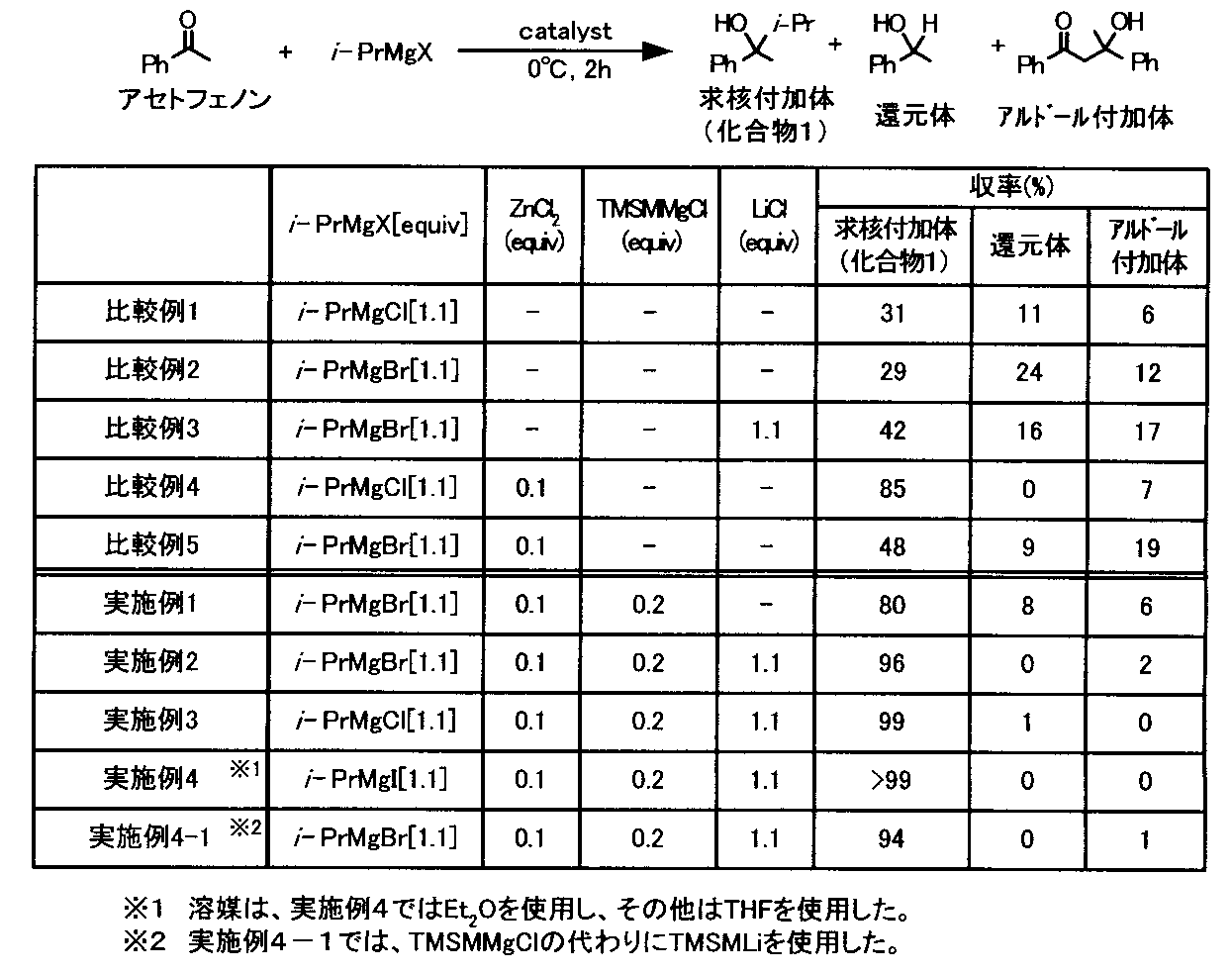
- Examples 1 to 4-1, Comparative Examples 1 to 5 In Examples 1 to 4-1 and Comparative Examples 1 to 5, a Grignard reaction was carried out using the production conditions shown in Table 1 according to the general method described above to obtain Compound 1. The results are shown in Table 1. As is clear from Table 1, in Comparative Examples 1 and 2 in which the Grignard reaction was performed in a system in which none of ZnCl 2 , TMSCH 2 MgCl and LiCl existed, a large amount of reduced products and aldol adducts were formed, and nucleophilic adducts The yield of Compound 1 was low. In Comparative Example 3 in which LiCl was added to Comparative Example 2, the yield of Compound 1 was slightly improved, but it was not sufficient.
- Comparative Example 4 in which ZnCl 2 was added to Comparative Example 1, since the zinc-magnesium ate complex was formed in the system, the yield of Compound 1 was improved to 85%. However, the halogen of the Grignard reagent was replaced with bromine. In Comparative Example 5, the yield of Compound 1 was only 48%. For these reasons, ZnCl 2 has the effect of greatly improving the yield of Compound 1 when the halogen of the Grignard reagent is chlorine, but such an effect is rarely seen when the halogen is bromine. all right. The results were the same as for bromine when the halogen was replaced with iodine.
- Example 1 in which TMSCH 2 MgCl was added to Comparative Example 5, the yield of Compound 1 was greatly improved to 80% even if the halogen of the Grignard reagent was bromine.
- Example 2 in which LiCl was further added to the system, the yield of Compound 1 was further improved to 96%.
- Examples 3 and 4 where the halogen of the Grignard reagent was changed from bromine to chlorine or iodine, Compound 1 was obtained almost quantitatively.
- Comparative Example 4 using the zinc-magnesium ate complex of Patent Document 1 the nucleophilic adduct was obtained in a high yield of 85%, and TMSCH 2 MgCl and LiCl were added thereto.
- Example 3 a further yield improvement (99% yield) was observed. For this reason, when the Grignard reaction is performed in a system in which ZnCl 2 , TMSCH 2 MgCl and LiCl are present, any reaction other than the nucleophilic reaction (reduction reaction), regardless of whether the halogen of the Grignard reagent is chlorine, bromine or iodine. It was found that compound 1 was obtained in a high yield. In Example 4-1, in which TMSCH 2 MgCl of Example 2 was replaced with TMSCH 2 Li, as in Example 2, compound 1 was obtained in a high yield and reactions other than the nucleophilic reaction were suppressed. The spectral data of Compound 1 is shown below.
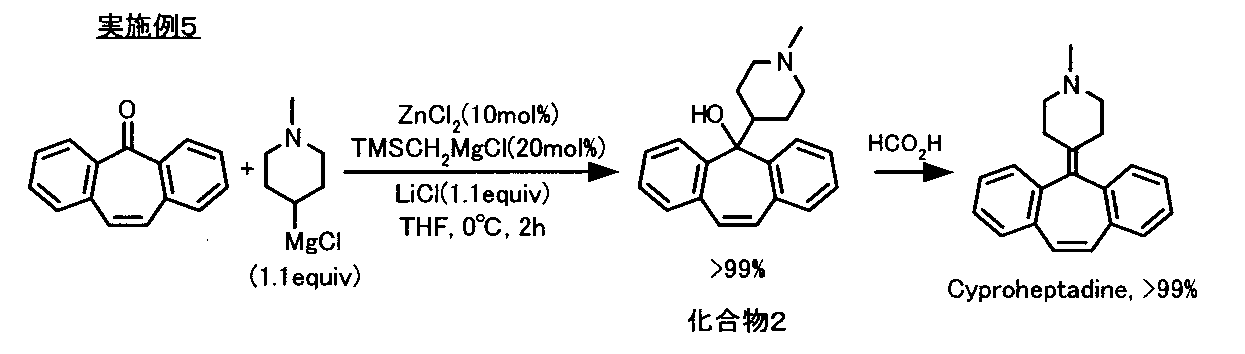
- Example 5 a synthetic intermediate of cyproheptadine (a serotonin receptor antagonist and having an antihistamine action) was produced. That is, according to the general method described above, the Grignard reaction was performed under the conditions shown in the following formula, and a tertiary alcohol (compound 2), which is a synthetic intermediate of cyproheptadine, was obtained almost quantitatively. The spectral data of Compound 2 is shown below. Compound 2 could also be induced to cycloheptazine by formic acid treatment (Tetrahedron Lett., 1988, vol. 29, p5701).
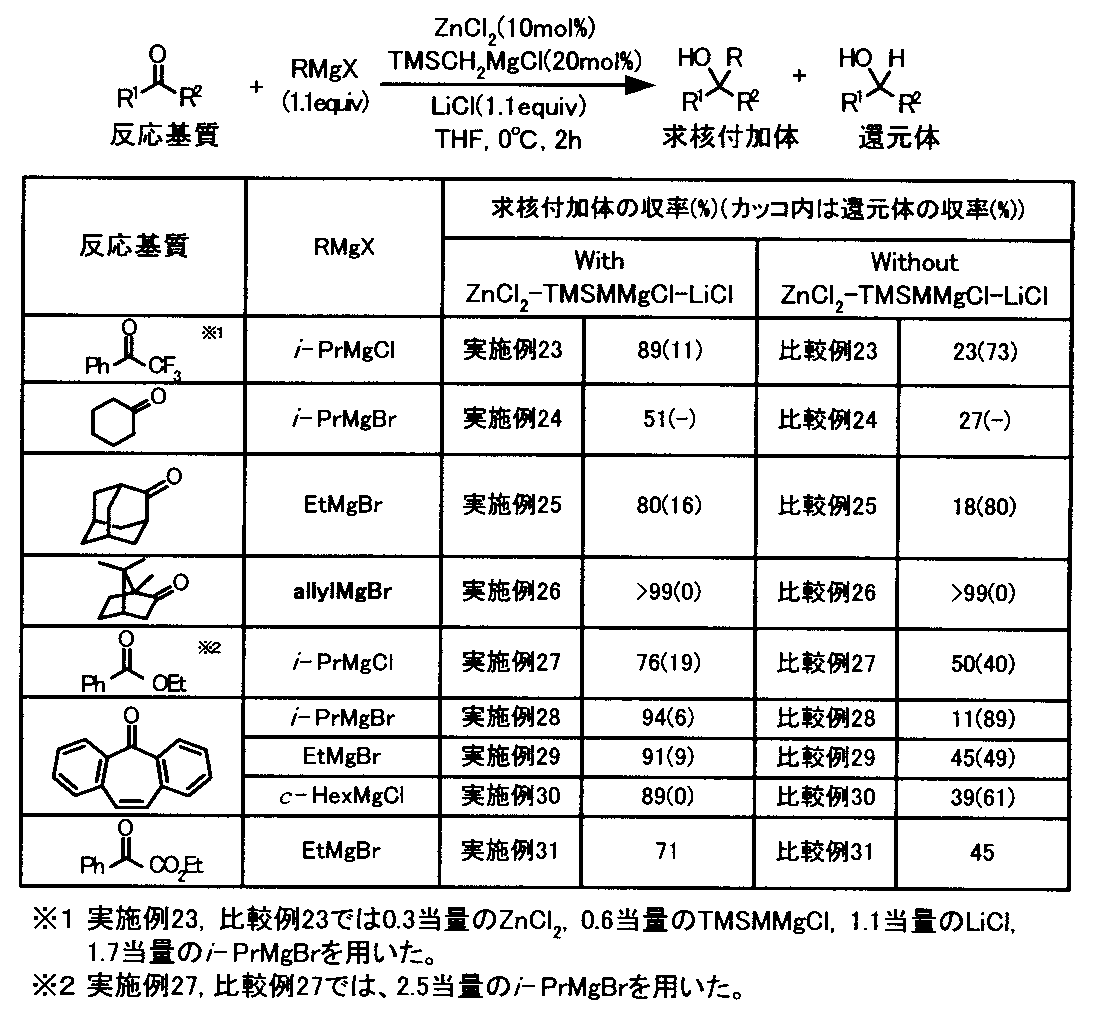
- Examples 6 to 31, Comparative Examples 6 to 31 Here, a wide variety of reaction substrates (ketones, esters, ketoesters) were used, and the yields of the corresponding tertiary alcohols were examined. That is, in Examples 6-31 and Comparative Examples 6-31, the type of reaction substrate was changed, and the Grignard reaction was performed using the conditions shown in Tables 2 and 3 according to the general method described above. A tertiary alcohol was obtained. The results are shown in Tables 2 and 3.
- Examples 6 to 31 are examples in which Grignard reaction was performed in a system in which ZnCl 2 , TMSCH 2 MgCl and LiCl were present, and Comparative Examples 6 to 31 were systems in which ZnCl 2 , TMSCH 2 MgCl and LiCl were not present. This is an example of reaction.
- Table 2 in the examples corresponding to the comparative examples in which the reductant is produced, the production of the reductant is suppressed and the yield of the intended tertiary alcohol is improved. Moreover, in the Example corresponding to the comparative example with the production
- Examples 22-1 and 22-2 are examples in which a Grignard reagent having an aryl group was used, and the intended tertiary alcohol was obtained in high yield in both cases.
- the structure of the tertiary alcohol obtained in each Example was determined by spectral data such as 1 HNMR, 13 CNMR, and HRMS.
- Examples 32-36, Comparative Examples 32-36 Here, various aldehydes, aldimines and amides were used as reaction substrates, and the yields of the corresponding nucleophilic adducts were examined. That is, in Examples 32 to 36, the Grignard reaction was carried out under the conditions shown in Table 4 according to the general method described above to obtain various nucleophilic adducts. The results are shown in Table 4. Examples 32 to 36 are examples in which Grignard reaction was performed in a system in which ZnCl 2 , TMSCH 2 MgCl and LiCl exist, and Comparative Examples 32 to 35 were systems in which ZnCl 2 , TMSCH 2 MgCl and LiCl were not present. This is an example of reaction.
- Example 32 corresponding to Comparative Example 32 in which a reduced form (primary alcohol) is produced when an aldehyde is used as a reaction substrate, the production of a reduced form (primary alcohol) is not achieved. It was suppressed and the yield of the desired secondary alcohol was improved.
- Example 33 corresponding to Comparative Example 33 in which the production of the reductant (primary alcohol) was zero and the secondary alcohol was obtained in a yield of 69%, the production of the reductant (primary alcohol) was The yield of secondary alcohol was significantly improved while maintaining zero.
- Example 36 using amide as the reaction substrate, a tertiary alcohol was obtained by two-step alkylation via a ketone, as in the ester substrate of Example 27.
- Example 37 to 40 magnesium compounds (R′MgCl) having various dummy groups R ′ were examined. That is, in Examples 37 to 40, benzophenone was used as a reaction substrate, EtMgCl was used as a Grignard reactant, and a Grignard reaction was carried out using the conditions shown in Table 5 to obtain a tertiary alcohol. The results are shown in Table 5. Table 5 also shows the results of Comparative Example 17 for reference.
- Example 41 to 45 various metal halides were examined. That is, in Examples 41 to 43, acetophenone was used as a reaction substrate, i-PrMgBr was used as a Grignard reactant, and the Grignard reaction was performed under the conditions shown in Table 6 to obtain a tertiary alcohol. For reference, the results of Examples 1 and 2 are also shown in Table 6. On the other hand, in Examples 44 and 45, benzophenone was used as a reaction substrate, EtMgBr was used as a Grignard reactant, and the Grignard reaction was performed under the conditions shown in Table 6 to obtain a tertiary alcohol. For reference, the results of Example 17 are also shown in Table 6. As is clear from these results, even when NaCl or LiBr was used as the metal halide in addition to LiCl, the production of the reductant was suppressed and the yield of the tertiary alcohol was improved.
- the present invention can be used mainly in the pharmaceutical and chemical industries, and can be used, for example, in producing various alcohols and amines used as raw materials for photoresists in addition to pharmaceuticals, agricultural chemicals, and cosmetic intermediates. .
Landscapes
- Chemical & Material Sciences (AREA)
- Organic Chemistry (AREA)
- Chemical Kinetics & Catalysis (AREA)
- Organic Low-Molecular-Weight Compounds And Preparation Thereof (AREA)
- Pyridine Compounds (AREA)
- Low-Molecular Organic Synthesis Reactions Using Catalysts (AREA)
- Heterocyclic Compounds Containing Sulfur Atoms (AREA)
- Hydrogenated Pyridines (AREA)
Abstract
アセトフェノンと臭化イソプロピルマグネシウムとの反応を、塩化亜鉛、塩化トリメチルシリルメチルマグネシウム(TMSCH2MgCl)及び塩化リチウムの存在下で行なったところ、従来の亜鉛-マグネシウムアート錯体を用いた場合と比べて、第2級アルコール(還元体)の生成やアセトフェノンのアルドール付加体の生成を抑制し、第3級アルコールが高収率で得られた。
Description
本発明は、グリニャール反応を利用した求核付加体の製造方法及び求核付加反応剤に関する。
従来より、カルボニル炭素に炭化水素基を付加する求核付加反応に用いられる求核試薬としては、アルキルリチウムやグリニャール反応剤などが広く知られている。また、医農薬の合成中間体やフォトレジスト原料として有用であることが知られている第3級アルコールの一般的な合成手法としては、アルキルリチウムやグリニャール反応剤などを用いてケトンのカルボニル炭素に炭化水素基を付加する方法が挙げられるが、この方法ではケトンが還元されることにより第2級アルコールが副生して所望の第3級アルコールの収率低下を招くといった問題がある。本発明者らは亜鉛-マグネシウムアート錯体がこうした既往の問題を克服することを発見し、ケトンのカルボニル炭素に炭化水素基を付加することにより第3級アルコールを高収率で得る方法を報告している(特許文献1)。
しかしながら、特許文献1では、適用できるグリニャール反応剤はほとんどが塩化物であった。このため、グリニャール反応剤の適用範囲を塩化物のみならず臭化物やヨウ化物に広げることが望まれていた。グリニャール反応剤の臭化物やヨウ化物は市販されているものが多く、調製も塩化物よりも容易な場合が多いからである。
本発明はこのような課題を解決するためになされたものであり、適用できるグリニャール反応剤の範囲を広げることができるようにすることを目的の一つとする。また、求核付加体を高収率で得ることを目的の一つとする。更に、副反応(例えば還元反応やアルドール反応などの、望む求核付加体以外の化合物を生ずる反応)を抑制することを目的の一つとする。
上述した目的を達成するために、本発明者らは、アセトフェノンとグリニャール反応剤である臭化イソプロピルマグネシウムとの反応を、塩化亜鉛、塩化トリメチルシリルメチルマグネシウム及び塩化リチウムの存在下で行なったところ、従来の亜鉛-マグネシウムアート錯体を用いた場合と比べて、第2級アルコール(還元体)の生成やアセトフェノンのアルドール付加体の生成が抑制され第3級アルコールが高収率で得られることやグリニャール反応剤のハロゲンが塩素でなくても好結果を与えることを見いだし、本発明を完成するに至った。
即ち、本発明の求核付加体の製造方法は、カルボニル炭素又はイミノ炭素を含む反応基質の前記カルボニル炭素又は前記イミノ炭素に炭化水素基を付加することにより求核付加体を製造する方法であって、前記反応基質と前記炭化水素基を有するグリニャール反応剤との求核付加反応を、ZnX1
2(X1は塩素、臭素又はヨウ素である)と(R3Si)nCH3-nMgX2又は(R3Si)nCH3-nLi(nは1又は2であり、3つのRは同じであっても異なっていてもよいアルキル基、アルコキシ基又はアリール基であり、X2は塩素、臭素又はヨウ素である)の存在下で行うものである。
また、本発明の求核付加反応剤は、炭化水素基を有するグリニャール試薬と、ZnX1
2(X1は塩素、臭素又はヨウ素である)と、(R3Si)nCH3-nMgX2又は(R3Si)nCH3-nLi(nは1又は2であり、3つのRは同じであっても異なっていてもよいアルキル基、アルコキシ基又はアリール基であり、X2は塩素、臭素又はヨウ素である)とを含むものである。
本発明の求核付加体の製造方法によれば、グリニャール反応剤の適用範囲を塩化物のみならず臭化物やヨウ化物に広げることができる。また、従来のグリニャール反応剤を利用した反応に比べて、求核付加体を高収率で得ることができる。更に、副反応(例えば基質をケトンとする場合には還元体である第2級アルコールの生成やアルドール付加体の生成など)を抑制することができる。一方、本発明の求核付加反応剤は、こうした求核付加体の製造方法に用いるのに適している。
本発明では、求核付加反応剤の活性が高くなっているが、その理由は以下のように考えられる(下記式参照)。すなわち、ZnX1
2と(R3Si)nCH3-nMgX2 とが反応して系内にZnR’2(但し、R’はダミー基であり、(R3Si)nCH3-n を表す)が生成し、これとグリニャール反応剤RMgX(但し、Rは炭化水素基、Xは塩素、臭素又はヨウ素)とが反応して[RR’2Zn]-[MgX]+が生成する(下記式の(a)参照)。次に、[RR’2Zn]-[MgX]+の求核基Rがσ-p電子供与によって活性化され(下記式の(b)参照)、亜鉛のとなりでダミー基R’に結合している炭素と亜鉛との結合Zn-Cαがd-σ*電子供与によって安定化される(下記式の(c)参照)。このような機構によって、求核基Rの求核性が高くなったと考えられる。なお、(R3Si)nCH3-nMgX2 の代わりに(R3Si)nCH3-nLiを用いた場合も下記式と同様の機構で反応が進行すると考えられる。

本発明の求核付加体の製造方法は、カルボニル炭素又はイミノ炭素を含む反応基質の前記カルボニル炭素又は前記イミノ炭素に炭化水素基を付加することにより求核付加体を製造する方法であって、前記反応基質と前記炭化水素基を有するグリニャール反応剤との求核付加反応を、ZnX1
2(X1は塩素、臭素又はヨウ素である)と(R3Si)nCH3-nMgX2又は(R3Si)nCH3-nLi(nは1又は2であり、3つのRは同じであっても異なっていてもよいアルキル基、アルコキシ基又はアリール基であり、X2は塩素、臭素又はヨウ素である)の存在下で行うものである。
本発明の求核付加体の製造方法において、カルボニル炭素を含む反応基質としては、例えばアルデヒド、ケトン、エステル、ケトエステル、アミドなどが挙げられるが、このうちケトン、エステルが好ましい。ケトンやエステルを反応基質として用いた場合には、医農薬の合成中間体やフォトレジスト原料などに有用な第3級アルコールを製造することができる。ケトンとしては、特に限定されるものではないが、例えばベンゾフェノンのようにカルボニル炭素に2つの芳香族炭化水素が結合したもの;アセトフェノンやプロピオフェノン、アセトナフトンのようにカルボニル炭素に脂肪族炭化水素(ペルフルオロアルキル基を含む)と芳香族炭化水素とが結合したもの;シクロヘキサノンやシクロペンタノン、1-又は2-インダノン、1-又は2-テトラロン、アダマンタノンなどのようにカルボニル炭素が脂環式炭化水素の環を構成するもの;メチル-2-チエニルケトンやメチル-3-チエニルケトン、メチル-2-ピリジルケトンのようにカルボニル炭素にヘテロ環と脂肪族炭化水素とが結合したもの;2,2’-ジチエニルケトンのようにカルボニル炭素にヘテロ環が結合したものなどが挙げられる。また、エステルとしては、特に限定されるものではないが、例えば安息香酸エチルのように芳香族カルボン酸エステルなどが挙げられる。一方、イミノ炭素を含む反応基質としては、例えばアルジミンやケチミンなどが挙げられるが、このうちアルジミンが好ましい。アルジミンとしては、特に限定されるものではないが、例えば芳香族アルデヒドと第1級アミン(脂肪族アミン、芳香族アミンなど)との反応によって得られるものが挙げられる。
本発明の求核付加体の製造方法において、グリニャール反応剤の炭化水素基としては、アルキル基、シクロアルキル基、アルケニル基、シクロアルケニル基、アルキニル基、アリール基などが挙げられる。アルキル基としては、例えばメチル基、エチル基、n-プロピル基、イソプロピル基、n-ブチル基、イソブチル基、sec-ブチル基などが挙げられる。シクロアルキル基としては、例えばシクロプロピル基、シクロペンチル基、シクロヘキシル基、シクロヘプチル基などが挙げられる。アルケニル基としては、例えばビニル基、アリル基、イソプロペニル基、1-ブテニル基、2-ブテニル基、3-ブテニル基、2-メチル-1-ブテニル基、3-メチル-1-ブテニル基、スチリル基などが挙げられる。シクロアルケニル基としては、例えば2-シクロペンテン-1-イル、3-シクロペンテン-1-イル、2-シクロヘキセン-1-イル、3-シクロヘキセン-1-イルなどが挙げられる。アルキニル基としては、例えばエチニル基、2-プロピニル基などが挙げられる。アリール基としては、例えばフェニル基、トリル基、4-フルオロフェニル基、ナフチル基、アントリル基、フェナントリル基、ピレニル基などが挙げられる。
本発明の求核付加体の製造方法において、ZnX1
2は、X1が塩素、臭素又はヨウ素であり、このうちX1が塩素であることが好ましい。このZnX1
2の使用量は、カルボニル炭素又はイミノ炭素を含む反応基質に対して1~20mol%が好ましく、5~15mol%がより好ましい。
本発明の求核付加体の製造方法は、(R3Si)nCH3-nMgX2又は(R3Si)nCH3-nLi(nは1又は2であり、3つのRは同じであっても異なっていてもよいアルキル基、アルコキシ基又はアリール基であり、X2は塩素、臭素又はヨウ素である)を用いるものである。ここで、アルキル基としては、前述したものを使用可能である。アルコキシ基としては、例えばメトキシ基、エトキシ基、n-プロポキシ基、イソプロポキシ基、n-ブトキシ基、イソブトキシ基、sec-ブトキシ基、tert-ブトキシ基などが挙げられる。アリール基としては、フェニル基、トリル基、ナフチル基などが挙げられる。(R3Si)nCH3-nMgX2又は(R3Si)nCH3-nLi の使用量は、ZnX1に対して0.5~2倍モルが好ましく、2倍モルがより好ましい。
本発明の求核付加体の製造方法では、グリニャール反応剤による求核反応を、更にMX3(MはLi、Na、Kであり、X3は塩素、臭素又はヨウ素である)の存在下で行うことが好ましい。これにより、副反応の生成が一層抑制され、結果として目的とする求核付加体の収率が一層高くなる。こうしたMX3としては、LiCl,LiBr又はNaClが好ましく、LiClがより好ましい。LiClを用いた場合には、他の塩と一線を画した効果が得られるが、その理由は、いわゆる塩効果のほかに、グリニャール反応剤のハロゲンがLiClの塩素原子に置き換わるハロゲン交換が起き、そのハロゲン交換後の高活性なグリニャール反応剤が求核付加反応に寄与するためと考えられる。また、MX3の使用量は、グリニャール反応剤に対して0.9~1.1倍モル使用するのが好ましい。
本発明の求核付加体の製造方法において、反応溶媒はエーテル系溶媒を使用するのが好ましい。エーテル系溶媒としては、例えばジエチルエーテル、テトラヒドロフラン(THF)などのほか、これらと炭化水素系溶媒(ヘキサンなど)との混合溶媒などが挙げられる。
本発明の求核付加体の製造方法において、反応温度は目的生成物である求核付加体と副生成物である還元体との比率や単位時間当たりの求核付加体の生成率などを考慮して適宜設定すればよいが、例えば-78~100℃の範囲で設定するのが好ましく、-20~50℃の範囲で設定するのがより好ましく、0~30℃の範囲で設定するのが更に好ましい。
本発明の求核付加体の製造方法において、反応時間は、反応基質、反応温度などに応じて適宜設定すればよいが、通常は数分~数10時間である。なお、求核付加反応は反応基質が完全に消費されるまで行ってもよいが、反応が進むにつれて反応基質の消失速度が極端に遅くなる場合には反応基質が完全に消費されなくても反応を終了して反応生成物を取り出した方が好ましい場合もある。
本発明の求核付加体の製造方法において、求核付加体を単離するには、通常知られている単離手法を適用すればよい。例えば、反応混合物に水と有機溶媒とを加えて分液ロートで水層と有機層に分液し、有機層をろ過及び濃縮した後、カラムクロマトグラムなどで精製することにより、目的とする求核付加体を単離することができる。
また、本発明の求核付加反応剤は、炭化水素基を有するグリニャール試薬と、ZnX1
2(X1は塩素、臭素又はヨウ素である)と、(R3Si)nCH3-nMgX2又は(R3Si)nCH3-nLi(nは1又は2であり、3つのRは同じであっても異なっていてもよいアルキル基、アルコキシ基又はアリール基であり、X2は塩素、臭素又はヨウ素である)とを含むものである。
ここで、グリニャール反応剤の炭化水素基やZnX1
2 、(R3Si)nCH3-nMgX2又は(R3Si)nCH3-nLi については、上述したものを使用可能である。また、ZnX1
2の含有量はグリニャール反応剤に対して1~20mol%が好ましく、5~15mol%がより好ましい。(R3Si)nCH3-nMgX2又は(R3Si)nCH3-nLi の含有量はZnX1
2に対して0.5~2倍モルが好ましく、2倍モルがより好ましい。この求核付加反応剤は、更にMX3(MはLi、Na、Kであり、X3は塩素、臭素又はヨウ素である)を含んでいることが好ましい。ここで、MX3については、上述したものを使用可能である。また、MX3の含有量はグリニャール反応剤に対して0.9~1.1倍モルが好ましい。この求核付加反応剤は、反応溶媒と同じ溶媒に溶解されていることが好ましい。
[一般的手法]
本発明の求核付加体の製造方法の一般的手法を以下に示す。窒素置換したシュレンク反応容器に、ZnCl2 (40.8mg,0.30mmol)を加えて、減圧下(<5mmHg)でヒートガンにより溶融乾燥する。次いでLiCl(139.9mg,3.3mmol)を加え、再び減圧下(<5Torr)でヒートガンにより溶融乾燥する。次いでMe3SiCH2MgCl(1M in Et2O,0.60mL,0.60mmol)を加えて室温で15分撹拌する。Me3SiCH2-はTMSCH2またはTMSMと略す。さらにグリニャール反応剤であるハロゲン化アルキルマグネシウムRMgX(0.5-2.0M in THF or Et2O,3.3mmol)を加えて、室温で45分攪拌する。なお、グリニャール反応剤の濃度が1Mを超える場合には、そのグリニャール反応剤を系内で1Mになるように希釈し、濃度が1M以下の場合には、直接使用する。その後、混合液を0℃に冷却し、反応基質(3.0mmol)をシリシンジポンプを用いて1時間掛けて加え、さらに2時間撹拌する。なお、反応基質が固体の場合、前もってTHF(約2mL)に溶かしておく。反応終了をTLCで確認し、飽和塩化アンモニウム水溶液(10mL)を加えて反応を停止する。酢酸エチルで抽出し(10mL×3)、抽出した有機層を飽和塩化ナトリウム水溶液(10mL)で洗浄し、硫酸マグネシウムで乾燥後、ろ過、減圧濃縮する。シリカゲルカラムクロマトグラフィー(展開=ヘキサン/酢酸エチル)にて生成物を分取・精製し、求核付加体を得る。
本発明の求核付加体の製造方法の一般的手法を以下に示す。窒素置換したシュレンク反応容器に、ZnCl2 (40.8mg,0.30mmol)を加えて、減圧下(<5mmHg)でヒートガンにより溶融乾燥する。次いでLiCl(139.9mg,3.3mmol)を加え、再び減圧下(<5Torr)でヒートガンにより溶融乾燥する。次いでMe3SiCH2MgCl(1M in Et2O,0.60mL,0.60mmol)を加えて室温で15分撹拌する。Me3SiCH2-はTMSCH2またはTMSMと略す。さらにグリニャール反応剤であるハロゲン化アルキルマグネシウムRMgX(0.5-2.0M in THF or Et2O,3.3mmol)を加えて、室温で45分攪拌する。なお、グリニャール反応剤の濃度が1Mを超える場合には、そのグリニャール反応剤を系内で1Mになるように希釈し、濃度が1M以下の場合には、直接使用する。その後、混合液を0℃に冷却し、反応基質(3.0mmol)をシリシンジポンプを用いて1時間掛けて加え、さらに2時間撹拌する。なお、反応基質が固体の場合、前もってTHF(約2mL)に溶かしておく。反応終了をTLCで確認し、飽和塩化アンモニウム水溶液(10mL)を加えて反応を停止する。酢酸エチルで抽出し(10mL×3)、抽出した有機層を飽和塩化ナトリウム水溶液(10mL)で洗浄し、硫酸マグネシウムで乾燥後、ろ過、減圧濃縮する。シリカゲルカラムクロマトグラフィー(展開=ヘキサン/酢酸エチル)にて生成物を分取・精製し、求核付加体を得る。
[実施例1~4-1,比較例1~5]
実施例1~4-1,比較例1~5では、上述した一般的手法に準じて、表1に示す製造条件を採用してグリニャール反応を行ない、化合物1を得た。その結果を表1に示す。表1から明らかなように、ZnCl2、TMSCH2MgCl及びLiClのいずれも存在しない系でグリニャール反応を行なった比較例1,2では、還元体やアルドール付加体が多く生成し、求核付加体である化合物1の収率は低かった。また、比較例2にLiClを添加した比較例3では、化合物1の収率が若干向上したが、十分とはいえなかった。一方、比較例1にZnCl2を添加した比較例4では、亜鉛-マグネシウムアート錯体が系内で生成するため化合物1の収率は85%に向上したが、グリニャール反応剤のハロゲンを臭素に代えた比較例5では、化合物1の収率は48%にとどまった。こうしたことから、ZnCl2は、グリニャール反応剤のハロゲンが塩素の場合には化合物1の収率を大幅に向上させる効果があるが、ハロゲンが臭素の場合にはそうした効果はあまりみられないことがわかった。なお、ハロゲンをヨウ素に代えた場合も臭素と同様の結果であった。
実施例1~4-1,比較例1~5では、上述した一般的手法に準じて、表1に示す製造条件を採用してグリニャール反応を行ない、化合物1を得た。その結果を表1に示す。表1から明らかなように、ZnCl2、TMSCH2MgCl及びLiClのいずれも存在しない系でグリニャール反応を行なった比較例1,2では、還元体やアルドール付加体が多く生成し、求核付加体である化合物1の収率は低かった。また、比較例2にLiClを添加した比較例3では、化合物1の収率が若干向上したが、十分とはいえなかった。一方、比較例1にZnCl2を添加した比較例4では、亜鉛-マグネシウムアート錯体が系内で生成するため化合物1の収率は85%に向上したが、グリニャール反応剤のハロゲンを臭素に代えた比較例5では、化合物1の収率は48%にとどまった。こうしたことから、ZnCl2は、グリニャール反応剤のハロゲンが塩素の場合には化合物1の収率を大幅に向上させる効果があるが、ハロゲンが臭素の場合にはそうした効果はあまりみられないことがわかった。なお、ハロゲンをヨウ素に代えた場合も臭素と同様の結果であった。
これに対して、比較例5にTMSCH2MgClを添加した実施例1では、グリニャール反応剤のハロゲンが臭素であっても化合物1の収率は80%と大幅に向上し、この実施例1の系に更にLiClを添加した実施例2では、化合物1の収率は96%と更に向上した。また、グリニャール反応剤のハロゲンを臭素から塩素やヨウ素に代えた実施例3,4では、化合物1がほぼ定量的に得られた。更に、特許文献1の亜鉛-マグネシウムアート錯体を用いた比較例4では、求核付加体が収率85%という高収率で得られているが、これにTMSCH2MgClとLiClとを添加した実施例3では、更なる収率の改善(収率99%)が見られた。こうしたことから、ZnCl2、TMSCH2MgCl及びLiClが存在する系でグリニャール反応を行なうと、グリニャール反応剤のハロゲンが塩素、臭素及びヨウ素のいずれであっても、求核反応以外の反応(還元反応やアルドール反応)が抑制され、化合物1が高収率で得られることがわかった。実施例2のTMSCH2MgClをTMSCH2Liに代えた実施例4-1でも、実施例2と同様、化合物1が高収率で得られると共に求核反応以外の反応が抑制された。化合物1のスペクトルデータを以下に示す。
化合物1:1H NMR (300 MHz, CDCl3) δ 0.80 (d, J = 6.9 Hz, 3H), 0.89 (d, J = 6.9 Hz, 3H), 1.53 (s, 3H), 1.56 (s, 1H), 2.02 (sept, J = 6.9 Hz, 1H), 7.20-7.45 (m, 5H). 13C NMR (75 MHz, CDCl3) δ 17.2, 17.4, 26.7, 38.6, 77.8, 125.2, 126.4, 127.8, 147.8. HRMS(FAB+) calcd for C11H15 [M-OH]+ 147.1174, found 147.1170.
[実施例5]
ここでは、シプロヘプタジン(セロトニン受容体拮抗体であり抗ヒスタミン作用を有する)の合成中間体を製造した。すなわち、上述した一般的手法に準じて、下記式に示す条件を採用してグリニャール反応を行ない、シプロヘプタジンの合成中間体である第3級アルコール(化合物2)をほぼ定量的に得た。化合物2のスペクトルデータを以下に示す。なお、化合物2は、ギ酸処理(Tetrahedron Lett., 1988, vol.29, p5701)によりシクロヘプタジンに誘導することもできた。
ここでは、シプロヘプタジン(セロトニン受容体拮抗体であり抗ヒスタミン作用を有する)の合成中間体を製造した。すなわち、上述した一般的手法に準じて、下記式に示す条件を採用してグリニャール反応を行ない、シプロヘプタジンの合成中間体である第3級アルコール(化合物2)をほぼ定量的に得た。化合物2のスペクトルデータを以下に示す。なお、化合物2は、ギ酸処理(Tetrahedron Lett., 1988, vol.29, p5701)によりシクロヘプタジンに誘導することもできた。
化合物2:1H NMR (300 MHz, CDCl3) δ 0.76-1.06 (m, 10H), 2.38 (s, 1H), 2.52 (m, 1H), 6.95 (s, 2H), 7.26 (td, J = 7.5, 1.2 Hz, 2H), 7.32 (dd, J = 7.5, 1.5 Hz, 2H), 7.41 (td, J = 8.1, 1.5 Hz, 2H), 7.92 (dd, J = 8.1, 1.2 Hz, 2H). 13C NMR (75 MHz, CDCl3) δ 26.3, 26.5, 26.8, 38.3, 79.2, 124.8, 126.2, 128.3, 129.4, 131.4, 132.3, 142.2. HRMS(FAB+) calcd for C21H21 [M-OH]+ 273.1643, found 273.1642.
[実施例6~31,比較例6~31]
ここでは、多種多様の反応基質(ケトン、エステル、ケトエステル)を用い、それに対応する第3級アルコールの収率を検討した。すなわち、実施例6~31,比較例6~31では、反応基質の種類を変え、上述した一般的手法に準じて表2及び表3に示す条件を採用してグリニャール反応を行ない、各種の第3級アルコールを得た。その結果を表2及び表3に示す。実施例6~31は、ZnCl2、TMSCH2MgCl及びLiClが存在する系でグリニャール反応を行なった例であり、比較例6~31は、ZnCl2、TMSCH2MgCl及びLiClが存在しない系でグリニャール反応を行なった例である。表2から明らかなように、還元体が生成する比較例に対応する実施例では、還元体の生成が抑制され、目的とする第3級アルコールの収率が向上した。また、還元体の生成がゼロの比較例に対応する実施例では、還元体の生成はゼロのまま、目的とする第3級アルコールの収率が向上した。実施例22-1,22-2はアリール基を有するグリニャール反応剤を使用した例であるが、いずれも目的とする第3級アルコールが高収率で得られた。なお、各実施例で得られた第3級アルコールは、1HNMR、13CNMR、HRMSなどのスペクトルデータにより構造を決定した。
ここでは、多種多様の反応基質(ケトン、エステル、ケトエステル)を用い、それに対応する第3級アルコールの収率を検討した。すなわち、実施例6~31,比較例6~31では、反応基質の種類を変え、上述した一般的手法に準じて表2及び表3に示す条件を採用してグリニャール反応を行ない、各種の第3級アルコールを得た。その結果を表2及び表3に示す。実施例6~31は、ZnCl2、TMSCH2MgCl及びLiClが存在する系でグリニャール反応を行なった例であり、比較例6~31は、ZnCl2、TMSCH2MgCl及びLiClが存在しない系でグリニャール反応を行なった例である。表2から明らかなように、還元体が生成する比較例に対応する実施例では、還元体の生成が抑制され、目的とする第3級アルコールの収率が向上した。また、還元体の生成がゼロの比較例に対応する実施例では、還元体の生成はゼロのまま、目的とする第3級アルコールの収率が向上した。実施例22-1,22-2はアリール基を有するグリニャール反応剤を使用した例であるが、いずれも目的とする第3級アルコールが高収率で得られた。なお、各実施例で得られた第3級アルコールは、1HNMR、13CNMR、HRMSなどのスペクトルデータにより構造を決定した。

[実施例32~36、比較例32~36]
ここでは、反応基質として種々のアルデヒド、アルジミン及びアミドを用い、それに対応する求核付加体の収率を検討した。すなわち、実施例32~36では、上述した一般的手法に準じて表4に示す条件を採用してグリニャール反応を行ない、各種の求核付加体を得た。その結果を表4に示す。実施例32~36は、ZnCl2、TMSCH2MgCl及びLiClが存在する系でグリニャール反応を行なった例であり、比較例32~35は、ZnCl2、TMSCH2MgCl及びLiClが存在しない系でグリニャール反応を行なった例である。
ここでは、反応基質として種々のアルデヒド、アルジミン及びアミドを用い、それに対応する求核付加体の収率を検討した。すなわち、実施例32~36では、上述した一般的手法に準じて表4に示す条件を採用してグリニャール反応を行ない、各種の求核付加体を得た。その結果を表4に示す。実施例32~36は、ZnCl2、TMSCH2MgCl及びLiClが存在する系でグリニャール反応を行なった例であり、比較例32~35は、ZnCl2、TMSCH2MgCl及びLiClが存在しない系でグリニャール反応を行なった例である。
表4から明らかなように、反応基質としてアルデヒドを用いた場合、還元体(第1級アルコール)が生成する比較例32に対応する実施例32では、還元体(第1級アルコール)の生成が抑制され、目的とする第2級アルコールの収率が向上した。また、還元体(第1級アルコール)の生成がゼロで第2級アルコールが収率69%で得られた比較例33に対応する実施例33では、還元体(第1級アルコール)の生成はゼロのままで第2級アルコールの収率が大幅に向上した。
反応基質としてアルジミンを用いた場合、実施例34,35では、比較例34,35に比べて目的とする第2級アミンの収率が向上した。
反応基質としてアミドを用いた実施例36では、実施例27のエステル基質と同様、ケトンを経由する2段階アルキル化により第3級アルコールが得られた。

[実施例37~40]
ここでは、種々のダミー基R’を持つマグネシウム化合物(R’MgCl)について検討した。すなわち、実施例37~40では、反応基質としてベンゾフェノン、グリニャール反応剤としてEtMgClを用い、表5に示す条件を採用してグリニャール反応を行ない、第3級アルコールを得た。その結果を表5に示す。なお、表5には、参考までに比較例17の結果も示した。表5から明らかなように、ダミー基R’として、Si上の置換基がメチル基(アルキル基)、イソプロポキシ基(アルコキシ基)、フェニル基(アリール基)のいずれのものを用いた場合でも、還元体の生成が抑制され、第3級アルコールの収率が向上した。
ここでは、種々のダミー基R’を持つマグネシウム化合物(R’MgCl)について検討した。すなわち、実施例37~40では、反応基質としてベンゾフェノン、グリニャール反応剤としてEtMgClを用い、表5に示す条件を採用してグリニャール反応を行ない、第3級アルコールを得た。その結果を表5に示す。なお、表5には、参考までに比較例17の結果も示した。表5から明らかなように、ダミー基R’として、Si上の置換基がメチル基(アルキル基)、イソプロポキシ基(アルコキシ基)、フェニル基(アリール基)のいずれのものを用いた場合でも、還元体の生成が抑制され、第3級アルコールの収率が向上した。

[実施例41~45]
ここでは、種々のハロゲン化金属について検討した。すなわち、実施例41~43では、反応基質としてアセトフェノン、グリニャール反応剤としてi-PrMgBrを用い、表6に示す条件を採用してグリニャール反応を行ない、第3級アルコールを得た。参考までに、実施例1,2の結果も表6に示した。一方、実施例44,45では、反応基質としてベンゾフェノン、グリニャール反応剤としてEtMgBrを用い、表6に示す条件を採用してグリニャール反応を行ない、第3級アルコールを得た。参考までに、実施例17の結果も表6に示した。これらの結果から明らかなように、ハロゲン化金属として、LiCl以外にNaClやLiBrを用いた場合でも、還元体の生成が抑制され、第3級アルコールの収率が向上した。
ここでは、種々のハロゲン化金属について検討した。すなわち、実施例41~43では、反応基質としてアセトフェノン、グリニャール反応剤としてi-PrMgBrを用い、表6に示す条件を採用してグリニャール反応を行ない、第3級アルコールを得た。参考までに、実施例1,2の結果も表6に示した。一方、実施例44,45では、反応基質としてベンゾフェノン、グリニャール反応剤としてEtMgBrを用い、表6に示す条件を採用してグリニャール反応を行ない、第3級アルコールを得た。参考までに、実施例17の結果も表6に示した。これらの結果から明らかなように、ハロゲン化金属として、LiCl以外にNaClやLiBrを用いた場合でも、還元体の生成が抑制され、第3級アルコールの収率が向上した。

本出願は、2009年3月4日に出願された日本国特許出願第2009-051013号を優先権主張の基礎としており、引用によりその内容の全てが本明細書に含まれる。
本発明は、主に薬品化学産業に利用可能であり、例えば医薬品や農薬、化粧品の中間体のほかフォトレジストの原料などとして利用される種々のアルコールやアミンを製造する際に利用することができる。
Claims (8)
- カルボニル炭素又はイミノ炭素を含む反応基質の前記カルボニル炭素又は前記イミノ炭素に炭化水素基を付加することにより求核付加体を製造する方法であって、
前記反応基質と前記炭化水素基を有するグリニャール反応剤との求核付加反応を、ZnX1 2(X1は塩素、臭素又はヨウ素である)と(R3Si)nCH3-nMgX2又は(R3Si)nCH3-nLi(nは1又は2であり、3つのRは同じであっても異なっていてもよいアルキル基、アルコキシ基又はアリール基であり、X2は塩素、臭素又はヨウ素である)の存在下で行う、求核付加体の製造方法。 - ZnX1 2を前記反応基質に対して1~20mol%使用し、(R3Si)nCH3-nMgX2 又は(R3Si)nCH3-nLiをZnX1 2に対して0.5~2倍モル使用する、請求項1に記載の求核付加体の製造方法。
- 前記求核付加反応を、更にMX3(MはLi、Na又はKであり、X3は塩素、臭素又はヨウ素である)の存在下で行う、請求項1又は2に記載の求核付加体の製造方法。
- MX3を前記グリニャール反応剤に対して0.9~1.1倍モル使用する、請求項3に記載の求核付加体の製造方法。
- 炭化水素基を有するグリニャール試薬と、ZnX1 2(X1は塩素、臭素又はヨウ素である)と、(R3Si)nCH3-nMgX2又は(R3Si)nCH3-nLi(nは1又は2であり、3つのRは同じであっても異なっていてもよいアルキル基、アルコキシ基又はアリール基であり、X2は塩素、臭素又はヨウ素である)とを含む、求核付加反応剤。
- ZnX1 2を前記グリニャール反応剤に対して1~20mol%含み、(R3Si)nCH3-nMgX2 又は(R3Si)nCH3-nLiをZnX1に対して0.5~2倍モル含む、請求項5に記載の求核付加反応剤。
- 更にMX3(MはLi、Na又はKであり、X3は塩素、臭素又はヨウ素である)を含む、請求項5又は6に記載の求核付加反応剤。
- MX3を前記グリニャール反応剤に対して0.9~1.1倍モル含む、請求項7に記載の求核付加反応剤。
Priority Applications (1)
| Application Number | Priority Date | Filing Date | Title |
|---|---|---|---|
| JP2011502692A JP5585992B2 (ja) | 2009-03-04 | 2010-02-03 | グリニャール反応を利用した求核付加体の製造方法及び求核付加反応剤 |
Applications Claiming Priority (2)
| Application Number | Priority Date | Filing Date | Title |
|---|---|---|---|
| JP2009-051013 | 2009-03-04 | ||
| JP2009051013 | 2009-03-04 |
Publications (1)
| Publication Number | Publication Date |
|---|---|
| WO2010100990A1 true WO2010100990A1 (ja) | 2010-09-10 |
Family
ID=42709553
Family Applications (1)
| Application Number | Title | Priority Date | Filing Date |
|---|---|---|---|
| PCT/JP2010/051493 Ceased WO2010100990A1 (ja) | 2009-03-04 | 2010-02-03 | グリニャール反応を利用した求核付加体の製造方法及び求核付加反応剤 |
Country Status (2)
| Country | Link |
|---|---|
| JP (1) | JP5585992B2 (ja) |
| WO (1) | WO2010100990A1 (ja) |
Cited By (2)
| Publication number | Priority date | Publication date | Assignee | Title |
|---|---|---|---|---|
| JP2012236818A (ja) * | 2011-04-25 | 2012-12-06 | Sumitomo Chemical Co Ltd | アミン化合物の製造方法 |
| WO2013041234A1 (de) | 2011-09-21 | 2013-03-28 | Creative Balloons Maschinenbau Gmbh & Co. Kg | Vorrichtung und verfahren zur prozess- und zyklusoptimierten herstellung von hohlkörpern aus einem schlauchförmigen rohling |
Citations (1)
| Publication number | Priority date | Publication date | Assignee | Title |
|---|---|---|---|---|
| WO2008134890A1 (en) * | 2007-05-07 | 2008-11-13 | Valorisation-Recherche, Societe En Commandite | Methods for preparing diorganozinc compounds |
Family Cites Families (1)
| Publication number | Priority date | Publication date | Assignee | Title |
|---|---|---|---|---|
| JP4783633B2 (ja) * | 2004-02-10 | 2011-09-28 | 独立行政法人科学技術振興機構 | 芳香族化合物の製造方法 |
-
2010
- 2010-02-03 WO PCT/JP2010/051493 patent/WO2010100990A1/ja not_active Ceased
- 2010-02-03 JP JP2011502692A patent/JP5585992B2/ja not_active Expired - Fee Related
Patent Citations (1)
| Publication number | Priority date | Publication date | Assignee | Title |
|---|---|---|---|---|
| WO2008134890A1 (en) * | 2007-05-07 | 2008-11-13 | Valorisation-Recherche, Societe En Commandite | Methods for preparing diorganozinc compounds |
Non-Patent Citations (2)
| Title |
|---|
| ALEXANDRE COTE ET AL., JOURNAL OF THE AMERICAN CHEMICAL SOCIETY, vol. 130, 2008, pages 2771 - 2773 * |
| DIRK BROHM ET AL., JOURNAL OF THE AMERICAN CHEMICAL SOCIETY, vol. 124, 2002, pages 13171 - 13178 * |
Cited By (2)
| Publication number | Priority date | Publication date | Assignee | Title |
|---|---|---|---|---|
| JP2012236818A (ja) * | 2011-04-25 | 2012-12-06 | Sumitomo Chemical Co Ltd | アミン化合物の製造方法 |
| WO2013041234A1 (de) | 2011-09-21 | 2013-03-28 | Creative Balloons Maschinenbau Gmbh & Co. Kg | Vorrichtung und verfahren zur prozess- und zyklusoptimierten herstellung von hohlkörpern aus einem schlauchförmigen rohling |
Also Published As
| Publication number | Publication date |
|---|---|
| JP5585992B2 (ja) | 2014-09-10 |
| JPWO2010100990A1 (ja) | 2012-09-06 |
Similar Documents
| Publication | Publication Date | Title |
|---|---|---|
| US20180044358A1 (en) | Method for producing dialkylaminosilane | |
| US9975912B2 (en) | Method for producing (E,Z)-7,9-dodecadienyl-1-acetate | |
| US20040106818A1 (en) | Process for the preparation of cyclohexanol derivatives | |
| JPH08208581A (ja) | N,N′−ジ置換されたp−キノンジイミンの製造方法、該ジイミンからなる安定剤、オルガノシラン組成物、その安定化法、および相転移触媒法 | |
| JP5585992B2 (ja) | グリニャール反応を利用した求核付加体の製造方法及び求核付加反応剤 | |
| JP6086163B2 (ja) | 2’−トリフルオロメチル基置換芳香族ケトンの製造方法 | |
| JP5678977B2 (ja) | 高純度ジイソプロピル亜鉛及びその製法 | |
| JP3893180B2 (ja) | (3−アルコキシフエニル)マグネシウムクロライドの製造方法及びその使用方法 | |
| CN106045831A (zh) | 一种假性甲基紫罗兰酮的绿色合成方法 | |
| JP3905340B2 (ja) | 有機金属化合物の新規調製法 | |
| JP7018327B2 (ja) | ベンズアルデヒド誘導体の製造方法 | |
| JP2007290973A (ja) | 亜鉛−マグネシウムアート錯体を含む求核試薬及びそれを使用する求核付加体の製造方法 | |
| JP3477631B2 (ja) | 1,3−ビス(3−アミノプロピル)−1,1,3,3−テトラオルガノジシロキサンの精製方法 | |
| JP4873502B2 (ja) | 亜鉛−マグネシウムアート錯体を含む求核試薬及びそれを使用する求核付加体の製造方法 | |
| JP2014214152A (ja) | 非対称ジアルキルアミン化合物の製造方法 | |
| JP2015017073A (ja) | 4−メチルテトラヒドロピランを溶媒とするアルキルグリニャール試薬の製造方法 | |
| JP4243397B2 (ja) | 新規な不飽和2級アルコールおよびその製造法 | |
| US4524221A (en) | Process for the production of acyloins | |
| JP4366854B2 (ja) | 12−アミノ−4,8−ドデカジエンニトリル及びその製造法 | |
| JP2016169165A (ja) | 2,6−ジフルオロベンゾイル蟻酸化合物の製造方法 | |
| US4556723A (en) | Process for the production of acyloins | |
| JP2014076981A (ja) | 非対称ジアルキルアミン化合物の製造方法 | |
| JP2010209017A (ja) | 芳香族アミン化合物の製造方法 | |
| JP2016069299A (ja) | 2−トリフルオロメチル安息香酸エステルの製造方法 | |
| JP2011190216A (ja) | (トリフルオロメチル)アルキルケトンの製造方法 |
Legal Events
| Date | Code | Title | Description |
|---|---|---|---|
| 121 | Ep: the epo has been informed by wipo that ep was designated in this application |
Ref document number: 10748587 Country of ref document: EP Kind code of ref document: A1 |
|
| DPE1 | Request for preliminary examination filed after expiration of 19th month from priority date (pct application filed from 20040101) | ||
| WWE | Wipo information: entry into national phase |
Ref document number: 2011502692 Country of ref document: JP |
|
| NENP | Non-entry into the national phase |
Ref country code: DE |
|
| 122 | Ep: pct application non-entry in european phase |
Ref document number: 10748587 Country of ref document: EP Kind code of ref document: A1 |