WO2010095422A1 - 悪性腫瘍治療剤 - Google Patents
悪性腫瘍治療剤 Download PDFInfo
- Publication number
- WO2010095422A1 WO2010095422A1 PCT/JP2010/000962 JP2010000962W WO2010095422A1 WO 2010095422 A1 WO2010095422 A1 WO 2010095422A1 JP 2010000962 W JP2010000962 W JP 2010000962W WO 2010095422 A1 WO2010095422 A1 WO 2010095422A1
- Authority
- WO
- WIPO (PCT)
- Prior art keywords
- acid sequence
- amino acid
- ribonuclease
- derived
- rnase
- Prior art date
- Legal status (The legal status is an assumption and is not a legal conclusion. Google has not performed a legal analysis and makes no representation as to the accuracy of the status listed.)
- Ceased
Links
Images


Classifications
-
- A—HUMAN NECESSITIES
- A61—MEDICAL OR VETERINARY SCIENCE; HYGIENE
- A61K—PREPARATIONS FOR MEDICAL, DENTAL OR TOILETRY PURPOSES
- A61K36/00—Medicinal preparations of undetermined constitution containing material from algae, lichens, fungi or plants, or derivatives thereof, e.g. traditional herbal medicines
- A61K36/06—Fungi, e.g. yeasts
- A61K36/07—Basidiomycota, e.g. Cryptococcus
-
- A—HUMAN NECESSITIES
- A61—MEDICAL OR VETERINARY SCIENCE; HYGIENE
- A61K—PREPARATIONS FOR MEDICAL, DENTAL OR TOILETRY PURPOSES
- A61K38/00—Medicinal preparations containing peptides
- A61K38/16—Peptides having more than 20 amino acids; Gastrins; Somatostatins; Melanotropins; Derivatives thereof
- A61K38/43—Enzymes; Proenzymes; Derivatives thereof
- A61K38/46—Hydrolases (3)
- A61K38/465—Hydrolases (3) acting on ester bonds (3.1), e.g. lipases, ribonucleases
-
- A—HUMAN NECESSITIES
- A61—MEDICAL OR VETERINARY SCIENCE; HYGIENE
- A61P—SPECIFIC THERAPEUTIC ACTIVITY OF CHEMICAL COMPOUNDS OR MEDICINAL PREPARATIONS
- A61P35/00—Antineoplastic agents
-
- C—CHEMISTRY; METALLURGY
- C12—BIOCHEMISTRY; BEER; SPIRITS; WINE; VINEGAR; MICROBIOLOGY; ENZYMOLOGY; MUTATION OR GENETIC ENGINEERING
- C12N—MICROORGANISMS OR ENZYMES; COMPOSITIONS THEREOF; PROPAGATING, PRESERVING, OR MAINTAINING MICROORGANISMS; MUTATION OR GENETIC ENGINEERING; CULTURE MEDIA
- C12N9/00—Enzymes; Proenzymes; Compositions thereof; Processes for preparing, activating, inhibiting, separating or purifying enzymes
- C12N9/14—Hydrolases (3)
- C12N9/16—Hydrolases (3) acting on ester bonds (3.1)
- C12N9/22—Ribonucleases [RNase]; Deoxyribonucleases [DNase]
-
- C—CHEMISTRY; METALLURGY
- C12—BIOCHEMISTRY; BEER; SPIRITS; WINE; VINEGAR; MICROBIOLOGY; ENZYMOLOGY; MUTATION OR GENETIC ENGINEERING
- C12Y—ENZYMES
- C12Y301/00—Hydrolases acting on ester bonds (3.1)
- C12Y301/27—Endoribonucleases producing 3'-phosphomonoesters (3.1.27)
- C12Y301/27003—Ribonuclease T1 (3.1.27.3)
Definitions
- the present invention relates to a malignant tumor therapeutic agent containing a new ribonuclease.
- Ribonuclease is an enzyme that degrades RNA, and examples include ribonuclease T2 regardless of the type of base, ribonuclease A that cleaves only a portion having a pyrimidine base, and ribonuclease T1 that degrades only a guanine portion.
- ⁇ -sarcin having antitumor activity has a structure close to that of RNase T1, but is not a T1 type RNase.
- An object of the present invention is to provide an antineoplastic therapeutic agent containing a new ribonuclease.
- T1 type ribonuclease derived from oyster mushrooms has a particularly strong tumor cell growth inhibitory action compared to ribonuclease derived from Yamabushitake which is the same T1 type ribonuclease. And was found to be particularly useful as a therapeutic agent for malignant tumors among T1-type ribonucleases, thereby completing the present invention.
- the present invention provides a therapeutic agent for malignant tumors containing T1 type ribonuclease derived from oyster mushrooms.
- the present invention also provides a pharmaceutical composition for the treatment of malignant tumors comprising a oyster mushroom-derived T1 type ribonuclease and a pharmaceutically acceptable carrier.
- the present invention also provides use of oyster mushroom-derived T1-type ribonuclease for the production of a therapeutic agent for malignant tumors.
- the present invention provides a method for treating malignant tumors, characterized by administering an effective amount of T1-type ribonuclease derived from oyster mushrooms.
- the therapeutic agent for malignant tumor of the present invention has an excellent tumor cell growth inhibitory action, is stable in the vicinity of neutrality, and has high thermal stability, so that it can be easily applied as a pharmaceutical product.
- the active ingredient of the malignant tumor therapeutic agent of the present invention is a oyster mushroom-derived T1 type ribonuclease (hereinafter sometimes abbreviated as RNase Po1).
- Oyster mushrooms are edible mushrooms belonging to the genus Oyster mushrooms, among which Pleurotus ostereatus is particularly preferable.
- the T1 type ribonuclease used in the present invention can be extracted from the oyster mushroom fruit body, but can also be extracted from a transformant of a microorganism such as Escherichia coli by a genetic recombination method.
- RNase Po1 has a protein having the amino acid sequence represented by SEQ ID NO: 1, and an amino acid sequence in which one or several amino acids have been deleted, substituted or added in the amino acid sequence represented by SEQ ID NO: 1, and ribonuclease Proteins with activity are included.
- the amino acid sequence in which one or several amino acids are deleted, substituted or added in the amino acid sequence represented by SEQ ID NO: 1 is one having 90% or more identity with the amino acid sequence of SEQ ID NO: 1, particularly Those having an identity of 95% or more are preferred.
- the oyster mushroom fruit body is chopped or pulverized, homogenized with an aqueous sodium acetate solution, and solids are removed by centrifugation. Next, a protein fraction can be obtained from this supernatant by ammonium sulfate fractionation and fractionated by gel filtration, ion exchange chromatography, or the like (J. Biochem. 116, 26-33 (1994)).
- a part of amino acid sequence such as N-terminal and C-terminal of RNase Po1 purified from the fruit body of oyster mushroom is determined by a known method, and an oligonucleotide corresponding thereto is synthesized. After extracting the oyster mushroom total RNA using the synthesized oligonucleotide as a probe, the cDNA fragment obtained by the reverse transcriptase reaction may be cloned.
- the host used for cloning is not particularly limited, but it is appropriate to use Escherichia coli as the host in terms of operability and convenience.
- an expression control signal A recombinant expression vector in which a transcription initiation signal and a translation initiation signal are linked upstream is prepared.
- a transcription initiation signal when E. coli is used as a host, lac promoter, trp promoter, tac promoter (Proc. Natl. Acad. Sci. USA., 80, 21 (1983), Gene, 20, 231) (1982)), trc promoter (J. Biol. Chem., 260, 3539 (1985)) and the like.
- the vector various plasmid vectors, phage vectors, etc.
- plasmid vector When Escherichia coli is specifically used as a host, pBR322 (Gene, 2, 95 (1975)), pUC18, pUC19 (Gene, 33, 103 (1985)) and the like can be exemplified. A microorganism is transformed using the prepared recombinant vector.
- the host microorganism is not particularly limited as long as it is safe and easy to handle. For example, microorganisms commonly used for DNA recombination operations such as Escherichia coli and yeast can be used.
- Escherichia coli is advantageous, and for example, BL21 strain, K12 strain, C600 strain, JM105 strain, JM109 strain (Gene, 33, 103-119 (1985)) used for recombinant DNA experiments can be used. .
- Many methods for transforming microorganisms have already been reported, and may be appropriately selected according to the microorganism used as a host.
- Escherichia coli can be transformed by a method (J. Mol. Biol., 53, 159 (1970)) in which a plasmid is introduced into the cells after treatment with calcium chloride at a low temperature.
- the obtained transformant is grown in a medium in which the microorganism can grow, and further cultured until the enzyme accumulates in large amounts inside or outside the cell by inducing the expression of the cloned RNase Po1 gene. Do.
- the transformant may be cultured according to a conventional method using a medium containing a nutrient source necessary for the growth of the microorganism, such as a carbon source and a nitrogen source.
- Escherichia coli when Escherichia coli is used as a host, a medium commonly used for culturing Escherichia coli such as 2 ⁇ YT medium (Methods in Enzymology, 100, 20 (1983)), LB medium, M9CA medium (Molecular Cloning, the above) is used as a medium. It can be used at a culture temperature of 20 to 40 ° C., if necessary, with aeration and stirring.
- culture is performed by adding an appropriate amount of an antibiotic (such as ampicillin or kanamycin depending on the drug resistance marker of the plasmid) to the culture medium in order to prevent the plasmid from dropping during culture. To do.
- an antibiotic such as ampicillin or kanamycin depending on the drug resistance marker of the plasmid
- the expression of the gene is induced by a method commonly used for the promoter used.
- a method commonly used for the promoter used for example, when the lac promoter or tac promoter is used, an appropriate amount of isopropyl- ⁇ -D-thiogalactopyranoside (hereinafter abbreviated as IPTG), which is an expression inducer, is added in the middle of the culture.
- IPTG isopropyl- ⁇ -D-thiogalactopyranoside
- a purified product obtained from the culture supernatant thus obtained by using a treatment usually used for enzyme purification such as ammonium sulfate salting-out treatment, dialysis treatment, solvent treatment such as ethanol, and various chromatographic treatments alone or in combination.
- a treatment usually used for enzyme purification such as ammonium sulfate salting-out treatment, dialysis treatment, solvent treatment such as ethanol, and various chromatographic treatments alone or in combination.
- RNase Po1 has an isoelectric point of 8.7, so it can be transferred into cells. In addition, since there are many pairs of disulfide bonds, the thermal stability is also excellent. Furthermore, since the optimum pH is 7.5, the enzyme activity can be expressed to the maximum in the cell.
- RNase Po1 suppresses the growth of various tumor cells at a low concentration and is useful as a therapeutic agent for malignant tumors in mammals including humans.
- RNase Po1 is a T1 type ribonuclease, but has a particularly strong antitumor effect compared to the ribonuclease derived from Yamabushitake belonging to the same T1 type and the typical fungus-derived RNase T1.
- the malignant tumors that are targets of the malignant tumor therapeutic agent of the present invention include blood and hematopoietic tissue tumors such as leukemia and lymphoma, and solid tumors.
- Solid tumors include epithelial cell cancers such as skin cancer, lung cancer, colon cancer, stomach cancer, breast cancer, prostate cancer, thyroid cancer; and sarcomas such as leiomyosarcoma and osteosarcoma.
- the medicament or pharmaceutical composition of the present invention comprises RNase Po1, excipient, binder, lubricant, disintegrant, coating agent, emulsifier, suspending agent, solvent, stabilizer, absorption aid, ointment base Add one or more pharmaceutically acceptable carriers as appropriate, and formulate it into a dosage form (pharmaceutical composition) suitable for oral administration, injection administration, rectal administration, external use, etc. by conventional methods. Obtained by.
- Preparations for oral administration include granules, tablets, dragees, capsules, pills, liquids, emulsions, suspensions, etc .; preparations for injection administration include intravenous injection, intramuscular injection, subcutaneous injection, infusion Preparations for injection and the like; suppositories, soft capsules and the like are preferable as preparations for rectal administration.
- the medicament of the present invention can be administered to mammals including humans as a preparation as described above.
- the medicament of the present invention is preferably administered as 1 to 4 times of about 1 to 500 mg / kg per day as RNase Po1.
- Reference example 1 Add 3 kg of oyster mushroom fruit body and homogenize by adding 0.01 M acetate buffer (pH 6.0). Centrifuge for 30 minutes at 10,000 rpm and use the supernatant. Add 90% saturated ammonium sulfate, centrifuge after ammonium sulfate fractionation, dissolve the precipitate in buffer, and dialyze against purified water. Gel filtration with Sephadex G50, gel filtration with Ultragel AcA54, followed by ion exchange chromatography with SP-Toyopearl 650M. Further, ion exchange chromatography using DEAE-Toyopearl 650M is performed, and gel filtration is performed by HPLC using a TSK Gel G2000SW column. RNase Po1 was obtained by the above operation.
- Reference example 2 Purification of rRNase Po1 Escherichia coli for expression introduced with pET-pelB-Po1 (BL21 (DE3) pLys S) is inoculated into a liquid TB medium supplemented with 100 ⁇ g / mL ampicillin, and one day later, IPTG is brought to a final concentration of 0.5 mM.
- RRNase Po1 was purified using about 2 L of culture supernatant that was added to the above and subjected to transcription induction in a dark place at 25 ° C. for 7 days while shaking at 80 rpm. The isoelectric point estimated from the cDNA sequence of rRNase Po1 was 8.7.
- a flowchart of the purification method of rRNase Po1 is shown in FIG.
- Example 1 Effects of RNase T1 (derived from fungi) and basidiomycete-derived T1 type RNase, RNase Po1, and Hericium erinaceum (Yamabushitake) on the growth of tumor cells using human neuroblastoma cells (IMR-32) It was investigated.
- Cell growth inhibitory action Cells were diluted with RPMI 1640 medium supplemented with 10% fetal calf serum to give 5 ⁇ 10 3 cells / 100 ⁇ L or 3 ⁇ 10 5 cells / mL. RNase having a final concentration of 0 to 10 ⁇ M was added to 100 ⁇ L or 200 ⁇ L of the cell culture solution, respectively, and cultured at 37 ° C. for 72 hours under 5% CO 2 condition. The cell growth inhibition rate was calculated by MTT method.
- Intracellular uptake Each RNase with a final concentration of 6 ⁇ M was added to 2 mL of 3 ⁇ 10 5 cell / mL cell suspension diluted with RPMI 1640 medium supplemented with 10% fetal calf serum, and 37 ° C. under 5% CO 2 condition. After culturing for 30 minutes, the cells were collected by centrifugation, freeze-thawed with 0.5% Triton X-100, centrifuged again, and the RNase activity of the supernatant was determined as an index.
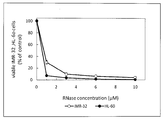
- RNase T1 and RNase Po1 have cell growth inhibitory effects on IMR-32 cells in a concentration-dependent manner.
- RNase Po1 has a viable cell count of about 10% when 3 ⁇ M is added. It decreased to the following (FIG. 2).
- the cell growth inhibitory effect of RNase Po1 on P388 cells was stronger than that of RNase He1. That is, RNase Po1 reduced the number of viable cells to about 30% by addition of 10 ⁇ M, while RNase He1 showed almost no cell growth inhibition even at 10 ⁇ M.
- the amount of RNase incorporated into tumor cells was 0.5% for RNase Po1, 0.03% for RNase T1, and 0.01% for RNase He1.
- Example 2 The growth inhibitory action of RNase Po1 on human leukemia HL-60 cells was examined.
- HL-60 cells were diluted with RPMI1640 medium supplemented with 10% fetal calf serum, and 200 ⁇ L of this cell culture solution adjusted to 3 ⁇ 10 5 cells / mL was added with RNase Po1 at a final concentration of 0 to 10 ⁇ M, under 5% CO 2 conditions.
- the cells were cultured at 37 ° C. for 72 hours, and the cell growth inhibition rate was calculated by the MTT method.
- HL-60 cells acute promyelocytic leukemia cells
Landscapes
- Health & Medical Sciences (AREA)
- Life Sciences & Earth Sciences (AREA)
- Chemical & Material Sciences (AREA)
- Natural Medicines & Medicinal Plants (AREA)
- Engineering & Computer Science (AREA)
- General Health & Medical Sciences (AREA)
- Organic Chemistry (AREA)
- Medicinal Chemistry (AREA)
- Pharmacology & Pharmacy (AREA)
- Animal Behavior & Ethology (AREA)
- Mycology (AREA)
- Public Health (AREA)
- Veterinary Medicine (AREA)
- Bioinformatics & Cheminformatics (AREA)
- Wood Science & Technology (AREA)
- Epidemiology (AREA)
- Zoology (AREA)
- Biotechnology (AREA)
- Genetics & Genomics (AREA)
- Microbiology (AREA)
- Molecular Biology (AREA)
- Alternative & Traditional Medicine (AREA)
- Biochemistry (AREA)
- General Engineering & Computer Science (AREA)
- Medical Informatics (AREA)
- Botany (AREA)
- Proteomics, Peptides & Aminoacids (AREA)
- Nuclear Medicine, Radiotherapy & Molecular Imaging (AREA)
- Gastroenterology & Hepatology (AREA)
- Immunology (AREA)
- General Chemical & Material Sciences (AREA)
- Chemical Kinetics & Catalysis (AREA)
- Biomedical Technology (AREA)
- Medicines Containing Plant Substances (AREA)
- Enzymes And Modification Thereof (AREA)
Abstract
本発明は、ヒラタケ由来のT1タイプリボヌクレアーゼを含有する悪性腫瘍治療薬に関する。
Description
本発明は、新たなリボヌクレアーゼを含有する悪性腫瘍治療薬に関する。
リボヌクレアーゼ(RNase)はRNAを分解する酵素であり、塩基の種類を問わないリボヌクレアーゼT2、ピリミジン塩基のある部分だけを切断するリボヌクレアーゼA、グアニンの部分のみを分解するリボヌクレアーゼT1などが挙げられる。
リボヌクレアーゼの中で、リボヌクレアーゼAに属するウシガエル由来のリボヌクレアーゼやウシ膵臓由来のリボヌクレアーゼに抗腫瘍活性があることは知られている(特許文献1、2及び非特許文献1)。また、抗腫瘍活性を有するα-サルシンはRNase T1に近い構造を有しているが、T1タイプのRNaseではない。
J.Clin.Oncol.2002,Jan 1:20(1):274-281
本発明の課題は、さらに新たなリボヌクレアーゼを含有する抗悪性腫瘍治療薬を提供することにある。
そこで本発明者は、T1タイプのリボヌクレアーゼに着目して種々検討してきたところ、ヒラタケ由来のT1タイプリボヌクレアーゼは、同じT1タイプのリボヌクレアーゼであるヤマブシタケ由来のリボヌクレアーゼ等に比べて特に強い腫瘍細胞増殖抑制作用を有し、T1タイプのリボヌクレアーゼの中でも特に悪性腫瘍治療薬として有用であることを見出し、本発明を完成した。
本発明は、ヒラタケ由来のT1タイプリボヌクレアーゼを含有する悪性腫瘍治療薬を提供するものである。
また、本発明は、ヒラタケ由来のT1タイプリボヌクレアーゼ、及び薬学的に許容される担体を含有する悪性腫瘍治療用医薬組成物を提供するものである。
また、本発明は、ヒラタケ由来のT1タイプリボヌクレアーゼの、悪性腫瘍治療薬製造のための使用を提供するものである。
さらに、本発明は、ヒラタケ由来のT1タイプリボヌクレアーゼの有効量を投与することを特徴とする、悪性腫瘍治療方法を提供するものである。
また、本発明は、ヒラタケ由来のT1タイプリボヌクレアーゼ、及び薬学的に許容される担体を含有する悪性腫瘍治療用医薬組成物を提供するものである。
また、本発明は、ヒラタケ由来のT1タイプリボヌクレアーゼの、悪性腫瘍治療薬製造のための使用を提供するものである。
さらに、本発明は、ヒラタケ由来のT1タイプリボヌクレアーゼの有効量を投与することを特徴とする、悪性腫瘍治療方法を提供するものである。
本発明の悪性腫瘍治療剤は、優れた腫瘍細胞増殖抑制作用を有し、中性付近で安定で、かつ熱安定性も高いので、医薬品としての応用が容易である。
本発明の悪性腫瘍治療剤の有効成分は、ヒラタケ由来のT1タイプリボヌクレアーゼ(以下、RNase Po1と略することもある)である。ヒラタケは、ヒラタケ科ヒラタケ属に属する食用キノコであり、このうちPleurotus ostreatusが特に好ましい。本発明で用いるT1タイプリボヌクレアーゼは、ヒラタケ子実体から抽出することもできるが、遺伝子組換え法により大腸菌等の微生物の形質転換体から抽出することもできる。
RNase Po1には、配列番号1で示されるアミノ酸配列を有するタンパク質、及び配列番号1で示されるアミノ酸配列において1若しくは数個のアミノ酸が欠失、置換若しくは付加されたアミノ酸配列を有し、かつリボヌクレアーゼ活性を有するタンパク質が含まれる。ここで、配列番号1で示されるアミノ酸配列において1若しくは数個のアミノ酸が欠失、置換若しくは付加されたアミノ酸配列としては、配列番号1のアミノ酸配列と90%以上の同一性を有するもの、特に95%以上の同一性を有するものが好ましい。
ヒラタケ子実体からRNase Po1を抽出するには、例えばヒラタケ子実体を細切又は粉砕し、酢酸ナトリウム水溶液を加えてホモジナイズし、遠心分離により固形物を除去する。次いでこの上清から硫安分画によりタンパク画分を得、ゲル濾過、イオン交換クロマト等により分画することにより得ることができる(J.Biochem.116,26-33(1994))。
一方、遺伝子組換え法によるRNase Po1の採取法については、例えば第51回日本薬学会関東支部大会(2007年10月16日)講演要旨集J12記載の方法を用いることができる。まず遺伝子のクローニングをし、クローニングしたDNA断片を用いた発現ベクターの調製、発現ベクターを用いたRNase Po1の調製を行うが、これらの操作は周知の技術であり、具体的には、例えば「Molecular Cloning」(Maniatisら編、Cold Spring Harbor Laboratories,Cold Spring Harbor、New York(1982))に記載の方法に従って行うことができる。
例えば、ヒラタケの子実体から精製したRNase Po1のN-末端、C-末端などのアミノ酸配列の一部を既知の方法で決定し、それに相当するオリゴヌクレオチドを合成する。合成したオリゴヌクレオチドをプローブとしてヒラタケのトータルRNAを抽出後、逆転写酵素反応で得たcDNA断片をクローニングすればよい。
クローン化に用いる宿主は特に限定されないが、操作性及び簡便性から大腸菌を宿主とするのが適当である。
クローン化に用いる宿主は特に限定されないが、操作性及び簡便性から大腸菌を宿主とするのが適当である。
クローン化した遺伝子の高発現系を構築するためには、たとえばマキザム-ギルバートの方法(Methods in Enzymology,65,499(1980))もしくはダイデオキシチェーンターミネーター法(Methods in Enzymology,101,20(1983))などを応用してクローン化したDNA断片の塩基配列を解析して当該遺伝子のコーディング領域を特定し、宿主微生物に応じて当該遺伝子が微生物菌体中で発現可能となるように発現制御シグナル(転写開始及び翻訳開始シグナル)をその上流に連結した組換え発現ベクターを作製する。
RNase Po1を異種微生物内で大量に産生させるために使用する発現制御シグナルとしては、人為的制御が可能で、RNase Po1の生産量を上昇させるような強力な転写開始並びに翻訳開始シグナルを用いることが望ましい。このような転写開始シグナルとしては、宿主として大腸菌を用いる場合には、lacプロモーター、trpプロモーター、tacプロモーター(Proc.Natl.Acad.Sci.USA.,80,21(1983)、Gene,20,231(1982))、trcプロモーター(J.Biol.Chem.,260,3539(1985))などを例示することができる。
ベクターとしては、種々のプラスミドベクター、ファージベクターなどが使用可能であるが、微生物菌体内で複製可能であり、適当な薬剤耐性マーカーと特定の制限酵素切断部位を有し、菌体内のコピー数の高いプラスミドベクターを使用するのが望ましい。具体的に大腸菌を宿主とする場合には、pBR322(Gene,2,95(1975))、pUC18,pUC19(Gene、33,103(1985))などを例示することができる。作製した組換えベクターを用いて微生物を形質転換する。宿主となる微生物としては安全性が高く取扱いやすいものであれば特に限定されない。例えば、大腸菌、酵母などDNA組換え操作に常用されている微生物を使用することができる。その中でも、大腸菌が有利であり、例えば組換えDNA実験に使用されるBL21株、K12株、C600菌、JM105菌、JM109菌(Gene,33,103-119(1985))などが使用可能である。
微生物を形質転換する方法はすでに多くの方法が報告されており、宿主として使用する微生物に応じて適宜選択すればよい。例えば大腸菌を宿主として使用する場合、低温下、塩化カルシウム処理して菌体内にプラスミドを導入する方法(J.Mol.Biol.,53,159(1970))により大腸菌を形質転換することができる。
ベクターとしては、種々のプラスミドベクター、ファージベクターなどが使用可能であるが、微生物菌体内で複製可能であり、適当な薬剤耐性マーカーと特定の制限酵素切断部位を有し、菌体内のコピー数の高いプラスミドベクターを使用するのが望ましい。具体的に大腸菌を宿主とする場合には、pBR322(Gene,2,95(1975))、pUC18,pUC19(Gene、33,103(1985))などを例示することができる。作製した組換えベクターを用いて微生物を形質転換する。宿主となる微生物としては安全性が高く取扱いやすいものであれば特に限定されない。例えば、大腸菌、酵母などDNA組換え操作に常用されている微生物を使用することができる。その中でも、大腸菌が有利であり、例えば組換えDNA実験に使用されるBL21株、K12株、C600菌、JM105菌、JM109菌(Gene,33,103-119(1985))などが使用可能である。
微生物を形質転換する方法はすでに多くの方法が報告されており、宿主として使用する微生物に応じて適宜選択すればよい。例えば大腸菌を宿主として使用する場合、低温下、塩化カルシウム処理して菌体内にプラスミドを導入する方法(J.Mol.Biol.,53,159(1970))により大腸菌を形質転換することができる。
得られた形質転換体は、当該微生物が増殖可能な培地中で増殖させ、さらにクローン化したRNase Po1遺伝子の発現を誘導して菌体内又は菌体外に当該酵素が大量に蓄積するまで培養を行う。形質転換体の培養は、炭素源、窒素源などの当該微生物の増殖に必要な栄養源を含有する培地を用いて常法に従って行えばよい。例えば、大腸菌を宿主として使用する場合、培地として2xYT培地(Methods in Enzymology,100,20(1983))、LB培地、M9CA培地(Molecular Cloning、前述)などの大腸菌の培養に常用されている培地を用い、20~40℃の培養温度で必要により通気攪拌しながら培養することができる。また、ベクターとしてプラスミドを用いた場合には、培養中におけるプラスミドの脱落を防ぐために適当な抗生物質(プラスミドの薬剤耐性マーカーに応じ、アンピシリン、カナマイシンなど)の薬剤を適当量培養液に加えて培養する。
培養中にRNase Po1遺伝子の発現を誘導する必要がある場合には、用いたプロモーターで常用されている方法で当該遺伝子の発現を誘導する。例えば、lacプロモーターやtacプロモーターを使用した場合には、培養中期に発現誘導剤であるイソプロピル-β-D-チオガラクトピラノシド(以下、IPTGと略称する)を適当量添加する。
培養中にRNase Po1遺伝子の発現を誘導する必要がある場合には、用いたプロモーターで常用されている方法で当該遺伝子の発現を誘導する。例えば、lacプロモーターやtacプロモーターを使用した場合には、培養中期に発現誘導剤であるイソプロピル-β-D-チオガラクトピラノシド(以下、IPTGと略称する)を適当量添加する。
こうして得られた培養上清から硫安塩析処理、透析処理、エタノールなどの溶媒処理、各種クロマトグラフィー処理などの酵素精製に通常使用されている処理を単独で、又は数種組み合わせて得られる精製物をRNase Po1として利用することができる。
RNase Po1の等電点は8.7であり細胞内への移行がよい。また、ジスルフィド結合が1組多いことから熱安定性にも優れている。さらに、至適pHが7.5であることから細胞内で酵素活性を最大限に発現できる。
RNase Po1は、種々の腫瘍細胞の増殖を低濃度で抑制し、ヒトを含む哺乳類における悪性腫瘍治療薬として有用である。RNase Po1はT1タイプのリボヌクレアーゼであるが、同じT1タイプに属するヤマブシタケ由来のリボヌクレアーゼや、典型的な真菌由来RNase T1に比べて特に強い抗腫瘍作用を有する。
本発明の悪性腫瘍治療薬の対象となる悪性腫瘍には、白血病、リンパ腫などの血液や造血組織の腫瘍及び固形腫瘍が含まれる。固形腫瘍としては、皮膚癌、肺癌、大腸癌、胃癌、乳癌、前立腺癌、甲状腺癌などの上皮細胞癌;及び平滑筋肉腫、骨肉腫などの肉腫が挙げられる。
本発明の医薬又は医薬組成物は、RNase Po1に、賦形剤、結合剤、滑沢剤、崩壊剤、被覆剤、乳化剤、懸濁化剤、溶剤、安定化剤、吸収補助剤、軟膏基剤等の1以上の薬学的に許容される担体を適宜添加し、常法により経口投与用、注射投与用、直腸内投与用、外用などに適する剤形(医薬組成物)に製剤化することによって得られる。
経口投与用の製剤としては、顆粒、錠剤、糖衣錠、カプセル剤、丸剤、液剤、乳剤、懸濁剤等が;注射投与用の製剤としては、静脈内注射、筋肉内注射、皮下注射、点滴注射用の製剤などが;直腸内投与用の製剤としては、坐薬、軟カプセル等が好ましい。
本発明の医薬は上記の如き製剤として、ヒトを含む哺乳動物に投与することができる。
本発明の医薬は、RNase Po1として、1日当り約1~500mg/kgを1~4回投与するのが好ましい。
経口投与用の製剤としては、顆粒、錠剤、糖衣錠、カプセル剤、丸剤、液剤、乳剤、懸濁剤等が;注射投与用の製剤としては、静脈内注射、筋肉内注射、皮下注射、点滴注射用の製剤などが;直腸内投与用の製剤としては、坐薬、軟カプセル等が好ましい。
本発明の医薬は上記の如き製剤として、ヒトを含む哺乳動物に投与することができる。
本発明の医薬は、RNase Po1として、1日当り約1~500mg/kgを1~4回投与するのが好ましい。
次に実施例を挙げて、本発明をさらに詳細に説明するが、本発明はこれら実施例に何ら限定されるものではない。
参考例1
ヒラタケ子実体3kgをきざみ、0.01M酢酸緩衝液(pH6.0)を加えてホモジナイズする。1万rpmで30分間遠心分離し、上清を用いる。90%飽和硫安を加え、硫安分画後遠心分離し沈殿を緩衝液に溶解し、精製水に対して透析する。Sephadex G50によるゲル濾過、Ultrogel AcA54によるゲル濾過、次いでSP-Toyopearl 650Mによるイオン交換クロマトを行う。さらにDEAE-Toyopearl 650Mによるイオン交換クロマトを行い、TSK Gel G2000SWカラムを用いたHPLCによるゲル濾過を行う。以上の操作によりRNase Po1を得た。
ヒラタケ子実体3kgをきざみ、0.01M酢酸緩衝液(pH6.0)を加えてホモジナイズする。1万rpmで30分間遠心分離し、上清を用いる。90%飽和硫安を加え、硫安分画後遠心分離し沈殿を緩衝液に溶解し、精製水に対して透析する。Sephadex G50によるゲル濾過、Ultrogel AcA54によるゲル濾過、次いでSP-Toyopearl 650Mによるイオン交換クロマトを行う。さらにDEAE-Toyopearl 650Mによるイオン交換クロマトを行い、TSK Gel G2000SWカラムを用いたHPLCによるゲル濾過を行う。以上の操作によりRNase Po1を得た。
参考例2
(rRNase Po1の精製)
pET-pelB-Po1を導入した発現用大腸菌(BL21(DE3)pLys S)を、100μg/mLのアンピシリンを添加した液体TB培地に植菌し、1日後にIPTGを終濃度0.5mMとなるように添加し、転写誘導をかけたものを25℃の暗所で7日間、80rpmで振とう培養した培養上清約2Lを出発原料としてrRNase Po1の精製を行った。なお、rRNase Po1のcDNA配列より推測した等電点は8.7であった。
rRNase Po1の精製法のフローチャートを図1に示した。
(rRNase Po1の精製)
pET-pelB-Po1を導入した発現用大腸菌(BL21(DE3)pLys S)を、100μg/mLのアンピシリンを添加した液体TB培地に植菌し、1日後にIPTGを終濃度0.5mMとなるように添加し、転写誘導をかけたものを25℃の暗所で7日間、80rpmで振とう培養した培養上清約2Lを出発原料としてrRNase Po1の精製を行った。なお、rRNase Po1のcDNA配列より推測した等電点は8.7であった。
rRNase Po1の精製法のフローチャートを図1に示した。
実施例1
RNase T1(真菌由来)及び担子菌由来の2種のT1タイプRNase、RNase Po1、Hericium erinaceum(ヤマブシタケ)のRNase He1について、ヒト神経芽腫細胞(IMR-32)を用いて腫瘍細胞の生育に対する影響を検討した。
RNase T1(真菌由来)及び担子菌由来の2種のT1タイプRNase、RNase Po1、Hericium erinaceum(ヤマブシタケ)のRNase He1について、ヒト神経芽腫細胞(IMR-32)を用いて腫瘍細胞の生育に対する影響を検討した。
(方法)
細胞生育阻害作用:細胞を10%牛胎仔血清を加えたRPMI 1640培地で希釈し、5×10³cell/100μL又は3×105cell/mLとした。この細胞培養液100μL又は200μLに終濃度0~10μMのRNaseをそれぞれ加え、5%CO2条件下、37℃、72時間培養し、MTT法により細胞生育阻害率を算出した。
細胞生育阻害作用:細胞を10%牛胎仔血清を加えたRPMI 1640培地で希釈し、5×10³cell/100μL又は3×105cell/mLとした。この細胞培養液100μL又は200μLに終濃度0~10μMのRNaseをそれぞれ加え、5%CO2条件下、37℃、72時間培養し、MTT法により細胞生育阻害率を算出した。
細胞内取り込み量:10%牛胎仔血清を加えたRPMI 1640培地で希釈した3×10⁵cell/mLの細胞懸濁液2mLに終濃度6μMの各RNaseを加え、5%CO2条件下37℃、30分培養後、遠心して細胞を回収し、0.5%Triton X-100を加えて凍結融解し、再度遠心分離し、上清のRNase活性を指標として求めた。
(結果)
ヒト神経芽腫細胞の中では、IMR-32細胞において、RNase T1、RNase Po1とも濃度依存的に細胞生育阻害作用を示し、特にRNase Po1は、3μMの添加により、生存細胞数は、約10%以下にまで低下した(図2)。また、P388細胞に対するRNase Po1の細胞生育阻害作用は、RNase He1よりも強力であった。すなわち、RNase Po1は、10μMの添加により、生存細胞数を約30%にまで低下させたのに対し、RNase He1は10μM添加でもほとんど細胞生育阻害を示さなかった。
また、腫瘍細胞(P-388)内へのRNaseの取り込み量は、RNase Po1は0.5%、RNase T1は0.03%、RNase He1は0.01%であった。
ヒト神経芽腫細胞の中では、IMR-32細胞において、RNase T1、RNase Po1とも濃度依存的に細胞生育阻害作用を示し、特にRNase Po1は、3μMの添加により、生存細胞数は、約10%以下にまで低下した(図2)。また、P388細胞に対するRNase Po1の細胞生育阻害作用は、RNase He1よりも強力であった。すなわち、RNase Po1は、10μMの添加により、生存細胞数を約30%にまで低下させたのに対し、RNase He1は10μM添加でもほとんど細胞生育阻害を示さなかった。
また、腫瘍細胞(P-388)内へのRNaseの取り込み量は、RNase Po1は0.5%、RNase T1は0.03%、RNase He1は0.01%であった。
実施例2
RNase Po1 のヒト白血病HL-60細胞に対する生育阻害作用を検討した。
(方法)
HL-60細胞を10%ウシ胎仔血清を加えたRPMI1640培地で希釈し、3×10⁵cell/mLとしたこの細胞培養液200μLに終濃度0~10μMのRNase Po1を加え、5%CO2条件下、37℃、72時間培養し、MTT法により細胞生育阻害率を算出した。
神経芽腫の1つであるIMR-32細胞に対する作用も併せて検討した。
HL-60細胞(急性前骨髄性白血病細胞)はヒューマンサイエンス振興財団より分譲された。
(結果)
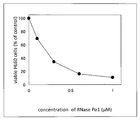
ヒト白血病HL-60細胞にRNasePo1を作用させたところ、最終濃度1×10⁻⁸Mの添加により、生存細胞が約10%まで減少した。同濃度の神経芽腫IMR-32細胞での生存細胞数が約30%であったことから、RNase Po1は、HL-60細胞に対し、IMR-32細胞に対する場合よりも約3倍高い生育阻害作用を有することが明らかになった(図3、図4)。
RNase Po1 のヒト白血病HL-60細胞に対する生育阻害作用を検討した。
(方法)
HL-60細胞を10%ウシ胎仔血清を加えたRPMI1640培地で希釈し、3×10⁵cell/mLとしたこの細胞培養液200μLに終濃度0~10μMのRNase Po1を加え、5%CO2条件下、37℃、72時間培養し、MTT法により細胞生育阻害率を算出した。
神経芽腫の1つであるIMR-32細胞に対する作用も併せて検討した。
HL-60細胞(急性前骨髄性白血病細胞)はヒューマンサイエンス振興財団より分譲された。
(結果)
ヒト白血病HL-60細胞にRNasePo1を作用させたところ、最終濃度1×10⁻⁸Mの添加により、生存細胞が約10%まで減少した。同濃度の神経芽腫IMR-32細胞での生存細胞数が約30%であったことから、RNase Po1は、HL-60細胞に対し、IMR-32細胞に対する場合よりも約3倍高い生育阻害作用を有することが明らかになった(図3、図4)。
Claims (8)
- ヒラタケ由来のT1タイプリボヌクレアーゼを含有する悪性腫瘍治療薬。
- ヒラタケ由来のT1タイプリボヌクレアーゼが、配列番号1で示されるアミノ酸配列を有するタンパク質、又は配列番号1で示されるアミノ酸配列において1若しくは数個のアミノ酸が欠失、置換若しくは付加されたアミノ酸配列を有し、かつリボヌクレアーゼ活性を有するタンパク質である請求項1記載の悪性腫瘍治療薬。
- ヒラタケ由来のT1タイプリボヌクレアーゼ、及び薬学的に許容される担体を含有する悪性腫瘍治療用医薬組成物。
- ヒラタケ由来のT1タイプリボヌクレアーゼが、配列番号1で示されるアミノ酸配列を有するタンパク質、又は配列番号1で示されるアミノ酸配列において1若しくは数個のアミノ酸が欠失、置換若しくは付加されたアミノ酸配列を有し、かつリボヌクレアーゼ活性を有するタンパク質である請求項3記載の医薬組成物。
- ヒラタケ由来のT1タイプリボヌクレアーゼの、悪性腫瘍治療薬製造のための使用。
- ヒラタケ由来のT1タイプリボヌクレアーゼが、配列番号1で示されるアミノ酸配列を有するタンパク質、又は配列番号1で示されるアミノ酸配列において1若しくは数個のアミノ酸が欠失、置換若しくは付加されたアミノ酸配列を有し、かつリボヌクレアーゼ活性を有するタンパク質である請求項5記載の使用。
- ヒラタケ由来のT1タイプリボヌクレアーゼの有効量を投与することを特徴とする悪性腫瘍治療方法。
- ヒラタケ由来のT1タイプリボヌクレアーゼが、配列番号1で示されるアミノ酸配列を有するタンパク質、又は配列番号1で示されるアミノ酸配列において1若しくは数個のアミノ酸が欠失、置換若しくは付加されたアミノ酸配列を有し、かつリボヌクレアーゼ活性を有するタンパク質である請求項7記載の治療方法。
Applications Claiming Priority (2)
| Application Number | Priority Date | Filing Date | Title |
|---|---|---|---|
| JP2009033373A JP2012092019A (ja) | 2009-02-17 | 2009-02-17 | 悪性腫瘍治療剤 |
| JP2009-033373 | 2009-02-17 |
Publications (1)
| Publication Number | Publication Date |
|---|---|
| WO2010095422A1 true WO2010095422A1 (ja) | 2010-08-26 |
Family
ID=42633710
Family Applications (1)
| Application Number | Title | Priority Date | Filing Date |
|---|---|---|---|
| PCT/JP2010/000962 Ceased WO2010095422A1 (ja) | 2009-02-17 | 2010-02-17 | 悪性腫瘍治療剤 |
Country Status (2)
| Country | Link |
|---|---|
| JP (1) | JP2012092019A (ja) |
| WO (1) | WO2010095422A1 (ja) |
Cited By (1)
| Publication number | Priority date | Publication date | Assignee | Title |
|---|---|---|---|---|
| CN106860790A (zh) * | 2017-03-22 | 2017-06-20 | 郑百战 | 一种治疗肺癌的中药制剂 |
-
2009
- 2009-02-17 JP JP2009033373A patent/JP2012092019A/ja active Pending
-
2010
- 2010-02-17 WO PCT/JP2010/000962 patent/WO2010095422A1/ja not_active Ceased
Non-Patent Citations (5)
| Title |
|---|
| "129th Annual Meeting of Pharmaceutical Society of Japan Kyoto 2009 Yoshishu 3, 05 March 2009 (05.03.2009)", article YURI KOBAYASHI ET AL.: "Kinoko Yurai Tl Type RNase no Mouse Hakketsubyo Saibo ni Taisuru Seiiku Sogai Sayo", pages: 115 * |
| ARNOLD, U. ET AL.: "Natural and engineered ribonucleases as potential cancer therapeutics", BIOTECHNOL LETT, vol. 28, no. 20, 2006, pages 1615 - 22 * |
| DATABASE GENBANK [online] 22 March 2008 (2008-03-22), KAWASUMI, K. ET AL.: "Pleurotus ostreatus RNPo1 mRNA for ribonuclease Tl, partial cds., GenBank", retrieved from http://www. ncbi.nlm.nih.gov/nuccore/171362782 Database accession no. AB429298.1 * |
| MAKAROV, A.A. ET AL.: "Binase and other microbial RNases as potential anticancer agents", BIOESSAYS, vol. 30, no. 8, 2008, pages 781 - 90 * |
| SURI, S. ET AL.: "RNase: a novel enzyme for treatment of cancers", INTERNET JOURNAL OF ONCOLOGY, vol. 5, no. 1, 2008, Retrieved from the Internet <URL:http://www.ispub.com/ostia/index.php?xmlFilePath=journals/ijo/vol5nl/rnase.xml> [retrieved on 20100304] * |
Cited By (1)
| Publication number | Priority date | Publication date | Assignee | Title |
|---|---|---|---|---|
| CN106860790A (zh) * | 2017-03-22 | 2017-06-20 | 郑百战 | 一种治疗肺癌的中药制剂 |
Also Published As
| Publication number | Publication date |
|---|---|
| JP2012092019A (ja) | 2012-05-17 |
Similar Documents
| Publication | Publication Date | Title |
|---|---|---|
| JPS60252496A (ja) | 新規なヒト生理活性ポリペプチド | |
| EP0414007B1 (en) | A novel arginine deiminase, its manufacturing method and an anti-cancer agent containing this enzyme as an effective ingredient | |
| JP7453213B2 (ja) | リコンビナントタンパク質変異体 | |
| CN106632682A (zh) | 融合蛋白ifn-elp及其应用 | |
| CN102898526A (zh) | 一种肿瘤坏死因子相关凋亡诱导配体融合蛋白及其制备和应用 | |
| JP2003533186A (ja) | アルギニンデイミナーゼの新規突然変異体 | |
| CN118620036A (zh) | 一种dhodh多肽降解剂及其应用 | |
| US20160222362A1 (en) | Target-Specific Double-Mutant Fusion Protein and Preparation Process Therefor | |
| EP1214346A1 (en) | A novel angiogenesis inhibitor | |
| WO2008145013A1 (zh) | 包含cd13靶向肽和力达霉素的融合蛋白 | |
| WO2010095422A1 (ja) | 悪性腫瘍治療剤 | |
| CN102260352B (zh) | 靶向性白细胞介素融合蛋白及其制备方法与应用 | |
| WO2023061515A1 (zh) | 一种新型治疗肝癌的fgf类似物及其应用 | |
| CN103865899B (zh) | 具有vegfr2/kdr受体特异性的融合毒素及其编码基因与应用 | |
| CN1239516C (zh) | 肿瘤坏死因子相关细胞凋亡诱导配体胞外区突变多肽及其制法与用途 | |
| JP2002523100A (ja) | 新規なヒトリゾチーム遺伝子、それによりコードされたポリペプチド、およびそれらの作製方法 | |
| AU2020256316B2 (en) | Molecular design of recombinant protein drug | |
| CN100425700C (zh) | scFvC6.5-sTrail融合基因和蛋白及制备 | |
| WO2000012717A1 (en) | A new gene of human lysoenzyme, the encoding polypeptide and methods for preparing them | |
| CN114316018A (zh) | 一种fgf21蛋白类似物及其应用 | |
| CN117586997A (zh) | 粘红酵母来源的苯丙氨酸解氨酶突变体及其应用 | |
| WO2004091650A1 (fr) | Utilisation de la troponine i cardiaque pour preparer des medicaments antitumoraux | |
| CN1049663C (zh) | 突变的人肿瘤坏死因子 | |
| JP3993652B2 (ja) | 感受性疾患剤 | |
| RU2619053C1 (ru) | Рекомбинантная плазмидная ДНК pET-15b_T3_RL, обеспечивающая синтез рекомбинантного слитого белка, состоящего из опухоль-специфического пептида и противоопухолевого пептида RL2, и рекомбинантный слитый белок, обладающий противоопухолевой активностью по отношению к раку молочной железы человека |
Legal Events
| Date | Code | Title | Description |
|---|---|---|---|
| 121 | Ep: the epo has been informed by wipo that ep was designated in this application |
Ref document number: 10743552 Country of ref document: EP Kind code of ref document: A1 |
|
| NENP | Non-entry into the national phase |
Ref country code: DE |
|
| 122 | Ep: pct application non-entry in european phase |
Ref document number: 10743552 Country of ref document: EP Kind code of ref document: A1 |
|
| NENP | Non-entry into the national phase |
Ref country code: JP |