WO2010093057A1 - 耐水素誘起割れ性に優れた高強度ラインパイプ用鋼板及び高強度ラインパイプ用鋼管 - Google Patents
耐水素誘起割れ性に優れた高強度ラインパイプ用鋼板及び高強度ラインパイプ用鋼管 Download PDFInfo
- Publication number
- WO2010093057A1 WO2010093057A1 PCT/JP2010/052483 JP2010052483W WO2010093057A1 WO 2010093057 A1 WO2010093057 A1 WO 2010093057A1 JP 2010052483 W JP2010052483 W JP 2010052483W WO 2010093057 A1 WO2010093057 A1 WO 2010093057A1
- Authority
- WO
- WIPO (PCT)
- Prior art keywords
- less
- steel
- hydrogen
- segregation
- amount
- Prior art date
- Legal status (The legal status is an assumption and is not a legal conclusion. Google has not performed a legal analysis and makes no representation as to the accuracy of the status listed.)
- Ceased
Links
Images

Classifications
-
- C—CHEMISTRY; METALLURGY
- C22—METALLURGY; FERROUS OR NON-FERROUS ALLOYS; TREATMENT OF ALLOYS OR NON-FERROUS METALS
- C22C—ALLOYS
- C22C38/00—Ferrous alloys, e.g. steel alloys
- C22C38/18—Ferrous alloys, e.g. steel alloys containing chromium
- C22C38/40—Ferrous alloys, e.g. steel alloys containing chromium with nickel
- C22C38/54—Ferrous alloys, e.g. steel alloys containing chromium with nickel with boron
-
- C—CHEMISTRY; METALLURGY
- C22—METALLURGY; FERROUS OR NON-FERROUS ALLOYS; TREATMENT OF ALLOYS OR NON-FERROUS METALS
- C22C—ALLOYS
- C22C38/00—Ferrous alloys, e.g. steel alloys
- C22C38/04—Ferrous alloys, e.g. steel alloys containing manganese
-
- C—CHEMISTRY; METALLURGY
- C22—METALLURGY; FERROUS OR NON-FERROUS ALLOYS; TREATMENT OF ALLOYS OR NON-FERROUS METALS
- C22C—ALLOYS
- C22C38/00—Ferrous alloys, e.g. steel alloys
- C22C38/001—Ferrous alloys, e.g. steel alloys containing N
-
- C—CHEMISTRY; METALLURGY
- C22—METALLURGY; FERROUS OR NON-FERROUS ALLOYS; TREATMENT OF ALLOYS OR NON-FERROUS METALS
- C22C—ALLOYS
- C22C38/00—Ferrous alloys, e.g. steel alloys
- C22C38/002—Ferrous alloys, e.g. steel alloys containing In, Mg, or other elements not provided for in one single group C22C38/001 - C22C38/60
-
- C—CHEMISTRY; METALLURGY
- C22—METALLURGY; FERROUS OR NON-FERROUS ALLOYS; TREATMENT OF ALLOYS OR NON-FERROUS METALS
- C22C—ALLOYS
- C22C38/00—Ferrous alloys, e.g. steel alloys
- C22C38/005—Ferrous alloys, e.g. steel alloys containing rare earths, i.e. Sc, Y, Lanthanides
-
- C—CHEMISTRY; METALLURGY
- C22—METALLURGY; FERROUS OR NON-FERROUS ALLOYS; TREATMENT OF ALLOYS OR NON-FERROUS METALS
- C22C—ALLOYS
- C22C38/00—Ferrous alloys, e.g. steel alloys
- C22C38/02—Ferrous alloys, e.g. steel alloys containing silicon
-
- C—CHEMISTRY; METALLURGY
- C22—METALLURGY; FERROUS OR NON-FERROUS ALLOYS; TREATMENT OF ALLOYS OR NON-FERROUS METALS
- C22C—ALLOYS
- C22C38/00—Ferrous alloys, e.g. steel alloys
- C22C38/06—Ferrous alloys, e.g. steel alloys containing aluminium
-
- C—CHEMISTRY; METALLURGY
- C22—METALLURGY; FERROUS OR NON-FERROUS ALLOYS; TREATMENT OF ALLOYS OR NON-FERROUS METALS
- C22C—ALLOYS
- C22C38/00—Ferrous alloys, e.g. steel alloys
- C22C38/08—Ferrous alloys, e.g. steel alloys containing nickel
-
- C—CHEMISTRY; METALLURGY
- C22—METALLURGY; FERROUS OR NON-FERROUS ALLOYS; TREATMENT OF ALLOYS OR NON-FERROUS METALS
- C22C—ALLOYS
- C22C38/00—Ferrous alloys, e.g. steel alloys
- C22C38/12—Ferrous alloys, e.g. steel alloys containing tungsten, tantalum, molybdenum, vanadium, or niobium
-
- C—CHEMISTRY; METALLURGY
- C22—METALLURGY; FERROUS OR NON-FERROUS ALLOYS; TREATMENT OF ALLOYS OR NON-FERROUS METALS
- C22C—ALLOYS
- C22C38/00—Ferrous alloys, e.g. steel alloys
- C22C38/14—Ferrous alloys, e.g. steel alloys containing titanium or zirconium
-
- C—CHEMISTRY; METALLURGY
- C22—METALLURGY; FERROUS OR NON-FERROUS ALLOYS; TREATMENT OF ALLOYS OR NON-FERROUS METALS
- C22C—ALLOYS
- C22C38/00—Ferrous alloys, e.g. steel alloys
- C22C38/16—Ferrous alloys, e.g. steel alloys containing copper
-
- C—CHEMISTRY; METALLURGY
- C22—METALLURGY; FERROUS OR NON-FERROUS ALLOYS; TREATMENT OF ALLOYS OR NON-FERROUS METALS
- C22C—ALLOYS
- C22C38/00—Ferrous alloys, e.g. steel alloys
- C22C38/18—Ferrous alloys, e.g. steel alloys containing chromium
- C22C38/32—Ferrous alloys, e.g. steel alloys containing chromium with boron
Definitions
- the present invention relates to a steel plate for a line pipe and a steel pipe for a line pipe, which are excellent in hydrogen-induced cracking resistance (referred to as HIC resistance), which is optimal for applications such as oil and natural gas transportation line pipes.
- HIC resistance hydrogen-induced cracking resistance
- HIC hydrogen-induced cracking
- Patent Documents 1 to 3 Mn is an element that easily segregates at the center of a steel sheet, and methods for suppressing the segregation of Mn have been proposed (for example, Patent Documents 1 to 3).
- Patent Document 1 proposes a steel sheet in which the ratio of the Mn content of the segregation part to the average Mn content in the steel is suppressed.
- Patent Documents 2 and 3 propose a high-strength line pipe that limits the P concentration of the segregation part in addition to the size of the Mn segregation spot and further utilizes Ca.
- hot rolled steel sheets with excellent HIC resistance have been proposed that focus on Nb segregation (for example, Patent Document 4).
- methods for suppressing inclusions such as carbides and nitrides of Ti and Nb have been proposed (for example, Patent Documents 5 and 6).
- the present invention has been made in view of such circumstances, and is suitable for steel pipes used for transportation line pipes of petroleum, natural gas, etc., and has excellent HIC resistance and steel pipe for line pipes and line pipes The issue is to provide steel pipes.
- the present inventors conducted earnest research on conditions necessary for obtaining a steel sheet for high-strength line pipe and a steel pipe for high-strength line pipe excellent in hydrogen-induced crack resistance with a tensile strength of 500 MPa or more, and new ultra-high strength It came to invent the steel plate for line pipes and the steel pipe for high-strength line pipes.
- the gist of the present invention is as follows.
- Ni 0.01 to 2.0%
- Cu 0.01 to 1.0%
- Cr 0.01 to 1.0%
- Mo 0.01 to 1.0%
- W 0.01 to 1.0%
- V 0.01 to 0.10%
- Zr 0.0001 to 0.050%
- Ta 0.0001 to 0.050%
- B 0.0001 to 0.0020%
- the steel plate for high-strength line pipes having excellent resistance to hydrogen-induced cracking as described in (1) above, wherein one or more of the above are contained, and the balance is iron and inevitable impurities.
- the base material is mass%, C: 0.02 to 0.08%, Si: 0.01 to 0.5%, Mn: 1.0 to 1.6% Nb: 0.001 to 0.10%, Ca: 0.0001 to 0.0050%, N: 0.0010 to 0.0050%, O: 0.0001 to 0.0030% Containing P: 0.01% or less, S: 0.0020% or less, Al: 0.030% or less, Ti: limited to 0.030% or less, S, Ca content, S / Ca ⁇ 0.5 And the balance consists of Fe and inevitable impurity elements, And the steel pipe for high intensity
- the base material is mass%, Ni: 0.01 to 2.0%, Cu: 0.01 to 1.0%, Cr: 0.01 to 1.0%, Mo: 0.01 to 1.0%, W: 0.01 to 1.0%, V: 0.01 to 0.10% Zr: 0.0001 to 0.050%, Ta: 0.0001 to 0.050%, B: 0.0001 to 0.0020%
- the steel pipe for high-strength line pipes having excellent resistance to hydrogen-induced cracking as described in (6) above, wherein one or more of the above are contained, and the balance consists of iron and inevitable impurities.
- the base material is mass%, REM: 0.0001 to 0.01%, Mg: 0.0001 to 0.01%, Y: 0.0001 to 0.005%, Hf: 0.0001 to 0.005%, Re: 0.0001 to 0.005%
- the steel pipe for high-strength line pipe excellent in hydrogen-induced crack resistance according to (6) or (7) above, further comprising one or more of them.
- the maximum Mn segregation degree of the base material 2.0 or less, Nb segregation degree: 4.0 or less, Ti segregation degree: 4.0 or less,
- the segregation degree of Mn, Nb, Ti decreases, the length of the non-crimped portion of the center segregation portion and the increase in the maximum hardness are suppressed, and the steel plate for line pipe excellent in hydrogen-induced crack resistance.
- industrial contributions such as the production of steel pipes for line pipes are extremely remarkable.
- FIG. 1 is a diagram showing the relationship between the S / Ca content ratio S / Ca and the CAR in the HIC test.
- the present inventors performed a NACE (National Association of Corrosion and Engineer) test using various steel plates for line pipes, and evaluated the presence or absence of HIC.
- the NACE test is a test method in which hydrogen sulfide gas is saturated in a solution of 5% NaCl solution + 0.5% acetic acid, pH 2.7 to investigate whether cracks are generated after 96 hours. After the test, a test piece was collected from the cracked steel plate, and the location where HIC was generated was observed in detail. As a result, it was found that the unbonded portion of the central segregation portion is a particularly important HIC starting point.
- This unseparated portion of the center segregation portion needs to have a length of 0.1 mm or less. This is because the fracture surface of the crack in which the HIC occurred after the NACE test was observed with a scanning electron microscope (SEM), and the minimum length of the uncompressed portion was more than 0.1 mm. It is a rule based.
- the non-crimped part means that the gap generated in the steel piece during solidification is not crimped by hot rolling and remains in the steel plate, and when the size is large, the length is measured by nondestructive inspection such as ultrasonic waves. be able to.
- the cause of the unbonded part remaining in the center segregation part is hydrogen contained in the steel slab before hot rolling.
- the steel When the steel is melted by a converter and secondary refining and then continuously cast, the steel solidifies and is cooled and contracts, so that a void is generated particularly at the center of the steel slab.
- this void has a negative pressure, if the amount of hydrogen in the steel slab is large, hydrogen gas enters the void.
- the amount of hydrogen contained in the steel when melted by secondary refining remains almost as it is in the voids in the steel slab after continuous casting.
- the structure of the steel slab is austenite, and hydrogen is not easily diffused out of the steel slab.
- austenite is a face-centered cubic crystal and a large amount of hydrogen can be dissolved.
- the voids in the steel slab become smaller, but the pressure of the hydrogen gas contained in the voids increases in inverse proportion to the size of the voids. For this reason, the gap cannot be crimped even by hot rolling, and an uncompressed portion remains on the steel plate.
- the steel sheet is cooled, and when the metal structure is transformed from austenite to ferrite, bainite, martensite, pearlite, etc., hydrogen is diffused to the outside. Therefore, the amount of hydrogen remaining on the steel sheet is lower than the amount of hydrogen after secondary refining.
- FIG. 1 shows the relationship between CAR (crack area ratio) and S / Ca in the HIC test of 0.04% C-1.25% Mn steel.
- CAR crack area ratio
- S / Ca the S / Ca content ratio
- FIG. 1 shows the relationship between CAR (crack area ratio) and S / Ca in the HIC test of 0.04% C-1.25% Mn steel.
- S / Ca ratio when the S / Ca ratio is 0.5 or more, HIC starts to be generated, and it is understood that S / Ca needs to be less than 0.5.
- the O content 0.0030% or less and the Al content 0.030% or less. It has been clarified that when the amount of O is large, coarse oxides are easily accumulated, and when Al is added in an amount of more than 0.030%, Al oxide clusters are easily accumulated.
- the maximum Mn segregation degree of the steel sheet and the steel pipe is 2.0 or less, and in addition to these, carbonitriding of accumulated Ti and Nb. It has been found that the occurrence of HIC in the steel pipe for line pipe and the steel pipe for line pipe can be remarkably prevented by restraining the object. In order to suppress accumulation of carbonitrides of Ti and Nb, it is preferable to satisfy the following conditions.
- the N content is 0.0050% or less
- the C content is 0.06% or less
- the segregation degrees of Nb and Ti are each 4 or less.
- the maximum Mn segregation degree is the ratio of the maximum Mn amount of the center segregation portion to the average Mn amount excluding the center segregation portion in the Mn amount of the steel plate and the steel pipe, that is, (the maximum Mn of the center segregation portion). Amount) / (average amount of Mn excluding the central segregation part).
- the Nb segregation degree and the Ti segregation degree are ratios of the average Nb amount (Ti amount) of the central segregation portion to the average Nb amount (Ti amount) excluding the central segregation portion of the steel plate and the steel pipe.
- the maximum degree of Mn segregation is determined by measuring the Mn concentration distribution of steel plates and steel pipes using EPMA (Electron Probe Micro Analyzer) or CMA (Computer Aided Micro Analyzer) capable of image processing the measurement results by EPMA. Can do.
- EPMA Electro Probe Micro Analyzer
- CMA Computer Aided Micro Analyzer
- the numerical value of the maximum Mn segregation degree varies depending on the probe diameter of EPMA (or CMA).
- the present inventors have found that the segregation of Mn can be properly evaluated by setting the probe diameter (beam diameter) to 2 ⁇ m. Actually, the measurement is performed as follows.
- the Mn concentration in a region of 1 mm (width) ⁇ 1 mm (thickness) is further measured with a beam diameter of 2 ⁇ m at the place where the Mn amount is most concentrated (center segregation portion).
- the maximum Mn segregation degree is obtained from this Mn concentration distribution.
- data of 500 points ⁇ 500 points are accumulated.
- the ratio of the maximum Mn concentration of the 250,000 points to the average Mn concentration excluding the central segregation portion was defined as the maximum Mn segregation degree, and the value was obtained.
- the Nb segregation degree and the Ti segregation degree can be determined by measuring the Nb concentration distribution and the Ti concentration distribution, respectively, by EPMA or CMA.
- the Nb segregation degree and the maximum Ti segregation degree it was found that the segregation can be appropriately evaluated by setting the beam diameter to 2 ⁇ m.
- the maximum hardness of the central segregation part of the steel plate and the steel pipe in which segregation of Mn, Nb, and Ti is suppressed is 300 Hv or less.
- the upper limit of the center segregation portion maximum hardness is 300 Hv, generation of HIC can be reliably prevented.
- Mn and Nb are elements that enhance the hardenability, and Ti contributes to precipitation strengthening. Therefore, by suppressing the segregation of these elements, the hardening of the central segregation part can be suppressed.
- the central segregation part is a part where the concentration of Mn measured by EPMA or CMA becomes maximum, and the maximum hardness of the central segregation part conforms to JIS Z 2244 after corroding with 3% nitric acid + 97% nital solution. Then, a Vickers hardness test may be performed with a load of 25 g.
- C is an element that improves the strength of steel, and as its effective lower limit, addition of 0.02% or more is necessary. On the other hand, if the amount of C exceeds 0.08%, the formation of carbides is promoted and the HIC resistance is impaired, so the upper limit is made 0.08%. Further, in order to suppress a decrease in HIC property, weldability, and toughness, the C content is preferably 0.06% or less.
- Si Si is a deoxidizing element and needs to be added in an amount of 0.01% or more. On the other hand, if the Si content exceeds 0.5%, the toughness of the weld heat affected zone (HAZ) is lowered, so the upper limit is made 0.5%.
- Mn Mn is an element that improves strength and toughness, and it is necessary to add 1.0% or more. On the other hand, if the amount of Mn exceeds 1.6%, the HAZ toughness is lowered, so the upper limit is made 1.6%. In order to suppress HIC, the Mn content is preferably less than 1.5%.
- Nb Nb is an element that forms carbides and nitrides and contributes to improvement in strength. In order to obtain the effect, it is necessary to add 0.001% or more. However, if Nb is added excessively, the degree of segregation of Nb increases, and the accumulation of Nb carbonitrides is invited, resulting in a decrease in HIC resistance. Therefore, in the present invention, the upper limit of the Nb amount is 0.10%. In consideration of HIC properties, the Nb content is preferably 0.05% or less.
- N is an element that forms nitrides such as TiN and NbN.
- the lower limit of the N amount is 0.0010%. It is necessary to. However, if the N content exceeds 0.0050%, Ti and Nb carbonitrides are likely to accumulate, and the HIC resistance is impaired. Therefore, the upper limit of the N amount is set to 0.0050%. In addition, when toughness etc. are requested
- P is an impurity. If the content exceeds 0.01%, the HIC resistance is impaired, and the toughness of the HAZ is lowered.
- the P content is limited to 0.01% or less.
- S is an element that reduces the HIC resistance by generating MnS that extends in the rolling direction during hot rolling. Therefore, in the present invention, it is necessary to reduce the amount of S, and the content is limited to 0.0020% or less. In order to improve toughness, the S content is preferably 0.0010% or less. The smaller the amount of S, the better. However, it is difficult to make it less than 0.0001%, and it is preferable to contain 0.0001% or more from the viewpoint of manufacturing cost.
- Ti is an element that is usually used for grain refinement as a deoxidizer or nitride-forming element. In the present invention, an element that lowers HIC resistance and toughness by forming carbonitrides. It is. Therefore, the Ti content is limited to 0.030% or less.
- Al Al is a deoxidizing element. However, in the present invention, when the addition amount exceeds 0.030%, an accumulation cluster of Al oxide is confirmed, so it is limited to 0.030% or less. When toughness is required, the upper limit of Al content is preferably set to 0.017% or less. Although the lower limit of the amount of Al is not particularly limited, it is preferable to add Al in an amount of 0.0005% or more in order to reduce the amount of oxygen in the molten steel.
- O is an impurity, and the content is limited to 0.0030% or less in order to suppress the accumulation of oxides and improve the HIC resistance. In order to suppress the formation of oxides and improve the base material and the HAZ toughness, the O content is preferably 0.0020% or less.
- Ca is an element that generates sulfide CaS, suppresses the generation of MnS extending in the rolling direction, and contributes significantly to the improvement of HIC resistance. If the addition amount of Ca is less than 0.0001%, the effect cannot be obtained, so the lower limit is set to 0.0001%. A content of 0.0005% or more is preferable. On the other hand, if the amount of Ca exceeds 0.0050%, oxides accumulate and the HIC resistance is impaired, so the upper limit is made 0.0050%. In the present invention, since S is fixed by adding Ca to form CaS, the ratio of S / Ca in the content of S and Ca is an important index.
- Ni is an element effective in improving toughness and strength, and in order to obtain the effect, addition of 0.01% or more is necessary. However, addition over 2.0% causes HIC and weldability. Therefore, the upper limit is preferably made 2.0%.
- Cu is an element effective for increasing the strength without reducing toughness, but if it is less than 0.01%, there is no effect, and if it exceeds 1.0%, cracking is likely to occur during heating of the steel slab or during welding. To do. Therefore, the content is preferably 0.01 to 1.0%.
- the upper limit is preferably 1.0%.
- Mo Mo is an element that improves hardenability and at the same time forms carbonitrides and improves strength. To obtain the effect, addition of 0.01% or more is preferable. On the other hand, if Mo is added in a large amount exceeding 1.0%, the cost increases, so the upper limit is preferably made 1.0%. Moreover, since the HIC property and the toughness may decrease when the strength of the steel increases, the more preferable upper limit is made 0.20%.
- W W is an element effective for improving the strength, and is preferably added in an amount of 0.01% or more. On the other hand, when W exceeding 1.0% is added, the toughness may be lowered, so the upper limit is preferably made 1.0%.
- V V is an element that forms carbides and nitrides and contributes to improvement in strength. In order to obtain the effect, addition of 0.01% or more is preferable. On the other hand, if V exceeding 0.10% is added, the toughness may be lowered, so the upper limit is preferably made 0.10%.
- Zr, Ta: Zr and Ta are elements that form carbides and nitrides as well as V and contribute to the improvement of strength. In order to obtain the effect, it is preferable to add 0.0001% or more. On the other hand, if Zr and Ta are added excessively in excess of 0.050%, the toughness may be reduced, so the upper limit is preferably made 0.050%.
- B B is an element that segregates at the grain boundaries of steel and contributes significantly to improving the hardenability. In order to obtain this effect, 0.0001% or more of B is preferably added. Further, B is an element that generates BN, lowers the solid solution N, and contributes to the improvement of the toughness of the weld heat affected zone. Therefore, addition of 0.0005% or more is more preferable. on the other hand. When B is added excessively, segregation to the grain boundary becomes excessive and the toughness may be lowered, so the upper limit is preferably made 0.0020%.
- REM REM is an element added as a deoxidizer and a desulfurizer, and 0.0001% or more is preferably added.
- Mg Mg is an element added as a deoxidizing agent and a desulfurizing agent. In particular, a fine oxide is generated and contributes to improvement of HAZ toughness.
- 0.0001% or more of Mg is preferably added.
- Mg is added in an amount exceeding 0.010%, the oxide tends to aggregate and coarsen, which may lead to deterioration in HIC properties and toughness of the base material and HAZ. Therefore, it is preferable that the amount of Mg added is 0.010% or less.
- Y, Hf, Re: Y, Hf, and Re are elements that, like Ca, generate sulfides, suppress the generation of MnS elongated in the rolling direction, and contribute to improvement in HIC resistance. In order to obtain such an effect, it is preferable to add 0.0001% or more of Y, Hf, and Re.
- the addition amount is preferably 0.0050% or less.
- the cause of the unbonded portion remaining in the center segregation portion is hydrogen contained in the steel slab before hot rolling. Therefore, the pressure of the hydrogen gas contained in the voids in the steel slab can be reduced by reducing the amount of hydrogen in the secondary refining.
- the amount of H in secondary refining is 0.00025% or less, there is almost no uncompressed part after hot rolling, and even if it exists, the length can be made 0.1 mm or less.
- the hydrogen partial pressure can be reduced by blowing inert gas, nitrogen, or the like into the atmosphere.
- the maximum Mn segregation degree, Nb segregation degree, and Ti segregation degree in the base material of a steel plate and a steel pipe are 2.0 or less, 4.0 or less, and 4.0 or less, respectively.
- the maximum Mn segregation degree is 2.0 or less, generation of coarse MnS is suppressed, and generation of HIC starting from MnS stretched in the rolling direction can be prevented.
- the Nb segregation degree is 4.0 or less
- the formation of accumulated Nb (C, N) is suppressed
- the Ti segregation degree is 4.0 or less
- the formation of accumulated TiN is suppressed, and the HIC property is deteriorated. Can be prevented.
- the maximum Mn segregation degree is the ratio of the maximum Mn amount of the central segregation portion to the average Mn amount excluding the central segregation portion of the steel plate and steel pipe, and the Mn concentration of the steel plate and steel pipe by EPMA or CMA with a beam diameter of 2 ⁇ m. Distribution can be measured and determined. The same applies to the degree of Nb segregation and the degree of Ti segregation. The Nb concentration distribution and the Ti concentration distribution were measured by EPMA or CMA with a beam diameter of 2 ⁇ m, respectively, and the average Nb excluding the central segregation portion of the steel plate and the steel pipe was measured.
- the ratio of the average amount of Nb of the center segregation part to the amount (Nb segregation degree), the ratio of the average Ti amount of the center segregation part to the average Ti amount excluding the center segregation part of the steel plate and steel pipe (Ti segregation degree) Is to be sought.
- a method for suppressing the maximum Mn segregation degree, Nb segregation degree, and Ti segregation degree will be described below.
- light reduction at the time of final solidification in continuous casting is optimal.
- the light reduction at the time of final solidification is applied to eliminate the mixing of solidified and unsolidified parts due to non-uniform cooling of the casting. it can.
- the steel slab In continuous casting, the steel slab is usually water-cooled, but the end in the width direction is cooled quickly, and the cooling in the center in the width direction is strengthened. Therefore, even if the steel piece is solidified at the end portion and the center portion in the width direction, solidification is delayed at a quarter portion in the width direction, and an unsolidified portion remains inside the steel piece.
- the solidified part and the unsolidified part are not uniform, and for example, the shape of the interface between the solidified part and the unsolidified part may be W-shaped in the width direction. If such non-uniform solidification occurs in the width direction, segregation is promoted and the HIC resistance is deteriorated.
- the steel containing the above components is melted in a steelmaking process, and then made into a steel slab by continuous casting.
- the steel slab is reheated and subjected to thick plate rolling to obtain a steel plate.
- the reheating temperature of the steel slab is 950 ° C. or higher
- the reduction ratio in the recrystallization temperature region is 2 or more
- the reduction ratio in the non-recrystallization region is 3 or more
- the average prior austenite particle size can be 20 ⁇ m or less.
- water cooling is performed after completion of rolling, it is preferable to start the water cooling from a temperature of 750 ° C. or higher and stop the water cooling in a temperature range of 400 to 500 ° C.
- the recrystallization temperature range is a temperature range where recrystallization occurs after rolling, and is generally over 900 ° C. for the components of the steel of the present invention.
- the non-recrystallization temperature range is a temperature range in which recrystallization and ferrite transformation do not occur after rolling, and is generally 750 to 900 ° C. for the steel components used in the present invention.
- Rolling in the recrystallization temperature range is called recrystallization rolling or rough rolling
- rolling in the non-recrystallization temperature range is called non-recrystallization rolling or finish rolling.
- the maximum hardness of center segregation can be reduced to 300 Hv or lower as described below.
- the water cooling start temperature is less than 750 ° C.
- C carbon
- the austenite phase enriched with C is transformed into hard martensite containing a large amount of C.
- the hardness can be suppressed to 300 Hv or less.
- the water cooling stop temperature is set to 400 ° C. or higher, similarly, the hard martensite after transformation is partially decomposed, and the hardness can be suppressed to 300 Hv or lower.
- strength will fall when water-cooling stop temperature is too high, 500 degrees C or less is preferable.
- Tensile test pieces, HIC test pieces, and macro test pieces were collected from the obtained steel plates and steel pipes and used for each test.
- the HIC test was performed according to NACETM0284.
- the segregation degree of Mn, Nb, and Ti was measured by EPMA using a macro test piece.
- the concentration distribution of Mn, Nb, and Ti is measured with a 50 ⁇ m beam system in a total thickness ⁇ 20 mm width measurement area, and then each element in the specimen thickness direction is concentrated. The concentration of each element was measured in a 1 mm ⁇ 1 mm region with a 2 ⁇ m beam system at the location (center segregation part).
- the Vickers hardness of center segregation was measured according to JIS Z 2244. Vickers hardness was measured at a site where the load was 25 g and the Mn concentration was highest in the distribution of Mn concentration in the thickness direction measured by EPMA.
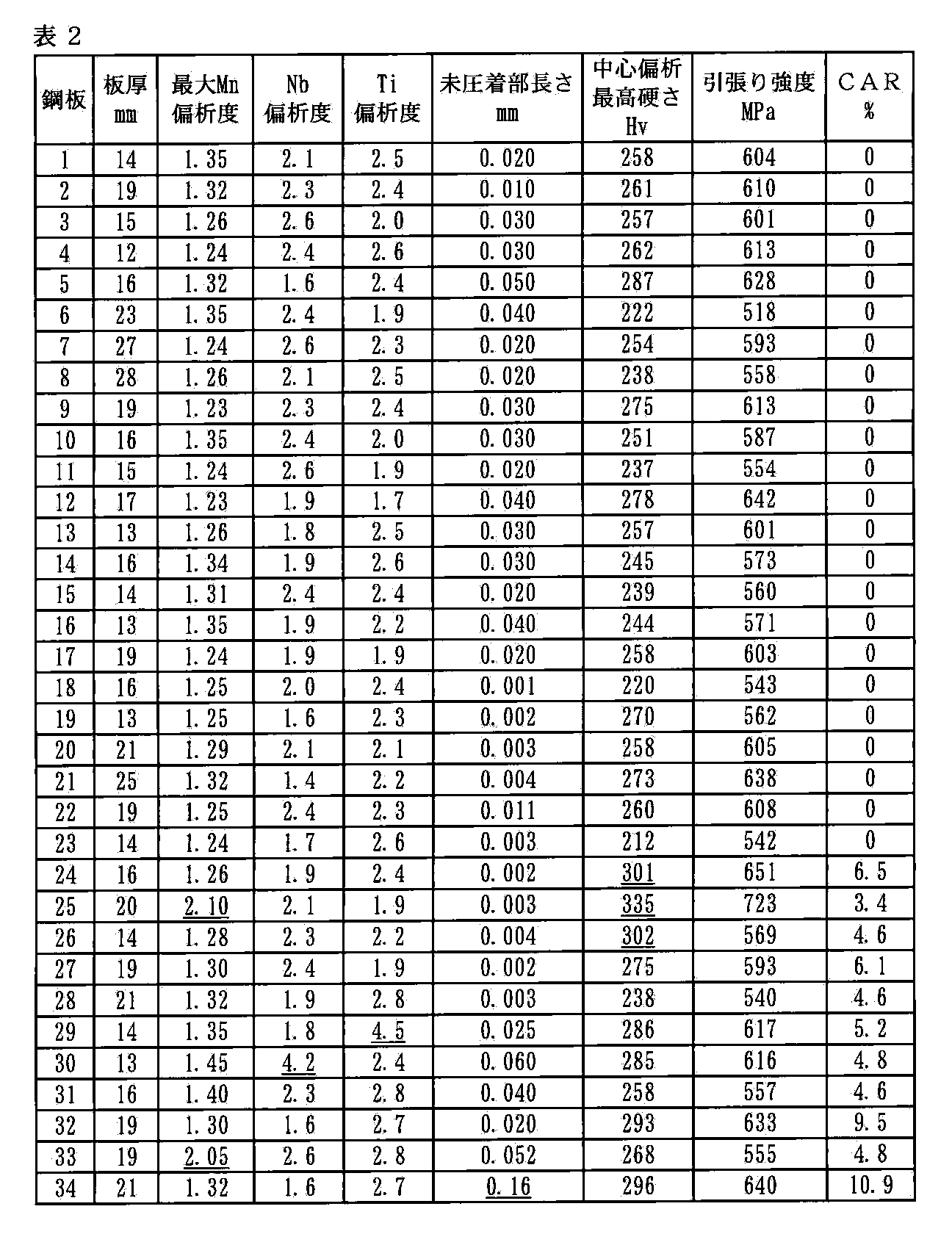
- Table 2 shows the plate thickness, maximum Mn segregation degree, Nb segregation degree, Ti segregation degree, length of the non-crimped part, maximum hardness of the central segregation part, respectively, obtained from steels 1 to 34 of Table 1.
- required by tensile strength and the HIC test is shown.
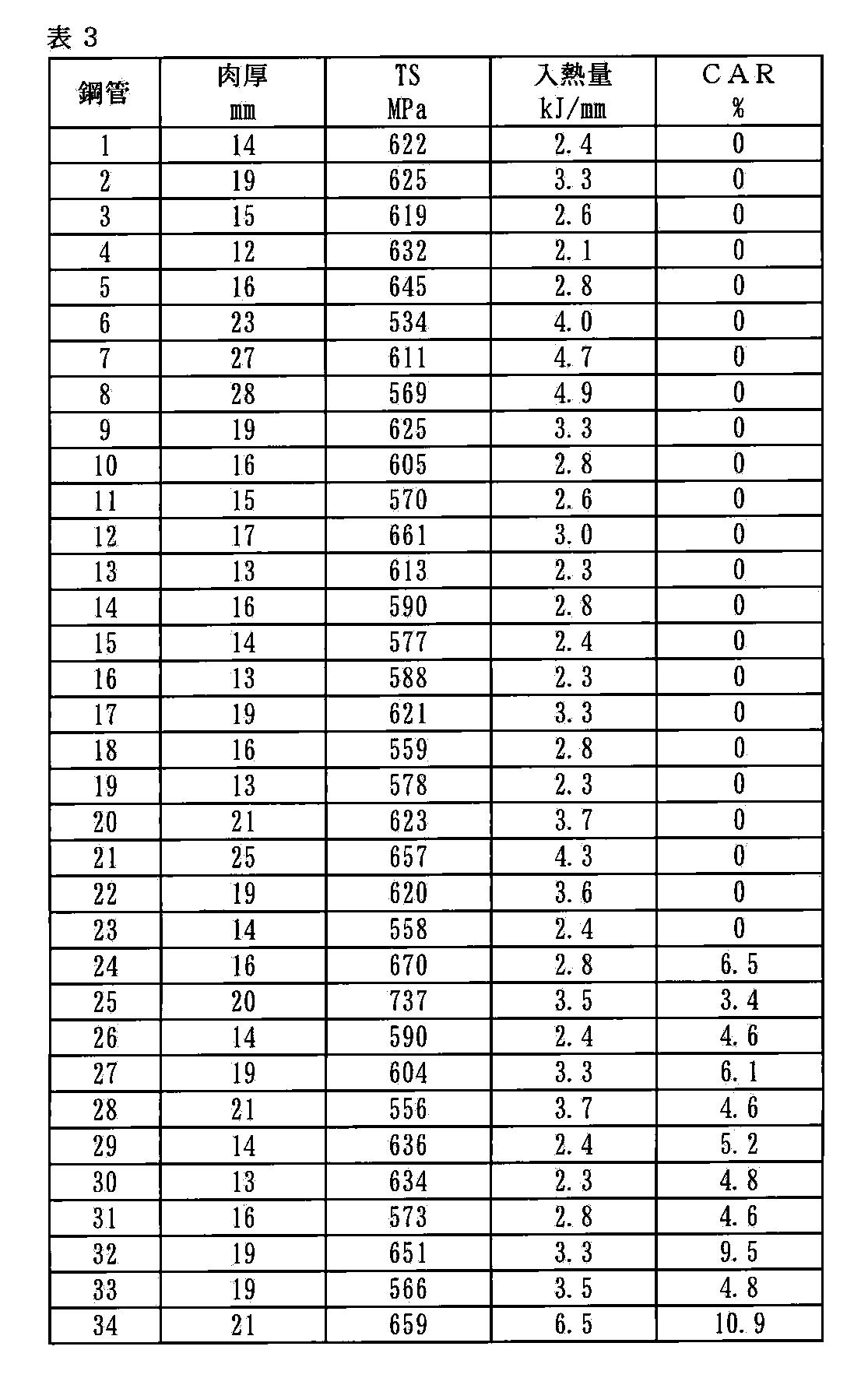
- Table 3 shows the thickness of the steel pipe obtained from each of the steels 1 to 34 shown in Table 1, the heat input of the main welding, and the area ratio of cracks determined by the HIC test.
- the maximum Mn segregation degree, Nb segregation degree, Ti segregation degree, length of unbonded part, and maximum hardness of the central segregation part of steel pipe are the same as steel sheet, and the tensile strength of steel pipe is 1-5% that of steel sheet. It is getting bigger.
- Steels 1 to 23 are examples of the present invention, and the steel sheets obtained from these steels have a maximum Mn segregation degree of 1.6 or less, a Nb segregation degree of 4.0 or less, a Ti segregation degree of 4.0 or less, The maximum hardness of the center segregation part is 300 Hv or less, and no cracks are generated by the HIC test.
- steels 24 to 34 represent comparative examples that are outside the scope of the present invention. That is, since any element of the basic components is outside the scope of the present invention, the CAR is over 3% in the HIC test.
Landscapes
- Chemical & Material Sciences (AREA)
- Engineering & Computer Science (AREA)
- Materials Engineering (AREA)
- Mechanical Engineering (AREA)
- Metallurgy (AREA)
- Organic Chemistry (AREA)
- Heat Treatment Of Steel (AREA)
Abstract
Description
HICは、特に、鋼の中心偏析部に存在する、延伸化したMnS、集積したTiやNbの炭窒化物、又は酸化物集積帯における酸化物系介在物など、鋼中の欠陥の周りに集積した水素に起因している。
したがって、サワー環境で使用されるラインパイプでは、従来から、延伸化したMnSの生成の抑制、Ti、Nbの炭窒化物や酸化物などの集積の抑制、あるいは中心偏析による硬化相の形成の抑制などの対策が講じられている。
また、Mnの偏析に加えて、Nbの偏析にも着目した、耐HIC性に優れる熱延鋼板が提案されている(例えば、特許文献4)。更に、Ti、Nbの炭化物、窒化物などの介在物を抑制する方法が提案されている(例えば、特許文献5、6)。
更に、Mnの偏析を解消すると、次にNbの偏析が問題になった。このNbの偏析についても、(偏析部の最大Nb含有量)/(鋼中の平均Nb含有量)の制御では不十分であり、より厳密に制御する必要があることがわかった。また、Nb−Ti−C−N系の介在物の長さや、(Ti,Nb)(C,N)系介在物の面密度及び長さを制御しても、HICの発生を防止することができなかった。
本発明は、このような実情に鑑みてなされたものであり、石油、天然ガス等の輸送用ラインパイプ等に使用される鋼管に最適な、耐HIC性に優れたラインパイプ用鋼板及びラインパイプ鋼管の提供を課題とするものである。
C :0.02~0.08%、
Si:0.01~0.5%、
Mn:1.0~1.6%、
Nb:0.001~0.10%、
Ca:0.0001~0.0050%、
N :0.0010~0.0050%、
O :0.0001~0.0030%
を含有し、
P :0.01%以下、
S :0.0020%以下、
Al:0.030%以下、
Ti:0.030%以下、
に制限し、S、Caの含有量が、
S/Ca<0.5
を満足し、残部がFe及び不可避的不純物元素からなり、
かつ、中心偏析部の未圧着部の長さを0.1mm以下
に制限したことを特徴とする耐水素誘起割れ性に優れた高強度ラインパイプ用鋼板。
(2)質量%で、
Ni:0.01~2.0%、
Cu:0.01~1.0%、
Cr:0.01~1.0%、
Mo:0.01~1.0%、
W :0.01~1.0%、
V :0.01~0.10%、
Zr:0.0001~0.050%、
Ta:0.0001~0.050%、
B :0.0001~0.0020%
の1種又は2種以上を含有して、残部が鉄及び不可避的不純物からなることを特徴とする上記(1)に記載の耐水素誘起割れ性に優れた高強度ラインパイプ用鋼板。
(3)質量%で
REM:0.0001~0.01%、
Mg:0.0001~0.01%、
Y :0.0001~0.005%、
Hf:0.0001~0.005%、
Re:0.0001~0.005%
のうち1種又は2種以上を、更に含有することを特徴とする上記(1)又は(2)に記載の耐水素誘起割れ性に優れた高強度ラインパイプ用鋼板。
(4)更に、
最大Mn偏析度:2.0以下、
Nb偏析度:4.0以下、
Ti偏析度:4.0以下、
に制限したことを特徴とする上記(1)又は(2)に記載の耐水素誘起割れ性に優れた高強度ラインパイプ用鋼板。
(5)中心偏析部の最高硬度が300Hv以下であることを特徴とする上記(1)又は(2)に記載の耐水素誘起割れ性に優れた高強度ラインパイプ用鋼板。
C :0.02~0.08%、
Si:0.01~0.5%、
Mn:1.0~1.6%、
Nb:0.001~0.10%、
Ca:0.0001~0.0050%、
N :0.0010~0.0050%、
O :0.0001~0.0030%
を含有し、
P :0.01%以下、
S :0.0020%以下、
Al:0.030%以下、
Ti:0.030%以下
に制限し、S、Caの含有量が、
S/Ca<0.5
を満足し、残部がFe及び不可避的不純物元素からなり、
かつ、母材の中心偏析部の未圧着部の長さを0.1mm以下に制限したことを特徴とする耐水素誘起割れ性に優れた高強度ラインパイプ用鋼管。
(7)母材が、質量%で、
Ni:0.01~2.0%、
Cu:0.01~1.0%、
Cr:0.01~1.0%、
Mo:0.01~1.0%、
W :0.01~1.0%、
V :0.01~0.10%、
Zr:0.0001~0.050%、
Ta:0.0001~0.050%、
B :0.0001~0.0020%
の1種又は2種以上を含有して、残部が鉄及び不可避的不純物からなることを特徴とする上記(6)に記載の耐水素誘起割れ性に優れた高強度ラインパイプ用鋼管。
(8)母材が、質量%で、
REM:0.0001~0.01%、
Mg:0.0001~0.01%、
Y :0.0001~0.005%、
Hf:0.0001~0.005%、
Re:0.0001~0.005%
のうち1種又は2種以上を、更に含有することを特徴とする上記(6)又は(7)に記載の耐水素誘起割れ性に優れた高強度ラインパイプ用鋼管。
(9)更に、母材の
最大Mn偏析度:2.0以下、
Nb偏析度:4.0以下、
Ti偏析度:4.0以下、
に制限したことを特徴とする上記(6)又は(7)に記載の耐水素誘起割れ性に優れた高強度ラインパイプ用鋼管。
(10)母材の中心偏析部の最高硬度が300Hv以下であることを特徴とする上記(6)又は(7)に記載の耐水素誘起割れ性に優れた高強度ラインパイプ用鋼管。
試験後、割れが発生した鋼板から試験片を採取し、HICの発生場所を詳細に観察した。その結果、中心偏析部の未圧着部が特に重要なHICの起点であることが判明した。
未圧着部とは、凝固時に鋼片に生じた空隙が、熱間圧延によって圧着されず、鋼板にも残存したものであり、サイズが大きい場合超音波等の非破壊検査によって長さを測定することができる。
また、熱間圧延後、鋼板は冷却され、金属組織がオーステナイトからフェライト、ベイナイト、マルテンサイト、パーライトなどに変態すると、水素が外部に放散される。そのため、鋼板に残留する水素量は、2次精錬後の水素量に比べると低下している。
図1に0.04%C−1.25%Mn鋼のHIC試験におけるCAR(割れ面積率)とS/Caの関係を示す。図1に示されるように、S/Caの比が0.5以上になると、HICが発生し始めるので、S/Caは0.5未満にする必要があることが判る。
また、酸化物の集積を抑制するには、O量を0.0030%以下にすること、Al量を0.030%以下にすることが必要である。O量が多いと、粗大な酸化物が集積しやすこと、Alを0.030%超添加すると、Alの酸化物のクラスターが集積しやすくなることが明らかとなった。
Ti、Nbの炭窒化物の集積を抑制するには、次の条件を満たすことが好ましい。N量を0.0050%以下にすること、C量を0.06%以下にすること、NbとTiの偏析度をそれぞれ4以下にすることである。
同様に、Nb偏析度とTi偏析度は、鋼板及び鋼管の中心偏析部を除いた平均のNb量(Ti量)に対する中心偏析部の平均化したNb量(Ti量)の比である。
この際、EPMA(又はCMA)のプローブ径によって最大Mn偏析度の数値が変化する。本発明者らは、プローブ径(ビーム径)を2μmとすることにより、適正にMnの偏析を評価できることを見出した。実際には、次のようにして測定を行う。
実際には、Nb、Ti偏析度に関しても、EPMAにて50μmのビーム径にて20mm幅(HIC試験片幅)×20mm厚(HIC試験片厚)の測定領域におけるNb、Tiのそれぞれの濃度分布を測定して、平均Nb濃度及び平均Ti濃度を求めた後、最もNb,Ti量が濃化していた場所(中心偏析部)において、さらに2μmのビーム径にて1mm(幅)×1mm(厚み)の領域のNbとTiの濃度を測定する。その際、板幅方向に測定した500点の平均を取り、中心偏析部の平均のNbとTiの濃度を導出する。そして、中心偏析部の平均Nb濃度(Ti濃度)の平均Nb濃度(Ti濃度)に対する比をそれぞれNb偏析度及びTi偏析度と定義してその値を求める。
なお、MnSなどの介在物が存在すると各元素の偏析度が見かけ上大きくなるので、介在物が当たった場合はその値は除いて評価するものとする。
なお、中心偏析部は、EPMAやCMAによって測定したMnの濃度が最大になる部位であり、中心偏析部の最高硬さは、3%硝酸+97%ナイタール溶液で腐食した後、JIS Z 2244に準拠し、25gの荷重でビッカース硬さ試験を行って、測定すればよい。
まず本発明の鋼板及び鋼管における母材成分の限定理由について述べる。以下において、元素の含有量の%は、質量%を意味するものとする。
Si:Siは脱酸元素であり、0.01%以上の添加が必要である。一方、Si量が0.5%を超えると、溶接熱影響部(HAZ)の靱性を低下させるため、上限を0.5%とする。
Nb:Nbは、炭化物、窒化物を形成し、強度の向上に寄与する元素である。その効果を得るためには、0.001%以上を添加することが必要である。しかし、Nbを過剰に添加すると、Nb偏析度が増加し、Nbの炭窒化物の集積を招いて、耐HIC性が低下する。したがって、本発明においては、Nb量の上限を0.10%とする。また、HIC性を考慮した場合、Nb量は0.05%以下にすることが好ましい。
P:Pは不純物であり、含有量が0.01%を超えると、耐HIC性を損ない、また、HAZの靱性が低下する。したがって、Pの含有量を0.01%以下に制限する。
S:Sは、熱間圧延時に圧延方向に延伸するMnSを生成して、耐HIC性を低下させる元素である。したがって、本発明では、S量を低減することが必要であり、含有量を0.0020%以下に制限する。また、靱性を向上させるためには、S量を0.0010%以下とすることが好ましい。S量は、少ないほど好ましいが、0.0001%未満にすることは困難であり、製造コストの観点から0.0001%以上の含有とすることが好ましい。
Al:Alは脱酸元素であるが、本発明においては、添加量が0.030%を超えるとAl酸化物の集積クラスターが確認されるため、0.030%以下に制限する。靭性が要求される場合には、Al量の上限を0.017%以下にすることが好ましい。Al量の下限値は特に限定しないが、溶鋼中の酸素量を低減させるためには、Alを0.0005%以上添加することが好ましい。
O:Oは不純物であり、酸化物の集積を抑制して、耐HIC性を向上させるために、含有量を0.0030%以下に制限する。酸化物の生成を抑制して、母材及びHAZ靭性を向上させるためには、O量を0.0020%以下とすることが好ましい。
本発明では、Caを添加して、CaSを形成させることにより、Sを固定するため、SとCaの含有量におけるS/Caの比は重要な指標である。S/Caの比が0.5以上であると、MnSが生成し、圧延時に延伸化したMnSが形成される。その結果、耐HIC性が劣化する。したがって、S/Caの比の値を0.5未満とした。
Ni:Niは、靱性及び強度の改善に有効な元素であり、その効果を得るためには0.01%以上の添加が必要であるが、2.0%を超える添加ではHIC性及び溶接性が低下するために、その上限を2.0%とすることが好ましい。
Cu:Cuは、靱性を低下させずに強度の上昇に有効な元素であるが、0.01%未満では効果がなく、1.0%を超えると鋼片加熱時や溶接時に割れを生じやすくする。従って、その含有量を0.01~1.0%とすることが好ましい。
Mo:Moは、焼入れ性を向上させると同時に、炭窒化物を形成し強度を改善する元素であり、その効果を得るためには、0.01%以上の添加が好ましい。一方、Moを1.0%を超えて多量に添加すると、コストが上昇するため、上限を1.0%にすることが好ましい。また、鋼の強度が上昇すると、HIC性及び靱性が低下することがあるため、より好ましい上限を0.20%とする。
V:Vは、炭化物、窒化物を形成し、強度の向上に寄与する元素であり、効果を得るためには、0.01%以上の添加が好ましい。一方、0.10%を超えるVを添加すると、靱性の低下を招くことがあるため、上限を0.10%とすることが好ましい。
B:Bは、鋼の粒界に偏析して焼入れ性の向上に著しく寄与する元素である。この効果を得るには、0.0001%以上のBの添加が好ましい。また、BはBNを生成し、固溶Nを低下させて、溶接熱影響部の靱性の向上にも寄与する元素であるため、0.0005%以上の添加がより好ましい。一方。Bを過剰に添加すると、粒界への偏析が過剰になり、靱性の低下を招くことがあるため、上限を0.0020%とすることが好ましい。
REM:REMは、脱酸剤及び脱硫剤として添加される元素であり、0.0001%以上の添加が好ましい。一方、0.010%を超えて添加すると、粗大な酸化物を生じて、HIC性や、母材及びHAZの靱性を低下させることがあり、好ましい添加量は0.010%以下である。
Mg:Mgは、脱酸剤及び脱硫剤として添加される元素であり、特に、微細な酸化物を生じて、HAZ靭性の向上にも寄与する。この効果を得るには、0.0001%以上のMgを添加することが好ましい。一方、Mgを0.010%超添加すると、酸化物が凝集、粗大化し易くなり、HIC性の劣化や、母材及びHAZの靱性の低下をもたらすことがある。したがって、Mgの添加量を0.010%以下とすることが好ましい。
Y、Hf、Re:Y、Hf、Reは、Caと同様、硫化物を生成し、圧延方向に伸長したMnSの生成を抑制し、耐HIC性の向上に寄与する元素である。このような効果を得るには、Y、Hf、Reを、0.0001%以上添加することが好ましい。一方、Y、Hf、Reの量が0.0050%を超えると、酸化物が増加し、凝集、粗大化すると耐HIC性を損なうため、添加量を0.0050%以下とすることが好ましい。
上述したように、中心偏析部に未圧着部が残存する原因は、熱間圧延前に鋼片に含まれる水素である。したがって、2次精錬における水素量を低減することによって、鋼片の空隙に含まれる水素ガスの圧力を低下させることができる。2次精錬におけるH量を0.00025%以下にすると、熱間圧延後、未圧着部はほとんどなくなり、存在したとしても0.1mm長さ以下にすることができる。
2次精錬における水素量を低減するには、2次精錬を行う際の雰囲気中の水素分圧を低下させることが好ましい。例えば、雰囲気中に不活性ガスや、窒素などを吹き込むことで、水素分圧を低下させることができる。
最大Mn偏析度を2.0以下にすることにより粗大なMnSの生成が抑制され、圧延方向に延伸化したMnSを起点とするHICの発生を防止することができる。また、Nb偏析度を4.0以下にすると集積したNb(C,N)の生成が抑制され、Ti偏析度を4.0以下にすると集積したTiNの生成が抑制され、HIC性の劣化を防止することができる。
Mn、Nb及びTiの偏析を抑制するには、連続鋳造における最終凝固時の軽圧下が最適である。最終凝固時の軽圧下は、鋳造の冷却の不均一に起因する、凝固部と未凝固部との混在を解消するために施すものであり、これにより、幅方向に均一に最終凝固させることができる。
連続鋳造において、通常、鋼片は水冷されるが、幅方向の端部は冷却が速く、幅方向の中央部の冷却は強化される。そのため、鋼片の幅方向の端部及び中央部では凝固していても、幅方向の1/4部では、凝固が遅れて、鋼片の内部には未凝固部が残存する。そのため、鋼片の幅方向において、凝固部と未凝固部が均一にならずに、例えば、凝固部と未凝固部との界面の形状が幅方向にW型となってしまうことがある。このような幅方向に不均一な凝固を生じてしまうと、偏析が助長されて、耐HIC性を劣化させる。
したがって、このようなW型の凝固を生じさせないようにするためには、鋳片の最終凝固位置における中心固相率の幅方向の分布に応じて圧下量を制御しながら軽圧下することが好ましい。このようにすることにより、幅方向でも中心偏析が抑制され、最大Mn偏析度、Nb偏析度、Ti偏析度を更に小さくすることができる。
この製造工程において、鋼片の再加熱温度を950℃以上とし、再結晶温度域での圧下比を2以上に、未再結晶域での圧下比を3以上にして厚板圧延を行えば、平均旧オーステナイト粒径を20μm以下にすることができる。更に、圧延終了後水冷を行うが、水冷の開始を750℃以上の温度から行い、水冷の停止を400~500℃の温度範囲で行うことが好ましい。
表1に示す化学成分を有する鋼を溶製し、連続鋳造により、厚みが240mmである鋼片とした。また、表1には、溶鋼の水素量の分析値も示した。連続鋳造では、最終凝固時の軽圧下を実施した。得られた鋼片を1000~1250℃に加熱し、900℃超の再結晶温度域で熱間圧延を行い、引き続き、750~900℃の未再結晶温度域での熱間圧延を行った。熱間圧延後は、750℃以上で水冷を開始し、400~500℃の温度で水冷を停止し、表2に示す種々の板厚の鋼板を作製した。
更に、鋼板を、Cプレス、Uプレス、Oプレスによって管状に成形し、端面を仮付け溶接し、内外面から本溶接を行った後、拡管後、鋼管とした。なお、本溶接は、サブマージドアーク溶接を採用した。
さらに、中心偏析のビッカース硬度をJIS Z 2244に準拠して測定した。ビッカース硬度の測定は、荷重を25gとし、EPMAによって測定した厚み方向のMn濃度の分布における、Mn濃度が最も高い部位で行った。
また、表3には、表1の鋼1~34からそれぞれ得られた鋼管の肉厚、本溶接の入熱量、HIC試験によって求められた割れの面積率を示す。なお、鋼管の最大Mn偏析度、Nb偏析度、Ti偏析度、未圧着部の長さ、中心偏析部の最高硬さは鋼板と同等であり、鋼管の引張り強度は鋼板よりも1~5%程度大きくなっている。
一方、鋼24~34は本発明の範囲外である比較例を示す。すなわち、基本成分の内いずれかの元素が、本発明の範囲外であるため、HIC試験にてCARが3%を超えているものである。

Claims (10)
- 質量%で、
C :0.02~0.08%、
Si:0.01~0.5%、
Mn:1.0~1.6%、
Nb:0.001~0.10%、
Ca:0.0001~0.0050%、
N :0.0010~0.0050%、
O :0.0001~0.0030%
を含有し、
P :0.01%以下、
S :0.0020%以下、
Al:0.030%以下、
Ti:0.030%以下
に制限し、S、Caの含有量が、
S/Ca<0.5
を満足し、残部がFe及び不可避的不純物元素からなり、
かつ、中心偏析部の未圧着部の長さを0.1mm以下
に制限したことを特徴とする耐水素誘起割れ性に優れた高強度ラインパイプ用鋼板。 - 質量%で、
Ni:0.01~2.0%、
Cu:0.01~1.0%、
Cr:0.01~1.0%、
Mo:0.01~1.0%、
W :0.01~1.0%、
V :0.01~0.10%、
Zr:0.0001~0.050%、
Ta:0.0001~0.050%、
B :0.0001~0.0020%
の1種又は2種以上を含有して、残部が鉄及び不可避的不純物からなることを特徴とする請求項1に記載の耐水素誘起割れ性に優れた高強度ラインパイプ用鋼板。 - 質量%で
REM:0.0001~0.01%、
Mg:0.0001~0.01%、
Y :0.0001~0.005%、
Hf:0.0001~0.005%、
Re:0.0001~0.005%
のうち1種又は2種以上を、更に含有することを特徴とする請求項1又は請求項2に記載の耐水素誘起割れ性に優れた高強度ラインパイプ用鋼板。 - 更に、
最大Mn偏析度:2.0以下、
Nb偏析度:4.0以下、
Ti偏析度:4.0以下、
に制限したことを特徴とする請求項1又は請求項2に記載の耐水素誘起割れ性に優れた高強度ラインパイプ用鋼板。 - 中心偏析部の最高硬度が300Hv以下であることを特徴とする請求項1又は請求項2に記載の耐水素誘起割れ性に優れた高強度ラインパイプ用鋼板。
- 母材が、質量%で、
C :0.02~0.08%、
Si:0.01~0.5%、
Mn:1.0~1.6%、
Nb:0.001~0.10%、
Ca:0.0001~0.0050%、
N :0.0010~0.0050%、
O :0.0001~0.0030%
を含有し、
P :0.01%以下、
S :0.0020%以下、
Al:0.030%以下、
Ti:0.030%以下
に制限し、S、Caの含有量が、
S/Ca<0.5
を満足し、残部がFe及び不可避的不純物元素からなり、
かつ、母材の中心偏析部の未圧着部の長さを0.1mm以下
に制限したことを特徴とする耐水素誘起割れ性に優れた高強度ラインパイプ用鋼管。 - 母材が、質量%で、
Ni:0.01~2.0%、
Cu:0.01~1.0%、
Cr:0.01~1.0%、
Mo:0.01~1.0%、
W :0.01~1.0%、
V :0.01~0.10%、
Zr:0.0001~0.050%、
Ta:0.0001~0.050%、
B :0.0001~0.0020%
の1種又は2種以上を含有して、残部が鉄及び不可避的不純物からなることを特徴とする請求項6に記載の耐水素誘起割れ性に優れた高強度ラインパイプ用鋼管。 - 母材が、質量%で、
REM:0.0001~0.01%、
Mg:0.0001~0.01%、
Y :0.0001~0.005%、
Hf:0.0001~0.005%、
Re:0.0001~0.005%
のうち1種又は2種以上を、更に含有することを特徴とする請求項6又は請求項7に記載の耐水素誘起割れ性に優れた高強度ラインパイプ用鋼管。 - 更に、母材の
最大Mn偏析度:2.0以下、
Nb偏析度:4.0以下、
Ti偏析度:4.0以下、
に制限したことを特徴とする請求項6又は請求項7に記載の耐水素誘起割れ性に優れた高強度ラインパイプ用鋼管。 - 母材の中心偏析部の最高硬度が300Hv以下であることを特徴とする請求項6又は請求項7に記載の耐水素誘起割れ性に優れた高強度ラインパイプ用鋼管。
Priority Applications (3)
| Application Number | Priority Date | Filing Date | Title |
|---|---|---|---|
| BRPI1008563A BRPI1008563A2 (pt) | 2009-02-12 | 2010-02-12 | chapa de aço de alta resistência e tubo de aço de alta resistência para oleoduto excelente em resistência á fratura induzida pelo hidrogênio |
| CN2010800075239A CN102317491A (zh) | 2009-02-12 | 2010-02-12 | 抗氢致开裂性优异的高强度管线管用钢板和高强度管线管用钢管 |
| KR1020137023805A KR101524397B1 (ko) | 2009-02-12 | 2010-02-12 | 내수소 유기 균열성이 우수한 고강도 라인 파이프용 강판 및 고강도 라인 파이프용 강관 |
Applications Claiming Priority (4)
| Application Number | Priority Date | Filing Date | Title |
|---|---|---|---|
| JP2009030314 | 2009-02-12 | ||
| JP2009-030314 | 2009-02-12 | ||
| JP2009-253147 | 2009-11-04 | ||
| JP2009253147A JP5423323B2 (ja) | 2009-02-12 | 2009-11-04 | 耐水素誘起割れ性に優れた高強度ラインパイプ用鋼板及び高強度ラインパイプ用鋼管 |
Publications (1)
| Publication Number | Publication Date |
|---|---|
| WO2010093057A1 true WO2010093057A1 (ja) | 2010-08-19 |
Family
ID=42561894
Family Applications (1)
| Application Number | Title | Priority Date | Filing Date |
|---|---|---|---|
| PCT/JP2010/052483 Ceased WO2010093057A1 (ja) | 2009-02-12 | 2010-02-12 | 耐水素誘起割れ性に優れた高強度ラインパイプ用鋼板及び高強度ラインパイプ用鋼管 |
Country Status (5)
| Country | Link |
|---|---|
| JP (1) | JP5423323B2 (ja) |
| KR (2) | KR101524397B1 (ja) |
| CN (2) | CN102317491A (ja) |
| BR (1) | BRPI1008563A2 (ja) |
| WO (1) | WO2010093057A1 (ja) |
Cited By (3)
| Publication number | Priority date | Publication date | Assignee | Title |
|---|---|---|---|---|
| EP2612946A4 (en) * | 2010-09-03 | 2014-03-26 | Nippon Steel & Sumitomo Metal Corp | HIGH-RESISTANCE STEEL PLATE WITH EXCEPTIONAL FRICTION STRENGTH AND EXCELLENT HIC RESISTANCE |
| EP2832879A4 (en) * | 2012-03-30 | 2016-01-13 | Nippon Steel & Sumitomo Metal Corp | HIGH-RESISTANCE STEEL TUBE FOR LINE TUBE WITH EXCELLENT RESISTANCE TO HYDROGEN-INDUCED TISSUE FORMING, HIGH-TIGHT STEEL TUBE FOR A TUBULAR TUBE AND METHOD FOR THE MANUFACTURE THEREOF |
| JP2020503445A (ja) * | 2016-12-22 | 2020-01-30 | ポスコPosco | 耐水素誘起割れ性に優れた引張強度450MPa級の厚肉鋼材及びその製造方法 |
Families Citing this family (21)
| Publication number | Priority date | Publication date | Assignee | Title |
|---|---|---|---|---|
| JP5423323B2 (ja) * | 2009-02-12 | 2014-02-19 | 新日鐵住金株式会社 | 耐水素誘起割れ性に優れた高強度ラインパイプ用鋼板及び高強度ラインパイプ用鋼管 |
| WO2010104165A1 (ja) * | 2009-03-12 | 2010-09-16 | 住友金属工業株式会社 | 耐hic厚鋼板およびuoe鋼管 |
| CN102471843A (zh) * | 2009-09-02 | 2012-05-23 | 新日本制铁株式会社 | 低温韧性优良的高强度管线管用钢板及高强度管线管用钢管 |
| BR112012005189A2 (pt) * | 2009-09-09 | 2016-03-08 | Nippon Steel Corp | chapas de aço para uso em tubos para oleodutos de alta resistência e aço para uso em tubos para oleodutos de alta resistência com excelente tenacidade a baixa temperatura |
| JP5857491B2 (ja) * | 2011-07-19 | 2016-02-10 | Jfeスチール株式会社 | Sr後の溶接部靱性に優れた低降伏比耐hic溶接鋼管およびその製造方法 |
| JP5853456B2 (ja) * | 2011-07-19 | 2016-02-09 | Jfeスチール株式会社 | Sr後の溶接部靱性に優れた低降伏比耐hic溶接鋼管およびその製造方法 |
| JP5824401B2 (ja) | 2012-03-30 | 2015-11-25 | 株式会社神戸製鋼所 | 耐水素誘起割れ性に優れた鋼板およびその製造方法 |
| KR101982014B1 (ko) | 2012-06-18 | 2019-05-24 | 제이에프이 스틸 가부시키가이샤 | 후육 고강도 내사우어 라인 파이프, 그의 제조 방법 및 그의 내hic성능의 판정 방법 |
| US20150152982A1 (en) | 2012-07-09 | 2015-06-04 | Jfe Steel Corporation | Thick-walled high-strength sour-resistant line pipe and method for producing same |
| KR101461730B1 (ko) * | 2012-12-21 | 2014-11-14 | 주식회사 포스코 | 내수소유기균열성 및 저온충격인성이 우수한 열연강판 및 그 제조방법 |
| KR101490561B1 (ko) * | 2012-12-21 | 2015-02-05 | 주식회사 포스코 | 내수소유기균열성 및 항복비가 우수한 박물 열연강판 및 그 제조방법 |
| CN103146997B (zh) * | 2013-03-28 | 2015-08-26 | 宝山钢铁股份有限公司 | 一种低合金高韧性耐磨钢板及其制造方法 |
| CN103215513B (zh) * | 2013-04-25 | 2016-03-30 | 宝山钢铁股份有限公司 | 一种抗腐蚀集输管线管及其制造方法 |
| JP2016125137A (ja) * | 2014-12-26 | 2016-07-11 | 株式会社神戸製鋼所 | 耐水素誘起割れ性に優れた鋼板およびラインパイプ用鋼管 |
| JP6584912B2 (ja) * | 2014-12-26 | 2019-10-02 | 株式会社神戸製鋼所 | 耐水素誘起割れ性に優れた鋼板およびラインパイプ用鋼管 |
| JP6642118B2 (ja) * | 2016-03-02 | 2020-02-05 | 日本製鉄株式会社 | 耐サワー鋼板 |
| JP6869151B2 (ja) * | 2016-11-16 | 2021-05-12 | 株式会社神戸製鋼所 | 鋼板およびラインパイプ用鋼管並びにその製造方法 |
| CN109694991A (zh) * | 2017-10-20 | 2019-04-30 | 鞍钢股份有限公司 | 一种抗氢致裂纹性能优异的容器钢板 |
| KR101999027B1 (ko) * | 2017-12-26 | 2019-07-10 | 주식회사 포스코 | 수소유기균열 저항성이 우수한 압력용기용 강재 및 그 제조방법 |
| CN108456834B (zh) * | 2018-03-05 | 2020-04-24 | 白婷婷 | 一种具有含Ti析出物的高强度管线钢及其制备方法 |
| CN113025902B (zh) * | 2021-03-04 | 2022-02-01 | 东北大学 | 一种强韧性能优良的热轧无缝钢管及其制造方法 |
Citations (5)
| Publication number | Priority date | Publication date | Assignee | Title |
|---|---|---|---|---|
| JPH04259352A (ja) * | 1991-02-14 | 1992-09-14 | Nkk Corp | 耐水素誘起割れ性の優れた鋼材およびその製造方法 |
| JPH06220577A (ja) * | 1993-01-26 | 1994-08-09 | Kawasaki Steel Corp | 耐hic特性に優れた高張力鋼及びその製造方法 |
| JPH06256894A (ja) * | 1993-03-08 | 1994-09-13 | Nippon Steel Corp | 耐水素誘起割れ性に優れた高強度ラインパイプ |
| JP2006063351A (ja) * | 2004-08-24 | 2006-03-09 | Sumitomo Metal Ind Ltd | 耐水素誘起割れ性に優れた高強度鋼板および製造方法、並びにラインパイプ用鋼管 |
| JP2007136496A (ja) * | 2005-11-17 | 2007-06-07 | Sumitomo Metal Ind Ltd | 連続鋳造方法および連続鋳造鋳片 |
Family Cites Families (3)
| Publication number | Priority date | Publication date | Assignee | Title |
|---|---|---|---|---|
| JP4314873B2 (ja) * | 2002-04-26 | 2009-08-19 | Jfeスチール株式会社 | 耐hic特性に優れたラインパイプ用高強度鋼板およびその製造方法 |
| US7736447B2 (en) * | 2003-12-19 | 2010-06-15 | Nippon Steel Corporation | Steel plates for ultra-high-strength linepipes and ultra-high-strength linepipes having excellent low-temperature toughness and manufacturing methods thereof |
| JP5423323B2 (ja) * | 2009-02-12 | 2014-02-19 | 新日鐵住金株式会社 | 耐水素誘起割れ性に優れた高強度ラインパイプ用鋼板及び高強度ラインパイプ用鋼管 |
-
2009
- 2009-11-04 JP JP2009253147A patent/JP5423323B2/ja active Active
-
2010
- 2010-02-12 KR KR1020137023805A patent/KR101524397B1/ko active Active
- 2010-02-12 CN CN2010800075239A patent/CN102317491A/zh active Pending
- 2010-02-12 WO PCT/JP2010/052483 patent/WO2010093057A1/ja not_active Ceased
- 2010-02-12 CN CN201610208070.5A patent/CN105838992A/zh active Pending
- 2010-02-12 BR BRPI1008563A patent/BRPI1008563A2/pt not_active Application Discontinuation
- 2010-02-12 KR KR1020117018676A patent/KR20110104111A/ko not_active Ceased
Patent Citations (5)
| Publication number | Priority date | Publication date | Assignee | Title |
|---|---|---|---|---|
| JPH04259352A (ja) * | 1991-02-14 | 1992-09-14 | Nkk Corp | 耐水素誘起割れ性の優れた鋼材およびその製造方法 |
| JPH06220577A (ja) * | 1993-01-26 | 1994-08-09 | Kawasaki Steel Corp | 耐hic特性に優れた高張力鋼及びその製造方法 |
| JPH06256894A (ja) * | 1993-03-08 | 1994-09-13 | Nippon Steel Corp | 耐水素誘起割れ性に優れた高強度ラインパイプ |
| JP2006063351A (ja) * | 2004-08-24 | 2006-03-09 | Sumitomo Metal Ind Ltd | 耐水素誘起割れ性に優れた高強度鋼板および製造方法、並びにラインパイプ用鋼管 |
| JP2007136496A (ja) * | 2005-11-17 | 2007-06-07 | Sumitomo Metal Ind Ltd | 連続鋳造方法および連続鋳造鋳片 |
Cited By (4)
| Publication number | Priority date | Publication date | Assignee | Title |
|---|---|---|---|---|
| EP2612946A4 (en) * | 2010-09-03 | 2014-03-26 | Nippon Steel & Sumitomo Metal Corp | HIGH-RESISTANCE STEEL PLATE WITH EXCEPTIONAL FRICTION STRENGTH AND EXCELLENT HIC RESISTANCE |
| US9528172B2 (en) | 2010-09-03 | 2016-12-27 | Nippon Steel & Sumitomo Metal Corporation | High-strength steel sheet having improved resistance to fracture and to HIC |
| EP2832879A4 (en) * | 2012-03-30 | 2016-01-13 | Nippon Steel & Sumitomo Metal Corp | HIGH-RESISTANCE STEEL TUBE FOR LINE TUBE WITH EXCELLENT RESISTANCE TO HYDROGEN-INDUCED TISSUE FORMING, HIGH-TIGHT STEEL TUBE FOR A TUBULAR TUBE AND METHOD FOR THE MANUFACTURE THEREOF |
| JP2020503445A (ja) * | 2016-12-22 | 2020-01-30 | ポスコPosco | 耐水素誘起割れ性に優れた引張強度450MPa級の厚肉鋼材及びその製造方法 |
Also Published As
| Publication number | Publication date |
|---|---|
| CN102317491A (zh) | 2012-01-11 |
| KR101524397B1 (ko) | 2015-06-04 |
| KR20110104111A (ko) | 2011-09-21 |
| JP2010209460A (ja) | 2010-09-24 |
| BRPI1008563A2 (pt) | 2016-03-15 |
| JP5423323B2 (ja) | 2014-02-19 |
| CN105838992A (zh) | 2016-08-10 |
| KR20130105941A (ko) | 2013-09-26 |
Similar Documents
| Publication | Publication Date | Title |
|---|---|---|
| JP5423323B2 (ja) | 耐水素誘起割れ性に優れた高強度ラインパイプ用鋼板及び高強度ラインパイプ用鋼管 | |
| JP5423324B2 (ja) | 耐水素誘起割れ性に優れた高強度ラインパイプ用鋼板及び高強度ラインパイプ用鋼管 | |
| JP5392441B1 (ja) | 耐水素誘起割れ性に優れた高強度ラインパイプ用鋼管及びこれに用いる高強度ラインパイプ用鋼板、並びにこれらの製造方法 | |
| RU2637202C2 (ru) | Листовая сталь для толстостенной высокопрочной магистральной трубы, обладающая превосходными сопротивлением воздействию кислой среды, сопротивлением смятию и низкотемпературной вязкостью, а также магистральная труба | |
| JP5098256B2 (ja) | 耐水素誘起割れ性能に優れたバウシンガー効果による降伏応力低下が小さい高強度ラインパイプ用鋼板およびその製造方法 | |
| JP5343519B2 (ja) | ラインパイプ用鋼板および鋼管 | |
| JP5353156B2 (ja) | ラインパイプ用鋼管及びその製造方法 | |
| JP5131714B2 (ja) | 低温靭性に優れた高強度ラインパイプ用鋼板及び高強度ラインパイプ用鋼管 | |
| WO2015012317A1 (ja) | ラインパイプ用鋼板及びラインパイプ | |
| JP7550625B2 (ja) | オーステナイト系ステンレス鋼板および鋼管ならびにこれらの製造方法 | |
| WO2015022899A1 (ja) | 溶接部品質の優れた電縫鋼管及びその製造方法 | |
| WO2010095730A1 (ja) | 耐サワーラインパイプ用鋼板の製造方法 | |
| WO2011042936A1 (ja) | 高強度鋼管、高強度鋼管用鋼板、及び、それらの製造方法 | |
| CN115210396A (zh) | 钢管和钢板 | |
| JP4719313B2 (ja) | 耐サワー性に優れた鋼板及びラインパイプ用鋼管 | |
| WO2011043287A1 (ja) | 強度、延性の良好なラインパイプ用鋼およびその製造方法 | |
| JP4677883B2 (ja) | バウシンガー効果による降伏応力低下が小さい高強度ラインパイプ用鋼板およびその製造方法 | |
| JP5343486B2 (ja) | 大入熱溶接用鋼材 | |
| EP4675003A1 (en) | Steel pipe and method for manufacturing same | |
| JP2025130177A (ja) | 溶接継手およびその製造方法 | |
| JP2025130176A (ja) | 溶接継手およびその製造方法 | |
| WO2024171518A1 (ja) | 水素輸送鋼管用高強度鋼板、その製造方法および水素輸送鋼管 |
Legal Events
| Date | Code | Title | Description |
|---|---|---|---|
| WWE | Wipo information: entry into national phase |
Ref document number: 201080007523.9 Country of ref document: CN |
|
| 121 | Ep: the epo has been informed by wipo that ep was designated in this application |
Ref document number: 10741330 Country of ref document: EP Kind code of ref document: A1 |
|
| ENP | Entry into the national phase |
Ref document number: 20117018676 Country of ref document: KR Kind code of ref document: A |
|
| NENP | Non-entry into the national phase |
Ref country code: DE |
|
| 122 | Ep: pct application non-entry in european phase |
Ref document number: 10741330 Country of ref document: EP Kind code of ref document: A1 |
|
| REG | Reference to national code |
Ref country code: BR Ref legal event code: B01A Ref document number: PI1008563 Country of ref document: BR |
|
| ENP | Entry into the national phase |
Ref document number: PI1008563 Country of ref document: BR Kind code of ref document: A2 Effective date: 20110811 |