WO2010087422A1 - ポリ乳酸の製造方法 - Google Patents
ポリ乳酸の製造方法 Download PDFInfo
- Publication number
- WO2010087422A1 WO2010087422A1 PCT/JP2010/051183 JP2010051183W WO2010087422A1 WO 2010087422 A1 WO2010087422 A1 WO 2010087422A1 JP 2010051183 W JP2010051183 W JP 2010051183W WO 2010087422 A1 WO2010087422 A1 WO 2010087422A1
- Authority
- WO
- WIPO (PCT)
- Prior art keywords
- aluminum
- compound
- polylactic acid
- general formula
- titanium
- Prior art date
- Legal status (The legal status is an assumption and is not a legal conclusion. Google has not performed a legal analysis and makes no representation as to the accuracy of the status listed.)
- Ceased
Links
Classifications
-
- C—CHEMISTRY; METALLURGY
- C08—ORGANIC MACROMOLECULAR COMPOUNDS; THEIR PREPARATION OR CHEMICAL WORKING-UP; COMPOSITIONS BASED THEREON
- C08G—MACROMOLECULAR COMPOUNDS OBTAINED OTHERWISE THAN BY REACTIONS ONLY INVOLVING UNSATURATED CARBON-TO-CARBON BONDS
- C08G63/00—Macromolecular compounds obtained by reactions forming a carboxylic ester link in the main chain of the macromolecule
- C08G63/78—Preparation processes
- C08G63/82—Preparation processes characterised by the catalyst used
- C08G63/823—Preparation processes characterised by the catalyst used for the preparation of polylactones or polylactides
-
- C—CHEMISTRY; METALLURGY
- C08—ORGANIC MACROMOLECULAR COMPOUNDS; THEIR PREPARATION OR CHEMICAL WORKING-UP; COMPOSITIONS BASED THEREON
- C08G—MACROMOLECULAR COMPOUNDS OBTAINED OTHERWISE THAN BY REACTIONS ONLY INVOLVING UNSATURATED CARBON-TO-CARBON BONDS
- C08G63/00—Macromolecular compounds obtained by reactions forming a carboxylic ester link in the main chain of the macromolecule
- C08G63/02—Polyesters derived from hydroxycarboxylic acids or from polycarboxylic acids and polyhydroxy compounds
- C08G63/06—Polyesters derived from hydroxycarboxylic acids or from polycarboxylic acids and polyhydroxy compounds derived from hydroxycarboxylic acids
- C08G63/08—Lactones or lactides
-
- C—CHEMISTRY; METALLURGY
- C08—ORGANIC MACROMOLECULAR COMPOUNDS; THEIR PREPARATION OR CHEMICAL WORKING-UP; COMPOSITIONS BASED THEREON
- C08L—COMPOSITIONS OF MACROMOLECULAR COMPOUNDS
- C08L2203/00—Applications
- C08L2203/02—Applications for biomedical use
Definitions
- the present invention relates to a method for producing polylactic acid.
- Aliphatic polyesters typified by polylactic acid and polyglycolic acid exhibit excellent biodegradability and biocompatibility. Therefore, medical and medical fields such as surgical sutures, microcapsules for injections, and bone fragment bonding members It is used in.
- polylactic acid uses lactic acid obtained by fermenting grains and waste as a raw material, so it is attracting the most attention as a green plastic that is friendly to the global environment, replacing conventional synthetic polymers derived from fossils. Has been done.
- a method for synthesizing polylactic acid a method of polycondensing lactic acid or a method of ring-opening polymerization of lactide is widely known.
- the former method is an equilibrium reaction, and in order to obtain a practical high molecular weight polymer, it is necessary to thoroughly remove water, which is a by-product generated during the reaction, under conditions such as high temperature and reduced pressure.
- the latter method is effective as a method for synthesizing a high molecular weight polylactic acid because no by-product is generated.
- Non-patent Document 1 As an effective polymerization catalyst for industrial production of polylactic acid by ring-opening polymerization, tin octylate, aluminum propoxide, and zinc lactate are widely known (Non-patent Document 1).
- ⁇ ⁇ Tin octylate is commercially available and is easy to handle, such as being soluble in various organic solvents and stable in air. Further, the catalyst activity is very high, and the polymerization is completed within a few minutes under general melt polymerization conditions (reaction temperature 120-200 ° C.), giving polylactic acid having a molecular weight of 100,000 to 1,000,000.
- Tin octylate is recognized as a food additive by the FDA (Food and drug administration: American Food and Drug Administration). However, since there is a possibility that the obtained polylactic acid may be applied to medical uses, in view of the fact that many other tin compounds have toxicity, in order not to give a bad impression to users or consumers, It is desirable not to use tin octylate in the production of polylactic acid.
- aluminum isopropoxide like tin octylate, is easy to obtain and handle, and has no negative impression on toxicity and fear of depolymerization at the time of melt molding.
- Zinc lactate like aluminum isopropoxide, is not yet put into practical use because its catalytic activity is significantly inferior to that of tin octylate, although there is no negative impression regarding toxicity and the possibility of depolymerization during melt molding.
- Patent Document 1 discloses a method for producing polylactic acid by ring-opening polymerization reaction of lactide using aluminum trifluoromethanesulfonic acid as a polymerization catalyst.
- the catalytic activity of aluminum trifluoromethanesulfonic acid is higher than that of the above-mentioned aluminum isopropoxide, the reaction requires 6 hours or more, which is not practically sufficient.
- the polylactic acid obtained by the reaction has a low weight average molecular weight of about 10,000 and is not practical.
- Patent Document 2 discloses A) a heat reaction condensate of a mixture of aluminum alkoxide, silicon halide and phosphate ester, and B) a trialkylaluminum having a C 1 to C 4 alkyl group and / or A method for producing polylactic acid by ring-opening polymerization reaction of 30% by weight of a lactide dichloromethane solution using a mixture of dialkylaluminum chlorides as a catalyst has been disclosed. By using this method, a highly useful biodegradable polymer is disclosed. A molecular weight lactic acid polymer can be produced. However, this method has a very long reaction time of several days, and sufficient catalytic activity is not obtained.
- Patent Document 3 discloses ring-opening polymerization reaction of cyclic dimer of ⁇ -hydroxy acid using an aluminum ⁇ -diketone uncharged complex such as aluminum tris (acetylacetonate) or aluminum dipivaloylmethanate as a catalyst.
- an aluminum ⁇ -diketone uncharged complex such as aluminum tris (acetylacetonate) or aluminum dipivaloylmethanate as a catalyst.
- a method for producing a polyester in which a low-molecular weight compound in the polymer is removed by performing a reduced pressure treatment in the molten state of the polymer at a later stage of the reaction or after the completion of the reaction. has been.
- a simpler and more suitable production method for industrialization that does not require a complicated process for removing the residual monomer under reduced pressure.
- An object of the present invention is to provide a method for producing polylactic acid in a high yield in a short time using a catalyst having a very high catalytic activity while being a green ring-opening polymerization catalyst that is friendly to the environment and the human body. It is.
- R 1 n AlX 3-n (1) (Wherein n represents an integer of 1 to 3, R 1 is the same or different and represents a linear or branched alkyl group having 1 to 10 carbon atoms, and X represents the same or different halogen atom.
- the ring-opening polymerization catalyst is further selected from the group consisting of aluminum compounds (excluding the alkylaluminum compounds described in the general formula (1)), zinc compounds, titanium compounds, zirconium compounds, magnesium compounds, and calcium compounds. It has been found that by using at least one metal compound, the ring-opening polymerization reaction of lactide proceeds more efficiently.
- the present invention has been completed based on the above findings, and provides the following method for producing polylactic acid.
- Item 1 The following general formula (1) R 1 n AlX 3-n (1) (Wherein n represents an integer of 1 to 3, R 1 is the same or different and represents a linear or branched alkyl group having 1 to 10 carbon atoms, and X represents the same or different halogen atom. Or represents a hydrogen atom, and Al represents an aluminum atom.)
- the manufacturing method of polylactic acid including the process of performing the ring-opening polymerization reaction of lactide using the alkylaluminum compound represented by these as a ring-opening polymerization catalyst.
- the alkylaluminum compound represented by the general formula (1) is trimethylaluminum, triethylaluminum, triisobutylaluminum, trinormalhexylaluminum, trinormalbutylaluminum, trinormaloctylaluminum, diethylaluminum chloride, ethylaluminum sesquichloride, ethyl.
- Item 2 The method for producing polylactic acid according to Item 1, which is at least one compound selected from the group consisting of aluminum dichloride and diisobutylaluminum hydride.
- the ring-opening polymerization catalyst at least one selected from the group consisting of an aluminum compound (excluding the alkylaluminum compound described in the above general formula (1)), a zinc compound, a titanium compound, a zirconium compound, a magnesium compound, and a calcium compound.
- an aluminum compound excluding the alkylaluminum compound described in the above general formula (1)
- a zinc compound excluding the alkylaluminum compound described in the above general formula (1)
- a zinc compound a titanium compound
- a zirconium compound a magnesium compound
- a calcium compound a calcium compound.
- Item 4 The method for producing polylactic acid according to Item 3, which is at least one compound selected from the group consisting of: Item 5.
- the metal compound is aluminum triisopropoxide, aluminum trisecondary butoxide, aluminum triethoxide, aluminum diisopropylate monosecondary butyrate, aluminum ethyl acetoacetate diisopropylate, aluminum tris (ethyl acetoacetate), aluminum tris ( Acetylacetonate), aluminum bisethylacetoacetate monoacetylacetonate, (alkylacetoacetate) aluminum diisopropylate, aluminum trifluoroacetylacetonate, aluminum trilactate; Zinc acetylacetonate (bis (2,4-pentadionato) zinc (II)), zinc diacetate, zinc dimethacrylate, zinc dilactate; Diisopropoxybis (ethylacetoacetate) titanium, tet
- the method for producing polylactic acid according to Item 4 which is at least one compound selected from the group consisting of (hexanediolato) titanium, di-normal-butoxybis (triethanolaminato) titanium, and tetraacetylacetonate titanium.
- Metal compounds are aluminum triisopropoxide, aluminum tris (ethyl acetoacetate), aluminum tris (acetylacetonate), aluminum trilactate, zinc acetylacetonate (bis (2,4-pentadionato) zinc (II)), tetra Item 6.
- the method for producing polylactic acid according to Item 5 which is at least one compound selected from the group consisting of isopropoxytitanium (IV), tetranormalbutoxytitanium, and tetrakis (2-ethylhexyloxy) titanium.
- Item 7. Item 2. The method for producing polylactic acid according to Item 1, wherein the amount of the alkylaluminum compound represented by the general formula (1) is 0.00001 to 1 mol% with respect to 100 parts by weight of lactide.
- Item 10. Item 2. The method for producing polylactic acid according to Item 1, wherein the polymerization reaction is performed in a molten state of lactide. Item 11. Item 11. The method for producing polylactic acid according to Item 10, wherein the reaction temperature is 100 to 200 ° C.
- a polymerization reaction proceeds in a short time with a small amount of catalyst, and polylactic acid having a sufficiently high molecular weight in practical use can be obtained with high production efficiency. Further, since the reaction time is short, the coloring of the polymer can be suppressed.
- the obtained polylactic acid is excellent in safety and thermal stability.
- Alkyl Aluminum Compound Catalyst An alkyl aluminum compound used as a ring-opening polymerization catalyst in the present invention is represented by the following general formula (1).
- R 1 n AlX 3-n (1) (Wherein n represents an integer of 1 to 3, R 1 is the same or different and represents a linear or branched alkyl group having 1 to 10 carbon atoms, and X represents the same or different halogen atom. Or represents a hydrogen atom, and Al represents an aluminum metal atom.) It is a compound represented by these.
- the number of carbon atoms of the alkyl group represented by R 1 in the general formula (1) is preferably 1 to 10, more preferably 1 to 8, and still more preferably 1 to 4.
- halogen atom represented by X in General formula (1) a fluorine atom, a chlorine atom, a bromine atom, an iodine atom, etc. are mentioned.
- X is preferably a chlorine atom or a bromine atom.
- n is preferably 3.
- alkylaluminum compound catalyst represented by the general formula (1) examples include trimethylaluminum, triethylaluminum, triisobutylaluminum, trinormalhexylaluminum, trinormalbutylaluminum, trinormaloctylaluminum, diethylaluminum chloride, ethylaluminum.
- Examples include sesquichloride, ethylaluminum dichloride, and diisobutylaluminum hydride.
- alkylaluminum compound catalyst represented by the general formula (1) can be used alone or in combination of two or more.
- Metal Compound Catalyst in addition to the alkylaluminum compound of the above general formula (1), an aluminum compound (excluding the compound of the general formula (1)), a zinc compound, a titanium compound, and a zirconium compound
- metal compounds such as magnesium compounds, calcium compounds, indium compounds, iron compounds, cobalt compounds, lanthanum compounds, neodymium compounds, samarium compounds, yttrium compounds, vanadium compounds, manganese compounds, nickel compounds, chromium compounds, and copper compounds.
- a metal compound can be used individually by 1 type or in combination of 2 or more types.
- an aluminum compound (excluding the compound of the general formula (1)), a zinc compound, a titanium compound, a zirconium compound, a magnesium compound, and a calcium compound are preferable.
- the following general formula (2) Al (OR 2 ) 3 (2) (Wherein R 2 s are the same or different and are each a linear or branched alkyl group having 1 to 12 carbon atoms, an aryl group having 1 to 4 rings which may have a substituent, or A linear or branched acyl group having 1 to 12 carbon atoms, and Al represents an aluminum atom.)
- An aluminum compound represented by the following general formula (3) Zn (OR 3 ) 2 (3) (In the formula, R 3 is the same as R 2 described above, and Zn represents a zinc atom.)
- a zinc compound represented by the following general formula (4) Ti (OR 4 ) 4 (4) (In the formula, R 4 is the same as R 2 above, and Ti represents a titanium atom.)
- an aluminum compound represented by the general formula (2), a zinc compound represented by the general formula (3), and a titanium compound represented by the general formula (4) are preferable.
- the ring constituting the aryl group is not limited as long as the entire functional group has aromaticity, and representative examples include a phenyl group and a naphthyl group.
- Examples of the substituent present on the ring of the aryl group include an alkyl group having 1 to 6 carbon atoms, an alkoxy group having 1 to 6 carbon atoms, an acyl group having 1 to 8 carbon atoms, a halogen atom, an amino group, Examples thereof include a hydroxyl group, a sulfonyl group, a carboxyl group, a cyano group, a nitro group, a vinyl group, an allyl group, and an isocyano group.
- aluminum compound of the general formula (2) examples include aluminum triisopropoxide, aluminum trisecondary butoxide, aluminum triethoxide, aluminum diisopropylate monosecondary butyrate, aluminum ethyl acetoacetate diisopropylate, Aluminum tris (ethyl acetoacetate), aluminum tris (acetylacetonate), aluminum bisethylacetoacetate monoacetylacetonate, (alkylacetoacetate) aluminum diisopropylate, aluminum trifluoroacetylacetonate, aluminum trilactate, etc. It can be illustrated.
- aluminum triisopropoxide, aluminum trisecondary butoxide, aluminum triethoxide, aluminum tris (ethyl acetoacetate), aluminum tris (acetylacetonate), aluminum bisethylacetoacetate monoacetylacetonate, aluminum trifluoroacetyl Acetonate and aluminum trilactate are preferred, and aluminum triisopropoxide, aluminum tris (ethyl acetoacetate), aluminum tris (acetylacetonate), and aluminum trilactate are more preferred.
- the zinc compound of the general formula (3) include zinc acetylacetonate (bis (2,4-pentadionato) zinc (II)), zinc diacetate, zinc dimethacrylate, and zinc dilactate. be able to. Among them, zinc acetylacetonate (bis (2,4-pentadionato) zinc (II)) and zinc dilactate are preferable, and zinc acetylacetonate (bis (2,4-pentadionato) zinc (II)) is more preferable.
- titanium compound of the general formula (4) examples include diisopropoxybis (ethyl acetoacetate) titanium, tetraisopropoxy titanium (IV), tetranormal butoxy titanium, tetrakis (2-ethylhexyloxy) titanium, tetrastearyl.
- tetraisopropoxytitanium (IV), tetranormalbutoxytitanium, tetrakis (2-ethylhexyloxy) titanium, diisopropoxybis (acetylacetonato) titanium are preferable, and tetraisopropoxytitanium (IV), tetranormalbutoxytitanium, And tetrakis (2-ethylhexyloxy) titanium is more preferred.
- zirconium compound of the general formula (5) examples include acetylacetone tributoxyzirconium, tetranormalbutoxyzirconium, zirconium acetylacetonate, tetratertiarybutoxyzirconium, tetraethoxyzirconium, and tetranormalpropoxyzirconium. It can. Among these, tetranormal butoxyzirconium, zirconium acetylacetonate, tetraethoxyzirconium, and tetranormalpropoxyzirconium are preferable.
- magnesium compound of the general formula (6) examples include magnesium diacetylacetonate, magnesium ditertiary butoxide, magnesium dietoxide, magnesium dimethoxide, and magnesium distearate. Of these, magnesium diethyloxide and magnesium dimethoxide are preferred.
- calcium compound of the general formula (7) examples include calcium diacetylacetonate, calcium bis (2-ethylhexanoate), calcium diisopropoxide, and calcium dimethoxide. Of these, calcium bis (2-ethylhexanoate) is preferable.
- metal compounds include indium acetylacetonate, indium acetate, indium isopropoxide, ferric acetylacetonate, ferric isopropoxide, ferric (2-ethylhexanoate), cobalt (II) acetate, cobalt (III) acetylacetonate, cobalt (II) (2-ethylhexanoate), lanthanum (III) isopropoxide, neodymium (III) isopropoxide, samarium isopropoxide (III), yttrium (III) isopropoxide , Vanadium butoxide, manganese (II) acetate, manganese (II) acetylacetonate, nickel (II) acetylacetonate, nickel (II) (2-ethylhexanoate), chromium (III) a Chill acetonate, and copper (II)
- Preferred combinations of an alkylaluminum compound catalyst and a metal compound catalyst include the combinations shown in Tables 1 and 2 below.
- the use amount of the alkylaluminum compound catalyst represented by the general formula (1) is preferably about 0.00001 to 1 mol%, preferably about 0.00005 to 0.5 mol%, based on the use amount of lactide. Is more preferred, and about 0.001 to 0.5 mol% is even more preferred. If it is the said range, sufficient catalyst activity will be obtained.
- the amount of the metal compound catalyst used is preferably about 0.00001 to 1 mol%, more preferably about 0.00005 to 0.5 mol%, and about 0.001 to 0 mol% based on the amount of lactide used. Even more preferred is 5 mol%.
- the use ratio of the alkylaluminum compound catalyst to the metal compound catalyst is preferably about 0.1 to 10 equivalents of the amount of the alkylaluminum compound catalyst used relative to the metal compound catalyst. More preferred is 5 to 5 equivalents, and even more preferred is about 1 to 3 equivalents.
- the amount of the alkylaluminum compound catalyst used relative to the metal compound catalyst is not less than the above lower limit, a practically sufficient activity is obtained.
- the amount is not more than the above upper limit value, practically sufficient activity and practically sufficiently high molecular weight polylactic acid can be obtained.
- Lactide Lactide that can be used for polymerization in the present invention includes L-lactide, D-lactide, meso-lactide, rac-lactide and the like.
- a lactide can be used individually by 1 type or in mixture of 2 or more types.
- the lactide may be obtained by reacting either synthetic lactic acid or lactic acid obtained by fermentation.
- the ring-opening polymerization reaction may be carried out without a solvent or in the presence of a reaction solvent.
- the reaction solvent include aromatic hydrocarbons such as benzene, toluene and xylene; ethers such as diethyl ether, dibutyl ether and tetrahydrofuran; aliphatic saturated hydrocarbons such as pentane, hexane, cyclohexane and octane; methylene chloride And halogen-containing hydrocarbons such as chloroform; acetone; 1,4-dioxane; dimethylformamide; dimethyl sulfoxide and the like.
- a solvent suitably according to superposition
- a solvent can be used individually by 1 type or in combination of 2 or more types.
- the amount of the solvent used may be about 100 to 1000 parts by weight, preferably about 100 to 800 parts by weight, and more preferably about 100 to 500 parts by weight with respect to 100 parts by weight of lactide.
- Lactide is in a solid state at normal temperature and normal pressure, but usually partially or entirely in a molten state when heated to 90 ° C. or higher under normal pressure.
- the state of the lactide during the ring-opening polymerization reaction is not particularly limited, but is preferably in a molten state or a solution state from the viewpoint of good reaction uniformity.
- lactide is reacted in a molten state, that is, melt polymerization, it is not necessary to use substantially a solvent, so that a larger amount of polymer can be produced when a reaction vessel having the same volume is used.
- the melt polymerization does not exclude the use of about 10 parts by weight or less of solvent with respect to 100 parts by weight of lactide.
- polymerization in a solution state enables polymerization at a low temperature, there is an advantage that the polymerization can be performed in the presence of a thermally unstable catalyst or additive.
- the reaction temperature is usually about 40 to 200 ° C. In the case of melt polymerization, it may be 90 ° C. or higher at which lactide melts, but is preferably about 100 to 200 ° C., more preferably about 140 to 200 ° C., and still more preferably about 140 to 180 ° C. In the melt polymerization, when a solvent is used, the reaction temperature may be lower than the boiling point of the solvent. If it is the said temperature range, while reaction progresses efficiently, discoloration of the polymer by heat can be avoided. In the case of solution polymerization, about 40 ° C. or higher is preferable, and about 60 ° C. or higher is more preferable. If it is the said temperature range, reaction will advance efficiently. The upper limit of the solution polymerization reaction temperature may be a temperature lower than the boiling point of the solvent. The reaction time is usually about 1 to 120 minutes. The polymerization reaction may be usually performed with stirring.
- the mixing order of each component used in the reaction is not particularly limited.
- lactide, optionally a solvent, an alkylaluminum compound catalyst, and optionally a metal compound catalyst may be simultaneously added to the reaction vessel to carry out the reaction.
- lactide is added to the reaction vessel, and when the lactide is melted by heating, an alkylaluminum compound catalyst and, optionally, a metal compound catalyst are added. It is preferable.
- the lactide and the metal compound catalyst are added to the reaction vessel, and when the lactide is melted by heating, the alkylaluminum compound catalyst is added. It is preferable to do.
- the weight average molecular weight of the polylactic acid obtained by the above-described method of the present invention is usually about 50,000 to 500,000. Moreover, the color of the polylactic acid obtained is usually white without color or light yellow.
- the polylactic acid obtained by the production method of the present invention may be used as a polylactic acid composition by appropriately adding necessary additives depending on the application. Specifically, the polylactic acid composition includes polylactic acid obtained by the method of the present invention, a plasticizer, an antioxidant, a light stabilizer, an ultraviolet absorber, a heat stabilizer, a lubricant, a release agent, and various fillers.
- an antistatic agent a flame retardant, a foaming agent, a filler, an antibacterial agent, an antifungal agent, a nucleating agent, a dye, and a colorant such as a pigment.
- An additive can be used individually by 1 type or in combination of 2 or more types.
- an injection molded product, an extrusion molded product, a vacuum or compressed air molded product, a blow molded product, a film, a sheet nonwoven fabric, a fiber, a cloth, and a composite with other materials can be manufactured.
- the molded product can be a molded product for uses such as agricultural materials, fishery materials, civil engineering or building materials, stationery, and medical supplies. Molding can be performed by a conventional method.
- Example 1 L-lactide 10.0 g (69.4 mmol), the rotor was placed in a Schlenk tube, vacuum-dried for 1 hour, and purged with nitrogen, and then heated to 140 ° C. in a nitrogen atmosphere to confirm that L-lactide had melted. After confirmation, 31 ⁇ L (34 ⁇ mol) of a 15 wt% triethylaluminum / toluene solution was added as an alkylaluminum compound catalyst, and the polymerization reaction was carried out at 140 ° C. for 10 minutes. An almost white polymer was formed at the bottom of the Schlenk tube.
- Example 2 The polymerization reaction was carried out in the same procedure as in Example 1 except that 34 ⁇ L (34 ⁇ mol) of 1M trimethylaluminum / hexane solution was used instead of 31 ⁇ L (34 ⁇ mol) of 15 wt% triethylaluminum / toluene solution. An almost white polymer was formed at the bottom of the Schlenk tube.
- Example 3 The polymerization reaction was carried out in the same procedure as in Example 1 except that 34 ⁇ L (34 ⁇ mol) of 1M triisobutylaluminum / hexane solution was used instead of 31 ⁇ L (34 ⁇ mol) of 15 wt% triethylaluminum / toluene solution. An almost white polymer was formed at the bottom of the Schlenk tube.
- Example 4 A polymerization reaction was carried out in the same procedure as in Example 1 except that 34 ⁇ L (34 ⁇ mol) of 1M tri-normal octyl aluminum / hexane solution was used instead of 31 ⁇ L (34 ⁇ mol) of 15 wt% triethylaluminum / toluene solution. An almost white polymer was formed at the bottom of the Schlenk tube.
- Example 5 The polymerization reaction was carried out in the same procedure as in Example 1 except that 34 ⁇ L (34 ⁇ mol) of 1M diethylaluminum chloride / hexane solution was used instead of 31 ⁇ L (34 ⁇ mol) of 15 wt% triethylaluminum / toluene solution. An almost white polymer was formed at the bottom of the Schlenk tube.
- Example 6 10.0 g (69.4 mmol) of L-lactide, 7 mg (34 ⁇ mol) of aluminum triisopropoxide as a metal compound catalyst, a rotor placed in a Schlenk cage, vacuum-dried for 1 hour, and nitrogen substitution was performed. After heating to 140 ° C., it was confirmed that L-lactide was melted, 45 ⁇ L (50 ⁇ mol) of 15 wt% triethylaluminum / toluene solution was added as an alkylaluminum compound catalyst, and the polymerization reaction was carried out for 10 minutes. An almost white polymer was formed at the bottom of the Schlenk tube.
- Example 7 A polymerization reaction was carried out in the same procedure as in Example 6 except that 11 mg (34 ⁇ mol) of aluminum tris (acetylacetonate) was used instead of 7 mg (34 ⁇ mol) of aluminum triisopropoxide. An almost white polymer was formed at the bottom of the Schlenk tube.
- Example 8 A polymerization reaction was performed in the same procedure as in Example 6 except that 14 mg (34 ⁇ mol) of aluminum tris (ethyl acetoacetate) was used instead of 7 mg (34 ⁇ mol) of aluminum triisopropoxide. An almost white polymer was formed at the bottom of the Schlenk tube.
- Example 9 The polymerization reaction was carried out in the same procedure as in Example 6 except that 10 mg (34 ⁇ mol) of aluminum tri-L-lactate was used instead of 7 mg (34 ⁇ mol) of aluminum triisopropoxide. An almost white polymer was formed at the bottom of the Schlenk tube.
- Example 10 The same procedure as in Example 6 except that 9 mg (34 ⁇ mol) of zinc acetylacetonate (bis (2,4-pentadionato) zinc (II)) was used instead of 7 mg (34 ⁇ mol) of aluminum triisopropoxide. The polymerization reaction was carried out. An almost white polymer was formed at the bottom of the Schlenk tube.
- Example 11 The polymerization reaction was carried out in the same procedure as in Example 6 except that 10 mg (34 ⁇ mol) of tetraisopropoxytitanium (IV) was used instead of 7 mg (34 ⁇ mol) of aluminum triisopropoxide. An almost white polymer was formed at the bottom of the Schlenk tube.
- Comparative Example 2 A polymerization reaction was carried out in the same procedure as in Comparative Example 1 except that 11 mg (34 ⁇ mol) of aluminum tris (acetylacetonate) was used instead of 7 mg (34 ⁇ mol) of aluminum triisopropoxide. A polymer was formed at the bottom of the Schlenk tube.
- Examples 1 to 11 using an alkylalumnium compound catalyst high-molecular-weight polylactic acid was obtained in a high yield in a short reaction time of 10 minutes.
- Examples 6 to 11 using a metal compound catalyst in addition to the alkylalumnium compound catalyst have higher molecular weight within the same reaction time than Examples 1 to 5 using only the alkylalumnium compound catalyst.
- polylactic acid was obtained in higher yield.
- Comparative Examples 1 to 6 in which no alkylalumnium compound catalyst was used the polymerization rate was extremely slow, and no polymer was obtained even after 24 hours. It can be seen that the molecular weight is low.
- since it takes a long time to complete the polymerization there is a concern about the discoloration of polylactic acid, and the polylactic acid actually obtained in Comparative Example 6 was remarkably discolored to brown and was not practical.
- polylactic acid effective for clothing, daily life, pharmaceutical materials, medical materials, and industrial materials such as agriculture, fishery, architecture, civil engineering, and the like can be efficiently obtained. It can be produced using a green catalyst. Therefore, the present invention greatly contributes to solving industrial and environmental problems.
Landscapes
- Chemical & Material Sciences (AREA)
- Health & Medical Sciences (AREA)
- Chemical Kinetics & Catalysis (AREA)
- Medicinal Chemistry (AREA)
- Polymers & Plastics (AREA)
- Organic Chemistry (AREA)
- Polyesters Or Polycarbonates (AREA)
- Biological Depolymerization Polymers (AREA)
Abstract
Description
下記一般式(1)
R1 nAlX3-n ・・・・・(1)
(式中、nは1~3の整数を示し、R1は、同一又は異なって、炭素数1~10の直鎖又は分岐鎖のアルキル基を示し、Xは、同一又は異なって、ハロゲン原子、または水素原子を示し、Alはアルミニウム金属原子を示す。)
で表されるアルキルアルミニウム化合物を開環重合触媒として用いて、ラクチドの開環重合反応を行うことにより、少ない触媒量で短時間に重合反応が進行することを見出した。
また、開環重合触媒として、さらに、アルミニウム化合物(上記一般式(1)に記載のアルキルアルミニウム化合物を除く)、亜鉛化合物、チタン化合物、ジルコニウム化合物、マグネシウム化合物、およびカルシウム化合物からなる群より選ばれる少なくとも1種の金属化合物を用いることにより、一層、効率よくラクチドの開環重合反応が進行することを見出した。
項1.
下記一般式(1)
R1 nAlX3-n ・・・・・(1)
(式中、nは1~3の整数を示し、R1は、同一又は異なって、炭素数1~10の直鎖又は分岐鎖のアルキル基を示し、Xは、同一又は異なって、ハロゲン原子、または水素原子を示し、Alはアルミニウム原子を示す。)
で表されるアルキルアルミニウム化合物を開環重合触媒として用いて、ラクチドの開環重合反応を行う工程を含む、ポリ乳酸の製造方法。
項2.
上記一般式(1)で表されるアルキルアルミニウム化合物が、トリメチルアルミニウム、トリエチルアルミニウム、トリイソブチルアルミニウム、トリノルマルヘキシルアルミニウム、トリノルマルブチルアルミニウム、トリノルマルオクチルアルミニウム、ジエチルアルミニウムクロライド、エチルアルミニウムセスキクロライド、エチルアルミニウムジクロライド、およびジイソブチルアルミニウムハイドライドからなる群より選ばれる少なくとも1種の化合物である、項1に記載のポリ乳酸の製造方法。
項3.
開環重合触媒として、さらに、アルミニウム化合物(上記一般式(1)に記載のアルキルアルミニウム化合物を除く)、亜鉛化合物、チタン化合物、ジルコニウム化合物、マグネシウム化合物、およびカルシウム化合物からなる群より選ばれる少なくとも1種の金属化合物を用いる、項1に記載のポリ乳酸の製造方法。
項4.
金属化合物が、下記一般式(2)で表される化合物、下記一般式(3)で表される化合物、下記一般式(4)で表される化合物、下記一般式(5)で表される化合物、下記一般式(6)で表される化合物、及び下記一般式(7)で表される化合物
Al(OR2)3 ・・・・・(2)
Zn(OR3)2 ・・・・・(3)
Ti(OR4)4 ・・・・・(4)
Zr(OR5)4 ・・・・・(5)
Mg(OR6)2 ・・・・・(6)
Ca(OR7)2 ・・・・・(7)
(式中、R2~R7は、それぞれ、同一又は互いに異なって、炭素数1~12の直鎖もしくは分岐鎖状のアルキル基、置換基を有していてよい1~4個の環を有するアリール基、又は炭素数1~12の直鎖もしくは分岐鎖状のアシル基を示し、Alはアルミニウム原子を示し、Znは亜鉛原子を示し、Tiはチタン原子を示し、Zrはジルコニウム原子を示し、Mgはマグネシウム原子を示し、Caはカルシウム原子を示す。)
からなる群より選ばれる少なくとも1種の化合物である、項3に記載のポリ乳酸の製造方法。
項5.
金属化合物が、アルミニウムトリイソプロポキサイド、アルミニウムトリセカンダリーブトキサイド、アルミニウムトリエトキサイド、アルミニウムジイソプロピレートモノセカンダリブチレート、アルミニウムエチルアセトアセテートジイソプロピレート、アルミニウムトリス(エチルアセトアセテート)、アルミニウムトリス(アセチルアセトネート)、アルミニウムビスエチルアセトアセテートモノアセチルアセトネート、(アルキルアセトアセタト)アルミニウムジイソプロピレート、アルミニウムトリフルオロアセチルアセトネート、アルミニウムトリラクテート;
ジンクアセチルアセトネート(ビス(2,4-ペンタジオナト)亜鉛(II))、ジンクジアセテート、ジンクジメタクリレート、ジンクジラクテート;
ジイソプロポキシビス(エチルアセトアセテート)チタン、テトライソプロポキシチタン(IV)、テトラノルマルブトキシチタン、テトラキス(2-エチルヘキシルオキシ)チタン、テトラステアリルオキシチタン、テトラメトキシチタン、ジイソプロポキシビス(アセチルアセトナト)チタン、ジイソプロポキシビス(2-エチル-1,3-ヘキサンジオラト)チタン、ジイソプロポキシビス(トリエタノールアミナト)チタン、ジ(2-エチルヘキソキシ)ビス(2-エチル-1,3-ヘキサンジオラト)チタン、ジ-ノルマル-ブトキシビス(トリエタノールアミナト)チタン、テトラアセチルアセトネートチタンからなる群より選ばれる少なくとも1種の化合物である、項4に記載のポリ乳酸の製造方法。
項6.
金属化合物が、アルミニウムトリイソプロポキサイド、アルミニウムトリス(エチルアセトアセテート)、アルミニウムトリス(アセチルアセトネート)、アルミニウムトリラクテート、ジンクアセチルアセトネート(ビス(2,4-ペンタジオナト)亜鉛(II))、テトライソプロポキシチタン(IV)、テトラノルマルブトキシチタン、およびテトラキス(2-エチルヘキシルオキシ)チタンからなる群より選ばれる少なくとも1種の化合物である、項5に記載のポリ乳酸の製造方法。
項7.
上記一般式(1)で表されるアルキルアルミニウム化合物の使用量が、ラクチド100重量部に対して0.00001~1モル%である、項1に記載のポリ乳酸の製造方法。
項8.
金属化合物の使用量が、ラクチド100重量部に対して0.00001~1モル%である、項3に記載のポリ乳酸の製造方法。
項9.
上記一般式(1)で表されるアルキルアルミニウム化合物の使用量が、金属化合物の使用量に対して、モル比で、0.1~10当量である、項3に記載のポリ乳酸の製造方法。
項10.
ラクチドを溶融状態にして重合反応を行う、項1に記載のポリ乳酸の製造方法。
項11.
反応温度を100~200℃とする、項10に記載のポリ乳酸の製造方法。
以下、本発明を詳細に説明する。
本発明において開環重合触媒として使用されるアルキルアルミニウム化合物は、下記一般式(1)
R1 nAlX3-n ・・・(1)
(式中、nは1~3の整数を示し、R1は、同一又は異なって、炭素数1~10の直鎖又は分岐鎖のアルキル基を示し、Xは、同一又は異なって、ハロゲン原子、または水素原子を示し、Alはアルミニウム金属原子を示す。)
で表される化合物である。
一般式(1)中のR1で表されるアルキル基の炭素数は、1~10が好ましく、1~8がより好ましく、1~4がさらにより好ましい。また、一般式(1)中のXで表されるハロゲン原子としては、フッ素原子、塩素原子、臭素原子、およびヨウ素原子などが挙げられる。Xは塩素原子、または臭素原子が好ましい。nは3が好ましい。
一般式(1)で表されるアルキルアルミニウム化合物触媒は、1種類を単独で、又は2種類以上を組み合わせて使用できる。
本発明方法では、開環重合触媒として、上記一般式(1)のアルキルアルミニウム化合物に加えて、アルミニウム化合物(一般式(1)の化合物を除く)、亜鉛化合物、チタン化合物、ジルコニウム化合物、マグネシウム化合物、カルシウム化合物、インジウム化合物、鉄化合物、コバルト化合物、ランタナム化合物、ネオジウム化合物、サマリウム化合物、イットリウム化合物、バナジウム化合物、マンガン化合物、ニッケル化合物、クロム化合物、および銅化合物などの金属化合物を用いることができる。金属化合物は、1種を単独で、または2種類以上を組み合わせて用いることができる。
具体的には、下記一般式(2)
Al(OR2)3 ・・・・・(2)
(式中、R2は、同一又は互いに異なって、炭素数1~12の直鎖もしくは分岐鎖状のアルキル基、置換基を有していてよい1~4個の環を有するアリール基、又は炭素数1~12の直鎖もしくは分岐鎖状のアシル基を示し、Alはアルミニウム原子を示す。)
で表されるアルミニウム化合物、下記一般式(3)
Zn(OR3)2 ・・・・・(3)
(式中、R3は、上記R2と同じであり、Znは亜鉛原子を示す。)
で表される亜鉛化合物、下記一般式(4)
Ti(OR4)4 ・・・・・(4)
(式中、R4は、上記R2と同じであり、Tiはチタン原子を示す。)
で表されるチタン化合物、下記一般式(5)
Zr(OR5)4 ・・・・・(5)
(式中、R5は、上記R2と同じであり、Zrはジルコニウム原子を示す。)
で表されるジルコニウム化合物、下記一般式(6)
Mg(OR6)2 ・・・・・(6)
(式中、R6は、上記R2と同じであり、Mgはマグネシウム原子を示す。)
で表されるマグネシウム化合物、下記一般式(7)
Ca(OR7)2 ・・・・・(7)
(式中、R7は、上記R2と同じであり、Caはカルシウム原子を示す。)
で表されるカルシウム化合物が挙げられる。
特に、上記一般式(2)で表されるアルミニウム化合物、上記一般式(3)で表される亜鉛化合物、上記一般式(4)で表されるチタン化合物が好ましい。
アリール基を構成する環は、官能基全体として芳香族性を有する限り限定されず、代表例として、フェニル基、ナフチル基などが挙げられる。また、アリール基の環上に存在する置換基としては、例えば、炭素数1~6のアルキル基、炭素数1~6のアルコキシ基、炭素数1~8のアシル基、ハロゲン原子、アミノ基、水酸基、スルホニル基、カルボキシル基、シアノ基、ニトロ基、ビニル基、アリル基、イソシアノ基などが挙げられる。
中でも、アルミニウムトリイソプロポキサイド、アルミニウムトリセカンダリーブトキサイド、アルミニウムトリエトキサイド、アルミニウムトリス(エチルアセトアセテート)、アルミニウムトリス(アセチルアセトネート)、アルミニウムビスエチルアセトアセテートモノアセチルアセトネート、アルミニウムトリフルオロアセチルアセトネート、およびアルミニウムトリラクテートが好ましく、アルミニウムトリイソプロポキサイド、アルミニウムトリス(エチルアセトアセテート)、アルミニウムトリス(アセチルアセトネート)、およびアルミニウムトリラクテートがより好ましい。
アルキルアルミニウム化合物触媒と金属化合物触媒との好ましい組み合わせとして、以下の表1、表2に示す組合わせが挙げられる。


一般式(1)で表されるアルキルアルミニウム化合物触媒の使用量は、ラクチド使用量に対して、約0.00001~1モル%が好ましく、約0.00005~0.5モル%がより好ましく、約0.001~0.5モル%がさらにより好ましい。上記範囲であれば、十分な触媒活性が得られる。
また、上記の金属化合物触媒の使用量は、ラクチド使用量に対して、約0.00001~1モル%が好ましく、約0.00005~0.5モル%がより好ましく、約0.001~0.5モル%がさらにより好ましい。
アルキルアルミニウム化合物触媒と金属化合物触媒との使用比率は、モル比で、金属化合物触媒に対して、アルキルアルミニウム化合物触媒の使用量が、約0.1~10当量であるのが好ましく、約0.5~5当量であるのがより好ましく、約1~3当量であるのがさらにより好ましい。金属化合物触媒に対するアルキルアルミニウム化合物触媒の使用量が、上記下限値以上の場合は実用上十分な活性が得られる。また、上記上限値以下の場合は実用上十分な活性及び実用上十分に高分子量のポリ乳酸が得られる。
本発明で重合に使用できるラクチドとしては、L-ラクチド、D-ラクチド、meso-ラクチド、rac-ラクチドなどが挙げられる。ラクチドは、1種類を単独で、又は2種類以上を混合して用いることができる。また、ラクチドは合成乳酸又は発酵により得られた乳酸の何れを反応させることで得られたものであってもよい。
本発明において、開環重合反応は無溶媒で行ってもよく、反応溶媒存在下で行ってもよい。反応溶媒としては、例えば、ベンゼン、トルエン、キシレンなどの芳香族炭化水素類;ジエチルエーテル、ジブチルエーテル、テトラヒドロフランなどのエーテル類、ペンタン、ヘキサン、シクロヘキサン、オクタンなどの脂肪族飽和炭化水素類;メチレンクロリド、クロロホルムなどの含ハロゲン炭化水素類;アセトン;1,4-ジオキサン;ジメチルホルムアミド;ジメチルスルホオキシドなどが挙げることができる。中でも、芳香族炭化水素類、及び脂肪族飽和炭化水素類が好ましく、トルエン、キシレン、ヘキサンがより好ましい。溶媒は、重合温度に応じて適宜選択すればよい。
溶媒は、1種類を単独で、又は2種類以上を組み合わせて使用できる。
溶媒の使用量は、ラクチドの100重量部に対して、約100~1000重量部、好ましくは約100~800重量部、より好ましくは約100~500重量部とすることができる。
ラクチドは、常温、常圧では固体状態であるが、通常、常圧下で90℃以上に加熱すると一部または全体が溶融状態となる。開環重合反応時のラクチドの状態は特に限定されないが、反応の均一性が良い点で、溶融状態あるいは溶液状態であることが好ましい。
ラクチドを溶融状態で反応させる重合、即ち溶融重合は、実質的に溶媒を使用しなくても済むため同体積の反応槽を用いた場合により多くのポリマーを製造できる。また、反応終了後の溶媒の除去が実質的に不要である、溶液状態での重合に比べて反応速度が速いといった利点がある。但し、本発明において、溶融重合は、ラクチドの100重量部に対して約10重量部以下の溶媒を使用することを排除しない。
一方、溶液状態での重合は、低温での重合が可能となるため、熱的に不安定な触媒や添加物の存在下に重合を行うことができるという利点がある。
反応時間は、通常、約1~120分間とすればよい。
重合反応は、通常、撹拌下で行えばよい。
上記説明した本発明方法により得られるポリ乳酸の重量平均分子量は、通常、約5万~50万である。また、得られるポリ乳酸の色は、通常、着色のない白色、ないしは淡黄色である。
本発明の製造方法で得られたポリ乳酸は、用途に応じて適宜必要な添加剤を加えて、ポリ乳酸組成物として用いてもよい。ポリ乳酸組成物としては、具体的には、本発明方法で得られたポリ乳酸と、可塑剤、酸化防止剤、光安定剤、紫外線吸収剤、熱安定剤、滑剤、離形剤、各種フィラー、帯電防止剤、難燃剤、発泡剤、充填剤、抗菌剤、抗かび剤、核形成剤、染料、顔料のような着色剤などの添加剤とを含む組成物が挙げられる。添加剤は、1種類を単独で又は2種類以上を組合わせて使用できる。
以下、本発明を、実施例を挙げてより詳細に説明する。但し、本発明はその要旨を逸脱しない限り、以下の実施例に限定されるものではない。
L-ラクチド10.0g(69.4mmol)、回転子をシュレンク管に入れ、1時間真空乾燥、窒素置換を行った後、窒素雰囲気下で140℃に加熱し、L-ラクチドが溶融したことを確認し、アルキルアルミニウム化合物触媒として15wt%トリエチルアルミニウム/トルエン溶液31μL(34μmol)を加え、重合反応を140℃で10分間行った。シュレンク管底にほぼ白色の重合体が生成した。
15wt%トリエチルアルミニウム/トルエン溶液31μL(34μmol)に代えて、1Mトリメチルアルミニウム/ヘキサン溶液34μL(34μmol)を用いた点を除いて、実施例1と同様の手順で重合反応を行った。シュレンク管底にほぼ白色の重合体が生成した。
15wt%トリエチルアルミニウム/トルエン溶液31μL(34μmol)に代えて、1Mトリイソブチルアルミニウム/ヘキサン溶液34μL(34μmol)を用いた点を除いて、実施例1と同様の手順で重合反応を行った。シュレンク管底にほぼ白色の重合体が生成した。
15wt%トリエチルアルミニウム/トルエン溶液31μL(34μmol)に代えて、1Mトリノルマルオクチルアルミニウム/ヘキサン溶液34μL(34μmol)を用いた点を除いて、実施例1と同様の手順で重合反応を行った。シュレンク管底にほぼ白色の重合体が生成した。
15wt%トリエチルアルミニウム/トルエン溶液31μL(34μmol)に代えて、1Mジエチルアルミニウムクロライド/ヘキサン溶液34μL(34μmol)を用いた点を除いて、実施例1と同様の手順で重合反応を行った。シュレンク管底にほぼ白色の重合体が生成した。
L-ラクチド10.0g(69.4mmol)、金属化合物触媒としてアルミニウムトリイソプロポキサイド7mg(34μmol)、回転子をシュレンク菅に入れ、1時間真空乾燥、窒素置換を行った後、窒素雰囲気下で140℃に加熱し、L-ラクチドの溶融を確認し、アルキルアルミニウム化合物触媒として15wt%トリエチルアルミニウム/トルエン溶液45μL(50μmol)を加え、重合反応を10分間行った。シュレンク管底にほぼ白色の重合体が生成した。
アルミニウムトリイソプロポキサイド7mg(34μmol)に代えて、アルミニウムトリス(アセチルアセトネート)11mg(34μmol)を用いた点を除いて、実施例6と同様の手順で重合反応を行った。シュレンク管底にほぼ白色の重合体が生成した。
アルミニウムトリイソプロポキサイド7mg(34μmol)に代えて、アルミニウムトリス(エチルアセトアセテート)14mg(34μmol)を用いた点を除いて、実施例6と同様の手順で重合反応を行った。シュレンク管底にほぼ白色の重合体が生成した。
アルミニウムトリイソプロポキサイド7mg(34μmol)に代えて、アルミニウムトリL-ラクテート10mg(34μmol)を用いた点を除いて、実施例6と同様の手順で重合反応を行った。シュレンク管底にほぼ白色の重合体が生成した。
アルミニウムトリイソプロポキサイド7mg(34μmol)に代えて、ジンクアセチルアセトネート(ビス(2,4-ペンタジオナト)亜鉛(II))9mg(34μmol)を用いた点を除いて、実施例6と同様の手順で重合反応を行った。シュレンク管底にほぼ白色の重合体が生成した。
アルミニウムトリイソプロポキサイド7mg(34μmol)に代えて、テトライソプロポキシチタン(IV)10mg(34μmol)を用いた点を除いて、実施例6と同様の手順で重合反応を行った。シュレンク管底にほぼ白色の重合体が生成した。
L-ラクチド10.0g(69.4mmol)、アルミニウムトリイソプロポキシド7mg(34μmol)、回転子をシュレンク管に入れ、1時間真空乾燥、窒素置換を行った後、窒素雰囲気下で140℃に加熱し、L-ラクチドの溶融したことを確認し、重合反応を24時間行った。シュレンク管底に白色固体(ラクチド)が析出した。
アルミニウムトリイソプロポキシド7mg(34μmol)に代えて、アルミニウムトリス(アセチルアセトネート)11mg(34μmol)を用いた点を除いて、比較例1と同様の手順で重合反応を行った。シュレンク管底に重合体が生成した。
アルミニウムトリイソプロポキシド7mg(34μmol)に代えて、アルミニウムトリス(エチルアセトアセテート)14mg(34μmol)を用いた点を除いて、比較例1と同様の手順で重合反応を行った。シュレンク管底に重合体が生成した。
アルミニウムトリイソプロポキシド7mg(34μmol)に代えて、アルミニウムトリL-ラクテート10mg(34μmol)を用いた点を除いて、比較例1と同様の手順で重合反応を行った。シュレンク管底に白色固体(ラクチド)が析出した。
アルミニウムトリス(アセチルアセトネート)11mg(34μmol)に代えて、ジンクアセチルアセトネート(ビス(2,4-ペンタジオナト)亜鉛(II))9mg(34μmol)を用い、30分間反応を行った点を除いて、比較例2と同様の手順で重合反応を行った。シュレンク管底に黄色の重合体が生成した。
アルミニウムトリス(アセチルアセトネート)11mg(34μmol)に代えて、テトライソプロポキシチタン(IV)10mg(34μmol)を用い、30分間反応を行った点を除いて、比較例2と同様の手順で重合反応を行った。シュレンク管底に茶色の重合体が生成した。
各例で得られた重合体を放冷した後、クロロホルム100mLに溶解させ、メタノール1L中に、重合体のクロロホルム溶液を滴下しポリマーを沈殿させ回収し、60℃で3時間真空乾燥し、重量を測定して収量(収率)を求めた。また、得られた重合体は、テトラヒドロフランに溶解し、島津ゲルパーミエーションクロマトグラフィーシステムを用いて、標準ポリスチレン換算で重量平均分子量を算出した。これらの評価結果を以下の表3に示す。
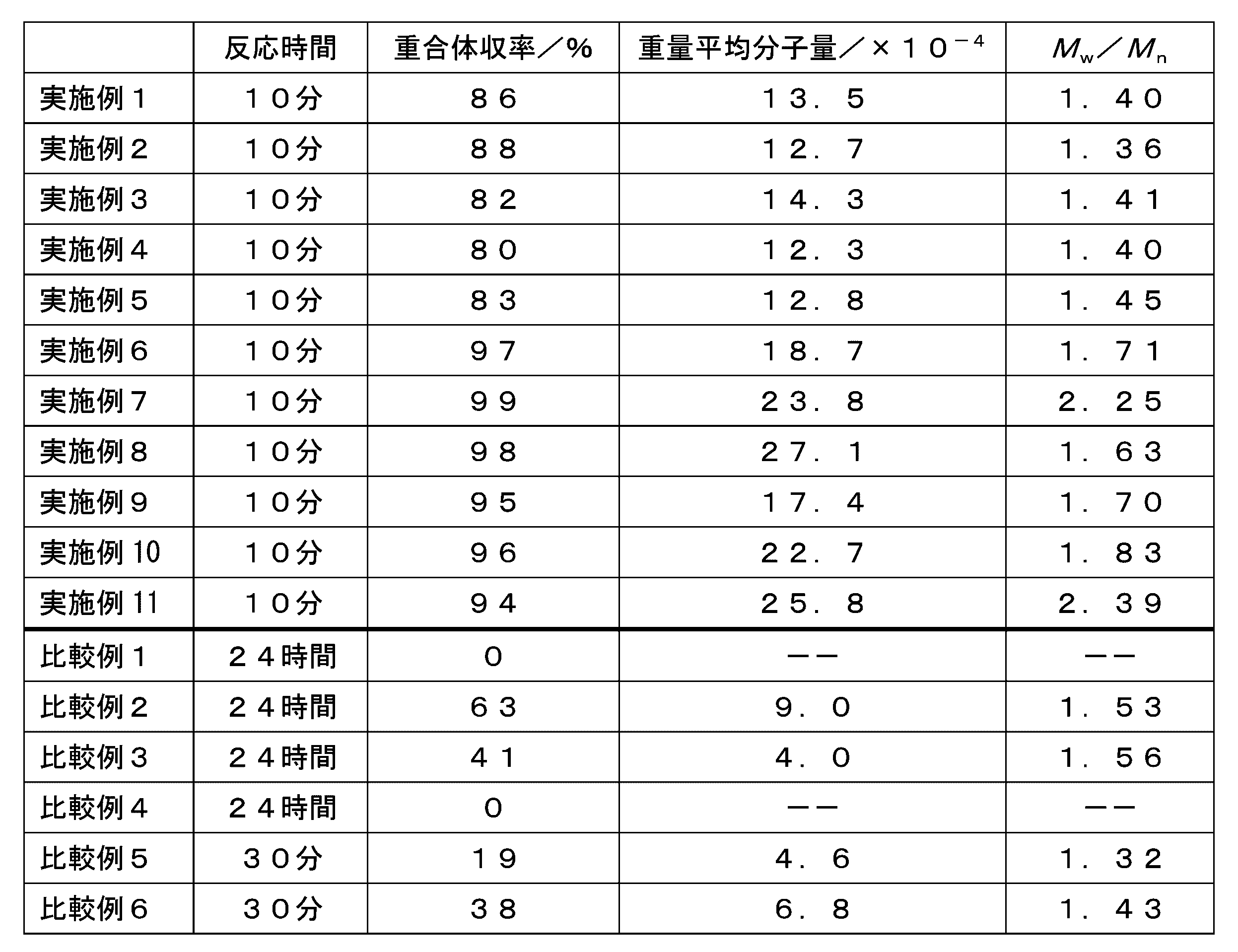
これに対し、アルキルアルムニウム化合物触媒を用いなかった比較例1~6では、重合速度が極めて遅く、24時間経ってもポリマーが得られないか、またはポリマーが得られても、その収率や分子量が低いことが分かる。また、重合完了までに長時間を要するため、ポリ乳酸の変色が懸念され、実際に比較例6で得られたポリ乳酸は、著しく褐色に変色し、実用的なものではなかった。
Claims (11)
- 下記一般式(1)
R1 nAlX3-n ・・・・・(1)
(式中、nは1~3の整数を示し、R1は、同一又は異なって、炭素数1~10の直鎖又は分岐鎖のアルキル基を示し、Xは、同一又は異なって、ハロゲン原子、または水素原子を示し、Alはアルミニウム原子を示す。)
で表されるアルキルアルミニウム化合物を開環重合触媒として用いて、ラクチドの開環重合反応を行う工程を含む、ポリ乳酸の製造方法。 - 上記一般式(1)で表されるアルキルアルミニウム化合物が、トリメチルアルミニウム、トリエチルアルミニウム、トリイソブチルアルミニウム、トリノルマルヘキシルアルミニウム、トリノルマルブチルアルミニウム、トリノルマルオクチルアルミニウム、ジエチルアルミニウムクロライド、エチルアルミニウムセスキクロライド、エチルアルミニウムジクロライド、およびジイソブチルアルミニウムハイドライドからなる群より選ばれる少なくとも1種の化合物である、請求項1に記載のポリ乳酸の製造方法。
- 開環重合触媒として、さらに、アルミニウム化合物(上記一般式(1)に記載のアルキルアルミニウム化合物を除く)、亜鉛化合物、チタン化合物、ジルコニウム化合物、マグネシウム化合物、およびカルシウム化合物からなる群より選ばれる少なくとも1種の金属化合物を用いる、請求項1に記載のポリ乳酸の製造方法。
- 金属化合物が、下記一般式(2)で表される化合物、下記一般式(3)で表される化合物、下記一般式(4)で表される化合物、下記一般式(5)で表される化合物、下記一般式(6)で表される化合物、及び下記一般式(7)で表される化合物
Al(OR2)3 ・・・・・(2)
Zn(OR3)2 ・・・・・(3)
Ti(OR4)4 ・・・・・(4)
Zr(OR5)4 ・・・・・(5)
Mg(OR6)2 ・・・・・(6)
Ca(OR7)2 ・・・・・(7)
(式中、R2~R7は、それぞれ、同一又は互いに異なって、炭素数1~12の直鎖もしくは分岐鎖状のアルキル基、置換基を有していてよい1~4個の環を有するアリール基、又は炭素数1~12の直鎖もしくは分岐鎖状のアシル基を示し、Alはアルミニウム原子を示し、Znは亜鉛原子を示し、Tiはチタン原子を示し、Zrはジルコニウム原子を示し、Mgはマグネシウム原子を示し、Caはカルシウム原子を示す。)
からなる群より選ばれる少なくとも1種の化合物である、請求項3に記載のポリ乳酸の製造方法。 - 金属化合物が、アルミニウムトリイソプロポキサイド、アルミニウムトリセカンダリーブトキサイド、アルミニウムトリエトキサイド、アルミニウムジイソプロピレートモノセカンダリブチレート、アルミニウムエチルアセトアセテートジイソプロピレート、アルミニウムトリス(エチルアセトアセテート)、アルミニウムトリス(アセチルアセトネート)、アルミニウムビスエチルアセトアセテートモノアセチルアセトネート、(アルキルアセトアセタト)アルミニウムジイソプロピレート、アルミニウムトリフルオロアセチルアセトネート、アルミニウムトリラクテート;
ジンクアセチルアセトネート(ビス(2,4-ペンタジオナト)亜鉛(II))、ジンクジアセテート、ジンクジメタクリレート、ジンクジラクテート;
ジイソプロポキシビス(エチルアセトアセテート)チタン、テトライソプロポキシチタン(IV)、テトラノルマルブトキシチタン、テトラキス(2-エチルヘキシルオキシ)チタン、テトラステアリルオキシチタン、テトラメトキシチタン、ジイソプロポキシビス(アセチルアセトナト)チタン、ジイソプロポキシビス(2-エチル-1,3-ヘキサンジオラト)チタン、ジイソプロポキシビス(トリエタノールアミナト)チタン、ジ(2-エチルヘキソキシ)ビス(2-エチル-1,3-ヘキサンジオラト)チタン、ジ-ノルマル-ブトキシビス(トリエタノールアミナト)チタン、テトラアセチルアセトネートチタンからなる群より選ばれる少なくとも1種の化合物である、請求項4に記載のポリ乳酸の製造方法。 - 金属化合物が、アルミニウムトリイソプロポキサイド、アルミニウムトリス(エチルアセトアセテート)、アルミニウムトリス(アセチルアセトネート)、アルミニウムトリラクテート、ジンクアセチルアセトネート(ビス(2,4-ペンタジオナト)亜鉛(II))、テトライソプロポキシチタン(IV)、テトラノルマルブトキシチタン、およびテトラキス(2-エチルヘキシルオキシ)チタンからなる群より選ばれる少なくとも1種の化合物である、請求項5に記載のポリ乳酸の製造方法。
- 上記一般式(1)で表されるアルキルアルミニウム化合物の使用量が、ラクチド100重量部に対して0.00001~1モル%である、請求項1に記載のポリ乳酸の製造方法。
- 金属化合物の使用量が、ラクチド100重量部に対して0.00001~1モル%である、請求項3に記載のポリ乳酸の製造方法。
- 上記一般式(1)で表されるアルキルアルミニウム化合物の使用量が、金属化合物の使用量に対して、モル比で、0.1~10当量である、請求項3に記載のポリ乳酸の製造方法。
- ラクチドを溶融状態にして重合反応を行う、請求項1に記載のポリ乳酸の製造方法。
- 反応温度を100~200℃とする、請求項10に記載のポリ乳酸の製造方法。
Priority Applications (3)
| Application Number | Priority Date | Filing Date | Title |
|---|---|---|---|
| CN2010800061039A CN102300904A (zh) | 2009-01-30 | 2010-01-29 | 制造聚乳酸的方法 |
| JP2010548556A JPWO2010087422A1 (ja) | 2009-01-30 | 2010-01-29 | ポリ乳酸の製造方法 |
| US13/146,470 US20110313127A1 (en) | 2009-01-30 | 2010-01-29 | Method for producing polylactic acid |
Applications Claiming Priority (4)
| Application Number | Priority Date | Filing Date | Title |
|---|---|---|---|
| JP2009020727 | 2009-01-30 | ||
| JP2009-020727 | 2009-01-30 | ||
| JP2009026917 | 2009-02-09 | ||
| JP2009-026917 | 2009-02-09 |
Publications (1)
| Publication Number | Publication Date |
|---|---|
| WO2010087422A1 true WO2010087422A1 (ja) | 2010-08-05 |
Family
ID=42395676
Family Applications (1)
| Application Number | Title | Priority Date | Filing Date |
|---|---|---|---|
| PCT/JP2010/051183 Ceased WO2010087422A1 (ja) | 2009-01-30 | 2010-01-29 | ポリ乳酸の製造方法 |
Country Status (4)
| Country | Link |
|---|---|
| US (1) | US20110313127A1 (ja) |
| JP (1) | JPWO2010087422A1 (ja) |
| CN (1) | CN102300904A (ja) |
| WO (1) | WO2010087422A1 (ja) |
Cited By (6)
| Publication number | Priority date | Publication date | Assignee | Title |
|---|---|---|---|---|
| KR101536269B1 (ko) * | 2012-04-30 | 2015-07-13 | 주식회사 엘지화학 | 폴리락타이드 수지의 제조 방법 |
| JP2016516872A (ja) * | 2013-05-02 | 2016-06-09 | ピュラック バイオケム ビー. ブイ. | 新規の重合触媒を使用するplaの製造方法 |
| WO2016117473A1 (ja) * | 2015-01-19 | 2016-07-28 | 日本曹達株式会社 | ポリエステルの製造方法 |
| CN109415501A (zh) * | 2016-07-05 | 2019-03-01 | 日东化成株式会社 | 聚酯聚合用催化剂、聚酯树脂的制造方法 |
| CN114729081A (zh) * | 2019-11-04 | 2022-07-08 | 陶氏环球技术有限责任公司 | 联苯基苯酚钛聚合催化剂 |
| CN115433349A (zh) * | 2021-06-03 | 2022-12-06 | 中国科学技术大学 | 聚乳酸两性离子化合物、合成方法及应用 |
Families Citing this family (5)
| Publication number | Priority date | Publication date | Assignee | Title |
|---|---|---|---|---|
| CN103421034B (zh) * | 2013-08-09 | 2015-10-21 | 中国科学院长春应用化学研究所 | 手性铝化合物及其制备方法和聚乳酸的制备方法 |
| CN107936238B (zh) * | 2017-12-12 | 2020-09-29 | 泰山医学院 | 利用含乙酰丙酮衍生物的非对称铝配合物催化乙交酯聚合的方法 |
| CN114516775B (zh) * | 2020-11-20 | 2024-09-27 | 中国石油天然气股份有限公司 | 一种催化剂组合物 |
| CN117003997B (zh) * | 2022-04-29 | 2026-02-24 | 爱美客技术发展股份有限公司 | 一种聚乙二醇单甲醚-聚乳酸嵌段共聚物的制备方法 |
| CN115477762B (zh) * | 2022-08-30 | 2023-06-27 | 山东理工大学 | 金属有机框架催化剂及其制法和应用 |
Citations (1)
| Publication number | Priority date | Publication date | Assignee | Title |
|---|---|---|---|---|
| JPH08193127A (ja) * | 1995-01-19 | 1996-07-30 | Daiso Co Ltd | 乳酸重合体の製造法 |
Family Cites Families (1)
| Publication number | Priority date | Publication date | Assignee | Title |
|---|---|---|---|---|
| JP2688330B2 (ja) * | 1994-10-25 | 1997-12-10 | 株式会社日本触媒 | ポリエステル樹脂組成物 |
-
2010
- 2010-01-29 CN CN2010800061039A patent/CN102300904A/zh active Pending
- 2010-01-29 JP JP2010548556A patent/JPWO2010087422A1/ja active Pending
- 2010-01-29 US US13/146,470 patent/US20110313127A1/en not_active Abandoned
- 2010-01-29 WO PCT/JP2010/051183 patent/WO2010087422A1/ja not_active Ceased
Patent Citations (1)
| Publication number | Priority date | Publication date | Assignee | Title |
|---|---|---|---|---|
| JPH08193127A (ja) * | 1995-01-19 | 1996-07-30 | Daiso Co Ltd | 乳酸重合体の製造法 |
Cited By (8)
| Publication number | Priority date | Publication date | Assignee | Title |
|---|---|---|---|---|
| KR101536269B1 (ko) * | 2012-04-30 | 2015-07-13 | 주식회사 엘지화학 | 폴리락타이드 수지의 제조 방법 |
| JP2016516872A (ja) * | 2013-05-02 | 2016-06-09 | ピュラック バイオケム ビー. ブイ. | 新規の重合触媒を使用するplaの製造方法 |
| WO2016117473A1 (ja) * | 2015-01-19 | 2016-07-28 | 日本曹達株式会社 | ポリエステルの製造方法 |
| JPWO2016117473A1 (ja) * | 2015-01-19 | 2017-08-10 | 日本曹達株式会社 | ポリエステルの製造方法 |
| CN109415501A (zh) * | 2016-07-05 | 2019-03-01 | 日东化成株式会社 | 聚酯聚合用催化剂、聚酯树脂的制造方法 |
| US11059837B2 (en) | 2016-07-05 | 2021-07-13 | Nitto Kasei Co., Ltd. | Catalyst for polyester polymerization and method for producing polyester resin |
| CN114729081A (zh) * | 2019-11-04 | 2022-07-08 | 陶氏环球技术有限责任公司 | 联苯基苯酚钛聚合催化剂 |
| CN115433349A (zh) * | 2021-06-03 | 2022-12-06 | 中国科学技术大学 | 聚乳酸两性离子化合物、合成方法及应用 |
Also Published As
| Publication number | Publication date |
|---|---|
| JPWO2010087422A1 (ja) | 2012-08-02 |
| US20110313127A1 (en) | 2011-12-22 |
| CN102300904A (zh) | 2011-12-28 |
Similar Documents
| Publication | Publication Date | Title |
|---|---|---|
| WO2010087422A1 (ja) | ポリ乳酸の製造方法 | |
| Rosen et al. | Tailor-made stereoblock copolymers of poly (lactic acid) by a truly living polymerization catalyst | |
| JP5048245B2 (ja) | 生分解性直鎖ランダムコポリエステルおよびその製造法と用途 | |
| Wei et al. | Aluminum complexes bearing bidentate amido–phosphine ligands for ring-opening polymerization of ε-caprolactone: steric effect on coordination chemistry and reactivity | |
| CN103936618B (zh) | 手性四齿氮锌配合物及其制备方法和应用 | |
| WO2016011939A1 (zh) | 生物质肌酐催化法合成聚(丁二酸丁二醇酯-共-己二酸丁二醇酯)的工艺方法 | |
| CN102532494A (zh) | 丙交酯-ε-己内酯共聚催化剂及共聚方法 | |
| CN107022068B (zh) | ε-己内酯和L-丙交酯共聚催化剂及共聚方法 | |
| JP2011111461A (ja) | ポリ乳酸の製造方法 | |
| CN101353420B (zh) | 聚乳酸-聚乙二醇共聚物的溶剂热合成制备方法 | |
| Sagar et al. | Crafting sustainable solutions: architecting biodegradable copolymers through controlled ring-opening copolymerization | |
| TWI589639B (zh) | 具有增進顏色的聚(對苯二甲酸1,4-環己二甲酯樹脂)的方法與以此方法製備的聚(對苯二甲酸1,4-環己二甲酯樹脂) | |
| CN109679081B (zh) | 利用双核手性胺亚胺镁配合物催化己内酯聚合的方法 | |
| CN102333785B (zh) | 聚乳酸树脂及其制备方法 | |
| KR101183226B1 (ko) | 유기 금속복합체, 촉매 조성물 및 폴리락타이드 수지의 제조 방법 | |
| CN105418900A (zh) | 聚丁二酸丁二醇酯与聚乳酸嵌段共聚物的制备方法 | |
| JP2010185003A (ja) | ポリ乳酸の製法 | |
| CN110078634B (zh) | 一种氨基酸亚锡配合物的制备方法及应用 | |
| CN109705159B (zh) | 一种含磷氮配体烷基铝化合物的制备方法与应用 | |
| CN102791764A (zh) | 聚交酯树脂、制备该聚交酯树脂的方法以及包含该聚交酯树脂的聚交酯树脂组合物 | |
| CN109749072B (zh) | 利用双核胺亚胺镁配合物催化丙交酯聚合的方法 | |
| CN118184981A (zh) | 一种有机金属催化剂及其制备方法和应用 | |
| CN111995633B (zh) | 一种三齿稀土金属配合物、制备方法和应用 | |
| CN112679708B (zh) | 用于连续开环制备聚乙醇酸的催化剂组合物及制备聚乙醇酸的方法及其聚乙醇酸 | |
| CN101591349B (zh) | 氮桥联双芳氧基钇对二苄氧化合物及其制备和应用 |
Legal Events
| Date | Code | Title | Description |
|---|---|---|---|
| WWE | Wipo information: entry into national phase |
Ref document number: 201080006103.9 Country of ref document: CN |
|
| 121 | Ep: the epo has been informed by wipo that ep was designated in this application |
Ref document number: 10735884 Country of ref document: EP Kind code of ref document: A1 |
|
| ENP | Entry into the national phase |
Ref document number: 2010548556 Country of ref document: JP Kind code of ref document: A |
|
| NENP | Non-entry into the national phase |
Ref country code: DE |
|
| WWE | Wipo information: entry into national phase |
Ref document number: 13146470 Country of ref document: US |
|
| 122 | Ep: pct application non-entry in european phase |
Ref document number: 10735884 Country of ref document: EP Kind code of ref document: A1 |