WO2010074233A1 - α-オレフィン重合体の製造方法、α-オレフィン重合体、および潤滑油組成物 - Google Patents
α-オレフィン重合体の製造方法、α-オレフィン重合体、および潤滑油組成物 Download PDFInfo
- Publication number
- WO2010074233A1 WO2010074233A1 PCT/JP2009/071598 JP2009071598W WO2010074233A1 WO 2010074233 A1 WO2010074233 A1 WO 2010074233A1 JP 2009071598 W JP2009071598 W JP 2009071598W WO 2010074233 A1 WO2010074233 A1 WO 2010074233A1
- Authority
- WO
- WIPO (PCT)
- Prior art keywords
- olefin polymer
- atom
- carbon atoms
- group
- producing
- Prior art date
- Legal status (The legal status is an assumption and is not a legal conclusion. Google has not performed a legal analysis and makes no representation as to the accuracy of the status listed.)
- Ceased
Links
Images


Classifications
-
- C—CHEMISTRY; METALLURGY
- C08—ORGANIC MACROMOLECULAR COMPOUNDS; THEIR PREPARATION OR CHEMICAL WORKING-UP; COMPOSITIONS BASED THEREON
- C08F—MACROMOLECULAR COMPOUNDS OBTAINED BY REACTIONS ONLY INVOLVING CARBON-TO-CARBON UNSATURATED BONDS
- C08F8/00—Chemical modification by after-treatment
- C08F8/04—Reduction, e.g. hydrogenation
-
- C—CHEMISTRY; METALLURGY
- C08—ORGANIC MACROMOLECULAR COMPOUNDS; THEIR PREPARATION OR CHEMICAL WORKING-UP; COMPOSITIONS BASED THEREON
- C08F—MACROMOLECULAR COMPOUNDS OBTAINED BY REACTIONS ONLY INVOLVING CARBON-TO-CARBON UNSATURATED BONDS
- C08F10/00—Homopolymers and copolymers of unsaturated aliphatic hydrocarbons having only one carbon-to-carbon double bond
-
- C—CHEMISTRY; METALLURGY
- C10—PETROLEUM, GAS OR COKE INDUSTRIES; TECHNICAL GASES CONTAINING CARBON MONOXIDE; FUELS; LUBRICANTS; PEAT
- C10M—LUBRICATING COMPOSITIONS; USE OF CHEMICAL SUBSTANCES EITHER ALONE OR AS LUBRICATING INGREDIENTS IN A LUBRICATING COMPOSITION
- C10M107/00—Lubricating compositions characterised by the base-material being a macromolecular compound
- C10M107/02—Hydrocarbon polymers; Hydrocarbon polymers modified by oxidation
- C10M107/10—Hydrocarbon polymers; Hydrocarbon polymers modified by oxidation containing aliphatic monomer having more than 4 carbon atoms
-
- C—CHEMISTRY; METALLURGY
- C10—PETROLEUM, GAS OR COKE INDUSTRIES; TECHNICAL GASES CONTAINING CARBON MONOXIDE; FUELS; LUBRICANTS; PEAT
- C10M—LUBRICATING COMPOSITIONS; USE OF CHEMICAL SUBSTANCES EITHER ALONE OR AS LUBRICATING INGREDIENTS IN A LUBRICATING COMPOSITION
- C10M143/00—Lubricating compositions characterised by the additive being a macromolecular hydrocarbon or such hydrocarbon modified by oxidation
- C10M143/08—Lubricating compositions characterised by the additive being a macromolecular hydrocarbon or such hydrocarbon modified by oxidation containing aliphatic monomer having more than 4 carbon atoms
-
- C—CHEMISTRY; METALLURGY
- C08—ORGANIC MACROMOLECULAR COMPOUNDS; THEIR PREPARATION OR CHEMICAL WORKING-UP; COMPOSITIONS BASED THEREON
- C08F—MACROMOLECULAR COMPOUNDS OBTAINED BY REACTIONS ONLY INVOLVING CARBON-TO-CARBON UNSATURATED BONDS
- C08F110/00—Homopolymers of unsaturated aliphatic hydrocarbons having only one carbon-to-carbon double bond
- C08F110/02—Ethene
-
- C—CHEMISTRY; METALLURGY
- C08—ORGANIC MACROMOLECULAR COMPOUNDS; THEIR PREPARATION OR CHEMICAL WORKING-UP; COMPOSITIONS BASED THEREON
- C08F—MACROMOLECULAR COMPOUNDS OBTAINED BY REACTIONS ONLY INVOLVING CARBON-TO-CARBON UNSATURATED BONDS
- C08F210/00—Copolymers of unsaturated aliphatic hydrocarbons having only one carbon-to-carbon double bond
- C08F210/16—Copolymers of ethene with alpha-alkenes, e.g. EP rubbers
-
- C—CHEMISTRY; METALLURGY
- C08—ORGANIC MACROMOLECULAR COMPOUNDS; THEIR PREPARATION OR CHEMICAL WORKING-UP; COMPOSITIONS BASED THEREON
- C08F—MACROMOLECULAR COMPOUNDS OBTAINED BY REACTIONS ONLY INVOLVING CARBON-TO-CARBON UNSATURATED BONDS
- C08F4/00—Polymerisation catalysts
- C08F4/42—Metals; Metal hydrides; Metallo-organic compounds; Use thereof as catalyst precursors
- C08F4/44—Metals; Metal hydrides; Metallo-organic compounds; Use thereof as catalyst precursors selected from light metals, zinc, cadmium, mercury, copper, silver, gold, boron, gallium, indium, thallium, rare earths or actinides
- C08F4/60—Metals; Metal hydrides; Metallo-organic compounds; Use thereof as catalyst precursors selected from light metals, zinc, cadmium, mercury, copper, silver, gold, boron, gallium, indium, thallium, rare earths or actinides together with refractory metals, iron group metals, platinum group metals, manganese, rhenium technetium or compounds thereof
- C08F4/62—Refractory metals or compounds thereof
- C08F4/64—Titanium, zirconium, hafnium or compounds thereof
- C08F4/659—Component covered by group C08F4/64 containing a transition metal-carbon bond
- C08F4/65908—Component covered by group C08F4/64 containing a transition metal-carbon bond in combination with an ionising compound other than alumoxane, e.g. (C6F5)4B-X+
-
- C—CHEMISTRY; METALLURGY
- C08—ORGANIC MACROMOLECULAR COMPOUNDS; THEIR PREPARATION OR CHEMICAL WORKING-UP; COMPOSITIONS BASED THEREON
- C08F—MACROMOLECULAR COMPOUNDS OBTAINED BY REACTIONS ONLY INVOLVING CARBON-TO-CARBON UNSATURATED BONDS
- C08F4/00—Polymerisation catalysts
- C08F4/42—Metals; Metal hydrides; Metallo-organic compounds; Use thereof as catalyst precursors
- C08F4/44—Metals; Metal hydrides; Metallo-organic compounds; Use thereof as catalyst precursors selected from light metals, zinc, cadmium, mercury, copper, silver, gold, boron, gallium, indium, thallium, rare earths or actinides
- C08F4/60—Metals; Metal hydrides; Metallo-organic compounds; Use thereof as catalyst precursors selected from light metals, zinc, cadmium, mercury, copper, silver, gold, boron, gallium, indium, thallium, rare earths or actinides together with refractory metals, iron group metals, platinum group metals, manganese, rhenium technetium or compounds thereof
- C08F4/62—Refractory metals or compounds thereof
- C08F4/64—Titanium, zirconium, hafnium or compounds thereof
- C08F4/659—Component covered by group C08F4/64 containing a transition metal-carbon bond
- C08F4/65912—Component covered by group C08F4/64 containing a transition metal-carbon bond in combination with an organoaluminium compound
-
- C—CHEMISTRY; METALLURGY
- C10—PETROLEUM, GAS OR COKE INDUSTRIES; TECHNICAL GASES CONTAINING CARBON MONOXIDE; FUELS; LUBRICANTS; PEAT
- C10M—LUBRICATING COMPOSITIONS; USE OF CHEMICAL SUBSTANCES EITHER ALONE OR AS LUBRICATING INGREDIENTS IN A LUBRICATING COMPOSITION
- C10M2205/00—Organic macromolecular hydrocarbon compounds or fractions, whether or not modified by oxidation as ingredients in lubricant compositions
- C10M2205/02—Organic macromolecular hydrocarbon compounds or fractions, whether or not modified by oxidation as ingredients in lubricant compositions containing acyclic monomers
- C10M2205/028—Organic macromolecular hydrocarbon compounds or fractions, whether or not modified by oxidation as ingredients in lubricant compositions containing acyclic monomers containing aliphatic monomers having more than four carbon atoms
-
- C—CHEMISTRY; METALLURGY
- C10—PETROLEUM, GAS OR COKE INDUSTRIES; TECHNICAL GASES CONTAINING CARBON MONOXIDE; FUELS; LUBRICANTS; PEAT
- C10M—LUBRICATING COMPOSITIONS; USE OF CHEMICAL SUBSTANCES EITHER ALONE OR AS LUBRICATING INGREDIENTS IN A LUBRICATING COMPOSITION
- C10M2205/00—Organic macromolecular hydrocarbon compounds or fractions, whether or not modified by oxidation as ingredients in lubricant compositions
- C10M2205/02—Organic macromolecular hydrocarbon compounds or fractions, whether or not modified by oxidation as ingredients in lubricant compositions containing acyclic monomers
- C10M2205/028—Organic macromolecular hydrocarbon compounds or fractions, whether or not modified by oxidation as ingredients in lubricant compositions containing acyclic monomers containing aliphatic monomers having more than four carbon atoms
- C10M2205/0285—Organic macromolecular hydrocarbon compounds or fractions, whether or not modified by oxidation as ingredients in lubricant compositions containing acyclic monomers containing aliphatic monomers having more than four carbon atoms used as base material
-
- C—CHEMISTRY; METALLURGY
- C10—PETROLEUM, GAS OR COKE INDUSTRIES; TECHNICAL GASES CONTAINING CARBON MONOXIDE; FUELS; LUBRICANTS; PEAT
- C10N—INDEXING SCHEME ASSOCIATED WITH SUBCLASS C10M RELATING TO LUBRICATING COMPOSITIONS
- C10N2020/00—Specified physical or chemical properties or characteristics, i.e. function, of component of lubricating compositions
- C10N2020/01—Physico-chemical properties
- C10N2020/011—Cloud point
-
- C—CHEMISTRY; METALLURGY
- C10—PETROLEUM, GAS OR COKE INDUSTRIES; TECHNICAL GASES CONTAINING CARBON MONOXIDE; FUELS; LUBRICANTS; PEAT
- C10N—INDEXING SCHEME ASSOCIATED WITH SUBCLASS C10M RELATING TO LUBRICATING COMPOSITIONS
- C10N2020/00—Specified physical or chemical properties or characteristics, i.e. function, of component of lubricating compositions
- C10N2020/01—Physico-chemical properties
- C10N2020/02—Viscosity; Viscosity index
-
- C—CHEMISTRY; METALLURGY
- C10—PETROLEUM, GAS OR COKE INDUSTRIES; TECHNICAL GASES CONTAINING CARBON MONOXIDE; FUELS; LUBRICANTS; PEAT
- C10N—INDEXING SCHEME ASSOCIATED WITH SUBCLASS C10M RELATING TO LUBRICATING COMPOSITIONS
- C10N2020/00—Specified physical or chemical properties or characteristics, i.e. function, of component of lubricating compositions
- C10N2020/01—Physico-chemical properties
- C10N2020/04—Molecular weight; Molecular weight distribution
-
- C—CHEMISTRY; METALLURGY
- C10—PETROLEUM, GAS OR COKE INDUSTRIES; TECHNICAL GASES CONTAINING CARBON MONOXIDE; FUELS; LUBRICANTS; PEAT
- C10N—INDEXING SCHEME ASSOCIATED WITH SUBCLASS C10M RELATING TO LUBRICATING COMPOSITIONS
- C10N2030/00—Specified physical or chemical properties which is improved by the additive characterising the lubricating composition, e.g. multifunctional additives
- C10N2030/54—Fuel economy
-
- C—CHEMISTRY; METALLURGY
- C10—PETROLEUM, GAS OR COKE INDUSTRIES; TECHNICAL GASES CONTAINING CARBON MONOXIDE; FUELS; LUBRICANTS; PEAT
- C10N—INDEXING SCHEME ASSOCIATED WITH SUBCLASS C10M RELATING TO LUBRICATING COMPOSITIONS
- C10N2040/00—Specified use or application for which the lubricating composition is intended
- C10N2040/04—Oil-bath; Gear-boxes; Automatic transmissions; Traction drives
-
- C—CHEMISTRY; METALLURGY
- C10—PETROLEUM, GAS OR COKE INDUSTRIES; TECHNICAL GASES CONTAINING CARBON MONOXIDE; FUELS; LUBRICANTS; PEAT
- C10N—INDEXING SCHEME ASSOCIATED WITH SUBCLASS C10M RELATING TO LUBRICATING COMPOSITIONS
- C10N2040/00—Specified use or application for which the lubricating composition is intended
- C10N2040/04—Oil-bath; Gear-boxes; Automatic transmissions; Traction drives
- C10N2040/042—Oil-bath; Gear-boxes; Automatic transmissions; Traction drives for automatic transmissions
-
- C—CHEMISTRY; METALLURGY
- C10—PETROLEUM, GAS OR COKE INDUSTRIES; TECHNICAL GASES CONTAINING CARBON MONOXIDE; FUELS; LUBRICANTS; PEAT
- C10N—INDEXING SCHEME ASSOCIATED WITH SUBCLASS C10M RELATING TO LUBRICATING COMPOSITIONS
- C10N2040/00—Specified use or application for which the lubricating composition is intended
- C10N2040/06—Instruments or other precision apparatus, e.g. damping fluids
-
- C—CHEMISTRY; METALLURGY
- C10—PETROLEUM, GAS OR COKE INDUSTRIES; TECHNICAL GASES CONTAINING CARBON MONOXIDE; FUELS; LUBRICANTS; PEAT
- C10N—INDEXING SCHEME ASSOCIATED WITH SUBCLASS C10M RELATING TO LUBRICATING COMPOSITIONS
- C10N2040/00—Specified use or application for which the lubricating composition is intended
- C10N2040/08—Hydraulic fluids, e.g. brake-fluids
-
- C—CHEMISTRY; METALLURGY
- C10—PETROLEUM, GAS OR COKE INDUSTRIES; TECHNICAL GASES CONTAINING CARBON MONOXIDE; FUELS; LUBRICANTS; PEAT
- C10N—INDEXING SCHEME ASSOCIATED WITH SUBCLASS C10M RELATING TO LUBRICATING COMPOSITIONS
- C10N2040/00—Specified use or application for which the lubricating composition is intended
- C10N2040/135—Steam engines or turbines
-
- C—CHEMISTRY; METALLURGY
- C10—PETROLEUM, GAS OR COKE INDUSTRIES; TECHNICAL GASES CONTAINING CARBON MONOXIDE; FUELS; LUBRICANTS; PEAT
- C10N—INDEXING SCHEME ASSOCIATED WITH SUBCLASS C10M RELATING TO LUBRICATING COMPOSITIONS
- C10N2040/00—Specified use or application for which the lubricating composition is intended
- C10N2040/20—Metal working
- C10N2040/22—Metal working with essential removal of material, e.g. cutting, grinding or drilling
-
- C—CHEMISTRY; METALLURGY
- C10—PETROLEUM, GAS OR COKE INDUSTRIES; TECHNICAL GASES CONTAINING CARBON MONOXIDE; FUELS; LUBRICANTS; PEAT
- C10N—INDEXING SCHEME ASSOCIATED WITH SUBCLASS C10M RELATING TO LUBRICATING COMPOSITIONS
- C10N2040/00—Specified use or application for which the lubricating composition is intended
- C10N2040/20—Metal working
- C10N2040/24—Metal working without essential removal of material, e.g. forming, gorging, drawing, pressing, stamping, rolling or extruding; Punching metal
-
- C—CHEMISTRY; METALLURGY
- C10—PETROLEUM, GAS OR COKE INDUSTRIES; TECHNICAL GASES CONTAINING CARBON MONOXIDE; FUELS; LUBRICANTS; PEAT
- C10N—INDEXING SCHEME ASSOCIATED WITH SUBCLASS C10M RELATING TO LUBRICATING COMPOSITIONS
- C10N2040/00—Specified use or application for which the lubricating composition is intended
- C10N2040/25—Internal-combustion engines
-
- C—CHEMISTRY; METALLURGY
- C10—PETROLEUM, GAS OR COKE INDUSTRIES; TECHNICAL GASES CONTAINING CARBON MONOXIDE; FUELS; LUBRICANTS; PEAT
- C10N—INDEXING SCHEME ASSOCIATED WITH SUBCLASS C10M RELATING TO LUBRICATING COMPOSITIONS
- C10N2040/00—Specified use or application for which the lubricating composition is intended
- C10N2040/25—Internal-combustion engines
- C10N2040/251—Alcohol-fuelled engines
-
- C—CHEMISTRY; METALLURGY
- C10—PETROLEUM, GAS OR COKE INDUSTRIES; TECHNICAL GASES CONTAINING CARBON MONOXIDE; FUELS; LUBRICANTS; PEAT
- C10N—INDEXING SCHEME ASSOCIATED WITH SUBCLASS C10M RELATING TO LUBRICATING COMPOSITIONS
- C10N2040/00—Specified use or application for which the lubricating composition is intended
- C10N2040/25—Internal-combustion engines
- C10N2040/255—Gasoline engines
-
- C—CHEMISTRY; METALLURGY
- C10—PETROLEUM, GAS OR COKE INDUSTRIES; TECHNICAL GASES CONTAINING CARBON MONOXIDE; FUELS; LUBRICANTS; PEAT
- C10N—INDEXING SCHEME ASSOCIATED WITH SUBCLASS C10M RELATING TO LUBRICATING COMPOSITIONS
- C10N2040/00—Specified use or application for which the lubricating composition is intended
- C10N2040/25—Internal-combustion engines
- C10N2040/255—Gasoline engines
- C10N2040/26—Two-strokes or two-cycle engines
-
- C—CHEMISTRY; METALLURGY
- C10—PETROLEUM, GAS OR COKE INDUSTRIES; TECHNICAL GASES CONTAINING CARBON MONOXIDE; FUELS; LUBRICANTS; PEAT
- C10N—INDEXING SCHEME ASSOCIATED WITH SUBCLASS C10M RELATING TO LUBRICATING COMPOSITIONS
- C10N2040/00—Specified use or application for which the lubricating composition is intended
- C10N2040/30—Refrigerators lubricants or compressors lubricants
-
- C—CHEMISTRY; METALLURGY
- C10—PETROLEUM, GAS OR COKE INDUSTRIES; TECHNICAL GASES CONTAINING CARBON MONOXIDE; FUELS; LUBRICANTS; PEAT
- C10N—INDEXING SCHEME ASSOCIATED WITH SUBCLASS C10M RELATING TO LUBRICATING COMPOSITIONS
- C10N2050/00—Form in which the lubricant is applied to the material being lubricated
- C10N2050/10—Form in which the lubricant is applied to the material being lubricated semi-solid; greasy
-
- C—CHEMISTRY; METALLURGY
- C10—PETROLEUM, GAS OR COKE INDUSTRIES; TECHNICAL GASES CONTAINING CARBON MONOXIDE; FUELS; LUBRICANTS; PEAT
- C10N—INDEXING SCHEME ASSOCIATED WITH SUBCLASS C10M RELATING TO LUBRICATING COMPOSITIONS
- C10N2070/00—Specific manufacturing methods for lubricant compositions
-
- Y—GENERAL TAGGING OF NEW TECHNOLOGICAL DEVELOPMENTS; GENERAL TAGGING OF CROSS-SECTIONAL TECHNOLOGIES SPANNING OVER SEVERAL SECTIONS OF THE IPC; TECHNICAL SUBJECTS COVERED BY FORMER USPC CROSS-REFERENCE ART COLLECTIONS [XRACs] AND DIGESTS
- Y10—TECHNICAL SUBJECTS COVERED BY FORMER USPC
- Y10S—TECHNICAL SUBJECTS COVERED BY FORMER USPC CROSS-REFERENCE ART COLLECTIONS [XRACs] AND DIGESTS
- Y10S526/00—Synthetic resins or natural rubbers -- part of the class 520 series
- Y10S526/943—Polymerization with metallocene catalysts
Definitions
- the present invention relates to a method for producing an ⁇ -olefin polymer, an ⁇ -olefin polymer obtained by the production method, and a lubricating oil composition containing the ⁇ -olefin polymer.
- lubricating oils for automobiles and industrial machinery so far include a relatively high viscosity. With the recent improvement in performance of automobiles and industrial machinery, these lubricating oils However, higher performance has been demanded. Regarding the improvement of the performance of lubricating oils, various synthetic lubricating oils have been developed so far. For example, the following techniques are known for ⁇ -olefin polymers which are one type of synthetic lubricating oil components.
- Patent Documents 1 and 2 disclose a method of polymerizing 1-decene with a Friedel-Craft catalyst using aluminum chloride or boron trifluoride. Further, there are known examples in which ethylene and ⁇ -olefin are polymerized by various methods, and the obtained polymer is used as a lubricating oil.
- Patent Document 3 discloses a production method using a reduced chromium catalyst.
- 4 and 5 disclose a production method by cationic polymerization
- Patent Documents 6 and 7 disclose a production method using a Ziegler type catalyst
- Patent Documents 8 to 16 disclose a production method using a metallocene catalyst.
- the present invention has been made in view of the above circumstances, and is a method for producing an ⁇ -olefin polymer, and an ⁇ -olefin polymer having an appropriate viscosity as a lubricating oil can be easily produced industrially.
- An object of the present invention is to provide a method for producing an ⁇ -olefin polymer, in which the properties of the product can be widely changed by controlling the reaction conditions.
- a method for producing an ⁇ -olefin polymer comprising: A method for producing an ⁇ -olefin polymer comprising a step of polymerizing one or more ⁇ -olefins having 6 to 20 carbon atoms (polymerization step) using a catalyst comprising the following (A) and (B): (A) General formula (I)
- R 1 to R 6 are each independently a hydrogen atom, a halogen atom, a hydrocarbon group having 1 to 20 carbon atoms, or a halogen atom, a silicon atom, an oxygen atom, a sulfur atom, a nitrogen atom and a phosphorus atom
- R a and R b are each independently a divalent group connecting two cyclopentadienyl rings with 1 to 3 atoms
- X 1 and X 2 are each independently a hydrogen atom ,
- the reaction conditions in the polymerization step are a hydrogen pressure of 0 to 0.2 MPa (G) and a reaction temperature of 0 to 200 ° C. 5). 5.
- a lubricating oil composition comprising the ⁇ -olefin polymer according to 8 and / or the hydrogenated ⁇ -olefin polymer according to 9; Is to provide.
- an ⁇ -olefin polymer having an appropriate viscosity as a lubricating oil can be easily produced industrially. Further, by controlling the reaction conditions, the characteristics of the product can be widely changed, and desired Provided is a method for producing an ⁇ -olefin polymer, which can easily produce an ⁇ -olefin polymer having characteristics.
- FIG. 3 is a graph showing the relationship between the reaction temperature of an ⁇ -olefin polymer and the 100 ° C. kinematic viscosity of the polymer.
- FIG. 3 is a graph showing the relationship between 100 ° C. kinematic viscosity and pour point of an ⁇ -olefin polymer.
- the production method of an ⁇ -olefin polymer of the present invention comprises the step of polymerizing one or more ⁇ -olefins having 6 to 20 carbon atoms (polymerization step) using a specific catalyst. Is the method.
- the transition metal compound represented by these is used.
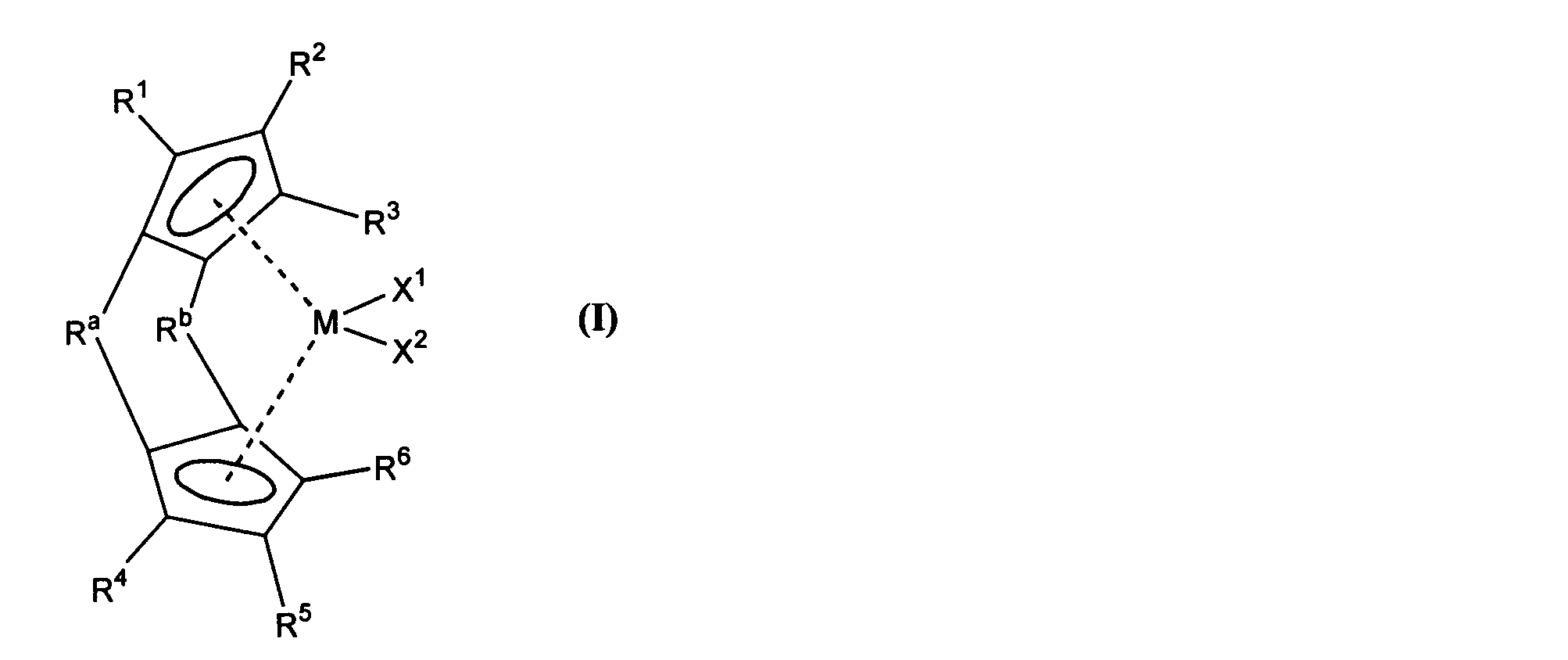
- the compound represented by the general formula (I) is a transition metal compound composed of a bi-bridged bis (cyclopentadienyl) -based metallocene complex, wherein R 1 to R 6 are each independently a hydrogen atom , A halogen atom, a hydrocarbon group having 1 to 20 carbon atoms, or an organic group having 1 to 20 carbon atoms containing one or more atoms selected from a halogen atom, a silicon atom, an oxygen atom, a sulfur atom, a nitrogen atom and a phosphorus atom Indicates.
- the metallocene complex is a complex having a condensed cyclopentadienyl group as a ligand, such as a bibridged bis (indenyl) metallocene complex
- a ligand such as a bibridged bis (indenyl) metallocene complex
- an ⁇ -olefin polymer having a desired viscosity will be obtained.
- the reaction conditions such as high pressure conditions, addition of a large amount of hydrogen or high reaction temperature, and dilution with an inert solvent are required.
- R 1 to R 6 are preferably a hydrogen atom or an alkyl group having 1 to 20 carbon atoms, and more preferably a hydrogen atom or an alkyl group having 1 to 4 carbon atoms.
- At least one selected from R 1 to R 3 is a hydrogen atom
- at least one selected from R 4 to R 6 is a hydrogen atom
- high pressure conditions can be obtained in order to obtain an ⁇ -olefin polymer having a desired viscosity. This is not preferable because a large amount of hydrogen is added, reaction conditions such as a high reaction temperature, or dilution with an inert solvent is required.
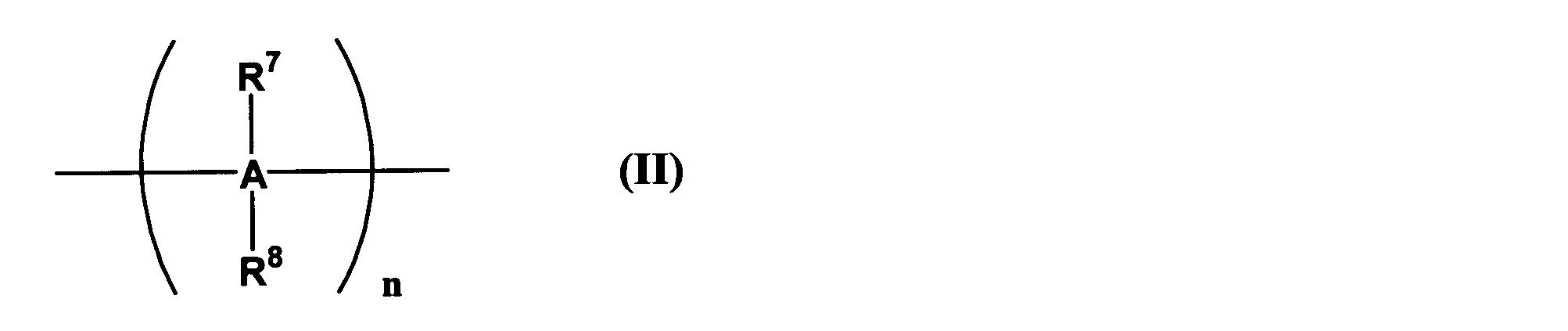
- R a and R b are each independently a divalent group that connects two cyclopentadienyl rings with 1 to 3 atoms, and preferably has the general formula (II)
- R 7 and R 8 each independently represents a hydrogen atom, a halogen atom, a hydrocarbon group having 1 to 20 carbon atoms, or a halogen-containing hydrocarbon group having 1 to 20 carbon atoms, preferably a hydrogen atom or 1 to 4 hydrocarbon group, more preferably a hydrogen atom or an alkyl group having 1 to 4 carbon atoms.
- A represents an atom of Group 14 of the periodic table.
- R a, preferred examples of R b is, -CR 7 R 8 -, - SiR 7 R 8 -, - CR 7 R 8 -CR 7 R 8 - and the like.
- X 1 and X 2 are each independently a ⁇ -bonded ligand, which is a hydrogen atom, a halogen atom, a hydrocarbon group having 1 to 20 carbon atoms, or a halogen atom, a silicon atom, an oxygen atom, or a sulfur atom. And an organic group having 1 to 20 carbon atoms containing at least one atom selected from a nitrogen atom and a phosphorus atom.
- Preferred examples of X 1 and X 2 include a halogen atom.
- M represents a transition metal belonging to Groups 4 to 6 of the periodic table, and a transition metal belonging to Group 4 of the periodic table is preferred.
- Examples of the compound represented by the general formula (I) include (1,1′-ethylene) (2,2′-ethylene) biscyclopentadienylzirconium dichloride, (1,1′-ethylene) (2, 2'-ethylene) bis (3-methylcyclopentadienyl) zirconium dichloride, (1,1'-ethylene) (2,2'-ethylene) bis (4-methylcyclopentadienyl) zirconium dichloride, (1, 1'-ethylene) (2,2'-ethylene) bis (3,4-dimethylcyclopentadienyl) zirconium dichloride, (1,1'-ethylene) (2,2'-ethylene) bis (3,5- Dimethylcyclopentadienyl) zirconium dichloride, (1,1'-dimethylsilylene) (2,2'-dimethylsilylene) biscyclopentadienylzirco Um dichloride, (1,1'-dimethylsilylene) (2,2'-dimethylsily
- transition metal compound used as the component (A) one kind may be used, or two or more kinds may be used in combination.
- (B) an organoaluminum oxy compound and / or (b-2) an ionic compound that can be converted into a cation by reacting with the above transition metal compound is used. Is done.
- (B-1) As the organoaluminum oxy compound, the following general formula (III)
- R 9 to R 14 each represent a hydrocarbon group or halogen atom having 1 to 20 carbon atoms, preferably 1 to 12 carbon atoms.
- the hydrocarbon group include an alkyl group, an alkenyl group, an aryl group, and an arylalkyl group.
- n represents the degree of polymerization and is usually an integer of 2 to 50, preferably 2 to 40.
- Each R 9 to R 14 may be the same or different.
- aluminoxane examples include methylaluminoxane, ethylaluminoxane, isobutylaluminoxane and the like.
- Examples of the method for producing the aluminoxane include a method in which an alkylaluminum is brought into contact with a condensing agent such as water, but the means is not particularly limited, and the reaction may be performed according to a known method.
- a method in which an organoaluminum compound is dissolved in an organic solvent and brought into contact with water a method in which an organoaluminum compound is initially added at the time of polymerization, and water is added later, crystal water contained in a metal salt, etc.
- a method of reacting water adsorbed on an inorganic material or an organic material with an organoaluminum compound a method of reacting a tetraalkyldialuminoxane with a trialkylaluminum, and a reaction with water.
- the aluminoxane may be insoluble in toluene.
- These aluminoxanes may be used alone or in combination of two or more.
- any ionic compound that can be converted into a cation by reacting with the transition metal compound of the component (A) can be used.
- L 1 represents a Lewis base
- R 15 represents a hydrogen atom, an alkyl group having 1 to 20 carbon atoms, or a carbon atom having 6 to 20 carbon atoms selected from an aryl group, an alkylaryl group and an arylalkyl group. Represents a hydrocarbon group.
- L 1 examples include ammonia, methylamine, aniline, dimethylamine, diethylamine, N-methylaniline, diphenylamine, N, N-dimethylaniline, trimethylamine, triethylamine, tri-n-butylamine, methyldiphenylamine, Amines such as pyridine, p-bromo-N, N-dimethylaniline, p-nitro-N, N-dimethylaniline, phosphines such as triethylphosphine, triphenylphosphine, diphenylphosphine, thioethers such as tetrahydrothiophene, benzoic acid Examples thereof include esters such as ethyl acid, and nitriles such as acetonitrile and benzonitrile.
- R 15 include a hydrogen atom, a methyl group, an ethyl group, a benzyl group, and a trityl group
- L 2 represents M 1 , R 16 R 17 M 2 , R 18 C or R 19 M 2 .
- R 16 and R 17 are each a cyclopentadienyl group, a substituted cyclopentadienyl group, an indenyl group or a fluorenyl group
- R 18 is an alkyl group having 1 to 20 carbon atoms, or an aryl group, an alkylaryl group and an arylalkyl group
- a hydrocarbon group having 6 to 20 carbon atoms selected from R 19 represents a macrocyclic ligand such as tetraphenylporphyrin or phthalocyanine.
- M 1 includes elements in groups 1 to 3, 11 to 13, and 17 of the periodic table
- M 2 represents elements in groups 7 to 12 of the periodic table.
- R 16 and R 17 include a cyclopentadienyl group, a methylcyclopentadienyl group, an ethylcyclopentadienyl group, and a pentamethylcyclopentadienyl group.
- R 18 include a phenyl group, p-tolyl group, p-methoxyphenyl group, and the like.
- R 19 include tetraphenylporphyrin, phthalocyanine, and the like.
- M 1 include Li, Na, K, Ag, Cu, Br, I, and I 3.
- M 2 include Mn, Fe, Co, Ni, and Zn. And so on.
- [Z] ⁇ represents a non-coordinating anion [Z 1 ] ⁇ or [Z 2 ] ⁇ .
- [Z 1 ] ⁇ represents an anion having a plurality of groups bonded to the element, that is, [M 3 G 1 G 2 ... G f ] ⁇ .
- M 3 represents a group 5-15 element of the periodic table, preferably a group 13-15 element of the periodic table.
- G 1 to G f are each a hydrogen atom, a halogen atom, an alkyl group having 1 to 20 carbon atoms, a dialkylamino group having 2 to 40 carbon atoms, an alkoxy group having 1 to 20 carbon atoms, an aryl group having 6 to 20 carbon atoms, Aryloxy group having 6 to 20 carbon atoms, alkylaryl group having 7 to 40 carbon atoms, arylalkyl group having 7 to 40 carbon atoms, halogen-substituted hydrocarbon group having 1 to 20 carbon atoms, acyloxy group having 1 to 20 carbon atoms Or an organic metalloid group or a heteroatom-containing hydrocarbon group having 2 to 20 carbon atoms.
- G 1 to G f may form a ring.
- f represents an integer of [(valence of central metal M 3 ) +1].
- [Z 2 ] ⁇ is a Bronsted acid alone or a conjugate base of a combination of Bronsted acid and Lewis acid having a logarithm (pKa) of the reciprocal of the acid dissociation constant of ⁇ 10 or less, or an acid generally defined as a super strong acid
- pKa logarithm
- a Lewis base may be coordinated.
- [Z 1 ] ⁇ that is, [M 3 G 1 G 2 ... G f ] ⁇
- M 3 include B, Al, Si, P, As, Sb, etc., preferably B And Al.
- G 1 and G 2 to G f include dialkylamino groups such as dimethylamino group and diethylamino group, alkoxy groups or aryloxy groups such as methoxy group, ethoxy group, n-propoxy group, and phenoxy group.
- hydrocarbon groups methyl group, ethyl group, n-propyl group, isopropyl group, n-butyl group, isobutyl group, n-octyl group, n-eicosyl group, phenyl group, p-tolyl group, benzyl group, 4 -T-butylphenyl group, 3,5-dimethylphenyl group, etc.
- halogen atoms such as fluorine, chlorine, bromine, iodine, heteroatom-containing hydrocarbon groups as p-fluorophenyl group, 3,5-difluorophenyl group, Pentachlorophenyl group, 3,4,5-trifluorophenyl group, pentafluorophenyl group, 3,5-bis ( Trifluoromethyl) phenyl group, bis (trimethylsilyl) such as a methyl group, as the organic metalloid group, pentamethyl antimony group, a trimethylsilyl group, trimethylgermyl group, diphenylarsine group, dicyclohexyl antimony group, and a diphenyl borate containing group.
- halogen atoms such as fluorine, chlorine, bromine, iodine, heteroatom-containing hydrocarbon groups as p-fluorophenyl group, 3,5-difluorophenyl group, Pentachlorophenyl group, 3,4,5-triflu
- non-coordinating anions that is, Bronsted acids having a pKa of ⁇ 10 or less or a conjugate base [Z 2 ] ⁇ in combination of Bronsted acids and Lewis acids
- trifluoromethanesulfonate anions CF 3 SO 3 ) ⁇
- bis (trifluoromethanesulfonyl) methyl anion bis (trifluoromethanesulfonyl) benzyl anion, bis (trifluoromethanesulfonyl) amide
- fluorosulfonic acid anion FSO 3 ) ⁇
- chlorosulfonic acid anion ClSO 3 ) ⁇
- fluorosulfonic acid anion / 5-antimony fluoride FSO 3
- Such (b-2) component compounds include triethylammonium tetraphenylborate, tri-n-butylammonium tetraphenylborate, trimethylammonium tetraphenylborate, tetraethylammonium tetraphenylborate, tetraphenyl Methyl (tri-n-butyl) ammonium borate, benzyl (tri-n-butyl) ammonium tetraphenylborate, dimethyldiphenylammonium tetraphenylborate, triphenyl (methyl) ammonium tetraphenylborate, trimethyltetraphenylborate Anilinium, methyl pyridinium tetraphenylborate, benzylpyridinium tetraphenylborate, methyl tetraphenylborate (2-cyanopyridinium), tetrakis (pent
- This component (b-2) may be used alone or in combination of two or more.
- the ratio of the component (A) to the component (B) used in the present invention is preferably 1: 1 to 1: 1, in terms of molar ratio when the component (b-1) is used as the component (B).
- the molar ratio is preferably 10: 1 to 1: 100, more preferably 2: 1.
- As the component (B), (b-1) and (b-2) can be used alone or in combination of two or more.
- the catalyst in the present invention may contain the above-mentioned components (A) and (B) as the main components, and (A) component, (B) component and (C) organoaluminum compound. May be contained as a main component.
- the organoaluminum compound of the component (C) the general formula (VII) (R 20 ) v AlQ 3-v (VII) (Wherein R 20 represents an alkyl group having 1 to 10 carbon atoms, Q represents a hydrogen atom, an alkoxy group having 1 to 20 carbon atoms, an aryl group having 6 to 20 carbon atoms, or a halogen atom, and v represents 1 to 3 carbon atoms) Which is an integer).
- the compound represented by the general formula (VII) include trimethylaluminum, triethylaluminum, triisopropylaluminum, triisobutylaluminum, dimethylaluminum chloride, diethylaluminum chloride, methylaluminum dichloride, ethylaluminum dichloride, dimethylaluminum fluoride. , Diisobutylaluminum hydride, diethylaluminum hydride, ethylaluminum sesquichloride and the like. These organoaluminum compounds may be used singly or in combination of two or more.
- the use ratio of the component (A) to the component (C) is molar ratio, preferably 1: 1 to 1: 10,000, more preferably 1: 5 to 1: 2,000, and still more preferably 1: 10 to 1: 1,000.
- this component (C) the activity per transition metal can be improved, but if it is too much, the organoaluminum compound is wasted and a large amount remains in the ⁇ -olefin polymer, which is not preferable.
- At least one of the catalyst components can be supported on a suitable carrier and used.
- the type of the carrier is not particularly limited, and any of inorganic oxide carriers, other inorganic carriers, and organic carriers can be used.
- inorganic oxide carriers or other inorganic carriers can be used from the viewpoint of morphological control. Is preferred.
- the inorganic oxide carrier examples include SiO 2 , Al 2 O 3 , MgO, ZrO 2 , TiO 2 , Fe 2 O 3 , B 2 O 3 , CaO, ZnO, BaO, ThO 2 and mixtures thereof.
- examples thereof include silica alumina, zeolite, ferrite, and glass fiber. Of these, SiO 2 and Al 2 O 3 are particularly preferable.
- the inorganic oxide carrier may contain a small amount of carbonate, nitrate, sulfate and the like.
- examples of the carrier other than the above include a magnesium compound represented by the general formula Mg (R 21 ) a Xb represented by magnesium compounds such as MgCl 2 and Mg (OC 2 H 5 ) 2 , and complex salts thereof.
- R 21 represents an alkyl group having 1 to 20 carbon atoms, an alkoxy group having 1 to 20 carbon atoms or an aryl group having 6 to 20 carbon atoms
- X represents a halogen atom or an alkyl group having 1 to 20 carbon atoms
- b is 0 to 2
- a + b 2.
- Each R 21 and X may be the same or different.
- the organic carrier examples include polymers such as polystyrene, styrene-divinylbenzene copolymer, polyethylene, polypropylene, substituted polystyrene, and polyarylate, starch, and carbon.
- the carrier used in the present invention MgCl 2 , MgCl (OC 2 H 5 ), Mg (OC 2 H 5 ) 2 , SiO 2 , Al 2 O 3 and the like are preferable.
- the properties of the carrier vary depending on the type and production method, but the average particle size is usually 1 to 300 ⁇ m, preferably 10 to 200 ⁇ m, more preferably 20 to 100 ⁇ m.
- the specific surface area of the carrier is usually 1 ⁇ 1,000m 2 / g, preferably 50 ⁇ 500m 2 / g, pore volume is usually 0.1 ⁇ 5cm 3 / g, preferably 0.3 ⁇ 3 cm 3 / g.
- the specific surface area and pore volume can be determined from the volume of nitrogen gas adsorbed according to the BET method, for example (see “J. Am. Chem. Soc., 60, 309 (1983)”). Further, it is desirable that the carrier is used after being baked usually at 150 to 1,000 ° C., preferably 200 to 800 ° C.
- At least one catalyst component is supported on the carrier, it is desirable to support at least one of the component (A) and the component (B), preferably both the component (A) and the component (B).
- the method for supporting at least one of the component (A) and the component (B) on the carrier is not particularly limited.
- a method of mixing at least one of the component (A) and the component (B) with the carrier A method of treating a support with an organoaluminum compound or a halogen-containing silicon compound and then mixing with at least one of the component (A) and the component (B) in an inert solvent, the support and the component (A) and / or the component (B)
- a method of reacting an organoaluminum compound or a halogen-containing silicon compound a method in which the component (A) or the component (B) is supported on a carrier and then mixed with the component (B) or the component (A), the component (A)
- a method of mixing the contact reaction product of the component (B) with the carrier a method of allowing the carrier to coexist in the contact reaction of the component (A) and the component (B), and the like can be used.
- the organoaluminum compound of (C) component can also be added.
- a catalyst can be produced
- the component (A) and the component (B), a carrier, and, if necessary, the organoaluminum compound of the component (C) are added, and an olefin such as ethylene is added at normal pressure to 2 MPa, at ⁇ 20 to 200 ° C.
- a method of carrying out prepolymerization for about 1 minute to 2 hours to produce catalyst particles can be used.
- the use ratio of the component (b-1) to the carrier is, by mass ratio, preferably 1: 0.5 to 1: 1,000, more preferably 1: 1 to 1:50.
- the ratio of the component (b-2) and the carrier used is preferably from 1: 5 to 1: 10,000, more preferably from 1:10 to 1: 500 in terms of mass ratio.
- the ratio of the component (A) to the carrier used is preferably 1: 5 to 1: 10,000, more preferably 1:10 to 1: 500 in terms of mass ratio.
- the use ratio of the component (B) and the carrier and the use ratio of the component (A) and the carrier are in the above ranges in terms of mass ratio.
- the amount of the component (C) is a molar ratio with respect to the component (A) as described above, preferably 1: 1 to 1: 10,000, more preferably 1: 5 to 1: 2,000. More preferably, it is 1:10 to 1: 1,000.
- the average particle size of the catalyst of the present invention thus prepared is usually 2 to 200 ⁇ m, preferably 10 to 150 ⁇ m, particularly preferably 20 to 100 ⁇ m, and the specific surface area is usually 20 to 1,000 m 2 / g. It is preferably 50 to 500 m 2 / g. If the average particle size is less than 2 ⁇ m, fine powder in the polymer may increase, and if it exceeds 200 ⁇ m, coarse particles in the polymer may increase.
- the activity may decrease, and if it exceeds 1,000 m 2 / g, the bulk density of the polymer may decrease.
- the amount of transition metal in 100 g of the support is usually 0.05 to 10 g, particularly preferably 0.1 to 2 g. If the amount of transition metal is outside the above range, the activity may be lowered.
- it can be set as the industrially advantageous manufacturing method by carry
- At least one ⁇ -olefin having 6 to 20 carbon atoms is used as a raw material monomer.
- the ⁇ -olefin having 6 to 20 carbon atoms include 1-hexene, 4-methyl-1-pentene, 1-heptene, 1-octene, 1-nonene, 1-decene, 1-undecene, 1-dodecene, Examples include 1-tridecene, 1-tetradecene, 1-pentadecene, 1-hexadecene, 1-heptadecene, 1-octadecene, 1-nonadecene, 1-eicosene, and the like. One or more of these may be used. Among them, those having 6 to 14 carbon atoms, which are easily available and inexpensive, are more preferable, and those having 8 to 12 carbon atoms are particularly preferable.
- the polymerization method is not particularly limited, and any method such as a bulk polymerization method, a solution polymerization method, a suspension polymerization method, a slurry polymerization method, and a gas phase polymerization method may be used.
- the polymerization temperature is usually 0 to 200 ° C., preferably 30 to 150 ° C., more preferably 40 to 120 ° C.
- the ratio of the catalyst to the raw material monomer is preferably from 1 to 10 8 , particularly preferably from 100 to 10 5 , based on the raw material monomer / the component (A) (molar ratio).
- the polymerization time is usually from 5 minutes to 20 hours, and the reaction pressure is preferably from atmospheric pressure to 0.2 MPaG, particularly preferably from atmospheric pressure to 0.1 MPaG.
- a solvent can also be used.
- aromatic hydrocarbons such as benzene, toluene, xylene and ethylbenzene
- alicyclic hydrocarbons such as cyclopentane, cyclohexane and methylcyclohexane
- aliphatic hydrocarbons such as pentane, hexane, heptane and octane, chloroform
- Halogenated hydrocarbons such as dichloromethane
- solvents may be used alone or in combination of two or more.
- a monomer such as 1-butene may be used as a solvent.
- activity is improved by adding hydrogen when polymerizing an ⁇ -olefin having 6 to 20 carbon atoms.
- hydrogen When hydrogen is used, it is usually 0.2 MPaG or less, preferably 0.001 to 0.1 MPaG, more preferably 0.01 to 0.1 MPaG.
- prepolymerization can be performed using the polymerization catalyst.
- the prepolymerization can be performed, for example, by bringing a small amount of olefin into contact with the catalyst component, but the method is not particularly limited, and a known method can be used.
- the olefin used for the prepolymerization is not particularly limited, and examples thereof include ethylene, ⁇ -olefin having 3 to 20 carbon atoms, or a mixture thereof. It is advantageous to use the same olefin as the monomer used in this polymerization. It is.
- the prepolymerization temperature is usually ⁇ 20 to 200 ° C., preferably ⁇ 10 to 130 ° C., more preferably 0 to 80 ° C.
- an inert hydrocarbon, aliphatic hydrocarbon, aromatic hydrocarbon, monomer or the like can be used as a solvent.
- aliphatic hydrocarbons are particularly preferred.
- the conditions are preferably adjusted so that the amount of the prepolymerized product per 1 mmol of the transition metal component in the catalyst is 1 to 10,000 g, particularly 1 to 1,000 g.
- the method for adjusting the molecular weight of the polymer includes the method of selecting the type, amount of use, polymerization temperature of each catalyst component, the method of adding hydrogen, and the method of adding an inert gas such as nitrogen. There is.
- ⁇ -olefin polymer When an ⁇ -olefin polymer is used as a lubricating oil, it is preferable to remove ⁇ -olefin compounds ( ⁇ -olefin and ⁇ -olefin oligomer) having 24 or less carbon atoms after the above polymerization step.
- the removal method include a method of performing distillation under reduced pressure.
- limiting in particular as the method of hydrogenation A well-known method can be used.
- an ⁇ -olefin polymer having an appropriate viscosity as a lubricating oil can be easily produced industrially, and the reaction conditions are controlled, for example, by adjusting the reaction temperature.
- the properties of the product can be varied widely.
- the above-mentioned “manufacturing easily industrially” means, for example, that the amount of hydrogen used and the amount of pressurization are small, use a reaction temperature that is relatively mild and easy to control, and dilute with an inert solvent. This means that no process is required.
- the ⁇ -olefin polymer of the present invention is an ⁇ -olefin polymer obtained by the above production method, and preferably has a kinematic viscosity at 100 ° C. measured in accordance with JISK2283 of 20 to 1000 mm 2 / s.
- a kinematic viscosity at 100 ° C. measured in accordance with JISK2283 of 20 to 1000 mm 2 / s.
- the kinematic viscosity at 100 ° C. is within the above range, it can be suitably used as a high viscosity lubricating oil component. From this point of view, the kinematic viscosity at 100 ° C. and more preferably 25 ⁇ 800mm 2 / s, particularly preferably 30 ⁇ 700mm 2 / s.
- the number average molecular weight of the ⁇ -olefin polymer of the present invention is usually 1500 to 10,000, preferably 1800 to 8,000, and more preferably 2000 to 7000.
- the molecular weight distribution (Mw / Mn) is usually 1.5-4. These values can be determined by gel permeation chromatography.
- the ⁇ -olefin polymer of the present invention has an isotacticity by triad display of the ⁇ -olefin unit chain portion of usually 20 to 40%, preferably 25 to 35%, and a syndiotacticity of usually 40% or less, Preferably, it is 15 to 35%.
- a polymer having good low temperature characteristics is obtained.
- the ⁇ -olefin polymer of the present invention is characterized by a lower pour point and a higher viscosity index than a polymer obtained by a conventional production method.
- an ⁇ -olefin polymer having a kinematic viscosity at 100 ° C. of about 40 mm 2 / s usually has a pour point of ⁇ 45 ° C. or lower and a viscosity index (VI) of 170 or higher.
- the pour point is usually ⁇ 40 ° C. or lower and the viscosity index (VI) is 190 or higher.
- the lubricating oil composition of the present invention contains the ⁇ -olefin polymer and / or the hydrogenated ⁇ -olefin polymer, and these polymers are usually 0.01 to 100 mass based on the total amount of the composition. %contains.
- the use form of the ⁇ -olefin polymer or hydrogenated ⁇ -olefin polymer is not particularly limited, and may be used as a base oil or an additive. When used as a base oil, it can be widely used from low molecular weight to high molecular weight. When used as a base oil, it may be used alone or in combination with other base oils.
- the mixing ratio is not particularly limited, but is usually 1 to 100% by mass based on the total amount of the composition.
- the utilization as a viscosity index improver is mentioned, for example.
- examples of the high molecular weight ⁇ -olefin polymer include those having a number average molecular weight exceeding 5000.
- the addition amount is usually 0.01 to 33% by mass based on the total amount of the composition.
- phosphorus extreme pressure agents such as phosphate ester and phosphite ester, oleic acid, stearic acid, carboxylic acid such as dimer acid or oily agent such as ester thereof, zinc dithiophosphate (excluding ZnDTP and aryl type),
- Antiwear agents such as zinc dithiocarbamate (ZnDTC), sulfurized oxymolybdenum dithiocarbamate (MoDTC), nickel dithiophosphate (NiDTP), nickel dithiocarbamate (NiDTC), amine and phenolic antioxidants, thiadiazole, benzotriazole, etc.
- Metal deactivators such as alkenyl succinic acid or its esters and imides, sorbitan esters, rust inhibitors such as sulfonates, phenates and salicylates of neutral alkaline earth metals, dimethylpolysiloxane, polyacrylate How anti-foaming agents, and the like.
- the use of the lubricating oil composition of the present invention is not particularly limited, and gasoline engine oil (2-cycle, 4-cycle), internal combustion engine oil such as diesel engine oil, gear oil, ATF (automatic transmission oil), PSF (power steering oil) ), Drive oil such as buffer oil, chassis oil, turbine oil, hydraulic oil, machine tool oil, refrigeration machine oil, etc., processing oil such as rolling oil, cutting grinding oil, heat treatment oil, grease, etc. it can.
- gasoline engine oil (2-cycle, 4-cycle
- internal combustion engine oil such as diesel engine oil, gear oil, ATF (automatic transmission oil), PSF (power steering oil)
- Drive oil such as buffer oil, chassis oil, turbine oil, hydraulic oil, machine tool oil, refrigeration machine oil, etc.
- processing oil such as rolling oil, cutting grinding oil, heat treatment oil, grease, etc. it can.
- the physical properties of the ⁇ -olefin polymer were evaluated by the following methods. (1) Pour point Measured according to JIS K 2269. (2) Kinematic viscosity and viscosity index Kinematic viscosity was measured according to JIS K 2283. The viscosity index was calculated from the kinematic viscosity according to JIS K 2283. (3) Number average molecular weight and molecular weight distribution (Mw / Mn) Using a GPC-900 (column: TOSOH TSK-GEL MULTIPIORE HXL-M (2) + Shodex KF801 (1)) apparatus manufactured by JASCO Corporation, the solvent: tetrahydrofuran, temperature: 23 ° C., polystyrene conversion. (4) Stereoregularity, terminal structure, branched structure It was determined using 13 C-NMR by the method described in [Macromolecules 24, 2334 (1991); Polymer, 30, 1350 (1989)].
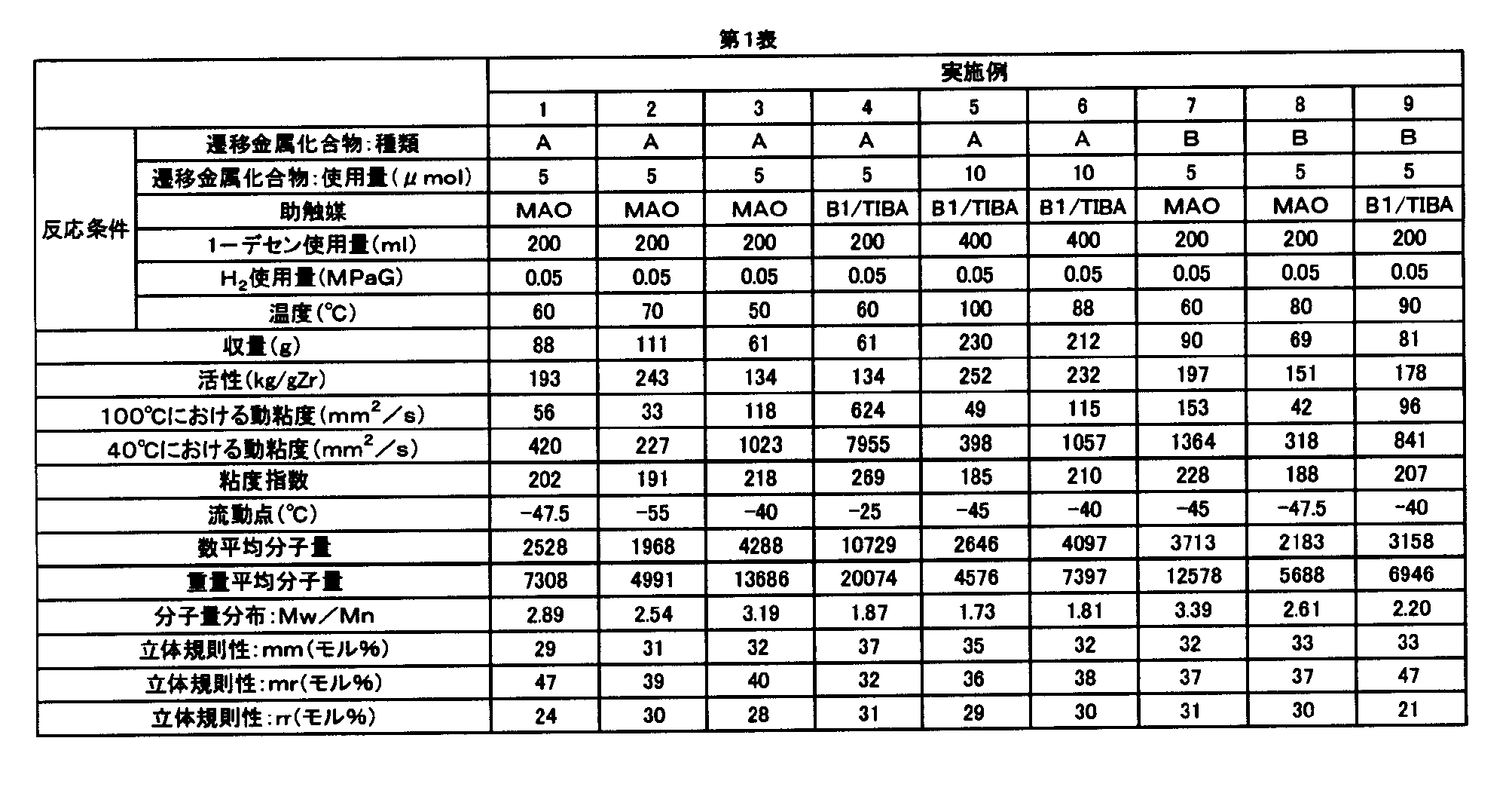
- Example 1 A stainless steel autoclave having an internal volume of 1 liter was sufficiently dried, and after nitrogen substitution, 200 ml of 1-decene was added, and the temperature was raised to 60 ° C. After adding 0.5 mmol of methylaluminoxane (2.0 mmol / ml toluene solution; 0.25 ml), (1,1′-dimethylsilylene) (2,2′-dimethylsilylene) obtained in Production Example 1 was used. -After introducing 5 micromoles of bis (cyclopentadienyl) zirconium dichloride (5 micromol / ml toluene solution; 1 ml), hydrogen was introduced immediately to reach 0.05 MPaG, and polymerization was started.
- Example 2 Except that the polymerization temperature was set to 70 ° C., the same procedure as in Example 1 was performed to obtain 111 g of a colorless transparent liquid. The results obtained by the above analytical method are shown in Table 1.
- Example 3 Except that the polymerization temperature was 50 ° C., the same procedure as in Example 1 was performed to obtain 61 g of a colorless transparent liquid. The results obtained by the above analytical method are shown in Table 1.
- Example 4 The same procedure as in Example 1 was carried out except that 0.5 mmol of triisobutylaluminum and 0.01 mmol of N, N-dimethylanilinium tetrakis (pentafluorophenyl) borate were used instead of methylaluminoxane to obtain 61 g of a colorless transparent liquid. It was. The results obtained by the above analytical method are shown in Table 1.
- Example 5 400 ml of 1-decene, 1.0 mmol of triisobutylaluminum, 0.02 mmol of N, N-dimethylanilinium tetrakis (pentafluorophenyl) borate, (1,1′-dimethylsilylene) (2,2 ′ -Dimethylsilylene) -bis (cyclopentadienyl) zirconium dichloride was prepared in the same manner as in Example 4 except that 10 micromol, the polymerization temperature was 100 ° C., and the reaction time was 240 minutes to obtain 230 g of a colorless transparent liquid. The results obtained by the above analytical method are shown in Table 1.
- Example 6 The same procedure as in Example 5 was carried out except that the polymerization temperature was 88 ° C., to obtain 212 g of a colorless transparent liquid. The results obtained by the above analytical method are shown in Table 1.
- Example 7 Instead of (1,1′-dimethylsilylene) (2,2′-dimethylsilylene) -bis (cyclopentadienyl) zirconium dichloride, (1,1′-dimethylsilylene) (2, 90 g of colorless and transparent liquid was obtained in the same manner as in Example 1 except that 2′-isopropylidene) -bis (cyclopentadienyl) zirconium dichloride was used. The results obtained by the above analytical method are shown in Table 1.
- Example 8 The same procedure as in Example 7 was conducted except that the polymerization temperature was changed to 80 ° C., to obtain 69 g of a colorless transparent liquid. The results obtained by the above analytical method are shown in Table 1.
- Example 9 Instead of (1,1′-dimethylsilylene) (2,2′-dimethylsilylene) -bis (cyclopentadienyl) zirconium dichloride, (1,1′-dimethylsilylene) (2, Using the same procedure as in Example 4 except that 2′-isopropylidene) -bis (cyclopentadienyl) zirconium dichloride was used and the polymerization temperature was 80 ° C., 81 g of a colorless transparent liquid was obtained. The results obtained by the above analytical method are shown in Table 1.
- Example 1 Example 1, except that bis (cyclopentadienyl) zirconium dichloride was used instead of (1,1'-dimethylsilylene) (2,2'-dimethylsilylene) -bis (cyclopentadienyl) zirconium dichloride. To 65 g of a colorless transparent liquid. The results obtained by the above analytical method are shown in Table 2. [Comparative Example 2] The same procedure as in Comparative Example 1 was conducted except that the polymerization temperature was 50 ° C. and hydrogen was 0.02 MPa, and 103 g of a colorless transparent liquid was obtained. The results obtained by the above analytical method are shown in Table 2.
- Example 3 Example 1 except that bis (pentamethylcyclopentadienyl) zirconium dichloride was used instead of (1,1′-dimethylsilylene) (2,2′-dimethylsilylene) -bis (cyclopentadienyl) zirconium dichloride. In the same manner, 40 g of a colorless transparent liquid was obtained. The results obtained by the above analytical method are shown in Table 2.
- Example 4 A colorless transparent liquid 96 g was obtained in the same manner as in Comparative Example 3 except that the polymerization temperature was 50 ° C. and hydrogen was 0.02 MPa. The results obtained by the above analytical method are shown in Table 2.
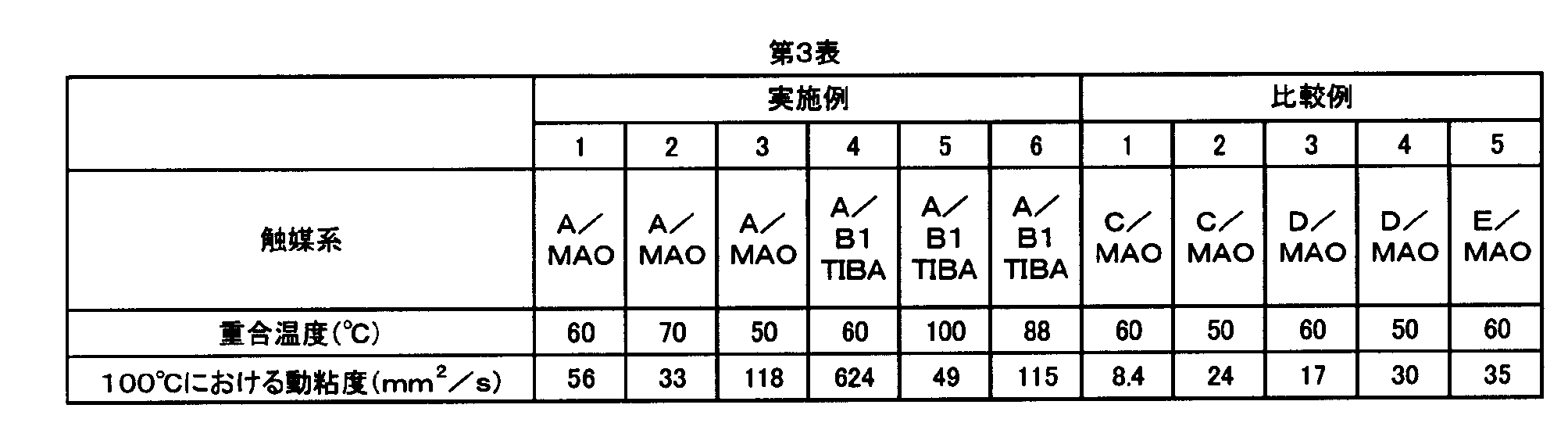
- the ⁇ -olefin polymers of Comparative Examples 6 to 9 show preferable values as lubricating oils with respect to kinematic viscosity at 100 ° C.
- Comparative Example 8 the catalytic activity is low.
- Comparative Examples 6, 7 and 9 the stereoregularity of the obtained polymer is different from the Examples.
- the ⁇ -olefin polymer obtained in the present invention has a lower pour point than the ⁇ -olefin polymer of the comparative example when compared with those of the same kinematic viscosity. It has more preferable properties as a lubricating oil.
- Example 10 A stainless steel autoclave with an internal volume of 1 liter was sufficiently dried, and after nitrogen substitution, 400 ml of 1-decene and then 0.3 mmol of triisobutylaluminum were added, and the temperature was raised to 105 ° C.
- Example 11 The polymer obtained in Example 10 was put in a stainless steel autoclave having an internal volume of 1 liter, a stabilized nickel catalyst (SN750 manufactured by Sakai Chemical Industry Co., Ltd.) was added at a weight ratio of 1 wt%, and then 130 under 2 MPa hydrogen. The reaction was carried out at 6 ° C. for 6 hours. After completion of the reaction, the temperature was cooled to around 80 ° C., and then the contents were taken out and the catalyst component was separated by filtration at 70 ° C. using a 1 ⁇ m filter to obtain 260 g of hydrogenated product. Table 5 shows the results obtained by the above analysis method.
- SN750 manufactured by Sakai Chemical Industry Co., Ltd.
- Example 12 Except that 400 ml of 1-dodecene was used in place of 1-decene, the same procedure as in Example 10 was performed to obtain 230 g of a colorless and transparent polymer from which components having 24 or less carbon atoms were removed. Table 5 shows the results obtained by the above analysis method.
- Example 13 Hydrogenation was carried out in the same manner as in Example 11 except that the polymer obtained in Example 12 was used and the catalyst was changed to a palladium / alumina catalyst (5% Pd supported product) to obtain 229 g of a polymer hydrogenated product. It was. Table 5 shows the results obtained by the above analysis method.
- Example 14 The same procedure as in Example 10 was repeated except that 400 ml of 1-octene was used instead of 1-decene to obtain 254 g of a colorless and transparent polymer from which components having 24 or less carbon atoms were removed. Table 5 shows the results obtained by the above analysis method.
- Example 15 Hydrogenation was performed in the same manner as in Example 13 except that the polymer obtained in Example 14 was used, to obtain 252 g of a polymer hydrogenated product. Table 5 shows the results obtained by the above analysis method.
- A (1,1′-dimethylsilylene) (2,2′-dimethylsilylene) -bis (cyclopentadienyl) zirconium dichloride
- B1 N, N-dimethylanilinium tetrakis (pentafluorophenyl) borate
- TIBA triisobutyl aluminum
- an ⁇ -olefin polymer having an appropriate viscosity as a lubricating oil can be easily produced industrially, which contributes to a reduction in fuel consumption, energy saving, and longer life required for the lubricating oil. .
Landscapes
- Chemical & Material Sciences (AREA)
- Organic Chemistry (AREA)
- Chemical Kinetics & Catalysis (AREA)
- General Chemical & Material Sciences (AREA)
- Health & Medical Sciences (AREA)
- Medicinal Chemistry (AREA)
- Polymers & Plastics (AREA)
- Oil, Petroleum & Natural Gas (AREA)
- Transition And Organic Metals Composition Catalysts For Addition Polymerization (AREA)
- Addition Polymer Or Copolymer, Post-Treatments, Or Chemical Modifications (AREA)
- Lubricants (AREA)
- Crystallography & Structural Chemistry (AREA)
- Engineering & Computer Science (AREA)
- Materials Engineering (AREA)
Abstract
Description
すなわち本発明は、
1.α-オレフィン重合体の製造方法であって、
以下の(A)および(B)を用いてなる触媒を使用して、炭素数6~20のα-オレフィン一種以上を重合する工程(重合工程)を含む、α-オレフィン重合体の製造方法、
(A)一般式(I)
で表される遷移金属化合物
(B)(b-1)有機アルミニウムオキシ化合物及び/または(b-2)上記遷移金属化合物と反応してカチオンに変換しうるイオン性化合物
2.一般式(I)においてR1~R6がいずれも水素原子である、上記1に記載のα-オレフィン重合体の製造方法、
3.重合工程が炭素数6~20のα-オレフィン二種以上を重合する工程である、上記1又は2に記載のα-オレフィン重合体の製造方法、
4.前記重合工程における反応条件が、水素圧が0~0.2MPa(G)、反応温度が0~200℃である、上記1~3のいずれかに記載のオレフィン重合体の製造方法、
5.α-オレフィン重合体が、100℃における動粘度が20~1000mm2/sのα-オレフィン重合体である、上記1~4のいずれかに記載のα-オレフィン重合体の製造方法、
6.α-オレフィン重合体が、α-オレフィン単位連鎖部のトリアッド表示によるアイソタクティシティーが20~40%、シンジオタクティシティーが40%以下であるα-オレフィン重合体である、上記1~5のいずれかに記載のα-オレフィン重合体の製造方法、
7.前記重合工程の後に、炭素数24以下のα-オレフィン系化合物を除去する工程を含む、上記1~6のいずれかに記載のα-オレフィン重合体の製造方法、
8.上記1~7のいずれかに記載の製造方法により得られるα-オレフィン重合体、
9.上記8に記載のα-オレフィン重合体を水添させて得られる水添α-オレフィン重合体、
10.上記8に記載のα-オレフィン重合体及び/又は上記9に記載の水添α-オレフィン重合体を含有する潤滑油組成物、
を提供するものである。
本発明のα-オレフィン重合体の製造方法は、特定の触媒を使用して、炭素数6~20のα-オレフィン一種以上を重合する工程(重合工程)を含む、α-オレフィン重合体の製造方法である。

一般式(I)で表される化合物は、二架橋型ビス(シクロペンタジエニル)系メタロセン錯体からなる遷移金属化合物であって、式中、R1~R6は、それぞれ独立に、水素原子、ハロゲン原子、炭素数1~20の炭化水素基、またはハロゲン原子、ケイ素原子、酸素原子、イオウ原子、窒素原子およびリン原子から選ばれる一種以上の原子を含有する炭素数1~20の有機基を示す。該メタロセン錯体が、二架橋型ビス(インデニル)系メタロセン錯体のような縮合型シクロペンタジエニル基を配位子とする錯体である場合には、所望の粘度のα-オレフィン重合体を得ようとする場合に、高圧条件、多量の水素の添加、または高い反応温度等の反応条件や、不活性溶剤による希釈を必要とするために好ましくない。R1~R6は好ましくは水素原子又は炭素数1~20のアルキル基であり、より好ましくは水素原子または炭素数1~4のアルキル基である。R1~R3から選ばれる少なくとも1つは水素原子であり、R4~R6から選ばれる少なくとも1つは水素原子である。R1~R3のいずれも水素原子でなく、またR4~R6のいずれも水素原子でない場合も同様に、所望の粘度のα-オレフィン重合体を得ようとする場合に、高圧条件、多量の水素の添加、または高い反応温度等の反応条件や、不活性溶剤による希釈を必要とするために好ましくない。
Ra、Rbは、それぞれ独立に、二つのシクロペンタジエニル環を1~3個の原子で結合する二価の基であり、好ましくは、一般式(II)
X1およびX2は、それぞれ独立に、σ結合性の配位子であって、水素原子、ハロゲン原子、炭素数1~20の炭化水素基、またはハロゲン原子、ケイ素原子、酸素原子、イオウ原子、窒素原子およびリン原子から選ばれる一種以上の原子を含有する炭素数1~20の有機基を示す。好ましいX1およびX2としては、ハロゲン原子が挙げられる。Mは周期表第4~6族の遷移金属を示し、周期表第4族の遷移金属が好ましい。
(b-1)有機アルミニウムオキシ化合物としては、下記一般式(III)

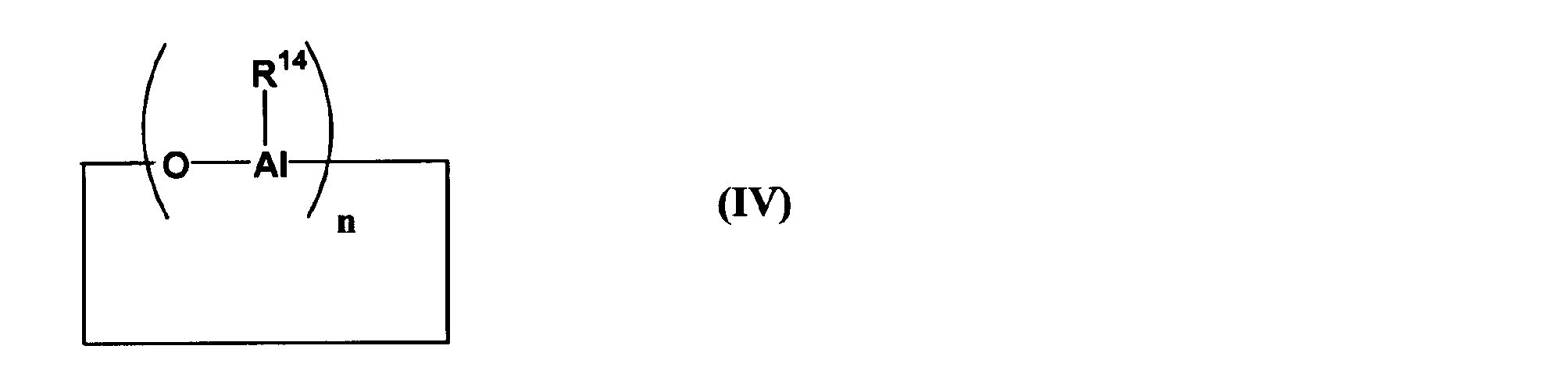
一般式(III)および(IV)において、R9~R14は炭素数1~20、好ましくは1~12の炭化水素基又はハロゲン原子を示す。当該炭化水素基としては、アルキル基,アルケニル基,アリール基,アリールアルキル基などが挙げられる。nは重合度を示し、通常2~50、好ましくは2~40の整数である。なお、各R9~R14は同じでも異なっていてもよい。)
([L1-R15]k+)a([Z]-)b ・・・(V)
([L2]k+)a([Z]-)b ・・・(VI)
で表されるものを好適に使用することができる。
M1は、周期律表第1~3、11~13、17族元素を含むものであり、M2は、周期律表第7~12族元素を示す。
[Z]-は、非配位性アニオン[Z1]-又は[Z2]-を表す。
[Z1]-は複数の基が元素に結合したアニオン、すなわち[M3G1G2・・・Gf]-を表す。ここで、M3は周期律表第5~15族元素、好ましくは周期律表第13~15族元素を示す。G1~Gfはそれぞれ水素原子、ハロゲン原子、炭素数1~20のアルキル基、炭素数2~40のジアルキルアミノ基、炭素数1~20のアルコキシ基、炭素数6~20のアリール基、炭素数6~20のアリールオキシ基、炭素数7~40のアルキルアリール基、炭素数7~40のアリールアルキル基、炭素数1~20のハロゲン置換炭化水素基、炭素数1~20のアシルオキシ基又は有機メタロイド基又は炭素数2~20のヘテロ原子含有炭化水素基を示す。G1~Gfのうち二つ以上が環を形成してもよい。fは[(中心金属M3の原子価)+1]の整数を示す。
[Z2]-は酸解離定数の逆数の対数(pKa)が-10以下のブレンステッド酸単独又はブレンステッド酸及びルイス酸の組合わせの共役塩基、又は一般的に超強酸と定義される酸の共役塩基を示す。また、ルイス塩基が配位していてもよい。
(R20)vAlQ3-v ・・・(VII)
(式中、R20は炭素数1~10のアルキル基、Qは水素原子、炭素数1~20のアルコキシ基,炭素数6~20のアリール基又はハロゲン原子を示し、vは1~3の整数である。)で示される化合物が用いられる。
また、α-オレフィン重合体に水添処理をして、水添α-オレフィン重合体を製造することが安定性向上の観点から好ましい。水添の方法としては、特に制限はなく公知の方法を使用することができる。
なお、上記の「工業的に容易に製造する」とは、例えば、水素使用量および加圧量が少量ですむこと、比較的温和で制御し易い反応温度を使用すること、不活性溶剤で希釈する工程を必要としないことなどを指す。
本発明のα-オレフィン重合体は、上記の製造方法によって得られるα-オレフィン重合体であり、JISK2283に準拠して測定した100℃における動粘度が20~1000mm2/sであることが好ましい。100℃における動粘度が上記範囲内であることで、高粘度潤滑油成分として好適に用いることができる。当該観点から、100℃における動粘度は25~800mm2/sがより好ましく、30~700mm2/sが特に好ましい。
本発明の潤滑油組成物は、前記α-オレフィン重合体及び/又は前記水添α-オレフィン重合体を含有するものであり、これらの重合体を組成物全量基準で通常0.01~100質量%含有する。
本発明の潤滑油組成物において、α-オレフィン重合体や水添α-オレフィン重合体の使用形態は特に制限はなく、基油として用いてもよく、添加剤として用いてもよい。基油として用いる場合は、低分子量のものから高分子量のものまで広く用いることができる。基油として用いる場合は、単独で用いてもよいし、或いは他の基油と混合して用いてもよい。混合割合は、特に制限はないが、組成物全量基準で通常1~100質量%である。添加剤として用いる場合は、例えば、粘度指数向上剤としての利用が挙げられる。この場合、比較的高分子量のα-オレフィン重合体を用いることが好ましい。例えば、高分子量のα-オレフィン重合体としては、数平均分子量が5000を超えるものが挙げられる。また、添加量としては、組成物全量基準で通常0.01~33質量%である。
(1)流動点
JIS K 2269に準拠し測定した。
(2)動粘度及び粘度指数
動粘度は、JIS K 2283に準拠し測定した。粘度指数は、動粘度より、JIS K 2283に準拠し計算して求めた。
(3)数平均分子量及び分子量分布(Mw/Mn)
日本分光製GPC-900(カラム;TOSOH TSK-GEL MULTIPORE HXL-M(2本)+Shodex KF801(1本))装置を用い、溶媒;テトラヒドロフラン、温度;23℃、ポリスチレン換算で求めた。
(4)立体規則性、末端構造、分岐構造
[Macromolecules24,2334(1991);Polymer,30,1350(1989)]に記載の方法により13C-NMRを用いて求めた。
窒素置換した1000ml三つ口フラスコに、金属Na約13.8g(600mmol)と乾燥THF(テトラヒドロフラン)400mlを入れ、0℃で攪拌を行った。5分後、これにシクロペンタジエン1~2mlを滴下し、水素の発生がおさまったら、新たにシクロペンタジエン1~2mlを加え、これを繰り返し、合計50ml(600mmol)のシクロペンタジエンを加えた。反応溶液は無色透明から薄いピンク色に変化した。THFを減圧留去後、結晶をヘキサンで二回洗浄し、減圧乾固させることにより、シクロペンタジエニルナトリウムをピンク色粉末として得た。
シクロペンタジエニルナトリウム43.0g(480mmol)にTHF457mlを0℃で加え攪拌をした。-78℃に冷却し、ジクロロジメチルシラン29.2ml(480mmol)をゆっくり滴下した。溶液はピンク色から白色に変化した。室温で一晩攪拌後、THFを留去し、黄色粉末〔化合物(1)〕を得た。
化合物(1)をヘキサン150mlで抽出し、上澄み液を窒素置換した1000ml三つ口フラスコに移送した。-78℃に冷却後、n-ブチルリチウム(2.73mol/l)を175.8ml(480mmol)滴下した。反応溶液は黄色から白濁色になった。室温で一晩攪拌後、濾過により上澄みを留去した。得られた白色固体をヘキサン100mlで洗浄した。減圧下乾燥することにより、ジリチウム塩〔化合物(2)〕を白色粉末として得た。
化合物(2)27.4g(137mmol)にジエチルエーテル50ml、ヘキサン100mlを加えた。-78℃に冷却後、ジクロロジメチルシラン16.7ml(137mmol)をゆっくり滴下した。室温で5時間攪拌後、沈殿を濾過により取り除き、炉液を濃縮した。ヘキサンから再結晶することにより、針状透明結晶として化合物(3)を4.05g(収率12%)得た。
窒素置換した200mlシュレンク管に、化合物(3)4.05g(16.6mmol)をヘキサン60mlに溶解し攪拌を行った。-78℃に冷却後、n-ブチルリチウム(2.73mol/l)を12.1ml(33.1mmol)滴下し、室温で終夜攪拌した。白濁溶液の溶媒を減圧で留去後、沈殿をヘキサン20mlで洗浄した。減圧下乾燥することにより、ジリチウム塩〔化合物(4)〕を白色粉末として得た。
1H-NMR(500MHz,CDCl3)δ:0.49〔6H,s,(CH3)2Si〕、0.87〔6H,s,(CH3)2Si〕、6.40(2H,t,-CH-)、6.89(4H,d,-CH-)
シクロペンタジエニルナトリウム12.8g(143mmol)にTHF100mlを0℃で加え攪拌をした。-78℃に冷却後、6,6-ジメチルフルベン17.3ml(143mmol)のTHF溶液50mlを滴下した。反応溶液は濃オレンジ色になり若干濁った。室温で3時間攪拌後、水100mlで加水分解をした。溶媒を減圧下留去した後、水とヘキサンで分液し、有機層を無水硫酸マグネシウムで乾燥した。溶媒を留去し、減圧蒸留(30℃/10.6Pa)を行うことにより、化合物(6)を4.66g(収率18.9%)得た。
窒素置換した200mlシュレンク管に、化合物(6)4.66g(27.0mmol)をTHF50mlに溶解し攪拌を行った。-78℃に冷却後、n-ブチルリチウム(2.73mol/l)を19.8ml(54.0mmol)を滴下し、室温で終夜攪拌を行った。再び-78℃に冷却後、ジクロロジメチルシラン3.3ml(27.0mmol)のTHF21ml溶液を30分かけて滴下を行った。室温で終夜攪拌後、反応溶液は白濁色から黄色になった。沈殿を濾過により取り除き、炉液を濃縮した。得られた黄色油状物を減圧蒸留(35~45℃/7.98Pa)することにより、化合物(7)を1.0g(収率16.2%)得た。
窒素置換した200mlシュレンク管に、化合物(7)1.0g(4.38mmol)をヘキサン41mlに溶解し攪拌を行った。-78℃に冷却後、n-ブチルリチウム(2.73mol/l)を3.20ml(8.76mmol)滴下し、室温で終夜攪拌した。白濁溶液の溶媒を減圧で留去後、沈殿をヘキサン10mlで洗浄した。減圧下乾燥することにより、ジリチウム塩〔化合物(8)〕を白色粉末として得た。
1H-NMR(500MHz,CDCl3)δ:0.45〔3H,s,(CH3)2Si〕、0.91〔3H,s,(CH3)2Si〕、1.43〔3H,s,(CH3)C〕、2.06〔3H,s,(CH3)C〕、6.06(2H,m,-CH-)、6.44(2H,m,-CH-)、6.72(2H,m,-CH-)
内容積1リットルのステンレス製オートクレーブを十分乾燥し、窒素置換の後に、1-デセン200ミリリットルを入れ、60℃に昇温した。メチルアルミノキサン0.5ミリモル(2.0ミリモル/mlのトルエン溶液;0.25ml)を投入した後、製造例1で得た(1,1’-ジメチルシリレン)(2,2’-ジメチルシリレン)-ビス(シクロペンタジエニル)ジルコニウムジクロリド5マイクロモル(5マイクロモル/mlのトルエン溶液;1ml)を投入後、すぐに水素を導入し、0.05MPaGとし、重合を開始した。
120分後、メタノール10mlを投入し重合を停止させた。内容物を取り出し、1mol/lの塩酸200ml中に加え、攪拌した。この溶液を分液ロートに移し、有機層を分取した後、有機層を水洗し、有機層を東洋ろ紙製2Cのろ紙で固形分を取り除いた。得られた溶液からロータリーエバポレーター(約1.0×10-4MPaの減圧下、オイルバス100℃)で、ヘプタン、原料、メタノール等を留去し、無色透明液体88gを得た。前記の分析方法により得られた結果を第1表に示す。
重合温度を70℃にした以外は実施例1と同様に行い、無色透明液体111gを得た。前記の分析方法により得られた結果を第1表に示す。
〔実施例3〕
重合温度を50℃にした以外は実施例1と同様に行い、無色透明液体61gを得た。前記の分析方法により得られた結果を第1表に示す。
〔実施例4〕
メチルアルミノキサンの代わりにトリイソブチルアルミニウム0.5ミリモルとN,N-ジメチルアニリニウムテトラキス(ペンタフルオロフェニル)ボレート0.01ミリモルを用いた以外は実施例1と同様に行い、無色透明液体61gを得た。前記の分析方法により得られた結果を第1表に示す。
〔実施例5〕
1-デセンを400ミリリットル、トリイソブチルアルミニウムを1.0ミリモル、N,N-ジメチルアニリニウムテトラキス(ペンタフルオロフェニル)ボレートを0.02ミリモル、(1,1’-ジメチルシリレン)(2,2’-ジメチルシリレン)-ビス(シクロペンタジエニル)ジルコニウムジクロリドを10マイクロモル、重合温度を100℃、反応時間を240分にした以外は実施例4と同様に行い、無色透明液体230gを得た。前記の分析方法により得られた結果を第1表に示す。
〔実施例6〕
重合温度を88℃にした以外は実施例5と同様に行い、無色透明液体212gを得た。前記の分析方法により得られた結果を第1表に示す。
(1,1’-ジメチルシリレン)(2,2’-ジメチルシリレン)-ビス(シクロペンタジエニル)ジルコニウムジクロリドの代わりに製造例2で得られた(1,1’-ジメチルシリレン)(2,2’-イソプロピリデン)-ビス(シクロペンタジエニル)ジルコニウムジクロリドを用いた以外は実施例1と同様に行い、無色透明液体90gを得た。前記の分析方法により得られた結果を第1表に示す。
〔実施例8〕
重合温度を80℃にした以外は実施例7と同様に行い、無色透明液体69gを得た。前記の分析方法により得られた結果を第1表に示す。
〔実施例9〕
(1,1’-ジメチルシリレン)(2,2’-ジメチルシリレン)-ビス(シクロペンタジエニル)ジルコニウムジクロリドの代わりに製造例2で得られた(1,1’-ジメチルシリレン)(2,2’-イソプロピリデン)-ビス(シクロペンタジエニル)ジルコニウムジクロリドを用い、重合温度を80℃にした以外は実施例4と同様に行い、無色透明液体81gを得た。前記の分析方法により得られた結果を第1表に示す。
(1,1’-ジメチルシリレン)(2,2’-ジメチルシリレン)-ビス(シクロペンタジエニル)ジルコニウムジクロリドの代わりにビス(シクロペンタジエニル)ジルコニウムジクロリドを用いた以外は実施例1と同様に行い、無色透明液体65gを得た。前記の分析方法により得られた結果を第2表に示す。
〔比較例2〕
重合温度を50℃、水素を0.02MPaとした以外は比較例1と同様に行い、無色透明液体103gを得た。前記の分析方法により得られた結果を第2表に示す。
〔比較例3〕
(1,1’-ジメチルシリレン)(2,2’-ジメチルシリレン)-ビス(シクロペンタジエニル)ジルコニウムジクロリドの代わりにビス(ペンタメチルシクロペンタジエニル)ジルコニウムジクロリドを用いた以外は実施例1と同様に行い、無色透明液体40gを得た。前記の分析方法により得られた結果を第2表に示す。
〔比較例4〕
重合温度を50℃、水素を0.02MPaとした以外は比較例3と同様に行い、無色透明液体96gを得た。前記の分析方法により得られた結果を第2表に示す。
〔比較例5〕
(1,1’-ジメチルシリレン)(2,2’-ジメチルシリレン)-ビス(シクロペンタジエニル)ジルコニウムジクロリドの代わりにビス(n-ブチルシクロペンタジエニル)ジルコニウムジクロリドを用いた以外は実施例1と同様に行い、無色透明液体43gを得た。前記の分析方法により得られた結果を第2表に示す。
(1,1’-ジメチルシリレン)(2,2’-ジメチルシリレン)-ビス(シクロペンタジエニル)ジルコニウムジクロリドの代わりにrac(エチリデン)-ビス(1-インデニル)ジルコニウムジクロリドを用いた以外は実施例1と同様に行い、無色透明液体100gを得た。前記の分析方法により得られた結果を第2表に示す。
〔比較例7〕
(1,1’-ジメチルシリレン)(2,2’-ジメチルシリレン)-ビス(シクロペンタジエニル)ジルコニウムジクロリドの代わりに(エチリデン)-ビス(2メチル-4フェニルインデニル)ジルコニウムジクロリドを用い、重合温度を80℃にした以外は実施例1と同様に行い、無色透明液体107gを得た。前記の分析方法により得られた結果を第2表に示す。
〔比較例8〕
ジフェニルメチリデン-シクロペンタジエニルフルオレニルジルコニウムジクロリドを用い、重合温度を90℃、水素を0.8MPaにした以外は実施例1と同様に行い、無色透明液体38gを得た。前記の分析方法により得られた結果を第2表に示す。
〔比較例9〕
(1,1’-ジメチルシリレン)(2,2’-ジメチルシリレン)-ビス(シクロペンタジエニル)ジルコニウムジクロリドの代わりに(1,2’-ジメチルシリレン)(2,1’-ジメチルシリレン)ビス(インデニル)ジルコニウムジクロリドを用い、重合温度を70℃、水素を0.5MPaにした以外は実施例1と同様に行い、無色透明液体112gを得た。前記の分析方法により得られた結果を第2表に示す。

〔遷移金属化合物〕
A:(1,1’-ジメチルシリレン)(2,2’-ジメチルシリレン)-ビス(シクロペンタジエニル)ジルコニウムジクロリド
B:(1,1’-ジメチルシリレン)(2,2’-イソプロピリデン)-ビス(シクロペンタジエニル)ジルコニウムジクロリド
C:ビス(シクロペンタジエニル)ジルコニウムジクロリド
D:ビス(ペンタメチルシクロペンタジエニル)ジルコニウムジクロリド
E:ビス(n-ブチルシクロペンタジエニル)ジルコニウムジクロリド
F:rac(エチリデン)-ビス(1-インデニル)ジルコニウムジクロリド
G:(エチリデン)-ビス(2メチル-4フェニルインデニル)ジルコニウムジクロリド
H:ジフェニルメチリデン-シクロペンタジエニルフルオレニルジルコニウムジクロリド
I:(1,2’-ジメチルシリレン)(2,1’-ジメチルシリレン)ビス(インデニル)ジルコニウムジクロリド
〔助触媒〕
MAO:メチルアルミノキサン
B1:N,N-ジメチルアニリニウムテトラキス(ペンタフルオロフェニル)ボレート
TIBA:トリイソブチルアルミニウム

内容積1リットルのステンレス製オートクレーブを十分乾燥し、窒素置換の後に、1-デセン400ミリリットル、次にトリイソブチルアルミニウム0.3ミリモルをいれ、105℃に昇温した。別途準備した触媒混合液〔10ミリリットルのガラス製シュレンク瓶に窒素雰囲気下でトリイソブチルアルミニウム0.20ミリモル(0.5ミリモル/ミリリットルのトルエン溶液;0.4ミリリットル)、製造例1で得た(1,1’-ジメチルシリレン)(2,2’-ジメチルシリレン)-ビス(シクロペンタジエニル)ジルコニウムジクロリド4マイクロモル(5マイクロモル/ミリリットルのトルエン溶液;0.8ミリリットル)及び粉末状のN,N-ジメチルアニリニウムテトラキス(ペンタフルオロフェニル)ボレート0.08ミリモル(64ミリグラム)を入れ室温で1分ほど攪拌した後、1-デセン2ミリリットルを加えて更に室温で1時間攪拌したもの〕を1.6ミリリットル投入後、水素0.02MPaGを導入し、重合を開始した。120分後、残りの触媒混合液1.6mlを添加し、更に105℃で120分反応させた後、メタノール10mlを投入し重合を停止させた。内容物を取り出し、1wt%NaOH水溶液200ml中に加え、攪拌した。この溶液を分液ロートに移し、有機層を分取した後、有機層を水洗し、東洋ろ紙製2Cのろ紙で有機層の固形分を取り除いた。得られた溶液からロータリーエバポレーター(約1.0×10-4MPaの減圧下、オイルバス100℃)で、トルエン、原料、メタノール等を留去し、無色透明液体275gを得た。更に薄膜蒸留装置(柴田科学製分子蒸留装置MS-300特型、高真空排気装置DS-212Z)を用いて5×10-6Paの減圧下、180℃で蒸留を行い、炭素数20以下の成分を取除いた重合物261gを得た。前記の分析方法により得られた結果を第5表に示す。
実施例10で得られた重合物を内容積1リットルのステンレス製オートクレーブに入れ、安定化ニッケル触媒(堺化学工業株式会社製 SN750)を重量比で1wt%添加後、2MPaの水素のもと130℃で6時間反応させた。反応終了後、温度を80℃付近まで冷却した後、内容物を取り出し、1μmのフィルターを用いて70℃で触媒成分を濾過分離し、水添物260gを得た。前記の分析方法により得られた結果を第5表に示す。
1-デセンの代わりに1-ドデセン400ミリリットルを用いた以外は実施例10と同様に行い、炭素数24以下の成分を取除いた無色透明の重合物230gを得た。前記の分析方法により得られた結果を第5表に示す。
〔実施例13〕
実施例12で得られた重合物を使用し、触媒をパラジウム/アルミナ触媒(5%Pd担持品)に変えた以外は実施例11と同様に水素化を行い、重合物水添体229gを得た。前記の分析方法により得られた結果を第5表に示す。
1-デセンの代わりに1-オクテン400ミリリットルを用いた以外は実施例10と同様に行い、炭素数24以下の成分を取除いた無色透明の重合物254gを得た。前記の分析方法により得られた結果を第5表に示す。
〔実施例15〕
実施例14で得られた重合物を使用した以外は実施例13と同様に水素化を行い、重合物水添体252gを得た。前記の分析方法により得られた結果を第5表に示す。

B1:N,N-ジメチルアニリニウムテトラキス(ペンタフルオロフェニル)ボレート
TIBA:トリイソブチルアルミニウム
Claims (10)
- α-オレフィン重合体の製造方法であって、
以下の(A)および(B)を用いてなる触媒を使用して、炭素数6~20のα-オレフィン一種以上を重合する工程(重合工程)を含む、α-オレフィン重合体の製造方法。
(A)一般式(I)

で表される遷移金属化合物
(B)(b-1)有機アルミニウムオキシ化合物及び/または(b-2)上記遷移金属化合物と反応してカチオンに変換しうるイオン性化合物 - 一般式(I)においてR1~R6がいずれも水素原子である、請求項1に記載のα-オレフィン重合体の製造方法。
- 重合工程が炭素数6~20のα-オレフィン二種以上を重合する工程である、請求項1又は2に記載のα-オレフィン重合体の製造方法。
- 前記重合工程における反応条件が、水素圧が0~0.2MPa(G)、反応温度が0~200℃である、請求項1~3のいずれかに記載のオレフィン重合体の製造方法。
- α-オレフィン重合体が、100℃における動粘度が20~1000mm2/sのα-オレフィン重合体である、請求項1~4のいずれかに記載のα-オレフィン重合体の製造方法。
- α-オレフィン重合体が、α-オレフィン単位連鎖部のトリアッド表示によるアイソタクティシティーが20~40%、シンジオタクティシティーが40%以下であるα-オレフィン重合体である、請求項1~5のいずれかに記載のα-オレフィン重合体の製造方法。
- 前記重合工程の後に、炭素数24以下のα-オレフィン系化合物を除去する工程を含む、請求項1~6のいずれかに記載のα-オレフィン重合体の製造方法。
- 請求項1~7のいずれかに記載の製造方法により得られるα-オレフィン重合体。
- 請求項8に記載のα-オレフィン重合体を水添させて得られる水添α-オレフィン重合体。
- 請求項8に記載のα-オレフィン重合体及び/又は請求項9に記載の水添α-オレフィン重合体を含有する潤滑油組成物。
Priority Applications (4)
| Application Number | Priority Date | Filing Date | Title |
|---|---|---|---|
| EP09835029.1A EP2380918B1 (en) | 2008-12-26 | 2009-12-25 | Process for producing alpha-olefin polymer, alpha-olefin polymer, and lubricating oil composition |
| US13/142,326 US9023960B2 (en) | 2008-12-26 | 2009-12-25 | Process for producing α-olefin polymer, α-olefin polymer, and lubricating oil composition |
| JP2010544157A JP5674474B2 (ja) | 2008-12-26 | 2009-12-25 | α−オレフィン重合体の製造方法、α−オレフィン重合体、および潤滑油組成物 |
| SG2011046950A SG172399A1 (en) | 2008-12-26 | 2009-12-25 | PROCESS FOR PRODUCING a-OLEFIN POLYMER, a-OLEFIN POLYMER, AND LUBRICATING OIL COMPOSITION |
Applications Claiming Priority (2)
| Application Number | Priority Date | Filing Date | Title |
|---|---|---|---|
| JP2008-334833 | 2008-12-26 | ||
| JP2008334833 | 2008-12-26 |
Publications (1)
| Publication Number | Publication Date |
|---|---|
| WO2010074233A1 true WO2010074233A1 (ja) | 2010-07-01 |
Family
ID=42287836
Family Applications (1)
| Application Number | Title | Priority Date | Filing Date |
|---|---|---|---|
| PCT/JP2009/071598 Ceased WO2010074233A1 (ja) | 2008-12-26 | 2009-12-25 | α-オレフィン重合体の製造方法、α-オレフィン重合体、および潤滑油組成物 |
Country Status (5)
| Country | Link |
|---|---|
| US (1) | US9023960B2 (ja) |
| EP (1) | EP2380918B1 (ja) |
| JP (1) | JP5674474B2 (ja) |
| SG (1) | SG172399A1 (ja) |
| WO (1) | WO2010074233A1 (ja) |
Cited By (9)
| Publication number | Priority date | Publication date | Assignee | Title |
|---|---|---|---|---|
| WO2012070240A1 (ja) | 2010-11-26 | 2012-05-31 | 出光興産株式会社 | α-オレフィン重合体及びその製造方法 |
| WO2012096159A1 (ja) | 2011-01-13 | 2012-07-19 | 出光興産株式会社 | オレフィンオリゴマー混合物の製造方法 |
| WO2012096158A1 (ja) | 2011-01-13 | 2012-07-19 | 出光興産株式会社 | アルファオレフィン不飽和2量体の製造方法 |
| WO2012157531A1 (ja) * | 2011-05-19 | 2012-11-22 | 出光興産株式会社 | 1-オクテン・1-デセン・1-ドデセン三元共重合体及びそれを含有する潤滑油組成物 |
| WO2013015176A1 (ja) * | 2011-07-25 | 2013-01-31 | 出光興産株式会社 | 1-デセン・1-ドデセン共重合体及びそれを含有する潤滑油組成物 |
| WO2013015175A1 (ja) * | 2011-07-25 | 2013-01-31 | 出光興産株式会社 | 1-オクテン・1-デセン共重合体及びそれを含有する潤滑油組成物 |
| WO2014142206A1 (ja) | 2013-03-14 | 2014-09-18 | 出光興産株式会社 | α-オレフィン重合体及び水添α-オレフィン重合体の製造方法 |
| JP2015034294A (ja) * | 2009-06-16 | 2015-02-19 | シェブロン フィリップス ケミカル カンパニー エルピー | メタロセン−ssa触媒系を用いたアルファオレフィンのオリゴマー化および得られたポリアルファオレフィンの潤滑剤ブレンドを製造するための使用 |
| US11180583B2 (en) | 2018-11-27 | 2021-11-23 | Dl Chemical Co., Ltd. | Polyalphaolefin having uniform structure and method of preparing same |
Families Citing this family (4)
| Publication number | Priority date | Publication date | Assignee | Title |
|---|---|---|---|---|
| EP3601305B1 (en) | 2017-03-20 | 2021-12-15 | LANXESS Organometallics GmbH | Process for producing isopropylidene bis(cyclopentadienyl)zirconium dichloride |
| KR102062341B1 (ko) * | 2017-06-01 | 2020-01-03 | 영창케미칼 주식회사 | 절삭유 조성물 및 그를 이용한 절삭방법 |
| US11098139B2 (en) * | 2018-02-28 | 2021-08-24 | Chevron Phillips Chemical Company Lp | Advanced quality control tools for manufacturing bimodal and multimodal polyethylene resins |
| WO2020112547A1 (en) * | 2018-11-29 | 2020-06-04 | Exxonmobil Chemical Patents Inc. | Poly(alpha-olefin)s and methods thereof |
Citations (26)
| Publication number | Priority date | Publication date | Assignee | Title |
|---|---|---|---|---|
| US3149178A (en) | 1961-07-11 | 1964-09-15 | Socony Mobil Oil Co Inc | Polymerized olefin synthetic lubricants |
| US3382291A (en) | 1965-04-23 | 1968-05-07 | Mobil Oil Corp | Polymerization of olefins with bf3 |
| JPH02169526A (ja) | 1988-10-27 | 1990-06-29 | Shell Internatl Res Maatschappij Bv | エチレンをオリゴマー化する方法及び触媒 |
| JPH03131612A (ja) | 1989-10-18 | 1991-06-05 | Idemitsu Kosan Co Ltd | 合成潤滑油の製造法 |
| JPH05271339A (ja) | 1992-03-26 | 1993-10-19 | Idemitsu Kosan Co Ltd | オレフィン系合成ワックス及びその製造方法 |
| JPH0680725A (ja) | 1990-10-02 | 1994-03-22 | Mitsui Petrochem Ind Ltd | α−オレフィン系共重合体の製造方法 |
| WO1995009172A1 (en) * | 1993-09-30 | 1995-04-06 | Idemitsu Kosan Co., Ltd. | Transition metal compound, olefin polymerization catalyst, and process for producing olefin polymer by using said catalyst |
| JPH07102013A (ja) * | 1993-09-30 | 1995-04-18 | Idemitsu Kosan Co Ltd | エチレン系重合体の製造方法 |
| JPH07133234A (ja) | 1993-11-11 | 1995-05-23 | Idemitsu Kosan Co Ltd | α−オレフィンオリゴマーの製造方法 |
| JPH07145205A (ja) | 1993-06-04 | 1995-06-06 | Neste Oy | C4〜C40のα−オレフィンの重合方法またはこれと他のα−オレフィンとの共重合方法 |
| JPH08505888A (ja) | 1992-12-30 | 1996-06-25 | ネステ・オイ | C▲下4▼オレフィンを線状α−オレフィンとともにオリゴマー化する方法 |
| JPH09508151A (ja) | 1994-01-06 | 1997-08-19 | モービル・オイル・コーポレイション | 新しい炭化水素潤滑剤および留出油燃料の添加剤 |
| JP2000063425A (ja) * | 1998-06-10 | 2000-02-29 | Teijin Ltd | 水添α―オレフィン―ジシクロペンタジエン共重合体の製造方法 |
| JP2000072825A (ja) * | 1998-06-19 | 2000-03-07 | Idemitsu Petrochem Co Ltd | エチレン系共重合体、その製造方法並びにそれを含む樹脂組成物、成形体および潤滑油 |
| JP2000351813A (ja) | 1999-04-09 | 2000-12-19 | Mitsui Chemicals Inc | エチレン・α−オレフィン共重合体およびその製造方法ならびにその用途 |
| JP2001139620A (ja) * | 1999-11-19 | 2001-05-22 | Japan Polyolefins Co Ltd | エチレン重合用触媒及びポリエチレンの製造方法 |
| JP2001335607A (ja) * | 2000-05-30 | 2001-12-04 | Idemitsu Petrochem Co Ltd | α−オレフィン重合体の製造方法及び潤滑油 |
| JP2003510382A (ja) * | 1999-09-23 | 2003-03-18 | ビーピー・コーポレーション・ノース・アメリカ・インコーポレーテッド | オリゴマーオイル及びその製造方法 |
| JP2003105016A (ja) * | 2001-07-27 | 2003-04-09 | Japan Polyolefins Co Ltd | エチレン系重合体製造用触媒、エチレン系重合体の製造方法およびエチレン−α−オレフィン共重合体 |
| JP2005501957A (ja) | 2001-08-31 | 2005-01-20 | シエル・インターナシヨネイル・リサーチ・マーチヤツピイ・ベー・ウイ | ポリ−α−オレフィンの合成及びその用途 |
| JP2005200454A (ja) | 2004-01-13 | 2005-07-28 | Mitsui Chemicals Inc | α−オレフィン(共)重合体とその用途 |
| JP2005200446A (ja) | 2004-01-13 | 2005-07-28 | Mitsui Chemicals Inc | α−オレフィン(共)重合体とその用途 |
| JP2006176760A (ja) | 2004-11-26 | 2006-07-06 | Mitsui Chemicals Inc | 合成潤滑油および潤滑油組成物 |
| JP2006348153A (ja) * | 2005-06-15 | 2006-12-28 | Idemitsu Kosan Co Ltd | α−オレフィン重合体変性物及びその架橋体の製造方法 |
| WO2007011459A1 (en) | 2005-07-19 | 2007-01-25 | Exxonmobil Chemical Patents Inc. | Polyalpha-olefin compositions and processes to produce the same |
| WO2007011832A1 (en) * | 2005-07-19 | 2007-01-25 | Exxonmobil Chemical Patents Inc. | Lubricants from mixed alpha-olefin feeds |
Family Cites Families (6)
| Publication number | Priority date | Publication date | Assignee | Title |
|---|---|---|---|---|
| JP3363904B2 (ja) * | 1993-10-26 | 2003-01-08 | 出光興産株式会社 | 分岐状エチレン系マクロモノマー及びそれを用いた重合体 |
| US6232407B1 (en) | 1998-06-10 | 2001-05-15 | Teijin Limited | Process for producing hydrogenated α-olefin-dicyclopentadiene copolymer, method for molding the same and optical material |
| US7173099B1 (en) | 1999-10-05 | 2007-02-06 | Idemitsu Kosan Co., Ltd. | Propylene polymers and resin composition and molding containing the polymers |
| JP2005075908A (ja) | 2003-08-29 | 2005-03-24 | Idemitsu Kosan Co Ltd | 高級α−オレフィン共重合体及びその製造方法 |
| US7453005B2 (en) * | 2004-01-28 | 2008-11-18 | Idemitsu Kosan Co., Ltd. | Transition metal compound and catalyst for olefin polymerization |
| US7795194B2 (en) | 2004-11-26 | 2010-09-14 | Mitsui Chemicals, Inc. | Synthetic lubricating oil and lubricating oil composition |
-
2009
- 2009-12-25 US US13/142,326 patent/US9023960B2/en active Active
- 2009-12-25 SG SG2011046950A patent/SG172399A1/en unknown
- 2009-12-25 EP EP09835029.1A patent/EP2380918B1/en active Active
- 2009-12-25 JP JP2010544157A patent/JP5674474B2/ja active Active
- 2009-12-25 WO PCT/JP2009/071598 patent/WO2010074233A1/ja not_active Ceased
Patent Citations (26)
| Publication number | Priority date | Publication date | Assignee | Title |
|---|---|---|---|---|
| US3149178A (en) | 1961-07-11 | 1964-09-15 | Socony Mobil Oil Co Inc | Polymerized olefin synthetic lubricants |
| US3382291A (en) | 1965-04-23 | 1968-05-07 | Mobil Oil Corp | Polymerization of olefins with bf3 |
| JPH02169526A (ja) | 1988-10-27 | 1990-06-29 | Shell Internatl Res Maatschappij Bv | エチレンをオリゴマー化する方法及び触媒 |
| JPH03131612A (ja) | 1989-10-18 | 1991-06-05 | Idemitsu Kosan Co Ltd | 合成潤滑油の製造法 |
| JPH0680725A (ja) | 1990-10-02 | 1994-03-22 | Mitsui Petrochem Ind Ltd | α−オレフィン系共重合体の製造方法 |
| JPH05271339A (ja) | 1992-03-26 | 1993-10-19 | Idemitsu Kosan Co Ltd | オレフィン系合成ワックス及びその製造方法 |
| JPH08505888A (ja) | 1992-12-30 | 1996-06-25 | ネステ・オイ | C▲下4▼オレフィンを線状α−オレフィンとともにオリゴマー化する方法 |
| JPH07145205A (ja) | 1993-06-04 | 1995-06-06 | Neste Oy | C4〜C40のα−オレフィンの重合方法またはこれと他のα−オレフィンとの共重合方法 |
| WO1995009172A1 (en) * | 1993-09-30 | 1995-04-06 | Idemitsu Kosan Co., Ltd. | Transition metal compound, olefin polymerization catalyst, and process for producing olefin polymer by using said catalyst |
| JPH07102013A (ja) * | 1993-09-30 | 1995-04-18 | Idemitsu Kosan Co Ltd | エチレン系重合体の製造方法 |
| JPH07133234A (ja) | 1993-11-11 | 1995-05-23 | Idemitsu Kosan Co Ltd | α−オレフィンオリゴマーの製造方法 |
| JPH09508151A (ja) | 1994-01-06 | 1997-08-19 | モービル・オイル・コーポレイション | 新しい炭化水素潤滑剤および留出油燃料の添加剤 |
| JP2000063425A (ja) * | 1998-06-10 | 2000-02-29 | Teijin Ltd | 水添α―オレフィン―ジシクロペンタジエン共重合体の製造方法 |
| JP2000072825A (ja) * | 1998-06-19 | 2000-03-07 | Idemitsu Petrochem Co Ltd | エチレン系共重合体、その製造方法並びにそれを含む樹脂組成物、成形体および潤滑油 |
| JP2000351813A (ja) | 1999-04-09 | 2000-12-19 | Mitsui Chemicals Inc | エチレン・α−オレフィン共重合体およびその製造方法ならびにその用途 |
| JP2003510382A (ja) * | 1999-09-23 | 2003-03-18 | ビーピー・コーポレーション・ノース・アメリカ・インコーポレーテッド | オリゴマーオイル及びその製造方法 |
| JP2001139620A (ja) * | 1999-11-19 | 2001-05-22 | Japan Polyolefins Co Ltd | エチレン重合用触媒及びポリエチレンの製造方法 |
| JP2001335607A (ja) * | 2000-05-30 | 2001-12-04 | Idemitsu Petrochem Co Ltd | α−オレフィン重合体の製造方法及び潤滑油 |
| JP2003105016A (ja) * | 2001-07-27 | 2003-04-09 | Japan Polyolefins Co Ltd | エチレン系重合体製造用触媒、エチレン系重合体の製造方法およびエチレン−α−オレフィン共重合体 |
| JP2005501957A (ja) | 2001-08-31 | 2005-01-20 | シエル・インターナシヨネイル・リサーチ・マーチヤツピイ・ベー・ウイ | ポリ−α−オレフィンの合成及びその用途 |
| JP2005200454A (ja) | 2004-01-13 | 2005-07-28 | Mitsui Chemicals Inc | α−オレフィン(共)重合体とその用途 |
| JP2005200446A (ja) | 2004-01-13 | 2005-07-28 | Mitsui Chemicals Inc | α−オレフィン(共)重合体とその用途 |
| JP2006176760A (ja) | 2004-11-26 | 2006-07-06 | Mitsui Chemicals Inc | 合成潤滑油および潤滑油組成物 |
| JP2006348153A (ja) * | 2005-06-15 | 2006-12-28 | Idemitsu Kosan Co Ltd | α−オレフィン重合体変性物及びその架橋体の製造方法 |
| WO2007011459A1 (en) | 2005-07-19 | 2007-01-25 | Exxonmobil Chemical Patents Inc. | Polyalpha-olefin compositions and processes to produce the same |
| WO2007011832A1 (en) * | 2005-07-19 | 2007-01-25 | Exxonmobil Chemical Patents Inc. | Lubricants from mixed alpha-olefin feeds |
Non-Patent Citations (4)
| Title |
|---|
| J. AM. CHEM. SOC., vol. 60, 1983, pages 309 |
| MACROMOLECULES, vol. 24, 1991, pages 2334 |
| POLYMER, vol. 30, 1989, pages 1350 |
| See also references of EP2380918A4 |
Cited By (16)
| Publication number | Priority date | Publication date | Assignee | Title |
|---|---|---|---|---|
| US9745230B2 (en) | 2009-06-16 | 2017-08-29 | Chevron Phillips Chemical Company Lp | Oligomerization of alpha olefins using metallocene-SSA catalyst systems and use of the resultant polyalphaolefins to prepare lubricant blends |
| JP2015034294A (ja) * | 2009-06-16 | 2015-02-19 | シェブロン フィリップス ケミカル カンパニー エルピー | メタロセン−ssa触媒系を用いたアルファオレフィンのオリゴマー化および得られたポリアルファオレフィンの潤滑剤ブレンドを製造するための使用 |
| US9334203B2 (en) | 2009-06-16 | 2016-05-10 | Chevron Phillips Chemical Company Lp | Oligomerization of alpha olefins using metallocene-SSA catalyst systems and use of the resultant polyalphaolefins to prepare lubricant blends |
| JP2016186089A (ja) * | 2009-06-16 | 2016-10-27 | シェブロン フィリップス ケミカル カンパニー エルピー | メタロセン−ssa触媒系を用いたアルファオレフィンのオリゴマー化および得られたポリアルファオレフィンの潤滑剤ブレンドを製造するための使用 |
| WO2012070240A1 (ja) | 2010-11-26 | 2012-05-31 | 出光興産株式会社 | α-オレフィン重合体及びその製造方法 |
| WO2012096159A1 (ja) | 2011-01-13 | 2012-07-19 | 出光興産株式会社 | オレフィンオリゴマー混合物の製造方法 |
| WO2012096158A1 (ja) | 2011-01-13 | 2012-07-19 | 出光興産株式会社 | アルファオレフィン不飽和2量体の製造方法 |
| WO2012157531A1 (ja) * | 2011-05-19 | 2012-11-22 | 出光興産株式会社 | 1-オクテン・1-デセン・1-ドデセン三元共重合体及びそれを含有する潤滑油組成物 |
| CN103562238A (zh) * | 2011-05-19 | 2014-02-05 | 出光兴产株式会社 | 1-辛烯-1-癸烯-1-十二烯三元共聚物和含有其的润滑油组合物 |
| WO2013015176A1 (ja) * | 2011-07-25 | 2013-01-31 | 出光興産株式会社 | 1-デセン・1-ドデセン共重合体及びそれを含有する潤滑油組成物 |
| WO2013015175A1 (ja) * | 2011-07-25 | 2013-01-31 | 出光興産株式会社 | 1-オクテン・1-デセン共重合体及びそれを含有する潤滑油組成物 |
| CN103649138A (zh) * | 2011-07-25 | 2014-03-19 | 出光兴产株式会社 | 1-辛烯-1-癸烯共聚物和含有其的润滑油组合物 |
| WO2014142206A1 (ja) | 2013-03-14 | 2014-09-18 | 出光興産株式会社 | α-オレフィン重合体及び水添α-オレフィン重合体の製造方法 |
| JPWO2014142206A1 (ja) * | 2013-03-14 | 2017-02-16 | 出光興産株式会社 | α−オレフィン重合体及び水添α−オレフィン重合体の製造方法 |
| US9745396B2 (en) | 2013-03-14 | 2017-08-29 | Idemitsu Kosan Co., Ltd. | Methods for producing α-olefin polymer and hydrogenated α-olefin polymer |
| US11180583B2 (en) | 2018-11-27 | 2021-11-23 | Dl Chemical Co., Ltd. | Polyalphaolefin having uniform structure and method of preparing same |
Also Published As
| Publication number | Publication date |
|---|---|
| US20120040878A1 (en) | 2012-02-16 |
| US9023960B2 (en) | 2015-05-05 |
| JPWO2010074233A1 (ja) | 2012-06-21 |
| EP2380918A4 (en) | 2013-04-17 |
| EP2380918B1 (en) | 2019-07-24 |
| EP2380918A1 (en) | 2011-10-26 |
| JP5674474B2 (ja) | 2015-02-25 |
| SG172399A1 (en) | 2011-07-28 |
Similar Documents
| Publication | Publication Date | Title |
|---|---|---|
| JP5674474B2 (ja) | α−オレフィン重合体の製造方法、α−オレフィン重合体、および潤滑油組成物 | |
| US6414090B2 (en) | Process for producing a polymer of an α-olefin and lubricant | |
| WO2011093295A1 (ja) | α-オレフィン(共)重合体、水添α-オレフィン(共)重合体及びそれを含有する潤滑油組成物 | |
| WO2013015175A1 (ja) | 1-オクテン・1-デセン共重合体及びそれを含有する潤滑油組成物 | |
| JP5357605B2 (ja) | α−オレフィン重合体の製造方法及び潤滑油 | |
| WO2012157531A1 (ja) | 1-オクテン・1-デセン・1-ドデセン三元共重合体及びそれを含有する潤滑油組成物 | |
| WO2013015176A1 (ja) | 1-デセン・1-ドデセン共重合体及びそれを含有する潤滑油組成物 | |
| JP4870308B2 (ja) | エチレン系共重合体、その製造方法及びそれを含む潤滑油組成物 | |
| JP5845259B2 (ja) | オレフィン重合体の製造方法 | |
| JPWO2001058968A1 (ja) | エチレン系共重合体、その製造方法及びそれを含む潤滑油組成物 | |
| US9056931B2 (en) | Method for producing olefin polymer |
Legal Events
| Date | Code | Title | Description |
|---|---|---|---|
| 121 | Ep: the epo has been informed by wipo that ep was designated in this application |
Ref document number: 09835029 Country of ref document: EP Kind code of ref document: A1 |
|
| ENP | Entry into the national phase |
Ref document number: 2010544157 Country of ref document: JP Kind code of ref document: A |
|
| WWE | Wipo information: entry into national phase |
Ref document number: 2009835029 Country of ref document: EP |
|
| NENP | Non-entry into the national phase |
Ref country code: DE |
|
| WWE | Wipo information: entry into national phase |
Ref document number: 13142326 Country of ref document: US |