WO2010071002A1 - 表示性能を向上させた二色粒子 - Google Patents
表示性能を向上させた二色粒子 Download PDFInfo
- Publication number
- WO2010071002A1 WO2010071002A1 PCT/JP2009/069541 JP2009069541W WO2010071002A1 WO 2010071002 A1 WO2010071002 A1 WO 2010071002A1 JP 2009069541 W JP2009069541 W JP 2009069541W WO 2010071002 A1 WO2010071002 A1 WO 2010071002A1
- Authority
- WO
- WIPO (PCT)
- Prior art keywords
- particles
- dichroic
- particle
- color
- colored
- Prior art date
- Legal status (The legal status is an assumption and is not a legal conclusion. Google has not performed a legal analysis and makes no representation as to the accuracy of the status listed.)
- Ceased
Links
Images

Classifications
-
- G—PHYSICS
- G02—OPTICS
- G02F—OPTICAL DEVICES OR ARRANGEMENTS FOR THE CONTROL OF LIGHT BY MODIFICATION OF THE OPTICAL PROPERTIES OF THE MEDIA OF THE ELEMENTS INVOLVED THEREIN; NON-LINEAR OPTICS; FREQUENCY-CHANGING OF LIGHT; OPTICAL LOGIC ELEMENTS; OPTICAL ANALOGUE/DIGITAL CONVERTERS
- G02F1/00—Devices or arrangements for the control of the intensity, colour, phase, polarisation or direction of light arriving from an independent light source, e.g. switching, gating or modulating; Non-linear optics
- G02F1/01—Devices or arrangements for the control of the intensity, colour, phase, polarisation or direction of light arriving from an independent light source, e.g. switching, gating or modulating; Non-linear optics for the control of the intensity, phase, polarisation or colour
- G02F1/17—Devices or arrangements for the control of the intensity, colour, phase, polarisation or direction of light arriving from an independent light source, e.g. switching, gating or modulating; Non-linear optics for the control of the intensity, phase, polarisation or colour based on variable-absorption elements not provided for in groups G02F1/015 - G02F1/169
- G02F1/172—Devices or arrangements for the control of the intensity, colour, phase, polarisation or direction of light arriving from an independent light source, e.g. switching, gating or modulating; Non-linear optics for the control of the intensity, phase, polarisation or colour based on variable-absorption elements not provided for in groups G02F1/015 - G02F1/169 based on a suspension of orientable dipolar particles, e.g. suspended particles displays
-
- G—PHYSICS
- G02—OPTICS
- G02F—OPTICAL DEVICES OR ARRANGEMENTS FOR THE CONTROL OF LIGHT BY MODIFICATION OF THE OPTICAL PROPERTIES OF THE MEDIA OF THE ELEMENTS INVOLVED THEREIN; NON-LINEAR OPTICS; FREQUENCY-CHANGING OF LIGHT; OPTICAL LOGIC ELEMENTS; OPTICAL ANALOGUE/DIGITAL CONVERTERS
- G02F1/00—Devices or arrangements for the control of the intensity, colour, phase, polarisation or direction of light arriving from an independent light source, e.g. switching, gating or modulating; Non-linear optics
- G02F1/01—Devices or arrangements for the control of the intensity, colour, phase, polarisation or direction of light arriving from an independent light source, e.g. switching, gating or modulating; Non-linear optics for the control of the intensity, phase, polarisation or colour
- G02F1/165—Devices or arrangements for the control of the intensity, colour, phase, polarisation or direction of light arriving from an independent light source, e.g. switching, gating or modulating; Non-linear optics for the control of the intensity, phase, polarisation or colour based on translational movement of particles in a fluid under the influence of an applied field
- G02F1/166—Devices or arrangements for the control of the intensity, colour, phase, polarisation or direction of light arriving from an independent light source, e.g. switching, gating or modulating; Non-linear optics for the control of the intensity, phase, polarisation or colour based on translational movement of particles in a fluid under the influence of an applied field characterised by the electro-optical or magneto-optical effect
- G02F1/167—Devices or arrangements for the control of the intensity, colour, phase, polarisation or direction of light arriving from an independent light source, e.g. switching, gating or modulating; Non-linear optics for the control of the intensity, phase, polarisation or colour based on translational movement of particles in a fluid under the influence of an applied field characterised by the electro-optical or magneto-optical effect by electrophoresis
-
- G—PHYSICS
- G02—OPTICS
- G02F—OPTICAL DEVICES OR ARRANGEMENTS FOR THE CONTROL OF LIGHT BY MODIFICATION OF THE OPTICAL PROPERTIES OF THE MEDIA OF THE ELEMENTS INVOLVED THEREIN; NON-LINEAR OPTICS; FREQUENCY-CHANGING OF LIGHT; OPTICAL LOGIC ELEMENTS; OPTICAL ANALOGUE/DIGITAL CONVERTERS
- G02F1/00—Devices or arrangements for the control of the intensity, colour, phase, polarisation or direction of light arriving from an independent light source, e.g. switching, gating or modulating; Non-linear optics
- G02F1/01—Devices or arrangements for the control of the intensity, colour, phase, polarisation or direction of light arriving from an independent light source, e.g. switching, gating or modulating; Non-linear optics for the control of the intensity, phase, polarisation or colour
- G02F1/17—Devices or arrangements for the control of the intensity, colour, phase, polarisation or direction of light arriving from an independent light source, e.g. switching, gating or modulating; Non-linear optics for the control of the intensity, phase, polarisation or colour based on variable-absorption elements not provided for in groups G02F1/015 - G02F1/169
-
- G—PHYSICS
- G02—OPTICS
- G02F—OPTICAL DEVICES OR ARRANGEMENTS FOR THE CONTROL OF LIGHT BY MODIFICATION OF THE OPTICAL PROPERTIES OF THE MEDIA OF THE ELEMENTS INVOLVED THEREIN; NON-LINEAR OPTICS; FREQUENCY-CHANGING OF LIGHT; OPTICAL LOGIC ELEMENTS; OPTICAL ANALOGUE/DIGITAL CONVERTERS
- G02F1/00—Devices or arrangements for the control of the intensity, colour, phase, polarisation or direction of light arriving from an independent light source, e.g. switching, gating or modulating; Non-linear optics
- G02F1/01—Devices or arrangements for the control of the intensity, colour, phase, polarisation or direction of light arriving from an independent light source, e.g. switching, gating or modulating; Non-linear optics for the control of the intensity, phase, polarisation or colour
- G02F1/19—Devices or arrangements for the control of the intensity, colour, phase, polarisation or direction of light arriving from an independent light source, e.g. switching, gating or modulating; Non-linear optics for the control of the intensity, phase, polarisation or colour based on variable-reflection or variable-refraction elements not provided for in groups G02F1/015 - G02F1/169
-
- G—PHYSICS
- G02—OPTICS
- G02B—OPTICAL ELEMENTS, SYSTEMS OR APPARATUS
- G02B2207/00—Coding scheme for general features or characteristics of optical elements and systems of subclass G02B, but not including elements and systems which would be classified in G02B6/00 and subgroups
- G02B2207/113—Fluorescence
-
- G—PHYSICS
- G02—OPTICS
- G02B—OPTICAL ELEMENTS, SYSTEMS OR APPARATUS
- G02B26/00—Optical devices or arrangements for the control of light using movable or deformable optical elements
- G02B26/02—Optical devices or arrangements for the control of light using movable or deformable optical elements for controlling the intensity of light
- G02B26/026—Optical devices or arrangements for the control of light using movable or deformable optical elements for controlling the intensity of light based on the rotation of particles under the influence of an external field, e.g. gyricons, twisting ball displays
-
- G—PHYSICS
- G02—OPTICS
- G02F—OPTICAL DEVICES OR ARRANGEMENTS FOR THE CONTROL OF LIGHT BY MODIFICATION OF THE OPTICAL PROPERTIES OF THE MEDIA OF THE ELEMENTS INVOLVED THEREIN; NON-LINEAR OPTICS; FREQUENCY-CHANGING OF LIGHT; OPTICAL LOGIC ELEMENTS; OPTICAL ANALOGUE/DIGITAL CONVERTERS
- G02F1/00—Devices or arrangements for the control of the intensity, colour, phase, polarisation or direction of light arriving from an independent light source, e.g. switching, gating or modulating; Non-linear optics
- G02F1/01—Devices or arrangements for the control of the intensity, colour, phase, polarisation or direction of light arriving from an independent light source, e.g. switching, gating or modulating; Non-linear optics for the control of the intensity, phase, polarisation or colour
- G02F1/165—Devices or arrangements for the control of the intensity, colour, phase, polarisation or direction of light arriving from an independent light source, e.g. switching, gating or modulating; Non-linear optics for the control of the intensity, phase, polarisation or colour based on translational movement of particles in a fluid under the influence of an applied field
- G02F1/1675—Constructional details
- G02F2001/1678—Constructional details characterised by the composition or particle type
-
- G—PHYSICS
- G02—OPTICS
- G02F—OPTICAL DEVICES OR ARRANGEMENTS FOR THE CONTROL OF LIGHT BY MODIFICATION OF THE OPTICAL PROPERTIES OF THE MEDIA OF THE ELEMENTS INVOLVED THEREIN; NON-LINEAR OPTICS; FREQUENCY-CHANGING OF LIGHT; OPTICAL LOGIC ELEMENTS; OPTICAL ANALOGUE/DIGITAL CONVERTERS
- G02F2203/00—Function characteristic
- G02F2203/34—Colour display without the use of colour mosaic filters
Definitions
- the present invention relates to a dichroic particle and an image display device. More specifically, the present invention relates to a dichroic particle suitably used as a display element of a particle rotation type image display apparatus, and a particle rotation type image display apparatus having the particle as a display element.
- CTR CRT
- PDP Plasma Display Panel
- LCD Liquid Crystal Display
- FED Electrolytic Emission Display
- CRT is a display device that emits light by scanning a fluorescent material with an electron beam that has converged electrons.
- a PDP is a display device that encloses a high-pressure noble gas in a region having a phosphor layer sandwiched between two electrodes and applies a voltage to the noble gas to generate ultraviolet rays to generate light.
- the LCD is a device that displays the polarization state of the light from the backlight by changing the polarization state of the light according to the orientation of the liquid crystal by passing the light through the liquid crystal.
- the FED is a display device that emits electrons by emitting electrons into a vacuum and making them collide with a phosphor.
- particle rotation type display in which particles divided into two colors are arranged in an insulating resin and the two-color particles are rotated.
- particles having two or more color regions are rotatably dispersed on a light-transmitting support such as silicone rubber, and a voltage is applied by sandwiching the light-transmitting support between electrodes.
- the specific color areas of all particles are oriented in the same orientation. This is possible because the charging characteristics of each color region of the particles are different. Further, when the specific gravity of each color region of the particles is matched, the rotation performance of the particles is increased.
- the particle rotation type display is a display method excellent in power saving.
- the particle rotation type display since it takes time for the particles to rotate in this method, the particle rotation type display is not suitable for a display device in which an image to be displayed changes rapidly, for example, a display device that displays a moving image.
- the particle rotation type display is suitable for displaying still images such as characters and figures, and is expected to be applied to so-called electronic paper.
- Patent Document 1 Japanese Patent Application Laid-Open No. 64-42683 discloses a wax-like substance as a main material, and particles made of the same and a pigment and a dye.
- Patent Document 2 Japanese Patent Laid-Open No. 11-352421
- Patent Document 3 Japanese Patent Laid-Open No. 2000-1221073 discloses a two-color ball obtained by coating a glass ball filled with titanium dioxide with a black material.
- JP-A 64-42683 Japanese Patent Laid-Open No. 11-352421 JP 2000-122103 A
- the particles disclosed in these patent documents are mainly white / black dichroic particles, and in the other color combination particles, the cause is unknown, but the rotation of the particles when a voltage is applied. Performance (rotational speed) is insufficient.
- An object of the present invention is to provide a dichroic particle having excellent rotational performance of a particle when a voltage is applied, and particularly when a voltage is applied to particles having a color combination other than a white / black color combination.
- the purpose is to achieve high rotation performance.
- the inventor of the present invention has included a conductive white pigment in a hemispherical portion that constitutes one color (ground color) of the two-color particles, so that even in a combination of colors other than a combination of white / black, It has been found that high rotational performance can be achieved when a voltage is applied, and the present invention has been completed.
- the dichroic particles of the present invention are resin dichroic particles in which the individual spherical particles are substantially bisected into different colors in appearance, and the substantially hemisphere of the dichroic particles contains a conductive white pigment, A dichroic particle that constitutes a ground color, and the remaining substantially hemisphere of the dichroic particle is colored in any color other than the ground color.
- the conductive white pigment can be produced, for example, by treating a white pigment with a conductive material selected from the group consisting of antimony oxide / tin oxide and indium oxide / tin dioxide to impart conductivity.
- the powder resistivity of the conductive white pigment blended in the substantially hemisphere constituting the ground color of the dichroic particles is usually in the range of 1 to 100 ⁇ cm.
- the dichroic particles having a high dielectric constant in the ground color almost hemisphere and having a difference in dielectric constant between the hemispheres have high rotational performance when a voltage is applied.
- the substantially hemisphere colored in an arbitrary color excluding the ground color is colored with, for example, a chromatic dye or a chromatic color pigment.
- the substantially hemispherical portion colored in an arbitrary color other than the ground color Contains a chromatic dye or chromatic pigment.
- the average particle size of the dichroic particles is usually in the range of 30 to 200 ⁇ m on a volume basis in consideration of the efficiency of particle rotation.
- the dichroic particles of the present invention are suitable as a display element of a particle rotation type image display device.
- the particle rotation type image display device of the present invention is a particle rotation type image display device made of an insulating resin that contains two-color particles in a freely rotatable manner between a pair of electrodes.
- the spherical particles are resin dichroic particles roughly divided into two different colors, and the substantially hemisphere of the dichroic particles contains a conductive white pigment, constituting a ground color, and the rest of the dichroic particles The substantially hemisphere is colored in an arbitrary color except the ground color, and the dichroic particles are rotated in the insulating resin by a voltage applied between the electrodes.
- the dichroic particles float in a rotatable manner in an insulating liquid impregnated in the insulating resin.
- the voltage applied between the pair of electrodes is preferably in the range of 50 to 300V.
- dichroic particles having excellent rotational performance of particles when a voltage is applied particularly dichroic particles having a combination of colors other than a combination of white / black having excellent rotational performance, and the two colors
- a particle rotation type image display device having particles as display elements is provided.
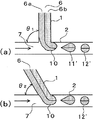
- FIG. 1 is a conceptual diagram showing a first microchannel for transferring a colored continuous phase and a second microchannel for manufacturing a dichroic particle in the method for manufacturing a dichroic particle described in Japanese Patent Application Laid-Open No. 2004-197083. It is a figure showing formation of a color particle.
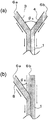
- FIG. 2 is a conceptual diagram showing an example of a method for forming a colored continuous phase in the method for producing dichroic particles described in Japanese Patent Application Laid-Open No. 2004-197083.
- FIG. 3 is a diagram showing one system of a method for producing dichroic particles described in Japanese Patent Application Laid-Open No. 2004-197083.
- dichroic particles of the present invention and the particle rotation type image display apparatus having the dichroic particles as display elements will be described in detail.
- the dichroic particles of the present invention are resin dichroic particles in which the individual spherical particles are substantially bisected into different colors in appearance.
- the substantially hemisphere of the dichroic particles contains a conductive white pigment, and the white pigment mainly composed of the conductive white pigment constitutes the ground color.
- the remaining substantially hemisphere of the dichroic particles is colored in an arbitrary color except the ground color.
- the dichroic particle of the present invention has a dielectric region in which approximately half of one particle contains a conductive white pigment, and the remaining substantially half that contains a colorant without containing a conductive component. Area (colored area).
- the dielectric region forming approximately half of one particle of the dichroic particle of the present invention contains a conductive white pigment whose powder resistivity is usually in the range of 1 to 100 ⁇ cm, preferably 1 to 30 ⁇ cm. It is formed from resin. It is preferable that a crosslinked structure is formed in this dielectric region.
- the conductive white pigment is usually in an amount in the range of 1 to 10 parts by weight, preferably 2 to 5 parts by weight with respect to 100 parts by weight of the total weight of the conductive white pigment and the resin. It is contained in.
- the conductive white pigment in such an amount, a region occupying about half of the two-color particles exhibits conductivity and a high dielectric constant.
- the potential difference between the dielectric region in the dichroic particle and the colored region containing the coloring material causes the dichroic particle of the present invention placed between a pair of electrodes to rotate according to the voltage applied to the electrode. It becomes a driving force.
- the dielectric region containing the conductive white pigment is generally white reflecting the color of the conductive white pigment, but may be colored within a range that does not impair the properties of the dielectric region. For example, if the dielectric region is colored yellow, the background color of the dichroic particle of the present invention is yellow. That is, in the dichroic particles of the present invention, the component that determines the characteristics of the dielectric region that occupies approximately half is a conductive white pigment, and since the conductive white pigment itself is white, The original ground color is white. For this reason, the ground color of the two-color particles can be adjusted to any color from white to light to dark to black.
- Such characteristics are the characteristics of the dichroic particles of the present invention that can be achieved by using a conductive white pigment in the dielectric region, and black conductive carbon black or the like is used as the conductive material.
- the ground color cannot be adjusted by stacking colors as described above.
- the dielectric region can be freely colored. Therefore, the colored regions constituting the remaining half of the dichroic particles are appropriately selected according to the color of the dielectric region. be able to. In general, the formed image becomes clearer by coloring with a color opposite to or similar to the color of the dielectric region.
- the ratio of the resin and the colorant in the colored region may be such that the color of the dielectric region cannot be seen through the colored region, and the colorant may be used, and the total amount of resin and colorant is 100 parts by weight.
- the colorant is usually used in an amount in the range of 1 to 70 parts by weight, preferably in the range of 2 to 50 parts by weight.
- This colored region is made of a resin and a colorant dispersed or dissolved in the resin. It is preferable that the colored region also has a crosslinked structure as in the dielectric region.
- the dichroic particles of the present invention having such a structure can be produced by various methods.
- the dichroic particles of the present invention are roughly classified into three types. Specifically, the method is roughly classified into a microchannel method (see, for example, JP-A-2004-199083), a dropping method (see, for example, JP-A-2004-199022), and a crushing method (see, for example, JP-A-2004-294628). Is done. These methods will be described below.
- a colored continuous phase 6 divided into two colors is transferred in a first microchannel 1 and continuously in a second microchannel 2 in which a fluid medium flows. It is discharged sequentially or intermittently. Since the colored continuous phase and the fluid medium have an insoluble relationship of O / W or W / O with each other, the discharged colored continuous phase flows in the second microchannel and is spherical due to the interfacial tension. Particle 12 ′ is obtained.
- the colored continuous phase contains a resin or its monomer, and the resin or its monomer is polymerized and cured by UV irradiation and / or heating when the colored continuous phase is discharged and spheroidized. Thus, resin-made two-color particles in which the individual spherical particles are substantially bisected into different colors in terms of appearance are completed.
- the colored continuous phase is divided into two colors, and both phases contain a resin or its monomer, a coloring material such as a dye or a pigment, and other optional components.
- the phase (ground hue) that constitutes a substantially hemisphere constituting the ground color contains a coloring material and a conductive white pigment for imparting conductivity to the substantially hemisphere constituting the ground color.
- the phase (arbitrary colored phase other than the ground color) that is substantially hemispherically colored in an arbitrary color except the ground color contains an arbitrary coloring material other than the ground color.
- Arbitrary coloring phases other than the said ground hue and ground color are obtained by mixing these containing components.
- the resin examples include acrylic resins, styrene resins, ethylene resins, vinyl chloride resins, vinyl acetate resins, and the monomers include those capable of forming the resin.
- the main monomers used in the present invention include (meth) acrylic monomers, styrene monomers and vinyl monomers.
- Examples of the (meth) acrylic monomers include: (meth) acrylic acid alkyl esters such as methyl (meth) acrylate, ethyl (meth) acrylate, butyl (meth) acrylate, octyl (meth) acrylate, (meth) acrylic Cycloalkyl (meth) acrylates such as cyclohexyl acid, esters of (meth) acrylic acid and bicyclic alcohols such as isobornyl acrylate, (meth) acrylic such as phenyl (meth) acrylate and benzyl (meth) acrylate And acid aryl esters.
- (meth) acrylic acid alkyl esters such as methyl (meth) acrylate, ethyl (meth) acrylate, butyl (meth) acrylate, octyl (meth) acrylate
- (meth) acrylic Cycloalkyl (meth) acrylates such as cyclohexy
- styrenic monomer examples include: styrene, methyl styrene, dimethyl styrene, trimethyl styrene, ethyl styrene, diethyl styrene, triethyl styrene, propyl styrene, butyl styrene, hexyl styrene, heptyl styrene and octyl styrene, fluorostyrene, chlorostyrene, Examples include bromostyrene, dibromostyrene, chloromethylstyrene, nitrostyrene, acetylstyrene, methoxystyrene, ⁇ -methylstyrene, vinyltoluene, and sodium p-styrenesulfonate.
- vinyl monomers examples include: vinyl acetate, vinyl propionate, vinyl n-butyrate, vinyl isobutyrate, vinyl pivalate, vinyl caproate, vinyl persate, vinyl laurate, vinyl stearate, vinyl benzoate, Examples thereof include vinyl pt-butyl benzoate and vinyl salicylate.
- Examples of other monomers used in the present invention include: vinylidene chloride, vinyl chlorohexanecarboxylate, ⁇ -methacryloyloxyethyl hydrogen phthalate, perfluoroethylene, perfluoropropylene, vinylidene fluoride, vinyltrimethoxysilane, vinyl A triethoxysilane is mentioned.
- At least one functional group for example, carboxyl group, amide group, amino
- a monomer having a group, hydroxyl group, epoxy group, or nitrile group in the molecule can be used in combination.
- Examples of monomers having a carboxyl group in the molecule are unsaturated carboxylic acids; acrylic acid, methacrylic acid, tetrahydrophthalic acid, itaconic acid, citraconic acid, crotonic acid, maleic acid, fumaric acid, isocrotonic acid, norbornene
- Examples include dicarboxylic acid, bicyclo [2,2,1] hept-2-ene-5,6-dicarboxylic acid, and the like.
- these derivatives include maleic anhydride, itaconic anhydride, citraconic anhydride, tetrahydrophthalic anhydride, bicyclo [2,2,1] hept-2-ene-5,6-dicarboxylic anhydride, and acid halide. And examples of monomers having a carboxyl group in the molecule.
- Examples of monomers having an amide group in the molecule are amide group-containing vinyl monomers; acrylamide, methacrylamide, and N-methylol methacrylamide, N-methoxyethyl methacrylamide, N-butoxymethyl methacrylamide, Acrylamide derivatives such as N, N-dimethylacrylamide, N, N-dimethylaminopropylacrylamide, N-methylacrylamide, and (meth) acrylamides such as N-methylol (meth) acrylamide and diacetone acrylamide, 6-amino Examples include hexyl succinimide and 2-aminoethyl succinimide.
- Examples of monomers having an amino group in the molecule are amino group-containing vinyl monomers; aminoethyl (meth) acrylate, propylaminoethyl (meth) acrylate, dimethylaminoethyl methacrylate, (meth) acrylic Alkyl ester derivatives of acrylic acid or methacrylic acid such as aminopropyl acid, phenylaminoethyl methacrylate, cyclohexylaminoethyl methacrylate, vinylamine derivatives such as N-vinyldiethylamine and N-acetylvinylamine, allylamine, methacrylamine, N -Allylamine derivatives such as methylacrylamine, and aminostyrenes such as p-aminostyrene.
- Examples of monomers having a hydroxyl group in the molecule (meth) acrylic acid-2-hydroxyethyl, (meth) acrylic acid-2-hydroxypropyl, monoester of (meth) acrylic acid and polypropylene glycol or polyethylene glycol And adducts of lactones with 2-hydroxyethyl (meth) acrylate.
- Examples of monomers having an epoxy group in the molecule include: glycidyl (meth) acrylate, mono and diglycidyl esters of maleic acid, mono and diglycidyl esters of fumaric acid, mono and diglycidyl esters of crotonic acid, tetrahydrophthalic acid Mono- and diglycidyl esters of itaconic acid, mono- and glycidyl esters of itaconic acid, mono- and diglycidyl esters of butenetricarboxylic acid, mono- and diglycidyl esters of citraconic acid, mono- and diglycidyl esters of allyl succinic acid, and mono- and alkylglycidyl dicarboxylic acids And alkyl glycidyl ester of p-styrene carboxylic acid.
- Examples of monomers having a nitrile group in the molecule include acrylonitrile and methacrylonitrile.
- such monomers can be used singly or in combination of two or more.
- the above resin can be obtained by polymerizing the corresponding monomer.
- the monomer or resin is cured while becoming spherical due to its interfacial tension by UV irradiation and / or heating, and has a spherical shape It becomes a cured product.
- the conductive white pigment is obtained, for example, by treating a white pigment with a conductive material of either antimony oxide / tin oxide or indium oxide / tin dioxide to impart conductivity, thereby forming a ground color. Used to impart conductivity to a substantially hemisphere.
- a white pigment include titanium oxide and zinc oxide.
- the treatment is specifically an operation of coating or impregnating with the above-mentioned conductive material using a spherical white pigment (for example, titanium oxide) as a core.
- a spherical white pigment for example, titanium oxide
- the titanium oxide may be a rutile type or an anatase type.
- the coating or impregnation can be performed by mixing a white pigment with a conductive material in a wet or dry manner.
- the conductive white pigment thus obtained is also commercially available.
- a conductive white pigment marketed under the trade name ET-500W Ishihara Sangyo Co., Ltd.
- the amount of the white pigment and the covering material (or impregnating material) constituting the conductive white pigment can be appropriately set, but the weight ratio of the white pigment and the covering material (or impregnating material) (white)
- the pigment: coating material (or impregnating material) is usually set in the range of 95: 5 to 70:30, preferably 90:10 to 80:20.
- the particle diameter of the conductive white pigment is usually 0.10 to 5 ⁇ m, preferably 0.10 to 0.5 ⁇ m.
- the powder resistivity of the conductive white pigment is usually 1 to 100 ⁇ cm, preferably 1 to 30 ⁇ cm.
- a conductive white pigment as described above and a white pigment not subjected to a conductive treatment can be mixed and used.
- Colorant examples include achromatic dyes, achromatic pigments, chromatic dyes, and chromatic pigments.
- Solvent Blue, Solvent Red, Solvent Orange, Solvent Green, Lummogen F Orange, etc. are also examples of coloring materials.
- dyes and heat-sensitive dyes that are usually used in writing recording liquids such as clarine, perylene, dicyanopinyl, azo, quinophthalone, aminopyrazole, methine, dicyanoimidazole, indoaniline, phthalocyanine Leuco dyes used as recording paper or temperature sensitive coloring materials, rhodamine B stearate (red 215), tetrachlorotetrabromofluorescene (red 218), tetrabromofluorescene (red 223), sudan III (red 225), dibromofluorescein (orange 201), diiodo fluorescein (orange 206), fluorescein (yellow 201), quinoline yellow SS (yellow 204), quinizarin green SS (green 202) , Azurin purple SS (purple 201), medicinal scarlet (red 501), oil red XO (red 505) ), Orange SS (Orange
- dyes can be used alone or in admixture of two or more. Further, various direct dyes, acid dyes, basic dyes, azoic dyes, reactive dyes, fluorescent dyes and fluorescent dyes can be used as necessary. Brighteners are also examples of colorants, and these can be dispersed in the above (meth) acrylic monomers.
- a yellow pigment permanent yellow DHG, Lionol Yellow 1212B, Shimla First Yellow 4400, Pigment Yellow 12, Pigment Red 57: 1 as magenta pigment, Lionol Red 6B-4290G, Irgarite Rubin 4BL, Fastgen Super Magenta RH, As a cyan pigment, Lionol Blue 7027, Fastgen Blue BB, Chromophthal Blue 4GNP, Carbon black, black pearls 430, Bengala, ultramarine blue, As the white pigment, various inorganic / organic pigments such as titanium white, zinc sulfide, zinc oxide, alumina white, and calcium carbonate having no conductivity can be used.
- the total amount of the colorant is usually 0.1 to 50 parts by weight, preferably 2 to 40 parts by weight with respect to 100 parts by weight of the total amount of the resin and its monomers in each phase. Further, when expressed in terms of volume fraction, it is preferably 1 to 20%.
- Polymerization initiator In the present invention, it is preferable to include a polymerization initiator in the ground color phase and any colored phase other than the ground color.
- the polymerization initiator is used so that the monomer that is polymerized to become a resin easily initiates the polymerization reaction, and in the present invention, it is preferable to contain the polymerization initiator in the colored continuous phase.
- polymerization initiator examples include persulfates such as potassium persulfate and ammonium persulfate, peroxides such as benzoyl peroxide and laurium peroxide, and azo compounds such as asobisisobutyronitrile.
- polymerization initiators preferably used for coloring and polymerization include azo polymerization initiators such as 2,2′-azobis (2-methylpropionitrile) and 2,2′-azobis (2-methyl).
- These polymerization initiators are usually used in an amount of 0.01 to 5 parts by weight, preferably 0.5 to 2 parts by weight, per 100 parts by weight of the monomer.
- acetophenones conventionally known as photopolymerization initiators; for example, acetophenone, 2,2-diethoxyacetophenone, p-dimethylaminoacetophenone, methoxyacetophenone, 2,2-dimethoxy-2- Phenylacetophenone, 2-hydroxy-2-cyclohexylacetophenone, Ketones; for example, benzophenone, 2-chlorobenzophenone, p, p'-dichlorobenzophenone, p, p'-bisdiethylaminobenzophenone, N, N'-tetramethyl-4,4'-diaminobenzophenone (Michler's ketone), 4 -(2-hydroxyethoxy) phenyl (2-hydroxy-2-propyl) ketone, Moreover, benzoin ethers; for example, benzoin, benzoin methyl ether, benzoin ethyl ether, benzoin
- thermal decomposition type polymerization initiator examples include peroxyesters, organic peroxides, organic hydroperoxides, organic peroxyketals, and azo compounds.
- peroxyesters examples include: tert-hexylperoxypivalate, tert-butylperoxyneodecanate, tert-butylperoxybenzoate, tert-hexylperoxy-2-ethylhexanoate, hexylperoxy Neodecanate, cumylperoxyneodecanate, 1,1,3,3-tetramethylbutylperoxy-2-ethylhexanoate.
- organic peroxides examples include: dicumyl peroxide, di-tert-butyl peroxide, tert-butyl cumyl peroxide, dilauroyl peroxide, dibenzoyl peroxide, diacetyl peroxide, didecanoyl peroxide, Examples include diisononanoyl peroxide and 2-methylpentanoyl peroxide.
- organic hydroperoxides examples include: tert-butyl hydroperoxide, cumyl hydroperoxide, 2,5-dimethyl-2,5-dihydroperoxyhexane, p-methane hydroperoxide, diisopropyl Examples include benzene hydroperoxide.
- organic peroxyketals examples include: 1,1-bis (tert-hexylperoxy) -3,3,5-trimethylcyclohexane, 1,1-bis (tert-hexylperoxy) cyclohexane, 1,1-bis (tert-butylperoxy) 3,3,5-trimethylcyclohexane may be mentioned.
- azo compounds examples include: 2,2′-azobisisobutyronitrile, 2,2′-azobis-2,4-dimethylvaleronitrile, 2,2′-azobiscyclohexylnitrile, 1,1 Examples include '-azobis (cyclohexane-1-carbonitrile), 2-phenylazo-4-methoxy-2,4-dimethylvaleronitrile, and dimethyl-2,2'-azobisisobutyrate.
- These polymerization initiators can be used alone or in combination of two or more.
- Multifunctional monomer In the present invention, a polyfunctional monomer having two or more functionalities is blended in the ground hue and any colored phase other than the ground color, and reacted with the main monomer or other monomer used in the present invention described above. Also good.
- bifunctional or higher polyfunctional monomer examples include (poly) alkylene glycol diacrylates, triacrylates, tetraacrylates, or (poly) alkylene glycol dimethacrylates. And trimethacrylic acid esters and tetramethacrylic acid esters.
- ethylene glycol di (meth) acrylate examples include ethylene glycol di (meth) acrylate, triethylene glycol di (meth) acrylate, tetraethylene glycol di (meth) acrylate, diethylene glycol di (meth) acrylate, polypropylene glycol di (meth) acrylate, neopentyl glycol di (Meth) acrylate, trimethylolpropane tri (meth) acrylate, pentaerythritol tri (meth) acrylate, 1,1,1-trishydroxymethylethane diacrylate, 1,1,1-trishydroxymethylethane triacrylate, 1, 1,1-trishydroxymethylpropane triacrylate, N-methylol acrylate, 1,9-nonanediol diacrylate, 2-butyl-2-ethyl-1,3-propyl Mention may be made of bread diacrylate.
- the bifunctional or higher polyfunctional monomer is used to introduce a crosslinked structure into the resin.
- the cross-linking structure is not essential, but the dichroic particles have a cross-linking structure, so that the insulating liquid such as silicone oil and the dichroic particles of the present invention are in contact with each other in the particle rotation type image display device of the present invention described later. Even so, the dichroic particles of the present invention are not swollen by the insulating liquid, and the dichroic particles can be stably suspended in the insulating liquid in the insulating resin.
- such a polyfunctional monomer is usually used in an amount of 10 to 90 parts by weight in 100 parts by weight of the monomer to be the above-mentioned resin.
- a polyfunctional monomer can be polymerized using only it and a crosslinked structure can be formed, and the polymer of a polyfunctional monomer can also be used as the resin in the dichroic particle of the present invention.
- Other optional ingredients contained in the colored continuous phase include UV sensitizers, charge control agents, pigment dispersants, heat stabilizers, conductive agents, antiseptics. Agents, surface tension modifiers, antifoaming agents, rust inhibitors, antioxidants, near infrared absorbers, ultraviolet absorbers, fluorescent agents, fluorescent whitening agents, and the like.
- the UV sensitizer is used to exert the effect of the photopolymerization initiator more strongly, and examples thereof include n-butylamine, triethylamine, tri-n-butylphosphine and the like.
- the charge control agent is added to the ground hue and / or an arbitrary colored phase other than the ground color, thereby adjusting the charging characteristics of each substantially hemisphere of the obtained dichroic particles and applying a voltage. Used to improve the rotational performance of dichroic particles.
- charge control agents include styrene acrylic polymers, calixarene derivatives, hindered amines, azine compounds, salicylic acid metal complexes, phenol condensates, lecithin, pararosarinin, nigrosine dyes, alkoxylated amines, alkylamides.
- the charge control agent may also serve as a colorant, or the colorant may serve as a charge control agent.
- the charge control agent is usually used in an amount of 0.05 to 5 parts by weight, preferably 0.5 to 2 parts by weight with respect to 100 parts by weight of the monomer as the resin.
- the fluid medium used in the microchannel method is a medium having an O / W or W / O relationship with the colored continuous phase.
- the fluid medium is a medium in which the colored continuous phase does not dissolve in itself and the colored continuous phase becomes spherical, and thus the colored continuous phase can be freely deformed in the fluid medium.
- the fluid medium examples include a polyvinyl alcohol aqueous solution in which polyvinyl alcohol is dissolved in ion-exchanged water, a carboxymethyl cellulose aqueous solution, and a hydroxymethyl cellulose aqueous solution. Since the colored continuous phase is often an oily phase (O phase), the fluid medium is preferably an aqueous phase (W phase).
- O phase oily phase
- W phase aqueous phase
- a colored continuous phase 6 divided into two colors is transferred in the first microchannel 1 to flow.
- the liquid is continuously or intermittently discharged into the second microchannel 2 in which the conductive medium flows.
- the colored continuous phase and the fluid medium have an insoluble relationship in which they are present in an O / W or W / O state. Therefore, the discharged colored continuous phase flows into the second microchannel and becomes spherical particles 12 ′ due to the interfacial tension.
- This colored continuous phase contains a resin or its monomer, and the resin or its monomer is polymerized and cured by UV irradiation and / or heating when the colored continuous phase is discharged and spheroidized.
- a cured resin body is usually formed, and dichroic particles in which the individual spherical particles are roughly divided into two different colors in appearance are generated.
- the fluid (colored continuous phase) flowing therethrough is dominated by viscosity, so the number of lay nozzles is approximately 1000 or less and the laminar flow state Tend to be.
- the colored continuous phase is split into two colors, and the colored continuous phase split into two colors tends to be transferred in a nearly laminar flow state. It can be easily transferred in the microchannel.
- the flow rate of hr is preferably 0.01 to 5 ml / hr, and can be appropriately transferred or discharged into the second microchannel.
- the flow rate is preferably 1 to 50 ml / hr.
- the flow ratio represented by F2 / F1 is the liquidity such as the production amount of the dichroic particles to be produced, the average particle size and particle monodispersity, the fluid viscosity, density and surface tension of the colored continuous phase and the fluid medium. Can be set as appropriate.
- the colored continuous phase discharged into the second microchannel is formed into spherical particles during discharge, dispersion, and transfer while being separated into two colors, and the resin or the monomer in the discharged colored continuous phase is subjected to UV irradiation and / or Polymerized and cured by heating. Since the spherical shape of the discharged colored continuous phase after spheroidization is stable, this polymerization curing does not necessarily occur even if the colored continuous phase does not completely polymerize and cure while flowing in the second microchannel.
- the treatment can be appropriately performed under UV irradiation and / or heating in a separate container which is a collecting tank for dichroic particles provided outside the microchannel system.
- the irradiation amount when irradiating UV is usually 300 to 1500 mJ / cm 2
- the heating temperature when heating is usually 60 to 100 ° C.
- the heating time is 20 to 120 minutes.
- the liquid is introduced into the liquid inflow end of the first microchannel, for example, in the manner illustrated in FIG. Hue [6a / 6b] is supplied.
- the third microchannel 3 and the fourth microchannel 4 are joined to the liquid inflow end of the first microchannel 1 so as to form a V shape.
- ground colors and arbitrary colored phases other than the ground colors 6a and 6b are supplied to the first microchannel 1, and two hues [6a / 6b] are supplied into the first microchannel 1.
- the colored continuous phase 6 is formed. In the system shown in FIG.
- the third microchannel 3 and the fourth microchannel 4 that form a V shape are preferably provided on the same plane as the first microchannel 1.
- a colored continuous phase that has been phase-divided into two colors in the manner shown in FIG. 2B can be supplied to the first microchannel.
- an intersection angle (or opening angle) ⁇ 6 is in an acute angle range in the transfer direction of the hue 6b at an intermediate portion of the first microchannel 1 to which the hue 6b is transferred.
- the third microchannel 8 is joined. Then, by supplying the hue 6a from the third microchannel 8, the colored continuous phase 6 of two hues [6a / 6b] can be formed in the first microchannel 1.
- the dichroic particles of the present invention can also be produced by the method shown in FIG.
- the liquid outflow end port of the first microchannel 1 and the liquid inflow end port of the cylindrical second microchannel 2 in which the fluid medium 7 flows at a predetermined flow F expressed in units of ml / hr are coaxial with each other. It is joined to.
- the colored continuous phase 6 of the two-color phase [6a / 6b] transferred to the first microchannel 1 is the front end port of the first microchannel 1 (or the connecting portion) ( At the liquid outflow end), the fluidized medium 7 supplied from both side microchannels 5a and 5b is discharged into the second microchannel 2 so as to be scraped off, and a spheroidized product 12 'of the colored continuous phase 6 is formed.
- Examples of the shapes of the vertical cut openings of the first to third microchannels and the side microchannel described above include, for example, a circle, an ellipse, and a rectangle (square, rectangle, trapezoid).
- the shape of the vertical cut opening of the microchannel is preferably a square (square, rectangle).
- these microchannel cutting openings are rectangular (or rectangular)
- the long sides of the cutting openings are in the range of 0.5 to 500 ⁇ m
- the short sides of the cutting openings are in the range of 0.5 to 500 ⁇ m.
- the lower limit of the length of each side is 1 ⁇ m.
- Droplet method In the droplet method, a first droplet having a ground color and a second droplet having an arbitrary hue other than the ground color are brought into contact with each other in air or in a liquid to form a single droplet.
- the dichroic particles of the present invention are produced by contact and solidification instantaneously.
- the same coloring material as that used in the microchannel method can be used.
- an amine compound such as 1,6 hexanediamine, sodium alginate, sodium carboxymethylcellulose, and polyvinyl alcohol are added to the first droplet and the second liquid. They can be used as constituents of droplets, which react with the reaction solution.
- the first droplet contains a conductive white pigment.
- a charge control agent or a charge control agent may be blended as an optional component of the first droplet and the second droplet.
- the first and second liquid droplets can be formed by ejecting liquids (first liquid and second liquid) composed of the respective components, for example, with a spray nozzle or an ink jet nozzle.
- the first and second droplets can be formed by discharging into a liquid in which the first liquid and the second liquid are not dissolved.
- the first and second liquids are hydrophilic liquids, they may be discharged into a non-hydrophilic solvent such as oil.
- reaction liquid examples include acid chlorides such as sebacoyl chloride, isocyanates such as TDI, polyvalent cations such as calcium chloride, and acids such as borax and hydrochloric acid. These are appropriately selected depending on the components of the formed first and second droplets.
- the first and second droplets created by jetting with an inkjet nozzle come into contact with each other in the air to form one droplet. If the reaction liquid is prepared in a place where the liquid droplet falls, the liquid droplet contacts the reaction liquid and is instantly cured. In this way, the dichroic particles of the present invention are produced.
- a laminate (C) comprising a layer composed of the thermoplastic resin ground color composition (A) and a thermoplastic resin colored composition (B) colored in an arbitrary color other than the ground color is laminated on the laminated surface.
- the dichroic hitting in a substantially vertical direction is crushed to obtain crushed pieces, and the crushed pieces are heated to produce the dichroic particles of the present invention.
- the crushed pieces need to be deformed into a spherical shape by heating. Therefore, the resin that constitutes the dichroic particles needs to be a thermoplastic resin.
- thermoplastic resin used in the thermoplastic resin ground color composition (A) and the thermoplastic resin coloring composition (B) a known thermoplastic natural resin or synthetic resin can be used.
- natural resins such as rosin, rosin pentaerythritol ester and dammar; acrylic resins obtained by (co) polymerizing acrylic monomers that can be used in the microchannel method, styrene- Synthetic resins such as (meth) acrylic acid ester copolymers, styrene- (meth) acrylic acid copolymers, polystyrene, maleic acid resins, polyvinyl chloride, polyesters, and thermoplastic polyurethanes can be used.
- natural resins such as rosin, rosin pentaerythritol ester and dammar
- acrylic resins obtained by (co) polymerizing acrylic monomers that can be used in the microchannel method
- styrene- Synthetic resins such as (meth) acrylic acid ester copolymers, styrene- (meth) acrylic acid copolymers, polystyrene, maleic acid resins, polyvinyl chloride, polyesters, and thermo
- the above resins can be used alone or in combination of two or more. However, in the crushing method, after the laminate made of the thermoplastic resin is produced, it is crushed into small pieces and then granulated by heating, so that it has flexibility suitable for crushing force and has a glass transition temperature of 60 ° C.
- the above resins are preferred.
- Examples of the method for producing the laminate (C) include the following methods. (1) After coating the coating material (A1) containing the thermoplastic resin ground color composition (A) on the substrate and drying it, the coating material (B1) containing the thermoplastic resin coloring composition (B) Laminate coating, drying and then peeling from substrate (2) Method of spraying paint (A1) on substrate and drying, spraying paint (B1), drying and peeling from substrate ( 3) A method of spreading a plate-like product or ingot on which the thermoplastic resin ground color composition (A) and the thermoplastic resin coloring composition (B) are stacked with a heating roller or the like.
- a solvent is required, and examples of the solvent include alcohols, esters, ketones, glycol ethers, glycol esters, and glycol ether esters.
- the laminated body (C) is crushed by a point-like blow in a direction substantially perpendicular to the laminated surface to obtain a crushed piece, and the crushed piece is heated.
- the point-like impact has a shape capable of giving an impact to a point-like narrow area, for example, a needle-like shape or a cone-like shape, and gives an impact larger than the breaking strength of the laminate (C). It is given by a striker made of a material that can be used, such as steel or stainless steel.
- the above substantially vertical direction is specifically the vertical direction ⁇ 15 °.
- the crushed pieces obtained by smashing the laminated body (C) with a point-like blow in a direction substantially perpendicular to the laminated surface are heated by the striker. More specifically, among the thermoplastic resins contained in the thermoplastic resin ground color composition (A) or the thermoplastic resin coloring composition (B), the crushed pieces are heated with hot air or the like. Heat to the melting start temperature of the resin or higher to melt. The crushed pieces are spheroidized into a spherical shape by the interfacial tension of the thermoplastic resin, and dichroic crushed pieces are cooled to obtain two-color particles.
- the dichroic particles of the present invention are made of a resin, and in appearance, the individual spherical particles are approximately bisected into different colors, and the substantially hemisphere of the dichroic particles is a conductive white pigment. In addition, a ground color is formed, and the remaining substantially hemisphere of the dichroic particles is colored in an arbitrary color other than the ground color.
- the dichroic particles of the present invention have a large difference between the dielectric constant of the substantially hemisphere of the ground color and the dielectric constant of the substantially hemisphere colored in any color other than the ground color. to differ greatly. Therefore, the dichroic particles of the present invention are excellent in the rotational performance of the particles when a voltage is applied, and are particularly high even in particles having a color combination other than the combination of white / black colors, which has been insufficient in conventional rotational performance. Rotational performance is achieved.
- the average particle diameter of the dichroic particles of the present invention is usually in the range of 30 to 200 ⁇ m, preferably 70 to 150 ⁇ m, expressed on a volume basis. Dichroic particles having an average particle diameter in this range are likely to rotate when a voltage is applied.
- the variation in the particle diameter is usually 20% or less, preferably 5% or less, and more preferably 3% or less, when the uniformity is expressed as a Cv value.
- the average particle diameter can be adjusted as follows.
- the average particle diameter of the obtained two-color particles becomes small due to the discharge amount limitation, nozzle limitation, resin viscosity limitation, and the like.
- the particle diameter of both droplets is reduced by reducing the nozzle hole diameter. Therefore, as a result, the particle diameter of the dichroic particles is also reduced.
- sodium alginate or the like that reacts with the reaction solution is used as a solution dissolved in a solvent. Therefore, the first and second droplets also contain a solvent.
- the solvent evaporates and the particle size becomes smaller than before the solvent evaporates. Therefore, the average particle diameter of the dichroic particles can be adjusted by adjusting the concentration of components other than the solvent of the first and second droplets.
- the size of the obtained two-color particles can be controlled by adjusting the density of the needles by making the striker that gives a dot-like hitting into a bundle-like bundle of needles. . That is, after obtaining dichroic particles by changing the needle density, the density of the needles that can efficiently obtain the desired particle diameter can be determined by measuring the particle diameter. The relationship between the particle diameter and the needle density is affected by the size of the fragments that can be cracked by the striker.
- the dichroic particles of the present invention are excellent in rotation performance when a voltage is applied, they are suitable as display elements for particle rotation type image display devices.
- a particle rotation type image display device comprising the dichroic particles of the present invention as a display element is a particle rotation type image display device made of an insulating resin that rotatably contains dichroic particles between a pair of electrodes.
- the colored particles are resin-made dichroic particles in which the individual spherical particles are approximately bisected into different colors in appearance, and the substantially hemisphere of the dichroic particles includes a conductive white pigment, constituting a ground color.
- the remaining substantially hemisphere of the dichroic particles is colored in an arbitrary color except the ground color, and the dichroic particles are rotated in the insulating resin by a voltage applied between the electrodes. It is configured.
- the particle rotation type image display device of the present invention generally has a sheet shape and can be manufactured through the following steps.
- Manufacturing step. A step of laminating electrode members on both surfaces of the display member.
- thermosetting resin used in the thermosetting resin composition in the step (1) is not particularly limited as long as both insulation and transparency are excellent, but has flexibility when used as a display sheet.
- a two-component curable silicone resin can be suitably used.
- a particle rotation type image display apparatus using a two-component curable silicone resin as a thermosetting resin will be described.
- thermosetting resin composition is obtained by blending the two-color curable particles of the present invention with a two-part curable silicone resin so that the content is 40 to 60% by volume and mixing with a stirrer. If the content of the dichroic particles is less than 40% by volume, the resulting display sheet may not be sufficiently concealed, and the display characteristics of the image display device may be deteriorated. On the other hand, if it exceeds 60% by volume, the amount of the resin is insufficient, and it may be difficult to uniformly apply the thermosetting resin composition to the base material during sheet preparation.
- thermosetting resin composition can be applied to the substrate by known and conventional means.
- the viscosity of the thermosetting resin composition is usually as high as 5000 to 10,000 mPa ⁇ s, and suitable coating means include, for example, single-wafer coaters such as wire bar coating, applicator coating, and spin coating.
- suitable coating means include, for example, single-wafer coaters such as wire bar coating, applicator coating, and spin coating.
- Other examples include continuous coaters such as knife coaters, comma coaters, die coaters, and lip coaters.
- the substrate used at this time is not particularly limited as long as it can be used without any problem at the temperature at which the thermosetting resin as a subsequent step is cured, but polyethylene terephthalate (PET) having excellent strength and dimensional stability. ) Is preferred.
- PET polyethylene terephthalate
- the coating thickness of the thermosetting resin composition is preferably 2 to 4 times the average particle diameter expressed by volume of the dichroic particles of the present invention. If it is smaller than 2 times, coarse particles or the like are caused during coating on the substrate, and coating unevenness is likely to occur, and the concealability of the resulting display sheet may be insufficient. On the other hand, when the ratio is larger than four times, the dichroic particles are arranged in multiple layers in the thickness direction, whereby the reflectance of the display sheet is lowered and the display quality may be deteriorated.
- the coating film of the thermosetting resin composition is cured by heating. Curing is preferably performed at a temperature as high as possible within a range not exceeding the glass transition temperature of the thermoplastic resin used for the dichroic particles.
- the insulating cured resin sheet in which the two-color particles of the present invention are dispersed is obtained by peeling the thermosetting coating film of the thermosetting resin composition from the substrate. Since the dichroic particles dispersed in the insulating transparent resin sheet are in close contact with the cured matrix resin, they do not rotate even when an electric field is applied. Therefore, by immersing the insulating transparent resin sheet in an insulating liquid and swelling the cured product of the thermosetting resin composition, a vacuole filled with the insulating liquid around the dichroic particles is formed. Can be formed.
- the insulating liquid used can swell the cured thermosetting resin, and does not dissolve or swell any of the resin used in the dielectric region and the colored region of the dichroic particle of the present invention. There must be.
- insulating liquids include silicone oil, higher fatty acid esters, polyolefin ethers, isoparaffins, and fluorinated polyethers.
- thermosetting resin is the silicone resin
- silicone oil can be suitably used as the insulating liquid. Since the silicone oil has a high affinity with the silicone resin, it swells the cured silicone resin, but does not dissolve or swell any of the resins used for the dielectric region and the colored region.
- the silicone oil for example, methylphenylpolysiloxane, dimethylpolysiloxane, or the like can be used.
- the viscosity of the silicone oil at 25 ° C. is preferably 100 mPa, s or less. When the viscosity exceeds 100 mPa, s, it becomes difficult to rotate the two-color particles in the vacuole, and the display response speed may be reduced. Increasing the electric field strength to compensate for this tends to cause problems such as increased power consumption for image rewriting and the like.
- the specific gravity of the silicone oil is preferably selected to be close to the specific gravity of the dichroic particles.
- thermosetting resin described above is a two-component curable silicone resin and the insulating liquid is a silicone oil
- a vacuole is formed by immersion for 10 to 24 hours at room temperature. This time can be shortened by setting the temperature at which the insulating transparent resin sheet is immersed in the insulating liquid as high as possible within a range not exceeding the glass transition temperature of the resin used for the dichroic particles.
- the particle rotation type image display device of the present invention is obtained by laminating electrode layers on both surfaces of the sheet-like display member obtained by the above method.
- a sheet-like electrode member provided with an electrode layer on one side of the substrate for example, a plastic film provided with an electrode layer on one side, may be laminated on both sides of the sheet-like display member as a substrate.
- the electrode surface of the substrate and the surface of the sheet-shaped display member do not necessarily need to be in close contact, and the surface opposite to the electrode surface of the substrate may be in close contact with the sheet-shaped display member.
- a single-layer or multilayer plastic film having gas barrier properties may be interposed between the sheet-like display member and the substrate for the purpose of preventing leakage of the insulating liquid and blocking outside air.
- plastic films and sheets such as vinylidene chloride, vinyl chloride, polyethylene, polypropylene, polyethylene terephthalate, glass plates, and the like can be used.
- a metal foil having a low electric resistance value such as aluminum, copper, nickel, a thin film formed by vapor deposition or sputtering, or a transparent electrode such as indium tin oxide (ITO), antimony tin oxide (ATO) tin oxide
- ITO indium tin oxide
- ATO antimony tin oxide
- the particle rotation type image display device of the present invention obtained by laminating such an electrode layer on both surfaces of the sheet-like display member, at least the viewing-side electrode layer of the device, the substrate on which the electrode layer is laminated, and the necessity All plastic films used according to the requirements must be transparent. This is because the image displayed by the apparatus cannot be seen unless it is transparent.
- an adhesive or a double-sided pressure-sensitive adhesive sheet may be used. Also in this case, it is necessary to select a material so as not to impair the transparency on the viewing side of the display sheet.
- a voltage usually in the range of 50 to 500 V, preferably a voltage in the range of 50 to 300 V is applied between the electrodes of the substrate.
- thermosetting resin excellent in insulation and transparency
- the thermosetting resin contains the dichroic particles of the present invention in a freely rotatable manner, so that a voltage is applied. Since the dichroic particles have excellent rotational performance, quick display is possible.
- the specific gravity of the ground color approximately hemisphere of the two-color particles and the specific gravity of any color other than the ground color are substantially the same (when the specific gravity is combined), the two colors
- the center of gravity of the particles becomes or approaches the center of the sphere, and the two-color particles are easily rotated. Furthermore, even after the voltage is applied to rotate the dichroic particles, the dichroic particles are rotated according to gravity and the display of the display device is not changed, and the memory characteristics are exhibited.
- the particle rotation type image display device of the present invention is Usually has memory characteristics.
- the specific gravity of the ground color substantially hemisphere and the arbitrarily colored substantially hemisphere can be adjusted as follows, for example.
- the ground color substantially hemisphere of the present invention contains a conductive white pigment. Therefore, the specific gravity of the ground color substantially hemisphere portion tends to be heavier than that of the arbitrarily colored substantially hemisphere.
- the specific gravity of the ground color approximately hemisphere is reduced by reducing the content of the conductive white pigment contained in the ground color approximately hemisphere or increasing the content of other light components with a low specific gravity contained in the ground color approximately hemisphere. can do.
- the arbitrarily colored substantially hemisphere by increasing the content of the colorant having a high specific gravity or by adding a specific gravity adjuster having a heavy specific gravity without affecting the color of the arbitrarily colored substantially hemisphere, Specific gravity can be increased.
- the specific gravity adjusting agent include magnetite when the arbitrarily colored substantially hemisphere is black.
- dichroic particles that have excellent rotational performance when a voltage is applied and can serve as a display element of a particle rotation type image display device having memory characteristics are obtained. can get.
- the particle rotation type image display device of the present invention is excellent in rotation performance even if the dichroic particle as the display element is a dichroic particle having a color combination other than the combination of white / black, Since it has memory characteristics by predetermined adjustment, it can be expected to be applied to electronic paper.
- MMA methyl methacrylate
- TMPTA trimethylolpropane triacrylate
- titanium white manufactured by Ishihara Sangyo Co., Ltd .; CR-50-2
- conductive titanium Ishihara Sangyo Co., Ltd .; ET-500W
- a quaternary ammonium salt (benzyltributylammonium-4-hydroxynaphthalene-1-sulfonate) is dissolved as a charge control agent, and hexyl peroxyneodecanate is used as a thermal polymerization initiator. 5 parts by weight was dissolved to obtain a colored continuous phase reactive solution A-1.
- the conductive titanium ET-500W is a rutile-type spherical titanium oxide coated with tin dioxide and antimony pentoxide as a core.
- the weight of titanium dioxide is 83%
- the weight of tin dioxide is 10%
- the weight of antimony pentoxide is 4%
- the particle diameter of the conductive white pigment is 0.2 to 0.3 ⁇ m
- the powder resistivity at a pressure of 9,8 MPa is 2 to 5 ⁇ cm.
- the powder resistivity is obtained by pressure-molding a conductive white pigment powder at 9.8 MPa to prepare a sample piece, and measuring the resistance value between the upper and lower sides of the sample piece in the pressurized state. The thickness was measured, and the volume resistivity was calculated from the measured resistance value and the thickness and cross-sectional area of the test piece.
- Reactive Solution A-2 As a monomer for forming the resin, 6 parts by weight of cyanine blue (manufactured by Dainichi Seika Kogyo Co., Ltd.) as a coloring material was dispersed in 20 parts by weight of MMA and 80 parts by weight of TMPTA using a ball mill. 1 part by weight of a salicylic acid metal complex (Orient Chemical Industries, Ltd .: BONTRON E-84) as a charge control agent is dissolved in the obtained mixed liquid, and 5 weight of hexyl peroxyneodecanate is used as a thermal polymerization initiator. A colored continuous phase reactive solution A-2 was obtained.
- Example 1 Next, 1 part by weight of 88% saponified polyvinyl alcohol was dissolved in 100 parts by weight of ion-exchanged water, and this was used as an aqueous fluid medium B.
- the obtained resin sheet is peeled off from the PET substrate and immersed in silicone oil (viscosity: 2 mPa, s) for 15 hours, so that the dichroic particles are wrapped in the silicone oil and can be freely rotated in the silicone resin. A new vacuole was obtained.
- An electronic paper was prepared by sandwiching the silicone resin containing the vacuole with a glass plate coated with an ITO electrode on the surface via a multilayer plastic.
- Examples 2-6, Comparative Examples 1-2 Dichroic particles and electronic paper were prepared in the same manner as in Example 1 except that the compositions of the colored continuous phase reactive solutions A-1 and A-2 were changed as shown in Table 1. Evaluation of particle rotation performance and particle response performance and color difference were performed. The results are shown in Table 1. The particle response performance was evaluated only for Example 1 and Comparative Example 1. As a result, the time required for the two-color particles of Example 1 to reverse was one third of the time required for the two-color particles of Comparative Example 1 to reverse. That is, the inversion speed of the dichroic particles of Example 1 was three times the inversion speed of the dichroic particles of Comparative Example 1.
- IBXA Isobornyl acrylate
- EGDMA Ethylene glycol dimethacrylate
- CR-50-2 Titanium white manufactured by Ishihara Sangyo Co., Ltd.
- PV Fast Yellow H2G Yellow coloring material R-980 manufactured by Clariant Japan Co., Ltd. Titanium white ET-500W manufactured by Ishihara Sangyo Co., Ltd.
- Zinc oxide Cyanine blue manufactured by Hakusuitec Co., Ltd .: Dainichi Seika Kogyo Co., Ltd .: 4920 Permanent Carmain FBB02-JP ...
Landscapes
- Physics & Mathematics (AREA)
- Nonlinear Science (AREA)
- General Physics & Mathematics (AREA)
- Optics & Photonics (AREA)
- Health & Medical Sciences (AREA)
- Life Sciences & Earth Sciences (AREA)
- Chemical & Material Sciences (AREA)
- Chemical Kinetics & Catalysis (AREA)
- Electrochemistry (AREA)
- Molecular Biology (AREA)
- Electrochromic Elements, Electrophoresis, Or Variable Reflection Or Absorption Elements (AREA)
Abstract
Description
本発明の二色粒子は、外観上、個々の球状粒子が異なる色に略二分された樹脂製の二色粒子である。この二色粒子の略半球には導電性白色顔料が含有されており、この導電性白色顔料を主体成分とする白色顔料が地色を構成する。そして、この二色粒子の残りの略半球が、前記地色を除く任意の色に着色されている。
このマイクロチャンネル法では、図1に示されるように、二色に分相した着色連続相6を第1マイクロチャンネル1内で移送し、流動性媒体が流れている第2マイクロチャンネル2内に連続的又は間欠的に順次吐出させる。前記着色連続相と前記流動性媒体とは、お互いにO/WまたはW/Oの、不溶の関係にあるため、吐出された着色連続相は第2マイクロチャンネル内を流れながら、界面張力により球状粒子12'となる。そしてこの着色連続相は樹脂またはそのモノマーを含有しており、樹脂またはそのモノマーは、着色連続相が吐出されて球状化されているときにUV照射および/または加熱することにより重合硬化し、これにより、外観上、個々の球状粒子が異なる色に略二分された樹脂製の二色粒子が完成する。
前記着色連続相は、二色に分相しており、そのどちらの相も樹脂またはそのモノマー、染料や顔料などの着色材、およびその他の任意成分を含有する。本発明の二色粒子において地色を構成する略半球となる相(地色相)には、着色材および地色を構成する略半球に導電性を付与するための導電性白色顔料が含有されている。地色を除く任意の色に着色された略半球となる相(地色以外の任意の着色相)には、地色を除く任意の着色材が含有されている。前記地色相及び地色以外の任意の着色相は、これらの含有成分を混合することで得られる。
前記樹脂としてはアクリル系樹脂・スチレン系樹脂・エチレン系樹脂・塩化ビニル系樹脂・酢酸ビニル系樹脂等が挙げられ、前記モノマーとしては、前記樹脂を形成しうるものが挙げられる。
本発明に使用される主なモノマーとしては、(メタ)アクリル系モノマー、スチレン系モノマーおよびビニル系モノマーが挙げられる。
前記導電性白色顔料は、たとえば、白色顔料を、酸化アンチモン/二酸化スズ、酸化インジウム/二酸化スズのいずれかの導電性材料で処理して導電性を付与することにより得られ、地色を構成する略半球に導電性を付与するために使用される。前記白色顔料としては、たとえば、酸化チタン、酸化亜鉛が挙げられる。
上記着色材としては、無彩色染料、無彩色顔料、有彩色染料および有彩色顔料が挙げられる。
水、赤・・・VALIFAST RED 3306,Olesolol Fast RED BL,Solvent RED 8Cr(3価)5.8%含有、Permanent Carmain FBB02-JP、
青・・・カヤセットブルー,Solvent Blue 35、シアニンブルー
黄色・・・VALIFAST YELLOW 4120,Oil Yellow 129,Solvent Yellow 16,Solvent Yellow 33,Disperse Yellow 54、PV Fast Yellow H2G、
レモン色・・・Piast Yellow 8005、
緑・・・Oil Green 502,Opias Green 502,Solvent Green 3、
マゼンダ・・・VALIFAST PINK 2310N,Plast RED D-54,Plast RED 8355,Plast RED 8360,Plast Vioiet 8850,Disperse Violet 28,Solvent RED 149,Solvent RED 49,Solvent RED 52,Solvent RED 218Cr(3価)4%含有、
シアン・・・VALIFAST BLUE 2610,VALIFAST BLUE 2606,Oil BLUE 650,Plast BLUE 8580,Plast BLUE 8540,Oil BLUE 5511,Solvent Blue 70 Cu4%含有、
オレンジ・・・Oil Orange 201,VALIFAST ORANGE 3210,Solvent Orange 70,カヤセットオレンジG、
ブラウン・・・VALIFAST BROWN 2402,Solvent Yellow 116,Kayaset Flavine FG等を挙げることができる。
マゼンダ顔料としてピグメントレッド57:1,リオノールレッド6B-4290G,イルガライトルビン4BL,ファストゲンスーパーマゼンダRH、
シアン顔料としてリオノールブルー7027,ファストゲンブルーBB,クロモフタルブルー4GNP、
ブラック顔料としてカーボンブラック,ブラックパールズ430,ベンガラ,群青、
白色顔料として、導電性を有しないチタンホワイト、硫化亜鉛、酸化亜鉛、アルミナホワイト、炭酸カルシウム等の各種の無機・有機顔料等も使用することができる。
本発明においては、地色相および地色以外の任意の着色相に重合開始剤を含有させることが好ましい。
またケトン類;例えば、ベンゾフェノン、2-クロロベンゾフェノン、p,p´-ジクロロベンゾフェノン、p,p´-ビスジエチルアミノベンゾフェノン、N,N´-テトラメチル-4,4´-ジアミノベンゾフェノン(ミヒラーケトン)、4-(2-ヒドロキシエトキシ)フェニル(2-ヒドロキシ-2-プロピル)ケトン、
また、ベンゾインエーテル類;例えば、ベンゾイン,ベンゾインメチルエーテル,ベンゾインエチルエーテル,ベンゾインイソプロピルエーテル,ベンゾインイソブチルエーテル,ベンジルメチルケタール,ベンゾイルベンゾエート、α-アシロキシムエステル,チオキサンソン類を挙げることができる。
本発明においては、地色相および地色以外の任意の着色相に2官能性以上の多官能性モノマーを配合して、前掲の本発明に使用される主なモノマーまたはその他のモノマーと反応させてもよい。
上記着色連続相(すなわち地色相および地色以外の任意の着色相)に含有されるその他の任意成分としては、UV増感剤、帯電制御剤、顔料分散剤、熱安定剤、導電剤、防腐剤、表面張力調整剤、消泡剤、防錆剤、酸化防止剤、近赤外吸収剤、紫外線吸収剤、蛍光剤、蛍光増白剤等が挙げられる。
マイクロチャンネル法において用いられる流動性媒体は、前述のように前記着色連続相とO/WまたはW/Oの関係にある媒体である。換言すれば、流動性媒体は、自身に着色連続相を溶解させず、また着色連続相が球状になるために、この流動性媒体中で着色連続相が自由に変形できる媒体である。
本発明の二色粒子を形成する方法の一例であるマイクロチャンネル法においては、図1に示されるように、二色に分相した着色連続相6を第1マイクロチャンネル1内で移送し、流動性媒体が流れている第2マイクロチャンネル2内に連続的又は間欠的に順次吐出させる。前記着色連続相と前記流動性媒体とは、お互いにO/WまたはW/O状態を形成して存在するという、不溶の関係にある。そのため、吐出された着色連続相は第2マイクロチャンネル内を流れながら、界面張力により球状粒子12'となる。そしてこの着色連続相は樹脂またはそのモノマーを含有しており、樹脂またはそのモノマーは、着色連続相が吐出されて球状化されているときにUV照射および/または加熱することにより重合して硬化することにより、通常は樹脂の硬化体を形成し、外観上、個々の球状粒子が異なる色に略二分された二色粒子が生成する。
液滴法では、地色の第1の液滴と、地色以外の任意の色相を有する第2の液滴とを、空気中または液中で接触させて一つの液滴とし、反応液に接触させ、瞬時に固めることによって本発明の二色粒子を製造する。
まず、空気中で液滴とする方法について説明する。前記第1および第2の液滴は、それぞれの含有成分からなる液体(第1の液体および第2の液体)を、たとえばスプレーノズル、インクジェットノズルで噴出することにより、形成することができる。
前記反応液としては、たとえばセバコイルクロライドなどの酸クロライド、TDIなどのイソシアネート、塩化カルシウムなどの多価カチオン、硼砂、塩酸などの酸が挙げられる。これらは、形成した第1および第2の液滴の成分により適宜選択される。
上記のように、たとえばインクジェットノズルで噴出することにより作成された第1および第2の液滴は空気中で接触して一つの液滴となる。該液滴が落下する場所に前記反応液を用意しておけば、液滴は反応液に接触して瞬時に硬化する。このようにして本発明の二色粒子が製造される。
破砕法では、熱可塑性樹脂地色組成物(A)からなる層と、地色以外の任意の色に着色した熱可塑性樹脂着色組成物(B)とからなる積層体(C)を、積層面と略垂直方向への点状の打撃により破砕して破砕片を得て、この破砕片を加熱することにより、本発明の二色粒子を製造する。破砕法では、前記破砕片が加熱により球形に変形する必要があるので、二色粒子を構成する樹脂となる樹脂は、熱可塑性樹脂である必要がある。
積層体(C)を作成する方法としては、例えば、以下の方法が挙げられる。
(1)基体上に熱可塑性樹脂地色組成物(A)を含有する塗料(A1)を塗工して乾燥させた後、熱可塑性樹脂着色組成物(B)を含有する塗料(B1)を積層塗工し、乾燥後、基体から剥離する積層塗工法
(2)基体上に塗料(A1)を噴霧して乾燥させた後、塗料(B1)を噴霧し、乾燥後基体から剥離する方法
(3)熱可塑性樹脂地色組成物(A)と熱可塑性樹脂着色組成物(B)とを重ねた板状物やインゴットを加熱ローラーなどにより展延する方法。
破砕法では、上記の積層体(C)を、積層面と略垂直方向への点状の打撃により破砕して破砕片を得て、この破砕片を加熱する。
例えば上述の方法により製造される本発明の二色粒子は、樹脂からなり、外観上、個々の球状粒子が異なる色に略二分されており、該二色粒子の略半球が導電性白色顔料を含み、地色を構成しており、該二色粒子の残りの略半球が、前記地色を除く任意の色に着色されている。
上述したように、本発明の二色粒子は電圧を印加した際の回転性能に優れるため、粒子回転型画像表示装置の表示素子として好適である。
(1)本発明の二色粒子を分散させた熱硬化性樹脂組成物を調製する工程。
(2)該熱硬化性樹脂組成物を基材に塗布した後熱硬化させることにより、前記二色粒子が分散した絶縁性透明樹脂シートを作製する工程。
(3)該絶縁透明樹脂シートを絶縁性液体中に浸漬することにより、該シートを膨潤させ、内部に分散している二色粒子を包むように絶縁性液体の液胞を形成させた表示部材を作製する工程。
(4)該表示部材の両面に電極部材を積層する工程。
樹脂を形成するモノマーとして、メチルメタクリレート(MMA)20重量部および、トリメチロールプロパントリアクリレート(TMPTA)80重量部に、着色材としてチタンホワイト(石原産業(株)製;CR-50-2)30重量部及び導電性チタン(石原産業(株)製;ET-500W)5重量部をボールミルを用いて分散させた。得られた混合液に、帯電制御剤として、4級アンモニウム塩(ベンジルトリブチルアンモニウム-4-ヒドロキシナフタレン-1-スルフォネート)0.5重量部を溶解させ、熱重合開始剤としてヘキシルパーオキシネオデカネート5重量部を溶解させ、着色連続相用反応性溶液A-1を得た。
樹脂を形成するモノマーとして、MMA20重量部および、TMPTA80重量部に、着色材としてシアニンブルー(大日精化工業(株)製)6重量部をボールミルを用いて分散させた。得られた混合液に、帯電制御剤として、サリチル酸系金属錯体(オリエント化学工業(株)製:BONTRON E―84)1重量部を溶解させ、熱重合開始剤としてヘキシルパーオキシネオデカネート5重量部を溶解させ、着色連続相用反応性溶液A-2を得た。
次に、イオン交換水100重量部に88%ケン化ポリビニルアルコール1重量部を溶解させ、これを水性の流動性媒体Bとした。
前記電子ペーパーに、電極間に100Vの電位差が生じるように電圧の印加をおこない、二色粒子の向きを統一した。電極間の電圧の印加方法を正負反転させることによって、二色粒子を反転させた。この際の二色粒子の反転の様子を確認し、反転している粒子数(200個中)を数えた。150個以上反転した場合を○、反転したのが150個未満であった場合を×として下記表1に示す。確認サイズは約1mm角内。N=5における平均値にて評価を行った。
前記電子ペーパーに、電極間に100Vの電位差が生じるように電圧の印加を行い、二色粒子の向きを統一した。電極間の電圧の印加方法を正負反転させることによって、二色粒子を反転させた。その際、回転している粒子が確認できなくなるまでの時間を計測した。確認サイズは約1mm角内とし、N=5における平均値にて評価を行った。
前記電子ペーパーに、電極間に100Vの電位差を生じるように電圧を印加し、電極間の電圧の印加方法を正負反転させることによって、二色粒子を反転させた。それにより二色粒子が単一方向の向きに並んだ際の色差の測定を行った。測定には(有)東京電色製TC-8600Aを用いた。結果を下記表1に示す。
着色連続相用反応性溶液A-1およびA-2の組成を表1に示すように変更した以外は実施例1と同様にして二色粒子および電子ペーパーを作成し、実施例1と同様に粒子回転性能および粒子応答性能の評価ならびに色差の評価を行った。結果を表1に示す。なお、粒子応答性能の評価は実施例1および比較例1のみについて行った。その結果、実施例1の二色粒子が反転するのに要した時間は、比較例1の二色粒子が反転するのに要した時間の3分の1であった。つまり実施例1の二色粒子の反転速度は、比較例1の二色粒子の反転速度の3倍であった。

IBXA・・・イソボルニルアクリレート
EGDMA・・・エチレングリコールジメタクリレート
CR-50-2・・・石原産業(株)製のチタンホワイト
PV Fast Yellow H2G・・・クラリアントジャパン(株)製の黄色着色材
R-980・・・石原産業(株)製のチタンホワイト
ET-500W・・・石原産業(株)製の導電性白色顔料
導電性酸化亜鉛・・・ハクスイテック(株)製
シアニンブルー・・・大日精化工業(株)製:4920
Permanent Carmain FBB02-JP・・・クラリアントジャパン(株)製の赤色着色材
1,9-ND-A…1,9ノナンジオールジアクリレート
BMA…ブチルメタクリレート
NPA…ネオペンチルグリコールジアクリレート
BEPGA…2ブチル-2エチル-1,3プロパンジオールジアクリレート
CR-58…石原産業(株)製のチタンホワイト
KA-20…チタン工業(株)製のチタンホワイト
2 第2マイクロチャンネル
3 第3マイクロチャンネル
4 第4マイクロチャンネル
5a,5b サイド・マイクロチャンネル
6 着色連続相
7 流動性媒体
8 第3マイクロチャンネル
10 着色連続相の吐出物
11' 球状化しつつある吐出物
12' 二色粒子
Claims (8)
- 外観上、個々の球状粒子が異なる色に略二分された樹脂製の二色粒子であって、
該二色粒子の略半球が導電性白色顔料を含み、地色を構成しており、
該二色粒子の残りの略半球が、前記地色を除く任意の色に着色されていることを特徴とする二色粒子。 - 上記二色粒子の地色を構成する略半球に含まれる導電性白色顔料が、白色顔料を、酸化アンチモン/二酸化スズ、酸化インジウム/二酸化スズよりなる群から選ばれる導電性材料で処理して導電性を付与してなるものであることを特徴とする請求項第1項記載の二色粒子。
- 上記二色粒子の地色を構成する略半球に配合される導電性白色顔料の粉体抵抗率が、1~100Ωcmの範囲内にあることを特徴とする請求項第1項記載の二色粒子。
- 上記地色を除く任意の色に着色された略半球が、有彩色染料あるいは有彩色顔料を含有することを特徴とする請求項第1項記載の二色粒子。
- 上記二色粒子の平均粒子径が、体積基準で表わして30~200μmの範囲内にあることを特徴とする請求項第1項記載の二色粒子。
- 一対の電極間に二色粒子を回動自在に含有する絶縁樹脂からなる粒子回転型画像表示装置であって、
該二色粒子が、外観上、個々の球状粒子が異なる色に略二分された樹脂製の二色粒子であって、
該二色粒子の略半球が導電性白色顔料を含み、地色を構成しており、
該二色粒子の残りの略半球が、前記地色を除く任意の色に着色されてなり、
該電極間に印加する電圧によって該二色粒子が該絶縁樹脂内で回動することを特徴とする粒子回転型画像表示装置。 - 上記絶縁樹脂中に含浸された絶縁性液体中に、上記二色粒子が回動自在に浮遊していることを特徴とする請求項第6項記載の粒子回転型画像表示装置。
- 上記一対の電極間に印加する電圧が、50~300Vの範囲内にあることを特徴とする請求項第6項記載の粒子回転型画像表示装置。
Priority Applications (1)
| Application Number | Priority Date | Filing Date | Title |
|---|---|---|---|
| CN2009801516289A CN102246094B (zh) | 2008-12-17 | 2009-11-18 | 提高了显示性能的双色粒子 |
Applications Claiming Priority (2)
| Application Number | Priority Date | Filing Date | Title |
|---|---|---|---|
| JP2008320848A JP5224589B2 (ja) | 2008-12-17 | 2008-12-17 | 表示性能を向上させた二色粒子 |
| JP2008-320848 | 2008-12-17 |
Publications (1)
| Publication Number | Publication Date |
|---|---|
| WO2010071002A1 true WO2010071002A1 (ja) | 2010-06-24 |
Family
ID=42268677
Family Applications (1)
| Application Number | Title | Priority Date | Filing Date |
|---|---|---|---|
| PCT/JP2009/069541 Ceased WO2010071002A1 (ja) | 2008-12-17 | 2009-11-18 | 表示性能を向上させた二色粒子 |
Country Status (4)
| Country | Link |
|---|---|
| JP (1) | JP5224589B2 (ja) |
| KR (1) | KR101630362B1 (ja) |
| CN (1) | CN102246094B (ja) |
| WO (1) | WO2010071002A1 (ja) |
Families Citing this family (6)
| Publication number | Priority date | Publication date | Assignee | Title |
|---|---|---|---|---|
| JP5646388B2 (ja) * | 2011-04-05 | 2014-12-24 | 綜研化学株式会社 | 球状粒子形成用の組成物、該組成物を用いた球状粒子及び該球状粒子を用いてなる電子ペーパー |
| JP5604480B2 (ja) * | 2012-08-01 | 2014-10-08 | 綜研化学株式会社 | 二色粒子 |
| CN108139661A (zh) * | 2015-10-08 | 2018-06-08 | 大日本印刷株式会社 | 颗粒、光学片、屏幕、显示装置、颗粒检查装置和颗粒制造装置、以及颗粒检查方法、颗粒制造方法、屏幕检查方法和屏幕制造方法 |
| CN111221196B (zh) * | 2020-03-12 | 2022-05-17 | 福州大学 | 一种快速响应的量子点电子纸显示器及其制备方法 |
| CN112731721B (zh) * | 2021-01-07 | 2023-03-21 | 上海理工大学 | 基于微流控系统层流特性的电子墨水屏全彩显示装置 |
| TW202406999A (zh) * | 2022-06-15 | 2024-02-16 | 日商帝化股份有限公司 | 分散液、其製造方法及其硬化物 |
Citations (3)
| Publication number | Priority date | Publication date | Assignee | Title |
|---|---|---|---|---|
| JPH1185069A (ja) * | 1997-09-12 | 1999-03-30 | Canon Inc | 着色ボールの製造方法及び表示装置の製造方法 |
| JP2001051625A (ja) * | 1999-08-11 | 2001-02-23 | Sony Corp | 表示装置 |
| JP2002311463A (ja) * | 2001-01-26 | 2002-10-23 | Xerox Corp | ツイストボールを用いたディスプレイ装置 |
Family Cites Families (5)
| Publication number | Priority date | Publication date | Assignee | Title |
|---|---|---|---|---|
| JP2860790B2 (ja) | 1987-08-10 | 1999-02-24 | 富士ゼロックス 株式会社 | 粒子回転型ディスプレイ |
| JPH11352421A (ja) | 1998-06-10 | 1999-12-24 | Canon Inc | 表示媒体、それを用いた表示装置および表示方法 |
| JP2000122103A (ja) | 1998-10-19 | 2000-04-28 | Sony Corp | 表示装置 |
| JP4659169B2 (ja) * | 2000-02-28 | 2011-03-30 | 学校法人東海大学 | 球体回転表示装置 |
| CN100491408C (zh) * | 2002-12-06 | 2009-05-27 | 综研化学株式会社 | 使用微通道制造着色球状颗粒的方法及其使用的微通道型制造设备 |
-
2008
- 2008-12-17 JP JP2008320848A patent/JP5224589B2/ja not_active Expired - Fee Related
-
2009
- 2009-11-18 KR KR1020117007241A patent/KR101630362B1/ko not_active Expired - Fee Related
- 2009-11-18 CN CN2009801516289A patent/CN102246094B/zh not_active Expired - Fee Related
- 2009-11-18 WO PCT/JP2009/069541 patent/WO2010071002A1/ja not_active Ceased
Patent Citations (3)
| Publication number | Priority date | Publication date | Assignee | Title |
|---|---|---|---|---|
| JPH1185069A (ja) * | 1997-09-12 | 1999-03-30 | Canon Inc | 着色ボールの製造方法及び表示装置の製造方法 |
| JP2001051625A (ja) * | 1999-08-11 | 2001-02-23 | Sony Corp | 表示装置 |
| JP2002311463A (ja) * | 2001-01-26 | 2002-10-23 | Xerox Corp | ツイストボールを用いたディスプレイ装置 |
Also Published As
| Publication number | Publication date |
|---|---|
| JP5224589B2 (ja) | 2013-07-03 |
| JP2010145598A (ja) | 2010-07-01 |
| CN102246094A (zh) | 2011-11-16 |
| KR101630362B1 (ko) | 2016-06-14 |
| KR20110104470A (ko) | 2011-09-22 |
| CN102246094B (zh) | 2013-06-12 |
Similar Documents
| Publication | Publication Date | Title |
|---|---|---|
| JP5224589B2 (ja) | 表示性能を向上させた二色粒子 | |
| JP4527384B2 (ja) | マイクロチャンネルを用いた着色球状粒子の製造方法、およびその製造方法に用いるマイクロチャンネル式製造装置 | |
| EP2415786B1 (en) | Irregularly shaped particles and method for producing same | |
| CN103764687B (zh) | 异形树脂粒子及其制造方法与其用途 | |
| JP2006122900A (ja) | カプセル化物及びその製造方法 | |
| JP5604480B2 (ja) | 二色粒子 | |
| JP2014047233A (ja) | 構造色発現用組成物及び構造色発現膜 | |
| CN106103598B (zh) | 涂布的银色着色剂 | |
| WO2023054002A1 (ja) | 塗料用水性樹脂組成物及び塗料 | |
| JP2011095659A (ja) | 表示性能を向上させた擬二色粒子 | |
| CN104160328B (zh) | 电泳粒子、电泳粒子的制备方法以及电泳显示装置 | |
| JP7755568B2 (ja) | 接着性粒子、接着剤及び調光積層体 | |
| JP5646388B2 (ja) | 球状粒子形成用の組成物、該組成物を用いた球状粒子及び該球状粒子を用いてなる電子ペーパー | |
| JP2014047232A (ja) | 構造色発現用組成物及び構造色発現膜 | |
| JP5666487B2 (ja) | 異形樹脂粒子、その製造方法、およびその用途 | |
| JP2015072393A (ja) | 電子ペーパー | |
| TW202336178A (zh) | 膠體結晶用組成物、以及積層體 | |
| JP2004285203A (ja) | 高分子ゲル組成物及びその製造方法、並びに高分子ゲル組成物を用いた光学素子 | |
| JP2011170225A (ja) | 電気泳動表示素子用ポリマー粒子、及び電気泳動表示素子用ポリマー粒子の製造方法及び分散液 | |
| JP2007286208A (ja) | 2色相帯電性球状粒子のマイクロチャネル式製造方法及びその粒子を用いる画像表示装置 | |
| JP7573012B2 (ja) | 複合粒子、複合粒子粉体及び調光材 | |
| JP2004138930A (ja) | 電気泳動性粒子を内包するマイクロカプセルの製造方法 | |
| JP7568491B2 (ja) | インクジェット記録用水系インク | |
| WO2024010061A1 (ja) | 複合粒子及び調光積層体 | |
| JP2006293028A (ja) | 電気泳動粒子、その製造方法及び電気泳動表示装置 |
Legal Events
| Date | Code | Title | Description |
|---|---|---|---|
| WWE | Wipo information: entry into national phase |
Ref document number: 200980151628.9 Country of ref document: CN |
|
| 121 | Ep: the epo has been informed by wipo that ep was designated in this application |
Ref document number: 09833307 Country of ref document: EP Kind code of ref document: A1 |
|
| ENP | Entry into the national phase |
Ref document number: 20117007241 Country of ref document: KR Kind code of ref document: A |
|
| NENP | Non-entry into the national phase |
Ref country code: DE |
|
| 122 | Ep: pct application non-entry in european phase |
Ref document number: 09833307 Country of ref document: EP Kind code of ref document: A1 |