WO2010061644A1 - 椅子 - Google Patents
椅子 Download PDFInfo
- Publication number
- WO2010061644A1 WO2010061644A1 PCT/JP2009/054626 JP2009054626W WO2010061644A1 WO 2010061644 A1 WO2010061644 A1 WO 2010061644A1 JP 2009054626 W JP2009054626 W JP 2009054626W WO 2010061644 A1 WO2010061644 A1 WO 2010061644A1
- Authority
- WO
- WIPO (PCT)
- Prior art keywords
- backrest
- seat
- rear seat
- posture
- chair
- Prior art date
- Legal status (The legal status is an assumption and is not a legal conclusion. Google has not performed a legal analysis and makes no representation as to the accuracy of the status listed.)
- Ceased
Links
Images



Classifications
-
- A—HUMAN NECESSITIES
- A47—FURNITURE; DOMESTIC ARTICLES OR APPLIANCES; COFFEE MILLS; SPICE MILLS; SUCTION CLEANERS IN GENERAL
- A47C—CHAIRS; SOFAS; BEDS
- A47C1/00—Chairs adapted for special purposes
- A47C1/02—Reclining or easy chairs
- A47C1/031—Reclining or easy chairs having coupled concurrently adjustable supporting parts
- A47C1/034—Reclining or easy chairs having coupled concurrently adjustable supporting parts the parts including a leg-rest or foot-rest
- A47C1/0342—Reclining or easy chairs having coupled concurrently adjustable supporting parts the parts including a leg-rest or foot-rest in combination with movable backrest-seat unit or back-rest
-
- A—HUMAN NECESSITIES
- A47—FURNITURE; DOMESTIC ARTICLES OR APPLIANCES; COFFEE MILLS; SPICE MILLS; SUCTION CLEANERS IN GENERAL
- A47C—CHAIRS; SOFAS; BEDS
- A47C7/00—Parts, details, or accessories of chairs or stools
- A47C7/02—Seat parts
- A47C7/024—Seat parts with double seats
-
- A—HUMAN NECESSITIES
- A61—MEDICAL OR VETERINARY SCIENCE; HYGIENE
- A61G—TRANSPORT, PERSONAL CONVEYANCES, OR ACCOMMODATION SPECIALLY ADAPTED FOR PATIENTS OR DISABLED PERSONS; OPERATING TABLES OR CHAIRS; CHAIRS FOR DENTISTRY; FUNERAL DEVICES
- A61G5/00—Chairs or personal conveyances specially adapted for patients or disabled persons, e.g. wheelchairs
- A61G5/006—Chairs or personal conveyances specially adapted for patients or disabled persons, e.g. wheelchairs convertible to stretchers or beds
-
- A—HUMAN NECESSITIES
- A61—MEDICAL OR VETERINARY SCIENCE; HYGIENE
- A61G—TRANSPORT, PERSONAL CONVEYANCES, OR ACCOMMODATION SPECIALLY ADAPTED FOR PATIENTS OR DISABLED PERSONS; OPERATING TABLES OR CHAIRS; CHAIRS FOR DENTISTRY; FUNERAL DEVICES
- A61G5/00—Chairs or personal conveyances specially adapted for patients or disabled persons, e.g. wheelchairs
- A61G5/10—Parts, details or accessories
- A61G5/1054—Large wheels, e.g. higher than the seat portion
-
- A—HUMAN NECESSITIES
- A61—MEDICAL OR VETERINARY SCIENCE; HYGIENE
- A61G—TRANSPORT, PERSONAL CONVEYANCES, OR ACCOMMODATION SPECIALLY ADAPTED FOR PATIENTS OR DISABLED PERSONS; OPERATING TABLES OR CHAIRS; CHAIRS FOR DENTISTRY; FUNERAL DEVICES
- A61G5/00—Chairs or personal conveyances specially adapted for patients or disabled persons, e.g. wheelchairs
- A61G5/10—Parts, details or accessories
- A61G5/1056—Arrangements for adjusting the seat
- A61G5/1067—Arrangements for adjusting the seat adjusting the backrest relative to the seat portion
-
- A—HUMAN NECESSITIES
- A61—MEDICAL OR VETERINARY SCIENCE; HYGIENE
- A61G—TRANSPORT, PERSONAL CONVEYANCES, OR ACCOMMODATION SPECIALLY ADAPTED FOR PATIENTS OR DISABLED PERSONS; OPERATING TABLES OR CHAIRS; CHAIRS FOR DENTISTRY; FUNERAL DEVICES
- A61G5/00—Chairs or personal conveyances specially adapted for patients or disabled persons, e.g. wheelchairs
- A61G5/10—Parts, details or accessories
- A61G5/12—Rests specially adapted therefor, e.g. for the head or the feet
- A61G5/121—Rests specially adapted therefor, e.g. for the head or the feet for head or neck
-
- A—HUMAN NECESSITIES
- A61—MEDICAL OR VETERINARY SCIENCE; HYGIENE
- A61G—TRANSPORT, PERSONAL CONVEYANCES, OR ACCOMMODATION SPECIALLY ADAPTED FOR PATIENTS OR DISABLED PERSONS; OPERATING TABLES OR CHAIRS; CHAIRS FOR DENTISTRY; FUNERAL DEVICES
- A61G5/00—Chairs or personal conveyances specially adapted for patients or disabled persons, e.g. wheelchairs
- A61G5/10—Parts, details or accessories
- A61G5/12—Rests specially adapted therefor, e.g. for the head or the feet
- A61G5/125—Rests specially adapted therefor, e.g. for the head or the feet for arms
-
- A—HUMAN NECESSITIES
- A61—MEDICAL OR VETERINARY SCIENCE; HYGIENE
- A61G—TRANSPORT, PERSONAL CONVEYANCES, OR ACCOMMODATION SPECIALLY ADAPTED FOR PATIENTS OR DISABLED PERSONS; OPERATING TABLES OR CHAIRS; CHAIRS FOR DENTISTRY; FUNERAL DEVICES
- A61G5/00—Chairs or personal conveyances specially adapted for patients or disabled persons, e.g. wheelchairs
- A61G5/10—Parts, details or accessories
- A61G5/12—Rests specially adapted therefor, e.g. for the head or the feet
- A61G5/127—Rests specially adapted therefor, e.g. for the head or the feet for lower legs
-
- A—HUMAN NECESSITIES
- A61—MEDICAL OR VETERINARY SCIENCE; HYGIENE
- A61G—TRANSPORT, PERSONAL CONVEYANCES, OR ACCOMMODATION SPECIALLY ADAPTED FOR PATIENTS OR DISABLED PERSONS; OPERATING TABLES OR CHAIRS; CHAIRS FOR DENTISTRY; FUNERAL DEVICES
- A61G5/00—Chairs or personal conveyances specially adapted for patients or disabled persons, e.g. wheelchairs
- A61G5/10—Parts, details or accessories
- A61G5/12—Rests specially adapted therefor, e.g. for the head or the feet
- A61G5/128—Rests specially adapted therefor, e.g. for the head or the feet for feet
-
- A—HUMAN NECESSITIES
- A61—MEDICAL OR VETERINARY SCIENCE; HYGIENE
- A61G—TRANSPORT, PERSONAL CONVEYANCES, OR ACCOMMODATION SPECIALLY ADAPTED FOR PATIENTS OR DISABLED PERSONS; OPERATING TABLES OR CHAIRS; CHAIRS FOR DENTISTRY; FUNERAL DEVICES
- A61G2203/00—General characteristics of devices
- A61G2203/70—General characteristics of devices with special adaptations, e.g. for safety or comfort
- A61G2203/74—General characteristics of devices with special adaptations, e.g. for safety or comfort for anti-shear when adjusting furniture
-
- A—HUMAN NECESSITIES
- A61—MEDICAL OR VETERINARY SCIENCE; HYGIENE
- A61G—TRANSPORT, PERSONAL CONVEYANCES, OR ACCOMMODATION SPECIALLY ADAPTED FOR PATIENTS OR DISABLED PERSONS; OPERATING TABLES OR CHAIRS; CHAIRS FOR DENTISTRY; FUNERAL DEVICES
- A61G5/00—Chairs or personal conveyances specially adapted for patients or disabled persons, e.g. wheelchairs
- A61G5/10—Parts, details or accessories
- A61G5/1056—Arrangements for adjusting the seat
- A61G5/1075—Arrangements for adjusting the seat tilting the whole seat backwards
Definitions
- the present invention relates to a chair, and more particularly to a chair that can be suitably used in a facility that provides services (shampoo, cut, diagnosis, treatment, etc.) such as a hairdressing salon, dentistry, and otolaryngology.
- a facility that provides services (shampoo, cut, diagnosis, treatment, etc.) such as a hairdressing salon, dentistry, and otolaryngology.
- a chair provided with a reclining function and configured so that a seated person can take a tilted posture or a supine posture by tilting the backrest is put into practical use.
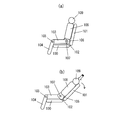
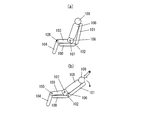
- FIGS. 6 (a) and 6 (b) are side views of a conventional chair.
- the chair includes a horizontal seat 100, a standing backrest 101, and a shaft 103 that pivotably supports the seat 100 and the backrest 101.
- the seated person takes a posture of placing the thigh 103 and the waist 106 on the seat 100 and depositing the body 108 on the backrest 101 when sitting.
- the lower leg 104 hangs downward from the front of the thigh 103 with the knee 105 as an axis, and the waist 106 is positioned near the axis 103.
- the head 109 is located slightly above the backrest 101.
- the thigh 107 has the greater trochanter 107 as its fulcrum, but the greater trochanter 107 is located away from the shaft 103.
- FIG. 7 (a) when the seated person sits shallowly, this deviation is further increased as shown in FIG. 7 (b). If there are skin abnormalities (for example, pressure sores, burns, inflammation, etc.) or back pain in the vicinity of the back of the seated person or the waist 106, a backlash will cause pain to the seated person.
- skin abnormalities for example, pressure sores, burns, inflammation, etc.
- back pain in the vicinity of the back of the seated person or the waist 106 a backlash will cause pain to the seated person.
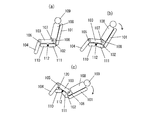
- FIGS. 8 (a) and 8 (b) When the seated person's head is placed on the shampoo table, the state shown in FIGS. 8 (a) and 8 (b) is further as shown in FIG. 8 (c). It is easy to feel pain through discomfort. In particular, if the seated person has a history of hypertension or stroke, such a posture is very dangerous.
- Patent Document 1 Japanese Patent Laid-Open No. 2001-149413
- a seat is divided into a front seat portion 110 and a rear seat portion 111, and these seat portions 110, 111 are further divided. And a hinge 112 that can be bent.
- FIG. 9 (b) As the backrest 101 is inclined, the rear seat portion 111 can be bent downward, and the problem of the displacement can be slightly improved.
- an object of the present invention is to provide a chair capable of safely and comfortably transitioning a seated person's posture from a standing posture to an inclined posture while avoiding a deviation or an unreasonable posture in one movement of tilting the backrest. .
- a chair is a seat having a backrest having a reference point, a horizontal front seat, and a rear seat that is connected to the front seat and pivotally supported so as to swing downward with respect to the front seat.
- the upper end is connected to the leg rest pivotally supported by the front end of the front seat, and the rear end of the rear seat and the lower end of the backrest so that the backrest can be tilted backward from the standing posture to the inclined posture.
- a tilting mechanism that changes the positional relationship between the rear end of the rear seat and the lower end of the backrest so that the distance from the reference point to the rear seat becomes smaller in the tilted posture than in the standing posture as it tilts backward.
- a connecting mechanism for connecting the lower end portion of the backrest and a portion below the upper end portion of the leg rest and swinging the leg rest forward as the backrest tilts backward.
- the backrest is in an upright posture, and the seated person sits so that his / her waist comes in contact with the reference point.
- the distance from the reference point to the back seat is the maximum, and the distance between the great trochanter of the seated person and the rear end of the back seat is also the maximum.
- the tilting mechanism changes the positional relationship between the rear end of the rear seat and the lower end of the backrest so that the distance from the reference point to the rear seat is smaller in the tilted posture than in the standing posture, As a result, the backrest follows the movement of the upper body of the seated person, and the seated person hardly feels the deviation. Thereby, anxiety and discomfort can be suppressed.
- the rear seat can be swung downward with respect to the front seat to further follow the posture change of the seated person, and the seated person can change the posture with peace of mind.
- the leg rest can be raised and kept in contact with the lower leg of the seated person.
- an unpleasant gap is less likely to occur below the seated person's knees, and the seated person's knees are not lifted abnormally, causing danger. Therefore, the seated person can change his / her posture with peace of mind.
- the chair according to the second invention further includes a restricting means for restricting an angle at which the rear seat swings with respect to the front seat, and the distance remains constant in the standing posture until the angle is restricted by the restricting means.
- the tilting mechanism connects the rear end of the rear seat and the lower end of the backrest so that the backrest and the rear seat swing together, and the angle is regulated by the regulating means.
- the tilting mechanism connects the rear end portion of the rear seat and the lower end portion of the backrest so that the distance between the rear seat and the backrest swings independently from the distance in the standing posture.
- the restricting means includes a baffle plate that is provided on the side surface of the rear seat and has an inclined surface that restricts the angle.
- This configuration makes it possible to control the swing angle with a simple configuration and with certainty.
- a chair according to a fourth aspect, wherein the tilting mechanism includes a first link whose both ends are hinged to a rear end portion of the rear seat, a lower end portion of the backrest, and an intermediate position of the reference point, and a rear seat Both ends are hinged to the position ahead of the middle position and the lower end of the backrest, respectively, and have a second link formed longer than the first link.
- tilting operation can be realized with a simple configuration and with certainty.
- a guide groove and a claw engaged with the guide groove as the tilting mechanism.
- the chair according to the fifth invention is provided with a leg side support attached to the side of the leg rest.
- This configuration can support the lower leg of the occupant from the side, improving safety and security even when the leg strength of the occupant is weak.
- the rear seat when the backrest is in the standing posture, the rear seat is held so as to incline downward at a small angle with respect to the front seat.
- the seated person in a standing posture, the seated person can take a posture in which his / her waist is already down with respect to the thigh, and safety and security can be improved.
- the movement of the backrest can be made to follow the movement of the upper body of the seated person, an unpleasant shift can be suppressed, and safety and security can be improved.
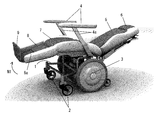
- FIG. 1 is a perspective view of a chair (standing posture) according to an embodiment of the present invention
- FIG. 2 is a perspective view of the chair in the inclined posture.
- this chair has a frame 1, and all elements are provided so as to be movable or immovable with respect to the frame 1.
- the chair shown in FIG. 1 is a chair that is considered to be suitable for providing services such as shampooing and cutting to a seated person (including those who need care) in a hairdressing salon. For this reason, about four small wheels 2 and about two large wheels 3 are rotatably supported on the frame 1. In other words, this chair is also a wheelchair.
- the chair that can suppress the displacement in this way provides comfort to the seated person even when the seated person is a healthy person.
- the chair that can be suitably used and is a subject of the present invention includes a chair used for such a purpose. Because the displacement can be suppressed, the seated person can easily wake up even if the seated person has back pain, regardless of the body shape.
- this chair can take the standing posture shown in FIG. 1, the inclined posture shown in FIG. 2, and an intermediate posture between them.
- a pair of left and right horizontal armrests 4 are fixed in a cantilevered manner to the tip of an arm 4 a extending obliquely upward from the frame 1, so that a seated person can place the left and right elbows on the armrest 4. Yes.
- the arm 4a can be expanded and contracted steplessly, and it is preferable that the height of the armrest 4 can be adjusted steplessly according to the height of the elbow of the seated person.
- This chair has a seat 7, a leg rest 8 that faces downward from the front end of the seat 7, and a footrest 9 that bends at a substantially right angle from the lower end of the leg rest 8.
- a pair of left and right side supports 8 a are arranged on both sides of the leg rest 8. It is preferable that the side support 8a has its upper end pivotally supported by the leg rest 8 so that the middle and lower portions of the side support 8a can be flipped upward with the upper end of the side support 8a as the center.
- the side support 8a supports the lower leg of the occupant from the side, and even if the leg strength of the occupant is weak, the side support 8a acts as a splint and the lower leg is displaced laterally from the chair. You can avoid it. As a result, safety and security can be improved.
- the backrest 5 has a shape along the spine of the seated person so that the body pressure can be dispersed. As shown in FIG. 3, the backrest 5 is formed with a waist rest portion 5a that protrudes forward as the spine of the seated person curves in an S shape near the waist.
- a pillow 6 is detachably attached to the upper part of the backrest 5.
- the pillow 6 can be adjusted steplessly with respect to the backrest 5 in accordance with the sitting height of the seated person.
- pillows of various shapes can be selectively attached according to the type of service (for example, treatment).
- the back 5 and the seat 7 are formed so as to be detachable so that an optimal one can be selectively attached according to the weight of the seated person.
- the height of the handle mechanism can be raised and lowered according to the height of the seated person.
- a lifting mechanism is provided on the chair, and the lifting mechanism is operated by the foot lever, and the height is set according to the service to be provided, so that the service provider does not cause back pain. It is desirable to set the height suitable for the seated person to sit and stand.
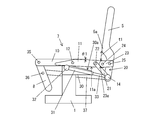
- FIG. 3 shows the chair when in a standing posture
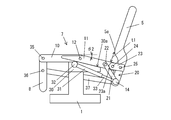
- FIG. 4 shows the chair when in an intermediate posture
- FIG. 5 shows the chair when in an inclined posture.
- the seat 7 has a horizontal front seat 10 and a rear seat 11 that is connected to the front seat 10 and is pivotally supported so as to swing downward with respect to the front seat 10.
- the front seat 10 is fixed horizontally so as not to move with respect to the frame 1.
- the rear end portion of the front seat 10 and the front of the rear seat 11 are connected by a hinge 12 so as to be swingable.
- the rear seat 11 When the backrest 5 is in the standing posture shown in FIG. 3, the rear seat 11 is held so as to incline downward with a small angle ⁇ ⁇ b> 1 with respect to the front seat 10.
- the small angle ⁇ 1 is preferably about 3 degrees to about 5 degrees.
- the air cylinder 31 is merely an example, and an elastic material such as a spring can be used.
- a base end portion of the air cylinder 31 is pivotally supported by a baffle plate 30 (fixed to the frame 1) by a shaft support portion 32, and a distal end portion of a rod 33 is supported by a shaft support portion 14 at a lower end portion of the backrest 5. Is pivotally supported by the shaft.
- the front side of the hinge 12 of the rear seat 11 is inclined cotton whose normal direction is obliquely upward, and a tilting mechanism 20 is provided at the rear end of the rear seat 11.
- the tilting mechanism 20 has a first link 23 and a second link 21.
- the second link 21 is formed longer than the first link 24.
- Both end portions of the first link 23 are swingable by hinges 24 and 25, respectively, between the rear end portion of the rear seat 11 and the shaft support portion 14 at the lower end portion of the backrest 5 and the waistrest convex portion 5a.
- the waist bump convex portion 5a is used as a reference point, but another fixed point of the backrest 5 may be used as a reference point.
- both end portions of the second link 21 are swingable by a hinge 22 and a shaft support portion 14 to a position ahead of an intermediate position of the rear seat 11 and a shaft support portion 14 at a lower end portion of the backrest 5, respectively. Connected.
- the second link 21 receives an urging force from the air cylinder 31 and tries to push up the first link 23 to rotate counterclockwise in FIG. 3 about the hinge 22, but the corner portion 23 a Since the second link 21 is in contact with the side surface of the two links 21, the second link 21 maintains the position shown in FIG. As a result, the backrest 5 also maintains the position of FIG.
- the baffle plate 30 corresponds to a regulating means, and has an inclined surface 30 a that is provided on the side surface of the rear seat 11 and regulates the angle of the rear seat 11.
- the upper end of the leg rest 8 is pivotally supported by the hinge 35 on the front end of the front seat 10. Further, the shaft support portion 14 at the lower end portion of the backrest 5 and the portion below the upper end portion of the leg rest 8 are connected to the connection link 37 by the hinge 36 and the shaft support portion 14 so as to be swingable.
- the connecting link 35 corresponds to a connecting mechanism.
- the backrest 5 In the standing posture shown in FIG. 3, the backrest 5 is in the most raised state, and the connecting link 35 is at the most retracted position. As a result, the leg rest 8 is positioned so as to enter the inner side (backrest 5 side) than the vertical in a side view.
- the corner 23a reaches the intermediate position shown in FIG.
- the rear seat 11, the tilting mechanism 20, the backrest 5, the connecting link 37, and the leg rest 8 swing integrally around the hinge 12 while the side surface of the second link 21 is in contact.
- the distance from the waist bump convex portion 5 a to the rear seat 11 is kept constant at the distance t ⁇ b> 1 in the standing posture, and the backrest 5 and the rear seat 11 are Swings together.
- the rear seat 11 and the inclined surface 30a of the baffle plate 30 are in contact with each other. For this reason, thereafter, the rear seat 11 cannot swing in the clockwise direction in FIG. 4 around the hinge 12, and the angle of the rear seat 11 is restricted.
- the swing of the rear seat 11 is restricted, and the angle formed by the front seat 10 and the rear seat 11 is the maximum angle ⁇ 2.
- the maximum angle ⁇ 2 is preferably about 30 degrees.
- the backrest 5 is further tilted from the intermediate posture in FIG. 4, the deviation pointed out in the “Background Technology” section is likely to occur.
- the distance from the waist bump convex portion 5a to the rear seat 11 becomes smaller than the distance t1 in the standing posture, and the backrest 5 Swings independently of the rear seat 11 (the rear seat 11 is stopped).
- the backrest 5 draws a trajectory that sinks downward, and the distance becomes small (distance t2 ⁇ t1). That is, the hip resting convex portion 5a follows the movement of the seated person's waist, and the above-mentioned deviation does not occur.
- the connecting rod 37 is pushed forward, so the leg rest 8 moves diagonally forward.
- the weak seated person can push the lower leg up naturally with full reclining as shown in FIG. 5, and the seated person can easily tilt or lie on the back without feeling a burden on the waist. Can take.
- the perspective view of the chair (standing posture) in one embodiment of the present invention The perspective view of the chair (inclination posture) in one embodiment of the present invention Side view of chair (standing posture) in one embodiment of the present invention Side view of a chair (intermediate posture) in one embodiment of the present invention Side view of chair (inclined posture) in one embodiment of the present invention
- A) Side view of conventional chair (standing posture) (b) Side view of conventional chair (mid-tilt posture) (A) Side view of conventional chair (standing posture) (b) Side view of conventional chair (mid-tilt posture) (A) Side view of (standing posture) of a conventional chair (b) Side view of (medium tilt posture) of a conventional chair (c) Side view of (large tilt posture) of a conventional chair (A) Side view of (standing posture) of a conventional chair (b) Side view of (medium tilt posture) of a conventional chair (c) Side view of (large tilt posture) of a conventional chair (A) Side view of (standing posture) of a conventional chair
Landscapes
- Health & Medical Sciences (AREA)
- General Health & Medical Sciences (AREA)
- Life Sciences & Earth Sciences (AREA)
- Animal Behavior & Ethology (AREA)
- Public Health (AREA)
- Veterinary Medicine (AREA)
- Dentistry (AREA)
- Otolaryngology (AREA)
- Chairs For Special Purposes, Such As Reclining Chairs (AREA)
- Chair Legs, Seat Parts, And Backrests (AREA)
Priority Applications (1)
| Application Number | Priority Date | Filing Date | Title |
|---|---|---|---|
| US13/129,897 US8783770B2 (en) | 2008-11-25 | 2009-03-11 | Chair |
Applications Claiming Priority (2)
| Application Number | Priority Date | Filing Date | Title |
|---|---|---|---|
| JP2008-299789 | 2008-11-25 | ||
| JP2008299789A JP5433832B2 (ja) | 2008-11-25 | 2008-11-25 | 椅子 |
Publications (1)
| Publication Number | Publication Date |
|---|---|
| WO2010061644A1 true WO2010061644A1 (ja) | 2010-06-03 |
Family
ID=42225528
Family Applications (1)
| Application Number | Title | Priority Date | Filing Date |
|---|---|---|---|
| PCT/JP2009/054626 Ceased WO2010061644A1 (ja) | 2008-11-25 | 2009-03-11 | 椅子 |
Country Status (3)
| Country | Link |
|---|---|
| US (1) | US8783770B2 (enExample) |
| JP (1) | JP5433832B2 (enExample) |
| WO (1) | WO2010061644A1 (enExample) |
Cited By (1)
| Publication number | Priority date | Publication date | Assignee | Title |
|---|---|---|---|---|
| EP2637623A4 (en) * | 2010-11-10 | 2015-12-09 | Invacare Corp | SEAT WITH ADJUSTABLE TILT |
Families Citing this family (19)
| Publication number | Priority date | Publication date | Assignee | Title |
|---|---|---|---|---|
| US9592914B2 (en) | 2011-10-07 | 2017-03-14 | Bombardier Inc. | Aircraft seat |
| US9073453B2 (en) * | 2011-10-07 | 2015-07-07 | Bombardier Inc. | Aircraft seat |
| US9714095B2 (en) | 2011-10-07 | 2017-07-25 | Bombardier Inc. | Aircraft seat |
| US9714862B2 (en) | 2011-10-07 | 2017-07-25 | Bombardier Inc. | Aircraft seat |
| JP6112454B2 (ja) * | 2013-04-05 | 2017-04-12 | タカラベルモント株式会社 | 理美容用椅子 |
| EP2823796B1 (en) * | 2013-07-12 | 2017-08-16 | Permobil AB | Wheelchair with tilt capability |
| CA2935290C (en) * | 2013-12-30 | 2021-10-12 | Bombardier Inc. | Aircraft seat |
| JP6349118B2 (ja) * | 2014-03-24 | 2018-06-27 | 三貴ホールディングス株式会社 | リクライニング車椅子 |
| CA2962585C (en) | 2014-09-25 | 2022-07-26 | Bombardier Inc. | Aircraft seat |
| NO339052B1 (no) * | 2014-10-27 | 2016-11-07 | Sykkylven Staal As | Anordning ved sittemøbel |
| KR101677528B1 (ko) * | 2014-11-10 | 2016-11-18 | 안배현 | 전동 꺼꾸리 운동기구 |
| EP3034056B1 (en) * | 2014-12-18 | 2017-11-29 | Permobil AB | Seat arrangement and electrically powered wheelchair comprising the same |
| US20170295934A1 (en) * | 2016-04-18 | 2017-10-19 | Camatic Pty Ltd | Reclinable seat |
| US10357107B2 (en) | 2017-03-27 | 2019-07-23 | Matthew D. Jacobs | Powered chairs for public venues, assemblies for use in powered chairs, and components for use in assemblies for use in powered chairs |
| US10349744B2 (en) | 2017-03-27 | 2019-07-16 | Matthew D. Jacobs | Powered chairs for public venues, assemblies for use in powered chairs, and components for use in assemblies for use in powered chairs |
| JP7360653B2 (ja) * | 2020-05-20 | 2023-10-13 | ソフトプレン工業株式会社 | リハビリ治療装置 |
| US11478082B2 (en) | 2020-12-22 | 2022-10-25 | Barbara Gervais | Care chair |
| CN116350464B (zh) * | 2023-03-20 | 2025-09-02 | 广州艾捷斯医疗器械有限公司 | 牙科座椅 |
| US12484697B2 (en) * | 2023-05-24 | 2025-12-02 | Bobby Mitchell, JR. | Wheelchair accessible salon chairs |
Citations (2)
| Publication number | Priority date | Publication date | Assignee | Title |
|---|---|---|---|---|
| JP2000152840A (ja) * | 1998-11-20 | 2000-06-06 | Shiroki Corp | リクライニングチェア |
| JP2008212399A (ja) * | 2007-03-05 | 2008-09-18 | Kokuyo Co Ltd | 椅子 |
Family Cites Families (20)
| Publication number | Priority date | Publication date | Assignee | Title |
|---|---|---|---|---|
| US2764224A (en) * | 1953-01-28 | 1956-09-25 | Maurer Pierre | Reclining chair with foot rest articulation |
| US2843183A (en) * | 1954-08-19 | 1958-07-15 | Norman P Martin | Article of repose for supporting the body of a person |
| US3863984A (en) * | 1972-12-01 | 1975-02-04 | Nancy E Sickels | Leg-supporting -and-retaining device attachable to an elevatable legrest of a wheel chair |
| US4300249A (en) * | 1980-03-25 | 1981-11-17 | Taylor Francis H | Chair for neurologically impaired patients |
| DE3018686A1 (de) * | 1980-05-16 | 1981-11-26 | Ritter Ag, 7500 Karlsruhe | Zahnaerztlicher patientenstuhl |
| ATE21613T1 (de) * | 1983-01-21 | 1986-09-15 | Pierre Schmitz | Stuhl, insbesondere buerostuhl. |
| SE449164B (sv) * | 1984-03-12 | 1987-04-13 | Henning Bergenwall | Mobel innefattande ett stativ, ett sete och ett relativt setet svengbart ryggstod |
| IE66531B1 (en) * | 1991-05-21 | 1996-01-24 | Ashfield Eng Co Wexford Ltd | A chair tilting mechanism |
| KR960705494A (ko) * | 1993-11-01 | 1996-11-08 | 프리아븐 에치. 닐슨 | 동기식(synchronous) 좌석 및 등받이 조절부를 갖는 작업의자(A WORKING CHAIR WITH SYNCHRONOUS SEAT AND BACK ADJUSTMENT) |
| US6155645A (en) * | 1997-10-02 | 2000-12-05 | Bedrich; Achim | Rest chair |
| WO2000078185A2 (en) * | 1999-06-17 | 2000-12-28 | Steelcase Inc. | Chair construction |
| JP3559211B2 (ja) | 1999-11-29 | 2004-08-25 | 株式会社カワムラサイクル | 車椅子 |
| US7014269B2 (en) * | 2001-06-15 | 2006-03-21 | Hon Technology Inc. | Chair back construction |
| JP2004141247A (ja) | 2002-10-22 | 2004-05-20 | Toshiba Tec Corp | リクライニング椅子 |
| AT412752B (de) * | 2003-06-06 | 2005-07-25 | Herzog Mario Dr | Vorrichtung zur abstützung des rumpfes einer person |
| FR2856279B1 (fr) * | 2003-06-19 | 2006-02-17 | Lifestand Internat Sa | Fauteuil verticalisateur a moyens amovibles de maintien des jambes |
| EP2120648B1 (en) * | 2007-01-29 | 2021-06-16 | Herman Miller, Inc. | Seating structure and methods for the use thereof |
| JP4435215B2 (ja) * | 2007-07-19 | 2010-03-17 | 三洋電機株式会社 | 椅子型マッサージ機 |
| KR100903215B1 (ko) * | 2008-10-10 | 2009-06-18 | 주식회사 시디즈 | 틸팅 가능 의자 |
| SE533619C2 (sv) * | 2009-03-06 | 2010-11-09 | Biomekanisk sittkonstruktion |
-
2008
- 2008-11-25 JP JP2008299789A patent/JP5433832B2/ja active Active
-
2009
- 2009-03-11 WO PCT/JP2009/054626 patent/WO2010061644A1/ja not_active Ceased
- 2009-03-11 US US13/129,897 patent/US8783770B2/en not_active Expired - Fee Related
Patent Citations (2)
| Publication number | Priority date | Publication date | Assignee | Title |
|---|---|---|---|---|
| JP2000152840A (ja) * | 1998-11-20 | 2000-06-06 | Shiroki Corp | リクライニングチェア |
| JP2008212399A (ja) * | 2007-03-05 | 2008-09-18 | Kokuyo Co Ltd | 椅子 |
Cited By (1)
| Publication number | Priority date | Publication date | Assignee | Title |
|---|---|---|---|---|
| EP2637623A4 (en) * | 2010-11-10 | 2015-12-09 | Invacare Corp | SEAT WITH ADJUSTABLE TILT |
Also Published As
| Publication number | Publication date |
|---|---|
| US20110266841A1 (en) | 2011-11-03 |
| JP5433832B2 (ja) | 2014-03-05 |
| US8783770B2 (en) | 2014-07-22 |
| JP2010124885A (ja) | 2010-06-10 |
Similar Documents
| Publication | Publication Date | Title |
|---|---|---|
| JP5433832B2 (ja) | 椅子 | |
| US9375372B2 (en) | Stand-up unit for stand-up wheelchairs and chairs, particularly therapy chairs | |
| JP5391268B2 (ja) | 出産補助装置 | |
| JP2012507311A (ja) | ベッド、特には病院用ベッド又は看護用ベッド | |
| US20150137548A1 (en) | Wheelchair with user controlled tilt mechanism | |
| KR20150047545A (ko) | 환자 자세 변경 시스템 | |
| JP4944688B2 (ja) | 医療用椅子 | |
| US7585019B2 (en) | Seat reclining mechanism for power wheelchair | |
| CN112426287A (zh) | 座椅调节式轮椅 | |
| CN213963997U (zh) | 座椅调节式轮椅 | |
| US20020067019A1 (en) | Contracture relieving adjustable wheelchair | |
| JP3740072B2 (ja) | 連動式リクライニング機構を備えた椅子 | |
| JP2004065626A (ja) | 座面構造およびこれを利用する椅子 | |
| JP2005124795A (ja) | 肘掛け椅子 | |
| CN209863627U (zh) | 扶手装置 | |
| JP2008029533A (ja) | 歯科治療用椅子 | |
| JP3509574B2 (ja) | 身体支持装置 | |
| JP3111913U (ja) | 介護用車椅子 | |
| JP7076833B2 (ja) | フットレスト付き介護用椅子 | |
| JP2004160055A (ja) | 身体障害者用椅子 | |
| CN219354436U (zh) | 一种护理轮椅 | |
| JP3601707B2 (ja) | 折畳み機能を有する椅子装置 | |
| KR102863089B1 (ko) | 이승 보조장치 | |
| JP7157874B2 (ja) | 介助装置 | |
| TWI311051B (enExample) |
Legal Events
| Date | Code | Title | Description |
|---|---|---|---|
| 121 | Ep: the epo has been informed by wipo that ep was designated in this application |
Ref document number: 09828894 Country of ref document: EP Kind code of ref document: A1 |
|
| NENP | Non-entry into the national phase |
Ref country code: DE |
|
| WWE | Wipo information: entry into national phase |
Ref document number: 13129897 Country of ref document: US |
|
| 122 | Ep: pct application non-entry in european phase |
Ref document number: 09828894 Country of ref document: EP Kind code of ref document: A1 |