WO2010053010A1 - コンベアハンドレール貼着フィルム - Google Patents
コンベアハンドレール貼着フィルム Download PDFInfo
- Publication number
- WO2010053010A1 WO2010053010A1 PCT/JP2009/068175 JP2009068175W WO2010053010A1 WO 2010053010 A1 WO2010053010 A1 WO 2010053010A1 JP 2009068175 W JP2009068175 W JP 2009068175W WO 2010053010 A1 WO2010053010 A1 WO 2010053010A1
- Authority
- WO
- WIPO (PCT)
- Prior art keywords
- handrail
- adhesive
- film
- adhesive layer
- conveyor
- Prior art date
- Legal status (The legal status is an assumption and is not a legal conclusion. Google has not performed a legal analysis and makes no representation as to the accuracy of the status listed.)
- Ceased
Links
Images
Classifications
-
- C—CHEMISTRY; METALLURGY
- C09—DYES; PAINTS; POLISHES; NATURAL RESINS; ADHESIVES; COMPOSITIONS NOT OTHERWISE PROVIDED FOR; APPLICATIONS OF MATERIALS NOT OTHERWISE PROVIDED FOR
- C09J—ADHESIVES; NON-MECHANICAL ASPECTS OF ADHESIVE PROCESSES IN GENERAL; ADHESIVE PROCESSES NOT PROVIDED FOR ELSEWHERE; USE OF MATERIALS AS ADHESIVES
- C09J133/00—Adhesives based on homopolymers or copolymers of compounds having one or more unsaturated aliphatic radicals, each having only one carbon-to-carbon double bond, and at least one being terminated by only one carboxyl radical, or of salts, anhydrides, esters, amides, imides, or nitriles thereof; Adhesives based on derivatives of such polymers
- C09J133/04—Homopolymers or copolymers of esters
- C09J133/06—Homopolymers or copolymers of esters of esters containing only carbon, hydrogen and oxygen, the oxygen atom being present only as part of the carboxyl radical
- C09J133/08—Homopolymers or copolymers of acrylic acid esters
-
- B—PERFORMING OPERATIONS; TRANSPORTING
- B66—HOISTING; LIFTING; HAULING
- B66B—ELEVATORS; ESCALATORS OR MOVING WALKWAYS
- B66B31/00—Accessories for escalators, or moving walkways, e.g. for sterilising or cleaning
- B66B31/02—Accessories for escalators, or moving walkways, e.g. for sterilising or cleaning for handrails
-
- C—CHEMISTRY; METALLURGY
- C09—DYES; PAINTS; POLISHES; NATURAL RESINS; ADHESIVES; COMPOSITIONS NOT OTHERWISE PROVIDED FOR; APPLICATIONS OF MATERIALS NOT OTHERWISE PROVIDED FOR
- C09J—ADHESIVES; NON-MECHANICAL ASPECTS OF ADHESIVE PROCESSES IN GENERAL; ADHESIVE PROCESSES NOT PROVIDED FOR ELSEWHERE; USE OF MATERIALS AS ADHESIVES
- C09J7/00—Adhesives in the form of films or foils
- C09J7/30—Adhesives in the form of films or foils characterised by the adhesive composition
- C09J7/38—Pressure-sensitive adhesives [PSA]
- C09J7/381—Pressure-sensitive adhesives [PSA] based on macromolecular compounds obtained by reactions involving only carbon-to-carbon unsaturated bonds
- C09J7/385—Acrylic polymers
-
- C—CHEMISTRY; METALLURGY
- C09—DYES; PAINTS; POLISHES; NATURAL RESINS; ADHESIVES; COMPOSITIONS NOT OTHERWISE PROVIDED FOR; APPLICATIONS OF MATERIALS NOT OTHERWISE PROVIDED FOR
- C09J—ADHESIVES; NON-MECHANICAL ASPECTS OF ADHESIVE PROCESSES IN GENERAL; ADHESIVE PROCESSES NOT PROVIDED FOR ELSEWHERE; USE OF MATERIALS AS ADHESIVES
- C09J2301/00—Additional features of adhesives in the form of films or foils
- C09J2301/10—Additional features of adhesives in the form of films or foils characterized by the structural features of the adhesive tape or sheet
- C09J2301/12—Additional features of adhesives in the form of films or foils characterized by the structural features of the adhesive tape or sheet by the arrangement of layers
- C09J2301/124—Additional features of adhesives in the form of films or foils characterized by the structural features of the adhesive tape or sheet by the arrangement of layers the adhesive layer being present on both sides of the carrier, e.g. double-sided adhesive tape
-
- C—CHEMISTRY; METALLURGY
- C09—DYES; PAINTS; POLISHES; NATURAL RESINS; ADHESIVES; COMPOSITIONS NOT OTHERWISE PROVIDED FOR; APPLICATIONS OF MATERIALS NOT OTHERWISE PROVIDED FOR
- C09J—ADHESIVES; NON-MECHANICAL ASPECTS OF ADHESIVE PROCESSES IN GENERAL; ADHESIVE PROCESSES NOT PROVIDED FOR ELSEWHERE; USE OF MATERIALS AS ADHESIVES
- C09J2301/00—Additional features of adhesives in the form of films or foils
- C09J2301/10—Additional features of adhesives in the form of films or foils characterized by the structural features of the adhesive tape or sheet
- C09J2301/12—Additional features of adhesives in the form of films or foils characterized by the structural features of the adhesive tape or sheet by the arrangement of layers
- C09J2301/124—Additional features of adhesives in the form of films or foils characterized by the structural features of the adhesive tape or sheet by the arrangement of layers the adhesive layer being present on both sides of the carrier, e.g. double-sided adhesive tape
- C09J2301/1242—Additional features of adhesives in the form of films or foils characterized by the structural features of the adhesive tape or sheet by the arrangement of layers the adhesive layer being present on both sides of the carrier, e.g. double-sided adhesive tape the opposite adhesive layers being different
-
- C—CHEMISTRY; METALLURGY
- C09—DYES; PAINTS; POLISHES; NATURAL RESINS; ADHESIVES; COMPOSITIONS NOT OTHERWISE PROVIDED FOR; APPLICATIONS OF MATERIALS NOT OTHERWISE PROVIDED FOR
- C09J—ADHESIVES; NON-MECHANICAL ASPECTS OF ADHESIVE PROCESSES IN GENERAL; ADHESIVE PROCESSES NOT PROVIDED FOR ELSEWHERE; USE OF MATERIALS AS ADHESIVES
- C09J2433/00—Presence of (meth)acrylic polymer
Definitions
- the present invention relates to a conveyor handrail adhesive film. More specifically, the present invention relates to a conveyor handrail sticking film used as a dust-removing double-sided adhesive film for cleaning a conveyor handrail and a handrail guide roll.
- the handrail is generally formed of a rubber belt or a urethane belt so as not to slip even when touched by a user.
- a method for cleaning the handrail a method of wiping off the surface with a neutral detergent, a silicone liquid, or an organic solvent (thinner, toluene) is generally used.
- contamination which does not fall by wiping cleaning is scraped off using instruments, such as a spatula.
- the handrail has an endless shape, and after appearing at the top as a handrail, it passes under the floor, passes through the vicinity of the drive unit, and appears again on the ground through a number of guide rolls.
- oil stains may solidify on the handrail by touching the lubricating oil of the driving device or the like or receiving the splashing of the lubricating oil.
- the oil attached to the handrail may touch the guide roll and solidify to a part of the guide roll. Even in such a case, wiping of oil stains may be insufficient with a waste cloth or the like.
- the guide roll can be cleaned only at the timing of the conveyor maintenance, even if the handrail is wiped with a waste cloth or the like, it may be immediately soiled.
- the double-sided tapes according to Patent Documents 1 and 2 sometimes cause adhesive residue on the handrail when the double-sided tape is peeled off from the handrail after use.
- adhesive residue may occur when peeled off after sticking for a long time under summer temperature conditions.
- An object of the present invention is to provide a conveyer handrail adhering film that can remove dirt and dust from the handrail and guide rolls by adhering to the conveyer handrail and moving the conveyer handrail.
- the present invention provides a conveyor handrail sticking film used as a dust-removing double-sided adhesive film for cleaning a conveyor handrail and a guide roll of a handrail, comprising a base material layer and the base material layer.
- the adhesive layer A is laminated on one surface of the substrate and adhered to the surface of the conveyor handrail, and the adhesive layer B is laminated on the other surface of the base material layer and has a small adhesive force applied to the adhesive layer A.
- a conveyor handrail sticking film it is preferable that the adhesive force of the adhesive layer B is 0.1 N / 10 mm or more, and the adhesive force of the adhesive layer A is 10 N / 10 mm or less.
- the adhesive layer A and the adhesive layer B preferably comprise an acrylic adhesive and / or a surfactant.
- the “conveyor” means a belt-like transport device that places and transports passengers on a circulating and rotating belt such as an escalator or a moving sidewalk.
- the “adhesive strength” was measured in accordance with “Adhesive tape / adhesive sheet test method” defined in JIS Z0237, and a film was applied to the surface of a stainless steel (SUS) plate, and then peeled off in a 180-degree direction. It means 180 degree peeling adhesive strength (N / 10mm).
- an adhesive film capable of removing dirt and dust from the handrail and the guide roll can be obtained by sticking to the conveyor handrail and moving the conveyor handrail.
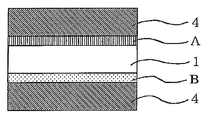
- the conveyor handrail adhesive film according to the present invention is a film attached to a conveyor handrail, and is a base material layer 1, an adhesive layer A laminated on one surface of the base material layer 1, It consists of the adhesion layer B laminated
- Base material layer The base material layer 1 is not particularly limited, but Japanese paper, non-woven fabric, ethylene-vinyl acetate copolymer, ethylene-methyl methacrylate copolymer, ethylene-ethyl acrylate copolymer, ethylene-diene copolymer, Ethylene-propylene-diene terpolymer, ethylene-octene copolymer, very low density polyethylene, low density polyethylene, linear low density polyethylene, high density polyethylene, polypropylene, ethylene-propylene copolymer, TPO (hard Polypropylene or polyethylene for segments, rubbery copolymers of ethylene and propylene for soft segments, rubbery copolymers of ethylene, propylene and diene, acrylonitrile butadiene rubber, thermoplastic elastomers made of natural rubber), polystyrene, styrene -Isoprene co-weight Polymer, styrene-butadiene copoly
- the base layer 1 has good anti-blocking property between films, an ethylene-vinyl acetate copolymer, an ethylene-methyl methacrylate copolymer, an ethylene-ethyl acrylate copolymer, an ethylene-octene copolymer are used.
- Ultra low density polyethylene, low density polyethylene, linear low density polyethylene, polypropylene, TPO and the like are preferably used.
- the base material layer 1 preferably has a tensile strength of 10 to 50 MPa and a hardness (Shore A) of 30 to 100.
- the base material layer 1 can contain various additives as long as the physical properties thereof are not impaired.
- specific examples of the additive include pigments such as antibacterial agents, colorants, antioxidants, fillers, antiblocking agents, antistatic agents, flame retardants, ultraviolet absorbers, lubricants, and light stabilizers.
- the manufacturing method of the base material layer 1 is not particularly limited, and a known method can be used.
- each resin component is mixed using melt kneading and various mixing devices (single or twin screw extruder, roll, Banbury mixer, various kneaders, etc.) It can be formed by an inflation method, a T-die method, a calendar processing method, or the like.
- the thickness of the base material layer 1 is not particularly limited, but is preferably 20 to 300 ⁇ m, particularly preferably 30 to 200 ⁇ m. A sufficient strength can be obtained by setting the thickness of the base material layer 1 to 20 ⁇ m or more. Moreover, it can be set as the film excellent in the construction workability
- Adhesive layer Adhesive layers A and B of the conveyor handrail adhesive film according to the present invention are formed for adhering the film to the handrail and adsorbing dirt and dust.
- the adhesive layer A is adhered to the surface of the conveyor handrail and adsorbs and removes dirt and dust adhering to the surface of the handrail.
- the adhesive layer B adsorbs and removes dirt and dust adhering to the guide roll.
- the adhesive strength of the adhesive layer B on the guide roll side is set smaller than the adhesive strength of the adhesive layer A on the conveyor handrail side. If the adhesive strength of the adhesive layer B is greater than the adhesive strength of the adhesive layer A, when the film is attached to the conveyor handrail and the conveyor handrail is moved to remove dirt from the handrail and the guide roll, the film is removed from the handrail. May float.
- the adhesive strength of the adhesive layer A is preferably 10 N / 10 mm or less, more preferably 2 to 5 N / 10 mm.
- the adhesive strength of the pressure-sensitive adhesive layer B is preferably 0.1 N / 10 mm or more, more preferably 0.3 to 1 N / 10 mm. If the adhesive strength of the adhesive layer A is greater than 10 N / 10 mm, adhesive residue may be generated on the handrail when the film is peeled off. Further, if the adhesive strength of the adhesive layer B is smaller than 0.1 N / 10 mm, dust or the like may not be adsorbed.
- the adhesive layers A and B are not particularly limited as long as they can adhere the conveyor handrail adhesive film to the handrail and can adsorb dust or the like.
- the acrylic pressure-sensitive adhesive is easy to design for tackiness and removability.
- the acrylic pressure-sensitive adhesive include a homopolymer of (meth) acrylic acid ester or a copolymer with a copolymerizable monomer.
- (meth) acrylic acid esters include (meth) acrylic acid alkyl esters such as methyl ester, ethyl ester, butyl ester, 2-ethylhexyl ester, octyl ester, dimethylaminoethyl methacrylate, t-butylaminoethyl methacrylate, etc.
- Specific examples of the copolymerizable monomer include vinyl acetate, styrene, acrylonitrile and the like.
- the pressure-sensitive adhesive A used for the pressure-sensitive adhesive layer A has 2-ethylhexyl ester as the main monomer, and the polymer has a glass transition temperature of ⁇ 70 to ⁇ 30 ° C. and a molecular weight of 500,000 or more, preferably Is preferably an emulsion-based pressure-sensitive adhesive having a million or more.
- the pressure-sensitive adhesive B used for the pressure-sensitive adhesive layer B is an emulsion system in which the main monomer is butyl ester, and the polymer has a glass transition temperature of ⁇ 50 to ⁇ 10 ° C. and a molecular weight of 500,000 or more, preferably 1,000,000 or more.
- a cross-linked pressure-sensitive adhesive obtained by reacting a pressure-sensitive adhesive with a curing agent is preferred.
- the tackifier can be selected in consideration of the softening point, compatibility with each component, etc., for example, terpene resin, rosin resin, hydrogenated rosin resin, coumarone / indene resin, styrenic resin, aliphatic And petroleum oil resins, alicyclic petroleum resins, terpene-phenol resins, xylene resins, other aliphatic hydrocarbon resins, and aromatic hydrocarbon resins.
- the softening point of the tackifier is preferably 65 to 130 ° C., particularly preferably an alicyclic saturated hydrocarbon resin of petroleum resin having a softening point of 65 to 130 ° C., a polyterpene resin having a softening point of 80 to 130 ° C., softening A glycerin ester of hydrogenated rosin having a point of 80 to 130 ° C. is preferable.
- curing agent examples include an isocyanate curing agent, an epoxy curing agent, and an amine curing agent. These may be used singly or in combination of two or more.
- isocyanate curing agent examples include 2,4-tolylene diisocyanate, 2,6-tolylene diisocyanate, 1,3-xylylene diisocyanate, 1,4-xylene diisocyanate, diphenylmethane-4,4′-diisocyanate, Polyvalent isocyanate compounds such as diphenylmethane-2,4'-diisocyanate, 3-methyldiphenylmethane diisocyanate, hexamethylene diisocyanate, isophorone diisocyanate, dicyclohexylmethane-4,4'-diisocyanate, dicyclohexylmethane-2,4'-diisocyanate, lysine isocyanate Is mentioned.
- the means for forming the pressure-sensitive adhesive layers A and B on the base material layer 1 is not particularly limited.
- a pressure-sensitive adhesive solution comprising a pressure-sensitive adhesive, a tackifier, an anti-aging agent and the like is applied to one side of the base material layer 1.
- Examples include a means for drying, a method in which a pressure-sensitive adhesive solution is previously applied to one side of a separator and dried, and then bonded to the base material layer 1.
- the thickness of the pressure-sensitive adhesive layers A and B can be appropriately set within a range that does not impair the adhesiveness and handleability, but is preferably 5 to 100 ⁇ m, preferably 10 to 40 ⁇ m.
- the surfactant that can be added to the adhesive layers A and B is not particularly limited, but a normal anionic surfactant, a cationic surfactant, a nonionic surfactant, an amphoteric surfactant, and a polymer interface.
- Various agents such as an activator, a fluorosurfactant, and a reactive surfactant can be used. These surfactants may be used alone or in combination.
- an anionic surfactant that does not cause an acid-base reaction with the emulsion adhesive and a nonionic surfactant are preferable.
- Cationic surfactants are not preferred because they can corrode metal parts of equipment.
- the anionic surfactant include fatty acid type, alkylbenzene type, sulfate ester type, higher alcohol type and the like, for example, higher fatty acid sodium, sodium alkylsulfonate, sodium alkylbenzenesulfonate, sodium alkyldiphenyl ether disulfonate, etc. .
- Nonionic surfactants include polyoxyethylene alkyl ether, polyoxyethylene myristyl ether, polyoxyethylene alkylene alkyl ether, polyoxylethylene derivatives, polyoxyethylene polyoxypropylene block polymer, sorbitan fatty acid ester, polyoxyethylene sorbitan Examples include fatty acid esters, polyoxyethylene sorbitol fatty acid esters, glycerin fatty acid esters, polyoxyethylene fatty acid esters, polyoxyethylene oleic acid esters, polyoxyethylene alkylamines, alkyl alkanolamides, and polyoxyethylene nonylphenyl ethers.
- the addition amount of the surfactant is 0.1 to 20% by mass, preferably 0.5 to 10% by mass with respect to 100% by mass of the pressure-sensitive adhesive. If the addition amount of the surfactant is less than 0.1% by mass, a sufficient cleaning effect may not be obtained for dirt and the like adhering to the handrail and guide roll. On the other hand, when the surfactant exceeds 20% by mass, the pressure-sensitive adhesive has a plasticizing effect, and when the film is peeled off, an adhesive residue may be generated on the surface of the handrail.
- the method for adhering the conveyor handrail affixed film according to the present invention to the conveyor handrail is not particularly limited.
- a rubber roll while peeling the separator layer 4 provided on the surface of the adhesive layer A It can be attached by using a simple attaching jig or the like that is crimped to the handrail with a squeegee or the like.
- an adhesive film peels off the separator layer 4 provided in the adhesion layer B surface before use, and uses it.
- the width and length of the film to which the handrail is attached depend on the size of the handrail, but it can cover the surface of the handrail, preferably about 60 to 150 mm, and the length is preferably 20 to 40 m. If it is short, it will be 1-5 m.
- the conveyor is started so that the film adhesion portion makes two to five turns and stopped at a position where the film does not stop inside the conveyor. If the conveyor is restarted while the film is stopped inside the conveyor, the film may be peeled off inside the conveyor, which may cause an abnormality in the conveyor. After the procedure, the film is peeled off from the surface of the handrail to complete the cleaning. If dust cannot be removed in one step, repeat the procedure 2 to 3 times.
- Example 1 The conveyor handrail affixed film according to the present invention is prepared by the following steps (a) to (c), and evaluations are made on the properties of “adhesive strength”, “glue glue”, “floating”, and “dust adsorbing”. went.
- (B) Acrylic water-based pressure-sensitive adhesive (manufactured by Nippon Shokubai Co., Ltd .: SKE-4851, main component: 2-ethylhexyl ester, so that the thickness after drying the pressure-sensitive adhesive layer A in advance is 20 ⁇ m on one side of the base material layer 1 Glass transition temperature-30 ° C.) and an epoxy-based crosslinking agent (manufactured by Mitsubishi Gas Chemical Industries, Ltd .: TETRAD-C) were applied, and dried paper separator 110 ⁇ m (manufactured by Sumika Kogyo Co., Ltd., SL-80KCD7) was bonded. .
- SKE-4851 main component: 2-ethylhexyl ester
- (C) Acrylic water-based pressure-sensitive adhesive (manufactured by Etec: N-730A, main component: on the opposite side of the base material layer 1 to which the pressure-sensitive adhesive layer A is bonded, so that the thickness after the pressure-sensitive adhesive layer B is previously dried is 20 ⁇ m.
- Butyl ester, glass transition temperature -50 ° C) and epoxy cross-linking agent (Mitsubishi Gas Chemical Co., Ltd .: TETRAD-C) are applied, and dried paper separator 110 ⁇ m (Sumika Kogyo Co., Ltd., SL-80KCD7) is applied.
- a conveyor handrail affixed film was obtained.
- the adhesive residue on the adherend when one end of the film is peeled from the adherend at a speed of 300 mm / min in the direction of 180 degrees is 2500 mm 2, which is the sticking area of the film.
- a pressure-sensitive adhesive layer A having a width of 25 mm was attached to the sulfonated rubber sheet.
- a chlorosulfonated rubber sheet having a thickness of 1 mm was attached to the adhesive layer B on the reverse side.
- the sticking was performed by reciprocating the top of the chlorosulfonated rubber sheet stuck to the adhesive layer B with a rubber roller weighing 2 kg.
- the peeling position when one end of the chlorosulfonated rubber sheet stuck to the pressure-sensitive adhesive layer B was peeled from the pressure-sensitive adhesive layer B at a speed of 300 mm / min in the 180 ° direction was evaluated as follows. Evaluated by criteria. “Good”: When the peeling position is the interface between the chlorosulfonated rubber sheet adhered to the adhesive layer B and the adhesive layer B.
- Examples 2 and 3 The configuration was the same as in Example 1 except that the adhesive strength of the adhesive layer A and the adhesive layer B was changed. All the characteristic values were evaluated as good, and the intended film was obtained.
- Example 4 An ethylene-vinyl acetate copolymer film (manufactured by Hayashi Kajisha Co., Ltd., E003: vinyl acetate content 17 wt%) was used as the base layer 1, and an acrylic water-based adhesive (manufactured by Showa Polymer Co., Ltd .: SE-4500) was used as the adhesive layer B.
- a film was prepared in the same manner as in Example 1 except that the main component: butyl ester, glass transition temperature ⁇ 25 ° C.) and an epoxy-based crosslinking agent (Mitsubishi Gas Chemical Co., Ltd .: TETRAD-C) were applied.
- the adhesive strength of the adhesive layer A was 1 N / 10 mm
- the adhesive strength of the adhesive layer B was 0.3 N / 10 mm. All the characteristic values were evaluated as good, and the intended film was obtained.
- Comparative Example 5 In Comparative Example 5 in which the adhesive strength of the adhesive layer B of Example 1 was changed to 0.01 N / 10 mm, the adhesive force was too low, and thus the dust adsorbability deteriorated.
- the handrail and the guide roll can be reliably cleaned by sticking the adhesive film to the conveyor handrail.
- the conveyor handrail adhesive film according to the present invention is suitably used as a dust-removing double-sided adhesive film for cleaning handrails and guide rolls such as escalators and moving walkways.
Landscapes
- Chemical & Material Sciences (AREA)
- Organic Chemistry (AREA)
- Chemical Kinetics & Catalysis (AREA)
- Adhesives Or Adhesive Processes (AREA)
- Adhesive Tapes (AREA)
- Escalators And Moving Walkways (AREA)
- Laminated Bodies (AREA)
Abstract
Description
このコンベアハンドレール貼着フィルムにおいて、前記粘着層Bの粘着力は0.1N/10mm以上であり、前記粘着層Aの粘着力は10N/10mm以下あることが好適である。
また、前記粘着層Aと前記粘着層Bとは、アクリル系粘着剤及び/又は界面活性剤を含んでなることが好適である。
基材層1は、特に限定されないが、和紙、不織布、エチレン-酢酸ビニル共重合体、エチレン-メチルメタアクリレート共重合体、エチレン-エチルアクリレート共重合体、エチレン-ジエン共重合体、エチレン-プロピレン-ジエン3元共重合体、エチレン-オクテン共重合体、超低密度ポリエチレン、低密度ポリエチレン、直鎖状低密度ポリエチレン、高密度ポリエチレン、ポリプロピレン、エチレン-プロピレン共重合体、TPO(ハードセグメントがポリプロピレンやポリエチレン、ソフトセグメントがエチレンとプロピレンとのゴム状共重合体や、エチレンとプロピレンとジエンとのゴム状共重合体、アクリロニトリルブタジエンゴム、天然ゴムからなる熱可塑性エラストマー)、ポリスチレン、スチレン-イソプレン共重合体、スチレン-ブタジエン共重合体、水添スチレン-ブタジエン共重合体、スチレン-エチレン・ブチレン-エチレンブロック共重合体、エチレン-エチレン・ブチレン-エチレンブロック共重合体、スチレン-エチレン・ブチレン-スチレンブロック共重合体、スチレン-エチレン・プロピレン-スチレンブロック共重合体、スチレン-イソプレン-スチレンブロック共重合体、スチレン-エチレン-プロピレン共重合体、スチレン-イソブチレン-スチレン共重合体、スチレン-イソブチレン共重合体、スチレン-エチレン-ブチレン共重合体、ポリエステルウレタン、ポリエーテルウレタン、アイモノマー、ポリ塩化ビニル、エチレンとプロピレンとジエンとのゴム状共重合体、エチレンとプロピレンとのゴム状共重合体、クロロスルホン化ポリエチレン、アクリルゴム、クロロプレンゴム、ポリメチレン型の飽和主鎖をもつゴム、主鎖に炭素と酸素をもつゴム、主鎖に不飽和炭素結合をもつゴム、主鎖にけい素と酸素をもつゴム、主鎖に炭素と酸素および窒素をもつゴム等からなる。これらの樹脂は、1種類を単独で用いてもよいし、2種類以上を混合して用いてもよい。基材層1には、フィルム同士のアンチブロッキング性が良好なことから、エチレン-酢酸ビニル共重合体、エチレン-メチルメタアクリレート共重合体、エチレン-エチルアクリレート共重合体、エチレン-オクテン共重合体、超低密度ポリエチレン、低密度ポリエチレン、直鎖状低密度ポリエチレン、ポリプロピレン、TPO等を用いることが好ましい。
本発明に係るコンベアハンドレール貼着フィルムの粘着層A、Bは、フィルムをハンドレールに密着させるためと、汚れやゴミを吸着させるために形成されるものである。
本発明に係るコンベアハンドレール貼付フィルムをコンベアハンドレールに貼着する方法は、特に限定されず、例えば、粘着層A表面に設けられたセパレータ層4を剥がしながらゴムロール、スキージー等でハンドレールに圧着する簡易貼付治具等を使用することにより貼着することができる。また、粘着フィルムは、使用前に粘着層B表面に設けられたセパレータ層4を剥がし、使用する。
以下の工程(a)~(c)により、本発明に係るコンベアハンドレール貼付フィルムを作製し、「粘着力」、「糊のこり」、「浮き」、「ゴミ吸着性」の各特性について評価を行った。
(b)基材層1の片面に、粘着層Aをあらかじめ乾燥後の厚みが20μmとなるようにアクリル水系粘着剤(日本触媒社製:SKE-4851、主成分:2-エチルへキシルエステル、ガラス転移温度-30℃)及びエポキシ系架橋剤(三菱ガス化学工業社製:TETRAD-C)を塗布して、乾燥した紙セパレータ110μm(住化加工紙社製、SL-80KCD7)を貼り合せた。
(c)粘着層Aを貼り合わせた基材層1の逆面に、粘着層Bをあらかじめ乾燥後の厚みが20μmとなるようにアクリル水系粘着剤(イーテック社製:N-730A、主成分:ブチルエステル、ガラス転移温度-50℃)及びエポキシ系架橋剤(三菱ガス化学社製:TETRAD-C)を塗布して、乾燥した紙セパレータ110μm(住化加工紙社製、SL-80KCD7)を貼り合せて、コンベアハンドレール貼付フィルムを得た。
JIS Z0237に規定の「粘着テープ・粘着シート試験法」に準拠して、粘着層A、Bの粘着力(180度引き剥がし粘着力)を測定した。
(2)糊のこりの評価
23±2℃、65±5%RHの条件下で、SUS板に厚さ1mmのクロロスルホン化ゴムシートを、両面テープを介して貼着し被着体とし、このクロロスルホン化ゴムシートに幅25mm、長さ100mmのフィルムの粘着層Aを貼着した。貼着は、フィルムの上を重さ2kgのゴムローラーで1往復させることによって行った。貼着してから20分経過後に、フィルムの一端を180度方向に速度300mm/分で被着体から剥離させたときの被着体への糊残りを、フィルムの貼着面積である2500mm2を100%とした糊残り部分の面積率によって評価(目視評価)した。
(3)浮きの評価
23±2℃、65±5%RHの条件下で、SUS板に厚さ1mmのクロロスルホン化ゴムシートを、両面テープを介して貼着し被着体とし、このクロロスルホン化ゴムシートに25mm幅のフィルムの粘着層Aを貼着した。さらに、逆面の粘着層Bにも厚さ1mmのクロロスルホン化ゴムシートを貼着した。貼着は、粘着層Bに貼着したクロロスルホン化ゴムシートの上を重さ2kgのゴムローラーで1往復させることによって行った。貼着してから20分経過後に、粘着層Bに貼着したクロロスルホン化ゴムシートの一端を180度方向に速度300mm/分で粘着層Bから剥離させたときの剥離位置を、次の評価基準で評価した。
「良」:剥離位置が、粘着層Bに貼着したクロロスルホン化ゴムシートと粘着層Bの界面の場合のもの。
「不良」:剥離位置が、粘着層Aに貼着したクロロスルホン化ゴムシートと粘着層Aの界面の場合のもの。
(4)ゴミ吸着性の評価
フィルムの粘着層Bの上に、厚さ150μmのセルロース系繊維不織布を置き、この不織布の上から重さ2kgのゴムローラーで20往復させた。20往復中に粘着フィルムの粘着層Bからセルロース系繊維不織布が浮く状態を目視で判定し、次の評価基準で評価した。
「良」:セルロース系繊維不織布が浮かないもの。
「不良」:セルロース系繊維不織布が浮くもの。
粘着層A及び粘着層Bの粘着力を変更した以外は、実施例1と同様な構成とした。全ての特性値が良好と評価され、目的とするフィルムが得られた。
基材層1としてエチレン-酢酸ビニル共重合体フィルム(林一二社製、E003:酢酸ビニル含量17wt%)を用い、粘着層Bとしてアクリル水系粘着剤(昭和高分子社製:SE-4500、主成分:ブチルエステル、ガラス転移温度-25℃)及びエポキシ系架橋剤(三菱ガス化学社製:TETRAD-C)を塗布した以外は、実施例1と同様の工程でフィルムを作製した。粘着層Aの粘着力は1N/10mm、粘着層Bの粘着力は0.3N/10mmとした。全ての特性値が良好と評価され、目的とするフィルムが得られた。
実施例1~3において粘着層A及び粘着層Bに使用した粘着剤を入れ替えてフィルムを作製した。比較例1~3では、粘着層Aの粘着力が粘着層Bの粘着力より低いため、浮きが発生した。
実施例1の粘着層Aの粘着力を12N/10mmに変更した比較例4では、粘着力が強すぎるため、糊残りが発生した。
実施例1の粘着層Bの粘着力を0.01N/10mmに変更した比較例5では、粘着力が低すぎるため、ゴミ吸着性が悪化した。

A 粘着層A
B 粘着層B
4 セパレータ
Claims (5)
- 基材層と、該基材層の一方の面に積層され、コンベアハンドレール表面に貼着される粘着層Aと、該基材層の他方の面に積層され、粘着層Aに対して小さい粘着力が付与された粘着層Bと、を含んでなるコンベアハンドレール貼着フィルム。
- 前記粘着層Bの粘着力が0.1N/10mm以上であり、前記粘着層Aの粘着力が10N/10mm以下である請求項1に記載のコンベアハンドレール貼着フィルム。
- 前記粘着層Aと前記粘着層Bとがアクリル系粘着剤を含んでなる請求項1又は2に記載のコンベアハンドレール貼着フィルム。
- 前記粘着層Aと前記粘着層Bとが界面活性剤を含んでなる請求項1~3のいずれか1項に記載のコンベアハンドレール貼着フィルム。
- コンベアのハンドレール及びハンドレールのガイドロールの清掃用ゴミ取り両面粘着フィルムである請求項1~4のいずれか1項に記載のコンベアハンドレール貼着フィルム。
Priority Applications (2)
| Application Number | Priority Date | Filing Date | Title |
|---|---|---|---|
| CN2009801512860A CN102272033A (zh) | 2008-11-04 | 2009-10-22 | 输送机扶手粘贴膜 |
| JP2010536735A JP5567490B2 (ja) | 2008-11-04 | 2009-10-22 | コンベアハンドレール貼着フィルム |
Applications Claiming Priority (2)
| Application Number | Priority Date | Filing Date | Title |
|---|---|---|---|
| JP2008-282778 | 2008-11-04 | ||
| JP2008282778 | 2008-11-04 |
Publications (1)
| Publication Number | Publication Date |
|---|---|
| WO2010053010A1 true WO2010053010A1 (ja) | 2010-05-14 |
Family
ID=42152819
Family Applications (1)
| Application Number | Title | Priority Date | Filing Date |
|---|---|---|---|
| PCT/JP2009/068175 Ceased WO2010053010A1 (ja) | 2008-11-04 | 2009-10-22 | コンベアハンドレール貼着フィルム |
Country Status (4)
| Country | Link |
|---|---|
| JP (1) | JP5567490B2 (ja) |
| CN (1) | CN102272033A (ja) |
| TW (1) | TWI495702B (ja) |
| WO (1) | WO2010053010A1 (ja) |
Cited By (2)
| Publication number | Priority date | Publication date | Assignee | Title |
|---|---|---|---|---|
| WO2011148913A1 (ja) * | 2010-05-27 | 2011-12-01 | 電気化学工業株式会社 | コンベアハンドレール貼着フィルム、コンベアハンドレール及びハンドレールのガイドロール清掃方法 |
| JP2012077110A (ja) * | 2010-09-30 | 2012-04-19 | Lintec Corp | 両面粘着テープ及びタッチパネル付き表示装置 |
Families Citing this family (3)
| Publication number | Priority date | Publication date | Assignee | Title |
|---|---|---|---|---|
| CN106477440A (zh) * | 2015-09-01 | 2017-03-08 | 常州市丛禾电梯配件有限公司 | 碳纤维复合梯级 |
| EP3475376A1 (en) * | 2016-06-27 | 2019-05-01 | Avery Dennison Corporation | Adhesive articles |
| CN107745473A (zh) * | 2017-10-17 | 2018-03-02 | 安徽天安新材料有限公司 | Tpo薄膜的制备方法 |
Citations (5)
| Publication number | Priority date | Publication date | Assignee | Title |
|---|---|---|---|---|
| JPS61267682A (ja) * | 1985-05-21 | 1986-11-27 | 日立エレベ−タサ−ビス株式会社 | 移動手摺案内ローラ清掃具 |
| JPH07157730A (ja) * | 1993-12-03 | 1995-06-20 | Kyodo Giken Kagaku Kk | 粘着テープ及びその製造方法 |
| JP3059439U (ja) * | 1998-11-30 | 1999-07-09 | 株式会社サトー | 粘着テープ付装飾具 |
| JP2006137894A (ja) * | 2004-11-15 | 2006-06-01 | Etsuko Hidaka | 柔軟な粘着性紙 |
| JP2008074935A (ja) * | 2006-09-20 | 2008-04-03 | Umehara:Kk | 卓球ラケットのラバー貼着用両面粘着シート |
Family Cites Families (4)
| Publication number | Priority date | Publication date | Assignee | Title |
|---|---|---|---|---|
| JPS6221692A (ja) * | 1985-07-19 | 1987-01-30 | 日立エレベ−タサ−ビス株式会社 | 案内ロ−ラの清掃方法 |
| JP3044167U (ja) * | 1997-02-17 | 1997-12-16 | 信 太田 | エスカレータ駆動ローラー清掃用シート |
| JP4187535B2 (ja) * | 2003-01-09 | 2008-11-26 | 三菱電機ビルテクノサービス株式会社 | 連続表示シート付きハンドレール |
| US20050186416A1 (en) * | 2004-02-25 | 2005-08-25 | 3M Innnovative Properties Company | Hydrophilic articles |
-
2009
- 2009-10-22 WO PCT/JP2009/068175 patent/WO2010053010A1/ja not_active Ceased
- 2009-10-22 CN CN2009801512860A patent/CN102272033A/zh active Pending
- 2009-10-22 JP JP2010536735A patent/JP5567490B2/ja active Active
- 2009-10-28 TW TW098136455A patent/TWI495702B/zh active
Patent Citations (5)
| Publication number | Priority date | Publication date | Assignee | Title |
|---|---|---|---|---|
| JPS61267682A (ja) * | 1985-05-21 | 1986-11-27 | 日立エレベ−タサ−ビス株式会社 | 移動手摺案内ローラ清掃具 |
| JPH07157730A (ja) * | 1993-12-03 | 1995-06-20 | Kyodo Giken Kagaku Kk | 粘着テープ及びその製造方法 |
| JP3059439U (ja) * | 1998-11-30 | 1999-07-09 | 株式会社サトー | 粘着テープ付装飾具 |
| JP2006137894A (ja) * | 2004-11-15 | 2006-06-01 | Etsuko Hidaka | 柔軟な粘着性紙 |
| JP2008074935A (ja) * | 2006-09-20 | 2008-04-03 | Umehara:Kk | 卓球ラケットのラバー貼着用両面粘着シート |
Cited By (5)
| Publication number | Priority date | Publication date | Assignee | Title |
|---|---|---|---|---|
| WO2011148913A1 (ja) * | 2010-05-27 | 2011-12-01 | 電気化学工業株式会社 | コンベアハンドレール貼着フィルム、コンベアハンドレール及びハンドレールのガイドロール清掃方法 |
| CN102906002A (zh) * | 2010-05-27 | 2013-01-30 | 电气化学工业株式会社 | 输送机扶手贴合膜、输送机扶手及扶手导辊的清扫方法 |
| CN102906002B (zh) * | 2010-05-27 | 2014-12-31 | 电气化学工业株式会社 | 输送机扶手贴合膜、输送机扶手及扶手导辊的清扫方法 |
| JP5887266B2 (ja) * | 2010-05-27 | 2016-03-16 | デンカ株式会社 | コンベアハンドレール貼着フィルム、コンベアハンドレール及びハンドレールのガイドロール清掃方法 |
| JP2012077110A (ja) * | 2010-09-30 | 2012-04-19 | Lintec Corp | 両面粘着テープ及びタッチパネル付き表示装置 |
Also Published As
| Publication number | Publication date |
|---|---|
| JPWO2010053010A1 (ja) | 2012-04-05 |
| TWI495702B (zh) | 2015-08-11 |
| JP5567490B2 (ja) | 2014-08-06 |
| CN102272033A (zh) | 2011-12-07 |
| TW201026813A (en) | 2010-07-16 |
Similar Documents
| Publication | Publication Date | Title |
|---|---|---|
| JP5567490B2 (ja) | コンベアハンドレール貼着フィルム | |
| JP5582562B2 (ja) | 粘着フィルム | |
| JP5408640B2 (ja) | 紫外線硬化型粘着剤組成物、紫外線硬化型粘着シート及びその製造方法 | |
| JP3643600B2 (ja) | 半導体ウェーハ処理接着剤およびテープ | |
| KR20050062451A (ko) | 가열박리형 점착 시이트 | |
| CN106232756A (zh) | 层叠片 | |
| TWI880973B (zh) | 雙面黏著帶 | |
| CN105407779A (zh) | 有机质污渍去除用粘合清洁器 | |
| KR20150109351A (ko) | 유기질 오염물 제거용 점착 클리너 | |
| KR102448980B1 (ko) | 점착 클리너 | |
| TWI712503B (zh) | 透明導電性膜用載膜及積層體 | |
| JP5887266B2 (ja) | コンベアハンドレール貼着フィルム、コンベアハンドレール及びハンドレールのガイドロール清掃方法 | |
| CN107249420A (zh) | 粘合清洁器 | |
| JP2000183140A (ja) | 半導体ウエハ固定用シート | |
| CN1654575A (zh) | 除去含溶剂物用粘合片 | |
| JP5346226B2 (ja) | 研磨材固定用両面粘着テープ及び研磨材付き粘着テープ | |
| KR101668745B1 (ko) | 복합 가교 아크릴 기재층을 포함하는 양면 점착시트 | |
| JP2023099604A (ja) | 光学フィルム用表面保護フィルム | |
| JP2006273909A (ja) | 繊維補強粘着テープ及びその製造方法 | |
| JP6781295B2 (ja) | 表面保護フィルム用剥離フィルム、及びそれが貼合された光学フィルム用表面保護フィルム | |
| CN100455437C (zh) | 除去含溶剂物质用粘合片 | |
| JP2006223562A (ja) | 耐ブロッキング性に優れたクリーニングシートおよびこれを用いたクリーニング方法 | |
| JP6907395B2 (ja) | 表面保護フィルム、及びそれが貼合された光学部品 | |
| JP7211732B2 (ja) | 粘着クリーナー | |
| JP2006224452A (ja) | 耐ブロッキング性に優れたクリーニングシートおよびこれを用いたクリーニング方法 |
Legal Events
| Date | Code | Title | Description |
|---|---|---|---|
| WWE | Wipo information: entry into national phase |
Ref document number: 200980151286.0 Country of ref document: CN |
|
| 121 | Ep: the epo has been informed by wipo that ep was designated in this application |
Ref document number: 09824710 Country of ref document: EP Kind code of ref document: A1 |
|
| ENP | Entry into the national phase |
Ref document number: 2010536735 Country of ref document: JP Kind code of ref document: A |
|
| NENP | Non-entry into the national phase |
Ref country code: DE |
|
| 122 | Ep: pct application non-entry in european phase |
Ref document number: 09824710 Country of ref document: EP Kind code of ref document: A1 |