WO2010052888A1 - カチオン電着塗装システム用徐放性殺菌・抗菌剤 - Google Patents
カチオン電着塗装システム用徐放性殺菌・抗菌剤 Download PDFInfo
- Publication number
- WO2010052888A1 WO2010052888A1 PCT/JP2009/005827 JP2009005827W WO2010052888A1 WO 2010052888 A1 WO2010052888 A1 WO 2010052888A1 JP 2009005827 W JP2009005827 W JP 2009005827W WO 2010052888 A1 WO2010052888 A1 WO 2010052888A1
- Authority
- WO
- WIPO (PCT)
- Prior art keywords
- cationic electrodeposition
- electrodeposition coating
- antibacterial agent
- sustained
- coating system
- Prior art date
- Legal status (The legal status is an assumption and is not a legal conclusion. Google has not performed a legal analysis and makes no representation as to the accuracy of the status listed.)
- Ceased
Links
Images

Classifications
-
- C—CHEMISTRY; METALLURGY
- C25—ELECTROLYTIC OR ELECTROPHORETIC PROCESSES; APPARATUS THEREFOR
- C25D—PROCESSES FOR THE ELECTROLYTIC OR ELECTROPHORETIC PRODUCTION OF COATINGS; ELECTROFORMING; APPARATUS THEREFOR
- C25D17/00—Constructional parts, or assemblies thereof, of cells for electrolytic coating
- C25D17/002—Cell separation, e.g. membranes, diaphragms
-
- C—CHEMISTRY; METALLURGY
- C25—ELECTROLYTIC OR ELECTROPHORETIC PROCESSES; APPARATUS THEREFOR
- C25D—PROCESSES FOR THE ELECTROLYTIC OR ELECTROPHORETIC PRODUCTION OF COATINGS; ELECTROFORMING; APPARATUS THEREFOR
- C25D13/00—Electrophoretic coating characterised by the process
- C25D13/22—Servicing or operating apparatus or multistep processes
- C25D13/24—Regeneration of process liquids
-
- A—HUMAN NECESSITIES
- A01—AGRICULTURE; FORESTRY; ANIMAL HUSBANDRY; HUNTING; TRAPPING; FISHING
- A01N—PRESERVATION OF BODIES OF HUMANS OR ANIMALS OR PLANTS OR PARTS THEREOF; BIOCIDES, e.g. AS DISINFECTANTS, AS PESTICIDES OR AS HERBICIDES; PEST REPELLANTS OR ATTRACTANTS; PLANT GROWTH REGULATORS
- A01N43/00—Biocides, pest repellants or attractants, or plant growth regulators containing heterocyclic compounds
- A01N43/72—Biocides, pest repellants or attractants, or plant growth regulators containing heterocyclic compounds having rings with nitrogen atoms and oxygen or sulfur atoms as ring hetero atoms
- A01N43/80—Biocides, pest repellants or attractants, or plant growth regulators containing heterocyclic compounds having rings with nitrogen atoms and oxygen or sulfur atoms as ring hetero atoms five-membered rings with one nitrogen atom and either one oxygen atom or one sulfur atom in positions 1,2
-
- C—CHEMISTRY; METALLURGY
- C09—DYES; PAINTS; POLISHES; NATURAL RESINS; ADHESIVES; COMPOSITIONS NOT OTHERWISE PROVIDED FOR; APPLICATIONS OF MATERIALS NOT OTHERWISE PROVIDED FOR
- C09D—COATING COMPOSITIONS, e.g. PAINTS, VARNISHES OR LACQUERS; FILLING PASTES; CHEMICAL PAINT OR INK REMOVERS; INKS; CORRECTING FLUIDS; WOODSTAINS; PASTES OR SOLIDS FOR COLOURING OR PRINTING; USE OF MATERIALS THEREFOR
- C09D5/00—Coating compositions, e.g. paints, varnishes or lacquers, characterised by their physical nature or the effects produced; Filling pastes
- C09D5/14—Paints containing biocides, e.g. fungicides, insecticides or pesticides
-
- C—CHEMISTRY; METALLURGY
- C09—DYES; PAINTS; POLISHES; NATURAL RESINS; ADHESIVES; COMPOSITIONS NOT OTHERWISE PROVIDED FOR; APPLICATIONS OF MATERIALS NOT OTHERWISE PROVIDED FOR
- C09D—COATING COMPOSITIONS, e.g. PAINTS, VARNISHES OR LACQUERS; FILLING PASTES; CHEMICAL PAINT OR INK REMOVERS; INKS; CORRECTING FLUIDS; WOODSTAINS; PASTES OR SOLIDS FOR COLOURING OR PRINTING; USE OF MATERIALS THEREFOR
- C09D5/00—Coating compositions, e.g. paints, varnishes or lacquers, characterised by their physical nature or the effects produced; Filling pastes
- C09D5/44—Coating compositions, e.g. paints, varnishes or lacquers, characterised by their physical nature or the effects produced; Filling pastes for electrophoretic applications
- C09D5/4488—Cathodic paints
-
- C—CHEMISTRY; METALLURGY
- C25—ELECTROLYTIC OR ELECTROPHORETIC PROCESSES; APPARATUS THEREFOR
- C25D—PROCESSES FOR THE ELECTROLYTIC OR ELECTROPHORETIC PRODUCTION OF COATINGS; ELECTROFORMING; APPARATUS THEREFOR
- C25D13/00—Electrophoretic coating characterised by the process
- C25D13/04—Electrophoretic coating characterised by the process with organic material
-
- C—CHEMISTRY; METALLURGY
- C25—ELECTROLYTIC OR ELECTROPHORETIC PROCESSES; APPARATUS THEREFOR
- C25D—PROCESSES FOR THE ELECTROLYTIC OR ELECTROPHORETIC PRODUCTION OF COATINGS; ELECTROFORMING; APPARATUS THEREFOR
- C25D13/00—Electrophoretic coating characterised by the process
- C25D13/22—Servicing or operating apparatus or multistep processes
-
- C—CHEMISTRY; METALLURGY
- C25—ELECTROLYTIC OR ELECTROPHORETIC PROCESSES; APPARATUS THEREFOR
- C25D—PROCESSES FOR THE ELECTROLYTIC OR ELECTROPHORETIC PRODUCTION OF COATINGS; ELECTROFORMING; APPARATUS THEREFOR
- C25D17/00—Constructional parts, or assemblies thereof, of cells for electrolytic coating
- C25D17/02—Tanks; Installations therefor
Definitions
- the present invention relates to a sustained-release bactericidal and antibacterial agent for a cationic electrodeposition coating system that does not adversely affect the cationic electrodeposition and the physical properties of the coating film and is easy to replenish.
- This application claims priority based on Japanese Patent Application No. 2008-283366 for which it applied to Japan on November 4, 2008, and uses the content here.
- Cationic electrodeposition paints are excellent in throwing power (the ability to form a coating even in places where the paint is difficult to attach, such as objects with a bag structure), and have excellent durability and corrosion resistance. Therefore, it is widely used as an undercoating paint for conductive metals such as automobile bodies and electrical products.
- the cationic electrodeposition paint is a non-aqueous (solvent) system
- the organic solvent in the electrodeposition bath serves as a preservative and no preservative is required.
- a paint used for cationic electrodeposition coatings As a paint used for cationic electrodeposition coatings, basic resins (for example, amine-modified epoxy resins) are neutralized with neutralizing organic acids (for example, sulfamic acid, acetic acid, dimethylolpropionic acid, formic acid, and lactic acid). However, water-soluble or emulsified ones are used. When cationic electrodeposition is performed, neutralizing acid ions are generated near the anode. It is known that electrodeposition is promoted by removing neutralized acid ions of a certain concentration or more accumulated in the electrodeposition tank.
- neutralizing organic acids for example, sulfamic acid, acetic acid, dimethylolpropionic acid, formic acid, and lactic acid.
- water-soluble or emulsified ones are used.
- excessive neutralized acid ions are selectively introduced into the diaphragm chamber through a diaphragm made of an ion exchange membrane, and this diaphragm solution (polar solution) containing excess neutralized acid ions, etc. is sent to the polar liquid tank, A predetermined process is performed, and a part is returned to the electrodeposition tank.
- polar solution polar solution
- microorganisms such as fungi and bacteria are likely to propagate. Due to the propagation of bacteria and the like, problems such as the difficulty of forming an electrodeposited film, peeling of the formed film, poor appearance and poor corrosion resistance, etc. have occurred.
- Patent Document 1 discloses a cation containing 5-chloro-2-methyl-4-isothiazolin-3-one and 2-methyl-4-isothiazolin-3-one.
- An electrodeposition coating composition is disclosed. This cationic electrodeposition coating composition makes it possible to prevent the generation of microorganisms such as bacteria, mold and yeast in the electrodeposition coating and to sterilize the microorganisms.
- Patent Document 2 discloses an electrodeposition coating composition containing an antibacterial agent composed of an isothiazolone compound such as chloromethylisothiazolone, methylisothiazolone, and octylisothiazolone. Since the isothiazoline-based compounds disclosed in Patent Documents 1 and 2 are liquids at room temperature, they can be added to paints as they are.
- Patent Document 3 discloses 4,5-dichloro-2-octyl-4-isothiazolin-3-one and 1,4-bis (bromoacetoxy) -2-butene or 1,2-benzisothiazoline-3-one.
- Industrial antibacterial and antifungal agents containing ON are described.
- Patent Document 4 describes an industrial antibacterial agent containing 1,2-benzisothiazolin-3-one and 2-n-octyl-4-isothiazolin-3-one.
- Patent Document 5 describes an industrial antibacterial agent containing 1,2-benzisothiazolin-3-one and 1,4-bis (bromoacetoxy) -2-butene.
- Patent Documents 3 to 5 do not describe application to a cationic electrodeposition coating system.
- the antibacterial agents described in Patent Documents 3 to 5 are hardly soluble in the cationic electrodeposition coating, and the antibacterial agent powder that has not been completely dissolved may cause a problem in the coating film, and therefore is applied to the cationic electrodeposition coating system. It never happened.
- the object to be coated with the electrodeposition coating is then taken out of the tank from the electrodeposition tank by the conveyor, but a slight amount of electrodeposition coating liquid is adhered to the surface of the object to be coated. Therefore, a water-washing process is performed on the object to be coated in order to remove the electrodeposition coating liquid.
- a water-washing process is performed on the object to be coated in order to remove the electrodeposition coating liquid.
- an object to be coated with electrodeposition is washed with water by a dip water washing device, spray water washing device, industrial water spray washing device, ion exchange water spray washing device, etc. while being conveyed by a conveyor, and adheres to the surface.
- the electrodeposition coating liquid is removed.
- the dip rinsing apparatus or the rinsing apparatus is washed with the rinsing water stored (held) in the dip rinsing tank or the rinsing water reservoir.
- Microorganisms such as fungi and bacteria are likely to propagate in the wash water thus stored. These microorganisms mainly live as a group on the inner wall of the dip water washing tank or washing water storage tank, and some of these film-like deposits (slims) often peel off from the inner wall. As a result, it becomes a floc floating in the washing water. Such flocs tend to adhere to or adhere to the coating film of the electrodeposited object.
- the floc adheres to the coating film of the object to be coated, Even if it is washed with a spray washing device or an ion-exchange water spray washing device, it is not easily removed, and it may be brought into the next coating process as it is to cause a defective coating film.
- Patent Document 6 describes that an isothiazolone-based antibacterial agent (5-chloro-2-methyl-isothiazolin-3-one, 2-methyl-4) is used for washing water in electrodeposition coating. -Isothiazolin-3-one) is described. Since 5-chloro-2-methyl-isothiazolin-3-one and 2-methyl-4-isothiazolin-3-one are liquids at room temperature, the compounds are used as they are added to the replenishing washing water.
- an isothiazolone-based antibacterial agent (5-chloro-2-methyl-isothiazolin-3-one, 2-methyl-4) is used for washing water in electrodeposition coating.
- -Isothiazolin-3-one is described. Since 5-chloro-2-methyl-isothiazolin-3-one and 2-methyl-4-isothiazolin-3-one are liquids at room temperature, the compounds are used as they are added to the replenishing washing water.
- the antibacterial agent, disinfectant or antifungal agent in the above electrodeposition coating system is consumed by electrodeposition coating or cleaning, and their effectiveness is lost.
- antibacterial agent, disinfectant or antifungal agent uniformly dissolved in a solvent is continuously added to paint, polar liquid or washing water to be replenished in electrodeposition tank, polar liquid tank or washing water tank It is necessary to add to. Therefore, complicated equipment or complicated work such as sterilization / antibacterial treatment equipment and means for continuous addition is required.
- the object of the present invention is to provide a continuous sterilization / antibacterial means in an electrodeposition coating system without requiring complicated processes such as a sterilization / antibacterial treatment apparatus and means for continuous addition.
- the present inventor has been conventionally applied to a cationic electrodeposition coating system because an antibacterial agent powder that is hardly soluble in the cationic electrodeposition coating and does not completely melt may cause a problem in the coating film. Attention was paid to 1,2-benzisothiazolin-3-one, a kind of antibacterial and antibacterial agent. This 1,2-benzisothiazolin-3-one has low solubility in acidic water. On the other hand, paints, polar liquids, washing water, and the like used for cationic electrodeposition coating are low pH acidic liquids.
- a bactericidal / antibacterial agent comprising a tablet or briquette containing 1,2-benzisothiazolin-3-one and 1,2-benzisothiazoline-3-one in an aqueous container.
- a bactericidal / antibacterial agent comprising a tablet or briquette containing 1,2-benzisothiazolin-3-one and 1,2-benzisothiazoline-3-one in an aqueous container.
- the present invention (1) Sustained release bactericidal and antibacterial agent for cationic electrodeposition coating system comprising a tablet or briquette containing 1,2-benzisothiazolin-3-one, (2) 1,2-benzisothiazolin-3-one, benzoic acid, sorbic acid, 1,4-bisbromoacetoxy-2-butene (BBAB), 1,4-bisbromoacetoxy-2-ethane (BBAE) 1,2-dibromo-2,4-dicyanobutane (DBDCB), 2,2-dibromo-3-nitropropionamide (DBNPA), 2-bromo-2-nitro-1,3-propanediol (BNP) and A cation comprising a tablet or briquette containing one or more compounds selected from the group consisting of 1,1,2,2-tetrakis (4-hydroxyphenyl) ethane / chloroisothiazoline clathrate (TEP-CIT clathrate) Sustained release bactericidal
- Sustained release bactericidal and antibacterial agent for cationic electrodeposition coating system (7) The sustained-release disinfectant / antibacterial agent for cationic electrodeposition coating system according to (5), wherein the water-permeable container is formed of a nonwoven fabric, (8) The sustained-release disinfectant / antibacterial agent for cationic electrodeposition coating system according to (6), wherein the water-permeable container is formed of a nonwoven fabric, (9) The sustained-release bactericidal / antibacterial agent according to the above (1) to (8) is immersed in the cationic electrodeposition coating in the cationic electrodeposition coating system or placed under the circulation of the cationic electrodeposition coating, -Bactericidal and antibacterial method of cationic electrodeposition paint in which benzoisothiazolin-3-one is gradually dissolved in the cationic electrodeposition paint, (10) The sustained-release bactericidal / antibacterial agent according to (1) to (8) is immersed in or placed in a polar liquid in a cationic electrodeposition
- the sustained-release disinfectant / antibacterial agent for the cationic electrodeposition coating system of the present invention is placed in the electrodeposition tank, electrodeposition paint storage tank, polar liquid storage tank, dip cleaning tank, washing water storage tank, etc. of the cationic electrodeposition coating system.
- 1,2-Benzisothiazolin-3-one gradually dissolves and persists at an appropriate concentration by simply immersing it in a paint, polar liquid or washing water, or simply placing it in the circulation of a cationic electrodeposition paint, polar liquid or washing water. It can be supplied continuously and can be sterilized and antibacterial in an electrodeposition coating system. As a result, the replenishment operation of the sterilizing / antibacterial agent becomes easy.
- the bactericidal / antibacterial agent of the present invention does not adversely affect cationic electrodeposition and physical properties of the coating film.
- the sustained-release disinfectant / antibacterial agent for cationic electrodeposition coating system of the present invention contains 1,2-benzisothiazolin-3-one (hereinafter sometimes referred to as “BIT”) as a main component. It is.
- BIT 1,2-benzisothiazolin-3-one
- various powdered or granular products are commercially available, and these can be used.
- a BIT inclusion compound produced by using BIT as a guest and surrounding the guest with a host can be used.
- the first sustained-release bactericidal / antibacterial agent of the present invention comprises a tablet or briquette containing 1,2-benzisothiazolin-3-one. Tablets or briquettes are powdered or granulated cakes. The tablet and the briquette may be distinguished from each other depending on how they are hardened, but are not particularly distinguished in the present invention. In the present specification, a tablet or briquette may be referred to as a “tablet”.
- the shape of the tablet or briquette is not particularly limited, and examples thereof include a cylindrical shape, an elliptical column shape, a disc shape, a donut shape, a spherical shape, and an ellipsoidal shape.
- the diameter is usually 10 to 100 mm, preferably 30 to 70 mm, and the height or thickness is usually 5 to 30 mm, preferably 10 to 20 mm.
- briquettes those having a major axis of 5 to 50 mm can be used.
- the sustained-release disinfectant / antibacterial agent consisting of a tablet or briquette may be obtained by solidifying only BIT, or by appropriately blending BIT with ingredients usually used in the formation of tablets or briquettes. There may be.
- the ingredients that can be blended are not particularly limited. Examples thereof include a flow agent, an excipient, a lubricant, a binder, an antiseptic / antibacterial agent other than BIT, a pH adjuster, a chelating agent, and an antifoaming agent.
- a base material having different solubility can be used as a blending component, and the active ingredient can be adjusted to be released continuously for a certain period of time.
- sustained release can be enhanced by applying a film or the like on the surface of the tablet or briquette.
- excipient is added so as to be an appropriate amount to handle when there are few active ingredients.
- Excipients are generally substances that do not have physiological activity. Examples thereof include lactose, starch, mannitol, sorbitol, erythritol, and calcium sulfate.
- filler can be contained in this invention tablet at 70 mass% or less, for example.
- Lubricants are added to improve the fluidity of the powder and facilitate compression formation.
- examples thereof include stearic acid, magnesium stearate, calcium stearate, stearyl alcohol, sucrose fatty acid ester, hydrogenated castor oil, hydrogenated rapeseed oil, polyethylene glycol, and microcrystalline wax.
- sucrose fatty acid esters are preferred.
- the lubricant can be contained in the tablet of the present invention at, for example, 5% by mass or less.
- Examples of the flow agent include long-chain fatty acids such as stearic acid; monoglycerides, diglycerides and triglycerides of long-chain (10 to 22 carbon atoms) fatty acids; higher fatty alcohols such as carnauba wax, polyoxyethylene hydrogenated castor oil and stearyl alcohol; Examples include waxes such as cetanol; lecithin and sodium lauryl sulfate.
- a flow agent can be contained in the tablet of the present invention at, for example, 5% by mass or less.
- the binder is added to bind the raw material powder particles and can increase the mechanical strength of the tablet. If the mechanical strength of the tablet is low, the tablet collapses, and the BIT solid powder that has not completely melted tends to diffuse into the cationic electrodeposition paint, the polar liquid, washing water, and the like.
- hydroxypropyl starch methylcellulose, carboxymethylcellulose, sodium carboxymethylcellulose, hydroxypropylcellulose, hydroxypropylmethylcellulose, polyvinylpyrrolidone, ethylcellulose, cellulose polymer, acrylic polymer, gum arabic, starch paste, polyvinyl alcohol, macrogol, A pullulan can be mentioned. Of these, methyl cellulose, carboxymethyl cellulose, or hydroxypropyl cellulose is preferred.
- the binder can be contained in the tablet of the present invention at, for example, 10% by mass or less.
- antiseptic and antibacterial agents other than BIT include, for example, methyl paraoxybenzoate, ethyl paraoxybenzoate, propyl paraoxybenzoate, butyl paraoxybenzoate, acrinol, methyl rosaniline chloride, benzalkonium chloride, benzethonium chloride, cetylpyridinium bromide, Polyhexamethylene biguanide, alkylpolyaminoethylglycine, benzyl alcohol, phenethyl alcohol, chlorobutanol, phenoxyethanol, zirconium phosphate silver, zinc, zinc oxide and other supports, silver zinc aluminosilicate, mercurochrome, thimerosal, povidone iodine, dehydroacetic acid , Chloroxylenol, chlorophene, resorcin, orthophenylphenol, isopropylmethylphenol, thymol, hinokitiol, Famin
- BNP 2-bromo-2-nitro-1,3-propanediol
- DBNPA 2,2-dibromo-3-nitro
- Antiseptic / antibacterial agents other than BIT can be contained in the tablet of the present invention at, for example, 70% by mass or less.
- benzoic acid is preferable when mixed with BIT, since the moldability during tableting becomes good and a tablet exhibiting dissolution characteristics suitable as the sustained-release bactericidal / antibacterial agent of the present invention can be obtained.
- Benzoic acid is preferably contained in the tablet of the present invention in an amount of 10 to 80% by mass, more preferably 40 to 70% by mass.
- pH adjusters examples include hydrochloric acid, sulfuric acid, oxalic acid, gluconic acid, propionic acid, aspartic acid, epsilon aminocaproic acid, glutamic acid, aminoethylsulfonic acid, phosphoric acid, polyphosphoric acid, boric acid, gluconolactone, ammonium acetate.
- the pH adjuster can be contained in the tablet of the present invention at, for example, 50% by mass or less.
- chelating agents examples include edetic acid, polyphosphoric acid, metaphosphoric acid, 1-hydroxyethane-1,1-diphosphonic acid, and the like.
- a chelating agent can be contained in the tablet of the present invention at, for example, 50% by mass or less.
- a method commonly used in the technical field may be used as it is or by appropriately applying it.
- a granulation method and a tableting method for example, a wet tableting method and a direct tableting method
- a wet method in which compounding ingredients such as excipients are added to BIT as appropriate and kneaded, and the stretched product is punched into a certain shape; a method of compressing and forming the mixed raw material; wet kneading
- a manufacturing method that puts things in a mold and dries.
- Tableting includes a direct tableting method in which the mixed raw materials are tableted as it is, and a granulation tableting method in which the mixed raw materials are granulated and then tableted.
- the direct tableting method the process is simple, but if the raw material has poor fluidity, the weight may vary and the finish may be poor.
- a wet-kneaded product is put in a mold and dried. When many components that melt by overheating are included as tablet components, the components are mixed together, then heated and stirred into a slurry, the slurry is poured into a mold, cooled, and removed from the mold. Tablets can be formed.
- each component used for tableting is weighed, and the active ingredient (BIT) and blending ingredients such as an excipient, a binder, and a disintegrant are mixed uniformly (primary mixing). This is granulated into granules. The granules are sieved as necessary (sieving). Mix lubricant with granules (secondary mixing). Although it is preferable to make it uniform to some extent, if it is mixed too much, the active ingredient may be difficult to be released in the case of a lubricant having water repellency. The secondary mixture is compression molded (tabletting). Tableting pressure may affect quality.
- the tableting pressure (maximum load applied to the unit area of the upper surface of the tablet at the time of tableting) is preferably 100 to 2000 kg / cm 2 , more preferably 300 to 1000 kg / cm 2 .
- capping is peeled off in a cap shape on the upper side of the tablet during demolding; sticking that causes powder to adhere to the heel during tableting and the separation of the heel is bad; scratching the tablet surface; friction between the tablet and the mortar , Which may result in binding that causes poor tablet discharge after tableting, so that a lubricant or a flow agent can be appropriately selected.
- a composition having a good tableting property is filled in a mold so as to form a thin layer on the top and bottom of the mixture containing the main component, and then compressed into three layers.
- a method of forming a tablet having a structure can be preferably employed.
- the second sustained-release disinfectant / antibacterial agent of the present invention is obtained by storing BIT such as powder, granules, tablets and briquettes in a water-permeable container.
- water permeability is a property that allows water to pass through but does not pass solids such as powder.
- the container is not particularly limited by its shape, and examples thereof include a box shape, a bag shape, a bottle shape, and a barrel shape.
- a nonwoven fabric, a woven fabric, a perforated film, or the like is used as a material for the container.
- the non-woven fabric can prevent the BIT solid powder or water-insoluble lubricant blended when molding the tablet from mixing into the electrodeposition coating liquid, and the insoluble matter. It is preferable because the influence on the electrodeposition coating due to the above can be prevented.
- Powdered or granular BIT dissolves faster in water than tableted or briquetted BIT. Therefore, when using powdered or granular BIT, water permeability is required to enhance sustained release. It is preferable to use a container limited to some extent.
- a non-woven bag is preferably used as the water-permeable container.
- various known storage methods can be employed such as a nonwoven fabric that can restrict the passage of water to some extent, and a packaging body that stores BIT in a plastic container that can restrict the passage of water.
- a container made of a laminated film obtained by laminating a non-woven fabric and a plastic perforated film is particularly preferably used from the viewpoint of preventing diffusion of powder and adjusting dissolution when using powdered BIT.
- An electrodeposition coating system usually comprises a pretreatment process, an electrodeposition process, and a baking drying process.
- the pretreatment step is a step of adjusting the surface of the object to be coated to a state suitable for painting. In this step, operations such as degreasing, water washing, hot water washing, and chemical conversion coating are performed. Water washing is usually performed at room temperature, and degreasing, hot water washing and chemical conversion coating are usually carried out at 40 to 60 ° C.
- the electrodeposition step is a step of placing a coating film on the surface of an object to be coated.
- Electrodeposition coating is usually performed at 25 to 35 ° C.
- water washing is usually performed at room temperature.
- Water cleaning includes spray cleaning and dip cleaning.
- the water cleaning includes cleaning using reclaimed water and finishing cleaning using pure water such as industrial water or ion exchange water.
- the baking drying process is a process of curing the coating film on the surface of the object to be coated. In the process, operations such as setting natural drying and baking drying are performed. Baking and drying are performed at 150 to 200 ° C., although the temperature and the like are selected according to the type of paint.
- the sustained-release sterilization / antibacterial agent of the present invention is preferably used for sterilization / antibacterial of cationic electrodeposition paints, sterilization / antibacterial of extreme liquid, and sterilization / antibacterial of washing water in a cationic electrodeposition coating system.
- the sustained-release disinfectant / antibacterial agent of the present invention is placed in the electrodeposition tank or electrodeposition paint storage tank of the cationic electrodeposition coating system and immersed in the cationic electrodeposition paint or cationic electrodeposition. It is carried out in such a manner that 1,2-benzisothiazolin-3-one is gradually dissolved under the distribution of the paint. As shown in FIG.
- the electrodeposition tank is a bathtub filled with a cationic electrodeposition paint.
- the coating object 100 connected to the negative electrode and the electrode 101 connected to the positive electrode are immersed in the cationic electrodeposition coating material, and when a voltage is applied between the two electrodes, the coating particles move to the coating material side, Paint is placed on the object surface.
- the neutralized acid ions move toward the electrode 101, and the polar liquid containing high-concentration neutralized acid ions accumulates in the diaphragm 16.
- the electrodeposition paint storage tank (not shown) is a container for temporarily storing paint newly prepared for replenishing the electrodeposition tank and paint extracted from the electrodeposition tank and regenerated.
- Electroposition coating only the replenishment of cationic electrodeposition paint lowers the surface of the electrodeposition bath by evaporating water or taking out the acid as an extreme solution, etc., so ion-exchanged water and fresh neutralized acid or as described later
- the electrode solution can be replenished to the electrodeposition bath.
- the sustained-release sterilization / antibacterial agent of the present invention is placed in the polar liquid storage tank of the cationic electrodeposition coating system and soaked in the polar liquid or placed under the circulation of the polar liquid.
- the benzoisothiazolin-3-one is gradually dissolved.
- the polar liquid is extracted from the diaphragm in which the electrodes are accommodated and transferred to the polar liquid storage tank 20, where it is regenerated, and returned to the inside of the electrodeposition tank or diaphragm by a pump.
- the sustained-release sterilization / antibacterial agent of the present invention is placed in a dip washing tank or a washing water storage tank (not shown) of a cationic electrodeposition coating system and immersed in washing water or circulation of washing water. Placed below, the 1,2-benzisothiazolin-3-one is allowed to dissolve gradually.
- the sustained-release bactericidal / antibacterial agent of the present invention is suitable for the washing water used in the first and second water washing after the electrodeposition coating among the washing water in the cationic electrodeposition coating system.
- the washing water used in the first and second water washings contains a large amount of washed cationic electrodeposition paint and is acidic, and since it is stored in the washing water storage tank and dip washing tank, fungi etc. Cheap.
- the washed cationic electrodeposition paint is removed from the washing water by ultrafiltration or the like, and the washing water is regenerated.
- the cationic electrodeposition paint removed from the washing water is transferred to the aforementioned paint storage tank and reused in the electrodeposition tank 10.
- the sustained-release disinfectant / antibacterial agent of the present invention can be stored in a net or the like and immersed in a cationic electrodeposition paint, polar liquid or washing water, or placed under circulation of the cationic electrodeposition paint, polar liquid or washing water. it can.
- Example 1 1,2-Benzisothiazolin-3-one (BIT) powder is compression-molded at a tableting pressure of 900 to 1000 kg / cm 2 to obtain a cylindrical antibacterial and antibacterial agent (tablet) having a diameter of 30 mm and a mass of 15 g. It was.
- BIT is dissolved in water sequentially from the tablet surface, so that BIT that could not be dissolved in the electrodeposition tank, polar liquid storage tank, washing tank, etc., is difficult to diffuse as a solid powder, The risk of hindrance was reduced.
- Example 2 A mixture of 50 parts by mass of BIT and 50 parts by mass of benzoic acid was tableted at a tableting pressure of 600 to 700 kg / cm 2 to obtain a disc-shaped bactericidal / antibacterial agent (tablet) having a diameter of 60 mm and a mass of 60 g. .
- a disc-shaped bactericidal / antibacterial agent tabletted at a tableting pressure of 600 to 700 kg / cm 2
- BIT is dissolved in water sequentially from the tablet surface, so that BIT that could not be dissolved in the electrodeposition tank, polar liquid storage tank, washing tank, etc., is difficult to diffuse as a solid powder, The risk of hindrance was reduced.
- Example 3 A mixture of 99 parts by mass of BIT and 1 part by mass of sucrose fatty acid ester was tableted at a tableting pressure of 300 to 400 kg / cm 2 to obtain a cylindrical tablet having a diameter of 30 mm and a mass of 20 g.
- One tablet was stored in a non-woven bag and sealed by heat sealing to obtain a bactericidal / antibacterial agent (bag).
- a bactericidal / antibacterial agent bag.
- water-insoluble sucrose fatty acid esters and the like do not diffuse into the electrodeposition tank, the polar liquid storage tank, the water washing tank, etc., and the risk of causing problems with the coating film is greatly reduced.
- Example 4 40 g of BIT powder is stored in a bag made of a two-layer film made by laminating a non-woven fabric and a polyethylene film with a thickness of 0.1 mm having holes with a diameter of 5 mm at intervals of 5 mm, sealed by heat sealing, and sterilized. ⁇ An antibacterial agent (bag) was obtained. In this sterilizing / antibacterial agent, the solid powder of BIT does not diffuse into the electrodeposition tank, the polar liquid storage tank, the water washing tank, etc., so that the possibility of causing a problem with the coating film is greatly reduced.
- the bactericidal / antibacterial property can be maintained for a long time without continuous addition.
- the number of viable bacteria in the polar liquid in the electrodeposition tank increased to 10 5 cfu / ml after 4 weeks. The generation of a microbial film was observed inside the electrode.
- the number of viable bacteria in the washing tank became 10 4 cfu / ml, and the inner wall of the washing tank was slimmed.
- Example 3 The tablet obtained in Example 3 was roughly crushed, fine powder was removed, and a 1/10 mass of bulk solid was obtained.
- the bulk solid was stored in a non-woven small bag and sealed by heat sealing as a sample.
- 4 g of the BIT powder used in Example 4 was stored in a small bag made of a film having a two-layer structure obtained by laminating a nonwoven fabric and a polyethylene film having a thickness of 0.1 mm having 5 mm-diameter holes at intervals of 5 mm, and heat-sealed. What was sealed was prepared as a sample (Example 4).
- BIT 1,2-benzisothiazolin-3-one
- BBAB 1,4-bisbromoacetoxy-2-butene
- BBAE 1,4-bisbromoacetoxy-2-ethane
- DBDCB 1,2-dibromo-2,4- Dicyanobutane
- DBNPA 2,2-dibromo-3-nitropropionamide
- TEP-CIT inclusion 1,1,2,2-tetrakis (4-hydroxyphenyl) ethane / chloroisothiazoline inclusion
- BNP 2-bromo- 2-Nitro-1,3-propanediol
- the washing water of the electrodeposition coating line (pure water that is not recycled water used in the coating line) was sampled and divided into 1 liter.
- a non-woven fabric bag containing the drug (5 g) was immersed therein and stirred gently for 60 minutes. After stirring, the non-woven bag was taken out, and only water was continuously stirred for 48 hours, and the viable cell count was measured.
- the mixing ratio of the drugs was 1: 1 (w / w). As a result, it was as follows, and the effect of the drug was confirmed.
- Electrodeposition tank 20 Polar liquid storage tank 16: Diaphragm 100: Coating object 101: Electrode P: Pump +: Positive electrode-: Negative electrode
Landscapes
- Chemical & Material Sciences (AREA)
- Engineering & Computer Science (AREA)
- Materials Engineering (AREA)
- Organic Chemistry (AREA)
- Life Sciences & Earth Sciences (AREA)
- Chemical Kinetics & Catalysis (AREA)
- Electrochemistry (AREA)
- Metallurgy (AREA)
- Wood Science & Technology (AREA)
- Health & Medical Sciences (AREA)
- Plant Pathology (AREA)
- Agronomy & Crop Science (AREA)
- Pest Control & Pesticides (AREA)
- Dentistry (AREA)
- General Health & Medical Sciences (AREA)
- Zoology (AREA)
- Environmental Sciences (AREA)
- Molecular Biology (AREA)
- Agricultural Chemicals And Associated Chemicals (AREA)
- Paints Or Removers (AREA)
Abstract
Description
本願は、2008年11月4日に、日本に出願された特願2008-283366号に基づき優先権を主張し、その内容をここに援用する。
(1)1,2-ベンゾイソチアゾリン-3-オンを含有するタブレット又はブリケットからなるカチオン電着塗装システム用徐放性殺菌・抗菌剤、
(2)1,2-ベンゾイソチアゾリン-3-オンと、安息香酸、ソルビン酸、1,4-ビスブロモアセトキシ-2-ブテン(BBAB)、1,4-ビスブロモアセトキシ-2-エタン(BBAE)、1,2-ジブロモ-2,4-ジシアノブタン(DBDCB)、2,2-ジブロモ-3-ニトロプロピオンアミド(DBNPA)、2―ブロモ―2―ニトロ―1,3―プロパンジオール(BNP)及び1,1,2,2―テトラキス(4-ヒドロキシフェニル)エタン・クロロイソチアゾリン包接体(TEP-CIT包接体)からなる群より選ばれる1つ以上の化合物を含有するタブレット又はブリケットからなるカチオン電着塗装システム用徐放性殺菌・抗菌剤、
(3)前記タブレット又はブリケットが圧縮成形体である、前記(1)に記載のカチオン電着塗装システム用徐放性殺菌・抗菌剤、
(4)前記タブレット又はブリケットが圧縮成形体である、前記(2)に記載のカチオン電着塗装システム用徐放性殺菌・抗菌剤、
(5)1,2-ベンゾイソチアゾリン-3-オンを通水性容器に収納してなるカチオン電着塗装システム用徐放性殺菌・抗菌剤、
(6)1、2-ベンゾイソチアゾリン―3―オンと、安息香酸、ソルビン酸、1,4-ビスブロモアセトキシ-2-ブテン(BBAB)、1,4-ビスブロモアセトキシ-2-エタン(BBAE)、1,2-ジブロモ-2,4-ジシアノブタン(DBDCB)、2,2-ジブロモ-3-ニトロプロピオンアミド(DBNPA)、2―ブロモ―2―ニトロ―1,3―プロパンジオール(BNP)及び1,1,2,2―テトラキス(4-ヒドロキシフェニル)エタン・クロロイソチアゾリン包接体(TEP-CIT包接体)からなる群より選ばれる1つ以上の化合物を通水性容器に収納してなるカチオン電着塗装システム用徐放性殺菌・抗菌剤、
(7)前記通水性容器が不織布で形成されている前記(5)に記載のカチオン電着塗装システム用徐放性殺菌・抗菌剤、
(8)前記通水性容器が不織布で形成されている前記(6)に記載のカチオン電着塗装システム用徐放性殺菌・抗菌剤、
(9)前記(1)~(8)に記載の徐放性殺菌・抗菌剤を、カチオン電着塗装システムにおけるカチオン電着塗料中に浸しまたはカチオン電着塗料の流通下に置き、1,2-ベンゾイソチアゾリン-3-オンがカチオン電着塗料に徐々に溶解するようにしたカチオン電着塗料の殺菌・抗菌方法、
(10)前記(1)~(8)に記載の徐放性殺菌・抗菌剤を、カチオン電着塗装システムにおける極液中に浸しまたは極液の流通下に置き、1,2-ベンゾイソチアゾリン-3-オンが極液に徐々に溶解するようにした極液の殺菌・抗菌方法、および
(11)前記(1)~(8)に記載の徐放性殺菌・抗菌剤を、カチオン電着塗装システムにおける洗浄水中に浸しまたは洗浄水の流通下に置き、1,2-ベンゾイソチアゾリン-3-オンが洗浄水に徐々に溶解するようにした洗浄水の殺菌・抗菌方法、である。
本発明のカチオン電着塗装システム用徐放性殺菌・抗菌剤は、主成分として、1,2-ベンゾイソチアゾリン-3-オン(以下、「BIT」と記載することがある。)を含有するものである。BITは、粉末状または顆粒状の各種製品が市販されており、それらを使用することができる。また、BITをゲストとし、該ゲストをホストで取り囲むことによって生じるBIT包接化合物を使用することができる。
配合できる成分は特に制限されない。例えば、流動剤、賦形剤、滑沢剤、結合剤、BIT以外の防腐・抗菌剤、pH調整剤、キレート剤、消泡剤などが挙げられる。徐放性を高めるために、配合成分として溶解性の異なる基材などを使い、一定時間持続的に有効成分が放出されるよう調整することができる。例えば、タブレットまたはブリケットの表面に皮膜などを施すなどして、徐放性を高めることができる。
流動剤としては、例えば、ステアリン酸などの長鎖脂肪酸;長鎖(炭素数10~22個)脂肪酸のモノグリセリド、ジグリセリド、トリグリセリド;カルナバロウ、ポリオキシエチレン硬化ヒマシ油、ステアリルアルコール等の高級脂肪アルコール;セタノールなどのワックス;レシチン、ラウリル硫酸ナトリウムを挙げることができる。流動剤は、本発明錠剤中に、例えば5%質量%以下で含有させることができる。
具体的には、BITに賦形剤などの配合成分を適宜加えて練り合わせ、のばしたものを一定の形に打ち抜いて製造する湿製方法;混合した原料を圧縮形成する方法;湿式練合したものを型に入れ乾燥させる製法がある。錠剤の圧縮形成のことを「打錠」といい、本発明の徐放性殺菌・抗菌剤の製法として好ましい。打錠には、混合した原料をそのまま打錠する直接打錠法と、混合した原料を顆粒にしてから打錠する造粒打錠法がある。直接打錠法では工程は単純になるが、原料の流動性が悪いと重量にばらつきが出たり仕上がりが悪くなることがある。また、湿式練合したものを型に入れ乾燥させる製法がある。
過熱によって溶融する成分を錠剤成分として多く含ませる場合には、各成分を混ぜ合わせ、次いでそれを加熱撹拌してスラリーにし、そのスラリーを型に注入し、冷却し、型から取り出すという方法で、錠剤を成形することができる。
また、杵への付着を防止するために、主成分を含む混合物の上下に打錠性の良好な組成物を薄く層状になるように金型に充填し、しかる後に打錠して、三層構造の錠剤にする方法が好ましく採用できる。
電着塗装システムは、通常、前処理工程、電着工程および焼付乾燥工程とからなる。前処理工程は、被塗物の表面を塗装に適した状態に調整する工程である。該工程では、脱脂、水洗浄、湯洗、化成被膜などの操作が行われる。水洗浄は、通常、常温で行われ、脱脂、湯洗および化成被膜は、通常、40~60℃で行われる。電着工程は、被塗物の表面に塗膜を載せる工程である。該工程では、通常、被塗物に電気化学的に塗膜を形成させる電着塗装、未電着塗料等を洗い落とすための水洗浄(工水洗浄と純水洗浄)などの操作が行われる。電着塗装は、通常、25~35℃で行われ、水洗浄は、通常、常温で行われる。水洗浄にはスプレー洗浄、ディップ洗浄などがある。また、水洗浄は、再生水を用いる洗浄と、工水やイオン交換水などの純水を用いる仕上げ洗浄とがある。焼付乾燥工程は、被塗物の表面の塗膜を硬化させる工程である。該工程では、セッティング自然乾燥、焼付乾燥などの操作が行われる。焼付乾燥は塗料の種類に応じて温度等が選択されるが、通常、150~200℃で行われる。
カチオン電着塗料の殺菌・抗菌は、本発明の徐放性殺菌・抗菌剤をカチオン電着塗装システムの電着槽や電着塗料貯槽等に入れ、カチオン電着塗料中に浸しまたはカチオン電着塗料の流通下に置き、1,2-ベンゾイソチアゾリン-3-オンが徐々に溶解するようにして行われる。図1に示すように、電着槽は、カチオン電着塗料を満たした浴槽である。カチオン電着塗料に負極に接続された被塗物100と正極に接続された電極101とが浸され、両極間に電圧を印加することによって、塗料粒子が被塗物側に移動し、被塗物表面に塗料が載せられる。電極101側に向かって中和酸イオンが移動し、隔膜16の中に高濃度の中和酸イオンを含む極液が溜まる。電着塗料貯槽(図示せず)は、電着槽へ補充するために新たに調製された塗料や電着槽から抜き出され再生された塗料を一時的に貯蔵するための容器である。電着塗装では、カチオン電着塗料の補給だけでは、水分の蒸発や酸の極液としての持ち出し等で電着浴の液面が下がるので、イオン交換水と新鮮な中和酸または後述するように極液を電着槽に補給することができる。
また、本発明の徐放性殺菌・抗菌剤はネット等に収納して、カチオン電着塗料、極液もしくは洗浄水中に浸しまたはカチオン電着塗料、極液もしくは洗浄水の流通下に置くことができる。
(実施例1)
1,2-ベンゾイソチアゾリン-3-オン(BIT)の粉末を打錠圧900~1000kg/cm2で打錠成形して、直径30mm、質量15gの円柱状の殺菌・抗菌剤(錠剤)を得た。この殺菌・抗菌剤では、錠剤表面からBITが順次水に溶解していくので、電着槽、極液貯槽、水洗槽等内に溶け切れなかったBITが固形粉末として拡散しにくく、塗膜に支障をきたすおそれが低減されていた。
BIT 50質量部、および安息香酸 50質量部の混合物を打錠圧600~700kg/cm2で打錠成形して、直径60mm、質量60gの円板状の殺菌・抗菌剤(錠剤)を得た。この殺菌・抗菌剤では、錠剤表面からBITが順次水に溶解していくので、電着槽、極液貯槽、水洗槽等内に溶け切れなかったBITが固形粉末として拡散しにくく、塗膜に支障をきたすおそれが低減されていた。
BIT 99質量部、および蔗糖脂肪酸エステル 1質量部の混合物を打錠圧300~400kg/cm2で打錠成形して、直径30mm、質量20gの円柱状の錠剤を得た。この錠剤1錠を不織布製の袋に収納し、ヒートシールにより密封し、殺菌・抗菌剤(バッグ)を得た。この殺菌・抗菌剤では、水に不溶な蔗糖脂肪酸エステル等が電着槽、極液貯槽、水洗槽等内に拡散しないので、塗膜に支障をきたすおそれが大幅に低減されていた。
BITの粉末40gを、不織布と直径5mmの穴を5mm間隔で有する厚さ0.1mmのポリエチレンフィルムとをラミネートしてなる2層構造のフィルムからなる袋に収納し、ヒートシールにより密封し、殺菌・抗菌剤(バッグ)を得た。この殺菌・抗菌剤では、BITの固形粉末が、電着槽、極液貯槽、水洗槽等内に拡散しないので、塗膜に支障をきたすおそれが大幅に低減されていた。
実施例1~4の電着塗装システム用徐放性殺菌・抗菌剤をプラスチック製のネットに収納し、極液貯槽およびディップ水洗槽中に設置し、極液および洗浄水の流通下に置いて、通常の電着塗装の操作を連日行った。電着槽中のカチオン電着塗料およびディップ水洗槽中の洗浄水の生菌数および槽内壁の状態を1週に一回の頻度で調べた。
実施例1~4の殺菌・抗菌剤を用いた場合には、4週間経過時点でも、極液および洗浄水は良好な状態を保ち、微生物膜やぬめりの発生はなかった。本発明の殺菌・抗菌剤によれば、連続添加をしなくても、殺菌・抗菌性を長期間持続させることができる。
一方、極液貯槽およびディップ水洗槽のいずれにも抗菌剤を使用しなかった場合には、4週間経過時点で、電着槽の極液中の生菌数が105cfu/mlまで増加し、電極内部に微生物膜の発生が認められた。また、4週間経過時点で、水洗槽内の生菌数は104cfu/mlとなり、水洗槽の内壁にぬめりが生じた。
実施例1~4で得られた殺菌・抗菌剤それぞれの1/10スケール試料をネットに収納し、極液貯槽およびディップ水洗槽からサンプリングした1000mlの極液および洗浄水中に浸した。スターラーでゆっくり攪拌しながら培養し、48時間経過時に生菌数(cfu/ml)を測定した。結果を表1に示す。
なお、1/10スケール試料は、次のようにして調製した。
実施例1および実施例2の電着塗装システム用殺菌・抗菌剤(錠剤)を粗く砕き、微粉末を除き、1/10の質量の塊状固体を試料としてそれぞれ用意した(実施例1および2)。
実施例3で得られた錠剤を粗く砕き、微粉末を除き、1/10の質量の塊状固体を得、該塊状固体を不織布製の小型袋に収納し、ヒートシールにより密封したものを試料として用意した(実施例3)。
実施例4で用いたBIT粉末4gを不織布と直径5mmの穴を5mm間隔で有する厚さ0.1mmのポリエチレンフィルムとをラミネートしてなる2層構造のフィルムからなる小袋に収納し、ヒートシールにより密封したものを試料として用意した(実施例4)。

実際に稼働している電着塗装ラインのUF水洗水(UF膜(ウルトラフィルター)で濾過した循環洗浄水、6トンタンク)に対して、不織布の袋に入れた下記薬剤(200g)を浸漬し、一定期間、水の濁りを観察した。濁りのあるものは微生物の増殖あり、無いものは増殖無しと判断した。薬剤の混合比は1:1(w/w)とした。その結果、以下の通りとなり、薬剤の効果が確認された。
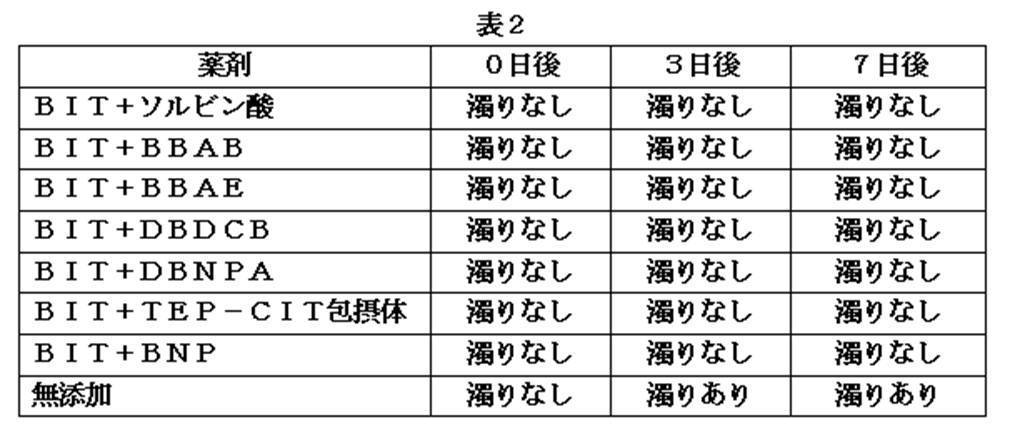
BIT :1,2-ベンゾイソチアゾリン-3-オン
BBAB :1,4-ビスブロモアセトキシ-2-ブテン
BBAE :1,4-ビスブロモアセトキシ-2-エタン
DBDCB:1,2-ジブロモ-2,4-ジシアノブタン
DBNPA:2,2-ジブロモ-3-ニトロプロピオンアミド
TEP-CIT包接体:1,1,2,2―テトラキス(4-ヒドロキシフェニル)エタン・クロロイソチアゾリン包接体
BNP :2-ブロモ-2-ニトロ-1,3-プロパンジオール
電着塗装ラインの水洗水(塗装ラインで使用している再生水ではない純水)をサンプリングし、1リットルに小分けした。その中に薬剤(5g)の入った不織布袋を浸漬し、60分間軽く攪拌した。攪拌後、不織布袋を取りだし、更に水のみを48時間連続攪拌し、生菌数を測定した。薬剤の混合比は1:1(w/w)とした。その結果以下の通りとなり、薬剤の効果が確認された。

20 : 極液貯槽
16 : 隔膜
100: 被塗物
101: 電極
P : ポンプ
+ : 正極
- : 負極
Claims (11)
- 1,2-ベンゾイソチアゾリン-3-オンを含有するタブレット又はブリケットからなるカチオン電着塗装システム用徐放性殺菌・抗菌剤。
- 1,2-ベンゾイソチアゾリン-3-オンと、安息香酸、ソルビン酸、1,4-ビスブロモアセトキシ-2-ブテン(BBAB)、1,4-ビスブロモアセトキシ-2-エタン(BBAE)、1,2-ジブロモ-2,4-ジシアノブタン(DBDCB)、2,2-ジブロモ-3-ニトロプロピオンアミド(DBNPA)、2―ブロモ―2―ニトロ―1,3―プロパンジオール(BNP)及び1,1,2,2―テトラキス(4-ヒドロキシフェニル)エタン・クロロイソチアゾリン包接体(TEP-CIT包接体)からなる群より選ばれる1つ以上の化合物を含有するタブレット又はブリケットからなるカチオン電着塗装システム用徐放性殺菌・抗菌剤。
- 前記タブレット又はブリケットが圧縮成形体である、請求項1に記載のカチオン電着塗装システム用徐放性殺菌・抗菌剤。
- 前記タブレット又はブリケットが圧縮成形体である、請求項2に記載のカチオン電着塗装システム用徐放性殺菌・抗菌剤。
- 1,2-ベンゾイソチアゾリン-3-オンを通水性容器に収納してなるカチオン電着塗装システム用徐放性殺菌・抗菌剤。
- 1、2-ベンゾイソチアゾリン―3―オンと、安息香酸、ソルビン酸、1,4-ビスブロモアセトキシ-2-ブテン(BBAB)、1,4-ビスブロモアセトキシ-2-エタン(BBAE)、1,2-ジブロモ-2,4-ジシアノブタン(DBDCB)、2,2-ジブロモ-3-ニトロプロピオンアミド(DBNPA)、2―ブロモ―2―ニトロ―1,3―プロパンジオール(BNP)及び1,1,2,2―テトラキス(4-ヒドロキシフェニル)エタン・クロロイソチアゾリン包接体(TEP-CIT包接体)からなる群より選ばれる1つ以上の化合物を通水性容器に収納してなるカチオン電着塗装システム用徐放性殺菌・抗菌剤。
- 前記通水性容器が不織布で形成されている請求項5に記載のカチオン電着塗装システム用徐放性殺菌・抗菌剤。
- 前記通水性容器が不織布で形成されている請求項6に記載のカチオン電着塗装システム用徐放性殺菌・抗菌剤。
- 請求項1~8に記載の徐放性殺菌・抗菌剤を、カチオン電着塗装システムにおけるカチオン電着塗料中に浸しまたはカチオン電着塗料の流通下に置き、1,2-ベンゾイソチアゾリン-3-オンがカチオン電着塗料に徐々に溶解するようにしたカチオン電着塗料の殺菌・抗菌方法。
- 請求項1~8に記載の徐放性殺菌・抗菌剤を、カチオン電着塗装システムにおける極液中に浸しまたは極液の流通下に置き、1,2-ベンゾイソチアゾリン-3-オンが極液に徐々に溶解するようにした極液の殺菌・抗菌方法。
- 請求項1~8に記載の徐放性殺菌・抗菌剤を、カチオン電着塗装システムにおける洗浄水中に浸しまたは洗浄水の流通下に置き、1,2-ベンゾイソチアゾリン-3-オンが洗浄水に徐々に溶解するようにした洗浄水の殺菌・抗菌方法。
Priority Applications (2)
| Application Number | Priority Date | Filing Date | Title |
|---|---|---|---|
| CN2009801421787A CN102196726A (zh) | 2008-11-04 | 2009-11-02 | 阳离子电沉积涂覆系统用缓释性杀菌·抗菌剂 |
| JP2010536682A JP5368471B2 (ja) | 2008-11-04 | 2009-11-02 | カチオン電着塗装システム用徐放性殺菌・抗菌剤 |
Applications Claiming Priority (2)
| Application Number | Priority Date | Filing Date | Title |
|---|---|---|---|
| JP2008-283366 | 2008-11-04 | ||
| JP2008283366 | 2008-11-04 |
Publications (1)
| Publication Number | Publication Date |
|---|---|
| WO2010052888A1 true WO2010052888A1 (ja) | 2010-05-14 |
Family
ID=42152702
Family Applications (1)
| Application Number | Title | Priority Date | Filing Date |
|---|---|---|---|
| PCT/JP2009/005827 Ceased WO2010052888A1 (ja) | 2008-11-04 | 2009-11-02 | カチオン電着塗装システム用徐放性殺菌・抗菌剤 |
Country Status (3)
| Country | Link |
|---|---|
| JP (1) | JP5368471B2 (ja) |
| CN (2) | CN103875683A (ja) |
| WO (1) | WO2010052888A1 (ja) |
Cited By (1)
| Publication number | Priority date | Publication date | Assignee | Title |
|---|---|---|---|---|
| CN107897178A (zh) * | 2017-11-18 | 2018-04-13 | 五河县黄淮粮油机械有限公司 | 一种抗菌不锈钢的制备方法 |
Families Citing this family (4)
| Publication number | Priority date | Publication date | Assignee | Title |
|---|---|---|---|---|
| CN103704234B (zh) * | 2014-01-07 | 2015-04-01 | 中国农业科学院植物保护研究所 | 一种防治农业细菌性病害的组合物 |
| JP7598552B2 (ja) * | 2020-10-02 | 2024-12-12 | メルテックス株式会社 | バレルめっき用スズめっき液 |
| CN114959833B (zh) * | 2022-06-08 | 2023-11-17 | 希诺股份有限公司 | 一种钛及钛合金表面阳极氧化抗菌处理的方法 |
| CN116426999A (zh) * | 2023-04-03 | 2023-07-14 | 安徽同曦高科新材料股份有限公司 | 一种具有抗菌防霉树脂涂层的不锈钢管及其制备方法 |
Citations (9)
| Publication number | Priority date | Publication date | Assignee | Title |
|---|---|---|---|---|
| JPS57154107A (en) * | 1981-03-17 | 1982-09-22 | Japanese National Railways<Jnr> | Slowly soluble germicidal composition |
| JPH0229468A (ja) * | 1988-07-19 | 1990-01-31 | Kansai Paint Co Ltd | カチオン性電着塗料組成物 |
| JPH0344303A (ja) * | 1989-07-12 | 1991-02-26 | Ichikawa Gosei Kagaku Kk | 非医療用抗菌性組成物 |
| JPH08113502A (ja) * | 1994-08-26 | 1996-05-07 | Nippon Soda Co Ltd | 早溶性成形物 |
| JP2002285384A (ja) * | 2001-03-26 | 2002-10-03 | Nippon Paint Co Ltd | 微生物繁殖防止方法 |
| JP2004105824A (ja) * | 2002-09-17 | 2004-04-08 | Ebara Corp | 水系スケール防止剤と防止方法 |
| JP2006143719A (ja) * | 2004-11-16 | 2006-06-08 | Rohm & Haas Co | 殺菌性組成物 |
| JP2006299380A (ja) * | 2005-04-25 | 2006-11-02 | Nippon Paint Co Ltd | 電着塗装方法および電着塗装システム |
| JP2007161729A (ja) * | 2002-01-31 | 2007-06-28 | Rohm & Haas Co | 相乗的殺微生物配合物 |
Family Cites Families (2)
| Publication number | Priority date | Publication date | Assignee | Title |
|---|---|---|---|---|
| AU7865598A (en) * | 1997-08-14 | 1999-02-25 | Rohm And Haas Company | Solid biocidal compositions |
| JP2003138202A (ja) * | 2001-11-07 | 2003-05-14 | Nippon Paint Co Ltd | 抗菌性無鉛性カチオン電着塗料組成物 |
-
2009
- 2009-11-02 JP JP2010536682A patent/JP5368471B2/ja not_active Expired - Fee Related
- 2009-11-02 CN CN201410092974.7A patent/CN103875683A/zh active Pending
- 2009-11-02 WO PCT/JP2009/005827 patent/WO2010052888A1/ja not_active Ceased
- 2009-11-02 CN CN2009801421787A patent/CN102196726A/zh active Pending
Patent Citations (9)
| Publication number | Priority date | Publication date | Assignee | Title |
|---|---|---|---|---|
| JPS57154107A (en) * | 1981-03-17 | 1982-09-22 | Japanese National Railways<Jnr> | Slowly soluble germicidal composition |
| JPH0229468A (ja) * | 1988-07-19 | 1990-01-31 | Kansai Paint Co Ltd | カチオン性電着塗料組成物 |
| JPH0344303A (ja) * | 1989-07-12 | 1991-02-26 | Ichikawa Gosei Kagaku Kk | 非医療用抗菌性組成物 |
| JPH08113502A (ja) * | 1994-08-26 | 1996-05-07 | Nippon Soda Co Ltd | 早溶性成形物 |
| JP2002285384A (ja) * | 2001-03-26 | 2002-10-03 | Nippon Paint Co Ltd | 微生物繁殖防止方法 |
| JP2007161729A (ja) * | 2002-01-31 | 2007-06-28 | Rohm & Haas Co | 相乗的殺微生物配合物 |
| JP2004105824A (ja) * | 2002-09-17 | 2004-04-08 | Ebara Corp | 水系スケール防止剤と防止方法 |
| JP2006143719A (ja) * | 2004-11-16 | 2006-06-08 | Rohm & Haas Co | 殺菌性組成物 |
| JP2006299380A (ja) * | 2005-04-25 | 2006-11-02 | Nippon Paint Co Ltd | 電着塗装方法および電着塗装システム |
Cited By (1)
| Publication number | Priority date | Publication date | Assignee | Title |
|---|---|---|---|---|
| CN107897178A (zh) * | 2017-11-18 | 2018-04-13 | 五河县黄淮粮油机械有限公司 | 一种抗菌不锈钢的制备方法 |
Also Published As
| Publication number | Publication date |
|---|---|
| JP5368471B2 (ja) | 2013-12-18 |
| CN103875683A (zh) | 2014-06-25 |
| CN102196726A (zh) | 2011-09-21 |
| JPWO2010052888A1 (ja) | 2012-04-05 |
Similar Documents
| Publication | Publication Date | Title |
|---|---|---|
| JP5368471B2 (ja) | カチオン電着塗装システム用徐放性殺菌・抗菌剤 | |
| EP1299517A1 (de) | Maschinengeschirrspülmittel mit zusatznutzen | |
| JP2011099096A5 (ja) | ||
| DE3853612T3 (de) | Verfahren zur Abgabe eines granulierten funktionellen Stoffes aus einem wasserlöslichen Behälter | |
| JP5367967B2 (ja) | カビ処理剤及びカビ処理方法 | |
| JP4601361B2 (ja) | 銀イオン水生成用材料とそれを用いる銀イオン水製造方法 | |
| CA2479895A1 (en) | Application of brine solutions to food products, without the production of effluent | |
| CN1911042A (zh) | 一种固态季铵盐消毒除臭组合物及制备方法 | |
| JP2018526322A (ja) | 低溶解性次亜塩素酸塩含有錠剤 | |
| CN103989655A (zh) | 一种左旋泮托拉唑钠肠溶片及其制备方法 | |
| CN102197830A (zh) | 三氯异氰尿酸复合杀菌消毒片剂及其制备方法 | |
| CN109504558A (zh) | 一种茶垢清洁剂及其制备方法 | |
| US20200361800A1 (en) | Composition for water treatment and methods of manufacture | |
| CN103740517A (zh) | 一种砂缸清洗剂 | |
| GB2605584A (en) | Coated Metallic Substrates | |
| US20150125528A1 (en) | Controlled release apparatus and uses thereof | |
| CN109156474A (zh) | 一种过硫酸氢钾消毒片 | |
| CN105647667A (zh) | 一种粘泥剥离剂的配制方法 | |
| CN105254126A (zh) | 一种污水处理方法 | |
| CN109772801A (zh) | 一种化成箔生产线清洗方法 | |
| JP4614623B2 (ja) | 農業分野で利用する水の製造方法 | |
| CN108283947A (zh) | 一种工业用除臭、杀菌离子交换树脂再生剂的制备方法 | |
| JP6254484B2 (ja) | 脱水ケーキの消臭方法及び汚泥処理装置 | |
| EP4650389A1 (en) | Soluble films, film articles, and methods of making and using same | |
| CN109763084B (zh) | 带表面抗菌镀涂层的钢板的制备工艺 |
Legal Events
| Date | Code | Title | Description |
|---|---|---|---|
| WWE | Wipo information: entry into national phase |
Ref document number: 200980142178.7 Country of ref document: CN |
|
| 121 | Ep: the epo has been informed by wipo that ep was designated in this application |
Ref document number: 09824589 Country of ref document: EP Kind code of ref document: A1 |
|
| ENP | Entry into the national phase |
Ref document number: 2010536682 Country of ref document: JP Kind code of ref document: A |
|
| WWE | Wipo information: entry into national phase |
Ref document number: 2507/CHENP/2011 Country of ref document: IN |
|
| NENP | Non-entry into the national phase |
Ref country code: DE |
|
| 122 | Ep: pct application non-entry in european phase |
Ref document number: 09824589 Country of ref document: EP Kind code of ref document: A1 |