WO2010052883A1 - 洗浄剤組成物 - Google Patents
洗浄剤組成物 Download PDFInfo
- Publication number
- WO2010052883A1 WO2010052883A1 PCT/JP2009/005814 JP2009005814W WO2010052883A1 WO 2010052883 A1 WO2010052883 A1 WO 2010052883A1 JP 2009005814 W JP2009005814 W JP 2009005814W WO 2010052883 A1 WO2010052883 A1 WO 2010052883A1
- Authority
- WO
- WIPO (PCT)
- Prior art keywords
- soybean polysaccharide
- water
- composition
- acid
- detergent composition
- Prior art date
- Legal status (The legal status is an assumption and is not a legal conclusion. Google has not performed a legal analysis and makes no representation as to the accuracy of the status listed.)
- Ceased
Links
Classifications
-
- C—CHEMISTRY; METALLURGY
- C11—ANIMAL OR VEGETABLE OILS, FATS, FATTY SUBSTANCES OR WAXES; FATTY ACIDS THEREFROM; DETERGENTS; CANDLES
- C11D—DETERGENT COMPOSITIONS; USE OF SINGLE SUBSTANCES AS DETERGENTS; SOAP OR SOAP-MAKING; RESIN SOAPS; RECOVERY OF GLYCEROL
- C11D3/00—Other compounding ingredients of detergent compositions covered in group C11D1/00
- C11D3/48—Medical, disinfecting agents, disinfecting, antibacterial, germicidal or antimicrobial compositions
-
- A—HUMAN NECESSITIES
- A61—MEDICAL OR VETERINARY SCIENCE; HYGIENE
- A61K—PREPARATIONS FOR MEDICAL, DENTAL OR TOILETRY PURPOSES
- A61K8/00—Cosmetics or similar toiletry preparations
- A61K8/18—Cosmetics or similar toiletry preparations characterised by the composition
- A61K8/72—Cosmetics or similar toiletry preparations characterised by the composition containing organic macromolecular compounds
- A61K8/73—Polysaccharides
-
- A—HUMAN NECESSITIES
- A61—MEDICAL OR VETERINARY SCIENCE; HYGIENE
- A61Q—SPECIFIC USE OF COSMETICS OR SIMILAR TOILETRY PREPARATIONS
- A61Q19/00—Preparations for care of the skin
- A61Q19/10—Washing or bathing preparations
-
- A—HUMAN NECESSITIES
- A61—MEDICAL OR VETERINARY SCIENCE; HYGIENE
- A61Q—SPECIFIC USE OF COSMETICS OR SIMILAR TOILETRY PREPARATIONS
- A61Q5/00—Preparations for care of the hair
- A61Q5/02—Preparations for cleaning the hair
-
- C—CHEMISTRY; METALLURGY
- C11—ANIMAL OR VEGETABLE OILS, FATS, FATTY SUBSTANCES OR WAXES; FATTY ACIDS THEREFROM; DETERGENTS; CANDLES
- C11D—DETERGENT COMPOSITIONS; USE OF SINGLE SUBSTANCES AS DETERGENTS; SOAP OR SOAP-MAKING; RESIN SOAPS; RECOVERY OF GLYCEROL
- C11D3/00—Other compounding ingredients of detergent compositions covered in group C11D1/00
- C11D3/16—Organic compounds
- C11D3/162—Organic compounds containing Si
Definitions
- the present invention relates to a detergent composition having excellent foaming, excellent foam quality, and excellent antifouling effect of dirt components.
- Soap has long been used as a surfactant for shampoo compositions, skin cleanser compositions represented by hand soap and body soap, and laundry detergent compositions used when washing clothes.
- alkyl sulfates and alkyl ether sulfates have been widely used.
- olefin sulfonates and nonionic surfactants have been used.
- these synthetic surfactants are excellent surfactants for detergent compositions because they have abundant foaming, they have the drawback of poor foam quality compared to soap.
- Fatty acid diethanolamides, amine oxides, higher alcohols, fatty acids, saponins, pectin, etc. are used as adjuvants to improve this defect, but the effect of improving foam quality cannot be practically used, or foam quality
- the problem was that the amount of foam decreased even if the improvement was achieved.
- CMC carboxymethyl cellulose
- water-soluble soybean polysaccharides have been studied as a foam improving agent for shampoo (Patent Document 1) and an anti-redeposition agent for washing detergent compositions (Patent Document 2). Have confirmed.
- the water-soluble soybean polysaccharide had an effective foam quality improving effect and anti-reattachment effect when used in combination with a surfactant.
- the foam quality may be reduced or foam may be reduced. In some cases, the amount decreased. Further, a sufficient re-adhesion preventing effect could not be obtained unless 0.1% by weight or more was blended in the cleaning composition.
- the present invention does not reduce the amount of foam even when used in a small amount, and is excellent in foaming, foam quality, and antifouling effect of dirt components, and is a cleaning composition such as a shampoo composition, a skin cleaning composition, and a laundry detergent composition.
- the purpose is to provide goods.
- the present inventors have conducted a crosslinking treatment on a water-soluble soybean polysaccharide, and when the crosslinked soybean polysaccharide is used together with a surfactant, The present invention has been completed by finding that it has a foam quality improving effect and an anti-fouling effect that can not be obtained with the basic soybean polysaccharide, and has a foam quality improving effect even with a small amount.
- the present invention (1) A detergent composition comprising a surfactant and a crosslinked soybean polysaccharide. (2) The cleaning composition according to (1), wherein the surfactant includes an anionic surfactant. (3) The detergent composition according to (1), wherein the crosslinked soybean polysaccharide is contained in an amount of 0.01 to 15% by weight with respect to the total weight of the detergent composition. (4) The cleaning composition according to (1) to (3), which is a shampoo composition or a skin cleaning composition. (5) The cleaning composition according to (1) to (3), which is a clothing cleaning composition. It is.
- a novel shampoo composition having a good foam quality and preventing redeposition of soil components which was not obtained with a conventional water-soluble soybean polysaccharide, was used in a smaller amount than the conventional water-soluble soybean polysaccharide.
- a cleaning composition for skin and a cleaning composition for washing was used in a smaller amount than the conventional water-soluble soybean polysaccharide.
- surfactant used in the present invention include anionic surfactants and nonionic surfactants.
- anionic surfactant -COO - group, -SO 3 - group, -OSO 3 - group, preferably selected from those having at least one functional group selected from -PO 3 2-group .
- anionic surfactants having different functional groups are shown below.
- -COO - as those having a group, (a) lauroyl sarcosine, lauroyl sarcosine triethanolamine acyl sarcosine, (b) methyl cocoyl alanine, lauroyl methyl alanine, cocoyl methylalanine triethanolamine, lauroyl methylalanine triethanolamine And (c) acyl glutamic acid such as N-cocoyl-L-glutamic acid and N-myristol-L-glutamic acid, and alkali metal salts (a) to (c).
- co-acylmethyltaurine coils such as methyl taurine
- -OSO 3 - group-containing products include (i) lauryl sulfate, lauryl sulfate triethanolamine, higher alcohol sulfate such as ammonium lauryl sulfate, and (j) lauryl ether sulfate, polyoxyethylene lauryl ether And higher alkyl ether sulfates such as sulfate esters and alkali metal salts (i) to (j).
- Examples of the compound having —PO 3 2- group include (k) higher alcohol phosphates, (l) polyoxyethylene alcohol phosphates, and (l) to (m) alkali metal salts.
- Nonionic surfactants include (n) 2-alkyl-N-carboxymethyl-N-hydroxyethyl imidazolinium betaine, coconut alkyl-N-carboxyethyl-N-hydroxyethyl imidazolinium betaine sodium, 2-alkyl- Alkylimidazolinium betaine-type surfactants such as N-carboxyethyl-N-hydroxyethylimidazolinium betaine, (o) Amidopropyl betaine-type surfactants such as amidopropyldimethylaminoacetic acid betaine laurate, (p) Chloride Stearylmethylammonium, (q) lauric acid diethanolamide, (r) coconut oil fatty acid sorbitan polyethylene glycol ether, and (s) coconut oil fatty acid amidopropyldimethylaminoacetic acid betaine.
- one or two or more selected from these surfactants can be used alone or in combination.
- these surfactants for the reason that the effects of the crosslinked soybean polysaccharide of the present invention are remarkably shown, those containing an anionic surfactant as the surfactant are preferred, and those containing only the anionic surfactant as the surfactant are the most. preferable.
- the crosslinked soybean polysaccharide is a soybean polysaccharide obtained by subjecting a water-soluble soybean polysaccharide to a crosslinking treatment.
- a water-soluble soybean polysaccharide obtained by various methods can be used.
- a water-soluble soybean polysaccharide as described in Japanese Patent No. 2599477 is used. Can be used.
- a water-soluble soybean polysaccharide can be obtained by solid-liquid separation. Okara from the production of isolated soy protein, which is low in both oil and protein, is preferred as the raw material, and when the extraction temperature exceeds 100 ° C, the extraction efficiency is high.
- the water-soluble soybean polysaccharide thus obtained may be subjected to the following crosslinking treatment on the extracted filtrate or the purified product of the extracted filtrate, or the dried filtrate of the extracted filtrate or the purified product. A cross-linking treatment may be performed.
- water-soluble soybean polysaccharide molecules can be crosslinked directly or via a crosslinking agent.
- An example of a method for directly cross-linking polysaccharide molecules is to add 2 to 50 mmol of various acid aqueous solutions including mineral acids such as hydrochloric acid to water-soluble soybean polysaccharide to 100 g of polysaccharide, Heat to 100 to 160 ° C after adjusting to 0.5 to 20% by weight.
- the water-soluble soybean polysaccharide may be crosslinked by enzyme treatment or radiation treatment.
- a method for crosslinking water-soluble soybean polysaccharide via a crosslinking agent is exemplified.
- Various crosslinking agents are added to the aqueous solution of water-soluble soybean polysaccharide.
- Phosphoric acid compounds and its salts such as phosphoric acid, phytic acid, polyphosphoric acid, metaphosphoric acid, phosphoric anhydride, hexametaphosphoric acid, trimetaphosphoric acid, and phosphorus oxychloride
- Examples include epichlorohydrin, formaldehyde, glutaraldehyde, diepoxyalkanes and diepoxyalkenes.
- a phosphoric acid compound or a salt thereof is preferable in view of reaction efficiency, and trimetaphosphoric acid or a salt thereof is most preferable.
- the amount of the crosslinking agent to be added varies depending on the kind of the crosslinking agent and the concentration of the water-soluble soybean polysaccharide. For example, when sodium trimetaphosphate is used in a 5% by weight aqueous solution of the water-soluble soybean polysaccharide, the solid content in the solution is increased. On the other hand, it is preferably 1 to 100% by weight, more preferably 10 to 80% by weight, and most preferably 20 to 50% by weight.
- the amount of the crosslinking agent is too small, the efficiency of crosslinking is low, and if the amount of the crosslinking agent is too large, the viscosity of the solution increases rapidly and may be sol or gelated during the treatment. Even if the concentration of the water-soluble soybean polysaccharide in the reaction solution is adjusted, it is necessary to adjust the concentration of the crosslinking agent to be added. When the concentration of the water-soluble soybean polysaccharide is high, the amount of the crosslinking agent to be added is less than the above value. can do.
- the water-soluble soybean polysaccharide concentration in the reaction solution is low if the concentration is low, and if it is high, the viscosity is increased and the handling property is deteriorated, but it is preferably 0.1 to 20% by weight, preferably 1 to 10% by weight. Particularly preferred.
- salts can also be added. Examples of salts that can dissolve water include NaCl, CaCl 2, and the like.
- the aqueous solution after the addition thereof can be efficiently subjected to crosslinking treatment by heat treatment under alkaline conditions.
- the alkaline conditions are preferably pH 10 or more, more preferably pH 12 or more, and preferably less than pH 14, more preferably pH 13 or less.
- the heating conditions are preferably 40 ° C. or higher, more preferably 50 ° C. or higher, most preferably 55 ° C. or higher, preferably 90 ° C. or lower, more preferably 80 ° C. or lower.
- the heating time is preferably 10 minutes or more, more preferably 30 minutes or more, and preferably 4 hours or less, more preferably 2 hours or less.
- the water-soluble soybean polysaccharide may be decomposed by ⁇ -elimination reaction or the like, and when the heating pH and the heating temperature are low, the crosslinking reactivity is inferior.
- the water-soluble soybean polysaccharide is cross-linked, a high molecular weight fraction is generated, and the air bubble improving effect and the anti-reattachment effect can be enhanced.
- only the water-soluble fraction can be obtained by removing the generated insolubilized material.
- Cross-linking with water-soluble soybean polysaccharide and other polymer materials is the same as with water-soluble soybean polysaccharide alone, and can be cross-linked directly or via other cross-linking agents. It is. In addition, the reaction method and conditions at that time are the same as in the case of water-soluble soybean polysaccharide alone.
- polymer materials include cellulose, microcrystalline cellulose, fermented cellulose, various modified celluloses such as CMC, hyaluronic acid, starch, modified starch, dextrin, agar, carrageenan, farcelan, guar gum, locust bean gum, tamarind seed polysaccharide , Polysaccharides such as tara gum, gum arabic, gum tragacanth, karaya gum, pectin, xanthan gum, pullulan, gellan gum, chitin, chitosan and hydrolysates thereof.
- the obtained crosslinked soybean polysaccharide can be used as it is, but mixed mineral components may be removed.
- any method capable of separating and removing salts may be used. Examples thereof include precipitation using a polar organic solvent such as methanol, ethanol, isopropanol, and acetone, electrodialysis, ion exchange resin or hydrophobic resin, and membrane fractionation using a UF membrane. It is preferable to use one or a combination of two or more of these methods.
- a powdered crosslinked soybean polysaccharide is obtained.
- the detergent composition is obtained by adding various additives to the surfactant in order to enhance the washing function.
- the detergent composition of the present invention is different from the surfactant described above in that many crosslinked soybeans are added.
- a saccharide is added, and one or more of a chelating agent, a moisturizing component, a saccharide, an anti-inflammatory agent, an immunostimulant, an enzyme, a protein, and a fragrance can be used in combination as necessary.
- Illustrative examples include phosphoric acid and salts thereof such as hexametaphosphoric acid, tripolyphosphoric acid and pyrophosphoric acid, organic acids such as citric acid and malic acid and salts thereof, sugar alcohols such as glycerin, sorbitol and xylitol, cellulose, microcrystalline cellulose, Various modified celluloses such as fermented cellulose, CMC, hyaluronic acid, starch, modified starch, dextrin, agar, carrageenan, ferreran, guar gum, locust bean gum, tamarind seed polysaccharide, tara gum, gum arabic, tragacanth gum, caraya gum, pectin, xanthan gum, Anti-inflammatory agents such as pullulan, gellan gum, chitin and chitosan and their hydrolysates, allantoin and glycyrrhizinate, immunostimulants such as aloe extract, ⁇ -glucan,
- the content of the crosslinked soybean polysaccharide in the cleaning composition of the present invention is preferably 0.01% by weight or more, more preferably 0.05% by weight or more, and most preferably the lower limit relative to the total weight of the cleaning composition. 0.5% by weight or more.
- the upper limit is preferably 15% by weight or less, more preferably 10% by weight or less, and most preferably 8% by weight or less.
- it can be used at 0.01 wt% or more and less than 0.1 wt%. If the amount is less than 0.01% by weight, the effect of improving foam quality and preventing re-adhesion is insufficient, and if it exceeds 15% by weight, foaming may be insufficient.
- a shampoo composition is a form of a cleaning composition that mainly cleans the hair
- a skin cleaning composition mainly refers to a cleaning composition that cleans the body surface, fingers, face, etc. of the human body. It is one form. Without damaging the hair and the skin of the scalp, face, fingers, and body surface, sebum adhering to the hair and skin, waste products peeled off from the skin, and dirt and dust in the air are taken into the bubbles. This is characterized by separating them with water and washing them off with water.
- surfactants in particular, polyoxyethylene lauryl ether sodium sulfate, sodium lauroyl sarcosine, sodium lauroylmethylalanine, sodium cocoylmethylalanine, disodium lauryl sulfosuccinate, sodium lauryl sulfate, coconut oil fatty acid sorbitan polyethylene glycol ether, etc. It is good to use.
- proteins such as collagen that have the effect of preventing or repairing hair and scalp caused by washing, peptides and amino acids that are degradation products thereof, hyaluronic acid, betaine, and polyoctanium that are moisturizing ingredients, preservatives
- phenokita ethanol which is, etidronic acid, which is an antioxidant, citric acid, which is a pH adjusting agent, or the like is added.
- a clothing cleaning composition is one form of a cleaning composition used for cleaning textiles such as clothing.
- the above-mentioned surfactants particularly sodium alkylbenzene sulfonate, sodium alkyl sulfate, sodium ⁇ -olefin sulfonate, polyoxyethylene alcohol phosphate, sodium lauryl sulfate may be used.
- bleaching agent sodium hypochlorite, sodium chlorite, and hydrosulfite
- fluorescent whitening agent builder, carbonate, silicate, polyphosphate, and Lipase, protease, amylase, cellulase, etc.
- protease amylase
- cellulase etc.
- Production Example 2 (Production of cross-linked soybean polysaccharide) A 5% by weight aqueous solution of soybean polysaccharide A obtained in Production Example 1 was prepared and heated in a boiling water bath for 5 minutes. Sodium trimetaphosphate was dissolved in the aqueous solution of polysaccharide to a final concentration of 2% by weight and adjusted to pH 12 using an aqueous sodium hydroxide solution. The reaction was allowed to react with stirring at 60 ° C. for 1 hour. Insoluble matter was removed by centrifugation (8,000 rpm, 30 minutes) to obtain a supernatant.
- soybean polysaccharide B The polysaccharide solution was precipitated with a final 60 wt% ethanol and purified with 90 wt% hydrous ethanol, and the resulting precipitate was air-dried to obtain a crosslinked soybean polysaccharide. This was designated as soybean polysaccharide B.
- Examples 1 and 2 (specific formulation examples of shampoo compositions) As is apparent from the results of Tables 2 and 3, by blending the crosslinked soybean polysaccharide, a shampoo composition excellent in foam quality was obtained without reducing the amount of foam. Therefore, a cross-linked soybean polysaccharide was blended into a practical blend and its efficacy was evaluated. That is, the rinse-integrated shampoo composition (Example 1) was prepared according to the formulation shown in Table 4, and the conditioning shampoo composition (Example 2) was adjusted according to the formulation shown in Table 5.
- Example 1 and Example 2 were all excellent in foaming, the foam quality was very fine and creamy. In addition, the water repellency was very good and was a practical shampoo composition.
- Example 4 (Laundry detergent composition-1) 200 g of buffer solution adjusted to pH 2 to 12 (pH 2 and 5: 100 mM sodium citrate buffer solution, pH 7, 9, 12: 100 mM phosphate buffer solution) 5% by weight of sodium alkylbenzene sulfonate, soybean polysaccharide (A or B) or carboxymethylcellulose (CMC: Serogen; manufactured by Daiichi Kogyo Seiyaku Co., Ltd.) is dispersed and dissolved so as to be 0.2% by weight, and carbon black (manufactured by Sigma-Aldrich) is used so that the soil component becomes 0.5% by weight. ) Was added.
- the whiteness of cotton broad was measured with a powder color difference meter (Medel Z-1001DP type color difference meter manufactured by Nippon Denshoku) and evaluated by the L value at the time of reflection measurement.
- Medel Z-1001DP type color difference meter manufactured by Nippon Denshoku was evaluated by the L value at the time of reflection measurement.
- three cotton broad were also used, and the function was evaluated with the average value of L values.
- Table 6 The results are summarized in Table 6. The lower the adhesion of carbon black, the higher the L value, but the criteria for determining the adhesion suppression effect were as follows.
- Soy polysaccharide B has an effect of suppressing the adhesion of carbon black to cotton broad by adding 0.01% by weight or more in the system and not deteriorating the cleaning effect of the surfactant. A function equivalent to or greater than that was expressed. The effect was even better than CMC.
- Example 3 Specific formulation examples and effects of liquid laundry detergent composition
- the effect of suppressing the adhesion of dirt components can be obtained by blending the crosslinked soybean polysaccharide with the laundry detergent composition. Therefore, a cross-linked soybean polysaccharide was blended into a practical blend and its efficacy was evaluated.
- blending shown in Table 8 was prepared, and the adhesion inhibitory effect of stain
Landscapes
- Life Sciences & Earth Sciences (AREA)
- Health & Medical Sciences (AREA)
- Chemical & Material Sciences (AREA)
- Veterinary Medicine (AREA)
- Public Health (AREA)
- General Health & Medical Sciences (AREA)
- Animal Behavior & Ethology (AREA)
- Oil, Petroleum & Natural Gas (AREA)
- Organic Chemistry (AREA)
- Wood Science & Technology (AREA)
- Chemical Kinetics & Catalysis (AREA)
- Engineering & Computer Science (AREA)
- Dermatology (AREA)
- Birds (AREA)
- Epidemiology (AREA)
- Detergent Compositions (AREA)
- Cosmetics (AREA)
Abstract
本願発明は、少量の使用でも泡量を減少させない、泡立ちに優れ、泡質に優れ、汚れ成分の付着汚染防止効果に優れた、シャンプー,ボディーソープ,ハンドソープ,洗濯洗剤等の洗浄剤組成物を提供することを目的とする。水溶性大豆多糖類に架橋化処理を行なった架橋化大豆多糖類を、界面活性剤と併用して洗浄剤組成物を得る事で、従来の水溶性大豆多糖類よりも少ない量で優れた泡量と泡質向上効果が得られた。更に、洗濯用洗浄剤組成物において、汚れ成分の衣類繊維への付着抑制効果を有していることを見出した。
Description
本発明は、泡立ちに優れ、泡質に優れ、汚れ成分の付着汚染防止効果に優れた洗浄剤組成物に関する。
シャンプー組成物、ハンドソープ及びボディーソープに代表される肌用洗浄剤組成物、衣類を洗浄する時に使用される洗濯洗浄剤組成物等の界面活性剤としては、石鹸が古くより利用されて来たが、昭和30年代以降、合成洗剤の進歩とともにアルキル硫酸塩,アルキルエーテル硫酸塩が広く使用されるようになった。更に、昭和50年代以降は、オレフィンスルホン酸塩や非イオン系界面活性剤などが使用されるようになった。これらの合成界面活性剤は、豊富な泡立ちを持つ事から優れた洗浄剤組成物用の界面活性剤ではあるが、石鹸に比べて泡質が悪いという欠点があった。この欠点を改良する補助剤として脂肪酸ジエタノールアミド,アミンオキシド,高級アルコール類,脂肪酸類,サポニン,ペクチンなどが用いられているが、泡質の改善効果が実用に耐え得るものでなかったり、泡質が改善されても泡量が減少するなどの問題点を有していた。
更に、界面活性剤の効果で毛髪や衣類等の基質から脱離し、洗浄液中に分散している汚れの成分の一部が再度基質に付着して洗浄効果を下げてしまうという問題点があった。これを防止する方法として、カルボキシメチルセルロース(CMC)が再付着防止剤として検討されて来た。CMCは、優れた再付着防止効果を有する一方、無機或は有機ビルダーなどが配合されている処方において溶解し難い問題が有り、界面活性剤の溶解性にも影響を与えるため、完璧な再付着防止剤とは言えなかった。
これらの問題点を解決すべく水溶性大豆多糖類がシャンプーの泡質改良剤(特許文献1)、及び洗濯用洗浄剤組成物の再付着防止剤(特許文献2)として検討され、一定の効果を確認している。水溶性大豆多糖類は、界面活性剤との併用で有効な泡質の改良効果と再付着防止効果を有していたが、併用する界面活性剤の種類によっては泡質が低下したり、泡量が減少する場合もあった。また、洗浄剤組成物中0.1重量%以上配合しなければ充分な再付着防止効果が得られなかった。
本願発明は、少量の使用でも泡量を減少させない、泡立ち,泡質,汚れ成分の付着汚染防止効果に優れた、シャンプー組成物,肌用洗浄剤組成物,洗濯洗剤組成物等の洗浄剤組成物を提供することを目的とする。
本発明者らは、上記の課題に対して鋭意研究を重ねた結果、水溶性大豆多糖類に対して架橋化処理を行なった、架橋化大豆多糖類を界面活性剤と共に用いると、従来の水溶性大豆多糖類では得られなかった泡質向上効果と、汚れ成分の付着防止効果を示し、更に少量でも泡質向上効果があることを見出し、本発明を完成させた。
即ち、本発明は、
(1)界面活性剤と架橋化大豆多糖類とを含む、洗浄剤組成物。
(2)界面活性剤がアニオン界面活性剤を含む、(1)に記載の洗浄剤組成物。
(3)架橋化大豆多糖類が洗浄剤組成物の全重量に対して0.01重量%から15重量%含まれる、(1)に記載の洗浄剤組成物。
(4)シャンプー組成物または肌用洗浄剤組成物である、(1)乃至(3)に記載の洗浄剤組成物。
(5)衣類洗浄剤組成物である、(1)乃至(3)に記載の洗浄剤組成物。
である。
(1)界面活性剤と架橋化大豆多糖類とを含む、洗浄剤組成物。
(2)界面活性剤がアニオン界面活性剤を含む、(1)に記載の洗浄剤組成物。
(3)架橋化大豆多糖類が洗浄剤組成物の全重量に対して0.01重量%から15重量%含まれる、(1)に記載の洗浄剤組成物。
(4)シャンプー組成物または肌用洗浄剤組成物である、(1)乃至(3)に記載の洗浄剤組成物。
(5)衣類洗浄剤組成物である、(1)乃至(3)に記載の洗浄剤組成物。
である。
本発明によって、従来の水溶性大豆多糖類より少量の使用で、従来の水溶性大豆多糖類では得られなかった、泡質が良く、汚れ成分の再付着が防止された、新規なシャンプー組成物や肌用洗浄剤組成物,洗濯用洗浄剤組成物を提供することが出来る。
(界面活性剤)
以下、本発明を具体的に説明する。本発明に用いる界面活性剤としては、アニオン界面活性剤、非イオン界面活性剤などが挙げられる。アニオン界面活性剤としては、-COO-基、-SO3 -基、-OSO3 -基、-PO3 2-基等から選ばれた少なくとも1種類の官能基を有するものから選ばれるのが好ましい。
以下、本発明を具体的に説明する。本発明に用いる界面活性剤としては、アニオン界面活性剤、非イオン界面活性剤などが挙げられる。アニオン界面活性剤としては、-COO-基、-SO3 -基、-OSO3 -基、-PO3 2-基等から選ばれた少なくとも1種類の官能基を有するものから選ばれるのが好ましい。
官能基の異なるアニオン界面活性剤について以下に例示する。-COO-基を有する物としては、(a)ラウロイルサルコシン,ラウロイルサルコシントリエタノールアミン等のアシルサルコシン、(b)ココイルメチルアラニン,ラウロイルメチルアラニン,ココイルメチルアラニントリエタノールアミン,ラウロイルメチルアラニントリエタノールアミン等のアシルメチルアラニン、及び(c)N-ココイル-L-グルタミン酸,N-ミリストル-L-グルタミン酸等のアシルグルタミン酸、並びに(a)~(c)のアルカリ金属塩が挙げられる。
-SO3
-基を有する物としては、(d)ココイルメチルタウリン等のアシルメチルタウリン,(e)スルホコハク酸ラウリル,スルホコハク酸ラウロイルアタノールアミド,オレイン酸アミドスルホコハク酸等のスルホコハク酸型界面活性剤、(f)α-オレフィンスルホン酸、(g)アルキル硫酸エステル、及び(h)アルキルベンゼンスルホン酸、並びに(d)~(h)のアルカリ金属塩が挙げられる。
-OSO3
-基を有する物としては、(i)ラウリル硫酸エステル,ラウリル硫酸エステルトリエタノールアミン,ラウリル硫酸エステルアンモニウム等の高級アルコール硫酸エステル、及び(j)ラウリルエーテル硫酸エステル,ポリオキシエチレンラウリルエーテル硫酸エステル等の高級アルキルエーテル硫酸エステル、並びに(i)~(j)のアルカリ金属塩が挙げられる。
-PO3
2-基を有する物としては、(k)高級アルコールリン酸エステル、及び(l)ポリオキシエチレンアルコールリン酸エステル、並びに(l)~(m)のアルカリ金属塩が挙げられる。
非イオン界面活性剤としては、(n)2-アルキル-N-カルボキシメチル-N-ヒドロキシエチルイミダゾリニウムベタイン,ヤシアルキル-N-カルボキシエチル-N-ヒドロキシエチルイミダゾリニウムベタインナトリウム,2-アルキル-N-カルボキシエチル-N-ヒドロキシエチルイミダゾリニウムベタイン等のアルキルイミダゾリニウムベタイン型界面活性剤、(o)ラウリン酸アミドプロピルジメチルアミノ酢酸ベタイン等のアミドプロピルベタイン型界面活性剤、(p)塩化ステアリルメチルアンモニウム、(q)ラウリン酸ジエタノールアミド、(r)ヤシ油脂肪酸ソルビタンポリエチレングリコールエーテル、及び(s)ヤシ油脂肪酸アミドプロピルジメチルアミノ酢酸ベタイン等が挙げられる。本願発明は、これら界面活性剤から選ばれた一種または二種以上を、単独であるいは組み合わせて使用することができる。中でも、本願発明の架橋化大豆多糖類の効果が顕著に示される理由から、界面活性剤としてアニオン界面活性剤を含んだものが好ましく、界面活性剤としてアニオン界面活性剤のみを含んだものが最も好ましい。
(架橋化大豆多糖類)
架橋化大豆多糖類とは、水溶性大豆多糖類に架橋化処理を行なって得られた大豆多糖類である。本発明に使用する水溶性大豆多糖類とは、種々の方法で得られる水溶性大豆多糖類を用いることができるが、例えば、特許第2599477号公報に記載された様な水溶性大豆多糖類を用いることができる。製造の一例を示せば、豆腐や豆乳、分離大豆蛋白質の製造時に副産物として得られるオカラや、脱脂大豆粕を原料として、水系下で蛋白質の等電点付近である弱酸性域で高温抽出し、固液分離により水溶性大豆多糖類を得ることができる。油分,蛋白質が共に少ない、分離大豆蛋白質製造時のオカラが原料に好ましく、抽出温度は100℃を超えると抽出効率が高く好ましい。この様に得られた水溶性大豆多糖類は、抽出濾液または抽出濾液の精製物に対して以下の架橋化処理を行なっても良いし、抽出濾液またはその精製物を更に乾燥した物に対して架橋化処理を行なっても良い。
架橋化大豆多糖類とは、水溶性大豆多糖類に架橋化処理を行なって得られた大豆多糖類である。本発明に使用する水溶性大豆多糖類とは、種々の方法で得られる水溶性大豆多糖類を用いることができるが、例えば、特許第2599477号公報に記載された様な水溶性大豆多糖類を用いることができる。製造の一例を示せば、豆腐や豆乳、分離大豆蛋白質の製造時に副産物として得られるオカラや、脱脂大豆粕を原料として、水系下で蛋白質の等電点付近である弱酸性域で高温抽出し、固液分離により水溶性大豆多糖類を得ることができる。油分,蛋白質が共に少ない、分離大豆蛋白質製造時のオカラが原料に好ましく、抽出温度は100℃を超えると抽出効率が高く好ましい。この様に得られた水溶性大豆多糖類は、抽出濾液または抽出濾液の精製物に対して以下の架橋化処理を行なっても良いし、抽出濾液またはその精製物を更に乾燥した物に対して架橋化処理を行なっても良い。
(架橋化処理)
架橋化処理としては、水溶性大豆多糖類分子間を直接架橋させることも出来るし、架橋剤を介して架橋させることも出来る。多糖類分子間を直接架橋させる方法を例示すると、水溶性大豆多糖類に、塩酸等の鉱酸をはじめとした各種の酸水溶液を、多糖類100gに対して2~50m mol加え、水分量を0.5~20重量%とした上で100℃~160℃で加熱する。また、水溶性大豆多糖類を酵素処理や、放射線処理によって架橋しても良い。
架橋化処理としては、水溶性大豆多糖類分子間を直接架橋させることも出来るし、架橋剤を介して架橋させることも出来る。多糖類分子間を直接架橋させる方法を例示すると、水溶性大豆多糖類に、塩酸等の鉱酸をはじめとした各種の酸水溶液を、多糖類100gに対して2~50m mol加え、水分量を0.5~20重量%とした上で100℃~160℃で加熱する。また、水溶性大豆多糖類を酵素処理や、放射線処理によって架橋しても良い。
水溶性大豆多糖類に架橋剤を介して架橋させる方法を例示する。水溶性大豆多糖類の水溶液に対し、種々の架橋剤を添加する。ここで言う架橋剤とは、特に限定されないが、リン酸,フィチン酸,ポリリン酸,メタリン酸,無水リン酸,ヘキサメタリン酸,トリメタリン酸、等のリン酸化合物及びその塩、並びに、オキシ塩化リン、エピクロロヒドリン,ホルムアルデヒド,グルタルアルデヒド,ジエポキシアルカン及びジエポキシアルケン等が例示出来る。中でも反応の効率からリン酸化合物若しくはその塩類が好ましく、トリメタリン酸若しくはその塩類が最も好ましい。添加する架橋剤の量は、架橋剤の種類や水溶性大豆多糖類の濃度によっても異なるが、例えば水溶性大豆多糖類の5重量%水溶液にトリメタリン酸ナトリウムを用いる場合、溶液中の固形分に対して好ましくは1重量%以上100重量%以下、更に好ましくは10重量%以上80重量%以下、最も好ましくは20重量%以上50重量%以下である。架橋剤の量が少なすぎると、架橋化の効率が低く、架橋剤の量が多すぎると溶液の粘度が急激に上昇し、処理の過程でゾル化或はゲル化することがある。反応液中の水溶性大豆多糖類の濃度に合わせても、添加する架橋剤の濃度を調整する必要があり、水溶性大豆多糖類の濃度が高い場合、添加する架橋剤は上記値より少量にすることができる。尚、反応液中の水溶性大豆多糖類の濃度は、薄いと反応性が低く、高いと粘度上昇等が伴い取扱性が悪化するが、0.1~20重量%が好ましく、1~10重量%が特に好ましい。また、架橋化処理をする場合、反応時の水溶性大豆多糖類の粘性を調製するために、塩類を添加することもできる。塩類としては、水の溶解するものであって、NaCl,CaCl2などが好ましいものとして例示できる。
架橋剤としてリン酸化合物またはその塩類を用いた場合、それらを添加後の水溶液は、アルカリ条件で加熱処理することで、効率よく架橋化処理を行なうことが出来る。本発明の気泡性及び再付着防止機能を高めるには、アルカリ条件としては、好ましくはpH10以上、更に好ましくはpH12以上であり、且つ、好ましくはpH14未満、更に好ましくはpH13以下が良好である。また、加熱条件としては、好ましくは40℃以上、更に好ましくは50℃以上、最も好ましくは55℃以上であり、且つ、好ましくは90℃以下、更に好ましくは80℃以下が良好である。加熱時間は、好ましくは10分間以上、更に好ましくは30分以上であり、且つ、好ましくは4時間以下、更に好ましくは2時間以下が良好である。加熱pHおよび加熱温度が高い場合は、水溶性大豆多糖類がβ脱離反応等により分解することがあり、また、加熱pHおよび加熱温度が低い場合は、架橋化反応性に劣る。この操作により、水溶性大豆多糖類は架橋化が起こり、高分子量画分が生成され、気泡改良効果と再付着防止効果を高めることが出来る。尚、発生する不溶化物を除去すると、水溶性画分のみを得ることができる。
水溶性大豆多糖類と他の高分子素材を用いて架橋させる場合も、水溶性大豆多糖類単独の場合と同様であり、直接架橋させることも、他の架橋剤を介して架橋させることも可能である。また、その際の反応方法や条件も水溶性大豆多糖類単独の場合に準じる。他の高分子素材としては、セルロース,微結晶セルロース,発酵セルロース,CMC等の各種修飾セルロース,ヒアルロン酸,デンプン,化工澱粉,デキストリン,寒天,カラギーナン,ファーセラン,グアーガム,ローカストビーンガム,タマリンド種子多糖類,タラガム,アラビアガム,トラガントガム,カラヤガム,ペクチン,キサンタンガム,プルラン,ジェランガム,キチン,キトサンなどの多糖類及びその加水分解物が挙げられる。
得られた架橋化大豆多糖類はそのままで用いることも可能であるが、混在するミネラル成分を除去してもよい。脱塩精製処理の方法として、塩類が分離除去出来るいずれの方法でも構わない。メタノール,エタノール,イソプロパノール,アセトン等の極性有機溶媒を用いた沈殿法,電気透析,イオン交換樹脂あるいは疎水性樹脂,UF膜を用いた膜分画等が例示出来る。これらの1つ又は2つ以上の方法を組み合わせて用いることが好ましい。こうして精製された架橋化大豆多糖類溶液をプレート殺菌、或いは超高温短時間殺菌(UHT)等の殺菌処理を経た後、または経ることなく、凍結乾燥,スプレードライ,加熱乾燥後に粉砕する等の方法により、粉体の架橋化大豆多糖類が得られる。
(洗浄剤組成物)
洗浄剤組成物とは、洗浄の機能を高める為に界面活性剤に種々の添加物を加えたものであるが、本発明の洗浄剤組成物とは、前述した界面活性剤に架橋化大豆多糖類を加えたものであり、必要に応じてキレート剤,保湿成分,糖質,抗炎症剤,免疫賦活剤,酵素,蛋白質,及び香料の1種或は2以上を併用することができる。例示すると、ヘキサメタリン酸,トリポリリン酸,及びピロリン酸等のリン酸及びその塩、クエン酸,及びリンゴ酸等の有機酸及びその塩、グリセリン,ソルビトール,キシリトール等の糖アルコール、セルロース,微結晶セルロース,発酵セルロース,CMC等の各種修飾セルロース,ヒアルロン酸,デンプン,化工澱粉,デキストリン,寒天,カラギーナン,ファーセラン,グアーガム,ローカストビーンガム,タマリンド種子多糖類,タラガム,アラビアガム,トラガントガム,カラヤガム,ペクチン,キサンタンガム,プルラン,ジェランガム,キチン,キトサンなどの多糖類及びその加水分解物、アラントイン,及びグリチルリチン酸塩等の抗炎症剤、アロエエキス,β-グルカン,及び胎盤抽出エキス等の免疫賦活剤、リパーゼ,プロテアーゼ,セルラーゼ,アミラーゼ,リゾチーム等の酵素、ゼラチン,乳蛋白質や大豆蛋白質などの蛋白質及びその加水分解物等が挙げられる。
洗浄剤組成物とは、洗浄の機能を高める為に界面活性剤に種々の添加物を加えたものであるが、本発明の洗浄剤組成物とは、前述した界面活性剤に架橋化大豆多糖類を加えたものであり、必要に応じてキレート剤,保湿成分,糖質,抗炎症剤,免疫賦活剤,酵素,蛋白質,及び香料の1種或は2以上を併用することができる。例示すると、ヘキサメタリン酸,トリポリリン酸,及びピロリン酸等のリン酸及びその塩、クエン酸,及びリンゴ酸等の有機酸及びその塩、グリセリン,ソルビトール,キシリトール等の糖アルコール、セルロース,微結晶セルロース,発酵セルロース,CMC等の各種修飾セルロース,ヒアルロン酸,デンプン,化工澱粉,デキストリン,寒天,カラギーナン,ファーセラン,グアーガム,ローカストビーンガム,タマリンド種子多糖類,タラガム,アラビアガム,トラガントガム,カラヤガム,ペクチン,キサンタンガム,プルラン,ジェランガム,キチン,キトサンなどの多糖類及びその加水分解物、アラントイン,及びグリチルリチン酸塩等の抗炎症剤、アロエエキス,β-グルカン,及び胎盤抽出エキス等の免疫賦活剤、リパーゼ,プロテアーゼ,セルラーゼ,アミラーゼ,リゾチーム等の酵素、ゼラチン,乳蛋白質や大豆蛋白質などの蛋白質及びその加水分解物等が挙げられる。
本発明の洗浄剤組成物中における架橋化大豆多糖類の含有量は、洗浄剤組成物の全重量に対し、下限として、好ましくは0.01重量%以上、更に好ましくは0.05重量%以上、最も好ましくは0.5重量%以上である。また上限として、好ましくは15重量%以下、更に好ましくは10重量%以下、最も好ましくは8重量%以下である。あるいは、少量で洗浄組成物とするために、0.01重量%以上、0.1重量%未満で使用することもできる。0.01重量%よりも少ない量では、泡質向上及び再付着防止の効果が不十分に、15重量%を越えて配合した場合、泡立ちが不十分になる場合がある。
(シャンプー組成物または肌用洗浄剤組成物)
シャンプー組成物とは、主に頭髪を洗浄する洗浄剤組成物の一形態であり、肌用洗浄剤組成物とは、主に人体の体表,手指,顔面等を洗浄する洗浄剤剤組成物の一形態である。頭髪、並びに頭皮,顔面,手指および体表等の皮膚を傷めることなく、頭髪及び皮膚に付着した皮脂、角質から剥離した老廃物、空気中のちりやほこりなどの汚れ物質を気泡の中に取り込んで分離させ、水洗浄によりこれらを洗い落とす特徴が有る。前述した界面活性剤の、特にポリオキシエチレンラウリルエーテル硫酸ナトリウム,ラウロイルサルコシンナトリウム,ラウロイルメチルアラニンナトリウム,ココイルメチルアラニンナトリウム,スルホコハク酸ラウリル二ナトリウム,ラウリル硫酸エステルナトリウム,ヤシ油脂肪酸ソルビタンポリエチレングリコールエーテル等を用いることが良い。また、洗浄に伴う頭髪及び頭皮のダメージを防止したり、補修する効果を持つコラーゲン等の蛋白質、その分解物であるペプチドやアミノ酸、保湿成分であるヒアルロン酸,ベタイン,及びポリオクタニウム、防腐剤であるフェノキタシエタノール、酸化防止剤であるエチドロン酸、pH調整剤であるクエン酸等を添加する場合がある。
シャンプー組成物とは、主に頭髪を洗浄する洗浄剤組成物の一形態であり、肌用洗浄剤組成物とは、主に人体の体表,手指,顔面等を洗浄する洗浄剤剤組成物の一形態である。頭髪、並びに頭皮,顔面,手指および体表等の皮膚を傷めることなく、頭髪及び皮膚に付着した皮脂、角質から剥離した老廃物、空気中のちりやほこりなどの汚れ物質を気泡の中に取り込んで分離させ、水洗浄によりこれらを洗い落とす特徴が有る。前述した界面活性剤の、特にポリオキシエチレンラウリルエーテル硫酸ナトリウム,ラウロイルサルコシンナトリウム,ラウロイルメチルアラニンナトリウム,ココイルメチルアラニンナトリウム,スルホコハク酸ラウリル二ナトリウム,ラウリル硫酸エステルナトリウム,ヤシ油脂肪酸ソルビタンポリエチレングリコールエーテル等を用いることが良い。また、洗浄に伴う頭髪及び頭皮のダメージを防止したり、補修する効果を持つコラーゲン等の蛋白質、その分解物であるペプチドやアミノ酸、保湿成分であるヒアルロン酸,ベタイン,及びポリオクタニウム、防腐剤であるフェノキタシエタノール、酸化防止剤であるエチドロン酸、pH調整剤であるクエン酸等を添加する場合がある。
(衣類洗浄剤組成物)
衣類洗浄剤組成物とは、衣類等の繊維製品を洗浄する為に用いられる洗浄剤組成物の一形態である。例えば前述した界面活性剤の、特にアルキルベンゼンスルホン酸ナトリウム,アルキル硫酸エステルナトリウム,α-オレフィンスルホン酸ナトリウム,ポリオキシエチレンアルコールリン酸エステル,ラウリル硫酸エステルナトリウムを用いることが良い。また、衣類の洗浄効果を高める目的で、漂白剤として、次亜塩素酸ナトリウム,亜塩素酸ナトリウム,及びハイドロサルファイト,蛍光増白剤、ビルダーとして炭酸塩,ケイ酸塩,ポリリン酸塩,及びCMC、汚れ成分の分解酵素としてリパーゼ,プロテアーゼ,アミラーゼ,及びセルラーゼ等を添加する場合がある。
衣類洗浄剤組成物とは、衣類等の繊維製品を洗浄する為に用いられる洗浄剤組成物の一形態である。例えば前述した界面活性剤の、特にアルキルベンゼンスルホン酸ナトリウム,アルキル硫酸エステルナトリウム,α-オレフィンスルホン酸ナトリウム,ポリオキシエチレンアルコールリン酸エステル,ラウリル硫酸エステルナトリウムを用いることが良い。また、衣類の洗浄効果を高める目的で、漂白剤として、次亜塩素酸ナトリウム,亜塩素酸ナトリウム,及びハイドロサルファイト,蛍光増白剤、ビルダーとして炭酸塩,ケイ酸塩,ポリリン酸塩,及びCMC、汚れ成分の分解酵素としてリパーゼ,プロテアーゼ,アミラーゼ,及びセルラーゼ等を添加する場合がある。
以下に実施例を挙げて本発明を更に詳細に説明する。尚、例中の部及び%は何れも重量基準を意味するものとする。
○製造例1(水溶性大豆多糖類の製造)
分離大豆蛋白質の製造工程で得られた生オカラに2倍重量部の水を加え、塩酸を用いてpHを4.5に調整した。120℃で90分間加圧加熱処理を行ない、冷却後に遠心分離(10,000g×20分)により不溶性成分を分離して水溶性大豆多糖類溶液を得た。同多糖類溶液を最終60重量%エタノールで沈殿させ、沈澱を90重量%の含水エタノールで精製し、得られた沈殿を風乾して水溶性大豆多糖類を得た。これを大豆多糖類Aとした。
分離大豆蛋白質の製造工程で得られた生オカラに2倍重量部の水を加え、塩酸を用いてpHを4.5に調整した。120℃で90分間加圧加熱処理を行ない、冷却後に遠心分離(10,000g×20分)により不溶性成分を分離して水溶性大豆多糖類溶液を得た。同多糖類溶液を最終60重量%エタノールで沈殿させ、沈澱を90重量%の含水エタノールで精製し、得られた沈殿を風乾して水溶性大豆多糖類を得た。これを大豆多糖類Aとした。
○製造例2(架橋化大豆多糖類の製造)
製造例1で得た大豆多糖類Aの5重量%水溶液を調製し、沸騰水浴中で5分間加熱した。多糖類水溶液にトリメタリン酸ナトリウムを溶液中に最終2重量%となるように溶解し、水酸化ナトリウム水溶液を用いてpH12に調整した。この反応液を60℃で1時間攪拌しながら反応させた。不溶物を遠心分離(8,000rpm, 30分)で除去し、上清を得た。多糖類溶液を最終60重量%エタノールで沈殿させ、90重量%の含水エタノールで精製し、得られた沈殿を風乾して架橋化大豆多糖類を得た。これを大豆多糖類Bとした。
製造例1で得た大豆多糖類Aの5重量%水溶液を調製し、沸騰水浴中で5分間加熱した。多糖類水溶液にトリメタリン酸ナトリウムを溶液中に最終2重量%となるように溶解し、水酸化ナトリウム水溶液を用いてpH12に調整した。この反応液を60℃で1時間攪拌しながら反応させた。不溶物を遠心分離(8,000rpm, 30分)で除去し、上清を得た。多糖類溶液を最終60重量%エタノールで沈殿させ、90重量%の含水エタノールで精製し、得られた沈殿を風乾して架橋化大豆多糖類を得た。これを大豆多糖類Bとした。
○実験例1(大豆多糖類の分子量及び糖分析値)
中性糖は、硫酸分解した後、HPLC-PAD法で分析した。ウロン酸は、D-ガラクツロン酸を標準物質としてBlumenkrantz法で比色定量した。また、ゲルろ過HPLC (TSKgel-G-5000PWXL;TOSOH, 7.8mm×30cm 移動相:50mM 酢酸ナトリウム水溶液(pH5.0), 流速 1.0mL/min, RI検出器, 標準物質プルランP-82(昭和電工(株)))により分子量分布を測定した。高分子画分の定量については、RI検出装置で測定して得たクロマトグラムの総ピーク面積が多糖類の総量に相当するとし、総ピーク面積に対する分子量50万から1000万の高分子多糖類成分のピーク面積の含有割合を定量した。以下の表1に高分子成分の含有割合と組成、糖組成分析値を示す。
中性糖は、硫酸分解した後、HPLC-PAD法で分析した。ウロン酸は、D-ガラクツロン酸を標準物質としてBlumenkrantz法で比色定量した。また、ゲルろ過HPLC (TSKgel-G-5000PWXL;TOSOH, 7.8mm×30cm 移動相:50mM 酢酸ナトリウム水溶液(pH5.0), 流速 1.0mL/min, RI検出器, 標準物質プルランP-82(昭和電工(株)))により分子量分布を測定した。高分子画分の定量については、RI検出装置で測定して得たクロマトグラムの総ピーク面積が多糖類の総量に相当するとし、総ピーク面積に対する分子量50万から1000万の高分子多糖類成分のピーク面積の含有割合を定量した。以下の表1に高分子成分の含有割合と組成、糖組成分析値を示す。
○表1(大豆多糖類の分子量及び分析値)
 トリメタリン酸処理後の大豆多糖類Bは、高分子成分含有比率の含量からも明らかな様に、処理前の大豆多糖類Aに比較して高分子化している。このことから、トリメタリン酸により、水溶性大豆多糖類が架橋化されたことが確認できた。
○実験例2(シャンプー組成物-1)
表2に記載の配合にてシャンプー組成物を調製した。全量が100部になる様に精製水に分散溶解して調製した。界面活性剤のみ並びに大豆多糖類Aを併用したものを比較実験例、界面活性剤に大豆多糖類Bを併用したものを実験例として、これら組成物を用い、以下の2通りの方法で性能評価を行った。
表2に記載の配合にてシャンプー組成物を調製した。全量が100部になる様に精製水に分散溶解して調製した。界面活性剤のみ並びに大豆多糖類Aを併用したものを比較実験例、界面活性剤に大豆多糖類Bを併用したものを実験例として、これら組成物を用い、以下の2通りの方法で性能評価を行った。
(振とう試験)
組成物を100mL容の共栓付きメスシリンダーに10mL分注し、これに水20mLを加えた。栓をしたメスシリンダーを30秒間激しく手で振とうし、静置して10分後の泡量と泡質を以下の基準で評価した。10名の判定者の平均点を評価点とした。
(泡量)3・・・多い、2・・・普通、1・・・少ない
(泡質)3・・・非常に細かい、2・・・少し細かい、1・・・荒い
組成物を100mL容の共栓付きメスシリンダーに10mL分注し、これに水20mLを加えた。栓をしたメスシリンダーを30秒間激しく手で振とうし、静置して10分後の泡量と泡質を以下の基準で評価した。10名の判定者の平均点を評価点とした。
(泡量)3・・・多い、2・・・普通、1・・・少ない
(泡質)3・・・非常に細かい、2・・・少し細かい、1・・・荒い
(毛束試験)
長さ20cm、重さ5gの毛束を予め水で濡らしておいた。これに上記組成物1gを付け、軽く指先で洗髪した。生じた泡の泡量と泡質を以下の基準で評価した。10名の判定者の平均点を評価点とした。
(泡量)3・・・多い、2・・・普通、1・・・少ない
(泡質)3・・・非常に細かい、2・・・少し細かい、1・・・荒い
長さ20cm、重さ5gの毛束を予め水で濡らしておいた。これに上記組成物1gを付け、軽く指先で洗髪した。生じた泡の泡量と泡質を以下の基準で評価した。10名の判定者の平均点を評価点とした。
(泡量)3・・・多い、2・・・普通、1・・・少ない
(泡質)3・・・非常に細かい、2・・・少し細かい、1・・・荒い
○表2(シャンプー組成物の組成と性能)
 大豆多糖類Bを用いる事でシャンプー組成物の泡量と泡質の向上効果が確認され、洗浄剤組成物として高い機能を持つことが推測できた。その効果は、架橋化していない大豆多糖類Aの効果を上回るものであった。
○実験例3(シャンプー組成物-2)
ラウリル硫酸エステルナトリウム20部に大豆多糖類Bを併用し、表3に記載の配合にてシャンプー組成物を調製した。尚、全量が100部になる様に精製水に分散溶解して調製した。機能評価は実験例2に従って、毛束試験にて実施した。
ラウリル硫酸エステルナトリウム20部に大豆多糖類Bを併用し、表3に記載の配合にてシャンプー組成物を調製した。尚、全量が100部になる様に精製水に分散溶解して調製した。機能評価は実験例2に従って、毛束試験にて実施した。
○表3(シャンプー組成物の組成と性能)
 大豆多糖類Aは、洗浄剤組成物に少なくとも0.1重量%配合しなければ泡質改善効果が認められなかったのに対して、大豆多糖類Bは、洗浄剤組成物に0.01重量%以上配合することで泡質の改善効果が認められた。尚、系中に20重量%配合した場合、顕著な増粘が認められた上、泡質の顕著な悪化が認められたことから、シャンプー組成物の配合量としては0.01重量%から15重量%で効果が高く、0.05重量%から10重量%が特に良好だった。
○実施例1,2(シャンプー組成物の具体的配合例効能)
表2及び表3の結果から明らかな様に、架橋化大豆多糖類を配合する事により、泡量を減らす事無く泡質に優れたシャンプー組成物が得られた。そこで、実用的な配合に架橋化大豆多糖類を配合し、その効能を評価した。すなわち、表4の配合でリンス一体型シャンプー組成物(実施例1)を、表5の配合でコンディショニング用シャンプー組成物(実施例2)を調整した。
表2及び表3の結果から明らかな様に、架橋化大豆多糖類を配合する事により、泡量を減らす事無く泡質に優れたシャンプー組成物が得られた。そこで、実用的な配合に架橋化大豆多糖類を配合し、その効能を評価した。すなわち、表4の配合でリンス一体型シャンプー組成物(実施例1)を、表5の配合でコンディショニング用シャンプー組成物(実施例2)を調整した。
○表4(リンス一体型シャンプー組成物の配合表)

○表5(コンディショニング用シャンプー組成物の配合表)
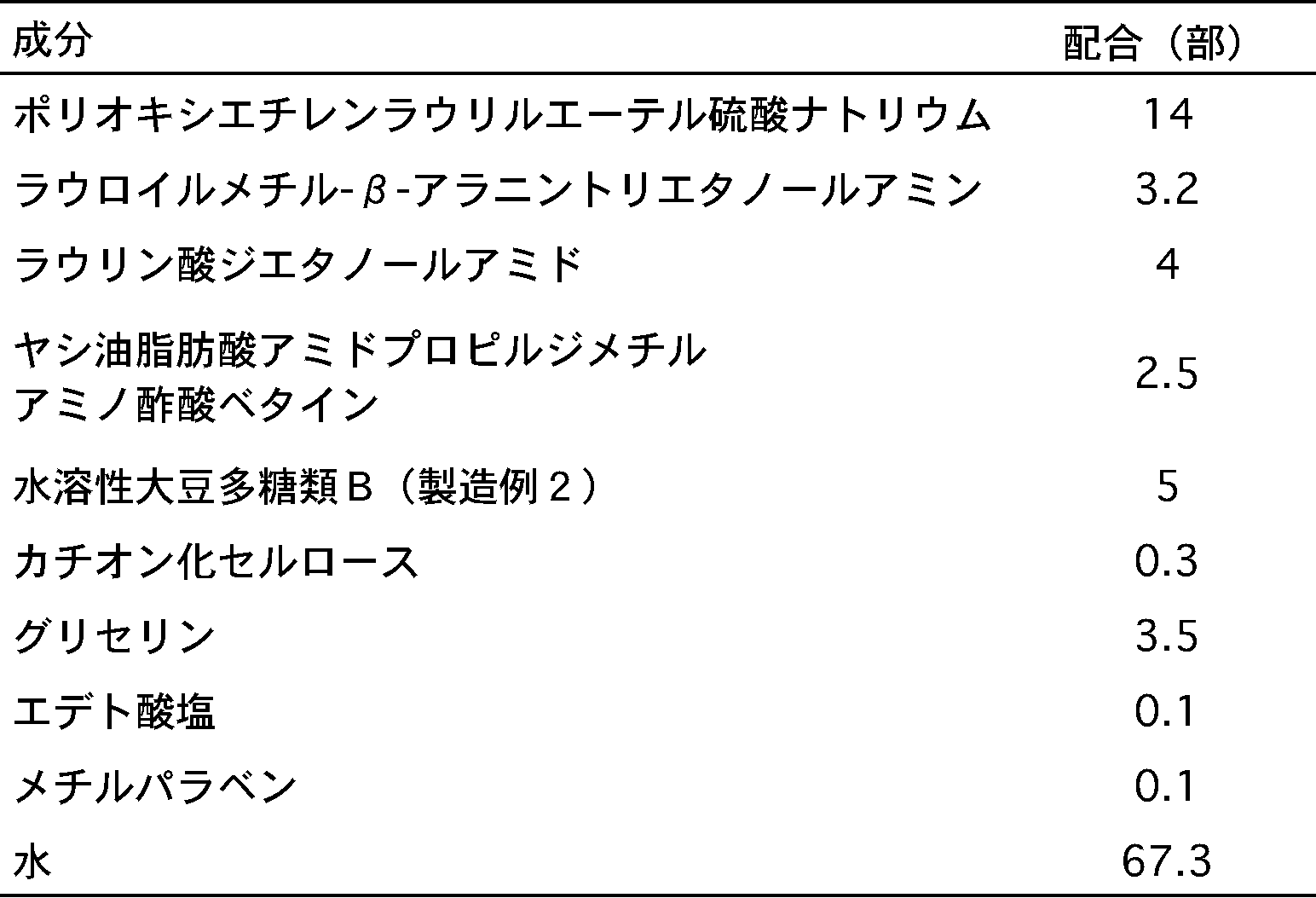
実施例1及び実施例2のシャンプー組成物は何れも泡立ちに優れ、泡質も非常にきめが細かくてクリーミーであった。また、水漱ぎ性も非常に良好であり、実用的なシャンプー組成物であった。
○実験例4(洗濯用洗浄剤組成物-1)
pH2から12に調製した緩衝液200g(pH2および5:100mMクエン酸ナトリウム緩衝液、pH7,9,12:100mMリン酸緩衝液)にアルキルベンゼンスルホン酸ナトリウムを5重量%、大豆多糖類(A或はB)、或はカルボキシメチルセルロース(CMC:セロゲン;第一工業製薬製)を0.2重量%になる様に分散溶解し、汚れ成分として系中0.5重量%になる様にカーボンブラック(Sigma-Aldrich社製)を添加した。この分散液に綿ブロード(2cm×4cm)を浸漬し、速やかに引き上げてカーボンブラックの付着性を検討した。綿ブロードの白度を粉体色差計(日本電色社製 MEDEL Z-1001DP型色差計)で測定し、反射測定時のL値で評価した。尚、各試験区につき、3枚の綿ブロードをも用い、L値の平均値をもって機能を評価した。結果を表6に纏めた。カーボンブラックの付着性が少ない程L値は高くなるが、付着抑制効果の判断基準は以下の通りとした。
(付着抑制効果)
効果有り(◎)・・L値80以上、
やや効果有り(○)・・L値60~79、
効果なし(×)・L値59以下
尚、アルキルベンゼンスルホン酸ナトリウム単独使用のもの、および大豆多糖類Aを併用したもの、CMCを併用したものを比較実験例とし、大豆多糖類Bを併用したものを実験例とした。
pH2から12に調製した緩衝液200g(pH2および5:100mMクエン酸ナトリウム緩衝液、pH7,9,12:100mMリン酸緩衝液)にアルキルベンゼンスルホン酸ナトリウムを5重量%、大豆多糖類(A或はB)、或はカルボキシメチルセルロース(CMC:セロゲン;第一工業製薬製)を0.2重量%になる様に分散溶解し、汚れ成分として系中0.5重量%になる様にカーボンブラック(Sigma-Aldrich社製)を添加した。この分散液に綿ブロード(2cm×4cm)を浸漬し、速やかに引き上げてカーボンブラックの付着性を検討した。綿ブロードの白度を粉体色差計(日本電色社製 MEDEL Z-1001DP型色差計)で測定し、反射測定時のL値で評価した。尚、各試験区につき、3枚の綿ブロードをも用い、L値の平均値をもって機能を評価した。結果を表6に纏めた。カーボンブラックの付着性が少ない程L値は高くなるが、付着抑制効果の判断基準は以下の通りとした。
(付着抑制効果)
効果有り(◎)・・L値80以上、
やや効果有り(○)・・L値60~79、
効果なし(×)・L値59以下
尚、アルキルベンゼンスルホン酸ナトリウム単独使用のもの、および大豆多糖類Aを併用したもの、CMCを併用したものを比較実験例とし、大豆多糖類Bを併用したものを実験例とした。
○表6(洗濯用洗浄剤組成物・付着抑制効果)
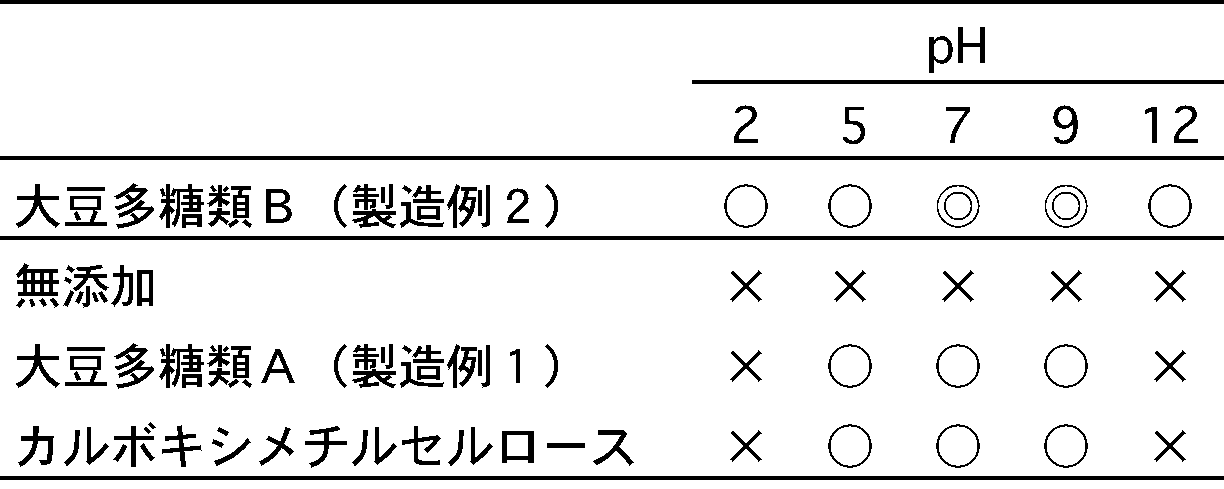 架橋化大豆多糖類は、アルキルベンゼンスルホン酸ナトリウムと併用することでpHに関わらずカーボンブラックの綿ブロードへの付着を抑える効果が認められ、界面活性剤の洗浄効果を低下させないことが判った。その効果は、CMCに勝るものであった。
○実験例4(洗濯用洗浄剤組成物-2)
アルキルベンゼンスルホン酸ナトリウム20部、トリポリリン酸ナトリウム5部に、大豆多糖類A,大豆多糖類B,CMCをそれぞれ表7に示す配合で加え、全量が100部になる様に精製水に分散溶解して洗濯用洗浄剤組成物を調製した。水200gに1重量%になる様に洗浄剤組成物を分散し、カーボンブラックを0.5重量%になるように添加した。この分散液に、実験例3と同様に綿ブロードを用いてカーボンブラックの付着性を検討評価した。
アルキルベンゼンスルホン酸ナトリウム20部、トリポリリン酸ナトリウム5部に、大豆多糖類A,大豆多糖類B,CMCをそれぞれ表7に示す配合で加え、全量が100部になる様に精製水に分散溶解して洗濯用洗浄剤組成物を調製した。水200gに1重量%になる様に洗浄剤組成物を分散し、カーボンブラックを0.5重量%になるように添加した。この分散液に、実験例3と同様に綿ブロードを用いてカーボンブラックの付着性を検討評価した。
○表7(洗濯用洗浄剤組成物・付着抑制効果)
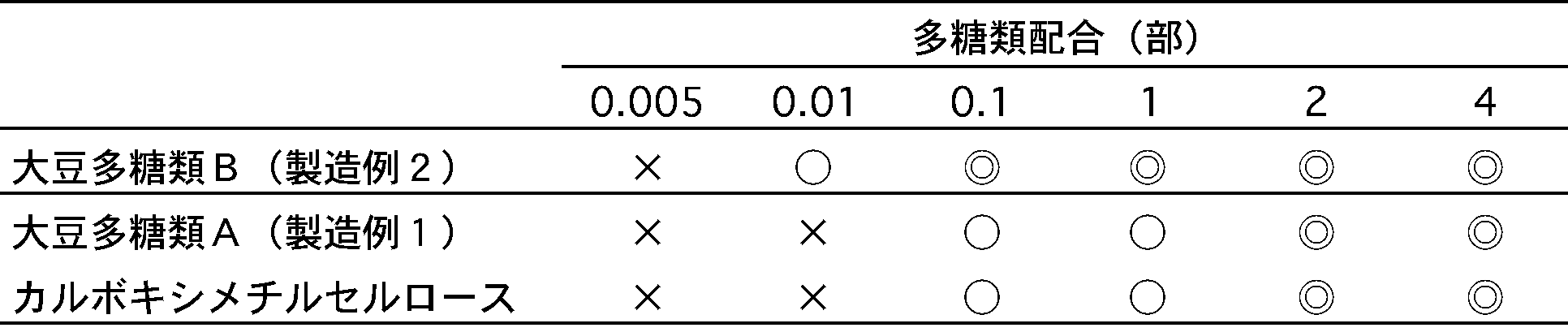 大豆多糖類Bは、系中に0.01重量%以上配合する事でカーボンブラックの綿ブロードへの付着を抑える、界面活性剤の洗浄効果を低下させない効果が認められ、大豆多糖類Aの1/10量で同等以上の機能を発現した。その効果は、CMCにも勝るものであった。
○実施例3(液体洗濯用洗浄剤組成物の具体的配合例と効能)
表6及び表7の結果から明らかな様に、洗濯用洗浄剤組成物に架橋化大豆多糖類を配合する事により、汚れ成分の付着抑制効果が得られる。そこで、実用的な配合に架橋化大豆多糖類を配合し、その効能を評価した。表8に示した配合にて架橋化大豆多糖類を配合した液体洗濯洗浄剤組成物を調製し、汚れの付着抑制効果について検討した。
表6及び表7の結果から明らかな様に、洗濯用洗浄剤組成物に架橋化大豆多糖類を配合する事により、汚れ成分の付着抑制効果が得られる。そこで、実用的な配合に架橋化大豆多糖類を配合し、その効能を評価した。表8に示した配合にて架橋化大豆多糖類を配合した液体洗濯洗浄剤組成物を調製し、汚れの付着抑制効果について検討した。
○表8(液体洗濯用洗浄剤組成物)
 表8に記載の液体洗濯用洗浄剤組成物は、溶液が透明であり、汚れ成分の衣類繊維への付着抑制効果が認められた。
Claims (5)
- 界面活性剤と架橋化大豆多糖類とを含む、洗浄剤組成物。
- 界面活性剤がアニオン界面活性剤を含む、請求項1に記載の洗浄剤組成物。
- 架橋化大豆多糖類が洗浄剤組成物の全重量に対して0.01重量%から15重量%含まれる、請求項1に記載の洗浄剤組成物。
- シャンプー組成物または肌用洗浄剤組成物である、請求項1乃至3に記載の洗浄剤組成物。
- 衣類洗浄剤組成物である、請求項1乃至3に記載の洗浄剤組成物。
Priority Applications (1)
| Application Number | Priority Date | Filing Date | Title |
|---|---|---|---|
| JP2010536678A JP5510334B2 (ja) | 2008-11-06 | 2009-11-02 | 洗浄剤組成物 |
Applications Claiming Priority (2)
| Application Number | Priority Date | Filing Date | Title |
|---|---|---|---|
| JP2008-285861 | 2008-11-06 | ||
| JP2008285861 | 2008-11-06 |
Publications (1)
| Publication Number | Publication Date |
|---|---|
| WO2010052883A1 true WO2010052883A1 (ja) | 2010-05-14 |
Family
ID=42152697
Family Applications (1)
| Application Number | Title | Priority Date | Filing Date |
|---|---|---|---|
| PCT/JP2009/005814 Ceased WO2010052883A1 (ja) | 2008-11-06 | 2009-11-02 | 洗浄剤組成物 |
Country Status (2)
| Country | Link |
|---|---|
| JP (1) | JP5510334B2 (ja) |
| WO (1) | WO2010052883A1 (ja) |
Cited By (3)
| Publication number | Priority date | Publication date | Assignee | Title |
|---|---|---|---|---|
| JP2010136638A (ja) * | 2008-12-10 | 2010-06-24 | Fuji Oil Co Ltd | 食品用物性改良剤 |
| WO2019177168A1 (ja) * | 2018-03-13 | 2019-09-19 | 地方独立行政法人神奈川県立産業技術総合研究所 | 多糖組成物 |
| JP2021054867A (ja) * | 2014-12-12 | 2021-04-08 | ロレアル | 直鎖状アルファ−オレフィンスルホン酸塩、アニオン性界面活性剤並びに非イオン性及び/又は両性界面活性剤を含有する化粧用組成物、並びに美容トリートメント方法 |
Families Citing this family (1)
| Publication number | Priority date | Publication date | Assignee | Title |
|---|---|---|---|---|
| KR102171856B1 (ko) * | 2020-05-06 | 2020-10-30 | 주식회사 블루워시 | 수용성 필름을 이용한 분말형 간편세제 |
Citations (7)
| Publication number | Priority date | Publication date | Assignee | Title |
|---|---|---|---|---|
| JPH0358770A (ja) * | 1988-10-07 | 1991-03-13 | Ajinomoto Co Inc | 水性ペースト状組成物及びその製造法 |
| JPH05194987A (ja) * | 1992-01-22 | 1993-08-03 | Kawaken Fine Chem Co Ltd | 液体洗浄剤組成物 |
| JPH05194158A (ja) * | 1992-01-22 | 1993-08-03 | Kawaken Fine Chem Co Ltd | シャンプー組成物 |
| JPH05230101A (ja) * | 1992-02-24 | 1993-09-07 | Fuji Oil Co Ltd | 水溶性多糖類の水不溶化法 |
| JPH06209716A (ja) * | 1993-01-14 | 1994-08-02 | Ajinomoto Co Inc | 大豆カゼイン架橋混合蛋白の製造法 |
| JP2003261598A (ja) * | 2002-03-05 | 2003-09-19 | Dainippon Ink & Chem Inc | 変性大豆蛋白質、その製造方法及びそれを用いた成形品 |
| WO2008149738A1 (ja) * | 2007-06-06 | 2008-12-11 | Fuji Oil Company, Limited | 水溶性多糖類の製造法 |
-
2009
- 2009-11-02 JP JP2010536678A patent/JP5510334B2/ja not_active Expired - Fee Related
- 2009-11-02 WO PCT/JP2009/005814 patent/WO2010052883A1/ja not_active Ceased
Patent Citations (7)
| Publication number | Priority date | Publication date | Assignee | Title |
|---|---|---|---|---|
| JPH0358770A (ja) * | 1988-10-07 | 1991-03-13 | Ajinomoto Co Inc | 水性ペースト状組成物及びその製造法 |
| JPH05194987A (ja) * | 1992-01-22 | 1993-08-03 | Kawaken Fine Chem Co Ltd | 液体洗浄剤組成物 |
| JPH05194158A (ja) * | 1992-01-22 | 1993-08-03 | Kawaken Fine Chem Co Ltd | シャンプー組成物 |
| JPH05230101A (ja) * | 1992-02-24 | 1993-09-07 | Fuji Oil Co Ltd | 水溶性多糖類の水不溶化法 |
| JPH06209716A (ja) * | 1993-01-14 | 1994-08-02 | Ajinomoto Co Inc | 大豆カゼイン架橋混合蛋白の製造法 |
| JP2003261598A (ja) * | 2002-03-05 | 2003-09-19 | Dainippon Ink & Chem Inc | 変性大豆蛋白質、その製造方法及びそれを用いた成形品 |
| WO2008149738A1 (ja) * | 2007-06-06 | 2008-12-11 | Fuji Oil Company, Limited | 水溶性多糖類の製造法 |
Cited By (3)
| Publication number | Priority date | Publication date | Assignee | Title |
|---|---|---|---|---|
| JP2010136638A (ja) * | 2008-12-10 | 2010-06-24 | Fuji Oil Co Ltd | 食品用物性改良剤 |
| JP2021054867A (ja) * | 2014-12-12 | 2021-04-08 | ロレアル | 直鎖状アルファ−オレフィンスルホン酸塩、アニオン性界面活性剤並びに非イオン性及び/又は両性界面活性剤を含有する化粧用組成物、並びに美容トリートメント方法 |
| WO2019177168A1 (ja) * | 2018-03-13 | 2019-09-19 | 地方独立行政法人神奈川県立産業技術総合研究所 | 多糖組成物 |
Also Published As
| Publication number | Publication date |
|---|---|
| JP5510334B2 (ja) | 2014-06-04 |
| JPWO2010052883A1 (ja) | 2012-04-05 |
Similar Documents
| Publication | Publication Date | Title |
|---|---|---|
| JP7234134B2 (ja) | 組成物 | |
| JP7116035B2 (ja) | 両親媒性多糖誘導体及びそれを含む組成物 | |
| CN112646669A (zh) | 一种含有生物蛋白酶的洗护合一洗衣液 | |
| JP5510334B2 (ja) | 洗浄剤組成物 | |
| JP6490929B2 (ja) | 繊維製品用の液体洗浄剤 | |
| JP2008247925A (ja) | 可溶化ケラチンの製造方法 | |
| KR20200125543A (ko) | 액체 세제 조성물 | |
| EP1257599B1 (fr) | Utilisation de compositions a base de proteines, de polysaccharides et de derives d'oxyde d'ethylene comme surfactants | |
| JPWO2010055664A1 (ja) | 洗浄剤組成物 | |
| JP2837360B2 (ja) | 洗浄剤組成物 | |
| WO2020250931A1 (ja) | 組成物 | |
| TWI679026B (zh) | 皮膚洗淨用組成物 | |
| JPWO2004029190A1 (ja) | 新規な界面活性剤およびその用途 | |
| EP3578630B1 (en) | Liquid detergent composition | |
| CN102181330B (zh) | 一种生物清洁剂及其制备方法 | |
| JP3209777B2 (ja) | 液体洗浄剤組成物 | |
| US9169457B2 (en) | Washing or cleaning agent with cellulose or a cellulose derivative | |
| DE102016208408A1 (de) | Wasch- oder Reinigungsmittel enthaltend eine Polyethylenterephthalat Hydrolase | |
| CN115725372B (zh) | 一种具有柔顺功能的液体洗涤剂 | |
| CN121930924A (zh) | 一种包含辛基磺酸钠的泥斑清洁组合物及其制作方法 | |
| CN108624890A (zh) | 一种用于金属抛光工件的除蜡水及其制备方法 | |
| KR102160437B1 (ko) | 해조류 추출물과 이온수를 포함하는 세정제의 제조방법 | |
| JP3121657B2 (ja) | シャンプー組成物 | |
| CN109385639A (zh) | 一种用于金属工件的除蜡水及其制备方法 | |
| CN119799424A (zh) | 一种高效杀菌温和洗衣液及其制备方法 |
Legal Events
| Date | Code | Title | Description |
|---|---|---|---|
| 121 | Ep: the epo has been informed by wipo that ep was designated in this application |
Ref document number: 09824584 Country of ref document: EP Kind code of ref document: A1 |
|
| ENP | Entry into the national phase |
Ref document number: 2010536678 Country of ref document: JP Kind code of ref document: A |
|
| NENP | Non-entry into the national phase |
Ref country code: DE |
|
| 122 | Ep: pct application non-entry in european phase |
Ref document number: 09824584 Country of ref document: EP Kind code of ref document: A1 |