WO2010002217A2 - 페하 민감성 금속 나노 입자 및 이의 제조 방법 - Google Patents
페하 민감성 금속 나노 입자 및 이의 제조 방법 Download PDFInfo
- Publication number
- WO2010002217A2 WO2010002217A2 PCT/KR2009/003640 KR2009003640W WO2010002217A2 WO 2010002217 A2 WO2010002217 A2 WO 2010002217A2 KR 2009003640 W KR2009003640 W KR 2009003640W WO 2010002217 A2 WO2010002217 A2 WO 2010002217A2
- Authority
- WO
- WIPO (PCT)
- Prior art keywords
- compound
- sensitive
- metal
- metal nanoparticles
- nanoparticles
- Prior art date
- Legal status (The legal status is an assumption and is not a legal conclusion. Google has not performed a legal analysis and makes no representation as to the accuracy of the status listed.)
- Ceased
Links
- SZCPGHVRUWNIII-OUKQBFOZSA-N CCCCC(CCCCC(NCCNC(/C=C(\C)/C(O)=O)=O)=O)S Chemical compound CCCCC(CCCCC(NCCNC(/C=C(\C)/C(O)=O)=O)=O)S SZCPGHVRUWNIII-OUKQBFOZSA-N 0.000 description 1
Images


Classifications
-
- B—PERFORMING OPERATIONS; TRANSPORTING
- B82—NANOTECHNOLOGY
- B82B—NANOSTRUCTURES FORMED BY MANIPULATION OF INDIVIDUAL ATOMS, MOLECULES, OR LIMITED COLLECTIONS OF ATOMS OR MOLECULES AS DISCRETE UNITS; MANUFACTURE OR TREATMENT THEREOF
- B82B3/00—Manufacture or treatment of nanostructures by manipulation of individual atoms or molecules, or limited collections of atoms or molecules as discrete units
-
- C—CHEMISTRY; METALLURGY
- C12—BIOCHEMISTRY; BEER; SPIRITS; WINE; VINEGAR; MICROBIOLOGY; ENZYMOLOGY; MUTATION OR GENETIC ENGINEERING
- C12N—MICROORGANISMS OR ENZYMES; COMPOSITIONS THEREOF; PROPAGATING, PRESERVING, OR MAINTAINING MICROORGANISMS; MUTATION OR GENETIC ENGINEERING; CULTURE MEDIA
- C12N5/00—Undifferentiated human, animal or plant cells, e.g. cell lines; Tissues; Cultivation or maintenance thereof; Culture media therefor
- C12N5/0081—Purging biological preparations of unwanted cells
- C12N5/0093—Purging against cancer cells
-
- A—HUMAN NECESSITIES
- A61—MEDICAL OR VETERINARY SCIENCE; HYGIENE
- A61K—PREPARATIONS FOR MEDICAL, DENTAL OR TOILETRY PURPOSES
- A61K41/00—Medicinal preparations obtained by treating materials with wave energy or particle radiation ; Therapies using these preparations
- A61K41/0052—Thermotherapy; Hyperthermia; Magnetic induction; Induction heating therapy
-
- A—HUMAN NECESSITIES
- A61—MEDICAL OR VETERINARY SCIENCE; HYGIENE
- A61K—PREPARATIONS FOR MEDICAL, DENTAL OR TOILETRY PURPOSES
- A61K47/00—Medicinal preparations characterised by the non-active ingredients used, e.g. carriers or inert additives; Targeting or modifying agents chemically bound to the active ingredient
- A61K47/50—Medicinal preparations characterised by the non-active ingredients used, e.g. carriers or inert additives; Targeting or modifying agents chemically bound to the active ingredient the non-active ingredient being chemically bound to the active ingredient, e.g. polymer-drug conjugates
- A61K47/51—Medicinal preparations characterised by the non-active ingredients used, e.g. carriers or inert additives; Targeting or modifying agents chemically bound to the active ingredient the non-active ingredient being chemically bound to the active ingredient, e.g. polymer-drug conjugates the non-active ingredient being a modifying agent
- A61K47/54—Medicinal preparations characterised by the non-active ingredients used, e.g. carriers or inert additives; Targeting or modifying agents chemically bound to the active ingredient the non-active ingredient being chemically bound to the active ingredient, e.g. polymer-drug conjugates the non-active ingredient being a modifying agent the modifying agent being an organic compound
- A61K47/555—Medicinal preparations characterised by the non-active ingredients used, e.g. carriers or inert additives; Targeting or modifying agents chemically bound to the active ingredient the non-active ingredient being chemically bound to the active ingredient, e.g. polymer-drug conjugates the non-active ingredient being a modifying agent the modifying agent being an organic compound pre-targeting systems involving an organic compound, other than a peptide, protein or antibody, for targeting specific cells
-
- A—HUMAN NECESSITIES
- A61—MEDICAL OR VETERINARY SCIENCE; HYGIENE
- A61K—PREPARATIONS FOR MEDICAL, DENTAL OR TOILETRY PURPOSES
- A61K49/00—Preparations for testing in vivo
- A61K49/001—Preparation for luminescence or biological staining
- A61K49/0063—Preparation for luminescence or biological staining characterised by a special physical or galenical form, e.g. emulsions, microspheres
- A61K49/0065—Preparation for luminescence or biological staining characterised by a special physical or galenical form, e.g. emulsions, microspheres the luminescent/fluorescent agent having itself a special physical form, e.g. gold nanoparticle
-
- A—HUMAN NECESSITIES
- A61—MEDICAL OR VETERINARY SCIENCE; HYGIENE
- A61K—PREPARATIONS FOR MEDICAL, DENTAL OR TOILETRY PURPOSES
- A61K51/00—Preparations containing radioactive substances for use in therapy or testing in vivo
- A61K51/02—Preparations containing radioactive substances for use in therapy or testing in vivo characterised by the carrier, i.e. characterised by the agent or material covalently linked or complexing the radioactive nucleus
- A61K51/04—Organic compounds
- A61K51/0402—Organic compounds carboxylic acid carriers, fatty acids
-
- A—HUMAN NECESSITIES
- A61—MEDICAL OR VETERINARY SCIENCE; HYGIENE
- A61N—ELECTROTHERAPY; MAGNETOTHERAPY; RADIATION THERAPY; ULTRASOUND THERAPY
- A61N5/00—Radiation therapy
- A61N5/06—Radiation therapy using light
- A61N5/0613—Apparatus adapted for a specific treatment
- A61N5/062—Photodynamic therapy, i.e. excitation of an agent
-
- A—HUMAN NECESSITIES
- A61—MEDICAL OR VETERINARY SCIENCE; HYGIENE
- A61P—SPECIFIC THERAPEUTIC ACTIVITY OF CHEMICAL COMPOUNDS OR MEDICINAL PREPARATIONS
- A61P35/00—Antineoplastic agents
-
- C—CHEMISTRY; METALLURGY
- C12—BIOCHEMISTRY; BEER; SPIRITS; WINE; VINEGAR; MICROBIOLOGY; ENZYMOLOGY; MUTATION OR GENETIC ENGINEERING
- C12N—MICROORGANISMS OR ENZYMES; COMPOSITIONS THEREOF; PROPAGATING, PRESERVING, OR MAINTAINING MICROORGANISMS; MUTATION OR GENETIC ENGINEERING; CULTURE MEDIA
- C12N13/00—Treatment of microorganisms or enzymes with electrical or wave energy, e.g. magnetism, sonic waves
-
- A—HUMAN NECESSITIES
- A61—MEDICAL OR VETERINARY SCIENCE; HYGIENE
- A61B—DIAGNOSIS; SURGERY; IDENTIFICATION
- A61B2562/00—Details of sensors; Constructional details of sensor housings or probes; Accessories for sensors
- A61B2562/02—Details of sensors specially adapted for in-vivo measurements
- A61B2562/0285—Nanoscale sensors
-
- A—HUMAN NECESSITIES
- A61—MEDICAL OR VETERINARY SCIENCE; HYGIENE
- A61K—PREPARATIONS FOR MEDICAL, DENTAL OR TOILETRY PURPOSES
- A61K51/00—Preparations containing radioactive substances for use in therapy or testing in vivo
- A61K51/12—Preparations containing radioactive substances for use in therapy or testing in vivo characterised by a special physical form, e.g. emulsion, microcapsules, liposomes, characterized by a special physical form, e.g. emulsions, dispersions, microcapsules
- A61K51/1241—Preparations containing radioactive substances for use in therapy or testing in vivo characterised by a special physical form, e.g. emulsion, microcapsules, liposomes, characterized by a special physical form, e.g. emulsions, dispersions, microcapsules particles, powders, lyophilizates, adsorbates, e.g. polymers or resins for adsorption or ion-exchange resins
- A61K51/1255—Granulates, agglomerates, microspheres
-
- A—HUMAN NECESSITIES
- A61—MEDICAL OR VETERINARY SCIENCE; HYGIENE
- A61N—ELECTROTHERAPY; MAGNETOTHERAPY; RADIATION THERAPY; ULTRASOUND THERAPY
- A61N5/00—Radiation therapy
- A61N5/06—Radiation therapy using light
- A61N2005/0658—Radiation therapy using light characterised by the wavelength of light used
- A61N2005/0659—Radiation therapy using light characterised by the wavelength of light used infrared
-
- A—HUMAN NECESSITIES
- A61—MEDICAL OR VETERINARY SCIENCE; HYGIENE
- A61N—ELECTROTHERAPY; MAGNETOTHERAPY; RADIATION THERAPY; ULTRASOUND THERAPY
- A61N5/00—Radiation therapy
- A61N5/06—Radiation therapy using light
- A61N2005/0658—Radiation therapy using light characterised by the wavelength of light used
- A61N2005/0662—Visible light
- A61N2005/0663—Coloured light
-
- A—HUMAN NECESSITIES
- A61—MEDICAL OR VETERINARY SCIENCE; HYGIENE
- A61N—ELECTROTHERAPY; MAGNETOTHERAPY; RADIATION THERAPY; ULTRASOUND THERAPY
- A61N5/00—Radiation therapy
- A61N5/06—Radiation therapy using light
- A61N5/067—Radiation therapy using light using laser light
-
- B—PERFORMING OPERATIONS; TRANSPORTING
- B82—NANOTECHNOLOGY
- B82Y—SPECIFIC USES OR APPLICATIONS OF NANOSTRUCTURES; MEASUREMENT OR ANALYSIS OF NANOSTRUCTURES; MANUFACTURE OR TREATMENT OF NANOSTRUCTURES
- B82Y40/00—Manufacture or treatment of nanostructures
-
- B—PERFORMING OPERATIONS; TRANSPORTING
- B82—NANOTECHNOLOGY
- B82Y—SPECIFIC USES OR APPLICATIONS OF NANOSTRUCTURES; MEASUREMENT OR ANALYSIS OF NANOSTRUCTURES; MANUFACTURE OR TREATMENT OF NANOSTRUCTURES
- B82Y5/00—Nanobiotechnology or nanomedicine, e.g. protein engineering or drug delivery
Definitions
- the present invention relates to pH-sensitive particles and a method and use thereof, and more particularly, to provide a pH-sensitive metal nanoparticles, a method for producing the same and a therapeutic use through apoptosis through photothermal treatment.
- the surrounding environment of abnormal cells such as cancer cells
- the surrounding environment of abnormal cells is known to exhibit weak acidity at pH 6.0 to 7.2, unlike the pH environment in the body showing pH 7.2-7.4.
- Methods to treat cancer by using the characteristics of these cancer cells are being studied.
- the copolymer is formed by copolymerizing a biodegradable poly ( ⁇ -amino ester) compound having a pH sensitivity and a hydrophilic polyethylene glycol-based compound, It is disclosed a method of forming a micelle structure through ionization characteristics varying with pH and delivering a drug to cancer cells in a targeted manner according to pH changes in the body, thereby killing cancer cells.
- WO 2002/20510 discloses acid sensitive compounds and salts thereof comprising acid sensitive cyclic ortho-esters and one or more hydrophilic substituents.
- the compound forms conjugates with the therapeutic molecule (liposomes, complexes, nanoparticles, etc.) and then releases the therapeutic molecule into cellular tissues or regions with acidic pH.
- Metal nanoparticles have unique optical properties due to their unique surface plasmon properties.
- Surface plasmon refers to a phenomenon in which electrons on a metal surface vibrate collectively due to resonance of electromagnetic energy of a specific energy of light when light is incident between the surface of a metal nanoparticle, which is a conductor, and a dielectric such as air and water. This interaction between light and metal nanoparticles is so strong that the absorption coefficient at resonance frequencies is much greater than that of conventional organic dyes.
- the resonant frequency varies depending on the size, shape, and dispersed solvent of the particles, efforts are being made to make metal nanoparticles having various sizes, shapes, and surface characteristics, and apply them to optical sensors or light collecting devices.
- Photothermal therapy is a treatment method that attacks cancer cells by converting light energy into heat energy.
- Light focused on the surface of the gold nanoparticles is emitted through various paths, among which electron-lattice vibration and electron-electron scattering are heat emission processes.
- the thermal energy released locally may be sufficient energy to kill cells due to the excellent light condensing effect of the gold nanoparticles and the large volume to surface area.
- cancer cells generally have weaker heat than normal cells, so controlling the amount of light focused on the gold nanoparticles allows local cells to be treated selectively without damaging normal cells.
- Republic of Korea Patent Application No. 102604 2006 discloses a particle formed with a gold coating layer containing the magnetic particles in the silica particles of 50-500 nm size, the cancer cell target-oriented ligand is formed.
- cancer-targeted ligand binds to cancer cells
- magnetic resonance images can be obtained by diagnosing cancer or using magnetism of magnetic material, and also using heat emitted by gold nano-shells that absorb energy by radiating electromagnetic pulses in the near infrared region. Only cancer cells selectively necrosis cancer.
- this method has a problem of developing efficient biological ligands capable of recognizing specific cancer cells and conjugating them to metals.
- Another object of the present invention is to provide a pH sensitive metal nanoparticles.
- Another object of the present invention is to provide a method for producing pH sensitive metal nanoparticles.
- Another object of the present invention is to provide new pH sensitive compounds.
- Yet another object of the present invention is to provide a use of pH sensitive particles as a sensor.
- PH-sensitive metal nanoparticles according to the invention is characterized in that the surface is formed a compound whose charge is changed according to pH.
- the metal nanoparticles may be metal particles or particles coated with a metal on a material such as silica.
- the metal may be a single metal or an alloy, and a material to which a compound whose charge is changed depending on pH may be attached.
- the metal is a gold particle.
- the compound formed on the surface of the metal nanoparticles is a structure in which the charge of the compound is changed according to pH, and may bind to the metal atoms exposed on the surface of the metal particles in the form of ligand.
- the compound is preferably a compound in which the charge of the compound is changed based on pH 7.0.
- the compound may change the charge from negative charge to positive charge when the pH is changed from basic or neutral to acidic.
- the compound may be represented by the following formula (I).
- the present invention comprises a method for producing a pH-sensitive metal nanoparticles by attaching a compound whose charge is changed depending on pH on the surface of the metal nanoparticles.
- the metal nanoparticles may be used in a variety of products that can be attached to a compound that changes the charge depending on pH, in one embodiment of the invention, the metal particles may be combined with a sulfur atom contained in the compound Gold particles or gold coated particles.
- the compound whose charge is changed according to pH may be represented by the following formula (I).
- the compound whose charge is changed according to the pH may be attached in the form of substituting other compounds attached to the surface of the metal nanoparticles, for example, citrate attached to the surface to stabilize the gold nanoparticles. .
- the photothermal treatment method according to the present invention is characterized in that the pH-sensitive metal nanoparticles are added and aggregated, and the abnormal cells are killed by irradiating the aggregated metal nanoparticles with light.
- the abnormal cells are cells showing an abnormal pH environment, for example, cancer cells showing an acidic pH environment.
- the pH-sensitive metal nanoparticles preferably use a metal capable of killing cells through photothermal action by receiving light irradiated from outside the cell.
- Conventional metals used for photothermal therapy can be used, and are preferably gold particles.
- the metal nanoparticles are preferably used in a size that can penetrate into abnormal cells.
- the diameter of the metal nanoparticles is 20 nm or less, more preferably about 5-15 nm in size.
- the metal nanoparticles approach and / or penetrate abnormal cells, aggregate in an acidic pH environment, and the cells are killed by performing photothermal treatment in a state in which discharge to the outside of the cells is suppressed.
- the metal nanoparticles are pH sensitive particles to sense and aggregate low pH of abnormal cells such as cancer cells.
- the metal nanoparticles may be in the form of a compound formed on the surface that can aggregate in an acidic pH environment.
- the metal nanoparticles are charged when the compound is changed from basic pH to acidic pH, the compound formed on the surface undergoes a reaction such as hydrolysis.
- a reaction such as hydrolysis.
- the absorption wavelength becomes longer. Therefore, in the case of using long wavelength light such as infrared light having good transmittance, it is possible to heat the metal nanoparticles aggregated not only in the skin or subcutaneous region but also in the body or organ. Therefore, photothermal treatment is possible regardless of the site of cancer cells, and the range of photothermal treatment is greatly increased.
- the present invention consists of a pH-sensitive compound consisting of the formula (I).
- the present invention comprises the steps of preparing a compound of formula (II) by reacting lipoic acid and ethylenediamine;
- the pH-sensitive particles according to the present invention are aggregated only in cells having an abnormal pH such as cancer cells, and absorb light of long wavelength, and thus can be used in various applications using these properties.
- the pH-sensitive particles according to the present invention can be used in applications such as cancer diagnostic reagents, contrast agents, cancer treatment agents, photosensitizers.
- the pH-sensitive nanoparticles when attached to the surface of the sensor, it can be used as a sensor for measuring the change in pH.
- the present invention provides agglomerated aggregates of 5-20 nm gold nanoparticles that absorb infrared light.
- the aggregates are in the form of clusters, the diameter of the clusters being 0.1-10 microns, preferably 1-3 microns.
- the present invention relates to a method of generating heat by absorbing infrared light into aggregated gold nanoparticles.
- the pH-sensitive gold nanoparticles according to the present invention are well dispersed in neutral or basic conditions and absorb only a wavelength band of 600 nm or less. However, under acidic conditions, the surface charge of the nanoparticles is changed and in this process, aggregation with adjacent nanoparticles occurs due to electrostatic attraction. The nanoparticle aggregates thus formed are transferred to the long wavelength band of the visible light and the infrared band of 600 nm or more due to the characteristics of the surface plasmon.
- administering results in site-specific aggregation of cancer tissues by specific acidic environment of cancer tissues. Can be formed.
- the nanoparticles introduced into the cancer cells are induced to form agglomerates rapidly in a portion that may have an acidic pH in the cell, such as an endosome. As the aggregates are formed in the cells, it is expected that the efficiency of chemotherapy will be increased by inhibiting exocytosis and inhibiting the release of pH-sensitive gold nanoparticles induced into cancer cells.
- the greatest advantage of cancer photothermal therapy with pH-sensitive gold nanoparticles is that the pH-sensitive gold nanoparticles are aggregated as they are induced in cancer cells in cancer tissues, and the absorption wavelength band of the aggregates shifts to the long wavelength band due to the characteristics of the surface plasmon. . Therefore, it is possible to use a long wavelength light source that is excellent in tissue transmittance and can be applied to cancer tissues deep in the skin.
- the limitation of the conventional chemotherapy using light is that the wavelength of the photosensitive agent reacts is relatively short, and thus its application is limited to cancer that does not require relatively good tissue transmittance such as skin cancer.
- the pH sensitive gold nanoparticles of the present example can overcome this limitation.
- the present invention provides metal nanoparticles having an average diameter of 1-500 nanometers, comprising a pH sensitive compound, and agglomerating at an acidic pH.
- the pH sensitive compound may be a known pH sensitive polymer and / or low molecular weight compound, the compound may be coated, for example spray coating, substitution, for example ligand substitution, or mixed, for example with a metal powder It can be introduced into the metal particles through a known method such as mixing of the compound powder, and can be used without limitation as long as the pH sensitive compound can be introduced to agglomerate the metal particles at an acidic pH.
- pH sensitive metal nanoparticles and a method of manufacturing the same have been provided.
- the pH sensitive particles according to the invention can be aggregated in cells with abnormal pH, providing a variety of uses as therapeutics and diagnostics.
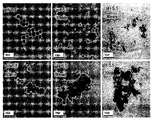
- pH sensitive gold nanoparticles 1 is a transmission electron micrograph of pH sensitive gold nanoparticles according to the present invention.
- PH sensitive gold nanoparticles dispersed in aqueous solution at pH 7.3 (clockwise from top left), pH sensitive gold nanoparticles after 10, 30, 120, 90 and 60 minutes respectively Particles.
- Size bars are 50 nm for pH 7.3 and 500 nm for pH 5.5
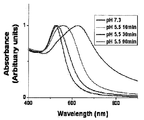
- pH-sensitive gold nanoparticles according to the present invention pH-sensitive gold nanoparticles according to the pH and time.
- Black is the absorbance spectrum result measured after 24 hours of dispersion under pH 7.3 conditions, and blue, green, and red were measured after 10 minutes, 30 minutes, and 90 minutes of dispersion in acetate buffer solution of pH 5.5, respectively. Absorption Spectrum.
- Figure 3 is a dark field micrograph observed after capturing the pH-sensitive gold nanoparticles according to the present invention in cervical cancer cells. It is labeled red by gold nanoparticles that form aggregates in cells.
- Figure 4 is an optical micrograph of the cervical cancer cells experimental group (left row) and the comparison group (right row) cultured with pH sensitive gold nanoparticles according to the present invention.
- Lipoic acid (1) is dissolved in anhydrous chloroform, and then added to 1.3 equivalents of carbonyldiimidazole at room temperature and in a vacuum environment, followed by stirring for 5 minutes and remaining carbonyldiimidazole.
- the reaction solution layer is separated.
- Ethylenediamine, equivalent to 5 equivalents of lipoic acid is dissolved in N-hydrous chloroform in a nitrogen environment, and then stirred for 1 hour by adding the above solution while lowering the temperature in an ice bath (ice bath).
- Silver (2) the reaction solution was purified by extraction 3 times with 10% NaCl aqueous solution and 1 time with tertiary distilled water and stirred for 24 hours at room temperature by addition of citraconic anhydride. The solid is filtered.
- the resultant is (3).
- the solid is dissolved in an aqueous solution adjusted to pH 9 using 2N NaOH, and then 1 equivalent of NaBH4 is added thereto, followed by stirring at room temperature for 4 hours.
- the synthesized pH sensitive ligand (4) was used directly without purification.
- the prepared compound (4) is hydrolyzed under acidic conditions and amide is decomposed to produce primary amine and citraconic acid through the following route, and the produced primary amine is positively charged under acidic conditions.
- HAuCl 4 a precursor of gold, was dissolved in distilled water, heated and stirred at 120 ° C. for 30 minutes, and trisodium citrate was added thereto, followed by further heating and stirring at 120 ° C. for 2 hours. At this time, trisodium citrate acts as a reducing agent and a surface ligand, and it can be seen that gold nanoparticles were formed by changing the color of the solution from yellow to red within several minutes. After stirring at room temperature to cool. ( Ind. Eng. Chem. Res. 2007, 46, 3128-3136 )
- Gold nanoparticles stabilized with citrate were added to an aqueous solution dissolved in excess of the synthesized pH sensitive ligand and stirred at room temperature for 8 hours.
- Citrate is ligand exchanged to pH sensitive ligand because one functional group of pH sensitive ligand has dithiol, which has stronger surface binding ability with gold nanoparticles than citrate which is a carboxylic acid functional group. It is then dialyzed to remove excess ligand.
- pH sensitive gold nanoparticles were dispersed in pH 7.3 and pH 5.5 aqueous solutions, respectively, and after 10 minutes, 30 minutes, 120 minutes, 90 minutes, and 60 minutes, respectively, the pH-sensitive gold nanoparticles were determined by transmission electron microscopy. The aggregation of was observed. The results are shown in FIG. As shown in FIG. 1, the formation of aggregates was observed directly at pH 5.5 acidic conditions. pH sensitive gold nanoparticles are well dispersed into nanoparticles with an average size of 15 nm at pH 7.3 regardless of elapsed time. By changing the pH-sensitive gold nanoparticles aqueous solution to pH 5.5 conditions, it can be seen that as the aggregate forms over time, the aggregate size gradually increases to several ⁇ m.
- the synthesized pH-sensitive gold nanoparticles were measured by monitoring the absorption spectrum over time after exposure to a pH 7.3 environment similar to normal cells and a pH 5.5 environment similar to surrounding cancer cells. After dispersing at pH 7.3 conditions, the absorbance spectrum was measured at 24 hours, and then dispersed in an acetate buffer solution of pH 5.5, and the absorbance spectrum was measured after 10 minutes, 30 minutes, and 90 minutes, respectively, and is shown in FIG. 2.
- pH sensitive gold nanoparticles strongly absorb only light in the visible region below 600 nm at pH 7.3, a common biological environment, but as the pH is adjusted to 5.5, the absorption wavelength gradually shifts to longer wavelengths, resulting in a red-near-infrared region. You can see that it absorbs light. This is because the hydrolysis of the surface ligands of the pH-sensitive gold nanoparticles causes the particles to combine with electrostatic attraction to form aggregates in the process of changing the charge from the negative charge to the positive charge.
- pH-sensitive gold nanoparticles around normal cells absorb only light in the visible region below 600 nm.
- pH-sensitive gold nanoparticles around cancer cells in an acidic environment, such as pH 5.5 form aggregates and absorb light in the red-infrared region.
- Light in the red-infrared region has the advantage of increasing the light-heating effect due to the high permeability of the body due to the small amount of absorption and scattering by biological materials such as skin and blood as well as the selective light-heat treatment for cancer cells.
- Cervical cancer cells were treated with pH-sensitive gold nanoparticles and photographed with a dark field microscope. The photograph taken is shown in FIG. 3. As the aggregate forms, the absorption wavelength is shifted to a longer wavelength and absorbs light in the red-near-infrared region.
- pH-sensitive gold nanoparticles When pH-sensitive gold nanoparticles accumulate in endosome through entrapment and enter into cells, the pH-sensitive gold nanoparticles form aggregates because the endosomes are exposed to an acidic environment as they turn into lysosomes.
Landscapes
- Health & Medical Sciences (AREA)
- Life Sciences & Earth Sciences (AREA)
- Chemical & Material Sciences (AREA)
- Engineering & Computer Science (AREA)
- General Health & Medical Sciences (AREA)
- Animal Behavior & Ethology (AREA)
- Veterinary Medicine (AREA)
- Public Health (AREA)
- Biomedical Technology (AREA)
- Bioinformatics & Cheminformatics (AREA)
- Epidemiology (AREA)
- Pharmacology & Pharmacy (AREA)
- Medicinal Chemistry (AREA)
- Organic Chemistry (AREA)
- Genetics & Genomics (AREA)
- Zoology (AREA)
- Wood Science & Technology (AREA)
- Biotechnology (AREA)
- Molecular Biology (AREA)
- General Engineering & Computer Science (AREA)
- Biochemistry (AREA)
- Microbiology (AREA)
- Nuclear Medicine, Radiotherapy & Molecular Imaging (AREA)
- Crystallography & Structural Chemistry (AREA)
- Immunology (AREA)
- Nanotechnology (AREA)
- Biophysics (AREA)
- Inorganic Chemistry (AREA)
- Cell Biology (AREA)
- Proteomics, Peptides & Aminoacids (AREA)
- Physics & Mathematics (AREA)
- Optics & Photonics (AREA)
- Oncology (AREA)
- Pathology (AREA)
- Radiology & Medical Imaging (AREA)
- Chemical Kinetics & Catalysis (AREA)
- Manufacturing & Machinery (AREA)
- General Chemical & Material Sciences (AREA)
- Medicinal Preparation (AREA)
- Pharmaceuticals Containing Other Organic And Inorganic Compounds (AREA)
Priority Applications (5)
| Application Number | Priority Date | Filing Date | Title |
|---|---|---|---|
| JP2011516156A JP5577329B2 (ja) | 2008-07-03 | 2009-07-03 | pH感受性金属ナノ粒子およびその製造方法 |
| US13/002,476 US9616122B2 (en) | 2008-07-03 | 2009-07-03 | PH sensitive metal nanoparticle and preparation method |
| EP09773753.0A EP2308799B1 (en) | 2008-07-03 | 2009-07-03 | Ph sensitive metal nanoparticle and preparation method |
| CN200980125951.9A CN102083741B (zh) | 2008-07-03 | 2009-07-03 | pH敏感性金属纳米粒子及其制造方法 |
| US15/438,698 US20170226474A1 (en) | 2008-07-03 | 2017-02-21 | Ph sensitive metal and nanoparticle and preparation method |
Applications Claiming Priority (2)
| Application Number | Priority Date | Filing Date | Title |
|---|---|---|---|
| KR1020080064270A KR101014246B1 (ko) | 2008-07-03 | 2008-07-03 | 페하 민감성 금속 나노 입자 및 이의 제조 방법. |
| KR10-2008-0064270 | 2008-07-03 |
Related Child Applications (2)
| Application Number | Title | Priority Date | Filing Date |
|---|---|---|---|
| US13/002,476 A-371-Of-International US9616122B2 (en) | 2008-07-03 | 2009-07-03 | PH sensitive metal nanoparticle and preparation method |
| US15/438,698 Division US20170226474A1 (en) | 2008-07-03 | 2017-02-21 | Ph sensitive metal and nanoparticle and preparation method |
Publications (2)
| Publication Number | Publication Date |
|---|---|
| WO2010002217A2 true WO2010002217A2 (ko) | 2010-01-07 |
| WO2010002217A3 WO2010002217A3 (ko) | 2010-06-24 |
Family
ID=41466491
Family Applications (1)
| Application Number | Title | Priority Date | Filing Date |
|---|---|---|---|
| PCT/KR2009/003640 Ceased WO2010002217A2 (ko) | 2008-07-03 | 2009-07-03 | 페하 민감성 금속 나노 입자 및 이의 제조 방법 |
Country Status (6)
| Country | Link |
|---|---|
| US (2) | US9616122B2 (https=) |
| EP (1) | EP2308799B1 (https=) |
| JP (1) | JP5577329B2 (https=) |
| KR (1) | KR101014246B1 (https=) |
| CN (1) | CN102083741B (https=) |
| WO (1) | WO2010002217A2 (https=) |
Cited By (4)
| Publication number | Priority date | Publication date | Assignee | Title |
|---|---|---|---|---|
| WO2011129549A3 (ko) * | 2010-04-15 | 2012-02-02 | 포항공과대학교 산학협력단 | Ph 민감성 금속 나노 입자를 이용한 항암제 전달 시스템 |
| US20130189367A1 (en) * | 2011-07-29 | 2013-07-25 | University Of Washington Through Its Center For Commercialization | Nanovectors for targeted gene silencing and cytotoxic effect in cancer cells |
| JP2014505657A (ja) * | 2010-10-29 | 2014-03-06 | ポステック アカデミー−インダストリー ファンデーション | 両性イオンを有するナノ粒子表面改質用分子篩の合成とその応用 |
| US9784730B2 (en) | 2013-03-21 | 2017-10-10 | University Of Washington Through Its Center For Commercialization | Nanoparticle for targeting brain tumors and delivery of O6-benzylguanine |
Families Citing this family (10)
| Publication number | Priority date | Publication date | Assignee | Title |
|---|---|---|---|---|
| KR101368179B1 (ko) * | 2010-11-12 | 2014-03-03 | 포항공과대학교 산학협력단 | 강한 전하를 가지는 나노입자 표면 분자체와 이를 이용한 생접합 및 층상 자기조립 방법 |
| WO2012174287A1 (en) * | 2011-06-15 | 2012-12-20 | The Board Of Regents Of The University Of Texas System | Luminescent nanoparticle compositions |
| CN102989016A (zh) * | 2012-11-05 | 2013-03-27 | 浙江大学 | 一种具有pH敏感性的纳米微粒材料及其制备方法 |
| KR20140092430A (ko) * | 2012-12-26 | 2014-07-24 | 삼성전자주식회사 | 나노입자 조립체, 이의 제조방법 및 이를 포함하는 활성물질 전달 복합체 |
| US9874554B1 (en) | 2014-07-16 | 2018-01-23 | Verily Life Sciences Llc | Aptamer-based in vivo diagnostic system |
| CN104667301B (zh) * | 2015-02-12 | 2017-08-22 | 东北师范大学 | 一种单分散核壳结构AuNCs‑A@CaP纳米粒子的制备方法及其应用 |
| JP2019512486A (ja) * | 2016-03-08 | 2019-05-16 | チルドレンズ ナショナル メディカル センターChildren’S National Medical Center | 官能化されたプルシアンブルーナノ粒子、組合せプルシアンブルーナノ粒子ベースのナノ免疫療法およびその適用 |
| CN107941778A (zh) * | 2017-10-11 | 2018-04-20 | 南方医科大学南方医院 | 一种用于检测体液pH的传感器及其制备和应用方法 |
| CN111514308B (zh) * | 2020-03-10 | 2023-02-17 | 西南民族大学 | pH诱导电荷翻转型抗菌金纳米棒及其制备方法和应用 |
| CN113899732B (zh) * | 2021-09-30 | 2023-09-22 | 航天科工(长沙)新材料研究院有限公司 | pH值敏感型配体修饰纳米金及其制备方法 |
Citations (3)
| Publication number | Priority date | Publication date | Assignee | Title |
|---|---|---|---|---|
| WO2002020510A1 (fr) | 2000-09-05 | 2002-03-14 | Gencell S.A. | Composes acidosensibles, leur preparation et utilisations |
| KR20060102604A (ko) | 2005-03-24 | 2006-09-28 | 이지로보틱스 주식회사 | 로봇 리모컨 서비스 방법 및 장치 |
| KR100802080B1 (ko) | 2007-03-28 | 2008-02-11 | 성균관대학교산학협력단 | pH 민감성 블록 공중합체 및 이를 이용한 고분자 마이셀 |
Family Cites Families (6)
| Publication number | Priority date | Publication date | Assignee | Title |
|---|---|---|---|---|
| CA1340527C (en) * | 1988-05-31 | 1999-05-04 | Lidia Vallarino | Macrocyclic complexes of yttrium, the lanthanides and the actinides having peripheral coupling functionalities |
| US6530944B2 (en) * | 2000-02-08 | 2003-03-11 | Rice University | Optically-active nanoparticles for use in therapeutic and diagnostic methods |
| GB0321937D0 (en) | 2003-09-19 | 2003-10-22 | Univ Liverpool | Nanoparticle conjugates and method of production thereof |
| US7601331B2 (en) * | 2004-11-10 | 2009-10-13 | National University Of Singapore | NIR-sensitive nanoparticle |
| KR100713745B1 (ko) * | 2006-02-27 | 2007-05-07 | 연세대학교 산학협력단 | 상전이 리간드로 코팅된 수용성 자성 또는 금속 산화물나노입자 및 이의 제조방법 |
| KR20080008668A (ko) | 2006-07-20 | 2008-01-24 | 재단법인서울대학교산학협력재단 | 자성체 나노입자를 이용하여 단백질을 선택적으로 결합,분리 또는 정제하는 방법 |
-
2008
- 2008-07-03 KR KR1020080064270A patent/KR101014246B1/ko active Active
-
2009
- 2009-07-03 WO PCT/KR2009/003640 patent/WO2010002217A2/ko not_active Ceased
- 2009-07-03 JP JP2011516156A patent/JP5577329B2/ja not_active Expired - Fee Related
- 2009-07-03 CN CN200980125951.9A patent/CN102083741B/zh not_active Expired - Fee Related
- 2009-07-03 EP EP09773753.0A patent/EP2308799B1/en active Active
- 2009-07-03 US US13/002,476 patent/US9616122B2/en active Active
-
2017
- 2017-02-21 US US15/438,698 patent/US20170226474A1/en not_active Abandoned
Patent Citations (3)
| Publication number | Priority date | Publication date | Assignee | Title |
|---|---|---|---|---|
| WO2002020510A1 (fr) | 2000-09-05 | 2002-03-14 | Gencell S.A. | Composes acidosensibles, leur preparation et utilisations |
| KR20060102604A (ko) | 2005-03-24 | 2006-09-28 | 이지로보틱스 주식회사 | 로봇 리모컨 서비스 방법 및 장치 |
| KR100802080B1 (ko) | 2007-03-28 | 2008-02-11 | 성균관대학교산학협력단 | pH 민감성 블록 공중합체 및 이를 이용한 고분자 마이셀 |
Non-Patent Citations (2)
| Title |
|---|
| IND. ENG. CHEM. RES., vol. 46, 2007, pages 3128 - 3136 |
| See also references of EP2308799A4 |
Cited By (8)
| Publication number | Priority date | Publication date | Assignee | Title |
|---|---|---|---|---|
| WO2011129549A3 (ko) * | 2010-04-15 | 2012-02-02 | 포항공과대학교 산학협력단 | Ph 민감성 금속 나노 입자를 이용한 항암제 전달 시스템 |
| CN102858323A (zh) * | 2010-04-15 | 2013-01-02 | 浦项工科大学校产学协力团 | 利用了pH敏感性金属纳米粒子的抗癌剂传递系统 |
| US20130331764A9 (en) * | 2010-04-15 | 2013-12-12 | Sungjee Kim | ANTICANCER AGENT DELIVERY SYSTEM USING pH-SENSITIVE METAL NANOPARTICLES |
| EP2559429A4 (en) * | 2010-04-15 | 2016-03-23 | Postech Acad Ind Found | SYSTEM FOR THE ADMINISTRATION OF ANTICREMENT WITH PH-SENSITIVE METAL NANOPARTICLES |
| US9757474B2 (en) * | 2010-04-15 | 2017-09-12 | Postech Academy-Industry Foundation | Anticancer agent delivery system using pH-sensitive metal nanoparticles |
| JP2014505657A (ja) * | 2010-10-29 | 2014-03-06 | ポステック アカデミー−インダストリー ファンデーション | 両性イオンを有するナノ粒子表面改質用分子篩の合成とその応用 |
| US20130189367A1 (en) * | 2011-07-29 | 2013-07-25 | University Of Washington Through Its Center For Commercialization | Nanovectors for targeted gene silencing and cytotoxic effect in cancer cells |
| US9784730B2 (en) | 2013-03-21 | 2017-10-10 | University Of Washington Through Its Center For Commercialization | Nanoparticle for targeting brain tumors and delivery of O6-benzylguanine |
Also Published As
| Publication number | Publication date |
|---|---|
| KR20100004220A (ko) | 2010-01-13 |
| EP2308799B1 (en) | 2017-11-08 |
| KR101014246B1 (ko) | 2011-02-16 |
| JP2011526883A (ja) | 2011-10-20 |
| CN102083741B (zh) | 2015-11-25 |
| US20170226474A1 (en) | 2017-08-10 |
| US9616122B2 (en) | 2017-04-11 |
| JP5577329B2 (ja) | 2014-08-20 |
| WO2010002217A3 (ko) | 2010-06-24 |
| EP2308799A4 (en) | 2014-12-17 |
| CN102083741A (zh) | 2011-06-01 |
| US20110269170A1 (en) | 2011-11-03 |
| EP2308799A2 (en) | 2011-04-13 |
Similar Documents
| Publication | Publication Date | Title |
|---|---|---|
| WO2010002217A2 (ko) | 페하 민감성 금속 나노 입자 및 이의 제조 방법 | |
| Tao et al. | Surface plasmon resonance–enhanced photoacoustic imaging and photothermal therapy of endogenous H2S‐triggered Au@ Cu2O | |
| CN110790698B (zh) | 一种深红/近红外多功能聚集诱导发光材料及其制备方法和应用 | |
| Chen et al. | Studies on preparation of photosensitizer loaded magnetic silica nanoparticles and their anti-tumor effects for targeting photodynamic therapy | |
| WO2014163221A1 (en) | Metal oxide nanoparticle-based t1-t2 dual-mode magnetic resonance imaging contrast agent | |
| Ramírez-García et al. | Controlling trapping states on selective theranostic core@ shell (NaYF 4: Yb, Tm@ TiO 2-ZrO 2) nanocomplexes for enhanced NIR-activated photodynamic therapy against breast cancer cells | |
| CN109705840A (zh) | 基于亲和组装的高发光量子点荧光微球的制备方法 | |
| WO2010074539A2 (ko) | 고온의 ac 자기 유도 발열을 보이는 가공된 초 상자성 마그네슘 도핑된 페라이트 나노입자의 제조방법 및 그 방법에 의하여 제조된 가공된 초상자성 마그네슘 도핑된 페라이트 나노입자 | |
| Liang et al. | Synthesis of NaYF4: Yb, Er upconversion nanoparticle-based optomagnetic multifunctional composite for drug delivery system | |
| Li et al. | Folic acid-conjugated chromium (III) doped nanoparticles consisting of mixed oxides of zinc, gallium and tin, and possessing near-infrared and long persistent phosphorescence for targeted imaging of cancer cells | |
| WO2017157063A1 (zh) | 一种用于治疗癌症的复合纳米载药材料及其制备方法 | |
| CN106267200B (zh) | 紫外光介导的纳米颗粒自组装聚集体、其制备方法和应用 | |
| Cao et al. | Multifunctional phototherapy system based on graphene oxide for photothermal/photodynamic synergetic therapy of prostate cancer | |
| CN113440624A (zh) | 一种氧化锰基复合纳米材料及其制备方法 | |
| CN114209825A (zh) | 亚铜离子响应的no释放和光热协同治疗剂及其应用 | |
| CN111333819B (zh) | 一种化合物及其用途 | |
| CN110559271B (zh) | 具有成像功能的五重刺激响应型纳米载体及其制备方法 | |
| KR20220128851A (ko) | 공유결합에 의한 베타-디케톤 유로퓸 복합체가 포함된 다공질 실리카 형광나노입자 및 이의 제조방법 | |
| CN108714223B (zh) | 一种兼具磁共振和荧光双重成像特性的造影剂及其制备方法 | |
| KR101001906B1 (ko) | 페하 민감성 화합물 및 그 제조 방법 | |
| CN109810702A (zh) | 一种生物相容性好的纳米荧光探针及其制备方法 | |
| CN107875385A (zh) | 一种asgpr蛋白靶向诊疗剂和应用 | |
| Zhao et al. | Polydopamine-assisted decoration of silver nanoparticles on gold nanorods for photothermal and chemical antimicrobial applications | |
| CN115227814A (zh) | 一种化学发光介导的纳米颗粒、自组装聚集体及其制备方法和应用 | |
| Liu et al. | Biological window excited up-conversion persistent luminescence nanoparticles for bioimaging and photodynamic therapy |
Legal Events
| Date | Code | Title | Description |
|---|---|---|---|
| WWE | Wipo information: entry into national phase |
Ref document number: 200980125951.9 Country of ref document: CN |
|
| 121 | Ep: the epo has been informed by wipo that ep was designated in this application |
Ref document number: 09773753 Country of ref document: EP Kind code of ref document: A2 |
|
| ENP | Entry into the national phase |
Ref document number: 2011516156 Country of ref document: JP Kind code of ref document: A |
|
| NENP | Non-entry into the national phase |
Ref country code: DE |
|
| REEP | Request for entry into the european phase |
Ref document number: 2009773753 Country of ref document: EP |
|
| WWE | Wipo information: entry into national phase |
Ref document number: 2009773753 Country of ref document: EP |
|
| WWE | Wipo information: entry into national phase |
Ref document number: 13002476 Country of ref document: US |