WO2009107709A1 - セラミックス粉体の固化方法及びセラミックス固化体 - Google Patents
セラミックス粉体の固化方法及びセラミックス固化体 Download PDFInfo
- Publication number
- WO2009107709A1 WO2009107709A1 PCT/JP2009/053526 JP2009053526W WO2009107709A1 WO 2009107709 A1 WO2009107709 A1 WO 2009107709A1 JP 2009053526 W JP2009053526 W JP 2009053526W WO 2009107709 A1 WO2009107709 A1 WO 2009107709A1
- Authority
- WO
- WIPO (PCT)
- Prior art keywords
- ceramic powder
- ceramic
- activated
- fiber
- solidified
- Prior art date
- Legal status (The legal status is an assumption and is not a legal conclusion. Google has not performed a legal analysis and makes no representation as to the accuracy of the status listed.)
- Ceased
Links
Images
Classifications
-
- C—CHEMISTRY; METALLURGY
- C04—CEMENTS; CONCRETE; ARTIFICIAL STONE; CERAMICS; REFRACTORIES
- C04B—LIME, MAGNESIA; SLAG; CEMENTS; COMPOSITIONS THEREOF, e.g. MORTARS, CONCRETE OR LIKE BUILDING MATERIALS; ARTIFICIAL STONE; CERAMICS; REFRACTORIES; TREATMENT OF NATURAL STONE
- C04B28/00—Compositions of mortars, concrete or artificial stone, containing inorganic binders or the reaction product of an inorganic and an organic binder, e.g. polycarboxylate cements
- C04B28/24—Compositions of mortars, concrete or artificial stone, containing inorganic binders or the reaction product of an inorganic and an organic binder, e.g. polycarboxylate cements containing alkyl, ammonium or metal silicates; containing silica sols
- C04B28/26—Silicates of the alkali metals
-
- B—PERFORMING OPERATIONS; TRANSPORTING
- B82—NANOTECHNOLOGY
- B82Y—SPECIFIC USES OR APPLICATIONS OF NANOSTRUCTURES; MEASUREMENT OR ANALYSIS OF NANOSTRUCTURES; MANUFACTURE OR TREATMENT OF NANOSTRUCTURES
- B82Y30/00—Nanotechnology for materials or surface science, e.g. nanocomposites
-
- C—CHEMISTRY; METALLURGY
- C04—CEMENTS; CONCRETE; ARTIFICIAL STONE; CERAMICS; REFRACTORIES
- C04B—LIME, MAGNESIA; SLAG; CEMENTS; COMPOSITIONS THEREOF, e.g. MORTARS, CONCRETE OR LIKE BUILDING MATERIALS; ARTIFICIAL STONE; CERAMICS; REFRACTORIES; TREATMENT OF NATURAL STONE
- C04B33/00—Clay-wares
- C04B33/02—Preparing or treating the raw materials individually or as batches
- C04B33/04—Clay; Kaolin
-
- C—CHEMISTRY; METALLURGY
- C04—CEMENTS; CONCRETE; ARTIFICIAL STONE; CERAMICS; REFRACTORIES
- C04B—LIME, MAGNESIA; SLAG; CEMENTS; COMPOSITIONS THEREOF, e.g. MORTARS, CONCRETE OR LIKE BUILDING MATERIALS; ARTIFICIAL STONE; CERAMICS; REFRACTORIES; TREATMENT OF NATURAL STONE
- C04B33/00—Clay-wares
- C04B33/36—Reinforced clay-wares
-
- C—CHEMISTRY; METALLURGY
- C04—CEMENTS; CONCRETE; ARTIFICIAL STONE; CERAMICS; REFRACTORIES
- C04B—LIME, MAGNESIA; SLAG; CEMENTS; COMPOSITIONS THEREOF, e.g. MORTARS, CONCRETE OR LIKE BUILDING MATERIALS; ARTIFICIAL STONE; CERAMICS; REFRACTORIES; TREATMENT OF NATURAL STONE
- C04B35/00—Shaped ceramic products characterised by their composition; Ceramics compositions; Processing powders of inorganic compounds preparatory to the manufacturing of ceramic products
- C04B35/622—Forming processes; Processing powders of inorganic compounds preparatory to the manufacturing of ceramic products
- C04B35/626—Preparing or treating the powders individually or as batches ; preparing or treating macroscopic reinforcing agents for ceramic products, e.g. fibres; mechanical aspects section B
- C04B35/62605—Treating the starting powders individually or as mixtures
- C04B35/6261—Milling
-
- C—CHEMISTRY; METALLURGY
- C04—CEMENTS; CONCRETE; ARTIFICIAL STONE; CERAMICS; REFRACTORIES
- C04B—LIME, MAGNESIA; SLAG; CEMENTS; COMPOSITIONS THEREOF, e.g. MORTARS, CONCRETE OR LIKE BUILDING MATERIALS; ARTIFICIAL STONE; CERAMICS; REFRACTORIES; TREATMENT OF NATURAL STONE
- C04B2235/00—Aspects relating to ceramic starting mixtures or sintered ceramic products
- C04B2235/02—Composition of constituents of the starting material or of secondary phases of the final product
- C04B2235/50—Constituents or additives of the starting mixture chosen for their shape or used because of their shape or their physical appearance
- C04B2235/52—Constituents or additives characterised by their shapes
- C04B2235/5208—Fibers
- C04B2235/526—Fibers characterised by the length of the fibers
-
- C—CHEMISTRY; METALLURGY
- C04—CEMENTS; CONCRETE; ARTIFICIAL STONE; CERAMICS; REFRACTORIES
- C04B—LIME, MAGNESIA; SLAG; CEMENTS; COMPOSITIONS THEREOF, e.g. MORTARS, CONCRETE OR LIKE BUILDING MATERIALS; ARTIFICIAL STONE; CERAMICS; REFRACTORIES; TREATMENT OF NATURAL STONE
- C04B2235/00—Aspects relating to ceramic starting mixtures or sintered ceramic products
- C04B2235/02—Composition of constituents of the starting material or of secondary phases of the final product
- C04B2235/50—Constituents or additives of the starting mixture chosen for their shape or used because of their shape or their physical appearance
- C04B2235/52—Constituents or additives characterised by their shapes
- C04B2235/5208—Fibers
- C04B2235/5264—Fibers characterised by the diameter of the fibers
-
- C—CHEMISTRY; METALLURGY
- C04—CEMENTS; CONCRETE; ARTIFICIAL STONE; CERAMICS; REFRACTORIES
- C04B—LIME, MAGNESIA; SLAG; CEMENTS; COMPOSITIONS THEREOF, e.g. MORTARS, CONCRETE OR LIKE BUILDING MATERIALS; ARTIFICIAL STONE; CERAMICS; REFRACTORIES; TREATMENT OF NATURAL STONE
- C04B2235/00—Aspects relating to ceramic starting mixtures or sintered ceramic products
- C04B2235/02—Composition of constituents of the starting material or of secondary phases of the final product
- C04B2235/50—Constituents or additives of the starting mixture chosen for their shape or used because of their shape or their physical appearance
- C04B2235/52—Constituents or additives characterised by their shapes
- C04B2235/5284—Hollow fibers, e.g. nanotubes
- C04B2235/5288—Carbon nanotubes
-
- C—CHEMISTRY; METALLURGY
- C04—CEMENTS; CONCRETE; ARTIFICIAL STONE; CERAMICS; REFRACTORIES
- C04B—LIME, MAGNESIA; SLAG; CEMENTS; COMPOSITIONS THEREOF, e.g. MORTARS, CONCRETE OR LIKE BUILDING MATERIALS; ARTIFICIAL STONE; CERAMICS; REFRACTORIES; TREATMENT OF NATURAL STONE
- C04B2235/00—Aspects relating to ceramic starting mixtures or sintered ceramic products
- C04B2235/02—Composition of constituents of the starting material or of secondary phases of the final product
- C04B2235/50—Constituents or additives of the starting mixture chosen for their shape or used because of their shape or their physical appearance
- C04B2235/52—Constituents or additives characterised by their shapes
- C04B2235/5296—Constituents or additives characterised by their shapes with a defined aspect ratio, e.g. indicating sphericity
-
- C—CHEMISTRY; METALLURGY
- C04—CEMENTS; CONCRETE; ARTIFICIAL STONE; CERAMICS; REFRACTORIES
- C04B—LIME, MAGNESIA; SLAG; CEMENTS; COMPOSITIONS THEREOF, e.g. MORTARS, CONCRETE OR LIKE BUILDING MATERIALS; ARTIFICIAL STONE; CERAMICS; REFRACTORIES; TREATMENT OF NATURAL STONE
- C04B2235/00—Aspects relating to ceramic starting mixtures or sintered ceramic products
- C04B2235/02—Composition of constituents of the starting material or of secondary phases of the final product
- C04B2235/50—Constituents or additives of the starting mixture chosen for their shape or used because of their shape or their physical appearance
- C04B2235/54—Particle size related information
- C04B2235/5418—Particle size related information expressed by the size of the particles or aggregates thereof
- C04B2235/5436—Particle size related information expressed by the size of the particles or aggregates thereof micrometer sized, i.e. from 1 to 100 micron
-
- C—CHEMISTRY; METALLURGY
- C04—CEMENTS; CONCRETE; ARTIFICIAL STONE; CERAMICS; REFRACTORIES
- C04B—LIME, MAGNESIA; SLAG; CEMENTS; COMPOSITIONS THEREOF, e.g. MORTARS, CONCRETE OR LIKE BUILDING MATERIALS; ARTIFICIAL STONE; CERAMICS; REFRACTORIES; TREATMENT OF NATURAL STONE
- C04B2235/00—Aspects relating to ceramic starting mixtures or sintered ceramic products
- C04B2235/70—Aspects relating to sintered or melt-casted ceramic products
- C04B2235/96—Properties of ceramic products, e.g. mechanical properties such as strength, toughness, wear resistance
Definitions
- the present invention relates to a method for solidifying ceramic powder without using high-temperature sintering without using a binder such as cement or water glass, and a ceramic solidified body.
- a room-temperature solidified ceramic solidified body in which ceramic powder is bonded using water glass as a binder is attracting attention as an energy-saving material that does not depend on limestone and does not need to be fired.
- this ceramic solidified body water glass and a filler such as metakaolin are mixed, and metal ions such as aluminum are eluted from the filler and reacted with water glass.
- sodium silicate which is a component of water glass is crosslinked to become an inorganic polymer. Then, dehydration condensation occurs as the water evaporates, resulting in a solidified ceramic.
- a building material such as a block can be easily obtained without using limestone (for activation of the filler). It is desirable to fire at around 750 ° C., but still much lower than the firing temperature of cement clinker). For this reason, the amount of carbon dioxide generated during production is much less than that of cement.
- the solubility of the ceramic greatly varies depending on the ratio of silicon and sodium in the water glass and the degree of polymerization. For this reason, it is difficult to control solidification, and it is difficult to obtain a solidified ceramic body with high reproducibility.
- the water in the water glass evaporates, and is apt to be distorted or cracked, resulting in inferior mechanical strength.
- shrinkage occurs due to evaporation of moisture, there is a problem that the dimensional accuracy is poor.
- a large amount of water glass is used, there is a problem that the water glass component is raised on the surface and becomes white and dirty.
- the ceramics need to have a silicic acid or silicate phase not only on the surface but also to some extent inside.
- Ceramics have also been developed (see Japan Ceramics Association, Proceedings of the 20th Autumn Symposium, page 17).
- the solidification can be easily controlled, the mechanical strength and the dimensional accuracy are excellent, the appearance is good, the energy consumption during production is small, and a wide range of resources can be used as a raw material.
- the non-fired ceramic obtained by solidifying the ceramic powder activated by the mechanochemical treatment by alkali treatment has been required to further increase the mechanical strength.
- the present invention has been made in view of the above-mentioned conventional circumstances, and is a solidified ceramic body obtained by alkali treatment and solidified ceramic powder activated by mechanochemical treatment, and further solidified body with excellent mechanical strength. Providing is an issue to be solved.
- the method for solidifying a ceramic powder according to the present invention includes an activated ceramic powder having a surface mechanochemically amorphized by grinding a ceramic powder having at least a surface made of silicic acid and / or silicate.
- a solidified ceramic body is obtained by utilizing a mechanochemical phenomenon.
- the mechanochemical phenomenon is a change in chemical bond or electron density distribution in a solid that has been subjected to impact stress or shear stress due to crushing, etc., causing various chemical reactions due to charge transfer locally or thermal processes. This is a phenomenon in which excitation of electron energy occurs, unlike the excited state at.
- Silicic acid and silicate can be made amorphous by mechanochemical treatment. For this reason, by utilizing this phenomenon, the powder of silicic acid or silicate is ground by a ball mill or the like as a grinding process, and then the amorphous phase is obtained by applying an alkali. And alkali are reacted and solidified by dissolution and reprecipitation.
- the ceramic powder used as a raw material has at least a surface made of silicic acid and / or silicate, so that the surface is mechanochemically amorphized by the grinding process and activated ceramic powder in a state susceptible to alkali attack. Become a body. Further, in the mixing step, inorganic fibers and / or synthetic resin fibers are added to the activated ceramic powder and mixed to form a fiber-activated ceramic powder mixture. In the alkali treatment step, the fiber-activated ceramic powder mixture is mixed. It is solidified by the action of alkali.
- the amorphous phase present on the surface of the activated ceramic powder is attacked with alkali and dissolved, and further, dehydration condensation reaction occurs and reprecipitates, so that inorganic fibers and / or synthetic resin fibers are taken in. To solidify.
- the solidified ceramic body of the present invention is manufactured.
- the ceramic solidified body thus obtained contains inorganic fibers and / or synthetic resin fibers in the solidified product obtained by bonding the solidified activated ceramic powders, and as a fiber-reinforced composite material. It will have the property of. For this reason, compared with the case where an inorganic fiber and / or a synthetic resin fiber cannot be added, it becomes a solidified body excellent in mechanical strength.
- alkali metal hydroxide contained in the alkaline aqueous solution in the dissolution step examples include potassium hydroxide, sodium hydroxide, lithium hydroxide and the like.
- calcium hydroxide, barium hydroxide, or the like is used as the alkaline earth metal hydroxide contained in the alkaline aqueous solution in the dissolving step.
- inorganic fibers mixed with the activated ceramic powder examples include carbon fibers, alumina fibers, SiC fibers, and SiN fibers. Among them, carbon fiber is light and excellent in mechanical strength, and thus can be made into a solidified ceramic body that is lightweight and excellent in mechanical strength. In addition, inorganic fibers made of carbon nanotubes can also be used. Carbon nanotubes have particularly high mechanical strength and also have a function as an adsorbent, and can be a solidified ceramic body as a functional material.
- the organic fibers mixed with the activated ceramic powder various synthetic resin fibers and natural fibers can be raised.
- the synthetic resin fiber a fiber made of polyethylene, a fiber made of polypropylene, a fiber made of polyamide resin, or the like can be used.
- fibers made of aromatic polyamide resins are preferred because they are excellent in mechanical strength and heat resistance, and particularly preferred are poly-p-phenyleneterephthalamides obtained by co-condensation polymerization from p-phenylenediamine and terephthalic acid chloride. (Kevlar (registered trademark of DuPont)).
- This fiber has a tensile strength five times that of steel, has high heat and friction resistance, and is resistant to cuts and impacts. It has excellent mechanical strength, heat resistance, friction resistance, cut resistance and impact resistance.
- animal fibers such as a cellulose fiber and wool and silk, can be used, for example.
- the ceramic solidified body of the present invention can be obtained by the method for solidifying ceramic powder of the present invention. That is, the solidified ceramic body of the present invention comprises an inorganic fiber and / or an activated ceramic powder obtained by mechanochemically amorphizing the surface of a ceramic powder comprising at least a surface of silicic acid and / or silicate. Alternatively, the fiber-activated ceramic powder mixture to which the synthetic resin fiber is added is treated with an alkaline aqueous solution containing an alkali metal hydroxide and / or an alkaline earth metal hydroxide to be solidified.
- the ceramics used as a raw material are required to have at least a surface made of silicic acid and / or silicate.
- examples of such ceramics include clay minerals such as bentonite, kaolinite, metakaolin, and montmorillonite, and SiO 2 —Al 2 O 3 inorganic powders such as quartz and mullite.
- clay minerals and quartz are preferable because they are inexpensive and can be obtained in large quantities.
- the inventors have obtained a solidified ceramic body that is dense and excellent in mechanical strength when metakaolin is used as a clay mineral.
- waste such as fly ash, glitter, glass, paper sludge, and aluminum dross can be used as ceramics.
- Ceramics whose surface is made of silicic acid and / or silicate include, for example, silicon nitride, silicon carbide, aluminosilicate (zeolite), sialon (SiAlON), silicon oxynitride (SiON), silicon oxycarbide ( SiOC) and the like.
- an aggregate having at least a surface composed of silicic acid and / or silicate can be used in combination.
- Such aggregates include sand, crushed sand, gravel, crushed stone, quartz sand, quartzite powder, crystalline alumina, fly ash, alumina, mica, diatomaceous earth, mica, rock powder (shirasu, anti-fluorite, etc.), basalt, feldspar, Wollastonite, clay, bauxite, sepiolite, fiber material, etc. can be used.
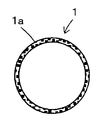
- ⁇ Milling process> In the milling step, at least the surface is a ceramic powder composed of silicic acid and / or silicate, and as shown in FIG.
- the activated ceramic powder 1 having the layer 1a is obtained.
- the network structure of silica is in an amorphous state and is easily eroded by alkali.
- the apparatus capable of performing such an action include a mixing apparatus such as a ball mill, a vibration mill, a planetary mill, and a medium stirring mill, a ball medium mill, a roller mill, a pulverizer such as a mortar, and the like. Is not to be done. Further, a jet crusher or the like that can mainly apply a force such as impact and grinding to the object to be crushed can also be used. If it is pulverized with a jet pulverizer, compressive force, shear force, impact force, etc. can be applied, thereby silicic acid and / or silicate on the ceramic surface is made amorphous and activated ceramic powder. Can do.
- the grinding process it is preferable to grind until there is no change in the particle size distribution over time. Grinding until there is no change in the particle size distribution over time is considered to have reached the limit that the ceramic powder can be made fine by grinding, and the mechanochemical amorphization of the ceramic surface is the most advanced state. It has become.
- the activated ceramic powder 1 obtained by grinding to such a state is likely to proceed with dissolution with an alkaline aqueous solution, and the obtained ceramic solidified body becomes dense and has high mechanical strength.
- ⁇ Mixing process> In the mixing step, inorganic fibers and / or synthetic resin fibers are added to and mixed with the activated ceramic powder obtained in the grinding step to obtain a mixed powder.
- the mixed powder is treated by adding an alkaline aqueous solution containing an alkali metal hydroxide and / or an alkaline earth metal hydroxide.
- the apparatus for mixing and kneading the alkaline aqueous solution and the mixed powder is not particularly limited, and any conventionally known mixer or kneader can be used. Examples thereof include a double-arm kneader, a pressure kneader, an Eirich mixer, a super mixer, a planetary mixer, a Banbury mixer, a continuous mixer, and a continuous kneader. It is also preferable to use a vacuum kneader to remove bubbles. In this way, it is possible to prevent bubbles from remaining in the solidified ceramic body.
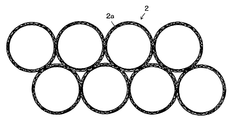
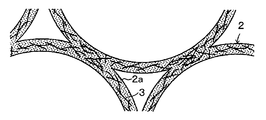
- the amorphous layer 1a on the surface of the activated ceramic powder 1 is dissolved, and further dehydrated and condensed to produce a deposited layer 2a shown in FIG.
- the fibers 3 added in the mixing step are taken into the precipitation layer 2a to form a composite.
- the precipitated layer 2a serves as an adhesive, and the ceramic solidified body 2 is obtained.
- the dissolution reaction of the amorphous layer 1a and the dehydration condensation reaction may be performed at room temperature, or can be accelerated by heating.
- the reaction temperature may be appropriately selected depending on the type of ceramic as a raw material and the type and concentration of the alkaline aqueous solution, but generally room temperature to 200 ° C is preferable, and room temperature to 60 ° C is more preferable.
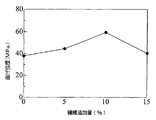
- Example 1 In Example 1, using a metakaolin (average particle size of 1 ⁇ m) dehydrated by calcining kaolinite and using an aqueous potassium hydroxide solution as an alkaline aqueous solution, a carbon nanotube-reinforced metakaolin solidified body was produced through the following steps. .
- a metakaolin average particle size of 1 ⁇ m
- Carbon nanotubes (multilayer, 100 nm ⁇ , fiber length 10 ⁇ m, aspect ratio 100) were added to the activated metakaolin powder so as to be 5% by weight and mixed with a mixer.
- Example 2 In Example 2, the mixing ratio of carbon nanotubes was 10% by weight. Other manufacturing conditions are the same as those in the first embodiment, and a description thereof will be omitted.
- Example 3 In Example 3, the mixing ratio of the carbon nanotubes was 15% by weight. Other manufacturing conditions are the same as those in the first embodiment, and a description thereof will be omitted.
- Comparative Example 1 In Comparative Example 1, the alkali treatment step was performed without adding carbon nanotubes to the activated metakaolin powder. Other conditions are the same as those in the first embodiment, and a description thereof will be omitted.
- multi-layer carbon nanotubes were mixed with activated metakaolin powder, but instead, single-layer carbon nanotubes or carbon fibers may be mixed.
- Example 4 an aramid fiber reinforced metakaolin solidified body was produced through the following steps using a kaolinite baked and dehydrated metakaolin (average particle size 1 ⁇ m) and an aqueous potassium hydroxide solution as an alkaline aqueous solution. .
- the three-point bending strength was measured at room temperature using a strength test apparatus in accordance with JIS R 1601. As a result, the bending strength was higher than that of the metakaolin solidified body of Comparative Example 1 in which poly-p-phenyleneterephthalamide was not added.
- the present invention is an energy saving type and can be used in many industrial fields as a structural material that emits less carbon dioxide during production.
Landscapes
- Chemical & Material Sciences (AREA)
- Engineering & Computer Science (AREA)
- Ceramic Engineering (AREA)
- Materials Engineering (AREA)
- Organic Chemistry (AREA)
- Structural Engineering (AREA)
- Dispersion Chemistry (AREA)
- Nanotechnology (AREA)
- Inorganic Chemistry (AREA)
- Manufacturing & Machinery (AREA)
- Physics & Mathematics (AREA)
- Crystallography & Structural Chemistry (AREA)
- General Physics & Mathematics (AREA)
- Condensed Matter Physics & Semiconductors (AREA)
- Composite Materials (AREA)
- Chemical Kinetics & Catalysis (AREA)
- Curing Cements, Concrete, And Artificial Stone (AREA)
- Compositions Of Macromolecular Compounds (AREA)
- Compositions Of Oxide Ceramics (AREA)
Priority Applications (1)
| Application Number | Priority Date | Filing Date | Title |
|---|---|---|---|
| US12/918,890 US8480801B2 (en) | 2008-02-27 | 2009-02-26 | Solidification method of ceramic powder and solidified ceramics |
Applications Claiming Priority (2)
| Application Number | Priority Date | Filing Date | Title |
|---|---|---|---|
| JP2008046128A JP2009203102A (ja) | 2008-02-27 | 2008-02-27 | セラミックス粉体の固化方法及びセラミックス固化体 |
| JP2008-046128 | 2008-02-27 |
Publications (1)
| Publication Number | Publication Date |
|---|---|
| WO2009107709A1 true WO2009107709A1 (ja) | 2009-09-03 |
Family
ID=41016096
Family Applications (1)
| Application Number | Title | Priority Date | Filing Date |
|---|---|---|---|
| PCT/JP2009/053526 Ceased WO2009107709A1 (ja) | 2008-02-27 | 2009-02-26 | セラミックス粉体の固化方法及びセラミックス固化体 |
Country Status (3)
| Country | Link |
|---|---|
| US (1) | US8480801B2 (https=) |
| JP (1) | JP2009203102A (https=) |
| WO (1) | WO2009107709A1 (https=) |
Cited By (2)
| Publication number | Priority date | Publication date | Assignee | Title |
|---|---|---|---|---|
| CN106747480A (zh) * | 2016-12-13 | 2017-05-31 | 华中科技大学 | 一种利用温控缓释助烧剂中金属离子固化陶瓷浆料的方法 |
| JP2018123027A (ja) * | 2017-02-01 | 2018-08-09 | 国立大学法人 名古屋工業大学 | シリカ/グラファイト無焼成固化体及びその製造方法 |
Families Citing this family (13)
| Publication number | Priority date | Publication date | Assignee | Title |
|---|---|---|---|---|
| MX2009013931A (es) * | 2009-12-17 | 2011-06-16 | Urbanizaciones Inmobiliarias Del Ct S A De C V | Concreto reforzado con nanomateriales hibridos. |
| US20140084203A1 (en) * | 2011-05-23 | 2014-03-27 | Toyota Jidosha Kabushiki Kaisha | Method for producing a material for at least any one of an energy device and an electrical storage device |
| US20180371119A1 (en) | 2015-11-06 | 2018-12-27 | VINCE Reed | Process for providing inorganic polymer ceramic-like materials |
| WO2017104848A1 (ja) * | 2015-12-18 | 2017-06-22 | 日産化学工業株式会社 | 疎水性クラスター及び粘土鉱物を含む組成物 |
| CN108002725A (zh) * | 2017-12-28 | 2018-05-08 | 应城市嘉鸿技术服务科技有限公司 | 一种石膏增强剂及其制备方法 |
| JP7024968B2 (ja) * | 2018-03-29 | 2022-02-24 | 株式会社アドヴィックス | 無焼成セラミックス摩擦材、ブレーキパッド及び無焼成セラミックス摩擦材の製造方法 |
| JP7043930B2 (ja) * | 2018-03-29 | 2022-03-30 | 株式会社アドヴィックス | 無焼成セラミックス摩擦材、ブレーキパッド及び無焼成セラミックス摩擦材の製造方法 |
| JP7340809B2 (ja) * | 2019-04-01 | 2023-09-08 | ヤマキ電器株式会社 | ナノカーボン複合セラミックス及びその製造方法 |
| CN110217851A (zh) * | 2019-07-02 | 2019-09-10 | 北京英鸿光大生物技术有限公司 | 一种基于火山石元素的离子陶球及其制作方法 |
| CZ309105B6 (cs) * | 2019-08-06 | 2022-02-02 | First Point a.s. | Protipožární zateplovací materiál a způsob jeho výroby |
| WO2021155108A1 (en) * | 2020-01-29 | 2021-08-05 | Northwestern University | Carbon fiber-reinforced metakaolin-based geopolymer composites |
| CN111646817A (zh) * | 2020-05-04 | 2020-09-11 | 唐山中陶卫浴制造有限公司 | 一种烧成陶瓷坯体深层修补材料 |
| SE2350319A1 (en) * | 2023-03-22 | 2024-09-23 | Skanska Sverige Ab | Method for treatment of clay |
Citations (2)
| Publication number | Priority date | Publication date | Assignee | Title |
|---|---|---|---|---|
| JPH09124354A (ja) * | 1995-10-30 | 1997-05-13 | Sekisui Chem Co Ltd | 硬化性無機質組成物 |
| JPH09208278A (ja) * | 1996-01-31 | 1997-08-12 | Sekisui Chem Co Ltd | 無機質硬化体の製造方法 |
Family Cites Families (17)
| Publication number | Priority date | Publication date | Assignee | Title |
|---|---|---|---|---|
| US4629507A (en) * | 1982-06-11 | 1986-12-16 | Kabushiki Kaisha Toyota Chuo Kenkyusho | Water glass-based inorganic material and process for producing the same |
| DE3246621A1 (de) * | 1982-12-16 | 1984-06-20 | Dynamit Nobel Ag, 5210 Troisdorf | Bauteilverkleidungen aus anorganischen formmassen |
| US4509985A (en) * | 1984-02-22 | 1985-04-09 | Pyrament Inc. | Early high-strength mineral polymer |
| US5584895A (en) * | 1994-04-18 | 1996-12-17 | Ngk Insulators, Ltd. | Process for preparing solidified material containing coal ash |
| CA2243977C (en) * | 1995-02-17 | 2002-09-10 | Drexel University | Fly ash cementitious material and method of making a product |
| JPH08301638A (ja) * | 1995-04-28 | 1996-11-19 | Osamu Ikeda | ジオポリマーによるカオリン質粉体の固化 および材料化 |
| JPH11302064A (ja) * | 1998-04-22 | 1999-11-02 | Taiheiyo Cement Corp | 硬化性無機質組成物及び無機質硬化体の製造方法 |
| JP2000159581A (ja) * | 1998-11-24 | 2000-06-13 | Sekisui Chem Co Ltd | アルミノ珪酸塩スラリー及び無機質硬化体の製造方法 |
| WO2000044686A1 (en) * | 1999-01-27 | 2000-08-03 | Weihua Jin | Artificial stone employing waste glass |
| US6221148B1 (en) * | 1999-11-30 | 2001-04-24 | Engelhard Corporation | Manufacture of improved metakaolin by grinding and use in cement-based composites and alkali-activated systems |
| US6403257B1 (en) * | 2000-07-10 | 2002-06-11 | The Gillette Company | Mechanochemical synthesis of lithiated manganese dioxide |
| US6969422B2 (en) * | 2000-09-20 | 2005-11-29 | Goodrich Corporation | Inorganic matrix composition and composites incorporating the matrix composition |
| US6966945B1 (en) * | 2000-09-20 | 2005-11-22 | Goodrich Corporation | Inorganic matrix compositions, composites and process of making the same |
| FI115046B (fi) * | 2001-11-01 | 2005-02-28 | Kautar Oy | Hydraulisesti kovettuva sideaineseos ja menetelmä sen valmistamiseksi |
| EP1830824B1 (en) * | 2004-12-31 | 2016-01-13 | Iceutica Pty Ltd. | Nanoparticle composition and methods for synthesis thereof |
| US7846250B2 (en) * | 2006-08-07 | 2010-12-07 | Schlumberger Technology Corporation | Geopolymer composition and application for carbon dioxide storage |
| US8057594B2 (en) * | 2007-06-19 | 2011-11-15 | Georgia Tech Research Corporation | High strength pozzolan foam materials and methods of making the same |
-
2008
- 2008-02-27 JP JP2008046128A patent/JP2009203102A/ja active Pending
-
2009
- 2009-02-26 US US12/918,890 patent/US8480801B2/en not_active Expired - Fee Related
- 2009-02-26 WO PCT/JP2009/053526 patent/WO2009107709A1/ja not_active Ceased
Patent Citations (2)
| Publication number | Priority date | Publication date | Assignee | Title |
|---|---|---|---|---|
| JPH09124354A (ja) * | 1995-10-30 | 1997-05-13 | Sekisui Chem Co Ltd | 硬化性無機質組成物 |
| JPH09208278A (ja) * | 1996-01-31 | 1997-08-12 | Sekisui Chem Co Ltd | 無機質硬化体の製造方法 |
Non-Patent Citations (1)
| Title |
|---|
| "Proceedings of Fall Meeting of the Ceramic Society of Japan, 12 September, 2007 (12.09.07)", vol. 20TH, article YAMAKAWA T. ET AL.: "Mechanochemical Shori shita Ceramic Funtai o Riyo shita Mushosei Ceramics no Sakusei", pages: 17 * |
Cited By (2)
| Publication number | Priority date | Publication date | Assignee | Title |
|---|---|---|---|---|
| CN106747480A (zh) * | 2016-12-13 | 2017-05-31 | 华中科技大学 | 一种利用温控缓释助烧剂中金属离子固化陶瓷浆料的方法 |
| JP2018123027A (ja) * | 2017-02-01 | 2018-08-09 | 国立大学法人 名古屋工業大学 | シリカ/グラファイト無焼成固化体及びその製造方法 |
Also Published As
| Publication number | Publication date |
|---|---|
| US20110053761A1 (en) | 2011-03-03 |
| US8480801B2 (en) | 2013-07-09 |
| JP2009203102A (ja) | 2009-09-10 |
Similar Documents
| Publication | Publication Date | Title |
|---|---|---|
| WO2009107709A1 (ja) | セラミックス粉体の固化方法及びセラミックス固化体 | |
| Bekkeri et al. | Synthesis of artificial aggregates and their impact on performance of concrete: a review | |
| US11525077B2 (en) | Geopolymer concretes for energy storage applications | |
| JP6728313B2 (ja) | 舗装材およびブロックの複合材料およびそれらの調製方法 | |
| JP5055550B2 (ja) | セラミックスの固化方法、セラミックス固化体、及び活性化セラミックス粉体 | |
| Kumar et al. | Experimental study on metakaolin and GGBS based geopolymer concrete | |
| Elhag et al. | A critical review on mechanical, durability, and microstructural properties of industrial by-product-based geopolymer composites | |
| JP7178367B2 (ja) | 硬化性組成物から形成される成形体 | |
| RU2000131201A (ru) | Бетон, включающий органические волокна, диспергированные в цементном растворе, цементный раствор для бетона и премиксы | |
| JP7143077B2 (ja) | 硬化性組成物から形成されるジオポリマー成形体 | |
| JPH10512842A (ja) | 複合コンクリート | |
| JP2008536781A5 (https=) | ||
| Mahmad Nor et al. | A review on the manufacturing of lightweight aggregates using industrial by-product | |
| JP5435255B2 (ja) | 下水汚泥溶融スラグを活性フィラーとするジオポリマー固化体及びその製造方法 | |
| Emara et al. | Geopolymers as sustainable alternates for portland cement in constructive concrete: systematic review | |
| JP2002348167A (ja) | 水硬性組成物 | |
| CN104386990A (zh) | 一种赤泥固化剂及其应用 | |
| JP5277371B2 (ja) | セラミックス粉体の固化方法 | |
| JP5061348B2 (ja) | セラミックス多孔体の製造方法及びセラミックス多孔体 | |
| WO2013139961A1 (en) | A composition for production of construction materials | |
| JP4864866B2 (ja) | ポーラスコンクリートとその骨材 | |
| JP2005075716A (ja) | 赤泥の固化方法 | |
| CZ300134B6 (cs) | Dvousložkové geopolymerní pojivo a zpusob jeho výroby | |
| JP2010095444A (ja) | セラミックスの固化方法 | |
| TWI358398B (https=) |
Legal Events
| Date | Code | Title | Description |
|---|---|---|---|
| 121 | Ep: the epo has been informed by wipo that ep was designated in this application |
Ref document number: 09713972 Country of ref document: EP Kind code of ref document: A1 |
|
| NENP | Non-entry into the national phase |
Ref country code: DE |
|
| WWE | Wipo information: entry into national phase |
Ref document number: 12918890 Country of ref document: US |
|
| 122 | Ep: pct application non-entry in european phase |
Ref document number: 09713972 Country of ref document: EP Kind code of ref document: A1 |