WO2009100810A1 - Flüssigkristallines medium und flüssigkristallanzeige - Google Patents

Flüssigkristallines medium und flüssigkristallanzeige Download PDF

Info

Publication number
WO2009100810A1
WO2009100810A1 PCT/EP2009/000437 EP2009000437W WO2009100810A1 WO 2009100810 A1 WO2009100810 A1 WO 2009100810A1 EP 2009000437 W EP2009000437 W EP 2009000437W WO 2009100810 A1 WO2009100810 A1 WO 2009100810A1
Authority
WO
WIPO (PCT)
Prior art keywords
compounds
independently
formula
liquid
another
Prior art date
Legal status (The legal status is an assumption and is not a legal conclusion. Google has not performed a legal analysis and makes no representation as to the accuracy of the status listed.)
Ceased
Application number
PCT/EP2009/000437
Other languages
English (en)
French (fr)
Inventor
Michael Wittek
Markus Czanta
Atsutaka Manabe
Lars Lietzau
Marcus Reuter
Brigitte Schuler
Elisabeth Meyer
Current Assignee (The listed assignees may be inaccurate. Google has not performed a legal analysis and makes no representation or warranty as to the accuracy of the list.)
Merck Patent GmbH
Original Assignee
Merck Patent GmbH
Priority date (The priority date is an assumption and is not a legal conclusion. Google has not performed a legal analysis and makes no representation as to the accuracy of the date listed.)
Filing date
Publication date
Application filed by Merck Patent GmbH filed Critical Merck Patent GmbH
Priority to US12/867,571 priority Critical patent/US8404150B2/en
Publication of WO2009100810A1 publication Critical patent/WO2009100810A1/de
Anticipated expiration legal-status Critical
Ceased legal-status Critical Current

Links

Classifications

    • CCHEMISTRY; METALLURGY
    • C09DYES; PAINTS; POLISHES; NATURAL RESINS; ADHESIVES; COMPOSITIONS NOT OTHERWISE PROVIDED FOR; APPLICATIONS OF MATERIALS NOT OTHERWISE PROVIDED FOR
    • C09KMATERIALS FOR MISCELLANEOUS APPLICATIONS, NOT PROVIDED FOR ELSEWHERE
    • C09K19/00Liquid crystal materials
    • C09K19/04Liquid crystal materials characterised by the chemical structure of the liquid crystal components, e.g. by a specific unit
    • C09K19/06Non-steroidal liquid crystal compounds
    • C09K19/08Non-steroidal liquid crystal compounds containing at least two non-condensed rings
    • C09K19/30Non-steroidal liquid crystal compounds containing at least two non-condensed rings containing saturated or unsaturated non-aromatic rings, e.g. cyclohexane rings
    • C09K19/3098Unsaturated non-aromatic rings, e.g. cyclohexene rings
    • CCHEMISTRY; METALLURGY
    • C09DYES; PAINTS; POLISHES; NATURAL RESINS; ADHESIVES; COMPOSITIONS NOT OTHERWISE PROVIDED FOR; APPLICATIONS OF MATERIALS NOT OTHERWISE PROVIDED FOR
    • C09KMATERIALS FOR MISCELLANEOUS APPLICATIONS, NOT PROVIDED FOR ELSEWHERE
    • C09K19/00Liquid crystal materials
    • C09K19/04Liquid crystal materials characterised by the chemical structure of the liquid crystal components, e.g. by a specific unit
    • C09K19/42Mixtures of liquid crystal compounds covered by two or more of the preceding groups C09K19/06 - C09K19/40
    • CCHEMISTRY; METALLURGY
    • C09DYES; PAINTS; POLISHES; NATURAL RESINS; ADHESIVES; COMPOSITIONS NOT OTHERWISE PROVIDED FOR; APPLICATIONS OF MATERIALS NOT OTHERWISE PROVIDED FOR
    • C09KMATERIALS FOR MISCELLANEOUS APPLICATIONS, NOT PROVIDED FOR ELSEWHERE
    • C09K19/00Liquid crystal materials
    • C09K19/04Liquid crystal materials characterised by the chemical structure of the liquid crystal components, e.g. by a specific unit
    • C09K2019/0444Liquid crystal materials characterised by the chemical structure of the liquid crystal components, e.g. by a specific unit characterized by a linking chain between rings or ring systems, a bridging chain between extensive mesogenic moieties or an end chain group
    • C09K2019/0466Liquid crystal materials characterised by the chemical structure of the liquid crystal components, e.g. by a specific unit characterized by a linking chain between rings or ring systems, a bridging chain between extensive mesogenic moieties or an end chain group the linking chain being a -CF2O- chain
    • CCHEMISTRY; METALLURGY
    • C09DYES; PAINTS; POLISHES; NATURAL RESINS; ADHESIVES; COMPOSITIONS NOT OTHERWISE PROVIDED FOR; APPLICATIONS OF MATERIALS NOT OTHERWISE PROVIDED FOR
    • C09KMATERIALS FOR MISCELLANEOUS APPLICATIONS, NOT PROVIDED FOR ELSEWHERE
    • C09K2323/00Functional layers of liquid crystal optical display excluding electroactive liquid crystal layer characterised by chemical composition
    • CCHEMISTRY; METALLURGY
    • C09DYES; PAINTS; POLISHES; NATURAL RESINS; ADHESIVES; COMPOSITIONS NOT OTHERWISE PROVIDED FOR; APPLICATIONS OF MATERIALS NOT OTHERWISE PROVIDED FOR
    • C09KMATERIALS FOR MISCELLANEOUS APPLICATIONS, NOT PROVIDED FOR ELSEWHERE
    • C09K2323/00Functional layers of liquid crystal optical display excluding electroactive liquid crystal layer characterised by chemical composition
    • C09K2323/03Viewing layer characterised by chemical composition

Definitions

  • the present invention relates to liquid crystalline media and liquid crystal displays containing these media, especially to displays addressed by an active matrix, and more particularly to Twisted Nematic (TN), N Plane Switching (IPS) or Fringe Field Switching (FFS) displays.
  • TN Twisted Nematic
  • IPS N Plane Switching
  • FFS Fringe Field Switching
  • LCDs Liquid crystal displays
  • LCDs are used in many areas to display information. LCDs are used for both direct-view and projection-type displays.
  • electro-optical modes for example, Twisted hJematic (TN), Super Twisted Nematic (STN), Optically Compensated Bend (OCB) and Electrically Controlled Birefringence (ECB) are used along with their various modifications and others. All of these modes use an electric field that is substantially perpendicular to the substrates or to the liquid crystal layer.
  • electro-optical modes that use an electric field that is substantially parallel to the substrates or the liquid crystal layer, such as the Mi-plane switching (IPS) mode (as in DE 40 00 451 and EP 0 588 568) and in Fringe Field Switching (FFS) mode, which has a strong "fringe field", a strong electric field near the edge of the electrodes, and an electric field throughout the cell, which has both a strong vertical component and an electric field.
  • IPS Mi-plane switching
  • FFS Fringe Field Switching
  • LCDs LCDs in modern desktop monitors and are intended for use in displays for televisions and multimedia applications
  • the liquid crystals according to the present invention are preferably used in displays of this type.
  • liquid-crystalline media with eh he smaller values of dielectric anisotropy are used, but also in IPS displays partially liquid-crystalline media are used with a dielectric anisotropy of only about 3 or even lower.
  • liquid-crystalline media with lower viscosities ( ⁇ ), especially with lower rotational viscosities ( ⁇ -i) are required.
  • the rotational viscosity should be 80 mPa ⁇ s or less, preferably 60 mPa ⁇ s or less, and especially 55 mPa ⁇ s or less.
  • the media must have a range of nematic phase of appropriate width and position, as well as suitable birefringence ( ⁇ n), and dielectric anisotropy ( ⁇ ) should be high enough to allow reasonably low operating voltage.
  • should be higher than 2 and very preferably higher than 3, but preferably not higher than 15 and in particular not higher than 12, since this would be contrary to an at least reasonably high specific resistance.
  • the displays according to the present invention by an active matrix (active matrix LCDs, short AMDs), preferably by a matrix of thin-film transistors (TFTs), addressed.
  • active matrix LCDs active matrix LCDs, short AMDs
  • TFTs thin-film transistors
  • the liquid crystals according to the invention can also be advantageously used in displays with other known addressing agents.
  • PDLC p_polymer dispersed jiquid crystal
  • NCAP non-polar curvilinearly aligned p_hase
  • PN systems polymer network
  • the modes particularly preferred according to the present invention employ the liquid crystal medium per se, surface-oriented. These surfaces are typically pretreated to to achieve a uniform orientation of the liquid crystal material.
  • the display modes according to the present invention preferably use an electric field that is substantially parallel to the compound layer.
  • Liquid crystal compositions suitable for LCDs and especially for IPS displays are e.g. JP 07-181 439 (A), EP 0 667 555, EP 0 673 986, DE 195 09 410, DE 195 28 106, DE 195 28 107, WO 96/23 851 and WO 96/28 521.
  • these compositions have serious disadvantages. Most of them, among other shortcomings, lead to unfavorably long response times, have too low resistivity values, and / or require operating voltages that are too high.
  • liquid-crystalline media with suitable properties for practical applications, such as a broad nematic phase range, suitable optical anisotropy ⁇ n corresponding to the type of display used, a high ⁇ and especially low viscosities.
  • liquid-crystalline media having a suitably high ⁇ , a suitable phase range and ⁇ n can be realized which do not have the disadvantages of the materials of the prior art or at least only to a considerably lesser extent.
  • liquid crystalline media contain at least the following components:
  • component A a dielectrically positive component, component A, containing
  • R 1 is alkyl, alkoxy, fluorinated alkyl or fluorinated alkoxy having 1 to 7 C atoms, alkenyl, alkenyloxy, alkoxyalkyl or fluorinated alkenyl having 2 to 7 C atoms and preferably alkyl or alkenyl,
  • L 1 "to L 14 independently of one another are H, F or Cl, preferably H or F, preferably two or more of L 11 to L 14 F, preferably L 11 and / or L 13 F and very preferably all of them F and
  • j and k are independently 0, 1 or 2, but with ⁇ + k) 0, 1 or 2, preferably 0 or 1 and particularly preferably 1, and
  • R 2 and R 3 independently of one another are alkyl, alkoxy, fluorinated alkyl or fluorinated alkoxy having 1 to 7 C atoms, alkenyl, alkenyloxy, alkoxyalkyl or fluorinated alkenyl having 2 to 7 C atoms and preferably R 2 and R 3 are alkyl or alkenyl .
  • L 21,, L 22,. L 31 and, L 32 are independently H or F, preferably
  • X 2 and X 3 independently of one another are halogen, halogenated alkyl or alkoxy having 1 to 3 C atoms or halogenated alkenyl or alkenyloxy having 2 or 3 C atoms, preferably F, Cl, -OCF 3 or -CF 3 , very preferably F, Cl or -OCF 3 ,
  • component B optionally a dielectrically neutral component, component B, containing one or more compounds of formula IV
  • R 41 and R 42 independently of one another have the meaning given above under formula II for R, preferably R 41 AIII alkyl and U RR 4422 AA! Alkyl or alkoxy or R 41 alkenyl and R 42 denotes alkyl,
  • p is 0, 1 or 2, preferably 0 or 1.
  • component A contains one or more dielectrically positive compounds of formula I having a dielectric anisotropy greater than 3 and wherein the parameters have the respective meanings given above under formula I and preferably X 1 is F, more preferably predominantly, more strongly it preferably consists essentially and quite preferably consists entirely of it.
  • the component A contains one or more compounds selected from the group of the compounds of the formulas IA to IF, preferably selected from the group of the compounds of the formulas IA, IB, ID and IF: wherein the parameters hhaabbeenn the meanings given above under formula I and LL 15 and LL 16 uunnaabbhphinnggiigg vvoonneeiinnaainder and from L 11 to L 14 H, or Cl, preferably H or F, mean.
  • the component A contains one or more compounds selected from the group of the compounds of the formulas IA-1 to IA-5, preferably selected from the group of the compounds of the formulas IA-2 to IA-5:
  • X 1 is preferably F, Cl, CF 3 or OCF 3 and particularly preferably F or Cl and very particularly preferably F.
  • the component A contains one or more compounds selected from the group of the compounds of the formulas IB-1 to IB-5, preferably selected from the group of the compounds of the formulas IB-2 to IB-5:
  • X 1 is preferably F, Cl, CF 3 or OCF 3 and particularly preferably F or Cl and very particularly preferably F.
  • the component A contains one or more compounds selected from the group of the compounds of the formulas IC-1 to IC-5, preferably selected from the group of the compounds of the formulas IC-2 to IC-5:
  • X 1 is preferably F, Cl, CF 3 or OCF 3 and particularly preferably F or Cl and very particularly preferably F.
  • the component A contains one or more compounds selected from the group of the compounds of the formulas ID-1 to ID-5, preferably selected from the group of the compounds of the formulas ID-1 to ID-5:
  • X 1 is preferably F, Cl, CF 3 or OCF 3 and particularly preferably F or Cl and very particularly preferably F.
  • the component A contains one or more compounds selected from the group of the compounds of the formulas IE-1 to IE-5, preferably selected from the group of the compounds of the formulas IE-2 to IE-5:
  • X 1 is preferably F 1 Cl, CF 3 or OCF 3 and particularly preferably F or Cl and very particularly preferably F.
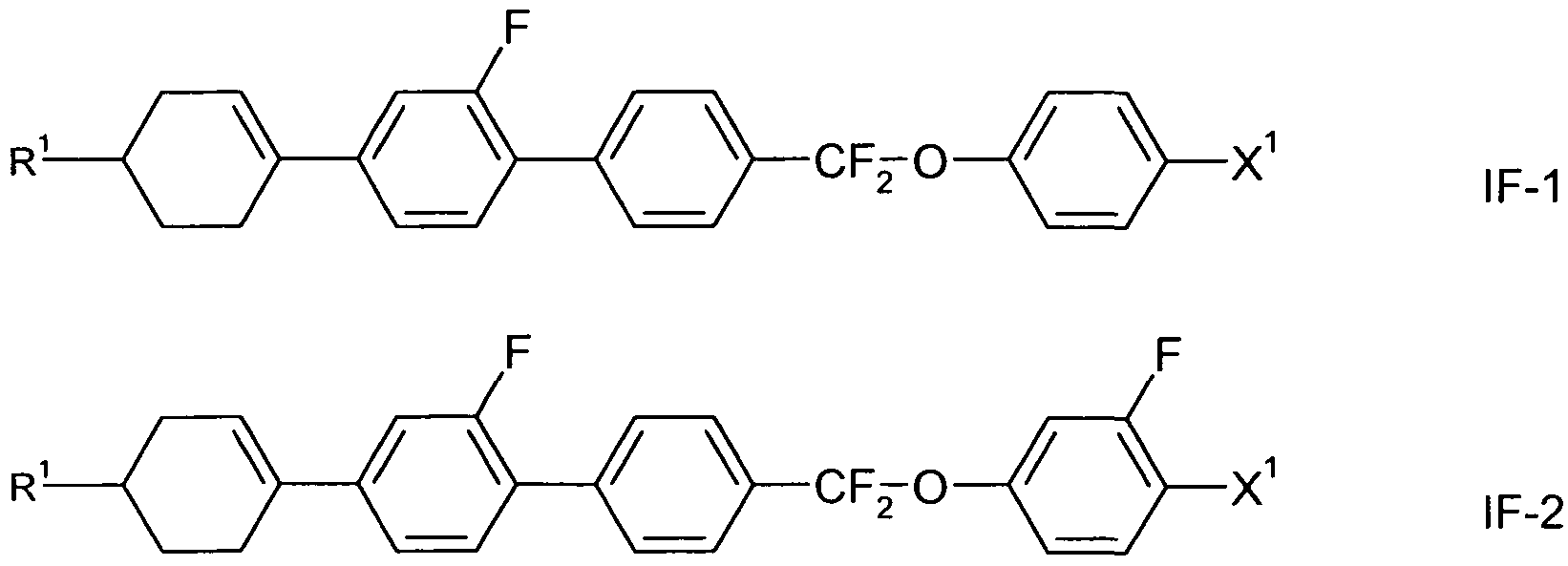
  • the component A contains one or more compounds selected from the group of the compounds of the formulas IF-1 to IF-5, preferably selected from the group of the compounds of the formulas IF-2 to IF-5:
  • X 1 is preferably F, Cl, CF 3 or OCF 3 and particularly preferably F or Cl and very particularly preferably F.
  • the media according to the present invention in component A contain, in addition to one or more compounds of formula I, one or more compounds selected from the group of formulas II and III, more preferably predominantly, even more preferably essentially and most preferably it consists entirely of compounds of formulas I and II and / or III.
  • the component A contains one or more compounds selected from the group of the compounds of the formulas 11-1 to II-3:
  • component A contains compounds selected from the group of compounds of formulas 11-1 to II-3, wherein L 21 and L 2 "2 or L 2" 3 and ⁇ J 24 are both F.
  • component A contains compounds selected from the group of the compounds of formulas 11-1 and II-2, wherein L 21 , L 22 , L 23 and L 24 all denote F.
  • component A contains one or more compounds of formula 11-1.
  • the compounds of formula 11-1 are selected from the group of compounds of formulas 11-1 a to 11-1 j
  • L 25 to L 28 independently of one another are H or F, preferably L 27 and L 28 are both H, particularly preferably L 26 H.
  • Component A preferably contains compounds selected from the group of compounds of the formulas 11-1 a to 11-1 e, in which L 21 and L 22 both denote F and / or L 23 and L 24 denote both F.
  • component A contains compounds which are selected from the group of the compounds of the formulas 11-1a to 11-1 h, in which L 21 , L 22 , L 23 and L 24 all denote F.
  • Component A preferably contains one or more compounds of the formula II-2.
  • the compounds of the formula II-2 are preferably selected from the group of the compounds of the formulas II-2a to II-2c
  • L 21 and L 22 are preferably both F.
  • Component A preferably contains one or more compounds of the formula II-3.
  • the compounds of the formula II-3 are preferably selected from the group of the compounds of the formulas II-3a to II-3e
  • L 21 and L 22 are both F, in formulas II-3c and III-3d
  • L and L 22 both F and / or L 23 and L 24 are both F and in formula II-3e
  • L 21 , L 22 and L 25 F mean.
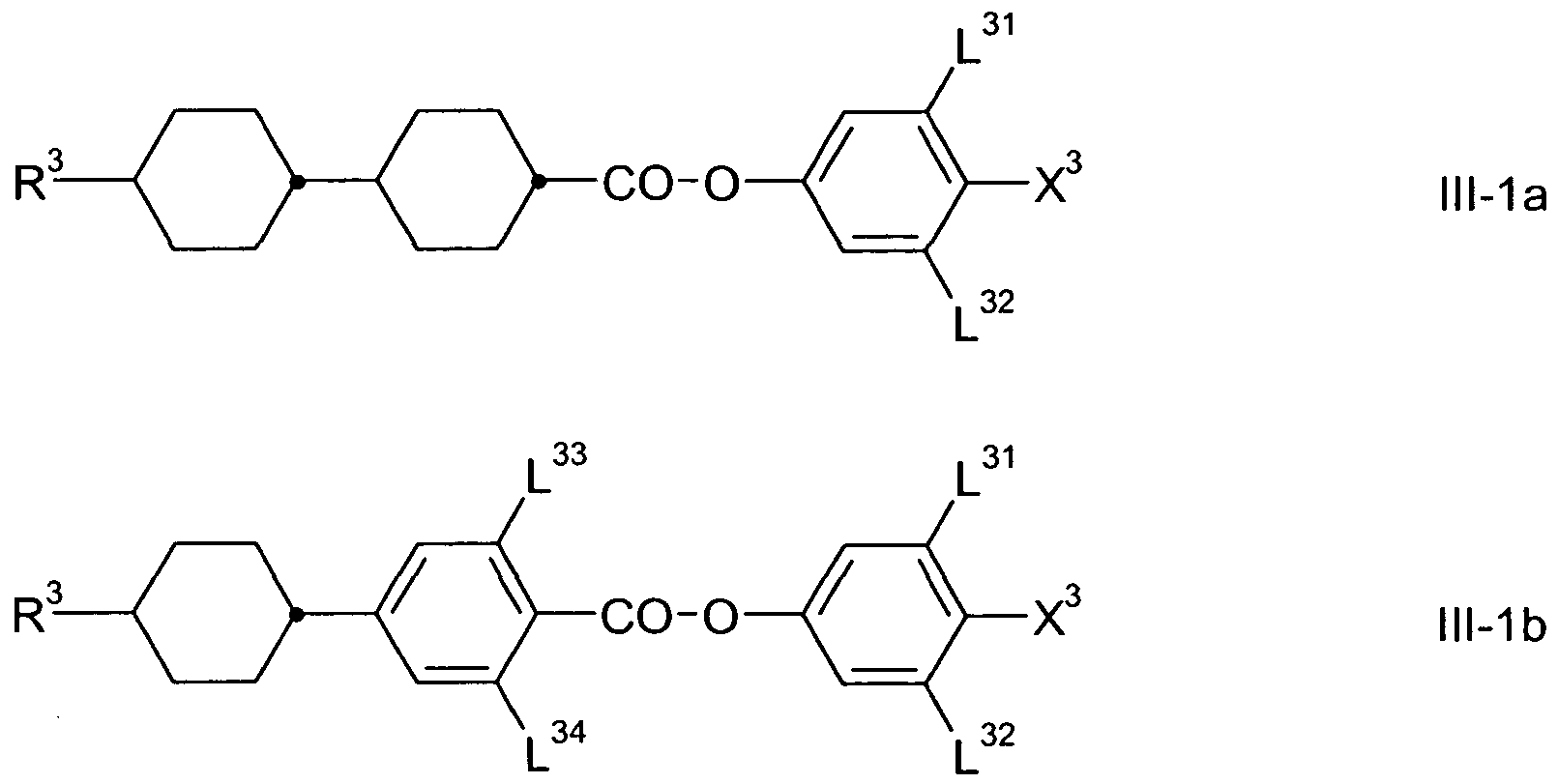
  • component A contains one or more compounds selected from the group of formulas III-1 and III-2:
  • Component A preferably contains one or more compounds of the formula III-1.
  • the compounds of the formula III-1 are preferably selected from the group of the compounds of the formulas III-1 a and HM b
  • Component A preferably contains one or more compounds of the formula III-2.
  • the compounds of the formula III-2 are preferably selected from the group of the compounds of the formulas III-2a to III-2J
  • component A comprises one or more compounds of the formula Ia Ml-1 which are preferably selected from the group of compounds of the formulas III-1a-1 to 111-1 aG
  • R 3 has the meaning given above.
  • Component A preferably contains one or more compounds of the formula IIIIB, which are preferably selected from the group of the compounds of the formulas III-1 B-1 to III-1 B-4, preferably III-1 b4
  • R 3 has the meaning given above.
  • Component A preferably comprises one or more compounds of the formula II-2a which are preferably selected from the group of the compounds of the formulas II-2a-1 to II-2a-5
  • Component A preferably comprises one or more compounds of the formula III-2b, which are preferably selected from the group of the compounds of the formulas III-2b-1 and III-2b-2, preferably III-2b-2
  • Component A preferably comprises one or more compounds of the formula III-2c, which are preferably selected from the group of the compounds of the formulas III-2c-1 to III-2c-5
  • R 3 has the meaning given above.
  • Component A preferably contains one or more compounds selected from the group of the compounds of the formulas III-2d and III-2e which are preferably selected from the group of the compounds of the formulas III-2d-1 and III-2e-1
  • Component A preferably contains one or more compounds of the formula III-2f, which are preferably selected from the group of the compounds of the formulas III-2f-1 to III-2f-5
  • R 3 has the meaning given above.
  • Component A preferably contains one or more compounds of the formula III-2g, which are preferably selected from the group of the compounds of the formulas III-2g-1 to III-2g-5
  • R> 3 has the meaning given above.
  • Component A preferably comprises one or more compounds of the formula III-2h, which are preferably selected from the group of the compounds of the formulas III-2h-1 to III-2h-5
  • R 3 has the meaning given above.
  • Component A preferably contains one or more compounds of the formula III-2i which are preferably selected from the group of the compounds of the formulas III-2i-1 and III-2i-2
  • R 3 has the meaning given above.
  • Component A preferably comprises one or more compounds of the formula III-2i which are preferably selected from the group of the compounds of the formulas III-2J-1 and III-2J-2
  • R 3 has the meaning given above.
  • the media according to the present invention may contain one or more compounds of the formula III-3
  • R 3 has the meaning given above.
  • the liquid-crystalline media according to the present invention contain a dielectrically neutral component, component B.
  • This component preferably has a dielectric anisotropy in the range of -1.5 to 3.
  • it contains dielectrically neutral compounds having a dielectric anisotropy in the range of -1.5 to 3, more preferably it consists predominantly, even more preferably it consists essentially and especially preferably consists entirely of it.
  • this component contains one or more, more preferably predominantly, even more preferably substantially, and quite preferably, it consists entirely of dielectrically neutral compounds having a dielectric anisotropy in the range of -1, 5 to 3, of formula IV.
  • the dielectrically neutral component, component B contains one or more compounds selected from the group of compounds of formulas IV-1 to IV-6
  • R 41 and R 42 have the respective meanings given above under formula IV and in formulas IV-1, IV-5 and IV-6
  • R 41 are preferably alkyl or alkenyl, preferably alkenyl
  • R 42 is preferably alkyl or alkenyl, preferably alkyl
  • in formula IV-2 R 41 and R 42 are preferably alkyl and in formula IV-4
  • R 41 is preferably alkyl or alkenyl, more preferably alkyl
  • R 42 is preferably alkyl or alkoxy, more preferably alkoxy.
  • the dielectrically neutral component, component B contains one or more compounds selected from the group of compounds of formulas IV-1, IV-4, IV-5 and IV-6, preferably one or more compounds of formula IV-1 and one or more compounds selected from the group of the formulas IV-4 and IV-5, more preferably in each case one or more compounds of the formulas IV-1, IV-4 and IV-5 and very preferably in each case one or more compounds of formulas IV-1, IV-4, IV-5 and IV-6.
  • component B contains one or more compounds of formula IV-5, more preferably selected from their respective sub-formulas of formula CCP-Vn and / or CCP-nV-m and / or CCP-Vn-m, more preferably Formula CCP-Vn and / or CCP-V2-n and most preferably selected from the group of the formulas CCP-V-1 and CCP-V2-1.
  • formula IV-5 more preferably selected from their respective sub-formulas of formula CCP-Vn and / or CCP-nV-m and / or CCP-Vn-m, more preferably Formula CCP-Vn and / or CCP-V2-n and most preferably selected from the group of the formulas CCP-V-1 and CCP-V2-1.
  • component B comprises one or more compounds of formula IV-1, more preferably selected from their respective sub-formulas of formula CC-nm, CC-nV and / or CC-n-Vm, more preferably of the formulas CC- nV and / or CC-n-Vm and most preferably selected from the group of the formulas CC-3-V, CC-4-V, CC-5-V CC-3-V1, CC-4-V1,
  • liquid-crystal mixtures according to the present invention comprise one or more compounds of formula IV selected from the group of compounds of formula IV-1 to IV-6 as shown above and optionally of the formulas IV-7 to IV-14:
  • R 41 and R 42 independently of one another are alkyl, alkoxy, fluorinated alkyl or fluorinated alkoxy having 1 to 7 C atoms, alkenyl, alkenyloxy, alkoxyalkyl or fluorinated alkenyl having 2 to 7 C atoms and
  • component B preferably contains one or more compounds of formula IV-7, more preferably selected from their respective sub-formulas of formula CPP-3-2, CPP-5-2 and CGP-3-2, more preferably of the formula CPP-3-2 and / or CGP-3-2 and most preferably the formula CPP-3-2.
  • the definitions of these abbreviations (acronyms) are given below in Table D, or from Tables A to C.
  • the component A of the media according to the present invention may contain one or more compounds of the formula V.
  • R 1 denotes alkyl, alkoxy, fluorinated alkyl or fluorinated alkoxy having 1 to 7 C atoms, alkenyl, alkenyloxy, alkoxyalkyl or fluorinated alkenyl having 2 to 7 C atoms and preferably alkyl or alkenyl,
  • L 51 and L 52 are independently H or F, preferably L 51 is F, and
  • X 5 halogen, halogenated alkyl or alkoxy having 1 to 3 carbon atoms or halogenated alkenyl or alkenyloxy with
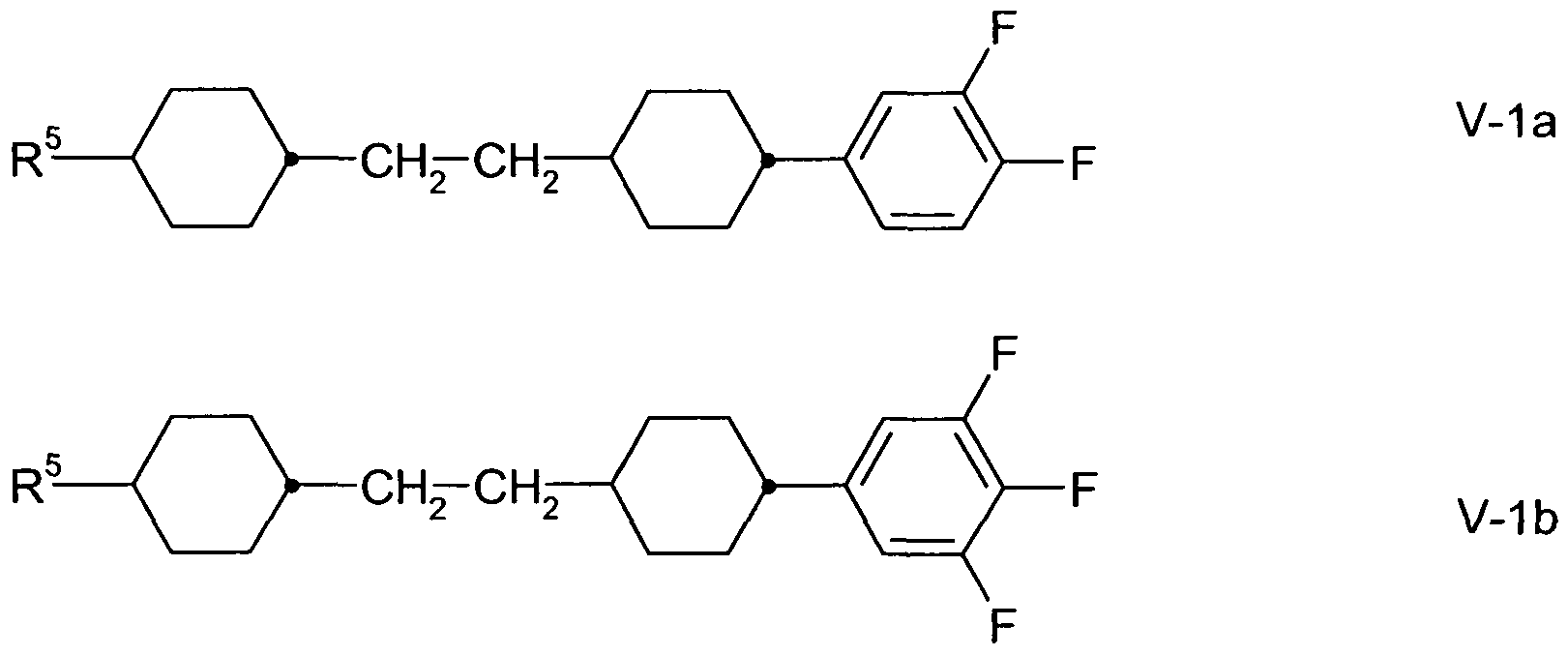
  • the media according to the present invention contain one or more compounds of the formula V, preferably selected from the group of the compounds of the formulas V-1 and V-2
  • the compounds of formula V-1 are selected from the group of compounds of formulas V-1a and V-1 b
  • R j5 has the meaning given above.
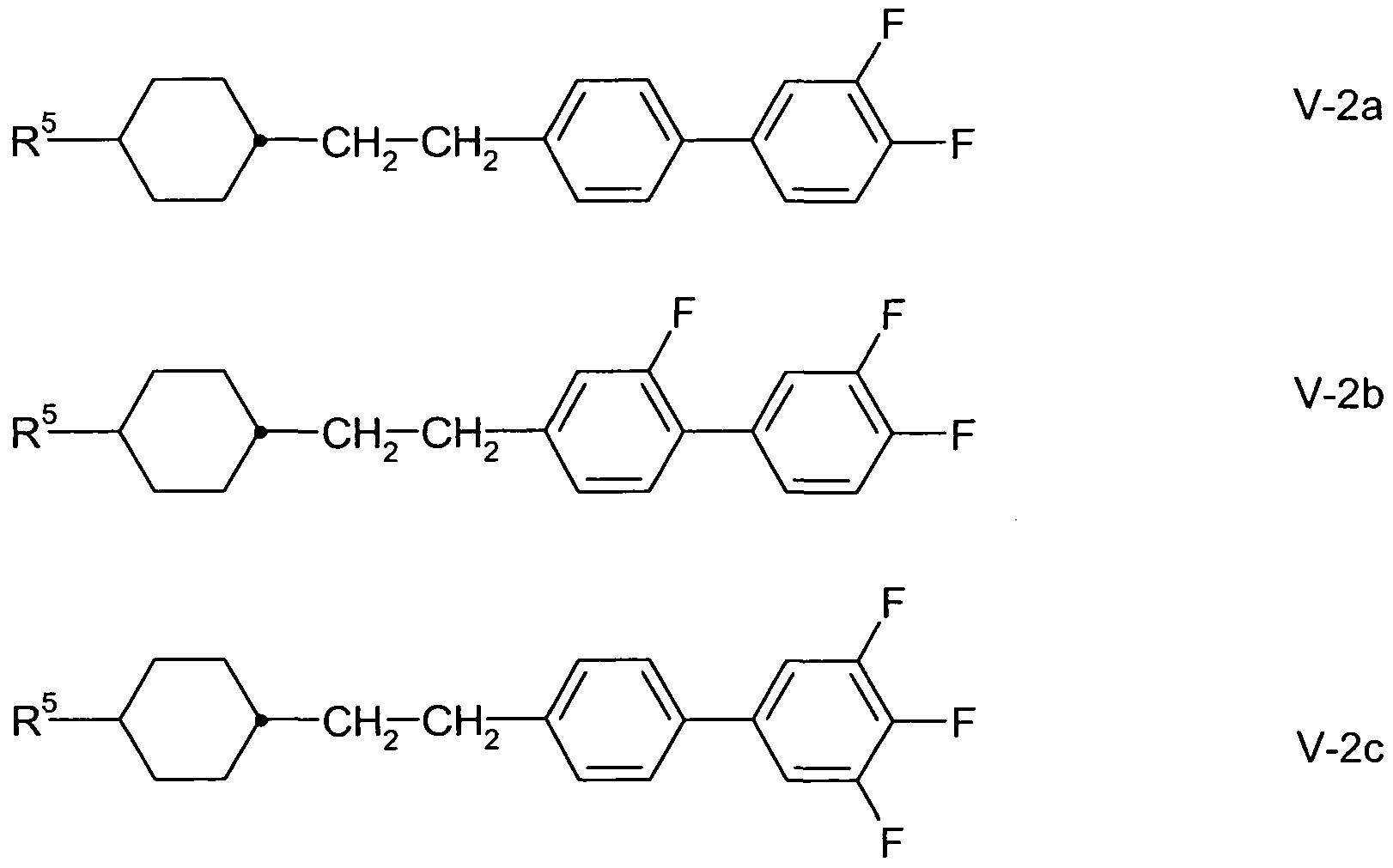
  • the compounds of formula V-2 are selected from the
  • R> 5 has the meaning given above.
  • liquid-crystalline media according to the present invention in component B in addition to the compounds of formula IV, one or more compounds of formula VI
  • R 61 and R 62 independently of one another have the meaning given above under formula II for R, preferably R 61
  • Alkyl and R, 6 denotes D 2 'alkyl or alkenyl
  • r is 0, 1 or 2, preferably 0 or 1.
  • the dielectrically neutral component, component B in this case contains one or more compounds selected from the group of compounds of formulas VI-1 and VI-2
  • the dielectrically neutral component, component B in this case contains one or more compounds selected from the group of the compounds of formulas VI-1 and VI-2, wherein R 61 is preferably n-alkyl and in formula VI-1 R 62 is preferably Alkenyl and in formula VI-2 R 62 is preferably n-alkyl.
  • component B contains one or more compounds of formula VI-1, more preferably their sub-formula PP-n-2Vm, even more preferably of formula PP-1-2V1.
  • the definitions of these abbreviations (acronyms) are given below in Table D, or from Tables A to C.
  • component B contains one or more compounds of formula VI-2, more preferably their sub-formula PGP-nm, even more preferably their sub-formula PGP-3-m, most preferably selected from the formulas PGP-3-2, PGP-3-3, PGP-3-4 and PGP-3-5.
  • the definitions of these abbreviations (acronyms) are also given below in Table D, or from Tables A to C.
  • the liquid-crystal mixtures according to the present invention preferably comprise at least compounds of a further formula. These further compounds are preferably compounds selected from the group of the compounds of the formulas IV and / or V and / or VI, preferably of the formula IV.
  • mixtures according to the present invention may also each contain one or more compounds of the formulas I to VI and VIII, preferably of the formulas I to VI, particularly preferably of the formulas I to V.
  • liquid-crystal mixtures according to the present invention may optionally contain another component, component C, which has a negative dielectric anisotropy and contains, preferably predominantly, dielectric-negative compounds consists, more preferably consists essentially of, and most preferably entirely consists of, preferably of the formula VII
  • R 71 and R independently of one another have the meaning given above under formula II for R,
  • L 71 and L 72 independently of one another are CF or N, preferably one or more of them is CF, / and most preferably both are CF, and
  • s is 0 or 1.
  • liquid crystal mixtures according to the present invention may contain another optional component, component D, which has a positive dielectric anisotropy and contains, preferably predominantly consists of, more preferably substantially positive, dielectric compounds, and most preferably entirely thereof, preferably Formula VIII
  • R a has the meaning given above under formula II for R
  • Z and Z are independently -CH 2 CH 2 -, -COO-, trans-
  • -CH CH-
  • trans- -CF CF-, -CH 2 O-, -CF 2 O- or a single bond, preferably one or more of them is a single bond, or mean and most preferably both represent a single bond,
  • t is 0, 1 or 2, preferably 0 or 1, more preferably 1, and
  • X 8 has the meaning given above under formula II for X 2 or alternatively independently of R 8 may have the meaning given for R 8 , and
  • the liquid-crystalline media according to the present invention contain the components A to E, preferably A to D and most preferably A to C, and in particular compounds selected from the group of compounds of formulas I to VIII, preferably I to V and more preferably I to III and / or IV, more preferably, they are predominantly, even more preferably substantially, and most preferably, completely composed.
  • the entity in question ie the medium or component
  • the entity in question contains the indicated component or components or compound or compounds, preferably in a total concentration of 10% or more, and more preferably 20%. or more.
  • the entity in question contains 55% or more, preferably 60% or more and more preferably 70% or more of the stated component or components or compound or compounds.
  • Substantially in this context means that the entity in question contains 80% or more, preferably 90% or more, and most preferably 95% or more of the indicated component or components or compound or compounds.
  • the entity in question contains 98% or more, preferably 99% or more and most preferably 100.0% of the indicated component or components or compound or compounds.
  • the component C contains, more preferably it consists predominantly and quite preferably it consists entirely of one or more compounds of the formula VII, preferably selected from the group of the compounds of the formulas VII-1 to VII-3
  • R 71 and R 72 have the respective meanings given above under formula VII.
  • R 71 is preferably n-alkyl or 1-E-alkenyl and R 72 is preferably n-alkyl or alkoxy.
  • the liquid-crystal media according to the present invention preferably have a clearing point of 60 ° C or more, more preferably 65 ° C or more, more preferably 70 ° C or more, and most preferably 75 ° C or more.
  • the ⁇ n of the liquid crystal media according to the present invention is preferably 589 nm (Na D ) and 20 ° C in the range of 0.060 or more to 0.140 or less, more preferably in the range of 0.070 or more to 0.130 or less, still more preferably in the range from 0.080 or more to 0.125 or less, and more preferably in the range of 0.090 or more to 0.122 or less.
  • the ⁇ n of the liquid crystal media according to the present invention is preferably 0.080 or more, more preferably 0.090 or more.
  • the ⁇ of the liquid crystal medium according to the invention at 1 kHz and 20 ° C is preferably 2 or more, more preferably 4 or more, and most preferably 6 or more. In particular, ⁇ is 15 or less.
  • the nematic phase of the media of the invention extends at least from 0 ° C or less to 70 ° C or more, more preferably at least from -20 ° C or less to 70 ° C or more, even more preferably at least -30 ° C or less up to 75 ° C or more and more particularly at least from -40 ° C or less to 75 ° C or more.
  • the ⁇ n of the liquid crystal media is in the range of 0.090 or more to
  • is preferably in the range of 2 or more to 12 or less, preferably 10 or less.
  • the ⁇ n of the liquid crystal media is in the range of 0.085 or more to 0.130 or less, more preferably in the range of 0.090 or more to 0.125 or less, and more preferably in the range of 0.095 or more to 0.120 or less. while ⁇ is preferably 4 or more, more preferably 6 or more, even more preferably 8.0 or more, and more preferably in the range of 8.0 or more to 10.0 or less.
  • the nematic phase of the media of the invention preferably extends at least from -20 ° C or less to 70 ° C or more, more preferably at least from -20 ° C or less to 70 ° C or more, most preferably at least -30 ° C or less to 70 ° C or more and especially at least from -40 ° C or less to 70 ° C or more.
  • the ⁇ n of the liquid crystal media is in the range of 0.070 or more to 0.120 or less, more preferably in the range of 0.075 or more to 0.115 or less, and more preferably in the range of 0.080 or more to 0.110 or less. while ⁇ is preferably 2.0 or more, more preferably in the range of 3.0 or more to 14.0 or less, and more preferably either in the range of 4.0 or more to 6.0 or less, or more preferably in the range of 6.0 or more to 11, 0 or less.
  • the nematic phase of the media of the invention preferably extends at least from -20 ° C or less to 75 ° C or more, more preferably at least from -30 ° C or less to 70 ° C or more, most preferably at least -30 ° C or less to 75 ° C or more and especially at least from -30 ° C or less to 80 ° C or more.
  • the ⁇ n of the liquid crystal media is in the range of 0.080 or more to 0.120 or less, more preferably in the range of 0.085 or more to 0.115 or less, and more preferably in the range of 0.090 or more to 0.110 or less.
  • is preferably 1, 5 or more, more preferably in the range of 2.0 or more to 8.0 or less, and more preferably either in the range of 2.0 or more to 6.0 or less, or more preferably in the range of 2.0 or more to 4.0 or less.
  • the nematic phase of the media of the invention preferably extends at least from -20 ° C or less to 65 ° C or more, more preferably at least from -30 ° C or less to 70 ° C or more, most preferably at least -30 ° C or less to 75 ° C or more and especially at least from -30 ° C or less to 80 ° C or more.
  • the ⁇ n of the liquid crystal media is in the range of 0.070 or more to 0.120 or less, more preferably in the range of 0.070 or more to 0.110 or less, and more preferably in the range of 0.090 or more to 0.100 or less. while ⁇ is preferably 2.0 or more, more preferably in the range of 3.0 or more to 8.0 or less, and more preferably in the range of 3.0 or more to 4.0 or less.
  • the nematic phase of the media of the invention preferably extends at least from -20 ° C or less to 65 ° C or more, more preferably at least from -30 ° C or less to 70 ° C or more, most preferably at least -30 ° C or less than 70 ° C or more, and more preferably at least from -40 ° C or less to 70 ° C or more.
  • the ⁇ n of the liquid crystal media is in the range of 0.110 or more to 0.150 or less, more preferably in the range of 0.120 or more to 0.145 or less, and more preferably about 0.137 or more to 0.100 or less , preferably in the range of 2.0 or more to 8.0 or less, and more preferably in either the range of 3.0 or more to 7.0 or less.
  • the nematic phase of the media of the invention preferably extends at least from -20 ° C or less to 70 ° C or more, more preferably at least from -30 ° C or less to 70 ° C or more, most preferably at least -30 ° C or less to 75 ° C or more and especially at least from -30 ° C or less to 80 ° C or more.
  • the compounds of formula I are preferably used at a total concentration of from 1% to 50%, more preferably from 1% to 30%, more preferably from 2% to 30% and most preferably from 3% to 30% of the total mixture ,
  • the compounds of formulas II and IM are preferably in a total concentration of from 2% to 60%, more preferably from 3% to
  • the compounds of formula IV are preferably used in a total concentration of from 0% to 70%, more preferably from 10% to 65%, even more preferably from 20% to 60% and most preferably from 15% to 55% of the total mixture.
  • the compounds of formula VI are preferably in a total concentration of from 0% to 50%, more preferably from 1% to 40%, even more preferably from 5% to 30% and most preferably from 10% to 20% of the total mixture.
  • Component C is preferably present at a level of from 0% to 30%, more preferably from 0% to 15%, and most preferably from 1% to
  • the media of the invention may contain other liquid crystal compounds to adjust the physical properties.
  • Such compounds are known to the person skilled in the art.
  • Their concentration in the media according to the present invention is preferably 0% to 30%, more preferably 0.1% to 20%, and most preferably 1% to 15%.
  • the compounds of formula I are preferably used in a total concentration of from 1% to 65%, more preferably from 3% to 60% and most preferably from 5% to 57% of the total mixture while the compounds of formula VI are preferably used in a total concentration of from 5% to 40%, more preferably from 10% to 35% and most preferably from 10% to 30% of the total mixture.
  • the media preferably contain one or more compounds of formula VI and most preferably of formula VI-2.
  • the medium preferably contains one or more compounds of formula IV, more preferably of formula IV-1, even more preferably selected from their respective sub-formulas of formula CC-nV and / or CC- n-Vm, more preferably of the formula CC-n-V1 and / or CC-nV and most preferably selected from the group of the formulas CC-3-V, CC-4-V, CC-5-V and CC-3 V1.
  • the concentration of the compound of the formula CC-3-V in the media according to the invention is 50% to 65%, particularly preferably 55% to 60%.
  • the liquid-crystal media preferably contain a total of 50% to
  • dielectrically positive describes compounds or components with ⁇ > 3.0, dielectrically neutral with -1.5 ⁇ ⁇ 3.0 and dielectrically negative with ⁇ ⁇ -1.5.
  • is determined at a frequency of 1 kHz and 20 ° C.
  • the dielectric anisotropy of each compound is determined from the results of a solution of 10% of each individual compound in a nematic host mixture. If the solubility of each compound in the host mixture is less than 10%, the concentration is reduced to 5%.
  • the capacities of the test mixtures are determined both in a cell with homeotropic and with a homogeneous orientation.
  • Layer thickness is about 20 ⁇ m for both cell types.
  • the applied voltage is a square wave with a frequency of 1 kHz and an effective value of typically 0.5V to 1.0V, but is always chosen to be below the capacitive threshold for the particular test mixture.
  • is defined as ( ⁇
  • the mixture ZLI-4792 is used for dielectrically positive compounds and the mixture ZLI-3086 for dielectrically neutral as well as for dielectrically negative compounds, both from Merck KGaA, Germany.
  • the absolute dielectric constants of the compounds are determined from the change in the respective values of the host mixture upon addition of the compounds of interest. The values are extrapolated to a concentration of the compounds of interest of 100%. Components which have a nematic phase at the measuring temperature of 20 ° C are measured as such, all others are treated as compounds.
  • threshold voltage refers to in the present
  • the optical threshold is reported for 10% relative contrast (Vi 0 ), the term saturation voltage refers to the optical saturation and is given for 90% relative contrast (V 90 ), in both cases, unless expressly stated otherwise.
  • the capacitive threshold voltage (Vo), also called the Freedericks threshold V F ⁇ is only used if expressly stated.
  • the optical anisotropy ( ⁇ n) becomes The dielectric anisotropy ( ⁇ ) is determined at a frequency of 1 kHz
  • the threshold voltages as well as all other electro-optical properties are determined using test cells manufactured by Merck KGaA, Germany
  • the test cells for the determination of ⁇ have a layer thickness of about 20 ⁇ m, and the electrode is a circular ITO.
  • An electrode with an area of 1, 13 cm 2 and a guard ring is SE-1211 from Nissan Chemicals, Japan, for homeotropic alignment ( ⁇ n) and polyimide AL-1054 from Japan Synthetic Rubber, Japan, for homogeneous orientation ( ⁇ i).
  • Capacitance is determined using a Solatron 1260 frequency response analyzer using a sine wave with a voltage of 0.3 V rms - Als
  • the liquid-crystal media according to the present invention may include further additives and chiral dopants in the usual concentrations.
  • the total concentration of these other ingredients is in the range of 0% to 10%, preferably 0.1% to 6%, based on the total mixture.
  • the concentrations of the individual compounds used are preferably each in the range of 0.1% to 3%.
  • the concentration of these and similar additives is not taken into account in the specification of the values and concentration ranges of the liquid crystal components and compounds of the liquid crystal media in this application.
  • the liquid-crystal media according to the invention consist of several compounds, preferably from 3 to 30, more preferably from 4 to 20 and most preferably from 4 to 16 compounds. These compounds are mixed in a conventional manner. In general, the desired amount of the compound used in the smaller amount is dissolved in the compound used in the larger amount. If the temperature is above the clearing point of the compound used in the higher concentration, the completion of the dissolution process is particularly easy to observe.
  • the media in other conventional ways, for example using so-called premixes, which may for example be homologous or eutectic mixtures of compounds, or using so-called multi-bottle systems whose components are themselves ready-to-use mixtures.
  • the liquid crystal media according to the present invention can be modified to be useful in all known types of liquid crystal displays, either by using the liquid crystal media per se, such as TN, TN-AMD, ECB-AMD 1 VAN-AMD, IPS-AMD 1 FFS-AMD LCDs or in composite systems, such as PDLC, NCAP, PN LCDs and especially in ASM-PA LCDs.
  • the liquid crystal media per se such as TN, TN-AMD, ECB-AMD 1 VAN-AMD, IPS-AMD 1 FFS-AMD LCDs or in composite systems, such as PDLC, NCAP, PN LCDs and especially in ASM-PA LCDs.
  • n and m are each integers and the three dots "..” are placeholders for other abbreviations in this table
  • the following table gives example structures along with their respective abbreviations, which are shown to illustrate the meaning of the rules for the Furthermore, they represent compounds which are preferably used.
  • Table E example compounds are listed which can be used as stabilizer in the mesogenic media according to the present invention.
  • the mesogenic media contain one or more compounds selected from the group of compounds of Table E.
  • the mesogenic media contain one or more compounds selected from the group of compounds of Table F.
  • the mesogenic media according to the present application contain two or more, preferably four or more, compounds selected from the group consisting of the compounds of the above tables.
  • the liquid-crystal media according to the present invention preferably contain seven or more, preferably eight or more compounds, preferably compounds having three or more, preferably four or more, different formulas selected from the group of the compounds of Table D. Examples
  • a liquid crystal composition having the composition and properties as shown in the following table is prepared.
  • a liquid crystal composition having the composition and properties as shown in the following table is prepared.
  • a liquid crystal composition having the composition and properties as shown in the following table is prepared.
  • a liquid crystal composition having the composition and properties as shown in the following table is prepared.
  • a liquid crystal composition having the composition and properties as shown in the following table is prepared.
  • a liquid crystal composition having the composition and properties as shown in the following table is prepared.
  • a liquid crystal composition having the composition and properties as shown in the following table is prepared.
  • a liquid crystal composition having the composition and properties as shown in the following table is prepared.
  • a liquid crystal composition having the composition and properties as shown in the following table is prepared.
  • a liquid crystal composition having the composition and properties as shown in the following table is prepared.
  • a liquid crystal composition having the composition and properties as shown in the following table is prepared.
  • a liquid crystal composition having the composition and properties as shown in the following table is prepared.
  • a liquid crystal composition having the composition and properties as shown in the following table is prepared.
  • a liquid crystal composition having the composition and properties as shown in the following table is prepared.
  • a liquid crystal composition having the composition and properties as shown in the following table is prepared.
  • a liquid crystal composition having the composition and properties as shown in the following table is prepared.
  • a liquid crystal composition having the composition and properties as shown in the following table is prepared.
  • a liquid crystal composition having the composition and properties as shown in the following table is prepared.
  • a liquid crystal composition having the composition and properties as shown in the following table is prepared.
  • a liquid crystal composition having the composition and properties as shown in the following table is prepared.
  • a liquid crystal composition having the composition and properties as shown in the following table is prepared.
  • a liquid crystal composition having the composition and properties as shown in the following table is prepared.

Landscapes

  • Chemical & Material Sciences (AREA)
  • Crystallography & Structural Chemistry (AREA)
  • Engineering & Computer Science (AREA)
  • Materials Engineering (AREA)
  • Organic Chemistry (AREA)
  • Liquid Crystal Substances (AREA)

Abstract

Die vorliegende Erfindung betrifft dielektrisch positive, flüssigkristalline Medien enthaltend eine oder mehrere Verbindungen der Formel I worin die Parameter die in der Spezifikation angegebene Bedeutung besitzen, und gegebenenfalls eine oder mehrere Verbindungen ausgewählt aus der Gruppe der Verbindungen der Formeln Il und III worin die Parameter die in der Spezifikation angegebene Bedeutung besitzen, und gegebenenfalls eine oder mehrere Verbindungen der Formel IV worin die Parameter die in der Spezifikation angegebene Bedeutung besitzen, sowie diese Medien enthaltende Flüssigkristallanzeigen, speziell Aktivmatrixanzeigen und insbesondere TN-, IPS- und FFS-Anzeigen.

Description

Flüssigkristallines Medium und Flüssigkristallanzeige
Gebiet der Erfindung
Die vorliegende Erfindung betrifft flüssigkristalline Medien und diese Medien enthaltende Flüssigkristallanzeigen, speziell Anzeigen, die durch eine Aktivmatrix adressiert werden und insbesondere Anzeigen des Typs Twisted Nematic (TN), |n Plane Switching (IPS) oder Fringe Field Switching (FFS).
Stand der Technik und zu lösendes Problem
Flüssigkristallanzeigen (Liquid Crystal Displays - LCDs) werden in vielen Bereichen genutzt, um Informationen anzuzeigen. LCDs werden sowohl für Direktsichtanzeigen als auch für Anzeigen des Projektionstyps verwendet. Als elektrooptische Modi werden beispielsweise Twisted hJematic (TN), Super Twisted Nematic (STN), Optically Compensated Bend (OCB) und Electrically Controlled Birefringence (ECB) zusammen mit ihren ver- schiedenen Modifikationen sowie andere verwendet. Alle diese Modi nutzen ein elektrisches Feld, das im Wesentlichen rechtwinklig zu den Substraten beziehungsweise zur Flüssigkristallschicht verläuft. Neben diesen Modi gibt es auch elektrooptische Modi, die ein elektrisches Feld nutzen, das im Wesentlichen parallel zu den Substraten beziehungsweise der Flüssigkristallschicht verläuft, wie etwa der Mi-Plane Switching (IPS) Modus (wie z.B. in DE 40 00 451 und EP 0 588 568 offenbart) und im Fringe Field Switching (FFS) Modus, in dem ein starkes sogenanntes „fringe field" vorliegt, also ein starkes elektrisches Feld nahe am Rand der Elektroden und in der gesamten Zelle ein elektrisches Feld, welches sowohl eine starke vertikale Komponente als auch eine starke horizontale Komponente aufweist. Vor allem diese beiden letzteren elektrooptischen Modi werden für LCDs in modernen Tischmonitoren verwendet und sind für die Nutzung in Anzeigen für Fernseher und Multimedia-Anwendungen vorgesehen. Die Flüssigkristalle gemäß der vorliegenden Erfindung werden vorzugsweise in Anzeigen dieser Art verwendet. Generell werden in FFS-Displays dielektrisch positive, flüssigkristalline Medien mit eher kleineren Werten der dielektrischen Anisotropie verwendet, aber auch bei IPS-Displays werden teilweise flüssigkristalline Medien mit einer dielektrischen Anisotropie von nur ca. 3 oder sogar darunter verwendet.
Für diese Anzeigen sind neue flüssigkristalline Medien mit verbesserten
Eigenschaften erforderlich. Insbesondere müssen die Ansprechzeiten für viele Arten von Anwendungen verbessert werden. Es sind daher flüssigkristalline Medien mit geringeren Viskositäten (η), speziell mit geringeren Rotationsviskositäten (γ-i) erforderlich. Die Rotationsviskosität sollte 80 mPa-s oder weniger, vorzugsweise 60 mPa s oder weniger und speziell 55 mPa-s oder weniger betragen. Neben diesem Parameter müssen die Medien über einen Bereich der nematischen Phase mit geeigneter Breite und Lage, sowie eine geeignete Doppelbrechung (Δn) verfügen und dielektrische Anisotropie (Δε) sollte hoch genug sein, um eine einigermaßen niedrige Betriebsspannung zu ermöglichen. Vorzugsweise sollte Δε höher als 2 und sehr bevorzugt höher als 3, vorzugsweise jedoch nicht höher als 15 und insbesondere nicht höher als 12 liegen, da dies einem zumindest einigermaßen hohen spezifischen Widerstand entgegenstehen würde.
Vorzugsweise werden die Anzeigen gemäß der vorliegenden Erfindung durch eine Aktivmatrix (active matrix LCDs, kurz AMDs), bevorzugt durch eine Matrix aus Dünnschichttransistoren (TFTs), adressiert. Die erfindungsgemäßen Flüssigkristalle können jedoch in vorteilhafter weise auch in Anzeigen mit anderen bekannten Adressierungsmitteln verwendet werden.
Es gibt zahlreiche unterschiedliche Anzeigemodi, die Verbundsysteme aus niedrigmolekularen Flüssigkristallmaterialien zusammen mit Polymer- materialien verwenden. Es sind dies z.B. PDLC- (p_olymer dispersed jiquid crystal), NCAP- (nematic curvilinearily aligned p_hase) und PN-Systeme (ßolymer network), wie beispielsweise in WO 91/05 029 offenbart, oder ASM-Systeme (axially Symmetrie microdomain) und andere. Im Gegensatz hierzu verwenden die gemäß der vorliegenden Erfindung speziell bevor- zugten Modi das Flüssigkristallmedium als solches, auf Oberflächen ausgerichtet. Diese Oberflächen werden typischerweise vorbehandelt, um eine uniforme Orientierung des Flüssigkristallmaterials zu erzielen. Die Anzeigemodi gemäß der vorliegenden Erfindung verwenden vorzugsweise ein elektrisches Feld, das im Wesentlichen parallel zur Verbundschicht verläuft.
Flüssigkristallzusammensetzungen, die sich für LCDs und speziell für IPS- Anzeigen eignen, sind z.B. aus JP 07-181 439 (A), EP 0 667 555, EP 0 673 986, DE 195 09 410, DE 195 28 106, DE 195 28 107, WO 96/23 851 und WO 96/28 521 bekannt. Diese Zusammensetzungen sind jedoch mit gravierenden Nachteilen behaftet. Die meisten von ihnen führen, neben anderen Mängeln, zu unvorteilhaft langen Ansprechzeiten, weisen zu geringe Werte für den spezifischen Widerstand auf und/oder erfordern Betriebsspannungen, die zu hoch sind.
Es besteht daher ein erheblicher Bedarf an flüssigkristallinen Medien mit geeigneten Eigenschaften für praktische Anwendungen, wie einem breiten nematischen Phasenbereich, geeigneter optischer Anisotropie Δn entsprechend dem verwendeten Anzeigetyp, einem hohen Δε und speziell geringen Viskositäten.
Vorliegende Erfindung
Überraschenderweise wurde nun gefunden, dass flüssigkristalline Medien mit einem geeignet hohen Δε, einem geeigneten Phasenbereich und Δn verwirklicht werden können, welche die Nachteile der Materialien des Standes der Technik nicht oder zumindest nur in erheblich geringerem Maße aufweisen.
Diese verbesserten flüssigkristallinen Medien gemäß der vorliegenden Anmeldung enthalten mindestens die folgenden Komponenten:
- eine dielektrisch positive Komponente, Komponente A, enthaltend
o eine oder mehrere dielektrisch positive Verbindungen der Formel I - A -
Figure imgf000006_0001
worin
R1 Alkyl, Alkoxy, fluoriertes Alkyl oder fluoriertes Alkoxy mit 1 bis 7 C-Atomen, Alkenyl, Alkenyloxy, Alkoxyalkyl oder fluoriertes Alkenyl mit 2 bis 7 C-Atomen und vorzugsweise Alkyl oder Alkenyl bedeutet,
X1 -CN, Halogen, halogeniertes Alkyl oder halogeniertes Alkoxy mit 1 bis 3 C-Atomen oder halogeniertes Alkenyl oder halogeniertes Alkenyloxy mit 2 oder 3 C-Atomen, vorzugsweise F, Cl, -OCF3, -CF3 oder -0-CH=CF2, stärker bevorzugt F, Cl oder -OCF3 und ganz bevorzugt F bedeutet,
Figure imgf000006_0002
unabhängig voneinander und, falls die Ringe A11 bzw. A12 mehrfach vorhanden sind, auch diese unabhängig voneinander,
Figure imgf000006_0003
Figure imgf000007_0001
oder
Figure imgf000007_0002
, vorzugsweise
Figure imgf000007_0003
Figure imgf000007_0004
Figure imgf000007_0005
, besonders bevorzugt
oder
Figure imgf000007_0007
Figure imgf000007_0006
und ganz besonders bevorzugt
Figure imgf000007_0008
oder
Figure imgf000007_0009
bedeutet,
Z ,1"1 bis Z 13 unabhängig voneinander und, falls Z11 bzw. Z13 mehrfach vorhanden sind, auch diese unabhängig voneinander, -CH2CH2-, -CF2CF2-, -COO-, trans- -CH=CH-, trans- -CF=CF-, -CH2O-, -CF2O-, oder eine Einfachbindung, vorzugsweise -CH2CH2-, -COO-, trans- -CH=CH- oder eine Einfachbindung und ganz bevorzugt eine Einfachbindung bedeuten,
L 1"1 bis L 14 unabhängig voneinander H, F oder Cl, vorzugsweise H oder F, vorzugsweise zwei oder mehr von L11 bis L14 F, vorzugsweise L11 und/oder L13 F und ganz bevorzugt alle von ihnen F bedeuten und
j und k unabhängig voneinander 0, 1 oder 2 bedeuten, wobei jedoch α + k) 0, 1 oder 2, bevorzugt 0 oder 1 und besonders bevorzugt 1 bedeutet, und
o gegebenenfalls eine oder mehrere Verbindungen ausgewählt aus der Gruppe der Verbindungen der Formeln Il und IM
Figure imgf000008_0001
worin
R2 und R3 unabhängig voneinander Alkyl, Alkoxy, fluoriertes Alkyl oder fluoriertes Alkoxy mit 1 bis 7 C-Atomen, Alkenyl, Alkenyloxy, Alkoxyalkyl oder fluoriertes Alkenyl mit 2 bis 7 C-Atomen und vorzugsweise R2 und R3 Alkyl oder Alkenyl bedeuten,
Figure imgf000008_0002
unabhängig voneinander
Figure imgf000008_0003
Figure imgf000009_0001
L 21 , , L 22 , . L 31 und , , L 32 unabhängig voneinander H oder F, vorzugsweise
L21 und/oder L31 F bedeuten,
X2 und X3 unabhängig voneinander Halogen, halogeniertes Alkyl oder Alkoxy mit 1 bis 3 C-Atomen oder halogeniertes Alkenyl oder Alkenyloxy mit 2 oder 3 C-Atomen, vorzugsweise F, Cl, -OCF3 oder -CF3, ganz bevorzugt F, Cl oder -OCF3 bedeuten,
-CH2CH2-, -CF2CF2-, -COO-, trans- -CH=CH-, trans- -CF=CF-, -CH2O- oder eine Einfachbindung, vorzugsweise -CH2CH2-, -COO-, trans- -CH=CH- oder eine Einfachbindung und ganz bevorzugt -COO-, trans- -CH=CH- oder eine Einfachbindung bedeutet und I1 m, n und o unabhängig voneinander 0 oder 1 bedeuten, und
- gegebenenfalls eine dielektrisch neutrale Komponente, Komponente B, enthaltend eine oder mehrere Verbindungen der Formel IV
Figure imgf000010_0001
worin
R41 und R42 unabhängig voneinander die oben unter Formel Il für R angegebene Bedeutung besitzen, vorzugsweise R41 AAllkkyyll uunndd RR4422 AA!lkyl oder Alkoxy oder R41 Alkenyl und R42 Alkyl bedeutet,
Figure imgf000010_0002
unabhängig voneinander und bei zweifachem Auftreten von
Figure imgf000010_0003
auch diese unabhängig voneinander
Figure imgf000010_0004
Figure imgf000011_0001
bedeuten,
vorzugsweise eines oder mehrere von
Figure imgf000011_0002
bedeutet/bedeuten,
Z41 und Z42 unabhängig voneinander und bei zweifachem Auftreten von Z41 auch diese unabhängig voneinander -CH2CH2-, -COO-, trans- -CH=CH-, trans- -CF=CF-, -CH2O-, -CF2O-, -C≡C- oder eine Einfachbindung bedeuten, vorzugsweise eines oder mehrere von ihnen eine Einfachbindung bedeutet/bedeuten und
p 0, 1 oder 2, vorzugsweise 0 oder 1 bedeutet.
Vorzugsweise enthält die Komponente A eine oder mehrere dielektrisch positive Verbindungen der Formel I mit einer dielektrischen Anisotropie von mehr als 3 und worin die Parameter die jeweiligen oben unter Formel I angegebenen Bedeutungen besitzen und vorzugsweise X1 F bedeutet, stärker bevorzugt besteht sie überwiegend, noch stärker bevorzugt besteht sie im Wesentlichen und ganz bevorzugt besteht sie vollständig daraus.
In einer bevorzugten Ausführungsform der vorliegenden Erfindung enthält die Komponente A eine oder mehrere Verbindungen ausgewählt aus der Gruppe der Verbindungen der Formeln IA bis IF, bevorzugt ausgewählt aus der Gruppe der Verbindungen der Formeln IA, IB, ID und IF:
Figure imgf000012_0001
worin die Parameter die oben unter Formel I gegebenen Bedeutungen hhaabbeenn uunndd LL15 uunndd LL16 uunnaabbhhäännggiigg vvoonneeiinnaainder und von L11 bis L14 H, oder Cl, vorzugsweise H oder F, bedeuten.
In einer bevorzugten Ausführungsform der vorliegenden Erfindung enthält die Komponente A eine oder mehrere Verbindungen ausgewählt aus der Gruppe der Verbindungen der Formeln IA-1 bis IA-5, bevorzugt ausgewählt aus der Gruppe der Verbindungen der Formeln IA-2 bis IA-5:
Figure imgf000013_0001
worin die Parameter die jeweiligen oben unter Formel I angegebenen Bedeutungen besitzen und X1 vorzugsweise F, Cl, CF3 oder OCF3 und besonders bevorzugt F oder Cl und ganz besonders bevorzugt F bedeutet.
In einer bevorzugten Ausführungsform der vorliegenden Erfindung enthält die Komponente A eine oder mehrere Verbindungen ausgewählt aus der Gruppe der Verbindungen der Formeln IB-1 bis IB-5, bevorzugt ausgewählt aus der Gruppe der Verbindungen der Formeln IB-2 bis IB-5:
Figure imgf000014_0001
worin die Parameter die jeweiligen oben unter Formel I angegebenen Bedeutungen besitzen und X1 vorzugsweise F, Cl, CF3 oder OCF3 und besonders bevorzugt F oder Cl und ganz besonders bevorzugt F bedeutet.
In einer ebenfalls bevorzugten Ausführungsform der vorliegenden Erfindung enthält die Komponente A eine oder mehrere Verbindungen ausgewählt aus der Gruppe der Verbindungen der Formeln IC-1 bis IC-5, bevorzugt ausgewählt aus der Gruppe der Verbindungen der Formeln IC-2 bis IC-5:
Figure imgf000015_0001
Figure imgf000016_0001
worin die Parameter die jeweiligen oben unter Formel I angegebenen Bedeutungen besitzen und X1 vorzugsweise F, Cl, CF3 oder OCF3 und besonders bevorzugt F oder Cl und ganz besonders bevorzugt F bedeutet.
In einer weiteren bevorzugten Ausführungsform der vorliegenden Erfindung enthält die Komponente A eine oder mehrere Verbindungen ausgewählt aus der Gruppe der Verbindungen der Formeln ID-1 bis ID-5, bevorzugt ausgewählt aus der Gruppe der Verbindungen der Formeln ID-1 bis ID-5:
Figure imgf000016_0002
Figure imgf000017_0001
worin die Parameter die jeweiligen oben unter Formel I angegebenen Bedeutungen besitzen und X1 vorzugsweise F, Cl, CF3 oder OCF3 und besonders bevorzugt F oder Cl und ganz besonders bevorzugt F bedeutet.
In einer weiteren bevorzugten Ausführungsform der vorliegenden Erfindung enthält die Komponente A eine oder mehrere Verbindungen ausgewählt aus der Gruppe der Verbindungen der Formeln IE-1 bis IE-5, bevorzugt ausgewählt aus der Gruppe der Verbindungen der Formeln IE-2 bis IE-5:
Figure imgf000017_0002
Figure imgf000018_0001
worin die Parameter die jeweiligen oben unter Formel I angegebenen Bedeutungen besitzen und X1 vorzugsweise F1 Cl, CF3 oder OCF3 und besonders bevorzugt F oder Cl und ganz besonders bevorzugt F bedeutet.
In einer weiteren bevorzugten Ausführungsform der vorliegenden Erfindung enthält die Komponente A eine oder mehrere Verbindungen ausgewählt aus der Gruppe der Verbindungen der Formeln IF-1 bis IF-5, bevorzugt ausgewählt aus der Gruppe der Verbindungen der Formeln IF-2 bis IF-5:
Figure imgf000018_0002
Figure imgf000019_0001
worin die Parameter die jeweiligen oben unter Formel I angegebenen Bedeutungen besitzen und X1 vorzugsweise F, Cl, CF3 oder OCF3 und besonders bevorzugt F oder Cl und ganz besonders bevorzugt F bedeutet.
Vorzugsweise liegt die Gesamtkonzentration der Verbindungen der Formel
1 im Medium im Bereich von 1 % bis 50 %, stärker bevorzugt von 2 % bis 40 %, noch stärker bevorzugt von 3 % bis 35 % und ganz bevorzugt von 3 %, bevorzugt von 4 %, bis 30 %. Wird eine einzelne homologe Verbindung der Formel I im Medium verwendet, so ist deren Konzentration bevorzugt im Bereich von 1 % bis 20 %, werden zwei oder mehr homologe Verbindungen der Formel I im Medium verwendet, so werden bevorzugt
2 % bis 15 % der einzelnen Homologen verwendet.
Vorzugsweise enthalten die Medien gemäß der vorliegenden Erfindung in Komponente A zusätzlich zu einer oder mehreren Verbindungen der Formel I eine oder mehrere Verbindungen ausgewählt aus der Gruppe der Formeln Il und III, stärker bevorzugt besteht sie überwiegend, noch stärker bevorzugt besteht sie im Wesentlichen und ganz bevorzugt besteht sie vollständig aus Verbindungen der Formeln I und Il und/oder III. In einer bevorzugten Ausführungsform der vorliegenden Erfindung enthält die Komponente A eine oder mehrere Verbindungen ausgewählt aus der Gruppe der Verbindungen der Formeln 11-1 bis II-3:
Figure imgf000020_0001
worin die Parameter die jeweiligen oben unter Formel Il angegebenen Bedeutungen besitzen und in Formel 11-1 die Parameter L und L unabhängig voneinander und von den anderen Parametern H oder F bedeuten und in Formel M-2 vorzugsweise
Figure imgf000020_0002
unabhängig voneinander
Figure imgf000020_0003
oder bedeuten. Vorzugsweise enthält die Komponente A Verbindungen, die ausgewählt sind aus der Gruppe der Verbindungen der Formeln 11-1 bis II-3, worin L21 und L 2"2 oder L 2"3 und \J 24 beide F bedeuten.
In einer bevorzugten Ausführungsform enthält die Komponente A Verbindungen, die ausgewählt sind aus der Gruppe der Verbindungen der Formeln 11-1 und II-2, worin L21, L22, L23 und L24 alle F bedeuten.
Vorzugsweise enthält die Komponente A eine oder mehrere Verbindungen der Formel 11-1. Vorzugsweise sind die Verbindungen der Formel 11-1 ausgewählt aus der Gruppe der Verbindungen der Formeln 11-1 a bis 11-1 j
Figure imgf000021_0001
Figure imgf000022_0001
worin die Parameter die jeweiligen oben angegebenen Bedeutungen besitzen und L25 bis L28 unabhängig voneinander H oder F, bevorzugt L27 und L28 beide H, besonders bevorzugt L26 H bedeuten.
Vorzugsweise enthält die Komponente A Verbindungen, die ausgewählt sind aus der Gruppe der Verbindungen der Formeln 11-1 a bis 11-1 e, worin L21 und L22 beide F und/oder L23 und L24 beide F bedeuten.
In einer bevorzugten Ausführungsform enthält die Komponente A Ver- bindungen, die ausgewählt sind aus der Gruppe der Verbindungen der Formeln 11-1 a bis 11-1 h, worin L21, L22, L23 und L24 alle F bedeuten.
Speziell bevorzugte Verbindungen der Formel 11-1 sind
Figure imgf000023_0001
Figure imgf000024_0001
worin R2 und X2 die oben angegebene Bedeutungen besitzen und X2 bevorzugt F bedeutet. Vorzugsweise enthält die Komponente A eine oder mehrere Verbindungen der Formel II-2. Vorzugsweise sind die Verbindungen der Formel II-2 ausgewählt aus der Gruppe der Verbindungen der Formeln ll-2a bis ll-2c
Figure imgf000025_0001
worin die Parameter die jeweiligen oben angegebenen Bedeutungen besitzen und L21 und L22 vorzugsweise beide F bedeuten.
Vorzugsweise enthält die Komponente A eine oder mehrere Verbindungen der Formel II-3. Vorzugsweise sind die Verbindungen der Formel II-3 ausgewählt aus der Gruppe der Verbindungen der Formeln ll-3a bis ll-3e
Figure imgf000025_0002
Figure imgf000026_0001
worin die Parameter die jeweiligen oben angegebenen Bedeutungen besitzen und L und L unabhängig voneinander und von den anderen
Parametern H oder F bedeuten und vorzugsweise in den Formeln ll-3a und ll-3b
L21 und L22 beide F bedeuten, in den Formeln ll-3c und ll-3d
L und L 22 beide F und/oder L 23 und L 24 beide F bedeuten und in Formel ll-3e
L21, L22 und L25 F bedeuten.
Speziell bevorzugte Verbindungen der Formel II-3 sind
Figure imgf000027_0001
worin R die oben angegebene Bedeutung besitzt.
In einer weiteren bevorzugten Ausführungsform der vorliegenden Erfindung enthält die Komponente A eine oder mehrere Verbindungen ausgewählt aus der Gruppe der Formeln 111-1 und III-2:
Figure imgf000028_0001
Figure imgf000028_0002
worin die Parameter die jeweiligen oben unter Formel IiI angegebenen Bedeutungen besitzen.
Vorzugsweise enthält die Komponente A eine oder mehrere Verbindungen der Formel 111-1. Vorzugsweise sind die Verbindungen der Formel 111-1 ausgewählt aus der Gruppe der Verbindungen der Formeln 111-1 a und HM b
Figure imgf000028_0003
worin die Parameter die jeweiligen oben angegebenen Bedeutungen bbeessiittzzeenn uunndd ddiiee PPaarraammeetteerr LL3333 uunndd LL3344 uunnaabbhhängig voneinander und von den anderen Parametern H oder F bedeuten. Vorzugsweise enthält die Komponente A eine oder mehrere Verbindungen der Formel III-2. Vorzugsweise sind die Verbindungen der Formel III-2 ausgewählt aus der Gruppe der Verbindungen der Formeln lll-2a bis III-2J
Figure imgf000029_0001
Figure imgf000030_0001
worin die Parameter die jeweiligen oben angegebenen Bedeutungen bessiittzzeenn uunndd ddiiee PPaarraammeetteerr LL3355 uunndd LL3366 uunnaabbhhäänngig voneinander und von den anderen Parametern H oder F bedeuten. Vorzugsweise enthält die Komponente A eine oder mehrere Verbindungen der Formel Ml-Ia1 die vorzugsweise aus der Gruppe der Verbindungen der Formeln lll-1a-1 bis 111-1 a-G ausgewählt sind
Figure imgf000031_0001
worin R3 die oben angegebene Bedeutung besitzt.
Vorzugsweise enthält die Komponente A eine oder mehrere Verbindungen der Formel IM-I b, die vorzugsweise ausgewählt sind aus der Gruppe der Verbindungen der Formeln lll-1 b-1 bis lll-1 b-4, vorzugsweise Ill-1 b4
Figure imgf000032_0001
worin R3 die oben angegebene Bedeutung besitzt.
Vorzugsweise enthält die Komponente A eine oder mehrere Verbindungen der Formel ll-2a, die vorzugsweise ausgewählt sind aus der Gruppe der Verbindungen der Formeln ll-2a-1 bis ll-2a-5
Figure imgf000032_0002
Figure imgf000033_0001
worin R die oben angegebene Bedeutung besitzt.
Vorzugsweise enthält die Komponente A eine oder mehrere Verbindungen der Formel lll-2b, die vorzugsweise ausgewählt sind aus der Gruppe der Verbindungen der Formeln lll-2b-1 und lll-2b-2, vorzugsweise lll-2b-2
Figure imgf000033_0002
worin R die oben angegebene Bedeutung besitzt.
Vorzugsweise enthält die Komponente A eine oder mehrere Verbindungen der Formel lll-2c, die vorzugsweise ausgewählt sind aus der Gruppe der Verbindungen der Formeln lll-2c-1 bis lll-2c-5
Figure imgf000033_0003
Figure imgf000034_0001
worin R3 die oben angegebene Bedeutung besitzt.
Vorzugsweise enthält die Komponente A eine oder mehrere Verbindungen ausgewählt aus der Gruppe der Verbindungen der Formeln lll-2d und lll-2e, die vorzugsweise ausgewählt sind aus der Gruppe der Verbindun- gen der Formeln lll-2d-1 und lll-2e-1
Figure imgf000034_0002
wohn R i3 d .:ie oben angegebene Bedeutung besitzt. Vorzugsweise enthält die Komponente A eine oder mehrere Verbindungen der Formel lll-2f, die vorzugsweise ausgewählt sind aus der Gruppe der Verbindungen der Formeln lll-2f-1 bis lll-2f-5
Figure imgf000035_0001
worin R3 die oben angegebene Bedeutung besitzt.
Vorzugsweise enthält die Komponente A eine oder mehrere Verbindungen der Formel lll-2g, die vorzugsweise ausgewählt sind aus der Gruppe der Verbindungen der Formeln lll-2g-1 bis lll-2g-5
Figure imgf000036_0001
worin R >3 die oben angegebene Bedeutung besitzt.
Vorzugsweise enthält die Komponente A eine oder mehrere Verbindungen der Formel lll-2h, die vorzugsweise ausgewählt sind aus der Gruppe der Verbindungen der Formeln lll-2h-1 bis lll-2h-5
Figure imgf000036_0002
Figure imgf000037_0001
worin R3 die oben angegebene Bedeutung besitzt.
Vorzugsweise enthält die Komponente A eine oder mehrere Verbindungen der Formel lll-2i die vorzugsweise ausgewählt sind aus der Gruppe der Verbindungen der Formeln lll-2i-1 und lll-2i-2
Figure imgf000037_0002
Figure imgf000038_0001
worin R3 die oben angegebene Bedeutung besitzt.
Vorzugsweise enthält die Komponente A eine oder mehrere Verbindungen der Formel lll-2i die vorzugsweise ausgewählt sind aus der Gruppe der Verbindungen der Formeln III-2J-1 und III-2J-2
Figure imgf000038_0002
worin R3 die oben angegebene Bedeutung besitzt.
Alternativ oder zusätzlich zu den Verbindungen der Formeln 111-1 und/oder III-2 können die Medien gemäß der vorliegenden Erfindung eine oder mehrere Verbindungen der Formel III-3 enthalten
Figure imgf000038_0003
worin die Parameter die jeweiligen oben unter Formel III angegebenen Bedeutungen besitzen und vorzugsweise ausgewählt sind aus der Gruppe der Formeln lll-3a und lll-3b
Figure imgf000039_0001
worin R3 die oben angegebene Bedeutung besitzt.
Vorzugsweise enthalten die flüssigkristallinen Medien gemäß der vorliegenden Erfindung eine dielektrisch neutrale Komponente, Komponente B. Diese Komponente weist bevorzugt eine dielektrische Anisotropie im Bereich von -1 ,5 bis 3 auf. Vorzugsweise enthält sie dielektrisch neutrale Verbindungen mit einer dielektrischen Anisotropie im Bereich von -1 ,5 bis 3, stärker bevorzugt besteht sie überwiegend, noch stärker bevorzugt besteht sie im Wesentlichen und speziell bevorzugt besteht sie vollständig daraus. Vorzugsweise enthält diese Komponente eine oder mehrere, stärker bevorzugt besteht sie überwiegend, noch stärker bevorzugt besteht sie im Wesentlichen und ganz bevorzugt besteht sie vollständig aus dielektrisch neutralen Verbindungen mit einer dielektrischen Anisotropie im Bereich von -1 ,5 bis 3, der Formel IV.
Vorzugsweise enthält die dielektrisch neutrale Komponente, Komponente B, eine oder mehrere Verbindungen ausgewählt aus der Gruppe der Verbindungen der Formeln IV-1 bis IV-6
IV-1
Figure imgf000039_0002
Figure imgf000040_0001
worin R41 und R42 die jeweiligen oben unter Formel IV angegebenen Be- deutungen besitzen und in den Formeln IV-1 , IV-5 und IV-6 R41 vorzugsweise Alkyl oder Alkenyl, vorzugsweise Alkenyl, und R42 vorzugsweise Alkyl oder Alkenyl, vorzugsweise Alkyl bedeutet, in Formel IV-2 R41 und R42 vorzugsweise Alkyl bedeuten und in Formel IV-4 R41 vorzugsweise Alkyl oder Alkenyl, stärker bevorzugt Alkyl, und R42 vorzugsweise Alkyl oder Alkoxy, stärker bevorzugt Alkoxy bedeutet.
Vorzugsweise enthält die dielektrisch neutrale Komponente, Komponente B, eine oder mehrere Verbindungen ausgewählt aus der Gruppe der Verbindungen der Formeln IV-1 , IV-4, IV-5 und IV-6, vorzugsweise eine oder mehrere Verbindungen der Formel IV-1 und eine oder mehrere Verbindungen ausgewählt aus der Gruppe der Formeln IV-4 und IV-5, stärker bevorzugt jeweils eine oder mehrere Verbindungen der Formeln IV-1 , IV-4 und IV-5 und ganz bevorzugt jeweils eine oder mehrere Verbindungen Formeln IV-1 , IV-4, IV-5 und IV-6. In einer bevorzugten Ausführungsform enthält die Komponente B eine oder mehrere Verbindungen der Formel IV-5, stärker bevorzugt ausgewählt aus ihren jeweiligen Unterformeln der Formel CCP-V-n und/ oder CCP-nV-m und/oder CCP-Vn-m, stärker bevorzugt der Formel CCP- V-n und/oder CCP-V2-n und ganz bevorzugt ausgewählt aus der Gruppe der Formeln CCP-V-1 und CCP-V2-1. Die Definitionen dieser Abkürzungen (Akronyme) sind unten in Tabelle D angegeben, bzw. aus den Tabellen A bis C zu ersehen.
In einer ebenfalls bevorzugten Ausführungsform enthält die Komponente B eine oder mehrere Verbindungen der Formel IV-1 , stärker bevorzugt ausgewählt aus ihren jeweiligen Unterformeln der Formel CC-n-m, CC-n-V und/ oder CC-n-Vm, stärker bevorzugt der Formeln CC-n-V und/ oder CC-n-Vm und ganz bevorzugt ausgewählt aus der Gruppe der Formeln CC-3-V, CC-4-V, CC-5-V CC-3-V1 , CC-4-V1 ,
CC-5-V1 und CC-3-V2. Die Definitionen dieser Abkürzungen (Akronyme) sind ebenfalls unten in Tabelle D angegeben, bzw. aus den Tabellen A bis C zu ersehen.
In einer weiteren bevorzugten Ausführungsform der vorliegenden Erfindung, bei der es sich um dieselbe wie die vorhergehende oder um eine andere handeln kann, enthalten die Flüssigkristallmischungen gemäß der vorliegenden Erfindung eine oder mehrere Verbindungen der Formel IV ausgewählt aus der Gruppe der Verbindungen der Formeln IV-1 bis IV-6 wie oben gezeigt und gegebenenfalls der Formeln IV-7 bis IV-14:
Figure imgf000041_0001
Figure imgf000042_0001
worin
R41 und R42 unabhängig voneinander Alkyl, Alkoxy, fluoriertes Alkyl oder fluoriertes Alkoxy mit 1 bis 7 C-Atomen, Alkenyl, Alkenyloxy, Alkoxyalkyl oder fluoriertes Alkenyl mit 2 bis 7 C-Atomen bedeuten und
H oder F bedeutet. In einer bevorzugten Ausfϋhrungsform enthält die Komponente B vorzugsweise eine oder mehrere Verbindungen der Formel IV-7, stärker bevorzugt ausgewählt aus ihren jeweiligen Unterformeln der Formel CPP-3-2, CPP-5-2 und CGP-3-2, stärker bevorzugt der Formel CPP-3-2 und/oder CGP-3-2 und ganz besonders bevorzugt der Formel CPP-3-2. Die Definitionen dieser Abkürzungen (Akronyme) sind unten in Tabelle D angegeben, bzw. aus den Tabellen A bis C zu ersehen.
Alternativ oder zusätzlich zu den Verbindungen der Formeln Il und/oder III kann die Komponente A der Medien gemäß der vorliegenden Erfindung eine oder mehrere Verbindungen der Formel V enthalten
Figure imgf000043_0001
worin
FC Alkyl, Alkoxy, fluoriertes Alkyl oder fluoriertes Alkoxy mit 1 bis 7 C-Atomen, Alkenyl, Alkenyloxy, Alkoxyalkyl oder fluoriertes Alkenyl mit 2 bis 7 C-Atomen und vorzugsweise Alkyl oder Alkenyl bedeutet,
Figure imgf000043_0002
unabhängig voneinander
Figure imgf000043_0003
oder
Figure imgf000044_0001
bedeuten,
L51 und L52 unabhängig voneinander H oder F bedeuten, vorzugsweise L51 F bedeutet, und
X5 Halogen, halogeniertes Alkyl oder Alkoxy mit 1 bis 3 C- Atomen oder halogeniertes Alkenyl oder Alkenyloxy mit
2 oder 3 C-Atomen, vorzugsweise F1 Cl, -OCF3 oder -CF3, ganz bevorzugt F, Cl oder -OCF3 bedeutet,
Z5 -CH2CH2-, -CF2CF2-, -COO-, trans- -CH=CH-, trans- -CF=CF- oder -CH2O-, vorzugsweise -CH2CH2-, -COO- oder trans- -CH=CH- und ganz bevorzugt -COO- oder trans- -CH=CH- bedeutet und
q O oder 1 bedeutet. In einer bevorzugten Ausführungsform enthalten die Medien gemäß der vorliegenden Erfindung eine oder mehrere Verbindungen der Formel V, vorzugsweise ausgewählt aus der Gruppe der Verbindungen der Formeln V-1 und V-2
Figure imgf000044_0002
worin die Parameter die jeweiligen oben angegebenen Bedeutungen besitzen und die Parameter L53 und L54 unabhängig voneinander und von den anderen Parametern H oder F bedeuten und Z5 vorzugsweise -CH2- CH2- bedeutet.
Vorzugsweise sind die Verbindungen der Formel V-1 ausgewählt aus der Gruppe der Verbindungen der Formeln V-1a und V-1 b
Figure imgf000045_0001
worin R j5 die oben angegebene Bedeutung besitzt.
Vorzugsweise sind die Verbindungen der Formel V-2 ausgewählt aus der
Gruppe der Verbindungen der Formeln V-2a bis V-2d
Figure imgf000045_0002
Figure imgf000046_0001
worin R >5 die oben angegebene Bedeutung besitzt.
Vorzugsweise enthalten die flüssigkristallinen Medien gemäß der vorliegenden Erfindung in Komponente B, zusätzlich zu den Verbindungen der Formel IV eine oder mehrere Verbindungen der Formel VI
Figure imgf000046_0002
worin
R61 und R62 unabhängig voneinander die oben unter Formel Il für R angegebene Bedeutung besitzen, vorzugsweise R61
Alkyl und R ,6D2' Alkyl oder Alkenyl bedeutet,
und bei zweifachem Auftreten bei jedem Auftreten
Figure imgf000046_0003
unabhängig voneinander
Figure imgf000046_0004
Figure imgf000047_0001
bedeuten,
vorzugsweise eines oder mehrere von
Figure imgf000047_0002
bedeuten,
Z61 und Z62 unabhängig voneinander und bei zweifachem Auftreten von Z61 auch diese unabhängig voneinander -CH2CH2-, -COO-, trans- -CH=CH-, trans- -CF=CF-, -CH2O-, -CF2O- oder eine Einfachbindung bedeuten, vorzugsweise eines oder mehrere von ihnen eine Einfachbindung bedeutet/bedeuten, und
r 0, 1 oder 2, vorzugsweise 0 oder 1 bedeutet.
Vorzugsweise enthält die dielektrisch neutrale Komponente, Komponente B, in diesem Fall eine oder mehrere Verbindungen ausgewählt aus der Gruppe der Verbindungen der Formeln VI-1 und VI-2
Figure imgf000047_0003
worin R und R die jeweiligen oben unter Formel VI angegebenen Bedeutungen besitzen und R61 vorzugsweise Alkyl bedeutet und in Formel VI-1 R62 vorzugsweise Alkenyl, vorzugsweise -(CH2^-CH=CH-CH3, und in Formel VI-2 R62 vorzugsweise Alkyl bedeutet. Vorzugsweise enthält die dielektrisch neutrale Komponente, Komponente B, in diesem Fall eine oder mehrere Verbindungen ausgewählt aus der Gruppe der Verbindungen der Formeln VI-1 und VI-2, worin R61 vorzugsweise n-Alkyl bedeutet und in Formel VI-1 R62 vorzugsweise Alkenyl und in Formel VI-2 R62 vorzugsweise n-Alkyl bedeutet.
In einer bevorzugten Ausführungsform enthält die Komponente B eine oder mehrere Verbindungen der Formel VI-1 , stärker bevorzugt ihrer Unterformel PP-n-2Vm, noch stärker bevorzugt der Formel PP-1-2V1. Die Definitionen dieser Abkürzungen (Akronyme) sind unten in Tabelle D angegeben, bzw. aus den Tabellen A bis C zu ersehen.
In einer weiteren bevorzugten Ausführungsform enthält die Komponente B eine oder mehrere Verbindungen der Formel VI-2, stärker bevorzugt ihrer Unterformel PGP-n-m, noch stärker bevorzugt ihrer Unterformel PGP-3-m, ganz bevorzugt ausgewählt aus den Formeln PGP-3-2, PGP-3-3, PGP-3-4 und PGP-3-5. Die Definitionen dieser Abkürzungen (Akronyme) sind ebenfalls unten in Tabelle D angegeben, bzw. aus den Tabellen A bis C zu ersehen. Vorzugsweise enthalten die Flüssigkristallmischungen gemäß der vorliegenden Erfindung neben den Verbindungen der Formel I und den Verbindungen der Formeln Il und/oder III mindestens Verbindungen einer weiteren Formel. Diese weiteren Verbindungen sind bevorzugt Verbindungen ausgewählt aus der Gruppe der Verbindungen der Formeln IV und/oder V und/ oder VI, vorzugsweise der Formel IV.
Selbstverständlich können die Mischungen gemäß der vorliegenden Erfindung auch jeweils eine oder mehrere Verbindungen der Formeln I bis VI und VIII, bevorzugt der Formeln I bis VI, besonders bevorzugt der Formeln I bis V, enthalten.
Zusätzlich können die Flüssigkristallmischungen gemäß der vorliegenden Erfindung optional eine weitere Komponente, Komponente C, enthalten, die eine negative dielektrische Anisotropie aufweist und dielektrisch negative Verbindungen enthält, vorzugsweise überwiegend daraus besteht, stärker bevorzugt im Wesentlichen daraus besteht und ganz bevorzugt vollständig daraus besteht, vorzugsweise der Formel VII
Figure imgf000049_0001
worin
72
R71 und R unabhängig voneinander die oben unter Formel Il für R angegebene Bedeutung besitzen,
Figure imgf000049_0002
vorzugsweise
bedeutet,
Figure imgf000049_0003
Figure imgf000049_0004
bedeutet,
Z71 und Z 72 unabhängig voneinander -CH2CH2-, -COO-, trans- -CH=CH-, trans- -CF=CF-, -CH2O-, -CF2O- oder eine Einfachbindung bedeuten, vorzugsweise eines oder mehrere von ihnen eine Einfachbindung bedeutet/ bedeuten und ganz bevorzugt beide eine Einfachbindung bedeuten,
L71 und L 72 unabhängig voneinander C-F oder N bedeuten, vorzugsweise eines oder mehrere von ihnen C-F bedeutet/bedeuten und ganz bevorzugt beide C-F bedeuten, und
s 0 oder 1 bedeutet.
Zusätzlich können die Flüssigkristallmischungen gemäß der vorliegenden Erfindung eine weitere optionale Komponente, Komponente D, enthalten, die eine positive dielektrische Anisotropie aufweist und dielektrisch positive Verbindungen enthält, vorzugsweise überwiegend daraus besteht, stärker bevorzugt im Wesentlichen daraus besteht und ganz bevorzugt vollständig daraus besteht, vorzugsweise der Formel VIII
Figure imgf000050_0001
worin
Ra die oben unter Formel Il für R angegebene Bedeutung besitzt,
eines von
Figure imgf000050_0002
vorzugsweise
Figure imgf000051_0001
bedeutet, vorzugsweise
Figure imgf000051_0002
bedeutet,
und die anderen dieselbe Bedeutung besitzen oder unabhängig voneinander
Figure imgf000051_0003
vorzugsweise
Figure imgf000051_0004
Figure imgf000052_0001
oder bedeuten,
Z und Z unabhängig voneinander -CH2CH2-, -COO-, trans-
-CH=CH-, trans- -CF=CF-, -CH2O-, -CF2O- oder eine Einfachbindung bedeuten, vorzugsweise eines oder mehrere von ihnen eine Einfachbindung bedeutet/ bedeuten und ganz bevorzugt beide eine Einfachbindung bedeuten,
t 0, 1 oder 2, vorzugsweise 0 oder 1 , stärker bevorzugt 1 bedeutet, und
X8 die oben unter Formel Il für X2 angegebene Bedeutung besitzt oder alternativ unabhängig von R8 die für R8 angegebene Bedeutung besitzen kann und
wovon die Verbindungen der Formel I ausgenommen sind.
Vorzugsweise enthalten die flüssigkristallinen Medien gemäß der vorliegenden Erfindung die Komponenten A bis E, vorzugsweise A bis D und ganz bevorzugt A bis C, und insbesondere Verbindungen ausgewählt aus der Gruppe der Verbindungen der Formeln I bis VIII, vorzugsweise I bis V und ganz bevorzugt I bis III und/oder IV, stärker bevorzugt bestehen sie überwiegend, noch stärker bevorzugt bestehen sie im Wesentlichen und ganz bevorzugt bestehen sie vollständig daraus.
In dieser Anmeldung bedeutet enthalten im Zusammenhang mit Zusammensetzungen, dass die betreffende Entität, d.h. das Medium oder die Komponente, die angegebene Komponente oder Komponenten oder Verbindung oder Verbindungen enthält, vorzugsweise in einer Gesamt- konzentration von 10 % oder mehr und ganz bevorzugt von 20 % oder mehr. Überwiegend bestehen bedeutet in diesem Zusammenhang, dass die betreffende Entität 55 % oder mehr, vorzugsweise 60 % oder mehr und ganz bevorzugt 70 % oder mehr der angegebenen Komponente oder Komponenten oder Verbindung oder Verbindungen enthält.
Im Wesentlichen bestehen bedeutet in diesem Zusammenhang, dass die betreffende Entität 80 % oder mehr, vorzugsweise 90 % oder mehr und ganz bevorzugt 95 % oder mehr der angegebenen Komponente oder Komponenten oder Verbindung oder Verbindungen enthält.
Vollständig bestehen bedeutet in diesem Zusammenhang, dass die betreffende Entität 98 % oder mehr, vorzugsweise 99 % oder mehr und ganz bevorzugt 100,0 % der angegebenen Komponente oder Komponenten oder Verbindung oder Verbindungen enthält.
Vorzugsweise enthält die Komponente C, stärker bevorzugt besteht sie überwiegend und ganz bevorzugt besteht sie vollständig aus einer oder mehreren Verbindungen der Formel VII, vorzugsweise ausgewählt aus der Gruppe der Verbindungen der Formeln VII-1 bis VII-3
Figure imgf000053_0001
worin R71 und R72 die jeweiligen oben unter Formel VII angegebenen Bedeutungen besitzen.
In den Formeln VII-1 bis VII-3 bedeutet R71 vorzugsweise n-Alkyl oder 1-E-Alkenyl und R72 vorzugsweise n-Alkyl oder Alkoxy.
Auch andere mesogene Verbindungen, die oben nicht explizit genannt sind, können gegebenenfalls und in vorteilhafter Weise in den Medien gemäß der vorliegenden Erfindung verwendet werden. Solche Verbin- düngen sind dem Fachmann bekannt.
Die Flüssigkristallmedien gemäß der vorliegenden Erfindung weisen bevorzugt einen Klärpunkt von 60 °C oder mehr, stärker bevorzugt von 65 °C oder mehr, besonders bevorzugt von 70 °C oder mehr und ganz besonders bevorzugt von 75 °C oder mehr, auf.
Das Δn der Flüssigkristallmedien gemäß der vorliegenden Erfindung liegt bei 589 nm (NaD) und 20 °C vorzugsweise im Bereich von 0,060 oder mehr bis 0,140 oder weniger, stärker bevorzugt im Bereich von 0,070 oder mehr bis 0,130 oder weniger, noch stärker bevorzugt im Bereich von 0,080 oder mehr bis 0,125 oder weniger und ganz bevorzugt im Bereich von 0,090 oder mehr bis 0,122 oder weniger.
In einer bevorzugten Ausführungsform der vorliegenden Anmeldung be- trägt das Δn der Flüssigkristallmedien gemäß der vorliegenden Erfindung vorzugsweise 0,080 oder mehr, stärker bevorzugt 0,090 oder mehr.
Das Δε des Flüssigkristallmediums gemäß der Erfindung bei 1 kHz und 20 °C beträgt vorzugsweise 2 oder mehr, stärker bevorzugt 4 oder mehr und ganz bevorzugt 6 oder mehr. Insbesondere beträgt Δε 15 oder weniger.
Vorzugsweise erstreckt sich die nematische Phase der erfindungsgemäßen Medien mindestens von 0 °C oder weniger bis 70 °C oder mehr, stärker bevorzugt mindestens von -20 °C oder weniger bis 70 °C oder mehr, ganz bevorzugt mindestens von -30 °C oder weniger bis 75 °C oder mehr und insbesondere mindestens von -40 °C oder weniger bis 75 °C oder mehr.
In einer ersten bevorzugten Ausführungsform der vorliegenden Erfindung liegt das Δn der Flüssigkristallmedien im Bereich von 0,090 oder mehr bis
0,130 oder weniger, stärker bevorzugt im Bereich von 0,095 oder mehr bis 0,120 oder weniger und ganz bevorzugt im Bereich von 0,100 oder mehr bis 0,115 oder weniger, während Δε vorzugsweise im Bereich von 2 oder mehr bis 12 oder weniger, vorzugsweise 10 oder weniger liegt.
In einer zweiten bevorzugten Ausführungsform der vorliegenden Erfindung liegt das Δn der Flüssigkristallmedien im Bereich von 0,085 oder mehr bis 0,130 oder weniger, stärker bevorzugt im Bereich von 0,090 oder mehr bis 0,125 oder weniger und ganz bevorzugt im Bereich von 0,095 oder mehr bis 0,120 oder weniger, während Δε vorzugsweise 4 oder mehr, stärker bevorzugt 6 oder mehr, noch stärker bevorzugt 8,0 oder mehr beträgt und ganz bevorzugt im Bereich von 8,0 oder mehr bis 10,0 oder weniger liegt.
In dieser Ausführungsform erstreckt sich die nematische Phase der erfindungsgemäßen Medien vorzugsweise mindestens von -20 °C oder weniger bis 70 °C oder mehr, stärker bevorzugt mindestens von -20 °C oder weniger bis 70 °C oder mehr, ganz bevorzugt mindestens von -30 °C oder weniger bis 70 °C oder mehr und insbesondere mindestens von -40 °C oder weniger bis 70 °C oder mehr.
In einer dritten bevorzugten Ausführungsform der vorliegenden Erfindung liegt das Δn der Flüssigkristallmedien im Bereich von 0,070 oder mehr bis 0,120 oder weniger, stärker bevorzugt im Bereich von 0,075 oder mehr bis 0,115 oder weniger und ganz bevorzugt im Bereich von 0,080 oder mehr bis 0,110 oder weniger, während Δε vorzugsweise 2,0 oder mehr beträgt, stärker bevorzugt im Bereich von 3,0 oder mehr bis 14,0 oder weniger und ganz bevorzugt entweder im Bereich von 4,0 oder mehr bis 6,0 oder weniger oder besonders bevorzugt im Bereich von 6,0 oder mehr bis 11 ,0 oder weniger liegt. In dieser Ausführungsform erstreckt sich die nematische Phase der erfindungsgemäßen Medien vorzugsweise mindestens von -20°C oder weniger bis 75°C oder mehr, stärker bevorzugt mindestens von -30 °C oder weniger bis 70 °C oder mehr, ganz bevorzugt mindestens von -30 °C oder weniger bis 75 °C oder mehr und insbesondere mindestens von -30 °C oder weniger bis 80 °C oder mehr.
In einer vierten bevorzugten Ausführungsform der vorliegenden Erfindung liegt das Δn der Flüssigkristallmedien im Bereich von 0,080 oder mehr bis 0,120 oder weniger, stärker bevorzugt im Bereich von 0,085 oder mehr bis 0,115 oder weniger und ganz bevorzugt im Bereich von 0,090 oder mehr bis 0,110 oder weniger, während Δε vorzugsweise 1 ,5 oder mehr beträgt, stärker bevorzugt im Bereich von 2,0 oder mehr bis 8,0 oder weniger und ganz bevorzugt entweder im Bereich von 2,0 oder mehr bis 6,0 oder weniger oder besonders bevorzugt im Bereich von 2,0 oder mehr bis 4,0 oder weniger liegt.
In dieser Ausführungsform erstreckt sich die nematische Phase der erfindungsgemäßen Medien vorzugsweise mindestens von -20°C oder weniger bis 65°C oder mehr, stärker bevorzugt mindestens von -30 °C oder weniger bis 70 °C oder mehr, ganz bevorzugt mindestens von -30 °C oder weniger bis 75 °C oder mehr und insbesondere mindestens von -30 °C oder weniger bis 80 °C oder mehr. In einer fünften bevorzugten Ausführungsform der vorliegenden Erfindung liegt das Δn der Flüssigkristallmedien im Bereich von 0,070 oder mehr bis 0,120 oder weniger, stärker bevorzugt im Bereich von 0,070 oder mehr bis 0,110 oder weniger und ganz bevorzugt im Bereich von 0,090 oder mehr bis 0,100 oder weniger, während Δε vorzugsweise 2,0 oder mehr beträgt, stärker bevorzugt im Bereich von 3,0 oder mehr bis 8,0 oder weniger und ganz bevorzugt entweder im Bereich von 3,0 oder mehr bis 4,0 oder weniger liegt.
In dieser Ausführungsform erstreckt sich die nematische Phase der erfindungsgemäßen Medien vorzugsweise mindestens von -20°C oder weniger bis 65°C oder mehr, stärker bevorzugt mindestens von -30 °C oder weniger bis 70 °C oder mehr, ganz bevorzugt mindestens von -30 °C oder weniger bis 70°C oder mehr und insbesondere mindestens von -40 °C oder weniger bis 70 °C oder mehr.
In einer sechsten bevorzugten Ausfϋhrungsform der vorliegenden Erfin- düng liegt das Δn der Flüssigkristallmedien im Bereich von 0,110 oder mehr bis 0,150 oder weniger, stärker bevorzugt im Bereich von 0,120 oder mehr bis 0,145 oder weniger und ganz bevorzugt bei etwa 0,137 oder mehr bis 0,100 oder weniger, vorzugsweise im Bereich von 2,0 oder mehr bis 8,0 oder weniger und ganz bevorzugt entweder im Bereich von 3,0 oder mehr bis 7,0 oder weniger liegt.
In dieser Ausführungsform erstreckt sich die nematische Phase der erfindungsgemäßen Medien vorzugsweise mindestens von -20°C oder weniger bis 70°C oder mehr, stärker bevorzugt mindestens von -30 °C oder weniger bis 70 °C oder mehr, ganz bevorzugt mindestens von -30 °C oder weniger bis 75°C oder mehr und insbesondere mindestens von -30 °C oder weniger bis 80 °C oder mehr.
Gemäß der vorliegenden Erfindung werden die Verbindungen der Formel I vorzugsweise in einer Gesamtkonzentration von 1 % bis 50 %, stärker bevorzugt von 1 % bis 30 %, stärker bevorzugt von 2 % bis 30 % und ganz bevorzugt von 3 % bis 30 % der Gesamtmischung verwendet.
Die Verbindungen der Formeln Il und IM werden vorzugsweise in einer Gesamtkonzentration von 2 % bis 60 %, stärker bevorzugt von 3 % bis
55 %, noch stärker bevorzugt von 15 % bis 50 % und ganz bevorzugt von 20 % bis 45 % der Gesamtmischung verwendet.
Die Verbindungen der Formel IV werden vorzugsweise in einer Gesamtkonzentration von 0 % bis 70 %, stärker bevorzugt von 10 % bis 65 %, noch stärker bevorzugt von 20 % bis 60 % und ganz bevorzugt von 15 % bis 55 % der Gesamtmischung verwendet.
Die Verbindungen der Formel VI werden vorzugsweise in einer Gesamtkonzentration von 0 % bis 50 %, stärker bevorzugt von 1 % bis 40 %, noch stärker bevorzugt von 5 % bis 30 % und ganz bevorzugt von 10 % bis 20 % der Gesamtmischung verwendet.
Die Komponente C wird vorzugsweise in einer Konzentration von 0 % bis 30 %, stärker bevorzugt von 0 % bis 15 % und ganz bevorzugt von 1 % bis
10 % der Gesamtmischung verwendet.
Gegebenenfalls können die erfindungsgemäßen Medien weitere Flüssigkristallverbindungen enthalten, um die physikalischen Eigenschaften einzustellen. Solche Verbindungen sind dem Fachmann bekannt. Ihre Konzentration in den Medien gemäß der vorliegenden Erfindung beträgt vorzugsweise 0 % bis 30 %, stärker bevorzugt 0,1 % bis 20 % und ganz bevorzugt 1 % bis 15 %.
In der ersten bevorzugten Ausführungsform der vorliegenden Erfindung wie oben genannt werden die Verbindungen der Formel I vorzugsweise in einer Gesamtkonzentration von 1 % bis 65 %, stärker bevorzugt von 3 % bis 60 % und ganz bevorzugt von 5 % bis 57 % der Gesamtmischung verwendet, während die Verbindungen der Formel VI vorzugsweise in einer Gesamtkonzentration von 5 % bis 40 %, stärker bevorzugt von 10 % bis 35 % und ganz bevorzugt von 10 % bis 30 % der Gesamtmischung verwendet wird.
In dieser bevorzugten Ausführungsform enthalten die Medien vorzugs- weise eine oder mehrere Verbindungen der Formel VI und ganz bevorzugt der Formel VI-2.
Speziell in der zweiten bevorzugten Ausführungsform der vorliegenden Erfindung wie oben genannt enthält das Medium vorzugsweise eine oder mehrere Verbindungen der Formel IV, stärker bevorzugt der Formel IV-1 , noch stärker bevorzugt ausgewählt aus ihren jeweiligen Unterformeln der Formel CC-n-V und/oder CC-n-Vm, stärker bevorzugt der Formel CC-n-V1 und/ oder CC-n-V und ganz bevorzugt ausgewählt aus der Gruppe der Formeln CC-3-V, CC-4-V, CC-5-V und CC-3-V1. Die Definitionen dieser Abkürzungen (Akronyme) sind unten in Tabelle D angegeben. Die Konzentration der Verbindung der Formel CC-3-V in den erfindungsgemäßen Medien beträgt in einer bevorzugten Ausführungsform 50 % bis 65 % betragen, besonders bevorzugt 55 % bis 60 %.
Die Flüssigkristallmedien enthalten vorzugsweise insgesamt 50 % bis
100 %, stärker bevorzugt 70 % bis 100 % und ganz bevorzugt 80 % bis 100 % und insbesondere 90 % bis 100 % einer oder mehrerer Verbindungen ausgewählt aus der Gruppe der Verbindungen der Formeln I, II, III, IV, V1 VI und VII, vorzugsweise der Formeln I, II, III, IV, V und VI.
In der vorliegenden Anmeldung beschreibt der Ausdruck dielektrisch positiv Verbindungen oder Komponenten mit Δε > 3,0, dielektrisch neutral mit - 1 ,5 < Δε < 3,0 und dielektrisch negativ mit Δε < -1 ,5. Δε wird bei einer Frequenz von 1 kHz und 20°C bestimmt. Die dielektrische Anisotropie der jeweiligen Verbindung wird aus den Ergebnissen einer Lösung von 10 % der jeweiligen einzelnen Verbindung in einer nematischen Host-Mischung bestimmt. Wenn die Löslichkeit der jeweiligen Verbindung in der Host- Mischung weniger als 10 % beträgt, wird die Konzentration auf 5 % reduziert. Die Kapazitäten der Testmischungen werden sowohl in einer Zelle mit homöotroper als auch mit homogener Orientierung bestimmt. Die
Schichtdicke beträgt bei beiden Zelltypen ca. 20 μm. Die angelegte Spannung ist eine Rechteckwelle mit einer Frequenz von 1 kHz und einem Effektivwert von typischerweise 0,5 V bis 1 ,0 V, wird jedoch stets so ausgewählt, dass sie unterhalb der kapazitiven Schwelle für die jeweilige Testmischung liegt.
Δε ist als (ε| | - ε±) definiert, während εorchschn. (ε| | + 2 εj.) / 3 ist.
Als Host-Mischung wird für dielektrisch positive Verbindungen die Mischung ZLI-4792 und für dielektrisch neutrale sowie für dielektrisch negative Verbindungen die Mischung ZLI-3086 verwendet, beide von Merck KGaA, Deutschland. Die absoluten Dielektrizitätskonstanten der Verbindungen werden aus der Änderung der jeweiligen Werte der Host- Mischung bei Zugabe der interessierenden Verbindungen bestimmt. Die Werte werden auf eine Konzentration der interessierenden Verbindungen von 100 % extrapoliert. Komponenten, die bei der Messtemperatur von 20 °C eine nematische Phase aufweisen, werden als solche gemessen, alle anderen werden wie Verbindungen behandelt.
Der Ausdruck Schwellenspannung bezeichnet in der vorliegenden
Anmeldung die optische Schwelle und ist für 10 % relativen Kontrast (Vi0) angegeben, der Ausdruck Sättigungsspannung bezeichnet die optische Sättigung und ist für 90 % relativen Kontrast (V90) angegeben, in beiden Fällen, soweit nicht ausdrücklich etwas anderes angegeben ist. Die kapazitive Schwellenspannung (Vo), auch Freedericks-Schwelle V genannt, wird nur verwendet, wenn dies ausdrücklich genannt ist.
Die in dieser Anmeldung angegebenen Parameterbereiche schließen sämtlich die Grenzwerte ein, wenn nicht ausdrücklich etwas anderes angegeben ist.
Die unterschiedlichen für verschiedene Bereiche von Eigenschaften angegebenen oberen und unteren Grenzwerte ergeben in Kombination miteinander zusätzliche bevorzugte Bereiche.
In der gesamten Anmeldung gelten, wenn nicht ausdrücklich anders angegeben, die folgenden Bedingungen und Definitionen. Alle Konzentrationen sind in Massenprozent angegeben und beziehen sich jeweils auf die Gesamtmischung, alle Temperaturen und alle Temperaturunterschiede sind in Grad Celsius bzw. Differenzgrad angegeben. Alle physikalischen
Eigenschaften werden nach „Merck Liquid Crystals, Physical Properties of Liquid Crystals", Stand Nov. 1997, Merck KGaA, Deutschland, bestimmt und sind für eine Temperatur von 20 °C aufgeführt, wenn nicht ausdrücklich anders angegeben. Die optische Anisotropie (Δn) wird bei einer Wellenlänge von 589,3 nm bestimmt. Die dielektrische Anisotropie (Δε) wird bei einer Frequenz von 1 kHz bestimmt. Die Schwellenspannungen sowie alle anderen elektrooptischen Eigenschaften werden mit bei Merck KGaA, Deutschland, hergestellten Testzellen bestimmt. Die Testzellen für die Bestimmung von Δε besitzen eine Schichtdicke von circa 20 μm. Bei der Elektrode handelt es sich um eine kreisförmige ITO-
Elektrode mit einer Fläche von 1 ,13 cm2 und einem Schutzring. Die Aus- richtungsschichten sind SE-1211 von Nissan Chemicals, Japan, für homöotrope Ausrichtung (εn) und Polyimid AL-1054 von Japan Synthetic Rubber, Japan, für homogene Ausrichtung (εi). Die Bestimmung der Kapazitäten erfolgt mit einem Frequenzgang-Analysegerät Solatron 1260 unter Verwendung einer Sinuswelle mit einer Spannung von 0,3 Vrms- Als
Licht wird bei den elektrooptischen Messungen weißes Licht verwendet. Dabei wird ein Aufbau mit einem im Handel erhältlichen Gerät DMS der Fa. Autronic-Melchers, Germany verwendet. Die charakteristischen Spannungen wurden unter senkrechter Beobachtung bestimmt. Die Schwellenspannung (Vi0), Mittgrauspannung (V50) und Sättigungsspannung (V90) wurden für 10 %, 50 % bzw. 90 % relativen Kontrast bestimmt.
Die Flüssigkristallmedien gemäß der vorliegenden Erfindung können weitere Zusatzstoffe und chirale Dotierstoffe in den üblichen Konzentra- tionen beinhalten. Die Gesamtkonzentration dieser weiteren Bestandteile liegt im Bereich von 0 % bis 10 %, vorzugsweise 0,1 % bis 6 %, bezogen auf die Gesamtmischung. Die Konzentrationen der einzelnen verwendeten Verbindungen liegen vorzugsweise jeweils im Bereich von 0,1 % bis 3 %. Die Konzentration dieser und ähnlicher Zusatzstoffe wird bei der Angabe der Werte und Konzentrationsbereiche der Flüssigkristallkomponenten und -Verbindungen der Flüssigkristallmedien in dieser Anmeldung nicht berücksichtigt.
Die erfindungsgemäßen Flüssigkristallmedien bestehen aus mehreren Verbindungen, vorzugsweise aus 3 bis 30, stärker bevorzugt aus 4 bis 20 und ganz bevorzugt aus 4 bis 16 Verbindungen. Diese Verbindungen werden auf herkömmliche Weise gemischt. In der Regel wird die gewünschte Menge der in der geringeren Menge verwendeten Verbindung in der in der größeren Menge verwendeten Verbindung gelöst. Liegt die Temperatur über dem Klärpunkt der in der höheren Konzentration verwendeten Verbindung, ist die Vervollständigung des Lösungsvorgangs besonders leicht zu beobachten. Es ist jedoch auch möglich, die Medien auf anderen üblichen Wegen, beispielsweise unter Verwendung von so genannten Vormischungen, bei denen es sich z.B. um homologe oder eutektische Mischungen von Verbindungen handeln kann, oder unter Verwendung von so genann- ten „Multi-Bottle"-Systemen, deren Bestandteile selbst gebrauchsfertige Mischungen sind, herzustellen.
Durch Zugabe geeigneter Zusatzstoffe können die Flüssigkristallmedien gemäß der vorliegenden Erfindung so modifiziert werden, dass sie in allen bekannten Arten von Flüssigkristallanzeigen verwendbar sind, entweder durch Verwendung der Flüssigkristallmedien als solcher, wie TN-, TN- AMD, ECB-AMD1 VAN-AMD, IPS-AMD1 FFS-AMD LCDs oder in Verbundsystemen, wie PDLC, NCAP, PN LCDs und speziell in ASM-PA LCDs.
Alle Temperaturen, wie z.B. der Schmelzpunkt T(K1N) bzw. T(K1S), der Übergang von der smektischen (S) zur nematischen (N) Phase T(S1N) und der Klärpunkt T (N1I) der Flüssigkristalle sind in Grad Celsius angegeben. Alle Temperaturdifferenzen sind in Differenzgraden angegeben.
In der vorliegenden Erfindung und insbesondere in den folgenden Beispielen sind die Strukturen der mesogenen Verbindungen durch Abkürzungen angegeben, die auch als Akronyme bezeichnet werden. In diesen Akronymen sind die chemischen Formeln unter Verwendung der folgenden Tabellen A bis C wie folgt abgekürzt. Alle Gruppen CnH2n+i. CmH2m+i und QH2I+1 bzw. CnH2n-I, CmH2m-i und C|H2M bedeuten geradkettiges Alkyl bzw. Alkenyl, vorzugsweise 1-E-Alkenyl, jeweils mit n, m bzw. I C-Atomen. In der Tabelle A werden die für die Ringelemente der Kernstrukturen der Verbindungen verwendeten Codes aufgeführt, während in der Tabelle B die Verknüpfungsgruppen gezeigt sind. Tabelle C gibt die Bedeutungen der Codes für die Endgruppen der linken bzw. rechten Seite. In Tabelle D sind Beispielstrukturen von Verbindungen mit ihren jeweiligen Abkürzungen zusammengestellt.
Figure imgf000062_0001
Figure imgf000063_0001
Figure imgf000064_0001
Figure imgf000064_0002
Figure imgf000064_0003
Figure imgf000065_0001
worin n und m jeweils ganze Zahlen bedeuten und die drei Punkte ,,.." Platzhalter für andere Abkürzungen aus dieser Tabelle sind. In der folgenden Tabelle werden Beispielstrukturen zusammen mit ihren jeweiligen Abkürzungen angegeben. Diese werden gezeigt, um die Bedeutung der Regeln für die Abkürzungen zu demonstrieren. Weiterhin stellen sie Verbindungen dar, die vorzugsweise verwendet werden.
Figure imgf000065_0002
Figure imgf000066_0001
Figure imgf000067_0001
Figure imgf000068_0001
Figure imgf000069_0001
Figure imgf000070_0001
Figure imgf000071_0001
Figure imgf000072_0001
Figure imgf000073_0001
Figure imgf000074_0001
Figure imgf000075_0001
Figure imgf000076_0001
In der folgenden Tabelle, Tabelle E, sind Beispielverbindungen zusammengestellt, die in den mesogenen Medien gemäß der vorliegenden Erfindung als Stabilisator verwendet werden können.
Figure imgf000076_0002
Figure imgf000077_0001
Figure imgf000078_0001
Figure imgf000079_0001
In einer bevorzugten Ausführungsform der vorliegenden Erfindung enthalten die mesogenen Medien eine oder mehrere Verbindungen ausgewählt aus der Gruppe der Verbindungen der Tabelle E.
In der folgenden Tabelle, Tabelle F, sind Beispielverbindungen zusammengestellt, die in den mesogenen Medien gemäß der vorliegenden Erfindung vorzugsweise als chirale Dotierstoffe verwendet werden können.
Figure imgf000079_0002
Figure imgf000080_0001
Figure imgf000081_0001
In einer bevorzugten Ausführungsform der vorliegenden Erfindung enthalten die mesogenen Medien eine oder mehrere Verbindungen ausgewählt aus der Gruppe der Verbindungen der Tabelle F.
Vorzugsweise enthalten die mesogenen Medien gemäß der vorliegenden Anmeldung zwei oder mehr, vorzugsweise vier oder mehr, Verbindungen ausgewählt aus der Gruppe bestehend aus den Verbindungen der obigen Tabellen.
Die Flüssigkristallmedien gemäß der vorliegenden Erfindung enthalten vorzugsweise sieben oder mehr, vorzugsweise acht oder mehr Verbindungen, vorzugsweise Verbindungen mit drei oder mehr, vorzugsweise vier oder mehr unterschiedlichen Formeln, ausgewählt aus der Gruppe der Verbindungen der Tabelle D. Beispiele
Die folgenden Beispiele erläutern die vorliegende Erfindung, ohne sie in irgendeiner Weise zu beschränken.
Aus den physikalischen Eigenschaften wird dem Fachmann jedoch deutlich, welche Eigenschaften zu erzielen sind und in welchen Bereichen sie modifizierbar sind. Insbesondere ist also die Kombination der verschiedenen Eigenschaften, die vorzugsweise erreicht werden können, für den Fachmann gut definiert.
Beispiel 1
Es wird eine Flüssigkristallmischung mit der Zusammensetzung und den Eigenschaften wie in der folgenden Tabelle angegeben hergestellt.
Figure imgf000082_0001
Diese Mischung eignet sich sehr gut für Anzeigen im TN-Modus und insbesondere für Anzeigen zur Anwendung in „Note Books" (3,3 V Treiber). Beispiel 2
Es wird eine Flüssigkristallmischung mit der Zusammensetzung und den Eigenschaften wie in der folgenden Tabelle angegeben hergestellt.
Figure imgf000083_0001
Diese Mischung eignet sich sehr gut für Anzeigen im TN-Modus und insbesondere für Anzeigen zur Anwendung in „Note Books" (3,3 V Treiber).
Beispiel 3
Es wird eine Flüssigkristallmischung mit der Zusammensetzung und den Eigenschaften wie in der folgenden Tabelle angegeben hergestellt.
Figure imgf000084_0001
Diese Mischung eignet sich sehr gut für Anzeigen im TN-Modus und insbesondere für Anzeigen zur Anwendung in „Note Books" (3,3 V Treiber).
Beispiel 4
Es wird eine Flüssigkristallmischung mit der Zusammensetzung und den Eigenschaften wie in der folgenden Tabelle angegeben hergestellt.
Figure imgf000085_0001
Beispiel 5
Es wird eine Flüssigkristallmischung mit der Zusammensetzung und den Eigenschaften wie in der folgenden Tabelle angegeben hergestellt.
Figure imgf000086_0001
Beispiel 6
Es wird eine Flüssigkristallmischung mit der Zusammensetzung und den Eigenschaften wie in der folgenden Tabelle angegeben hergestellt.
Figure imgf000087_0001
Beispiel 7
Es wird eine Flüssigkristallmischung mit der Zusammensetzung und den Eigenschaften wie in der folgenden Tabelle angegeben hergestellt.
Figure imgf000088_0001
Beispiel 8
Es wird eine Flüssigkristallmischung mit der Zusammensetzung und den Eigenschaften wie in der folgenden Tabelle angegeben hergestellt.
Figure imgf000089_0001
Beispiel 9
Es wird eine Flüssigkristallmischung mit der Zusammensetzung und den Eigenschaften wie in der folgenden Tabelle angegeben hergestellt.
Figure imgf000090_0001
Beispiel 10
Es wird eine Flüssigkristallmischung mit der Zusammensetzung und den Eigenschaften wie in der folgenden Tabelle angegeben hergestellt.
Figure imgf000091_0001
Beispiel 11
Es wird eine Flüssigkristallmischung mit der Zusammensetzung und den Eigenschaften wie in der folgenden Tabelle angegeben hergestellt.
Figure imgf000092_0001
Beispiel 12
Es wird eine Flüssigkristallmischung mit der Zusammensetzung und den Eigenschaften wie in der folgenden Tabelle angegeben hergestellt.
Figure imgf000093_0001
Beispiel 13
Es wird eine Flüssigkristallmischung mit der Zusammensetzung und den Eigenschaften wie in der folgenden Tabelle angegeben hergestellt.
Figure imgf000094_0001
Beispiel 14
Es wird eine Flüssigkristallmischung mit der Zusammensetzung und den Eigenschaften wie in der folgenden Tabelle angegeben hergestellt.
Figure imgf000095_0001
Beispiel 15
Es wird eine Flüssigkristallmischung mit der Zusammensetzung und den Eigenschaften wie in der folgenden Tabelle angegeben hergestellt.
Figure imgf000096_0001
Beispiel 16
Es wird eine Flüssigkristallmischung mit der Zusammensetzung und den Eigenschaften wie in der folgenden Tabelle angegeben hergestellt.
Figure imgf000097_0001
Beispiel 17
Es wird eine Flüssigkristallmischung mit der Zusammensetzung und den Eigenschaften wie in der folgenden Tabelle angegeben hergestellt.
Figure imgf000098_0001
Diese Mischung eignet sich sehr gut für Anzeigen im IPS- und im FFS- Modus.
Beispiel 18
Es wird eine Flüssigkristallmischung mit der Zusammensetzung und den Eigenschaften wie in der folgenden Tabelle angegeben hergestellt.
Figure imgf000099_0001
Diese Mischung eignet sich sehr gut für Anzeigen im IPS- und im FFS- Modus.
Beispiel 19
Es wird eine Flüssigkristallmischung mit der Zusammensetzung und den Eigenschaften wie in der folgenden Tabelle angegeben hergestellt.
Figure imgf000100_0001
Diese Mischung eignet sich sehr gut für Anzeigen im IPS- und im FFS- Modus.
Beispiel 20
Es wird eine Flüssigkristallmischung mit der Zusammensetzung und den Eigenschaften wie in der folgenden Tabelle angegeben hergestellt.
Figure imgf000101_0001
Diese Mischung eignet sich sehr gut für Anzeigen im IPS- und im FFS- Modus.
Beispiel 21
Es wird eine Flüssigkristallmischung mit der Zusammensetzung und den Eigenschaften wie in der folgenden Tabelle angegeben hergestellt.
Figure imgf000102_0001
Diese Mischung eignet sich sehr gut für Anzeigen im IPS- und im FFS- Modus.
Beispiel 22
Es wird eine Flüssigkristallmischung mit der Zusammensetzung und den Eigenschaften wie in der folgenden Tabelle angegeben hergestellt.
Figure imgf000103_0001
Diese Mischung eignet sich sehr gut für Anzeigen im TN-Modus und insbesondere für Anzeigen zur Anwendung in „Note Books" (2,5 V Treiber).

Claims

Patentansprüche
1. Flüssigkristallmedium, dadurch gekennzeichnet, dass es eine mehrere dielektrisch positive Verbindungen der Formel I
Figure imgf000104_0001
worin
Alkyl, Alkoxy, fluoriertes Alkyl oder fluoriertes Alkoxy mit 1 bis 7 C-Atomen, Alkenyl, Alkenyloxy, Alkoxyalkyl oder fluoriertes Alkenyl mit 2 bis 7 C-Atomen bedeutet,
X1 -CN, Halogen, halogeniertes Alkyl oder halogeniertes Alkoxy mit 1 bis 3 C-Atomen oder halogeniertes Alkenyl oder halogeniertes Alkenyloxy mit 2 oder 3 C-Atomen bedeutet,
Figure imgf000104_0002
unabhängig voneinander und, falls
die Ringe A11 bzw. A12 mehrfach vorhanden sind, auch diese unabhängig voneinander,
Figure imgf000104_0003
Figure imgf000105_0001
Z11 bis Z13 unabhängig voneinander und, falls Z11 bzw. Z13 mehrfach vorhanden sind, auch diese unabhängig voneinander, -CH2CH2-, -CF2CF2-, -COO-, trans- -CH=CH-, trans- -CF=CF-, -CF2O-, -CH2O- oder eine Einfachbindung
bedeuten,
L11 bis L14 unabhängig voneinander H oder F bedeuten und
j und k unabhängig voneinander 0, 1 oder 2 bedeuten, wobei jedoch
G + k) 0, 1 oder 2 bedeutet, enthält.
Flüssigkristallmedium nach Anspruch 1 , dadurch gekennzeichnet, dass es eine oder mehrere Verbindungen ausgewählt aus der Gruppe der Verbindungen der Formeln Il und IM
Figure imgf000105_0002
Figure imgf000106_0001
worin
R2 und R3 unabhängig voneinander Alkyl, Alkoxy, fluoriertes Alkyl oder fluoriertes Alkoxy mit 1 bis 7 C-Atomen, Alkenyl, Alkenyloxy, Alkoxyalkyl oder fluoriertes Alkenyl mit 2 bis 7 C-Atomen bedeuten,
Figure imgf000106_0002
unabhängig voneinander
Figure imgf000106_0003
L21, L22, L31 und L32 unabhängig voneinander H oder F bedeuten, X2 und X3 unabhängig voneinander Halogen, halogeniertes Alkyl oder Alkoxy mit 1 bis 3 C-Atomen oder halogeniertes Alkenyl oder Alkenyloxy mit 2 oder 3 C-Atomen bedeuten,
-CH2CH2-, -CF2CF2-, -COO-, trans- -CH=CH-, trans- -CF=CF-, -CH2O- oder eine Einfachbindung bedeutet und
I, m, n und o unabhängig voneinander 0 oder 1 bedeuten, enthält.
3. Flüssigkristallmedium nach Anspruch 1 oder 2, dadurch gekennzeichnet, dass es eine oder mehrere Verbindungen der Formel IV
Figure imgf000107_0001
worin
R41 und R42 unabhängig voneinander die oben unter Formel Il für R2 angegebene Bedeutung besitzen,
Figure imgf000107_0002
unabhängig voneinander und bei zweifachem Auftreten von
Figure imgf000107_0003
auch diese unabhängig voneinander
Figure imgf000108_0001
Z41 und Z42 unabhängig voneinander und bei zweifachem Auftreten von Z41 auch diese unabhängig voneinander -CH2CH2-, -COO-, trans- -CH=CH-, trans- -CF=CF-, -CH2O-, -CF2O-, -C≡C- oder eine Einfachbindung bedeuten und
0, 1 oder 2 bedeutet, enthält.
Flüssigkristallmedium nach einem oder mehreren der Ansprüche 1 bis 3, dadurch gekennzeichnet, dass die Gesamtkonzentration der Verbindungen der Formel I im Medium im Bereich von 1 % bis 50 % liegt.
Flüssigkristallmedium nach einem oder mehreren der Ansprüche 1 bis 4, dadurch gekennzeichnet, dass das Medium eine oder mehrere Verbindungen der Formel I enthält, worin X1 F bedeutet. Flüssigkristallmedium nach einem oder mehreren der Ansprüche 2 bis 5, dadurch gekennzeichnet, dass es eine oder mehrere Verbindungen der Formel Il wie in Anspruch 2 angegeben enthält.
Flüssigkristallmedium nach einem oder mehreren der Ansprüche 2 bis 6, dadurch gekennzeichnet, dass es eine oder mehrere Verbindungen der Formel IM wie in Anspruch 2 angegeben enthält.
8. Flüssigkristallmedium nach einem oder mehreren der Ansprüche 3 bis 7, dadurch gekennzeichnet, dass es eine oder mehrere dielektrisch neutrale Verbindungen der Formel IV wie in Anspruch 3 angegeben enthält.
9. Flüssigkristallmedium nach einem oder mehreren der Ansprüche 1 bis 6, dadurch gekennzeichnet, dass es eine oder mehrere Verbindungen der Formel VI
Figure imgf000109_0001
worin
R61 und R62 unabhängig voneinander die für R2 unter Formel Il in Anspruch 3 angegebene Bedeutung besitzen,
Figure imgf000109_0002
und bei zweifachem Auftreten bei jedem Auftreten unabhängig voneinander
Figure imgf000109_0003
Figure imgf000110_0001
Z61 und Z62 unabhängig voneinander und bei zweifachem Auftreten fi1 von Z auch diese unabhängig voneinander -CH2CH2-, -COO-, trans- -CH=CH-, trans- -CF=CF-, -CH2O-, -CF2O- oder eine Einfachbindung bedeuten und
0, 1 oder 2 bedeutet, enthält.
10. Flüssigkristallanzeige, dadurch gekennzeichnet, dass sie ein Flüssigkristallmedium nach einem oder mehreren der Ansprüche 1 bis 9 enthält.
11. Flüssigkristallanzeige nach Anspruch 10, dadurch gekennzeichnet, dass sie durch eine Aktivmatrix adressiert wird.
12. Verwendung eines Flüssigkristallmediums nach einem oder mehreren der Ansprüche 1 bis 9 in einer Flüssigkristallanzeige.
13. Verfahren zur Herstellung eines Flüssigkristallmediums, dadurch gekennzeichnet, dass eine oder mehrere Verbindungen der Formel nach Anspruch 1 mit einer oder mehreren weiteren Verbindungen und gegebenenfalls mit einem oder mehreren Zusätzen gemischt werden.
PCT/EP2009/000437 2008-02-15 2009-01-23 Flüssigkristallines medium und flüssigkristallanzeige Ceased WO2009100810A1 (de)

Priority Applications (1)

Application Number Priority Date Filing Date Title
US12/867,571 US8404150B2 (en) 2008-02-15 2009-01-23 Liquid-crystalline medium and liquid-crystal display

Applications Claiming Priority (2)

Application Number Priority Date Filing Date Title
DE102008009409 2008-02-15
DE102008009409.9 2008-02-15

Publications (1)

Publication Number Publication Date
WO2009100810A1 true WO2009100810A1 (de) 2009-08-20

Family

ID=40452017

Family Applications (1)

Application Number Title Priority Date Filing Date
PCT/EP2009/000437 Ceased WO2009100810A1 (de) 2008-02-15 2009-01-23 Flüssigkristallines medium und flüssigkristallanzeige

Country Status (5)

Country Link
US (1) US8404150B2 (de)
KR (1) KR101565625B1 (de)
DE (1) DE102009005747B4 (de)
TW (1) TWI449775B (de)
WO (1) WO2009100810A1 (de)

Cited By (10)

* Cited by examiner, † Cited by third party
Publication number Priority date Publication date Assignee Title
KR100806286B1 (ko) * 2006-06-26 2008-02-22 황태운 형광펜 동심 내장형 필기구
JP2011153202A (ja) * 2010-01-27 2011-08-11 Jnc Corp 液晶化合物、液晶組成物および液晶表示素子
JP5617842B2 (ja) * 2009-09-24 2014-11-05 Jnc株式会社 液晶組成物および液晶表示素子
JP2016500735A (ja) * 2012-10-25 2016-01-14 メルク パテント ゲゼルシャフト ミット ベシュレンクテル ハフツングMerck Patent Gesellschaft mit beschraenkter Haftung 結晶媒体および電気光学液晶ディスプレイ
WO2016062209A1 (zh) * 2014-10-20 2016-04-28 江苏和成显示科技股份有限公司 液晶组合物及其显示器件
WO2016115928A1 (zh) * 2015-01-21 2016-07-28 北京八亿时空液晶科技股份有限公司 含2-甲基-3,4,5-三氟苯液晶化合物的液晶组合物及其应用
WO2016145907A1 (zh) * 2015-03-13 2016-09-22 北京八亿时空液晶科技股份有限公司 一种液晶组合物及其应用
EP2714843B1 (de) 2011-06-01 2016-12-21 Merck Patent GmbH Flüssigkristallines medium und flüssigkristallanzeigevorrichtung
US9695361B2 (en) 2012-10-05 2017-07-04 Dic Corporation Liquid crystal composition and liquid crystal display element using the same
EP4249570A1 (de) 2022-03-21 2023-09-27 Merck Patent GmbH Flüssigkristallines medium

Families Citing this family (13)

* Cited by examiner, † Cited by third party
Publication number Priority date Publication date Assignee Title
US8394292B2 (en) * 2008-02-01 2013-03-12 MERCK Patent Gesellschaft mit beschränkter Haftung Liquid-crystalline medium and liquid-crystal display
JP5634879B2 (ja) * 2008-02-18 2014-12-03 メルク パテント ゲゼルシャフト ミット ベシュレンクテル ハフツングMerck Patent Gesellschaft mit beschraenkter Haftung 液晶媒体および液晶ディスプレイ
CN103687929B (zh) * 2012-07-18 2015-09-23 Dic株式会社 向列型液晶组合物以及使用其的液晶显示元件
EP2703472B1 (de) * 2012-08-31 2018-07-04 Merck Patent GmbH Flüssigkristallines Medium
JP5534110B1 (ja) * 2012-12-27 2014-06-25 Dic株式会社 フルオロビフェニル含有組成物
WO2014102960A1 (ja) * 2012-12-27 2014-07-03 Dic株式会社 フルオロビフェニル含有組成物
CN104114673A (zh) * 2013-02-18 2014-10-22 Dic株式会社 液晶组合物、液晶显示元件和液晶显示器
JP5500322B1 (ja) * 2013-03-25 2014-05-21 Dic株式会社 液晶組成物及びこれを用いた液晶表示素子
JPWO2016098479A1 (ja) * 2014-12-15 2017-04-27 Dic株式会社 組成物及びそれを使用した液晶表示素子
JP6617596B2 (ja) * 2015-03-25 2019-12-11 Jnc株式会社 シクロヘキセン環を有する液晶性化合物、液晶組成物および液晶表示素子
CN107142116B (zh) * 2017-06-29 2023-10-03 石家庄诚志永华显示材料有限公司 一种液晶组合物
CN108192641A (zh) * 2018-01-22 2018-06-22 烟台显华化工科技有限公司 一种液晶组合物及其应用
CN112143507B (zh) * 2019-06-28 2025-03-18 默克专利股份有限公司 Lc介质

Citations (7)

* Cited by examiner, † Cited by third party
Publication number Priority date Publication date Assignee Title
EP0844229A1 (de) * 1996-11-22 1998-05-27 Chisso Corporation Polyhalogenalkyletherderivate sowie diese enthaltende Flüssigkristallzusammensetzung und Flüssigkristallanzeigeelemente
DE10243776A1 (de) * 2001-09-29 2003-04-10 Merck Patent Gmbh Flüssigkristalline Verbindungen
EP1482018A1 (de) * 2003-05-27 2004-12-01 MERCK PATENT GmbH Aldehyde mit Difluoroxymethylen-Brücke
US20060278850A1 (en) * 2005-05-25 2006-12-14 Markus Czanta Liquid crystalline medium and liquid crystal display
EP1813662A1 (de) * 2006-01-27 2007-08-01 MERCK PATENT GmbH Flüssigkristallines Medium und Flüssigkristallanzeige
WO2008019743A1 (de) * 2006-08-16 2008-02-21 Merck Patent Gmbh Cyclohexen-verbindungen für flüssigkristalline mischungen
EP1900792A1 (de) * 2006-09-13 2008-03-19 Merck Patent GmbH Fluorphenyl-Verbindungen für flüssigkristalline Mischungen

Family Cites Families (14)

* Cited by examiner, † Cited by third party
Publication number Priority date Publication date Assignee Title
WO1991005029A1 (de) 1989-10-02 1991-04-18 MERCK Patent Gesellschaft mit beschränkter Haftung Elektrooptisches flüssigkristallsystem
DE4000451B4 (de) 1990-01-09 2004-12-09 Merck Patent Gmbh Elektrooptisches Flüssigkristallschaltelement
DE69333323T2 (de) 1992-09-18 2004-09-16 Hitachi, Ltd. Flüssigkristall-Anzeigevorrichtung
JPH07181439A (ja) 1993-12-24 1995-07-21 Hitachi Ltd アクティブマトリクス型液晶表示装置
JP3543351B2 (ja) 1994-02-14 2004-07-14 株式会社日立製作所 アクティブマトリクス型液晶表示装置
TW262553B (de) 1994-03-17 1995-11-11 Hitachi Seisakusyo Kk
JP3787819B2 (ja) 1994-07-14 2006-06-21 日本曹達株式会社 アゼチジノン化合物及びその製造方法
DE19528107B4 (de) 1995-03-17 2010-01-21 Merck Patent Gmbh Flüssigkristallines Medium und seine Verwendung in einer elektrooptischen Flüssigkristallanzeige
DE19528106A1 (de) 1995-02-03 1996-08-08 Merck Patent Gmbh Elektrooptische Flüssigkristallanzeige
CN1125158C (zh) 1995-02-03 2003-10-22 默克专利股份有限公司 电光液晶显示器
DE19509410A1 (de) 1995-03-15 1996-09-19 Merck Patent Gmbh Elektrooptische Flüssigkristallanzeige
DE102007033584A1 (de) 2006-08-16 2008-02-21 Merck Patent Gmbh Cyclohexen-Verbindungen für flüssigkristalline Mischungen
DE102008016053A1 (de) * 2007-04-24 2008-10-30 Merck Patent Gmbh Flüssigkristallines Medium und Flüssigkristallanzeige
US8394292B2 (en) * 2008-02-01 2013-03-12 MERCK Patent Gesellschaft mit beschränkter Haftung Liquid-crystalline medium and liquid-crystal display

Patent Citations (7)

* Cited by examiner, † Cited by third party
Publication number Priority date Publication date Assignee Title
EP0844229A1 (de) * 1996-11-22 1998-05-27 Chisso Corporation Polyhalogenalkyletherderivate sowie diese enthaltende Flüssigkristallzusammensetzung und Flüssigkristallanzeigeelemente
DE10243776A1 (de) * 2001-09-29 2003-04-10 Merck Patent Gmbh Flüssigkristalline Verbindungen
EP1482018A1 (de) * 2003-05-27 2004-12-01 MERCK PATENT GmbH Aldehyde mit Difluoroxymethylen-Brücke
US20060278850A1 (en) * 2005-05-25 2006-12-14 Markus Czanta Liquid crystalline medium and liquid crystal display
EP1813662A1 (de) * 2006-01-27 2007-08-01 MERCK PATENT GmbH Flüssigkristallines Medium und Flüssigkristallanzeige
WO2008019743A1 (de) * 2006-08-16 2008-02-21 Merck Patent Gmbh Cyclohexen-verbindungen für flüssigkristalline mischungen
EP1900792A1 (de) * 2006-09-13 2008-03-19 Merck Patent GmbH Fluorphenyl-Verbindungen für flüssigkristalline Mischungen

Cited By (16)

* Cited by examiner, † Cited by third party
Publication number Priority date Publication date Assignee Title
KR100806286B1 (ko) * 2006-06-26 2008-02-22 황태운 형광펜 동심 내장형 필기구
JP5617842B2 (ja) * 2009-09-24 2014-11-05 Jnc株式会社 液晶組成物および液晶表示素子
JP2011153202A (ja) * 2010-01-27 2011-08-11 Jnc Corp 液晶化合物、液晶組成物および液晶表示素子
EP2714843B1 (de) 2011-06-01 2016-12-21 Merck Patent GmbH Flüssigkristallines medium und flüssigkristallanzeigevorrichtung
EP2714843B2 (de) 2011-06-01 2019-10-30 Merck Patent GmbH Flüssigkristallines medium und flüssigkristallanzeigevorrichtung
US10450509B2 (en) 2011-06-01 2019-10-22 Merck Patent Gmbh Liquid crystal medium and liquid display
US9695361B2 (en) 2012-10-05 2017-07-04 Dic Corporation Liquid crystal composition and liquid crystal display element using the same
US10106741B2 (en) 2012-10-25 2018-10-23 Merck Patent Gmbh Liquid-crystalline medium and electro-optical liquid-crystal display
JP2016500735A (ja) * 2012-10-25 2016-01-14 メルク パテント ゲゼルシャフト ミット ベシュレンクテル ハフツングMerck Patent Gesellschaft mit beschraenkter Haftung 結晶媒体および電気光学液晶ディスプレイ
US9951276B2 (en) 2014-10-20 2018-04-24 Jiangsu Hecheng Display Technology Co., Ltd. Liquid crystal composition and display device thereof
WO2016062209A1 (zh) * 2014-10-20 2016-04-28 江苏和成显示科技股份有限公司 液晶组合物及其显示器件
WO2016115928A1 (zh) * 2015-01-21 2016-07-28 北京八亿时空液晶科技股份有限公司 含2-甲基-3,4,5-三氟苯液晶化合物的液晶组合物及其应用
US10414981B2 (en) 2015-01-21 2019-09-17 Beijing Bayi Space Lcd Technology Co., Ltd Liquid crystal composition containing 2-methyl-3,4,5-trifluorobenzene liquid crystal compound and application thereof
WO2016145907A1 (zh) * 2015-03-13 2016-09-22 北京八亿时空液晶科技股份有限公司 一种液晶组合物及其应用
US10557082B2 (en) 2015-03-13 2020-02-11 Beijing Bayi Space Lcd Technology Co., Ltd Liquid crystal composition and application thereof
EP4249570A1 (de) 2022-03-21 2023-09-27 Merck Patent GmbH Flüssigkristallines medium

Also Published As

Publication number Publication date
KR101565625B1 (ko) 2015-11-03
US8404150B2 (en) 2013-03-26
TWI449775B (zh) 2014-08-21
DE102009005747A1 (de) 2009-08-20
TW200940689A (en) 2009-10-01
US20100314582A1 (en) 2010-12-16
KR20100137462A (ko) 2010-12-30
DE102009005747B4 (de) 2018-05-03

Similar Documents

Publication Publication Date Title
DE102009005747B4 (de) Flüssigkristallines Medium und seine Verwendung in einer Flüssigkristallanzeige
DE102009006322B4 (de) Flüssigkristallines Medium und seine Verwendung in einer Flüssigkristallanzeige
DE102009010580B4 (de) Flüssigkristallines Medium und und dessen Verwendung in einer Flüssigkristallanzeige
DE102008046379B4 (de) Flüssigkristallines Medium und dessen Verwendung in einer Flüssigkristallanzeige
EP2147079B1 (de) Flüssigkristallines medium und flüssigkristallanzeige
DE102010018170A1 (de) Flüssigkristallines Medium und Flüssigkristallanzeige
DE102009006272B4 (de) Flüssigkristallines Medium und dessen Verwendung in einer Flüssigkristallanzeige
DE102009004764B4 (de) Flüssigkristallines Medium und seine Verwendung in einer Flüssigkristallanzeige
DE102009010578B4 (de) Flüssigkristallines Medium und Flüssigkristallanzeige
EP2516588B1 (de) Flüssigkristallines medium und flüssigkristallanzeige
EP3112441B1 (de) Flüssigkristallines medium und flüssigkristallanzeige
DE102010015824B4 (de) Flüssigkristallines Medium und Flüssigkristallanzeige
DE102008046250B4 (de) Flüssigkristallines Medium und seine Verwendung in Flüssigkristallanzeigen
WO2012076121A1 (de) Flüssigkristallines medium und flüssigkristallanzeige
DE60216211T2 (de) Flüssigkristallines Medium und Flüssigkristallanzeige
DE102010049441B4 (de) Flüssigkristallines Medium für Flüssigkristallanzeigen
DE102006033886A1 (de) FK-Mischungen mit geringer Frequenzabhängigkeit für TFT-Anzeigen
WO2009121458A1 (de) Flüssigkristallines medium und flüssigkristallanzeige

Legal Events

Date Code Title Description
121 Ep: the epo has been informed by wipo that ep was designated in this application

Ref document number: 09710948

Country of ref document: EP

Kind code of ref document: A1

WWE Wipo information: entry into national phase

Ref document number: 12867571

Country of ref document: US

NENP Non-entry into the national phase

Ref country code: DE

ENP Entry into the national phase

Ref document number: 20107020503

Country of ref document: KR

Kind code of ref document: A

122 Ep: pct application non-entry in european phase

Ref document number: 09710948

Country of ref document: EP

Kind code of ref document: A1