WO2009090809A1 - 熱可塑性樹脂組成物とそれを用いた樹脂成形品および偏光子保護フィルムならびに樹脂成形品の製造方法 - Google Patents
熱可塑性樹脂組成物とそれを用いた樹脂成形品および偏光子保護フィルムならびに樹脂成形品の製造方法 Download PDFInfo
- Publication number
- WO2009090809A1 WO2009090809A1 PCT/JP2008/072335 JP2008072335W WO2009090809A1 WO 2009090809 A1 WO2009090809 A1 WO 2009090809A1 JP 2008072335 W JP2008072335 W JP 2008072335W WO 2009090809 A1 WO2009090809 A1 WO 2009090809A1
- Authority
- WO
- WIPO (PCT)
- Prior art keywords
- resin
- resin composition
- weight
- film
- thermoplastic resin
- Prior art date
- Legal status (The legal status is an assumption and is not a legal conclusion. Google has not performed a legal analysis and makes no representation as to the accuracy of the status listed.)
- Ceased
Links
- 0 *c(cc1*)ccc1-c1nc(-c(ccc(*)c2)c2O)nc(-c(ccc(*)c2)c2O)n1 Chemical compound *c(cc1*)ccc1-c1nc(-c(ccc(*)c2)c2O)nc(-c(ccc(*)c2)c2O)n1 0.000 description 1
Images
Classifications
-
- C—CHEMISTRY; METALLURGY
- C08—ORGANIC MACROMOLECULAR COMPOUNDS; THEIR PREPARATION OR CHEMICAL WORKING-UP; COMPOSITIONS BASED THEREON
- C08K—Use of inorganic or non-macromolecular organic substances as compounding ingredients
- C08K5/00—Use of organic ingredients
- C08K5/16—Nitrogen-containing compounds
- C08K5/34—Heterocyclic compounds having nitrogen in the ring
- C08K5/3467—Heterocyclic compounds having nitrogen in the ring having more than two nitrogen atoms in the ring
- C08K5/3477—Six-membered rings
- C08K5/3492—Triazines
Definitions
- the present invention relates to a thermoplastic resin composition suitable as a heat-resistant transparent material, a resin molded product comprising the composition, and a polarizer protective film which is a specific example of the resin molded product. Moreover, this invention relates to the polarizing plate provided with the said protective film, an image display apparatus provided with the said polarizing plate, and also relates to the manufacturing method of a resin molded product.
- Thermoplastic acrylic resin represented by polymethyl methacrylate (PMMA) (hereinafter also simply referred to as “acrylic resin”) has excellent optical properties such as high light transmittance, mechanical strength, and moldability. In addition, because of its excellent balance of surface hardness, it is widely used as a transparent material in various industrial products such as automobiles and home appliances. In recent years, the use of optical members such as optical members used in image display devices has increased.
- Acrylic resin may turn yellow when exposed to light containing ultraviolet rays, resulting in a decrease in transparency.
- a method for preventing this a method of adding an ultraviolet absorber (UVA) is known.
- UVA ultraviolet absorber
- foaming may occur or UVA may bleed out when an acrylic resin composition to which UVA is added is molded.
- UVA may evaporate due to heat applied at the time of molding, resulting in a problem that the ultraviolet absorption ability of the obtained resin molded product is lowered or the molding apparatus is contaminated by the evaporated UVA.
- a resin having a ring structure in the main chain is known.
- a resin having a ring structure in the main chain has a higher glass transition temperature (Tg) than a resin having no ring structure in the main chain.
- Tg glass transition temperature
- Japanese Patent Application Laid-Open No. 2007-31537 discloses an acrylic resin having an N-substituted maleimide structure as a ring structure in the main chain
- Japanese Patent Application Laid-Open No. 2006-328334 has a glutarimide structure as a ring structure in the main chain.
- An acrylic resin is disclosed.
- Japanese Laid-Open Patent Publication Nos. 2000-230016 and 2006-96960 disclose acrylic resins having a lactone ring structure as a ring structure in the main chain.
- thermoplastic resin composition of the present invention has 100 parts by weight of a thermoplastic resin mainly composed of an acrylic resin (resin (A)) having a ring structure in the main chain, and a structure represented by the following formula (1). Containing 0.1 to 5 parts by weight of an ultraviolet absorber (UVA (B)) and having a glass transition temperature of 110 ° C. or higher.
- a thermoplastic resin mainly composed of an acrylic resin (resin (A)) having a ring structure in the main chain, and a structure represented by the following formula (1). Containing 0.1 to 5 parts by weight of an ultraviolet absorber (UVA (B)) and having a glass transition temperature of 110 ° C. or higher.
- UVA ultraviolet absorber
- R 1 in the above formula (1) is a hydrogen atom or a group represented by the formula “—OR 5 ”, and R 5 is an alkyl group or alkyl ester group having 1 to 18 carbon atoms.
- R 2 to R 4 are each independently a hydrogen atom or an alkyl group or alkyl ester group having 1 to 18 carbon atoms.
- the resin molded product of the present invention is composed of the thermoplastic resin composition of the present invention.
- the polarizer protective film of the present invention is a kind of the resin molded product of the present invention, and is composed of the thermoplastic resin composition of the present invention.
- the polarizing plate of the present invention includes a polarizer and the polarizer protective film of the present invention.
- the image display device of the present invention includes the polarizing plate of the present invention.
- thermoplastic resin composition of the present invention is extruded to form a molded product.
- the resin composition of the present invention has excellent heat resistance based on a high Tg of 110 ° C. or higher by containing a thermoplastic resin mainly composed of the resin (A) and UVA (B) at a predetermined ratio. Even during molding at high temperatures, the occurrence of bleeding out and the like is suppressed, and the occurrence of problems due to UVA transpiration is small.
- the resin molded product of the present invention composed of such a resin composition has excellent heat resistance based on the height of Tg, high ultraviolet absorbing ability based on UVA (B), and high transparency based on acrylic resin (A), It shows mechanical strength and moldability. Further, the resin molded product of the present invention has few appearance or optical defects due to bleed-out, etc., and this effect is particularly effective when the resin molded product of the present invention is a film or sheet, such as an optical film such as a polarizer protective film. This is particularly noticeable when it is a member.
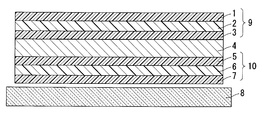
- FIG. 1 is a schematic diagram showing an example of the structure of an image display unit in the image display apparatus of the present invention.
- the resin (A) is not particularly limited as long as it is an acrylic resin having a ring structure in the main chain. However, the resin (A) needs to be an acrylic resin having a Tg of 110 ° C. or more as the resin composition.
- the acrylic resin is a resin having a (meth) acrylic acid ester unit and / or a (meth) acrylic acid unit as a constituent unit.
- the total ratio of the (meth) acrylic acid ester unit and the (meth) acrylic acid unit in all the structural units of the acrylic resin is usually 50 mol% or more, preferably 60 mol% or more, more preferably 70 mol% or more. It is.
- Resin (A) has a ring structure in the main chain. When the ring structure is a derivative of a (meth) acrylate unit, a (meth) acrylate unit or (meth) acrylic unit in all structural units If the total of the proportions of the ring structure is 50 mol% or more, an acrylic resin is obtained.
- (Meth) acrylate units are, for example, methyl (meth) acrylate, ethyl (meth) acrylate, n-propyl (meth) acrylate, n-butyl (meth) acrylate, t-butyl (meth) acrylate , N-hexyl (meth) acrylate, cyclohexyl (meth) acrylate, benzyl (meth) acrylate, chloromethyl (meth) acrylate, 2-chloroethyl (meth) acrylate, 2-hydroxyethyl (meth) acrylate , 3-hydroxypropyl (meth) acrylate, 2,3,4,5,6-pentahydroxyhexyl (meth) acrylate, 2,3,4,5-tetrahydroxypentyl (meth) acrylate, 2- ( ⁇ -hydroxyacrylates such as hydroxymethyl) methyl acrylate and 2- (hydroxyethyl) methyl acrylate Methyl
- Resin (A) may have 2 or more types of these structural units as a (meth) acrylic acid ester unit.
- the resin (A) preferably has a methyl (meth) acrylate (MMA) unit.
- MMA methyl (meth) acrylate
- the resin (A), a resin composition containing the resin (A), and a resin obtained by molding the composition The thermal stability of the molded product is improved.
- the Tg of the resin (A) is usually 110 ° C. or higher because the Tg of the resin composition containing the resin (A) and UVA (B) is 110 ° C. or higher.
- the Tg of the resin (A) is preferably 115 ° C. or higher, more preferably 120 ° C. or higher, and further preferably 130 ° C. or higher.
- a high Tg of the resin (A) of 110 ° C. or higher, and in some cases 130 ° C. or higher is achieved by the resin (A) having a ring structure in the main chain.
- Tg of polymethyl methacrylate (PMMA) which is a typical acrylic resin having no ring structure in the main chain is 105 ° C. That is, the resin (A) having a ring structure in the main chain improves the heat resistance of a resin molded product obtained from the composition of the present invention containing the resin (A).
- a resin molded product with improved heat resistance, such as a resin film is suitable for use as an optical member because it can be easily placed near a heat generating part such as a light source in an image display device.
- the Tg of the resin composition when the Tg of the resin composition is increased by including the resin (A) having a ring structure in the main chain, it is necessary to increase the molding temperature of the composition.
- the acrylic resin composition is usually formed into a molded product by extrusion molding, and at that time, a molding temperature equal to or higher than Tg of the composition is required.
- the molding temperature is high, foaming and UVA bleed out are likely to occur during molding, and UVA transpiration tends to be strong.
- the resin composition of the present invention even in such a case, the occurrence of bleed-out is small, and the occurrence of problems due to UVA transpiration can be suppressed.
- the ring structure is at least one selected from, for example, a lactone ring structure, a glutarimide structure, a glutaric anhydride structure, an N-substituted maleimide structure, and a maleic anhydride structure.
- the ring structure is preferably at least one selected from a glutarimide structure, a glutaric anhydride structure, and a lactone ring structure. Further, since the structure does not contain a nitrogen atom, coloring (yellowing) is unlikely to occur, and the optical characteristics when the resin molded product is obtained are excellent, and the ring structure is preferably a lactone ring structure.
- the resin (A) is preferably an acrylic resin having a lactone ring structure in the main chain.
- the lactone ring structure that the resin (A) may have in the main chain is not particularly limited, and may be, for example, a 4- to 8-membered ring. However, since it has excellent stability as a ring structure, A 6-membered ring is preferable, and a 6-membered ring is more preferable.
- the 6-membered lactone ring structure is, for example, the structure disclosed in Japanese Patent Application Laid-Open No. 2004-168882, but the precursor (the lactone ring structure is converted into the main chain by subjecting the precursor to a cyclization condensation reaction).
- the polymerization yield of the resin (A) is high), the resin (A) having a high lactone ring content can be obtained by the cyclocondensation reaction of the precursor, and the methyl methacrylate unit is a structural unit.
- a structure represented by the following formula (2) is preferable because the polymer can be a precursor.
- R 6 , R 7 and R 8 are each independently a hydrogen atom or an organic residue having 1 to 20 carbon atoms.
- the organic residue may contain an oxygen atom.
- the organic residue in the formula (2) is, for example, an alkyl group having 1 to 20 carbon atoms such as a methyl group, an ethyl group, or a propyl group; an ethenyl group, a propenyl group, or the like having 1 to 20 carbon atoms.
- the lactone ring structure can be formed by dealcoholization cyclocondensation of a precursor having a hydroxyl group and an ester group in the molecular chain.
- the lactone ring represented by the formula (2) is formed, for example, by forming a copolymer of methyl methacrylate (MMA) and 2- (hydroxymethyl) methyl acrylate (MHMA) and then adjoining MMA in the copolymer. It can be formed by dealcoholization cyclocondensation of units and MHMA units.
- R 6 is H
- R 7 is CH 3
- R 8 is CH 3 .
- the following formula (3) shows a glutarimide structure and a glutaric anhydride structure.
- R 9 and R 10 in the above formula (3) are each independently a hydrogen atom or a methyl group, and X 1 is an oxygen atom or a nitrogen atom.
- X 1 is an oxygen atom
- R 11 does not exist
- R 11 is a hydrogen atom, a linear alkyl group having 1 to 6 carbon atoms, a cyclopentyl group, a cyclohexyl group, or a phenyl group.
- the ring structure represented by the formula (3) is a glutarimide structure.
- the glutarimide structure can be formed, for example, by imidizing a (meth) acrylic acid ester polymer with an imidizing agent such as methylamine.
- the ring structure represented by the formula (3) is a glutaric anhydride structure.
- the glutaric anhydride structure can be formed, for example, by subjecting a copolymer of (meth) acrylic acid ester and (meth) acrylic acid to dealcoholization cyclocondensation within the molecule.
- the following formula (4) shows an N-substituted maleimide structure and a maleic anhydride structure.
- R 12 and R 13 in the above formula (4) are each independently a hydrogen atom or a methyl group, and X 2 is an oxygen atom or a nitrogen atom.
- X 2 is an oxygen atom
- R 14 does not exist
- X 2 is a nitrogen atom
- R 14 is a hydrogen atom, a linear alkyl group having 1 to 6 carbon atoms, a cyclopentyl group, a cyclohexyl group, or a phenyl group. .
- the ring structure represented by the formula (4) is an N-substituted maleimide structure.
- the acrylic resin having an N-substituted maleimide structure in the main chain can be formed, for example, by copolymerizing N-substituted maleimide and (meth) acrylic acid ester.
- the ring structure represented by the formula (4) is a maleic anhydride structure.
- the acrylic resin having a maleic anhydride structure in the main chain can be formed, for example, by copolymerizing maleic anhydride and (meth) acrylic acid ester.
- each method for forming a ring structure exemplified in the description of formulas (3) and (4) all polymers used for forming each ring structure have (meth) acrylate units as constituent units.
- the resin obtained by this method is an acrylic resin.
- the content of the ring structure (excluding the lactone ring structure) in the resin (A) is not particularly limited, but is, for example, 5 to 90% by weight, preferably 10 to 70% by weight, more preferably 10 to 60% by weight, 10 to 50% by weight is more preferable.
- the content of the lactone ring structure in the resin is not particularly limited, but is, for example, 5 to 90% by weight, 20 to 90% by weight, 30 to 90% by weight. 35 to 90% by weight, 40 to 80% by weight and 45 to 75% by weight are more preferable.
- the resin (A) having a ring structure in the main chain can be produced by a known method.
- the resin (A) whose ring structure is a lactone ring structure is, for example, a method described in JP-A-2006-96960 (WO2006 / 025445), JP-A-2006-171464, or JP-A-2007-63541.
- the resin (A) whose ring structure is an N-substituted maleimide structure, a glutaric anhydride structure or a glutarimide structure is, for example, a method described in JP2007-31537A, WO2007 / 26659, or WO2005 / 108438.
- the resin (A) whose ring structure is a maleic anhydride structure can be produced, for example, by the method described in JP-A-57-153008.
- the resin (A) may have a structural unit other than the (meth) acrylic acid ester unit and the (meth) acrylic acid unit.
- a structural unit examples include styrene, vinyltoluene, ⁇ -methylstyrene. Derived from monomers such as acrylonitrile, methyl vinyl ketone, ethylene, propylene, vinyl acetate, methallyl alcohol, allyl alcohol, 2-hydroxymethyl-1-butene, ⁇ -hydroxymethylstyrene, ⁇ -hydroxyethylstyrene, etc. It is a structural unit.
- the resin (A) may have two or more of these structural units.
- Resin (A) may have a structural unit having an effect of giving negative intrinsic birefringence to the resin.
- the degree of freedom in controlling the birefringence of the resin composition and the resin molded product obtained by molding the composition is improved, and the resin molded product (for example, resin film) formed from the resin composition of the present invention. Use as an optical member is expanded.
- Intrinsic birefringence refers to the orientation axis from the refractive index n1 of light in a direction parallel to the direction (orientation axis) in which molecular chains are oriented in a layer (for example, a sheet or film) in which resin molecular chains are uniaxially oriented.
- the sign of the intrinsic birefringence of the resin (A) itself is determined by the balance between the action of the structural unit with respect to the intrinsic birefringence and the action of the other structural unit of the resin (A).
- An example of a structural unit having an effect of giving negative intrinsic birefringence to the resin (A) is a styrene unit.
- Resin (A) may have a structural unit (UVA unit) having ultraviolet absorbing ability.
- UVA unit structural unit having ultraviolet absorbing ability.
- the ultraviolet absorbing ability of the resin composition and the resin molded product obtained by molding the composition is further improved.
- the compatibility between the resin (A) and the UVA (B) is improved.
- the monomer (C) that is the source of the UVA unit is not particularly limited, and is, for example, a benzotriazole derivative, a triazine derivative, or a benzophenone derivative into which a polymerizable group is introduced.
- the polymerizable group to be introduced can be appropriately selected according to the structural unit of the resin (A).
- the monomer (C) examples include 2- (2′-hydroxy-5′-methacryloyloxy) ethylphenyl-2H-benzotriazole (trade name RUVA-93 manufactured by Otsuka Chemical), 2- (2′- Hydroxy-5'-methacryloyloxy) phenyl-2H-benzotriazole, 2- (2'-hydroxy-3'-t-butyl-5'-methacryloyloxy) phenyl-2H-benzotriazole.
- 2- (2′-hydroxy-5′-methacryloyloxy) ethylphenyl-2H-benzotriazole trade name RUVA-93 manufactured by Otsuka Chemical
- 2- (2′- Hydroxy-5'-methacryloyloxy) phenyl-2H-benzotriazole 2- (2'-hydroxy-3'-t-butyl-5'-methacryloyloxy
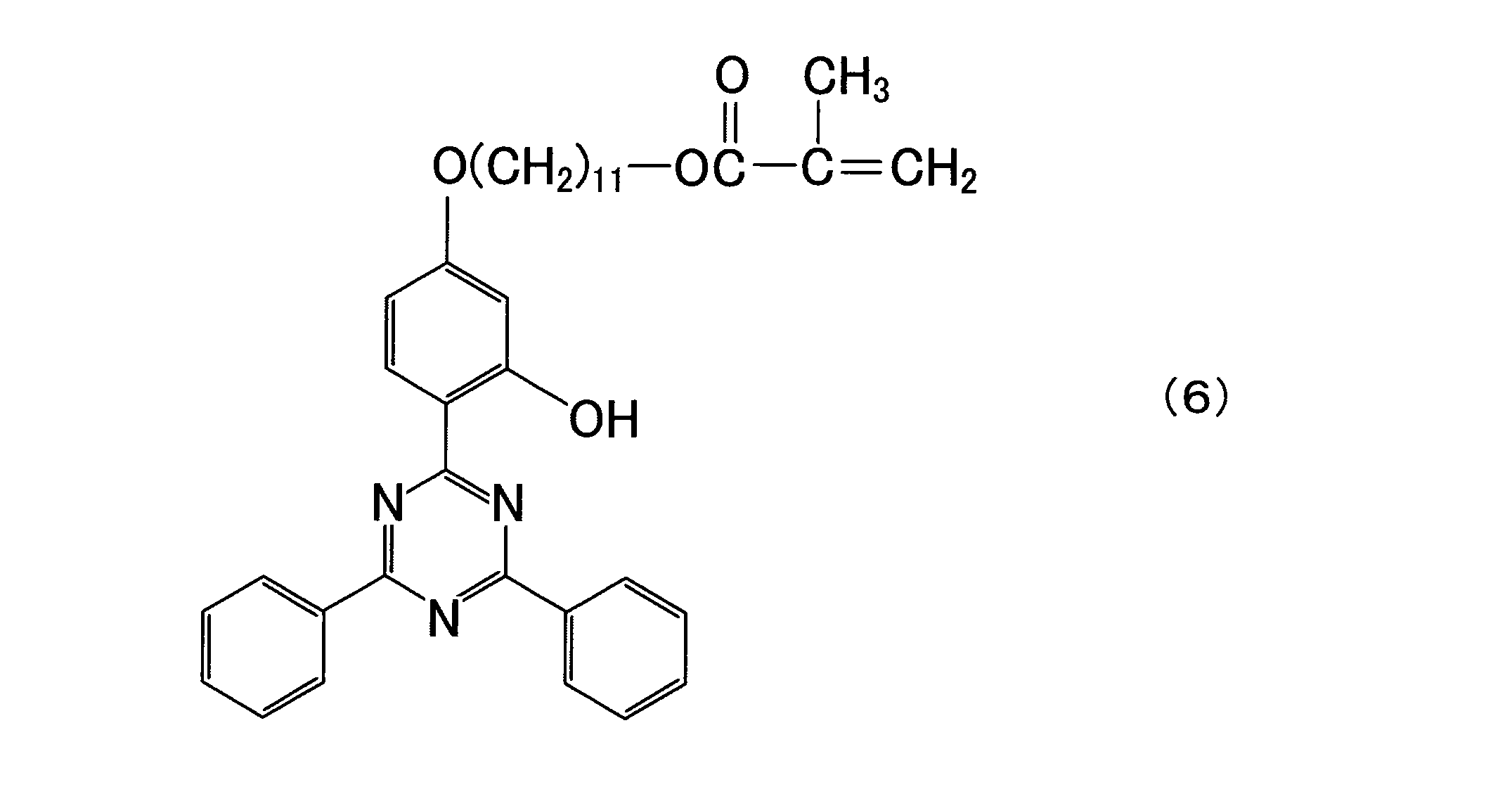
- monomer (C) other than the above are triazine derivatives represented by the following formulas (5), (6) and (7) or benzotriazole derivatives represented by the following formula (8). .
- the monomer (C) is preferably 2- (2'-hydroxy-5'-methacryloyloxy) ethylphenyl-2H-benzotriazole because of its high ultraviolet absorption ability.
- the desired ultraviolet absorbing effect can be obtained even when the content of the UVA unit in the resin (A) is low. That is, even when the resin (A) contains a UVA unit, the content of constituent units other than the UVA unit can be relatively increased, and characteristics (for example, thermoplasticity and heat resistance) suitable for various uses such as an optical member can be obtained. It becomes easy to obtain the resin composition which has. Further, since the coloration of the resin composition tends to occur when the content of the UVA unit is increased, the UVA unit having a high ultraviolet absorption ability can suppress the coloring of the resin molded product finally obtained, The molded article is suitable for use as an optical member.
- the content of the unit in the resin (A) is preferably 20% by weight or less, and more preferably 15% by weight or less.
- the content of the UVA unit in the resin (A) exceeds 20% by weight, the heat resistance as the resin composition is lowered.
- the weight average molecular weight of the resin (A) is, for example, in the range of 1,000 to 300,000, preferably in the range of 5,000 to 250,000, more preferably in the range of 10,000 to 200,000, and still more preferably in the range of 50,000 to 200,000.
- UVA (B) has a structure represented by the following formula (1).
- R 1 in the above formula (1) is a hydrogen atom or a group represented by the formula “—OR 5 ”, and R 5 is an alkyl group or alkyl ester group having 1 to 18 carbon atoms.
- R 2 to R 4 are each independently a hydrogen atom or an alkyl group or alkyl ester group having 1 to 18 carbon atoms.
- the alkyl ester group is preferably a group represented by the formula “—CH (—R 15 ) C ( ⁇ O) OR 16 ”.
- R 15 is a hydrogen atom or a methyl group.
- 16 is an alkyl group.
- the alkyl groups R 2 to R 4 and R 16 may be linear alkyl groups or branched alkyl groups.
- UVA (B) has a phenyltriazine skeleton, but has two hydroxyphenyl groups bonded to the triazine in the skeleton.
- the conventional triazine UVA disclosed in JP-A-2006-328334 and the like only one hydroxyphenyl group is bonded to the triazine.
- the hydrogen atom of the hydroxyl group in the hydroxyphenyl group forms a hydrogen bond with the nitrogen atom of triazine, and the formed hydrogen bond increases the action as a chromophore of the phenyltriazine skeleton.
- UVA (B) since the two hydrogen bonds are formed, the action of the phenyltriazine skeleton as a chromophore can be further increased, and a high UV absorbing ability can be obtained with a small amount of UVA (B) added. .
- the resin (A) is an acrylic resin having a ring structure in the main chain and the compatibility between the resin (A) and the UVA (B) is high, the resin composition of the present invention provides heat resistance. In addition, a resin molded product having excellent transparency can be obtained.
- R 1 in the above formula (1) is preferably a group represented by the above formula “—OR 5 ”, that is, an alkoxy group or an alkyl esteroxy group.
- R 5 is an alkyl group, that is, R 1 is an alkoxy group.
- R 2 , R 3 and R 4 are also alkyl groups. preferable.
- UVA (B) Specific examples of UVA (B) are given in the following formulas (9) and (10). However, UVA (B) is not limited to the example shown below.
- a commercially available ultraviolet absorber containing UVA (B) represented by the above formula (9) as a main component is, for example, TINUVIN460 (manufactured by Ciba Specialty Chemicals).
- the main component in this specification means a component with most content (content rate), and the content rate is typically 50 weight% or more.
- the molar extinction coefficient for light in the wavelength range of 300 nm to 380 nm is preferably 10,000 (L ⁇ mol ⁇ 1 ⁇ cm ⁇ 1 ) or more in the chloroform solution.
- the Tg of the resin composition of the present invention is 110 ° C. or higher and the temperature required for molding (for example, extrusion molding) is high, a gel may be formed during molding. Gels are more likely to occur as the molding temperature increases. For this reason, the higher the Tg of the composition, the higher the required molding temperature, and the easier it is to produce a gel.
- UVA (B) does not have a structure that can serve as a crosslinking point of the resin (A) such as a thiol group, a hydroxyl group, an amine group, or a carbon-carbon double bond.
- the resin film for example, optical films, such as a polarizer protective film
- the molding temperature of the composition can be further increased by suppressing the generation of gel, (1) the melt viscosity of the composition during molding is lowered and the productivity of the resin molded product is improved.
- the hydroxyphenyl group in UVA (B) represented by the formula (1) has a hydroxyl group as a substituent, but the hydroxyl group directly bonded to the benzene ring does not form a crosslinked structure with the resin (A), so that it becomes a crosslinking point. I don't think it's a possible structure.
- TAC triacetyl cellulose
- the resin composition of the present invention contains a resin (A) and UVA (B), and the content of UVA (B) in the composition is 100 parts by weight of the thermoplastic resin including the resin (A). That is, when the total weight of the thermoplastic resin contained in the composition is 100 parts by weight, it is in the range of 0.1 to 5 parts by weight.
- the content of UVA (B) is smaller than the above range, sufficient ultraviolet absorbing ability cannot be obtained.
- the content of UVA (B) is larger than the above range, the demerit of foaming and bleed out during molding becomes larger than the merit of increasing the ultraviolet absorbing ability.
- the content of UVA (B) in the resin composition of the present invention is preferably 0.5 to 4 parts by weight, and more preferably 1 to 3 parts by weight with respect to 100 parts by weight of the thermoplastic resin.
- the main component of the thermoplastic resin contained in the resin composition of the present invention is the resin (A).
- the proportion of the resin (A) in the entire thermoplastic resin contained in the resin composition of the present invention is usually 60% by weight or more, preferably 70% by weight or more, more preferably 85% by weight or more. It is.
- the resin composition of the present invention has a thermoplastic resin other than the resin (A) in a proportion of less than 40% by weight (preferably 30% by weight) based on the total thermoplastic resin contained in the composition. Less than 15% by weight, more preferably less than 15% by weight.
- thermoplastic resins include, for example, olefin polymers such as polyethylene, polypropylene, ethylene-propylene copolymer, poly (4-methyl-1-pentene); halogen-containing polymers such as vinyl chloride and chlorinated vinyl resins; polystyrene Styrene polymers such as styrene-methyl methacrylate copolymer, styrene-acrylonitrile copolymer, acrylonitrile-butadiene-styrene block copolymer; polyesters such as polyethylene terephthalate, polybutylene terephthalate, polyethylene naphthalate; nylon 6, nylon 66 , Polyamides such as nylon 610; polyacetals; polycarbonates; polyphenylene oxides; polyphenylene sulfides; polyether ether ketones; Terusaruhon; polyoxyethylene Penji alkylene; polyamideimide; polybutadiene rubber or ABS resin containing an acrylic rubber, rubber-like
- the rubbery polymer preferably has on its surface a graft portion having a composition compatible with the resin (A).
- the average particle size is determined according to the present invention. From the viewpoint of improving transparency when the resin composition is a resin film, 300 nm or less is preferable, and 150 nm or less is more preferable.
- compatibility with the resin (A) is derived from the vinyl cyanide monomer.
- a copolymer containing a structural unit and a structural unit derived from an aromatic vinyl monomer is preferred.
- the copolymer is, for example, a styrene-acrylonitrile copolymer or a vinyl chloride resin.
- the resin composition of the present invention has a high glass transition temperature (Tg) of 110 ° C. or higher.
- Tg glass transition temperature
- the Tg of the resin composition of the present invention is 115 ° C. or higher, 120 ° C. or higher, and further 130 ° C. or higher. .
- the resin composition of the present invention has a high ultraviolet absorbing ability based on UVA (B).
- the transmittance of light having a wavelength of 380 nm is less than 30%, and in some cases, 20 %, Further less than 10%, and less than 1%. What is necessary is just to measure this transmittance
- the resin composition of the present invention has a high visible light transmittance based on the compatibility between the resin (A) and the UVA (B). For example, when the film has a thickness of 100 ⁇ m, it transmits light having a wavelength of 500 nm.
- the rate can be 80% or more, in some cases 85% or more, and even 90% or more. This transmittance can be measured in the same manner as the transmittance of light having a wavelength of 380 nm.
- the resin composition of the present invention can suppress UVA (B) sublimation during and after molding.
- UVA UVA
- a volatile component obtained by heating the film at 150 ° C. for 10 hours is dissolved in a volume of 1 mL of a solvent (for example, chloroform) to obtain a film.
- the absorbance of light having a wavelength of 350 nm measured by an absorptiometer while being stored in a quartz cell having an optical path length of 1 cm can be made less than 0.1. Note that when the amount of sublimation of UVA increases, the amount of UVA in the volatile component increases, and thus the absorbance of the solution in which the component is dissolved increases.
- the combination of the resin (A) and UVA (B) described above can improve the hue of the composition and a resin molded product obtained by molding the composition.
- the resin composition of the present invention may contain a polymer having negative intrinsic birefringence.
- the freedom degree of control of the birefringence for example, phase difference
- the resin composition and the resin molded product obtained by molding the composition is improved.
- the polymer having negative intrinsic birefringence is, for example, a copolymer of a vinyl cyanide monomer and an aromatic vinyl monomer.
- the copolymer is, for example, a styrene-acrylonitrile copolymer, and the styrene-acrylonitrile copolymer is excellent in compatibility with the resin (A) in a wide range of copolymer compositions.
- the styrene-acrylonitrile copolymer can be produced by various polymerization methods such as emulsion polymerization, suspension polymerization, solution polymerization, and bulk polymerization.
- a resin molded article formed from the resin composition of the present invention is used as an optical member, it is preferable to use a styrene-acrylonitrile copolymer produced by solution polymerization or bulk polymerization because transparency and optical properties are improved. .
- the resin composition of the present invention may contain an antioxidant.
- antioxidant is not specifically limited, For example, well-known antioxidants, such as a hindered phenol type, a phosphorus type, or a sulfur type, can be used by 1 type or in combination of 2 or more types.
- 2,4-di-t-amyl-6- [1- (3,5-di-t-amyl-2-hydroxyphenyl) ethyl] phenyl acrylate eg, Sumitizer GS manufactured by Sumitomo Chemical
- 2 -T-Butyl-6- (3-t-butyl-2-hydroxy-5-methylbenzyl) -4-methylphenyl acrylate for example, Sumitizer GM manufactured by Sumitomo Chemical
- Sumitizer GM manufactured by Sumitomo Chemical
- the addition amount of the antioxidant in the resin composition of the present invention is, for example, 0 to 10% by weight, preferably 0 to 5% by weight, more preferably 0.01 to 2% by weight, and 0.05 to 1% by weight. Is more preferable. When the amount of the antioxidant added is excessively large, the antioxidant bleed out or silver streaks may occur during molding.
- the resin composition of the present invention may contain other additives.
- Other additives include, for example, a stabilizer such as a light stabilizer, a weather stabilizer, and a heat stabilizer; a reinforcing material such as a glass fiber and a carbon fiber; a near infrared absorber; a tris (dibromopropyl) phosphate, a triallyl phosphate, Flame retardants such as antimony oxide; antistatic agents typified by anionic, cationic, and nonionic surfactants; colorants such as inorganic pigments, organic pigments, dyes; organic fillers, inorganic fillers; resin modifiers; Plasticizers; lubricants; flame retardants.
- the amount of the other additives added to the resin composition of the present invention is, for example, 0 to 5% by weight, preferably 0 to 2% by weight, and more preferably 0 to 0.5% by weight.
- the resin composition of the present invention can be molded into an arbitrary shape, for example, a film or a sheet, by a known molding technique such as injection molding, blow molding, extrusion molding, or cast molding.
- the molding temperature may be appropriately set according to the Tg and characteristics of the resin composition, and is not particularly limited, but is, for example, 150 to 350 ° C., and preferably 200 to 300 ° C.
- the resin molded product obtained by molding the resin composition of the present invention has few defects such as bleed-out, and has high ultraviolet absorbing ability, heat resistance and transparency.
- the resin composition of the present invention can be produced by mixing a thermoplastic resin mainly composed of the resin (A) and UVA (B) by a known method.
- the produced resin composition may be pelletized with a pelletizer or the like, if necessary.
- thermoplastic resin and UVA (B) are not particularly limited as long as the above-described properties as the resin composition are not impaired.
- UVA (B) may be added during polymerization of a thermoplastic resin (for example, resin (A)), or after polymerization of the thermoplastic resin, the obtained thermoplastic resin and UVA (B) are mixed (for example, Melt kneading).
- the specific method for melt-kneading the thermoplastic resin and UVA (B) is not particularly limited.
- the thermoplastic resin, UVA (B) and other components to be added may be simultaneously heated and melted and kneaded.
- UVA (B) may be further added thereto and kneaded. Further, after the thermoplastic resin is heated and melted, UVA (B) and other components to be added may be further added and kneaded.
- the resin molded product of the present invention comprises the resin composition of the present invention.
- the resin molded product of the present invention has various characteristics based on the characteristics of the above-described resin composition of the present invention.
- the resin molded product of the present invention has high ultraviolet absorption ability, heat resistance and transparency.
- the resin molded product of the present invention has few defects such as bleed out.
- the resin molded product of the present invention can be suitably used as an optical member. Further, due to the high heat resistance, it can be placed close to a heat generating part such as a light source.
- the shape of the resin molded product of the present invention is not particularly limited, and is, for example, a film or a sheet.
- the thickness of the resin molded product of the present invention that is a film is, for example, 1 ⁇ m or more and less than 350 ⁇ m, and preferably 10 ⁇ m or more and less than 350 ⁇ m. When the thickness is less than 1 ⁇ m, the strength as a resin film may be insufficient, and breakage or the like is likely to occur during post-processing such as stretching.
- the thickness of the resin molded product of the present invention which is a sheet is, for example, from 350 ⁇ m to 10 mm, and preferably from 350 ⁇ m to 5 mm. When the thickness exceeds 10 mm, it becomes difficult to make the sheet thickness uniform, and it becomes difficult to use the resin sheet as an optical member.
- the resin sheet and the resin film can be formed, for example, by extruding the resin composition of the present invention.
- the resin molded product of the present invention has a high Tg, for example, a value of 110 ° C. or higher. Depending on the composition of the resin composition constituting the resin molded product, Tg is 115 ° C. or higher, 120 ° C. or higher, and further 130 ° C. or higher.
- the resin molded product of the present invention has a high ultraviolet absorbing ability.
- the transmittance of light having a wavelength of 380 nm can be less than 30%, sometimes less than 20%, further less than 10%, and less than 1%.
- the resin molded product of the present invention has a high visible light transmittance.
- the transmittance of light having a wavelength of 500 nm can be 80% or more, in some cases 85% or more, 90% or more, and further 92% or more.
- the transmittance of the film (sheet) with respect to light having a wavelength of 380 nm and light having a wavelength of 500 nm may be measured according to the method described above.
- the resin molded product of the present invention preferably has a tensile strength measured according to ASTM-D-882-61T of 10 MPa or more and less than 100 MPa, more preferably 30 MPa or more and less than 100 MPa.
- a tensile strength measured according to ASTM-D-882-61T 10 MPa or more and less than 100 MPa, more preferably 30 MPa or more and less than 100 MPa.
- the mechanical strength as a resin sheet (film) may become inadequate.
- the tensile strength exceeds 100 MPa, the workability decreases.
- the resin molded product of the present invention preferably has an elongation of 1% or more measured in accordance with ASTM-D-882-61T.
- the upper limit of the said elongation rate is not specifically limited, Usually, it is 100% or less.
- the toughness as a resin sheet (film) may become inadequate.
- the tensile modulus measured according to ASTM-D-882-61T is preferably 0.5 GPa or more, more preferably 1 GPa or more, and 2 GPa or more. More preferably.
- the upper limit of the said tensile elasticity modulus is not specifically limited, Usually, it is 20 GPa or less. When the said tensile elasticity modulus is less than 0.5 GPa, the mechanical strength as a resin sheet (film) may become inadequate.
- Functional coating layers may be formed on the surface of the resin molded product of the present invention which is a sheet or a film, if necessary.
- Functional coating layers include, for example, antistatic layers, adhesive layers, adhesive layers, easy adhesion layers, antiglare (non-glare) layers, antifouling layers such as photocatalyst layers, antireflection layers, hard coat layers, and UV shielding layers. Layers, heat ray shielding layers, electromagnetic wave shielding layers, gas barrier layers, and the like.
- the member which has the functional coating layer mentioned above may be laminated
- the use of the resin molded product of the present invention which is a sheet or a film is not particularly limited, it can be suitably used as an optical member due to its high transparency, heat resistance and ultraviolet absorbing ability.
- the optical member is, for example, an optical protective film (sheet), specifically, a protective film for various optical disk (VD, CD, DVD, MD, LD, etc.) substrates, and an image display device such as a liquid crystal display (LCD). It is a polarizer protective film used for the polarizing plate with which is provided.
- Retardation film viewing angle compensation film, light diffusion film, reflection film, antireflection film, antiglare film, brightness enhancement film, optical film such as touch panel conductive film, or diffusion plate, light guide, retardation plate
- optical sheet such as a prism sheet.
- a polarizer protective film will be described.
- a pair of polarizing plates is arranged in the LCD so as to sandwich the liquid crystal cell based on the principle of image display.
- the polarizing plate generally includes a polarizer made of a resin film such as polyvinyl alcohol, and a polarizer protective film for protecting the polarizer.
- a polarizer protective film of the present invention deterioration of the polarizer due to ultraviolet rays can be suppressed due to its high ultraviolet absorbing ability.
- the high heat resistance makes it possible to dispose the polarizing plate close to the light source, and the high transparency makes it possible to form an image display device having excellent image display characteristics.
- the polarizer protective film Conventionally, a triacetyl cellulose (TAC) film has been used as the polarizer protective film.
- TAC film does not have sufficient moisture and heat resistance, and when the TAC film is used as a polarizer protective film, the characteristics of the polarizing plate may be deteriorated under a high temperature or high humidity environment. Further, the TAC film has a retardation in the thickness direction, and this retardation adversely affects the viewing angle characteristics of an image display device such as an LCD, particularly a large screen image display device.
- the polarizer protective film of this invention consists of a resin composition which has an acrylic resin as a main component, it can improve heat-and-moisture resistance and optical characteristics compared with a TAC film.
- the structure of the polarizing plate including the polarizer protective film of the present invention is not particularly limited, and may be a structure in which a polarizer protective film is laminated on one surface of the polarizer.
- the polarizer may be sandwiched between the polarizer protective films.
- a typical example of the structure of the polarizing plate of the present invention is an adhesive on one or both sides of a polarizer obtained by uniaxially stretching a polyvinyl alcohol film dyed with a dichroic substance such as iodine or a dichroic dye. It is the structure which joined the polarizer protective film of this invention through the layer or the easily bonding layer.
- the polarizing plate of the present invention can be used for image display devices such as LCDs.
- the polarizing plate of the present invention may be disposed on only one of the viewing side or the backlight side of the liquid crystal cell, or on both sides.
- the image display apparatus in which the polarizing plate of the present invention can be used is not particularly limited, and examples thereof include reflective, transmissive, and transflective LCDs; TN, STN, OCB, HAN, VA, IPS, and the like. LCDs having various driving systems; electroluminescence (EL) displays; plasma displays (PD); field emission displays (FEDs).
- EL electroluminescence
- PD plasma displays
- FEDs field emission displays
- the configuration of the image display device including the polarizing plate of the present invention is not particularly limited as long as members such as a retardation plate, an optical compensation sheet, and a backlight unit are appropriately provided as necessary. Good.
- FIG. 1 shows an example of the structure of the image display unit in the image display apparatus of the present invention.
- An image display unit 11 illustrated in FIG. 1 is an image display unit of an LCD, and includes a liquid crystal cell 4, a pair of polarizing plates 9 and 10 disposed so as to sandwich the liquid crystal cell 4, and the liquid crystal cell 4 and the polarizing plate 9. 10 and a backlight 8 disposed on one surface of the laminated body.
- Each polarizing plate 9, 10 includes polarizers 2, 6 and a pair of polarizer protective films 1, 3, 5, 7 arranged so as to sandwich the polarizer.
- the liquid crystal cell 4 has a known structure, and includes, for example, a liquid crystal layer, a glass substrate, a transparent electrode, an alignment film, and the like.
- the backlight 8 has a known structure, and includes, for example, a light source, a reflection sheet, a light guide plate, a diffusion plate, a diffusion sheet, a prism sheet, and a brightness enhancement film.
- At least one selected from the four polarizer protective films may be the polarizer protective film of the present invention, and all the polarizer protective films are preferably the polarizer protective films of the present invention.
- the protective film is preferably the polarizer protective film of the present invention, and among the polarizer protective films 1 and 3 of the polarizing plate 9, at least the film 1 positioned on the outer side is the polarizer protective film of the present invention. More preferred.
- the image display unit 11 may further include an arbitrary optical member such as a phase difference plate or an optical compensation sheet as necessary.
- the method for producing a resin molded product of the present invention is not particularly limited, but an example of a method for producing a resin film as a resin molded product will be shown below. This manufacturing method can also be applied to a method for manufacturing a resin sheet.
- extrusion molding method as a method for producing a resin film from the resin composition of the present invention.
- a mixer such as an omni mixer
- the resulting mixture may be extrusion kneaded from a kneader.
- the kneader used for the extrusion kneading is not particularly limited, and for example, a known kneader such as a single screw extruder, a twin screw extruder, or a pressure kneader can be used.
- a separately formed resin composition may be melt-extruded.
- the melt extrusion method include a T-die method and an inflation method, and the molding temperature at that time is preferably 200 to 350 ° C., more preferably 250 to 300 ° C., still more preferably 255 ° C. to 300 ° C., particularly The temperature is preferably 260 ° C to 300 ° C.
- a resin film wound into a roll can be obtained by attaching a T-die to the tip of the extruder and winding the film extruded from the T-die. At this time, it is also possible to control the temperature and speed of winding and to stretch (uniaxial stretching) in the extrusion direction of the film. Further, the film may be stretched in a direction perpendicular to the extrusion direction, and sequential biaxial stretching or simultaneous biaxial stretching may be performed.
- the type is not particularly limited and may be uniaxial, biaxial, or multiaxial, but its L / D value is (L is the value of the extruder) 10 to 100, preferably 20 to 50, more preferably 25 to 40, in order to sufficiently plasticize the resin composition and obtain a good kneaded state. preferable.
- L / D value is less than 10, the resin composition cannot be sufficiently plasticized and a good kneaded state may not be obtained.
- the L / D value exceeds 100, the resin in the composition may be thermally decomposed due to excessive generation of shear heat to the resin composition.
- the set temperature of the cylinder is preferably 200 ° C. or higher and 300 ° C. or lower, more preferably 250 ° C. or higher and 300 ° C. or lower. If setting temperature is less than 200 degreeC, the melt viscosity of a resin composition will become high too much, and the productivity of a resin film will fall. On the other hand, if the set temperature exceeds 300 ° C., the resin in the resin composition may be thermally decomposed.
- the shape is not particularly limited, but the extruder preferably has one or more open vent portions.
- the decomposition gas can be sucked from the open vent portion, and the amount of volatile components remaining in the obtained resin film can be reduced.
- the open vent portion may be in a reduced pressure state, and the degree of pressure reduction is 931 to 1.3 hPa (700 to 1 mmHg) as the pressure of the open vent portion.
- the range is preferable, and the range of 798 to 13.3 hPa (600 to 10 mmHg) is more preferable.
- a resin composition filtered with a polymer filter may be molded. Since the foreign matter present in the resin composition can be removed by the polymer filter, defects in the appearance of the obtained film can be reduced. In addition, the resin composition will be in a high temperature molten state at the time of filtration with a polymer filter. For this reason, the resin composition deteriorates when passing through the polymer filter, gas components and colored deterioration products formed by the deterioration flow into the composition, and the resulting film is perforated, flow pattern, flow Defects such as streaks may be observed. This defect is particularly easily observed during continuous molding of a resin film.
- the molding temperature decreases the melt viscosity of the resin composition and shortens the residence time of the resin composition in the polymer filter, for example, 255. ⁇ 300 ° C., preferably 260 to 320 ° C.
- the configuration of the polymer filter is not particularly limited, a polymer filter in which a large number of leaf disk filters are arranged in a housing can be suitably used.
- the filter material of the leaf disk type filter may be any of a type in which a metal fiber nonwoven fabric is sintered, a type in which metal powder is sintered, a type in which several metal meshes are laminated, or a hybrid type in which they are combined. The sintered type is most preferred.
- the filtration accuracy by the polymer filter is not particularly limited, but is usually 15 ⁇ m or less, preferably 10 ⁇ m or less, more preferably 5 ⁇ m or less.
- the residence time of the resin composition becomes longer, so that the thermal degradation of the composition increases and the productivity of the resin film decreases.
- the filtration accuracy exceeds 15 ⁇ m, it is difficult to remove foreign substances in the resin composition.
- the filtration area with respect to the resin treatment amount per hour in the polymer filter is not particularly limited, and can be appropriately set according to the treatment amount of the resin composition.
- the filtration area is, for example, 0.001 to 0.15 m 2 / (kg / h).
- the shape of the polymer filter is not particularly limited.
- an inner flow type having a plurality of resin flow ports and a resin flow path in the center pole; an inner peripheral surface of the leaf disk filter at a plurality of vertices or faces And an external flow type having a resin flow path on the outer surface of the center pole.
- an external flow type in which the resin stays are small.
- the residence time of the resin composition in the polymer filter is not particularly limited, but is preferably 20 minutes or less, more preferably 10 minutes or less, and even more preferably 5 minutes or less.
- the filter inlet pressure and the filter outlet pressure during filtration are, for example, 3 to 15 MPa and 0.3 to 10 MPa, respectively, and the pressure loss (pressure difference between the inlet pressure and the outlet pressure of the filter) is 1 MPa to 15 MPa. A range is preferred.
- the pressure loss is 1 MPa or less, the resin composition tends to be biased in the flow path through the filter, and the quality of the obtained resin film tends to deteriorate.
- the pressure loss exceeds 15 MPa, the polymer filter is easily damaged.
- the temperature of the resin composition introduced into the polymer filter may be appropriately set according to the melt viscosity, and is, for example, 250 to 300 ° C, preferably 255 to 300 ° C, and more preferably 260 to 300 ° C.
- the specific process for obtaining a resin film with few foreign substances and colored substances by filtration using a polymer filter is not particularly limited.
- the resin composition of the present invention is preferably extruded as it is after the production to obtain a resin film. Since heat history can be reduced as compared with the case where a resin film is formed by remelting the pellet obtained after pelletizing the resin composition, thermal deterioration of the resin composition can be suppressed. Moreover, in this method, since mixing of the foreign material from an environment can be suppressed, it can suppress that a foreign material exists in the obtained resin film, or coloring of the obtained resin film.
- a gear pump and a polymer filter are preferably arranged between the extruder and the T die.
- the resin film obtained by extrusion may be stretched as necessary.
- the type of stretching is not particularly limited, and may be uniaxial stretching or biaxial stretching.
- the mechanical strength of the resin film can be improved by stretching, and in some cases, birefringence can be imparted to the resin film.
- the resin composition of this invention can maintain optical isotropy after extending
- the stretching temperature is not particularly limited, and a temperature in the vicinity of Tg of the resin composition is preferable.
- the draw ratio and the draw speed are not particularly limited.
- heat treatment may be performed as necessary after stretching.
- the glass transition temperature (Tg) of each sample was determined in accordance with JIS K7121 regulations. Specifically, it is obtained by using a differential scanning calorimeter (manufactured by Rigaku, DSC-8230) and heating a sample of about 10 mg from normal temperature to 200 ° C. (temperature increase rate 20 ° C./min) in a nitrogen gas atmosphere. The DSC curve was evaluated by the starting point method. ⁇ -alumina was used as a reference.
- the light transmittance of each sample was measured by measuring the transmittance of the film for light having a wavelength of 380 nm and 500 nm using a spectrophotometer (manufactured by Shimadzu Corporation, UV-3100) after forming a film having a thickness of 100 ⁇ m by extrusion molding. It was evaluated by doing. A specific method for forming a 100 ⁇ m thick film from each sample will be described later.
- chloroform in which UVA was dissolved was placed in a quartz cell having an optical path length of 1 cm, and the absorbance with respect to light having a wavelength of 350 nm was measured using an absorptiometer (manufactured by Shimadzu Corporation, UV-3100). The greater the UVA sublimation amount, the greater the measured absorbance.
- the degree of contamination of the molding apparatus when molding each sample was evaluated by measuring the amount of UVA attached to the cast roll (the metal roll with which the molten resin film extruded from the T-die first contacts).
- the amount of adhesion was evaluated as follows. First, after a resin film was continuously extrusion-molded for 1 hour by a molding apparatus equipped with a cast roll, a 10 cm ⁇ 10 cm range at the center of the roll was wiped off with a cellulose wiper dipped in chloroform. Next, the wiper used for wiping was immersed in 30 mL of chloroform, and UVA wiped off from the cast roll was dissolved in chloroform.
- chloroform in which UVA was dissolved was placed in a quartz cell having an optical path length of 1 cm, and the absorbance with respect to light having a wavelength of 350 nm was measured using an absorptiometer (manufactured by Shimadzu Corporation, UV-3100).
- an absorptiometer manufactured by Shimadzu Corporation, UV-3100. The greater the amount of UVA attached to the cast roll (that is, the higher the UVA scattering property), the greater the measured absorbance.
- the content of the lactone ring structure in the acrylic resin was determined by the dynamic TG method as follows. First, a dynamic TG measurement was performed on an acrylic resin having a lactone ring structure, a weight reduction rate between 150 ° C. and 300 ° C. was measured, and the obtained value was defined as an actual weight reduction rate (X). . 150 ° C. is a temperature at which hydroxyl groups and ester groups remaining in the resin start a cyclization condensation reaction, and 300 ° C. is a temperature at which thermal decomposition of the resin begins.
- the rate of weight loss due to the reaction (ie, dealcoholization of the precursor)
- the weight reduction rate assuming that the condensation reaction rate was 100%) was calculated and used as the theoretical weight reduction rate (Y).
- the theoretical weight reduction rate (Y) can be determined from the content of the structural unit having a hydroxyl group involved in the dealcoholization reaction in the precursor. Note that the composition of the precursor was derived from the composition of the acrylic resin to be measured.
- the dealcoholization reaction rate of the acrylic resin was determined by the formula [1- (actually measured weight reduction rate (X) / theoretical weight reduction rate (Y))] ⁇ 100 (%).
- X actually measured weight reduction rate
- Y theoretical weight reduction rate
- the content of the structural unit having a hydroxyl group involved in the dealcoholization reaction in the precursor is multiplied by the obtained dealcoholization reaction rate and converted to the weight of the lactone ring structure, thereby containing the lactone ring structure in the acrylic resin. Rate.
- the dealcoholization reaction rate of the acrylic resin produced in Example 1 and Comparative Example 2 described later is obtained.
- the prepared acrylic resin pellets or the polymerization solution before the pellets were dissolved in tetrahydrofuran (THF) (or diluted with THF), and then the resin was precipitated using excess hexane or methanol. Next, the precipitate is vacuum dried (pressure 1.33 hPa, 80 ° C., 3 hours or more) to remove volatile components, and the obtained white solid resin is subjected to dynamic TG measurement under the following measurement conditions. Went.
- THF tetrahydrofuran
- Measuring device Rigaku, Thermo Plus 2 TG-8120 Dynamic TG Sample weight: 5-10mg Temperature increase rate: 10 ° C./min Atmosphere: under nitrogen flow (200 ml / min) Measurement method: Step-like isothermal control method (controlled at 60 to 500 ° C. with a weight reduction rate value of 0.005% / sec or less)
- Example 1 A reaction vessel having an internal volume of 1000 L equipped with a stirrer, a temperature sensor, a cooling pipe, and a nitrogen introduction pipe was charged with 40 parts by weight of methyl methacrylate (MMA), 10 parts by weight of methyl 2- (hydroxymethyl) acrylate (MHMA), 50 parts by weight of toluene as a polymerization solvent, and 0.025 parts by weight of Adeka Stub 2112 (manufactured by Asahi Denka Kogyo Co., Ltd.) were charged, and the temperature was raised to 105 ° C. while passing nitrogen through the mixture.
- MMA methyl methacrylate
- MHMA methyl 2- (hydroxymethyl) acrylate
- Adeka Stub 2112 manufactured by Asahi Denka Kogyo Co., Ltd.
- the polymerization solution thus obtained had a barrel temperature of 240 ° C., a rotation speed of 100 rpm, a degree of vacuum of 13.3 to 400 hPa (10 to 300 mmHg), a rear vent number of one, and a forevent number of four.
- the addition amount of UVA (B) in the resin composition (D-1) is included in the composition (D-1) with respect to 100 parts by weight of the acrylic resin (A) having a lactone ring structure in the main chain. 4.2 parts by weight (with respect to 100 parts by weight of the thermoplastic resin).
- the resin composition (D-2) was obtained by melting at a processing speed of 10 kg / hour.
- the amount of UVA (B) added to the resin composition (D-2) is 100 parts by weight of the thermoplastic resin (acrylic resin (A) and acrylonitrile-styrene copolymer) contained in the composition (D-2). 4.1 parts by weight.
- the amount of UVA (B) added in the resin composition (D-3) is 100 parts by weight of the thermoplastic resin (glutarimide-containing acrylic resin and acrylonitrile-styrene copolymer) contained in the composition (D-3). 4.0 parts by weight.
- the glutarimide-containing acrylic resin used as the resin (A) has a glutarimide structure in which X 1 is a nitrogen atom and R 9 to R 11 are CH 3 in the main chain in the above formula (3).
- Comparative Example 1 90 parts by weight of the resin composition (D-1) prepared in Example 1, 10 parts by weight of acrylonitrile-styrene copolymer (manufactured by Asahi Kasei Chemicals Co., Ltd., Stylac AS783), and 3 parts by weight of TINUVIN 460 as UVA (B)
- the resin composition (D-4) as a comparative example was obtained by melting at a speed of 10 kg / hour.
- the amount of UVA (B) added in the resin composition (D-4) is 100 parts by weight of the thermoplastic resin (acrylic resin (A) and acrylonitrile-styrene copolymer) contained in the composition (D-4). 6.6 parts by weight.
- Example 2 A reaction vessel having an internal volume of 1000 L equipped with a stirrer, a temperature sensor, a cooling pipe, and a nitrogen introduction pipe was charged with 40 parts by weight of methyl methacrylate (MMA), 10 parts by weight of methyl 2- (hydroxymethyl) acrylate (MHMA), 50 parts by weight of toluene as a polymerization solvent, and 0.025 parts by weight of Adeka Stub 2112 (manufactured by Asahi Denka Kogyo Co., Ltd.) were charged, and the temperature was raised to 105 ° C. while passing nitrogen through the mixture.
- MMA methyl methacrylate
- MHMA methyl 2- (hydroxymethyl) acrylate
- Adeka Stub 2112 manufactured by Asahi Denka Kogyo Co., Ltd.
- the resin composition (D-5), which is a comparative example, was obtained by introducing at a treatment speed of / hour, performing devolatilization and filtration.
- the amount of UVA added to the resin composition (D-5) is 100 parts by weight of the acrylic resin (A) having a lactone ring structure in the main chain (that is, the thermoplastic resin contained in the composition (D-5)). 1.6 parts by weight (with respect to 100 parts by weight).
- SUMISORB300 is a benzotriazole-based ultraviolet absorber, and its structure is different from the structure represented by the above formula (1).
- Example 4 710 parts by weight of deionized water and 1.5 parts by weight of sodium lauryl sulfate are charged into a polymerization vessel equipped with a stirrer, a temperature sensor, a cooling pipe and a nitrogen introduction pipe, and sodium lauryl sulfate is dissolved in the deionized water. It was.
- a monomer mixture comprising 99 parts by weight of butyl acrylate (BA), 0.02 part by weight of 1,3-butanediol dimethacrylate (BDMA) and 1.0 part by weight of allyl methacrylate (AMA)
- a polymerization initiator solution consisting of 0.3 parts by weight of potassium persulfate and 10.0 parts by weight of deionized water are continuously dropped into the polymerization vessel from separate routes over 90 minutes, and a monomer mixture ( Polymerization of the monomer contained in M-1) proceeded. The polymerization was continued for 60 minutes after the dropping.
- a monomer mixture (M-2) composed of 73.0 parts by weight of styrene (St) and 27.0 parts by weight of acrylonitrile (AN), 0.27 parts by weight of t-butyl hydroperoxide (PBH)
- a polymerization initiator solution consisting of 20.0 parts by weight of ionic water was continuously dropped into the polymerization vessel from a separate route over 100 minutes to proceed the polymerization of the monomer contained in the monomer mixture (M-2).
- finish of dripping the inside of a superposition
- the solution in the vessel was filtered through a 300-mesh wire mesh to obtain an emulsion polymerization solution of a rubber polymer.
- the obtained emulsion polymerization solution is salted out with calcium chloride to solidify the rubbery polymer contained in the polymerization solution, and the resulting solidified product is washed with water and dried to obtain a powdery rubber. Polymer fine particles (average particle size 96 nm) were obtained.
- UVA (B) 85 parts by weight of the resin composition (D-1) prepared in Example 1, 15 parts by weight of the rubber polymer fine particles prepared above, and 0.6 parts by weight of TINUVIN460 (Ciba Specialty) as UVA (B)
- the resin composition (D-6) was obtained by melting under the conditions of time.
- the amount of UVA (B) added in the resin composition (D-6) is 4 with respect to 100 parts by weight of the thermoplastic resin (acrylic resin (A) and rubbery polymer) contained in the composition (D-6). .2 parts by weight.
- Table 1 below shows the results of evaluating the above characteristics of the resin composition samples of Examples 1-4 and Comparative Examples 1-2.
- a resin film having a thickness of 100 ⁇ m was produced under the following extrusion conditions using a single-screw extruder having a cylinder diameter of 20 mm, a T-die having a width of 120 mm, and a roll for winding the formed film. Temperature 280 ° C., T die temperature 280 ° C., winding speed 2.5 m / min, roll temperature 110 ° C.
- the turbidity change amount of the resin film formed from each resin composition of the example was smaller than that of the resin film formed from each resin composition of the comparative example.
- thermoplastic resin composition containing an acrylic resin having a ring structure in the main chain and UVA, and the occurrence of bleed-out and the like is suppressed even during molding at a high temperature, and UVA evaporates.
- a resin composition that can reduce the occurrence of problems can be provided.
Landscapes
- Chemical & Material Sciences (AREA)
- Health & Medical Sciences (AREA)
- Chemical Kinetics & Catalysis (AREA)
- Medicinal Chemistry (AREA)
- Polymers & Plastics (AREA)
- Organic Chemistry (AREA)
- Compositions Of Macromolecular Compounds (AREA)
- Polarising Elements (AREA)
Abstract
高温成形時にブリードアウトの発生が抑制され、紫外線吸収剤の蒸散が低減された熱可塑性樹脂組成物を提供する。主鎖に環構造を有するアクリル樹脂を主成分とする熱可塑性樹脂100重量部と、以下の式(1)に示される構造の紫外線吸収剤0.1~5重量部とを含み、ガラス転移温度が110°C以上の組成物とする。
Description
本発明は、耐熱性透明材料として好適な熱可塑性樹脂組成物と、当該組成物からなる樹脂成形品および樹脂成形品の具体的な一例である偏光子保護フィルムとに関する。また、本発明は、上記保護フィルムを備える偏光板と、当該偏光板を備える画像表示装置とに関し、さらには樹脂成形品の製造方法に関する。
ポリメタクリル酸メチル(PMMA)に代表される熱可塑性アクリル樹脂(以下、単に「アクリル樹脂」ともいう)は、高い光線透過率を有するなど、その光学特性に優れるとともに、機械的強度、成形加工性および表面硬度のバランスに優れることから、自動車および家電製品をはじめとする各種の工業製品における透明材料として幅広く使用されている。また近年、画像表示装置に用いる光学部材など、光学関連用途への使用が増大している。
アクリル樹脂は、紫外線を含む光に曝されると黄変して透明度が低下することがあり、これを防ぐ方法として、紫外線吸収剤(UVA)を添加する方法が知られている。しかし一般的なUVAでは、UVAを添加したアクリル樹脂組成物を成形する際に発泡が生じたり、UVAがブリードアウトしたりすることがある。また、成形時に加えられる熱によりUVAが蒸散して、得られた樹脂成形品の紫外線吸収能が低下したり、蒸散したUVAにより成形装置が汚染されるなどの問題が生じることがある。
ところで、透明性と耐熱性とを兼ね備えたアクリル樹脂として、主鎖に環構造を有する樹脂が知られている。主鎖に環構造を有する樹脂は、主鎖に環構造を有さない樹脂に比べてガラス転移温度(Tg)が高く、例えば、画像表示装置において光源などの発熱部に近接した配置が容易となるなど、実用上の様々な利点を有する。特開2007-31537号公報には、環構造としてN-置換マレイミド構造を主鎖に有するアクリル樹脂が開示されており、特開2006-328334号公報には、環構造としてグルタルイミド構造を主鎖に有するアクリル樹脂が開示されている。特開2000-230016号公報および特開2006-96960号公報には、環構造としてラクトン環構造を主鎖に有するアクリル樹脂が開示されている。
樹脂あるいは樹脂組成物のTgが高くなると、より高い成形温度が必要となる。このため、主鎖に環構造を有するアクリル樹脂にUVAを添加すると、得られた樹脂成形品に発泡やUVAのブリードアウトが生じやすい。また、成形時におけるUVAの蒸散が強くなることによる紫外線吸収能の低下、成形装置の汚染が生じやすくなる。
これらの問題を考慮し、これまで、少量の添加により高い紫外線吸収効果が得られるとされるトリアジン系化合物、ベンゾトリアゾール系化合物およびベンゾフェノン系化合物が、UVAとして、アクリル樹脂と組み合わせて用いられている。上述した特開2006-328334号公報にも上記化合物が開示されている。
しかし、これらの化合物は、主鎖に環構造を有するアクリル樹脂との相溶性に課題が残る。高温での成形時における発泡、ブリードアウトの発生の抑制も必ずしも十分であるといえない。また、アクリル樹脂とUVAとを含む樹脂組成物から光学部材を形成する際に、得られた部材の外観上の欠点を減らすことを目的として、ポリマーフィルタによる樹脂組成物の濾過を行うことがあるが、この場合、樹脂組成物の成形温度をさらに高くする必要がある。成形温度が高くなると、発泡およびブリードアウトが発生しやすくなるとともに、UVAの蒸散に伴う問題(得られた樹脂成形品における紫外線吸収能の低下、蒸散したUVAによる成形装置の汚染)が生じやすくなる。
本発明は、主鎖に環構造を有するアクリル樹脂とUVAとを含む熱可塑性樹脂組成物であって、ガラス転移温度の高さに基づく優れた耐熱性を有しながら、高温での成形時においても、ブリードアウトなどの発生が抑制され、UVAの蒸散による問題の発生を低減できる樹脂組成物を提供することを目的とする。
本発明の熱可塑性樹脂組成物は、主鎖に環構造を有するアクリル樹脂(樹脂(A))を主成分とする熱可塑性樹脂100重量部と、以下の式(1)に示される構造を有する紫外線吸収剤(UVA(B))0.1~5重量部とを含み、ガラス転移温度が110℃以上である。

本発明の樹脂成形品は、上記本発明の熱可塑性樹脂組成物からなる。
本発明の偏光子保護フィルムは、本発明の樹脂成形品の1種であり、本発明の熱可塑性樹脂組成物からなる。
本発明の偏光板は、偏光子と、本発明の偏光子保護フィルムとを備える。
本発明の画像表示装置は、本発明の偏光板を備える。
本発明の樹脂成形品の製造方法では、本発明の熱可塑性樹脂組成物を押出成形して成形品とする。
本発明の樹脂組成物は、樹脂(A)を主成分とする熱可塑性樹脂とUVA(B)とを所定の比率で含むことにより、110℃以上という高いTgに基づく優れた耐熱性を示すとともに、高温での成形時においてもブリードアウトなどの発生が抑制され、UVAの蒸散による問題の発生が少ない。
このような樹脂組成物からなる本発明の樹脂成形品は、Tgの高さに基づく優れた耐熱性と、UVA(B)に基づく高い紫外線吸収能ならびにアクリル樹脂(A)に基づく高い透明性、機械的強度および成形加工性とを示す。また、本発明の樹脂成形品は、ブリードアウトなどによる外観上あるいは光学的な欠点が少なく、この効果は、本発明の樹脂成形品がフィルムまたはシートである場合、特に偏光子保護フィルムなどの光学部材である場合に、特に顕著となる。
[樹脂組成物]
本発明の樹脂組成物について詳細に説明する。
本発明の樹脂組成物について詳細に説明する。
[樹脂(A)]
樹脂(A)は、主鎖に環構造を有するアクリル樹脂である限り、特に限定されない。ただし、樹脂(A)は、樹脂組成物としてのTgが110℃以上となるアクリル樹脂である必要がある。
樹脂(A)は、主鎖に環構造を有するアクリル樹脂である限り、特に限定されない。ただし、樹脂(A)は、樹脂組成物としてのTgが110℃以上となるアクリル樹脂である必要がある。
アクリル樹脂は、(メタ)アクリル酸エステル単位および/または(メタ)アクリル酸単位を構成単位として有する樹脂である。アクリル樹脂が有する全構成単位における(メタ)アクリル酸エステル単位および(メタ)アクリル酸単位の割合の合計は、通常50モル%以上であり、好ましくは60モル%以上、より好ましくは70モル%以上である。樹脂(A)は主鎖に環構造を有するが、当該環構造が(メタ)アクリル酸エステル単位の誘導体である場合は、全構成単位における(メタ)アクリル酸エステル単位、(メタ)アクリル酸単位および環構造の割合の合計が50モル%以上であれば、アクリル樹脂とする。
(メタ)アクリル酸エステル単位は、例えば(メタ)アクリル酸メチル、(メタ)アクリル酸エチル、(メタ)アクリル酸n-プロピル、(メタ)アクリル酸n-ブチル、(メタ)アクリル酸t-ブチル、(メタ)アクリル酸n-ヘキシル、(メタ)アクリル酸シクロヘキシル、(メタ)アクリル酸ベンジル、(メタ)アクリル酸クロロメチル、(メタ)アクリル酸2-クロロエチル、(メタ)アクリル酸2-ヒドロキシエチル、(メタ)アクリル酸3-ヒドロキシプロピル、(メタ)アクリル酸2,3,4,5,6-ペンタヒドロキシヘキシル、(メタ)アクリル酸2,3,4,5-テトラヒドロキシペンチル、2-(ヒドロキシメチル)アクリル酸メチルおよび2-(ヒドロキシエチル)アクリル酸メチルなどのα-ヒドロキシアクリル酸メチル、などの各単量体に由来する構成単位である。樹脂(A)は、(メタ)アクリル酸エステル単位として、これらの構成単位を2種以上有していてもよい。樹脂(A)は、(メタ)アクリル酸メチル(MMA)単位を有することが好ましく、この場合、樹脂(A)ならびに樹脂(A)を含む樹脂組成物および当該組成物を成形して得た樹脂成形品の熱安定性が向上する。
樹脂(A)のTgは、樹脂(A)およびUVA(B)を含む樹脂組成物のTgが110℃以上であることから、通常110℃以上である。樹脂(A)のTgは、115℃以上が好ましく、120℃以上がより好ましく、130℃以上がさらに好ましい。
110℃以上、場合によっては130℃以上、という樹脂(A)の高いTgは、樹脂(A)が主鎖に環構造を有することにより達成される。例えば、主鎖に環構造を有さない代表的なアクリル樹脂であるポリメタクリル酸メチル(PMMA)のTgは、105℃である。即ち、主鎖に環構造を有する樹脂(A)により、当該樹脂(A)を含む本発明の組成物から得た樹脂成形品の耐熱性が向上する。このように耐熱性が向上した樹脂成形品、例えば樹脂フィルムは、画像表示装置における光源などの発熱部近傍への配置が容易となるなど、光学部材としての用途に好適である。
ところで、主鎖に環構造を有する樹脂(A)を含むことにより樹脂組成物のTgが高くなると、当該組成物の成形温度を高くする必要がある。アクリル樹脂組成物は、通常、押出成形により成形品となるが、その際、当該組成物のTg以上の成形温度が必要である。成形温度が高くなると、成形時に発泡やUVAのブリードアウトが生じやすく、UVAの蒸散も強くなりやすい。しかし、本発明の樹脂組成物では、このような場合においても、ブリードアウトなどの発生が少なく、UVAの蒸散による問題の発生を抑制できる。
環構造は、例えば、ラクトン環構造、グルタルイミド構造、無水グルタル酸構造、N-置換マレイミド構造および無水マレイン酸構造から選ばれる少なくとも1種である。
樹脂(A)および樹脂組成物のTgがより向上することから、環構造は、グルタルイミド構造、無水グルタル酸構造およびラクトン環構造から選ばれる少なくとも1種が好ましい。また、構造内に窒素原子を含まないために着色(黄変)が生じにくく、樹脂成形品としたときの光学特性に優れることから、環構造がラクトン環構造であることが好ましい。換言すれば、樹脂(A)は、主鎖にラクトン環構造を有するアクリル樹脂であることが好ましい。
樹脂(A)が主鎖に有していてもよいラクトン環構造は特に限定されず、例えば4~8員環であってもよいが、環構造としての安定性に優れることから5員環または6員環であることが好ましく、6員環であることがより好ましい。6員環であるラクトン環構造は、例えば、特開2004-168882号公報に開示されている構造であるが、前駆体(前駆体を環化縮合反応させることで、ラクトン環構造を主鎖に有する樹脂(A)が得られる)の重合収率が高いこと、前駆体の環化縮合反応により、高いラクトン環含有率を有する樹脂(A)が得られること、メタクリル酸メチル単位を構成単位として有する重合体を前駆体にできること、などの理由から、以下の式(2)により示される構造が好ましい。
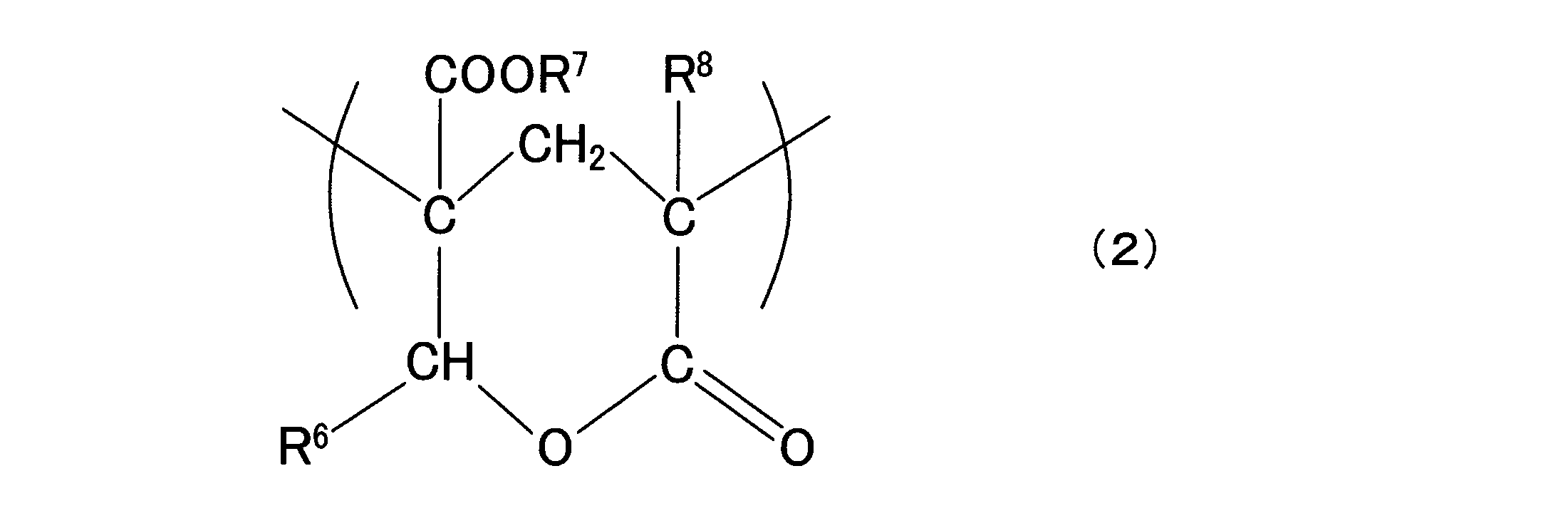
式(2)における有機残基は、例えば、メチル基、エチル基、プロピル基などの炭素数が1~20の範囲のアルキル基;エテニル基、プロペニル基などの炭素数が1~20の範囲の不飽和脂肪族炭化水素基;フェニル基、ナフチル基などの炭素数が1~20の範囲の芳香族炭化水素基;上記アルキル基、上記不飽和脂肪族炭化水素基および上記芳香族炭化水素基において、水素原子の一つ以上が、水酸基、カルボキシル基、エーテル基およびエステル基から選ばれる少なくとも1種の基により置換された基;である。
ラクトン環構造は、分子鎖内に水酸基およびエステル基を有する前駆体を脱アルコール環化縮合させて形成できる。式(2)に示すラクトン環は、例えば、メタクリル酸メチル(MMA)と2-(ヒドロキシメチル)アクリル酸メチル(MHMA)との共重合体を形成した後、当該共重合体における隣り合ったMMA単位とMHMA単位とを脱アルコール環化縮合させることで形成できる。このとき、R6はH、R7はCH3、R8はCH3である。
以下の式(3)に、グルタルイミド構造および無水グルタル酸構造を示す。
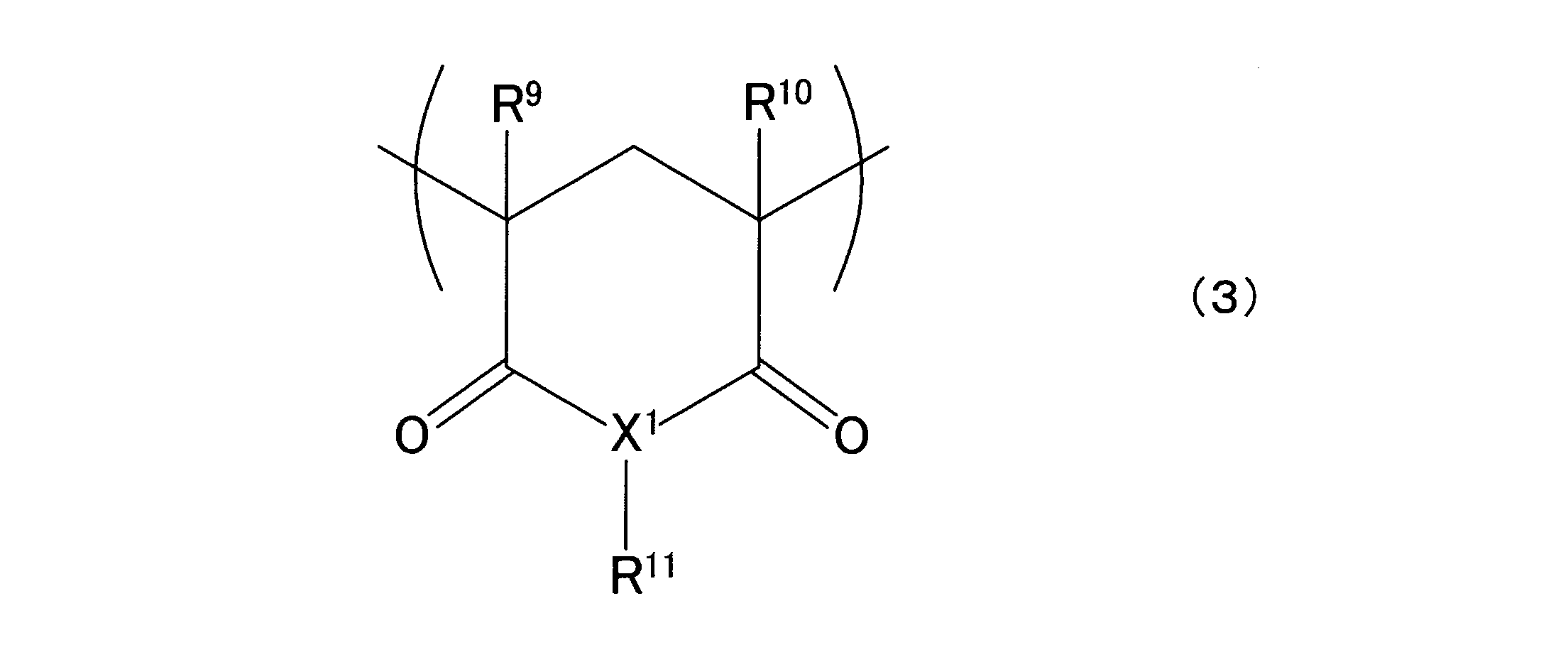
X1が窒素原子のとき、式(3)により示される環構造はグルタルイミド構造となる。グルタルイミド構造は、例えば、(メタ)アクリル酸エステル重合体をメチルアミンなどのイミド化剤によりイミド化して形成できる。
X1が酸素原子のとき、式(3)により示される環構造は無水グルタル酸構造となる。無水グルタル酸構造は、例えば、(メタ)アクリル酸エステルと(メタ)アクリル酸との共重合体を、分子内で脱アルコール環化縮合させて形成できる。
以下の式(4)に、N-置換マレイミド構造および無水マレイン酸構造を示す。

X2が窒素原子のとき、式(4)により示される環構造はN-置換マレイミド構造となる。N-置換マレイミド構造を主鎖に有するアクリル樹脂は、例えば、N-置換マレイミドと(メタ)アクリル酸エステルとを共重合して形成できる。
X2が酸素原子のとき、式(4)により示される環構造は無水マレイン酸構造となる。無水マレイン酸構造を主鎖に有するアクリル樹脂は、例えば、無水マレイン酸と(メタ)アクリル酸エステルとを共重合して形成できる。
なお、式(3)、(4)の説明において例示した、環構造を形成する各方法では、各々の環構造の形成に用いる重合体が全て(メタ)アクリル酸エステル単位を構成単位として有するため、当該方法により得た樹脂はアクリル樹脂となる。
樹脂(A)における上記環構造(ラクトン環構造を除く)の含有率は特に限定されないが、例えば5~90重量%であり、10~70重量%が好ましく、10~60重量%がより好ましく、10~50重量%がさらに好ましい。
樹脂(A)が主鎖にラクトン環構造を有する場合、当該樹脂におけるラクトン環構造の含有率は特に限定されないが、例えば5~90重量%であり、20~90重量%、30~90重量%、35~90重量%、40~80重量%および45~75重量%になるほど、より好ましくなる。
樹脂(A)における環構造の含有率が過度に小さくなると、樹脂組成物ならびに当該組成物を成形して得た樹脂成形品の耐熱性が低下したり、耐溶剤性および表面硬度が不十分となることがある。一方、上記含有率が過度に大きくなると、樹脂組成物の成形性、ハンドリング性が低下する。
主鎖に環構造を有する樹脂(A)は、公知の方法により製造できる。環構造がラクトン環構造である樹脂(A)は、例えば、特開2006-96960号公報(WO2006/025445号公報)、特開2006-171464号公報あるいは特開2007-63541号公報に記載の方法により製造できる。環構造がN-置換マレイミド構造、無水グルタル酸構造あるいはグルタルイミド構造である樹脂(A)は、例えば、特開2007-31537号公報、WO2007/26659号公報あるいはWO2005/108438号公報に記載の方法により製造できる。環構造が無水マレイン酸構造である樹脂(A)は、例えば、特開昭57-153008号公報に記載の方法により製造できる。
樹脂(A)は、(メタ)アクリル酸エステル単位および(メタ)アクリル酸単位以外の構成単位を有していてもよく、このような構成単位は、例えば、スチレン、ビニルトルエン、α-メチルスチレン、アクリロニトリル、メチルビニルケトン、エチレン、プロピレン、酢酸ビニル、メタリルアルコール、アリルアルコール、2-ヒドロキシメチル-1-ブテン、α-ヒドロキシメチルスチレン、α-ヒドロキシエチルスチレン、などの単量体に由来する構成単位である。樹脂(A)は、これらの構成単位を2種以上有していてもよい。
樹脂(A)は、当該樹脂に対して負の固有複屈折を与える作用を有する構成単位を有していてもよい。この場合、樹脂組成物ならびに当該組成物を成形して得た樹脂成形品の複屈折性の制御の自由度が向上し、本発明の樹脂組成物から形成した樹脂成形品(例えば、樹脂フィルム)の光学部材としての使用用途が拡大する。
なお、固有複屈折とは、樹脂の分子鎖が一軸配向した層(例えば、シートあるいはフィルム)における、分子鎖が配向する方向(配向軸)に平行な方向の光の屈折率n1から、配向軸に垂直な方向の光の屈折率n2を引いた値(即ち、“n1-n2”)をいう。樹脂(A)自体の固有複屈折の正負は、固有複屈折に関して当該構成単位が与える作用と、樹脂(A)が有するその他の構成単位が与える作用との兼ね合いにより決定される。
樹脂(A)に対して負の固有複屈折を与える作用を有する構成単位の一例は、スチレン単位である。
樹脂(A)は、紫外線吸収能を有する構成単位(UVA単位)を有していてもよい。この場合、樹脂組成物ならびに当該組成物を成形して得た樹脂成形品の紫外線吸収能がさらに向上する。また、UVA単位の構造によっては、樹脂(A)とUVA(B)との相容性が向上する。
UVA単位の起源となる単量体(C)は特に限定されず、例えば、重合性基を導入したベンゾトリアゾール誘導体、トリアジン誘導体またはベンゾフェノン誘導体である。導入する重合性基は、樹脂(A)が有する構成単位に応じて、適宜選択できる。
単量体(C)の具体例は、2-(2’-ヒドロキシ-5’-メタクリロイルオキシ)エチルフェニル-2H-ベンゾトリアゾール(大塚化学製、商品名RUVA-93)、2-(2’-ヒドロキシ-5’-メタクリロイルオキシ)フェニル-2H-ベンゾトリアゾール、2-(2’-ヒドロキシ-3’-t-ブチル-5’-メタクリロイルオキシ)フェニル-2H-ベンゾトリアゾールである。
単量体(C)の上記とは別の具体例は、以下の式(5)、(6)、(7)により示されるトリアジン誘導体あるいは以下の式(8)により示されるベンゾトリアゾール誘導体である。

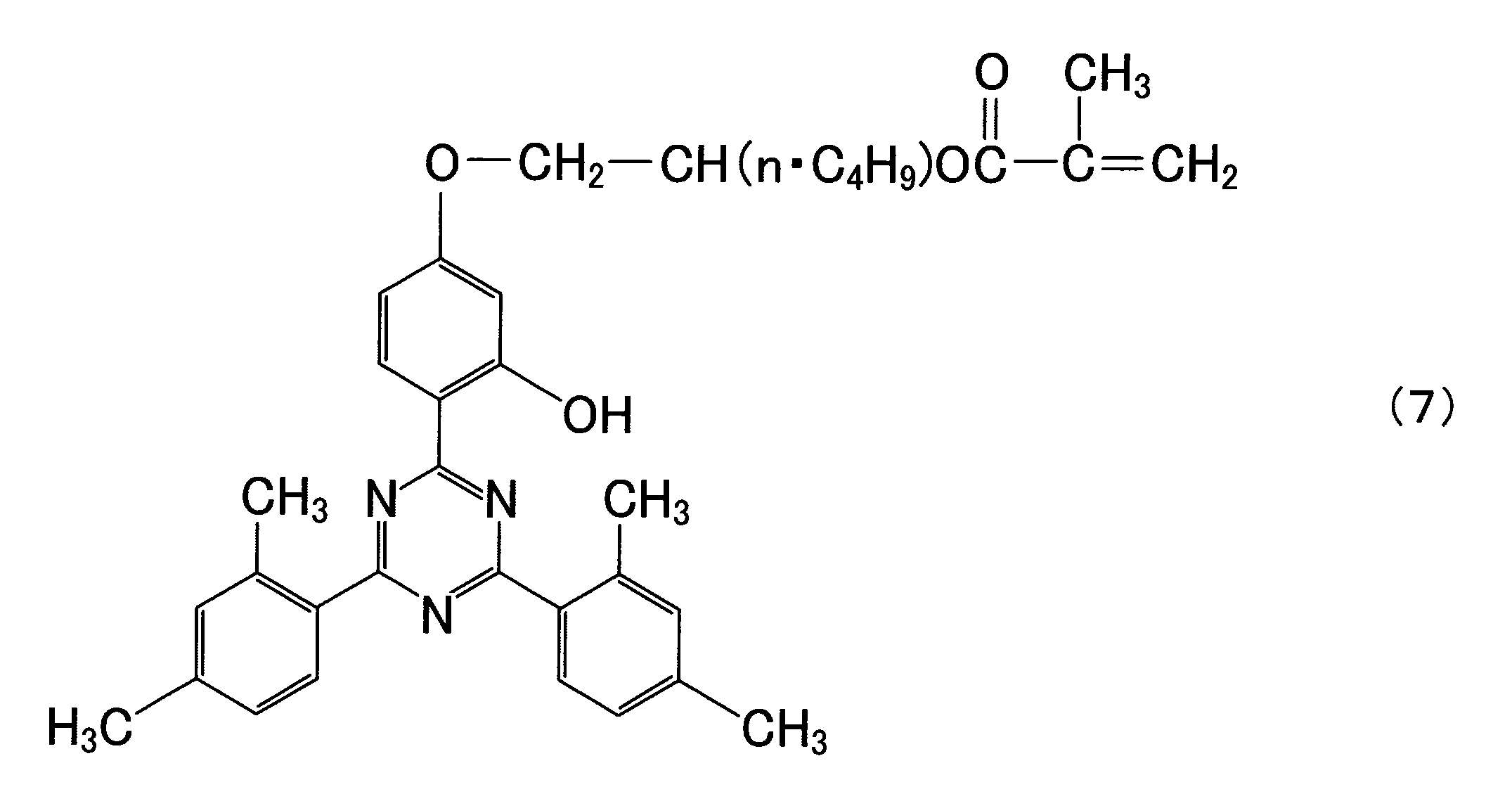
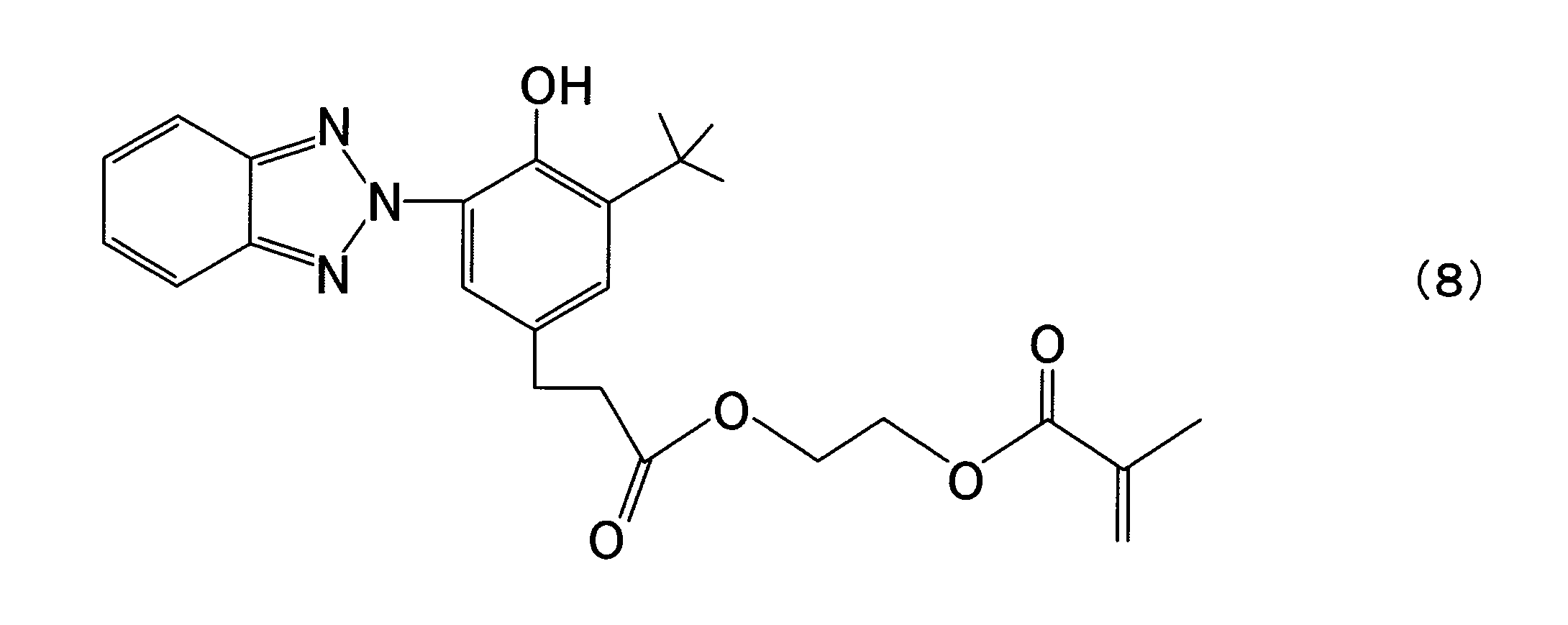
紫外線吸収能が高いことから、単量体(C)は、2-(2’-ヒドロキシ-5’-メタクリロイルオキシ)エチルフェニル-2H-ベンゾトリアゾールが好ましい。高い紫外線吸収能を有するUVA単位によれば、樹脂(A)におけるUVA単位の含有率が低い場合においても望む紫外線吸収効果が得られる。即ち、樹脂(A)がUVA単位を含む場合においてもUVA単位以外の構成単位の含有率を相対的に大きくでき、光学部材などの様々な用途に好適な特性(例えば熱可塑性、耐熱性)を有する樹脂組成物が得やすくなる。また、UVA単位の含有率が大きくなると樹脂組成物の成形時に着色が生じやすくなるため、高い紫外線吸収能を有するUVA単位によれば、最終的に得られる樹脂成形品の着色を抑制でき、当該成形品は光学部材の用途に好適となる。
樹脂(A)がUVA単位を含む場合、樹脂(A)における当該単位の含有率は20重量%以下が好ましく、15%重量以下がより好ましい。樹脂(A)におけるUVA単位の含有率が20重量%を超えると、樹脂組成物としての耐熱性が低下する。
樹脂(A)の重量平均分子量は、例えば1000~300000の範囲であり、5000~250000の範囲が好ましく、10000~200000の範囲がより好ましく、50000~200000の範囲がさらに好ましい。
[UVA(B)]
UVA(B)は、以下の式(1)により示される構造を有する。
UVA(B)は、以下の式(1)により示される構造を有する。

UVA(B)はフェニルトリアジン骨格を有するが、当該骨格内に、トリアジンに結合した2つのヒドロキシフェニル基を有する。これに対して、特開2006-328334号公報などに開示されている従来のトリアジン系UVAでは、トリアジンに結合するヒドロキシフェニル基は1つのみである。ヒドロキシフェニル基における水酸基の水素原子は、トリアジンの窒素原子とともに水素結合を形成し、形成された水素結合は、フェニルトリアジン骨格が有する発色団としての作用を増大させる。UVA(B)では、上記水素結合が2つ形成されるため、フェニルトリアジン骨格の発色団としての作用をより増大でき、少ないUVA(B)の添加量で、高い紫外線吸収能を得ることができる。
また、樹脂(A)が主鎖に環構造を有するアクリル樹脂であること、ならびに樹脂(A)とUVA(B)との相容性が高いことから、本発明の樹脂組成物により、耐熱性および透明性に優れる樹脂成形品が得られる。
上記式(1)におけるR1は、上記式「-OR5」により示される基、即ちアルコキシ基またはアルキルエステルオキシ基、であることが好ましい。この場合、フェニルトリアジン骨格の発色団としての作用がより増大する。上記作用を増大させる効果が高いことから、R5がアルキル基である、即ちR1がアルコキシ基である、ことが好ましく、このとき、R2、R3およびR4もアルキル基であることが好ましい。
UVA(B)の具体例を、以下の式(9)、(10)に挙げる。ただし、UVA(B)は、以下に示す例に限定されない。
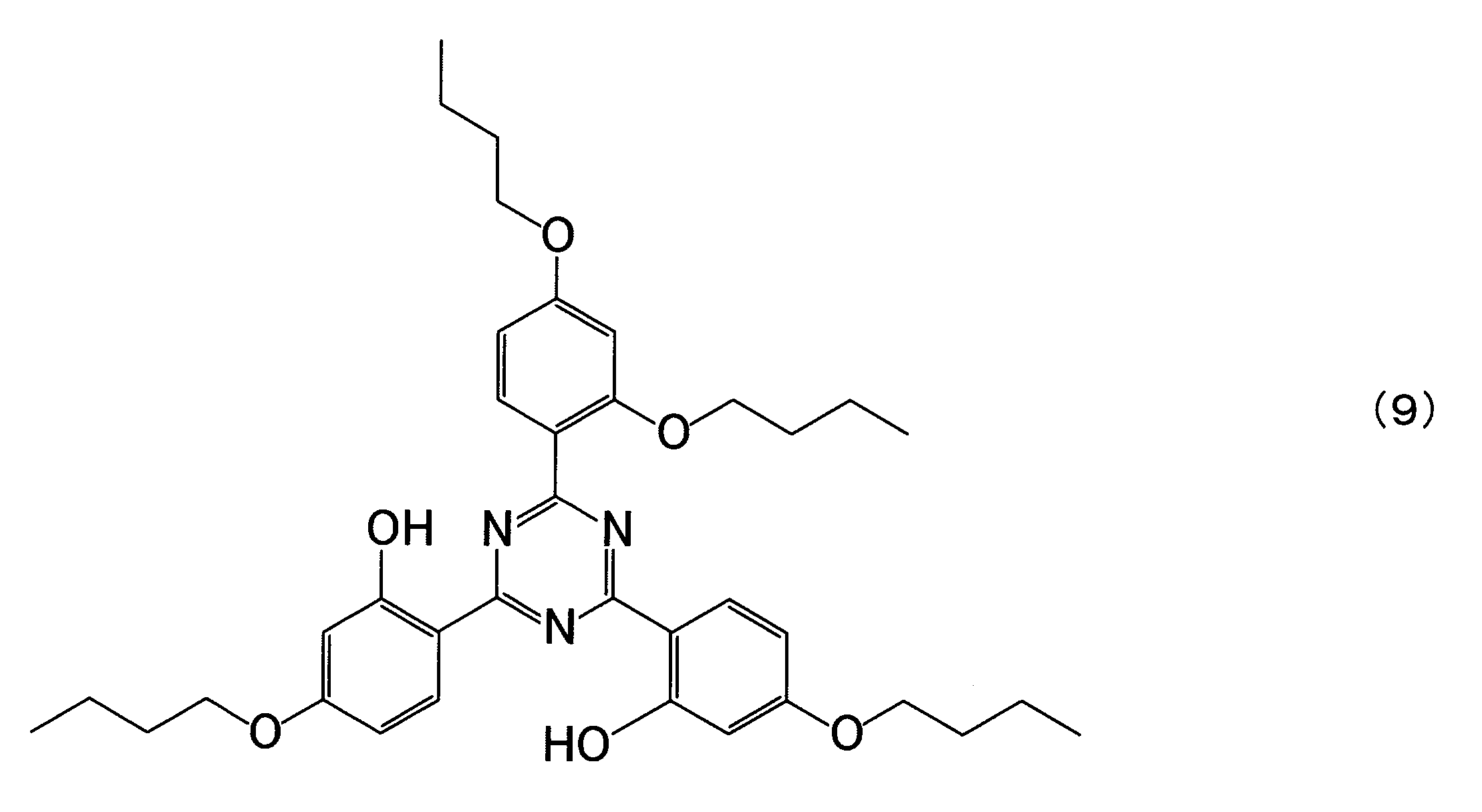
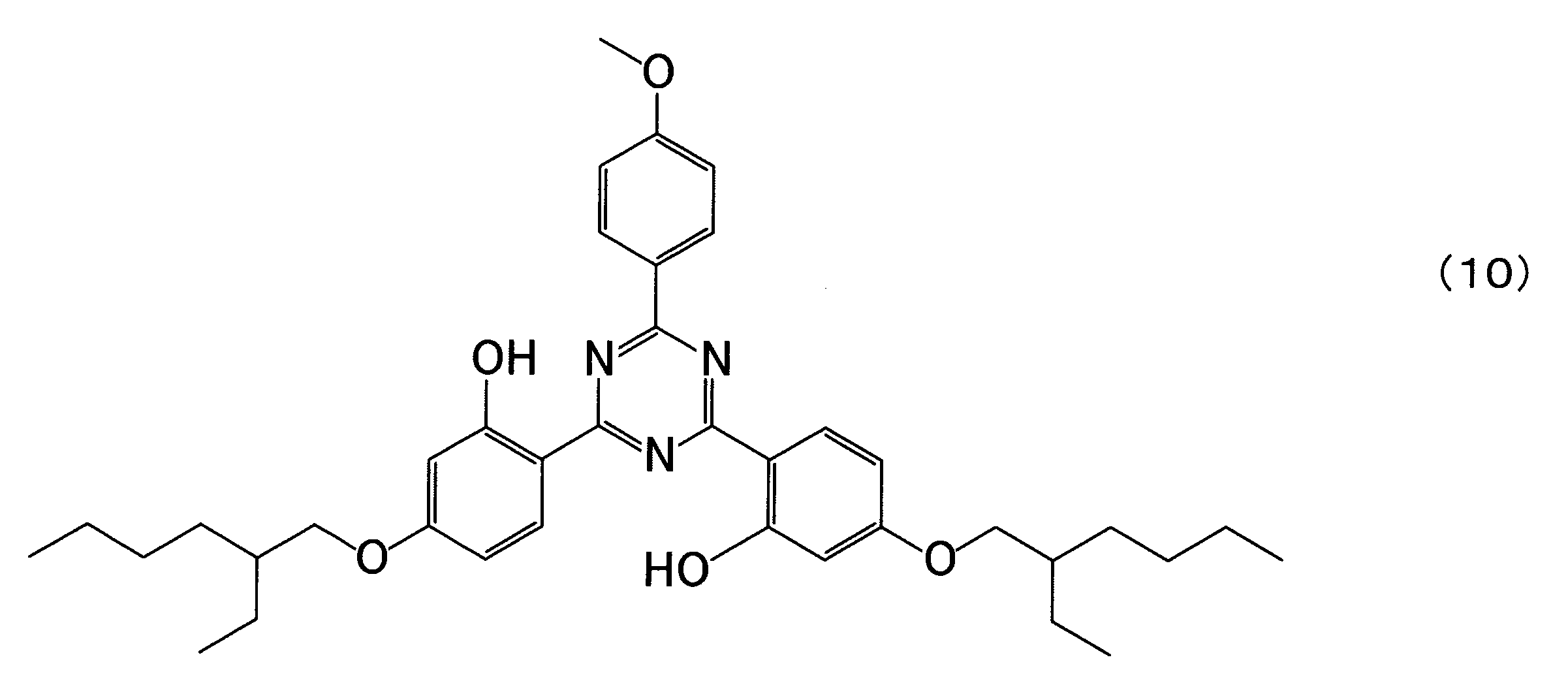
上記式(9)により示されるUVA(B)を主成分として含む市販の紫外線吸収剤には、例えば、TINUVIN460(チバスペシャリティケミカルズ製)がある。なお、本明細書における主成分とは、最も含有量(含有率)が多い成分を意味し、その含有率は典型的には50重量%以上である。
UVA(B)における、波長300nmから380nmの範囲の光に対するモル吸光係数は、クロロホルム溶液中において10000(L・mol-1・cm-1)以上であることが好ましい。
本発明の樹脂組成物のTgは110℃以上であり、成形(例えば押出成形)に必要な温度が高いため、成形時にゲルが生じることがある。ゲルは、成形温度が高くなるほど生じやすい。このため、組成物のTgが高くなるほど必要な成形温度が高くなり、ゲルが生じやすくなる。
ここでUVA(B)は、チオール基、水酸基、アミン基、炭素-炭素二重結合などの樹脂(A)の架橋点となりうる構造を有さない。このため、本発明の樹脂組成物では、その成形時におけるゲルの発生を抑制でき、外観上あるいは光学的な欠点が少ない樹脂フィルム(例えば偏光子保護フィルムなどの光学フィルム)が得られる。また、ゲルの発生が抑制されることで組成物の成形温度をより高くできるため、(1)成形時における組成物の溶融粘度が低下して樹脂成形品の生産性が向上する、(2)ゲルなどの異物の除去を目的として成形時にポリマーフィルタによる濾過を実施する場合には、ゲルの発生が抑制されることでフィルタの交換周期が長くなる、などの効果が得られる。
なお、式(1)に示すUVA(B)におけるヒドロキシフェニル基には置換基として水酸基が存在するが、ベンゼン環に直接結合した水酸基は樹脂(A)と架橋構造を形成しないため、架橋点となりうる構造とは考えない。
ところで、光学部材として用いられる材料の一つにトリアセチルセルロース(TAC)があるが、TACは分解温度が約250℃程度と低いため、押出成形を利用することができず、通常、流延法(キャスト法)によりフィルムに成形される。即ち、TACフィルムの形成時にはTAC自身が高温に晒されることがないため、UVA中にTACとの架橋点となりうる構造が存在するか否かは、TACフィルムにおける光学的欠点の発生頻度および生産性に影響を与えない。
[樹脂組成物]
本発明の樹脂組成物は樹脂(A)とUVA(B)とを含み、当該組成物におけるUVA(B)の含有量は、樹脂(A)をはじめとする熱可塑性樹脂100重量部に対して、即ち、当該組成物に含まれる熱可塑性樹脂全体の重量を100重量部としたときに、0.1~5重量部の範囲である。UVA(B)の含有量が上記範囲よりも小さくなると、十分な紫外線吸収能を得ることができない。一方、UVA(B)の含有量が上記範囲よりも大きくなると、紫外線吸収能が増加するメリットよりも、成形時に、発泡やブリードアウトが発生するデメリットの方が大きくなる。
本発明の樹脂組成物は樹脂(A)とUVA(B)とを含み、当該組成物におけるUVA(B)の含有量は、樹脂(A)をはじめとする熱可塑性樹脂100重量部に対して、即ち、当該組成物に含まれる熱可塑性樹脂全体の重量を100重量部としたときに、0.1~5重量部の範囲である。UVA(B)の含有量が上記範囲よりも小さくなると、十分な紫外線吸収能を得ることができない。一方、UVA(B)の含有量が上記範囲よりも大きくなると、紫外線吸収能が増加するメリットよりも、成形時に、発泡やブリードアウトが発生するデメリットの方が大きくなる。
本発明の樹脂組成物におけるUVA(B)の含有量は、熱可塑性樹脂100重量部に対して、UVA(B)0.5~4重量部が好ましく、1~3重量部がより好ましい。
本発明の樹脂組成物に含まれる熱可塑性樹脂の主成分は樹脂(A)である。具体的には、本発明の樹脂組成物に含まれる熱可塑性樹脂全体に占める樹脂(A)の割合は、通常60重量%以上であり、好ましくは70重量%以上、より好ましくは85重量%以上である。換言すれば、本発明の樹脂組成物は、樹脂(A)以外の熱可塑性樹脂を、当該組成物に含まれる熱可塑性樹脂全体に占める割合にして40重量%未満の範囲(好ましくは30重量%未満の範囲、より好ましくは15重量%未満の範囲)で含んでもよい。
このような熱可塑性樹脂は、例えば、ポリエチレン、ポリプロピレン、エチレン-プロピレン共重合体、ポリ(4-メチル-1-ペンテン)などのオレフィンポリマー;塩化ビニル、塩素化ビニル樹脂などのハロゲン含有ポリマー;ポリスチレン、スチレン-メタクリル酸メチル共重合体、スチレン-アクリロニトリル共重合体、アクリロニトリル-ブタジエン-スチレンブロック共重合体などのスチレンポリマー;ポリエチレンテレフタレート、ポリブチレンテレフタレート、ポリエチレンナフタレートなどのポリエステル;ナイロン6、ナイロン66、ナイロン610などのポリアミド;ポリアセタール;ポリカーボネート;ポリフェニレンオキシド;ポリフェニレンスルフィド;ポリエーテルエーテルケトン;ポリサルホン;ポリエーテルサルホン;ポリオキシペンジレン;ポリアミドイミド;ポリブタジエン系ゴムあるいはアクリル系ゴムを配合したABS樹脂、ASA樹脂などのゴム質重合体;などである。ゴム質重合体は、その表面に、樹脂(A)と相溶し得る組成のグラフト部を有することが好ましく、また、ゴム質重合体が粒子状である場合、その平均粒子径は、本発明の樹脂組成物を樹脂フィルムとしたときの透明性向上の観点から、300nm以下が好ましく、150nm以下がより好ましい。
上記例示した熱可塑性樹脂のなかでも、樹脂(A)との相溶性、特に主鎖にラクトン環構造を有する樹脂(A)との相溶性に優れることから、シアン化ビニル単量体に由来する構成単位と芳香族ビニル単量体に由来する構成単位とを含む共重合体が好ましい。当該共重合体は、例えば、スチレン-アクリロニトリル共重合体または塩化ビニル樹脂である。
本発明の樹脂組成物は、110℃以上の高いガラス転移温度(Tg)を有する。樹脂(A)の構成(例えば、樹脂(A)における環構造の種類、含有率など)によっては、本発明の樹脂組成物のTgは115℃以上、120℃以上、さらには130℃以上となる。
本発明の樹脂組成物は、UVA(B)に基づく高い紫外線吸収能を有し、例えば、厚さ100μmのフィルムとしたときに、波長380nmの光の透過率を30%未満、場合によっては20%未満、さらには10%未満、1%未満とすることができる。この透過率は、JIS K7361:1997の規定に基づいて測定すればよい。
本発明の樹脂組成物は、樹脂(A)とUVA(B)との相溶性に基づく高い可視光透過率を有し、例えば、厚さ100μmのフィルムとしたときに、波長500nmの光の透過率を80%以上、場合によっては85%以上、さらには90%以上とすることができる。この透過率は、波長380nmの光の透過率と同様に測定できる。
本発明の樹脂組成物では、成形時および成形後におけるUVA(B)の昇華を抑制できる。例えば、詳細は実施例に後述するが、所定のサイズのフィルムとしたときに、当該フィルムを150℃で10時間加熱して得た揮発成分を体積1mLの溶媒(例えばクロロホルム)に溶解させ、得られた溶液を光路長1cmの石英セルに収容して吸光度計により測定した波長350nmの光に対する吸光度を0.1未満とすることができる。なお、UVAの昇華量が増えると、揮発成分中のUVAの量が増大するため、当該成分を溶解させた溶液の上記吸光度が増大することになる。
本発明の樹脂組成物では、上述した樹脂(A)とUVA(B)との組み合わせにより、当該組成物および当該組成物を成形して得た樹脂成形品の色相を改善できる。
本発明の樹脂組成物は、負の固有複屈折を有する重合体を含んでもよい。この場合、樹脂組成物および当該組成物を成形して得た樹脂成形品における複屈折性(例えば位相差)の制御の自由度が向上する。
負の固有複屈折を有する重合体は、例えば、シアン化ビニル単量体と芳香族ビニル単量体との共重合体である。当該共重合体は、例えばスチレン-アクリロニトリル共重合体であり、スチレン-アクリロニトリル共重合体は、広範囲の共重合組成において樹脂(A)との相容性に優れる。
スチレン-アクリロニトリル共重合体は、乳化重合、懸濁重合、溶液重合、バルク重合などの各種の重合方法による製造が可能である。本発明の樹脂組成物から形成した樹脂成形品を光学部材として使用する場合、透明性および光学特性が向上することから、溶液重合またはバルク重合により製造したスチレン-アクリロニトリル共重合体を用いることが好ましい。
本発明の樹脂組成物は、酸化防止剤を含んでいてもよい。酸化防止剤は特に限定されないが、例えば、ヒンダードフェノール系、リン系あるいはイオウ系などの公知の酸化防止剤を、1種で、または2種以上を併用して用いることができる。特に、2,4-ジ-t-アミル-6-[1-(3,5-ジ-t-アミル-2-ヒドロキシフェニル)エチル]フェニルアクリレート(例えば、住友化学工業製スミライザーGS)、および2-t-ブチル-6-(3-t-ブチル-2-ヒドロキシ-5-メチルベンジル)-4-メチルフェニルアクリレート(例えば、住友化学工業製スミライザーGM)が、高温成形時における樹脂組成物の劣化を抑制する効果が高いことから好ましい。
本発明の樹脂組成物における酸化防止剤の添加量は、例えば0~10重量%であり、0~5重量%が好ましく、0.01~2重量%がより好ましく、0.05~1重量%がさらに好ましい。酸化防止剤の添加量が過度に大きくなると、成形時に酸化防止剤のブリードアウトやシルバーストリークスが発生することがある。
本発明の樹脂組成物は、その他の添加剤を含んでいてもよい。その他の添加剤は、例えば、耐光安定剤、耐候安定剤、熱安定剤などの安定剤;ガラス繊維、炭素繊維などの補強材;近赤外線吸収剤;トリス(ジブロモプロピル)ホスフェート、トリアリルホスフェート、酸化アンチモンなどの難燃剤;アニオン系、カチオン系、ノニオン系の界面活性剤に代表される帯電防止剤;無機顔料、有機顔料、染料などの着色剤;有機フィラー、無機フィラー;樹脂改質剤;可塑剤;滑剤;難燃剤などである。本発明の樹脂組成物における、上記その他の添加剤の添加量は、例えば0~5重量%であり、0~2重量%が好ましく、0~0.5重量%がより好ましい。
本発明の樹脂組成物は、公知の成形手法、例えば、射出成形、ブロー成形、押出成形、キャスト成形などの手法により、任意の形状、例えばフィルムあるいはシート、に成形できる。成形温度は樹脂組成物のTgおよび特性に応じて適宜設定すればよく、特に限定されないが、例えば150~350℃であり、200~300℃が好ましい。
本発明の樹脂組成物を成形して得た樹脂成形品は、ブリードアウトなどの欠点が少なく、高い紫外線吸収能、耐熱性および透明性を有する。
[樹脂組成物の製造方法]
本発明の樹脂組成物は、樹脂(A)を主成分とする熱可塑性樹脂とUVA(B)とを公知の方法により混合して製造できる。製造した樹脂組成物は、必要に応じて、ペレタイザーなどによりペレット化してもよい。
本発明の樹脂組成物は、樹脂(A)を主成分とする熱可塑性樹脂とUVA(B)とを公知の方法により混合して製造できる。製造した樹脂組成物は、必要に応じて、ペレタイザーなどによりペレット化してもよい。
熱可塑性樹脂とUVA(B)とを混合するタイミングは、樹脂組成物としての上述した諸特性が阻害されない限り、特に限定されない。熱可塑性樹脂(例えば樹脂(A))を重合中にUVA(B)を添加してもよいし、熱可塑性樹脂を重合した後、得られた熱可塑性樹脂とUVA(B)とを混合(例えば溶融混練)してもよい。熱可塑性樹脂とUVA(B)とを溶融混練する具体的な手法は特に限定されず、例えば、熱可塑性樹脂、UVA(B)およびその他の添加する成分を、同時に加熱溶融して混練してもよいし、熱可塑性樹脂およびその他の添加する成分を加熱溶融した後、そこにUVA(B)をさらに添加して混練してもよい。また、熱可塑性樹脂を加熱溶融した後、そこにUVA(B)およびその他の添加する成分をさらに添加して混練してもよい。
[樹脂成形品]
本発明の樹脂成形品は、上記本発明の樹脂組成物からなる。本発明の樹脂成形品は、上述した本発明の樹脂組成物が有する特性に基づく、各種の特性を有する。例えば、本発明の樹脂成形品は、高い紫外線吸収能、耐熱性および透明性を有する。また例えば、本発明の樹脂成形品は、ブリードアウトなどの欠点が少ない。
本発明の樹脂成形品は、上記本発明の樹脂組成物からなる。本発明の樹脂成形品は、上述した本発明の樹脂組成物が有する特性に基づく、各種の特性を有する。例えば、本発明の樹脂成形品は、高い紫外線吸収能、耐熱性および透明性を有する。また例えば、本発明の樹脂成形品は、ブリードアウトなどの欠点が少ない。
これらの特徴により、本発明の樹脂成形品は、光学部材として好適に用いることができる。また、高い耐熱性により、光源などの発熱部に近接した配置が可能となる。
本発明の樹脂成形品の形状は特に限定されず、例えば、フィルムまたはシートである。
フィルムである本発明の樹脂成形品の厚さは、例えば、1μm以上350μm未満であり、好ましくは10μm以上350μm未満である。厚さが1μm未満になると、樹脂フィルムとしての強度が不十分となる場合があり、延伸などの後加工を行う際に、破断などが生じやすい。
シートである本発明の樹脂成形品の厚さは、例えば、350μm以上10mm以下であり、好ましくは350μm以上5mm以下である。厚さが10mmを超えると、シート厚を均一にすることが難しくなり、樹脂シートを光学部材として用いることが難しくなる。
樹脂シートおよび樹脂フィルムは、例えば、本発明の樹脂組成物を押出成形して形成できる。
本発明の樹脂成形品は高いTgを有し、例えば、その値が110℃以上である。樹脂成形品を構成する樹脂組成物の組成によっては、Tgは115℃以上、120℃以上、さらには130℃以上となる。
本発明の樹脂成形品は、高い紫外線吸収能を有する。例えば、厚さ100μmのフィルムとしたときに、波長380nmの光の透過率を30%未満、場合によっては20%未満、さらには10%未満、1%未満とすることができる。
本発明の樹脂成形品は、高い可視光透過率を有する。例えば、厚さ100μmのフィルムとしたときに、波長500nmの光の透過率を80%以上、場合によっては85%以上、90%以上、さらには92%以上とすることができる。波長380nmの光、および波長500nmの光に対するフィルム(シート)の透過率の測定は、上述した方法に従えばよい。
本発明の樹脂成形品は、ASTM-D-882-61Tの規定に準拠して測定した引張強度が10MPa以上100MPa未満であることが好ましく、30MPa以上100MPa未満であることがより好ましい。上記引張強度が10MPa未満の場合、樹脂シート(フィルム)としての機械的強度が不十分となることがある。一方、上記引張強度が100MPaを超えると、その加工性が低下する。
本発明の樹脂成形品は、ASTM-D-882-61Tの規定に準拠して測定した伸び率が1%以上であることが好ましい。上記伸び率の上限は特に限定されないが、通常100%以下である。上記伸び率が1%未満の場合、樹脂シート(フィルム)としての靭性が不十分となることがある。
本発明の樹脂成形品は、ASTM-D-882-61Tの規定に準拠して測定した引張弾性率が0.5GPa以上であることが好ましく、1GPa以上であることがより好ましく、2GPa以上であることがさらに好ましい。上記引張弾性率の上限は特に限定されないが、通常20GPa以下である。上記引張弾性率が0.5GPa未満の場合、樹脂シート(フィルム)としての機械的強度が不十分となることがある。
シートまたはフィルムである本発明の樹脂成形品の表面には、必要に応じて、各種の機能性コーティング層が形成されていてもよい。機能性コーティング層は、例えば、帯電防止層、粘接着剤層、接着層、易接着層、防眩(ノングレア)層、光触媒層などの防汚層、反射防止層、ハードコート層、紫外線遮蔽層、熱線遮蔽層、電磁波遮蔽層、ガスバリヤー層などである。また、本発明の樹脂成形品に、上述した機能性コーティング層を有する部材が積層されていてもよい。当該部材の積層は、粘着剤や接着剤を介して行うことができる。
シートまたはフィルムである本発明の樹脂成形品の用途は特に限定されないが、その高い透明性、耐熱性および紫外線吸収能により、光学部材として好適に用いることができる。光学部材は、例えば、光学用保護フィルム(シート)、具体的には、各種の光ディスク(VD、CD、DVD、MD、LDなど)基板の保護フィルム、液晶表示装置(LCD)などの画像表示装置が備える偏光板に用いる偏光子保護フィルムである。位相差フィルム、視野角補償フィルム、光拡散フィルム、反射フィルム、反射防止フィルム、防眩フィルム、輝度向上フィルム、タッチパネル用導電フィルムなどの光学フィルムとして、あるいは、拡散板、導光体、位相差板、プリズムシートなどの光学シートとして、本発明の樹脂成形品を用いてもよい。
一例として偏光子保護フィルムを説明する。LCDには、その画像表示原理に基づき、液晶セルを狭持するように一対の偏光板が配置される。偏光板は、一般に、ポリビニルアルコールなどの樹脂フィルムからなる偏光子と、当該偏光子を保護するための偏光子保護フィルムとを備える。本発明の偏光子保護フィルムによれば、その高い紫外線吸収能により、紫外線による偏光子の劣化を抑制できる。また、高い耐熱性により、偏光板を光源に近接して配置することが可能となり、高い透明性により、画像表示特性に優れる画像表示装置を形成できる。
従来、偏光子保護フィルムには、トリアセチルセルロース(TAC)フィルムが用いられている。しかし、TACフィルムは耐湿熱性が十分ではなく、TACフィルムを偏光子保護フィルムとして用いた場合、高温または高湿度の環境下で偏光板の特性が劣化することがある。また、TACフィルムは厚さ方向の位相差を有しており、この位相差は、LCDなどの画像表示装置、特に大画面の画像表示装置、の視野角特性に悪影響を与える。これに対して本発明の偏光子保護フィルムは、アクリル樹脂を主成分とする樹脂組成物からなるため、TACフィルムに比べて耐湿熱性および光学特性を向上できる。
本発明の偏光子保護フィルムを備える偏光板(本発明の偏光板)の構造は特に限定されず、偏光子の一方の面に偏光子保護フィルムが積層された構造であってもよいし、一対の偏光子保護フィルムによって偏光子が挟持された構造であってもよい。本発明の偏光板の構造の典型的な一例は、ポリビニルアルコールフィルムをヨウ素または二色性染料などの二色性物質により染色した後に一軸延伸して得た偏光子の片面または両面に、接着剤層または易接着層を介して本発明の偏光子保護フィルムを接合させた構造である。
本発明の偏光板は、LCDをはじめとする画像表示装置に用いることができる。本発明の偏光板をLCDに用いる場合、当該偏光板は、液晶セルの視認側あるいはバックライト側のいずれか一方のみに配置されても、双方の側に配置されてもよい。
本発明の偏光板を使用できる画像表示装置は特に限定されず、例えば、反射型、透過型、半透過型のLCD;TN型、STN型、OCB型、HAN型、VA型、IPS型などの各種の駆動方式を有するLCD;エレクトロルミネッセンス(EL)ディスプレイ;プラズマディスプレイ(PD);電界放出ディスプレイ(FED:Field Emission Display)である。
本発明の偏光板を備える画像表示装置(本発明の画像表示装置)の構成は特に限定されず、位相差板、光学補償シート、バックライト部などの部材を、必要に応じて適宜備えればよい。
図1に、本発明の画像表示装置における画像表示部の構造の一例を示す。図1に示す画像表示部11は、LCDの画像表示部であり、液晶セル4と、液晶セル4を挟持するように配置された一対の偏光板9、10と、液晶セル4および偏光板9、10の積層体における一方の面に配置されたバックライト8とを備える。それぞれの偏光板9、10は、偏光子2、6と、当該偏光子を挟持するように配置された一対の偏光子保護フィルム1、3、5、7とを備える。液晶セル4は公知の構造を有しており、例えば、液晶層、ガラス基板、透明電極、配向膜などを備える。バックライト8は公知の構造を有しており、例えば、光源、反射シート、導光板、拡散板、拡散シート、プリズムシート、輝度向上フィルムなどを備える。
画像表示部11では、4つの偏光子保護フィルムから選ばれる少なくとも1つが本発明の偏光子保護フィルムであればよく、全ての偏光子保護フィルムが本発明の偏光子保護フィルムであることが好ましい。画像表示部11に外部から入射する紫外線が問題となる場合には、液晶セル4の両側に配置される偏光板9、10のうち、視認側(外部側)に位置する偏光板9の偏光子保護フィルムが本発明の偏光子保護フィルムであることが好ましく、偏光板9の偏光子保護フィルム1、3のうち、少なくとも外部側に位置するフィルム1が本発明の偏光子保護フィルムであることがより好ましい。
画像表示部11は、必要に応じて、位相差板あるいは光学補償シートなどの任意の光学部材をさらに有していてもよい。
[樹脂成形品の製造方法]
上述したように、本発明の樹脂成形品の製造方法は特に限定されないが、以下、樹脂成形品として樹脂フィルムの製造方法の一例を示す。この製造方法は、樹脂シートの製造方法にも適用できる。
上述したように、本発明の樹脂成形品の製造方法は特に限定されないが、以下、樹脂成形品として樹脂フィルムの製造方法の一例を示す。この製造方法は、樹脂シートの製造方法にも適用できる。
本発明の樹脂組成物から樹脂フィルムを製造する方法として、押出成形法がある。具体的な例としては、樹脂組成物を構成する各成分をオムニミキサーなどの混合機でプレブレンドした後、得られた混合物を混練機から押出混練してもよい。押出混練に用いる混練機は特に限定されず、例えば、単軸押出機、二軸押出機などの押出機、あるいは加圧ニーダーなどの公知の混練機を用いることができる。
また、別途形成した樹脂組成物を溶融押出成形してもよい。溶融押出法には、例えば、Tダイ法、インフレーション法などがあり、その際の成形温度は、好ましくは200~350℃、より好ましくは250~300℃、さらに好ましくは255℃~300℃、特に好ましくは260℃~300℃である。
Tダイ法を用いる場合、押出機の先端部にTダイを取り付け、このTダイから押し出したフィルムを巻き取ることで、ロール状に巻回させた樹脂フィルムを得ることができる。このとき、巻き取りの温度および速度を制御して、フィルムの押し出し方向に延伸(一軸延伸)を加えることも可能である。また、押し出し方向と垂直な方向にフィルムを延伸して、逐次二軸延伸あるいは同時二軸延伸などを実施してもよい。
押出成形に押出機を用いる場合、その種類は特に限定されず、単軸であっても二軸であっても多軸であってもよいが、そのL/D値は(Lは押出機のシリンダーの長さ、Dはシリンダー内径)、樹脂組成物を十分に可塑化して良好な混練状態を得るために、10以上100以下が好ましく、20以上50以下がより好ましく、25以上40以下がさらに好ましい。L/D値が10未満の場合、樹脂組成物を十分に可塑化できず、良好な混練状態が得られないことがある。一方、L/D値が100を超えると、樹脂組成物に対して過度に剪断発熱が加わることで、組成物中の樹脂が熱分解する可能性がある。
またこの場合、シリンダーの設定温度は、好ましくは200℃以上300℃以下であり、より好ましくは250℃以上300℃以下である。設定温度が200℃未満では、樹脂組成物の溶融粘度が過度に高くなって、樹脂フィルムの生産性が低下する。一方、設定温度が300℃を超えると、樹脂組成物中の樹脂が熱分解する可能性がある。
押出成形に押出機を用いる場合、その形状は特に限定されないが、押出機が1個以上の開放ベント部を有することが好ましい。このような押出機を用いることによって、開放ベント部から分解ガスを吸引することができ、得られた樹脂フィルムに残存する揮発成分の量を低減できる。開放ベント部から分解ガスを吸引するためには、例えば、開放ベント部を減圧状態にすればよく、その減圧度は、開放ベント部の圧力にして、931~1.3hPa(700~1mmHg)の範囲が好ましく、798~13.3hPa(600~10mmHg)の範囲がより好ましい。開放ベント部の圧力が931hPaより高い場合、揮発成分、あるいは樹脂の分解により発生する単量体成分などが、樹脂組成物中に残存しやすい。一方、開放ベント部の圧力を1.3hPaより低く保つことは工業的に困難である。
光学フィルムなど、光学部材として用いる樹脂フィルムを製造する場合、ポリマーフィルタで濾過した樹脂組成物を成形してもよい。ポリマーフィルタにより、樹脂組成物中に存在する異物を除去できるため、得られたフィルムの外観上の欠点を低減できる。なお、ポリマーフィルタによる濾過時には、樹脂組成物は高温の溶融状態となる。このため、ポリマーフィルタを通過する際に樹脂組成物が劣化し、劣化により形成されたガス成分や着色劣化物が組成物中に流れだして、得られたフィルムに、穴あき、流れ模様、流れスジなどの欠点が観察されることがある。この欠点は、特に樹脂フィルムの連続成形時に観察されやすい。このため、ポリマーフィルタで濾過した樹脂組成物を成形する際には、その成形温度は、樹脂組成物の溶融粘度を低下させ、ポリマーフィルタにおける樹脂組成物の滞留時間を短くするために、例えば255~300℃であり、260~320℃が好ましい。
ポリマーフィルタの構成は特に限定されないが、ハウジング内に多数枚のリーフディスク型フィルタを配したポリマーフィルタを好適に用いることができる。リーフディスク型フィルタの濾材は、金属繊維不織布を焼結したタイプ、金属粉末を焼結したタイプ、金網を数枚積層したタイプ、あるいはそれらを組み合わせたハイブリッドタイプのいずれでもよいが、金属繊維不織布を焼結したタイプが最も好ましい。
ポリマーフィルタによる濾過精度は特に限定されないが、通常15μ以下、好ましくは10μ以下、より好ましくは5μ以下である。濾過精度が1μ以下になると、樹脂組成物の滞留時間が長くなることで当該組成物の熱劣化が大きくなる他、樹脂フィルムの生産性が低下する。一方、濾過精度が15μを超えると、樹脂組成物中の異物を除去することが難しくなる。
ポリマーフィルタにおける、時間あたりの樹脂処理量に対する濾過面積は特に限定されず、樹脂組成物の処理量に応じて適宜設定できる。上記濾過面積は、例えば、0.001~0.15m2/(kg/h)である。
ポリマーフィルタの形状は特に限定されず、例えば、複数の樹脂流通口を有し、センターポール内に樹脂の流路を有する内流型;断面が複数の頂点もしくは面においてリーフディスクフィルタの内周面に接し、センターポールの外面に樹脂の流路がある外流型;などがある。特に、樹脂の滞留箇所の少ない外流型を用いることが好ましい。
ポリマーフィルタにおける樹脂組成物の滞留時間に特に制限はないが、20分以下が好ましく、10分以下がより好ましく、5分以下がさらに好ましい。また、濾過時におけるフィルタ入口圧およびフィルタ出口圧は、例えば、それぞれ、3~15MPaおよび0.3~10MPaであり、圧力損失(フィルタの入口圧と出口圧の圧力差)は、1MPa~15MPaの範囲が好ましい。圧力損失が1MPa以下になると、樹脂組成物がフィルタを通過する流路に偏りが生じやすく、得られた樹脂フィルムの品質が低下する傾向がある。一方、圧力損失が15MPaを超えると、ポリマーフィルタの破損が起こり易くなる。
ポリマーフィルタに導入される樹脂組成物の温度は、その溶融粘度に応じて適宜設定すればよく、例えば250~300℃であり、255~300℃が好ましく、260~300℃がさらに好ましい。
ポリマーフィルタを用いた濾過処理により、異物、着色物の少ない樹脂フィルムを得る具体的な工程は、特に限定されない。例えば、(1)クリーン環境下で樹脂組成物の形成および濾過処理を行い、引き続いてクリーン環境下で樹脂組成物の成形を行うプロセス、(2)異物または着色物を有する樹脂組成物を、クリーン環境下で濾過処理した後、引き続いてクリーン環境下で樹脂組成物の成形を行うプロセス、(3)異物または着色物を有する樹脂組成物を、クリーン環境下で濾過処理すると同時に成形を行うプロセス、などが挙げられる。それぞれの工程毎に、複数回、ポリマーフィルタによる樹脂組成物の濾過処理を行ってもよい。
ポリマーフィルタによって樹脂組成物を濾過する際には、押出機とポリマーフィルタとの間にギアポンプを設置して、フィルタ内の樹脂組成物の圧力を安定化することが好ましい。
本発明の樹脂組成物は、その製造後、そのまま押出成形して樹脂フィルムとすることが好ましい。樹脂組成物をペレット化した後に、得られたペレットを再溶融して樹脂フィルムを成形する場合に比べて、熱履歴を少なくできるため、樹脂組成物の熱劣化を抑制できる。また、この手法では、環境からの異物の混入を抑制できるため、得られた樹脂フィルムに異物が存在したり、得られた樹脂フィルムが着色することを抑制できる。なお、押出機とTダイの間に、ギアポンプおよびポリマーフィルタを配置することが好ましい。
押出成形によって得られた樹脂フィルムは、必要に応じて延伸してもよい。延伸の種類は特に限定されず、一軸延伸であっても二軸延伸であってもよい。延伸により、樹脂フィルムの機械的強度を向上でき、場合によっては、樹脂フィルムに複屈折性を賦与することも可能である。なお、本発明の樹脂組成物は、その組成によっては、延伸後も光学的等方性を保つことが可能である。延伸温度は特に限定されず、樹脂組成物のTg近傍の温度が好ましい。延伸倍率および延伸速度も特に限定されない。
樹脂フィルムの光学特性および機械的特性を安定させるために、延伸後、必要に応じて熱処理(アニーリング)を実施してもよい。
以下、実施例により、本発明をより詳細に説明する。本発明は、以下に示す実施例に限定されない。
最初に、本実施例において作製した樹脂組成物サンプルの評価方法を示す。
[ガラス転移温度]
各サンプルのガラス転移温度(Tg)は、JIS K7121の規定に準拠して求めた。具体的には、示差走査熱量計(リガク製、DSC-8230)を用い、窒素ガス雰囲気下、約10mgのサンプルを常温から200℃まで昇温(昇温速度20℃/分)して得られたDSC曲線から、始点法により評価した。リファレンスには、α-アルミナを用いた。
各サンプルのガラス転移温度(Tg)は、JIS K7121の規定に準拠して求めた。具体的には、示差走査熱量計(リガク製、DSC-8230)を用い、窒素ガス雰囲気下、約10mgのサンプルを常温から200℃まで昇温(昇温速度20℃/分)して得られたDSC曲線から、始点法により評価した。リファレンスには、α-アルミナを用いた。
[光線透過率]
各サンプルの光線透過率は、押出成形により厚さ100μmのフィルムとした後、分光光度計(島津製作所製、UV-3100)を用いて、波長380nmおよび500nmの光に対する当該フィルムの透過率を測定することで評価した。各サンプルから、厚さ100μmのフィルムを形成する具体的な方法は後述する。
各サンプルの光線透過率は、押出成形により厚さ100μmのフィルムとした後、分光光度計(島津製作所製、UV-3100)を用いて、波長380nmおよび500nmの光に対する当該フィルムの透過率を測定することで評価した。各サンプルから、厚さ100μmのフィルムを形成する具体的な方法は後述する。
[昇華性]
各サンプルにおけるUVAの昇華性を以下のように評価した。最初に、押出成形により、各サンプルを厚さ100μmのフィルムとし、その一部(サイズにして1cm×3cm)を切り出した。次に、切り出したフィルムを試験管内に封入した後、メタルバス中において、150℃で10時間加熱した。次に、試験管からフィルムを取り出した後、当該試験管にクロロホルム1mLを入れ、フィルムから昇華して試験管の内壁に付着したUVAをクロロホルムに溶解させた。次に、UVAを溶解させたクロロホルムを光路長1cmの石英セルに収容し、吸光度計(島津製作所製、UV-3100)を用いて、波長350nmの光に対する吸光度を測定した。UVAの昇華量が大きいほど、測定される吸光度は大きくなる。
各サンプルにおけるUVAの昇華性を以下のように評価した。最初に、押出成形により、各サンプルを厚さ100μmのフィルムとし、その一部(サイズにして1cm×3cm)を切り出した。次に、切り出したフィルムを試験管内に封入した後、メタルバス中において、150℃で10時間加熱した。次に、試験管からフィルムを取り出した後、当該試験管にクロロホルム1mLを入れ、フィルムから昇華して試験管の内壁に付着したUVAをクロロホルムに溶解させた。次に、UVAを溶解させたクロロホルムを光路長1cmの石英セルに収容し、吸光度計(島津製作所製、UV-3100)を用いて、波長350nmの光に対する吸光度を測定した。UVAの昇華量が大きいほど、測定される吸光度は大きくなる。
[飛散性]
各サンプルを成形する際の成形装置の汚染度を、キャストロール(Tダイから押し出された溶融状態の樹脂フィルムが、最初に接触する金属ロール)に対するUVAの付着量を測定することにより評価した。付着量は、以下のように評価した。最初に、キャストロールを備える成形装置により、樹脂フィルムを1時間連続して押出成形した後に、ロール中央部の10cm×10cmの範囲を、クロロホルムを浸したセルロース製ワイパーで拭き取った。次に、拭き取りに使用したワイパーを、30mLのクロロホルムに浸漬させて、キャストロールから拭き取ったUVAをクロロホルムに溶解させた。次に、UVAを溶解させたクロロホルムを光路長1cmの石英セルに収容し、吸光度計(島津製作所製、UV-3100)を用いて、波長350nmの光に対する吸光度を測定した。キャストロールへのUVAの付着量が大きい(即ち、UVAの飛散性が高い)ほど、測定される吸光度は大きくなる。
各サンプルを成形する際の成形装置の汚染度を、キャストロール(Tダイから押し出された溶融状態の樹脂フィルムが、最初に接触する金属ロール)に対するUVAの付着量を測定することにより評価した。付着量は、以下のように評価した。最初に、キャストロールを備える成形装置により、樹脂フィルムを1時間連続して押出成形した後に、ロール中央部の10cm×10cmの範囲を、クロロホルムを浸したセルロース製ワイパーで拭き取った。次に、拭き取りに使用したワイパーを、30mLのクロロホルムに浸漬させて、キャストロールから拭き取ったUVAをクロロホルムに溶解させた。次に、UVAを溶解させたクロロホルムを光路長1cmの石英セルに収容し、吸光度計(島津製作所製、UV-3100)を用いて、波長350nmの光に対する吸光度を測定した。キャストロールへのUVAの付着量が大きい(即ち、UVAの飛散性が高い)ほど、測定される吸光度は大きくなる。
[フィルムの濁度変化量]
各サンプルから形成したフィルムの濁度の変化量を、以下のように評価した。最初に、押出成形により、各サンプルを厚さ100μmのフィルムとし、その一部(サイズにして5cm×5cm)を切り出した。次に、切り出したフィルムの濁度を、濁度計(日本電色工業製、NDH-1001DP)を用いて測定し、測定した値を初期値とした。次に、切り出したフィルムを、100℃に保持した熱風乾燥機(タバイ製)内に200時間放置した後、放置後のフィルムの濁度を再度測定して、上記初期値からの変化量を求めた。成形後のフィルムの濁度が変化する要因として、熱によるUVAのブリードアウトが考えられる。
各サンプルから形成したフィルムの濁度の変化量を、以下のように評価した。最初に、押出成形により、各サンプルを厚さ100μmのフィルムとし、その一部(サイズにして5cm×5cm)を切り出した。次に、切り出したフィルムの濁度を、濁度計(日本電色工業製、NDH-1001DP)を用いて測定し、測定した値を初期値とした。次に、切り出したフィルムを、100℃に保持した熱風乾燥機(タバイ製)内に200時間放置した後、放置後のフィルムの濁度を再度測定して、上記初期値からの変化量を求めた。成形後のフィルムの濁度が変化する要因として、熱によるUVAのブリードアウトが考えられる。
[ラクトン環構造の含有率]
アクリル樹脂におけるラクトン環構造の含有率は、ダイナミックTG法により、以下のようにして求めた。最初に、ラクトン環構造を有するアクリル樹脂に対してダイナミックTG測定を実施し、150℃から300℃の間の重量減少率を測定して、得られた値を実測重量減少率(X)とした。150℃は、樹脂に残存する水酸基およびエステル基が環化縮合反応を開始する温度であり、300℃は、樹脂の熱分解が始まる温度である。これとは別に、前駆体である重合体に含まれる全ての水酸基が脱アルコール反応を起こしてラクトン環が形成されたと仮定して、その反応による重量減少率(即ち、前駆体の脱アルコール環化縮合反応率が100%であったと仮定した重量減少率)を算出し、理論重量減少率(Y)とした。具体的には、理論重量減少率(Y)は、前駆体における、脱アルコール反応に関与する水酸基を有する構成単位の含有率から求めることができる。なお、前駆体の組成は、測定対象であるアクリル樹脂の組成から導いた。次に、式[1-(実測重量減少率(X)/理論重量減少率(Y))]×100(%)により、アクリル樹脂の脱アルコール反応率を求めた。測定対象であるアクリル樹脂において、求めた脱アルコール反応率の分だけラクトン環構造が形成されていると考えられる。そこで、前駆体における、脱アルコール反応に関与する水酸基を有する構成単位の含有率に、求めた脱アルコール反応率を乗じ、ラクトン環構造の重量に換算することで、アクリル樹脂におけるラクトン環構造の含有率とした。
アクリル樹脂におけるラクトン環構造の含有率は、ダイナミックTG法により、以下のようにして求めた。最初に、ラクトン環構造を有するアクリル樹脂に対してダイナミックTG測定を実施し、150℃から300℃の間の重量減少率を測定して、得られた値を実測重量減少率(X)とした。150℃は、樹脂に残存する水酸基およびエステル基が環化縮合反応を開始する温度であり、300℃は、樹脂の熱分解が始まる温度である。これとは別に、前駆体である重合体に含まれる全ての水酸基が脱アルコール反応を起こしてラクトン環が形成されたと仮定して、その反応による重量減少率(即ち、前駆体の脱アルコール環化縮合反応率が100%であったと仮定した重量減少率)を算出し、理論重量減少率(Y)とした。具体的には、理論重量減少率(Y)は、前駆体における、脱アルコール反応に関与する水酸基を有する構成単位の含有率から求めることができる。なお、前駆体の組成は、測定対象であるアクリル樹脂の組成から導いた。次に、式[1-(実測重量減少率(X)/理論重量減少率(Y))]×100(%)により、アクリル樹脂の脱アルコール反応率を求めた。測定対象であるアクリル樹脂において、求めた脱アルコール反応率の分だけラクトン環構造が形成されていると考えられる。そこで、前駆体における、脱アルコール反応に関与する水酸基を有する構成単位の含有率に、求めた脱アルコール反応率を乗じ、ラクトン環構造の重量に換算することで、アクリル樹脂におけるラクトン環構造の含有率とした。
一例として、後述の実施例1、比較例2で作製したアクリル樹脂の脱アルコール反応率を求める。脱アルコール反応により生成するメタノールの分子量が32であり、前駆体(MHMAとMMAとの共重合体)における、脱アルコール反応に関与する水酸基を有する構成単位であるMHMA単位の含有率は20重量%であり、MHMA単位の単量体換算の分子量が116であることから、上記樹脂の理論重量減少率(Y)は、(32/116)×20=5.52重量%となる。一方、上記樹脂の実測重量減少率(X)は0.18重量%であったので、脱アルコール反応率は96.7%(=(1-0.18/5.52)×100(%))となる。
次に、上記樹脂におけるラクトン環構造の含有率を求める。前駆体におけるMHMA単位の含有率が20重量%、MHMA単位の単量体換算の分子量が116、脱アルコール反応率が96.7%、ラクトン環構造の式量が170であることから、上記樹脂におけるラクトン環構造の含有率は、28.3%(=20.0×0.967×170/116)となる。
[ダイナミックTG測定]
アクリル樹脂のダイナミックTG測定は、以下のように行った。
アクリル樹脂のダイナミックTG測定は、以下のように行った。
作製したアクリル樹脂のペレットまたはペレットとする前の重合溶液を、テトラヒドロフラン(THF)に溶解させた後(あるいはTHFで希釈した後)、過剰のヘキサンまたはメタノールを用いて樹脂を沈殿させた。次に、沈殿物を真空乾燥(圧力1.33hPa、80℃、3時間以上)して揮発成分を除去し、得られた白色固体状の樹脂に対して、以下の測定条件下でダイナミックTG測定を行った。
測定装置:リガク製、Thermo Plus 2 TG-8120 Dynamic TG
試料重量:5~10mg
昇温速度:10℃/分
雰囲気:窒素フロー(200ml/分)下
測定方法:階段状等温制御法(60~500℃の間で、重量減少速度値を0.005%/秒以下として制御)
測定装置:リガク製、Thermo Plus 2 TG-8120 Dynamic TG
試料重量:5~10mg
昇温速度:10℃/分
雰囲気:窒素フロー(200ml/分)下
測定方法:階段状等温制御法(60~500℃の間で、重量減少速度値を0.005%/秒以下として制御)
(実施例1)
攪拌装置、温度センサー、冷却管、および窒素導入管を備えた、内容積1000Lの反応釜に、40重量部のメタクリル酸メチル(MMA)、10重量部の2-(ヒドロキシメチル)アクリル酸メチル(MHMA)、重合溶媒として50重量部のトルエン、および酸化防止剤として0.025重量部のアデカスタブ2112(旭電化工業製)を仕込み、これに窒素を通じつつ、105℃まで昇温させた。昇温に伴う還流が始まったところで、重合開始剤として0.05重量部のt-アミルパーオキシイソノナノエート(アルケマ吉富製、商品名:ルペロックス570)を添加するとともに、0.10重量部のt-アミルパーオキシイソノナノエートを3時間かけて滴下しながら、約105~110℃の還流下で溶液重合を進行させ、さらに4時間の熟成を行った。
攪拌装置、温度センサー、冷却管、および窒素導入管を備えた、内容積1000Lの反応釜に、40重量部のメタクリル酸メチル(MMA)、10重量部の2-(ヒドロキシメチル)アクリル酸メチル(MHMA)、重合溶媒として50重量部のトルエン、および酸化防止剤として0.025重量部のアデカスタブ2112(旭電化工業製)を仕込み、これに窒素を通じつつ、105℃まで昇温させた。昇温に伴う還流が始まったところで、重合開始剤として0.05重量部のt-アミルパーオキシイソノナノエート(アルケマ吉富製、商品名:ルペロックス570)を添加するとともに、0.10重量部のt-アミルパーオキシイソノナノエートを3時間かけて滴下しながら、約105~110℃の還流下で溶液重合を進行させ、さらに4時間の熟成を行った。
次に、得られた重合溶液に、環化縮合反応の触媒(環化触媒)として、0.05重量部のリン酸2-エチルヘキシル(堺化学工業製、Phoslex A-8)を加え、約90~110℃の還流下において2時間、ラクトン環構造を形成するための環化縮合反応を進行させた。引き続き、オートクレーブにより、重合溶液を240℃で30分間加熱することで環化縮合反応を進行させた後、得られた重合溶液に、UVA(B)として2重量部のTINUVIN460(チバスペシャリティケミカルズ製)を加えた。
次に、このようにして得た重合溶液を、バレル温度240℃、回転速度100rpm、減圧度13.3~400hPa(10~300mmHg)、リアベント数1個、およびフォアベント数4個であり、先端部にリーフディスク型のポリマーフィルタ(濾過精度5μ、濾過面積1.5m2)を配置したベントタイプスクリュー二軸押出機(Φ=50.0mm、L/D=30)に、樹脂量換算で45kg/時の処理速度で導入し、脱揮および濾過を実施して、樹脂組成物(D-1)を得た。樹脂組成物(D-1)におけるUVA(B)の添加量は、ラクトン環構造を主鎖に有するアクリル樹脂(A)100重量部に対して(即ち、組成物(D-1)に含まれる熱可塑性樹脂100重量部に対して)4.2重量部である。
(実施例2)
実施例1で作製した樹脂組成物(D-1)90重量部と、10重量部のアクリロニトリル-スチレン共重合体(旭化成ケミカルズ製、スタイラックAS783)と、UVA(B)として0.4重量部のTINUVIN460(チバスペシャリティケミカルズ製)との混合物をホッパーに仕込み、当該混合物を、二軸押出機(Φ=30mm、L/D=42)にて、バレル温度260℃、回転速度100rpm、減圧度13hPa、処理速度10kg/時の条件で溶融させて、樹脂組成物(D-2)を得た。樹脂組成物(D-2)におけるUVA(B)の添加量は、組成物(D-2)に含まれる熱可塑性樹脂(アクリル樹脂(A)およびアクリロニトリル-スチレン共重合体)100重量部に対して4.1重量部である。
実施例1で作製した樹脂組成物(D-1)90重量部と、10重量部のアクリロニトリル-スチレン共重合体(旭化成ケミカルズ製、スタイラックAS783)と、UVA(B)として0.4重量部のTINUVIN460(チバスペシャリティケミカルズ製)との混合物をホッパーに仕込み、当該混合物を、二軸押出機(Φ=30mm、L/D=42)にて、バレル温度260℃、回転速度100rpm、減圧度13hPa、処理速度10kg/時の条件で溶融させて、樹脂組成物(D-2)を得た。樹脂組成物(D-2)におけるUVA(B)の添加量は、組成物(D-2)に含まれる熱可塑性樹脂(アクリル樹脂(A)およびアクリロニトリル-スチレン共重合体)100重量部に対して4.1重量部である。
(実施例3)
樹脂(A)としてグルタルイミド含有アクリル樹脂(ロームアンドハース製、KAMAX T-240)90重量部、ならびに10重量部のアクリロニトリル-スチレン共重合体(旭化成ケミカルズ製、スタイラックAS783)と、UVA(B)として4重量部のTINUVIN460(チバスペシャリティケミカルズ製)との混合物をホッパーに仕込み、2カ所のベントを有する二軸押出機(Φ=30mm、L/D=42)にて、バレル温度260℃、回転速度100rpm、減圧度13hPa、処理速度10kg/時の条件で溶融させて、樹脂組成物(D-3)を得た。樹脂組成物(D-3)におけるUVA(B)の添加量は、組成物(D-3)に含まれる熱可塑性樹脂(グルタルイミド含有アクリル樹脂およびアクリロニトリル-スチレン共重合体)100重量部に対して4.0重量部である。
樹脂(A)としてグルタルイミド含有アクリル樹脂(ロームアンドハース製、KAMAX T-240)90重量部、ならびに10重量部のアクリロニトリル-スチレン共重合体(旭化成ケミカルズ製、スタイラックAS783)と、UVA(B)として4重量部のTINUVIN460(チバスペシャリティケミカルズ製)との混合物をホッパーに仕込み、2カ所のベントを有する二軸押出機(Φ=30mm、L/D=42)にて、バレル温度260℃、回転速度100rpm、減圧度13hPa、処理速度10kg/時の条件で溶融させて、樹脂組成物(D-3)を得た。樹脂組成物(D-3)におけるUVA(B)の添加量は、組成物(D-3)に含まれる熱可塑性樹脂(グルタルイミド含有アクリル樹脂およびアクリロニトリル-スチレン共重合体)100重量部に対して4.0重量部である。
なお、樹脂(A)として用いたグルタルイミド含有アクリル樹脂は、上記式(3)においてX1が窒素原子であり、R9~R11がCH3であるグルタルイミド構造を主鎖に有する。
(比較例1)
実施例1で作製した樹脂組成物(D-1)90重量部と、10重量部のアクリロニトリル-スチレン共重合体(旭化成ケミカルズ製、スタイラックAS783)と、UVA(B)として3重量部のTINUVIN460(チバスペシャリティケミカルズ製)との混合物をホッパーに仕込み、当該混合物を、二軸押出機(Φ=30mm、L/D=42)にて、バレル温度260℃、回転速度100rpm、減圧度13hPa、処理速度10kg/時の条件で溶融させて、比較例である樹脂組成物(D-4)を得た。樹脂組成物(D-4)におけるUVA(B)の添加量は、組成物(D-4)に含まれる熱可塑性樹脂(アクリル樹脂(A)およびアクリロニトリル-スチレン共重合体)100重量部に対して6.6重量部である。
実施例1で作製した樹脂組成物(D-1)90重量部と、10重量部のアクリロニトリル-スチレン共重合体(旭化成ケミカルズ製、スタイラックAS783)と、UVA(B)として3重量部のTINUVIN460(チバスペシャリティケミカルズ製)との混合物をホッパーに仕込み、当該混合物を、二軸押出機(Φ=30mm、L/D=42)にて、バレル温度260℃、回転速度100rpm、減圧度13hPa、処理速度10kg/時の条件で溶融させて、比較例である樹脂組成物(D-4)を得た。樹脂組成物(D-4)におけるUVA(B)の添加量は、組成物(D-4)に含まれる熱可塑性樹脂(アクリル樹脂(A)およびアクリロニトリル-スチレン共重合体)100重量部に対して6.6重量部である。
(比較例2)
攪拌装置、温度センサー、冷却管、および窒素導入管を備えた、内容積1000Lの反応釜に、40重量部のメタクリル酸メチル(MMA)、10重量部の2-(ヒドロキシメチル)アクリル酸メチル(MHMA)、重合溶媒として50重量部のトルエン、および酸化防止剤として0.025重量部のアデカスタブ2112(旭電化工業製)を仕込み、これに窒素を通じつつ、105℃まで昇温させた。昇温に伴う還流が始まったところで、重合開始剤として0.05重量部のt-アミルパーオキシイソノナノエート(アルケマ吉富製、商品名:ルペロックス570)を添加するとともに、0.10重量部のt-アミルパーオキシイソノナノエートを3時間かけて滴下しながら、約105~110℃の還流下で溶液重合を進行させ、さらに4時間の熟成を行った。
攪拌装置、温度センサー、冷却管、および窒素導入管を備えた、内容積1000Lの反応釜に、40重量部のメタクリル酸メチル(MMA)、10重量部の2-(ヒドロキシメチル)アクリル酸メチル(MHMA)、重合溶媒として50重量部のトルエン、および酸化防止剤として0.025重量部のアデカスタブ2112(旭電化工業製)を仕込み、これに窒素を通じつつ、105℃まで昇温させた。昇温に伴う還流が始まったところで、重合開始剤として0.05重量部のt-アミルパーオキシイソノナノエート(アルケマ吉富製、商品名:ルペロックス570)を添加するとともに、0.10重量部のt-アミルパーオキシイソノナノエートを3時間かけて滴下しながら、約105~110℃の還流下で溶液重合を進行させ、さらに4時間の熟成を行った。
次に、得られた重合溶液に、環化縮合反応の触媒(環化触媒)として、0.05重量部のリン酸2-エチルヘキシル(堺化学工業製、Phoslex A-8)を加え、約90~110℃の還流下において2時間、ラクトン環構造を形成するための環化縮合反応を進行させた。引き続き、オートクレーブにより、重合溶液を240℃で30分間加熱することで環化縮合反応を進行させた後、得られた重合溶液に、UVAとして0.75重量部のSUMISORB300(住友化学製)を加えた。
次に、このようにして得た重合溶液を、バレル温度240℃、回転速度100rpm、減圧度13.3~400hPa(10~300mmHg)、リアベント数1個、およびフォアベント数4個であり、先端部にリーフディスク型のポリマーフィルタ(濾過精度5μ、濾過面積1.5m2)を配置したベントタイプスクリュー二軸押出機(Φ=50.0mm、L/D=30)に、樹脂量換算で45kg/時の処理速度で導入し、脱揮および濾過を実施して、比較例である樹脂組成物(D-5)を得た。樹脂組成物(D-5)におけるUVAの添加量は、ラクトン環構造を主鎖に有するアクリル樹脂(A)100重量部に対して(即ち、組成物(D-5)に含まれる熱可塑性樹脂100重量部に対して)1.6重量部である。
なお、SUMISORB300は、ベンゾトリアゾール系の紫外線吸収剤であり、その構造は、上記式(1)により示される構造とは異なる。
(実施例4)
攪拌装置、温度センサー、冷却管および窒素導入管を備えた重合容器に、710重量部の脱イオン水および1.5重量部のラウリル硫酸ナトリウムを投入し、脱イオン水にラウリル硫酸ナトリウムを溶解させた。次に、重合容器内の温度を70℃に昇温した後、ナトリウムホルムアルデヒドスルホキシレート(SFS)0.93重量部、硫酸第一鉄0.001重量部、エチレンジアミン四酢酸(EDTA)0.003重量部および脱イオン水20重量部の混合溶液を重合容器内に一括投入し、続いて重合容器内を窒素ガスで十分に置換した。
攪拌装置、温度センサー、冷却管および窒素導入管を備えた重合容器に、710重量部の脱イオン水および1.5重量部のラウリル硫酸ナトリウムを投入し、脱イオン水にラウリル硫酸ナトリウムを溶解させた。次に、重合容器内の温度を70℃に昇温した後、ナトリウムホルムアルデヒドスルホキシレート(SFS)0.93重量部、硫酸第一鉄0.001重量部、エチレンジアミン四酢酸(EDTA)0.003重量部および脱イオン水20重量部の混合溶液を重合容器内に一括投入し、続いて重合容器内を窒素ガスで十分に置換した。
次に、アクリル酸ブチル(BA)99重量部、1,3-ブタンジオールジメタクリレート(BDMA)0.02重量部およびメタクリル酸アリル(AMA)1.0重量部からなるモノマー混合液(M-1)と、過硫酸カリウム0.3重量部および脱イオン水10.0重量部とからなる重合開始剤溶液とを、重合容器内に別々のルートから90分かけて連続滴下させ、モノマー混合液(M-1)に含まれるモノマーの重合を進行させた。なお、滴下終了後もさらに60分間、重合を継続させた。
次に、スチレン(St)73.0重量部およびアクリロニトリル(AN)27.0重量部からなるモノマー混合液(M-2)と、t-ブチルハイドロパーオキサイド(PBH)0.27重量部および脱イオン水20.0重量部からなる重合開始剤溶液とを、重合容器内に別々のルートから100分かけて連続滴下させ、モノマー混合液(M-2)に含まれるモノマーの重合を進行させた。なお、滴下終了後も、重合容器内を80℃に昇温して120分間、さらに重合を継続させた。
その後、重合容器内の温度を40℃とした後、容器内の溶液を300メッシュの金網で濾過し、ゴム質重合体の乳化重合液を得た。
次に、得られた乳化重合液を塩化カルシウムで塩析することで、当該重合液に含まれるゴム質重合体を凝固させ、得られた凝固物を水洗、乾燥して、粉体状のゴム質重合体微粒子(平均粒子径96nm)を得た。
次に、実施例1で作製した樹脂組成物(D-1)85重量部と、上記作製したゴム質重合体微粒子15重量部と、UVA(B)として0.6重量部のTINUVIN460(チバスペシャリティケミカルズ製)との混合物をホッパーに仕込み、当該混合物を、二軸押出機(Φ=30mm、L/D=42)にて、バレル温度250℃、回転速度100rpm、減圧度13hPa、処理速度10kg/時の条件で溶融させて、樹脂組成物(D-6)を得た。樹脂組成物(D-6)におけるUVA(B)の添加量は、組成物(D-6)に含まれる熱可塑性樹脂(アクリル樹脂(A)およびゴム質重合体)100重量部に対して4.2重量部である。
実施例1~4および比較例1~2の樹脂組成物サンプルに対して、上記特性を評価した結果を以下の表1に示す。なお、厚さ100μmの樹脂フィルムは、シリンダー径が20mmの単軸押出機、幅120mmのTダイ、および成形後のフィルムを巻き取るロールを用いて、以下の押出成形条件にて作製した:押出温度280℃、Tダイ温度280℃、巻き取り速度2.5m/分、ロール温度110℃。
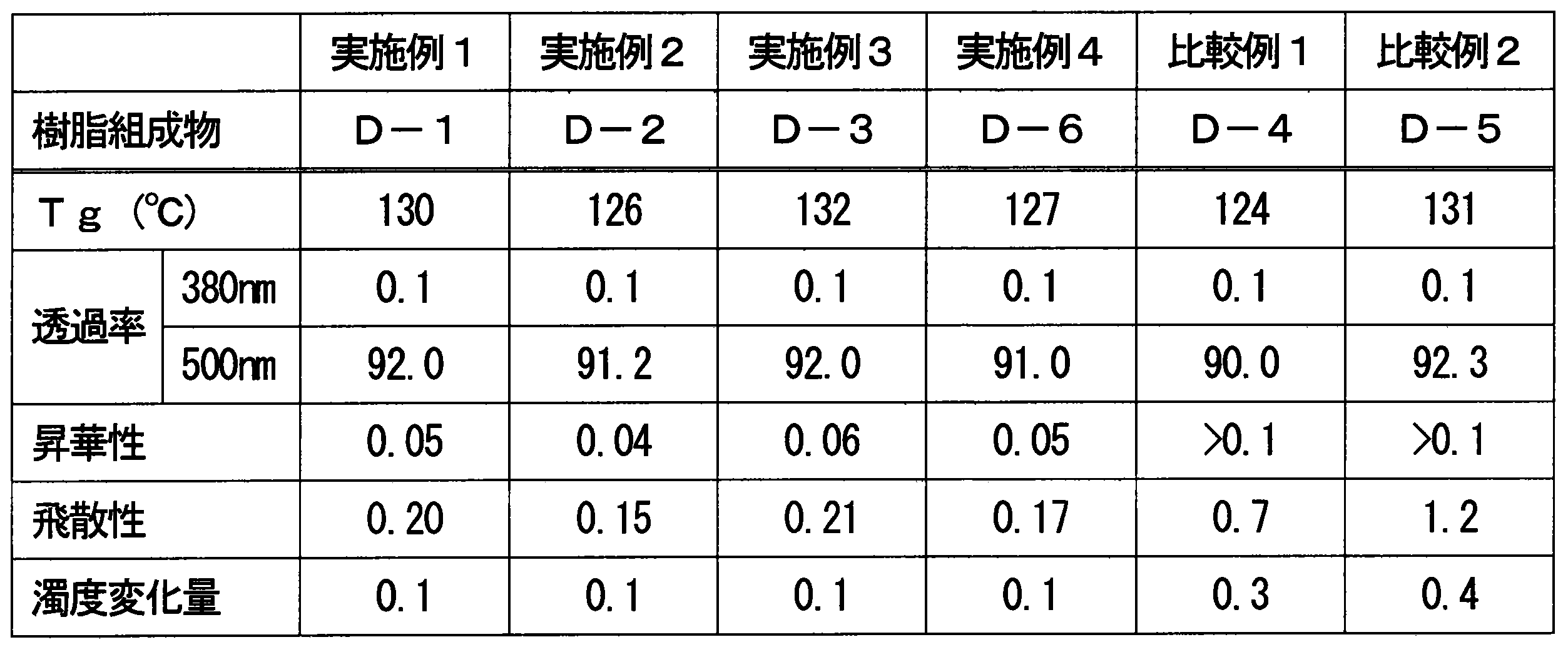
表1に示すように、実施例の各樹脂組成物では、比較例と同等の高いガラス転移温度、紫外線吸収能および可視光透過性を実現しながら、成形時におけるUVAの昇華性および飛散性を、比較例に比べて抑制できた。
また、実施例の各樹脂組成物から形成した樹脂フィルムの濁度変化量は、比較例の各樹脂組成物から形成した樹脂フィルムに比べて小さくなった。実施例の各樹脂組成物から形成した樹脂フィルムでは、比較例に比べて、熱による、フィルム成形後のUVAのブリードアウトが抑制されたと考えられる。
本発明は、その意図および本質的な特徴から逸脱しない限り、他の実施形態に適用しうる。この明細書に開示されている実施形態は、あらゆる点で説明的なものであってこれに限定されない。本発明の範囲は、上記説明ではなく添付したクレームによって示されており、クレームと均等な意味および範囲にあるすべての変更はそれに含まれる。
本発明によれば、主鎖に環構造を有するアクリル樹脂とUVAとを含む熱可塑性樹脂組成物であって、高温での成形時においても、ブリードアウトなどの発生が抑制され、UVAの蒸散による問題の発生を低減できる樹脂組成物を提供できる。
この樹脂組成物からは、外観上あるいは光学的な欠点が少なく、高い紫外線吸収能、耐熱性および透明性を有する樹脂成形品を形成でき、得られた樹脂成形品、例えば樹脂フィルムは、光学部材としての用途に好適に用いることができる。
Claims (14)
- 主鎖に環構造を有するアクリル樹脂を主成分とする熱可塑性樹脂100重量部と、
以下の式(1)に示される構造を有する紫外線吸収剤0.1~5重量部と、を含み、
ガラス転移温度が110℃以上である熱可塑性樹脂組成物。

- 前記式(1)におけるR1が、前記式「-OR5」により示される基である請求項1に記載の熱可塑性樹脂組成物。
- 前記式(1)におけるR2、R3、R4およびR5が、アルキル基である請求項2に記載の熱可塑性樹脂組成物。
- 前記環構造が、ラクトン環構造、グルタルイミド構造、無水グルタル酸構造、N-置換マレイミド構造および無水マレイン酸構造から選ばれる少なくとも1種である請求項1に記載の熱可塑性樹脂組成物。
- 前記環構造が、以下の式(2)により示されるラクトン環構造である請求項1に記載の熱可塑性樹脂組成物。
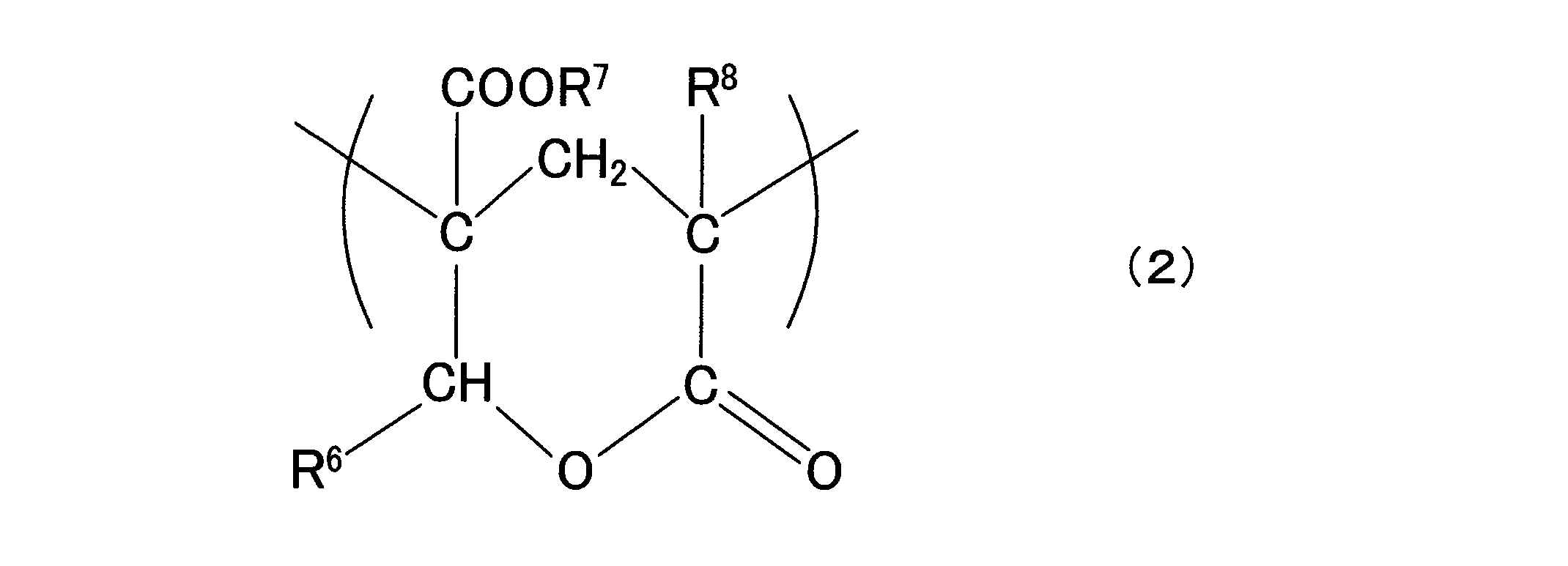
- シアン化ビニル単量体と芳香族ビニル単量体との共重合体をさらに含む請求項1に記載の熱可塑性樹脂組成物。
- 前記アクリル樹脂が、スチレン単位を構成単位として有する請求項1に記載の熱可塑性樹脂組成物。
- 請求項1に記載の熱可塑性樹脂組成物からなる樹脂成形品。
- シートまたはフィルムである請求項8に記載の樹脂成形品。
- 厚さ100μm、サイズ1cm×3cmのフィルムとしたときに、当該フィルムを150℃で10時間加熱して得た揮発成分を体積1mLの溶媒に溶解させ、得られた溶液を光路長1cmの石英セルに収容して吸光度計により測定した波長350nmの光に対する吸光度が0.1未満である請求項8に記載の樹脂成形品。
- 請求項1に記載の熱可塑性樹脂組成物からなる偏光子保護フィルム。
- 偏光子と、請求項11に記載の偏光子保護フィルムとを備える偏光板。
- 請求項12に記載の偏光板を備える画像表示装置。
- 請求項1に記載の熱可塑性樹脂組成物を押出成形して成形品とする、樹脂成形品の製造方法。
Applications Claiming Priority (4)
| Application Number | Priority Date | Filing Date | Title |
|---|---|---|---|
| JP2008006031 | 2008-01-15 | ||
| JP2008-006030 | 2008-01-15 | ||
| JP2008006030 | 2008-01-15 | ||
| JP2008-006031 | 2008-01-15 |
Publications (1)
| Publication Number | Publication Date |
|---|---|
| WO2009090809A1 true WO2009090809A1 (ja) | 2009-07-23 |
Family
ID=40885209
Family Applications (1)
| Application Number | Title | Priority Date | Filing Date |
|---|---|---|---|
| PCT/JP2008/072335 Ceased WO2009090809A1 (ja) | 2008-01-15 | 2008-12-09 | 熱可塑性樹脂組成物とそれを用いた樹脂成形品および偏光子保護フィルムならびに樹脂成形品の製造方法 |
Country Status (1)
| Country | Link |
|---|---|
| WO (1) | WO2009090809A1 (ja) |
Cited By (1)
| Publication number | Priority date | Publication date | Assignee | Title |
|---|---|---|---|---|
| WO2015079693A1 (ja) * | 2013-11-29 | 2015-06-04 | 株式会社カネカ | 光学用樹脂組成物、およびフィルム |
Citations (6)
| Publication number | Priority date | Publication date | Assignee | Title |
|---|---|---|---|---|
| JP2001147319A (ja) * | 1999-05-31 | 2001-05-29 | Fuji Photo Film Co Ltd | 光学フィルターおよび反射防止膜 |
| JP2002351026A (ja) * | 2001-05-23 | 2002-12-04 | Fuji Photo Film Co Ltd | ハロゲン化銀カラー写真感光材料 |
| JP2004347679A (ja) * | 2003-05-20 | 2004-12-09 | Konica Minolta Opto Inc | 光学フィルムの製造方法、光学フィルム、偏光板及び表示装置 |
| JP2006299171A (ja) * | 2005-04-25 | 2006-11-02 | Fuji Photo Film Co Ltd | セルロースアシレートフィルムおよびその製造方法、光学補償シート、偏光板ならびに液晶表示装置 |
| JP2007217667A (ja) * | 2006-01-17 | 2007-08-30 | Sekisui Chem Co Ltd | 熱可塑性樹脂フィルム、位相差フィルム及び偏光子保護フィルム |
| JP2007269965A (ja) * | 2006-03-31 | 2007-10-18 | Sumitomo Bakelite Co Ltd | 樹脂組成物、積層体、配線板および配線板の製造方法 |
-
2008
- 2008-12-09 WO PCT/JP2008/072335 patent/WO2009090809A1/ja not_active Ceased
Patent Citations (6)
| Publication number | Priority date | Publication date | Assignee | Title |
|---|---|---|---|---|
| JP2001147319A (ja) * | 1999-05-31 | 2001-05-29 | Fuji Photo Film Co Ltd | 光学フィルターおよび反射防止膜 |
| JP2002351026A (ja) * | 2001-05-23 | 2002-12-04 | Fuji Photo Film Co Ltd | ハロゲン化銀カラー写真感光材料 |
| JP2004347679A (ja) * | 2003-05-20 | 2004-12-09 | Konica Minolta Opto Inc | 光学フィルムの製造方法、光学フィルム、偏光板及び表示装置 |
| JP2006299171A (ja) * | 2005-04-25 | 2006-11-02 | Fuji Photo Film Co Ltd | セルロースアシレートフィルムおよびその製造方法、光学補償シート、偏光板ならびに液晶表示装置 |
| JP2007217667A (ja) * | 2006-01-17 | 2007-08-30 | Sekisui Chem Co Ltd | 熱可塑性樹脂フィルム、位相差フィルム及び偏光子保護フィルム |
| JP2007269965A (ja) * | 2006-03-31 | 2007-10-18 | Sumitomo Bakelite Co Ltd | 樹脂組成物、積層体、配線板および配線板の製造方法 |
Cited By (1)
| Publication number | Priority date | Publication date | Assignee | Title |
|---|---|---|---|---|
| WO2015079693A1 (ja) * | 2013-11-29 | 2015-06-04 | 株式会社カネカ | 光学用樹脂組成物、およびフィルム |
Similar Documents
| Publication | Publication Date | Title |
|---|---|---|
| JP4974971B2 (ja) | 熱可塑性樹脂組成物とそれを用いた樹脂成形品および偏光子保護フィルムならびに樹脂成形品の製造方法 | |
| JP5300385B2 (ja) | 熱可塑性樹脂組成物とそれを用いたフィルム | |
| TWI444424B (zh) | A thermoplastic resin composition, a resin molded product using the resin composition, a protective element for a polarizing element, and a method for producing a resin molded product | |
| JP5912277B2 (ja) | 光学フィルム、偏光子保護フィルム、偏光板および画像表示装置 | |
| JP5230363B2 (ja) | 熱可塑性樹脂組成物の製造方法 | |
| JP6508961B2 (ja) | 熱可塑性樹脂組成物とそれを用いた光学フィルム | |
| JP2007316366A (ja) | 偏光子保護フィルム、偏光板、および画像表示装置 | |
| JP5424717B2 (ja) | 光学フィルムの製造方法 | |
| JPWO2008050573A1 (ja) | 偏光子保護フィルム、偏光板、および画像表示装置 | |
| WO2008047836A1 (fr) | Composition de résine thermoplastique | |
| JP5601781B2 (ja) | 光学フィルム | |
| JP2010072135A (ja) | 光学フィルム | |
| JP2012031332A (ja) | 光学フィルムの製造方法 | |
| JP5430187B2 (ja) | 2軸延伸フィルム | |
| JP2009191248A (ja) | 熱可塑性樹脂組成物とそれを用いた樹脂成形品および偏光子保護フィルムならびに樹脂成形品の製造方法 | |
| JP5675191B2 (ja) | 光学フィルムの製造方法 | |
| JP2012008557A (ja) | 偏光子保護フィルム、偏光板、および液晶表示装置 | |
| JP2011017761A (ja) | 位相差フィルムの製造方法 | |
| JP5350640B2 (ja) | 熱可塑性樹脂組成物とそれを用いた樹脂成形品および偏光子保護フィルム | |
| JP2010243581A (ja) | リン酸エステルを含むアクリル樹脂よりなる光学フィルム | |
| JP2014098133A (ja) | 樹脂組成物とそれを用いた樹脂成形品 | |
| JP2009191249A (ja) | 熱可塑性樹脂組成物とそれを用いた樹脂成形品および偏光子保護フィルムならびに樹脂成形品の製造方法 | |
| JP6646941B2 (ja) | 熱可塑性樹脂組成物とそれを用いた光学フィルム | |
| JP2013186212A (ja) | 位相差フィルム | |
| JP2012203328A (ja) | 光学フィルム |
Legal Events
| Date | Code | Title | Description |
|---|---|---|---|
| 121 | Ep: the epo has been informed by wipo that ep was designated in this application |
Ref document number: 08871149 Country of ref document: EP Kind code of ref document: A1 |
|
| NENP | Non-entry into the national phase |
Ref country code: DE |
|
| 122 | Ep: pct application non-entry in european phase |
Ref document number: 08871149 Country of ref document: EP Kind code of ref document: A1 |