WO2006123734A1 - 含フッ素ポリマー錯体を含んでなる複合材料 - Google Patents
含フッ素ポリマー錯体を含んでなる複合材料 Download PDFInfo
- Publication number
- WO2006123734A1 WO2006123734A1 PCT/JP2006/309914 JP2006309914W WO2006123734A1 WO 2006123734 A1 WO2006123734 A1 WO 2006123734A1 JP 2006309914 W JP2006309914 W JP 2006309914W WO 2006123734 A1 WO2006123734 A1 WO 2006123734A1
- Authority
- WO
- WIPO (PCT)
- Prior art keywords
- polymer
- fluorine
- composite material
- complex
- group
- Prior art date
- Legal status (The legal status is an assumption and is not a legal conclusion. Google has not performed a legal analysis and makes no representation as to the accuracy of the status listed.)
- Ceased
Links
Classifications
-
- C—CHEMISTRY; METALLURGY
- C08—ORGANIC MACROMOLECULAR COMPOUNDS; THEIR PREPARATION OR CHEMICAL WORKING-UP; COMPOSITIONS BASED THEREON
- C08F—MACROMOLECULAR COMPOUNDS OBTAINED BY REACTIONS ONLY INVOLVING CARBON-TO-CARBON UNSATURATED BONDS
- C08F8/00—Chemical modification by after-treatment
- C08F8/42—Introducing metal atoms or metal-containing groups
Definitions
- Composite material comprising a fluorine-containing polymer complex
- the present invention relates to a composite material including a fluorine-containing polymer complex and a matrix polymer.
- Optical communication systems using silica-based fibers (GOF) or plastic optical fibers (POF) enable high-capacity and high-speed data transmission.
- OPF silica-based fibers
- POF plastic optical fibers
- optical signals are attenuated due to losses that occur during propagation, branching, connection, and switching.
- amplification by an optical amplifier, an optical amplification element, or the like is required. I need it.
- a (quartz) glass-based material doped with rare earth metal ions is typically cited.
- JP-A-2000-63682 discloses a composition in which a rare earth metal complex is dispersed in a fluorine-containing acrylate polymer as an organic photofunctional material.
- JP-A-2000-63682 as specific examples of fluorine-containing metatalylate and fluorine-containing acrylate, poly (hexafluoroisopropyl methacrylate), poly (hexafluoro-n-propyl methacrylate) Talylate) and polyfluoroisopropyl acrylate (paragraph number [0069] of Japanese Patent Application Laid-Open No. 2000-63682). Hexafluoroisopropyl methacrylate (iFPMA) is also used as a matrix polymer in the examples.
- iFPMA Hexafluoroisopropyl methacrylate
- the composition containing the rare earth metal complex described in JP-A-2000-63682 is insufficient in light emission intensity and light emission efficiency.
- the heat resistance is insufficient, and in some cases, the shape changes due to heat generation of the element.
- Nd (hfa-D) and Nd (pom—D) are epoxy resins that are weak against acids.
- metal complexes having a non-fluorine polymer as a ligand have also been proposed (Japanese Patent Laid-Open Nos. 6-166727, 2001-131542, and 2). 001-220579, JP-A-2002-163902).
- the ligand itself is a hydrocarbon polymer, there remains a problem in that the emission intensity of the rare earth metal is impaired.
- the purpose is to solve V and other issues.
- the present invention relates to a composite material comprising a fluorine-containing polymer complex (A) in which a fluorine-containing polymer ligand is coordinated to a metal, and a matrix polymer (B).
- Preferred examples of the matrix polymer (B) include an epoxy polymer, a silicone polymer, a urethane polymer, an acrylic polymer, a fluorine polymer, and a mixture thereof.
- the force that the fluorine-containing polymer complex (A) is a powder is also preferably a point force that has good dispersibility in the matrix polymer.
- the metal is not limited as long as it can be coordinated to a fluorine-containing polymer ligand! ⁇ Force Group force consisting of Group 2 to Group 13 and rare earth metal in the periodic table At least one selected metal Is preferable in that a good coordination state can be formed.
- the fluorine-containing polymer complex (A) is dispersed in the matrix polymer (B) in the composite material of the present invention from the standpoint of uniform effects.
- the present invention also relates to a molded article having the above-mentioned composite material force. Molded products can take various forms in addition to film.
- the molded article of the present invention is useful as an optical member.
- the present invention also relates to a curable composition
- a curable composition comprising a fluorine-containing polymer complex (A) in which a fluorine-containing polymer ligand is coordinated to a metal and a polymerizable monomer (C).
- the polymerizable monomer (C) used in the hard curable yarn and composition includes a polymerizable monomer that gives an epoxy polymer, a polymerizable monomer that gives a silicone polymer, a polymerizable monomer that gives a urethane polymer, A polymerizable monomer that gives an acrylic polymer or a polymerizable monomer that gives a fluorine polymer is preferred.
- the fluorinated polymer complex (A) is constituted by coordination of a fluorinated polymer ligand to a metal.
- the important points here are that they contain fluorine atoms and that the ligands are not just high molecular weight polymers. That is, the fluorine-containing polymer ligand used in the present invention needs to contain a fluorine atom and be a polymer. The reason for this is that the decrease in emission intensity can be suppressed by containing fluorine atoms, and the ligand can be replaced by using a high molecular weight polymer (polymerized monomer). It also has the power to prevent attacks on metals such as water and acids.
- the fluorine-containing polymer complex (A) used in the present invention comprises a coordination form between a metal and a coordination structural unit Q, a metal type, a metal charge (whether charge-compensated or non-compensated), coordination Depending on the order, etc., formula (I):
- Pn-Q is a fluorine-containing polymer ligand
- R-Q is a non-polymeric ligand or a non-fluorine-based polymer ligand
- M is a coordination metal
- n is a positive integer
- n + m is a coordination number
- the metal M is not limited as long as it can coordinate to the fluorine-containing polymer ligand (Pn-Q), but the group power consisting of the group 2 to group 13 of the periodic table and the rare earth metal is selected. Both are preferred because one metal can form a good coordination state. When these metals form a coordination bond, they may be zero-valent (charge non-compensation type) or one to three-valent ions (charge compensation type).
- Metals belonging to groups 2 to 13 of the periodic table include, for example, group 2 elements such as barium (Ba); group 3 elements such as yttrium (Y) (excluding rare earth elements); titanium (Ti), etc. Group 4 elements; Group 5 elements such as vanadium (V); Group 6 elements such as molybdenum (Mo); Group 7 elements such as manganese (Mn); Group 8 elements such as ruthenium (Ru); Conoleto (Co) , Iridium (Ir) and other Group 9 elements; Nickel (Ni), Palladium (Pd), Platinum (Pt) and other Group 10 elements; Copper (Cu), Silver (Ag), Gold (Au) and other Group 11 elements Elements: Group 12 elements such as zinc (Zn); Group 13 elements such as indium (In).
- group 2 elements such as barium (Ba); group 3 elements such as yttrium (Y) (excluding rare earth elements); titanium (Ti), etc.
- Group 4 elements Group 5 elements such as vanadium (V); Group 6 elements such as
- Rare earth metals are scandium-um elements and lanthanum excluding actinium in the periodic table. It is at least one selected from the powers of the 17 elements of theoidoid group, among them Elpium (Er), Thulium (Tm), Prasedium (Pr), Holmium (Ho), Neodium (Nd) Pium (Eu), cerium (Ce), samarium (Sm), dysprosium (Dy), terbium (Tb) and the like are preferred.
- Elpium (Er), Thulium (Tm), Prasedium (Pr), Holmium (Ho), Neodium (Nd) Pium (Eu), cerium (Ce), samarium (Sm), dysprosium (Dy), terbium (Tb) and the like are preferred.
- optical material in particular, as an optical functional material, among these, it is used according to applications such as light emission, optical amplification and wavelength conversion, and according to the type of light (wavelength) required.
- rare earth elements such as prasedium (fluorescence wavelength: 1300nm) and erbium (fluorescence wavelength: 1550nm). And neodymium (fluorescence wavelength: 850 nm) are preferred.
- Europium (fluorescence wavelength: 615 nm) is preferred for optical amplification applications for optical communications using visible light with a wavelength of 650 nm.
- a rare earth element that generates light having a required wavelength as fluorescence is selected.
- a power such as terbium emitting green light (fluorescence wavelength: 532 nm) and europium emitting red light (fluorescence wavelength: 615 nm).
- a rare earth metal complex is a rare earth element in which one or more ligands are coordinated, and the rare earth element surrounds the rare earth element as compared with the rare earth metal ion. Therefore, in the process where the excited rare earth element emits light, the stored energy of the rare earth element escapes to the surrounding matrix polymer, and the emission intensity and efficiency may decrease.
- the present invention by using at least one ligand as a polymer molecule, the interaction between the matrix polymer and the complex is suppressed, and the escape of energy is suppressed. As a result, the emission intensity from rare earth metals is reduced. ⁇ Increases luminous efficiency.
- the repeating unit N includes a structural unit Q capable of coordinating with a metal and may contain a fluorine atom; the repeating unit D does not contain a coordination structural unit Q and contains a fluorine atom.
- Preferred examples include a fluorine-containing polymer chain represented by the following units: at least one of N, D and Q containing a fluorine atom and repeating unit N of 0.1 to: LOO mol%.
- the repeating unit N is further represented by the formula (N1):
- N1 may contain a fluorine atom 2 to: a repeating unit that also has a divalent organic group of LOO;
- R 1 represents a carbon atom that may contain a bond or a fluorine atom 1 to: a divalent organic group of LOO;
- Q is preferably a coordination structural unit).
- repeating unit N for example, the formula (Nl-1):
- repeating unit N1 represented by the formula (N1-1) include
- R 1 for example, the formula (Rl— 1):
- organic group R 1 represented by the formula (R1-1) include, for example,
- Rf is a fluorine-containing alkylene group having 1 to 50 carbon atoms or a fluorine atom having 2 to C carbon atoms bonded to the coordination structural unit Q).
- N-1 the preferred repeating unit N is represented by the formula (N-1):
- a specific example of the repeating unit N-1 is obtained by replacing Rf of the structural unit M described as formula (2) in WO 02Z072696A1 with (R 2 ) -Q. d
- repeating unit N include the following.
- OCF CF. OCF. CH. OCH CH CH Q
- Arbitrary repeating unit D is a unit derived from a monomer copolymerizable with the monomer that gives repeating unit N, and is not particularly limited, and is appropriately selected according to the required characteristics of the target fluorine-containing polymer complex. If you do.
- repeating unit D for example, the repeating unit described in WO 02Z072696A1 can be exemplified.
- the refractive index of the fluorine-containing polymer complex or a cured product thereof can be kept low, and that the refractive index can be further reduced.
- the mechanical properties and glass transition point of the polymer complex can be adjusted by selecting the monomer, and the glass transition point can be increased by copolymerizing with the repeating unit N, which is preferable. .
- repeating units (iii) is preferable in that transparency can be increased, a lower refractive index can be achieved, and a fluorine-containing polymer complex having a high glass transition point can be obtained.
- (iv) A repeating unit derived from an ethylenic monomer containing no fluorine atom
- the solubility in a general-purpose solvent is improved, and the compatibility with an additive such as a photocatalyst or a curing agent added as necessary can be improved.
- repeating unit N As a copolymerization component of repeating unit N, it is more preferable to add repeating unit N to the repeating unit of fluorine-containing ethylenic monomer or non-fluorine ethylenic monomer (above-mentioned (iii), (iv)). Furthermore, it is preferable to introduce an alicyclic monomer structural unit (V), which can increase the glass transition point and increase the hardness.
- Preferable examples of the above repeating unit D include those described as arbitrary structural unit A in WO 02Z072696A1 as the structure and specific examples.
- the repeating unit N is contained in an amount of 0.1 to 100 mol%. If the amount is too small, the metal content will be low.
- the lower limit is preferably 1 mol%, more preferably 5 mol%.
- the upper limit of the repeating unit N is as high as possible, and is closer to 100 mol%, which is more preferable.
- the weight average molecular weight of the fluorine-containing polymer ligand is preferably 2,000 or more, more preferably 5,000 or more, and particularly preferably 10,000 or more. If the weight average molecular weight is too small, the effect of the present invention of blocking external environmental forces such as moisture and acid tends to be attenuated.
- the upper limit is 10,000,000, or even 5,000,000, especially 3,000,000. This is preferable because it has a good blocking effect against external environmental forces.
- the fluorine content of the fluorine-containing polymer ligand is preferably 5% by mass or more, more preferably 10% by mass or more, and particularly preferably 20% by mass or more, in order to improve the luminous efficiency of the central metal.
- the upper limit is when Pn is a perfluoropolymer chain.
- the fluorine-containing polymer ligand (Pn-Q) is not limited as long as it contains an atom having a ⁇ electron (for example, a heteroatom) or an unsaturated bond.
- Sarasako is a polymer complex (A) that includes a charge-compensated type ligand that forms a metal ion (cation) and forms a coordination bond and an ionic bond with the metal ion (cation).
- A polymer complex
- Stability, heat resistance, purple resistance oc preferable from the viewpoint of excellent external characteristics.
- charge compensation type polymer ligand Pn-Q
- Pn-Q charge compensation type polymer ligand
- Rb 1 is a hydrocarbon group having 1 to 20 carbon atoms, a fluorine-containing group having 1 to 20 carbon atoms in which part or all of the hydrogen atoms are substituted with fluorine atoms.
- X 11 is a hydrogen atom, a deuterium atom, a fluorine atom, or a hydrocarbon group having 1 to 20 carbon atoms Selected from fluorine-containing hydrocarbon groups having 1 to 20 carbon atoms in which part or all of hydrogen atoms are substituted with fluorine atoms
- Rb 1 is the same as the above formula (bla);
- Rb 2 is a hydrocarbon group having 1 to 20 carbon atoms, carbon obtained by substituting some or all of the hydrogen atoms with fluorine atoms.
- Number 1-20 fluorinated carbonization A hydrogen group and a hydrocarbon group having 1-20 carbon atoms with a heterocyclic structure (at least one selected)
- Pn is the same as the above formula (bla); Rb is the same as the above formula (bib); Rb is a hydrocarbon group having 1 to 20 carbon atoms, and some or all of the hydrogen atoms are fluorine atoms. Substituted fluorine-containing hydrocarbon group having 1 to 20 carbon atoms and hydrocarbon having 1 to 20 carbon atoms having a heterocyclic structure.
- OSI is preferable.
- Pn,! ⁇ 1 to! ⁇ 3 is particularly excellent in luminous (amplification) efficiency when at least one of them is a fluorine-containing hydrocarbon group having 1 to 20 carbon atoms in which some or all of the hydrogen atoms are substituted with fluorine atoms. In this respect, the stability at the time of complex formation is excellent, and this is preferable.
- X 11 is particularly preferably a deuterium atom or a fluorine atom in terms of excellent luminous (amplification) efficiency.
- Rb 4 is a hydrogen atom, a hydrocarbon group having 1 to 20 carbon atoms, a carbon formed by substituting some or all of the hydrogen atoms with fluorine atoms. Fluorine-containing hydrocarbon group having 1 to 20 carbon atoms, and hydrocarbon group having 1 to 20 carbon atoms having a heterocyclic structure are selected. At least one kind; Y 1 is 0, S or N— (R ′ is a hydrogen atom, carbon A hydrocarbon group having 1 to 20 carbon atoms, and a ligand represented by a fluorine-containing hydrocarbon group having 1 to 20 carbon atoms in which some or all of the hydrogen atoms are substituted with fluorine atoms). These are preferable in terms of good light emission efficiency and amplification efficiency.
- R is a hydrocarbon group having 1 to 20 carbon atoms and a carbon atom having 1 or a part of the hydrogen atoms substituted by fluorine atoms.
- Fluorine-containing hydrocarbon power of ⁇ 20 is also selected, and also ring structure with phosphorus atom Which may be formed), and these are preferable in terms of good light emission efficiency and amplification efficiency.
- R is a fluorinated hydrocarbon group having 1 to 20 carbon atoms in which part or all of the hydrogen atoms are substituted with fluorine atoms. It is preferable in that it is excellent.
- the fluorine-containing polymer complex (A) used for the composite material of the present invention is a compound in which a non-compensated (zero-valent) charge-uncompensated ligand having no charge (negative charge) is further introduced. Moyo! /
- the charge-uncompensated ligand has a ⁇ -electron pair that has no charge in the whole ligand and can coordinate to empty d activation of a metal such as a rare earth metal. [0149] [Chemical 39]
- the fluorine-containing polymer complex (A) used in the present invention has at least one fluorine-containing polymer ligand selected from the above-described metal ions of the above-mentioned charge-compensated or non-compensated polymer ligand. Any other ligand (R—Q) is preferable as long as it is coordinate-bonded. Preferably, 2 to 4 ligands are coordinate-bonded. These ligands consist of only one of charge-compensated or non-charge-compensated !, or include both charge-compensated and charge-uncompensated types. .
- the other ligand (RQ) may be a conventionally known non-polymeric organic ligand, non-fluorine polymer ligand, or inorganic anion.
- non-polymeric organic ligand examples include those obtained by replacing Pn of the above-mentioned fluorine-containing polymer ligand with various hydrogen atoms or non-polymeric organic groups.
- non-fluorine polymer ligand examples include those obtained by replacing the fluorine atom of the above-mentioned fluorine-containing polymer ligand with another atom such as hydrogen or deuterium.
- the compound containing the coordination structure used in the production method (1) may be selected according to the target coordination structure.
- the diketone structure of (bl) above Fluoroacetylacetone can be used.
- the method for producing a fluorine-containing polymer complex is a method in which a fluorine-containing polymer ligand is reacted with a metal or a metal compound according to a conventional method.
- Examples of the metal compound include europium acetate, erbium acetate, and neodymium acetate.
- Acetate, copper acetate, etc. are useful.
- the fluorine-containing polymer complexes ( ⁇ ) have polymer ligands, so most of them are solid at room temperature (25 ° C) .
- the composite material of the present invention comprises the above-mentioned fluorine-containing polymer complex (A) and a matrix polymer (B).
- the matrix polymer (B) functions to retain the fluorine-containing polymer complex, and can be selected in consideration of the affinity with the fluorine-containing polymer complex and processability. Specifically, an epoxy polymer, a silicone polymer, a urethane polymer, an talyl polymer, a fluorine polymer, or a mixture thereof can be exemplified.
- the epoxy-based polymer is not particularly limited, for example, as an epoxy-based compound.
- bisphenol A type epoxy resin bisphenol F type epoxy resin, bisphenol AD type epoxy Bisphenol-type epoxy resin such as bisphenol S-type epoxy resin; Novolac-type epoxy resin such as phenol novolac type epoxy resin, cresol nopolac type epoxy resin; Trisphenol methane triglycidyl ether, etc.
- Aromatic epoxy resins such as these hydrogenated products and halides; 3, 4-Epoxycyclohexenoremethylolate 3, 4-Epoxycyclohexane decanolate, 3, 4 Epoxy 2-methylcyclohexylmethyl-3, 4 Epoxy 2—Methinorecyclohexane power Bis (3,4-epoxycyclohexylene) adipate, bis (3,4-epoxycyclohexylmethyl) adipate, bis (3,4-epoxy 6-methylcyclohexylmethyl) adipate, 2- (3, 4 Epoxycyclohexyl 5, 5-spiro 3, 4 epoxy) cyclohexanone metadioxane, alicyclic epoxy resin such as bis (2,3 epoxycyclopentyl) ether; 1,4 diglycidyl ether of butanediol, 1,6-hexanediol diglycidyl ether, glycerin triglycidyl ether, trimethyl
- silicone-based polymer examples include tetranolecoxysilane zonoregenole polymer, trialkoxysilane sol-gel polymer, methyltrialkoxysilane sol-gel polymer, tetraalkoxysilane and trialkoxysilane sol-gel polymer, and tetraalkoxysilane.
- a silicone polymer is used as a matrix, it is useful as a composite material such as a semiconductor sealing agent.
- urethane-based polymers include 4,4, -diphenylmethane diisocyanate, 2,4 mono- and Z or 2,6-toluene diisocyanate, polymethylene polyphenylpolyisocyanate, and xylylene diene.
- acrylic polymers include polymethyl (meth) acrylate, polyethyl (meth) acrylate, poly n-propyl (meth) acrylate, poly n-butyl (meth) acrylate, polyisobutyl (meth).
- fluorine-based polymer examples include polytetrafluoroethylene (PTFE), tetrafluoroethylene Z perfluoroalkyl butyl ether copolymer (PFA), and tetrafluoroethylene Z hexafluoropropylene copolymer ( FEP), polyvinylidene fluoride (PVDF), and ethylene Z tetrafluoroethylene copolymer (ETFE).
- PTFE polytetrafluoroethylene
- PFA tetrafluoroethylene Z perfluoroalkyl butyl ether copolymer
- FEP tetrafluoroethylene Z hexafluoropropylene copolymer
- PVDF polyvinylidene fluoride
- ETFE ethylene Z tetrafluoroethylene copolymer
- the composite form of the fluorine-containing polymer complex and the matrix polymer may take various forms such as a multilayer structure, a sea-island structure, and a dispersed structure.
- a dispersion in which the fluorine-containing polymer complex is dispersed in the matrix polymer is preferred because the fluorine-containing polymer complex exists uniformly.
- the blending ratio of the fluorine-containing polymer complex (A) and the matrix polymer (B) may be appropriately selected depending on the purpose of use of the composite material.
- the fluoropolymer complex (A) is 0.1 parts by mass or more, more preferably 0.5 parts by mass or more, particularly 1 part by mass or more. This is advantageous in terms of characteristics.
- the upper limit is 100 parts by mass of the fluorine-containing polymer complex (A) with respect to 100 parts by mass of the matrix polymer (B), and further 500 parts by mass, especially 1000 parts by mass. This is advantageous in terms of metal concentration.
- Epoxy polymer or silicone polymer is used as matrix polymer (B)
- an acid catalyst is used as a catalyst during polymerization, the coordination bond between the ligand and the metal is broken in the conventional non-polymeric complex, which reduces the amount of the complex functioning. was there.
- the fluorine-containing polymer complex (A) used in the present invention can prevent the penetration of an acid in such an epoxy polymer into the complex with a stable polymer portion, a composite material having a stable function as a complex can be provided.
- the function corresponding to the blending amount is expressed, even if the amount is the same as the conventional amount, the function can be greatly improved.
- the method for producing the composite material of the present invention is not particularly limited. For example, the following method can be employed.
- the fluorinated polymer complex (A) in the form of powder, it is preferable to add the fluorinated polymer complex (A) in the form of powder.
- the particle size of the powder may be appropriately selected depending on the purpose and application. Usually select in the range of 10nm to 10 ⁇ m.
- the solvent used in the production method (1) may be selected in accordance with the matrix polymer, and the melt-kneading conditions in the production method (2) may be selected in accordance with the matrix polymer!
- Production method (3) is a method of directly producing a composite material by polymerizing polymerizable monomer (C) in the presence of fluorine-containing polymer complex (A). Uniform mixing of high molecular weight components is performed. This is particularly effective when the solvent is insufficient, the solvent solubility of the matrix polymer (B) is low, or the melt moldability during melt processing is low.
- the curable composition used in the production method (3) includes a fluorine-containing polymer complex (A) and a polymerizable monomer.
- the polymerizable monomer (C) is a polymerizable monomer or monomer mixture that gives a matrix polymer (B) by polymerization, for example, a polymer that gives an epoxy polymer.
- Polymer a monomer that gives a silicone polymer, a polymerizable monomer that gives a urethane polymer, a polymerizable monomer that gives an acrylic polymer, and a polymerizable monomer that gives a fluorine polymer.
- Specific examples include monomers that give the polymers described as examples of the matrix polymer (B).
- the concentration of the fluorine-containing polymer complex (A) in the curable composition may be selected according to the content in the target composite material.
- the present invention also relates to a molded article comprising the composite material of the present invention.
- the strong molded product may be a case where the composite material itself is a molded product, or may be a molded product obtained by combining a composite material with another material and performing molding molding.
- Examples of cases where the composite material itself is a molded product include molded products such as films, sheets, boards, blocks, and tubes.
- a casting method, a melt extrusion method, an injection molding method, or the like can be appropriately employed.
- Such a functional composite material or molded product is not limited to these, for example, the power that can be exemplified as follows.
- Illustrative examples include luminescent materials, light amplification materials, optical functional materials such as LEDs and organic EL, and imaging plates.
- Eu europium
- Tb tenolebium
- Er enorebium
- Acrylic polymers fluoropolymers, polyesters, polyimides and the like are suitable.
- the content of the fluorine-containing polymer complex (A1) is considered to improve the fluorescence intensity.
- additives For optical materials, various additives may be blended as necessary. Examples of additives include leveling agents, viscosity modifiers, light stabilizers, antioxidants, moisture absorbers, and pigments.
- rare earth metal ions may be blended.
- the rare earth metal ions are usually mixed in the form of a salt with a counter ion capable of ionic bonding with the rare earth metal ions.
- Rare earth metal cations are usually used as salts of divalent, trivalent or tetravalent metal cations, with no limit on valence.
- rare earth metal salts include halides such as chlorides, bromides, and iodides of the rare earth elements exemplified above; salts such as nitrates, perchlorates, bromates, acetates, sulfates, phosphates, etc. Etc. Further, organic salts of rare earth metals such as organic acid salts and organic sulfonic acid salts may be used. Also, double nitrates, double sulfates and chelate cakes can be used.
- rare earth metal salts include salt salts such as praseodymium, praseodymium bromide, praseodymium iodide, prasedium nitrate, prasedium perchlorate, prasedium bromate, praseodymium acetate, prasedium sulfate, and prasedium phosphate.
- neodymium salt such as neodymium bromide, neodymium bromide, neodymium iodide, neodymium nitrate, neodymium perchlorate, neodymium bromate, neodymium acetate, neodymium sulfate, neodymium phosphate; europium chloride, odor Europium salts such as europium iodide, europium iodide, europium nitrate, europium perchlorate, europium bromate, europium acetate, europium sulfate, europium phosphate; erbium chloride, elpium bromide, rubidium iodide, nitric acid Rubiumu, perchloric acid erbium, bromate erbium
- Erbium salts such as erbium acetate, erbium sulfate, erbium phosphate; terbium chloride, terbium bromide, terbium iodide, terbium nitrate, terbium perchlorate, terbium benzoate, terbium acetate, terbium sulfate, terbium phosphate
- Terbium salts such as: samarium chloride, samarium bromide, samarium iodide, samarium nitrate, samarium perchlorate, samarium bromate, samarium acetate, samarium sulfate, samarium phosphate, and the like.
- an optical element using an optical functional optical material for the core that is, an optical amplifying element and a light emitting element can be provided.
- An optical amplifying element is a kind of optical waveguide device having a core part and a cladding part, and is an element whose signal intensity is amplified while an optical signal passes through the core part of an optical waveguide formed on a substrate. Generally speaking. In this optical amplifying element, it is necessary to form the core part with a material having an optical amplifying function.
- the optical amplifying element has a core portion (a portion of an optical waveguide having an optical amplifying function) constructed by the optical member of the present invention.
- an appropriate cladding material is required. It is necessary to use a material having a lower refractive index than the material of the core part as the material for the cladding part.
- the material for the cladding part is not particularly limited. Organic materials are used. Of course, the use of the fluorine-containing polymer complex (A) and the matrix polymer (B) does not matter.
- the light emitting element is, for example, an EL element, a polymer light emitting diode, a light emitting diode, an optical fiber laser, a laser element, an optical fiber, a liquid crystal backlight, a photodetector, a wavelength conversion filter, and the like. It is applied to large displays, lighting, liquid crystals, optical discs, laser printers, medical lasers, laser processing, printing and copying machines.
- the composite material of the present invention is used for the core part as in the case of the optical amplification type element, and an existing organic material such as the above-described organic material is used for the clad part.
- the matrix polymer (B) can be used as it is.
- the optical amplification element and the light emitting element in the present invention can be integrated with other optical elements to construct a more multifunctional optical circuit.
- other optical elements include optical switches, optical filters, and optical branching elements.
- the optical branching device includes an optical amplifying element according to the present invention and an N-branch waveguide (N is an integer of 2 or more) connected to the output end of the core part of the optical amplifying element and made of the same material as the core part
- N is an integer of 2 or more
- the optical amplifying element and the light emitting element in the present invention can be produced by a conventionally known production method except that the composite material of the present invention is used as a core part.
- the optical device encapsulated with the composite material of the present invention has a matrix polymer, In addition, it has excellent moisture and moisture resistance derived from the fluorine-containing polymer, so it has extremely excellent moisture and moisture resistance.
- the material of the present invention is excellent in transparency over a wide range of ultraviolet power and near infrared, and is particularly useful as a sealing member for optical applications.
- optical functionality since optical functionality is combined, it is possible to add added values such as a wavelength conversion function, a light amplification function, and a stimulated light emission function in addition to a normal sealing function.
- Examples of usage of the sealing member in the present invention include light-emitting elements such as light-emitting diodes (LEDs), EL elements, nonlinear optical elements, photorefractive elements, and photo-tus crystals, light-receiving elements, wavelength conversion elements, and light
- LEDs light-emitting diodes
- EL elements nonlinear optical elements
- photorefractive elements and photo-tus crystals
- light-receiving elements wavelength conversion elements
- a package (encapsulation) or surface mounting of an optical functional element such as an add / drop element, an optical cross-connect element, or a modulator
- sealing materials (or fillers) for optical members such as lenses for deep ultraviolet microscopes are also included. Sealed light elements are used in various places, but non-limiting examples include high-mount stop lamps, instrument panels, mobile phone backlights, and light sources for remote control devices for various electrical products.
- Elements Camera auto focus, CDZDVD optical pickup light receiving element, etc.
- Measurement is performed using an NMR measuring apparatus manufactured by BRUKER.
- the weight average molecular weight of the fluoropolymer complex is determined by GPC analysis.
- the obtained sample was subjected to gel permeation chromatography (GPC) using a GPC HLC-8020 manufactured by Tosoh Corporation and a column (GPC KF-801 by Shodex), GP C KF-
- GPC gel permeation chromatography
- the weight average molecular weight is calculated from the data measured using 1 802 and 2 GPC KF-806M connected in series, with the flow rate of terahydride-furan (THF) as the solvent at a flow rate of lmlZ.
- thermogravimeter TGA-50, Shimadzu Corporation
- the sample lOmg is burned by the oxygen flask combustion method, the decomposition gas is absorbed in 20 ml of deionized water, and the fluorine ion concentration in the absorption liquid is measured by the fluorine selective electrode method (fluorine ion meter, model 901 manufactured by Orion). (Mass%).
- Fluorescence Spectrophotometer F-4010 manufactured by HITACHI measure the emission spectrum of each sample, compare the peak areas of specific wavelengths, and measure the relative emission intensity.
- the fluorine-containing polymer complex is incinerated at 600 ° C, and the metal content (mass%) in the fluorine-containing polymer complex is determined from the amount of the metal oxide after the incineration. Using the value of this metal content, the metal content in the composite material according to the blending amount of the fluoropolymer complex is calculated.
- a 50 ml glass four-necked flask equipped with a stirrer and a thermometer was charged with 0.9 g (21 mmol) of sodium hydride and thoroughly purged with nitrogen, and then 20 ml of dimethylformamide was suspended.
- the reactor was then cooled to 5 ° C with an ice bath. After cooling, 4.5 g (21 mmol) of hexafluoroacetylacetone was added dropwise.
- Fluorinated ether ether homopolymer having COC1 group obtained in Synthesis Example 2 in a 100 ml glass four-necked flask equipped with a stirrer and a thermometer. It was dissolved in 30 ml of formamide and cooled to 5 ° C with an ice bath. Thereafter, the dimethylformamide solution of hexafluoroacetylacetone prepared above was dropped by force-ureation and stirred for 5 hours.
- reaction solution was reprecipitated with hexane, 2. Og of a highly viscous solid was formed. This was separated and vacuum dried to obtain a colorless and transparent polymer.
- the weight average molecular weight measured by GPC analysis was 25,000.
- This solid has a hexafluoroacetylacetone group 9H, 9H-perfluoro-
- the fluorine content was 59 mass%, and the metal content was 7.7 mass%.
- a 1-L glass four-necked flask equipped with a stirrer and a thermometer was combined with 50 g of the fluorinated allylic ether homopolymer having an ester group obtained in Synthesis Example 5, 250 ml of jetyl ether, sodium methoxide (8. 0.15 mol), and after sufficient nitrogen substitution, CF COCH (62 g, 0.15) dissolved in 100 ml of jetyl ether at 0 ° C under a nitrogen stream.
- the polymer was analyzed by 19 F-NMR, —NMR analysis, and IR analysis.
- the fluorine content was 59 mass%, and the metal content was 9.0 mass%.
- the weight average molecular weight measured by GPC analysis was 32000.
- the temperature was raised and stirred for 6 hours. Attach a still to the reactor, and distill SOC1 from the reaction solution under reduced pressure.
- a solution obtained by dissolving the obtained polymer in acetone was poured into hexane, separated and vacuum-dried to obtain 7.3 g of a colorless and transparent polymer.
- a 1 L glass four-necked flask equipped with a stirrer and a thermometer was charged with 18 g (70 mmol) of the fluorine-containing ether ether-containing homopolymer having a COC1 group obtained in Synthesis Example 9 and sufficiently purged with nitrogen. It was dissolved in 300 ml of dimethylformamide and cooled to 5 ° C with an ice bath. Thereafter, the dimethylformamide solution of hexafluoroacetylaceton prepared above was dropped by force-ureation and stirred for 5 hours.
- the fluorine content was 55 mass%, and the metal content was 10 mass%.
- the weight average molecular weight measured by GPC praying was 15,000.
- a solution obtained by dissolving the obtained polymer in acetone was poured into hexane, separated and vacuum-dried to obtain 15 g of a colorless and transparent polymer.
- the polymer was analyzed by 19 F-NMR, —NMR analysis, and IR analysis.
- Synthesis Example 14 Synthesis of polymer complex having diketone group-containing fluorinated aryl ether polymer as a ligand
- the fluorine content was 54 mass%, and the metal content was 13 mass%.
- the weight average molecular weight measured by GPC spectroscopy was 53,000.
- This polymer was analyzed by 19 F-NMR, —NMR analysis, and IR analysis. As a result, it was an epoxy group-containing fluoropolymer (B-3) in which only the structural unit of the fluoroalkyl ether having an epoxy group was used. It was.
- the fluorine content was 27 mass%, and the weight average molecular weight measured by GPC analysis was 33,000.
- Hydrogenated bisphenol type epoxy (YX-8000 manufactured by Japan Epoxy Resin Co., Ltd. Fluorine content 0% by mass B-1) 6.5 g and hexahydro-4-methylphthalic anhydride 3.5 g were mixed together.
- This mixed solution was cast into a petri dish and cured by heating at 120 ° C for 9 hours using an electric furnace to obtain a composite material of the present invention.
- Thermal decomposition temperature of the composite material is 270 ° C, metal content 7. 7 X 10- 3% by mass ivy. Furthermore, although the appearance was cloudy, the dispersibility of the complex particles was ⁇ .
- the emission intensity was measured using a fluorometer (excitation light: 350 nm, observation wavelength: 615 nm), and the emission intensity of the cured composite material was 1.
- a mixed solution was prepared and heat-cured in the same manner as in Example 1 except that the blending amount of the powder of the fluoropolymer complex (A-1) obtained in Synthesis Example 4 was lOO mg to obtain a composite material.
- a mixed solution was prepared and heat-cured in the same manner as in Example 1 except that the amount of the powder of the fluorine-containing polymer complex (A-1) obtained in Synthesis Example 4 was changed to lg to obtain a composite material. [0313] The obtained composite material was examined in the same manner as in Example 1 for the thermal decomposition temperature, metal content, appearance, dispersibility, and emission intensity. The results are shown in Table 1.
- Fluorine-containing hydrogenated epoxy (fluorine content 22 mass% B-2):
- Thermal decomposition temperature of the composite material is 270 ° C, metal content 1. 0 X 10- 2% by mass ivy. Furthermore, although the appearance was cloudy, the dispersibility of the complex particles was ⁇ .
- the emission intensity was measured using a fluorometer (excitation light: 350 nm, observation wavelength: 615 nm), and the emission intensity of the cured composite material was 1.
- a mixed solution was prepared in the same manner as in Example 6 except that the blending amount of the powder of the fluorine-containing polymer complex (A-2) obtained in Synthesis Example 7 was lOO mg, and heat-cured to obtain a composite material.
- a mixture was prepared in the same manner as in Example 6 except that the amount of the powder of the fluorine-containing polymer complex (A-2) obtained in Synthesis Example 7 was changed to lg, and a composite material was obtained by heating and curing.
- Fluorine-containing hydrogenated epoxy (B-2) 5.3 g and hexahydro-4-methylphthalic anhydride 1.7 g are mixed, and the fluorine-containing polymer complex (A-2) lOOmg obtained in Synthesis Example 7 is dispersed and mixed.
- a liquid was prepared and heat-cured in the same manner as in Example 6 to obtain a composite material.
- a mixture of 5.9 g of allyl ether polymer (B-3) having an epoxy group in the side chain obtained in Synthesis Example 15 and 2.lg of hexano, id mouthpiece 4-methylphthalic anhydride was obtained in Synthesis Example 7. Included A mixed solution was prepared by dispersing fluoropolymer complex (A-2) lOOmg, and heat-cured in the same manner as in Example 6 to obtain a composite material.
- Thermal decomposition temperature of the composite material is 270 ° C, metal content 8. 9 X 10- 3% by mass ivy. Furthermore, although the appearance was cloudy, the dispersibility of the complex particles was ⁇ .
- the emission intensity was measured using a fluorometer (excitation light: 350 nm, observation wavelength: 615 nm), and the emission intensity of the cured composite material was 1.
- a mixed solution was prepared in the same manner as in Example 11 except that the blending amount of the powder of the fluoropolymer complex (A-3) obtained in Synthesis Example 11 was lOO mg, and heat-cured to obtain a composite material.
- a mixed solution was prepared in the same manner as in Example 11 except that the amount of the powder of the fluorine-containing polymer complex (A-3) obtained in Synthesis Example 11 was lg, and a composite material was obtained by heating and curing.
- Fluorine-containing hydrogenated epoxy (B-2) 5.3 g and hexahydro-4-methylphthalic anhydride 1.7 g were mixed, and the fluorine-containing polymer complex (A-3) lOOmg obtained in Synthesis Example 11 was dispersed. A mixed solution was prepared and heat-cured in the same manner as in Example 11 to obtain a composite material.
- Thermal decomposition temperature of the composite material is 270 ° C, metal content 1. 3 X 10- 2% by mass ivy. Furthermore, although the appearance was cloudy, the dispersibility of the complex particles was ⁇ .
- the emission intensity was measured using a fluorometer (excitation light: 350 nm, observation wavelength: 615 nm), and the emission intensity of the cured composite material was 1.
- a mixed solution was prepared in the same manner as in Example 16 except that the amount of the powder of the fluorine-containing polymer complex (A-4) obtained in Synthesis Example 14 was lOO mg, and heat-cured to obtain a composite material.
- a mixed solution was prepared in the same manner as in Example 16 except that the amount of the powder of the fluorine-containing polymer complex (A-4) obtained in Synthesis Example 14 was lg, and a composite material was obtained by heating and curing.
- Fluorine-containing hydrogenated epoxy (B-2) 5.3 g and hexahydro-4-methylphthalic anhydride 1.7 g were mixed, and the fluorine-containing polymer complex (A-4) lOOmg obtained in Synthesis Example 14 was dispersed.
- a mixed solution was prepared and heat-cured in the same manner as in Example 16 to obtain a composite material.
- Thermal decomposition temperature of the composite material is 270 ° C, metal content 1. 9 X 10- 2% by mass ivy. Furthermore, the appearance was transparent, and the dispersibility of the complex particles was ⁇ .
- the emission intensity was measured using a fluorometer (excitation light: 350 nm, observation wavelength: 615 nm), and the emission intensity of the cured composite material was 1.
- a mixed solution was prepared in the same manner as in Comparative Example 1 except that the compounding amount of the europium complex obtained in Comparative Synthesis Example 1 was lOO mg, and was cured by heating to obtain a composite material.
- a mixed solution was prepared in the same manner as in Comparative Example 1 except that the amount of the europium complex obtained in Comparative Synthesis Example 1 was changed to lg, followed by heat curing to obtain a composite material.
- Fluorine-containing hydrogenated epoxy (B-2) 5.3 g and hexahydro-4-methylphthalic anhydride 1.7 g were mixed, and the europium complex lOOmg obtained in Comparative Synthesis Example 1 was dispersed to prepare a mixed solution. In the same manner as in 1, it was cured by heating to obtain a composite material.
Landscapes
- Chemical & Material Sciences (AREA)
- General Chemical & Material Sciences (AREA)
- Health & Medical Sciences (AREA)
- Chemical Kinetics & Catalysis (AREA)
- Medicinal Chemistry (AREA)
- Polymers & Plastics (AREA)
- Organic Chemistry (AREA)
- Polymerisation Methods In General (AREA)
- Addition Polymer Or Copolymer, Post-Treatments, Or Chemical Modifications (AREA)
- Compositions Of Macromolecular Compounds (AREA)
- Electroluminescent Light Sources (AREA)
Abstract
酸などの外部環境からの影響による錯体の各種活性の損なわれやすさを改善する。金属に含フッ素ポリマー配位子が配位されてなる含フッ素ポリマー錯体(A)と、マトリックスポリマー(B)とからなる複合材料。
Description
明 細 書
含フッ素ポリマー錯体を含んでなる複合材料
技術分野
[0001] 本発明は、含フッ素ポリマー錯体とマトリックスポリマーを含む複合材料に関する。
背景技術
[0002] 石英系ファイバ(GOF)またはプラスチック光ファイバ (POF)を用いた光通信システ ムは、大容量かつ高速のデータ伝送を可能にし、今後、家庭内 LANや自動車内 LA Nでの光ネットワークの構築が考えられて 、る。
[0003] 光通信システムでは、伝播、分岐、接続、スイッチングの際に生ずる損失が原因で 、光信号の減衰が生じ、光信号の減衰を補償するため、光増幅器や光増幅素子など による増幅が必要になる。
[0004] 光増幅機能や発光機能を発現可能な材料としては希土類金属イオンをドープさせ た (石英)ガラス系材料が代表的に挙げられる。しかし、それらを用いての種々な形状 への加工は困難であり、例えば光導波路型の光増幅素子または発光素子として回 路中に組み込むには、数多くの工程や大きなエネルギーの消費を必要とする。
[0005] そこで、容易に加工が可能で、光増幅素子または発光素子に利用できる有機系の 光機能性材料が求められている。
[0006] 特開 2000— 63682号公報において有機系の光機能性材料として、含フッ素アタリ レート系ポリマーに希土類金属錯体を分散させた組成物を開示している。
[0007] この特開 2000— 63682号公報には、含フッ素メタタリレートおよび含フッ素アタリレ ートの具体例として、ポリ(へキサフルォロイソプロピルメタタリレート)、ポリ(へキサフ ルオロー n—プロピルメタタリレート)およびポリフルォロイソプロピルアタリレートが例 示され (特開 2000— 63682号公報の段落番号 [0069])、実施例においてもマトリツ タスポリマーとしてへキサフルォロイソプロピルメタタリレート(iFPMA)の単独ポリマ 一、ナフイオン(デュポン社の商標)、 iFPMAとメチルメタタリレート(MMA)のコポリ マー、 MMAとフルォロイソプロピルアタリレートのコポリマー、 MMAとへキサフルォ ロー n—プロピルメタタリレートのコポリマーなどがフッ素原子を持たない PMMAに比
ベて発光強度が改善されて!、るとの目視による官能的な評価データが示されて 、る
[0008] しかし、これら特開 2000— 63682号公報の希土類金属錯体を含む組成物は、発 光強度、発光効率において不十分である。また耐熱性においても不充分であり、場 合によっては、素子の発熱などにより形状が変化してしまう。
[0009] また、ポリエチレンをマトリックスポリマーとし、これにフエナントリンを配位させたユー 口ピウム (III)錯体を分散させたフィルムの発光現象が検討されている(Pogrebら、 POL YMER FOR ADVANCED TECHNOLOGIES, 15、 414〜418頁(2004年))。
[0010] 一方、希土類金属錯体の側からの検討も行なわれており、配位子として振動励起 失活が少な 、点力 C—F結合を含む比較的分子量の大き 、(嵩高 ヽ)含フッ素有 機配位子が研究されている(Yanagidaら、 Coordination Chemistry Reviews, 171、 46 1〜480頁(1998年)、柳田ら、有機ィ匕学協会誌、 Vol.58, Νο.10、 23〜33頁(2000 年)、長谷川靖哉、化学と工業、第 53卷、第 2号、 126〜130頁 (2000年))。
[0011] Yanagidaら、 Coordination Chemistry Reviewsゝ 171、 461〜480頁(1998年)では Nd錯体としてトリス—(へキサフルォロアセチルァセトナト)ネオジム (III) (略称「Nd(M a-D)」)、トリス一(ビス一パーフルォロォクタノィルメタンナト)ネオジム (III) (略称「N
3
d (pom-D)」)が DMSOの液状中で発光することを報告して 、る。
3
[0012] 同じ研究グループの柳田ら、有機化学協会誌、 Vol.58, No.10、 23〜33頁(2000 年)および長谷川靖哉、化学と工業、第 53卷、第 2号、 126〜130頁(2000年)では 、上記含フッ素有機配位子の Nd錯体について、ポリメタクリル酸メチルとポリ(へキサ フルォロイソプロピルメタタリレート)での発光を確認して 、る。
[0013] し力しこれらの研究では、配位子自体をポリマーとすることは示唆されて ヽな 、。さ らに、 Nd (hfa-D)や Nd (pom— D)などは酸に弱ぐエポキシ榭脂ゃシリコーン榭
3 3
脂などのマトリックスポリマーと混合すると配位子交換を起こしてしまい、発光強度が 低下すると 、う点で課題が残って 、る。
[0014] さらに金属錯体に限ってみれば、非フッ素系のポリマーを配位子とする金属錯体も 提案されている(特開平 6— 166727号公報、特開 2001— 131542号公報、特開 2 001— 220579号公報、特開 2002— 163902号公報)。
しかしこれらは配位子自体が炭化水素系のポリマーであるため、希土類金属の発 光強度が損なわれる点で課題が残って 、る。
発明の開示
[0015] 本発明は、酸などの外部環境力 の影響によって錯体の各種活性が損なわれやす
V、と 、う課題を解決することを目的とする。
[0016] すなわち本発明は、金属に含フッ素ポリマー配位子が配位されてなる含フッ素ポリ マー錯体 (A)と、マトリックスポリマー(B)とからなる複合材料に関する。
[0017] マトリックスポリマー(B)としては、エポキシ系ポリマー、シリコーン系ポリマー、ウレタ ン系ポリマー、アクリル系ポリマー、フッ素系ポリマーまたはこれらの混合物が好ましく 例示できる。
[0018] また、含フッ素ポリマー錯体 (A)が粉体であること力 マトリックスポリマーに対する 分散性が良好な点力も好ましい。
[0019] 前記金属としては含フッ素ポリマー配位子に配位できるものであれば限定されな!ヽ 力 周期律表の 2〜13族および希土類金属よりなる群力 選ばれた少なくとも 1種の 金属が良好な配位状態を形成できる点で好ましい。
[0020] 本発明の複合材料にぉ 、て、含フッ素ポリマー錯体 (A)がマトリックスポリマー(B) 中に分散されて 、ることが、均一に効果が発現する点から好ま 、。
[0021] 本発明はまた、上記の複合材料力もなる成形品にも関する。成形品としてはフィル ムのほか種々の形態を取りうる。
[0022] 本発明の成形品は光学部材として有用である。
[0023] また本発明は、金属に含フッ素ポリマー配位子が配位されてなる含フッ素ポリマー 錯体 (A)と、重合性モノマー (C)とからなる硬化性組成物にも関する。
[0024] 力かる硬化性糸且成物に用いる重合性モノマー(C)としては、エポキシ系ポリマーを 与える重合性モノマー、シリコーン系ポリマーを与える重合性モノマー、ウレタン系ポ リマーを与える重合性モノマー、アクリル系ポリマーを与える重合性モノマーまたはフ ッ素系ポリマーを与える重合性モノマーが好まし 、。
発明を実施するための最良の形態
[0025] まず、本発明の複合材料の (A)成分である含フッ素ポリマー錯体について説明す
る。
[0026] 含フッ素ポリマー錯体 (A)は、金属に含フッ素ポリマー配位子が配位して構成され ている。ここで重要な点はフッ素原子を含んでいる点と、単に配位子が分子量が高い というだけではなぐポリマーである点にある。すなわち、本発明で使用する含フッ素 ポリマー配位子は、フッ素原子を含有しかつポリマーであることが必要である。その理 由は、フッ素原子を含有することで発光強度の低下を抑制でき、さらに配位子を高分 子量でかつポリマー(モノマーが重合したもの)とすることにより、配位子交換をしょう とする水や酸などの金属への攻撃を防ぐことができる力もである。
[0027] 本発明で使用する含フッ素ポリマー錯体 (A)は、金属と配位構造単位 Qとの配位 形態、金属の種類、金属の電荷 (電荷補償型か電荷非補償型か)、配位数などによ つて異なるが、式 (I) :
[Pn-Q] M[R-Q]
n m
(式中、 Pn—Qは含フッ素ポリマー配位子; R—Qは非ポリマー性の配位子または非 フッ素系のポリマー配位子; Mは配位金属; nは正の整数; mは 0または正の整数; n +mは配位数)で示され得る。
[0028] 金属 Mとしては、含フッ素ポリマー配位子(Pn— Q)に配位できるものであれば限定 されないが、周期律表の 2〜13族および希土類金属よりなる群力 選ばれた少なくと も 1種の金属が良好な配位状態を形成できる点で好ま 、。これらの金属は配位結 合を形成するときは、 0価 (電荷非補償型)でも 1〜3価のイオン (電荷補償型)でもよ い。
[0029] 周期律表 2〜13族に属する金属としては、たとえばバリウム(Ba)などの 2族元素;ィ ットリウム (Y)などの 3族元素 (希土類元素は除く);チタン (Ti)などの 4族元素;バナ ジゥム(V)などの 5族元素;モリブデン(Mo)などの 6族元素;マンガン(Mn)などの 7 族元素;ルテニウム (Ru)などの 8族元素;コノ レト(Co)、イリジウム(Ir)などの 9族元 素;ニッケル (Ni)、パラジウム (Pd)、白金 (Pt)などの 10族元素;銅 (Cu)、銀 (Ag)、 金 (Au)などの 11族元素;亜鉛 (Zn)などの 12族元素;インジウム(In)などの 13族元 素が例示できる。
[0030] 希土類金属は、周期律表においてアクチニウムを除くスカンジ-ゥム族元素とランタ
ノイド族の 17種の元素のな力から選ばれる少なくとも 1種であり、なかでも、エルピウ ム(Er)、ツリウム(Tm)、プラセォジゥム(Pr)、ホルミウム(Ho)、ネオジゥム(Nd)、ュ 一口ピウム(Eu)、セリウム(Ce)、サマリウム(Sm)、ジスプロシウム (Dy)、テルビウム( Tb)などが好ましくあげられる。
[0031] 光学材料、特に光機能性材料として使用する場合には、これらのなかから、発光、 光増幅および波長変換などの用途に応じ、また必要とする光の種類 (波長)に応じて 用いる金属、特に希土類元素の種類が選択される。
[0032] たとえば、波長 1300〜1550nmの近赤外光を用いた光通信の光増幅用途では、 近赤外領域の蛍光発生能を有する希土類元素から選択するのが好ましい。
[0033] 具体的には、プラセォジゥム(蛍光波長: 1300nm)、エルビウム(蛍光波長:1550 nm)などの希土類元素があげられ、波長 850nmの近赤外光を用いた光通信の光増 幅用途では、ネオジゥム(蛍光波長: 850nm)が好ましい。波長 650nmの可視光を 用いた光通信の光増幅用途では、ユーロピウム (蛍光波長: 615nm)などが好まし ヽ
[0034] 発光素子および波長変換材料としての用途では、それぞれ必要とする波長の光を 蛍光として発生する希土類元素が選択される。
[0035] 例えば、発光用途では、緑色発光のテルビウム (蛍光波長: 532nm)、赤色発光の ユーロピウム(蛍光波長: 615nm)など力も選択するのが好まし 、。
[0036] 通常、希土類金属錯体は、希土類元素に 1つ以上の配位子が配位結合したもので あり、希土類金属イオンと比べ、希土類元素の周りを配位子がとり囲んでいる。そのた め励起した希土類元素が発光する過程で、その蓄えられた希土類元素のエネルギ 一が周りのマトリックスポリマーに逃げて発光強度 ·発光効率が低下する場合がある。 本発明では少なくとも 1個の配位子をポリマー分子とすることにより、マトリックスポリマ 一と錯体との相互作用を抑え、エネルギーが逃げるのを抑えており、その結果、希土 類金属からの発光強度 ·発光効率が増大するものである。
[0037] つぎに含フッ素ポリマー配位子(Pn—Q)について、ポリマー部分 (Pn)を中心に説 明する。
[0038] 含フッ素ポリマー配位子としては、式(1):
[0039] [化 1]
^N D^- (1)
[0040] (式中、繰返し単位 Nは金属と配位可能な構造単位 Qを含みフッ素原子を含んでい てもよい単位;繰返し単位 Dは配位構造単位 Qを含まずフッ素原子を含んでいてもよ い単位; N、 Dおよび Qの少なくとも 1つはフッ素原子を含み、かつ繰返し単位 Nを 0. 1〜: LOOモル%含む)で示される含フッ素ポリマー鎖が好ましくあげられる。
[0041] 繰返し単位 Nは、さらには式(N1):
[0042] [化 2]

[0043] (式中、 N1はフッ素原子を含んでいてもよい炭素数 2〜: LOOの 2価の有機基力もなる 繰返し単位; R1は結合手またはフッ素原子を含んでいてもよい炭素数 1〜: LOOの 2価 の有機基; Qは前記配位構造単位)で示されるものが好ましい。
[0044] 繰返し単位 N1としては、たとえば式 (Nl— 1):
[0045] [化 3] CX 2 - CX3ト [0046] (式中、 X1および X2は同じかまたは異なり、 Hまたは F;X3は H、 F、 CHまたは CF )
3 3 が好ましくあげられる。
[0047] 式 (N1— 1)で示される繰返し単位 N1の具体例としては、たとえば
[0048] [化 4]
— CH2-C F)—
[0049] または
[0050] [化 5]
— C F 2— C Fト
[0051] があげられる。
[0052] 2価の有機基である R1としては、たとえば式 (Rl— 1):
[0053] [化 6]
- CX4X5)a-(C = 0)b (0)c-(R2)d- (R l - 1)
[0054] (式中、 X4および X5は同じかまたは異なり、 H、 Fまたは CF; R2は配位構造単位 Qと
3
結合するフッ素原子を含んで 、てもよ 、炭素数 1〜: LOOの 2価の有機基; aは 0〜3の 整数; b、 cおよび dは同じかまたは異なり、 0または 1)で示される有機基が好ましくあ げられる。
[0055] 式 (R1 - 1)で示される有機基 R1の具体例としては、たとえば
-CF O— Rf—
2
または
O— Rf—
(式中、 Rfは前記配位構造単位 Qと結合する炭素数が 1〜50の含フッ素アルキレン 基または炭素数が 2〜: LOOのエーテル結合を有する含フッ素アルキレン基)などがあ げられる。
[0056] 以上の観点から、繰返し単位 Nの好ましいものとしては、式 (N— 1):
[0057] [化 7]
^cx — cx3)—
(CX4X5) a-(C = 0)b (0)C-{R2) d-Q (N-l)
[0058] (式中、 X1、 X2、 X3、 X4、 X5、 R2、 Q、 a、 b、 cおよび dは前記と同じ)で示される単位 N
1である。
[0059] 繰返し単位 N—1の具体例は、国際公開第 02Z072696A1号公報に式(2)として 記載されている構造単位 Mの Rfを (R2) —Qで置き換えたもの力 好ましい範囲と共 d
に例示できる。
[0060] 繰返し単位 Nの具体例としては、たとえばつぎのものが例示できる。
[0061] [化 8]

CF.OCF-Q CF,OCFCH.-Q
I し
1. ^ " I. " P し' ]n .j F
CF,OCFCII,0-Q CF?0 CFCF , O ); C F .... Q
" I "' I " '
CF3 、 CF3 CF3
CH2 = CF
C F O■'■■ C F C F O )·;;■- C F C H Q
■' I I ■■·■
CF3 CF3
CH„ = CF
I
C F 2 O -i C F C F 2 O C F C H 2 O C H 2 C H— C H 2— Q
CF3 CF3 Q ^ ί ί >· 1.
■ I
CF2CHCF2CF20}^CF2 - Q 、 CH„ = CF
I
CF2CHCF2CF2— O CF CHf Q 、 CH-■ CF
I
CF20 <CFaCFa 0>, CF2CF2 Q 、 I
CF„0 ··{· C F C F O CF.CF C H Q 、
CH., = CF
―' I
 CH? = CF
I
C F,O^CF »CF C H 7 Q
F3 、
CF„ = CF CF,. = CF
^ I !
OCFoCF, ^ Q 、 OCF2CF2CH2— Q 、
CF = CF
■' I
OCF2CF2CH2OCH2— CH— CH2— Q
Q 、
CF, = CF CF, = CF
I I
0-(CF,-CF)-Q C CF;sCF—0^ CF;:CF2CH2— Q
CF3 CF3
CF2=CF
CHCF CF-0- CF,CF2CH,OCH2CHCH2-Q
CF3
CF2 = CF CF2 = CF
0-(CF2 CH2-Q 、
CF, = CF CF2 = CF
'. s I
OCFHCF?OCF?-Q 、 OCF9CF OCF.2CH2 Q 、
CF CF
OCF CF。OCF。CH。OCH CH CHり Q
Q
CF2 = CF
I
OCF2CF2CH2OCF2CF2 Q
CF2 = CF
I
OCF2CF2CH2OCF2CF2CH2-Q 、 [0064] (nは 0〜20)
[0065] 任意の繰返し単位 Dは、繰返し単位 Nを与えるモノマーと共重合可能なモノマーに 由来する単位であり、特に限定されず、目的とする含フッ素ポリマー錯体の要求特性 などに応じて適宜選択すればょ ヽ。
[0066] 繰返し単位 Dとして、たとえば国際公開第 02Z072696A1号公報に記載されたつ ぎの繰返し単位が例示できる。
[0067] (0金属と配位しな ヽ官能基を有する含フッ素エチレン性単量体から誘導される繰返 し単位
これらは、官能基含有フッ素ポリマー錯体およびその組成物の近赤外領域での透 明性を維持しながら、基材への密着性や溶剤、特に汎用溶剤への溶解性を付与で きる点で好ましぐそのほか架橋性などの機能を付与できる点で好ましい。
[0068] (ii)官能基を含まな 、含フッ素エチレン性単量体力 誘導される繰返し単位
これらは含フッ素ポリマー錯体またはその硬化物の屈折率を低く維持できる点で、 またさらに低屈折率ィ匕することができる点で好まし 、。また単量体を選択することでポ リマー錯体の機械的特性やガラス転移点などを調整でき、特に繰返し単位 Nと共重 合してガラス転移点を高くすることができ、好ま 、ものである。
[0069] (iii)フッ素を有する脂肪族環状の繰返し単位
これらの繰返し単位 (iii)を導入すると、透明性を高くでき、また、より低屈折率化が可 能となり、さらに高ガラス転移点の含フッ素ポリマー錯体が得られる点で好ましい。
[0070] (iv)フッ原子を含まな ヽエチレン性単量体から誘導される繰返し単位
屈折率を悪化 (高屈折率化)させな 、範囲でフッ素を含まな 、エチレン性単量体か ら誘導される繰返し単位 (iv)を導入してもよ ヽ。
[0071] それによつて、汎用溶剤への溶解性が向上したり、添加剤、たとえば光触媒や必要 に応じて添加する硬化剤との相溶性を改善できたりするので好ましい。
[0072] (V)脂環式単量体から誘導される繰返し単位
繰返し単位 Nの共重合成分として、より好ましくは繰返し単位 Nと前述の含フッ素ェ チレン性単量体または非フッ素エチレン性単量体 (前述の (iii)、 (iv))の繰返し単位に カロえて、さらに脂環式単量体構造単位 (V)を導入してもよぐそれによつて高ガラス転 移点化、高硬度化が図られるので好ましい。
[0073] 以上の繰返し単位 Dの好ま 、構造や具体例としては国際公開第 02Z072696A 1号公報に任意の構造単位 Aとして記載されたものが採用できる。
[0074] 含フッ素ポリマー配位子のポリマー鎖部分の構造としては、繰返し単位 Nを 0. 1〜 100モル%含んで 、ることが好まし 、。少なすぎると金属含有量が低くなつてしまう。 下限は好ましくは 1モル%、さらには 5モル%である。また、繰返し単位 Nの上限は高 ければ高 、方が好ましぐ 100モル%に近 、ほど好まし 、。
[0075] 含フッ素ポリマー配位子の重量平均分子量は、 2, 000以上、さらには 5, 000以上 、特に 10, 000以上が好ましい。重量平均分子量が小さくなりすぎると水分や酸など の外部環境力 の遮断という本発明の効果が減衰する傾向にある。上限は 10, 000 , 000、さらには 5, 000, 000、特に 3, 000, 000であること力 外咅環境力らの遮断 効果が良好である点から好まし ヽ。
[0076] 含フッ素ポリマー配位子のフッ素含有率は、 5質量%以上、さらには 10質量%以上 、特に 20質量%以上であることが、中心金属の発光効率が高くなる点力も好ましい。 上限は Pnがパーフルォロポリマー鎖の場合である。
[0077] 含フッ素ポリマー配位子 (Pn— Q)は、 π電子を有する原子 (例えばへテロ原子など )や不飽和結合などを含むものであればよいが、炭素 炭素二重結合、炭素一へテ 口原子間の二重結合、ヘテロ原子一へテロ原子間二重結合を有する含フッ素ポリマ 一であることが、特に、金属近傍に C—H結合が存在しないため、発光強度が低下し
ない点で好ましい。
[0078] さら〖こは、配位子自体ァ-オンを形成し、金属イオン (カチオン)と配位結合とイオン 結合を形成する電荷補償タイプの配位子を含むことが、ポリマー錯体 (A)の安定性、 耐熱性、耐紫 o c =外線性に優れる点で好ましい。
[0079] 電荷補償タイプのポリマー配位子 (Pn—Q)は具体的には、たとえばつぎのものが あげられる。 o c =
[0080] (bl) βージケトン構造を有する配位子
具体的には、式 (b la) :
[0081] [化 11] ヽ Θ

[0082] (式中、 Pnは前記と同じ; Rb1は炭素数 1〜20の炭化水素基、水素原子の一部また はすべてがフッ素原子に置換されてなる炭素数 1〜20の含フッ素炭化水素基、およ び複素環構造を有する炭素数 1〜20の炭化水素基力も選ばれる少なくとも 1種; X11 は水素原子、重水素原子、フッ素原子、炭素数 1〜20の炭化水素基、および水素原 子の一部またはすべてがフッ素原子に置換されてなる炭素数 1〜20の含フッ素炭化 水素基から選ばれるもの)
または式 (bib):
[0083] [化 12]
/ ヽ Θ
R b C R b
P n ノ
[0084] (式中、 Pn、 Rb1は前記式 (bla)と同じ; Rb2は炭素数 1〜20の炭化水素基、水素原 子の一部またはすべてがフッ素原子に置換されてなる炭素数 1〜20の含フッ素炭化
水素基、および複素環構造を有する炭素数 1〜20の炭化水素基力 選ばれる少なく とも 1種)
で示される配位子であり、これらは、錯体構成時の安定性、錯体構成時の吸収効率 が良好な点で好ましい。
[0085] 具体的には、
[0086] [化 13]


[0088] [化 15]

[0089] が好ましくあげられる。
[0090] (b2) β ジスルフォ-ル構造を有する配位子
具体的には、式 (b2a) :
[0091] [化 16]

[0092] (式中、 Pn、 X11は前記式 (bla)と同じ; Rb2は前記式 (bib)と同じ) または式 (b2b):
[0093] [化 17]

[0094] (式中、 Pnは前記式 (bla)と同じ; Rbは前記式 (bib)と同じ; Rbは炭素数 1〜20の 炭化水素基、水素原子の一部またはすべてがフッ素原子に置換されてなる炭素数 1 〜20の含フッ素炭化水素基、および複素環構造を有する炭素数 1〜20の炭化水素 基力 選ばれる少なくとも 1種)
で示される配位子であり、これらは錯体構成時の安定性、錯体構成時の吸収効率が 良好な点で好ましい。
[0095] 具体的には、
[0096] [化 18]
O 、ϋ
C H , s CF
0 ヽ Θ
CF C D - - P ti n
e
o o s = =
C
、θ ノ

[化 19]

[0097] が例示でき、なかでも
[0098] [化 20]

[0099] が好ましくあげられる。
[0100] (b3)カルボ-ルイミド構造を有する配位子
具体的には、式 (b3) :
[0101] [化 21]

[0102] (式中、 Pn、 Rb1は前記式 (bla)と同じ)で示される配位子であり、これらは、発光効 率、増幅効率が良好な点で好ましい。
[0103] 具体的には、
[0104] [化 22]
P nノ 、 C F
c

[0105] が例不でき、なかでも
[0106] [化 23]

[0107] が好ましく挙げられる。
[0108] (b4)スルホンイミド構造を有する配位子 具体的には、式 (b4) :
[0109] [化 24]

[0110] (式中、 Pn、 Rb1は前記式 (bla)と同じ)で示される配位子であり、これらは発光効率
、増幅効率が良好な点O SIで好ましい。
[0111] 具体的には、
[0112] [化 25]
θ

[0113] が例示でき、なかでも
[0114] [化 26]

、 e
P n
ノ
[0115] が好ましくあげられる。
[0116] 式(bla)、 (bib)ゝ (b2a)、(b2b)、(b3)および(b4)において、 Pn、!^1〜!^3は なかでも、少なくとも一方が水素原子の一部またはすべてがフッ素原子に置換されて なる炭素数 1〜20の含フッ素炭化水素基であることが発光 (増幅)効率に優れて 、る 点、錯体構成時の安定性が優れて 、る点で好ま ヽ。
[0117] さらに式 (bla)、 (b2a)において、 X11はなかでも、重水素原子またはフッ素原子で あることが発光 (増幅)効率に優れて ヽる点で好ま ヽ。
[0118] (b5)式 (b5)で示される配位子
[0119] [化 27]

P n
[0120] (式中、 Pnは前記式 (bla)と同じ; Rb4は水素原子、炭素数 1〜20の炭化水素基、水 素原子の一部またはすべてがフッ素原子に置換されてなる炭素数 1〜20の含フッ素 炭化水素基、および複素環構造を有する炭素数 1〜20の炭化水素基力 選ばれる 少なくとも 1種; Y1は 0、 Sまたは N— (R' は水素原子、炭素数 1〜20の炭化水 素基、および水素原子の一部またはすべてがフッ素原子に置換されてなる炭素数 1 〜20の含フッ素炭化水素基力 選ばれるもの)で示される配位子であり、これらは発 光効率、増幅効率が良好な点で好ましい。
[0121] 具体的には、
[0122] [化 28]
//: O660ε900ί1£/AV

〔〔〕6§0
 が例示でき、なかでも [化 30]


[0126] が好ましくあげられる。
[0127] (b6)式 (b6)で示される配位子
[0128] [化 31]

[0129] (式中、 Pn、 Rb4および Y1は前記式 (b5)と同じ)で示される配位子であり、これらは発 光効率、増幅効率が良好な点で好ましい。
[0130] 具体的には、
[0131] [化 32]

[0132] [化 33]

[0133] が例示でき、なかでも [0134] [化 34]


[0135] が好ましくあげられる。
[0136] (b7)式 (b7)で示される配位子
[0137] [化 35]

P n
(式中、 Pn、Rb4および Y1は前記式 (b5)と同じ; R は炭素数 1〜20の炭化水素基 および水素原子の一部またはすべてがフッ素原子に置換されてなる炭素数 1〜20の 含フッ素炭化水素基力も選ばれるものであって、またさらにリン原子を伴って環構造
を形成してもよい)で示される配位子であり、これらは発光効率、増幅効率が良好な 点で好ましい。
[0139] 具体的には、
[0140] [化 36]


[0141] [化 37]

[0142] が例示でき、なかでも
[0143] [化 38]


[0144] が好ましくあげられる。
[0145] 式 (b5)、 (b6)および (b7)にお!/、て、 Rb4は、水素原子の一部またはすべてがフッ 素原子に置換されてなる炭素数 1〜20の含フッ素炭化水素基であることが発光 (増 幅)効率に優れて!/、る点で好ま ヽ。
[0146] 式 (b7)にお 、て、 R は、水素原子の一部またはすべてがフッ素原子に置換され てなる炭素数 1〜20の含フッ素炭化水素基であることが発光 (増幅)効率に優れて 、 る点で好ましい。
[0147] 本発明の複合材料に用いる含フッ素ポリマー錯体 (A)は、さらに電荷 (負の電荷) を有さな ヽ (0価)電荷非補償型の配位子を導入したものであってもよ!/、。
[0148] 電荷非補償型の配位子とは、配位子全体で電荷を有さず、希土類金属などの金属 の空の d起動に配位可能な π電子対を有するもので、
[0149] [化 39]
I I I
c = o、 s = o、 p = o、 p = s
I I I
P n P n P n P n
[0150] などの部位を有する化合物力 通常選択される。
[0151] 具体的には、
[0152] [化 40]

[0153] などがあげられ、好ましくは [0154] [化 41]

[0155] などがあげられる。
[0156] 電荷非補償型の含フッ素ポリマー配位子において、一部にフッ素原子を導入したも のが発光 (増幅)効率に優れて!/、る点で優れて!/、る。
[0157] 本発明に用いる含フッ素ポリマー錯体 (A)は上記金属イオンに、前述の電荷補償 型または電荷非補償型のポリマー配位子力 選ばれる少なくとも 1種の含フッ素ポリ マー配位子が配位結合したものであればよぐ他の配位子 (R—Q)も含めて好ましく は 2〜4個の配位子が配位結合したものである。これらの配位子は、電荷補償型また は電荷非補償型の 、ずれか一方のみで構成されて!、ても、電荷補償型と電荷非補 償型の両方を含んで 、てもよ 、。
[0158] 他の配位子 (R— Q)は、従来公知の非ポリマー性の有機配位子でも、非フッ素系 のポリマー配位子でも、無機ァニオンでもよい。
[0159] 非ポリマー性有機配位子としては、上記の含フッ素ポリマー配位子の Pnを各種の 水素原子や非ポリマー性の有機基に置き換えたものが例示できる。
[0160] 非フッ素系のポリマー配位子としては、上記の含フッ素ポリマー配位子のフッ素原 子を水素や重水素などの他の原子に置き換えたものが例示できる。
[0161] 含フッ素ポリマーに配位構造単位 Qを導入する方法としては、つぎの方法などが採
用できる。
(1)官能基を有する含フッ素ポリマーに配位構造を含む化合物を反応させる方法( 高分子反応法)。
(2)配位構造を予め含む重合性モノマーを合成し、このモノマーを単独で重合する 力 または他のモノマーと共重合する方法 (重合法)。
[0162] 製造法(1)で使用する配位構造を含む化合物は、目的とする配位構造に合わせて 選択すればよぐたとえば上記 (bl)の ジケトン構造を導入する場合には、へキサフ ルォロアセチルアセトンなどが使用できる。
[0163] そのほか、
[0164] [化 42]
C ^ s - Ha y C 6H5 , 6H5 (^]HI2 C 6Η5
ο ο ο ο
[0165] なども有用である。
[0166] 含フッ素ポリマー錯体の製造法は、含フッ素ポリマー配位子と金属または金属化合 物とを常法に従って反応させればょ 、。
[0167] 金属化合物としては、たとえば酢酸ユーロピウム、酢酸エルビウム、酢酸ネオジゥム
、酢酸 ッケル、酢酸銅などが有用である。
[0168] 従来の含フッ素錯体が液状のものもあるのに対し、含フッ素ポリマー錯体 (Α)はポリ マー配位子を有することから、常温(25°C)で固体のものが殆どである。
[0169] 以下に本発明で使用する含フッ素ポリマー錯体 (A)の具体的な配位状態の代表 例を示すが、これら以外に種々多様な配位状態が存在することは当業者には容易に 確認できるであろう。
[0170] [化 43]
R u2@ 〔P F

一 P→!

P n
[0171] 本発明の複合材料は、上記含フッ素ポリマー錯体 (A)とマトリックスポリマー(B)か らなる。
[0172] マトリックスポリマー(B)は、含フッ素ポリマー錯体を保持する働きをするもので、含 フッ素ポリマー錯体との親和性、加工性などを考慮して選択すればょ 、。
[0173] 具体的には、エポキシ系ポリマー、シリコーン系ポリマー、ウレタン系ポリマー、アタリ ル系ポリマー、フッ素系ポリマーまたはこれらの混合物が例示できる。
[0174] エポキシ系ポリマーとしては、たとえばエポキシ系化合物としては、特に限定される ものではないが、たとえば、ビスフエノール A型エポキシ榭脂、ビスフエノール F型ェポ キシ榭脂、ビスフエノール AD型エポキシ榭脂、ビスフエノール S型エポキシ榭脂など のビスフエノール型エポキシ榭脂;フエノールノボラック型エポキシ榭脂、クレゾールノ ポラック型エポキシ榭脂などのノボラック型エポキシ榭脂;トリスフエノールメタントリダリ シジルエーテルなどやこれらの水素添加物やハロゲン化物などの芳香族エポキシ榭 脂; 3, 4—エポキシシクロへキシノレメチノレー 3, 4—エポキシシクロへキサンカノレボキ シレート、 3, 4 エポキシ 2—メチルシクロへキシルメチルー 3, 4 エポキシ 2— メチノレシクロへキサン力ノレボキシレート、ビス(3, 4—エポキシシクロへキシノレ)アジべ ート、ビス(3, 4—エポキシシクロへキシルメチル)アジペート、ビス(3, 4—エポキシ 6—メチルシクロへキシルメチル)アジペート、 2- (3, 4 エポキシシクロへキシル 5, 5—スピロ 3, 4 エポキシ)シクロへキサノン メタ ジォキサン、ビス(2, 3 エポキシシクロペンチル)エーテルなどの脂環族エポキシ榭脂;1, 4 ブタンジォ ールのジグリシジルエーテル、 1, 6 へキサンジオールのジグリシジルエーテル、グ リセリンのトリグリシジルエーテル、トリメチロールプロパンのトリグリシジルエーテル、ポ リエチレングリコールのジグリシジルエーテル、ポリプロピレングリコールのジグリシジ ルエーテル、炭素数が 2〜9個のアルキレン基を有するポリオキシアルキレングリコー ルゃポリテトラメチレンエーテルグリコール等を含む長鎖ポリオールのポリグリシジル エーテルなどの脂肪族エポキシ榭脂;フタル酸ジグリシジルエステル、テトラヒドロフタ ル酸ジグリシジルエステル、へキサヒドロフタル酸ジグリシジルエステル、ジグリシジル p ォキシ安息香酸、サリチル酸のグリシジルエーテルーグリシジルエステル、ダイ マー酸ジグリシジルエステルなどやこれらの水素添カ卩物などのグリシジルエステル型 エポキシ榭脂;トリグリシジルイソシァヌレート、環状アルキレン尿素の N, N,一ジグリ シジル誘導体、 p アミノフヱノールの N, N O トリグリシジル誘導体、 m—アミノフ ェノールの N, N, O トリグリシジル誘導体などやこれらの水素添カ卩物などのグリシジ ルァミン型エポキシ榭脂; 1分子中に少なくとも 2個のエポキシ基を有するポリエステ
ル榭脂;上記各種エポキシ榭脂の構造中にウレタン結合を導入したウレタン変成ェ ポキシ榭脂;上記各種エポキシ榭脂の構造中にポリ力プロラタトン結合を導入したポリ 力プロラタトン変成エポキシ榭脂などがあげられる。これらのエポキシ系化合物は、単 独で用いられてもよいし、 2種類以上が併用されてもよい。エポキシ系ポリマーをマトリ ックスとする場合、 LEDなどの封止材料として有用である。
[0175] シリコーン系ポリマーとしては、たとえば、テトラァノレコキシシランのゾノレゲノレポリマー 、トリアルコキシシランのゾルゲルポリマー、メチルトリアルコキシシランのゾルゲルポリ マー、テトラアルコキシシランとトリアルコキシシランのゾルゲルポリマー、テトラアルコ キシシランとメチルトリアルコキシシランのゾルゲルポリマー、メチルトリアルコキシシラ ンとトリアルコキシシランのゾルゲルポリマー、テトラアルコキシシランとジメチルアルコ キシシランのゾルゲルポリマー、水素シルセスキォキサン、メチルシルセスキォキサン 、フッ素含有水素シルセスキォキサンなどがあげられる。シリコーン系ポリマーをマトリ ックスとする場合、半導体封止剤などの複合材料として有用である。
[0176] ウレタン系ポリマーとしては、たとえば 4, 4,ージフエ-ルメタンジイソシァネート、 2, 4一および Zまたは 2, 6—トルエンジイソシァネート、ポリメチレンポリフエ-ルポリイソ シァネート、キシリレンジイソシァネート、 1, 3—(ビスイソシァネート)メチルシクロへキ サン、イソホロンジイソシァネートおよびこれらのイソシァネート類の 2量体、 3量体、力 ルボジイミド変性体、ァロファネート変性体、ビューレット変性体、プレボリマーなどが あげられる。これらは単独使用でも 2種以上の併用でもよ 、。
[0177] アクリル系ポリマーとしては、たとえばポリメチル (メタ)アタリレート、ポリェチル (メタ) アタリレート、ポリ n—プロピル (メタ)アタリレート、ポリ n—ブチル (メタ)アタリレート、ポ リイソブチル (メタ)アタリレート、ポリ sec—ブチル (メタ)アタリレート、ポリ t—ブチル (メ タ)アタリレート、ポリイソアミル (メタ)アタリレート、ポリ n—へキシル (メタ)アタリレート、 ポリシクロへキシル (メタ)アタリレート、ポリ 2—ェチルへキシル (メタ)アタリレート、ポリ n—ォクチル (メタ)アタリレート、ポリラウリル (メタ)アタリレート、ポリ n—トリデシル (メタ )アタリレート、ポリトリスチル (メタ)アタリレート、ポリセチル (メタ)アタリレート、ポリステ ァリル (メタ)アタリレート、ポリアリル (メタ)アタリレート、ポリビュル (メタ)アタリレート、 ポリベンジル (メタ)アタリレート、ポリフエ-ル (メタ)アタリレート、ポリ 2—ナフチル (メタ
)アタリレート、ポリ 2, 4, 6—トリクロ口フエ-ル (メタ)アタリレート、ポリ 2, 4, 6—トリブ ロモフエ-ル (メタ)アタリレート、ポリイソボル-ル (メタ)アタリレート、ポリ 2—メトキシェ チル (メタ)アタリレート、ポリ 2—エトキシェチル (メタ)アタリレート、ポリジエチレンダリ コールモノメチルエーテル(メタ)アタリレート、ポリエチレングリコールモノメチルエー テル (メタ)アタリレート、ポリプロピレングリコールモノメチルエーテル (メタ)アタリレート 、ポリテトラヒドロフルオリル (メタ)アタリレート、ポリ 2, 3—ジブロモプロピル (メタ)ァク リレート、ポリ 2—クロ口ェチル (メタ)アタリレート、ポリ 2, 2, 2—トリフルォロェチル (メ タ)アタリレート、ポリへキサフルォロイソプロピル (メタ)アタリレート、ポリグリシジル (メ タ)アタリレート、ポリアクリル酸 3—トリメトキシシリルプロピル (メタ)アタリレート、ポリ 2 —ジェチルアミノエチル (メタ)アタリレート、ポリ 2—ジメチルアミノエチル (メタ)アタリレ ート、ポリ t—ブチルアミノエチル (メタ)アタリレートなどがあげられる。これらのポリ(メ タ)アクリル酸エステルは単独で用 ヽられてもよぐ 2種以上が併用されてもょ ヽ。
[0178] フッ素系ポリマーとしては、たとえばポリテトラフノレォロエチレン (PTFE)、テトラフノレ ォロエチレン Zパーフルォロアルキルビュルエーテル共重合体(PFA)、テトラフル ォロエチレン Zへキサフルォロプロピレン共重合体(FEP)、ポリビ-リデンフルオラィ ド(PVDF)、エチレン Zテトラフルォロエチレン共重合体 (ETFE)などがあげられる。
[0179] 含フッ素ポリマー錯体とマトリックスポリマーとの複合形態としては、たとえば多層構 造、海島構造、分散構造などの多様な形態を取り得るが、含フッ素ポリマー錯体がマ トリックスポリマー中に分散した分散構造とすることが、含フッ素ポリマー錯体を均一 に存在させる点で好ま U ヽ。
[0180] 含フッ素ポリマー錯体 (A)とマトリックスポリマー(B)との配合割合は複合材料の使 用目的などにより適宜選定すればよいが、一般的にはマトリックスポリマー(B) 100質 量部に対して含フッ素ポリマー錯体 (A)を 0. 1質量部以上、さらには 0. 5質量部以 上、特に 1質量部以上とするのが、含フッ素ポリマー錯体の発光強度、吸収強度、電 気特性の点で有利である。上限は、マトリックスポリマー(B) 100質量部に対して含フ ッ素ポリマー錯体 (A)を 100質量部、さらには 500質量部、特に 1000質量部とする のが、含フッ素ポリマー錯体の発光強度、金属濃度の点で有利である。
[0181] マトリックスポリマー(B)としてエポキシ系ポリマーやシリコーン系ポリマーを使用す
るとき、重合時の触媒として酸触媒が使用されるため、従来の非ポリマー性の錯体で は配位子と金属との配位結合が切れてしま ヽ、錯体として機能する量が減少すること があった。しかし、本発明で使用する含フッ素ポリマー錯体 (A)はそうしたエポキシ系 ポリマー中の酸の錯体への浸入を安定なポリマー部分で阻止できるので、錯体として の機能が安定した複合材料が提供できる。さらに、配合量に見合った機能が発現す るため、従来と同量であっても機能的には大きく向上させることができる。
[0182] 本発明の複合材料を製造する方法には特に制限はなぐたとえばつぎの方法など が採用できる。
(1)溶剤に溶解させたマトリックスポリマー(B)または液状のマトリックスポリマー(B) に含フッ素ポリマー錯体 (A)を添加混合した後、溶剤を除去する方法。
(2)マトリックスポリマー(B)と含フッ素ポリマー錯体 (A)とを溶融混練する方法。
(3)マトリックスポリマー(B)を与える重合性モノマー(C)と含フッ素ポリマー錯体 (A) との硬化性組成物を調製した後、ラジカル重合法ゃァニオン重合法等の公知の重合 法で重合する方法。
[0183] これらの製造法において、含フッ素ポリマー錯体 (A)をマトリックスポリマーに均一 に分散させるためには、含フッ素ポリマー錯体 (A)を粉体の形にしておき、添加する ことが好ましい。粉体としての粒径は目的、用途などにより適宜選択すればよい。通 常 10nm〜10 μ mの範囲で選択する。
[0184] また製造法(1)で使用する溶剤はマトリックスポリマーに合わせて選択すればよいし 、製造法(2)の溶融混練条件もマトリックスポリマーに合わせて選択すればよ!、。
[0185] 製造法(3)は、含フッ素ポリマー錯体 (A)の存在下に重合性モノマー(C)を重合し て複合材料を直接製造する方法であり、高分子量の成分同士の均一混合が不充分 になる場合やマトリックスポリマー (B)の溶剤溶解性が低!、場合、溶融加工時の溶融 成形性が低 、場合などに特に有効である。
[0186] 製造法(3)に用いる硬化性組成物は、含フッ素ポリマー錯体 (A)と重合性モノマー
(C)とからなる。
[0187] 重合性モノマー(C)としては、重合によりマトリックスポリマー(B)を与える重合性モ ノマーまたはモノマー混合物であり、たとえばエポキシ系ポリマーを与える重合 ¾モノ
マー、シリコーン系ポリマーを与える重合性モノマー、ウレタン系ポリマーを与える重 合性モノマー、アクリル系ポリマーを与える重合性モノマー、フッ素系ポリマーを与え る重合性モノマーなどがあげられる。具体例としては、マトリックスポリマー(B)の例示 として記載したポリマーを与えるモノマーがあげられる。
[0188] 重合法および重合条件はそれぞれのポリマーの合成に好適な方法が採用される。
[0189] 硬化性組成物中の含フッ素ポリマー錯体 (A)の濃度は、 目的とする複合材料中の 含有量に合わせて選択すればょ 、。
[0190] 本発明はまた、本発明の複合材料からなる成形品にも関する。
[0191] 力かる成形品は複合材料自体が成形品である場合であってもよ 、し、複合材料と 他の材料を組み合わせて成形カ卩ェして得られる成形品であってもよい。
[0192] 複合材料自体が成形品である場合としては、フィルム、シート、ボード、ブロック、チ ユーブなどの成形品が例示できる。成形法としては、キャスト法、溶融押出法、射出 成形法などが適宜採用できる。
[0193] また複合材料の機能面力 見れば、含フッ素ポリマー錯体の機能によって種々の 機能を有する成形品として有用である。
[0194] そうした機能性の複合材料または成形品としては、たとえばつぎのものを代表例とし てあげることができる力 これらのみに限定されるものではない。
[0195] (1)光学部材
発光材料、光増幅材料、 LED,有機 ELなどの光機能性材料、イメージングプレー トなどが例示できる。
[0196] (1 1)光機能性材料
(A1)含フッ素ポリマー錯体
金属として希土類金属、遷移金属を含む錯体であり、金属としてはユーロピウム (E u)、テノレビゥム (Tb)、 エノレビゥム(Er)などが好適である。
[0197] (B1)マトリックスポリマー
アクリル系ポリマー、フッ素系ポリマー、ポリエステル、ポリイミドなどが好適である。
[0198] 光学部材において、光増幅器や光導波路等の光通信用部品や発光体として利用 する場合には、この含フッ素ポリマー錯体 (A1)の含有量は、蛍光強度の向上の観
点から 0. 01〜20質量%の範囲で選ぶのが好ましぐさらに好ましくは 0. 1〜15質 量0 /0、最も好ましくは 0. 5〜: LO質量%である。
[0199] 含フッ素ポリマー錯体 (A1)の含有量が少なすぎると目的とする光増幅作用、発光 強度、輝尽発光強度、波長変換効果などの目的の性能が発揮されなくなる。
[0200] 一方、含フッ素ポリマー錯体 (A1)の含有量が多すぎると、含フッ素ポリマー錯体 (
A1)とマトリックスポリマー(B1)との分散性、相溶性が悪くなるため好ましくない。
[0201] 光学材料用としては、必要に応じて種々の添加剤を配合してもよい。添加剤として は、たとえばレべリング剤、粘度調整剤、光安定剤、酸化防止剤、水分吸収剤、顔料
、染料、補強剤などがあげられる。
[0202] また、含フッ素ポリマー錯体 (A1)〖こ加えて、無機蛍光体を配合するときは、演色性 を変化させることができる点で好まし 、。
[0203] 無機蛍光体の具体例としては、
(1) YAG (黄色発光材料)
具体的には(YaGdl—a) (AlbGal-b) O Ce3+など
12
(2) YOS (赤色発光材料)
具体的には Y O S :Erなど
2 2
(3) BAM: Eu (青色発光材料)
具体的には(Ba, Mg)Al O : Erなど
10 17
(4) SCA (青色発光材料)
具体的には(Sr、 CaBaMg) (PO ) CI: Euなど
10 4 6 2
(5) GN4 (緑色発光材料)
ZnS : Cu, A1など
(6) BAM :Eu, Mn (緑色発光材料)
具体的には(Ba, Mg)Al O : Eu, Mnなど
10 17
の蛍光体があげられる。
(7)輝尽発光材料
具体的には、 BaFBr:Eu \ BaH:Eu2+など
[0204] また、希土類金属イオンを配合してもよい。
[0205] 希土類金属イオンは通常、希土類金属イオンとイオン結合できる対ァ-オンとの塩 の形態で混合される。希土類金属陽イオンは価数には制限はなぐ通常 2価または 3 価あるいは 4価の金属カチオンの塩として用いられる。
[0206] 希土類金属塩としては、前記例示の希土類元素の塩化物、臭化物、ヨウ化物など のハロゲン化物;硝酸塩、過塩素酸塩、臭素酸塩、酢酸塩、硫酸塩、リン酸塩などの 塩などが挙げられる。また、有機酸の塩、有機スルホン酸の塩など、希土類金属の有 機塩であってもよい。また、複硝酸塩、複硫酸塩、キレートイ匕物も使用可能である。
[0207] 具体的な希土類金属塩としては、塩ィ匕プラセォジゥム、臭化プラセォジゥム、ヨウ化 ブラセォジゥム、硝酸プラセォジゥム、過塩素酸プラセォジゥム、臭素酸プラセォジゥ ム、酢酸プラセォジゥム、硫酸プラセォジゥム、リン酸プラセォジゥム等のプラセォジ ゥム塩;塩ィ匕ネオジゥム、臭化ネオジゥム、ヨウ化ネオジゥム、硝酸ネオジゥム、過塩 素酸ネオジゥム、臭素酸ネオジゥム、酢酸ネオジゥム、硫酸ネオジゥム、リン酸ネオジ ゥム等のネオジゥム塩;塩化ユーロピウム、臭化ユーロピウム、ヨウ化ユーロピウム、硝 酸ユーロピウム、過塩素酸ユーロピウム、臭素酸ユーロピウム、酢酸ユーロピウム、硫 酸ユーロピウム、リン酸ユーロピウム等のユーロピウム塩;塩化エルビウム、臭化エル ピウム、ヨウ化工ルビゥム、硝酸エルビウム、過塩素酸エルビウム、臭素酸エルビウム
、酢酸エルビウム、硫酸エルビウム、リン酸エルビウム等のエルビウム塩;塩化テルビ ゥム、臭化テルビウム、ヨウ化テルビウム、硝酸テルビウム、過塩素酸テルビウム、臭 素酸テルビウム、酢酸テルビウム、硫酸テルビウム、リン酸テルビウム等のテルビウム 塩;塩化サマリウム、臭化サマリウム、ヨウ化サマリウム、硝酸サマリウム、過塩素酸サ マリゥム、臭素酸サマリウム、酢酸サマリウム、硫酸サマリウム、リン酸サマリウム等のサ マリゥム塩などをあげることができる。
[0208] 成形品としては光機能性光学材料をコア部に使用した光学素子、すなわち光増幅 素子および発光素子が提供できる。
[0209] 光増幅素子とはコア部とクラッド部を有する光導波路デバイスの一種で、基板上に 形成された光導波路のコア部中を光信号が通過中に信号強度が増幅される素子の ことを一般的にいう。この光増幅素子ではコア部を光増幅作用をもつ材料で形成す る必要がある。
[0210] 本発明によれば、光増幅素子はそのコア部 (光増幅作用を有する光導波路の部分 )を本発明の光学部材で構築したものである。
[0211] これらの本発明の光学部材を光増幅素子のコア部として使用するには適切なクラッ ド材が必要となる。クラッド部用材料としてはコア部の材料よりも屈折率の低 、ものを 使用する必要があるが、本発明の光学部材をコア部として使用する場合、クラッド部 用材料は特に制限はなぐ既存の有機材料が用いられる。もちろん、前記の含フッ素 ポリマー錯体 (A)とマトリックスポリマー(B)を使用しても力まわない。
[0212] 本発明において発光素子とは、たとえば EL素子、ポリマー発光ダイオード、発光ダ ィオード、光ファイバ一レーザー、レーザー素子、光ファイバ一、液晶バックライト、光 検知器、波長変換フィルタ一等であり、大型ディスプレイ、照明、液晶、光ディスク、レ 一ザ一プリンター、医療用レーザー、レーザー加工、印刷、コピー機器などに応用さ れる。
[0213] コア部とクラッド部とから構成される発光素子の場合、光増幅型素子と同様に、コア 部に本発明の複合材料を使用し、クラッド部には既存の有機材料、たとえば前記のよ うにマトリックスポリマー(B)をそのまま使用することができる。
[0214] また、本発明における光増幅素子および発光素子は、他の光素子と集積化するこ とでより多機能な光回路を構築することができる。他の光素子としては、光スィッチ、 光フィルタ、光分岐素子など任意のものをあげることができる。特に、本発明における 光増幅素子と、該光増幅素子のコア部の出力端に接続され該コア部と同じ材料で構 成された N分岐導波路 (Nは 2以上の整数)を含む光分岐素子とを同一基板に一体 に具える光回路は、光損失の少な 、分岐素子となり得るので好ま 、。
[0215] 本発明における光増幅素子および発光素子は、本発明の複合材料をコア部として 使用する以外は、従来公知の製法で作製できる。
[0216] また本発明の硬化性組成物を用いて、成形することで、より精度良ぐ効率的に回 路形成が可能となる。
[0217] (1 2)封止材料
光機能性を備えた封止材料および、それらからなる光デバイスとしても使用できる。 本発明の複合材料で封止された光デバイスは、封止部分がマトリックスポリマー、特
に含フッ素ポリマーに由来する優れた防湿性、耐湿性をもっため、極めて優れた防 湿、耐湿信頼性を有している。また、本発明の材料は紫外力も近赤外の広範囲にわ たって透明性に優れており、光学用途での封止部材に特に有用である。さらに光機 能性を併せもっため、通常の封止機能だけではなぐ例えば、波長変換機能や光増 幅機能、輝尽発光機能と ヽつた付加価値を加えることができる。
[0218] 本発明における封止部材の使用形態としては、たとえば発光ダイオード (LED)、 E L素子、非線形光学素子、フォトリフラクティブ素子、フォト-タス結晶などの発光素子 ゃ受光素子や波長変換素子、光分岐挿入素子、光クロスコネクト素子、モジユレータ 一などの光機能素子のパッケージ (封入)、表面実装などが例示できる。また、深紫 外線顕微鏡のレンズなどの光学部材用封止材 (または充填材)などもあげられる。封 止された光素子は種々の場所に使用されるが、非限定的な例示としては、ハイマウン トストップランプやメーターパネル、携帯電話のバックライト、各種電気製品のリモート コントロール装置の光源などの発光素子;カメラのオートフォーカス、 CDZDVD用光 ピックアップ用受光素子などがあげられる。
[0219] (1 3)その他の光学部材
たとえば照明器具のカバー材、液晶ディスプレイのバックライト、透明意匠ケース、 表示板、自動車用部品、波長変換フィルターなどに例示されるシート状発光体、ファ ィバレーザー、感光性インク、センサーなどとしても有用である。
実施例
[0220] ここで本発明を実施例に基づいて説明するが、本発明は力かる実施例のみに限ら れるものではない。
[0221] まず、本発明で使用する各種の物性およびパラメーターの測定法について、まとめ て述べる。
[0222] (l) NMR
BRUKER社製の NMR測定装置を用いて測定する。
iH—NMR測定条件: 300MHz (テトラメチルシラン =Oppm)
19F— NMR測定条件: 282MHz (トリクロ口フルォロメタン: Oppm)
[0223] (2) IR分析
Perkin Elmer社製フーリエ変換赤外分光光度計 1760Xで室温にて測定する。
[0224] (3)重量平均分子量
含フッ素ポリマー錯体の重量平均分子量は GPC分析によって行う。
[0225] 含フッ素ポリマー錯体 lgを 100mlのビーカーに入れ、 1N—塩酸 50mlを注ぎ、 25 °Cで 10時間攪拌して配位結合を切る。生成したポリマーをアセトンに溶解させた後 へキサンで再沈殿して試料を調製する。
[0226] 得られた試料をゲルパーミエーシヨンクロマトグラフィー(GPC)により、東ソー (株) 製の GPC HLC— 8020を用い、 Shodex社製のカラム(GPC KF— 801を 1本、 GP C KF— 802を 1本、 GPC KF— 806Mを 2本直列に接続)を使用し、溶媒としてテト ラハイド口フラン (THF)を流速 lmlZ分で流して測定したデータより、重量平均分子 量を算出する。
[0227] (4)熱分解温度
熱重量計( (株)島津製作所の TGA-50)を用い、窒素雰囲気の条件で昇温速度 1 0°CZminの条件で測定し、 1 %質量減の温度で評価する。
[0228] (5)フッ素含有率
酸素フラスコ燃焼法により試料 lOmgを燃焼し、分解ガスを脱イオン水 20mlに吸収 させ、吸収液中のフッ素イオン濃度をフッ素選択電極法 (フッ素イオンメーター、オリ オン社製 901型)で測定することにより求める(質量%)。
[0229] (6)発光強度の測定
蛍光分光光度計(HITACHI社製の Fluorescence Spectrophotometer F— 4 010)を用い、各サンプルの発光スペクトルを測定し、特定波長のピーク面積を比較 し相対発光強度を測定する。
[0230] (7)金属含有量の測定
電気炉を用いて、 600°Cで含フッ素ポリマー錯体を灰化し、灰化後の金属酸化物 の量から、含フッ素ポリマー錯体中の金属含有量 (質量%)を求める。この金属含有 量の値を用いて、含フッ素ポリマー錯体の配合量に応じた複合材料中の金属含有量 が算出される。
[0231] (8)複合材料の外観
目視で行う。
[0232] (9)複合材料中の錯体の分散性
目視で行う。基準は、〇は均一分散状態、 Xは白濁状態である。
[0233] 合成例 1 (COC1基を有する含フッ素ァリルエーテルモノマーの合成)
撹拌装置および温度計を備えた 1Lのガラス製四つ口フラスコに、 9H, 9H—パー フルォロ一 2, 5 ジメチル一 3, 6 ジォキサ一 8 ノネノイツク酸 422g (l. Omol)と ジメチルホルムアミド 7. 4g (l. Omol)の混合液を反応器に入れ、撹拌しながら 80°C で SOCl 143g (l. 2mol)を滴下した。その後、反応液を 100°Cに昇温し 6時間撹拌
2
した。蒸留器を反応器に装着し、減圧下で反応液カゝら SOC1を留去し、その後減圧
2
度を上げ、 9H, 9H—パーフルオロー 2, 5 ジメチルー 3, 6 ジォキサー8 ノネノ イツク酸クロリドの粗生成物を取り出した。
[0234] この液状の粗生成物を濃硫酸で洗浄し、 60mmHgで減圧蒸留し、沸点 50°Cで次 に示す 9H, 9H—パーフルオロー 2, 5 ジメチルー 3, 6 ジォキサ 8 ノネノイツ ク酸クロリド':
[0235] [化 44]
CH C F O
 [0236] 441g (0. 91mol)を得た(収率 91%)。
[0237] 合成例 2 (COC1基を有する含フッ素ァリルエーテルのホモポリマーの合成)
撹拌装置および温度計を備えた 100mlのガラス製四つ口フラスコに、合成例 1で 得た 9H, 9H—パーフルオロー 2, 5 ジメチルー 3, 6 ジォキサ一 8 ノネノイツク 酸クロリド 20gと DHP :
[0238] [化 45]
{ H (C F 2 C F 2) 3- (C = 0) -0 ~ [0239] の 8. 0質量%パーフルォ口へキサン溶液 5. 3gを反応器に入れ、十分に窒素置換を
行った後、窒素気流下、 20°Cで 7時間撹拌を行ったところ、粘稠で透明なポリマーが 生成した。
[0240] 得られた固体をアセトンに溶解させたものをへキサンに注ぎ、分離、真空乾燥させ、 無色透明なポリマー 7. 3gを得た。
[0241] このポリマーを19 F— NMR、 ¾— NMR分析、 IR分析により分析したところ、上記含 フッ素ァリルエーテルの構造単位のみ力もなる含フッ素ポリマーであった。
[0242] 合成例 3 (へキサフルォロアセチルアセトン基を有する含フッ素ァリルエーテルポリマ 一の合成)
撹拌装置および温度計を備えた 50mlのガラス製四つ口フラスコに、ソディウムハイ ドライド 0. 9g (21mmol)を入れ十分に窒素置換した後、ジメチルホルムアミド 20ml を入れ、懸濁した。その後、反応器を氷浴により 5°Cに冷却した。冷却後、へキサフル ォロアセチルアセトン 4. 5g (21mmol)を滴下した。
[0243] 撹拌装置および温度計を備えた 100mlのガラス製四つ口フラスコに合成例 2で得 た COC1基を有する含フッ素ァリルエーテルのホモポリマー 3. Ogを入れ、十分に窒 素置換した後にジメチルホルムアミド 30mlに溶解させ、氷浴により 5°Cに冷却した。 その後、力-ユレーシヨンにより、上記で調製したへキサフルォロアセチルアセトンの ジメチルホルムアミド溶液を滴下し、 5時間撹拌した。
[0244] 得られた反応液をへキサンで再沈澱したところ、高粘度の固体状物が 2. Og生成し た。これを分離、真空乾燥させ、無色透明なポリマーを得た。
[0245] このポリマーを19 F— NMR、 ipi— NMR分析、 IR分析により分析したところ、へキサ フルォロアセチルアセトン基を有する上記含フッ素ァリルエーテルの構造単位のみか らなるつぎの式 (a— 1)で示される含フッ素ポリマーであることを確認した。
[0246] また、 GPC分析により測定した重量平均分子量は、 25, 000であった。
式 (a - 1) :
[0247] [化 46]

CF3 C = C
CF,
[0248] 合成例 4 (へキサフルォロアセチルアセトン基を有する含フッ素ァリルエーテルポリマ 一を配位子とするポリマー錯体 Fの合成)
3
撹拌装置および温度計を備えた 100mlのガラス製四つ口フラスコに、合成例 3で 得たへキサフルォロアセチルアセトン基を有する含フッ素ァリルエーテルポリマー(a
-1)2. Ogをメタノール 20ml〖こ溶解させ、撹拌しながら、酢酸ユーロピウム 1.7gを 水 40mlに溶解させたものを滴下した。
[0249] 5時間撹拌後、 30分間静置し、生成した固体を沈澱させた。上澄みの水溶液をデ カンテーシヨンして除き、固体をアセトン、へキサンで 2回洗浄した。その後、 60°Cで 1
2時間真空乾燥し、白色の固体 1.8gを得た。
[0250] この固体がへキサフルォロアセチルアセトン基を有する 9H, 9H—パーフルオロー
2, 5—ジメチルー 3, 6—ジォキサー8—ノネノイツク酸のホモポリマーとユーロピウム (
Eu)との錯体 (A- 1)であることを IR分析によって確認した。
[0251] またフッ素含有率は 59質量%であり、金属含有量は 7.7質量%であった。
[0252] 合成例 5 (エステル基を有する含フッ素ァリルエーテルホモポリマーの合成)
撹拌装置および温度計を備えた 200mlのガラス製フラスコに、
[0253] [化 47]
CH。 = CF O
I II
CF2OCFCF2OCFCOCH3
CF3 CF3
[0254] 20g(33mmol)および DHPの 8.0質量0 /0パーフルォ口へキサン溶液 5.6g入れ、 十分に窒素置換を行った後、窒素気流下、 20°Cで 7時間撹拌を行ったところ、粘稠
なポリマーが生成した。これをアセトンに溶解させたものをへキサンに注ぎ、分離、真 空乾燥させ、無色透明なポリマー 15gを得た。
[0255] このポリマーを19 F— NMR、 ¾— NMR分析、 IR分析により分析したところ、上記含 フッ素ァリルエーテルの構造単位のみ力もなる含フッ素ポリマーであった。
[0256] GPC分析により測定した重量平均分子量は 32, 000であった。
[0257] 合成例 6 (ジケトン基を有する含フッ素ァリルエーテルポリマーの合成)
撹拌装置および温度計を備えた 1Lのガラス製四つ口フラスコに合成例 5で得たェ ステル基を有する含フッ素ァリルエーテルホモポリマー 50g、ジェチルエーテル 250 ml、ナトリウムメトキシド (8. lg、 0. 15mol)を入れ、十分に窒素置換を行った後、窒 素気流下、 0°Cでジェチルエーテル 100mlに溶解させた C F COCH (62g、 0. 15
7 15 3
mol)を滴下した。
[0258] 2時間撹拌後、 1N-HC1 100mlを入れ、激しく撹拌した。ついで反応器に蒸留器 を装着し、ジェチルエーテル溶液を留去したところ、高粘度の固体状物が生成した。 これをアセトンに溶解させたものをへキサンに注ぎ、分離、真空乾燥させ、黄着色透 明なポリマー 32gを得た。
[0259] このポリマーを19 F— NMR、 — NMR分析、 IR分析により分析したところ、上記ジ ケトン基を有する含フッ素ァリルエーテルの構造単位のみ力 なるつぎの式 (a— 2) で示される含フッ素ポリマーであった。
式(a— 2):
[0260] [化 48]

C F。O C F C F 2 O C F C C H。C C 7 F
C F 3 C F 3 合成例 7 (ジケトン基を有する含フッ素ァリルエーテルポリマーを配位子とするポリマ ー錯体の合成)
撹拌装置および温度計を備えた 300mlのガラス製四つ口フラスコに、合成例 6で 得たジケトン基を有する含フッ素ァリルエーテルポリマー(a— 2) 20gをアセトン 50ml
に溶解し、撹拌しながら、室温で、酢酸ユーロピウム 19g(50mmo)を水 100mlに溶 解させたものを滴下した。
[0262] 7時間撹拌後、 30分静置し、生成した固体を沈澱させた。上澄みの水溶液をデカ ンテーシヨンして除き、固体をアセトン、へキサンで 2回洗浄した。その後、 60°Cで 12 時間真空乾燥し、黄色が力つた固体 15gを得た。
[0263] この固体がジケトン基を有する含フッ素ァリルエーテルポリマー(a— 2)とユーロピウ ム (Eu)との錯体 (A- 2)であることを IR分析によって確認した。
[0264] またフッ素含有率は 59質量%であり、金属含有量は 9.0質量%であった。 GPC分 析により測定した重量平均分子量は 32000であった。
[0265] 合成例 8 (COC1基を有する含フッ素ァリルエーテルモノマーの合成)
撹拌装置および温度計を備えた 1Lのガラス製四つ口フラスコに、
[0266] [化 49]
CH2 = CF O
CF2OCFCOH
I
CF3
[0267] 256g(l. Omol)とジメチルホルムアミド 7.4g(l. Omol)の混合液を反応器に入れ、 撹拌しながら 80°Cで SOC1143g(l.2mol)を滴下した。その後、反応液を 100°Cに
2
昇温し 6時間撹拌した。蒸留器を反応器に装着し、減圧下で反応液カゝら SOC1を留
2 去し、その後減圧度を上げ、粗生成物を取り出した。
[0268] この液を濃硫酸で洗浄し、式:
[0269] [化 50]
CH2 = CF O
CF。OCFCC 1
I
CF3
[0270] で示される COC1基を有する含フッ素ァリルエーテルモノマー 200gを得た。
[0271] 合成例 9 (COC1基を有する含フッ素ァリルエーテルのホモポリマーの合成)
撹拌装置および温度計を備えた 100mlのガラス製四つ口フラスコに、合成例 8で
得た COC1基を有する含フッ素ァリルエーテルモノマー 20gと DHPの 8. 0質量%パ 一フルォ口へキサン溶液 5. 3gを反応器に入れ、十分に窒素置換を行った後、窒素 気流下、 20°Cで 7時間撹拌を行ったところ、粘稠なポリマーが生成した。
[0272] 得られたポリマーをアセトンに溶解させたものをへキサンに注ぎ、分離、真空乾燥さ せ、無色透明なポリマー 7. 3gを得た。
[0273] このポリマーを19 F— NMR、 ¾— NMR分析、 IR分析により分析したところ、上記含 フッ素ァリルエーテルの構造単位のみ力もなる含フッ素ポリマーであった。
[0274] 合成例 10 (へキサフルォロアセチルアセトン基を有する含フッ素ァリルエーテルポリ マーの合成)
撹拌装置および温度計を備えた 500mlのガラス製四つ口フラスコに、ソディウムノヽ イドライド 9g (210mmol)を入れ十分に窒素置換した後、ジメチルホルムアミド 200m 1を入れ、懸濁した。その後、反応器を氷浴により 5°Cに冷却した。冷却後、へキサフ ルォロアセチルアセトン 45g (210mmol)を滴下した。
[0275] 撹拌装置および温度計を備えた 1Lのガラス製四つ口フラスコに合成例 9で得た C OC1基を有する含フッ素ァリルエーテルのホモポリマー 18g (70mmol)を入れ、十分 に窒素置換した後にジメチルホルムアミド 300mlに溶解させ、氷浴により 5°Cに冷却 した。その後、力-ユレーシヨンにより、上記で調製したへキサフルォロアセチルァセト ンのジメチルホルムアミド溶液を滴下し、 5時間撹拌した。
[0276] 得られた反応液をへキサンで再沈澱したところ、高粘度の固体状物が 20g生成した 。これを分離、真空乾燥させ、無色透明なポリマーを得た。
[0277] このポリマーを19 F— NMR、 ipi— NMR分析、 IR分析により分析したところ、へキサ フルォロアセチルアセトン基を有する上記含フッ素ァリルエーテルの構造単位のみか らなるつぎの式 (a— 3)で示される含フッ素ポリマーであることを確認した。
式(a— 3):
[0278] [化 51]
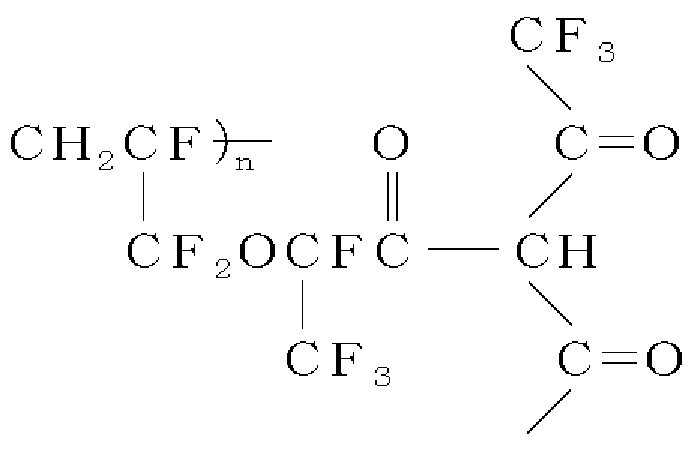
CF,
[0279] 合成例 11 (へキサフルォロアセチルアセトン基を有する含フッ素ァリルエーテルポリ マーを配位子とするポリマー錯体の合成)
撹拌装置および温度計を備えた 100mlのガラス製四つ口フラスコに、合成例 10で 得たへキサフルォロアセチルアセトン基を有する含フッ素ァリルエーテルポリマー(a
-3)2. Ogをメタノール 20ml〖こ溶解させ、撹拌しながら、酢酸ユーロピウム 1.7gを 水 40mlに溶解させたものを滴下した。
[0280] 5時間撹拌後、 30分間静置し、生成した固体を沈澱させた。上澄みの水溶液をデ カンテーシヨンして除き、固体をアセトン、へキサンで 2回洗浄した。その後、 60°Cで 1
2時間真空乾燥し、白色の固体 1.3gを得た。
[0281] この固体がへキサフルォロアセチルアセトン基を有する含フッ素ァリルエーテルポリ マー(a— 3)とユーロピウム(Eu)との錯体 (A— 3)であることを IR分析によって確認し た。
[0282] またフッ素含有率は 55質量%であり、金属含有量は 10質量%であった。 GPC分 祈により測定した重量平均分子量は、 15, 000であった。
[0283] 合成例 12 (エステル基を有する含フッ素ァリルエーテルホモポリマーの合成)
撹拌装置および温度計を備えた 200mlのガラス製フラスコに、
[0284] [化 52]
CH2 = CF O
CF2OCFCOCH3
I
CF3
[0285] 20g(74mmol)と DHPの 8.0質量%パーフロへキサン溶液を 5.6g入れ、十分に窒
素置換を行った後、窒素気流下、 20°Cで 7時間撹拌を行ったところ、粘稠なポリマー が生成した。
[0286] 得られたポリマーをアセトンに溶解させたものをへキサンに注ぎ、分離、真空乾燥さ せ、無色透明なポリマー 15gを得た。
[0287] このポリマーを19 F— NMR、 ¾— NMR分析、 IR分析により分析したところ、上記含 フッ素ァリルエーテルの構造単位のみ力もなる含フッ素ポリマーであった。
[0288] 合成例 13 (ジケトン基を有する含フッ素ァリルエーテルポリマーの合成)
撹拌装置および温度計を備えたガラス製四つ口フラスコに合成例 12で得たエステ ル基を有する含フッ素ァリルエーテルホモポリマー 5、 Og(19mmol)、ジェチルエー テル 25ml、ナトリウムメトキシド(1. Og、 19mmol)を入れ、十分に窒素置換を行った 後、窒素気流下、 0°Cでジェチルエーテル 100mlに溶解させた C F COCH (7.8g
7 15 3
、 19mmol)を滴下した。
[0289] 2時間撹拌後、 1N-HC1100mlを入れ、激しく撹拌した。その後反応器に蒸留器 を装着し、ジェチルエーテル溶液を留去したところ、高粘度の固体状物が生成した。 得られた固体をアセトンに溶解させたものをへキサンに注ぎ、分離、真空乾燥させ、 黄着色透明なポリマー 3.2gを得た。
[0290] このポリマーを19 F— NMR、 — NMR分析、 IR分析により分析したところ、上記ジ ケトン基を有する含フッ素ァリルエーテルの構造単位のみ力 なるつぎの式 (a— 4) で示される含フッ素ポリマーであった。
[0291] [化 53]
^CH2CF)^ O O
CF2OCFCCH2CC7F15
CF3
[0292] 合成例 14 (ジケトン基を有する含フッ素ァリルエーテルポリマーを配位子とするポリマ ー錯体の合成)
撹拌装置および温度計を備えた 300mlのガラス製四つ口フラスコに、合成例 13で 得られたジケトン基を有する含フッ素ァリルエーテルポリマー(a— 4) 2. Ogをアセトン
10mlに溶解し、撹拌しながら、室温で、酢酸ユーロピウム 1. 9g (5mmol)を水 100 mlに溶解させたものを滴下した。
[0293] 7時間撹拌後、 30分間静置し、生成した固体を沈澱させた。上澄みの水溶液をデ カンテーシヨンして除き、固体をアセトン、へキサンで 2回洗浄した。その後、 60°Cで 1
2時間真空乾燥し、黄色が力つた固体 1. 5gを得た。
[0294] この固体がジケトン基を有する含フッ素ァリルエーテルポリマー(a— 4)とユーロピウ ム (Eu)との錯体 (A-4)であることを IR分析によって確認した。
[0295] またフッ素含有率は 54質量%であり、金属含有量は 13質量%であった。 GPC分 祈により測定した重量平均分子量は 53, 000であった。
[0296] 合成例 15 (側鎖にエポキシ基を有するァリルエーテルポリマーの合成)
撹拌装置および温度計を備えた 500mlのガラス製四つ口フラスコに、
[0297] [化 54]
CH2 = C F
C F 2 O H2

[0298] 200g (0. 43mol)と DHPの 8. 0質量0 /0パーフルォ口へキサン溶液 19g (2mol)を反 応器に入れ、十分に窒素置換を行った後、窒素気流下、 20°Cで 7時間撹拌を行った ところ、高粘度の固体状物が生成した。これをアセトンに溶解させたものをへキサンに 注ぎ、分離、真空乾燥させ、無色透明なポリマー 160gを得た。
[0299] このポリマーを19 F— NMR、 — NMR分析、 IR分析により分析したところ、上記ェ ポキシ基を有する含フッ素ァリルエーテルの構造単位のみ力 なるエポキシ基含有 含フッ素ポリマー(B— 3)であった。
[0300] またフッ素含有率は 27質量%であり、 GPC分析により測定した重量平均分子量は 33, 000であった。
[0301] 比較合成例 l (EuHFA錯体の合成)
1Lのガラス製フラスコに、酢酸ユーロピウム 4水和物の 100g (250mmol)、 へキサ フルォロアセチルアセトン(HFA)の 150g (lmol)および純水 500mlを投入し、 25
°Cで 3日間撹拌した。
[0302] ついで、析出した固形物をろ過により取り出し、固形物を水洗後、水 メタノール混 合溶媒で再結晶したところ、白色の固体が得られた (収率 60%)。
[0303] この結晶を IR、 — NMRおよび19 F— NMR分析し、目的の錯体、 Eu (CF COC
3
HCOCF )であることを確認した。
3
[0304] また、得られた白色結晶は Tg— DTA測定により 2水和物であることが推測された。
[0305] 実施例 1
水添ビスフエノール型エポキシ(ジャパンエポキシレジン (株)製の YX— 8000。フッ 素含有率 0質量%。 B— 1) 6. 5gとへキサハイドロー 4ーメチルフタル酸無水物 3. 5g を混合し、これに合成例 4で得た含フッ素ポリマー錯体 (A- 1)の粉末 (数平均粒子 径 3 μ m) lOmgを分散させた。
[0306] この混合液をシャーレにキャストし、電気炉を用いて 120°Cで 9時間加熱して硬化さ せ、本発明の複合材料を得た。
[0307] この複合材料の熱分解温度は 270°Cであり、金属含有量は 7. 7 X 10— 3質量%であ つた。さらに外観は白濁していたが、錯体粒子の分散性は〇であった。
[0308] 硬化後、蛍光光度計 (励起光: 350nm、観測波長: 615nm)を用いて発光強度を 測定し、硬化した複合材料の発光強度を 1とした。
[0309] その後、再び電気炉を用い 120°Cで 15時間後、 40時間後および 110時間加熱し た後の発光強度を同様に測定した。加熱後の複合材料の発光強度を指数として表 1 に示す。
[0310] 実施例 2
合成例 4で得た含フッ素ポリマー錯体 (A- 1)の粉末の配合量を lOOmgとした以 外は実施例 1と同様にして混合液を調製し、加熱硬化させて複合材料を得た。
[0311] 得られた複合材料について、実施例 1と同様にして熱分解温度、金属含有量、外 観、分散性および発光強度を調べた。結果を表 1に示す。
[0312] 実施例 3
合成例 4で得た含フッ素ポリマー錯体 (A- 1)の粉末の配合量を lgとした以外は実 施例 1と同様にして混合液を調製し、加熱硬化させて複合材料を得た。
[0313] 得られた複合材料について、実施例 1と同様にして熱分解温度、金属含有量、外 観、分散性および発光強度を調べた。結果を表 1に示す。
[0314] 実施例 4
含フッ素水添エポキシ (フッ素含有率 22質量%。 B— 2):
[0315] [化 55]

[0316] 5. 3gとへキサハイドロー 4ーメチルフタル酸無水物 1. 7gを混合し、合成例 4で得ら れた含フッ素ポリマー錯体 (A—l) lOOmgを分散させて混合液を調製し、実施例 1と 同様にして加熱硬化させて複合材料を得た。
[0317] 得られた複合材料について、実施例 1と同様にして熱分解温度、金属含有量、外 観、分散性および発光強度を調べた。結果を表 1に示す。
[0318] 実施例 5
合成例 15で得た側鎖にエポキシ基を有するァリルエーテルポリマー(B— 3。フッ素 含有率 27質量%) 5. 9gとへキサハイドロー 4ーメチルフタル酸無水物 2. lgを混合し 、合成例 4で得られた含フッ素ポリマー錯体 (A—1) lOOmgを分散させて混合液を 調製し、実施例 1と同様にして加熱硬化させて複合材料を得た。
[0319] 得られた複合材料について、実施例 1と同様にして熱分解温度、金属含有量、外 観、分散性および発光強度を調べた。結果を表 1に示す。
[0320] [表 1]

実施例 6
水添ビスフエノール型エポキシ(B— 1) 6. 5gとへキサハイド 4ーメチルフタル酸 無水物 3. 5gを混合し、これに合成例 7で得た含フッ素ポリマー錯体 (A— 2)の粉末 ( 数平均粒子径 5 μ m) 10mgを分散させた。
[0322] この混合液をシャーレにキャストし、電気炉を用いて 120°Cで 9時間加熱して硬化さ せ、本発明の複合材料を得た。
[0323] この複合材料の熱分解温度は 270°Cであり、金属含有量は 1. 0 X 10— 2質量%であ つた。さらに外観は白濁していたが、錯体粒子の分散性は〇であった。
[0324] 硬化後、蛍光光度計 (励起光: 350nm、観測波長: 615nm)を用いて発光強度を 測定し、硬化した複合材料の発光強度を 1とした。
[0325] その後、再び電気炉を用い 120°Cで 15時間後、 40時間後および 110時間加熱し た後の発光強度を同様に測定した。加熱後の複合材料の発光強度を指数として表 2 に示す。
[0326] 実施例 7
合成例 7で得た含フッ素ポリマー錯体 (A- 2)の粉末の配合量を lOOmgとした以 外は実施例 6と同様にして混合液を調製し、加熱硬化させて複合材料を得た。
[0327] 得られた複合材料について、実施例 6と同様にして熱分解温度、金属含有量、外 観、分散性および発光強度を調べた。結果を表 2に示す。
[0328] 実施例 8
合成例 7で得た含フッ素ポリマー錯体 (A- 2)の粉末の配合量を lgとした以外は実 施例 6と同様にして混合液を調製し、加熱硬化させて複合材料を得た。
[0329] 得られた複合材料について、実施例 6と同様にして熱分解温度、金属含有量、外 観、分散性および発光強度を調べた。結果を表 2に示す。
[0330] 実施例 9
含フッ素水添エポキシ(B— 2) 5. 3gとへキサハイドロー 4ーメチルフタル酸無水物 1 . 7gを混合し、合成例 7で得られた含フッ素ポリマー錯体 (A— 2) lOOmgを分散させ て混合液を調製し、実施例 6と同様にして加熱硬化させて複合材料を得た。
[0331] 得られた複合材料について、実施例 6と同様にして熱分解温度、金属含有量、外 観、分散性および発光強度を調べた。結果を表 2に示す。
[0332] 実施例 10
合成例 15で得た側鎖にエポキシ基を有するァリルエーテルポリマー(B— 3) 5. 9g とへキサノ、イド口— 4—メチルフタル酸無水物 2. lgを混合し、合成例 7で得られた含
フッ素ポリマー錯体 (A— 2) lOOmgを分散させて混合液を調製し、実施例 6と同様に して加熱硬化させて複合材料を得た。
[0333] 得られた複合材料について、実施例 6と同様にして熱分解温度、金属含有量、外 観、分散性および発光強度を調べた。結果を表 2に示す。
[0334] [表 2]
素含有率フッ
光強度発散性熱遠度金含有量施例分属温芙
時後時後時後直後°量量間間間化 ( (質 (質硬)))00%% 11 4 15c σ>
ο
〇 < < < <
驩
m m o
r~ - CO 寸 o r-
Csi C CM 丁
1 1 ! I
O O 〇 O 〇
X X X X X
o o CO 寸 O
「 r— d r-
o O o CO σ>
CO
r- CO o
実施例 11
水添ビスフエノール型エポキシ(B— 1) 6. 5gとへキサハイドロー 4ーメチルフタル酸 無水物 3. 5gを混合し、これに合成例 11で得た含フッ素ポリマー錯体 (A— 3)の粉末 (数平均粒子径 5 μ m) 10mgを分散させた。
[0336] この混合液をシャーレにキャストし、電気炉を用いて 120°Cで 9時間加熱して硬化さ せ、本発明の複合材料を得た。
[0337] この複合材料の熱分解温度は 270°Cであり、金属含有量は 8. 9 X 10— 3質量%であ つた。さらに外観は白濁していたが、錯体粒子の分散性は〇であった。
[0338] 硬化後、蛍光光度計 (励起光: 350nm、観測波長: 615nm)を用いて発光強度を 測定し、硬化した複合材料の発光強度を 1とした。
[0339] その後、再び電気炉を用い 120°Cで 15時間後、 40時間後および 110時間加熱し た後の発光強度を同様に測定した。加熱後の複合材料の発光強度を指数として表 3 に示す。
[0340] 実施例 12
合成例 11で得た含フッ素ポリマー錯体 (A- 3)の粉末の配合量を lOOmgとした以 外は実施例 11と同様にして混合液を調製し、加熱硬化させて複合材料を得た。
[0341] 得られた複合材料について、実施例 11と同様にして熱分解温度、金属含有量、外 観、分散性および発光強度を調べた。結果を表 3に示す。
[0342] 実施例 13
合成例 11で得た含フッ素ポリマー錯体 (A- 3)の粉末の配合量を lgとした以外は 実施例 11と同様にして混合液を調製し、加熱硬化させて複合材料を得た。
[0343] 得られた複合材料について、実施例 11と同様にして熱分解温度、金属含有量、外 観、分散性および発光強度を調べた。結果を表 3に示す。
[0344] 実施例 14
含フッ素水添エポキシ(B— 2) 5. 3gとへキサハイドロー 4ーメチルフタル酸無水物 1 . 7gを混合し、合成例 11で得られた含フッ素ポリマー錯体 (A— 3) lOOmgを分散さ せて混合液を調製し、実施例 11と同様にして加熱硬化させて複合材料を得た。
[0345] 得られた複合材料について、実施例 11と同様にして熱分解温度、金属含有量、外 観、分散性および発光強度を調べた。結果を表 3に示す。
[0346] 実施例 15
合成例 15で得た側鎖にエポキシ基を有するァリルエーテルポリマー(B— 3) 5. 9g とへキサノ、イド口— 4—メチルフタル酸無水物 2. lgを混合し、合成例 11で得られた
含フッ素ポリマー錯体 (A— 3) lOOmgを分散させて混合液を調製し、実施例 11と同 様にして加熱硬化させて複合材料を得た。
[0347] 得られた複合材料について、実施例 11と同様にして熱分解温度、金属含有量、外 観、分散性および発光強度を調べた。結果を表 3に示す。
[0348] [表 3]
t CO CD CO
o o c>
素含有率フッ
光強度発散性熱遠度金含有量施例分属温芙
時後時後時後直後°量量間間間化 ( (質 (質硬)))00%% 11 4 15c CO σ> CO CO
o o o o o
CO σ> CO CO
o o o o
〇 < < < 驩 寸 o
CO o
CSi CM C 卜 CM
(M
1 1 1 ! i
O o 〇 o o
X X X X X
ω CM c
00 00 00 o o o CO σ>
C CO
CO 寸 m
実施例 16
水添ビスフエノール型エポキシ(B— 1) 6. 5gとへキサハイドロー 4ーメチルフタル酸 無水物 3. 5gを混合し、これに合成例 14で得た含フッ素ポリマー錯体 (A— 4)の粉末 (数平均粒子径 4 μ m) lOmgを分散させた。
[0350] この混合液をシャーレにキャストし、電気炉を用いて 120°Cで 9時間加熱して硬化さ せ、本発明の複合材料を得た。
[0351] この複合材料の熱分解温度は 270°Cであり、金属含有量は 1. 3 X 10— 2質量%であ つた。さらに外観は白濁していたが、錯体粒子の分散性は〇であった。
[0352] 硬化後、蛍光光度計 (励起光: 350nm、観測波長: 615nm)を用いて発光強度を 測定し、硬化した複合材料の発光強度を 1とした。
[0353] その後、再び電気炉を用い 120°Cで 15時間後、 40時間後および 110時間加熱し た後の発光強度を同様に測定した。加熱後の複合材料の発光強度を指数として表 4 に示す。
[0354] 実施例 17
合成例 14で得た含フッ素ポリマー錯体 (A-4)の粉末の配合量を lOOmgとした以 外は実施例 16と同様にして混合液を調製し、加熱硬化させて複合材料を得た。
[0355] 得られた複合材料について、実施例 16と同様にして熱分解温度、金属含有量、外 観、分散性および発光強度を調べた。結果を表 4に示す。
[0356] 実施例 18
合成例 14で得た含フッ素ポリマー錯体 (A-4)の粉末の配合量を lgとした以外は 実施例 16と同様にして混合液を調製し、加熱硬化させて複合材料を得た。
[0357] 得られた複合材料について、実施例 16と同様にして熱分解温度、金属含有量、外 観、分散性および発光強度を調べた。結果を表 4に示す。
[0358] 実施例 19
含フッ素水添エポキシ(B— 2) 5. 3gとへキサハイドロー 4ーメチルフタル酸無水物 1 . 7gを混合し、合成例 14で得られた含フッ素ポリマー錯体 (A— 4) lOOmgを分散さ せて混合液を調製し、実施例 16と同様にして加熱硬化させて複合材料を得た。
[0359] 得られた複合材料について、実施例 16と同様にして熱分解温度、金属含有量、外 観、分散性および発光強度を調べた。結果を表 4に示す。
[0360] 実施例 20
合成例 15で得た側鎖にエポキシ基を有するァリルエーテルポリマー(B— 3) 5. 9g とへキサノ、イド口— 4—メチルフタル酸無水物 2. lgを混合し、合成例 14で得られた
含フッ素ポリマー錯体 (A— 4) lOOmgを分散させて混合液を調製し、実施例 16と同 様にして加熱硬化させて複合材料を得た。
[0361] 得られた複合材料について、実施例 16と同様にして熱分解温度、金属含有量、外 観、分散性および発光強度を調べた。結果を表 4に示す。
[0362] [表 4]

比較例 1
水添ビスフエノール型エポキシ(B— 1) 6. 5gとへキサハイドロー 4ーメチルフタル酸 無水物 3. 5gを混合し、これに比較合成例 1で得たユーロピウム錯体 10mgを分散さ せた。
[0364] この混合液をシャーレにキャストし、電気炉を用いて 120°Cで 9時間加熱して硬化さ せ、比較用の複合材料を得た。
[0365] この複合材料の熱分解温度は 270°Cであり、金属含有量は 1. 9 X 10— 2質量%であ つた。さらに外観は透明であり、錯体粒子の分散性は〇であった。
[0366] 硬化後、蛍光光度計 (励起光: 350nm、観測波長: 615nm)を用いて発光強度を 測定し、硬化した複合材料の発光強度を 1とした。
[0367] その後、再び電気炉を用い 120°Cで 15時間後、 40時間後および 110時間加熱し た後の発光強度を同様に測定した。加熱後の複合材料の発光強度を指数として表 5 に示す。
[0368] 比較例 2
比較合成例 1で得たユーロピウム錯体の配合量を lOOmgとした以外は比較例 1と 同様にして混合液を調製し、加熱硬化させて複合材料を得た。
[0369] 得られた複合材料について、比較例 1と同様にして熱分解温度、金属含有量、外 観、分散性および発光強度を調べた。結果を表 5に示す。
[0370] 比較例 3
比較合成例 1で得たユーロピウム錯体の配合量を lgとした以外は比較例 1と同様 にして混合液を調製し、加熱硬化させて複合材料を得た。
[0371] 得られた複合材料について、比較例 1と同様にして熱分解温度、金属含有量、外 観、分散性および発光強度を調べた。結果を表 5に示す。
[0372] 比較例 4
含フッ素水添エポキシ(B— 2) 5. 3gとへキサハイドロー 4ーメチルフタル酸無水物 1 . 7gを混合し、比較合成例 1で得たユーロピウム錯体 lOOmgを分散させて混合液を 調製し、比較例 1と同様にして加熱硬化させて複合材料を得た。
[0373] 得られた複合材料について、比較例 1と同様にして熱分解温度、金属含有量、外 観、分散性および発光強度を調べた。結果を表 5に示す。
[0374] 比較例 5
合成例 15で得た側鎖にエポキシ基を有するァリルエーテルポリマー(B— 3) 5. 9g とへキサノ、イド口— 4—メチルフタル酸無水物 2. lgを混合し、比較合成例 1で得たュ
一口ピウム錯体 lOOmgを分散させて混合液を調製し、比較例 1と同様にして加熱硬 化させて複合材料を得た。
[0375] 得られた複合材料について、比較例 1と同様にして熱分解温度、金属含有量、外 観、分散性および発光強度を調べた。結果を表 5に示す。
[0376] [表 5]

本発明によれば、酸などの外部環境力 の影響によって錯体の各種活性が損なわ れやす 、と 、う課題を解決することができる。
Claims
[1] 金属に含フッ素ポリマー配位子が配位されてなる含フッ素ポリマー錯体 (A)と、マト リックスポリマー(B)とからなる複合材料。
[2] マトリックスポリマー(B)が、エポキシ系ポリマー、シリコーン系ポリマー、ウレタン系 ポリマー、アクリル系ポリマー、フッ素系ポリマーまたはこれらの混合物である請求の 範囲第 1項記載の複合材料。
[3] 前記含フッ素ポリマー錯体 (A)が粉体である請求の範囲第 1項または第 2項記載の 複合材料。
[4] 前記金属が、周期律表の 2〜13族および希土類金属よりなる群力 選ばれた少な くとも 1種の金属である請求の範囲第 1項〜第 3項のいずれかに記載の複合材料。
[5] 前記含フッ素ポリマー錯体 (A)が、マトリックスポリマー(B)中に分散されて!、る請 求の範囲第 1項〜第 4項のいずれかに記載の複合材料。
[6] 請求の範囲第 1項〜第 5項のいずれかに記載の複合材料力 なる成形品。
[7] フィルムである請求の範囲第 6項記載の成形品。
[8] 請求の範囲第 6項または第 7項記載の成形品からなる光学部材。
[9] 金属に含フッ素ポリマー配位子が配位されてなる含フッ素ポリマー錯体 (A)と、重 合性モノマー(C)とからなる硬化性組成物。
[10] 重合性モノマー(C)が、エポキシ系ポリマーを与える重合性モノマー、シリコーン系 ポリマーを与える重合 ¾モノマー、ウレタン系ポリマーを与える重合 ¾モノマー、ァク リル系ポリマーを与える重合性モノマーまたはフッ素系ポリマーを与える重合性モノ マーである請求の範囲第 9項記載の硬化性組成物。
Applications Claiming Priority (2)
| Application Number | Priority Date | Filing Date | Title |
|---|---|---|---|
| JP2005-148613 | 2005-05-20 | ||
| JP2005148613A JP2006321956A (ja) | 2005-05-20 | 2005-05-20 | 含フッ素ポリマー錯体を含んでなる複合材料 |
Publications (1)
| Publication Number | Publication Date |
|---|---|
| WO2006123734A1 true WO2006123734A1 (ja) | 2006-11-23 |
Family
ID=37431306
Family Applications (1)
| Application Number | Title | Priority Date | Filing Date |
|---|---|---|---|
| PCT/JP2006/309914 Ceased WO2006123734A1 (ja) | 2005-05-20 | 2006-05-18 | 含フッ素ポリマー錯体を含んでなる複合材料 |
Country Status (2)
| Country | Link |
|---|---|
| JP (1) | JP2006321956A (ja) |
| WO (1) | WO2006123734A1 (ja) |
Families Citing this family (1)
| Publication number | Priority date | Publication date | Assignee | Title |
|---|---|---|---|---|
| JP2010275498A (ja) * | 2009-06-01 | 2010-12-09 | Central Glass Co Ltd | 含フッ素化合物、含フッ素高分子化合物、レジスト組成物、トップコート組成物及びパターン形成方法 |
Citations (4)
| Publication number | Priority date | Publication date | Assignee | Title |
|---|---|---|---|---|
| JP2000063682A (ja) * | 1998-08-25 | 2000-02-29 | New Japan Chem Co Ltd | 希土類錯体を含む樹脂組成物及び成形体 |
| WO2002072706A1 (en) * | 2001-03-08 | 2002-09-19 | Daikin Industries, Ltd. | Optical material comprising curable fluoropolymer |
| JP2003523457A (ja) * | 2000-02-18 | 2003-08-05 | フォトン−エックス インコーポレイテッド | 希土類ポリマー光学増幅器またはファイバー |
| WO2003091343A1 (en) * | 2002-04-25 | 2003-11-06 | Daikin Industries, Ltd. | Fluorinated optical material comprising fluoropolymer having functional group capable of forming complex with rare earth metal ion |
-
2005
- 2005-05-20 JP JP2005148613A patent/JP2006321956A/ja not_active Withdrawn
-
2006
- 2006-05-18 WO PCT/JP2006/309914 patent/WO2006123734A1/ja not_active Ceased
Patent Citations (4)
| Publication number | Priority date | Publication date | Assignee | Title |
|---|---|---|---|---|
| JP2000063682A (ja) * | 1998-08-25 | 2000-02-29 | New Japan Chem Co Ltd | 希土類錯体を含む樹脂組成物及び成形体 |
| JP2003523457A (ja) * | 2000-02-18 | 2003-08-05 | フォトン−エックス インコーポレイテッド | 希土類ポリマー光学増幅器またはファイバー |
| WO2002072706A1 (en) * | 2001-03-08 | 2002-09-19 | Daikin Industries, Ltd. | Optical material comprising curable fluoropolymer |
| WO2003091343A1 (en) * | 2002-04-25 | 2003-11-06 | Daikin Industries, Ltd. | Fluorinated optical material comprising fluoropolymer having functional group capable of forming complex with rare earth metal ion |
Also Published As
| Publication number | Publication date |
|---|---|
| JP2006321956A (ja) | 2006-11-30 |
Similar Documents
| Publication | Publication Date | Title |
|---|---|---|
| KR101511829B1 (ko) | 구상 형광체, 파장 변환형 태양 전지 밀봉재, 태양 전지 모듈 및 이들의 제조 방법 | |
| JP3328262B2 (ja) | 固体高分子電解質用架橋剤、これを用いて製造した架橋型固体高分子電解質およびリチウムポリマー二次電池 | |
| TWI549978B (zh) | 可聚合的組成物,其生成之固化產物,及該等材料之用途 | |
| JP4804572B2 (ja) | 赤外線遮断性フィルム及び赤外線遮断性積層フィルム | |
| WO2001020374A1 (fr) | Filtre optique et son procede production | |
| JP3933180B2 (ja) | 環状エーテル共重合体、コーティング用樹脂組成物、光デバイス、光デバイス製造方法 | |
| EP1375598B1 (en) | Optical material comprising curable fluoropolymer | |
| KR100933441B1 (ko) | 음이온 계면 활성제를 이용한 수분산 폴리(3, 4-에틸렌다이옥시싸이오펜) 용액의 제조 방법 및 그 용액 | |
| Du et al. | Poly (arylene ether) s based on platinum (ii) acetylide complexes: synthesis and photophysical and nonlinear absorption properties | |
| JP4956888B2 (ja) | 含フッ素アクリレート系重合体を含んでなる光機能性光学材料 | |
| EP1738897B1 (en) | Photofunctional laminate | |
| EP1498459A1 (en) | Fluorinated optical material comprising fluoropolymer having functional group capable of forming complex with rare earth metal ion | |
| WO2007010713A1 (ja) | 重合性含フッ素化合物金属錯体、該金属錯体を含む重合性含フッ素錯体組成物および該組成物から得られる複合材料 | |
| JP2023008136A (ja) | 重合体含有組成物 | |
| CN100427542C (zh) | 含有具有官能团的含氟聚合物的光学材料 | |
| JP2006321956A (ja) | 含フッ素ポリマー錯体を含んでなる複合材料 | |
| KR102684821B1 (ko) | 대전 방지 재료, 그의 제조 방법 및 대전 방지막 | |
| JPWO2006082845A1 (ja) | 硬化性組成物およびそれを硬化してなる光学部材 | |
| JP2005320356A (ja) | 光機能性材料 | |
| JP3951682B2 (ja) | 硬化性組成物および樹脂硬化物 | |
| JP2024100121A (ja) | ポリマーおよび樹脂組成物 | |
| JP2023012653A (ja) | 硫黄含有重合体の製造方法、硫黄含有重合体、及び、硫黄含有重合体組成物 | |
| JP2010222435A (ja) | 硬化性樹脂組成物、硬化樹脂、および硬化樹脂の製造方法 |
Legal Events
| Date | Code | Title | Description |
|---|---|---|---|
| 121 | Ep: the epo has been informed by wipo that ep was designated in this application | ||
| NENP | Non-entry into the national phase |
Ref country code: DE |
|
| NENP | Non-entry into the national phase |
Ref country code: RU |
|
| 122 | Ep: pct application non-entry in european phase |
Ref document number: 06756336 Country of ref document: EP Kind code of ref document: A1 |