WO2006049113A1 - カルバペネム合成中間体およびその製造法 - Google Patents

カルバペネム合成中間体およびその製造法 Download PDF

Info

Publication number
WO2006049113A1
WO2006049113A1 PCT/JP2005/019970 JP2005019970W WO2006049113A1 WO 2006049113 A1 WO2006049113 A1 WO 2006049113A1 JP 2005019970 W JP2005019970 W JP 2005019970W WO 2006049113 A1 WO2006049113 A1 WO 2006049113A1
Authority
WO
WIPO (PCT)
Prior art keywords
compound
group
salt
amine
amine salt
Prior art date
Legal status (The legal status is an assumption and is not a legal conclusion. Google has not performed a legal analysis and makes no representation as to the accuracy of the status listed.)
Ceased
Application number
PCT/JP2005/019970
Other languages
English (en)
French (fr)
Inventor
Masaaki Uenaka
Yutaka Ide
Masahiko Nagai
Hiromi Yabunaka
Current Assignee (The listed assignees may be inaccurate. Google has not performed a legal analysis and makes no representation or warranty as to the accuracy of the list.)
Shionogi and Co Ltd
Original Assignee
Shionogi and Co Ltd
Priority date (The priority date is an assumption and is not a legal conclusion. Google has not performed a legal analysis and makes no representation as to the accuracy of the date listed.)
Filing date
Publication date
Application filed by Shionogi and Co Ltd filed Critical Shionogi and Co Ltd
Publication of WO2006049113A1 publication Critical patent/WO2006049113A1/ja
Anticipated expiration legal-status Critical
Ceased legal-status Critical Current

Links

Classifications

    • CCHEMISTRY; METALLURGY
    • C07ORGANIC CHEMISTRY
    • C07DHETEROCYCLIC COMPOUNDS
    • C07D477/00Heterocyclic compounds containing 1-azabicyclo [3.2.0] heptane ring systems, i.e. compounds containing a ring system of the formula:, e.g. carbapenicillins, thienamycins; Such ring systems being further condensed, e.g. 2,3-condensed with an oxygen-, nitrogen- or sulphur-containing hetero ring
    • C07D477/10Heterocyclic compounds containing 1-azabicyclo [3.2.0] heptane ring systems, i.e. compounds containing a ring system of the formula:, e.g. carbapenicillins, thienamycins; Such ring systems being further condensed, e.g. 2,3-condensed with an oxygen-, nitrogen- or sulphur-containing hetero ring with hydrogen atoms, hydrocarbon or substituted hydrocarbon radicals, directly attached in position 4, and with a carbon atom having three bonds to hetero atoms with at the most one bond to halogen, e.g. an ester or nitrile radical, directly attached in position 2
    • C07D477/12Heterocyclic compounds containing 1-azabicyclo [3.2.0] heptane ring systems, i.e. compounds containing a ring system of the formula:, e.g. carbapenicillins, thienamycins; Such ring systems being further condensed, e.g. 2,3-condensed with an oxygen-, nitrogen- or sulphur-containing hetero ring with hydrogen atoms, hydrocarbon or substituted hydrocarbon radicals, directly attached in position 4, and with a carbon atom having three bonds to hetero atoms with at the most one bond to halogen, e.g. an ester or nitrile radical, directly attached in position 2 with hydrogen atoms, hydrocarbon or substituted hydrocarbon radicals, attached in position 6
    • C07D477/16Heterocyclic compounds containing 1-azabicyclo [3.2.0] heptane ring systems, i.e. compounds containing a ring system of the formula:, e.g. carbapenicillins, thienamycins; Such ring systems being further condensed, e.g. 2,3-condensed with an oxygen-, nitrogen- or sulphur-containing hetero ring with hydrogen atoms, hydrocarbon or substituted hydrocarbon radicals, directly attached in position 4, and with a carbon atom having three bonds to hetero atoms with at the most one bond to halogen, e.g. an ester or nitrile radical, directly attached in position 2 with hydrogen atoms, hydrocarbon or substituted hydrocarbon radicals, attached in position 6 with hetero atoms or carbon atoms having three bonds to hetero atoms with at the most one bond to halogen, e.g. an ester or nitrile radical, directly attached in position 3
    • C07D477/20Sulfur atoms
    • CCHEMISTRY; METALLURGY
    • C07ORGANIC CHEMISTRY
    • C07DHETEROCYCLIC COMPOUNDS
    • C07D205/00Heterocyclic compounds containing four-membered rings with one nitrogen atom as the only ring hetero atom
    • C07D205/02Heterocyclic compounds containing four-membered rings with one nitrogen atom as the only ring hetero atom not condensed with other rings
    • C07D205/06Heterocyclic compounds containing four-membered rings with one nitrogen atom as the only ring hetero atom not condensed with other rings having one double bond between ring members or between a ring member and a non-ring member
    • C07D205/08Heterocyclic compounds containing four-membered rings with one nitrogen atom as the only ring hetero atom not condensed with other rings having one double bond between ring members or between a ring member and a non-ring member with one oxygen atom directly attached in position 2, e.g. beta-lactams
    • CCHEMISTRY; METALLURGY
    • C07ORGANIC CHEMISTRY
    • C07DHETEROCYCLIC COMPOUNDS
    • C07D477/00Heterocyclic compounds containing 1-azabicyclo [3.2.0] heptane ring systems, i.e. compounds containing a ring system of the formula:, e.g. carbapenicillins, thienamycins; Such ring systems being further condensed, e.g. 2,3-condensed with an oxygen-, nitrogen- or sulphur-containing hetero ring
    • C07D477/02Preparation
    • C07D477/04Preparation by forming the ring or condensed ring systems
    • YGENERAL TAGGING OF NEW TECHNOLOGICAL DEVELOPMENTS; GENERAL TAGGING OF CROSS-SECTIONAL TECHNOLOGIES SPANNING OVER SEVERAL SECTIONS OF THE IPC; TECHNICAL SUBJECTS COVERED BY FORMER USPC CROSS-REFERENCE ART COLLECTIONS [XRACs] AND DIGESTS
    • Y02TECHNOLOGIES OR APPLICATIONS FOR MITIGATION OR ADAPTATION AGAINST CLIMATE CHANGE
    • Y02PCLIMATE CHANGE MITIGATION TECHNOLOGIES IN THE PRODUCTION OR PROCESSING OF GOODS
    • Y02P20/00Technologies relating to chemical industry
    • Y02P20/50Improvements relating to the production of bulk chemicals
    • Y02P20/55Design of synthesis routes, e.g. reducing the use of auxiliary or protecting groups

Definitions

  • the present invention relates to a synthetic intermediate of rubapenem having antibacterial activity and a method for producing the same. Specifically, the present invention relates to the intermediate, its amine salt, its crystal, and a process for producing strong rubapenem using them. Background art
  • Patent Document 1 As a method for producing a synthetic intermediate of 1 alkyl strength rubapenem, Patent Document 1 (Reference Example 1 2) includes the following compound 5 6 as an intermediate for utilizing the Dieckmann condensation reaction. It is disclosed.
  • Patent Document 2 (Example 13) describes a method for producing doripenem from Compound 5 [Chemical Formula 2]
  • Non-Patent Document 1 describes the following reaction as a method for producing the hydroxy-protected form of Compound 5 described above.
  • Patent Document 1 JP-A-1 79180
  • Patent Document 2 JP-A-5-294970
  • Non-patent literature l Synlett, 315-316, 1995
  • Step 1 A step of producing compound (III) by protecting carboxy of compound ( ⁇ ),
  • Step 2 A step of producing Compound (V) by reacting Compound (III) with Compound (IV), and
  • Step 3 The compound (I) or the amine salt thereof according to (1) above, which comprises a step of subjecting the compound (V) to a deprotection reaction and optionally reacting with an amine.
  • COZ represents an active ester or an acid anhydride of a carboxyl group, a thiol carboxyl group protected by a protective group, a substituted aryloxy group, or a heteroaryl carbon group.
  • COZ is an active ester or an acid anhydride of a carboxyl group, a thiol carboxyl group protected with a protecting group for a thiol force propyloxyl group, a substituted aryloxycarbonyl group, or a heteroaryloxycarbonyl group;
  • R 3 comprises preparing a compound (VII) represented by hydroxy protecting group), then treating it with a base, and further treating with a hydroxyl active esterifying agent.
  • (14) is alkylsilyl, 2 is -3 to 11, and Z or L is OP (OXOPh) (Ph
  • the present invention provides a novel synthetic intermediate of force rubapenem derivative, a method for producing the same, and a method for producing force rubapenem derivative using the same.
  • the target strength rubapenem derivative can be synthesized in high yield with high efficiency.
  • Examples of the protecting group for hydroxy include trialkylsilyl (eg, trimethylsilyl, t-butyldimethylsilyl), acyl (eg, acetyl, bivaloyl), lower alkyl (eg, methyl, ethyl), lower alkoxy lower alkyl (eg, methoxymethyl, Methoxyethyl), lower alkyl sulfo (eg methanesulfol), lower alkoxy carbo (eg methoxy carboyl, t-butyloxy carbo), aralkyloxy carbo yl (eg benzyloxy) Noreboninole, o Nitrobenzinore, Xicanoreboninole, p Nitrobenzinore, Xicanorebonyl, p-methoxybenzyloxycarbonyl), substituted methyl (eg, methoxymethyl, 2-methoxyethoxymethyl, methylthiomethyl) ),
  • Carboxy protecting groups include lower alkyl (eg, methyl, ethyl, n-propoxy, isopropyl, t-butyl), substituted lower alkyl (example of substituent: lower alkoxy (eg, methoxy, ethoxy, n propoxy, Isopropoxy, n-butoxy, isobutoxy, t-butoxy)), substituted or unsubstituted aralkyl (eg benzyl, phenethyl, p-methoxybenzyl, 2, 4 dimethoxybenzyl, o nitrobenzyl, p nitrobenzyl, p— Benzyl)), hetero atoms (eg, 0, S, N) optionally intervening C3-C8 cycloalkyl, alkylsilyl (eg, trimethylsilyl, t-butyldimethylsilyl), lower alkoxymethyl (eg, methoxy) Methyl, e
  • “Lower” preferably means C1-C6, more preferably C1-C4.
  • Halogen represents F, Cl, Br, or I.
  • Amine salt amines of compound (I) include primary, secondary, and tertiary amines
  • Primary amines include methylamine, ethylamine, isopropylamine, sec-butylamine, tert-butylamine, isoamylamine, n-decylamine, 3-methoxypropylamine, benzylamine, phenethylamine, 4-methoxyphenethylamine, 2,2-dimethoxyethylamine, 3,3-dimethoxypropylamine, p-chloroarine, 2- (p-chlorophenol) ethylamine, (-)- ⁇ -methylbenzylamine, 3 , 4-Dimethoxyphenethylamine, Benzhydrylamine, 2- (4-aminophenol) ethylamine, 2-aminobenzylamine, (+)-dihydroabietylamine, 4-methoxybenzylamine, 3-methoxy Phenethylamine, 4-tert-butylbenzilamine, aniline, 4-bromo-2-fluoroani
  • Secondary amines include dimethylamine, jetylamine, diisopropylamine, dicyclohexylamine, 3,5-dichloro-4,4, -dihydroxydiphenylamine, benzyl-N-methyl. Ethanolamine is exemplified, and diisopropylamine and dicyclohexylamine are preferable.
  • tertiary amines examples include N-methylmorpholine, triethylamine, tributylamine, triarylamine, N-ethyldiisopropylamine, and ⁇ , ⁇ -dimethylbutylamine.
  • the amine salt of compound (I) is preferably a crystal.
  • those having good crystallinity with respect to compound (I) are primary or secondary amines, preferably methylamine, ethylamine, isopropylamine, tert-butylamine, (-)- ⁇ -methylbenzylamine, Diisopropylamine and dicyclohexylamine are preferable, and methylamine and diisopropylamine are more preferable.
  • diisopropylamine is particularly preferred because it has advantages such as low crystallinity, low toxicity, and low reactivity to the ⁇ -ratata ring. It can also be used as a base (acid trapping agent) in the next step condensation.
  • the amine salt or the crystal thereof may be a solvate.
  • the solvent include water and alcohol.
  • R 1 is a hydroxy protecting group
  • R 2 is a carboxy protecting group
  • X is a halogen
  • Compound (III) is obtained by protecting carboxy of compound (II).
  • the reaction may be carried out according to the usual carboxy protection reaction.
  • R 1 is a force exemplified by the above hydroxy protecting group, preferably trialkylsilyl, particularly t-butyldimethylsilyl (TBS).
  • TBS t-butyldimethylsilyl
  • R 2 is a force exemplified by the above-mentioned carboxy protecting group, preferably lower alkyl substituted with lower alkoxy, such as 1-methoxyethyl, 1-ethoxyethyl, 1 isopropoxycetyl, 1 n propoxychetil 1 n-butoxystil, 1-sobutoxyl, 1 t-butoxystil, particularly preferably 1-isobutoxyl.
  • carboxy protecting group preferably lower alkyl substituted with lower alkoxy, such as 1-methoxyethyl, 1-ethoxyethyl, 1 isopropoxycetyl, 1 n propoxychetil 1 n-butoxystil, 1-sobutoxyl, 1 t-butoxystil, particularly preferably 1-isobutoxyl.
  • These protecting groups are less susceptible to side reactions such as rearrangement to the 1-position N atom during the reaction.
  • reaction accelerator such as an acid
  • the acid include methanesulfonic acid, P-toluenesulfonic acid, hydrochloric acid, sulfuric acid, phosphoric acid and the like.
  • Reaction solvents include hydrocarbons (eg, pentane, hexane, heptane, cyclohexane, petroleum ether, toluene, xylene), halogenated hydrocarbons (eg, dichloromethane, chloroform, carbon tetrachloride), alcohols (eg, : Methanol, ethanol), formic acid, acetic acid, propionic acid, ethyl acetate, acetone, formamide, nitromethane, acetonitrile, ether (eg, tetrahydrofuran, jetyl ether), water and mixed solvents thereof are exemplified. Preferably, it is toluene, acetonitrile, or a mixed solvent thereof.
  • hydrocarbons eg, pentane, hexane, heptane, cyclohexane, petroleum ether, toluene, xylene
  • the reaction temperature is generally 0-100 ° C, preferably 0-50 ° C, more preferably 10-30 ° C.
  • the reaction time is several hours to several tens of hours.
  • the resulting compound (III) may be subjected to the next step without isolation.
  • Compound (V) is produced by reacting compound (III) with compound (IV).
  • the halogen represented by X is preferably C or Br.
  • a reaction accelerator such as a base
  • bases include NaH, sodium tert-butoxide, potassium tert-butoxide, sodium tert-pentoxide, n-butyllithium, lithium diisopropylamide, lithium bis (trimethylsilyl) amide, and sodium bis (trimethylsilyl) amide.
  • an interlayer transfer catalyst may be used in combination.
  • quaternary ammonium salt eg, tetra n-butyl ammonium chloride, tetra n-butyl ammonium chloride
  • Reaction solvents include hydrocarbons (eg, pentane, hexane, heptane, cyclohexane, petroleum ether, toluene, xylene), halogenated hydrocarbons (eg, dichloromethane, chloroform, carbon tetrachloride), alcohols (eg, : Methanol, ethanol), formic acid, acetic acid, propionic acid, ethyl acetate, acetone, formamide, nitromethane, acetonitrile, ether (eg, tetrahydrofuran, jetyl ether), water and mixed solvents thereof are preferable, , Toluene, acetonitrile, tetrahydrofuran or a mixed solvent thereof.
  • the reaction temperature is usually 70 to 0 ° C, preferably 50 to 30 ° C.
  • the reaction time is several hours to several tens of hours.
  • the resulting compound (V) may be subjected to the next step without isolation.
  • Compound (V) is subjected to a deprotection reaction and then optionally reacted with amine to give compound (I) or an amine salt thereof.
  • the deprotection reaction may be carried out in accordance with the conditions for a normal carboxy deprotection reaction.
  • compound (V) may be treated with an acid.
  • Acids include hydrochloric acid, sulfuric acid, potassium hydrogen sulfate Examples are sodium hydrogen sulfate, nitric acid, phosphoric acid, sodium dihydrogen phosphate, and potassium dihydrogen phosphate.
  • the reaction time is usually several minutes to several tens of hours.
  • the reaction with amine is usually carried out under ice cooling to room temperature.
  • a seed crystal may be added if desired.
  • Solvents used for crystallization include hydrocarbons (eg, pentane, hexane, heptane, cyclohexane, petroleum ether, toluene, xylene), halogenated hydrocarbons (eg, dichloromethane, chloroform, carbon tetrachloride).
  • Alcohol eg methanol, ethanol
  • formic acid acetic acid, propionic acid, methyl acetate, ethyl acetate, propyl acetate, butyl acetate, acetone, formamide, nitromethane, acetonitrile, ether (eg tetrahydrofuran, jetyl ether), Examples thereof include water and mixed solvents thereof.
  • ether eg tetrahydrofuran, jetyl ether
  • examples thereof include water and mixed solvents thereof.
  • heat treatment, ultrasonic treatment, stirring, etc. may be performed.
  • compound (I) or an amine salt thereof is in the 4-position according to the method described in JP-A-6-316559.
  • COZ represents an active ester or an acid anhydride of a carboxyl group, a thiol carboxyl group protected by a protective group, a substituted aryloxy group, or a heteroaryl carbon group.
  • the Z group may be a halogen atom such as chlorine, bromine or iodine; for example, ethoxycarboxoxy, isopropyloxycarboxoxy, sec- Lower alkyloxycarboxoxy groups having 1 to 5 carbon atoms such as butyroxycarbonyloxy; A lower alkanesulfo-loxy group having 1 to 4 carbon atoms such as ruoxy; for example, an arylsulfo-loxy group such as p-toluenesulfo-loxy; for example, di (carbon number 1) such as dimethylphosphoryloxy and jetylphosphoryloxy -4 lower alkyl) phosphoryloxy groups; diarylphosphoryloxy groups such as di (phenol) phosphoryloxy; cyclic imidooxy groups such as N-succinimidoxy, N-phthalimidoxy Groups; heteroaryl groups such as imidazole and triazole;
  • a halogen atom such as chlorine, bromine or iodine
  • Suitable examples of the protective group for the carboxyl group and the protective group for the thiol carboxyl group used when COZ is a protected carboxyl group or a thiol carboxyl group are the same as those described above.
  • preferred examples of the substituted aryloxy group include P--trophenyloxy, o--trophenyloxy, 2,4,5-trichlorophenyloxy, etc.
  • the heteroaryloxy group includes o —Pyridyloxy, p-pyridyloxy and the like can be mentioned.
  • the conversion from the above compound (I) to (VI) is preferably carried out in the presence of a condensing agent. More preferably, compound (VI) in which COZ is COSPh (Ph is a phenol) can be produced by subjecting the carboxy moiety of compound (I) or its amine salt to a thioester in the presence of a condensing agent.
  • the above reaction is preferably performed in a high yield of 70% or more, more preferably 80% or more, and even more preferably 90% or more.
  • reaction may be used in combination with an acid scavenger if desired.
  • the above-mentioned amine can be used as the acid scavenger.
  • coz is an active ester or an acid anhydride of a carboxyl group, a thiol carboxyl group protected with a protecting group for a thiol force lpoxyl group, a substituted aryloxycarbonyl group, or a heteroaryloxycarbonyl group; R (3 ) is a hydroxy protecting group), after the production of compound (VII), it is treated with a base according to the method described in JP-A-6-316559, and further treated with an active esterifying agent for a hydroxyl group.
  • R 3 is a force exemplified by the above hydroxy protecting group, preferably trialkylsilyl, especially trimethylsilyl (TMS).
  • TMS trimethylsilyl
  • TMS is preferably used in terms of deprotection.
  • the active ester of a hydroxyl group represented by L is, for example, a substituted or unsubstituted aryl sulfonic acid ester group (substituted or unsubstituted aryl sulfonic sulfo-oxy group), a lower alkane sulfonic acid ester group (lower alkane sulfo-oxy group), a halogeno lower alkanthol. It represents a phosphonic acid ester group (norogeno-lower alkanesulfo-oxyloxy group) or a dialyl phosphoric acid ester group (diarylphosphoryloxy group) or a halogenated metal atom that is an ester with a hydrogen halide.
  • the active esterifying agent for a hydroxyl group is a reagent that produces an active ester as described above.
  • the substituted or unsubstituted aryl sulfonic acid ester include benzene sulfonic acid ester, p toluene sulfonic acid ester, p-trobenzene sulfonic acid ester, and p bromobenzene sulfonic acid ester.
  • the acid ester include methanesulfonic acid ester and ethanesulfonic acid ester.
  • the halogeno lower alkanesulfonic acid ester include trifluoromethanesulfonic acid ester.
  • dialyl phosphoric acid ester examples include Examples of the diphenyl phosphoric acid ester and the halogenated compounds include chlorine, bromine, and iodide.
  • these active esters of alcohol p-toluenesulfonic acid ester, methanesulfonic acid ester and diphenylphosphoric acid ester can be mentioned, and diphenylphosphoric acid ester is preferable.
  • diphenyl phosphoric acid chloride eg, diphenyl phosphoric acid chloride
  • the active esterifying agent is preferable as the active esterifying agent.
  • Bases for treating compound (VII) in an inert solvent include metal salts of amines such as lithium diisopropylamide, lithium bis (trimethylsilyl) amide, and sodium amide, metal salts of alcohols such as potassium tert-butoxide, Examples thereof include alkali metal hydrides such as sodium hydride and lithium hydride, and sodium methylsulfinylmethide.
  • the amount of base used is usually 1.5 to 3 equivalents.
  • the preferred reaction temperature is -75 ° C to 50 ° C.
  • R 3 is alkylsilyl
  • Z is SPh
  • Z or L is OP (OXOPh) (Ph is full).
  • the compound (ring) has the formula: R 4 — SH (R 4 is the same as the method described in JP-A-1-79180, JP-A-6-316559, JP-A-5-294970, USP 5,317,016, etc.
  • Examples of pharmaceutically acceptable salts include basic salts such as alkali metal salts such as sodium salts and potassium salts; alkaline earth metal salts such as calcium salts and magnesium salts; ammonium salts; trimethylamine salts. , Triethylamine salt, dicyclohexylamine salt, ethanolamine salt, diethanolamine salt, triethanolamine salt, brocaine salt, medalamine salt, diethanolamine salt or aliphatic amine amine salt such as ethylenediamine salt; ⁇ , ⁇ -dibenzyl ethylenediamine, Aralkylamine salts; Heterocyclic aromatic amine amines such as pyridine salts, picoline salts, quinoline salts, isoquinoline salts; tetramethylammonium salts, tetraethylammonium salts, benzyltrimethylammonium salts, benzyltrie Tiluamum salt, benzyltri Examples include quaternary ammonium salts
  • the acid salt examples include inorganic acid salts such as hydrochloride, sulfate, nitrate, phosphate, carbonate, bicarbonate, perchlorate; acetate, propionate, lactate, maleate , Organic acid salts such as fumarate, tartrate, malate, citrate, and ascorbate; sulfonic acids such as methanesulfonate, isethionate, benzenesulfonate, and ⁇ ⁇ ⁇ ⁇ -toluenesulfonate Salt: aspartate, glutamate And acidic amino acids such as Examples of solvates include hydrates and alcohol solvates.
  • Compound (X) includes: (1) cenamycin, (2) imipenem, (3) meropenem, (4) beer penem, (5) panipenem, (6) BQ-2727, (7 ) S-4661 (Doripenem) is an example (each “SR 4 " is shown below).
  • TBS t butyldimethylsilyl
  • TMS trimethylsilyl tBu: t butyl
  • the ethyl acetate layer was washed twice with 389 ml of water, the aqueous layer was extracted with 311 ml of ethyl acetate, the ethyl acetate layers were combined, concentrated under reduced pressure, 200 ml of toluene was added, and the solution was concentrated under reduced pressure to give a 6-like residue 108.16 g (quantitative value: 85.0 g, yield: 94%) was obtained.
  • the toluene layer was washed sequentially with 270 ml of water and 270 ml of saturated saline, the aqueous layer was extracted with 160 ml of toluene, the toluene layers were combined, concentrated under reduced pressure, and 92.70 g (quantitative value: 53.36 g, yield) of 7 Rate: 87%).
  • Example 13 of JP-A-5-294970 compound 7 obtained in Example 3 was subjected to a condensation reaction for forming a 2-position side chain to synthesize compound 8, and further deprotection By subjecting to reaction, compound 9 (doripenem) is obtained.
  • the corresponding amine salt was obtained by reacting the above-mentioned various amines other than diisopropylamine with the free form of Compound 4.
  • Dicyclohexylamine salt, methylamine salt, ethylamine salt, isopropylamine salt, t-butylamine salt, and (1) -a-methylbenzylamine salt were obtained as crystals.
  • dicyclohexylamine, methylamine, t-butylamine, and (1) a methylbenzylamine showed good crystallinity.
  • the powder X-ray diffraction patterns are shown in Figures 2 to 5, and the diffraction angles of the main peaks are shown below.
  • Example 9 Using the various amine salts obtained in Example 5 as raw materials, Compound 9 is obtained according to the methods of Examples 2-4.
  • the obtained SPL / methanol solution was cooled to 18 ° C., and 10% aqueous sodium hydroxide solution (130.5 g) was added to adjust the pH to 2.4.
  • ethyl acetate (357 ml) and brine (113 ml) were added, liquid separation was performed, and SPL was extracted into the organic layer.
  • the organic layer was washed successively with water (357 ml) and 2% brine (119 mix x 2).
  • the resulting four aqueous layers were back extracted with ethyl acetate (102 ml) to recover SPL lost to the aqueous layer.
  • FIG. 1 is a powder X-ray diffraction pattern and peak value of diisopropylamine salt crystals obtained in Example 1.
  • the vertical axis represents intensity (unit: cps), and the horizontal axis represents diffraction angle (2 ⁇ , unit: degree).
  • FIG. 2 is a powder X-ray diffraction pattern and peak value of dicyclohexylamine salt crystals obtained in Example 5.
  • FIG. 3 shows a powder X-ray diffraction pattern and peak value of methylamine salt crystals in Example 5.
  • FIG. 4 shows a powder X-ray diffraction pattern and peak value of t-ptylamine salt crystal in Example 5.
  • FIG. 5 shows the powder X-ray diffraction pattern and peak value of (1) -a-methylbenzylamine salt crystals in Example 5.
  • FIG. 6 is a powder X-ray diffraction pattern of SPL hemihydrate crystals obtained in Reference Example 1.
  • the vertical axis represents intensity (unit: cps), and the horizontal axis represents diffraction angle (2 ⁇ , unit: degree).
  • FIG. 7 is a powder X-ray diffraction pattern of anhydrous SPL crystals obtained in Reference Example 1.
  • the vertical axis represents intensity (unit: cps), and the horizontal axis represents diffraction angle (2 ⁇ , unit: degree).

Landscapes

  • Chemical & Material Sciences (AREA)
  • Organic Chemistry (AREA)
  • Health & Medical Sciences (AREA)
  • Life Sciences & Earth Sciences (AREA)
  • Molecular Biology (AREA)
  • Nitrogen Condensed Heterocyclic Rings (AREA)
  • Organic Low-Molecular-Weight Compounds And Preparation Thereof (AREA)

Description

力ルバぺネム合成中間体およびその製造法
技術分野
[0001] 本発明は、抗菌活性を有する力ルバぺネムの合成中間体およびその製造法に関 する。詳しくは本発明は、該中間体、そのアミン塩、その結晶およびそれらを利用した 力ルバぺネムの製法に関する。 背景技術
[0002] 1 アルキル力ルバぺネムの合成中間体の製法として、特許文献 1 (参考例 1 2) には、 Dieckmann縮合反応を利用するための中間体として以下に示すィ匕合物 5 6が 開示されている。
[化 1]
Figure imgf000003_0001
また特許文献 2 (実施例 13)には、化合物 5からドリぺネムの製法が記載されている [化 2]
Figure imgf000003_0002
Figure imgf000003_0003
(式中、 TMS:トリメチルシリル)
非特許文献 1には、上記化合物 5のヒドロキシ保護体の製法として以下の反応が記 載されている。
[化 3]
Figure imgf000004_0001
a: 1) TBS-C1, NaH, THF, 0°C, lh 2) BrCH2C02Allyl, NaH(TMS)2, THF, 50°C,
30min 3) K2C03, H20, 25°C, lOmin 4) aq. HC1
特許文献 1:特開平 1 79180
特許文献 2:特開平 5— 294970
非特許文献 l : Synlett, 315-316, 1995
発明の開示
発明が解決しょうとする課題
[0003] 化合物 5を従来の方法で製造すると、副反応を十分に制御するのが容易ではなぐ その結果、 目的の力ルバぺネムを工業的に効率よく製造するのは極めて困難であつ た。例えば、 j8—ラタタム環の 4位のカルボキシをチォエステルとした後、 1位 N原子 をアルキルィ匕した場合には、チォエステル基の一部が外れることが分力つた。また出 発物質のヒドロキシ保護基の種類によっては、該ヒドロキシ保護基に由来する副生成 物が化合物 5に混入し、それを完全に除去することが困難であった。
課題を解決するための手段
[0004] 本発明者らは鋭意検討した結果、化合物 5およびその誘導体の製法として、新規中 間体である化合物 (I)またはそのアミン塩を経由すれば、工業的に効率よく目的化合 物が製造できることを見出した。また化合物 5を効率よく製造するための反応条件 (例 :縮合剤の種類)等についても検討し、以下に示す本発明を完成した。
(1)式:
[化 4]
Figure imgf000005_0001
で示される化合物 (I)またはそのアミン塩。
(2)ァミンが 1級ァミンまたは 2級ァミンである、上記 1記載のアミン塩。
(3)ァミンが、メチルァミン、ェチルァミン、イソプロピルァミン、 t—ブチルァミン、(一) a メチルベンジルァミン、ジイソプロピルァミン、またはジシクロへキシルァミンで ある、上記 1記載のアミン塩。
(4)ジイソプロピルアミン塩である、上記 1記載のアミン塩。
(5)結晶である、上記 1〜4のいずれかに記載のアミン塩。
(6)粉末 X線回折パターンにおいて、 2 0 =8.7, 9.7, 15.7, 22.4度に主ピークを示す 結晶である、上記 4記載のジイソプロピルアミン塩。
(7)以下の反応スキーム:
[化 5]
Figure imgf000005_0002
Figure imgf000005_0003
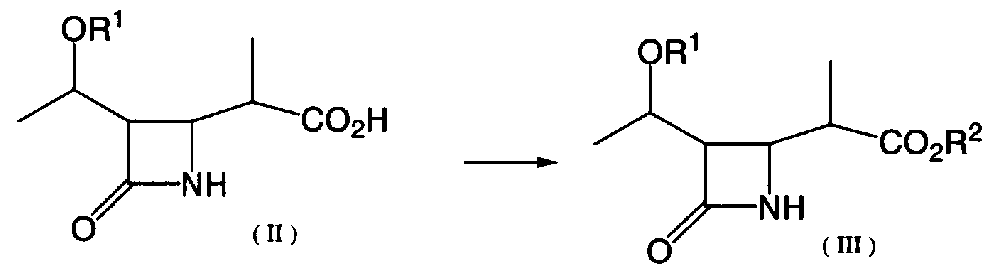
(式中、 R1はヒドロキシ保護基; R2はカルボキシ保護基; Xはハロゲン)で示され、以下 の工程:
(第 1工程)化合物 (Π)のカルボキシを保護して化合物 (III)を製造する工程、
(第 2工程)化合物 (III)を化合物 (IV)と反応させて化合物 (V)を製造する工程、およ び
(第 3工程)ィ匕合物 (V)を脱保護反応に付した後、所望によりァミンと反応させる工程 を包含することを特徴とする、上記 1記載の化合物 (I)またはそのアミン塩の製造方法
(8) R1はアルキルシリルおよび/または R2はアルコキシアルキルである、上記 7記載 の製造方法。
(9) R1は t—ブチルジメチルシリルおよび/または R2は 1—イソブトキシェチルである 、上記 7記載の製造方法。
(10)上記 1に記載の化合物(I)またはそのアミン塩のカルボキシ部分を活性エステ ル化、活性酸無水物化、チオールエステル化、ァリールエステルイ匕またはへテロァリ ールエステルイ匕する工程を包含する、式:
[化 6]
Figure imgf000006_0001
(式中、 COZは、カルボキシル基の活性エステルもしくは活性酸無水物、保護基で保 護されたチオールカルボキシル基、置換ァリールォキシカルボ-ル基、またはへテロ ァリールォキシカルボ-ル基)で示される化合物 (VI)の製造方法。
(11)上記 1に記載の化合物(I)またはそのアミン塩のカルボキシ部分を、縮合剤存 在下、チオールエステル化することにより、 COZが COSPh(Phはフエ-ル)である化 合物 (VI)を製造する、上記 10記載の製造方法。
(12)縮合剤力 Ph P(0)C1、 (PhO) P(0)Cl (Phはフ -ル)または 2-クロ口- 4,6- ジメトキシトリアジンである、上記 11記載の製造方法。
(13)上記 10記載の方法により化合物 (VI)を製造した後、これをヒドロキシの保護反 応に付すことにより、式:
[化 7]
Figure imgf000007_0001
(式中、 COZは、カルボキシル基の活性エステルもしくは活性酸無水物、チオール力 ルポキシル基の保護基で保護されたチオールカルボキシル基、置換ァリールォキシ カルボニル基、またはへテロアリールォキシカルボ-ル基; R3はヒドロキシ保護基)で 示される化合物 (VII)を製造した後、これを塩基で処理し、さらに水酸基の活性エス テル化剤で処理する工程を包含する、式:
[化 8]
Figure imgf000007_0002
(式中、 R3はヒドロキシ保護基; Lはエステルイ匕されたヒドロキシ基)で示される化合物
(VIII)の製造方法。
(14) はァルキルシリル、2は—3?11、および Zまたは Lは— OP(OXOPh) (Phは
2 フエニル)である、上記 13記載の製造方法。
(15)上記 14記載の方法により化合物 (VIII)を製造した後、式: R4— SH (R4はカル バぺネム誘導体の 2位に結合し得るチォエーテル型側鎖の残基)で示される化合物
(IX)またはその塩と反応させ、得られたィ匕合物を脱保護する工程を包含する、式
Figure imgf000008_0001
(式中、 R4は前記と同意義)で示される化合物 (X)、その製薬上許容される塩または それらの溶媒和物の製造方法。
発明の効果
[0005] 本発明は、力ルバぺネム誘導体の新規な合成中間体、その製造方法、およびそれ を用いた力ルバぺネム誘導体の製造方法を提供する。本発明の製法により目的の力 ルバぺネム誘導体を効率よぐ高収率で合成できる。
発明を実施するための最良の形態
[0006] 本発明中、各用語は特に断らない限り、単独または併用で、以下の意味を示す。
ヒドロキシの保護基としては、トリアルキルシリル (例:トリメチルシリル、 t—ブチルジメ チルシリル)、ァシル(例:ァセチル、ビバロイル)、低級アルキル(例:メチル、ェチル) 、低級アルコキシ低級アルキル(例:メトキシメチル、メトキシェチル)、低級アルキルス ルホ-ル(例:メタンスルホ -ル)、低級アルコキシカルボ-ル(例:メトキシカルボ-ル 、 t ブチルォキシカルボ-ル)、ァラルキルォキシカルボ-ル(例:ベンジルォキシカ ノレボニノレ、 o 二トロべンジノレ才キシカノレボニノレ、 p 二トロべンジノレ才キシカノレボニ ル、 p—メトキシベンジルォキシカルボ-ル)、置換メチル(例:メトキシメチル、 2—メト キシエトキシメチル、メチルチオメチル)、テトラヒドロビラニル等が例示される。
カルボキシの保護基としては、低級アルキル(例:メチル、ェチル、 n—プロポキシ、 イソプロピル、 t—ブチル)、置換された低級アルキル (置換基の例:低級アルコキシ( 例:メトキシ、エトキシ、 n プロポキシ、イソプロポキシ、 n ブトキシ、イソブトキシ、 t ーブトキシ))、置換または無置換のァラルキル(例:ベンジル、フエネチル、 p—メトキ シベンジル、 2, 4 ジメトキシベンジル、 o ニトロベンジル、 p ニトロベンジル、 p— クロ口ベンジル)、ヘテロ原子(例:0, S, N)が介在していてもよい C3〜C8シクロア ルキル、アルキルシリル(例:トリメチルシリル、 tーブチルジメチルシリル)、低級アルコ キシメチル (例:メトキシメチル、エトキシメチル、イソブトキシメチル)、低級脂肪族ァシ ルォキシメチル(例:ァセトキシメチル、プロピオ-ルォキシメチル、ブチリルォキシメ チル、ビバロイルォキシメチル)、低級アルコキシカルボ-ルォキシェチル(例: 1ーメ トキシカルボ-ルォキシェチル、 1 エトキシカルボ-ルォキシェチル)、置換または 無置換の炭素数 3〜10の 2 低級ァルケ-ル基(例:ァリル、 2—メチルァリル、 3—メ チルァリル、 3—フエ-ルァリル)、置換あるいは無置換のジァリールアルキル基(例: ジフエ-ルメチル、ジ—p ァ-シルメチル)、置換あるいは無置換のァリール基(例: フエ-ノレ、 p クロ口フエ二ノレ、 2, 4, 5 トリクロ口フエ二ノレ、 p -トロフエ-ノレ、 o— - トロフエ-ル、 p—メトキシフエ-ル)、ヘテロァリール(例: 2 ピリジル、 3 ピリジル、 4 —ピリジル、 2 ピリミジル、 2— (4, 6 ジメチル)ピリミジル)が例示される。
「低級」は、好ましくは C1〜C6、さらに好ましくは C1〜C4を意味する。
ハロゲンは、 F、 Cl、 Br、 Iを示す。
化合物(I)のァミン塩のアミンは、 1級ァミン、 2級ァミン、および 3級ァミンを包含する
1級ァミンとしては、メチルァミン、ェチルァミン、イソプロピルァミン、 sec-ブチルアミ ン、 tert-ブチルァミン,イソアミルァミン、 n-デシルァミン、 3-メトキシプロピルァミン、 ベンジルァミン、フエネチルァミン、 4-メトキシフエネチルァミン、 2,2-ジメトキシェチル ァミン、 3,3-ジメトキシプロピルァミン、 p-クロロア-リン、 2- (p-クロ口フエ-ル)ェチルァ ミン、(-) - α -メチルベンジルァミン、 3,4-ジメトキシフエネチルァミン、ベンズヒドリルァ ミン、 2- (4-ァミノフエ-ル)ェチルァミン、 2-ァミノベンジルァミン、(+)-ジヒドロアビエチ ルァミン、 4-メトキシベンジルァミン、 3-メトキシフエネチルァミン、 4- tert-ブチルベン ジルァミン、ァニリン、 4-ブロモ -2-フルォロア二リン、 4,4,-ジチオア二リン、 2,2,-ジチ ォジァ-リンが例示され、好ましくは、メチルァミン、ェチルァミン、イソプロピルアミン 、 tert-ブチルァミン、(-) - a -メチルベンジルァミンである。
2級ァミンとしては、ジメチルァミン、ジェチルァミン、ジイソプロピルァミン、ジシクロ へキシルァミン、 3, 5-ジクロロ- 4,4,-ジヒドロキシジフエニルァミン、ベンジル- N-メチル エタノールァミンが例示され、好ましくは、ジイソプロピルァミン、ジシクロへキシルアミ ンである。
3級ァミンとしては、 N-メチルモルホリン、トリェチルァミン、トリブチルァミン、 トリァリ ルァミン、 N-ェチルジイソプロピルァミン、 Ν,Ν-ジメチルブチルァミンが例示される。 化合物 (I)のアミン塩は好ましくは結晶である。上記ァミンの内、化合物 (I)に関して 結晶性が良いのは 1級または 2級ァミンであり、好ましくはメチルァミン、ェチルァミン 、イソプロピルァミン、 tert-ブチルァミン、(-) - α -メチルベンジルァミン、ジイソプロピ ルァミン、ジシクロへキシルァミンであり、さらに好ましくはメチルァミン、ジイソプロピル ァミンである。この内、ジイソプロピルアミンは、特に結晶性がよぐ毒性がなぐかつ β ラタタム環への反応性が低い等の利点を有するので特に好ましい。また次工程 縮合の際、塩基 (酸トラップ剤)としても利用できる。
上記アミン塩またはその結晶は、溶媒和物であってもよい。該溶媒としては、水、ァ ルコールが例示される。
本発明者らの検討結果では、化合物 (I)をァミン塩に変換することにより結晶性が 改善され、高純度の結晶として単離することに成功した。これによつて、化合物 (I)の 合成過程で混入してくる種々の副生成物(例:丁83— 011、丁83—じ1、 (TBS) Ο)
2 を容易に除去できる (TBS = t プチルジメチルシリル)。その結果、カラム処理が不 要になり、またそれ以降の工程における反応効率が高まる等の利点が生じる。よって 、本発明製法では特に化合物 (I)のァミン塩、好ましくはその結晶を経由することによ り、種々の力ルバぺネム誘導体を工業的に効率よく合成できる。
上記アミン塩結晶は、粉末 X線解析によって、後記実施例に示す X線回折パターン を示す (X線回折測定条件:管球 CuK o;線、管電圧 40Kv、管電流 15mA、 dsin Θ =η λ (ηは整数、 dは面間隔(単位:オングストローム)、 Θは回折角(単位:度)))。 これらの結晶は、各回折角または面間隔の値によって特徴づけられる。
化合物 (I)およびそのアミン塩の製法にっ 、て説明する。
Figure imgf000011_0001
Figure imgf000011_0002
( V ) ( i )
(式中、 R1はヒドロキシ保護基; R2はカルボキシ保護基; Xはハロゲン)
(第 1工程)
化合物 (II)のカルボキシを保護することによりィ匕合物 (III)を得る。当該反応は、通 常のカルボキシの保護反応に準じて行えば良 、。
R1としては前記のヒドロキシ保護基が例示される力 好ましくは、トリアルキルシリル 、特に tーブチルジメチルシリル (TBS)である。
R2としては前記のカルボキシの保護基が例示される力 好ましくは、低級アルコキシ で置換された低級アルキルであり、例えば、 1—メトキシェチル、 1—エトキシェチル、 1 イソプロポキシェチル、 1 n プロポキシェチル、 1 n ブトキシェチル、 1ーィ ソブトキシェチル、 1 t ブトキシェチルであり、特に好ましくは、 1 イソブトキシェ チルである。これらの保護基は、反応中で 1位 N原子への転位等の副反応が起こりに くい。
所望により酸等の反応促進剤を使用してもよい。酸としては、メタンスルホン酸、 P - トルエンスルホン酸、塩酸、硫酸、リン酸などが例示される。
反応溶媒としては、炭化水素(例:ペンタン、へキサン、ヘプタン、シクロへキサン、 石油エーテル、トルエン、キシレン)、ハロゲン化炭化水素(例:ジクロロメタン、クロ口 ホルム、四塩化炭素)、アルコール(例:メタノール、エタノール)、ギ酸、酢酸、プロピ オン酸、酢酸ェチル、アセトン、ホルムアミド、ニトロメタン、ァセトニトリル、エーテル( 例:テトラヒドロフラン、ジェチルエーテル)、水それらの混合溶媒等が例示されるが、 好ましくは、トルエン、ァセトニトリル、またはその混合溶媒である。
反応温度は、通常、 0〜100°C、好ましくは 0〜50°C、より好ましくは 10〜30°Cであ る。
反応時間は数時間から数十時間である。
得られる化合物(III)は、単離せずに次工程の反応に付してもよい。
(第 2工程)
化合物 (III)を化合物 (IV)と反応させて化合物 (V)を製造する。
Xで示されるハロゲンは好ましくは、 Cほたは Brである。
所望により塩基等の反応促進剤を使用してもよい。塩基としては、 NaH、ソジゥム t ert-ブトキサイド、ポタシゥム tert-ブトキサイド、ソジゥム tert-ペントキサイド、 n-ブチ ルリチウム、リチウムジイソプロピルアミド、リチウムビス(トリメチルシリル)アミド、ソジゥ ムビス (トリメチルシリル)アミドが例示される。また所望により層間移動触媒を併用して もよい。層間移動触媒としては、 4級アンモ-ゥム塩 (例:テトラ n-プチルアンモ -ゥム クロライド、テトラ n-ブチルアンモ -ゥムブロマイド等が使用できる。
反応溶媒としては、炭化水素(例:ペンタン、へキサン、ヘプタン、シクロへキサン、 石油エーテル、トルエン、キシレン)、ハロゲン化炭化水素(例:ジクロロメタン、クロ口 ホルム、四塩化炭素)、アルコール(例:メタノール、エタノール)、ギ酸、酢酸、プロピ オン酸、酢酸ェチル、アセトン、ホルムアミド、ニトロメタン、ァセトニトリル、エーテル( 例:テトラヒドロフラン、ジェチルエーテル)、水それらの混合溶媒等が例示されるが、 好ましくは、トルエン、ァセトニトリル、テトラヒドロフランまたはその混合溶媒である。 反応温度は、通常 70〜0°C、好ましくは 50〜一 30°Cである。
反応時間は数時間から数十時間である。
得られる化合物 (V)は、単離せずに次工程の反応に付してもよい。
(第 3工程)
化合物 (V)を脱保護反応に付した後、所望によりァミンと反応させることにより、化合 物 (I)またはそのアミン塩を得る。
脱保護反応は、通常のカルボキシの脱保護反応の条件に準じて行えばよい。好ま しくは化合物 (V)を酸で処理すればよい。酸としては、塩酸、硫酸、硫酸水素カリウム 、硫酸水素ナトリウム、硝酸、燐酸、燐酸二水素ナトリウム、燐酸二水素カリウムが例 示される。反応時間は、通常、数分〜数十時間である。
ァミンとの反応は、通常、氷冷下〜室温で行われる。アミン塩として晶析させる場合 、所望により、種晶を添加してもよい。晶析に使用する溶媒としては、炭化水素 (例: ペンタン、へキサン、ヘプタン、シクロへキサン、石油エーテル、トルエン、キシレン)、 ハロゲン化炭化水素(例:ジクロロメタン、クロ口ホルム、四塩化炭素)、アルコール(例 :メタノール、エタノール)、ギ酸、酢酸、プロピオン酸、酢酸メチル、酢酸ェチル、酢 酸プロピル、酢酸ブチル、アセトン、ホルムアミド、ニトロメタン、ァセトニトリル、エーテ ル (例:テトラヒドロフラン、ジェチルエーテル)、水それらの混合溶媒等が例示される 。また結晶化において、所望により、加熱処理、超音波処理や攪拌等を行ってもよい さらに化合物(I)またはそのアミン塩は、特開平 6— 316559号に記載の方法に従 い、 4位のカルボキシ部分を活性エステル化、活性酸無水物化、チオールエステル ィ匕、ァリールエステルイ匕またはへテロアリールエステルイ匕することにより、以下に示す 公知化合物 (VI)に変換できる。
[化 11]
Figure imgf000013_0001
(式中、 COZは、カルボキシル基の活性エステルもしくは活性酸無水物、保護基で保 護されたチオールカルボキシル基、置換ァリールォキシカルボ-ル基、またはへテロ ァリールォキシカルボ-ル基)
COZがカルボキシル基の活性エステルまたは活性酸無水物である場合には、 Z基 としては例えば塩素、臭素、ヨウ素のようなハロゲン原子;例えばエトキシカルボ-ル ォキシ、イソプロピルォキシカルボルォキシ、 sec—ブチルォキシカルボニルォキシの ような炭素数 1〜5の低級アルキルォキシカルボ-ルォキシ基;例えばメタンスルホ- ルォキシのような炭素数 1〜4の低級アルカンスルホ -ルォキシ基;例えば p—トルェ ンスルホ-ルォキシのようなァリールスルホ -ルォキシ基;例えばジメチルホスホリル ォキシ、ジェチルホスホリルォキシのようなジ(炭素数 1〜4の低級アルキル)ホスホリ ルォキシ基;例えばジ(フエ-ル)ホスホリルォキシのようなジァリールホスホリルォキ シ基;例えば N—サクシイミドォキシ、 N—フタルイミドォキシのような環状イミドォキシ 基;イミダゾール、トリァゾールのようなへテロァリール基;例えば 3— (2—チォキソ) - チアゾリジニルのようなへテロシクロアルキル基等を挙げることができる。
COZが保護されたカルボキシル基またはチオールカルボキシル基である場合に用 いられるカルボキシル基の保護基およびチオールカルボキシル基の保護基は前述と 同様のものを好適なものとして挙げることができる。さらに置換ァリールォキシ基として は好適なものとして P— -トロフエ-ルォキシ、 o— -トロフエ-ルォキシ、 2, 4, 5—トリ クロ口フエニルォキシ等を挙げることができ、ヘテロァリールォキシ基としては o—ピリ ジルォキシ、 p -ピリジルォキシ等を挙げることができる。
上記の化合物(I)から (VI)への変換は、好ましくは縮合剤存在下で行われる。より 好ましくは、化合物(I)またはそのアミン塩のカルボキシ部分を、縮合剤存在下、チォ ールエステル化することにより、 COZが COSPh (Phはフエ-ル)である化合物(V I) を製造できる。
縮合剤としては、種々のものが使用可能である力 好ましくは、 ClCOOiBu、 tBuC OCl、 CDI (カルボキシジイミダゾール)、 Ph P (0) C1、 (PhO) P (0) C1, (PhO) P (
2 2
0) C1、 2—クロ口— 4, 6—ジメトキシトリアジンが例示され、より好ましくは Ph P(0)C1
2 2
、 (PhO) P (0) Cほたは 2—クロ口— 4, 6—ジメトキシトリアジンである。縮合剤の選
2
択に応じて、上記反応は、好ましくは 70%以上、より好ましくは 80%以上、さらに好ま しくは 90%以上の高収率で反応する。
また上記反応は所望により酸捕捉剤を併用してもよい。酸捕捉剤としては前記アミ ンが使用可能である。
さらに化合物 (VI)をヒドロキシの保護反応に付すことにより、式:
[化 12]
Figure imgf000015_0001
(式中、 cozは、カルボキシル基の活性エステルもしくは活性酸無水物、チオール力 ルポキシル基の保護基で保護されたチオールカルボキシル基、置換ァリールォキシ カルボニル基、またはへテロアリールォキシカルボ-ル基; R3はヒドロキシ保護基)で 示される化合物 (VII)を製造した後、特開平 6— 316559号に記載の方法に従い、こ れを塩基で処理し、さらに水酸基の活性エステル化剤で処理することにより、式:
[化 13]
Figure imgf000015_0002
(式中、 R3はヒドロキシ保護基; Lはエステルイ匕されたヒドロキシ基)で示される化合物 (VIII)を製造できる。
R3としては前記のヒドロキシ保護基が例示される力 好ましくは、トリアルキルシリル 、特にトリメチルシリル (TMS)である。特に化合物 (VIII)を使用してドリぺネムを製造 する場合には、脱保護のしゃすさの点で TMSが好ましく使用される。
詳しくは、化合物 (VII)を不活性溶媒中、塩基で処理後、中間体を単離せず反応液 中の活性エステルもしくは活性酸無水物の残基または保護されたチオールカルボキ シル基のチオール残基(Z-)をョードメタン、ョードプロパン、臭化ァリル、臭化べンジ ル、 p—トルエンスルホン酸メチルエステル等のアルキル化剤、 p—トルエンスルホ- ルクロリド、メタンスルホユルクロリド等のァシル化剤によって捕捉した後、水酸基の活 性エステル化剤と処理すればょ ヽ。
Lで示される水酸基の活性エステルとは、例えば置換もしくは無置換ァリールスルホ ン酸エステル基 (置換もしくは無置換ァリールスルホ-ルォキシ基)、低級アルカンス ルホン酸エステル基(低級アルカンスルホ-ルォキシ基)、ハロゲノ低級アルカンスル ホン酸エステル基(ノヽロゲノ低級アルカンスルホ-ルォキシ基)またはジァリールホス ホリックアシッドエステル基 (ジァリールホスホリルォキシ基)を示すか、またはハロゲン 化水素とのエステルであるハロゲンィ匕物原子を示す。したがって、水酸基の活性エス テル化剤とは、上述のような活性エステルを生成する試剤である。さらに、置換もしく は無置換ァリ一ルスルホン酸エステルとしては、例えばベンゼンスルホン酸エステル 、 p トルエンスルホン酸エステル、 p -トロベンゼンスルホン酸エステル、 p ブロ モベンゼンスルホン酸エステルなどを、低級アルカンスルホン酸エステルとしては、例 えばメタンスルホン酸エステル、エタンスルホン酸エステルなどを、ハロゲノ低級アル カンスルホン酸エステルとしては、例えばトリフルォロメタンスルホン酸エステルなどを 、ジァリールホスホリックアシッドエステルとしては、例えばジフエ-ルホスホリックァシ ッドエステルなどを、またハロゲンィ匕物としては、例えば塩素、臭素、ヨウ素化物など を挙げることができる。このようなアルコールの活性エステルの中で好適なものとして は、 p トルエンスルホン酸エステル、メタンスルホン酸エステル、ジフエ-ルホスホリ ック酸エステルを挙げることができ、好ましくは、ジフエ-ルホスホリック酸エステルで ある。よって活性エステル化剤として好ましくは、ジフエ-ルホスホリック酸クロライド( 例:ジフエ-ルホスホリック酸クロライド)である。
化合物 (VII)を不活性溶媒中で処理する際の塩基としては、リチウムジイソプロピル アミド、リチウムビス(トリメチルシリル)アミド、ソジゥムアミド等のアミン類の金属塩、ポ タシゥム tーブトキサイド等のアルコール類の金属塩、水素化ナトリウム、水素化力リウ ム等の水素化アルカリ金属類およびソジゥムメチルスルフィ二ルメチド等を挙げること ができる。塩基の使用量は、通常、 1.5〜3当量である。好適な反応温度は— 75°C〜 50°Cである。
上記反応において好ましくは、 R3はアルキルシリル、 Zは SPh、および Zまたは L は OP(OXOPh) (Phはフ -ル)である。 化合物(環)は、特開平 1— 79180、特開平 6— 316559、特開平 5— 294970号 、 USP 5, 317, 016等に記載の方法に準じて、式: R4— SH (R4は力ルバぺネム誘 導体の 2位に結合し得るチォエーテル型側鎖の残基)で示される化合物(IX)または その塩と反応させ、得られたィ匕合物を所望により脱保護することにより、式
[化 14]
Figure imgf000017_0001
(式中、 R4は前記と同意義)で示される化合物 (X)、その製薬上許容される塩または それらの溶媒和物が製造できる。
製薬上許容される塩としては、塩基性塩として、例えば、ナトリウム塩、カリウム塩等 のアルカリ金属塩;カルシウム塩、マグネシウム塩等のアルカリ土類金属塩;アンモ- ゥム塩;トリメチルァミン塩、トリェチルァミン塩、ジシクロへキシルァミン塩、エタノール アミン塩、ジエタノールアミン塩、トリエタノールアミン塩、ブロカイン塩、メダルミン塩、 ジエタノールアミン塩またはエチレンジァミン塩等の脂肪族ァミン塩; Ν,Ν-ジベンジル エチレンジァミン、ベネタミン塩等のァラルキルアミン塩;ピリジン塩、ピコリン塩、キノリ ン塩、イソキノリン塩等のへテロ環芳香族ァミン塩;テトラメチルアンモ -ゥム塩、テトラ ェチルァモ -ゥム塩、ベンジルトリメチルアンモ -ゥム塩、ベンジルトリェチルアンモ- ゥム塩、ベンジルトリブチルアンモ -ゥム塩、メチルトリオクチルアンモ -ゥム塩、テトラ ブチルアンモ-ゥム塩等の第 4級アンモ-ゥム塩;アルギニン塩、リジン塩等の塩基 性アミノ酸塩等が挙げられる。酸性塩としては、例えば、塩酸塩、硫酸塩、硝酸塩、リ ン酸塩、炭酸塩、炭酸水素塩、過塩素酸塩等の無機酸塩;酢酸塩、プロピオン酸塩 、乳酸塩、マレイン酸塩、フマール酸塩、酒石酸塩、リンゴ酸塩、クェン酸塩、ァスコ ルビン酸塩等の有機酸塩;メタンスルホン酸塩、イセチオン酸塩、ベンゼンスルホン 酸塩、 Ρ-トルエンスルホン酸塩等のスルホン酸塩;ァスパラギン酸塩、グルタミン酸塩 等の酸性アミノ酸等が挙げられる。溶媒和物としては、水和物やアルコール和物が例 示される。
化合物 (X)としては、 (1)チェナマイシン、 (2)イミぺネム、 (3)メロぺネム、 (4)ビア ぺネム、 (5)パニぺネム、 (6) BQ— 2727、(7) S— 4661 (ドリぺネム)などが例示さ れる (各" SR4"を以下に示す)。
[化 15]
Figure imgf000018_0001
以下に実施例を示す。
(略号)
TBS :t ブチルジメチルシリル TMS :トリメチルシリル tBu:t ブチル
iPr:イソプロピル Ph:フエニル Ally CH CH=CH Alloc: CO CH CH=CH
2 2 2 2 :
DMF:ジメチルホルムアミド THF:テトラヒドロフラン
[化 16]
Figure imgf000019_0001
TMSCI, iPr2NH
AcOEt -DMF
Figure imgf000019_0002
Figure imgf000019_0003
Figure imgf000019_0004
8 9 実施例 1 (1→4)
(1)ソジゥムハイドライド (純度: 60%) 12.21 g(1.15 eq)、トルエン 120 ml、ァセトニトリル 40 mlの懸濁液に 40°C加熱下、 tert-ァミルアルコール 34.9 ml(1.2 eq)のトルエン 40 ml溶液を滴下し、そのまま 20分撹拌した後、室温まで冷却した (以下、ソジゥム tert- ペントキサイドのトルエン-ァセトニトリル溶液という)。
化合物 1 (80.00 g, 0.2654 mol )にパラトルエンスルホン酸 91 mg(0.002 eq)、無水トル ェン 400 mlをカ卩え、室温撹拌下、イソブチルビニルエーテル 44.99 g(1.3 eq)を加え、 そのまま 2.5時間撹拌した。
(2)反応溶媒をトルエンから d -THFに変更して、上記(1)と同様の反応を行った。反
8
応液の一部を経時的に取り出して NMR測定を行い、原料ィ匕合物 1のピークの消失 を確認した。その場合の NMR値を以下に示す。 NMR値カゝら化合物 2が生成してい )S
Figure imgf000020_0001
^nffi^、つ 翻 。 ·Π止纖 ^翻 S'I¾(bs S'Dlui SZ ベ ΰ
Figure imgf000020_0002
、 μιι οοτ ェ邈 (氺 。:
ra 00 ^
Figure imgf000020_0003
oiベエ Ai¾ (氺 οοΐ氺¾»べェ 。:ふ
Figure imgf000020_0004
0
9ΐ氺; (bs 9·ΐ)§ 9-SS最軍。 つ 翻 9ΐ^^Ο)¾·、 (b3 S'0)F" Z'W
Νε、止 If ^ ^ ^ oof 6 Τ «ffiW«(s)giT(
uidd
(ω Ήΐ ) 06"S '( ZH re=f 'b Ήΐ ) 68'S '( ω 'HZ ) OS'S '( ω 'ΗΖ ) Z9'f '( ZH 0·8ΐ ' S'I=f 'PP Ήΐ ) 6Z'f '( ω 'Ηΐ ) 9Vf '( ω 'Ηΐ ) SI' '( 0·8ΐ=ί" 'P 'Ηΐ ) S8T '( ω ' I ) ο ·ε '( ^ 'ΗΪ ) ιζτ '( ω 'ΗΪ ) 66 '( ^ 'HI ) LS'Z '( ^ Ήε ) ε8·ΐ '( ω Ήε ) 8 ε·ΐ '( ω Ή9 ) Ζ'Ϊ '( ω Ή9 ) 06 '( s 'H6 ) 68 '( s 'H9 ) Ο -(OQD) Η Ν-ΗΤ
°- § 6 Τ
.a>£
Figure imgf000020_0005
ozベエ β¾¾氺、つ 回 S 1 00S氺 ¾簠ベエ ί
Figure imgf000020_0006
00S氺: Z'0)S 9 z-f
Figure imgf000020_0007
-ベ エ ίθ)、 ^ ベ - マ っ灞鱸^ 、 つ。 s—〜(^一、 (b3 ε·ΐ) s 9 -Ϊ94— ^ f
Figure imgf000020_0008
(I) 3IT (ε) uidd ( ZH VQ=i 'i>
'HI ) Z8"S '( ω 'Ηΐ ) Vf '( ω 'Ηΐ ) 9ZT '( ω 'Ηΐ ) ΖΥΖ '( ^ 'Ηΐ ) ΖΖ '( ^ 'Ηΐ ) WZ '(ω 'Ηΐ ) 9 '( ω 'Ηΐ ) 8Γΐ '( ω Ήε ) Γΐ '( ΖΗ 2- =Γ 'Ρ Ήε ) 6ΐ·ΐ '( ΖΗ Ζ •Ζ=ί" 'Ρ Ήε ) 8ΐ·ΐ '( ω Ή9 ) 06 '( s Ή6 ) 68 '( s 'H9 ) 80 : ( Η丄」 Ρ) Η顺- Ητ
。 SR
81
0.66T0/S00Zdf/X3d εΐΐ6ΐ7θ/900Ζ OAV 収率: 65%)得た。
Anal. Calcd for C H N O -0.2H O: C, 58.50; H, 8.89; N, 7.18; H O, 0.92. Found:
19 34 2 6 2 2
C, 58.74; H, 8.72; N, 7.25, H O, 0.97. JH- NMR (CDC1 ): 1.23 ( 3H, d, J=7.2 Hz )
2 3
, 1.29 ( 6H, d, J=6.3 Hz ), 1.32 ( 3H, d, J=6.3 Hz ), 2.51 ( 1H, m ), 2.89 ( 1H, dd, J =2.1, 9.3 Hz ), 3.34 ( 1H, m ), 3.82 ( 1H, dd, J=1.8, 8.7 Hz ), 3.87 ( 1H, d, 18.6 Hz ), 4.11 ( 1H, m ), 4.31 ( 1H, d, 18 Hz ), 4.63 ( 2H, d, J=5.7 Hz ), 5.31 ( 2H, m ), 5. 90 ( 1H, m ), 7.0 ( 4H, br ) ppm
ジイソプロピルアミン塩 4の粉末 X線回折パターンを図 1に示す。特に、 2 Θ =8.7, 9. 7, 15.7, 22.4度に主ピークを示した。
実施例 2 (4→6)
化合物 4 80.00 g (純度: 97.2%, 0.201 mol)に酢酸ェチル 311 mlをカ卩え、氷冷撹拌下 、ジフエ-ルリン酸クロライド 64.80 g(1.2 eq)を滴下し、室温で 1時間撹拌した。再び 氷冷し、 DMF 78 mlとチォフエノール 22.7 ml(l.l eq)をカ卩えた後、ジイソプロピルアミ ン 37.1 ml(1.3 eq)を滴下し、そのまま 1.5時間撹拌した。この時点でィ匕合物 5が生成し ていることを HPLC (高速液体クロマト)で確認した。さらに同温度で、トリメチルシリル クロライド 33.2 ml(1.3 eq)とジイソプロピルアミン 42.8 ml(1.5 eq)を順次滴下し、そのま ま 1.5時間撹拌した。 6%重曹水 367 ml(1.3 eq)を加え、室温で 10分撹拌した後、水を 1.2 L加え、分液した。酢酸ェチル層は水 389 mlで 2回洗浄、水層は酢酸ェチル 311 mlで抽出、酢酸ェチル層を合わせ、減圧濃縮した後、トルエン 200 mlを加え、減圧 濃縮し、 6のァメ状残渣 108.16 g (定量値: 85.0 g,収率: 94%)を得た。
1H-NMR (CDC1 ): 0.15 ( 9H, s ), 1.29 ( 6H, d, J=6.9Hz ), 3.08 ( 1H, dd, J=2.7, 8.1
3
Hz ), 3.15 ( 1H, qd, J=6.9, 3.0 Hz ), 2.85 ( 1H, dd, J=0.6, 18.0 Hz ), 4.12 ( 1H, dd, J=2.4, 3.0 Hz ), 4.32 ( 1H, d, 18.0 Hz ), 4.60 ( 2H, m ), 5.27 ( 2H, m ), 6.87 ( 1H, m ), 7.40 (5H, m ) ppm
実施例 3 (6→7)
ソジゥムハイドライド (純度: 60%) 9.86 g(2.3 eq)、トルエン-ァセトニトリル (85- 15) 160 ml の懸濁液に 35°C加熱下、 tert-ァミルアルコール 28.2 ml(1.2 eq)のトルエン-ァセトニ トリル (85- 15) 37 ml溶液を滴下し、そのまま 15分撹拌した。— 45°C冷却撹拌下、実施 例 2で得た 6(純度: 78.6%, 0.107 mol)のトルエン-ァセトニトリル (85 - 15) 95 ml溶液を — 40°C以下で滴下し、そのまま 1.5時間撹拌した。さらに同温度でヨウ化メチル 8.67 ml(1.2 eq)を滴下し、 1.5時間撹拌した後、ジフエ-ルリン酸クロライド 30.22 g(1.05 eq) のトルエン-ァセトニトリル (85 - 15) 27 ml溶液を滴下、氷冷し 2時間 40分撹拌した。これ に重曹 13.5 g(1.5 eq)の水 270 ml溶液を加え、分液。トルエン層は水 270 ml、飽和食 塩水 270 mlで順次洗浄、水層はトルエン 160 mlで抽出、トルエン層を合わせ、減圧 濃縮し、 7のァメ状残渣 92.70 g (定量値: 53.36 g,収率: 87%)を得た。
JH-NMR (CDC1 ): 0.12 ( 9H, s ), 1.19 ( 3H, d, J=7.2 Hz ), 1.25 ( 3H, d, J=6.0 Hz ),
3
3.25 ( 1H, dd, J=3.0, 6.9 Hz ), 3.46 ( 1H, m ), 4.11 ( 1H, dd, J=3.0, 9.9 Hz ), 4.19 ( 1H, qu, J=6.6 Hz ), 4.66 ( 1H, m ), 5.29 ( 2H, m ), 5.87 ( 1H, m ), 7.31 ( 15H, m ) ppm
実施例 4 (7→9)
実施例 3で得られた化合物 7を、特開平 5— 294970の実施例 13に記載の方法に 準じて、 2位側鎖形成用の縮合反応に付して化合物 8を合成し、さらに脱保護反応に 付すことにより、化合物 9 (ドリぺネム)を得る。
実施例 5
実施例 1の方法に準じて、化合物 4のフリー体に、ジイソプロピルアミン以外の前記 の各種アミンを反応させることにより、対応するアミン塩を得た。ジシクロへキシルアミ ン塩、メチルァミン塩、ェチルァミン塩、イソプロピルアミン塩、 tーブチルァミン塩、お よび(一) - a—メチルベンジルァミン塩は結晶として得られた。特にジシクロへキシ ルァミン塩、メチルァミン塩、 tーブチルァミン塩、および(一) a メチルベンジル アミン塩は良好な結晶性を示した。粉末 X線回折パターンを図 2〜5に示し、主なピ ークの回折角を以下に示す。
ジシクロへキシノレアミン塩
2 Θ = 8.5, 15.0, 18.1 , 19.3, 21.7, 22.6, 24.5度
メチルァミン塩
2 Θ = 9.5, 11.3, 17.6, 18.0, 21.6, 22.3, 23.8, 26.0, 30.5、 33.6度
t ブチルァミン塩 2 θ =6.7, 8.1, 9.7, 13.3, 16.2, 17.7, 19.3, 20.0, 22.7度
(-) - α—メチルベンジルァミン塩
2 Θ =7.2, 17.1, 17.4, 18.0, 18.3, 20.6, 22.5, 25.1, 26.6, 27.3度
実施例 6
実施例 5で得られた各種アミン塩を原料にして、実施例 2〜4の方法に準じて化合 物 9を得る。
参考例
4-二トロべンジル (2S,4S)-4-ァセチルチオ- 2-(Ν-スルファモイル- tert-ブトキシカル ボキサミドメチル)ピロリジン- 1-カルボキシレート (ATS, 51.0 g)をメタノール (169 ml)に 溶解した。これに 17%塩ィ匕水素/メタノール溶液 (82.8 g)を加え、 35°Cで 2時間、 40°Cで 3時間加熱攪拌して ATSの Boc基とァセチル基が脱保護された 4-ニトロべンジル(2S, 4S)-4-メルカプト- 2-スルファモイル-ァミノメチルピロリジン- 1-カルボキシレート (以下 SPL)へと誘導した。得られた SPL/メタノール溶液を 18 °Cまで冷却し、 10%水酸化ナト リウム水溶液 (130.5 g)を加えて pHを 2.4に調整した。次に酢酸ェチル (357 ml)と食塩 水 (113 ml)を加え、分液操作を行い、 SPLを有機層に抽出した。続いて、有機層を水 ( 357 ml)、 2%食塩水 (119 mi x 2回)で順次洗浄した。生じた 4つの水層はそれぞれ酢酸 ェチル (102 ml)で逆抽出して水層にロスした SPLを回収した。有機層を合併し、脱水 濃縮して得られた濃縮液 (36.9 g)に水 (368 mg, lwt%)を加え、 5°Cで終夜冷却放置し た。析出した結晶を濾取後乾燥して SPLの 0.5水和物結晶 (13.1 g)を得た。また、該結 晶は加温 40 °C、減圧乾燥により無水結晶に変換した。
[化 17]
Figure imgf000023_0001
0.5水和物結晶のデータ:元素分析 H(%)4.66 C(%)39.06 N(%)13.96
また、 0.5水和物結晶及び無水結晶それぞれの粉末 X線回折パターンを
す。 (X線回折測定条件:管球 Cn、管電圧 40Kv、管電流 40mA)
図面の簡単な説明
[図 1]実施例 1で得られたジイソプロピルアミン塩結晶の粉末 X線回折パターンとその ピーク値である。縦軸は強度(単位: cps)、横軸は回折角度(2 Θ、単位:度)を示す。
[図 2]実施例 5で得られたジシクロへキシルァミン塩結晶の粉末 X線回折パターンとそ のピーク値である。
[図 3]実施例 5でメチルァミン塩結晶の粉末 X線回折パターンとそのピーク値である。
[図 4]実施例 5で t—プチルァミン塩結晶の粉末 X線回折パターンとそのピーク値であ る。
[図 5]実施例 5で(一) - a—メチルベンジルァミン塩結晶の粉末 X線回折パターンと そのピーク値である。
[図 6]参考例 1で得られた SPLの 0.5水和物結晶の粉末 X線回析パターンである。縦軸 は強度 (単位: cps)、横軸は回折角度 (2 Θ、単位:度)を示す。
[図 7]参考例 1で得られた SPLの無水結晶の粉末 X線回析パターンである。縦軸は強 度 (単位: cps)、横軸は回折角度 (2 Θ、単位:度)を示す。

Claims

請求の範囲
[1] 式:
[化 1]
Figure imgf000025_0001
で示される化合物 (I)またはそのアミン塩。
ァミンが 1級ァミンまたは 2級ァミンである、請求項 1記載のアミン塩。
ァミンが、メチルァミン、ェチルァミン、イソプロピルァミン、 t—ブチルァミン、(一) a メチルベンジルァミン、ジイソプロピルァミン、またはジシクロへキシルァミンであ る、請求項 1記載のアミン塩。
[4] ジイソプロピルアミン塩である、請求項 1記載のアミン塩。
[5] 結晶である、請求項 1〜4のいずれかに記載のアミン塩。
[6] 粉末 X線回折パターンにおいて、 2 0 =8.7, 9.7, 15.7, 22.4度に主ピークを示す結晶 である、請求項 4記載のジイソプロピルアミン塩。
[7] 以下の反応スキーム:
[化 2]
Figure imgf000025_0002
Figure imgf000025_0003
(式中、 R1はヒドロキシ保護基; R2はカルボキシ保護基; Xはハロゲン)で示され、以下 の工程:
(第 1工程)化合物 (Π)のカルボキシを保護して化合物 (III)を製造する工程、
(第 2工程)化合物 (III)を化合物 (IV)と反応させて化合物 (V)を製造する工程、およ び
(第 3工程)ィ匕合物 (V)を脱保護反応に付した後、所望によりァミンと反応させる工程 を包含することを特徴とする、請求項 1記載の化合物 (I)またはそのアミン塩の製造方 法。
[8] R1はアルキルシリルおよび Zまたは R2はアルコキシアルキルである、請求項 7記載の 製造方法。
[9] R1は t—ブチルジメチルシリルおよび Zまたは R2は 1—イソブトキシェチルである、請 求項 7記載の製造方法。
[10] 請求項 1に記載の化合物(I)またはそのアミン塩のカルボキシ部分を活性エステルイ匕
、活性酸無水物化、チオールエステル化、ァリールエステル化またはへテロアリール エステルイ匕する工程を包含する、式:
[化 3]
Figure imgf000026_0001
(式中、 COZは、カルボキシル基の活性エステルもしくは活性酸無水物、保護基で保 護されたチオールカルボキシル基、置換ァリールォキシカルボ-ル基、またはへテロ ァリールォキシカルボ-ル基)で示される化合物 (VI)の製造方法。
請求項 1に記載の化合物(I)またはそのアミン塩のカルボキシ部分を、縮合剤存在下 、チオールエステル化することにより、 COZが COSPh(Phはフエ-ル)である化合物 (VI)を製造する、請求項 10記載の製造方法。 [12] 縮合剤が、 Ph P(0)C1、 (PhO) P(0)Cl (Phはフエ-ル)または 2-クロ口- 4,6-ジメトキ
2 2
シトリアジンである、請求項 11記載の製造方法。
[13] 請求項 10記載の方法により化合物 (VI)を製造した後、これをヒドロキシの保護反応 に付すことにより、式:
[化 4]
Figure imgf000027_0001
(式中、 COZは、カルボキシル基の活性エステルもしくは活性酸無水物、チオール力 ルポキシル基の保護基で保護されたチオールカルボキシル基、置換ァリールォキシ カルボニル基、またはへテロアリールォキシカルボ-ル基; R3はヒドロキシ保護基)で 示される化合物 (VII)を製造した後、これを塩基で処理し、さらに水酸基の活性エス テル化剤で処理する工程を包含する、式:
[化 5]
Figure imgf000027_0002
(式中、 R3はヒドロキシ保護基; Lはエステルイ匕されたヒドロキシ基)で示される化合物 (VIII)の製造方法。
[14] R3はアルキルシリル、 Zは SPh、および Zまたは Lは一 OP(OXOPh) (Phはフエ-
2
ル)である、請求項 13記載の製造方法。
[15] 請求項 14記載の方法により化合物 (VIII)を製造した後、式: R4— SH (R4はカルバぺ ネム誘導体の 2位に結合し得るチォエーテル型側鎖の残基)で示される化合物(IX) またはその塩と反応させ、得られた化合物を脱保護する工程を包含する、式
[化 6]
Figure imgf000028_0001
(式中、 R4は前記と同意義)で示される化合物 (X)、その製薬上許容される塩または それらの溶媒和物の製造方法。
PCT/JP2005/019970 2004-11-01 2005-10-31 カルバペネム合成中間体およびその製造法 Ceased WO2006049113A1 (ja)

Applications Claiming Priority (2)

Application Number Priority Date Filing Date Title
JP2004-317592 2004-11-01
JP2004317592A JP2008044847A (ja) 2004-11-01 2004-11-01 カルバペネム合成体およびその製造法

Publications (1)

Publication Number Publication Date
WO2006049113A1 true WO2006049113A1 (ja) 2006-05-11

Family

ID=36319120

Family Applications (1)

Application Number Title Priority Date Filing Date
PCT/JP2005/019970 Ceased WO2006049113A1 (ja) 2004-11-01 2005-10-31 カルバペネム合成中間体およびその製造法

Country Status (2)

Country Link
JP (1) JP2008044847A (ja)
WO (1) WO2006049113A1 (ja)

Cited By (1)

* Cited by examiner, † Cited by third party
Publication number Priority date Publication date Assignee Title
EP2401278A4 (en) * 2009-02-26 2012-07-04 Orchid Chemicals & Pharm Ltd IMPROVED PROCESS FOR THE PREPARATION OF A CARBAPENEM ANTIBIOTICS

Citations (3)

* Cited by examiner, † Cited by third party
Publication number Priority date Publication date Assignee Title
JPH05294970A (ja) * 1991-08-20 1993-11-09 Shionogi & Co Ltd ピロリジルチオカルバペネム誘導体
JPH0656836A (ja) * 1992-08-06 1994-03-01 Tanabe Seiyaku Co Ltd カルバペネム誘導体の製法
WO2003089432A1 (en) * 2002-04-22 2003-10-30 Sumitomo Pharmaceuticals Co., Ltd. Process for producing carbapenem derivative

Patent Citations (3)

* Cited by examiner, † Cited by third party
Publication number Priority date Publication date Assignee Title
JPH05294970A (ja) * 1991-08-20 1993-11-09 Shionogi & Co Ltd ピロリジルチオカルバペネム誘導体
JPH0656836A (ja) * 1992-08-06 1994-03-01 Tanabe Seiyaku Co Ltd カルバペネム誘導体の製法
WO2003089432A1 (en) * 2002-04-22 2003-10-30 Sumitomo Pharmaceuticals Co., Ltd. Process for producing carbapenem derivative

Cited By (1)

* Cited by examiner, † Cited by third party
Publication number Priority date Publication date Assignee Title
EP2401278A4 (en) * 2009-02-26 2012-07-04 Orchid Chemicals & Pharm Ltd IMPROVED PROCESS FOR THE PREPARATION OF A CARBAPENEM ANTIBIOTICS

Also Published As

Publication number Publication date
JP2008044847A (ja) 2008-02-28

Similar Documents

Publication Publication Date Title
TWI816651B (zh) 7H-吡咯并[2,3-d]嘧啶衍生物的製造方法及其合成中間體
JP7795485B2 (ja) ピリミジニル-3,8-ジアザビシクロ[3.2.1]オクタニルメタノン誘導体およびその塩の調製
SK15892000A3 (sk) Spôsob syntézy cox-2 inhibítorov a medziprodukty
WO2010073706A1 (ja) カルバペネム側鎖中間体の改良された製造方法
WO2006006290A1 (ja) 1-オキサセファロスポリン-7α-メトキシ-3-クロルメチル誘導体の製法
CN102365272A (zh) 用于合成罗苏伐他汀或其药学上可接受的盐的关键中间体
JP4742868B2 (ja) (2r)−2−プロピルオクタン酸の製造方法、その中間体
KR900003497B1 (ko) 퀴나졸린디온 및 피리도피리미딘디온 및 이들을 함유하는 제약 조성물
WO2006049113A1 (ja) カルバペネム合成中間体およびその製造法
JP2001247570A (ja) インドール酢酸化合物及びその製造方法
KR20150066777A (ko) 광학활성 인돌린 유도체 및 이의 제조방법
JP2006001882A (ja) O−置換チロシン化合物の製造方法
JPH10130244A (ja) アシクロヌクレオシドの製造方法
JP4451537B2 (ja) 置換脂環式−1,3−ジオンの製造方法
WO2026093943A1 (en) Chemical process for preparing phenylpiperidinyl indole derivatives
JP2004238322A (ja) (r)−3−アミノペンタンニトリルメタンスルホン酸塩の製造方法
KR100856133B1 (ko) 아토르바스타틴의 개선된 제조방법
CN1910180B (zh) 制备2-(乙氧基甲基)-托烷衍生物的方法
JPS59134796A (ja) 6−アミノペニシラン酸のテトラアルキルアンモニウム塩を用いる6−アミノペニシラン酸エステルの製造法
US20070037854A1 (en) Process for preparing sulfonamide-containing indole compounds
WO2017148416A1 (zh) 一种美登素酯的制备方法及其中间体
WO1996029334A1 (en) PROCESSES FOR THE PREPARATION OF β-LACTAM DERIVATIVE
JP3719269B2 (ja) 2−アルキル−4−オキソ−5、6、7、8−テトラヒドロ−シクロヘプトイミダゾールの製造方法
JP2006176531A (ja) 光学活性ベンズイミダゾール誘導体の光学異性体
JPH1192435A (ja) ベンゼン誘導体およびその製造方法

Legal Events

Date Code Title Description
AK Designated states

Kind code of ref document: A1

Designated state(s): AE AG AL AM AT AU AZ BA BB BG BR BW BY BZ CA CH CN CO CR CU CZ DE DK DM DZ EC EE EG ES FI GB GD GE GH GM HR HU ID IL IN IS JP KE KG KM KN KP KR KZ LC LK LR LS LT LU LV LY MA MD MG MK MN MW MX MZ NA NG NI NO NZ OM PG PH PL PT RO RU SC SD SE SG SK SL SM SY TJ TM TN TR TT TZ UA UG US UZ VC VN YU ZA ZM ZW

AL Designated countries for regional patents

Kind code of ref document: A1

Designated state(s): BW GH GM KE LS MW MZ NA SD SL SZ TZ UG ZM ZW AM AZ BY KG KZ MD RU TJ TM AT BE BG CH CY CZ DE DK EE ES FI FR GB GR HU IE IS IT LT LU LV MC NL PL PT RO SE SI SK TR BF BJ CF CG CI CM GA GN GQ GW ML MR NE SN TD TG

121 Ep: the epo has been informed by wipo that ep was designated in this application
NENP Non-entry into the national phase

Ref country code: DE

122 Ep: pct application non-entry in european phase

Ref document number: 05800495

Country of ref document: EP

Kind code of ref document: A1