WO2005019169A2 - Indolin-derivate als ppar delta modulatoren - Google Patents

Indolin-derivate als ppar delta modulatoren Download PDF

Info

Publication number
WO2005019169A2
WO2005019169A2 PCT/EP2004/009175 EP2004009175W WO2005019169A2 WO 2005019169 A2 WO2005019169 A2 WO 2005019169A2 EP 2004009175 W EP2004009175 W EP 2004009175W WO 2005019169 A2 WO2005019169 A2 WO 2005019169A2
Authority
WO
WIPO (PCT)
Prior art keywords
formula
compounds
hydrogen
given above
meanings given
Prior art date
Legal status (The legal status is an assumption and is not a legal conclusion. Google has not performed a legal analysis and makes no representation as to the accuracy of the status listed.)
Ceased
Application number
PCT/EP2004/009175
Other languages
English (en)
French (fr)
Other versions
WO2005019169A3 (de
Inventor
Elke Dittrich-Wengenroth
Stephan Siegel
Michael Woltering
Current Assignee (The listed assignees may be inaccurate. Google has not performed a legal analysis and makes no representation or warranty as to the accuracy of the list.)
Bayer AG
Original Assignee
Bayer Healthcare AG
Priority date (The priority date is an assumption and is not a legal conclusion. Google has not performed a legal analysis and makes no representation as to the accuracy of the date listed.)
Filing date
Publication date
Application filed by Bayer Healthcare AG filed Critical Bayer Healthcare AG
Priority to EP04764167A priority Critical patent/EP1675825A2/de
Priority to JP2006523592A priority patent/JP2007502797A/ja
Priority to CA002535960A priority patent/CA2535960A1/en
Priority to US10/568,887 priority patent/US20070197626A1/en
Publication of WO2005019169A2 publication Critical patent/WO2005019169A2/de
Publication of WO2005019169A3 publication Critical patent/WO2005019169A3/de
Anticipated expiration legal-status Critical
Ceased legal-status Critical Current

Links

Classifications

    • CCHEMISTRY; METALLURGY
    • C07ORGANIC CHEMISTRY
    • C07DHETEROCYCLIC COMPOUNDS
    • C07D209/00Heterocyclic compounds containing five-membered rings, condensed with other rings, with one nitrogen atom as the only ring hetero atom
    • C07D209/02Heterocyclic compounds containing five-membered rings, condensed with other rings, with one nitrogen atom as the only ring hetero atom condensed with one carbocyclic ring
    • C07D209/04Indoles; Hydrogenated indoles
    • C07D209/08Indoles; Hydrogenated indoles with only hydrogen atoms or radicals containing only hydrogen and carbon atoms, directly attached to carbon atoms of the hetero ring
    • AHUMAN NECESSITIES
    • A61MEDICAL OR VETERINARY SCIENCE; HYGIENE
    • A61PSPECIFIC THERAPEUTIC ACTIVITY OF CHEMICAL COMPOUNDS OR MEDICINAL PREPARATIONS
    • A61P3/00Drugs for disorders of the metabolism
    • A61P3/04Anorexiants; Antiobesity agents
    • AHUMAN NECESSITIES
    • A61MEDICAL OR VETERINARY SCIENCE; HYGIENE
    • A61PSPECIFIC THERAPEUTIC ACTIVITY OF CHEMICAL COMPOUNDS OR MEDICINAL PREPARATIONS
    • A61P3/00Drugs for disorders of the metabolism
    • A61P3/06Antihyperlipidemics
    • AHUMAN NECESSITIES
    • A61MEDICAL OR VETERINARY SCIENCE; HYGIENE
    • A61PSPECIFIC THERAPEUTIC ACTIVITY OF CHEMICAL COMPOUNDS OR MEDICINAL PREPARATIONS
    • A61P3/00Drugs for disorders of the metabolism
    • A61P3/08Drugs for disorders of the metabolism for glucose homeostasis
    • A61P3/10Drugs for disorders of the metabolism for glucose homeostasis for hyperglycaemia, e.g. antidiabetics
    • AHUMAN NECESSITIES
    • A61MEDICAL OR VETERINARY SCIENCE; HYGIENE
    • A61PSPECIFIC THERAPEUTIC ACTIVITY OF CHEMICAL COMPOUNDS OR MEDICINAL PREPARATIONS
    • A61P35/00Antineoplastic agents
    • AHUMAN NECESSITIES
    • A61MEDICAL OR VETERINARY SCIENCE; HYGIENE
    • A61PSPECIFIC THERAPEUTIC ACTIVITY OF CHEMICAL COMPOUNDS OR MEDICINAL PREPARATIONS
    • A61P43/00Drugs for specific purposes, not provided for in groups A61P1/00-A61P41/00
    • AHUMAN NECESSITIES
    • A61MEDICAL OR VETERINARY SCIENCE; HYGIENE
    • A61PSPECIFIC THERAPEUTIC ACTIVITY OF CHEMICAL COMPOUNDS OR MEDICINAL PREPARATIONS
    • A61P5/00Drugs for disorders of the endocrine system
    • A61P5/14Drugs for disorders of the endocrine system of the thyroid hormones, e.g. T3, T4
    • AHUMAN NECESSITIES
    • A61MEDICAL OR VETERINARY SCIENCE; HYGIENE
    • A61PSPECIFIC THERAPEUTIC ACTIVITY OF CHEMICAL COMPOUNDS OR MEDICINAL PREPARATIONS
    • A61P9/00Drugs for disorders of the cardiovascular system
    • A61P9/10Drugs for disorders of the cardiovascular system for treating ischaemic or atherosclerotic diseases, e.g. antianginal drugs, coronary vasodilators, drugs for myocardial infarction, retinopathy, cerebrovascula insufficiency, renal arteriosclerosis
    • AHUMAN NECESSITIES
    • A61MEDICAL OR VETERINARY SCIENCE; HYGIENE
    • A61PSPECIFIC THERAPEUTIC ACTIVITY OF CHEMICAL COMPOUNDS OR MEDICINAL PREPARATIONS
    • A61P9/00Drugs for disorders of the cardiovascular system
    • A61P9/12Antihypertensives

Definitions

  • the present application relates to new indoline derivatives, processes for their preparation and their use in medicaments, in particular as potent PPAR-delta activating compounds for the prophylaxis and / or treatment of cardiovascular diseases, in particular dyslipidemias, arteriosclerosis and coronary heart diseases.
  • CAD coronary artery disease
  • fibrates are the only form of therapy for patients in these risk groups. They act as weak agonists of the peroxisome proliferator-activated receptor (PPAR) -alpha (Nature 1990, 347, 645-50). A disadvantage of previously approved fibrates is their poor interaction with the receptor, which leads to high daily doses and significant side effects.
  • PPAR peroxisome proliferator-activated receptor
  • the object of the present invention was to provide new compounds which can be used as PPAR delta modulators.
  • Indoline derivatives as phospholipase inhibitors for the treatment of inflammatory diseases are claimed in WO 99/43672, WO 99/43654 and WO 99/43651.
  • the present invention relates to compounds of the general formula (I)
  • R 1 represents phenyl or 5- to 6-membered heteroaryl with up to two heteroatoms from the series N, O and / or S, which in turn are each one to three times, identical or different, by substituents selected from the group halogen, Cyano, nitro, (-CC 6 ) - alkyl, which in turn can be substituted by hydroxy, (-C 6 ) alkoxy, trifluoromethyl, trifluoromefhoxy, (-C 6 ) alkylsulfonyl, (C r C 6 ) alkanoyl, (C ⁇ -C6) alkoxy carbonyl, carboxyl, A ino, (C 1 -C 6) acylamino, mono- and di- (C ⁇ -C6) alkylamino can be substituted,
  • R 2 and R 3 are the same or different and independently of one another represent hydrogen or (C 1 -C 4 ) alkyl or, together with the carbon atom to which they are attached, a 3- to 7-membered, spiro-linked cycloalkyl- Forming a ring,
  • R 4 represents hydrogen or (CC 4 ) alkyl
  • R 5 and R 6 are hydrogen or together with the carbon atom to which they are attached form a carbonyl group
  • R 7 represents hydrogen, (C, -C 4 ) -alkyl, (C, -C 4 ) -alkoxy or halogen,
  • R 8 and R 9 are identical or different and are independently hydrogen or (C 1 -C 4 ) alkyl
  • R 10 represents hydrogen or a hydrolyzable group which can be broken down into the corresponding carboxylic acid
  • Y represents O, S or NR 1 ', wherein
  • Such groups are exemplary and preferably: benzyl, (dC 6 ) -alkyl or (C 3 -C 8 ) -cycloalkyl, each optionally one or more times, identically or differently, by halogen, hydroxy, amino, (-C-C 6 ) -Alkoxy, carboxyl, (CC 6 ) -alkoxycarbonyl, (-C-C 6 ) -alkoxycarbonylamino or (-C-C 6 ) -alkanoyloxy, or in particular (CC 4 ) -alkyl, which may be one or more, the same or differently, by halogen, hydroxy, amino, (CC 4 ) alkoxy, carboxyl, (CC 4 ) alkoxycarbonyl, (C ⁇ -C) alkoxycarbonylamino or (C ⁇ -C 4 ) alkanoyloxy is substituted.
  • a straight-chain or branched alkyl radical having 1 to 6 or 1 to 4 carbon atoms is preferred.
  • the following may be mentioned by way of example and preferably: methyl, ethyl, n-propyl, isopropyl and tert-butyl.
  • Cv-CgVCvcloalkyl stands for a monocyclic cycloalkyl group with 3 to 8 carbon atoms. Examples and preferably mentioned are: cyclopropyl, cyclobutyl, cyclopentyl and cyclohexyl.
  • Ct-CfiValkoxy and (G-QValkoxy in the context of the invention represent a straight-chain or branched alkoxy radical having 1 to 6 or 1 to 4 carbon atoms.
  • a straight-chain or branched alkoxy radical having 1 to 4 carbon atoms is preferred. Examples and preferably are mentioned : Methoxy, ethoxy, n-propoxy, isopropoxy and tert-butoxy.
  • G-CfiValkoxycarbonyl and (CrC ⁇ -alkoxycarbonyl in the context of the invention represent a straight-chain or branched alkoxy radical having 1 to 6 or 1 to 4 carbon atoms which is linked via a carbonyl group.
  • a straight-chain or branched alkoxycarbonyl radical having 1 to 4 carbon atoms examples and preferably are: mefhoxycarbonyl, ethoxycarbonyl, n-propoxycarbonyl, isopropoxycarbonyl and tert-butoxycarbonyl.
  • an amino group with a straight-chain or branched alkoxycarbonyl substituent which has 1 to 6 or 1 to 4 carbon atoms in the alkoxy radical and is linked via the carbonyl group.
  • An alkoxycarbonylamino radical having 1 to 4 carbon atoms is preferred. The following may be mentioned as examples and preferably: Me oxycarbonylamino, ethoxycarbonylamino, n-propoxycarbonylamino and tert-butoxycarbonylamino.
  • (-C-Cfi) alkanoyl and (C j -CaVAlkanoyl) stands for a straight-chain or branched alkyl radical having 1 to 6 or 1 to 4 carbon atoms within the scope of the invention, which carries a double bonded oxygen atom in the 1 position and via the 1-position is linked.
  • a straight-chain or branched alkanoyl radical having 1 to 4 carbon atoms is preferred. Examples and preferably mentioned are: formyl, acetyl, propionyl, n-butyryl, i-butyryl, pivaloyl and n-hexanoyl.
  • C-CfiVAlkanoyloxy and (-C-G ⁇ ) -alkanoyloxy stand in the context of the invention for a straight-chain or branched alkyl radical having 1 to 6 or 1 to 4 carbon atoms, which carries a double bonded oxygen atom in the 1 position and in the 1-position is linked via a further oxygen atom.
  • An alkanoyloxy radical having 1 to 4 carbon atoms is preferred. Examples and preferably are: acetoxy, propionoxy, n-butyroxy, i-butyroxy, pivaloyloxy, n-hexanoyloxy.
  • mono- (-C-Cg) alkylamino and mono-fC j -C j Valkylamino stand for an amino group with a straight-chain or branched alkyl substituent which has 1 to 6 or 1 to 4 carbon atoms.
  • a straight-chain or branched monoalkylamino radical having 1 to 4 carbon atoms is preferred.
  • the following may be mentioned by way of example and preferably: methylamines, ethylamino, n-propylamino, isopropylamino and tert-butylamino.
  • di- (C 1 -C 8 -alkylamino and DKC-OV-alkylamino) stand for an amino group with two identical or different straight-chain or branched alkyl substituents, each having 1 to 6 or 1 to 4 carbon atoms.
  • Straight-chain are preferred or branched dialkylamino radicals each having 1 to 4 carbon atoms, examples which may be mentioned as examples: Nn-propylamino, N-tert-butyl-N-methylamino, N-ethyl-Nn-pentylamino and Nn-hexyl-N-methylamino.
  • (-CgVAcylamino in the context of the invention represents an amino group with a straight-chain or branched alkanoyl substituent which has 1 to 6 carbon atoms and is linked via the carbonyl group.
  • An acylamino radical with 1 to 2 carbon atoms is preferred. Exemplary and preferably mentioned are: formamido, acetamido, propionamido, n-butyramido and pivaloylamido.
  • (-Cg - alkylsulfonyl in the context of the invention represents a straight-chain or branched alkylsulfonyl radical having 1 to 6 carbon atoms.
  • a straight-chain or branched alkylsulfonyl radical having 1 to 4 carbon atoms is preferred. Examples include and are preferably: methylsulfonyl, ethylsulfonyl, n Propyl sulfonyl, isopropyl sulfonyl, tert-butyl sulfonyl, n-pentyl sulfonyl and n-hexyl sulfonyl.
  • 5- to 6-membered heteroaryl with up to 2 identical or different heteroatoms from the series N, O and or S stands for a monocyclic aromatic heterocycle (heteroaromatics) which is via a ring carbon atom or optionally via a ring nitrogen atom of the heteroaromatic is linked.
  • heteroaromatics monocyclic aromatic heterocycle (heteroaromatics) which is via a ring carbon atom or optionally via a ring nitrogen atom of the heteroaromatic is linked.
  • Examples include: furanyl, pyrrolyl, thienyl, pyrazolyl, imidazolyl, thiazolyl, oxazolyl, isoxazolyl, isothiazolyl, pyridyl, pyrimidinyl, pyridazinyl, pyrazinyl.
  • 5- to 6-membered heteroaryl radicals having up to two nitrogen atoms such as, for example, imidazolyl, pyridyl, pyrimidinyl, pyridazinyl, pyrazinyl, are preferred.
  • Halogen in the context of the invention includes fluorine, chlorine, bromine and iodine. Chlorine or fluorine are preferred.
  • the compounds according to the invention can exist in stereoisomeric forms which either behave like image and mirror image (enantiomers) or do not behave like image and mirror image (diastereomers).
  • the invention relates both to the enantiomers or diastereomers and to their respective mixtures.
  • the racemic forms, like the diastereomers, can be separated into the stereoisomerically uniform constituents in a known manner.
  • the compounds according to the invention can also be present as salts.
  • physiologically acceptable salts are preferred.
  • Physiologically acceptable salts can be salts of the compounds according to the invention with inorganic or organic acids.
  • Salts with inorganic acids such as, for example, hydrochloric acid, hydrobromic acid, phosphoric acid or sulfuric acid, or salts with organic carboxylic or sulfonic acids such as, for example, acetic acid, propionic acid, maleic acid, fumaric acid, malic acid, citric acid, tartaric acid, lactic acid, benzoic acid, or methanesulfonic acid, ethanesulfonic acid , Benzenesulfonic acid, toluenesulfonic acid or naphthalenedisulfonic acid.
  • Physiologically acceptable salts can also be salts of the compounds according to the invention with bases, such as metal or ammonium salts.
  • bases such as metal or ammonium salts.
  • alkali metal salts for example sodium or potassium salts
  • alkaline earth metal salts for example magnesium or calcium salts
  • ammonium salts which are derived from ammonia or organic amines, such as, for example, ethylamine, di- or triethylamine, ethyldiisopropylamine, monoethanolamine, di - or triefhanolamine, dicyclohexylamine, dimethylaminoethanol, dibenzylamine, N-methyl morpholine, dihydroabietylamine, 1-ephenamine, methylpiperidine, arginine, lysine, ethylenediamine or 2-phenylefhylamine.
  • the compounds according to the invention can also be in the form of their solvates, in particular in the form of their hydrates.
  • R 1 represents phenyl, the one or two, identical or different, by substituents selected from the group halogen, cyano, nitro, (-C-C 4 ) alkyl, which in turn can be substituted by hydroxy, (CC) alkoxy , Trifluoromethyl, trifluoromefhoxy, (CpC 4 ) -alkanoyl, amino, mono- and di- (C] -C 4 ) -alkylamino can be substituted,
  • R 2 and R 3 are the same or different and stand for (-CC 4 ) -alkyl or together with the carbon atom to which they are attached form a 4- to 6-membered, spiro-linked cycloalkyl ring,
  • R 4 represents hydrogen
  • R 5 and R 6 are hydrogen or together with the carbon atom to which they are attached form a carbonyl group
  • R 7 represents hydrogen, (C, -C 4 ) -alkyl, (CC 4 ) -alkoxy, fluorine or chlorine,
  • R 8 and R 9 independently of one another represent hydrogen or methyl
  • R 10 represents hydrogen
  • Y stands for O or S.
  • R 1 represents phenyl, which can be substituted by fluorine, chlorine, cyano, methyl, ethyl, tert-butyl, methoxy, ethoxy, trifluoromethyl, trifluoromorphhoxy, amino, dimethylamino or diethylamino,
  • R 2 and R 3 each represent methyl or together with the carbon atom to which they are attached form a spiro-linked cyclopentane or cyclohexane ring,
  • R 4 represents hydrogen
  • R 5 and R 6 are hydrogen or together with the carbon atom to which they are attached form a carbonyl group
  • R 7 represents hydrogen, methyl, methoxy, ethoxy, fluorine or chlorine
  • R 8 and R 9 each represent hydrogen
  • R 1 ° represents hydrogen
  • radical definitions given in the respective combinations or preferred combinations of radicals are replaced independently of the radical combinations of the radicals given by radical definitions of other combinations.
  • R 1 represents phenyl which is substituted by fluorine, chlorine or trifluoromethyl
  • R 5 and R 6 are hydrogen or together with the carbon atom to which they are attached form a carbonyl group
  • R 7 represents hydrogen, methyl, methoxy, ethoxy, fluorine or chlorine
  • R 1 , R 2 , R 3 , R 4 , R 7 , R 8 , R 9 , X, Y and T each have the meanings given above, couples them in the event that R 5 and R 6 in formula (I) or (IA) stand for hydrogen, further in compounds of the formula (V) in an inert solvent in the presence of a suitable reducing agent
  • R 7 has the meanings given above and
  • Q represents a suitable leaving group such as halogen, mesylate or tosylate
  • R 1 , R 2 , R 3 , R 4 , R 7 , R 8 , R 9 , T and Z each have the meanings given above,
  • carboxylic acids of the formula (VI) or (XU) are further modified to give compounds of the formula (I) or (I-A) by known methods for esterification,
  • Inert solvents for process step (H) + (DT) ⁇ (IV) or (H) + (VET) ⁇ (VET) are, for example, ethers such as diethyl ether, dioxane, tetrahydrofuran, glycol dimethyl ether or diethylene glycol dimethyl ether, hydrocarbons such as benzene, toluene, xylene , Hexane, cyclohexane or petroleum fractions, halogenated hydrocarbons such as dichloromethane, trichloromethane, tetrachloromethane, 1, 2-dichloroethane, trichlorethylene or chlorobenzene, or other solvents such as ethyl acetate, pyridine, dimethyl sulfoxide, dimethylformamide, N, N'-dimethylpropylene urea , N-methyl pyrrolidone (NMP), acetonitrile or acetone. It is also possible to
  • Suitable condensation agents for the amide formation in process step (11) + (HT) ⁇ (IV) or (IT) + (VE) - »(VIÜ) are, for example, carbodiimides, e.g. N, N'-diethyl, N, N'-dipropyl, N, N'-diisopropyl, N, N'-dicyclohexylcarbodiimide (DCC), N- (3-dimethylaminoisopropyl) -N'-ethylcarbodiimide hydrochloride (EDC), or carbonyl compounds such as N, N'-carbonyldiimidazole, or 1,2-oxazolium compounds such as 2-ethyl-5-phenyl-l, 2-oxazolium-3-sulfate or 2-tert.-butyl-5-methyl- isoxazolium perchlorate, or acylamino compounds such as 2-efhoxy-l-ethoxycarbonyl-l,
  • Sodium or potassium carbonate or hydrogen carbonate, or organic bases such as trialkylamines, e.g. Triefhylamine, N-methylmorpholine, N-methylpiperidine or diisopropylethylamine. EDC is preferably used.
  • Process step (II) + (IH) - »(PV) or (IT) + (VH) -» (VIÜ) is generally in a temperature range from 0 ° C to + 100 ° C, preferably from 0 ° C to + 40 ° C.
  • the reaction can be carried out at normal, elevated or reduced pressure (e.g. from 0.5 to 5 bar). Generally one works at normal pressure.
  • Suitable reducing agents for process step (IV) ⁇ (V) or (X) -> (XI) are, for example, borohydrides such as borane or diborane, including the complexes, for example with tetrahydrofuran or dimethyl sulfide, or also diphenylsilane in the presence of carbonyl tris ( triphenylphosphine) rhodium (r) hydride as catalyst [see R. Kuwano, M. Takahashi, Y. Ito, Tetrahedron Lett. 1998, 39, 1017-1020].
  • Inert solvents for process step (IV) - (V) or (X) -> (XI) are, for example, ethers such as diethyl ether, dioxane, tetrahydrofuran, glycol dimethyl ether or diethylene glycol dimethyl ether, or hydrocarbons such as benzene, toluene, xylene, hexane, cyclohexane or petroleum fractions. It is also possible to use mixtures of the solvents mentioned. Tetrahydrofuran is preferred.
  • the reaction generally takes place in a temperature range from -20 ° C. to + 80 ° C., preferably from 0 ° C. to + 40 ° C.
  • the reaction can be carried out under normal, elevated or reduced pressure (for example from 0.5 to 5 bar). Generally one works at normal pressure.
  • Inert solvents for process step (VIH) + (LX) -> (X) are, for example, ethers such as diethyl ether, dioxane, tetrahydrofuran, glycol dimethyl ether or diethylene glycol dimethyl ether, hydrocarbons such as benzene, xylene, toluene, hexane, cyclohexane or petroleum fractions, or other solvents such as acetone , 2-butanone, dimethylformamide, dimethyl sulfoxide, acetonitrile or N-methylpyrrolidinone. It is also possible to use mixtures of the solvents mentioned. Dimethylformamide or acetone is preferred.
  • the usual inorganic or organic bases are suitable as bases for the process step (VITJ) + (LX) - (X).
  • bases include alkali metal hydroxides such as lithium, sodium or potassium hydroxide, alkali metal or alkaline earth metal carbonates such as sodium, potassium or calcium carbonate, alkali metal hydrides such as sodium hydride, or organic amines such as pyridine, triethylamine, ethyl diisopropylamine, N-methylphorpholine or N-methylpiperidine , Potassium carbonate or sodium hydride is preferred.
  • the base is used in an amount of 1 to 5, preferably 1 to 2, mol, based on 1 mol of the compound of the formula (VITJ).
  • the reaction generally takes place in a temperature range from -20 ° C. to + 150 ° C., preferably from 0 ° C. to + 80 ° C.
  • the reaction can be carried out at normal, elevated or reduced pressure (e.g. from 0.5 to 5 bar). Generally one works at normal pressure.
  • Inert solvents for process step (IV) / (V) ⁇ (VI) or (X) / (XI) ⁇ (XU) are, for example, halogenated hydrocarbons such as dichloromethane, 1, 2-dichloroethane or trichlorethylene, ethers such as diethyl ether, dioxane, Tetrahydrofuran, glycol dimethyl ether or diethylene glycol dimethyl ether, alcohols such as methanol, ethanol, n-propanol, isopropanol, n-butanol or tert-butanol, hydrocarbons such as benzene, xylene, toluene, hexane, cyclohexane or petroleum fractions, or other solvents such as nitromethane , Acetone, dimethylformamide, dimethyl sulfoxide, acetonitrile, N-methylpyrrolidinone or water.
  • halogenated hydrocarbons such as
  • inorganic bases are suitable as bases for process step (IV) / (V) ⁇ (VI) or (X) / (XI) ⁇ (Xu).
  • alkali hydroxides such as lithium, sodium or potassium hydroxide, or alkali or alkaline earth carbonates such as sodium, potassium or calcium carbonate. Lithium or sodium hydroxide are particularly preferred.
  • the base is used in an amount of 1 to 5, preferably 1 to 3, mol, based on 1 mol of the compound of the formula (IV), (V), (X) or (XI).
  • Suitable acids for process step (IV) / (V) ⁇ (VI) or (X) / (XI) ⁇ (XU) are the customary inorganic acids such as, for example, hydrochloric acid or sulfuric acid, or sulfonic acids such as toluenesulfonic acid, mefhan sulfonic acid or Trifluoromethanesulfonic acid, or carboxylic acids such as trifluoroacetic acid.
  • the reaction generally takes place in a temperature range from -20 ° C. to + 100 ° C., preferably from 0 ° C. to + 30 ° C.
  • the reaction can be carried out at normal, elevated or reduced pressure (e.g. from 0.5 to 5 bar). Generally one works at normal pressure.
  • A represents chlorine or bromine
  • R 2 , R 3 and R 4 each have the meanings given above, in the event that R 2 and R 3 in (XTV) are both not hydrogen, to compounds of the formula (XV) or in the case that R 3 in (XTV) is hydrogen to compounds of the formula (XVI)
  • PG stands for a suitable arnino protective group, preferably for 4-nitrophenylsulfonyl,
  • R 12 represents hydrogen or methyl or both radicals together form a CH 2 CH 2 or C (CH 3 ) 2 -C (CH 3 ) 2 bridge,
  • Inert solvents for process step (XIO) + (XTV) - (XV) or (XVI) are, for example, halogenated hydrocarbons such as dichloromethane, trichloromethane, tetrachloromethane, trichloroethane, tetrachloroethane, 1, 2-dichloroethane or trichlorethylene, ethers such as dioxane, tetrahydro - Furan, glycol dimethyl ether or diethylene glycol dimethyl ether, alcohols such as methanol, ethanol, n-propanol, iso-propanol, n-butanol or tert-butanol, or hydrocarbons such as benzene, xylene, toluene, hexane, cyclohexane or petroleum fractions, or other solvents such as acetonitrile or water.
  • halogenated hydrocarbons such as dichloromethan
  • reaction is preferably carried out without solvent to the product (XVI), in the event that R 2 and R 3 are both not hydrogen, the reaction is preferably in a mixture of toluene and acetonitrile to the product (XV) performed.
  • the usual inorganic or organic acids are suitable as acids for process step (XTIf) + (XTV) - (XV) or (XVI). These preferably include hydrochloric acid, sulfuric acid or phosphoric acid, or carboxylic acids such as formic acid, acetic acid, or trifluoroacetic acid, or Sulfonic acids such as toluenesulfonic acid, methanesulfonic acid or trifluoromethanesulfonic acid.
  • the usual Lewis acids such as boron trifluoride, aluminum trichloride or zinc chloride are also suitable. The acid is used here in an amount of 1 to 10 mol, based on 1 mol of the compound of the formula (XHI).
  • reaction is preferably with 1 to 2 mol of zinc chloride to the product (XVI), and in the event that R 2 and R 3 are both not hydrogen, preferably with 2 to 5 mol of trifluoroacetic acid to the product (XV).
  • the reaction generally takes place in a temperature range from 0 ° C to + 250 ° C.
  • the reaction is preferably carried out in a temperature range from + 130 ° C to + 200 ° C to the product (XVI)
  • the Reaction preferably carried out in a temperature range from 0 ° C to + 50 ° C to the product (XV).
  • the reaction can be carried out under normal, elevated or reduced pressure (for example from 0.5 to 5 bar). Generally one works at normal pressure.
  • Reducing agents suitable for process step (XV) or (XVI) -> (XVII) are boron, aluminum or silicon hydrides, such as, for example, borane, diborane, sodium borohydride, sodium cyanoborohydride, lithium aluminum hydride or triethylsilane, optionally in the presence of an acid or Lewis acid, for example Acetic acid, trifluoroacetic acid, aluminum trichloride or boron trifluoride, or hydrogenation with hydrogen in the presence of a suitable catalyst such as, for example, palladium on activated carbon, platinum oxide or Raney nickel.
  • a suitable catalyst such as, for example, palladium on activated carbon, platinum oxide or Raney nickel.
  • a suitable catalyst such as, for example, palladium on activated carbon, platinum oxide or Raney nickel.
  • Suitable solvents for process step (XV) or (XVI) ⁇ (XVH) are, for example, ethers such as diethyl ether, dioxane, tetrahydrofuran, glycol dimethyl ether or diethylene glycol dimethyl ether, alcohols such as methanol, ethanol, n-propanol, iso-propanol, n-butanol or tert-butanol, or hydrocarbons such as benzene, xylene, toluene, hexane, cyclohexane or petroleum fractions, or other solvents such as acetonitrile, acetic acid or water. It is also possible to use mixtures of the solvents mentioned.
  • ethers such as diethyl ether, dioxane, tetrahydrofuran, glycol dimethyl ether or diethylene glycol dimethyl ether
  • alcohols such as methanol, ethanol, n-propanol,
  • Preferred for the reduction of the compounds of the formula (XVI) is the use of acetic acid, which serves as an acid additive to the reducing agent in large excess at the same time as a solvent.
  • acetic acid which serves as an acid additive to the reducing agent in large excess at the same time as a solvent.
  • a mixture of methanol and toluene / acetonitrile [from the reaction (XTU) - »(XV), with the addition of 2 to 5 mol of trifluoroacetic acid] in a ratio of 1: 1 used up to 1:10.
  • the reaction generally takes place in a temperature range from -20 ° C to + 100 ° C, preferably from -10 ° C to + 50 ° C.
  • the reaction can be carried out under normal, elevated or reduced pressure (for example from 0.5 to 5 bar). Generally one works at normal pressure.
  • Inert solvents for process step (XVEO) + (XLX) -> (XX) are, for example, ethers such as diethyl ether, dioxane, tetrahydrofuran, glycol dimethyl ether or diethylene glycol dimethyl ether, alcohols such as methanol, ethanol, n-propanol, iso-propanol, n-butanol or tert .- Butanol, hydrocarbons such as benzene, xylene, toluene, hexane, cyclohexane or petroleum fractions, or other solvents such as dimethylformamide, acetonitrile or water. It is also possible to use mixtures of the solvents mentioned. Toluene, dimethylformamide or acetonitrile are preferred.
  • the usual inorganic or organic bases are suitable as bases for process step (XVIJJ) + (XLX) ⁇ (XX).
  • bases for process step (XVIJJ) + (XLX) ⁇ (XX).
  • alkali metal hydroxides such as, for example, lithium, sodium or potassium hydroxide, alkali metal or alkaline earth metal carbonates such as sodium, potassium or calcium carbonate, alkali metal phosphates such as sodium or potassium phosphate, or organic airlines such as pyridine, triethylamine, ethyldiisopropylamine, N-mefhylmorpholine or N- methylpiperidine.
  • Sodium or potassium carbonate or potassium phosphate are particularly preferred.
  • the base is used here in an amount of 1 to 5, preferably 2 to 3, mol, based on 1 mol of the compound of the formula (XVIJJ).
  • Suitable palladium catalysts for process step (XVJJJ) + (XIX) ⁇ (XX) are preferably palladium (O) or palladium (II) compounds which are used preformed, such as, for example, [1,1 'bis (diphenylphosphino) ferrocenyl] palladium (II) chloride, bis (triphenylphosphine) palladium (II) chloride or tetrakis (triphenylphosphine) palladium (0), or those in situ from a suitable palladium source such as bis (dibenzylidene acetone) palladium (0) and a suitable one Phosphine ligands can be generated.
  • a suitable palladium source such as bis (dibenzylidene acetone) palladium (0) and a suitable one Phosphine ligands can be generated.
  • the reaction generally takes place in a temperature range from 0 ° C. to + 150 ° C., preferably from + 20 ° C. to + 120 ° C.
  • the reaction can be carried out at normal, elevated or reduced pressure (e.g. from 0.5 to 5 bar). Generally one works at normal pressure.
  • R 7 and Z each have the meanings given above and represents benzyl or (-CC 6 ) -alkyl
  • Inert solvents for process step (XXI) + (XXU) - »(XXIJJ) are, for example, ethers such as diethyl ether, dioxane, tetrahydrofuran, glycol dimethyl ether or diethylene glycol dimethyl ether, hydrocarbons such as benzene, xylene, toluene, hexane, cyclohexane or petroleum fractions, or other solvents such as acetone , 2-butanone, dimethylformamide, dimethyl sulfoxide, acetonitrile or N-methylpyrrolidinone. It is also possible to use mixtures of the solvents mentioned. Dimethylformamide or acetone is preferred.
  • Suitable bases for process step (XXI) + (XXIT) - »(XXIJJ) are the usual inorganic or organic bases. These include alkali metal hydroxides such as, for example, lithium, sodium or potassium hydroxide, alkali metal or alkaline earth metal carbonates such as sodium, potassium or calcium carbonate, alkali metal hydrides such as sodium hydride, or organic amines such as pyridine, triethylamine, ethyldiisopropylamine, N-methylphorpholine or N-methylpiperidine. Potassium carbonate or sodium hydride is preferred.
  • alkali metal hydroxides such as, for example, lithium, sodium or potassium hydroxide
  • alkali metal or alkaline earth metal carbonates such as sodium, potassium or calcium carbonate
  • alkali metal hydrides such as sodium hydride
  • organic amines such as pyridine, triethylamine, ethyldiisopropylamine, N-methylphor
  • the base is used in an amount of 1 to 5, preferably 1 to 2, mol, based on 1 mol of the compound of the formula (XXI).
  • the reaction generally takes place in a temperature range from -20 ° C. to + 150 ° C., preferably from 0 ° C. to + 80 ° C.
  • the reaction can be carried out at normal, elevated or reduced pressure (e.g. from 0.5 to 5 bar). Generally one works at normal pressure.
  • Inert solvents for process step (XXIJJ) - »(XXIV) or (XXV) are, for example, halogenated hydrocarbons such as dichloromethane, 1, 2-dichlorofhan or trichlorethylene, ethers such as diethyl ether, dioxane, tetrahydrofuran, glycol dimethyl ether or diethylene glycol dimethyl ether, alcohols such as methanol, Ethanol, n-propanol, iso-propanol, n-butanol or tert-butanol, hydrocarbons such as benzene, xylene, toluene, hexane, cyclohexane or petroleum fractions, or other solvents such as nitromethane, acetone, dimethylformamide, dimethyl sulfoxide, acetonitrile, N-methylpyrrolidinone or water.
  • halogenated hydrocarbons such as dichloromethane
  • the usual inorganic bases are suitable as bases for process step (XXIH) -> (XXIV) or (XXV). These preferably include alkali hydroxides such as lithium, sodium or potassium hydroxide, or alkali or alkaline earth carbonates such as sodium, potassium or calcium carbonate. Lithium or sodium hydroxide are particularly preferred.
  • the base is used in an amount of 1 to 5, preferably 1 to 3, mol, based on 1 mol of the compound of the formula (XXIJJ).
  • Suitable acids for process step (XXIJJ) ⁇ (XXIV) or (XXV) are the customary inorganic acids such as, for example, hydrochloric acid or sulfuric acid, or sulfonic acids such as toluenesulfonic acid, methanesulfonic acid or trifluoromethanesulfonic acid, or carboxylic acids such as trifluoroacetic acid.
  • the reaction generally takes place in a temperature range from -20 ° C. to + 100 ° C., preferably from 0 ° C. to + 30 ° C.
  • the reaction can be carried out at normal, elevated or reduced pressure (e.g. from 0.5 to 5 bar). Generally one works at normal pressure.
  • the compounds of the formula (I) or (I-A) according to the invention have a surprising and valuable spectrum of pharmacological activity and can therefore be used as versatile medicaments. They are particularly suitable for the treatment of coronary heart disease, for the prevention of myocardial infarction and for the treatment of restenosis after coronary angioplasty or stenting.
  • the compounds of the formula (I) or (I-A) according to the invention are preferably suitable for the treatment of arteriosclerosis and hypercholesterolemia, for increasing morbidly low HDL levels and for lowering increased triglyceride and LDL levels. They can also be used to treat obesity, diabetes, metabolic syndrome (glucose intolerance, hyperinsulinemia, dyslipidemia and hypertension due to insulin resistance), liver fibrosis and cancer.
  • the new active substances can be used alone or, if necessary, in combination with other active substances, preferably from the group CETP inhibitors, antidiabetics, antioxidants, cytostatics, calcium antagonists, antihypertensive agents, thyroid hormones and or thyroid mimetics, inhibitors of HMG-CoA reductase, inhibitors of HMG -CoA reductase expression, squalene synthesis inhibitors, ACAT inhibitors, blood circulation promoting agents, platelet aggregation inhibitors, anticoagulants, angiotensin U receptor antagonists, cholesterol absorption inhibitors, MTP inhibitors, aldolase reductase inhibitors, aldolase reductase inhibitors, Anoretics, lipase inhibitors and PPAR- ⁇ and or PPAR- ⁇ agonists are administered.
  • active substances preferably from the group CETP inhibitors, antidiabetics, antioxidants, cytostatics, calcium antagonists, antihypertensive agents, thyroid hormones and or thyroid mime
  • the activity of the compounds according to the invention can e.g. Check in vitro using the transactivation assay described in the example section.
  • the activity of the compounds according to the invention in vivo can be e.g. check by the examinations described in the example section.
  • Preparations suitable for oral administration include tablets, capsules, pellets, dragees, pills, granules, solid and liquid aerosols, syrups, emulsions, suspensions and solutions.
  • the active ingredient must be present in such an amount that a therapeutic effect is achieved.
  • the active ingredient can be present in a concentration of 0.1 to 100% by weight, in particular 0.5 to 90% by weight, preferably 5 to 80% by weight.
  • the concentration of the active ingredient should be 0.5 to 90% by weight, ie the active ingredient should be present in amounts which are sufficient to achieve the dosage range indicated.
  • the active ingredients can be converted into the customary preparations in a manner known per se. This is done using inert, non-toxic, pharmaceutically suitable carriers, auxiliaries, solvents, vehicles, emulsifiers and / or dispersants.
  • auxiliaries include: water, non-toxic organic solvents such as e.g. Paraffins, vegetable oils (e.g. sesame oil), alcohols (e.g. ethanol, glycerin), glycols (e.g. polyethylene glycol), solid carriers such as natural or synthetic rock flour (e.g. talc or silicates), sugar (e.g. milk sugar), emulsifiers, dispersants (e.g. polyvinyl nylpyrrolidone) and lubricants (e.g. magnesium sulfate).
  • non-toxic organic solvents such as e.g. Paraffins, vegetable oils (e.g. sesame oil), alcohols (e.g. ethanol, glycerin), glycols (e.g. polyethylene glycol), solid carriers such as natural or synthetic rock flour (e.g. talc or silicates), sugar (e.g. milk sugar), emulsifiers, dispersants (e.g. polyvinyl n
  • tablets can of course also contain additives such as sodium citrate together with additives such as starch, gelatin and the like.
  • additives such as sodium citrate together with additives such as starch, gelatin and the like.
  • Aqueous preparations for oral administration can also be mixed with flavor enhancers or colorants.
  • doses of 0.001 to 5 mg / kg, preferably 0.005 to 3 mg / kg of body weight are preferably administered per 24 hours.
  • Device type MS Micromass ZQ
  • Device type HPLC Waters Alliance 2790
  • Eluent A water + 500 ul 50% formic acid / 1
  • eluent B acetonitrile + 500 ul 50% formic acid / 1
  • Oven 45 ° C
  • Flow 0.0 min 0.75 ml / min ⁇ 4.5 min 0.75 ml / min - 5.5 min 1.25 ml min
  • UV detection 210 nm.
  • a mixture of 45 ml of toluene / acetonitrile (49: 1) is flushed with argon for 5 minutes and then 3.00 g (16.0 mmol) of 4-bromophenylhydrazine are added. Then 3.71 ml (48.1 mmol) of trifluoroacetic acid are slowly added, taking care that a temperature of 35 ° C. is not exceeded. The temperature is then kept at 35 ° C. and a solution of 1.05 g (14.6 mmol) of isobutyraldehyde in 4 ml of toluene / acetonitrile (49: 1) is slowly added dropwise within 2 h. The mixture is stirred for 4 h at 35 ° C.
  • N- Dimethylformamide is rapidly added dropwise 27.2 ml (28.9 g, 314.0 mmol) thioacetic acid with stirring at room temperature.
  • the reaction mixture is then stirred at 45 ° C. for 5 hours, after cooling, 1 l of ethyl acetate is added and the organic phase is washed twice with saturated sodium carbonate solution and once with saturated sodium chloride solution.
  • the crude product is purified on silica gel 60 (mobile phase: cyclohexane / ethyl acetate 5: 1).
  • the product fractions are concentrated in vacuo, taken up in ethyl acetate and mixed with a solution of hydrogen chloride in dioxane. The mixture is evaporated to dryness in vacuo. 31 mg (45% of theory) of the desired product are obtained.
  • the crude product is purified over silica gel 60 (mobile phase: cyclo- hexane / ethyl acetate 5: 1). After concentrating the product fractions, taking up in ethyl acetate, adding a solution of hydrogen chloride in dioxane and again concentrating to dryness, 30 mg (40% of theory) of the desired product are obtained.
  • a cellular assay is used to identify activators of the peroxisome proliferator-activated receptor delta (PPAR-delta).
  • the GAL4-PPAR ⁇ expression construct contains the ligand binding domain of PPAR ⁇ (amino acids 414-1326), which is PCR-amplified and cloned into the vector pcDNA3.1. This vector already contains the GAL4 DNA binding domain (amino acids 1-147) of the vector pFC2-dbd (Stratagene).
  • the reporter construct which contains five copies of the GAL4 binding site, upstream of a thyridine kinase promoter, leads to the expression of Firefly luciferase (Photinus pyralis) after activation and binding of GAL4-PPAR ⁇ .
  • CHO (Chinese hamster ovary) cells are in CHO-A-SFM medium (GJBCO), supplemented with 2.5% fetal calf serum and 1% penicillin streptomycin (GJJ3CO), with a cell density of 2 x 10 3 cells per well in a 384 well plate (Greiner) sown. After culturing at 37 ° C. for 48 h, the cells are stimulated. For this purpose, the substances to be tested are taken up in the medium mentioned above and added to the cells. After a stimulation time of 24 hours, the luciferase activity is measured using a video camera. The measured relative light units result in a sigmoid stimulation curve depending on the substance concentration.
  • the EC 50 values are calculated using the GraphPad PRISM computer program (version 3.02). In this test, exemplary embodiments 1-16 show EC 50 values in a range from 10 nM to 10 ⁇ M.
  • HDL-C HDL cholesterol
  • the substances which are to be investigated for their HDL-C-increasing effect in vivo are administered orally to male transgenic hApoAl mice.
  • the substances are administered orally once a day for 7 days.
  • the test substances are dissolved in a solution of Solutol HS 15 + ethanol + saline (0.9%) in a ratio of 1 + 1 + 8 or in a solution of Solutol HS 15 + saline (0.9%) in a ratio of 2 + 8.
  • the dissolved substances are applied in a volume of 10 ml / kg body weight with a gavage. Animals that are treated in the same way but only receive the solvent (10 ml kg body weight) without test substance serve as a control group.
  • blood is taken from each mouse for the determination of ApoAl, serum cholesterol, HDL-C and serum triglycerides (TG) by puncturing the retroorbital venous plexus (previous value).
  • the animals are then given the test substance for the first time using a pharyngeal tube.
  • 24 hours after the last substance application, i.e. on the 8th day after the start of treatment blood is again taken from each animal to determine the same parameters by puncturing the retroorbital venous plexus.
  • the blood samples are centrifuged and, after the serum has been obtained, cholesterol and TG are determined photometrically using an EPOS Analyzer 5060 (Eppendorf-Gedorfebau, Netheler & Hinz GmbH, Hamburg). The determination is carried out using commercially available enzyme tests (Boehringer Mannheim, Mannheim).
  • the non-HDL-C fraction is precipitated with 20% PEG 8000 in 0.2 M glycine buffer pH 10.
  • the cholesterol is determined from the supernatant in a 96-well perforated plate using a commercially available reagent (Ecoline 25, Merck, Darmstadt) using UV photometry (BIO-TEK Instruments, USA).
  • the human mouse ApoAl is a sandwich ELISA method using a polyclonal anti-human ApoAl and a monoclonal anti-human ApoAl antibody (Biode- sign International, USA).
  • the quantification is carried out UV-photometrically (BIO-TEK Instruments, USA) with peroxidase-coupled anti-mouse IGG antibodies (KPL, USA) and peroxidase substrate (KPL, USA).
  • the effect of the test substances on the HDL-C concentration is determined by subtracting the measured value of the 1st blood sample (previous value) from the measured value of the 2nd blood sample (after treatment). The differences of all HDL-C values in a group are averaged and compared with the mean of the differences in the control group.
  • Substances that increase the HDL-C of the treated animals statistically significantly (p ⁇ 0.05) by at least 15% compared to that of the control group are considered to be pharmacologically active.
  • mice with insulin resistance and increased blood glucose levels are used.
  • C57B1 / 6J Lep ⁇ ob> mice are treated according to the same protocol as the transgenic ApoAl mice.
  • Serum lipids are determined as described above.
  • serum glucose is determined as a parameter for blood glucose in these animals. The serum glucose is determined enzymatically on an EPOS Analyzer 5060 (see above) using commercially available enzyme tests (Boehringer Mannheim).
  • a blood glucose-lowering effect of the test substances is determined by subtracting the measured value of the first blood sample from an animal (previous value) from the measured value of the second blood sample from the same animal (after treatment). The differences of all serum glucose values in a group are averaged and compared with the mean value of the differences in the control group.
  • the compounds according to the invention can be converted into pharmaceutical preparations as follows:
  • the mixture of compound according to the invention, lactose and starch is granulated with a 5% solution (m / m) of the PVP in water. After drying, the granules are mixed with the magnesium stearate for 5 minutes. This mixture is ve ⁇ resst with a conventional tablet press (format of the tablet see above). A pressing force of 15 kN is used as a guideline for the compression.
  • a single dose of 100 mg of the compound according to the invention corresponds to 10 ml of oral suspension.
  • Rhodigel is suspended in ethanol, the compound according to the invention is added to the suspension.
  • the water is added with stirring.
  • the mixture is stirred for about 6 hours until the swelling of the rhodel is complete.
  • Orally applicable solution ;
  • the compound of the invention is suspended in the mixture of polyethylene glycol and polysorbate with stirring. The stirring process is continued until the compound according to the invention has completely dissolved.

Landscapes

  • Health & Medical Sciences (AREA)
  • Chemical & Material Sciences (AREA)
  • Organic Chemistry (AREA)
  • Veterinary Medicine (AREA)
  • Life Sciences & Earth Sciences (AREA)
  • Public Health (AREA)
  • General Health & Medical Sciences (AREA)
  • Bioinformatics & Cheminformatics (AREA)
  • Chemical Kinetics & Catalysis (AREA)
  • General Chemical & Material Sciences (AREA)
  • Medicinal Chemistry (AREA)
  • Nuclear Medicine, Radiotherapy & Molecular Imaging (AREA)
  • Engineering & Computer Science (AREA)
  • Pharmacology & Pharmacy (AREA)
  • Animal Behavior & Ethology (AREA)
  • Diabetes (AREA)
  • Obesity (AREA)
  • Hematology (AREA)
  • Cardiology (AREA)
  • Heart & Thoracic Surgery (AREA)
  • Endocrinology (AREA)
  • Child & Adolescent Psychology (AREA)
  • Emergency Medicine (AREA)
  • Urology & Nephrology (AREA)
  • Vascular Medicine (AREA)
  • Pharmaceuticals Containing Other Organic And Inorganic Compounds (AREA)
  • Indole Compounds (AREA)

Abstract

Die vorliegende Anmeldung betrifft neue Indolin-Derivate, Verfahren zu ihrer Herstellung sowie ihre Verwendung in Arzneimitteln, insbesondere als potente PPAR-delta aktivierende Verbindungen zur Prophylaxe und/oder Behandlung kardiovaskulärer Erkrankungen, insbesondere von Dyslipidämien, Arteriosklerose und koronaren Herzkrankheiten.

Description

Indolin-Derivate
Die vorliegende Anmeldung betrifft neue Indolin-Derivate, Verfahren zu ihrer Herstellung sowie ihre Verwendung in Arzneimitteln, insbesondere als potente PPAR-delta aktivierende Verbindungen zur Prophylaxe und/oder Behandlung kardiovaskulärer Erkrankungen, insbesondere von Dyslipidämien, Arteriosklerose und koronaren Herzkrankheiten.
Trotz vielfacher Therapieerfolge bleiben koronare Herzkrankheiten (KHK) ein ernstes Problem der öffentlichen Gesundheit. Während die Behandlung mit Statinen durch Hemmung der HMG-CoA- Reduktase sehr erfolgreich die Plasmakonzentration von LDL-Cholesterin senkt und dieses zu einer signifikanten Senkung der Mortalität von Risikopatienten führt, so fehlen heute überzeugen- de Behandlungsstrategien zur Therapie von Patienten mit ungünstigem HDL/LDL-Cholesterin- Verhältnis und/oder einer Hypertriglyceridämie.
Fibrate stellen heute die einzige Therapieform für Patienten dieser Risikogruppen dar. Sie wirken als schwache Agonisten des Peroxisom-Proliferator-aktivierten Rezeptors (PPAR)-alpha (Nature 1990, 347, 645-50). Ein Nachteil von bisher zugelassenen Fibraten ist ihre nur schwache Interakti- on mit dem Rezeptor, die zu hohen Tagesdosen und deutlichen Nebenwirkungen führt.
Für den Peroxisom-Proliferator-aktivierten Rezeptor (PPAR)-delta (Mol. Endocrinol. 1992, 6, 1634-41) weisen erste pharmakologische Befunde in Tiermodellen darauf hin, dass potente PPAR- delta-Agonisten ebenfalls zu einer Verbesserung des HDL/LDL-Cholesterin-Verhältnisses und der Hypertriglyceridämie führen können.
Aufgabe der vorliegenden Erfindung war die Bereitstellung neuer Verbindungen, die als PPAR- delta-Modulatoren eingesetzt werden können.
Indolin-Derivate als Phospholipase-Inhibitoren zur Behandlung entzündlicher Erkrankungen werden in WO 99/43672, WO 99/43654 und WO 99/43651 beansprucht.
Gegenstand der vorliegenden Erfindung sind Verbindungen der allgemeinen Formel (I)
Figure imgf000002_0001
in welcher R1 für Phenyl oder für 5- bis 6-gliedriges Heteroaryl mit bis zu zwei Heteroatomen aus der Reihe N, O und/oder S steht, die ihrerseits jeweils ein- bis dreifach, gleich oder verschieden, durch Substituenten ausgewählt aus der Gruppe Halogen, Cyano, Nitro, (Cι-C6)- Alkyl, welches seinerseits durch Hydroxy substituiert sein kann, (Cι-C6)-Alkoxy, Trifluor- methyl, Trifluormefhoxy, (Cι-C6)-Alkylsulfonyl, (CrC6)-Alkanoyl, (Cι-C6)-Alkoxy- carbonyl, Carboxyl, A ino, (C1-C6)-Acylamino, Mono- und Di-(Cι-C6)-alkylamino substituiert sein können,
R2 und R3 gleich oder verschieden sind und unabhängig voneinander für Wasserstoff oder (C1-C4)- Alkyl stehen oder gemeinsam mit dem Kohlenstoffatom, an das sie gebunden sind, einen 3- bis 7-gliedrigen, spiro-verknüpften Cycloalkyl-Ring bilden,
R4 für Wasserstoff oder (C C4)-Alkyl steht,
R5 und R6 Wasserstoff bedeuten oder gemeinsam mit dem Kohlenstoffatom, an das sie gebunden sind, eine Carbonylgruppe bilden,
R7 für Wasserstoff, (C,-C4)-Alkyl, (C,-C4)-Alkoxy oder Halogen steht,
R8 und R9 gleich oder verschieden sind und unabhängig voneinander für Wasserstoff oder (C1-C4)- Alkyl stehen,
R10 für Wasserstoff oder für eine hydrolysierbare Gruppe steht, die zur entsprechenden Carbonsäure abgebaut werden kann,
X für O, S oder N-R11
und
Y für eine Bindung steht
oder
X für eine Bindung
und
Y für O, S oder N-R1 ' steht, worin
R1 ' jeweils Wasserstoff, (C C )-Alkyl oder (Cι-C4)-Alkanoyl bedeutet,
sowie ihre Salze, Solvate und Solvate der Salze. Im Rahmen der Erfindung bedeutet in der Definition von R10 eine hydrolysierbare Gruppe eine Gruppe, die insbesondere im Körper zu einer Umwandlung der -C(O)ORI0-Gruppierung in die entsprechende Carbonsäure (R10 = Wasserstoff) führt. Solche Gruppen sind beispielhaft und vorzugsweise: Benzyl, (d-C6)-Alkyl oder (C3-C8)-Cycloalkyl, die jeweils gegebenenfalls ein- oder mehrfach, gleich oder verschieden, durch Halogen, Hydroxy, Amino, (Cι-C6)-Alkoxy, Carboxyl, (C C6)-Alkoxycarbonyl, (Cι-C6)-Alkoxycarbonylamino oder (Cι-C6)-Alkanoyloxy substituiert sind, oder insbesondere (C C4)-Alkyl, das gegebenenfalls ein- oder mehrfach, gleich oder verschieden, durch Halogen, Hydroxy, Amino, (C C4)-Alkoxy, Carboxyl, (C C4)-Alkoxycarbonyl, (Cι-C )-Alkoxycarbonylamino oder (Cι-C4)-Alkanoyloxy substituiert ist.
Figure imgf000004_0001
im Rahmen der Erfindung für einen geradkettigen oder verzweigten Alkylrest mit 1 bis 6 bzw. 1 bis 4 Kohlenstoffatomen. Bevorzugt ist ein geradkettiger oder verzweigter Alkylrest mit 1 bis 4 Kohlenstoffatomen. Beispielhaft und vorzugsweise seien genannt: Methyl, Ethyl, n-Propyl, Isopropyl und tert.-Butyl.
(Cv-CgVCvcloalkyl steht im Rahmen der Erfindung für eine monocyclische Cycloalkylgruppe mit 3 bis 8 Kohlenstoffatomen. Beispielhaft und vorzugsweise seien genannt: Cyclopropyl, Cyclobutyl, Cyclopentyl und Cyclohexyl.
("Ct-CfiVAlkoxy und (G-QVAlkoxy stehen im Rahmen der Erfindung für einen geradkettigen oder verzweigten Alkoxyrest mit 1 bis 6 bzw. 1 bis 4 Kohlenstoffatomen. Bevorzugt ist ein geradkettiger oder verzweigter Alkoxyrest mit 1 bis 4 Kohlenstoffatomen. Beispielhaft und vorzugsweise seien genannt: Methoxy, Ethoxy, n-Propoxy, Isopropoxy und tert.-Butoxy.
("G-CfiVAlkoxycarbonyl und (CrC^-Alkoxycarbonyl stehen im Rahmen der Erfindung für einen geradkettigen oder verzweigten Alkoxyrest mit 1 bis 6 bzw. 1 bis 4 Kohlenstoffatomen, der über eine Carbonylgruppe verknüpft ist. Bevorzugt ist ein geradkettiger oder verzweigter Alkoxycarbonylrest mit 1 bis 4 Kohlenstoffatomen. Beispielhaft und vorzugsweise seien genannt: Mefhoxycarbonyl, Ethoxycarbonyl, n-Propoxycarbonyl, Isopropoxycarbonyl und tert.-Butoxycarbonyl.
Figure imgf000004_0002
stehen im Rahmen der Erfindung für eine Amino-Gruppe mit einem geradkettigen oder verzweigten Alkoxycarbonylsubsti- tuenten, der im Alkoxyrest 1 bis 6 bzw. 1 bis 4 Kohlenstoffatome aufweist und über die Carbonylgruppe verknüpft ist. Bevorzugt ist ein Alkoxycarbonylamino-Rest mit 1 bis 4 Kohlenstoff- atomen. Beispielhaft und vorzugsweise seien genannt: Me oxycarbonylamino, Ethoxycarbonylami- no, n-Propoxycarbonylamino und tert.-Butoxycarbonylamino. (Cι-Cfi)-Alkanoyl und (Cj-CaVAlkanoyl steht im Rahmen der Erfindung für einen geradkettigen oder verzweigten Alkyl-Rest mit 1 bis 6 bzw. 1 bis 4 Kohlenstoffatomen, der in der 1 -Position ein doppelt gebundenes Sauerstoffatom trägt und über die 1 -Position verknüpft ist. Bevorzugt ist ein geradkettiger oder verzweigter Alkanoyl-Rest mit 1 bis 4 Kohlenstoffatomen. Beispielhaft und vorzugsweise seien genannt: Formyl, Acetyl, Propionyl, n-Butyryl, i-Butyryl, Pivaloyl und n-Hexanoyl.
("C-CfiVAlkanoyloxy und (Cι-Gι)-Alkanoyloxy stehen im Rahmen der Erfindung für einen geradkettigen oder verzweigten Alkyl-Rest mit 1 bis 6 bzw. 1 bis 4 Kohlenstoffatomen, der in der 1 -Position ein doppelt gebundenes Sauerstoffatom trägt und in der 1 -Position über ein weiteres Sauerstoffatom verknüpft ist. Bevorzugt ist ein Alkanoyloxy-Rest mit 1 bis 4 Kohlenstoffatomen. Beispielhaft und vorzugsweise seien genannt: Acetoxy, Propionoxy, n-Butyroxy, i-Butyroxy, Pivaloyloxy, n- Hexanoyloxy.
Mono-(Cι-Cg)-Alkylamino und Mono-fCj-CjVAlkylamino stehen im Rahmen der Erfindung für eine Ammo-Gruppe mit einem geradkettigen oder verzweigten Alkylsubstituenten, der 1 bis 6 bzw. 1 bis 4 Kohlenstoffatome aufweist. Bevorzugt ist ein geradkettiger oder verzweigter Monoalkyl- amino-Rest mit 1 bis 4 Kohlenstoffatomen. Beispielhaft und vorzugsweise seien genannt: Methylamine, Ethylamino, n-Propylamino, Isopropylamino und tert.-Butylamino.
Di-(Cι-Cfi -Alkylamino und DKC-OVAlkylamino stehen im Rahmen der Erfindung für eine Ami- no-Gruppe mit zwei gleichen oder verschiedenen geradkettigen oder verzweigten Alkylsubstituenten, die jeweils 1 bis 6 bzw. 1 bis 4 Kohlenstoffatome aufweisen. Bevorzugt sind geradkettige oder verzweigte Dialkylamino-Reste mit jeweils 1 bis 4 Kohlenstoffatomen. Beispielhaft und vorzugsweise seien genannt: NN-Dimethylamino, N,N-Diethylamino, N-Ethyl-N-methylamino, N-Methyl-N- n-propylamino, N-Isopropyl-N-n-propylamino, N-tert.-Butyl-N-methylamino, N-Ethyl-N-n- pentylamino und N-n-Hexyl-N-methylamino.
( -CgVAcylamino steht im Rahmen der Erfindung für eine Amino-Gruppe mit einem geradkettigen oder verzweigten Alkanoyl-Substituenten, der 1 bis 6 Kohlenstoffatome aufweist und über die Car- bonylgruppe verknüpft ist. Bevorzugt ist ein Acylamino-Rest mit 1 bis 2 Kohlenstoffatomen. Beispielhaft und vorzugsweise seien genannt: Formamido, Acetamido, Propionamido, n-Butyramido und Pivaloylamido.
( -Cg - Alkylsulfonyl steht im Rahmen der Erfindung für einen geradkettigen oder verzweigten Alkylsulfonyl-Rest mit 1 bis 6 Kohlenstoffatomen. Bevorzugt ist ein geradkettiger oder verzweigter Alkylsulfonyl-Rest mit 1 bis 4 Kohlenstoffatomen. Beispielhaft und vorzugsweise seien genannt: Methylsulfonyl, Ethylsulfonyl, n-Propylsulfonyl, Isopropylsulfonyl, tert.-Butylsulfonyl, n- Pentylsulfonyl und n-Hexylsulfonyl. 5- bis 6-gliedriges Heteroaryl mit bis zu 2 gleichen oder verschiedenen Heteroatomen aus der Reihe N, O und oder S steht im Rahmen der Erfindung für einen monocyclischen aromatischen Hetero- cyclus (Heteroaromaten), der über ein Ringkohlenstoffatom oder gegebenenfalls über ein Ring- stickstoffatom des Heteroaromaten verknüpft ist. Beispielhaft seien genannt: Furanyl, Pyrrolyl, Thie- nyl, Pyrazolyl, Imidazolyl, Thiazolyl, Oxazolyl, Isoxazolyl, Isothiazolyl, Pyridyl, Pyrimidinyl, Pyri- dazinyl, Pyrazinyl. Bevorzugt sind 5- bis 6-gliedrige Heteroaryl-Reste mit bis zu zwei Stickstoffatomen wie beispielsweise Imidazolyl, Pyridyl, Pyrimidinyl, Pyridazinyl, Pyrazinyl.
Halogen schließt im Rahmen der Erfindung Fluor, Chlor, Brom und Iod ein. Bevorzugt sind Chlor oder Fluor.
Die erfindungsgemäßen Verbindungen können in Abhängigkeit von dem Substitutionsmuster in stereoisomeren Formen, die sich entweder wie Bild und Spiegelbild (Enantiomere), oder die sich nicht wie Bild und Spiegelbild (Diastereomere) verhalten, existieren. Die Erfindung betrifft sowohl die Enantiomeren oder Diastereomeren als auch deren jeweilige Mischungen. Die Racem- formen lassen sich ebenso wie die Diastereomeren in bekannter Weise in die stereoisomer einheit- liehen Bestandteile trennen.
Weiterhin können bestimmte Verbindungen in tautomeren Formen vorliegen. Dies ist dem Fachmann bekannt, und derartige Verbindungen sind ebenfalls vom Umfang der Erfindung umfasst.
Die erfindungsgemäßen Verbindungen können auch als Salze vorliegen. Im Rahmen der Erfindung sind physiologisch unbedenkliche Salze bevorzugt.
Physiologisch unbedenkliche Salze können Salze der erfindungsgemäßen Verbindungen mit anorganischen oder organischen Säuren sein. Bevorzugt werden Salze mit anorganischen Säuren wie beispielsweise Chlorwasserstoffsäure, Bromwasserstoffsäure, Phosphorsäure oder Schwefelsäure, oder Salze mit organischen Carbon- oder Sulfonsäuren wie beispielsweise Essigsäure, Propionsäu- re, Maleinsäure, Fumarsäure, Äpfelsäure, Zitronensäure, Weinsäure, Milchsäure, Benzoesäure, oder Methansulfonsäure, Ethansulfonsäure, Benzolsulfonsäure, Toluolsulfonsäure oder Naphtha- lindisulfonsäure.
Physiologisch unbedenkliche Salze können ebenso Salze der erfindungsgemäßen Verbindungen mit Basen sein, wie beispielsweise Metall- oder Ammoniumsalze. Bevorzugte Beispiele sind Alkalimetallsalze (z.B. Natrium- oder Kaliumsalze), Erdalkalisalze (z.B. Magnesium- oder Calciumsal- ze), sowie Ammoniumsalze, die abgeleitet sind von Ammoniak oder organischen Aminen, wie beispielsweise Ethylamin, Di- bzw. Triefhylamin, Efhyldiisopropylamin, Monoethanolamin, Di- bzw. Triefhanolamin, Dicyclohexylamin, Dimethylaminoethanol, Dibenzylamin, N-Methyl- morpholin, Dihydroabietylamin, 1-Ephenamin, Methylpiperidin, Arginin, Lysin, Ethylendiamin oder 2-Phenylefhylamin.
Die erfindungsgemäßen Verbindungen können auch in Form ihrer Solvate, insbesondere in Form ihrer Hydrate vorliegen.
Bevorzugt sind Verbindungen der allgemeinen Formel (I), in welcher
R1 für Phenyl steht, das ein- bis zweifach, gleich oder verschieden, durch Substituenten ausgewählt aus der Gruppe Halogen, Cyano, Nitro, (Cι-C4)-Alkyl, welches seinerseits durch Hydroxy substituiert sein kann, (C C )-Alkoxy, Trifiuormefhyl, Trifluormefhoxy, (CpC4)- Alkanoyl, Amino, Mono- und Di-(C]-C4)-alkylamino substituiert sein kann,
R2 und R3 gleich oder verschieden sind und für (Cι-C4)-Alkyl stehen oder gemeinsam mit dem Kohlenstoffatom, an das sie gebunden sind, einen 4- bis 6-gliedrigen, spiro-verknüpften Cycloalkyl-Ring bilden,
R4 für Wasserstoff steht,
R5 und R6 Wasserstoff bedeuten oder gemeinsam mit dem Kohlenstoffatom, an das sie gebunden sind, eine Carbonylgruppe bilden,
R7 für Wasserstoff, (C,-C4)-Alkyl, (C C4)-Alkoxy, Fluor oder Chlor steht,
R8 und R9 unabhängig voneinander für Wasserstoff oder Methyl stehen,
R10 für Wasserstoff steht,
X für O oder S
und
Y für eine Bindung steht
oder
X für eine Bindung
und
Y für O oder S steht.
Besonders bevorzugt sind Verbindungen der allgemeinen Formel (I), in welcher R1 für Phenyl steht, das durch Fluor, Chlor, Cyano, Methyl, Ethyl, tert.-Butyl, Methoxy, E- thoxy, Trifluormethyl, Trifiuormefhoxy, Amino, Dimethylamino oder Diethylamino substituiert sein kann,
R2 und R3 jeweils für Methyl stehen oder gemeinsam mit dem Kohlenstoffatom, an das sie gebun- den sind, einen spiro-verknüpften Cyclopentan- oder Cyclohexan-Ring bilden,
R4 für Wasserstoff steht,
R5 und R6 Wasserstoff bedeuten oder gemeinsam mit dem Kohlenstoffatom, an das sie gebunden sind, eine Carbonylgruppe bilden,
R7 für Wasserstoff, Methyl, Methoxy, Ethoxy, Fluor oder Chlor steht,
R8 und R9 j eweils für Wasserstoff stehen,
R1 ° für Wasserstoff steht,
X für O
und
Y für eine Bindung steht
oder
X für eine Bindung
und
Y für O steht.
Die oben aufgeführten allgemeinen oder in Vorzugsbereichen angegebenen Reste-Definitionen gelten sowohl für die Endprodukte der Formel (I) als auch entsprechend für die jeweils zur Herstellung benötigten Ausgangsstoffe bzw. Zwischenprodukte.
Die in den jeweiligen Kombinationen bzw. bevorzugten Kombinationen von Resten im einzelnen angegebenen Reste-Definitionen werden unabhängig von den jeweilig angegebenen Kombinationen der Reste beliebig auch durch Reste-Definitionen anderer Kombinationen ersetzt.
Ganz besonders bevorzugt sind Kombinationen von zwei oder mehreren der oben genannten Vorzugsbereiche. Von besonderer Bedeutung sind Verbindungen der Formel (I-A)
Figure imgf000009_0001
in welcher
R1 für Phenyl steht, das durch Fluor, Chlor oder Trifluormethyl substituiert ist,
R5 und R6 Wasserstoff bedeuten oder gemeinsam mit dem Kohlenstoffatom, an das sie gebunden sind, eine Carbonylgruppe bilden,
R7 für Wasserstoff, Methyl, Methoxy, Ethoxy, Fluor oder Chlor steht,
X für O
und für eine Bindung steht
oder für eine Bindung
und
Y für O steht,
und die über Y verknüpfte Gruppe sich in der in Formel (I-A) gekennzeichneten para- oder metaPosition des Phenylrings relativ zum Substituenten X befindet.
Außerdem wurde ein Verfahren zur Herstellung der erfindungsgemäßen Verbindungen der allgemeinen Formel (I) bzw. (I-A) gefunden, dadurch gekennzeichnet, dass man Verbindungen der Formel (IT)
Figure imgf000009_0002
in welcher R , R , R und R jeweils die oben angegebenen Bedeutungen haben,
entweder
[A] in einem inerten Lösungsmittel in Gegenwart eines Kondensationsmittels und gegebenenfalls in Gegenwart einer Hilfsbase mit einer Verbindung der Formel (111)
Figure imgf000010_0001
in welcher
X, Y, R , R und R jeweils die oben angegebenen Bedeutungen haben und für Benzyl oder (G-C6)-Alkyl steht, zu Verbindungen der Formel (IV)
Figure imgf000010_0002
in welcher R1, R2, R3, R4, R7, R8, R9, X, Y und T jeweils die oben angegebenen Bedeutungen haben, kuppelt, diese für den Fall, dass R5 und R6 in Formel (I) bzw. (I-A) für Wasserstoff stehen, in einem inerten Lösungsmittel in Gegenwart eines geeigneten Reduktionsmittels weiter in Verbindungen der Formel (V)
Figure imgf000010_0003
in welcher R1, R2, R3, R4, R7, R8, R9, X, Y und T jeweils die oben angegebenen Bedeutungen haben, überfuhrt, die Verbindungen der Formel (IV) bzw. (V) dann mit Säuren oder Basen oder im Falle, dass T für Benzyl steht, auch hydrogenolytisch zu den entsprechenden Carbon- säuren der Formel (VI)
Figure imgf000011_0001
in welcher R1, R2, R3, R4, R5, R6, R7, R8, R9, X und Y jeweils die oben angegebenen Bedeutungen haben, überführt,
oder auch
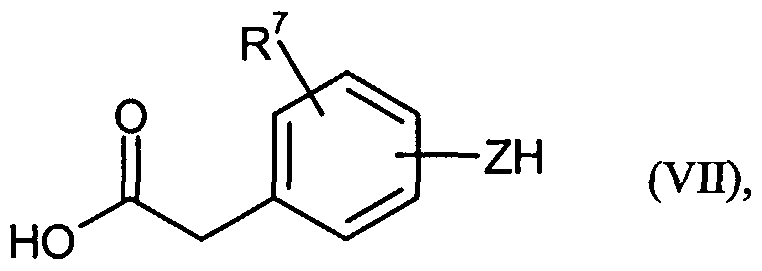
[B] im Falle, dass in Formel (I) bzw. (I-A) X für eine Bindung und Y für O, S oder N-R11 steht, zunächst in einem inerten Lösungsmittel in Gegenwart eines Kondensationsmittels und gegebenenfalls in Gegenwart einer Hilfsbase mit einer Verbindung der Formel (VE)
Figure imgf000011_0002
in welcher
R7 die oben angegebenen Bedeutungen hat und
Z für O, S oder N-R1 ! steht, worin R11 die oben angegebenen Bedeutungen hat, zu Verbindungen der Formel (VIE)
Figure imgf000012_0001
in welcher R , R , R , R , R und Z jeweils die oben angegebenen Bedeutungen haben,
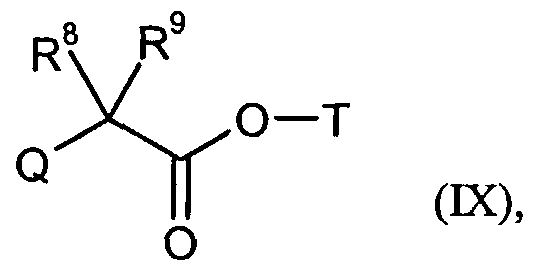
kuppelt, diese dann in einem inerten Lösungsmittel in Gegenwart einer Base mit einer Verbindung der Formel (LX)
Figure imgf000012_0002
in welcher R , R und T jeweils die oben angegebenen Bedeutungen haben und
Q für eine geeignete Abgangsgruppe wie beispielsweise Halogen, Mesylat oder To- sylat steht,
zu Verbindungen der Formel (X)
Figure imgf000012_0003
in welcher R1, R2, R3, R4, R7, R8, R9, T und Z jeweils die oben angegebenen Bedeutungen haben,
umsetzt, diese für den Fall, dass R5 und R6 in Formel (I) bzw. (I-A) für Wasserstoff stehen, in einem inerten Lösungsmittel in Gegenwart eines geeigneten Reduktionsmittels weiter in Verbindungen der Formel (XI)
Figure imgf000013_0001
in welcher R1, R2, R3, R4, R7, R8, R9, T und Z jeweils die oben angegebenen Bedeutungen haben, überfuhrt, die Verbindungen der Formel (X) bzw. (XI) dann mit Säuren oder Basen oder im Falle, dass T für Benzyl steht, auch hydrogenolytisch zu den entsprechenden Carbonsäuren der Formel (XU)
Figure imgf000013_0002
in welcher R1, R2, R3, R4, R5, R6, R7, R8, R9 und Z jeweils die oben angegebenen Bedeutungen haben, überführt,
gegebenenfalls die Carbonsäuren der Formel (VI) bzw. (XU) nach bekannten Methoden zur Veresterung weiter zu Verbindungen der Formel (I) bzw. (I-A) modifiziert,
und die resultierenden Verbindungen der Formel (VI), (XII), (I) bzw. (I-A) gegebenenfalls mit den entsprechenden (i) Lösungsmitteln und/oder (ii) Basen oder Säuren zu ihren Solvaten, Salzen und/oder Solvaten der Salze umsetzt.
Inerte Lösungsmittel für den Verfahrensschritt (H) + (DT) → (IV) bzw. (H) + (VET) → (VET) sind beispielsweise Ether wie Diethylether, Dioxan, Tetrahydrofuran, Glykoldimethylether oder Diethylenglykoldimethylether, Kohlenwasserstoffe wie Benzol, Toluol, Xylol, Hexan, Cyclohexan oder Erdölfraktionen, Halogenkohlenwasserstoffe wie Dichlormethan, Trichlormethan, Tetrachlor- methan, 1 ,2-Dichlorethan, Trichlorethylen oder Chlorbenzol, oder andere Lösungsmittel wie E- thylacetat, Pyridin, Dimethylsulfoxid, Dimethylformamid, N,N'-Dimethylpropylenharnstoff (DMPU), N-Mefhylpyrrolidon (NMP), Acetonitril oder Aceton. Ebenso ist es möglich, Gemische der genannten Lösemittel zu verwenden. Bevorzugt sind Dichlormefhan, 1,2-Dichlorethan oder Dimethylformamid.
Als Kondensationsmittel für die Amidbildung im Verfahrensschritt (11) + (HT) → (IV) bzw. (IT) + (VE) -» (VIÜ) eignen sich beispielsweise Carbodiimide, z.B. N,N'-Diethyl-, N,N'-Dipropyl-, N,N'- Diisopropyl-, N,N'-Dicyclohexylcarbodiimid (DCC), N-(3-Dimethylaminoisopropyl)-N'-ethyl- carbodiimid-Hydrochlorid (EDC), oder Carbonylverbindungen wie N,N'-Carbonyldiimidazol, oder 1,2-Oxazoliumverbindungen wie 2-Ethyl-5-phenyl-l,2-oxazolium-3-sulfat oder 2-tert.-Butyl-5- methyl-isoxazolium-perchlorat, oder Acylaminoverbindungen wie 2-Efhoxy-l-ethoxycarbonyl-l,2- dihydrochinolin, oder Propanphosphonsäureanhydrid, oder Isobutylchlorformiat, oder Bis-(2-oxo- 3-oxazolidinyl)-phosphorylchlorid oder Benzotriazolyloxy-tris(dimethylamino)phosphonium-hexa- fluorophosphat, oder O-(Benzotriazol- 1 -yl)-N,N,N',N'-tetramethyluronium-hexafluorophosphat (HBTU), 2-(2-Oxo-l-(2H)-pyridyl)-l,l,3,3-tetramethyluronium-tetrafluoroborat (TPTU) oder O- (7-Azabenzotriazol- 1 -yl)-N,N,N',N'-tetramethyluronium-hexafluorophosphat (HATU), gegebenenfalls in Kombination mit weiteren Hilfsstoffen wie 1 -Hydroxybenzotriazol oder N-Hydroxy- succinimid, sowie als Basen Alkalicarbonate, z.B. Natrium- oder Kaliumcarbonat oder -hydrogen- carbonat, oder organische Basen wie Trialkylamine, z.B. Triefhylamin, N-Methylmorpholin, N- Methylpiperidin oder Diisopropylethylamin. Bevorzugt wird EDC verwendet.
Der Verfahrensschritt (II) + (IH) -» (PV) bzw. (IT) + (VH) — » (VIÜ) wird im Allgemeinen in einem Temperaturbereich von 0°C bis +100°C, bevorzugt von 0°C bis +40°C, durchgeführt. Die Umset- zung kann bei normalem, erhöhtem oder bei erniedrigtem Druck durchgeführt werden (z.B. von 0.5 bis 5 bar). Im Allgemeinen arbeitet man bei Normaldruck.
Als Reduktionsmittel für den Verfahrensschritt (IV) → (V) bzw. (X) -> (XI) eignen sich beispielsweise Borhydride wie Boran oder Diboran, einschließlich der Komplexe beispielsweise mit Tetrahydrofuran oder Dimethylsulfid, oder auch Diphenylsilan in Gegenwart von Carbo- nyltris(triphenylphosphin)rhodium(r)hydrid als Katalysator [siehe R. Kuwano, M. Takahashi, Y. Ito, Tetrahedron Lett. 1998, 39, 1017-1020].
Inerte Lösungsmittel für den Verfahrensschritt (IV) - (V) bzw. (X) — > (XI) sind beispielsweise Ether wie Diethylether, Dioxan, Tetrahydrofuran, Glykoldimethylether oder Diethylenglykoldi- methylether, oder Kohlenwasserstoffe wie Benzol, Toluol, Xylol, Hexan, Cyclohexan oder Erdöl- fraktionen. Ebenso ist es möglich, Gemische der genannten Lösemittel einzusetzen. Bevorzugt ist Tetrahydrofuran. Die Reaktion erfolgt im Allgemeinen in einem Temperaturbereich von -20°C bis +80°C, bevorzugt von 0°C bis +40°C. Die Umsetzung kann bei normalem, erhöhtem oder bei erniedrigtem Druck durchgeführt werden (z.B. von 0.5 bis 5 bar). Im Allgemeinen arbeitet man bei Normaldruck.
Inerte Lösungsmittel für den Verfahrensschritt (VIH) + (LX) -> (X) sind beispielsweise Ether wie Diethylether, Dioxan, Tetrahydrofuran, Glykoldimethylether oder Diethylenglykoldimethylether, Kohlenwasserstoffe wie Benzol, Xylol, Toluol, Hexan, Cyclohexan oder Erdölfraktionen, oder andere Lösungsmittel wie Aceton, 2-Butanon, Dimethylformamid, Dimethylsulfoxid, Acetonitril oder N-Methylpyrrolidinon. Ebenso ist es möglich, Gemische der genannten Lösungsmittel einzusetzen. Bevorzugt ist Dimethylformamid oder Aceton.
Als Basen für den Verfahrensschritt (VITJ) + (LX) - (X) eignen sich die üblichen anorganischen oder organischen Basen. Hierzu gehören Alkalihydroxide wie beispielsweise Lithium-, Natriumoder Kaliumhydroxid, Alkali- oder Erdalkalicarbonate wie Natrium-, Kalium- oder Calciumcarbo- nat, Alkalihydride wie Natriumhydrid, oder organische Amine wie Pyridin, Triethylamin, E hyl- diisopropylamin, N-Mefhylmorpholin oder N-Methylpiperidin. Bevorzugt ist Kaliumcarbonat oder Natriumhydrid.
Die Base wird hierbei in einer Menge von 1 bis 5, bevorzugt von 1 bis 2 Mol, bezogen auf 1 Mol der Verbindung der Formel (VITJ) eingesetzt.
Die Reaktion erfolgt im Allgemeinen in einem Temperaturbereich von -20°C bis +150°C, bevorzugt von 0°C bis +80°C. Die Umsetzung kann bei normalem, erhöhtem oder bei erniedrigtem Druck durchgeführt werden (z.B. von 0.5 bis 5 bar). Im Allgemeinen arbeitet man bei Normaldruck.
Inerte Lösungsmittel für den Verfahrensschritt (IV) / (V) → (VI) bzw. (X) / (XI) → (XU) sind beispielsweise Halogenkohlenwasserstoffe wie Dichlorme han, 1 ,2-Dichlorethan oder Trichlorethylen, Ether wie Diethylether, Dioxan, Tetrahydrofuran, Glykoldimethylether oder Diethylen- glykoldimethylether, Alkohole wie Methanol, Ethanol, n-Propanol, iso-Propanol, n-Butanol oder tert.-Butanol, Kohlenwasserstoffe wie Benzol, Xylol, Toluol, Hexan, Cyclohexan oder Erdölfraktionen, oder andere Lösungsmittel wie Nitromethan, Aceton, Dimethylformamid, Dimethylsulfoxid, Acetonitril, N-Methylpyrrolidinon oder auch Wasser. Ebenso ist es möglich, Gemische der genannten Lösungsmittel einzusetzen. Bevorzugt sind bei einer basischen Esterhydrolyse Alkohole wie Methanol oder Ethanol und deren Gemische mit Tetrahydrofuran und bei einer sauren Esterspaltung Dichlormefhan. Als Basen für den Verfahrensschritt (IV) / (V) → (VI) bzw. (X) / (XI) → (Xu) eignen sich die üblichen anorganischen Basen. Hierzu gehören bevorzugt Alkalihydroxide wie beispielsweise Lithium-, Natrium- oder Kaliumhydroxid, oder Alkali- oder Erdalkalicarbonate wie Natrium-, Kalium- oder Calciumcarbonat. Besonders bevorzugt sind Lithium- oder Natriumhydroxid.
Die Base wird hierbei in einer Menge von 1 bis 5, bevorzugt von 1 bis 3 Mol, bezogen auf 1 Mol der Verbindung der Formel (IV), (V), (X) bzw. (XI) eingesetzt.
Als Säuren für den Verfahrensschritt (IV) / (V) → (VI) bzw. (X) / (XI) → (XU) eignen sich die üblichen anorganischen Säuren wie beispielsweise Salzsäure oder Schwefelsäure, oder Sulfon- säuren wie Toluolsulfonsäure, Mefhansulfonsäure oder Trifluormefhansulfonsäure, oder Carbon- säuren wie Trifluoressigsäure.
Die Reaktion erfolgt im Allgemeinen in einem Temperaturbereich von -20°C bis +100°C, bevorzugt von 0°C bis +30°C. Die Umsetzung kann bei normalem, erhöhtem oder bei erniedrigtem Druck durchgeführt werden (z.B. von 0.5 bis 5 bar). Im Allgemeinen arbeitet man bei Normaldruck.
Die Verbindungen der Formel (H) können in Analogie zu literaturbekannten Verfahren dadurch hergestellt werden, dass man Verbindungen der Formel (XIH)
Figure imgf000016_0001
in welcher
A für Chlor oder Brom steht,
in Gegenwart einer Säure oder Lewis-Säure, gegebenenfalls in einem inerten Lösungsmittel, mit einer Verbindung der Formel (XTV)
Figure imgf000016_0002
in welcher R2, R3 und R4 jeweils die oben angegebenen Bedeutungen haben, im Fall, dass R2 und R3 in (XTV) beide ungleich Wasserstoff sind, zu Verbindungen der Formel (XV) bzw. im Fall, dass R3 in (XTV) für Wasserstoff steht, zu Verbindungen der Formel (XVI)
Figure imgf000017_0001
(XV) (XVI)
in welchen A und R4 jeweils die oben angegebenen Bedeutungen haben,
umsetzt, die Verbindungen der Formel (XV) bzw. (XVI) dann mit Hilfe eines Bor-, Aluminiumoder Siliciumhydrids, wie beispielsweise Natriumborhydrid oder Natriumcyanoborhydrid, oder durch Hydrierung in Gegenwart eines geeigneten Katalysators, wie beispielsweise Raney-Nickel, zu Verbindungen der Formel (XVII)
Figure imgf000017_0002
in welcher A, R2, R3 und R4 jeweils die oben angegebenen Bedeutungen haben,
reduziert [für die Verfahrensschritte (XTH) + (XIV) → (XV) → (XVH) vgl. z.B. P.E. Maligres, I. Houpis, K. Rossen, A. Molina, J. Sager, V. Upadhyay, K.M. Wells, R.A. Reamer, J.E. Lynch, D. Askin, R.P. Volante, P.J. Reider, Tetrahedron 1997, 53, 10983-10992], die Verbindungen der Formel (XVJJ) dann nach literaturüblichen Methoden in Verbindungen der Formel (XVITJ)
Figure imgf000017_0003
in welcher A, R , R und R jeweils die oben angegebenen Bedeutungen haben und
PG für eine geeignete Arnino-Schutzgruppe, vorzugsweise für 4-Nitrophenylsulfonyl steht,
überführt, diese dann in einer Kupplungsreaktion mit einer Verbindung der Formel (XLX)
Figure imgf000018_0001
in welcher R1 die oben angegebenen Bedeutungen hat und
R12 für Wasserstoff oder Methyl steht oder beide Reste zusammen eine CH2CH2- oder C(CH3)2-C(CH3)2-Brücke bilden,
in einem inerten Lösungsmittel in Gegenwart eines geeigneten Palladium-Katalysators und einer Base zu Verbindungen der Formel (XX)
Figure imgf000018_0002
in welcher PG, R1, R2, R3 und R4 jeweils die oben angegebenen Bedeutungen haben,
umsetzt [vgl. z.B. W. Hahnfeld, M. Jung, Pharmazie 1994, 49, 18-20; idetn, Liebigs Ann. Chem. 1994, 59-64] und abschließend nach literaturüblichen Methoden die Schutzgruppe PG zu Verbindungen der Formel (IT) wieder entfernt.
Inerte Lösungsmittel für den Verfahrensschritt (XIO) + (XTV) - (XV) bzw. (XVI) sind beispielsweise Halogenkohlenwasserstoffe wie Dichlormefhan, Trichlormethan, Tetrachlormethan, Tri- chlorethan, Tetrachlorethan, 1 ,2-Dichlorethan oder Trichlorethylen, Ether wie Dioxan, Tetrahydro- furan, Glykoldimethylether oder Diethylenglykoldimethylether, Alkohole wie Methanol, Ethanol, n-Propanol, iso-Propanol, n-Butanol oder tert.-Butanol, oder Kohlenwasserstoffe wie Benzol, Xylol, Toluol, Hexan, Cyclohexan oder Erdölfraktionen, oder andere Lösungsmittel wie Acetonitril oder Wasser. Ebenso ist es möglich, Gemische der genannten Lösungsmittel einzusetzen. Es ist auch möglich, die Reaktion ohne Lösungsmittel durchzuführen. Im Fall, dass R3 für Wasserstoff steht, wird die Reaktion bevorzugt ohne Lösungsmittel zum Produkt (XVI) durchgeführt, im Fall, dass R2 und R3 beide ungleich Wasserstoff sind, wird die Reaktion bevorzugt in einem Gemisch aus Toluol und Acetonitril zum Produkt (XV) durchgeführt.
Als Säuren für den Verfahrensschritt (XTIf) + (XTV) - (XV) bzw. (XVI) eignen sich die üblichen anorganischen oder organischen Säuren. Hierzu gehören bevorzugt Salzsäure, Schwefelsäure oder Phosphorsäure, oder Carbonsäuren wie Ameisensäure, Essigsäure, oder Trifluoressigsäure, oder Sulfonsäuren wie Toluolsulfonsäure, Methansulfonsäure oder Trifluormethansulfonsäure. Alternativ eignen sich auch die üblichen Lewissäuren wie beispielsweise Bortrifluorid, Aluminiurntrichlo- rid oder Zinkchlorid. Die Säure wird hierbei in einer Menge von 1 bis 10 Mol, bezogen auf 1 Mol der Verbindung der Formel (XHI), eingesetzt. Im Fall, dass R3 für Wasserstoff steht, wird die Re- aktion bevorzugt mit 1 bis 2 Mol Zinkchlorid zum Produkt (XVI), und im Fall, dass R2 und R3 beide ungleich Wasserstoff sind, bevorzugt mit 2 bis 5 Mol Trifluoressigsäure zum Produkt (XV) durchgeführt.
Die Reaktion erfolgt im Allgemeinen in einem Temperaturbereich von 0°C bis +250°C. Im Fall, dass R3 für Wasserstoff steht, wird die Reaktion bevorzugt in einem Temperaturbereich von +130°C bis +200°C zum Produkt (XVI) durchgeführt, im Fall, dass R2 und R3 beide ungleich Wasserstoff sind, wird die Reaktion bevorzugt in einem Temperaturbereich von 0°C bis +50°C zum Produkt (XV) durchgeführt. Die Umsetzung kann bei normalem, erhöhtem oder bei erniedrigtem Druck durchgeführt werden (z.B. von 0.5 bis 5 bar). Im Allgemeinen arbeitet man bei Normaldruck.
Für den Verfahrensschritt (XV) bzw. (XVI) -> (XVII) geeignete Reduktionsmittel sind Bor-, Aluminium- oder Siliciumhydride, wie beispielsweise Boran, Diboran, Natriumborhydrid, Natriumcyanoborhydrid, Lithiumaluminiumhydrid oder Triethylsilan, gegebenenfalls in Gegenwart einer Säure oder Lewissäure wie beispielsweise Essigsäure, Trifluoressigsäure, Aluminiumtrichlorid oder Bortrifluorid, oder die Hydrierung mit Wasserstoff in Gegenwart eines geeigneten Katalysa- tors wie beispielsweise Palladium auf Aktivkohle, Platinoxid oder Raney-Nickel. Bevorzugt ist bei Verbindungen der Formel (XVI) die Reduktion unter Verwendung von Natriumcyanoborhydrid; bei Verbindungen der Formel (XV) wird vorzugsweise Natriumborhydrid verwendet.
Geeignete Lösungsmittel für den Verfahrensschritt (XV) bzw. (XVI) → (XVH) sind beispielsweise Ether wie Diethylether, Dioxan, Tetrahydrofuran, Glykoldimethylether oder Diethylen- glykoldimethylether, Alkohole wie Methanol, Ethanol, n-Propanol, iso-Propanol, n-Butanol oder tert.-Butanol, oder Kohlenwasserstoffe wie Benzol, Xylol, Toluol, Hexan, Cyclohexan oder Erdölfraktionen, oder andere Lösungsmittel wie Acetonitril, Essigsäure oder Wasser. Ebenso ist es möglich, Gemische der genannten Lösungsmittel einzusetzen. Bevorzugt ist für die Reduktion der Verbindungen der Formel (XVI) die Verwendung von Essigsäure, die als Säurezusatz zum Redukti- onsmittel im großen Uberschuss gleichzeitig als Lösungsmittel dient. Für die Reduktion der Verbindungen der allgemeinen Formel (XV) wird vorzugsweise ein Gemisch aus Methanol und Tolu- ol/Acetonitril [aus der Umsetzung (XTU) -» (XV), unter Zusatz von 2 bis 5 Mol Trifluoressigsäure] im Verhältnis 1 :1 bis 1:10 verwendet. Die Reaktion erfolgt im Allgemeinen in einem Temperaturbereich von -20°C bis +100°C, bevorzugt von -10°C bis +50°C. Die Umsetzung kann bei normalem, erhöhtem oder bei erniedrigtem Druck durchgeführt werden (z.B. von 0.5 bis 5 bar). Im Allgemeinen arbeitet man bei Normaldruck.
Inerte Lösungsmittel für den Verfahrensschritt (XVEO) + (XLX) -> (XX) sind beispielsweise Ether wie Diethylether, Dioxan, Tetrahydrofuran, Glykoldimethylether oder Diethylenglykoldimethylether, Alkohole wie Methanol, Ethanol, n-Propanol, iso-Propanol, n-Butanol oder tert.- Butanol, Kohlenwasserstoffe wie Benzol, Xylol, Toluol, Hexan, Cyclohexan oder Erdölfraktionen, oder andere Lösungsmittel wie Dimethylformamid, Acetonitril oder auch Wasser. Ebenso ist es möglich, Gemische der genannten Lösungsmittel einzusetzen. Bevorzugt sind Toluol, Dimethylformamid oder Acetonitril.
Als Basen für den Verfahrensschritt (XVIJJ) + (XLX) → (XX) eignen sich die üblichen anorganischen oder organischen Basen. Hierzu gehören bevorzugt Alkalihydroxide wie beispielsweise Lithium-, Natrium- oder Kaliumhydroxid, Alkali- oder Erdalkalicarbonate wie Natrium-, Kalium- oder Calciumcarbonat, Alkaliphosphate wie Natrium- oder Kaliumphosphat, oder organische Airline wie Pyridin, Triethylamin, Efhyldiisopropylamin, N-Mefhylmorpholin oder N-Methylpiperidin. Besonders bevorzugt sind Natrium- oder Kaliumcarbonat oder Kaliumphosphat.
Die Base wird hierbei in einer Menge von 1 bis 5, bevorzugt von 2 bis 3 Mol, bezogen auf 1 Mol der Verbindung der Formel (XVIJJ) eingesetzt.
Geeignete Palladium-Katalysatoren für den Verfahrensschritt (XVJJJ) + (XIX) → (XX) sind bevorzugt Palladium(O)- oder Palladium(II)-Verbindungen, die präformiert eingesetzt werden, wie beispielsweise [1,1 '-Bis(diphenylphosphino)ferrocenyl]palladium(II)chlorid, Bis(triphenyl- phosphin)palladium(II)chlorid oder Tetrakis(triphenylphosphin)palladium(0), oder die in situ aus einer geeigneten Palladiumquelle wie beispielsweise Bis(dibenzylidenaceton)palladium(0) und einem geeigneten Phosphinliganden erzeugt werden können.
Die Reaktion erfolgt im Allgemeinen in einem Temperaturbereich von 0°C bis +150°C, bevorzugt von +20°C bis +120°C. Die Umsetzung kann bei normalem, erhöhtem oder bei erniedrigtem Druck durchgeführt werden (z.B. von 0.5 bis 5 bar). Im Allgemeinen arbeitet man bei Normaldruck.
Die Verbindungen der Formel (IU) können in Analogie zu literaturbekannten Verfahren beispiels- weise dadurch hergestellt werden, dass man Verbindungen der Formel (XXI)
Figure imgf000021_0001
in welcher R7 und Z jeweils die oben angegebenen Bedeutungen haben und für Benzyl oder (Cι-C6)-Alkyl steht,
in einem inerten Lösungsmittel in Gegenwart einer Base mit einer Verbindung der Formel (XXU)
Figure imgf000021_0002
in welcher Q die oben angegebenen Bedeutungen hat und für Benzyl oder (Cι-C6)-Alkyl steht, jedoch in seiner spezifischen Bedeutung von T1 verschieden ist,
zu Verbindungen der Formel (XXUT)
Figure imgf000021_0003
in welcher R7, Z, T1 und T2 jeweils die oben angegebenen Bedeutungen haben,
umsetzt und diese dann unter kontrollierten, chemoselektiven Reaktionsbedingungen mit Säuren oder Basen oder im Falle, dass T1 bzw. T2 für Benzyl steht, auch hydrogenolytisch wahlweise in die entsprechenden Carbonsäuren der Formel (XXIV) bzw. (XXV)
Figure imgf000021_0004
Figure imgf000022_0001
in welchen R7, Z und T1 bzw. T2 jeweils die oben angegebenen Bedeutungen haben,
überführt.
Inerte Lösungsmittel für den Verfahrensschritt (XXI) + (XXU) -» (XXIJJ) sind beispielsweise Ether wie Diethylether, Dioxan, Tetrahydrofuran, Glykoldimethylether oder Diethylenglykoldimethylether, Kohlenwasserstoffe wie Benzol, Xylol, Toluol, Hexan, Cyclohexan oder Erdölfraktionen, oder andere Lösungsmittel wie Aceton, 2-Butanon, Dimethylformamid, Dimethylsulfoxid, Acetonitril oder N-Methylpyrrolidinon. Ebenso ist es möglich, Gemische der genannten Lösungsmittel einzusetzen. Bevorzugt ist Dimethylformamid oder Aceton.
Als Basen für den Verfahrensschritt (XXI) + (XXIT) -» (XXIJJ) eignen sich die üblichen anorganischen oder organischen Basen. Hierzu gehören Alkalihydroxide wie beispielsweise Lithium-, Natrium- oder Kaliumhydroxid, Alkali- oder Erdalkalicarbonate wie Natrium-, Kalium- oder Calcium- carbonat, Alkalihydride wie Natriumhydrid, oder organische Amine wie Pyridin, Triethylamin, Efhyldiisopropylamin, N-Mefhylmorpholin oder N-Methylpiperidin. Bevorzugt ist Kaliumcarbonat oder Natriumhydrid.
Die Base wird hierbei in einer Menge von 1 bis 5, bevorzugt von 1 bis 2 Mol, bezogen auf 1 Mol der Verbindung der Formel (XXI) eingesetzt.
Die Reaktion erfolgt im Allgemeinen in einem Temperaturbereich von -20°C bis +150°C, bevorzugt von 0°C bis +80°C. Die Umsetzung kann bei normalem, erhöhtem oder bei erniedrigtem Druck durchgeführt werden (z.B. von 0.5 bis 5 bar). Im Allgemeinen arbeitet man bei Normaldruck.
Inerte Lösungsmittel für den Verfahrensschritt (XXIJJ) -» (XXIV) bzw. (XXV) sind beispielsweise Halogenkohlenwasserstoffe wie Dichlormefhan, 1 ,2-Dichlorefhan oder Trichlorethylen, Ether wie Diethylether, Dioxan, Tetrahydrofuran, Glykoldimethylether oder Diethylenglykoldimethyl- ether, Alkohole wie Methanol, Ethanol, n-Propanol, iso-Propanol, n-Butanol oder tert.-Butanol, Kohlenwasserstoffe wie Benzol, Xylol, Toluol, Hexan, Cyclohexan oder Erdölfraktionen, oder andere Lösungsmittel wie Nitromethan, Aceton, Dimethylformamid, Dimethylsulfoxid, Acetonitril, N-Methylpyrrolidinon oder auch Wasser. Ebenso ist es möglich, Gemische der genannten Lösungsmittel einzusetzen. Bevorzugt sind bei einer basischen Esterhydrolyse Alkohole wie Me- thanol oder Ethanol und deren Gemische mit Tetrahydrofuran und bei einer sauren Esterspaltung Dichlormefhan.
Als Basen für den Verfahrensschritt (XXIH) -> (XXIV) bzw. (XXV) eignen sich die üblichen anorganischen Basen. Hierzu gehören bevorzugt Alkalihydroxide wie beispielsweise Lithium-, Natrium- oder Kaliumhydroxid, oder Alkali- oder Erdalkalicarbonate wie Natrium-, Kalium- oder Calciumcarbonat. Besonders bevorzugt sind Lithium- oder Natriumhydroxid.
Die Base wird hierbei in einer Menge von 1 bis 5, bevorzugt von 1 bis 3 Mol, bezogen auf 1 Mol der Verbindung der Formel (XXIJJ) eingesetzt.
Als Säuren für den Verfahrensschritt (XXIJJ) → (XXIV) bzw. (XXV) eignen sich die üblichen anorganischen Säuren wie beispielsweise Salzsäure oder Schwefelsäure, oder Sulfonsäuren wie Toluolsulfonsäure, Methansulfonsäure oder Trifluormefhansulfonsäure, oder Carbonsäuren wie Trifluoressigsäure.
Die Reaktion erfolgt im Allgemeinen in einem Temperaturbereich von -20°C bis +100°C, bevorzugt von 0°C bis +30°C. Die Umsetzung kann bei normalem, erhöhtem oder bei erniedrigtem Druck durchgeführt werden (z.B. von 0.5 bis 5 bar). Im Allgemeinen arbeitet man bei Normaldruck.
Die Verbindungen der Formeln (VU), (IX), (XJJJ), (XTV), (XIX), (XXI) und (XXJJ) sind kommerziell erhältlich, literaturbekannt oder können in Analogie zu literaturbekannten Verfahren hergestellt werden.
Das erfindungsgemäße Verfahren kann durch die folgenden Reaktionsschemata 1 bis 3 veranschaulicht werden:
Schema 1
Figure imgf000024_0001
a) Trifluoressigsäure, 35-40°C; b) NaBR,, Methanol, -10°C; c) Et3N, cat. DMAP, Dichlormethan, RT; d) Pd(PPh3)4-Katalysator, K2CO3, Toluol, 110°C; e) NaOH, Thioessigsäure, DMF, 45°C.
Schema 2
Figure imgf000025_0001
c)
Figure imgf000025_0002
a) EDC, 1,2-Dichlorethan, RT; b) K2CO3, Br-CH2-COOT, DMF, 50°C; c) NaOH, EtOH (T - Me oder Et) oder TFA, CH2C12 (T = 'Bu), RT; d) Rh(PPh3)3(CO)H, Ph2SiH2, THF, RT.
Schema 3
Figure imgf000026_0001
a) K2CO3, DMF, 50°C; b) NaOH, EtOH (T2 = Me oder Et, T1 = 'Bu) oder TFA, CH2C12 (T2 = 'Bu, T1 = Me oder Et), RT; c) NaOH, EtOH (T1 = Me oder Et, T2 = *Bu) oder TFA, CH2C12 (T1 = 'Bu, T2 = Me oder Et), RT; d) Verbindung der Formel (Ua) [Schema 1], EDC, 1,2-Dichlorethan, RT; e) NaOH, EtOH (T1 bzw. T2 = Me oder Et) oder TFA, CH2C12 (T1 bzw. T2 = 'Bu), RT; f) Rh(PPh3)3(CO)H, Ph2SiH2, THF, RT; g) NaOH, EtOH (T1 bzw. T2 = Me oder Et) oder TFA, CH2C12 (T1 bzw. T2 = 'Bu), RT.
Die erfindungsgemäßen Verbindungen der Formel (I) bzw. (I-A) zeigen ein überraschendes und wertvolles pharmakologisches Wirkungsspektrum und lassen sich daher als vielseitige Medikamente einsetzen. Insbesondere eignen sie sich zur Behandlung der koronaren Herzkrankheit, zur Myokardinfarkt-Prophylaxe sowie zur Behandlung von Restenose nach Koronarangioplastie oder Stenting. Bevorzugt eignen sich die erfindungsgemäßen Verbindungen der Formel (I) bzw. (I-A) zur Behandlung der Arteriosklerose und Hypercholesterolämie, zur Erhöhung krankhaft niedriger HDL-Spiegel sowie zur Senkung erhöhter Triglycerid- und LDL-Spiegel. Darüber hinaus können sie zur Behandlung von Obesitas, Diabetes, zur Behandlung des metabolischen Syndroms (Gluco- se-Intoleranz, Hyperinsulinämie, Dyslipidämie und Bluthochdruck infolge von Insulinresistenz), der Leberfibrose und Krebs angewendet werden.
Die neuen Wirkstoffe können allein oder bei Bedarf in Kombination mit anderen Wirkstoffen vorzugsweise aus der Gruppe CETP-Inhibitoren, Antidiabetika, Antioxidantien, Cytostatika, Calcium- antagonisten, Blutdrucksenkende Mittel, Thyroidhormone und oder Thyroidmimetika, Inhibitoren der HMG-CoA-Reduktase, Inhibitoren der HMG-CoA-Reduktase-Expression, Squalensynthese- Inhibitoren, ACAT-Inhibitoren, durchblutungsfördernde Mittel, Thrombozytenaggregations- hemmer, Antikoagulantien, Angiotensin-U-Rezeptorantagonisten, Cholesterin-Absorptions- hemmer, MTP-Inhibitoren, Aldolase-Reduktase-Inhibitoren, Fibrate, Niacin, Anoretika, Lipase- Inhibitoren und PPAR-α- und oder PPAR-γ-Agonisten verabreicht werden.
Die Wirksamkeit der erfindungsgemäßen Verbindungen lässt sich z.B. in vitro durch den im Beispielteil beschriebenen Transaktivierungsassay prüfen.
Die Wirksamkeit der erfindungsgemäßen Verbindungen in vivo lässt sich z.B. durch die im Beispielteil beschriebenen Untersuchungen prüfen.
Für die Applikation der Verbindungen der allgemeinen Formel (T) bzw. (I-A) kommen alle üblichen Applikationsformen in Betracht, d.h. also oral, parenteral, inhalativ, nasal, sublingual, rektal, äußerlich wie z.B. transdermal, oder lokal wie z.B. bei Implantaten oder Stents. Bei der parentera- len Applikation sind insbesondere intravenöse, intramuskuläre oder subkutane Applikation, beispielsweise als subkutanes Depot, zu nennen. Bevorzugt ist die orale oder parenterale Applikation. Ganz besonders bevorzugt ist die orale Applikation. Hierbei können die Wirkstoffe allein oder in Form von Zubereitungen verabreicht werden. Für die orale Applikation eignen sich als Zubereitungen u.a. Tabletten, Kapseln, Pellets, Dragees, Pillen, Granulate, feste und flüssige Aerosole, Sirupe, Emulsionen, Suspensionen und Lösungen. Hierbei muss der Wirkstoff in einer solchen Menge vorliegen, dass eine therapeutische Wirkung erzielt wird. Im Allgemeinen kann der Wirkstoff in einer Konzentration von 0.1 bis 100 Gew.-%, insbesondere 0.5 bis 90 Gew.-%, vorzugsweise 5 bis 80 Gew.-%, vorliegen. Insbesondere sollte die Konzentration des Wirkstoffs 0.5 bis 90 Gew.-% betragen, d.h. der Wirkstoff sollte in Mengen vorliegen, die ausreichend sind, den angegebenen Dosierungsspielraum zu erreichen.
Zu diesem Zweck können die Wirkstoffe in an sich bekannter Weise in die üblichen Zubereitungen überführt werden. Dies geschieht unter Verwendung inerter, nichttoxischer, pharmazeutisch geeigneter Trägerstoffe, Hilfsstoffe, Lösungsmittel, Vehikel, Emulgatoren und/oder Dispergiermittel.
Als Hilfsstoffe seien beispielsweise aufgeführt: Wasser, nichttoxische organische Lösungsmittel wie z.B. Paraffine, pflanzliche Öle (z.B. Sesamöl), Alkohole (z.B. Ethanol, Glycerin), Glykole (z.B. Polyefhylenglykol), feste Trägerstoffe wie natürliche oder synthetische Gesteinsmehle (z.B. Talkum oder Silikate), Zucker (z.B. Milchzucker), Emulgiermittel, Dispergiermittel (z.B. Polyvi- nylpyrrolidon) und Gleitmittel (z.B. Magnesiumsulfat).
Im Falle der oralen Applikation können Tabletten selbstverständlich auch Zusätze wie Natriumcit- rat zusammen mit Zuschlagstoffen wie Stärke, Gelatine und dergleichen enthalten. Wässrige Zubereitungen für die orale Applikation können weiterhin mit Geschmacksaufbesserern oder Farbstof- fen versetzt werden.
Bei oraler Applikation werden vorzugsweise Dosierungen von 0.001 bis 5 mg/kg, bevorzugt von 0.005 bis 3 mg/kg Körpergewicht je 24 Stunden appliziert.
Die nachfolgenden Ausführungsbeispiele erläutern die Erfindung. Die Erfindung ist nicht auf die Beispiele beschränkt.
Die Prozentangaben in den folgenden Tests und Beispielen sind, sofern nicht anders angegeben, Gewichtsprozente; Teile sind Gewichtsteile. Lösungsmittelverhältnisse, Verdünnungsverhältnisse und Konzentrationsangaben von flüssig flüssig-Lösungen beziehen sich jeweils auf das Volumen. A. Beispiele
Abkürzungen:
'Bu tert.-Butyl
DCI direkte chemische Ionisation (bei MS)
DMAP 4-N,N-Dimethylaminopyridin
DMF N,N-Dimethylformamid
DMSO Dimethylsulfoxid d. Th. der Theorie (bei Ausbeute)
EDC N'-(3-Dimethylaminopropyl)-N-ethylcarbodiimid x HCl
ESI Elektrospray-Ionisation (bei MS)
Et Ethyl h Stunde(n)
HPLC Hochdruck-, Hochleistungsflüssigchromatographie
LC/MS Flüssigchromatographie-gekoppelte Massenspektroskopie
Me Methyl min Minute(n)
MS Massenspektroskopie
NMR Kernresonanzspektroskopie
Ph Phenyl
Rf Retentionsindex (bei DC)
RT Raumtemperatur
TFA Trifluoressigsäure
THF Tetrahydrofuran
UV Ultraviolett-Spektrum
HPLC- und LC/MS-Methoden:
Methode 1 :
Instrument: Micromass Platform LCZ mit HPLC Agilent Serie 1100; Säule: Grom-Sil 120 ODS-4 HE, 50 mm x 2.0 mm, 3 μm; Eluent A: 1 1 Wasser + 1 ml 50%-ige Ameisensäure, Eluent B: 1 1 Acetonitril + 1 ml 50%-ige Ameisensäure; Gradient: 0.0 min 100% A → 0.2 min 100% A → 2.9 min 30% A → 3.1 min 10% A → 4.5 min 10% A; Ofen: 55°C; Fluss: 0.8 ml/min; UV-Detektion: 208-400 nm.
Methode 2:
Instrument: HP 1100 mit DAD-Detektion; Säule: Kromasil RP-18, 60 mm x 2 mm, 3.5 μm; Eluent A: 5 ml HCIO4/I Wasser, Eluent B: Acetonitril; Gradient: 0 min 2% B → 0.5 min 2% B → 4.5 min 90% B -> 9 min 90% B; Fluss: 0.75 ml/min; Ofen: 30°C; UV-Detektion: 210 nm.
Methode 3:
Instrument: HP 1100 mit DAD-Detektion; Säule: Kromasil RP-18, 60 mm x 2 mm, 3.5 μm; Eluent A: 5 ml HCIO4 I Wasser, Eluent B: Acetonitril; Gradient: 0 min 2% B → 0.5 min 2% B → 4.5 min 90%o B → 6.5 min 90% B; Fluss: 0.75 ml/min; Ofen: 30°C; UV-Detektion: 210 nm.
Methode 4:
Instrument: HP 1100 mit DAD-Detektion; Säule: Kromasil RP-18, 125 mm x 2 mm, 3.5 μm; E- luent A: PIC B7-Heptansulfonsäure (Fa. Waters, Art.-Nr. WAT084282), Eluent B: Acetonitril; Gradient: 0 min 2% B → 1 min 2% B → 9 min 90% B → 13 min 90% B; Fluss: 2 ml/min; Ofen: 30°C; UV-Detektion: 210 nm.
Methode 5:
Gerätetyp MS: Micromass ZQ; Gerätetyp HPLC: Waters Alliance 2790; Säule: Grom-Sil 120 ODS-4 HE, 50 mm x 2 mm, 3.0 μm; Eluent A: Wasser + 500 μl 50%-ige Ameisensäure / 1, Eluent B: Acetonitril + 500 μl 50%-ige Ameisensäure / 1; Gradient: 0.0 min 5% B → 2.0 min 40% B → 4.5 min 90% B - 5.5 min 90% B; Ofen: 45°C; Fluss: 0.0 min 0.75 ml/min → 4.5 min 0.75 ml/min - 5.5 min 1.25 ml min; UV-Detektion: 210 nm. Methode 6:
Instrument: Micromass Quattro LCZ, mit HPLC Agilent Serie 1100; Säule: Grom-Sil 120 ODS-4 HE, 50 mm x 2.0 mm, 3 μm; Eluent A: 1 1 Wasser + 1 ml 50%-ige Ameisensäure, Eluent B: 1 1 Acetonitril + 1 ml 50%-ige Ameisensäure; Gradient: 0.0 min 100% A → 0.2 min 100% A → 2.9 min 30% A → 3.1 min 10% A → 4.5 min 10% A; Ofen: 55°C; Fluss: 0.8 ml/min; UV-Detektion: 208-400 nm.
Ausgangsverbindungen:
Beispiel 1A
5 -Brom-3 ,3 -dimethylindolin
Figure imgf000031_0001
Ein Gemisch von 45 ml Toluol/ Acetonitril (49:1) wird 5 Minuten mit Argon gespült und dann mit 3.00 g (16.0 mmol) 4-Bromphenylhydrazin versetzt. Anschließend fügt man langsam 3.71 ml (48.1 mmol) Trifluoressigsäure zu, wobei darauf geachtet wird, daß dabei eine Temperatur von 35°C nicht überschritten wird. Anschließend hält man die Temperatur auf 35°C und tropft langsam innerhalb von 2 h eine Lösung von 1.05 g (14.6 mmol) iso-Butyraldehyd in 4 ml Toluol/Acetonitril (49:1) zu. Man rührt 4 h bei 35°C und 2 h bei Raumtemperatur. Anschließend wird auf -10°C gekühlt, mit 4.0 ml Methanol versetzt und innerhalb von 30 min 819 mg (21.7 mmol) festes Natriumborhydrid in Portionen zugegeben. Dabei darf die Temperatur -2°C nicht überschreiten. Nach beendeter Zugabe wird 1 h bei 0°C gerührt. Nach Zugabe von 150 ml einer 6 Gew.-%-igen Lösung von Ammoniak in Wasser werden die Phasen getrennt und die organische Phase wird mit je 1.5 ml Acetonitril und Methanol versetzt. Anschließend wird die organische Phase mit 150 ml einer 15%- igen Lösung von Natriumchlorid in Wasser gewaschen und über Natriumsulfat getrocknet. Es wird durch 100 g Kieselgel filtriert und zweimal mit je 200 ml Diethylether nachgewaschen. Das organische Filtrat wird im Vakuum eingeengt und über 100 g Kiesel gel chromatographiert. Zunächst werden mit Cyclohexan die Nebenprodukte eluiert, anschließend wird mit einem Gemisch Cyclo- hexan/Diethylefher (20:1) das gewünschte Produkt eluiert.
Ausbeute: 1.78 g (54% d. Th.)
Rf (Petrolether/Ethylacetat 5:1) = 0.47 UV [nm] = 200, 268, 276
MS (ESIpos): m z = 226 [M+H]+
Η-NMR (200 MHz, DMSO-d6): δ = 1.20 (s, 6H), 3.18 (d, 2H), 5.66 (br. s, 1H), 6.42 (d, 1H), 7.02 (dd, lH), 7.10 (d, 1H).
Beispiel 2A
5-Brom-3,3-dimethyl-l-(4-nitrobenzol)sulfonylindolin
Figure imgf000032_0001
Zu einer Lösung von 17.00 g (75.18 mmol) 5-Brom-3,3-dimethylindolin, 0.46 g (3.76 mmol) DMAP und 21 ml (15.22 g, 150.4 mmol) Triethylamin in 100 ml Dichlormethan wird bei 5-10°C eine Lösung von 17.50 g (78.94 mmol) 4-Nitrobenzolsulfonylchlorid in 150 ml Dichlormethan zugetropft. Anschließend wird das Gemisch über Nacht bei Raumtemperatur gerührt. Das Reaktionsgemisch wird mit 2 N wässriger Salzsäure versetzt, die Phasen werden getrennt und die organische Phase wird mit Wasser und gesättigter Kochsalz-Lösung gewaschen. Nach Trocknung über Natriumsulfat und Entfernen des Lösungsmittels im Vakuum erhält man 31 g (98% d. Th.) des gewünschten Produktes.
HPLC (Methode 1): R, = 4.1 min.
MS (DCI): m z = 428 [M+NH4]+
•H-NMR (300 MHz, CDC13): δ = 1.14 (s, 6H), 3.68 (s, 2H), 7.15 (d, 1H), 7.34 (dd, 1H), 7.51 (d, 1H), 8.00 (d, 2H), 8.32 (d, 2H).
Beispiel 3A
3 ,3 -Dimethyl- 1 -(4-nitrobenzol)sulfonyl-5 -(4-trifluormethyl)phenylindolin
Figure imgf000033_0001
Durch eine Suspension von 31.00 g (75.38 mmol) 5-Brom-3,3-dimefhyl-l-(4-nitrobenzol)sulfonyl- indolin, 21.47 g (113.06 mmol) 4-Trifluormethylphenylboronsäure und 15.63 g (113.06 mmol) Kaliumcarbonat in 500 ml Toluol wird 15 Minuten lang ein Argonstrom geleitet. Anschließend werden 1.72 g (1.51 mmol) Tetrakis(triphenylphosphin)palladium zugegeben und das Reaktionsgemisch über Nacht unter Rückfluss erhitzt. Nach Abkühlen wird das Gemisch über ca. 1000 ml Kieselgel 60 filtriert und die Säule dann mit ca. 1.5 1 Cyclohexan und mit 2 1 Dichlormefhan nachgewaschen. Durch Entfernen des Lösungsmittels der DichlormethanFraktion im Vakuum erhält man 30 g (84% d. Th.) des gewünschten Produktes.
HPLC (Methode 2): Rt = 5.71 min.
MS (DCI): m z = 494 [M+NH4]+
'H-NMR (300 MHz, CDC13): δ = 1.21 (s, 6H), 3.72 (s, 2H), 7.26 (s, 1H), 7.47 (dd, 1H), 7.60 (d, 2H), 7.68 (d, 2H), 7.70 (d, 1H), 8.06 (d, 2H), 8.32 (d, 2H).
Beispiel 4A
3,3-Dimethyl-5-(4-trifluormethyl)phenylindolin
Figure imgf000033_0002
Zu einem Gemisch von 68 g (142.7 mmol) 3,3-Dimethyl-l-(4-nitrobenzol)sulfonyl-5-(4-trifluor- mefhyl)phenylindolin und 25.1 g (627.9 mmol) Natriumhydroxid in 300 ml N,N-Dimethyl- formamid werden unter Rühren bei Raumtemperatur zügig 27.2 ml (28.9 g, 314.0 mmol) Thioes- sigsäure zugetropft. Anschließend wird das Reaktionsgemisch 5 Stunden bei 45°C gerührt, nach Abkühlung mit 1 1 Ethylacetat versetzt und die organische Phase zweimal mit gesättigter Natrium- carbonat-Lösung und einmal mit gesättigter Kochsalz-Lösung gewaschen. Nach Trocknung über Natriumsulfat wird das Lösungsmittel im Vakuum entfernt' und das erhaltene Rohprodukt an 1 kg Kieselgel 60 gereinigt (Laufmittel Cyclohexan/Efhylacetat 7:1). Das Eluat wird eingeengt und der erhaltene Rückstand wird kristallisiert. Man erhält 27.1 g (61% d. Th.) des gewünschen Produktes.
HPLC (Methode 3): Rt = 4.46 min.
MS (ESIpos): m/z = 292 [M+H]+
Η-NMR (300 MHz, CDC13): δ = 1.37 (s, 6H), 3.40 (s, 2H), 6.70 (d, IH), 7.27 (d, IH), 7.30 (dd, IH), 7.62 (s, 4H).
Beispiel 5A
Ethyl [4-(2-tert.-butoxy-2-oxoethoxy)-3-ethoxyphenyl]acetat
Figure imgf000034_0001
Zu einer Lösung von 5.0 g (22.3 mmol) Ethyl (3-efhoxy-4-hydroxyphenyl)acetat in 75 ml DMF werden 3.39 g (24.526 mmol) Kaliumcarbonat gegeben und das Gemisch anschließend 1 h bei 50°C gerührt. Danach werden 3.62 ml (24.53 mmol) Bromessigsäure-tert.-butylester zugegeben und die Reaktionsmischung wird über Nacht bei 50°C gerührt. Nach Beendigung der Reaktion wird das Lösemittel im Vakuum abdestilliert, der Rückstand wird mit 150 ml Essigsäureethylester aufgenommen und dreimal mit je 75 ml Wasser gewaschen. Die organische Phase wird über Natriumsulfat getrocknet und eingeengt. Man erhält 7.5 g (99.4% d. Th.) des gewünschten Produktes.
HPLC (Methode 3): Rt = 4.96 min.
MS (DCI): m/z = 356 [M+NH4]+
Η-NMR (300 MHz, CDC13): δ = 1.22 (t, 3H), 1.42 (t, 3H), 1.48 (s, 9H), 3.5 (s, 2H), 4.12 (tt, 4H), 4.55 (s, 2H), 6.75 (d, 2H), 6.85 (s, IH).
Beispiel 6A
[2-Ethoxy-4-(2-ethoxy-2-oxoethyl)phenoxy]essigsäure
Figure imgf000035_0001
Zu einer Lösung von 3.38 g (10.0 mmol) Ethyl [4-(2-tert.-butoxy-2-oxoethoxy)-3-ethoxy- phenyl]acetat in 25 ml Dichlormethan werden bei RT 7.7 ml (100.0 mmol) Trifluoressigsäure zugegeben und anschließend bis zur vollständigen Umsetzung bei RT gerührt. Das Reaktionsgemisch wird im Vakuum vom Lösemittel befreit, in 100 ml Essigsäureethylester aufgenommen und zweimal mit 50 ml Wasser gewaschen. Die organische Phase wird über Magnesiumsulfat getrocknet und im Vakuum vom Lösemittel befreit. Nach Reinigung über Kieselgel (Laufmittel: Cyclohe- xan/Essigsäureethylester 1 : 1) erhält man 2.54 g (89% d. Th.) des gewünschten Produktes.
HPLC (Methode 3): R, = 3.89 min.
Η-NMR (200 MHz, CDC13): δ = 1.25 (t, 3H), 1.48 (t, 3H), 3.55 (s, 2H), 4.15 (m, 4H), 4.65 (s, 2H), 6.88 (m, 3H), 7.65 (br. s, IH).
Beispiel 7A
[4-(2-tert.-Butoxy-2-oxoethoxy)-3-ethoxyphenyl]essigsäure
Figure imgf000035_0002
Zu einer Lösung von 3.384 g (10.0 mmol) Ethyl [4-(2-tert.-butoxy-2-oxoethoxy)-3-ethoxy- phenylacetat in 50 ml Ethanol werden bei RT 11 ml (11.0 mmol) 1 M Natronlauge gegeben. Anschließend wird das Gemisch bis zur vollständigen Umsetzung bei RT gerührt. Es wird die äquivalente Menge Salzsäure zugegeben, das Ethanol wird im Vakuum abdestilliert und der wässrige Rückstand wird mit Essigsäureethylester extrahiert. Die organische Phase wird über Natriumsulfat getrocknet und eingeengt. Die Reinigung erfolgt über Kieselgel (Laufmittel: Cyclohexan Essig- säureethylester 5:1). Man erhält 451 mg (96% d. Th.) des gewünschten Produktes.
HPLC (Methode 4): R, = 3.06 min. MS (DCI): m z = 328 ΓM+NH4]+
Η-NMR (200 MHz, CDC13): δ = 1.4 (t, 3H), 1.5 (s, 9H), 3.55 (s, 2H), 4.1 (q, 2H), 4.55 (s, 2H), 6.78 (s, 2H), 6.85 (s, IH).
Beispiel 8A
Ethyl [3-(2-tert.-butoxy-2-oxoethoxy)phenyl]acetat
Figure imgf000036_0001
Zu einer Lösung von 3.604 g (20.0 mmol ) Ethyl (3-hydroxyphenyl)acetat in 25 ml DMF werden 3.040 g (22.0 mmol) Kaliumcarbonat gegeben und das Gemisch 1 h bei 50°C gerührt. Anschließend werden 3.248 ml (22.0 mmol) Bromessigsäure-tert.-butylester zugegeben und das Gemisch über Nacht bei 50°C weitergerührt. Nach Beendigung der Reaktion wird das Lösemittel im Vakuum abdestilliert. Das Rohprodukt wird in 100 ml Essigsäureethylester aufgenommen und dreimal mit je 50 ml Wasser gewaschen. Die organische Phase wird über Natriumsulfat getrocknet und im Vakuum vom Lösemittel befreit. Man erhält 5.6 g (95% d. Th.) des gewünschten Produktes.
HPLC (Methode 3): R, = 4.75 min.
MS (DCI): m/z = 312 [M+NH4]+
Η-NMR (200 MHz, CDC13): δ = 1.25 (t, 3H), 1.5 (s, 9H), 3.55 (s, 2H), 4.15 (q, 2H), 4.5 (s, 2H), 6.82 (m, 3H), 7.25 (m, IH).
Beispiel 9A
[3-(2-Ethoxy-2-oxoethyl)phenoxy]essigsäure
Figure imgf000036_0002
2.7 g (9.173 mmol) Ethyl [3-(2-tert.-butoxy-2-oxoethoxy)phenyl]acetat werden in 25 ml Dichlormethan gelöst, bei RT mit 7.07 ml (91.73 mmol) Trifluoressigsäure versetzt und bis zur vollständi- gen Umsetzung bei RT gerührt. Anschließend wird das Reaktionsgemisch im Vakuum eingeengt, das Rohprodukt in 100 ml Essigsäureethylester aufgenommen und zweimal mit je 50 ml Wasser gewaschen. Die organische Phase wird über Magnesiumsulfat getrocknet und im Vakuum von Lösemittel befreit. Reinigung des Rohproduktes über Kiesel gel (Laufmittel: Cyclohe- xan/Essigsäureethylester 1:1) ergibt 2 g (91% d. Th.) des gewünschten Produktes.
HPLC (Methode 3): Rt = 3.89 min.
MS (DCI): m/z = 256 [M+NH4]+
Η-NMR (300 MHz, CDC13): δ = 1.25 (t, 3H), 3.58 (s, 2H), 4.15 (q, 2H), 4.68 (s, 2H), 6.88 (m, 3H), 7.25 (t, 2H).
Beispiel 10A
Ethyl [4-(2-tert.-butoxy-2-oxoethoxy)-3-fluorphenyl]acetat
Figure imgf000037_0001
Zu einer Lösung von 1.1 g (5.55 mmol ) Ethyl (3-fluor-4-hydroxyphenyl)acetat in 10 ml DMF werden bei RT 844 mg (6.11 mmol) Kaliumcarbonat gegeben und die Suspension wird 1 h bei 50°C gerührt. Anschließend werden 0.90 ml (6.11 mmol) Bromessigsäure-tert.-butylester zugegeben und das Gemisch über Nacht bei 50°C weitergerührt. Nach Beendigung der Reaktion wird das Lösemittel im Vakuum abdestilliert, das Rohprodukt in 100 ml Essigsäureethylester aufgenommen und dreimal mit je 50 ml Wasser gewaschen. Die organische Phase wird über Natriumsulfat getrocknet und im Vakuum vom Lösemittel befreit. Man erhält 1.7 g (98% d. Th.) des gewünschten Produktes.
HPLC (Methode 3): Rt = 4.93 min.
MS (DCI): m/z = 330 [M+NH4]+
'H-NMR (200 MHz, CDC13): δ = 1.25 (t, 3H), 1.48 (s, 9H), 3.5 (s, 2H), 4.15 (q, 2H), 4.58 (s, 2H), 6.95 (m, 3H). Beispiel 11A
[4-(2-Ethoxy-2-oxoethyl)-2-fluorphenoxy]essigsäure
Figure imgf000038_0001
Zu einer Lösung von 800 mg (0.215 mmol) Ethyl [4-(2-tert.-butoxy-2-oxoefhoxy)-3- fluorphenyljacetat in 5 ml Dichlormethan werden 1.97 ml (2.15 mmol) Trifluoressigsäure gegeben und bis zur vollständigen Umsetzung bei RT gerührt. Anschließend wird das Reaktionsgemisch im Vakuum eingeengt, der Rückstand in 50 ml Essigsäureethylester aufgenommen und zweimal mit je 20 ml Wasser gewaschen. Die organische Phase wird über Magnesiumsulfat getrocknet, im Vakuum eingeengt und das Rohprodukt über Kieselgel (Laufmittel: Cyclohexan/Essigsäureethylester 1:1) gereinigt. Man erhält 590 mg (89% d. Th.) des gewünschten Produktes.
HPLC (Methode 2): R, = 5.17 min.
MS (DCI): m/z = 501 [M+NH4]+
"H-NMR (200 MHz, DMSO-d6): δ = 1.35 (s, 6H), 2.0 (s, 2H), 3.85 (s, 2H), 4.65 (s, 2H), 6.85 (m, 3H), 7.25 (t, IH), 7.6 (m, 2H), 7.8 (dd, 4H), 8.15 (d, IH), 13.0 (br. s, IH).
Beispiel 12A
2-Chlor-4-(2-{3,3-dimethyl-5-[4-(trifluormethyl)phenyl]-2,3-dihydro-lH-indol-l-yl}-2- oxoethyl)phenol
Figure imgf000038_0002
Zu einer Lösung von 218.5 mg (0.75 mmol) 3,3-Dimethyl-5-(4-trifluormefhyl)phenylindolin und 209.9 mg (1.13 mmol) 3-Chlor-4-hydroxyphenylessigsäure in 2 ml 1 ,2-Dichlorethan werden bei
0°C 287.6 mg (1.5 mmol) N'-(3-Dimethylaminopropyl)-N-ethylcarbodiimid-Hydrochlorid gegeben und anschließend das Gemisch über Nacht bei RT gerührt. Das Reaktionsgemisch wird zunächst über Kieselgel filtriert (Laufmittel: Cyclohexan/Essigsäureethylester 5: 1). Die Produktfraktion wird eingeengt und dann mittels präparativer HPLC feingereinigt (RP18-Säule; Laufmittel: Aceto- nitril/Wasser, Gradient 30:70 → 90:10). Man erhält 195 mg (56% d. Th.) des gewünschten Pro- duktes.
HPLC (Methode 5): Rt= 3.39 min.
'H-NMR (300 MHz, CDC13): δ = 1.4 (s, 6H), 2.05 (s, 2H), 3.62 (br. s, 2H), 3.85 (br. s, 2H), 5.5 (s, IH), 7.15 (d, IH), 7.35 (d, IH), 7.45 (d, IH), 7.68 (s, 4H), 8.3 (d, IH).
Beispiel 13A
4-(2-{3,3-Dimethyl-5-[4-(trifluormethyl)phenyl]-2,3-dihydro-lH-indol-l-yl}-2-oxoethyl)-2- mefhoxyphenol
Figure imgf000039_0001
Zu einer Lösung von 218.5 mg (0.75 mmol) 3,3-Dimethyl-5-(4-trifluormethyl)phenylindolin und 204.9 mg (1.3 mmol) 4-Hydroxy-3-methoxyphenylessigsäure in 2 ml 1,2-Dichlorethan werden bei 0°C 287.6 mg (1.5 mmol) N,-(3-Dimethylaminopropyl)-N-ethylcarbodiimid-Hydrochlorid gegeben und anschließend das Gemisch über Nacht bei RT gerührt. Das Reaktionsgemisch wird direkt über Kieselgel gereinigt (Laufmittel: Cyclohexan/Essigsäureethylester 5:1). Man erhält 280 mg (82% d. Th.) des gewünschten Produktes.
HPLC (Methode 2): R, = 5.28 min.
MS (DCI): m/z = 473 [M+NH4]+
Η-NMR (400 MHz, CDC13): δ = 1.35 (s, 6H), 3.75 (s, 2H), 3.85 (s, 2H), 3.9 (s, 3H), 5.55 (s, IH), 6.75 (d, IH), 6.85 (m, 2H), 7.32 (s, IH), 7.45 (d, IH), 7.68 (s, 4H), 8.3 (d, IH). Ausführungsbeispiele:
Beispiel 1
Ethyl [4-(2-{3,3-dimethyl-5-[4-(trifluormethyl)phenyl]-2,3-dihydro-lH-indol-l-yl}-2-oxoethoxy)- 3 -ethoxyphenyl] acetat
Figure imgf000040_0001
Zu einer Lösung von 100 mg (0.343 mmol) 3,3-Dimethyl-5-(4-trifluormethyl)phenyl-indolin und 145.4 mg (0.515 mmol) [2-Ethoxy-4-(2-ethoxy-2-oxoethyl)phenoxy]essigsäure in 2 ml 1,2- Dichlorethan werden bei 0°C 131.6 mg (0.687 mmol) N'-(3-Dimethylaminopropyl)-N-ethyl- carbodiimid-Hydrochlorid gegeben und anschließend das Reaktionsgemisch über Nacht bei RT gerührt. Das Reaktionsgemisch wird direkt über Kieselgel gereinigt (Laufmittel: Cyclohe- xan/Essigsäureethylester 3:1). Man erhält 161 mg (84% d. Th.) des gewünschten Produktes.
HPLC (Methode 2): Rt = 5.68 min.
MS (ESIpos): m z = 556 [M+H]+
'H-NMR (300 MHz, CDC13): δ = 1.45 (s, 12H), 3.5 (s, 2H), 4.05 (s, 2H), 4.15 (m, 4H), 4.8 (s, 2H), 6.78 (d, IH), 6.85 (s, IH), 6.95 (d, IH), 7.35 (s, IH), 7.45 (d, IH), 7.68 (s, 4H), 8.28 (br. d, IH).
Beispiel 2
tert.-Butyl [4-(2-{3,3-dimethyl-5-[4-(trifluormethyl)phenyl]-2,3-dihydro-lH-indol-l-yl}-2-oxo- ethyl)-2-ethoxyphenoxy]acetat
Figure imgf000041_0001
Zu einer Lösung von 150 mg (0.515 mmol) 3,3-Dimethyl-5-(4-trifluormethyl)phenyl-indolin und 239.7 mg (0.772 mmol) [4-(2-tert.-Butoxy-2-oxoethoxy)-3-ethoxyphenyl]essigsäure in 2 ml 1,2- Dichlorethan werden bei 0°C 159.9 mg (1.03 mmol) N'-(3-Dimethylaminopropyl)-N-ethylcarbodi- imid-Hydrochlorid gegeben und anschließend das Gemisch über Nacht bei RT gerührt. Das Reaktionsgemisch wird direkt über Kieselgel gereinigt (Laufmittel: Cyclohexan/Essigsäureethylester 5: 1). Man erhält 279 mg (93% d. Th.) des gewünschten Produktes.
HPLC (Methode 6): Rt = 4.82 min.
MS (ESIpos): m/z = 584 [M+H]+
Η-NMR (200 MHz, CDC13): δ = 1.35 (s, 6H), 1.4 (t, 3H), 1.45 (s, 9H), 3.72 (s, 2H), 3.85 (s, 2H), 4.1 (q, 2H), 4.55 (s, 2H), 6.8 (s, 2H), 6.9 (s, IH), 7.32 (s, IH), 7.45 (d, IH), 7.68 (s, 4H), 8.32 (d, IH).
Beispiel 3
Ethyl [4-(2-{3,3-dimethyl-5-[4-(trifluormethyl)phenyl]-2,3-dihydro-lH-indol-l-yl}-2-oxoethoxy)- 3-fluorphenyl]acetat
Figure imgf000042_0001
Zu einer Lösung von 100 mg (0.343 mmol) 3,3-Dimethyl-5-(4-trifluormethyl)phenyl-indolin und 131.9 mg (0.515 mmol) [4-(2-Ethoxy-2-oxoethyl)-2-fluoφhenoxy]essigsäure in 2 ml 1,2- Dichlorethan werden bei 0°C 131.6 mg (0.687 mmol) N'-(3-Dimethylaminopropyl)-N-ethyl- carbodiimid-Hydrochlorid gegeben und anschließend das Gemisch über Nacht bei RT gerührt. Es wird direkt über Kieselgel gereinigt (Laufmittel: Cyclohexan/Essigsäureethylester 3:1). Man erhält 166 mg (91% d. Th.) des gewünschten Produktes.
HPLC (Methode 2): R, = 5.64 min.
MS (ESIpos): m/z = 530 [M+H]+
'H-NMR (300 MHz, CDC13): δ = 1.25 (t, 3H), 1.42 (s, 6H), 3.52 (s, 2H), 3.98 (s, 2H), 4.15 (q, 2H), 4.82 (s, 2H), 7.05 (m, 3H), 7.35 (s, IH), 7.45 (d, IH), 7.68 (s, 4H), 8.28 (d, IH).
Beispiel 4
Ethyl [3-(2-{3,3-dimethyl-5-[4-(trifluormethyl)phenyl]-2,3-dihydro-lH-indol-l-yl}-2-oxoethoxy)- phenyljacetat
Figure imgf000042_0002
Zu einer Lösung von 100 mg (0.343 mmol) 3,3-Dimethyl-5-(4-trifluormethyl)phenyl-indolin und 122.7 mg (0.515 mmol) [3-(2-Ethoxy-2-oxoethyl)phenoxy]essigsäure in 2 ml 1 ,2-Dichlorethan werden bei 0°C 131.6 mg (0.687 mmol) N'-(3-Dimethylaminopropyl)-N-ethylcarbodiimid-Hydro- chlorid gegeben und anschließend das Gemisch über Nacht bei RT gerührt. Das Reaktionsgemisch wird direkt über Kieselgel gereinigt (Laufmittel: Cyclohexan/Essigsäureethylester 3:1). Man erhält 171 mg (97% d. Th) des gewünschten Produktes.
HPLC (Methode 2): R, = 5.63 min.
MS (ESIpos): m/z = 512 [M+H]+
Η-NMR (300 MHz, CDC13): δ = 1.35 (t, 3H), 1.42 (s, 6H), 3.55 (s, 2H), 3.95 (s, 2H), 4.15 (q, 2H), 4.78 (s, 2H), 6.92 (m, 4H), 7.35 (s, IH), 7.48 (d, IH), 7.68 (s, 4H), 8.28 (d, IH).
Beispiel 5
[4-(2-{3,3-Dimethyl-5-[4-(trifluormethyl)phenyl]-2,3-dihydro-lH-indol-l-yl}-2-oxoethyl)-2- ethoxyphenoxyjessigsäure
Figure imgf000043_0001
Eine Lösung von 117 mg (0.20 mmol) tert.-Butyl [4-(2-{3,3-dimefhyl-5-[4-(trifluormethyl)phenyl]- 2,3-dihydro-lH-indol-l-yl}-2-oxoethyl)-2-ethoxyphenoxy]acetat in 3 ml Dichlormethan wird bei RT mit 0.154 ml (2.005 mmol) Trifluoressigsäure versetzt und bis zur vollständigen Umsetzung gerührt. Anschließend wird das Reaktionsgemisch im Vakuum eingeengt und das Rohprodukt an Kieselgel gereinigt (Laufmittel: Cyclohexan/Essigsäureethylester 3:1, 1:1). Man erhält 75 mg (70 % d. Th.) des gewünschten Produktes.
HPLC (Methode 3): R, = 5.20 min.
MS (ESI): m z = 528 [M+H]+ Η-NMR (300 MHz, DMSO-d6): δ = 1.32 (t, 3H), 1.35 (s, 6H), 3.8 (s, 2H), 3.98 (s, 2H), 4.05 (q, 2H), 4.65 (s, 2H), 6.78 (m, 2H), 6.92 (s, IH), 7.55 (d, IH), 7.65 (s, IH), 7.85 (dd, 4H), 8.12 (d, IH), 12.88 (br. s, IH).
Beispiel 6
[4-(2-{3,3-Dimethyl-5-[4-(trifluormethyl)phenyl]-2,3-dihydro-lH-indol-l-yl}ethyl)-2- mefhoxyphenoxy]essigsäure
Figure imgf000044_0001
Zu einer Lösung von 16 mg (0.029 mmol) tert.-Butyl [4-(2-{3,3-dimethyl-5-[4-(trifluor- methyl)phenyl]-2,3-dihydro-lH-indol-l-yl}ethyl)-2-methoxyphenoxy]acetat in 0.5 ml Dichlor- methan werden bei RT 0.022 ml (0.288 mmol) Trifluoressigsäure gegeben und das Gemisch anschließend bis zur vollständigen Umsetzung gerührt. Das Reaktionsgemisch wird im Vakuum eingeengt und das Rohprodukt über Kieselgel gereinigt (Laufmittel: Dichlormethan - Dichlor- mefhan/Mefhanol 10:1). Man erhält 13 mg (90% d. Th.) des gewünschten Produktes.
MS (ESI): m/z = 500 [M+H]+
Η-NMR (300 MHz, CDC13): δ = 1.32 (s, 6H), 2.85 (t, 2H), 3.2 (s, 2H), 3.38 (t, 2H), 3.88 (s, 3H), 4.6 (s, 2H), 6.48 (d, IH), 6.8 (s, 2H), 6.9 (d, IH), 7.22 (s, IH), 7.35 (d, IH), 7.6 (s, 4H).
Beispiel 7
tert.-Butyl [2-chlor-4-(2-{3,3-dimethyl-5-[4-(trifluormethyl)phenyl]-2,3-dihydro-lH-indol-l-yl}-2- oxoethyl)phenoxy]acetat
Figure imgf000045_0001
Eine Lösung von 100 mg (0.217 mmol) 2-Chlor-4-(2-{3,3-dimethyl-5-[4-(trifluormethyl)phenyl]- 2,3-dihydro-lH-indol-l-yl}-2-oxoethyl)phenol in 2 ml DMF wird mit 30 mg (0.217 mmol) Kali- umcarbonat versetzt und 1 h bei RT gerührt. Anschließend werden 0.035 ml (0.239 mmol) Brom- essigsäure-tert.-butylester zugegeben. Das Gemisch wird zunächst 3 h bei RT und dann über Nacht bei 50°C gerührt. Nach Beendigung der Reaktion wird das Lösemittel im Vakuum abdestilliert, das Rohprodukt wird in 30 ml Essigsäureethylester aufgenommen und zweimal mit je 15 ml Wasser und einmal mit gesättigter Kaliumcarbonat-Lösung gewaschen. Die organische Phase wird über Natriumsulfat getrocknet und im Vakuum eingeengt. Man erhält 117 mg (93% d. Th.) des gewünschten Produktes.
MS (ESI): m/z = 575 [M+H]+
'H-NMR (300 MHz, CDC13): δ = 1.38 (s, 6H), 1.5 (s, 9H), 3.75 (s, 2H), 3.85 (s, 2H), 4.58 (s, 2H), 6.82 (d, IH), 7.15 (d, IH), 7.35 (d, 2H), 7.48 (d, IH), 7.68 (s, 4H), 8.3 (d, IH).
Beispiel 8
tert.-Butyl [4-(2-{3,3-dimethyl-5-[4-(trifluormethyl)phenyl]-2,3-dihydro-lH-indol-l-yl}-2- oxoethyl)-2-methoxyphenoxy]acetat
Figure imgf000046_0001
Eine Lösung von 100 mg (0.22 mmol) 4-(2-{3,3-Dimethyl-5-[4-(trifluormethyl)phenyl]-2,3- dihydro-lH-indol-l-yl}-2-oxoethyl)-2-methoxyphenol in 2 ml DMF wird mit 30.343 mg (0.22 mmol) Kaliumcarbonat versetzt und 1 h bei RT gerührt. Danach werden 0.036 ml (0.242mmol) Bromessigsäure-tert.-butylester zugegeben. Das Gemisch wird zunächst 3 h bei RT, dann über Nacht bei 50°C weitergerührt. Nach Beendigung der Reaktion wird das Lösemittel im Vakuum abdestilliert, das Rohprodukt in 30 ml Essigsäureethylester aufgenommen und zweimal mit je 15 ml Wasser und einmal mit gesättigter Kaliumcarbonat-Lösung gewaschen. Die organische Phase wird über Natriumsulfat getrocknet und im Vakuum eingeengt. Nach Reinigung des Rohproduktes über Kiesel gel (Laufmittel: Cyclohexan/Essigsäureefhylester 3:1) erhält man 111 mg (88%o d. Th.) des gewünschten Produktes.
HPLC (Methode 2): R, = 5.62 min.
MS (ESI): m/z = 514 [M+H]+
Η-NMR (200 MHz, CDC13): δ = 1.35 (s, 6H), 1.45 (s, 9H), 3.75 (s, 2H), 3.88 (s, 2H), 3.9 (s, 3H), 4.55 (s, 2H), 6.78 (s, 2H), 6.9 (s, IH), 7.35 (s, IH), 7.45 (d, IH), 7.68 (s, 4H), 8.3 (d, IH).
Beispiel 9
[4-(2-{3,3-Dimethyl-5-[4-(trifluormethyl)phenyl]-2,3-dihydro-lH-indol-l-yl}-2-oxoethoxy)-3- ethoxyphenyl] essigsaure
Figure imgf000047_0001
Zu einer Lösung von 130 mg (0.234 mmol) Ethyl [4-(2-{3,3-dimethyl-5-[4-(trifluor- methyl)phenyl]-2,3-dihydro-lH-indol-l-yl}-2-oxoethoxy)-3-ethoxyphenyl]acetat in 5 ml Ethanol werden bei RT 0.257 ml (0.257 mmol) 1 M Natronlauge gegeben und anschließend das Gemisch bis zur vollständigen Umsetzung bei RT gerührt. Danach werden 0.3 ml 1 N Salzsäure zugegeben und das Ethanol im Vakuum abdestilliert. Es fällt ein weißer Niederschlag aus, der abgesaugt, mit Wasser gewaschen und im Vakuum getrocknet wird. Man erhält 117 mg (94 % d. Th.) des gewünschten Produktes.
HPLC (Methode 3): R, = 5.2 min.
MS (ESI): m/z = 528 [M+H]+
Η-NMR (200 MHz, DMSO-d6): δ = 1.35 (t, 3H), 1.4 (s, 6H), 3.5 (s, 2H), 4.0 (s, 2H), 4.05 (q, 2H), 4.95 (s, 2H), 6.75 (d, IH), 6.9 (s, 2H), 7.6 (d, IH), 7.7 (s, IH), 7.85 (dd, 4H), 8.12 (d, IH), 12.25 (br. s, IH).
Beispiel 10
[3-(2-{3,3-Dimethyl-5-[4-(trifluormethyl)phenyl]-2,3-dihydro-lH-indol-l-yl}-2-oxoethoxy)- phenyljessigsäure
Figure imgf000047_0002
Eine Lösung von 87 mg (0.17 mmol) Ethyl [3-(2-{3,3-dimethyl-5-[4-(trifluormethyl)phenyl]-2,3- dihydro-lH-indol-l-yl}-2-oxoethoxy)phenyl]acetat in 5 ml Ethanol wird bei RT mit 0.187 ml (0.187 mmol) 1 M Natronlauge versetzt und bis zur vollständigen Umsetzung bei RT gerührt. Anschließend werden 0.25 ml 1 N Salzsäure zugegeben und das Ethanol im Vakuum abdestilliert. Es fällt ein weißer Niederschlag aus, der abgesaugt, mit Wasser gewaschen und im Vakuum getrocknet wird. Man erhält 75 mg (91% d. Th.) des gewünschten Produktes.
HPLC (Methode 3): R, = 5.16 min.
MS (ESI): m/z = 484 [M+H]+
Η-NMR (200 MHz, DMSO-d6): δ = 1.4 (s, 6H), 3.55 (s, 2H), 4.0 (s, 2H), 4.95 (s, 2H), 6.88 (d, IH), 6.92 (s, 2H), 7.25 (t, IH), 7.6 (d, IH), 7.72 (s, IH), 7.85 (dd, 4H), 8.12 (d, IH), 12.35 (br. s, IH).
Beispiel 11
Ethyl [4-(2-{3,3-dimethyl-5-[4-(trifluormethyl)phenyl]-2,3-dihydro-lH-indol-l-yl}ethoxy)-3-fluor- phenyl]acetat
Figure imgf000048_0001
Eine Lösung von 69 mg (0.13 mmol) Ethyl [4-(2-{3,3-dimethyl-5-[4-(trifluormethyl)phenyl]-2,3- dihydro-lH-indol-l-yl}-2-oxoethoxy)-3-fluoφhenyl]acetat und 1.2 mg (0.001 mmol) Carbonyl- tris(triphenylphosphin)rhodium(I)hydrid in 1 ml THF wird bei RT mit 0.06 ml (0.326 mmol) Diphenylsilan versetzt und über Nacht bei RT nachgerührt. Das Gemisch wird im Vakuum eingeengt und über Kieselgel (Laufmittel: Cyclohexan/Essigsäureethylester 7: 1) gereinigt. Das Produkt wird direkt weiter in der nächsten Stufe eingesetzt.
Beispiel 12
[4-(2-{3,3-Dimethyl-5-[4-(trifluormethyl)phenyl]-2,3-dihydro-lH-indol-l-yl}ethoxy)-3-fluor- phenyljessigsäure-Hydrochlorid
Figure imgf000049_0001
Eine Lösung von 67 mg (0.13 mmol) Ethyl [4-(2-{3,3-dimethyl-5-[4-(trifluormethyl)phenyl]-2,3- dihydro-lH-indol-l-yl}ethoxy)-3-fluoφhenyl]acetat in 2 ml Ethanol wird mit 1.43 ml (0.143mmol) 0.1 M Natronlauge versetzt und bei RT bis zur vollständigen Umsetzung gerührt. Anschließend wird eine äquivalente Menge Salzsäure zugegeben, die wässrige Phase wird mit Essigsäureethylester extrahiert, die organische Phase wird über Natriumsulfat getrocknet und im Vakuum eingeengt. Das Rohprodukt wird über Kiesel gel 60 gereinigt (Laufmittel: Cyclohexan/- Essigsäureethylester 5:1). Die Produktfraktionen werden im Vakuum eingeengt, in Essigsäureethylester aufgenommen und mit einer Lösung von Chlorwasserstoff in Dioxan versetzt. Das Gemisch wird im Vakuum bis zur Trockene eingeengt. Man erhält 31 mg (45% d. Th.) des gewünschten Produktes.
HPLC (Methode 3): Rt = 5.66 min.
MS (ESI): m z = 488 [M+H]+
Η-NMR (200 MHz, DMSO-d6): δ = 1.28 (s, 6H), 3.35 (s, 2H), 3.49 (s, 2H), 3.95 (br. s, 3H), 4.25 (t, 2H), 6.65 (d, IH), 7.1 (m, 3H), 7.42 (m, 2H), 7.75 (dd, 4H).
Beispiel 13
Ethyl [3-(2-{3,3-dimethyl-5-[4-(trifluormethyl)phenyl]-2)3-dihydro-lH-indol-l-yl}ethoxy)phenyl]- acetat
Figure imgf000050_0001
Eine Lösung von 75 mg (0.147 mmol) Ethyl [3-(2-{3,3-dimethyl-5-[4-(trifluormethyl)phenyl]-2,3- dihydro-lH-indol-l-yl}-2-oxoethoxy)phenyl]acetat und 1.3 mg (0.001 mmol) Carbonyltris(tri- phenylphosphin)rhodium(I)hydrid in 1 ml THF wird bei RT mit 0.068 ml (0.367 mmol) Diphenyl- silan versetzt und über Nacht bei RT nachgerührt. Anschließend wird das Gemisch im Vakuum eingeengt und über Kieselgel (Laufmittel: Cyclohexan/Essigsäureethylester 7:1) gereinigt. Das Produkt wird direkt weiter in der nächsten Stufe eingesetzt.
Beispiel 14
[3-(2-{3,3-Dimethyl-5-[4-(trifluormethyl)phenyl]-2,3-dihydro-lH-indol-l-yl}ethoxy)phenyl]- essigsäure-Hydrochlorid
Figure imgf000050_0002
Zu einer Lösung von 73.14 mg (0.147 mmol) Ethyl [3-(2-{3,3-dimethyl-5-[4-(trifluormethyl)- phenyl]-2,3-dihydro-lH-indol-l-yl}ethoxy)phenyl]acetat in 2 ml Ethanol werden bei RT 1.62 ml (0.162 mmol) 0.1 M Natronlauge gegeben und anschließend das Gemisch bis zur vollständigen Umsetzung bei RT gerührt. Dann wird die äquivalente Menge Salzsäure zugegeben, die wässrige Phase mit Essigsäureethylester extrahiert, die organische Phase wird über Natriumsulfat getrocknet und im Vakuum eingeengt. Das Rohprodukt wird über Kieselgel 60 gereinigt (Laufmittel: Cyclo- hexan/Essigsäureethylester 5:1). Nach Einengen der Produktfraktionen, Aufnehmen in Essigsäureethylester, Zugabe einer Lösung von Chlorwasserstoff in Dioxan und erneutem Einengen bis zur Trockene erhält man 30 mg (40% d. Th.) des gewünschten Produktes.
HPLC (Methode 3): R, = 5.67 min.
MS (ESI): m/z = 470 [M+H]+
Η-NMR (200 MHz, DMSO-d6): δ = 1.3 (s, 6H), 3.52 (s, 2H), 3.55 (s, 2H), 3.58 (t, 2H), 4.18 (t, 2H), 6.68 (d, IH), 6.85 (m, 3H), 7.25 (t, IH), 7.42 (m, 2H), 7.75 (dd, 4H), 12.3 (br. s, IH).
Beispiel 15
tert.-Butyl [4-(2-{3,3-dimethyl-5-[4-(trifluormethyl)phenyl]-2,3-dihydro-lH-indol-l-yl}ethyl)-2- methoxyphenoxy]acetat
Figure imgf000051_0001
Eine Lösung von 75 mg (0.132 mmol) tert.-Butyl [4-(2-{3,3-dimethyl-5-[4-(trifluormethyl)phenyl]- 2,3-dihydro-lH-indol-l-yl}-2-oxoethoxy)-2-methoxyphenoxy]acetat und 1.2 mg (0.001 mmol) Carbonyltris(triphenylphosphin)rhodium(I)hydrid in 1 ml THF wird bei RT mit 0.061 ml (0.329 mmol) Diphenylsilan versetzt und über Nacht bei RT nachgerührt. Anschließend wird das Gemisch im Vakuum eingeengt, über Kiesel gel (Laufmittel: Cyclohexan/Essigsäureethylester 7:1) vorgereinigt und mittels präparativer HPLC (RP18-Säule; Laufmittel: Acetonitril/Wasser, Gradient 30:70 -» 90:10) feingereinigt. Man erhält 20 mg (27% d. Th.) des gewünschten Produktes.
MS (ESI): m z = 555 [M+H]+ 'H-NMR (300 MHz, CDC13): δ = 1.35 (s, 6H), 1.45 (s, 9H), 2.88 (t, 2H), 3.22 (s, 2H), 3.4 (t, 2H), 3.88 (s, 3H), 4.55 (s, 2H), 6.52 (d, IH), 6.75 (s, 2H), 6.8 (s, IH), 7.22 (s, IH), 7.35 (d, IH), 7.62 (s, 4H).
Beispiel 16
tert.-Butyl [2-chlor-4-(2-{3,3-dimethyl-5-[4-(trifluormethyl)phenyl]-2,3-dihydro-lH-indol-l- yl} ethyl)phenoxy]acetat
Figure imgf000052_0001
Eine Lösung von 84 mg (0.146 mmol) tert.-Butyl [2-chlor-4-(2-{3,3-dimethyl-5-[4-(trifluor- methyl)phenyl]-2,3-dihydro-lH-indol-l-yl}-2-oxoethyl)phenoxy]acetat und 1.3 mg (0.001 mmol) Carbonyltris(triphenylphosphin)rhodium(ι)hydrid in 1 ml THF wird bei RT mit 0.068 ml (0.366 mmol) Diphenylsilan versetzt und über Nacht bei RT nachgerührt. Anschließend wird das Gemisch im Vakuum eingeengt, über Kieselgel (Laufmittel: Cyclohexan/Essigsäureethylester 7: 1) vorgereinigt und zweimal mittels präparativer HPLC (RP18-Säule; Laufmittel: Acetonitril/Wasser, Gradient 30:70 → 90:10) feingereinigt. Man erhält 29.5 mg (36% d. Th.) des gewünschten Produk- tes.
MS (ESI): m/z = 559 [M+H]+
Η-NMR (300 MHz, CDC13): δ = 1.35 (s, 6H), 1.48 (s, 9H), 2.88 (t, 2H), 3.25 (s, 2H), 3.38 (t, 2H), 4.55 (s, 2H), 6.6 (d, IH), 6.78 (d, IH), 7.08 (d, IH), 7.3 (s, IH), 7.38 (d, IH), 7.6 (s, 4H), 7.65 (s, IH). B. Bewertung der physiologischen Wirksamkeit
Beispiel A
Zellulärer Transaktivierungs-Assay:
Testprinzip:
Ein zellulärer Assay wird eingesetzt zur Identifizierung von Aktivatoren des Peroxisom- Proliferator-aktivierten Rezeptors delta (PPAR-delta).
Da Säugetierzellen verschiedene endogene nukleare Rezeptoren enthalten, die eine eindeutige Inteφretation der Ergebnisse komplizieren könnten, wird ein etabliertes Chimärensystem eingesetzt, in dem die Liganden-Bindungsdomäne des humanen PPARδ-Rezeptors an die DNA- Bindungsdomäne des Hefe-Transkriptionsfaktors GAL4 fusioniert wird. Die so entstehende GAL4-PPARδ-Chimäre wird in CHO- Zellen mit einem Reporterkonstrukt co-transfiziert und stabil exprimiert.
Klonierung:
Das GAL4-PPARδ-Expressions-Konstrukt enthält die Ligandenbindungsdomäne von PPARδ (A- minosäuren 414-1326), welche PCR-amplifiziert wird und in den Vektor pcDNA3.1 hineinkloniert wird. Dieser Vektor enthält bereits die GAL4-DNA-Bindungsdomäne (Aminosäuren 1-147) des Vektors pFC2-dbd (Stratagene). Das Reporterkonstrukt, welches fünf Kopien der GAL4- Bindestelle, vorgeschaltet vor einem Thyrnidinkinasepromoter enthält, führt zur Expression der Firefly-Luciferase (Photinus pyralis) nach Aktivierung und Bindung von GAL4-PPARδ.
Transaktivierungs-Assay (Luciferase-Reporter):
CHO (Chinese hamster ovary)-Zellen werden in CHO-A-SFM-Medium (GJBCO), supplementiert mit 2.5% fötalem Kälberserum und 1% Penicillin Streptomycin (GJJ3CO), mit einer Zelldichte von 2 x 10³ Zellen pro well in einer 384 well-Platte (Greiner) ausgesät. Nach Kultivierung über 48 h bei 37°C werden die Zellen stimuliert. Dazu werden die zu prüfenden Substanzen in oben ge- nanntem Medium aufgenommen und zu den Zellen dazu gegeben. Nach einer Stimulationszeit von 24 Stunden wird die Luciferaseaktivität mit Hilfe einer Videokamera gemessen. Die gemessenen relativen Lichteinheiten ergeben in Abhängigkeit von der Substanz-konzentration eine sigmoide Stimulationskurve. Die Berechnung der EC50-Werte erfolgt mit Hilfe des Computeφrogramms GraphPad PRISM (Version 3.02). Die Ausführungsbeispiele 1-16 zeigen in diesem Test ECso-Werte in einem Bereich von 10 nM bis 10 μM.
Beispiel B
Testbeschreibungen zur Auffindung von pharmakologisch wirksamen Substanzen, die das HDL- Cholesterin (HDL-C) im Serum von transgenen Mäusen, die mit dem humanen ApoAl-Gen (hA- poAl) transfiziert sind, erhöhen bzw. das metabolische Syndrom von adipösen ob,ob-Mäusen beeinflussen und deren Blutglucosekonzentration senken:
Die Substanzen, die auf ihre HDL-C erhöhende Wirkung in vivo untersucht werden sollen, werden männlichen transgenen hApoAl -Mäusen oral verabreicht. Die Tiere werden einen Tag vor Ver- suchsbeginn randomisiert Gruppen mit gleicher Tierzahl, in der Regel n = 7-10, zugeordnet. Während des gesamten Versuches steht den Tieren Trinkwasser und Futter ad libitum zur Verfügung. Die Substanzen werden einmal täglich 7 Tage lang oral verabreicht. Zu diesem Zweck werden die Testsubstanzen in einer Lösung aus Solutol HS 15 + Ethanol + Kochsalzlösung (0.9%) im Verhältnis 1+1+8 oder in einer Lösung aus Solutol HS 15 + Kochsalzlösung (0.9%) im Verhältnis 2+8 gelöst. Die Applikation der gelösten Substanzen erfolgt in einem Volumen von 10 ml/kg Köφer- gewicht mit einer Schlundsonde. Als Kontrollgruppe dienen Tiere, die genauso behandelt werden, aber nur das Lösungsmittel (10 ml kg Köφergewicht) ohne Testsubstanz erhalten.
Vor der ersten Substanzapplikation wird jeder Maus zur Bestimmung von ApoAl, Serumcholeste- rin, HDL-C und Serumtriglyceriden (TG) Blut durch Punktion des retroorbitalen Venenplexus entnommen (Vorwert). Anschließend wird den Tieren mit einer Schlundsonde die Testsubstanz zum ersten Mal verabreicht. 24 Stunden nach der letzten Substanzapplikation, d.h. am 8. Tag nach Behandlungsbeginn, wird jedem Tier zur Bestimmung der gleichen Parameter erneut Blut durch Punktion des retroorbitalen Venenplexus entnommen. Die Blutproben werden zentrifugiert, und nach Gewinnung des Serums werden Cholesterin und TG photometrisch mit einem EPOS Analy- zer 5060 (Eppendorf-Gerätebau, Netheler & Hinz GmbH, Hamburg) bestimmt. Die Bestimmung erfolgt mit handelsüblichen Enzymtests (Boehringer Mannheim, Mannheim).
Zur Bestimmung des HDL-C wird die nicht-HDL-C-Fraktion mit 20% PEG 8000 in 0.2 M Glycin- puffer pH 10 gefällt. Aus dem Überstand wird das Cholesterin in einer 96er-Lochplatte mit handelsüblichem Reagenz (Ecoline 25, Merck, Darmstadt) UV-photometrisch bestimmt (BIO-TEK Instruments, USA).
Das humane Maus- ApoAl wird mit einer Sandwich-ELISA-Methode unter Verwendung eines polyklonalen antihuman-ApoAl- und eines monoklonalen antihuman-ApoAl-Antiköφers (Biode- sign International, USA) bestimmt. Die Quantifizierung erfolgt UV-photometrisch (BIO-TEK Instruments, USA) mit Peroxidase-gekoppelten anti-Maus-IGG-Antiköφer (KPL, USA) und Peroxi- dase-substrat (KPL, USA).
Die Wirkung der Testsubstanzen auf die HDL-C-Konzentration wird durch Subtraktion des Mess- wertes der 1. Blutentnahme (Vorwert) von dem Messwert der 2. Blutentnahme (nach Behandlung) bestimmt. Es werden die Differenzen aller HDL-C-Werte einer Gruppe gemittelt und mit dem Mittelwert der Differenzen der Kontrollgruppe verglichen.
Die statistische Auswertung erfolgt mit Student' s t-Test nach vorheriger Übeφrüfung der Varianzen auf Homogenität.
Substanzen, die das HDL-C der behandelten Tiere, verglichen mit dem der Kontrollgruppe, statistisch signifikant (p<0.05) um mindestens 15% erhöhen, werden als pharmakologisch wirksam angesehen.
Um Substanzen auf ihre Beeinflussung eines metabolischen Syndroms prüfen zu können, werden Tiere mit einer Insulinresistenz und erhöhten Blutglucosespiegeln verwendet. Dazu werden C57B1/6J Lep <ob> - Mäuse nach dem gleichen Protokoll behandelt wie die transgenen ApoAl - Mäuse. Die Serumlipide werden wie oben beschrieben bestimmt. Zusätzlich wird bei diesen Tieren Serumglucose als Parameter für die Blutglucose bestimmt. Die Serumglucose wird enzymatisch an einem EPOS Analyzer 5060 (s. oben) mit handelsüblichen Enzymtests (Boehringer Mannheim) bestimmt.
Eine Blutglucose-senkende Wirkung der Testsubstanzen wird durch Subtraktion des Messwertes der 1. Blutentnahme eines Tieres (Vorwert) von dem Messwert der 2. Blutentnahme des gleichen Tieres (nach Behandlung) bestimmt. Es werden die Differenzen aller Serumglucose-Werte einer Gruppe gemittelt und mit dem Mittelwert der Differenzen der Kontrollgruppe verglichen.
Die statistische Auswertung erfolgt mit Student's t-Test nach vorheriger Übeφrüfung der Varian- zen auf Homogenität.
Substanzen, die die Serumglucosekonzentration der behandelten Tiere, verglichen mit der der Kontrollgruppe, statistisch signifikant (p<0.05) um mindestens 10% senken, werden als pharmakologisch wirksam angesehen. C. Ausführungsbeispiele für pharmazeutische Zusammensetzungen
Die erfindungsgemäßen Verbindungen können folgendermaßen in pharmazeutische Zubereitungen überführt werden:
Tablette:
Zusammensetzung:
100 mg der Verbindung von Beispiel 1, 50 mg Lactose (Monohydrat), 50 mg Maisstärke (nativ), 10 mg Polyvinylpyrrolidon (PVP 25) (Fa. BASF, Ludwigshafen, Deutschland) und 2 mg Magnesi- umstearat.
Tablettengewicht 212 mg. Durchmesser 8 mm, Wölbungsradius 12 mm.
Herstellung:
Die Mischung aus erfindungsgemäßer Verbindung, Lactose und Stärke wird mit einer 5%-igen Lösung (m/m) des PVPs in Wasser granuliert. Das Granulat wird nach dem Trocknen mit dem Magnesiumstearat 5 Minuten gemischt. Diese Mischung wird mit einer üblichen Tablettenpresse veφresst (Format der Tablette siehe oben). Als Richtwert für die Veφressung wird eine Presskraft von 15 kN verwendet.
Oral applizierbare Suspension:
Zusammensetzung:
1000 mg der Verbindung von Beispiel 1, 1000 mg Ethanol (96%), 400 mg Rhodigel® (Xanthan gum der Firma FMC, Pennsylvania, USA) und 99 g Wasser.
Einer Einzeldosis von 100 mg der erfindungsgemäßen Verbindung entsprechen 10 ml orale Suspension.
Herstellung:
Das Rhodigel wird in Ethanol suspendiert, die erfindungsgemäße Verbindung wird der Suspension zugefügt. Unter Rühren erfolgt die Zugabe des Wassers. Bis zum Abschluß der Quellung des Rho- digels wird ca. 6 h gerührt. Oral applizierbare Lösung;
Zusammensetzung:
500 mg der Verbindung von Beispiel 1, 2.5 g Polysorbat und 97 g Polyethylenglycol 400. Einer Einzeldosis von 100 mg der erfindungsgemäßen Verbindung entsprechen 20 g orale Lösung.
Herstellung:
Die erfindungsgemäße Verbindung wird in der Mischung aus Polyethylenglycol und Polysorbat unter Rühren suspendiert. Der Rührvorgang wird bis zur vollständigen Auflösung der erfindungsgemäßen Verbindung fortgesetzt.

Claims

Patentanspräche
Verbindungen der allgemeinen Formel (I)
Figure imgf000058_0001
in welcher
R1 für Phenyl oder für 5- bis 6-gliedriges Heteroaryl mit bis zu zwei Heteroatomen aus der Reihe N, O und/oder S steht, die ihrerseits jeweils ein- bis dreifach, gleich oder verschieden, durch Substituenten ausgewählt aus der Gruppe Halogen, Cya- no, Nitro, (Cι-C6)-Alkyl, welches seinerseits durch Hydroxy substituiert sein kann, (Cι-C6)-Alkoxy, Trifluormefhyl, Trifluormethoxy, (C C6)-Alkylsulfonyl, (C C6)- Alkanoyl, (Cι-C6)-Alkoxycarbonyl, Carboxyl, Amino, (C1-C6)-Acylamino, Mono- und Di-(C C6)-alkylamino substituiert sein können,
R2 und R3 gleich oder verschieden sind und unabhängig voneinander für Wasserstoff oder (Cι-C4)-Alkyl stehen oder gemeinsam mit dem Kohlenstoffatom, an das sie gebunden sind, einen 3- bis 7-gliedrigen, spiro-verknüpften Cycloalkyl-Ring bilden,
R4 für Wasserstoff oder (C,-C4)-Alkyl steht,
R5 und R6 Wasserstoff bedeuten oder gemeinsam mit dem Kohlenstoffatom, an das sie gebunden sind, eine Carbonylgruppe bilden,
R7 für Wasserstoff, (C,-C4)-Alkyl, (d-C4)-Alkoxy oder Halogen steht,
R8 und R9 gleich oder verschieden sind und unabhängig voneinander für Wasserstoff oder (C C4)-Alkyl stehen,
R für Wasserstoff oder für eine hydrolysierbare Gruppe steht, die zur entsprechenden Carbonsäure abgebaut werden kann,
X für O, S oder N-R11 und Y für eine Bindung steht oder
X für eine Bindung und Y für O, S oder N-R11 steht, worin
R11 jeweils Wasserstoff, (Cι-C4)-Alkyl oder (Cι-C4)-Alkanoyl bedeutet, sowie deren pharmazeutisch verträgliche Salze, Solvate und Solvate der Salze.
2. Verbindungen der allgemeinen Formel (P gemäß Anspruch 1, in welcher
R1 für Phenyl steht, das ein- bis zweifach, gleich oder verschieden, durch Substituen- ten ausgewählt aus der Gruppe Halogen, Cyano, Nitro, (Cι-C4)-Alkyl, welches seinerseits durch Hydroxy substituiert sein kann, (Cι-C4)-Alkoxy, Trifluormethyl, Trifluormethoxy, (C]-C4)-Alkanoyl, Amino, Mono- und Di-(Cι-C4)-alkylamino substituiert sein kann,
R2 und R3 gleich oder verschieden sind und für (C C4)-Alkyl stehen oder gemeinsam mit dem Kohlenstoffatom, an das sie gebunden sind, einen 4- bis 6-gliedrigen, spiro- verknüpften Cycloalkyl-Ring bilden,
R4 für Wasserstoff steht,
R5 und R6 Wasserstoff bedeuten oder gemeinsam mit dem Kohlenstoffatom, an das sie gebunden sind, eine Carbonylgruppe bilden, R7 für Wasserstoff, (C C4)-Alkyl, (C,-C4)-Alkoxy, Fluor oder Chlor steht,
R8 und R9 unabhängig voneinander für Wasserstoff oder Methyl stehen,
R10 für Wasserstoff steht,
X für O oder S und Y für eine Bindung steht oder
X für eine Bindung
und
Y für O oder S steht.
Verbindungen der allgemeinen Formel (I) gemäß Anspruch 1, in welcher
R1 für Phenyl steht, das durch Fluor, Chlor, Cyano, Methyl, Ethyl, tert.-Butyl, Methoxy, Ethoxy, Trifluormethyl, Trifluormethoxy, Amino, Dimethylamino oder Diethy- lamino substituiert sein kann,
R2 und R3 jeweils für Methyl stehen oder gemeinsam mit dem Kohlenstoffatom, an das sie gebunden sind, einen spiro-verknüpften Cyclopentan- oder Cyclohexan-Ring bilden,
R4 für Wasserstoff steht,
R5 und R6 Wasserstoff bedeuten oder gemeinsam mit dem Kohlenstoffatom, an das sie gebunden sind, eine Carbonylgruppe bilden,
R7 für Wasserstoff, Methyl, Methoxy, Ethoxy, Fluor oder Chlor steht,
R8 und R9 jeweils für Wasserstoff stehen,
R10 für Wasserstoff steht,
X für O
und
Y für eine Bindung steht
oder
X für eine Bindung
und
Y für O steht. Verbindungen der Formel (I-A)
Figure imgf000061_0001
in welcher
R1 für Phenyl steht, das durch Fluor, Chlor oder Trifluormethyl substituiert ist,
R5 und R6 Wasserstoff bedeuten oder gemeinsam mit dem Kohlenstoffatom, an das sie gebunden sind, eine Carbonylgruppe bilden,
R7 für Wasserstoff, Methyl, Methoxy, Ethoxy, Fluor oder Chlor steht,
X für O
und für eine Bindung steht
oder
X für eine Bindung
und
Y für O steht,
und die über Y verknüpfte Gruppe sich in der in Formel (I-A) gekennzeichneten para- oder meta-Position des Phenylrings relativ zum Substituenten X befindet.
Verfahren zur Herstellung der Verbindungen der allgemeinen Formel (I) bzw. (I-A), wie in den Ansprüchen 1 bis 4 definiert, dadurch gekennzeichnet, dass man Verbindungen der Formel (JJ)
Figure imgf000061_0002
in welcher R1, R2, R3 und R4 jeweils die oben angegebenen Bedeutungen haben,
entweder
[A] in einem inerten Lösungsmittel in Gegenwart eines Kondensationsmittels und gegebenenfalls in Gegenwart einer Hilfsbase mit einer Verbindung der Formel (JJJ)
Figure imgf000062_0001
in welcher
X, Y, R , R und R jeweils die oben angegebenen Bedeutungen haben und für Benzyl oder (C C6)-Alkyl steht, zu Verbindungen der Formel (IV)
Figure imgf000062_0002
in welcher R1, R2, R3, R4, R7, R8, R9, X, Y und T jeweils die oben angegebenen Bedeutungen haben, kuppelt, diese für den Fall, dass R5 und R6 in Formel (I) bzw. (I-A) für Wasserstoff stehen, in einem inerten Lösungsmittel in Gegenwart eines geeigneten Reduktionsmittels weiter in Verbindungen der Formel (V)
Figure imgf000062_0003
in welcher R1, R2, R3, R4, R7, R8, R9, X, Y und T jeweils die oben angegebenen Bedeutungen haben, überführt, die Verbindungen der Formel (IV) bzw. (V) dann mit Säuren oder Basen oder im Falle, dass T für Benzyl steht, auch hydrogenolytisch zu den entsprechenden Carbonsäuren der Formel (VI)
Figure imgf000063_0001
in welcher R1, R2, R3, R4, R5, R6, R7, R8, R9, X und Y jeweils die oben angegebenen Bedeutungen haben, überführt,
oder auch
[B] im Falle, dass in Formel (I) bzw. (I-A) X für eine Bindung und Y für O, S oder N- Ru steht, zunächst in einem inerten Lösungsmittel in Gegenwart eines Kondensationsmittels und gegebenenfalls in Gegenwart einer Hilfsbase mit einer Verbindung der Formel (VJJ)
Figure imgf000063_0002
in welcher
R7 die oben angegebenen Bedeutungen hat und
Z für O, S oder N-Rn steht, worin Ru die oben angegebenen Bedeutungen hat, zu Verbindungen der Formel (VIJJ)
Figure imgf000064_0001
in welcher R1, R2, R3, R4, R7 und Z jeweils die oben angegebenen Bedeutungen haben,
kuppelt, diese dann in einem inerten Lösungsmittel in Gegenwart einer Base mit einer Verbindung der Formel (JX)
Figure imgf000064_0002
in welcher R8, R9 und T jeweils die oben angegebenen Bedeutungen haben und
Q für eine geeignete Abgangsgruppe wie beispielsweise Halogen, Mesylat oder Tosylat steht,
zu Verbindungen der Formel (X)
Figure imgf000064_0003
in welcher R1, R2, R3, R4, R7, R8, R9, T und Z jeweils die oben angegebenen Bedeutungen haben,
umsetzt, diese für den Fall, dass R5 und R6 in Formel (I) bzw. (I-A) für Wasserstoff stehen, in einem inerten Lösungsmittel in Gegenwart eines geeigneten Reduktionsmittels weiter in Verbindungen der Formel (XI)
Figure imgf000065_0001
in welcher R1, R2, R3, R4, R7, R8, R9, T und Z jeweils die oben angegebenen Bedeutungen haben, überführt, die Verbindungen der Formel (X) bzw. (XI) dann mit Säuren oder Basen oder im Falle, dass T für Benzyl steht, auch hydrogenolytisch zu den entsprechenden Carbonsäuren der Formel (XIJ)
Figure imgf000065_0002
in welcher R1, R2, R3, R4, R5, R6, R7, R8, R9 und Z jeweils die oben angegebenen Bedeutungen haben, überf hrt, gegebenenfalls die Carbonsäuren der Formel (VI) bzw. (XU) nach bekannten Methoden zur Veresterung weiter zu Verbindungen der Formel (I) bzw. (I-A) modifiziert, und die resultierenden Verbindungen der Formel (VI), (XU), (I) bzw. (I-A) gegebenenfalls mit den entsprechenden (i) Lösungsmitteln und/oder (ii) Basen oder Säuren zu ihren Solvaten, Salzen und/oder Solvaten der Salze umsetzt.
6. Verbindungen der Formel (I) bzw. (I-A), wie in den Ansprüchen 1 bis 4 definiert, zur Vorbeugung und Behandlung von Krankheiten.
7. Arzneimittel enthaltend mindestens eine Verbindung der Formel (I) bzw. (I-A), wie in den Ansprüchen 1 bis 4 definiert, und inerte, nichttoxische, pharmazeutisch geeignete Trägerstoffe, Hilfsmittel, Lösungsmittel, Vehikel, Emulgatoren und/oder Dispergiermittel.
8. Verwendung von Verbindungen der Formel (T) bzw. (I-A) und Arzneimittel, die in den Ansprüchen 1 bis 7 definiert sind, zur Vorbeugung vor und Behandlung von Krankheiten.
9. Verwendung von Verbindungen der Formel (I) bzw. (I-A), wie in den Ansprüchen 1 bis 6 definiert, zur Herstellung von Arzneimitteln.
10. Verwendung von Verbindungen der Formel (I) bzw. (I-A), wie in den Ansprüchen 1 bis 4 definiert, zur Herstellung von Arzneimitteln zur Vorbeugung und Behandlung von Stroke, Arteriosklerose, koronaren Herzkrankheiten und Dyslipidämie, zur Myokardinfarkt- Prophylaxe sowie zur Behandlung von Restenose nach Koronarangioplastie oder Stenting.
11. Verfahren zu Vorbeugung und Behandlung von Krankheiten, dadurch gekennzeichnet, dass man Verbindungen der Formel (I) bzw. (I-A), wie in den Ansprüchen 1 bis 4 definiert, auf Lebewesen einwirken lässt.
PCT/EP2004/009175 2003-08-18 2004-08-16 Indolin-derivate als ppar delta modulatoren Ceased WO2005019169A2 (de)

Priority Applications (4)

Application Number Priority Date Filing Date Title
EP04764167A EP1675825A2 (de) 2003-08-18 2004-08-16 Indolin-derivate als ppar delta modulatoren
JP2006523592A JP2007502797A (ja) 2003-08-18 2004-08-16 インドリン誘導体
CA002535960A CA2535960A1 (en) 2003-08-18 2004-08-16 Indoline derivatives
US10/568,887 US20070197626A1 (en) 2003-08-18 2004-08-16 Indoline derivatives

Applications Claiming Priority (2)

Application Number Priority Date Filing Date Title
DE10337839.1 2003-08-18
DE10337839A DE10337839A1 (de) 2003-08-18 2003-08-18 Indolin-Derivate

Publications (2)

Publication Number Publication Date
WO2005019169A2 true WO2005019169A2 (de) 2005-03-03
WO2005019169A3 WO2005019169A3 (de) 2005-05-12

Family

ID=34201612

Family Applications (1)

Application Number Title Priority Date Filing Date
PCT/EP2004/009175 Ceased WO2005019169A2 (de) 2003-08-18 2004-08-16 Indolin-derivate als ppar delta modulatoren

Country Status (6)

Country Link
US (1) US20070197626A1 (de)
EP (1) EP1675825A2 (de)
JP (1) JP2007502797A (de)
CA (1) CA2535960A1 (de)
DE (1) DE10337839A1 (de)
WO (1) WO2005019169A2 (de)

Cited By (1)

* Cited by examiner, † Cited by third party
Publication number Priority date Publication date Assignee Title
FR2921366A1 (fr) * 2007-09-26 2009-03-27 Servier Lab Nouveaux derives heterocycliques, leur procede de preparation et les compositions pharmaceutiques qui les contiennent

Families Citing this family (2)

* Cited by examiner, † Cited by third party
Publication number Priority date Publication date Assignee Title
TWI356705B (en) * 2007-10-25 2012-01-21 Internat Chlorella Co Ltd Extracts from chlorella sorokiniana
WO2010000353A1 (en) * 2008-06-09 2010-01-07 Sanofi-Aventis Sulfonamides with heterocycle and oxadiazolone headgroup, processes for their preparation and their use as pharmaceuticals

Family Cites Families (5)

* Cited by examiner, † Cited by third party
Publication number Priority date Publication date Assignee Title
AU7705601A (en) * 2000-07-25 2002-02-05 Merck & Co Inc N-substituted indoles useful in the treatment of diabetes
EP1310494B1 (de) * 2000-08-11 2012-01-25 Nippon Chemiphar Co., Ltd. Ppar-delta aktivatoren
DE10151390A1 (de) * 2001-10-18 2003-05-08 Bayer Ag Essigsäurederivate
DE10222034A1 (de) * 2002-05-17 2003-11-27 Bayer Ag Tetrahydroisochinolin-Derivate
DE10229777A1 (de) * 2002-07-03 2004-01-29 Bayer Ag Indolin-Phenylsulfonamid-Derivate

Cited By (1)

* Cited by examiner, † Cited by third party
Publication number Priority date Publication date Assignee Title
FR2921366A1 (fr) * 2007-09-26 2009-03-27 Servier Lab Nouveaux derives heterocycliques, leur procede de preparation et les compositions pharmaceutiques qui les contiennent

Also Published As

Publication number Publication date
US20070197626A1 (en) 2007-08-23
WO2005019169A3 (de) 2005-05-12
DE10337839A1 (de) 2005-03-17
EP1675825A2 (de) 2006-07-05
JP2007502797A (ja) 2007-02-15
CA2535960A1 (en) 2005-03-03

Similar Documents

Publication Publication Date Title
DE10229777A1 (de) Indolin-Phenylsulfonamid-Derivate
JP5918859B2 (ja) オーファン核内受容体RARに関連するオーファン受容体−ガンマ(RORγ、NR1F3)活性の調整剤としての、慢性の炎症性疾患および自己免疫性疾患を治療するためのピロロカルボキサミド
US8946439B2 (en) Amide compounds, compositions and uses thereof
DE3324034C2 (de)
JP4667384B2 (ja) イオンチャネルリガンドとしてのアミド誘導体および薬学的組成物、ならびにこれらを使用する方法
EP1583743A1 (de) Indol-phenylsulfonamid-derivate als ppar-delta aktivierende verbindungen
EP2797892A1 (de) Pyridinonderivate als gewebetransglutaminaseinhibitoren
DE69429591T2 (de) Therapeutisch wirksame Verbindungen
EP1507763A1 (de) Tetrahydroisochinolin-derivate
DE10151390A1 (de) Essigsäurederivate
WO2002022586A1 (de) Indazole mit thyroid-hormon-ähnlicher wirkung, verfahren zu ihrer herstellung und ihre verwendung in arzneimitteln
EP1654227A1 (de) Bicyclische indolinsulfonamid-derivate
EP1268422A1 (de) Indole zur behandlung von krankheiten die mit schilddrüsenhormonen behandeln werden können
DE102004016845A1 (de) Phenylthioessigsäure-Derivate und ihre Verwendung
DE102004046623A1 (de) Neue Pyrimidin-Derivate und ihre Verwendung
EP1656134A1 (de) Indolin-sulfanilsäureamide als ppar-delta modulatoren
EP1675825A2 (de) Indolin-derivate als ppar delta modulatoren
KR101249668B1 (ko) Hdl-콜레스테롤 상승제로서 2-트라이플루오로메틸니코틴아미드 유도체
DE102004012365A1 (de) Substituierte Dihydropyridine
US5530018A (en) Meso-azanoradamantanes
EP2025673A1 (de) Arylsulfonamide mit analgetischer Wirkung
DE69711542T2 (de) Derivate von substituierten Benzoylharnstoffen und diese enthaltende Medikamente
DE102004049291A1 (de) Neue Oxadiazinon-Derivate und ihre Verwendung
EP0237918A2 (de) N-Substituierte Aminoalkansäuren, Verfahren zu ihrer Herstellung, ihre Verwendung sowie pharmazeutische Präparate auf Basis dieser Verbindungen
DE10130830A1 (de) Indol-Derivate

Legal Events

Date Code Title Description
AK Designated states

Kind code of ref document: A2

Designated state(s): AE AG AL AM AT AU AZ BA BB BG BR BW BY BZ CA CH CN CO CR CU CZ DE DK DM DZ EC EE EG ES FI GB GD GE GH GM HR HU ID IL IN IS JP KE KG KP KR KZ LC LK LR LS LT LU LV MA MD MG MK MN MW MX MZ NA NI NO NZ OM PG PH PL PT RO RU SC SD SE SG SK SL SY TJ TM TN TR TT TZ UA UG US UZ VC VN YU ZA ZM ZW

AL Designated countries for regional patents

Kind code of ref document: A2

Designated state(s): BW GH GM KE LS MW MZ NA SD SL SZ TZ UG ZM ZW AM AZ BY KG KZ MD RU TJ TM AT BE BG CH CY CZ DE DK EE ES FI FR GB GR HU IE IT LU MC NL PL PT RO SE SI SK TR BF BJ CF CG CI CM GA GN GQ GW ML MR NE SN TD TG

121 Ep: the epo has been informed by wipo that ep was designated in this application
WWE Wipo information: entry into national phase

Ref document number: 2004764167

Country of ref document: EP

ENP Entry into the national phase

Ref document number: 2535960

Country of ref document: CA

WWE Wipo information: entry into national phase

Ref document number: 2006523592

Country of ref document: JP

WWP Wipo information: published in national office

Ref document number: 2004764167

Country of ref document: EP

WWE Wipo information: entry into national phase

Ref document number: 10568887

Country of ref document: US

Ref document number: 2007197626

Country of ref document: US

WWP Wipo information: published in national office

Ref document number: 10568887

Country of ref document: US