WO2004114022A1 - ポジ型レジスト組成物 - Google Patents
ポジ型レジスト組成物 Download PDFInfo
- Publication number
- WO2004114022A1 WO2004114022A1 PCT/JP2004/008785 JP2004008785W WO2004114022A1 WO 2004114022 A1 WO2004114022 A1 WO 2004114022A1 JP 2004008785 W JP2004008785 W JP 2004008785W WO 2004114022 A1 WO2004114022 A1 WO 2004114022A1
- Authority
- WO
- WIPO (PCT)
- Prior art keywords
- group
- resist composition
- component
- positive resist
- structural unit
- Prior art date
- Legal status (The legal status is an assumption and is not a legal conclusion. Google has not performed a legal analysis and makes no representation as to the accuracy of the status listed.)
- Ceased
Links
Classifications
-
- G—PHYSICS
- G03—PHOTOGRAPHY; CINEMATOGRAPHY; ANALOGOUS TECHNIQUES USING WAVES OTHER THAN OPTICAL WAVES; ELECTROGRAPHY; HOLOGRAPHY
- G03F—PHOTOMECHANICAL PRODUCTION OF TEXTURED OR PATTERNED SURFACES, e.g. FOR PRINTING, FOR PROCESSING OF SEMICONDUCTOR DEVICES; MATERIALS THEREFOR; ORIGINALS THEREFOR; APPARATUS SPECIALLY ADAPTED THEREFOR
- G03F7/00—Photomechanical, e.g. photolithographic, production of textured or patterned surfaces, e.g. printing surfaces; Materials therefor, e.g. comprising photoresists; Apparatus specially adapted therefor
- G03F7/004—Photosensitive materials
- G03F7/039—Macromolecular compounds which are photodegradable, e.g. positive electron resists
- G03F7/0392—Macromolecular compounds which are photodegradable, e.g. positive electron resists the macromolecular compound being present in a chemically amplified positive photoresist composition
- G03F7/0397—Macromolecular compounds which are photodegradable, e.g. positive electron resists the macromolecular compound being present in a chemically amplified positive photoresist composition the macromolecular compound having an alicyclic moiety in a side chain
Definitions
- the present invention relates to a positive resist composition. More specifically, the present invention relates to a positive resist composition suitable for the production of electronic devices such as semiconductor devices and liquid crystal display devices, and particularly suitable for processes using a wavelength of 200 nm or less, particularly an ArF excimer laser. And a chemically amplified positive resist composition.
- miniaturization has rapidly progressed due to advances in lithography technology.
- the wavelength of an exposure light source is generally shortened.
- ultraviolet rays such as g-line and i-line were conventionally used, but now the KrF excimer laser (248 nm) is the center of mass production, and the ArF excimer laser is (193 nm) is beginning to be introduced in mass production.
- Resists for light sources such as KrF excimer lasers and ArF excimer lasers are required to have high resolution to reproduce patterns of minute dimensions and high sensitivity to such short wavelength light sources.
- One of the resists that satisfies these conditions is a base resin whose solubility is increased by the action of an acid, and an acid generator that generates an acid upon exposure (hereinafter abbreviated as PAG).
- PAG an acid generator that generates an acid upon exposure
- the reaction mechanism of the chemically amplified positive resist is such that upon exposure, the PAG incorporated in the resist generates an acid, and the acid changes the solubility of the base resin.
- a dissolution inhibiting group that can be eliminated by an acid into the base resin of a chemically amplified positive resist, the dissolution inhibiting group is eliminated only in the exposed area, and the solubility in the developing solution is improved.
- heat treatment post exposure baking, hereinafter abbreviated as PEB
- PEB post exposure baking
- resist materials must be able to form resist patterns of 130 nm or less, for example, around 100 nm, using, for example, an ArF excimer laser. Have been. To respond to this miniaturization, resist materials capable of forming fine resist patterns using ArF excimer laser (193 nm) are being vigorously developed.
- hydroxystyrene-based resin polyhydroxystyrene with high transparency to KrF excimer laser (248 nm) and its hydroxyl group protected by acid dissociable, dissolution inhibiting group ( Hereinafter, it may be referred to as hydroxystyrene-based resin).
- a resin having a benzene ring such as a hydroxystyrene resin has insufficient transparency at around 193 nm. Therefore, the chemically amplified resist using the resin as a base resin component has drawbacks such as low resolution.
- a resist material that does not have a benzene ring has excellent transparency around 193 nm, and has excellent dry etching resistance
- a resin having a unit derived from a (meth) acrylic ester having a polycyclic hydrocarbon group such as an adamantane skeleton in an ester portion in a main chain thereof (i) A resin having a unit derived from a (meth) acrylic ester having a polycyclic hydrocarbon group such as an adamantane skeleton in an ester portion in a main chain thereof (for example, Patent Document
- Patent Documents 9 and 10 Polycycloolefin type resin having a norbornane ring or the like in its main chain, or copolymer type resin (COMA) of norbornane ring and maleic anhydride (see, for example, Patent Documents 9 and 10).
- the miniaturization of semiconductor elements is further advanced, and further improvement in resist properties is required for resist compositions using the resins (i) and (ii) described above.
- Patent Documents 11 and 12 disclose a narrow molecular weight distribution (monodispersion) and a dispersity of 1.5.
- the following proposals have improved resist characteristics such as resolution.
- Patent Document 1 Patent No. 2881969
- Patent Document 2 JP-A-5-346668
- Patent Document 3 Japanese Patent Application Laid-Open No. 7-23451-1
- Patent Document 4 JP-A-9-173173
- Patent Document 5 JP-A-9-190637.
- Patent Document 6 JP-A-10-161313
- Patent Document 7 JP-A-10-319595
- Patent Document 8 Japanese Patent Application Laid-Open No. 11-12326
- Patent Document 9 JP-A-10-10739
- Patent Document 10 JP-A-2000-235263
- Patent Document 11 JP 2001-356483 A
- Patent Document 12 JP-A-2000-310859
- the target resist pattern size can be formed stably without depending on the temperature change.
- the importance of the PEB margin is increasing.
- an object of the present invention is to provide a chemically amplified positive resist composition having a high resolution and a wide PEB margin. Disclosure of the invention
- the present inventors have conducted intensive studies, and as a result, have an acid dissociable, dissolution inhibiting group.
- a base resin component that increases the solubility of the resin a resin having an absorbance at 193 nm of 1.0 (1 ⁇ ) or less and a dispersity (Mw / Mn) of 1.5 or less It has been found that a positive resist composition using the above solves the above problems, and has completed the present invention.
- the present invention comprises (A) a base resin component having an acid dissociable, dissolution inhibiting group and having increased solubility in the presence of an acid, and (B) a component capable of generating an acid upon irradiation with radiation.
- the component (A) has an absorbance at 193 ⁇ m of 1.0 (l / im) or less and a degree of dispersion (MwZMn) of 1.5 or less.
- MwZMn degree of dispersion
- ( ⁇ -lower alkyl) acrylic acid means one or both of ⁇ -lower alkylacrylic acid such as methacrylic acid and acrylic acid.
- ⁇ -lower alkylacrylic acid means a hydrogen atom bonded to the ⁇ -carbon atom of acrylic acid substituted with a lower alkyl group.
- structural unit means a monomer unit that forms the polymer.
- structural unit derived from ( ⁇ -lower alkyl) acrylate means a structural unit formed by cleavage of the ethylenic double bond of ( ⁇ -lower alkyl) acrylate.
- the positive resist composition of the present invention comprises: ( ⁇ ) a base resin component having an acid dissociable, dissolution inhibiting group and having an increased alkali solubility by the action of an acid (hereinafter, referred to as a component ( ⁇ )); An acid generator (hereinafter, referred to as a component (II)) that generates an acid upon irradiation (hereinafter, sometimes referred to as exposure) with the acid.
- a base resin component having an acid dissociable, dissolution inhibiting group and having an increased alkali solubility by the action of an acid hereinafter, referred to as a component ( ⁇ )
- An acid generator hereinafter, referred to as a component (II)
- exposure an acid upon irradiation
- the acid dissociable, dissolution inhibiting group in the component ( ⁇ ) is dissociated. Changes from insoluble to soluble. Therefore, when the positive type resist is exposed through a mask pattern in the formation of the resist pattern, or when ⁇ ⁇ ⁇ is performed in addition to the exposure, the exposed portion turns to soluble. On the other hand, since the unexposed portion remains insoluble in the resist and does not change, a positive resist pattern can be formed by developing the resist in the resist.
- the component (A) has an absorbance at 193 nm of 1.0 ( ⁇ ) or less and a degree of dispersion (Mw / Mn) of 1.5 or less.
- the absorbance at 193 nm is not more than 1.0 m) is a property required to achieve the first required resolution of the resist composition.
- the numerical value is preferably 0.8 ( ⁇ / ⁇ ) or less, more preferably 0.5 (l / ⁇ ) or less, and still more preferably 0.25 ( ⁇ / ⁇ ) or less.
- the absorbance may be determined by a known absorbance method.
- the component (II) of the present invention is dissolved in a soluble organic solvent, for example, propylene glycol monomethyl ether acetate to form a uniform solution, which is coated on a glass substrate to a thickness of 1.0 // m. Then, irradiate with 193 nm light and measure.
- a soluble organic solvent for example, propylene glycol monomethyl ether acetate
- the degree of dispersion is a value represented by mass average molecular weight Z number average molecular weight (MwZMn). When the degree of dispersion is 1.5 or less, the PEB margin and the resist heat resistance are improved.
- the numerical value of the degree of dispersion is preferably 1.3 or less, more preferably 1.2 or less. The lower limit is theoretically 1.0, but the closer to this, the better.
- the component (A) of the present invention has a mass average molecular weight (Mw; polystyrene conversion standard by gel permeation chromatography) of about 2000 to 500, preferably 300 to 300. A value of about 0.00 is preferable because the resin has an appropriate solubility and can form a favorable resist pattern.
- Mw mass average molecular weight
- the component (A) of the present invention is also characterized by its glass transition point (T g).
- ( ⁇ -lower alkyl) ac Some include structural units derived from lylic acid esters (hereinafter may be abbreviated as structural unit (a)).
- the lower alkyl group bonded to the ⁇ carbon atom of the ⁇ -lower alkyl atalylic acid may be linear or branched, and is preferably an alkyl group having 1 to 5 carbon atoms. Preferably, a methyl group having 1 carbon atom is used.
- examples of the resin containing the structural unit (a) include the following three types (a) to (c).
- (C) A copolymer of an acrylic acid ester and a methacrylic acid ester unit comprising the structural unit (a a) and the structural unit (ma).
- the polymer (a) has a Tg of about 110 to 140.
- the Tg of the polymer of (mouth) is about 140 to 180 ° C.
- the Tg of the copolymer of (c) is a value in the range.
- the component (A) since the component (A) has a dispersity of 1.5 or less, it is a conventional resin having a dispersity of more than 1.5 as described above, and has the same Mw. It has been confirmed that T g is increased by about 10 to 30 ° C. as compared with the resin that is used. It has also been confirmed that the effect of increasing Tg is similar in (a), (mouth) and (c).
- the component (A) of the present invention can be characterized by having a Tg force of preferably 120 ° C or higher, more preferably 135 ° C or higher.
- the upper limit of Tg is not particularly limited as long as it is lower than the decomposition point of the resin, but it is preferably about 200 ° C.
- the resins (a) and (c) are preferable because of their excellent Tg increasing effect. It is preferable that the ratio of the structural unit (aa) in the resins (a) and (c) is higher, and it is preferably at least 50 mol%, more preferably at least 80 mol%, of all the structural units. Preferred, and may be 1 0 0 mole 0/0.
- the acid dissociable, dissolution inhibiting group in component (A) has the ability to inhibit the dissolution of the entire component (A) before exposure, and at the same time, the acid generated from component (B) after exposure. It is sufficient that the dissociation by the action changes the entire component (A) to a soluble state, and is not particularly limited, and a conventionally known one can be used.
- an acid dissociable, dissolution inhibiting group those used for (meth) acrylic acid-based resins and the like can be used alone or in any combination of two or more kinds.
- a chain alkoxyalkyl group, a tertiary alkyloxycarbonyl group, a tertiary alkyl group, a tertiary alkoxycarbonylalkyl group, and a cyclic ether group a chain alkoxyalkyl group, a tertiary alkyloxycarbonyl group, a tertiary alkyl group, a tertiary alkoxycarbonylalkyl group, and a cyclic ether group.
- chain alkoxyalkyl group examples include a 1-ethoxyethoxy group, a 1-methoxymethylethyl group, a 1-isopropoxyl group, a 1-methoxypropyl group, and an l-n-ptoxexetyl group.
- tertiary alkyloxycarbonyl group examples include a tert-butyloxycarbonyl group, a tert-amyloxycarbonyl group, and the like.
- tertiary alkyl group examples include a branched tertiary alkyl group such as a tert-butyl group and a tert-amyl group, and an aliphatic polycyclic group such as a 2-methyl-adamantyl group and a 2-ethyl-adamantyl group. And a tertiary alkyl group containing an aliphatic monocyclic group such as a tertiary alkyl group containing a group, a 1-methylcyclyl hexyl group, and a 1-ethylcyclyl hexyl group.
- Examples of the tertiary alkoxycarbonylalkyl group include a tert-butyloxycarbonylmethyl group, a tert-amyloxycarbylmethyl group, and the like.
- Examples of the cyclic ether group include a tetrahydrobiranyl group and a tetrahydrofuranyl group.
- a tertiary alkyl group is preferable, and a tertiary alkyl group containing an aliphatic polycyclic group is more preferable.
- the aliphatic polycyclic group can be arbitrarily selected from those proposed in a large number of ArF resists.
- bicycloalkane, Licycloalkane, tetracycloalkane, and the like include groups in which one or more hydrogen atoms have been removed from polycycloalkane such as adamantan, norbornane, isobornane, tricyclodecane, and tetracyclododecane.
- an adamantyl group, a norbornyl group, and a tetracyclodecanyl group are industrially preferable.
- the aliphatic polycyclic group-containing tertiary alkyl group includes an aliphatic polycyclic group in which the carbon atom bonded to the ester portion of the ( ⁇ -lower alkyl) acrylate forms a tertiary alkyl group.
- Group-containing tertiary alkyl groups are preferred.
- Such an acid dissociable, dissolution inhibiting group is generally preferably bonded to a side chain of a resin, and specifically, is preferably bonded to an ester portion of a structural unit derived from a carboxylic acid ester. Above all, it is preferable that it is bonded to the ester part of the structural unit derived from ( ⁇ -lower alkyl) acrylate, and in this case, the component (II) is a resin containing the structural unit (a).
- the component (A) preferably contains, as the structural unit (a), a structural unit (a-1) derived from an acid dissociable, dissolution inhibiting group-containing ( ⁇ -lower alkyl) acrylate.
- the structural unit (a-1) is selected from the group consisting of structural units having an aliphatic polycyclic group-containing tertiary alkyl group represented by the following general formulas (1), (II) and (III). Those containing at least one of them are excellent in dry etching resistance, excellent in high resolution and preferable.
- R is a hydrogen atom or a lower alkyl group
- R 1 is a lower alkyl group
- R 2 and R 3 are each independently a lower alkyl group
- R 4 is a tertiary alkyl. Group.
- the lower alkyl group for R may be linear or branched, preferably an alkyl group having 1 to 5 carbon atoms, more preferably a methyl group having 1 carbon atom.
- the lower alkyl group for R ⁇ R 2 and R 3 may be linear or branched, and is preferably an alkyl group having 1 to 5 carbon atoms, more preferably a methyl group having 1 to 2 carbon atoms. And an ethyl group.
- tertiary alkyl group for R 4 examples include a branched tertiary alkyl group such as a tert-butyl group and a tert-amyl group.
- the component (A) is further derived from the lactone-containing aliphatic monocyclic or polycyclic group-containing ( ⁇ -lower alkyl) acrylate as the structural unit (a) in addition to the structural unit -1).
- the structural unit ( a -2) With the structural unit ( a -2), the adhesion between the resist film and the substrate can be increased, and the hydrophilicity with the developer can be increased. It is preferable that the film does not peel off even in the cleaning process.
- the Rataton containing aliphatic monocyclic group within the structural unit (a- 2) include groups obtained by removing one hydrogen atom from ⁇ one Petit Rorakuton.
- the aliphatic polycyclic group in the structural unit (a-2) any of the same polycyclic groups as those exemplified in the structural unit (a-1) can be appropriately selected and used.
- a group obtained by removing one hydrogen atom from a lactone-containing bicycloalkyl compound having the following structural formula is used.
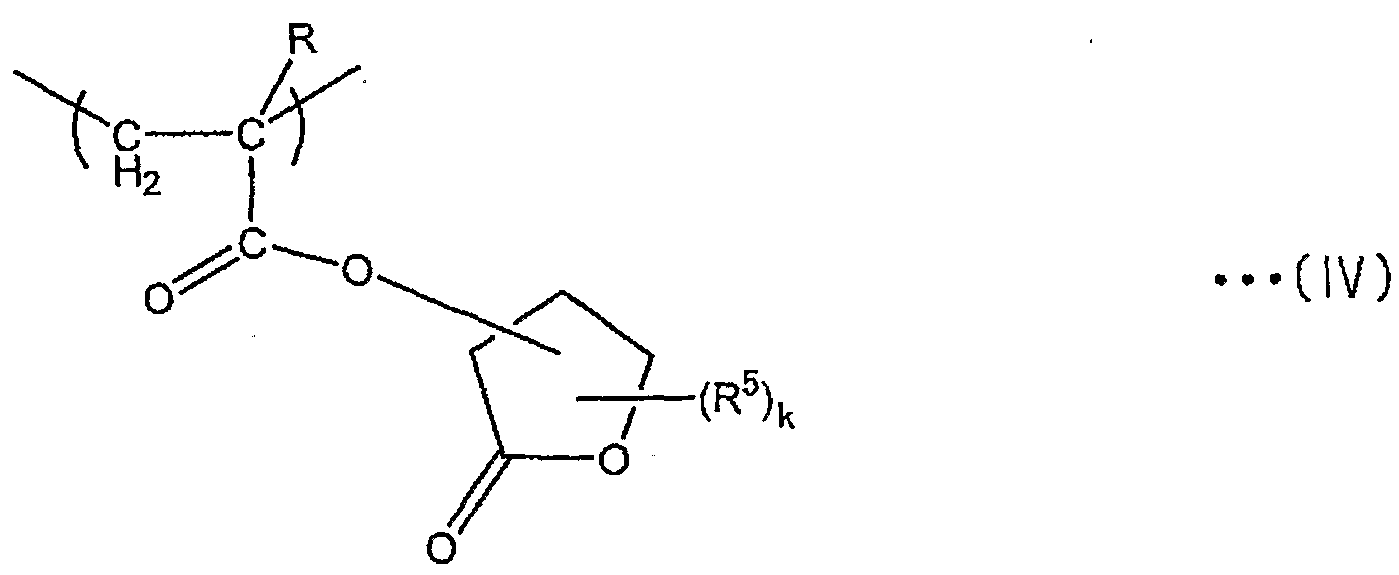
- the following general formula (IV) derived from an ( ⁇ -lower alkyl) acrylate ester containing a lactone-containing aliphatic monocyclic group or an aliphatic polycyclic group, ) And (VI) are preferred.
- R 5 is a hydrogen atom or a lower alkyl group, and when R 5 is a lower alkyl group, k is an integer of 1 to 4, and R 5 is a hydrogen atom. In the formula, k is an integer of 1 to 2.
- R 5 may be linear or branched, and is preferably an alkyl group having 1 to 5, more preferably 1 to 3 carbon atoms. Can be
- the structural unit represented by the general formula (IV) is most preferable because it is suitable for monodispersion of the obtained component (A) and has excellent resolution and PEB margin.
- the following general formula (V I I) is more preferable as the general formula (IV).
- the component (A) may have a polarity as a structural unit (a) in addition to the structural unit (a-1) or in addition to the structural unit (a-1) unit and the structural unit (a-2).
- a structural unit ( a -3) derived from an ( ⁇ -lower alkyl) acrylate ester containing a group-containing aliphatic hydrocarbon group increases the hydrophilicity of the entire component (A) with the developer, and In parts, alkali solubility is improved. Therefore, it contributes to improvement in resolution.
- Examples of the polar group include a hydroxyl group and a cyano group, and a hydroxyl group is preferable.
- Examples of the aliphatic hydrocarbon group include a linear or branched hydrocarbon group (alkylene group) having 1 to 10 carbon atoms and an aliphatic polycyclic group.
- alkylene group alkylene group having 1 to 10 carbon atoms
- an aliphatic polycyclic group As the aliphatic polycyclic group in the structural unit (a-3), any of the same polycyclic groups as those exemplified in the structural unit (a-1) can be appropriately selected and used.
- the hydrocarbon group in the polar group-containing aliphatic hydrocarbon group is a linear hydrocarbon group having 1 to 10 carbon atoms, ( ⁇ -lower alkyl) acrylic acid Structural units derived from hydroxyethyl ester, and when the hydrocarbon group is an aliphatic polycyclic group, a structural unit represented by the following general formula (VIII) is preferred.
- the number of ⁇ is 1, and the hydroxyl group is bonded to the 3-position of the adamantyl group.
- the number of ⁇ is 1, and the hydroxyl group is bonded to the 3-position of the adamantyl group.
- the structural unit (a-1) is in the range of 30 to 60 mol%, preferably 30 to 50 mol%, because of excellent resolution.
- Structural units (a- 2) 2 0-60 mole 0/0, preferably favored excellent resolution to range from 20 to 50 mol% arbitrariness.
- Structural units (a- 3) force SO ⁇ 50 mole%, preferably in the range of excellent resist pattern shape when in the range of 10 to 40 mole 0/0 preferred.
- the component (A) includes, as the structural unit (a-4), an aliphatic polycyclic group other than the structural units (a-1), (a-12), and (a-3).
- Alkyl A structural unit derived from an acrylate ester may be included.
- the units other than the structural units (a-1), -2), and (a-3) mean that they do not overlap with these, and the aliphatic polycyclic group includes the above-mentioned (a-1) , (A-2), and a large number of aliphatic polycyclic groups similar to those in (a-3).
- Many such structural units (a-4) have been known as ArF positive resist materials, but in particular, tricyclodecanyl (meth) acrylate, adamantyl (meth) acrylate And a unit derived from at least one selected from tetracyclodecanyl (meth) acrylates, which is preferable in terms of industrial availability. These structural units are shown below as structural formulas.
- each unit in the case of a 4-way system structural units (a- 1) is 25 to 50 mol%, preferably in the range of 30-40 mole 0/0, the structural units (a - 2) 25 ⁇ 50 molar 0/0, preferably in the range of 30-40 mole 0/0, the structural units (a - 3) is 10-30 mol%, preferably 10 to 20 mole 0 /.
- constituent units (a -4) 5 to 25 mol% preferably may range from 10 to 20 mole 0/0, to improve the depth of focus of an isolated pattern, reducing the proximity effect It is preferable because it is possible. If the ratio is out of this range, there is a problem that the resolution deteriorates, which is not preferable.
- the component (A) is a resin synthesized by a living radical polymerization method.
- living ion polymerization Also known is a method called living ion polymerization.
- a catalyst such as butyllithium is used, but for certain monomers, the problem is that the catalyst is lost and the chain reaction does not proceed (monomer selectivity). is there. More specifically, when a monomer containing a ⁇ -butyrolataton residue contained in the structural unit (a-2) or a monomer containing a hydroxyl group contained in the structural unit (a-3) is used, The polymerization reaction does not proceed because the catalyst preferentially attacks the sulfonic group and the hydroxyl group rather than the ethylenic double bond.
- living radical polymerization does not have the monomer selectivity problem found in living anion polymerization, and allows a wide selection of monomers.
- monodispersion can be performed significantly compared to free radical polymerization.
- each constituent unit of the component (A) a ⁇ -petit mouth rataton residue or the like contained in the constituent unit (a-2), which is difficult to be used in the above-mentioned living-chain polymerization,
- the structural unit (a-3) contains a hydroxyl group, the merits are particularly exhibited in living / radical polymerization.
- polymerization is performed using the above dithio compound. More specifically, the monomers, the polymerization initiator and the dithio compound may be dissolved in an organic solvent and reacted by heating, stirring, or the like. The temperature and time during the polymerization may be substantially the same as in the free radical polymerization, and may be appropriately adjusted depending on the polymer having the desired structural unit, its mass average molecular weight, and the like.
- the Mw and the dispersity (M.wZM n) of the component (A) thus obtained can be determined by gel permeation chromatography in terms of polystyrene.
- component (B) an arbitrary one can be appropriately selected from those conventionally known as an acid generator in a chemically amplified resist.
- an ionic salt having a fluorinated alkylsulfonic acid ion as an anion is preferable.
- preferred acid generators include diphenyl dimethyl trifluoromethanesulfonate, (4-methoxyphenyl phenol) phenol trifluoromethane sulfonate, and bis (p-tert-butyl phenyl) phenol.
- one type of acid generator may be used alone, or two or more types may be used in combination. They may be used together.
- Component (B) is used in an amount of 0.5 to 30 parts by mass, preferably 1 to 10 parts by mass, per 100 parts by mass of component (A). If the amount is less than 0.5 part by mass, pattern formation may not be sufficiently performed. If the amount exceeds 30 parts by mass, a uniform solution may not be easily obtained, and storage stability may be deteriorated.
- the positive resist composition of the present invention can be produced by dissolving the materials in an organic solvent (C).
- any component can be used as long as it can dissolve each component to be used and can form a uniform solution, and any of those conventionally known as solvents for chemically amplified resists can be used.
- One or more types can be appropriately selected and used.
- ketones such as acetone, methyl ethyl ketone, hexahexanone, methyl isoaminophenol, 2-heptanone, ethylene glycolone, ethylene glycolone monoacetate, diethylene glycoloneole, diethylene glycolone monoacetate
- Polyhydric compounds such as propylene glycol monoole, propylene glycol monoacetate, zipper pyrendalcol, or dipropylene daricole monoacetate monomethinole ether, monoethyl ether, monopropyl ether, monobutyl ether or monophenyl ether Alcohols and their derivatives, cyclic ethers such as dioxane, methyl lactate, ethyl lactate, methyl acetate, ethyl acetate, butyl acetate, methyl pyruvate, ethyl pyruvate, methoxy Propionic acid methylation, esters such as E Toki ciprofib
- the amount used is not particularly limited, but is set to a concentration that can be applied to a substrate or the like.
- the positive resist composition of the present invention includes a resist pattern shape and post exposure stability (the latent image formed by the Dattern wise).
- a nitrogen-containing organic compound can be further added as an optional component (D).
- any known compounds may be used arbitrarily, but a secondary lower aliphatic amine ⁇ a tertiary lower aliphatic amine is preferred.
- the lower aliphatic amine refers to an alkyl or alkyl alcohol having 5 or less carbon atoms.
- the secondary and tertiary amines include trimethylamine, getylamine, triethylamine, and di-n-amine. Examples thereof include propylamine, tree n-propylamine, tripentylamine, diethanolamine, triethanolamine, and triisopropanolamine, and tertiary alkanolamine such as triethanolamine is particularly preferable.
- an organic carboxylic acid or an oxo acid of phosphorus or Its derivatives can be included.
- the component (D) and the component (E) can be used in combination, or one of them can be used.
- organic carboxylic acid for example, malonic acid, citric acid, malic acid, succinic acid, benzoic acid, salicylic acid and the like are suitable.
- Phosphorus oxo acids or derivatives thereof include phosphoric acid, derivatives such as phosphoric acid, di-n-butyl ester, diphenyl phosphate, etc., phosphonic acid, dimethyl phosphonate, phosphonic acid Derivatives such as phosphonic acids and their esters, such as -di-n-butyl ester, pheninolephosphonic acid, diphenylenostenole phosphonate, and dibenzyl phosphonate; phosphinic acids such as phosphinic acid and phenylphosphinic acid; and Ester of Among these, phosphonic acid is particularly preferred.
- the component (E) is used in an amount of 0.01 to 5.0 parts by mass per 100 parts by mass of the component (A).
- the positive resist composition of the present invention may further contain additives that are miscible as required, such as an additional resin for improving the performance of the resist film, a surfactant for improving coatability, and a dissolution inhibitor. , A plasticizer, a stabilizer, a coloring agent, an antihalation agent and the like can be appropriately added and contained.
- the above-described positive resist composition of the present invention has a wide PEB margin. It also has excellent heat resistance. Further, as an effect that spreads from the width of the PEB margin, uneven heating in the substrate surface is unlikely to occur, so that the in-plane uniformity of the resist layer formed on the substrate using the positive resist composition is improved. High, for example, even in 300mm ⁇ a wafer which is expected to be mass-produced in the future, it is possible to stably form a resist pattern of a desired fine size. Method of forming resist pattern>
- the formation of the resist pattern can be performed, for example, as follows.
- the above-mentioned positive resist composition is applied by a spinner or the like, and prebaked for 40 to 120 seconds, preferably 60 to 90 seconds at a temperature of 80 to 150 ° C, After selectively exposing an ArF excimer laser beam through a desired mask pattern using, for example, an ArF exposure apparatus, PEB (post-exposure heating) is performed under a temperature condition of 80 to 150 ° C. For 40 to 120 seconds, preferably 60 to 90 seconds. Then an alkaline developing solution, developing is conducted using an example from 0.1 to 10 weight 0/0 tetramethyl ⁇ emissions monitor ⁇ beam hydroxide aqueous solution. Thus, a resist pattern faithful to the mask pattern can be obtained.
- PEB post-exposure heating
- An organic or inorganic antireflection film may be provided between the substrate and the coating layer of the resist composition.
- Wavelength used for the exposure is not particularly limited, A r F excimer laser, Kr F E key island laser, F 2 excimer laser, EUV (extreme ultraviolet), VUV (vacuum ultraviolet), It can be performed using radiation such as EB (electron beam), X-ray, and soft X-ray.
- the resist composition according to the present invention is effective for an ArF excimer laser.
- component (A) 100 parts by weight of component (A), 3.5 parts by weight of component (B), 25 parts by weight of component (D) 25 parts by weight of ⁇ -butyrolactone, propylene glycol monomethyl ether acetate and ethyl lactate weight ratio
- component (B) 100 parts by weight of component (A), 3.5 parts by weight of component (B), 25 parts by weight of component (D) 25 parts by weight of ⁇ -butyrolactone, propylene glycol monomethyl ether acetate and ethyl lactate weight ratio
- the mixture was dissolved in 9: 0 mass parts of a mixture of 8: 2 to obtain a uniform positive resist solution.
- the copolymer (A 1) was polymerized by a living radical method.
- the Mw of the copolymer (A 1) is 9100, and the absorbance at 193 nm is
- the substrate was treated with PEB at 95 ° C for 90 seconds, and then padded with an aqueous solution of 2.38% by mass of tetramethylammonium hydroxide at 23 ° C for 30 seconds. It was developed, washed with water for 20 seconds and dried.
- a line-and-space pattern (1: 1) of 120 nm was formed in a good shape. Its depth of focus was 700 m. The limit resolution was up to 110.
- the PEB margin was expressed as a resist pattern dimensional change per unit time (nm / ° C). The smaller the value, the better the PEB margin.
- the PEB margin in this example was 5.7 11111 ° (:).
- Comparative Example 1 the method for polymerizing the acrylate copolymer (A 1) of component (A) was An acrylate copolymer (A 2) having similar monomer units in the same ratio except that the radical method was changed to the free radical polymerization was prepared: Mass average molecular weight of the copolymer (A 2) Is 15000, the absorbance at 193 nm is less than 0.232 ( ⁇ / ⁇ ), the dispersity (MwZMn) is 1.82, and Tg is 1 15 ° C.
- Example 1 a positive resist solution having the same composition as in Example 1 was prepared, and then patterned in the same manner as in Example 1.
- a line-and-space pattern (1: 1) of 120 nm has a good shape.
- the depth of focus and the critical resolution were the same as in Example 1, but the PEB margin was poor at 8.1 nmZ ° C.
- the positive resist composition of the present invention has high resolution and a wide PEB margin.
Landscapes
- Physics & Mathematics (AREA)
- Spectroscopy & Molecular Physics (AREA)
- General Physics & Mathematics (AREA)
- Materials For Photolithography (AREA)
- Exposure And Positioning Against Photoresist Photosensitive Materials (AREA)
- Photosensitive Polymer And Photoresist Processing (AREA)
- Addition Polymer Or Copolymer, Post-Treatments, Or Chemical Modifications (AREA)
Abstract
Description


Claims




Applications Claiming Priority (2)
| Application Number | Priority Date | Filing Date | Title |
|---|---|---|---|
| JP2003-174862 | 2003-06-19 | ||
| JP2003174862A JP2005010488A (ja) | 2003-06-19 | 2003-06-19 | ポジ型レジスト組成物 |
Publications (1)
| Publication Number | Publication Date |
|---|---|
| WO2004114022A1 true WO2004114022A1 (ja) | 2004-12-29 |
Family
ID=33534801
Family Applications (1)
| Application Number | Title | Priority Date | Filing Date |
|---|---|---|---|
| PCT/JP2004/008785 Ceased WO2004114022A1 (ja) | 2003-06-19 | 2004-06-16 | ポジ型レジスト組成物 |
Country Status (3)
| Country | Link |
|---|---|
| JP (1) | JP2005010488A (ja) |
| TW (1) | TW200504468A (ja) |
| WO (1) | WO2004114022A1 (ja) |
Cited By (1)
| Publication number | Priority date | Publication date | Assignee | Title |
|---|---|---|---|---|
| WO2005124463A1 (ja) * | 2004-06-21 | 2005-12-29 | Tokyo Ohka Kogyo Co., Ltd. | ポジ型レジスト組成物及びレジストパターン形成方法 |
Families Citing this family (4)
| Publication number | Priority date | Publication date | Assignee | Title |
|---|---|---|---|---|
| JP2006208546A (ja) * | 2005-01-26 | 2006-08-10 | Tokyo Ohka Kogyo Co Ltd | レジストパターン形成方法 |
| JP4498939B2 (ja) | 2005-02-01 | 2010-07-07 | 東京応化工業株式会社 | ポジ型レジスト組成物およびレジストパターン形成方法 |
| JP2006349800A (ja) * | 2005-06-14 | 2006-12-28 | Tokyo Ohka Kogyo Co Ltd | ポジ型レジスト組成物およびレジストパターン形成方法 |
| WO2026070556A1 (ja) * | 2024-09-30 | 2026-04-02 | 富士フイルム株式会社 | 感活性光線性又は感放射線性樹脂組成物、レジスト膜、パターン形成方法、及び電子デバイスの製造方法 |
Citations (13)
| Publication number | Priority date | Publication date | Assignee | Title |
|---|---|---|---|---|
| JPH11352695A (ja) * | 1998-06-11 | 1999-12-24 | Sumitomo Chem Co Ltd | 狭分散性重合体を用いたポジ型レジスト組成物 |
| JP2001183836A (ja) * | 1999-12-22 | 2001-07-06 | Sumitomo Chem Co Ltd | 化学増幅型ポジ型レジスト組成物 |
| JP2002003553A (ja) * | 2000-06-23 | 2002-01-09 | Denki Kagaku Kogyo Kk | クロス鎖にポリエンを含むクロス共重合体及びその製造方法 |
| JP2002155118A (ja) * | 2000-09-07 | 2002-05-28 | Shin Etsu Chem Co Ltd | 高分子化合物、レジスト材料及びパターン形成方法 |
| JP2002251009A (ja) * | 2001-02-23 | 2002-09-06 | Daicel Chem Ind Ltd | フォトレジスト用重合性不飽和化合物 |
| JP2002275215A (ja) * | 2001-01-09 | 2002-09-25 | Mitsubishi Rayon Co Ltd | 重合体、化学増幅型レジスト組成物、および、パターン形成方法 |
| JP2003084436A (ja) * | 2001-09-10 | 2003-03-19 | Tokyo Ohka Kogyo Co Ltd | 化学増幅型レジスト組成物 |
| JP2003122014A (ja) * | 2001-10-19 | 2003-04-25 | Mitsubishi Rayon Co Ltd | 共重合体 |
| WO2003048861A1 (en) * | 2001-12-03 | 2003-06-12 | Tokyo Ohka Kogyo Co., Ltd. | Positive resist composition and method of forming resist pattern from the same |
| JP2003167347A (ja) * | 2001-12-03 | 2003-06-13 | Tokyo Ohka Kogyo Co Ltd | ポジ型レジスト組成物及びレジストパターンの形成方法 |
| JP2003167346A (ja) * | 2001-12-03 | 2003-06-13 | Tokyo Ohka Kogyo Co Ltd | ポジ型レジスト組成物及びレジストパターン形成方法 |
| JP2003215806A (ja) * | 2002-01-25 | 2003-07-30 | Sumitomo Chem Co Ltd | レジスト組成物 |
| JP2003238629A (ja) * | 2002-02-19 | 2003-08-27 | Sumitomo Bakelite Co Ltd | 化学増幅型フォトレジスト用ポリマー及びフォトレジスト組成物 |
-
2003
- 2003-06-19 JP JP2003174862A patent/JP2005010488A/ja not_active Withdrawn
-
2004
- 2004-06-16 TW TW093117382A patent/TW200504468A/zh unknown
- 2004-06-16 WO PCT/JP2004/008785 patent/WO2004114022A1/ja not_active Ceased
Patent Citations (13)
| Publication number | Priority date | Publication date | Assignee | Title |
|---|---|---|---|---|
| JPH11352695A (ja) * | 1998-06-11 | 1999-12-24 | Sumitomo Chem Co Ltd | 狭分散性重合体を用いたポジ型レジスト組成物 |
| JP2001183836A (ja) * | 1999-12-22 | 2001-07-06 | Sumitomo Chem Co Ltd | 化学増幅型ポジ型レジスト組成物 |
| JP2002003553A (ja) * | 2000-06-23 | 2002-01-09 | Denki Kagaku Kogyo Kk | クロス鎖にポリエンを含むクロス共重合体及びその製造方法 |
| JP2002155118A (ja) * | 2000-09-07 | 2002-05-28 | Shin Etsu Chem Co Ltd | 高分子化合物、レジスト材料及びパターン形成方法 |
| JP2002275215A (ja) * | 2001-01-09 | 2002-09-25 | Mitsubishi Rayon Co Ltd | 重合体、化学増幅型レジスト組成物、および、パターン形成方法 |
| JP2002251009A (ja) * | 2001-02-23 | 2002-09-06 | Daicel Chem Ind Ltd | フォトレジスト用重合性不飽和化合物 |
| JP2003084436A (ja) * | 2001-09-10 | 2003-03-19 | Tokyo Ohka Kogyo Co Ltd | 化学増幅型レジスト組成物 |
| JP2003122014A (ja) * | 2001-10-19 | 2003-04-25 | Mitsubishi Rayon Co Ltd | 共重合体 |
| WO2003048861A1 (en) * | 2001-12-03 | 2003-06-12 | Tokyo Ohka Kogyo Co., Ltd. | Positive resist composition and method of forming resist pattern from the same |
| JP2003167347A (ja) * | 2001-12-03 | 2003-06-13 | Tokyo Ohka Kogyo Co Ltd | ポジ型レジスト組成物及びレジストパターンの形成方法 |
| JP2003167346A (ja) * | 2001-12-03 | 2003-06-13 | Tokyo Ohka Kogyo Co Ltd | ポジ型レジスト組成物及びレジストパターン形成方法 |
| JP2003215806A (ja) * | 2002-01-25 | 2003-07-30 | Sumitomo Chem Co Ltd | レジスト組成物 |
| JP2003238629A (ja) * | 2002-02-19 | 2003-08-27 | Sumitomo Bakelite Co Ltd | 化学増幅型フォトレジスト用ポリマー及びフォトレジスト組成物 |
Cited By (1)
| Publication number | Priority date | Publication date | Assignee | Title |
|---|---|---|---|---|
| WO2005124463A1 (ja) * | 2004-06-21 | 2005-12-29 | Tokyo Ohka Kogyo Co., Ltd. | ポジ型レジスト組成物及びレジストパターン形成方法 |
Also Published As
| Publication number | Publication date |
|---|---|
| TW200504468A (en) | 2005-02-01 |
| JP2005010488A (ja) | 2005-01-13 |
Similar Documents
| Publication | Publication Date | Title |
|---|---|---|
| TWI373691B (en) | Resist pattern forming method | |
| TWI311235B (ja) | ||
| WO2006054432A1 (ja) | ネガ型レジスト組成物 | |
| WO2008012999A1 (en) | Positive resist composition and method of forming resist pattern | |
| WO2004108780A1 (ja) | ホトレジスト組成物用樹脂、ホトレジスト組成物、およびレジストパターン形成方法 | |
| JP4040537B2 (ja) | ネガ型レジスト組成物、及びそれを用いたレジストパターン形成方法 | |
| TWI286670B (en) | Positive resist composition and resist pattern formation method | |
| JP4040536B2 (ja) | ネガ型レジスト組成物、及びそれを用いたレジストパターン形成方法 | |
| JP4434570B2 (ja) | 樹脂の製造方法 | |
| WO2005101128A1 (ja) | ポジ型レジスト組成物及びレジストパターン形成方法 | |
| WO2007148492A1 (ja) | ポジ型レジスト組成物およびレジストパターン形成方法 | |
| JP4628809B2 (ja) | ネガ型レジスト組成物およびレジストパターン形成方法 | |
| WO2004114022A1 (ja) | ポジ型レジスト組成物 | |
| WO2007148525A1 (ja) | ポジ型レジスト組成物およびレジストパターン形成方法 | |
| KR100910147B1 (ko) | 포지티브형 레지스트 조성물 및 레지스트 패턴 형성 방법 | |
| WO2006123496A1 (ja) | ポジ型レジスト組成物およびレジストパターン形成方法 | |
| JP4493938B2 (ja) | ポジ型レジスト組成物及びレジストパターン形成方法 | |
| TWI313270B (en) | Method of producing (meth) acrylic acid derivative polymer for resist | |
| WO2005116768A1 (ja) | ポジ型レジスト組成物及びそれを用いたレジストパターン形成方法 | |
| WO2006080151A1 (ja) | レジストパターン形成方法 | |
| WO2005106587A1 (ja) | ポジ型レジスト組成物、レジストパターン形成方法及びイオンインプランテーション方法 | |
| WO2006038477A1 (ja) | 高分子化合物、ポジ型レジスト組成物およびレジストパターン形成方法 | |
| JP2005164633A (ja) | ポジ型レジスト組成物及びレジストパターン形成方法 | |
| JP2005070742A (ja) | ポジ型レジスト組成物及びレジストパターン形成方法 | |
| JP4184212B2 (ja) | 低加速電子線用ポジ型レジスト組成物 |
Legal Events
| Date | Code | Title | Description |
|---|---|---|---|
| AK | Designated states |
Kind code of ref document: A1 Designated state(s): AE AG AL AM AT AU AZ BA BB BG BR BW BY BZ CA CH CN CO CR CU CZ DE DK DM DZ EC EE EG ES FI GB GD GE GH GM HR HU ID IL IN IS KE KG KP KR KZ LC LK LR LS LT LU LV MA MD MG MK MN MW MX MZ NA NI NO NZ OM PG PH PL PT RO RU SC SD SE SG SK SL SY TJ TM TN TR TT TZ UA UG US UZ VC VN YU ZA ZM ZW |
|
| AL | Designated countries for regional patents |
Kind code of ref document: A1 Designated state(s): BW GH GM KE LS MW MZ NA SD SL SZ TZ UG ZM ZW AM AZ BY KG KZ MD RU TJ TM AT BE BG CH CY CZ DE DK EE ES FI FR GB GR HU IE IT LU MC NL PL PT RO SE SI SK TR BF BJ CF CG CI CM GA GN GQ GW ML MR NE SN TD TG |
|
| 121 | Ep: the epo has been informed by wipo that ep was designated in this application | ||
| 122 | Ep: pct application non-entry in european phase |