USPP6050P - Chrysanthemum plant named Kardo - Google Patents
Chrysanthemum plant named Kardo Download PDFInfo
- Publication number
- USPP6050P USPP6050P US06/786,001 US78600185V US6050P US PP6050 P USPP6050 P US PP6050P US 78600185 V US78600185 V US 78600185V US 6050 P US6050 P US 6050P
- Authority
- US
- United States
- Prior art keywords
- kardo
- capitulum
- development
- flowering
- color
- Prior art date
- Legal status (The legal status is an assumption and is not a legal conclusion. Google has not performed a legal analysis and makes no representation as to the accuracy of the status listed.)
- Expired - Lifetime
Links
- 241000723353 Chrysanthemum Species 0.000 title claims 3
- 241000131317 Capitulum Species 0.000 claims 3
- 230000018109 developmental process Effects 0.000 claims 2
- 230000017260 vegetative to reproductive phase transition of meristem Effects 0.000 claims 2
- 235000005633 Chrysanthemum balsamita Nutrition 0.000 claims 1
- 241000196324 Embryophyta Species 0.000 claims 1
- 230000000977 initiatory effect Effects 0.000 claims 1
- 239000007921 spray Substances 0.000 claims 1
Images


Definitions
- the present invention comprises a new and distinct cultivar of Chrysanthemum, botanically known as Dentrenthema morifolium, Ramat., previously Chrysanthemum morifolium, Ramat., and referred to by the cultivar name Kardo.
- Kardo identified as 79L40001, was originated from a cross made in a controlled breeding program in Salinas, Calif., in 1979.
- the female parent of Kardo identified as 75211A01, was the cultivar identified as White Nova, disclosed in U.S. Plant Pat. No. 5,289.
- the male parent of Kardo identified as 78419004, was an unnamed seedling.
- Kardo was discovered and selected as one flowering plant within the progeny of the stated cross by William E. Duffett in July of 1980, in a controlled environment in Salinas, Calif.
- Kardo has not been observed under all possible environmental conditions.
- the phenotype may vary significantly with variations in environment such as temperature, light intensity and day length.
- Peduncle length ranging from 18 to 33 cm.
- Sheet 1 is a color photograph of Kardo grown as a single stem cut spray.
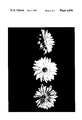
- Sheet 2 is a black and white photograph of three views of the inflorescence of Kardo.
- Sheet 3 is a black and white photograph showing the upper and under sides of the leaves of Kardo at three stages of development (mature, intermediate and immature).
- Color (general tonality from a distance of three meters).--Yellow-orange.
- Gynoecium --Present both ray and disc florets.
Landscapes
- Cultivation Of Plants (AREA)
- Breeding Of Plants And Reproduction By Means Of Culturing (AREA)
Abstract
A Chrysanthemum plant named Kardo particularly characterized as to uniqueness by the combined characteristics of flat capitulum form; daisy capitulum type; yellow-orange ray floret color; diameter across face of capitulum of up to 11 cm at maturity; uniform nine week photoperiodic flowering response to short days; tall plant height when grown single stem; 18 to 33 cm peduncles on open, normally terminal sprays; slow development of green discs and 13° C. minimum temperature tolerance for initiation and development of flowering buds with a 12 to 13 hour continuous dark period.
Description
The present invention comprises a new and distinct cultivar of Chrysanthemum, botanically known as Dentrenthema morifolium, Ramat., previously Chrysanthemum morifolium, Ramat., and referred to by the cultivar name Kardo.
Kardo, identified as 79L40001, was originated from a cross made in a controlled breeding program in Salinas, Calif., in 1979. The female parent of Kardo, identified as 75211A01, was the cultivar identified as White Nova, disclosed in U.S. Plant Pat. No. 5,289. The male parent of Kardo, identified as 78419004, was an unnamed seedling.
Kardo was discovered and selected as one flowering plant within the progeny of the stated cross by William E. Duffett in July of 1980, in a controlled environment in Salinas, Calif.
The first act of asexual reproduction of Kardo was accomplished when vegetative cuttings were taken from the initial selection in October of 1980 in a controlled environment in Salinas, Calif. by a technician working under formulations established and supervised by William E. Duffett.
Horticultural examination of controlled flowerings of successive plantings has shown that the unique combination of characteristics as herein disclosed for Kardo are firmly fixed and are retained through successive generations of asexual reproduction.
Kardo has not been observed under all possible environmental conditions. The phenotype may vary significantly with variations in environment such as temperature, light intensity and day length.
The following observations, measurements and comparisons describe plants grown in Salinas, Calif. and Bogota, Colombia under greenhouse conditions which approximate those generally used in commercial greenhouse practice.
The following traits have been repeatedly observed and are determined to be basic characteristics of Kardo which, in combination, distinguish this Chrysanthemum as a new and distinct cultivar:
(1) Flat capitulum form.
(2) Daisy capitulum type.
(3) Yellow-orange ray floret color.
(4) Diameter across face of capitulum up to 11 cm. at maturity.
(5) Uniform nine week photoperiodic flowering response to short days.
(6) Peduncle length ranging from 18 to 33 cm.
(7) Tall plant height, requiring one long day week prior to short days to attain a flowered plant height of 95 to 105 cm for year around flowering.
(8) Low temperature tolerance of 13° C. for initiation and development of flowering buds when grown in single stem cut spray programs with a continuous dark period of 12 to 13 hours.
The accompanying photographic drawings show typical inflorescence and leaf characteristics of Kardo, with the colors being as nearly true as possible with illustrations of this type.
Sheet 1 is a color photograph of Kardo grown as a single stem cut spray.
Sheet 2 is a black and white photograph of three views of the inflorescence of Kardo.
Sheet 3 is a black and white photograph showing the upper and under sides of the leaves of Kardo at three stages of development (mature, intermediate and immature).
Of the commercial cultivars known to the inventor, the most similar in comparison to Kardo is Amber, disclosed in U.S. Plant Pat. No. 3,969. Reference is made to attached Chart A, which compares certain characteristics of Kardo to the same characteristics of Amber. Similar traits are type, form, response and low temperature tolerance. Kardo develops a lighter ray floret color, longer peduncles, larger capitulum diameter and taller plant height than Amber.
In the following description, color references are made to The Royal Horticultural Society Colour Chart. The exact colors for corolla of ray florets are not precisely represented in The Royal Horticultural Society Colour Chart (RHS), and the colors given are the closest to the actual color of Kardo. The color values were determined on plant material grown in Salinas, Calif. on July 18, 1985.
Classification:
Botanical.--Dentrenthema morifolium, Ramat., cv Kardo.
Commercial.--Daisy cut spray mum.
A. Capitulum:
Form.--Flat.
Type.--Daisy.
Diameter across face.--Up to 11 cm at maturity.
B. Corolla of ray florets:
Color (general tonality from a distance of three meters).--Yellow-orange.
Color (upper surface).--Base color 19A to 20B, overlaid with 167B.
Color (under surface).--14C.
Shape.--Oblong.
C. Corolla of disc florets:
Color (mature).--14C.
Color (immature).--7A.
D. Reproductive organs:
Androecium.--Present disc florets only; moderate pollen.
Gynoecium.--Present both ray and disc florets.
A. General appearance:
Height.--Tall; 95 to 105 cm. as a flowering plant from a rooted cutting with seven long days for year around flowerings maintaining a continuous dark period of 12 to 13 hours.
B. Foliage:
Color (upper surface).--147A.
Color (under surface).--137B-137C.
Shape.--Narrow, deeply lobed and sharply serrated.
              CHART A
______________________________________
COMPARISON OF KARDO AND AMBER
______________________________________
                  CAPIT-
                  ULUM             DIAMETER
                  FORM     SPRAY   ACROSS
CULTI- FLORET     AND      FORMA-  FACE OF
VAR    COLOR      TYPE     TION    CAPITULUM
______________________________________
KARDO  YELLOW-    FLAT     18 to   UP TO 11 cm.
       ORANGE     DAISY    33 cm.
                           PEDUN-
                           CLES
AMBER  ORANGE     FLAT     15 to   UP TO 8 cm.
                  DAISY    20 cm.
                           PEDUN-
                           CLES
______________________________________
                              LOW
CULTI- PLANT      FLOWERING   TEMPERATURE
VAR    HEIGHT     RESPONSE    TOLERANCE
______________________________________
KARDO  TALL,      9 WEEKS     13° C.
       95 to
       105 cm.
AMBER  MEDIUM,    9 WEEKS     13° C.
       80 to
       90 cm.
______________________________________
COMPARISONS MADE OF PLANTS GROWN AS SINGLE
STEM CUT SPRAY MUMS WITH SEVEN LONG DAYS
UB SALINAS, CALIFORNIA
______________________________________
Claims (1)
1. A new and distinct Chrysanthemum plant named Kardo, as described and illustrated, and particularly characterized as to uniqueness by the combined characteristics of flat capitulum form; daisy capitulum type; yellow-orange ray floret color; diameter across face of capitulum of up to 11 cm at maturity; uniform nine week photoperiodic flowering response to short days; tall plant height when grown single stem; 18 to 33 cm peduncles on open, normally terminal sprays; slow development of green discs; and 13° C. minimum temperature tolerance for initiation and development of flowering buds with a 12 to 13 hour continuous dark period.
Priority Applications (1)
| Application Number | Priority Date | Filing Date | Title |
|---|---|---|---|
| US06/786,001 USPP6050P (en) | 1985-10-10 | 1985-10-10 | Chrysanthemum plant named Kardo |
Applications Claiming Priority (1)
| Application Number | Priority Date | Filing Date | Title |
|---|---|---|---|
| US06/786,001 USPP6050P (en) | 1985-10-10 | 1985-10-10 | Chrysanthemum plant named Kardo |
Publications (1)
| Publication Number | Publication Date |
|---|---|
| USPP6050P true USPP6050P (en) | 1987-12-01 |
Family
ID=25137305
Family Applications (1)
| Application Number | Title | Priority Date | Filing Date |
|---|---|---|---|
| US06/786,001 Expired - Lifetime USPP6050P (en) | 1985-10-10 | 1985-10-10 | Chrysanthemum plant named Kardo |
Country Status (1)
| Country | Link |
|---|---|
| US (1) | USPP6050P (en) |
-
1985
- 1985-10-10 US US06/786,001 patent/USPP6050P/en not_active Expired - Lifetime
Similar Documents
| Publication | Publication Date | Title |
|---|---|---|
| USPP6399P (en) | Chrysanthemum plant named Vero | |
| USPP6881P (en) | Chrysanthemum plant named Fina | |
| USPP6954P (en) | Chrysanthemum plant named Cream Vero | |
| USPP6943P (en) | Chrysanthemum plant named Yellow Vero | |
| USPP6886P (en) | Chrysanthemum plant named Moda | |
| USPP6497P (en) | Chrysanthemum plant named Brioso | |
| USPP6058P (en) | Chrysanthemum plant named Solo | |
| USPP6050P (en) | Chrysanthemum plant named Kardo | |
| USPP5996P (en) | Chrysanthemum plant named Falma | |
| USPP6882P (en) | Chrysanthemum plant named Oreo | |
| USPP7019P (en) | Chrysanthemum plant named Nevado | |
| USPP6902P (en) | Chrysanthemum plant named Caricia | |
| USPP6124P (en) | Chrysanthemum plant named Omegon | |
| USPP6903P (en) | Chrysanthemum plant named Paleto | |
| USPP6900P (en) | Chrysanthemum plant named Apto | |
| USPP7407P (en) | Chrysanthemum plant named Momento | |
| USPP6051P (en) | Chrysanthemum plant named Calvex | |
| USPP5414P (en) | Chrysanthemum plant named Foxy | |
| USPP5736P (en) | Chrysanthemum plant named Citron | |
| USPP6125P (en) | Chrysanthemum plant named Iridon | |
| USPP7406P (en) | Chrysanthemum plant named Conquista | |
| USPP6904P (en) | Chrysanthemum plant named Nacido | |
| USPP7464P (en) | Chrysanthemum plant named Paloma | |
| USPP7594P (en) | Chrysanthemum plant named White Oreo | |
| USPP6883P (en) | Chrysanthemum plant named Fasto |
Legal Events
| Date | Code | Title | Description |
|---|---|---|---|
| AS | Assignment |
Owner name: YODER BROTHERS, INC., BOX 230, BARBERTON, OH., A C Free format text: ASSIGNMENT OF ASSIGNORS INTEREST.;ASSIGNOR:DUFFETT, WILLIAM E.;REEL/FRAME:004483/0919 Effective date: 19851003 |