US9837657B2 - Assembled battery - Google Patents

Assembled battery Download PDF

Info

Publication number
US9837657B2
US9837657B2 US14/964,100 US201514964100A US9837657B2 US 9837657 B2 US9837657 B2 US 9837657B2 US 201514964100 A US201514964100 A US 201514964100A US 9837657 B2 US9837657 B2 US 9837657B2
Authority
US
United States
Prior art keywords
battery cells
connection part
bus bar
circuit board
concave portion
Prior art date
Legal status (The legal status is an assumption and is not a legal conclusion. Google has not performed a legal analysis and makes no representation as to the accuracy of the status listed.)
Active
Application number
US14/964,100
Other versions
US20160172647A1 (en
Inventor
Hiroshi OKIGA
Current Assignee (The listed assignees may be inaccurate. Google has not performed a legal analysis and makes no representation or warranty as to the accuracy of the list.)
Toyota Motor Corp
Original Assignee
Toyota Motor Corp
Priority date (The priority date is an assumption and is not a legal conclusion. Google has not performed a legal analysis and makes no representation as to the accuracy of the date listed.)
Filing date
Publication date
Application filed by Toyota Motor Corp filed Critical Toyota Motor Corp
Publication of US20160172647A1 publication Critical patent/US20160172647A1/en
Application granted granted Critical
Publication of US9837657B2 publication Critical patent/US9837657B2/en
Active legal-status Critical Current
Anticipated expiration legal-status Critical

Links

Images

Classifications

    • H01M2/206
    • HELECTRICITY
    • H01ELECTRIC ELEMENTS
    • H01MPROCESSES OR MEANS, e.g. BATTERIES, FOR THE DIRECT CONVERSION OF CHEMICAL ENERGY INTO ELECTRICAL ENERGY
    • H01M50/00Constructional details or processes of manufacture of the non-active parts of electrochemical cells other than fuel cells, e.g. hybrid cells
    • H01M50/50Current conducting connections for cells or batteries
    • H01M50/569Constructional details of current conducting connections for detecting conditions inside cells or batteries, e.g. details of voltage sensing terminals
    • HELECTRICITY
    • H01ELECTRIC ELEMENTS
    • H01MPROCESSES OR MEANS, e.g. BATTERIES, FOR THE DIRECT CONVERSION OF CHEMICAL ENERGY INTO ELECTRICAL ENERGY
    • H01M10/00Secondary cells; Manufacture thereof
    • H01M10/42Methods or arrangements for servicing or maintenance of secondary cells or secondary half-cells
    • H01M10/48Accumulators combined with arrangements for measuring, testing or indicating the condition of cells, e.g. the level or density of the electrolyte
    • H01M10/482Accumulators combined with arrangements for measuring, testing or indicating the condition of cells, e.g. the level or density of the electrolyte for several batteries or cells simultaneously or sequentially
    • H01M2/204
    • HELECTRICITY
    • H01ELECTRIC ELEMENTS
    • H01MPROCESSES OR MEANS, e.g. BATTERIES, FOR THE DIRECT CONVERSION OF CHEMICAL ENERGY INTO ELECTRICAL ENERGY
    • H01M50/00Constructional details or processes of manufacture of the non-active parts of electrochemical cells other than fuel cells, e.g. hybrid cells
    • H01M50/50Current conducting connections for cells or batteries
    • H01M50/502Interconnectors for connecting terminals of adjacent batteries; Interconnectors for connecting cells outside a battery casing
    • H01M50/507Interconnectors for connecting terminals of adjacent batteries; Interconnectors for connecting cells outside a battery casing comprising an arrangement of two or more busbars within a container structure, e.g. busbar modules
    • YGENERAL TAGGING OF NEW TECHNOLOGICAL DEVELOPMENTS; GENERAL TAGGING OF CROSS-SECTIONAL TECHNOLOGIES SPANNING OVER SEVERAL SECTIONS OF THE IPC; TECHNICAL SUBJECTS COVERED BY FORMER USPC CROSS-REFERENCE ART COLLECTIONS [XRACs] AND DIGESTS
    • Y02TECHNOLOGIES OR APPLICATIONS FOR MITIGATION OR ADAPTATION AGAINST CLIMATE CHANGE
    • Y02EREDUCTION OF GREENHOUSE GAS [GHG] EMISSIONS, RELATED TO ENERGY GENERATION, TRANSMISSION OR DISTRIBUTION
    • Y02E60/00Enabling technologies; Technologies with a potential or indirect contribution to GHG emissions mitigation
    • Y02E60/10Energy storage using batteries

Definitions

  • the invention relates to an assembled battery, and particularly, relates to an assembled battery including a plurality of battery cells, a bus bar that electrically connects the battery cells with each other, and a circuit board that is electrically connected with the plurality of battery cells.
  • a circuit board for detecting the respective voltages of the battery cells and equalizing the respective voltages of the battery cells is electrically connected with the battery cells.
  • the circuit board is joined, by nuts, to electrode terminals of the plurality of battery cells, while the electrode terminals are respectively passed through holes formed on the circuit board.
  • the invention provides an assembled battery that makes it possible to absorb the thickness error between the battery cells, and to electrically connect the circuit board with the battery cells suitably.
  • An assembled battery is an assembled battery including: a plurality of battery cells; a bus bar that electrically connects the battery cells with each other; and a circuit board that is electrically connected with the battery cells, in which the bus bar has a first connection part and a second connection part, the first connection part being electrically connected with the battery cells, the second connection part being electrically connected with a connection part of the circuit board via a conductive adhesive, and the second connection part has a concave portion that contains the conductive adhesive.
  • the concave portion have an opening part at a bottom part. Therefore, it is possible to prevent a poor connection due to the non-filling of the conductive adhesive and an insufficient strength at a connection part between the bus bar and the circuit board.
  • the second connection part be connected with the first connection part via a step part, such that the gap between the second connection part and the battery cells is wider than the gap between the first connection part and the battery cells.
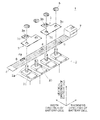
  • FIG. 1 is an enlarged exploded view showing an upper part of an assembled battery in Embodiment 1;
  • FIG. 2 is an enlarged plan view showing the assembled battery in Embodiment 1;
  • FIG. 3A is a plan view showing a bus bar in Embodiment 1;
  • FIG. 3B is a lateral view of the bus bar in Embodiment 1;
  • FIG. 4 is a diagram showing a state before a circuit board is electrically connected with the bus bar in Embodiment 1;
  • FIG. 5 is a diagram showing a state in which the circuit board is electrically connected with the bus bar in Embodiment 1;
  • FIG. 6 is a diagram showing a state before the circuit board is electrically connected with a bus bar in Embodiment 2;
  • FIG. 7A is a plan view showing a bus bar in Embodiment 3.
  • FIG. 7B is a lateral view of the bus bar in Embodiment 3.
  • FIG. 8A is a plan view showing a different bus bar in Embodiment 3.
  • FIG. 8B is a lateral view of the different bus bar in Embodiment 3.
  • FIG. 1 is an enlarged exploded view showing an upper part of the assembled battery in the embodiment.
  • FIG. 2 is an enlarged plan view showing the assembled battery in the embodiment.
  • FIG. 3A is a plan view showing a bus bar in the embodiment.
  • FIG. 3B is a lateral view of the bus bar in the embodiment.
  • the assembled battery 1 includes battery cells 2 , bus bars 3 , and a circuit board 4 .
  • the battery cell 2 is a general lithium-ion battery or the like.
  • an electrode terminal 2 a which is one of a positive electrode and a negative electrode, is provided at one end in the width direction of the battery cell 2
  • an electrode terminal 2 b which is the other of the positive electrode and the negative electrode, is provided at the other end.
  • the electrode terminals 2 a , 2 b in the embodiment which are rod screws, protrude upward from bases 2 c provided on the upper surfaces of the battery cells 2 , respectively.
  • the plurality of battery cells 2 are arrayed in the thickness direction of the battery cells 2 .
  • the bus bar 3 which is a plate-shaped member composed of a conductive material, electrically connects the electrode terminal 2 a of one of adjacent battery cells 2 and the electrode terminal 2 b of the other of the battery cells 2 .
  • the bus bar 3 in the embodiment is a flat plate member having a nearly T-shape as viewed from the thickness direction of the bus bar 3 , and has a first connection part 3 a that is electrically connected with the electrode terminals 2 a , 2 b , and a second connection part 3 b that is electrically connected with the circuit board 4 .
  • the shape of the bus bar 3 is not particularly limited, and for example, may be a nearly L-shape or the like.
  • bus bar 3 in the embodiment electrically connects the adjacent battery cells 2 with each other, the battery cells 2 to be connected do not need to be adjacent.
  • the border between the first connection part 3 a and the second connection part 3 b is shown by an alternate long and short dash line.
  • first connection part 3 a On the first connection part 3 a , holes 3 c are formed at an interval. As shown in FIG. 1 and FIG. 2 , the electrode terminal 2 a of one of the adjacent battery cells 2 and the electrode terminal 2 b of the other of the battery cells 2 are passed through the holes 3 c , respectively, and the first connection part 3 a is electrically connected with the electrode terminals 2 a , 2 b , by nuts 5 .
  • a concave portion 3 d that is dented in the thickness direction of the bus bar 3 is formed.
  • the concave portion 3 d in the embodiment is formed in a truncated cone shape, and is dented such that the diameter is reduced upward.
  • the concave portion 3 d contains a conductive adhesive 6 for electrically connecting the circuit board 4 .
  • the conductive adhesive 6 a general conductive adhesive can be used.
  • the circuit board 4 for detecting the respective voltages of the battery cells 2 and equalizing the voltages of the battery cells 2 , is electrically connected with the second connection part 3 b of the bus bars 3 via the conductive adhesives 6 .
  • the circuit board 4 in the embodiment is a printed circuit board, and can input and output signals for an external control device (the illustration is omitted), through a connector 7 .
  • the circuit board 4 includes a land 4 a , as a connection part that is connected with the bus bar 3 via the conductive adhesive 6 .
  • FIG. 4 is a diagram showing a state before the circuit board is electrically connected with the bus bar in the embodiment.
  • FIG. 5 is a diagram showing a state in which the circuit board is electrically connected with the bus bar in the embodiment.
  • the plurality of battery cells 2 are arrayed, and the electrode terminal 2 a of one of the adjacent battery cells 2 and the electrode terminal 2 b of the other of the battery cells 2 are passed through the holes 3 c of the bus bar 3 .
  • the nuts 5 are screwed around the electrode terminals 2 a , 2 b so that the first connection part 3 a of the bus bar 3 is sandwiched between the nuts 5 and the bases 2 c .
  • the bus bar 3 is electrically connected with the electrode terminals 2 a , 2 b.
  • the conductive adhesive 6 is applied on the land 4 a of the circuit board 4 , and the circuit board 4 is pressed onto the second connection part 3 b of the bus bar 3 from the lower side of the bus bar 3 , such that the conductive adhesive 6 is contained in the concave portion 3 d of the bus bar 3 .
  • the regions surrounded by the dashed lines are the application regions of the conductive adhesives 6 .
  • the conductive adhesive 6 is contained in the concave portion 3 d , allowing for the prevention of the protrusion of the conductive adhesive 6 . Thereby, it is possible to prevent an insulation failure and pressure-resistance reduction due to the adhesion of the conductive adhesive 6 to another member.
  • an opening part 3 e be formed at the bottom part (that is, the upper end part) of the concave portion 3 d of the bus bar 3 .
  • the circuit board 4 is pressed onto the second connection part 3 b of the bus bar 3 until the conductive adhesive 6 overflows from the opening part 3 e of the concave portion 3 d , and thereby, it is possible to visually confirm that the conductive adhesive 6 has been filled into the concave portion 3 d . Therefore, it is possible to prevent a poor connection due to the non-filling of the conductive adhesive 6 and an insufficient strength at the connection part between the bus bar 3 and the circuit board 4 .
  • the conductive adhesive 6 cures, and thereby, the assembly of the assembled battery 1 is completed.
  • the opening part 3 e is formed on the concave portion 3 d .
  • the circuit board 4 is electrically connected with the bus bars 3 and further the battery cells 2 , and therefore, by the conductive adhesive 6 , it is possible to absorb the thickness error between the battery cells 2 . Accordingly, it is possible to absorb the thickness error between the battery cells 2 , and to electrically connect the circuit board 4 with the battery cells 2 suitably.
  • the electrode terminals of the battery cells cannot be passed through the holes of the circuit board due to the thickness error between the battery cells 2 , and defective circuit boards are produced. Further, when the electrode terminals of the battery cells are passed through the holes of the circuit board, the circuit board is distorted, resulting in the separation or disconnection of wires, the decrease in the reliability for solder joint parts of components mounted on the circuit board, or the like.
  • the thickness error between the battery cells 2 is absorbed by the conductive adhesive 6 , and therefore, the circuit board is not distorted, allowing for the increase in the reliability of the assembled battery 1 compared to the related assembled battery.
  • the bus bar 3 in the Embodiment 1 is formed as a flat plate member, but is not limited to this. That is, in a bus bar 31 shown in FIG. 6 , a second connection part 31 b is connected with a first connection part 31 a via a step part 31 c , such that the interval between the second connection part 31 b and the upper surface of the battery cell 2 is wider. In other words, the bus bar 31 is bent such that the interval between the second connection part 31 b and the upper surface of the battery cell 2 is wider than the interval between the first connection part 31 a and the upper surface of the battery cell 2 . Thereby, it is possible to secure a large workspace for connecting the circuit board 4 with the bus bar 31 .
  • FIG. 6 the same elements as the bus bar 3 in Embodiment 1 are denoted using the same reference characters.
  • the concave portion 3 d in Embodiment 1 and Embodiment 2 has a truncated cone shape, but is not limited to this. That is, as shown in FIG. 7A and FIG. 7B , a concave portion 41 d of a bus bar 41 may be formed in a truncated square pyramid shape. Further, as shown in FIG. 8A and FIG. 8B , a concave portion 42 d of a bus bar 42 may be formed in a hemisphere shape. In short, the shape is not particularly limited, as long as the conductive adhesive 6 can be contained.
  • FIG. 7A , FIG. 7B , FIG. 8A and FIG. 8B the same elements as the bus bar 3 in Embodiment 1 are denoted using the same reference characters.

Landscapes

  • Chemical & Material Sciences (AREA)
  • Chemical Kinetics & Catalysis (AREA)
  • Electrochemistry (AREA)
  • General Chemical & Material Sciences (AREA)
  • Engineering & Computer Science (AREA)
  • Manufacturing & Machinery (AREA)
  • Connection Of Batteries Or Terminals (AREA)
  • Battery Mounting, Suspending (AREA)
  • Microelectronics & Electronic Packaging (AREA)

Abstract

An assembled battery includes a plurality of battery cells, a bus bar that electrically connects the battery cells with each other, and a circuit board that is electrically connected with the battery cells. The bus bar has a first connection part that is electrically connected with the battery cells, and a second connection part that is electrically connected with a connection part of the circuit board via a conductive adhesive. The second connection part has a concave portion that contains the conductive adhesive.

Description

INCORPORATION BY REFERENCE
The disclosure of Japanese Patent Application No. 2014-251174 filed on Dec. 11, 2014 including the specification, drawings and abstract is incorporated herein by reference in its entirety.
BACKGROUND OF THE INVENTION
1. Field of the Invention
The invention relates to an assembled battery, and particularly, relates to an assembled battery including a plurality of battery cells, a bus bar that electrically connects the battery cells with each other, and a circuit board that is electrically connected with the plurality of battery cells.
2. Description of Related Art
In an assembled battery in which a plurality of battery cells are connected, a circuit board for detecting the respective voltages of the battery cells and equalizing the respective voltages of the battery cells is electrically connected with the battery cells. For example, in an assembled battery in Japanese Patent Application Publication No. 2003-45409 (JP 2003-45409 A), the circuit board is joined, by nuts, to electrode terminals of the plurality of battery cells, while the electrode terminals are respectively passed through holes formed on the circuit board.
By the manufacturing tolerance of the battery cells, a thickness error sometimes appears between the battery cells. In the assembled battery in JP 2003-45409 A, in which the nut joining is performed while the electrode terminals of the battery cells are passed through the holes of the circuit board, when the thickness error appears between the battery cells, the electrode terminals of the battery cells cannot be passed through the holes of the circuit board. That is, in the assembled battery in JP 2003-45409 A, it is impossible to absorb the thickness error between the battery cells, and to electrically connect the circuit board with the battery cells.
SUMMARY OF THE INVENTION
The invention provides an assembled battery that makes it possible to absorb the thickness error between the battery cells, and to electrically connect the circuit board with the battery cells suitably.
An assembled battery according to an aspect of the invention is an assembled battery including: a plurality of battery cells; a bus bar that electrically connects the battery cells with each other; and a circuit board that is electrically connected with the battery cells, in which the bus bar has a first connection part and a second connection part, the first connection part being electrically connected with the battery cells, the second connection part being electrically connected with a connection part of the circuit board via a conductive adhesive, and the second connection part has a concave portion that contains the conductive adhesive. Thereby, it is possible to absorb the thickness error between the battery cells, and to electrically connect the circuit board with the battery cells suitably.
In the above assembled battery, it is preferable that the concave portion have an opening part at a bottom part. Thereby, it is possible to prevent a poor connection due to the non-filling of the conductive adhesive and an insufficient strength at a connection part between the bus bar and the circuit board.
In the above assembled battery, it is preferable that the second connection part be connected with the first connection part via a step part, such that the gap between the second connection part and the battery cells is wider than the gap between the first connection part and the battery cells. Thereby, it is possible to secure a large workspace for connecting the circuit board with the bus bar.
According to the above aspect, it is possible to provide an assembled battery that makes it possible to absorb the thickness error between the battery cells and to electrically connect the circuit board with the battery cells suitably.
BRIEF DESCRIPTION OF THE DRAWINGS
Features, advantages, and technical and industrial significance of exemplary embodiments of the invention will be described below with reference to the accompanying drawings, in which like numerals denote like elements, and wherein:
FIG. 1 is an enlarged exploded view showing an upper part of an assembled battery in Embodiment 1;
FIG. 2 is an enlarged plan view showing the assembled battery in Embodiment 1;
FIG. 3A is a plan view showing a bus bar in Embodiment 1;
FIG. 3B is a lateral view of the bus bar in Embodiment 1;
FIG. 4 is a diagram showing a state before a circuit board is electrically connected with the bus bar in Embodiment 1;
FIG. 5 is a diagram showing a state in which the circuit board is electrically connected with the bus bar in Embodiment 1;
FIG. 6 is a diagram showing a state before the circuit board is electrically connected with a bus bar in Embodiment 2;
FIG. 7A is a plan view showing a bus bar in Embodiment 3;
FIG. 7B is a lateral view of the bus bar in Embodiment 3;
FIG. 8A is a plan view showing a different bus bar in Embodiment 3; and
FIG. 8B is a lateral view of the different bus bar in Embodiment 3.
DETAILED DESCRIPTION OF EMBODIMENTS
Hereinafter, specific embodiments in which the invention is applied will be described in detail, with reference to the drawings. Here, the invention is not limited to the following embodiments. Further, for a clear explanation, the following description and the drawings are appropriately simplified.
Embodiment 1
The configuration of an assembled battery in the embodiment will be described. FIG. 1 is an enlarged exploded view showing an upper part of the assembled battery in the embodiment. FIG. 2 is an enlarged plan view showing the assembled battery in the embodiment. FIG. 3A is a plan view showing a bus bar in the embodiment. FIG. 3B is a lateral view of the bus bar in the embodiment.
As shown in FIG. 1 and FIG. 2, the assembled battery 1 includes battery cells 2, bus bars 3, and a circuit board 4. The battery cell 2 is a general lithium-ion battery or the like. On the upper surface, an electrode terminal 2 a, which is one of a positive electrode and a negative electrode, is provided at one end in the width direction of the battery cell 2, and an electrode terminal 2 b, which is the other of the positive electrode and the negative electrode, is provided at the other end.
As shown in FIG. 1, the electrode terminals 2 a, 2 b in the embodiment, which are rod screws, protrude upward from bases 2 c provided on the upper surfaces of the battery cells 2, respectively. The plurality of battery cells 2 are arrayed in the thickness direction of the battery cells 2.
The bus bar 3, which is a plate-shaped member composed of a conductive material, electrically connects the electrode terminal 2 a of one of adjacent battery cells 2 and the electrode terminal 2 b of the other of the battery cells 2. As shown in FIG. 1 and FIG. 3A, the bus bar 3 in the embodiment is a flat plate member having a nearly T-shape as viewed from the thickness direction of the bus bar 3, and has a first connection part 3 a that is electrically connected with the electrode terminals 2 a, 2 b, and a second connection part 3 b that is electrically connected with the circuit board 4. Here, the shape of the bus bar 3 is not particularly limited, and for example, may be a nearly L-shape or the like. Further, although the bus bar 3 in the embodiment electrically connects the adjacent battery cells 2 with each other, the battery cells 2 to be connected do not need to be adjacent. Here, in FIG. 3A and others, the border between the first connection part 3 a and the second connection part 3 b is shown by an alternate long and short dash line.
On the first connection part 3 a, holes 3 c are formed at an interval. As shown in FIG. 1 and FIG. 2, the electrode terminal 2 a of one of the adjacent battery cells 2 and the electrode terminal 2 b of the other of the battery cells 2 are passed through the holes 3 c, respectively, and the first connection part 3 a is electrically connected with the electrode terminals 2 a, 2 b, by nuts 5.
On the second connection part 3 b, a concave portion 3 d that is dented in the thickness direction of the bus bar 3 is formed. As shown in FIG. 1, FIG. 3A and FIG. 3B, the concave portion 3 d in the embodiment is formed in a truncated cone shape, and is dented such that the diameter is reduced upward. The concave portion 3 d contains a conductive adhesive 6 for electrically connecting the circuit board 4. Here, as the conductive adhesive 6, a general conductive adhesive can be used.
The circuit board 4, for detecting the respective voltages of the battery cells 2 and equalizing the voltages of the battery cells 2, is electrically connected with the second connection part 3 b of the bus bars 3 via the conductive adhesives 6. The circuit board 4 in the embodiment is a printed circuit board, and can input and output signals for an external control device (the illustration is omitted), through a connector 7. Then, the circuit board 4 includes a land 4 a, as a connection part that is connected with the bus bar 3 via the conductive adhesive 6.
Next, an assembly process of the assembled battery 1 in the embodiment will be described. FIG. 4 is a diagram showing a state before the circuit board is electrically connected with the bus bar in the embodiment. FIG. 5 is a diagram showing a state in which the circuit board is electrically connected with the bus bar in the embodiment.
First, the plurality of battery cells 2 are arrayed, and the electrode terminal 2 a of one of the adjacent battery cells 2 and the electrode terminal 2 b of the other of the battery cells 2 are passed through the holes 3 c of the bus bar 3. The nuts 5 are screwed around the electrode terminals 2 a, 2 b so that the first connection part 3 a of the bus bar 3 is sandwiched between the nuts 5 and the bases 2 c. As a result, the bus bar 3 is electrically connected with the electrode terminals 2 a, 2 b.
Next, as shown in FIG. 1 and FIG. 4, the conductive adhesive 6 is applied on the land 4 a of the circuit board 4, and the circuit board 4 is pressed onto the second connection part 3 b of the bus bar 3 from the lower side of the bus bar 3, such that the conductive adhesive 6 is contained in the concave portion 3 d of the bus bar 3. Incidentally, in FIG. 1, the regions surrounded by the dashed lines are the application regions of the conductive adhesives 6.
At this time, the conductive adhesive 6 is contained in the concave portion 3 d, allowing for the prevention of the protrusion of the conductive adhesive 6. Thereby, it is possible to prevent an insulation failure and pressure-resistance reduction due to the adhesion of the conductive adhesive 6 to another member.
Here, it is preferable that an opening part 3 e be formed at the bottom part (that is, the upper end part) of the concave portion 3 d of the bus bar 3. Thereby, it is possible to release the residual air and evaporated conductive adhesive 6 in the concave portion 3 d. Furthermore, the circuit board 4 is pressed onto the second connection part 3 b of the bus bar 3 until the conductive adhesive 6 overflows from the opening part 3 e of the concave portion 3 d, and thereby, it is possible to visually confirm that the conductive adhesive 6 has been filled into the concave portion 3 d. Therefore, it is possible to prevent a poor connection due to the non-filling of the conductive adhesive 6 and an insufficient strength at the connection part between the bus bar 3 and the circuit board 4.
Next, the conductive adhesive 6 cures, and thereby, the assembly of the assembled battery 1 is completed. Here, in the case where the opening part 3 e is formed on the concave portion 3 d, it is possible to make the conductive adhesive 6 cure, by using a photo-curable conductive adhesive as the conductive adhesive 6 and irradiating the opening part 3 e with light. Thereby, it is possible to shorten the manufacturing time of the assembled battery 1.
Thus, in the assembled battery 1 according to the embodiment, with use of the conductive adhesive 6, the circuit board 4 is electrically connected with the bus bars 3 and further the battery cells 2, and therefore, by the conductive adhesive 6, it is possible to absorb the thickness error between the battery cells 2. Accordingly, it is possible to absorb the thickness error between the battery cells 2, and to electrically connect the circuit board 4 with the battery cells 2 suitably.
In the case where the nut joining is performed while the electrode terminals of the battery cells are passed through the holes of the circuit board in the conventional way, the electrode terminals of the battery cells cannot be passed through the holes of the circuit board due to the thickness error between the battery cells 2, and defective circuit boards are produced. Further, when the electrode terminals of the battery cells are passed through the holes of the circuit board, the circuit board is distorted, resulting in the separation or disconnection of wires, the decrease in the reliability for solder joint parts of components mounted on the circuit board, or the like. On the other hand, in the assembled battery 1 according to the embodiment, the thickness error between the battery cells 2 is absorbed by the conductive adhesive 6, and therefore, the circuit board is not distorted, allowing for the increase in the reliability of the assembled battery 1 compared to the related assembled battery.
Further, in the case where the circuit board is joined by nuts in the conventional way, a trouble such as the loosening of the nuts due to the creep of the circuit board is likely to occur. However, in the assembled battery 1 according to the embodiment, with use of the conductive adhesive 6, the circuit board 4 is joined to the bus bar 3, and therefore, a trouble such as the loosening of the nuts does not occur.
Embodiment 2
The bus bar 3 in the Embodiment 1 is formed as a flat plate member, but is not limited to this. That is, in a bus bar 31 shown in FIG. 6, a second connection part 31 b is connected with a first connection part 31 a via a step part 31 c, such that the interval between the second connection part 31 b and the upper surface of the battery cell 2 is wider. In other words, the bus bar 31 is bent such that the interval between the second connection part 31 b and the upper surface of the battery cell 2 is wider than the interval between the first connection part 31 a and the upper surface of the battery cell 2. Thereby, it is possible to secure a large workspace for connecting the circuit board 4 with the bus bar 31. Here, in FIG. 6, the same elements as the bus bar 3 in Embodiment 1 are denoted using the same reference characters.
Embodiment 3
The concave portion 3 d in Embodiment 1 and Embodiment 2 has a truncated cone shape, but is not limited to this. That is, as shown in FIG. 7A and FIG. 7B, a concave portion 41 d of a bus bar 41 may be formed in a truncated square pyramid shape. Further, as shown in FIG. 8A and FIG. 8B, a concave portion 42 d of a bus bar 42 may be formed in a hemisphere shape. In short, the shape is not particularly limited, as long as the conductive adhesive 6 can be contained. Here, in FIG. 7A, FIG. 7B, FIG. 8A and FIG. 8B, the same elements as the bus bar 3 in Embodiment 1 are denoted using the same reference characters.
The invention is not limited to the above embodiments, and can be appropriately modified in a range without departing from the spirit.
Claims (7)

What is claimed is:
1. An assembled battery comprising:
a plurality of battery cells;
a bus bar that electrically connects the battery cells with each other; and
a circuit board that is electrically connected with the battery cells,
wherein the bus bar has a first connection part and a second connection part, the first connection part being electrically connected with the battery cells, the second connection part being electrically connected with a connection part of the circuit board via a conductive adhesive, and
wherein the second connection part has a concave portion that contains the conductive adhesive, and the concave portion is dented in a thickness direction of the bus bar, wherein the thickness direction is parallel to a vertical direction of the battery cells.
2. The assembled battery according to claim 1, wherein the concave portion has an opening part at a bottom part.
3. The assembled battery according to claim 1, wherein the second connection part is connected with the first connection part via a step part, such that a gap between the second connection part and the battery cells is wider than a gap between the first connection part and the battery cells.
4. The assembled battery according to claim 1, wherein the concave portion is formed in a truncated cone shape.
5. The assembled battery according to claim 1, wherein the concave portion is formed in a truncated square pyramid shape.
6. The assembled battery according to claim 1, wherein the concave portion is formed in a hemisphere shape.
7. The assembled battery according to claim 1, wherein the concave portion is dented such that a diameter of the concave portion is reduced upward in the thickness direction of the bus bar.
US14/964,100 2014-12-11 2015-12-09 Assembled battery Active US9837657B2 (en)

Applications Claiming Priority (2)

Application Number Priority Date Filing Date Title
JP2014-251174 2014-12-11
JP2014251174A JP6179503B2 (en) 2014-12-11 2014-12-11 Assembled battery

Publications (2)

Publication Number Publication Date
US20160172647A1 US20160172647A1 (en) 2016-06-16
US9837657B2 true US9837657B2 (en) 2017-12-05

Family

ID=56082668

Family Applications (1)

Application Number Title Priority Date Filing Date
US14/964,100 Active US9837657B2 (en) 2014-12-11 2015-12-09 Assembled battery

Country Status (5)

Country Link
US (1) US9837657B2 (en)
JP (1) JP6179503B2 (en)
KR (1) KR101814654B1 (en)
CN (1) CN105702904B (en)
DE (1) DE102015121420A1 (en)

Families Citing this family (11)

* Cited by examiner, † Cited by third party
Publication number Priority date Publication date Assignee Title
JP6571627B2 (en) * 2016-11-18 2019-09-04 矢崎総業株式会社 Conductive module and battery pack
JP6574814B2 (en) * 2017-06-16 2019-09-11 矢崎総業株式会社 Conductor module mounting structure
WO2019216218A1 (en) * 2018-05-09 2019-11-14 株式会社Gsユアサ Power storage device
KR102120662B1 (en) * 2018-06-08 2020-06-11 대산전자(주) Clad for busbar and manufacturing method of clad for busbar
JP7042412B2 (en) * 2018-07-05 2022-03-28 株式会社オートネットワーク技術研究所 Connection module and power storage module
JP7140005B2 (en) * 2019-03-07 2022-09-21 株式会社オートネットワーク技術研究所 Battery wiring module and battery pack assembly
US10991929B2 (en) 2019-08-05 2021-04-27 Gentherm Inc. Strain relief for flex foil
US11139623B2 (en) * 2020-01-14 2021-10-05 Lear Corporation Splice connector assembly
KR102847235B1 (en) * 2020-06-17 2025-08-14 주식회사 엘지에너지솔루션 Battery module with non-welded structure as a connection structure between a busbar and a voltage sensing member
JP7638099B2 (en) * 2021-01-27 2025-03-03 メクテック株式会社 Voltage Monitoring Module
JP7794776B2 (en) * 2023-04-17 2026-01-06 矢崎総業株式会社 Busbar Module

Citations (9)

* Cited by examiner, † Cited by third party
Publication number Priority date Publication date Assignee Title
JPH03218034A (en) 1990-01-23 1991-09-25 Sumitomo Electric Ind Ltd Semiconductor mounting board
JP2003045409A (en) 2001-07-31 2003-02-14 Yazaki Corp Power source device
CN101626086A (en) 2008-07-11 2010-01-13 罗伯特.博世有限公司 Accumulator with several accumulator cells
JP2013045508A (en) 2011-08-22 2013-03-04 Auto Network Gijutsu Kenkyusho:Kk Battery interconnection module
US20130130065A1 (en) * 2011-11-17 2013-05-23 Kyung-ho Park Rechargeable battery pack
JP2013109927A (en) 2011-11-18 2013-06-06 Sumitomo Electric Ind Ltd Battery wiring module, method of manufacturing the same, and power supply device having battery wiring module
US20130171843A1 (en) * 2011-12-30 2013-07-04 International Business Machines Corporation Bus bar for power distribution on a printed circuit board
JP2014022287A (en) 2012-07-20 2014-02-03 Toyota Boshoku Corp Flexible printed substrate
JP2014086246A (en) 2012-10-23 2014-05-12 Nippon Mektron Ltd Flexible printed wiring board with bus bar, and method of manufacturing the same, and battery system

Family Cites Families (6)

* Cited by examiner, † Cited by third party
Publication number Priority date Publication date Assignee Title
JP2007208137A (en) * 2006-02-03 2007-08-16 Sanyo Electric Co Ltd Electricity storage device and mounter
JP2013097894A (en) * 2011-10-28 2013-05-20 Auto Network Gijutsu Kenkyusho:Kk Battery wiring module
JP2013105522A (en) * 2011-11-10 2013-05-30 Auto Network Gijutsu Kenkyusho:Kk Battery wiring module
JP2013143281A (en) * 2012-01-11 2013-07-22 Auto Network Gijutsu Kenkyusho:Kk Wiring module for battery
JP5606480B2 (en) 2012-03-22 2014-10-15 株式会社東芝 Battery and battery manufacturing method
JP2013232569A (en) * 2012-05-01 2013-11-14 Taiyo Yuden Co Ltd Electrochemical device

Patent Citations (11)

* Cited by examiner, † Cited by third party
Publication number Priority date Publication date Assignee Title
JPH03218034A (en) 1990-01-23 1991-09-25 Sumitomo Electric Ind Ltd Semiconductor mounting board
JP2003045409A (en) 2001-07-31 2003-02-14 Yazaki Corp Power source device
CN101626086A (en) 2008-07-11 2010-01-13 罗伯特.博世有限公司 Accumulator with several accumulator cells
US20100009252A1 (en) * 2008-07-11 2010-01-14 Robert Bosh Gmbh Accumulator with several accumulator cells
JP2013045508A (en) 2011-08-22 2013-03-04 Auto Network Gijutsu Kenkyusho:Kk Battery interconnection module
US20130130065A1 (en) * 2011-11-17 2013-05-23 Kyung-ho Park Rechargeable battery pack
JP2013109927A (en) 2011-11-18 2013-06-06 Sumitomo Electric Ind Ltd Battery wiring module, method of manufacturing the same, and power supply device having battery wiring module
US20130171843A1 (en) * 2011-12-30 2013-07-04 International Business Machines Corporation Bus bar for power distribution on a printed circuit board
JP2014022287A (en) 2012-07-20 2014-02-03 Toyota Boshoku Corp Flexible printed substrate
JP2014086246A (en) 2012-10-23 2014-05-12 Nippon Mektron Ltd Flexible printed wiring board with bus bar, and method of manufacturing the same, and battery system
US20140370343A1 (en) 2012-10-23 2014-12-18 Nippon Mektron, Ltd. Flexible printed circuit with bus bars, manufacturing method thereof, and battery system

Also Published As

Publication number Publication date
JP2016115442A (en) 2016-06-23
US20160172647A1 (en) 2016-06-16
KR20160071331A (en) 2016-06-21
CN105702904A (en) 2016-06-22
DE102015121420A1 (en) 2016-06-16
CN105702904B (en) 2019-03-08
KR101814654B1 (en) 2018-01-04
JP6179503B2 (en) 2017-08-16

Similar Documents

Publication Publication Date Title
US9837657B2 (en) Assembled battery
US6545226B2 (en) Printed wiring board interposer sub-assembly
KR102032506B1 (en) Secondary battery module improved in connecting structure of sensing wire harness and assembly method for the same
US20180198110A1 (en) Circuit board and battery connection module
CN105980864A (en) Resistor and current detector
CN106169554B (en) Busbar and battery module
US10483517B2 (en) Bus bar assembly structure and battery module
CN109074925A (en) The mounting structure of shunt resistance device and shunt resistance device
US10285279B2 (en) Semiconductor device and method for manufacturing the same
CN103813626A (en) Circuit board module, circuit board and lamp
US10181665B2 (en) Substrate connecting structure
US20170025660A1 (en) Battery assembly using printed circuit board substrate including bus bar
US11605843B2 (en) Mechanism for electrically contacting a printed circuit board to a battery cell composite system, and device comprising such a mechanism, and such a battery cell composite system
JP6946837B2 (en) Battery pack
US20170042051A1 (en) Semiconductor device
CN107732070A (en) Battery modules and assemble method
US20160093564A1 (en) Apparatus for manufacturing semiconductor device and the semiconductor device
CN101118994B (en) Electrical connector assembly and method of assembling same
JP4632353B2 (en) Storage element connection structure and storage element module
US20170332492A1 (en) Electrical circuitry assembly and method for manufacturing the same
KR200476683Y1 (en) Printed circuit board including bus bar
JP2019096512A (en) Connecting member and connecting method
JP6604184B2 (en) Semiconductor module
KR101598604B1 (en) Film type prove unit
KR102134235B1 (en) Test socket module

Legal Events

Date Code Title Description
AS Assignment

Owner name: TOYOTA JIDOSHA KABUSHIKI KAISHA, JAPAN

Free format text: ASSIGNMENT OF ASSIGNORS INTEREST;ASSIGNOR:OKIGA, HIROSHI;REEL/FRAME:037251/0909

Effective date: 20151103

STCF Information on status: patent grant

Free format text: PATENTED CASE

MAFP Maintenance fee payment

Free format text: PAYMENT OF MAINTENANCE FEE, 4TH YEAR, LARGE ENTITY (ORIGINAL EVENT CODE: M1551); ENTITY STATUS OF PATENT OWNER: LARGE ENTITY

Year of fee payment: 4

MAFP Maintenance fee payment

Free format text: PAYMENT OF MAINTENANCE FEE, 8TH YEAR, LARGE ENTITY (ORIGINAL EVENT CODE: M1552); ENTITY STATUS OF PATENT OWNER: LARGE ENTITY

Year of fee payment: 8