US9330203B2 - Real-time event feedback - Google Patents
Real-time event feedback Download PDFInfo
- Publication number
- US9330203B2 US9330203B2 US13/781,741 US201313781741A US9330203B2 US 9330203 B2 US9330203 B2 US 9330203B2 US 201313781741 A US201313781741 A US 201313781741A US 9330203 B2 US9330203 B2 US 9330203B2
- Authority
- US
- United States
- Prior art keywords
- participant
- checkpoint
- event
- radio
- elapsed time
- Prior art date
- Legal status (The legal status is an assumption and is not a legal conclusion. Google has not performed a legal analysis and makes no representation as to the accuracy of the status listed.)
- Expired - Fee Related, expires
Links
Images




Classifications
-
- G—PHYSICS
- G06—COMPUTING OR CALCULATING; COUNTING
- G06F—ELECTRIC DIGITAL DATA PROCESSING
- G06F17/00—Digital computing or data processing equipment or methods, specially adapted for specific functions
- G06F17/40—Data acquisition and logging
-
- A—HUMAN NECESSITIES
- A63—SPORTS; GAMES; AMUSEMENTS
- A63B—APPARATUS FOR PHYSICAL TRAINING, GYMNASTICS, SWIMMING, CLIMBING, OR FENCING; BALL GAMES; TRAINING EQUIPMENT
- A63B71/00—Games or sports accessories not covered in groups A63B1/00 - A63B69/00
- A63B71/06—Indicating or scoring devices for games or players, or for other sports activities
-
- A—HUMAN NECESSITIES
- A63—SPORTS; GAMES; AMUSEMENTS
- A63B—APPARATUS FOR PHYSICAL TRAINING, GYMNASTICS, SWIMMING, CLIMBING, OR FENCING; BALL GAMES; TRAINING EQUIPMENT
- A63B71/00—Games or sports accessories not covered in groups A63B1/00 - A63B69/00
- A63B71/06—Indicating or scoring devices for games or players, or for other sports activities
- A63B71/0686—Timers, rhythm indicators or pacing apparatus using electric or electronic means
-
- A—HUMAN NECESSITIES
- A63—SPORTS; GAMES; AMUSEMENTS
- A63F—CARD, BOARD, OR ROULETTE GAMES; INDOOR GAMES USING SMALL MOVING PLAYING BODIES; VIDEO GAMES; GAMES NOT OTHERWISE PROVIDED FOR
- A63F13/00—Video games, i.e. games using an electronically generated display having two or more dimensions
- A63F13/80—Special adaptations for executing a specific game genre or game mode
- A63F13/816—Athletics, e.g. track-and-field sports
-
- G—PHYSICS
- G07—CHECKING-DEVICES
- G07C—TIME OR ATTENDANCE REGISTERS; REGISTERING OR INDICATING THE WORKING OF MACHINES; GENERATING RANDOM NUMBERS; VOTING OR LOTTERY APPARATUS; ARRANGEMENTS, SYSTEMS OR APPARATUS FOR CHECKING NOT PROVIDED FOR ELSEWHERE
- G07C1/00—Registering, indicating or recording the time of events or elapsed time, e.g. time-recorders for work people
- G07C1/22—Registering, indicating or recording the time of events or elapsed time, e.g. time-recorders for work people in connection with sports or games
Definitions
- each runner wears a bib containing a radio frequency identification (RFID) tag that responds to an interrogation signal by transmitting a unique RFID code.
- RFID radio frequency identification
- One or more checkpoints along the route may use an RFID reader to identify each runner passing the checkpoint and to record a corresponding time value.
- Event information such as elapsed time, lap time, speed, etc., may be calculated and maintained for each runner. The runners turn in their bib at the end of the event to validate their having run the race.
- the runners receive feedback visually as to their race time during the race because all of the runners are at the same venue. For example, a local race time is made visible to runners at the checkpoints. However, that local race time displayed in this way is a generic elapsed time for the entire race, which may not be in perfect synch with an official race time kept remotely and is not specific to any particular runner. Individual runners cross the starting line at different times, meaning each participant's elapsed time is different from that local race time being displayed. While individual runners may wear a sports or fitness watch to monitor an unofficial race or lap time it is often inaccurate or unreliable. Also, spectators are often further limited in the type and accuracy of information they can obtain regarding participants.
- a portable identifying device worn or carried by a participant may transmit a participant identifier from the participant device to a checkpoint device at a checkpoint located along the course of the event.
- the participant device receives a checkpoint communication from the checkpoint.
- the checkpoint communication includes a checkpoint identifier and a checkpoint event time reflecting when the participant crossed the checkpoint.
- a determination may be made of an elapsed time specific to the participant based upon the checkpoint identifier and the checkpoint event time. The participant elapsed time may then be displayed on the participant device.
- the participant device may communicate with an event server by way of a wireless wide area network (WWAN) transceiver included in the participant device or in a secondary participant device also worn or carried by the participant.
- WWAN wireless wide area network
- the communications via WWAN with the race server may exchange information about the participant, such as global positioning system (GPS) location information or physiological information, and/or serve as a mechanism for verifying or ensuring the participant receives checkpoint race times, which may be translated into participant elapsed times.
- GPS global positioning system
- FIG. 1 is a component block diagram of a multiple-venue event feedback system interacting with a participant device in accordance with various embodiments.
- FIG. 2 is an illustration of a participant device suitable for use with the various embodiments.
- FIG. 4 is a component block diagram of an alternative participant device interacting with an alternative checkpoint device in accordance with various embodiments.
- FIG. 5 is a cutaway view of an exemplary participant device of an event feedback system in accordance with various embodiments.
- FIG. 6 is a cutaway view of an exemplary event server of an event feedback system in accordance with various embodiments.
- FIG. 7 is a cutaway view of an exemplary timing system of an event feedback system in accordance with various embodiments.
- FIGS. 8A and 8B are call flow diagrams of embodiments of a method for presenting feedback information on a participant device.
- FIG. 9 is a component block diagram of an event feedback system in accordance with various embodiments.
- FIG. 11 is a system block diagram of an event feedback system having participant devices in accordance with various embodiments.
- FIG. 12 is a system block diagram of an event feedback system having a participant device with an autonomous participant identifier.
- FIG. 14 is a process flow diagram of an embodiment method for tracking event feedback for participants in an event in accordance with various embodiments.
- FIG. 15 is a process flow diagram of an embodiment method for presenting event feedback to a participant in an event in accordance with various embodiments.
- FIG. 16 is a process flow diagram of an embodiment method for tracking event feedback for participants in an event in accordance with various embodiments.
- An event may include any number of participants, including just a single participant.
- the term “participant” refers to an individual taking part in the event to which reference is made.
- a “non-participant” includes other individuals not actively participating in the event, such as spectators, organizers, staff or other individuals associated with a participant but not actively participating in the event.
- That official event time may be sent periodically in the form of time update values to the checkpoints to maintain the checkpoint event times in synch with the official event time.
- a determination may be made as to an individual participant's elapsed time based on when the participant crossed the checkpoint.
- a first checkpoint may be a checkpoint or starting line, which may be used to determine an individual participant's event start time and reflects when they individually started the event if it is different from the official event time.
- a distance from the start of the event may be determined. Also, knowing a participant identifier, this information may be correlated to determine a participant elapsed time, which may be displayed on the participant device.
- radio refers to a device used to wirelessly transmit and receive impulses or signals representing data, information and/or a message.
- a radio can include a receiver and a transmitter, which can collectively be referred to as a transceiver.
- the participant device may also display an indication of the geographic location of the participant as well as physiological data that might be measured by physiological sensors.
- the participant may carry more than one participant device each including a short range wireless radio (e.g., a Bluetooth® or ANT® radio).
- a short range wireless radio e.g., a Bluetooth® or ANT® radio
- the participant devices may establish a personal area network between themselves, such as a wireless interface configured to exchange data.
- at least one of those participant devices may also communicate wirelessly with checkpoint devices.
- the participant's identifier may be transmitted to the wireless check point device by a first participant device, and information may be received from the wireless check point by way of a second participant device.
- Each participant 161 - 165 may wear or carry a participant device 171 - 175 , respectively, that identifies them and responds to wireless connection 151 by one or more checkpoint devices 141 - 143 at respective checkpoints 131 - 133 , such as a first checkpoint 131 , a second checkpoint 132 or a third checkpoint 133 , by responding with a participant identifier.
- Each checkpoint device 141 - 143 may function as, or be part of, a local timing system 140 that may communicate a time value corresponding to an event time to the participant device, which then displays the event time to the participant.
- the participant device 224 may incorporate a variety of capabilities that may be used to enhance the user experience and to provide operability in a range of conditions.
- the wrist-worn device 268 may be a waterproof and sweat proof container provided with a user interface 256 that compensates for ambient temperature and lighting conditions and that operates in a wide range of environmental temperatures.
- the participant device 224 may enable user interaction through touch menus on a display 270 of the user interface 256 , dedicated buttons 272 independent of the display 270 , and a vibration motor 274 which may be used to get the attention of the user.
- An emergency button 276 may enable instant communication with authorities or In Case of Emergency (ICE) contacts at the touch of a button.
- the participant device 224 may further include an audio speaker 278 which may be used to provide the event feedback or other prompts and commands (e.g., in the form of tones or synthesized speech), as well as a microphone 280 which may be coupled to a voice recognition module within the processor 246 to enable the processor to receive user inputs via voice commands.
- the device may capture and analyze workout data for runners, cyclists, hikers, etc.
- physiological data may be sensed such as pace, distance, heart rate, calories, laps, power, revolutions per minute (RPM), speed and elevation.
- Physiological data includes fitness parameters representing an individual's well being or level of fitness determined from physiological measurements, such as vital signs or other indicators.
- the participant device 224 may be used for racing and training year-round.
- the participant device 224 may download a track identifier, track physical layout, tack geographic coordinates, track elevation, road grade of portions of the track, distance to the track from current location, dimensions of or distance between points on the track, type of terrain, etc. Such information may be beneficial for training for a particular event.
- an RFID transponder is placed in the bib or other accessory the race participant wears.
- RFID readers may be placed at checkpoint crossings around the race track.
- the RFID reader receives a participant's participant identifier which may be transmitted by the RFID transponder in the participant's bib/accessory.
- the RFID reader may determine the precise time of each checkpoint crossing by observing the time at which the race participant's participant identifier was received by the RFID reader.
- the RFID reader then may communicate that timing to the official race server.
- the race participant receives no indication as to their race status or performance within the race.
- Integrating the RFID device 214 into the wrist-worn device 268 allows the race organization to replace or augment the current RFID bib for the event participant with the proposed participant device 224 .
- the RFID device 214 in the participant device 224 may be capable of sensing checkpoint crossings with competition-precision timing by detecting the RFID reader's broadcast.
- the RFID device 214 in the device may enable the real-time display of checkpoint event time on the wrist-worn device 268 for the event participant to stay attuned to their progress in the race.
- Checkpoint event time and checkpoint identifier may be communicated to the wrist-worn device 268 in order to calculate and/or display an event time corresponding to checkpoint event time(s).
- the wrist-worn device 268 may use the WWAN to communicate a participant status, such as the captured timing data, to the event server and to retrieve the event participant's race ranking and position in the race, in addition to other statistics that may be interesting to the participant. Examples of other event information include position within their age, sex, racial designation or other demographic class overall, how much distance exists between the participant and next competitor, first place runner or a friend, etc.
- the RFID readers at checkpoint crossing may also capture the participant's timing.
- the official event feedback system may validate the wrist-worn device is accurately capturing the timing data for the event participant. This may be important in events in which not all participants are wearing the wrist-worn device 268 .
- participant status may be used to generate interesting statistics about participant's pace, heart rate, location, race position, lap timing, etc., with family and friends via an application for spectators. This information may enhance the spectator experience.
- the collection and communication of such participant status information is not limited to embodiments including RFID, but is applicable to all embodiments.
- an RFID device 214 inside a wrist-worn device 268 may be directly interfaced to a GPS-enabled Mobile Station Modem (MSM).
- the RFID transponder chip may have an exposed microcontroller unit (MCU) interface.
- MCU microcontroller unit
- a forward link of the RFID reader at the checkpoint may be used to transmit checkpoint event time and a checkpoint identifier to the RFID transponder inside of the device.
- the device locally stores checkpoint and calculates/stores the user's lap times.
- the device may provide immediate feedback to the user when they have crossed the checkpoint.
- the device may provide a history of checkpoints crossed and lap times, and distance until the next checkpoint.
- the participant 161 enters a checkpoint 131 , causing the first participant device 171 to be detected by a checkpoint device 316 , which in turn sends checkpoint communication 317 to a local timing system 320 of the event data 304 component.
- the local timing system 320 sends a publish message via a packet data network 323 (e.g., the Internet) to an event server 325 that may disseminate official event data including live tracking to end user devices 329 .
- the event server 325 may validate information, such as checkpoint event times received from the second participant device 324 bypassing the checkpoint 131 using the WWAN 333 communication network.
- the second participant device 324 may be synchronized with official event data received via the remote server 339 from the event server 325 for distribution, in order to capture an official checkpoint event time corresponding to when the participant 161 crossed the first checkpoint 131 that may be different from the first checkpoint event time received by the second participant device 324 through the checkpoint communication 317 received by way of a checkpoint device 316 .
- event parameters such as distances or allotted time interval for completing one or more laps or route segments, may be preloaded or dynamically loaded on the second participant device 324 .
- the second participant device 324 may display one or more of the following:
- Integrating the event data 304 component with the event feedback 306 component may enable and ensure participants 161 receive official event data, including checkpoint event times if not received from the checkpoint 131 .
- the first network interface 310 may publish information collected from the participant devices 324 for use as part of the official event data.
- a multi-venue event integration of an event feedback 306 component with an event data 304 component may enable participants 161 - 165 to receive the status of the number of people still in the event based upon their current event, the participants in their country/region and the overall world event.
- the feedback may be personalized such that the participant 161 receives event status pre-designated friends who are participants, for instance.
- the participant's GPS location, ranking and physiological data may be uploaded within each lap over the WWAN 333 for sharing and marketing purposes to both the event data 304 component and the event feedback 306 component.
- An added benefit of the GPS tracking capability in conjunction with the integration of the event data 304 component and the event feedback 306 component is that the official tracking may validate a participant 161 by the tracked route in addition to just intermittent checkpoint data.
- the RFID device 414 senses checkpoint crossings with competition-precision timing by detecting the broadcast interrogation by an RFID reader.
- the accessory device 403 provides the checkpoint time and checkpoint number directly to its ANT® transceiver 415 for broadcast via an antenna 405 to the ANT® transceiver of the wrist-worn device 401 .
- the wrist-worn device 401 presents, such as by displaying on a user interface 456 , the checkpoint event time on the wrist-worn device for the event participant to stay attune to their progress in the event.
- the accessory device 403 may have a timing component that is synchronized at the start of the event or per periodically updated by a checkpoint device that is part of a local timing system 420 .
- an accessory device 403 may have the RFID device 214 that is passive until excited by RFID interrogation and have a device such as the ANT® transceiver 415 that directly detects the RFID interrogation in order to independently determine event timing.
- the independently determined event timing by the ANT® transceiver 415 may be a fallback should the RFID device 214 fail to communicate with the ANT® transceiver 415 .
- the event feedback system 400 may validate the accessory device is accurately capturing the timing or other data for the participant. This may be important in events in which not all participants are wearing the accessory device 403 and wrist-worn device 401 .
- the RFID device 414 and the ANT® transceiver 415 may be directly interfaced to a MCU inside a wearable accessory (such as a foot pod). Alternatively, or additionally the ANT® transceiver 415 may be directly interfaced to GPS-enabled MSM inside of the accessory device 403 .
- Checkpoint communications with the participant may be executed using a forward link 417 of an RFID reader at the checkpoint 431 , which may transmit a checkpoint identifier and an event time to the RFID device 414 inside the accessory device 403 .
- the ANT® transceiver 415 inside the accessory device 403 may transmit the checkpoint identifier and an event time to the wrist-worn device 401 .
- the wrist-worn device 401 may locally store checkpoint communication data and may calculate and store user's times and other performance feedback.
- the wrist-worn device 401 may provide immediate feedback to the participant 161 when the participant 161 has crossed the checkpoint 431 .
- the wrist-worn device 401 may provide a history of checkpoints crossed and lap times, and distance until the next checkpoint.
- the accessory device 403 as ANT® master may transmit checkpoint identifier and an event time continuously, such as 4 times a second.
- Checkpoint identifier and an event time may be updated at the accessory device 403 upon crossing each checkpoint as detected by the RFID device 414 , and then held constant until the next checkpoint.
- maintaining a continuous solid channel connection for extended periods with the accessory device 403 may consume a lot of power.
- the accessory device 403 may receive checkpoint identifiers and event times, via the RFID device 414 , and then may transmit intermittently as the ANT® master, such as 4-8 times a second for 30 seconds.
- the wrist-worn device 401 may implement an ANT® background scanning channel to detect the ANT® transmissions.
- the wrist-worn device 401 may ping an event server 419 via WWAN 433 to see if the RFID reader 407 received data from the RFID device 414 at that checkpoint 431 .
- the event server 419 may also provide event information 421 via a packet data network 423 to a spectator device 425 .
- a local timing system 420 may provide event feedback to the second participant device 424 as an alternative to, or to augment, feedback via WWAN 433 .
- the local timing system 420 may comprise a computing device 435 that may control an ANT® base station 437 that broadcasts a low power radio signal 439 at or near the checkpoint 431 .
- the ANT® base station 437 may be a multi-channel ANT® transceiver that may be directly interfaced to an MCU inside a base station transmitter at each checkpoint 431 of an event.
- the ANT® base station 437 has network access 441 to the event server 419 .
- the ANT® base station 437 also may have direct access to the data the RFID reader 407 may capture at that checkpoint 431 .
- the ANT® base station 437 broadcasts the forward link (low power radio signal 439 ) that contains the checkpoint identifier and event time using a participant identifier, which may be a unique ANT® device ID.
- this unique ANT® device ID may be discovered during pairing with the accessory device 403 and then stored in the event server 419 and forwarded to the local timing system 420 .
- the ANT® device ID may be preconfigured for particular accessory devices and/or event timing systems.
- the wrist-worn device 401 may be used without the accessory device 403 .
- the wrist-worn device 401 may detect the ANT® base station 437 and transmit the ANTS device ID.
- the wrist-worn device 401 may incorporate the RFID device 214 .
- a broadcast channel may be provided for every participant 161 that crosses the checkpoint 431 at a given time.
- several 8-channel ANT® transceivers may be needed inside the ANT® base station 437 to scale up the capacity.
- the ANT® base station 437 may load balance by increasing or reducing the number of channels.
- ANT® broadcast messages may be transmitted as soon as the RFID reader 407 detects that the participant 161 is approaching the checkpoint 408 .
- the ANT® base station 437 may begin to transmit broadcast messages with the unique ANT® device ID immediately, perhaps even before the participant 161 has crossed checkpoint, to expedite the ANT® channel establishment.
- the ANT® broadcast messages may contain previous checkpoint data or no data if merely establishing the ANT® channel.
- the checkpoint identifier and event time may be forwarded to the ANT® base station 437 that transmit this new data. Thereby, the participant 161 may receive event feedback within 1-2 seconds after crossing the checkpoint 431 .
- the wrist-worn device 401 may implement an ANT® background scanning channel to detect the ANT® transmissions. Another option is for the wrist-worn device 401 to use GPS to determine that the participant 161 is approaching a checkpoint 431 and command that the ANTS slave (accessory device 403 ) to start listening/scanning. For example, the accessory device 403 may begin listening/scanning in a search mode within a predetermined distance, such as 150 feet of the checkpoint 431 . Prediction of crossing a checkpoint may be based upon a distance calculation or a time calculation, such as based upon historical data captured for a population of participants or for the particular participant 161 .
- the wrist-worn device 401 may ping the event server 419 via WWAN 433 to see if the RFID reader 407 received data from the RFID device 414 at that checkpoint 431 .
- a wrist-worn device 501 that acts as the second participant device 181 ( FIG. 1 ) or a portion of the participant device 424 ( FIG. 4 ) may include a structure 502 capable of holding a processor 503 coupled to internal memories 504 and 506 .
- the structure 502 may include a main bezel and/or a strap (i.e., styled like a watch band) sized to hold the processor 503 , memories 504 , 506 and other components.
- Internal memories 504 and 506 may be volatile or non-volatile memories, and may also be secure and/or encrypted memories, or unsecure and/or unencrypted memories, or any combination thereof.
- the processor 503 may also be coupled to a touch screen display 507 , such as a resistive-sensing touch screen, capacitive-sensing touch screen infrared sensing touch screen, or the like. Additionally, the display 507 of the wrist-worn device 501 need not have touch screen capability. Additionally, the wrist-worn device 501 may have one or more antenna 508 for sending and receiving electromagnetic radiation that may be connected to a wireless data link 510 and/or cellular telephone transceiver 512 coupled to the processor 502 .
- the wrist-worn device 501 may also include physical buttons 514 and 516 for receiving user inputs.
- the wrist-worn device 501 may incorporate a physiological sensor 518 , and an RFID device (transponder) 520 .
- the various embodiments may also be implemented on any of a variety of commercially available server devices, such as the server 600 illustrated in FIG. 6 .
- the server 600 may perform the functions of event server 102 ( FIG. 1 ), remote server 339 ( FIG. 3 ), event server 325 ( FIG. 3 ), and event server 419 ( FIG. 4 ).
- Such a server 600 typically includes a processor 602 coupled to backplane 604 that provides support to a plurality of modules or blades 606 that each volatile memory and a large capacity nonvolatile memory, such as a disk drive.
- the backplane 604 may provide power, cooling, data bus connections, etc., to the module for blades 606 .
- the server 600 may also include a floppy disc drive, compact disc (CD) or DVD disc drive coupled to the processor 602 .
- the server 600 may also include network access ports 608 coupled to the processor 602 for establishing network interface connections with a network, such as a local area network coupled to other broadcast system computers and servers.
- the server 600 may include peripheral devices such as a monitor 610 , a keyboard 612 , a pointing device 614 , and a stylus touchpad 616 .
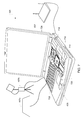
- a computing device 435 which may be a laptop computer, will typically include a processor 712 coupled to volatile memory 714 and a large capacity nonvolatile memory, such as a disk drive 716 of Flash memory.
- the computing device 435 may also include a removable memory interface 718 , such as a floppy disc drive or an optical disk drive coupled to the processor 712 .
- the computing device 435 may also include a number of connector ports coupled to the processor 712 for establishing data connections or receiving external memory devices, such as a USB or FireWire® connector sockets, or other network connection circuits for coupling the processor 712 to a network.
- the computer housing includes a touchpad 720 , a keyboard 722 , and a display 724 all coupled to the processor 712 .
- Other configurations of the computing device may include a computer mouse or trackball coupled to the processor (e.g., via a USB input) as are well known, which may also be used in conjunction with the various embodiments.
- FIGS. 8A-8B illustrates an embodiment call flow diagram 800 performed between remote event feedback elements 802 , a participant device 804 that is worn or carried by a participant, a WWAN 806 , and subscribers 808 for event feedback.
- the remote event feedback elements 802 maps RFIDs to participant identifiers.
- the participant device 804 monitors an ANT® sensor.
- the participant device 804 tracks current location.
- remote event feedback elements 802 at a checkpoint N ⁇ 1 818 interrogates an RFID tag 820 that may be worn or carried or worn by the participant.
- the RFID tag 820 responds with RFID 821 .
- a determination by the participant device 804 may be made whether a checkpoint has been passed in block 822 based upon receiving a signal from the RFID tag 820 .
- an unofficial event value may be received, stored and display in block 824 .
- remote event feedback elements 802 may transmit official checkpoint number or ID with the event time value to the participant device 804 in block 826 responds by receiving, storing and displaying the official event value.
- the server/database may communicate the event information to WWAN 806 in block 840 .
- the WWAN may forward the event information to subscribers 808 and participants (via participant device 804 ) in block 842 , which present the event information on a user interface, respectively, in blocks 844 , 846 .
- the participant device 804 may transmit participant identifier and locally stored data in an ANT® broadcast when in range of the checkpoint N 856 in block 866 , which in turn receives the participant identifier and locally stored data in block 868 .
- the portion of the remote event feedback elements 802 at checkpoint N 856 may forward in block 872 the checkpoint event time for the particular participant ID, as well as other locally stored checkpoint data to an event server/database (DB) using a communication network, such as a backhaul network.
- DB event server/database
- the event server/DB receives and validates the checkpoint event time for the particular participant ID with data from the participant device 804 in block 874 .
- the participant device 804 determines whether a failure occurs in receiving a checkpoint event time value from checkpoint N 856 in block 876 . If not, processing may return to block 850 in anticipation of an upcoming checkpoint. If failed to receive in block 876 , then the participant device 804 queries the event server in block 878 , which may be forwarded to the server by WWAN 806 in block 880 . The remote event feedback elements 802 responds to the query in block 882 . The WWAN 806 forwards the response in block 884 to the participant device 804 , which in turn receives, stores, and displays the official event information in block 886 . In this way, a participant elapsed time originally displayed on the participant device 804 gets changed in response to receiving event feedback from the remote event feedback elements 802 indicating an official participant elapsed time different from the participant elapsed time originally displayed.
- the participant device 904 maintains event information for checkpoints that have been reached, such as a checkpoint identifier (N ⁇ 1) 928 and a time value (N ⁇ 1) 930 , which may be an unofficially detected at the participant device 904 . From this data, real-time event feedback 931 may be calculated. Alternatively or in addition, the checkpoint identifier N ⁇ 1 932 and time value N ⁇ 1 934 that corresponds to the participant identifier (ID) 917 may be pushed or pulled via WWAN 912 from the event server 910 . Other types of event information 935 may also be maintained by and disseminated from the event server 910 .
- event information for checkpoints that have been reached such as a checkpoint identifier (N ⁇ 1) 928 and a time value (N ⁇ 1) 930 , which may be an unofficially detected at the participant device 904 . From this data, real-time event feedback 931 may be calculated. Alternatively or in addition, the checkpoint identifier N ⁇ 1 932 and time value N ⁇
- event information 935 may include an official event time, which is maintained by the event server 910 with time update values regularly distributed to checkpoints for maintaining local checkpoint time values that are synchronized with the official event time.
- an official checkpoint identifier N 936 and a checkpoint event time based on a time value N 938 may be locally pushed or pulled from the checkpoint N 908 base station N 940 to the participant device 904 .
- the time value N 938 may be independently determined by the checkpoint N 908 using a local clock or regularly synchronized at the checkpoint N 908 with the event server 910 official event time.
- Exemplary embodiments transmit the participant identifier by transmitting an RFID signal by the participant identifier in response to the checkpoint device comprising an RFID reader.
- the time value may be determined by detecting interrogation of the participant identifier by the RFID reader 918 .
- the participant identifier 916 may transmit the participant identifier to the checkpoint device to generate an official time value associated with the participant.
- the participant device receives the official time value by the participant device via a WWAN.
- the event feedback information may contain an event status of a participant.
- the participant device 904 may detect or determine current location, such as by receiving GPS signals. For instance, the participant device 904 may then determine route guidance based upon the current location and route information and present the route guidance on the user interface of the participant device. Alternatively, the device location may be estimated based upon historical performance timing. Alternatively, the participant device may determine whether the checkpoint device (base station 940 ) should be within range based upon the current location and route information.
- the participant device 904 may activate a receiver of the participant device configured to receive an official time value in response to determining being with range. In certain embodiments, the receiver comprises a wireless wide area network receiver. Alternatively, the receiver comprises an ANT® receiver.
- the participant device detects a value of physiological data of the participant, and may transmit the physiological data value to an event server.
- the event server 902 provides event feedback to participants in an event.
- a checkpoint device RFID reader 918 or base station 940
- RFID reader 918 or base station 940 may be configured to receive, at a checkpoint 908 of an event venue 911 , a signal containing a participant identifier (ID) 917 from a participant identifier worn or carried by a participant.
- An event server 910 may be configured to determine an official time value based upon the receiving of the participant identifier.
- a transmitter (WWAN 912 or base station 940 ) may be configured to transmit the official time value to a participant device 904 worn or carried by the participant for presenting on a user interface 920 .
- non-transitory computer-readable medium having stored thereon processor-executable instructions is configured to cause a processor 948 to perform operations, including receiving, by a checkpoint device at a checkpoint of an event venue, a signal containing a participant identifier from a participant device; determining an official time value based upon the receiving of the participant identifier; and transmitting the official time value to another participant device worn or carried by the participant for presenting on a user interface.
- the event feedback system 900 receives official time values for a plurality of participants from checkpoint devices at more than one event venue.
- the checkpoint device comprises an RFID reader 918 that interrogates the participant identifier 916 (RFID device).
- RFID device the participant identifier 916
- the event has timing requirements for each participant to meet or ranking levels they must maintain over segments of the event.
- the event server 902 may calculate the event status for the participant based upon the official time value and the timing requirement.
- the event server 902 may transmit the official time value to the participant device via a wireless wide area network 912 .
- the event feedback system may transmit the official time value to the participant device via a low power radio broadcast by a base station 940 , such as via an ANT® communication protocol.
- the event server 902 may distribute route information to the participant device 904 .
- the event server 902 may receive physiological data of the participant and transmit the physiological data via a communication network for presenting on a user interface 920 .
- FIG. 10 is a component block diagram of an event feedback system 1000 having a participant device 1002 with an integrated participant identifier, depicted as a read/write (R/W) RFID integrated circuit (IC) 1004 .
- the participant device 1002 for example may be attached to a user and used in a manner similar to other fitness devices, such as a sports watch or MP3 player, although some embodiments may be carried or worn in other manners.
- the participant device 1002 may have a processor 1006 that may be configured with processor-executable instructions to execute applications for fitness and route tracking and event feedback.
- the participant device 1002 may communicate via a WWAN transceiver (TXR) 1008 , the R/W RFID integrated circuit 1004 , a GPS receiver (RX) 1010 , and a ANT® transceiver 1012 that transmit and receive via one or more antennas 1014 .
- the participant device 1002 may have a portable power supply, such as a battery 1016 .
- WWAN transceiver 1008 may provide access to voice and data communication, GPS receiver 1010 enables location tracking, ANT® transceiver 1012 may captures fitness data from wireless ANT® accessories, and R/W RFID integrated circuit 1004 may capture track checkpoint event timing.
- the participant device 1002 may provide a fitness and racing product that enhances activities performed by the participant or user. For example, with GPS and ANT®, the participant device 1002 may capture and analyze workout data for runners, cyclists, hikers, etc. (pace, distance, heart rate, calories, laps, power, revolutions per minute (RPM), speed and elevation). With these fitness features, the device may be used for racing and training year-round.
- Integrating the RFID capability into participant device 1002 may allow an event organization to replace a conventional RFID bib/accessory for the event participant with the participant device 1002 .
- the RFID integrated circuit 1004 may be functionally identical to the RFID in the conventional bib/accessory in one aspect.
- the RFID integrated circuit 1004 may sense RF signals emitted by RFID readers at checkpoint crossings with competition-precision timing by detecting a broadcast from an RFID transceiver, depicted as an RFID reader/base station 1018 .
- the R/W RFID integrated circuit 1004 is integrated with the processor 1006 , which may enable real-time display of checkpoint event time on the participant device 1002 for the event participant to stay attune to their progress in the event.
- the RFID reader/base station 1018 may transmit checkpoint time 1020 and checkpoint number 1022 to the participant device 1002 , which in turn may calculate lap time between checkpoints. All previous checkpoint and lap times may also available for presenting visually, aurally, or haptically on the participant device 1002 .
- the RFID integrated circuit 1004 may operate at a conventional low frequency of 125 kHz for backward compatibility at close proximity with passive RFID tags or an ultra-high-frequency (UHF) frequency of 900 MHz for mast RFID antenna systems.
- the low frequency (LF) RFID operating frequency range is 120-150 kHz.
- the LF transponder may be passive with a read range limited to 4 inches.
- the UHF RFID operating frequency range is 860-960 MHz (North America, Europe, and Japan). Depending on whether the UHF transponder is passive, semi-passive or active, the read range varies between 20-100 feet. Multiple readers and antennas may be used to improve the read success rate, to increase timing accuracy, and to scale up for capacity.
- a typical reader reads a transponder's data multiple times to decrease the chance of bit errors in the received data.
- communications between readers may be synchronized and divided in both time and frequency to avoid reader collisions.
- the R/W RFID integrated circuit 1004 in the participant device 1002 may operate as the conventional RFID in a participant's bib/accessory.
- the RFID readers at checkpoint crossings may capture the participant's timing by reading the participant ID 1024 from the participant device 1002 .
- the other participants may wear a traditional RFID bib/accessory that is compatible with the RFID readers, such as by operating on the same frequency, and the event server, such as by using compatible data formats.
- the participant device 1002 may use the WWAN transceiver 1008 to communicate the captured timing data to an official event timing system (remote event system 1034 ) and retrieve the event status and position in the event for the participant.
- Event information including statistics may also be retrieved that may be interesting to the participant, such as their position within their age/gender event class overall, how much distance between them and next competitor, first place runner, friend, etc.
- FIG. 11 is a component block diagram of an event feedback system 1100 having operatively coupled participant devices 1101 , including a first participant device 1103 (e.g., an accessory such as a foot pod device attached to the laces of a runner's shoe) and a second participant device 1102 (e.g., a wrist-worn device).
- the first participant device can maintain a participant identifier using the incorporated R/W RFID integrated circuit 1104 .
- the second participant device 1102 may have one or more processors 1006 that may execute applications for fitness and route tracking and event feedback.
- the first participant device 1103 may have one or more antennas 1118 for an ANT® transceiver 1120 to communicate with the second participant device 1102 under the control of one or more processors 1122 and powered by a power supply, depicted as battery 1124 .
- the first participant device 1103 in the form of a foot pod, may be attached to a shoe for being close to a ground-mounted checkpoint sensor.
- the RFID transceiver (reader/base station) 1130 has a processor 1140 that may be configured to control the RFID antenna (mat) 1142 via an R/W RFID integrated circuit 1144 and that may communicate with an event server 1146 via a network connection 1148 .
- a checkpoint device 1150 may be formed by the RFID antenna (mat) 1142 and RFID TXR (reader/base station) 1130 .
- Channel configuration involves setting several parameters such as channel period, channel RF frequency (78 available), channel type, and network type.
- a channel ID may also be set, which may include transmission type, device type and a unique device number.
- a common channel configuration may be required for two ANT® devices to communicate. Some channel parameters may be set prior to opening a channel, but most parameters may be changed while the channel is open.
- the channel configuration and channel ID may be controlled by the master and sent with every broadcast message. The slave searches for messages with a channel configuration common to its own, may establish a channel when it finds a match and synchronizes to the master.
- the messages sent from the master to the slave are broadcast type, and the slave does not need to acknowledge.
- the values of all channel configuration parameters may be defined and known ahead of time by both the second participant device 1102 and first participant device 1103 , except for the unique device number.
- Each first participant device 1103 has a unique device number, which the second participant device 1102 may obtain by pairing in an isolated space. During pairing, the slave may use a wildcard value when searching to obtain the unique device number of the master. Once the second participant device 1102 obtains the device number of the first participant device 1103 , it may receive broadcast messages from the first participant device 1103 . The second participant device 1102 will reject messages from all other accessories.
- the standard specifies that 80 transmitters within a 10 meter radius will co-exist without performance loss. That is for ANT® devices on the same RF frequency channel, transmitting four (4) messages per second, the ANT® protocol provides 78 RF frequency channels available which could be utilized to scale up the number of close-proximity users, and allow an even denser cluster of ANT® transmitters.
- the first participant device 1103 and second participant device 1102 may maintain an ANT® channel throughout the entire event.
- Checkpoint time and checkpoint number may be updated at the first participant device 1103 upon crossing checkpoint via RFID, and then may be held constant until the next checkpoint.
- the accessory transmits checkpoint time and checkpoint number continuously at a message rate of four (4) times a second.
- each broadcast message there are eight (8) bytes of data payload which contain that information, and are decoded by the wrist-worn device.
- the data format of the 8-byte payload are defined ahead of time and known by both the first participant device 1103 and second participant device 1102 .
- the participant ID 1136 may also be contained in the 8-byte data payload as a redundant check to ensure the participant is receiving the correct data.
- the second participant device 1102 may ping a database of the event server 1146 via WWAN to see if the RFID TXR (reader/base station) 1130 received data from the first participant device 1103 at that checkpoint.
- the second participant device 1102 may receive the updated checkpoint identifier and checkpoint event time via WWAN.
- FIG. 12 is a component block diagram of an event feedback system 1200 having a second participant device 1202 with an autonomous first participant device 1203 with participant identifier, which may be a transponder (bib tag), either worn or carried by a participant.
- a checkpoint device 1205 may include an RFID reader 1207 that obtains a participant identifier 1209 from the first participant device 1203 and an ANT® base station 1211 that exchanges event information with the second participant device 1202 .
- the ANT® base station 1211 and RFID reader 1207 may be integrated or separate components interfaced via a connection 1212 between respective communication network connections 1213 , 1215 .
- the RFID reader 1207 may incorporate one or more processors 1217 that cause an R/W RFID integrated circuit 1219 to transmit RFID communication at a UHF 900 MHz frequency on a forward channel 1221 from one or more antennas 1223 .
- the first participant device 1203 may contain an R/W RFID integrated circuit 1225 that is energized by the forward channel 1221 or alternatively by a power supply, depicted as a battery 1227 .
- the R/W RFID integrated circuit 1225 may transmit the participant identifier 1209 on a reverse channel 1229 to the RFID reader 1207 .
- the first participant device 1203 and RFID reader 1207 may exchange other data 1231 .
- the second participant device 1202 does not locally receive information from the first participant device 1203 .
- the ANT® base station 1211 of the checkpoint device 1205 may include a checkpoint integrated circuit or application 1233 executed by one or more processors 1235 that may determine the event information that should be transmitted to the second participant device 1202 as well as to a remote event system 1237 .
- an ANT® transceiver 1239 may transmit via one or more antennas 1241 a checkpoint identifier 1243 , checkpoint time 1245 and the participant identifier 1209 that is received at one or more antennas 1247 for an ANT® transceiver (TXR) 1251 of the second participant device 1202 .
- TXR ANT® transceiver
- the second participant device 1202 for example may be attached and user interacted with in a manner similar to a fitness device or sports watch, although certain embodiments may be carried or worn in other manners.
- the participant device 1202 may have one or more processors 1253 that may execute applications for fitness and route tracking and event feedback.
- the second participant device 1202 may communicate via a WWAN transceiver 1255 , and a GPS receiver 1257 .
- the second participant device 1202 may be have a portable power supply, depicted as a battery 1259 .
- the second participant device 1202 may perform functions described above with reference to FIG. 10 for second participant device 1002 .
- the ANTS base station 1211 may be the ANT® master, and the second participant device 1202 may be an ANT® slave, and may be configured in a manner similar or identical as described above with reference to FIG. 11 .
- the ANT® master may control the channel, which is a logical connection between the ANT® nodes.
- the ANT® master may configure the channel, initiate communication, transmit data at a certain channel period (0.5-200 Hz), and keep the channel synchronized.
- Channel configuration may involve setting several parameters such as channel period, channel RF frequency (78 available), channel type, and network type.
- a channel ID may also be set, which may include transmission type, device type and a unique device number.
- a common channel configuration may be required for two ANT® devices to communicate.
- Some channel parameters may be set prior to opening a channel, but most parameters may be changed while the channel is open.
- the channel configuration and channel ID may be controlled by the ANT® master and sent with every broadcast message.
- the ANT® slave may search for messages with a channel configuration common to its own, establish a channel when it finds a match and synchronize to the ANT® master.
- the ANT® master may broadcast messages which are received by many ANT® slaves (one-to-many network topology). The slaves do not need to acknowledge such broadcast transmissions.
- Various embodiments may be scaled up to support more than 100,000 second participant devices 1202 .
- the configurable parameters that may be utilized to scale the system capacity may include device number, channel frequency, and channel period.
- Each ANT® base station 1211 may support eight (8) ANT® broadcast channels (or eight (8) ANT® masters). Several ANT® base stations 1211 may be deployed near the checkpoints to increase the number of ANT® masters. At a given checkpoint, each ANT® master may have a unique device number. The ANT® master may configure their channels to operate on different RF frequency channels. As mentioned above, the ANT® protocol has 78 RF frequency channels available which may be utilized to scale up the number of close-proximity users.
- each checkpoint's cluster of ANT® base stations may repeat the channel configuration. So each second participant devices 1202 may keep the same channel configuration throughout the event course. At each checkpoint, the second participant devices 1202 may search, establish a channel and received broadcast messages from an ANT® master with the common channel configuration. The second participant devices 1202 may reject messages from all other ANT® masters. Thus, many second participant devices 1202 may coexist in close proximity without unintentionally receiving messages from another ANT® master.
- an ANT® base station 1211 may have the following capacity:
- all channels may be on the same Radio Frequency (RF) frequency channel.
- RF Radio Frequency
- FIG. 13 illustrates an embodiment method 1300 of providing event feedback to participants in an event of presenting event information to a participant in the event.
- a first checkpoint communication is received at a first radio of a first participant device carried by a first participant from a checkpoint device at a first checkpoint located along a first course of the event.
- the first checkpoint communication includes a first checkpoint identifier and a first checkpoint event time reflecting when the first participant crossed the first checkpoint.
- a determination is made in block 1304 of a first participant elapsed time, based upon the first checkpoint identifier and the first checkpoint event time from block 1302 .
- the participant device may then display the first participant elapsed time on the first participant device in block 1306 .
- a participant status may be transmitted from the first participant device using a second radio of the participant device to an event server.
- the participant status may include the first checkpoint event time and/or the second radio may include a Wireless Wide Area Network (WWAN) transceiver.
- the method may also include receiving event feedback including a ranking of the first participant and displaying at least a portion of the event feedback on the first participant device.
- the method may further include receiving GPS location information using a third radio of the first participant device. The GPS location information identifying a geographic location of the first participant.
- the method may further include receiving physiological data of the first participant using a fourth radio of the first participant device.
- the method may further include changing the first participant elapsed time displayed on the first participant device in response to the event feedback indicating an official participant elapsed time corresponding to when the first participant crossed the first checkpoint that is different from the originally displayed first participant elapsed time.
- the participant status may include at least one of GPS location information identifying a geographic location of the first participant and physiological data of the first participant.
- the method may further include switching power between the second radio and a third radio of the first participant device in response to the first participant device being a predetermined distance from the first checkpoint.
- the method may further include powering on at least one of the second radio and a third radio of the first participant device in response to the first participant device being within a predetermined distance of the first checkpoint.
- the method may further include transmitting a request for a second checkpoint event time in response to determining the first participant device has passed a second checkpoint without receiving a second checkpoint communication.
- the method may further include transmitting at least one of the first checkpoint identifier and the first checkpoint event time to a second participant device carried by the first participant during the event, the second participant device being disposed remote from the first participant device.
- an ANT® protocol may be used to communicate between the first participant device and the second participant device.
- at least one of the first checkpoint identifier and the first checkpoint event time may be transmitted by the first participant device to the second participant device regularly until a second checkpoint communication is received by the first participant device from a second checkpoint located along the first course of the event.
- At least one of the first checkpoint identifier and the first checkpoint event time may be transmitted by the first participant device to the second participant device for a set interval of time.
- a scan may be initiated by the second participant device for at least one of the first checkpoint identifier and the first checkpoint event time in response to a determination that the first checkpoint is within a predetermined distance from at least one of the first participant device and the second participant device.
- the first checkpoint communication may use an ANT® communication protocol.
- FIG. 14 illustrates a method 1400 of providing event feedback to participants in an event.
- an event server maintains an official event time during the event.
- the event server transmits a first time value to a first checkpoint device based upon the official event time.
- the event server receives a first checkpoint event time from the first checkpoint device. The first checkpoint event time may be based on the first time value and when a first participant crossed the first checkpoint.
- the method may include receiving at the event server a participant status transmitted from a first participant device carried by the first participant during the event. The participant status may be received by way of a second communication network bypassing the first checkpoint. The participant status may include a secondary checkpoint event time associated with when the first participant crossed the first checkpoint.
- the event feedback may be transmitted from the event server to the first participant device by way of the second communication network, with the event feedback including a ranking of the first participant.
- the second communication network may include WWAN and the first participant device includes a WWAN transceiver.
- the first participant status may include at least one of GPS location information identifying a geographic location of the first participant and physiological data of the first participant.
- the method may further include detecting at the first checkpoint the first participant device being within a predetermined distance from the first checkpoint.
- the first checkpoint may transmit a first checkpoint communication to a first radio of the first participant device.
- the first checkpoint communication may include a first checkpoint identifier and a first checkpoint event time associated with when the first participant crossed the first checkpoint.
- a participant elapsed time may be determined from the first checkpoint event time may be based on an official event time.
- the first checkpoint event time may be transmitted from the checkpoint to the event server.
- the first checkpoint communication may be transmitted from the first checkpoint using an ANT® communication protocol.
- the method may further include determining a participant identifier associated with the first participant device in response to the first participant device being detected at the first checkpoint. Also, a solid channel connection may be established between the first checkpoint and the first participant device using the participant identifier. Further, the method may include receiving at the event server a request for the first checkpoint event time transmitted from the first participant device. The method may also include transmitting from the event server the first checkpoint event time to a second radio of the first participant device by way of the second communication network. Yet further, the method may include transmitting from the event server the first time update value based on the official event time to a third checkpoint located on a second course of the event. Additionally a third checkpoint event time associated with a second participant transmitted from the third checkpoint may be received at the event server.
- FIG. 16 illustrates an embodiment process flow diagram 1600 of tracking progress of participants in an event.
- an event feedback system receives, by a checkpoint device at a checkpoint of an event venue, a signal containing a participant identifier from a participant identifier worn or carried by a participant.
- the event feedback system determines an official time value based upon the receiving of the participant identifier.
- the event feedback system may transmit the official time value to a participant device worn or carried by the participant for presenting on a user interface.
- the functions described may be implemented in hardware, software, firmware, or any combination thereof. If implemented in software, the functions may be stored on or transmitted over as one or more instructions or code on a computer-readable medium.
- the steps of a method or algorithm disclosed herein may be embodied in a processor-executable software module which may reside on a tangible, non-transitory computer-readable storage medium. Tangible, non-transitory computer-readable storage media may be any available media that may be accessed by a computer.
Landscapes
- Engineering & Computer Science (AREA)
- Physics & Mathematics (AREA)
- Theoretical Computer Science (AREA)
- General Engineering & Computer Science (AREA)
- General Physics & Mathematics (AREA)
- Data Mining & Analysis (AREA)
- Mathematical Physics (AREA)
- Software Systems (AREA)
- Databases & Information Systems (AREA)
- Computer Hardware Design (AREA)
- Health & Medical Sciences (AREA)
- General Health & Medical Sciences (AREA)
- Physical Education & Sports Medicine (AREA)
- Multimedia (AREA)
- Telephonic Communication Services (AREA)
- Navigation (AREA)
- Mobile Radio Communication Systems (AREA)
- Position Fixing By Use Of Radio Waves (AREA)
Priority Applications (6)
| Application Number | Priority Date | Filing Date | Title |
|---|---|---|---|
| US13/781,741 US9330203B2 (en) | 2012-03-02 | 2013-02-28 | Real-time event feedback |
| KR1020147027541A KR20140135228A (ko) | 2012-03-02 | 2013-03-01 | 실시간 이벤트 피드백 |
| CN201380011364.3A CN104137153B (zh) | 2012-03-02 | 2013-03-01 | 实时事件反馈 |
| JP2014560100A JP6157513B2 (ja) | 2012-03-02 | 2013-03-01 | リアルタイムのイベントフィードバック |
| PCT/US2013/028700 WO2013131022A1 (en) | 2012-03-02 | 2013-03-01 | Real-time event feedback |
| EP13710228.1A EP2820622A1 (en) | 2012-03-02 | 2013-03-01 | Real-time event feedback |
Applications Claiming Priority (2)
| Application Number | Priority Date | Filing Date | Title |
|---|---|---|---|
| US201261606366P | 2012-03-02 | 2012-03-02 | |
| US13/781,741 US9330203B2 (en) | 2012-03-02 | 2013-02-28 | Real-time event feedback |
Publications (2)
| Publication Number | Publication Date |
|---|---|
| US20130231760A1 US20130231760A1 (en) | 2013-09-05 |
| US9330203B2 true US9330203B2 (en) | 2016-05-03 |
Family
ID=49043280
Family Applications (1)
| Application Number | Title | Priority Date | Filing Date |
|---|---|---|---|
| US13/781,741 Expired - Fee Related US9330203B2 (en) | 2012-03-02 | 2013-02-28 | Real-time event feedback |
Country Status (6)
| Country | Link |
|---|---|
| US (1) | US9330203B2 (enExample) |
| EP (1) | EP2820622A1 (enExample) |
| JP (1) | JP6157513B2 (enExample) |
| KR (1) | KR20140135228A (enExample) |
| CN (1) | CN104137153B (enExample) |
| WO (1) | WO2013131022A1 (enExample) |
Cited By (8)
| Publication number | Priority date | Publication date | Assignee | Title |
|---|---|---|---|---|
| US20130311581A1 (en) * | 2012-05-18 | 2013-11-21 | Andrew Milburn | Transmission of command execution messages for providing a shared experience to both internal, at-venue participants, and external, networked participants |
| US20140358632A1 (en) * | 2011-07-21 | 2014-12-04 | Parlant Technology, Inc. | System and method for enhanced event participation |
| US20190174284A1 (en) * | 2014-08-25 | 2019-06-06 | Phyzio, Inc. | Physiologic Sensors for Sensing, Measuring, Transmitting, and Processing Signals |
| US10580223B2 (en) | 2017-07-17 | 2020-03-03 | Scott CRANFILL | System and process for timing competitive athletic events |
| US20210170231A1 (en) * | 2019-12-08 | 2021-06-10 | Salvatore Paxia | Distributed race timing system with real time feedback for participants |
| EP3832520B1 (en) * | 2019-12-03 | 2023-02-08 | race result AG | Apparatus for determining a passing time of a passive rfid sports timing transponder |
| US20250166422A1 (en) * | 2022-01-17 | 2025-05-22 | Mylaps B.V. | Uhf sports timing tag assembly |
| US12440776B2 (en) | 2021-12-03 | 2025-10-14 | Schell Games Llc | Devices, systems, and methods for enhancing the gameplay of toy |
Families Citing this family (59)
| Publication number | Priority date | Publication date | Assignee | Title |
|---|---|---|---|---|
| WO2012100237A2 (en) | 2011-01-20 | 2012-07-26 | Innovative Timing Systems, Llc | Rfid timing system and method with integrated event participant location tracking |
| WO2012119215A1 (en) | 2011-03-04 | 2012-09-13 | Eski Inc. | Devices and methods for providing a distributed manifestation in an environment |
| US20140206289A1 (en) * | 2011-06-10 | 2014-07-24 | Aliphcom | Data-capable band management in an integrated application and network communication data environment |
| US20140340997A1 (en) * | 2013-05-20 | 2014-11-20 | Aliphcom | Media device, application, and content management using sensory input determined from a data-capable watch band |
| US9400902B2 (en) * | 2012-05-22 | 2016-07-26 | Trimble Navigation Limited | Multi-modal entity tracking and display |
| US9305196B2 (en) | 2012-05-22 | 2016-04-05 | Trimble Navigation Limited | Entity tracking |
| US9363304B2 (en) | 2012-06-06 | 2016-06-07 | Google Inc. | Synchronizing action execution across networked nodes using relative time |
| US9345948B2 (en) | 2012-10-19 | 2016-05-24 | Todd Martin | System for providing a coach with live training data of an athlete as the athlete is training |
| US10319155B2 (en) * | 2013-01-22 | 2019-06-11 | Ravi Vemulapalli | System for tracking participants |
| US9607443B2 (en) * | 2013-02-25 | 2017-03-28 | Peter Randall Harvey | Portable race device for displaying real-time race information |
| US10318708B2 (en) * | 2013-03-14 | 2019-06-11 | Nike, Inc. | System and method for monitoring athletic activity from multiple body locations |
| US20140322815A1 (en) * | 2013-04-26 | 2014-10-30 | Roche Diagnostics Operations, Inc. | Pairing and synchronizing a mobile phone application with a handheld glucose meter |
| ES2667770T3 (es) * | 2013-06-04 | 2018-05-14 | Isolynx, Llc | Optimización del sistema de seguimiento de objetos y herramientas |
| CN205670807U (zh) * | 2013-07-05 | 2016-11-02 | 菲力尔系统公司 | 监视系统 |
| JP2015073591A (ja) * | 2013-10-07 | 2015-04-20 | セイコーエプソン株式会社 | 携帯機器および積算時間表示制御方法 |
| WO2015088795A1 (en) | 2013-12-09 | 2015-06-18 | Todd Martin | System and method for event timing and photography |
| US20150245172A1 (en) * | 2014-02-26 | 2015-08-27 | UtilityLink, LLC | Centralized database for infrastructure detection and incident reporting |
| US20150302235A1 (en) * | 2014-04-16 | 2015-10-22 | Timing And Racing Around The Clock Llc | Race timing system |
| US12333808B2 (en) | 2014-05-31 | 2025-06-17 | Todd Martin | System and method for identifying a brand worn by a person in a sporting event |
| ES2952400T3 (es) * | 2014-07-28 | 2023-10-31 | Mylaps B V | Módulo transpondedor y módulo de acceso para activar y configurar dicho módulo transpondedor |
| EP2981028B1 (en) | 2014-07-28 | 2020-05-06 | MyLaps B.V. | Transponder module and access module for activating and configuring such transponder module over a CAN bus |
| GB201419950D0 (en) * | 2014-11-10 | 2014-12-24 | Tom Tom Int Bv | Method of sharing data between electronic devices |
| US10478668B2 (en) * | 2014-11-24 | 2019-11-19 | Adidas Ag | Activity monitoring base station |
| KR101659976B1 (ko) * | 2014-12-30 | 2016-09-26 | 주식회사 디랙스 | 측정 장치 및 이에 사용되는 무선 통신 시스템 |
| US9704004B1 (en) * | 2015-01-09 | 2017-07-11 | Tempo Tickets, Llc | Systems and methods of real-time assignment of items to preregistered individuals |
| JP6951377B2 (ja) * | 2015-02-28 | 2021-10-20 | 華為技術有限公司Huawei Technologies Co.,Ltd. | ウェアラブルデバイス |
| US9613477B2 (en) * | 2015-04-21 | 2017-04-04 | International Business Machines Corporation | Collection of information using contactless devices in combination with mobile computing devices |
| CN108141903A (zh) | 2015-08-05 | 2018-06-08 | 爱奇 | 用于与接收单元通信的方法和装置 |
| US9813857B2 (en) | 2015-08-13 | 2017-11-07 | Eski Inc. | Methods and apparatus for creating an individualized record of an event |
| DE102015015036A1 (de) * | 2015-11-23 | 2017-05-24 | race result AG | Positionsverfolgung bei Sportveranstaltungen |
| WO2017113924A1 (en) * | 2015-12-31 | 2017-07-06 | Lam Cho Wing | System including alternation of sensor connection and transmission mechanism for motion sensing garment |
| CN109315015A (zh) | 2016-04-01 | 2019-02-05 | 爱奇 | 设备的基于接近的配置 |
| CN105785756B (zh) * | 2016-05-05 | 2018-04-06 | 安徽华米信息科技有限公司 | 计时方法、装置及系统 |
| CN109863543A (zh) | 2016-09-07 | 2019-06-07 | 爱奇 | 用于分布式呈现的投影系统和相关方法 |
| US20180339216A1 (en) * | 2017-05-26 | 2018-11-29 | Mario Gencarelli | Foam roller and roller insert module formusical therapy and method of use |
| US12190669B2 (en) | 2017-09-14 | 2025-01-07 | Adam J. Epstein | Multi-activity venue automation |
| US11532193B2 (en) | 2017-09-14 | 2022-12-20 | Adam J. Epstein | Multi-activity venue automation |
| AU2018350362C1 (en) | 2017-10-22 | 2025-06-26 | Todd Martin | System and method for image recognition registration of an athlete in a sporting event |
| US10758825B2 (en) * | 2017-10-31 | 2020-09-01 | King.Com Ltd. | Controlling a user interface of a computer device |
| US12005359B2 (en) | 2017-10-31 | 2024-06-11 | King.Com Ltd. | Controlling a user interface of a computer device |
| JP6947225B2 (ja) * | 2017-12-06 | 2021-10-13 | 日本電気株式会社 | イベント活性化装置、イベント活性化方法、及びプログラム |
| CN108197745A (zh) * | 2018-01-02 | 2018-06-22 | 深圳市威米通讯有限公司 | 田径比赛的排名预测方法及装置 |
| US10818152B2 (en) * | 2018-01-15 | 2020-10-27 | Universal City Studios Llc | Interactive systems and methods with feedback devices |
| US10943458B2 (en) * | 2019-02-21 | 2021-03-09 | Jung-Tang Huang | Marathon timing and real-time accident notification method and system thereof |
| US11551537B2 (en) | 2019-04-11 | 2023-01-10 | Nexite Ltd. | Wireless dual-mode identification tag |
| EP3954053B1 (en) | 2019-04-11 | 2026-07-08 | Nexite Ltd. | Tag configured for variable intervals between signal transmissions |
| US20210370133A1 (en) * | 2020-05-29 | 2021-12-02 | Jennifer Lapoint | System and method for providing augmented reality information and sports performance data over a wireless network |
| ES2886399A1 (es) * | 2020-06-16 | 2021-12-17 | Crono Chip S L | Método y equipo de cronometraje |
| CN111696334A (zh) * | 2020-06-29 | 2020-09-22 | 广东智能精灵科技有限公司 | 一种支持125KHz识别的统计方法﹑装置及系统 |
| CN111815962A (zh) * | 2020-07-08 | 2020-10-23 | 支付宝(杭州)信息技术有限公司 | 车辆身份的识别方法、装置、主设备和从设备 |
| CN112116798B (zh) * | 2020-09-15 | 2022-02-08 | 中国人民解放军63660部队 | 一种并行任务下两目标测控交叉复用方法 |
| US20220143461A1 (en) * | 2020-11-11 | 2022-05-12 | Isolynx, Llc | System and method for real-time tracking of athletes across geographically separated venues |
| EP4275160B1 (en) | 2021-01-11 | 2025-05-07 | Nexite Ltd. | Contactless and automatic operations of a retail store |
| CN112732085A (zh) * | 2021-01-14 | 2021-04-30 | 广东高驰运动科技有限公司 | 一种可穿戴设备及其控制方法、装置和计算机存储介质 |
| CN113055078B (zh) * | 2021-03-12 | 2022-02-08 | 西南科技大学 | 有效信息年龄确定方法、以及无人机飞行轨迹优化方法 |
| ES2925317A1 (es) * | 2021-03-30 | 2022-10-14 | Crono Chip Sl | Método y equipo de cronometraje deportivo |
| WO2022207952A1 (es) | 2021-03-30 | 2022-10-06 | Crono Chip S.L. | Sistema de control de paso y método de cálculo de tiempo de paso mediante campo magnético |
| WO2023111845A1 (en) | 2021-12-13 | 2023-06-22 | Nexite Ltd. | Systems, methods, and devices for contactless and automatic operation of retail stores |
| CN116978140A (zh) * | 2023-08-01 | 2023-10-31 | 中国工商银行股份有限公司 | 数据中心冷源站巡检方法及装置 |
Citations (31)
| Publication number | Priority date | Publication date | Assignee | Title |
|---|---|---|---|---|
| US5511045A (en) | 1991-12-19 | 1996-04-23 | Casio Computer Co., Ltd. | Time measurement apparatus and system having reception or transmission function |
| US5737280A (en) * | 1994-11-21 | 1998-04-07 | Univert Inc. | Clocking system for measuring running speeds of track runners |
| WO2001000281A2 (en) | 1999-06-29 | 2001-01-04 | Trakus, Inc. | Performance monitoring system |
| JP2002282408A (ja) | 2001-03-26 | 2002-10-02 | Tamura Electric Works Ltd | 移動競技管理装置及び移動競技管理方法 |
| US20030235116A1 (en) * | 2002-06-20 | 2003-12-25 | Astra Gesellschaft Fur Asset Management Mbh & Co. Kg | Method and device for automatic timing in mass sporting events |
| US20040006445A1 (en) * | 2002-07-04 | 2004-01-08 | Paek Min-Ho | Number label embedded with antenna tag for measuring race runner's time records via wireless identification, and runners' time records measurement method and system using the same |
| US20040100566A1 (en) * | 2002-11-25 | 2004-05-27 | Eastman Kodak Company | Correlating captured images and timed event data |
| US20060176216A1 (en) | 2004-11-17 | 2006-08-10 | Hipskind Jason C | Tracking and timing system |
| JP2006235864A (ja) | 2005-02-23 | 2006-09-07 | Nec Corp | 情報提供システム、情報提供装置、情報提供プログラム、および情報提供方法 |
| US20060217232A1 (en) * | 2005-03-24 | 2006-09-28 | Trakstarr Fitness Systems, Inc. | Lap counter system for multiple runners |
| FR2896325A1 (fr) | 2006-01-18 | 2007-07-20 | Cyrlink Soc Par Actions Simpli | Dispositif de chronometrage |
| US20070182567A1 (en) * | 2006-01-27 | 2007-08-09 | Orbiter, Llc | Portable lap counter and system |
| WO2008121856A1 (en) | 2007-03-30 | 2008-10-09 | Nike, Inc. | Rfid triggered personal athletic device |
| US20080278314A1 (en) | 2007-04-30 | 2008-11-13 | Ionearth Llc | Event tracking and monitoring system |
| US20090213700A1 (en) * | 2008-02-27 | 2009-08-27 | Conant James R | Automated Interval Timing Method Devices and System |
| US20100088023A1 (en) * | 2008-10-03 | 2010-04-08 | Adidas Ag | Program Products, Methods, and Systems for Providing Location-Aware Fitness Monitoring Services |
| US20100160014A1 (en) | 2008-11-25 | 2010-06-24 | Mario Galasso | Methods and apparatus for virtual competition |
| US20110233282A1 (en) | 2010-03-26 | 2011-09-29 | Howell Daniel R | Race bib timing device |
| US20110250937A1 (en) | 2010-04-12 | 2011-10-13 | Hubbard Jason R | Race participant tracking via wireless positioning technology and near real time reporting of location and pertinent race metrics to the participant and optionally to other individuals or publication on the internet |
| US20120025944A1 (en) * | 2010-07-29 | 2012-02-02 | Innovative Timing Systems, Llc | Automated Timing Systems and Methods Having Multiple Time Event Recorders and an Integrated User Time Entry Interface |
| US20120072172A1 (en) * | 2009-05-29 | 2012-03-22 | Chronotrack Systems, Inc. | Race timing system |
| US20120120771A1 (en) * | 2010-10-18 | 2012-05-17 | Lapides John S | Athletic event timing and display systems |
| US20120223817A1 (en) * | 2010-09-03 | 2012-09-06 | Innovative Timing Systems, Llc | Integrated Detection Point Passive RFID Tag Reader and Event Timing system and Method |
| US20120274508A1 (en) * | 2009-04-26 | 2012-11-01 | Nike, Inc. | Athletic Watch |
| US20120303753A1 (en) * | 2010-01-11 | 2012-11-29 | Innovative Timing Systems | Sports timing system (sts) integrated communication system and method |
| US20120319822A1 (en) * | 2010-03-01 | 2012-12-20 | Innovative Timing Systems | Variably spaced multi-point rfid tag reader systems and methods |
| US20130143631A1 (en) * | 2010-08-12 | 2013-06-06 | Amusys Amusement Systems Electronics Gmbh | Method and device for controlling and/or monitoring racing vehicles on a racetrack |
| US20130166049A1 (en) * | 2011-12-22 | 2013-06-27 | Adidas Ag | Fitness Activity Monitoring Systems And Methods |
| US20130285794A1 (en) * | 2011-01-20 | 2013-10-31 | Innovative Timing Systems, Llc | Rfid timing system and method with integrated event participant location tracking |
| US20130300542A1 (en) * | 2011-01-20 | 2013-11-14 | Innovative Timing Systems, Llc | Laser detection enhanced rfid tag reading event timing system and method |
| US8649890B2 (en) * | 2011-05-31 | 2014-02-11 | Todd M. Martin | System and method for providing an athlete with a performance profile |
Family Cites Families (2)
| Publication number | Priority date | Publication date | Assignee | Title |
|---|---|---|---|---|
| US5283733A (en) * | 1992-03-24 | 1994-02-01 | Colley Russell H | Computer on-line golf scoring device |
| JP2010088886A (ja) * | 2008-10-03 | 2010-04-22 | Adidas Ag | 場所認識型スポーツ活動モニタリングサービスを提供するためのプログラム製品、方法及びシステム |
-
2013
- 2013-02-28 US US13/781,741 patent/US9330203B2/en not_active Expired - Fee Related
- 2013-03-01 KR KR1020147027541A patent/KR20140135228A/ko not_active Ceased
- 2013-03-01 CN CN201380011364.3A patent/CN104137153B/zh not_active Expired - Fee Related
- 2013-03-01 EP EP13710228.1A patent/EP2820622A1/en not_active Withdrawn
- 2013-03-01 WO PCT/US2013/028700 patent/WO2013131022A1/en not_active Ceased
- 2013-03-01 JP JP2014560100A patent/JP6157513B2/ja not_active Expired - Fee Related
Patent Citations (32)
| Publication number | Priority date | Publication date | Assignee | Title |
|---|---|---|---|---|
| US5511045A (en) | 1991-12-19 | 1996-04-23 | Casio Computer Co., Ltd. | Time measurement apparatus and system having reception or transmission function |
| US5737280A (en) * | 1994-11-21 | 1998-04-07 | Univert Inc. | Clocking system for measuring running speeds of track runners |
| WO2001000281A2 (en) | 1999-06-29 | 2001-01-04 | Trakus, Inc. | Performance monitoring system |
| JP2002282408A (ja) | 2001-03-26 | 2002-10-02 | Tamura Electric Works Ltd | 移動競技管理装置及び移動競技管理方法 |
| US20030235116A1 (en) * | 2002-06-20 | 2003-12-25 | Astra Gesellschaft Fur Asset Management Mbh & Co. Kg | Method and device for automatic timing in mass sporting events |
| US20040006445A1 (en) * | 2002-07-04 | 2004-01-08 | Paek Min-Ho | Number label embedded with antenna tag for measuring race runner's time records via wireless identification, and runners' time records measurement method and system using the same |
| US20040100566A1 (en) * | 2002-11-25 | 2004-05-27 | Eastman Kodak Company | Correlating captured images and timed event data |
| US20060176216A1 (en) | 2004-11-17 | 2006-08-10 | Hipskind Jason C | Tracking and timing system |
| JP2006235864A (ja) | 2005-02-23 | 2006-09-07 | Nec Corp | 情報提供システム、情報提供装置、情報提供プログラム、および情報提供方法 |
| US20060217232A1 (en) * | 2005-03-24 | 2006-09-28 | Trakstarr Fitness Systems, Inc. | Lap counter system for multiple runners |
| FR2896325A1 (fr) | 2006-01-18 | 2007-07-20 | Cyrlink Soc Par Actions Simpli | Dispositif de chronometrage |
| US20070182567A1 (en) * | 2006-01-27 | 2007-08-09 | Orbiter, Llc | Portable lap counter and system |
| WO2008121856A1 (en) | 2007-03-30 | 2008-10-09 | Nike, Inc. | Rfid triggered personal athletic device |
| US20080258917A1 (en) * | 2007-03-30 | 2008-10-23 | Nike, Inc. | Rfid triggered personal athletic device |
| US20080278314A1 (en) | 2007-04-30 | 2008-11-13 | Ionearth Llc | Event tracking and monitoring system |
| US20090213700A1 (en) * | 2008-02-27 | 2009-08-27 | Conant James R | Automated Interval Timing Method Devices and System |
| US20100088023A1 (en) * | 2008-10-03 | 2010-04-08 | Adidas Ag | Program Products, Methods, and Systems for Providing Location-Aware Fitness Monitoring Services |
| US20100160014A1 (en) | 2008-11-25 | 2010-06-24 | Mario Galasso | Methods and apparatus for virtual competition |
| US20120274508A1 (en) * | 2009-04-26 | 2012-11-01 | Nike, Inc. | Athletic Watch |
| US20120072172A1 (en) * | 2009-05-29 | 2012-03-22 | Chronotrack Systems, Inc. | Race timing system |
| US20120303753A1 (en) * | 2010-01-11 | 2012-11-29 | Innovative Timing Systems | Sports timing system (sts) integrated communication system and method |
| US20120319822A1 (en) * | 2010-03-01 | 2012-12-20 | Innovative Timing Systems | Variably spaced multi-point rfid tag reader systems and methods |
| US20110233282A1 (en) | 2010-03-26 | 2011-09-29 | Howell Daniel R | Race bib timing device |
| US20110250937A1 (en) | 2010-04-12 | 2011-10-13 | Hubbard Jason R | Race participant tracking via wireless positioning technology and near real time reporting of location and pertinent race metrics to the participant and optionally to other individuals or publication on the internet |
| US20120025944A1 (en) * | 2010-07-29 | 2012-02-02 | Innovative Timing Systems, Llc | Automated Timing Systems and Methods Having Multiple Time Event Recorders and an Integrated User Time Entry Interface |
| US20130143631A1 (en) * | 2010-08-12 | 2013-06-06 | Amusys Amusement Systems Electronics Gmbh | Method and device for controlling and/or monitoring racing vehicles on a racetrack |
| US20120223817A1 (en) * | 2010-09-03 | 2012-09-06 | Innovative Timing Systems, Llc | Integrated Detection Point Passive RFID Tag Reader and Event Timing system and Method |
| US20120120771A1 (en) * | 2010-10-18 | 2012-05-17 | Lapides John S | Athletic event timing and display systems |
| US20130285794A1 (en) * | 2011-01-20 | 2013-10-31 | Innovative Timing Systems, Llc | Rfid timing system and method with integrated event participant location tracking |
| US20130300542A1 (en) * | 2011-01-20 | 2013-11-14 | Innovative Timing Systems, Llc | Laser detection enhanced rfid tag reading event timing system and method |
| US8649890B2 (en) * | 2011-05-31 | 2014-02-11 | Todd M. Martin | System and method for providing an athlete with a performance profile |
| US20130166049A1 (en) * | 2011-12-22 | 2013-06-27 | Adidas Ag | Fitness Activity Monitoring Systems And Methods |
Non-Patent Citations (1)
| Title |
|---|
| International Search Report and Written Opinion-PCT/US2013/028700-ISA/EPO-Jun. 12, 2013. |
Cited By (13)
| Publication number | Priority date | Publication date | Assignee | Title |
|---|---|---|---|---|
| US20140358632A1 (en) * | 2011-07-21 | 2014-12-04 | Parlant Technology, Inc. | System and method for enhanced event participation |
| US20130311581A1 (en) * | 2012-05-18 | 2013-11-21 | Andrew Milburn | Transmission of command execution messages for providing a shared experience to both internal, at-venue participants, and external, networked participants |
| US11706601B2 (en) | 2014-08-25 | 2023-07-18 | Phyzio, Inc | Physiologic sensors for sensing, measuring, transmitting, and processing signals |
| US10798547B2 (en) * | 2014-08-25 | 2020-10-06 | Phyzio, Inc. | Physiologic sensors for sensing, measuring, transmitting, and processing signals |
| US11277728B2 (en) * | 2014-08-25 | 2022-03-15 | Phyzio, Inc. | Physiologic sensors for sensing, measuring, transmitting, and processing signals |
| US20190174284A1 (en) * | 2014-08-25 | 2019-06-06 | Phyzio, Inc. | Physiologic Sensors for Sensing, Measuring, Transmitting, and Processing Signals |
| US12035217B2 (en) | 2014-08-25 | 2024-07-09 | Phyzio, Inc. | Physiologic sensors for sensing, measuring, transmitting, and processing signals |
| US10580223B2 (en) | 2017-07-17 | 2020-03-03 | Scott CRANFILL | System and process for timing competitive athletic events |
| EP3832520B1 (en) * | 2019-12-03 | 2023-02-08 | race result AG | Apparatus for determining a passing time of a passive rfid sports timing transponder |
| US11580788B2 (en) | 2019-12-03 | 2023-02-14 | race result AG | Apparatus for determining a passing time of a passive RFID sports timing transponder |
| US20210170231A1 (en) * | 2019-12-08 | 2021-06-10 | Salvatore Paxia | Distributed race timing system with real time feedback for participants |
| US12440776B2 (en) | 2021-12-03 | 2025-10-14 | Schell Games Llc | Devices, systems, and methods for enhancing the gameplay of toy |
| US20250166422A1 (en) * | 2022-01-17 | 2025-05-22 | Mylaps B.V. | Uhf sports timing tag assembly |
Also Published As
| Publication number | Publication date |
|---|---|
| WO2013131022A1 (en) | 2013-09-06 |
| JP6157513B2 (ja) | 2017-07-05 |
| JP2015511856A (ja) | 2015-04-23 |
| EP2820622A1 (en) | 2015-01-07 |
| US20130231760A1 (en) | 2013-09-05 |
| CN104137153A (zh) | 2014-11-05 |
| CN104137153B (zh) | 2017-09-19 |
| KR20140135228A (ko) | 2014-11-25 |
Similar Documents
| Publication | Publication Date | Title |
|---|---|---|
| US20130231760A1 (en) | Real-time event feedback | |
| US12260948B2 (en) | Fitness activity monitoring systems and methods | |
| US11038965B2 (en) | Method and arrangement for monitoring physiological data | |
| US9864066B2 (en) | Portable biometric monitoring devices having location sensors | |
| TWI789572B (zh) | 馬拉松賽事計時及即時事故通知方法及其系統 | |
| US20130246021A1 (en) | Required time calculating system, required time calculating method, and computer-readable recording medium storing required time calculating program | |
| US20170161962A1 (en) | Portable race device for displaying real-time race information | |
| KR20150098609A (ko) | 무선 영역 네트워크 인에이블형 이동 디바이스 액세서리 | |
| US20170014068A1 (en) | Activity meter, activity amount measurement device, portable terminal, information sharing assistance device, information sharing system, activity assistance device, and activity assistance system | |
| US11426629B2 (en) | Method for quantifying a sporting activity | |
| US20210170231A1 (en) | Distributed race timing system with real time feedback for participants | |
| US10362995B1 (en) | Outdoor group exercise information administering system | |
| JP6780869B2 (ja) | 身体パラメータ測定用のセンサモジュール |
Legal Events
| Date | Code | Title | Description |
|---|---|---|---|
| AS | Assignment |
Owner name: QUALCOMM INCORPORATED, CALIFORNIA Free format text: ASSIGNMENT OF ASSIGNORS INTEREST;ASSIGNORS:ROSEN, ERIC C.;HENNENFENT, SUSAN M.;GILL, HARLEEN K.;AND OTHERS;SIGNING DATES FROM 20130822 TO 20140108;REEL/FRAME:034816/0676 |
|
| STCF | Information on status: patent grant |
Free format text: PATENTED CASE |
|
| FEPP | Fee payment procedure |
Free format text: MAINTENANCE FEE REMINDER MAILED (ORIGINAL EVENT CODE: REM.); ENTITY STATUS OF PATENT OWNER: LARGE ENTITY |
|
| LAPS | Lapse for failure to pay maintenance fees |
Free format text: PATENT EXPIRED FOR FAILURE TO PAY MAINTENANCE FEES (ORIGINAL EVENT CODE: EXP.); ENTITY STATUS OF PATENT OWNER: LARGE ENTITY |
|
| STCH | Information on status: patent discontinuation |
Free format text: PATENT EXPIRED DUE TO NONPAYMENT OF MAINTENANCE FEES UNDER 37 CFR 1.362 |
|
| FP | Lapsed due to failure to pay maintenance fee |
Effective date: 20200503 |