US9110446B2 - Dye-based time-indicating label - Google Patents
Dye-based time-indicating label Download PDFInfo
- Publication number
- US9110446B2 US9110446B2 US13/712,549 US201213712549A US9110446B2 US 9110446 B2 US9110446 B2 US 9110446B2 US 201213712549 A US201213712549 A US 201213712549A US 9110446 B2 US9110446 B2 US 9110446B2
- Authority
- US
- United States
- Prior art keywords
- layer
- dye
- timing
- activating
- polymer resin
- Prior art date
- Legal status (The legal status is an assumption and is not a legal conclusion. Google has not performed a legal analysis and makes no representation as to the accuracy of the status listed.)
- Active, expires
Links
- 230000003213 activating effect Effects 0.000 claims abstract description 120
- 239000000758 substrate Substances 0.000 claims abstract description 41
- 239000010410 layer Substances 0.000 claims description 337
- 230000001815 facial effect Effects 0.000 claims description 137
- 239000002952 polymeric resin Substances 0.000 claims description 63
- 229920003002 synthetic resin Polymers 0.000 claims description 63
- 239000004014 plasticizer Substances 0.000 claims description 55
- GWEVSGVZZGPLCZ-UHFFFAOYSA-N Titan oxide Chemical compound O=[Ti]=O GWEVSGVZZGPLCZ-UHFFFAOYSA-N 0.000 claims description 29
- 229920000728 polyester Polymers 0.000 claims description 21
- 239000000049 pigment Substances 0.000 claims description 18
- 239000007787 solid Substances 0.000 claims description 18
- 239000004820 Pressure-sensitive adhesive Substances 0.000 claims description 12
- 229910052782 aluminium Inorganic materials 0.000 claims description 12
- XAGFODPZIPBFFR-UHFFFAOYSA-N aluminium Chemical group [Al] XAGFODPZIPBFFR-UHFFFAOYSA-N 0.000 claims description 12
- 239000004814 polyurethane Substances 0.000 claims description 12
- 229920002635 polyurethane Polymers 0.000 claims description 10
- 239000003960 organic solvent Substances 0.000 claims description 9
- NIXOWILDQLNWCW-UHFFFAOYSA-N acrylic acid group Chemical group C(C=C)(=O)O NIXOWILDQLNWCW-UHFFFAOYSA-N 0.000 claims description 7
- 238000013508 migration Methods 0.000 claims description 7
- 230000005012 migration Effects 0.000 claims description 7
- 229920001296 polysiloxane Polymers 0.000 claims description 7
- 239000000126 substance Substances 0.000 claims description 7
- 239000011086 glassine Substances 0.000 claims description 6
- JFCQEDHGNNZCLN-UHFFFAOYSA-N glutaric acid Chemical compound OC(=O)CCCC(O)=O JFCQEDHGNNZCLN-UHFFFAOYSA-N 0.000 claims description 6
- 229920000915 polyvinyl chloride Polymers 0.000 claims description 5
- 239000004800 polyvinyl chloride Substances 0.000 claims description 5
- 230000001681 protective effect Effects 0.000 claims description 5
- 229920000098 polyolefin Polymers 0.000 claims description 4
- PYKYMHQGRFAEBM-UHFFFAOYSA-N anthraquinone Natural products CCC(=O)c1c(O)c2C(=O)C3C(C=CC=C3O)C(=O)c2cc1CC(=O)OC PYKYMHQGRFAEBM-UHFFFAOYSA-N 0.000 claims description 3
- 150000004056 anthraquinones Chemical class 0.000 claims description 3
- 229920001971 elastomer Polymers 0.000 claims description 3
- 239000005060 rubber Substances 0.000 claims description 3
- 229940116351 sebacate Drugs 0.000 claims description 3
- CXMXRPHRNRROMY-UHFFFAOYSA-L sebacate(2-) Chemical compound [O-]C(=O)CCCCCCCCC([O-])=O CXMXRPHRNRROMY-UHFFFAOYSA-L 0.000 claims description 3
- JNXDCMUUZNIWPQ-UHFFFAOYSA-N trioctyl benzene-1,2,4-tricarboxylate Chemical compound CCCCCCCCOC(=O)C1=CC=C(C(=O)OCCCCCCCC)C(C(=O)OCCCCCCCC)=C1 JNXDCMUUZNIWPQ-UHFFFAOYSA-N 0.000 claims description 3
- 239000004372 Polyvinyl alcohol Substances 0.000 claims description 2
- 229920002451 polyvinyl alcohol Polymers 0.000 claims description 2
- 239000002344 surface layer Substances 0.000 claims description 2
- 229920006254 polymer film Polymers 0.000 claims 1
- 230000004913 activation Effects 0.000 abstract description 10
- 238000005304 joining Methods 0.000 abstract description 4
- 239000000975 dye Substances 0.000 description 108
- 238000000576 coating method Methods 0.000 description 40
- 239000000203 mixture Substances 0.000 description 39
- 238000009472 formulation Methods 0.000 description 36
- ZWEHNKRNPOVVGH-UHFFFAOYSA-N 2-Butanone Chemical compound CCC(C)=O ZWEHNKRNPOVVGH-UHFFFAOYSA-N 0.000 description 21
- 229920005989 resin Polymers 0.000 description 20
- 239000011347 resin Substances 0.000 description 20
- 239000002904 solvent Substances 0.000 description 16
- 230000008859 change Effects 0.000 description 13
- 230000000694 effects Effects 0.000 description 13
- 239000004408 titanium dioxide Substances 0.000 description 13
- 238000010276 construction Methods 0.000 description 12
- 239000003795 chemical substances by application Substances 0.000 description 11
- YXFVVABEGXRONW-UHFFFAOYSA-N Toluene Chemical compound CC1=CC=CC=C1 YXFVVABEGXRONW-UHFFFAOYSA-N 0.000 description 6
- 230000001070 adhesive effect Effects 0.000 description 6
- 239000011248 coating agent Substances 0.000 description 6
- 238000011161 development Methods 0.000 description 6
- -1 e.g. Substances 0.000 description 6
- 239000011521 glass Substances 0.000 description 6
- 239000000463 material Substances 0.000 description 6
- 229920001225 polyester resin Polymers 0.000 description 6
- 239000004645 polyester resin Substances 0.000 description 6
- 229910001220 stainless steel Inorganic materials 0.000 description 6
- 239000010935 stainless steel Substances 0.000 description 6
- 239000000853 adhesive Substances 0.000 description 5
- 238000013461 design Methods 0.000 description 5
- 238000003475 lamination Methods 0.000 description 5
- 238000000034 method Methods 0.000 description 5
- 238000012546 transfer Methods 0.000 description 4
- 239000000654 additive Substances 0.000 description 3
- 230000000996 additive effect Effects 0.000 description 3
- 239000011230 binding agent Substances 0.000 description 3
- 150000001875 compounds Chemical class 0.000 description 3
- 230000009477 glass transition Effects 0.000 description 3
- 239000000123 paper Substances 0.000 description 3
- 239000002245 particle Substances 0.000 description 3
- 229920006267 polyester film Polymers 0.000 description 3
- 229920005749 polyurethane resin Polymers 0.000 description 3
- 238000003860 storage Methods 0.000 description 3
- 239000011800 void material Substances 0.000 description 3
- LRFVTYWOQMYALW-UHFFFAOYSA-N 9H-xanthine Chemical compound O=C1NC(=O)NC2=C1NC=N2 LRFVTYWOQMYALW-UHFFFAOYSA-N 0.000 description 2
- 239000004925 Acrylic resin Substances 0.000 description 2
- 229920000178 Acrylic resin Polymers 0.000 description 2
- VTYYLEPIZMXCLO-UHFFFAOYSA-L Calcium carbonate Chemical compound [Ca+2].[O-]C([O-])=O VTYYLEPIZMXCLO-UHFFFAOYSA-L 0.000 description 2
- JOYRKODLDBILNP-UHFFFAOYSA-N Ethyl urethane Chemical compound CCOC(N)=O JOYRKODLDBILNP-UHFFFAOYSA-N 0.000 description 2
- OFBQJSOFQDEBGM-UHFFFAOYSA-N Pentane Chemical compound CCCCC OFBQJSOFQDEBGM-UHFFFAOYSA-N 0.000 description 2
- TZCXTZWJZNENPQ-UHFFFAOYSA-L barium sulfate Chemical compound [Ba+2].[O-]S([O-])(=O)=O TZCXTZWJZNENPQ-UHFFFAOYSA-L 0.000 description 2
- 239000012530 fluid Substances 0.000 description 2
- 238000010030 laminating Methods 0.000 description 2
- 229920000139 polyethylene terephthalate Polymers 0.000 description 2
- 239000005020 polyethylene terephthalate Substances 0.000 description 2
- 230000003381 solubilizing effect Effects 0.000 description 2
- 239000001993 wax Substances 0.000 description 2
- 239000004808 2-ethylhexylester Substances 0.000 description 1
- BCHZICNRHXRCHY-UHFFFAOYSA-N 2h-oxazine Chemical compound N1OC=CC=C1 BCHZICNRHXRCHY-UHFFFAOYSA-N 0.000 description 1
- NIXOWILDQLNWCW-UHFFFAOYSA-M Acrylate Chemical compound [O-]C(=O)C=C NIXOWILDQLNWCW-UHFFFAOYSA-M 0.000 description 1
- 229920005479 Lucite® Polymers 0.000 description 1
- CTQNGGLPUBDAKN-UHFFFAOYSA-N O-Xylene Chemical compound CC1=CC=CC=C1C CTQNGGLPUBDAKN-UHFFFAOYSA-N 0.000 description 1
- 239000004952 Polyamide Substances 0.000 description 1
- 239000004698 Polyethylene Substances 0.000 description 1
- 239000004642 Polyimide Substances 0.000 description 1
- 239000004743 Polypropylene Substances 0.000 description 1
- BQCADISMDOOEFD-UHFFFAOYSA-N Silver Chemical compound [Ag] BQCADISMDOOEFD-UHFFFAOYSA-N 0.000 description 1
- 239000004433 Thermoplastic polyurethane Substances 0.000 description 1
- KRADHMIOFJQKEZ-UHFFFAOYSA-N Tri-2-ethylhexyl trimellitate Chemical compound CCCCC(CC)COC(=O)C1=CC=C(C(=O)OCC(CC)CCCC)C(C(=O)OCC(CC)CCCC)=C1 KRADHMIOFJQKEZ-UHFFFAOYSA-N 0.000 description 1
- RJDOZRNNYVAULJ-UHFFFAOYSA-L [O--].[O--].[O--].[O--].[O--].[O--].[O--].[O--].[O--].[O--].[F-].[F-].[Mg++].[Mg++].[Mg++].[Al+3].[Si+4].[Si+4].[Si+4].[K+] Chemical compound [O--].[O--].[O--].[O--].[O--].[O--].[O--].[O--].[O--].[O--].[F-].[F-].[Mg++].[Mg++].[Mg++].[Al+3].[Si+4].[Si+4].[Si+4].[K+] RJDOZRNNYVAULJ-UHFFFAOYSA-L 0.000 description 1
- 230000002745 absorbent Effects 0.000 description 1
- 239000002250 absorbent Substances 0.000 description 1
- 239000011358 absorbing material Substances 0.000 description 1
- 150000001242 acetic acid derivatives Chemical class 0.000 description 1
- 239000012790 adhesive layer Substances 0.000 description 1
- 150000001298 alcohols Chemical class 0.000 description 1
- 150000001338 aliphatic hydrocarbons Chemical class 0.000 description 1
- 239000003963 antioxidant agent Substances 0.000 description 1
- 150000004945 aromatic hydrocarbons Chemical class 0.000 description 1
- 239000000987 azo dye Substances 0.000 description 1
- 238000000498 ball milling Methods 0.000 description 1
- 229940073609 bismuth oxychloride Drugs 0.000 description 1
- 229910000019 calcium carbonate Inorganic materials 0.000 description 1
- 239000006229 carbon black Substances 0.000 description 1
- 125000002915 carbonyl group Chemical group [*:2]C([*:1])=O 0.000 description 1
- 239000003086 colorant Substances 0.000 description 1
- 230000001010 compromised effect Effects 0.000 description 1
- 230000007423 decrease Effects 0.000 description 1
- 230000003247 decreasing effect Effects 0.000 description 1
- 125000000664 diazo group Chemical group [N-]=[N+]=[*] 0.000 description 1
- 239000006185 dispersion Substances 0.000 description 1
- 150000002148 esters Chemical class 0.000 description 1
- 150000002170 ethers Chemical class 0.000 description 1
- 238000002474 experimental method Methods 0.000 description 1
- 239000004744 fabric Substances 0.000 description 1
- 239000011888 foil Substances 0.000 description 1
- 238000005286 illumination Methods 0.000 description 1
- 230000006872 improvement Effects 0.000 description 1
- 238000010348 incorporation Methods 0.000 description 1
- 239000001013 indophenol dye Substances 0.000 description 1
- 239000003112 inhibitor Substances 0.000 description 1
- 230000000977 initiatory effect Effects 0.000 description 1
- 150000002576 ketones Chemical class 0.000 description 1
- 230000000670 limiting effect Effects 0.000 description 1
- 238000011068 loading method Methods 0.000 description 1
- 238000004519 manufacturing process Methods 0.000 description 1
- 239000011159 matrix material Substances 0.000 description 1
- 238000005259 measurement Methods 0.000 description 1
- 229910052751 metal Inorganic materials 0.000 description 1
- 239000002184 metal Substances 0.000 description 1
- 229910044991 metal oxide Inorganic materials 0.000 description 1
- 150000004706 metal oxides Chemical class 0.000 description 1
- 125000001434 methanylylidene group Chemical group [H]C#[*] 0.000 description 1
- 238000012986 modification Methods 0.000 description 1
- 230000004048 modification Effects 0.000 description 1
- 229920003052 natural elastomer Polymers 0.000 description 1
- 229920001194 natural rubber Polymers 0.000 description 1
- 239000012454 non-polar solvent Substances 0.000 description 1
- BWOROQSFKKODDR-UHFFFAOYSA-N oxobismuth;hydrochloride Chemical compound Cl.[Bi]=O BWOROQSFKKODDR-UHFFFAOYSA-N 0.000 description 1
- 238000004806 packaging method and process Methods 0.000 description 1
- 239000002798 polar solvent Substances 0.000 description 1
- 229920002647 polyamide Polymers 0.000 description 1
- 239000004417 polycarbonate Substances 0.000 description 1
- 229920000515 polycarbonate Polymers 0.000 description 1
- 229920000573 polyethylene Polymers 0.000 description 1
- 229920001721 polyimide Polymers 0.000 description 1
- 229920000642 polymer Polymers 0.000 description 1
- 239000004926 polymethyl methacrylate Substances 0.000 description 1
- 229920001155 polypropylene Polymers 0.000 description 1
- XOFYZVNMUHMLCC-ZPOLXVRWSA-N prednisone Chemical compound O=C1C=C[C@]2(C)[C@H]3C(=O)C[C@](C)([C@@](CC4)(O)C(=O)CO)[C@@H]4[C@@H]3CCC2=C1 XOFYZVNMUHMLCC-ZPOLXVRWSA-N 0.000 description 1
- 230000002028 premature Effects 0.000 description 1
- 238000003825 pressing Methods 0.000 description 1
- 230000008569 process Effects 0.000 description 1
- 238000012545 processing Methods 0.000 description 1
- 230000002829 reductive effect Effects 0.000 description 1
- 238000002310 reflectometry Methods 0.000 description 1
- 238000000926 separation method Methods 0.000 description 1
- 150000004760 silicates Chemical class 0.000 description 1
- 229910052709 silver Inorganic materials 0.000 description 1
- 239000004332 silver Substances 0.000 description 1
- 229920003051 synthetic elastomer Polymers 0.000 description 1
- 239000005061 synthetic rubber Substances 0.000 description 1
- 238000010998 test method Methods 0.000 description 1
- 229920001169 thermoplastic Polymers 0.000 description 1
- 229920006344 thermoplastic copolyester Polymers 0.000 description 1
- 229920002803 thermoplastic polyurethane Polymers 0.000 description 1
- 239000004416 thermosoftening plastic Substances 0.000 description 1
- 239000001016 thiazine dye Substances 0.000 description 1
- 239000001003 triarylmethane dye Substances 0.000 description 1
- 230000000007 visual effect Effects 0.000 description 1
- XLYOFNOQVPJJNP-UHFFFAOYSA-N water Substances O XLYOFNOQVPJJNP-UHFFFAOYSA-N 0.000 description 1
- 229940075420 xanthine Drugs 0.000 description 1
- 239000008096 xylene Substances 0.000 description 1
Images


Classifications
-
- G—PHYSICS
- G04—HOROLOGY
- G04F—TIME-INTERVAL MEASURING
- G04F13/00—Apparatus for measuring unknown time intervals by means not provided for in groups G04F5/00 - G04F10/00
-
- G—PHYSICS
- G04—HOROLOGY
- G04F—TIME-INTERVAL MEASURING
- G04F1/00—Apparatus which can be set and started to measure-off predetermined or adjustably-fixed time intervals without driving mechanisms, e.g. egg timers
-
- G—PHYSICS
- G09—EDUCATION; CRYPTOGRAPHY; DISPLAY; ADVERTISING; SEALS
- G09F—DISPLAYING; ADVERTISING; SIGNS; LABELS OR NAME-PLATES; SEALS
- G09F3/00—Labels, tag tickets, or similar identification or indication means; Seals; Postage or like stamps
- G09F3/02—Forms or constructions
- G09F3/0291—Labels or tickets undergoing a change under particular conditions, e.g. heat, radiation, passage of time
-
- B—PERFORMING OPERATIONS; TRANSPORTING
- B41—PRINTING; LINING MACHINES; TYPEWRITERS; STAMPS
- B41M—PRINTING, DUPLICATING, MARKING, OR COPYING PROCESSES; COLOUR PRINTING
- B41M5/00—Duplicating or marking methods; Sheet materials for use therein
- B41M5/26—Thermography ; Marking by high energetic means, e.g. laser otherwise than by burning, and characterised by the material used
- B41M5/382—Contact thermal transfer or sublimation processes
- B41M5/392—Additives, other than colour forming substances, dyes or pigments, e.g. sensitisers, transfer promoting agents
- B41M5/395—Macromolecular additives, e.g. binders
-
- B—PERFORMING OPERATIONS; TRANSPORTING
- B41—PRINTING; LINING MACHINES; TYPEWRITERS; STAMPS
- B41M—PRINTING, DUPLICATING, MARKING, OR COPYING PROCESSES; COLOUR PRINTING
- B41M5/00—Duplicating or marking methods; Sheet materials for use therein
- B41M5/26—Thermography ; Marking by high energetic means, e.g. laser otherwise than by burning, and characterised by the material used
- B41M5/40—Thermography ; Marking by high energetic means, e.g. laser otherwise than by burning, and characterised by the material used characterised by the base backcoat, intermediate, or covering layers, e.g. for thermal transfer dye-donor or dye-receiver sheets; Heat, radiation filtering or absorbing means or layers; combined with other image registration layers or compositions; Special originals for reproduction by thermography
- B41M5/42—Intermediate, backcoat, or covering layers
-
- B—PERFORMING OPERATIONS; TRANSPORTING
- B41—PRINTING; LINING MACHINES; TYPEWRITERS; STAMPS
- B41M—PRINTING, DUPLICATING, MARKING, OR COPYING PROCESSES; COLOUR PRINTING
- B41M5/00—Duplicating or marking methods; Sheet materials for use therein
- B41M5/50—Recording sheets characterised by the coating used to improve ink, dye or pigment receptivity, e.g. for ink-jet or thermal dye transfer recording
- B41M5/52—Macromolecular coatings
-
- C—CHEMISTRY; METALLURGY
- C09—DYES; PAINTS; POLISHES; NATURAL RESINS; ADHESIVES; COMPOSITIONS NOT OTHERWISE PROVIDED FOR; APPLICATIONS OF MATERIALS NOT OTHERWISE PROVIDED FOR
- C09D—COATING COMPOSITIONS, e.g. PAINTS, VARNISHES OR LACQUERS; FILLING PASTES; CHEMICAL PAINT OR INK REMOVERS; INKS; CORRECTING FLUIDS; WOODSTAINS; PASTES OR SOLIDS FOR COLOURING OR PRINTING; USE OF MATERIALS THEREFOR
- C09D11/00—Inks
- C09D11/50—Sympathetic, colour changing or similar inks
-
- F—MECHANICAL ENGINEERING; LIGHTING; HEATING; WEAPONS; BLASTING
- F16—ENGINEERING ELEMENTS AND UNITS; GENERAL MEASURES FOR PRODUCING AND MAINTAINING EFFECTIVE FUNCTIONING OF MACHINES OR INSTALLATIONS; THERMAL INSULATION IN GENERAL
- F16L—PIPES; JOINTS OR FITTINGS FOR PIPES; SUPPORTS FOR PIPES, CABLES OR PROTECTIVE TUBING; MEANS FOR THERMAL INSULATION IN GENERAL
- F16L1/00—Laying or reclaiming pipes; Repairing or joining pipes on or under water
- F16L1/024—Laying or reclaiming pipes on land, e.g. above the ground
- F16L1/06—Accessories therefor, e.g. anchors
- F16L1/11—Accessories therefor, e.g. anchors for the detection or protection of pipes in the ground
-
- G—PHYSICS
- G01—MEASURING; TESTING
- G01N—INVESTIGATING OR ANALYSING MATERIALS BY DETERMINING THEIR CHEMICAL OR PHYSICAL PROPERTIES
- G01N21/00—Investigating or analysing materials by the use of optical means, i.e. using sub-millimetre waves, infrared, visible or ultraviolet light
- G01N21/75—Systems in which material is subjected to a chemical reaction, the progress or the result of the reaction being investigated
- G01N21/77—Systems in which material is subjected to a chemical reaction, the progress or the result of the reaction being investigated by observing the effect on a chemical indicator
- G01N21/78—Systems in which material is subjected to a chemical reaction, the progress or the result of the reaction being investigated by observing the effect on a chemical indicator producing a change of colour
-
- G—PHYSICS
- G01—MEASURING; TESTING
- G01N—INVESTIGATING OR ANALYSING MATERIALS BY DETERMINING THEIR CHEMICAL OR PHYSICAL PROPERTIES
- G01N31/00—Investigating or analysing non-biological materials by the use of the chemical methods specified in the subgroup; Apparatus specially adapted for such methods
- G01N31/22—Investigating or analysing non-biological materials by the use of the chemical methods specified in the subgroup; Apparatus specially adapted for such methods using chemical indicators
-
- G—PHYSICS
- G01—MEASURING; TESTING
- G01N—INVESTIGATING OR ANALYSING MATERIALS BY DETERMINING THEIR CHEMICAL OR PHYSICAL PROPERTIES
- G01N31/00—Investigating or analysing non-biological materials by the use of the chemical methods specified in the subgroup; Apparatus specially adapted for such methods
- G01N31/22—Investigating or analysing non-biological materials by the use of the chemical methods specified in the subgroup; Apparatus specially adapted for such methods using chemical indicators
- G01N31/223—Investigating or analysing non-biological materials by the use of the chemical methods specified in the subgroup; Apparatus specially adapted for such methods using chemical indicators for investigating presence of specific gases or aerosols
-
- G—PHYSICS
- G01—MEASURING; TESTING
- G01N—INVESTIGATING OR ANALYSING MATERIALS BY DETERMINING THEIR CHEMICAL OR PHYSICAL PROPERTIES
- G01N33/00—Investigating or analysing materials by specific methods not covered by groups G01N1/00 - G01N31/00
- G01N33/48—Biological material, e.g. blood, urine; Haemocytometers
- G01N33/50—Chemical analysis of biological material, e.g. blood, urine; Testing involving biospecific ligand binding methods; Immunological testing
- G01N33/52—Use of compounds or compositions for colorimetric, spectrophotometric or fluorometric investigation, e.g. use of reagent paper and including single- and multilayer analytical elements
- G01N33/521—Single-layer analytical elements
-
- G—PHYSICS
- G01—MEASURING; TESTING
- G01N—INVESTIGATING OR ANALYSING MATERIALS BY DETERMINING THEIR CHEMICAL OR PHYSICAL PROPERTIES
- G01N33/00—Investigating or analysing materials by specific methods not covered by groups G01N1/00 - G01N31/00
- G01N33/48—Biological material, e.g. blood, urine; Haemocytometers
- G01N33/50—Chemical analysis of biological material, e.g. blood, urine; Testing involving biospecific ligand binding methods; Immunological testing
- G01N33/53—Immunoassay; Biospecific binding assay; Materials therefor
- G01N33/543—Immunoassay; Biospecific binding assay; Materials therefor with an insoluble carrier for immobilising immunochemicals
- G01N33/54366—Apparatus specially adapted for solid-phase testing
- G01N33/54386—Analytical elements
-
- G—PHYSICS
- G01—MEASURING; TESTING
- G01N—INVESTIGATING OR ANALYSING MATERIALS BY DETERMINING THEIR CHEMICAL OR PHYSICAL PROPERTIES
- G01N33/00—Investigating or analysing materials by specific methods not covered by groups G01N1/00 - G01N31/00
- G01N33/48—Biological material, e.g. blood, urine; Haemocytometers
- G01N33/50—Chemical analysis of biological material, e.g. blood, urine; Testing involving biospecific ligand binding methods; Immunological testing
- G01N33/53—Immunoassay; Biospecific binding assay; Materials therefor
- G01N33/543—Immunoassay; Biospecific binding assay; Materials therefor with an insoluble carrier for immobilising immunochemicals
- G01N33/544—Immunoassay; Biospecific binding assay; Materials therefor with an insoluble carrier for immobilising immunochemicals the carrier being organic
- G01N33/545—Synthetic resin
-
- G—PHYSICS
- G04—HOROLOGY
- G04F—TIME-INTERVAL MEASURING
- G04F1/00—Apparatus which can be set and started to measure-off predetermined or adjustably-fixed time intervals without driving mechanisms, e.g. egg timers
- G04F1/04—Apparatus which can be set and started to measure-off predetermined or adjustably-fixed time intervals without driving mechanisms, e.g. egg timers by movement or acceleration due to gravity
- G04F1/06—Apparatus which can be set and started to measure-off predetermined or adjustably-fixed time intervals without driving mechanisms, e.g. egg timers by movement or acceleration due to gravity by flowing-away of a prefixed quantity of fine-granular or liquid materials, e.g. sand-glass, water-clock
-
- G—PHYSICS
- G04—HOROLOGY
- G04F—TIME-INTERVAL MEASURING
- G04F13/00—Apparatus for measuring unknown time intervals by means not provided for in groups G04F5/00 - G04F10/00
- G04F13/06—Apparatus for measuring unknown time intervals by means not provided for in groups G04F5/00 - G04F10/00 using fluidic means
-
- G—PHYSICS
- G09—EDUCATION; CRYPTOGRAPHY; DISPLAY; ADVERTISING; SEALS
- G09F—DISPLAYING; ADVERTISING; SIGNS; LABELS OR NAME-PLATES; SEALS
- G09F3/00—Labels, tag tickets, or similar identification or indication means; Seals; Postage or like stamps
- G09F3/02—Forms or constructions
- G09F3/0295—Labels or tickets for tubes, pipes and the like
-
- G—PHYSICS
- G09—EDUCATION; CRYPTOGRAPHY; DISPLAY; ADVERTISING; SEALS
- G09F—DISPLAYING; ADVERTISING; SIGNS; LABELS OR NAME-PLATES; SEALS
- G09F3/00—Labels, tag tickets, or similar identification or indication means; Seals; Postage or like stamps
- G09F3/04—Labels, tag tickets, or similar identification or indication means; Seals; Postage or like stamps to be fastened or secured by the material of the label itself, e.g. by thermo-adhesion
-
- G—PHYSICS
- G09—EDUCATION; CRYPTOGRAPHY; DISPLAY; ADVERTISING; SEALS
- G09F—DISPLAYING; ADVERTISING; SIGNS; LABELS OR NAME-PLATES; SEALS
- G09F3/00—Labels, tag tickets, or similar identification or indication means; Seals; Postage or like stamps
- G09F3/04—Labels, tag tickets, or similar identification or indication means; Seals; Postage or like stamps to be fastened or secured by the material of the label itself, e.g. by thermo-adhesion
- G09F3/06—Labels, tag tickets, or similar identification or indication means; Seals; Postage or like stamps to be fastened or secured by the material of the label itself, e.g. by thermo-adhesion by clamping action
-
- G—PHYSICS
- G09—EDUCATION; CRYPTOGRAPHY; DISPLAY; ADVERTISING; SEALS
- G09F—DISPLAYING; ADVERTISING; SIGNS; LABELS OR NAME-PLATES; SEALS
- G09F7/00—Signs, name or number plates, letters, numerals, or symbols; Panels or boards
- G09F7/18—Means for attaching signs, plates, panels, or boards to a supporting structure
-
- H—ELECTRICITY
- H01—ELECTRIC ELEMENTS
- H01B—CABLES; CONDUCTORS; INSULATORS; SELECTION OF MATERIALS FOR THEIR CONDUCTIVE, INSULATING OR DIELECTRIC PROPERTIES
- H01B13/00—Apparatus or processes specially adapted for manufacturing conductors or cables
- H01B13/34—Apparatus or processes specially adapted for manufacturing conductors or cables for marking conductors or cables
- H01B13/344—Apparatus or processes specially adapted for manufacturing conductors or cables for marking conductors or cables by applying sleeves, ferrules, tags, clips, labels or short length strips
-
- H—ELECTRICITY
- H01—ELECTRIC ELEMENTS
- H01B—CABLES; CONDUCTORS; INSULATORS; SELECTION OF MATERIALS FOR THEIR CONDUCTIVE, INSULATING OR DIELECTRIC PROPERTIES
- H01B7/00—Insulated conductors or cables characterised by their form
- H01B7/36—Insulated conductors or cables characterised by their form with distinguishing or length marks
- H01B7/368—Insulated conductors or cables characterised by their form with distinguishing or length marks being a sleeve, ferrule, tag, clip, label or short length strip
Definitions
- This invention relates to time-indicating labels.
- the invention relates to multilayer, dye-based labels while in another aspect, the invention relates to labels comprising a top sheet, activating layer, timing layer, dye and a substrate.
- Numerous devices are known which provide, after activation, a visual indication of the passage of a predetermined period of time. Such time indicators are useful, for example, as a security badge, as an indicator of the length of time a perishable item has been on the wholesaler's or retailer's shelf, and for numerous other uses.
- time indicators One problem that generally exists with such a time indicators is that they gradually change color over a period of time and it is difficult to ascertain the actual completion of the time interval, i.e., it is a “grey” time interval.
- a time indicator For a time indicator to be useful, its appearance should not change for at least 70% of its intended life. Such a time indicator would remain until near the end of the time interval for which it was created, and then the color (or image) rapidly would appear. In essence, what is desirable is a time switch meaning a rapid color change to clearly show that the time interval has ended.
- a topsheet A topsheet,
- the topsheet and activating layer comprise a first or activation section of the indicator while the timing layer, dye layer and substrate comprise a second or base section of the indicator.
- the activating layer of the first section and the timing layer of the second section are each protected with a release sheet.
- the first and second sections of the indicator comprise a kit which can be converted into an active time indicator by removal of the release sheets and joining of the activating layer to the timing layer.
- the first and second section are joined to one another by a common release sheet or liner which maintains the indicator in an inactive state until the release sheet is removed and the activating layer is joined to the timing layer.
- the invention is an activated, multilayer time indicator comprising:
- a translucent or transparent topsheet comprising a polymeric film having first and second facial surfaces
- An activating layer having first and second facial surfaces, the first facial surface of the activating layer in contact with the second facial surface of the topsheet, the activating layer comprising a plasticizer and a polymer resin in which the plasticizer comprises 20-80 weight percent (wt %) of the activating layer,
- a timing layer having first and second facial surfaces, the first facial surface of the timing layer in direct contact with the second facial surface of the activating layer, the timing layer comprising a polymer resin and an opaque pigment in which the polymer resin has a weight average molecular weight of 5,000 to 1,000,000 grams per mole and a Tg of greater than 25° C., the polymer resin comprising 15-85 wt % of the timing layer sufficient to achieve an opacity of at least 90% per ASTM D2805.
- a substrate having first and second facial surfaces having first and second facial surfaces, the first facial surface of the substrate in direct contact with the second facial surface of the dye layer, the substrate inert to the plasticizer of the activating layer.
- the dye of dye layer D is soluble in the solvent. In one embodiment dye particles are dispersed in a solvent with an insoluble resin binder.
- the activated, multilayer time indicator further comprises a pressure sensitive adhesive (PSA) layer for mounting the label to a substrate. In one embodiment the activated, multilayer time indicator further comprises a release liner to protect the PSA layer.
- PSA pressure sensitive adhesive
- a translucent or transparent topsheet comprising a polymeric film having first and second facial surfaces
- An activating layer having first and second facial surfaces, the first facial surface of the activating layer in contact with the second facial surface of the topsheet, the activating layer comprising a plasticizer and a polymer resin in which the plasticizer comprises 20-80 wt % of the activating layer,
- a timing layer having first and second facial surfaces, the first facial surface of the timing layer in direct contact with the second facial surface of the release sheet, the timing layer comprising a polymer resin and an opaque pigment in which the polymer resin has a weight average molecular weight of 5,000 to 1,000,000 grams per mole and a Tg of greater than 25° C., the polymer resin comprising 15-85 wt % of the timing layer, sufficient to achieve an opacity of at least 90% per ASTM D2805,
- a substrate having first and second facial surfaces having first and second facial surfaces, the first facial surface of the substrate in direct contact with the second facial surface of the dye layer, the substrate inert to the plasticizer of the activating layer.
- the dye of dye layer E is soluble in the solvent. In one embodiment dye particles are dispersed in a solvent with an insoluble resin binder.
- the activated, multilayer time indicator further comprises a pressure sensitive adhesive (PSA) layer for mounting the label to a substrate. In one embodiment the activated, multilayer time indicator further comprises a release liner to protect the PSA layer.
- PSA pressure sensitive adhesive
- the invention is a two-section, inactivate, multilayer time indicator kit comprising:
- a first section comprising:
- FIG. 1 is a schematic representation of a first section of one embodiment of a time indicator of this invention.
- FIG. 2 is a schematic representation of a second section of one embodiment of a time indicator of this invention.
- FIG. 3 is a schematic representation of one embodiment of a time indicator in which the first and second sections are joined to one another but the time indicator is not activated.
- FIG. 4 is a schematic representation of one embodiment of an activated time indicator.
- FIG. 5 is a schematic of the second section of one embodiment of a time indicator of this invention coated with multiple timing layers.
- FIG. 6 is a line graph reporting the effect of increased plasticizer content within the activating layer on the change in color intensity ( ⁇ M) over time of Examples 1, 3 and 5.
- FIG. 7 is a line graph reporting the effect of increased plasticizer content within the activating layer on color change ( ⁇ E) over time of Examples 1, 3 and 5.
- FIG. 8 is a line graph reporting the effect of increased timing layer thickness on the change in color intensity ( ⁇ M) over time of Examples 2, 4 and 6.
- FIG. 9 is a line graph reporting the effect of increased timing layer thickness on color change ( ⁇ E) over time of Examples 2, 4 and 6.
- FIG. 10 is a line graph reporting the effect of different opacifying agents within the timing layer on the change in color intensity ( ⁇ M) over time of Examples 6, 11 and 12.
- FIG. 11 is a line graph reporting the effect of different opacifying agents within the timing layer on color change ( ⁇ E) over time of Examples 6, 11 and 12.
- FIG. 12 is a line graph reporting the effect of different resins within the timing layer on the change in color intensity ( ⁇ M) over time of Examples 7, 8, 9 and 10.
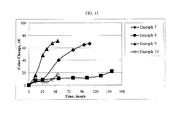
- FIG. 13 is a line graph reporting the effect of different resins within the timing layer on the color change ( ⁇ E) over time of Examples 7, 8, 9 and 10.
- the numerical ranges in this disclosure are approximate, and thus may include values outside of the range unless otherwise indicated. Numerical ranges include all values from and including the lower and the upper values, in increments of one unit, provided that there is a separation of at least two units between any lower value and any higher value. As an example, if a compositional, physical or other property, such as, for example, layer thickness, is from 100 to 1,000, then all individual values, such as 100, 101, 102, etc., and sub ranges, such as 100 to 144, 155 to 170, 197 to 200, etc., are expressly enumerated.
- “Facial surface” and like terms are used in distinction to “edge surface”. For example, if rectangular in shape or configuration, a layer, e.g., film, will comprise two opposing facial surfaces joined by four edge surfaces (two opposing pairs of edge surfaces, each pair intersecting the other pair at right angles). If circular in configuration, then the layer will comprise two opposing facial surfaces joined by one continuous edge surface.
- Permeable and like terms describes a material, e.g., a film, filter, absorbent, scrim, etc., through which a fluid, e.g., a gas, can pass under normal use conditions.
- Nonpermeable and like terms describes a material, e.g., an adhesive, film, etc., through which a fluid cannot pass under normal use conditions.
- Ink and like terms mean a coatable or printable formulation that can and usually does contain a dye and/or pigment.
- “Dye” and like terms mean a light absorbing compound that is present in a molecularly dispersed (dissolved) form.
- Porture and like terms mean a visible light reflecting or absorbing material or compound that is present in a non-molecularly dispersed (particulate) form.
- Graphic “Graphic”, “graphic image” and like terms mean text or pictorial representations formed of ink or other dye or pigment substances. Graphics include, but are not limited to, words, numbers, bar codes, pictures, designs (geometric or otherwise), and solid colors (typically applied by flood coating).
- Reflective substance and like terms mean an electromagnetic energy reflective material or compound that is present in a molecularly dispersed or dissolved form. “Reflective” as used in this definition is a function of opacity as defined in ASTM D2805.
- “Appearance” and like terms mean readable by the unaided human eye or by machine.
- the topsheet of the time indicator of this invention is sufficiently translucent so that a graphic or color beneath it is visible to the naked eye under typical viewing conditions, e.g., daylight or the ambient light available in a typical artificially lit room such as an office or store.
- the topsheet can be clear or tinted, and preferably it is transparent.
- the topsheet can comprise indicia, e.g., a preprinted graphic such as the word “EXPIRED” OR “VOID”, that is visible by machine or to the naked eye under typical viewing conditions only after the timing layer has expired.
- the topsheet can comprise any polymeric material that is sufficiently translucent that it does not significantly detract from the visibility of the dye.
- the topsheet is a polymeric film, e.g., a film comprising a polyolefin such as polyethylene or polypropylene, or polyester such as polyethylene terephthalate (PET), or the like.
- PET polyethylene terephthalate
- the thickness of the topsheet also known as an overlay substrate or cover sheet, is a function of a number of different variables including but not limited to the design thickness of the indicator, degree of protection desired for the underlying graphic, cost, and the like, but typically the thickness is from 0.5 to 6 mil (0.0127 to 0.1524 millimeters (mm)), more typically from 1 to 3 mil (0.0254 to 0.0762 mm).
- the topsheet comprises first and second facial surfaces with the first facial surface exposed or open to the environment and the second facial surface in contact with a facial surface of the activating layer.
- the topsheet can be covered with an optional, translucent topcoat which is printable by any convenient manner, e.g. direct thermal, thermal transfer, dot-matrix, inkjet, or handwriting using pens, pencils or markers.
- Topcoat formulations are commercially available and well known in the art. Examples include 159TT and 334M (both available from Actega Wit) which are a thermal transfer receptive and writable topcoat, respectively.
- the formulations are urethane or acrylate based formulations and applied in a thickness range of 2-10 microns.
- the activating layer also known as the activation or enhancement layer, is typically colorless and comprises a plasticizer and a polymer resin.
- the plasticizer also known as a migrating agent, is compatible, i.e., soluble, with the dye of the dye layer and the resin of the timing layer.
- Monomeric and polymeric plasticizers can be use, and these plasticizers include but are not limited to PLASTHALL® P-550 (a polyester glutarate), PLASTHALL® 7050 (a dialkyl diether glutarate), PLASTHALL® TOTM (trioctyl trimellitate), and PARAPLEX® G-25 (a polyester sebacate), all available from The HallStar Company.
- any film-forming polymer resin that can be solubilized by the selected plasticizer can be used in the activating layer, and representative polymer resins include, but are not limited to, polyurethane, polyester, natural or synthetic rubber, rubber-acrylic hybrid, polyamide, polyethylene-vinyl acetate, acrylic, and the like, with polyurethane resins preferred.
- the weight average molecular weight (Mw) of the resin can vary widely, but it is typically between 5,000 and 1,000,000, more typically between 10,000 and 40,000, grams per mole for thermoplastic polyurethane.
- the plasticizer is admixed with the resin to lower the glass transition temperature (Tg) of the resin and, in turn, increase the adhesive property of the resin.
- the activating layer comprises 20 to 80, more typically 40 to 60, weight percent of the plasticizer.
- utilizing a non-pressure sensitive polymer resin, such as ESTANE 5703 from Lubrizol allows for the incorporation of higher loadings of plasticizer to enhance the migration of the dye.
- the remainder of the layer comprises the polymer resin although the layer can comprise other components as well, e.g., antioxidants, UV-inhibitors, etc., but these other components are typically used in nominal amounts, e.g., less than 2, more typically less than 1, wt % of the activating layer.
- Tackifying agents known to the art can be added to increase adhesion to the timing layer surface. Typically, the amount of tackifying agent ranges from 1 to 30 parts based on total solids.
- the thickness of the activating layer is, like the thickness of the topsheet, a function of a number of different variables including but not limited to the desired timing, design thickness of the indicator, the nature and amount of plasticizer, the nature of the polymer resin, cost and the like, but typically the thickness is from 0.2 to 3 mil (0.00508 to 0.0762 mm), more typically from 0.5 to 1.5 mil (0.0127 to 0.0381 mm).
- the activating layer comprises first and second facial surfaces with the first facial surface in contact with the second facial surface of the topsheet and the second facial surface, depending upon the state of the time indicator, covered with a protective or release layer, open to the environment, or in contact with a facial surface of the timing layer.
- the activating layer in combination with the topsheet comprises the first section of the time indicator.
- This first section is typically manufactured separate from the second section of the time indicator, and it typically comprises an optional release layer to protect the activating layer during manufacturing, packaging, storage and/or shipping.
- the topsheet and activating layer can be joined to one another in any convenient manner with or without the use of an adhesive. Typically, the two layers are joined to one another without the use of an adhesive using any one of a number of known coating processes.
- the optional release layer in contact with the second facial surface of the activating layer is removed so that the second facial surface of the activating layer can be brought into contact with the first facial surface of the timing layer.
- Exemplary release layers include, but are not limited to, polyvinyl alcohol, silicones, fluorinated chemicals, glassine paper and waxes.
- the timing layer comprises a polymer resin and a pigment.
- any film-forming polymer resin can be used for the timing layer, and representative polymer resins include, but are not limited to, acrylic, polyurethane, polyester and the like, with polyurethane and polyester resins preferred.
- the weight average molecular weight (Mw) of the resin can vary widely, and it is typically between 5,000 and 1,000,000, more typically between 10,000 and 40,000, grams per mole for thermoplastic copolyester.
- the resin has a glass transition temperature (Tg) typically greater than 25° C., more typically greater than 50° C., which maximizes the storage stability of the final construction with the preferred Tg range determined in large part by the chemical composition of the timing layer.
- the pigment can be any reflective, opaque, or absorptive substance such as aluminum, stainless steel, natural and synthetic mica, coated glasses, metal oxides, silicates, bismuth oxychloride, calcium carbonate, barium sulfate, carbon black but is typically and preferably aluminum flake and/or titanium dioxide (TiO 2 ).
- Aluminum flake is a preferred pigment because its high reflectivity and opacity reduces the visibility of the dye as it migrates through the timing layer, minimizing the grey time or, in other words, the time that exists between the start of color development to the completion of the color development (both as observed by a machine or the unaided eye).
- a preferred, film-forming timing layer that is constructed using equal parts of either TiO 2 or aluminum flake has an opacity of 82% and 100%, respectively, per ASTM D2805.
- the TiO 2 containing construction will appear pink prior to activation due to low opacity while the aluminum flake containing construction will have no pink color.
- the thickness of the timing layer is, like the thickness of the topsheet and activating layer, a function of a number of different variables including but not limited to the desired timing, design thickness of the time indicator, the nature and amount of pigment, the nature of the polymer resin, cost and the like, but typically the thickness is from 0.2 to 3 mil (0.00508 to 0.0762 mm), more typically from 0.5 to 1.5 mil (0.0127 to 0.0381 mm).
- the timing layer comprises first and second facial surfaces with the first facial surface, depending upon the state of the time indicator, covered with a protective or release layer, open to the environment, or in contact with the facial surface of the activating layer. The second facial surface of the timing layer is in contact with the first facial surface of the dye layer.
- the use of aluminum flake allows for one to reduce the thickness of the timing layer to achieve multi-day timing due to its inherently high opacity. Furthermore, the reduced thickness allows the timing layer to be printed using processes known to the art (e.g. gravure, flexo, etc.). This allows for the application of multiple timing layers in a single construction (see FIG. 5 ).
- the timing layer can comprise indicia, e.g., a preprinted graphic such as the word “EXPIRED” or “VOID”, that is visible by machine or to the naked eye under typical viewing conditions only after the timing layer has expired.
- indicia e.g., a preprinted graphic such as the word “EXPIRED” or “VOID”, that is visible by machine or to the naked eye under typical viewing conditions only after the timing layer has expired.
- the dye layer comprises a polymer resin and an organic solvent soluble dye.
- any film-forming polymer resin can be used for the dye layer, and representative polymer resins include, but are not limited to, acrylic, polyurethane, polyester, polyvinyl chloride, rubber, rubber-acrylic hybrid and the like, with polyurethane and polyester resins preferred.
- the weight average molecular weight (Mw) of the resin can vary widely, and it is typically between 5,000 and 1,000,000, more typically between 10,000 and 40,000, grams per mole for thermoplastic polyester.
- the resin has a Tg typically greater than 25° C., more typically greater than 50° C. which maximizes the storage stability of the final construction, with the preferred Tg range determined in large part by the chemical composition of the film substrate.
- An alternative method would be to solubilize the dye in a pressure sensitive adhesive.
- the dye component of the dye layer is water-insoluble and soluble in organic solvents such as nonpolar solvents such as various aromatic and aliphatic hydrocarbons like toluene, xylene, pentane, etc., and various polar solvents such as ketones, acetates, ethers, esters, alcohols, etc.
- organic solvents such as nonpolar solvents such as various aromatic and aliphatic hydrocarbons like toluene, xylene, pentane, etc.
- various polar solvents such as ketones, acetates, ethers, esters, alcohols, etc.
- the dye is also soluble in the resin and plasticizer of the activating layer.
- a wide variety of dyes can be used in the practice of this invention including diazo dyes, carbonyl dyes, polymethine dyes, azomethine dyes, triarylmethane dyes, indoaniline dyes, indophenol dyes, xanthine dyes, oxazine dyes, and thiazine dyes although the dyes of the anthraquinone, methine and azo dye families are preferred.
- the dyes are typically used at a concentration of 1-30 parts, preferably 10-25 parts solids in the dye layer.
- the thickness of the dye layer is, like the thickness of the topsheet, activating and timing layers, a function of a number of different variables including but not limited to the design thickness of the time indicator, the nature and amount of pigment, the nature of the polymer resin, cost and the like, but typically the thickness is from 0.001 to 1 mil (0.0000254 to 0.0254 mm), more typically from 0.05 to 0.2 mil (0.00127 to 0.00508 mm). Solubilizing the dye in an organic solvent makes it more uniformly available to the solubilizing action of the plasticizer than if it was in a particulate or dispersed form, such as solvent soluble dye particulates dispersed in a water based coating.
- the dye layer can comprise indicia, e.g., a preprinted graphic such as the word “EXPIRED” or “VOID”, that is visible by machine or to the naked eye under typical viewing conditions only after the timing layer has expired.
- indicia e.g., a preprinted graphic such as the word “EXPIRED” or “VOID”, that is visible by machine or to the naked eye under typical viewing conditions only after the timing layer has expired.
- the base of the time-indicator can be any substrate, typically a film or paper, whose structural integrity is not compromised or otherwise affected by the plasticizer.
- Exemplary substrate layers include, but are not limited to, various polymeric films such as polyesters, polyimides, polyolefins, polycarbonates, various nonpolymeric materials such as glassine or wax paper, woven and non-woven papers or fabrics, and metal foils.
- the preferred substrate is a solvent resistant polymeric film that will provide a uniform, smooth surface for the dye and timing layers which will improve the consistency and accuracy of dye migration after activation.
- the dye layer needs to adhere to the base substrate, and it is typically applied to the base substrate using a printing or coating technique, e.g., flexographic, gravure, screen, Meyer rod or the like.
- a printing or coating technique e.g., flexographic, gravure, screen, Meyer rod or the like.
- the polymer resin chemistry of the timing and dye layers is the same which provides good adhesion and minimizes the interface between the two layers through which the plasticizer needs to migrate.
- the timing layer can be applied to the dye layer in any convenient manner but is typically applied by means of heat lamination and without the use of an adhesive. If heat lamination is chosen as the method for applying the dye layer, proper selection of processing controls such as lamination temperature, roller speed and pressure are necessary to control and minimize the migration of the dye into the timing layer, and this selection is well within the knowledge of those skilled in the art.
- the timing layer can be protected by an optional release liner until the second section of the time indicator is ready to be joined to the first section of the time indicator.
- the first and second sections are joined together by a common release liner separating the activating and timing layers. When ready for use, the two sections are separated from the common release liner, and then joined together, typically by pressing the open surface of the activating layer against the open surface of the timing layer to form an activated time indicator.
- FIG. 1 is a schematic representation of a first section of one embodiment of a time indicator of this invention.
- First section 10 (also known as an activation section) comprises topsheet 11 and activating layer 12 .
- Topsheet 11 comprises first and second facial surfaces 11 a and 11 b
- activating layer 12 comprises first and second facial surfaces 12 a and 12 b , with second facial surface 11 b of topsheet 11 in direct contact with first facial surface 12 a of activating layer 12 .
- first section 10 further comprises optional release sheet or layer 13 which comprises facial surfaces 13 a and 13 b in which facial surface 13 a is in direct contact with facial surface 12 b of activating layer 12 .
- the purpose, of course, of optional release sheet 13 is to protect activating layer 12 until it is ready to be joined to the timing layer to activate the time indicator.
- FIG. 2 is a schematic representation of a second section of one embodiment of a time indicator of this invention.
- Second section 20 (also known as a base layer) comprises timing layer 21 , dye layer 22 and substrate 23 .
- Timing layer 21 comprises first and second facial surfaces 21 a and 21 b
- dye layer 22 comprises first and second facial surfaces 22 a and 22 b
- substrate 23 comprises first and second facial surfaces 23 a and 23 b .
- Second facial surface 21 b of timing layer 21 is in direct contact with first facial surface 22 a of dye layer 22
- second facial surface 22 b of dye layer 22 is in direct contact with first facial surface 23 a of substrate 23 .
- second section 20 further comprises optional release sheet or layer 24 which comprises facial surfaces 24 a and 24 b in which facial surface 24 b is in direct contact with facial surface 21 a of timing layer 21 .
- optional release sheet 24 is like that for release sheet 13 , i.e., to protect timing layer 21 until it is ready to be joined to the activating layer to activate the time indicator.
- FIG. 3 is a schematic representation of one embodiment of a time indicator in which the first and second sections are joined to one another but the time indicator is not activated.
- time indicator 30 comprises first section 10 joined to second section 20 by release sheet 31 which comprises first facial surface 31 a and second facial surface 31 b .
- First facial surface 31 a of release sheet 31 is in direct contact with second facial surface 12 b of activating layer 12 while second facial surface 31 b is in direct contact with first facial surface 21 a of timing layer 21 .
- Release sheet 31 is constructed from materials of any typical release sheet, e.g., polymeric film, glassine paper, etc., that not only protects the integrity of both the activating and timing layers, but also does not allow a component bleed from one layer to the other layer and thus initiating a pre-mature activation of the time indicator.
- any typical release sheet e.g., polymeric film, glassine paper, etc.
- FIG. 4 is a schematic representation of one embodiment of an activated time indicator.
- Activated time indicator 40 comprises first section 10 joined to second section 20 at the interface of activating layer 10 and timing layer 21 , i.e., at the interface formed by the direct contact of second facial surface 12 b of activating layer 12 and first facial surface 21 a of timing layer 21 .
- the embodiment of FIG. 4 is essentially the embodiment of FIG. 3 without release sheet 31 separating the first and second sections of the time indicator.
- FIG. 5 is a schematic of an alternative second section of one embodiment of a time indicator of this invention in which multiple timing layers are coated onto a dye layer.
- Second section 20 also known as a base layer
- the embodiment of FIG. 5 is essentially the embodiment of FIG. 2 with multiple time layers 25 , 26 , 27 and 28 applied to the surface of the dye layer 22 .
- Timing layer 25 , 26 , 27 and 28 are different thicknesses. These multiple time layers allow for multiple indication zones to be located on a single time indicating construction.
- Layer 23 is the substrate layer, and layer 29 is an optional adhesive layer.
- Activation of the time indicator is essentially the joining of the first and second sections.
- the release sheet is simply removed from both sections, e.g., typically by peeling it off the layer to which it is adhered, discarding the removed release liners in an environmentally acceptable manner, and then joining the first and second sections to one another, e.g., simply by laminating the activating layer to the timing layer.
- the plasticizer or migrating agent of the activating layer will move through the timing layer to mobilize the dye in the dye layer which will then migrate into and through the timing layer in which it will become visible.
- release sheet 31 is removed from time indicator 30 , and sections 10 and 20 are then joined to one another to activate the time indicator.
- a monomeric plasticizer (PLASTHALL® 7050 available from HallStar), 4.7 g, and a 25% solution of a polyester type polyurethane (ESTANE® 5703 available from Lubrizol), in methyl ethyl ketone 75 g, was placed into a glass jar. The solution was mixed on a roller for 30 minutes to create a homogenous solution.
- the above monomeric plasticizer solution was coated onto a 2.0 mil polyester film using a roll coating method that consisted of two stainless steel rollers that have an adjustable gap between the two.
- the coated film was placed into a 300° F. (149° C.) oven for 1 minute to drive off solvent.
- a silicone coated release liner was placed over the adhesive. The thickness of the coating was 1.0 mil after solvent removal.
- a 70% dispersion of titanium dioxide in methyl ethyl ketone prepared by ball milling titanium dioxide, 70 g, methyl ethyl ketone, 28 g and a dispersing additive (DISPERBYK® 111 available from Altana, 2 g, for 24 hours), 66.4 g, a 35% solution of an acrylic resin in methyl ethyl ketone (ELVACITE® 2016 available from Lucite International, Inc.), 132.8 g, a dispersing additive (DISPERBYK® 111), 0.95 g, and a silicone leveling agent (BYK® 302 available from Altana), 0.3 g, were added to a glass jar and mixed for 24 hours on a roller.
- the above formulation was coated onto a silicone coated release liner using a roll coating method that consisted of two stainless steel rollers that have an adjustable gap between the two.
- the coated film was placed into a 300° F. (149° C.) oven for 4 minutes to drive off solvent yielding a dry film thickness of 0.75 mils.
- a solvent soluble dye (MACROLEX® Red H available from Lanxess), 2.0 g, and a 35% solution of an acrylic resin (ELVACITE® 2016) in methyl ethyl ketone, 50 g, were added to a glass jar and mixed for 30 minutes on a roller.
- the above formulation was coated onto a polyester film base sheet using a roll coating method that consisted of two stainless steel rollers that have an adjustable gap between the two.
- the coated film was placed into a 300° F. (149° C.) oven for 3 minutes to drive off solvent.
- the dry thickness of the coating was 0.10 microns.
- the timing layer and dye layer were heat laminated together to create a single construction.
- the laminating temperature used 180° F. (82° C.) was higher than the glass transition temperature of the polymers chosen for the timing and dye layers to ensure good adhesion between the timing layer and the dye layer.
- temperature and pressure was chosen during heat lamination to keep the amount of dye transfer into the timing layer consistent. Increasing or decreasing the speed during heat lamination will effect the distance the dye will transfer into the timing layer.
- the activating formulation and coating method was the same as described in Example 1 except the amount of monomeric plasticizer (PLASTHALL® 7050) was increased to 12.5 g.
- the timing formulation and coating method used was the same as described in Example 1 except the dry thickness was 0.50 mil.
- the dye formulation and coating method used was the same as described in Example 1.
- the activating formulation and coating method used was the same as described in Example 2.
- Timing formulation and coating method used is the same as described in Example 1.
- the dye formulation and coating method used is the same as described in Example 1.
- the activating formulation and coating method used was the same as described in Example 2.
- the timing formulation and coating method used was the same as described in Example 1 except the dry thickness was 1.00 mil.
- the dye formulation and coating method used is the same as described in Example 1.
- the activating formulation and coating method was the same as described in Example 2 except the amount of monomeric plasticizer (PLASTHALL® 7050) was increased to 18.75 g.
- Timing formulation and coating method used is the same as described in Example 1.
- the dye formulation and coating method used is the same as described in Example 1.
- the activating formulation and coating method used was the same as described in Example 5 except the thickness was 1.4 mil.
- Titanium dioxide 17 g, a dispersing additive (DISPERBYK® 111 available from Altana), 2 g, a 30% solution of a polyester resin (VYLON® 103 available from Toyobo) in a 50:50 blend of methyl ethyl ketone and toluene, 132.8 g, and a silicone leveling agent (BYK® 333 available from Altana), 0.3 g, were added to a glass jar and ball milled for 24 hours on a roller.
- DISPERBYK® 111 available from Altana
- VYLON® 103 available from Toyobo
- silicone leveling agent BYK® 333 available from Altana
- the above formulation was coated onto a silicone coated release liner using a roll coating method that consisted of two stainless steel rollers that have an adjustable gap between the two.
- the coated film was placed into a 300° F. (149° C.) oven for 4 minutes to drive off solvent.
- the thickness of the dry film was varied, depending on the gap between the two rollers.
- a solvent soluble dye (MACROLEX® Red H), 1.32 g, and a 30% solution of an a polyester resin (VYLON® 103) in methyl ethyl ketone, 25 g, were added to a glass jar and mixed for 30 minutes on a roller.
- the above formulation was coated onto a polyester film base sheet using a roll coating method that consisted of two stainless steel rollers that have an adjustable gap between the two.
- the coated film was placed into a 300° F. (149° C.) oven for 3 minutes to drive off solvent.
- the dry thickness of the coating was 0.10 microns.
- the activating formulation and coating method used was the same as described in Example 6.
- Timing formulation and coating method used was the same as described in Example 6 except an aluminum flake (SPARKLE SILVET®ULTRA 0011-20-P available from Silberline) was used as the pigment instead of TiO 2 .
- the dye formulation and coating method used was the same as described in Example 6.
- the activating formulation and coating method used was the same as described in Example 6.
- the timing formulation and coating method used was the same as described in Example 7 except the thickness was 0.75 mil.
- the dye formulation and coating method used was the same as described in Example 6.
- the activating formulation and coating method used was the same as described in Example 6.
- the timing formulation and coating method used was the same as described in Example 7a different polyester resin (Vylon® 240 available from Toyobo) was used.
- the activating formulation and coating method used was the same as described in Example 6.
- Timing formulation and coating method used was the same as described in Example 9 except the final thickness was 0.75 mil.
- the dye formulation and coating method used was the same as described in Example 6.
- the activating formulation and coating method used was the same as described in Example 6.
- Timing formulation and coating method used was the same as described in Example 7 except aluminum flake (SILVERSTAR 009 available from Silberline) was used as the pigment.
- the dye formulation and coating method used was the same as described in Example 6.
- Activation of timing was achieved by applying the activating layer onto the timing layer surface of the timing layer/dye layer construction.
- the appearance and intensity of color was monitored as a function of time using an X-Rite Series 530 Spectrophotometer, collecting quantitative color measurements such as image density (Magenta setting) and L*a*b* values (observer angle, 10°, illumination, D65).
- a delta E ( ⁇ E) value was calculated using the CIE76 method. Reported below are the change in image density and ⁇ E as a function of time for various time indicator constructions.
- the following Table contains information related to time indicators constructed as described above.
- FIGS. 6 and 7 illustrate the effect of increased plasticizer content within the activating layer on the color development over time. Increasing the amount of plasticizer decreases the time at which color is first visible. In addition, high plasticizer content leads to higher intensities.
- FIGS. 8 and 9 illustrate the effect of increasing the timing layer thickness on color development over time. Increasing the thickness of the timing layer increases the time at which color is first visible.
- FIGS. 10 and 11 illustrate the effect of using different opacifying agents within the timing layer on color development over time.
- the content of the opacifying agent within the timing layer is constant.
- the first development of color in TiO 2 occurs at an earlier time compared to aluminum flake.
- Examples 6 and 11 show the ability to control and extend the time indication using the increased opacity from the aluminum flake. Additionally, a comparison of the novel art with a commercially available time indicator is illustrated. Examples 6 and 11 show the greater color intensity that can be obtained versus a commercially available product (Example 12).
- FIGS. 12 and 13 illustrate the effect changing the type of resin that is used in the timing layer. These figures show the difference between two polyester resins used in the timing.
- the higher molecular weight resin (Vylon 103) extends the end point time compared to the lower molecular weight rein (Vylon 240).
- Vylon 103 The higher molecular weight resin
- Vylon 240 the lower molecular weight rein
- One skilled in the art could select a timing layer resin based upon the desired end timing point using the above with other parameters such as compatibility with the plasticizer and timing layer thickness.
Landscapes
- Physics & Mathematics (AREA)
- General Physics & Mathematics (AREA)
- Engineering & Computer Science (AREA)
- Theoretical Computer Science (AREA)
- Laminated Bodies (AREA)
- Measurement Of Unknown Time Intervals (AREA)
Priority Applications (6)
| Application Number | Priority Date | Filing Date | Title |
|---|---|---|---|
| US13/712,549 US9110446B2 (en) | 2012-12-12 | 2012-12-12 | Dye-based time-indicating label |
| EP13808321.7A EP2932335B1 (de) | 2012-12-12 | 2013-11-22 | Farbstoffbasiertes zeitanzeigeetikett |
| CN201380072815.4A CN104981741B (zh) | 2012-12-12 | 2013-11-22 | 基于染料的时间指示标签 |
| CA2892611A CA2892611C (en) | 2012-12-12 | 2013-11-22 | Dye-based time-indicating label |
| PCT/US2013/071468 WO2014092977A2 (en) | 2012-12-12 | 2013-11-22 | Dye-based time-indicating label |
| AU2013360154A AU2013360154B2 (en) | 2012-12-12 | 2013-11-22 | Dye-based time-indicating label |
Applications Claiming Priority (1)
| Application Number | Priority Date | Filing Date | Title |
|---|---|---|---|
| US13/712,549 US9110446B2 (en) | 2012-12-12 | 2012-12-12 | Dye-based time-indicating label |
Publications (2)
| Publication Number | Publication Date |
|---|---|
| US20140158039A1 US20140158039A1 (en) | 2014-06-12 |
| US9110446B2 true US9110446B2 (en) | 2015-08-18 |
Family
ID=49780340
Family Applications (1)
| Application Number | Title | Priority Date | Filing Date |
|---|---|---|---|
| US13/712,549 Active 2034-02-21 US9110446B2 (en) | 2012-12-12 | 2012-12-12 | Dye-based time-indicating label |
Country Status (6)
| Country | Link |
|---|---|
| US (1) | US9110446B2 (de) |
| EP (1) | EP2932335B1 (de) |
| CN (1) | CN104981741B (de) |
| AU (1) | AU2013360154B2 (de) |
| CA (1) | CA2892611C (de) |
| WO (1) | WO2014092977A2 (de) |
Cited By (2)
| Publication number | Priority date | Publication date | Assignee | Title |
|---|---|---|---|---|
| WO2017196950A1 (en) | 2016-05-11 | 2017-11-16 | Brady Worldwide, Inc. | Dye-based time-indicating label without initial gray time |
| US11699362B2 (en) | 2020-05-18 | 2023-07-11 | Precision Dynamics Corporation | Self-expiring identification bands and methods of use thereof |
Families Citing this family (7)
| Publication number | Priority date | Publication date | Assignee | Title |
|---|---|---|---|---|
| JP6637458B2 (ja) * | 2017-03-03 | 2020-01-29 | 日本コンベヤ株式会社 | 円周搬送装置 |
| CN107478646A (zh) * | 2017-08-14 | 2017-12-15 | 仲恺农业工程学院 | 肉类新鲜度指示标签、用于该指示标签的溶液及制作方法 |
| CN109410738A (zh) * | 2017-08-16 | 2019-03-01 | 中国科学院苏州纳米技术与纳米仿生研究所 | 一种热敏感标签、其制备方法和使用方法 |
| US11346786B2 (en) * | 2018-10-09 | 2022-05-31 | Sensor International, Llc | High pressure sensitive color changeable indicators and methods of making such indicators |
| US10943511B2 (en) * | 2019-05-23 | 2021-03-09 | Capital One Services, Llc | Systems, methods, and articles of manufacture for time-dependent color-changing article |
| CN111084035A (zh) * | 2020-01-20 | 2020-05-01 | 福建省农业科学院果树研究所 | 一种提示采收时间的果实套袋标贴 |
| CN113942326B (zh) * | 2020-07-17 | 2022-12-06 | 宏启胜精密电子(秦皇岛)有限公司 | 变色贴纸 |
Citations (6)
| Publication number | Priority date | Publication date | Assignee | Title |
|---|---|---|---|---|
| US5602804A (en) | 1995-08-03 | 1997-02-11 | Temtec Inc | Long term rapid color changing time indicator |
| US5633835A (en) | 1990-01-04 | 1997-05-27 | Temtec, Inc. | Long term rapid color changing time indicator |
| US5822280A (en) | 1996-05-06 | 1998-10-13 | Temtec, Inc. | Long term rapid color changing time indicator employing dye absorbing layer |
| US6452873B1 (en) | 1999-06-14 | 2002-09-17 | Temtec, Inc | Visually changing paper time indicator employing controllable barrier |
| US20040013839A1 (en) | 2002-03-07 | 2004-01-22 | Ko Chan U. | Color changing device for time indicating label and methods of making and using the same |
| US20050185520A1 (en) | 2004-02-25 | 2005-08-25 | Haas David J. | Long term rapid color changing time indicator |
Family Cites Families (2)
| Publication number | Priority date | Publication date | Assignee | Title |
|---|---|---|---|---|
| CN1431566A (zh) * | 2003-01-23 | 2003-07-23 | 重庆大学 | 时间指示器 |
| CN201159676Y (zh) * | 2007-10-10 | 2008-12-03 | 万宸霞 | 温度时间指示标签 |
-
2012
- 2012-12-12 US US13/712,549 patent/US9110446B2/en active Active
-
2013
- 2013-11-22 CN CN201380072815.4A patent/CN104981741B/zh active Active
- 2013-11-22 CA CA2892611A patent/CA2892611C/en active Active
- 2013-11-22 WO PCT/US2013/071468 patent/WO2014092977A2/en not_active Ceased
- 2013-11-22 AU AU2013360154A patent/AU2013360154B2/en active Active
- 2013-11-22 EP EP13808321.7A patent/EP2932335B1/de active Active
Patent Citations (6)
| Publication number | Priority date | Publication date | Assignee | Title |
|---|---|---|---|---|
| US5633835A (en) | 1990-01-04 | 1997-05-27 | Temtec, Inc. | Long term rapid color changing time indicator |
| US5602804A (en) | 1995-08-03 | 1997-02-11 | Temtec Inc | Long term rapid color changing time indicator |
| US5822280A (en) | 1996-05-06 | 1998-10-13 | Temtec, Inc. | Long term rapid color changing time indicator employing dye absorbing layer |
| US6452873B1 (en) | 1999-06-14 | 2002-09-17 | Temtec, Inc | Visually changing paper time indicator employing controllable barrier |
| US20040013839A1 (en) | 2002-03-07 | 2004-01-22 | Ko Chan U. | Color changing device for time indicating label and methods of making and using the same |
| US20050185520A1 (en) | 2004-02-25 | 2005-08-25 | Haas David J. | Long term rapid color changing time indicator |
Cited By (3)
| Publication number | Priority date | Publication date | Assignee | Title |
|---|---|---|---|---|
| WO2017196950A1 (en) | 2016-05-11 | 2017-11-16 | Brady Worldwide, Inc. | Dye-based time-indicating label without initial gray time |
| US9958836B2 (en) | 2016-05-11 | 2018-05-01 | Brady Worldwide, Inc. | Dye-based time indicating label without initial gray time |
| US11699362B2 (en) | 2020-05-18 | 2023-07-11 | Precision Dynamics Corporation | Self-expiring identification bands and methods of use thereof |
Also Published As
| Publication number | Publication date |
|---|---|
| EP2932335B1 (de) | 2024-08-14 |
| WO2014092977A3 (en) | 2014-08-07 |
| WO2014092977A8 (en) | 2015-07-16 |
| EP2932335C0 (de) | 2024-08-14 |
| AU2013360154A1 (en) | 2015-06-11 |
| WO2014092977A2 (en) | 2014-06-19 |
| EP2932335A2 (de) | 2015-10-21 |
| CA2892611A1 (en) | 2014-06-19 |
| US20140158039A1 (en) | 2014-06-12 |
| CN104981741B (zh) | 2018-03-06 |
| AU2013360154B2 (en) | 2016-05-12 |
| CA2892611C (en) | 2017-11-07 |
| CN104981741A (zh) | 2015-10-14 |
Similar Documents
| Publication | Publication Date | Title |
|---|---|---|
| US9110446B2 (en) | Dye-based time-indicating label | |
| EP2102839B1 (de) | Fälschungsverhinderungsetiketten mit funktion zur anzeige von über die kanten eindringenden flüssigkeiten | |
| ES2676079T3 (es) | Precintos a prueba de manipulaciones | |
| US20130239874A1 (en) | Robust, ultraviolet-protected ambient condition history indicator and method of making same | |
| US20100043694A1 (en) | Tamper evident indicating devices | |
| CA2478308A1 (en) | Color changing device for time indicating label and methods of making and using the same | |
| JPH06506412A (ja) | 戸外ビジュアルサイン情報のためのpvcシート材料 | |
| US7388814B2 (en) | Three-dimensional dye migration time indicator | |
| EP3455680B1 (de) | Farbstoffbasiertes zeitanzeige-etikett ohne anfängliche grauzeit | |
| US8999262B2 (en) | Expiration indication label | |
| JP2888095B2 (ja) | インジケータラベル | |
| JP3039221B2 (ja) | インジケータラベル | |
| JPS62278083A (ja) | 記録媒体 | |
| JP2004285243A (ja) | 剥がし検知機能付き粘着シート | |
| JPH07146648A (ja) | インジケータラベル | |
| JPH06109869A (ja) | 期間経過表示体 | |
| JPH0627880A (ja) | 期間経過表示ラベル及びその使用方法 | |
| JPH07219433A (ja) | インジケータラベル |
Legal Events
| Date | Code | Title | Description |
|---|---|---|---|
| AS | Assignment |
Owner name: BRADY WORLDWIDE, INC., WISCONSIN Free format text: ASSIGNMENT OF ASSIGNORS INTEREST;ASSIGNORS:KASPER, MATTHEW M.;SCHEUER, ADAM D.;SAVAGIAN, MICHAEL D.;REEL/FRAME:029455/0817 Effective date: 20121211 |
|
| FEPP | Fee payment procedure |
Free format text: PAYOR NUMBER ASSIGNED (ORIGINAL EVENT CODE: ASPN); ENTITY STATUS OF PATENT OWNER: LARGE ENTITY |
|
| STCF | Information on status: patent grant |
Free format text: PATENTED CASE |
|
| MAFP | Maintenance fee payment |
Free format text: PAYMENT OF MAINTENANCE FEE, 4TH YEAR, LARGE ENTITY (ORIGINAL EVENT CODE: M1551); ENTITY STATUS OF PATENT OWNER: LARGE ENTITY Year of fee payment: 4 |
|
| MAFP | Maintenance fee payment |
Free format text: PAYMENT OF MAINTENANCE FEE, 8TH YEAR, LARGE ENTITY (ORIGINAL EVENT CODE: M1552); ENTITY STATUS OF PATENT OWNER: LARGE ENTITY Year of fee payment: 8 |