US8941072B2 - Silicon drift diode detector configured to switch between pulse height measurement mode and current measurement mode - Google Patents
Silicon drift diode detector configured to switch between pulse height measurement mode and current measurement mode Download PDFInfo
- Publication number
- US8941072B2 US8941072B2 US13/544,776 US201213544776A US8941072B2 US 8941072 B2 US8941072 B2 US 8941072B2 US 201213544776 A US201213544776 A US 201213544776A US 8941072 B2 US8941072 B2 US 8941072B2
- Authority
- US
- United States
- Prior art keywords
- electrons
- detector
- active volume
- measurement mode
- radiation
- Prior art date
- Legal status (The legal status is an assumption and is not a legal conclusion. Google has not performed a legal analysis and makes no representation as to the accuracy of the status listed.)
- Active, expires
Links
- XUIMIQQOPSSXEZ-UHFFFAOYSA-N Silicon Chemical compound [Si] XUIMIQQOPSSXEZ-UHFFFAOYSA-N 0.000 title claims abstract description 22
- 238000005259 measurement Methods 0.000 title claims abstract description 22
- 229910052710 silicon Inorganic materials 0.000 title claims abstract description 22
- 239000010703 silicon Substances 0.000 title claims abstract description 22
- 230000005855 radiation Effects 0.000 claims description 24
- 239000002245 particle Substances 0.000 claims description 11
- 239000011888 foil Substances 0.000 claims description 7
- 230000000903 blocking effect Effects 0.000 claims description 6
- 230000001678 irradiating effect Effects 0.000 claims 3
- 230000000149 penetrating effect Effects 0.000 claims 1
- 239000003990 capacitor Substances 0.000 description 9
- 238000000034 method Methods 0.000 description 4
- 235000014676 Phragmites communis Nutrition 0.000 description 2
- 238000006243 chemical reaction Methods 0.000 description 2
- 230000001419 dependent effect Effects 0.000 description 2
- 230000005684 electric field Effects 0.000 description 2
- 230000005686 electrostatic field Effects 0.000 description 2
- 239000000463 material Substances 0.000 description 2
- ZOXJGFHDIHLPTG-UHFFFAOYSA-N Boron Chemical compound [B] ZOXJGFHDIHLPTG-UHFFFAOYSA-N 0.000 description 1
- 238000000441 X-ray spectroscopy Methods 0.000 description 1
- 238000009825 accumulation Methods 0.000 description 1
- 230000003321 amplification Effects 0.000 description 1
- 230000005540 biological transmission Effects 0.000 description 1
- 229910052796 boron Inorganic materials 0.000 description 1
- 230000006735 deficit Effects 0.000 description 1
- 230000000694 effects Effects 0.000 description 1
- 238000010884 ion-beam technique Methods 0.000 description 1
- 238000001465 metallisation Methods 0.000 description 1
- 238000003199 nucleic acid amplification method Methods 0.000 description 1
- 230000006798 recombination Effects 0.000 description 1
- 238000005215 recombination Methods 0.000 description 1
- 230000001846 repelling effect Effects 0.000 description 1
- 238000010922 spray-dried dispersion Methods 0.000 description 1
- 230000001960 triggered effect Effects 0.000 description 1
Images


Classifications
-
- G—PHYSICS
- G01—MEASURING; TESTING
- G01T—MEASUREMENT OF NUCLEAR OR X-RADIATION
- G01T1/00—Measuring X-radiation, gamma radiation, corpuscular radiation, or cosmic radiation
- G01T1/16—Measuring radiation intensity
- G01T1/24—Measuring radiation intensity with semiconductor detectors
-
- G—PHYSICS
- G01—MEASURING; TESTING
- G01T—MEASUREMENT OF NUCLEAR OR X-RADIATION
- G01T1/00—Measuring X-radiation, gamma radiation, corpuscular radiation, or cosmic radiation
- G01T1/29—Measurement performed on radiation beams, e.g. position or section of the beam; Measurement of spatial distribution of radiation
- G01T1/2914—Measurement of spatial distribution of radiation
- G01T1/2921—Static instruments for imaging the distribution of radioactivity in one or two dimensions; Radio-isotope cameras
- G01T1/2928—Static instruments for imaging the distribution of radioactivity in one or two dimensions; Radio-isotope cameras using solid state detectors
-
- H—ELECTRICITY
- H01—ELECTRIC ELEMENTS
- H01J—ELECTRIC DISCHARGE TUBES OR DISCHARGE LAMPS
- H01J37/00—Discharge tubes with provision for introducing objects or material to be exposed to the discharge, e.g. for the purpose of examination or processing thereof
- H01J37/02—Details
- H01J37/244—Detectors; Associated components or circuits therefor
-
- H—ELECTRICITY
- H01—ELECTRIC ELEMENTS
- H01J—ELECTRIC DISCHARGE TUBES OR DISCHARGE LAMPS
- H01J37/00—Discharge tubes with provision for introducing objects or material to be exposed to the discharge, e.g. for the purpose of examination or processing thereof
- H01J37/26—Electron or ion microscopes; Electron or ion diffraction tubes
- H01J37/261—Details
-
- H—ELECTRICITY
- H01—ELECTRIC ELEMENTS
- H01J—ELECTRIC DISCHARGE TUBES OR DISCHARGE LAMPS
- H01J37/00—Discharge tubes with provision for introducing objects or material to be exposed to the discharge, e.g. for the purpose of examination or processing thereof
- H01J37/26—Electron or ion microscopes; Electron or ion diffraction tubes
- H01J37/28—Electron or ion microscopes; Electron or ion diffraction tubes with scanning beams
-
- H01L31/115—
-
- H—ELECTRICITY
- H10—SEMICONDUCTOR DEVICES; ELECTRIC SOLID-STATE DEVICES NOT OTHERWISE PROVIDED FOR
- H10F—INORGANIC SEMICONDUCTOR DEVICES SENSITIVE TO INFRARED RADIATION, LIGHT, ELECTROMAGNETIC RADIATION OF SHORTER WAVELENGTH OR CORPUSCULAR RADIATION
- H10F30/00—Individual radiation-sensitive semiconductor devices in which radiation controls the flow of current through the devices, e.g. photodetectors
- H10F30/20—Individual radiation-sensitive semiconductor devices in which radiation controls the flow of current through the devices, e.g. photodetectors the devices having potential barriers, e.g. phototransistors
- H10F30/29—Individual radiation-sensitive semiconductor devices in which radiation controls the flow of current through the devices, e.g. photodetectors the devices having potential barriers, e.g. phototransistors the devices being sensitive to radiation having very short wavelengths, e.g. X-rays, gamma-rays or corpuscular radiation
-
- H—ELECTRICITY
- H01—ELECTRIC ELEMENTS
- H01J—ELECTRIC DISCHARGE TUBES OR DISCHARGE LAMPS
- H01J2237/00—Discharge tubes exposing object to beam, e.g. for analysis treatment, etching, imaging
- H01J2237/244—Detection characterized by the detecting means
- H01J2237/2441—Semiconductor detectors, e.g. diodes
- H01J2237/24415—X-ray
-
- H—ELECTRICITY
- H01—ELECTRIC ELEMENTS
- H01J—ELECTRIC DISCHARGE TUBES OR DISCHARGE LAMPS
- H01J2237/00—Discharge tubes exposing object to beam, e.g. for analysis treatment, etching, imaging
- H01J2237/244—Detection characterized by the detecting means
- H01J2237/2448—Secondary particle detectors
Definitions
- the invention relates to a radiation detector for detecting X-rays, the detector comprising a Silicon Diode.
- Such a detector is known from “Optimized readout methods of silicon drift detectors for high-resolution X-ray spectroscopy”, A. Niculae et al., Nuclear Instruments & Methods in Physics Research A, 568 (2006) 336-342, further referred to as Niculae [-1-].
- the known publication discloses as detector comprising a Silicon Drift Diode (SDD) and associated electronic circuitry.
- SDD Silicon Drift Diode
- a SDD shows an active volume where impinging radiation, such as X-ray photons, generate electron-hole pairs.
- impinging radiation such as X-ray photons
- the anode is very small, and thus has a very small capacitance with respect to the cathode.
- the signal induced on the anode is buffered with a FET that is integrated with the SDD, as otherwise the capacitance of the wiring would already deteriorate the signal.
- Detectors using an SDD are known to be used in, for example, a Scanning Electron Microscope (SEM).
- SEM Scanning Electron Microscope
- a SEM a finely focused beam of electrons scans over the surface of a sample.
- the electrons typically have an energy between 200 eV and 30 keV, although lower and higher energies are known to be used.
- the electrons interact with the sample and as a result radiation emerges from the sample.
- the radiation typically comprises secondary electrons (SEs, emerging from the sample with an energy below 50 eV), backscattered electrons (BSEs, emerging from the sample with an energy above 50 eV), and characteristic X-ray photons (X-rays).
- SEs secondary electrons
- BSEs backscattered electrons
- X-rays characteristic X-ray photons
- a limitation of the SDD is the number of pulses per second that can be counted:
- the speed of the SDD is limited by the time the electrons take to travel to the anode and the repelling effect (also known as the ballistic deficit effect) of the electrons during this time. This results in a finite rise time in the order of 50 to 100 nsec. Furthermore subsequent electronics limit the count rate. In practice a count rate of 5 ⁇ 10 5 counts per second to 1 ⁇ 10 6 counts per second can be achieved. At regular times the charge on the integrating capacitor needs to be reset. This is often done by an external reset circuitry that is triggered when the output signal exceeds a certain threshold. Resetting the device usually takes a couple of microseconds in which time the SDD is not able to respond on input signals, thereby further limiting the count rate.
- the SDD can also work in a internal, self-biasing reset mode, where the anode charge is compensated by leakage from the drain of the FET to the anode. This mode, however, results in slightly worse performance (energy discrimination).
- a SDD could also be used for detecting electrons, provided the electrons are sufficiently energetic to reach the active volume of the SDD.
- a problem when using said detectors in a SEM at a position where the SDD is hit by BSEs is that the number of BSEs generated is much larger than the number of X-ray photons. Detecting 10 6 electrons per second is equivalent to a current of only 0.16 pA, while a SEM typically operates in a mode in which a BSE current is in excess of 1 pA, more specifically 100 pA, and where the BSE current may be orders of magnitude larger (1 nA or more).
- a draw-back of detectors using an SDD is that they are not equipped to detect a BSE signal with a current in excess of 1 pA, more specifically in excess of 1 nA.
- the detector is typically placed in a position where also BSEs could be detected (just above the sample)
- the invention intends to provide a solution to said problem.
- a detector according to the invention is characterized in that the Silicon Drift Diode comprises a voltage/current converter ( 208 ) between an I/O port and the anode, the detector equipped to selectively connect the voltage/current converter in an analog feed-back loop via a switch ( 209 ), as a result of which the Silicon Drift Diode is equipped to switchably operate in a pulse height measurement mode (PHMM) or a current measurement mode (CMM).
- PHMM pulse height measurement mode
- CCMM current measurement mode
- the SDD By feeding a feedback current to the anode, the SDD is used in CMM, in which the output signal of the detector depends on the number of electron/hole pairs generated per second. No reset is needed, as the voltage on the anode is kept at a constant voltage due to the feed-back loop. This mode is preferred when detecting for example BSEs, when the maximum count rate is exceeded.
- analog feed-back loop is used to describe that the signal that is fed back can take any value along a substantially continuous scale, as opposed to a logical signal that can take only two values.
- the switch can be either a mechanical switch (for example a reed relay) or an electronic switch (for example comprising one or more FETs). It may also be that the output signal is a digital output signal, and that in the feed-back loop this digital signal is converted using a Digital to Analog Converter (DAC). In that case the switch may take the form of controlling the conversion of the DAC, in which one state of the control keeps the output of the DAC constant, irrespective of the (digital) input to the DAC.
- DAC Digital to Analog Converter
- Niculae [-1-] describes a voltage/current converter that is placed between an I/O port and the anode, but via a comparator, so that the signal fed back is a logical signal.
- CMOS charge preamplifier for silicon drift detectors with on-chip JFET and feedback capacitor C. Fiorini et al., Nuclear Instruments & Methods in Physics Research A, 568 (2006) 322-328
- a circuit is shown where an analog feed-back is provided via resistors R 1 and R g .
- this circuit does not possess a switch between output and anode to switchably operate in a pulse height measurement mode (PHMM) or a current measurement mode (CMM).
- PHMM pulse height measurement mode
- CCMM current measurement mode
- the output signal of the detector is proportional to the number of electron/hole pairs.
- the converter shows a logarithmic voltage/current characteristic (for example caused by a diode)
- the output signal shows a logarithmic dependency to the number of electron/hole pairs.
- the reset diode which is typically present on the SDD can be used as voltage/current converter showing a logarithmic dependency.
- the SDD By disconnecting the voltage/current feedback the SDD operates in its well-known PHMM, thus detecting the energy per event. This mode is preferred when detecting the energy of X-rays.
- the SDD shows a sensitive surface, the sensitive surface sensitive to radiation, the sensitive surface opposite to the surface on which the anode is formed, and the SDD shows an active volume close to the sensitive surface, the distance of the active volume to the sensitive surface sufficiently small for electrons with an energy of 20 keV, more specifically 2 keV, most specifically 500 eV, to penetrate to this active volume and generate electron/hole pairs in the active volume, as a result of which the detector can selectively be used as a detector for detecting X-rays or as a detector for detecting X-rays and electrons in a charged particle apparatus.
- a SDD shows an active volume in which the electron/hole pairs are generated and collected to either the anode (electrons) or the cathode (holes).
- the distance of the active volume to the sensitive surface is sufficiently small for X-rays to penetrate the active volume and generate electron/hole pairs.
- the distance between the sensitive surface and the active volume is, for commercially available prior art SDD's, too large for electrons with an energy of, for example 1 keV, to penetrate the active volume.
- the active layer just under the sensitive surface which should be conductive, as it acts as cathode
- low energy electrons can penetrate into the active volume.
- a charged particle apparatus is equipped with the detector according to the invention, the apparatus is equipped to scan a sample with a finely focused charged particle beam, as a result of which secondary radiation including X-rays, back-scattered electrons and secondary electrons emerge from the sample, the apparatus equipped with means for selectively blocking the backscattered electrons and secondary electrons emerging from the sample to reach the detector or for passing the backscattered electrons and/or secondary electrons, the means passing X-rays emerging from the sample.
- An apparatus equipped to scan a sample with a finely focused charged particle beam, as a result of which secondary radiation including X-rays, back-scattered electrons and secondary electrons emerge from the sample is known to the skilled person as, for example, a Scanning Electron Microscope (SEM), a Scanning Transmission Electron Microscope (STEM), or a Focused Ion Beam instrument (FIB).
- SEM Scanning Electron Microscope
- STEM Scanning Transmission Electron Microscope
- FIB Focused Ion Beam instrument
- the detector can be used as a standard X-ray detector, or as an electron detector. In the latter mode, detecting for example BSEs or SEs, the detector also detects X-rays, but the contribution of X-rays to the total signal is negligible, as X-rays are generated with a much lower efficiency than BSEs and SEs.
- the means can take the form of a switchable magnetic or electrostatic field deflecting the electrons, a switchable electric field decelerating the electrons to such an energy that they reflected or reach the detector with an energy so low that they do not penetrate to the active volume, or a mechanical means moving (inserting) or removing a foil between the electron source (the sample) and the detector, the foil transparent to X-rays (for example a thin plastic foil).
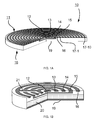
- FIG. 1A schematically shows a SDD
- FIG. 1B schematically shows the central part of the SSD shown in FIG. 1A .
- FIG. 2A schematically shows an electronic representation of a (part of a) prior art detector
- FIG. 2B schematically shows an electronic representation of a (part of a) detector according to the invention.
- FIG. 1A schematically shows a SDD.
- a SDD is formed from by a silicon wafer 10 , showing a volume of high purity, or at least showing little recombination sides, between a first side 11 and a second side 18 .
- Side 11 comprises the anode 16 and side 18 comprises the cathode 19 . Electrodes of any electron/hole pairs generated in the volume between these two sides will drift to the anode and the holes to the cathode(s).
- Side 11 shows at a first side 11 a central electrode 12 forming the drain of a FET.
- An electrode 13 surrounding the central electrode forms the gate of the FET, and electrode 14 surrounding electrode 13 forms the source of the FET.
- the FET is shielded from the rest of the silicon wafer by a shield electrode 15 surrounding electrodes 12 , 13 and 14 , both laterally and ‘inside’ the wafer.
- the anode is connected to the gate of the FET (connection not shown in FIG. 1A ).
- a number of concentric electrodes 17 - i Surrounding the anode a number of concentric electrodes 17 - i are formed. The innermost of these concentric electrodes is connected to a voltage close to the anode voltage, the successive rings 17 - i connected to voltages increasing from slightly above the anode voltage for the innermost of these electrodes to a voltage close to or equal to the cathode voltage for the outermost electrode.
- the ring electrodes 17 - i cause a field inside the wafer that guides all electrons from electron/hole pairs to the anode, while the anode is only a small structure and thus shows only a small capacitance with respect to the cathode.
- FIG. 1B schematically shows a detail of the SDD shown in FIG. 1A .
- FIG. 1B shows the part from the centre until the anode.
- Side 18 is the side sensitive to radiation. Underneath this surface the sensitive volume 20 is shown. X-rays incident on the sensitive surface penetrate into the volume and generate in this volume a number of electron/hole pairs. The amount of electron/hole pairs depends on the energy of the photon. In normal operation the number of photons is such, that each event can be detected separately, and thus the number of electron/hole pairs per event, that is: per incident photon.
- leakage current from the drain of the FET to its gate can be used to compensate for the average charge accumulation.
- FIG. 2A schematically shows an electronic representation of a (part of a) prior art detector.
- the electronic representation shows the SDD used in a charge amplifier configuration.
- the part within box 200 are part of the SDD, the other parts are external to the SDD.
- the SDD comprises a cathode 201 and an anode 202 , a FET 203 of which the gate is internally connected to the anode 202 , a feedback capacitor 205 of which one side is connected to the anode 202 , and a reset element in the form of diode 204 of which the cathode is connected to the anode 202 .
- Connected to outputs of the SDD are its cathode, the source and drain of the FET, the side of the feedback capacitor not connected to the anode 202 , and the anode of the reset diode.
- the external connections of the cathode 201 and the source of the FET are tied together to ground potential.
- the drain of the FET is connected to an amplifier 206 .
- the output of the amplifier is connected to the feedback capacitor on the SDD and thus a charge amplifier is formed.
- Further reset logic 207 is connected to the output of the amplifier, which produces a pulse to the anode of the reset diode, as a result of which the SDD is reset.
- the detector can operate in so-called “continuous reset mode”, in which the reset logic is not active, or not even present, and the drain/gate voltage of the FET generates a (voltage dependent) leakage current that compensates the induced (average) anode/cathode current.
- the detector not shown, but necessary for operating the detector, are electronics for biasing the anode 202 , the drain of the FET, and the concentric rings 107 - i . It is noted that the voltages for the concentric rings can be derived from a resistive network integrated on the SDD between its anode and its cathode.
- the output of the amplifier is connected to further electronics and logic to determine the pulse height of the charge amplifier resulting from an incident photon.
- FIG. 2B schematically shows an electronic representation of a (part of a) detector according to the invention.
- the detector according to the invention resembles the prior art detector shown in FIG. 2A .
- the detector can be switch from its normal pulse height measurement mode (PHMM), in which switch 209 is opened and the feedback element is not active, to a current measurement mode (CMM), in which switch 209 is closed and the feedback element is part of the feedback loop. In this mode the reset logic 207 should be disabled.
- PHMM normal pulse height measurement mode
- CMS current measurement mode
- the switch 209 can be a mechanical relay, such as a reed relay, or an electronic switch, such as a FET.
- the feedback via capacitor 205 need not be disabled, as this does not influence the feedback via the resistor 208 .
- the switch may also select feedback between the capacitor 206 and the resistor when executed as a double pole switch.
- the feedback element can also show a voltage/current characteristic that is non-linear (non-ohmic), in other words that it can be different from a resistor.
- a logarithmic response can be realized by using, for example, a diode as feedback element. As such a diode is often already present in the form of the reset diode, the detector can then use a prior art SDD. The resultant detector has a large dynamic range in CMM.
- reset logic 207 produces a signal that is continuously high.
- the reset logic produces a pulse with a specified voltage to reset the anode.
- the voltage on the diode is dependent on the current induced between anode 202 and cathode 201 : the current through the diode equals the current between anode and cathode.
- U.S. Pat. No. 7,858,946 describes a detector comprising a SDD where the input of the first amplifier is connected to the source of the FET.
- this patent describes this as the typical usage
- other documents such as http://home.dei.polimi.it/sampietr/Ratex/RATEX1.html state that “The disadvantage of the Source Follower configuration is represented by the instability of the charge-to-voltage conversion made by the overall capacitance seen by the anode” and advocate the use of the detector in charge sensitive amplifier configuration.
- the invention is also relevant to detectors comprising a SDD in source follower mode. It is noted that the polarity of the amplification of the amplifier is different for the two modes (source follower, with the source connected to amplifier or drain connected to amplifier).
- a circle symmetric SDD is shown, but that also asymmetric SDD's, for example shaped like a teardrop, are known, where the anode/FET are placed far from the center, as well as multiple SDD's integrated on one part of silicon.
- a SDD showing a central through-hole or multiple SDD's arranged around a central through-hole may be contemplated, the central through-hole for passing the beam of charged particles that irradiates the sample.
Landscapes
- Chemical & Material Sciences (AREA)
- Analytical Chemistry (AREA)
- Physics & Mathematics (AREA)
- Health & Medical Sciences (AREA)
- Life Sciences & Earth Sciences (AREA)
- General Physics & Mathematics (AREA)
- High Energy & Nuclear Physics (AREA)
- Molecular Biology (AREA)
- Spectroscopy & Molecular Physics (AREA)
- Measurement Of Radiation (AREA)
Priority Applications (1)
| Application Number | Priority Date | Filing Date | Title |
|---|---|---|---|
| US13/544,776 US8941072B2 (en) | 2011-07-07 | 2012-07-09 | Silicon drift diode detector configured to switch between pulse height measurement mode and current measurement mode |
Applications Claiming Priority (5)
| Application Number | Priority Date | Filing Date | Title |
|---|---|---|---|
| US201161505404P | 2011-07-07 | 2011-07-07 | |
| EP11172955A EP2544025A1 (en) | 2011-07-07 | 2011-07-07 | Silicon Drift Detector for use in a charged particle apparatus |
| EP11172955.4 | 2011-07-07 | ||
| EP11172955 | 2011-07-07 | ||
| US13/544,776 US8941072B2 (en) | 2011-07-07 | 2012-07-09 | Silicon drift diode detector configured to switch between pulse height measurement mode and current measurement mode |
Publications (2)
| Publication Number | Publication Date |
|---|---|
| US20130099114A1 US20130099114A1 (en) | 2013-04-25 |
| US8941072B2 true US8941072B2 (en) | 2015-01-27 |
Family
ID=46319067
Family Applications (1)
| Application Number | Title | Priority Date | Filing Date |
|---|---|---|---|
| US13/544,776 Active 2032-07-26 US8941072B2 (en) | 2011-07-07 | 2012-07-09 | Silicon drift diode detector configured to switch between pulse height measurement mode and current measurement mode |
Country Status (4)
| Country | Link |
|---|---|
| US (1) | US8941072B2 (enExample) |
| EP (2) | EP2544025A1 (enExample) |
| JP (1) | JP5995562B2 (enExample) |
| CN (1) | CN102866413B (enExample) |
Cited By (1)
| Publication number | Priority date | Publication date | Assignee | Title |
|---|---|---|---|---|
| US11397270B2 (en) * | 2019-02-25 | 2022-07-26 | Ketek Gmbh | Method for operating a signal filter and radiation detection system |
Families Citing this family (15)
| Publication number | Priority date | Publication date | Assignee | Title |
|---|---|---|---|---|
| DE102011080341A1 (de) * | 2011-08-03 | 2013-02-07 | Carl Zeiss Nts Gmbh | Verfahren und Teilchenstrahlgerät zur Erzeugung eines Bildes eines Objekts |
| US9123837B2 (en) * | 2013-05-31 | 2015-09-01 | Oxford Instruments Analytical Oy | Semiconductor detector with radiation shield |
| US10460905B2 (en) * | 2015-09-23 | 2019-10-29 | Kla-Tencor Corporation | Backscattered electrons (BSE) imaging using multi-beam tools |
| ITUB20159390A1 (it) * | 2015-12-24 | 2017-06-24 | Fond Bruno Kessler | Rivelatore a semiconduttore, rivelatore di radiazione e apparecchiatura di rivelazione di radiazione. |
| KR101749920B1 (ko) * | 2016-03-02 | 2017-06-22 | 한국과학기술원 | 실리콘 드리프트 디텍터를 이용한 엑스선 검출용 방사선 검출기 |
| CN105842727B (zh) * | 2016-06-03 | 2018-07-03 | 中国工程物理研究院激光聚变研究中心 | 一种透射式平响应软x射线辐射流测量装置 |
| ES2653767B1 (es) | 2016-07-07 | 2019-03-28 | Consejo Superior Investigacion | Sensor de electrones para microscopia electronica |
| EP3532873B1 (en) * | 2016-10-27 | 2021-06-23 | Shenzhen Xpectvision Technology Co., Ltd. | Dark noise compensation in a radiation detector |
| CN106525028B (zh) * | 2016-10-28 | 2019-05-24 | 北京控制工程研究所 | 用于x射线脉冲星导航敏感器的硅漂移探测器处理电路 |
| EP3385756A1 (en) * | 2017-04-06 | 2018-10-10 | Koninklijke Philips N.V. | Pulse shaper |
| DE102018204683B3 (de) | 2018-03-27 | 2019-08-08 | Carl Zeiss Microscopy Gmbh | Elektronenstrahlmikroskop |
| KR102484833B1 (ko) * | 2018-07-31 | 2023-01-06 | 한국원자력연구원 | 방사성 핵종 분석 시스템 |
| EP3842838A1 (en) * | 2019-12-23 | 2021-06-30 | Koninklijke Philips N.V. | Radiological instrument with a pulse shaper circuit |
| CN111584656B (zh) * | 2020-06-15 | 2021-11-09 | 中国科学院微电子研究所 | 漂移探测器及其加工方法 |
| CN114300570B (zh) * | 2021-12-29 | 2024-05-17 | 上海集成电路研发中心有限公司 | 探测器及制造方法 |
Citations (20)
| Publication number | Priority date | Publication date | Assignee | Title |
|---|---|---|---|---|
| US3813545A (en) * | 1973-04-12 | 1974-05-28 | Edax Int Inc | X-ray scan area mapping system |
| US4149076A (en) * | 1976-04-05 | 1979-04-10 | Albert Richard D | Method and apparatus producing plural images of different contrast range by X-ray scanning |
| US4186307A (en) * | 1976-08-31 | 1980-01-29 | Tokyo Shibaura Electric Co., Ltd. | Radiation measuring apparatus employing variable rate pulse sampling control |
| US4775834A (en) * | 1983-08-18 | 1988-10-04 | Valmet Oy | Pulse width-pulse height multiplicator in a static kWh meter |
| US5113077A (en) * | 1989-10-05 | 1992-05-12 | Hitachi Medical Corporation | Radiation detection circuit having a signal integrating capacitor, and a data aquisition system for an x-ray scanner including such circuit |
| US20050105665A1 (en) * | 2000-03-28 | 2005-05-19 | Lee Grodzins | Detection of neutrons and sources of radioactive material |
| US7187316B1 (en) * | 2006-02-06 | 2007-03-06 | Brookhaven Science Associates, Llc | Method and apparatus for clockless analog-to-digital conversion and peak detection |
| US20080001095A1 (en) * | 2006-06-29 | 2008-01-03 | Oliver Richard Astley | Adaptive imaging system |
| US7411198B1 (en) * | 2006-05-31 | 2008-08-12 | The United States Of America As Represented By The Administrator Of The National Aeronautics And Space Administration | Integrator circuitry for single channel radiation detector |
| US20080317200A1 (en) * | 2004-09-28 | 2008-12-25 | UNIVERSITé DE SHERBROOKE | Method and System for Low Radiation Computed Tomography |
| US20090021717A1 (en) | 2007-06-25 | 2009-01-22 | Asml Netherlands B.V. | Radiation Detector, Method of Manufacturing a Radiation Detector, and Lithographic Apparatus Comprising a Radiation Detector |
| US20090073735A1 (en) * | 2007-09-13 | 2009-03-19 | Kesler Scott B | Analog duty cycle replicating frequency converter for pwm signals |
| US7586108B2 (en) | 2007-06-25 | 2009-09-08 | Asml Netherlands B.V. | Radiation detector, method of manufacturing a radiation detector and lithographic apparatus comprising a radiation detector |
| US20100163742A1 (en) | 2008-12-25 | 2010-07-01 | Jeol Ltd. | Silicon Drift X-Ray Detector |
| US7858946B2 (en) | 2007-01-18 | 2010-12-28 | Bruker Ax Microanalysis Gmbh | Energy dispersive X-ray I-FET SDD detector appliance and a method for pulsed reset neutralization of accumulated charges within an energy dispersive X-ray I-FET SDD detector appliance |
| US20110031215A1 (en) * | 2009-08-07 | 2011-02-10 | Hubert Mantz | Particle beam systems and methods |
| US20110169116A1 (en) | 2010-01-13 | 2011-07-14 | Fei Company | Radiation Detector |
| US8049182B2 (en) * | 2010-01-12 | 2011-11-01 | Oxford Instruments Nanotechnology Tools Limited | Charged particle filter |
| US8198577B2 (en) * | 2009-02-25 | 2012-06-12 | Caeleste Cvba | High dynamic range analog X-ray photon counting |
| US20120273679A1 (en) * | 2009-12-07 | 2012-11-01 | Oxford Instruments Nanotechnology Tools Ltd | X-ray analyser |
Family Cites Families (5)
| Publication number | Priority date | Publication date | Assignee | Title |
|---|---|---|---|---|
| DE19960243A1 (de) | 1999-12-14 | 2001-07-05 | Infineon Technologies Ag | Bussystem |
| US6541836B2 (en) * | 2001-02-21 | 2003-04-01 | Photon Imaging, Inc. | Semiconductor radiation detector with internal gain |
| US7193216B2 (en) * | 2004-10-22 | 2007-03-20 | Oxford Instruments Analytical Oy | Method and circuit arrangement for compensating for rate dependent change of conversion factor in a drift-type radiation detector and a detector appliance |
| US7339175B1 (en) * | 2006-07-28 | 2008-03-04 | Thermo Electron Scientific Instruments Llc | Feedback circuit for output control in a semiconductor X-ray detector |
| CN101281148B (zh) * | 2007-07-27 | 2011-01-05 | 江苏天瑞仪器股份有限公司 | 一种高分辨率的半导体核辐射探测器 |
-
2011
- 2011-07-07 EP EP11172955A patent/EP2544025A1/en not_active Withdrawn
-
2012
- 2012-06-28 EP EP12173975.9A patent/EP2544026B1/en active Active
- 2012-07-06 JP JP2012152136A patent/JP5995562B2/ja active Active
- 2012-07-06 CN CN201210233116.0A patent/CN102866413B/zh active Active
- 2012-07-09 US US13/544,776 patent/US8941072B2/en active Active
Patent Citations (20)
| Publication number | Priority date | Publication date | Assignee | Title |
|---|---|---|---|---|
| US3813545A (en) * | 1973-04-12 | 1974-05-28 | Edax Int Inc | X-ray scan area mapping system |
| US4149076A (en) * | 1976-04-05 | 1979-04-10 | Albert Richard D | Method and apparatus producing plural images of different contrast range by X-ray scanning |
| US4186307A (en) * | 1976-08-31 | 1980-01-29 | Tokyo Shibaura Electric Co., Ltd. | Radiation measuring apparatus employing variable rate pulse sampling control |
| US4775834A (en) * | 1983-08-18 | 1988-10-04 | Valmet Oy | Pulse width-pulse height multiplicator in a static kWh meter |
| US5113077A (en) * | 1989-10-05 | 1992-05-12 | Hitachi Medical Corporation | Radiation detection circuit having a signal integrating capacitor, and a data aquisition system for an x-ray scanner including such circuit |
| US20050105665A1 (en) * | 2000-03-28 | 2005-05-19 | Lee Grodzins | Detection of neutrons and sources of radioactive material |
| US20080317200A1 (en) * | 2004-09-28 | 2008-12-25 | UNIVERSITé DE SHERBROOKE | Method and System for Low Radiation Computed Tomography |
| US7187316B1 (en) * | 2006-02-06 | 2007-03-06 | Brookhaven Science Associates, Llc | Method and apparatus for clockless analog-to-digital conversion and peak detection |
| US7411198B1 (en) * | 2006-05-31 | 2008-08-12 | The United States Of America As Represented By The Administrator Of The National Aeronautics And Space Administration | Integrator circuitry for single channel radiation detector |
| US20080001095A1 (en) * | 2006-06-29 | 2008-01-03 | Oliver Richard Astley | Adaptive imaging system |
| US7858946B2 (en) | 2007-01-18 | 2010-12-28 | Bruker Ax Microanalysis Gmbh | Energy dispersive X-ray I-FET SDD detector appliance and a method for pulsed reset neutralization of accumulated charges within an energy dispersive X-ray I-FET SDD detector appliance |
| US20090021717A1 (en) | 2007-06-25 | 2009-01-22 | Asml Netherlands B.V. | Radiation Detector, Method of Manufacturing a Radiation Detector, and Lithographic Apparatus Comprising a Radiation Detector |
| US7586108B2 (en) | 2007-06-25 | 2009-09-08 | Asml Netherlands B.V. | Radiation detector, method of manufacturing a radiation detector and lithographic apparatus comprising a radiation detector |
| US20090073735A1 (en) * | 2007-09-13 | 2009-03-19 | Kesler Scott B | Analog duty cycle replicating frequency converter for pwm signals |
| US20100163742A1 (en) | 2008-12-25 | 2010-07-01 | Jeol Ltd. | Silicon Drift X-Ray Detector |
| US8198577B2 (en) * | 2009-02-25 | 2012-06-12 | Caeleste Cvba | High dynamic range analog X-ray photon counting |
| US20110031215A1 (en) * | 2009-08-07 | 2011-02-10 | Hubert Mantz | Particle beam systems and methods |
| US20120273679A1 (en) * | 2009-12-07 | 2012-11-01 | Oxford Instruments Nanotechnology Tools Ltd | X-ray analyser |
| US8049182B2 (en) * | 2010-01-12 | 2011-11-01 | Oxford Instruments Nanotechnology Tools Limited | Charged particle filter |
| US20110169116A1 (en) | 2010-01-13 | 2011-07-14 | Fei Company | Radiation Detector |
Non-Patent Citations (26)
| Title |
|---|
| ‘Amptek Silicon Drift Detectors,’ http://www.amptek.com/pdf/ansdd3.pdf, retrieved Apr. 26, 2013, 7 pgs. |
| ‘On-board electronics for X-ray detectors,’ http://home.dei.polimi.it/sampietr/Ratex/RATEX1.html, retrieved Apr. 26, 2013, 5 pgs. |
| ‘PNSensor Silicon Drift Detector Development,’ http://www.pnsensor.de/Welcome/Detector/SDD/index.html, retrieved Apr. 26, 2013, 4 pgs. |
| Alberti, R., et al., ‘Performance of Different Readout Topologies of Silicon Drift Detectors in PIXZE Spectroscopy,’ IEEE Nuclear Science Symposium Conference Record, Oct. 19, 2008, pp. 2575-2580. |
| Alberti, R., et al., 'Performance of Different Readout Topologies of Silicon Drift Detectors in PIXZE Spectroscopy,' IEEE Nuclear Science Symposium Conference Record, Oct. 19, 2008, pp. 2575-2580. |
| 'Amptek Silicon Drift Detectors,' http://www.amptek.com/pdf/ansdd3.pdf, retrieved Apr. 26, 2013, 7 pgs. |
| Fiorini, C., ‘A CMOS charge preamplifier for silicon drift detectors with on-chip JFET and feedback capacitor,’ Nuclear Instruments and Methods in Physics A, Aug. 10, 2006, pp. 322-328, vol. 568. |
| Fiorini, C., 'A CMOS charge preamplifier for silicon drift detectors with on-chip JFET and feedback capacitor,' Nuclear Instruments and Methods in Physics A, Aug. 10, 2006, pp. 322-328, vol. 568. |
| Fiorini, C., et al., ‘Charge-Sensitive Preamplifier With Continuous Reset by Means of the Gate-to-Drain Current of JFET Integrated on the Detector,’ IEEE transactions on Nuclear Science, Nov. 4-10, 2001, pp. 1018-1020, vol. 2. |
| Fiorini, C., et al., ‘Charge-Sensitive Preamplifier With Continuous Reset by Means of the Gate-to-Drain Current of the JFET Integrated on the Detector,’IEEE Transactions on Nuclear Science, Jun. 2002, pp. 1147-1149, vol. 49, No. 3. |
| Fiorini, C., et al., ‘Continuous Charge Restoration in Semiconductor Detectors by Means of the Gate-to-Drain Current of the Integrated Front-End JFET,’ IEEE Transactions on Nuclear Science, 1999, pp. 761-764, vol. 46, No. 3. |
| Fiorini, C., et al., 'Charge-Sensitive Preamplifier With Continuous Reset by Means of the Gate-to-Drain Current of JFET Integrated on the Detector,' IEEE transactions on Nuclear Science, Nov. 4-10, 2001, pp. 1018-1020, vol. 2. |
| Fiorini, C., et al., 'Charge-Sensitive Preamplifier With Continuous Reset by Means of the Gate-to-Drain Current of the JFET Integrated on the Detector,'IEEE Transactions on Nuclear Science, Jun. 2002, pp. 1147-1149, vol. 49, No. 3. |
| Fiorini, C., et al., 'Continuous Charge Restoration in Semiconductor Detectors by Means of the Gate-to-Drain Current of the Integrated Front-End JFET,' IEEE Transactions on Nuclear Science, 1999, pp. 761-764, vol. 46, No. 3. |
| Gatti, P., et al., ‘Semiconductor Drift Chamber—An Application of a Novel Charge Transport Scheme,’ Nuclear Instruments and Methods in Physics Research, 1984, pp. 608-614, vol. 225. |
| Gatti, P., et al., 'Semiconductor Drift Chamber-An Application of a Novel Charge Transport Scheme,' Nuclear Instruments and Methods in Physics Research, 1984, pp. 608-614, vol. 225. |
| Lechner, P, et al., ‘Silicon drift detectors for high resolution, high count rate x-ray spectroscopy at room temperature,’ International Centre for Diffraction Data 2004, Advances in X-Ray Analysis, 2004, pp. 53-58, vol. 47. |
| Lechner, P, et al., 'Silicon drift detectors for high resolution, high count rate x-ray spectroscopy at room temperature,' International Centre for Diffraction Data 2004, Advances in X-Ray Analysis, 2004, pp. 53-58, vol. 47. |
| Niculae, A., et al., ‘Optimized readout methods of silicon drift detectors for high-resolution X-ray spectroscopy,’ Nuclear Instruments and Methods in Physics Research A, 2006, pp. 336-342, vol. 568. |
| Niculae, A., et al., 'Optimized readout methods of silicon drift detectors for high-resolution X-ray spectroscopy,' Nuclear Instruments and Methods in Physics Research A, 2006, pp. 336-342, vol. 568. |
| 'On-board electronics for X-ray detectors,' http://home.dei.polimi.it/sampietr/Ratex/RATEX1.html, retrieved Apr. 26, 2013, 5 pgs. |
| 'PNSensor Silicon Drift Detector Development,' http://www.pnsensor.de/Welcome/Detector/SDD/index.html, retrieved Apr. 26, 2013, 4 pgs. |
| Struder, L., ‘High Resolution Silicon Detectors for Photons and Particles,’ Radiation Protection Dosimetry, 1995, pp. 39-46, vol. 61, No. 1-3. |
| Struder, L., ‘High-resolution imaging X-ray spectrometers,’ http://www.hll.mpg.de/07—publication/2000/nima—45473. pdf, retrieved Feb. 3, 2010, 41 pgs. |
| Struder, L., 'High Resolution Silicon Detectors for Photons and Particles,' Radiation Protection Dosimetry, 1995, pp. 39-46, vol. 61, No. 1-3. |
| Struder, L., 'High-resolution imaging X-ray spectrometers,' http://www.hll.mpg.de/07-publication/2000/nima-45473. pdf, retrieved Feb. 3, 2010, 41 pgs. |
Cited By (1)
| Publication number | Priority date | Publication date | Assignee | Title |
|---|---|---|---|---|
| US11397270B2 (en) * | 2019-02-25 | 2022-07-26 | Ketek Gmbh | Method for operating a signal filter and radiation detection system |
Also Published As
| Publication number | Publication date |
|---|---|
| CN102866413A (zh) | 2013-01-09 |
| US20130099114A1 (en) | 2013-04-25 |
| EP2544026B1 (en) | 2013-12-11 |
| EP2544025A1 (en) | 2013-01-09 |
| JP2013019897A (ja) | 2013-01-31 |
| JP5995562B2 (ja) | 2016-09-21 |
| CN102866413B (zh) | 2016-12-28 |
| EP2544026A1 (en) | 2013-01-09 |
Similar Documents
| Publication | Publication Date | Title |
|---|---|---|
| US8941072B2 (en) | Silicon drift diode detector configured to switch between pulse height measurement mode and current measurement mode | |
| Baron | Report on the X-ray efficiency and time response of a 1 cm2 reach through avalanche diode | |
| JP5875606B2 (ja) | 改善されたカウンタ構造を備えている単一光子計数検出器システム | |
| CN101110157B (zh) | 用于成像系统的自适应数据获取 | |
| JP5102580B2 (ja) | 荷電粒子線応用装置 | |
| US9966224B2 (en) | Quantitative secondary electron detection | |
| JP2013019897A5 (enExample) | ||
| US7619199B2 (en) | Time-resolved measurement apparatus and position-sensitive election multiplier tube | |
| Andrä et al. | Development of low-energy X-ray detectors using LGAD sensors | |
| US20140332692A1 (en) | Semiconductor drift detector and corresponding operating method | |
| AU2001262881B2 (en) | Radiation detection apparatus and method | |
| US5081664A (en) | X-ray measurement apparatus for the measurement of x-ray doses and acceleration voltage | |
| US20110147600A1 (en) | Counting x-ray detector | |
| Shikhaliev et al. | Scanning‐slit photon counting x‐ray imaging system using a microchannel plate detector | |
| TWI445039B (zh) | 粒子偵測系統 | |
| Petrov et al. | Ultrafast compact classical Mott polarimeter | |
| Longoni et al. | 4.2 X-Ray Detectors and Signal Processing | |
| US6121623A (en) | Parallel radiation detector | |
| CN208721796U (zh) | 一种中子和γ射线联合探测器 | |
| Alberti et al. | Optimized readout configuration for PIXE spectrometers based on Silicon Drift Detectors: Architecture and performance | |
| Andra et al. | Development of low-energy X-ray detectors using LGAD sensors | |
| Castoldi et al. | Validation of proton tests in air for detector calibration over a wide range of charge injection levels | |
| Ogasawara et al. | Avalanche photodiode arrays enable large-area measurements of medium-energy electrons | |
| Jiang et al. | A novel high dynamic-range SiPM for scintillator-based hadronic calorimetry | |
| Alberti et al. | Performance of different readout topologies of silicon drift detectors in PIXE spectroscopy |
Legal Events
| Date | Code | Title | Description |
|---|---|---|---|
| STCF | Information on status: patent grant |
Free format text: PATENTED CASE |
|
| MAFP | Maintenance fee payment |
Free format text: PAYMENT OF MAINTENANCE FEE, 4TH YEAR, LARGE ENTITY (ORIGINAL EVENT CODE: M1551) Year of fee payment: 4 |
|
| MAFP | Maintenance fee payment |
Free format text: PAYMENT OF MAINTENANCE FEE, 8TH YEAR, LARGE ENTITY (ORIGINAL EVENT CODE: M1552); ENTITY STATUS OF PATENT OWNER: LARGE ENTITY Year of fee payment: 8 |