US8899953B2 - Extrusion die head - Google Patents
Extrusion die head Download PDFInfo
- Publication number
- US8899953B2 US8899953B2 US13/377,248 US201013377248A US8899953B2 US 8899953 B2 US8899953 B2 US 8899953B2 US 201013377248 A US201013377248 A US 201013377248A US 8899953 B2 US8899953 B2 US 8899953B2
- Authority
- US
- United States
- Prior art keywords
- plate
- apertures
- shaping
- tube
- aperture
- Prior art date
- Legal status (The legal status is an assumption and is not a legal conclusion. Google has not performed a legal analysis and makes no representation as to the accuracy of the status listed.)
- Active, expires
Links
- 0 *=C1C2*=CCC12 Chemical compound *=C1C2*=CCC12 0.000 description 1
Images


Classifications
-
- B—PERFORMING OPERATIONS; TRANSPORTING
- B29—WORKING OF PLASTICS; WORKING OF SUBSTANCES IN A PLASTIC STATE IN GENERAL
- B29C—SHAPING OR JOINING OF PLASTICS; SHAPING OF MATERIAL IN A PLASTIC STATE, NOT OTHERWISE PROVIDED FOR; AFTER-TREATMENT OF THE SHAPED PRODUCTS, e.g. REPAIRING
- B29C48/00—Extrusion moulding, i.e. expressing the moulding material through a die or nozzle which imparts the desired form; Apparatus therefor
- B29C48/25—Component parts, details or accessories; Auxiliary operations
- B29C48/30—Extrusion nozzles or dies
-
- A—HUMAN NECESSITIES
- A23—FOODS OR FOODSTUFFS; TREATMENT THEREOF, NOT COVERED BY OTHER CLASSES
- A23P—SHAPING OR WORKING OF FOODSTUFFS, NOT FULLY COVERED BY A SINGLE OTHER SUBCLASS
- A23P30/00—Shaping or working of foodstuffs characterised by the process or apparatus
- A23P30/20—Extruding
- A23P30/25—Co-extrusion of different foodstuffs
-
- A23P1/125—
-
- A—HUMAN NECESSITIES
- A21—BAKING; EDIBLE DOUGHS
- A21C—MACHINES OR EQUIPMENT FOR MAKING OR PROCESSING DOUGHS; HANDLING BAKED ARTICLES MADE FROM DOUGH
- A21C11/00—Other machines for forming the dough into its final shape before cooking or baking
- A21C11/16—Extruding machines
- A21C11/163—Applying co-extrusion, i.e. extruding two or more plastic substances simultaneously, e.g. for making filled dough products; Making products from two or more different substances supplied to the extruder
-
- A—HUMAN NECESSITIES
- A23—FOODS OR FOODSTUFFS; TREATMENT THEREOF, NOT COVERED BY OTHER CLASSES
- A23G—COCOA; COCOA PRODUCTS, e.g. CHOCOLATE; SUBSTITUTES FOR COCOA OR COCOA PRODUCTS; CONFECTIONERY; CHEWING GUM; ICE-CREAM; PREPARATION THEREOF
- A23G3/00—Sweetmeats; Confectionery; Marzipan; Coated or filled products
- A23G3/0002—Processes of manufacture not relating to composition and compounding ingredients
- A23G3/0063—Coating or filling sweetmeats or confectionery
- A23G3/0065—Processes for making filled articles, composite articles, multi-layered articles
- A23G3/0068—Processes for making filled articles, composite articles, multi-layered articles the material being shaped at least partially by a die; Extrusion of filled or multi-layered cross-sections or plates, optionally with the associated cutting
-
- A—HUMAN NECESSITIES
- A23—FOODS OR FOODSTUFFS; TREATMENT THEREOF, NOT COVERED BY OTHER CLASSES
- A23G—COCOA; COCOA PRODUCTS, e.g. CHOCOLATE; SUBSTITUTES FOR COCOA OR COCOA PRODUCTS; CONFECTIONERY; CHEWING GUM; ICE-CREAM; PREPARATION THEREOF
- A23G3/00—Sweetmeats; Confectionery; Marzipan; Coated or filled products
- A23G3/02—Apparatus specially adapted for manufacture or treatment of sweetmeats or confectionery; Accessories therefor
- A23G3/20—Apparatus for coating or filling sweetmeats or confectionery
- A23G3/2007—Manufacture of filled articles, composite articles, multi-layered articles
- A23G3/2015—Manufacture of filled articles, composite articles, multi-layered articles the material being shaped at least partially by a die; Extrusion of filled or multi-layered cross-sections or plates, optionally with the associated cutting device
-
- A—HUMAN NECESSITIES
- A23—FOODS OR FOODSTUFFS; TREATMENT THEREOF, NOT COVERED BY OTHER CLASSES
- A23P—SHAPING OR WORKING OF FOODSTUFFS, NOT FULLY COVERED BY A SINGLE OTHER SUBCLASS
- A23P30/00—Shaping or working of foodstuffs characterised by the process or apparatus
- A23P30/20—Extruding
-
- B29C47/12—
-
- B29C47/128—
-
- B—PERFORMING OPERATIONS; TRANSPORTING
- B29—WORKING OF PLASTICS; WORKING OF SUBSTANCES IN A PLASTIC STATE IN GENERAL
- B29C—SHAPING OR JOINING OF PLASTICS; SHAPING OF MATERIAL IN A PLASTIC STATE, NOT OTHERWISE PROVIDED FOR; AFTER-TREATMENT OF THE SHAPED PRODUCTS, e.g. REPAIRING
- B29C48/00—Extrusion moulding, i.e. expressing the moulding material through a die or nozzle which imparts the desired form; Apparatus therefor
- B29C48/03—Extrusion moulding, i.e. expressing the moulding material through a die or nozzle which imparts the desired form; Apparatus therefor characterised by the shape of the extruded material at extrusion
- B29C48/06—Rod-shaped
-
- B—PERFORMING OPERATIONS; TRANSPORTING
- B29—WORKING OF PLASTICS; WORKING OF SUBSTANCES IN A PLASTIC STATE IN GENERAL
- B29C—SHAPING OR JOINING OF PLASTICS; SHAPING OF MATERIAL IN A PLASTIC STATE, NOT OTHERWISE PROVIDED FOR; AFTER-TREATMENT OF THE SHAPED PRODUCTS, e.g. REPAIRING
- B29C48/00—Extrusion moulding, i.e. expressing the moulding material through a die or nozzle which imparts the desired form; Apparatus therefor
- B29C48/03—Extrusion moulding, i.e. expressing the moulding material through a die or nozzle which imparts the desired form; Apparatus therefor characterised by the shape of the extruded material at extrusion
- B29C48/09—Articles with cross-sections having partially or fully enclosed cavities, e.g. pipes or channels
-
- B—PERFORMING OPERATIONS; TRANSPORTING
- B29—WORKING OF PLASTICS; WORKING OF SUBSTANCES IN A PLASTIC STATE IN GENERAL
- B29C—SHAPING OR JOINING OF PLASTICS; SHAPING OF MATERIAL IN A PLASTIC STATE, NOT OTHERWISE PROVIDED FOR; AFTER-TREATMENT OF THE SHAPED PRODUCTS, e.g. REPAIRING
- B29C48/00—Extrusion moulding, i.e. expressing the moulding material through a die or nozzle which imparts the desired form; Apparatus therefor
- B29C48/15—Extrusion moulding, i.e. expressing the moulding material through a die or nozzle which imparts the desired form; Apparatus therefor incorporating preformed parts or layers, e.g. extrusion moulding around inserts
-
- B—PERFORMING OPERATIONS; TRANSPORTING
- B29—WORKING OF PLASTICS; WORKING OF SUBSTANCES IN A PLASTIC STATE IN GENERAL
- B29C—SHAPING OR JOINING OF PLASTICS; SHAPING OF MATERIAL IN A PLASTIC STATE, NOT OTHERWISE PROVIDED FOR; AFTER-TREATMENT OF THE SHAPED PRODUCTS, e.g. REPAIRING
- B29C48/00—Extrusion moulding, i.e. expressing the moulding material through a die or nozzle which imparts the desired form; Apparatus therefor
- B29C48/16—Articles comprising two or more components, e.g. co-extruded layers
- B29C48/18—Articles comprising two or more components, e.g. co-extruded layers the components being layers
-
- B—PERFORMING OPERATIONS; TRANSPORTING
- B29—WORKING OF PLASTICS; WORKING OF SUBSTANCES IN A PLASTIC STATE IN GENERAL
- B29C—SHAPING OR JOINING OF PLASTICS; SHAPING OF MATERIAL IN A PLASTIC STATE, NOT OTHERWISE PROVIDED FOR; AFTER-TREATMENT OF THE SHAPED PRODUCTS, e.g. REPAIRING
- B29C48/00—Extrusion moulding, i.e. expressing the moulding material through a die or nozzle which imparts the desired form; Apparatus therefor
- B29C48/25—Component parts, details or accessories; Auxiliary operations
- B29C48/30—Extrusion nozzles or dies
- B29C48/302—Extrusion nozzles or dies being adjustable, i.e. having adjustable exit sections
-
- B—PERFORMING OPERATIONS; TRANSPORTING
- B29—WORKING OF PLASTICS; WORKING OF SUBSTANCES IN A PLASTIC STATE IN GENERAL
- B29C—SHAPING OR JOINING OF PLASTICS; SHAPING OF MATERIAL IN A PLASTIC STATE, NOT OTHERWISE PROVIDED FOR; AFTER-TREATMENT OF THE SHAPED PRODUCTS, e.g. REPAIRING
- B29C48/00—Extrusion moulding, i.e. expressing the moulding material through a die or nozzle which imparts the desired form; Apparatus therefor
- B29C48/25—Component parts, details or accessories; Auxiliary operations
- B29C48/30—Extrusion nozzles or dies
- B29C48/304—Extrusion nozzles or dies specially adapted for bringing together components, e.g. melts within the die
-
- B29C47/003—
-
- B29C47/0057—
-
- B—PERFORMING OPERATIONS; TRANSPORTING
- B29—WORKING OF PLASTICS; WORKING OF SUBSTANCES IN A PLASTIC STATE IN GENERAL
- B29C—SHAPING OR JOINING OF PLASTICS; SHAPING OF MATERIAL IN A PLASTIC STATE, NOT OTHERWISE PROVIDED FOR; AFTER-TREATMENT OF THE SHAPED PRODUCTS, e.g. REPAIRING
- B29C48/00—Extrusion moulding, i.e. expressing the moulding material through a die or nozzle which imparts the desired form; Apparatus therefor
- B29C48/001—Combinations of extrusion moulding with other shaping operations
- B29C48/0018—Combinations of extrusion moulding with other shaping operations combined with shaping by orienting, stretching or shrinking, e.g. film blowing
-
- B—PERFORMING OPERATIONS; TRANSPORTING
- B29—WORKING OF PLASTICS; WORKING OF SUBSTANCES IN A PLASTIC STATE IN GENERAL
- B29C—SHAPING OR JOINING OF PLASTICS; SHAPING OF MATERIAL IN A PLASTIC STATE, NOT OTHERWISE PROVIDED FOR; AFTER-TREATMENT OF THE SHAPED PRODUCTS, e.g. REPAIRING
- B29C48/00—Extrusion moulding, i.e. expressing the moulding material through a die or nozzle which imparts the desired form; Apparatus therefor
- B29C48/03—Extrusion moulding, i.e. expressing the moulding material through a die or nozzle which imparts the desired form; Apparatus therefor characterised by the shape of the extruded material at extrusion
- B29C48/12—Articles with an irregular circumference when viewed in cross-section, e.g. window profiles
Definitions
- the present invention relates to an extrusion die head and apparatus comprising the extrusion die head, for the extrusion of hollow or centre-filled shapes.
- GB 2186836 describes an extrusion die for producing an internally supported hollow article.
- the die comprises an outer die part having a single aperture therein and an inner die part comprising a plurality of fluid injectors permanently fixed to a manifold.
- a material is extruded around the injectors and through the single aperture such that the extrudate has a number of passages therein.
- GB 2186836 discloses two types of extrusion die which have different arrangements of injectors in the inner die part and different shapes of aperture in the outer die part. The two extrusion dies have been specially designed to produce particular extruded products and cannot be adapted to vary the external shape or the arrangement of passages in the extrudate.
- an extrusion die head for the preparation of a plurality of centre-filled products of varying composition wherein each product comprises a first (filling) material and a second (outer) material, said die head comprising at least one tube such that a first material may be extruded through the tube or tubes and a second material may be extruded around the tube or tubes,
- location and the number of the tubes may be customised to vary the location and amount of the first material relative to the second material and thereby vary the composition of the centre-filled product.
- the customisation is achieved by means of the or each tube being detachably engaged with a first plate having a plurality of first apertures therein.
- a flow path is defined for the first material from the first aperture through the associated tube.
- an extrusion die apparatus comprising a sleeve enclosing the die head of the first aspect.
- location and the number of the tubes may be customised to vary the location and amount of the first material relative to the second material and thereby vary the composition of the centre-filled product.
- the present invention also resides in a kit for preparing the die head of the first aspect comprising
- At least one tube suitable for linking with a first aperture at least one tube suitable for linking with a first aperture.
- the kit comprises a plurality of tubes suitable for linking with a plurality of first apertures.
- the kit additionally comprises at least one blocking element for blocking a first aperture.
- Suitable blocking members include a cover (e.g. a silicone membrane) or a plug or bung.
- an extrusion die head comprising
- each tube is detachably engaged at opposite ends to the first and second plates respectively whereby to define a flowpath between a pair of first and second apertures.
- an extrusion die apparatus comprising a sleeve enclosing the die head of the fourth aspect
- the second plate is located at one end of the sleeve and the opposite end of the sleeve is engaged with a supply pipe for a second material
- the first plate is provided at one end of a support which extends axially into the sleeve and is engaged with a supply pipe for a first material.
- an extrusion method comprising extruding a first material and a second material using the extrusion die of the fourth aspect, comprising
- a kit for preparing the die head of the fourth aspect comprising
- At least one tube for linking a first aperture to a second aperture.
- the kit additionally comprises at least one shaping plate for fastening to the second plate and thereby blocking at least one but not all of the second apertures therein.
- the kit additionally comprises a plurality of shaping plates. In this way, a variety of shapes of extruded product may be obtained using the kit.
- the kit additionally comprises at least one blocking element for blocking a first aperture.
- Suitable blocking members include a cover (e.g. a silicone membrane) or a plug or bung.
- the die head of the fourth aspect is employed to co-extrude a first material and a second material through the second apertures.
- the first material is conveyed from one or more first apertures via one or more tubes to one or more second apertures where it is extruded.
- a second material is supplied directly to the remaining second apertures (those second apertures which are not engaged with a tube) where it is extruded.
- Those first apertures which are not engaged with a tube may be blocked to prevent the first and second materials passing through.
- the blocking of the excess first apertures may be achieved individually, for example by placing a plug or bung in each of the excess first apertures.
- a cover e.g. a silicone membrane
- the tube can be removed from its position between a pair of first and second apertures and then replaced in another position between a different pair of first and second apertures.
- the die head may be disassembled by separating the first and second plates and removing the tube from its position between one pair of first and second apertures and then reassembled by placing the tube in an alternative position between another pair of first and second apertures.
- the tube may be removed from the first and second plates by sliding the entire length of the tube through a first or second aperture.
- detachable tube is advantageous because the composition of the extrudate can be easily altered without the need to redesign the entire die head.
- the location of the first material (usually a filling material) within the second material may be modified.
- the number and arrangement of the tubes may be varied to provide a range of different patterns in the resulting extrudate.
- the tubes may provide a flowpath to a series of first apertures which together form a shape. Suitable shapes include a triangle, a square, a rectangle, a pentagon, a hexagon, a circle and a star.
- the cross-section of the extrudate (formed by the first and second materials) will correspond to the shape formed by all of the second apertures. For example, if the second apertures are arranged to form a circle, the resulting extrudate will have a circular cross-section.
- the location of the first material within the second material will vary depending on the location of the tubes but the cross-section of the extrudate will remain constant.
- a shaping plate is fastened to the second plate so that the cross-section of the resulting extrudate may be modified.
- the shaping plate comprises at least one aperture and modifies the cross-section of the resulting extrudate by blocking at least one but not all of the second apertures.
- the shaping plate is typically thinner than the second plate and provides a simple, inexpensive way to modify the die head.
- the shaping plate may be made from a plastics material, metal or glass.
- the shaping plate may be fixed against relative rotation with second plate. Alternatively, the shaping plate may be rotatable relative to the second plate.
- the second plate may comprise at least 25, at least 40, at least 60, at least 75, at least 90, at least 120 or at least 150 second apertures. In one embodiment, the number of second apertures is greater than the number of tubes.
- the number of first apertures may be equal to the number of second apertures. Alternatively, the number of first apertures may be less than the number of second apertures.
- each second aperture is selected depending on the desired appearance of the resulting product, for example, the cross-section of each second aperture may be circular, square or diamond. In a particular embodiment, the cross-section of each of the second apertures is circular. The cross-section of each second aperture may be the same as or different from the cross-section of any of the first apertures. In a particular embodiment, the cross-section of each second aperture is circular.
- the at least one tube must have a good seal with the first and second apertures to ensure successful extrusion.
- the opposite ends of the tube are sealed within the first and second apertures respectively.
- the exterior cross-section of the at least one tube may be the same as the cross-section of the first and/or second apertures.
- Each second aperture has a diameter.
- diameter is used to refer to the maximum width of the second aperture regardless of cross-sectional shape (i.e. not limited to circular cross-sections).
- the second apertures may have a diameter of less than 10 mm, less than 6 mm, less than 3 mm, less than 2 mm, less than 1 mm, less than 0.5 mm, or less than 0.25 mm. Smaller apertures are useful since they allow for intricate patterns to be obtained. In some embodiments the apertures have a diameter of less than 100 ⁇ m, 50 ⁇ m, or 10 ⁇ m. An extrusion die having such small apertures is disclosed in International (PCT) Application Publication No. WO 2005/056272. The use of very small apertures allows for the incorporation of capillaries of the first material in the resulting extruded material. Such capillaries of first material are thought to be less prone to leakage through the second material than thicker channel of first material may be.
- all of the second apertures have substantially the same size and shape such that the at least one tube may be employed to deliver the first material to any one of the second apertures i.e. the second plate comprises just one series of second apertures where each of the first apertures within the series has substantially the same size and shape as the other second apertures within that series.
- the second apertures may have a range of different sizes and shapes. It will be understood that it is more convenient if a given tube can be employed to deliver material to any one of a large number of second apertures.
- the second plate comprises no more than three series of second apertures where each of the second apertures within a given series has substantially the same size and shape as the other second apertures within that series.
- the second apertures are spaced apart from one another by a given distance.
- the ratio of the diameter of a second aperture to the shortest distance between that second aperture and its nearest neighbour is from 3:1 to 1:1 and may be approximately 2:1. This range of ratios has been found to be particularly useful for producing a cohesive extruded product.
- the second plate may be made from plastics or metal, for example stainless steel. In a particular embodiment, the second plate is made from metal.
- the second plate may be disc-shaped. In a particular embodiment, the first and second plates have the same shape.
- the first and second plates must remain spaced from one another in use. This may be achieved by placing connecting members between the first and second plates.
- the connecting members may be detachably engaged (for example, using screw fixings) with the first and/or second plates so the die head can be easily disassembled and reassembled.
- the first plate can be secured to the interior surface of the sleeve so that it remains spaced from the second plate.
- an extrusion die head comprising
- At least one tube located between the shaping plate and the first plate
- each tube is detachably engaged at one end to the first plate whereby to define a flowpath between the first aperture and the shaping aperture.
- an extrusion die apparatus comprising a sleeve enclosing the die head of the eighth aspect
- the shaping plate is located at one end of the sleeve and the opposite end of the sleeve is engaged with a supply pipe for a second material
- the first plate is provided at one end of a support which extends axially into the sleeve and is engaged with a supply pipe for a first material.
- an extrusion method comprising extruding a first material and a second material using the extrusion die of the eighth aspect, comprising
- kit for preparing the die head of the eighth aspect comprising
- At least one tube for linking a first aperture to the shaping aperture.
- the kit additionally comprises at least one blocking element for blocking a first aperture.
- Suitable blocking members include a cover (e.g. a silicone membrane) or a plug or bung.
- the die head is employed to co-extrude a first material and a second material through the shaping aperture in the shaping plate.
- the first material is conveyed from one or more first apertures via one or more tubes to the shaping aperture where it is extruded.
- the second material is supplied directly to the shaping aperture where is extruded around the tube or tubes.
- those first apertures which are not engaged with a tube are blocked to prevent the first and second materials passing through.
- the tube can be removed from its position between the first aperture and the shaping aperture and then replaced in another position between a different first aperture and the spacing aperture.
- the die head may be disassembled by separating the shaping plate and the first plate, removing the tube and then reassembled by placing the tube in an alternative position between a different first aperture and the shaping aperture.
- the tube may be removed by sliding the entire length of the tube through the shaping aperture or a first aperture.
- detachable tube is advantageous because the composition of the extrudate can be easily altered without the need to redesign the entire die head.
- the location of the first material (usually a filling material) within the second material may be modified.
- the shaping plate may be fixed against relative rotation with the first plate or the shaping plate may be rotatable relative to the first plate.
- a further plate having a plurality of apertures therein may be located between the shaping plate and the first plate.
- the die head comprises at least 10, at least 15, at least 30 or at least 60 tubes.
- the tube may be rigid or flexible and may be made from a plastics material, metal or glass.
- the tube is a hollow steel or copper rod.
- the tubes may have an inner diameter of less than 10 mm, less than 6 mm, less than 3 mm, less than 2 mm or less than 1 mm. Smaller tube diameters are useful since they allow for intricate patterns to be obtained. In some embodiments the tube or tubes may have an inner diameter of less than 500 ⁇ m, less than 250 ⁇ m, less than 100 ⁇ m, less than 50 ⁇ m, or less than 10 ⁇ m.
- the tubes may be considered to be microcapillaries. Extrusion dies comprising needles having very small bores are disclosed in International (PCT) Application Publication No. WO 2005/056272 and WO2008044122. The use of very small bores allows for the incorporation of capillaries of the first material in the resulting extruded material. Such capillaries of first material are thought to be less prone to leakage through the second material than thicker channel of first material may be.
- the inner diameter of the tube or tubes will affect the diameter of the channels of filling material in the extrudate. It will be understood that the extrudate can be stretched (pulled) as it exits the die head making it thinner and thereby decreasing the diameter of the filling material. For example, an extrudate made from a die head comprising a tube having an inner diameter of 3 mm can be stretched such the filling material has a diameter of just 1 mm.
- the number of first apertures is greater than the number of tubes.
- the first plate may comprise at least 25, at least 40, at least 60, at least 75, at least 90, at least 120 or at least 150 first apertures.
- Each first aperture has a diameter.
- diameter is used to refer to the maximum width of the first aperture regardless of cross-sectional shape (i.e. not limited to circular cross-sections).
- the first apertures may have a diameter of less than 10 mm, less than 6 mm, less than 3 mm, less than 2 mm, less than 1 mm, less than 0.5 mm, or less than 0.25 mm. Smaller apertures are useful since they allow for intricate patterns to be obtained. In some embodiments the apertures have a diameter of less than 100 ⁇ m, 50 ⁇ m, or 10 ⁇ m. An extrusion die having such small apertures is disclosed in International (PCT) Application Publication No. WO 2005/056272. The use of very small apertures allows for the incorporation of capillaries of the first material in the resulting extruded material. Such capillaries of first material are thought to be less prone to leakage through the second material than thicker channel of first material may be.
- the first apertures are spaced apart from one another by a given distance.
- the ratio of the diameter of a first aperture to the shortest distance between that first aperture and its nearest neighbour is from 3:1 to 1:1 and may be approximately 2:1.
- an extrusion die head comprising
- a first plate spaced from the shaping plate and having a plurality of telescopic tubes attached thereto, each tube having an extended position whereby to define a flowpath through the tube to the shaping aperture and a retracted position whereby to prevent flow therethough.
- an extrusion die apparatus comprising a sleeve enclosing the die head of the twelfth aspect
- the shaping plate is located at one end of the sleeve and the opposite end of the sleeve is engaged with a supply pipe for a second material
- the first plate is provided at one end of a support which extends axially into the sleeve and is engaged with a supply pipe for a first material.
- an extrusion method comprising extruding a first material and a second material using the extrusion die of the twelfth aspect, comprising
- the die head is employed to co-extrude a first material and a second material through the shaping aperture in the shaping plate.
- the first material is conveyed from the first plate through the extended tubes to the shaping aperture where it is extruded.
- the second material is supplied directly to the shaping aperture where it is extruded around the extended tube or tubes.
- the first plate may be made from plastics or metal, for example stainless steel. In a particular embodiment, the first plate is made from metal.
- the first plate may be disc-shaped.
- a plurality of supply pipes may be employed to deliver a plurality of first materials to the first plate and/or apertures.
- the first material is a filling material selected from a gas, liquid, gel, paste, powder or an extrudable solid. It will be understood that where a gas is used as the first material, the resulting product will have hollow portions.
- Suitable gases include non-toxic gases suitable for food use such as air, nitrogen, nitrous oxide, and carbon dioxide.
- Suitable liquids include oils, including fruit flavouring oils, herbal flavouring oils; alcoholic beverages, including liqueurs; syrups, including glucose syrups, high fructose corn syrups, high maltose corn syrups; and sugar-free syrups; viscous liquids such as caramels; and emulsions, including creams (oil-in-water emulsions), and water-in-oil emulsions.
- Suitable gels include those derived from gelatin, gum Arabic, locust bean gum, guar gum, carrageenan or alginates.
- Suitable pastes include almond paste, peanut paste, other nut pastes, starch-based pastes, and fruit pastes (such as purées).
- Suitable powders include sherbet, popping candy, and other confectionery powders.
- Suitable extrudable solids include chewing gum, bubble gum, candy, and chocolate (such as aerated and non-aerated forms of milk, dark or white chocolate, optionally including additional flavourings).
- the filling material is chocolate and the second material is chocolate
- the chocolate of the filling material will typically be distinguishable from that of the second material.
- the filling material may be selected from white chocolate, dark chocolate, aerated milk chocolate, praline, or flavoured milk chocolate (such as with mint or orange flavour).
- the method further comprises modifying a filling material within the product.
- modification may involve a change in physical state, such as for example solidification of a liquid; or a change in composition, such as a loss in moisture, or a chemical reaction.
- the modification may be caused by active treatment of the extruded product (such as maintaining the temperature of the extruded product above or below a certain level, or storing it in an atmosphere having a specific humidity level) or may happen passively as a result of the environment within the extrudate following extrusion or simply after a period of time.
- the filling material may be an aqueous solution of gelatine, which, following cooling of the extrudate, sets into a gel.
- the second material is an edible extrudable solid.
- Suitable edible extrudable solids include chewing gum, bubble gum, candy, and chocolate (such as aerated and non-aerated forms of milk, dark or white chocolate, optionally including additional flavourings).
- a extrusion die apparatus comprising a sleeve enclosing a die head, wherein the die head comprises a shaping plate having a shaping aperture therein and the shaping plate is detachably engaged with the sleeve.
- the shaping plate is integrally formed with the rest of the apparatus such that it cannot be removed and replaced. It is therefore necessary to shut down the production line when changing from one shape of product to another.
- the use of a detachable shaping plate allows the shaping plate to be replaced quickly and easily such that a plurality of products having different cross-sections may be made.
- a shaping plate for an extrusion die comprising a shaping aperture therein, wherein the outline of the shaping aperture may be changed.
- the shaping plate comprises at least one cover portion which may be moved to restrict the shaping aperture and thereby change its outline.
- the cover portion is located within the shaping plate and moves linearly to restrict the shaping aperture.
- the outline of the shaping aperture may be changed such that the die can be used to make products with different cross-sections without having to replace the shaping plate. This is useful to quickly swap production to different products or might even be employed during the production of a single product such that the product has a variable cross-section. Conveniently, the outline of the shaping aperture will be changed remotely to assist in the automation of the extrusion method.
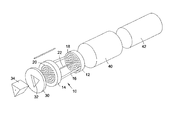
- FIG. 1 is an expanded perspective view of an apparatus comprising a die head in accordance with an embodiment of the invention.
- FIG. 2 is a perspective view of the apparatus of FIG. 1
- FIG. 3 a cross-section of the apparatus of FIG. 1 .
- FIG. 4 is a front view of a plate for a die head in accordance with an embodiment of the invention.
- FIG. 5 is a front view of a shaping plate and second plate of accordance with another embodiment of the invention.
- FIG. 6 is a front view of a shaping plate and second plate of accordance with another embodiment of the invention.
- FIGS. 7 a and 7 b are front views of a shaping plate in accordance with an embodiment of the invention.
- FIG. 1 shows a stainless steel die head 10 comprising a disc-shaped first plate 12 and a disc-shaped second plate 14 spaced apart and connected by two rigid connecting members 16 which have been screwed to the first and second plates 12 , 14 .
- the first plate 12 and the second plate 14 comprise approximately 90 first circular apertures 18 and approximately 90 second circular apertures 20 respectively.
- the first apertures 18 and the second apertures 20 are arranged in a pattern of concentric circles.
- a hollow rod 22 links a first aperture 18 in the centre of the first plate 12 and a second aperture 20 in the centre of the second plate 14 .
- the rod 20 has an inner diameter of approximately 1.8 mm. Whilst just one rod 22 is shown for the sake of clarity, it will be understood that a number of rods may be employed.
- a stainless steel shaping plate 30 may be fastened to the second plate 14 to change the shape of resulting extrudate.
- the shaping plate 30 is also disc-shaped and comprises a triangular aperture 32 although the skilled reader will appreciate that any number of shapes could employed.
- the shaping plate 30 is thinner than the first and second plates 12 , 14 and a number of such plates can be easily machined with different shapes of apertures.
- the extruded product 34 has a triangular cross-section and a filling through its centre.
- the die head 10 is sealed within a cylindrical sleeve 40 and the first plate 12 is attached to a support 42 .
- FIG. 2 there is shown a perspective view of the apparatus.
- the die head 10 is sealed within the sleeve 40 and is not visible.
- FIG. 3 there is shown a cross-section of the apparatus in use.
- the die head 10 is sealed within a cylindrical sleeve 40 with the second plate 14 located at one end of the sleeve 40 and the first plate 12 spaced from the second plate 14 within the sleeve 40 .
- a supply pipe is engaged with the first plate 12 via the support 42 such that a first material 44 can be fed to the tube 22 .
- the remaining first apertures 18 are blocked by bungs so that they are not fed by the supply pipe.
- a second material 46 is fed into the sleeve 40 around the support 42 and fills the space between the first and second plates 12 , 14 .
- the first and second materials 44 , 46 are then extruded through the second apertures 20 and the shaping aperture 32 to provide an extrudate consisting of a triangular prism of the second material 46 (e.g. milk chocolate) having a thin filling of the first material 44 (e.g. white chocolate) therethough.
- a triangular prism of the second material 46 e.g. milk chocolate
- the first material 44 e.g. white chocolate
- a disc-shaped stainless steel plate 50 for use either as a first plate or as a second plate in an extrusion die head.
- the plate 50 comprises approximately 130 circular apertures 52 which are arranged in a series of concentric circles. Each aperture has the same size and shape. Each aperture has a diameter of approximately 2.1 mm and is spaced from its nearest neighbour by approximately 1 mm i.e. the ratio of the diameter of the aperture to the distance between that aperture and its nearest neighbour is approximately 2:1.
- FIG. 5 there is shown a disc-shaped stainless steel second plate 60 and a fastened thereto a disc-shaped stainless steel shaping plate 62 .
- the second plate 62 comprises a plurality of second apertures 64 , some of which are visible through a square shaping aperture 66 in the shaping plate 62 .
- the extrudate produced from this apparatus will have a square cross-section and a number of spaced channels extending throughout.
- the second plate 72 comprises a plurality of second apertures 74 , some of which are visible through a shaping aperture 76 in the shaping plate 72 .
- the shaping aperture 76 is a horizontal slot which extends upwardly at each end and results in an extrudate having the same cross-section with channels of a filling material extending throughout.
- FIGS. 7 a and 7 b there is shown a shaping plate 80 having a square shaping aperture 82 therein.
- the shaping plate 80 has two triangular cover portions 84 located within shaping plate 80 adjacent the aperture 82 .
- the cover portions 84 are located away from the shaping aperture 82 such that the outline of the shaping aperture 82 is square whereas in FIG. 7 b the cover portions 84 have been moved linearly to restrict the aperture 82 such that its outline has been changed to a triangle.
Landscapes
- Engineering & Computer Science (AREA)
- Life Sciences & Earth Sciences (AREA)
- Food Science & Technology (AREA)
- Mechanical Engineering (AREA)
- Chemical & Material Sciences (AREA)
- Polymers & Plastics (AREA)
- Manufacturing & Machinery (AREA)
- Extrusion Moulding Of Plastics Or The Like (AREA)
Applications Claiming Priority (3)
| Application Number | Priority Date | Filing Date | Title |
|---|---|---|---|
| GB0909988.8A GB2470937B (en) | 2009-06-10 | 2009-06-10 | Extrusion die head |
| GB0909988.8 | 2009-06-10 | ||
| PCT/GB2010/001108 WO2010142941A1 (en) | 2009-06-10 | 2010-06-04 | Extrusion die head |
Publications (2)
| Publication Number | Publication Date |
|---|---|
| US20120135122A1 US20120135122A1 (en) | 2012-05-31 |
| US8899953B2 true US8899953B2 (en) | 2014-12-02 |
Family
ID=40937186
Family Applications (1)
| Application Number | Title | Priority Date | Filing Date |
|---|---|---|---|
| US13/377,248 Active 2030-08-30 US8899953B2 (en) | 2009-06-10 | 2010-06-04 | Extrusion die head |
Country Status (8)
| Country | Link |
|---|---|
| US (1) | US8899953B2 (pl) |
| EP (1) | EP2440069B1 (pl) |
| AU (1) | AU2010258463B2 (pl) |
| BR (1) | BRPI1010730A8 (pl) |
| CA (1) | CA2764923C (pl) |
| GB (1) | GB2470937B (pl) |
| PL (1) | PL2440069T3 (pl) |
| WO (1) | WO2010142941A1 (pl) |
Families Citing this family (4)
| Publication number | Priority date | Publication date | Assignee | Title |
|---|---|---|---|---|
| GB2470937B (en) | 2009-06-10 | 2014-09-24 | Cadbury Uk Ltd | Extrusion die head |
| CN104397863A (zh) * | 2014-12-12 | 2015-03-11 | 四川金鼓食品有限责任公司 | 一种粉条机及其中的过渡部件 |
| CN115945168A (zh) * | 2023-02-08 | 2023-04-11 | 萍乡市捷龙环保科技有限公司 | 一种沸石分子筛吸附剂的制备工艺 |
| CN117429034A (zh) * | 2023-10-16 | 2024-01-23 | 浙江精诚模具机械有限公司 | 一种双料挤出模头 |
Citations (26)
| Publication number | Priority date | Publication date | Assignee | Title |
|---|---|---|---|---|
| US3227103A (en) | 1963-08-21 | 1966-01-04 | Schafer Leonhard | Spiral design pastry die |
| US3344751A (en) | 1966-11-04 | 1967-10-03 | Marigold Foods Inc | Device for making confections |
| US3408960A (en) | 1967-06-12 | 1968-11-05 | Ho Maid Products Co | Powered variegator for frozen comestible manufacture |
| US3779676A (en) | 1970-10-26 | 1973-12-18 | A Bernard | Apparatus for making composite product |
| US3793466A (en) * | 1971-06-11 | 1974-02-19 | Lever Brothers Ltd | Process for preparing a restructured meat product |
| US3840311A (en) | 1971-06-01 | 1974-10-08 | Glacier Industries | Apparatus for extruding multi-flavor ice cream products of varied shapes |
| GB1405619A (en) | 1972-03-31 | 1975-09-10 | Corning Glass Works | Face plate assembly |
| US4075270A (en) | 1974-12-13 | 1978-02-21 | Corning Glass Works | Extrusion die mask |
| US4480980A (en) * | 1978-11-02 | 1984-11-06 | Beehive Machinery, Inc. | Apparatus for extruding composite food products |
| JPS61135575A (ja) | 1984-10-17 | 1986-06-23 | Fujii Haruyuki | 繊維状食品押出製造機 |
| GB2186836A (en) | 1986-02-06 | 1987-08-26 | Cadbury Ltd | Extruding an internally supported hollow article |
| CA1290974C (en) | 1988-06-23 | 1991-10-22 | Norman A. E. Hoy | Extruder head for making a patterned block of an ice cream product |
| WO1997027760A1 (de) | 1996-02-02 | 1997-08-07 | Unilever Plc | Koextrusions-verfahren, -vorrichtung und -produkt |
| JPH09224575A (ja) | 1995-12-18 | 1997-09-02 | Akutagawa Seika Kk | 型流し機構、及び該型流し機構を用い、所定の混交模様を施してなる固化形成物品を製造する固化形成物品の製造方法 |
| DE19813465A1 (de) | 1997-03-27 | 1998-10-01 | Ngk Insulators Ltd | Extrusionsvorrichtung |
| JPH10337765A (ja) | 1997-06-05 | 1998-12-22 | Misawa Homes Co Ltd | 金型固定構造 |
| EP0891854A2 (de) | 1997-07-18 | 1999-01-20 | Kannegiesser KMH Kunststofftechnik GmbH | Vorrichtung zum Dosieren eines plastifizierten Kunststoffs, insbesondere Kunststoffsstrangs |
| US6086352A (en) | 1997-04-12 | 2000-07-11 | Mcfarland; Archie Rae | Apparatus for extruding products made up of composite materials |
| WO2001038071A1 (en) | 1999-11-23 | 2001-05-31 | Unilever Plc | Process for the manufacture of shaped articles |
| WO2003026863A1 (en) | 2001-09-27 | 2003-04-03 | Corning Incorporated | Apparatus and method of correcting bow in a honeycomb extrudate |
| US6755638B2 (en) | 2001-12-05 | 2004-06-29 | Professionals Auto Parts International Co., Ltd. | Apparatus for producing continuous extrusion molding |
| WO2004076144A2 (en) | 2003-02-21 | 2004-09-10 | Corning Incorporated | Device and method of correcting extrudate bow |
| WO2005009149A1 (en) | 2003-07-18 | 2005-02-03 | Frito-Lay North America, Inc. | Apparatus and method for imprinting lines on direct-expanded food products having complex shapes with improved dimensional quality |
| US20050092365A1 (en) | 2003-10-28 | 2005-05-05 | Rawes Godfrey D. | Extrusion assembly |
| DE202007013318U1 (de) * | 2007-09-21 | 2008-01-03 | Mauser-Werke Gmbh | Vorrichtung und deren Verwendung zur Herstellung von Kunststoff-Behältern mit Sichtstreifen |
| EP2440069A1 (en) | 2009-06-10 | 2012-04-18 | Cadbury UK Limited | Extrusion die head |
-
2009
- 2009-06-10 GB GB0909988.8A patent/GB2470937B/en active Active
-
2010
- 2010-06-04 EP EP10725246.2A patent/EP2440069B1/en active Active
- 2010-06-04 AU AU2010258463A patent/AU2010258463B2/en active Active
- 2010-06-04 PL PL10725246T patent/PL2440069T3/pl unknown
- 2010-06-04 US US13/377,248 patent/US8899953B2/en active Active
- 2010-06-04 CA CA2764923A patent/CA2764923C/en active Active
- 2010-06-04 WO PCT/GB2010/001108 patent/WO2010142941A1/en not_active Ceased
- 2010-06-04 BR BRPI1010730A patent/BRPI1010730A8/pt not_active Application Discontinuation
Patent Citations (28)
| Publication number | Priority date | Publication date | Assignee | Title |
|---|---|---|---|---|
| US3227103A (en) | 1963-08-21 | 1966-01-04 | Schafer Leonhard | Spiral design pastry die |
| US3344751A (en) | 1966-11-04 | 1967-10-03 | Marigold Foods Inc | Device for making confections |
| US3408960A (en) | 1967-06-12 | 1968-11-05 | Ho Maid Products Co | Powered variegator for frozen comestible manufacture |
| GB1375208A (pl) | 1970-10-26 | 1974-11-27 | ||
| US3779676A (en) | 1970-10-26 | 1973-12-18 | A Bernard | Apparatus for making composite product |
| US3840311A (en) | 1971-06-01 | 1974-10-08 | Glacier Industries | Apparatus for extruding multi-flavor ice cream products of varied shapes |
| US3793466A (en) * | 1971-06-11 | 1974-02-19 | Lever Brothers Ltd | Process for preparing a restructured meat product |
| GB1405619A (en) | 1972-03-31 | 1975-09-10 | Corning Glass Works | Face plate assembly |
| US4075270A (en) | 1974-12-13 | 1978-02-21 | Corning Glass Works | Extrusion die mask |
| US4480980A (en) * | 1978-11-02 | 1984-11-06 | Beehive Machinery, Inc. | Apparatus for extruding composite food products |
| JPS61135575A (ja) | 1984-10-17 | 1986-06-23 | Fujii Haruyuki | 繊維状食品押出製造機 |
| GB2186836A (en) | 1986-02-06 | 1987-08-26 | Cadbury Ltd | Extruding an internally supported hollow article |
| CA1290974C (en) | 1988-06-23 | 1991-10-22 | Norman A. E. Hoy | Extruder head for making a patterned block of an ice cream product |
| JPH09224575A (ja) | 1995-12-18 | 1997-09-02 | Akutagawa Seika Kk | 型流し機構、及び該型流し機構を用い、所定の混交模様を施してなる固化形成物品を製造する固化形成物品の製造方法 |
| WO1997027760A1 (de) | 1996-02-02 | 1997-08-07 | Unilever Plc | Koextrusions-verfahren, -vorrichtung und -produkt |
| DE19813465A1 (de) | 1997-03-27 | 1998-10-01 | Ngk Insulators Ltd | Extrusionsvorrichtung |
| US6086352A (en) | 1997-04-12 | 2000-07-11 | Mcfarland; Archie Rae | Apparatus for extruding products made up of composite materials |
| JPH10337765A (ja) | 1997-06-05 | 1998-12-22 | Misawa Homes Co Ltd | 金型固定構造 |
| EP0891854A2 (de) | 1997-07-18 | 1999-01-20 | Kannegiesser KMH Kunststofftechnik GmbH | Vorrichtung zum Dosieren eines plastifizierten Kunststoffs, insbesondere Kunststoffsstrangs |
| WO2001038071A1 (en) | 1999-11-23 | 2001-05-31 | Unilever Plc | Process for the manufacture of shaped articles |
| WO2003026863A1 (en) | 2001-09-27 | 2003-04-03 | Corning Incorporated | Apparatus and method of correcting bow in a honeycomb extrudate |
| US6755638B2 (en) | 2001-12-05 | 2004-06-29 | Professionals Auto Parts International Co., Ltd. | Apparatus for producing continuous extrusion molding |
| WO2004076144A2 (en) | 2003-02-21 | 2004-09-10 | Corning Incorporated | Device and method of correcting extrudate bow |
| WO2005009149A1 (en) | 2003-07-18 | 2005-02-03 | Frito-Lay North America, Inc. | Apparatus and method for imprinting lines on direct-expanded food products having complex shapes with improved dimensional quality |
| US20050092365A1 (en) | 2003-10-28 | 2005-05-05 | Rawes Godfrey D. | Extrusion assembly |
| DE202007013318U1 (de) * | 2007-09-21 | 2008-01-03 | Mauser-Werke Gmbh | Vorrichtung und deren Verwendung zur Herstellung von Kunststoff-Behältern mit Sichtstreifen |
| US20100052208A1 (en) * | 2007-09-21 | 2010-03-04 | Mauser-Werke Gmbh | Method and apparatus for producing plastic containers |
| EP2440069A1 (en) | 2009-06-10 | 2012-04-18 | Cadbury UK Limited | Extrusion die head |
Non-Patent Citations (7)
| Title |
|---|
| GB ER 0909988.8 dated Jul. 16, 2014. |
| GB R GB0909988.8 dated Feb. 16, 2010, Claims searched 29, 30. |
| GB Search Report, Application No. GB0909988.8, dated May 9, 2013. |
| GB SR GB0909988.8 dated Feb. 16, 2010, Claims searched: 28. |
| GB SR GB0909988.8 dated Oct. 8, 2009, Claims searched 1-27, 2 refs. |
| GB SR GB0909988.8 dated Oct. 8, 2009, Claims searched: 1 to 27, 3 refs. |
| ISR PCT/GB2010/001108 dated Oct. 15, 2010. |
Also Published As
| Publication number | Publication date |
|---|---|
| BRPI1010730A8 (pt) | 2017-12-05 |
| PL2440069T3 (pl) | 2017-08-31 |
| EP2440069A1 (en) | 2012-04-18 |
| AU2010258463A1 (en) | 2012-01-19 |
| CA2764923C (en) | 2017-10-24 |
| GB0909988D0 (en) | 2009-07-22 |
| US20120135122A1 (en) | 2012-05-31 |
| GB2470937A (en) | 2010-12-15 |
| EP2440069B1 (en) | 2016-10-05 |
| BRPI1010730A2 (pt) | 2015-09-15 |
| AU2010258463B2 (en) | 2014-03-06 |
| CA2764923A1 (en) | 2010-12-16 |
| GB2470937B (en) | 2014-09-24 |
| WO2010142941A1 (en) | 2010-12-16 |
Similar Documents
| Publication | Publication Date | Title |
|---|---|---|
| EP2724622B1 (en) | Apparatus and method for manufacturing products | |
| RU2500173C2 (ru) | Кондитерский продукт и способ его производства | |
| US8899953B2 (en) | Extrusion die head | |
| JPH1028536A (ja) | 押出し凍結菓子の製造方法および装置 | |
| US20090311385A1 (en) | Extruded Candy | |
| AU2011231371B2 (en) | Consumable biscuit products and methods of production thereof | |
| FI92368B (fi) | Menetelmä ja laite syötävän tuotteen valmistamiseksi | |
| US20130101707A1 (en) | Consumables and methods of production thereof | |
| RU2576453C2 (ru) | Съедобные продукты, устройство и способы для их изготовления | |
| US20140242243A1 (en) | Apparatus, system, and method for filling a confectionary article | |
| CA2918821C (en) | Method and apparatus for making a confectionery product | |
| US20140227410A1 (en) | Apparatus for filling a confectionary article | |
| US20170049125A1 (en) | Comestible products, apparatus and methods for producing thereof | |
| AU2014200769B2 (en) | Apparatus and method for manufacturing products | |
| US20140328962A1 (en) | Apparatus for filling a confectionary article | |
| NZ610489B (en) | Comestible products, apparatus and methods for production thereof |
Legal Events
| Date | Code | Title | Description |
|---|---|---|---|
| AS | Assignment |
Owner name: CADBURY UK LIMITED, UNITED KINGDOM Free format text: ASSIGNMENT OF ASSIGNORS INTEREST;ASSIGNOR:BUFTON, ANDREW;REEL/FRAME:027670/0100 Effective date: 20120118 |
|
| STCF | Information on status: patent grant |
Free format text: PATENTED CASE |
|
| MAFP | Maintenance fee payment |
Free format text: PAYMENT OF MAINTENANCE FEE, 4TH YEAR, LARGE ENTITY (ORIGINAL EVENT CODE: M1551) Year of fee payment: 4 |
|
| MAFP | Maintenance fee payment |
Free format text: PAYMENT OF MAINTENANCE FEE, 8TH YEAR, LARGE ENTITY (ORIGINAL EVENT CODE: M1552); ENTITY STATUS OF PATENT OWNER: LARGE ENTITY Year of fee payment: 8 |