US7805526B2 - Inter-device authentication system, inter-device authentication method, communication device, and computer program - Google Patents
Inter-device authentication system, inter-device authentication method, communication device, and computer program Download PDFInfo
- Publication number
- US7805526B2 US7805526B2 US10/520,975 US52097505A US7805526B2 US 7805526 B2 US7805526 B2 US 7805526B2 US 52097505 A US52097505 A US 52097505A US 7805526 B2 US7805526 B2 US 7805526B2
- Authority
- US
- United States
- Prior art keywords
- area network
- local area
- home
- same
- communication apparatus
- Prior art date
- Legal status (The legal status is an assumption and is not a legal conclusion. Google has not performed a legal analysis and makes no representation as to the accuracy of the status listed.)
- Expired - Fee Related, expires
Links
Images


Classifications
-
- H—ELECTRICITY
- H04—ELECTRIC COMMUNICATION TECHNIQUE
- H04L—TRANSMISSION OF DIGITAL INFORMATION, e.g. TELEGRAPHIC COMMUNICATION
- H04L9/00—Cryptographic mechanisms or cryptographic arrangements for secret or secure communications; Network security protocols
- H04L9/32—Cryptographic mechanisms or cryptographic arrangements for secret or secure communications; Network security protocols including means for verifying the identity or authority of a user of the system or for message authentication, e.g. authorization, entity authentication, data integrity or data verification, non-repudiation, key authentication or verification of credentials
-
- H—ELECTRICITY
- H04—ELECTRIC COMMUNICATION TECHNIQUE
- H04L—TRANSMISSION OF DIGITAL INFORMATION, e.g. TELEGRAPHIC COMMUNICATION
- H04L41/00—Arrangements for maintenance, administration or management of data switching networks, e.g. of packet switching networks
- H04L41/18—Delegation of network management function, e.g. customer network management [CNM]
-
- G—PHYSICS
- G06—COMPUTING OR CALCULATING; COUNTING
- G06F—ELECTRIC DIGITAL DATA PROCESSING
- G06F15/00—Digital computers in general; Data processing equipment in general
-
- H—ELECTRICITY
- H04—ELECTRIC COMMUNICATION TECHNIQUE
- H04L—TRANSMISSION OF DIGITAL INFORMATION, e.g. TELEGRAPHIC COMMUNICATION
- H04L12/00—Data switching networks
- H04L12/28—Data switching networks characterised by path configuration, e.g. LAN [Local Area Networks] or WAN [Wide Area Networks]
- H04L12/46—Interconnection of networks
-
- H—ELECTRICITY
- H04—ELECTRIC COMMUNICATION TECHNIQUE
- H04L—TRANSMISSION OF DIGITAL INFORMATION, e.g. TELEGRAPHIC COMMUNICATION
- H04L12/00—Data switching networks
- H04L12/66—Arrangements for connecting between networks having differing types of switching systems, e.g. gateways
-
- H—ELECTRICITY
- H04—ELECTRIC COMMUNICATION TECHNIQUE
- H04L—TRANSMISSION OF DIGITAL INFORMATION, e.g. TELEGRAPHIC COMMUNICATION
- H04L61/00—Network arrangements, protocols or services for addressing or naming
- H04L61/09—Mapping addresses
- H04L61/25—Mapping addresses of the same type
- H04L61/2596—Translation of addresses of the same type other than IP, e.g. translation from MAC to MAC addresses
-
- H—ELECTRICITY
- H04—ELECTRIC COMMUNICATION TECHNIQUE
- H04L—TRANSMISSION OF DIGITAL INFORMATION, e.g. TELEGRAPHIC COMMUNICATION
- H04L63/00—Network architectures or network communication protocols for network security
- H04L63/08—Network architectures or network communication protocols for network security for authentication of entities
-
- H—ELECTRICITY
- H04—ELECTRIC COMMUNICATION TECHNIQUE
- H04L—TRANSMISSION OF DIGITAL INFORMATION, e.g. TELEGRAPHIC COMMUNICATION
- H04L12/00—Data switching networks
- H04L12/28—Data switching networks characterised by path configuration, e.g. LAN [Local Area Networks] or WAN [Wide Area Networks]
- H04L12/2803—Home automation networks
-
- H—ELECTRICITY
- H04—ELECTRIC COMMUNICATION TECHNIQUE
- H04L—TRANSMISSION OF DIGITAL INFORMATION, e.g. TELEGRAPHIC COMMUNICATION
- H04L2101/00—Indexing scheme associated with group H04L61/00
- H04L2101/60—Types of network addresses
- H04L2101/618—Details of network addresses
- H04L2101/622—Layer-2 addresses, e.g. medium access control [MAC] addresses
Definitions
- the present invention relates to a device-to-device authentication system, a device-to-device authentication method, a communication apparatus and a computer program, for managing the use of the contents between devices such as music data, image data, digital data such as electronic publication, a motion picture or the like, which are distributed by a network or the like, in particular, to a device-to-device authentication system, a device-to-device authentication method, a communication apparatus and a computer program for managing the use of the contents within the scope of private use allowed by the copyright law.
- the present invention relates to a device-to-device authentication system, a device-to-device authentication method, a communication apparatus and a computer program for managing the use of the contents within the scope of private use allowed by the copyright law on a home network connected to an external network via a router, in particular, to a device-to-device authentication method, a communication apparatus and a computer program for managing so that each client terminal on the home network uses the contents legitimately acquired on a home server within the scope of private use allowed by the copyright law.
- the distributed contents are digital data, and therefore, an unauthorized operation such as copy or falsification can be relatively easy to perform. Moreover, a fraud such as the copy or the falsification of the contents is currently frequently committed, which is a main cause of hampering the interest of a digital-content vendor. As a result, a vicious cycle that the price of the contents must be increased to result in the hindrance of diffusion is generated.
- An information device such as a personal computer for home use or a PDA (Personal Digital Assistants) and, in addition, various information home appliances such as a television set and a video playback device are interconnected via a home network.
- a home network is interconnected to an external broadband network including the Internet via a router.
- the contents legitimately acquired from a server on the Internet are stored in a server on the home network (hereinafter, referred to as a “home server”), the contents are distributed via the home network to another in-home terminal (client).
- client in-home terminal
- the client terminal connected to the home network is supposed to be within the scope of personal use or family use. Therefore, it is considered that it is appropriate for the client terminal on the home network to make free use of the legitimately acquired contents in the home server (it is apparent that the number of terminals which can enjoy the contents is required to be limited to a certain number).
- the home server since the home network is interconnected to an external network via a router based on an IP protocol, the home server does not know where a client making access actually is. If the home server provides the contents to external (remote) access, the use of the contents is substantially unrestrained. Therefore, the copyright for the contents is almost unprotected. As a result, a content creator may lose the motivation of the creation.
- the home server allows the client terminal in the home network to use the contents in the same manner, the same client terminal logs into a plurality of home networks at time intervals. As a result, it can use the contents almost unrestrictedly.
- an UPnP registered trademark
- the UPnP allows easy network construction without any complicated operations and allows a content-providing service between network-connected devices without any difficult operations and setting.
- the UPnP is advantageous in that it is not dependent on an operating system (OS) and the addition of a device is easy.
- OS operating system
- UPnP network-connected devices exchange a definition file described in an XML (eXtensible Markup Language) format for mutual authentication.
- XML eXtensible Markup Language
- a device to be connected to the network acquires a device ID by the addressing process and acquires information for other devices on the network by the discovery process, thereby enabling a service request.
- the contents stored in the home server can be accessed from other devices on the home network.
- the contents can be acquired by a device implementing the UPnP connection. If the contents are video data or audio data, a TV or a player is connected as a network-connected device so that a movie or music can be enjoyed.
- the home server is made to have a list of clients whose access is allowed so that collation with the list is executed each time access to the home server is requested from a client. In this way, unauthorized access can be excluded.
- MAC address filtering uses a MAC (Media Access Control) address corresponding to a physical address unique to each communication apparatus to set it as an access-allowable device list. More specifically, a MAC address of each device whose access is allowed is registered on a router or a gateway for isolating the internal network such as the home network and the external network from each other. A MAC address assigned to a received packet and the registered MAC address are collated with each other. Access from a device with an unregistered MAC address is refused (see, for example, Japanese Patent Application Publication No. 10-271154).
- MAC Media Access Control
- the access-allowable device list In order to construct the access-allowable device list, however, it is necessary to check the MAC addresses of all the devices connected to the internal network. Moreover, efforts to input all the acquired MAC addresses so as to create a list are required. Furthermore, in the home network, a connected device is relatively frequently changed. Therefore, the access-allowable device list has to be modified for each such change.
- An object of the present invention is to provide preferable device-to-device authentication system, device-to-device authentication method, communication apparatus and computer program, which are capable of suitably managing the use of the contents between devices on a home network connected to an external network via a router.
- Another object of the present invention is to provide preferable device-to-device authentication system, device-to-device authentication method, communication apparatus and computer program, which are capable of suitably managing so that each client terminal on a home network uses the contents legitimately acquired on a home server within the scope of private use allowed by the copyright law.
- a first aspect thereof is a device-to-device authentication system for authenticating a device on a home network connectable to an external network via a router, characterized by including: local environment management means for confirming whether or not another device making access to the device on the home network is present on the home network.
- a “system” herein means a logical assembly of a plurality of apparatuses (or functional modules for realizing a specific function), and each apparatus or functional module may be or may not be present in a single box body.
- one of the devices is a home server for legitimately acquiring the contents from the external network via the router or through package media or broadcast reception, whereas the other device is a client for making a request for the contents to the home server for use.
- the home server After the confirmation of the presence of both the devices on the same home network, the home server provides the contents and/or issues a license for the contents to the client.
- Two or more home servers can be installed on the home network.
- each home server since client terminals on the same home network are under a local environment, each home server registers them as members to form a group in an independent manner so as to distribute the contents and to issue a license for the use of the contents.
- the client terminal can be registered as a member simultaneously on two or more home servers on the same home network to belong to a plurality of groups and can acquire a license of the contents from each of the home servers.
- the client terminal is under a local environment for each of the home servers and therefore is supposed to fall within the scope of personal or family use, it is appropriate for it to make free use of the contents of each of the home serves in the local environment.
- the client terminal can be registered on a plurality of home servers as a member at the same time, it should not be allowed to belong to a plurality of groups of home servers over a plurality of home networks at time intervals. This is because the connection to another home network corresponds to the move of the client terminal to a remote environment for the first connected home network or the connection to one home network is equivalent to the presence of the client terminal in a remote environment for the other home networks.
- a client can use the contents acquired from a plurality of home servers on the same home network. However, upon connection to a home server on an other home network, the client can not use the contents acquired from home servers on the home networks other than said other home network.
- the local environment management means can confirm the presence or the absence a device making an access request on the same home network by, for example, the identification or the non-identification of a MAC address of a device making an access request with a MAC address of a router set as a default gateway.
- the home network is connected to the external network via the home router. If access is made from the same network, a source MAC address is assigned thereto. In the case of external access via the router, however, a source address field is rewritten to the MAC address of the router. Using such an existing mechanism of an IP protocol, a MAC address of the device on the other side of communication is compared with the MAC address of the home router so as to automatically identify if it is access from the home network.
- the local environment management means can confirm the presence or the absence on the same home network based on whether or not the respective devices share the same identification information regarding the home network.
- each of the devices acquires the MAC address of the router set as the default gateway as identification information regarding the home network. The presence or the absence on the home network is confirmed based on whether or not the devices have the MAC address of the same default gateway.
- a local environment management apparatus for supplying network identification information is installed on the home network so that each device acquires a MAC address of the local environment management apparatus as identification information regarding the home network. The presence or the absence on the same network can be confirmed based on whether or not the devices have the MAC address of the same local environment management apparatus.
- a second aspect of the present invention is a computer program described in a computer-readable format so as to execute a process for authenticating a device, on a home network connected to an external network via a router, on which a home server for legitimately acquiring the contents from the external network and a client making a request for the contents for use are present, the computer program characterized by including: a local environment management step of confirming whether or not the home server and the client are present on the home network; and a content-provision step of providing the contents and/or issuing a license for the contents to the client by the home server in response to the confirmation of the presence of both the devices on the same home network by the local environment management step.
- the computer program according to the second aspect of the present invention defines a computer program described in a computer-readable format so as to realize a predetermined process on a computer system.
- the computer program according to the second aspect of the present invention is installed on a computer system, so that a cooperative function is demonstrated on the computer system.
- FIG. 1 is a diagram schematically showing a basic structure of a home network
- FIG. 2 is a diagram showing an exemplary structure of a home network on which two home servers are present;
- FIG. 3 is a diagram showing a state where a client terminal is connected to a plurality of home networks
- FIG. 4 is a diagram schematically showing a structure of a home network according to one embodiment of the present invention.
- FIG. 5 is a diagram schematically showing a structure of a home network according to another embodiment of the present invention.
- FIG. 6 is a diagram schematically showing a hardware structure of a host apparatus connected to the home network as a server, a client or the like;
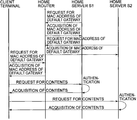
- FIG. 7 is a diagram showing an operation sequence on a home network according to the present invention.
- FIG. 8 is a diagram showing a structure of a local environment management table
- FIG. 9 is a flowchart showing a processing procedure for use of the contents on a client terminal
- FIG. 10 is a diagram showing a variation of the home network illustrated in FIG. 4 ;
- FIG. 11 is a diagram showing an operation sequence on a home network according to the present invention.
- FIG. 12 is a diagram showing a variation of FIG. 10 .
- a client terminal in a home network (hereinafter, also referred to as a “local environment”) falls within the scope of private use, the inventors of the present invention propose a system in which only a client under the local environment can use the contents stored on a home server.
- FIG. 1 schematically shows a basic structure of a home network.
- a home network installed in home is connected to an external network such as the Internet via a home router.
- a home server and at least one client terminal are present.
- the home server legitimately acquires and stores the contents from a content server on the external network via the home router to distribute the contents in home. It is apparent that the home server can acquire the contents by means other than the network, such as package media or broadcast reception.
- Each client terminal makes a request for desired contents to the home server so as to acquire them for use.
- the client terminals connected to the home network are present under the local environment, and it is supposed that they are within the scope of personal or family use. Therefore, it is considered that it is appropriate for the client terminals on the home network to make free use of the contents legitimately acquired on the home server. Accordingly, the home server registers the client terminals under the local environment as members and issues a license for the contents distribution and the use of the contents. It is apparent that the number of terminals capable of enjoying the contents is required to be limited to a certain number because unlimited connection by the client is not allowable.
- the client terminal acquires the contents from the home server, uses the contents such as for copy or streaming and can also take the contents out of the local environment (into a remote environment) for use.
- a client terminal that is not present on the home network, that is, in a remote environment is not considered to be within the scope of personal or family use. If the client terminal in the remote environment is allowed to use the contents, the use of the contents is substantially unrestrained. As a result, the copyright for the contents is almost unprotected. Therefore, the home server neither registers the client in the remote environment as a member nor issues a license of the contents.
- only one home server is present on the home network.
- two or more home servers may be installed on the same home network so that each of the home servers independently provides a distribution service of the contents in the home network.
- each of the home servers independently registers them as members to form a group so as to distribute the contents and to issue a license for the use of the contents.
- the client terminal acquires the contents from the home server, uses the contents such as for copy or streaming and can also take the contents out of the local environment (into a remote environment) for use.
- the client terminal can be registered simultaneously on two or more home servers on the same home network as members to belong to a plurality of groups and can acquire a license of the contents from each of the home servers.
- the client terminal is also present under the local environment for the respective home servers and therefore it is supposed that it is within the scope of personal or family use. Therefore, it is considered that it is appropriate for the client to make free use of the contents of each of the home servers in the local environment.
- the client terminal can be registered on a plurality of home server as a member at the same time, it should not be allowed to belong to a plurality of groups of home servers over a plurality of home networks at time intervals (see FIG. 3 ).
- connection to another home network is corresponding to the move of the client terminal to a remote environment for the first connected home network or the connection to one home network is equivalent to the presence of the client terminal in a remote environment for the other home networks.
- the local environment is within the personal or family scope, whereas the remote environment departs from the personal or family scope.
- the client terminal it is technically possible for the client terminal to be connected to a plurality of home networks at time intervals. However, if the use of the contents is successively allowed with the connection, the use of the contents is substantially unrestrained. As a result, the copyright for the contents is almost unprotected.
- a current network protocol does not provide any mechanism for identifying a network, such as a home network, by segment. Therefore, in view of the connection of the home network to the external network via the home router, using an existing mechanism of an IP protocol that access from the same network is provided with a source MAC address whereas a source address field is rewritten to a MAC address of a router in the case of external access via a router, the inventors of the present invention propose a method of automatically identifying if access is made from the home network by comparing a MAC address of the device on the other side of communication with a MAC address of the home router.
- FIG. 4 schematically shows a structure of a home network according to an embodiment of the present invention.
- a home network installed in home is connected to a WAN such as the Internet or another LAN via a home router.
- the home router is set as a default gateway of the home network.
- the home network is constituted by, for example, connecting a LAN cable of a host apparatus such as a home server or a client terminal to a hub (concentrator).
- the host apparatuses on the home network such as the home server, the client terminal and the home router, and a host apparatus on the external network have MAC addresses, each being unique to a device.
- the host apparatus transmits and receives a packet including header information containing a destination MAC address and a source MAC address, for example, an Ethernet (registered trademark) frame via the network.
- the host apparatuses on the home network such as the home server and the client terminal, are constituted as, for example, UPnP-compatible devices.
- the addition and the deletion of a connected device to/from the network are easy.
- a device to be connected to the network can enjoy service on the home network such as the use of the contents in accordance with the following procedure.
- the home server legitimately acquires and stores the contents from a content server on the external network via the home router to distribute the contents in home.
- Each of the client terminals is allowed to make a request for desired contents to the home server and acquires them for use.
- the client terminal acquires the contents from the home server and uses the contents such as for copy or streaming. Furthermore, it can take the contents out of the local environment (into the remote environment) for use.
- FIG. 5 schematically shows a structure of a home network according to another embodiment of the present invention.
- the home network is connected to a WAN such as the Internet or another LAN via the home router.
- the home router is also set as a default gateway of the home network.
- the respective home servers may be simultaneously present on the home network or may be connected at a time interval.
- each of the home servers registers them as members to form a group so as to distribute the contents and to issue a license for the use of the contents.
- the client terminal acquires the contents from the home server, uses the contents such as for copy or streaming and can also take the contents out of the local environment (into a remote environment) for use.
- the client terminal can be registered simultaneously on two or more home servers on the same home network as members to belong to a plurality of groups and can acquire a license of the contents from each of the home servers.
- FIG. 6 schematically shows a hardware structure of a host apparatus connected to the home network as a server, a client or the like.
- the system is constituted mainly of a processor 10 .
- the processor 10 executes various processes based on a program stored in a memory.
- the processor controls various peripheral devices connected through a bus 30 .
- the peripheral devices connected to the bus 30 are as follows.
- a memory 20 is constituted of a semiconductor memory, for example, a DRAM (Dynamic RAM) or the like and is used to load a program code executed in the processor 10 or to temporarily store operation data of an execution program.
- DRAM Dynamic RAM
- a display controller 21 generates a display image in accordance with a draw command sent from the processor 10 and transmits it to a display device 22 .
- the display apparatus 22 connected to the display controller displays and outputs the image on a screen in accordance with display image information transmitted from the display controller 21 .
- An input/output interface 23 to which a keyboard 24 and a mouse 25 are connected, transfers an input signal from the keyboard 24 or the mouse 25 to the processor 10 .
- a network interface 26 is connected to the external network such as a LAN and the Internet and controls data communication through the Internet. Specifically, it transfers data transmitted from the processor 10 to another apparatus on the Internet and receives data transmitted through the Internet so as to pass it to the processor 10 .
- a hard disk drive (HDD) controller 27 to which a high-capacity external storage apparatus 28 such as an HDD is connected, controls the input and output of data to the HDD 28 to which the HDD controller 27 is connected.
- the HDD 28 stores a program of an operating system (OS), an application program, a driver program and the like to be executed by the processor.
- the application program is, for example, a server application for authenticating each client terminal on the home network as the home server or for providing the contents or issuing a license, a client application for use of the contents such as for reproduction of the contents provided by the server or the like, and the like.
- FIG. 7 shows an operation on the home network according to this embodiment. It is assumed that at least a client terminal, two home servers and a home router are present on the network and the home router is set as the default gateway.
- the client terminal acquires the contents from the home server and uses the contents such as for copy or streaming.
- each home server acquires a MAC address of the default gateway from the home router.
- the client terminal For access to the server, the client terminal first acquires the MAC address of the default gateway and transmits an access request with the acquired MAC address to the server.
- the server fetches the source MAC address from a request packet and compares it with the MAC address of the default gateway which is acquired in advance by itself. If it is access from the same network, the source MAC address is assigned thereto. However, if it is external access via the router, the source address field is rewritten to the MAC address of the router. Therefore, based on the identification or non-identification of the source MAC address with the MAC address of the default gateway, it can be easily determined whether or not the request-source client is on the same network, that is, in the local environment. If it is in the local environment, the requested contents are distributed and a license thereof is issued. However, if it is not in the local environment, the request is refused. The use of the contents is allowed between the devices only in the thus formed local environment, thereby effectively restraining the unauthorized distribution of the contents.
- the client terminal Upon reception of a response packet from the request-destination server, the client terminal fetches the MAC address and a server name of the server and stores them with the MAC address of the default gateway acquired prior to the access request as a set in the local environment management table.
- FIG. 8 schematically shows a structure of the local environment management table.
- a record is entered each time a request for the contents is made to a new server.
- a LAST flag, a network identification ID, and a MAC address and a server name of a server are stored.
- the network identification ID the MAC address of the default gateway acquired prior to the access to the server is described.
- the LAST flag a flag is set to a record of the last accessed server.
- FIG. 8 shows a history of the client terminal making access to a server S 1 on a home network connected to a home router A, access to a server S 2 on the home network connected to the home router A, and access to a server S 3 on a home network connected to a home router B.
- the last access made by the client terminal is to the server S 2 on the home network connected to the home router A.
- the client terminal can be registered simultaneously on two or more home servers on the same home network as members to belong to a plurality of groups and can acquire a license for the contents from each of the home server. This is because, in this case, the client terminal is present under the local environment for each of the home servers and therefore is supposed to be within the scope of personal or family use.
- the client terminal is connected to another home network at a time interval, it corresponds to a move of the client terminal to a remote environment for the first connected home network at that time.
- the collation of the MAC address of the default gateway obtained by the client terminal upon access to the server on the local environment management table allows the determination of the movement between the home networks.
- the client terminal acquires the contents from the home server, uses the contents such as for copy or streaming and can further take the contents out of the local environment (into a remote environment) for use.
- it is not allowable to connect to a plurality of home networks at time intervals so as to use the sequentially acquired contents in an unrestrained manner. Therefore, in this embodiment, the use of the contents on the client terminal is limited to those acquired from the currently connected home network.
- the LAST flag in the local environment management table shown in FIG. 8 indicates the last accessed home server.
- the home network on which the last accessed home server is present is the current local environment for the client terminal. Therefore, it is supposed that the home server having the MAC address of the same default gateway as that of the home server to which the LAST flag is assigned is present in the local environment.
- FIG. 9 shows a processing procedure for the use of the contents on the client terminal in the form of flowchart.
- the local environment management table is referred to so as to determine whether or not there are any other servers having the MAC address of the same default gateway as that of the record to which the LAST flag is set (step S 1 ).
- the contents acquired from the server having the same MAC address are rendered available (step S 2 ), whereas the contents acquired from the other servers are rendered unavailable (step S 3 ).
- the access is automatically identified to be that from the home network or not by comparing the MAC address of the one in communication with the MAC address of the home router.
- a method of identifying the presence of the host apparatus on the same home network is not limited thereto.
- FIG. 10 shows a variation of the home network shown in FIG. 4 .
- the home network is connected to a WAN such as the Internet or to another LAN via the home router.
- the home router is set as the default gateway of the home network, it is optional.
- the home network is constituted by connecting a LAN cable of the host apparatus such as the home server or the client terminal to the hub.
- This embodiment differs from FIG. 4 in that a local identification apparatus for imparting the identification function to the home network is connected to the home network.
- the local environment that is supposed to be within the scope of personal or family use is formed on the home network. Therefore, the home server legitimately acquires and stores the contents from the content server on the external network via the home router so as to distribute the contents in home.
- Each client terminal is allowed to make a request for desired contents to the home server and acquires them for use (idem).
- FIG. 11 shows an operation on the home network illustrated in FIG. 10 .
- the client terminal acquires the contents from the home server to use the contents such as for copy and streaming. Prior to the start of a content-distribution service, each home server acquires a MAC address of the local identification apparatus.
- the client terminal For access to the server, the client terminal first acquires the MAC address of the local identification apparatus and transmits an access request with the acquired MAC address to the home server.
- the server fetches the MAC address of the local identification apparatus from the request packet and compares it with the MAC address of the local identification apparatus acquired in advance by itself. Then, it is determined in a simple manner whether or not the request-source client is on the home network, that is, in the local environment based on the identification or the non-identification of the two MAC addresses. In the case where it is in the local environment, the requested contents are distributed and a license thereof is issued. In the case where it is not in the local environment, the request is refused. The use of the contents between the devices only in the thus formed local environment is allowed, so that the unauthorized distribution of the contents can be effectively restrained.
- the client terminal Upon reception of a response packet from the request-destination server, the client terminal fetches the MAC address and the server name of the server and stores them with the MAC address of the local identification apparatus acquired prior to the access request as a set in the local environment management table. In each record of the local environment management table in this case, the MAC address of the local identification apparatus is described in place of the MAC address of the default gateway.
- FIG. 12 shows a variation of the home network illustrated in FIG. 10 .
- the local identification apparatus can be constituted to be incorporated into the home router or another host apparatus on the home network.
- the local identification apparatus is always powered ON and at least one local identification apparatus exists in home. Since the home server is, for example, a TV set or a video recording/playback apparatus and these devices are not necessarily constantly activated (the local environment cannot be confirmed because they are not powered ON), it is not satisfactory as a requirement for the local identification apparatus. On the other hand, since each household has one refrigerator and the refrigerator is always powered ON, it satisfies the requirement as the local identification apparatus. In addition, since the refrigerator is heavy and therefore is fixed and unmovable, the secondary effect that it is difficult to take it out to commit a fraud can be obtained.
- two or more local identification apparatuses may be present on a single home network.
- the client terminal specifies the local identification apparatus to make a request for authentication.
- the server specifies the local identification apparatus to make a request for authentication.
- the client terminal makes a request for authentication to the local identification apparatus while specifying the server so that the local identification apparatus performs the authentication with the server.
- the collation of the MAC addresses of the devices is used for the authentication between the devices in the embodiment described in this specification; it is presupposed that the home router and the local identification apparatus have the MAC addresses in such a form that is difficult to falsificate by using encryption means.
- preferable device-to-device authentication system, device-to-device authentication method, communication apparatus and computer program which are capable of suitably managing the use of the contents between devices on a home network connected to an external network via a router, can be provided.
- preferable device-to-device authentication system, device-to-device authentication method, communication apparatus and computer program which are capable of suitably managing so that each client terminal on a home network uses the contents legitimately acquired on a home server within the scope of private use allowed by the copyright law, can be provided.
- the use of the contents is allowed between devices only in a local environment, so that the unauthorized distribution of the contents can be effectively restrained.
Landscapes
- Engineering & Computer Science (AREA)
- Computer Networks & Wireless Communication (AREA)
- Signal Processing (AREA)
- Computer Security & Cryptography (AREA)
- General Engineering & Computer Science (AREA)
- Computer Hardware Design (AREA)
- Computing Systems (AREA)
- Power Engineering (AREA)
- Theoretical Computer Science (AREA)
- Physics & Mathematics (AREA)
- General Physics & Mathematics (AREA)
- Small-Scale Networks (AREA)
- Data Exchanges In Wide-Area Networks (AREA)
- Computer And Data Communications (AREA)
- Storage Device Security (AREA)
Applications Claiming Priority (4)
| Application Number | Priority Date | Filing Date | Title |
|---|---|---|---|
| JP2003132903 | 2003-05-12 | ||
| JP2003-132903 | 2003-05-12 | ||
| JP2003132903A JP4161791B2 (ja) | 2003-05-12 | 2003-05-12 | 機器間認証システム及び機器間認証方法、通信装置、並びにコンピュータ・プログラム |
| PCT/JP2004/003336 WO2004100457A1 (ja) | 2003-05-12 | 2004-03-12 | 機器間認証システム及び機器間認証方法、通信装置、並びにコンピュータ・プログラム |
Publications (2)
| Publication Number | Publication Date |
|---|---|
| US20050228894A1 US20050228894A1 (en) | 2005-10-13 |
| US7805526B2 true US7805526B2 (en) | 2010-09-28 |
Family
ID=33432181
Family Applications (1)
| Application Number | Title | Priority Date | Filing Date |
|---|---|---|---|
| US10/520,975 Expired - Fee Related US7805526B2 (en) | 2003-05-12 | 2004-03-12 | Inter-device authentication system, inter-device authentication method, communication device, and computer program |
Country Status (6)
| Country | Link |
|---|---|
| US (1) | US7805526B2 (de) |
| EP (1) | EP1523133B1 (de) |
| JP (1) | JP4161791B2 (de) |
| KR (1) | KR20060014354A (de) |
| CN (1) | CN1701567B (de) |
| WO (1) | WO2004100457A1 (de) |
Cited By (4)
| Publication number | Priority date | Publication date | Assignee | Title |
|---|---|---|---|---|
| US20100299414A1 (en) * | 2007-10-12 | 2010-11-25 | Packetfront Systems Ab | Method of Configuring Routers Using External Servers |
| US20100299264A1 (en) * | 2007-09-12 | 2010-11-25 | Sony Corporation | Open market content distribution |
| US20110161405A1 (en) * | 2009-12-31 | 2011-06-30 | Aten International Co., Ltd. | Intelligent network management platform for ikvm servers |
| US12170648B2 (en) | 2020-03-10 | 2024-12-17 | Bsh Hausgeraete Gmbh | Device and method for controlling the access to an electrical device |
Families Citing this family (16)
| Publication number | Priority date | Publication date | Assignee | Title |
|---|---|---|---|---|
| WO2005015419A1 (ja) | 2003-08-12 | 2005-02-17 | Sony Corporation | 通信処理装置、および通信制御方法、並びにコンピュータ・プログラム |
| JP3796507B2 (ja) * | 2004-09-16 | 2006-07-12 | シャープ株式会社 | 送信器、受信器、送信方法および伝送方法 |
| KR100694104B1 (ko) | 2005-02-23 | 2007-03-12 | 삼성전자주식회사 | 라운드 트립 시간을 측정하는 방법 및 이를 이용한 인접성검사 방법 |
| KR100636232B1 (ko) | 2005-04-29 | 2006-10-18 | 삼성전자주식회사 | 해시 체인을 이용하여 디바이스들간의 인접성을 검사하는방법 및 장치 |
| KR100781511B1 (ko) * | 2005-06-29 | 2007-12-03 | 삼성전자주식회사 | 홈 네트워크를 기반으로 하는 스트리밍 서비스 방법 및시스템 |
| WO2007055549A1 (en) * | 2005-11-14 | 2007-05-18 | Lg Electronics Inc. | Method for selecting a determinator of priority to access a network |
| JP4570582B2 (ja) * | 2006-03-31 | 2010-10-27 | 富士通株式会社 | ネットワーク監視プログラム、ネットワーク監視方法、およびネットワーク監視装置 |
| KR101145848B1 (ko) * | 2006-11-29 | 2012-05-17 | 삼성전자주식회사 | 콘텐츠 전송을 위한 접근 제어 방법 및 상기 접근 제어방법을 이용하는 네트워크의 노드 |
| FR2913841B1 (fr) * | 2007-03-15 | 2009-09-04 | Canon Kk | Procede d'acces a distance a un reseau,produit programme d'ordinateur,moyen de stockage et dispositifs correspondants |
| CN101414998B (zh) * | 2007-10-15 | 2012-08-08 | 华为技术有限公司 | 一种基于认证机制转换的通信方法、系统及设备 |
| CN102014156A (zh) * | 2010-03-26 | 2011-04-13 | 深圳中兴网信科技有限公司 | 一种软件商城系统、软件销售平台和接入网关 |
| JP5222899B2 (ja) * | 2010-05-20 | 2013-06-26 | 株式会社コナミデジタルエンタテインメント | ゲームシステム、サーバ装置、ログイン方法、ならびに、プログラム |
| CN102624619B (zh) * | 2012-03-09 | 2015-05-27 | 上海大亚科技有限公司 | 基于源地址的多默认网关下实现报文转发路由选择的方法 |
| CN102611712A (zh) * | 2012-04-10 | 2012-07-25 | 中山爱科数字家庭产业孵化基地有限公司 | 一种数字家庭网络接入与认证方法 |
| CN106470109A (zh) * | 2015-08-21 | 2017-03-01 | 阿里巴巴集团控股有限公司 | 一种身份识别方法和设备 |
| US11159420B2 (en) | 2019-04-17 | 2021-10-26 | Cloudflare, Inc. | Method and apparatus of automatic route optimization in a private virtual network for client devices of a local network |
Citations (17)
| Publication number | Priority date | Publication date | Assignee | Title |
|---|---|---|---|---|
| US5802047A (en) * | 1995-05-31 | 1998-09-01 | Nec Corporation | Inter-LAN connecting device with combination of routing and switching functions |
| US5802316A (en) * | 1995-01-26 | 1998-09-01 | Ito; Yuji | Routers connecting LANs through public network |
| JPH10271154A (ja) | 1997-03-21 | 1998-10-09 | Nec Eng Ltd | 不正アクセス防止方法およびシステム |
| JPH11203249A (ja) | 1998-01-16 | 1999-07-30 | Fuji Xerox Co Ltd | ライセンス付与システムおよびライセンス付与方法 |
| US6006272A (en) * | 1998-02-23 | 1999-12-21 | Lucent Technologies Inc. | Method for network address translation |
| JP2001285283A (ja) | 2000-03-30 | 2001-10-12 | Toshiba Corp | 通信装置およびその通信方法 |
| JP2001285284A (ja) | 2000-03-30 | 2001-10-12 | Toshiba Corp | 送信装置およびその送信方法 |
| JP2002073861A (ja) | 2000-08-24 | 2002-03-12 | Matsushita Electric Ind Co Ltd | 情報配信制御方法 |
| JP2002222172A (ja) | 2001-01-25 | 2002-08-09 | Nippon Telegr & Teleph Corp <Ntt> | ユーザ認証方法 |
| US20020157002A1 (en) | 2001-04-18 | 2002-10-24 | Messerges Thomas S. | System and method for secure and convenient management of digital electronic content |
| US20020161918A1 (en) * | 2001-04-27 | 2002-10-31 | Fujitsu Limited Of Kawasaki, Japan | Packet transmission system in which packet is transferred without replacing address in the packet |
| US20030018491A1 (en) | 2001-07-17 | 2003-01-23 | Tohru Nakahara | Content usage device and network system, and license information acquisition method |
| JP2003076805A (ja) | 2001-08-24 | 2003-03-14 | Internatl Business Mach Corp <Ibm> | デジタルコンテンツの貸し出しを管理するためのシステム、サーバおよび方法、ならびにデジタルコンテンツを使用可能にするためのコンピュータ装置およびプログラム |
| WO2003034408A2 (en) | 2001-10-18 | 2003-04-24 | Nokia Corporation | System and method for controlled copying and moving of contents |
| US20040215752A1 (en) * | 2003-03-28 | 2004-10-28 | Cisco Technology, Inc. | Network address translation with gateway load distribution |
| US20050100025A1 (en) * | 1994-08-31 | 2005-05-12 | Kabushiki Kaisha Toshiba | Network interconnection apparatus, network node apparatus, and packet transfer method for high speed, large capacity inter-network communication |
| US6931018B1 (en) * | 2001-03-16 | 2005-08-16 | At&T Corp. | Local network router and method of routing IP data packets |
Family Cites Families (1)
| Publication number | Priority date | Publication date | Assignee | Title |
|---|---|---|---|---|
| JP3563714B2 (ja) * | 2001-08-08 | 2004-09-08 | 株式会社東芝 | ネットワーク間接続装置 |
-
2003
- 2003-05-12 JP JP2003132903A patent/JP4161791B2/ja not_active Expired - Fee Related
-
2004
- 2004-03-12 WO PCT/JP2004/003336 patent/WO2004100457A1/ja not_active Ceased
- 2004-03-12 EP EP04720220A patent/EP1523133B1/de not_active Expired - Lifetime
- 2004-03-12 CN CN2004800007081A patent/CN1701567B/zh not_active Expired - Fee Related
- 2004-03-12 US US10/520,975 patent/US7805526B2/en not_active Expired - Fee Related
- 2004-03-12 KR KR1020057000534A patent/KR20060014354A/ko not_active Withdrawn
Patent Citations (18)
| Publication number | Priority date | Publication date | Assignee | Title |
|---|---|---|---|---|
| US20050100025A1 (en) * | 1994-08-31 | 2005-05-12 | Kabushiki Kaisha Toshiba | Network interconnection apparatus, network node apparatus, and packet transfer method for high speed, large capacity inter-network communication |
| US5802316A (en) * | 1995-01-26 | 1998-09-01 | Ito; Yuji | Routers connecting LANs through public network |
| US5802047A (en) * | 1995-05-31 | 1998-09-01 | Nec Corporation | Inter-LAN connecting device with combination of routing and switching functions |
| JPH10271154A (ja) | 1997-03-21 | 1998-10-09 | Nec Eng Ltd | 不正アクセス防止方法およびシステム |
| JPH11203249A (ja) | 1998-01-16 | 1999-07-30 | Fuji Xerox Co Ltd | ライセンス付与システムおよびライセンス付与方法 |
| US6006272A (en) * | 1998-02-23 | 1999-12-21 | Lucent Technologies Inc. | Method for network address translation |
| JP2001285283A (ja) | 2000-03-30 | 2001-10-12 | Toshiba Corp | 通信装置およびその通信方法 |
| JP2001285284A (ja) | 2000-03-30 | 2001-10-12 | Toshiba Corp | 送信装置およびその送信方法 |
| JP2002073861A (ja) | 2000-08-24 | 2002-03-12 | Matsushita Electric Ind Co Ltd | 情報配信制御方法 |
| JP2002222172A (ja) | 2001-01-25 | 2002-08-09 | Nippon Telegr & Teleph Corp <Ntt> | ユーザ認証方法 |
| US6931018B1 (en) * | 2001-03-16 | 2005-08-16 | At&T Corp. | Local network router and method of routing IP data packets |
| US20020157002A1 (en) | 2001-04-18 | 2002-10-24 | Messerges Thomas S. | System and method for secure and convenient management of digital electronic content |
| US20020161918A1 (en) * | 2001-04-27 | 2002-10-31 | Fujitsu Limited Of Kawasaki, Japan | Packet transmission system in which packet is transferred without replacing address in the packet |
| US20030018491A1 (en) | 2001-07-17 | 2003-01-23 | Tohru Nakahara | Content usage device and network system, and license information acquisition method |
| JP2003076805A (ja) | 2001-08-24 | 2003-03-14 | Internatl Business Mach Corp <Ibm> | デジタルコンテンツの貸し出しを管理するためのシステム、サーバおよび方法、ならびにデジタルコンテンツを使用可能にするためのコンピュータ装置およびプログラム |
| WO2003034408A2 (en) | 2001-10-18 | 2003-04-24 | Nokia Corporation | System and method for controlled copying and moving of contents |
| US20030076955A1 (en) | 2001-10-18 | 2003-04-24 | Jukka Alve | System and method for controlled copying and moving of content between devices and domains based on conditional encryption of content key depending on usage state |
| US20040215752A1 (en) * | 2003-03-28 | 2004-10-28 | Cisco Technology, Inc. | Network address translation with gateway load distribution |
Non-Patent Citations (1)
| Title |
|---|
| English translation of Copyright Law of Japan, Article 30, Apr. 2008. |
Cited By (7)
| Publication number | Priority date | Publication date | Assignee | Title |
|---|---|---|---|---|
| US20100299264A1 (en) * | 2007-09-12 | 2010-11-25 | Sony Corporation | Open market content distribution |
| US9412125B2 (en) * | 2007-09-12 | 2016-08-09 | Sony Corporation | Open market content distribution |
| US10909491B2 (en) | 2007-09-12 | 2021-02-02 | Sony Corporation | Open market content distribution |
| US20100299414A1 (en) * | 2007-10-12 | 2010-11-25 | Packetfront Systems Ab | Method of Configuring Routers Using External Servers |
| US20110161405A1 (en) * | 2009-12-31 | 2011-06-30 | Aten International Co., Ltd. | Intelligent network management platform for ikvm servers |
| US8862697B2 (en) * | 2009-12-31 | 2014-10-14 | Aten International Co., Ltd. | Intelligent network management platform for IKVM servers |
| US12170648B2 (en) | 2020-03-10 | 2024-12-17 | Bsh Hausgeraete Gmbh | Device and method for controlling the access to an electrical device |
Also Published As
| Publication number | Publication date |
|---|---|
| KR20060014354A (ko) | 2006-02-15 |
| EP1523133A4 (de) | 2008-05-28 |
| CN1701567A (zh) | 2005-11-23 |
| US20050228894A1 (en) | 2005-10-13 |
| EP1523133A1 (de) | 2005-04-13 |
| WO2004100457A1 (ja) | 2004-11-18 |
| JP2004336618A (ja) | 2004-11-25 |
| JP4161791B2 (ja) | 2008-10-08 |
| CN1701567B (zh) | 2010-05-26 |
| EP1523133B1 (de) | 2013-01-02 |
Similar Documents
| Publication | Publication Date | Title |
|---|---|---|
| US7805526B2 (en) | Inter-device authentication system, inter-device authentication method, communication device, and computer program | |
| US7930536B2 (en) | Device-to-device authentication system, device-to-device authentication method, communication apparatus, and computer program | |
| KR101109232B1 (ko) | 네트워크 자원 정보 라우팅을 위한 서버 아키텍처 | |
| KR100941385B1 (ko) | 조건적 액세스 시스템 | |
| US9154534B1 (en) | Multiple media device infrastructure | |
| EP1510071B1 (de) | System und verfahren zur verwaltung digitaler berechtigungen | |
| US20110072269A1 (en) | Network av contents playback system, server, program and recording medium | |
| US20050229245A1 (en) | Inter-device authentication system, inter-device authentication method, communication device, and computer program | |
| US20060159110A1 (en) | Open service gateway initiative-based home gateway apparatus and device registration method thereof | |
| US20030177251A1 (en) | Communication system, gateway device and gateway program | |
| US8931059B2 (en) | Method and apparatus for cross DRM domain registration | |
| US20110154449A1 (en) | System and Method of Multimedia Access | |
| CN1934844B (zh) | 服务器设备、客户机设备以及网络系统 | |
| WO2016110048A1 (zh) | 一种分享媒体内容的方法和装置 | |
| US7523211B2 (en) | Information processing apparatus, information processing method, and computer-readable storage medium | |
| JP4460541B2 (ja) | コンテンツ送受信先認証方法、コンテンツ送受信先認証システムおよびプログラム | |
| US10165082B2 (en) | Method and apparatus for managing connection between plurality of devices over network | |
| KR20120094350A (ko) | Dlna 기반 홈 네트워크 시스템에서 제한된 컨텐츠 리스트를 제공하기 위한 방법, 이를 수행하기 위한 디지털 미디어 서버 및 디지털 미디어 플레이어 | |
| JP2005252403A (ja) | コンテンツ記録システム及びコンテンツ記録方法、並びにコンピュータ・プログラム |
Legal Events
| Date | Code | Title | Description |
|---|---|---|---|
| AS | Assignment |
Owner name: SONY CORPORATION, JAPAN Free format text: ASSIGNMENT OF ASSIGNORS INTEREST;ASSIGNORS:TAKABAYASHI, KAZUHIKO;NAKANO, TAKEHIKO;HONDA, YASUAKI;AND OTHERS;REEL/FRAME:016540/0954 Effective date: 20041126 |
|
| FEPP | Fee payment procedure |
Free format text: PAYOR NUMBER ASSIGNED (ORIGINAL EVENT CODE: ASPN); ENTITY STATUS OF PATENT OWNER: LARGE ENTITY |
|
| FEPP | Fee payment procedure |
Free format text: PAYER NUMBER DE-ASSIGNED (ORIGINAL EVENT CODE: RMPN); ENTITY STATUS OF PATENT OWNER: LARGE ENTITY Free format text: PAYOR NUMBER ASSIGNED (ORIGINAL EVENT CODE: ASPN); ENTITY STATUS OF PATENT OWNER: LARGE ENTITY |
|
| STCF | Information on status: patent grant |
Free format text: PATENTED CASE |
|
| FPAY | Fee payment |
Year of fee payment: 4 |
|
| MAFP | Maintenance fee payment |
Free format text: PAYMENT OF MAINTENANCE FEE, 8TH YEAR, LARGE ENTITY (ORIGINAL EVENT CODE: M1552) Year of fee payment: 8 |
|
| FEPP | Fee payment procedure |
Free format text: MAINTENANCE FEE REMINDER MAILED (ORIGINAL EVENT CODE: REM.); ENTITY STATUS OF PATENT OWNER: LARGE ENTITY |
|
| LAPS | Lapse for failure to pay maintenance fees |
Free format text: PATENT EXPIRED FOR FAILURE TO PAY MAINTENANCE FEES (ORIGINAL EVENT CODE: EXP.); ENTITY STATUS OF PATENT OWNER: LARGE ENTITY |
|
| STCH | Information on status: patent discontinuation |
Free format text: PATENT EXPIRED DUE TO NONPAYMENT OF MAINTENANCE FEES UNDER 37 CFR 1.362 |
|
| FP | Lapsed due to failure to pay maintenance fee |
Effective date: 20220928 |