US7493138B2 - Portable wireless communication terminal, picked-up image editing apparatus, and picked-up image editing method - Google Patents
Portable wireless communication terminal, picked-up image editing apparatus, and picked-up image editing method Download PDFInfo
- Publication number
- US7493138B2 US7493138B2 US10/914,935 US91493504A US7493138B2 US 7493138 B2 US7493138 B2 US 7493138B2 US 91493504 A US91493504 A US 91493504A US 7493138 B2 US7493138 B2 US 7493138B2
- Authority
- US
- United States
- Prior art keywords
- multimedia data
- data
- image
- combined
- memory
- Prior art date
- Legal status (The legal status is an assumption and is not a legal conclusion. Google has not performed a legal analysis and makes no representation as to the accuracy of the status listed.)
- Expired - Fee Related, expires
Links
- 238000004891 communication Methods 0.000 title claims description 37
- 238000000034 method Methods 0.000 title claims description 22
- 230000015654 memory Effects 0.000 claims abstract description 44
- 230000006870 function Effects 0.000 claims description 29
- 230000005540 biological transmission Effects 0.000 claims description 21
- 239000000203 mixture Substances 0.000 abstract description 3
- 230000006835 compression Effects 0.000 description 8
- 238000007906 compression Methods 0.000 description 8
- 238000010586 diagram Methods 0.000 description 2
- 230000000694 effects Effects 0.000 description 2
- 244000205754 Colocasia esculenta Species 0.000 description 1
- 235000006481 Colocasia esculenta Nutrition 0.000 description 1
- 238000004590 computer program Methods 0.000 description 1
- 239000000470 constituent Substances 0.000 description 1
- 239000004973 liquid crystal related substance Substances 0.000 description 1
- 239000000463 material Substances 0.000 description 1
- 238000011017 operating method Methods 0.000 description 1
- 230000004044 response Effects 0.000 description 1
- 239000004065 semiconductor Substances 0.000 description 1
- 230000005236 sound signal Effects 0.000 description 1
Images




Classifications
-
- H—ELECTRICITY
- H04—ELECTRIC COMMUNICATION TECHNIQUE
- H04N—PICTORIAL COMMUNICATION, e.g. TELEVISION
- H04N1/00—Scanning, transmission or reproduction of documents or the like, e.g. facsimile transmission; Details thereof
- H04N1/00127—Connection or combination of a still picture apparatus with another apparatus, e.g. for storage, processing or transmission of still picture signals or of information associated with a still picture
- H04N1/00281—Connection or combination of a still picture apparatus with another apparatus, e.g. for storage, processing or transmission of still picture signals or of information associated with a still picture with a telecommunication apparatus, e.g. a switched network of teleprinters for the distribution of text-based information, a selective call terminal
- H04N1/00307—Connection or combination of a still picture apparatus with another apparatus, e.g. for storage, processing or transmission of still picture signals or of information associated with a still picture with a telecommunication apparatus, e.g. a switched network of teleprinters for the distribution of text-based information, a selective call terminal with a mobile telephone apparatus
-
- G—PHYSICS
- G11—INFORMATION STORAGE
- G11B—INFORMATION STORAGE BASED ON RELATIVE MOVEMENT BETWEEN RECORD CARRIER AND TRANSDUCER
- G11B20/00—Signal processing not specific to the method of recording or reproducing; Circuits therefor
- G11B20/00086—Circuits for prevention of unauthorised reproduction or copying, e.g. piracy
-
- H—ELECTRICITY
- H04—ELECTRIC COMMUNICATION TECHNIQUE
- H04B—TRANSMISSION
- H04B1/00—Details of transmission systems, not covered by a single one of groups H04B3/00 - H04B13/00; Details of transmission systems not characterised by the medium used for transmission
- H04B1/38—Transceivers, i.e. devices in which transmitter and receiver form a structural unit and in which at least one part is used for functions of transmitting and receiving
- H04B1/40—Circuits
-
- H—ELECTRICITY
- H04—ELECTRIC COMMUNICATION TECHNIQUE
- H04M—TELEPHONIC COMMUNICATION
- H04M1/00—Substation equipment, e.g. for use by subscribers
- H04M1/57—Arrangements for indicating or recording the number of the calling subscriber at the called subscriber's set
- H04M1/575—Means for retrieving and displaying personal data about calling party
- H04M1/576—Means for retrieving and displaying personal data about calling party associated with a pictorial or graphical representation
-
- H—ELECTRICITY
- H04—ELECTRIC COMMUNICATION TECHNIQUE
- H04M—TELEPHONIC COMMUNICATION
- H04M1/00—Substation equipment, e.g. for use by subscribers
- H04M1/72—Mobile telephones; Cordless telephones, i.e. devices for establishing wireless links to base stations without route selection
- H04M1/724—User interfaces specially adapted for cordless or mobile telephones
- H04M1/72403—User interfaces specially adapted for cordless or mobile telephones with means for local support of applications that increase the functionality
- H04M1/7243—User interfaces specially adapted for cordless or mobile telephones with means for local support of applications that increase the functionality with interactive means for internal management of messages
- H04M1/72439—User interfaces specially adapted for cordless or mobile telephones with means for local support of applications that increase the functionality with interactive means for internal management of messages for image or video messaging
-
- H—ELECTRICITY
- H04—ELECTRIC COMMUNICATION TECHNIQUE
- H04N—PICTORIAL COMMUNICATION, e.g. TELEVISION
- H04N1/00—Scanning, transmission or reproduction of documents or the like, e.g. facsimile transmission; Details thereof
- H04N1/00912—Arrangements for controlling a still picture apparatus or components thereof not otherwise provided for
-
- H—ELECTRICITY
- H04—ELECTRIC COMMUNICATION TECHNIQUE
- H04N—PICTORIAL COMMUNICATION, e.g. TELEVISION
- H04N5/00—Details of television systems
- H04N5/76—Television signal recording
- H04N5/765—Interface circuits between an apparatus for recording and another apparatus
- H04N5/77—Interface circuits between an apparatus for recording and another apparatus between a recording apparatus and a television camera
- H04N5/772—Interface circuits between an apparatus for recording and another apparatus between a recording apparatus and a television camera the recording apparatus and the television camera being placed in the same enclosure
-
- H—ELECTRICITY
- H04—ELECTRIC COMMUNICATION TECHNIQUE
- H04M—TELEPHONIC COMMUNICATION
- H04M2250/00—Details of telephonic subscriber devices
- H04M2250/52—Details of telephonic subscriber devices including functional features of a camera
-
- H—ELECTRICITY
- H04—ELECTRIC COMMUNICATION TECHNIQUE
- H04M—TELEPHONIC COMMUNICATION
- H04M2250/00—Details of telephonic subscriber devices
- H04M2250/64—Details of telephonic subscriber devices file transfer between terminals
-
- H—ELECTRICITY
- H04—ELECTRIC COMMUNICATION TECHNIQUE
- H04N—PICTORIAL COMMUNICATION, e.g. TELEVISION
- H04N2201/00—Indexing scheme relating to scanning, transmission or reproduction of documents or the like, and to details thereof
- H04N2201/0008—Connection or combination of a still picture apparatus with another apparatus
- H04N2201/0015—Control of image communication with the connected apparatus, e.g. signalling capability
-
- H—ELECTRICITY
- H04—ELECTRIC COMMUNICATION TECHNIQUE
- H04N—PICTORIAL COMMUNICATION, e.g. TELEVISION
- H04N5/00—Details of television systems
- H04N5/76—Television signal recording
- H04N5/907—Television signal recording using static stores, e.g. storage tubes or semiconductor memories
-
- H—ELECTRICITY
- H04—ELECTRIC COMMUNICATION TECHNIQUE
- H04N—PICTORIAL COMMUNICATION, e.g. TELEVISION
- H04N9/00—Details of colour television systems
- H04N9/79—Processing of colour television signals in connection with recording
- H04N9/7921—Processing of colour television signals in connection with recording for more than one processing mode
-
- H—ELECTRICITY
- H04—ELECTRIC COMMUNICATION TECHNIQUE
- H04N—PICTORIAL COMMUNICATION, e.g. TELEVISION
- H04N9/00—Details of colour television systems
- H04N9/79—Processing of colour television signals in connection with recording
- H04N9/80—Transformation of the television signal for recording, e.g. modulation, frequency changing; Inverse transformation for playback
- H04N9/804—Transformation of the television signal for recording, e.g. modulation, frequency changing; Inverse transformation for playback involving pulse code modulation of the colour picture signal components
- H04N9/8042—Transformation of the television signal for recording, e.g. modulation, frequency changing; Inverse transformation for playback involving pulse code modulation of the colour picture signal components involving data reduction
-
- H—ELECTRICITY
- H04—ELECTRIC COMMUNICATION TECHNIQUE
- H04N—PICTORIAL COMMUNICATION, e.g. TELEVISION
- H04N9/00—Details of colour television systems
- H04N9/79—Processing of colour television signals in connection with recording
- H04N9/80—Transformation of the television signal for recording, e.g. modulation, frequency changing; Inverse transformation for playback
- H04N9/804—Transformation of the television signal for recording, e.g. modulation, frequency changing; Inverse transformation for playback involving pulse code modulation of the colour picture signal components
- H04N9/8042—Transformation of the television signal for recording, e.g. modulation, frequency changing; Inverse transformation for playback involving pulse code modulation of the colour picture signal components involving data reduction
- H04N9/8047—Transformation of the television signal for recording, e.g. modulation, frequency changing; Inverse transformation for playback involving pulse code modulation of the colour picture signal components involving data reduction using transform coding
-
- H—ELECTRICITY
- H04—ELECTRIC COMMUNICATION TECHNIQUE
- H04N—PICTORIAL COMMUNICATION, e.g. TELEVISION
- H04N9/00—Details of colour television systems
- H04N9/79—Processing of colour television signals in connection with recording
- H04N9/80—Transformation of the television signal for recording, e.g. modulation, frequency changing; Inverse transformation for playback
- H04N9/82—Transformation of the television signal for recording, e.g. modulation, frequency changing; Inverse transformation for playback the individual colour picture signal components being recorded simultaneously only
- H04N9/8205—Transformation of the television signal for recording, e.g. modulation, frequency changing; Inverse transformation for playback the individual colour picture signal components being recorded simultaneously only involving the multiplexing of an additional signal and the colour video signal
-
- Y—GENERAL TAGGING OF NEW TECHNOLOGICAL DEVELOPMENTS; GENERAL TAGGING OF CROSS-SECTIONAL TECHNOLOGIES SPANNING OVER SEVERAL SECTIONS OF THE IPC; TECHNICAL SUBJECTS COVERED BY FORMER USPC CROSS-REFERENCE ART COLLECTIONS [XRACs] AND DIGESTS
- Y10—TECHNICAL SUBJECTS COVERED BY FORMER USPC
- Y10S—TECHNICAL SUBJECTS COVERED BY FORMER USPC CROSS-REFERENCE ART COLLECTIONS [XRACs] AND DIGESTS
- Y10S707/00—Data processing: database and file management or data structures
- Y10S707/99931—Database or file accessing
- Y10S707/99939—Privileged access
Definitions
- the present invention relates to a portable wireless communication terminal having a function for transmitting/receiving multimedia data; a picked-up image editing apparatus; and a picked-up image editing method.
- the present invention relates to a portable wireless communication terminal and a picked-up image editing apparatus and method having a function for combining and/or processing a downloaded image together with a picked-up image.
- a portable telephone comprising a function capable of processing picked-up data and capable of freely setting a motion picture, animation, sound (melody) or the like downloaded over a content provider as a call arrival image as is the case with a variety of multimedia data.
- the thus downloaded data is often inhibited from being duplicated or processed, and information with copyright protection is added to the data in advance.
- a general user has few opportunities of recognizing them. Therefore, when an attempt is made to freely combine and/or process picked-up images, there are many cases in which such combining and/or processing are/is restricted or inhibited.
- the image picked-up by the above-described portable telephone with the camera function and another image with copyright obtained by downloading it can be displayed to be combined with each other.
- the thus combined image cannot be transmitted. Therefore, after the combined image has been temporarily held in the portable telephone, when an attempt is made to transmit it via E-mail, the combined image is not displayed, and cannot be transmitted. At this time, the general user cannot understand why the combined image is not displayed and cannot be transmitted. In such a case, there has been a problem that the user has a trouble with operation, and the usability of the portable telephone is very poor.
- It is an object of the present invention to provide a portable wireless communication terminal capable of notifying the fact that multimedia data cannot be transmitted when the multimedia data targeted to be combined includes data downloaded via a network or protected by copyright information and a picked-up image editing apparatus and a picked-up image editing method incorporated in this portable wireless communication terminal.
- a portable wireless communication terminal having an acquiring device which acquires multimedia data, a wireless communication function, and a downloading function for downloading multimedia data over a network by using the wireless communication function, the portable wireless communication terminal comprises:
- a memory which stores the multimedia data acquired by using the acquiring device and the multimedia data downloaded over the network
- a combining instruction issuing unit which issues a combining instruction to combine the multimedia data with each other;
- a combining unit which, when the combining instruction issued by the combing instruction issuing unit is detected, reads out multimedia data to be combined from the memory, and combines the read out data;
- a storage control unit which, when the multimedia data combined by the combining unit includes downloaded data, stores storage addresses of respective multimedia data stored in the memory so as to be associated with each other, and, when the multimedia data combined by the combining unit does not include downloaded data, stores the combined multimedia data in the memory;
- a transmission instruction issuing unit which issues a transmission instruction to transmit the combined multimedia data to an outside of the portable communication terminal
- a determination unit which, when the multimedia data is read out by the transmission instruction issuing unit, determines whether or not the storage addresses of multimedia data are stored in the memory
- a disabling unit which, when the determining unit determines that the storage addresses of multimedia data are stored in the memory, disables transmission of the combined multimedia data.
- a picked-up image editing apparatus comprises:
- a memory which stores a mixture of multimedia data with processing disable information and multimedia data without processing disable information
- an image pick-up device which picks-up an image of an object as one of a still picture and a motion picture
- an image data producing unit which produces image data based on an image picked-up by the image pick-up device
- a combining instruction issuing unit which issues a combining instruction to combine the produced image data with the multimedia data stored in the memory
- an output content storing unit which, when the multimedia data targeted to be combined has processing disable information, stores only output contents based on a processing result.
- a picked-up image editing method comprises:
- FIG. 1A and FIG. 1B are external views each showing an example in which a foldable portable wireless communication terminal according to a first embodiment of the present invention is opened, wherein FIG. 1A is a plan view thereof, and FIG. 1B is a rear view thereof;
- FIG. 2 is a block diagram showing an example of a circuit configuration of a portable telephone shown in FIG. 1 ;
- FIG. 3 is a schematic view showing an example of a configuration of a RAM memory area shown in FIG. 1 ;
- FIG. 4 is a schematic view showing an example of a configuration of a data folder management table shown in FIG. 3 ;
- FIG. 5 is a schematic view showing an example of contents of a call arrival setting table shown in FIG. 3 ;
- FIG. 6 is a flow chart showing general procedures for setting an image (a still picture or a motion picture) picked-up by the portable telephone shown in FIG. 1 on the call arrival setting table so as to be displayed upon call arrival;
- FIG. 7 is a flow chart showing more detailed procedures for setting an image (a still picture or a motion picture) picked-up by the portable telephone shown in FIG. 1 on the call arrival setting table so as to be displayed upon call arrival;
- FIG. 8 is a flow chart showing procedures for picking-up an image by actually using a camera function of the portable telephone shown in FIG. 1 , and producing the resulting image as a display image upon call arrival;
- FIG. 9 is a flow chart showing procedures for picking-up an image by actually using a camera function of the portable telephone shown in FIG. 1 , and producing the resulting image as a display image upon call arrival;
- FIG. 10 is a flow chart showing procedures for picking-up an image by actually using a camera function of the portable telephone shown in FIG. 1 , and producing the resulting image as a display image upon call arrival;
- FIG. 11 is a flow chart showing procedures for picking-up an image by actually using a camera function of the portable telephone shown in FIG. 1 , and producing the resulting image as a display image upon call arrival;
- FIG. 12 is a flow chart showing procedures for picking-up an image by actually using a camera function of the portable telephone shown in FIG. 1 , and producing the resulting image as a display image upon call arrival;
- FIG. 13 is a schematic view showing an example of storage contents of the RAM data folder shown in FIG. 1 ;
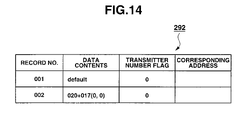
- FIG. 14 is a schematic view showing an example of contents of a call arrival setting table in step S 20 shown in FIG. 8 ;
- FIG. 15 is a schematic view showing an example of contents when a combined image has been stored in the data folder shown in FIG. 3 ;
- FIG. 16 is a schematic view showing an example of storage contents of a call arrival setting table when no copyright is attached to a combined image
- FIG. 17 is a schematic view showing an example of storage contents of a call arrival setting table when a sound is output upon call arrival when no copyright is attached to a combined image;
- FIG. 18 is a schematic view showing an example of storage contents of a call arrival setting table when a sound is output upon call arrival when a copyright is attached to a combined image;
- FIG. 19 is a schematic view showing an example of storage contents when a combined image produced by combining a motion picture with a still picture has been stored in the call arrival setting table shown in FIG. 3 ;
- FIG. 20 is a schematic view showing an example of storage contents when a combined image produced by combining sound-attachment animation with a still picture has been stored in the data folder shown in FIG. 3 ;
- FIG. 21 is a schematic view showing an example of storage contents when a motion picture file obtained by picking-up a motion picture by the portable telephone shown in FIG. 1 has been stored in the data folder shown in FIG. 3 ;
- FIG. 22 is a schematic view showing an example of storage contents when a combined image produced by combining a motion picture which is not provided with a copyright with a still picture has been stored in the data folder shown in FIG. 3 ;
- FIGS. 23A , 23 B, 23 C, 23 D, and 23 E are views each showing a screen example when an image is combined with a still picture displayed at a display device shown in FIG. 1 ;
- FIGS. 24A and 24B are views each showing a screen example when an image is combined with a motion picture displayed at the display device shown in FIG. 1 ;
- FIGS. 25A , 25 B, and 25 C are views each showing a screen example displayed at the display device shown in FIG. 1 when a motion picture has been combined with another motion picture;
- FIG. 26 is a flow chart showing procedures when a combined image has been called by the portable telephone shown in FIG. 1 ;
- FIG. 27 is a flow chart showing processing for producing a sound to be output together with a call arrival image when a motion picture has been changed to a call arrival image by a portable telephone according to a second embodiment of the present invention
- FIG. 28 is a schematic view showing an example of a configuration of a RAM memory area in another embodiment
- FIG. 29 is a schematic view showing an example of a configuration of a data folder management table shown in FIG. 28 ;
- FIG. 30 is a schematic view showing an example of a configuration of the data folder management table shown in FIG. 28 in another embodiment.
- FIGS. 1A and 1B are external views each showing an example in which a foldable portable wireless communication terminal according to one embodiment of the present invention is opened, wherein FIG. 1A is a plan view thereof, and FIG. 1B is a rear view thereof.
- a portable telephone 1 is provided with a camera.
- This telephone has a foldable structure capable of picking-up a still picture (“JPEG” compression) and a motion picture (“MPEG” compression), the structure including a cover and main body.
- JPEG still picture
- MPEG motion picture
- an expandable antenna 11 is provided at a rear face of the cover;
- a speaker 12 carrying out sound output is provided at the frontal side of the cover;
- a key operating portion 14 is provided on a front face of the main body.
- This key operating portion includes a variety of function keys (such as an E-mail key 141 , an address key 141 , and a shutter key 143 ); ten numeric keys 144 ; and the like.
- the E-mail key 141 is provided for starting up an E-mail function and displaying an E-mail menu.
- the address key 142 is provided for opening an address notebook used to select an E-mail address of a transmission destination.
- the shutter key 143 is provided for closing a shutter which is mounted.
- the ten numeric keys 144 are used for telephone number or character input.
- a microphone 15 carrying out sound input is provided at the lower part of the main body.
- a subsidiary display device 16 and a rear key 17 made of a transparent or semitransparent material are provided at the rear face of the cover, and incorporates an LED 171 emitting a light upon call arrival therein.
- An object lens 18 is provided at the lower part of the subsidiary display device 16 at the rear face of the cover.
- a loudspeaker 19 informing a call arrival or the like is provided at the rear lower part of the main body such that a buzzer is audible even in a state in which the cover is closed at the main body.
- FIG. 2 is a block diagram showing an example of a circuit configuration of the portable telephone 1 shown in FIG. 1 .
- the portable telephone 1 comprises: a wireless transmitter/receiver 20 for transmitting/receiving and modulating/demodulating a sound or text (E-mail data) via the antenna 11 in a wireless manner; a wireless signal processor 21 for carrying out processing required for wireless communication such as demodulating the sound or text (E-mail data) received by the wireless transmitter/receiver 20 , or modulating a sound or text to be transmitted to the wireless transmitter/receiver 20 ; a controller 22 for controlling a variety of operations and a whole operation; an image compression/encoding processor 23 for compressing/encrypting an image or the like picked-up by an image pickup module 181 (including the object lens 18 and a rewritable flash ROM (not shown)) and a digital sound processor (DSP) 182 ; a flash ROM 24 for storing a variety of programs described later; a driver 25 for driving
- the image compression/encoding processor 23 is a circuit portion which encodes a still picture in a JPEG scheme or a motion picture in an “amc” scheme compatible with MPEG-4 scheme after capturing the still picture or motion picture picked-up by the picking-up portion (object lens 18 , image pickup module 181 , DSP 182 ) and digitally encoded and a display image (still picture or motion picture) combined when a call arrival image is produced in a camera mode described later.
- this portion comprises a function for downloading image data over a network by means of a system (not shown) or decoding a still picture file attached to a received E-mail (JPEG (JPG) scheme, SMP scheme, PNG scheme, GIF scheme) or a motion picture file (MPEG (AMC) ASF) scheme, GIF animation scheme).
- JPEG JPG
- SMP scheme SMP scheme
- PNG PNG scheme
- GIF motion picture file
- AMC motion picture file
- GIF animation scheme GIF animation scheme
- FIG. 3 is a schematic view showing a memory area configuration of the RAM 29 .
- the RAM 29 is segmented into an area of a data folder management table 290 ; an area of a data folder 291 ; an area of a call arrival setting table 292 ; an area of an address notebook table 293 ; and an area of other data memory 294 .
- a table configuration of the data folder management table 290 is as shown in FIG. 4 . Actual real data is stored in the data folder 291 . However, the data folder management table 290 managing them is provided so as to write a file name, a data size, a folder attribute, a folder title, a file attribute, and a copyright flag for each record number, and one record is formed of these elements.
- the folder attribute is provided for sorting and managing items of data.
- data stored in a data folder is displayed for each folder. Any files are recorded miscellaneously in order of recording.
- the folder name indicates the name of folder displayed on the display screen.
- the file attribute designates the attribute of data itself stored in the data folder.
- a motion picture indicates data (irrespective of the presence or absence of a sound) encoded/compressed in a file conforming to the AMC scheme compatible with the MPEG scheme and a motion picture file picked-up by the portable telephone 1 . Even when no-sound is provided or only a sound is provided, when encoding is carried out in the MPEG scheme, the encoded data is handled as a same folder “movie.” It is assumed that this attribute includes an animation file conforming to the GIF scheme (refer to record No. 15 of FIG. 4 ) or a file conforming to the PMD scheme (a sound-attachment animation file specialized for a format of the portable telephone (refer to record No. 14 of FIG. 4 )).
- the still picture includes a still picture file conforming to the JPEG (JPG) scheme, the BMP scheme, the PNG scheme, or GIF scheme or a still picture file picked-up by the portable telephone 1 .
- the sound attribute includes an sound file recorded in the portable telephone 1 (refer to QCP format No. 003 ); a file conforming to the PMD format (a sound-attachment animation file specialized for the format of the portable telephone (when no animation is provided)) (refer to record Nos. 007 and 008 of FIG. 4 ); and a file conforming to the MMF scheme (a memory file specialized for the format of the portable telephone) (refer to record Nos. 009 to 010 of FIG. 4 ).
- the call arrival setting table 292 is a table for setting what type of broadcast (screen display and sound (melody) output) is carried out when a call arrival request signal from the outside to an own telephone has been received.
- record No. of the above-described data folder management table 290 is stored.
- this file When a file attribute of data corresponding to the stored record No. is a motion picture, this file is opened upon the receipt of the call arrival request signal, and the corresponding motion picture is displayed at the display device 13 . Then, when this motion picture file includes a sound, the corresponding sound is output. When no-sound is included, a defaulted broadcast buzzer is output.
- this file is opened upon the receipt of a call arrival request signal, and the corresponding still picture is displayed at the display device 13 . Then, in the call arrival setting table 292 , when record No. corresponding to this still picture file includes record No, of a file whose file attribute is “sound,” the sound corresponding to that record No. is output. Otherwise, a defaulted broadcast buzzer is output.
- FIG. 5 is a view showing an example of contents of the call arrival setting table 292 .
- a transmitter number flag in FIG. 5 includes the transmitter's telephone number in a call arrival request signal. When this telephone number is identical to that stored in the address notebook table 293 , when the transmitter number flag is set, broadcasting is carried out based on that call arrival setting.
- a corresponding address denotes a storage address in the address notebook table 293 described above.
- the portable telephone 1 provides access to an image data download site over a communication network via the antenna 11 , the wireless transmitter/receiver 20 , and the wireless signal processor 21 , downloads image data, and stores the downloaded image data in an image memory 23 .
- the image file picked-up by the picking-up portion (object lens 18 , image pickup module 181 , DSP 182 ) and compressed/encoded by the image compression/encoding processor 23 is stored in the other data memory 294 (image memory) of the RAM 29 .
- the controller 22 determines whether or not the downloaded image is combined with the picked-up image displayed upon call arrival in step A 01 of FIG. 6 .
- the determination result is negative, association with a sound file played back at the same time when this picked-up image is displayed upon call arrival is instructed in step A 02 , and a storage address of a still picture file and a storage address of the sound file are stored in the call arrival setting table 292 so as to be associated with each other in step S 03 .
- step A 04 When the downloaded image is combined with the picked-up image, processing goes to step A 04 in which it is determined whether or not a copyright is attached to the downloaded image to be combined. When the determination result is negative, processing goes to step A 07 , and when the determination result is affirmative, processing goes to step A 05 .
- step A 05 association with the sound file played back at the same time when this picked-up image is displayed upon call arrival is instructed.
- step A 06 the storage address of the still picture file, the storage address and combining position of the image to be combined, and the storage address of the sound file are stored in the call arrival setting table 292 so as to be associated with each other.
- step A 07 When processing goes to step A 07 , the downloaded image is combined with the picked-up image, and the combining result is captured. Then, the captured result is stored in the new data folder 291 contained in the RAM 29 .
- step A 08 association with the sound file played back at the same time when this combined image is displayed upon call arrival is instructed.
- step A 09 the storage address of the combining result and the storage address of the sound file are stored in the call arrival setting table 292 so as to be associated with each other.
- FIG. 7 is a flow chart showing more detailed operating procedures for setting the image (still picture or motion picture) picked-up by the portable telephone 1 so as to be displayed upon call arrival.
- step B 01 it is determined whether or not the downloaded image is combined with the picked-up image to be displayed upon call arrival.
- step B 02 it is determined in step B 02 whether or not a sound is attached to the picked-up image to be displayed upon call arrival, i.e., a call arrival image.
- processing goes to step B 05
- the determination result is affirmative, processing goes to step B 03 .
- step B 03 it is determined whether or not the sound attached to the call arrival image is output upon call arrival.
- processing goes to step B 05
- determination result is affirmative
- processing goes to step B 04 .
- step B 04 the storage address of the motion picture file is stored in the call arrival setting table 292 so as to be associated with the storage address of the picked-up image.
- step B 05 When processing goes to step B 05 , association of the sound output when the call arrival image is displayed with the sound file is instructed.
- step B 06 the storage address of the motion picture file and the storage address of the sound file are stored in the call arrival setting table 292 so as to be associated with each other.
- step B 01 When it is determined in step B 01 that the downloaded image is combined with the picked-up image, processing goes to step B 07 in which it is determined whether or not a copyright is attached to the downloaded image to be combined. When the determination result is negative, processing goes to step B 13 , and when the determination result is affirmative, processing goes to step B 08 . In step B 08 , it is determined whether or not a sound is attached to either of the picked-up image file and the downloaded image file. When the determination result is negative, processing goes to step B 11 , and when the determination result is affirmative, processing goes to step B 09 .
- step B 09 it is determined whether or not the sound attached to any image is output upon call arrival.
- processing goes to step B 11 , and when the determination result is affirmative, processing goes to step B 10 .
- step B 10 the storage address of the motion picture file and the storage address and combining position of the image to be combined are stored in the call arrival setting table 292 so as to be associated with each other.
- step B 11 When processing goes to step B 11 , association of the sound file is instructed, and the storage address of the motion picture file, the storage address and combining position of the image to be combined, and the storage address of the sound file are stored in the call arrival setting table 292 so as to be associated with each other.
- step B 13 it is determined whether or not a sound is attached to both of the picked-up image file and the downloaded image file.
- processing goes to step B 18 , and when the determination result is affirmative, processing goes to step B 14 .
- step B 14 a sound to be played back upon call arrival is instructed to be selected.
- step B 15 the combining result is played back and captured, and the captured combining result is newly stored in the data folder 291 .
- step B 16 it is determined whether or not a sound is output upon call arrival.
- processing goes to step B 19 , and when the determination result is affirmative, processing goes to step B 17 .
- step B 17 an address of the captured motion picture file (combined image) is stored in the call arrival setting table 292 .
- step B 18 it is determined whether or not a sound is attached to either of the picked-up image file and the downloaded image file.
- processing goes to step B 15 , and when the determination result is negative, processing goes to step B 19 .
- step B 19 association with the sound file is instructed.
- step B 20 the address of the captured motion picture file (combined image) and the storage address of the sound file are stored in the call arrival setting table 292 so as to be associated with each other.
- FIGS. 8 , 9 , 10 , 11 , and 12 are flow charts showing procedures for picking-up an image by actually using a camera function of the portable telephone 1 and producing the image as a display image upon call arrival.
- the controller 22 When the key input device 14 of the portable telephone 1 is operated to enter the camera mode, the controller 22 causes the display device 13 to display a menu in step S 01 . The user selects whether to pick up a motion picture or to pick up a still picture by operating the input device 14 with referring to this menu display. Thus, the controller 22 determines whether a functional mode selected in step S 02 is a still picture or a motion picture. When the selected functional mode is a still picture, processing goes to step S 03 , and when the selected functional mode is a motion picture, processing goes to step S 48 of FIG. 11 .
- FIG. 23A shows an example of screen displayed at the display device when the user has selected a still picture, wherein the “still picture” is underlined.
- FIG. 24A shows an example of screen when a motion picture has been selected, wherein the “motion picture” is underlined.
- step S 03 an electrical signal obtained by picking-up an object by the image pickup module 181 is imaged by means of the DSP 182 , and the resulting image is through-displayed intact at the main display device 13 through the driver 25 .
- step S 04 it is determined whether or not operation of the shutter key 143 is detected. When the determination result is negative, processing returns to step S 03 , and when the determination result is affirmative, processing goes to step S 05 in which the image output from the DSP 182 is stored to be temporarily captured in the other data memory 294 of the RAM 29 .
- step S 06 after a file name input instruction has been displayed for the user at the display device 13 , it is determined whether or not a file name input determination has been detected in step S 07 .
- processing goes to step S 09 , and when the determination result is negative, processing goes to step S 08 in which it is determined whether or not cancellation has been detected.
- processing returns to step S 06 , and when the determination result is affirmative, processing returns to step S 03 .
- step S 09 a file attribute and/or a still picture, and folder attribute 002 (my photo) are attached to the captured still picture, and stored in the data folder 291 .
- step S 10 the display device 13 displays an image which causes the user to select whether or not this picked-up image is used for a call arrival image.
- FIG. 23B shows an example of display image when the user has selected that the image is used for the call arrival image, wherein “YES” is underlined.
- step S 11 it is determined whether or not the user has selected that the image is used for the call arrival image.
- a file name (fuukei.jpg) is set in the picked-up still picture file.
- the set file name is stored in the data folder 291 of the RAM 29 with record No. 20 , and processing returns to the menu display.
- processing goes to step S 12 .
- step S 12 determines whether or not the downloaded image is combined with the picked-up image displayed upon call arrival in step S 12 .
- step S 24 determines whether or not the downloaded image is combined with the picked-up image displayed upon call arrival in step S 12 .
- step S 14 determines whether or not the determination result is the still picture or a motion picture is to be combined.
- step S 14 the file attribute and/or still picture files which have/has already been downloaded over a network are displayed at the display device 13 for each folder.
- step S 15 the display device displays a combined image as shown in FIG. 23C , for example, according to the subsequent user selecting and/or combining operation.
- Image combining are carried out until a determination of the completion of producing a combined image has been detected.
- the completion of producing the combined image is determined, it is determined in step S 17 whether or not a copyright flag is attached to the downloaded image used to be combined.
- processing goes to step S 21 , and when the determination result is affirmative, processing goes to step S 18 .
- step S 18 the display device 13 displays an indication for checking whether or not a valid copyright flag is attached to the downloaded image.
- step S 19 processing from step S 14 to step S 18 is repeated until YES has been detected for check.
- processing goes to step S 20 in which association data is stored in the call arrival setting table 292 , and then, processing goes to step S 24 shown in FIG. 9 .
- FIG. 14 shows an example of contents of the call arrival setting table 292 in step S 20 .
- the figure shows a case in which a still picture file of stamp02.png of record No. 17 has been combined with a still picture file of record No. 20 .
- a display example of this case will be described with reference to FIG. 23C .
- the still picture of stamp 02 .png (still picture indicating a human being on the top left of the display screen in FIG. 23C ) cannot be newly produced as a combined image because the copyright flag is set. Therefore, the storage contents of the call arrival setting table 292 are produced as record No. of picked-up image file+record No. of combined image file (combining position (upper left corner reference) X coordinate, combining position (upper left corner reference) y coordinate).
- step S 21 When processing goes to step S 21 , the combined still picture is played back once.
- step S 22 a file name of this combined image is input and determined. Then, record No. 21 is newly stored in the data folder 291 as shown in FIG. 15 . Then, in step S 23 , a storage address of this combined image is stored in the call arrival setting table 292 , as shown in FIG. 16 , and processing goes to step S 24 .
- An example of contents of the data folder 291 in FIG. 15 shows a case in which a captured image (chakufuukei.jpg) of the combining result has been newly stored when a copyright protection flag (illegal copy protection) is not set in the combined image file.
- FIG. 16 shows an example of storage contents of the call arrival setting table 292 when a still picture file of stamp 01 .png of record No. 16 has been combined with a still picture file of record No. 20 , for example, as the above-described combined image.
- An example of the display screen of the display device 13 will be described again with reference to FIG. 23C .
- the still picture of stamp01.png (still picture indicating a human being at the upper left of the display screen in FIG. 23C ) is newly produced as a combined image because the copyright flag is not set. Therefore, the storage contents of the call arrival setting table 292 are produced as record No. of the newly produced image file.
- step S 24 when a sound is added to a call arrival image, the file attribute and/or sound which have/has been already downloaded over a network, or a file attribute animation (excluding no-sound) file are displayed for each folder. Then, the fact that the user has selected this file is displayed until the selection has been detected in step S 25 . Thereafter, when the user selection is detected, association data as shown in FIG. 17 is stored in the call arrival setting table 292 in step S 26 . Then, processing returns to the menu display screen.
- FIG. 17 shows storage contents of the call arrival setting table 292 when the still picture file of stamp02.png of record No. 17 is combined with the still picture file of record No. 20 , and record No. 08 is stored as a sound file to be output upon call arrival.
- the storage contents of the call arrival setting table 292 are produced as record No. of picked-up image file+record No. of combined image file (combining position (upper left corner reference) X coordinate, combining position (upper left corner reference) y coordinate)+record No. of associated sound file.
- step S 25 in which “No” is detected an example of contents of the call arrival setting table 292 in step S 26 is as shown in FIG. 18 .
- FIG. 18 there is shown an example of storage contents of the call arrival setting table 292 when record No. 08 is stored in record No. 21 (in a newly produce combined image file) as a sound file to be output upon call arrival.
- the storage contents of the call arrival setting table 292 are produced as record No. of newly produced image file+record No. of associated sound file.
- step S 31 shown in FIG. 10 the display device 13 displays files whose downloaded file attribute is a motion picture for each folder.
- step S 32 the display device 13 displays a combined image according to the subsequent user selecting and/or combining operation.
- FIG. 19 shows a storage example of a combined image when a motion picture has been produced to be combined with a still picture in step S 32 .
- the figure shows a state in which the image file (chakufuukei.gif) produced when the file attribute motion picture (movieframe 01 gif) shown in FIG. 13 is combined is captured, and is stored as record No. 021 in the data folder 291 of the RAM 29 .
- step S 46 when a sound file (without a copyright) is associated, a sound-attachment animation file (chakufuukei.pmd) is processed as a file. Then, the processed file is stored in the data folder 291 , as shown in FIG. 20 .
- Image combining is carried out until a determination of the completion of producing a combined image has been detected.
- the completion of producing the combined image is determined, it is determined whether or not the copyright flag is attached to the downloaded image used to be combined in step S 34 .
- the determination result is negative, processing goes to step S 38 , and when the determination result is affirmative, processing goes to step S 35 .
- step S 35 the display device 13 displays an indication for checking whether or not a valid copyright flag is attached to the downloaded image.
- step S 36 processing from step S 31 to step S 35 is repeated until affirmative answer YES has been detected.
- step S 37 processing goes to step S 37 in which association data is stored in the call arrival setting table 292 , and then, processing goes to step S 41 .
- step S 38 When processing goes to step S 38 , the combined motion picture is played back from start to end timings and is compressed by means of the image compression/encoding processor 23 . Then, in step S 39 , a file name of this combined image is input and determined. Then, in step S 40 , the file name is newly stored in the data folder 291 , and processing goes to step S 41 .
- step S 41 when a sound is added to a call arrival image, the display device 13 displays a file attribute and/or a sound which have/has been already downloaded over a network, or a file attribute animation (excluding no-sound) file for each folder. Then, the display is continued until it is detected in step S 42 that the user has selected the file.
- step S 43 it is determined in step S 43 whether or not the copyright flag is attached to the downloaded image used to be combined. When the determination result is negative, processing goes to step S 46 , and when the determination result is affirmative, processing goes to step S 44 .
- step S 44 the display device 13 displays an indication for checking whether or not a valid copyright flag is attached to the downloaded image.
- step S 45 processing from step S 41 to step S 44 is repeated until affirmative answer YES has been detected.
- YES is selected, processing goes to step S 47 in which association data is stored in the call arrival setting table 292 , and then, processing returns to the menu display screen.
- step S 46 When no copyright flag is attached to the downloaded image, processing goes to step S 46 in which a motion picture is set as a file attribute, and 001 or 004 is set in a folder attribute. Thereafter, processing goes to step S 47 in which association data is stored in the call arrival setting table 292 , and then, processing returns to the menu display screen.
- step S 48 of FIG. 11 When the image pick-up mode selected in step S 02 of FIG. 8 is a motion picture, processing goes to step S 48 of FIG. 11 in which an electrical signal obtained by picking-up an object by the image pickup module 181 is imaged by means of the DSP 182 , and the resulting image is through-displayed intact at the display device 13 through the driver 25 . Then, in step S 49 , it is determined whether or not operation of the shutter key 143 is detected. When the determination result is negative, processing returns to step S 48 , and when the determination result is affirmative, processing goes to step S 50 in which the motion picture output from the DSP 182 is stored to be temporarily captured in the other data memory 294 of the RAM 29 .
- step S 51 it is determined whether or not operation of the shutter key 143 is detected.
- the determination result is negative, it is determined whether or not a predetermined time interval has elapsed in step S 52 .
- processing returns to step S 50 , and when the determination result is affirmative, processing goes to step S 53 .
- processing goes to step S 53 immediately.
- step S 51 When operation of the shutter key 143 is detected in step S 51 , processing goes to step S 53 in which the temporarily captured image is compressed/encoded by means of the image compression/encoding processor 23 . Then, in step S 54 , the display device 13 displays a file name input instruction for the user.
- step S 55 it is determined whether or not a determination of file name input has been detected. When the determination result is negative, processing goes to step S 56 in which it is determined whether or not cancellation has been detected. When no cancellation has been detected, processing returns to step S 54 , and when cancellation has been detected, processing returns to step S 48 .
- step S 55 When a determination of file name input has been detected in step S 55 , processing goes to step S 57 in which the compressed/encoded motion picture is stored as shown in FIG. 21 in the data folder 291 of the RAM 29 by attaching the file attribute and/or motion picture or folder attribute 003 (movie) to the motion picture.
- FIG. 21 shows an example in which, after a motion picture has been picked-up in the camera mode, when a motion picture file is produced, a file name (car.amc) is set for that motion picture file, and the set file name is stored as record No. 20 in the data folder 291 .
- step S 58 the display device 13 displays an image which causes the user to select whether this picked-up image is used for a call arrival image.
- step S 59 it is determined whether or not the user has selected that the picked-up image is used for the call arrival image. When the determination result is negative, processing returns to the display menu, and when the determination result is affirmative, processing goes to step S 60 .
- FIG. 24B shows an example of screen of the display device 13 when the user has selected that the picked-up image is used for the call arrival image, wherein “YES” is underlined.
- the user selects whether or not the selected image is combined with a downloaded image.
- the controller 22 determines whether or not the downloaded image is combined with a picked-up image to be displayed upon call arrival. When the determination result is negative, processing goes to step S 71 shown in FIG. 12 . When the determination result is affirmative, processing goes to step S 61 in which the display device 13 displays the file attribute, still picture, motion picture, or animation file which has already been downloaded over a network for each folder. In step S 62 , the display device 13 displays a combined image according to the subsequent user selecting and/or combining operation.
- step S 63 processing of step S 62 is repeated until a determination of a combined image has been selected.
- step S 64 it is determined in step S 64 whether or not a copyright flag is attached to the downloaded image used to be combined.
- processing goes to step S 68 , and when the determination result is affirmative, processing goes to step S 65 .
- step S 65 the display device 13 displays an indication for checking whether a valid copyright flag is attached to the downloaded image.
- step S 66 processing from step S 61 to step S 66 is repeated until affirmative answer YES has been detected. When YES is detected, processing goes to step S 67 in which association data is stored in the call arrival setting table 292 , and then, processing goes to step S 71 of FIG. 12 .
- step S 68 When processing goes to step S 68 , the combined still picture is played back from start to end timings and is compressed by means of the image compression/encoding processor 23 .
- step S 69 a file name of this combined image is input and determined, and then, the determined image is newly stored as shown in FIG. 22 in the data folder 291 of the RAM 29 . Further, in step S 70 , this storage address is stored in the call arrival setting table 292 , and then, processing goes to step S 71 of FIG. 12
- FIG. 22 is a view showing an example in which, when a copyright protection flag (illegal copy protection) is not set for an image file having a motion picture combined with a still picture therein, a captured image (chakucar.amc) of the combining result is newly stored in the data folder 291 .
- a copyright protection flag illegal copy protection
- a captured image chakucar.amc
- FIGS. 25A , 25 B, and 25 C each show an example of screen on which a motion picture is combined with a still picture.
- data for which star-marked columns are changed alternately is produced as a file called movieframe 01 .gif of record No. 18 in FIG. 22 .
- a motion picture file is produced in accordance with the file format of a picked-up image.
- step S 71 of FIG. 12 when a sound is added to a call arrival image, the file attribute and/or sound which have/has downloaded over a network, or a file attribute animation (excluding no-sound) file is displayed for each folder. Then, the display continues until the user selection has been detected in step S 72 .
- step S 73 When the user selection is detected, it is determined whether or not the copyright flag is attached to the downloaded image used to be combined in step S 73 . When the determination result is negative, processing goes to step S 77 , and when the determination result is affirmative, processing goes to step S 74 .
- step S 74 the display device 13 displays an indication for checking whether or not a valid copyright flag is attached to the downloaded image.
- step S 75 processing from step S 71 to step S 74 is repeated until affirmative answer YES has been detected.
- YES is detected, processing goes to step S 76 in which association data is stored in the call arrival setting table 292 , and then, processing goes to the menu display screen.
- step S 73 When no copyright flag is attached to the downloaded image at step S 73 , processing goes to step S 77 in which a motion picture is set as a file attribute; 001 or 004 is set as a folder attribute; association data is stored in the call arrival setting table 292 ; and then, processing returns to the menu display screen.
- the controller 22 makes a search for the RAM 29 .
- the image to be used is stored as association data in the call arrival setting table 292 , it is determined that a copyright is attached to a portion of the combined image. Then, the display device 13 displays an indication that “the image to be used cannot be displayed because a portion of the combined image has a copyright.” In addition, when the combined image is used for transmission via E-mail, the display device displays an indication that “the image cannot be displayed and transmitted because a portion of the combined image has a copyright.”
- FIG. 26 is a flow chart showing procedures of the controller 22 when the above described combined image is used.
- step D 01 when a combined image is called, processing goes to step D 02 in which a search is made for the call arrival setting table 292 of the RAM 29 . Then, it is determined whether or not the storage addresses of picked-up image and downloaded image configuring a combined image targeted for the call request are stored differently to be associated with each other.
- step D 03 based on the above described search, it is determined whether or not the storage addresses of the picked-up image and downloaded image are different from each other.
- processing goes to step DOS in which the combined image data is read out from the data folder 291 of the RAM 29 which is a storage destination, and the readout data is displayed.
- step D 04 the display device 13 displays a message that “the image cannot be displayed because a portion of the combined image has a copyright,” and terminates processing.
- the display device when the user uses a combined image which has been combined and stored once, when a portion of the combined image has a copyright, the display device displays an indication that “the image cannot be displayed because a portion of the combined image has a copyright.” In addition, when the combined image is used for transmission via E-mail, the display device further displays an additional indication that “transmission is impossible.” Thus, the user can know immediately why the image is not displayed and why transmission via E-mail is impossible. Therefore, operability of the portable telephone 1 can be improved.
- FIG. 27 is a flow chart showing processing for generating a sound to be output together with a call arrival image when a motion picture according to a second embodiment of the present invention is produced as a call arrival image.
- a description of the configuration and operation thereof is omitted. A main portion of that operation will be described here.
- step C 01 it is determined whether or not a sound is attached to a motion picture to be combined.
- processing goes to step C 02
- step C 04 it is determined whether or nor a sound is output upon call arrival.
- step C 04 it is determined whether or nor a sound is output upon call arrival.
- processing goes to step C 04 .
- step S 03 a storage address of a motion picture file is stored in the call arrival setting table 292 of the RAM 29 .
- step C 04 When processing goes to step C 04 , association with a sound file is instructed here.
- step C 05 it is determined whether or not a copyright flag is attached to this sound file. When the determination result is affirmative, the storage address of the motion picture file and the storage address of the sound file are stored in the call arrival setting table 292 so as to be associated with each other.
- step C 07 When no copyright flag is attached to the sound file, processing goes to step C 07 in which a motion picture file is played back and captured while the associated sound file is output.
- step C 08 a motion picture file is newly stored in the data folder 292 .
- step C 09 the storage address of the newly produced motion picture file is stored in the call arrival setting table 292 .
- the motion picture file and sound file are stored respectively.
- the respective storage addresses are stored as association data in the call arrival setting table 292 . Thus, when these addresses are detected, it is determined that a sound output together with the combined image has a copyright.
- the display device displays an indication that “no transmission is possible because a sound has a copyright.” In this manner, the user can know immediately why transmission is impossible, and operation of the portable telephone 1 can be improved.
- the determination as to whether combining is enabled or disabled may be made on the presumption that “copyright protection is applied to file data downloaded over the Internet in principle.”
- FIG. 28 is a schematic view showing a memory area configuration of the RAM 29 in the portable telephone 1 which is made compatible with the above-described case.
- a difference from the above first embodiment and second embodiment is that a data folder management table 295 is provided instead of the data folder management table 290 .
- the other circuit configuration and memory configuration are identical to those in the above described first and second embodiments.
- a table configuration of the data folder management table 295 is as shown in FIG. 29 . Actual real data is stored in the data folder 291 .
- the data folder management table 290 managing them is provided to write a file name, a data size, a folder attribute, a folder title, and a file attribute on a record No. by record No. basis, and one record is formed of these elements.
- a region of the folder title is set so as to sort a downloaded item and a produced one in the portable telephone 1 when multimedia files are stored to be mixed. That is, in the folder title, a folder called “my . . . ” stores a variety of data obtained by operating the portable telephone 1 such as startup of a camera function. On the other hand, a folder which is not called “my . . . ” is stored in a folder for storing downloaded data.
- the determination as to whether combining is enabled or disabled may be made on the presumption that “all files may be processed as long as they are in a file format conforming to the DFC standard or Exif standard.”
- FIG. 30 shows a table configuration of the data folder management table 295 of the RAM 29 in the portable telephone 1 which is made compatible with the above described case. Actual real data is stored in the data folder 291 .
- the data folder management table 290 managing them is provided so as to write a file name, a data size, a folder attribute, a folder title, and, a file attribute in a DCF/Exif flag area on a record No. by record No. basis. One record is formed of these elements.
- the DCF/Exif flag area is provided as a flag set for sorting the downloaded item and the item produced in the portable telephone 1 according to whether they are produced in accordance with the DCF standard or Exif standard in storing a still picture file conforming to the JPEG scheme. That is, in FIG. 30 , a file name “taro.jpg” managed in record No. 002 is picked-up by the portable telephone 1 , and is stored in a folder whose folder title is “my photo.” Therefore, this file is found to be a still picture file stored after picked-up, and thus, “1” is set in the DCF/Exif flag area. On the other hand, a file name idol01.jpg managed in record No. 012 is stored in a folder whose folder title is “graphic.” Therefore, this file is found to have been downloaded, and thus, “0” is set in the DCF/Exif flag area.
- a computer program can be supplied to a computer through a disk type recording medium such as a floppy disk or a hard disk; a variety of memories such as a semiconductor memory or a card type memory; or a variety of program recording mediums such as a communication network.
- a disk type recording medium such as a floppy disk or a hard disk
- memories such as a semiconductor memory or a card type memory
- program recording mediums such as a communication network.
- the multimedia data targeted to be combined when combining of multimedia data is instructed, it is determined whether or not the multimedia data targeted to be combined includes data downloaded via the network by the wireless communication function. When the determination result is affirmative, a corresponding storage address is stored, and transmission of the combined multimedia data is inhibited.
- the multimedia data targeted to be combined includes data downloaded via the network or protected by copyright information, it is possible to notify to the user that transmission cannot be carried out, so that the user's usability can be improved.
- the multimedia data combined as the content of call arrival notification can be used, and thus, the multimedia data according to the user's preference can be freely used without worrying about acquisition by use of a device incorporated in advance or acquisition by downloading.
- the user can use the still picture data or the motion picture data without worrying about acquisition by picking-up or downloading.
- the multimedia data after combined is uniquely handled as motion picture data, so that the user can use motion picture data freely.
- the multimedia data Since the sound data recorded by the user is handled as one item of the multimedia data, the multimedia data according to the user's preference can be freely used.
- the multimedia data targeted to be combined includes data downloaded via a network or protected by copyright information, it is possible to check only the combining result without combining and/or storing these items of the data, so that the user's usability can be improved.
- the combining result is stored as new multimedia data, and thus, the user's usability can be improved.
- the determination as to whether the combining is enabled or disabled can be easily made without making a determination based on redundant data.
- the determination as to whether the combining is enabled or disabled can be easily made.
- the multimedia data targeted to be combined includes data downloaded via the network or protected by copyright information, it is possible to check only the combining result without combining and/or storing items of the data, and thus, the user's usability can be improved.
- the combining result is stored as new multimedia data, so that the user's usability can be improved.
- the determination as to whether the combining is enabled or disabled can be made without making a determination based on redundant data.
- the present invention is not limited to the above described embodiments.
- the present invention can be carried out according to other various modes in specific configuration, function, operation, and advantageous effect without deviating from the spirit of the invention.
- a similar advantageous effect can be achieved by applying the present invention to a portable wireless communication terminal PDA, a portable personal computer and the like.
Landscapes
- Engineering & Computer Science (AREA)
- Signal Processing (AREA)
- Multimedia (AREA)
- Human Computer Interaction (AREA)
- Computer Networks & Wireless Communication (AREA)
- Business, Economics & Management (AREA)
- General Business, Economics & Management (AREA)
- Computer Security & Cryptography (AREA)
- Mobile Radio Communication Systems (AREA)
- Telephone Function (AREA)
- Storage Device Security (AREA)
- Television Signal Processing For Recording (AREA)
- Processing Or Creating Images (AREA)
- Facsimiles In General (AREA)
Applications Claiming Priority (5)
| Application Number | Priority Date | Filing Date | Title |
|---|---|---|---|
| JP2002346895 | 2002-11-29 | ||
| JP2002-346895 | 2002-11-29 | ||
| JP2003349458A JP4140499B2 (ja) | 2002-11-29 | 2003-10-08 | 通信端末、及び、プログラム |
| JP2003-349458 | 2003-10-08 | ||
| PCT/JP2003/015291 WO2004051658A1 (en) | 2002-11-29 | 2003-11-28 | Portable wireless communication terminal for picked-up image editing |
Related Parent Applications (1)
| Application Number | Title | Priority Date | Filing Date |
|---|---|---|---|
| PCT/JP2003/015291 Continuation WO2004051658A1 (en) | 2002-11-29 | 2003-11-28 | Portable wireless communication terminal for picked-up image editing |
Publications (2)
| Publication Number | Publication Date |
|---|---|
| US20050010568A1 US20050010568A1 (en) | 2005-01-13 |
| US7493138B2 true US7493138B2 (en) | 2009-02-17 |
Family
ID=32473648
Family Applications (1)
| Application Number | Title | Priority Date | Filing Date |
|---|---|---|---|
| US10/914,935 Expired - Fee Related US7493138B2 (en) | 2002-11-29 | 2004-08-09 | Portable wireless communication terminal, picked-up image editing apparatus, and picked-up image editing method |
Country Status (9)
| Country | Link |
|---|---|
| US (1) | US7493138B2 (de) |
| EP (1) | EP1454317B1 (de) |
| JP (1) | JP4140499B2 (de) |
| KR (1) | KR100689309B1 (de) |
| CN (1) | CN100530143C (de) |
| AT (1) | ATE369605T1 (de) |
| AU (1) | AU2003283842A1 (de) |
| DE (1) | DE60315408T2 (de) |
| WO (1) | WO2004051658A1 (de) |
Cited By (2)
| Publication number | Priority date | Publication date | Assignee | Title |
|---|---|---|---|---|
| USRE43559E1 (en) | 2004-03-02 | 2012-07-31 | Lg Electronics Inc. | Method and communication system for identifying calling/called party |
| US20120236937A1 (en) * | 2007-07-20 | 2012-09-20 | Fujifilm Corporation | Image processing apparatus, image processing method and computer readable medium |
Families Citing this family (34)
| Publication number | Priority date | Publication date | Assignee | Title |
|---|---|---|---|---|
| TWI289708B (en) * | 2002-12-25 | 2007-11-11 | Qualcomm Mems Technologies Inc | Optical interference type color display |
| US7342705B2 (en) | 2004-02-03 | 2008-03-11 | Idc, Llc | Spatial light modulator with integrated optical compensation structure |
| US7561323B2 (en) * | 2004-09-27 | 2009-07-14 | Idc, Llc | Optical films for directing light towards active areas of displays |
| US7911428B2 (en) * | 2004-09-27 | 2011-03-22 | Qualcomm Mems Technologies, Inc. | Method and device for manipulating color in a display |
| US7710632B2 (en) * | 2004-09-27 | 2010-05-04 | Qualcomm Mems Technologies, Inc. | Display device having an array of spatial light modulators with integrated color filters |
| US7630123B2 (en) * | 2004-09-27 | 2009-12-08 | Qualcomm Mems Technologies, Inc. | Method and device for compensating for color shift as a function of angle of view |
| US7508571B2 (en) * | 2004-09-27 | 2009-03-24 | Idc, Llc | Optical films for controlling angular characteristics of displays |
| US20060066586A1 (en) * | 2004-09-27 | 2006-03-30 | Gally Brian J | Touchscreens for displays |
| US7710636B2 (en) * | 2004-09-27 | 2010-05-04 | Qualcomm Mems Technologies, Inc. | Systems and methods using interferometric optical modulators and diffusers |
| US7807488B2 (en) * | 2004-09-27 | 2010-10-05 | Qualcomm Mems Technologies, Inc. | Display element having filter material diffused in a substrate of the display element |
| KR100631610B1 (ko) * | 2004-11-26 | 2006-10-09 | 엘지전자 주식회사 | 휴대단말기의 영상신호 합성장치 및 방법 |
| JP4648017B2 (ja) * | 2005-02-01 | 2011-03-09 | 株式会社リコー | 図面管理方法及び図面管理プログラム |
| US20060181547A1 (en) * | 2005-02-12 | 2006-08-17 | Patrick Loo | Method and system for image editing in a mobile multimedia processor |
| CN1828665B (zh) * | 2005-02-12 | 2011-11-30 | 美国博通公司 | 在通信设备中处理信息的方法和系统 |
| US20060181540A1 (en) * | 2005-02-12 | 2006-08-17 | Patrick Loo | Image editor with plug-in capability for editing images in a mobile communication device |
| US20060182411A1 (en) * | 2005-02-12 | 2006-08-17 | Patrick Loo | Architecture for an image editor used for editing images in a mobile communication device |
| CA2604097A1 (en) * | 2005-04-14 | 2006-10-26 | Any Corner Llc | Systems and methods for a multimedia communications system |
| US7603001B2 (en) * | 2006-02-17 | 2009-10-13 | Qualcomm Mems Technologies, Inc. | Method and apparatus for providing back-lighting in an interferometric modulator display device |
| US20080063156A1 (en) * | 2006-08-28 | 2008-03-13 | Sony Ericsson Mobile Communications Ab | System and method for coordinating audiovisual content with contact list information |
| WO2008045200A2 (en) * | 2006-10-06 | 2008-04-17 | Qualcomm Mems Technologies, Inc. | Optical loss structure integrated in an illumination apparatus of a display |
| EP2069838A2 (de) * | 2006-10-06 | 2009-06-17 | Qualcomm Mems Technologies, Inc. | Beleuchtungsvorrichtung mit eingebautem lichtkoppler |
| WO2008045207A2 (en) | 2006-10-06 | 2008-04-17 | Qualcomm Mems Technologies, Inc. | Light guide |
| WO2008045462A2 (en) * | 2006-10-10 | 2008-04-17 | Qualcomm Mems Technologies, Inc. | Display device with diffractive optics |
| US7864395B2 (en) | 2006-10-27 | 2011-01-04 | Qualcomm Mems Technologies, Inc. | Light guide including optical scattering elements and a method of manufacture |
| US7777954B2 (en) * | 2007-01-30 | 2010-08-17 | Qualcomm Mems Technologies, Inc. | Systems and methods of providing a light guiding layer |
| US8068710B2 (en) | 2007-12-07 | 2011-11-29 | Qualcomm Mems Technologies, Inc. | Decoupled holographic film and diffuser |
| WO2009102733A2 (en) * | 2008-02-12 | 2009-08-20 | Qualcomm Mems Technologies, Inc. | Integrated front light diffuser for reflective displays |
| US20100157406A1 (en) * | 2008-12-19 | 2010-06-24 | Qualcomm Mems Technologies, Inc. | System and method for matching light source emission to display element reflectivity |
| CN102449513B (zh) * | 2009-05-29 | 2015-01-21 | 高通Mems科技公司 | 照明装置及其制造方法 |
| US20110032214A1 (en) * | 2009-06-01 | 2011-02-10 | Qualcomm Mems Technologies, Inc. | Front light based optical touch screen |
| JP4860743B2 (ja) * | 2009-10-16 | 2012-01-25 | Necカシオモバイルコミュニケーションズ株式会社 | カメラ付き携帯端末装置およびプログラム |
| US8848294B2 (en) | 2010-05-20 | 2014-09-30 | Qualcomm Mems Technologies, Inc. | Method and structure capable of changing color saturation |
| US8902484B2 (en) | 2010-12-15 | 2014-12-02 | Qualcomm Mems Technologies, Inc. | Holographic brightness enhancement film |
| CN110519464B (zh) * | 2019-09-27 | 2021-10-26 | 上海掌门科技有限公司 | 来电提醒的设置方法、设备及计算机可读存储介质 |
Citations (15)
| Publication number | Priority date | Publication date | Assignee | Title |
|---|---|---|---|---|
| KR20010038360A (ko) | 1999-10-25 | 2001-05-15 | 윤종용 | 카메라가 실장된 휴대폰의 화상/문서 편집방법 |
| US6243594B1 (en) * | 1999-06-09 | 2001-06-05 | Shimon Silberfenig | Combination cellular telephone and sound storage device and method of use |
| US20010013039A1 (en) * | 2000-02-08 | 2001-08-09 | Choi Choo Hwan | File structure for preventing edition and deletion in internet, a variety of computers and computer application media, advertising method using the file structure and system used for the method |
| US20010021649A1 (en) * | 1999-12-24 | 2001-09-13 | Timo Kinnunen | User interface for a radiotelephone |
| US20010023417A1 (en) | 1994-11-23 | 2001-09-20 | Stefik Mark J. | System for controlling the distribution and use of digital works using digital tickets |
| US20020073214A1 (en) | 2000-10-24 | 2002-06-13 | Seiko Epson Corporation | System and method for digital content distribution |
| US20020077988A1 (en) * | 2000-12-19 | 2002-06-20 | Sasaki Gary D. | Distributing digital content |
| US20020120586A1 (en) * | 2001-01-05 | 2002-08-29 | Teruo Masaki | Copyrighted work managing method and apparatus thereof |
| US20020135695A1 (en) * | 2001-03-26 | 2002-09-26 | Edelson Steven D. | Video data reduction by selected frame elimination |
| US20030224773A1 (en) * | 2002-05-31 | 2003-12-04 | Douglas Deeds | Fragmented delivery of multimedia |
| US20040145660A1 (en) * | 2001-06-06 | 2004-07-29 | Yosuke Kusaka | Electronic imaging apparatus and electronic imaging system |
| US20040203835A1 (en) * | 2002-04-24 | 2004-10-14 | Kevin Trottier | Integrated telephony and television system |
| US20040235494A1 (en) * | 2001-06-27 | 2004-11-25 | Fumiaki Matsumoto | Image providing apparatus and image providing system |
| US20040260716A1 (en) * | 2001-10-31 | 2004-12-23 | Masataka Sugiura | Content information transferring device and content information receiving device |
| US20050234828A1 (en) * | 2000-08-31 | 2005-10-20 | Sony Corporation | Content distribution system, content distribution method, information processing apparatus, and program providing medium |
Family Cites Families (5)
| Publication number | Priority date | Publication date | Assignee | Title |
|---|---|---|---|---|
| KR20020067803A (ko) * | 2001-02-19 | 2002-08-24 | 삼성전자 주식회사 | 휴대용 단말기의 멀티미디어 전자우편 서비스 시스템 및방법 |
| US6983166B2 (en) * | 2001-08-20 | 2006-01-03 | Qualcomm, Incorporated | Power control for a channel with multiple formats in a communication system |
| US7324565B2 (en) * | 2003-05-14 | 2008-01-29 | Nokia Corporation | Method and device for channel multiplexing or demultiplexing |
| KR100630169B1 (ko) * | 2003-08-16 | 2006-09-29 | 삼성전자주식회사 | 비동기 광대역 부호분할 다중접속 통신 시스템에서 역방향전용 채널을 이용한 역방향 패킷 데이터 서비스 방법 및장치 |
| US20050073985A1 (en) * | 2003-10-04 | 2005-04-07 | Samsung Electronics Co., Ltd. | System and method for controlling a TTI in a W-CDMA communication system supporting enhanced uplink dedicated transport channel |
-
2003
- 2003-10-08 JP JP2003349458A patent/JP4140499B2/ja not_active Expired - Fee Related
- 2003-11-28 DE DE60315408T patent/DE60315408T2/de not_active Expired - Lifetime
- 2003-11-28 EP EP03775975A patent/EP1454317B1/de not_active Expired - Lifetime
- 2003-11-28 CN CNB2003801001675A patent/CN100530143C/zh not_active Expired - Fee Related
- 2003-11-28 WO PCT/JP2003/015291 patent/WO2004051658A1/en not_active Ceased
- 2003-11-28 KR KR1020047011779A patent/KR100689309B1/ko not_active Expired - Fee Related
- 2003-11-28 AT AT03775975T patent/ATE369605T1/de not_active IP Right Cessation
- 2003-11-28 AU AU2003283842A patent/AU2003283842A1/en not_active Abandoned
-
2004
- 2004-08-09 US US10/914,935 patent/US7493138B2/en not_active Expired - Fee Related
Patent Citations (15)
| Publication number | Priority date | Publication date | Assignee | Title |
|---|---|---|---|---|
| US20010023417A1 (en) | 1994-11-23 | 2001-09-20 | Stefik Mark J. | System for controlling the distribution and use of digital works using digital tickets |
| US6243594B1 (en) * | 1999-06-09 | 2001-06-05 | Shimon Silberfenig | Combination cellular telephone and sound storage device and method of use |
| KR20010038360A (ko) | 1999-10-25 | 2001-05-15 | 윤종용 | 카메라가 실장된 휴대폰의 화상/문서 편집방법 |
| US20010021649A1 (en) * | 1999-12-24 | 2001-09-13 | Timo Kinnunen | User interface for a radiotelephone |
| US20010013039A1 (en) * | 2000-02-08 | 2001-08-09 | Choi Choo Hwan | File structure for preventing edition and deletion in internet, a variety of computers and computer application media, advertising method using the file structure and system used for the method |
| US20050234828A1 (en) * | 2000-08-31 | 2005-10-20 | Sony Corporation | Content distribution system, content distribution method, information processing apparatus, and program providing medium |
| US20020073214A1 (en) | 2000-10-24 | 2002-06-13 | Seiko Epson Corporation | System and method for digital content distribution |
| US20020077988A1 (en) * | 2000-12-19 | 2002-06-20 | Sasaki Gary D. | Distributing digital content |
| US20020120586A1 (en) * | 2001-01-05 | 2002-08-29 | Teruo Masaki | Copyrighted work managing method and apparatus thereof |
| US20020135695A1 (en) * | 2001-03-26 | 2002-09-26 | Edelson Steven D. | Video data reduction by selected frame elimination |
| US20040145660A1 (en) * | 2001-06-06 | 2004-07-29 | Yosuke Kusaka | Electronic imaging apparatus and electronic imaging system |
| US20040235494A1 (en) * | 2001-06-27 | 2004-11-25 | Fumiaki Matsumoto | Image providing apparatus and image providing system |
| US20040260716A1 (en) * | 2001-10-31 | 2004-12-23 | Masataka Sugiura | Content information transferring device and content information receiving device |
| US20040203835A1 (en) * | 2002-04-24 | 2004-10-14 | Kevin Trottier | Integrated telephony and television system |
| US20030224773A1 (en) * | 2002-05-31 | 2003-12-04 | Douglas Deeds | Fragmented delivery of multimedia |
Non-Patent Citations (4)
| Title |
|---|
| "Digital Rights Management Version 1.0 Proposed Version." Jun. 28, 2002. Open Mobile Alliance. <www.openmobilealliance.org>. |
| "Digital Rights Management Version 1.0" Announcement Open Mobile Alliance, XX, XX, Sep. 5, 2002, pp. 1-21, XP002273196. |
| Nokia Announcement: "Nokia 3650 technical specifications" Internet Citation, 'Online! Sep. 6, 2002, pp. 1-3, XP002275872, Retrieved from the Internet: <Url:http://www.forum.nokia.com/main/1,,015-20,00.html> retrieved on Apr. 4, 2001!. |
| Open Mobile Alliance: "Rights Expression Language Version 1.0" Announcement Open Mobile Alliance, 'Online!-Sep. 13, 2002, p. 1-29, XP002275873, Retrieved from the Internet: <URL:http://www.openmobilealliance.org/tech/docs/DRM/OMA-Download- DRMREL-V1-0-20020913-C.pdf> retrieved on Apr. 1, 2004 !. |
Cited By (9)
| Publication number | Priority date | Publication date | Assignee | Title |
|---|---|---|---|---|
| USRE43559E1 (en) | 2004-03-02 | 2012-07-31 | Lg Electronics Inc. | Method and communication system for identifying calling/called party |
| USRE43648E1 (en) | 2004-03-02 | 2012-09-11 | Lg Electronics Inc. | Method and communication system for identifying calling/called party |
| USRE43852E1 (en) | 2004-03-02 | 2012-12-11 | Lg Electronics Inc. | Method and communication system for identifying calling/called party |
| USRE43893E1 (en) | 2004-03-02 | 2013-01-01 | Lg Electronics Inc. | Method and communication system for identifying calling/called party |
| USRE44066E1 (en) | 2004-03-02 | 2013-03-12 | Lg Electronics Inc. | Method and communication system for identifying calling/called party |
| USRE44067E1 (en) * | 2004-03-02 | 2013-03-12 | Lg Electronics Inc. | Method and communication system for identifying calling/called party |
| USRE44951E1 (en) | 2004-03-02 | 2014-06-17 | Lg Electronics Inc. | Method and communication system for identifying calling/called party |
| US20120236937A1 (en) * | 2007-07-20 | 2012-09-20 | Fujifilm Corporation | Image processing apparatus, image processing method and computer readable medium |
| US8532394B2 (en) * | 2007-07-20 | 2013-09-10 | Fujifilm Corporation | Image processing apparatus, image processing method and computer readable medium |
Also Published As
| Publication number | Publication date |
|---|---|
| DE60315408D1 (de) | 2007-09-20 |
| AU2003283842A1 (en) | 2004-06-23 |
| KR20040077913A (ko) | 2004-09-07 |
| ATE369605T1 (de) | 2007-08-15 |
| DE60315408T2 (de) | 2007-11-29 |
| EP1454317B1 (de) | 2007-08-08 |
| US20050010568A1 (en) | 2005-01-13 |
| KR100689309B1 (ko) | 2007-03-02 |
| EP1454317A1 (de) | 2004-09-08 |
| WO2004051658A1 (en) | 2004-06-17 |
| CN100530143C (zh) | 2009-08-19 |
| JP2004194293A (ja) | 2004-07-08 |
| JP4140499B2 (ja) | 2008-08-27 |
| CN1685434A (zh) | 2005-10-19 |
Similar Documents
| Publication | Publication Date | Title |
|---|---|---|
| US7493138B2 (en) | Portable wireless communication terminal, picked-up image editing apparatus, and picked-up image editing method | |
| CN100428756C (zh) | 具备通信和摄像功能的电子机器、图像显示方法和程序 | |
| US20040102225A1 (en) | Portable communication terminal and image display method | |
| KR100470576B1 (ko) | 메일 송수신 장치 및 방법 | |
| US20170034335A1 (en) | Method of displaying and transmitting thumbnail image data in a wireless terminal | |
| JP4439472B2 (ja) | データ記憶装置、情報送信装置、データ記憶システム及び情報処理システム | |
| KR100582909B1 (ko) | 휴대통신단말 및 화상표시방법 | |
| KR20020007941A (ko) | 화상 정보 작성 장치, 화상 통신 단말, 화상 신호 분배서버 및 화상 정보 제공 시스템 | |
| US6981646B2 (en) | Chip embedded trading card, recording and/or reproducing apparatus therefor, and message building method | |
| JP4618356B2 (ja) | 電子機器、及び、プログラム | |
| JP2005033346A (ja) | 情報処理装置、情報処理方法及びソフトウェア | |
| JP2004140710A (ja) | 携帯電話端末および携帯電話端末の制御方法 | |
| JP4258546B2 (ja) | 電話端末、及び、プログラム | |
| JP3359526B2 (ja) | デジタル電子カメラ | |
| KR101108837B1 (ko) | 휴대단말기의 메시지 저장장치 및 방법 | |
| JP3849640B2 (ja) | 印刷画像指定装置 | |
| JP2001045347A (ja) | データ通信システムおよびそのシステムを構成するディジタル・カメラ | |
| KR100724965B1 (ko) | 이동 통신 단말기 및 그 단말기의 이미지 출력 방법 | |
| JP2004295525A (ja) | Webページ作成システムおよびWebページ作成方法 | |
| JP4349153B2 (ja) | 撮像機器、動画表示制御方法及び動画表示制御プログラム | |
| JP2004172722A (ja) | 画像データ記録装置、画像データ表示装置、画像データ記録方法および画像データ表示方法 | |
| JP2002027390A (ja) | 記録装置 | |
| US20050054373A1 (en) | Communication terminal apparatus and program for processing communication information | |
| JP2006033111A (ja) | 電子機器 |
Legal Events
| Date | Code | Title | Description |
|---|---|---|---|
| AS | Assignment |
Owner name: CASIO COMPUTER CO., LTD., JAPAN Free format text: ASSIGNMENT OF ASSIGNORS INTEREST;ASSIGNORS:NAGATOMO, SHOICHI;FURUTA, SHINICHI;HOMMA, ATSUCHI;REEL/FRAME:015675/0602 Effective date: 20040730 |
|
| AS | Assignment |
Owner name: CASIO COMPUTER CO., LTD., JAPAN Free format text: CORRECTIVE ASSIGNMENT TO CORRECT THE CONVEYING PARTY NAME, PREVIOUSLY RECORDED AT REEL 015675, FRAME 0602;ASSIGNORS:NAGATOMO, SHOICHI;FURUTA, SHINICHI;HOMMA, ATSUSHI;REEL/FRAME:015828/0046 Effective date: 20040730 |
|
| STCF | Information on status: patent grant |
Free format text: PATENTED CASE |
|
| FPAY | Fee payment |
Year of fee payment: 4 |
|
| FEPP | Fee payment procedure |
Free format text: PAYOR NUMBER ASSIGNED (ORIGINAL EVENT CODE: ASPN); ENTITY STATUS OF PATENT OWNER: LARGE ENTITY |
|
| FPAY | Fee payment |
Year of fee payment: 8 |
|
| FEPP | Fee payment procedure |
Free format text: MAINTENANCE FEE REMINDER MAILED (ORIGINAL EVENT CODE: REM.); ENTITY STATUS OF PATENT OWNER: LARGE ENTITY |
|
| LAPS | Lapse for failure to pay maintenance fees |
Free format text: PATENT EXPIRED FOR FAILURE TO PAY MAINTENANCE FEES (ORIGINAL EVENT CODE: EXP.); ENTITY STATUS OF PATENT OWNER: LARGE ENTITY |
|
| STCH | Information on status: patent discontinuation |
Free format text: PATENT EXPIRED DUE TO NONPAYMENT OF MAINTENANCE FEES UNDER 37 CFR 1.362 |
|
| FP | Lapsed due to failure to pay maintenance fee |
Effective date: 20210217 |