US7433579B2 - Recording and reproducing apparatus and reproduction processing method - Google Patents
Recording and reproducing apparatus and reproduction processing method Download PDFInfo
- Publication number
- US7433579B2 US7433579B2 US10/930,249 US93024904A US7433579B2 US 7433579 B2 US7433579 B2 US 7433579B2 US 93024904 A US93024904 A US 93024904A US 7433579 B2 US7433579 B2 US 7433579B2
- Authority
- US
- United States
- Prior art keywords
- recording
- content
- reproduction
- user
- recorded
- Prior art date
- Legal status (The legal status is an assumption and is not a legal conclusion. Google has not performed a legal analysis and makes no representation as to the accuracy of the status listed.)
- Expired - Fee Related, expires
Links
Images



Classifications
-
- H—ELECTRICITY
- H04—ELECTRIC COMMUNICATION TECHNIQUE
- H04N—PICTORIAL COMMUNICATION, e.g. TELEVISION
- H04N5/00—Details of television systems
- H04N5/76—Television signal recording
-
- G—PHYSICS
- G11—INFORMATION STORAGE
- G11B—INFORMATION STORAGE BASED ON RELATIVE MOVEMENT BETWEEN RECORD CARRIER AND TRANSDUCER
- G11B19/00—Driving, starting, stopping record carriers not specifically of filamentary or web form, or of supports therefor; Control thereof; Control of operating function ; Driving both disc and head
- G11B19/02—Control of operating function, e.g. switching from recording to reproducing
-
- G—PHYSICS
- G11—INFORMATION STORAGE
- G11B—INFORMATION STORAGE BASED ON RELATIVE MOVEMENT BETWEEN RECORD CARRIER AND TRANSDUCER
- G11B20/00—Signal processing not specific to the method of recording or reproducing; Circuits therefor
- G11B20/10—Digital recording or reproducing
-
- H—ELECTRICITY
- H04—ELECTRIC COMMUNICATION TECHNIQUE
- H04N—PICTORIAL COMMUNICATION, e.g. TELEVISION
- H04N5/00—Details of television systems
- H04N5/76—Television signal recording
- H04N5/91—Television signal processing therefor
- H04N5/93—Regeneration of the television signal or of selected parts thereof
-
- H—ELECTRICITY
- H04—ELECTRIC COMMUNICATION TECHNIQUE
- H04N—PICTORIAL COMMUNICATION, e.g. TELEVISION
- H04N5/00—Details of television systems
- H04N5/76—Television signal recording
- H04N5/78—Television signal recording using magnetic recording
- H04N5/781—Television signal recording using magnetic recording on disks or drums
-
- H—ELECTRICITY
- H04—ELECTRIC COMMUNICATION TECHNIQUE
- H04N—PICTORIAL COMMUNICATION, e.g. TELEVISION
- H04N5/00—Details of television systems
- H04N5/76—Television signal recording
- H04N5/84—Television signal recording using optical recording
- H04N5/85—Television signal recording using optical recording on discs or drums
-
- H—ELECTRICITY
- H04—ELECTRIC COMMUNICATION TECHNIQUE
- H04N—PICTORIAL COMMUNICATION, e.g. TELEVISION
- H04N9/00—Details of colour television systems
- H04N9/79—Processing of colour television signals in connection with recording
- H04N9/80—Transformation of the television signal for recording, e.g. modulation, frequency changing; Inverse transformation for playback
- H04N9/804—Transformation of the television signal for recording, e.g. modulation, frequency changing; Inverse transformation for playback involving pulse code modulation of the colour picture signal components
- H04N9/8042—Transformation of the television signal for recording, e.g. modulation, frequency changing; Inverse transformation for playback involving pulse code modulation of the colour picture signal components involving data reduction
-
- H—ELECTRICITY
- H04—ELECTRIC COMMUNICATION TECHNIQUE
- H04N—PICTORIAL COMMUNICATION, e.g. TELEVISION
- H04N9/00—Details of colour television systems
- H04N9/79—Processing of colour television signals in connection with recording
- H04N9/87—Regeneration of colour television signals
- H04N9/8715—Regeneration of colour television signals involving the mixing of the reproduced video signal with a non-recorded signal, e.g. a text signal
Definitions
- the present invention relates to a recording and reproducing apparatus capable of receiving, recording, and reproducing broadcast content and a reproduction processing method thereof.
- Recording apparatus for recording broadcast content have recently been developed, such as video recorders using a recording medium such as an HDD (Hard Disc Drive), a DVD (Digital Versatile Disc) or the like.
- a recording medium such as an HDD (Hard Disc Drive), a DVD (Digital Versatile Disc) or the like.
- These apparatus for broadcast receiving/recording purposes include a plurality of tuners for receiving television broadcasts, for example, thereby realizing a function of recording a program while another program is viewed.
- An apparatus using an HDD as a recording medium can simultaneously record a plurality of broadcast content by a time division process or the like using one HDD when the apparatus has two tuners and two circuit systems for performing encoding for recording.
- the same is, of course, true for apparatus having a plurality of HDDs, apparatus having an HDD and a DVD drive unit, and the like.
- one tuner (a recording tuner) is used for recording according to programmed recording, for example, and another tuner (a tuner used for real-time live viewing, which will hereinafter be referred to as a “live viewing tuner”) is used for viewing according to a channel operation by a user.
- a recording tuner a tuner used for recording according to programmed recording
- another tuner a tuner used for real-time live viewing, which will hereinafter be referred to as a “live viewing tuner” is used for viewing according to a channel operation by a user.
- a receiving/recording apparatus capable of simultaneously recording broadcast content obtained by multiple tuners can simultaneously record a program received by a recording tuner and a program received by a live viewing tuner.
- the broadcast content received by the live viewing tuner according to channel operations by a user and output to a display for viewing are recorded simultaneously with the broadcast content received by the recording tuner.
- FIGS. 1A , 1 B, 1 C, 1 D, and 1 E This state is shown in FIGS. 1A , 1 B, 1 C, 1 D, and 1 E.
- FIGS. 1A , 1 B, and 1 C show states of output and recording of broadcast content received by the live viewing tuner.
- FIGS. 1D and 1E show states of recording of broadcast content received by the recording tuner.
- the recording tuner performs recording of the broadcast content on Channel 1 (the channel of a broadcasting station will hereinafter be described as “ch”) from a time t 0 according to programmed recording or a user operation. That is, the selected channel of the recording tuner is ch 1 and the recording tuner demodulates the broadcast content on ch 1 .
- the broadcast content is subjected to predetermined encoding for a recording process, and is then supplied to a recording unit, such as, for example, an HDD. That is, broadcast video on ch 1 is recorded.
- the live viewing tuner performs reception and demodulation processing in response to a channel operation of the user.
- Video of a broadcast content obtained by the live viewing tuner is output to the display for viewing by the user, and is also recorded onto the HDD, for example.
- the recording of the video being viewed will be referred to as “live recording” for the sake of description to be differentiated from recording using the recording tuner.
- Recording using the recording tuner will be referred to as “normal recording.”
- video on ch 4 is recorded as a live recording from the time t 1 , and the live video on ch 4 is displayed as output video on the display from the time t 1 .
- video on ch 1 is recorded as a live recording from the time t 2 , and the live video on ch 1 is displayed as output video on the display from the time t 2 .
- Such an apparatus which performs live recording while live video is viewed, can reproduce the live recorded video when the user performs a reproduction-related operation.
- the reproduction-related operation refers to an operation related to a state of display of video reproduced from the recording medium on the display, such as, for example, program start search, fast forward, rewind or other searches, normal reproduction, and varied speed reproduction.
- video reproduced from the live recording of broadcast content on ch 4 can be displayed on the display 12 in place of the live video on ch 4 . It is thereby possible to again view an immediately preceding scene in a program being viewed, for example.
- Live recording is started only in response to a channel operation. Specifically, when a program on a certain channel is viewed, video from the time when a change to that channel was made has been recorded live, and the video from that time can be reproduced arbitrarily.
- a file recorded live from the time t 2 (for example, a content file currently being recorded on the HDD) is reproduced. Since the start of the file is to be reproduced by the program start search operation, the video from the time t 2 is reproduced.
- the program start search operation at the time t 3 changes video displayed on the display from the video at the time t 3 of the program on ch 1 to the live recorded video from the time t 2 of the program on ch 1 .
- the program on ch 1 which is started at the time t 0 , is recorded as a normal recording using the recording tuner. That is, suppose that the user is viewing the program recorded from the time t 0 live from the time t 2 , which is an intermediate point in the program. In this case, the user often desires to view the program from the start (that is, from program content at the time t 0 ) rather than from the intermediate point.
- the apparatus recognizes the reproduction-related operation as an operation on the video file recorded live during the live viewing, and performs reproduction processing on the live recorded video, because it is generally considered suitable for use by the user.
- the reproduction-related operation as an operation on the video file recorded live during the live viewing, and performs reproduction processing on the live recorded video, because it is generally considered suitable for use by the user.
- the user desires to view an immediately preceding scene in the program being viewed live, for example, requiring the user to perform a complex menu operation or mode operation or the like to view the live recorded video will greatly degrade ease of operation.
- reproduction processing on the live recorded file is performed in response to the reproduction-related operation during the live viewing.
- it then becomes impossible to view reproduced video from the start of the program on ch 1 , for example, by the reproduction-related operation during the live viewing even when the program is recorded from the start by normal recording using the recording tuner.
- broadcast content recorded (or being recorded) on the recording tuner side can be reproduced in response to a user operation.
- an apparatus simultaneously performing normal recording using the recording tuner and live recording of a program on a channel being viewed recognize a reproduction-related operation during viewing as an operation on a file being recorded live at that point in time, and accordingly perform reproduction processing.
- reproduction processing performed on the live recorded file in response to a reproduction-related operation may not be desirable to the user.
- a recording and reproducing apparatus including a first reception unit and a second reception unit operable to receive content signals; a recording and reproduction unit operable to simultaneously record onto a recording medium the respective content signals received by the first and second reception units and to reproduce the recorded content signals, the content signal received by the first reception unit being recorded on the recording medium as a first content file, and the content signal received by the second reception unit being recorded on the recording medium as a second content file; an output processing unit operable to output to an output unit the content signal received by the first reception unit and a content signal reproduced from the recording medium; an operating unit operable to perform reproduction-related operations on the content signals recorded on the recording medium; and a control unit operable to perform reproduction-related processing on the second content file when a reproduction-related operation is performed by the operating unit and the first and second reception units are receiving content signals from an identical channel during simultaneous recording while the content signal received by the first reception unit is being output to the output unit.
- a reproduction processing method including recording a first content signal received by a first reception unit onto a recording medium as a first content file while outputting the first content signal to an output unit; recording a second content signal received by a second reception unit onto the recording medium as a second content file; performing reproduction-related processing on the second content file when a reproduction-related operation is performed while the first and second reception units are receiving content signals from an identical channel and the steps of recording the first and second content signals are being performed simultaneously.
- the present invention when a user who is viewing live video of a broadcast content received and demodulated by the first reception unit performs a reproduction-related operation, reproduction processing on the most appropriate content file for the user among the recorded content files is performed.
- the present invention when viewing and live recording of a broadcast content obtained by the first reception unit (recording of a first content file) and normal recording of a broadcast content obtained by the second reception unit (recording of a second content file) are performed simultaneously, and when a user performs a reproduction-related operation, reproduction processing on the first content file is performed when the first and second reception units are receiving different channels, and reproduction processing on the second content file is performed when the first and second reception units are receiving the same channel.
- reproduction processing on the first content file is performed when the first and second reception units are receiving different channels
- reproduction processing on the second content file is performed when the first and second reception units are receiving the same channel.
- FIGS. 1A , 1 B, 1 C, 1 D, and 1 E are diagrams of assistance in explaining conventional recording, video output, and reproduction processing;
- FIG. 2 is a block diagram of a recording and reproducing apparatus according to an embodiment of the present invention.
- FIGS. 3A , 3 B, 3 C, 3 D, and 3 E are diagrams of assistance in explaining recording, video output, and reproduction processing according to the embodiment of FIG. 2 ;
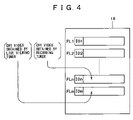
- FIG. 4 is a diagram of assistance in explaining content files recorded according to the embodiment of FIG. 2 ;
- FIG. 5 is a flowchart of a process at a time of channel change according to the embodiment of FIG. 2 .
- An embodiment of the present invention will hereinafter be described by taking as an example a recording and reproducing apparatus (digital video recorder) capable of digitally recording a program of an analog television broadcast.
- a recording and reproducing apparatus digital video recorder capable of digitally recording a program of an analog television broadcast.
- FIG. 2 is a block diagram showing an example of the configuration of hardware of a digital video recorder according to the present embodiment, the digital video recorder being capable of receiving an analog broadcast and digitally recording the analog broadcast.
- Tuners 1 and 2 each support analog television broadcasting. It is to be noted that while the tuners 1 and 2 are described as a device supporting analog television broadcasting in the embodiment, the tuners 1 and 2 may of course support digital terrestrial broadcasting, digital satellite broadcasting and the like.
- the tuners 1 and 2 extract a signal of a program desired by a user from signals of a plurality of programs (broadcast content) received by an antenna not shown in the figure under control of a CPU 15 , and output the signal to MPEG (Motion Picture Experts Group) encoders 3 and 4 , respectively.
- MPEG Motion Picture Experts Group
- the tuner 1 is a live viewing tuner used for real-time live viewing.
- the live viewing tuner 1 therefore performs channel selection, reception, and demodulation in response to a channel operation by the user.
- the live viewing tuner 1 outputs an audio signal and a video signal of a received program to an audio signal processing circuit 9 and a video signal processing circuit 11 , respectively, for viewing by the user.
- the video signal and the audio signal of the program obtained by the live viewing tuner 1 are also output to the MPEG encoder 3 as described above to be processed for recording. This is to live record the program being viewed as it is.
- the tuner 2 is a recording tuner provided for normal recording, that is, programmed recording, automatic recording (which, though not described in detail, is recording that automatically selects a program on the basis of a history of viewing by the user or a history of recording, for example), manual recording (recording started by a user operation), or the like other than live viewing recording.
- a video signal and an audio signal of a program obtained by the recording tuner 2 are output to the MPEG encoder 4 as described above to be processed for recording.
- the live viewing tuner 1 and the recording tuner 2 are clearly distinguished from each other in this example, it is possible to use a plurality of tuners flexibly, with one of the tuners used as a live viewing tuner and another used as a recording tuner.
- the MPEG encoders 3 and 4 encode the program signal supplied from the tuners 1 and 2 , respectively, by subjecting the program signal to compression processing and the like on the basis of an MPEG system. That is, the MPEG encoders 3 and 4 perform encoding for video recording (picture recording).
- Data encoded by the compression processing and the like is supplied to a storage unit 18 via a bus 20 , and then recorded in the storage unit 18 .
- one program is stored as one video content file (content file).
- an MPEG decoder 5 In reproducing a content file compressed by the MPEG system and stored in the storage unit 18 , an MPEG decoder 5 reads the reproduced data stream via the bus 20 , and decodes the data stream. An audio signal and a video signal obtained by decoding the data stream are output to the audio signal processing circuit 9 and the video signal processing circuit 11 , respectively.
- An added sound generating circuit 6 generates an operating sound or an added sound when the user operates a remote commander 14 , and outputs the operating sound or the added sound to the audio signal processing circuit 9 .
- a video decoder 8 reads image data for display stored in a VRAM (Video RAM) 7 , and converts the image data into a video signal. The converted video signal is supplied to the video signal processing circuit 11 .
- VRAM Video RAM
- the audio signal processing circuit 9 subjects the audio data supplied from the tuner 1 or 2 or the MPEG decoder 5 to D/A (Digital to Analog) conversion, subjects the audio data to sound processing, amplification processing and the like, and then outputs the audio data to a speaker 10 connected to the audio signal processing circuit 9 .
- D/A Digital to Analog
- the audio signal processing circuit 9 subjects the audio data supplied from the tuner 1 or 2 or the MPEG decoder 5 to D/A conversion, combines the audio signal and the added sound with each other, and then outputs a resulting audio signal to the speaker 10 .
- the video signal processing circuit 11 subjects the video data supplied from the television tuner 1 or 2 or the MPEG decoder 5 to D/A conversion, and then outputs the video data to a display 12 connected to the video signal processing circuit 11 .
- image data for display is supplied from the video decoder 8 , however, the video signal processing circuit 11 combines the video data supplied from the television tuner 1 or 2 or the MPEG decoder 5 and the image data for display with each other, subjects the result to D/A conversion, and then outputs a resulting video signal to the display 12 .
- the speaker 10 outputs the audio signal supplied from the audio signal processing circuit 9 .
- the display 12 displays (reproduces) the video signal supplied from the video signal processing circuit 11 .
- the speaker 10 and the display 12 may be provided integrally within the recording apparatus, or may be connected as a separate device to the recording apparatus.
- a remote control light receiving unit 13 receives the light of an operating signal, converts the operating signal into an operation command signal formed by an electric signal, and then outputs the operation command signal to the CPU 15 .
- the remote commander 14 may use not only the infrared system but also radio waves, for example.
- the remote commander 14 and the remote control light receiving unit 13 are parts enabling the user to supply various operation inputs. For example, various user operations such as a channel change operation, a reproduction-related operation and the like are performed by using the remote commander 14 .
- a menu screen or the like is displayed as a GUI using the display 12 .
- a video signal for such GUI display is generated by the VRAM 7 and the video decoder 8 mentioned above.
- operating elements may be formed on a panel of a casing of the apparatus to allow various operation inputs.
- the CPU (Central Processing Unit) 15 performs various processing according to a program stored in a ROM (Read Only Memory) 17 or the storage unit 18 when an operating signal (command) is input from the remote control light receiving unit 13 .
- a RAM 16 temporarily stores a starting module, a platform software program such as an OS or the like, or an application program stored in the ROM 17 or the storage unit 18 , or a parameter changed as required in execution of the program.
- the ROM 17 stores the starting module and the platform software module for operating the CPU 15 .
- a nonvolatile RAM 19 includes a memory card or a flash memory, for example.
- the nonvolatile RAM 19 stores authentication information, billing information, and preference information of the user and the like.
- the storage unit 18 includes a magnetic hard disk or a recordable DVD disk, for example.
- the storage unit 18 stores video content, data (metadata) related to the video content, EPG information and the like.
- the storage unit 18 is a medium onto which broadcast content received in the recording apparatus is recorded.
- the digital video recorder in this example can perform live recording by a system of the viewing tuner 1 and the MPEG encoder 3 and perform normal recording, such as, for example, programmed recording, automatic recording, and manual recording, by a system of the recording tuner 2 and the MPEG encoder 4 .
- normal recording such as, for example, programmed recording, automatic recording, and manual recording
- recording onto the storage unit 18 using an HDD can be performed by these two systems simultaneously. Also, it is possible to reproduce a content file in the process of being recorded.
- FIGS. 3A , 3 B, and 3 C show states of a channel received by the live viewing tuner 1 , live recording, and output video for viewing by the user.
- FIGS. 3D and 3E show states of a channel received by the recording tuner 2 and normal recording of a received broadcast content.
- the recording tuner performs recording on Channel 1 (ch 1 ) from a time t 0 as programmed recording, automatic recording, or manual recording, for example. That is, the selected channel of the recording tuner 2 is ch 1 and the recording tuner 2 demodulates the broadcast content on ch 1 .
- a video signal and an audio signal obtained by demodulating the broadcast content are processed by the MPEG encoder 4 , and then supplied to the storage unit 18 to be recorded therein as one content file. That is, broadcast video on ch 1 is recorded.
- the live viewing tuner 1 performs reception and demodulation processing in response to a channel operation of the user.
- a video signal and an audio signal of a broadcast content obtained are supplied to the video signal processing circuit 11 and the audio signal processing circuit 9 , and then output from the display 12 and the speaker 10 .
- the video signal and the audio signal obtained by the live viewing tuner 1 are processed by the MPEG encoder 3 , and then supplied to the storage unit 18 to be recorded therein as one content file. That is, video currently being viewed by the user is recorded live.
- video on ch 4 is recorded as a live recording from the time t 1 , and the live video on ch 4 is displayed as output video on the display from the time t 1 .
- video on ch 1 is recorded as a live recording from the time t 2 , and the live video on ch 1 is displayed as output video on the display from the time t 2 .
- a different title ID is given to the content file recorded in the storage unit 18 for each program (one recording unit).
- One title ID is set to a content file recorded by programmed recording or the like as shown in FIG. 3E , for example.
- one content file is generated at the time of changing channels, and one title ID is given to each content file.
- the recording of the video on ch 10 for a period from t 0 to t 1 forms one content file, and one title ID is given to the content file.
- the recording of the video on ch 4 for a period from t 1 to t 2 forms another content file, and another title ID is given to the content file.
- FIG. 4 shows content files formed in the storage unit 18 after the time t 2 .
- Content files FL 1 , FL 2 , . . . represent content files recorded before the time t 2 .
- a unique code is given as a title ID (ID 1 , ID 2 , . . . ) to each of the content files.
- the user In a period after the time t 2 , the user is viewing ch 1 , and therefore live recording of ch 1 is performed.
- the video signal and the audio signal obtained by the live viewing tuner 1 are being recorded as a content file FLn shown in FIG. 4 .
- a program on ch 1 continues being recorded after the time t 0 . This program is being recorded as a content file FLn.
- a title ID (IDm) is given to the content file FLn
- a title ID (IDn) is given to the content file FLn.
- the digital video recorder in this example performs live recording during viewing of live video, and is thus able to output reproduced video of a program being viewed when the user performs a reproduction-related operation.
- the reproduction-related operation refers to an operation related to a state of display of video reproduced from the recording medium on the display, such as, for example, program start search, fast forward, rewind or other searches, normal reproduction, and varied speed reproduction.
- the digital video recorder can reproduce a content file from the storage unit 18 obtained by live recording of ch 4 , and display the reproduced video on the display 12 in place of the live video on ch 4 . It is thereby possible to view again an immediately preceding scene in a program being viewed, for example.
- a live recorded content file is thus reproduced in response to a reproduction-related operation during viewing in cases where the channels of the live viewing tuner 1 and the recording tuner 2 are not the same, that is, in cases where the programs of a content file being normally recorded at that point in time and the live recorded content file are different from each other, or in cases where normal recording is not performed.
- the user performs a program start search operation at a time t 3 at which a program on ch 1 is being viewed.
- the content file FLn recorded live from the time t 2 and the content file FLn normally recorded from the time t 0 using the recording tuner 2 have program contents of the same channel.
- the content file FLn is processed as a file to be reproduced in response to the program start search operation, and the content file FLn is reproduced from a start thereof, for example.
- reproduced video from the start of the content file FLn being normally recorded using the recording tuner 2 is displayed on the display 12 after the time t 3 at which the program start search operation is performed.
- reproduction processing is performed on the content file being recorded live at that point in time.
- reproduction processing is performed on the content file being normally recorded by the system of the recording tuner 2 .
- the user can thereby have an appropriate reproduction performed of a program currently being viewed by a simple operation.
- the content files being recorded simultaneously are the same program, reproduced video of the program being viewed can be displayed by reproducing either of the content files.
- the content file normally recorded by programmed recording, automatic recording, manual recording or the like often includes video from the start of the program.
- the user can achieve such an operation without distinguishing the recording systems and the content files.
- ease of operation and convenience are enhanced.
- FIG. 5 represents a process performed at and after a time when the user performs a channel change operation using the remote commander 14 during live viewing. Though this flowchart does not show timing of ending the process for simplicity of description, the process that has been performed is ended when the user performs a channel change operation during the performance of the process of FIG. 5 , and then a process from step F 101 is restarted. Of course, the process of FIG. 5 may be ended by another operation for performing a function, an operation for turning off power, or the like.
- the CPU 15 starts the process from step F 101 .
- the channel received by the live viewing tuner 1 is changed to a channel specified by the user.
- the live viewing tuner 1 performs reception and demodulation on the channel specified by the user.
- step F 102 the CPU 15 starts live video display and live recording of a signal of the received and demodulated broadcast content.
- a program on the channel is output for viewing by the user from the display 12 and the speaker 10 .
- a video signal and an audio signal encoded by the MPEG encoder 3 are recorded live as one content file in the storage unit 18 .
- the CPU 15 retains a title ID added to the content file being recorded live as a variable (register) A.
- step F 103 the CPU 15 determines whether normal recording on the same channel as that of the live recording started as described above is being performed. That is, the CPU 15 determines whether recording using the recording tuner 2 is being performed, and when recording using the recording tuner 2 is being performed, the CPU 15 determines whether the channel of the recording tuner 2 is the same as the current channel of the live viewing tuner 1 .
- step F 104 the CPU 15 monitors a reproduction-related operation by the user. During a period when no reproduction-related operation is performed, the output for viewing and the live recording started in step F 102 are continued. During this period, the process returns from step F 104 to step F 103 . Thus, in conditions in which no reproduction-related operation is performed and recording of the same channel as that of the live recording is not started as normal recording using the recording tuner 2 , a process in a loop including steps F 103 and F 104 is repeated.
- step F 104 When a reproduction-related operation by the user is detected in step F 104 , the process of the CPU 15 proceeds to step F 105 to process the content file with the title ID retained as the variable A according to the content (program start search, search, reproduction or the like) of the detected operation. That is, the content file currently being recorded live is processed. For example, when the reproduction-related operation is performed at a time within the period from t 1 to t 2 in FIGS.
- the CPU 15 instructs the storage unit 18 to perform processing for reproduction, search or the like according to the detected operation with respect to the live recording on ch 4 , and makes the MPEG decoder 5 supply reproduced video and reproduced audio to the video signal processing circuit 11 and the audio signal processing circuit 9 to output the reproduced video and the reproduced audio from the display 12 and the speaker 10 .
- step F 105 The processing according to various reproduction-related operations by the user in step F 105 is performed until a reproduction stop operation by the user is detected in step F 106 .
- the user can view the video recorded live arbitrarily by performing an operation for program start search, fast reverse, reproduction, fast forward, pause or the like.
- step F 106 When the user performs a reproduction stop operation, the process of the CPU 15 proceeds from step F 106 to F 107 , where reproduction processing on the content file with the title ID retained as the variable A is ended.
- step F 108 a state for viewing live video is restored. That is, a state is restored in which the video signal processing circuit 11 and the audio signal processing circuit 9 output a video signal and an audio signal received and demodulated by the live viewing tuner 1 from the display 12 and the speaker 10 . The process then returns to step F 103 .
- step F 105 live recording of the content file for the reproduction processing is continued in the period corresponding to the processing from step F 105 to step F 108 . That is, the reproduction processing in step F 105 is reproduction processing on an already recorded part of the content file currently being recorded live.
- step F 101 the title ID of the content file being normally recorded using the recording tuner 2 is retained as a variable (register) B.
- step F 110 the CPU 15 monitors an end of the normal recording.
- step F 111 the CPU 15 monitors a reproduction-related operation by the user.
- step F 103 When an end of the normal recording is detected without a reproduction-related operation being performed in a monitoring loop including steps F 110 and F 111 , the process returns to step F 103 .
- step F 111 When a reproduction-related operation by the user is detected in step F 111 , the process of the CPU 15 proceeds to step F 112 to stop the live recording being performed. That is, the recording of the content file with the title ID of the variable A, which recording is performed from step F 102 in the storage unit 18 , is ended.
- step F 113 the content file with the title ID retained as the variable B is processed according to the content (program start search, search, reproduction or the like) of the reproduction-related operation by the user.
- reproduction-related processing program start search and subsequent reproduction in this case
- the storage unit 18 performs program start search and reproduction of the content file with the title ID “B”, which file is obtained by normal recording, and reproduced video and reproduced audio are supplied by the MPEG decoder 5 to the video signal processing circuit 11 and the audio signal processing circuit 9 so that the reproduced video and the reproduced audio are output from the display 12 and the speaker 10 .
- step F 113 The processing according to various reproduction-related operations by the user in step F 113 is performed until a reproduction stop operation by the user is detected in step F 114 .
- the user can arbitrarily view the video normally recorded using the recording tuner 2 by performing an operation for program start search, fast reverse, reproduction, fast forward, pause or the like.
- step F 116 a state for viewing live video is restored. That is, a state is restored in which the video signal processing circuit 11 and the audio signal processing circuit 9 output a video signal and an audio signal received and demodulated by the live viewing tuner 1 from the display 12 and the speaker 10 . The process then returns to step F 110 .
- step F 113 is reproduction processing on an already recorded part of the content file currently being normally recorded.
- a recording end time determined in setting programmed recording, automatic recording, manual recording or the like arrives during the reproduction-related processing in step F 113 , the recording of the content file is ended.
- the reproduction operation as described with reference to FIGS. 3A to 3E is realized. Specifically, when the user performs a reproduction-related operation during live viewing and recording of the same channel as the channel being normally recorded using the recording tuner 2 , reproduction processing is performed on the content file being normally recorded. On the other hand, when the channel being normally recorded and the channel being viewed are different from each other, reproduction processing is performed on the content file being recorded live. Thus, as described above, reproductions suitable for the user can be realized.
- the recording and reproducing apparatus has a function of receiving analog terrestrial broadcasts
- the apparatus may of course have a tuner for receiving BS broadcasts or digital BS or terrestrial broadcasts. It is also conceivable that the recording and reproducing apparatus has a tuner supporting cable television broadcasts and various other broadcasts.
- the recording and reproducing apparatus has a plurality of recording systems using these tuners.
- the present invention is thus applicable to apparatus having three or more recording systems.
- an apparatus including a storage unit for recording broadcast content is taken as an example, the present invention is applicable to apparatus connected to an external recording device, such as an HDD or a disk drive device, for example, and that record broadcast content onto a recording medium in the connected recording device.
- an external recording device such as an HDD or a disk drive device, for example
- the apparatus records broadcast content
- the present invention is applicable to apparatus recording audio broadcasts.
- various forms of recording and reproducing apparatus for recording and reproducing various broadcast content are realized.
Landscapes
- Engineering & Computer Science (AREA)
- Signal Processing (AREA)
- Multimedia (AREA)
- Television Signal Processing For Recording (AREA)
- Two-Way Televisions, Distribution Of Moving Picture Or The Like (AREA)
- Signal Processing For Digital Recording And Reproducing (AREA)
- Management Or Editing Of Information On Record Carriers (AREA)
Applications Claiming Priority (2)
| Application Number | Priority Date | Filing Date | Title |
|---|---|---|---|
| JP2003308498A JP4244752B2 (ja) | 2003-09-01 | 2003-09-01 | 記録再生装置、再生処理方法 |
| JPP2003-308498 | 2003-09-01 |
Publications (2)
| Publication Number | Publication Date |
|---|---|
| US20050111838A1 US20050111838A1 (en) | 2005-05-26 |
| US7433579B2 true US7433579B2 (en) | 2008-10-07 |
Family
ID=34410952
Family Applications (1)
| Application Number | Title | Priority Date | Filing Date |
|---|---|---|---|
| US10/930,249 Expired - Fee Related US7433579B2 (en) | 2003-09-01 | 2004-08-31 | Recording and reproducing apparatus and reproduction processing method |
Country Status (4)
| Country | Link |
|---|---|
| US (1) | US7433579B2 (https=) |
| JP (1) | JP4244752B2 (https=) |
| KR (1) | KR101055018B1 (https=) |
| CN (1) | CN1324887C (https=) |
Cited By (4)
| Publication number | Priority date | Publication date | Assignee | Title |
|---|---|---|---|---|
| US20060190976A1 (en) * | 2005-01-24 | 2006-08-24 | Chung Dong C | Apparatus and method for searching start position of broadcasting program |
| US20070082607A1 (en) * | 2005-10-11 | 2007-04-12 | Lg Electronics Inc. | Digital broadcast system and method for a mobile terminal |
| US20100158486A1 (en) * | 2008-12-19 | 2010-06-24 | Seagate Technology Llc | Storage device and controller to selectively activate a storage media |
| US20110173671A1 (en) * | 2008-09-07 | 2011-07-14 | Sung Ho Seo | Method and System for Providing Bidirectional Contents Service in Cable Broadcasting Environment, and Computer-Readable Recording Medium |
Families Citing this family (12)
| Publication number | Priority date | Publication date | Assignee | Title |
|---|---|---|---|---|
| DE02747828T1 (de) * | 2001-05-11 | 2004-07-08 | Scientific-Atlanta, Inc. | Verwaltung von zeitschiebepuffern |
| US7962011B2 (en) | 2001-12-06 | 2011-06-14 | Plourde Jr Harold J | Controlling substantially constant buffer capacity for personal video recording with consistent user interface of available disk space |
| US8565578B2 (en) * | 2001-12-06 | 2013-10-22 | Harold J. Plourde, Jr. | Dividing and managing time-shift buffering into program specific segments based on defined durations |
| US7257308B2 (en) | 2001-12-06 | 2007-08-14 | Scientific-Atlanta, Inc. | Converting time-shift buffering for personal video recording into permanent recordings |
| US8181205B2 (en) | 2002-09-24 | 2012-05-15 | Russ Samuel H | PVR channel and PVR IPG information |
| JP2007049628A (ja) * | 2005-08-12 | 2007-02-22 | Sharp Corp | 録画装置 |
| KR101090173B1 (ko) * | 2006-10-30 | 2011-12-06 | 엘지전자 주식회사 | 방송용 단말기 및 그 방송 데이터 재생 방법, 그동작제어방법 |
| FR2925814A1 (fr) * | 2007-12-19 | 2009-06-26 | Thomson Licensing Sas | Dispositif et procede de reception de paquets de donnees video. |
| JP2010200156A (ja) * | 2009-02-26 | 2010-09-09 | Toshiba Corp | テレビジョン受信装置、及び表示制御方法 |
| JP2010233258A (ja) * | 2010-07-09 | 2010-10-14 | Hitachi Ltd | 録画再生装置及び録画再生方法 |
| CN103905888A (zh) * | 2014-03-07 | 2014-07-02 | 深圳市同洲电子股份有限公司 | 一种直播录制方法及直播录制器 |
| CN103986945B (zh) * | 2014-05-27 | 2018-01-05 | 华为技术有限公司 | 一种混合网络系统、频道内容回看方法与混合机顶盒 |
Citations (6)
| Publication number | Priority date | Publication date | Assignee | Title |
|---|---|---|---|---|
| WO1992022983A2 (en) * | 1991-06-11 | 1992-12-23 | Browne H Lee | Large capacity, random access, multi-source recorder player |
| JP2002051290A (ja) | 2000-08-02 | 2002-02-15 | Sanyo Electric Co Ltd | 放送信号記録再生装置 |
| JP2002152639A (ja) | 2000-11-07 | 2002-05-24 | Sony Corp | 記録再生装置および方法、並びに記録媒体 |
| JP2002185912A (ja) | 2000-12-15 | 2002-06-28 | Pioneer Electronic Corp | 放送番組録画装置及び放送番組の録画方法 |
| JP2003087730A (ja) | 2001-09-10 | 2003-03-20 | Pioneer Electronic Corp | 番組記録再生システムおよび番組記録再生方法 |
| US6571053B1 (en) * | 1998-07-23 | 2003-05-27 | Kabushiki Kaisha Toshiba | Television program recording system |
Family Cites Families (6)
| Publication number | Priority date | Publication date | Assignee | Title |
|---|---|---|---|---|
| US5563714A (en) * | 1994-04-21 | 1996-10-08 | Sony Corporation | Digital signal processing apparatus for recording and reproducing time-base compressed digital image data in an image transmission system |
| KR100605893B1 (ko) * | 1999-10-08 | 2006-08-01 | 삼성전자주식회사 | 시간지연 시청을 위한 비디오 스트림 처리방법 |
| DE10195884T1 (de) * | 2000-03-08 | 2003-03-27 | Gen Instrument Corp | Persönlicher Datenrecorder und Inbetriebnahme und Nutzung desselben |
| JP2001309255A (ja) * | 2000-04-26 | 2001-11-02 | Toshiba Corp | デジタルテレビ放送受信機 |
| JP2003052001A (ja) * | 2001-08-07 | 2003-02-21 | Mitsubishi Electric Corp | 蓄積型テレビ受信機 |
| KR100873677B1 (ko) * | 2002-01-23 | 2008-12-12 | 엘지전자 주식회사 | 개인 비디오 리코더 |
-
2003
- 2003-09-01 JP JP2003308498A patent/JP4244752B2/ja not_active Expired - Fee Related
-
2004
- 2004-08-30 KR KR1020040068391A patent/KR101055018B1/ko not_active Expired - Fee Related
- 2004-08-31 US US10/930,249 patent/US7433579B2/en not_active Expired - Fee Related
- 2004-09-01 CN CNB2004100874172A patent/CN1324887C/zh not_active Expired - Fee Related
Patent Citations (6)
| Publication number | Priority date | Publication date | Assignee | Title |
|---|---|---|---|---|
| WO1992022983A2 (en) * | 1991-06-11 | 1992-12-23 | Browne H Lee | Large capacity, random access, multi-source recorder player |
| US6571053B1 (en) * | 1998-07-23 | 2003-05-27 | Kabushiki Kaisha Toshiba | Television program recording system |
| JP2002051290A (ja) | 2000-08-02 | 2002-02-15 | Sanyo Electric Co Ltd | 放送信号記録再生装置 |
| JP2002152639A (ja) | 2000-11-07 | 2002-05-24 | Sony Corp | 記録再生装置および方法、並びに記録媒体 |
| JP2002185912A (ja) | 2000-12-15 | 2002-06-28 | Pioneer Electronic Corp | 放送番組録画装置及び放送番組の録画方法 |
| JP2003087730A (ja) | 2001-09-10 | 2003-03-20 | Pioneer Electronic Corp | 番組記録再生システムおよび番組記録再生方法 |
Cited By (7)
| Publication number | Priority date | Publication date | Assignee | Title |
|---|---|---|---|---|
| US20060190976A1 (en) * | 2005-01-24 | 2006-08-24 | Chung Dong C | Apparatus and method for searching start position of broadcasting program |
| US8385728B2 (en) * | 2005-01-24 | 2013-02-26 | Humax Co., Ltd. | Apparatus and method for searching start position of broadcasting program |
| US20070082607A1 (en) * | 2005-10-11 | 2007-04-12 | Lg Electronics Inc. | Digital broadcast system and method for a mobile terminal |
| US7826793B2 (en) * | 2005-10-11 | 2010-11-02 | Lg Electronics Inc. | Digital broadcast system and method for a mobile terminal |
| US20110173671A1 (en) * | 2008-09-07 | 2011-07-14 | Sung Ho Seo | Method and System for Providing Bidirectional Contents Service in Cable Broadcasting Environment, and Computer-Readable Recording Medium |
| US20100158486A1 (en) * | 2008-12-19 | 2010-06-24 | Seagate Technology Llc | Storage device and controller to selectively activate a storage media |
| US9282277B2 (en) * | 2008-12-19 | 2016-03-08 | Seagate Technology Llc | Storage device and controller to selectively activate a storage media |
Also Published As
| Publication number | Publication date |
|---|---|
| KR20050024183A (ko) | 2005-03-10 |
| CN1324887C (zh) | 2007-07-04 |
| US20050111838A1 (en) | 2005-05-26 |
| CN1595965A (zh) | 2005-03-16 |
| JP2005079954A (ja) | 2005-03-24 |
| JP4244752B2 (ja) | 2009-03-25 |
| KR101055018B1 (ko) | 2011-08-05 |
Similar Documents
| Publication | Publication Date | Title |
|---|---|---|
| US7433579B2 (en) | Recording and reproducing apparatus and reproduction processing method | |
| US8195029B2 (en) | Content viewing support apparatus and content viewing support method, and computer program | |
| US20040250294A1 (en) | Method and apparatus for resuming reproduction of service program from point of interruption | |
| JP2007534218A (ja) | デジタル放送受信装置、方法、プログラム | |
| JP4029487B2 (ja) | 記録装置および記録方法、再生装置および再生方法、ならびに、記録媒体 | |
| JP4540701B2 (ja) | デジタル放送受信機及び予約録画方法 | |
| JP2006350925A (ja) | 番組検索支援システム | |
| US20080138035A1 (en) | Recording/Reproducing Apparatus and Display Control Method | |
| EP1819159A2 (en) | Display device | |
| JP2002152652A (ja) | 放送受信記録再生方法及び放送受信記録再生装置 | |
| JPH06105280A (ja) | 放送受信記録再生装置 | |
| JP4192924B2 (ja) | 情報記録再生装置 | |
| WO2005101824A1 (ja) | 情報記録装置及び情報記録方法、情報再生装置及び情報再生方法、情報記録用プログラム及び情報再生用プログラム | |
| JP2004349944A (ja) | ハードディスクレコーダ | |
| JP3796203B2 (ja) | 録画装置制御機能付き放送受信装置 | |
| JP2009081573A (ja) | 録画再生装置 | |
| JP4654999B2 (ja) | 情報記録再生装置 | |
| KR100696831B1 (ko) | 영상 녹화 시스템의 예약 녹화 방법 | |
| EP1761050A2 (en) | Method of controlling personal video recorder and personal video recorder using the same | |
| JP2007068042A (ja) | 受信装置および方法 | |
| KR100441539B1 (ko) | 영상녹화재생장치 및 영상녹화방법 | |
| KR101386820B1 (ko) | 방송수신기에서의 방송녹화 및 재생 제어 방법 | |
| JP4412321B2 (ja) | テレビ番組送信/記録再生システム | |
| KR20070107545A (ko) | 영상출력기기의 재생 제어 장치 및 방법 | |
| KR20040110640A (ko) | 피브이알 시스템의 방송 프로그램 녹화 방법 |
Legal Events
| Date | Code | Title | Description |
|---|---|---|---|
| AS | Assignment |
Owner name: SONY CORPORATION, JAPAN Free format text: ASSIGNMENT OF ASSIGNORS INTEREST;ASSIGNOR:ARISHIMA, YOSHIAKI;REEL/FRAME:015507/0918 Effective date: 20041129 |
|
| FEPP | Fee payment procedure |
Free format text: PAYOR NUMBER ASSIGNED (ORIGINAL EVENT CODE: ASPN); ENTITY STATUS OF PATENT OWNER: LARGE ENTITY |
|
| FPAY | Fee payment |
Year of fee payment: 4 |
|
| REMI | Maintenance fee reminder mailed | ||
| LAPS | Lapse for failure to pay maintenance fees | ||
| STCH | Information on status: patent discontinuation |
Free format text: PATENT EXPIRED DUE TO NONPAYMENT OF MAINTENANCE FEES UNDER 37 CFR 1.362 |
|
| STCH | Information on status: patent discontinuation |
Free format text: PATENT EXPIRED DUE TO NONPAYMENT OF MAINTENANCE FEES UNDER 37 CFR 1.362 |
|
| FP | Lapsed due to failure to pay maintenance fee |
Effective date: 20161007 |