US6803473B2 - Method for producing maleic acid anhydride - Google Patents
Method for producing maleic acid anhydride Download PDFInfo
- Publication number
- US6803473B2 US6803473B2 US10/220,746 US22074602A US6803473B2 US 6803473 B2 US6803473 B2 US 6803473B2 US 22074602 A US22074602 A US 22074602A US 6803473 B2 US6803473 B2 US 6803473B2
- Authority
- US
- United States
- Prior art keywords
- reaction zone
- reactor
- shell
- catalyst
- zone
- Prior art date
- Legal status (The legal status is an assumption and is not a legal conclusion. Google has not performed a legal analysis and makes no representation as to the accuracy of the status listed.)
- Expired - Lifetime, expires
Links
- FPYJFEHAWHCUMM-UHFFFAOYSA-N maleic anhydride Chemical compound O=C1OC(=O)C=C1 FPYJFEHAWHCUMM-UHFFFAOYSA-N 0.000 title claims abstract description 61
- 238000004519 manufacturing process Methods 0.000 title claims abstract description 9
- 238000006243 chemical reaction Methods 0.000 claims abstract description 185
- 239000003054 catalyst Substances 0.000 claims abstract description 106
- 229930195733 hydrocarbon Natural products 0.000 claims abstract description 85
- 150000002430 hydrocarbons Chemical class 0.000 claims abstract description 85
- 239000007789 gas Substances 0.000 claims abstract description 65
- QVGXLLKOCUKJST-UHFFFAOYSA-N atomic oxygen Chemical compound [O] QVGXLLKOCUKJST-UHFFFAOYSA-N 0.000 claims abstract description 46
- 229910052760 oxygen Inorganic materials 0.000 claims abstract description 46
- 239000001301 oxygen Substances 0.000 claims abstract description 46
- 229910052698 phosphorus Inorganic materials 0.000 claims abstract description 38
- 239000011574 phosphorus Substances 0.000 claims abstract description 38
- -1 phosphorus compound Chemical class 0.000 claims abstract description 27
- 238000007254 oxidation reaction Methods 0.000 claims abstract description 26
- 230000003647 oxidation Effects 0.000 claims abstract description 24
- OAICVXFJPJFONN-UHFFFAOYSA-N Phosphorus Chemical compound [P] OAICVXFJPJFONN-UHFFFAOYSA-N 0.000 claims abstract description 14
- 229910052720 vanadium Inorganic materials 0.000 claims abstract description 13
- GPPXJZIENCGNKB-UHFFFAOYSA-N vanadium Chemical compound [V]#[V] GPPXJZIENCGNKB-UHFFFAOYSA-N 0.000 claims abstract description 13
- 125000004432 carbon atom Chemical group C* 0.000 claims abstract description 10
- 239000004215 Carbon black (E152) Substances 0.000 claims description 53
- 238000000034 method Methods 0.000 claims description 43
- IJDNQMDRQITEOD-UHFFFAOYSA-N n-butane Chemical compound CCCC IJDNQMDRQITEOD-UHFFFAOYSA-N 0.000 claims description 42
- 239000006227 byproduct Substances 0.000 claims description 9
- 238000011144 upstream manufacturing Methods 0.000 claims description 8
- 125000004178 (C1-C4) alkyl group Chemical group 0.000 claims description 3
- 229910019142 PO4 Inorganic materials 0.000 claims description 3
- NBIIXXVUZAFLBC-UHFFFAOYSA-K phosphate Chemical compound [O-]P([O-])([O-])=O NBIIXXVUZAFLBC-UHFFFAOYSA-K 0.000 claims description 3
- 239000010452 phosphate Substances 0.000 claims description 3
- DQWPFSLDHJDLRL-UHFFFAOYSA-N triethyl phosphate Chemical compound CCOP(=O)(OCC)OCC DQWPFSLDHJDLRL-UHFFFAOYSA-N 0.000 description 21
- 230000000694 effects Effects 0.000 description 17
- 239000007788 liquid Substances 0.000 description 17
- 238000012546 transfer Methods 0.000 description 17
- 239000000203 mixture Substances 0.000 description 16
- CURLTUGMZLYLDI-UHFFFAOYSA-N Carbon dioxide Chemical compound O=C=O CURLTUGMZLYLDI-UHFFFAOYSA-N 0.000 description 14
- 239000011261 inert gas Substances 0.000 description 14
- 239000012071 phase Substances 0.000 description 13
- 238000010521 absorption reaction Methods 0.000 description 12
- 239000000047 product Substances 0.000 description 11
- UHOVQNZJYSORNB-UHFFFAOYSA-N Benzene Chemical compound C1=CC=CC=C1 UHOVQNZJYSORNB-UHFFFAOYSA-N 0.000 description 9
- 229910002092 carbon dioxide Inorganic materials 0.000 description 9
- 230000001105 regulatory effect Effects 0.000 description 9
- XLYOFNOQVPJJNP-UHFFFAOYSA-N water Chemical compound O XLYOFNOQVPJJNP-UHFFFAOYSA-N 0.000 description 9
- 239000000463 material Substances 0.000 description 8
- 230000009849 deactivation Effects 0.000 description 7
- IJGRMHOSHXDMSA-UHFFFAOYSA-N Atomic nitrogen Chemical compound N#N IJGRMHOSHXDMSA-UHFFFAOYSA-N 0.000 description 6
- 238000010438 heat treatment Methods 0.000 description 6
- ZXEKIIBDNHEJCQ-UHFFFAOYSA-N isobutanol Chemical compound CC(C)CO ZXEKIIBDNHEJCQ-UHFFFAOYSA-N 0.000 description 6
- 150000003839 salts Chemical class 0.000 description 6
- 239000000243 solution Substances 0.000 description 6
- 238000001179 sorption measurement Methods 0.000 description 6
- VXNZUUAINFGPBY-UHFFFAOYSA-N 1-Butene Chemical class CCC=C VXNZUUAINFGPBY-UHFFFAOYSA-N 0.000 description 5
- OKTJSMMVPCPJKN-UHFFFAOYSA-N Carbon Chemical compound [C] OKTJSMMVPCPJKN-UHFFFAOYSA-N 0.000 description 5
- 230000015572 biosynthetic process Effects 0.000 description 5
- 150000001875 compounds Chemical class 0.000 description 5
- 239000002904 solvent Substances 0.000 description 5
- 239000007858 starting material Substances 0.000 description 5
- YEJRWHAVMIAJKC-UHFFFAOYSA-N 4-Butyrolactone Chemical compound O=C1CCCO1 YEJRWHAVMIAJKC-UHFFFAOYSA-N 0.000 description 4
- KAKZBPTYRLMSJV-UHFFFAOYSA-N Butadiene Chemical compound C=CC=C KAKZBPTYRLMSJV-UHFFFAOYSA-N 0.000 description 4
- LFQSCWFLJHTTHZ-UHFFFAOYSA-N Ethanol Chemical compound CCO LFQSCWFLJHTTHZ-UHFFFAOYSA-N 0.000 description 4
- WYURNTSHIVDZCO-UHFFFAOYSA-N Tetrahydrofuran Chemical compound C1CCOC1 WYURNTSHIVDZCO-UHFFFAOYSA-N 0.000 description 4
- 239000000654 additive Substances 0.000 description 4
- WERYXYBDKMZEQL-UHFFFAOYSA-N butane-1,4-diol Chemical compound OCCCCO WERYXYBDKMZEQL-UHFFFAOYSA-N 0.000 description 4
- 239000012018 catalyst precursor Substances 0.000 description 4
- 238000001816 cooling Methods 0.000 description 4
- GNTDGMZSJNCJKK-UHFFFAOYSA-N divanadium pentaoxide Chemical compound O=[V](=O)O[V](=O)=O GNTDGMZSJNCJKK-UHFFFAOYSA-N 0.000 description 4
- 239000012535 impurity Substances 0.000 description 4
- VNWKTOKETHGBQD-UHFFFAOYSA-N methane Chemical compound C VNWKTOKETHGBQD-UHFFFAOYSA-N 0.000 description 4
- 239000011148 porous material Substances 0.000 description 4
- 230000000750 progressive effect Effects 0.000 description 4
- 0 ***P(C)(=O)**.***P(C)** Chemical compound ***P(C)(=O)**.***P(C)** 0.000 description 3
- QTBSBXVTEAMEQO-UHFFFAOYSA-N Acetic acid Chemical compound CC(O)=O QTBSBXVTEAMEQO-UHFFFAOYSA-N 0.000 description 3
- OKKJLVBELUTLKV-UHFFFAOYSA-N Methanol Chemical compound OC OKKJLVBELUTLKV-UHFFFAOYSA-N 0.000 description 3
- NBIIXXVUZAFLBC-UHFFFAOYSA-N Phosphoric acid Chemical compound OP(O)(O)=O NBIIXXVUZAFLBC-UHFFFAOYSA-N 0.000 description 3
- 239000010439 graphite Substances 0.000 description 3
- 229910002804 graphite Inorganic materials 0.000 description 3
- 238000002156 mixing Methods 0.000 description 3
- 229910052757 nitrogen Inorganic materials 0.000 description 3
- 238000005457 optimization Methods 0.000 description 3
- 239000003960 organic solvent Substances 0.000 description 3
- 230000036961 partial effect Effects 0.000 description 3
- RGSFGYAAUTVSQA-UHFFFAOYSA-N pentamethylene Natural products C1CCCC1 RGSFGYAAUTVSQA-UHFFFAOYSA-N 0.000 description 3
- 239000000843 powder Substances 0.000 description 3
- 230000002829 reductive effect Effects 0.000 description 3
- 125000004169 (C1-C6) alkyl group Chemical group 0.000 description 2
- 125000005913 (C3-C6) cycloalkyl group Chemical group 0.000 description 2
- OCKGFTQIICXDQW-ZEQRLZLVSA-N 5-[(1r)-1-hydroxy-2-[4-[(2r)-2-hydroxy-2-(4-methyl-1-oxo-3h-2-benzofuran-5-yl)ethyl]piperazin-1-yl]ethyl]-4-methyl-3h-2-benzofuran-1-one Chemical compound C1=C2C(=O)OCC2=C(C)C([C@@H](O)CN2CCN(CC2)C[C@H](O)C2=CC=C3C(=O)OCC3=C2C)=C1 OCKGFTQIICXDQW-ZEQRLZLVSA-N 0.000 description 2
- HGINCPLSRVDWNT-UHFFFAOYSA-N Acrolein Chemical compound C=CC=O HGINCPLSRVDWNT-UHFFFAOYSA-N 0.000 description 2
- 125000000041 C6-C10 aryl group Chemical group 0.000 description 2
- UGFAIRIUMAVXCW-UHFFFAOYSA-N Carbon monoxide Chemical compound [O+]#[C-] UGFAIRIUMAVXCW-UHFFFAOYSA-N 0.000 description 2
- XEEYBQQBJWHFJM-UHFFFAOYSA-N Iron Chemical compound [Fe] XEEYBQQBJWHFJM-UHFFFAOYSA-N 0.000 description 2
- PXHVJJICTQNCMI-UHFFFAOYSA-N Nickel Chemical compound [Ni] PXHVJJICTQNCMI-UHFFFAOYSA-N 0.000 description 2
- OFBQJSOFQDEBGM-UHFFFAOYSA-N Pentane Chemical compound CCCCC OFBQJSOFQDEBGM-UHFFFAOYSA-N 0.000 description 2
- ATUOYWHBWRKTHZ-UHFFFAOYSA-N Propane Chemical compound CCC ATUOYWHBWRKTHZ-UHFFFAOYSA-N 0.000 description 2
- OFOBLEOULBTSOW-UHFFFAOYSA-N Propanedioic acid Natural products OC(=O)CC(O)=O OFOBLEOULBTSOW-UHFFFAOYSA-N 0.000 description 2
- NBBJYMSMWIIQGU-UHFFFAOYSA-N Propionic aldehyde Chemical compound CCC=O NBBJYMSMWIIQGU-UHFFFAOYSA-N 0.000 description 2
- 238000009825 accumulation Methods 0.000 description 2
- 238000009835 boiling Methods 0.000 description 2
- IAQRGUVFOMOMEM-UHFFFAOYSA-N but-2-ene Chemical compound CC=CC IAQRGUVFOMOMEM-UHFFFAOYSA-N 0.000 description 2
- 239000001569 carbon dioxide Substances 0.000 description 2
- 229910002091 carbon monoxide Inorganic materials 0.000 description 2
- 230000000052 comparative effect Effects 0.000 description 2
- ZSWFCLXCOIISFI-UHFFFAOYSA-N cyclopentadiene Chemical compound C1C=CC=C1 ZSWFCLXCOIISFI-UHFFFAOYSA-N 0.000 description 2
- LPIQUOYDBNQMRZ-UHFFFAOYSA-N cyclopentene Chemical compound C1CC=CC1 LPIQUOYDBNQMRZ-UHFFFAOYSA-N 0.000 description 2
- 230000001419 dependent effect Effects 0.000 description 2
- DOIRQSBPFJWKBE-UHFFFAOYSA-N dibutyl phthalate Chemical compound CCCCOC(=O)C1=CC=CC=C1C(=O)OCCCC DOIRQSBPFJWKBE-UHFFFAOYSA-N 0.000 description 2
- XBDQKXXYIPTUBI-UHFFFAOYSA-N dimethylselenoniopropionate Natural products CCC(O)=O XBDQKXXYIPTUBI-UHFFFAOYSA-N 0.000 description 2
- 238000004821 distillation Methods 0.000 description 2
- 238000002474 experimental method Methods 0.000 description 2
- 238000005194 fractionation Methods 0.000 description 2
- 239000001257 hydrogen Substances 0.000 description 2
- 229910052739 hydrogen Inorganic materials 0.000 description 2
- 150000002431 hydrogen Chemical class 0.000 description 2
- 238000005984 hydrogenation reaction Methods 0.000 description 2
- VZCYOOQTPOCHFL-UPHRSURJSA-N maleic acid Chemical compound OC(=O)\C=C/C(O)=O VZCYOOQTPOCHFL-UPHRSURJSA-N 0.000 description 2
- 239000011976 maleic acid Substances 0.000 description 2
- 239000000155 melt Substances 0.000 description 2
- 229910052751 metal Inorganic materials 0.000 description 2
- 239000002184 metal Substances 0.000 description 2
- 150000002739 metals Chemical class 0.000 description 2
- BDAGIHXWWSANSR-UHFFFAOYSA-N methanoic acid Natural products OC=O BDAGIHXWWSANSR-UHFFFAOYSA-N 0.000 description 2
- VLKZOEOYAKHREP-UHFFFAOYSA-N n-Hexane Chemical class CCCCCC VLKZOEOYAKHREP-UHFFFAOYSA-N 0.000 description 2
- 229910052756 noble gas Inorganic materials 0.000 description 2
- 150000002835 noble gases Chemical class 0.000 description 2
- 239000002245 particle Substances 0.000 description 2
- 239000008188 pellet Substances 0.000 description 2
- YWAKXRMUMFPDSH-UHFFFAOYSA-N pentene Chemical compound CCCC=C YWAKXRMUMFPDSH-UHFFFAOYSA-N 0.000 description 2
- 150000003018 phosphorus compounds Chemical class 0.000 description 2
- FGIUAXJPYTZDNR-UHFFFAOYSA-N potassium nitrate Chemical compound [K+].[O-][N+]([O-])=O FGIUAXJPYTZDNR-UHFFFAOYSA-N 0.000 description 2
- 238000012545 processing Methods 0.000 description 2
- 238000010926 purge Methods 0.000 description 2
- VWDWKYIASSYTQR-UHFFFAOYSA-N sodium nitrate Chemical compound [Na+].[O-][N+]([O-])=O VWDWKYIASSYTQR-UHFFFAOYSA-N 0.000 description 2
- LPXPTNMVRIOKMN-UHFFFAOYSA-M sodium nitrite Chemical compound [Na+].[O-]N=O LPXPTNMVRIOKMN-UHFFFAOYSA-M 0.000 description 2
- 230000003068 static effect Effects 0.000 description 2
- YLQBMQCUIZJEEH-UHFFFAOYSA-N tetrahydrofuran Natural products C=1C=COC=1 YLQBMQCUIZJEEH-UHFFFAOYSA-N 0.000 description 2
- IAQRGUVFOMOMEM-ONEGZZNKSA-N trans-but-2-ene Chemical compound C\C=C\C IAQRGUVFOMOMEM-ONEGZZNKSA-N 0.000 description 2
- VZCYOOQTPOCHFL-UHFFFAOYSA-N trans-butenedioic acid Natural products OC(=O)C=CC(O)=O VZCYOOQTPOCHFL-UHFFFAOYSA-N 0.000 description 2
- WVLBCYQITXONBZ-UHFFFAOYSA-N trimethyl phosphate Chemical compound COP(=O)(OC)OC WVLBCYQITXONBZ-UHFFFAOYSA-N 0.000 description 2
- 125000004191 (C1-C6) alkoxy group Chemical group 0.000 description 1
- PMJHHCWVYXUKFD-SNAWJCMRSA-N (E)-1,3-pentadiene Chemical compound C\C=C\C=C PMJHHCWVYXUKFD-SNAWJCMRSA-N 0.000 description 1
- QMMOXUPEWRXHJS-HWKANZROSA-N (e)-pent-2-ene Chemical compound CC\C=C\C QMMOXUPEWRXHJS-HWKANZROSA-N 0.000 description 1
- HECLRDQVFMWTQS-RGOKHQFPSA-N 1755-01-7 Chemical compound C1[C@H]2[C@@H]3CC=C[C@@H]3[C@@H]1C=C2 HECLRDQVFMWTQS-RGOKHQFPSA-N 0.000 description 1
- SMZOUWXMTYCWNB-UHFFFAOYSA-N 2-(2-methoxy-5-methylphenyl)ethanamine Chemical compound COC1=CC=C(C)C=C1CCN SMZOUWXMTYCWNB-UHFFFAOYSA-N 0.000 description 1
- NIXOWILDQLNWCW-UHFFFAOYSA-N 2-Propenoic acid Natural products OC(=O)C=C NIXOWILDQLNWCW-UHFFFAOYSA-N 0.000 description 1
- OSWFIVFLDKOXQC-UHFFFAOYSA-N 4-(3-methoxyphenyl)aniline Chemical compound COC1=CC=CC(C=2C=CC(N)=CC=2)=C1 OSWFIVFLDKOXQC-UHFFFAOYSA-N 0.000 description 1
- ZOXJGFHDIHLPTG-UHFFFAOYSA-N Boron Chemical compound [B] ZOXJGFHDIHLPTG-UHFFFAOYSA-N 0.000 description 1
- VYZAMTAEIAYCRO-UHFFFAOYSA-N Chromium Chemical compound [Cr] VYZAMTAEIAYCRO-UHFFFAOYSA-N 0.000 description 1
- RYGMFSIKBFXOCR-UHFFFAOYSA-N Copper Chemical compound [Cu] RYGMFSIKBFXOCR-UHFFFAOYSA-N 0.000 description 1
- XDTMQSROBMDMFD-UHFFFAOYSA-N Cyclohexane Chemical compound C1CCCCC1 XDTMQSROBMDMFD-UHFFFAOYSA-N 0.000 description 1
- MYMOFIZGZYHOMD-UHFFFAOYSA-N Dioxygen Chemical compound O=O MYMOFIZGZYHOMD-UHFFFAOYSA-N 0.000 description 1
- OTMSDBZUPAUEDD-UHFFFAOYSA-N Ethane Chemical compound CC OTMSDBZUPAUEDD-UHFFFAOYSA-N 0.000 description 1
- DGAQECJNVWCQMB-PUAWFVPOSA-M Ilexoside XXIX Chemical compound C[C@@H]1CC[C@@]2(CC[C@@]3(C(=CC[C@H]4[C@]3(CC[C@@H]5[C@@]4(CC[C@@H](C5(C)C)OS(=O)(=O)[O-])C)C)[C@@H]2[C@]1(C)O)C)C(=O)O[C@H]6[C@@H]([C@H]([C@@H]([C@H](O6)CO)O)O)O.[Na+] DGAQECJNVWCQMB-PUAWFVPOSA-M 0.000 description 1
- WHXSMMKQMYFTQS-UHFFFAOYSA-N Lithium Chemical compound [Li] WHXSMMKQMYFTQS-UHFFFAOYSA-N 0.000 description 1
- ZOKXTWBITQBERF-UHFFFAOYSA-N Molybdenum Chemical compound [Mo] ZOKXTWBITQBERF-UHFFFAOYSA-N 0.000 description 1
- XUIMIQQOPSSXEZ-UHFFFAOYSA-N Silicon Chemical compound [Si] XUIMIQQOPSSXEZ-UHFFFAOYSA-N 0.000 description 1
- 235000021355 Stearic acid Nutrition 0.000 description 1
- 229910000831 Steel Inorganic materials 0.000 description 1
- YSMRWXYRXBRSND-UHFFFAOYSA-N TOTP Chemical compound CC1=CC=CC=C1OP(=O)(OC=1C(=CC=CC=1)C)OC1=CC=CC=C1C YSMRWXYRXBRSND-UHFFFAOYSA-N 0.000 description 1
- ATJFFYVFTNAWJD-UHFFFAOYSA-N Tin Chemical compound [Sn] ATJFFYVFTNAWJD-UHFFFAOYSA-N 0.000 description 1
- RTAQQCXQSZGOHL-UHFFFAOYSA-N Titanium Chemical compound [Ti] RTAQQCXQSZGOHL-UHFFFAOYSA-N 0.000 description 1
- HCHKCACWOHOZIP-UHFFFAOYSA-N Zinc Chemical compound [Zn] HCHKCACWOHOZIP-UHFFFAOYSA-N 0.000 description 1
- QCWXUUIWCKQGHC-UHFFFAOYSA-N Zirconium Chemical compound [Zr] QCWXUUIWCKQGHC-UHFFFAOYSA-N 0.000 description 1
- AZFNGPAYDKGCRB-XCPIVNJJSA-M [(1s,2s)-2-amino-1,2-diphenylethyl]-(4-methylphenyl)sulfonylazanide;chlororuthenium(1+);1-methyl-4-propan-2-ylbenzene Chemical compound [Ru+]Cl.CC(C)C1=CC=C(C)C=C1.C1=CC(C)=CC=C1S(=O)(=O)[N-][C@@H](C=1C=CC=CC=1)[C@@H](N)C1=CC=CC=C1 AZFNGPAYDKGCRB-XCPIVNJJSA-M 0.000 description 1
- IKHGUXGNUITLKF-XPULMUKRSA-N acetaldehyde Chemical compound [14CH]([14CH3])=O IKHGUXGNUITLKF-XPULMUKRSA-N 0.000 description 1
- 239000003463 adsorbent Substances 0.000 description 1
- 125000001931 aliphatic group Chemical group 0.000 description 1
- 239000000956 alloy Substances 0.000 description 1
- 229910045601 alloy Inorganic materials 0.000 description 1
- PNEYBMLMFCGWSK-UHFFFAOYSA-N aluminium oxide Inorganic materials [O-2].[O-2].[O-2].[Al+3].[Al+3] PNEYBMLMFCGWSK-UHFFFAOYSA-N 0.000 description 1
- 238000004458 analytical method Methods 0.000 description 1
- 150000008064 anhydrides Chemical class 0.000 description 1
- 229910052787 antimony Inorganic materials 0.000 description 1
- WATWJIUSRGPENY-UHFFFAOYSA-N antimony atom Chemical compound [Sb] WATWJIUSRGPENY-UHFFFAOYSA-N 0.000 description 1
- 150000004945 aromatic hydrocarbons Chemical class 0.000 description 1
- 125000003118 aryl group Chemical group 0.000 description 1
- 230000033228 biological regulation Effects 0.000 description 1
- 229910052797 bismuth Inorganic materials 0.000 description 1
- JCXGWMGPZLAOME-UHFFFAOYSA-N bismuth atom Chemical compound [Bi] JCXGWMGPZLAOME-UHFFFAOYSA-N 0.000 description 1
- 238000009529 body temperature measurement Methods 0.000 description 1
- 229910052796 boron Inorganic materials 0.000 description 1
- 125000000484 butyl group Chemical group [H]C([*])([H])C([H])([H])C([H])([H])C([H])([H])[H] 0.000 description 1
- ZTQSAGDEMFDKMZ-UHFFFAOYSA-N butyric aldehyde Natural products CCCC=O ZTQSAGDEMFDKMZ-UHFFFAOYSA-N 0.000 description 1
- 239000007795 chemical reaction product Substances 0.000 description 1
- 229910052804 chromium Inorganic materials 0.000 description 1
- 239000011651 chromium Substances 0.000 description 1
- 238000004140 cleaning Methods 0.000 description 1
- 229910017052 cobalt Inorganic materials 0.000 description 1
- 239000010941 cobalt Substances 0.000 description 1
- GUTLYIVDDKVIGB-UHFFFAOYSA-N cobalt atom Chemical compound [Co] GUTLYIVDDKVIGB-UHFFFAOYSA-N 0.000 description 1
- 238000012733 comparative method Methods 0.000 description 1
- 238000009833 condensation Methods 0.000 description 1
- 230000005494 condensation Effects 0.000 description 1
- 229910052802 copper Inorganic materials 0.000 description 1
- 239000010949 copper Substances 0.000 description 1
- 229910052593 corundum Inorganic materials 0.000 description 1
- MLUCVPSAIODCQM-NSCUHMNNSA-N crotonaldehyde Chemical compound C\C=C\C=O MLUCVPSAIODCQM-NSCUHMNNSA-N 0.000 description 1
- MLUCVPSAIODCQM-UHFFFAOYSA-N crotonaldehyde Natural products CC=CC=O MLUCVPSAIODCQM-UHFFFAOYSA-N 0.000 description 1
- 230000003247 decreasing effect Effects 0.000 description 1
- 238000013461 design Methods 0.000 description 1
- 238000003795 desorption Methods 0.000 description 1
- 238000010586 diagram Methods 0.000 description 1
- JBSLOWBPDRZSMB-FPLPWBNLSA-N dibutyl (z)-but-2-enedioate Chemical compound CCCCOC(=O)\C=C/C(=O)OCCCC JBSLOWBPDRZSMB-FPLPWBNLSA-N 0.000 description 1
- 150000005690 diesters Chemical class 0.000 description 1
- 238000010790 dilution Methods 0.000 description 1
- 239000012895 dilution Substances 0.000 description 1
- XNMQEEKYCVKGBD-UHFFFAOYSA-N dimethylacetylene Natural products CC#CC XNMQEEKYCVKGBD-UHFFFAOYSA-N 0.000 description 1
- XPPKVPWEQAFLFU-UHFFFAOYSA-N diphosphoric acid Chemical compound OP(O)(=O)OP(O)(O)=O XPPKVPWEQAFLFU-UHFFFAOYSA-N 0.000 description 1
- 238000001035 drying Methods 0.000 description 1
- 230000008030 elimination Effects 0.000 description 1
- 238000003379 elimination reaction Methods 0.000 description 1
- 125000001495 ethyl group Chemical group [H]C([H])([H])C([H])([H])* 0.000 description 1
- 238000001704 evaporation Methods 0.000 description 1
- 230000008020 evaporation Effects 0.000 description 1
- 238000001914 filtration Methods 0.000 description 1
- 239000012530 fluid Substances 0.000 description 1
- 235000019253 formic acid Nutrition 0.000 description 1
- 238000004817 gas chromatography Methods 0.000 description 1
- 229910052735 hafnium Inorganic materials 0.000 description 1
- VBJZVLUMGGDVMO-UHFFFAOYSA-N hafnium atom Chemical compound [Hf] VBJZVLUMGGDVMO-UHFFFAOYSA-N 0.000 description 1
- 229910052736 halogen Inorganic materials 0.000 description 1
- 150000002367 halogens Chemical class 0.000 description 1
- DMEGYFMYUHOHGS-UHFFFAOYSA-N heptamethylene Natural products C1CCCCCC1 DMEGYFMYUHOHGS-UHFFFAOYSA-N 0.000 description 1
- 125000004836 hexamethylene group Chemical class [H]C([H])([*:2])C([H])([H])C([H])([H])C([H])([H])C([H])([H])C([H])([H])[*:1] 0.000 description 1
- 229910052742 iron Inorganic materials 0.000 description 1
- 230000001788 irregular Effects 0.000 description 1
- 125000000959 isobutyl group Chemical group [H]C([H])([H])C([H])(C([H])([H])[H])C([H])([H])* 0.000 description 1
- 238000002955 isolation Methods 0.000 description 1
- 125000001449 isopropyl group Chemical group [H]C([H])([H])C([H])(*)C([H])([H])[H] 0.000 description 1
- 239000007791 liquid phase Substances 0.000 description 1
- 229910052744 lithium Inorganic materials 0.000 description 1
- 230000007774 longterm Effects 0.000 description 1
- 239000000314 lubricant Substances 0.000 description 1
- WPBNNNQJVZRUHP-UHFFFAOYSA-L manganese(2+);methyl n-[[2-(methoxycarbonylcarbamothioylamino)phenyl]carbamothioyl]carbamate;n-[2-(sulfidocarbothioylamino)ethyl]carbamodithioate Chemical compound [Mn+2].[S-]C(=S)NCCNC([S-])=S.COC(=O)NC(=S)NC1=CC=CC=C1NC(=S)NC(=O)OC WPBNNNQJVZRUHP-UHFFFAOYSA-L 0.000 description 1
- 239000000594 mannitol Substances 0.000 description 1
- 238000002844 melting Methods 0.000 description 1
- 239000007769 metal material Substances 0.000 description 1
- WSFSSNUMVMOOMR-NJFSPNSNSA-N methanone Chemical compound O=[14CH2] WSFSSNUMVMOOMR-NJFSPNSNSA-N 0.000 description 1
- 125000002496 methyl group Chemical group [H]C([H])([H])* 0.000 description 1
- 229910052750 molybdenum Inorganic materials 0.000 description 1
- 239000011733 molybdenum Substances 0.000 description 1
- 239000003345 natural gas Substances 0.000 description 1
- 229910052759 nickel Inorganic materials 0.000 description 1
- 229910052758 niobium Inorganic materials 0.000 description 1
- 239000010955 niobium Substances 0.000 description 1
- GUCVJGMIXFAOAE-UHFFFAOYSA-N niobium atom Chemical compound [Nb] GUCVJGMIXFAOAE-UHFFFAOYSA-N 0.000 description 1
- QIQXTHQIDYTFRH-UHFFFAOYSA-N octadecanoic acid Chemical compound CCCCCCCCCCCCCCCCCC(O)=O QIQXTHQIDYTFRH-UHFFFAOYSA-N 0.000 description 1
- OQCDKBAXFALNLD-UHFFFAOYSA-N octadecanoic acid Natural products CCCCCCCC(C)CCCCCCCCC(O)=O OQCDKBAXFALNLD-UHFFFAOYSA-N 0.000 description 1
- 238000011017 operating method Methods 0.000 description 1
- 150000002903 organophosphorus compounds Chemical class 0.000 description 1
- 239000007800 oxidant agent Substances 0.000 description 1
- QYZLKGVUSQXAMU-UHFFFAOYSA-N penta-1,4-diene Chemical compound C=CCC=C QYZLKGVUSQXAMU-UHFFFAOYSA-N 0.000 description 1
- QMMOXUPEWRXHJS-UHFFFAOYSA-N pentene-2 Natural products CCC=CC QMMOXUPEWRXHJS-UHFFFAOYSA-N 0.000 description 1
- 230000000737 periodic effect Effects 0.000 description 1
- 235000011007 phosphoric acid Nutrition 0.000 description 1
- PMJHHCWVYXUKFD-UHFFFAOYSA-N piperylene Natural products CC=CC=C PMJHHCWVYXUKFD-UHFFFAOYSA-N 0.000 description 1
- 239000002574 poison Substances 0.000 description 1
- 231100000614 poison Toxicity 0.000 description 1
- 229920000642 polymer Polymers 0.000 description 1
- 229920000909 polytetrahydrofuran Polymers 0.000 description 1
- 239000001267 polyvinylpyrrolidone Substances 0.000 description 1
- 235000013855 polyvinylpyrrolidone Nutrition 0.000 description 1
- 229920000036 polyvinylpyrrolidone Polymers 0.000 description 1
- 239000004323 potassium nitrate Substances 0.000 description 1
- 235000010333 potassium nitrate Nutrition 0.000 description 1
- 239000004304 potassium nitrite Substances 0.000 description 1
- 235000010289 potassium nitrite Nutrition 0.000 description 1
- 239000002244 precipitate Substances 0.000 description 1
- 238000002360 preparation method Methods 0.000 description 1
- 230000002035 prolonged effect Effects 0.000 description 1
- BDERNNFJNOPAEC-UHFFFAOYSA-N propan-1-ol Chemical compound CCCO BDERNNFJNOPAEC-UHFFFAOYSA-N 0.000 description 1
- 239000001294 propane Substances 0.000 description 1
- 235000019260 propionic acid Nutrition 0.000 description 1
- 125000001436 propyl group Chemical group [H]C([*])([H])C([H])([H])C([H])([H])[H] 0.000 description 1
- 230000001681 protective effect Effects 0.000 description 1
- 229940005657 pyrophosphoric acid Drugs 0.000 description 1
- IUVKMZGDUIUOCP-BTNSXGMBSA-N quinbolone Chemical compound O([C@H]1CC[C@H]2[C@H]3[C@@H]([C@]4(C=CC(=O)C=C4CC3)C)CC[C@@]21C)C1=CCCC1 IUVKMZGDUIUOCP-BTNSXGMBSA-N 0.000 description 1
- 239000012495 reaction gas Substances 0.000 description 1
- 239000011541 reaction mixture Substances 0.000 description 1
- 229920006395 saturated elastomer Polymers 0.000 description 1
- 229930195734 saturated hydrocarbon Natural products 0.000 description 1
- 238000005201 scrubbing Methods 0.000 description 1
- 125000002914 sec-butyl group Chemical group [H]C([H])([H])C([H])([H])C([H])(*)C([H])([H])[H] 0.000 description 1
- 238000007493 shaping process Methods 0.000 description 1
- 229910052710 silicon Inorganic materials 0.000 description 1
- 239000010703 silicon Substances 0.000 description 1
- 238000004088 simulation Methods 0.000 description 1
- 239000011734 sodium Substances 0.000 description 1
- 229910052708 sodium Inorganic materials 0.000 description 1
- 239000004317 sodium nitrate Substances 0.000 description 1
- 235000010344 sodium nitrate Nutrition 0.000 description 1
- 235000010288 sodium nitrite Nutrition 0.000 description 1
- 239000007787 solid Substances 0.000 description 1
- 238000005507 spraying Methods 0.000 description 1
- 239000010935 stainless steel Substances 0.000 description 1
- 229910001220 stainless steel Inorganic materials 0.000 description 1
- 239000008117 stearic acid Substances 0.000 description 1
- 239000010959 steel Substances 0.000 description 1
- 238000003756 stirring Methods 0.000 description 1
- 239000000725 suspension Substances 0.000 description 1
- 238000003786 synthesis reaction Methods 0.000 description 1
- 125000000999 tert-butyl group Chemical group [H]C([H])([H])C(*)(C([H])([H])[H])C([H])([H])[H] 0.000 description 1
- 229910052718 tin Inorganic materials 0.000 description 1
- 229910052719 titanium Inorganic materials 0.000 description 1
- 239000010936 titanium Substances 0.000 description 1
- RXPQRKFMDQNODS-UHFFFAOYSA-N tripropyl phosphate Chemical compound CCCOP(=O)(OCCC)OCCC RXPQRKFMDQNODS-UHFFFAOYSA-N 0.000 description 1
- 229930195735 unsaturated hydrocarbon Natural products 0.000 description 1
- 150000003682 vanadium compounds Chemical class 0.000 description 1
- 238000009834 vaporization Methods 0.000 description 1
- 230000008016 vaporization Effects 0.000 description 1
- 239000002912 waste gas Substances 0.000 description 1
- 238000010626 work up procedure Methods 0.000 description 1
- 229910001845 yogo sapphire Inorganic materials 0.000 description 1
- 239000010457 zeolite Substances 0.000 description 1
- 229910052725 zinc Inorganic materials 0.000 description 1
- 239000011701 zinc Substances 0.000 description 1
- 229910052726 zirconium Inorganic materials 0.000 description 1
Images


Classifications
-
- B—PERFORMING OPERATIONS; TRANSPORTING
- B01—PHYSICAL OR CHEMICAL PROCESSES OR APPARATUS IN GENERAL
- B01J—CHEMICAL OR PHYSICAL PROCESSES, e.g. CATALYSIS OR COLLOID CHEMISTRY; THEIR RELEVANT APPARATUS
- B01J8/00—Chemical or physical processes in general, conducted in the presence of fluids and solid particles; Apparatus for such processes
- B01J8/02—Chemical or physical processes in general, conducted in the presence of fluids and solid particles; Apparatus for such processes with stationary particles, e.g. in fixed beds
- B01J8/06—Chemical or physical processes in general, conducted in the presence of fluids and solid particles; Apparatus for such processes with stationary particles, e.g. in fixed beds in tube reactors; the solid particles being arranged in tubes
- B01J8/067—Heating or cooling the reactor
-
- C—CHEMISTRY; METALLURGY
- C07—ORGANIC CHEMISTRY
- C07C—ACYCLIC OR CARBOCYCLIC COMPOUNDS
- C07C51/00—Preparation of carboxylic acids or their salts, halides or anhydrides
- C07C51/16—Preparation of carboxylic acids or their salts, halides or anhydrides by oxidation
- C07C51/21—Preparation of carboxylic acids or their salts, halides or anhydrides by oxidation with molecular oxygen
- C07C51/215—Preparation of carboxylic acids or their salts, halides or anhydrides by oxidation with molecular oxygen of saturated hydrocarbyl groups
-
- B—PERFORMING OPERATIONS; TRANSPORTING
- B01—PHYSICAL OR CHEMICAL PROCESSES OR APPARATUS IN GENERAL
- B01J—CHEMICAL OR PHYSICAL PROCESSES, e.g. CATALYSIS OR COLLOID CHEMISTRY; THEIR RELEVANT APPARATUS
- B01J2208/00—Processes carried out in the presence of solid particles; Reactors therefor
- B01J2208/00008—Controlling the process
- B01J2208/00017—Controlling the temperature
- B01J2208/00106—Controlling the temperature by indirect heat exchange
- B01J2208/00168—Controlling the temperature by indirect heat exchange with heat exchange elements outside the bed of solid particles
- B01J2208/00212—Plates; Jackets; Cylinders
-
- B—PERFORMING OPERATIONS; TRANSPORTING
- B01—PHYSICAL OR CHEMICAL PROCESSES OR APPARATUS IN GENERAL
- B01J—CHEMICAL OR PHYSICAL PROCESSES, e.g. CATALYSIS OR COLLOID CHEMISTRY; THEIR RELEVANT APPARATUS
- B01J2208/00—Processes carried out in the presence of solid particles; Reactors therefor
- B01J2208/00008—Controlling the process
- B01J2208/00017—Controlling the temperature
- B01J2208/0053—Controlling multiple zones along the direction of flow, e.g. pre-heating and after-cooling
Definitions
- the present invention relates to a process for preparing maleic anhydride by heterogeneously catalyzed gas-phase oxidation of hydrocarbons having at least four carbon atoms using oxygen-containing gases in the presence of a volatile phosphorus compound over a catalyst comprising vanadium, phosphorus and oxygen in a shell-and-tube reactor unit having at least two successive cooled reaction zones.
- Maleic anhydride is an important intermediate in the synthesis of ⁇ -butyrolactone, tetrahydrofuran and 1,4-butanediol, which are in turn used as solvents or are processed further to give, for example, polymers such as polytetrahydrofuran or polyvinylpyrrolidone.
- maleic anhydride by heterogeneously catalyzed gas-phase oxidation of hydrocarbons having at least four carbon atoms using oxygen in a shell-and-tube reactor over a catalyst comprising vanadium, phosphorus and oxygen is generally known and described, for example, in Ullmann's Encyclopedia of Industrial Chemistry, 6 th edition, 1999 Electronic Release, Chapter “MALEIC AND FUMARIC ACID—Maleic Anhydride”.
- benzene or C 4 -hydrocarbons such as 1,3-butadiene, n-butenes or n-butane are reacted.
- VPO catalysts comprising vanadium, phosphorus and oxygen
- VPO catalysts are used in unpromoted (see U.S. Pat. Nos. 4,429,137, 4,562,268, 5,641,722 and 5,773,382) or promoted (see U.S. Pat. No. 5,011,945, 5,158,923 and 5,296,436) form.
- U.S. Pat. No. 4,562,268, Example 18 a maximum space-time yield of 76 g/lh, i.e. 76 g of maleic anhydride per 1 of catalyst and hour, is achieved.
- the space-time yield is the amount of desired product, i.e. maleic anhydride, in grams produced per hour and volume of the catalyst bed in liters in continuous operation.
- the most important objective of the heterogeneously catalyzed gas-phase oxidations of hydrocarbons to maleic anhydride is essentially to achieve a very high space-time yield over a long period of some months.
- EP-A-0 123 467 teaches that the addition of the phosphorus compound can also be carried out continuously during the oxidation reaction with addition of steam.
- a space-time yield of 68 g/lh was achieved (see Example 1 in the document cited).
- U.S. Pat. NO. 5,185,455 discloses optimization of the process parameters in the oxidation of n-butane to maleic anhydride-over a VPO catalyst in the continual presence of trimethyl phosphate and water vapor.
- the maximum space-time yield achieved was 104 g/lh (see Example 2 in the document cited).
- EP-A-0 099 431 has proposed countering the abovementioned effect of reduced selectivity at increased generation of heat by use of a structured catalyst bed, i.e. a bed in which the activity varies according to position. The lowest catalyst activity is at the reactor inlet and the highest is at the reactor outlet. In between, it can vary continuously or in steps.
- a structured catalyst bed i.e. a bed in which the activity varies according to position.
- the lowest catalyst activity is at the reactor inlet and the highest is at the reactor outlet. In between, it can vary continuously or in steps.
- the document teaches essentially dilution of the active catalyst particles with inert material and the use of catalysts of differing activity and possibly mixtures thereof.
- U.S. Pat. No. 5,011,945 describes the use of a structured catalyst bed in the oxidation of n-butane over a VPO catalyst in the presence of a volatile phosphorus compound, with the unreacted n-butane being recirculated after maleic anhydride and by-products have been separated off.
- the lowest catalyst activity is at the reactor inlet and the highest is at the reactor outlet.
- a space-time yield of at most 95 g/lh is described.
- WO 93/01155 discloses a process for preparing maleic anhydride from n-butane over a VPO catalyst in the presence of a volatile phosphorus compound, in which the catalyst activity is varied with temperature and n-butane concentration in the flow direction of the gas in such a way that the reaction rate is promoted by high activity in a region of low temperature and low n-butane concentration within the bed and is damped by low activity in a critical region within the bed where the combination of temperature and n-butane concentration would lead to an excessive increase in conversion and reaction temperature.
- the maximum space-time yield achieved was 129 g/lh (see Example 6 in the document cited).
- n-butane throughput over the catalyst can no longer be increased significantly under the conditions disclosed in Wellauer et al., since the temperature of the hot spot maxima would increase significantly. This in turn would result in a significant reduction in the selectivity and thus a significant decrease in the yield and space-time yield.
- a further object of the present invention was to find flexible reaction conditions which make it possible to obtain a high space-time yield over a prolonged period even in the event of fluctuations in the amount, quality or purity of the starting materials or in the event of progressive catalyst deactivation.
- shell-and-tube reactor unit refers to a unit comprising at least one shell-and-tube reactor.
- a shell-and-tube reactor in turn comprises at least one reactor tube which is surrounded by a heat transfer medium for heating and/or cooling.
- shell-and-tube reactors used industrially contain from a few hundred to tens of thousands of reactor tubes connected in parallel. If a plurality of individual shell-and-tube reactors (in the sense of shell-and-tube reactor apparatuses) are connected in parallel, these are considered to be the equivalent of a shell-and-tube reactor and are included under the term shell-and-tube reactor as used below.
- the shell-and-tube reactor unit comprises a plurality of shell-and-tube reactors, for example two, three, four or more, these are connected in series.
- the shell-and-tube reactors are then connected in direct sequence, i.e. the output stream from one shell-and-tube reactor is conveyed directly to the inlet of the following reactor.
- mass and/or energy it is also possible for mass and/or energy to be removed and/or introduced between the two shell-and-tube reactors.
- part of the gas stream or a component thereof can be taken off or a further gas stream can be introduced or the gas stream can be passed through a heat exchanger.
- reaction zone refers to a region within a shell-and-tube reactor in which a catalyst is present and the temperature is maintained at a uniform value.
- the temperature of a reaction zone is the temperature at which the catalyst in this reaction zone would be if the process were carried out in the absence of a chemical reaction. If this temperature is not exactly the same at all points, the term refers to the arithmetic mean of the temperatures along the reaction zone.
- the first, second or further reaction zones are in each case the first, second or further reaction zones in the direction in which the gas is passed through.
- a shell-and-tube reactor can have one, two, three or even more successive reaction zones. If a shell-and-tube reactor has more than one reaction zone, use is generally made of physically separate heat transfer media.
- the shell-and-tube reactor unit which can be used in the process of the present invention may, for example, be achieved
- the shell-and-tube reactor unit can also have one or more preheating zones which heat the incoming gas mixture.
- a preheating zone integrated into a shell-and-tube reactor can be achieved, for example, by means of reactor tubes which are filled with inert material and are likewise surrounded by heat transfer medium.
- inert material it is in principle possible to use all shaped bodies which are chemically inert, i.e. induce or catalyze no heterogeneous catalytical reaction, and which result in a maximum pressure drop below the respective, maximum tolerable plant-specific value.
- Suitable inert materials are, for example, oxidic materials such as Al 2 O 3 or SiC or metallic materials such as stainless steel.
- Examples of shaped bodies are spheres, pellets, hollow cylinders, rings, trilobes, tristars, wagon wheels, extrudates or irregular crushed bodies.
- the temperature in the first reaction zone in the flow direction is from 350 to 450° C., preferably from 380 to 440° C. and particularly preferably from 380 to 430° C.
- the temperatures in the second and further reaction zones in the flow direction are from 350 to 480° C., preferably from 380 to 460° C. and particularly preferably from 400 to 450° C.
- the temperature difference between the hottest reaction zone and the coolest reaction zone is at least 2° C. In general, the hottest reaction zone is downstream of the coolest reaction in the flow direction, with further reaction zones being able to be located in between. For the embodiment having two successive reaction zones, this means that the temperature of the second reaction zone is at least 2° C. above the temperature of the first reaction zone.
- T(zone 2) ⁇ T(zone 1) conforms to the minimum temperature difference according to the present invention, i.e. T(zone 2) is the highest temperature and T(zone 1) is the lowest temperature upstream of the hottest zone. Thus, T(zone 3) is by definition lower than T(zone 2).
- T(zone 3) ⁇ T(zone 1) conforms to the minimum temperature difference according to the present invention, i.e. T(zone 3) is the highest temperature and T(zone 1) is the lowest temperature upstream of the hottest zone.
- T(zone 2) is by definition between T(zone 1) and T(zone 3).
- T(zone 3) ⁇ T(zone 2) conforms to the minimum temperature difference according to the present invention, i.e. T(zone 3) is the highest temperature and T(zone 2) is the lowest temperature upstream of the hottest zone.
- T(zone 1) is by definition between T(zone 2) and T(zone 3).
- the temperature difference between the hottest and coolest reaction zones is preferably at least 5° C., particularly preferably at least 8° C., very particularly preferably at least 10° C. and in particular at least 12° C.
- a hot spot maximum is the maximum temperature measured in the catalyst bed within a reaction zone during the chemical reaction.
- the hot spot maximum is located neither directly at the beginning nor directly at the end of a reaction zone, so that the temperature before and after the hot spot maximum is lower. If there is no maximum temperature within a catalyst bed of a reaction zone, i.e. every point is at the same temperature, then this temperature is taken as the hot spot maximum.
- the yield of desired product increases with increasing temperature difference between the hot spot maximum of the second or subsequent reaction zone and the hot spot maximum of a preceding reaction zone.
- the hot spot maximum of the first, second or subsequent reaction zone is in each case the hot spot maximum of the first, second or subsequent reaction zone in the direction in which the gas passes through.
- At least one hot spot maximum of the second or subsequent reaction zone is higher than all hot spot maxima in preceding reaction zones.
- Hydrocarbons which can be used in the process of the present invention are aliphatic and aromatic, saturated and unsaturated hydrocarbons having at least four carbon atoms, for example 1,3-butadiene, 1-butene, 2-cis-butene, 2-trans-butene, n-butane, C 4 mixtures, 1,3-pentadiene, 1,4-pentadiene, 1-pentene, 2-cis-pentene, 2-trans-pentene, n-pentane, cyclopentadiene, dicyclopentadiene, cyclopentene, cyclopentane, C 5 mixtures, hexenes, hexanes, cyclohexane and benzene.
- n-butane Preference is given to using 1-butene, 2-cis-butene, 2-trans-butene, n-butane, benzene or mixtures thereof. Particular preference is given to using n-butane, for example as pure n-butane or as a component of n-butane-containing gases and liquids.
- the n-butane used can originate, for example, from natural gas, from steam crackers or from FCC plants.
- the addition of the hydrocarbon is generally quantity-regulated, i.e. with continual setting of a defined amount per unit time.
- the hydrocarbon can be metered in in liquid or gaseous form. Preference is given to metered addition in liquid form with subsequent vaporization before entry into the shell-and-tube reactor unit.
- Oxidants used are oxygen-containing gases, for example air, synthetic air, a gas enriched with oxygen or else “pure” oxygen, i.e. oxygen obtained, for example, from fractionation of liquid air.
- the oxygen-containing gas is also added under quantity regulation.
- the gas to be passed through the shell-and-tube reactor unit generally contains inert gas.
- the proportion of inert gas at the beginning is usually from 30 to 90% by volume.
- Inert gases are all gases which do not contribute directly to formation of maleic anhydride, for example nitrogen, noble gases, carbon monoxide, carbon dioxide, steam, oxygenated and nonoxygenated hydrocarbons having fewer than four carbon atoms, (e.g. methane, ethane, propane, methanol, formaldehyde, formic acid, ethanol, acetaldehyde, acetic acid, propanol, propionaldehyde, propionic acid, acrolein, crotonaldehyde, acrylic acid) and mixtures thereof.
- the inert gas is introduced into the system via the oxygen-containing gas.
- further inert gases separately.
- a volatile phosphorus compound is introduced into the gas in the process of the present invention.
- concentration at the beginning i.e. at the reactor inlet
- concentration at the beginning is at least 0.1 ppm by volume, i.e. 0.1 ⁇ 10 ⁇ 6 parts by volume of volatile phosphorus compounds based on the total volume of the gas at the reactor inlet.
- Preference is given to a content of from 0.2 to 20 ppm by volume, particularly preferably from 0.5 to 5 ppm by volume.
- volatile phosphorus compounds are all phosphorus-containing compounds which are gaseous in the desired concentration under the use conditions. Examples which may be mentioned are the compounds of the formulae (I) and (II)
- X 1 , X 2 and X 3 are, independently of one another, hydrogen, halogen, C 1 -C 6 -alkyl, C 3 -C 6 -cycloalkyl, C 6 -C 10 -aryl, C 1 -C 6 -alkoxy, C 3 -C 6 -cycloalkoxy or C 6 -C 10 -aroxy.
- X 1 , X 2 and X 3 are, independently of one another, hydrogen, halogen, C 1 -C 6 -alkyl, C 3 -C 6 -cycloalkyl, C 6 -C 10 -aryl, C 1 -C 6 -alkoxy, C 3 -C 6 -cycloalkoxy or C 6 -C 10 -aroxy.
- R 1 , R 2 and R 3 are, independently of one another, hydrogen, C 1 -C 6 -alkyl, C 3 -C 6 -cycloalkyl or C 6 -C 10 -aryl.
- Particular preference is given to compounds of the formula (III) in which R 1 , R 2 and R 3 are, independently of one another, C 1 -C 4 -alkyl such as methyl, ethyl, propyl, 1-methylethyl, butyl, 1-methylpropyl, 2-methylpropyl or 1,1-dimethylethyl, preferably tri(C 1 -C 4 -alkyl) phosphate.
- trimethyl phosphate triethyl phosphate and tripropyl phosphate, in particular triethyl phosphate.
- the process of the present invention can be carried out at a pressure below atmospheric pressure (e.g. down to 0.05 MPa abs) or above atmospheric pressure (e.g. up to 10 MPa abs).
- a pressure below atmospheric pressure (e.g. down to 0.05 MPa abs) or above atmospheric pressure (e.g. up to 10 MPa abs).
- this pressure is meant the pressure prevailing in the shell-and-tube reactor unit.
- Preference is given to a pressure of from 0.1 to 1 MPa abs, particularly preferably from 0.1 to 0.5 MPa abs.
- Possible catalysts for the process of the present invention are all those whose active composition comprises vanadium, phosphorus and oxygen.
- catalysts in which no promoters are present for example as described in U.S. Pat Nos. 5,275,996, 5,641,722, 5,137,860, 5,095,125, 4,933,312 or EP-A-0 056 901.
- catalysts which further comprise other components in addition to vanadium, phosphorus and oxygen.
- components comprising elements of groups 1 to 15 of the Periodic Table can be added.
- the content of additives in the finished catalyst is generally not more than about 5% by weight, in each case calculated as oxide. Examples may be found in WO 97/12674, WO 95/26817, U.S. Pat. Nos. 5,137,860, 5,296,436, 5,158,923 or 4,795,818.
- Preferred additives are compounds of the elements cobalt, molybdenum, iron, zinc, hafnium, zirconium, lithium, titanium, chromium, manganese, nickel, copper, boron, silicon, antimony, tin, niobium and bismuth.
- Suitable catalysts can, for example, be produced as follows:
- a pentavalent vanadium compound e.g. V 2 O 5
- an organic reducing solvent e.g. an alcohol such as isobutanol
- a pentavalent phosphorus compound e.g. orthophosphoric and/or pyrophosphoric acid
- VPO catalyst precursor formed e.g. by filtration or evaporation
- shaping e.g. tabletting, if desired with addition of a lubricant such as graphite and, if desired, addition of a pore former such as stearic acid);
- the catalyst performance can be influenced by a suitable combination of temperatures, treatment times and gas atmospheres matched to the respective catalyst system.
- additives are used, they can in principle be added at any stage of catalyst production, either as solution, solid or gaseous component.
- the additives are advantageously added in step (a) of the general description of the production of the VPO catalyst precursor given above.
- the catalysts used in the process of the present invention have an atomic phosphorus/vanadium ratio of from 0.9 to 1.5, preferably from 0.9 to 1.2 and particularly preferably from 1.0 to 1.1.
- the mean oxidation state of the vanadium is generally from +3.9 to +4.4, preferably from 4.0 to 4.3.
- the catalysts used generally have a BET surface area of from 10 to 50 m 2 /g, preferably from 15 to 30 m 2 /g. They generally have a pore volume of from 0.1 to 0.5 ml/g, preferably from 0.1 to 0.3 ml/g.
- the bulk density of the catalysts used is generally from 0.5 to 1.5 kg/l, preferably from 0.5 to 1.0 kg/l.
- the catalysts are generally used as shaped bodies having a mean size above 2 mm. Owing to the need to pay attention to the pressure drop in carrying out the process, smaller shaped bodies are generally unsuitable. Suitable shaped bodies are, for example, pellets, cylinders, hollow cylinders, rings, spheres, rods, wagon wheels or extrudates. Particular shapes such as “trilobes” and “tristars” (see EP-A-0 593 646) or shaped bodies having at least one notch on the outside (see U.S. Pat. No. 5,168,090) are likewise possible.
- unsupported catalysts i.e. the entire shaped catalyst body consists of the VPO-containing active composition, including possible auxiliaries such as graphite or pore formers and any further components.
- auxiliaries such as graphite or pore formers and any further components.
- the active composition it is also possible to apply the active composition to a support, for example an inorganic, oxidic shaped body.
- Such catalysts are generally referred to as coated catalysts.
- catalyst bed refers to catalyst material which has the same average composition and the same average activity per volume unit.
- a catalyst bed can be composed of shaped bodies of the same catalyst, of shaped bodies of a mixture of different catalysts or of shaped bodies (same catalyst or mixture of different catalysts) which are mixed, i.e. “diluted”, with an inert material.
- different catalyst beds are used in different reaction zones.
- the individual reaction zones can be realized in a single shell-and-tube reactor as multizone shell-and-tube reactor or in a plurality of shell-and-tube reactors connected in series, each of which may again have one or more reaction zones.
- a multizone shell-and-tube reactor is a shell-and-tube reactor which has at least two circuits for heat transfer media and makes it possible to set different temperatures in the individual reaction zones.
- “multizone shell-and-tube reactors” can be realized by, for example, constructing a plurality of thermally insulated circuits for heat transfer media, as shown schematically in FIG. 1 .
- the reactor body ( 1 ) contains the individual reactor tubes ( 2 ) whose inlet end and outlet end are each welded to a perforated plate ( 3 ). Between the two perforated plates, there are then further, thermally insulated perforated-plates ( 4 ) which divide the region of the heat transfer medium into a number of separate sections. Each section advantageously has a separate circulation pump or circulation apparatus and a separate heat exchanger.
- FIG. 1 a schematically shows a two-zone shell-and-tube reactor
- FIG. 1 b shows a three-zone shell-and-tube reactor.
- the heat transfer media can be passed through the space surrounding the reaction tubes in cocurrent to the gas mixture flowing through the reaction tubes, as shown in FIGS. 1 a and 1 b , or in countercurrent.
- the flow directions of the heat transfer media in the individual zones may also be different according to the present invention.
- the division into the individual reaction zones can be at equal intervals, but can also deviate significantly therefrom.
- the process of the present invention is advantageously carried out using a shell-and-tube reactor unit having two, three or four successive reaction zones.
- Preference is given to using a two-zone shell-and-tube reactor, a three-zone shell-and-tube reactor or a four-zone shell-and-tube reactor.
- Particular preference is given to carrying out the process in two successive reaction zones, in which case the use of a two-zone shell-and-tube reactor is particularly preferred.
- Suitable industrial embodiments are described, for example, in DE-A 22 01 528, DE-A 25 13 405, DE-A 28 30 765, DE-A 29 03 582, U.S. Pat. No. 3,147,084 and EP-A 0 383 224.
- a transverse flow can also be superposed on the parallel flow of the heat transfer medium relative to the reaction tubes within the respective reaction zone, so that the individual reaction zones correspond to a shell-and-tube reactor as described in EP-A 0 700 714 or EP-A 0 700 893 and an overall meandering flow (viewed in longitudinal section) of the heat transfer medium through the shell-and-tube reactor is obtained.
- the reaction mixture is advantageously preheated to the desired reaction temperature, for example in a preheating zone, before being brought into contact with the catalyst.
- the reactor tubes are usually made of ferritic steel and typically have a wall thickness of from 1 to 3 mm. Their internal diameter is generally from 20 to 30 mm.
- the number of reactor tubes per shell-and-tube reactor is usually in a range from 5000 to 35,000, although a number above 35,000 can also be employed in the case of particularly large plants.
- the reactor tubes are normally homogeneously distributed within the reactor body.
- Suitable heat transfer media are, in particular, fluid heating/cooling media.
- salt melts such as potassium nitrate, potassium nitrite, sodium nitrate and/or sodium nitrite or low-melting metals such as sodium or alloys of various metals is particularly advantageous.
- the inflow temperatures of the heat transfer medium are, according to the present invention, from 350 to 450° C. for the first reaction zone and from 350 to 480° C. for the second and each further reaction zone, with care having to be taken to ensure that the difference between the temperature of the hottest reaction zone and the temperature of the coldest reaction zone located upstream of the hottest reaction zone is at least 2° C. according to the present invention.
- the process of the present invention can be carried out in two preferred process variants, namely the variant with a “single pass” and the variant with “recirculation”.
- the conversion of hydrocarbons per pass through the reactor is from 75 to 95% and maleic anhydride and possibly oxygenated hydrocarbon by-products are removed from the output from the reactor.
- the reaction gas passed through the reactor, in particular the unreacted hydrocarbons, is/are not recirculated in any direct way in the “single pass” variant.
- the total conversion of hydrocarbons per pass is preferably from 80 to 90%.
- the remaining tailgas stream which comprises inert gases, unreacted hydrocarbons and possibly further components which have not been separated off, is generally discharged from the plant.
- the concentration of hydrocarbons at the beginning is preferably from 1.0 to 4.0% by volume, particularly preferably from 1.5 to 3.0% by volume.
- the concentration of oxygen at the beginning is preferably from 5 to 50% by volume, particularly preferably from 15 to 30% by volume.
- the origin of the oxygen used in the process of the present invention is in principle unimportant, as long as no harmful impurities are present.
- air is preferred as oxygen source. In the simplest case, this can be used directly or preferably after cleaning to remove particles. Enrichment with oxygen, for example by liquefaction of the air and subsequent distillation or by pressure swing adsorption, is also possible in principle.
- the volume hourly space velocity of hydrocarbons over the catalyst is generally at least 20 standard l/l ⁇ h, preferably at least 30 standard l/l ⁇ h, particularly preferably at least 35 standard l/l ⁇ h.
- the maleic anhydride can be separated off by, for example, absorption in a suitable absorption medium.
- Suitable absorption media are, for example, water or organic solvents.
- maleic anhydride is hydrated to form maleic acid.
- Suitable organic solvents are, for example, the high-boiling solvents mentioned in WO 97/43242, for example tricresyl phosphate, dibutyl maleate, high molecular weight wax, aromatic hydrocarbons having a boiling point above 140° C. and di-C 4 -C 8 -alkyl phthalates, e.g. dibutyl phthalate.
- Oxygenated hydrocarbon by-products are generally also absorbed in the solvents mentioned.
- the absorption can be carried out, for example, at from 60 to 160° C. and a pressure of from 0.1 to 0.5 MPa abs or above.
- Suitable methods of carrying out the absorption are, for instance, passing the gaseous, cooled or uncooled output from the reactor through a vessel filled with absorption liquid or spraying the absorption liquid in the gas stream.
- Appropriate methods of scrubbing gas streams are known to those skilled in the art.
- the conversion of hydrocarbons per pass through the reactor is from 30 to 60%, maleic anhydride and possibly oxygenated hydrocarbon by-products are removed from the output from the reactor and at least part of the remaining stream or at least part of the unreacted hydrocarbons, which may have been separated off, is recirculated to the reaction zones.
- the total conversion of hydrocarbons per pass is preferably from 40 to 50%.
- the concentration of hydrocarbons at the beginning is preferably at least 2.0% by volume, particularly preferably at least 2.5% by volume.
- concentration of oxygen at the beginning is preferably from 5 to 60% by volume, particularly preferably from 15 to 50% by volume.
- the origin of the oxygen used in the process of the present invention is in principle unimportant, as long as no harmful impurities are present. From simple technical considerations, the oxygen used generally originates from air, which is usually enriched in oxygen. This enrichment can be carried out, for example, by liquefaction of the air and subsequent distillation or by pressure swing adsorption. Preference is given to using an oxygen-containing gas having an oxygen concentration of from 20 to 100% by volume.
- the volume hourly space velocity of hydrocarbons over the catalyst is generally at least 20 standard l/l ⁇ h, preferably at least 30 standard l/l ⁇ h, particularly preferably at least 35 standard l/l ⁇ h.
- the integrated total conversion of hydrocarbons i.e. the conversion based on the total plant, is from 80 to 100%, preferably from 90 to 100%, in the “recirculation” variant of the process of the present invention.
- the maleic anhydride can be separated off, for example, as described under (a).
- the gas stream remaining after separating off maleic anhydride or at least the unreacted hydrocarbons therein present is/are at least partly recirculated to the reaction zones.
- the independent temperature control of the various reaction zones makes it possible to react in a targeted way to fluctuations in the quantity, quality or purity of the starting materials or to progressive catalyst deactivation and also makes it possible to obtain a stable and high yield of maleic anhydride.
- catalyst deactivation in the first reaction zone e.g. as a result of catalyst poisons which deactivate the upper layers of the VPO catalyst or due to thermal deactivation in the region of the hot spot maximum of the first reaction zone
- the conversion can be restored by increasing the temperature of this first reaction zone.
- targeted setting of the temperatures of the individual reaction zones makes possible a targeted setting of the conversions in these reaction zones, which exercises an influence on the selectivity and thus on the yield.
- the maleic anhydride obtained can, for example, be further processed to give ⁇ -butyrolactone, tetrahydrofuran, 1,4-butanediol or mixtures thereof. Suitable methods are known to those skilled in the art. For the sake of completeness, reference is made to the two documents WO 97/43234 (direct hydrogenation of maleic anhydride in the gas phase) and WO 97/43242 (hydrogenation of a diester of maleic acid in the gas phase).
- the invention further provides an apparatus for preparing maleic anhydride by the process of the present invention, by heterogeneously catalyzed gas-phase oxidation of hydrocarbons having at least four carbon atoms using oxygen-containing gases in the presence of a volatile phosphorus compound, comprising
- a shell-and-tube reactor unit which has at least two successive cooled reaction zones and makes it possible to set different temperatures in the individual reaction zones and
- An essential aspect of the apparatus of the present invention is the existence of units (a), (b) and (c) arranged successively in the flow direction.
- the units specified can follow one another either directly or indirectly via further interposed units or apparatuses. This includes equipment and connections which make it possible to introduce and/or remove mass and/or energy.
- the three units are described in more detail below.
- the feed unit ensures quantity-regulated introduction of the hydrocarbon, of the oxygen-containing gas, possibly of the inert gas and possibly of the phosphorus compound.
- the hydrocarbons can be metered in either in liquid form or in gaseous form. Preference is given to metered addition as a liquid phase.
- the oxygen-containing gas and any inert gas are added in gaseous form. Preference is given to adding only one gas which has the desired composition. In the “single pass” variant, this is preferably air, while in the “recirculation” variant it is preferably a gas having an oxygen content higher than that of air.
- the volatile phosphorus compound is preferably added separately in liquid form. However, it is also possible to introduce the volatile phosphorus compound in the desired amount into the hydrocarbon upstream of the plant. In this case, the corresponding addition unit is omitted on the apparatus.
- the shell-and-tube reactor unit is configured as described above. In particular, it has at least two successive reaction zones which make it possible to set different temperatures.
- the individual reaction zones can be achieved in a single shell-and-tube reactor configured as a multizone shell-and-tube reactor or in a plurality of shell-and-tube reactors connected in series, each of which may again have one or more reaction zones.
- the shell-and-tube reactor unit preferably comprises a multizone shell-and-tube reactor, particularly preferably a two-zone shell-and-tube reactor, a three-zone shell-and-tube reactor or a four-zone shell-and-tube reactor. Very particular preference is given to using a two-zone shell-and-tube reactor.
- the maleic anhydride formed is separated off as described above.
- various apparatuses suitable for absorption of gases in liquids for this purpose.
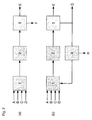
- FIG. 2 A greatly simplified block diagram of the apparatus of the present invention for the two specific process variants of “single pass” and “recirculation” is shown in FIG. 2 .
- FIG. 2 b shows the “recirculation” variant, where the units ( 1 ), ( 2 ) and ( 3 ) and the streams (A), (B), (C), (D) and (E) have the above meanings.
- Stream (G) is optional depending on the embodiment and corresponds to the “purge stream” to be discharged from the plant.
- the unit ( 4 ) which symbolizes the unit for increasing the concentration of the unreacted hydrocarbon and includes a waste gas stream (H).
- the recirculated hydrocarbon-containing gas is passed to the feed unit ( 1 ).
- the units mentioned can be connected in sequence either directly or indirectly by interposition of further units or apparatuses.
- further units or apparatuses present therein are, without implying any limitation, heat exchangers (for heating or cooling), pumps (for conveying liquids such as liquid feeds or the solution of the maleic anhydride which has been separated off) or gas compressors (for conveying and compressing gases such as the gaseous feeds or the gas to be recycled in the “recirculation” variant).
- n-butane is used as starting hydrocarbon and the heterogeneously catalyzed gas-phase oxidation is carried out in a “single pass” through a shell-and-tube reactor unit having two successive reaction zones.
- the gas stream is intimately mixed by passing it through a static mixer and is heated by passing it through a heat exchanger.
- the mixed and preheated gas stream is then introduced into the shell-and-tube reactor unit.
- this comprises a two-zone shell-and-tube reactor containing a catalyst comprising vanadium, phosphorus and oxygen.
- the two-zone shell-and-tube reactor can have various engineering configurations. The reader is therefore referred, in particular, to the examples in the description above.
- the two-zone shell-and-tube reactor can be replaced by two single-zone shell-and-tube reactors of known design connected in series.
- the relative division of the two reaction zones in terms of catalyst volume depends on various factors, for example the catalyst activity or the desired reaction conditions, and can be adapted to the respective system by a person skilled in the art by means of simple experiments.
- the temperature of the shell-and-tube reactor unit is preferably controlled by means of two salt melt circuits.
- the temperature of the second reaction zone is, according to the present invention, at least 2° C. above that of the first reaction zone.
- the two temperatures are set so that, under the given conditions, the temperature of the hot spot maximum of the second reaction zone is above that of the hot spot maximum of the first reaction zone.
- a conversion of 80-90% is preferably achieved per pass through the reactor.
- the product gas stream coming from the shell-and-tube reactor unit is cooled down in a heat exchanger and fed to the unit for separating off the maleic anhydride.
- the unit comprises at least one apparatus for the absorptive removal of maleic anhydride and possibly the oxygenated hydrocarbon by-products.
- Suitable apparatuses are, for example, containers filled with an absorption liquid through which the cooled output gas is passed or apparatuses in which the absorption liquid is sprayed into the gas stream.
- the solution comprising maleic anhydride is discharged from the plant for further processing or for isolating the desired product.
- the remaining gas stream is likewise discharged from the plant and, if desired, passed to a unit for recovering the unreacted n-butane.
- the heterogeneously catalyzed gas-phase oxidation is carried out in a shell-and-tube reactor unit having two successive reaction zones with “recirculation” of at least part of the unreacted n-butane.
- the feed unit, the shell-and-tube reactor unit and the unit for separating off the maleic anhydride formed are in principle configured as in the preferred “single pass” embodiment described. In the following, only the characteristic differences are therefore described.
- Oxygen is preferably used in the form of an enriched gas having an oxygen content of over 20% by volume, for example pure oxygen from fractionation of air.
- the amounts of the feed components n-butane, oxygen, volatile phosphorus compound and, if used, inert gas are matched to the corresponding operating procedure and the catalyst used.
- a conversion of 40-50% is preferably achieved per pass through the reactor.
- Maleic anhydride and possibly the oxygenated hydrocarbon by-products are separated off as described above and discharged from the plant for further processing or for isolation of the desired product.
- Part of the remaining gas stream, which comprises inert gases and unreacted n-butane, is discharged from the plant in order to counter accumulation of impurities.
- the major part of the gas is recirculated to the feed unit, mixed with the described starting materials and fed back into the shell-and-tube reactor unit.
- the present invention makes it possible to prepare maleic anhydride by heterogeneously catalyzed gas-phase oxidation of a hydrocarbon having at least four carbon atoms by means of oxygen so as to achieve a high hydrocarbon throughput over the catalyst, a high conversion, a high selectivity, a high yield of desired product and a high space-time yield. Space-time yields of 150 g/l ⁇ h can be achieved without problems.
- the present invention also makes possible a long catalyst life at high hydrocarbon throughputs.
- a further, important advantage of the invention is the high flexibility of the reaction conditions.
- the independently adjustable temperatures of the individual reaction zones enable the conversions and selectivities in these reaction zones to be set and optimized in a targeted manner. This makes it possible to specifically counteract a wide variety of influences, for example fluctuations in the quantity, quality or purity of the starting materials or progressive catalyst deactivation.
- V hydrocarbon volume of hydrocarbon in the gas phase standardized to 0° C. and 0.1013 MPa abs [standard l](Mathematical parameter. If a hydrocarbon is liquid under these conditions, the hypothetical gas volume is calculated via the ideal gas law.)
- the hollow cylinders were heated in a muffle furnace, initially in air at 7° C./min to 250° C. and subsequently at 2° C./min to 385° C.
- the catalyst was held at this temperature for 10 minutes, before the atmosphere was switched from air to N 2 /H 2 O (1:1).
- the catalyst was heated to 425° C. under the N 2 /H 2 O atmosphere (1:1) and the system was held at this temperature for 3 hours. Finally, the catalyst was cooled to room temperature under nitrogen.
- the catalyst had a bulk density of 0.9 1/kg, a total pore volume of 0.2 ml/g, a BET surface area of 17 m 2 /g, a phosphorus/vanadium ratio of 1.04-1.05 and a mean oxidation state of the vanadium of +4.1.
- the experimental plant was equipped with a feed unit and a reactor tube. Replacement of a shell-and-tube reactor by a reactor tube is very readily possible on a laboratory or pilot plant scale as long as the dimensions of the reactor tube are in the region of those of an industrial reactor tube.
- the plant was operated in a “single pass”.
- the hydrocarbon was introduced in liquid form at a quantity-regulated rate via a pump.
- oxygen-containing gas air was introduced at a quantity-regulated rate.
- Triethyl phosphate (TEP) was likewise added in liquid form, as a solution of 0.25% by weight of TEP in water, at a quantity-regulated rate.
- the shell-and-tube reactor unit comprised a two-zone reactor tube.
- the length of the reactor tube was 6.4 m, the internal diameter was 22.3 mm.
- a multi-thermocouple with 20 temperature measurement points was located in a protective sheath within the reactor tube.
- the reactor tube was divided into two reaction zones. Both reaction zones had a length of 3.2 m. They were surrounded by separately heatable/coolable heat transfer medium circuits. Flow through the shell-and-tube reactor was from the top downward.
- the upper 0.3 m of the reactor tube were filled with inert material and formed the preheating zone.
- the first and second reaction zones each contained 1.0 l of catalyst 1.
- As heat transfer medium use was made of a salt melt.
- the pressure at the reactor inlet was from 0.1 to 0.4 MPa abs (from 1 to 4 bar abs) in all experiments.
- gaseous product was taken off and passed to on-line analysis by gas chromatography.
- the main stream of the gaseous output from the reactor was discharged from the plant.
- Example 1A* the reactor was operated as a single-zone shell-and-tube reactor (not according to the present invention).
- the temperatures of both reaction zones were 429° C.
- the space velocity of n-butane over the catalyst was 40 standard l/l ⁇ h.
- Triethyl phosphate (TEP) was continually fed in as volatile phosphorus compound in an amount of 4 ppm by volume, based on the total amount of gas at the beginning. In the region of the first reaction zone, a hot spot maximum of 455° C. was observed.
- a yield Y of maleic anhydride of 54.2% was obtained. This corresponds to a space-time yield of 94.9 g/l ⁇ h.
- the experimental data are shown in Table 1.
- Example 1B to 1G the n-butane concentration or the space velocity over the catalyst was increased, with both reaction zones now being operated in accordance with the present invention at different temperatures.(two-zone shell-and-tube reactor). In order to counter a yield-reducing rise in the internal reactor temperature at higher space velocities, the temperature of the first reaction zone was decreased compared to Example 1A*. The temperature of the second reaction zone was adapted in accordance with requirements to achieve a high space-time yield. In Example 1G, a space-time yield of 149 g/l ⁇ h was achieved at an n-butane concentration of 3.0% by volume and a space velocity over the catalyst of 75 standard l/l ⁇ h.
- a space-time yield of 149 g/l ⁇ h can be achieved without problems by means of the process of the present invention.
- Example 2 the reactor was operated as a two-zone shell-and-tube reactor at a constant space velocity of 50 l/l ⁇ h, a constant n-butane concentration of 2.0% by volume and a continual introduction of triethyl phosphate (TEP) in an amount of 4 ppm by volume, based on the total amount of gas at the beginning.
- TEP triethyl phosphate
- the conversion C was 85 ⁇ 1% during the trial.
- the temperatures of the two reaction zones T 1 and T 2 were varied and thus the difference of the temperatures of the two hot spot maxima T 2,hot spot ⁇ T 1,hot spot was also varied.
- Example 2A a temperature difference between the two reaction zones T 2 ⁇ T 1 of 2° C. was set.
- the hot spot maximum of the second reaction zone T 2,hot spot obtained under these conditions was still relatively weakly pronounced compared to T 1,hot spot and, at 441° C., was 21° C. lower than T 1,hot spot . Nevertheless, a yield Y of maleic anhydride of 52.4% was obtained.
- the temperature difference between the two reaction zones T 2 ⁇ T 1 was increased to values greater than 2° C. by reducing T 1 and increasing T 2 .
- T 2 ⁇ T 1 was, for example, 6° C.
- the altered temperature setting reduced the conversion in the first reaction zone and increased it in the second reaction zone. This is reflected in a lowering of the temperature of the hot spot maximum of the first reaction zone T 1,hot spot and an increase in the temperature of the hot spot maximum of the second reaction zone T 2,hot spot .
- the temperature difference T 2,hot spot ⁇ T 1,hot spot dropped to ⁇ 12° C., which led to an increase in the yield Y of maleic anhydride to 53.0%.
- FIG. 3 shows the dependence of the yield Y of maleic anhydride on the temperature difference between the two hot spot maxima T 2,hot spot ⁇ T 1,hot spot as determined in Example 2.
- the yield increases steadily with increasing temperature difference T 2,hot spot ⁇ T 1,hot spot .
- Example 3 shows the long-term stability of the VPO catalyst used under the conditions according to the present invention at high space-time yield. Even after over 3300 hours of operation at an n-butane concentration of 3.0% by volume and a space velocity over the catalyst of 75 standard l/l ⁇ h, a constant, high space-time yield of 149-150 g/l ⁇ h continued to be achieved in the process of the present invention.
- the process of the present invention also makes possible stable operation at a high space-time yield of 149-150 g/l ⁇ h at high space velocity after over 3300 hours of operation.
- Example 4 the reactor was operated as a two-zone shell-and-tube reactor at a high space velocity of 75 standard l/l ⁇ h, a constant n-butane concentration of 3.0% by volume and an initial introduction of triethyl phosphate (TEP) in an amount of 4 ppm by volume, based on the total amount of gas at the beginning.
- TEP triethyl phosphate
- Example 4 shows that particularly at high-load operation with a high space velocity over the catalyst, the addition of a volatile phosphorus compound is essential to achieve stable reaction conditions. Without introduction of the phosphorus component or when insufficient phosphorus component is introduced, the activity of the VPO catalyst rises, leading to a significant rise in the temperature of the hot spot maximum of the first reaction zone T 1,hot spot , a significant rise in the conversion C and a decrease in the selectivity S. A runaway reaction is also possible under these circumstances.
- Examples 1 to 4 show that the process of the present invention makes it possible to achieve a high conversion, a high selectivity and a high yield of desired product and therefore a high space-time yield at a high space velocity of hydrocarbon over the catalyst.
- a space-time yield of 150 g/l ⁇ h can be achieved without problems in the gas-phase oxidation of n-butane over VPO catalysts in accordance with the present invention.
- This high value is reliably maintained even after several thousand operating hours as a result of the stable reaction conditions.
- Targeted setting of the catalyst activities, the amounts of catalyst and the temperatures of the individual reaction zones make it possible to optimize the yield of maleic anhydride.
- the yield rises continually with increasing temperature difference between the hot spot maximum of the second or subsequent reaction zone and a hot spot maximum of an upstream reaction zone.
- the process of the present invention provides a flexible reaction procedure in respect of the desired high space-time yield, which offers the possibility of optimization even in the case of fluctuations in the quantity, quality or purity of the starting materials or progressive catalyst deactivation.
Landscapes
- Chemical & Material Sciences (AREA)
- Organic Chemistry (AREA)
- Chemical Kinetics & Catalysis (AREA)
- Engineering & Computer Science (AREA)
- Oil, Petroleum & Natural Gas (AREA)
- Furan Compounds (AREA)
- Low-Molecular Organic Synthesis Reactions Using Catalysts (AREA)
- Catalysts (AREA)
Applications Claiming Priority (4)
| Application Number | Priority Date | Filing Date | Title |
|---|---|---|---|
| DE10011309A DE10011309A1 (de) | 2000-03-10 | 2000-03-10 | Verfahren zur Herstellung von Maleinsäreanhydrid |
| DE100-11-309.5 | 2000-03-10 | ||
| DE10011309 | 2000-03-10 | ||
| PCT/EP2001/002496 WO2001068626A1 (de) | 2000-03-10 | 2001-03-06 | Verfahren zur herstellung von maleinsäureanhydrid |
Publications (2)
| Publication Number | Publication Date |
|---|---|
| US20030065194A1 US20030065194A1 (en) | 2003-04-03 |
| US6803473B2 true US6803473B2 (en) | 2004-10-12 |
Family
ID=7633990
Family Applications (1)
| Application Number | Title | Priority Date | Filing Date |
|---|---|---|---|
| US10/220,746 Expired - Lifetime US6803473B2 (en) | 2000-03-10 | 2001-03-06 | Method for producing maleic acid anhydride |
Country Status (13)
| Country | Link |
|---|---|
| US (1) | US6803473B2 (de) |
| EP (1) | EP1261597A1 (de) |
| JP (1) | JP2003527382A (de) |
| KR (1) | KR100729325B1 (de) |
| CN (1) | CN1197853C (de) |
| AU (1) | AU2001250363A1 (de) |
| BR (1) | BR0109070A (de) |
| CA (1) | CA2402420A1 (de) |
| DE (1) | DE10011309A1 (de) |
| MX (1) | MXPA02008214A (de) |
| MY (1) | MY128287A (de) |
| TW (1) | TWI247744B (de) |
| WO (1) | WO2001068626A1 (de) |
Cited By (4)
| Publication number | Priority date | Publication date | Assignee | Title |
|---|---|---|---|---|
| US20060241309A1 (en) * | 2003-07-28 | 2006-10-26 | Basf Aktiengesellschaft Patents, Trademarks And Licenses | Method for the production of maleic anhydride |
| US20080009652A1 (en) * | 2006-07-05 | 2008-01-10 | Huntsman Petrochemical Corporation | Process of Making Butyric Acid |
| US20110110830A1 (en) * | 2009-11-10 | 2011-05-12 | Basf Se | Shell-and-tude reactor for preparing maleic anhydride |
| US10363533B2 (en) | 2017-02-10 | 2019-07-30 | Technobell d.o.o. Koper | Double zone tubular reactor and method for carrying out maleic anhydride production by n-butane oxidation |
Families Citing this family (18)
| Publication number | Priority date | Publication date | Assignee | Title |
|---|---|---|---|---|
| US6986931B2 (en) | 2000-10-02 | 2006-01-17 | S.C. Johnson & Son, Inc. | Disposable cutting sheet |
| EP2361899B1 (de) * | 2002-01-11 | 2015-07-22 | Mitsubishi Chemical Corporation | Verfahren zur katalytischen Gasphasenoxidation mit einem Wärmetausch-Reaktor mit mehreren Rohren |
| DE10211449A1 (de) * | 2002-03-15 | 2003-09-25 | Basf Ag | Katalysator-Precursor für die Herstellung von Maleinsäureanhydrid und Verfahren zu dessen Herstellung |
| DE10235355A1 (de) * | 2002-08-02 | 2004-02-19 | Basf Ag | Verfahren zur Herstellung von Maleinsäureanhydrid |
| KR100679752B1 (ko) * | 2003-01-31 | 2007-02-06 | 만 데베에 게엠베하 | 발열성 기체상 반응을 실행하기 위한 다중구역 관형 반응기 |
| JP2005330249A (ja) * | 2004-05-21 | 2005-12-02 | Sumitomo Chemical Co Ltd | 光学活性シタロプラムの製造方法、およびその中間体 |
| RU2326424C2 (ru) * | 2006-01-23 | 2008-06-10 | Новомосковский институт Российского химико-технологического университета им. Д.И. Менделеева | Система автоматического поддержания температурного профиля в реакторе |
| EP2379223A2 (de) * | 2008-12-22 | 2011-10-26 | Basf Se | Katalysatorformkörper und verfahren zur herstellung von maleinsäureanhydrid |
| DE102010012090A1 (de) * | 2010-03-19 | 2011-11-17 | Süd-Chemie AG | Verfahren zur katalytischen Gasphasenoxidation von Kohlenwasserstoffen und Katalysereaktionsvorrichtung |
| KR200450547Y1 (ko) * | 2010-03-22 | 2010-10-11 | 정성주 | 통기성 매트리스 |
| EP2658643B1 (de) | 2010-12-29 | 2020-02-12 | Rohm and Haas Company | Verfahren zur Propanoxidation |
| CN108546256A (zh) * | 2018-05-31 | 2018-09-18 | 淄博齐翔腾达化工股份有限公司 | 正丁烷选择氧化生产顺酐工艺及装置 |
| CN109053647B (zh) * | 2018-08-23 | 2022-06-10 | 常州新日催化剂股份有限公司 | 一种正丁烷氧化制顺酐的生产工艺 |
| CN111097467B (zh) * | 2018-10-25 | 2022-10-11 | 中国石油化工股份有限公司 | 低碳烃选择氧化的钒磷催化剂前驱体的活化方法 |
| DE202018106371U1 (de) * | 2018-11-09 | 2018-11-15 | Muw Screentec Filter- Und Präzisionstechnik Aus Metall Gmbh | Katalytischer Membranreaktor zur Durchführung chemischer Gleichgewichtsreaktionen |
| EP3835639B1 (de) | 2019-12-12 | 2023-08-30 | Basf Se | Gasdichtes, wärmedurchlässiges, keramisches und mehrlagiges verbundrohr |
| EP4122591A1 (de) * | 2021-07-23 | 2023-01-25 | Linde GmbH | Verfahren und anlage zur herstellung einer zielverbindung |
| DE102022004204A1 (de) | 2022-11-12 | 2024-05-23 | Hans-Jürgen Eberle | Vefahren zur Herstellung von Maleinsäureanhydrid |
Citations (34)
| Publication number | Priority date | Publication date | Assignee | Title |
|---|---|---|---|---|
| US3147084A (en) | 1962-03-08 | 1964-09-01 | Shell Oil Co | Tubular catalytic reactor with cooler |
| US3296282A (en) | 1964-03-05 | 1967-01-03 | Petro Tex Chem Corp | Oxidation of hydrocarbons |
| US3871445A (en) | 1972-01-13 | 1975-03-18 | Deggendorfer Werft Eisenbau | Reaction apparatus for carrying out exothermic and endothermic chemical processes with radial flow of a heat exchange medium |
| DE2513405A1 (de) | 1975-03-26 | 1976-10-14 | Basf Ag | Verfahren zur herstellung von acrylsaeure durch oxidation von propylen mit sauerstoff enthaltenden gasen in zwei getrennten katalysatorstufen, die in einem roehrenreaktor hintereinander angeordnet sind |
| DE2830765A1 (de) | 1977-07-13 | 1980-01-31 | Nippon Catalytic Chem Ind | Verfahren zur katalytischen dampfphasenoxidation mit entsprechendem reaktor |
| DE2903582A1 (de) | 1979-01-31 | 1980-08-07 | Basf Ag | Rohrbuendelreaktor zur durchfuehrung katalytischer reaktionen in der gasphase |
| US4231943A (en) | 1979-05-31 | 1980-11-04 | Chevron Research Company | Maleic anhydride production |
| EP0056901A2 (de) | 1980-12-29 | 1982-08-04 | The Standard Oil Company | Herstellung von fluidisierbaren Vanadin-Phosphoroxid-Katalysatoren und deren Verwendung zur Herstellung von Maleinsäureanhydrid |
| US4429137A (en) | 1980-12-29 | 1984-01-31 | The Standard Oil Company | Preparation of maleic anhydride |
| EP0099431A1 (de) | 1982-07-20 | 1984-02-01 | Amoco Corporation | Verfahren zur Herstellung von Maleinsäureanhydrid |
| EP0123467A1 (de) | 1983-04-14 | 1984-10-31 | Amoco Corporation | Wiederbelebung eines Phosphorvanadium enthaltenden Katalysators und dessen Herstellungsverfahren, Katalysator zur Herstellung von Maleinesäureanhydrid, der mit Phosphorsäurealkylestern in Anwesenheit von Wasser behandelt worden ist |
| US4515899A (en) | 1983-12-14 | 1985-05-07 | Denka Chemical Corporation | Steam regeneration of phosphorus treated vanadium-phosphorus-oxygen catalysts |
| US4562268A (en) | 1983-12-28 | 1985-12-31 | Monsanto Company | Process for producing maleic anhydride |
| US4795818A (en) | 1984-09-04 | 1989-01-03 | Scientific Design Company, Inc. | Optimizing the yield of maleic anhydride catalyst |
| US4933312A (en) | 1989-01-17 | 1990-06-12 | Amoco Corporation | Maleic anhydride catalysts and process for their manufacture |
| EP0383224A2 (de) | 1989-02-17 | 1990-08-22 | Jgc Corporation | Rohrbündelapparat mit einer Zwischenrohrplatte |
| US5011945A (en) | 1987-08-31 | 1991-04-30 | Amoco Corporation | Continuous process for the production of maleic anhydride |
| US5021588A (en) | 1985-01-18 | 1991-06-04 | E.I. Du Pont De Nemours And Company | Vapor phase catalytic oxidation of butane to maleic anhydride |
| EP0435951A1 (de) | 1988-09-23 | 1991-07-10 | Snell & Wilcox Ltd | Videosignal-verarbeitung und bildspeicher. |
| US5095125A (en) | 1989-01-17 | 1992-03-10 | Amoco Corporation | Maleic anhydride production |
| US5137860A (en) | 1991-06-27 | 1992-08-11 | Monsanto Company | Process for the transformation of vanadium/phosphorus mixed oxide catalyst precursors into active catalysts for the production of maleic anhydride |
| US5158923A (en) | 1990-05-21 | 1992-10-27 | Scientific Design Company, Inc. | Phosphorous/vanadium oxidation catalyst |
| US5168090A (en) | 1990-10-04 | 1992-12-01 | Monsanto Company | Shaped oxidation catalyst structures for the production of maleic anhydride |
| WO1993001155A1 (en) | 1991-07-08 | 1993-01-21 | Monsanto Company | High productivity process for the production of maleic anhydride |
| US5185455A (en) | 1992-02-18 | 1993-02-09 | Monsanto Company | Method for improving the performance of VPO catalysts |
| US5225574A (en) | 1990-04-24 | 1993-07-06 | Basf Aktiengesellschaft | Preparation of phthalic anhydride from o-xylene |
| US5275996A (en) | 1992-05-22 | 1994-01-04 | Monsanto Company | Phosphorous/vanadium oxide catalyst and process of preparation thereof |
| US5296436A (en) | 1993-01-08 | 1994-03-22 | Scientific Design Company, Inc. | Phosphorous/vanadium oxidation catalyst |
| EP0700714A1 (de) | 1994-09-08 | 1996-03-13 | Basf Aktiengesellschaft | Verfahren zu katalytischen Gasphasenoxidation von Propen zu Acrolein |
| EP0700893A1 (de) | 1994-09-08 | 1996-03-13 | Basf Aktiengesellschaft | Verfahren zur katalytischen Gasphasenoxidation von Acrolein zu Acrylsäure |
| WO1997012674A1 (en) | 1995-10-02 | 1997-04-10 | Huntsman Petrochemical Corporation | Molybdenum-modified vanadium-phosphorus oxide catalysts for the production of maleic anhydride |
| US5641722A (en) | 1994-09-15 | 1997-06-24 | Huntsman Petrochemical Corporation | High performance VPO catalyst and process of preparation thereof |
| WO1997026817A1 (fr) | 1996-01-24 | 1997-07-31 | Seb S.A. | Appareil electromenager de preparation culinaire, du genre robot menager multi-usages, comportant un moyen d'appui pour l'ensemble de travail rotatif |
| WO1997043242A1 (en) | 1996-05-14 | 1997-11-20 | Kvaerner Process Technology Limited | Process for the production of 1,4-butanediol, gamma-butyrolactone and tetrahydrofuran |
Family Cites Families (1)
| Publication number | Priority date | Publication date | Assignee | Title |
|---|---|---|---|---|
| US5168909A (en) * | 1991-04-08 | 1992-12-08 | Joyner Jr George R | Combination golf club head cover and hand warmer |
-
2000
- 2000-03-10 DE DE10011309A patent/DE10011309A1/de not_active Withdrawn
-
2001
- 2001-03-01 MY MYPI20010925A patent/MY128287A/en unknown
- 2001-03-06 MX MXPA02008214A patent/MXPA02008214A/es active IP Right Grant
- 2001-03-06 JP JP2001567718A patent/JP2003527382A/ja not_active Withdrawn
- 2001-03-06 CA CA002402420A patent/CA2402420A1/en not_active Abandoned
- 2001-03-06 KR KR1020027011779A patent/KR100729325B1/ko not_active Expired - Lifetime
- 2001-03-06 EP EP01923639A patent/EP1261597A1/de not_active Ceased
- 2001-03-06 CN CNB018063276A patent/CN1197853C/zh not_active Expired - Lifetime
- 2001-03-06 US US10/220,746 patent/US6803473B2/en not_active Expired - Lifetime
- 2001-03-06 BR BR0109070-4A patent/BR0109070A/pt not_active IP Right Cessation
- 2001-03-06 WO PCT/EP2001/002496 patent/WO2001068626A1/de not_active Ceased
- 2001-03-06 AU AU2001250363A patent/AU2001250363A1/en not_active Abandoned
- 2001-03-06 TW TW090105140A patent/TWI247744B/zh not_active IP Right Cessation
Patent Citations (38)
| Publication number | Priority date | Publication date | Assignee | Title |
|---|---|---|---|---|
| US3147084A (en) | 1962-03-08 | 1964-09-01 | Shell Oil Co | Tubular catalytic reactor with cooler |
| US3296282A (en) | 1964-03-05 | 1967-01-03 | Petro Tex Chem Corp | Oxidation of hydrocarbons |
| US3871445A (en) | 1972-01-13 | 1975-03-18 | Deggendorfer Werft Eisenbau | Reaction apparatus for carrying out exothermic and endothermic chemical processes with radial flow of a heat exchange medium |
| DE2513405A1 (de) | 1975-03-26 | 1976-10-14 | Basf Ag | Verfahren zur herstellung von acrylsaeure durch oxidation von propylen mit sauerstoff enthaltenden gasen in zwei getrennten katalysatorstufen, die in einem roehrenreaktor hintereinander angeordnet sind |
| DE2830765A1 (de) | 1977-07-13 | 1980-01-31 | Nippon Catalytic Chem Ind | Verfahren zur katalytischen dampfphasenoxidation mit entsprechendem reaktor |
| US4203906A (en) | 1977-07-13 | 1980-05-20 | Nippon Shokubai Kagaku Kogyo Co., Ltd. | Process for catalytic vapor phase oxidation |
| DE2903582A1 (de) | 1979-01-31 | 1980-08-07 | Basf Ag | Rohrbuendelreaktor zur durchfuehrung katalytischer reaktionen in der gasphase |
| US4231943A (en) | 1979-05-31 | 1980-11-04 | Chevron Research Company | Maleic anhydride production |
| EP0056901A2 (de) | 1980-12-29 | 1982-08-04 | The Standard Oil Company | Herstellung von fluidisierbaren Vanadin-Phosphoroxid-Katalysatoren und deren Verwendung zur Herstellung von Maleinsäureanhydrid |
| US4429137A (en) | 1980-12-29 | 1984-01-31 | The Standard Oil Company | Preparation of maleic anhydride |
| EP0099431A1 (de) | 1982-07-20 | 1984-02-01 | Amoco Corporation | Verfahren zur Herstellung von Maleinsäureanhydrid |
| EP0123467A1 (de) | 1983-04-14 | 1984-10-31 | Amoco Corporation | Wiederbelebung eines Phosphorvanadium enthaltenden Katalysators und dessen Herstellungsverfahren, Katalysator zur Herstellung von Maleinesäureanhydrid, der mit Phosphorsäurealkylestern in Anwesenheit von Wasser behandelt worden ist |
| US4515899A (en) | 1983-12-14 | 1985-05-07 | Denka Chemical Corporation | Steam regeneration of phosphorus treated vanadium-phosphorus-oxygen catalysts |
| US4562268A (en) | 1983-12-28 | 1985-12-31 | Monsanto Company | Process for producing maleic anhydride |
| US4795818A (en) | 1984-09-04 | 1989-01-03 | Scientific Design Company, Inc. | Optimizing the yield of maleic anhydride catalyst |
| US5021588A (en) | 1985-01-18 | 1991-06-04 | E.I. Du Pont De Nemours And Company | Vapor phase catalytic oxidation of butane to maleic anhydride |
| US5011945A (en) | 1987-08-31 | 1991-04-30 | Amoco Corporation | Continuous process for the production of maleic anhydride |
| EP0435951A1 (de) | 1988-09-23 | 1991-07-10 | Snell & Wilcox Ltd | Videosignal-verarbeitung und bildspeicher. |
| US4933312A (en) | 1989-01-17 | 1990-06-12 | Amoco Corporation | Maleic anhydride catalysts and process for their manufacture |
| US5095125A (en) | 1989-01-17 | 1992-03-10 | Amoco Corporation | Maleic anhydride production |
| EP0383224A2 (de) | 1989-02-17 | 1990-08-22 | Jgc Corporation | Rohrbündelapparat mit einer Zwischenrohrplatte |
| US5225574A (en) | 1990-04-24 | 1993-07-06 | Basf Aktiengesellschaft | Preparation of phthalic anhydride from o-xylene |
| US5158923A (en) | 1990-05-21 | 1992-10-27 | Scientific Design Company, Inc. | Phosphorous/vanadium oxidation catalyst |
| US5168090A (en) | 1990-10-04 | 1992-12-01 | Monsanto Company | Shaped oxidation catalyst structures for the production of maleic anhydride |
| US5137860A (en) | 1991-06-27 | 1992-08-11 | Monsanto Company | Process for the transformation of vanadium/phosphorus mixed oxide catalyst precursors into active catalysts for the production of maleic anhydride |
| WO1993001155A1 (en) | 1991-07-08 | 1993-01-21 | Monsanto Company | High productivity process for the production of maleic anhydride |
| US5185455A (en) | 1992-02-18 | 1993-02-09 | Monsanto Company | Method for improving the performance of VPO catalysts |
| US5275996A (en) | 1992-05-22 | 1994-01-04 | Monsanto Company | Phosphorous/vanadium oxide catalyst and process of preparation thereof |
| US5296436A (en) | 1993-01-08 | 1994-03-22 | Scientific Design Company, Inc. | Phosphorous/vanadium oxidation catalyst |
| US5739391A (en) | 1994-09-08 | 1998-04-14 | Basf Aktiengesellschaft | Catalytic gas-phase oxidation of acrolein to acrylic acid |
| EP0700714A1 (de) | 1994-09-08 | 1996-03-13 | Basf Aktiengesellschaft | Verfahren zu katalytischen Gasphasenoxidation von Propen zu Acrolein |
| EP0700893A1 (de) | 1994-09-08 | 1996-03-13 | Basf Aktiengesellschaft | Verfahren zur katalytischen Gasphasenoxidation von Acrolein zu Acrylsäure |
| US5821390A (en) | 1994-09-08 | 1998-10-13 | Basf Aktiengesellschaft | Catalytic gas-phase oxidation of propene to acrolein |
| US5641722A (en) | 1994-09-15 | 1997-06-24 | Huntsman Petrochemical Corporation | High performance VPO catalyst and process of preparation thereof |
| US5773382A (en) | 1994-09-15 | 1998-06-30 | Huntsman Petrochemical Corporation | High performance VPO catalyst and process of preparation thereof |
| WO1997012674A1 (en) | 1995-10-02 | 1997-04-10 | Huntsman Petrochemical Corporation | Molybdenum-modified vanadium-phosphorus oxide catalysts for the production of maleic anhydride |
| WO1997026817A1 (fr) | 1996-01-24 | 1997-07-31 | Seb S.A. | Appareil electromenager de preparation culinaire, du genre robot menager multi-usages, comportant un moyen d'appui pour l'ensemble de travail rotatif |
| WO1997043242A1 (en) | 1996-05-14 | 1997-11-20 | Kvaerner Process Technology Limited | Process for the production of 1,4-butanediol, gamma-butyrolactone and tetrahydrofuran |
Non-Patent Citations (2)
| Title |
|---|
| Chem.Eng.Sci.,vol. 41,No. 4, 765-772,1986,Wellauer et al. |
| Ull.Enc.Ind.Chem.6th Ed.,Oxidation of Benzen, 1999. |
Cited By (8)
| Publication number | Priority date | Publication date | Assignee | Title |
|---|---|---|---|---|
| US20060241309A1 (en) * | 2003-07-28 | 2006-10-26 | Basf Aktiengesellschaft Patents, Trademarks And Licenses | Method for the production of maleic anhydride |
| US7345167B2 (en) | 2003-07-28 | 2008-03-18 | Basf Aktiengesellschaft | Method for the production of maleic anhydride |
| US20080009652A1 (en) * | 2006-07-05 | 2008-01-10 | Huntsman Petrochemical Corporation | Process of Making Butyric Acid |
| US20110110830A1 (en) * | 2009-11-10 | 2011-05-12 | Basf Se | Shell-and-tude reactor for preparing maleic anhydride |
| RU2566749C2 (ru) * | 2009-11-10 | 2015-10-27 | Басф Се | Кожухотрубный реактор для получения ангидрида малеиновой кислоты |
| US9522374B2 (en) * | 2009-11-10 | 2016-12-20 | Basf Se | Shell-and-tube reactor for preparing maleic anhydride |
| US10363533B2 (en) | 2017-02-10 | 2019-07-30 | Technobell d.o.o. Koper | Double zone tubular reactor and method for carrying out maleic anhydride production by n-butane oxidation |
| EP3360611B1 (de) * | 2017-02-10 | 2021-04-28 | Technobell D.O.O. Koper | Verbesserter doppelzonen-rohrreaktor und verfahren zur durchführung von maleinanhydridherstellung durch n-butanoxidation |
Also Published As
| Publication number | Publication date |
|---|---|
| CN1197853C (zh) | 2005-04-20 |
| JP2003527382A (ja) | 2003-09-16 |
| KR20020080477A (ko) | 2002-10-23 |
| CA2402420A1 (en) | 2001-09-20 |
| MY128287A (en) | 2007-01-31 |
| US20030065194A1 (en) | 2003-04-03 |
| TWI247744B (en) | 2006-01-21 |
| KR100729325B1 (ko) | 2007-06-15 |
| WO2001068626A1 (de) | 2001-09-20 |
| AU2001250363A1 (en) | 2001-09-24 |
| DE10011309A1 (de) | 2001-09-13 |
| BR0109070A (pt) | 2003-06-03 |
| MXPA02008214A (es) | 2004-08-12 |
| CN1416427A (zh) | 2003-05-07 |
| EP1261597A1 (de) | 2002-12-04 |
Similar Documents
| Publication | Publication Date | Title |
|---|---|---|
| US6803473B2 (en) | Method for producing maleic acid anhydride | |
| US6812351B2 (en) | Hollow cylindrical catalyst and a method for producing a maleic acid anhydride | |
| EP1284815B1 (de) | Vorrichtung zur kontrollierten und optimierten zugabe von reaktanten in ein kontinuierliches strömungssystem und verfahren zu dessen gebrauch | |
| CA3031560C (en) | Oxidative dehydrogenation (odh) of ethane | |
| CA3031565C (en) | Oxidative dehydrogenation (odh) of ethane | |
| US11760704B2 (en) | Oxidative dehydrogenation coproduction | |
| EP3770145A1 (de) | Verfahren zur kontinuierlichen herstellung von acrolein oder acrylsäure als zielprodukt aus propen | |
| US7173143B2 (en) | Integrated method for synthesis propylene oxide | |
| EP0891316B1 (de) | Verfahren zur herstellung von methylmercatopropanal | |
| US20040015011A1 (en) | Method for producing propylene hydroformylation products and acrylic acid and/or acrolein | |
| US6989454B2 (en) | Method for producing maleic anhydride | |
| US7345167B2 (en) | Method for the production of maleic anhydride | |
| KR101824306B1 (ko) | 프로판 부분산화반응에 의한 연속식 아크릴산 제조방법 및 제조장치 | |
| EP4441020B1 (de) | Verfahren zur herstellung von isoprenal und/oder prenal | |
| US6620965B1 (en) | Process for vinyl acetate | |
| KR20160041259A (ko) | 프로판 부분산화반응에 의한 연속식 아크릴산 제조방법 | |
| US6884909B2 (en) | Process for preparing saturated carboxylic acids having from one to four carbon atoms by gas-phase oxidation of 2-butanone |
Legal Events
| Date | Code | Title | Description |
|---|---|---|---|
| AS | Assignment |
Owner name: BASF AKTIENGESELLSCHAFT, GERMANY Free format text: ASSIGNMENT OF ASSIGNORS INTEREST;ASSIGNORS:WEIGUNY, JENS;STORCK, SEBASTIAN;TENTEN, ANDREAS;AND OTHERS;REEL/FRAME:013384/0206 Effective date: 20010320 |
|
| STCF | Information on status: patent grant |
Free format text: PATENTED CASE |
|
| FPAY | Fee payment |
Year of fee payment: 4 |
|
| FPAY | Fee payment |
Year of fee payment: 8 |
|
| FPAY | Fee payment |
Year of fee payment: 12 |