US6120375A - Pleasure ride device - Google Patents
Pleasure ride device Download PDFInfo
- Publication number
- US6120375A US6120375A US09/030,230 US3023098A US6120375A US 6120375 A US6120375 A US 6120375A US 3023098 A US3023098 A US 3023098A US 6120375 A US6120375 A US 6120375A
- Authority
- US
- United States
- Prior art keywords
- model animal
- rocking
- player
- body portion
- player character
- Prior art date
- Legal status (The legal status is an assumption and is not a legal conclusion. Google has not performed a legal analysis and makes no representation as to the accuracy of the status listed.)
- Expired - Lifetime
Links
Images




Classifications
-
- A—HUMAN NECESSITIES
- A63—SPORTS; GAMES; AMUSEMENTS
- A63F—CARD, BOARD, OR ROULETTE GAMES; INDOOR GAMES USING SMALL MOVING PLAYING BODIES; VIDEO GAMES; GAMES NOT OTHERWISE PROVIDED FOR
- A63F13/00—Video games, i.e. games using an electronically generated display having two or more dimensions
- A63F13/20—Input arrangements for video game devices
- A63F13/24—Constructional details thereof, e.g. game controllers with detachable joystick handles
- A63F13/245—Constructional details thereof, e.g. game controllers with detachable joystick handles specially adapted to a particular type of game, e.g. steering wheels
-
- A—HUMAN NECESSITIES
- A63—SPORTS; GAMES; AMUSEMENTS
- A63F—CARD, BOARD, OR ROULETTE GAMES; INDOOR GAMES USING SMALL MOVING PLAYING BODIES; VIDEO GAMES; GAMES NOT OTHERWISE PROVIDED FOR
- A63F13/00—Video games, i.e. games using an electronically generated display having two or more dimensions
- A63F13/40—Processing input control signals of video game devices, e.g. signals generated by the player or derived from the environment
- A63F13/42—Processing input control signals of video game devices, e.g. signals generated by the player or derived from the environment by mapping the input signals into game commands, e.g. mapping the displacement of a stylus on a touch screen to the steering angle of a virtual vehicle
- A63F13/428—Processing input control signals of video game devices, e.g. signals generated by the player or derived from the environment by mapping the input signals into game commands, e.g. mapping the displacement of a stylus on a touch screen to the steering angle of a virtual vehicle involving motion or position input signals, e.g. signals representing the rotation of an input controller or a player's arm motions sensed by accelerometers or gyroscopes
-
- A—HUMAN NECESSITIES
- A63—SPORTS; GAMES; AMUSEMENTS
- A63F—CARD, BOARD, OR ROULETTE GAMES; INDOOR GAMES USING SMALL MOVING PLAYING BODIES; VIDEO GAMES; GAMES NOT OTHERWISE PROVIDED FOR
- A63F13/00—Video games, i.e. games using an electronically generated display having two or more dimensions
- A63F13/55—Controlling game characters or game objects based on the game progress
- A63F13/57—Simulating properties, behaviour or motion of objects in the game world, e.g. computing tyre load in a car race game
-
- A—HUMAN NECESSITIES
- A63—SPORTS; GAMES; AMUSEMENTS
- A63F—CARD, BOARD, OR ROULETTE GAMES; INDOOR GAMES USING SMALL MOVING PLAYING BODIES; VIDEO GAMES; GAMES NOT OTHERWISE PROVIDED FOR
- A63F13/00—Video games, i.e. games using an electronically generated display having two or more dimensions
- A63F13/55—Controlling game characters or game objects based on the game progress
- A63F13/58—Controlling game characters or game objects based on the game progress by computing conditions of game characters, e.g. stamina, strength, motivation or energy level
-
- A—HUMAN NECESSITIES
- A63—SPORTS; GAMES; AMUSEMENTS
- A63F—CARD, BOARD, OR ROULETTE GAMES; INDOOR GAMES USING SMALL MOVING PLAYING BODIES; VIDEO GAMES; GAMES NOT OTHERWISE PROVIDED FOR
- A63F13/00—Video games, i.e. games using an electronically generated display having two or more dimensions
- A63F13/80—Special adaptations for executing a specific game genre or game mode
- A63F13/803—Driving vehicles or craft, e.g. cars, airplanes, ships, robots or tanks
-
- A—HUMAN NECESSITIES
- A63—SPORTS; GAMES; AMUSEMENTS
- A63F—CARD, BOARD, OR ROULETTE GAMES; INDOOR GAMES USING SMALL MOVING PLAYING BODIES; VIDEO GAMES; GAMES NOT OTHERWISE PROVIDED FOR
- A63F13/00—Video games, i.e. games using an electronically generated display having two or more dimensions
- A63F13/40—Processing input control signals of video game devices, e.g. signals generated by the player or derived from the environment
- A63F13/44—Processing input control signals of video game devices, e.g. signals generated by the player or derived from the environment involving timing of operations, e.g. performing an action within a time slot
-
- A—HUMAN NECESSITIES
- A63—SPORTS; GAMES; AMUSEMENTS
- A63F—CARD, BOARD, OR ROULETTE GAMES; INDOOR GAMES USING SMALL MOVING PLAYING BODIES; VIDEO GAMES; GAMES NOT OTHERWISE PROVIDED FOR
- A63F2300/00—Features of games using an electronically generated display having two or more dimensions, e.g. on a television screen, showing representations related to the game
- A63F2300/10—Features of games using an electronically generated display having two or more dimensions, e.g. on a television screen, showing representations related to the game characterized by input arrangements for converting player-generated signals into game device control signals
- A63F2300/1062—Features of games using an electronically generated display having two or more dimensions, e.g. on a television screen, showing representations related to the game characterized by input arrangements for converting player-generated signals into game device control signals being specially adapted to a type of game, e.g. steering wheel
-
- A—HUMAN NECESSITIES
- A63—SPORTS; GAMES; AMUSEMENTS
- A63F—CARD, BOARD, OR ROULETTE GAMES; INDOOR GAMES USING SMALL MOVING PLAYING BODIES; VIDEO GAMES; GAMES NOT OTHERWISE PROVIDED FOR
- A63F2300/00—Features of games using an electronically generated display having two or more dimensions, e.g. on a television screen, showing representations related to the game
- A63F2300/60—Methods for processing data by generating or executing the game program
- A63F2300/63—Methods for processing data by generating or executing the game program for controlling the execution of the game in time
- A63F2300/638—Methods for processing data by generating or executing the game program for controlling the execution of the game in time according to the timing of operation or a time limit
-
- A—HUMAN NECESSITIES
- A63—SPORTS; GAMES; AMUSEMENTS
- A63F—CARD, BOARD, OR ROULETTE GAMES; INDOOR GAMES USING SMALL MOVING PLAYING BODIES; VIDEO GAMES; GAMES NOT OTHERWISE PROVIDED FOR
- A63F2300/00—Features of games using an electronically generated display having two or more dimensions, e.g. on a television screen, showing representations related to the game
- A63F2300/60—Methods for processing data by generating or executing the game program
- A63F2300/64—Methods for processing data by generating or executing the game program for computing dynamical parameters of game objects, e.g. motion determination or computation of frictional forces for a virtual car
-
- A—HUMAN NECESSITIES
- A63—SPORTS; GAMES; AMUSEMENTS
- A63F—CARD, BOARD, OR ROULETTE GAMES; INDOOR GAMES USING SMALL MOVING PLAYING BODIES; VIDEO GAMES; GAMES NOT OTHERWISE PROVIDED FOR
- A63F2300/00—Features of games using an electronically generated display having two or more dimensions, e.g. on a television screen, showing representations related to the game
- A63F2300/60—Methods for processing data by generating or executing the game program
- A63F2300/65—Methods for processing data by generating or executing the game program for computing the condition of a game character
-
- A—HUMAN NECESSITIES
- A63—SPORTS; GAMES; AMUSEMENTS
- A63F—CARD, BOARD, OR ROULETTE GAMES; INDOOR GAMES USING SMALL MOVING PLAYING BODIES; VIDEO GAMES; GAMES NOT OTHERWISE PROVIDED FOR
- A63F2300/00—Features of games using an electronically generated display having two or more dimensions, e.g. on a television screen, showing representations related to the game
- A63F2300/80—Features of games using an electronically generated display having two or more dimensions, e.g. on a television screen, showing representations related to the game specially adapted for executing a specific type of game
- A63F2300/8017—Driving on land or water; Flying
Definitions
- a game device of this sort is of relatively simple construction, since the vehicle is mechanical, even in the virtual space display.
- model animal device having the form of a model animal, with a main part rocked longitudinally by a straddling player, and controlling a player character representing the animal in virtual space;
- a rocking angle detection means for detecting a rocking angle of the model animal device
- the computing means includes an acceleration computing means which computes the motion acceleration for each rocking cycle of the model animal device, based on the detected rocking angle, and for each rocking cycle of the model animal device, accelerates the player character within the virtual space at a certain timing.
- the player straddles the model animal device which takes the form of a modeled animal, rocks in the longitudinal plane, and operates a player character representing the animal.
- the player character in virtual space is not accelerated continuously, but a construction is adopted whereby the acceleration occurs for each rocking cycle of the model animal device.
- an image of high realism can be shown in the display of the actual animal or a character similar thereto being accelerated discontinuously according to the motion action, and the player astride the model animal device can play the game with a feeling akin to that of controlling an actual animal.
- the computing means may accelerate the player character in synchronization with the feet of the player character hitting the ground.
- the game can be played with a feeling even more akin to that of controlling an actual animal.
- the rocking action of the model animal device and the action of the feet of the player character striking the ground are linked, and the player character is acceleration-controlled.
- the player watching the player character shown on the display while rocking the model animal device longitudinally and laterally obtains an impression of acceleration each time the feet of the model animal device ridden by the player actually hit the ground, and a pleasure ride device enabling a more interesting game is thus achieved.
- the acceleration computing means may include:
- a first means which, based on the detected rocking angle, computes the motion acceleration of the player character for each rocking cycle of the model animal device
- the model animal device may have the form of a model animal having a head portion and a body portion, and such that a player can straddle the body portion, seize reins provided on the head portion, stand on a pair of footrests provided on the body portion, and operate so as to control the animal in virtual space.
- the player can obtain an impression like that of controlling an actual animal.
- the body By movement of the reins, the body can be rocked.
- the speed of the animal can be controlled by manipulation of the reins, and this is close to the manipulation of an actual animal.
- FIG. 1 is a schematic illustration of a model animal device.
- FIG. 2 shows an embodiment of the pleasure ride device.
- FIG. 3 is a plan view of a head portion.
- FIG. 4 shows a screen display during the game of this embodiment.
- FIG. 5A shows an example of the model animal device of this embodiment in an operation state
- FIG. 5B is a schematic drawing of the action of the player character running in virtual space in synchronization with the operation.
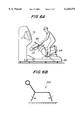
- FIG. 6A shows an example of the model animal device of this embodiment in another operation state
- FIG. 6B is a schematic drawing of the action of the player character controlled in synchronization with the operation.
- FIG. 8 is a functional block diagram of the model animal device of this embodiment.
- FIG. 9 is a graph for illustrating the rocking action of the model animal device.
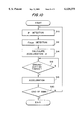
- FIG. 10 is a flowchart of the acceleration control of the player character during the game of this embodiment.
- FIG. 2 shows an embodiment of the pleasure ride device.
- This pleasure ride device has two displays 10 and two model animal devices 20.
- the displays 10 is shown the appearance of a horse race, according to information from the model animal devices 20. (See FIG. 4.)
- the model animal devices 20 are constructed to model racing horses.
- FIG. 1 is a schematic illustration of a model animal device.
- This model animal device 20 has a main unit comprising a head portion 22 and a body portion 24, and a base 26 supporting the body portion 24 so that the latter can rock.
- FIG. 3 is a plan view of the head portion.
- the head portion 22 is provided with reins 28 formed by a bent metal bar.
- the reins 28 are arranged to rotate through an angle of approximately 30 degrees through a fixing portion 30 provided within the head portion 22.
- the head portion 22 is fixed to the reins 28, and moves vertically together with the reins 28.
- the fixing portion 30 allows the reins 28 to rotate while applying a reaction force.
- a reaction force generator 36 exerts a reaction force on the rotating shaft 32, urging the latter in the rotary direction opposite to the direction of rotation.
- each footrest 38 like bicycle pedals, comprises a crank arm 40 at one end of which is attached orthogonally a pedal 42.
- the pedal 42 rotates, restricted to a range of approximately 20 degrees.
- the crank arm 40 is arranged to swing, restricted to a range from a base position pointing vertically downwards of approximately 45 degrees forwards and 70 degrees to the rear.
- one end of a link 44 is rotatably coupled, and at the other end of the link 44, one end of a lever 46 is rotatably coupled.
- the other end of the lever 46 is attached to a fixing portion 48.
- the fixing portion 48 imparts a reaction force to the lever 46, while allowing the lever 46 to rotate.
- crank arm 40, link 44, and lever 46 constitute a crank mechanism, and the rocking motion of the crank arm 40 is transmitted to become a rocking motion of the lever 46. Since a reaction force is imparted by the fixing portion 48 to the lever 46, at attempt to rock the crank arm 40 is met with an opposing reaction force.
- the body portion 24 is also provided with a seat 50. However, the player does not sit in the seat, but rather crouches to play the game.
- the body portion 24 is mounted on the base 26 so as to be able to rock. That is to say, a bearing 52 provided on the base 26 rotatably supports an axle 54 provided on the underside of the body portion 24, whereby the body portion 24 is able to rock. Furthermore, between the body portion 24 and the base 26 is interposed a resilient member 56 of rubber, which imparts a reaction force against the rocking of the body portion 24.
- the angle 0 at which the body portion 24 is inclined is detected by a rotary variable resistor 58 fixed to the base 26. That is to say, a rocking lever 62 is fixed to the rotary shaft (not shown in the drawing) of the rotary variable resistor 58, and a pin 60 is provided on the body portion 24.
- the pin 60 is disposed within a slot 62a formed in the rocking lever 62, and with the rocking of the body portion 24, the pin 60 moves substantially vertically, whereupon correspondingly the rocking lever 62 also moves vertically, and the angle of inclination ⁇ is detected by the rotary variable resistor 58.
- FIG. 8 is a functional block diagram of the pleasure ride device of this embodiment.
- the orientation (in the horizontal plane) of the reins 28 and head portion 22 detected by the rotary variable resistor 34, and the angle of inclination ⁇ in the vertical plane of the body portion 24 detected by the rotary variable resistor 58 are input to a processing unit 70.
- the processing unit 70 comprises a ROM in which is stored a program and other data, a RAM, and a CPU, and based on the input signals from the resistors 34 and 58 and a predetermined game program, computes the virtual space in which the horse representing the model animal device 20 straddled by the player appears, and shows this game image on the displays 10.
- FIG. 4 shows an example game image.
- FIGS. 5A to 7A illustrate the method of operation of the model animal device 20 of this embodiment.
- the direction of progress of the horse is determined by the lateral bending of the reins 28 as shown in FIG. 3, thus directing the head portion 22 in any particular orientation.
- This orientation is detected by the rotary variable resistor 34 shown in FIG. 1.
- the speed of the horse is determined by the magnitude of the angle of inclination ⁇ of the body portion 24.
- the speed of the horse is determined by the magnitude of the angle of inclination ⁇ when the body portion 24 is rocked in the longitudinal plane.
- the larger the magnitude of the angle of inclination ⁇ the more is the horse accelerated and the speed increased.
- the reins 28 are pushed down and the body portion 24 rocked forward, and next as shown in FIG. 7A the reins 28 are pulled up, and the body portion 24 is rocked back, and this motion is carried out repeatedly, rocking the body portion 24.
- the head portion 22 is arranged to be inclined in the direction opposite to the direction of inclination of the body portion 24. It should be noted that the angle of inclination ⁇ is detected by the rotary variable resistor 58 shown in FIG. 1.
- the footrests 38 are also rocked. However, the angle of rocking of the footrests 38 is unrelated to the speed and acceleration of the horse 100.
- a player astride the model animal device 20 bends the reins 28 laterally to point the head portion 22 in any desired direction, thus controlling the direction of progress of the horse 100, and further moves the reins 28 vertically and rocks the body portion 24 in the longitudinal plane, thereby being able to cause the horse 100 to run with a speed and acceleration determined by the angle of inclination ⁇ .
- FIG. 9 the variation of the angle of inclination ⁇ of the model animal device 20 being rocked in the longitudinal plane by the player is shown, and in FIG. 10 is shown a flowchart of the acceleration control of the horse 100 in virtual space based on the detected angle of inclination ⁇ .
- the player increases the degree of rocking of the model animal device 20 to make the horse 100 run faster, and decreases the degree of rocking to reduce speed.
- the angle of inclination ⁇ of the model animal device 20, or more specifically the angle of inclination ⁇ of the body portion 24 is detected using the rotary variable resistor 58, and input to the processing unit 70 (Step S10).
- the processing unit 70 based on this input value of the detected angle of inclination ⁇ detects the maximum angle of inclination ⁇ MAX for each of the rocking cycles t1, t2, . . . , as shown in FIG. 9.
- This maximum angle of inclination may be measured as separate maximum angles of inclination in the forward and rearward directions, or may be detected as the amplitude of the angle between the peak values in the forward and rearward directions (Step S12).
- Step S14 the processing unit 70 functions as an acceleration computing means, and computes the acceleration a of the horse 100 for each rocking cycle.
- Step S16 a decision is made as to the current state of the horse 100 in virtual space, and the timing of hitting of the ground by the hooves of the horse 100 is detected.
- the processing unit 70 of this embodiment for each rocking cycle, based on the data such as the angle of inclination of the model animal device 20, the timing of the hitting of the ground 110 by the hooves of the horse 100 is detected (Step S16), and on the timing of this ground-hitting, a computation of the acceleration of the horse 100 within the virtual space by an acceleration ⁇ is carried out (Step S18). That is to say, the processing unit 70 functions as an acceleration computing means which is synchronized to the hooves of the horse 100 hitting the ground, and computes the acceleration of the horse in virtual space.
- steps S10 to S20 are executed repeatedly for each rocking cycle of the model animal device 20, and the horse 100 shown on the display 10 undergoes acceleration control discontinuously in synchronization with the timing of the hooves hitting the ground 110.
- the horse 100 in the display 10 can be controlled to give an impression close to that of a real horse, and the player can enjoy riding the horse 100 of high realism displayed in the display 10, and play the game.
- various information computed by the processing unit 70 can be displayed.
- a ranking indication 12 in the center of the screen at the top is shown a ranking indication 12, and in the upper right corner is shown a navigation section 14 showing the course and the current position.
- a progress display 16 showing the timing of the leading horse passing certain points, and whether the pace is fast or slow.
- a position indication 18 showing the player's horse with respect to the other horses.
- a stamina meter 11 showing the degree to which the player's horse's stamina has been used up
- an acceleration meter 13 showing whether the player's horse is accelerating or decelerating.
- a horse message 15 showing the horse's status. In this drawing the status indicated is that the horse is proceeding downhill. To the left of this is shown the player's horse's number and name in an identifier indication 17. Further, when the leading horse passes a certain point close to the finish line, this fact is also indicated.
- the present invention is not limited to the above described embodiment, and various modifications are possible.
- the above embodiment has two displays 10 and model animal devices 20, allowing two players to play, but with a larger number of displays 10 and model animal devices 20, a larger number of players can take part.
- the example is of a game in which a horse is controlled in virtual space, using a model animal device 20, but the present invention is not limited to this, and can be applied to a wide range of cases in which a game is played by manipulating characters representing other animals or imaginary animals.
Landscapes
- Engineering & Computer Science (AREA)
- Multimedia (AREA)
- Human Computer Interaction (AREA)
- Theoretical Computer Science (AREA)
- Processing Or Creating Images (AREA)
Abstract
Description
Claims (10)
Applications Claiming Priority (2)
| Application Number | Priority Date | Filing Date | Title |
|---|---|---|---|
| JP9-061984 | 1997-02-28 | ||
| JP06198497A JP3659761B2 (en) | 1997-02-28 | 1997-02-28 | Amusement vehicle equipment |
Publications (1)
| Publication Number | Publication Date |
|---|---|
| US6120375A true US6120375A (en) | 2000-09-19 |
Family
ID=13186970
Family Applications (1)
| Application Number | Title | Priority Date | Filing Date |
|---|---|---|---|
| US09/030,230 Expired - Lifetime US6120375A (en) | 1997-02-28 | 1998-02-25 | Pleasure ride device |
Country Status (2)
| Country | Link |
|---|---|
| US (1) | US6120375A (en) |
| JP (1) | JP3659761B2 (en) |
Cited By (12)
| Publication number | Priority date | Publication date | Assignee | Title |
|---|---|---|---|---|
| US6471586B1 (en) * | 1998-11-17 | 2002-10-29 | Namco, Ltd. | Game system and information storage medium |
| US20070238579A1 (en) * | 2006-03-28 | 2007-10-11 | Matsushita Electric Works, Ltd. | Swing exercise machine |
| US20070275358A1 (en) * | 2006-05-26 | 2007-11-29 | Matsushita Electric Works, Ltd. | Balance exercise machine |
| US20080009395A1 (en) * | 2006-07-10 | 2008-01-10 | Jung-Wen Tseng | Horse-riding type exerciser |
| US20080096623A1 (en) * | 2004-09-22 | 2008-04-24 | Konami Digital Entertainment Co., Ltd. | Operation Input Device, Operation Evaluation Method, Recording Medium, and Program |
| US20080132343A1 (en) * | 2006-06-23 | 2008-06-05 | Moose Mountain Toymakers Ltd. | Children's riding device |
| US20080161174A1 (en) * | 2006-12-27 | 2008-07-03 | Fitjoy Sourcing & Developing Co., Ltd. | Waist training machine |
| US20090005186A1 (en) * | 2007-06-26 | 2009-01-01 | Jung-Wen Tseng | Horse-riding simulation device |
| US20090062083A1 (en) * | 2007-08-31 | 2009-03-05 | Matsushita Electric Works, Ltd. | Rocking type exercising apparatus |
| USD589069S1 (en) * | 2008-01-22 | 2009-03-24 | Jin-Chen Chuang | Horse riding machine |
| CN101088586B (en) * | 2006-06-15 | 2011-09-14 | 松下电工株式会社 | Balance exercise machine |
| US10632380B2 (en) | 2017-09-06 | 2020-04-28 | Champlain College Incorporated | Body motion driven interface system |
Families Citing this family (2)
| Publication number | Priority date | Publication date | Assignee | Title |
|---|---|---|---|---|
| US7780168B2 (en) | 2005-11-16 | 2010-08-24 | Aruze Gaming America, Inc. | Gaming machine |
| JP2010178777A (en) * | 2009-02-03 | 2010-08-19 | Panasonic Electric Works Co Ltd | Exercise system with display function |
Citations (13)
| Publication number | Priority date | Publication date | Assignee | Title |
|---|---|---|---|---|
| US3940130A (en) * | 1974-10-03 | 1976-02-24 | Fawcett William F | Bull fighting game |
| US3997979A (en) * | 1975-02-12 | 1976-12-21 | Turner Joe D | Rodeo training device |
| US4498676A (en) * | 1984-05-02 | 1985-02-12 | Runner Robert R | System for practicing roping |
| US5180338A (en) * | 1990-08-27 | 1993-01-19 | Pinto Albert A | Riding toy mechanism |
| US5209662A (en) * | 1989-06-30 | 1993-05-11 | Honda Giken Kogyo Kabushiki Kaisha | Riding simulation system of motorcycle |
| US5364271A (en) * | 1991-03-14 | 1994-11-15 | Atari Games Corporation | Bicycle and motorcycle riding simulation system |
| US5405152A (en) * | 1993-06-08 | 1995-04-11 | The Walt Disney Company | Method and apparatus for an interactive video game with physical feedback |
| US5429515A (en) * | 1991-06-13 | 1995-07-04 | Greenwood; William R. | Horse riding training apparatus |
| US5547382A (en) * | 1990-06-28 | 1996-08-20 | Honda Giken Kogyo Kabushiki Kaisha | Riding simulation system for motorcycles |
| US5713794A (en) * | 1995-06-22 | 1998-02-03 | Namco Ltd. | Simulator controlling device |
| US5848939A (en) * | 1996-07-24 | 1998-12-15 | Smith; James R. | Rodeo game system |
| US5860861A (en) * | 1995-05-08 | 1999-01-19 | John D. Lipps | Riding board game controller |
| US5865624A (en) * | 1995-11-09 | 1999-02-02 | Hayashigawa; Larry | Reactive ride simulator apparatus and method |
-
1997
- 1997-02-28 JP JP06198497A patent/JP3659761B2/en not_active Expired - Lifetime
-
1998
- 1998-02-25 US US09/030,230 patent/US6120375A/en not_active Expired - Lifetime
Patent Citations (13)
| Publication number | Priority date | Publication date | Assignee | Title |
|---|---|---|---|---|
| US3940130A (en) * | 1974-10-03 | 1976-02-24 | Fawcett William F | Bull fighting game |
| US3997979A (en) * | 1975-02-12 | 1976-12-21 | Turner Joe D | Rodeo training device |
| US4498676A (en) * | 1984-05-02 | 1985-02-12 | Runner Robert R | System for practicing roping |
| US5209662A (en) * | 1989-06-30 | 1993-05-11 | Honda Giken Kogyo Kabushiki Kaisha | Riding simulation system of motorcycle |
| US5547382A (en) * | 1990-06-28 | 1996-08-20 | Honda Giken Kogyo Kabushiki Kaisha | Riding simulation system for motorcycles |
| US5180338A (en) * | 1990-08-27 | 1993-01-19 | Pinto Albert A | Riding toy mechanism |
| US5364271A (en) * | 1991-03-14 | 1994-11-15 | Atari Games Corporation | Bicycle and motorcycle riding simulation system |
| US5429515A (en) * | 1991-06-13 | 1995-07-04 | Greenwood; William R. | Horse riding training apparatus |
| US5405152A (en) * | 1993-06-08 | 1995-04-11 | The Walt Disney Company | Method and apparatus for an interactive video game with physical feedback |
| US5860861A (en) * | 1995-05-08 | 1999-01-19 | John D. Lipps | Riding board game controller |
| US5713794A (en) * | 1995-06-22 | 1998-02-03 | Namco Ltd. | Simulator controlling device |
| US5865624A (en) * | 1995-11-09 | 1999-02-02 | Hayashigawa; Larry | Reactive ride simulator apparatus and method |
| US5848939A (en) * | 1996-07-24 | 1998-12-15 | Smith; James R. | Rodeo game system |
Cited By (16)
| Publication number | Priority date | Publication date | Assignee | Title |
|---|---|---|---|---|
| US6471586B1 (en) * | 1998-11-17 | 2002-10-29 | Namco, Ltd. | Game system and information storage medium |
| US20080096623A1 (en) * | 2004-09-22 | 2008-04-24 | Konami Digital Entertainment Co., Ltd. | Operation Input Device, Operation Evaluation Method, Recording Medium, and Program |
| US8167693B2 (en) * | 2004-09-22 | 2012-05-01 | Konami Digital Entertainment Co., Ltd. | Operation input device, operation evaluation method, recording medium, and program |
| US7931565B2 (en) * | 2006-03-28 | 2011-04-26 | Panasonic Electric Works Co., Ltd. | Swing exercise machine |
| US20070238579A1 (en) * | 2006-03-28 | 2007-10-11 | Matsushita Electric Works, Ltd. | Swing exercise machine |
| US7775939B2 (en) * | 2006-05-26 | 2010-08-17 | Panasonic Electric Works Co., Ltd. | Balance exercise machine |
| US20070275358A1 (en) * | 2006-05-26 | 2007-11-29 | Matsushita Electric Works, Ltd. | Balance exercise machine |
| CN101088586B (en) * | 2006-06-15 | 2011-09-14 | 松下电工株式会社 | Balance exercise machine |
| US20080132343A1 (en) * | 2006-06-23 | 2008-06-05 | Moose Mountain Toymakers Ltd. | Children's riding device |
| US7775893B2 (en) | 2006-06-23 | 2010-08-17 | Moose Mountain Toymakers Ltd. | Children's riding device |
| US20080009395A1 (en) * | 2006-07-10 | 2008-01-10 | Jung-Wen Tseng | Horse-riding type exerciser |
| US20080161174A1 (en) * | 2006-12-27 | 2008-07-03 | Fitjoy Sourcing & Developing Co., Ltd. | Waist training machine |
| US20090005186A1 (en) * | 2007-06-26 | 2009-01-01 | Jung-Wen Tseng | Horse-riding simulation device |
| US20090062083A1 (en) * | 2007-08-31 | 2009-03-05 | Matsushita Electric Works, Ltd. | Rocking type exercising apparatus |
| USD589069S1 (en) * | 2008-01-22 | 2009-03-24 | Jin-Chen Chuang | Horse riding machine |
| US10632380B2 (en) | 2017-09-06 | 2020-04-28 | Champlain College Incorporated | Body motion driven interface system |
Also Published As
| Publication number | Publication date |
|---|---|
| JPH10235021A (en) | 1998-09-08 |
| JP3659761B2 (en) | 2005-06-15 |
Similar Documents
| Publication | Publication Date | Title |
|---|---|---|
| US6059666A (en) | Riding game system | |
| US6120375A (en) | Pleasure ride device | |
| US12465811B2 (en) | Indoor bicycle training device | |
| JP2801882B2 (en) | Vehicle gaming machine | |
| US6210167B1 (en) | Riding gaming machine | |
| US8226484B2 (en) | Simulated handlebar twist-grip control of a simulated vehicle using a hand-held inertial sensing remote controller | |
| US7009613B2 (en) | Game device, method of processing and recording medium for the same | |
| US6217449B1 (en) | Image generating device and information storage medium | |
| JP2022547449A (en) | indoor bike training device | |
| KR102170332B1 (en) | Steering System for simulation device | |
| JPS61154689A (en) | Motorcycle game apparatus | |
| JP2010252977A (en) | Bike game machine and steering handle type input device used therefor | |
| US20090209309A1 (en) | Racing game simulator | |
| KR101102939B1 (en) | Screen archery system | |
| WO2001052958A1 (en) | Simulation game apparatus for motor race and its shaking device | |
| JP3770290B2 (en) | Image processing device, amusement facility and vehicle for amusement facility | |
| JP3772939B2 (en) | Play equipment | |
| JP3165790B2 (en) | Amusement vehicle equipment | |
| JP3917248B2 (en) | Amusement vehicle equipment | |
| JP3209684B2 (en) | Supporting device and simulator using the same | |
| JPH1147443A (en) | Horse riding game machine | |
| JPH05337255A (en) | Animated picture display game machine | |
| US20190070499A1 (en) | Haptic Feedback Device With Steering Simulation | |
| JP4108167B2 (en) | Image generating apparatus and information storage medium | |
| JPH10328415A (en) | Horseback riding game machine |
Legal Events
| Date | Code | Title | Description |
|---|---|---|---|
| AS | Assignment |
Owner name: NAMCO LTD., JAPAN Free format text: ASSIGNMENT OF ASSIGNORS INTEREST;ASSIGNOR:TAKAHASHI, KENICHI;REEL/FRAME:009198/0952 Effective date: 19980311 |
|
| STCF | Information on status: patent grant |
Free format text: PATENTED CASE |
|
| FPAY | Fee payment |
Year of fee payment: 4 |
|
| AS | Assignment |
Owner name: NAMCO BANDAI GAMES INC.,JAPAN Free format text: CHANGE OF NAME;ASSIGNOR:NAMCO LIMITED/NAMCO LTD.;REEL/FRAME:017996/0786 Effective date: 20060331 Owner name: NAMCO BANDAI GAMES INC., JAPAN Free format text: CHANGE OF NAME;ASSIGNOR:NAMCO LIMITED/NAMCO LTD.;REEL/FRAME:017996/0786 Effective date: 20060331 |
|
| AS | Assignment |
Owner name: NAMCO BANDAI GAMES INC, JAPAN Free format text: CHANGE OF ADDRESS;ASSIGNOR:NAMCO BANDAI GAMES INC.;REEL/FRAME:019834/0562 Effective date: 20070710 Owner name: NAMCO BANDAI GAMES INC,JAPAN Free format text: CHANGE OF ADDRESS;ASSIGNOR:NAMCO BANDAI GAMES INC.;REEL/FRAME:019834/0562 Effective date: 20070710 |
|
| AS | Assignment |
Owner name: NAMCO BANDAI GAMES INC., JAPAN Free format text: CHANGE OF ADDRESS;ASSIGNOR:NAMCO BANDAI GAMES INC.;REEL/FRAME:020206/0292 Effective date: 20070710 Owner name: NAMCO BANDAI GAMES INC.,JAPAN Free format text: CHANGE OF ADDRESS;ASSIGNOR:NAMCO BANDAI GAMES INC.;REEL/FRAME:020206/0292 Effective date: 20070710 |
|
| FPAY | Fee payment |
Year of fee payment: 8 |
|
| FEPP | Fee payment procedure |
Free format text: PAYOR NUMBER ASSIGNED (ORIGINAL EVENT CODE: ASPN); ENTITY STATUS OF PATENT OWNER: LARGE ENTITY |
|
| FPAY | Fee payment |
Year of fee payment: 12 |
|
| AS | Assignment |
Owner name: BANDAI NAMCO GAMES INC., JAPAN Free format text: CHANGE OF NAME;ASSIGNOR:NAMCO BANDAI GAMES INC.;REEL/FRAME:033061/0930 Effective date: 20140401 |
|
| AS | Assignment |
Owner name: BANDAI NAMCO ENTERTAINMENT INC., JAPAN Free format text: CHANGE OF NAME;ASSIGNOR:BANDAI NAMCO GAMES INC.;REEL/FRAME:038037/0842 Effective date: 20150401 |