US5764871A - Method and apparatus for constructing intermediate images for a depth image from stereo images using velocity vector fields - Google Patents
Method and apparatus for constructing intermediate images for a depth image from stereo images using velocity vector fields Download PDFInfo
- Publication number
- US5764871A US5764871A US08/141,157 US14115793A US5764871A US 5764871 A US5764871 A US 5764871A US 14115793 A US14115793 A US 14115793A US 5764871 A US5764871 A US 5764871A
- Authority
- US
- United States
- Prior art keywords
- sup
- sub
- image
- function
- images
- Prior art date
- Legal status (The legal status is an assumption and is not a legal conclusion. Google has not performed a legal analysis and makes no representation as to the accuracy of the status listed.)
- Expired - Lifetime
Links
Images
Classifications
-
- G—PHYSICS
- G06—COMPUTING OR CALCULATING; COUNTING
- G06T—IMAGE DATA PROCESSING OR GENERATION, IN GENERAL
- G06T7/00—Image analysis
- G06T7/50—Depth or shape recovery
- G06T7/55—Depth or shape recovery from multiple images
- G06T7/593—Depth or shape recovery from multiple images from stereo images
-
- G—PHYSICS
- G06—COMPUTING OR CALCULATING; COUNTING
- G06T—IMAGE DATA PROCESSING OR GENERATION, IN GENERAL
- G06T2207/00—Indexing scheme for image analysis or image enhancement
- G06T2207/10—Image acquisition modality
- G06T2207/10004—Still image; Photographic image
- G06T2207/10012—Stereo images
-
- G—PHYSICS
- G06—COMPUTING OR CALCULATING; COUNTING
- G06T—IMAGE DATA PROCESSING OR GENERATION, IN GENERAL
- G06T2207/00—Indexing scheme for image analysis or image enhancement
- G06T2207/20—Special algorithmic details
- G06T2207/20212—Image combination
- G06T2207/20221—Image fusion; Image merging
-
- H—ELECTRICITY
- H04—ELECTRIC COMMUNICATION TECHNIQUE
- H04N—PICTORIAL COMMUNICATION, e.g. TELEVISION
- H04N13/00—Stereoscopic video systems; Multi-view video systems; Details thereof
- H04N13/10—Processing, recording or transmission of stereoscopic or multi-view image signals
-
- H—ELECTRICITY
- H04—ELECTRIC COMMUNICATION TECHNIQUE
- H04N—PICTORIAL COMMUNICATION, e.g. TELEVISION
- H04N13/00—Stereoscopic video systems; Multi-view video systems; Details thereof
- H04N13/20—Image signal generators
- H04N13/204—Image signal generators using stereoscopic image cameras
-
- H—ELECTRICITY
- H04—ELECTRIC COMMUNICATION TECHNIQUE
- H04N—PICTORIAL COMMUNICATION, e.g. TELEVISION
- H04N13/00—Stereoscopic video systems; Multi-view video systems; Details thereof
- H04N2013/0074—Stereoscopic image analysis
- H04N2013/0081—Depth or disparity estimation from stereoscopic image signals
Definitions
- a microfiche appendix of source code in the "C" language having 63 total frames and one total microfiche.
- the microfiche appendix included herewith provides source code suitable for implementing an embodiment of the present invention on a Sun Microsystem Sparc 10 computer running the Unix operating system.
- the present invention relates to a method and an apparatus for constructing a depth image from a pair of stereo images by interpolating intermediate images and then interlacing them into a single image.
- Integral and lenticular photography have a long history of theoretical consideration and demonstration, but have only been met with limited commercial success. Many of the elementary concepts supporting integral and lenticular photography have been known for many years (see Takanori Okoshi, Three-Dimensional Imaging Techniques, Academic Press, New York, 1976; and G. Lippman, "E'preuves re'versibles, Photographics integrales," Comptes Rendus, 146, 446-451, Mar. 2, 1908).
- integral photography refers to the composition of the overall image as an integration of a large number of microscopically small photographic image components.
- Each photographic image component is viewed through a separate small lens usually formed as part of a mosaic of identical spherically-curved surfaces embossed or otherwise formed onto the front surface of a plastic sheet of appropriate thickness. This sheet is subsequently bonded or held in close contact with the emulsion layer containing the photographic image components.
- Lenticular photography could be considered a special case of integral photography where the small lenses are formed as sections of cylinders running the full extent of the print area in the vertical direction.
- a recent commercial attempt at a form of lenticular photography is the Nimslo camera which is now being manufactured by a Hong Kong camera works and sold as a Nishika camera. A sense of depth is clearly visible, however, the images resulting have limited depth realism and appear to jump as the print is rocked or the viewer's vantage relative to the print is changed.
- An optical method of making lenticular photographs is described by Okoshi.
- a photographic camera is affixed to a carriage on a slide rail which allows it to be translated in a horizontal direction normal to the direction of the desired scene.
- a series of pictures is taken where the camera is translated between subsequent exposures in equal increments from a central vantage point to later vantage points either side of the central vantage point.
- the distance that the lateral vantage points are displaced from the central vantage point is dependent on the maximum angle which the lenticular material can project photographic image components contained behind any given lenticule before it begins to project photographic image components contained behind an adjacent lenticule. It is not necessary to include a picture from the central vantage point, in which case the number of images will be even. If a picture from the central vantage point is included, the number of images will be odd.
- the sum of the total number of views contained between and including the lateral vantage points will determine the number of photographic components which eventually will be contained behind each lenticule.
- the negatives resulting from each of these views are then placed in an enlarger equipped with a lens of the same focal length the camera lens. Since the camera had been moved laterally between successive exposures as previously described, the positions of the images in the original scene will be seen to translate laterally across the film format. Consequently, the position of the enlarged images from the negatives also move laterally with respect to the center of the enlarger's easel as successive negatives are placed in the film gate.
- An assemblage consisting of a sheet of photographic material oriented with it's emulsion in contact with the flat back side of a clear plastic sheet of appropriate thickness having lenticules embossed or otherwise formed into its other side, is placed on the enlarger easel with the lenticular side facing the enlarger lens.
- the position of this sheet on the easel is adjusted until the field of the central image is centered on the center of this assemblage, and an exposure of the information being projected out of the enlarger lens is made through the lenticules onto the photographic emulsion.
- the final step in this process is to reassemble the photographic film and the plastic sheet again with intimate contact between the emulsion layer and the flat side of the lenticular plastics heet and so positioned laterally, so that the long strips of adjacent images resulting from exposures through the cylindrical lenticules are again positioned in a similar manner under the lenticules for viewing.
- an integral or lenticular photograph displays an infinite number of different angular views from each lenslet of lenticule. This is impossible since each angular view must have a corresponding small finite area of exposed emulsion or other hard copy media. Consequently, as an upper limit, the number of views must not exceed the resolution limit of the hard copy media.
- the number of views behind each lens is limited to four views, two of which were considered left perspective views and the remaining two as right perspective views. This is well below the resolution limit of conventional photographic emulsions and allows for only two options of stereoscopic viewing perspective as the viewer's head moves laterally.
- optical multiple projection method was also utilized in many experiments by Eastman Kodak researchers and engineers in the 1960's and 1970's and produced a lenticular photo displayed on the front cover of the 1969 Annual Report to Stockholders.
- This print had a large number of cameras taking alternate views of the scene to provide a smooth transition of perspectives for each lens. It is possible that as many as 21 different angular views were present and the result is much more effective.
- This method of image recording is called an "indirect" technique because the final print recording is indirectly derived from a series of two-dimensional image recordings.
- a more modern method of creating a lenticular print of depth image is to photographically capture two or more spatially separated images of the same scene and digitize the images, or capture digital images electronically.
- the digitized images are used to drive a printer to print the images electronically onto a print or transparency media to which a lenticular faceplate is attached for viewing.
- This method of creating a depth image is typified by U.S. Pat. No. 5,113,213 and U.S. application Ser. No. 885,699 (Kodak Dkt. 64,374).
- a second problem with the above systems is that plural images must be stored between which the interpolated intermediate images are created.
- the present invention accomplishes the above objects by performing an interpolation operation between a pair of stereo images to produce plural intermediate images which are then used to produce a depth image.
- the interpolation operation involves estimating the velocity vector field of the intermediate images.
- the estimation for a particular intermediate image involves constraining the search for the correspondences between the two images in the horizontal direction allowing the system to arrive at a more optimal solution which as a result does not require excessive gap filling by smoothing and which at the same time vertically aligns the entirety of the images.
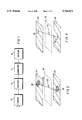
- FIG. 1 depicts the hardware components of the present invention
- FIG. 2 illustrates two dimensional searching during correspondence processing
- FIG. 3 depicts one dimensional searching during correspondence processing
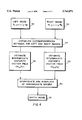
- FIG. 4 is a block diagram of the processes of the present invention.
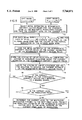
- FIG. 5 illustrates disparity vector field processing
- the present invention is designed to obtain images intermediate to a pair of stereo images so that a depth image, such as a lenticular or barrier image, can be created.
- the present invention as illustrated in FIG. 1, is implemented using conventional image processing equipment.
- the equipment includes one or more cameras 10 that captures stereo images on film.
- the film images are digitized by a conventional digitizer 12.
- An electronic camera can of course substitute for the film camera and digitizer.
- the digitizer images are supplied to a computer 14 which performs the process discussed herein to create intermediate images.
- the images are interlaced and provided to a display device 16.
- the display device 16 can be a CRT with a lenticular or barrier strip faceplate or it can be a print or transparency printer which produces a print to which a lenticular or barrier strip faceplate is attached.
- optical flow This vector field is commonly referred to as the optical flow (see Robot Vision, B. K. P. Horn, The MIT Press, 1991).
- One of the well-known characterizations of optical flow is that depth is inversely proportional to the magnitude of the optical flow vector. In this instance the zero parallax plane occurs in object space where the optical flow vectors have magnitude zero, i.e., points unaffected by the change of camera position, such as the background.
- the first step is to find correspondences between the pair of images 24 and 26.
- a vector or line 28 passing through the pixel 20 being created in the intermediate image is used to designate different areas on the images 24 and 26 are to be compared.
- the point of incidence on the images 24 and 26 can be systematically moved about two dimensional areas 30 and 32 searching for the areas that have the highest correlation in spectral and other image characteristics. Once these points are found the correspondences can be used to interpolate the value of the intermediate pixel 20.
- the correspondences between two images in two dimensions does not have a unique solution and, as a result, a search process as illustrated in FIG. 2 may not produce the best solution.
- the solution is not unique it is necessary to perform smoothing of the image to reduce or eliminate noise artifacts created in the intermediate image 22.
- the cameras used in obtaining the stereo image pair are assumed to be positioned parallel to the plane of the scene spanning the horizontal and vertical axes, and the changes in the camera positions are assumed to be strictly in the horizontal direction. It is assumed that the horizontal and the vertical axes of each image of the stereo image pair coincide with the horizontal and the vertical axes of the scene. Under these assumptions the correspondence between the images of the stereo image pair can be characterized by the intermediate disparity vector field with the constant vertical component relating to the alignment of the images and with the variable horizontal component relating to the depths of the corresponding points in the scene.
- each band of the right and the left digital images is defined as a two-dimensional array of numbers representing some measurements, known as pixels, taken from some grid of points ⁇ " on the sensed image. In the preferred embodiment, this grid is assumed to be a rectangular lattice.
- the right digital image 50 See FIG. 4 taken at the viewpoint t R and comprising of the spectral bands R 1 , . . .
- FIG. 4 the process of constructing the depth image consisting of the bands D 1 , . . . , D B is illustrated in FIG. 4 and can be described as follows.
- the intermediate disparity vector fields U 1 , V 1 ), . . . , (U K ,V K ) at some intermediate viewpoints t 1 , . . . , t K respectively are estimated 56 and 58.
- each band b 1, . . .
- the estimate of the intermediate image band I b ,k is obtained 60 by the interpolation process.
- the depth image band D b is constructed by interlacing the intermediate image bands I b ,l, . . . , I b ,K to produce the depth image 62.
- the method of estimating the intermediate disparity vector field (U k ,V k ) at the intermediate viewpoint t k is illustrated in FIG. 5 and can be described as the following multi-level resolution process: 1) Start 70 with the coarsest resolution level and the current estimate of the intermediate disparity vector field, (initially set to some constant); 2) Iteratively 72-82 improve the current estimate; 3) Project 84 to the next finer level of resolution to obtain the initial estimate of the intermediate disparity vector field at the next finer level which is taken as the current estimate of the intermediate disparity vector field; 4) Repeat steps 2) and 3) until the finest resolution level is reached.
- the proper estimate of the finest resolution level is taken as the final estimate of the intermediate disparity vector field.
- a system of nonlinear equations relative to the unknown current estimate of the intermediate disparity vector field is formed 76, then iterative improvement of the current estimate of the intermediate disparity vector field is achieved by solving 78 this system of nonlinear equations.
- the system of nonlinear equations relative to the unknown current estimate of the intermediate disparity vector field is defined in terms of the unknown current estimate of the intermediate disparity vector field, the quantities related to the right and to the left pixels and the generalized spatial partial derivatives of the right and the left images. These quantities are obtained by filtering each band of the right and the left images with filters ⁇ 1 , . . . ⁇ F and with the spatial partial derivatives of these filters.
- the symbol G is used for the set of indices with each index g ⁇ G specifying a particular band and a particular filter.
- the multi-level resolution process (See U.S. application Ser. No. 631,750 incorporated by reference herein) is built around a multi-level resolution pyramid meaning that on each coarser resolution level the filtered right and the filtered left images, their spatial partial derivatives and the estimates of the intermediate disparity vector fields are defined on subgrids of grids at a finer resolution level.
- the bands of the filtered right images, the spatial partial derivatives of the bands of the filtered right images, the bands of the filtered left images, and the spatial partial derivatives of the bands of the filtered left images are defined on the same grid of points ⁇ ' on the image plane of size N' by M'.
- the intermediate disparity vector fields are defined on a grid of points ⁇ on the image plane of size N by M.
- each index g ⁇ G specifying a particular filter and a particular image band form an optical flow function g t relative to a grid ⁇ as the difference between the estimated right filtered image band and the estimated left filtered image band.
- To obtain the estimated right filtered image band find the grid of image points ⁇ R which are the taken from the viewpoint t R estimated perspective projections onto the image plane of the visible points in the scene, whose perspective projections onto the image plane from the viewpoint t k are the grid points ⁇ ; and then interpolate the right filtered image from the grid of points ⁇ ' where the right filtered image is defined to the grid of points ⁇ R .
- the estimated left filtered image band is determined analogously.
- each image point of the grid ⁇ is shifted by the amount equal to the scaled by the factor (t R -t k )/(t R -t L ) value of the estimated intermediate disparity vector defined at that grid point.
- each image point of the grid ⁇ is shifted by the amount equal to the scaled by the factor (t k -t L )/(t R -t L ) value of the estimated intermediate disparity vector defined at that grid point.
- index g ⁇ G specifying a particular filter and a particular image band, form a spatial partial derivative g tu of the optical flow function g t with respect to the component u of the current estimate of the intermediate disparity vector corresponding to the index g as the defined on the grid ⁇ sum of the scaled by the factor (t R -t k )/(t R -t L ) spatial partial derivative of the estimated right filtered image band and the scaled by the factor (t k -t L )/(t R -t L ) spatial partial derivative of the estimated left filtered image band.
- the spatial partial derivative of the estimated right filtered image band To obtain the spatial partial derivative of the estimated right filtered image band, find the grid of image points ⁇ R which are taken from the viewpoint t R estimated perspective projections onto the image plane of the visible points in the scene, whose perspective projections onto the image plane from the viewpoint t k are the grid points ⁇ ; and then interpolate the spatial partial derivatives of the right filtered image from the grid of points ⁇ ' where the spatial partial derivative of the right filtered image is defined to the grid of points ⁇ R .
- each image point of the grid ⁇ is shifted by the amount equal to the scaled by the factor (t R -t k )/(t R -t L ) value of the estimated intermediate disparity vector defined at that grid point.
- each image point of the grid ⁇ is shifted by the amount equal to the scaled by the factor (t k -t L )/(t R -t L ) value of the estimated intermediate disparity vector defined at that grid point.
- index g ⁇ G specifying a particular filter and a particular image band, form a spatial partial derivative g tv of the optical flow function g t with respect to the component v of the current estimate of the intermediate disparity vector corresponding to the index g as the defined on the grid ⁇ sum of the scaled by the factor (t R -t k )/(t R -t L ) spatial partial derivative with respect to the vertical component of the image coordinate system of the estimated right filtered image band corresponding to the index g and the scaled by the factor (t k -t L )/(t R -t L ) spatial partial derivative with respect to the vertical component of the image coordinate system of the estimated left filtered image band corresponding to the index g.
- the spatial partial derivative with respect to the vertical component of the image coordinate system of the estimated right filtered image band find the grid of image points ⁇ R which are the taken from the viewpoint t R estimated perspective projections onto the image plane of the visible points in the scene, whose pespective projections onto the image plane from the viewpoint t k are the grid points ⁇ ; and then interpolate the spatial partial derivatives with respect to the vertical component of the image coordinate system of the right filtered image from the grid of points ⁇ ' where the spatial partial derivative with respect to the vertical component of the image coordinate system of the right filtered image is defined to the grid of points ⁇ R .
- the spatial partial derivative with respect to the vertical component of the image coordinate system of the estimated left filtered image band find the grid of image points ⁇ L which are taken from the viewpoint t L estimated perspective projections onto the image plane of the visible points in the scene, whose perspective projections onto the image plane from the viewpoint t k are the grid points ⁇ ; and then interpolate the spatial partial derivatives with respect to the vertical component of the image coordinate system of the left filtered image from the grid of points ⁇ ' where the spatial partial derivative with respect to the vertical component of the image coordinate system of the left filtered image is defined to the grid of points ⁇ L .
- each image point of the grid ⁇ is shifted by the amount equal to the scaled by the factor (t R -t k )/(t R -t L ) value of the estimated intermediate disparity vector defined at the grid point.
- each image point of the grid ⁇ is shifted by the amount equal to the scaled by the factor (t k -t L )/(t R -t L ) value of the estimated intermediate disparity vector defined at the grid point.
- Each non-boundary grid point of the rectangular grid ⁇ is surrounded by its eight nearest neighbors specifying eight different directions on the image plane. For each boundary grid point of the rectangular grid ⁇ the nearest neighbors are present only for some of these eight different directions.
- the symbol s is used to denote a vector on the image plane specifying one of these eight different directions on the image plane.
- the symbol S is used to denote the set of these eight vectors. For each vector s from the set S specifying a particular direction on the image plane, form a directional smoothness function (s, ⁇ u) for the variable horizontal component u of the current estimate of the intermediate disparity vector field as a finite difference approximation to the directional derivative of the horizontal component u of the current estimate of the intermediate disparity vector field.
- This directional smoothness function (s, ⁇ u) is defined on the rectangilar subgrid ⁇ s of the rectangular grid ⁇ with the property that every grid point of the rectangilar subgrid ⁇ s has the nearest in the direction s neighbor on the rectangular grid ⁇ .
- the directional smoothness function (s, ⁇ u) is equal to the difference between the value of the horizontal component u of the current estimate of the intermediate disparity vector field at the nearest in the direction s neighbor of this grid point and the value of the horizontal component u of the current estimate of the intermediate disparity vector field at this grid point.
- the system of nonlinear equations relative to the unknown current estimate of the intermediate disparity vector field is formed by combining the optical flow function g t and its spatial partial derivatives g tu , g tv for each filter and each image band specified by the index g ⁇ G together with the directional smoothness function (s, ⁇ u) for each image direction s ⁇ S and together with some constant parameters using four basic algebraic operations such as addition, subtraction, multiplication and division.
- the estimate of the intermediate digital image band I b ,k is defined as the sum of the scaled by the factor (t k -t L )/(t R -t L ) estimated right digital image band and the scaled by the factor (t R -t k )/(t R -t L ) estimated left digital image band.
- To obtain the estimated right digital image band find the grid of image points ⁇ R which are the taken from the viewpoint t R estimated perspective projections onto the image plane of the visible points in the scene, whose perspective projections onto the image plane from the viewpoint t k are the grid points ⁇ ; and then interpolate the right digital image band from the grid of points ⁇ " where the right digital image is defined to the grid of points ⁇ R .
- each image point of the grid ⁇ is shifted by the amount equal to the scaled by the factor (t R -t k )/(t R -t L ) value of the estimated intermediate disparity vector defined at that grid point.
- each image point of the grid ⁇ is shifted by the amount equal to the scaled by the factor (t k -t L )/(t R -t L ) value of the estimated intermediate disparity vector defined at that grid point.
- the initial images of a three-dimensional scene are, in general, discontinuous functions and their spatial partial derivatives are not defined at the points of discontinuity.
- the points of discontinuity are, often, among the most important points in the images and cannot be easily ignored.
- the initial images are treated as generalized functions and their partial derivatives as generalized partial derivatives.
- These generalized functions are defined on some subset of the set of infinitely differentiable functions. The functions from the subset are called "testing functions”.
- Parametric families of secondary images are then introduced through evaluations of the generalized functions associated with the initial images on the specific parametric family of functions taken from the set of testing functions.
- the secondary images are infinitely differentiable, and their partial derivatives can be obtained through evaluations of the generalized functions associated with the initial images on the partial derivatives of this specific parametric family of functions. This process can be described as follows.
- R is a one-dimensional Euclidean space
- image plane two-dimensional Euclidean space
- the value ⁇ (x,y,t) of the irradiance image function at the point (x,y) ⁇ R 2 and the viewpoint t ⁇ R is assumed to be roughly proportional to the radiance of the point in the scene being imaged, which projects to such a point (x,y) at the viewpoint t for every (x,y) ⁇ R 2 and every t ⁇ R.
- Different irradiance image functions ⁇ (x,y,t), (x,y,t) ⁇ R 3 (here R 3 is a three-dimensional Euclidean space) can be obtained by changing the following aspects of the image formation process: the direction of a light source illuminating the scene, the color of such a light source, and the spectral responsivity function that is used to compute the irradiance.
- each irradiance image function ⁇ (x,y,t) is locally integrable with respect to the Lebesgue measure dx dy dt in R 3 and thereby can be used to form a continuous linear functional ⁇ .sub. ⁇ (generalized function) defined on the locally convex linear topological space ⁇ (R 3 ).
- the space ⁇ (R 3 ) consists of all infinitely differentiable functions having compact supports in the set R 3 . This means that for each function ⁇ (R 3 ) there exists a closed bounded subset S.sub. ⁇ ⁇ R 3 such that the function ⁇ is equal to zero at the points that are outside the subset S.sub. ⁇ .
- the topology of the space ⁇ (R 3 ) is defined by a certain family of semi-norms.
- the functions ⁇ from the set ⁇ (R 3 ) will be called the "testing functions".
- the value of the generalized function ⁇ .sub. ⁇ associated with the irradiance image function ⁇ at the testing function ⁇ (R 3 ) is defined by the following relation: ##EQU1##
- the generalized function ⁇ .sub. ⁇ associated with different irradiance image functions ⁇ (x,y,t) are united into the family ⁇ .sub. ⁇
- the symbol ⁇ takes the role of the index (parameter) specifying the generalized function ⁇ .sub. ⁇ associated with a particular irradiance image function ⁇ (x,y,t) in addition to its role as a part of the notation for such an irradiance image function.
- the symbol ⁇ denotes the set of indices.
- Another way of constructing an initial image at a given viewpoint t ⁇ R is by identifying the set of points M(t).OR right.R 2 in the image plane, called the "feature points", where significant variations in the projected light patterns represented by the irradiance image functions take place at the viewpoint t, and then assigning feature value ⁇ (x.sub. ⁇ ,y.sub. ⁇ ,t.sub. ⁇ ) to each feature point (x.sub. ⁇ ,y.sub. ⁇ ,t.sub. ⁇ ) ⁇ M(t).
- the set of feature points ##EQU2## is assumed to be a closed subset of the space R 3 .
- the function ⁇ (x.sub. ⁇ ,y.sub. ⁇ ,t.sub. ⁇ ) defined on the set M as above will be called the "feature image function”.
- Different feature image functions ⁇ (x.sub. ⁇ ,y.sub. ⁇ ,t.sub. ⁇ ), (x.sub. ⁇ ,y.sub. ⁇ ,t.sub. ⁇ ) ⁇ M can be obtained by changing the criteria for selecting the set of feature points M and the criteria for assigning the feature value ⁇ (x.sub. ⁇ ,y.sub. ⁇ ,t.sub. ⁇ ).
- the set M may, for example, be a finite combination of the following four types of the subsets of the space R 3 : the three-dimensional regions, the two-dimensional regions, the one-dimensional contours, and the isolated points.
- family B.tbd.B(M) of "Borel subsets" of the set M shall be meant the members of the smallest ⁇ -finite, ⁇ -additive family of subsets of M which contains every compact set of M.
- ⁇ (B) be a ⁇ -finite, ⁇ -additive, and real-valued measure defined on the family B of Borel subsets of the set M.
- the feature image function ⁇ (x.sub. ⁇ ,y.sub. ⁇ ,t.sub. ⁇ ),(x.sub. ⁇ ,y.sub. ⁇ ,t.sub. ⁇ ) ⁇ M is assumed to be ⁇ -measurable and thereby can be used to form a continuous linear functional ⁇ .sub. ⁇ (generalized function) defined on the locally convex linear topological space ⁇ (R 3 ).
- the value of the generalized function ⁇ .sub. ⁇ associated with the feature image function ⁇ at the testing function ⁇ (R 3 ) is given by the following relation: ##EQU3##
- the generalized function ⁇ .sub. ⁇ associated with different feature image functions ⁇ (x.sub. ⁇ ,y.sub. ⁇ ,t.sub. ⁇ ) are united into the family ⁇ .sub. ⁇
- the symbol ⁇ takes the role of the index (parameter) specifying the generalized function ⁇ .sub. ⁇ associated with a particular feature image function ⁇ (x.sub. ⁇ ,y.sub. ⁇ ,t.sub. ⁇ ) in addition to its role as a part of the notation for such a feature image function.
- the symbol H denotes the set of indices.
- a "combined generalized initial image function” will be defined as a linear combination of the generalized partial derivatives of the generalized functions associated with the irradiance image functions and one of the generalized partial derivatives of the generalized functions associated with the feature image functions.
- ⁇ , ⁇ H ⁇ be a set of real-valued constants;
- g( ⁇ ) be an index attached to the set ⁇ ; and let m g ( ⁇ ) .tbd. ⁇ m.sub. ⁇ ,x,m.sub. ⁇ ,y,m.sub. ⁇ ,t,m.sub. ⁇ ,x,m.sub. ⁇ ,y,m.sub. ⁇ ,t
- ⁇ , ⁇ H ⁇ be a set of non-negative integer constants corresponding to the set of constants ⁇ .
- the combined generalized initial image function corresponding to the set of constants ⁇ is the generalized function ⁇ g ( ⁇ ) defined on the locally convex linear topological space ⁇ (R 3 ).
- the value of the combined generalized initial image function ⁇ g ( ⁇ ) corresponding to the set of constants ⁇ at the testing function ⁇ (R 3 ) is given by the relation ##EQU8## and is called the "observation" of the combined generalized initial image function ⁇ g ( ⁇ ) corresponding to the set of constants ⁇ on the testing function ⁇ .
- the combined generalized initial image functions ⁇ g ( ⁇ ) corresponding to sets of constants ⁇ with different values are united into the family ⁇ g ( ⁇ )
- the symbol ⁇ denotes the family of all different sets of constants ⁇
- the symbol g denotes the one-to-one mapping from the family ⁇ onto the set of indices denoted by the symbol G.
- the argument ⁇ appearing in the notation for a combined generalized initial image function is omitted and the symbol ⁇ g , g ⁇ G is used instead of the symbol ⁇ g ( ⁇ ), ⁇ to denote it.
- the points (x,y,t) from the set ⁇ T will be called “viewpoint-varying image points”.
- image corresponding to the parameter value ⁇ 1, ⁇ ) and taken at the viewpoint t ⁇ T is meant the collection, ⁇ g.sup. ⁇ (x,y,t)
- (x,y) ⁇ corresponding to every parameter value ⁇ 1, ⁇ ) and taken at a fixed viewpoint t ⁇ T will be called the "parametric image" taken at the viewpoint t.
- Each component g.sup. ⁇ (x,y,t), g ⁇ G of the parametric viewpoint-varying image function g.sup. ⁇ (x,y,t) is infinitely differentiable everywhere in the domain ⁇ T, and its partial derivatives with respect to the variables x, y, t can be obtained as observations of the combined generalized initial image function ⁇ g on the partial derivatives with respect to the parameters x, y, t of the testing function ⁇ .sup. ⁇ x ,y,t ⁇ (R 3 ) specified by the relation (2-4).
- g ⁇ G ⁇ of the parametric viewpoint-varying image function g.sup. ⁇ (x,y,t) are given as the observations ##EQU10## of the combined generalized initial image function ⁇ g on the testing functions ##EQU11## for every (x,y,t) ⁇ T, ⁇ 1, ⁇ ), where ##EQU12## and ⁇ x (x,y,t), ⁇ y (x,y,t) are the partial derivatives of the function ⁇ (x,
- the vector (u A (x,y,t, ⁇ t - , ⁇ t + ), v A (x,y,t, ⁇ t - , ⁇ t + )) can be defined only at those points (x,y) from the set R 2 that are projections of the points in the scene visible at the viewpoint t- ⁇ t - as well as the viewpoint t+ ⁇ t + .
- the collection of such image points will be denoted by the symbol ⁇ (t, ⁇ t - , ⁇ t + ).
- the set W(x,y,t, ⁇ t) will be defined from the relation ##EQU13## while the set W(x,y,t) will be defined as ##EQU14## where the symbol W(x,y,t, ⁇ t) means the topological closure of the set W(x,y,t, ⁇ t). It will be assumed that W(x,y,t) are single-element sets for almost every (x,y,t) ⁇ R 3 . This assumption means that the subset of the set R 3 containing the points (x,y,t), where the sets W(x,y,t) are not single-element sets, has a Lebesgue measure equal to zero.
- v.sup. ⁇ (x,y,t) of the velocity vector (u.sup. ⁇ (x,y,t),v.sup. ⁇ (x,y,t)) is independent of the image point (x,y) and therefore will be denoted as v.sup. ⁇ (t) while the velocity vector will be denoted as (u.sup. ⁇ (x,y,t),v.sup. ⁇ (t)).
- (x,y) ⁇ corresponding to the viewpoint t ⁇ T and to the parameter value of ⁇ 1, ⁇ ) will be called the "velocity vector field" of the image ⁇ g.sup. ⁇ (x,y,t)
- (x,y) ⁇ corresponding to every parameter value ⁇ 1, ⁇ ) and taken at a fixed viewpoint t ⁇ T will be called the "parametric velocity vector field" of the parametric image ⁇ g.sup. ⁇ (x,y,t)
- t 0 ' ⁇ t 1 ' ⁇ . . . ⁇ t k ' be a finite increasing sequence of viewpoints from some viewpoint interval T, and let t be a viewpoint from the same viewpoint interval T. Then the estimation problem can be formulated as follows. Given a sequence of parametric images ⁇ g.sup. ⁇ (x,y,t k ')
- K' which will be called the "parametric viewpoint-varying image sequence", and given the viewpoint t, find the parametric vector field ⁇ (u.sup. ⁇ (x,y,t),v.sup. ⁇ (t))
- the method of the present invention includes determining an estimate of the parametric velocity vector field corresponding to a given parametric viewpoint-varying image sequence.
- determining an estimate of the parametric velocity vector field corresponding to a given parametric viewpoint-varying image sequence In order for this determination to be possible, specific assumptions have to be made about the scene being imaged and about the imaging process itself. The assumptions we make are described in the following. Based on these assumptions constraints are imposed on the estimate of the parametric velocity vector field. The determination of the estimate is then reduced to solving the system of equations arising from such constraints for a given parametric viewpoint-varying image sequence.
- (x,y) ⁇ , ⁇ 1, ⁇ ) ⁇ is determined as the parametric vector field satisfying a set of constraints. These constraints are based on the following assumptions:
- the scene to be imaged is assumed to have near-constant and near-uniform illumination, which means that the changes in the incident illumination of each surface patch in the scene are small across the space, and are mainly due to the orientation of such surface patch relative to the light source.
- the irradiance ⁇ (x,y,t), ⁇ of each point (x,y) in the image plane R 2 at a viewpoint t ⁇ R is assumed to be roughly proportional to the radiance of the point in the scene projecting into the point (x,y) in the image plane at the viewpoint t, and the proportionality coefficient, to be independent of the location (x,y) and the viewpoint t.
- the scene is assumed to be made out of opaque objects.
- the criteria for selecting feature points (x.sub. ⁇ ,y.sub. ⁇ ,t.sub. ⁇ ) ⁇ M and the criteria for assigning feature values ⁇ (x.sub. ⁇ ,y.sub. ⁇ ,t.sub. ⁇ ), ⁇ H to each feature point (x.sub. ⁇ ,y.sub. ⁇ ,t.sub. ⁇ ) ⁇ M are assumed to represent the true properties of the objects and to be independent of the objects' spatial attitudes.
- the velocities of neighboring points of the objects in the scene are assumed to be similar, on one hand, and to change slowly with respect to viewpoint, on the other hand. In other words, it is assumed that the parametric viewpoint-varying velocity vector field of the surface points of each object in the scene varies smoothly across the space and across the viewpoint location.
- (x,y) ⁇ be an image point that is taken at the viewpoint t projection of some point in the scene that does not belong to the occluding boundaries.
- the occluding boundary of an object is defined as the points in the scene belonging to the portion of the object that projects to its silhouette.
- the optical flow and the directional smoothness constraints are not necessarily valid at the points near the occluding boundaries, even when the assumptions described at the beginning of this section are observed.
- the method of computing the estimate of the parametric velocity vector field of the present invention resolves the above difficulties by adjusting the weight associated with each constraint in such a way that it becomes small whenever the constraint is not valid.
- the functions (3-3), (3-11), (3-12), and (3-13), specifying the optical flow, directional smoothness, and regularization constraints are combined into the functional of the estimate of the parametric velocity vector field.
- the estimate is then computed by solving the system of nonlinear equations arising from a certain optimality criterion related to such functional.
- (x,y) ⁇ , ⁇ 1, ⁇ ) ⁇ is determined as the parametric vector field on which a weighted average of the optical flow, directional smoothness, and regularization constraints is minimized.
- each weight function associated with an optical flow constraint becomes small whenever the optical flow constraint is not satisfied
- each weight function associated with a smoothness constraint corresponding to a direction in which an occluding boundary is crossed becomes small whenever the directional smoothness constraint is not satisfied.
- each weight function has to be treated as if it were independent of the values of the unknown estimate of the parametric velocity vector field, because it only specifies a relative significance of the corresponding constraint as a part of the weighted average and not the constraint itself.
- two copies of the unknown estimate of the parametric velocity vector field are introduced: the invariable one, and the variable one.
- the invariable copy of the unknown estimate of the parametric velocity vector field are used, whereas in the constraint functions the values of the variable copy of the unknown estimate of the parametric velocity vector field are used.
- f(u,v,u,v) be a functional of the parametric vector fields (u,v),(u,v) defined as a weighted average of functions (3-3), (3-11), (3-12), and (3-13), specifying the optical flow, directional smoothness, and regularization constraints, respectively, by the following relation: ##EQU20##
- the estimate of the parametric velocity vector field is then defined as the parametric vector field (u,v), on which the functional f(u,v,u,v), considered as the function of the parametric vector field (u,v) and depending on the parametric vector field (u, v) as on the parameters, achieves a local minimum when the value of the parametric vector field (u,v) is identically equal to the value of the parametric vector field (u, v).
- the functional f(u,v,u,v) can be expressed in the form f(u,v,u+ ⁇ u,v+ ⁇ v).
- the parametric vector field ( ⁇ u, ⁇ v) specifies a perturbation to the parametric vector field (u,v), and the functional f(u,v,u+ ⁇ u,v+ ⁇ v) assigns the cost to each choice of the parametric vector field (u,v) and its perturbation ( ⁇ u, ⁇ v). Then the estimate of the parametric velocity vector field is the parametric vector field (u,v), for which a locally minimal cost is achieved when the perturbation ( ⁇ u, ⁇ v) is identically equal to zero.
- the above defined estimate (u,v) of the parametric velocity vector field is a solution of the system of equations ##EQU22##
- the functions g tu .sup. ⁇ (x,y,t,u.sup. ⁇ ,v.sup. ⁇ ) and g tv .sup. ⁇ (x,y,t,u.sup. ⁇ ,v.sup. ⁇ ) are the first-order partial derivatives of the function g t .sup. ⁇ (x,y,t,u.sup. ⁇ ,v.sup. ⁇ ) with respect to the components u.sup. ⁇ .tbd.u.sup. ⁇ (x,y,t) and v.sup. ⁇ .tbd.v.sup. ⁇ (t) of the estimate of the velocity vector.
- each of the weight functions ⁇ s .sup. ⁇ (x,y,t,u.sup. ⁇ ,v.sup. ⁇ , (s, ⁇ u.sup. ⁇ )), s ⁇ S will be chosen so that the contributions of the directional smoothness constraint (s, ⁇ u.sup. ⁇ (x,y,t)) to the functional (4-5) become small for every image point (x,y) ⁇ located near the occluding boundary where the occluding boundary is crossed in the direction s and the directional smoothness constraint (s, ⁇ u.sup. ⁇ (x,y,t)) is not satisfied.
- the image point (x,y) ⁇ be near the occluding boundary; then the following two events are likely to happen:
- the first point is the one projecting into the image point (x- ⁇ t - (u.sup. ⁇ (x,y,t)+ ⁇ u.sup. ⁇ (x,y,t)),y- ⁇ t - (v.sup. ⁇ (t)+ ⁇ v.sup. ⁇ (t))) at the viewpoint (t- ⁇ t - )
- the second point is the one projecting into the image point (x+ ⁇ t + (u.sup. ⁇ (x,y,t)+ ⁇ u.sup. ⁇ (x,y,t)),y+ ⁇ t + (v.sup. ⁇ (t)+ ⁇ v.sup. ⁇ (t)))) at the viewpoint (t+ ⁇ t + ).
- the first point is the one projecting into the image point (x- ⁇ t - (u.sup. ⁇ (x,y,t)- ⁇ u.sup. ⁇ (x,y,t)),y- ⁇ t - (v.sup. ⁇ (t)- ⁇ v.sup. ⁇ (t))) at the viewpoint (t- ⁇ t - )
- the second point is the one projecting into the image point (x+ ⁇ t + (u.sup. ⁇ (x,y,t)- ⁇ u.sup. ⁇ (x,y,t)),y+ ⁇ t + (v.sup. ⁇ (t)- ⁇ v.sup. ⁇ (t))) at the viewpoint (t+ ⁇ t + ) (see FIG.
- the functions g tu .sup. ⁇ (x,y,t,u.sup. ⁇ ,v.sup. ⁇ ) and g tv .sup. ⁇ (x,y,t,u.sup. ⁇ ,v.sup. ⁇ ) are the first-order partial derivatives of the function g t .sup. ⁇ (x,y,t,u.sup. ⁇ ,v.sup. ⁇ ) with respect to the components u.sup. ⁇ and v.sup. ⁇ of the estimate of the velocity vector.
- the image point (x,y) does not necessarily lie near the occluding boundary. It may, for example, lie on the object of the scene whose projection onto the image plane undergoes a rotation or a local deformation.
- the image point (x,y) doe snot necessarily cross the occluding boundary in the direction s. It may, for example, cross the radiance boundary arising from a texture or a sudden change in he illumination.
- each of the weight functions ⁇ .sup. ⁇ g .sbsb.t (x,y,t,u.sup. ⁇ ,v.sup. ⁇ ,
- )g t ⁇ G t should be a steadily decreasing function relative to the absolute value of the function g t .sup. ⁇ (x,y,t,u.sup. ⁇ ,v.sup. ⁇ ) and to the values of the function
- the function (4-9) is required to increase whenever the function (g.sup. ⁇ t (x,y,t,u.sup. ⁇ ,v.sup. ⁇ )) 2 is increased.
- the function (4-10) is required to increase whenever the function (s, ⁇ u.sup. ⁇ (x,y,t)) 2 is increased.
- the values of the estimates of the velocity vector field corresponding to the different values of the parameter ⁇ are tied together by imposing the following restriction: the estimate of the parametric velocity vector field ⁇ (u.sup. ⁇ (x,y,t,v.sup. ⁇ (t))
- (x,y) ⁇ , ⁇ 1, ⁇ ) ⁇ are imposed in the form of the boundary conditions as follows:
- (x,y) ⁇ , ⁇ 1, ⁇ ) ⁇ is required to converge to the vector field that is identically equal to a given vector constant (u.sup. ⁇ ,v.sup. ⁇ ) when the parameter ⁇ converges to ⁇ , and such convergence is required to be uniform over the set of the image points ⁇ .
- ⁇ 1, ⁇ be a given parameter value, and let ⁇ be an infinitesimal positive real value.
- (x,y) ⁇ ) corresponding to the parameter value ⁇ can be defined as follows: (u 0 .sup. ⁇ (x,y,t),v 0 .sup. ⁇ (t)) ⁇ (u.sup. ⁇ + ⁇ (x,y,t),v.sup. ⁇ + ⁇ (t),(x,y) ⁇ (4-14)
- optical flow constraint g t .sup. ⁇ (x,y,t,u.sup. ⁇ ,v.sup. ⁇ ) corresponding to the index g t ⁇ G t ) is represented in the system of nonlinear equations (4-19) by the expression ##EQU31## With respect to this expression the following cases can be considered:
- the function (4-22) achieves its maximal value ##EQU33## when the value of the function (g t .sup. ⁇ (x,y,t,u.sup. ⁇ ,v.sup. ⁇ )) 2 is equal to the value of the function r 2 /(p 2 +q 2
- the occluding object may artificially constrain the estimate (u.sup. ⁇ (x,y,t),v.sup. ⁇ (t)) in the direction orthogonal to the occluding boundary. Then the optical flow constraint may react by shifting the estimate (u.sup. ⁇ (x,y,t),v.sup. ⁇ (t)) of the velocity vector in the direction parallel to the occluding boundary to reduce the absolute value of the function g t .sup. ⁇ (x,y,t,u.sup. ⁇ ,v.sup. ⁇ ). This, in turn, may increase the value of the function
- the estimate (u.sup. ⁇ (x,y,t),v.sup. ⁇ (t)) may diverge as the result of nonlinearity of the optical flow constraint or as the result of the noise present in the images.
- the function (4-25) achieves its maximal value ##EQU36## when the value of the function (s, ⁇ u.sup. ⁇ (x,y,t)) 2 is equal to the value of the function a 2 /(c 2 +b 2 (s, ⁇ 'g t .sup. ⁇ (x,y,t,u.sup. ⁇ ,v.sup. ⁇ )) 2 ).
- Such an action reflects the fact that in this case the image point (x,y) is likely to cross the occluding boundary in the direction s if the value of the function (s, ⁇ u.sup. ⁇ (x,y,t)) 2 specifying the degree of the smoothness of the estimate of the velocity vector field in such a direction s is large.
- the role of the regularization constraint is to discriminate between the parametric vector fields (u, v) giving the same optimal values to the weighted average of the optical flow and the directional smoothness constraints without causing any significant changes in these values. This is achieved by assigning small values to the parameters ⁇ u and ⁇ v appearing in the system of nonlinear equations (4-19). For the sake of simplicity of the analysis given below, we shall ignore the regularization constraints by assuming that the parameters ⁇ u and ⁇ v are equal to zero while keeping in mind that the solution of the system of nonlinear equations (4-19) is locally unique.
- the parameter r 2 defines the coefficient of proportionality for the functions g t .sup. ⁇ (x,y,t,u.sup. ⁇ ,v.sup. ⁇ ),g t ⁇ G t specifying the optical flow constraints, while the parameter a 2 determines the proportionality coefficient for the function (s, ⁇ u.sup. ⁇ (x,y,t)),s ⁇ S specifying the directional smoothness constraints.
- the combination (4-24) of the parameters r 2 , p 2 , and q 2 determines the upper limit for the influence of the optical flow constraints on the solution of the system of nonlinear equations (4-19), while the combination (4-27) of the parameters a 2 , c 2 and b 2 g .sbsb.t,g t ⁇ G t determines the upper limit for the influence of the directional smoothness constraints on the solution of the system of nonlinear equations (4-19).
- the symbols g t .sup. ⁇ , g tu .sup. ⁇ , g tv .sup. ⁇ , g t .sup. ⁇ have been used instead of the symbols g t .sup. ⁇ , g tu .sup. ⁇ , g tv .sup. ⁇ , g t .sup. ⁇ to indicate that at every image point (x,y) ⁇ the corresponding functions depend on the estimate (u.sup. ⁇ (x,y,t),v.sup. ⁇ (t)) of the velocity vector (u.sup. ⁇ (x,y,t),v.sup. ⁇ (t)).
- the iterative updating scheme can be used.
- the improved estimate (u + .sup. ⁇ ,v + .sup. ⁇ ) ⁇ (u + .sup. ⁇ (x,y,t),v + .sup. ⁇ (t))
- the scaler parameter ⁇ defines the length of the step
- (x,y) ⁇ defines the direction of the step.
- the step length ⁇ (0,1! is selected in such a way that the following function is minimized:
- the step direction ( ⁇ u.sup. ⁇ , ⁇ v.sup. ⁇ ) is selected in such a way that the function (5-10) becomes steadily decreasing for sufficiently small values of ⁇ (0,1!.
- the improved estimate (u + .sup. ⁇ ,v + .sup. ⁇ ) is taken as the current estimate (u.sup. ⁇ ,v.sup. ⁇ ) of the solution of the system of nonlinear equations (5-7) corresponding to the parameter value ⁇ , and the step (5-9) of the iterative updating scheme is repeated to determine the next improved estimate (u + .sup. ⁇ ,v + .sup. ⁇ ) of the solution of the system of nonlinear equations (5-7) corresponding to the parameter value ⁇ .
- the nonlinear operator F.sup. ⁇ can be linearly expanded as
- the improved estimate (u + .sup. ⁇ ,v + .sup. ⁇ ) of the solution of the system of nonlinear equations (5-7), which is obtained as the result of solving the system of linear equations (5-13) and then applying the relation (5-9), is not necessarily a better estimate.
- the reason behind it comes from the fact that the Jacobian J.sup. ⁇ (u.sup. ⁇ ,v.sup. ⁇ ) of the nonlinear operator F.sup. ⁇ (u.sup. ⁇ ,v.sup. ⁇ ) is nonsymmetric and ill-conditioned, so that the system of linear equations (5-13) cannot be reliably solved for the vector field ( ⁇ u.sup. ⁇ , ⁇ v.sup. ⁇ ).
- This quasi-Newton method defines the regularization of the system of nonlinear equations (5-7) that is meaningful for the problem of estimating the parametric velocity vector field.
- F.sub. ⁇ .sup. ⁇ (u.sup. ⁇ ,v.sup. ⁇ ,u.sup. ⁇ ,v.sup. ⁇ ), ⁇ 0,1!, be a family of nonlinear operators of the invariable copy (u.sup. ⁇ ,v.sup. ⁇ ) and of the variable copy (u.sup. ⁇ ,v.sup. ⁇ ) of the estimate of the velocity vector field corresponding to the parameter value ⁇ defined by the relation ##EQU41## where the symbols g t .sup. ⁇ ,g tu .sup. ⁇ ,g tv .sup. ⁇ ,g t .sup. ⁇ are used to indicate that at every image point (x,y) ⁇ the corresponding functions depend on the invariable copy (u.sup. ⁇ (x,y,t), v.sup. ⁇ (t)) of the estimate of the velocity vector (u.sup. ⁇ (x,y,t),v.sup. ⁇ (t)), while the symbol g t
- variable copy (u.sup. ⁇ ,v.sup. ⁇ ) of the estimate of the velocity vector field is identically equal to the invariable copy (u.sup. ⁇ ,v.sup. ⁇ ) of the estimate of the velocity vector field, then for every ⁇ 0,1! the nonlinear operator F.sub. ⁇ .sup. ⁇ (u.sup. ⁇ ,v.sup. ⁇ ,u.sup. ⁇ ,v.sup. ⁇ ) is identically equal to the nonlinear operator F.sup. ⁇ (u.sup. ⁇ ,v.sup. ⁇ ).
- the parameter ⁇ defines the degree of the feedback relaxation of the optical flow and the directional smoothness constraints through the variable copy (u.sup. ⁇ ,v.sup. ⁇ ) of the estimate of the velocity vector field.
- M.sub. ⁇ .sup. ⁇ (u.sup. ⁇ ,v.sup. ⁇ )( ⁇ u.sup. ⁇ , ⁇ v.sup. ⁇ ),.theta. ⁇ 0,1! be a family of the linear and bounded with respect to the vector field ( ⁇ u.sup. ⁇ , ⁇ v.sup. ⁇ ) operators, where for each ⁇ 0,1!
- the operator M.sub. ⁇ .sup. ⁇ (u.sup. ⁇ ,v.sup. ⁇ )( ⁇ u.sup. ⁇ , ⁇ v.sup. ⁇ ) is the Jacobian of the nonlinear operator F.sub. ⁇ .sup. ⁇ (u.sup. ⁇ ,v.sup. ⁇ ,u.sup. ⁇ ,v.sup. ⁇ ), considered as the function of the vector field (u.sup. ⁇ ,v.sup. ⁇ ), and depending on the vector field (u.sup. ⁇ ,v.sup. ⁇ ) as on the parameter, under the conditions that the vector field (u.sup. ⁇ ,v.sup. ⁇ ) is identically equal to the vector field (u.sup. ⁇ ,v.sup. ⁇ ).
- the operator M.sup. ⁇ (u.sup. ⁇ ,v.sup. ⁇ )( ⁇ u.sup. ⁇ , ⁇ v.sup. ⁇ ) is defined as the member of the family M.sub. ⁇ .sup. ⁇ (u.sup. ⁇ ,v.sup. ⁇ )( ⁇ u.sup. ⁇ , ⁇ v.sup. ⁇ ),.theta. ⁇ 0,1! satisfying the following requirements:
- the vector field ( ⁇ u.sup. ⁇ , ⁇ v.sup. ⁇ ) obtained as the solution of the system of linear equations (5-14) is required to be a descent direction for the functional h(u.sup. ⁇ ,v.sup. ⁇ ,u.sup. ⁇ ,v.sup. ⁇ ), considered as the function of the vector field (u.sup. ⁇ ,v.sup. ⁇ ), and depending on the vector field (u.sup. ⁇ ,v.sup. ⁇ ) as on the parameter, under the conditions that the vector field (u.sup. ⁇ ,v.sup. ⁇ ) be identically equal to the vector field (u.sup. ⁇ ,v.sup. ⁇ ).
- the first-order partial with respect to the variable ⁇ derivative of the functional h(u.sup. ⁇ ,v.sup. ⁇ ,u.sup. ⁇ + ⁇ u.sup. ⁇ ,v.sup. ⁇ + ⁇ v.sup. ⁇ ) considered as the function of the scalar variable ⁇ is required to be negative when the value of such variable ⁇ is equal to 0. It is not difficult to see that the value of this derivative is equal to
- the operator M.sup. ⁇ (u.sup. ⁇ ,v.sup. ⁇ )( ⁇ u.sup. ⁇ , ⁇ v.sup. ⁇ ) is required to be the nearest possible approximation to the Jacobian J.sup. ⁇ (u.sup. ⁇ ,v.sup. ⁇ )( ⁇ u.sup. ⁇ , ⁇ v.sup. ⁇ ) of the nonlinear operator F.sup. ⁇ (u.sup. ⁇ ,v.sup. ⁇ ).
- Z is the set of integers ; h'.sub. ⁇ ,1,h'.sub. ⁇ ,2 are two-dimensional real vectors; and i 1 h'.sub. ⁇ ,1 +i 2 h'.sub. ⁇ ,2 is a linear combination of such vectors with integer coefficients i 1 ,i 2 .
- the points from the set R 2 (h'.sub. ⁇ ,1,h'.sub. ⁇ ,2) will be called the “sampling points" corresponding to the parameter ⁇ ; the functions ⁇ , ⁇ will be called the “sampled irradiance image functions"; and the functions ⁇ , ⁇ H will be called the “sampled feature image functions".
- the generalized functions ⁇ .sub. ⁇ , ⁇ associated with the sampled irradiance image functions ⁇ .sub. ⁇ , ⁇ and the generalized functions ⁇ .sub. ⁇ , ⁇ associated with the sampled feature image functions ⁇ .sub. ⁇ , ⁇ H are defined on the set of testing functions ⁇ (R 3 ) as follows.
- the value of the generalized function ⁇ .sub. ⁇ , ⁇ associated with the sampled irradiance image function ⁇ .sub. ⁇ at the testing function ⁇ (R 3 ) is given by the relation ##EQU45##
- the value of the generalized function ⁇ .sub. ⁇ , ⁇ associated with the sampled feature image function ⁇ 86 at the testing function ⁇ (R 3 ) is given by the relation ##EQU46##
- ⁇ ,.eta. ⁇ H ⁇ be a set of real-valued constants
- leg g( ⁇ ) be an index attached to the set ⁇
- ⁇ , ⁇ H ⁇ be a set of non-negative integer constants corresponding to the set of constants ⁇ .
- the "combined generalized sampled image function" corresponding to the index g ⁇ g( ⁇ ) is the generalized function ⁇ g , ⁇ defined on the locally convex linear topological space ⁇ (R 3 ).
- the value of the combined generalized sampled image function ⁇ g , ⁇ at the testing function ⁇ (R 3 ) is given by the relation ##EQU47## and is called the "observation" of the combined generalized sampled image function ⁇ g , ⁇ on the testing function ⁇ .
- such grids of points constitute a pyramid on the image plane which means that the following relation is satisfied:
- the "grid rotation method” is the sampling method that complies with the above requirements. It is commonly used to obtain numerical solutions of partial differential equations.
- f(x,y,t,s) is a function of the variables (x,y) ⁇ ,t ⁇ T,s ⁇ S, which is continuously differentiable with respect to the variables (x,y) ⁇ for every fixed value of the variables t ⁇ T,s ⁇ S.
- the unit circle making up the set S is replaced by a finite set, denoted by the same symbol S, of the set R 2 (h 94 ,1,h.sub. ⁇ ,2) having the following properties: the set S does not contain the origin, and for every element S belonging to the set S the element -s also belongs to the set S.
- the measure ds is replaced with the point measure associating the value 0.5 to every element s ⁇ S.
- ⁇ s is a real positive constant depending on the length of the vector s as a parameter, and the values s x ,s y are the components of the vector s ⁇ (s x ,s y ).
- the functions appearing under the summation over the set S sign are evaluated at the points (x+0.5s x ,y+0.5s y ,t), while the rest of the functions are evaluated at the points (x,y,t) for every (x,y) ⁇ R 2 (h.sub. ⁇ ,1,h.sub. ⁇ ,2),t ⁇ T,s ⁇ (s x ,s y ).epsilon.S.
- the functions g t .sup. ⁇ ,g tu .sup. ⁇ ,g tv .sup. ⁇ are defined, respectively, by the relations ##EQU55##
- 2 is defined as in the relation ##EQU56##
- the function (s, ⁇ u.sup. ⁇ ) is defined by the relations
- the value of the estimate of the velocity vector (u.sup. ⁇ (x+s x ,y+s y ,t),v.sup. ⁇ (t)) is defined to be identically equal to the value of the estimate of the velocity vector (u.sup. ⁇ (x,y,t),v.sup. ⁇ (t)).
- the system of linear equations (6-28) is symmetric and positive definite. As shown below, the system of linear equations (6-28) can be partitioned into two systems, one of which can be directly inverted. Based on these properties a fast preconditioned iterative method is constructed. If we introduce an ordering on the set ⁇ (h.sub. ⁇ ,1,h.sub. ⁇ ,2), then the system of linear equations (6-28) can be expressed in the matrix notation as
- T is the transpose vector of the row-vector ( ⁇ u.sup. ⁇ , ⁇ v.sup. ⁇ ), corresponding to the vector field ⁇ (u.sup. ⁇ (x,y,t), ⁇ v.sup. ⁇ (t))
- the "natural ordering" on the set ⁇ (h.sub. ⁇ ,1,h.sub. ⁇ ,2) can be defined as follows.
- the relations (6-2) and (6-22) imply that every element (x,y) ⁇ (h.sub. ⁇ ,1,h.sub. ⁇ , 2 ) can be uniquely represented in the form (x,y) ⁇ i 1 h.sub. ⁇ ,1 +i 2 h.sub. ⁇ ,2 where i 1 , and i 2 are integer numbers.
- G.sup. ⁇ (u.sup. ⁇ ,v.sup. ⁇ ) be a matrix defined as in the relation
- the initial approximation ( ⁇ u 0 .sup. ⁇ , ⁇ v 0 94 ) to the solution of the system of linear equations (7-7) is defined to be identically equal to zero.
- the approximation ( ⁇ u n+1 .sup. ⁇ , ⁇ v n+1 94 ) is defined in terms of the approximation ( ⁇ u n .sup. ⁇ , ⁇ v n 94 ) as in the relation
- the conjugate gradient method can be expressed in the alternative form
- the five level resolution pyramid was used with the value of the parameter ⁇ decreasing by a factor of 2.0 for each successively finer resolution level.
- a none-points finite-difference discretization was used.
- the positive integer constant k' appearing in the relations (6-9), (6-10) is equal to 4, while the positive integer constant k" appearing in the relations (6-20), (6-21) is equal to 2.
- the present invention is capable of estimating the velocity vector field with good accuracy in the case of the images of real world scenes containing multiple occluding boundaries.
Landscapes
- Engineering & Computer Science (AREA)
- Computer Vision & Pattern Recognition (AREA)
- Physics & Mathematics (AREA)
- General Physics & Mathematics (AREA)
- Theoretical Computer Science (AREA)
- Processing Or Creating Images (AREA)
- Stereoscopic And Panoramic Photography (AREA)
- Image Processing (AREA)
- Image Generation (AREA)
- Editing Of Facsimile Originals (AREA)
- Image Analysis (AREA)
Priority Applications (3)
| Application Number | Priority Date | Filing Date | Title |
|---|---|---|---|
| US08/141,157 US5764871A (en) | 1993-10-21 | 1993-10-21 | Method and apparatus for constructing intermediate images for a depth image from stereo images using velocity vector fields |
| EP94116485A EP0650145A3 (de) | 1993-10-21 | 1994-10-19 | Verfahren und Gerät zum Aufbau von Zwischenbildern für ein Tiefenbild aus Stereobildern. |
| JP6282980A JPH07210686A (ja) | 1993-10-21 | 1994-10-21 | ステレオ画像から奥行き画像のための中間画像を構成する方法および装置 |
Applications Claiming Priority (1)
| Application Number | Priority Date | Filing Date | Title |
|---|---|---|---|
| US08/141,157 US5764871A (en) | 1993-10-21 | 1993-10-21 | Method and apparatus for constructing intermediate images for a depth image from stereo images using velocity vector fields |
Publications (1)
| Publication Number | Publication Date |
|---|---|
| US5764871A true US5764871A (en) | 1998-06-09 |
Family
ID=22494436
Family Applications (1)
| Application Number | Title | Priority Date | Filing Date |
|---|---|---|---|
| US08/141,157 Expired - Lifetime US5764871A (en) | 1993-10-21 | 1993-10-21 | Method and apparatus for constructing intermediate images for a depth image from stereo images using velocity vector fields |
Country Status (3)
| Country | Link |
|---|---|
| US (1) | US5764871A (de) |
| EP (1) | EP0650145A3 (de) |
| JP (1) | JPH07210686A (de) |
Cited By (34)
| Publication number | Priority date | Publication date | Assignee | Title |
|---|---|---|---|---|
| WO1998047061A3 (en) * | 1997-04-15 | 1999-02-18 | Interval Research Corp | Data processing system and method for determining and analyzing correspondence information for a stereo image |
| US5936639A (en) * | 1997-02-27 | 1999-08-10 | Mitsubishi Electric Information Technology Center America, Inc. | System for determining motion control of particles |
| US6005987A (en) * | 1996-10-17 | 1999-12-21 | Sharp Kabushiki Kaisha | Picture image forming apparatus |
| US6061066A (en) * | 1998-03-23 | 2000-05-09 | Nvidia Corporation | Method and apparatus for creating perspective correct graphical images |
| US6192145B1 (en) * | 1996-02-12 | 2001-02-20 | Sarnoff Corporation | Method and apparatus for three-dimensional scene processing using parallax geometry of pairs of points |
| US6195475B1 (en) * | 1998-09-15 | 2001-02-27 | Hewlett-Packard Company | Navigation system for handheld scanner |
| US6215899B1 (en) * | 1994-04-13 | 2001-04-10 | Matsushita Electric Industrial Co., Ltd. | Motion and disparity estimation method, image synthesis method, and apparatus for implementing same methods |
| US6226407B1 (en) * | 1998-03-18 | 2001-05-01 | Microsoft Corporation | Method and apparatus for analyzing computer screens |
| US6252974B1 (en) * | 1995-03-22 | 2001-06-26 | Idt International Digital Technologies Deutschland Gmbh | Method and apparatus for depth modelling and providing depth information of moving objects |
| US6263100B1 (en) * | 1994-04-22 | 2001-07-17 | Canon Kabushiki Kaisha | Image processing method and apparatus for generating an image from the viewpoint of an observer on the basis of images obtained from a plurality of viewpoints |
| US6330353B1 (en) * | 1997-12-18 | 2001-12-11 | Siemens Corporate Research, Inc. | Method of localization refinement of pattern images using optical flow constraints |
| US20030012410A1 (en) * | 2001-07-10 | 2003-01-16 | Nassir Navab | Tracking and pose estimation for augmented reality using real features |
| US6526157B2 (en) * | 1997-08-01 | 2003-02-25 | Sony Corporation | Image processing apparatus, image processing method and transmission medium |
| US6567083B1 (en) * | 1997-09-25 | 2003-05-20 | Microsoft Corporation | Method, system, and computer program product for providing illumination in computer graphics shading and animation |
| US6587601B1 (en) * | 1999-06-29 | 2003-07-01 | Sarnoff Corporation | Method and apparatus for performing geo-spatial registration using a Euclidean representation |
| US20040135886A1 (en) * | 1996-12-11 | 2004-07-15 | Baker Henry H | Moving imager camera for track and range capture |
| US20040223051A1 (en) * | 1999-09-16 | 2004-11-11 | Shmuel Peleg | System and method for capturing and viewing stereoscopic panoramic images |
| US20040257451A1 (en) * | 2003-06-20 | 2004-12-23 | Toshinori Yamamoto | Image signal processing apparatus |
| US20050280892A1 (en) * | 2004-05-28 | 2005-12-22 | Nobuyuki Nagasawa | Examination method and examination apparatus |
| US20060038879A1 (en) * | 2003-12-21 | 2006-02-23 | Kremen Stanley H | System and apparatus for recording, transmitting, and projecting digital three-dimensional images |
| US20070150111A1 (en) * | 2005-11-04 | 2007-06-28 | Li-Wei Wu | Embedded network-controlled omni-directional motion system with optical flow based navigation |
| US20080049100A1 (en) * | 2006-08-24 | 2008-02-28 | Real D | Algorithmic interaxial reduction |
| US20090316994A1 (en) * | 2006-10-02 | 2009-12-24 | Faysal Boughorbel | Method and filter for recovery of disparities in a video stream |
| US20100053324A1 (en) * | 2008-09-02 | 2010-03-04 | Samsung Electronics Co. Ltd. | Egomotion speed estimation on a mobile device |
| US20100215248A1 (en) * | 2005-12-21 | 2010-08-26 | Gianluca Francini | Method for Determining Dense Disparity Fields in Stereo Vision |
| US20100284606A1 (en) * | 2009-05-08 | 2010-11-11 | Chunghwa Picture Tubes, Ltd. | Image processing device and method thereof |
| US20100286968A1 (en) * | 2008-03-28 | 2010-11-11 | Parashkevov Rossen R | Computing A Consistent Velocity Vector Field From A Set of Fluxes |
| CN102520574A (zh) * | 2010-10-04 | 2012-06-27 | 微软公司 | 飞行时间深度成像 |
| US20120237114A1 (en) * | 2011-03-16 | 2012-09-20 | Electronics And Telecommunications Research Institute | Method and apparatus for feature-based stereo matching |
| US20130058564A1 (en) * | 2011-09-07 | 2013-03-07 | Ralf Ostermann | Method and apparatus for recovering a component of a distortion field and for determining a disparity field |
| US20130236055A1 (en) * | 2012-03-08 | 2013-09-12 | Casio Computer Co., Ltd. | Image analysis device for calculating vector for adjusting a composite position between images |
| US20150254864A1 (en) * | 2014-03-07 | 2015-09-10 | Thomson Licensing | Method and apparatus for disparity estimation |
| US9183461B2 (en) | 2012-05-11 | 2015-11-10 | Intel Corporation | Systems and methods for row causal scan-order optimization stereo matching |
| US9883162B2 (en) | 2012-01-18 | 2018-01-30 | Panasonic Intellectual Property Management Co., Ltd. | Stereoscopic image inspection device, stereoscopic image processing device, and stereoscopic image inspection method |
Families Citing this family (3)
| Publication number | Priority date | Publication date | Assignee | Title |
|---|---|---|---|---|
| JP2009516864A (ja) * | 2005-11-23 | 2009-04-23 | コーニンクレッカ フィリップス エレクトロニクス エヌ ヴィ | マルチビューディスプレイ装置のためのビューの描画 |
| JP4608563B2 (ja) * | 2008-03-26 | 2011-01-12 | 富士フイルム株式会社 | 立体画像表示装置および方法並びにプログラム |
| EP2393298A1 (de) * | 2010-06-03 | 2011-12-07 | Zoltan Korcsok | Verfahren und Vorrichtung zur Erzeugung mehrfacher Bildansichten für eine autostereoskopische Anzeigevorrichtung mit Mehrfachansicht |
Citations (22)
| Publication number | Priority date | Publication date | Assignee | Title |
|---|---|---|---|---|
| US4170415A (en) * | 1977-07-15 | 1979-10-09 | The United States Of America As Represented By The Secretary Of The Interior | System for producing orthophotographs |
| US4704627A (en) * | 1984-12-17 | 1987-11-03 | Nippon Hoso Kyokai | Stereoscopic television picture transmission system |
| US4781435A (en) * | 1985-09-19 | 1988-11-01 | Deutsche Forschungs- Und Versuchsanstalt Fur Luft- Und Raumfahrt E.V. | Method for the stereoscopic representation of image scenes with relative movement between imaging sensor and recorded scene |
| US4837616A (en) * | 1987-06-19 | 1989-06-06 | Kabushiki Kaisha Toshiba | Image processing apparatus suitable for measuring depth of given point with respect to reference point using two stereoscopic images |
| US4870600A (en) * | 1986-06-11 | 1989-09-26 | Kabushiki Kaisha Toshiba | Three-dimensional image display system using binocular parallax |
| US4875034A (en) * | 1988-02-08 | 1989-10-17 | Brokenshire Daniel A | Stereoscopic graphics display system with multiple windows for displaying multiple images |
| US4894776A (en) * | 1986-10-20 | 1990-01-16 | Elscint Ltd. | Binary space interpolation |
| US4899295A (en) * | 1986-06-03 | 1990-02-06 | Quantel Limited | Video signal processing |
| US4940972A (en) * | 1987-02-10 | 1990-07-10 | Societe D'applications Generales D'electricite Et De Mecanique (S A G E M) | Method of representing a perspective image of a terrain and a system for implementing same |
| US4965753A (en) * | 1988-12-06 | 1990-10-23 | Cae-Link Corporation, Link Flight | System for constructing images in 3-dimension from digital data to display a changing scene in real time in computer image generators |
| US4965840A (en) * | 1987-11-27 | 1990-10-23 | State University Of New York | Method and apparatus for determining the distances between surface-patches of a three-dimensional spatial scene and a camera system |
| US5030984A (en) * | 1990-07-19 | 1991-07-09 | Eastman Kodak Company | Method and associated apparatus for minimizing the effects of motion in the recording of an image |
| US5113213A (en) * | 1989-01-13 | 1992-05-12 | Sandor Ellen R | Computer-generated autostereography method and apparatus |
| US5121343A (en) * | 1990-07-19 | 1992-06-09 | Faris Sadeg M | 3-D stereo computer output printer |
| US5146415A (en) * | 1991-02-15 | 1992-09-08 | Faris Sades M | Self-aligned stereo printer |
| US5179441A (en) * | 1991-12-18 | 1993-01-12 | The United States Of America As Represented By The Administrator Of The National Aeronautics And Space Administration | Near real-time stereo vision system |
| US5220441A (en) * | 1990-09-28 | 1993-06-15 | Eastman Kodak Company | Mechanism for determining parallax between digital images |
| US5264964A (en) * | 1991-12-18 | 1993-11-23 | Sades Faris | Multi-mode stereoscopic imaging system |
| US5330799A (en) * | 1992-09-15 | 1994-07-19 | The Phscologram Venture, Inc. | Press polymerization of lenticular images |
| US5383013A (en) * | 1992-09-18 | 1995-01-17 | Nec Research Institute, Inc. | Stereoscopic computer vision system |
| US5432543A (en) * | 1992-03-05 | 1995-07-11 | Olympus Optical Co., Ltd. | Endoscopic image processing device for estimating three-dimensional shape of object based on detection of same point on a plurality of different images |
| US5530774A (en) * | 1994-03-25 | 1996-06-25 | Eastman Kodak Company | Generation of depth image through interpolation and extrapolation of intermediate images derived from stereo image pair using disparity vector fields |
-
1993
- 1993-10-21 US US08/141,157 patent/US5764871A/en not_active Expired - Lifetime
-
1994
- 1994-10-19 EP EP94116485A patent/EP0650145A3/de not_active Withdrawn
- 1994-10-21 JP JP6282980A patent/JPH07210686A/ja active Pending
Patent Citations (22)
| Publication number | Priority date | Publication date | Assignee | Title |
|---|---|---|---|---|
| US4170415A (en) * | 1977-07-15 | 1979-10-09 | The United States Of America As Represented By The Secretary Of The Interior | System for producing orthophotographs |
| US4704627A (en) * | 1984-12-17 | 1987-11-03 | Nippon Hoso Kyokai | Stereoscopic television picture transmission system |
| US4781435A (en) * | 1985-09-19 | 1988-11-01 | Deutsche Forschungs- Und Versuchsanstalt Fur Luft- Und Raumfahrt E.V. | Method for the stereoscopic representation of image scenes with relative movement between imaging sensor and recorded scene |
| US4899295A (en) * | 1986-06-03 | 1990-02-06 | Quantel Limited | Video signal processing |
| US4870600A (en) * | 1986-06-11 | 1989-09-26 | Kabushiki Kaisha Toshiba | Three-dimensional image display system using binocular parallax |
| US4894776A (en) * | 1986-10-20 | 1990-01-16 | Elscint Ltd. | Binary space interpolation |
| US4940972A (en) * | 1987-02-10 | 1990-07-10 | Societe D'applications Generales D'electricite Et De Mecanique (S A G E M) | Method of representing a perspective image of a terrain and a system for implementing same |
| US4837616A (en) * | 1987-06-19 | 1989-06-06 | Kabushiki Kaisha Toshiba | Image processing apparatus suitable for measuring depth of given point with respect to reference point using two stereoscopic images |
| US4965840A (en) * | 1987-11-27 | 1990-10-23 | State University Of New York | Method and apparatus for determining the distances between surface-patches of a three-dimensional spatial scene and a camera system |
| US4875034A (en) * | 1988-02-08 | 1989-10-17 | Brokenshire Daniel A | Stereoscopic graphics display system with multiple windows for displaying multiple images |
| US4965753A (en) * | 1988-12-06 | 1990-10-23 | Cae-Link Corporation, Link Flight | System for constructing images in 3-dimension from digital data to display a changing scene in real time in computer image generators |
| US5113213A (en) * | 1989-01-13 | 1992-05-12 | Sandor Ellen R | Computer-generated autostereography method and apparatus |
| US5030984A (en) * | 1990-07-19 | 1991-07-09 | Eastman Kodak Company | Method and associated apparatus for minimizing the effects of motion in the recording of an image |
| US5121343A (en) * | 1990-07-19 | 1992-06-09 | Faris Sadeg M | 3-D stereo computer output printer |
| US5220441A (en) * | 1990-09-28 | 1993-06-15 | Eastman Kodak Company | Mechanism for determining parallax between digital images |
| US5146415A (en) * | 1991-02-15 | 1992-09-08 | Faris Sades M | Self-aligned stereo printer |
| US5179441A (en) * | 1991-12-18 | 1993-01-12 | The United States Of America As Represented By The Administrator Of The National Aeronautics And Space Administration | Near real-time stereo vision system |
| US5264964A (en) * | 1991-12-18 | 1993-11-23 | Sades Faris | Multi-mode stereoscopic imaging system |
| US5432543A (en) * | 1992-03-05 | 1995-07-11 | Olympus Optical Co., Ltd. | Endoscopic image processing device for estimating three-dimensional shape of object based on detection of same point on a plurality of different images |
| US5330799A (en) * | 1992-09-15 | 1994-07-19 | The Phscologram Venture, Inc. | Press polymerization of lenticular images |
| US5383013A (en) * | 1992-09-18 | 1995-01-17 | Nec Research Institute, Inc. | Stereoscopic computer vision system |
| US5530774A (en) * | 1994-03-25 | 1996-06-25 | Eastman Kodak Company | Generation of depth image through interpolation and extrapolation of intermediate images derived from stereo image pair using disparity vector fields |
Non-Patent Citations (25)
| Title |
|---|
| Agui, "An in-betweening method of Gray-valued images using density contour lines", System & Computers in Japan, Feb. 1986, pp. 89-96. |
| Agui, An in betweening method of Gray valued images using density contour lines , System & Computers in Japan, Feb. 1986, pp. 89 96. * |
| Bandari et al., "Visual Echo Analysis", Computer Vision, 1993 4th International Conference, pp. 220-225. |
| Bandari et al., Visual Echo Analysis , Computer Vision, 1993 4th International Conference, pp. 220 225. * |
| Chen et al., "View Interpolation for Image Synthesis", Association for Computing Machinery Computer Graphics Proceedings (SIG graph 93), Aug. 1993, pp. 279-288. |
| Chen et al., View Interpolation for Image Synthesis , Association for Computing Machinery Computer Graphics Proceedings (SIG graph 93), Aug. 1993, pp. 279 288. * |
| Dawson et al., "On the usefulness of optical flow for robotic part manipulation", IEEE/RSJ International Workshop on Intelligent Robot and Systems, 1991, pp. 117-122. |
| Dawson et al., On the usefulness of optical flow for robotic part manipulation , IEEE/RSJ International Workshop on Intelligent Robot and Systems, 1991, pp. 117 122. * |
| Gambotto, "Determining Stereo Correspondences and Egomotion from a Sequence of Stereo Images", Pattern Recognition, 1990 10th International Conference, pp. 159-262. |
| Gambotto, Determining Stereo Correspondences and Egomotion from a Sequence of Stereo Images , Pattern Recognition, 1990 10th International Conference, pp. 159 262. * |
| Gerstenberger, PCT Application WO A 92 06444, Sep. 1991. * |
| Gerstenberger, PCT Application WO-A-92 06444, Sep. 1991. |
| Ishiguro et al., "Analysis of Omni-Directional Views at Different Location", IEEE International Workshop on Intelligent Robots and Systems IROS '90, pp. 659-664. |
| Ishiguro et al., Analysis of Omni Directional Views at Different Location , IEEE International Workshop on Intelligent Robots and Systems IROS 90, pp. 659 664. * |
| Ribas Corbera et al., Interpolation of Cinematic Sequences , Applications of Computer Vision, 1992 Workshop, pp. 36 44. * |
| Ribas-Corbera et al., "Interpolation of Cinematic Sequences", Applications of Computer Vision, 1992 Workshop, pp. 36-44. |
| Scheuing et al., "Computing depth from dtereo images by using optical flow", Jul. 1986, Pattern Recognition Letters, pp. 205-212. |
| Scheuing et al., Computing depth from dtereo images by using optical flow , Jul. 1986, Pattern Recognition Letters, pp. 205 212. * |
| Tistarelli et al, "Dynamic Stereo in Visual Navigation", IEEE Computer Vision and Pattern Recognition, 1991, pp. 186-193. |
| Tistarelli et al, Dynamic Stereo in Visual Navigation , IEEE Computer Vision and Pattern Recognition, 1991, pp. 186 193. * |
| U.S. Ser. No. 07/631750, Filing Date Dec. 20, 1990, Applicant Name Sergei Fogel, Assignee Eastman Kodak Company. * |
| U.S. Ser. No. 07/697868, Filing Date May 9, 1991, Applicant Name Muhammed Ibrahim Sezan et al., Assignee Eastman Kodak Company. * |
| U.S. Ser. No. 07/722713, Filing Date Jun. 27, 1991, Applicant Name Taylor et al., Assignee Eastman Kodak Company. * |
| U.S. Ser. No. 07/823723, Filing Date Jan. 22, 1992, Applicant Name Sergei Fogel, Assignee Eastman Kodak Company. * |
| U.S. Ser. No. 07/885699, Filing Date May 19, 1992, Applicant Name Roy T. Taylor et al., Assignee Eastman Kodak Company. * |
Cited By (67)
| Publication number | Priority date | Publication date | Assignee | Title |
|---|---|---|---|---|
| US6215899B1 (en) * | 1994-04-13 | 2001-04-10 | Matsushita Electric Industrial Co., Ltd. | Motion and disparity estimation method, image synthesis method, and apparatus for implementing same methods |
| US6628820B2 (en) | 1994-04-22 | 2003-09-30 | Canon Kabushiki Kaisha | Image forming method and apparatus |
| US6263100B1 (en) * | 1994-04-22 | 2001-07-17 | Canon Kabushiki Kaisha | Image processing method and apparatus for generating an image from the viewpoint of an observer on the basis of images obtained from a plurality of viewpoints |
| US6252974B1 (en) * | 1995-03-22 | 2001-06-26 | Idt International Digital Technologies Deutschland Gmbh | Method and apparatus for depth modelling and providing depth information of moving objects |
| US6192145B1 (en) * | 1996-02-12 | 2001-02-20 | Sarnoff Corporation | Method and apparatus for three-dimensional scene processing using parallax geometry of pairs of points |
| US6005987A (en) * | 1996-10-17 | 1999-12-21 | Sharp Kabushiki Kaisha | Picture image forming apparatus |
| US20040135886A1 (en) * | 1996-12-11 | 2004-07-15 | Baker Henry H | Moving imager camera for track and range capture |
| US8493461B2 (en) | 1996-12-11 | 2013-07-23 | Interval Licensing Llc | Moving imager camera for track and range capture |
| US7486311B2 (en) | 1996-12-11 | 2009-02-03 | Vulcan Patents Llc | Moving imager camera for track and range capture |
| US20110058033A1 (en) * | 1996-12-11 | 2011-03-10 | Baker Henry H | Moving imager camera for track and range capture |
| US20080303908A1 (en) * | 1996-12-11 | 2008-12-11 | Baker Henry H | Moving imager camera for track and range capture |
| US8717450B2 (en) | 1996-12-11 | 2014-05-06 | Interval Licensing Llc | Moving imager camera for track and range capture |
| US7847826B2 (en) | 1996-12-11 | 2010-12-07 | Interval Licensing Llc | Moving imager camera for track and range capture |
| US5936639A (en) * | 1997-02-27 | 1999-08-10 | Mitsubishi Electric Information Technology Center America, Inc. | System for determining motion control of particles |
| US6215898B1 (en) | 1997-04-15 | 2001-04-10 | Interval Research Corporation | Data processing system and method |
| US7567702B2 (en) | 1997-04-15 | 2009-07-28 | Vulcan Patents Llc | Data processing system and method |
| US20090136091A1 (en) * | 1997-04-15 | 2009-05-28 | John Iselin Woodfill | Data processing system and method |
| US7925077B2 (en) | 1997-04-15 | 2011-04-12 | Tyzx, Inc. | Generation of a disparity result with low latency |
| US6456737B1 (en) | 1997-04-15 | 2002-09-24 | Interval Research Corporation | Data processing system and method |
| WO1998047061A3 (en) * | 1997-04-15 | 1999-02-18 | Interval Research Corp | Data processing system and method for determining and analyzing correspondence information for a stereo image |
| US20060013473A1 (en) * | 1997-04-15 | 2006-01-19 | Vulcan Patents Llc | Data processing system and method |
| US6526157B2 (en) * | 1997-08-01 | 2003-02-25 | Sony Corporation | Image processing apparatus, image processing method and transmission medium |
| US6625301B2 (en) | 1997-08-01 | 2003-09-23 | Sony Corporation | Image processing apparatus, image processing method and transmission medium |
| US6567083B1 (en) * | 1997-09-25 | 2003-05-20 | Microsoft Corporation | Method, system, and computer program product for providing illumination in computer graphics shading and animation |
| US6330353B1 (en) * | 1997-12-18 | 2001-12-11 | Siemens Corporate Research, Inc. | Method of localization refinement of pattern images using optical flow constraints |
| US6226407B1 (en) * | 1998-03-18 | 2001-05-01 | Microsoft Corporation | Method and apparatus for analyzing computer screens |
| US6061066A (en) * | 1998-03-23 | 2000-05-09 | Nvidia Corporation | Method and apparatus for creating perspective correct graphical images |
| US6195475B1 (en) * | 1998-09-15 | 2001-02-27 | Hewlett-Packard Company | Navigation system for handheld scanner |
| US6587601B1 (en) * | 1999-06-29 | 2003-07-01 | Sarnoff Corporation | Method and apparatus for performing geo-spatial registration using a Euclidean representation |
| US20050157166A9 (en) * | 1999-09-16 | 2005-07-21 | Shmuel Peleg | Digitally enhanced depth imaging |
| US20040223051A1 (en) * | 1999-09-16 | 2004-11-11 | Shmuel Peleg | System and method for capturing and viewing stereoscopic panoramic images |
| US7477284B2 (en) * | 1999-09-16 | 2009-01-13 | Yissum Research Development Company Of The Hebrew University Of Jerusalem | System and method for capturing and viewing stereoscopic panoramic images |
| US20030012410A1 (en) * | 2001-07-10 | 2003-01-16 | Nassir Navab | Tracking and pose estimation for augmented reality using real features |
| US7433547B2 (en) * | 2003-06-20 | 2008-10-07 | Canon Kabushiki Kaisha | Image signal processing apparatus |
| US20040257451A1 (en) * | 2003-06-20 | 2004-12-23 | Toshinori Yamamoto | Image signal processing apparatus |
| US20060038879A1 (en) * | 2003-12-21 | 2006-02-23 | Kremen Stanley H | System and apparatus for recording, transmitting, and projecting digital three-dimensional images |
| US7027081B2 (en) | 2003-12-21 | 2006-04-11 | Kremen Stanley H | System and apparatus for recording, transmitting, and projecting digital three-dimensional images |
| US20070115543A1 (en) * | 2004-05-28 | 2007-05-24 | Nobuyuki Nagasawa | Examination method and examination apparatus |
| US20080106786A1 (en) * | 2004-05-28 | 2008-05-08 | Nobuyuki Nagasawa | Examination method and examination apparatus |
| US20050280892A1 (en) * | 2004-05-28 | 2005-12-22 | Nobuyuki Nagasawa | Examination method and examination apparatus |
| US20070150111A1 (en) * | 2005-11-04 | 2007-06-28 | Li-Wei Wu | Embedded network-controlled omni-directional motion system with optical flow based navigation |
| US8160353B2 (en) | 2005-12-21 | 2012-04-17 | Telecom Italia S.P.A. | Method for determining dense disparity fields in stereo vision |
| US20100215248A1 (en) * | 2005-12-21 | 2010-08-26 | Gianluca Francini | Method for Determining Dense Disparity Fields in Stereo Vision |
| WO2008024316A3 (en) * | 2006-08-24 | 2008-10-16 | Real D | Algorithmic interaxial reduction |
| US8736672B2 (en) * | 2006-08-24 | 2014-05-27 | Reald Inc. | Algorithmic interaxial reduction |
| US20080049100A1 (en) * | 2006-08-24 | 2008-02-28 | Real D | Algorithmic interaxial reduction |
| US20090316994A1 (en) * | 2006-10-02 | 2009-12-24 | Faysal Boughorbel | Method and filter for recovery of disparities in a video stream |
| US20100286968A1 (en) * | 2008-03-28 | 2010-11-11 | Parashkevov Rossen R | Computing A Consistent Velocity Vector Field From A Set of Fluxes |
| US8428919B2 (en) | 2008-03-28 | 2013-04-23 | Exxonmobil Upstream Research Company | Computing a consistent velocity vector field from a set of fluxes |
| US8456524B2 (en) | 2008-09-02 | 2013-06-04 | Samsung Electronics Co., Ltd. | Egomotion speed estimation on a mobile device using a single imager |
| US20100134618A1 (en) * | 2008-09-02 | 2010-06-03 | Samsung Electronics Co., Ltd. | Egomotion speed estimation on a mobile device using a single imager |
| US20100053324A1 (en) * | 2008-09-02 | 2010-03-04 | Samsung Electronics Co. Ltd. | Egomotion speed estimation on a mobile device |
| US8253795B2 (en) * | 2008-09-02 | 2012-08-28 | Samsung Electronics Co., Ltd. | Egomotion speed estimation on a mobile device |
| US20100284606A1 (en) * | 2009-05-08 | 2010-11-11 | Chunghwa Picture Tubes, Ltd. | Image processing device and method thereof |
| US8571305B2 (en) * | 2009-05-08 | 2013-10-29 | Chunghwa Picture Tubes, Ltd. | Image processing device for enhancing stereoscopic sensation of an image using a depth image and method thereof |
| CN102520574A (zh) * | 2010-10-04 | 2012-06-27 | 微软公司 | 飞行时间深度成像 |
| US8983233B2 (en) | 2010-10-04 | 2015-03-17 | Microsoft Technology Licensing, Llc | Time-of-flight depth imaging |
| CN102520574B (zh) * | 2010-10-04 | 2014-10-29 | 微软公司 | 飞行时间深度成像 |
| US20120237114A1 (en) * | 2011-03-16 | 2012-09-20 | Electronics And Telecommunications Research Institute | Method and apparatus for feature-based stereo matching |
| US8787656B2 (en) * | 2011-03-16 | 2014-07-22 | Electronics And Telecommunications Research Institute | Method and apparatus for feature-based stereo matching |
| US20130058564A1 (en) * | 2011-09-07 | 2013-03-07 | Ralf Ostermann | Method and apparatus for recovering a component of a distortion field and for determining a disparity field |
| US9129378B2 (en) * | 2011-09-07 | 2015-09-08 | Thomson Licensing | Method and apparatus for recovering a component of a distortion field and for determining a disparity field |
| US9883162B2 (en) | 2012-01-18 | 2018-01-30 | Panasonic Intellectual Property Management Co., Ltd. | Stereoscopic image inspection device, stereoscopic image processing device, and stereoscopic image inspection method |
| US20130236055A1 (en) * | 2012-03-08 | 2013-09-12 | Casio Computer Co., Ltd. | Image analysis device for calculating vector for adjusting a composite position between images |
| US9183461B2 (en) | 2012-05-11 | 2015-11-10 | Intel Corporation | Systems and methods for row causal scan-order optimization stereo matching |
| US20150254864A1 (en) * | 2014-03-07 | 2015-09-10 | Thomson Licensing | Method and apparatus for disparity estimation |
| US9704252B2 (en) * | 2014-03-07 | 2017-07-11 | Thomson Licensing | Method and apparatus for disparity estimation |
Also Published As
| Publication number | Publication date |
|---|---|
| EP0650145A3 (de) | 1995-12-27 |
| EP0650145A2 (de) | 1995-04-26 |
| JPH07210686A (ja) | 1995-08-11 |
Similar Documents
| Publication | Publication Date | Title |
|---|---|---|
| US5764871A (en) | Method and apparatus for constructing intermediate images for a depth image from stereo images using velocity vector fields | |
| Gluckman et al. | Catadioptric stereo using planar mirrors | |
| KR100653288B1 (ko) | 비디오 화상으로부터의 얼굴 인식 | |
| US5963664A (en) | Method and system for image combination using a parallax-based technique | |
| US9137518B2 (en) | Method and system for converting 2D image data to stereoscopic image data | |
| US5530774A (en) | Generation of depth image through interpolation and extrapolation of intermediate images derived from stereo image pair using disparity vector fields | |
| US8326025B2 (en) | Method for determining a depth map from images, device for determining a depth map | |
| CN113711276B (zh) | 尺度感知单目定位和地图构建 | |
| US10841558B2 (en) | Aligning two images by matching their feature points | |
| Zhu et al. | Parallel-perspective stereo mosaics | |
| JP2009517683A (ja) | ステレオビジョンにおいて散乱視差場を求める方法 | |
| JPH05196421A (ja) | 影像と対象との間の距離を決定する方法と装置 | |
| KR100924716B1 (ko) | 자유 시점 영상 재생을 위한 2차원/3차원 가상 시점 합성방법 | |
| US5991459A (en) | Method of modifying a time-varying image sequence by estimation of velocity vector fields | |
| EP1131955B1 (de) | Verfahren zur globalen bewegungsschätzung | |
| EP1580684B1 (de) | Gesichtserkennung aus Videobildern | |
| Eustice et al. | Image registration underwater for fluid flow measurements and mosaicking | |
| KR20200022802A (ko) | 실루엣 기반 3d 영상 복원 장치 및 방법 | |
| JP7416573B2 (ja) | 立体画像生成装置及びそのプログラム | |
| Wexler et al. | Q-warping: Direct computation of quadratic reference surfaces | |
| Wang et al. | Deformable template based stereo | |
| Vernon | Optical device for computation of binocular stereo disparity with a single static camera | |
| AU682425B2 (en) | Method and apparatus for constructing intermediate images for a depth image from stero images | |
| Elgazzar et al. | 3D data acquisition for indoor environment modeling using a compact active range sensor | |
| Sein et al. | Reconstructing the arbitrary view of an object using the multiple camera system |
Legal Events
| Date | Code | Title | Description |
|---|---|---|---|
| AS | Assignment |
Owner name: EASTMAN KODAK COMPANY, NEW YORK Free format text: ASSIGNMENT OF ASSIGNORS INTEREST;ASSIGNOR:FOGEL, SERGEI V.;REEL/FRAME:006765/0872 Effective date: 19931021 |
|
| FEPP | Fee payment procedure |
Free format text: PAYOR NUMBER ASSIGNED (ORIGINAL EVENT CODE: ASPN); ENTITY STATUS OF PATENT OWNER: LARGE ENTITY |
|
| STCF | Information on status: patent grant |
Free format text: PATENTED CASE |
|
| FPAY | Fee payment |
Year of fee payment: 4 |
|
| FPAY | Fee payment |
Year of fee payment: 8 |
|
| FPAY | Fee payment |
Year of fee payment: 12 |
|
| AS | Assignment |
Owner name: CITICORP NORTH AMERICA, INC., AS AGENT, NEW YORK Free format text: SECURITY INTEREST;ASSIGNORS:EASTMAN KODAK COMPANY;PAKON, INC.;REEL/FRAME:028201/0420 Effective date: 20120215 |
|
| FEPP | Fee payment procedure |
Free format text: PAYER NUMBER DE-ASSIGNED (ORIGINAL EVENT CODE: RMPN); ENTITY STATUS OF PATENT OWNER: LARGE ENTITY Free format text: PAYOR NUMBER ASSIGNED (ORIGINAL EVENT CODE: ASPN); ENTITY STATUS OF PATENT OWNER: LARGE ENTITY |
|
| AS | Assignment |
Owner name: KODAK IMAGING NETWORK, INC., CALIFORNIA Free format text: PATENT RELEASE;ASSIGNORS:CITICORP NORTH AMERICA, INC.;WILMINGTON TRUST, NATIONAL ASSOCIATION;REEL/FRAME:029913/0001 Effective date: 20130201 Owner name: NPEC INC., NEW YORK Free format text: PATENT RELEASE;ASSIGNORS:CITICORP NORTH AMERICA, INC.;WILMINGTON TRUST, NATIONAL ASSOCIATION;REEL/FRAME:029913/0001 Effective date: 20130201 Owner name: KODAK AMERICAS, LTD., NEW YORK Free format text: PATENT RELEASE;ASSIGNORS:CITICORP NORTH AMERICA, INC.;WILMINGTON TRUST, NATIONAL ASSOCIATION;REEL/FRAME:029913/0001 Effective date: 20130201 Owner name: LASER-PACIFIC MEDIA CORPORATION, NEW YORK Free format text: PATENT RELEASE;ASSIGNORS:CITICORP NORTH AMERICA, INC.;WILMINGTON TRUST, NATIONAL ASSOCIATION;REEL/FRAME:029913/0001 Effective date: 20130201 Owner name: KODAK PORTUGUESA LIMITED, NEW YORK Free format text: PATENT RELEASE;ASSIGNORS:CITICORP NORTH AMERICA, INC.;WILMINGTON TRUST, NATIONAL ASSOCIATION;REEL/FRAME:029913/0001 Effective date: 20130201 Owner name: EASTMAN KODAK INTERNATIONAL CAPITAL COMPANY, INC., Free format text: PATENT RELEASE;ASSIGNORS:CITICORP NORTH AMERICA, INC.;WILMINGTON TRUST, NATIONAL ASSOCIATION;REEL/FRAME:029913/0001 Effective date: 20130201 Owner name: KODAK (NEAR EAST), INC., NEW YORK Free format text: PATENT RELEASE;ASSIGNORS:CITICORP NORTH AMERICA, INC.;WILMINGTON TRUST, NATIONAL ASSOCIATION;REEL/FRAME:029913/0001 Effective date: 20130201 Owner name: EASTMAN KODAK COMPANY, NEW YORK Free format text: PATENT RELEASE;ASSIGNORS:CITICORP NORTH AMERICA, INC.;WILMINGTON TRUST, NATIONAL ASSOCIATION;REEL/FRAME:029913/0001 Effective date: 20130201 Owner name: KODAK PHILIPPINES, LTD., NEW YORK Free format text: PATENT RELEASE;ASSIGNORS:CITICORP NORTH AMERICA, INC.;WILMINGTON TRUST, NATIONAL ASSOCIATION;REEL/FRAME:029913/0001 Effective date: 20130201 Owner name: CREO MANUFACTURING AMERICA LLC, WYOMING Free format text: PATENT RELEASE;ASSIGNORS:CITICORP NORTH AMERICA, INC.;WILMINGTON TRUST, NATIONAL ASSOCIATION;REEL/FRAME:029913/0001 Effective date: 20130201 Owner name: KODAK AVIATION LEASING LLC, NEW YORK Free format text: PATENT RELEASE;ASSIGNORS:CITICORP NORTH AMERICA, INC.;WILMINGTON TRUST, NATIONAL ASSOCIATION;REEL/FRAME:029913/0001 Effective date: 20130201 Owner name: FAR EAST DEVELOPMENT LTD., NEW YORK Free format text: PATENT RELEASE;ASSIGNORS:CITICORP NORTH AMERICA, INC.;WILMINGTON TRUST, NATIONAL ASSOCIATION;REEL/FRAME:029913/0001 Effective date: 20130201 Owner name: QUALEX INC., NORTH CAROLINA Free format text: PATENT RELEASE;ASSIGNORS:CITICORP NORTH AMERICA, INC.;WILMINGTON TRUST, NATIONAL ASSOCIATION;REEL/FRAME:029913/0001 Effective date: 20130201 Owner name: FPC INC., CALIFORNIA Free format text: PATENT RELEASE;ASSIGNORS:CITICORP NORTH AMERICA, INC.;WILMINGTON TRUST, NATIONAL ASSOCIATION;REEL/FRAME:029913/0001 Effective date: 20130201 Owner name: KODAK REALTY, INC., NEW YORK Free format text: PATENT RELEASE;ASSIGNORS:CITICORP NORTH AMERICA, INC.;WILMINGTON TRUST, NATIONAL ASSOCIATION;REEL/FRAME:029913/0001 Effective date: 20130201 Owner name: PAKON, INC., INDIANA Free format text: PATENT RELEASE;ASSIGNORS:CITICORP NORTH AMERICA, INC.;WILMINGTON TRUST, NATIONAL ASSOCIATION;REEL/FRAME:029913/0001 Effective date: 20130201 Owner name: EASTMAN KODAK INTERNATIONAL CAPITAL COMPANY, INC., NEW YORK Free format text: PATENT RELEASE;ASSIGNORS:CITICORP NORTH AMERICA, INC.;WILMINGTON TRUST, NATIONAL ASSOCIATION;REEL/FRAME:029913/0001 Effective date: 20130201 |
|
| AS | Assignment |
Owner name: APPLE INC., CALIFORNIA Free format text: ASSIGNMENT OF ASSIGNORS INTEREST;ASSIGNOR:EASTMAN KODAK COMPANY;REEL/FRAME:029939/0508 Effective date: 20130211 |