US5269981A - Process for hydrosonically microaperturing - Google Patents
Process for hydrosonically microaperturing Download PDFInfo
- Publication number
- US5269981A US5269981A US07/769,045 US76904591A US5269981A US 5269981 A US5269981 A US 5269981A US 76904591 A US76904591 A US 76904591A US 5269981 A US5269981 A US 5269981A
- Authority
- US
- United States
- Prior art keywords
- sheet material
- thin sheet
- pattern
- microapertures
- area
- Prior art date
- Legal status (The legal status is an assumption and is not a legal conclusion. Google has not performed a legal analysis and makes no representation as to the accuracy of the status listed.)
- Expired - Fee Related
Links
Images




Classifications
-
- B—PERFORMING OPERATIONS; TRANSPORTING
- B26—HAND CUTTING TOOLS; CUTTING; SEVERING
- B26F—PERFORATING; PUNCHING; CUTTING-OUT; STAMPING-OUT; SEVERING BY MEANS OTHER THAN CUTTING
- B26F1/00—Perforating; Punching; Cutting-out; Stamping-out; Apparatus therefor
- B26F1/26—Perforating by non-mechanical means, e.g. by fluid jet
-
- Y—GENERAL TAGGING OF NEW TECHNOLOGICAL DEVELOPMENTS; GENERAL TAGGING OF CROSS-SECTIONAL TECHNOLOGIES SPANNING OVER SEVERAL SECTIONS OF THE IPC; TECHNICAL SUBJECTS COVERED BY FORMER USPC CROSS-REFERENCE ART COLLECTIONS [XRACs] AND DIGESTS
- Y10—TECHNICAL SUBJECTS COVERED BY FORMER USPC
- Y10T—TECHNICAL SUBJECTS COVERED BY FORMER US CLASSIFICATION
- Y10T83/00—Cutting
- Y10T83/04—Processes
- Y10T83/0405—With preparatory or simultaneous ancillary treatment of work
- Y10T83/0443—By fluid application
-
- Y—GENERAL TAGGING OF NEW TECHNOLOGICAL DEVELOPMENTS; GENERAL TAGGING OF CROSS-SECTIONAL TECHNOLOGIES SPANNING OVER SEVERAL SECTIONS OF THE IPC; TECHNICAL SUBJECTS COVERED BY FORMER USPC CROSS-REFERENCE ART COLLECTIONS [XRACs] AND DIGESTS
- Y10—TECHNICAL SUBJECTS COVERED BY FORMER USPC
- Y10T—TECHNICAL SUBJECTS COVERED BY FORMER US CLASSIFICATION
- Y10T83/00—Cutting
- Y10T83/04—Processes
- Y10T83/0481—Puncturing
-
- Y—GENERAL TAGGING OF NEW TECHNOLOGICAL DEVELOPMENTS; GENERAL TAGGING OF CROSS-SECTIONAL TECHNOLOGIES SPANNING OVER SEVERAL SECTIONS OF THE IPC; TECHNICAL SUBJECTS COVERED BY FORMER USPC CROSS-REFERENCE ART COLLECTIONS [XRACs] AND DIGESTS
- Y10—TECHNICAL SUBJECTS COVERED BY FORMER USPC
- Y10T—TECHNICAL SUBJECTS COVERED BY FORMER US CLASSIFICATION
- Y10T83/00—Cutting
- Y10T83/929—Tool or tool with support
- Y10T83/9292—Wire tool
-
- Y—GENERAL TAGGING OF NEW TECHNOLOGICAL DEVELOPMENTS; GENERAL TAGGING OF CROSS-SECTIONAL TECHNOLOGIES SPANNING OVER SEVERAL SECTIONS OF THE IPC; TECHNICAL SUBJECTS COVERED BY FORMER USPC CROSS-REFERENCE ART COLLECTIONS [XRACs] AND DIGESTS
- Y10—TECHNICAL SUBJECTS COVERED BY FORMER USPC
- Y10T—TECHNICAL SUBJECTS COVERED BY FORMER US CLASSIFICATION
- Y10T83/00—Cutting
- Y10T83/929—Tool or tool with support
- Y10T83/9309—Anvil
-
- Y—GENERAL TAGGING OF NEW TECHNOLOGICAL DEVELOPMENTS; GENERAL TAGGING OF CROSS-SECTIONAL TECHNOLOGIES SPANNING OVER SEVERAL SECTIONS OF THE IPC; TECHNICAL SUBJECTS COVERED BY FORMER USPC CROSS-REFERENCE ART COLLECTIONS [XRACs] AND DIGESTS
- Y10—TECHNICAL SUBJECTS COVERED BY FORMER USPC
- Y10T—TECHNICAL SUBJECTS COVERED BY FORMER US CLASSIFICATION
- Y10T83/00—Cutting
- Y10T83/929—Tool or tool with support
- Y10T83/9309—Anvil
- Y10T83/9312—Rotatable type
Definitions
- the field of the present invention encompasses processes for aperturing thin sheet materials in a generally uniform pattern.
- Ultrasonics is basically the science of the effects of sound vibrations beyond the limit of audible frequencies. Ultrasonics has been used in a wide variety of applications. For example, ultrasonics has been used for (1) dust, smoke and mist precipitation; (2) preparation of colloidal dispersions; (3) cleaning of metal parts and fabrics; (4) friction welding; (5) the formation of catalysts; (6) the degassing and solidification of molten metals; (7) the extraction of flavor oils in brewing; (8) electroplating; (9) drilling hard materials; (10) fluxless soldering and (10) nondestructive testing such as in diagnostic medicine.
- the object of high power ultrasonic applications is to bring about some permanent physical change in the material treated. This process requires the flow of vibratory power per unit of area or volume. Depending on the application, the power density may range from less than a watt to thousands of watts per square centimeter. Although the original ultrasonic power devices operated at radio frequencies, today most operate at 20-69 kHz.
- the piezoelectric sandwich-type transducer driven by an electronic power supply has emerged as the most common source of ultrasonic power; the overall efficiency of such equipment (net acoustic power per electric-line power) is typically greater than 70%.
- the maximum power from a conventional transducer is inversely proportional to the square of the frequency.
- ultrasonic force has been use to bond or weld nonwoven webs. See, for example, U.S. Pat. Nos. 3,575,752 to Carpenter, 3,660,186 to Sager et al., 3,966,519 to Mitchell et al. and 4,605,454 to Savovitz et al. which disclose the use of ultrasonics to bond or weld nonwoven webs.
- U.S. Pat. Nos. 3,488,240 to Roberts describes the use of ultrasonics to bond or weld thin films such as oriented polyesters.
- Ultrasonic force has also been utilized to aperture nonwoven webs. See, for example, U.S. Pat. No. 3,949,127 to Ostermeier et al. and 3,966,519 to Mitchell et al..
- U.S. Pat. No. 4,815,714 to Douglas discusses the aperturing of a thin film by first abrading the film, which is in filled and unoriented form, and then subjecting the film to corona discharge treatment.
- sheet material refers to a generally nonporous item that can be arranged in generally planar configuration which, in an unapertured state, prior to being modified in accordance with the present invention, has a hydrostatic pressure (hydrohead) of at least about 100 centimeters of water when measured in accordance with Federal Test Method No. 5514, standard no. 191A.
- hydrostatic pressure hydrohead
- This term is also intended to include multilayer materials which include at least one such sheet as a layer thereof.
- thin sheet material refers to a sheet material having an average thickness generally of less than about ten (10) mils. Average thickness is determined by randomly selecting five (5) locations on a given sheet material, measuring the thickness of the sheet material at each location to the nearest 0.1 mil, and averaging the five values (sum of the five values divided by five).
- the term "mesh count” refers to the number which is the product of the number of wires in a wire mesh screen in both the machine (MD) and cross-machine (CD) directions in a given unit area.
- MD machine
- CD cross-machine
- a wire mesh screen having 100 wires per inch in the machine direction and 100 wires per inch in the cross machine direction would have a mesh count of 10,000 per square inch.
- raised areas are present on both sides of the mesh screen.
- the number of raised areas on one side of such a wire mesh screen is generally one-half of the mesh count.
- aperture refers to a generally linear hole or passageway. Aperture is to be distinguished from and does not include holes or passageways having the greatly tortuous path or passageways found in membranes.
- microaperture refers to an aperture which has an area of less than about 100,000 square micrometers. The area of the microaperture is to be measured at the narrowest point in the linear passageway or hole.
- ultrasonic vibrations refers to vibrations having a frequency of at least about 20,000 cycles per second.
- the frequency of the ultrasonic vibrations may range from about 20,000 to about 400,000 cycles per second.
- polymer or “polymeric” refer to a macromolecule formed by the chemical union of five (5) or more identical combining units called monomers.
- naturally occurring polymeric material refers to a polymeric material which occurs naturally.
- the term is also meant to include materials, such as cellophane, which can be regenerated from naturally occurring materials, such as, in the case of cellophane, cellulose.
- naturally occurring polymeric materials include, without limitation, (1) polysaccharides such as starch, cellulose, pectin, seaweed gums (such as agar, etc.), vegetable gums (such as arabic, etc.); (2) polypeptides; (3) hydrocarbons such as rubber and gutta percha (polyisoprene) and (4) regenerated materials such as cellophane or chitosan.
- metal or “metallic” refer to an element that forms positive ions when its compounds are in solution and whose oxides form hydroxides rather than acids with water.
- thermoset material refers to a high polymer that solidifies or “sets” irreversibly when heated. This property is almost invairably associated with a cross-linking reaction of the molecular constituents induced by heat or irradiation. In many cases, it is necessary to add "curing" agents such as organic peroxides or (in the case of natural rubber) sulfur to achieve cross-linking.
- curing agents such as organic peroxides or (in the case of natural rubber) sulfur to achieve cross-linking.
- thermoplastic linear polyethylene can be cross-linked to a thermosetting material either by radiation or by chemical reaction. A general discussion of cross-linking can be found at pages 331 to 414 of volume 4 of the Encyclopedia of Polymer Science and Technology, Plastics, Resins, Rubbers, Fibers published by John Wiley & Sons, Inc.
- thermoset material One method for determining whether a material is "cross-linked” and therefore a thermoset material, is to reflux the material in boiling toluene, xylene or another solvent, as appropriate, for forty (40) hours. If a weight percent residue of at least 5 percent remains the material is deemed to be cross-linked.
- Another procedure for determining whether a material is cross-linked vel non is to reflux 0.4 gram of the material in boiling toluene or another appropriate solvent, for example xylene, for twenty (20) hours. If no insoluble residue (gel) remains the material may not be cross-linked. However, this should be confirmed by the "melt flow" procedure below.
- thermoplastic material refers to a high polymer that softens when exposed to heat and returns to its original condition when cooled to room temperature. Natural substances which exhibit this behavior are crude rubber and a number of waxes.
- Other exemplary thermoplastic materials include, without limitation, polyvinyl chloride, polyesters, nylons, fluorocarbons, linear polyethylene such as linear low density polyethylene, polyurethane prepolymer, polystyrene, polypropylene, polyvinyl alcohol, caprolactams, and cellulosic and acrylic resins.
- hydrosonics refers to the application of ultrasonic vibrations to a material where the area of such application has had a liquid applied thereto to the extent that the liquid is present in sufficient quantity to generally fill the gap between the tip of the ultrasonic horn and the surface of the material.
- a method for forming microapertures in a thin sheet material having a thickness of about 10 mils or less where the area of each of the formed microapertures is generally greater than about 10 square micrometers includes the steps of: (1) placing the thin sheet material on a pattern anvil having a pattern of raised areas where the height of the raised areas is greater than the thickness of the thin sheet material; (2) conveying the thin sheet material, while placed on the pattern anvil, through an area where a fluid is applied to the thin sheet material; and (3) subjecting the thin sheet material to ultrasonic vibrations in the area where the fluid is applied to the thin sheet material.
- the thin sheet material is microapertured in a pattern generally the same as the pattern of raised areas on the pattern anvil.
- the fluid may be selected from the group including one or more of water, mineral oil, a chlorinated hydrocarbon, ethylene glycol or a solution of 50 volume percent water and 50 volume percent 2 propanol.
- the chlorinated hydrocarbon may be 1,1,1 trichloroethane or carbon tetrachloride.
- the microaperturing of the thin sheet material may be confined to a predesignated area or areas of the thin sheet material. This result may be obtained where only a portion of the thin sheet is subjected to ultrasonic vibrations. Alternatively, this result may be obtained where only a portion of the pattern anvil is provided with raised areas.
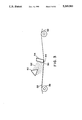
- FIG. 1 is a schematic representation of apparatus which may be utilizes ultrasonic vibrations to microaperture thin sheet materials.
- FIG. 2 is a cross sectional view of the transport mechanism for transporting the thin sheet material to the area where it is subjected to ultrasonic vibrations.
- FIG. 3 is a detailed view of the area where the thin sheet material is subjected to ultrasonic vibrations. The area is designated by the dotted circle in FIG. 1.
- FIG. 4 is a photomicrograph of a 0.45 mil thick sheet of aluminum foil which has been microapertured in accordance with the present invention.
- FIG. 5 is a scale which applies to the photomicrograph of FIG. 4 where each unit represents ten (10) microns (micrometers).
- FIG. 6 is a photomicrograph of a 0.8 mil thick cellulosic sheet which has been microapertured in accordance with the present invention.
- FIG. 7 is a scale which applied to the photomicrograph of FIG. 6 where each unit represents ten (10) microns (micrometers).
- FIG. 8 is a photomicrograph of a 0.5 mil thick sheet of polyethylene film which has been microapertured in with the present invention.
- FIG. 9 is a scale which applied to the photomicrograph of FIG. 8 where each unit represents ten (10) microns (micrometers).
- FIG. 10 is a photomicrograph of a 0.5 mil thick PVDC coated polyester sheet which has been microapertured in with the present invention.
- FIG. 11 is a scale which applied to the photomicrograph of FIG. 10 where each unit represents ten (10) microns (micrometers).
- FIG. 1 is a schematic representation of an apparatus which can carry out the method of the present invention
- the apparatus is generally represented by the reference numeral 10.
- a supply roll 12 of a thin sheet material 14 to be microapertured is provided.
- the term thin sheet material refers to sheet materials which have an average thickness of about ten (10) mils or less. Additionally, generally speaking, the average thickness of the thin sheet material 14 will be at least about 0.25 mil.
- the average thickness of the thin sheet 14 material may range from about 0.25 mil to about 5 mils. More particularly, the average thickness of the thin sheet material 14 may range from about 0.25 mil to about 2 mils. Even more specifically, the average thickness of the thin sheet material 14 may range from about 0.5 mil to about 1 mil.
- the thin sheet material 14 may be formed from a thermoplastic film.
- the thermoplastic film may be formed from a material selected from the group including one or more polyolefins, polyurethanes, polyesters, A-B-A' block copolymers where A and A' are each a thermoplastic polymer endblock which includes a styrenic moiety and where A may be the same thermoplastic polymer endblock as A', and where B is an elastomeric polymer midblock such as a conjugated diene or a lower alkene or ethylene vinyl acetate copolymer.
- the polyolefin may be selected from the group including one or more of linear low density polyethylene, polyethylene or polypropylene.
- the thermoplastic film may be a filled film with the filled film being selected form the group including a polyethylene film filed with starch, titanium dioxide, wax, carbon or calcium carbonate.
- the sheet material may be a thermoset film.
- the thermoset film may be formed from a material selected from the group including of one or more cross-linked polyesters, cross-linked natural rubber or cross-linked dimethyl siloxane.
- the sheet material may be a metal.
- the metal may be selected from the group including aluminum, copper, gold, silver, zinc, lead, iron or platinum.
- the sheet material may be a naturally occurring polymeric material.
- the naturally occurring polymeric material may be is selected from the group including cellophane, cellulose acetate, collagen or carrageenan.
- the thin sheet material 14 is transported to a first nip 16 formed by a first transport roll 18 and a first nip roller 20 by the action of an endless transport mechanism 22 which moves in the direction indicated by the arrow 24.
- the transport mechanism 22 is driven by the rotation of the first transport roller 18 in conjunction with a second transport roller 26 which, in turn, are driven by a conventional power source, not shown.
- FIG. 2 is a cross sectional view of the transport mechanism 22 taken along lines A--A in FIG. I.
- FIG. II discloses that the transport mechanism 22 includes a heavy duty transport wire mesh screen 28 usually having a mesh count of less than about 400 (i.e. less than about 20 wires per inch by 20 wires per inch mesh screen if machine direction (MD) and cross machine direction (CD) wire count is the same).
- Heavy duty mesh wire screens of this type may be made from a variety of materials such as, for example, metals, plastics, nylons or polyesters, and are readily available to those in the art.
- Located above and attached to the transport screen 28 is an endless flat shim plate 30.
- the shim plate 30 desirably is formed from stainless steel.
- a fine mesh wire pattern screen 32 Located above and attached to the shim plate 30 is a fine mesh wire pattern screen 32 usually having a mesh count of at least about 10,000 per square inch (i.e. at least a 100 wires per MD inch by 100 wires per CD inch mesh screen if MD and CD wire count is the same). Fine mesh wire screens of this type are readily available to those in the art.
- the fine mesh wire screen 32 has raised areas or knuckles 34 which preform the function of a pattern anvil as will be discussed later.
- the thin sheet material 14 is transported by the transport mechanism 22 over a tension roll 36 to an area 38 (defined in FIG. 1 by the dotted lined circle) where the thin sheet material 14 is subjected to ultrasonic vibrations.
- the assembly for subjecting the thin sheet material 14 to the ultrasonic vibrations is conventional and is generally designated at 40.
- the assembly 40 includes a power supply 42 which, through a power control 44, supplies power to a piezoelectric transducer 46.
- the piezoelectric transducer 46 transforms electrical energy into mechanical movement as a result of the transducer's vibrating in response to an input of electrical energy.
- the vibrations created by the piezoelectric transducer 46 are transferred, in conventional manner, to a mechanical movement booster or amplifier 48.
- the mechanical movement booster 48 may be designed to increase the amplitude of the vibrations (mechanical movement) by a known factor depending upon the configuration of the booster 48.
- the mechanical movement is transferred from the mechanical movement booster 48 to a conventional knife edge ultrasonic horn 50.
- a conventional knife edge ultrasonic horn 50 could be utilized.
- the ultrasonic horn 50 may be designed to effect yet another boost or increase in the amplitude of the mechanical movement (vibrations) which is to be applied to the thin sheet material 14.
- the assembly includes an actuator 52 which includes a pneumatic cylinder, not shown. The actuator 52 provides a mechanism for raising and lowering the assembly 40 so that the tip 54 of the ultrasonic horn 50 ca apply tension to the transport mechanism 22 upon the assembly 40 being lowered.
- FIG. 3 is a schematic representation of the area 38 where the ultrasonic vibrations are applied to the thin sheet material 14.
- the transport mechanism 22 forms an angle 56 with the tip 54 of the ultrasonic horn 50. While some microaperturing will occur if the angle 56 is as great as 45 degrees, it has been found that it is desirable for the angle 56 to range from about 5 degrees to about 15 degrees. For example, the angle 56 may range from about 7 to about 13 degrees. More particularly, the angle 56 may range from about 9 to about 11 degrees.
- FIG. 3 also illustrates that the transport mechanism 22 is supported from below by the first tension roll 36 and a second tension roll 58.
- a spray nozzle 60 Positioned somewhat prior to the tip 54 of the ultrasonic horn 50 is a spray nozzle 60 which is configured to apply a fluid 62 to the surface of the thin sheet material 14 just prior to the sheet material's 14 being subjected to ultrasonic vibrations by the tip 54 of the ultrasonic horn 50.
- the fluid 62 desirably may be selected from the group including one or more of water, mineral oil, a chlorinated hydrocarbon, ethylene glycol or a solution of 50 volume percent water and 50 volume percent 2 propanol.
- the chlorinated hydrocarbon may be selected from the group including 1,1,1 trichloroethane or carbon tetrachloride.
- the wedge-shaped area 64 formed by the tip 54 of the ultrasonic horn 50 and the transport mechanism 22 should be subjected to a sufficient amount of the fluid 62 for the fluid 62 to act as both a heat sink and a coupling agent for the most desirable results.
- a fluid collection tank 66 Positioned below the transport mechanism 22 in the area where the tip 54 of the ultrasonic horn 50 is located is a fluid collection tank 66. (See FIG.
- the fluid collection tank 66 serves to collect fluid 62 which has been applied to the surface of the thin sheet material 14 and which has either been driven through the sheet material 14 and/or the transport mechanism 22 or over the edges of the transport mechanism 22 by the action of the vibrations of the tip 54 of the ultrasonic horn 50. Fluid 62 which is collected in the collection tank 66 is transported by tubing 68 to a fluid holding tank 70.
- FIG. 1 illustrates that the fluid holding tank 70 contains a pump 72 which, by way of additional tubing 74, supplies the fluid 62 to the fluid spray nozzle 60. Accordingly, the fluid 62 may be re-cycled for a considerable period of time.
- the presence of the fluid 62 in the wedge-shaped area 64 during operation of the ultrasonic horn 50 accomplishes two separate and distinct functions.
- the presence of the fluid 62 allows the fluid 62 to act as a heat sink which allows the ultrasonic vibrations to be applied to the thin sheet material 14 without the thin sheet material 14 being altered or destroyed as by melting.
- the presence of the fluid 62 in the wedge-shaped area 64 allows the fluid 62 to act as a coupling agent in the application of the vibrations from the ultrasonic horn 50 to the thin sheet material 14.
- the action of the ultrasonic horn 50 on the thin sheet material 14 microapertures the thin sheet material 14 in spite of the fact that there are no fibers to re-arrange to form microapertures as was the case in Mitchell et al..
- the microapertures are punched through the thin sheet material 14 in the pattern of the raised areas or knuckles 34 of the fine mesh wire pattern screen 32.
- the number of microapertures produced will be equal to the number of raised areas or knuckles 34 on the upper surface of the fine mesh wire screen 32. That is, the number of microapertures will generally be one-half the mesh count of a given area of pattern screen 32.
- the pattern screen 32 is 100 wires per inch MD by 100 wires per inch CD
- the total number of knuckles or raised areas 34 on one side of the pattern wire per square inch 32 will be 100 times 100 divided by 2. This equals 5,000 microapertures per square inch.
- the calculation yields 20,000 microapertures per square inch.
- the wires are so thin as to allow the knuckles 34 on both sides to microaperture the thin sheet material 14 if sufficient force is applied.
- a 300 wires per inch MD by 300 wires per inch CD mesh screen yields 90,000 microapertures per square inch; for a 400 wires per inch MD by 400 wires per inch CD mesh--160,000 microapertures per square inch.
- the MD and CD wire count of the wire mesh screen does not have to be the same.
- the edge length of the thin sheet material may be increased by at least about 100 percent as compared to the sheet's edge length prior to microaperturing.
- the edge length of the thin sheet material may be increased by at least about 500 percent as compared to the sheet's edge length prior to microaperturing. More particularly, the edge length of the thin sheet material may be increased by at least about 1,500 percent as compared to the sheet's edge length prior to microaperturing. Even more particularly, the edge length of the thin sheet material may be increased by at least about 3,000 percent as compared to the sheet's edge length prior to microaperturing.
- the number of microapertures formed may also vary with the number of ultrasonic vibrations to which the thin sheet material 14 is subjected per unit area for a given period of time. This factor may be varied in a number of ways. For example, the number and size of the microapertures will vary somewhat with the line speed of the thin sheet material 14 as it passes underneath the tip 54 of the ultrasonic horn 50. Generally speaking, as line speed increases, first the size of the microapertures decreases and then the number of microapertures decreases. As the number of microapertures decreases the less the pattern of microapertures resembles the pattern of raised areas 34 on the pattern screen 32.
- line speeds that usually yields microapertures varies with the material utilized to form the thin sheet material 14 and the material used as the fluid 62.
- typical line speeds which should yield microapertures for a wide variety of fluids should range from about 5 to about 15 feet per minute.
- typical line speeds which usually yield microapertures range from about 6 to about 9 feet per minute.
- water is used as the fluid with 0.4 mil thick cross-linked natural rubber typical line speeds which usually yield microapertures range from about 3 to about 10 feet per minute.
- typical line speeds which usually yield microapertures for a wide variety of fluids range from about 4.5 to about 23.3 feet per minute.
- typical line speeds which usually yield microapertures range from about 4 to about 5 feet per minute.
- typical line speeds which usually yield microapertures for a wide variety of fluids range from about 5 to about 25 feet per minute.
- typical line speeds which usually yield microapertures range from about 5 to about 23 feet per minute.
- each of the microapertures formed will also vary with the parameters discussed above.
- the area of the microapertures will also vary with the area of the raised areas of the pattern anvil such as the knuckles 34 on the fine mesh wire screen 32.
- the type of material used in forming the thin sheet material 14 will also vary the area of the microapertures formed if all other parameters are maintained the same. For example, the softer the thin sheet material 14, the easier it is to push the thin sheet material 14 through the raised areas of the fine mesh pattern screen 32. Because the raised areas (knuckles) on the fine mesh screen are generally pyramidal in shape, the deeper the raised area penetrates the thin sheet material 14, the larger the microaperture.
- the shape of the microaperture will conform generally to the pyramidal shape of the raised area of the fine mesh screen and the microaperture will be generally pyramidally shaped, in the z direction, and will have an area which is greater at one end than at the other.
- the area of the microaperture should be measured at the narrowest point of the aperture.
- the height of the raised areas must be greater than the thickness of the thin sheet material 14 for microapertures to be formed and the degree of excess necessary may vary with the type of sheet material to be microapertured.
- the thin sheet material 14 may be necessary to subject the thin sheet material 14 to multiple passes through the apparatus 10 in order to microaperture the thin sheet material 14.
- the thin sheet material 14 will initially only be thinned in the pattern of the pattern anvil's raised areas.
- the thin sheet material 14 is repeatedly thinned by repeated application of ultrasonic vibrational force until such time as microapertures are formed.
- the fine mesh wire diameter size may be increased with the consequent decrease in mesh count. Increasing the wire diameter size of the fine mesh screen 32 increases the likelihood that microapertures will be formed.
- the microapertures can be formed in a predesignated area or areas of the thin sheet material 14. This can be accomplished in a number of ways.
- the thin sheet material 14 may be subjected to ultrasonic vibrations only at certain areas of the sheet material, thus, microaperturing would occur only in those areas.
- the entire thin sheet material could be subjected to ultrasonic vibrations with the pattern anvil having raised areas only at certain locations and otherwise being flat. Accordingly, the thin sheet material 14 would be microapertured only in those areas which corresponded to areas on the pattern anvil having raised areas.
- the area of each of the microapertures is usually greater than about ten square micrometers. That is the area of each of the microapertures may range from at least about 10 square micrometers to about 100,000 square micrometers. For example, the area of each of the formed microapertures may generally range from at least about 10 square micrometers to about 10,000 square micrometers. More particularly, the area of each of the formed microapertures may generally range from at least about 10 square micrometers to about 1,000 square micrometers. Even more particularly, the area of each of the formed microapertures may generally range from at least about 10 square micrometers to about 100 square micrometers.
- the presence of the fluid 62 is highly important to the present inventive process which uses the fluid as a coupling agent. Because a coupling agent is present, the microapertures are punched in the thin sheet material 14 as opposed to being formed by melting. The importance of the fluid 62 is further exemplified by the fact that the process has been attempted without the use of the fluid 62 and was not generally successful. Additionally, the presence of the shim plate 30 or its equivalent is necessary in order to provide an anvil mechanism against which the thin sheet material 14 may be worked, that is apertured, by the action of the tip 54 of the ultrasonic horn 50.
- the vibrating tip 54 of the ultrasonic horn 50 is acting in a hammer and anvil manner when operated in conjunction with the heavy duty wire mesh screen 28/shim plate 30/fine wire mesh 32 combination, it should be readily recognized that a certain degree of tension must be placed upon the transport mechanism 22 by the downward displacement of the ultrasonic horn 50. If there is little or no tension placed upon the transport mechanism 22, the shim plate 30 cannot preform its function as an anvil and microaperturing generally does not occur. Because both the shim plate 30 and the fine mesh pattern wire 32 form the resistance that the ultrasonic horn 50 works against, they are collectively referred herein as a pattern anvil combination.
- the function of the pattern anvil can be accomplished by other arrangements than the heavy duty wire mesh screen 28/shim plate 30/fine mesh screen 32 combination.
- the pattern anvil could be a flat plate with raised portions acting to direct the microaperturing force of the ultrasonic horn 50.
- the pattern anvil could be a cylindrical roller having raised areas. If the pattern anvil is a cylindrical roller with raised areas, it is desirable for the pattern anvil to be wrapped or coated with or made from a resilient material.
- the pattern anvil is a mesh screen the resiliency is provided by the fact that the screen is unsupported directly below the point of application of ultrasonic vibrations to the mesh screen.
- a sheet of 0.45 mil thick aluminum foil having the trade designation #01-213 was obtained from the Fischer Scientific Co. of Pittsburgh, Pa. and was cut into a length of about ten (10) inches and a width of about three (3) inches.
- the hydrohead of such aluminum foil prior to hydrosonic treatment has been measured as being greater than 137 centimeters of water. (This is the highest value obtainable with the equipment used.)
- the sample was subjected to hydrosonic treatment in accordance with the present invention.
- a Branson type J4 power level control which has the ability to regulate the ultimate output of the model 1120 power supply from 0 to 100%, was connected to the model 1120 power supply. In this example, the power level control was set at 100%. The actual amount of power consumed was indicated by a Branson model A410A wattmeter. This amount was about 900 watts.
- the output of the power supply was fed to a model 402 piezoelectric ultrasonic transducer obtained from the Branson Company.
- the transducer converts the electrical energy to mechanical movement. At 100% power the amount of mechanical movement of the transducer is about 0.8 micrometers.
- the piezoelectric transducer was connected to a mechanical movement booster section obtained from the Branson Company.
- the booster is a solid titanium shaft with a length equal to one-half wave length of the 20 kilohertz resonant frequency.
- Boosters can be machined so that the amount of mechanical movement at their output end is increased or decreased as compared to the amount of movement of the transducer. In this example the booster increased the amount of movement and has a gain ratio of about 1:2.5. That is, the amount of mechanical movement at the output end of the booster is about 2.5 times the amount of movement of the transducer.
- the output end of the booster was connected to an ultrasonic horn obtained from the Branson Company.
- the horn in this example is made of titanium with a working face of about 9 inches by about 1/2 inch.
- the leading and trailing edges of the working face of the horn are each curved on a radius of about 1/8 inch.
- the horn step area is exponential in shape and yields about a two-fold increase in the mechanical movement of the booster. That is, the horn step area has about a 1:2 gain ratio.
- the combined increase, by the booster and the horn step area, in the original mechanical movement created by the transducer yields a mechanical movement of about 4.0 micrometers.
- the forming table arrangement included a small forming table which was utilized to transport and support the sheet of foil to be microapertured.
- the forming table included two 2-inch diameter idler rollers which were spaced about 12 inches apart on the surface of the forming table.
- a transport mesh belt encircles the two idler rollers so that a continuous conveying or transport surface is created.
- the transport mesh belt is a square weave 20 ⁇ 20 mesh web of 0.020 inch diameter plastic filaments. The belt is about 10 inches wide and is raised above the surface of the forming table.
- the transducer/booster/horn assembly hereinafter the assembly, is secured in a Branson series 400 actuator.
- the actuator by means of a pneumatic cylinder with a piston area of about 4.4 square inches, lowers the assembly so that the output end of the horn contacts the sheet of aluminum foil which is to be microapertured.
- the actuator also raises the assembly so that the output end of the horn is removed from contact with the sheet of aluminum foil when power is switched off.
- the assembly is positioned so that the output end of the horn is adapted so that it may be lowered to contact the transport mesh belt between the two idler rollers.
- An 8-inch wide 0.005-inch thick stainless steel shim stock having a length of about 60 inches was placed on the plastic mesh transport belt to provide a firm support for a pattern screen which is placed on top of the stainless steel shim.
- the pattern screen is a 250 by 250 mesh wire size weave stainless steel screen.
- the sheet of aluminum foil which was to be microapertured was then fastened onto the pattern wire using masking tape.
- the forming table arrangement also included a fluid circulating system.
- the circulating system includes a fluid reservoir tank, a fluid circulating pump which may conveniently be located within the tank, associated tubing for transporting the fluid from the tank to a slotted boom which is designed to direct a curtain of fluid into the juncture of the output end of the horn and sheet of aluminum foil which is to be microapertured.
- the assembly was positioned so that the output end of the horn was at an angle of from about 10 to 15 degrees to the sheet of aluminum foil to be microapertured. Accordingly, a wedge shaped chamber was formed between the output end of the horn and the sheet of aluminum foil to be microapertured. It is into this wedge shaped chamber that the fluid, in this example water at room temperature, is directed by the slotted boom.
- the actuator was positioned at a height to insure that, when the assembly is lowered, the downward movement of the output end of the horn is stopped by the tension of the transport mesh before the actuator reaches the limit of its stroke.
- actuating pressure was adjusted to 8 pounds per square inch as read on a pressure gauge which is attached to the pneumatic cylinder of the actuator. This adjustment results in a total downward force of 35.2 pounds. (8 psi times 4.4 square inches of piston area equals 35.2 pounds of force.)
- the sequence of operation was (1) the fluid pump was switched on and the area where the output end of the horn was to contact the sheet of aluminum foil was flooded with water; (2) the transport mesh conveyor system was switched on and the aluminum foil started moving at 8 feet per minute; and (3) power to the assembly was supplied and the assembly was lowered so that the output end of the horn contacted the sheet of aluminum foil while the sheet continued to pass under the output end of the horn until the end of the sample was reached.
- the reading on the A410A wattmeter during the process is an indication of the energy required to maintain maximum mechanical movement at the output end of the horn while working against the combined mass of the fluid, the sheet of aluminum foil, the pattern wire, the shim stock, and the transport wire.
- This example yielded a microapertured aluminum foil having a maximum microaperture density of about 30,000 microapertures per square inch with the microapertures having an area of about 1,800 square micrometers.
- FIG. 4 is a photomicrograph of the thin aluminum foil sheet material apertured in accordance with example I.
- example I The process of example I was repeated with the exception that a sheet of annealed copper having a thickness of about 0.1 mil was utilized as the thin sheet material.
- the line speed of the copper sheet was 4 feet per minute as compared to the 8 feet per minute utilized in example I.
- the actual amount of power consumed was indicated by the Branson model A410A wattmeter as about 1,000 watts.
- This example yielded a microapertured copper sheet having a maximum density of about 30,000 microapertures per square inch with the microapertures having an area which varied from about 20 to 1,000 square micrometers. Significant microaperture density variation was encountered in this example.
- example I The process of example I was repeated with the exception that (1) a 0.8 mil thick cellulosic sheet obtained under the trade designation Flexel V-58 was used as the sheet; (2) the sheet was cut into a 8.5 by 11 inch sample; (3) about 775 watts were consumed: (4) a 120 by 120 stainless steel fine mesh screen was used; (5) a solution of 50 percent 2 propanol/50 percent water, by volume, was used as the fluid; (6) the actuating pressure was about 7 pounds per square inch and (7) the line speed about 23.3 feet per minute.
- Flexel V-58 0.8 mil thick cellulosic sheet obtained under the trade designation Flexel V-58 was used as the sheet; (2) the sheet was cut into a 8.5 by 11 inch sample; (3) about 775 watts were consumed: (4) a 120 by 120 stainless steel fine mesh screen was used; (5) a solution of 50 percent 2 propanol/50 percent water, by volume, was used as the fluid; (6) the actuating pressure was about 7 pounds per square inch and
- This example yielded a microapertured cellulosic sheet having a maximum microaperture density of about 7,000 microapertures per square inch with the microapertures having an area of about 40 square micrometers.
- the hydrohead of the microapertured cellulosic sheet was measured as being about 54 centimeters of water and the wvtr of the microapertured cellulosic sheet was measured as being about 219 grams per square meter per day.
- FIG. 6 is a photomicrograph of the thin cellulosic sheet material microapertured in accordance with example III.
- example III The process of example III was repeated with the exception that the line speed of the cellose sheet was 20.9 feet per minute as compared to the 23.3 feet per minute utilized in example III.
- the actual amount of power consumed was indicated by the Branson model A410A wattmeter as about 750 watts.
- the actuating pressure was about 6 pounds per square inch, gauge.
- This example yielded a microapertured cellulosic sheet having a maximum density of about 7,000 microapertures per square inch with the microapertures having an area of about 1,070 square micrometers.
- the hydrohead of this sample was measured as being about 22 centimeters of water and the wvtr was measured as being about 1,200 grams per square meter per day.
- the edge length increase of the material was calculated as being 766%.
- example I The process of example I was repeated with the exception that (1) a 0.5 mil thick polyethylene film obtained from the Edison Company under the trade designation "S/E 702" was used as the sheet; (2) the sheet was cut into a 8.5 by 11 inch sample; (3) about 750 watts were consumed and (4) the line speed about 14.5 feet per minute.
- This example yielded a microapertured polyethylene film having a maximum microaperture density of about 31,000 microapertures per square inch with the microapertures having an area of about 16 square micrometers.
- the average of three hydrohead values of the microapertured polyethylene film was measured as being about 21 centimeters of water and the average of three wvtr values of the microapertured polyethylene film was measured as being about 1,385 grams per square meter per day.
- FIG. 8 is a photomicrograph of the thin polyethylene material microapertured in accordance with Example V.
- Example V The process of Example V was repeated with the exception that the line speed was 22 feet per minute and the watts consumed was about 800.
- This example yielded a microapertured polyethylene film having a maximum microaperture density of about 31,000 microapertures per square inch with the microapertures having an area of about 15 square micrometers.
- the average of three hydrohead values of the microapertured polyethylene film was about 28 centimeters of water and the average of three wvtr values of the microapertured polyethylene film was measured as being about 1,083 grams per square meter per day.
- example I The process of example I was repeated with the exception that (1) a 0.5 mil thick polyester sheet coated on both sides with PVDC having the trade designation of Flexel Esterlock 50 was used as the sheet; (2) the sheet was cut into a 8.5 by 11 inch sample; (3) about 1,100 watts were consumed; (4) a 200 by 200 stainless steel fine mesh screen was used; (5) the actuating pressure was about 10 pounds per square inch and (7) the line speed about 3.8 feet per minute.
- This example yielded a microapertured PVDC coated sheet having a maximum microaperture density of about 20,000 microapertures per square inch with the microapertures having an area of about 30 square micrometers.
- the hydrohead of the microapertured PVDC coated polyester sheet was measured as being about 39 centimeters of water and the wvtr of the microapertured PVDC coated polyester sheet was measured as being about 141 grams per square meter per day. (The wvtr measurement is an average of two measurements.)
- FIG. 10 is a photomicrograph of the thin PVDC coated polyester sheet material microapertured in accordance with Example VII.
- Example V In order to illustrate the importance of the presence of the fluid as a coupling agent an illustrative example was run. This example attempted to duplicate Example V with the exception that no fluid was provided to the area where ultrasonic vibrations were being applied to the Edison polyethylene film. All process parameters of this illustrative example were the same as those of Example V with the exception that the line speed was seven (7) feet per minute and the actual amount of power consumed was indicated by the Branson model A410A wattmeter as about 800 watts.
- the microapertured sheet material of the present invention may be put are numerous.
- An example of such is the area of filtration.
- the microapertured thin sheet material of the present invention can be utilized as a filtration media for collecting charged particulates or particles from fluids such as the air or water.
- the fluid would circulate through the microapertures of the thin sheet material which, if it was metallic, could be provided with a charge to assist in the collection of the charged particulate or particle.
- the filter could be cleaned by reversing the charge on the thin microapertured sheet material whereby the collected particulates and/or particles would fall off of the thin sheet material.
- An example of where increase edge length would be important would be in the area of biodegradable sheet materials. If such sheet materials are microapertured in accordance with the present invention, the rate of biodegradation is increased as a result of the increased edge length.
Landscapes
- Life Sciences & Earth Sciences (AREA)
- Forests & Forestry (AREA)
- Engineering & Computer Science (AREA)
- Mechanical Engineering (AREA)
- Physical Or Chemical Processes And Apparatus (AREA)
- Treatment Of Fiber Materials (AREA)
- Application Of Or Painting With Fluid Materials (AREA)
- Shaping Of Tube Ends By Bending Or Straightening (AREA)
Priority Applications (8)
| Application Number | Priority Date | Filing Date | Title |
|---|---|---|---|
| US07/769,045 US5269981A (en) | 1991-09-30 | 1991-09-30 | Process for hydrosonically microaperturing |
| CA002057727A CA2057727A1 (en) | 1991-09-30 | 1991-12-16 | Process for hydrosonically microaperturing thin sheet materials |
| TW081107386A TW237411B (enExample) | 1991-09-30 | 1992-09-19 | |
| EP92116587A EP0535581A1 (en) | 1991-09-30 | 1992-09-28 | Process for hydrosonically microaperturing thin sheet materials |
| MX9205547A MX9205547A (es) | 1991-09-30 | 1992-09-29 | Proceso para microperforar hidrosonicamente materiales de hoja delgada. |
| KR1019920017772A KR930005751A (ko) | 1991-09-30 | 1992-09-29 | 박판 재료를 수음파적으로 미세 천공시키는 방법 |
| AU26038/92A AU651248B2 (en) | 1991-09-30 | 1992-09-29 | Process for hydrosonically microaperturing thin sheet materials |
| JP4283450A JPH06198598A (ja) | 1991-09-30 | 1992-09-30 | 流体音波により薄いシート材料に微小孔を形成する方法 |
Applications Claiming Priority (1)
| Application Number | Priority Date | Filing Date | Title |
|---|---|---|---|
| US07/769,045 US5269981A (en) | 1991-09-30 | 1991-09-30 | Process for hydrosonically microaperturing |
Publications (1)
| Publication Number | Publication Date |
|---|---|
| US5269981A true US5269981A (en) | 1993-12-14 |
Family
ID=25084269
Family Applications (1)
| Application Number | Title | Priority Date | Filing Date |
|---|---|---|---|
| US07/769,045 Expired - Fee Related US5269981A (en) | 1991-09-30 | 1991-09-30 | Process for hydrosonically microaperturing |
Country Status (3)
| Country | Link |
|---|---|
| US (1) | US5269981A (enExample) |
| CA (1) | CA2057727A1 (enExample) |
| TW (1) | TW237411B (enExample) |
Cited By (41)
| Publication number | Priority date | Publication date | Assignee | Title |
|---|---|---|---|---|
| US5466401A (en) * | 1991-09-30 | 1995-11-14 | Kimberly-Clark Corporation | Process for hydrosonically area thinning thin sheet materials |
| US5470424A (en) * | 1993-11-30 | 1995-11-28 | Kimberly-Clark Corporation | Process for forming liquid impermeable sheet material having a fibrous surface and products formed thereby |
| US5514308A (en) * | 1991-09-30 | 1996-05-07 | Kimberly-Clark Corporation | Method for hydrosonically embedding a material in a soft thin film material |
| US5585017A (en) * | 1993-09-13 | 1996-12-17 | James; William A. | Defocused laser drilling process for forming a support member of a fabric forming device |
| US5595690A (en) * | 1995-12-11 | 1997-01-21 | Hamilton Standard | Method for improving water transport and reducing shrinkage stress in membrane humidifying devices and membrane humidifying devices |
| US5681301A (en) * | 1996-01-24 | 1997-10-28 | Johnson & Johnson Worldwide Absorbent Products | Backing web in an absorbent article |
| US5735984A (en) * | 1994-11-08 | 1998-04-07 | Minnesota Mining And Manufacturing Company | Method of aperturing thin sheet materials |
| US5801106A (en) * | 1996-05-10 | 1998-09-01 | Kimberly-Clark Worldwide, Inc. | Polymeric strands with high surface area or altered surface properties |
| US5803106A (en) * | 1995-12-21 | 1998-09-08 | Kimberly-Clark Worldwide, Inc. | Ultrasonic apparatus and method for increasing the flow rate of a liquid through an orifice |
| US5824352A (en) * | 1994-09-16 | 1998-10-20 | Mcneil-Ppc, Inc. | Apparatus for producing an apertured plastic film having a tricot texture |
| US5868153A (en) * | 1995-12-21 | 1999-02-09 | Kimberly-Clark Worldwide, Inc. | Ultrasonic liquid flow control apparatus and method |
| US5879494A (en) * | 1996-09-23 | 1999-03-09 | Minnesota Mining And Manufacturing Company | Method of aperturing thin sheet materials |
| US5916462A (en) * | 1993-09-13 | 1999-06-29 | James; William A. | Laser drilling processes for forming an apertured film |
| US6020277A (en) * | 1994-06-23 | 2000-02-01 | Kimberly-Clark Corporation | Polymeric strands with enhanced tensile strength, nonwoven webs including such strands, and methods for making same |
| US6036467A (en) * | 1994-06-23 | 2000-03-14 | Kimberly-Clark Worldwide, Inc. | Apparatus for ultrasonically assisted melt extrusion of fibers |
| US6053424A (en) * | 1995-12-21 | 2000-04-25 | Kimberly-Clark Worldwide, Inc. | Apparatus and method for ultrasonically producing a spray of liquid |
| US6380264B1 (en) | 1994-06-23 | 2002-04-30 | Kimberly-Clark Corporation | Apparatus and method for emulsifying a pressurized multi-component liquid |
| US6450417B1 (en) | 1995-12-21 | 2002-09-17 | Kimberly-Clark Worldwide Inc. | Ultrasonic liquid fuel injection apparatus and method |
| US6543700B2 (en) | 2000-12-11 | 2003-04-08 | Kimberly-Clark Worldwide, Inc. | Ultrasonic unitized fuel injector with ceramic valve body |
| US6562166B2 (en) | 2001-05-11 | 2003-05-13 | The Procter & Gamble Company | Method of material property modification with ultrasonic energy |
| US6663027B2 (en) | 2000-12-11 | 2003-12-16 | Kimberly-Clark Worldwide, Inc. | Unitized injector modified for ultrasonically stimulated operation |
| US20040119208A1 (en) * | 2002-12-20 | 2004-06-24 | The Procter & Gamble Company | Method for making a polymeric web exhibiting a soft and silky tactile impression |
| US20040122395A1 (en) * | 2002-12-20 | 2004-06-24 | The Procter & Gamble Company | Polymeric web exhibiting a soft and silky tactile impression |
| US20040119207A1 (en) * | 2002-12-20 | 2004-06-24 | The Proctor & Gamble Company | Method of making a polymeric web exhibiting a soft and silky tactile impression |
| US20040194869A1 (en) * | 2003-04-07 | 2004-10-07 | Sca Hygiene Products Gmbh | Method and arrangement for bonding plies of tissue paper together |
| US20050191496A1 (en) * | 2002-12-20 | 2005-09-01 | The Procter & Gamble Company | Apparatus and method for making a forming structure |
| US20050208111A1 (en) * | 2001-12-19 | 2005-09-22 | Kelly Albert R | Personal care and surface cleaning article |
| US20080192568A1 (en) * | 2004-05-24 | 2008-08-14 | Dr. Hielscher Gmbh | Method and Device For Introducing Ultrasound Into a Flowable Medium |
| US7638090B2 (en) | 2006-03-31 | 2009-12-29 | Searete Llc | Surveying sterilizer methods and systems |
| US8114342B2 (en) | 2006-03-31 | 2012-02-14 | The Invention Science Fund I, Llc | Methods and systems for monitoring sterilization status |
| US8277724B2 (en) | 2006-03-31 | 2012-10-02 | The Invention Science Fund I, Llc | Sterilization methods and systems |
| US8758679B2 (en) | 2006-03-31 | 2014-06-24 | The Invention Science Fund I, Llc | Surveying sterilizer methods and systems |
| EP2807995A1 (en) | 2000-04-07 | 2014-12-03 | The Procter and Gamble Company | Apertured polymeric film webs and absorbant articles using such webs |
| US8932535B2 (en) | 2006-03-31 | 2015-01-13 | The Invention Science Fund I, Llc | Surveying sterilizer methods and systems |
| US8992837B2 (en) | 2006-03-31 | 2015-03-31 | The Invention Science Fund I, Llc | Methods and systems for monitoring sterilization status |
| US9545744B2 (en) | 2002-12-20 | 2017-01-17 | The Procter & Gamble Company | Apparatus for making polymeric web exhibiting a soft and silky tactile impression |
| WO2018233250A1 (en) | 2017-06-22 | 2018-12-27 | The Procter & Gamble Company | LAMINATED STRIPS AND ABSORBENT ARTICLES COMPRISING THEM |
| WO2020041534A1 (en) | 2018-08-22 | 2020-02-27 | The Procter & Gamble Company | Disposable absorbent article |
| US10646602B2 (en) | 2006-03-31 | 2020-05-12 | Deep Science, Llc | Methods and systems for sterilization |
| DE102019114446A1 (de) * | 2019-05-29 | 2020-12-03 | Airbus Operations Gmbh | System und Verfahren zum Verschweißen von zwei thermoplastischen Werkstücken |
| WO2025106363A1 (en) | 2023-11-15 | 2025-05-22 | The Procter & Gamble Company | Absorbent article with film topsheet |
Citations (74)
| Publication number | Priority date | Publication date | Assignee | Title |
|---|---|---|---|---|
| US1982587A (en) * | 1934-11-27 | Electrolytic foil | ||
| US3025585A (en) * | 1959-11-19 | 1962-03-20 | Chicopec Mfg Corp | Apparatus and method for making nonwoven fabric |
| US3097149A (en) * | 1963-07-09 | Methods of manufacturing microporous metallic membranes | ||
| FR1334711A (fr) * | 1962-09-26 | 1963-08-09 | Philips Nv | Feuille de protection ou d'isolement notamment en substance synthétique |
| US3155460A (en) * | 1960-05-20 | 1964-11-03 | Norman B Mears | Fine mesh screens |
| GB1018971A (en) * | 1962-08-16 | 1966-02-02 | Ronald Oliver Hargreaves Bull | Improvements in or relating to the joining of fibrous materials |
| US3333032A (en) * | 1963-11-12 | 1967-07-25 | Union Carbide Corp | Treated polymer surfaces of shaped articles |
| US3352769A (en) * | 1967-01-11 | 1967-11-14 | Ruben Samuel | Process for producing microperforated stainless steel sheets |
| US3451884A (en) * | 1964-08-05 | 1969-06-24 | Mitsubishi Petrochemical Co | Waterproof pile coated sheet for laminating |
| US3488240A (en) * | 1968-05-27 | 1970-01-06 | Ltv Electrosystems Inc | Ultrasonic welding method |
| US3575752A (en) * | 1968-05-22 | 1971-04-20 | Hercules Inc | Nonwoven bonding method |
| US3594134A (en) * | 1968-12-30 | 1971-07-20 | Gen Electric | Process for producing porous metal films and articles produced thereby |
| GB1253664A (en) * | 1967-09-29 | 1971-11-17 | Scott Paper Co | Method for forming apertured fibrous web |
| US3635609A (en) * | 1968-07-26 | 1972-01-18 | Cavitron Corp | Apparatus for embossing of materials with high-frequency vibrations |
| US3640786A (en) * | 1968-05-22 | 1972-02-08 | Hercules Inc | Pile fabric and method of making the same |
| US3660186A (en) * | 1969-04-08 | 1972-05-02 | Kimberly Clark Co | Method for bonding webs employing ultrasonic energy |
| US3683736A (en) * | 1970-12-23 | 1972-08-15 | Guenter H Loose | Ultrasonic perforating of a sheet of film, paper or the like |
| US3713960A (en) * | 1968-10-04 | 1973-01-30 | W Cochran | Antistatic tufted product |
| US3723854A (en) * | 1970-09-02 | 1973-03-27 | New Nippon Electric Co | Circuit for compensating for line drop between power source and load circuit |
| US3756880A (en) * | 1971-03-19 | 1973-09-04 | Eastman Kodak Co | Moval ultrasonic perforating a sheet of film paper or the like with chip re |
| US3794174A (en) * | 1972-01-11 | 1974-02-26 | Atomic Energy Commission | Porous metal insulator sandwich membrane |
| US3814101A (en) * | 1970-09-17 | 1974-06-04 | Union Carbide Corp | Disposable absorbent articles |
| US3818522A (en) * | 1972-04-13 | 1974-06-25 | Calottan Ag | Laminar cushion |
| US3832267A (en) * | 1972-09-19 | 1974-08-27 | Hercules Inc | Embossed film |
| US3881489A (en) * | 1973-08-20 | 1975-05-06 | Procter & Gamble | Breathable, liquid inpervious backsheet for absorptive devices |
| US3886941A (en) * | 1974-06-18 | 1975-06-03 | Union Carbide Corp | Diaper insert |
| US3929135A (en) * | 1974-12-20 | 1975-12-30 | Procter & Gamble | Absorptive structure having tapered capillaries |
| US3949127A (en) * | 1973-05-14 | 1976-04-06 | Kimberly-Clark Corporation | Apertured nonwoven webs |
| US3956450A (en) * | 1971-07-19 | 1976-05-11 | Dainippon Ink And Chemicals, Incorporated | Binding strap, and process for manufacturing same |
| US3963309A (en) * | 1972-12-15 | 1976-06-15 | D. Swarovski & Co., Glasschleiferei | Reflex light reflector sheet and method for its manufacture |
| US3966519A (en) * | 1974-12-27 | 1976-06-29 | Kimberly-Clark Corporation | Method of bonding fibrous webs and resulting products |
| US3989867A (en) * | 1973-02-16 | 1976-11-02 | The Procter & Gamble Company | Absorptive devices having porous backsheet |
| US4028033A (en) * | 1975-04-21 | 1977-06-07 | Branson Ultrasonics Corporation | Apparatus for embossing a plastic workpiece using vibratory energy |
| US4242392A (en) * | 1979-10-18 | 1980-12-30 | Schlegel Corporation | Soft barrier fin weatherstrip and method of manufacture |
| US4369219A (en) * | 1980-06-26 | 1983-01-18 | University Patents, Inc. | Custom valved cervical cap with deformable margin |
| US4389211A (en) * | 1981-06-01 | 1983-06-21 | Lenaghan Arlene R | Catamenial bandage |
| US4406720A (en) * | 1981-11-06 | 1983-09-27 | Burlington Industries, Inc. | Ultrasonic production of nonwovens |
| US4414045A (en) * | 1982-02-22 | 1983-11-08 | Burlington Industries, Inc. | High speed ultrasonic bonding |
| US4414244A (en) * | 1982-06-16 | 1983-11-08 | The United States Of America As Represented By The United States Department Of Energy | Surface modification to waveguides |
| GB2124134A (en) * | 1982-06-28 | 1984-02-15 | Gammacross Limited | Forming holes in artificial textile materials |
| US4438167A (en) * | 1979-10-15 | 1984-03-20 | Biax Fiberfilm Corporation | Novel porous fabric |
| US4472328A (en) * | 1981-06-09 | 1984-09-18 | Mitsubishi Chemical Industries, Ltd. | Process for producing porous film or sheet |
| US4488928A (en) * | 1983-05-16 | 1984-12-18 | Kimberly-Clark Corporation | Method and apparatus for forming soft, bulky absorbent webs and resulting product |
| EP0141556A2 (en) * | 1983-10-19 | 1985-05-15 | Sears Manufacturing Company | Process for developing porosity in air impervious film and articles produced by the process |
| US4588537A (en) * | 1983-02-04 | 1986-05-13 | Minnesota Mining And Manufacturing Company | Method for manufacturing an electret filter medium |
| US4601868A (en) * | 1982-04-21 | 1986-07-22 | The Procter & Gamble Company | Method of imparting a three-dimensional fiber-like appearance and tactile impression to a running ribbon of thermoplastic film |
| US4605454A (en) * | 1982-09-01 | 1986-08-12 | Kimberly-Clark Corporation | Method of ultrasonically bonding nonwoven webs |
| US4609518A (en) * | 1985-05-31 | 1986-09-02 | The Procter & Gamble Company | Multi-phase process for debossing and perforating a polymeric web to coincide with the image of one or more three-dimensional forming structures |
| US4629643A (en) * | 1985-05-31 | 1986-12-16 | The Procter & Gamble Company | Microapertured polymeric web exhibiting soft and silky tactile impression |
| US4645500A (en) * | 1984-11-23 | 1987-02-24 | Craig Medical Products Limited | Non-return valve assembly |
| US4695422A (en) * | 1984-02-16 | 1987-09-22 | The Procter & Gamble Company | Production of formed material by solid-state formation with a high-pressure liquid stream |
| EP0256717A2 (en) * | 1986-08-04 | 1988-02-24 | REXENE PRODUCTS COMPANY (A Delaware Corporation) | Process for the manufacture of microporous film |
| US4731282A (en) * | 1983-10-14 | 1988-03-15 | Hitachi Chemical Co., Ltd. | Anisotropic-electroconductive adhesive film |
| US4735843A (en) * | 1986-12-18 | 1988-04-05 | The Procter & Gamble Company | Selectively surface-hydrophilic porous or perforated sheets |
| US4747895A (en) * | 1986-08-20 | 1988-05-31 | American White Cross Laboratories, Inc. | Continuous ultrasonic perforating system and method |
| US4775571A (en) * | 1986-04-14 | 1988-10-04 | Kureha Kagaku Kogyo Kabushiki Kaisha | Biaxially stretched polyparaphenylene sulfide film and process for producing the same |
| US4777073A (en) * | 1987-03-11 | 1988-10-11 | Exxon Chemical Patents Inc. | Breathable films prepared from melt embossed polyolefin/filler precursor films |
| US4778644A (en) * | 1987-08-24 | 1988-10-18 | The Procter & Gamble Company | Method and apparatus for making substantially fluid-impervious microbubbled polymeric web using high pressure liquid stream |
| US4798604A (en) * | 1985-08-24 | 1989-01-17 | Smith And Nephew Associated Companies P.L.C. | Contoured film |
| DE3723404A1 (de) * | 1987-07-15 | 1989-01-26 | Aoe Plastic Gmbh | Fluessigkeitsdurchlaessige folie, insbesondere als deckfolie fuer saugstoff, sowie verfahren zu deren herstellung |
| US4801379A (en) * | 1986-07-23 | 1989-01-31 | Sulzer Brothers Limited | Microfilter foil and method of producing same |
| US4815714A (en) * | 1986-08-04 | 1989-03-28 | El Paso Products Company | Process for the manufacture of microporous film |
| USRE33063E (en) * | 1986-06-05 | 1989-09-19 | Apparatus and method for ultrasonically joining sheets of thermoplastic materials | |
| GB2218990A (en) * | 1988-05-27 | 1989-11-29 | Seed Co Ltd | Porous contact lens and method for making it |
| US4898761A (en) * | 1987-09-11 | 1990-02-06 | Reemay, Inc. | Barrier fabric and method |
| US4900317A (en) * | 1982-11-15 | 1990-02-13 | The Procter & Gamble Company | Disposable garment with breathable leg cuffs |
| US4929319A (en) * | 1987-02-20 | 1990-05-29 | Hoechst Aktiengesellschaft | Process and device for surface pre-treatment of plastic by means of an electrical corona discharge |
| US4931343A (en) * | 1985-07-31 | 1990-06-05 | Minnesota Mining And Manufacturing Company | Sheet material used to form portions of fasteners |
| US4955164A (en) * | 1989-06-15 | 1990-09-11 | Flow Research, Inc | Method and apparatus for drilling small diameter holes in fragile material with high velocity liquid jet |
| US4980215A (en) * | 1988-08-26 | 1990-12-25 | Aldine Technologies, Inc. | Absorbent package |
| US4995930A (en) * | 1985-06-14 | 1991-02-26 | Lever Brothers Company | Process for the production of a film combination |
| US5015521A (en) * | 1989-01-27 | 1991-05-14 | Mitsubishi Kasei Corporation | Porous film |
| US5059454A (en) * | 1989-04-26 | 1991-10-22 | Flex Products, Inc. | Method for making patterned thin film |
| US5098755A (en) * | 1990-11-21 | 1992-03-24 | Tanquary Albert C | Textured thermoplastic elastomeric film, articles comprising same, and method of making such textured thermoplastic elastomeric film and articles |
-
1991
- 1991-09-30 US US07/769,045 patent/US5269981A/en not_active Expired - Fee Related
- 1991-12-16 CA CA002057727A patent/CA2057727A1/en not_active Abandoned
-
1992
- 1992-09-19 TW TW081107386A patent/TW237411B/zh active
Patent Citations (74)
| Publication number | Priority date | Publication date | Assignee | Title |
|---|---|---|---|---|
| US1982587A (en) * | 1934-11-27 | Electrolytic foil | ||
| US3097149A (en) * | 1963-07-09 | Methods of manufacturing microporous metallic membranes | ||
| US3025585A (en) * | 1959-11-19 | 1962-03-20 | Chicopec Mfg Corp | Apparatus and method for making nonwoven fabric |
| US3155460A (en) * | 1960-05-20 | 1964-11-03 | Norman B Mears | Fine mesh screens |
| GB1018971A (en) * | 1962-08-16 | 1966-02-02 | Ronald Oliver Hargreaves Bull | Improvements in or relating to the joining of fibrous materials |
| FR1334711A (fr) * | 1962-09-26 | 1963-08-09 | Philips Nv | Feuille de protection ou d'isolement notamment en substance synthétique |
| US3333032A (en) * | 1963-11-12 | 1967-07-25 | Union Carbide Corp | Treated polymer surfaces of shaped articles |
| US3451884A (en) * | 1964-08-05 | 1969-06-24 | Mitsubishi Petrochemical Co | Waterproof pile coated sheet for laminating |
| US3352769A (en) * | 1967-01-11 | 1967-11-14 | Ruben Samuel | Process for producing microperforated stainless steel sheets |
| GB1253664A (en) * | 1967-09-29 | 1971-11-17 | Scott Paper Co | Method for forming apertured fibrous web |
| US3575752A (en) * | 1968-05-22 | 1971-04-20 | Hercules Inc | Nonwoven bonding method |
| US3640786A (en) * | 1968-05-22 | 1972-02-08 | Hercules Inc | Pile fabric and method of making the same |
| US3488240A (en) * | 1968-05-27 | 1970-01-06 | Ltv Electrosystems Inc | Ultrasonic welding method |
| US3635609A (en) * | 1968-07-26 | 1972-01-18 | Cavitron Corp | Apparatus for embossing of materials with high-frequency vibrations |
| US3713960A (en) * | 1968-10-04 | 1973-01-30 | W Cochran | Antistatic tufted product |
| US3594134A (en) * | 1968-12-30 | 1971-07-20 | Gen Electric | Process for producing porous metal films and articles produced thereby |
| US3660186A (en) * | 1969-04-08 | 1972-05-02 | Kimberly Clark Co | Method for bonding webs employing ultrasonic energy |
| US3723854A (en) * | 1970-09-02 | 1973-03-27 | New Nippon Electric Co | Circuit for compensating for line drop between power source and load circuit |
| US3814101A (en) * | 1970-09-17 | 1974-06-04 | Union Carbide Corp | Disposable absorbent articles |
| US3683736A (en) * | 1970-12-23 | 1972-08-15 | Guenter H Loose | Ultrasonic perforating of a sheet of film, paper or the like |
| US3756880A (en) * | 1971-03-19 | 1973-09-04 | Eastman Kodak Co | Moval ultrasonic perforating a sheet of film paper or the like with chip re |
| US3956450A (en) * | 1971-07-19 | 1976-05-11 | Dainippon Ink And Chemicals, Incorporated | Binding strap, and process for manufacturing same |
| US3794174A (en) * | 1972-01-11 | 1974-02-26 | Atomic Energy Commission | Porous metal insulator sandwich membrane |
| US3818522A (en) * | 1972-04-13 | 1974-06-25 | Calottan Ag | Laminar cushion |
| US3832267A (en) * | 1972-09-19 | 1974-08-27 | Hercules Inc | Embossed film |
| US3963309A (en) * | 1972-12-15 | 1976-06-15 | D. Swarovski & Co., Glasschleiferei | Reflex light reflector sheet and method for its manufacture |
| US3989867A (en) * | 1973-02-16 | 1976-11-02 | The Procter & Gamble Company | Absorptive devices having porous backsheet |
| US3949127A (en) * | 1973-05-14 | 1976-04-06 | Kimberly-Clark Corporation | Apertured nonwoven webs |
| US3881489A (en) * | 1973-08-20 | 1975-05-06 | Procter & Gamble | Breathable, liquid inpervious backsheet for absorptive devices |
| US3886941A (en) * | 1974-06-18 | 1975-06-03 | Union Carbide Corp | Diaper insert |
| US3929135A (en) * | 1974-12-20 | 1975-12-30 | Procter & Gamble | Absorptive structure having tapered capillaries |
| US3966519A (en) * | 1974-12-27 | 1976-06-29 | Kimberly-Clark Corporation | Method of bonding fibrous webs and resulting products |
| US4028033A (en) * | 1975-04-21 | 1977-06-07 | Branson Ultrasonics Corporation | Apparatus for embossing a plastic workpiece using vibratory energy |
| US4438167A (en) * | 1979-10-15 | 1984-03-20 | Biax Fiberfilm Corporation | Novel porous fabric |
| US4242392A (en) * | 1979-10-18 | 1980-12-30 | Schlegel Corporation | Soft barrier fin weatherstrip and method of manufacture |
| US4369219A (en) * | 1980-06-26 | 1983-01-18 | University Patents, Inc. | Custom valved cervical cap with deformable margin |
| US4389211A (en) * | 1981-06-01 | 1983-06-21 | Lenaghan Arlene R | Catamenial bandage |
| US4472328A (en) * | 1981-06-09 | 1984-09-18 | Mitsubishi Chemical Industries, Ltd. | Process for producing porous film or sheet |
| US4406720A (en) * | 1981-11-06 | 1983-09-27 | Burlington Industries, Inc. | Ultrasonic production of nonwovens |
| US4414045A (en) * | 1982-02-22 | 1983-11-08 | Burlington Industries, Inc. | High speed ultrasonic bonding |
| US4601868A (en) * | 1982-04-21 | 1986-07-22 | The Procter & Gamble Company | Method of imparting a three-dimensional fiber-like appearance and tactile impression to a running ribbon of thermoplastic film |
| US4414244A (en) * | 1982-06-16 | 1983-11-08 | The United States Of America As Represented By The United States Department Of Energy | Surface modification to waveguides |
| GB2124134A (en) * | 1982-06-28 | 1984-02-15 | Gammacross Limited | Forming holes in artificial textile materials |
| US4605454A (en) * | 1982-09-01 | 1986-08-12 | Kimberly-Clark Corporation | Method of ultrasonically bonding nonwoven webs |
| US4900317A (en) * | 1982-11-15 | 1990-02-13 | The Procter & Gamble Company | Disposable garment with breathable leg cuffs |
| US4588537A (en) * | 1983-02-04 | 1986-05-13 | Minnesota Mining And Manufacturing Company | Method for manufacturing an electret filter medium |
| US4488928A (en) * | 1983-05-16 | 1984-12-18 | Kimberly-Clark Corporation | Method and apparatus for forming soft, bulky absorbent webs and resulting product |
| US4731282A (en) * | 1983-10-14 | 1988-03-15 | Hitachi Chemical Co., Ltd. | Anisotropic-electroconductive adhesive film |
| EP0141556A2 (en) * | 1983-10-19 | 1985-05-15 | Sears Manufacturing Company | Process for developing porosity in air impervious film and articles produced by the process |
| US4695422A (en) * | 1984-02-16 | 1987-09-22 | The Procter & Gamble Company | Production of formed material by solid-state formation with a high-pressure liquid stream |
| US4645500A (en) * | 1984-11-23 | 1987-02-24 | Craig Medical Products Limited | Non-return valve assembly |
| US4609518A (en) * | 1985-05-31 | 1986-09-02 | The Procter & Gamble Company | Multi-phase process for debossing and perforating a polymeric web to coincide with the image of one or more three-dimensional forming structures |
| US4629643A (en) * | 1985-05-31 | 1986-12-16 | The Procter & Gamble Company | Microapertured polymeric web exhibiting soft and silky tactile impression |
| US4995930A (en) * | 1985-06-14 | 1991-02-26 | Lever Brothers Company | Process for the production of a film combination |
| US4931343A (en) * | 1985-07-31 | 1990-06-05 | Minnesota Mining And Manufacturing Company | Sheet material used to form portions of fasteners |
| US4798604A (en) * | 1985-08-24 | 1989-01-17 | Smith And Nephew Associated Companies P.L.C. | Contoured film |
| US4775571A (en) * | 1986-04-14 | 1988-10-04 | Kureha Kagaku Kogyo Kabushiki Kaisha | Biaxially stretched polyparaphenylene sulfide film and process for producing the same |
| USRE33063E (en) * | 1986-06-05 | 1989-09-19 | Apparatus and method for ultrasonically joining sheets of thermoplastic materials | |
| US4801379A (en) * | 1986-07-23 | 1989-01-31 | Sulzer Brothers Limited | Microfilter foil and method of producing same |
| US4815714A (en) * | 1986-08-04 | 1989-03-28 | El Paso Products Company | Process for the manufacture of microporous film |
| EP0256717A2 (en) * | 1986-08-04 | 1988-02-24 | REXENE PRODUCTS COMPANY (A Delaware Corporation) | Process for the manufacture of microporous film |
| US4747895A (en) * | 1986-08-20 | 1988-05-31 | American White Cross Laboratories, Inc. | Continuous ultrasonic perforating system and method |
| US4735843A (en) * | 1986-12-18 | 1988-04-05 | The Procter & Gamble Company | Selectively surface-hydrophilic porous or perforated sheets |
| US4929319A (en) * | 1987-02-20 | 1990-05-29 | Hoechst Aktiengesellschaft | Process and device for surface pre-treatment of plastic by means of an electrical corona discharge |
| US4777073A (en) * | 1987-03-11 | 1988-10-11 | Exxon Chemical Patents Inc. | Breathable films prepared from melt embossed polyolefin/filler precursor films |
| DE3723404A1 (de) * | 1987-07-15 | 1989-01-26 | Aoe Plastic Gmbh | Fluessigkeitsdurchlaessige folie, insbesondere als deckfolie fuer saugstoff, sowie verfahren zu deren herstellung |
| US4778644A (en) * | 1987-08-24 | 1988-10-18 | The Procter & Gamble Company | Method and apparatus for making substantially fluid-impervious microbubbled polymeric web using high pressure liquid stream |
| US4898761A (en) * | 1987-09-11 | 1990-02-06 | Reemay, Inc. | Barrier fabric and method |
| GB2218990A (en) * | 1988-05-27 | 1989-11-29 | Seed Co Ltd | Porous contact lens and method for making it |
| US4980215A (en) * | 1988-08-26 | 1990-12-25 | Aldine Technologies, Inc. | Absorbent package |
| US5015521A (en) * | 1989-01-27 | 1991-05-14 | Mitsubishi Kasei Corporation | Porous film |
| US5059454A (en) * | 1989-04-26 | 1991-10-22 | Flex Products, Inc. | Method for making patterned thin film |
| US4955164A (en) * | 1989-06-15 | 1990-09-11 | Flow Research, Inc | Method and apparatus for drilling small diameter holes in fragile material with high velocity liquid jet |
| US5098755A (en) * | 1990-11-21 | 1992-03-24 | Tanquary Albert C | Textured thermoplastic elastomeric film, articles comprising same, and method of making such textured thermoplastic elastomeric film and articles |
Non-Patent Citations (6)
| Title |
|---|
| "Crop Control", Modern Plastics, May 1991, pp. 58-60. |
| "Ultrasonics/High Power", Kirk-Othmer Encyclopedia of Chemical Technology, vol. 23, pp. 462-479, ©1983. |
| Crop Control , Modern Plastics, May 1991, pp. 58 60. * |
| Translation of Japanese Patent Application No. HEI 3(1991) 260160. * |
| Translation of Japanese Patent Application No. HEI 3(1991)-260160. |
| Ultrasonics/High Power , Kirk Othmer Encyclopedia of Chemical Technology, vol. 23, pp. 462 479, 1983. * |
Cited By (68)
| Publication number | Priority date | Publication date | Assignee | Title |
|---|---|---|---|---|
| US5514308A (en) * | 1991-09-30 | 1996-05-07 | Kimberly-Clark Corporation | Method for hydrosonically embedding a material in a soft thin film material |
| US5466401A (en) * | 1991-09-30 | 1995-11-14 | Kimberly-Clark Corporation | Process for hydrosonically area thinning thin sheet materials |
| US5585017A (en) * | 1993-09-13 | 1996-12-17 | James; William A. | Defocused laser drilling process for forming a support member of a fabric forming device |
| US5916462A (en) * | 1993-09-13 | 1999-06-29 | James; William A. | Laser drilling processes for forming an apertured film |
| US5783290A (en) * | 1993-11-30 | 1998-07-21 | Kimberly-Clark Worldwide, Inc. | Process for forming liquid impermeable sheet material having a fibrous surface and products formed thereby |
| US5470424A (en) * | 1993-11-30 | 1995-11-28 | Kimberly-Clark Corporation | Process for forming liquid impermeable sheet material having a fibrous surface and products formed thereby |
| US6020277A (en) * | 1994-06-23 | 2000-02-01 | Kimberly-Clark Corporation | Polymeric strands with enhanced tensile strength, nonwoven webs including such strands, and methods for making same |
| US6395216B1 (en) | 1994-06-23 | 2002-05-28 | Kimberly-Clark Worldwide, Inc. | Method and apparatus for ultrasonically assisted melt extrusion of fibers |
| US6380264B1 (en) | 1994-06-23 | 2002-04-30 | Kimberly-Clark Corporation | Apparatus and method for emulsifying a pressurized multi-component liquid |
| US6036467A (en) * | 1994-06-23 | 2000-03-14 | Kimberly-Clark Worldwide, Inc. | Apparatus for ultrasonically assisted melt extrusion of fibers |
| US5824352A (en) * | 1994-09-16 | 1998-10-20 | Mcneil-Ppc, Inc. | Apparatus for producing an apertured plastic film having a tricot texture |
| US5735984A (en) * | 1994-11-08 | 1998-04-07 | Minnesota Mining And Manufacturing Company | Method of aperturing thin sheet materials |
| US5595690A (en) * | 1995-12-11 | 1997-01-21 | Hamilton Standard | Method for improving water transport and reducing shrinkage stress in membrane humidifying devices and membrane humidifying devices |
| US6053424A (en) * | 1995-12-21 | 2000-04-25 | Kimberly-Clark Worldwide, Inc. | Apparatus and method for ultrasonically producing a spray of liquid |
| US5868153A (en) * | 1995-12-21 | 1999-02-09 | Kimberly-Clark Worldwide, Inc. | Ultrasonic liquid flow control apparatus and method |
| US6659365B2 (en) | 1995-12-21 | 2003-12-09 | Kimberly-Clark Worldwide, Inc. | Ultrasonic liquid fuel injection apparatus and method |
| US6315215B1 (en) | 1995-12-21 | 2001-11-13 | Kimberly-Clark Worldwide, Inc. | Apparatus and method for ultrasonically self-cleaning an orifice |
| US5803106A (en) * | 1995-12-21 | 1998-09-08 | Kimberly-Clark Worldwide, Inc. | Ultrasonic apparatus and method for increasing the flow rate of a liquid through an orifice |
| US6450417B1 (en) | 1995-12-21 | 2002-09-17 | Kimberly-Clark Worldwide Inc. | Ultrasonic liquid fuel injection apparatus and method |
| US5681301A (en) * | 1996-01-24 | 1997-10-28 | Johnson & Johnson Worldwide Absorbent Products | Backing web in an absorbent article |
| US5801106A (en) * | 1996-05-10 | 1998-09-01 | Kimberly-Clark Worldwide, Inc. | Polymeric strands with high surface area or altered surface properties |
| US5879494A (en) * | 1996-09-23 | 1999-03-09 | Minnesota Mining And Manufacturing Company | Method of aperturing thin sheet materials |
| EP2807995A1 (en) | 2000-04-07 | 2014-12-03 | The Procter and Gamble Company | Apertured polymeric film webs and absorbant articles using such webs |
| US6543700B2 (en) | 2000-12-11 | 2003-04-08 | Kimberly-Clark Worldwide, Inc. | Ultrasonic unitized fuel injector with ceramic valve body |
| US6663027B2 (en) | 2000-12-11 | 2003-12-16 | Kimberly-Clark Worldwide, Inc. | Unitized injector modified for ultrasonically stimulated operation |
| US6880770B2 (en) | 2000-12-11 | 2005-04-19 | Kimberly-Clark Worldwide, Inc. | Method of retrofitting an unitized injector for ultrasonically stimulated operation |
| US6562166B2 (en) | 2001-05-11 | 2003-05-13 | The Procter & Gamble Company | Method of material property modification with ultrasonic energy |
| US20050208111A1 (en) * | 2001-12-19 | 2005-09-22 | Kelly Albert R | Personal care and surface cleaning article |
| US20050191496A1 (en) * | 2002-12-20 | 2005-09-01 | The Procter & Gamble Company | Apparatus and method for making a forming structure |
| US8105526B2 (en) | 2002-12-20 | 2012-01-31 | The Procter & Gamble Company | Method for making a forming structure |
| US9545744B2 (en) | 2002-12-20 | 2017-01-17 | The Procter & Gamble Company | Apparatus for making polymeric web exhibiting a soft and silky tactile impression |
| US6852475B2 (en) | 2002-12-20 | 2005-02-08 | The Procter & Gamble Company | Method for making a forming structure |
| US20040118811A1 (en) * | 2002-12-20 | 2004-06-24 | The Procter & Gamble Company | Method for making a forming structure |
| US20040119207A1 (en) * | 2002-12-20 | 2004-06-24 | The Proctor & Gamble Company | Method of making a polymeric web exhibiting a soft and silky tactile impression |
| US20050209575A1 (en) * | 2002-12-20 | 2005-09-22 | Stone Keith J | Polymeric web exhibiting a soft and silky tactile impression |
| US20040122395A1 (en) * | 2002-12-20 | 2004-06-24 | The Procter & Gamble Company | Polymeric web exhibiting a soft and silky tactile impression |
| US7303861B2 (en) | 2002-12-20 | 2007-12-04 | The Procter & Gamble Company | Apparatus and method for making a forming structure |
| US20080044777A1 (en) * | 2002-12-20 | 2008-02-21 | Gary Brian F | Apparatus and method for making a forming structure |
| US7402723B2 (en) | 2002-12-20 | 2008-07-22 | The Procter & Gamble Company | Polymeric web exhibiting a soft and silky tactile impression |
| US20040119208A1 (en) * | 2002-12-20 | 2004-06-24 | The Procter & Gamble Company | Method for making a polymeric web exhibiting a soft and silky tactile impression |
| US7521588B2 (en) | 2002-12-20 | 2009-04-21 | The Procter & Gamble Company | Polymeric web exhibiting a soft and silky tactile impression |
| US8287800B2 (en) | 2002-12-20 | 2012-10-16 | The Procter And Gamble Company | Method for making a polymeric web exhibiting a soft and silky tactile impression |
| US20100019415A1 (en) * | 2002-12-20 | 2010-01-28 | Keith Joseph Stone | Method for making a forming structure |
| US7655176B2 (en) | 2002-12-20 | 2010-02-02 | The Procter & Gamble Company | Method of making a polymeric web exhibiting a soft and silky tactile impression |
| US7713683B2 (en) | 2002-12-20 | 2010-05-11 | The Procter & Gamble Company | Apparatus and method for making a forming structure |
| US20040180298A1 (en) * | 2002-12-20 | 2004-09-16 | The Proctor & Gamble Company | Method for making a forming structure |
| US8057729B2 (en) | 2002-12-20 | 2011-11-15 | The Procter & Gamble Company | Method for making a forming structure |
| US20040194869A1 (en) * | 2003-04-07 | 2004-10-07 | Sca Hygiene Products Gmbh | Method and arrangement for bonding plies of tissue paper together |
| US8235579B2 (en) * | 2004-05-24 | 2012-08-07 | Dr. Hielscher Gmbh | Device for introducing ultrasound into a flowable medium |
| US20080192568A1 (en) * | 2004-05-24 | 2008-08-14 | Dr. Hielscher Gmbh | Method and Device For Introducing Ultrasound Into a Flowable Medium |
| US7638090B2 (en) | 2006-03-31 | 2009-12-29 | Searete Llc | Surveying sterilizer methods and systems |
| US11185604B2 (en) | 2006-03-31 | 2021-11-30 | Deep Science Llc | Methods and systems for monitoring sterilization status |
| US7754156B2 (en) | 2006-03-31 | 2010-07-13 | The Invention Science Fund I, Llc | Surveying sterilizer methods and systems |
| US8758679B2 (en) | 2006-03-31 | 2014-06-24 | The Invention Science Fund I, Llc | Surveying sterilizer methods and systems |
| US8178042B2 (en) | 2006-03-31 | 2012-05-15 | The Invention Science Fund I, Llc | Methods and systems for monitoring sterilization status |
| US8932535B2 (en) | 2006-03-31 | 2015-01-13 | The Invention Science Fund I, Llc | Surveying sterilizer methods and systems |
| US8992837B2 (en) | 2006-03-31 | 2015-03-31 | The Invention Science Fund I, Llc | Methods and systems for monitoring sterilization status |
| US8114342B2 (en) | 2006-03-31 | 2012-02-14 | The Invention Science Fund I, Llc | Methods and systems for monitoring sterilization status |
| US8277724B2 (en) | 2006-03-31 | 2012-10-02 | The Invention Science Fund I, Llc | Sterilization methods and systems |
| US10646602B2 (en) | 2006-03-31 | 2020-05-12 | Deep Science, Llc | Methods and systems for sterilization |
| WO2018233250A1 (en) | 2017-06-22 | 2018-12-27 | The Procter & Gamble Company | LAMINATED STRIPS AND ABSORBENT ARTICLES COMPRISING THEM |
| EP4434503A2 (en) | 2017-06-22 | 2024-09-25 | The Procter & Gamble Company | Laminate webs and absorbent articles having the same |
| WO2020041534A1 (en) | 2018-08-22 | 2020-02-27 | The Procter & Gamble Company | Disposable absorbent article |
| EP3976355A1 (de) * | 2019-05-29 | 2022-04-06 | Airbus Operations GmbH | System und verfahren zum verschweissen von zwei thermoplastischen werkstücken |
| US20220134675A1 (en) * | 2019-05-29 | 2022-05-05 | Airbus Operations Gmbh | System and method for welding two thermoplastic workpieces |
| DE102019114446A1 (de) * | 2019-05-29 | 2020-12-03 | Airbus Operations Gmbh | System und Verfahren zum Verschweißen von zwei thermoplastischen Werkstücken |
| US12172383B2 (en) * | 2019-05-29 | 2024-12-24 | Airbus Operations Gmbh | System and method for welding two thermoplastic workpieces |
| WO2025106363A1 (en) | 2023-11-15 | 2025-05-22 | The Procter & Gamble Company | Absorbent article with film topsheet |
Also Published As
| Publication number | Publication date |
|---|---|
| CA2057727A1 (en) | 1993-03-31 |
| TW237411B (enExample) | 1995-01-01 |
Similar Documents
| Publication | Publication Date | Title |
|---|---|---|
| US5269981A (en) | Process for hydrosonically microaperturing | |
| US5735984A (en) | Method of aperturing thin sheet materials | |
| US5879494A (en) | Method of aperturing thin sheet materials | |
| EP0535581A1 (en) | Process for hydrosonically microaperturing thin sheet materials | |
| EP0502237B1 (en) | Porous film manufacturing apparatus | |
| AU703215B2 (en) | Ultrasonic system and method | |
| US5370830A (en) | Hydrosonic process for forming electret filter media | |
| EP0535579A1 (en) | Hydrosonically microapertured thin thermoplastic sheet materials | |
| US5514308A (en) | Method for hydrosonically embedding a material in a soft thin film material | |
| US5336452A (en) | Process for hydrosonically area embossing thin thermoplastic film materials | |
| US5314737A (en) | Area thinned thin sheet materials | |
| EP0589224A1 (en) | method for forming a net-like material from a thermoplastic film | |
| JPH06190998A (ja) | 多層材料およびその製造方法 | |
| EP0535580A1 (en) | Pressure sensitive valve system and process for forming said system | |
| EP0589225A1 (en) | Method for forming ultra-microapertures in thin thermoplastic film materials and products formed thereby | |
| JP2004513762A (ja) | 静電繊維フィルタウェブおよびその製造方法 | |
| CA2057706A1 (en) | Hydrosonically microapertured thin metallic sheet materials | |
| CA2057366A1 (en) | Hydrosonically micrapertured thin thermoset sheet materials | |
| CA2057695A1 (en) | Hydrosonically microapertured thin naturally occurring polymeric sheet materials and method of making the same | |
| CA2203404C (en) | Method of aperturing thin sheet materials |
Legal Events
| Date | Code | Title | Description |
|---|---|---|---|
| AS | Assignment |
Owner name: KIMBERLY-CLARK CORPORATION A CORPORATION OF DEL Free format text: ASSIGNMENT OF ASSIGNORS INTEREST.;ASSIGNORS:JAMESON, LEE K.;COHEN, BERNARD;REEL/FRAME:005875/0604 Effective date: 19910930 |
|
| CC | Certificate of correction | ||
| AS | Assignment |
Owner name: KIMBERLY-CLARK WORLDWIDE, INC., WISCONSIN Free format text: ASSIGNMENT OF ASSIGNORS INTEREST;ASSIGNOR:KIMBERLY-CLARK CORPORATION;REEL/FRAME:008519/0919 Effective date: 19961130 |
|
| REMI | Maintenance fee reminder mailed | ||
| LAPS | Lapse for failure to pay maintenance fees | ||
| FP | Lapsed due to failure to pay maintenance fee |
Effective date: 19971217 |
|
| STCH | Information on status: patent discontinuation |
Free format text: PATENT EXPIRED DUE TO NONPAYMENT OF MAINTENANCE FEES UNDER 37 CFR 1.362 |