US4185142A - Oxygen electrode rejuvenation methods - Google Patents
Oxygen electrode rejuvenation methods Download PDFInfo
- Publication number
- US4185142A US4185142A US05/932,229 US93222978A US4185142A US 4185142 A US4185142 A US 4185142A US 93222978 A US93222978 A US 93222978A US 4185142 A US4185142 A US 4185142A
- Authority
- US
- United States
- Prior art keywords
- oxygen electrode
- range
- washing
- oxygen
- drying
- Prior art date
- Legal status (The legal status is an assumption and is not a legal conclusion. Google has not performed a legal analysis and makes no representation as to the accuracy of the status listed.)
- Expired - Lifetime
Links
Images

Classifications
-
- C—CHEMISTRY; METALLURGY
- C25—ELECTROLYTIC OR ELECTROPHORETIC PROCESSES; APPARATUS THEREFOR
- C25B—ELECTROLYTIC OR ELECTROPHORETIC PROCESSES FOR THE PRODUCTION OF COMPOUNDS OR NON-METALS; APPARATUS THEREFOR
- C25B15/00—Operating or servicing cells
-
- C—CHEMISTRY; METALLURGY
- C25—ELECTROLYTIC OR ELECTROPHORETIC PROCESSES; APPARATUS THEREFOR
- C25B—ELECTROLYTIC OR ELECTROPHORETIC PROCESSES FOR THE PRODUCTION OF COMPOUNDS OR NON-METALS; APPARATUS THEREFOR
- C25B1/00—Electrolytic production of inorganic compounds or non-metals
- C25B1/01—Products
- C25B1/34—Simultaneous production of alkali metal hydroxides and chlorine, oxyacids or salts of chlorine, e.g. by chlor-alkali electrolysis
- C25B1/46—Simultaneous production of alkali metal hydroxides and chlorine, oxyacids or salts of chlorine, e.g. by chlor-alkali electrolysis in diaphragm cells
-
- Y—GENERAL TAGGING OF NEW TECHNOLOGICAL DEVELOPMENTS; GENERAL TAGGING OF CROSS-SECTIONAL TECHNOLOGIES SPANNING OVER SEVERAL SECTIONS OF THE IPC; TECHNICAL SUBJECTS COVERED BY FORMER USPC CROSS-REFERENCE ART COLLECTIONS [XRACs] AND DIGESTS
- Y10—TECHNICAL SUBJECTS COVERED BY FORMER USPC
- Y10T—TECHNICAL SUBJECTS COVERED BY FORMER US CLASSIFICATION
- Y10T29/00—Metal working
- Y10T29/49—Method of mechanical manufacture
- Y10T29/49002—Electrical device making
- Y10T29/49108—Electric battery cell making
Definitions
- the present invention relates generally to the rejuvenation of an oxygen electrode for use in an electrolytic cell and particularly for the production of chlorine and caustic (sodium hydroxide) in such a manner as to significantly reduce the voltages necessary for the operation of such electrolytic cells and to increase substantially the power efficiencies available from such electrolytic cells utilizing oxygen electrodes over extended periods of time. More particularly, the present disclosure relates to improved methods of rejuventation of oxygen electrodes which include utilizing in situ or out of cell techniques after substantial potential decay. The techniques include hot water or dilute acid washing followed by air drying at elevated gauge pressures and elevated temperatures. These techniques substantially lower the potentials for renewed periods of time. These techniques can be used several times on the same oxygen electrode to provide greatly extended lifetimes within commercially acceptable potentials. These methods may be utilized singularly or preferably in combination to produce higher power efficiencies at lower voltages so as to produce a more energy-efficient oxygen electrode in an electrolytic cell especially suitable for the production of chlorine and caustic.
- Chlorine and caustic are essential large volume commodities which are basic chemicals required by all industrial societies. They are produced almost entirely electrolytically from aqueous solutions of alkaline metal halides or more particularly sodium chloride with a major portion of such production coming from diaphragm type electrolytic cells.
- brine sodium chloride solution
- the flow rate is always maintained in excess of the conversion rate so that the resulting catholyte solution has unused or unreacted sodium chloride present.
- the hydrogen ions are discharged from the solution at the cathode in the form of hydrogen gas.
- the catholyte solution containing caustic soda (sodium hydroxide), unreacted sodium chloride and other impurities, must then be concentrated and purified to obtain a marketable sodium hydroxide commodity and sodium chloride which is to be reused in electrolytic cells for further production of sodium hydroxide and chlorine.
- the evolution of the hydrogen gas utilizes a higher voltage so as to reduce the power efficiency possible from such an electrolytic cell thus creating an energy inefficient means of producing sodium hydroxide and chlorine gas.
- the electrolytic cell With the advent of technological advances such as dimensionally stable anodes and various coating compositions therefore which permit ever narrowing gaps between the electrodes, the electrolytic cell has become more efficient in that the power efficiency is greatly enhanced by the use of these dimensionally stable anodes. Also, the hydraulically impermeable membrane has added a great deal to the use of the electrolytic cells in terms of selective migration of various ions across the membrane so as to exclude contaminates from the resultant product thereby eliminating some of the costly purification and concentration steps of processing.
- the oxygen electrode presents one possibility of elimination of this reaction since it consumes oxygen to combine with water and the electrons available at the cathode in accordance with the following equation
- the oxygen electrode itself is well known in the art since the many NASA projects utilized to promote space travel during the 1960 s also provided funds for the development of a fuel cell utilizing an oxygen electrode and a hydrogen anode such that the gas feeding of hydrogen and oxygen would produce an electrical current for utilization in a space craft. While this major government-financed research effort produced many fuel cell components including an oxygen electrode the circumstances and the environment in which the oxygen electrode was to function was quite different from that which would be experienced in a chlor-alkali cell. Thus while much of the technology gained during the NASA projects is of value in the chlor-alkali industry with regard to development of an oxygen electrode, much further development is necessary to adapt the oxygen electrode to the chlor-alkali cell environment.
- an object of the present invention to provide a methodology of rejuvenation of an oxygen electrode which will enhance and maximize the energy efficiencies to be derived from an oxygen electrode within the environment of a chlor-alkali electrolytic cell for extended periods of time.
- a failed oxygen electrode which has been in use in a chlor-alkali electrolytic cell may be rejuvenated by a method comprising the steps of: washing the oxygen electrode with a solution selected from the group of water or a dilute acid solution; and drying the oxygen electrode with a gaseous substance at elevated temperature.
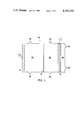
- FIG. 1 is a schematic view of an electrolytic cell for the production of halogen gas and alkali metal hydroxides according to the concepts of the present invention.
- FIG. 2 is a graphical representation of the relationship between elapsed time and measured potential of the cathode according to Example 5.
- Electrolytic cell 12 refers to a monopolar divided electrolytic cell which is suitable for use according to the concepts of the present invention. It is recognized that various other designs for electrolytic cells could incorporate the methods according to the concepts of the present invention, but that for illustration purposes the present schematic more amply describes the details of the present invention. Electrolytic cell 12, as shown in FIG. 1, would generally have some environmental supporting structure or foundation to maintain each electrolytic cell 12 in correct alignment so as to build a bank of electrolytic cells for production purposes. The details of this environmental structure have not been shown for ease of illustrating the concepts of the present invention.
- the cell itself could be manufactured from various materials either metallic or plastic in nature as long as these materials resist the severe surroundings of the chlorine environment, and temperature characteristics during the operation of the basic chlor-alkali cell which are well known in the art.
- materials generally include but are not limited to metallic materials such as steel, nickel, titanium and other valve metals in addition to plastics such as polyvinylchloride, polyethylene, polypropylene, fiberglass and others too numerous to mention.
- the valve metals include aluminum, molybdenum, niobium, titanium, tungsten, zirconium and alloys thereof.
- the electrolytic cell 12 shown has an anode 14, a separator 16, and a cathode 18 such that three individual compartments are formed within the electrolytic cell being mainly the anode compartment 20, the cathode compartment 22, and the oxygen compartment 24.
- the anode 14 will generally be constructed of a metallic substance, although graphitic carbon could be used as in the old electrodes which have largely been discarded by the industry presently. These anodes, particularly if they are to be used in a chlor-alkali cell 12, would generally be active material resistant to the anolyte such as a valve metal.
- a preferred valve metal based upon cost, availability and electrical chemical properties is titanium.
- a titanium substrate may take in the manufacture of an electrode, including for example, solid metal sheet material, expanded metal mesh material with a large percentage open area, and a porous titanium with a density of 30 to 70 percent pure titanium which can be produced by cold compacting titanium powder. If desired, the porous titanium can be reinforced with titanium mesh in the case of large electrodes.
- these substrate materials will have a surface coating to protect the material against passivation such as to make same what is generally known in the art as a dimensionally stable anode.
- Most of these coatings contain a noble metal, a noble metal oxide either alone or in combination with a valve metal oxide or other electrocatalytically active corrosion-resistant materials.
- These so-called dimensionally stable anodes are well-known and are widely used in the industry.
- One type of coating for instance would be a Beer-type coating which can be seen from U.S. Pat. Nos. 3,236,756; 3,632,498; 3,711,385; 3,751,296; and 3,933,616.
- Another type of coating utilized is one which tin, titanium and ruthenium oxides are used for surface coating as can be seen in U.S. Pat. Nos. 3,776,834 and 3,855,092.
- Two other examples of surface coatings include a tin, antimony with titanium and ruthenium oxides as found in U.S. Pat. No. 3,875,043 and a tantalium iridium oxide coating as found in U.S. Pat. No. 3,878,083.
- coatings which are available to those skilled in the art for use in chlor-alkali cells as well as other types of applications in which electrodes would be necessary for electrolytic reactions.
- separator 16 there are a number of materials which may be utilized for the separator 16 as shown in the drawing.
- One type of material anticipates the use of a substantially hydraulically impermeable or a cation exchange membrane as it is known in the art.
- One type of hydraulically impermeable cation exchange membrane which can be used in the apparatus of the present invention, is a thin film of flourinated copolmer having pendant sulfonic acid groups.
- the fluorinated copolymer is derived from monomers of the formulas:
- R represents the group ##STR1## in which the R 1 is fluorine or fluoroalkyl of 1 thru 10 carbon atoms; Y is fluorine or trifluoromethyl; m is 1, 2 or 3; n is 0 or 1; X is fluorine, chlorine or trifluoromethyl; and X 1 is X or CF 3 --CF 2 -- a O--, wherein a is 0 or an integer from 1 to 5.
- copolymer there should be sufficient repeating units, according to formula (3) above, to provide an --SO 3 H equivalent weight of about 800 to 1600.
- Materials having a water absorption of about 25 percent or greater are preferred since higher cell voltages at any given current density are required for materials having less water absorption.
- materials having a film thickness (unlaminated) of about 8 mils or more require higher cell voltages resulting in a lower power efficiency.
- the substrate film material will be laminated to and impregnated onto a hydraulically permeable, electrically non-conductive, inert, reinforcing member such as a woven or non-woven fabric made of fibers of asbestos, glass, TEFLON, or the like.
- a hydraulically permeable, electrically non-conductive, inert, reinforcing member such as a woven or non-woven fabric made of fibers of asbestos, glass, TEFLON, or the like.
- the laminating produce an unbroken surface of the film resin on at least one side of the fabric to prevent leakage through the substrate film material.
- Polymeric materials, according to formulas 3 and 4 can also be made wherein the ion exchange group instead of being a sulfonic acid exchange group could be many other types of structures.
- One particular type of structure is a carboxyl group ending in either an acid, and ester or a salt to form an ion exchange group similar to that of the sulfonic acid.
- SO 2 F one would find COOR 2 in its place wherein R 2 may be selected from the group of hydrogen, an alkali metal ion or an organic radical.
- a substrate material such as NAFION having any ion exchange group or function group capable of being converted into an ion exchange group or a function group in which an ion exchange group can easily be introduced would include such groups as oxy acids, salts, or esters of carbon, nitrogen, silicon, phosphorous, sulfur, chlorine, arsenic, selenium, or tellurium.
- a second type of substrate material has a backbone chain of copolymers of tetrafluoroethylene and hexafluoropropylene and, grafted onto this backbone, a fifty-fifty mixture by weight of styrene and alpha-methyl styrene. Subsequently, these grafts may be sulfonated or carbonated to achieve the ion exchange characteristic.
- This type of substrate while having different pendant groups has a fluorinated backbone chain so that the chemical resistivities are reasonably high.
- substrate film material would be polymeric substances having pendant carboxylic or sulfonic acid groups wherein the polymeric backbone is derived from the polymerization of a polyvinyl aromatic component with a monovinyl aromatic component in an inorganic solvent under conditions which prevent solvent evaporation and result in a generally copolymeric substance although a 100 percent polyvinyl aromatic compound may be prepared which is satisfactory.
- the polyvinyl aromatic component may be chosen from the group including: divinyl benzenes, divinyl toluenes, divinyl naphthalenes, divinyl diphenyls, divinyl-phenyl vinyl ethers, the substituted alkyl derivatives thereof such as dimethyl divinyl benzenes and similar polymerizable aromatic compounds which are polyfunctional with respect to vinyl groups.
- the monovinyl aromatic component which will generally be the impurities present in commercial grades of polyvinyl aromatic compounds include: styrene, isomeric vinyl toluenes, vinyl naphthalenes, vinyl ethyl benzenes, vinyl chlorobenzenes, vinyl xylenes, and alpha substituted alkyl derivates thereof, such as alpha methyl vinyl benzene.
- styrene isomeric vinyl toluenes
- vinyl naphthalenes vinyl ethyl benzenes
- vinyl chlorobenzenes vinyl xylenes
- alpha substituted alkyl derivates thereof such as alpha methyl vinyl benzene.
- Suitable solvents in which the polymerizable material may be dissolved prior to polymerization should be inert to the polymerization (in that they do not react chemically with the monomers or polymer), should also possess a boiling point greater than 60° C., and should be miscible with the sulfonation medium.
- Polymerization is effected by any of the well known expedients, for instance, heat, pressure, and catalytic accelerators, and is continued until an insoluble, infusible gel is formed substantially throughout the volume of solution.
- the resulting gel structures are then sulfonated in a solvated condition and to such an extent that there are not more than four equivalents of sulfonic acid groups formed for each mole of polyvinyl aromatic compound in the polymer and not less than one equivalent of sulfonic acid groups formed for each ten mole of poly and monovinyl aromatic compound in the polymer.
- these materials may require reinforcing of similar materials.
- Substrate film materials of this type are further described in the following patents which are hereby incorporated by reference: U.S. Pat. Nos. 2,731,408; 2,731,411 and 3,887,499. These materials are available from Ionics, Inc., under the trademark IONICS CR6.
- these treatments consist of reacting the pendant groups with substances which will yield less polar bonding and thereby absorb fewer water molecules by hydrogen bonding. This has a tendency to narrow the pore openings through which the cations travel so that less water of hydration is transmitted with the cations through the membrane.
- An example of this would be to react the ethylene diamine with the pendant groups to tie two of the pendant groups together by two nitrogen atoms in the ethylene diamine.
- the surface treatment will be done to a depth of approximately 2 mils on one side of the film by controlling the time of reaction. This will result in good electrical conductivity and cation transmission with less hydroxide ion and associated water reverse migration.
- the separator 16 could also be a porous diaphragm which may be made of any material compatible with the cell liquor environment, the proper bubble pressure and electrical conductivity characteristics.
- a material is asbestos which can be used either in paper sheet form or be vacuum-deposited fibers.
- a further modification can be effected by adding polymeric substances, generally fluorinated, to the slurry from which the diaphragm is deposited.
- polymeric materials themselves can be made porous to the extent that they show operational characteristics of a diaphragm. Those skilled in the art will readily recognize the wide variety of materials that are presently available for use as separators in chlor-alkali cells.
- the cathode 18 in order to be utilized according to the methods of the present invention, will necessarily be an oxygen electrode.
- An oxygen electrode or oxygen cathode may be defined as an electrode which is supplied with a molecular oxygen containing fluid to lower the voltage below that necessary for the evolution of hydrogen.
- the basic support for an oxygen cathode will generally include a current collector which could be constructed of a base metal although carbon black might also be used.
- base metal is used herein to refer to inexpensive metals which are commercially available for common construction purposes. Base metals are characterized by low cost, ready availability and adequate resistances to chemical corrosion when utilized as a cathode in electrolytic cells.
- Base metals would include, for instance, iron, nickel, lead and tin. Base metals also include alloys such as mild steels, stainless steel, bronze, monel and cast iron. A preferred base metal is chemically resistant to the catholyte and has a high electrical conductivity. Furthermore, this material will generally be a porous material such as a mesh when used in the construction of an oxygen cathode. A preferred metal, based upon cost, resistance to the catholyte and voltages available, is nickel. Other current collectors would include: tantalum, titanium, silver, silicon, zirconium, niobium, columbium, gold, and plated base metals.
- this basic support material Upon one side of this basic support material will be a coating of a porous material either compacted in such a fashion as to adhere to the nickel support or held together with some kind of binding substance so as to produce a porous substrate material.
- a preferred porous material based upon cost is carbon.
- Anchored within the porous portion of the oxygen cathode is a catalyst to catalyze the reaction wherein molecular oxygen combines with water molecules to produce hydroxide groups.
- These catalysts are generally based upon a silver or a platinum group metal such as palladium, platinum, ruthenium, gold, iridium, rhodium, osmium, or rhenium but also may be based upon semiprecious or nonprecious metal, alloys, metal oxides or organometal complexes.
- Other such catalysts include silver oxide, nickel, nickel oxide or platinum black.
- such electrodes will contain a hydrophobic material to wetproof the electrode structure.
- catalyst materials may be deposited upon the surface of the cathode support by electroplating or applying a compound of the catalyst metal such as platinum chloride or a like salt such as H 3 Pt(SO 3 ) 2 OH to the support and heating in an oxidizing atmosphere to obtain the catalytic oxide state or just heating to obtain the catalytic metallic state.
- the catalyst may be deposited on the exterior surface of the support and/or in the pores of the support so long as the oxygen and electrolyte both hve ready access to the coated pores which are catalytic sites.
- the porosity of the carbon material, the amount and the type of catalytic material used will affect the voltages and current efficiencies of the resultant electrolytic cell as well as their lifetimes.
- a preferred cathode 18 may be constructed according to U.S. Pat. No. 3,423,247, the disclosure of which is hereby incorporated by reference.
- an electrolytic cell 12 having three compartments, basically an anode compartment 20, a cathode compartment 22 and an oxygen compartment 24.
- an alkali metal halide solution in the anode compartment 20 as transmitted thereinto through the alkali metal halide solution inlet 26.
- the alkali metal halide solution preferably would be one which would evolve chlorine gas, such as sodium chloride or potassium chloride.
- an aqueous solution which would be transmitted thereinto through the aqueous solution inlet 28.
- the aqueous solution must contain sufficient water molecules to be broken down to form the required hydroxide groups necessary for the reaction.
- a fluid containing a sufficient amount of molecular oxygen to permit the cell operational characteristics Such a substance would generally be a gas and most preferably would be air with carbon dioxide removed and humidified or pure molecular oxygen which had been humidified.
- the reaction products such as chlorine gas would be removed from the anode compartment 20 through the halogen outlet 32 and aqueous NaOH or KOH would be removed from the cathode compartment 22 through the alkali metal hydroxide outlet 34 and an oxygen depleted fluid either in the form of residual pure oxygen or air most preferably would be removed from the depleted fluid outlet 36.
- the cathode 18 will experience a gradual increase in potential in time which indicates failure of the cathode. This is also manifested in an increase in the overall cell potential.
- the cathode 18, however, may be rejuvenated to reduce the potential of the cell after substantial decay has occured. Rejuvenation may be defined as a lowering of the potential across the electrodes of a cell 12 in which a cathode 18 is considered to have decayed to the point where it is no longer commercially feasible to continue production of chlorine and caustic therewith. This will generally be a failure potential in the range of -0.700 to -1.15 volts when the voltage is measured against a Hg/HgO reference electrode and a potential rejuvenation or potential lowering in the range of 0.01 to 1.0 volt.
- Rejuvenation may be accomplished in situ or out of cell. Both techniques contemplate washing both sides of the cathode 18 with a dilute acid solution or distilled water having a temperature in the range of 40° to 100° C. Examples of acids would include acetic, hydrochloric, sulfuric, carbonic, phosphoric, nitric and boric. The most preferred temperature range seems to be about 50° to 80° C. Furthermore, these wash cycles can be accomplished sequentially as by washing first with an acid solution followed by a water rinsing.
- the wash cycle is followed by a drying cycle which in situ would be a flushing with dry air at elevated temperatures and pressures.
- elevated pressures are used to avoid delamination of the electrode layers.
- the temperatures would generally be in the range of 50° to 100° C. and the pressures in the range of 0 to the point of electrode blow through. If the cathode 18 washing is done out of cell, then, following the drying cycle, it is advantageous to use a press to exert 1000 to 3000 pounds per square inch of pressure while maintaining the temperature in the range of 200° to 360° C.
- the time period would be as great as 24 hours while at the high end of the pressure and temperature ranges the time period should be in the range of 30 to 180 seconds.
- An oxygen electrode according to U.S. Pat. No. 3,423,245 was installed into an electrolytic cell as the cathode and run at 2 amperes per square inch and 60° C. until the voltage reached -0.982 volts as measured against a Hg/HgO reference electrode, when it was considered to have decayed beyond commercial usefulness.
- the oxygen electrode was then taken out of the cell and was soaked in deionized water for several days.
- An uncracked partially delaminated section of the oxygen electrode was then washed for 15 minutes in dilute acetic acid at 50° C. It was then rinsed with deionized water, dried and then pressed between two plates for 90 seconds at approximately 2000 pounds per square inch pressure. Upon restart, the following potentials was evident, showing a voltage savings initially of 0.742 volt and, finally, after 60 days, a savings of 0.589 volt over the cathode at the time of initial failure.
- An oxygen electrode according to U.S. Pat. No. 3,423,245 was run in an electrolytic cell as the cathode at 1 ampere per square inch and 60° C. until the voltage reached -0.577 volts as measured against a Hg/HgO reference electrode. The oxygen electrode was then washed in situ with warm distilled water while the electrolytic cell was shut down. The cell was then slowly started up to attain the same current density and temperature after 24 hours. The potential then was -0.497 for a savings of 0.080 volt.
- An oxygen electrode according to U.S. Pat. No. 3,423,245 was run in an electrolytic cell as the cathode at 1 ampere per square inch and 60° C. until the voltage reached -0.830 volt.
- the oxygen electrode was removed from the cell and cleaned ultrasonically in 0.1 N HCl solution. Some delamination was apparent so the cathode was then pressed between two nickel plates at about 200 pounds per square inch, heated to 115° C. and left overnight. The oxygen electrode was replaced into the electrolyte cell which was started up slowly. The potential then was -0.760 at 1 asi for a savings of 0.070 volt.
- An oxygen electrode having a substrate made of 30 mesh by 0.009 inch diameter nickel wire, woven cloth with approximately one half mil of silver plating was pressed from 0.018 inch to 0.012 inch thickness before use.
- the backing was a 65/35 mix of sodium carbonate/TEFLON with the sodium carbonate removed prior to cathode operation.
- the catalyst was a mix of 82 parts catalyst (30% silver, 70% R B carbon) and 18 parts TEFLON 30. This oxygen electrode was run in an electrolytic cell as the cathode, with 38% KOH at a current density of 0.125 ampere per square centimeter, a temperature of 60° ⁇ 5° C. and approximately zero ⁇ pressure, until it was in failure.
- the oxygen electrode was then rejuvenated by washing in situ with flowing water having a temperature of 60° C. for a time period of 16 hours and subsequently dried with air flow having a temperature of 120° C. for a time period in the range of 1 to 2 hours. This procedure was repeated two times and the results can be seen in the voltage versus time plot on the graphic illustration of FIG. 2 of the drawings.
- the voltages in FIG. 2 are stated as the cathode against a Hg/HgO reference electrode.
Landscapes
- Chemical & Material Sciences (AREA)
- Engineering & Computer Science (AREA)
- Chemical Kinetics & Catalysis (AREA)
- Electrochemistry (AREA)
- Materials Engineering (AREA)
- Metallurgy (AREA)
- Organic Chemistry (AREA)
- Inorganic Chemistry (AREA)
- Electrolytic Production Of Non-Metals, Compounds, Apparatuses Therefor (AREA)
- Electrodes For Compound Or Non-Metal Manufacture (AREA)
- Pharmaceuticals Containing Other Organic And Inorganic Compounds (AREA)
- Organic Low-Molecular-Weight Compounds And Preparation Thereof (AREA)
Priority Applications (20)
| Application Number | Priority Date | Filing Date | Title |
|---|---|---|---|
| US05/932,229 US4185142A (en) | 1978-08-09 | 1978-08-09 | Oxygen electrode rejuvenation methods |
| JP8802579A JPS5524991A (en) | 1978-08-09 | 1979-07-11 | Renewing of oxygen electrode |
| BR7904980A BR7904980A (pt) | 1978-08-09 | 1979-08-03 | Processo para regeneracao de um eletrodo de oxigenio falhado |
| YU01896/79A YU189679A (en) | 1978-08-09 | 1979-08-03 | Method of egenerating an oxygen electrode |
| AU49609/79A AU523927B2 (en) | 1978-08-09 | 1979-08-06 | Oxygen electrode rejuvenation process |
| RO7998393A RO77763A (ro) | 1978-08-09 | 1979-08-07 | Procedeu pentru regenerarea unui electrod de oxigen folosit in celulele electrolitice pentru producerea clorului si hidroxizilor alcalini |
| GR59786A GR70265B (ro) | 1978-08-09 | 1979-08-07 | |
| EP79301613A EP0008232B1 (en) | 1978-08-09 | 1979-08-08 | Oxygen electrode rejuvenation methods |
| ES483255A ES483255A1 (es) | 1978-08-09 | 1979-08-08 | Metodo para la reactivacion de un electrodo de oxigeno de- fectuoso |
| PL1979217628A PL116940B1 (en) | 1978-08-09 | 1979-08-08 | Process for regeneration of oxygen electrodes |
| NO792593A NO792593L (no) | 1978-08-09 | 1979-08-08 | Fremgangsmaate for aa rekonstituere en oxygenelektrode |
| FI792464A FI792464A7 (fi) | 1978-08-09 | 1979-08-08 | Happielektrodin uudistamismenetelmiä. |
| DD79214855A DD145284A5 (de) | 1978-08-09 | 1979-08-08 | Verfahren zur reaktivierung von sauerstoff-elektroden |
| DE7979301613T DE2962813D1 (en) | 1978-08-09 | 1979-08-08 | Oxygen electrode rejuvenation methods |
| CA000333372A CA1146911A (en) | 1978-08-09 | 1979-08-08 | Oxygen electrode rejuvenation methods |
| AR277642A AR223347A1 (es) | 1978-08-09 | 1979-08-08 | Metodo para la reactivacion de un electrodo de oxigeno |
| NZ191241A NZ191241A (en) | 1978-08-09 | 1979-08-08 | Rejuvenation of failed oxygen electrode from chlor-alkali electrolytic cell |
| IL58005A IL58005A0 (en) | 1978-08-09 | 1979-08-08 | Oxygen electrode rejuvenation methods |
| IN821/CAL/79A IN152967B (ro) | 1978-08-09 | 1979-08-08 | |
| ZA00794117A ZA794117B (en) | 1978-08-09 | 1979-08-08 | Oxygen electrode rejuvenation methods |
Applications Claiming Priority (1)
| Application Number | Priority Date | Filing Date | Title |
|---|---|---|---|
| US05/932,229 US4185142A (en) | 1978-08-09 | 1978-08-09 | Oxygen electrode rejuvenation methods |
Publications (1)
| Publication Number | Publication Date |
|---|---|
| US4185142A true US4185142A (en) | 1980-01-22 |
Family
ID=25461982
Family Applications (1)
| Application Number | Title | Priority Date | Filing Date |
|---|---|---|---|
| US05/932,229 Expired - Lifetime US4185142A (en) | 1978-08-09 | 1978-08-09 | Oxygen electrode rejuvenation methods |
Country Status (20)
| Country | Link |
|---|---|
| US (1) | US4185142A (ro) |
| EP (1) | EP0008232B1 (ro) |
| JP (1) | JPS5524991A (ro) |
| AR (1) | AR223347A1 (ro) |
| AU (1) | AU523927B2 (ro) |
| BR (1) | BR7904980A (ro) |
| CA (1) | CA1146911A (ro) |
| DD (1) | DD145284A5 (ro) |
| DE (1) | DE2962813D1 (ro) |
| ES (1) | ES483255A1 (ro) |
| FI (1) | FI792464A7 (ro) |
| GR (1) | GR70265B (ro) |
| IL (1) | IL58005A0 (ro) |
| IN (1) | IN152967B (ro) |
| NO (1) | NO792593L (ro) |
| NZ (1) | NZ191241A (ro) |
| PL (1) | PL116940B1 (ro) |
| RO (1) | RO77763A (ro) |
| YU (1) | YU189679A (ro) |
| ZA (1) | ZA794117B (ro) |
Cited By (7)
| Publication number | Priority date | Publication date | Assignee | Title |
|---|---|---|---|---|
| DE3436723A1 (de) * | 1984-10-06 | 1986-04-10 | BBC Aktiengesellschaft Brown, Boveri & Cie., Baden, Aargau | Verfahren zur herabsetzung der ueberspannung an einer aktivierten elektrode einer elektrochemischen zelle |
| FR2772051A1 (fr) * | 1997-12-10 | 1999-06-11 | Atochem Elf Sa | Procede d'immobilisation d'une cellule d'electrolyse a membrane et a cathode a reduction d'oxygene |
| US20040071865A1 (en) * | 2000-12-29 | 2004-04-15 | Renaut Mosdale | Method for making an assembly of base elements for a fuel cell substrate |
| US20060272174A1 (en) * | 2005-05-20 | 2006-12-07 | Klaus Hartig | Deposition chamber desiccation systems and methods of use thereof |
| DE102016211155A1 (de) * | 2016-06-22 | 2017-12-28 | Siemens Aktiengesellschaft | Anordnung und Verfahren für die Kohlendioxid-Elektrolyse |
| US10208385B2 (en) | 2017-03-21 | 2019-02-19 | Kabushiki Kaisha Toshiba | Carbon dioxide electrolytic device and carbon dioxide electrolytic method |
| US20210079541A1 (en) * | 2019-09-17 | 2021-03-18 | Kabushiki Kaisha Toshiba | Carbon dioxide electrolytic device and method of electrolyzing carbon dioxide |
Families Citing this family (1)
| Publication number | Priority date | Publication date | Assignee | Title |
|---|---|---|---|---|
| JP6845114B2 (ja) * | 2017-09-20 | 2021-03-17 | 株式会社東芝 | 二酸化炭素電解装置および二酸化炭素電解方法 |
Citations (24)
| Publication number | Priority date | Publication date | Assignee | Title |
|---|---|---|---|---|
| US1561775A (en) * | 1923-06-22 | 1925-11-17 | Us Light & Heat Corp | Treatment of plates for storage batteries |
| US2731411A (en) * | 1951-12-05 | 1956-01-17 | Ionics | Electrically conductive membranes and the like comprising the sulfonated polymerizates of polyvinyl aryl compounds |
| US2731408A (en) * | 1952-01-25 | 1956-01-17 | Ionics | Electrically conductive membranes and the like comprising copolymers of divinyl benzene and olefinic carboxylic compounds |
| US3041317A (en) * | 1960-05-02 | 1962-06-26 | Du Pont | Fluorocarbon sulfonyl fluorides |
| US3067276A (en) * | 1957-06-06 | 1962-12-04 | Accumulatoren Fabrik Ag | Method of regenerating double skeleton catalyst electrodes |
| US3236756A (en) * | 1957-04-09 | 1966-02-22 | Amalgamated Curacao Patents Co | Electrolysis with precious metalcoated titanium anode |
| US3242010A (en) * | 1963-12-18 | 1966-03-22 | Albert G Bodine | Method of and means for applying sonic energy to fuel cells |
| US3282875A (en) * | 1964-07-22 | 1966-11-01 | Du Pont | Fluorocarbon vinyl ether polymers |
| US3423245A (en) * | 1966-04-18 | 1969-01-21 | Nat Union Electric Corp | Delayed action battery |
| US3467586A (en) * | 1965-04-12 | 1969-09-16 | Hooker Chemical Corp | Rejuvenation of diaphragms for chlor-alkali cells |
| GB1184321A (en) * | 1968-05-15 | 1970-03-11 | Du Pont | Electrochemical Cells |
| US3624053A (en) * | 1963-06-24 | 1971-11-30 | Du Pont | Trifluorovinyl sulfonic acid polymers |
| US3632498A (en) * | 1967-02-10 | 1972-01-04 | Chemnor Ag | Electrode and coating therefor |
| US3711385A (en) * | 1970-09-25 | 1973-01-16 | Chemnor Corp | Electrode having platinum metal oxide coating thereon,and method of use thereof |
| US3751296A (en) * | 1967-02-10 | 1973-08-07 | Chemnor Ag | Electrode and coating therefor |
| US3776834A (en) * | 1972-05-30 | 1973-12-04 | Leary K O | Partial replacement of ruthenium with tin in electrode coatings |
| US3784399A (en) * | 1971-09-08 | 1974-01-08 | Du Pont | Films of fluorinated polymer containing sulfonyl groups with one surface in the sulfonamide or sulfonamide salt form and a process for preparing such |
| US3855092A (en) * | 1972-05-30 | 1974-12-17 | Electronor Corp | Novel electrolysis method |
| US3875043A (en) * | 1973-04-19 | 1975-04-01 | Electronor Corp | Electrodes with multicomponent coatings |
| US3878083A (en) * | 1972-05-18 | 1975-04-15 | Electronor Corp | Anode for oxygen evolution |
| US3887499A (en) * | 1971-12-06 | 1975-06-03 | Ionics | Cation exchange membranes having carboxylic and sulfonic acid functionality |
| US3926671A (en) * | 1973-06-07 | 1975-12-16 | Battelle Memorial Institute | Method of manufacturing positive nickel hydroxide electrodes |
| US3933616A (en) * | 1967-02-10 | 1976-01-20 | Chemnor Corporation | Coating of protected electrocatalytic material on an electrode |
| US4055709A (en) * | 1976-08-05 | 1977-10-25 | The United States Of America As Represented By The Secretary Of The Navy | Rejuvenation of nickel-cadmium battery cells |
Family Cites Families (2)
| Publication number | Priority date | Publication date | Assignee | Title |
|---|---|---|---|---|
| DE1671496B2 (de) * | 1967-05-26 | 1972-12-14 | Verfahren zum betrieb von sauerstoffelektroden in amalgamzersetzungszellen | |
| US3926769A (en) * | 1973-05-18 | 1975-12-16 | Dow Chemical Co | Diaphragm cell chlorine production |
-
1978
- 1978-08-09 US US05/932,229 patent/US4185142A/en not_active Expired - Lifetime
-
1979
- 1979-07-11 JP JP8802579A patent/JPS5524991A/ja active Pending
- 1979-08-03 BR BR7904980A patent/BR7904980A/pt unknown
- 1979-08-03 YU YU01896/79A patent/YU189679A/xx unknown
- 1979-08-06 AU AU49609/79A patent/AU523927B2/en not_active Expired - Fee Related
- 1979-08-07 RO RO7998393A patent/RO77763A/ro unknown
- 1979-08-07 GR GR59786A patent/GR70265B/el unknown
- 1979-08-08 IN IN821/CAL/79A patent/IN152967B/en unknown
- 1979-08-08 AR AR277642A patent/AR223347A1/es active
- 1979-08-08 ES ES483255A patent/ES483255A1/es not_active Expired
- 1979-08-08 FI FI792464A patent/FI792464A7/fi not_active Application Discontinuation
- 1979-08-08 DE DE7979301613T patent/DE2962813D1/de not_active Expired
- 1979-08-08 DD DD79214855A patent/DD145284A5/de unknown
- 1979-08-08 EP EP79301613A patent/EP0008232B1/en not_active Expired
- 1979-08-08 PL PL1979217628A patent/PL116940B1/pl unknown
- 1979-08-08 NO NO792593A patent/NO792593L/no unknown
- 1979-08-08 CA CA000333372A patent/CA1146911A/en not_active Expired
- 1979-08-08 ZA ZA00794117A patent/ZA794117B/xx unknown
- 1979-08-08 IL IL58005A patent/IL58005A0/xx unknown
- 1979-08-08 NZ NZ191241A patent/NZ191241A/xx unknown
Patent Citations (24)
| Publication number | Priority date | Publication date | Assignee | Title |
|---|---|---|---|---|
| US1561775A (en) * | 1923-06-22 | 1925-11-17 | Us Light & Heat Corp | Treatment of plates for storage batteries |
| US2731411A (en) * | 1951-12-05 | 1956-01-17 | Ionics | Electrically conductive membranes and the like comprising the sulfonated polymerizates of polyvinyl aryl compounds |
| US2731408A (en) * | 1952-01-25 | 1956-01-17 | Ionics | Electrically conductive membranes and the like comprising copolymers of divinyl benzene and olefinic carboxylic compounds |
| US3236756A (en) * | 1957-04-09 | 1966-02-22 | Amalgamated Curacao Patents Co | Electrolysis with precious metalcoated titanium anode |
| US3067276A (en) * | 1957-06-06 | 1962-12-04 | Accumulatoren Fabrik Ag | Method of regenerating double skeleton catalyst electrodes |
| US3041317A (en) * | 1960-05-02 | 1962-06-26 | Du Pont | Fluorocarbon sulfonyl fluorides |
| US3624053A (en) * | 1963-06-24 | 1971-11-30 | Du Pont | Trifluorovinyl sulfonic acid polymers |
| US3242010A (en) * | 1963-12-18 | 1966-03-22 | Albert G Bodine | Method of and means for applying sonic energy to fuel cells |
| US3282875A (en) * | 1964-07-22 | 1966-11-01 | Du Pont | Fluorocarbon vinyl ether polymers |
| US3467586A (en) * | 1965-04-12 | 1969-09-16 | Hooker Chemical Corp | Rejuvenation of diaphragms for chlor-alkali cells |
| US3423245A (en) * | 1966-04-18 | 1969-01-21 | Nat Union Electric Corp | Delayed action battery |
| US3632498A (en) * | 1967-02-10 | 1972-01-04 | Chemnor Ag | Electrode and coating therefor |
| US3751296A (en) * | 1967-02-10 | 1973-08-07 | Chemnor Ag | Electrode and coating therefor |
| US3933616A (en) * | 1967-02-10 | 1976-01-20 | Chemnor Corporation | Coating of protected electrocatalytic material on an electrode |
| GB1184321A (en) * | 1968-05-15 | 1970-03-11 | Du Pont | Electrochemical Cells |
| US3711385A (en) * | 1970-09-25 | 1973-01-16 | Chemnor Corp | Electrode having platinum metal oxide coating thereon,and method of use thereof |
| US3784399A (en) * | 1971-09-08 | 1974-01-08 | Du Pont | Films of fluorinated polymer containing sulfonyl groups with one surface in the sulfonamide or sulfonamide salt form and a process for preparing such |
| US3887499A (en) * | 1971-12-06 | 1975-06-03 | Ionics | Cation exchange membranes having carboxylic and sulfonic acid functionality |
| US3878083A (en) * | 1972-05-18 | 1975-04-15 | Electronor Corp | Anode for oxygen evolution |
| US3776834A (en) * | 1972-05-30 | 1973-12-04 | Leary K O | Partial replacement of ruthenium with tin in electrode coatings |
| US3855092A (en) * | 1972-05-30 | 1974-12-17 | Electronor Corp | Novel electrolysis method |
| US3875043A (en) * | 1973-04-19 | 1975-04-01 | Electronor Corp | Electrodes with multicomponent coatings |
| US3926671A (en) * | 1973-06-07 | 1975-12-16 | Battelle Memorial Institute | Method of manufacturing positive nickel hydroxide electrodes |
| US4055709A (en) * | 1976-08-05 | 1977-10-25 | The United States Of America As Represented By The Secretary Of The Navy | Rejuvenation of nickel-cadmium battery cells |
Cited By (11)
| Publication number | Priority date | Publication date | Assignee | Title |
|---|---|---|---|---|
| DE3436723A1 (de) * | 1984-10-06 | 1986-04-10 | BBC Aktiengesellschaft Brown, Boveri & Cie., Baden, Aargau | Verfahren zur herabsetzung der ueberspannung an einer aktivierten elektrode einer elektrochemischen zelle |
| FR2772051A1 (fr) * | 1997-12-10 | 1999-06-11 | Atochem Elf Sa | Procede d'immobilisation d'une cellule d'electrolyse a membrane et a cathode a reduction d'oxygene |
| EP0922789A1 (fr) * | 1997-12-10 | 1999-06-16 | Elf Atochem S.A. | Procédé d'immobilisation d'une cellule d'électrolyse à membrane et à cathode à réduction d'oxygene |
| US6203687B1 (en) * | 1997-12-10 | 2001-03-20 | Elf Atochem, S.A. | Method for shutting down an electrolysis cell with a membrane and an oxygen-reducing cathode |
| CN1106458C (zh) * | 1997-12-10 | 2003-04-23 | 埃勒夫阿托化学有限公司 | 膜与氧还原阴极的电解槽的间歇方法 |
| US20040071865A1 (en) * | 2000-12-29 | 2004-04-15 | Renaut Mosdale | Method for making an assembly of base elements for a fuel cell substrate |
| US20060272174A1 (en) * | 2005-05-20 | 2006-12-07 | Klaus Hartig | Deposition chamber desiccation systems and methods of use thereof |
| DE102016211155A1 (de) * | 2016-06-22 | 2017-12-28 | Siemens Aktiengesellschaft | Anordnung und Verfahren für die Kohlendioxid-Elektrolyse |
| US10208385B2 (en) | 2017-03-21 | 2019-02-19 | Kabushiki Kaisha Toshiba | Carbon dioxide electrolytic device and carbon dioxide electrolytic method |
| EP3378968B1 (en) * | 2017-03-21 | 2021-04-28 | Kabushiki Kaisha Toshiba | Carbon dioxide electrolytic device and carbon dioxide electrolytic method |
| US20210079541A1 (en) * | 2019-09-17 | 2021-03-18 | Kabushiki Kaisha Toshiba | Carbon dioxide electrolytic device and method of electrolyzing carbon dioxide |
Also Published As
| Publication number | Publication date |
|---|---|
| RO77763A (ro) | 1981-12-25 |
| PL217628A1 (ro) | 1980-04-21 |
| EP0008232A2 (en) | 1980-02-20 |
| YU189679A (en) | 1982-08-31 |
| NO792593L (no) | 1980-02-12 |
| AU523927B2 (en) | 1982-08-19 |
| PL116940B1 (en) | 1981-07-31 |
| ES483255A1 (es) | 1980-09-01 |
| DE2962813D1 (en) | 1982-07-01 |
| NZ191241A (en) | 1982-08-17 |
| AR223347A1 (es) | 1981-08-14 |
| DD145284A5 (de) | 1980-12-03 |
| AU4960979A (en) | 1980-02-14 |
| JPS5524991A (en) | 1980-02-22 |
| ZA794117B (en) | 1980-07-30 |
| IN152967B (ro) | 1984-05-12 |
| IL58005A0 (en) | 1979-12-30 |
| CA1146911A (en) | 1983-05-24 |
| EP0008232B1 (en) | 1982-05-12 |
| GR70265B (ro) | 1982-09-02 |
| BR7904980A (pt) | 1980-04-22 |
| FI792464A7 (fi) | 1981-01-01 |
| EP0008232A3 (en) | 1980-03-05 |
Similar Documents
| Publication | Publication Date | Title |
|---|---|---|
| US4221644A (en) | Air-depolarized chlor-alkali cell operation methods | |
| CA1056768A (en) | Coating metal anodes to decrease consumption rates | |
| US4209368A (en) | Production of halogens by electrolysis of alkali metal halides in a cell having catalytic electrodes bonded to the surface of a porous membrane/separator | |
| KR850000052B1 (ko) | 불소화 혼성막 | |
| US5635039A (en) | Membrane with internal passages to permit fluid flow and an electrochemical cell containing the same | |
| US6149810A (en) | Membrane with supported internal passages | |
| US3976549A (en) | Electrolysis method | |
| US4389297A (en) | Permionic membrane electrolytic cell | |
| US5437771A (en) | Electrolytic cell and processes for producing alkali hydroxide and hydrogen peroxide | |
| US4124477A (en) | Electrolytic cell utilizing pretreated semi-permeable membranes | |
| WO2003010360A1 (en) | Electrochemical synthesis of hydrogen peroxide | |
| US5168005A (en) | Multiaxially reinforced membrane | |
| US4299675A (en) | Process for electrolyzing an alkali metal halide | |
| US4276146A (en) | Cell having catalytic electrodes bonded to a membrane separator | |
| US4185142A (en) | Oxygen electrode rejuvenation methods | |
| US3926769A (en) | Diaphragm cell chlorine production | |
| US4749452A (en) | Multi-layer electrode membrane-assembly and electrolysis process using same | |
| JPH0586971B2 (ro) | ||
| EP0004191A2 (en) | Chloralkali electrolytic cell and method for operating same | |
| JP3264535B2 (ja) | ガス電極構造体及び該ガス電極構造体を使用する電解方法 | |
| US5512143A (en) | Electrolysis method using polymer additive for membrane cell operation where the polymer additive is ionomeric and added to the catholyte | |
| JPH11172484A (ja) | ガス拡散電極構造体とその製造方法 | |
| JP4447081B2 (ja) | 多硫化物の製造方法 | |
| CA1338634C (en) | Cell and method of operating a liquid-gas electrochemical cell | |
| US4061550A (en) | Process for electrolysis |
Legal Events
| Date | Code | Title | Description |
|---|---|---|---|
| AS | Assignment |
Owner name: DIAMOND SHAMROCK CHEMICALS COMPANY Free format text: CHANGE OF NAME;ASSIGNOR:DIAMOND SHAMROCK CORPORATION CHANGED TO DIAMOND CHEMICALS COMPANY;REEL/FRAME:004197/0130 |
|
| AS | Assignment |
Owner name: ELTECH SYSTEMS CORPORATION, 6100 GLADES ROAD, BOCA Free format text: ASSIGNMENT OF ASSIGNORS INTEREST.;ASSIGNOR:DIAMOND SHAMROCK CORPORATION, 717 N. HARWOOD STREET, DALLAS, TX 75201;REEL/FRAME:004357/0479 Effective date: 19841024 |
|
| AS | Assignment |
Owner name: OXYTECH SYSTEMS, INC., OHIO Free format text: ASSIGNMENT OF ASSIGNORS INTEREST;ASSIGNOR:ELTECH SYSTEMS CORPORATION;REEL/FRAME:008568/0099 Effective date: 19970618 |