US192583A - Improvement in reed-organs - Google Patents
Improvement in reed-organs Download PDFInfo
- Publication number
- US192583A US192583A US192583DA US192583A US 192583 A US192583 A US 192583A US 192583D A US192583D A US 192583DA US 192583 A US192583 A US 192583A
- Authority
- US
- United States
- Prior art keywords
- reed
- valves
- swell
- notes
- bass
- Prior art date
- Legal status (The legal status is an assumption and is not a legal conclusion. Google has not performed a legal analysis and makes no representation as to the accuracy of the status listed.)
- Expired - Lifetime
Links
- 238000010276 construction Methods 0.000 description 1
- 238000000034 method Methods 0.000 description 1
- 238000005192 partition Methods 0.000 description 1
Images
Classifications
-
- G—PHYSICS
- G10—MUSICAL INSTRUMENTS; ACOUSTICS
- G10B—ORGANS, HARMONIUMS OR SIMILAR WIND MUSICAL INSTRUMENTS WITH ASSOCIATED BLOWING APPARATUS
- G10B1/00—General design of organs, harmoniums or similar wind musical instruments with associated blowing apparatus
- G10B1/08—General design of organs, harmoniums or similar wind musical instruments with associated blowing apparatus of harmoniums, i.e. reed organs
Definitions
- I 5M y4m AMQX/ NPETERS PHOTO-LITHQGRAPHER. WASHINGTON, D Cv UNITED STATES PATENT OFFICE.
- Our invention consists of mechanism arranged to govern the swell of the accompaniment treble and bass notes, so that the swell of each note can be distinctly separated, one from the other, at the middle of the instrument, or atthe point where the treble and bass are used for the same purpose; the object being to give greater elegance and variety of expression to the notes, as the swell may be confined to one, two, or more of the notes or given to all, as desired.
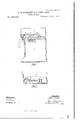
- Figure l is a plan, Fig. 2 a longitudinal elevation, and Fig. 3 a cross-section, of a reed-instrument embodying our improvements Fig. 4, a detail view, the upper portion of the instrument be ing removed to expose mechanism.
- A is the instrument-case, which may be constructed in any of the usual designs, the arrangement of the treadles, bellows, &c., being as usual.
- B is the reed-chamber. At the center of the reed-chamber, being that portion which corresponds to the central or accompanying notes, the swell-opening of a section,
- valves D are placed over the front faces of the dividing-partitions of section B. These valves are arranged to slide back and forth a distance equal to the length of section B, opening or shutting, as it is moved, the mouths of the subdivisions b, the number of subdivisions opened corresponding to the distance that the valves are moved.
- the valves D are connected by cords D to a diflerential roller, E, which roller is operated, to open the central swell, by a cord,
- valves from a pivoted knee-lever, F, of the usual description.
- the valves are closed by the reaction of the torsional strain of a spiral spring, Gr, coiled on a differential roller, G which roller is connected to the valve by cords G (Shown in Fig. 4.)
- the action of opening the valve D by pressing on the lever F coils the cord upon the roller E, and uncoils the cord upon the roller G at the same time twisting the spring G, and developing the power which returns the valve to its closing position immediately the pressure on the knee-lever is removed.
- the bass ends of the valves D are finished with a gradual inclination, and the parts are so proportioned that when the valves D have been withdrawn so far as to open all, or nearly all, the notes of the central section, the inclined ends H will engage with a projecting rod, 1, on the bass-swell valves I, and open the bass-swell valves. When the valves D move back, the spring J automatically closes the bass-swell again.
- a rod, K bent forwardly to clear the swell-chamber, and provided at the end with a suitable pointer or face-plate, K.
- This rod being attached to the valve D, has communicated to it the same motion, and we use it, in connection with a suitable graduated slot in the case of instrument, as an indicator to show how many notes are open to the swell.
- valves D could also be applied at the top or bottom of the central section without departing from the spirit of our invention.
- variable slide-valves D The combination, with the reed-chamber B, provided with the subdivided central section B, of the variable slide-valves D, substantially as shown and described.
Landscapes
- Physics & Mathematics (AREA)
- Engineering & Computer Science (AREA)
- Acoustics & Sound (AREA)
- Multimedia (AREA)
- Stringed Musical Instruments (AREA)
Description
' ZSheets-Sheet 1.
A. R. KOERBER & J. SHERIDAN. REED-ORGAN.
No. 192,583. Patented July 3,1877.
M .frwerdols. I
# FETERS, PNQTO-LITHOGRAPHER, WASHINGTON, D C.
Witnesses.
2SheetsSheei2. A. R. KOERBER & J. SHERIDAN.
REED-ORGAN. No.19Z,583. Patented July 3,1877.
W T (H l um. Ha UJHHHHJH! I Fig.4.
Inveniozas.
I 5M y4m AMQX/ NPETERS. PHOTO-LITHQGRAPHER. WASHINGTON, D Cv UNITED STATES PATENT OFFICE.
ALEXANDER KOERBER AND'JAMES SHERIDAN, OF TORONTO, ONTARIO,
CANADA.
IMPROVEMENT IN REED-ORGANS.
Specification forming part of Letters Patent No. 192,583, dated July 3, 1877; application filed May 17, 11511.
To all whom it may concern:
Be it kno wn that We, ALEXANDER RUDOLPH KOERBER, musicteacher, and JAMES SHERI- DAN, piano-tuner, both of the city of Toronto, in the county of York, in the Province of Ontario, Canada, have jointly invented certain new and useful Improvements on Musical Reed-Instruments, which improvements are fully set forth in the following specification, reference being had to the accompanying drawings.
Our invention consists of mechanism arranged to govern the swell of the accompaniment treble and bass notes, so that the swell of each note can be distinctly separated, one from the other, at the middle of the instrument, or atthe point where the treble and bass are used for the same purpose; the object being to give greater elegance and variety of expression to the notes, as the swell may be confined to one, two, or more of the notes or given to all, as desired.
In the accompanying drawing, Figure l is a plan, Fig. 2 a longitudinal elevation, and Fig. 3 a cross-section, of a reed-instrument embodying our improvements Fig. 4, a detail view, the upper portion of the instrument be ing removed to expose mechanism.
A is the instrument-case, which may be constructed in any of the usual designs, the arrangement of the treadles, bellows, &c., being as usual. B is the reed-chamber. At the center of the reed-chamber, being that portion which corresponds to the central or accompanying notes, the swell-opening of a section,
' B, is isolated from the swells of the bass and treble notes. This central section is subdivided into a number of passages or wind-inlets, b, corresponding with, and connected to, the accompaniment notes. Over the front faces of the dividing-partitions of section B valves D are placed. These valves are arranged to slide back and forth a distance equal to the length of section B, opening or shutting, as it is moved, the mouths of the subdivisions b, the number of subdivisions opened corresponding to the distance that the valves are moved. The valves D are connected by cords D to a diflerential roller, E, which roller is operated, to open the central swell, by a cord,
F, from a pivoted knee-lever, F, of the usual description. The valves are closed by the reaction of the torsional strain of a spiral spring, Gr, coiled on a differential roller, G which roller is connected to the valve by cords G (Shown in Fig. 4.) The action of opening the valve D by pressing on the lever F coils the cord upon the roller E, and uncoils the cord upon the roller G at the same time twisting the spring G, and developing the power which returns the valve to its closing position immediately the pressure on the knee-lever is removed.
The bass ends of the valves D are finished with a gradual inclination, and the parts are so proportioned that when the valves D have been withdrawn so far as to open all, or nearly all, the notes of the central section, the inclined ends H will engage with a projecting rod, 1, on the bass-swell valves I, and open the bass-swell valves. When the valves D move back, the spring J automatically closes the bass-swell again.
To one of the valves D is attached a rod, K, bent forwardly to clear the swell-chamber, and provided at the end with a suitable pointer or face-plate, K. This rod, being attached to the valve D, has communicated to it the same motion, and we use it, in connection with a suitable graduated slot in the case of instrument, as an indicator to show how many notes are open to the swell.
There are, of course, different methods of arranging the mechanical details of construction for instance, different forms of springs or a weight could be used in lieu of the spiral spring G to draw the valve D back. The valves D could also be applied at the top or bottom of the central section without departing from the spirit of our invention.
The advantages gained by our improvements are, that the swell of the treble and bass accompanying notes can be distinctly separated from each other, and the bass notes can be run along into the treble notes an octave or more, or vice versa, at the will of the performer.
We claim as new and desire to secure by Letters Patent- 1. A musical reed-instrument in which the central portions of the reed-cells are connected with an independent section of the reed-chamher, subdivided to correspond with the central or accompanying notes, and closed by a variable-swell valve, which valve can be operated to open or close one or more or all of the subdivisions of said section at the will of the performen.
2. The combination, with the reed-chamber B, provided with the subdivided central section B, of the variable slide-valves D, substantially as shown and described.
3. The pivoted knee-lever F, cord F, difl'erential roller E, and cords D, in combination with the valves D, substantially as shown and described.
4. The difl'erential spring-roller G and cords G in combination with the valves D, snbstan- A. R. 'KoERB'ER. JAMES SHERIDAN.
Witnesses:
GEO. A. AIRD, FRANK MUNRO.
Publications (1)
| Publication Number | Publication Date |
|---|---|
| US192583A true US192583A (en) | 1877-07-03 |
Family
ID=2261989
Family Applications (1)
| Application Number | Title | Priority Date | Filing Date |
|---|---|---|---|
| US192583D Expired - Lifetime US192583A (en) | Improvement in reed-organs |
Country Status (1)
| Country | Link |
|---|---|
| US (1) | US192583A (en) |
-
0
- US US192583D patent/US192583A/en not_active Expired - Lifetime
Similar Documents
| Publication | Publication Date | Title |
|---|---|---|
| US192583A (en) | Improvement in reed-organs | |
| US517648A (en) | Accordion | |
| US105718A (en) | Improvement in reed musical instruments | |
| US882575A (en) | Reed-harmonica. | |
| US91686A (en) | Improvement in organs and melodeons | |
| US566150A (en) | ehrlich | |
| US593690A (en) | Cornet | |
| US795795A (en) | Accordion. | |
| US467521A (en) | Musical instrument | |
| US274686A (en) | Henry k | |
| US86219A (en) | Gael fogelbeeg- | |
| US570200A (en) | chase | |
| US251861A (en) | Azro fowler | |
| US847636A (en) | Organ-action. | |
| US581313A (en) | Harmonica | |
| US1051398A (en) | Octave-coupler for accordions. | |
| US199516A (en) | Improvement in cornets | |
| US1320783A (en) | Prank herbert mowbray | |
| US487716A (en) | Organ | |
| USRE2666E (en) | George a | |
| US346152A (en) | Meeeitt gally | |
| US516990A (en) | Half to frank w | |
| US678329A (en) | Reed-organ. | |
| US1033129A (en) | Tone-regulator for piano-playing attachments. | |
| US117587A (en) | Improvement in organs |