US12295264B2 - Thermoelectric module and method for manufacturing the same - Google Patents
Thermoelectric module and method for manufacturing the same Download PDFInfo
- Publication number
- US12295264B2 US12295264B2 US17/741,352 US202217741352A US12295264B2 US 12295264 B2 US12295264 B2 US 12295264B2 US 202217741352 A US202217741352 A US 202217741352A US 12295264 B2 US12295264 B2 US 12295264B2
- Authority
- US
- United States
- Prior art keywords
- type semiconductor
- thermoelectric
- semiconductor device
- electrode
- insulating layer
- Prior art date
- Legal status (The legal status is an assumption and is not a legal conclusion. Google has not performed a legal analysis and makes no representation as to the accuracy of the status listed.)
- Active, expires
Links
Images




Classifications
-
- H—ELECTRICITY
- H10—SEMICONDUCTOR DEVICES; ELECTRIC SOLID-STATE DEVICES NOT OTHERWISE PROVIDED FOR
- H10N—ELECTRIC SOLID-STATE DEVICES NOT OTHERWISE PROVIDED FOR
- H10N10/00—Thermoelectric devices comprising a junction of dissimilar materials, i.e. devices exhibiting Seebeck or Peltier effects
- H10N10/01—Manufacture or treatment
-
- H—ELECTRICITY
- H10—SEMICONDUCTOR DEVICES; ELECTRIC SOLID-STATE DEVICES NOT OTHERWISE PROVIDED FOR
- H10N—ELECTRIC SOLID-STATE DEVICES NOT OTHERWISE PROVIDED FOR
- H10N10/00—Thermoelectric devices comprising a junction of dissimilar materials, i.e. devices exhibiting Seebeck or Peltier effects
- H10N10/10—Thermoelectric devices comprising a junction of dissimilar materials, i.e. devices exhibiting Seebeck or Peltier effects operating with only the Peltier or Seebeck effects
- H10N10/17—Thermoelectric devices comprising a junction of dissimilar materials, i.e. devices exhibiting Seebeck or Peltier effects operating with only the Peltier or Seebeck effects characterised by the structure or configuration of the cell or thermocouple forming the device
-
- H—ELECTRICITY
- H10—SEMICONDUCTOR DEVICES; ELECTRIC SOLID-STATE DEVICES NOT OTHERWISE PROVIDED FOR
- H10N—ELECTRIC SOLID-STATE DEVICES NOT OTHERWISE PROVIDED FOR
- H10N10/00—Thermoelectric devices comprising a junction of dissimilar materials, i.e. devices exhibiting Seebeck or Peltier effects
- H10N10/80—Constructional details
- H10N10/81—Structural details of the junction
-
- H—ELECTRICITY
- H10—SEMICONDUCTOR DEVICES; ELECTRIC SOLID-STATE DEVICES NOT OTHERWISE PROVIDED FOR
- H10N—ELECTRIC SOLID-STATE DEVICES NOT OTHERWISE PROVIDED FOR
- H10N10/00—Thermoelectric devices comprising a junction of dissimilar materials, i.e. devices exhibiting Seebeck or Peltier effects
- H10N10/80—Constructional details
- H10N10/81—Structural details of the junction
- H10N10/817—Structural details of the junction the junction being non-separable, e.g. being cemented, sintered or soldered
-
- H—ELECTRICITY
- H10—SEMICONDUCTOR DEVICES; ELECTRIC SOLID-STATE DEVICES NOT OTHERWISE PROVIDED FOR
- H10N—ELECTRIC SOLID-STATE DEVICES NOT OTHERWISE PROVIDED FOR
- H10N10/00—Thermoelectric devices comprising a junction of dissimilar materials, i.e. devices exhibiting Seebeck or Peltier effects
- H10N10/80—Constructional details
- H10N10/82—Interconnections
-
- H—ELECTRICITY
- H10—SEMICONDUCTOR DEVICES; ELECTRIC SOLID-STATE DEVICES NOT OTHERWISE PROVIDED FOR
- H10N—ELECTRIC SOLID-STATE DEVICES NOT OTHERWISE PROVIDED FOR
- H10N10/00—Thermoelectric devices comprising a junction of dissimilar materials, i.e. devices exhibiting Seebeck or Peltier effects
- H10N10/80—Constructional details
- H10N10/85—Thermoelectric active materials
- H10N10/851—Thermoelectric active materials comprising inorganic compositions
- H10N10/855—Thermoelectric active materials comprising inorganic compositions comprising compounds containing boron, carbon, oxygen or nitrogen
-
- H—ELECTRICITY
- H10—SEMICONDUCTOR DEVICES; ELECTRIC SOLID-STATE DEVICES NOT OTHERWISE PROVIDED FOR
- H10N—ELECTRIC SOLID-STATE DEVICES NOT OTHERWISE PROVIDED FOR
- H10N19/00—Integrated devices, or assemblies of multiple devices, comprising at least one thermoelectric or thermomagnetic element covered by groups H10N10/00 - H10N15/00
- H10N19/101—Multiple thermocouples connected in a cascade arrangement
Definitions
- thermoelectric module and a method for manufacturing the same.
- thermoelectric phenomenon may be divided into two technologies: a cooling technology using the Peltier effect and an energy harvesting technology using the Seebeck effect. Both technologies may be considered to be important enough to determine the rise or fall of companies in the future.
- a cooling technology using the Peltier effect and an energy harvesting technology using the Seebeck effect.
- Both technologies may be considered to be important enough to determine the rise or fall of companies in the future.
- the problems of global warming and energy depletion due to the rapid increase in the use of fossil fuels at this point have accelerated research on the development of new renewable energy.
- all of the equipment and electronic devices dissipate most of input energy in the form of heat.
- waste heat energy and application thereof to new areas will be a good methodology to overcome the energy crisis.
- a lot of research has been conducted around the world to reproduce, as electrical energy, waste heat of automobiles and a lot of waste heat given off by waste incinerators, steel mills, power plants, geothermal heat, electronic devices, body warmth, etc.
- thermoelectric power generation is volumetric power generation and may be combined with other power generation, which is a biggest strength in terms of application in the future.
- the amount of generated heat has increased due to the miniaturization, high power, high integration, and slimming of electronic components along with the development of the IT industry, and the generated heat acts as an important factor reducing a malfunction and efficiency of electronic devices.
- thermoelectric modules have been used, and if the functions such as noiselessness, fast cooling speed, and local cooling of thermoelectric modules are fully utilized, applicability of the thermoelectric modules may further increase.
- thermoelectric module of the related art is formed by repeating a single module including an n-type semiconductor, a P-type semiconductor, and each single module is connected to a metal electrode, and the metal electrode is connected to the ceramic substrate.
- thermoelectric module of the related art has limitations in high integration and miniaturization, has weak shear strength compared to compressive strength, and cracks may occur in the metal electrode connected to the ceramic substrate due to repeated thermal stress, or junction delamination occurs.
- Exemplary embodiments are to implement a chip-type thermoelectric module to achieve high integration and miniaturization of the thermoelectric module.
- Exemplary embodiments are to prevent defects such as cracks and joint separation by improving mechanical strength of a thermoelectric module.
- thermoelectric module may include a ceramic body including first and second thermoelectric elements and an insulating layer interposed therebetween in a stacking direction, in which each of the first and second thermoelectric elements comprises a first-type semiconductor device, a second-type semiconductor device, a first electrode connected to the first-type semiconductor device, a second electrode connected to the second-type semiconductor device, and a connection electrode connecting the first-type and second-type semiconductor devices, the first and second thermoelectric elements are electrically connected to each other in series, the first-type semiconductor device of the first thermoelectric element overlaps the second-type semiconductor device of the second thermoelectric element in the stacking direction, and the second-type semiconductor device of the first thermoelectric element overlaps the first-type semiconductor device of the second thermoelectric element in the stacking direction.
- FIG. 1 is a perspective view schematically illustrating a thermoelectric module according to an exemplary embodiment in the present disclosure
- FIG. 2 is an exploded perspective view of a stack structure of an insulating layer and a thermoelectric element of a thermoelectric module according to an exemplary embodiment in the present disclosure
- FIG. 3 is a perspective view illustrating a structure of a thermoelectric element and a conductive via of a thermoelectric module according to an exemplary embodiment in the present disclosure
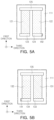
- FIGS. 5 A and 5 B are plan views illustrating a thermoelectric element of a thermoelectric module and a conductive via connected to the thermoelectric element in one plane according to an exemplary embodiment in the present disclosure
- a first direction may be defined as a thickness (T) direction
- a second direction may be defined as a length (L) direction or a stacking direction
- a third direction may be defined as a width (W) direction.
- thermoelectric module 100 includes a stack structure 110 of a plurality of insulating layers 111 , a plurality of thermoelectric elements 120 and 130 formed with the insulating layer 111 interposed therebetween and including first-type semiconductor devices 121 and 131 , second-type semiconductor devices 122 and 132 , first electrodes 123 and 133 connected to the first-type semiconductor devices, second electrodes 124 and 134 connected to the second-type semiconductor devices, and connection electrodes 125 and 135 connecting the first-type and second-type semiconductor devices 121 , 131 , 122 and 132 , and conductive vias 141 and 142 penetrating through the insulating layer 111 to connect thermoelectric elements adjacent to each other, among the plurality of thermoelectric elements 120 and 130 .
- the insulating layer 111 is not particularly limited as long as sufficient insulating properties may be obtained by including a material having insulating properties.
- the insulating layer 111 serves to separate the adjacent thermoelectric elements 120 and 130 from each other, and the thermoelectric elements 120 and 130 disposed to be adjacent to each other may be connected by the conductive vias 141 and 142 penetrating through the insulating layer 111 as will be described later.
- thermoelectric module 100 in which resistance to stress and/or thermal stress due to an external load may be improved, a degradation of performance due to oxidation of the thermoelectric elements 120 and 130 may be prevented, and which has excellent mechanical strength may be provided.
- the insulating layer 111 may include a material that can be simultaneously sintered with a semiconductor slurry forming the first-type semiconductor devices 121 and 131 and the second-type semiconductor devices 122 and 132 and a conductive paste forming the first electrodes 123 and 133 , and the second electrodes 124 and 134 , the connection electrodes 125 and 136 , and the conductive vias 141 and 142 .
- the insulating layer 111 may include low temperature co-fired ceramics (LTCCs) that are simultaneously sintered with the semiconductor slurry and the conductive paste. That is, the insulating layer 111 may be a ceramic sintered body, and more specifically, a low temperature co-fired ceramic sintered body.
- LTCCs low temperature co-fired ceramics
- an average thickness of the insulating layer 111 may be arbitrarily changed according to a size of the thermoelectric module 100 , and the thickness of the first layer may be configured to be 0.1 to 10 ⁇ m after sintering, but the present disclosure is not limited thereto.
- the first-type semiconductor devices 121 and 131 and the second-type semiconductor devices 122 and 132 may be formed of different semiconductor materials.
- the first-type semiconductor devices 121 and 131 may be formed of P-type semiconductor devices
- the second-type semiconductor devices 122 and 132 may be formed of N-type semiconductor device.
- the first-type semiconductor devices 121 and 131 and the second-type semiconductor devices 122 and 132 may form one unit cell.
- the first-type semiconductor devices 121 and 131 and the second-type semiconductor devices 122 and 132 may be formed of known thermoelectric materials employed in the art, and, for example, one or more semiconductors including two or more elements selected from the group consisting of transition metals, rare earth elements, group 13 elements, group 14 elements, group 15 elements, and group 16 elements may be used. Y, Ce, La, etc.
- rare earth elements one or more of Ti, Zr, Hf, V, Nb, Ta, Cr, Mo, W, Mn, Fe, Co, Ni, Cu, Zn, Ag, and Re may be used as the transition metals, one or more of B, Al, Ga, and In may be used as the group 13 elements, one or more of C, Si, Ge, Sn, and Pb may be used as the group 14 elements, one or more of P, As, Sb, and Bi may be used as the group 15 elements, and one or more of S, Se, and Te may be used as the group 16 elements.
- Examples of semiconductors including such elements may include one or more selected from the group consisting of Bi—Te-based, Co—Sb-based, Pb—Te-based, Si—Ge-based, Fe—Si-based or Sb—Te-based semiconductors, and include, more preferably, Bi—Te-based semiconductor.
- These semiconductors may include one or more elements selected from the group consisting of the transition metals, rare earth elements, group 13 elements, group 14 elements, group 15 elements, and group 16 elements as a dopant to improve electrical properties and the like.
- the Bi—Te-based semiconductor may include at least one of Bi 0.8 Sb 1.2 Te 3 , Bi 0.5 Sb 1.5 Te 2.7 Se 0.3 , Bi 2 Te 3 , Bi 2 Te 2.39 Se 0.6 , and Bi 2 Se 3 in which Sb and Se are used as dopants, but the present disclosure is not limited thereto.
- the first electrodes 123 and 133 are connected to the first-type semiconductor devices 121 and 131
- the second electrodes 124 and 134 are connected to the second-type semiconductor devices 122 and 132
- the first-type semiconductor devices 121 and 131 and the second-type semiconductor devices 122 and 132 are electrically connected to each other by the connection electrodes 125 and 135 .
- the conductive vias 141 and 142 penetrating through the insulating layer 111 are connected to the first electrodes 123 and 133 and the second electrodes 124 and 134 adjacent to each other with the insulating layer 111 interposed therebetween to connect the thermoelectric elements 120 and 130 adjacent to each other, among the plurality of thermoelectric elements 120 and 130 .
- the conductive vias 141 and 142 may be disposed on the same plane as that of the insulating layer 111 , thereby reducing a size of the thermoelectric module 100 and connecting the thermoelectric elements 120 and 130 adjacent to each other to the insulating layer 111 interposed therebetween.
- Each of the conductive vias 141 and 142 may not overlap the first-type and second-type semiconductor devices 121 , 131 , 122 and 132 in any of the first, second and third directions.
- the first electrodes 123 and 133 , the second electrodes 124 and 134 , the connection electrodes 125 and 135 , and the conductive vias 141 and 142 may include any one selected from the group consisting of Ag, Al, Cu, Ni, and alloys thereof.
- the metal component has excellent electrical conductivity, and in particular, nickel (Ni) may effectively suppress migration of the semiconductor device that may occur between the first-type semiconductor devices 121 and 131 and the second-type semiconductor devices 122 and 132 .
- nickel (Ni) may effectively suppress migration of the semiconductor device that may occur between the first-type semiconductor devices 121 and 131 and the second-type semiconductor devices 122 and 132 .
- silver (Ag) and aluminum (Al) may be sintered at a relatively low temperature, silver (Ag) and aluminum (Al) may be easily co-sintered with the thermoelectric material forming the first and second-type semiconductor devices.
- thermoelectric elements 120 and 130 may be co-sintered with the insulating layer 111 , and as described above, the materials forming the first and second-type semiconductor devices and metal components forming the first and second electrodes and the connection electrode may be appropriately selected to be simultaneously sintered with the insulating layer 111 .
- the number of stacks of the thermoelectric elements 120 and 130 may be determined according to a size and purpose of the thermoelectric module 100 . For example, 10 or more thermoelectric elements, or 100 or more thermoelectric elements may be stacked, but the present disclosure is not limited thereto.
- An average thickness of the thermoelectric elements 120 and 130 may be determined according to a size of the thermoelectric module 100 and the number of stacked thermoelectric elements 120 and 130 .
- the average thickness of the thermoelectric elements 120 and 130 may be determined to be in the range of 0.1 to 1.0 ⁇ m, but the present disclosure is not limited thereto.
- the plurality of thermoelectric elements may include the first thermoelectric element 120 and the second thermoelectric element 130 adjacent to each other with the insulating layer 111 interposed therebetween.
- the first conductive via 141 may connect the first electrode 123 of the first thermoelectric element 120 and the second electrode 134 of the second thermoelectric element 130 .
- the second conductive via 142 may connect the second electrode 124 of the first thermoelectric element 120 and the first electrode 133 of the second thermoelectric element 130 .
- thermoelectric module 100 When power is supplied to the thermoelectric module 100 according to an exemplary embodiment in the present disclosure, a side in which current flows from the first-type semiconductor devices 121 and 131 to the second-type semiconductor devices 122 and 132 may evolve heat and a side in which current flows from the second-type semiconductor devices 122 and 132 to the first-type semiconductor devices 121 and 131 may absorb heat due to the Peltier effect.
- thermoelectric module 100 when power is supplied to the thermoelectric module 100 , the P-type semiconductor device and the N-type semiconductor device are electrically connected in series so that a current flows, and holes in the P-type semiconductor device may move with heat toward the ( ⁇ ) side and the electrons in the N-type semiconductor device may move with heat toward the (+) side, so that the lower surface, among the upper surface and the lower surface of the thermoelectric module 100 facing each other in the first direction, may be cooled and the upper surface may be heated.
- the first-type semiconductor device 121 of the first thermoelectric element 120 may overlap the second-type semiconductor device 132 of the second thermoelectric element 130 in the stacking direction of the plurality of insulating layers 111
- the second-type semiconductor device 122 of the first thermoelectric element 120 may overlap the first-type semiconductor device 131 of the second thermoelectric element 130 in the stacking direction of the plurality of insulating layers 111 .
- thermoelectric module 100 based on the stacking direction, the first-type semiconductor devices 121 and 131 and the second-type semiconductor devices 122 and 132 may be alternately disposed.
- the number of stacked thermoelectric elements 120 and 130 may be increased in the same volume and a higher level of series connection may be implemented in the same volume.
- the thermoelectric module 100 may further include first and second external electrodes 161 and 162 disposed on the first surface S 1 and the second surface S 2 of the stack structure 110 of the plurality of insulating layers 111 facing each other in the stacking direction.
- the plurality of thermoelectric elements 120 and 130 may be electrically connected to the outside by the first and second external electrodes 161 and 162 .
- the first and second external electrodes 161 and 162 may extend to a lower surface of the stack structure 110 in consideration of mounting convenience.
- the lower surface of the stack structure 110 may refer to a mounted surface, among both surfaces facing each other in the first direction.
- the first and second external electrodes 161 and 162 may be formed of one of silver (Ag), lead (Pb), platinum (Pt), nickel (Ni), and copper (Cu) or alloys thereof, but the present disclosure is not limited thereto.
- first and second external electrodes 161 and 162 may be formed of a plurality of layers, and a plating layer may be further formed on the external electrodes to improve mounting characteristics.
- thermoelectric module 100 may further include a first connection via 151 penetrating through the insulating layer 111 to connect the first electrodes 123 and 133 to the first external electrode 161 and a second connection via 152 penetrating through the insulating layer 111 to connect the second electrodes 124 and 134 to the second external electrode 162 .
- the first and second connection vias 151 and 152 may include the same metal component as that of the first and second conductive vias 141 and 142 and may be formed by the same method, but the present disclosure is not limited thereto.
- connection vias 151 and 152 may connect the first electrodes 123 and 133 disposed at the outermost portion in the second direction (stacking direction) to the external electrode 161 and connect the second electrodes 124 and 134 disposed at the outermost portion in the second direction (stacking direction) to the second external electrode 162 .
- first and second connection vias 151 and 152 are disposed to overlap the first conductive via 141 in the stacking direction, but the present disclosure is not limited thereto and the first and second connection vias 151 and 152 may be disposed to overlap the second conductive via 142 in the stacking direction.
- At least one of the plurality of thermoelectric elements 220 and 230 may include a plurality of first-type semiconductor devices 221 and 231 , a plurality of second-type semiconductor devices 222 and 232 , and a plurality of connection electrodes 225 and 235 .
- thermoelectric elements may include a first thermoelectric element 220 and a second thermoelectric element 230 adjacent to each other with the insulating layer 211 interposed therebetween, and the first and second thermoelectric elements 220 and 230 may include first-type semiconductor devices 221 and 231 , second-type semiconductor devices 222 and 232 , and a plurality of connection electrodes 225 and 235 , respectively.
- thermoelectric elements 220 and 230 may form a plurality of unit cells in the same insulating layer 211 and realize high integration and miniaturization of the thermoelectric module by forming a higher level series connection within the same volume.
- the plurality of first-type semiconductor devices 221 and 231 and the plurality of second-type semiconductor devices 222 and 232 are alternately disposed in one direction, and the plurality of connection electrodes 225 and 235 may be alternately disposed at one end and the other end of the first-type and second-type semiconductor devices in the one direction.
- the first-type semiconductor device 221 and the second-type semiconductor device 222 of the first thermoelectric element 220 are alternately disposed in a third direction, and a plurality of connection electrodes 225 may be alternately disposed at one end and the other end of the first-type and second-type semiconductor devices 221 and 222 in the third direction.
- the first-type semiconductor device 231 and the second-type semiconductor device 232 of the second thermoelectric element 230 are alternately disposed in the third direction, and a plurality of connection electrodes 235 may be alternately disposed at one end and the other end of the first-type and second-type semiconductor devices 231 and 232 in the third direction.
- the plurality of connection electrodes 235 may be spaced apart from each other and connect a plurality of unit cells formed in the same insulating layer 211 to each other. Accordingly, high integration and miniaturization of the thermoelectric module may be realized by forming a higher level series connection within the same area of the insulating layer 211 .
- first conductive via 241 of the thermoelectric elements 220 and 230 may connect the first electrode 223 of the first thermoelectric element 220 to the second electrode 234 of the second thermoelectric element 230 .
- second conductive via 242 may connect the second electrode 224 of the first thermoelectric element 220 to the first electrode 233 of the second thermoelectric element 230 .
- the first-type semiconductor device 221 of the first thermoelectric element 220 may overlap the second-type semiconductor device 232 of the second thermoelectric element 230 in the stacking direction of the plurality of insulating layers 211
- the second-type semiconductor device 222 of the first thermoelectric element 220 may overlap the first-type semiconductor device 231 of the second thermoelectric element 230 in the stacking direction of the plurality of insulating layers 211 .
- thermoelectric elements 220 and 230 include two first-type semiconductor devices 221 and 231 and two second-type semiconductor devices 222 and 232 , respectively, the present disclosure is not limited thereto. That is, in consideration of the dimensions, manufacturing methods, etc. of each of the first and second-type semiconductor devices, the thermoelectric elements 220 and 230 may include three or more first-type semiconductor devices 221 and 231 and three or more second-type semiconductor devices 222 and 232 , respectively.
- FIGS. 7 A to 7 G are perspective views schematically illustrating a method for manufacturing a thermoelectric module according to another exemplary embodiment in the present disclosure.
- the method for manufacturing a thermoelectric module may include: preparing a ceramic green sheet 311 on which a plurality of vias are formed; filling the vias with a conductive paste to form conductive vias 341 and 342 ; forming a plurality of thermoelectric elements 320 and at certain intervals on the ceramic green sheet 311 ; stacking the ceramic green sheet 311 on which the plurality of thermoelectric elements 320 and 330 are formed to form a stack 300 ; and cutting the stack 300 into regions each corresponding to one thermoelectric module and sintering the cut region to form a stack structure of a plurality of insulating layers, wherein the forming of the thermoelectric elements 320 and 330 may include forming first and second-type semiconductor devices 321 , 322 , 331 , and 332 ; and forming first electrodes 323 and 333 connected to the first-type semiconductor devices 321 and 331 , second electrodes 324 and 334 connected to the second-type semiconductor devices 322 and 332
- thermoelectric module according to another exemplary embodiment in the present disclosure
- a ceramic green sheet 311 having a plurality of vias formed therein is prepared.
- the ceramic green sheet 311 is formed by preparing a slurry by mixing ceramic powder, a binder and a solvent and manufacturing the slurry in the form of a sheet having a thickness of several ⁇ m by a doctor blade method or the like.
- the ceramic powder preferably includes low temperature co-fired ceramics (LTCC), and may include fine ceramic powder particles to lower a sintering temperature.
- LTCC low temperature co-fired ceramics
- the conductive vias 341 and 342 may be formed by filling the vias with a conductive paste.
- the via may be formed in the ceramic green sheet 311 by a laser etching method or punching, but the present disclosure is not limited thereto.
- thermoelectric elements 320 and 330 may be formed on the ceramic green sheet 311 at certain intervals.
- the first-type semiconductor devices 321 and 331 and second-type semiconductor devices 322 and 332 may be formed on a ceramic green sheet 311 . More specifically, the first-type semiconductor device 321 and the second-type semiconductor device 322 of the first thermoelectric element 320 may be formed on the first ceramic green sheet 311 , and the first-type semiconductor device 331 and the second-type semiconductor device 332 of the second thermoelectric element 330 may be formed on a second ceramic green sheet 311 .
- the forming of the first-type semiconductor devices 321 and 331 and the second-type semiconductor devices 322 and 332 may be performed by a method for printing a first-type semiconductor slurry and a second-type semiconductor slurry on the ceramic green sheet 311 , and may be performed by a screen-printing method, but the present disclosure is not limited thereto.
- the first-type and second-type semiconductor slurries may be formed by mixing a thermoelectric material powder, a dispersant, and a solvent, and may further include a ceramic material to control a sintering temperature and a leveling agent to improve surface roughness.
- a thermoelectric material powder may be mixed and used.
- the dispersant may include a water-soluble dispersant such as polyvinyl pyrrolidone
- the solvent may include a solvent such as dimethylmethanamide, but the present disclosure is not limited thereto.
- the first electrodes 323 and 333 connected to the first-type semiconductor devices 321 and 331 , the second electrodes 324 and 334 connected to the second-type semiconductor devices 322 and 332 , and the connection electrodes 325 and 335 connecting the first-type and the second-type semiconductor devices may be formed.
- the steps of forming the first electrodes 323 and 333 , the second electrodes 324 and 334 , and the connection electrodes 325 and 335 may be performed by printing a conductive paste on the ceramic green sheet 311 , and may be performed by a screen-printing method or the like, but the present disclosure is not limited thereto.
- the stack 300 may be formed by stacking the ceramic green sheets 311 on which the plurality of thermoelectric elements 320 and 330 are formed.
- the first ceramic green sheet 311 on which the first thermoelectric element 320 is formed and the second ceramic green sheet 311 on which the second thermoelectric element 330 is formed may be alternately stacked.
- the first-type semiconductor device 321 of the first thermoelectric element 320 and the second-type semiconductor device 332 of the second thermoelectric element 330 may be alternately formed in the stacking direction (the second direction), and the second-type semiconductor device 322 of the first thermoelectric element 320 and the first-type semiconductor device 331 of the second thermoelectric element 330 may be alternately formed in the stacking direction (the second direction).
- first electrode 323 of the first thermoelectric element 320 and the second electrode 334 of the second thermoelectric element 330 may be connected to each other by the first conductive via 341
- second electrode 324 of the first thermoelectric element 320 and the first electrode 333 of the second thermoelectric element 330 may be connected to each other by the second conductive via 342 .
- a first connection via 351 and a second connection via (not shown) disposed at the outermost side in the stacking direction (the second direction) may be included.
- the first connection via 351 and the second connection via (not shown) have the same configuration as the conductive vias 341 and 342 and may be formed by the same process, except that they are disposed on the outermost side in the stacking direction to be connected to the external electrode.
- the stack 300 may be cut into regions each corresponding to a single thermoelectric module and fired to form a stack structure of a plurality of insulating layers. That is, by sintering the plurality of stacked chips 310 formed by cutting the stack 300 , the stack structure 110 of the plurality of insulating layers 111 , the plurality of thermoelectric elements 120 and 130 , and the conductive vias 141 and 142 may be formed. That is, the thermoelectric elements 120 and 130 and the insulating layer 111 may be simultaneously sintered.
- the sintering temperature may be a temperature at which the ceramic green sheet, the semiconductor slurry, and the conductive paste are simultaneously sintered and may be, for example, 350 to 600° C., but the present disclosure is not limited thereto.
- cold sintering or spark plasma sintering may be used to control the sintering temperature, but the present disclosure is not limited thereto.
- the method may further include forming the first and second external electrodes 161 and 162 on both surfaces of the stack structure 110 facing in the stacking direction (the second direction).
- the first and second external electrodes 161 and 162 may be formed by applying a conductive paste to the stack structure 110 and then performing drying and sintering, but the present disclosure is not limited thereto, and the first and second external electrodes 161 and 162 may also be formed using an electroless plating method or a sputtering method. Also, the first and second external electrodes 161 and 162 may extend to a lower surface of the stack structure 110 .
- thermoelectric module As set forth above, one of several effects of the present disclosure is to realize a chip-type thermoelectric module to achieve high integration and miniaturization of the thermoelectric module.
- One of several effects of the present disclosure is to prevent defects such as cracks and joint separation by improving the mechanical strength of the thermoelectric module.
- thermoelectric module is deteriorated at a high temperature.
Landscapes
- Engineering & Computer Science (AREA)
- Manufacturing & Machinery (AREA)
- Chemical & Material Sciences (AREA)
- Inorganic Chemistry (AREA)
- Cooling Or The Like Of Semiconductors Or Solid State Devices (AREA)
Abstract
Description
Claims (21)
Priority Applications (1)
| Application Number | Priority Date | Filing Date | Title |
|---|---|---|---|
| US19/170,814 US20250234783A1 (en) | 2021-12-07 | 2025-04-04 | Thermoelectric module and method for manufacturing the same |
Applications Claiming Priority (2)
| Application Number | Priority Date | Filing Date | Title |
|---|---|---|---|
| KR1020210173874A KR20230085571A (en) | 2021-12-07 | 2021-12-07 | Thermoelectric module and method for fabricating the same |
| KR10-2021-0173874 | 2021-12-07 |
Related Child Applications (1)
| Application Number | Title | Priority Date | Filing Date |
|---|---|---|---|
| US19/170,814 Division US20250234783A1 (en) | 2021-12-07 | 2025-04-04 | Thermoelectric module and method for manufacturing the same |
Publications (2)
| Publication Number | Publication Date |
|---|---|
| US20230180610A1 US20230180610A1 (en) | 2023-06-08 |
| US12295264B2 true US12295264B2 (en) | 2025-05-06 |
Family
ID=86607370
Family Applications (2)
| Application Number | Title | Priority Date | Filing Date |
|---|---|---|---|
| US17/741,352 Active 2042-05-14 US12295264B2 (en) | 2021-12-07 | 2022-05-10 | Thermoelectric module and method for manufacturing the same |
| US19/170,814 Pending US20250234783A1 (en) | 2021-12-07 | 2025-04-04 | Thermoelectric module and method for manufacturing the same |
Family Applications After (1)
| Application Number | Title | Priority Date | Filing Date |
|---|---|---|---|
| US19/170,814 Pending US20250234783A1 (en) | 2021-12-07 | 2025-04-04 | Thermoelectric module and method for manufacturing the same |
Country Status (4)
| Country | Link |
|---|---|
| US (2) | US12295264B2 (en) |
| JP (1) | JP2023084646A (en) |
| KR (1) | KR20230085571A (en) |
| CN (1) | CN116261387A (en) |
Citations (10)
| Publication number | Priority date | Publication date | Assignee | Title |
|---|---|---|---|---|
| US6620994B2 (en) | 2000-10-04 | 2003-09-16 | Leonardo Technologies, Inc. | Thermoelectric generators |
| US20100212713A1 (en) * | 2007-11-14 | 2010-08-26 | Murata Manufacturing Co., Ltd. | Thermoelectric Conversion Module Component, Thermoelectric Conversion Module, and Method for Producing the Aforementioned |
| JP2011199091A (en) | 2010-03-23 | 2011-10-06 | Kyocera Corp | Thermoelectric conversion module |
| KR20130056699A (en) | 2011-11-22 | 2013-05-30 | 한국기계연구원 | A thermolectric semiconductor module and a manufacturing method of the same |
| KR20130073554A (en) | 2011-12-23 | 2013-07-03 | 삼성전기주식회사 | Thermoelectric module and manufacturing method for theremoelectric module |
| US8669635B2 (en) * | 2008-10-20 | 2014-03-11 | 3M Innovative Properties Company | Electrically conductive nanocomposite material and thermoelectric device comprising the material |
| US20180248097A1 (en) | 2015-11-12 | 2018-08-30 | Murata Manufacturing Co., Ltd. | Thermoelectric conversion element |
| KR20200037631A (en) * | 2018-10-01 | 2020-04-09 | 현대자동차주식회사 | Thermoelectric module, thermoelectric module frame and method for manufacturing thermoelectric module |
| KR20210020461A (en) | 2019-08-14 | 2021-02-24 | 포항공과대학교 산학협력단 | Nanowire Thermoelectric device having a 3-Dimensional Stacked Nanowire and Method of Manufacturing the same |
| US20210057627A1 (en) * | 2018-03-16 | 2021-02-25 | Atsumitec Co., Ltd. | Thermoelectric power-generation device |
Family Cites Families (6)
| Publication number | Priority date | Publication date | Assignee | Title |
|---|---|---|---|---|
| JPH02260581A (en) * | 1989-03-31 | 1990-10-23 | Murata Mfg Co Ltd | thick film thermoelectric element |
| WO2010058464A1 (en) * | 2008-11-20 | 2010-05-27 | 株式会社村田製作所 | Thermoelectric conversion module |
| JP5598035B2 (en) * | 2010-03-16 | 2014-10-01 | 富士通株式会社 | Thermoelectric converter |
| KR102097332B1 (en) * | 2013-02-20 | 2020-04-06 | 삼성전기주식회사 | Multilayered ceramic electronic component |
| AU2016316164A1 (en) * | 2015-09-04 | 2018-04-26 | Hiroaki Nakaya | Thermoelectric conversion element and thermoelectric conversion module |
| US20210135080A1 (en) * | 2019-10-30 | 2021-05-06 | City University Of Hong Kong | Thermoelectric device |
-
2021
- 2021-12-07 KR KR1020210173874A patent/KR20230085571A/en not_active Ceased
-
2022
- 2022-05-09 JP JP2022077157A patent/JP2023084646A/en active Pending
- 2022-05-10 US US17/741,352 patent/US12295264B2/en active Active
- 2022-07-05 CN CN202210791072.7A patent/CN116261387A/en active Pending
-
2025
- 2025-04-04 US US19/170,814 patent/US20250234783A1/en active Pending
Patent Citations (11)
| Publication number | Priority date | Publication date | Assignee | Title |
|---|---|---|---|---|
| US6620994B2 (en) | 2000-10-04 | 2003-09-16 | Leonardo Technologies, Inc. | Thermoelectric generators |
| US20100212713A1 (en) * | 2007-11-14 | 2010-08-26 | Murata Manufacturing Co., Ltd. | Thermoelectric Conversion Module Component, Thermoelectric Conversion Module, and Method for Producing the Aforementioned |
| US8669635B2 (en) * | 2008-10-20 | 2014-03-11 | 3M Innovative Properties Company | Electrically conductive nanocomposite material and thermoelectric device comprising the material |
| JP2011199091A (en) | 2010-03-23 | 2011-10-06 | Kyocera Corp | Thermoelectric conversion module |
| KR20130056699A (en) | 2011-11-22 | 2013-05-30 | 한국기계연구원 | A thermolectric semiconductor module and a manufacturing method of the same |
| KR101324257B1 (en) | 2011-11-22 | 2013-11-01 | 한국기계연구원 | A Thermolectric Semiconductor module and A Manufacturing Method of The same |
| KR20130073554A (en) | 2011-12-23 | 2013-07-03 | 삼성전기주식회사 | Thermoelectric module and manufacturing method for theremoelectric module |
| US20180248097A1 (en) | 2015-11-12 | 2018-08-30 | Murata Manufacturing Co., Ltd. | Thermoelectric conversion element |
| US20210057627A1 (en) * | 2018-03-16 | 2021-02-25 | Atsumitec Co., Ltd. | Thermoelectric power-generation device |
| KR20200037631A (en) * | 2018-10-01 | 2020-04-09 | 현대자동차주식회사 | Thermoelectric module, thermoelectric module frame and method for manufacturing thermoelectric module |
| KR20210020461A (en) | 2019-08-14 | 2021-02-24 | 포항공과대학교 산학협력단 | Nanowire Thermoelectric device having a 3-Dimensional Stacked Nanowire and Method of Manufacturing the same |
Non-Patent Citations (3)
| Title |
|---|
| Machine translation of KR 10-2021-0020461 (Year: 2021). * |
| Machine translation of KR-2020037631-A (Year: 2020). * |
| Office Action issued in corresponding Korean Patent Application No. 10-2021-0173874 dated Nov. 10, 2022, with English abstract. |
Also Published As
| Publication number | Publication date |
|---|---|
| CN116261387A (en) | 2023-06-13 |
| KR20230085571A (en) | 2023-06-14 |
| JP2023084646A (en) | 2023-06-19 |
| KR20240010056A (en) | 2024-01-23 |
| US20230180610A1 (en) | 2023-06-08 |
| US20250234783A1 (en) | 2025-07-17 |
Similar Documents
| Publication | Publication Date | Title |
|---|---|---|
| US10510940B2 (en) | Thermoelectric generator | |
| KR102070390B1 (en) | Thermoelectric moudule and device using the same | |
| US8940571B2 (en) | Thermoelectric conversion element | |
| KR102561218B1 (en) | Thermoelectric device moudule | |
| KR102281066B1 (en) | Thermoelectric device moudule and device using the same | |
| US11101420B2 (en) | High performance thermoelectric device and method of manufacturing the same at ultra-high speed | |
| JP2012124469A (en) | Thermoelectric element and thermoelectric module | |
| KR20160117944A (en) | Thermoelectric device moudule and device using the same | |
| US11380832B2 (en) | Thermoelectric conversion module and method for producing thermoelectric conversion module | |
| KR20150021366A (en) | Thermoelectric element thermoelectric moudule using the same, and cooling device using thermoelectric moudule | |
| JP5537202B2 (en) | Thermoelectric conversion module | |
| KR20160126804A (en) | Thermoelectric device moudule and device using the same | |
| US20250234783A1 (en) | Thermoelectric module and method for manufacturing the same | |
| EP2503610A1 (en) | Structure useful for producing a thermoelectric generator, thermoelectric generator comprising same and method for producing same | |
| EP3813130A1 (en) | Thermoelectric conversion module and method for manufacturing thermoelectric conversion module | |
| KR102355281B1 (en) | Thermo electric element | |
| KR102224461B1 (en) | Thermoelectric element thermoelectric moudule using the same, and cooling device using thermoelectric moudule | |
| KR102139476B1 (en) | Thermoelectric moudule and device using the same | |
| KR102412389B1 (en) | Thermoelectric device moudule and device using the same | |
| JP2012124480A (en) | Thermoelectric element and manufacturing method for the same | |
| WO2019064949A1 (en) | Thermoelectric conversion element and method for manufacturing thermoelectric conversion element | |
| KR20170036449A (en) | Thermoelectric moudule and device using the same |
Legal Events
| Date | Code | Title | Description |
|---|---|---|---|
| AS | Assignment |
Owner name: SAMSUNG ELECTRO-MECHANICS CO., LTD., KOREA, REPUBLIC OF Free format text: ASSIGNMENT OF ASSIGNORS INTEREST;ASSIGNORS:KIM, SUNG HAN;HWANG, SE YEON;GI, JOON WOO;AND OTHERS;REEL/FRAME:059887/0079 Effective date: 20220307 |
|
| FEPP | Fee payment procedure |
Free format text: ENTITY STATUS SET TO UNDISCOUNTED (ORIGINAL EVENT CODE: BIG.); ENTITY STATUS OF PATENT OWNER: LARGE ENTITY |
|
| STPP | Information on status: patent application and granting procedure in general |
Free format text: NON FINAL ACTION MAILED |
|
| STPP | Information on status: patent application and granting procedure in general |
Free format text: RESPONSE TO NON-FINAL OFFICE ACTION ENTERED AND FORWARDED TO EXAMINER |
|
| STPP | Information on status: patent application and granting procedure in general |
Free format text: FINAL REJECTION MAILED |
|
| STPP | Information on status: patent application and granting procedure in general |
Free format text: ADVISORY ACTION MAILED |
|
| STPP | Information on status: patent application and granting procedure in general |
Free format text: DOCKETED NEW CASE - READY FOR EXAMINATION |
|
| STPP | Information on status: patent application and granting procedure in general |
Free format text: NON FINAL ACTION MAILED |
|
| STPP | Information on status: patent application and granting procedure in general |
Free format text: RESPONSE TO NON-FINAL OFFICE ACTION ENTERED AND FORWARDED TO EXAMINER |
|
| STPP | Information on status: patent application and granting procedure in general |
Free format text: FINAL REJECTION MAILED |
|
| STPP | Information on status: patent application and granting procedure in general |
Free format text: RESPONSE AFTER FINAL ACTION FORWARDED TO EXAMINER |
|
| STPP | Information on status: patent application and granting procedure in general |
Free format text: NOTICE OF ALLOWANCE MAILED -- APPLICATION RECEIVED IN OFFICE OF PUBLICATIONS |
|
| STCF | Information on status: patent grant |
Free format text: PATENTED CASE |