US12290220B2 - Cleaning apparatus - Google Patents

Cleaning apparatus Download PDF

Info

Publication number
US12290220B2
US12290220B2 US18/737,436 US202418737436A US12290220B2 US 12290220 B2 US12290220 B2 US 12290220B2 US 202418737436 A US202418737436 A US 202418737436A US 12290220 B2 US12290220 B2 US 12290220B2
Authority
US
United States
Prior art keywords
fluid
agitator
debris
surface cleaning
cleaning head
Prior art date
Legal status (The legal status is an assumption and is not a legal conclusion. Google has not performed a legal analysis and makes no representation as to the accuracy of the status listed.)
Active
Application number
US18/737,436
Other versions
US20240389818A1 (en
Inventor
Bartholomew Lampard
Jennifer ANDREWS
Fariha AHMED
Jay CASTRO
Oliver G. HOLMES
Joe BAXTER
Wil MCARDLE
Ognjen Vrdoljak
Lois JONES
Joshua KINGSBURY
David T. BARKER
Jemima L. C. Meil
Shiqi MU
Heliang CHEN
Dawei Liu
Xiang Zhou
Cong Su
Mingliang Qin
Current Assignee (The listed assignees may be inaccurate. Google has not performed a legal analysis and makes no representation or warranty as to the accuracy of the list.)
Sharkninja Operating LLC
Original Assignee
Sharkninja Operating LLC
Priority date (The priority date is an assumption and is not a legal conclusion. Google has not performed a legal analysis and makes no representation as to the accuracy of the date listed.)
Filing date
Publication date
Priority claimed from PCT/CN2024/073318 external-priority patent/WO2024239689A1/en
Application filed by Sharkninja Operating LLC filed Critical Sharkninja Operating LLC
Priority to US18/737,436 priority Critical patent/US12290220B2/en
Assigned to SHARKNINJA OPERATING LLC reassignment SHARKNINJA OPERATING LLC ASSIGNMENT OF ASSIGNORS INTEREST (SEE DOCUMENT FOR DETAILS). Assignors: SU, Cong, LAMPARD, BARTHOLOMEW, CHEN, Heliang, LIU, DAWEI, ZHOU, XIANG
Assigned to SHARKNINJA OPERATING LLC reassignment SHARKNINJA OPERATING LLC ASSIGNMENT OF ASSIGNORS INTEREST (SEE DOCUMENT FOR DETAILS). Assignors: BAXTER, Joe, JONES, Lois, QIN, Mingliang, MCARDLE, Wil, SU, Cong, ZHOU, XIANG, HOLMES, OLIVER G., MU, Shiqi, MEIL, JEMIMA L.C., KINGSBURY, Joshua, AHMED, Fariha, ANDREWS, JENNIFER, BARKER, David T., CASTRO, Jay, CHEN, Heliang, LAMPARD, BARTHOLOMEW, LIU, DAWEI, VRDOLJAK, OGNJEN
Publication of US20240389818A1 publication Critical patent/US20240389818A1/en
Priority to US19/083,593 priority patent/US20250213090A1/en
Application granted granted Critical
Publication of US12290220B2 publication Critical patent/US12290220B2/en
Active legal-status Critical Current
Anticipated expiration legal-status Critical

Links

Images

Classifications

    • AHUMAN NECESSITIES
    • A47FURNITURE; DOMESTIC ARTICLES OR APPLIANCES; COFFEE MILLS; SPICE MILLS; SUCTION CLEANERS IN GENERAL
    • A47LDOMESTIC WASHING OR CLEANING; SUCTION CLEANERS IN GENERAL
    • A47L11/00Machines for cleaning floors, carpets, furniture, walls, or wall coverings
    • A47L11/22Floor-sweeping machines, hand-driven
    • AHUMAN NECESSITIES
    • A47FURNITURE; DOMESTIC ARTICLES OR APPLIANCES; COFFEE MILLS; SPICE MILLS; SUCTION CLEANERS IN GENERAL
    • A47LDOMESTIC WASHING OR CLEANING; SUCTION CLEANERS IN GENERAL
    • A47L11/00Machines for cleaning floors, carpets, furniture, walls, or wall coverings
    • A47L11/24Floor-sweeping machines, motor-driven
    • AHUMAN NECESSITIES
    • A47FURNITURE; DOMESTIC ARTICLES OR APPLIANCES; COFFEE MILLS; SPICE MILLS; SUCTION CLEANERS IN GENERAL
    • A47LDOMESTIC WASHING OR CLEANING; SUCTION CLEANERS IN GENERAL
    • A47L11/00Machines for cleaning floors, carpets, furniture, walls, or wall coverings
    • A47L11/28Floor-scrubbing machines, motor-driven
    • A47L11/282Floor-scrubbing machines, motor-driven having rotary tools
    • AHUMAN NECESSITIES
    • A47FURNITURE; DOMESTIC ARTICLES OR APPLIANCES; COFFEE MILLS; SPICE MILLS; SUCTION CLEANERS IN GENERAL
    • A47LDOMESTIC WASHING OR CLEANING; SUCTION CLEANERS IN GENERAL
    • A47L11/00Machines for cleaning floors, carpets, furniture, walls, or wall coverings
    • A47L11/29Floor-scrubbing machines characterised by means for taking-up dirty liquid
    • A47L11/30Floor-scrubbing machines characterised by means for taking-up dirty liquid by suction
    • A47L11/302Floor-scrubbing machines characterised by means for taking-up dirty liquid by suction having rotary tools
    • AHUMAN NECESSITIES
    • A47FURNITURE; DOMESTIC ARTICLES OR APPLIANCES; COFFEE MILLS; SPICE MILLS; SUCTION CLEANERS IN GENERAL
    • A47LDOMESTIC WASHING OR CLEANING; SUCTION CLEANERS IN GENERAL
    • A47L11/00Machines for cleaning floors, carpets, furniture, walls, or wall coverings
    • A47L11/34Machines for treating carpets in position by liquid, foam, or vapour, e.g. by steam
    • AHUMAN NECESSITIES
    • A47FURNITURE; DOMESTIC ARTICLES OR APPLIANCES; COFFEE MILLS; SPICE MILLS; SUCTION CLEANERS IN GENERAL
    • A47LDOMESTIC WASHING OR CLEANING; SUCTION CLEANERS IN GENERAL
    • A47L11/00Machines for cleaning floors, carpets, furniture, walls, or wall coverings
    • A47L11/40Parts or details of machines not provided for in groups A47L11/02 - A47L11/38, or not restricted to one of these groups, e.g. handles, arrangements of switches, skirts, buffers, levers
    • A47L11/4013Contaminants collecting devices, i.e. hoppers, tanks or the like
    • AHUMAN NECESSITIES
    • A47FURNITURE; DOMESTIC ARTICLES OR APPLIANCES; COFFEE MILLS; SPICE MILLS; SUCTION CLEANERS IN GENERAL
    • A47LDOMESTIC WASHING OR CLEANING; SUCTION CLEANERS IN GENERAL
    • A47L11/00Machines for cleaning floors, carpets, furniture, walls, or wall coverings
    • A47L11/40Parts or details of machines not provided for in groups A47L11/02 - A47L11/38, or not restricted to one of these groups, e.g. handles, arrangements of switches, skirts, buffers, levers
    • A47L11/4013Contaminants collecting devices, i.e. hoppers, tanks or the like
    • A47L11/4016Contaminants collecting devices, i.e. hoppers, tanks or the like specially adapted for collecting fluids
    • AHUMAN NECESSITIES
    • A47FURNITURE; DOMESTIC ARTICLES OR APPLIANCES; COFFEE MILLS; SPICE MILLS; SUCTION CLEANERS IN GENERAL
    • A47LDOMESTIC WASHING OR CLEANING; SUCTION CLEANERS IN GENERAL
    • A47L11/00Machines for cleaning floors, carpets, furniture, walls, or wall coverings
    • A47L11/40Parts or details of machines not provided for in groups A47L11/02 - A47L11/38, or not restricted to one of these groups, e.g. handles, arrangements of switches, skirts, buffers, levers
    • A47L11/4013Contaminants collecting devices, i.e. hoppers, tanks or the like
    • A47L11/4025Means for emptying
    • AHUMAN NECESSITIES
    • A47FURNITURE; DOMESTIC ARTICLES OR APPLIANCES; COFFEE MILLS; SPICE MILLS; SUCTION CLEANERS IN GENERAL
    • A47LDOMESTIC WASHING OR CLEANING; SUCTION CLEANERS IN GENERAL
    • A47L11/00Machines for cleaning floors, carpets, furniture, walls, or wall coverings
    • A47L11/40Parts or details of machines not provided for in groups A47L11/02 - A47L11/38, or not restricted to one of these groups, e.g. handles, arrangements of switches, skirts, buffers, levers
    • A47L11/4036Parts or details of the surface treating tools
    • A47L11/4041Roll shaped surface treating tools
    • AHUMAN NECESSITIES
    • A47FURNITURE; DOMESTIC ARTICLES OR APPLIANCES; COFFEE MILLS; SPICE MILLS; SUCTION CLEANERS IN GENERAL
    • A47LDOMESTIC WASHING OR CLEANING; SUCTION CLEANERS IN GENERAL
    • A47L11/00Machines for cleaning floors, carpets, furniture, walls, or wall coverings
    • A47L11/40Parts or details of machines not provided for in groups A47L11/02 - A47L11/38, or not restricted to one of these groups, e.g. handles, arrangements of switches, skirts, buffers, levers
    • A47L11/4036Parts or details of the surface treating tools
    • A47L11/4044Vacuuming or pick-up tools; Squeegees
    • AHUMAN NECESSITIES
    • A47FURNITURE; DOMESTIC ARTICLES OR APPLIANCES; COFFEE MILLS; SPICE MILLS; SUCTION CLEANERS IN GENERAL
    • A47LDOMESTIC WASHING OR CLEANING; SUCTION CLEANERS IN GENERAL
    • A47L11/00Machines for cleaning floors, carpets, furniture, walls, or wall coverings
    • A47L11/40Parts or details of machines not provided for in groups A47L11/02 - A47L11/38, or not restricted to one of these groups, e.g. handles, arrangements of switches, skirts, buffers, levers
    • A47L11/4063Driving means; Transmission means therefor
    • A47L11/4069Driving or transmission means for the cleaning tools
    • AHUMAN NECESSITIES
    • A47FURNITURE; DOMESTIC ARTICLES OR APPLIANCES; COFFEE MILLS; SPICE MILLS; SUCTION CLEANERS IN GENERAL
    • A47LDOMESTIC WASHING OR CLEANING; SUCTION CLEANERS IN GENERAL
    • A47L11/00Machines for cleaning floors, carpets, furniture, walls, or wall coverings
    • A47L11/40Parts or details of machines not provided for in groups A47L11/02 - A47L11/38, or not restricted to one of these groups, e.g. handles, arrangements of switches, skirts, buffers, levers
    • A47L11/4075Handles; levers
    • AHUMAN NECESSITIES
    • A47FURNITURE; DOMESTIC ARTICLES OR APPLIANCES; COFFEE MILLS; SPICE MILLS; SUCTION CLEANERS IN GENERAL
    • A47LDOMESTIC WASHING OR CLEANING; SUCTION CLEANERS IN GENERAL
    • A47L11/00Machines for cleaning floors, carpets, furniture, walls, or wall coverings
    • A47L11/40Parts or details of machines not provided for in groups A47L11/02 - A47L11/38, or not restricted to one of these groups, e.g. handles, arrangements of switches, skirts, buffers, levers
    • A47L11/4077Skirts or splash guards
    • AHUMAN NECESSITIES
    • A47FURNITURE; DOMESTIC ARTICLES OR APPLIANCES; COFFEE MILLS; SPICE MILLS; SUCTION CLEANERS IN GENERAL
    • A47LDOMESTIC WASHING OR CLEANING; SUCTION CLEANERS IN GENERAL
    • A47L11/00Machines for cleaning floors, carpets, furniture, walls, or wall coverings
    • A47L11/40Parts or details of machines not provided for in groups A47L11/02 - A47L11/38, or not restricted to one of these groups, e.g. handles, arrangements of switches, skirts, buffers, levers
    • A47L11/408Means for supplying cleaning or surface treating agents
    • A47L11/4088Supply pumps; Spraying devices; Supply conduits
    • AHUMAN NECESSITIES
    • A47FURNITURE; DOMESTIC ARTICLES OR APPLIANCES; COFFEE MILLS; SPICE MILLS; SUCTION CLEANERS IN GENERAL
    • A47LDOMESTIC WASHING OR CLEANING; SUCTION CLEANERS IN GENERAL
    • A47L11/00Machines for cleaning floors, carpets, furniture, walls, or wall coverings
    • A47L11/40Parts or details of machines not provided for in groups A47L11/02 - A47L11/38, or not restricted to one of these groups, e.g. handles, arrangements of switches, skirts, buffers, levers
    • A47L11/4002Installations of electric equipment
    • A47L11/4008Arrangements of switches, indicators or the like
    • AHUMAN NECESSITIES
    • A47FURNITURE; DOMESTIC ARTICLES OR APPLIANCES; COFFEE MILLS; SPICE MILLS; SUCTION CLEANERS IN GENERAL
    • A47LDOMESTIC WASHING OR CLEANING; SUCTION CLEANERS IN GENERAL
    • A47L11/00Machines for cleaning floors, carpets, furniture, walls, or wall coverings
    • A47L11/40Parts or details of machines not provided for in groups A47L11/02 - A47L11/38, or not restricted to one of these groups, e.g. handles, arrangements of switches, skirts, buffers, levers
    • A47L11/408Means for supplying cleaning or surface treating agents
    • A47L11/4083Liquid supply reservoirs; Preparation of the agents, e.g. mixing devices
    • AHUMAN NECESSITIES
    • A47FURNITURE; DOMESTIC ARTICLES OR APPLIANCES; COFFEE MILLS; SPICE MILLS; SUCTION CLEANERS IN GENERAL
    • A47LDOMESTIC WASHING OR CLEANING; SUCTION CLEANERS IN GENERAL
    • A47L11/00Machines for cleaning floors, carpets, furniture, walls, or wall coverings
    • A47L11/40Parts or details of machines not provided for in groups A47L11/02 - A47L11/38, or not restricted to one of these groups, e.g. handles, arrangements of switches, skirts, buffers, levers
    • A47L11/408Means for supplying cleaning or surface treating agents
    • A47L11/4086Arrangements for steam generation

Definitions

  • the present disclosure generally relates to surface cleaning devices and more specifically to powered surface sweepers.
  • Surface treatment apparatuses can be configured to clean one or more surfaces (e.g., a floor).
  • Surface treatment apparatuses may include, for example, a vacuum cleaner, a mop, a steam cleaning apparatus, a sweeper (e.g., a powered sweeper), and/or any other surface treatment apparatus.
  • Powered sweepers may include one or more agitators (e.g., a brush roll), an agitator motor to drive (e.g., rotate) the one or more agitators, and a debris container to collect debris agitated from a surface to be cleaned using the one or more agitators.
  • a powered sweeper is configured to collect debris without the use of suction.
  • FIG. 1 shows a schematic example of a surface cleaning device, consistent with embodiments of the present disclosure.
  • FIG. 2 shows a schematic cross-section view of a surface cleaning head of the surface cleaning device of FIG. 1 , consistent with embodiments of the present disclosure.
  • FIG. 3 A shows a perspective view of a surface cleaning device, consistent with embodiments of the present disclosure.
  • FIG. 3 B shows a perspective cross-sectional view of an example of the surface cleaning device of FIG. 3 A having a steam manifold, consistent with embodiments of the present disclosure.
  • FIG. 3 C shows magnified view of the surface cleaning device of FIG. 3 B corresponding to region 3 B, consistent with embodiments of the present disclosure.
  • FIG. 3 D shows an exploded view of the steam manifold of FIG. 3 B , consistent with embodiments of the present disclosure.
  • FIG. 4 shows a cross-sectional view of the surface cleaning device of FIG. 3 A corresponding to region IV of FIG. 3 , consistent with embodiments of the present disclosure.
  • FIG. 5 A shows a cross-sectional view of the surface cleaning device of FIG. 3 A corresponding to region V of FIG. 4 , consistent with embodiments of the present disclosure.
  • FIG. 5 B shows another cross-sectional view of the surface cleaning device of FIG. 3 A corresponding to region V of FIG. 4 , consistent with embodiments of the present disclosure.
  • FIG. 6 shows a cross-section view of the surface cleaning device of FIG. 3 A corresponding to region VI of FIG. 3 , consistent with embodiments of the present disclosure.
  • FIG. 7 shows a perspective view of a paddle of a multi-axis pivot joint of the surface cleaning device of FIG. 3 , consistent with embodiments of the present disclosure.
  • FIG. 8 shows a bottom perspective view of a surface cleaning head of the surface cleaning device of FIG. 3 , consistent with embodiments of the present disclosure.
  • FIG. 9 A shows a cross-sectional view of an example of a squeegee configured to be used with the surface cleaning head of FIG. 8 , consistent with embodiments of the present disclosure.
  • FIG. 9 B shows a cross-sectional view of another example of a squeegee configured to be used with the surface cleaning head of FIG. 8 , consistent with embodiments of the present disclosure.
  • FIG. 9 C shows a cross-sectional view of another example of a squeegee configured to be used with the surface cleaning head of FIG. 8 , consistent with embodiments of the present disclosure.
  • FIG. 9 D shows a perspective view of another example of a squeegee configured to be used with the surface cleaning head of FIG. 8 , consistent with embodiments of the present disclosure.
  • FIG. 9 E shows a cross-sectional view of another example of a squeegee configured to be used with the surface cleaning head of FIG. 8 , consistent with embodiments of the present disclosure.
  • FIG. 9 F shows a perspective view of another example of a squeegee configured to be used with the surface cleaning head of FIG. 8 , consistent with embodiments of the present disclosure.
  • FIG. 9 G shows another perspective view of the squeegee of FIG. 9 F moving relative to a surface to be cleaned according to a forward stroke, consistent with embodiments of the present disclosure.
  • FIG. 9 H shows another perspective view of the squeegee of FIG. 9 F moving relative to a surface to be cleaned according to a reverse stroke, consistent with embodiments of the present disclosure.
  • FIG. 9 I shows a schematic view of the squeegee of FIG. 9 G , consistent with embodiments of the present disclosure.
  • FIG. 9 J shows a schematic view of the squeegee of FIG. 9 H , consistent with embodiments of the present disclosure.
  • FIG. 9 K shows a schematic view of another example of a squeegee, consistent with embodiments of the present disclosure.
  • FIG. 10 shows a cross-sectional perspective view of the surface cleaning head of FIG. 8 , consistent with embodiments of the present disclosure.
  • FIG. 11 shows a perspective view of a fluid stripper, consistent with embodiments of the present disclosure.
  • FIG. 12 shows a side view of an agitator body, consistent with embodiments of the present disclosure.
  • FIG. 13 A shows a side view of another agitator body, consistent with embodiments of the present disclosure.
  • FIG. 13 B shows a perspective view of an agitator having a bristle strip, consistent with embodiments of the present disclosure.
  • FIG. 13 C shows a schematic example of the agitator of FIG. 13 B , without the bristle strip, engaging a wall, consistent with embodiments of the present disclosure.
  • FIG. 14 shows a perspective view of an agitator, consistent with embodiments of the present disclosure.
  • FIG. 15 shows a perspective view of an agitator, consistent with embodiments of the present disclosure.
  • FIG. 16 A shows a perspective view of a portion of the surface cleaning device of FIG. 3 A having an agitator in a removal position, consistent with embodiments of the present disclosure.
  • FIG. 16 B shows a perspective view of the surface cleaning device of FIG. 3 B having a removable cover in a removed position, consistent with embodiments of the present disclosure.
  • FIG. 16 C shows a cross-sectional view of the surface cleaning device of FIG. 3 B illustrating a steam stem, consistent with embodiments of the present disclosure.
  • FIG. 16 D shows a perspective view of an example of a surface cleaning head having an agitator configured to be removed from the surface cleaning head in response to pivoting the agitator forwardly and upwardly, consistent with embodiments of the present disclosure.
  • FIG. 17 shows another perspective view of a portion of the surface cleaning device of FIG. 16 A having the agitator being removed therefrom, consistent with embodiments of the present disclosure.
  • FIG. 18 shows a cross-sectional view of an example motor retainer for the surface cleaning device of FIG. 3 A in an in-use position, consistent with embodiments of the present disclosure.
  • FIG. 19 shows a cross-section view of the motor retainer of FIG. 18 in a removal position, consistent with embodiments of the present disclosure.
  • FIG. 20 A shows an example surface cleaning head having an agitator configured to be removed from the surface cleaning head horizontally in a first removal position, consistent with embodiments of the present disclosure.
  • FIG. 20 B shows the surface cleaning head of FIG. 20 A having the agitator in an intermediary removal position, consistent with embodiments of the present disclosure.
  • FIG. 20 C shows the surface cleaning head of FIG. 20 A having the agitator in a removed position, consistent with embodiments of the present disclosure.
  • FIG. 21 shows a perspective bottom view of a removable cover of the surface cleaning head of FIG. 8 , consistent with embodiments of the present disclosure.
  • FIG. 22 shows a cross-sectional view of the removable cover of FIG. 21 , consistent with embodiments of the present disclosure.
  • FIG. 24 A shows a perspective view of the fluid catch plate of FIG. 23 , consistent with embodiments of the present disclosure.
  • FIG. 24 B shows an example of a textured surface for a fluid catch plate, consistent with embodiments of the present disclosure.
  • FIG. 24 C shows an example of a fluid catch plate having a single fluid outlet, consistent with embodiments of the present disclosure.
  • FIG. 25 A shows a perspective view of a debris container of the surface cleaning head of FIG. 8 , consistent with embodiments of the present disclosure.
  • FIG. 25 B shows a perspective view of an example of a vacuum valve for use with a debris container, consistent with embodiments of the present disclosure.
  • FIG. 26 shows a cross-sectional perspective view of the debris container of FIG. 25 A taken along the line XXVI-XXVI of FIG. 25 A , consistent with embodiments of the present disclosure.
  • FIG. 27 shows a perspective cross-sectional view of the debris container of FIG. 25 A received within the surface cleaning head of FIG. 8 when the surface cleaning head is resting on a surface to be cleaned, consistent with embodiments of the present disclosure.
  • FIG. 28 shows a perspective cross-sectional view of the debris container of FIG. 25 A received within the surface cleaning head of FIG. 8 when the surface cleaning head is at least partially lifted from the surface to be cleaned, consistent with embodiments of the present disclosure.
  • FIG. 29 shows another perspective view of the debris container of FIG. 25 A , consistent with embodiments of the present disclosure.
  • FIG. 30 shows a perspective view of a container valve of the debris container of FIG. 25 A , consistent with embodiments of the present disclosure.
  • FIG. 31 shows another perspective cross-sectional view of the surface cleaning head of FIG. 8 , consistent with embodiments of the present disclosure.
  • FIG. 32 A shows a cross-sectional view of an example of a surface cleaning head, consistent with embodiments of the present disclosure.
  • FIG. 32 B shows a cross-sectional view of an example of the surface cleaning head of FIG. 32 A having a debris container with a pivoting door in an open position, consistent with embodiments of the present disclosure.
  • FIG. 32 C is a cross-sectional view of the debris container of FIG. 32 B with the pivoting door in a closed position, consistent with embodiments of the present disclosure.
  • FIG. 33 shows a cross-sectional view of a debris container in a transport position, consistent with embodiments of the present disclosure.
  • FIG. 34 shows another cross-sectional view of the debris container in FIG. 33 in an emptying position, consistent with embodiments of the present disclosure.
  • FIG. 35 shows a perspective view of an example of a debris container, consistent with embodiments of the present disclosure.
  • FIG. 36 shows a perspective view of an example of a debris container, consistent with embodiments of the present disclosure.
  • FIG. 37 shows a perspective view of an example of a collection body of a debris container, consistent with embodiments of the present disclosure.
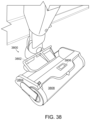
  • FIG. 38 shows a perspective view of an example of a surface cleaning head, consistent with embodiments of the present disclosure.
  • FIG. 39 shows a perspective view of an example a hand-held vacuum cleaner coupled to a surface cleaning head, consistent with embodiments of the present disclosure.
  • FIG. 40 shows a perspective view of the surface cleaning head of FIG. 39 , consistent with embodiments of the present disclosure.
  • FIG. 41 shows another perspective view of the surface cleaning head of FIG. 40 , consistent with embodiments of the present disclosure.
  • FIG. 42 shows a perspective view of the hand-held vacuum cleaner of FIG. 39 coupled to a wand, consistent with embodiments of the present disclosure.
  • the present disclosure is generally directed to a surface cleaning device configured to clean a surface to be cleaned (e.g., a floor) without the use of suction.
  • the surface cleaning device may include an upright section pivotally coupled to a surface cleaning head.
  • the surface cleaning head may include a fluid distributor configured to distribute a cleaning fluid and a debris container configured to collect liquid and solid debris.
  • the debris container may include a fluid debris chamber configured to collect fluid debris and a solid debris chamber configured to collect solid debris.
  • FIG. 1 shows a schematic example of a surface cleaning device 100 configured to clean a surface to be cleaned 101 (e.g., a floor) without the use of suction.
  • the surface cleaning device 100 includes an upright section 102 and a surface cleaning head 104 .
  • the upright section 102 is pivotally coupled to the surface cleaning head 104 and may include, for example, a power supply 106 .
  • the upright section 102 may include a fluid reservoir 108 configured to receive a cleaning fluid (e.g., water, a mixture of water and a cleaning chemical, and/or any other cleaning fluid) and a boiler 110 fluidly coupled to the fluid reservoir 108 .
  • the boiler 110 is configured to heat fluid from the fluid reservoir 108 (e.g., to generate steam).
  • a pump 111 for urging cleaning fluid from the fluid reservoir 108 may be provided in the upright section 102 and/or in the surface cleaning head 104 .
  • the surface cleaning head 104 includes one or more agitators 112 (e.g., a brush roll), at least one agitator motor 114 configure to drive (e.g., rotate) the one or more agitators 112 , and a debris container 116 configured to collect at least a portion of the debris agitated from a surface to be cleaned 101 by the one or more agitators 112 .
  • the surface cleaning head 104 further includes a fluid distributor 120 that is fluidly coupled to the fluid reservoir 108 .
  • the fluid distributor 120 is configured to distribute fluid to one or more of the one or more agitators 112 and/or the surface to be cleaned 101 .
  • the fluid distributor 120 may include a nozzle configured to apply a cleaning fluid directly to the surface to be cleaned 101 (e.g., at a location forward of the surface cleaning head 104 , relative to a direction of forward travel).
  • the fluid distributor 120 may include a steam manifold (e.g., having a plurality of steam delivery apertures) configured to deliver steam directly to the one or more agitators 112 .
  • the fluid distributor 120 may include a nozzle configured to apply steam directly to the surface to be cleaned 101 .
  • the fluid distributor 120 may include a manifold configured to deliver cleaning fluid directly to the one or more agitators 112 .
  • the surface cleaning head 104 may include one or more of the power supply 106 , the fluid reservoir 108 , and/or the boiler 110 . Such a configuration may allow the surface cleaning head 104 to be used interchangeably with other devices while being able to apply the cleaning fluid to the surface to be cleaned 101 .
  • the surface cleaning head 104 may be configured to removably couple with an upright section of a vacuum cleaner, wherein a suction source of the vacuum cleaner is disabled while the surface cleaning head 104 is attached thereto.
  • the surface cleaning head 104 may function as a vacuum cleaning accessory configured to provide a wet sweeping or a steam sweeping functionality to the vacuum cleaner, wherein, in some instances, a power supply of the vacuum cleaner may be configured to provide power to the surface cleaning head 104 .
  • FIG. 2 shows a schematic cross-sectional view of the surface cleaning head 104 of FIG. 1 .
  • the surface cleaning head 104 includes a head body 200 and a neck 202 pivotally coupled to the head body 200 such that the neck 202 is configured to pivot about one or more pivot axes.
  • the neck 202 is configured to receive a portion of the upright section 102 to pivotally couple the upright section 102 to the surface cleaning head 104 .
  • the neck 202 may include one or more of electrical connectors 204 and/or fluid couplings 206 .
  • the one or more electrical connectors 204 may be configured to electrically couple the power supply 106 ( FIG. 1 ) to the surface cleaning head 104 (e.g., to provide power to the agitator motor 114 ).
  • the fluid couplings 206 may be configured to fluidly couple the fluid distributor 120 with the fluid reservoir 108 ( FIG. 1 ) and/or the boiler 110 ( FIG. 1 ). In some instances, one or more of the fluid reservoir 108 and/or the boiler 110 may be coupled to the neck 202 .
  • the agitator motor 114 is configured to cause the one or more agitators 112 to rotate in a forward direction of rotation 208 , wherein the forward direction of rotation 208 is configured to propel debris on the surface to be cleaned 101 in a direction of the debris container 116 .
  • a squeegee 210 may be configured to cooperate with at least one of the one or more agitators 112 to deliver debris into the debris container 116 .
  • the squeegee 210 may be shaped and/or positioned such that the agitator 112 urges debris to move along the squeegee 210 and into the debris container 116 .
  • at least a portion of the squeegee 210 extends between the surface to be cleaned 101 and the head body 200 and between at least a portion of the one or more agitators 112 and at least a portion of the debris container 116 .
  • At least a portion of fluid distributed by the fluid distributor 120 may become absorbed within the one or more agitators 112 .
  • the absorbed fluid may have debris from the surface to be cleaned 101 entrained therein (which may be generally described as a dirty fluid).
  • a fluid stripper 212 may be configured to cooperate with the one or more agitators 112 to transfer fluid from the one or more agitators 112 and into the debris container 116 .
  • the fluid stripper 212 may generally be described as being configured to remove at least a portion of the fluid absorbed in the one or more agitators 112 .
  • the debris container 116 may include a solid debris chamber 214 configured to collect at least a portion of the solid debris (e.g., debris not capable of being entrained within the cleaning fluid) agitated from the surface to be cleaned 101 and a fluid debris chamber 216 configured to collect at least a portion of the fluid transferred from the one or more agitators 112 and into the debris container 116 (e.g., dirty fluid having debris entrained therein). Collection of solid debris separately from dirty fluid may allow solid debris to be emptied from the debris container 116 separately from collected dirty fluid. Such a configuration may make emptying the debris container 116 easier, potentially improving a user experience.
  • a solid debris chamber 214 configured to collect at least a portion of the solid debris (e.g., debris not capable of being entrained within the cleaning fluid) agitated from the surface to be cleaned 101
  • a fluid debris chamber 216 configured to collect at least a portion of the fluid transferred from the one or more agitators 112 and into the debris container 116 (e.g., dirty
  • FIG. 3 A shows a perspective view of a surface cleaning device 300 , which is an example of the surface cleaning device 100 of FIG. 1 .
  • the surface cleaning device 300 is configured to deliver cleaning fluid directly to the surface to be cleaned 302 and to collect debris and dirty fluid from the surface to be cleaned 302 without the use of suction.
  • the surface cleaning device 300 includes an upright section 304 and a surface cleaning head 306 .
  • the upright section 304 includes a fluid reservoir 308 configured to receive a cleaning fluid (e.g., water, a mixture of water and a cleaning chemical, and/or any other cleaning fluid), a power supply 310 (shown schematically in hidden lines), such as, for example, one or more batteries, an upright body 312 , and a handle 314 removably coupled to the upright body 312 .
  • the fluid reservoir 308 may be removably coupled to the upright body 312 such that the fluid reservoir 308 may be more easily refilled by a user. Alternatively, the fluid reservoir 308 may be non-removably coupled to the upright body 312 .
  • a pump 309 (shown schematically in hidden lines) is fluidly coupled to the fluid reservoir 308 and configured to urge cleaning fluid from the fluid reservoir 308 .
  • the pump 309 may be disposed within the upright body 312 .
  • the upright section 304 is pivotally coupled to the surface cleaning head 306 via a multi-axis pivot joint 316 .
  • the multi-axis pivot joint 316 is configured such that the upright section 304 pivots about at least a recline axis 318 and a side-to-side pivot axis 320 , wherein the recline axis 318 extends substantially (e.g., within 1° of, 2° of, 3° of, 4° of, or 5° of) perpendicular to the side-to-side pivot axis 320 .
  • the upright section 304 is configured to pivot about the recline axis 318 to transition between a storage (or upright) position and an in-use (or reclined) position and the upright section 304 is configured to pivot about the side-to-side pivot axis 320 between a central position, a first side (e.g., leftward) position, and a second side (e.g., rightward) position (e.g., for purposes of maneuvering the surface cleaning device 300 along the surface to be cleaned 302 ).
  • a first side e.g., leftward
  • a second side e.g., rightward
  • the surface cleaning head 306 includes an agitator 322 (e.g., a brush roll) configured to agitate the surface to be cleaned 302 , a spray nozzle 324 configured to distribute cleaning fluid to the surface to be cleaned 302 , and a debris collection assembly 326 .
  • the spray nozzle 324 is configured to emit cleaning fluid along an emission axis 328 that intersects the surface to be cleaned 302 at an intersection point 330 .
  • the agitator 322 is disposed between the intersection point 330 and at least a portion of the debris collection assembly 326 . In other words, the spray nozzle 324 is configured to emit cleaning fluid forward of the agitator 322 .
  • the surface cleaning head 306 may include a steam manifold.
  • the surface cleaning head 306 includes a steam manifold 350 fluidly coupled to a boiler 352 , the pump 309 , and the fluid reservoir 308 , wherein the steam manifold 350 delivers steam directly to the agitator 322 (e.g., at a location between a rotation axis of the agitator 322 and a forward most portion of the surface cleaning head 306 ).
  • the steam manifold 350 may include a manifold cover 354 having a flow-path connector 356 configured to couple to, for example, a flexible tube and a steam delivery channel 358 having a plurality of delivery apertures 360 through which steam is able to pass.
  • FIG. 4 shows a cross-sectional view of the surface cleaning device 300 generally corresponding to region IV of FIG. 3 .
  • the handle 314 includes an actuator 400 pivotally coupled to the handle 314 at a hand grip 402 .
  • Pivotal movement of the actuator 400 e.g., in response to a pulling motion of a user's finger
  • a drive shaft 404 moves (e.g., linearly).
  • the drive shaft 404 is configured to actuate an electronic switch 406 , shown schematically, (e.g., a push button, an optical break beam switch, a toggle switch, and/or any other electronic switch 406 ) disposed within the upright body 312 .
  • an electronic switch 406 shown schematically, (e.g., a push button, an optical break beam switch, a toggle switch, and/or any other electronic switch 406 ) disposed within the upright body 312 .
  • the actuator 400 and the drive shaft 404 may be generally described as providing a mechanical interface disposed within the removable handle 314 for actuating the electronic switch 406 within the upright body 312 .
  • the electronic switch 406 and the actuator 400 are disposed at opposing ends of the handle 314 .
  • Actuation of the electronic switch 406 may cause the surface cleaning device 300 to operate according to one or more cleaning behaviors.
  • the electronic switch 406 may be configured such that actuation causes the cleaning fluid to be emitted from the spray nozzle 324 ( FIG. 3 A ).
  • the electronic switch 406 may cause the pump 309 ( FIG. 3 A ) to be activated.
  • FIG. 5 A shows a cross-sectional view generally corresponding to region V of FIG. 4 having the handle 314 coupled to the upright body 312
  • FIG. 5 B shows a cross-sectional view generally corresponding to region V of FIG. 4 having the handle 314 decoupled from the upright body 312 .
  • the upright body 312 includes a handle receptacle 500 configured to selectively receive a portion of the handle 314 .
  • a depressible handle plunger 502 may be disposed within the handle receptacle 500 , wherein the handle plunger 502 is configured to transition between a retracted state ( FIG. 5 A ) and an extended state ( FIG. 5 B ).
  • the handle plunger 502 is configured to be transitioned to the retracted state in response to the handle 314 engaging the handle plunger 502 when the handle 314 is inserted into the handle receptacle 500 .
  • the handle plunger 502 is configured to be transitioned to the extended state in response to the handle 314 being removed from the handle receptacle 500 .
  • the handle plunger 502 is in retracted state and, when the handle 314 is decoupled from the upright body 312 , the handle plunger 502 is in the extended state.
  • the handle plunger 502 When in the extended state, the handle plunger 502 may be configured to extend over at least a portion of a switch cavity 506 , wherein the switch cavity 506 includes the electronic switch 406 . In some instances, the handle plunger 502 may be configured to enclose (e.g., sealingly enclose) the switch cavity 506 when the handle plunger 502 is in the extended position. Such a configuration may mitigate (or prevent) an ingress of debris and/or fluid into the switch cavity 506 when the handle 314 is decoupled from the upright body 312 , which may protect the electronic switch 406 from damage.
  • a cavity facing surface 508 of the handle plunger 502 may include a sealing material 510 (e.g., an elastomeric material) configured to form a seal with one or more sidewalls 512 forming the switch cavity 506 .
  • the sealing material 510 may be configured to form a seal that mitigates (e.g., prevents) the ingress of fluid and/or dust.
  • the handle plunger 502 may be biased towards the extended position such that, when the handle 314 is decoupled from the upright body 312 , the handle plunger 502 automatically moves to the extended position.
  • a spring 514 (shown schematically) may be configured to urge the handle plunger 502 towards the extended position. Biasing the handle plunger 502 towards the extended position may also increase the stability of the handle 314 within the handle receptacle 500 as a result of the handle plunger 502 exerting a compressive force on a portion of the handle 314 .
  • the handle plunger 502 may further include a handle engagement surface 516 that is generally opposite the cavity facing surface 508 .
  • the handle engagement surface 516 is configured to engage with the handle 314 as the handle 314 is being inserted into the handle receptacle 500 .
  • the handle engagement surface 516 may extend transverse, at a non-perpendicular angle, to an insertion axis 518 of the handle receptacle.
  • the insertion axis 518 extends substantially parallel to a longitudinal axis 520 of the handle 314 .
  • An actuation axis 522 along which the handle plunger 502 moves when transitioning between the retracted and extended states may extend substantially perpendicular to the insertion axis 518 .
  • FIG. 6 shows a cross-sectional view generally corresponding to region VI of FIG. 3 A and shows a cross-section of the multi-axis pivot joint 316 .
  • the multi-axis pivot joint 316 includes a pivot body 600 and a paddle 602 pivotally coupled to the pivot body 600 .
  • the pivot body 600 includes a body pivot 604 and a head pivot 606 vertically spaced apart from the body pivot 604 .
  • the body pivot 604 pivotally couples to the upright body 312 such that the side-to-side pivot axis 320 extends through the body pivot 604 .
  • the head pivot 606 pivotally couples to the surface cleaning head 306 such that the recline axis 318 extends through the head pivot 606 .
  • the paddle 602 is configured to pivot between a locked position and an unlocked position.
  • the upright section 304 is substantially prevented (e.g., less than 1°, less than 2°, less than 3°, less than 4°, less than 5°, or less than 10° of rotation in any one rotation direction) from pivoting about the side-to-side pivot axis 320 .
  • the paddle 602 is in the unlocked position, the paddle 602 does not substantially interfere with side-to-side movement of the upright section 304 about the side-to-side pivot axis 320 .
  • the paddle 602 is configured to pivot between the locked and unlocked positions based on a rotational position of the upright section 304 about the recline axis 318 .
  • the paddle 602 when the upright section 304 is in the storage (or upright) position the paddle 602 may be in the locked position and, when the upright section 304 is in the in-use (or reclined) position, the paddle 602 may be in the unlocked position.
  • the paddle 602 may be biased towards the unlocked position using, for example, a paddle biasing mechanism 609 (e.g., a spring such as torsion spring).
  • the paddle 602 includes a retaining portion 608 and a triggering portion 610 .
  • the retaining portion 608 may be configured to engage with a portion of the upright body 312 and the triggering portion 610 may be configured to engage with a portion of the surface cleaning head 306 .
  • the surface cleaning head 306 may include a paddle protrusion 612 configured to engage (e.g., contact) the triggering portion 610 of the paddle 602 .
  • engagement between the paddle protrusion 612 and the triggering portion 610 may cause the paddle 602 to pivot about a paddle axis 614 .
  • the paddle 602 may include a retention cutout 616 configured to receive a retention protrusion 618 of the upright body 312 .
  • the retention cutout 616 and the retention protrusion 618 cooperate to restrict (e.g., prevent) pivotal movement of the upright section 304 about the side-to-side pivot axis 320 .
  • the retaining portion 608 may be configured to selectively engage a portion of the upright body 312 (e.g., the retention protrusion 618 ) to substantially prevent the upright section 304 from pivoting about the side-to-side pivot axis 320 .
  • the retaining portion 608 and the triggering portion 610 of the paddle 602 may form a paddle angle ⁇ that opens in a direction facing the surface cleaning head 306 .
  • the paddle angle ⁇ may be, for example, 90° or greater.
  • FIG. 8 shows a bottom perspective view of the surface cleaning head 306 .
  • the surface cleaning head 306 includes a plurality of support wheels 800 and a squeegee 802 , wherein the squeegee 802 is disposed between at least a portion of the agitator 322 and the support wheels 800 .
  • the squeegee 802 may extend along substantially (e.g., at least 90%, at least 95%, at least 97%, at least 99%) an entire longitudinal length 801 of the agitator 322 or substantially an entire width 803 of the surface cleaning head 306 .
  • the agitator 322 is configured to cooperate with the squeegee 802 to urge debris into the debris collection assembly 326 ( FIG. 3 A ).
  • the agitator 322 may be configured to rotate according to a forward direction of rotation 804 , wherein the forward direction of rotation 804 is configured to urge solid debris to move along the squeegee 802 and into the debris collection assembly 326 .
  • the surface cleaning head 306 may further include an auxiliary wheel 806 .
  • the auxiliary wheel 806 may be configured to rotate about an auxiliary wheel rotation axis 808 and, in some instances, move linearly along an actuation axis 810 .
  • the surface cleaning head 306 may include one or more drain holes 812 .
  • the drain holes 812 may be configured to drain fluid trapped within the surface cleaning head 306 .
  • the drain holes 812 may be disposed generally below at least a portion of the debris collection assembly 326 .
  • FIG. 9 A shows a cross-sectional view of a squeegee 900 , which is an example of the squeegee 802 of FIG. 8 .
  • the squeegee 900 includes a squeegee core 902 and a squeegee cover 904 .
  • the squeegee core 902 includes an agitator facing side 906 and a mounting side 908 generally opposite the agitator facing side 906 .
  • the mounting side 908 may include mounting protrusion 910 configured to couple the squeegee 900 with the surface cleaning head 306 .
  • the protrusion 910 may be keyed to be received within a corresponding slot 912 of the surface cleaning head 306 .
  • the squeegee cover 904 may extend along at least a portion of the squeegee core 902 .
  • the squeegee cover 904 may extend along a substantial portion (e.g., at least 70%, at least 80%, at least 85%, at least 90%, at least 95%, at least 99%, or 100%) of one or more of the agitator facing side 906 and/or the mounting side 908 .
  • the squeegee core 902 and the squeegee cover 904 may be made of different materials.
  • the squeegee core 902 may be made of an elastomeric material (e.g., a natural or synthetic rubber, silicone, and/or any other elastomeric material) and the squeegee cover 904 may be a fabric material (e.g., a cloth material, a carbon fiber woven material, an aramid woven material, a polyester material such as polyethylene terephthalate, and/or any other fabric material).
  • a fabric material e.g., a cloth material, a carbon fiber woven material, an aramid woven material, a polyester material such as polyethylene terephthalate, and/or any other fabric material.
  • One example fabric material may have a thickness in a range of about 0.4 millimeters (mm) to about 0.45 mm, a yarn diameter in a range of about 0.28 mm to about 0.32 mm, and/or a pull force of about 7.23 grams (g) per yarn.
  • the squeegee cover 904 may have a lower coefficient of friction than the squeegee core 902 .
  • Such a configuration may allow the squeegee 900 to have similar mechanical properties to the material forming the squeegee core 902 while allowing the squeegee to have a lower friction coefficient.
  • a lower friction coefficient for the surface of the squeegee 900 in contact with debris may improve debris collection (e.g., by making movement of debris along the squeegee 900 by the agitator 322 , FIG. 3 A , easier).
  • a lower friction coefficient for the surface of the squeegee 900 in contact with the surface to be cleaned 302 may improve movement of the squeegee 900 along the surface to be cleaned 302 (e.g., by reducing squeaking noises as a result of the sliding contact between the squeegee 900 and the surface to be cleaned 302 ).
  • the squeegee cover 904 may extend over at least a portion of the mounting side 908 of the squeegee core 902 without extending along the agitator facing side 906 of the squeegee core 902 (e.g., to mitigate an effect of friction between the squeegee 900 and the surface to be cleaned 302 .
  • the squeegee 900 may have an arcuate shape, a planar shape, and/or any other shape.
  • the squeegee 900 may have an arc radius 914 in a range of 15 millimeters (mm) to 45 mm.
  • the arc radius 914 may be in a range of 25 mm to 35 mm.
  • the arc radius 914 may be about (e.g., within 1% of, 2% of, 3% of, 4% of, or 5% of) 30 mm. In some instances, the arc radius 914 may be selected to minimize a separation distance between the agitator 322 and the squeegee 900 . As shown in FIG. 9 C , in some instances, the squeegee 900 may have one or more planar surfaces that meet at an intersection point 916 .
  • the squeegee cover 904 may include an engagement region 918 that extends beyond a distal end 920 of the squeegee core 902 .
  • the engagement region 918 may be configured to engage with the surface to be cleaned 302 .
  • the engagement region 918 has an engagement region extension distance 922 .
  • the engagement region extension distance 922 may be, for example, at least 5% and less than 25% of a total squeegee extension distance 924 .
  • the engagement region 918 may be generally described as forming a selvage.
  • FIG. 9 D shows a perspective view of a squeegee 926 , which is another example of the squeegee 802 of FIG. 8 .
  • the squeegee 926 includes a squeegee body 928 having a plurality of spaced apart raised ribs 930 formed on an agitator facing side of the squeegee 926 .
  • the plurality of raised ribs 930 are spaced apart by a rib separation distance 932 .
  • the rib separation distance 932 may be the same or different for each set of immediately adjacent raised ribs 930 .
  • At least a portion of one or more of the raised ribs 930 may come into engagement with the agitator 322 ( FIG. 3 A ).
  • the ribs 930 may reduce a surface area of the squeegee 926 with which debris contacts.
  • FIG. 9 E shows a perspective view of a squeegee 934 , which is another example of the squeegee 802 of FIG. 8 .
  • the squeegee 934 includes a rigid portion 936 (e.g., a plastic body) and a flexible portion 938 (e.g., an elastomeric body).
  • the rigid portion 936 may be configured to couple to the surface cleaning head 306 ( FIG. 3 A ) and the flexible portion 938 may be configured to engage the surface to be cleaned 302 .
  • the flexible portion 938 may be overmolded onto the rigid portion 936 to form the squeegee 934 .
  • FIGS. 9 F- 9 H show perspective view of a squeegee 940 , which is another example of the squeegee 802 of FIG. 8 .
  • the squeegee 940 includes a flexible body 942 , a leading edge 944 , and a frame 946 .
  • the flexible body 942 is coupled to the frame 946 and the leading edge 944 is coupled to the flexible body 942 such that the leading edge 944 comes into engagement with the surface to be cleaned 302 .
  • the frame 946 may be configured to couple the squeegee 940 to the surface cleaning head 306 .
  • the frame 946 may be constructed of a material that is more rigid than the flexible body 942 , which allows the flexible body 942 to flex relative to the frame 946 as the surface cleaning head 306 moves along the surface to be cleaned 302 .
  • the leading edge 944 may include a material having a lower friction coefficient than the flexible body 942 . Such a configuration may allow the squeegee 940 to move more easily along the surface to be cleaned 302 .
  • the leading edge 944 may be configured to cooperate with the flexible body 942 to guide debris into the debris collection assembly 326 ( FIG. 3 A ).
  • FIG. 9 I shows a schematic representation of the squeegee 940 configured to guide solid debris 950 (e.g., sand) into the debris collection assembly 326 on the forward stroke 948 .
  • solid debris 950 e.g., sand
  • FIG. 9 H shows a schematic representation of the squeegee 940 configured to allow the solid debris 950 to pass underneath the squeegee on the reverse stroke 952 .
  • the leading edge 944 may encourage a bending of the flexible body 942 to encourage debris to pass under the squeegee 940 on the reverse stroke 952 . Further, a lower coefficient of friction may reduce a quantity of debris that sticks to the leading edge 944 .
  • the flexible body 942 includes an upper portion 954 configured to couple to the frame 946 and a lower portion 956 , wherein at least a portion of the lower portion 956 is configured to extend (e.g., in a cantilevered fashion) from the frame 946 .
  • the leading edge 944 may be coupled to the lower portion 956 of the flexible body 942 and extend along a distal edge 958 of the lower portion 956 .
  • Such a configuration may encourage flexing of the flexible body 942 as the surface cleaning head 306 moves along the surface to be cleaned 302 .
  • a portion of the leading edge 944 may extend along an agitator facing surface 960 and/or a surface to be cleaned facing surface 962 .
  • the flexible body 942 may include silicone, thermoplastic elastomer (TPE), and/or any other flexible material.
  • the leading edge 944 may include polytetrafluoroethylene (PTFE), one commercial example of which is Teflon brand PTFE, which is marketed by The Chemours Company, woven nylon, and/or any other material (e.g., having a lower coefficient of friction than the flexible body 942 ).
  • PTFE polytetrafluoroethylene
  • FIG. 9 K shows a schematic example a squeegee 964 , which is another example of the squeegee 802 of FIG. 8 .
  • the squeegee 964 includes a squeegee ramp 966 configured to face the agitator 322 ( FIG. 3 A ) and a surface wiper 968 configured to move along the surface to be cleaned 302 ( FIG. 3 A ).
  • the ramp 966 is configured to cooperate with the agitator 322 to urge debris into the debris collection assembly 326 ( FIG. 3 A ).
  • at least a portion of the ramp 966 is positioned between the agitator 322 and the surface wiper 968 . In other words, at least a portion of the ramp 966 is positioned forward of the surface wiper 968 .
  • FIG. 10 shows a cross-sectional perspective view of the surface cleaning head 306 of FIG. 3 .
  • the agitator 322 cooperates with the squeegee 802 to encourage debris (e.g., solid debris) to be collected within the debris collection assembly 326 .
  • the agitator 322 may include an agitator body 1000 , a motor cavity 1002 defined within the agitator body 1000 configured to receive at least a portion of an agitator motor 1004 , and an agitation material 1006 extending from (e.g., coupled to) an outer surface 1008 of the agitator body 1000 .
  • the agitation material 1006 may have a material thickness 1010 that extends from the outer surface 1008 of the agitator body 1000 to a distal most portion 1012 of the agitation material 1006 in a range of, for example, about 10 mm to about 14 mm.
  • the material thickness 1010 may be in a range of about 8 mm to about 12 mm.
  • the material thickness 1010 may be selected based, at least in part, on an intended debris size to be collected.
  • the agitation material 1006 may include any one or more of microfiber, bristle tufts, bristle strips, elastomeric flaps, fabric, and/or any other agitation material.
  • the agitator 322 may be tangent to, spaced apart from, or overlapping with the squeegee 802 when dry and/or when wet. In some instances, at least a portion of the squeegee 802 may be in contact with the agitator 322 when the surface cleaning head 306 rests on the surface to be cleaned 302 ( FIG. 3 A ).
  • a distal end region 1013 of the squeegee 802 that is proximate e.g., a distance within 1% of, 2% of, 3% of, 4% of, 5% of, or 10% of a maximum dimension of the squeegee 802
  • a distal end region 1013 of the squeegee 802 that is proximate may come into contact with the agitator 322 when the surface cleaning head 306 rests on the surface to be cleaned 302 .
  • a middle region 1014 of the squeegee 802 may come into contact with the agitator 322 when the surface cleaning head 306 rests on the surface to be cleaned 302 .
  • the surface cleaning head 306 further includes an agitation chamber 1016 within which the agitator 322 rotates and a fluid stripper 1018 configured to extend into the agitation material 1006 .
  • the fluid stripper 1018 is configured to contact the agitation material 1006 in order remove at least a portion of any fluid absorbed within the agitation material 1006 .
  • the removed fluid is transferred to the debris collection assembly 326 .
  • the fluid stripper 1018 may be generally described as being configured to transfer fluid from the agitator 322 to the debris collection assembly 326 .
  • the fluid stripper 1018 may be disposed within the agitation chamber 1016 such that a rotation axis 1020 of the agitator 322 is disposed between the surface to be cleaned 302 and the fluid stripper 1018 . Additionally, or alternatively, the fluid stripper 1018 may be disposed within the agitation chamber 1016 such that the fluid stripper 1018 is between the rotation axis 1020 of the agitator 322 and at least a portion of the debris collection assembly 326 .
  • the fluid stripper 1018 may extend into the agitation material 1006 by an extension distance 1022 .
  • the extension distance 1022 may be, for example, 5% of the material thickness 1010 of the agitation material 1006 to 95% of the material thickness 1010 .
  • the extension distance 1022 may be in a range of 25% of the material thickness 1010 to 85% of the material thickness 1010 .
  • the extension distance 1022 may be in a range of 60% of the material thickness 1010 to 95% of the material thickness 1010 .
  • the surface cleaning head 306 may further include a debris stripper 1024 .
  • the debris stripper 1024 is configured to strip solid debris from the agitator 322 .
  • the debris stripper 1024 may be positioned forward of the fluid stripper 1018 (relative to the forward direction of 804 , FIG. 8 ) such that the agitator 322 rotates the agitation material 1006 into contact with the debris stripper 1024 before the fluid stripper 1018 during operation. In other words, a used (or dirty) portion of the agitator 322 contacts the debris stripper 1024 before contacting the fluid stripper 1018 .
  • FIG. 11 shows a perspective view of the fluid stripper 1018 of FIG. 10 .
  • the fluid stripper 1018 includes a mounting region 1100 and a stripping region 1102 .
  • the stripping region 1102 may extend from the mounting region 1100 according to a fluid stripper angle ⁇ .
  • the fluid stripper angle ⁇ may be an obtuse angle that opens in a direction of the surface to be cleaned 302 ( FIG. 3 A ).
  • the fluid stripper 1018 may be formed, at least partially of, a plastic (e.g., Acrylonitrile Butadiene Styrene, “ABS”), a metal (e.g., a stainless steel alloy, an aluminum alloy, and/or any other metal), and/or any other suitable material.
  • ABS Acrylonitrile Butadiene Styrene
  • FIG. 12 shows an example of an agitator body 1200 , which is an example of the agitator body 1000 of FIG. 10 .
  • the agitator body 1200 includes a helical rib 1202 extending along an outer surface 1201 of the agitator body 1000 .
  • the helical rib 1202 may extend from the outer surface 1201 such that side surfaces 1203 of the helical rib 1202 form a substantially perpendicular angle with the outer surface 1201 .
  • the agitation material 1006 may be disposed on opposing sides of the helical rib 1202 such that the helical rib 1202 is disposed between the agitation material 1006 .
  • the agitation material 1006 may be in contact with at least one helical rib 1202 .
  • Contact with the helical rib 1202 may reduce a flexibility of a portion of the agitation material 1006 adjacent the helical rib 1202 .
  • the agitation material 1006 may extend over the helical rib 1202 .
  • Such a configuration causes a localized ridge to be formed in the agitation material 1006 as a result of the helical rib 1202 . Presence of a localized ridge in the agitation material 1006 may increase engagement with the surface to be cleaned 302 ( FIG. 3 A ) at the localized ridge.
  • the helical rib 1202 may have a rib height 1204 and a rib width 1206 .
  • the rib height 1204 extends radially outward from the agitator body 1200 and the rib width 1206 extends in a direction parallel to a rotation axis 1208 of the agitator body 1200 .
  • the rib height 1204 may be less than the material thickness 1010 of the agitation material 1006 .
  • the rib height 1204 may configured such that the helical rib 1202 does not come into contact with one or more of the surface to be cleaned 302 , the squeegee 802 ( FIG. 8 ), and/or the fluid stripper 1018 ( FIG. 10 ).
  • the rib height 1204 may be 10% of the material thickness 1010 of the agitation material 1006 to 30% of the material thickness 1010 .
  • the rib height 1204 may be about 2.5 mm.
  • rib width 1206 may be about the same as the rib height 1204 .
  • the helical rib 1202 may be formed of a rigid material (e.g., a plastic material) or a flexible material (e.g., a elastomeric material).
  • the helical rib 1202 may be formed of the same material as the agitator body 1200 .
  • FIG. 13 B shows an example of an agitator 1300 having at least one helical bristle strip 1302 extending therearound and microfiber 1304 extending on both sides of the helical bristle strip 1302 .
  • the agitator 1300 may additionally include at least one helical rib (e.g., the helical rib 1202 ).
  • a bristle strip may generally refer to a row of bristles having a linear length of at least 25% of a longitudinal length of the agitator 1300 , wherein immediately adjacent bristles forming the bristle strip have bases that are spaced apart by a distance less than three-times a maximum diameter of a single bristle.
  • the bristle strip 1302 may extend from the microfiber 1304 by a bristle extension distance 1306 .
  • the bristle extension distance 1306 may be, for example, equal to or greater than a thickness 1307 of the microfiber 1304 (e.g., when dry).
  • the bristle extension distance 1306 may be about 0.1 times to about 0.9 times the thickness 1307 of the microfiber 1304 (e.g., when dry).
  • the bristle strip 1302 may be at least partially folded over.
  • the elasticity of the bristles forming the bristle strip 1302 may cause the bristle strip 1302 to straighten, which may encourage debris collection.
  • Having the bristle strip 1302 extend from the microfiber 1304 may improve edge cleaning and/or corner cleaning performance of the surface cleaning device 300 ( FIG. 3 A ). For example, in the absence of suction, it may be difficult for the surface cleaning device 300 to collect debris adjacent a wall (e.g., as a result of a surface of the surface cleaning head 306 contacting the wall, potentially preventing a portion of the agitator 1300 from contacting the wall).
  • the bristle extension distance 1306 may be selected such that a portion of the bristle strip 1302 contacts the wall, pulling debris towards the surface cleaning head 306 to be collected.
  • the helical shape of the bristle strip 1302 may encourage movement of debris (e.g., as a result of an Archimedes screw effect).
  • FIG. 13 C illustrates an example of the agitator 1300 without the bristle strip 1302 .
  • a dead-zone 1308 exists between the surface cleaning head 306 and a wall 1310 , wherein debris within the dead-zone 1308 may not be collected.
  • the dead-zone 1308 may have a dead-zone length 1312 of about 22 mm.
  • the bristle extension distance 1306 may be at least about 22 mm.
  • FIG. 14 shows a perspective view of an agitator 1400 , which is an example of the agitator 322 of FIG. 3 .
  • the agitator 1400 includes an agitator body 1402 , an agitation material 1404 , and one or more ribs 1406 .
  • the one or more ribs 1406 may be configured to cause the surface cleaning head 306 ( FIG. 3 A ) to be briefly raised from the surface to be cleaned 302 ( FIG. 3 A ) with each rotation (e.g., resulting a vibrating motion).
  • Such a configuration may encourage debris to pass under the squeegee 802 ( FIG. 8 ) on a reverse stroke, which may mitigate an amount of debris that collects behind the squeegee 802 on the reverse stroke.
  • the one or more ribs 1406 may be formed of a rigid material (e.g., a plastic material) or a flexible material (e.g., a elastomeric material).
  • the one or more ribs 1406 may be formed of the same material as the agitator body 1402 .
  • the one or more ribs 1406 may be integrally formed from the agitator body 1402 .
  • the one or more ribs 1406 may be coupled to the agitator body 1402 .
  • FIG. 15 shows a perspective view of an agitator 1500 , which is an example of the agitator 322 of FIG. 3 .
  • the agitator 1500 includes an agitator body 1502 and a microfiber material 1504 .
  • the microfiber material 1504 can be coupled to (e.g., adhesively coupled to) an outer surface 1506 of the agitator body 1502 .
  • one or more additional agitation elements e.g., bristles, flaps, and/or any other agitation element
  • the one or more additional agitation elements may be interspersed according to a pattern (e.g., forming a helical pattern, a linear pattern, a chevron pattern, and/or any other pattern) or may be randomly interspersed.
  • the microfiber material 1504 may include a plurality of different microfiber materials (e.g., having different agitation characteristics, water absorption characteristics, and/or the like).
  • FIG. 16 A shows a perspective view of a portion of the surface cleaning device 300 .
  • the debris collection assembly 326 includes a removable cover 1600 that extends over at least a portion of a debris container 1602 and at least a portion of the agitator 322 .
  • the debris container 1602 may be at least partially received within a debris container cavity 1603 defined within the surface cleaning head 306 (e.g., a head body 1606 of the surface cleaning head 306 ).
  • the debris container cavity 1603 may be configured such that a tallest portion of the debris container 1602 is substantially flush with or below an upper most portion of the debris container cavity 1603 .
  • the removable cover 1600 may define at least a portion of the agitation chamber 1016 and may include the spray nozzle 324 .
  • the spray nozzle 324 may be fluidly coupled to the fluid reservoir ( FIG. 3 A ) through the removable cover 1600 (e.g., using one or more fluid tubes or fluid passages).
  • the removable cover 1600 includes a cover latch 1604 configured to removably couple the removable cover 1600 to the surface cleaning head 306 (e.g., the head body 1606 of the surface cleaning head 306 ).
  • the cover latch 1604 may be a pinch latch.
  • the removable cover 1600 may further include, in addition to, or in the alternative to, the spray nozzle 324 ( FIG. 3 A ), the steam manifold 350 .
  • the cover 1600 may include a stem receptacle 1650 configured to receive at least a portion of a steam stem 1652 .
  • the stem receptacle 1650 and the steam stem 1652 are configured to cooperate to fluidly couple the boiler 352 ( FIG. 3 B ) with the steam manifold 350 when the removable cover 1600 is coupled with the surface cleaning head 306 .
  • the steam stem 1652 includes a steam outlet 1654 .
  • the steam outlet 1654 is configured to fluidly couple the steam stem 1652 to the steam manifold 350 via the stem receptacle 1650 .
  • the steam outlet 1654 is configured to direct steam along a steam outlet axis 1656 .
  • the steam outlet axis 1656 extends in a non-vertical direction (e.g., a direction extending transverse, at a non-perpendicular angle, to the surface to be cleaned 302 ).
  • a non-vertical direction e.g., a direction extending transverse, at a non-perpendicular angle, to the surface to be cleaned 302 .
  • Such a configuration may reduce a risk of user harm (e.g., from residual steam within the boiler 352 , FIG. 3 B ).
  • the steam outlet axis 1656 may extend in a direction away from the agitator 322 .
  • at least a portion of steam emitted along the steam outlet axis 1656 may intersect with a portion of the head body 1606 (e.g., to encourage dissipation of emitted steam into a surrounding environment).
  • the steam stem 1652 may be disposed within a stem cavity 1658 of the head body 1606 such that at least a portion steam emitted from the steam outlet 1654 , when the removable cover 1600 is removed from the surface cleaning head 306 , is incident on a sidewall of the stem cavity 1658 .
  • an agitator opening 1608 is exposed, allowing the agitator 322 to be pivoted about an agitator pivot axis 1610 between an in-use position and a removal position.
  • the pivot axis 1610 extends substantially parallel to the surface to be cleaned 302 and transverse to (e.g., at a perpendicular angle) the rotation axis 1020 of the agitator 322 .
  • Such a configuration allows the agitator 322 to, for example, be pivoted upwardly.
  • the pivot axis 1610 may extend transverse to (e.g., at a non-perpendicular angle) the surface to be cleaned 302 .
  • Such a configuration allows the agitator 322 to, for example, be pivoted upwardly and forwardly such that at least a portion of the agitator 322 extends forward of the surface cleaning head 306 .
  • having the agitator 322 pivot upwardly and forwardly may allow at least a portion of the cover 1600 to be non-removable.
  • the agitator 322 When the agitator is in the removal position (e.g., as shown in FIG. 16 A ), the agitator 322 extends through the agitator opening 1608 .
  • the agitator opening 1608 is positioned opposite at least a portion of an agitator chamber opening 1609 .
  • the removal position may correspond to, for example, about 35° to about 55° of rotational movement about the agitator pivot axis 1610 from the in-use position.
  • the removal position may correspond to about 45° of rotational movement about the agitator pivot axis 1610 from the in-use position.
  • the agitator 322 When the agitator 322 is in the in-use position, at least a portion of the agitator 322 extends from the agitator chamber opening 1609 to engage the surface to be cleaned 302 . In other words, when in the removal position, the agitator 322 extends upwardly in a direction away from the surface to be cleaned 302 . Such a configuration may result in the presentation of the agitator 322 to a user, which may result in easier removal and/or replacement of the agitator 322 .
  • Transitioning the agitator 322 between the in-use position and the removal position may be accomplished by a user exerting a force on an agitator tab 1612 that causes the agitator 322 to pivot about the agitator pivot axis 1610 .
  • the agitator tab 1612 When in the in use position, the agitator tab 1612 may be received within a tab receptable 1614 of the head body 1606 of the surface cleaning head 306 . In some instances, the agitator tab 1612 may define a portion of an outer surface of the surface cleaning head 306 when the agitator 322 is in the in-use position.
  • the agitator motor 1004 pivots concurrently with the agitator 322 .
  • the agitator motor 1004 may be configured to be selectively retained within the in-use and removal positions.
  • a motor retainer 1800 may selectively retain the agitator motor 1004 in the in-use position ( FIG. 18 ) and the removal position ( FIG. 19 ).
  • the motor retainer 1800 may include a pawl 1802 pivotally coupled to the head body 1606 of the surface cleaning head 306 .
  • the pawl 1802 is configured to cooperate with a protrusion 1804 of the agitator motor 1004 to selectively retain the agitator motor 1004 in the in-use and removal positions.
  • the protrusion 1804 includes a notch 1806 configured to selectively receive the pawl 1802 and an engagement surface 1808 spaced apart from the notch 1806 configured to selectively engage (e.g., contact) the pawl 1802 .
  • the notch 1806 and the pawl 1802 include corresponding angled surfaces such that, as the agitator motor 1004 pivots from the in-use position towards the removal position, the pawl 1802 is urged out of the notch 1806 and into engagement with the engagement surface 1808 of the protrusion 1804 .
  • the pawl 1802 is biased by a biasing mechanism 1810 (e.g., a spring, such as a compression spring) into engagement with the notch 1806 and the engagement surface 1808 .
  • the bias force exerted by the biasing mechanism 1810 may be configured such that the weight of the agitator 322 and the agitator motor 1004 are insufficient to cause the agitator motor 1004 to transition from the removal position towards the in-use position.
  • the agitator motor 1004 is configured to remain in the removal position until a user exerts a force sufficient to transition to agitator motor 1004 to the in-use position.
  • FIGS. 18 and 19 show the motor retainer 1800 as selectively retaining the agitator 322 in two positions (the in-use and removal positions), other configurations are possible.
  • the motor retainer 1800 may be configured to selectively retain the agitator 322 in three or more positions.
  • the motor retainer 1800 may be configured to selectively retain the agitator 322 in an in-use position, an intermediary position (e.g., a rotational position corresponding to about 25° of rotational movement about the agitator pivot axis 1610 from the in-use position), and a removal position (e.g., a rotational position corresponding to about 45° of rotational movement about the agitator pivot axis 1610 from the in-use position).
  • the intermediary position the agitator 322 may or may not be removable from the surface cleaning head 306 .
  • the agitator motor 1004 when in the removal position, may be configured to engage a portion of the head body 1606 . Such a configuration may prevent the over pivoting of the agitator motor 1004 .
  • the agitator motor 1004 may also include a wire passthrough 1812 through which one or more wires 1814 (e.g., power supply wires) pass.
  • the wire passthrough 1812 may also be used to provide a cooling passage for providing cooling air to the agitator motor 1004 .
  • FIGS. 16 - 19 describe pivoting the agitator 322 upwardly towards a removal position
  • FIGS. 20 A- 20 C show a surface cleaning head 2000 , which is an example of the surface cleaning head 306 , having an agitator 2002 , which is an example of the agitator 322 , wherein the agitator 2002 is removable from the surface cleaning head 2000 without pivoting upwardly.
  • the agitator 2002 includes an agitator latch 2004 configured to engage with a head body 2006 of the surface cleaning head 2000 .
  • the agitator 2002 may be removed through an opening in a sidewall 2008 of the head body 2006 by moving the agitator 2002 along a removal axis 2010 .
  • the removal axis 2010 may correspond to (e.g., be coincident with) a rotation axis of the agitator 2002 .
  • FIG. 21 shows a perspective bottom view of the removable cover 1600
  • FIG. 22 shows a perspective cross-sectional view of the removable cover 1600
  • the removable cover 1600 includes a fluid catch plate 2100 .
  • the fluid catch plate 2100 is configured to collect fluid stripped from the agitator 322 ( FIG. 3 A ) by the fluid stripper 1018 .
  • the fluid catch plate 2100 is configured to direct collected fluid toward at least one chamber defined within the debris container 1602 ( FIG. 16 A ).
  • the fluid catch plate 2100 may include one or more of the debris stripper 1024 and/or the fluid stripper 1018 .
  • the debris stripper 1024 may include a plurality of spaced apart ridges 2102 (e.g., forming a comb) configured to engage the agitator 322 (e.g., protrude into the agitation material 1006 of the agitator 322 by about 1 mm). Engagement between the plurality of ridges 2102 and the agitator 322 may mitigate (e.g., prevent) a quantity of solid debris (e.g., fibrous debris such as hair) from entering the fluid catch plate 2100 .
  • a quantity of solid debris e.g., fibrous debris such as hair
  • the fluid catch plate 2100 is configured to transition between an in-use position ( FIG. 21 ) and a cleaning position ( FIG. 23 ) when the removable cover 1600 is removed from the surface cleaning head 306 ( FIG. 3 A ).
  • the fluid catch plate 2100 may be configured to pivot about a plate pivot axis 2300 between the in-use position and the cleaning position.
  • the fluid catch plate 2100 is configured to be selectively retained in the in-use position such that the fluid catch plate 2100 transitions from the in-use position to the cleaning position in response to an application of a force by a user.
  • the fluid catch plate 2100 may include a detent 2302 configured to be selectively receivable within a detent receptacle 2304 of the removable cover 1600 .
  • the fluid catch plate 2100 may be removably coupled with the removable cover 1600 .
  • FIG. 24 A shows a perspective view of the fluid catch plate 2100 .
  • the fluid catch plate 2100 has a collecting region 2400 , a first channel 2402 , and a second channel 2404 , the collecting region 2400 being fluidly coupled with the first and second channels 2402 and 2404 .
  • the collecting region 2400 is disposed between the agitator 322 ( FIG. 3 A ) and the first and second channels 2402 and 2404 when the fluid catch plate 2100 is in the in-use position and the removable cover 1600 ( FIG. 16 A ) is coupled to the surface cleaning head 306 ( FIG. 3 A ).
  • the collecting region 2400 may generally be described as being disposed forwardly of the first and second channels 2402 and 2404 .
  • the collecting region 2400 is configured to receive fluid stripped from the agitator 322 and direct the received fluid to the first and second channels 2402 and 2404 .
  • the collecting region 2400 includes a fluid diverter 2406 extending between the first and second channels 2402 and 2404 .
  • the fluid diverter 2406 is configured to divert fluid incident thereon into a respective one of the first or the second channel 2402 or 2404 .
  • the fluid diverter 2406 may have a generally triangular shape, wherein an apex of the triangular shape points towards the agitator 322 .
  • a first fluid grate 2408 may extend between the first channel 2402 and the collecting region 2400 .
  • the first fluid grate 2408 may extend from the fluid diverter 2406 to a first sidewall 2410 of the fluid catch plate 2100 .
  • fluid passing from the collecting region 2400 into the first fluid channel 2402 passes through the first fluid grate 2408 .
  • a second fluid grate 2412 may extend between the second channel 2404 and the collecting region 2400 .
  • the second fluid grate 2412 may extend from the fluid diverter 2406 to a second sidewall 2414 of the fluid catch plate 2100 , wherein the first and second sidewalls 2410 and 2414 are at opposing ends of the fluid catch plate 2100 .
  • the first and second fluid grates 2408 and 2412 include a plurality of spaced apart fluid passthroughs 2416 .
  • the fluid passthroughs 2416 are configured to allow fluid having debris entrained therein to pass through the first and second fluid grates 2408 and 2412 while the first and second fluid grates 2408 and 2412 collect solid debris (e.g., fibrous debris such as hair) thereon.
  • a fluid surface 2421 of the fluid catch plate 2100 may include a coarse texture (e.g., a plurality of raised protrusions) configured to capture solid debris (e.g., fibrous debris such as hair) while allowing fluid to pass therebetween.
  • a coarse texture e.g., a plurality of raised protrusions
  • solid debris e.g., fibrous debris such as hair
  • FIG. 24 B the texture may be formed using a plurality of raised protrusions 2450 (e.g., cylindrical protrusions, rectangular protrusions, spherical protrusions, and/or any other shape protrusion).
  • the first and second channels 2402 and 2404 are fluidly coupled to a respective fluid outlet 2418 and 2420 .
  • the fluid outlets 2418 and 2420 are fluidly coupled with at least one chamber defined within the debris container 1602 ( FIG. 16 A ).
  • fluid may flow along a catch plate flow path 2422 extending from the collecting region 2400 through a respective fluid grate 2408 or 2412 and into a respective fluid outlet 2418 or 2420 .
  • the fluid catch plate 2100 may have a single channel 2452 configured to direct fluid to a single fluid outlet 2454 .
  • FIG. 25 A shows a perspective view of the debris container 1602 and FIG. 26 shows a cross-sectional view of the debris container 1602 taken along the line XXVI-XXVI.
  • the debris container 1602 includes a solid debris chamber 2500 and a fluid debris chamber 2502 , the solid debris chamber 2500 being fluidly separated from the fluid debris chamber 2502 by a separation wall 2503 .
  • the solid debris chamber 2500 is disposed between the agitator 322 ( FIG. 3 A ) and the fluid debris chamber 2502 .
  • the fluid debris chamber 2502 includes a first collection region 2504 , a second collection region 2506 , and an interconnecting region 2508 .
  • the interconnecting region 2508 extends between the first and second collection regions 2504 and 2506 .
  • the interconnecting region 2508 fluidly couples the first collection region 2504 to the second collection region 2506 .
  • the interconnecting region 2508 has an interconnecting region largest width 2510
  • the first collection region 2504 has a first collection region largest width 2512
  • the second collection region 2506 has a second collection region largest width 2514 .
  • the interconnecting region largest width 2510 may be less than the first and the second collection region largest widths 2512 and 2514 .
  • the interconnecting region largest width 2510 may be less than half the first and second collection region largest widths 2512 and 2514 .
  • the interconnecting region 2508 is selectively fluidly coupled to a fluid collection tray 2516 of the debris container 1602 via a container valve 2518 of the debris container 1602 .
  • the container valve 2518 is disposed within the fluid collection tray 2516 .
  • the fluid collection tray 2516 is spaced vertically above the interconnecting region and is fluidly coupled to the first and second fluid outlets 2418 and 2420 ( FIG. 24 A ) of the fluid catch plate 2100 ( FIG. 21 ).
  • the fluid collection tray 2516 is fluidly coupled to the fluid catch plate 2100 .
  • fluid flowing through the fluid catch plate 2100 passes through the first and second fluid outlets 2418 and 2420 to be received within the fluid collection tray 2516 .
  • container valve 2518 is configured to selectively fluidly couple the fluid collection tray 2516 to the fluid debris chamber 2502 .
  • a first access door 2522 (shown in an open position) is configured to selectively extend over the first collection region 2504 and a second access door 2524 (shown in a closed position) is configured to selectively extend over the second collection region 2506 .
  • the first and second access doors 2522 and 2524 may be pivotally coupled to a container body 2526 of the debris container 1602 such that the first and second access doors 2522 and 2524 pivot between the open and closed positions.
  • fluid debris within the fluid debris chamber 2502 may be emptied from the fluid debris chamber 2502 .
  • each of the first and second access doors 2522 and 2524 may include a seal 2528 configured to sealingly engage with the container body 2526 .
  • each of the first and second access doors 2522 and 2524 may include a respective door latch 2530 configured to releasably engage a corresponding door catch 2532 on the container body 2526 . While the first and second access doors 2522 and 2524 are shown as being separate doors, other configurations are possible. For example, the first and second access doors 2522 and 2524 may be coupled together, forming a single door.
  • the debris container 1602 may include a grip 2534 for carrying the debris container 1602 .
  • the grip 2534 may extend within a central portion 2536 of the debris container 1602 .
  • the central portion 2536 may generally correspond to a central third of the debris container 1602 in a longitudinal direction.
  • first and/or second access doors 2522 and/or 2524 may not include a door latch 2530 configured to engage the a corresponding door catch 2532 .
  • the first and/or second access doors 2522 and/or 2524 may be retained in the closed position by creating a vacuum within the fluid debris chamber 2502 .
  • removal of the removable cover 1600 FIG. 16 A
  • may cause a vacuum to be generated in the fluid debris chamber 2502 e.g., by causing a piston configured to draw air from the fluid debris chamber 2502 to be actuated).
  • removal of the debris container 1602 from the surface cleaning head 306 FIG.
  • a vacuum may be caused to be generated in the fluid debris chamber 2502 (e.g., by causing a piston configured to draw air from the fluid debris chamber 2502 to be actuated).
  • a vacuum may be caused to be generated in the fluid debris chamber 2502 in response to a user grasping the grip 2534 (e.g., causing a piston configured to draw air from the fluid debris chamber 2502 to be actuated).
  • the vacuum within the fluid debris chamber 2502 may be released through actuation of a vacuum valve 2550 (see, e.g., FIG. 25 B ).
  • Actuation of the vacuum valve 2550 allows air to enter the fluid debris chamber 2502 , releasing the vacuum.
  • the vacuum valve 2550 may be used to transition the first and/or second access doors 2522 and/or 2524 to the open position.
  • the vacuum valve 2550 may also be a grip point for a user to open the first and/or second access doors 2522 and/or 2524 .
  • the debris container 1602 may include a fluid level detector 2600 within the fluid debris chamber 2502 .
  • the fluid level detector 2600 may be disposed within the second collection region 2506 .
  • the fluid level detector 2600 may include a float body 2602 pivotally connected to the debris container 1602 via a hinge 2604 .
  • the float body 2602 may be configured to actuate a switch (e.g., a hall-effect sensor) when a fluid level within the fluid debris chamber 2502 reaches a predetermined level (e.g., resulting in a generation of an alert to empty the fluid debris chamber 2502 , disabling the agitator motor 1004 , FIG. 10 , disabling the pump 309 , FIG.
  • a switch e.g., a hall-effect sensor
  • the fluid level detector 2600 may include a magnetic body capable of being detected by the hall-effect sensor when the fluid level reaches a predetermined level.
  • Use of a hall-effect sensor may allow the debris container 1602 to electrically isolated from the surface cleaning device 300 (e.g., by including the hall-effect sensor in the surface cleaning head 306 ).
  • FIG. 27 shows a cross-sectional view of a portion of the debris container 1602 received within the surface cleaning head 306 when the surface cleaning head 306 is resting on the surface to be cleaned 302 .
  • FIG. 28 shows a cross-sectional view of a portion of the debris container 1602 received within the surface cleaning head 306 when the surface cleaning head 306 is at least partially lifted from the surface to be cleaned 302 .
  • FIG. 29 shows a perspective view of the debris container 1602 when removed from the surface cleaning head 306 .
  • the container valve 2518 is configured to transition between the open position ( FIG. 27 ) and the closed position ( FIG. 28 ) based on a state of engagement of the surface cleaning head 306 with the surface to be cleaned 302 .
  • the container valve 2518 is biased towards a closed position by a valve biasing mechanism 2700 (e.g., a spring such as a torsion spring) such that linear movement of a head plunger 2702 causes the container valve 2518 to transition between the open and closed positions.
  • a valve biasing mechanism 2700 e.g., a spring such as a torsion spring
  • the head plunger 2702 when the surface cleaning head 306 rests on the surface to be cleaned 302 , the head plunger 2702 is urged in a direction of the container valve 2518 causing the container valve 2518 to move (e.g., pivot) towards the open position.
  • the head plunger 2702 may be in a retracted position within a plunger receptacle 2704 of the surface cleaning head 306 (e.g., defined within the head body 1606 of the surface cleaning head 306 ).
  • the head plunger 2702 when the surface cleaning head 306 is at least partially lifted from the surface to be cleaned 302 , the head plunger 2702 is urged in a direction away from the container valve 2518 (e.g., by gravity and/or a biasing mechanism) such that the valve biasing mechanism 2700 urges the container valve 2518 towards the closed position.
  • the head plunger 2702 may be in an extended position relative to the plunger receptacle 2704 , wherein in the extended position, the head plunger 2702 extends from the plunger receptacle 2704 by a distance greater than in the retracted position.
  • the auxiliary wheel 806 may be rotatably coupled to the head plunger 2702 and configured to move linearly with the head plunger 2702 along the actuation axis 810 . As such, engagement between the auxiliary wheel 806 and the surface to be cleaned 302 may result in the actuation of the container valve 2518 .
  • the container valve 2518 is urged towards the closed position by the valve biasing mechanism 2700 .
  • Such a configuration may mitigate (e.g., prevent) inadvertent spilling from the fluid debris chamber 2502 when emptying the debris container 1602 .
  • the container valve 2518 may generally be described as being configured to mitigate (e.g., prevent) spilling of fluid from fluid debris chamber 2502 when the surface cleaning head 306 is at least partially lifted from the surface to be cleaned 302 or when the debris container 1602 is removed from the surface cleaning head 306 .
  • FIG. 30 is a perspective view of the container valve 2518 decoupled from the debris container 1602 .
  • the container valve 2518 includes a hinge portion 3000 configured to be pivotally coupled with the debris container 1602 , a valve body 3002 having a scal 3004 extending therearound, and an actuation portion 3006 configured to engage (e.g., contact) the head plunger 2702 .
  • the valve body 3002 is configured to be at least partially received within a tray opening 3008 (see, FIG. 27 ) of the fluid collection tray 2516 ( FIG. 25 A ) such that at least a portion of the seal 3004 sealingly engages with at least a portion of the tray opening 3008 .
  • the hinge portion 3000 and the actuation portion 3006 are disposed on opposing sides of the valve body 3002 .
  • the fluid catch plate 2100 defines a pivot cavity 3100 within which the container valve 2518 pivots when transitioning between the open and closed positions.
  • the pivot cavity 3100 may generally correspond to a region disposed rearward of the fluid diverter 2406 .
  • FIG. 32 A shows a cross-sectional view of a surface cleaning head 3200 , which is an example of the surface cleaning head 104 of FIG. 1 .
  • the surface cleaning head 3200 includes an agitator 3202 , a debris container 3204 configured to cooperate with the agitator 3202 to collect debris from a surface to be cleaned 3206 , and a squeegee 3208 configured to cooperate with the agitator 3202 to guide debris from the surface to be cleaned 3206 into the debris container 3204 .
  • the squeegee 3208 may be coupled to a head body 3210 of the surface cleaning head 3200 or to the debris container 3204 .
  • the squeegee 3208 may engage one or more of the agitator 3202 and/or the surface to be cleaned 3206 .
  • the debris container 3204 includes a fluid stripper 3212 which engages with (e.g., protrudes into) at least a portion of the agitator 3202 such that at least a portion of any fluid absorbed within the agitator 3202 is stripped from the agitator 3202 as a result of the engagement.
  • the fluid stripper 3212 may be positioned above at least a portion of a container inlet 3252 of the debris container 3204 .
  • the fluid stripper 3212 may be formed, at least partially of, a plastic (e.g., Acrylonitrile Butadiene Styrene, “ABS”), a metal (e.g., a stainless steel alloy, an aluminum alloy, and/or any other metal), and/or any other suitable material.
  • ABS Acrylonitrile Butadiene Styrene
  • the stripped fluid may flow along at least a portion of a run-off surface 3216 and drip into the debris container 3204 .
  • the run-off surface 3216 may be angled such that a vertical separation distance 3218 between the run-off surface 3216 and a rotation axis 3220 of the agitator 3202 decreases within an increasing horizontal separation distance 3222 from the rotation axis 3220 .
  • the run-off surface 3216 may form a run-off angle ⁇ with the surface to be cleaned 3206 that is greater than 0° and less than 90°.
  • Such a configuration may encourage stripped fluid to flow along the run-off surface 3216 .
  • One or more of the fluid stripper 3212 and/or the run-off surface 3216 may be coupled to or integrally formed from a portion of the debris container 3204 (e.g., a lid 3224 of the debris container 3204 ).
  • the debris container 3204 includes a single collection chamber 3226 configured to collect solid and fluid debris.
  • the debris container 3204 may further include a grip 3228 (e.g., a handle).
  • the grip 3228 may be coupled to or integrally formed from the lid 3224 .
  • the grip 3228 and lid 3224 may be exposed during use (e.g., define at least a portion of a top surface of the surface cleaning head 3200 ). Such a configuration may enable removal along a substantially vertical removal axis 3230 .
  • the debris container 3204 may include a pivoting door 3250 configured to selectively open and close the container inlet 3252 .
  • the pivoting door 3250 may be configured to pivot from an open position to a closed position ( FIG. 32 C ) in response to the debris container 3204 being removed from the surface cleaning head 3200 .
  • the pivoting door 3250 may be configured to pivot from the closed position to the open position in response to the debris container 3204 being inserted into the surface cleaning head 3200 (e.g., after emptying).
  • the pivoting door 3250 may be biased towards the closed position, which may result in an automatic closing of the pivoting door 3250 when the debris container 3204 is removed from the surface cleaning head 3200 .
  • the pivoting door 3250 may completely close or substantially close the container inlet 3252 to mitigate (e.g., prevent) debris from exiting from the container inlet 3252 .
  • FIG. 33 shows the debris container 3204 removed from surface cleaning head 3200 ( FIG. 32 A ) in a transport position (the transport position generally corresponds to an in-use position when the debris container 3204 is disposed within the surface cleaning head 3200 ) and
  • FIG. 34 shows the debris container 3204 removed from surface cleaning head 3200 in an emptying position.
  • a collection body 3300 of the debris container 3204 is pivotally coupled to the lid 3224 (e.g., forming a “clam-shell” configuration).
  • the lid 3224 includes a latch 3302 configured to releasably engage a catch 3304 on the debris container 3204 .
  • the latch 3302 is configured to transition (e.g., in response to a sliding motion) between a retaining position ( FIG. 33 ) and a releasing position ( FIG. 34 ).
  • the collection body 3300 When in the releasing position, the collection body 3300 is capable of pivoting relative to the lid 3224 , transitioning the debris container 3204 from the transport position to the emptying position.
  • the latch 3302 may generally be described as being configured to selectively retain the debris container 3204 is in the transport position.
  • an actuation end 3306 of the latch 3302 may be disposed within the grip 3228 .
  • the actuation end 3306 of the latch 3302 may be at least partially obscured by a portion of the surface cleaning head 3200 when the debris container 3204 is coupled to the surface cleaning head 3200 .
  • a finger cavity 3307 of the grip 3228 may be opposite the actuation end 3306 of the latch 3302 (e.g., such that the actuation end 3306 may be actuated by a thumb of a user after the debris container 3204 is removed from the surface cleaning head 3200 ).
  • Such a configuration may prevent the accidental actuation of the latch 3302 during removal of the debris container 3204 from the surface cleaning head 3200 .
  • the collection body 3300 When transitioning between the transport and emptying positions, the collection body 3300 may pivot through a pivot angle of about 90°.
  • a biasing mechanism 3309 e.g., a spring
  • the collection body 3300 to pivot e.g., in a direction away from the lid 3224 , transitioning the debris container 3204 towards the emptying position.
  • Use of the biasing mechanism 3309 to urge the collection body 3300 to pivot away from the lid 3224 may encourage debris to exit the collection body 3300 via an emptying opening 3308 of the collection body 3300 .
  • a seal 3310 may extend around at least a portion of the emptying opening 3308 , wherein the seal 3310 is configured to sealingly engage with at least a portion of the lid 3224 when the debris container 3204 is in the transport position. Such a configuration may mitigate (e.g., prevent) leakage of dirty fluid at the interface between the lid 3224 and the collection body 3300 .
  • FIG. 35 shows a perspective view of a debris container 3500 , which is an example of the debris container 3204 of FIG. 32 .
  • the debris container 3500 includes a collection body 3502 and a lid 3504 pivotally coupled to the collection body 3502 .
  • the collection body 3502 defines at least a portion of a collection chamber 3506 .
  • the collection chamber 3506 may include one or more spaced apart baffles 3508 extending therein.
  • Each of the spaced apart baffles 3508 may include at least one fluid passthrough 3510 and extend from a container inlet 3512 of the debris container 3204 towards a rear end wall 3514 of the debris container 3204 .
  • the one or more spaced apart baffles 3508 may mitigate (e.g., prevent) an amount of fluid sloshing within the debris container 3204 (which may reduce a quantity of fluid that exits from the container inlet 3512 ).
  • one or more of the one or more baffles 3508 may include a top wall 3600 , wherein the top wall 3600 is spaced apart from a bottom wall 3602 of the collection body 3502 .
  • the top wall 3600 may extend from a respective baffle 3508 towards a longitudinal sidewall 3604 (e.g., a closest longitudinal sidewall 3604 ) of the collection body 3502 , forming a baffle chamber 3606 .
  • FIG. 37 shows a perspective view of a collection body 3700 , which may be an example of the collection body 3300 of FIG. 33 .
  • the collection body 3700 includes a first rib 3702 extending longitudinally along a collection body longitudinal axis 3704 and at least one second rib 3706 extending transverse to (e.g., perpendicular to) the first rib 3702 .
  • the first rib 3702 has a first rib width 3708 and a first rib height 3710 and the second rib 3706 has a second rib width 3712 and a second rib height 3714 .
  • the first rib width 3708 may be less than the second rib width 3712 and the first rib height 3710 may be less than the second rib height 3714 .
  • the first and second ribs 3702 and 3706 may be configured to cooperate to mitigate (e.g., prevent) sloshing of fluid within the collection body 3700 .
  • the first rib 3702 may be centrally disposed within the collection body 3700 and the second rib 3706 may be disposed within an end region 3716 (e.g., an end third) of the collection body 3700 .
  • FIG. 38 shows a perspective view of a surface cleaning head 3800 , which is an example of the surface cleaning head 104 of FIG. 1 .
  • the surface cleaning head 3800 includes a debris container lift 3802 pivotally coupled to a head body 3804 of the surface cleaning head 3800 .
  • the debris container lift 3802 is configured to selectively receive a debris container (e.g., the debris container 116 of FIG. 1 ).
  • the debris container lift 3802 is configured to transition between an in-use position and a removal position (e.g., such that the debris container can be removed to be emptied).
  • the debris container lift 3802 may be biased to pivot towards the removal position.
  • a lift latch 3806 may be provided to retain the debris container lift 3802 in the in-use position. Additionally, or alternatively, the lift latch 3806 may be configured to encourage a consistent engagement between a portion of the debris container (e.g., a fluid stripper) and an agitator 3808 .
  • FIG. 39 shows a perspective view of a hand-held vacuum cleaner 3900 coupled to a surface cleaning head 3902 (e.g., any one of the surface cleaning heads disclosed herein, such as, for example, surface cleaning head 104 of FIG. 1 ) via a wand 3904 .
  • the hand-held vacuum cleaner 3900 includes a suction motor 3906 , a power supply 3908 , a dust cup 3910 , and an inlet 3912 .
  • a first end 3914 of the wand 3904 is configured to selectively couple to the inlet 3912 and a second end 3916 of the wand 3904 to selectively couple to the surface cleaning head 3902 , the first end 3914 being opposite the second end 3916 along a longitudinal axis 3918 of the wand 3904 .
  • the wand 3904 is further configured to electrically couple the power supply 3908 to the surface cleaning head 3902 such that one or more electrical components of the surface cleaning head 3902 may be powered by the power supply 3908 .
  • the suction motor 3906 is fluidly coupled to the dust cup 3910 , the inlet 3912 , and the wand 3904 .
  • the suction motor 3906 may not be fluidly coupled to the surface cleaning head 3902 (e.g., suction is not generated within the surface cleaning head 3902 ). Additionally, or alternatively, the suction motor 3906 may be disabled when the surface cleaning head 3902 is electrically coupled with the power supply 3908 .
  • FIGS. 40 and 41 show a perspective view of the surface cleaning head 3902 .
  • the surface cleaning head 3902 includes a head body 4000 for movement along a surface to be cleaned 4002 (e.g., a floor), a neck 4004 pivotally coupled to the head body 4000 , and a fluid reservoir 4006 .
  • the head body 4000 includes an agitator 4008 (e.g., a brush roll) configured to engage the surface to be cleaned 4002 and one or more of a spray nozzle 4010 for spraying liquid or steam on to the surface to be cleaned 4002 and/or a manifold 4012 (shown schematically in hidden lines) for distributing liquid or steam to the agitator 4008 and/or the surface to be cleaned 4002 .
  • the head body 4000 may further include a debris container 4014 configured to receive wet and/or dry debris.
  • the debris container 4014 may be separated into a first compartment (e.g., a solid debris chamber) and a second compartment (e.g., a fluid debris chamber).
  • the agitator 4008 is configured to urge debris into the debris container 4014 without the use of suction.
  • the fluid reservoir 4006 is fluidly coupled to the spray nozzle 4010 and/or the manifold 4012 .
  • a supply pump 4016 may be configured to urge liquid from the fluid reservoir 4006 to the spray nozzle 4010 and/or the manifold 4012 .
  • the supply pump 4016 may be configured to urge fluid through a boiler 4018 , wherein steam exiting the boiler 4018 passes through to the spray nozzle 4010 and/or the manifold 4012 .
  • the fluid reservoir 4006 is coupled (e.g., removably coupled) to the neck 4004 .
  • the fluid reservoir 4006 may be coupled to the head body 4000 .
  • the neck 4004 may include one or more neck electrical connectors 4100 for electrically coupling to the power supply 3908 such the power supply 3908 may provide power to one or more components of the surface cleaning head 3902 (e.g., sensors, the supply pump 4016 , and/or a drive motor of the agitator 4008 ).
  • the one or more neck electrical connectors 4100 may be configured to communicatively couple the hand-held vacuum cleaner 3900 (e.g., a controller 3920 of the hand-held vacuum cleaner 3900 ) to one or more components of the surface cleaning head 3902 (e.g., sensors, the supply pump 4016 , and/or a drive motor of the agitator 4008 ).
  • the neck 4004 may further include a suction plug 4020 configured to be received within the second end 3916 of the wand 3904 .
  • the suction plug 4020 may be configured to obstruct (or block) a suction path extending within the wand 3904 .
  • FIG. 42 is a perspective view of the hand-held vacuum cleaner 3900 coupled with the wand 3904 .
  • the hand-held vacuum cleaner 3900 further includes a handle 4200 having an actuator 4202 (e.g., a tactile switch) configured to receive an input from a user.
  • the function of the actuator 4202 may be based, at least in part, on whether the surface cleaning head 3902 is electrically coupled to the hand-held vacuum cleaner 3900 .
  • the actuator 4202 may control the supply pump 4016 (e.g., to control a rate at which and/or an amount of liquid passing through the spray nozzle 4010 and/or the manifold 4012 ).
  • the actuator 4202 may control the suction motor 3906 (e.g., to control a quantity of suction generated).
  • the actuator 4202 may control one or more cleaning features of the secondary nozzle (e.g., an agitator speed and/or an illumination source).
  • the hand-held vacuum cleaner 3900 is configured to determine whether a cleaning accessory (e.g., the surface cleaning head 3902 or a secondary nozzle) is electrically coupled to the hand-held vacuum cleaner 3900 , if a cleaning accessory is detected, the hand-held vacuum cleaner 3900 further determines what type of cleaning accessory is electrically coupled to the hand-held vacuum cleaner 3900 , and adjusts a function of the actuator 4202 based, at least in part, on one or more of the determinations.
  • a cleaning accessory e.g., the surface cleaning head 3902 or a secondary nozzle
  • the second end 3916 of the wand 3904 includes one or more wand electrical connectors 4204 configured to cooperate with the neck electrical connectors 4100 ( FIG. 41 ).
  • the wand electrical connectors 4204 are configured to be electrically and/or communicatively coupled with the hand-held vacuum cleaner 3900 .
  • the debris container may include a solid debris chamber configured to collect at least a portion of the debris agitated from the surface to be cleaned and a fluid debris chamber configured to collect at least a portion of the fluid removed from the agitator by the fluid stripper.
  • the removable cover may include a fluid catch plate configured to transfer at least a portion of the cleaning fluid removed from the agitator by the fluid stripper to the fluid debris chamber, the fluid catch plate being configured to selectively transition between an in-use position and a cleaning position when the removable cover is removed from the surface cleaning head.
  • the fluid catch plate may be pivotally coupled to the removable cover and may be configured to pivot between the in-use position and the cleaning position when the removable cover is removed from the surface cleaning head.
  • the fluid catch plate may include a collecting region, a first channel, and a second channel, the collecting region being disposed forwardly of the first channel and the second channel.
  • the fluid catch plate may include a fluid diverter extending between the first channel and the second channel.
  • the fluid catch plate may include a first fluid grate extending between the first channel and the collecting region and a second fluid grate extending between the second channel and the collecting region.
  • the debris container may include a fluid collection tray fluidly coupled to the fluid catch plate and a container valve disposed within the fluid collection tray, the container valve configured to selectively fluidly couple the fluid collection tray with the fluid debris chamber.
  • the container valve may be configured to transition between an open position and a closed position based on a state of engagement of the surface cleaning head with the surface to be cleaned.
  • the container valve may be biased towards the closed position.
  • the surface cleaning device may further include a multi-axis pivot joint pivotally coupling the upright section to the surface cleaning head, wherein the multi-axis pivot joint is configured such that the upright section is pivotable about at least a recline axis and a side-to-side pivot axis.
  • the multi-axis pivot joint may include a pivot body and a paddle pivotally coupled to the pivot body, the paddle being configured to pivot between a locked position and an unlocked position, the paddle pivoting between the locked position and the unlocked position based on a rotational position of the upright section about the recline axis.
  • the paddle in the locked position, may be configured to substantially prevent the upright section from pivoting about the side-to-side pivot axis and, in the unlocked position, the paddle does not substantially interfere with movement of the upright section about the side-to-side pivot axis.
  • the paddle may include a retaining portion and a triggering portion, the retaining portion being configured to selectively engage a portion of the upright section to substantially prevent the upright section from pivoting about the side-to-side pivot axis and the triggering portion being configured to engage with a portion of the surface cleaning head.
  • the fluid distributor may include at least one of a spray nozzle or a steam manifold.
  • An example of a surface cleaning head may include a fluid distributor configured to distribute a cleaning fluid, an agitator configured to absorb at least a portion of the distributed cleaning fluid and to agitate debris on the surface to be cleaned, a fluid stripper configured to remove, from the agitator, at least a portion of the distributed cleaning fluid absorbed by the agitator, a debris container, and a removable cover extending over at least a portion of the debris container and at least a portion of the agitator.
  • the debris container may include a solid debris chamber configured to collect at least a portion of the debris agitated from the surface to be cleaned and a fluid debris chamber configured to collect at least a portion of the fluid removed from the agitator by the fluid stripper.
  • the removable cover may include a fluid catch plate configured to transfer at least a portion of the cleaning fluid removed from the agitator by the fluid stripper to the fluid debris chamber, the fluid catch plate being configured to selectively transition between an in-use position and a cleaning position when the removable cover is removed from the surface cleaning head.
  • the fluid catch plate may be pivotally coupled to the removable cover and may be configured to pivot between the in-use position and the cleaning position when the removable cover is removed from the surface cleaning head.
  • the fluid catch plate may include a collecting region, a first channel, a second channel, and a fluid diverter extending between the first channel and the second channel, the collecting region being disposed forwardly of the first channel and the second channel.
  • the fluid catch plate may include a first fluid grate extending between the first channel and the collecting region and a second fluid grate extending between the second channel and the collecting region.
  • the debris container may include a fluid collection tray fluidly coupled to the fluid catch plate and a container valve disposed within the fluid collection tray, the container valve configured to selectively fluidly couple the fluid collection tray with the fluid debris chamber.
  • the container valve may be configured to transition between an open position and a closed position based on a state of engagement of the surface cleaning head with the surface to be cleaned, the container valve being biased towards the closed position.
  • the fluid distributor may include at least one of a spray nozzle or a steam manifold.

Landscapes

  • Nozzles For Electric Vacuum Cleaners (AREA)

Abstract

A surface cleaning head may include a fluid distributor configured to distribute a cleaning fluid, an agitator configured to absorb at least a portion of the distributed cleaning fluid and to agitate debris on the surface to be cleaned, a fluid stripper configured to remove, from the agitator, at least a portion of the distributed cleaning fluid absorbed by the agitator, a debris container, and a removable cover. The debris container may include a solid debris chamber and a fluid debris chamber. The removable cover may include a fluid catch plate configured to transfer at least a portion of the cleaning fluid removed from the agitator by the fluid stripper to the fluid debris chamber, the fluid catch plate being configured to selectively transition between an in-use position and a cleaning position when the removable cover is removed from the surface cleaning head.

Description

CROSS-REFERENCE TO RELATED APPLICATIONS
The present application is a continuation of PCT/CN2024/073318 filed on Jan. 19, 2024 which claims the benefit of U.S. Provisional Application Ser. No. 63/503,766 filed on May 23, 2023, entitled Water or Steam Cleaning Apparatus, and U.S. Provisional Application Ser. No. 63/535,207 filed on Aug. 29, 2023, entitled Water or Steam Cleaning Apparatus and Accessory for Vacuum Cleaner, each of which are fully incorporated herein by reference.
TECHNICAL FIELD
The present disclosure generally relates to surface cleaning devices and more specifically to powered surface sweepers.
BACKGROUND INFORMATION
Surface treatment apparatuses can be configured to clean one or more surfaces (e.g., a floor). Surface treatment apparatuses may include, for example, a vacuum cleaner, a mop, a steam cleaning apparatus, a sweeper (e.g., a powered sweeper), and/or any other surface treatment apparatus. Powered sweepers may include one or more agitators (e.g., a brush roll), an agitator motor to drive (e.g., rotate) the one or more agitators, and a debris container to collect debris agitated from a surface to be cleaned using the one or more agitators. A powered sweeper is configured to collect debris without the use of suction.
BRIEF DESCRIPTION OF THE DRAWINGS
These and other features and advantages will be better understood by reading the following detailed description, taken together with the drawings wherein:
FIG. 1 shows a schematic example of a surface cleaning device, consistent with embodiments of the present disclosure.
FIG. 2 shows a schematic cross-section view of a surface cleaning head of the surface cleaning device of FIG. 1 , consistent with embodiments of the present disclosure.
FIG. 3A shows a perspective view of a surface cleaning device, consistent with embodiments of the present disclosure.
FIG. 3B shows a perspective cross-sectional view of an example of the surface cleaning device of FIG. 3A having a steam manifold, consistent with embodiments of the present disclosure.
FIG. 3C shows magnified view of the surface cleaning device of FIG. 3B corresponding to region 3B, consistent with embodiments of the present disclosure.
FIG. 3D shows an exploded view of the steam manifold of FIG. 3B, consistent with embodiments of the present disclosure.
FIG. 4 shows a cross-sectional view of the surface cleaning device of FIG. 3A corresponding to region IV of FIG. 3 , consistent with embodiments of the present disclosure.
FIG. 5A shows a cross-sectional view of the surface cleaning device of FIG. 3A corresponding to region V of FIG. 4 , consistent with embodiments of the present disclosure.
FIG. 5B shows another cross-sectional view of the surface cleaning device of FIG. 3A corresponding to region V of FIG. 4 , consistent with embodiments of the present disclosure.
FIG. 6 shows a cross-section view of the surface cleaning device of FIG. 3A corresponding to region VI of FIG. 3 , consistent with embodiments of the present disclosure.
FIG. 7 shows a perspective view of a paddle of a multi-axis pivot joint of the surface cleaning device of FIG. 3 , consistent with embodiments of the present disclosure.
FIG. 8 shows a bottom perspective view of a surface cleaning head of the surface cleaning device of FIG. 3 , consistent with embodiments of the present disclosure.
FIG. 9A shows a cross-sectional view of an example of a squeegee configured to be used with the surface cleaning head of FIG. 8 , consistent with embodiments of the present disclosure.
FIG. 9B shows a cross-sectional view of another example of a squeegee configured to be used with the surface cleaning head of FIG. 8 , consistent with embodiments of the present disclosure.
FIG. 9C shows a cross-sectional view of another example of a squeegee configured to be used with the surface cleaning head of FIG. 8 , consistent with embodiments of the present disclosure.
FIG. 9D shows a perspective view of another example of a squeegee configured to be used with the surface cleaning head of FIG. 8 , consistent with embodiments of the present disclosure.
FIG. 9E shows a cross-sectional view of another example of a squeegee configured to be used with the surface cleaning head of FIG. 8 , consistent with embodiments of the present disclosure.
FIG. 9F shows a perspective view of another example of a squeegee configured to be used with the surface cleaning head of FIG. 8 , consistent with embodiments of the present disclosure.
FIG. 9G shows another perspective view of the squeegee of FIG. 9F moving relative to a surface to be cleaned according to a forward stroke, consistent with embodiments of the present disclosure.
FIG. 9H shows another perspective view of the squeegee of FIG. 9F moving relative to a surface to be cleaned according to a reverse stroke, consistent with embodiments of the present disclosure.
FIG. 9I shows a schematic view of the squeegee of FIG. 9G, consistent with embodiments of the present disclosure.
FIG. 9J shows a schematic view of the squeegee of FIG. 9H, consistent with embodiments of the present disclosure.
FIG. 9K shows a schematic view of another example of a squeegee, consistent with embodiments of the present disclosure.
FIG. 10 shows a cross-sectional perspective view of the surface cleaning head of FIG. 8 , consistent with embodiments of the present disclosure.
FIG. 11 shows a perspective view of a fluid stripper, consistent with embodiments of the present disclosure.
FIG. 12 shows a side view of an agitator body, consistent with embodiments of the present disclosure.
FIG. 13A shows a side view of another agitator body, consistent with embodiments of the present disclosure.
FIG. 13B shows a perspective view of an agitator having a bristle strip, consistent with embodiments of the present disclosure.
FIG. 13C shows a schematic example of the agitator of FIG. 13B, without the bristle strip, engaging a wall, consistent with embodiments of the present disclosure.
FIG. 14 shows a perspective view of an agitator, consistent with embodiments of the present disclosure.
FIG. 15 shows a perspective view of an agitator, consistent with embodiments of the present disclosure.
FIG. 16A shows a perspective view of a portion of the surface cleaning device of FIG. 3A having an agitator in a removal position, consistent with embodiments of the present disclosure.
FIG. 16B shows a perspective view of the surface cleaning device of FIG. 3B having a removable cover in a removed position, consistent with embodiments of the present disclosure.
FIG. 16C shows a cross-sectional view of the surface cleaning device of FIG. 3B illustrating a steam stem, consistent with embodiments of the present disclosure.
FIG. 16D shows a perspective view of an example of a surface cleaning head having an agitator configured to be removed from the surface cleaning head in response to pivoting the agitator forwardly and upwardly, consistent with embodiments of the present disclosure.
FIG. 17 shows another perspective view of a portion of the surface cleaning device of FIG. 16A having the agitator being removed therefrom, consistent with embodiments of the present disclosure.
FIG. 18 shows a cross-sectional view of an example motor retainer for the surface cleaning device of FIG. 3A in an in-use position, consistent with embodiments of the present disclosure.
FIG. 19 shows a cross-section view of the motor retainer of FIG. 18 in a removal position, consistent with embodiments of the present disclosure.
FIG. 20A shows an example surface cleaning head having an agitator configured to be removed from the surface cleaning head horizontally in a first removal position, consistent with embodiments of the present disclosure.
FIG. 20B shows the surface cleaning head of FIG. 20A having the agitator in an intermediary removal position, consistent with embodiments of the present disclosure.
FIG. 20C shows the surface cleaning head of FIG. 20A having the agitator in a removed position, consistent with embodiments of the present disclosure.
FIG. 21 shows a perspective bottom view of a removable cover of the surface cleaning head of FIG. 8 , consistent with embodiments of the present disclosure.
FIG. 22 shows a cross-sectional view of the removable cover of FIG. 21 , consistent with embodiments of the present disclosure.
FIG. 23 shows a bottom perspective view of the removable cover of FIG. 21 having a fluid catch plate in a cleaning position, consistent with embodiments of the present disclosure.
FIG. 24A shows a perspective view of the fluid catch plate of FIG. 23 , consistent with embodiments of the present disclosure.
FIG. 24B shows an example of a textured surface for a fluid catch plate, consistent with embodiments of the present disclosure.
FIG. 24C shows an example of a fluid catch plate having a single fluid outlet, consistent with embodiments of the present disclosure.
FIG. 25A shows a perspective view of a debris container of the surface cleaning head of FIG. 8 , consistent with embodiments of the present disclosure.
FIG. 25B shows a perspective view of an example of a vacuum valve for use with a debris container, consistent with embodiments of the present disclosure.
FIG. 26 shows a cross-sectional perspective view of the debris container of FIG. 25A taken along the line XXVI-XXVI of FIG. 25A, consistent with embodiments of the present disclosure.
FIG. 27 shows a perspective cross-sectional view of the debris container of FIG. 25A received within the surface cleaning head of FIG. 8 when the surface cleaning head is resting on a surface to be cleaned, consistent with embodiments of the present disclosure.
FIG. 28 shows a perspective cross-sectional view of the debris container of FIG. 25A received within the surface cleaning head of FIG. 8 when the surface cleaning head is at least partially lifted from the surface to be cleaned, consistent with embodiments of the present disclosure.
FIG. 29 shows another perspective view of the debris container of FIG. 25A, consistent with embodiments of the present disclosure.
FIG. 30 shows a perspective view of a container valve of the debris container of FIG. 25A, consistent with embodiments of the present disclosure.
FIG. 31 shows another perspective cross-sectional view of the surface cleaning head of FIG. 8 , consistent with embodiments of the present disclosure.
FIG. 32A shows a cross-sectional view of an example of a surface cleaning head, consistent with embodiments of the present disclosure.
FIG. 32B shows a cross-sectional view of an example of the surface cleaning head of FIG. 32A having a debris container with a pivoting door in an open position, consistent with embodiments of the present disclosure.
FIG. 32C is a cross-sectional view of the debris container of FIG. 32B with the pivoting door in a closed position, consistent with embodiments of the present disclosure.
FIG. 33 shows a cross-sectional view of a debris container in a transport position, consistent with embodiments of the present disclosure.
FIG. 34 shows another cross-sectional view of the debris container in FIG. 33 in an emptying position, consistent with embodiments of the present disclosure.
FIG. 35 shows a perspective view of an example of a debris container, consistent with embodiments of the present disclosure.
FIG. 36 shows a perspective view of an example of a debris container, consistent with embodiments of the present disclosure.
FIG. 37 shows a perspective view of an example of a collection body of a debris container, consistent with embodiments of the present disclosure.
FIG. 38 shows a perspective view of an example of a surface cleaning head, consistent with embodiments of the present disclosure.
FIG. 39 shows a perspective view of an example a hand-held vacuum cleaner coupled to a surface cleaning head, consistent with embodiments of the present disclosure.
FIG. 40 shows a perspective view of the surface cleaning head of FIG. 39 , consistent with embodiments of the present disclosure.
FIG. 41 shows another perspective view of the surface cleaning head of FIG. 40 , consistent with embodiments of the present disclosure.
FIG. 42 shows a perspective view of the hand-held vacuum cleaner of FIG. 39 coupled to a wand, consistent with embodiments of the present disclosure.
DETAILED DESCRIPTION
The present disclosure is generally directed to a surface cleaning device configured to clean a surface to be cleaned (e.g., a floor) without the use of suction. The surface cleaning device may include an upright section pivotally coupled to a surface cleaning head. The surface cleaning head may include a fluid distributor configured to distribute a cleaning fluid and a debris container configured to collect liquid and solid debris. The debris container may include a fluid debris chamber configured to collect fluid debris and a solid debris chamber configured to collect solid debris.
FIG. 1 shows a schematic example of a surface cleaning device 100 configured to clean a surface to be cleaned 101 (e.g., a floor) without the use of suction. As shown, the surface cleaning device 100 includes an upright section 102 and a surface cleaning head 104. The upright section 102 is pivotally coupled to the surface cleaning head 104 and may include, for example, a power supply 106. In some instances, the upright section 102 may include a fluid reservoir 108 configured to receive a cleaning fluid (e.g., water, a mixture of water and a cleaning chemical, and/or any other cleaning fluid) and a boiler 110 fluidly coupled to the fluid reservoir 108. The boiler 110 is configured to heat fluid from the fluid reservoir 108 (e.g., to generate steam). A pump 111 for urging cleaning fluid from the fluid reservoir 108 may be provided in the upright section 102 and/or in the surface cleaning head 104.
The surface cleaning head 104 includes one or more agitators 112 (e.g., a brush roll), at least one agitator motor 114 configure to drive (e.g., rotate) the one or more agitators 112, and a debris container 116 configured to collect at least a portion of the debris agitated from a surface to be cleaned 101 by the one or more agitators 112. The surface cleaning head 104 further includes a fluid distributor 120 that is fluidly coupled to the fluid reservoir 108. The fluid distributor 120 is configured to distribute fluid to one or more of the one or more agitators 112 and/or the surface to be cleaned 101. For example, the fluid distributor 120 may include a nozzle configured to apply a cleaning fluid directly to the surface to be cleaned 101 (e.g., at a location forward of the surface cleaning head 104, relative to a direction of forward travel). By way of further example, the fluid distributor 120 may include a steam manifold (e.g., having a plurality of steam delivery apertures) configured to deliver steam directly to the one or more agitators 112. By way of still further example, the fluid distributor 120 may include a nozzle configured to apply steam directly to the surface to be cleaned 101. By way of still further example, the fluid distributor 120 may include a manifold configured to deliver cleaning fluid directly to the one or more agitators 112.
In some instances, the surface cleaning head 104 may include one or more of the power supply 106, the fluid reservoir 108, and/or the boiler 110. Such a configuration may allow the surface cleaning head 104 to be used interchangeably with other devices while being able to apply the cleaning fluid to the surface to be cleaned 101. For example, the surface cleaning head 104 may be configured to removably couple with an upright section of a vacuum cleaner, wherein a suction source of the vacuum cleaner is disabled while the surface cleaning head 104 is attached thereto. In this example, the surface cleaning head 104 may function as a vacuum cleaning accessory configured to provide a wet sweeping or a steam sweeping functionality to the vacuum cleaner, wherein, in some instances, a power supply of the vacuum cleaner may be configured to provide power to the surface cleaning head 104.
FIG. 2 shows a schematic cross-sectional view of the surface cleaning head 104 of FIG. 1 . As shown, the surface cleaning head 104 includes a head body 200 and a neck 202 pivotally coupled to the head body 200 such that the neck 202 is configured to pivot about one or more pivot axes. The neck 202 is configured to receive a portion of the upright section 102 to pivotally couple the upright section 102 to the surface cleaning head 104. The neck 202 may include one or more of electrical connectors 204 and/or fluid couplings 206. The one or more electrical connectors 204 may be configured to electrically couple the power supply 106 (FIG. 1 ) to the surface cleaning head 104 (e.g., to provide power to the agitator motor 114). The fluid couplings 206 may be configured to fluidly couple the fluid distributor 120 with the fluid reservoir 108 (FIG. 1 ) and/or the boiler 110 (FIG. 1 ). In some instances, one or more of the fluid reservoir 108 and/or the boiler 110 may be coupled to the neck 202.
The agitator motor 114 is configured to cause the one or more agitators 112 to rotate in a forward direction of rotation 208, wherein the forward direction of rotation 208 is configured to propel debris on the surface to be cleaned 101 in a direction of the debris container 116. A squeegee 210 may be configured to cooperate with at least one of the one or more agitators 112 to deliver debris into the debris container 116. For example, the squeegee 210 may be shaped and/or positioned such that the agitator 112 urges debris to move along the squeegee 210 and into the debris container 116. As such, at least a portion of the squeegee 210 extends between the surface to be cleaned 101 and the head body 200 and between at least a portion of the one or more agitators 112 and at least a portion of the debris container 116.
At least a portion of fluid distributed by the fluid distributor 120 may become absorbed within the one or more agitators 112. The absorbed fluid may have debris from the surface to be cleaned 101 entrained therein (which may be generally described as a dirty fluid). As such, it may be desirable to strip the absorbed fluid from the one or more agitators 112 periodically (e.g., with each complete rotation) in order to maintain a substantially consistent cleaning performance. For example, a fluid stripper 212 may be configured to cooperate with the one or more agitators 112 to transfer fluid from the one or more agitators 112 and into the debris container 116. In other words, the fluid stripper 212 may generally be described as being configured to remove at least a portion of the fluid absorbed in the one or more agitators 112.
As shown, the debris container 116 may include a solid debris chamber 214 configured to collect at least a portion of the solid debris (e.g., debris not capable of being entrained within the cleaning fluid) agitated from the surface to be cleaned 101 and a fluid debris chamber 216 configured to collect at least a portion of the fluid transferred from the one or more agitators 112 and into the debris container 116 (e.g., dirty fluid having debris entrained therein). Collection of solid debris separately from dirty fluid may allow solid debris to be emptied from the debris container 116 separately from collected dirty fluid. Such a configuration may make emptying the debris container 116 easier, potentially improving a user experience.
FIG. 3A shows a perspective view of a surface cleaning device 300, which is an example of the surface cleaning device 100 of FIG. 1 . The surface cleaning device 300 is configured to deliver cleaning fluid directly to the surface to be cleaned 302 and to collect debris and dirty fluid from the surface to be cleaned 302 without the use of suction.
As shown, the surface cleaning device 300 includes an upright section 304 and a surface cleaning head 306. The upright section 304 includes a fluid reservoir 308 configured to receive a cleaning fluid (e.g., water, a mixture of water and a cleaning chemical, and/or any other cleaning fluid), a power supply 310 (shown schematically in hidden lines), such as, for example, one or more batteries, an upright body 312, and a handle 314 removably coupled to the upright body 312. The fluid reservoir 308 may be removably coupled to the upright body 312 such that the fluid reservoir 308 may be more easily refilled by a user. Alternatively, the fluid reservoir 308 may be non-removably coupled to the upright body 312. A pump 309 (shown schematically in hidden lines) is fluidly coupled to the fluid reservoir 308 and configured to urge cleaning fluid from the fluid reservoir 308. The pump 309 may be disposed within the upright body 312.
The upright section 304 is pivotally coupled to the surface cleaning head 306 via a multi-axis pivot joint 316. The multi-axis pivot joint 316 is configured such that the upright section 304 pivots about at least a recline axis 318 and a side-to-side pivot axis 320, wherein the recline axis 318 extends substantially (e.g., within 1° of, 2° of, 3° of, 4° of, or 5° of) perpendicular to the side-to-side pivot axis 320. The upright section 304 is configured to pivot about the recline axis 318 to transition between a storage (or upright) position and an in-use (or reclined) position and the upright section 304 is configured to pivot about the side-to-side pivot axis 320 between a central position, a first side (e.g., leftward) position, and a second side (e.g., rightward) position (e.g., for purposes of maneuvering the surface cleaning device 300 along the surface to be cleaned 302).
The surface cleaning head 306 includes an agitator 322 (e.g., a brush roll) configured to agitate the surface to be cleaned 302, a spray nozzle 324 configured to distribute cleaning fluid to the surface to be cleaned 302, and a debris collection assembly 326. The spray nozzle 324 is configured to emit cleaning fluid along an emission axis 328 that intersects the surface to be cleaned 302 at an intersection point 330. The agitator 322 is disposed between the intersection point 330 and at least a portion of the debris collection assembly 326. In other words, the spray nozzle 324 is configured to emit cleaning fluid forward of the agitator 322.
In addition to, or in the alternative to, the spray nozzle 324 the surface cleaning head 306 may include a steam manifold. For example, and as shown in FIGS. 3B-3D, the surface cleaning head 306 includes a steam manifold 350 fluidly coupled to a boiler 352, the pump 309, and the fluid reservoir 308, wherein the steam manifold 350 delivers steam directly to the agitator 322 (e.g., at a location between a rotation axis of the agitator 322 and a forward most portion of the surface cleaning head 306). With reference to FIG. 3D, the steam manifold 350 may include a manifold cover 354 having a flow-path connector 356 configured to couple to, for example, a flexible tube and a steam delivery channel 358 having a plurality of delivery apertures 360 through which steam is able to pass.
FIG. 4 shows a cross-sectional view of the surface cleaning device 300 generally corresponding to region IV of FIG. 3 . As shown, the handle 314 includes an actuator 400 pivotally coupled to the handle 314 at a hand grip 402. Pivotal movement of the actuator 400 (e.g., in response to a pulling motion of a user's finger) causes a drive shaft 404 to move (e.g., linearly). The drive shaft 404 is configured to actuate an electronic switch 406, shown schematically, (e.g., a push button, an optical break beam switch, a toggle switch, and/or any other electronic switch 406) disposed within the upright body 312. In other words, the actuator 400 and the drive shaft 404 may be generally described as providing a mechanical interface disposed within the removable handle 314 for actuating the electronic switch 406 within the upright body 312. The electronic switch 406 and the actuator 400 are disposed at opposing ends of the handle 314.
Actuation of the electronic switch 406 may cause the surface cleaning device 300 to operate according to one or more cleaning behaviors. For example, the electronic switch 406 may be configured such that actuation causes the cleaning fluid to be emitted from the spray nozzle 324 (FIG. 3A). In this example, the electronic switch 406 may cause the pump 309 (FIG. 3A) to be activated.
FIG. 5A shows a cross-sectional view generally corresponding to region V of FIG. 4 having the handle 314 coupled to the upright body 312 and FIG. 5B shows a cross-sectional view generally corresponding to region V of FIG. 4 having the handle 314 decoupled from the upright body 312.
As shown, the upright body 312 includes a handle receptacle 500 configured to selectively receive a portion of the handle 314. A depressible handle plunger 502 may be disposed within the handle receptacle 500, wherein the handle plunger 502 is configured to transition between a retracted state (FIG. 5A) and an extended state (FIG. 5B). The handle plunger 502 is configured to be transitioned to the retracted state in response to the handle 314 engaging the handle plunger 502 when the handle 314 is inserted into the handle receptacle 500. The handle plunger 502 is configured to be transitioned to the extended state in response to the handle 314 being removed from the handle receptacle 500. In other words, when the handle 314 is coupled to the upright body 312, the handle plunger 502 is in retracted state and, when the handle 314 is decoupled from the upright body 312, the handle plunger 502 is in the extended state.
When in the extended state, the handle plunger 502 may be configured to extend over at least a portion of a switch cavity 506, wherein the switch cavity 506 includes the electronic switch 406. In some instances, the handle plunger 502 may be configured to enclose (e.g., sealingly enclose) the switch cavity 506 when the handle plunger 502 is in the extended position. Such a configuration may mitigate (or prevent) an ingress of debris and/or fluid into the switch cavity 506 when the handle 314 is decoupled from the upright body 312, which may protect the electronic switch 406 from damage. In some instances, a cavity facing surface 508 of the handle plunger 502 may include a sealing material 510 (e.g., an elastomeric material) configured to form a seal with one or more sidewalls 512 forming the switch cavity 506. The sealing material 510 may be configured to form a seal that mitigates (e.g., prevents) the ingress of fluid and/or dust.
The handle plunger 502 may be biased towards the extended position such that, when the handle 314 is decoupled from the upright body 312, the handle plunger 502 automatically moves to the extended position. For example, a spring 514 (shown schematically) may be configured to urge the handle plunger 502 towards the extended position. Biasing the handle plunger 502 towards the extended position may also increase the stability of the handle 314 within the handle receptacle 500 as a result of the handle plunger 502 exerting a compressive force on a portion of the handle 314.
The handle plunger 502 may further include a handle engagement surface 516 that is generally opposite the cavity facing surface 508. The handle engagement surface 516 is configured to engage with the handle 314 as the handle 314 is being inserted into the handle receptacle 500. For example, the handle engagement surface 516 may extend transverse, at a non-perpendicular angle, to an insertion axis 518 of the handle receptacle. The insertion axis 518 extends substantially parallel to a longitudinal axis 520 of the handle 314. An actuation axis 522 along which the handle plunger 502 moves when transitioning between the retracted and extended states may extend substantially perpendicular to the insertion axis 518.
FIG. 6 shows a cross-sectional view generally corresponding to region VI of FIG. 3A and shows a cross-section of the multi-axis pivot joint 316. As shown, the multi-axis pivot joint 316 includes a pivot body 600 and a paddle 602 pivotally coupled to the pivot body 600. The pivot body 600 includes a body pivot 604 and a head pivot 606 vertically spaced apart from the body pivot 604. The body pivot 604 pivotally couples to the upright body 312 such that the side-to-side pivot axis 320 extends through the body pivot 604. The head pivot 606 pivotally couples to the surface cleaning head 306 such that the recline axis 318 extends through the head pivot 606.
The paddle 602 is configured to pivot between a locked position and an unlocked position. When the paddle 602 is in the locked position, the upright section 304 is substantially prevented (e.g., less than 1°, less than 2°, less than 3°, less than 4°, less than 5°, or less than 10° of rotation in any one rotation direction) from pivoting about the side-to-side pivot axis 320. When the paddle 602 is in the unlocked position, the paddle 602 does not substantially interfere with side-to-side movement of the upright section 304 about the side-to-side pivot axis 320. The paddle 602 is configured to pivot between the locked and unlocked positions based on a rotational position of the upright section 304 about the recline axis 318. For example, when the upright section 304 is in the storage (or upright) position the paddle 602 may be in the locked position and, when the upright section 304 is in the in-use (or reclined) position, the paddle 602 may be in the unlocked position. The paddle 602 may be biased towards the unlocked position using, for example, a paddle biasing mechanism 609 (e.g., a spring such as torsion spring).
With additional reference to FIG. 7 (which shows a perspective view of the paddle 602), the paddle 602 includes a retaining portion 608 and a triggering portion 610. The retaining portion 608 may be configured to engage with a portion of the upright body 312 and the triggering portion 610 may be configured to engage with a portion of the surface cleaning head 306. For example, the surface cleaning head 306 may include a paddle protrusion 612 configured to engage (e.g., contact) the triggering portion 610 of the paddle 602. When the upright section 304 is transitioned to the storage position, engagement between the paddle protrusion 612 and the triggering portion 610 may cause the paddle 602 to pivot about a paddle axis 614. Pivotal movement of the paddle 602 about the paddle axis 614 causes the retaining portion 608 of the paddle 602 to come into engagement with the upright body 312. As shown, the paddle 602 may include a retention cutout 616 configured to receive a retention protrusion 618 of the upright body 312. The retention cutout 616 and the retention protrusion 618 cooperate to restrict (e.g., prevent) pivotal movement of the upright section 304 about the side-to-side pivot axis 320. In other words, the retaining portion 608 may be configured to selectively engage a portion of the upright body 312 (e.g., the retention protrusion 618) to substantially prevent the upright section 304 from pivoting about the side-to-side pivot axis 320.
The retaining portion 608 and the triggering portion 610 of the paddle 602 may form a paddle angle θ that opens in a direction facing the surface cleaning head 306. The paddle angle θ may be, for example, 90° or greater.
FIG. 8 shows a bottom perspective view of the surface cleaning head 306. As shown, the surface cleaning head 306 includes a plurality of support wheels 800 and a squeegee 802, wherein the squeegee 802 is disposed between at least a portion of the agitator 322 and the support wheels 800. The squeegee 802 may extend along substantially (e.g., at least 90%, at least 95%, at least 97%, at least 99%) an entire longitudinal length 801 of the agitator 322 or substantially an entire width 803 of the surface cleaning head 306.
In operation, the agitator 322 is configured to cooperate with the squeegee 802 to urge debris into the debris collection assembly 326 (FIG. 3A). For example, the agitator 322 may be configured to rotate according to a forward direction of rotation 804, wherein the forward direction of rotation 804 is configured to urge solid debris to move along the squeegee 802 and into the debris collection assembly 326. As also shown, the surface cleaning head 306 may further include an auxiliary wheel 806. The auxiliary wheel 806 may be configured to rotate about an auxiliary wheel rotation axis 808 and, in some instances, move linearly along an actuation axis 810.
As also shown in FIG. 8 , the surface cleaning head 306 may include one or more drain holes 812. The drain holes 812 may be configured to drain fluid trapped within the surface cleaning head 306. For example, the drain holes 812 may be disposed generally below at least a portion of the debris collection assembly 326.
FIG. 9A shows a cross-sectional view of a squeegee 900, which is an example of the squeegee 802 of FIG. 8 . As shown, the squeegee 900 includes a squeegee core 902 and a squeegee cover 904. The squeegee core 902 includes an agitator facing side 906 and a mounting side 908 generally opposite the agitator facing side 906. The mounting side 908 may include mounting protrusion 910 configured to couple the squeegee 900 with the surface cleaning head 306. For example, the protrusion 910 may be keyed to be received within a corresponding slot 912 of the surface cleaning head 306. The squeegee cover 904 may extend along at least a portion of the squeegee core 902. For example, the squeegee cover 904 may extend along a substantial portion (e.g., at least 70%, at least 80%, at least 85%, at least 90%, at least 95%, at least 99%, or 100%) of one or more of the agitator facing side 906 and/or the mounting side 908.
The squeegee core 902 and the squeegee cover 904 may be made of different materials. For example, the squeegee core 902 may be made of an elastomeric material (e.g., a natural or synthetic rubber, silicone, and/or any other elastomeric material) and the squeegee cover 904 may be a fabric material (e.g., a cloth material, a carbon fiber woven material, an aramid woven material, a polyester material such as polyethylene terephthalate, and/or any other fabric material). One example fabric material may have a thickness in a range of about 0.4 millimeters (mm) to about 0.45 mm, a yarn diameter in a range of about 0.28 mm to about 0.32 mm, and/or a pull force of about 7.23 grams (g) per yarn. The squeegee cover 904 may have a lower coefficient of friction than the squeegee core 902. Such a configuration may allow the squeegee 900 to have similar mechanical properties to the material forming the squeegee core 902 while allowing the squeegee to have a lower friction coefficient. A lower friction coefficient for the surface of the squeegee 900 in contact with debris may improve debris collection (e.g., by making movement of debris along the squeegee 900 by the agitator 322, FIG. 3A, easier). Similarly, a lower friction coefficient for the surface of the squeegee 900 in contact with the surface to be cleaned 302 may improve movement of the squeegee 900 along the surface to be cleaned 302 (e.g., by reducing squeaking noises as a result of the sliding contact between the squeegee 900 and the surface to be cleaned 302). In some instances (see, e.g., FIG. 9B), the squeegee cover 904 may extend over at least a portion of the mounting side 908 of the squeegee core 902 without extending along the agitator facing side 906 of the squeegee core 902 (e.g., to mitigate an effect of friction between the squeegee 900 and the surface to be cleaned 302.
The squeegee 900 may have an arcuate shape, a planar shape, and/or any other shape. For example, when the squeegee 900 has an arcuate shape, the squeegee 900 may have an arc radius 914 in a range of 15 millimeters (mm) to 45 mm. By way of further example, when the squeegee 900 has an arcuate shape, the arc radius 914 may be in a range of 25 mm to 35 mm. By way of still further example, when the squeegee 900 has an arcuate shape, the arc radius 914 may be about (e.g., within 1% of, 2% of, 3% of, 4% of, or 5% of) 30 mm. In some instances, the arc radius 914 may be selected to minimize a separation distance between the agitator 322 and the squeegee 900. As shown in FIG. 9C, in some instances, the squeegee 900 may have one or more planar surfaces that meet at an intersection point 916.
The squeegee cover 904 may include an engagement region 918 that extends beyond a distal end 920 of the squeegee core 902. The engagement region 918 may be configured to engage with the surface to be cleaned 302. The engagement region 918 has an engagement region extension distance 922. The engagement region extension distance 922 may be, for example, at least 5% and less than 25% of a total squeegee extension distance 924. In some instances, the engagement region 918 may be generally described as forming a selvage.
FIG. 9D shows a perspective view of a squeegee 926, which is another example of the squeegee 802 of FIG. 8 . As shown, the squeegee 926 includes a squeegee body 928 having a plurality of spaced apart raised ribs 930 formed on an agitator facing side of the squeegee 926. The plurality of raised ribs 930 are spaced apart by a rib separation distance 932. The rib separation distance 932 may be the same or different for each set of immediately adjacent raised ribs 930. At least a portion of one or more of the raised ribs 930 may come into engagement with the agitator 322 (FIG. 3A). In operation, the ribs 930 may reduce a surface area of the squeegee 926 with which debris contacts.
FIG. 9E shows a perspective view of a squeegee 934, which is another example of the squeegee 802 of FIG. 8 . As shown, the squeegee 934 includes a rigid portion 936 (e.g., a plastic body) and a flexible portion 938 (e.g., an elastomeric body). The rigid portion 936 may be configured to couple to the surface cleaning head 306 (FIG. 3A) and the flexible portion 938 may be configured to engage the surface to be cleaned 302. The flexible portion 938 may be overmolded onto the rigid portion 936 to form the squeegee 934.
FIGS. 9F-9H show perspective view of a squeegee 940, which is another example of the squeegee 802 of FIG. 8 . As shown, the squeegee 940 includes a flexible body 942, a leading edge 944, and a frame 946. The flexible body 942 is coupled to the frame 946 and the leading edge 944 is coupled to the flexible body 942 such that the leading edge 944 comes into engagement with the surface to be cleaned 302. The frame 946 may be configured to couple the squeegee 940 to the surface cleaning head 306. The frame 946 may be constructed of a material that is more rigid than the flexible body 942, which allows the flexible body 942 to flex relative to the frame 946 as the surface cleaning head 306 moves along the surface to be cleaned 302.
The leading edge 944 may include a material having a lower friction coefficient than the flexible body 942. Such a configuration may allow the squeegee 940 to move more easily along the surface to be cleaned 302. With reference to FIG. 9G, on a forward stroke (or movement direction) 948, the leading edge 944 may be configured to cooperate with the flexible body 942 to guide debris into the debris collection assembly 326 (FIG. 3A). FIG. 9I shows a schematic representation of the squeegee 940 configured to guide solid debris 950 (e.g., sand) into the debris collection assembly 326 on the forward stroke 948. With reference to FIG. 9H, on a reverse stroke (or movement direction) 952 the leading edge 944 may be configured to cooperate with the flexible body 942 such that debris passes under the squeegee 940 such that the agitator 322 (FIG. 3A) can urge the debris into the debris collection assembly 326. FIG. 9J shows a schematic representation of the squeegee 940 configured to allow the solid debris 950 to pass underneath the squeegee on the reverse stroke 952. When the leading edge 944 has a lower coefficient of friction than the flexible body 942, the leading edge 944 may encourage a bending of the flexible body 942 to encourage debris to pass under the squeegee 940 on the reverse stroke 952. Further, a lower coefficient of friction may reduce a quantity of debris that sticks to the leading edge 944.
As shown, the flexible body 942 includes an upper portion 954 configured to couple to the frame 946 and a lower portion 956, wherein at least a portion of the lower portion 956 is configured to extend (e.g., in a cantilevered fashion) from the frame 946. The leading edge 944 may be coupled to the lower portion 956 of the flexible body 942 and extend along a distal edge 958 of the lower portion 956. Such a configuration may encourage flexing of the flexible body 942 as the surface cleaning head 306 moves along the surface to be cleaned 302. In some instances, a portion of the leading edge 944 may extend along an agitator facing surface 960 and/or a surface to be cleaned facing surface 962.
The flexible body 942 may include silicone, thermoplastic elastomer (TPE), and/or any other flexible material. The leading edge 944 may include polytetrafluoroethylene (PTFE), one commercial example of which is Teflon brand PTFE, which is marketed by The Chemours Company, woven nylon, and/or any other material (e.g., having a lower coefficient of friction than the flexible body 942).
FIG. 9K shows a schematic example a squeegee 964, which is another example of the squeegee 802 of FIG. 8 . As shown, the squeegee 964 includes a squeegee ramp 966 configured to face the agitator 322 (FIG. 3A) and a surface wiper 968 configured to move along the surface to be cleaned 302 (FIG. 3A). The ramp 966 is configured to cooperate with the agitator 322 to urge debris into the debris collection assembly 326 (FIG. 3A). As shown, at least a portion of the ramp 966 is positioned between the agitator 322 and the surface wiper 968. In other words, at least a portion of the ramp 966 is positioned forward of the surface wiper 968.
FIG. 10 shows a cross-sectional perspective view of the surface cleaning head 306 of FIG. 3 . As shown, the agitator 322 cooperates with the squeegee 802 to encourage debris (e.g., solid debris) to be collected within the debris collection assembly 326. The agitator 322 may include an agitator body 1000, a motor cavity 1002 defined within the agitator body 1000 configured to receive at least a portion of an agitator motor 1004, and an agitation material 1006 extending from (e.g., coupled to) an outer surface 1008 of the agitator body 1000. The agitation material 1006 may have a material thickness 1010 that extends from the outer surface 1008 of the agitator body 1000 to a distal most portion 1012 of the agitation material 1006 in a range of, for example, about 10 mm to about 14 mm. By way of further example, the material thickness 1010 may be in a range of about 8 mm to about 12 mm. The material thickness 1010 may be selected based, at least in part, on an intended debris size to be collected. The agitation material 1006 may include any one or more of microfiber, bristle tufts, bristle strips, elastomeric flaps, fabric, and/or any other agitation material.
The agitator 322 may be tangent to, spaced apart from, or overlapping with the squeegee 802 when dry and/or when wet. In some instances, at least a portion of the squeegee 802 may be in contact with the agitator 322 when the surface cleaning head 306 rests on the surface to be cleaned 302 (FIG. 3A). For example, a distal end region 1013 of the squeegee 802 that is proximate (e.g., a distance within 1% of, 2% of, 3% of, 4% of, 5% of, or 10% of a maximum dimension of the squeegee 802) to the surface to be cleaned 302 may come into contact with the agitator 322 when the surface cleaning head 306 rests on the surface to be cleaned 302. By way of further example, at least a portion of a middle region 1014 of the squeegee 802 (e.g., a region extending between distal ends of the squeegee 802) may come into contact with the agitator 322 when the surface cleaning head 306 rests on the surface to be cleaned 302.
As shown, the surface cleaning head 306 further includes an agitation chamber 1016 within which the agitator 322 rotates and a fluid stripper 1018 configured to extend into the agitation material 1006. The fluid stripper 1018 is configured to contact the agitation material 1006 in order remove at least a portion of any fluid absorbed within the agitation material 1006. The removed fluid is transferred to the debris collection assembly 326. In other words, the fluid stripper 1018 may be generally described as being configured to transfer fluid from the agitator 322 to the debris collection assembly 326.
The fluid stripper 1018 may be disposed within the agitation chamber 1016 such that a rotation axis 1020 of the agitator 322 is disposed between the surface to be cleaned 302 and the fluid stripper 1018. Additionally, or alternatively, the fluid stripper 1018 may be disposed within the agitation chamber 1016 such that the fluid stripper 1018 is between the rotation axis 1020 of the agitator 322 and at least a portion of the debris collection assembly 326.
The fluid stripper 1018 may extend into the agitation material 1006 by an extension distance 1022. The extension distance 1022 may be, for example, 5% of the material thickness 1010 of the agitation material 1006 to 95% of the material thickness 1010. By way of further example, the extension distance 1022 may be in a range of 25% of the material thickness 1010 to 85% of the material thickness 1010. By way of still further example, the extension distance 1022 may be in a range of 60% of the material thickness 1010 to 95% of the material thickness 1010.
In some instances, the surface cleaning head 306 may further include a debris stripper 1024. The debris stripper 1024 is configured to strip solid debris from the agitator 322. The debris stripper 1024 may be positioned forward of the fluid stripper 1018 (relative to the forward direction of 804, FIG. 8 ) such that the agitator 322 rotates the agitation material 1006 into contact with the debris stripper 1024 before the fluid stripper 1018 during operation. In other words, a used (or dirty) portion of the agitator 322 contacts the debris stripper 1024 before contacting the fluid stripper 1018.
FIG. 11 shows a perspective view of the fluid stripper 1018 of FIG. 10 . As shown, the fluid stripper 1018 includes a mounting region 1100 and a stripping region 1102. The stripping region 1102 may extend from the mounting region 1100 according to a fluid stripper angle β. The fluid stripper angle β may be an obtuse angle that opens in a direction of the surface to be cleaned 302 (FIG. 3A). The fluid stripper 1018 may be formed, at least partially of, a plastic (e.g., Acrylonitrile Butadiene Styrene, “ABS”), a metal (e.g., a stainless steel alloy, an aluminum alloy, and/or any other metal), and/or any other suitable material.
FIG. 12 shows an example of an agitator body 1200, which is an example of the agitator body 1000 of FIG. 10 . As shown, the agitator body 1200 includes a helical rib 1202 extending along an outer surface 1201 of the agitator body 1000. For example, the helical rib 1202 may extend from the outer surface 1201 such that side surfaces 1203 of the helical rib 1202 form a substantially perpendicular angle with the outer surface 1201. By way of further example, one or more of the side surfaces 1203 of the helical rib 1202 may extend from the outer surface 1201 at a non-perpendicular (e.g., obtuse) angle (e.g., and forming an arcuate or planar surface). In some instances, the agitator body 1200 may include a plurality of helical ribs 1202 (see, e.g., FIG. 13A). The helical rib 1202 may be coupled to or integrally formed from the agitator body 1200. In operation, the helical rib 1202 may encourage larger and/or heavier debris into the debris collection assembly 326 (FIG. 3A). For example, the helical rib 1202 may generally be described as operating as an Archimedes screw.
In some instances, the agitation material 1006 (FIG. 10 ) may be disposed on opposing sides of the helical rib 1202 such that the helical rib 1202 is disposed between the agitation material 1006. For example, the agitation material 1006 may be in contact with at least one helical rib 1202. Contact with the helical rib 1202 may reduce a flexibility of a portion of the agitation material 1006 adjacent the helical rib 1202. In some instances, the agitation material 1006 may extend over the helical rib 1202. Such a configuration causes a localized ridge to be formed in the agitation material 1006 as a result of the helical rib 1202. Presence of a localized ridge in the agitation material 1006 may increase engagement with the surface to be cleaned 302 (FIG. 3A) at the localized ridge.
The helical rib 1202 may have a rib height 1204 and a rib width 1206. The rib height 1204 extends radially outward from the agitator body 1200 and the rib width 1206 extends in a direction parallel to a rotation axis 1208 of the agitator body 1200. The rib height 1204 may be less than the material thickness 1010 of the agitation material 1006. For example, the rib height 1204 may configured such that the helical rib 1202 does not come into contact with one or more of the surface to be cleaned 302, the squeegee 802 (FIG. 8 ), and/or the fluid stripper 1018 (FIG. 10 ). By way of further example, the rib height 1204 may be 10% of the material thickness 1010 of the agitation material 1006 to 30% of the material thickness 1010. By way of still further example, the rib height 1204 may be about 2.5 mm. In some instances, rib width 1206 may be about the same as the rib height 1204. The helical rib 1202 may be formed of a rigid material (e.g., a plastic material) or a flexible material (e.g., a elastomeric material). For example, the helical rib 1202 may be formed of the same material as the agitator body 1200.
FIG. 13B shows an example of an agitator 1300 having at least one helical bristle strip 1302 extending therearound and microfiber 1304 extending on both sides of the helical bristle strip 1302. In some instances, the agitator 1300 may additionally include at least one helical rib (e.g., the helical rib 1202). A bristle strip may generally refer to a row of bristles having a linear length of at least 25% of a longitudinal length of the agitator 1300, wherein immediately adjacent bristles forming the bristle strip have bases that are spaced apart by a distance less than three-times a maximum diameter of a single bristle. The bristle strip 1302 may extend from the microfiber 1304 by a bristle extension distance 1306. The bristle extension distance 1306 may be, for example, equal to or greater than a thickness 1307 of the microfiber 1304 (e.g., when dry). By way of further example, the bristle extension distance 1306 may be about 0.1 times to about 0.9 times the thickness 1307 of the microfiber 1304 (e.g., when dry). In some instances, when a portion of the bristle strip 1302 is rotating within the surface cleaning head 306 (FIG. 3A), the bristle strip 1302 may be at least partially folded over. In these instances, as the bristle strip 1302 is rotated to extend out of the surface cleaning head 306 to engage the surface to be cleaned 302 (FIG. 3A), the elasticity of the bristles forming the bristle strip 1302 may cause the bristle strip 1302 to straighten, which may encourage debris collection.
Having the bristle strip 1302 extend from the microfiber 1304 may improve edge cleaning and/or corner cleaning performance of the surface cleaning device 300 (FIG. 3A). For example, in the absence of suction, it may be difficult for the surface cleaning device 300 to collect debris adjacent a wall (e.g., as a result of a surface of the surface cleaning head 306 contacting the wall, potentially preventing a portion of the agitator 1300 from contacting the wall). In this example, the bristle extension distance 1306 may be selected such that a portion of the bristle strip 1302 contacts the wall, pulling debris towards the surface cleaning head 306 to be collected. The helical shape of the bristle strip 1302 may encourage movement of debris (e.g., as a result of an Archimedes screw effect). FIG. 13C illustrates an example of the agitator 1300 without the bristle strip 1302. As shown in FIG. 13C, without the bristle strip 1302 a dead-zone 1308 exists between the surface cleaning head 306 and a wall 1310, wherein debris within the dead-zone 1308 may not be collected. In one example, the dead-zone 1308 may have a dead-zone length 1312 of about 22 mm. As such, in some instances, the bristle extension distance 1306 may be at least about 22 mm.
FIG. 14 shows a perspective view of an agitator 1400, which is an example of the agitator 322 of FIG. 3 . As shown, the agitator 1400 includes an agitator body 1402, an agitation material 1404, and one or more ribs 1406. The one or more ribs 1406 may be configured to cause the surface cleaning head 306 (FIG. 3A) to be briefly raised from the surface to be cleaned 302 (FIG. 3A) with each rotation (e.g., resulting a vibrating motion). Such a configuration may encourage debris to pass under the squeegee 802 (FIG. 8 ) on a reverse stroke, which may mitigate an amount of debris that collects behind the squeegee 802 on the reverse stroke. The one or more ribs 1406 may be formed of a rigid material (e.g., a plastic material) or a flexible material (e.g., a elastomeric material). For example, the one or more ribs 1406 may be formed of the same material as the agitator body 1402. In some instances, the one or more ribs 1406 may be integrally formed from the agitator body 1402. Alternatively, the one or more ribs 1406 may be coupled to the agitator body 1402.
FIG. 15 shows a perspective view of an agitator 1500, which is an example of the agitator 322 of FIG. 3 . The agitator 1500 includes an agitator body 1502 and a microfiber material 1504. The microfiber material 1504 can be coupled to (e.g., adhesively coupled to) an outer surface 1506 of the agitator body 1502. In some instances, one or more additional agitation elements (e.g., bristles, flaps, and/or any other agitation element) may be interspersed within the microfiber material 1504. The one or more additional agitation elements may be interspersed according to a pattern (e.g., forming a helical pattern, a linear pattern, a chevron pattern, and/or any other pattern) or may be randomly interspersed. In some instances, the microfiber material 1504 may include a plurality of different microfiber materials (e.g., having different agitation characteristics, water absorption characteristics, and/or the like).
FIG. 16A shows a perspective view of a portion of the surface cleaning device 300. As shown, the debris collection assembly 326 includes a removable cover 1600 that extends over at least a portion of a debris container 1602 and at least a portion of the agitator 322. The debris container 1602 may be at least partially received within a debris container cavity 1603 defined within the surface cleaning head 306 (e.g., a head body 1606 of the surface cleaning head 306). In some instances, the debris container cavity 1603 may be configured such that a tallest portion of the debris container 1602 is substantially flush with or below an upper most portion of the debris container cavity 1603.
The removable cover 1600 may define at least a portion of the agitation chamber 1016 and may include the spray nozzle 324. The spray nozzle 324 may be fluidly coupled to the fluid reservoir (FIG. 3A) through the removable cover 1600 (e.g., using one or more fluid tubes or fluid passages). The removable cover 1600 includes a cover latch 1604 configured to removably couple the removable cover 1600 to the surface cleaning head 306 (e.g., the head body 1606 of the surface cleaning head 306). The cover latch 1604 may be a pinch latch.
As shown in FIG. 16B, the removable cover 1600 may further include, in addition to, or in the alternative to, the spray nozzle 324 (FIG. 3A), the steam manifold 350. In these instances, the cover 1600 may include a stem receptacle 1650 configured to receive at least a portion of a steam stem 1652. The stem receptacle 1650 and the steam stem 1652 are configured to cooperate to fluidly couple the boiler 352 (FIG. 3B) with the steam manifold 350 when the removable cover 1600 is coupled with the surface cleaning head 306.
As shown in FIG. 16C, the steam stem 1652 includes a steam outlet 1654. The steam outlet 1654 is configured to fluidly couple the steam stem 1652 to the steam manifold 350 via the stem receptacle 1650. The steam outlet 1654 is configured to direct steam along a steam outlet axis 1656. The steam outlet axis 1656 extends in a non-vertical direction (e.g., a direction extending transverse, at a non-perpendicular angle, to the surface to be cleaned 302). As such, steam emitted from the steam outlet 1654, when the removable cover 1600 is removed from the surface cleaning head 306, is emitted in a non-vertical direction (e.g., away from the user). Such a configuration, may reduce a risk of user harm (e.g., from residual steam within the boiler 352, FIG. 3B). For example, the steam outlet axis 1656 may extend in a direction away from the agitator 322. In some instances, when the removable cover 1600 is removed, at least a portion of steam emitted along the steam outlet axis 1656 may intersect with a portion of the head body 1606 (e.g., to encourage dissipation of emitted steam into a surrounding environment). For example, and as shown, the steam stem 1652 may be disposed within a stem cavity 1658 of the head body 1606 such that at least a portion steam emitted from the steam outlet 1654, when the removable cover 1600 is removed from the surface cleaning head 306, is incident on a sidewall of the stem cavity 1658.
Returning to FIG. 16A, when the removable cover 1600 is removed from the surface cleaning head 306, an agitator opening 1608 is exposed, allowing the agitator 322 to be pivoted about an agitator pivot axis 1610 between an in-use position and a removal position. As shown, the pivot axis 1610 extends substantially parallel to the surface to be cleaned 302 and transverse to (e.g., at a perpendicular angle) the rotation axis 1020 of the agitator 322. Such a configuration allows the agitator 322 to, for example, be pivoted upwardly. In some instances, the pivot axis 1610 may extend transverse to (e.g., at a non-perpendicular angle) the surface to be cleaned 302. Such a configuration, as shown in FIG. 16D, allows the agitator 322 to, for example, be pivoted upwardly and forwardly such that at least a portion of the agitator 322 extends forward of the surface cleaning head 306. In some instances, having the agitator 322 pivot upwardly and forwardly, may allow at least a portion of the cover 1600 to be non-removable.
When the agitator is in the removal position (e.g., as shown in FIG. 16A), the agitator 322 extends through the agitator opening 1608. The agitator opening 1608 is positioned opposite at least a portion of an agitator chamber opening 1609. The removal position may correspond to, for example, about 35° to about 55° of rotational movement about the agitator pivot axis 1610 from the in-use position. By way of further example, the removal position may correspond to about 45° of rotational movement about the agitator pivot axis 1610 from the in-use position.
When the agitator 322 is in the in-use position, at least a portion of the agitator 322 extends from the agitator chamber opening 1609 to engage the surface to be cleaned 302. In other words, when in the removal position, the agitator 322 extends upwardly in a direction away from the surface to be cleaned 302. Such a configuration may result in the presentation of the agitator 322 to a user, which may result in easier removal and/or replacement of the agitator 322.
Transitioning the agitator 322 between the in-use position and the removal position may be accomplished by a user exerting a force on an agitator tab 1612 that causes the agitator 322 to pivot about the agitator pivot axis 1610. When in the in use position, the agitator tab 1612 may be received within a tab receptable 1614 of the head body 1606 of the surface cleaning head 306. In some instances, the agitator tab 1612 may define a portion of an outer surface of the surface cleaning head 306 when the agitator 322 is in the in-use position.
As shown in FIG. 17 , when in the removal position, the agitator 322 may be moved along a removal axis 1700 to remove the agitator 322 from the surface cleaning head 306, exposing the agitator motor 1004. In other words, the agitator 322 is slidably coupled with the agitator motor 1004. Such a configuration may allow for easier cleaning and/or replacement of the agitator 322. The removal axis 1700 may correspond to (e.g., be coincident with) the rotation axis 1020 (FIG. 10 ) of the agitator 322. As also shown, the agitator motor 1004 includes a drive dog 1702 configured to cooperate with a corresponding drive of the agitator 322 to cause the agitator 322 to rotate.
When the agitator 322 pivots between the in-use and removal positions, the agitator motor 1004 pivots concurrently with the agitator 322. The agitator motor 1004 may be configured to be selectively retained within the in-use and removal positions. For example, as shown in FIGS. 18 and 19 , a motor retainer 1800 may selectively retain the agitator motor 1004 in the in-use position (FIG. 18 ) and the removal position (FIG. 19 ). The motor retainer 1800 may include a pawl 1802 pivotally coupled to the head body 1606 of the surface cleaning head 306. The pawl 1802 is configured to cooperate with a protrusion 1804 of the agitator motor 1004 to selectively retain the agitator motor 1004 in the in-use and removal positions. The protrusion 1804 includes a notch 1806 configured to selectively receive the pawl 1802 and an engagement surface 1808 spaced apart from the notch 1806 configured to selectively engage (e.g., contact) the pawl 1802. As shown, the notch 1806 and the pawl 1802 include corresponding angled surfaces such that, as the agitator motor 1004 pivots from the in-use position towards the removal position, the pawl 1802 is urged out of the notch 1806 and into engagement with the engagement surface 1808 of the protrusion 1804. The pawl 1802 is biased by a biasing mechanism 1810 (e.g., a spring, such as a compression spring) into engagement with the notch 1806 and the engagement surface 1808. The bias force exerted by the biasing mechanism 1810 may be configured such that the weight of the agitator 322 and the agitator motor 1004 are insufficient to cause the agitator motor 1004 to transition from the removal position towards the in-use position. In other words, the agitator motor 1004 is configured to remain in the removal position until a user exerts a force sufficient to transition to agitator motor 1004 to the in-use position.
While FIGS. 18 and 19 show the motor retainer 1800 as selectively retaining the agitator 322 in two positions (the in-use and removal positions), other configurations are possible. For example, the motor retainer 1800 may be configured to selectively retain the agitator 322 in three or more positions. In this example, the motor retainer 1800 may be configured to selectively retain the agitator 322 in an in-use position, an intermediary position (e.g., a rotational position corresponding to about 25° of rotational movement about the agitator pivot axis 1610 from the in-use position), and a removal position (e.g., a rotational position corresponding to about 45° of rotational movement about the agitator pivot axis 1610 from the in-use position). When in the intermediary position, the agitator 322 may or may not be removable from the surface cleaning head 306.
As shown in FIG. 19 , when in the removal position, the agitator motor 1004 may be configured to engage a portion of the head body 1606. Such a configuration may prevent the over pivoting of the agitator motor 1004.
As also shown in FIGS. 18 and 19 , the agitator motor 1004 may also include a wire passthrough 1812 through which one or more wires 1814 (e.g., power supply wires) pass. The wire passthrough 1812 may also be used to provide a cooling passage for providing cooling air to the agitator motor 1004.
While FIGS. 16-19 describe pivoting the agitator 322 upwardly towards a removal position, other configurations for removing the agitator 322 are possible. For example, FIGS. 20A-20C, show a surface cleaning head 2000, which is an example of the surface cleaning head 306, having an agitator 2002, which is an example of the agitator 322, wherein the agitator 2002 is removable from the surface cleaning head 2000 without pivoting upwardly. As shown, the agitator 2002 includes an agitator latch 2004 configured to engage with a head body 2006 of the surface cleaning head 2000. In response to actuating the agitator latch 2004, the agitator 2002 may be removed through an opening in a sidewall 2008 of the head body 2006 by moving the agitator 2002 along a removal axis 2010. The removal axis 2010 may correspond to (e.g., be coincident with) a rotation axis of the agitator 2002.
FIG. 21 shows a perspective bottom view of the removable cover 1600 and FIG. 22 shows a perspective cross-sectional view of the removable cover 1600. As shown, the removable cover 1600 includes a fluid catch plate 2100. The fluid catch plate 2100 is configured to collect fluid stripped from the agitator 322 (FIG. 3A) by the fluid stripper 1018. The fluid catch plate 2100 is configured to direct collected fluid toward at least one chamber defined within the debris container 1602 (FIG. 16A). As shown, the fluid catch plate 2100 may include one or more of the debris stripper 1024 and/or the fluid stripper 1018. The debris stripper 1024 may include a plurality of spaced apart ridges 2102 (e.g., forming a comb) configured to engage the agitator 322 (e.g., protrude into the agitation material 1006 of the agitator 322 by about 1 mm). Engagement between the plurality of ridges 2102 and the agitator 322 may mitigate (e.g., prevent) a quantity of solid debris (e.g., fibrous debris such as hair) from entering the fluid catch plate 2100.
As shown in FIG. 23 , the fluid catch plate 2100 is configured to transition between an in-use position (FIG. 21 ) and a cleaning position (FIG. 23 ) when the removable cover 1600 is removed from the surface cleaning head 306 (FIG. 3A). For example, the fluid catch plate 2100 may be configured to pivot about a plate pivot axis 2300 between the in-use position and the cleaning position. The fluid catch plate 2100 is configured to be selectively retained in the in-use position such that the fluid catch plate 2100 transitions from the in-use position to the cleaning position in response to an application of a force by a user. For example, the fluid catch plate 2100 may include a detent 2302 configured to be selectively receivable within a detent receptacle 2304 of the removable cover 1600. In some instances, the fluid catch plate 2100 may be removably coupled with the removable cover 1600.
FIG. 24A shows a perspective view of the fluid catch plate 2100. As shown, the fluid catch plate 2100 has a collecting region 2400, a first channel 2402, and a second channel 2404, the collecting region 2400 being fluidly coupled with the first and second channels 2402 and 2404. The collecting region 2400 is disposed between the agitator 322 (FIG. 3A) and the first and second channels 2402 and 2404 when the fluid catch plate 2100 is in the in-use position and the removable cover 1600 (FIG. 16A) is coupled to the surface cleaning head 306 (FIG. 3A). In other words, the collecting region 2400 may generally be described as being disposed forwardly of the first and second channels 2402 and 2404. The collecting region 2400 is configured to receive fluid stripped from the agitator 322 and direct the received fluid to the first and second channels 2402 and 2404. The collecting region 2400 includes a fluid diverter 2406 extending between the first and second channels 2402 and 2404. The fluid diverter 2406 is configured to divert fluid incident thereon into a respective one of the first or the second channel 2402 or 2404. For example, the fluid diverter 2406 may have a generally triangular shape, wherein an apex of the triangular shape points towards the agitator 322.
A first fluid grate 2408 may extend between the first channel 2402 and the collecting region 2400. The first fluid grate 2408 may extend from the fluid diverter 2406 to a first sidewall 2410 of the fluid catch plate 2100. As such, fluid passing from the collecting region 2400 into the first fluid channel 2402 passes through the first fluid grate 2408. A second fluid grate 2412 may extend between the second channel 2404 and the collecting region 2400. The second fluid grate 2412 may extend from the fluid diverter 2406 to a second sidewall 2414 of the fluid catch plate 2100, wherein the first and second sidewalls 2410 and 2414 are at opposing ends of the fluid catch plate 2100. As such, fluid passing from the collecting region 2400 into the second channel 2404 passes through the second fluid grate 2412. The first and second fluid grates 2408 and 2412 include a plurality of spaced apart fluid passthroughs 2416. The fluid passthroughs 2416 are configured to allow fluid having debris entrained therein to pass through the first and second fluid grates 2408 and 2412 while the first and second fluid grates 2408 and 2412 collect solid debris (e.g., fibrous debris such as hair) thereon. In some instances, in addition to, or in the alternative to, the first and second fluid grates 2408 and 2412, at least a portion of a fluid surface 2421 of the fluid catch plate 2100 may include a coarse texture (e.g., a plurality of raised protrusions) configured to capture solid debris (e.g., fibrous debris such as hair) while allowing fluid to pass therebetween. One example texture is shown in FIG. 24B. As shown in FIG. 24B, the texture may be formed using a plurality of raised protrusions 2450 (e.g., cylindrical protrusions, rectangular protrusions, spherical protrusions, and/or any other shape protrusion).
The first and second channels 2402 and 2404 are fluidly coupled to a respective fluid outlet 2418 and 2420. The fluid outlets 2418 and 2420 are fluidly coupled with at least one chamber defined within the debris container 1602 (FIG. 16A). As such, in operation, fluid may flow along a catch plate flow path 2422 extending from the collecting region 2400 through a respective fluid grate 2408 or 2412 and into a respective fluid outlet 2418 or 2420. In some instances, and as shown in FIG. 24C, the fluid catch plate 2100 may have a single channel 2452 configured to direct fluid to a single fluid outlet 2454.
FIG. 25A shows a perspective view of the debris container 1602 and FIG. 26 shows a cross-sectional view of the debris container 1602 taken along the line XXVI-XXVI. As shown, the debris container 1602 includes a solid debris chamber 2500 and a fluid debris chamber 2502, the solid debris chamber 2500 being fluidly separated from the fluid debris chamber 2502 by a separation wall 2503. The solid debris chamber 2500 is disposed between the agitator 322 (FIG. 3A) and the fluid debris chamber 2502. The fluid debris chamber 2502 includes a first collection region 2504, a second collection region 2506, and an interconnecting region 2508. The interconnecting region 2508 extends between the first and second collection regions 2504 and 2506. The interconnecting region 2508 fluidly couples the first collection region 2504 to the second collection region 2506. The interconnecting region 2508 has an interconnecting region largest width 2510, the first collection region 2504 has a first collection region largest width 2512, and the second collection region 2506 has a second collection region largest width 2514. The interconnecting region largest width 2510 may be less than the first and the second collection region largest widths 2512 and 2514. For example, the interconnecting region largest width 2510 may be less than half the first and second collection region largest widths 2512 and 2514.
The interconnecting region 2508 is selectively fluidly coupled to a fluid collection tray 2516 of the debris container 1602 via a container valve 2518 of the debris container 1602. The container valve 2518 is disposed within the fluid collection tray 2516. The fluid collection tray 2516 is spaced vertically above the interconnecting region and is fluidly coupled to the first and second fluid outlets 2418 and 2420 (FIG. 24A) of the fluid catch plate 2100 (FIG. 21 ). In other words, the fluid collection tray 2516 is fluidly coupled to the fluid catch plate 2100. As such, fluid flowing through the fluid catch plate 2100 passes through the first and second fluid outlets 2418 and 2420 to be received within the fluid collection tray 2516. Once within the fluid collection tray 2516, fluid passes through the container valve 2518 (when the container valve 2518 is in an open position) and into fluid debris chamber 2502. In other words, container valve 2518 is configured to selectively fluidly couple the fluid collection tray 2516 to the fluid debris chamber 2502.
A first access door 2522 (shown in an open position) is configured to selectively extend over the first collection region 2504 and a second access door 2524 (shown in a closed position) is configured to selectively extend over the second collection region 2506. For example, the first and second access doors 2522 and 2524 may be pivotally coupled to a container body 2526 of the debris container 1602 such that the first and second access doors 2522 and 2524 pivot between the open and closed positions. When in the open position, fluid debris within the fluid debris chamber 2502 may be emptied from the fluid debris chamber 2502. In some instances, each of the first and second access doors 2522 and 2524 may include a seal 2528 configured to sealingly engage with the container body 2526. As also shown, in some instances, each of the first and second access doors 2522 and 2524 may include a respective door latch 2530 configured to releasably engage a corresponding door catch 2532 on the container body 2526. While the first and second access doors 2522 and 2524 are shown as being separate doors, other configurations are possible. For example, the first and second access doors 2522 and 2524 may be coupled together, forming a single door.
As shown, the debris container 1602 may include a grip 2534 for carrying the debris container 1602. The grip 2534 may extend within a central portion 2536 of the debris container 1602. For example, the central portion 2536 may generally correspond to a central third of the debris container 1602 in a longitudinal direction.
In some instances, one or more of the first and/or second access doors 2522 and/or 2524 may not include a door latch 2530 configured to engage the a corresponding door catch 2532. In these instances, the first and/or second access doors 2522 and/or 2524 may be retained in the closed position by creating a vacuum within the fluid debris chamber 2502. For example, removal of the removable cover 1600 (FIG. 16A) may cause a vacuum to be generated in the fluid debris chamber 2502 (e.g., by causing a piston configured to draw air from the fluid debris chamber 2502 to be actuated). By way of further example, removal of the debris container 1602 from the surface cleaning head 306 (FIG. 3A) may cause a vacuum to be generated in the fluid debris chamber 2502 (e.g., by causing a piston configured to draw air from the fluid debris chamber 2502 to be actuated). By way of still further example, a vacuum may be caused to be generated in the fluid debris chamber 2502 in response to a user grasping the grip 2534 (e.g., causing a piston configured to draw air from the fluid debris chamber 2502 to be actuated). To transition the first and/or second access doors 2522 and/or 2524 to the open position, the vacuum within the fluid debris chamber 2502 may be released through actuation of a vacuum valve 2550 (see, e.g., FIG. 25B). Actuation of the vacuum valve 2550 allows air to enter the fluid debris chamber 2502, releasing the vacuum. As shown in FIG. 25B, the vacuum valve 2550 may be used to transition the first and/or second access doors 2522 and/or 2524 to the open position. In other words, the vacuum valve 2550 may also be a grip point for a user to open the first and/or second access doors 2522 and/or 2524.
With reference to FIG. 26 , the debris container 1602 may include a fluid level detector 2600 within the fluid debris chamber 2502. For example, the fluid level detector 2600 may be disposed within the second collection region 2506. The fluid level detector 2600 may include a float body 2602 pivotally connected to the debris container 1602 via a hinge 2604. The float body 2602 may be configured to actuate a switch (e.g., a hall-effect sensor) when a fluid level within the fluid debris chamber 2502 reaches a predetermined level (e.g., resulting in a generation of an alert to empty the fluid debris chamber 2502, disabling the agitator motor 1004, FIG. 10 , disabling the pump 309, FIG. 3A, and/or the like). For example, when the switch is a hall-effect sensor, the fluid level detector 2600 may include a magnetic body capable of being detected by the hall-effect sensor when the fluid level reaches a predetermined level. Use of a hall-effect sensor may allow the debris container 1602 to electrically isolated from the surface cleaning device 300 (e.g., by including the hall-effect sensor in the surface cleaning head 306).
FIG. 27 shows a cross-sectional view of a portion of the debris container 1602 received within the surface cleaning head 306 when the surface cleaning head 306 is resting on the surface to be cleaned 302. FIG. 28 shows a cross-sectional view of a portion of the debris container 1602 received within the surface cleaning head 306 when the surface cleaning head 306 is at least partially lifted from the surface to be cleaned 302. FIG. 29 shows a perspective view of the debris container 1602 when removed from the surface cleaning head 306.
As shown, the container valve 2518 is configured to transition between the open position (FIG. 27 ) and the closed position (FIG. 28 ) based on a state of engagement of the surface cleaning head 306 with the surface to be cleaned 302. The container valve 2518 is biased towards a closed position by a valve biasing mechanism 2700 (e.g., a spring such as a torsion spring) such that linear movement of a head plunger 2702 causes the container valve 2518 to transition between the open and closed positions.
For example, and as shown in FIG. 27 , when the surface cleaning head 306 rests on the surface to be cleaned 302, the head plunger 2702 is urged in a direction of the container valve 2518 causing the container valve 2518 to move (e.g., pivot) towards the open position. In this example, the head plunger 2702 may be in a retracted position within a plunger receptacle 2704 of the surface cleaning head 306 (e.g., defined within the head body 1606 of the surface cleaning head 306).
By way of further example, and as shown in FIG. 28 , when the surface cleaning head 306 is at least partially lifted from the surface to be cleaned 302, the head plunger 2702 is urged in a direction away from the container valve 2518 (e.g., by gravity and/or a biasing mechanism) such that the valve biasing mechanism 2700 urges the container valve 2518 towards the closed position. In this example, the head plunger 2702 may be in an extended position relative to the plunger receptacle 2704, wherein in the extended position, the head plunger 2702 extends from the plunger receptacle 2704 by a distance greater than in the retracted position. As also shown, the auxiliary wheel 806 may be rotatably coupled to the head plunger 2702 and configured to move linearly with the head plunger 2702 along the actuation axis 810. As such, engagement between the auxiliary wheel 806 and the surface to be cleaned 302 may result in the actuation of the container valve 2518.
By way of still further example, and as shown in FIG. 29 , when the debris container 1602 is removed from the surface cleaning head 306 (e.g., for purposes of emptying the debris container 1602), the container valve 2518 is urged towards the closed position by the valve biasing mechanism 2700. Such a configuration may mitigate (e.g., prevent) inadvertent spilling from the fluid debris chamber 2502 when emptying the debris container 1602.
In other words, in view of the above examples, the container valve 2518 may generally be described as being configured to mitigate (e.g., prevent) spilling of fluid from fluid debris chamber 2502 when the surface cleaning head 306 is at least partially lifted from the surface to be cleaned 302 or when the debris container 1602 is removed from the surface cleaning head 306.
FIG. 30 is a perspective view of the container valve 2518 decoupled from the debris container 1602. As shown, the container valve 2518 includes a hinge portion 3000 configured to be pivotally coupled with the debris container 1602, a valve body 3002 having a scal 3004 extending therearound, and an actuation portion 3006 configured to engage (e.g., contact) the head plunger 2702. The valve body 3002 is configured to be at least partially received within a tray opening 3008 (see, FIG. 27 ) of the fluid collection tray 2516 (FIG. 25A) such that at least a portion of the seal 3004 sealingly engages with at least a portion of the tray opening 3008. The hinge portion 3000 and the actuation portion 3006 are disposed on opposing sides of the valve body 3002.
As shown in FIG. 31 , the fluid catch plate 2100 defines a pivot cavity 3100 within which the container valve 2518 pivots when transitioning between the open and closed positions. The pivot cavity 3100 may generally correspond to a region disposed rearward of the fluid diverter 2406.
FIG. 32A shows a cross-sectional view of a surface cleaning head 3200, which is an example of the surface cleaning head 104 of FIG. 1 . As shown, the surface cleaning head 3200 includes an agitator 3202, a debris container 3204 configured to cooperate with the agitator 3202 to collect debris from a surface to be cleaned 3206, and a squeegee 3208 configured to cooperate with the agitator 3202 to guide debris from the surface to be cleaned 3206 into the debris container 3204. The squeegee 3208 may be coupled to a head body 3210 of the surface cleaning head 3200 or to the debris container 3204. The squeegee 3208 may engage one or more of the agitator 3202 and/or the surface to be cleaned 3206.
As shown, the debris container 3204 includes a fluid stripper 3212 which engages with (e.g., protrudes into) at least a portion of the agitator 3202 such that at least a portion of any fluid absorbed within the agitator 3202 is stripped from the agitator 3202 as a result of the engagement. The fluid stripper 3212 may be positioned above at least a portion of a container inlet 3252 of the debris container 3204. The fluid stripper 3212 may be formed, at least partially of, a plastic (e.g., Acrylonitrile Butadiene Styrene, “ABS”), a metal (e.g., a stainless steel alloy, an aluminum alloy, and/or any other metal), and/or any other suitable material.
The stripped fluid may flow along at least a portion of a run-off surface 3216 and drip into the debris container 3204. As such, the run-off surface 3216 may be angled such that a vertical separation distance 3218 between the run-off surface 3216 and a rotation axis 3220 of the agitator 3202 decreases within an increasing horizontal separation distance 3222 from the rotation axis 3220. For example, the run-off surface 3216 may form a run-off angle μ with the surface to be cleaned 3206 that is greater than 0° and less than 90°. Such a configuration may encourage stripped fluid to flow along the run-off surface 3216. One or more of the fluid stripper 3212 and/or the run-off surface 3216 may be coupled to or integrally formed from a portion of the debris container 3204 (e.g., a lid 3224 of the debris container 3204).
As shown, the debris container 3204 includes a single collection chamber 3226 configured to collect solid and fluid debris. The debris container 3204 may further include a grip 3228 (e.g., a handle). The grip 3228 may be coupled to or integrally formed from the lid 3224. The grip 3228 and lid 3224 may be exposed during use (e.g., define at least a portion of a top surface of the surface cleaning head 3200). Such a configuration may enable removal along a substantially vertical removal axis 3230.
In some instances, and with reference to FIG. 32B, the debris container 3204 may include a pivoting door 3250 configured to selectively open and close the container inlet 3252. For example, the pivoting door 3250 may be configured to pivot from an open position to a closed position (FIG. 32C) in response to the debris container 3204 being removed from the surface cleaning head 3200. By way of further example, the pivoting door 3250 may be configured to pivot from the closed position to the open position in response to the debris container 3204 being inserted into the surface cleaning head 3200 (e.g., after emptying). The pivoting door 3250 may be biased towards the closed position, which may result in an automatic closing of the pivoting door 3250 when the debris container 3204 is removed from the surface cleaning head 3200. When in the closed position, the pivoting door 3250 may completely close or substantially close the container inlet 3252 to mitigate (e.g., prevent) debris from exiting from the container inlet 3252.
FIG. 33 shows the debris container 3204 removed from surface cleaning head 3200 (FIG. 32A) in a transport position (the transport position generally corresponds to an in-use position when the debris container 3204 is disposed within the surface cleaning head 3200) and FIG. 34 shows the debris container 3204 removed from surface cleaning head 3200 in an emptying position.
As shown, a collection body 3300 of the debris container 3204 is pivotally coupled to the lid 3224 (e.g., forming a “clam-shell” configuration). The lid 3224 includes a latch 3302 configured to releasably engage a catch 3304 on the debris container 3204. The latch 3302 is configured to transition (e.g., in response to a sliding motion) between a retaining position (FIG. 33 ) and a releasing position (FIG. 34 ). When in the releasing position, the collection body 3300 is capable of pivoting relative to the lid 3224, transitioning the debris container 3204 from the transport position to the emptying position. As such, the latch 3302 may generally be described as being configured to selectively retain the debris container 3204 is in the transport position. As shown, an actuation end 3306 of the latch 3302 may be disposed within the grip 3228. In some instances, the actuation end 3306 of the latch 3302 may be at least partially obscured by a portion of the surface cleaning head 3200 when the debris container 3204 is coupled to the surface cleaning head 3200. For example, a finger cavity 3307 of the grip 3228 may be opposite the actuation end 3306 of the latch 3302 (e.g., such that the actuation end 3306 may be actuated by a thumb of a user after the debris container 3204 is removed from the surface cleaning head 3200). Such a configuration, may prevent the accidental actuation of the latch 3302 during removal of the debris container 3204 from the surface cleaning head 3200.
When transitioning between the transport and emptying positions, the collection body 3300 may pivot through a pivot angle of about 90°. In some instances, a biasing mechanism 3309 (e.g., a spring) may urge the collection body 3300 to pivot (e.g., in a direction away from the lid 3224, transitioning the debris container 3204 towards the emptying position). Use of the biasing mechanism 3309 to urge the collection body 3300 to pivot away from the lid 3224 may encourage debris to exit the collection body 3300 via an emptying opening 3308 of the collection body 3300. In some instances, a seal 3310 may extend around at least a portion of the emptying opening 3308, wherein the seal 3310 is configured to sealingly engage with at least a portion of the lid 3224 when the debris container 3204 is in the transport position. Such a configuration may mitigate (e.g., prevent) leakage of dirty fluid at the interface between the lid 3224 and the collection body 3300.
FIG. 35 shows a perspective view of a debris container 3500, which is an example of the debris container 3204 of FIG. 32 . As shown, the debris container 3500 includes a collection body 3502 and a lid 3504 pivotally coupled to the collection body 3502. The collection body 3502 defines at least a portion of a collection chamber 3506. The collection chamber 3506 may include one or more spaced apart baffles 3508 extending therein. Each of the spaced apart baffles 3508 may include at least one fluid passthrough 3510 and extend from a container inlet 3512 of the debris container 3204 towards a rear end wall 3514 of the debris container 3204. In operation, the one or more spaced apart baffles 3508 may mitigate (e.g., prevent) an amount of fluid sloshing within the debris container 3204 (which may reduce a quantity of fluid that exits from the container inlet 3512). In some instances, and as shown in FIG. 36 , one or more of the one or more baffles 3508 may include a top wall 3600, wherein the top wall 3600 is spaced apart from a bottom wall 3602 of the collection body 3502. In some instances, for example, the top wall 3600 may extend from a respective baffle 3508 towards a longitudinal sidewall 3604 (e.g., a closest longitudinal sidewall 3604) of the collection body 3502, forming a baffle chamber 3606.
FIG. 37 shows a perspective view of a collection body 3700, which may be an example of the collection body 3300 of FIG. 33 . As shown, the collection body 3700 includes a first rib 3702 extending longitudinally along a collection body longitudinal axis 3704 and at least one second rib 3706 extending transverse to (e.g., perpendicular to) the first rib 3702. The first rib 3702 has a first rib width 3708 and a first rib height 3710 and the second rib 3706 has a second rib width 3712 and a second rib height 3714. The first rib width 3708 may be less than the second rib width 3712 and the first rib height 3710 may be less than the second rib height 3714. The first and second ribs 3702 and 3706 may be configured to cooperate to mitigate (e.g., prevent) sloshing of fluid within the collection body 3700. In some instances, the first rib 3702 may be centrally disposed within the collection body 3700 and the second rib 3706 may be disposed within an end region 3716 (e.g., an end third) of the collection body 3700.
FIG. 38 shows a perspective view of a surface cleaning head 3800, which is an example of the surface cleaning head 104 of FIG. 1 . As shown, the surface cleaning head 3800 includes a debris container lift 3802 pivotally coupled to a head body 3804 of the surface cleaning head 3800. The debris container lift 3802 is configured to selectively receive a debris container (e.g., the debris container 116 of FIG. 1 ). The debris container lift 3802 is configured to transition between an in-use position and a removal position (e.g., such that the debris container can be removed to be emptied). The debris container lift 3802 may be biased to pivot towards the removal position. As such, a lift latch 3806 may be provided to retain the debris container lift 3802 in the in-use position. Additionally, or alternatively, the lift latch 3806 may be configured to encourage a consistent engagement between a portion of the debris container (e.g., a fluid stripper) and an agitator 3808.
FIG. 39 shows a perspective view of a hand-held vacuum cleaner 3900 coupled to a surface cleaning head 3902 (e.g., any one of the surface cleaning heads disclosed herein, such as, for example, surface cleaning head 104 of FIG. 1 ) via a wand 3904. The hand-held vacuum cleaner 3900 includes a suction motor 3906, a power supply 3908, a dust cup 3910, and an inlet 3912. A first end 3914 of the wand 3904 is configured to selectively couple to the inlet 3912 and a second end 3916 of the wand 3904 to selectively couple to the surface cleaning head 3902, the first end 3914 being opposite the second end 3916 along a longitudinal axis 3918 of the wand 3904. The wand 3904 is further configured to electrically couple the power supply 3908 to the surface cleaning head 3902 such that one or more electrical components of the surface cleaning head 3902 may be powered by the power supply 3908. The suction motor 3906 is fluidly coupled to the dust cup 3910, the inlet 3912, and the wand 3904. However, the suction motor 3906 may not be fluidly coupled to the surface cleaning head 3902 (e.g., suction is not generated within the surface cleaning head 3902). Additionally, or alternatively, the suction motor 3906 may be disabled when the surface cleaning head 3902 is electrically coupled with the power supply 3908.
FIGS. 40 and 41 show a perspective view of the surface cleaning head 3902. As shown, the surface cleaning head 3902 includes a head body 4000 for movement along a surface to be cleaned 4002 (e.g., a floor), a neck 4004 pivotally coupled to the head body 4000, and a fluid reservoir 4006. The head body 4000 includes an agitator 4008 (e.g., a brush roll) configured to engage the surface to be cleaned 4002 and one or more of a spray nozzle 4010 for spraying liquid or steam on to the surface to be cleaned 4002 and/or a manifold 4012 (shown schematically in hidden lines) for distributing liquid or steam to the agitator 4008 and/or the surface to be cleaned 4002. The head body 4000 may further include a debris container 4014 configured to receive wet and/or dry debris. In some instances, the debris container 4014 may be separated into a first compartment (e.g., a solid debris chamber) and a second compartment (e.g., a fluid debris chamber). In operation, the agitator 4008 is configured to urge debris into the debris container 4014 without the use of suction.
The fluid reservoir 4006 is fluidly coupled to the spray nozzle 4010 and/or the manifold 4012. For example, a supply pump 4016 may be configured to urge liquid from the fluid reservoir 4006 to the spray nozzle 4010 and/or the manifold 4012. When steam is generated, the supply pump 4016 may be configured to urge fluid through a boiler 4018, wherein steam exiting the boiler 4018 passes through to the spray nozzle 4010 and/or the manifold 4012. As shown, the fluid reservoir 4006 is coupled (e.g., removably coupled) to the neck 4004. However, in some instances, the fluid reservoir 4006 may be coupled to the head body 4000.
The neck 4004 may include one or more neck electrical connectors 4100 for electrically coupling to the power supply 3908 such the power supply 3908 may provide power to one or more components of the surface cleaning head 3902 (e.g., sensors, the supply pump 4016, and/or a drive motor of the agitator 4008). In some instances, the one or more neck electrical connectors 4100 may be configured to communicatively couple the hand-held vacuum cleaner 3900 (e.g., a controller 3920 of the hand-held vacuum cleaner 3900) to one or more components of the surface cleaning head 3902 (e.g., sensors, the supply pump 4016, and/or a drive motor of the agitator 4008).
The neck 4004 may further include a suction plug 4020 configured to be received within the second end 3916 of the wand 3904. In other words, the suction plug 4020 may be configured to obstruct (or block) a suction path extending within the wand 3904.
FIG. 42 is a perspective view of the hand-held vacuum cleaner 3900 coupled with the wand 3904. As shown, the hand-held vacuum cleaner 3900 further includes a handle 4200 having an actuator 4202 (e.g., a tactile switch) configured to receive an input from a user. The function of the actuator 4202 may be based, at least in part, on whether the surface cleaning head 3902 is electrically coupled to the hand-held vacuum cleaner 3900. For example, when the surface cleaning head 3902 is electrically coupled to the hand-held vacuum cleaner 3900, the actuator 4202 may control the supply pump 4016 (e.g., to control a rate at which and/or an amount of liquid passing through the spray nozzle 4010 and/or the manifold 4012). By way of further example, when the surface cleaning head 3902 is not electrically coupled to the hand-held vacuum cleaner 3900, the actuator 4202 may control the suction motor 3906 (e.g., to control a quantity of suction generated). By way of still further example, when a secondary nozzle (e.g., a suction nozzle having an agitator) is electrically coupled with the hand-held vacuum cleaner 3900, the actuator 4202 may control one or more cleaning features of the secondary nozzle (e.g., an agitator speed and/or an illumination source). In these examples, the hand-held vacuum cleaner 3900 is configured to determine whether a cleaning accessory (e.g., the surface cleaning head 3902 or a secondary nozzle) is electrically coupled to the hand-held vacuum cleaner 3900, if a cleaning accessory is detected, the hand-held vacuum cleaner 3900 further determines what type of cleaning accessory is electrically coupled to the hand-held vacuum cleaner 3900, and adjusts a function of the actuator 4202 based, at least in part, on one or more of the determinations.
As also shown, the second end 3916 of the wand 3904 includes one or more wand electrical connectors 4204 configured to cooperate with the neck electrical connectors 4100 (FIG. 41 ). The wand electrical connectors 4204 are configured to be electrically and/or communicatively coupled with the hand-held vacuum cleaner 3900.
An example of a surface cleaning device, consistent with the present disclosure, may include an upright section and a surface cleaning head pivotally coupled to the upright section. The surface cleaning head may include a fluid distributor configured to distribute a cleaning fluid, an agitator configured to absorb at least a portion of the distributed cleaning fluid and to agitate debris on the surface to be cleaned, a fluid stripper configured to remove, from the agitator, at least a portion of the distributed cleaning fluid absorbed by the agitator, a debris container, and a removable cover extending over at least a portion of the debris container and at least a portion of the agitator. The debris container may include a solid debris chamber configured to collect at least a portion of the debris agitated from the surface to be cleaned and a fluid debris chamber configured to collect at least a portion of the fluid removed from the agitator by the fluid stripper. The removable cover may include a fluid catch plate configured to transfer at least a portion of the cleaning fluid removed from the agitator by the fluid stripper to the fluid debris chamber, the fluid catch plate being configured to selectively transition between an in-use position and a cleaning position when the removable cover is removed from the surface cleaning head.
In some instances, the fluid catch plate may be pivotally coupled to the removable cover and may be configured to pivot between the in-use position and the cleaning position when the removable cover is removed from the surface cleaning head. In some instances, the fluid catch plate may include a collecting region, a first channel, and a second channel, the collecting region being disposed forwardly of the first channel and the second channel. In some instances, the fluid catch plate may include a fluid diverter extending between the first channel and the second channel. In some instances, the fluid catch plate may include a first fluid grate extending between the first channel and the collecting region and a second fluid grate extending between the second channel and the collecting region. In some instances, the debris container may include a fluid collection tray fluidly coupled to the fluid catch plate and a container valve disposed within the fluid collection tray, the container valve configured to selectively fluidly couple the fluid collection tray with the fluid debris chamber. In some instances, the container valve may be configured to transition between an open position and a closed position based on a state of engagement of the surface cleaning head with the surface to be cleaned. In some instances, the container valve may be biased towards the closed position. In some instances, the surface cleaning device may further include a multi-axis pivot joint pivotally coupling the upright section to the surface cleaning head, wherein the multi-axis pivot joint is configured such that the upright section is pivotable about at least a recline axis and a side-to-side pivot axis. In some instances, the multi-axis pivot joint may include a pivot body and a paddle pivotally coupled to the pivot body, the paddle being configured to pivot between a locked position and an unlocked position, the paddle pivoting between the locked position and the unlocked position based on a rotational position of the upright section about the recline axis. In some instances, in the locked position, the paddle may be configured to substantially prevent the upright section from pivoting about the side-to-side pivot axis and, in the unlocked position, the paddle does not substantially interfere with movement of the upright section about the side-to-side pivot axis. In some instances, the paddle may include a retaining portion and a triggering portion, the retaining portion being configured to selectively engage a portion of the upright section to substantially prevent the upright section from pivoting about the side-to-side pivot axis and the triggering portion being configured to engage with a portion of the surface cleaning head. In some instances, the fluid distributor may include at least one of a spray nozzle or a steam manifold.
An example of a surface cleaning head, consistent with the present disclosure, may include a fluid distributor configured to distribute a cleaning fluid, an agitator configured to absorb at least a portion of the distributed cleaning fluid and to agitate debris on the surface to be cleaned, a fluid stripper configured to remove, from the agitator, at least a portion of the distributed cleaning fluid absorbed by the agitator, a debris container, and a removable cover extending over at least a portion of the debris container and at least a portion of the agitator. The debris container may include a solid debris chamber configured to collect at least a portion of the debris agitated from the surface to be cleaned and a fluid debris chamber configured to collect at least a portion of the fluid removed from the agitator by the fluid stripper. The removable cover may include a fluid catch plate configured to transfer at least a portion of the cleaning fluid removed from the agitator by the fluid stripper to the fluid debris chamber, the fluid catch plate being configured to selectively transition between an in-use position and a cleaning position when the removable cover is removed from the surface cleaning head.
In some instances, the fluid catch plate may be pivotally coupled to the removable cover and may be configured to pivot between the in-use position and the cleaning position when the removable cover is removed from the surface cleaning head. In some instances, the fluid catch plate may include a collecting region, a first channel, a second channel, and a fluid diverter extending between the first channel and the second channel, the collecting region being disposed forwardly of the first channel and the second channel. In some instances, the fluid catch plate may include a first fluid grate extending between the first channel and the collecting region and a second fluid grate extending between the second channel and the collecting region. In some instances, the debris container may include a fluid collection tray fluidly coupled to the fluid catch plate and a container valve disposed within the fluid collection tray, the container valve configured to selectively fluidly couple the fluid collection tray with the fluid debris chamber. In some instances, the container valve may be configured to transition between an open position and a closed position based on a state of engagement of the surface cleaning head with the surface to be cleaned, the container valve being biased towards the closed position. In some instances, the fluid distributor may include at least one of a spray nozzle or a steam manifold.
While the principles of the invention have been described herein, it is to be understood by those skilled in the art that this description is made only by way of example and not as a limitation as to the scope of the invention. Other embodiments are contemplated within the scope of the present invention in addition to the exemplary embodiments shown and described herein. Modifications and substitutions by one of ordinary skill in the art are considered to be within the scope of the present invention, which is not to be limited except by the following claims.

Claims (20)

What is claimed is:
1. A surface cleaning device comprising:
an upright section; and
a surface cleaning head pivotally coupled to the upright section, the surface cleaning head including:
a fluid distributor configured to distribute a cleaning fluid;
an agitator configured to absorb at least a portion of the cleaning fluid distributed by the fluid distributor and to agitate debris on the surface to be cleaned;
a fluid stripper configured to remove, from the agitator, at least a portion of the distributed cleaning fluid absorbed by the agitator;
a debris container including:
a solid debris chamber configured to collect at least a portion of the debris agitated from the surface to be cleaned; and
a fluid debris chamber configured to collect at least a portion of the fluid removed from the agitator by the fluid stripper; and
a removable cover extending over at least a portion of the debris container and at least a portion of the agitator, the removable cover including a fluid catch plate pivotably coupled thereto and configured to transfer at least a portion of the cleaning fluid removed from the agitator by the fluid stripper to the fluid debris chamber, the fluid catch plate being configured to selectively and pivotably transition between an in-use position and a cleaning position when the removable cover is removed from the surface cleaning head.
2. The surface cleaning device of claim 1, wherein the fluid catch plate includes a collecting region, a first channel, and a second channel, the collecting region being disposed forwardly of the first channel and the second channel.
3. The surface cleaning device of claim 2, wherein the fluid catch plate includes a fluid diverter extending between the first channel and the second channel.
4. The surface cleaning device of claim 3, wherein the fluid catch plate includes a first fluid grate extending between the first channel and the collecting region and a second fluid grate extending between the second channel and the collecting region.
5. The surface cleaning device of claim 1, wherein the debris container includes a fluid collection tray fluidly coupled to the fluid catch plate and a container valve disposed within the fluid collection tray, the container valve configured to selectively fluidly couple the fluid collection tray with the fluid debris chamber.
6. The surface cleaning device of claim 5, wherein the container valve is configured to transition between an open position and a closed position based on a state of engagement of the surface cleaning head with the surface to be cleaned.
7. The surface cleaning device of claim 6, wherein the container valve is biased towards the closed position.
8. The surface cleaning device of claim 1 further comprising a multi-axis pivot joint pivotally coupling the upright section to the surface cleaning head, wherein the multi-axis pivot joint is configured such that the upright section is pivotable about at least a recline axis and a side-to-side pivot axis.
9. The surface cleaning device of claim 8, wherein the multi-axis pivot joint includes a pivot body and a paddle pivotally coupled to the pivot body, the paddle being configured to pivot between a locked position and an unlocked position, the paddle pivoting between the locked position and the unlocked position based on a rotational position of the upright section about the recline axis.
10. The surface cleaning device of claim 9, wherein, in the locked position, the paddle is configured to substantially prevent the upright section from pivoting about the side-to-side pivot axis and, in the unlocked position, the paddle does not substantially interfere with movement of the upright section about the side-to-side pivot axis.
11. The surface cleaning device of claim 10, wherein the paddle includes a retaining portion and a triggering portion, the retaining portion being configured to selectively engage a portion of the upright section to substantially prevent the upright section from pivoting about the side-to-side pivot axis and the triggering portion being configured to engage with a portion of the surface cleaning head.
12. The surface cleaning device of claim 1, wherein the fluid distributor includes at least one of a spray nozzle or a steam manifold.
13. A surface cleaning head comprising:
a fluid distributor configured to distribute a cleaning fluid;
an agitator configured to absorb at least a portion of the cleaning fluid distributed by the fluid distributor and to agitate debris on the surface to be cleaned;
a fluid stripper configured to remove, from the agitator, at least a portion of the distributed cleaning fluid absorbed by the agitator;
a debris container including:
a solid debris chamber configured to collect at least a portion of the debris agitated from the surface to be cleaned; and
a fluid debris chamber configured to collect at least a portion of the fluid removed from the agitator by the fluid stripper; and
a removable cover extending over at least a portion of the debris container and at least a portion of the agitator, the removable cover including a fluid catch plate pivotably coupled thereto and configured to transfer at least a portion of the cleaning fluid removed from the agitator by the fluid stripper to the fluid debris chamber, the fluid catch plate being configured to selectively and pivotably transition between an in-use position and a cleaning position when the removable cover is removed from the surface cleaning head.
14. The surface cleaning head of claim 13, wherein the fluid catch plate includes a collecting region, a first channel, a second channel, and a fluid diverter extending between the first channel and the second channel, the collecting region being disposed forwardly of the first channel and the second channel.
15. The surface cleaning head of claim 14, wherein the fluid catch plate includes a first fluid grate extending between the first channel and the collecting region and a second fluid grate extending between the second channel and the collecting region.
16. The surface cleaning head of claim 13, wherein the debris container includes a fluid collection tray fluidly coupled to the fluid catch plate and a container valve disposed within the fluid collection tray, the container valve configured to selectively fluidly couple the fluid collection tray with the fluid debris chamber.
17. The surface cleaning head of claim 16, wherein the container valve is configured to transition between an open position and a closed position based on a state of engagement of the surface cleaning head with the surface to be cleaned, the container valve being biased towards the closed position.
18. The surface cleaning head of claim 13, wherein the fluid distributor includes at least one of a spray nozzle or a steam manifold.
19. A surface cleaning device comprising:
an upright section; and
a surface cleaning head pivotally coupled to the upright section, the surface cleaning head including:
a fluid distributor configured to distribute a cleaning fluid;
an agitator configured to absorb at least a portion of the cleaning fluid distributed by the fluid distributor and to agitate debris on the surface to be cleaned;
a fluid stripper configured to remove, from the agitator, at least a portion of the distributed cleaning fluid absorbed by the agitator;
a debris container including:
a solid debris chamber configured to collect at least a portion of the debris agitated from the surface to be cleaned; and
a fluid debris chamber configured to collect at least a portion of the fluid removed from the agitator by the fluid stripper; and
a removable cover extending over at least a portion of the debris container and at least a portion of the agitator, the removable cover including a fluid catch plate configured to transfer at least a portion of the cleaning fluid removed from the agitator by the fluid stripper to the fluid debris chamber, the fluid catch plate being configured to selectively transition between an in-use position and a cleaning position when the removable cover is removed from the surface cleaning head, wherein the fluid catch plate includes a collecting region, a first channel, and a second channel, the collecting region being disposed forwardly of the first channel and the second channel.
20. A surface cleaning head comprising:
a fluid distributor configured to distribute a cleaning fluid;
an agitator configured to absorb at least a portion of the cleaning fluid distributed by the fluid distributor and to agitate debris on the surface to be cleaned;
a fluid stripper configured to remove, from the agitator, at least a portion of the distributed cleaning fluid absorbed by the agitator;
a debris container including:
a solid debris chamber configured to collect at least a portion of the debris agitated from the surface to be cleaned; and
a fluid debris chamber configured to collect at least a portion of the fluid removed from the agitator by the fluid stripper; and
a removable cover extending over at least a portion of the debris container and at least a portion of the agitator, the removable cover including a fluid catch plate configured to transfer at least a portion of the cleaning fluid removed from the agitator by the fluid stripper to the fluid debris chamber, the fluid catch plate being configured to selectively transition between an in-use position and a cleaning position when the removable cover is removed from the surface cleaning head, wherein the fluid catch plate includes a collecting region, a first channel, a second channel, and a fluid diverter extending between the first channel and the second channel, the collecting region being disposed forwardly of the first channel and the second channel.
US18/737,436 2023-05-23 2024-06-07 Cleaning apparatus Active US12290220B2 (en)

Priority Applications (2)

Application Number Priority Date Filing Date Title
US18/737,436 US12290220B2 (en) 2023-05-23 2024-06-07 Cleaning apparatus
US19/083,593 US20250213090A1 (en) 2023-05-23 2025-03-19 Cleaning apparatus

Applications Claiming Priority (4)

Application Number Priority Date Filing Date Title
US202363503766P 2023-05-23 2023-05-23
US202363535207P 2023-08-29 2023-08-29
PCT/CN2024/073318 WO2024239689A1 (en) 2023-05-23 2024-01-19 Cleaning apparatus
US18/737,436 US12290220B2 (en) 2023-05-23 2024-06-07 Cleaning apparatus

Related Parent Applications (1)

Application Number Title Priority Date Filing Date
PCT/CN2024/073318 Continuation WO2024239689A1 (en) 2023-05-23 2024-01-19 Cleaning apparatus

Related Child Applications (1)

Application Number Title Priority Date Filing Date
US19/083,593 Continuation US20250213090A1 (en) 2023-05-23 2025-03-19 Cleaning apparatus

Publications (2)

Publication Number Publication Date
US20240389818A1 US20240389818A1 (en) 2024-11-28
US12290220B2 true US12290220B2 (en) 2025-05-06

Family

ID=93565725

Family Applications (5)

Application Number Title Priority Date Filing Date
US18/737,482 Pending US20250017434A1 (en) 2023-05-23 2024-06-07 Cleaning apparatus
US18/737,436 Active US12290220B2 (en) 2023-05-23 2024-06-07 Cleaning apparatus
US18/737,454 Pending US20240389820A1 (en) 2023-05-23 2024-06-07 Cleaning apparatus
US18/737,464 Pending US20240389822A1 (en) 2023-05-23 2024-06-07 Cleaning apparatus
US19/083,593 Pending US20250213090A1 (en) 2023-05-23 2025-03-19 Cleaning apparatus

Family Applications Before (1)

Application Number Title Priority Date Filing Date
US18/737,482 Pending US20250017434A1 (en) 2023-05-23 2024-06-07 Cleaning apparatus

Family Applications After (3)

Application Number Title Priority Date Filing Date
US18/737,454 Pending US20240389820A1 (en) 2023-05-23 2024-06-07 Cleaning apparatus
US18/737,464 Pending US20240389822A1 (en) 2023-05-23 2024-06-07 Cleaning apparatus
US19/083,593 Pending US20250213090A1 (en) 2023-05-23 2025-03-19 Cleaning apparatus

Country Status (2)

Country Link
US (5) US20250017434A1 (en)
CN (1) CN223350132U (en)

Cited By (1)

* Cited by examiner, † Cited by third party
Publication number Priority date Publication date Assignee Title
USD1094935S1 (en) * 2024-01-02 2025-09-23 Calor Vacuum cleaner suction head

Citations (277)

* Cited by examiner, † Cited by third party
Publication number Priority date Publication date Assignee Title
US1770643A (en) 1927-03-29 1930-07-15 Giambertoni Andrea Floor brush with electrical drive
US3172138A (en) 1963-09-16 1965-03-09 William B Price Surface treating apparatus
US3225374A (en) 1963-08-26 1965-12-28 Singer Co Beater-brush roller for vacuum cleaner
US3619948A (en) 1969-04-21 1971-11-16 Merit Abrasive Prod Internally powered rotary abrasive means
US3907257A (en) 1974-08-15 1975-09-23 Edward R Drzewiecki Multipurpose hand tool
JPH07303587A (en) 1994-05-11 1995-11-21 Kowa:Kk Brushed roller for floor cleaning
US6134745A (en) 1998-02-13 2000-10-24 Dupro Ag Vacuum cleaning tool having a brush roller that can be pivoted out
US6256832B1 (en) 1997-01-30 2001-07-10 Notetry Limited Vacuum cleaner
US6323570B1 (en) 1998-04-03 2001-11-27 Matsushita Electric Industrial Co., Ltd. Rotary brush device and vacuum cleaner using the same
US6345411B1 (en) 1998-07-06 2002-02-12 Matsushita Electric Industrial Co., Ltd. Vacuum cleaner
US6351872B1 (en) 1999-07-16 2002-03-05 Matsushita Electric Corporation Of America Agitator motor projection system for vacuum cleaner
EP1244377A1 (en) 1999-11-24 2002-10-02 McLaughlin, Hugh Rogers A floor cleaning and liquid removal device
US6463626B1 (en) 1999-11-29 2002-10-15 Franco Ferrari Hinge of the frame type with an independent dual adjustment
US6757934B2 (en) 2001-08-27 2004-07-06 Lg Electronics, Inc. Suction head for vacuum cleaner
US6772476B2 (en) 2001-06-26 2004-08-10 Lg Electronics Inc. Suction head with power brush for vacuum cleaner
US6785933B2 (en) 2001-06-09 2004-09-07 Lg Electronics Inc. Suction head of vacuum cleaner with power brush
JP2004337499A (en) 2003-05-19 2004-12-02 Matsushita Electric Ind Co Ltd Vacuum cleaner suction tool and vacuum cleaner using the same
US6848147B2 (en) 2002-04-08 2005-02-01 Royal Appliance Mfg. Co. Internally driven agitator
US20050160555A1 (en) 2004-01-27 2005-07-28 Panasonic Corporation Of North America Vacuum cleaner with twin independently driven agitators
JP2005312589A (en) 2004-04-28 2005-11-10 Mitsubishi Electric Corp Vacuum cleaner suction tool
US7022003B1 (en) 2003-05-07 2006-04-04 Hughes John E Q Powder driven surface finishing apparatus
US20060150363A1 (en) 2005-01-11 2006-07-13 Goodway Electrical Company, Ltd. Floor cleaning apparatus and method
US7079923B2 (en) 2001-09-26 2006-07-18 F Robotics Acquisitions Ltd. Robotic vacuum cleaner
US7237298B2 (en) 2003-09-19 2007-07-03 Royal Appliance Mfg. Co. Sensors and associated methods for controlling a vacuum cleaner
US7451857B2 (en) 2004-09-03 2008-11-18 Honda Motor Co., Ltd. Seat mount structure for saddle ride type vehicle
JP2009268684A (en) 2008-05-07 2009-11-19 Kowa Co Ltd Rotating rotor, suction tool for vacuum cleaner, vacuum cleaner, and air conditioner
US7665172B1 (en) 2004-03-19 2010-02-23 Bissell Homecare, Inc. Sweeper
US20100107357A1 (en) 2008-11-04 2010-05-06 Toru Odachi Electric vacuum cleaner
US7718593B2 (en) 2004-01-09 2010-05-18 Bissell Homecare, Inc. Stable, low-foaming, peroxide steam cleaning compositions and method of predicting foaming in steam cleaning compositions
US7805795B2 (en) 2004-09-24 2010-10-05 Stein & Co. Gmbh Brush roll arrangement for a floor cleaning tool
US7814613B1 (en) 2003-10-23 2010-10-19 R.E. Whittaker Company, Inc. Rollers and disks for carpet cleaning
US20100306958A1 (en) 2009-06-09 2010-12-09 Dyson Technology Limited Cleaner head
US20100306959A1 (en) 2009-06-09 2010-12-09 Dyson Technology Limited Cleaner head
US7987546B2 (en) 2007-10-30 2011-08-02 Alfred Kaercher Gmbh & Co. Kg Cleaning machine
US8037571B2 (en) 2009-09-01 2011-10-18 Techtronic Floor Care Technology Limited Vacuum cleaner accessory tool having a removable brush
US8042222B2 (en) 2007-01-10 2011-10-25 Miele & Cie. Kg Vacuum attachment for a vacuum cleaner
US8214960B1 (en) 2008-08-19 2012-07-10 Nss Enterprises, Inc. Floor sweeper
JP4985804B2 (en) 2010-03-17 2012-07-25 パナソニック株式会社 Vacuum cleaner suction tool and vacuum cleaner using the same
US8316503B2 (en) 2009-06-09 2012-11-27 Dyson Technology Limited Cleaner head
CN102843944A (en) 2010-06-18 2012-12-26 三菱电机株式会社 Floor surface suction tool and electric vacuum cleaner using floor surface suction tool
US8353074B2 (en) 2009-12-03 2013-01-15 Bissell Homecare, Inc. Steam mop with shuttling steam distributor
JP5129996B2 (en) 2007-06-29 2013-01-30 株式会社コーワ Cleaning body cloth, cleaning body, rotary cleaning body, suction tool for vacuum cleaner, vacuum cleaner and air conditioner constituting rotary cleaning body
US8402600B2 (en) 2006-12-13 2013-03-26 Ab Electrolux Vacuum cleaner nozzle and roller
US8438694B2 (en) 2009-06-19 2013-05-14 Samsung Electronics Co., Ltd. Cleaning apparatus
US8458850B2 (en) 2009-05-12 2013-06-11 Bissell Homecare, Inc. Upright steam mop sweeper
US8495781B2 (en) 2007-12-18 2013-07-30 Carl Freudenberg Kg Cleaning device
US8549697B1 (en) 2008-05-29 2013-10-08 Bissell Homecare, Inc. Unattended spot cleaning with surface sanitization
US8572799B2 (en) 2006-05-19 2013-11-05 Irobot Corporation Removing debris from cleaning robots
US8601643B2 (en) 2008-03-17 2013-12-10 Electrolux Home Care Products, Inc. Agitator with cleaning features
US8607405B2 (en) 2008-03-14 2013-12-17 Techtronic Floor Care Technology Limited Battery powered cordless cleaning system
US8627543B2 (en) 2010-03-12 2014-01-14 Euro-Pro Operating Llc Cleaning appliance having multiple functions
US20140041136A1 (en) 2012-08-13 2014-02-13 Dyson Technology Limited Cleaner head
US8726441B1 (en) 2009-09-28 2014-05-20 Bissell Homecare, Inc. Floor sweeper with split brush assembly
US8739361B2 (en) 2010-03-04 2014-06-03 Dyson Technology Limited Vacuum cleaning head
US8745818B2 (en) 2010-01-08 2014-06-10 Dyson Technology Limited Cleaner head
US8776310B2 (en) 2012-02-08 2014-07-15 Dyson Technology Limited Cleaner-head for a vacuum cleaner
US8776311B2 (en) 2012-01-10 2014-07-15 Dyson Technology Limited Cleaner head for a vacuum cleaner
US8800107B2 (en) 2010-02-16 2014-08-12 Irobot Corporation Vacuum brush
US8806710B2 (en) 2009-06-09 2014-08-19 Dyson Technology Limited Cleaner head
US8819882B2 (en) 2011-02-08 2014-09-02 Koninklijke Philips N.V. Combination of a tray and a cleaning device for cleaning surfaces
US8850654B2 (en) 2009-08-11 2014-10-07 Bissell Homecare, Inc. Upright steam mop with auxiliary hand tool
US8898858B2 (en) 2012-02-08 2014-12-02 Dyson Technology Limited Cleaner-head for a vacuum cleaner
US8927480B2 (en) 2010-12-14 2015-01-06 Bissell Homecare, Inc. Cleaning cloth with encapsulated formulation, steam mop and method
JP5668629B2 (en) 2011-07-22 2015-02-12 三菱電機株式会社 Vacuum cleaner floor suction tool, and vacuum cleaner equipped with this floor suction tool
US9015897B2 (en) 2010-06-29 2015-04-28 Aktiebolaget Electrolux Dust detection system
US9021655B2 (en) 2010-07-16 2015-05-05 Dyson Technology Limited Vacuum cleaning appliance
US9042222B2 (en) 2012-11-28 2015-05-26 Broadcom Corporation Deadlock recovery for distributed devices
CN104717912A (en) 2012-08-13 2015-06-17 戴森技术有限公司 Cleaner head
US9066640B2 (en) 2010-01-08 2015-06-30 Dyson Technology Limited Cleaner head
US9072415B2 (en) 2010-11-05 2015-07-07 Bissell Homecare, Inc. Bare floor vacuum cleaner
US9095244B2 (en) 2010-06-29 2015-08-04 Aktiebolaget Electrolux Dust indicator for a vacuum cleaner
US9125540B2 (en) 2006-03-10 2015-09-08 Bissell Homecare, Inc. Bare floor cleaner
CN204931569U (en) 2015-08-14 2016-01-06 科沃斯机器人有限公司 Steam dust absorption cleaning machine
CN105392595A (en) 2013-04-12 2016-03-09 艾根系统有限公司 Coolant and chip separator apparatus
US9289105B2 (en) 2008-10-16 2016-03-22 Koninklijke Philips N.V. Device and method for wet floor cleaning
US9301665B2 (en) 2013-06-13 2016-04-05 Dyson Technology Limited Vacuum cleaner
US9320399B2 (en) 2013-01-17 2016-04-26 Dyson Technology Limited Agitator for a surface treating appliance
US9451857B2 (en) 2011-10-18 2016-09-27 Stein & Co. Gmbh Bearing arrangement of a rotating brush roller
CN105979842A (en) 2014-02-04 2016-09-28 创科实业有限公司 Extractor cleaning machine
US9521940B2 (en) 2011-03-04 2016-12-20 Bissell Homecare, Inc. Surface cleaning apparatus
JP6047824B2 (en) 2012-08-13 2016-12-21 ダイソン テクノロジー リミテッド Vacuum cleaner head
JP6075466B2 (en) 2014-02-07 2017-02-08 三菱電機株式会社 Floor suction tool and electric vacuum cleaner provided with the floor suction tool
US9572469B2 (en) 2015-02-03 2017-02-21 Rps Corporation Cylindrical brush assembly for a floor maintenance machine
CN106466149A (en) 2015-08-14 2017-03-01 科沃斯机器人股份有限公司 Steam dust absorption cleaning machine
US9635991B2 (en) 2012-12-18 2017-05-02 Bissell Homecare, Inc. Surface cleaning apparatus
US20170119225A1 (en) 2015-10-28 2017-05-04 Bissell Homecare, Inc. Surface cleaning apparatus
US9661976B2 (en) 2011-09-22 2017-05-30 Sharkninja Operating Llc Multi-functional cleaning system
US9700184B2 (en) 2014-05-05 2017-07-11 Stein & Co. Gmbh Floor care appliance
US9713411B2 (en) 2014-10-20 2017-07-25 The Kirby Company / Scott Fetzer Company Surface-treatment apparatus and head unit
US9750383B2 (en) 2012-12-18 2017-09-05 Alfred Kärcher Gmbh & Co. Kg Cleaning brush for a floor cleaner and floor cleaner with a cleaning brush
US9750380B2 (en) 2013-07-31 2017-09-05 Dyson Technology Limited Cleaner head for a vacuum cleaner
US20170273523A1 (en) 2016-03-25 2017-09-28 Bissell Homecare, Inc. Brushroll for vacuum cleaner
US9780380B2 (en) 2013-03-26 2017-10-03 Sk Innovation Co., Ltd. Current collector for battery and secondary battery comprising the same
US9775477B2 (en) 2013-05-02 2017-10-03 Aktiebolaget Electrolux Cleaning nozzle for a vacuum cleaner
US9801516B2 (en) 2013-06-13 2017-10-31 Dyson Technology Limited Surface cleaning appliance
US9826869B2 (en) 2015-03-06 2017-11-28 Dyson Technology Limited Suction nozzle for a vacuum cleaner
JP6248668B2 (en) 2014-02-07 2017-12-20 三菱電機株式会社 Floor suction tool and electric vacuum cleaner provided with the floor suction tool
US9848746B2 (en) 2011-01-14 2017-12-26 Ecovacs Robotics Co., Ltd. Vacuum cleaner and suction nozzle thereof
US9867515B2 (en) 2014-09-02 2018-01-16 Dyson Technology Limited Cleaner head
CN107713903A (en) 2017-08-18 2018-02-23 宁波富佳实业有限公司 A kind of drive mechanism and the dust collector rolling brush component comprising the mechanism
US9949605B2 (en) 2014-03-19 2018-04-24 Dyson Technology Limited Cleaner head
US20180132684A1 (en) 2016-11-17 2018-05-17 Johnson Electric S.A. Outer rotor motor and cleaner comprising same
US10004370B2 (en) 2013-07-31 2018-06-26 Dyson Technology Limited Cleaner head for a vacuum cleaner
US10016108B2 (en) 2013-06-07 2018-07-10 Techtronic Floor Care Technology Limited Agitator assembly
CN108283459A (en) 2018-04-14 2018-07-17 苏州爱普电器有限公司 Multifunction surface cleaning device
US10039431B1 (en) 2015-10-10 2018-08-07 Hizero Technologies Co., Ltd. Floor cleaner
US10045672B2 (en) 2012-12-21 2018-08-14 Aktiebolaget Electrolux Cleaning arrangement for a rotatable member of a vacuum cleaner, cleaner nozzle, vacuum cleaner and cleaning unit
US10052002B2 (en) 2014-04-07 2018-08-21 Tiger Tool International Incorporated Power head for vacuum systems
CN108420365A (en) 2018-05-17 2018-08-21 苏州毫安时电器科技有限公司 surface cleaner
CN108478105A (en) 2018-06-14 2018-09-04 江苏美的清洁电器股份有限公司 Floor brush of dust collector and dust catcher
CN108553035A (en) 2018-05-29 2018-09-21 宁波富佳实业有限公司 A kind of cleaning device applied in cleaning equipment
CN108606730A (en) 2018-05-29 2018-10-02 宁波富佳实业有限公司 It is a kind of to drag component and integrated form cleaning assemblies applied to wet in cleaning equipment
US10092150B2 (en) 2014-09-02 2018-10-09 Dyson Technology Limited Cleaner head
CN109008766A (en) 2018-07-31 2018-12-18 常州机电职业技术学院 Cleaner capable of automatically collecting water
CN109044210A (en) 2018-06-14 2018-12-21 宁波富佳实业有限公司 Floor cleaning machine leakage-proof apparatus
US20190008349A1 (en) 2017-07-06 2019-01-10 Dyson Technology Limited Suction nozzle
CN109199223A (en) 2018-08-22 2019-01-15 珠海格力电器股份有限公司 Scrubbing brush subassembly and dust catcher
US10213077B2 (en) 2014-03-19 2019-02-26 Dyson Technology Limited Cleaner head
CN109419448A (en) 2017-08-24 2019-03-05 尚科宁家运营有限公司 Surface cleaning head for a vacuum cleaner
US10226157B2 (en) 2015-01-30 2019-03-12 Sharkninja Operating Llc Removable rotatable driven agitator for surface cleaning head
CN208677291U (en) * 2017-02-22 2019-04-02 碧洁家庭护理有限公司 Motorized Floor Mop
US10258212B2 (en) 2016-05-20 2019-04-16 Lg Electronics Inc. Cleaner
CN109691933A (en) 2019-01-11 2019-04-30 江苏美的清洁电器股份有限公司 Scrubbing brush and dust catcher with it
US10321795B2 (en) 2014-12-30 2019-06-18 Bissell Homecare, Inc. Surface cleaning apparatus with debris ejector
US10327619B2 (en) 2014-10-13 2019-06-25 Alfred Kärcher SE & Co. KG Surface cleaning machine
US10376124B2 (en) 2004-08-02 2019-08-13 Bissell Homecare, Inc. Surface cleaning apparatus
US10398280B2 (en) 2016-02-17 2019-09-03 Bissell Homecare, Inc. Surface cleaning apparatus
US20190269289A1 (en) 2015-01-30 2019-09-05 Sharkninja Operating, Llc Removable rotatable driven agitator for surface cleaning head
CN110250995A (en) 2019-07-08 2019-09-20 苏州海力电器有限公司 Floor brush of dust collector and dust catcher
US10426306B2 (en) 2016-01-22 2019-10-01 Dyson Technology Limited Brushbar, cleaner head and method of manufacture of a brushbar
CN110292329A (en) 2019-07-31 2019-10-01 傲基科技股份有限公司 Scrubbing brush module and wet or dry dual-purpose dust catcher
CN209826554U (en) 2017-04-20 2019-12-24 Lg电子株式会社 Vacuum cleaner with a vacuum cleaner head
US10555650B2 (en) 2014-03-19 2020-02-11 Dyson Technology Limited Cleaner appliance
US20200046183A1 (en) 2018-08-09 2020-02-13 Samsung Electronics Co., Ltd. Vacuum cleaner
CN110897560A (en) 2019-11-26 2020-03-24 西安和光明宸科技有限公司 Electric floor cleaning machine
US10595624B2 (en) 2017-07-25 2020-03-24 Irobot Corporation Cleaning roller for cleaning robots
US10638901B2 (en) 2016-08-25 2020-05-05 Lg Electronics Inc. Nozzle for cleaner
CN111150341A (en) 2020-01-22 2020-05-15 帝舍智能科技(武汉)有限公司 a cleaning tool
CN111150339A (en) 2020-01-22 2020-05-15 帝舍智能科技(武汉)有限公司 Cleaning tool and method of using the same to clean up sticky trash
CN111166252A (en) 2020-01-22 2020-05-19 帝舍智能科技(武汉)有限公司 Cleaning head and cleaning tool
CN111166257A (en) 2020-01-22 2020-05-19 帝舍智能科技(武汉)有限公司 Sink and self-cleaning tractor
US10667662B2 (en) 2017-05-18 2020-06-02 Dyson Technology Limited Cleaner head
US10667660B2 (en) 2017-05-18 2020-06-02 Dyson Technology Limited Suction nozzle
US20200196818A1 (en) 2018-12-21 2020-06-25 Tennant Company Sweeper/scrubber system capable of handling large debris
US10702117B2 (en) 2012-09-17 2020-07-07 Bissell Inc. Grout cleaning tool
US10702108B2 (en) 2015-09-28 2020-07-07 Sharkninja Operating Llc Surface cleaning head for vacuum cleaner
CN111434299A (en) 2019-01-11 2020-07-21 江苏美的清洁电器股份有限公司 Floor brush and dust collector with same
CN111434301A (en) 2019-01-11 2020-07-21 添可智能科技有限公司 Cleaning appliance and its control method
US20200253447A1 (en) 2019-02-12 2020-08-13 Bissell Inc. Floor cleaning apparatus with cleaning fluid delivery system
US10758102B2 (en) 2016-06-28 2020-09-01 Vorwerk & Co. Interholding Gmbh Wet-cleaning appliance having a rotatable cleaning roller
US10765283B2 (en) 2018-02-13 2020-09-08 Hizero Technologies Co., Ltd. Bidirectional mobile cleaning device
US10786130B2 (en) 2013-12-12 2020-09-29 Alfred Kärcher SE & Co. KG Floor cleaning machine
US10791903B2 (en) 2017-01-31 2020-10-06 Bissell Inc. Steam cleaning apparatus
US20200315415A1 (en) 2017-12-20 2020-10-08 Dyson Technology Limited Suction nozzle and vacuum cleaner
US10842338B2 (en) 2015-04-24 2020-11-24 Carl Freudenberg Kg Manually-displaceable cleaning device having counter-rotatable rollers
CN112022009A (en) 2020-09-16 2020-12-04 广东美的白色家电技术创新中心有限公司 Sweeper and sweeper assembly
US20200397203A1 (en) 2017-04-20 2020-12-24 Lg Electronics Inc. Vacuum cleaner
US20200405105A1 (en) 2018-03-01 2020-12-31 Dyson Technology Limited Cleaner head for a vacuum cleaner
US20210015327A1 (en) 2018-03-29 2021-01-21 Dyson Technology Limited Suction nozzle
CN112294199A (en) 2020-11-23 2021-02-02 苏州睿克斯科技有限公司 A sweeping and mopping integrated device and a washing machine having the same
US10905296B2 (en) 2010-04-29 2021-02-02 Diversey, Inc. Floor cleaning tool and method
US20210036578A1 (en) 2018-03-21 2021-02-04 Dyson Technology Limited Electric drive
US10912438B2 (en) 2018-02-13 2021-02-09 Hizero Technologies Co., Ltd. Sweeping robot and corresponding cleaning device
US10912436B2 (en) 2015-10-10 2021-02-09 Hizero Technologies Co., Ltd. Floor cleaner, and cleaning mechanism for clearing cleaning roller
US10918253B2 (en) 2019-04-30 2021-02-16 Hubei Dstech Co. Ltd Handheld sweeping and mopping structure
EP3777632A1 (en) 2018-03-30 2021-02-17 Shenzhen Youpin Household Technology Co., Ltd. Integrated sweeping and mopping device
CN112369974A (en) 2020-12-04 2021-02-19 昆山鑫泰利精密组件股份有限公司 Dry-wet separation floor brush
US20210068602A1 (en) 2017-12-12 2021-03-11 Dyson Technology Limited Cleaner head for a vacuum cleaner
CN112533520A (en) 2018-06-27 2021-03-19 必胜公司 Surface cleaning device
US10959590B2 (en) 2015-10-12 2021-03-30 Alfred Kärcher SE & Co. KG Surface cleaning machine
US10959593B2 (en) 2018-06-14 2021-03-30 Hubei Dstech Co. Ltd Floor cleaner and water sink structure thereof
WO2021069862A1 (en) 2019-10-10 2021-04-15 Dyson Technology Limited Cleaner head for a vacuum cleaning appliance
WO2021069860A1 (en) 2019-10-10 2021-04-15 Dyson Technology Limited Cleaner head for a vacuum cleaning appliance
WO2021069863A1 (en) 2019-10-10 2021-04-15 Dyson Technology Limited Cleaner head for a vacuum cleaning appliance
US20210113047A1 (en) 2018-03-30 2021-04-22 Shenzhen Youpin Household Technology Co., Ltd. Sweeping and mopping integrated machine
US20210127938A1 (en) 2017-08-25 2021-05-06 Tyroc Industries Limited Accessory for use with vacuum cleaners
CN112754375A (en) 2021-01-28 2021-05-07 苏州川欧电器有限公司 Floor brush for cleaning equipment
CN112773286A (en) * 2020-12-29 2021-05-11 宁波举望科技有限公司 Mop bucket
CN112790683A (en) 2021-01-28 2021-05-14 苏州川欧电器有限公司 Cleaning equipment
CN112826386A (en) 2021-03-04 2021-05-25 深圳市赫兹家电有限公司 Garbage cleaning mechanism and cleaning appliance applying same
CN112842133A (en) 2021-02-25 2021-05-28 苏州微智新电器科技有限公司 Cleaning head for a floor cleaning tool
CN112842135A (en) 2021-04-08 2021-05-28 东莞市智美生活电子科技有限公司 Cleaning head brush rod, cleaning head and dust collector
CN112869628A (en) 2021-04-08 2021-06-01 东莞市智美生活电子科技有限公司 Cleaning head and dust collector
US20210169294A1 (en) * 2019-12-09 2021-06-10 Bissell Inc. Floor cleaning apparatus with cleaning fluid delivery system
CN112932325A (en) 2021-02-25 2021-06-11 江苏美的清洁电器股份有限公司 Round brush and have its cleaning device
US20210186290A1 (en) 2019-12-20 2021-06-24 Shenzhen Silver Star Intelligent Technology Co., Ltd Cleaning device
US11058274B2 (en) 2016-03-09 2021-07-13 Alfred Kärcher SE & Co. KG Surface cleaning machine
CN113180553A (en) 2021-04-21 2021-07-30 尚科宁家(中国)科技有限公司 Cleaning method of surface cleaning device
US11083351B2 (en) 2016-02-26 2021-08-10 Tyroc Industries Limited Accessory for use with vacuum cleaners
CN113243846A (en) 2021-04-30 2021-08-13 北京顺造科技有限公司 Surface cleaning apparatus and method of controlling the same
CN113273937A (en) 2021-06-01 2021-08-20 深圳市银舍创新科技有限公司 Cleaning device capable of being applied to multiple scenes
US11109735B2 (en) 2016-08-01 2021-09-07 Vorwerk & Co. Interholding Gmbh Wet-cleaning appliance having a cleaning roller
US11122946B2 (en) 2021-03-04 2021-09-21 Bissell Inc. Brushroll for surface cleaning apparatus
CN113455974A (en) 2020-03-31 2021-10-01 莱克电气股份有限公司 Cleaning device
CN113455968A (en) 2021-07-29 2021-10-01 杰瑞华创科技有限公司 Cleaning equipment
CN113455973A (en) 2020-03-31 2021-10-01 莱克电气股份有限公司 Cleaning device
US11141035B2 (en) 2017-05-19 2021-10-12 Shenzhen No Doubt Technology Co., Ltd. Roller mop capable of self-cleaning
CN113545700A (en) 2020-04-23 2021-10-26 Seb公司 Cleaning unit for suction head
CN113545712A (en) 2021-08-17 2021-10-26 珠海格力电器股份有限公司 Cleaning devices and vacuum cleaners
CN113545701A (en) 2020-04-23 2021-10-26 Seb公司 Cleaning unit for tips
CN113545699A (en) 2020-04-23 2021-10-26 Seb公司 Rotary brush for suction head
CN113598664A (en) 2021-07-14 2021-11-05 尚科宁家(中国)科技有限公司 Surface cleaning machine convenient to clearance
US11174607B2 (en) 2015-04-16 2021-11-16 Nilfisk A/S Apparatus for collecting garbage and debris for a motor-sweeper
CN113693512A (en) 2021-09-30 2021-11-26 深圳市启为机器人技术有限公司 A shell structure and cleaning device for cleaning device
CN113693520A (en) 2021-09-07 2021-11-26 杭州乐秀电子科技有限公司 Cleaning appliance
CN113796793A (en) 2021-09-28 2021-12-17 深圳市杉川机器人有限公司 Ground cleaning system
US20210393024A1 (en) 2018-09-26 2021-12-23 Dyson Technology Limited Cleaner head for a vacuum cleaner
CN113876261A (en) 2020-07-02 2022-01-04 帝舍智能科技(武汉)有限公司 a cleaning device
US20220022720A1 (en) 2019-04-08 2022-01-27 Alfred Kärcher SE & Co. KG Surface cleaning machine comprising a tank device for dirty fluid
US20220047131A1 (en) 2019-02-28 2022-02-17 Irobot Corporation Cleaning rollers for cleaning robots
US20220079402A1 (en) 2019-06-03 2022-03-17 Dyson Technology Limited Cleaner head for a vacuum cleaner
CN114246521A (en) 2022-01-20 2022-03-29 苏州睿克斯科技有限公司 Cleaning device
US11297985B2 (en) 2016-11-01 2022-04-12 Sharkninja Operating Llc Multi-mode cleaning apparatus with suction
CN114343501A (en) 2022-01-06 2022-04-15 帝舍智能科技(武汉)有限公司 Cleaning device for cleaning roller integrating mopping and sweeping, cleaning tool and control method
CN114451806A (en) 2022-03-14 2022-05-10 苏州普沃达智能科技有限公司 Portable wet-dry dual-purpose dirt suction devic
US20220142440A1 (en) 2017-10-06 2022-05-12 Omachron Intellectual Property Inc. Surface cleaning apparatus
US11345010B2 (en) 2018-07-25 2022-05-31 Techtronic Cordless Gp Outdoor surface treating apparatus and associated accessory tool assembly
US11344172B2 (en) 2019-01-24 2022-05-31 Midea Robozone Technology Co., Ltd. Roller brush assembly and cleaning device
US11357378B2 (en) 2019-01-28 2022-06-14 Jiaxing Iclean Smart Household Co., Ltd Floor sweeper
CN114631757A (en) 2020-12-15 2022-06-17 添可智能科技有限公司 Scrubbing brush device and cleaning equipment
WO2022129851A1 (en) 2020-12-17 2022-06-23 Dyson Technology Limited Floor treatment apparatus
WO2022129849A1 (en) 2020-12-17 2022-06-23 Dyson Technology Limited Floor cleaner
WO2022129850A1 (en) 2020-12-17 2022-06-23 Dyson Technology Limited Floor cleaner
US11369242B2 (en) 2019-05-10 2022-06-28 Irobot Corporation Reducing cleaning roller amplitude and speed oscillations of a cleaning robot
CN114680747A (en) 2020-12-31 2022-07-01 武汉滴水智能科技有限公司 Cleaning head and cleaning tool
CN114699025A (en) 2022-03-22 2022-07-05 苏州简单有为科技有限公司 Surface cleaning equipment
US20220211232A1 (en) 2019-06-03 2022-07-07 Dyson Technology Limited Cleaner head for a vacuum cleaner
US20220225852A1 (en) 2019-09-06 2022-07-21 Alfred Kärcher SE & Co. KG Floor cleaning machine with hair pickup and method for operating a floor cleaning machine
US20220233038A1 (en) 2019-06-03 2022-07-28 Dyson Technology Limited Cleaner head for a vacuum cleaner
US11399677B2 (en) 2017-01-19 2022-08-02 Lg Electronics Inc. Cleaner
US20220240736A1 (en) 2019-07-24 2022-08-04 Talentone Development Ltd. Cleaning heads and vacuum cleaners comprising same
CN114869178A (en) 2022-05-31 2022-08-09 深圳市银舍创新科技有限公司 Rolling brush assembly, surface cleaning device and cleaning method thereof
CN114931336A (en) 2022-05-23 2022-08-23 卓力电器集团有限公司 Cleaning base of surface cleaning equipment
WO2022180387A1 (en) 2021-02-26 2022-09-01 Dyson Technology Limited Floor cleaner dock
US11432699B2 (en) 2017-03-16 2022-09-06 Bissell Inc. Steam cleaning apparatus
CN217471875U (en) 2022-05-07 2022-09-23 北京顺造科技有限公司 Recovery storage part and wet type surface cleaning equipment
US20220304528A1 (en) 2021-03-27 2022-09-29 Shenzhen Jashen Technology Co., Ltd. Cleaning device
US11457781B2 (en) 2016-12-23 2022-10-04 Lg Electronics Inc. Nozzle for cleaner
US11471020B2 (en) 2011-04-29 2022-10-18 Irobot Corporation Robotic vacuum cleaning system
CN115251780A (en) 2022-08-29 2022-11-01 北京石头世纪科技股份有限公司 Pile body and cleaning system
US20220346612A1 (en) 2018-10-08 2022-11-03 Dyson Technology Limited Cleaner head
US20220346610A1 (en) 2019-12-23 2022-11-03 Koninklijke Philips N.V. A wet and dry vacuum cleaner
CN115349783A (en) 2022-08-22 2022-11-18 杜爵伟 Cleaning device
US11503975B2 (en) 2020-03-26 2022-11-22 Shenzhen Shermon Technology Co., Limited Dry-wet separation cleaning floor brush
US20220378258A1 (en) 2021-05-25 2022-12-01 Bissell Inc. Surface cleaning apparatus
CN115413972A (en) 2022-09-15 2022-12-02 苏州福士旺智能科技有限公司 Floor brush assembly for surface cleaning apparatus
US20220386839A1 (en) 2019-09-06 2022-12-08 Alfred Kärcher SE & Co. KG Floor cleaning machine and method for operating a floor cleaning machine
US11523724B2 (en) 2017-08-11 2022-12-13 Alfred Kärcher SE & Co. KG Surface cleaning machine with cover device for dirty fluid reservoir device
US20220395153A1 (en) 2019-10-10 2022-12-15 Dyson Technology Limited Cleaner head for a vacuum cleaning appliance
US11534046B2 (en) 2019-07-31 2022-12-27 Lg Electronics Inc. Cleaner
US11540689B2 (en) 2019-03-28 2023-01-03 Bissell Inc. Surface cleaning apparatus with two-stage collection
US20230058126A1 (en) 2019-05-14 2023-02-23 Tineco Intelligent Technology Co., Ltd. Vacuum head, collection bin, cleaning tray, filter assembly, and cleaning apparatus
US20230063470A1 (en) 2021-08-25 2023-03-02 Bissell Inc. Surface cleaning apparatus
US20230080846A1 (en) 2021-09-14 2023-03-16 Yong Zhou Electric cleaning device
US11641999B2 (en) 2019-07-31 2023-05-09 Lg Electronics Inc. Cleaner
CN116098532A (en) 2021-11-11 2023-05-12 追觅创新科技(苏州)有限公司 Floor brush mechanisms, cleaning equipment and cleaning systems
US20230157496A1 (en) 2021-11-19 2023-05-25 Samsung Electronics Co., Ltd. Cleaner head and cleaner including the same
US20230157502A1 (en) 2021-11-25 2023-05-25 Vorwerk & Co. Interholding Gmbh System comprised of a floor processing device, a memory device and at least one accessory device
US20230190067A1 (en) 2020-10-22 2023-06-22 Beijing Roborock Technology Co., Ltd. Mopping module and cleaning head
EP4201284A1 (en) 2021-12-23 2023-06-28 Alfred Kärcher SE & Co. KG Floor cleaning machine with footplate and method for removing a dirty fluid tank device from a cleaning head
US11707170B2 (en) 2021-04-15 2023-07-25 Omachron Intellectual Property Inc. Surface cleaning apparatus having a brush motor internal of a rotating brush and brush motor for driving a rotatable brushing member
US20230264885A1 (en) 2017-09-15 2023-08-24 Omachron Intellectual Property Inc. Surface cleaning apparatus
US20230263355A1 (en) 2020-07-10 2023-08-24 Dyson Technology Limited Vacuum cleaner
US20240057831A1 (en) 2014-12-17 2024-02-22 Omachron Intellectual Property Inc. Surface cleaning apparatus
GB2622855A (en) 2022-09-30 2024-04-03 Dyson Operations Pte Ltd A cleaner head for an appliance
GB2622856A (en) 2022-09-30 2024-04-03 Dyson Operations Pte Ltd A cleaner head for an appliance
GB2622849A (en) 2022-09-30 2024-04-03 Dyson Operations Pte Ltd A cleaner head for an appliance
GB2622854A (en) 2022-09-30 2024-04-03 Dyson Operations Pte Ltd A cleaner head for an appliance
GB2622860A (en) 2022-09-30 2024-04-03 Dyson Operations Pte Ltd A cleaner head for an appliance
GB2622852A (en) 2022-09-30 2024-04-03 Dyson Operations Pte Ltd A cleaner head for an appliance
GB2622848A (en) 2022-09-30 2024-04-03 Dyson Operations Pte Ltd A cleaner head for an appliance
GB2622858A (en) 2022-09-30 2024-04-03 Dyson Operations Pte Ltd A cleaner head for an appliance
GB2622853A (en) 2022-09-30 2024-04-03 Dyson Operations Pte Ltd A cleaner head for an appliance
GB2622857A (en) 2022-09-30 2024-04-03 Dyson Operations Pte Ltd A cleaner head for an appliance
GB2622859A (en) 2022-09-30 2024-04-03 Dyson Operations Pte Ltd A cleaner head for an appliance
WO2024069399A1 (en) 2022-09-30 2024-04-04 Dyson Operations PTE. LTD. A cleaner head for an appliance
US20240115097A1 (en) 2021-06-16 2024-04-11 Techtronic Floor Care Technology Limited Floor cleaner

Patent Citations (324)

* Cited by examiner, † Cited by third party
Publication number Priority date Publication date Assignee Title
US1770643A (en) 1927-03-29 1930-07-15 Giambertoni Andrea Floor brush with electrical drive
US3225374A (en) 1963-08-26 1965-12-28 Singer Co Beater-brush roller for vacuum cleaner
US3172138A (en) 1963-09-16 1965-03-09 William B Price Surface treating apparatus
US3619948A (en) 1969-04-21 1971-11-16 Merit Abrasive Prod Internally powered rotary abrasive means
US3907257A (en) 1974-08-15 1975-09-23 Edward R Drzewiecki Multipurpose hand tool
JPH07303587A (en) 1994-05-11 1995-11-21 Kowa:Kk Brushed roller for floor cleaning
US6256832B1 (en) 1997-01-30 2001-07-10 Notetry Limited Vacuum cleaner
US6134745A (en) 1998-02-13 2000-10-24 Dupro Ag Vacuum cleaning tool having a brush roller that can be pivoted out
US6400048B1 (en) 1998-04-03 2002-06-04 Matsushita Electric Industrial Co., Ltd. Rotary brush device and vacuum cleaner using the same
US6323570B1 (en) 1998-04-03 2001-11-27 Matsushita Electric Industrial Co., Ltd. Rotary brush device and vacuum cleaner using the same
US6437465B1 (en) 1998-04-03 2002-08-20 Matsushita Electric Industrial Co., Ltd. Rotary brush device and vacuum cleaner using the same
US6684451B2 (en) 1998-07-06 2004-02-03 Matsushita Electric Industrial Co., Ltd. Vacuum cleaner
US6345411B1 (en) 1998-07-06 2002-02-12 Matsushita Electric Industrial Co., Ltd. Vacuum cleaner
US6351872B1 (en) 1999-07-16 2002-03-05 Matsushita Electric Corporation Of America Agitator motor projection system for vacuum cleaner
EP1244377A1 (en) 1999-11-24 2002-10-02 McLaughlin, Hugh Rogers A floor cleaning and liquid removal device
US6463626B1 (en) 1999-11-29 2002-10-15 Franco Ferrari Hinge of the frame type with an independent dual adjustment
US6785933B2 (en) 2001-06-09 2004-09-07 Lg Electronics Inc. Suction head of vacuum cleaner with power brush
US6772476B2 (en) 2001-06-26 2004-08-10 Lg Electronics Inc. Suction head with power brush for vacuum cleaner
US6757934B2 (en) 2001-08-27 2004-07-06 Lg Electronics, Inc. Suction head for vacuum cleaner
US7079923B2 (en) 2001-09-26 2006-07-18 F Robotics Acquisitions Ltd. Robotic vacuum cleaner
US6848147B2 (en) 2002-04-08 2005-02-01 Royal Appliance Mfg. Co. Internally driven agitator
US7022003B1 (en) 2003-05-07 2006-04-04 Hughes John E Q Powder driven surface finishing apparatus
JP2004337499A (en) 2003-05-19 2004-12-02 Matsushita Electric Ind Co Ltd Vacuum cleaner suction tool and vacuum cleaner using the same
US7237298B2 (en) 2003-09-19 2007-07-03 Royal Appliance Mfg. Co. Sensors and associated methods for controlling a vacuum cleaner
US7814613B1 (en) 2003-10-23 2010-10-19 R.E. Whittaker Company, Inc. Rollers and disks for carpet cleaning
US7718593B2 (en) 2004-01-09 2010-05-18 Bissell Homecare, Inc. Stable, low-foaming, peroxide steam cleaning compositions and method of predicting foaming in steam cleaning compositions
US20050160555A1 (en) 2004-01-27 2005-07-28 Panasonic Corporation Of North America Vacuum cleaner with twin independently driven agitators
US7665172B1 (en) 2004-03-19 2010-02-23 Bissell Homecare, Inc. Sweeper
JP2005312589A (en) 2004-04-28 2005-11-10 Mitsubishi Electric Corp Vacuum cleaner suction tool
US10376124B2 (en) 2004-08-02 2019-08-13 Bissell Homecare, Inc. Surface cleaning apparatus
US7451857B2 (en) 2004-09-03 2008-11-18 Honda Motor Co., Ltd. Seat mount structure for saddle ride type vehicle
US7805795B2 (en) 2004-09-24 2010-10-05 Stein & Co. Gmbh Brush roll arrangement for a floor cleaning tool
US20060150363A1 (en) 2005-01-11 2006-07-13 Goodway Electrical Company, Ltd. Floor cleaning apparatus and method
US9918606B2 (en) 2006-03-10 2018-03-20 Bissell Homecare, Inc. Bare floor cleaner
US9125540B2 (en) 2006-03-10 2015-09-08 Bissell Homecare, Inc. Bare floor cleaner
US8572799B2 (en) 2006-05-19 2013-11-05 Irobot Corporation Removing debris from cleaning robots
US8402600B2 (en) 2006-12-13 2013-03-26 Ab Electrolux Vacuum cleaner nozzle and roller
US8042222B2 (en) 2007-01-10 2011-10-25 Miele & Cie. Kg Vacuum attachment for a vacuum cleaner
JP5129996B2 (en) 2007-06-29 2013-01-30 株式会社コーワ Cleaning body cloth, cleaning body, rotary cleaning body, suction tool for vacuum cleaner, vacuum cleaner and air conditioner constituting rotary cleaning body
US7987546B2 (en) 2007-10-30 2011-08-02 Alfred Kaercher Gmbh & Co. Kg Cleaning machine
US8495781B2 (en) 2007-12-18 2013-07-30 Carl Freudenberg Kg Cleaning device
US8607405B2 (en) 2008-03-14 2013-12-17 Techtronic Floor Care Technology Limited Battery powered cordless cleaning system
US8601643B2 (en) 2008-03-17 2013-12-10 Electrolux Home Care Products, Inc. Agitator with cleaning features
JP2009268684A (en) 2008-05-07 2009-11-19 Kowa Co Ltd Rotating rotor, suction tool for vacuum cleaner, vacuum cleaner, and air conditioner
US8549697B1 (en) 2008-05-29 2013-10-08 Bissell Homecare, Inc. Unattended spot cleaning with surface sanitization
US8214960B1 (en) 2008-08-19 2012-07-10 Nss Enterprises, Inc. Floor sweeper
US9289105B2 (en) 2008-10-16 2016-03-22 Koninklijke Philips N.V. Device and method for wet floor cleaning
US20100107357A1 (en) 2008-11-04 2010-05-06 Toru Odachi Electric vacuum cleaner
US10398274B2 (en) 2009-05-12 2019-09-03 Bissell Homecare, Inc. Bare floor cleaner
US8458850B2 (en) 2009-05-12 2013-06-11 Bissell Homecare, Inc. Upright steam mop sweeper
US11202546B2 (en) 2009-05-12 2021-12-21 Bissell Inc. Bare floor cleaner
US9504366B2 (en) 2009-05-12 2016-11-29 Bissell Homecare, Inc. Bare floor cleaner
JP5465611B2 (en) 2009-06-09 2014-04-09 ダイソン テクノロジー リミテッド Vacuum cleaner head
US20100306959A1 (en) 2009-06-09 2010-12-09 Dyson Technology Limited Cleaner head
US8316503B2 (en) 2009-06-09 2012-11-27 Dyson Technology Limited Cleaner head
US8806710B2 (en) 2009-06-09 2014-08-19 Dyson Technology Limited Cleaner head
US20100306958A1 (en) 2009-06-09 2010-12-09 Dyson Technology Limited Cleaner head
US8438694B2 (en) 2009-06-19 2013-05-14 Samsung Electronics Co., Ltd. Cleaning apparatus
US8650703B2 (en) 2009-06-19 2014-02-18 Samsung Electronics Co., Ltd. Cleaning apparatus
US10307033B2 (en) 2009-08-11 2019-06-04 Bissell Homecare, Inc. Upright steam mop with auxiliary hose
US11202549B2 (en) 2009-08-11 2021-12-21 Bissell Inc. Upright steam mop with auxiliary hose
US8850654B2 (en) 2009-08-11 2014-10-07 Bissell Homecare, Inc. Upright steam mop with auxiliary hand tool
US9433335B2 (en) 2009-08-11 2016-09-06 Bissell Homecare, Inc. Upright steam mop with auxiliary hose
US8037571B2 (en) 2009-09-01 2011-10-18 Techtronic Floor Care Technology Limited Vacuum cleaner accessory tool having a removable brush
US8726441B1 (en) 2009-09-28 2014-05-20 Bissell Homecare, Inc. Floor sweeper with split brush assembly
US8677552B2 (en) 2009-12-03 2014-03-25 Bissell Homecare, Inc. Steam cleaning apparatus
US8607404B2 (en) 2009-12-03 2013-12-17 Bissell Homecare, Inc. Steam cleaning apparatus
US8353074B2 (en) 2009-12-03 2013-01-15 Bissell Homecare, Inc. Steam mop with shuttling steam distributor
US8745818B2 (en) 2010-01-08 2014-06-10 Dyson Technology Limited Cleaner head
US9066640B2 (en) 2010-01-08 2015-06-30 Dyson Technology Limited Cleaner head
US8800107B2 (en) 2010-02-16 2014-08-12 Irobot Corporation Vacuum brush
US10314449B2 (en) 2010-02-16 2019-06-11 Irobot Corporation Vacuum brush
US20210386256A1 (en) 2010-02-16 2021-12-16 Irobot Corporation Vacuum Brush
US11058271B2 (en) 2010-02-16 2021-07-13 Irobot Corporation Vacuum brush
US8739361B2 (en) 2010-03-04 2014-06-03 Dyson Technology Limited Vacuum cleaning head
US8627543B2 (en) 2010-03-12 2014-01-14 Euro-Pro Operating Llc Cleaning appliance having multiple functions
JP4985804B2 (en) 2010-03-17 2012-07-25 パナソニック株式会社 Vacuum cleaner suction tool and vacuum cleaner using the same
US10905296B2 (en) 2010-04-29 2021-02-02 Diversey, Inc. Floor cleaning tool and method
JP5429374B2 (en) 2010-06-18 2014-02-26 三菱電機株式会社 Floor suction tool and electric vacuum cleaner using the floor suction tool
CN102843944A (en) 2010-06-18 2012-12-26 三菱电机株式会社 Floor surface suction tool and electric vacuum cleaner using floor surface suction tool
US9095244B2 (en) 2010-06-29 2015-08-04 Aktiebolaget Electrolux Dust indicator for a vacuum cleaner
US9015897B2 (en) 2010-06-29 2015-04-28 Aktiebolaget Electrolux Dust detection system
US9021655B2 (en) 2010-07-16 2015-05-05 Dyson Technology Limited Vacuum cleaning appliance
US9072415B2 (en) 2010-11-05 2015-07-07 Bissell Homecare, Inc. Bare floor vacuum cleaner
US20210045598A1 (en) 2010-11-05 2021-02-18 Bissell Inc. Vacuum cleaner
US8927480B2 (en) 2010-12-14 2015-01-06 Bissell Homecare, Inc. Cleaning cloth with encapsulated formulation, steam mop and method
US9848746B2 (en) 2011-01-14 2017-12-26 Ecovacs Robotics Co., Ltd. Vacuum cleaner and suction nozzle thereof
US8819882B2 (en) 2011-02-08 2014-09-02 Koninklijke Philips N.V. Combination of a tray and a cleaning device for cleaning surfaces
US9521940B2 (en) 2011-03-04 2016-12-20 Bissell Homecare, Inc. Surface cleaning apparatus
US11471020B2 (en) 2011-04-29 2022-10-18 Irobot Corporation Robotic vacuum cleaning system
JP5668629B2 (en) 2011-07-22 2015-02-12 三菱電機株式会社 Vacuum cleaner floor suction tool, and vacuum cleaner equipped with this floor suction tool
US9661976B2 (en) 2011-09-22 2017-05-30 Sharkninja Operating Llc Multi-functional cleaning system
US9451857B2 (en) 2011-10-18 2016-09-27 Stein & Co. Gmbh Bearing arrangement of a rotating brush roller
US8776311B2 (en) 2012-01-10 2014-07-15 Dyson Technology Limited Cleaner head for a vacuum cleaner
US8776310B2 (en) 2012-02-08 2014-07-15 Dyson Technology Limited Cleaner-head for a vacuum cleaner
US8898858B2 (en) 2012-02-08 2014-12-02 Dyson Technology Limited Cleaner-head for a vacuum cleaner
JP5810449B2 (en) 2012-08-13 2015-11-11 ダイソン テクノロジー リミテッド Vacuum cleaner head
CN104717912A (en) 2012-08-13 2015-06-17 戴森技术有限公司 Cleaner head
JP6047824B2 (en) 2012-08-13 2016-12-21 ダイソン テクノロジー リミテッド Vacuum cleaner head
US20140041136A1 (en) 2012-08-13 2014-02-13 Dyson Technology Limited Cleaner head
US10702117B2 (en) 2012-09-17 2020-07-07 Bissell Inc. Grout cleaning tool
US9042222B2 (en) 2012-11-28 2015-05-26 Broadcom Corporation Deadlock recovery for distributed devices
US9635991B2 (en) 2012-12-18 2017-05-02 Bissell Homecare, Inc. Surface cleaning apparatus
US9750383B2 (en) 2012-12-18 2017-09-05 Alfred Kärcher Gmbh & Co. Kg Cleaning brush for a floor cleaner and floor cleaner with a cleaning brush
US10045672B2 (en) 2012-12-21 2018-08-14 Aktiebolaget Electrolux Cleaning arrangement for a rotatable member of a vacuum cleaner, cleaner nozzle, vacuum cleaner and cleaning unit
US9320399B2 (en) 2013-01-17 2016-04-26 Dyson Technology Limited Agitator for a surface treating appliance
US9780380B2 (en) 2013-03-26 2017-10-03 Sk Innovation Co., Ltd. Current collector for battery and secondary battery comprising the same
CN105392595A (en) 2013-04-12 2016-03-09 艾根系统有限公司 Coolant and chip separator apparatus
US10071454B2 (en) 2013-04-12 2018-09-11 Eigen Systems Limited Coolant and chip separator apparatus
US9775477B2 (en) 2013-05-02 2017-10-03 Aktiebolaget Electrolux Cleaning nozzle for a vacuum cleaner
US10016108B2 (en) 2013-06-07 2018-07-10 Techtronic Floor Care Technology Limited Agitator assembly
US9301665B2 (en) 2013-06-13 2016-04-05 Dyson Technology Limited Vacuum cleaner
US9801516B2 (en) 2013-06-13 2017-10-31 Dyson Technology Limited Surface cleaning appliance
US10292556B2 (en) 2013-07-31 2019-05-21 Dyson Technology Limited Cleaner head for a vacuum cleaner
US10004370B2 (en) 2013-07-31 2018-06-26 Dyson Technology Limited Cleaner head for a vacuum cleaner
US10117554B2 (en) 2013-07-31 2018-11-06 Dyson Technology Limited Cleaner head for a vacuum cleaner
US9750380B2 (en) 2013-07-31 2017-09-05 Dyson Technology Limited Cleaner head for a vacuum cleaner
US10786127B2 (en) 2013-07-31 2020-09-29 Dyson Technology Limited Cleaner head for a vacuum cleaner
US10786130B2 (en) 2013-12-12 2020-09-29 Alfred Kärcher SE & Co. KG Floor cleaning machine
US11457790B2 (en) 2013-12-12 2022-10-04 Alfred Kärcher SE & Co. KG Floor cleaning machine
US9737187B2 (en) 2014-02-04 2017-08-22 Techtronic Floor Care Technology Limited Extractor cleaning machine
CN105979842A (en) 2014-02-04 2016-09-28 创科实业有限公司 Extractor cleaning machine
JP6075466B2 (en) 2014-02-07 2017-02-08 三菱電機株式会社 Floor suction tool and electric vacuum cleaner provided with the floor suction tool
JP6248668B2 (en) 2014-02-07 2017-12-20 三菱電機株式会社 Floor suction tool and electric vacuum cleaner provided with the floor suction tool
US10213077B2 (en) 2014-03-19 2019-02-26 Dyson Technology Limited Cleaner head
US9949605B2 (en) 2014-03-19 2018-04-24 Dyson Technology Limited Cleaner head
US10555650B2 (en) 2014-03-19 2020-02-11 Dyson Technology Limited Cleaner appliance
US10945572B2 (en) 2014-04-07 2021-03-16 Tiger Tool International Incorporated Power head for vacuum systems
US10052002B2 (en) 2014-04-07 2018-08-21 Tiger Tool International Incorporated Power head for vacuum systems
US9700184B2 (en) 2014-05-05 2017-07-11 Stein & Co. Gmbh Floor care appliance
US10092150B2 (en) 2014-09-02 2018-10-09 Dyson Technology Limited Cleaner head
US9867515B2 (en) 2014-09-02 2018-01-16 Dyson Technology Limited Cleaner head
US10362920B2 (en) 2014-10-13 2019-07-30 Alfred Kärcher Gmbh & Co. Kg Surface cleaning machine
US10327619B2 (en) 2014-10-13 2019-06-25 Alfred Kärcher SE & Co. KG Surface cleaning machine
US9713411B2 (en) 2014-10-20 2017-07-25 The Kirby Company / Scott Fetzer Company Surface-treatment apparatus and head unit
US20240057831A1 (en) 2014-12-17 2024-02-22 Omachron Intellectual Property Inc. Surface cleaning apparatus
US10321795B2 (en) 2014-12-30 2019-06-18 Bissell Homecare, Inc. Surface cleaning apparatus with debris ejector
US20190269289A1 (en) 2015-01-30 2019-09-05 Sharkninja Operating, Llc Removable rotatable driven agitator for surface cleaning head
US10226157B2 (en) 2015-01-30 2019-03-12 Sharkninja Operating Llc Removable rotatable driven agitator for surface cleaning head
US9572469B2 (en) 2015-02-03 2017-02-21 Rps Corporation Cylindrical brush assembly for a floor maintenance machine
US9826869B2 (en) 2015-03-06 2017-11-28 Dyson Technology Limited Suction nozzle for a vacuum cleaner
US11174607B2 (en) 2015-04-16 2021-11-16 Nilfisk A/S Apparatus for collecting garbage and debris for a motor-sweeper
US10842338B2 (en) 2015-04-24 2020-11-24 Carl Freudenberg Kg Manually-displaceable cleaning device having counter-rotatable rollers
CN204931569U (en) 2015-08-14 2016-01-06 科沃斯机器人有限公司 Steam dust absorption cleaning machine
CN106466149A (en) 2015-08-14 2017-03-01 科沃斯机器人股份有限公司 Steam dust absorption cleaning machine
US10702108B2 (en) 2015-09-28 2020-07-07 Sharkninja Operating Llc Surface cleaning head for vacuum cleaner
US10039431B1 (en) 2015-10-10 2018-08-07 Hizero Technologies Co., Ltd. Floor cleaner
US10729303B2 (en) 2015-10-10 2020-08-04 Hizero Technologies Co., Ltd. Floor cleaner
US10912436B2 (en) 2015-10-10 2021-02-09 Hizero Technologies Co., Ltd. Floor cleaner, and cleaning mechanism for clearing cleaning roller
US10959590B2 (en) 2015-10-12 2021-03-30 Alfred Kärcher SE & Co. KG Surface cleaning machine
US10631702B2 (en) 2015-10-28 2020-04-28 Bissell Inc. Surface cleaning apparatus
US20170119225A1 (en) 2015-10-28 2017-05-04 Bissell Homecare, Inc. Surface cleaning apparatus
US10426306B2 (en) 2016-01-22 2019-10-01 Dyson Technology Limited Brushbar, cleaner head and method of manufacture of a brushbar
US11304584B2 (en) 2016-02-17 2022-04-19 Bissell Inc. Surface cleaning apparatus
US10398280B2 (en) 2016-02-17 2019-09-03 Bissell Homecare, Inc. Surface cleaning apparatus
US11083351B2 (en) 2016-02-26 2021-08-10 Tyroc Industries Limited Accessory for use with vacuum cleaners
US11058274B2 (en) 2016-03-09 2021-07-13 Alfred Kärcher SE & Co. KG Surface cleaning machine
US20170273523A1 (en) 2016-03-25 2017-09-28 Bissell Homecare, Inc. Brushroll for vacuum cleaner
US10258212B2 (en) 2016-05-20 2019-04-16 Lg Electronics Inc. Cleaner
US10758102B2 (en) 2016-06-28 2020-09-01 Vorwerk & Co. Interholding Gmbh Wet-cleaning appliance having a rotatable cleaning roller
US11109735B2 (en) 2016-08-01 2021-09-07 Vorwerk & Co. Interholding Gmbh Wet-cleaning appliance having a cleaning roller
US10638901B2 (en) 2016-08-25 2020-05-05 Lg Electronics Inc. Nozzle for cleaner
US11297985B2 (en) 2016-11-01 2022-04-12 Sharkninja Operating Llc Multi-mode cleaning apparatus with suction
US20180132684A1 (en) 2016-11-17 2018-05-17 Johnson Electric S.A. Outer rotor motor and cleaner comprising same
US11202541B2 (en) 2016-11-17 2021-12-21 Johnson Electric International AG Outer rotor motor and cleaner comprising same
US11457781B2 (en) 2016-12-23 2022-10-04 Lg Electronics Inc. Nozzle for cleaner
US11399677B2 (en) 2017-01-19 2022-08-02 Lg Electronics Inc. Cleaner
US10791903B2 (en) 2017-01-31 2020-10-06 Bissell Inc. Steam cleaning apparatus
CN208677291U (en) * 2017-02-22 2019-04-02 碧洁家庭护理有限公司 Motorized Floor Mop
US11432699B2 (en) 2017-03-16 2022-09-06 Bissell Inc. Steam cleaning apparatus
CN209826554U (en) 2017-04-20 2019-12-24 Lg电子株式会社 Vacuum cleaner with a vacuum cleaner head
US20200397203A1 (en) 2017-04-20 2020-12-24 Lg Electronics Inc. Vacuum cleaner
US10925454B2 (en) 2017-04-20 2021-02-23 Lg Electronics Inc. Vacuum cleaner
JP6845924B2 (en) 2017-04-20 2021-03-24 エルジー エレクトロニクス インコーポレイティド Vacuum cleaner
US10667660B2 (en) 2017-05-18 2020-06-02 Dyson Technology Limited Suction nozzle
US10667662B2 (en) 2017-05-18 2020-06-02 Dyson Technology Limited Cleaner head
US11141035B2 (en) 2017-05-19 2021-10-12 Shenzhen No Doubt Technology Co., Ltd. Roller mop capable of self-cleaning
US20190008349A1 (en) 2017-07-06 2019-01-10 Dyson Technology Limited Suction nozzle
US20220151372A1 (en) 2017-07-25 2022-05-19 Irobot Corporation Cleaning roller for cleaning robots
US10595624B2 (en) 2017-07-25 2020-03-24 Irobot Corporation Cleaning roller for cleaning robots
US11241082B2 (en) 2017-07-25 2022-02-08 Irobot Corporation Cleaning roller for cleaning robots
US11523724B2 (en) 2017-08-11 2022-12-13 Alfred Kärcher SE & Co. KG Surface cleaning machine with cover device for dirty fluid reservoir device
CN107713903A (en) 2017-08-18 2018-02-23 宁波富佳实业有限公司 A kind of drive mechanism and the dust collector rolling brush component comprising the mechanism
CN109419448A (en) 2017-08-24 2019-03-05 尚科宁家运营有限公司 Surface cleaning head for a vacuum cleaner
US20210127938A1 (en) 2017-08-25 2021-05-06 Tyroc Industries Limited Accessory for use with vacuum cleaners
US20230264885A1 (en) 2017-09-15 2023-08-24 Omachron Intellectual Property Inc. Surface cleaning apparatus
US20220142440A1 (en) 2017-10-06 2022-05-12 Omachron Intellectual Property Inc. Surface cleaning apparatus
US20210068602A1 (en) 2017-12-12 2021-03-11 Dyson Technology Limited Cleaner head for a vacuum cleaner
US20200315415A1 (en) 2017-12-20 2020-10-08 Dyson Technology Limited Suction nozzle and vacuum cleaner
US10912438B2 (en) 2018-02-13 2021-02-09 Hizero Technologies Co., Ltd. Sweeping robot and corresponding cleaning device
US10765283B2 (en) 2018-02-13 2020-09-08 Hizero Technologies Co., Ltd. Bidirectional mobile cleaning device
US20200405105A1 (en) 2018-03-01 2020-12-31 Dyson Technology Limited Cleaner head for a vacuum cleaner
US20210036578A1 (en) 2018-03-21 2021-02-04 Dyson Technology Limited Electric drive
US20210015327A1 (en) 2018-03-29 2021-01-21 Dyson Technology Limited Suction nozzle
EP3777632A1 (en) 2018-03-30 2021-02-17 Shenzhen Youpin Household Technology Co., Ltd. Integrated sweeping and mopping device
US20210113047A1 (en) 2018-03-30 2021-04-22 Shenzhen Youpin Household Technology Co., Ltd. Sweeping and mopping integrated machine
CN108283459A (en) 2018-04-14 2018-07-17 苏州爱普电器有限公司 Multifunction surface cleaning device
CN108420365A (en) 2018-05-17 2018-08-21 苏州毫安时电器科技有限公司 surface cleaner
CN108553035A (en) 2018-05-29 2018-09-21 宁波富佳实业有限公司 A kind of cleaning device applied in cleaning equipment
CN108606730A (en) 2018-05-29 2018-10-02 宁波富佳实业有限公司 It is a kind of to drag component and integrated form cleaning assemblies applied to wet in cleaning equipment
CN109044210A (en) 2018-06-14 2018-12-21 宁波富佳实业有限公司 Floor cleaning machine leakage-proof apparatus
US10959593B2 (en) 2018-06-14 2021-03-30 Hubei Dstech Co. Ltd Floor cleaner and water sink structure thereof
CN108478105A (en) 2018-06-14 2018-09-04 江苏美的清洁电器股份有限公司 Floor brush of dust collector and dust catcher
CN112533520A (en) 2018-06-27 2021-03-19 必胜公司 Surface cleaning device
US20210251443A1 (en) 2018-06-27 2021-08-19 Bissell Inc. Surface cleaning apparatus
US11345010B2 (en) 2018-07-25 2022-05-31 Techtronic Cordless Gp Outdoor surface treating apparatus and associated accessory tool assembly
CN109008766A (en) 2018-07-31 2018-12-18 常州机电职业技术学院 Cleaner capable of automatically collecting water
US20200046183A1 (en) 2018-08-09 2020-02-13 Samsung Electronics Co., Ltd. Vacuum cleaner
CN109199223A (en) 2018-08-22 2019-01-15 珠海格力电器股份有限公司 Scrubbing brush subassembly and dust catcher
US20210393024A1 (en) 2018-09-26 2021-12-23 Dyson Technology Limited Cleaner head for a vacuum cleaner
US20220346612A1 (en) 2018-10-08 2022-11-03 Dyson Technology Limited Cleaner head
CN113573621A (en) 2018-12-21 2021-10-29 坦南特公司 Sweeper/scrubber system capable of handling large debris
US20200196818A1 (en) 2018-12-21 2020-06-25 Tennant Company Sweeper/scrubber system capable of handling large debris
CN109691933A (en) 2019-01-11 2019-04-30 江苏美的清洁电器股份有限公司 Scrubbing brush and dust catcher with it
CN111434299A (en) 2019-01-11 2020-07-21 江苏美的清洁电器股份有限公司 Floor brush and dust collector with same
CN111434301A (en) 2019-01-11 2020-07-21 添可智能科技有限公司 Cleaning appliance and its control method
CN111434300A (en) 2019-01-11 2020-07-21 江苏美的清洁电器股份有限公司 Floor brush and vacuum cleaner having the same
US11344172B2 (en) 2019-01-24 2022-05-31 Midea Robozone Technology Co., Ltd. Roller brush assembly and cleaning device
US11357378B2 (en) 2019-01-28 2022-06-14 Jiaxing Iclean Smart Household Co., Ltd Floor sweeper
US20200253447A1 (en) 2019-02-12 2020-08-13 Bissell Inc. Floor cleaning apparatus with cleaning fluid delivery system
US20220047131A1 (en) 2019-02-28 2022-02-17 Irobot Corporation Cleaning rollers for cleaning robots
US11540689B2 (en) 2019-03-28 2023-01-03 Bissell Inc. Surface cleaning apparatus with two-stage collection
US20220022720A1 (en) 2019-04-08 2022-01-27 Alfred Kärcher SE & Co. KG Surface cleaning machine comprising a tank device for dirty fluid
US10918253B2 (en) 2019-04-30 2021-02-16 Hubei Dstech Co. Ltd Handheld sweeping and mopping structure
US11369242B2 (en) 2019-05-10 2022-06-28 Irobot Corporation Reducing cleaning roller amplitude and speed oscillations of a cleaning robot
US20220313037A1 (en) 2019-05-10 2022-10-06 Irobot Corporation Reducing cleaning roller amplitude and speed oscillations of a cleaning robot
US20230058126A1 (en) 2019-05-14 2023-02-23 Tineco Intelligent Technology Co., Ltd. Vacuum head, collection bin, cleaning tray, filter assembly, and cleaning apparatus
US20220079402A1 (en) 2019-06-03 2022-03-17 Dyson Technology Limited Cleaner head for a vacuum cleaner
US20220233038A1 (en) 2019-06-03 2022-07-28 Dyson Technology Limited Cleaner head for a vacuum cleaner
US20220211232A1 (en) 2019-06-03 2022-07-07 Dyson Technology Limited Cleaner head for a vacuum cleaner
CN110250995A (en) 2019-07-08 2019-09-20 苏州海力电器有限公司 Floor brush of dust collector and dust catcher
US20220240736A1 (en) 2019-07-24 2022-08-04 Talentone Development Ltd. Cleaning heads and vacuum cleaners comprising same
CN110292329A (en) 2019-07-31 2019-10-01 傲基科技股份有限公司 Scrubbing brush module and wet or dry dual-purpose dust catcher
US11641999B2 (en) 2019-07-31 2023-05-09 Lg Electronics Inc. Cleaner
US11534046B2 (en) 2019-07-31 2022-12-27 Lg Electronics Inc. Cleaner
US20220225852A1 (en) 2019-09-06 2022-07-21 Alfred Kärcher SE & Co. KG Floor cleaning machine with hair pickup and method for operating a floor cleaning machine
US20220386839A1 (en) 2019-09-06 2022-12-08 Alfred Kärcher SE & Co. KG Floor cleaning machine and method for operating a floor cleaning machine
WO2021069863A1 (en) 2019-10-10 2021-04-15 Dyson Technology Limited Cleaner head for a vacuum cleaning appliance
WO2021069860A1 (en) 2019-10-10 2021-04-15 Dyson Technology Limited Cleaner head for a vacuum cleaning appliance
US20220395153A1 (en) 2019-10-10 2022-12-15 Dyson Technology Limited Cleaner head for a vacuum cleaning appliance
WO2021069862A1 (en) 2019-10-10 2021-04-15 Dyson Technology Limited Cleaner head for a vacuum cleaning appliance
CN110897560A (en) 2019-11-26 2020-03-24 西安和光明宸科技有限公司 Electric floor cleaning machine
US11266285B2 (en) 2019-12-09 2022-03-08 Bissell Inc. Floor cleaning apparatus with cleaning fluid delivery system
US20210169294A1 (en) * 2019-12-09 2021-06-10 Bissell Inc. Floor cleaning apparatus with cleaning fluid delivery system
CN113017488A (en) 2019-12-09 2021-06-25 必胜公司 Surface cleaning apparatus
US20210186290A1 (en) 2019-12-20 2021-06-24 Shenzhen Silver Star Intelligent Technology Co., Ltd Cleaning device
US20220346610A1 (en) 2019-12-23 2022-11-03 Koninklijke Philips N.V. A wet and dry vacuum cleaner
CN111166257A (en) 2020-01-22 2020-05-19 帝舍智能科技(武汉)有限公司 Sink and self-cleaning tractor
CN111150339A (en) 2020-01-22 2020-05-15 帝舍智能科技(武汉)有限公司 Cleaning tool and method of using the same to clean up sticky trash
CN111150341A (en) 2020-01-22 2020-05-15 帝舍智能科技(武汉)有限公司 a cleaning tool
CN111166252A (en) 2020-01-22 2020-05-19 帝舍智能科技(武汉)有限公司 Cleaning head and cleaning tool
US11503975B2 (en) 2020-03-26 2022-11-22 Shenzhen Shermon Technology Co., Limited Dry-wet separation cleaning floor brush
CN113455973A (en) 2020-03-31 2021-10-01 莱克电气股份有限公司 Cleaning device
EP4129145A1 (en) 2020-03-31 2023-02-08 Kingclean Electric Co., Ltd. Cleaning device
CN113455974A (en) 2020-03-31 2021-10-01 莱克电气股份有限公司 Cleaning device
EP3900595A1 (en) 2020-04-23 2021-10-27 Seb S.A. Cleaning unit for suction head
EP3900597A1 (en) 2020-04-23 2021-10-27 Seb S.A. Rotary brush for suction head
CN113545699A (en) 2020-04-23 2021-10-26 Seb公司 Rotary brush for suction head
CN113545701A (en) 2020-04-23 2021-10-26 Seb公司 Cleaning unit for tips
EP3900594A1 (en) 2020-04-23 2021-10-27 Seb S.A. Cleaning unit for suction head
CN113545700A (en) 2020-04-23 2021-10-26 Seb公司 Cleaning unit for suction head
CN113876261A (en) 2020-07-02 2022-01-04 帝舍智能科技(武汉)有限公司 a cleaning device
US20230263355A1 (en) 2020-07-10 2023-08-24 Dyson Technology Limited Vacuum cleaner
CN112022009A (en) 2020-09-16 2020-12-04 广东美的白色家电技术创新中心有限公司 Sweeper and sweeper assembly
US20230190067A1 (en) 2020-10-22 2023-06-22 Beijing Roborock Technology Co., Ltd. Mopping module and cleaning head
CN112294199A (en) 2020-11-23 2021-02-02 苏州睿克斯科技有限公司 A sweeping and mopping integrated device and a washing machine having the same
CN112369974A (en) 2020-12-04 2021-02-19 昆山鑫泰利精密组件股份有限公司 Dry-wet separation floor brush
CN114631757A (en) 2020-12-15 2022-06-17 添可智能科技有限公司 Scrubbing brush device and cleaning equipment
WO2022129850A1 (en) 2020-12-17 2022-06-23 Dyson Technology Limited Floor cleaner
WO2022129849A1 (en) 2020-12-17 2022-06-23 Dyson Technology Limited Floor cleaner
WO2022129851A1 (en) 2020-12-17 2022-06-23 Dyson Technology Limited Floor treatment apparatus
CN112773286A (en) * 2020-12-29 2021-05-11 宁波举望科技有限公司 Mop bucket
CN114680747A (en) 2020-12-31 2022-07-01 武汉滴水智能科技有限公司 Cleaning head and cleaning tool
CN112754375A (en) 2021-01-28 2021-05-07 苏州川欧电器有限公司 Floor brush for cleaning equipment
CN112790683A (en) 2021-01-28 2021-05-14 苏州川欧电器有限公司 Cleaning equipment
CN112842133A (en) 2021-02-25 2021-05-28 苏州微智新电器科技有限公司 Cleaning head for a floor cleaning tool
CN112932325A (en) 2021-02-25 2021-06-11 江苏美的清洁电器股份有限公司 Round brush and have its cleaning device
WO2022180387A1 (en) 2021-02-26 2022-09-01 Dyson Technology Limited Floor cleaner dock
CN112826386A (en) 2021-03-04 2021-05-25 深圳市赫兹家电有限公司 Garbage cleaning mechanism and cleaning appliance applying same
US11122946B2 (en) 2021-03-04 2021-09-21 Bissell Inc. Brushroll for surface cleaning apparatus
US20220304528A1 (en) 2021-03-27 2022-09-29 Shenzhen Jashen Technology Co., Ltd. Cleaning device
CN112869628A (en) 2021-04-08 2021-06-01 东莞市智美生活电子科技有限公司 Cleaning head and dust collector
CN112842135A (en) 2021-04-08 2021-05-28 东莞市智美生活电子科技有限公司 Cleaning head brush rod, cleaning head and dust collector
US11707170B2 (en) 2021-04-15 2023-07-25 Omachron Intellectual Property Inc. Surface cleaning apparatus having a brush motor internal of a rotating brush and brush motor for driving a rotatable brushing member
CN113180553A (en) 2021-04-21 2021-07-30 尚科宁家(中国)科技有限公司 Cleaning method of surface cleaning device
CN113243846A (en) 2021-04-30 2021-08-13 北京顺造科技有限公司 Surface cleaning apparatus and method of controlling the same
US20220378258A1 (en) 2021-05-25 2022-12-01 Bissell Inc. Surface cleaning apparatus
CN113273937A (en) 2021-06-01 2021-08-20 深圳市银舍创新科技有限公司 Cleaning device capable of being applied to multiple scenes
US20240115097A1 (en) 2021-06-16 2024-04-11 Techtronic Floor Care Technology Limited Floor cleaner
CN113598664A (en) 2021-07-14 2021-11-05 尚科宁家(中国)科技有限公司 Surface cleaning machine convenient to clearance
CN113455968A (en) 2021-07-29 2021-10-01 杰瑞华创科技有限公司 Cleaning equipment
CN113545712A (en) 2021-08-17 2021-10-26 珠海格力电器股份有限公司 Cleaning devices and vacuum cleaners
US20230063470A1 (en) 2021-08-25 2023-03-02 Bissell Inc. Surface cleaning apparatus
CN113693520A (en) 2021-09-07 2021-11-26 杭州乐秀电子科技有限公司 Cleaning appliance
US20230080846A1 (en) 2021-09-14 2023-03-16 Yong Zhou Electric cleaning device
CN113796793A (en) 2021-09-28 2021-12-17 深圳市杉川机器人有限公司 Ground cleaning system
CN113693512A (en) 2021-09-30 2021-11-26 深圳市启为机器人技术有限公司 A shell structure and cleaning device for cleaning device
CN116098532A (en) 2021-11-11 2023-05-12 追觅创新科技(苏州)有限公司 Floor brush mechanisms, cleaning equipment and cleaning systems
US20230157496A1 (en) 2021-11-19 2023-05-25 Samsung Electronics Co., Ltd. Cleaner head and cleaner including the same
US20230157502A1 (en) 2021-11-25 2023-05-25 Vorwerk & Co. Interholding Gmbh System comprised of a floor processing device, a memory device and at least one accessory device
EP4201284A1 (en) 2021-12-23 2023-06-28 Alfred Kärcher SE & Co. KG Floor cleaning machine with footplate and method for removing a dirty fluid tank device from a cleaning head
CN116369793A (en) 2021-12-23 2023-07-04 阿尔弗雷德·卡赫欧洲两合公司 Floor cleaning machine and method of removing dirty fluid tank assembly from cleaning head
CN114343501A (en) 2022-01-06 2022-04-15 帝舍智能科技(武汉)有限公司 Cleaning device for cleaning roller integrating mopping and sweeping, cleaning tool and control method
CN114246521A (en) 2022-01-20 2022-03-29 苏州睿克斯科技有限公司 Cleaning device
CN114451806A (en) 2022-03-14 2022-05-10 苏州普沃达智能科技有限公司 Portable wet-dry dual-purpose dirt suction devic
CN114699025A (en) 2022-03-22 2022-07-05 苏州简单有为科技有限公司 Surface cleaning equipment
CN217471875U (en) 2022-05-07 2022-09-23 北京顺造科技有限公司 Recovery storage part and wet type surface cleaning equipment
CN114931336A (en) 2022-05-23 2022-08-23 卓力电器集团有限公司 Cleaning base of surface cleaning equipment
CN114869178A (en) 2022-05-31 2022-08-09 深圳市银舍创新科技有限公司 Rolling brush assembly, surface cleaning device and cleaning method thereof
CN115349783A (en) 2022-08-22 2022-11-18 杜爵伟 Cleaning device
CN115251780A (en) 2022-08-29 2022-11-01 北京石头世纪科技股份有限公司 Pile body and cleaning system
CN115413972A (en) 2022-09-15 2022-12-02 苏州福士旺智能科技有限公司 Floor brush assembly for surface cleaning apparatus
GB2622856A (en) 2022-09-30 2024-04-03 Dyson Operations Pte Ltd A cleaner head for an appliance
GB2622849A (en) 2022-09-30 2024-04-03 Dyson Operations Pte Ltd A cleaner head for an appliance
GB2622854A (en) 2022-09-30 2024-04-03 Dyson Operations Pte Ltd A cleaner head for an appliance
GB2622860A (en) 2022-09-30 2024-04-03 Dyson Operations Pte Ltd A cleaner head for an appliance
GB2622852A (en) 2022-09-30 2024-04-03 Dyson Operations Pte Ltd A cleaner head for an appliance
GB2622848A (en) 2022-09-30 2024-04-03 Dyson Operations Pte Ltd A cleaner head for an appliance
GB2622858A (en) 2022-09-30 2024-04-03 Dyson Operations Pte Ltd A cleaner head for an appliance
GB2622853A (en) 2022-09-30 2024-04-03 Dyson Operations Pte Ltd A cleaner head for an appliance
GB2622857A (en) 2022-09-30 2024-04-03 Dyson Operations Pte Ltd A cleaner head for an appliance
GB2622859A (en) 2022-09-30 2024-04-03 Dyson Operations Pte Ltd A cleaner head for an appliance
WO2024069399A1 (en) 2022-09-30 2024-04-04 Dyson Operations PTE. LTD. A cleaner head for an appliance
GB2622855A (en) 2022-09-30 2024-04-03 Dyson Operations Pte Ltd A cleaner head for an appliance

Non-Patent Citations (4)

* Cited by examiner, † Cited by third party
Title
English translation of CN 112773286A (Year: 2021). *
English translation of CN 113573621A (Year: 2021). *
English translation of CN 208677291U (Year: 2019). *
PCT Search Report and Written Opinion mailed May 6, 2024 received in PCT Application No. PCT/CN24/073318, 11 pages.

Cited By (1)

* Cited by examiner, † Cited by third party
Publication number Priority date Publication date Assignee Title
USD1094935S1 (en) * 2024-01-02 2025-09-23 Calor Vacuum cleaner suction head

Also Published As

Publication number Publication date
US20240389820A1 (en) 2024-11-28
CN223350132U (en) 2025-09-19
US20250213090A1 (en) 2025-07-03
US20240389822A1 (en) 2024-11-28
US20250017434A1 (en) 2025-01-16
US20240389818A1 (en) 2024-11-28

Similar Documents

Publication Publication Date Title
US11751734B2 (en) Floor cleaner
US20230053712A1 (en) Surface cleaning apparatus having a fluid distributor
US11406240B1 (en) Floor cleaner
US11889960B2 (en) Floor cleaner
AU2019327393B2 (en) Floor cleaner
EP3826519B1 (en) Floor cleaner
US20250213090A1 (en) Cleaning apparatus
US20200060494A1 (en) Floor cleaner
CN116135108A (en) Hand-held suction cleaner
EP3787456A1 (en) Floor cleaner
US20200060502A1 (en) Floor cleaner
US20190313866A1 (en) Vacuum Cleaner With Airflow Directing Openings and Brushroll
WO2024239689A1 (en) Cleaning apparatus
US20260033692A1 (en) Debris containers for a cleaning apparatus
WO2026030207A2 (en) Debris containers for a cleaning apparatus
US7272871B1 (en) Dirt vessel equipped with cleaning plunger
CN119014765A (en) Surface cleaning device and surface cleaning head
US20250072676A1 (en) Water or steam cleaning apparatus and accessory for vacuum cleaner

Legal Events

Date Code Title Description
FEPP Fee payment procedure

Free format text: ENTITY STATUS SET TO UNDISCOUNTED (ORIGINAL EVENT CODE: BIG.); ENTITY STATUS OF PATENT OWNER: LARGE ENTITY

AS Assignment

Owner name: SHARKNINJA OPERATING LLC, MASSACHUSETTS

Free format text: ASSIGNMENT OF ASSIGNORS INTEREST;ASSIGNORS:LAMPARD, BARTHOLOMEW;CHEN, HELIANG;LIU, DAWEI;AND OTHERS;SIGNING DATES FROM 20240820 TO 20240826;REEL/FRAME:068415/0611

AS Assignment

Owner name: SHARKNINJA OPERATING LLC, MASSACHUSETTS

Free format text: ASSIGNMENT OF ASSIGNORS INTEREST;ASSIGNORS:LAMPARD, BARTHOLOMEW;ANDREWS, JENNIFER;AHMED, FARIHA;AND OTHERS;SIGNING DATES FROM 20240820 TO 20240909;REEL/FRAME:068531/0536

STPP Information on status: patent application and granting procedure in general

Free format text: RESPONSE TO NON-FINAL OFFICE ACTION ENTERED AND FORWARDED TO EXAMINER

STPP Information on status: patent application and granting procedure in general

Free format text: NOTICE OF ALLOWANCE MAILED -- APPLICATION RECEIVED IN OFFICE OF PUBLICATIONS

STPP Information on status: patent application and granting procedure in general

Free format text: AWAITING TC RESP., ISSUE FEE NOT PAID

STPP Information on status: patent application and granting procedure in general

Free format text: NOTICE OF ALLOWANCE MAILED -- APPLICATION RECEIVED IN OFFICE OF PUBLICATIONS

STPP Information on status: patent application and granting procedure in general

Free format text: AWAITING TC RESP., ISSUE FEE NOT PAID

STCF Information on status: patent grant

Free format text: PATENTED CASE