US12018380B2 - Metallic substrate treatment methods and articles comprising a phosphonate functionalized layer - Google Patents
Metallic substrate treatment methods and articles comprising a phosphonate functionalized layer Download PDFInfo
- Publication number
- US12018380B2 US12018380B2 US17/433,312 US201917433312A US12018380B2 US 12018380 B2 US12018380 B2 US 12018380B2 US 201917433312 A US201917433312 A US 201917433312A US 12018380 B2 US12018380 B2 US 12018380B2
- Authority
- US
- United States
- Prior art keywords
- metallic substrate
- fluid
- phosphonate
- acid
- functionalized layer
- Prior art date
- Legal status (The legal status is an assumption and is not a legal conclusion. Google has not performed a legal analysis and makes no representation as to the accuracy of the status listed.)
- Active, expires
Links
Images




Classifications
-
- C—CHEMISTRY; METALLURGY
- C23—COATING METALLIC MATERIAL; COATING MATERIAL WITH METALLIC MATERIAL; CHEMICAL SURFACE TREATMENT; DIFFUSION TREATMENT OF METALLIC MATERIAL; COATING BY VACUUM EVAPORATION, BY SPUTTERING, BY ION IMPLANTATION OR BY CHEMICAL VAPOUR DEPOSITION, IN GENERAL; INHIBITING CORROSION OF METALLIC MATERIAL OR INCRUSTATION IN GENERAL
- C23C—COATING METALLIC MATERIAL; COATING MATERIAL WITH METALLIC MATERIAL; SURFACE TREATMENT OF METALLIC MATERIAL BY DIFFUSION INTO THE SURFACE, BY CHEMICAL CONVERSION OR SUBSTITUTION; COATING BY VACUUM EVAPORATION, BY SPUTTERING, BY ION IMPLANTATION OR BY CHEMICAL VAPOUR DEPOSITION, IN GENERAL
- C23C22/00—Chemical surface treatment of metallic material by reaction of the surface with a reactive liquid, leaving reaction products of surface material in the coating, e.g. conversion coatings, passivation of metals
- C23C22/05—Chemical surface treatment of metallic material by reaction of the surface with a reactive liquid, leaving reaction products of surface material in the coating, e.g. conversion coatings, passivation of metals using aqueous solutions
- C23C22/06—Chemical surface treatment of metallic material by reaction of the surface with a reactive liquid, leaving reaction products of surface material in the coating, e.g. conversion coatings, passivation of metals using aqueous solutions using aqueous acidic solutions with pH less than 6
- C23C22/48—Chemical surface treatment of metallic material by reaction of the surface with a reactive liquid, leaving reaction products of surface material in the coating, e.g. conversion coatings, passivation of metals using aqueous solutions using aqueous acidic solutions with pH less than 6 not containing phosphates, hexavalent chromium compounds, fluorides or complex fluorides, molybdates, tungstates, vanadates or oxalates
- C23C22/56—Treatment of aluminium or alloys based thereon
-
- C—CHEMISTRY; METALLURGY
- C23—COATING METALLIC MATERIAL; COATING MATERIAL WITH METALLIC MATERIAL; CHEMICAL SURFACE TREATMENT; DIFFUSION TREATMENT OF METALLIC MATERIAL; COATING BY VACUUM EVAPORATION, BY SPUTTERING, BY ION IMPLANTATION OR BY CHEMICAL VAPOUR DEPOSITION, IN GENERAL; INHIBITING CORROSION OF METALLIC MATERIAL OR INCRUSTATION IN GENERAL
- C23C—COATING METALLIC MATERIAL; COATING MATERIAL WITH METALLIC MATERIAL; SURFACE TREATMENT OF METALLIC MATERIAL BY DIFFUSION INTO THE SURFACE, BY CHEMICAL CONVERSION OR SUBSTITUTION; COATING BY VACUUM EVAPORATION, BY SPUTTERING, BY ION IMPLANTATION OR BY CHEMICAL VAPOUR DEPOSITION, IN GENERAL
- C23C22/00—Chemical surface treatment of metallic material by reaction of the surface with a reactive liquid, leaving reaction products of surface material in the coating, e.g. conversion coatings, passivation of metals
- C23C22/05—Chemical surface treatment of metallic material by reaction of the surface with a reactive liquid, leaving reaction products of surface material in the coating, e.g. conversion coatings, passivation of metals using aqueous solutions
- C23C22/06—Chemical surface treatment of metallic material by reaction of the surface with a reactive liquid, leaving reaction products of surface material in the coating, e.g. conversion coatings, passivation of metals using aqueous solutions using aqueous acidic solutions with pH less than 6
- C23C22/07—Chemical surface treatment of metallic material by reaction of the surface with a reactive liquid, leaving reaction products of surface material in the coating, e.g. conversion coatings, passivation of metals using aqueous solutions using aqueous acidic solutions with pH less than 6 containing phosphates
-
- B—PERFORMING OPERATIONS; TRANSPORTING
- B05—SPRAYING OR ATOMISING IN GENERAL; APPLYING FLUENT MATERIALS TO SURFACES, IN GENERAL
- B05D—PROCESSES FOR APPLYING FLUENT MATERIALS TO SURFACES, IN GENERAL
- B05D7/00—Processes, other than flocking, specially adapted for applying liquids or other fluent materials to particular surfaces or for applying particular liquids or other fluent materials
- B05D7/14—Processes, other than flocking, specially adapted for applying liquids or other fluent materials to particular surfaces or for applying particular liquids or other fluent materials to metal, e.g. car bodies
-
- C—CHEMISTRY; METALLURGY
- C23—COATING METALLIC MATERIAL; COATING MATERIAL WITH METALLIC MATERIAL; CHEMICAL SURFACE TREATMENT; DIFFUSION TREATMENT OF METALLIC MATERIAL; COATING BY VACUUM EVAPORATION, BY SPUTTERING, BY ION IMPLANTATION OR BY CHEMICAL VAPOUR DEPOSITION, IN GENERAL; INHIBITING CORROSION OF METALLIC MATERIAL OR INCRUSTATION IN GENERAL
- C23C—COATING METALLIC MATERIAL; COATING MATERIAL WITH METALLIC MATERIAL; SURFACE TREATMENT OF METALLIC MATERIAL BY DIFFUSION INTO THE SURFACE, BY CHEMICAL CONVERSION OR SUBSTITUTION; COATING BY VACUUM EVAPORATION, BY SPUTTERING, BY ION IMPLANTATION OR BY CHEMICAL VAPOUR DEPOSITION, IN GENERAL
- C23C22/00—Chemical surface treatment of metallic material by reaction of the surface with a reactive liquid, leaving reaction products of surface material in the coating, e.g. conversion coatings, passivation of metals
- C23C22/05—Chemical surface treatment of metallic material by reaction of the surface with a reactive liquid, leaving reaction products of surface material in the coating, e.g. conversion coatings, passivation of metals using aqueous solutions
- C23C22/68—Chemical surface treatment of metallic material by reaction of the surface with a reactive liquid, leaving reaction products of surface material in the coating, e.g. conversion coatings, passivation of metals using aqueous solutions using aqueous solutions with pH between 6 and 8
-
- C—CHEMISTRY; METALLURGY
- C23—COATING METALLIC MATERIAL; COATING MATERIAL WITH METALLIC MATERIAL; CHEMICAL SURFACE TREATMENT; DIFFUSION TREATMENT OF METALLIC MATERIAL; COATING BY VACUUM EVAPORATION, BY SPUTTERING, BY ION IMPLANTATION OR BY CHEMICAL VAPOUR DEPOSITION, IN GENERAL; INHIBITING CORROSION OF METALLIC MATERIAL OR INCRUSTATION IN GENERAL
- C23C—COATING METALLIC MATERIAL; COATING MATERIAL WITH METALLIC MATERIAL; SURFACE TREATMENT OF METALLIC MATERIAL BY DIFFUSION INTO THE SURFACE, BY CHEMICAL CONVERSION OR SUBSTITUTION; COATING BY VACUUM EVAPORATION, BY SPUTTERING, BY ION IMPLANTATION OR BY CHEMICAL VAPOUR DEPOSITION, IN GENERAL
- C23C22/00—Chemical surface treatment of metallic material by reaction of the surface with a reactive liquid, leaving reaction products of surface material in the coating, e.g. conversion coatings, passivation of metals
- C23C22/73—Chemical surface treatment of metallic material by reaction of the surface with a reactive liquid, leaving reaction products of surface material in the coating, e.g. conversion coatings, passivation of metals characterised by the process
- C23C22/76—Applying the liquid by spraying
-
- C—CHEMISTRY; METALLURGY
- C23—COATING METALLIC MATERIAL; COATING MATERIAL WITH METALLIC MATERIAL; CHEMICAL SURFACE TREATMENT; DIFFUSION TREATMENT OF METALLIC MATERIAL; COATING BY VACUUM EVAPORATION, BY SPUTTERING, BY ION IMPLANTATION OR BY CHEMICAL VAPOUR DEPOSITION, IN GENERAL; INHIBITING CORROSION OF METALLIC MATERIAL OR INCRUSTATION IN GENERAL
- C23C—COATING METALLIC MATERIAL; COATING MATERIAL WITH METALLIC MATERIAL; SURFACE TREATMENT OF METALLIC MATERIAL BY DIFFUSION INTO THE SURFACE, BY CHEMICAL CONVERSION OR SUBSTITUTION; COATING BY VACUUM EVAPORATION, BY SPUTTERING, BY ION IMPLANTATION OR BY CHEMICAL VAPOUR DEPOSITION, IN GENERAL
- C23C22/00—Chemical surface treatment of metallic material by reaction of the surface with a reactive liquid, leaving reaction products of surface material in the coating, e.g. conversion coatings, passivation of metals
- C23C22/82—After-treatment
- C23C22/83—Chemical after-treatment
-
- C—CHEMISTRY; METALLURGY
- C23—COATING METALLIC MATERIAL; COATING MATERIAL WITH METALLIC MATERIAL; CHEMICAL SURFACE TREATMENT; DIFFUSION TREATMENT OF METALLIC MATERIAL; COATING BY VACUUM EVAPORATION, BY SPUTTERING, BY ION IMPLANTATION OR BY CHEMICAL VAPOUR DEPOSITION, IN GENERAL; INHIBITING CORROSION OF METALLIC MATERIAL OR INCRUSTATION IN GENERAL
- C23F—NON-MECHANICAL REMOVAL OF METALLIC MATERIAL FROM SURFACE; INHIBITING CORROSION OF METALLIC MATERIAL OR INCRUSTATION IN GENERAL; MULTI-STEP PROCESSES FOR SURFACE TREATMENT OF METALLIC MATERIAL INVOLVING AT LEAST ONE PROCESS PROVIDED FOR IN CLASS C23 AND AT LEAST ONE PROCESS COVERED BY SUBCLASS C21D OR C22F OR CLASS C25
- C23F11/00—Inhibiting corrosion of metallic material by applying inhibitors to the surface in danger of corrosion or adding them to the corrosive agent
- C23F11/08—Inhibiting corrosion of metallic material by applying inhibitors to the surface in danger of corrosion or adding them to the corrosive agent in other liquids
- C23F11/10—Inhibiting corrosion of metallic material by applying inhibitors to the surface in danger of corrosion or adding them to the corrosive agent in other liquids using organic inhibitors
- C23F11/167—Phosphorus-containing compounds
- C23F11/1676—Phosphonic acids
-
- C—CHEMISTRY; METALLURGY
- C23—COATING METALLIC MATERIAL; COATING MATERIAL WITH METALLIC MATERIAL; CHEMICAL SURFACE TREATMENT; DIFFUSION TREATMENT OF METALLIC MATERIAL; COATING BY VACUUM EVAPORATION, BY SPUTTERING, BY ION IMPLANTATION OR BY CHEMICAL VAPOUR DEPOSITION, IN GENERAL; INHIBITING CORROSION OF METALLIC MATERIAL OR INCRUSTATION IN GENERAL
- C23G—CLEANING OR DE-GREASING OF METALLIC MATERIAL BY CHEMICAL METHODS OTHER THAN ELECTROLYSIS
- C23G1/00—Cleaning or pickling metallic material with solutions or molten salts
- C23G1/02—Cleaning or pickling metallic material with solutions or molten salts with acid solutions
- C23G1/12—Light metals
- C23G1/125—Light metals aluminium
-
- C—CHEMISTRY; METALLURGY
- C23—COATING METALLIC MATERIAL; COATING MATERIAL WITH METALLIC MATERIAL; CHEMICAL SURFACE TREATMENT; DIFFUSION TREATMENT OF METALLIC MATERIAL; COATING BY VACUUM EVAPORATION, BY SPUTTERING, BY ION IMPLANTATION OR BY CHEMICAL VAPOUR DEPOSITION, IN GENERAL; INHIBITING CORROSION OF METALLIC MATERIAL OR INCRUSTATION IN GENERAL
- C23G—CLEANING OR DE-GREASING OF METALLIC MATERIAL BY CHEMICAL METHODS OTHER THAN ELECTROLYSIS
- C23G1/00—Cleaning or pickling metallic material with solutions or molten salts
- C23G1/14—Cleaning or pickling metallic material with solutions or molten salts with alkaline solutions
- C23G1/22—Light metals
-
- B—PERFORMING OPERATIONS; TRANSPORTING
- B60—VEHICLES IN GENERAL
- B60B—VEHICLE WHEELS; CASTORS; AXLES FOR WHEELS OR CASTORS; INCREASING WHEEL ADHESION
- B60B1/00—Spoked wheels; Spokes thereof
Definitions
- the present disclosure relates to metallic substrate treatment methods and articles comprising a phosphonate functionalized layer.
- Metallic substrates can be subjected to various surface treatments.
- the surface treatments can impart different properties to the surface of the metallic substrates. Designing a durable and aesthetically desirable surface treatment presents challenges.
- a metallic substrate treatment method comprises contacting a metallic substrate comprising at least one of aluminum and an aluminum alloy with a fluid to form a phosphonate functionalized layer on at least a region of the metallic substrate.
- the fluid comprises at least one of a phosphonate containing acid and a derivative thereof.
- the at least one of the phosphonate containing acid and the derivative thereof comprises a pKa of a first acidic proton.
- the fluid comprises a pH at least 0.5 pH value greater than the pKa of the first acidic proton.
- an article in another aspect, comprises a metallic substrate comprising aluminum or an aluminum alloy and a phosphonate functionalized layer on at least a region of the metallic substrate.
- FIG. 1 is a flow chart illustrating a non-limiting embodiment of a metallic substrate coating process according to the present disclosure
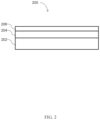
- FIG. 2 is a schematic diagram of a non-limiting embodiment of an article comprising a metallic substrate and a phosphonate functionalized layer on at least a region of the metallic substrate according to the present disclosure
- FIG. 3 provides images illustrating portions of Samples A-D after thermal shock exposure
- FIG. 4 A is a modified image illustrating Samples N and O after CASS testing.
- FIG. 4 B is a modified image of FIG. 4 A selectively illustrating pits formed on the Samples N and O.
- any references herein to “various embodiments,” “some embodiments,” “one embodiment,” “an embodiment,” or like phrases mean that a particular feature, structure, or characteristic described in connection with the example is included in at least one embodiment.
- appearances of the phrases “in various embodiments,” “in some embodiments,” “in one embodiment,” “in an embodiment,” or like phrases in the specification do not necessarily refer to the same embodiment.
- the particular described features, structures, or characteristics may be combined in any suitable manner in one or more embodiments.
- the particular features, structures, or characteristics illustrated or described in connection with one embodiment may be combined, in whole or in part, with the features, structures, or characteristics of one or more other embodiments without limitation. Such modifications and variations are intended to be included within the scope of the present embodiments.
- any numerical range recited herein includes all sub-ranges subsumed within the recited range.
- a range of “1 to 10” includes all sub-ranges between (and including) the recited minimum value of 1 and the recited maximum value of 10, that is, having a minimum value equal to or greater than 1 and a maximum value equal to or less than 10.
- Any maximum numerical limitation recited in this specification is intended to include all lower numerical limitations subsumed therein and any minimum numerical limitation recited in this specification is intended to include all higher numerical limitations subsumed therein. Accordingly, Applicant reserves the right to amend this specification, including the claims, to expressly recite any sub-range subsumed within the ranges expressly recited. All such ranges are inherently described in this specification.
- phosphonate refers to phosphorus compounds that comprise a phosphorous atom coordinated with three oxygen atoms. One of the three oxygen atoms can be coordinated to the phosphorous atom by a double bond.
- a phosphonate does not comprise phosphoric acid (H 3 O 4 P).
- a phosphonate can comprise the general Formula (I), wherein R 1 , R 2 , and R 3 are individually selected from hydrogen, an alkyl, or an aryl. As such, R 1 , R 2 , and R 3 can be the same or different groups.
- a metallic substrate treatment method can promote adhesion of a top coat to a metallic substrate, provide corrosion protection properties to a metallic substrate, and provide a desired aesthetic appearance of the metallic substrate.
- the present disclosure provides articles comprising a phosphonate functionalized layer. Articles including the phosphate functionalized layer thereon can exhibit adherence of a top coat to the article, comprise improved corrosion resistance, improved abrasion resistance, and/or have a desirable aesthetic appearance.
- a metallic substrate treatment method comprises contacting a metallic substrate with a fluid comprising a composition that can form a phosphonate functionalized layer on at least a region of the metallic substrate.
- Contacting the metallic substrate can comprise at least one of immersing the metallic substrate in a bath of the fluid, spraying the fluid onto the metallic substrate, and wiping the metallic substrate with the fluid.
- the bath of fluid can be agitated.
- the fluid bath can be agitated by at least one method selected from the group consisting of bubbling gas through the fluid in the bath and stirring the fluid (e.g., circulating the fluid with a pump, stirring the fluid with an impeller).
- the fluid can contact the metallic substrate for at least 1 second, such as, for example, at least 5 seconds, at least 10 seconds, at least 30 seconds, at least 1 minute, at least 5 minutes, at least 10 minutes, at least 20 minutes, or at least 30 minutes.
- the fluid can contact the metallic substrate for no greater than 40 minutes, such as, for example, no greater than 30 minutes, no greater than 20 minutes, no greater than 10 minutes, no greater than 5 minutes, no greater than 1 minute, no greater than 30 second, no greater than 10 second, or no greater than 5 seconds.
- the fluid can contact the metallic substrate for a time in a range of 1 second to 40 minutes, such as, for example, 2 seconds to 10 minutes, 5 second to 10 minutes, 5 seconds to 5 minutes, 5 seconds to 2 minutes, or 10 seconds to 30 seconds.
- the fluid can react with the metallic substrate during the contact time.
- the fluid can comprise at least one of a phosphonate containing acid and a derivative thereof.
- the phosphonate containing acid can be at least one of phosphorous acid (H 3 O 3 P), phenyl phosphonic acid (C 6 H 7 O 3 P), ethylphosphonic acid (C 2 H 7 O 3 P), octylphosphonic acid (C 8 H 19 O 3 P), octadecylphosphonic acid (C 18 H 39 O 3 P), vinylphosphonic acid (C 2 H 5 O 3 P), vinylphosphonic acid dimethyl ester (C 4 H 10 O 3 P), diethylenetriaminepentakis(methylphosphonic acid) (CH 5 O 3 P), octane diphosphonic acid (C 8 H 20 O 6 P 2 ), and derivatives of any of these compounds.
- a derivative of a phosphonic acid can be, for example, a deprotonated phosphonic acid (e.g., a deprotonated derivative thereof, a conjugate base) and/or an at least twice protonated phosphonic acid.
- the derivative of the phosphonic acid can comprise at least one of a deprotonated phosphorous acid (H 2 O 3 P ⁇ ), a deprotonated phenyl phosphonic acid (C 6 H 6 O 3 P ⁇ ), a deprotonated ethylphosphonic acid (C 2 H 6 O 3 P ⁇ ), a deprotonated octylphosphonic acid (C 8 H 18 O 3 P ⁇ ), a deprotonated octadecylphosphonic acid (C 18 H 38 O 3 P ⁇ ), a deprotonated vinylphosphonic acid (C 2 H 4 O 3 P ⁇ ), a deprotonated vinylphosphonic acid dimethyl ester (C 4
- the phosphonate containing acid and/or the derivative thereof can comprise a pKa (e.g., ⁇ log 10 of the acid dissociation constant, Ka) of a first acidic proton.
- the pKa of the first acidic proton corresponds to a pH at which substantially equal concentrations of phosphonate containing acid and its corresponding conjugate base (e.g., deprotonated phosphonate containing acid) are present in solution.
- Raising the pH of a solution comprising the phosphonate containing acid and/or derivative thereof above the pKa of the first acidic proton can increase the concentration of the conjugate base and decrease the concentration of the phosphonate containing acid.
- Lowering the pH of the solution comprising the phosphonate containing acid and/or derivative thereof below the pKa of the first acidic proton can decrease the concentration of the conjugate base and increase the concentration of the phosphonate containing acid.
- the conjugate base can comprise a negative charge ( ⁇ 1).
- the phosphonate containing acid can comprise a neutral charge.
- the phosphonate containing acid and/or the derivative thereof can comprise at least two pKas, such as, for example, a pKa of a first acidic proton and a pKa of a second acidic proton.
- the pKa of the second acidic proton corresponds to a pH at which substantially equal concentrations of the conjugate base and a corresponding secondary conjugate base (e.g., twice deprotonated conjugate base) are present in solution.
- the secondary conjugate base can comprise a negative two charge ( ⁇ 2).
- the phosphonate containing acid and/or the derivative thereof can comprise at least three pKas.
- the pKa of the first acidic proton can be 1.3 and the pKa of the second acidic proton can be 6.7. In various embodiments wherein the phosphonate containing acid and/or derivative thereof comprises ethylphosphonic acid, the pKa of the first acidic proton can be 2.4 and the pKa of the second acidic proton can be 8.1. In various embodiments wherein the phosphonate containing acid and/or derivative thereof comprises phenyl phosphonic acid, the pKa of the first acidic proton can be 1.8 and the pKa of the second acidic proton can be 7.1. In various embodiments wherein the phosphonate containing acid and/or derivative thereof comprises vinylphosphonic acid, the pKa of the first acidic proton can be 2.6 and the pKa of the second acidic proton can be 7.3.
- the pH of the fluid used in the present method can be selected based on a desired reactivity of the phosphonate containing acid and/or derivative thereof.
- the pH of the fluid can be selected in order to reduce the solubility of the metallic substrate in the fluid and thereby extend the operational life of the fluid.
- the fluid can comprise a pH at least 0.5 pH value greater than the pKa of the first acidic proton, such as, for example, at least 1 pH value greater, at least 2 pH values greater, at least 3 pH values greater, at least 4 pH values greater, at least 5 pH values greater, at least 6 pH values greater, or at least 8 pH values greater than the pKa of the first acidic proton.
- the fluid can comprise a pH no greater than 10 pH values greater than the pKa of the first acidic proton, such as, for example, no greater than 8 pH values greater, no greater than 6 pH values greater, no greater than 5 pH values greater, no greater than 4 pH values greater, no greater than 3 pH values greater, no greater than 2 pH values greater, no greater than 1 pH value greater, or no greater than 0.5 pH values greater than the pKa of the first acidic proton.
- a pH no greater than 10 pH values greater than the pKa of the first acidic proton such as, for example, no greater than 8 pH values greater, no greater than 6 pH values greater, no greater than 5 pH values greater, no greater than 4 pH values greater, no greater than 3 pH values greater, no greater than 2 pH values greater, no greater than 1 pH value greater, or no greater than 0.5 pH values greater than the pKa of the first acidic proton.
- the fluid can comprise a pH in a range of the pKa of the first acidic proton to 10 pH values greater than the pKa of the first acidic proton, such as, for example, at least 0.5 pH values greater than the pKa of the first acidic proton to 8 pH values greater than the pKa of the first acidic proton or at least 4 pH values greater than the pKa of the first acidic proton to 6 pH values greater than the first acidic proton.
- the fluid can comprise a pH in a range of the pKa of the first acidic proton to the pKa of the second acidic proton.
- the fluid comprises a pH wherein the phosphonate containing acid is substantially dissociated into the conjugate base.
- the fluid can comprise a pH greater than 1, such as, for example, greater than 1.5, greater than 2, greater than 2.5, greater than 3, greater than 4, greater than 5, greater than 5.5, greater than 6, greater than 6.5, greater than 7, greater than 8, greater than 8.5, greater than 9, or greater than 10.
- the fluid can comprise a pH of no greater than 12, such as, no greater than 11, no greater than 10, no greater than 9, no greater than 8.5, no greater than 8, no greater than 7, no greater than 6.5, no greater than 6, no greater than 5.5, no greater than 5, no greater than 4, no greater than 3, no greater than 2.5, or no greater than 2.
- the fluid can comprise a pH in a range of 1 to 12, such as, for example, 1.5 to 10, 1.5 to 9, 2.5 to 8, 4 to 10, 6 to 10, 4 to 8, 6 to 8, 5.5 to 8.5, or 6.5 to 8.5.
- the fluid used in the present method can be an aqueous liquid solution.
- the fluid can comprise a phosphonate containing acid and/or derivative thereof with a balance of water and, optionally, buffers, stabilizers, surfactants, and/or other additives.
- the fluid can comprise at least 0.1 weight percent of the phosphonate containing acid and/or the derivative thereof, based on the total weight of the fluid, such as, for example, at least 0.5 weight percent, at least 1 weight percent, at least 2 weight percent, at least 5 weight percent, at least 10 weight percent, or at least 15 weight percent of the phosphonate containing acid and/or the derivative thereof based on the total weight of the fluid.
- the fluid comprises no greater than 20 weight percent of the phosphonate containing acid and/or the derivative thereof based on the total weight of the fluid, such as, for example, no greater than 15 weight percent, no greater than 10 weight percent, no greater than 5 weight percent, no greater than 2 weight percent, no greater than 1 weight percent, or no greater than 0.5 weight percent of the phosphonate containing acid and/or derivative thereof based on the total weight of the fluid.
- the fluid comprises 0.1 weight percent to 20 weight percent of the phosphonate containing acid and/or derivative thereof based on the total weight of the fluid, such as, for example, 0.2 weight percent to 10 weight percent, 0.5 weight percent to 10 weight percent, 0.2 weight percent to 5 weight percent, or 0.5 weight percent to 2 weight percent of the phosphonate containing acid and/or derivative thereof based on the total weight of the fluid.
- a phosphonate functionalized layer on the metallic substrate.
- oxide e.g., aluminum oxide when the substrate includes aluminum or an aluminum alloy
- the phosphonate functionalized layer can comprise a phosphonate group bonded to the metallic substrate.
- the phosphonate group is bonded to the metallic substrate through a P—O—Al bond.
- the phosphonate group can be bonded to an oxide group on the metallic substrate or directly to a metal atom.
- the phosphonate functionalized layer can improve corrosion performance of the metallic substrate and can improve adherence of a coating to the metallic substrate.
- the phosphonate functionalized layer does not affect, or only minimally affects, the aesthetics of the metallic substrate.
- the International Commission on Illumination L*a*b* (CIELAB) color space lightness difference ( ⁇ L*) between the metallic substrate without the phosphonate functionalized layer (e.g., prior to contact with fluid) and the metallic substrate including the phosphonate functionalized layer thereon (e.g., after contact with the fluid) can be minimized.
- a CIELAB lightness difference ( ⁇ L*) between the metallic substrate comprising the phosphonate functionalized layer and the metallic substrate without the phosphonate functionalized layer is no greater than 10, such as, for example, no greater than 8, no greater than 5, no greater than 3, no greater than 2, no greater than 1, or no greater than 0.5, as measured with a BYK-Gardner Spectro Guide 45/0 Spectrophotometer.
- a CIELAB lightness difference ( ⁇ L*) between the metallic substrate comprising the phosphonate functionalized layer and the metallic substrate without the phosphonate functionalized layer is greater than 0.1, greater than 0.5, or greater than 1, as measured with a BYK-Gardner Spectro Guide 45/0 Spectrophotometer. In some embodiments, a CIELAB lightness difference ( ⁇ L*) between the metallic substrate comprising the phosphonate functionalized layer and the metallic substrate without the phosphonate functionalized layer is 0.
- a CIELAB lightness difference ( ⁇ L*) between the metallic substrate comprising the phosphonate functionalized layer and the metallic substrate without the phosphonate functionalized layer is in a range of 0 to 10, such as, for example, 0 to 5, 0 to 3, 0 to 2, 0 to 1, or 0.1 to 2, as measured with a BYK-Gardner Spectro Guide 45/0 Spectrophotometer.
- the metallic substrate treatment method according to the present disclosure can be incorporated into a metallic substrate coating process as shown schematically in, for example, FIG. 1 .
- the metallic substrate coating process can comprise cleaning the metallic substrate, 102 .
- the metallic substrate can be cleaned by at least one of an alkaline cleaning, acid cleaning, and a carbon dioxide based cleaning technique.
- the metallic substrate can be rinsed to remove residual chemicals used during the cleaning 104 .
- the rinse can comprise, for example, spraying the metallic substrate with a solution comprising water.
- the metallic substrate prior to cleaning the metallic substrate, can be polished.
- the metallic substrate can be subjected to the metallic substrate treatment method according to the present disclosure.
- the metallic substrate can be contacted with a fluid having a composition that can form a phosphonate functionalized layer on at least a region of the metallic substrate, 106 .
- the cleaning step 104 can occur prior to the contacting step 106 .
- the metallic substrate can be rinsed to remove residual fluid 108 .
- the rinse can comprise, for example, spraying the metallic substrate with water or a solution comprising water.
- the metallic substrate can be dried.
- a coating composition can be deposited over the phosphonate functionalized layer on the metallic substrate, 110 .
- the coating composition can be deposited by, for example, at least one of spray coating, spin coating, dip coating, roll coating, flow coating, and film coating.
- the coating composition can be deposited in contact with the phosphonate functionalized layer.
- the terms “on,” “onto,” “over,” and variants thereof mean applied, formed, deposited, provided, or otherwise located over a surface of a substrate but not necessarily in contact with the surface of the substrate.
- a coating layer “applied over” a substrate does not preclude the presence of one or more other coating layers of the same or different composition disposed between the applied coating layer and the substrate.
- a second coating layer “applied over” a first coating layer does not preclude the presence of one or more other coating layers of the same or different composition located between the applied second coating layer and the applied first coating layer.
- the coating composition can be cured to form the coating, 112 , on the metallic substrate.
- curable and curing refer to a chemical crosslinking of components in a curable composition and/or a chain extension of the curable composition. Accordingly, the terms “cure” and “curing” do not encompass solely physical drying of curable compositions through solvent or carrier evaporation.
- the term “cured,” as used in this specification, refers to the condition of a curable composition in which a component of the curable composition has chemically reacted to form a new covalent bond.
- curing the coating composition can comprise at least one of ambient curing, air flow, ultra violet radiation, electron beam radiation, gamma radiation, heat, and oxygen.
- curing the coating composition can comprise a flash off of solvents in the coating composition.
- the coating comprises at least one of a siloxane, a silazane, a fluoropolymer, an acrylic, an epoxy, a polyester, and a polyurethane.
- the coating can be substantially clear, or the coating can be opaque.
- the term “substantially clear” refers to a coating that produces no or minimal scattering or diffuse reflection of visible electromagnetic radiation.
- the coating can be colorless.
- the coating may include a colorant, such as, for example, a pigment or a dye.
- the coating may protect the article from, for example, abrasion and/or corrosion.
- FIG. 2 illustrates an article 200 comprising a metallic substrate 202 and a phosphonate functionalized layer 204 on at least a region of the metallic substrate 202 .
- the phosphonate functionalized layer 204 can be in contact with and bound to the metallic substrate 202 .
- a coating 206 can be deposited over at least a region of the phosphonate functionalized layer 204 .
- the phosphonate functionalized layer 204 can be bound to the coating 206 and can be in contact with the coating 206 .
- the phosphonate functionalized layer 204 can promote adhesion between the coating 206 and the metallic substrate 202 .
- the metallic substrate and the article comprising the substrate can comprise at least one of aluminum and an aluminum alloy.
- the aluminum alloy can comprise at least one of a 1000 series aluminum alloy, a 2000 series aluminum alloy, a 3000 series aluminum alloy, a 4000 series aluminum alloy, a 5000 series aluminum alloy, a 6000 series aluminum alloy, and a 7000 series aluminum alloy.
- the aluminum alloy can comprise 6061 aluminum alloy and/or 6361 aluminum alloy.
- the aluminum alloy can comprise a 5000 series aluminum alloy with added zinc.
- the aluminum alloy can comprise A356 and/or A357.
- An article including the metallic substrate comprising a phosphonate functionalized layer may be an article used in a variety of product applications such as, for example, commercial end-uses in industrial applications, in consumer applications (e.g., consumer electronics and/or appliances), or in other areas.
- the article including a metallic substrate comprising a phosphonate functionalized layer can be utilized in at least one of the aerospace field (e.g., an aerospace component), the automotive field (e.g., an automotive component), the transportation field (e.g., a transportation component), or the building and construction field (e.g., a building component or construction component).
- the article including the metallic substrate comprising a phosphonate functionalized layer can be configured as at least one of an aerospace component, an automotive component, a transportation component, and a building and construction component.
- an article including the metallic substrate comprising a phosphonate functionalized layer can be utilized in an elevated temperature application, such as in an aerospace or automotive vehicle.
- an article including a metallic substrate comprising a phosphonate functionalized layer can be utilized as an engine component in an aerospace vehicle (e.g., in the form of a blade, such as a compressor blade incorporated into the engine).
- an article including the metallic substrate comprising a phosphonate functionalized layer can be used as a heat exchanger component in the engine of an aerospace vehicle. The aerospace vehicle including the engine component/heat exchanger may subsequently be operated.
- an article including a metallic substrate comprising a phosphonate functionalized layer can be an automotive engine component.
- an automotive vehicle including such an automotive component may subsequently be operated.
- an article including a metallic substrate comprising a phosphonate functionalized layer may be used as a turbocharger component (e.g., a compressor wheel of a turbocharger, where elevated temperatures may be produced by recycling engine exhaust passing back through the turbocharger), and the automotive vehicle including the turbocharger component may be operated.
- a turbocharger component e.g., a compressor wheel of a turbocharger, where elevated temperatures may be produced by recycling engine exhaust passing back through the turbocharger
- an article including a metallic substrate comprising a phosphonate functionalized layer may be used as a blade in a land-based (stationary) turbine for electrical power generation, and the land-based turbine included the metallic part may be operated to generate electrical power.
- an article including a metallic substrate comprising a phosphonate functionalized layer can be utilized in defense applications, such as in body armor or in armored vehicles (e.g., armor plating).
- an article comprising a metallic substrate comprising a phosphonate functionalized layer can be utilized in consumer electronic applications, such as, for example, in laptop computer cases, battery cases, cell phones, cameras, mobile music players, handheld devices, computers, televisions, microwaves, cookware, washers/dryers, refrigerators, or sporting goods.
- an article including a metallic substrate comprising a phosphonate functionalized layer can be utilized in a structural application, such as, for example, an aerospace structural application or an automotive structural application.
- a structural application such as, for example, an aerospace structural application or an automotive structural application.
- an article including a metallic substrate comprising a phosphonate functionalized layer may be formed into various aerospace structural components, including, for example, floor beams, seat rails, fuselage framing, bulkheads, spars, ribs, longerons, and brackets.
- an article including a metallic substrate comprising a phosphonate functionalized layer can be utilized in an automotive structural application.
- an article including a metallic substrate comprising a phosphonate functionalized layer can be formed into various automotive structural components including, for example, nodes of space frames, shock towers, and sub frames.
- an article including a metallic substrate comprising a phosphonate functionalized layer can be a body-in-white automotive product.
- an article including a metallic substrate comprising a phosphonate functionalized layer can be utilized in an industrial engineering application.
- an article including a metallic substrate comprising a phosphonate functionalized layer may be formed into various industrial engineering products, such as, for example, tread-plate, tool boxes, bolting decks, bridge decks, and ramps.
- the metallic substrate can be a vehicle wheel or may be a portion of a vehicle wheel.
- the vehicle wheel can be at least one of, for example, a bonded wheel, a welded wheel, a formed wheel (e.g., vacuum formed), a cured wheel, a cast wheel, a forged wheel, and an additively manufactured wheel.
- the vehicle wheel may have been subjected to further processing to provide the final vehicle wheel such as machining or polishing.
- Samples A-S comprising a metallic substrate of 6000 series aluminum alloy were prepared and polished. Samples A-S were contacted with phosphorous acid solution (e.g., fluid comprising a phosphonate containing acid and/or a derivative thereof) to produce a phosphonate functionalized layer thereon.
- phosphorous acid solution e.g., fluid comprising a phosphonate containing acid and/or a derivative thereof
- the phosphorous acid solution comprised a range of 0.5 weight percent to 2 weight percent of phosphorous acid (available as a 98%, extra pure, powder from Thermo Fisher Scientific, Waltham, Massachusetts) with a balance of water.
- Samples A and B were exposed to a 0.6 weight percent phosphorous acid solution at pH 1.5 for 1 and 3 minutes respectively.
- Samples C and D were exposed to a 0.6 wt % solution at pH 6.5 for 1 and 3 minutes respectively.
- Samples A-D were coated with a siloxane coating and tested for adhesion performance. Adhesion performance was tested by scribing the coating with an “X” shape through to the metallic substrate with a blade to expose the underlying metallic substrate. Adhesion of the coating to the metallic substrate was assessed by thermal shock according to GM 9525P such that the samples underwent a single water soak/freeze/thaw (steam exposure) cycle.
- a portion of each Sample A-D including the “X” shaped scribe is shown in FIG.
- Sample A showed a large loss of adhesion as evidenced by the lost coating around the center of the “X” shaped scribe on Sample A and Sample B showed a loss of adhesion as evidenced by a chip in the coating proximal to the upper right section of the “X” shaped scribe on Sample B.
- No loss of adhesion was observed for Sample C and Sample D.
- Samples C and D had improved coating adhesion compared to Examples A and B. It is believed that other metallic substrate pretreatment methods according to the present disclosure can also achieve an improvement in adhesion performance.
- Samples E-M were contacted with a 0.5 weight percent phosphorous acid solution comprised or a 2 weight percent phosphorous acid solution. Thereafter, Samples E-M were coated with a siloxane coating. The corrosion resistance of the Samples E-M was tested for filiform track formation. The filiform track formation testing was conducted by scribing a line 1.5 inches in length through the coating with a blade to expose the underlying metallic substrate. The Samples E-M were then exposed to Copper-Accelerated Acetic Acid-Salt Spray (Fog) testing (CASS Test) according to ASTM B368-09 (2014).
- Fog Copper-Accelerated Acetic Acid-Salt Spray
- the longest filiform track-length (e.g., filament-like corrosion originating from the scribe) of each of Samples E-M was measured under a microscope with a ruler.
- the corrosion performance of each Sample E-M was replicated two more times for a total of 3 measurements for each Sample E-M.
- the mean average of the longest filiform track-length of the 3 measurements for each of Samples E-M and are shown in Table 1.
- Sample G exhibited improved filiform corrosion performance compared to Sample E (25% less mean average filiform track-length).
- Sample H exhibited improved filiform corrosion performance compared to Sample F (38% less mean average filiform track-length).
- Sample I exhibited improved filiform corrosion performance compared to Sample E (51% less mean average filiform track-length).
- Sample L exhibited improved filiform corrosion performance compared to Sample J (21% less mean average filiform track-length).
- Sample M exhibited improved filiform corrosion performance compared to Sample K (25% less mean average filiform track-length). It is believed that other metallic substrate pretreatment methods according to the present disclosure can also achieve an improvement in filiform corrosion performance.
- Samples N and O were substantially equal in size. Samples N and O were prepared in duplicate. Sample N was contacted with a 0.6 weight percent phosphorous acid solution comprising a pH of 1.5, and Sample O was contacted with a 0.6 weight percent phosphorous acid solution comprising a pH of 6.5. After coating Samples N and O with a siloxane coating, the Samples N and O were subjected to a CASS Test according to ASTM B368-09 (2014).
- Sample O had an average of 19 pits, which is an improvement of 70% (based on number of pits) compared to Sample N.
- Sample O had an average total pit surface area of 35.5 mm 2 , which is an improvement of 83% compared to Sample N. It is believed that other metallic substrate pretreatment methods according to the present disclosure can also achieve an improvement in field corrosion.
- Samples P-Q were contacted with a 0.6 weight percent phosphorous acid solution.
- Samples P and R were contacted with a solution comprising a pH of 1.5 while Samples Q and S were contacted with a phosphorous acid solution comprising a pH of 6.5.
- Samples P and Q were contacted with their respective phosphorous acid solution for 1 minute, and Samples R and S were contacted with their respective phosphorous acid solution for 3 minutes.
- the L* value each of the Samples P-S was measured (L* 3 ) with a BYK-Gardner Spectro Guide 45/0 Spectrophotometer after contacting the Samples P-S with the phosphorous acid solutions.
- the L* value of each Sample P-S was measured with a BYK-Gardner Spectro Guide 45/0 Spectrophotometer (L* 4 ).
- , as well as a value ⁇ L*′′
- the ⁇ L*′ value measured for Sample Q improved upon the ⁇ L*′ value for Sample P. Specifically, the ⁇ L*′ value for Sample Q is 99% less than that for Sample P.
- the ⁇ L*′ value measured for Sample S improved upon the ⁇ L*′ value for Sample R. Specifically, the ⁇ L*′ value for Sample S is 99% less than that for Sample R. It is believed that other metallic substrate pretreatment methods according to the present disclosure can also achieve an improvement in ⁇ L*′ and/or ⁇ L*′′.
Landscapes
- Chemical & Material Sciences (AREA)
- Engineering & Computer Science (AREA)
- Materials Engineering (AREA)
- Mechanical Engineering (AREA)
- Metallurgy (AREA)
- Organic Chemistry (AREA)
- Chemical Kinetics & Catalysis (AREA)
- General Chemical & Material Sciences (AREA)
- Life Sciences & Earth Sciences (AREA)
- Wood Science & Technology (AREA)
- Other Surface Treatments For Metallic Materials (AREA)
- Chemical Treatment Of Metals (AREA)
- ing And Chemical Polishing (AREA)
- Application Of Or Painting With Fluid Materials (AREA)
- Paints Or Removers (AREA)
- Laminated Bodies (AREA)
Priority Applications (1)
| Application Number | Priority Date | Filing Date | Title |
|---|---|---|---|
| US17/433,312 US12018380B2 (en) | 2019-03-01 | 2019-12-18 | Metallic substrate treatment methods and articles comprising a phosphonate functionalized layer |
Applications Claiming Priority (3)
| Application Number | Priority Date | Filing Date | Title |
|---|---|---|---|
| US201962812334P | 2019-03-01 | 2019-03-01 | |
| US17/433,312 US12018380B2 (en) | 2019-03-01 | 2019-12-18 | Metallic substrate treatment methods and articles comprising a phosphonate functionalized layer |
| PCT/US2019/067014 WO2020180386A1 (en) | 2019-03-01 | 2019-12-18 | Metallic substrate treatment methods and articles comprising a phosphonate functionalized layer |
Related Parent Applications (1)
| Application Number | Title | Priority Date | Filing Date |
|---|---|---|---|
| PCT/US2019/067014 A-371-Of-International WO2020180386A1 (en) | 2019-03-01 | 2019-12-18 | Metallic substrate treatment methods and articles comprising a phosphonate functionalized layer |
Related Child Applications (1)
| Application Number | Title | Priority Date | Filing Date |
|---|---|---|---|
| US18/478,059 Division US20240026545A1 (en) | 2019-03-01 | 2023-09-29 | Metallic substrate treatment methods and articles comprising a phosphonate functionalized layer |
Publications (2)
| Publication Number | Publication Date |
|---|---|
| US20220145471A1 US20220145471A1 (en) | 2022-05-12 |
| US12018380B2 true US12018380B2 (en) | 2024-06-25 |
Family
ID=72337261
Family Applications (2)
| Application Number | Title | Priority Date | Filing Date |
|---|---|---|---|
| US17/433,312 Active 2040-10-01 US12018380B2 (en) | 2019-03-01 | 2019-12-18 | Metallic substrate treatment methods and articles comprising a phosphonate functionalized layer |
| US18/478,059 Pending US20240026545A1 (en) | 2019-03-01 | 2023-09-29 | Metallic substrate treatment methods and articles comprising a phosphonate functionalized layer |
Family Applications After (1)
| Application Number | Title | Priority Date | Filing Date |
|---|---|---|---|
| US18/478,059 Pending US20240026545A1 (en) | 2019-03-01 | 2023-09-29 | Metallic substrate treatment methods and articles comprising a phosphonate functionalized layer |
Country Status (10)
| Country | Link |
|---|---|
| US (2) | US12018380B2 (de) |
| EP (4) | EP3931370B1 (de) |
| JP (3) | JP2022521951A (de) |
| CN (1) | CN113490766A (de) |
| AU (1) | AU2019432938B2 (de) |
| CA (1) | CA3129947C (de) |
| ES (1) | ES2983557T3 (de) |
| HU (3) | HUE073177T2 (de) |
| MX (4) | MX2021009972A (de) |
| WO (1) | WO2020180386A1 (de) |
Families Citing this family (2)
| Publication number | Priority date | Publication date | Assignee | Title |
|---|---|---|---|---|
| HUE073177T2 (hu) * | 2019-03-01 | 2026-01-28 | Howmet Aerospace Inc | Fém hordozó kezelési eljárások éa foszfonát-funkcionált réteget tartalmazó termékek |
| FR3168779A1 (fr) | 2024-11-22 | 2026-05-29 | Constellium Issoire | Plancher industriel comprenant une tole metallique a reliefs |
Citations (23)
| Publication number | Priority date | Publication date | Assignee | Title |
|---|---|---|---|---|
| US3630790A (en) | 1969-05-13 | 1971-12-28 | Dow Chemical Co | Method of protection of metal surfaces from corrosion |
| EP0122129B1 (de) | 1983-04-08 | 1989-08-09 | Albright & Wilson Limited | Verfahren zum Verdichten von anodisiertem Aluminium |
| US5103550A (en) | 1989-12-26 | 1992-04-14 | Aluminum Company Of America | Method of making a food or beverage container |
| US5354494A (en) * | 1992-01-21 | 1994-10-11 | Betz Laboratories, Inc. | Reactive silane composition and process for enhanced drainage of residual aqueous rinse on the external surfaces of plastic parts |
| US5728233A (en) | 1995-11-20 | 1998-03-17 | Nippon Paint Co., Ltd. | Surface treatment composition, surface treatment solution and surface treatment method for aluminum and its alloys |
| DE19654642A1 (de) | 1996-12-28 | 1998-09-17 | Metallgesellschaft Ag | Wässrige Lösung zur Behandlung metallischer Oberflächen und Verfahren zu ihrer Verwendung |
| US20030082391A1 (en) | 2001-06-05 | 2003-05-01 | Henkel Corporation | Multilayer coatings for metal substrates |
| US20060131544A1 (en) | 2004-12-21 | 2006-06-22 | Hercules Chemical Company Incorporated | Corrosion inhibiting heat transfer materials |
| US20060151070A1 (en) | 2005-01-12 | 2006-07-13 | General Electric Company | Rinsable metal pretreatment methods and compositions |
| US20080108537A1 (en) | 2006-11-03 | 2008-05-08 | Rees Wayne M | Corrosion inhibitor system for mildly acidic to ph neutral halogen bleach-containing cleaning compositions |
| US20080127859A1 (en) | 2004-11-10 | 2008-06-05 | Thomas Kolberg | Method for Coating Metallic Surfaces with an Aqueous Multi-Component Composition |
| US20080164151A1 (en) * | 2006-12-28 | 2008-07-10 | National University Corporation Tohoku University | Metal member having a metal oxide film and method of manufacturing the same |
| JP2008231418A (ja) | 2007-02-22 | 2008-10-02 | Kansai Paint Co Ltd | チタン・ジルコニウム膜形成用塗布剤、チタン・ジルコニウム膜形成方法及びチタン・ジルコニウム膜で被覆された金属基材 |
| US20090053552A1 (en) | 2007-08-25 | 2009-02-26 | Berend-Jan De Gans | Corrosion inhibitor |
| EP2246124A1 (de) | 2008-01-24 | 2010-11-03 | Nippon Light Metal Company, Ltd. | Beschichtetes metallmaterial |
| US20130296195A1 (en) * | 2009-07-14 | 2013-11-07 | Pacific Biosciences Of California, Inc. | Selectively Functionalized Arrays |
| JP2015134957A (ja) | 2013-12-18 | 2015-07-27 | 日本パーカライジング株式会社 | 水系金属表面処理剤、金属表面処理皮膜及び金属表面処理皮膜付き金属材料 |
| JP2016098397A (ja) | 2014-11-20 | 2016-05-30 | 株式会社神戸製鋼所 | 表面処理アルミニウム合金板およびその製造方法 |
| WO2016129640A1 (ja) | 2015-02-12 | 2016-08-18 | 日本ペイント・サーフケミカルズ株式会社 | 金属表面処理剤 |
| WO2017188108A1 (ja) | 2016-04-27 | 2017-11-02 | 三洋化成工業株式会社 | エッチング液及び電子基板の製造方法 |
| US10106689B2 (en) | 2013-08-06 | 2018-10-23 | Henkel Ag & Co. Kgaa | Metal pretreatment compositions comprising silanes and organophosporus acids |
| WO2019036062A1 (en) | 2016-08-12 | 2019-02-21 | Ppg Industries Ohio, Inc. | TWO STEP PRETREATMENT SYSTEM AND METHOD |
| US20190136385A1 (en) | 2016-02-10 | 2019-05-09 | Nippon Paint Surf Chemicals Co., Ltd. | Chemical conversion bath replenishment method |
Family Cites Families (19)
| Publication number | Priority date | Publication date | Assignee | Title |
|---|---|---|---|---|
| US4308079A (en) * | 1980-06-16 | 1981-12-29 | Martin Marietta Corporation | Durability of adhesively bonded aluminum structures and method for inhibiting the conversion of aluminum oxide to aluminum hydroxide |
| US5059258A (en) * | 1989-08-23 | 1991-10-22 | Aluminum Company Of America | Phosphonic/phosphinic acid bonded to aluminum hydroxide layer |
| US5126210A (en) * | 1989-08-23 | 1992-06-30 | Aluminum Company Of America | Anodic phosphonic/phosphinic acid duplex coating on valve metal surface |
| US5132181A (en) * | 1989-08-23 | 1992-07-21 | Aluminum Company Of America | Phosphonic/phosphinic acid bonded to aluminum hydroxide layer |
| US5306526A (en) * | 1992-04-02 | 1994-04-26 | Ppg Industries, Inc. | Method of treating nonferrous metal surfaces by means of an acid activating agent and an organophosphate or organophosphonate and substrates treated by such method |
| US5463804A (en) * | 1994-08-31 | 1995-11-07 | Aluminum Company Of America | Coating aluminum alloy sheet to promote adhesive bonding for vehicle assemblies |
| US6299983B1 (en) * | 1997-06-27 | 2001-10-09 | E. I. Du Pont De Nemours And Company | Derivatized metallic surfaces, composites of functionalized polymers with such metallic surfaces and processes for formation thereof |
| US6167609B1 (en) * | 1997-12-26 | 2001-01-02 | Aluminum Company Of America | Acid pretreatment for adhesive bonding of vehicle assemblies |
| DE10010758A1 (de) * | 2000-03-04 | 2001-09-06 | Henkel Kgaa | Korrosionsschutzverfahren für Metalloberflächen |
| WO2002066702A1 (en) * | 2001-02-16 | 2002-08-29 | Henkel Kommanditgesellschaft Auf Atkien | Process for treating multi-metal articles |
| US7578921B2 (en) * | 2001-10-02 | 2009-08-25 | Henkel Kgaa | Process for anodically coating aluminum and/or titanium with ceramic oxides |
| US9365931B2 (en) * | 2006-12-01 | 2016-06-14 | Kobe Steel, Ltd. | Aluminum alloy with high seawater corrosion resistance and plate-fin heat exchanger |
| JP6586266B2 (ja) * | 2014-01-31 | 2019-10-02 | 貴和化学薬品株式会社 | 金属表面処理剤 |
| JP6289222B2 (ja) * | 2014-04-04 | 2018-03-07 | Bbsジャパン株式会社 | 耐食性マグネシウム合金鍛造ホイール及びその製造方法 |
| SG11201609525VA (en) * | 2014-05-14 | 2016-12-29 | Chemetall Gmbh | Method for coating metal surfaces of substrates and objects coated in accordance with said method |
| MX2019010021A (es) * | 2017-03-06 | 2019-10-15 | Arconic Inc | Metodos para preparar aleaciones de aluminio 7xxx para uniones adhesivas, y productos relacionados a estas. |
| US20220017779A1 (en) * | 2018-12-18 | 2022-01-20 | 3M Innovative Properties Company | Composition including polysiloxane phosphate or phosphonate and method of making a treated article |
| HUE073177T2 (hu) * | 2019-03-01 | 2026-01-28 | Howmet Aerospace Inc | Fém hordozó kezelési eljárások éa foszfonát-funkcionált réteget tartalmazó termékek |
| JP2023547737A (ja) * | 2020-11-10 | 2023-11-13 | ケメタル ゲゼルシャフト ミット ベシュレンクテル ハフツング | 酸性水性組成物含有コポリマーによる金属表面の処理 |
-
2019
- 2019-12-18 HU HUE23210575A patent/HUE073177T2/hu unknown
- 2019-12-18 CA CA3129947A patent/CA3129947C/en active Active
- 2019-12-18 CN CN201980093129.2A patent/CN113490766A/zh active Pending
- 2019-12-18 HU HUE23210574A patent/HUE073282T2/hu unknown
- 2019-12-18 US US17/433,312 patent/US12018380B2/en active Active
- 2019-12-18 ES ES19918458T patent/ES2983557T3/es active Active
- 2019-12-18 AU AU2019432938A patent/AU2019432938B2/en active Active
- 2019-12-18 EP EP19918458.1A patent/EP3931370B1/de active Active
- 2019-12-18 HU HUE19918458A patent/HUE067836T2/hu unknown
- 2019-12-18 MX MX2021009972A patent/MX2021009972A/es unknown
- 2019-12-18 EP EP24159109.8A patent/EP4394081A1/de active Pending
- 2019-12-18 EP EP23210575.9A patent/EP4299793B1/de active Active
- 2019-12-18 WO PCT/US2019/067014 patent/WO2020180386A1/en not_active Ceased
- 2019-12-18 JP JP2021549599A patent/JP2022521951A/ja active Pending
- 2019-12-18 EP EP23210574.2A patent/EP4299792B1/de active Active
-
2021
- 2021-08-18 MX MX2026002715A patent/MX2026002715A/es unknown
- 2021-08-18 MX MX2026002714A patent/MX2026002714A/es unknown
- 2021-08-18 MX MX2026002713A patent/MX2026002713A/es unknown
-
2023
- 2023-05-26 JP JP2023086660A patent/JP2023116529A/ja active Pending
- 2023-09-29 US US18/478,059 patent/US20240026545A1/en active Pending
-
2025
- 2025-05-02 JP JP2025076563A patent/JP2025131574A/ja active Pending
Patent Citations (24)
| Publication number | Priority date | Publication date | Assignee | Title |
|---|---|---|---|---|
| US3630790A (en) | 1969-05-13 | 1971-12-28 | Dow Chemical Co | Method of protection of metal surfaces from corrosion |
| EP0122129B1 (de) | 1983-04-08 | 1989-08-09 | Albright & Wilson Limited | Verfahren zum Verdichten von anodisiertem Aluminium |
| US5103550A (en) | 1989-12-26 | 1992-04-14 | Aluminum Company Of America | Method of making a food or beverage container |
| US5354494A (en) * | 1992-01-21 | 1994-10-11 | Betz Laboratories, Inc. | Reactive silane composition and process for enhanced drainage of residual aqueous rinse on the external surfaces of plastic parts |
| US5728233A (en) | 1995-11-20 | 1998-03-17 | Nippon Paint Co., Ltd. | Surface treatment composition, surface treatment solution and surface treatment method for aluminum and its alloys |
| DE19654642A1 (de) | 1996-12-28 | 1998-09-17 | Metallgesellschaft Ag | Wässrige Lösung zur Behandlung metallischer Oberflächen und Verfahren zu ihrer Verwendung |
| US20030082391A1 (en) | 2001-06-05 | 2003-05-01 | Henkel Corporation | Multilayer coatings for metal substrates |
| US20080127859A1 (en) | 2004-11-10 | 2008-06-05 | Thomas Kolberg | Method for Coating Metallic Surfaces with an Aqueous Multi-Component Composition |
| US20060131544A1 (en) | 2004-12-21 | 2006-06-22 | Hercules Chemical Company Incorporated | Corrosion inhibiting heat transfer materials |
| US20060151070A1 (en) | 2005-01-12 | 2006-07-13 | General Electric Company | Rinsable metal pretreatment methods and compositions |
| US20080245444A1 (en) * | 2005-01-12 | 2008-10-09 | General Electric Company | Rinsable metal pretreatment methods and compositions |
| US20080108537A1 (en) | 2006-11-03 | 2008-05-08 | Rees Wayne M | Corrosion inhibitor system for mildly acidic to ph neutral halogen bleach-containing cleaning compositions |
| US20080164151A1 (en) * | 2006-12-28 | 2008-07-10 | National University Corporation Tohoku University | Metal member having a metal oxide film and method of manufacturing the same |
| JP2008231418A (ja) | 2007-02-22 | 2008-10-02 | Kansai Paint Co Ltd | チタン・ジルコニウム膜形成用塗布剤、チタン・ジルコニウム膜形成方法及びチタン・ジルコニウム膜で被覆された金属基材 |
| US20090053552A1 (en) | 2007-08-25 | 2009-02-26 | Berend-Jan De Gans | Corrosion inhibitor |
| EP2246124A1 (de) | 2008-01-24 | 2010-11-03 | Nippon Light Metal Company, Ltd. | Beschichtetes metallmaterial |
| US20130296195A1 (en) * | 2009-07-14 | 2013-11-07 | Pacific Biosciences Of California, Inc. | Selectively Functionalized Arrays |
| US10106689B2 (en) | 2013-08-06 | 2018-10-23 | Henkel Ag & Co. Kgaa | Metal pretreatment compositions comprising silanes and organophosporus acids |
| JP2015134957A (ja) | 2013-12-18 | 2015-07-27 | 日本パーカライジング株式会社 | 水系金属表面処理剤、金属表面処理皮膜及び金属表面処理皮膜付き金属材料 |
| JP2016098397A (ja) | 2014-11-20 | 2016-05-30 | 株式会社神戸製鋼所 | 表面処理アルミニウム合金板およびその製造方法 |
| WO2016129640A1 (ja) | 2015-02-12 | 2016-08-18 | 日本ペイント・サーフケミカルズ株式会社 | 金属表面処理剤 |
| US20190136385A1 (en) | 2016-02-10 | 2019-05-09 | Nippon Paint Surf Chemicals Co., Ltd. | Chemical conversion bath replenishment method |
| WO2017188108A1 (ja) | 2016-04-27 | 2017-11-02 | 三洋化成工業株式会社 | エッチング液及び電子基板の製造方法 |
| WO2019036062A1 (en) | 2016-08-12 | 2019-02-21 | Ppg Industries Ohio, Inc. | TWO STEP PRETREATMENT SYSTEM AND METHOD |
Non-Patent Citations (5)
| Title |
|---|
| ChemBK, "Phenylphosphonic acid", https://www.chembk.com/en/chem/Phenylphosphonic%20acid, accessed Oct. 4, 2023 (Year: 2023). * |
| Freedman, et al., "The Preparation and Properties of Phosphonic Acids", Chemical Reviews, vol. 57, Issue 3, pp. 479-523, [retrieved from the internet on Jun. 6, 2022], URL: https://pubs.acs.org/doi/10.1021/cr50015a003, Published Jun. 1, 1957. |
| International Search Report and Written Opinion of the International Searching Authority for International Application No. PCT/US2019/067014 mailed Apr. 21, 2020. |
| Jaffe, et al., "The Acid Dissociation Constants of Aromatic Phosphonic Acids", I. Meta and Para Substituted Compounds, Journal of the American Chemical Society, vol. 75, Issue 9, pp. 2209-2211, [retrieved from the Internet on Jun. 6, 2022], URL: https://pubs.acs.org/doi/10.1021/ja01105a054, Published May 1, 1953. |
| Phosphorous Acid—Wikipedia. [retrieved from the internet on Jun. 6, 2022], URL: https://en.wikipedia.org/w/index.php?title=Phosphorous_acid&oldid=863613432, Published Oct. 11, 2018. |
Also Published As
| Publication number | Publication date |
|---|---|
| MX2026002714A (es) | 2026-04-01 |
| EP3931370A4 (de) | 2023-03-01 |
| BR112021015736A2 (pt) | 2021-10-26 |
| CA3129947C (en) | 2023-04-11 |
| EP4299792B1 (de) | 2025-10-08 |
| WO2020180386A1 (en) | 2020-09-10 |
| JP2023116529A (ja) | 2023-08-22 |
| EP4299792A3 (de) | 2024-03-20 |
| US20220145471A1 (en) | 2022-05-12 |
| MX2026002715A (es) | 2026-04-01 |
| US20240026545A1 (en) | 2024-01-25 |
| CA3129947A1 (en) | 2020-09-10 |
| EP4299792A2 (de) | 2024-01-03 |
| EP4299792C0 (de) | 2025-10-08 |
| HUE073177T2 (hu) | 2026-01-28 |
| MX2021009972A (es) | 2021-09-21 |
| MX2026002713A (es) | 2026-04-01 |
| EP3931370A1 (de) | 2022-01-05 |
| EP4299793C0 (de) | 2025-10-08 |
| AU2019432938A1 (en) | 2021-09-02 |
| ES2983557T3 (es) | 2024-10-23 |
| HUE067836T2 (hu) | 2024-11-28 |
| EP3931370C0 (de) | 2024-07-03 |
| EP3931370B1 (de) | 2024-07-03 |
| EP4394081A1 (de) | 2024-07-03 |
| CN113490766A (zh) | 2021-10-08 |
| EP4299793A3 (de) | 2024-03-20 |
| EP4299793B1 (de) | 2025-10-08 |
| HUE073282T2 (hu) | 2026-01-28 |
| JP2022521951A (ja) | 2022-04-13 |
| JP2025131574A (ja) | 2025-09-09 |
| EP4299793A2 (de) | 2024-01-03 |
| AU2019432938B2 (en) | 2023-01-05 |
Similar Documents
| Publication | Publication Date | Title |
|---|---|---|
| US20240026545A1 (en) | Metallic substrate treatment methods and articles comprising a phosphonate functionalized layer | |
| US6436475B1 (en) | Process of treating metallic surfaces | |
| CN1327031C (zh) | 涂布金属的基底的后处理 | |
| CA2754819C (en) | Method for treating and/or coating a substrate with non-chrome materials | |
| US10550478B2 (en) | Chromium-free conversion coating | |
| WO2019087475A1 (ja) | 前処理剤および化成処理剤 | |
| US4861663A (en) | Process for antistatic treatment or pretreatment of polyamides, polyimides, antistatically treated or pretreated materials, and the use thereof | |
| BR112015004364B1 (pt) | Método para tratar um substrato metálico e método para revestir um substrato metálico | |
| CN103958737A (zh) | 化学处理剂 | |
| US20130029134A1 (en) | Anticorrosion Sol-Gel Coating For Metal Substrate | |
| KR102920459B1 (ko) | 금속을 위한 보호 코팅 | |
| BR112021015736B1 (pt) | Método de tratamento de substrato metálico e artigo | |
| EP2443273A1 (de) | Verfahren zur mapping-reduktion einer elektroabscheidbaren beschichtung | |
| JP2014047353A (ja) | クロムフリー化成被覆 | |
| JP7592605B2 (ja) | 固体表面、特に金属表面にシランベースのコーティングを適用するための改善された方法 | |
| US20110177346A1 (en) | Method of imparting corrosion resistance to a substrate coated with a powder coating composition | |
| CZ20023495A3 (cs) | Zbarvená konverzní vrstva | |
| KR101516382B1 (ko) | 마그네슘 또는 마그네슘 합금의 표면처리 방법 | |
| CN107829060A (zh) | 输电线路杆塔长效防腐的方法 | |
| JPH03267379A (ja) | 撥水性に優れたアルミニウム材料及その製造方法 | |
| JPH05209141A (ja) | 耐候性塗膜及びそれを形成したアルミニウム部材 |
Legal Events
| Date | Code | Title | Description |
|---|---|---|---|
| AS | Assignment |
Owner name: HOWMET AEROSPACE INC., PENNSYLVANIA Free format text: CHANGE OF NAME;ASSIGNOR:ARCONIC INC.;REEL/FRAME:057279/0429 Effective date: 20200330 Owner name: ARCONIC INC., PENNSYLVANIA Free format text: ASSIGNMENT OF ASSIGNORS INTEREST;ASSIGNORS:SCOTT, RYAN N.;ROBARE, KEVIN M.;GIOCONDI, JENNIFER L.;AND OTHERS;SIGNING DATES FROM 20190228 TO 20190317;REEL/FRAME:057269/0642 |
|
| STPP | Information on status: patent application and granting procedure in general |
Free format text: DOCKETED NEW CASE - READY FOR EXAMINATION |
|
| STPP | Information on status: patent application and granting procedure in general |
Free format text: NON FINAL ACTION MAILED |
|
| STPP | Information on status: patent application and granting procedure in general |
Free format text: RESPONSE TO NON-FINAL OFFICE ACTION ENTERED AND FORWARDED TO EXAMINER |
|
| STPP | Information on status: patent application and granting procedure in general |
Free format text: FINAL REJECTION MAILED |
|
| STPP | Information on status: patent application and granting procedure in general |
Free format text: DOCKETED NEW CASE - READY FOR EXAMINATION |
|
| STPP | Information on status: patent application and granting procedure in general |
Free format text: NOTICE OF ALLOWANCE MAILED -- APPLICATION RECEIVED IN OFFICE OF PUBLICATIONS |
|
| STPP | Information on status: patent application and granting procedure in general |
Free format text: PUBLICATIONS -- ISSUE FEE PAYMENT VERIFIED |
|
| STCF | Information on status: patent grant |
Free format text: PATENTED CASE |