US11272711B2 - Antimicrobial and synergistic phytochemical composition, its preparation and applications - Google Patents

Antimicrobial and synergistic phytochemical composition, its preparation and applications Download PDF

Info

Publication number
US11272711B2
US11272711B2 US15/763,390 US201615763390A US11272711B2 US 11272711 B2 US11272711 B2 US 11272711B2 US 201615763390 A US201615763390 A US 201615763390A US 11272711 B2 US11272711 B2 US 11272711B2
Authority
US
United States
Prior art keywords
extract
composition
plant
composition according
ppm
Prior art date
Legal status (The legal status is an assumption and is not a legal conclusion. Google has not performed a legal analysis and makes no representation as to the accuracy of the status listed.)
Active, expires
Application number
US15/763,390
Other versions
US20180235238A1 (en
Inventor
Daisong TUO
Fukang ZHAN
Xinyuan XU
Liquan SUN
Chen Zou
Dan Zhu
Current Assignee (The listed assignees may be inaccurate. Google has not performed a legal analysis and makes no representation or warranty as to the accuracy of the list.)
Purpana Beijing Technologies Co Ltd
Original Assignee
Purpana Beijing Technologies Co Ltd
Priority date (The priority date is an assumption and is not a legal conclusion. Google has not performed a legal analysis and makes no representation as to the accuracy of the date listed.)
Filing date
Publication date
Family has litigation
First worldwide family litigation filed litigation Critical https://patents.darts-ip.com/?family=54980737&utm_source=google_patent&utm_medium=platform_link&utm_campaign=public_patent_search&patent=US11272711(B2) "Global patent litigation dataset” by Darts-ip is licensed under a Creative Commons Attribution 4.0 International License.
Application filed by Purpana Beijing Technologies Co Ltd filed Critical Purpana Beijing Technologies Co Ltd
Assigned to PURPANA (BEIJING) TECHNOLOGIES CO., LTD. reassignment PURPANA (BEIJING) TECHNOLOGIES CO., LTD. ASSIGNMENT OF ASSIGNORS INTEREST (SEE DOCUMENT FOR DETAILS). Assignors: SUN, Liquan, XU, Xinyuan, ZHAN, Fukang, ZHU, DAN, ZOU, CHEN, TUO, Daisong
Publication of US20180235238A1 publication Critical patent/US20180235238A1/en
Application granted granted Critical
Publication of US11272711B2 publication Critical patent/US11272711B2/en
Active legal-status Critical Current
Adjusted expiration legal-status Critical

Links

Classifications

    • AHUMAN NECESSITIES
    • A01AGRICULTURE; FORESTRY; ANIMAL HUSBANDRY; HUNTING; TRAPPING; FISHING
    • A01NPRESERVATION OF BODIES OF HUMANS OR ANIMALS OR PLANTS OR PARTS THEREOF; BIOCIDES, e.g. AS DISINFECTANTS, AS PESTICIDES OR AS HERBICIDES; PEST REPELLANTS OR ATTRACTANTS; PLANT GROWTH REGULATORS
    • A01N65/00Biocides, pest repellants or attractants, or plant growth regulators containing material from algae, lichens, bryophyta, multi-cellular fungi or plants, or extracts thereof
    • A01N65/08Magnoliopsida [dicotyledons]
    • A01N65/30Polygonaceae [Buckwheat family], e.g. red-knees or rhubarb
    • AHUMAN NECESSITIES
    • A01AGRICULTURE; FORESTRY; ANIMAL HUSBANDRY; HUNTING; TRAPPING; FISHING
    • A01NPRESERVATION OF BODIES OF HUMANS OR ANIMALS OR PLANTS OR PARTS THEREOF; BIOCIDES, e.g. AS DISINFECTANTS, AS PESTICIDES OR AS HERBICIDES; PEST REPELLANTS OR ATTRACTANTS; PLANT GROWTH REGULATORS
    • A01N43/00Biocides, pest repellants or attractants, or plant growth regulators containing heterocyclic compounds
    • A01N43/02Biocides, pest repellants or attractants, or plant growth regulators containing heterocyclic compounds having rings with one or more oxygen or sulfur atoms as the only ring hetero atoms
    • A01N43/04Biocides, pest repellants or attractants, or plant growth regulators containing heterocyclic compounds having rings with one or more oxygen or sulfur atoms as the only ring hetero atoms with one hetero atom
    • A01N43/22Biocides, pest repellants or attractants, or plant growth regulators containing heterocyclic compounds having rings with one or more oxygen or sulfur atoms as the only ring hetero atoms with one hetero atom rings with more than six members
    • AHUMAN NECESSITIES
    • A01AGRICULTURE; FORESTRY; ANIMAL HUSBANDRY; HUNTING; TRAPPING; FISHING
    • A01NPRESERVATION OF BODIES OF HUMANS OR ANIMALS OR PLANTS OR PARTS THEREOF; BIOCIDES, e.g. AS DISINFECTANTS, AS PESTICIDES OR AS HERBICIDES; PEST REPELLANTS OR ATTRACTANTS; PLANT GROWTH REGULATORS
    • A01N45/00Biocides, pest repellants or attractants, or plant growth regulators, containing compounds having three or more carbocyclic rings condensed among themselves, at least one ring not being a six-membered ring
    • AHUMAN NECESSITIES
    • A01AGRICULTURE; FORESTRY; ANIMAL HUSBANDRY; HUNTING; TRAPPING; FISHING
    • A01NPRESERVATION OF BODIES OF HUMANS OR ANIMALS OR PLANTS OR PARTS THEREOF; BIOCIDES, e.g. AS DISINFECTANTS, AS PESTICIDES OR AS HERBICIDES; PEST REPELLANTS OR ATTRACTANTS; PLANT GROWTH REGULATORS
    • A01N63/00Biocides, pest repellants or attractants, or plant growth regulators containing microorganisms, viruses, microbial fungi, animals or substances produced by, or obtained from, microorganisms, viruses, microbial fungi or animals, e.g. enzymes or fermentates
    • A01N63/10Animals; Substances produced thereby or obtained therefrom
    • A01N63/14Insects
    • AHUMAN NECESSITIES
    • A01AGRICULTURE; FORESTRY; ANIMAL HUSBANDRY; HUNTING; TRAPPING; FISHING
    • A01NPRESERVATION OF BODIES OF HUMANS OR ANIMALS OR PLANTS OR PARTS THEREOF; BIOCIDES, e.g. AS DISINFECTANTS, AS PESTICIDES OR AS HERBICIDES; PEST REPELLANTS OR ATTRACTANTS; PLANT GROWTH REGULATORS
    • A01N65/00Biocides, pest repellants or attractants, or plant growth regulators containing material from algae, lichens, bryophyta, multi-cellular fungi or plants, or extracts thereof
    • A01N65/08Magnoliopsida [dicotyledons]
    • AHUMAN NECESSITIES
    • A01AGRICULTURE; FORESTRY; ANIMAL HUSBANDRY; HUNTING; TRAPPING; FISHING
    • A01NPRESERVATION OF BODIES OF HUMANS OR ANIMALS OR PLANTS OR PARTS THEREOF; BIOCIDES, e.g. AS DISINFECTANTS, AS PESTICIDES OR AS HERBICIDES; PEST REPELLANTS OR ATTRACTANTS; PLANT GROWTH REGULATORS
    • A01N65/00Biocides, pest repellants or attractants, or plant growth regulators containing material from algae, lichens, bryophyta, multi-cellular fungi or plants, or extracts thereof
    • A01N65/08Magnoliopsida [dicotyledons]
    • A01N65/20Fabaceae or Leguminosae [Pea or Legume family], e.g. pea, lentil, soybean, clover, acacia, honey locust, derris or millettia
    • AHUMAN NECESSITIES
    • A61MEDICAL OR VETERINARY SCIENCE; HYGIENE
    • A61KPREPARATIONS FOR MEDICAL, DENTAL OR TOILETRY PURPOSES
    • A61K36/00Medicinal preparations of undetermined constitution containing material from algae, lichens, fungi or plants, or derivatives thereof, e.g. traditional herbal medicines
    • A61K36/18Magnoliophyta (angiosperms)
    • A61K36/185Magnoliopsida (dicotyledons)
    • A61K36/31Brassicaceae or Cruciferae (Mustard family), e.g. broccoli, cabbage or kohlrabi
    • AHUMAN NECESSITIES
    • A61MEDICAL OR VETERINARY SCIENCE; HYGIENE
    • A61KPREPARATIONS FOR MEDICAL, DENTAL OR TOILETRY PURPOSES
    • A61K36/00Medicinal preparations of undetermined constitution containing material from algae, lichens, fungi or plants, or derivatives thereof, e.g. traditional herbal medicines
    • A61K36/18Magnoliophyta (angiosperms)
    • A61K36/185Magnoliopsida (dicotyledons)
    • A61K36/48Fabaceae or Leguminosae (Pea or Legume family); Caesalpiniaceae; Mimosaceae; Papilionaceae
    • AHUMAN NECESSITIES
    • A61MEDICAL OR VETERINARY SCIENCE; HYGIENE
    • A61KPREPARATIONS FOR MEDICAL, DENTAL OR TOILETRY PURPOSES
    • A61K36/00Medicinal preparations of undetermined constitution containing material from algae, lichens, fungi or plants, or derivatives thereof, e.g. traditional herbal medicines
    • A61K36/18Magnoliophyta (angiosperms)
    • A61K36/185Magnoliopsida (dicotyledons)
    • A61K36/70Polygonaceae (Buckwheat family), e.g. spineflower or dock
    • A61K36/708Rheum (rhubarb)
    • YGENERAL TAGGING OF NEW TECHNOLOGICAL DEVELOPMENTS; GENERAL TAGGING OF CROSS-SECTIONAL TECHNOLOGIES SPANNING OVER SEVERAL SECTIONS OF THE IPC; TECHNICAL SUBJECTS COVERED BY FORMER USPC CROSS-REFERENCE ART COLLECTIONS [XRACs] AND DIGESTS
    • Y02TECHNOLOGIES OR APPLICATIONS FOR MITIGATION OR ADAPTATION AGAINST CLIMATE CHANGE
    • Y02ATECHNOLOGIES FOR ADAPTATION TO CLIMATE CHANGE
    • Y02A40/00Adaptation technologies in agriculture, forestry, livestock or agroalimentary production
    • Y02A40/10Adaptation technologies in agriculture, forestry, livestock or agroalimentary production in agriculture

Definitions

  • This disclosure is related to an antibacterial and synergistic field for agricultural applications. In details, it is related to preparation of a composition and its applications.
  • Anthraquinones widely exist in the roots, stems, leaves, flower and seeds of different families of plants such as Polygonaceae, Rhmnaceae, Fabaceaem, Asphodelaceae and Rubiaceae. Plants which are widely used for extracting anthraquinone are rhubarb, giant knotweed and cassia seeds.
  • Rhubarb belongs to the family of Polygonaceae.
  • Main rhubarb includes Rheum palmatum L., R. tanguticum Maxim. ex Balf., R. officinale Baill.
  • the extract of Rhubarb is enriched with anthraquinones, which include, but not limited to, rhein, aloe-rmodin, emodin, physcion, chrysophanol, physcion-glucoside, chrysophanol-glucoside, emodin-glucoside and rhein-glucoside.
  • anthraquinones include, but not limited to, rhein, aloe-rmodin, emodin, physcion, chrysophanol, physcion-glucoside, chrysophanol-glucoside, emodin-glucoside and rhein-glucoside.
  • the extract of roots and stems of R. palmatum L. is composed of 2-3% anthraquinones, and about 1% of free anthraquinones.
  • the extract of roots and stems of R. tanguticum Maxim. ex Balf. is composed of
  • the extract of roots and stems of R. officinale Baill. is composed of 4-6% anthraquinones, and about 2.0% of free anthraquinones.
  • the roots and stems of the hybrid of R. officinale Baill. and R. officinale Baill. are used as materials for anthraquinones.
  • Giant knotweed Reynoutria sachalinensis , belongs to the family of Polygonaceae.
  • the extract of giant knotweed is enriched with anthraquinones and their glucosides, mainly including, but not limited to, emodin, physcion, chrysophanol, physcion glucoside, emodin glucoside, chrysophanol glucoside and resveratrol etc.
  • Roots and stems of giant knotweed are usually used as materials for anthraquinones.
  • Senna obtusifolia belongs to the family of Fabaceae.
  • Cassia seeds are generally used for herbal ingredients.
  • the extract of the cassia seeds is enriched with anthraquinones, which mainly include, but not limited to, emodin, chrysophenol. physcion, obtusin, obtisifolin and their corresponding glucosides.
  • the cassia seeds are usually used as the materials for anthraquinones.
  • the extracts of rhubarb, giant knotweed and/or cassia seeds are enriched with anthraquinones, possess ability to control a wide spectrum of plant diseases, almost all fungal diseases (Ascomycota, Basidiomycota, Oomycetes and Deuteromycota) and bacterial diseases such as downy mildew, gray mold, powdery mildew, rust, rice glume blight, rice blast, bacterial wilt and stem rot etc., and possess protective, curative, eradicative, penetration and systemic activity.
  • fungal diseases Ascomycota, Basidiomycota, Oomycetes and Deuteromycota
  • bacterial diseases such as downy mildew, gray mold, powdery mildew, rust, rice glume blight, rice blast, bacterial wilt and stem rot etc.
  • extracts containing anthraquinones such as giant knotweed also induce the accumulation of phytoalexins and polyphenols in plants (Daayf et al., 1995; Wurms et al. 1999; Schmitt, 2002), and therefore induce the plant defenses against plant pathogens (Vechet et al. 2009).
  • the induced resistance of anthraquinones-containing extracts mainly exhibits on the locations where applied.
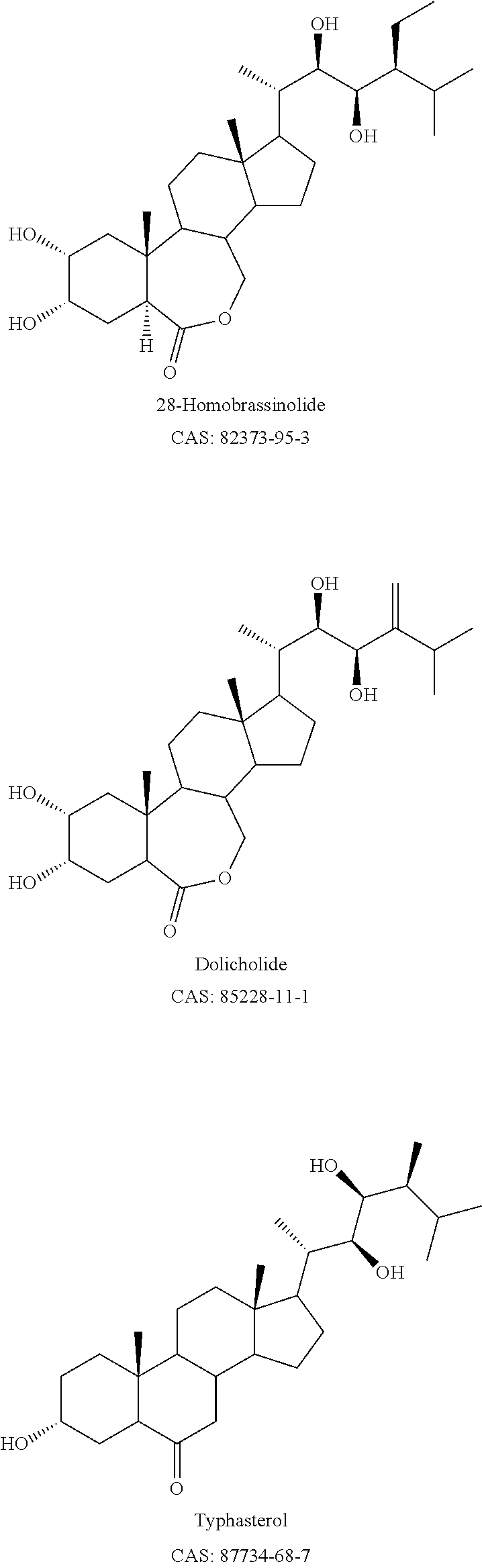
  • Brassinolide was the first separated and identified brassinosteroids (BRs) from Canola pollen, and possessed biological activity. Its Chinese name is Yóucài sù nèi zh ⁇ hacek over (i) ⁇ , CAS number is 72962-43-7, and chemical name is (3aS,5S,6R,7aR,7bS,9aS,10R,12aS,12 ⁇ S)-10-[(2S,3R,4R,5S)-3,4-dihydroxy-5,6-di methyl-2-heptanyl]-5,6-dihydroxy-7a,9a-dimethylhexadecahydro-3H-benzo[c]indeno[5,4-e]oxepin-3-one.
  • Brassinosteroids are the main biological principles in Canola pollen. They consist of the following compounds:
  • Jieguang Jiang discovered beewax could be an alternative source for brassinosteroids (CN 85102899) and Qiming He discovered that extraction of brassinosteroids could be realized through beewax hydrolysis by enzymes from Pseudomonas fluorescens (CN101684483).
  • Extracts of beewax contain brassinosteroids, which are composed of the following compounds:
  • Synthesized brassinosteroids include the following compounds:
  • brassinolide As the sixth auxin after plant growth auxin, gibberellin, cytokinin, abscisic acid and ethylene. It is widely considered as a plant auxin with the highest biological activity, broad spectrum and harmlessness. Plant physiologists generally consider that it can fully stimulate the plant's inner potential, promote the plant growth and improve the plant yield, enhance crop cold, disease and salt resistance, and improve crop defense and reduce the side-effects of herbicides on crops.
  • Brassinolide possesses an obvious effects on cell elongation, its effective concentration is a few orders lower than plant auxin. Brassinolide promotes proton pump to transfer hydrogen ions out of cell membrane, leading to acidification of intercellular environment, so as to promote the growth of cell wall relaxation. At the same time, brassinolide can also inhibit the activity of growth hormone oxidases, enhance the content of plant inner growth hormone. Therefore, there will be a synergistic effect when combined with plant growth hormone and brassinolide.
  • brassinolide can also regulate the synthesis and metabolism of some plant growth-related proteins, leading to regulating plant growth. Brassinolide mainly locates at the site of vigorous plant growth. Brassinolide also regulates the nutrient distribution in plants, enhances the dry weight under the treated site and, in contrast, decreases the dry weight above the treated site, but maintain the consistency of plant total dry weight. Moreover, brassinolide can also affect the metabolism of nucleus and slow the senescence of plant cells in vitro.
  • FZ, YC, and the combinations of FZ or YC with other active ingredients have been known in pesticide field, antimicrobial activity and plant growth regulation of the composition of FZ and YC has not been reported, especially no attention has been paid on their synergistic effects on induced systemic resistance against bacterial, fungal and viral pathogens and promoting plant growth.
  • the aim of this innovation is to provide a synergistic composition with functions of antimicrobial activity and promoting plant growth, preparation and its applications
  • the active ingredients of disclosed composition in this innovation are FZ and YC.
  • the preparation of the composition was also disclosed in this innovation.
  • the formulation types include, but not limited to, following: emulsifiable concentrate (EC), aqueous emulsion (EW), microemulison (ME), suspension concentrate (SC), oil dispersion (OD), capsule suspension (CS), wettable powder (WP), water dispersible granule (WDG), soluble powder (SP), soluble granule (SG), suspension emulsion (SE), flowable concentrate for seed treatment (FS), aqueous solution (AS) and ready to use formulation.
  • This innovation also provides the applications of the composition on inhibiting plant bacterial, fungal and viral pathogens, promoting plant growth, enhancing the plant resistance under stresses and improving the crop yields.
  • FZ is extracted from the roots, stems, flower and seeds of Polygonaceae, Rhmnaceae, Fabaceae, Asphodelaceae, Rubiaceae.
  • Anthraquinones and their corresponding glucosides are the main biological principles. Common plant materials for anthraquinones are rhubarb, giant knotweed and cassia seeds.
  • Anthraquinones from rhubarb include, but not limited to, rhein, aloe-emodin, emodin, physcion, chrysophanol, physcion-glucoside, chrysophanol-glucoside, emodin-glucoside and rhein-glucoside etc.
  • Anthraquinones from giant knotweed include, but not limited to, emodin, physcion, chrysophenol, emodin-glucoside, physcion-glucoside, chrysophanol-glucoside and resveratrol etc.
  • Anthraquinones from cassia seeds include, but not limited to, emodin, chrysophanol, physcion, obtusin, obtusifolin and their corresponding glucosides etc.
  • YC is extracted from canola pollen (e.g., pollen of Brassica napus L.) and beewax (direct extraction of beewax or extraction after enzymatic hydrolysis of beewax), and YC can be synthesized brassinosteroids.
  • the extracts of both canola pollen and beewax include the brassinosteroids.
  • the extract of canola pollen includes the brassinosteroids, which consists of one or multiple following compounds:
  • the extract of beewax includes the brassinosteroids, which consists of one or multiple following compounds:
  • the synthesized brassinosteroids include one or multiple following compounds:
  • FZ is preferably giant knotweed extract and cassia seed extract, and further preferably giant knotweed extract.
  • YC is preferably beewax extract and synthesized brassinosteroids, and further preferably beewax extract.
  • weight ratio of FZ and YC can be changed within a wide range, in particular, weight ratio of FZ and YC can be from 0.0001:1 to 1000000:1, preferably from 0.001:1 to 100000:1, more preferably from 0.01:10 to 10,000:1.
  • the concentration ratio of the FZ and YC may be from 1000 ppm:0.001 ppm to 1 ppm:500 ppm, more preferably from 500 ppm:0.01 ppm to 5 ppm:200 ppm.
  • the active ingredients in the composition can be varied over a wide range, in particular, the active ingredient FZ in the composition can be in an amount of 0.001% (w/w) to 99% (w/w), preferably from 0.01% (w/w) to 60% (w/w); the active ingredient YC in the composition can be in an amount of 0.000001% (w/w) to 60% (w/w), preferably from 0.00001% (w/w) to 40%.
  • the composition typically further comprises at least two carriers, at least one and preferably as additives, such as surfactants.
  • surfactants may be known in the art that various surfactants, preferably present in present invention one or multiple of the emulsifiers, dispersants or wetting agents:
  • carrier that, in addition to the above-described surfactants, are known in the art, can be various carriers, specifically, for example: one or more of carbon black, kaolin, diatomaceous earth, clay, talc, bentonite, pumice, titanium oxide, dextrin, mixture of cellulose powder, calcium carbonate, a soluble starch, urea, ammonium fertilizer, mixture of urea and ammonium fertilizer, glucose, maltose, table sugar, anhydrous potassium carbonate, anhydrous sodium carbonate, anhydrous potassium bicarbonate, anhydrous sodium bicarbonate, mixture of anhydrous potassium carbonate and anhydrous potassium bicarbonate, and mixture of anhydrous sodium carbonate and anhydrous sodium bicarbonate;
  • Such emulsifiers may be a variety of emulsifiers, in particular, the emulsifier may be one or multiple of following: calcium dodecanyl sulfate, lecithin, sorbitan fatty acid ester, polyoxyethylene sorbitan fatty acid ester, polyoxyethylene fatty acid ester, polyoxyethylene fatty acid diester, polyoxyethylene fatty alcohol ether, polyoxyethylene fatty amine, ethoxylated castor oil, polyoxyethylene hydrogenated castor oil, polyethylene glycol fatty acid esters, alkylphenol polyoxyethylene ether, polyoxyethylene alkylphenyl ether, polyoxyethylene dialkylphenyl ether, polyoxyethylene alkylphenyl ether/formaldehyde condensate, polyoxyethylene/polyoxypropylene block polymer ether, polyoxyethylene diphenyl ether, polyoxyethylene benzyl phenyl ether, polyoxyethylene styryl pheny
  • the dispersant mentioned above may be the art of the various known dispersants, in particular, the dispersant is one or multiple of the following: lignin sulfonate, polyacrylic acid sodium, naphthalene sulfonate, alkylnaphthalene sulfonate, methylene-bis-naphthalene sulfonate, alkylamide taurates, poly-carboxylic acid salt, alkylnaphthalene sodium sulfate, alkylnaphthalene formaldehyde polymer.
  • the wetting agent mentioned above may be the art of the various known wetting agents, in particular, the wetting agent is one or multiple of the following: sodium lauryl sulfate, secondary alkyl sodium sulfate, sodium dodecyl benzenesulfonate, fatty alcohol polyglycol ether sulfates, and mixture of alkylnaphthalene sulfate with an anionic wetting agent;
  • compositions of the invention may also contain a variety of commonly used in the art formulation additives, in particular, the formulation additives can be one or multiple of the followings: solvents, co-solvents, thickeners, antifreeze, capsule material, protective agents, defoamers, disintegrating agents and a binder.
  • formulation additives can be one or multiple of the followings: solvents, co-solvents, thickeners, antifreeze, capsule material, protective agents, defoamers, disintegrating agents and a binder.
  • Solvents described above may be well known in the art a variety of solvents, specifically, the solvent may be one or multiple of the following: an organic solvent, vegetable oil, mineral oil, solvent oil and water.
  • said organic solvent comprises N-methyl pyrrolidone, tetrahydrofuran, dimethylsulfoxide, N, N-dimethyl decanamide, N, N-dimethylformamide, xylene, tetrahydrofurfuryl alcohol, tributyl phosphate, 1, 4-dioxane or cyclohexanone:
  • the vegetable oils includes one or multiple of the following: epoxidized soybean oil, soybean oil, peanut oil, rapeseed oil, castor oil, corn oil and pine oil.
  • the mineral oils include one or multiple of the following: liquid paraffin, oil, kerosene and lubricants.
  • the solvent oils include Solvesso 100, Solvesso 150 or Solvesso 200.
  • Antifreeze mentioned above is well known in the art a variety of antifreeze, the present invention is preferably one or multiple of the following: ethylene glycol, propylene glycol, glycerin and urea.
  • the thickener mentioned above may be the various known art thickeners, in particular, the thickener may be one or multiple of the following: xanthan gum, polyvinyl alcohol, polypropylene glycol, polyethylene glycol, carbon black, diatomaceous earth, kaolin, clay, sodium alginate, aluminum silicate, sodium silicate, carboxymethyl cellulose, hydroxypropyl cellulose and sodium bentonite.
  • Capsule materials mentioned above may be known in the art a variety of capsule materials, preferably in present invention is one or multiple of the following: polyurethane, polyurea or urea-formaldehyde resin.
  • Protective agents mentioned above may be known in the art a variety of protective agents, preferably in present invention is polyethylene alcohol and/or polyglycol.
  • Antifoaming agent said here may be known in the art the various defoamers, the present invention is preferably one or multiple of the following: organosiloxane, tributyl phosphate and silicone.
  • the present invention further provides formulation types of the composition mentioned above.
  • formulation types include emulsifiable concentrate (EC), aqueous emulsion (EW), microemulison (ME), suspension concentrate (SC), oil dispersion (OD), capsule suspension (CS), wettable powder (WP), water dispersible granule (WDG).
  • Formulations of the present invention may be well known in the art in various forms, in particular, it can be emulsifiable concentrate (EC), aqueous emulsions, aqueous suspensions, oil dispersion, capsule suspensions, wettable powders, water dispersible granules agents, soluble powders, soluble granules or micro-emulsions, suspoemulsions (SE), suspension seed formulation (FS), aqueous solution (AS) and ready-to-use formulation (Ready-to-use formulation).
  • EC emulsifiable concentrate
  • SE aqueous emulsions
  • aqueous suspensions oil dispersion
  • capsule suspensions wettable powders
  • water dispersible granules agents soluble powders
  • soluble granules or micro-emulsions suspoemulsions
  • SE suspension seed formulation
  • AS aqueous solution
  • Ready-to-use formulation Ready-to-use formulation
  • the total content of the active ingredient in the emulsifiable concentrate formulation (EC) is from 0.01% to 95% by weight, co-solvent content from 0% to 20% by weight, the emulsifier content is from 1% to 30% by weight, solvent made up to 100%.
  • the preparation methods of EC formulation mentioned above may comprise of, for example, blending each of the active ingredients, solvents, co-solvent or solubilizers and emulsifiers to make a homogeneous oil phase, therefore, obtain an emulsifiable concentrate formulation (EC).
  • Aqueous emulsion or microemulsion described in present invention comprises by weight: active ingredient from 0.01% to 95%, Emulsifier from 1% to 30%, co-solvent from 0% to 30% 0%, solvent from 1% to 30%, antifreeze from 0% to 10%, thickener from 1% to 10%, made up to 100% with water.
  • the method of preparing the above-described aqueous emulsions or microemulsions for example may comprise of blending the active ingredient, an emulsifier, a co-solvent and solvent to form a uniform oil phase: mixing water, thickeners, antifreeze, etc. to obtain a homogeneous the aqueous phase.
  • the aqueous phase is added to the oil phase or oil phase is added to the aqueous phase, forming well dispersed aqueous emulsion or microemulsion.
  • the microemulsion is transparent appearance, water emulsion is suspension.
  • Aqueous suspension described in present invention comprises by weight: active ingredient from 0.01% to 95%, surfactants from 1% to 30%, antifreeze from 0% to 10%, thickener from 1% to 5%, made up to 100% with water.
  • Oil dispersion described in present invention comprises by weight: active ingredient from 0.01% to 95%, surfactants from 1% to 30%, thickener from 0.1% to 0.5%, made up to 100% with oil.
  • aqueous/oil suspension uses either water or oil as a media, grind the active ingredients, surfactants, thickeners to make fine particles, forming the aqueous or oil suspension.
  • the soluble granules, soluble powders, water dispersible granules, or wettable powder described in present invention comprises by weight: active ingredients from 0.01% to 95%, surfactants from 1% to 30%, make up to 100% with various carriers.
  • the preparation of water-dispersible granules, soluble granules are as follows: mix each active ingredient and other carriers and mill them, dry the mixture by spraying drying or boiling drying to obtain final products: or knead the mixed crushed powder with water, granulate with a granulator, final granules are obtained by drying and sieving through 5-60 mesh.
  • the preparation method of soluble powders and wettable powder described in present innovation is as follows: fully mix each of the active ingredients, various additives and fillers such as other carriers well and mill the mixture with a superfine grinding mill.
  • the capsule suspension described in present invention comprises by weight: active ingredients from 0.01% to 95%, solvents from 1% to 30%, protective agents from 0.1% to 5%, defoamers from 0.05% to 1.0%, capsule material from 1% to 30%, dispenser from 1% to 30%, antifreeze from 1% to 10%, thickener from 0.1% to 5%, make up to 100% with water.
  • the preparation method of capsule suspension described in present innovation is as follows: mix the solvent with capsule material; add the active ingredients to form a mixture; add such a mixture into another mixture consisting of protective agent, antifreeze, defoamer and water to emulsify, stir the mixture until polymerization is completed, then thickener, dispenser and wetting agents are added to form a stable capsule suspension.
  • the present innovation also provides the applications of the composition against the fungi, bacteria and/or virus-caused plant diseases.
  • compositions of the present invention may be provided in a form of finished formulations, i.e. the compositions of each substance have been mixed: can also be provided in a single formulation form, mixed in a tub or tank themselves prior to use, the concentrates are usually mixed with water to give the desired concentration of the active ingredients.
  • compositions of the present invention are useful in a variety of crops, such as cucumbers, pumpkin, zucchini, tomatoes, onions, green onions, beets, peppers and other vegetables: wheat, cereals, rice and other row crops: mung bean, tobacco, flax and other economic crops: strawberries, grapes, citrus and other fruit crops or trees: peony, chrysanthemum , roses and other flowers and other ornamental and garden plants.
  • crops such as cucumbers, pumpkin, zucchini, tomatoes, onions, green onions, beets, peppers and other vegetables: wheat, cereals, rice and other row crops: mung bean, tobacco, flax and other economic crops: strawberries, grapes, citrus and other fruit crops or trees: peony, chrysanthemum , roses and other flowers and other ornamental and garden plants.
  • composition of the present invention is compared with the corresponding individual active component.
  • Good efficacy is against plant diseases such as powdery mildew, downy mildew, late blight, frost blight, Pythium , damping-off disease, black stem disease, canker, early blight, scab, rust, septoria nodorum blotch, net blotch, leaf blight, blast charcoal, gray mold and other plant diseases, especially extremely effective against cucumber downy mildew, powdery mildew, citrus Huanglongbing, rice blast and sheath blight.
  • plant diseases such as powdery mildew, downy mildew, late blight, frost blight, Pythium , damping-off disease, black stem disease, canker, early blight, scab, rust, septoria nodorum blotch, net blotch, leaf blight, blast charcoal, gray mold and other plant diseases, especially extremely effective against cucumber downy mildew, powdery milde
  • composition of the present invention is simple, prior to or after disease appearance, applying it to plants or their growth environments with conventional methods such as soil mixing, spraying, dipping, drenching etc., its application rate may be adjusted according to climate condition and/or crops. Under normal circumstances, 1-1000 g/mu is applied.
  • the application concentration is from 0.001 to 1000 mg/L, diluted, preferably, with water.
  • the experiment proved very surprising synergistic effects by mixing active principles of FZ and YC with different induced resistance mechanisms, the mixture obviously enhanced control effects of fungi, bacteria and/or virus-caused plant diseases, expanded the antimicrobial spectrum and obviously promoted plant growth and improved the crop yields.
  • compositions of the present invention possess the following advantages:
  • compositions of FZ and YC within a certain concentration range exhibit excellent synergistic effect; When compared with either an individual active principle, the compositions significantly improved antimicrobial effect, thereby reducing the amount of active principles, aligning with reducing farmers' costs and the impact on the environment.
  • composition is a combination of an antimicrobial agent and a plant growth regulator, so that different interaction characteristics between the two agents have a very strong complementary advantages, can effectively delay the occurrence and development of resistance to an individual agent.
  • Preparation methods of suspension spores used for spraying inoculation in the following examples is as follows: spray distilled water onto the diseased leaves, collect the spore solution and adjust it into a spore concentration of 10 5 /mL.
  • rhubarb extract crush Rhubarb roots after drying, ferment, extract with ethanol-water mixture, concentrate, hydrolyze, neutralize, extract with ethyl acetate, concentrate to obtain rhubarb extracts.
  • cassia seed extract crush cassia seeds after drying, ferment, extract with ethanol-water mixture, concentrate, hydrolyze, neutralize, extract with ethyl acetate, concentrate to obtain cassia seed extracts.
  • canola pollen powder extract crush the canola pollens, extract with ethanol-water, concentrate the extraction solution and then extract with ethyl acetate, concentrate the ethyl acetate layer to obtain canola pollen extract.
  • Preparation of beeswax extract emulsify the beewax with water and emulsifier to form a dispersion solution, add 2000-3000U/L degrading enzyme solution (e.g., enzyme solution from Pseudomonas fluorescens fermentation), adjust the pH and temperature, fully hydrolyze, extract the hydrolyzed solution with ethanol and n-hexane, concentrate to obtain the beewax extract.
  • 2000-3000U/L degrading enzyme solution e.g., enzyme solution from Pseudomonas fluorescens fermentation
  • Synthetic brassinosteroids usually from phytosteroid alcohols such as stigmasterol. Synthetic brassinosteroids can be obtained after a series of sequential reactions: sulfonylation, cyclization, oxidation, ring-opening, the catalytic oxidation and esterification.
  • brassinolide 80% typhasterol
  • 80% 14-hydroxylated brassinosteroid can be obtained from Canola pollen extract, beeswax extract, or synthetic brassinosteroids.
  • Example 1 Capsule Suspension: 0.5% of Active Ingredients
  • Formula composition rhubarb extract (4.995 g), 80% brassinolide technical grade (0.005 g), 150 solvent oil (solvent, 21 g), polyurea (capsule material, 3 g), polyvinyl alcohol (protecting agent, 1.0 g), organosiloxane (defoamers, 0.05 g), xanthan gum (thickener, 0.15 g), sodium lignin sulfonate (dispersing agent, 3 g), add water made up to 1 kg.
  • Preparation method The mixture of FZ, YC, No. 150 solvent oil and polyurea was added into another mixture consisting of polyvinyl alcohol, organosiloxane and water to emulsify, stirred until the polymerization reaction was completed; added xanthan gum and sodium lignin sulfonate to form a stable capsule suspension. The median capsule diameter was 5-8 microns. This product was coded as A1.
  • Example 2 Aqueous Emulsion: 5% of Active Ingredients
  • Formula composition giant knotweed extract (49.875 g), 80% typhasterol technical grade (0.125 g), No 150 solvent oil (50 g), polyoxyethylene styrene phenyl ether (emulsifier, 50 g), polypropylene alcohol (thickener, 80 g), diatomaceous earth (carrier, 30 g) add water made up to 1 kg.
  • Preparation method combined the FZ, YC, NO 150 solvent oil and polyoxyethylene styrene phenyl ether to make a homogenous oil phase; added diatomaceous earth into water to form a homogeneous aqueous phase; under high speed stirring, added the aqueous phase into oil phase to form 5% aqueous suspension with good dispersing property.
  • This product was coded as A2.
  • Formula composition giant knotweed extract (75 g), canola pollen extract (75 g), N-methylpyrrolidone (co-solvent, 50 g), sec-octyl phenol ethoxylates (emulsifier, 100 g), ethoxylated castor oil (emulsifier, 200 g), ethylene glycol (antifreeze, 50 g), water made up to 1 kg.
  • Preparation method Made homogeneous oil phase by adding FZ, YC, N-methyl pyrrolidone, sec-octylphenol polyoxyethylene ether and ethoxylated castor oil: added glycol into water to form a uniform aqueous phase; under high speed stirring, the aqueous phase was added to the oil phase to form a microemulsion containing 15% of active ingredients.
  • This product was coded as A3.
  • Example 4 Aqueous Suspension: 4.5% of Active Ingredients
  • Formula composition Cassia seed extract (44.8 g), beeswax extract (2 g), ethoxylated castor oil (emulsifier, 10 g), fatty alcohol polyethoxyethylene ether (emulsifier, 30 g), diatomaceous earth (thickener, 30 g), propylene glycol (antifreeze, 60 g), water made up to 1 kg.
  • Preparation method Water was used as a medium, the FZ, YC, ethoxylated castor oil, fatty alcohol polyoxyethylene ether, diatomaceous earth and glycol were added into sand mill to grind fine particle, forming aqueous suspensions containing 4.5% active ingredients. This product was coded as A4.
  • Formula composition giant knotweed extract (499.8 g), 80% 14-hydroxylated brassinosteroid technical grade (0.2 g), polyoxyethylene fatty alcohol ether (emulsifier, 100 g), polyoxyethylene fatty acid ester (emulsifier, 50 g), kaolin (thickener, 30 g), paraffin oil made up to 1 kg.
  • Paraffin oil was used as the medium.
  • the FZ, YC, polyoxyethylene fatty alcohol ether, polyoxyethylene fatty acid ester and kaolin were added into sand mill to grind fine particles, forming an oil suspension containing 50% active ingredient. This product was coded as A5.
  • Rhubarb extract (199.5 g), beeswax extract (0.5 g) calcium lignosulfonate (dispersants, 50 g), fatty alcohol polyglycol ether sulfate (wetting agent, 50 g), urea (carrier) to make up to 1 kg.
  • Preparation method The FZ, YC, calcium lignosulfonate, fatty alcohol polyglycol ether sulfate and urea were mixed and pulverized, added water, granulated it with a granulator with diameter of 1.0 mm sieve, dried, and sieved through 30 mesh sieve to prepare a water-dispersible granules containing 20% of active ingredients. This product was coded as A6.
  • Example 7 Emulsifier Concentrate, 70% of Active Ingredients
  • Formula composition Cassia extract (600 g), canola pollen extract (100 g), alkylphenol polyoxyethylene ether (emulsifier, 50 g), fatty alcohol polyoxyethylene ether (emulsifier, 50 g), No 150 solvent oil made up to 1 kg, mixed all and formed a homogeneous oil phase, i.e., emulsifier concentrate 70% of the active ingredient. This product was coded as A7.
  • Example 8 Wettable Powder, 80% of Active Ingredients
  • Rhubarb extract (784 g), beeswax extract (16 g), sodium lignosulphonate (dispersant, 30 g), methylene-bis-naphthalene sulfonate (dispersing agent NNO, 20 g), soluble starch (carrier, 50 g), kaolin (carrier) made up to 1 kg.
  • Preparation method The components described above were thoroughly mixed, ground with a superfine grinding mill to obtain a wettable powder containing 80% of active ingredients. This product was coded as A8.
  • Example 9 Water Dispersible Granules, 90% of Active Ingredients
  • Formula composition giant knotweed extract (896 g), beeswax extract (4 g), calcium lignosulfonate (dispersants, 50 g), fatty alcohol polyglycol ether sulfate (wetting agent, 50 g), urea (vector) made up to 1 kg.
  • Preparation method The FZ, YC, calcium lignosulfonate, fatty alcohol polyglycol ether sulfate and urea were mixed and pulverized, added water, granulated with a granulator equipped with a diameter of 1.0 mm sieve, dried and then sieved through a 30 mesh sieve, forming water-dispersible granules containing 90% of active ingredients.
  • Tis product was coded as A9
  • Giant knotweed extract (949.05 g), 80% brassinolide technical grade (0.95 g), alkylnaphthalene sulfonic acid formaldehyde condensate (30 g), alkylnaphthalene sulfonate (wetting agent, 20 g),
  • Example 11 Aqueous Solution, 30% of Active Ingredients
  • Formula composition Giant knotweed extract (25 g), beeswax extract (275 g), ethanol (co-solvent, 50 g), ethylene glycol (antifreeze, 50 g), water made up to 1 kg.
  • Preparation method Mixed the giant knotweed extract, beewax extract and ethanol to form a homogeneous oil phase; added ethylene glycol into water to form a homogeneous aqueous phase; under high speed stirring, the oil phase was added to the aqueous phase to form a good aqueous solution containing 30% of active ingredients.
  • This product was coded as A11.
  • Control Formulation 1 Oil Dispersion, 3% Rhubarb Extract
  • Rhubarb extract (30 g), polyoxyethylene fatty alcohol ethers (emulsifier, 30 g), polyoxyethylene fatty acid ester (emulsifier, 10 g), kaolin (thickener, 10 g), paraffin oil made up to 1 kg.
  • Paraffin oil was used as the medium.
  • the rhubarb extract, polyoxyethylene fatty alcohol ether, polyoxyethylene fatty acid ester and kaolin were added in sand grinding mill to obtain an oil dispersion containing 3% active ingredient. This product was coded as C1.
  • Control Formulation 2 Microemulsion, 5% Giant Knotweed Extract
  • Formula composition giant knotweed extract (50 g), N-methylpyrrolidone (co-solvent, 20 g), sec-octylphenol polyoxylethylene ether (emulsifier, 40 g), ethoxylated castor oil (emulsifier, 80 g), ethylene glycol (antifreeze, 30 g), water made up to 1 kg.
  • Preparation method Made homogeneous oil phase by adding giant knotweed extract, N-methyl pyrrolidone, sec-octylphenol polyoxyethylene ether and ethoxylated castor oil: added glycol into water to form a uniform aqueous phase; under high speed stirring, the aqueous phase was added to the oil phase to form a microemulsion containing 5% of active ingredient. This product was coded as C2.
  • Control Formulation 3 Soluble Powder, 10% Cassia Seed Extract
  • Formula composition Cassia extract (100 g), alkyl naphthalene sulfonic acid formaldehyde condensate (dispersant, 10 g), alkylnaphthalene sulfonate (wetting agent, 10 g), soluble starch made up to 1 kg
  • Control Formulation 4 Aqueous Solution, 0.1% Brassinolide
  • Formula composition 80% of brassinolide technical grade (1.25 g), ethanol (co-solvent, 10 g), ethylene glycol (antifreeze, 30 g), water made up to 1 kg.
  • Preparation method a homogeneous oil phase was made by mixing the brassinolide technical grade and alcohol.
  • An aqueous phase was made by adding glycol into water; under high speed stirring, the oil phase was added to the aqueous phase to form a good aqueous solution containing 0.1% of the active ingredient. This product was coded as C4.
  • Control Formulation 5 Aqueous Solution, 0.01% Typhasterol
  • Formula composition 80% of typhasterol technical grade (0.125 g), ethanol (co-solvent, 5 g), ethylene glycol (antifreeze, 30 g), water made up to 1 kg.
  • Preparation method a homogeneous oil phase was made by mixing the typhasterol technical grade and alcohol. An aqueous phase was made by adding glycol into water; under high speed stirring, the oil phase was added to the aqueous phase to form a good aqueous solution containing 0.01% of the active ingredient. This product was coded as C5.
  • Control Formulation 6 Aqueous Solution, 0.1% Canola Pollen Extract
  • Formula composition Canola pollen extract (1 g), NO 150 solvent oil (solvent, 10 g), polyoxyethylene styryl phenyl ether (emulsifier, 40 g), polypropylene alcohol (thickener, 70 g), diatomaceous earth (carrier, 20 g) and water made up to 1 kg
  • a homogeneous oil phase was made by mixing the canola pollen extract, No 150 solvent oil and polyoxyethylene styrene phenyl ether.
  • An aqueous phase was made by adding polypropylene alcohol, diatomaceous earth and water; under high speed stirring, the oil phase was added to the aqueous phase to form a good aqueous solution containing 0.1% of the active ingredient. This product was coded as C6.
  • Control Formulation 7 Soluble Powder, 1% Beewax Extract
  • Formula composition Beeswax extract (10 g), alkyl naphthalene sulfonic acid formaldehyde condensate (dispersant, 6 g), alkylnaphthalene sulfonate (wetting agent, 10 g), soluble starch made up to 1 kg.
  • Preparation method The components described above were thoroughly mixed, ground with a superfine grinding mill to obtain soluble powder containing 1% of the active ingredient. This product was coded as C7.
  • Control Formulation 8 Aqueous Solution, 0.1% 14-Hydroxylated Brassinosteroids
  • Formula composition 80% of 14-hydroxylated brassinosteroids. (1.25 g), ethanol (co-solvent, 11 g), ethylene glycol (antifreeze, 25 g), water made up to 1 kg.
  • Preparation method a homogeneous oil phase was made by mixing 14-hydroxylated brassinosteroid technical grade and ethanol. An aqueous phase was made by adding ethylene glycol and water. Under high speed stirring, the oil phase was added to the aqueous phase to form a good aqueous solution containing 0.01% of the active ingredient. This product was coded as C8.
  • FZ observed control effect of FZ at the same concentration of FZ in the composition
  • YC observed control effect of YC at the same concentration of YC in the composition
  • Standard Test Method for Rice pot assay was used. 12 pots were used for each group. Each group was divided into three treatments and a water blank control. Seven days prior to rice break period, whole rice plants were sprayed with the same volume of three treatment chemicals as that of water blank control until dripping. Twenty four hours after spraying, spore inoculation was conducted by spray inoculation. Six days after inoculation, spraying was repeated with water as a control, each treatment was repeated three times. Survey was conducted in rice maturity. The total number of rice plants and the number of diseased plants were recorded, and control was calculated.
  • pot assay was used. 12 pots were used for each group. Each group was divided into three treatments and a water blank control. At 2-leaf stage, whole cucumber plants were treated by foliar spraying, with the same volume of three treatment chemicals as that of water blank control until dripping. Twenty four hour later, all plants were inoculated with spores by foliar spraying. After the onset of investigated disease in the blank control treatment, disease progression in all other treatments was investigated and control effects were calculated.
  • compositions of between FZ and YC within an appropriate ratio.
  • compositions of FZ and YC significantly improved the control effect of plant diseases, therefore, reducing the amount of individual components, reducing farmers' expenses and also decreasing the impact on environment.
  • the compositions of FZ and YC showed good efficacy against a variety of diseases on various crops, and their compositions displayed a broad antimicrobial spectrum.

Landscapes

  • Health & Medical Sciences (AREA)
  • Life Sciences & Earth Sciences (AREA)
  • General Health & Medical Sciences (AREA)
  • Engineering & Computer Science (AREA)
  • Natural Medicines & Medicinal Plants (AREA)
  • Zoology (AREA)
  • Agronomy & Crop Science (AREA)
  • Plant Pathology (AREA)
  • Dentistry (AREA)
  • Wood Science & Technology (AREA)
  • Environmental Sciences (AREA)
  • Microbiology (AREA)
  • Biotechnology (AREA)
  • Mycology (AREA)
  • Pest Control & Pesticides (AREA)
  • Agricultural Chemicals And Associated Chemicals (AREA)
  • Insects & Arthropods (AREA)
  • Virology (AREA)

Abstract

The innovations provides an antimicrobial and synergistic phytochemical composition, consisting of two active ingredients (FZ and YC). This innovation also consists of formulation processes and its applications to fungi, bacteria and/or virus-caused plant diseases such as citrus Huanglongbing, grape downy mildew, strawberry gray mold etc. This innovation combines two ingredients (FZ and YC) with different modes of action, dramatically improving plant inducible acquired resistance. Therefore, this composition dramatically enhances the control efficacy of plant diseases caused by fungi, bacteria or virus, expands the antimicrobial spectrum and promotes the plant growth.

Description

TECHNICAL FIELD
This disclosure is related to an antibacterial and synergistic field for agricultural applications. In details, it is related to preparation of a composition and its applications.
TECHNICAL BACKGROUND
Anthraquinones widely exist in the roots, stems, leaves, flower and seeds of different families of plants such as Polygonaceae, Rhmnaceae, Fabaceaem, Asphodelaceae and Rubiaceae. Plants which are widely used for extracting anthraquinone are rhubarb, giant knotweed and cassia seeds.
Rhubarb belongs to the family of Polygonaceae. Main rhubarb includes Rheum palmatum L., R. tanguticum Maxim. ex Balf., R. officinale Baill.
The extract of Rhubarb is enriched with anthraquinones, which include, but not limited to, rhein, aloe-rmodin, emodin, physcion, chrysophanol, physcion-glucoside, chrysophanol-glucoside, emodin-glucoside and rhein-glucoside. For example, the extract of roots and stems of R. palmatum L. is composed of 2-3% anthraquinones, and about 1% of free anthraquinones. The extract of roots and stems of R. tanguticum Maxim. ex Balf. is composed of 5-6% anthraquinones, and about 0.8% of free anthraquinones. The extract of roots and stems of R. officinale Baill. is composed of 4-6% anthraquinones, and about 2.0% of free anthraquinones. In general, the roots and stems of the hybrid of R. officinale Baill. and R. officinale Baill. are used as materials for anthraquinones.
Giant knotweed, Reynoutria sachalinensis, belongs to the family of Polygonaceae. The extract of giant knotweed is enriched with anthraquinones and their glucosides, mainly including, but not limited to, emodin, physcion, chrysophanol, physcion glucoside, emodin glucoside, chrysophanol glucoside and resveratrol etc. Roots and stems of giant knotweed are usually used as materials for anthraquinones.
Senna obtusifolia belongs to the family of Fabaceae. Cassia seeds are generally used for herbal ingredients. The extract of the cassia seeds is enriched with anthraquinones, which mainly include, but not limited to, emodin, chrysophenol. physcion, obtusin, obtisifolin and their corresponding glucosides. The cassia seeds are usually used as the materials for anthraquinones.
The extracts of rhubarb, giant knotweed and/or cassia seeds are enriched with anthraquinones, possess ability to control a wide spectrum of plant diseases, almost all fungal diseases (Ascomycota, Basidiomycota, Oomycetes and Deuteromycota) and bacterial diseases such as downy mildew, gray mold, powdery mildew, rust, rice glume blight, rice blast, bacterial wilt and stem rot etc., and possess protective, curative, eradicative, penetration and systemic activity.
Except for antimicrobial activity, extracts containing anthraquinones such as giant knotweed also induce the accumulation of phytoalexins and polyphenols in plants (Daayf et al., 1995; Wurms et al. 1999; Schmitt, 2002), and therefore induce the plant defenses against plant pathogens (Vechet et al. 2009). The induced resistance of anthraquinones-containing extracts mainly exhibits on the locations where applied.
Canola Pollen Extracts
Brassinolide was the first separated and identified brassinosteroids (BRs) from Canola pollen, and possessed biological activity. Its Chinese name is Yóucài sù nèi zh{hacek over (i)}, CAS number is 72962-43-7, and chemical name is (3aS,5S,6R,7aR,7bS,9aS,10R,12aS,12βS)-10-[(2S,3R,4R,5S)-3,4-dihydroxy-5,6-di methyl-2-heptanyl]-5,6-dihydroxy-7a,9a-dimethylhexadecahydro-3H-benzo[c]indeno[5,4-e]oxepin-3-one.
In 1970, J. W. Mitchell separated a highly biological active substance from Canola pollen, named it as a brassinosteroid. In another 10 years, American scientists obtained 10 mg brassinosteroid from 225 kg of Canola pollen. British scientists (Mandafa et al.) obtained a highly pure brassinosteroid and its crystal structure in 1978, determining that it belongs to steroids. In 1979, Grove et al. determined its stereochemistry and named it as brassinolide (Grove et al. 1979, Nature 281: 216 217).
Brassinosteroids are the main biological principles in Canola pollen. They consist of the following compounds:
Figure US11272711-20220315-C00001
Figure US11272711-20220315-C00002
Figure US11272711-20220315-C00003
Beewax Extracts
To expand the natural resources of brassinosteroids and reduce the cost of goods, Jieguang Jiang discovered beewax could be an alternative source for brassinosteroids (CN 85102899) and Qiming He discovered that extraction of brassinosteroids could be realized through beewax hydrolysis by enzymes from Pseudomonas fluorescens (CN101684483).
Extracts of beewax contain brassinosteroids, which are composed of the following compounds:
Figure US11272711-20220315-C00004
Figure US11272711-20220315-C00005
Figure US11272711-20220315-C00006
Dolichos lablab seeds were also discovered as an alternative source of brassinosteroids (Jun BABA et al, 1983, Agric. Biol. Chern., 47).
Synthesized Brassinosteroids
Since the identification of brassinosteroids in 1979, over 10 methods have been reported for synthesis of brassinosteroids. Due to owing the steroid backbone of all brassinosteroids, phytosteroids are usually used as staring materials for synthesis. Japanese scientist (Mori. K.) used stigmasterol as a starting material to synthesize homobrassinolide. American scientist (Thompson) adopted ergosterol as a starting material to synthesize epibrassinolide. Tkekawa et al. in Japan applied campesterol as a starting material to prepare epibrassinolide. Later. Liang Li et al. in China used phytosteriods as starting materials to synthesize three brassinosteroids such as epi-homobrassinolide (CN 891035060 and CN 981050212), which has become an industrial route. Tianchong Xia et al. started with stigmasterol and campesterol to prepare brassinolide, homobrassinolide and epibrassinolide (CN 100999542).
Synthesized brassinosteroids include the following compounds:
Figure US11272711-20220315-C00007
Figure US11272711-20220315-C00008
Scientists have considered brassinolide as the sixth auxin after plant growth auxin, gibberellin, cytokinin, abscisic acid and ethylene. It is widely considered as a plant auxin with the highest biological activity, broad spectrum and harmlessness. Plant physiologists generally consider that it can fully stimulate the plant's inner potential, promote the plant growth and improve the plant yield, enhance crop cold, disease and salt resistance, and improve crop defense and reduce the side-effects of herbicides on crops.
Over the last few decades, scientists have fully studied the mode of action and biological efficacy of brassinolide, mainly focused on the cell elongation and plant growth. Brassinolide possesses an obvious effects on cell elongation, its effective concentration is a few orders lower than plant auxin. Brassinolide promotes proton pump to transfer hydrogen ions out of cell membrane, leading to acidification of intercellular environment, so as to promote the growth of cell wall relaxation. At the same time, brassinolide can also inhibit the activity of growth hormone oxidases, enhance the content of plant inner growth hormone. Therefore, there will be a synergistic effect when combined with plant growth hormone and brassinolide. In addition, brassinolide can also regulate the synthesis and metabolism of some plant growth-related proteins, leading to regulating plant growth. Brassinolide mainly locates at the site of vigorous plant growth. Brassinolide also regulates the nutrient distribution in plants, enhances the dry weight under the treated site and, in contrast, decreases the dry weight above the treated site, but maintain the consistency of plant total dry weight. Moreover, brassinolide can also affect the metabolism of nucleus and slow the senescence of plant cells in vitro.
Except for functioning as plant growth regulator and plant growth hormone, natural and synthesized brassinosteroids have been found to induced systemic resistance (ISR) of plants against bacterial and fungal pathogens (Nakashita et al., 2003, Plant Journal 33:887 898). Antimicrobial activity locates at the whole plants.
Although FZ, YC, and the combinations of FZ or YC with other active ingredients have been known in pesticide field, antimicrobial activity and plant growth regulation of the composition of FZ and YC has not been reported, especially no attention has been paid on their synergistic effects on induced systemic resistance against bacterial, fungal and viral pathogens and promoting plant growth.
Innovation
The aim of this innovation is to provide a synergistic composition with functions of antimicrobial activity and promoting plant growth, preparation and its applications
The active ingredients of disclosed composition in this innovation are FZ and YC.
The preparation of the composition was also disclosed in this innovation. The formulation types include, but not limited to, following: emulsifiable concentrate (EC), aqueous emulsion (EW), microemulison (ME), suspension concentrate (SC), oil dispersion (OD), capsule suspension (CS), wettable powder (WP), water dispersible granule (WDG), soluble powder (SP), soluble granule (SG), suspension emulsion (SE), flowable concentrate for seed treatment (FS), aqueous solution (AS) and ready to use formulation.
This innovation also provides the applications of the composition on inhibiting plant bacterial, fungal and viral pathogens, promoting plant growth, enhancing the plant resistance under stresses and improving the crop yields.
As mentioned above, FZ is extracted from the roots, stems, flower and seeds of Polygonaceae, Rhmnaceae, Fabaceae, Asphodelaceae, Rubiaceae. Anthraquinones and their corresponding glucosides are the main biological principles. Common plant materials for anthraquinones are rhubarb, giant knotweed and cassia seeds.
Anthraquinones from rhubarb include, but not limited to, rhein, aloe-emodin, emodin, physcion, chrysophanol, physcion-glucoside, chrysophanol-glucoside, emodin-glucoside and rhein-glucoside etc.
Anthraquinones from giant knotweed include, but not limited to, emodin, physcion, chrysophenol, emodin-glucoside, physcion-glucoside, chrysophanol-glucoside and resveratrol etc.
Anthraquinones from cassia seeds include, but not limited to, emodin, chrysophanol, physcion, obtusin, obtusifolin and their corresponding glucosides etc.
As mentioned above, YC is extracted from canola pollen (e.g., pollen of Brassica napus L.) and beewax (direct extraction of beewax or extraction after enzymatic hydrolysis of beewax), and YC can be synthesized brassinosteroids. The extracts of both canola pollen and beewax include the brassinosteroids.
The extract of canola pollen includes the brassinosteroids, which consists of one or multiple following compounds:
Figure US11272711-20220315-C00009
Figure US11272711-20220315-C00010
Figure US11272711-20220315-C00011
the extract of beewax includes the brassinosteroids, which consists of one or multiple following compounds:
Figure US11272711-20220315-C00012
Figure US11272711-20220315-C00013
Figure US11272711-20220315-C00014
The synthesized brassinosteroids include one or multiple following compounds:
Figure US11272711-20220315-C00015
Figure US11272711-20220315-C00016
In the preferred embodiment of the present invention, FZ is preferably giant knotweed extract and cassia seed extract, and further preferably giant knotweed extract. YC is preferably beewax extract and synthesized brassinosteroids, and further preferably beewax extract.
Accumulated data from the inventor demonstrated that it was very obvious that the composition of FZ and YC improved the crop yield, enhanced plant resistance and boosted plant resistance against plant pathogens.
In the present invention, weight ratio of FZ and YC can be changed within a wide range, in particular, weight ratio of FZ and YC can be from 0.0001:1 to 1000000:1, preferably from 0.001:1 to 100000:1, more preferably from 0.01:10 to 10,000:1.
In the present invention, the concentration ratio of the FZ and YC may be from 1000 ppm:0.001 ppm to 1 ppm:500 ppm, more preferably from 500 ppm:0.01 ppm to 5 ppm:200 ppm.
In the present invention, the active ingredients in the composition can be varied over a wide range, in particular, the active ingredient FZ in the composition can be in an amount of 0.001% (w/w) to 99% (w/w), preferably from 0.01% (w/w) to 60% (w/w); the active ingredient YC in the composition can be in an amount of 0.000001% (w/w) to 60% (w/w), preferably from 0.00001% (w/w) to 40%.
In the present invention, in addition to active ingredients, the composition typically further comprises at least two carriers, at least one and preferably as additives, such as surfactants.
such surfactants may be known in the art that various surfactants, preferably present in present invention one or multiple of the emulsifiers, dispersants or wetting agents:
Other carriers that, in addition to the above-described surfactants, are known in the art, can be various carriers, specifically, for example: one or more of carbon black, kaolin, diatomaceous earth, clay, talc, bentonite, pumice, titanium oxide, dextrin, mixture of cellulose powder, calcium carbonate, a soluble starch, urea, ammonium fertilizer, mixture of urea and ammonium fertilizer, glucose, maltose, table sugar, anhydrous potassium carbonate, anhydrous sodium carbonate, anhydrous potassium bicarbonate, anhydrous sodium bicarbonate, mixture of anhydrous potassium carbonate and anhydrous potassium bicarbonate, and mixture of anhydrous sodium carbonate and anhydrous sodium bicarbonate;
Such emulsifiers that are known in the art may be a variety of emulsifiers, in particular, the emulsifier may be one or multiple of following: calcium dodecanyl sulfate, lecithin, sorbitan fatty acid ester, polyoxyethylene sorbitan fatty acid ester, polyoxyethylene fatty acid ester, polyoxyethylene fatty acid diester, polyoxyethylene fatty alcohol ether, polyoxyethylene fatty amine, ethoxylated castor oil, polyoxyethylene hydrogenated castor oil, polyethylene glycol fatty acid esters, alkylphenol polyoxyethylene ether, polyoxyethylene alkylphenyl ether, polyoxyethylene dialkylphenyl ether, polyoxyethylene alkylphenyl ether/formaldehyde condensate, polyoxyethylene/polyoxypropylene block polymer ether, polyoxyethylene diphenyl ether, polyoxyethylene benzyl phenyl ether, polyoxyethylene styryl phenyl ether, polyoxyethylene ether silicone, ester type silicones, polyoxyethylene fatty alcohol ethers, fatty alcohol (polyoxyethylene) ether, sodium sulfosuccinate, and alkylphenol polyoxypropylene polyoxyethylene ether.
The dispersant mentioned above may be the art of the various known dispersants, in particular, the dispersant is one or multiple of the following: lignin sulfonate, polyacrylic acid sodium, naphthalene sulfonate, alkylnaphthalene sulfonate, methylene-bis-naphthalene sulfonate, alkylamide taurates, poly-carboxylic acid salt, alkylnaphthalene sodium sulfate, alkylnaphthalene formaldehyde polymer.
The wetting agent mentioned above may be the art of the various known wetting agents, in particular, the wetting agent is one or multiple of the following: sodium lauryl sulfate, secondary alkyl sodium sulfate, sodium dodecyl benzenesulfonate, fatty alcohol polyglycol ether sulfates, and mixture of alkylnaphthalene sulfate with an anionic wetting agent;
The compositions of the invention may also contain a variety of commonly used in the art formulation additives, in particular, the formulation additives can be one or multiple of the followings: solvents, co-solvents, thickeners, antifreeze, capsule material, protective agents, defoamers, disintegrating agents and a binder.
Solvents described above may be well known in the art a variety of solvents, specifically, the solvent may be one or multiple of the following: an organic solvent, vegetable oil, mineral oil, solvent oil and water.
Wherein said organic solvent comprises N-methyl pyrrolidone, tetrahydrofuran, dimethylsulfoxide, N, N-dimethyl decanamide, N, N-dimethylformamide, xylene, tetrahydrofurfuryl alcohol, tributyl phosphate, 1, 4-dioxane or cyclohexanone: the vegetable oils includes one or multiple of the following: epoxidized soybean oil, soybean oil, peanut oil, rapeseed oil, castor oil, corn oil and pine oil.
The mineral oils include one or multiple of the following: liquid paraffin, oil, kerosene and lubricants.
The solvent oils include Solvesso 100, Solvesso 150 or Solvesso 200.
Meanwhile, these solvents can be used as co-solvents.
Antifreeze mentioned above is well known in the art a variety of antifreeze, the present invention is preferably one or multiple of the following: ethylene glycol, propylene glycol, glycerin and urea.
The thickener mentioned above may be the various known art thickeners, in particular, the thickener may be one or multiple of the following: xanthan gum, polyvinyl alcohol, polypropylene glycol, polyethylene glycol, carbon black, diatomaceous earth, kaolin, clay, sodium alginate, aluminum silicate, sodium silicate, carboxymethyl cellulose, hydroxypropyl cellulose and sodium bentonite.
Capsule materials mentioned above may be known in the art a variety of capsule materials, preferably in present invention is one or multiple of the following: polyurethane, polyurea or urea-formaldehyde resin.
Protective agents mentioned above may be known in the art a variety of protective agents, preferably in present invention is polyethylene alcohol and/or polyglycol.
Antifoaming agent said here may be known in the art the various defoamers, the present invention is preferably one or multiple of the following: organosiloxane, tributyl phosphate and silicone.
The present invention further provides formulation types of the composition mentioned above. Such formulation types include emulsifiable concentrate (EC), aqueous emulsion (EW), microemulison (ME), suspension concentrate (SC), oil dispersion (OD), capsule suspension (CS), wettable powder (WP), water dispersible granule (WDG). Soluble powder (SP), soluble granule (SG), suspension emulsion (SE), flowable concentrate for seed treatment (FS), aqueous solution (AS) and ready-to-use formulation.
Formulations of the present invention may be well known in the art in various forms, in particular, it can be emulsifiable concentrate (EC), aqueous emulsions, aqueous suspensions, oil dispersion, capsule suspensions, wettable powders, water dispersible granules agents, soluble powders, soluble granules or micro-emulsions, suspoemulsions (SE), suspension seed formulation (FS), aqueous solution (AS) and ready-to-use formulation (Ready-to-use formulation). The formulation mentioned above can be prepared by conventional methods in the art. For example,
The total content of the active ingredient in the emulsifiable concentrate formulation (EC) is from 0.01% to 95% by weight, co-solvent content from 0% to 20% by weight, the emulsifier content is from 1% to 30% by weight, solvent made up to 100%.
The preparation methods of EC formulation mentioned above may comprise of, for example, blending each of the active ingredients, solvents, co-solvent or solubilizers and emulsifiers to make a homogeneous oil phase, therefore, obtain an emulsifiable concentrate formulation (EC).
Aqueous emulsion or microemulsion described in present invention comprises by weight: active ingredient from 0.01% to 95%, Emulsifier from 1% to 30%, co-solvent from 0% to 30% 0%, solvent from 1% to 30%, antifreeze from 0% to 10%, thickener from 1% to 10%, made up to 100% with water.
The method of preparing the above-described aqueous emulsions or microemulsions for example, may comprise of blending the active ingredient, an emulsifier, a co-solvent and solvent to form a uniform oil phase: mixing water, thickeners, antifreeze, etc. to obtain a homogeneous the aqueous phase. Under high speed stirring, the aqueous phase is added to the oil phase or oil phase is added to the aqueous phase, forming well dispersed aqueous emulsion or microemulsion. Wherein the microemulsion is transparent appearance, water emulsion is suspension.
Aqueous suspension described in present invention comprises by weight: active ingredient from 0.01% to 95%, surfactants from 1% to 30%, antifreeze from 0% to 10%, thickener from 1% to 5%, made up to 100% with water.
Oil dispersion described in present invention comprises by weight: active ingredient from 0.01% to 95%, surfactants from 1% to 30%, thickener from 0.1% to 0.5%, made up to 100% with oil.
The methods of preparation aqueous/oil suspension mentioned above are as follows: use either water or oil as a media, grind the active ingredients, surfactants, thickeners to make fine particles, forming the aqueous or oil suspension.
The soluble granules, soluble powders, water dispersible granules, or wettable powder described in present invention comprises by weight: active ingredients from 0.01% to 95%, surfactants from 1% to 30%, make up to 100% with various carriers.
Among them, the preparation of water-dispersible granules, soluble granules are as follows: mix each active ingredient and other carriers and mill them, dry the mixture by spraying drying or boiling drying to obtain final products: or knead the mixed crushed powder with water, granulate with a granulator, final granules are obtained by drying and sieving through 5-60 mesh.
The preparation method of soluble powders and wettable powder described in present innovation is as follows: fully mix each of the active ingredients, various additives and fillers such as other carriers well and mill the mixture with a superfine grinding mill.
The capsule suspension described in present invention comprises by weight: active ingredients from 0.01% to 95%, solvents from 1% to 30%, protective agents from 0.1% to 5%, defoamers from 0.05% to 1.0%, capsule material from 1% to 30%, dispenser from 1% to 30%, antifreeze from 1% to 10%, thickener from 0.1% to 5%, make up to 100% with water.
The preparation method of capsule suspension described in present innovation is as follows: mix the solvent with capsule material; add the active ingredients to form a mixture; add such a mixture into another mixture consisting of protective agent, antifreeze, defoamer and water to emulsify, stir the mixture until polymerization is completed, then thickener, dispenser and wetting agents are added to form a stable capsule suspension.
The present innovation also provides the applications of the composition against the fungi, bacteria and/or virus-caused plant diseases.
The compositions of the present invention may be provided in a form of finished formulations, i.e. the compositions of each substance have been mixed: can also be provided in a single formulation form, mixed in a tub or tank themselves prior to use, the concentrates are usually mixed with water to give the desired concentration of the active ingredients.
The compositions of the present invention are useful in a variety of crops, such as cucumbers, pumpkin, zucchini, tomatoes, onions, green onions, beets, peppers and other vegetables: wheat, cereals, rice and other row crops: mung bean, tobacco, flax and other economic crops: strawberries, grapes, citrus and other fruit crops or trees: peony, chrysanthemum, roses and other flowers and other ornamental and garden plants.
There is an obvious synergism when the composition of the present invention is compared with the corresponding individual active component. Good efficacy is against plant diseases such as powdery mildew, downy mildew, late blight, frost blight, Pythium, damping-off disease, black stem disease, canker, early blight, scab, rust, septoria nodorum blotch, net blotch, leaf blight, blast charcoal, gray mold and other plant diseases, especially extremely effective against cucumber downy mildew, powdery mildew, citrus Huanglongbing, rice blast and sheath blight.
Application method of the composition of the present invention is simple, prior to or after disease appearance, applying it to plants or their growth environments with conventional methods such as soil mixing, spraying, dipping, drenching etc., its application rate may be adjusted according to climate condition and/or crops. Under normal circumstances, 1-1000 g/mu is applied. The application concentration is from 0.001 to 1000 mg/L, diluted, preferably, with water.
In the present invention, the experiment proved very surprising synergistic effects by mixing active principles of FZ and YC with different induced resistance mechanisms, the mixture obviously enhanced control effects of fungi, bacteria and/or virus-caused plant diseases, expanded the antimicrobial spectrum and obviously promoted plant growth and improved the crop yields.
In summary, the compositions of the present invention possess the following advantages:
The compositions of FZ and YC within a certain concentration range exhibit excellent synergistic effect; When compared with either an individual active principle, the compositions significantly improved antimicrobial effect, thereby reducing the amount of active principles, aligning with reducing farmers' costs and the impact on the environment.
Expansion of antimicrobial spectrum leads to control of multiple plant diseases with one product, providing a convenient and effective means of disease prevention and protection.
The composition is a combination of an antimicrobial agent and a plant growth regulator, so that different interaction characteristics between the two agents have a very strong complementary advantages, can effectively delay the occurrence and development of resistance to an individual agent.
DETAILED EXPERIMENTS
By the following specific embodiments of the present invention is further illustrated, but the present invention is not limited only to the following examples. The content of the following examples is expressed by percent of weight.
Some substances in the following examples were purchased from different companies: polyurea from Dongsheng Futian Jufu Company, organosiloxane from Mianyang Huili Huanyang Co. Ltd., sodium ligninsulfonate and calcium lignosulfonate from Henan Anyang Chemical Industry, polyoxyethylene styryl phenyl ether from Nanjing Taihua chemical industry, polypropylene alcohol from Beijing Baishun Chemical Tech Co. Ltd., sec-octyl phenol polyoxyethylene ether, fatty alcohol polyoxyethylene ether and polyoxyethylene fatty acid ester from Tianjin Hongmei Chemical Industry, kaolin from Anhui Tongling Guotai Non-metallic Materials Co., paraffin oil from Beijing Huaye Hongyu Chemical Co., Ltd, fatty alcohol polyglycol ether sulfate from Shanghai Youwen Chemical Co., urea (available from Annhui JinAo Chemical Co., Ltd., Alkyl phenol polyoxyethylene ether from Beijing Huayou Chemical Co., methylene bis-naphthalene sulfonate sodium, alkyl naphthalenesulfonic acid formaldehyde condensate and alkyl naphthalene sulfonic acid salt from Beijing Chemical Reagent Factory.
Preparation methods of suspension spores used for spraying inoculation in the following examples is as follows: spray distilled water onto the diseased leaves, collect the spore solution and adjust it into a spore concentration of 105/mL.
Preparation of rhubarb extract: crush Rhubarb roots after drying, ferment, extract with ethanol-water mixture, concentrate, hydrolyze, neutralize, extract with ethyl acetate, concentrate to obtain rhubarb extracts.
Preparation of giant knotweed extract: crush giant knotweed roots after drying, ferment, extract with ethanol-water mixture, concentrate, hydrolyze, neutralize, extract with ethyl acetate, concentrate to obtain giant knotweed extracts.
Preparation of cassia seed extract: crush cassia seeds after drying, ferment, extract with ethanol-water mixture, concentrate, hydrolyze, neutralize, extract with ethyl acetate, concentrate to obtain cassia seed extracts.
Preparation of canola pollen powder extract: crush the canola pollens, extract with ethanol-water, concentrate the extraction solution and then extract with ethyl acetate, concentrate the ethyl acetate layer to obtain canola pollen extract.
Preparation of beeswax extract: emulsify the beewax with water and emulsifier to form a dispersion solution, add 2000-3000U/L degrading enzyme solution (e.g., enzyme solution from Pseudomonas fluorescens fermentation), adjust the pH and temperature, fully hydrolyze, extract the hydrolyzed solution with ethanol and n-hexane, concentrate to obtain the beewax extract.
Preparation of synthetic brassinosteroids: usually from phytosteroid alcohols such as stigmasterol. Synthetic brassinosteroids can be obtained after a series of sequential reactions: sulfonylation, cyclization, oxidation, ring-opening, the catalytic oxidation and esterification.
After purification, over 80% technical grade of active ingredients such as brassinolide, 80% typhasterol and 80% 14-hydroxylated brassinosteroid can be obtained from Canola pollen extract, beeswax extract, or synthetic brassinosteroids.
Example 1: Capsule Suspension: 0.5% of Active Ingredients
Formula composition: rhubarb extract (4.995 g), 80% brassinolide technical grade (0.005 g), 150 solvent oil (solvent, 21 g), polyurea (capsule material, 3 g), polyvinyl alcohol (protecting agent, 1.0 g), organosiloxane (defoamers, 0.05 g), xanthan gum (thickener, 0.15 g), sodium lignin sulfonate (dispersing agent, 3 g), add water made up to 1 kg.
Preparation method: The mixture of FZ, YC, No. 150 solvent oil and polyurea was added into another mixture consisting of polyvinyl alcohol, organosiloxane and water to emulsify, stirred until the polymerization reaction was completed; added xanthan gum and sodium lignin sulfonate to form a stable capsule suspension. The median capsule diameter was 5-8 microns. This product was coded as A1.
Example 2: Aqueous Emulsion: 5% of Active Ingredients
Formula composition: giant knotweed extract (49.875 g), 80% typhasterol technical grade (0.125 g), No 150 solvent oil (50 g), polyoxyethylene styrene phenyl ether (emulsifier, 50 g), polypropylene alcohol (thickener, 80 g), diatomaceous earth (carrier, 30 g) add water made up to 1 kg.
Preparation method: combined the FZ, YC, NO 150 solvent oil and polyoxyethylene styrene phenyl ether to make a homogenous oil phase; added diatomaceous earth into water to form a homogeneous aqueous phase; under high speed stirring, added the aqueous phase into oil phase to form 5% aqueous suspension with good dispersing property. This product was coded as A2.
Example 3: Microemulsion: 15% of Active Ingredients
Formula composition: giant knotweed extract (75 g), canola pollen extract (75 g), N-methylpyrrolidone (co-solvent, 50 g), sec-octyl phenol ethoxylates (emulsifier, 100 g), ethoxylated castor oil (emulsifier, 200 g), ethylene glycol (antifreeze, 50 g), water made up to 1 kg.
Preparation method: Made homogeneous oil phase by adding FZ, YC, N-methyl pyrrolidone, sec-octylphenol polyoxyethylene ether and ethoxylated castor oil: added glycol into water to form a uniform aqueous phase; under high speed stirring, the aqueous phase was added to the oil phase to form a microemulsion containing 15% of active ingredients. This product was coded as A3.
Example 4: Aqueous Suspension: 4.5% of Active Ingredients
Formula composition: Cassia seed extract (44.8 g), beeswax extract (2 g), ethoxylated castor oil (emulsifier, 10 g), fatty alcohol polyethoxyethylene ether (emulsifier, 30 g), diatomaceous earth (thickener, 30 g), propylene glycol (antifreeze, 60 g), water made up to 1 kg.
Preparation method: Water was used as a medium, the FZ, YC, ethoxylated castor oil, fatty alcohol polyoxyethylene ether, diatomaceous earth and glycol were added into sand mill to grind fine particle, forming aqueous suspensions containing 4.5% active ingredients. This product was coded as A4.
Example 5: Oil Dispersion, 50% of Active Ingredients
Formula composition: giant knotweed extract (499.8 g), 80% 14-hydroxylated brassinosteroid technical grade (0.2 g), polyoxyethylene fatty alcohol ether (emulsifier, 100 g), polyoxyethylene fatty acid ester (emulsifier, 50 g), kaolin (thickener, 30 g), paraffin oil made up to 1 kg.
Preparation method: Paraffin oil was used as the medium. The FZ, YC, polyoxyethylene fatty alcohol ether, polyoxyethylene fatty acid ester and kaolin were added into sand mill to grind fine particles, forming an oil suspension containing 50% active ingredient. This product was coded as A5.
Example 6: Soluble Granules, 20% of Active Ingredients
Formula composition: Rhubarb extract (199.5 g), beeswax extract (0.5 g) calcium lignosulfonate (dispersants, 50 g), fatty alcohol polyglycol ether sulfate (wetting agent, 50 g), urea (carrier) to make up to 1 kg.
Preparation method: The FZ, YC, calcium lignosulfonate, fatty alcohol polyglycol ether sulfate and urea were mixed and pulverized, added water, granulated it with a granulator with diameter of 1.0 mm sieve, dried, and sieved through 30 mesh sieve to prepare a water-dispersible granules containing 20% of active ingredients. This product was coded as A6.
Example 7: Emulsifier Concentrate, 70% of Active Ingredients
Formula composition: Cassia extract (600 g), canola pollen extract (100 g), alkylphenol polyoxyethylene ether (emulsifier, 50 g), fatty alcohol polyoxyethylene ether (emulsifier, 50 g), No 150 solvent oil made up to 1 kg, mixed all and formed a homogeneous oil phase, i.e., emulsifier concentrate 70% of the active ingredient. This product was coded as A7.
Example 8: Wettable Powder, 80% of Active Ingredients
Formula composition: Rhubarb extract (784 g), beeswax extract (16 g), sodium lignosulphonate (dispersant, 30 g), methylene-bis-naphthalene sulfonate (dispersing agent NNO, 20 g), soluble starch (carrier, 50 g), kaolin (carrier) made up to 1 kg.
Preparation method: The components described above were thoroughly mixed, ground with a superfine grinding mill to obtain a wettable powder containing 80% of active ingredients. This product was coded as A8.
Example 9: Water Dispersible Granules, 90% of Active Ingredients
Formula composition: giant knotweed extract (896 g), beeswax extract (4 g), calcium lignosulfonate (dispersants, 50 g), fatty alcohol polyglycol ether sulfate (wetting agent, 50 g), urea (vector) made up to 1 kg.
Preparation method: The FZ, YC, calcium lignosulfonate, fatty alcohol polyglycol ether sulfate and urea were mixed and pulverized, added water, granulated with a granulator equipped with a diameter of 1.0 mm sieve, dried and then sieved through a 30 mesh sieve, forming water-dispersible granules containing 90% of active ingredients. Tis product was coded as A9
Example 10: Soluble Powder, 95% of Active Ingredients
Formula composition: Giant knotweed extract (949.05 g), 80% brassinolide technical grade (0.95 g), alkylnaphthalene sulfonic acid formaldehyde condensate (30 g), alkylnaphthalene sulfonate (wetting agent, 20 g),
Preparation method: The components described above were thoroughly mixed, ground with a superfine grinding mill to obtain soluble powder containing 95% of the active ingredient. This product was codes as A10.
Example 11: Aqueous Solution, 30% of Active Ingredients
Formula composition: Giant knotweed extract (25 g), beeswax extract (275 g), ethanol (co-solvent, 50 g), ethylene glycol (antifreeze, 50 g), water made up to 1 kg.
Preparation method: Mixed the giant knotweed extract, beewax extract and ethanol to form a homogeneous oil phase; added ethylene glycol into water to form a homogeneous aqueous phase; under high speed stirring, the oil phase was added to the aqueous phase to form a good aqueous solution containing 30% of active ingredients. This product was coded as A11.
Control Formulation 1: Oil Dispersion, 3% Rhubarb Extract
Formula composition: Rhubarb extract (30 g), polyoxyethylene fatty alcohol ethers (emulsifier, 30 g), polyoxyethylene fatty acid ester (emulsifier, 10 g), kaolin (thickener, 10 g), paraffin oil made up to 1 kg.
Preparation method: Paraffin oil was used as the medium. The rhubarb extract, polyoxyethylene fatty alcohol ether, polyoxyethylene fatty acid ester and kaolin were added in sand grinding mill to obtain an oil dispersion containing 3% active ingredient. This product was coded as C1.
Control Formulation 2: Microemulsion, 5% Giant Knotweed Extract
Formula composition: giant knotweed extract (50 g), N-methylpyrrolidone (co-solvent, 20 g), sec-octylphenol polyoxylethylene ether (emulsifier, 40 g), ethoxylated castor oil (emulsifier, 80 g), ethylene glycol (antifreeze, 30 g), water made up to 1 kg.
Preparation method: Made homogeneous oil phase by adding giant knotweed extract, N-methyl pyrrolidone, sec-octylphenol polyoxyethylene ether and ethoxylated castor oil: added glycol into water to form a uniform aqueous phase; under high speed stirring, the aqueous phase was added to the oil phase to form a microemulsion containing 5% of active ingredient. This product was coded as C2.
Control Formulation 3: Soluble Powder, 10% Cassia Seed Extract
Formula composition: Cassia extract (100 g), alkyl naphthalene sulfonic acid formaldehyde condensate (dispersant, 10 g), alkylnaphthalene sulfonate (wetting agent, 10 g), soluble starch made up to 1 kg
Preparation method: The components described above were thoroughly mixed, ground with a superfine grinding mill to obtain soluble powder containing 10% of the active ingredients. This product was coded as C3.
Control Formulation 4: Aqueous Solution, 0.1% Brassinolide
Formula composition: 80% of brassinolide technical grade (1.25 g), ethanol (co-solvent, 10 g), ethylene glycol (antifreeze, 30 g), water made up to 1 kg.
Preparation method: a homogeneous oil phase was made by mixing the brassinolide technical grade and alcohol. An aqueous phase was made by adding glycol into water; under high speed stirring, the oil phase was added to the aqueous phase to form a good aqueous solution containing 0.1% of the active ingredient. This product was coded as C4.
Control Formulation 5: Aqueous Solution, 0.01% Typhasterol
Formula composition: 80% of typhasterol technical grade (0.125 g), ethanol (co-solvent, 5 g), ethylene glycol (antifreeze, 30 g), water made up to 1 kg.
Preparation method: a homogeneous oil phase was made by mixing the typhasterol technical grade and alcohol. An aqueous phase was made by adding glycol into water; under high speed stirring, the oil phase was added to the aqueous phase to form a good aqueous solution containing 0.01% of the active ingredient. This product was coded as C5.
Control Formulation 6: Aqueous Solution, 0.1% Canola Pollen Extract
Formula composition: Canola pollen extract (1 g), NO 150 solvent oil (solvent, 10 g), polyoxyethylene styryl phenyl ether (emulsifier, 40 g), polypropylene alcohol (thickener, 70 g), diatomaceous earth (carrier, 20 g) and water made up to 1 kg
Preparation method: a homogeneous oil phase was made by mixing the canola pollen extract, No 150 solvent oil and polyoxyethylene styrene phenyl ether. An aqueous phase was made by adding polypropylene alcohol, diatomaceous earth and water; under high speed stirring, the oil phase was added to the aqueous phase to form a good aqueous solution containing 0.1% of the active ingredient. This product was coded as C6.
Control Formulation 7: Soluble Powder, 1% Beewax Extract
Formula composition: Beeswax extract (10 g), alkyl naphthalene sulfonic acid formaldehyde condensate (dispersant, 6 g), alkylnaphthalene sulfonate (wetting agent, 10 g), soluble starch made up to 1 kg.
Preparation method: The components described above were thoroughly mixed, ground with a superfine grinding mill to obtain soluble powder containing 1% of the active ingredient. This product was coded as C7.
Control Formulation 8: Aqueous Solution, 0.1% 14-Hydroxylated Brassinosteroids
Formula composition: 80% of 14-hydroxylated brassinosteroids. (1.25 g), ethanol (co-solvent, 11 g), ethylene glycol (antifreeze, 25 g), water made up to 1 kg.
Preparation method: a homogeneous oil phase was made by mixing 14-hydroxylated brassinosteroid technical grade and ethanol. An aqueous phase was made by adding ethylene glycol and water. Under high speed stirring, the oil phase was added to the aqueous phase to form a good aqueous solution containing 0.01% of the active ingredient. This product was coded as C8.
Experimental examples 1-11 with compositions described above illustrated their applications against fungi-, bacteria- and/or virus-caused plant diseases.
Colby equation was used to calculate the expected control effect of two active ingredients of FZ and YC,
Expected control effect=FZ+YC−(FZ*YC/100)
FZ=observed control effect of FZ at the same concentration of FZ in the composition
YC=observed control effect of YC at the same concentration of YC in the composition
Partial experimental methods were as follows:
Standard Test Method for Rice: pot assay was used. 12 pots were used for each group. Each group was divided into three treatments and a water blank control. Seven days prior to rice break period, whole rice plants were sprayed with the same volume of three treatment chemicals as that of water blank control until dripping. Twenty four hours after spraying, spore inoculation was conducted by spray inoculation. Six days after inoculation, spraying was repeated with water as a control, each treatment was repeated three times. Survey was conducted in rice maturity. The total number of rice plants and the number of diseased plants were recorded, and control was calculated.
Cucumber experimental methods: pot assay was used. 12 pots were used for each group. Each group was divided into three treatments and a water blank control. At 2-leaf stage, whole cucumber plants were treated by foliar spraying, with the same volume of three treatment chemicals as that of water blank control until dripping. Twenty four hour later, all plants were inoculated with spores by foliar spraying. After the onset of investigated disease in the blank control treatment, disease progression in all other treatments was investigated and control effects were calculated.
Orange Huanglongbing (Citrus HLB) Experimental Methods:
In greenhouse condition, developing citrus plants (e.g., orange) with HLB symptoms were transferred into black bugs with an irrigation condition. Four groups of leaves (10 leaves/group) were selected for each plant. There were sprayed with diluted water solution of the FZ, YC and their combination, and water blank, respectively. Five replicates were set up. Four sprayings were performed with a 7-day interval. After 1 month from the last spraying, DNA was extracted from treated leaves, titers pf HLP was determined with PCR kits. Citrus plant leaves treated with water dilution of FZ, YC and their combinations were considered as treatment groups. Citrus plant leaves treated with water was considered as a control group.
control effect=100%*(control group-treatment group)/control group
Experimental Example 1: Antimicrobial and Synergistic Experiment of the Composition of Rhubarb Extract and Brassinolide Against Cucumber Downy Mildew
TABLE 1
antimicrobial effect of individual components
against cucumber downy mildew
Product Percent of Control effect
code Component Al Dilution (%)
C1 Rhubarb 3.0% 600 60.5
extract
C4 brassinolide 0.1% 25000 5.1
TABLE 2
antimicrobial effect of the composition
against cucumber downy mildew
Expected Experimental
Product Percent of control control
code Component Al Dilution effect (%) effect (%)
A1 Rhubarb 0.4995% 100 62.5 77.1
extract
80% 0.0005%
brassinolide
Experimental Example 2: Antimicrobial and Synergistic Experiment of the Composition of Giant Knotweed Extract and Typhasterol Against Rice Blast
TABLE 3
antimicrobial effect of individual components against rice blast
Product Percent of Control effect
code Component Al Dilution (%)
C2 Giant knotweed 5.0% 1600 65.2
extract
C5 typhasterol 0.01% 1600 20.3
TABLE 4
antimicrobial effect of the composition against rice blast
Expected Experimental
Product Percent of control control
code Component Al Dilution effect (%) effect (%)
A2 Giant knotweed 0.49875% 1000 72.3 90.5
extract
80% 0.0125%
typhasterol
Experimental Example 3: Antimicrobial and Synergistic Experiment of the Composition of Giant Knotweed Extract and Canola Pollen Extract Against Eggplant Phytophthora Fruitrot
TABLE 5
antimicrobial effect of individual components
against eggplant Phytophthora fruitrot
Product Percent of Control effect
code Component Al Dilution (%)
C2 Giant knotweed 5.0% 1700 52.8
extract
C6 Canola pollen 0.1% 32 7.9
extract
TABLE 6
antimicrobial effect of the composition
against eggplant Phytophthora fruitrot
Expected Experimental
Product Percent of control control
code Component Al Dilution effect (%) effect (%)
A3 Giant knotweed 7.5% 2500 56.5 71.3
extract
Canola pollen 7.5%
extract
Experimental Example 4: Antimicrobial and Synergistic Experiment of the Composition of Cassia Seed Extract and Beewax Extract Against Strawberry Root Rot
TABLE 7
antimicrobial effect of individual components
against strawberry root rot
Product Percent of Control effect
code Component Al Dilution (%)
C3 Cassia seed 10% 3300 61.3
extract
C7 beewax extract  1% 70000 25.4
TABLE 8
antimicrobial effect of the composition against strawberry root rot
Expected Experimental
Product Percent of control control
code Component Al Dilution effect (%) effect (%)
A4 Cassia seed 4.48% 1500 71.1 87.9
extract
beewax extract 0.02%
Experimental Example 5: Antimicrobial and Synergistic Experiment of the Composition of Giant Knotweed Extract and 14-Hydrolated Brassinosteroids Against Grape Downy Mildew
TABLE 9
antimicrobial effect of individual components
against grape downy mildew
Product Percent of Control effect
code Component Al Dilution (%)
C2 Giant knotweed extract 5.0% 1600 66.8
C8 14-hydroxylated 0.1% 96000 15.7
brassinosteroids
TABLE 10
antimicrobial effect of the composition
against grape downy mildew
Expected Experimental
Product Percent of control control effect
code Component Al Dilution effect (%) (%)
A5 Giant knotweed 49.98% 16000 72.0 89.6
extract
80% 14- 0.02%
hydroxylated
brassino-
steroids
Experimental Example 6: Antimicrobial and Synergistic Experiment of the Composition of Rhubarb Extract and Beewax Extract Against Tomato Leaf Curl Virus Disease
TABLE 11
antimicrobial effect of individual components
against tomato leaf curl virus disease
Product Percent of Control effect
code Component Al Dilution (%)
C1 rhubarb 3.0% 300 36.3
extract
C7 Beewax 1% 35000 28.0
extract
TABLE 12
antimicrobial effect of the composition
against tomato leaf curl virus disease
Expected Experimental
Product Percent of control control
code Component Al Dilution effect (%) effect (%)
A6 rhubarb 19.95% 2000 54.1 72.0
extract
Beewax 0.05%
extract
Experimental Example 7: Antimicrobial and Synergistic Experiment of the Composition of Cassia Seed Extract and Canola Pollen Extract Against Potato Early Blight
TABLE 13
antimicrobial effect of individual components
against potato early blight
Product Percent of Control effect
code Component Al Dilution (%)
C3 Cassia seed  10% 2500 56.7
extract
C6 Canola pollen 0.1% 150 10.2
extract
TABLE 14
antimicrobial effect of the composition against potato early blight
Expected Experimental
Product Percent of control control
code Component Al Dilution effect (%) effect (%)
A7 Cassia seed 60% 15000 61.1 74.7
extract
Canola pollen 10%
extract
Experimental Example 8: Antimicrobial and Synergistic Experiment of the Composition of Rhubarb Extract and Beewax Extract Against Rose Powdery Mildew
TABLE 15
antimicrobial effect of individual components
against rose powdery mildew
Product Percent of Control effect
code Component Al Dilution (%)
C1 rhubarb 3.0% 600 79.1
extract
C7 beewax 1.0% 9700 3.1
extract
TABLE 16
antimicrobial effect of the composition
against rose powdery mildew
Expected Experimental
Product Percent of control control
code Component Al Dilution effect (%) effect (%)
A8 rhubarb 78.4% 15500 79.7 96.1
extract
beewax 1.6%
extract
Experimental Example 9: Antimicrobial and Synergistic Experiment of the Composition of Giant Knotweed Extract and Beewax Extract Against Soybean Rust
TABLE 17
antimicrobial effect of individual components against soybean rust
Product Percent of Control effect
code Component Al Dilution (%)
C2 Giant knotweed 5.0% 1550 67.4
extract
C7 beewax extract 1.0% 70000 21.0
TABLE 18
antimicrobial effect of the composition against soybean rust
Expected Experimental
Product Percent of control control
code Component Al Dilution effect (%) effect (%)
A9 Giant knotweed 89.6% 28000 74.2 91.6
extract
beewax extract 0.4%
Experimental Example 10: Antimicrobial and Synergistic Experiment of the Composition of Giant Knotweed Extract and Brassinolide Against Pepper Bacterial Wilt
TABLE 19
antimicrobial effect of individual components
against pepper bacterial wilt
Product Percent of Control effect
code Component Al Dilution (%)
C2 Giant knotweed 5.0% 26.3 43.9
extract
C4 brassinolide 0.1% 658 11.7
TABLE 20
antimicrobial effect of the composition against pepper bacterial wilt
Expected Experimental
Product Percent of control control
code Component Al Dilution effect (%) effect (%)
A10 Giant knotweed 94.905% 500 50.5 68.8
extract
80% 0.095%
brassinolide
Experimental Example 11: Antimicrobial and Synergistic Experiment of the Composition of Giant Knotweed Extract and Beewax Extract Against Citrus Huanglongbing
TABLE 21
antimicrobial effect of individual components
against citrus Huanglongbing
Product Percent of Control effect
code Component Al Dilution (%)
C2 Giant knotweed 5.0% 2000 6.7
extract
C7 Beewax extract 1.0% 36.3 54.1
TABLE 22
antimicrobial effect of the composition
against citrus Huanglongbing
Expected Experimental
Product Percent of control control
code Component Al Dilution effect (%) effect (%)
A11 Giant knotweed 2.5% 1000 57.2 74.0
extract
Beewax extract 27.5%
Experimental examples (1-11) demonstrated that an obvious synergistic effect was observed for compositions of between FZ and YC within an appropriate ratio. When compared with individual components, compositions of FZ and YC significantly improved the control effect of plant diseases, therefore, reducing the amount of individual components, reducing farmers' expenses and also decreasing the impact on environment. In addition, the compositions of FZ and YC showed good efficacy against a variety of diseases on various crops, and their compositions displayed a broad antimicrobial spectrum.

Claims (18)

What is claimed is:
1. A phytochemical composition exhibiting antimicrobial effects comprising:
a carrier; and
a synergistic combination of active ingredients consisting essentially of a first active ingredient (FZ) and a second active ingredient (YC), wherein
a) FZ includes:
1) rhubarb extract;
2) giant knotweed extract;
3) cassia seed extract; or
4) combinations thereof; and wherein
b) YC includes:
1) canola pollen extract;
2) beewax extract;
3) synthesized brassinosteroid; or
4) combinations thereof.
2. The composition according to claim 1, wherein the FZ is selected from giant knotweed extract and cassia seed extract.
3. The composition according to claim 1, wherein the FZ is selected from giant knotweed extract.
4. The composition according to claim 1, wherein the YC is selected from Canola pollen extract, beewax extract, and synthesized brassinosteroid.
5. The composition according to claim 1, wherein the YC is selected from beewax extract.
6. The composition according to claim 1, wherein the percent content of FZ in the composition is 0.001-99.0% (w/w), and percent content of YC in the composition is 0.000001-60% (w/w).
7. The composition according to claim 6, wherein the percent content of FZ and YC in the composition is 0.01-60% (w/w) and 0.00001-40% (w/w), respectively.
8. The composition according to claim 1, wherein the weight ratio between FZ and YC (FZ:YC) is from 0.0001:1 to 1000000:1.
9. The composition according to claim 8, wherein the weight ratio between FZ and YC (FZ:YC) is from 0.001:1 to 100000:1.
10. The composition according to claim 9, wherein the weight ratio between FZ and YC (FZ:YC) is from 0.01:1 to 10000:1.
11. The composition according to claim 10, wherein the application concentration ratio between FZ and YC (FZ:YC) is from 1000 ppm:0.001 ppm to 1 ppm:500 ppm.
12. The composition according to claim 11 is from 500 ppm:0.01 ppm to 5 ppm:200 ppm.
13. The composition according to claim 1, where the composition is formulated as any one of the following formulation types: emulsifiable concentrate (EC), aqueous emulsion (EW), microemulison (ME), suspension concentrate (SC), oil dispersion (OD), capsule suspension (CS), wettable powder (WP), water dispersible granule (WDG). Soluble powder (SP), soluble granule (SG), suspension emulsion (SE), flowable concentrate for seed treatment (FS), aqueous solution (AS) and ready to use formulation.
14. The composition of claim 1, wherein
the one or more rhubarb extracts include anthraquinones such as rhein, aloe-emodin, emodin, physcion, chrysophanol, physcion-glucoside, chrysophanol-glucoside, emodin-glucoside and rhein-glucoside;
the one or more giant knotweed extracts, include anthraquinones such as emodin, physcion, chrysophenol, emodin-glucoside, physcion-glucosde, chrysophanol-glucoside and resveratrol;
the one or more cassia seed extracts include anthraquinones such as emodin, chrysophanolphyscion, obtusin, obtusifolin and their corresponding glucosides;
the one or more canola pollen extracts include brassinosteroids, such as brassinolide. 24-epibrassinolide, 28-epihomobrassinolidem, 28-homobrassinolide, dolicholide. typhasterol, 28-norcastasterone and 22, 23, 24-trisepibrassinolide; and
the one or more beewax extracts, include brassinosteroids, such as brassinolide, 24-epibrassinolide, 28-epihomobrassinolidem, 28-homobrassinolide, dolicholide. typhasterol, 28-norcastasterone and 14-hydroxylated brassinosteroid; and
the one or more synthesized brassinosteroids include one or more of brassinolide. 24-epibrassinolide, 28-epihomobrassinolidem, 28-homobrassinolide and typhasterol.
15. The composition of claim 1, wherein said combination has a synergistic antimicrobial effect.
16. A method for protecting a plant from diseases caused by fungi, bacteria or virus, comprising applying to the plant the composition of claim 1, thereby inducing plant resistance, promoting plant growth and/or enhancing plant yields.
17. The method of claim 16, wherein the plant is selected from the group consisting of: cucumber, pumpkin, squash, tomato, onion, shallots, beet, pepper, wheat, cereals, rice, sunflower, green bean, tobacco, flax, strawberry, grape, citrus, pears, apple, peony, chrysanthemum, rose and the plant diseases caused by fungi, bacteria, or virus is optionally: powdery mildew, downy mildew, late blight, pythium, damping-off disease, canker, black shank disease, Canker, early blight, rice blast, sheath blight, black scab, rust, glume spot disease, net blotch, leaf blight, botrytis disease, blast blight, bacterial wilt disease, bacterial stem rot disease and/or citrus huanglongbing.
18. The method of claim 17, wherein the plant is protected from cucumber and grape downy mildew and powdery mildew; cucumber and strawberry botrytis disease; citrus huanglongbing, rice blast; rice sheath blight and rice bacterial blight; peanut, pepper and tomato bacterial wilt; sunflower bacterial stem rot; and pear scab.
US15/763,390 2015-10-14 2016-09-28 Antimicrobial and synergistic phytochemical composition, its preparation and applications Active 2038-07-14 US11272711B2 (en)

Applications Claiming Priority (3)

Application Number Priority Date Filing Date Title
CN201510661990.8A CN105211120B (en) 2015-10-14 2015-10-14 The antibacterial synergistic composition of plant and its preparation and application
CN201510661990.8 2015-10-14
PCT/CN2016/100604 WO2017063504A1 (en) 2015-10-14 2016-09-28 Composition for plant bacteriostasis and synergy, and preparation and applications thereof

Publications (2)

Publication Number Publication Date
US20180235238A1 US20180235238A1 (en) 2018-08-23
US11272711B2 true US11272711B2 (en) 2022-03-15

Family

ID=54980737

Family Applications (1)

Application Number Title Priority Date Filing Date
US15/763,390 Active 2038-07-14 US11272711B2 (en) 2015-10-14 2016-09-28 Antimicrobial and synergistic phytochemical composition, its preparation and applications

Country Status (3)

Country Link
US (1) US11272711B2 (en)
CN (1) CN105211120B (en)
WO (1) WO2017063504A1 (en)

Families Citing this family (20)

* Cited by examiner, † Cited by third party
Publication number Priority date Publication date Assignee Title
CN105211120B (en) 2015-10-14 2017-11-28 帕潘纳(北京)科技有限公司 The antibacterial synergistic composition of plant and its preparation and application
CN107637593A (en) * 2016-07-22 2018-01-30 四川利尔作物科学有限公司 The bactericidal composition of controlling plant diseases and its application
CN107637592A (en) * 2016-07-22 2018-01-30 四川利尔作物科学有限公司 The bactericidal composition of controlling plant diseases and its application
CN106489941B (en) * 2016-09-09 2019-03-29 北京清源保生物科技有限公司 A kind of Physcion suspension seed-coating agent and its preparation and application
CN106490071A (en) * 2016-10-31 2017-03-15 郑州思辩科技有限公司 A kind of agricultural chemicals of preventing and treating uncinula necator and preparation method thereof
CN106577652B (en) * 2016-11-29 2019-05-24 李志旭 A kind of mango pest repellant
CN107488058A (en) * 2017-07-28 2017-12-19 温妙云 A kind of medicine fertilizer containing plant tissue extract and preparation method thereof
CN107494635A (en) * 2017-08-15 2017-12-22 赖进九 For preventing and treating cucumber disease and improving the plant extracts of cucumber nutrient composition content
CN110150322B (en) * 2019-06-24 2021-04-27 平顶山市农业科学院 Green and environment-friendly medicament for preventing and controlling gray mold, preparation method and use method thereof
CN110292053A (en) * 2019-07-09 2019-10-01 江西鑫邦科技有限责任公司 A kind of composite plant growth regulator and its application
CN110483605A (en) * 2019-08-16 2019-11-22 郑州信联生化科技有限公司 The preparation and its application of one plant growth regulators
CN111053119B (en) * 2019-12-05 2023-11-14 黑龙江九阳豆业有限公司 Preparation method of soybean milk with improved stability and soybean milk
CN111567525A (en) * 2020-05-08 2020-08-25 易之泰生物科技(龙岩)有限公司 A kind of composition and method for preventing and treating citrus Huanglongbing
MX2024000507A (en) * 2021-07-08 2024-01-31 Agrematch Ltd Herbicidal compositions.
CN115191450B (en) * 2022-08-12 2023-05-16 山东农业大学 Chinese herbal medicine rheum officinale preparation for promoting growth of tomato plants and application method thereof
CN115088724B (en) * 2022-08-26 2022-11-15 山东康惠植物保护有限公司 Bactericide containing tetraconazole and chrysophanol for treating powdery mildew of cucumbers
CN116473084B (en) * 2023-04-27 2025-11-25 上海交通大学 A turmeric rhizome extract emulsifiable concentrate, its preparation method, and its application in the control of powdery mildew in plants.
WO2025085914A1 (en) * 2023-10-20 2025-04-24 Deyle Lucas Geoffrey Compositions and methods for mitigating the effects of viroid infection in plants
CN118844475B (en) * 2024-03-15 2025-04-29 成都新朝阳作物科学股份有限公司 Plant growth regulating composition and application thereof
CN118435843A (en) * 2024-04-01 2024-08-06 江西省农业科学院植物保护研究所 Rice blast control method

Citations (9)

* Cited by examiner, † Cited by third party
Publication number Priority date Publication date Assignee Title
CN1515152A (en) 2003-08-29 2004-07-28 湖北省农业科学植保土肥研究所 Application of antraquinone derivative as pesticide for controlling plant diseases
CN101053642A (en) * 2006-04-10 2007-10-17 广州康臣药业有限公司 Traditional Chinese medicinal composition for treating fatty liver and its preparation method
US20120141387A1 (en) * 2009-08-12 2012-06-07 Laboratoires Expanscience Composition including an unsaponifiable fraction
CN102595885A (en) 2009-10-05 2012-07-18 玛珑生物创新有限公司 Anthroquinone containing derivatives as biochemical agricultural products
CN103269583A (en) 2010-11-04 2013-08-28 马罗内生物创新公司 Compositions containing anthraquinone derivatives as growth promoters and antifungal agents
CN103571657A (en) * 2013-10-24 2014-02-12 朱建华 Natural soap for removing poxes as well as preparation method thereof
CN103918651A (en) 2014-04-30 2014-07-16 吴通 Pesticide composition for preventing and treating root knot nematode disease and method
CN105192001A (en) 2014-06-27 2015-12-30 陕西美邦农药有限公司 Polygonum cuspidatum extract containing composition capable of resisting bacteria and improving yield
CN105211120A (en) 2015-10-14 2016-01-06 帕潘纳(北京)科技有限公司 The antibacterial synergistic composition of plant and preparation thereof and application

Family Cites Families (2)

* Cited by examiner, † Cited by third party
Publication number Priority date Publication date Assignee Title
CN102674981A (en) * 2012-06-11 2012-09-19 内蒙古永业农丰生物科技有限责任公司 Preparation and application of compound chemical fertilizer capable of promoting growth and health of plants
CN105766915A (en) * 2014-12-22 2016-07-20 成都新朝阳作物科学有限公司 Bactericidal composition containing emodin methyl ether and brassin and preparation method thereof

Patent Citations (9)

* Cited by examiner, † Cited by third party
Publication number Priority date Publication date Assignee Title
CN1515152A (en) 2003-08-29 2004-07-28 湖北省农业科学植保土肥研究所 Application of antraquinone derivative as pesticide for controlling plant diseases
CN101053642A (en) * 2006-04-10 2007-10-17 广州康臣药业有限公司 Traditional Chinese medicinal composition for treating fatty liver and its preparation method
US20120141387A1 (en) * 2009-08-12 2012-06-07 Laboratoires Expanscience Composition including an unsaponifiable fraction
CN102595885A (en) 2009-10-05 2012-07-18 玛珑生物创新有限公司 Anthroquinone containing derivatives as biochemical agricultural products
CN103269583A (en) 2010-11-04 2013-08-28 马罗内生物创新公司 Compositions containing anthraquinone derivatives as growth promoters and antifungal agents
CN103571657A (en) * 2013-10-24 2014-02-12 朱建华 Natural soap for removing poxes as well as preparation method thereof
CN103918651A (en) 2014-04-30 2014-07-16 吴通 Pesticide composition for preventing and treating root knot nematode disease and method
CN105192001A (en) 2014-06-27 2015-12-30 陕西美邦农药有限公司 Polygonum cuspidatum extract containing composition capable of resisting bacteria and improving yield
CN105211120A (en) 2015-10-14 2016-01-06 帕潘纳(北京)科技有限公司 The antibacterial synergistic composition of plant and preparation thereof and application

Non-Patent Citations (1)

* Cited by examiner, † Cited by third party
Title
State Intellectual Property Office of the P.R. China, International Search Report issued in corresponding Application No. PCT/CN2016/100604, dated Dec. 15, 2016.

Also Published As

Publication number Publication date
WO2017063504A1 (en) 2017-04-20
US20180235238A1 (en) 2018-08-23
CN105211120B (en) 2017-11-28
CN105211120A (en) 2016-01-06

Similar Documents

Publication Publication Date Title
US11272711B2 (en) Antimicrobial and synergistic phytochemical composition, its preparation and applications
CN103583532B (en) Tetramycin compound and its application
CN105557689B (en) A kind of bacillus wettable powder and preparation method thereof containing brassin lactones
CN107668068A (en) A kind of herbicidal composition containing anilofos, pyraclonil and benzobicylon
CN104488901A (en) Compound composition containing methanesulphonyl myclobutanil and antibiotics bactericide and preparation
CN105707126A (en) Bactericidal composition, preparation and application of bactericidal composition
CN103348982B (en) A kind of Fungicidal mixture
CN102150659B (en) Bactericide composition, preparation and application thereof
CN102150656B (en) Bactericide composition, preparation and application thereof
CN101485319A (en) Herbicidal composition containing oxadiazon and butralin
CN105123803A (en) Botanical fungicide containing thymol and kasugamycin
CN113068700A (en) Herbicide composition containing PDS inhibitor and application thereof
CN101953353B (en) Herbicide composition and use thereof
CN104365611B (en) A kind of bactericidal composition and application containing amisulbrom and mandipropamid
CN103392739B (en) Sterilizing composition containing mandipropamid and copper calcium sulphate
CN107568226A (en) A kind of miticide composition containing Spiromesifen and plant growth regulator
CN106719760A (en) Herbicidal composition for rice field and its application
CN106417313A (en) Bactericidal composition containing amisulbrom and fluopicolide
CN106538604A (en) A kind of bactericide containing isopyrazam
CN103518754B (en) Insecticidal acaricidal composition and application thereof
CN104719317A (en) Weeding composition containing halauxifen-methyl, carfentrazone-ethyl and mesosulfuron-methyl
CN103461344A (en) Wheat filed weeding combination
CN103461372B (en) A kind of agricultural insecticide composition containing imidaclothiz and ethyl pleocidin
CN102150658A (en) Bactericide composition and preparation and application thereof
CN107751204A (en) A kind of complex composition and preparation of the lactams of ketoxime containing isolonglifolene and S-Ethyl ethylthio sulfonate

Legal Events

Date Code Title Description
FEPP Fee payment procedure

Free format text: ENTITY STATUS SET TO UNDISCOUNTED (ORIGINAL EVENT CODE: BIG.); ENTITY STATUS OF PATENT OWNER: SMALL ENTITY

AS Assignment

Owner name: PURPANA (BEIJING) TECHNOLOGIES CO., LTD., CHINA

Free format text: ASSIGNMENT OF ASSIGNORS INTEREST;ASSIGNORS:TUO, DAISONG;ZHAN, FUKANG;XU, XINYUAN;AND OTHERS;SIGNING DATES FROM 20180320 TO 20180322;REEL/FRAME:045370/0079

FEPP Fee payment procedure

Free format text: ENTITY STATUS SET TO SMALL (ORIGINAL EVENT CODE: SMAL); ENTITY STATUS OF PATENT OWNER: SMALL ENTITY

STPP Information on status: patent application and granting procedure in general

Free format text: DOCKETED NEW CASE - READY FOR EXAMINATION

STPP Information on status: patent application and granting procedure in general

Free format text: NON FINAL ACTION MAILED

STPP Information on status: patent application and granting procedure in general

Free format text: RESPONSE TO NON-FINAL OFFICE ACTION ENTERED AND FORWARDED TO EXAMINER

STPP Information on status: patent application and granting procedure in general

Free format text: RESPONSE TO NON-FINAL OFFICE ACTION ENTERED AND FORWARDED TO EXAMINER

STPP Information on status: patent application and granting procedure in general

Free format text: FINAL REJECTION MAILED

STPP Information on status: patent application and granting procedure in general

Free format text: DOCKETED NEW CASE - READY FOR EXAMINATION

STPP Information on status: patent application and granting procedure in general

Free format text: NOTICE OF ALLOWANCE MAILED -- APPLICATION RECEIVED IN OFFICE OF PUBLICATIONS

STCF Information on status: patent grant

Free format text: PATENTED CASE

MAFP Maintenance fee payment

Free format text: PAYMENT OF MAINTENANCE FEE, 4TH YR, SMALL ENTITY (ORIGINAL EVENT CODE: M2551); ENTITY STATUS OF PATENT OWNER: SMALL ENTITY

Year of fee payment: 4