US10829403B2 - Treatment of silica based soot or an article made of silica based soot - Google Patents
Treatment of silica based soot or an article made of silica based soot Download PDFInfo
- Publication number
- US10829403B2 US10829403B2 US13/206,004 US201113206004A US10829403B2 US 10829403 B2 US10829403 B2 US 10829403B2 US 201113206004 A US201113206004 A US 201113206004A US 10829403 B2 US10829403 B2 US 10829403B2
- Authority
- US
- United States
- Prior art keywords
- silica
- treatment
- ccl
- soot
- based soot
- Prior art date
- Legal status (The legal status is an assumption and is not a legal conclusion. Google has not performed a legal analysis and makes no representation as to the accuracy of the status listed.)
- Expired - Fee Related, expires
Links
- VYPSYNLAJGMNEJ-UHFFFAOYSA-N Silicium dioxide Chemical compound O=[Si]=O VYPSYNLAJGMNEJ-UHFFFAOYSA-N 0.000 title claims abstract description 139
- 239000004071 soot Substances 0.000 title claims abstract description 113
- 239000000377 silicon dioxide Substances 0.000 title claims abstract description 68
- VZGDMQKNWNREIO-UHFFFAOYSA-N tetrachloromethane Chemical compound ClC(Cl)(Cl)Cl VZGDMQKNWNREIO-UHFFFAOYSA-N 0.000 claims abstract description 135
- 239000012159 carrier gas Substances 0.000 claims abstract description 27
- 238000000034 method Methods 0.000 claims abstract description 27
- MCMNRKCIXSYSNV-UHFFFAOYSA-N Zirconium dioxide Chemical compound O=[Zr]=O MCMNRKCIXSYSNV-UHFFFAOYSA-N 0.000 claims description 111
- 239000002245 particle Substances 0.000 claims description 92
- 238000009792 diffusion process Methods 0.000 claims description 24
- 238000006243 chemical reaction Methods 0.000 claims description 16
- 230000035484 reaction time Effects 0.000 claims description 10
- -1 is: t treatment Chemical compound 0.000 claims 1
- 239000000203 mixture Substances 0.000 abstract description 43
- 229910002091 carbon monoxide Inorganic materials 0.000 abstract description 13
- 229910052801 chlorine Inorganic materials 0.000 abstract description 12
- 238000004140 cleaning Methods 0.000 abstract description 6
- 150000001875 compounds Chemical class 0.000 abstract description 3
- QDOXWKRWXJOMAK-UHFFFAOYSA-N dichromium trioxide Chemical compound O=[Cr]O[Cr]=O QDOXWKRWXJOMAK-UHFFFAOYSA-N 0.000 description 76
- KZBUYRJDOAKODT-UHFFFAOYSA-N Chlorine Chemical compound ClCl KZBUYRJDOAKODT-UHFFFAOYSA-N 0.000 description 53
- 239000000460 chlorine Substances 0.000 description 24
- 230000003247 decreasing effect Effects 0.000 description 13
- ZAMOUSCENKQFHK-UHFFFAOYSA-N Chlorine atom Chemical compound [Cl] ZAMOUSCENKQFHK-UHFFFAOYSA-N 0.000 description 11
- 239000000835 fiber Substances 0.000 description 8
- 230000003287 optical effect Effects 0.000 description 8
- 238000012545 processing Methods 0.000 description 8
- UGFAIRIUMAVXCW-UHFFFAOYSA-N Carbon monoxide Chemical compound [O+]#[C-] UGFAIRIUMAVXCW-UHFFFAOYSA-N 0.000 description 7
- 230000008030 elimination Effects 0.000 description 7
- 238000003379 elimination reaction Methods 0.000 description 7
- 238000005530 etching Methods 0.000 description 5
- 230000008901 benefit Effects 0.000 description 4
- 238000003763 carbonization Methods 0.000 description 4
- NHYCGSASNAIGLD-UHFFFAOYSA-N chlorine monoxide Inorganic materials Cl[O] NHYCGSASNAIGLD-UHFFFAOYSA-N 0.000 description 4
- 239000007789 gas Substances 0.000 description 4
- 239000012535 impurity Substances 0.000 description 4
- 238000004519 manufacturing process Methods 0.000 description 4
- 229910044991 metal oxide Inorganic materials 0.000 description 4
- 150000004706 metal oxides Chemical class 0.000 description 4
- OKTJSMMVPCPJKN-UHFFFAOYSA-N Carbon Chemical compound [C] OKTJSMMVPCPJKN-UHFFFAOYSA-N 0.000 description 3
- 229910052799 carbon Inorganic materials 0.000 description 3
- 238000001035 drying Methods 0.000 description 3
- 239000011521 glass Substances 0.000 description 3
- JEIPFZHSYJVQDO-UHFFFAOYSA-N iron(III) oxide Inorganic materials O=[Fe]O[Fe]=O JEIPFZHSYJVQDO-UHFFFAOYSA-N 0.000 description 3
- 239000013307 optical fiber Substances 0.000 description 3
- 239000000126 substance Substances 0.000 description 3
- YGYAWVDWMABLBF-UHFFFAOYSA-N Phosgene Chemical compound ClC(Cl)=O YGYAWVDWMABLBF-UHFFFAOYSA-N 0.000 description 2
- 229910004298 SiO 2 Inorganic materials 0.000 description 2
- 238000000354 decomposition reaction Methods 0.000 description 2
- 229910021485 fumed silica Inorganic materials 0.000 description 2
- 230000004048 modification Effects 0.000 description 2
- 238000012986 modification Methods 0.000 description 2
- 239000008188 pellet Substances 0.000 description 2
- 238000003825 pressing Methods 0.000 description 2
- 229910003910 SiCl4 Inorganic materials 0.000 description 1
- URBHJJGWUIXBFJ-UHFFFAOYSA-N [C].[Cl] Chemical compound [C].[Cl] URBHJJGWUIXBFJ-UHFFFAOYSA-N 0.000 description 1
- 239000003795 chemical substances by application Substances 0.000 description 1
- 229910052681 coesite Inorganic materials 0.000 description 1
- 229910052906 cristobalite Inorganic materials 0.000 description 1
- 230000018044 dehydration Effects 0.000 description 1
- 238000006297 dehydration reaction Methods 0.000 description 1
- 238000003795 desorption Methods 0.000 description 1
- 238000002474 experimental method Methods 0.000 description 1
- 239000005350 fused silica glass Substances 0.000 description 1
- 238000002329 infrared spectrum Methods 0.000 description 1
- 238000011068 loading method Methods 0.000 description 1
- 238000012423 maintenance Methods 0.000 description 1
- 238000002844 melting Methods 0.000 description 1
- 230000008018 melting Effects 0.000 description 1
- 238000005215 recombination Methods 0.000 description 1
- 230000006798 recombination Effects 0.000 description 1
- FDNAPBUWERUEDA-UHFFFAOYSA-N silicon tetrachloride Chemical compound Cl[Si](Cl)(Cl)Cl FDNAPBUWERUEDA-UHFFFAOYSA-N 0.000 description 1
- 238000005245 sintering Methods 0.000 description 1
- 238000011272 standard treatment Methods 0.000 description 1
- 229910052682 stishovite Inorganic materials 0.000 description 1
- 229910052905 tridymite Inorganic materials 0.000 description 1
- XLYOFNOQVPJJNP-UHFFFAOYSA-N water Substances O XLYOFNOQVPJJNP-UHFFFAOYSA-N 0.000 description 1
Images




Classifications
-
- C—CHEMISTRY; METALLURGY
- C03—GLASS; MINERAL OR SLAG WOOL
- C03B—MANUFACTURE, SHAPING, OR SUPPLEMENTARY PROCESSES
- C03B19/00—Other methods of shaping glass
- C03B19/14—Other methods of shaping glass by gas- or vapour- phase reaction processes
- C03B19/1453—Thermal after-treatment of the shaped article, e.g. dehydrating, consolidating, sintering
-
- C—CHEMISTRY; METALLURGY
- C03—GLASS; MINERAL OR SLAG WOOL
- C03B—MANUFACTURE, SHAPING, OR SUPPLEMENTARY PROCESSES
- C03B37/00—Manufacture or treatment of flakes, fibres, or filaments from softened glass, minerals, or slags
- C03B37/01—Manufacture of glass fibres or filaments
- C03B37/012—Manufacture of preforms for drawing fibres or filaments
-
- C—CHEMISTRY; METALLURGY
- C03—GLASS; MINERAL OR SLAG WOOL
- C03B—MANUFACTURE, SHAPING, OR SUPPLEMENTARY PROCESSES
- C03B19/00—Other methods of shaping glass
- C03B19/06—Other methods of shaping glass by sintering, e.g. by cold isostatic pressing of powders and subsequent sintering, by hot pressing of powders, by sintering slurries or dispersions not undergoing a liquid phase reaction
-
- C—CHEMISTRY; METALLURGY
- C03—GLASS; MINERAL OR SLAG WOOL
- C03B—MANUFACTURE, SHAPING, OR SUPPLEMENTARY PROCESSES
- C03B19/00—Other methods of shaping glass
- C03B19/14—Other methods of shaping glass by gas- or vapour- phase reaction processes
-
- C—CHEMISTRY; METALLURGY
- C03—GLASS; MINERAL OR SLAG WOOL
- C03B—MANUFACTURE, SHAPING, OR SUPPLEMENTARY PROCESSES
- C03B37/00—Manufacture or treatment of flakes, fibres, or filaments from softened glass, minerals, or slags
- C03B37/01—Manufacture of glass fibres or filaments
- C03B37/012—Manufacture of preforms for drawing fibres or filaments
- C03B37/0128—Manufacture of preforms for drawing fibres or filaments starting from pulverulent glass
- C03B37/01282—Manufacture of preforms for drawing fibres or filaments starting from pulverulent glass by pressing or sintering, e.g. hot-pressing
-
- C—CHEMISTRY; METALLURGY
- C03—GLASS; MINERAL OR SLAG WOOL
- C03B—MANUFACTURE, SHAPING, OR SUPPLEMENTARY PROCESSES
- C03B37/00—Manufacture or treatment of flakes, fibres, or filaments from softened glass, minerals, or slags
- C03B37/01—Manufacture of glass fibres or filaments
- C03B37/012—Manufacture of preforms for drawing fibres or filaments
- C03B37/014—Manufacture of preforms for drawing fibres or filaments made entirely or partially by chemical means, e.g. vapour phase deposition of bulk porous glass either by outside vapour deposition [OVD], or by outside vapour phase oxidation [OVPO] or by vapour axial deposition [VAD]
-
- C—CHEMISTRY; METALLURGY
- C03—GLASS; MINERAL OR SLAG WOOL
- C03B—MANUFACTURE, SHAPING, OR SUPPLEMENTARY PROCESSES
- C03B37/00—Manufacture or treatment of flakes, fibres, or filaments from softened glass, minerals, or slags
- C03B37/01—Manufacture of glass fibres or filaments
- C03B37/012—Manufacture of preforms for drawing fibres or filaments
- C03B37/014—Manufacture of preforms for drawing fibres or filaments made entirely or partially by chemical means, e.g. vapour phase deposition of bulk porous glass either by outside vapour deposition [OVD], or by outside vapour phase oxidation [OVPO] or by vapour axial deposition [VAD]
- C03B37/01446—Thermal after-treatment of preforms, e.g. dehydrating, consolidating, sintering
Definitions
- the disclosure relates generally to a method of decreasing the concentration of impurities in silica soot, and more particularly to a method of decreasing the concentration of ZrO 2 and Cr 2 O 3 particles that are present (i) in soot which may be used in manufacturing processes that utilize compressed soot or fumed silica in optical preform manufacturing, or in manufacturing of other articles, (ii) in glass or silica soot articles such as optical preforms.
- Optical soot preforms are used in making optical fibers. These soot preforms are sintered into glass and then drawn into optical fibers.
- One method of making soot preforms includes pressing of the fumed silica or reclaimed soot around a core cane or around an OVD soot covered core cane. The pressed soot preform is further heat-treated, dehydrated and cleaned of some impurities by treatment with chlorine (Cl 2 , typically for about 4 hrs) at about 3% concentration by volume. The “cleaned” preform is sintered into a glass blank, and then drawn into optical fiber.
- ZrO 2 and Cr 2 O 3 particles are often present in the soot and thus are incorporated into the preform.
- These refractory particles have melting temperatures that are much higher than the draw temperatures and can be the sources for fiber breaks if left incorporated in the fiber.
- the sizes of these refractory particles have to be below a certain size (e.g., below 0.2 or 0.1 ⁇ m) for them to not cause fiber breaks under tensile loading. If the initial size of the Cr 2 O 3 particles is relatively small (less than 0.25 ⁇ m), this can be done by treating preforms with dehydration agents such as chlorine. However, Cl 2 cleaning is ineffective at removing ZrO 2 particles, or for larger sized Cr 2 O 3 particles.
- ZrO 2 and larger Cr 2 O 3 particles i.e., 0.5 ⁇ m or larger in cross-section
- ZrO 2 and larger Cr 2 O 3 particles i.e., 0.5 ⁇ m or larger in cross-section
- particle impurities for certain processes can be larger in size and can be present in significant concentrations, making them difficult to remove using a standard treatment with Cl 2 .
- One embodiment of the disclosure relates to a method of cleaning silica-based soot or an article made of silica-based soot, the method comprising the step of:
- silica-based soot or the article made of silica-based soot with at least one of the following compounds:
- the treatment by CCl 4 is performed at temperatures between 600° C., and 850° C.
- the treatment with the CO and Cl mixture is performed at temperatures between 900° C. and 1200° C.
- the treatment by CCl 4 is performed for at least 20 min, more preferably for at least 50 min
- the treatment with the CO and Cl 2 mixture is performed for at least 30 min, more preferably for at least 100 min.
- An additional embodiment of the disclosure relates to a method of cleaning silica-based soot or an article made of silica-based soot, the method comprising the following steps:
- the treatment with CCl 4 is performed at temperatures between 600° C., and 850° C.
- the treatment with the mixture of CO and Cl is performed at temperatures between 900° C. and 1200° C.
- the method(s) disclosed herein can advantageously remove refractory particles from silica-based soot and silica-based soot articles (e.g., optical soot preforms).
- Another advantage of the method(s) disclosed herein is that treatment of silica-based soot preforms lowers the concentration and/or or eliminates the presence of undesirable refractory particles, which that can result in elimination of these particles as sources of fiber breaks.
- Another advantage of the method(s) disclosed herein is that after the treatment of silica-based soot preforms, the larger particles are decreased in size such that they are no longer sources of fiber breaks. For example 1 ⁇ m, 2 ⁇ m, 5 ⁇ m, or even 10 ⁇ m Cr 2 O 3 and/or ZrO 2 particles can be decreased in size to 0.2 ⁇ m, or 0.1 ⁇ m, or smaller.
- FIG. 4A illustrates the decrease in Cr 2 O 3 particle size versus time, for different initial particle sizes when soot is treated, according to one embodiment, at 1100° C. with a mixture of CO and Cl 2 ;
- FIG. 4B illustrates the decrease in Cr 2 O 3 particle size versus time, for different initial particle sizes when soot is treated, according to one embodiment, at 1175° C. with a mixture of CO and Cl 2 ;
- FIG. 4C illustrates the decrease in Cr 2 O 3 particle size versus time, for different initial particle sizes when soot is treated according to one embodiment, at 1175° C. with a mixture of CO and Cl 2 , but at higher concentrations compared to FIG. 4B .
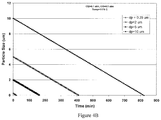
- FIG. 8 illustrates the decrease in ZrO 2 particle size versus time, for different initial particle sizes, when soot is treated according to one embodiment at 727° C. with CCl 4 .
- One embodiment of the disclosure relates to a method of cleaning of silica-based soot or an article made of silica-based soot. According to this embodiment the method comprises the step of:
- silica-based soot or the article made of silica-based soot with at least one of the following compounds:
- the treatment by CCl 4 is performed for at least 2 min, more preferably for at lest 5 min, more preferably at lest 10 or 20 min, for example for at least 50 min.
- the treatment with the CO and Cl 2 mixture is performed for at least 5 min, preferably at least 20 min or 30 min, more preferably for at least 100 min.
- the ratio of CO to Cl 2 is between 0.5 and 2, more preferably between 0.75 and 1.5.
- FIG. 1 illustrates the decrease in Cr 2 O 3 particle size at three different concentrations of chlorine (Cl 2 was utilized alone, without CO), at the treatment temperature of 1100° C.
- the initial size of the Cr 2 O 3 particles was 0.25 ⁇ m.
- the Cl 2 concentration in the carrier gas was 5%, 10%, and 25% by volume respectively, which is higher than the typically used concentrations of Cl 2 when treating optical preforms.
- FIG. 1 illustrates that even when the initial Cr 2 O 3 particle sizes are relatively small (about 0.25 ⁇ m) the amount of time needed to eliminate the Cr 2 O 3 particles is relatively long even when high concentration of chlorine (about 10%) is used at high temperatures (about 1100° C.).
- FIG. 1 shows that at a Cl 2 concentration of 10%, the required treatment time to eliminate 0.25 ⁇ m Cr 2 O 3 particles is approximately 5 hrs (300 min). Even when the Cl 2 concentration is 25%, the required treatment time to eliminate 0.25 ⁇ m Cr 2 O 3 particles is approximately 2 hrs.
- FIG. 2 illustrates that the soot treatment time is dramatically decreased when a mixture of carbon monoxide and chlorine is utilized.
- FIG. 2 illustrates that the addition of 10% CO to 10% of Cl 2 in a carrier gas results in a ten-fold decrease in treatment time (from about 300 min, as shown in FIG. 1 , to about 30 min).
- the initial particle sizes of Cr 2 O 3 particles of FIG. 2 is identical to those of FIG. 1 (about 0.25 ⁇ m), and the treatment temperature is also the same (about 1100° C.).
- FIG. 2 illustrates that the shortest treatment time is achieved when the ratio of chlorine to carbon monoxide is 1:1.
- the particle size decrease rates at different temperatures, when silica soot is treated with a CO and Cl 2 mixture at 10% concentrations of each CO and Cl 2 is shown in FIG. 3 .
- the treatment (particle processing) temperatures is 900° C.
- the treatment time for the elimination of metal oxide particles such as Cr 2 O 3 when the initial particle sizes are about 0.25 ⁇ m, is about 140 min-150 min.
- the treatment temperature is 1100° C.
- the treatment time for elimination of metal oxide particles, such as Cr 2 O 3 is about 30-35 min (when the initial particle sizes are 0.25 ⁇ m).
- the reaction(s) in order to decrease the silica soot process treatment time when using the CO/Cl 2 mixture, it is advantageous to have the reaction(s) at temperatures greater than 900° C., more preferably greater than 1000° C. and even more preferably greater than 1100° C. (e.g., 1125° C., 1150° C., 1175° C., 1190° C.).
- temperatures above 1200° C. there can be significant etching of the silica soot by the CO/Cl 2 mixture and some sintering of the soot preform. Consequently, the maximum temperature is preferably not higher than 1200° C.
- the rate of particle size decrease for different initial particle size is illustrated in FIG. 4A .
- the treatment time needs to be chosen appropriately, based on the maximum particle size. For example, if one knows that silica soot contains Cr 2 O 3 particles that are up to 2 ⁇ m in diameter, (if the treatment temperature is 1100° C.) the processing time with the CO/Cl 2 mixture (10%/10% vol % in carrier gas) should be about 4 to 4.5 hrs.
- the processing time with the CO/Cl 2 mixture should be about 10-12 hrs (if the treatment temperature is 1100° C.). However, these processing times can be decreased if the temperature during CO/Cl 2 is increased to 1150° C.-1175° C. It is noted for that when the concentration of Cl 2 is increased (e.g., to about 15%, 20%, or 25%) with the corresponding increase in CO concentration, such that the ratio of CO:Cl 2 is between 0.5 and 2 (preferably, between 0.75, and more preferably 1) the treatment time for soot containing larger Cr 2 O 3 particles (e.g., 1-10 ⁇ m diameter, or larger) may be decreased even further.
- FIG. 4B illustrates the rate of particle size decrease for different initial particle size when the treatment temperature is 1175° C. (same concentrations (10 vol % of Cl 2 and 10 vol % of CO, in carrier gas).
- FIG. 4C illustrates the rate of particle size decrease for different initial particle size when the treatment temperature is 1175° C., but the concentrations Cl 2 and CO (in carrier gas) were each increased to 30 vol % (0.3 atm).
- the diffusion reaction time is a function of soot layer thickness L (in cm) and diffusion rate of the CO/Cl 2 mixture D eff (in cm 2 /sec) through the porous soot preform, or loose silica soot and is given as:
- parameter x C12 is given as x C12 : (y C12 )/(y C12 +y CO ), where y C12 and y CO are the partial pressure of chlorine and carbon monoxide respectively.
- the treatment time with the CO/Cl 2 mixture is greater than 5 min, for example 10 min to 100 hrs.
- the treatment time with the CO/Cl 2 mixture is 10 min to 15 or 20 hrs, for example 20 min, 30 min, 50 min, 1 hr, 1.5 hrs, 2 hrs, 3 hrs, 4 hrs, 6 hrs, 8 hrs, 10 hrs, 12 hrs., or some period of time there between.
- ZrO 2 particles are present in the soot, chemical treatment of soot with chlorine and CO mixture is not very effective. That is, although some ZrO 2 particles will be eliminated or minimized in size to the appropriate level during the treatment with the CO/Cl 2 mixture as described above, not all of the ZrO 2 particles will be decreased in size to the appropriate levels (0.1 ⁇ m, or smaller).
- the treatment of ZrO 2 particles with CCl 4 is very effective.
- CCl 4 treatment of silica soot for example of optical preforms containing porous silica soot is most effective in temperature range between 600° C.-850° C. Below 600° C., the reaction of CCl 4 is slow and above 850° C., CCl 4 can decompose and react with silica muffle and silica soot particles, as well as form elemental carbon.
- FIGS. 5-8 The rate of ZrO 2 particle size decrease at different CCl 4 concentrations, temperatures and for the specified initial ZrO 2 particle sizes is shown in FIGS. 5-8 . More specifically, FIGS. 5 and 6 illustrate that the decrease in ZrO 2 particle size occurs faster with higher concentrations of CCl 4 and at higher temperatures. For example, as shown in FIG. 5 , at a treatment temperature of 527° C., when the concentration CCl 4 was increased from 10% to 30% (0.1 atm to 0.3 atm) the complete elimination of ZrO 2 particles up to 1 ⁇ m in cross-section occurred in 62 min instead of 185 min. As shown in FIG.
- the processing time with the CCl 4 (assuming concentration of 0.1 atm) is about 45-50 min. If the ZrO 2 particles have a maximum diameter of 10 ⁇ m, the processing time with CCl 4 (assuming a concentration of 10%) is about 90-95 min. However, these processing times can be decreased if the concentration of CCl 4 is increased.
- silica soot doped with 1 wt % Cr 2 O 3 (average particle size of 2 ⁇ m), 1 wt % of Fe 2 O 3 (average particle size of 3 ⁇ m), and 1 wt % of ZrO 2 (average particle size of 5 ⁇ m) was pressed into a silica soot pellet with a density of 0.90 g/cm 3 and treated with a mixture of 5% CCl 4 in He (this embodiment utilized He as carrier gas) at 800° C. for 45 minutes.
- the treatment time should be greater than the diffusion time and reaction time, as shown below, i.e.: t treatment,ZrO2 (in min)> t diffusion +t reaction,ZrO2 [4] where the diffusion reaction time is a function of soot layer thickness L (in cm) and diffusion rate of the CCl 4 D eff,CCl4 (in cm 2 /sec) through the porous soot preform and is given as:
- the treatment time with the CCl 4 is greater than 2 min, for example 5 minutes to 100 hours.
- the treatment time with the CO/Cl 2 mixture is 10 min to 15, for example 20 min, 30 min, 50 min, 1 hr, 1.5 hrs, 2 hrs, 3 hrs, 4 hrs, 6 hrs, 8 hrs, 10 hrs, 12 hrs, or some period of time there between.
- Tables 1 and 2 show the total treatment times for the 6 cm thick silica based soot layers with maximum initial Cr 2 O 3 particles of different sizes, when treated with different combinations of chlorine and carbon monoxide mixtures at various treatment temperatures, such that the size of the Cr 2 O 3 particles was reduced to zero (i.e., no Cr 2 O 3 ).
- the diffusion times are much smaller than the reaction times, and the total treatment time is almost equal to the reaction time.
- Examples 55-90 of Table 2 show the total treatment times (resulted in reduction of ZrO 2 particles sizes to zero) for the 6 cm thick soot layers with initial ZrO 2 particles of different sizes, when treated with different concentrations of carbon tetrachloride at various treatment temperatures.
- Many soot bodies articles include both of these impurities and therefore would need treatment with CCl 4 (between 600° C. and 850° C.) and CO+Cl 2 mixture (between 900° C. and 1200° C.).
- CCl 4 between 600° C. and 850° C.
- CO+Cl 2 mixture between 900° C. and 1200° C.
- the in some applications total elimination of Cr 2 O 3 and ZrO 2 particles may not be necessary, as long as their diameter is decreased below a critical size. For example, in fiber preforms, one may decide to simply decrease the particle sizes to a maximum size of about 0.2 ⁇ m or less, or to 0.1 ⁇ m or less, so that they are unlikely to become a
Landscapes
- Chemical & Material Sciences (AREA)
- Engineering & Computer Science (AREA)
- Manufacturing & Machinery (AREA)
- Organic Chemistry (AREA)
- Materials Engineering (AREA)
- Life Sciences & Earth Sciences (AREA)
- Chemical Kinetics & Catalysis (AREA)
- General Life Sciences & Earth Sciences (AREA)
- Geochemistry & Mineralogy (AREA)
- Thermal Sciences (AREA)
- Physics & Mathematics (AREA)
- General Chemical & Material Sciences (AREA)
- Dispersion Chemistry (AREA)
- Glass Melting And Manufacturing (AREA)
- Manufacture, Treatment Of Glass Fibers (AREA)
- Silicon Compounds (AREA)
- Treating Waste Gases (AREA)
Abstract
Description
-
- (i) a mixture of CO and Cl2 in a carrier gas such that the total concentration of CO and Cl2 in the mixture is greater than 10%, by volume and the ratio of CO:Cl2 is between 0.25 and 5;
- (ii) CCl4 in a carrier gas, such that concentration CCl4 is greater than 1% by volume.
-
- treating said silica-based soot or said article made of silica-based soot with
- (i) CCl4 in a carrier gas, such that concentration CCl4 is greater than 1%, by volume; and
- (ii) a mixture of CO and Cl2 in a carrier gas such that the total concentration of CO and Cl2 in said mixture is greater than 10%, by volume and the ratio of CO:Cl2 is between 0.25 and 5;
- wherein said treatment with CCl4 is performed either before, or after the treatment with the mixture of CO and Cl2.
-
- (i) a mixture of CO and Cl in a carrier gas such that the total concentration of CO and Cl2 in said mixture is greater than 10%, by volume and the ratio of CO:Cl2 is between 0.25 and 5;
- (ii) CCl4 in a carrier gas, such that concentration CCl4 is greater than 1% by volume, in carrier gas. For example, CCl4 concentration in carrier gas may be 1.5%, 2 vol %, 3 vol %, 5 vol %, 10 vol %, 15 vol %, 20 vol %, 25 vol %, 30 vol %, 35 vol %, or 40 vol %.) Preferably, the treatment by CCl4 is performed at temperatures between 600° C., and 850° C. Preferably, the treatment with the CO and Cl mixture is performed at temperatures between 900° C. and 1200° C., more preferably, between 1000° C. and 1200° C., and even more preferably between 1100° C. and 1200° C. (e.g., 1050° C., 1075° C., 1100° C., 1125° C., 1150° C., 1175° C., or 1190° C.). The carrier gas may be, for example, He, Ar, N2, or the combination thereof.
-
- (i) CCl4 in a carrier gas, such that concentration CCl4 is greater than 1%, by volume; and
- (ii) a mixture of CO and Cl2 in a carrier gas such that the total concentration of CO and Cl2 in said mixture is greater than 10%, by volume and the ratio of CO:Cl2 is between 0.25 and 5;
- wherein the treatment with CCl4 is performed either before, or after the treatment with the mixture of CO and Cl2. Preferably, the treatment by CCl4 is performed at temperatures between 600° C., and 850° C., and the treatment with the mixture of CO and Cl2 is performed at temperatures between 900° C. and 1200° C. (e.g., 950° C., 975° C., 1000° C., 1025° C., 1050° C., 1075° C., 1100° C., 1125° C., 1150° C., 1175° C., 1190° C.). Preferably the treatment with CCl4 is performed for at least 2 min, and the treatment with a mixture of CO and Cl2 is performed for at least 5 min.
t treatment,Cr203(in min)>t diffusion +t reaction,Cr203
H 2 O+CCl 4→2HCl+COCl2 (drying)
2H 2 O+CCl 4→4HCl+CO 2 (drying)
SiO 2 +CCl 4→COCl2+SiOxCly (doping)
CCl 4 →:CCl 2+2·Cl→C 2 Cl 4 +Cl 2 (decomposition and recombination)
SiO 2 +CCl 4→SiCl4 +CO 2 (etching)
CCl4→C+4·Cl (carbonization)
t treatment,ZrO2(in min)>t diffusion +t reaction,ZrO2 [4]
where the diffusion reaction time is a function of soot layer thickness L (in cm) and diffusion rate of the CCl4 Deff,CCl4 (in cm2/sec) through the porous soot preform and is given as:
and the reaction time is given as:
| TABLE 1 |
| Treatment of Cr2O3 containing soot with CO/Cl2mixture |
| Soot | Soot | Initial | Total | ||||||||
| Treatment | Layer | Layer | Cr2O3 | Chlorine | Carbon | Diffusion | Reaction | Treatment | |||
| Example | Temperature | Thickness | Density | Diffusivity, | Particle | concent. | monoxide | Time | Time | Time | |
| # | [C.] | (cm) | (g/cm3) | cm2/sec | Size (μm) | (atm) | (atm) | xCl2 | (min) | (min) | (min) |
| 1 | 900 | 6.00 | 0.60 | 1.01 | 0.25 | 0.1 | 0 | 1.00 | 0.59 | 1354.87 | 13 |
| 55 | |||||||||||
| 2 | 900 | 6.00 | 0.60 | 1.01 | 0.25 | 0.1 | 0.05 | 0.67 | 0.59 | 168.51 | 169 |
| 3 | 900 | 6.00 | 0.60 | 1.01 | 0.25 | 0.1 | 0.1 | 0.50 | 0.59 | 142.62 | 143 |
| 4 | 900 | 6.00 | 0.60 | 1.01 | 0.25 | 0.1 | 0.2 | 0.33 | 0.59 | 151.22 | 152 |
| 5 | 900 | 6.00 | 0.80 | 0.64 | 0.25 | 0.1 | 0 | 1 | 0.94 | 1354.87 | 1356 |
| 6 | 900 | 6.00 | 0.60 | 1.01 | 0.25 | 0.2 | 0 | 1 | 0.59 | 677.43 | 678 |
| 7 | 900 | 6.00 | 0.60 | 1.01 | 0.25 | 0.2 | 0.1 | 0.67 | 0.59 | 84.25 | 85 |
| 8 | 900 | 6.00 | 0.60 | 1.01 | 0.25 | 0.2 | 0.2 | 0.5 | 0.59 | 71.31 | 72 |
| 9 | 900 | 6.00 | 0.60 | 1.01 | 0.25 | 0.2 | 0.4 | 0.33 | 0.59 | 75.61 | 76 |
| 10 | 900 | 6.00 | 0.60 | 1.01 | 1 | 0.1 | 0.1 | 0.50 | 0.59 | 570.47 | 571 |
| 11 | 900 | 6.00 | 0.60 | 1.01 | 1 | 0.2 | 0.2 | 0.5 | 0.59 | 285.23 | 286 |
| 12 | 900 | 6.00 | 0.60 | 1.01 | 1 | 0.4 | 0.4 | 0.5 | 0.59 | 142.62 | 143 |
| 13 | 900 | 6.00 | 0.60 | 1.01 | 5 | 0.1 | 0.1 | 0.5 | 0.59 | 2852.35 | 2853 |
| 14 | 900 | 6.00 | 0.60 | 1.01 | 5 | 0.2 | 0.2 | 0.5 | 0.59 | 1426.17 | 1427 |
| 15 | 900 | 6.00 | 0.60 | 1.01 | 5 | 0.4 | 0.4 | 0.5 | 0.59 | 713.09 | 714 |
| 16 | 900 | 6.00 | 0.60 | 1.01 | 10 | 0.1 | 0.1 | 0.5 | 0.59 | 5704.70 | 5705 |
| 17 | 900 | 6.00 | 0.60 | 1.01 | 10 | 0.2 | 0.2 | 0.5 | 0.59 | 2852.35 | 2853 |
| 18 | 900 | 6.00 | 0.60 | 1.01 | 10 | 0.4 | 0.4 | 0.5 | 0.59 | 1426.17 | 1427 |
| 19 | 1000 | 6.00 | 0.60 | 1.09 | 0.25 | 0.1 | 0 | 1.00 | 0.55 | 606.58 | 607 |
| 20 | 1000 | 6.00 | 0.60 | 1.09 | 0.25 | 0.1 | 0.05 | 0.67 | 0.55 | 75.44 | 76 |
| 21 | 1000 | 6.00 | 0.60 | 1.09 | 0.25 | 0.1 | 0.1 | 0.50 | 0.55 | 63.85 | 64 |
| 22 | 1000 | 6.00 | 0.60 | 1.09 | 0.25 | 0.1 | 0.2 | 0.33 | 0.55 | 67.70 | 68 |
| 23 | 1000 | 6.00 | 0.80 | 0.68 | 0.25 | 0.1 | 0 | 1 | 0.88 | 606.58 | 607 |
| 24 | 1000 | 6.00 | 0.60 | 1.09 | 0.25 | 0.2 | 0 | 1 | 0.55 | 303.29 | 304 |
| 25 | 1000 | 6.00 | 0.60 | 1.09 | 0.25 | 0.2 | 0.1 | 0.67 | 0.55 | 37.72 | 38 |
| 26 | 1000 | 6.00 | 0.60 | 1.09 | 0.25 | 0.2 | 0.2 | 0.5 | 0.55 | 31.93 | 32 |
| 27 | 1000 | 6.00 | 0.60 | 1.09 | 0.25 | 0.2 | 0.4 | 0.33 | 0.55 | 33.85 | 34 |
| 28 | 1000 | 6.00 | 0.60 | 1.09 | 1 | 0.1 | 0.1 | 0.50 | 0.55 | 255.40 | 256 |
| 29 | 1000 | 6.00 | 0.60 | 1.09 | 1 | 0.2 | 0.2 | 0.5 | 0.55 | 127.70 | 128 |
| 30 | 1000 | 6.00 | 0.60 | 1.09 | 1 | 0.4 | 0.4 | 0.5 | 0.55 | 63.85 | 64 |
| 31 | 1000 | 6.00 | 0.60 | 1.09 | 5 | 0.1 | 0.1 | 0.5 | 0.55 | 1277.00 | 1278 |
| 32 | 1000 | 6.00 | 0.60 | 1.09 | 5 | 0.2 | 0.2 | 0.5 | 0.55 | 638.50 | 639 |
| 33 | 1000 | 6.00 | 0.60 | 1.09 | 5 | 0.4 | 0.4 | 0.5 | 0.55 | 319.25 | 320 |
| 34 | 1000 | 6.00 | 0.60 | 1.09 | 10 | 0.1 | 0.1 | 0.5 | 0.55 | 2554.00 | 2555 |
| 35 | 1000 | 6.00 | 0.60 | 1.09 | 10 | 0.2 | 0.2 | 0.5 | 0.55 | 1277.00 | 1278 |
| 36 | 1000 | 6.00 | 0.60 | 1.09 | 10 | 0.4 | 0.4 | 0.5 | 0.55 | 638.50 | 639 |
| 37 | 1150 | 6.00 | 0.60 | 1.19 | 0.25 | 0.1 | 0 | 1.00 | 0.50 | 224.57 | 225 |
| 38 | 1150 | 6.00 | 0.60 | 1.19 | 0.25 | 0.1 | 0.05 | 0.67 | 0.50 | 27.93 | 28 |
| 39 | 1150 | 6.00 | 0.60 | 1.19 | 0.25 | 0.1 | 0.1 | 0.50 | 0.50 | 23.64 | 24 |
| 40 | 1150 | 6.00 | 0.60 | 1.19 | 0.25 | 0.1 | 0.2 | 0.33 | 0.50 | 25.06 | 26 |
| 41 | 1150 | 6.00 | 0.80 | 0.75 | 0.25 | 0.1 | 0 | 1 | 0.80 | 224.57 | 225 |
| 42 | 1150 | 6.00 | 0.60 | 1.19 | 0.25 | 0.2 | 0 | 1 | 0.50 | 112.28 | 113 |
| 43 | 1150 | 6.00 | 0.60 | 1.19 | 0.25 | 0.2 | 0.1 | 0.67 | 0.50 | 13.96 | 14 |
| 44 | 1150 | 6.00 | 0.60 | 1.19 | 0.25 | 0.2 | 0.2 | 0.5 | 0.50 | 11.82 | 12 |
| 45 | 1150 | 6.00 | 0.60 | 1.19 | 0.25 | 0.2 | 0.4 | 0.33 | 0.50 | 12.53 | 13 |
| 46 | 1150 | 6.00 | 0.60 | 1.19 | 1 | 0.1 | 0.1 | 0.50 | 0.50 | 94.55 | 95 |
| 47 | 1150 | 6.00 | 0.60 | 1.19 | 1 | 0.2 | 0.2 | 0.5 | 0.50 | 47.28 | 48 |
| 48 | 1150 | 6.00 | 0.60 | 1.19 | 1 | 0.4 | 0.4 | 0.5 | 0.50 | 23.64 | 24 |
| 49 | 1150 | 6.00 | 0.60 | 1.19 | 5 | 0.1 | 0.1 | 0.5 | 0.50 | 472.77 | 473 |
| 50 | 1150 | 6.00 | 0.60 | 1.19 | 5 | 0.2 | 0.2 | 0.5 | 0.50 | 236.38 | 237 |
| 51 | 1150 | 6.00 | 0.60 | 1.19 | 5 | 0.4 | 0.4 | 0.5 | 0.50 | 118.19 | 119 |
| 52 | 1150 | 6.00 | 0.60 | 1.19 | 10 | 0.1 | 0.1 | 0.5 | 0.50 | 945.54 | 946 |
| 53 | 1150 | 6.00 | 0.60 | 1.19 | 10 | 0.2 | 0.2 | 0.5 | 0.50 | 472.77 | 473 |
| 54 | 1150 | 6.00 | 0.60 | 1.19 | 10 | 0.4 | 0.4 | 0.5 | 0.50 | 236.38 | 237 |
| TABLE 2 |
| Treatment of ZrO2 containing soot with CCl4/Reaction of CCl4 with ZrO2 |
| Soot | Soot | Initial | Total | ||||||
| Treatment | Layer | Layer | ZrO2 | CCl4 | Diffusion | Reaction | Treatment | ||
| Example | Temperature | Thickness | Density | Diffusivity, | Particle | conc. | Time | Time | Time |
| # | [C.] | (cm) | (g/cm3) | cm2/sec | Size (um) | (atm) | (min) | (min) | (min) |
| 55 | 600 | 6.00 | 0.60 | 0.61 | 1 | 0.1 | 0.98 | 53.72 | 54.70 |
| 56 | 600 | 6.00 | 0.80 | 0.42 | 1 | 0.1 | 1.43 | 53.72 | 55.14 |
| 57 | 600 | 6.00 | 0.60 | 0.61 | 1 | 0.2 | 0.98 | 26.86 | 27.84 |
| 58 | 600 | 6.00 | 0.60 | 0.61 | 2 | 0.1 | 0.98 | 107.43 | 108.42 |
| 59 | 600 | 6.00 | 0.60 | 0.61 | 2 | 0.2 | 0.98 | 53.72 | 54.70 |
| 60 | 600 | 6.00 | 0.60 | 0.61 | 2 | 0.4 | 0.98 | 26.86 | 27.84 |
| 61 | 600 | 6.00 | 0.60 | 0.61 | 5 | 0.1 | 0.98 | 268.58 | 269.57 |
| 62 | 600 | 6.00 | 0.60 | 0.61 | 5 | 0.2 | 0.98 | 134.29 | 135.27 |
| 63 | 600 | 6.00 | 0.60 | 0.61 | 5 | 0.4 | 0.98 | 67.15 | 68.13 |
| 64 | 600 | 6.00 | 0.60 | 0.61 | 10 | 0.1 | 0.98 | 537.16 | 538.15 |
| 65 | 600 | 6.00 | 0.60 | 0.61 | 10 | 0.2 | 0.98 | 268.58 | 269.57 |
| 66 | 600 | 6.00 | 0.60 | 0.61 | 10 | 0.4 | 0.98 | 134.29 | 135.27 |
| 67 | 700 | 6.00 | 0.60 | 0.69 | 1 | 0.1 | 0.87 | 13.08 | 13.95 |
| 68 | 700 | 6.00 | 0.80 | 0.469 | 1 | 0.1 | 1.28 | 13.08 | 14.36 |
| 69 | 700 | 6.00 | 0.60 | 0.69 | 1 | 0.2 | 0.87 | 6.54 | 7.41 |
| 70 | 700 | 6.00 | 0.60 | 0.69 | 2 | 0.1 | 0.87 | 26.16 | 27.03 |
| 71 | 700 | 6.00 | 0.60 | 0.69 | 2 | 0.2 | 0.87 | 13.08 | 13.95 |
| 72 | 700 | 6.00 | 0.60 | 0.69 | 2 | 0.4 | 0.87 | 6.54 | 7.41 |
| 73 | 700 | 6.00 | 0.60 | 0.69 | 5 | 0.1 | 0.87 | 65.39 | 66.26 |
| 74 | 700 | 6.00 | 0.60 | 0.69 | 5 | 0.2 | 0.87 | 32.70 | 33.57 |
| 75 | 700 | 6.00 | 0.60 | 0.69 | 5 | 0.4 | 0.87 | 16.35 | 17.22 |
| 76 | 700 | 6.00 | 0.60 | 0.69 | 10 | 0.1 | 0.87 | 130.79 | 131.66 |
| 77 | 700 | 6.00 | 0.60 | 0.69 | 10 | 0.2 | 0.87 | 65.39 | 66.26 |
| 78 | 700 | 6.00 | 0.60 | 0.69 | 10 | 0.4 | 0.87 | 32.70 | 33.57 |
| 79 | 850 | 6.00 | 0.60 | 0.805 | 1 | 0.1 | 0.75 | 2.52 | 3.26 |
| 80 | 850 | 6.00 | 0.80 | 0.53 | 1 | 0.1 | 1.13 | 2.52 | 3.65 |
| 81 | 850 | 6.00 | 0.60 | 0.805 | 1 | 0.2 | 0.75 | 1.26 | 2.00 |
| 82 | 850 | 6.00 | 0.60 | 0.805 | 2 | 0.1 | 0.75 | 5.04 | 5.78 |
| 83 | 850 | 6.00 | 0.60 | 0.805 | 2 | 0.2 | 0.75 | 2.52 | 3.26 |
| 84 | 850 | 6.00 | 0.60 | 0.805 | 2 | 0.4 | 0.75 | 1.26 | 2.00 |
| 85 | 850 | 6.00 | 0.60 | 0.805 | 5 | 0.1 | 0.75 | 12.59 | 13.34 |
| 86 | 850 | 6.00 | 0.60 | 0.805 | 5 | 0.2 | 0.75 | 6.30 | 7.04 |
| 87 | 850 | 6.00 | 0.60 | 0.805 | 5 | 0.4 | 0.75 | 3.15 | 3.89 |
| 88 | 850 | 6.00 | 0.60 | 0.805 | 10 | 0.1 | 0.75 | 25.19 | 25.93 |
| 89 | 850 | 6.00 | 0.60 | 0.805 | 10 | 0.2 | 0.75 | 12.59 | 13.34 |
| 90 | 850 | 6.00 | 0.60 | 0.805 | 10 | 0.4 | 0.75 | 6.30 | 7.04 |
Claims (6)
t treatment,ZrO2(in min)>t diffusion,ZrO2 +t reaction,ZrO2,
t treatment,ZrO2(in min)>t diffusion,ZrO2 +t reaction,ZrO2,
Priority Applications (1)
| Application Number | Priority Date | Filing Date | Title |
|---|---|---|---|
| US13/206,004 US10829403B2 (en) | 2010-08-12 | 2011-08-09 | Treatment of silica based soot or an article made of silica based soot |
Applications Claiming Priority (2)
| Application Number | Priority Date | Filing Date | Title |
|---|---|---|---|
| US37300510P | 2010-08-12 | 2010-08-12 | |
| US13/206,004 US10829403B2 (en) | 2010-08-12 | 2011-08-09 | Treatment of silica based soot or an article made of silica based soot |
Publications (2)
| Publication Number | Publication Date |
|---|---|
| US20120202674A1 US20120202674A1 (en) | 2012-08-09 |
| US10829403B2 true US10829403B2 (en) | 2020-11-10 |
Family
ID=44533136
Family Applications (1)
| Application Number | Title | Priority Date | Filing Date |
|---|---|---|---|
| US13/206,004 Expired - Fee Related US10829403B2 (en) | 2010-08-12 | 2011-08-09 | Treatment of silica based soot or an article made of silica based soot |
Country Status (8)
| Country | Link |
|---|---|
| US (1) | US10829403B2 (en) |
| EP (1) | EP2603467B1 (en) |
| JP (1) | JP5886288B2 (en) |
| KR (1) | KR20130097752A (en) |
| CN (1) | CN103068754B (en) |
| BR (1) | BR112013001913A2 (en) |
| RU (1) | RU2013110513A (en) |
| WO (1) | WO2012021317A1 (en) |
Families Citing this family (4)
| Publication number | Priority date | Publication date | Assignee | Title |
|---|---|---|---|---|
| DE102013110177A1 (en) * | 2013-09-16 | 2015-03-19 | Heraeus Quarzglas Gmbh & Co. Kg | Process for producing iron-doped silica glass |
| US10053386B2 (en) | 2014-04-25 | 2018-08-21 | Corning Incorporated | Method for forming optical fiber and preforms |
| EP3516435B1 (en) * | 2016-09-21 | 2022-04-27 | Corning Incorporated | Optical fibers having a varying clad index and methods of forming same |
| CZ309251B6 (en) * | 2020-10-23 | 2022-06-22 | Univerzita Karlova | Method of cleaning and non-destructive monitoring of the process of cleaning quartz ampoules for semiconductor technologies |
Citations (24)
| Publication number | Priority date | Publication date | Assignee | Title |
|---|---|---|---|---|
| US4263031A (en) * | 1978-06-12 | 1981-04-21 | Corning Glass Works | Method of producing glass optical filaments |
| JPS63190734A (en) | 1987-01-30 | 1988-08-08 | Sumitomo Electric Ind Ltd | Method for manufacturing base material for optical fiber |
| JPS63215526A (en) | 1987-03-02 | 1988-09-08 | Hitachi Chem Co Ltd | Production of silica glass |
| US4775401A (en) * | 1987-06-18 | 1988-10-04 | American Telephone And Telegraph Company, At&T Bell Laboratories | Method of producing an optical fiber |
| JPH01145346A (en) | 1987-12-02 | 1989-06-07 | Sumitomo Electric Ind Ltd | Method for manufacturing base material for optical fiber |
| JPH01164740A (en) | 1987-12-22 | 1989-06-28 | Sumitomo Electric Ind Ltd | Production of optical fiber preform |
| US4854956A (en) * | 1986-07-14 | 1989-08-08 | U.S. Philips Corp. | Method of manufacturing optical fibres having a core and a cladding of glass applying the rod-in-tube technique |
| CN1042322A (en) | 1988-10-29 | 1990-05-23 | 上海电器压铸厂 | The injection device of cold horizontal type die-casting facility |
| US4969941A (en) * | 1987-02-16 | 1990-11-13 | Sumitomo Electric Industries, Ltd. | Furnace for heating glass preform for optical fiber and method for producing glass preform |
| US5157747A (en) * | 1991-01-18 | 1992-10-20 | At&T Bell Laboratories | Photorefractive optical fiber |
| JPH0532429A (en) | 1991-07-30 | 1993-02-09 | Furukawa Electric Co Ltd:The | Purification of porous parent material for optical fiber |
| US5320659A (en) * | 1988-12-21 | 1994-06-14 | Sumitomo Electric Industries, Ltd. | Method of forming a carbon coated optical fiber with co-current reactant flow |
| US5356447A (en) | 1993-03-11 | 1994-10-18 | At&T Bell Laboratories | Manufacture of high proof-test optical fiber using sol-gel |
| JPH07157326A (en) | 1993-12-02 | 1995-06-20 | Furukawa Electric Co Ltd:The | Manufacturing method of optical fiber preform |
| US20020023466A1 (en) | 1998-07-02 | 2002-02-28 | Mary Louise Mandich | Process for fabricating optical fiber |
| US20020108404A1 (en) | 2000-09-27 | 2002-08-15 | Burke Gerald E. | Drying agent and improved process for drying soot preforms |
| US20040107735A1 (en) * | 2002-12-04 | 2004-06-10 | Fitel Usa Corp. | Rod-in-tube optical fiber preform and method |
| US20040139765A1 (en) * | 2003-01-16 | 2004-07-22 | Sumitomo Electric Industries, Ltd. | Method of producing optical fiber preform, and optical fiber preform and optical fiber produced with the method |
| US6799442B1 (en) | 1999-03-08 | 2004-10-05 | Novara Technology S.R.L. | Sol-gel process for the production of manufactures containing an incompressible insert and manufactures thereby obtained |
| US6813908B2 (en) * | 2000-12-22 | 2004-11-09 | Corning Incorporated | Treating an optical fiber preform with carbon monoxide |
| US20050044886A1 (en) * | 2003-09-02 | 2005-03-03 | Okasinski Matthew Joseph | Process for production of isotopes |
| US20060183623A1 (en) * | 2003-12-17 | 2006-08-17 | Asahi Glass Company Limited | Synthetic quartz glass for optical member and its production method |
| US20090272716A1 (en) | 2008-04-30 | 2009-11-05 | Dana Craig Bookbinder | Process for Preparing an Optical Preform |
| US20100071421A1 (en) | 2008-09-23 | 2010-03-25 | Steven Bruce Dawes | Soot Radial Pressing For Optical Fiber Overcladding |
-
2011
- 2011-08-01 WO PCT/US2011/046101 patent/WO2012021317A1/en not_active Ceased
- 2011-08-01 JP JP2013524100A patent/JP5886288B2/en not_active Expired - Fee Related
- 2011-08-01 EP EP11746080.8A patent/EP2603467B1/en not_active Not-in-force
- 2011-08-01 BR BR112013001913A patent/BR112013001913A2/en not_active Application Discontinuation
- 2011-08-01 RU RU2013110513/03A patent/RU2013110513A/en not_active Application Discontinuation
- 2011-08-01 KR KR1020137006190A patent/KR20130097752A/en not_active Withdrawn
- 2011-08-01 CN CN201180038877.4A patent/CN103068754B/en not_active Expired - Fee Related
- 2011-08-09 US US13/206,004 patent/US10829403B2/en not_active Expired - Fee Related
Patent Citations (24)
| Publication number | Priority date | Publication date | Assignee | Title |
|---|---|---|---|---|
| US4263031A (en) * | 1978-06-12 | 1981-04-21 | Corning Glass Works | Method of producing glass optical filaments |
| US4854956A (en) * | 1986-07-14 | 1989-08-08 | U.S. Philips Corp. | Method of manufacturing optical fibres having a core and a cladding of glass applying the rod-in-tube technique |
| JPS63190734A (en) | 1987-01-30 | 1988-08-08 | Sumitomo Electric Ind Ltd | Method for manufacturing base material for optical fiber |
| US4969941A (en) * | 1987-02-16 | 1990-11-13 | Sumitomo Electric Industries, Ltd. | Furnace for heating glass preform for optical fiber and method for producing glass preform |
| JPS63215526A (en) | 1987-03-02 | 1988-09-08 | Hitachi Chem Co Ltd | Production of silica glass |
| US4775401A (en) * | 1987-06-18 | 1988-10-04 | American Telephone And Telegraph Company, At&T Bell Laboratories | Method of producing an optical fiber |
| JPH01145346A (en) | 1987-12-02 | 1989-06-07 | Sumitomo Electric Ind Ltd | Method for manufacturing base material for optical fiber |
| JPH01164740A (en) | 1987-12-22 | 1989-06-28 | Sumitomo Electric Ind Ltd | Production of optical fiber preform |
| CN1042322A (en) | 1988-10-29 | 1990-05-23 | 上海电器压铸厂 | The injection device of cold horizontal type die-casting facility |
| US5320659A (en) * | 1988-12-21 | 1994-06-14 | Sumitomo Electric Industries, Ltd. | Method of forming a carbon coated optical fiber with co-current reactant flow |
| US5157747A (en) * | 1991-01-18 | 1992-10-20 | At&T Bell Laboratories | Photorefractive optical fiber |
| JPH0532429A (en) | 1991-07-30 | 1993-02-09 | Furukawa Electric Co Ltd:The | Purification of porous parent material for optical fiber |
| US5356447A (en) | 1993-03-11 | 1994-10-18 | At&T Bell Laboratories | Manufacture of high proof-test optical fiber using sol-gel |
| JPH07157326A (en) | 1993-12-02 | 1995-06-20 | Furukawa Electric Co Ltd:The | Manufacturing method of optical fiber preform |
| US20020023466A1 (en) | 1998-07-02 | 2002-02-28 | Mary Louise Mandich | Process for fabricating optical fiber |
| US6799442B1 (en) | 1999-03-08 | 2004-10-05 | Novara Technology S.R.L. | Sol-gel process for the production of manufactures containing an incompressible insert and manufactures thereby obtained |
| US20020108404A1 (en) | 2000-09-27 | 2002-08-15 | Burke Gerald E. | Drying agent and improved process for drying soot preforms |
| US6813908B2 (en) * | 2000-12-22 | 2004-11-09 | Corning Incorporated | Treating an optical fiber preform with carbon monoxide |
| US20040107735A1 (en) * | 2002-12-04 | 2004-06-10 | Fitel Usa Corp. | Rod-in-tube optical fiber preform and method |
| US20040139765A1 (en) * | 2003-01-16 | 2004-07-22 | Sumitomo Electric Industries, Ltd. | Method of producing optical fiber preform, and optical fiber preform and optical fiber produced with the method |
| US20050044886A1 (en) * | 2003-09-02 | 2005-03-03 | Okasinski Matthew Joseph | Process for production of isotopes |
| US20060183623A1 (en) * | 2003-12-17 | 2006-08-17 | Asahi Glass Company Limited | Synthetic quartz glass for optical member and its production method |
| US20090272716A1 (en) | 2008-04-30 | 2009-11-05 | Dana Craig Bookbinder | Process for Preparing an Optical Preform |
| US20100071421A1 (en) | 2008-09-23 | 2010-03-25 | Steven Bruce Dawes | Soot Radial Pressing For Optical Fiber Overcladding |
Non-Patent Citations (11)
| Title |
|---|
| CN201180038877.4 First Office Action dated Nov. 15, 2014, Chinese Patent Office. |
| Jena, P.K., "Studies on kinetics of low-temperature chlorination of ZrO2 by gaseous carbon tetrachloride", Metallurgical and materials transactions B, 1995 26(2): 235-240. |
| JP2013524100 Office Action dated May 7, 2015; Japanese Patent Office. |
| McDaniel, M.P. "Surface Halides of Silica: 1. Chloride" J. Phys. Chem. 1981, 85, 532-537. |
| Oct. 11, 2011 International Search Report issued in counterpart application No. PCT/US2011/046101. |
| R. Byron Bird et al., Transport Phenomena 571 (1960). |
| Reinecke et al. "Knudsen diffusion, gas permeability, and water content in an unconsolidated porous medium", Water Resources Research, vol. 38, No. 12, 1280. pp. 16-1 through 16-15. (Dec. 2002). * |
| Rosner, Daniel E.; Tandon, Pushkar, Prediction and Correlation of Accessible Area of Large Multiparticle Aggregates, AIChE Journal, Jul. 1994, vol. 40, No. 7. |
| Tandon, P., "Doping of Silica During Sintering", J. Non-Crystalline Solids, 351 (16-17), 1466-1472 (2005). |
| Tandon, Pushkar, Doping of silica during sintering, Journal of Non-Crystalline Solids 351 (2005) pp. 1466-1472. |
| Tandon, Pushkar; Murtagh, Michael, Particle-vapor interaction in deposition systems: influence on deposit morphology chemical Engineering Science 60 (2005) pp. 1685-1699. |
Also Published As
| Publication number | Publication date |
|---|---|
| BR112013001913A2 (en) | 2016-05-24 |
| RU2013110513A (en) | 2014-09-20 |
| KR20130097752A (en) | 2013-09-03 |
| WO2012021317A1 (en) | 2012-02-16 |
| US20120202674A1 (en) | 2012-08-09 |
| EP2603467A1 (en) | 2013-06-19 |
| CN103068754B (en) | 2016-05-25 |
| CN103068754A (en) | 2013-04-24 |
| EP2603467B1 (en) | 2020-09-30 |
| JP5886288B2 (en) | 2016-03-16 |
| JP2013535404A (en) | 2013-09-12 |
Similar Documents
| Publication | Publication Date | Title |
|---|---|---|
| DE102008033945B4 (en) | Process for the preparation of quartz glass doped with nitrogen and quartz glass grains suitable for carrying out the process, process for producing a quartz glass strand and method for producing a quartz glass crucible | |
| US8017536B2 (en) | Component of quartz glass for use in semiconductor manufacture and method for producing the same | |
| CN105073657B (en) | Fluorination of Doped Silica Glass | |
| JP4381512B2 (en) | Method for treating silica granules using a porous graphite crucible | |
| US20120202674A1 (en) | Treatment of Silica Based Soot or an Article made of Silica Based Soot | |
| DK158940B (en) | PROCEDURE FOR MANUFACTURING FRAME FOR OPTICAL FIBERS | |
| US11795097B2 (en) | Method of producing optical fiber preform and optical fiber | |
| JPH1053423A (en) | Method for producing synthetic silica glass | |
| US6915664B2 (en) | Method of manufacturing a fluorine-doped silica powder | |
| JPS616144A (en) | Sintering method of parent glass material for optical fiber | |
| JP5177979B2 (en) | Composite quartz glass tube for semiconductor manufacturing | |
| US20020108404A1 (en) | Drying agent and improved process for drying soot preforms | |
| CN100413798C (en) | Method for producing preform and preform | |
| JPS63201025A (en) | Manufacturing method and equipment for high-purity transparent glass | |
| EP2108624A1 (en) | Rare-earth-doped optical fiber, optical fiber amplifier, and method of manufacturing a preform for such fiber | |
| KR20200099085A (en) | Fabrication method of glass preform for optical fiber | |
| CN1633398A (en) | Method for making optical fiber preforms using improved chemical vapor deposition including dehydration and dechlorination steps and optical fibers made by the method | |
| CN116209640A (en) | Method for producing fluorine-containing silica glass | |
| JPS6283323A (en) | Glass manufacturing method | |
| CN1761629A (en) | Synthetic silica glass tube for the production of a preform, method for producing the same in a vertical drawing process and use of said tube | |
| AU650761B2 (en) | Process for production of glass article | |
| JPH03183632A (en) | Production of glass preform for optical fiber | |
| JPH0425212B2 (en) | ||
| JPH02124733A (en) | Heating furnace for glass base material for optical fiber | |
| JPS63206325A (en) | Production of optical fiber |
Legal Events
| Date | Code | Title | Description |
|---|---|---|---|
| AS | Assignment |
Owner name: CORNING INCORPORATED, NEW YORK Free format text: ASSIGNMENT OF ASSIGNORS INTEREST;ASSIGNORS:LEBLOND, NICOLAS;TANDON, PUSHKAR;VEMURY, SRINIVAS;SIGNING DATES FROM 20110805 TO 20111102;REEL/FRAME:027174/0509 |
|
| STCV | Information on status: appeal procedure |
Free format text: EXAMINER'S ANSWER TO APPEAL BRIEF MAILED |
|
| STCV | Information on status: appeal procedure |
Free format text: APPEAL AWAITING BPAI DOCKETING |
|
| STCV | Information on status: appeal procedure |
Free format text: ON APPEAL -- AWAITING DECISION BY THE BOARD OF APPEALS |
|
| STCV | Information on status: appeal procedure |
Free format text: BOARD OF APPEALS DECISION RENDERED |
|
| STPP | Information on status: patent application and granting procedure in general |
Free format text: NOTICE OF ALLOWANCE MAILED -- APPLICATION RECEIVED IN OFFICE OF PUBLICATIONS |
|
| ZAAA | Notice of allowance and fees due |
Free format text: ORIGINAL CODE: NOA |
|
| ZAAB | Notice of allowance mailed |
Free format text: ORIGINAL CODE: MN/=. |
|
| STPP | Information on status: patent application and granting procedure in general |
Free format text: PUBLICATIONS -- ISSUE FEE PAYMENT VERIFIED |
|
| STCF | Information on status: patent grant |
Free format text: PATENTED CASE |
|
| LAPS | Lapse for failure to pay maintenance fees |
Free format text: PATENT EXPIRED FOR FAILURE TO PAY MAINTENANCE FEES (ORIGINAL EVENT CODE: EXP.); ENTITY STATUS OF PATENT OWNER: LARGE ENTITY |
|
| STCH | Information on status: patent discontinuation |
Free format text: PATENT EXPIRED DUE TO NONPAYMENT OF MAINTENANCE FEES UNDER 37 CFR 1.362 |
|
| FP | Lapsed due to failure to pay maintenance fee |
Effective date: 20241110 |