US10733967B2 - Handpull musical instrument - Google Patents
Handpull musical instrument Download PDFInfo
- Publication number
- US10733967B2 US10733967B2 US16/045,313 US201816045313A US10733967B2 US 10733967 B2 US10733967 B2 US 10733967B2 US 201816045313 A US201816045313 A US 201816045313A US 10733967 B2 US10733967 B2 US 10733967B2
- Authority
- US
- United States
- Prior art keywords
- treble
- housing part
- bass
- keyboard
- cover
- Prior art date
- Legal status (The legal status is an assumption and is not a legal conclusion. Google has not performed a legal analysis and makes no representation as to the accuracy of the status listed.)
- Active
Links
Images




Classifications
-
- G—PHYSICS
- G10—MUSICAL INSTRUMENTS; ACOUSTICS
- G10D—STRINGED MUSICAL INSTRUMENTS; WIND MUSICAL INSTRUMENTS; ACCORDIONS OR CONCERTINAS; PERCUSSION MUSICAL INSTRUMENTS; AEOLIAN HARPS; SINGING-FLAME MUSICAL INSTRUMENTS; MUSICAL INSTRUMENTS NOT OTHERWISE PROVIDED FOR
- G10D11/00—Accordions, concertinas or the like; Keyboards therefor
-
- G—PHYSICS
- G10—MUSICAL INSTRUMENTS; ACOUSTICS
- G10D—STRINGED MUSICAL INSTRUMENTS; WIND MUSICAL INSTRUMENTS; ACCORDIONS OR CONCERTINAS; PERCUSSION MUSICAL INSTRUMENTS; AEOLIAN HARPS; SINGING-FLAME MUSICAL INSTRUMENTS; MUSICAL INSTRUMENTS NOT OTHERWISE PROVIDED FOR
- G10D11/00—Accordions, concertinas or the like; Keyboards therefor
- G10D11/02—Actions
-
- G—PHYSICS
- G10—MUSICAL INSTRUMENTS; ACOUSTICS
- G10H—ELECTROPHONIC MUSICAL INSTRUMENTS; INSTRUMENTS IN WHICH THE TONES ARE GENERATED BY ELECTROMECHANICAL MEANS OR ELECTRONIC GENERATORS, OR IN WHICH THE TONES ARE SYNTHESISED FROM A DATA STORE
- G10H1/00—Details of electrophonic musical instruments
- G10H1/32—Constructional details
-
- G—PHYSICS
- G10—MUSICAL INSTRUMENTS; ACOUSTICS
- G10H—ELECTROPHONIC MUSICAL INSTRUMENTS; INSTRUMENTS IN WHICH THE TONES ARE GENERATED BY ELECTROMECHANICAL MEANS OR ELECTRONIC GENERATORS, OR IN WHICH THE TONES ARE SYNTHESISED FROM A DATA STORE
- G10H3/00—Instruments in which the tones are generated by electromechanical means
- G10H3/12—Instruments in which the tones are generated by electromechanical means using mechanical resonant generators, e.g. strings or percussive instruments, the tones of which are picked up by electromechanical transducers, the electrical signals being further manipulated or amplified and subsequently converted to sound by a loudspeaker or equivalent instrument
- G10H3/14—Instruments in which the tones are generated by electromechanical means using mechanical resonant generators, e.g. strings or percussive instruments, the tones of which are picked up by electromechanical transducers, the electrical signals being further manipulated or amplified and subsequently converted to sound by a loudspeaker or equivalent instrument using mechanically actuated vibrators with pick-up means
- G10H3/16—Instruments in which the tones are generated by electromechanical means using mechanical resonant generators, e.g. strings or percussive instruments, the tones of which are picked up by electromechanical transducers, the electrical signals being further manipulated or amplified and subsequently converted to sound by a loudspeaker or equivalent instrument using mechanically actuated vibrators with pick-up means using a reed
-
- G—PHYSICS
- G10—MUSICAL INSTRUMENTS; ACOUSTICS
- G10H—ELECTROPHONIC MUSICAL INSTRUMENTS; INSTRUMENTS IN WHICH THE TONES ARE GENERATED BY ELECTROMECHANICAL MEANS OR ELECTRONIC GENERATORS, OR IN WHICH THE TONES ARE SYNTHESISED FROM A DATA STORE
- G10H2230/00—General physical, ergonomic or hardware implementation of electrophonic musical tools or instruments, e.g. shape or architecture
- G10H2230/045—Special instrument [spint], i.e. mimicking the ergonomy, shape, sound or other characteristic of a specific acoustic musical instrument category
- G10H2230/245—Spint accordion, i.e. mimicking accordions; Electrophonic instruments with one or more typical accordion features, e.g. special accordion keyboards or bellows, electrophonic aspects of mechanical accordions, Midi-like control therefor
Definitions
- the invention relates to a handpull musical instrument comprising housing parts for treble and bass connected by a bellows according to the preamble of Claim 1 .
- Handpull musical instruments which have the keyboard attached in an angled configuration on the right-hand side, the treble, belong to the various types of accordion. This arrangement of the keyboard can be traced back to the first Viennese or the first French instruments.
- a diatonic accordion having mounting tables for mounting sound producing equipment to the treble and bass sides, which are inclined with respect to each other in order to achieve an enhanced sound effect.
- a treble keyboard is arranged as an angled extension of the mounting table. The treble keyboard thus provides a fingerboard adjacent to the mounting table, the fingerboard forming an independent housing component detached from the mounting table. Handle levels known from common handpull musical instruments can thus be transferred to instruments having an improved sound effect.
- the housings of the known constructions enclose the entire mechanism of the accordion which is accommodated therein.
- the housing for the treble part which in particular accommodates the reed blocks bearing the bellows-driven reeds, is configured as a treble pan with a treble fingerboard fastened thereto for attaching the piano keyboard.
- the treble pan contains an outwardly oriented angled portion over its entire length on the side on which the fingerboard is connected thereto.
- a musical instrument is known from DE 1 273 966 in which a conventional accordion part with reed blocks bearing bellows-driven reeds and a polyphonic electrical sound producing equipment with the associated electrical sound producing equipment and the associated electronic components are accommodated in one and the same instrument which is configured in the form of an accordion.
- the electronic sound producing equipment and the contact part in a housing having approximately the same dimensions as those of a standard accordion, the following is provided.
- the outwardly oriented angled fingerboard with the key mechanism mounted thereon is displaced by a small amount, for example 1 to 5 cm, in the direction of the front face of the accordion.
- a drawback with all of the previously disclosed shapes of accordion is that the natural body posture of the accordion player is not sufficiently taken into consideration.
- a handpull musical instrument in particular an accordion, is provided, said instrument taking greater account of the ergonomic aspects of the accordion player by altering the shape of the treble housing and altering the positioning of the keyboard.
- the invention does not rely on previous technical conditions in the instrument but on the optimal hand and arm posture for the player, for playing the handpull musical instrument, in particular the accordion.
- the reasons for the previous arrangement of the keyboard were also in the internal mechanical construction of the instrument.
- the lever proportions from the key to the flap have to have the corresponding path length/stroke.
- the space in the interior of the instrument, in particular in the treble housing, is limited so that the reed blocks may only be positioned in the instrument in a specific position with little degrees of freedom. Due to this positioning and the lever issues, an outwardly oriented angling of the fingerboard with the keyboard on the treble side has been regarded until now as absolutely necessary.
- the solution according to the invention provides that the keyboard on the treble side is displaced to the front towards the front face of the handpull musical instrument, in particular the accordion, and is adaptable with regard to an angle to the human anatomy.
- the handpull musical instrument, in particular the accordion may be played in a relaxed and easy manner without the player having to twist unnaturally and become tense.
- the solution according to the invention it is possible to play the “arm-hand line” without substantially angling back the hand.
- the shoulder region may be relieved of tension by the upper arms no longer having to be turned outwardly. Only the fingers have to be bent in an ergonomic movement for actuating the keys or buttons.
- the player achieves an unprecedented, perfectly easy and relaxed playing experience. Specifically for children, this fact is a decisive factor since bad postures in childhood may lead to health consequences.
- the treble cover forms the treble keyboard according to the invention
- the sound and/or signal producing equipment as part of the inner mechanical structure of the instrument is positioned physically close behind the treble keyboard.
- the treble keyboard thus forms an upper shed having an overlap with a subjacent lower shed in which the sound and/or signal producing equipment is arranged.
- the overlap is a lateral overlap with respect to an instrument central plane, wherein the overlap may be chosen to have a partial or full overlap range.
- the upper and lower sheds are then preferably aligned in relation to the bellows of the handpull musical instrument.
- the shed height of the lower shed may be determined by the width of a front side surface of the columnar hollow body in angular design.
- the improved ergonomics are thus combined with an improved positioning of the sound and/or signal producing equipment with respect to the treble keyboard.
- the instrument thus allows for an improved balancing by weight.
- a polyphonic electrical sound or signal producing equipment and the associated electronic components may be accommodated together or alternatively in one and the same instrument, in particular in the treble housing and optionally in the bellows.
- Such an instrument allows to play either acoustically with reeds and a natural sound generation by flowing air or with an electronic sound and/or signal generation or with both types of sound generation at the same time. If it is an exclusively electronic musical instrument, this instrument has no acoustic sounds produced by air flowing through.
- FIG. 1 shows schematically a perspective front view of a handpull musical instrument according to a first exemplary embodiment
- FIG. 2 shows a perspective side view of the handpull musical instrument according to FIG. 1 in the direction of the bass housing
- FIG. 3 shows schematically a perspective front view of a handpull musical instrument according to a second exemplary embodiment
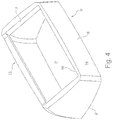
- FIG. 4 shows schematically a perspective front view of a treble housing of the handpull musical instrument according to FIG. 3 ,
- FIG. 5 shows schematically a perspective front view of the treble keyboard of the handpull musical instrument according to FIG. 3 ,
- FIG. 6 shows schematically a perspective front view of a handpull musical instrument according to a third exemplary embodiment
- FIG. 7 shows schematically a perspective front view of a handpull musical instrument according to a fourth exemplary embodiment
- FIG. 8 shows schematically a top view of the handpull musical instrument according to FIG. 7 .
- the invention relates to a handpull musical instrument, in particular an accordion, with housing parts for treble, the treble housing 2 , and bass, the bass housing 3 , connected by a bellows 1 .
- the handpull musical instrument comprises the associated sound and/or signal producing equipment and mechanical parts (not shown).
- a treble keyboard 4 is installed in the treble housing 2 and a bass keyboard 5 is installed in the bass housing 3 .
- the treble housing 2 is configured as an columnar hollow body 6 in angular design, which is open on the bellows side and opposite thereto comprises an opening 7 for receiving a treble cover 8 .
- the treble cover 8 is arranged so as to be aligned at an acute angle to an instrument central plane M between the two housing parts 2 , 3 , such that the treble housing 2 is tapered towards the instrument front face V and, thereby, the treble cover 8 is displaced towards the front.
- the treble cover 8 forms the treble keyboard 4 .
- the treble keyboard 4 thus preferably closes the opening 7 of the columnar hollow body 6 in angular design and is thus integrated within the spatial shape of the treble housing 2 .
- the treble housing 2 delimits, via the columnar hollow body 6 in angular design, a space 9 (see FIG. 4 ) which is suitable for accommodating the sound and/or signal producing equipment, valves, key mechanisms, etc.
- the treble keyboard 4 is preferably arranged at such a distance from the bellows 1 that an arrangement plane D of the treble cover 8 passes through the instrument central plane M outside the instrument's base area.
- the treble keyboard 4 is preferably arranged in an angular range of 30° to 80° relative to the instrument central plane M.
- the columnar hollow body 6 in angular design preferably has a cross section of a triangle or convex quadrilateral or pentagon, whereby the treble keyboard 4 displaced towards the front is orientable relative to the instrument central plane M at angles which take account of human anatomy and at the same time provide a hollow body 6 with sufficient dimensions for accommodating the sound and/or signal producing equipment.
- the cross section of the columnar hollow body 6 in angular design of the treble housing 2 is substantially triangular with one side toward the bellows 1 , one side toward the rear face 12 of the handpull musical instrument and one side toward the treble keyboard 4 .
- the side surface 14 and the remaining side surfaces of the columnar hollow body 6 in angular design may be configured to be planar, curved and/or cornered.
- the treble keyboard 4 and the bass keyboard 5 may be configured as a piano keyboard or a button keyboard.
- FIG. 1 and FIG. 2 show the treble keyboard 4 as a piano keyboard according to a first exemplary embodiment.
- the treble keyboard 4 in this case preferably has a vertical keyboard axis.
- the bass keyboard 5 for example, has a button keyboard.
- the treble housing 2 may be provided for delimiting a space 9 for accommodating reed blocks 10 bearing bellows-actuated reeds (see FIG. 7 ).
- the keys 11 of the treble keyboard 4 are connected to treble valves (not shown) which, actuated by bellows, control in a manner known per se the air flow through reed blocks 10 bearing the different reeds.
- the keys 11 may be provided individually with switches and/or contacts, etc. which serve for the individual control of electrical sound signal sources. These switches and/or signal producing equipment are known per se and are not shown.
- a polyphonic electrical sound and/or signal producing equipment which is known per se, together with the associated electronic components may be accommodated in the treble housing 2 according to the invention.
- the columnar hollow body 6 in angular design is configured in cross section according to a convex quadrilateral and the width of the front side surface 14 is selected such that together with the tapering of the hollow body 6 and thus the angular alignment of the treble keyboard 4 relative to the instrument central plane M a spatial depth for the treble housing 2 is achieved which accommodates the sound and/or signal producing equipment and associated components, in particular when electronic sound and/or signal producing equipment is installed at the same time.
- the treble keyboard 4 is to be played in the same manner as in the first exemplary embodiment since the angular position relative to the instrument central plane M is selectable in the same manner.
- the treble keyboard 4 is insertable into the opening 7 , wherein the treble keyboard 4 has a number of sound outlet openings 15 for the air flowing through bellows-actuated reeds (not shown) for the production of sound.
- the sound outlet openings 15 may be configured in a region around the treble keyboard 4 .
- each key 11 is preferably configured with a sound outlet opening 15 along the edge 16 of the hollow body 6 .
- the edge 16 is preferably arranged on the front side surface 14 of the hollow body 6 .
- the keys 11 may have, for example, an extension portion as shown in FIG. 5 , the respective sound outlet opening 15 being formed therein.
- a bar consisting of a plurality of sound outlet openings 15 can be provided.
- the width of the respective sound outlet opening 15 in this case may follow the width of the respective key 11 of the piano keyboard.
- the bass keyboard 5 may be configured in the same manner with a number of sound outlet openings (not shown).
- FIG. 6 shows a third exemplary embodiment which differs from that shown in FIG. 3 , by the treble keyboard 4 being configured as a button keyboard. Otherwise, the above-described applies accordingly.
- the bass housing may have a fingerboard 20 for bass buttons 21 , the handle level thereof being at an angle relative to the instrument central plane M.
- the handle level B of the bass buttons 21 may be arranged mirror-symmetrically to the treble keyboard 4 .
- FIG. 7 shows, via a cut-out, partial regions of a mechanical sound producing equipment in the treble housing 2 .
- FIG. 8 illustrates by means of a via top view of the handpull musical instrument according to the invention, in particular the accordion, the orientation of the treble keyboard 4 on the treble housing 2 relative to the front face V and rear face 12 of the instrument relative to the instrument central plane M.
- the treble cover 8 may be of roof-shaped configuration, wherein the treble keyboard 4 is preferably arranged on the roof side, that is directed towards the front face V of the instrument.
- the treble cover 8 forms the treble keyboard 4 according to the invention, wherein the sound and/or signal producing equipment as part of the inner mechanical structure of the instrument is positioned physically close behind the treble keyboard 4 , as shown in particular in FIG. 7 in conjunction with FIG. 8 .
- the treble keyboard 4 thus forms an upper shed having an overlap with a subjacent lower shed in the form of the space 9 , in which the sound and/or signal producing equipment, as in particular the reed blocks 10 according to FIG. 7 , are arranged.
- the overlap is a lateral overlap with respect to an instrument central plane M ( FIG. 8 ), wherein the overlap may be chosen to have a partial or full overlap range.
- the upper and lower sheds are then preferably aligned in relation to the bellows 1 of the handpull musical instrument.
- the shed height of the lower shed, or space 9 may be determined by a width of the front side surface 14 of the columnar hollow body 6 in angular design ( FIG. 4 ).
Landscapes
- Physics & Mathematics (AREA)
- Engineering & Computer Science (AREA)
- Acoustics & Sound (AREA)
- Multimedia (AREA)
- Electrophonic Musical Instruments (AREA)
Abstract
Description
Claims (18)
Applications Claiming Priority (3)
| Application Number | Priority Date | Filing Date | Title |
|---|---|---|---|
| DE102017007064.4A DE102017007064A1 (en) | 2017-07-26 | 2017-07-26 | Handzuginstrument |
| DE102017007064 | 2017-07-26 | ||
| DE102017007064.4 | 2017-07-26 |
Publications (2)
| Publication Number | Publication Date |
|---|---|
| US20190035368A1 US20190035368A1 (en) | 2019-01-31 |
| US10733967B2 true US10733967B2 (en) | 2020-08-04 |
Family
ID=63041754
Family Applications (1)
| Application Number | Title | Priority Date | Filing Date |
|---|---|---|---|
| US16/045,313 Active US10733967B2 (en) | 2017-07-26 | 2018-07-25 | Handpull musical instrument |
Country Status (5)
| Country | Link |
|---|---|
| US (1) | US10733967B2 (en) |
| EP (1) | EP3435368B1 (en) |
| CN (1) | CN109308889B (en) |
| DE (1) | DE102017007064A1 (en) |
| RU (1) | RU2730411C2 (en) |
Cited By (1)
| Publication number | Priority date | Publication date | Assignee | Title |
|---|---|---|---|---|
| US11694662B2 (en) * | 2020-12-29 | 2023-07-04 | Carboneon Gmbh | Manual pulling instrument |
Families Citing this family (2)
| Publication number | Priority date | Publication date | Assignee | Title |
|---|---|---|---|---|
| USD861776S1 (en) * | 2017-07-21 | 2019-10-01 | Hohner Musikinstrumente Gmbh | Handpull musical instrument |
| KR20190070586A (en) | 2017-12-13 | 2019-06-21 | 엘지디스플레이 주식회사 | Compound for electron transporting material and organic light emitting diode including the same |
Citations (13)
| Publication number | Priority date | Publication date | Assignee | Title |
|---|---|---|---|---|
| CH55044A (en) | 1912-02-05 | 1912-07-16 | Wilhelm Bestgen | harmonica |
| US1781394A (en) | 1929-02-20 | 1930-11-11 | Iorio Candido | Accordion |
| US1922381A (en) * | 1932-01-11 | 1933-08-15 | Max B Luttbeg | Accordion |
| US2036545A (en) | 1935-04-05 | 1936-04-07 | Wurlitzer Grand Piano Company | Accordion |
| US2056212A (en) | 1935-06-22 | 1936-10-06 | Wurlitzer Grand Piano Company | Electric accordion |
| US2114085A (en) | 1936-07-11 | 1938-04-12 | Pollina Frank | Accordion |
| US2514978A (en) | 1950-07-11 | Accordian key holder | ||
| DE1785862U (en) | 1958-08-11 | 1959-03-26 | Max Haeussler | HARMONIC INSTRUMENTS, IN PARTICULAR ACCORDION AND HAND HARMONICS. |
| US2983178A (en) | 1958-03-10 | 1961-05-09 | Lesman Corp | Accordion-organ |
| DE1273966B (en) | 1967-04-22 | 1968-07-25 | Hans Woerl | Musical instrument |
| DE1299988B (en) | 1965-05-20 | 1969-07-24 | Musikinstrumentenbau Markneuki | Piano and button accordion |
| WO2003085637A1 (en) | 2002-03-13 | 2003-10-16 | Valentin Zupan | Treble box of accordion |
| FR2945146A1 (en) | 2009-04-30 | 2010-11-05 | Thierry Gaboriau | Diatonic accordion for use in traditional music or jazz, has left side case including face wall with frontal openings and plane internal partition, where partition forms angle ranging from specific degrees with end face of bellows |
Family Cites Families (6)
| Publication number | Priority date | Publication date | Assignee | Title |
|---|---|---|---|---|
| CA348124A (en) * | 1935-02-12 | B. Luttbeg Max | Accordion | |
| US2681587A (en) * | 1951-01-19 | 1954-06-22 | Hohner Ag Matth | Accordion |
| CN2256574Y (en) * | 1996-07-12 | 1997-06-18 | 王峰 | Key type accordion |
| CN2829006Y (en) * | 2005-09-07 | 2006-10-18 | 李遇秋 | Right hand two-line key of accordion |
| CN202677814U (en) * | 2012-06-13 | 2013-01-16 | 江阴金杯安琪乐器有限公司 | Function conversion key for accordion |
| TWI511123B (en) * | 2012-07-30 | 2015-12-01 | Dien-Foon Wu | Musical instrument keyboard |
-
2017
- 2017-07-26 DE DE102017007064.4A patent/DE102017007064A1/en active Pending
-
2018
- 2018-07-18 EP EP18000612.4A patent/EP3435368B1/en active Active
- 2018-07-23 CN CN201810817904.1A patent/CN109308889B/en active Active
- 2018-07-25 US US16/045,313 patent/US10733967B2/en active Active
- 2018-07-25 RU RU2018127311A patent/RU2730411C2/en active
Patent Citations (13)
| Publication number | Priority date | Publication date | Assignee | Title |
|---|---|---|---|---|
| US2514978A (en) | 1950-07-11 | Accordian key holder | ||
| CH55044A (en) | 1912-02-05 | 1912-07-16 | Wilhelm Bestgen | harmonica |
| US1781394A (en) | 1929-02-20 | 1930-11-11 | Iorio Candido | Accordion |
| US1922381A (en) * | 1932-01-11 | 1933-08-15 | Max B Luttbeg | Accordion |
| US2036545A (en) | 1935-04-05 | 1936-04-07 | Wurlitzer Grand Piano Company | Accordion |
| US2056212A (en) | 1935-06-22 | 1936-10-06 | Wurlitzer Grand Piano Company | Electric accordion |
| US2114085A (en) | 1936-07-11 | 1938-04-12 | Pollina Frank | Accordion |
| US2983178A (en) | 1958-03-10 | 1961-05-09 | Lesman Corp | Accordion-organ |
| DE1785862U (en) | 1958-08-11 | 1959-03-26 | Max Haeussler | HARMONIC INSTRUMENTS, IN PARTICULAR ACCORDION AND HAND HARMONICS. |
| DE1299988B (en) | 1965-05-20 | 1969-07-24 | Musikinstrumentenbau Markneuki | Piano and button accordion |
| DE1273966B (en) | 1967-04-22 | 1968-07-25 | Hans Woerl | Musical instrument |
| WO2003085637A1 (en) | 2002-03-13 | 2003-10-16 | Valentin Zupan | Treble box of accordion |
| FR2945146A1 (en) | 2009-04-30 | 2010-11-05 | Thierry Gaboriau | Diatonic accordion for use in traditional music or jazz, has left side case including face wall with frontal openings and plane internal partition, where partition forms angle ranging from specific degrees with end face of bellows |
Non-Patent Citations (2)
| Title |
|---|
| European Search Report dated Dec. 20, 2018 in Patent Application No. 18000612.4, all pages. |
| Office action dated Sep. 4, 2019 in European Patent Application No. 18000612.4, all pages. |
Cited By (1)
| Publication number | Priority date | Publication date | Assignee | Title |
|---|---|---|---|---|
| US11694662B2 (en) * | 2020-12-29 | 2023-07-04 | Carboneon Gmbh | Manual pulling instrument |
Also Published As
| Publication number | Publication date |
|---|---|
| RU2730411C2 (en) | 2020-08-21 |
| EP3435368B1 (en) | 2020-12-16 |
| CN109308889A (en) | 2019-02-05 |
| CN109308889B (en) | 2023-08-08 |
| US20190035368A1 (en) | 2019-01-31 |
| DE102017007064A1 (en) | 2019-01-31 |
| RU2018127311A3 (en) | 2020-03-17 |
| RU2018127311A (en) | 2020-01-31 |
| EP3435368A1 (en) | 2019-01-30 |
Similar Documents
| Publication | Publication Date | Title |
|---|---|---|
| US20190035368A1 (en) | Handpull Musical Instrument | |
| US3433113A (en) | Ligatures or reed-holders for single-reed musical wind instruments | |
| US20060272473A1 (en) | Mouthpiece for a wind instrument | |
| US10540948B2 (en) | Ergonomic head joint for a transverse flute | |
| JP2004521386A (en) | Harmonica comb | |
| US20030154844A1 (en) | Hands-free chromatic harmonica | |
| US4664011A (en) | Flute | |
| CN111462715B (en) | Accordion | |
| KR102671686B1 (en) | Wind instruments mounting tone hole hardwood key button | |
| CN214671767U (en) | A 24 hole accent harmonica | |
| US1922381A (en) | Accordion | |
| JPH0428156Y2 (en) | ||
| JPH0337032Y2 (en) | ||
| JP3097070U (en) | String instrument | |
| CN206921455U (en) | Improved structure of saxophone | |
| JP2545159Y2 (en) | Soprano saxophone | |
| JP4022671B2 (en) | Interlocking device and key system in the flute foot tube | |
| CN214226495U (en) | Accordion | |
| CN209785538U (en) | Combined musical instrument | |
| CN216562429U (en) | Chromatic scale harmonica | |
| CN208433209U (en) | A kind of seven-stringed plucked instrument in some ways similar to the zither tuning device | |
| JP3151001U (en) | Saxophone structure | |
| US4285261A (en) | Pianoharp action | |
| CN208351912U (en) | A kind of melodica guitar connection is played music device | |
| US3343438A (en) | Bass section of accordions |
Legal Events
| Date | Code | Title | Description |
|---|---|---|---|
| FEPP | Fee payment procedure |
Free format text: ENTITY STATUS SET TO UNDISCOUNTED (ORIGINAL EVENT CODE: BIG.); ENTITY STATUS OF PATENT OWNER: LARGE ENTITY |
|
| STPP | Information on status: patent application and granting procedure in general |
Free format text: DOCKETED NEW CASE - READY FOR EXAMINATION |
|
| AS | Assignment |
Owner name: HOHNER MUSIKINSTRUMENTE GMBH, GERMANY Free format text: ASSIGNMENT OF ASSIGNORS INTEREST;ASSIGNORS:TRAPP, THOMAS;HOYER, KNUT;REEL/FRAME:046807/0933 Effective date: 20180823 |
|
| STPP | Information on status: patent application and granting procedure in general |
Free format text: NON FINAL ACTION MAILED |
|
| STPP | Information on status: patent application and granting procedure in general |
Free format text: RESPONSE TO NON-FINAL OFFICE ACTION ENTERED AND FORWARDED TO EXAMINER |
|
| STPP | Information on status: patent application and granting procedure in general |
Free format text: NON FINAL ACTION MAILED |
|
| STPP | Information on status: patent application and granting procedure in general |
Free format text: NOTICE OF ALLOWANCE MAILED -- APPLICATION RECEIVED IN OFFICE OF PUBLICATIONS |
|
| STPP | Information on status: patent application and granting procedure in general |
Free format text: NOTICE OF ALLOWANCE MAILED -- APPLICATION RECEIVED IN OFFICE OF PUBLICATIONS |
|
| STPP | Information on status: patent application and granting procedure in general |
Free format text: PUBLICATIONS -- ISSUE FEE PAYMENT RECEIVED |
|
| STCF | Information on status: patent grant |
Free format text: PATENTED CASE |
|
| MAFP | Maintenance fee payment |
Free format text: PAYMENT OF MAINTENANCE FEE, 4TH YEAR, LARGE ENTITY (ORIGINAL EVENT CODE: M1551); ENTITY STATUS OF PATENT OWNER: LARGE ENTITY Year of fee payment: 4 |