US10183094B2 - Biodegradable water absorbent - Google Patents
Biodegradable water absorbent Download PDFInfo
- Publication number
- US10183094B2 US10183094B2 US15/527,916 US201515527916A US10183094B2 US 10183094 B2 US10183094 B2 US 10183094B2 US 201515527916 A US201515527916 A US 201515527916A US 10183094 B2 US10183094 B2 US 10183094B2
- Authority
- US
- United States
- Prior art keywords
- naturally derived
- derived polymer
- clay mineral
- water absorbent
- water
- Prior art date
- Legal status (The legal status is an assumption and is not a legal conclusion. Google has not performed a legal analysis and makes no representation as to the accuracy of the status listed.)
- Expired - Fee Related, expires
Links
- XLYOFNOQVPJJNP-UHFFFAOYSA-N water Substances O XLYOFNOQVPJJNP-UHFFFAOYSA-N 0.000 title claims abstract description 106
- 239000002250 absorbent Substances 0.000 title claims abstract description 74
- 230000002745 absorbent Effects 0.000 title claims abstract description 74
- 229920000642 polymer Polymers 0.000 claims abstract description 101
- 239000002734 clay mineral Substances 0.000 claims abstract description 76
- 239000002245 particle Substances 0.000 claims abstract description 54
- 238000004132 cross linking Methods 0.000 claims abstract description 38
- 239000003431 cross linking reagent Substances 0.000 claims abstract description 33
- 238000010521 absorption reaction Methods 0.000 claims abstract description 26
- 239000000499 gel Substances 0.000 claims description 74
- 239000000017 hydrogel Substances 0.000 claims description 60
- 238000000034 method Methods 0.000 claims description 41
- 238000009833 condensation Methods 0.000 claims description 22
- 230000005494 condensation Effects 0.000 claims description 22
- 239000003960 organic solvent Substances 0.000 claims description 21
- LMDZBCPBFSXMTL-UHFFFAOYSA-N 1-Ethyl-3-(3-dimethylaminopropyl)carbodiimide Substances CCN=C=NCCCN(C)C LMDZBCPBFSXMTL-UHFFFAOYSA-N 0.000 claims description 16
- 239000003795 chemical substances by application Substances 0.000 claims description 11
- RPNUMPOLZDHAAY-UHFFFAOYSA-N Diethylenetriamine Chemical group NCCNCCN RPNUMPOLZDHAAY-UHFFFAOYSA-N 0.000 claims description 8
- 238000001035 drying Methods 0.000 claims description 8
- FPQQSJJWHUJYPU-UHFFFAOYSA-N 3-(dimethylamino)propyliminomethylidene-ethylazanium;chloride Chemical group Cl.CCN=C=NCCCN(C)C FPQQSJJWHUJYPU-UHFFFAOYSA-N 0.000 claims description 6
- 238000004519 manufacturing process Methods 0.000 claims description 6
- NQTADLQHYWFPDB-UHFFFAOYSA-N N-Hydroxysuccinimide Chemical compound ON1C(=O)CCC1=O NQTADLQHYWFPDB-UHFFFAOYSA-N 0.000 claims description 5
- 108700022290 poly(gamma-glutamic acid) Proteins 0.000 claims description 2
- 239000007788 liquid Substances 0.000 abstract description 38
- 239000007858 starting material Substances 0.000 abstract description 5
- 239000012530 fluid Substances 0.000 abstract description 3
- 230000001747 exhibiting effect Effects 0.000 abstract 1
- GUJOJGAPFQRJSV-UHFFFAOYSA-N dialuminum;dioxosilane;oxygen(2-);hydrate Chemical compound O.[O-2].[O-2].[O-2].[Al+3].[Al+3].O=[Si]=O.O=[Si]=O.O=[Si]=O.O=[Si]=O GUJOJGAPFQRJSV-UHFFFAOYSA-N 0.000 description 29
- 229910052901 montmorillonite Inorganic materials 0.000 description 29
- 239000011734 sodium Substances 0.000 description 27
- 230000000052 comparative effect Effects 0.000 description 25
- 239000000843 powder Substances 0.000 description 24
- SVPXDRXYRYOSEX-UHFFFAOYSA-N bentoquatam Chemical compound O.O=[Si]=O.O=[Al]O[Al]=O SVPXDRXYRYOSEX-UHFFFAOYSA-N 0.000 description 19
- 239000006185 dispersion Substances 0.000 description 19
- -1 poly(glutamic acid) Polymers 0.000 description 19
- 239000000243 solution Substances 0.000 description 19
- OKKJLVBELUTLKV-UHFFFAOYSA-N Methanol Chemical compound OC OKKJLVBELUTLKV-UHFFFAOYSA-N 0.000 description 18
- 239000000440 bentonite Substances 0.000 description 18
- 229910000278 bentonite Inorganic materials 0.000 description 18
- CSCPPACGZOOCGX-UHFFFAOYSA-N Acetone Chemical compound CC(C)=O CSCPPACGZOOCGX-UHFFFAOYSA-N 0.000 description 17
- 239000000126 substance Substances 0.000 description 15
- 239000002253 acid Substances 0.000 description 12
- 230000008961 swelling Effects 0.000 description 11
- FAPWRFPIFSIZLT-UHFFFAOYSA-M Sodium chloride Chemical compound [Na+].[Cl-] FAPWRFPIFSIZLT-UHFFFAOYSA-M 0.000 description 10
- 239000007864 aqueous solution Substances 0.000 description 10
- 150000001875 compounds Chemical group 0.000 description 10
- 238000005469 granulation Methods 0.000 description 10
- 230000003179 granulation Effects 0.000 description 10
- 239000000203 mixture Substances 0.000 description 10
- VEXZGXHMUGYJMC-UHFFFAOYSA-N Hydrochloric acid Chemical compound Cl VEXZGXHMUGYJMC-UHFFFAOYSA-N 0.000 description 9
- 125000003178 carboxy group Chemical group [H]OC(*)=O 0.000 description 9
- 238000006243 chemical reaction Methods 0.000 description 9
- 150000003949 imides Chemical class 0.000 description 9
- 150000003839 salts Chemical class 0.000 description 9
- 238000003756 stirring Methods 0.000 description 9
- HEMHJVSKTPXQMS-UHFFFAOYSA-M Sodium hydroxide Chemical compound [OH-].[Na+] HEMHJVSKTPXQMS-UHFFFAOYSA-M 0.000 description 8
- 238000007598 dipping method Methods 0.000 description 8
- 239000012085 test solution Substances 0.000 description 8
- ZIUHHBKFKCYYJD-UHFFFAOYSA-N n,n'-methylenebisacrylamide Chemical compound C=CC(=O)NCNC(=O)C=C ZIUHHBKFKCYYJD-UHFFFAOYSA-N 0.000 description 7
- 230000035699 permeability Effects 0.000 description 7
- 239000002504 physiological saline solution Substances 0.000 description 7
- LFQSCWFLJHTTHZ-UHFFFAOYSA-N Ethanol Chemical compound CCO LFQSCWFLJHTTHZ-UHFFFAOYSA-N 0.000 description 6
- 230000000694 effects Effects 0.000 description 6
- 229920002643 polyglutamic acid Polymers 0.000 description 6
- 229920002554 vinyl polymer Polymers 0.000 description 6
- 238000005550 wet granulation Methods 0.000 description 6
- 125000003277 amino group Chemical group 0.000 description 5
- 125000000524 functional group Chemical group 0.000 description 5
- 238000006116 polymerization reaction Methods 0.000 description 5
- 238000002360 preparation method Methods 0.000 description 5
- 239000011780 sodium chloride Substances 0.000 description 5
- 239000002904 solvent Substances 0.000 description 5
- 229920002134 Carboxymethyl cellulose Polymers 0.000 description 4
- KFZMGEQAYNKOFK-UHFFFAOYSA-N Isopropanol Chemical compound CC(C)O KFZMGEQAYNKOFK-UHFFFAOYSA-N 0.000 description 4
- 239000004677 Nylon Substances 0.000 description 4
- ROOXNKNUYICQNP-UHFFFAOYSA-N ammonium persulfate Chemical compound [NH4+].[NH4+].[O-]S(=O)(=O)OOS([O-])(=O)=O ROOXNKNUYICQNP-UHFFFAOYSA-N 0.000 description 4
- 239000001768 carboxy methyl cellulose Substances 0.000 description 4
- 235000010948 carboxy methyl cellulose Nutrition 0.000 description 4
- 239000008112 carboxymethyl-cellulose Substances 0.000 description 4
- 238000010382 chemical cross-linking Methods 0.000 description 4
- 239000004927 clay Substances 0.000 description 4
- 238000010908 decantation Methods 0.000 description 4
- 239000010410 layer Substances 0.000 description 4
- 150000007522 mineralic acids Chemical class 0.000 description 4
- 238000002156 mixing Methods 0.000 description 4
- 229920001778 nylon Polymers 0.000 description 4
- 150000007524 organic acids Chemical class 0.000 description 4
- 229920000768 polyamine Polymers 0.000 description 4
- 239000011541 reaction mixture Substances 0.000 description 4
- SMZOUWXMTYCWNB-UHFFFAOYSA-N 2-(2-methoxy-5-methylphenyl)ethanamine Chemical compound COC1=CC=C(C)C=C1CCN SMZOUWXMTYCWNB-UHFFFAOYSA-N 0.000 description 3
- NIXOWILDQLNWCW-UHFFFAOYSA-N 2-Propenoic acid Natural products OC(=O)C=C NIXOWILDQLNWCW-UHFFFAOYSA-N 0.000 description 3
- 238000002441 X-ray diffraction Methods 0.000 description 3
- 238000004220 aggregation Methods 0.000 description 3
- 230000002776 aggregation Effects 0.000 description 3
- 230000000903 blocking effect Effects 0.000 description 3
- 238000004090 dissolution Methods 0.000 description 3
- 229920001971 elastomer Polymers 0.000 description 3
- 239000011229 interlayer Substances 0.000 description 3
- 238000005259 measurement Methods 0.000 description 3
- 238000000691 measurement method Methods 0.000 description 3
- 230000005855 radiation Effects 0.000 description 3
- 230000003014 reinforcing effect Effects 0.000 description 3
- 229910021647 smectite Inorganic materials 0.000 description 3
- KIUKXJAPPMFGSW-DNGZLQJQSA-N (2S,3S,4S,5R,6R)-6-[(2S,3R,4R,5S,6R)-3-Acetamido-2-[(2S,3S,4R,5R,6R)-6-[(2R,3R,4R,5S,6R)-3-acetamido-2,5-dihydroxy-6-(hydroxymethyl)oxan-4-yl]oxy-2-carboxy-4,5-dihydroxyoxan-3-yl]oxy-5-hydroxy-6-(hydroxymethyl)oxan-4-yl]oxy-3,4,5-trihydroxyoxane-2-carboxylic acid Chemical compound CC(=O)N[C@H]1[C@H](O)O[C@H](CO)[C@@H](O)[C@@H]1O[C@H]1[C@H](O)[C@@H](O)[C@H](O[C@H]2[C@@H]([C@@H](O[C@H]3[C@@H]([C@@H](O)[C@H](O)[C@H](O3)C(O)=O)O)[C@H](O)[C@@H](CO)O2)NC(C)=O)[C@@H](C(O)=O)O1 KIUKXJAPPMFGSW-DNGZLQJQSA-N 0.000 description 2
- PQUXFUBNSYCQAL-UHFFFAOYSA-N 1-(2,3-difluorophenyl)ethanone Chemical compound CC(=O)C1=CC=CC(F)=C1F PQUXFUBNSYCQAL-UHFFFAOYSA-N 0.000 description 2
- UWFRVQVNYNPBEF-UHFFFAOYSA-N 1-(2,4-dimethylphenyl)propan-1-one Chemical compound CCC(=O)C1=CC=C(C)C=C1C UWFRVQVNYNPBEF-UHFFFAOYSA-N 0.000 description 2
- 229920001661 Chitosan Polymers 0.000 description 2
- VZCYOOQTPOCHFL-OWOJBTEDSA-N Fumaric acid Chemical compound OC(=O)\C=C\C(O)=O VZCYOOQTPOCHFL-OWOJBTEDSA-N 0.000 description 2
- BPQQTUXANYXVAA-UHFFFAOYSA-N Orthosilicate Chemical compound [O-][Si]([O-])([O-])[O-] BPQQTUXANYXVAA-UHFFFAOYSA-N 0.000 description 2
- 108010020346 Polyglutamic Acid Proteins 0.000 description 2
- 108010039918 Polylysine Proteins 0.000 description 2
- QAOWNCQODCNURD-UHFFFAOYSA-N Sulfuric acid Chemical compound OS(O)(=O)=O QAOWNCQODCNURD-UHFFFAOYSA-N 0.000 description 2
- 239000000783 alginic acid Substances 0.000 description 2
- 229920000615 alginic acid Polymers 0.000 description 2
- 235000010443 alginic acid Nutrition 0.000 description 2
- 229960001126 alginic acid Drugs 0.000 description 2
- 150000004781 alginic acids Chemical class 0.000 description 2
- 229910001870 ammonium persulfate Inorganic materials 0.000 description 2
- 230000015572 biosynthetic process Effects 0.000 description 2
- 229940045110 chitosan Drugs 0.000 description 2
- 238000004581 coalescence Methods 0.000 description 2
- 238000010586 diagram Methods 0.000 description 2
- GYZLOYUZLJXAJU-UHFFFAOYSA-N diglycidyl ether Chemical compound C1OC1COCC1CO1 GYZLOYUZLJXAJU-UHFFFAOYSA-N 0.000 description 2
- 238000000635 electron micrograph Methods 0.000 description 2
- 125000003700 epoxy group Chemical group 0.000 description 2
- 238000001914 filtration Methods 0.000 description 2
- 239000010419 fine particle Substances 0.000 description 2
- 229920000370 gamma-poly(glutamate) polymer Polymers 0.000 description 2
- 238000010438 heat treatment Methods 0.000 description 2
- 229920002674 hyaluronan Polymers 0.000 description 2
- 229960003160 hyaluronic acid Drugs 0.000 description 2
- 229910052500 inorganic mineral Inorganic materials 0.000 description 2
- 238000004898 kneading Methods 0.000 description 2
- 239000011707 mineral Substances 0.000 description 2
- 239000000178 monomer Substances 0.000 description 2
- 229920003023 plastic Polymers 0.000 description 2
- 239000004033 plastic Substances 0.000 description 2
- 229920001308 poly(aminoacid) Polymers 0.000 description 2
- 229920000656 polylysine Polymers 0.000 description 2
- BDERNNFJNOPAEC-UHFFFAOYSA-N propan-1-ol Chemical compound CCCO BDERNNFJNOPAEC-UHFFFAOYSA-N 0.000 description 2
- KIDHWZJUCRJVML-UHFFFAOYSA-N putrescine Chemical compound NCCCCN KIDHWZJUCRJVML-UHFFFAOYSA-N 0.000 description 2
- 229910000269 smectite group Inorganic materials 0.000 description 2
- 229940047670 sodium acrylate Drugs 0.000 description 2
- 159000000000 sodium salts Chemical class 0.000 description 2
- 238000010557 suspension polymerization reaction Methods 0.000 description 2
- 238000003786 synthesis reaction Methods 0.000 description 2
- JOXIMZWYDAKGHI-UHFFFAOYSA-N toluene-4-sulfonic acid Chemical compound CC1=CC=C(S(O)(=O)=O)C=C1 JOXIMZWYDAKGHI-UHFFFAOYSA-N 0.000 description 2
- VZCYOOQTPOCHFL-UHFFFAOYSA-N trans-butenedioic acid Natural products OC(=O)C=CC(O)=O VZCYOOQTPOCHFL-UHFFFAOYSA-N 0.000 description 2
- ARCGXLSVLAOJQL-UHFFFAOYSA-N trimellitic acid Chemical compound OC(=O)C1=CC=C(C(O)=O)C(C(O)=O)=C1 ARCGXLSVLAOJQL-UHFFFAOYSA-N 0.000 description 2
- XFNJVJPLKCPIBV-UHFFFAOYSA-N trimethylenediamine Chemical compound NCCCN XFNJVJPLKCPIBV-UHFFFAOYSA-N 0.000 description 2
- 125000000391 vinyl group Chemical group [H]C([*])=C([H])[H] 0.000 description 2
- 238000005406 washing Methods 0.000 description 2
- JOLQKTGDSGKSKJ-UHFFFAOYSA-N 1-ethoxypropan-2-ol Chemical compound CCOCC(C)O JOLQKTGDSGKSKJ-UHFFFAOYSA-N 0.000 description 1
- ARXJGSRGQADJSQ-UHFFFAOYSA-N 1-methoxypropan-2-ol Chemical compound COCC(C)O ARXJGSRGQADJSQ-UHFFFAOYSA-N 0.000 description 1
- VILCJCGEZXAXTO-UHFFFAOYSA-N 2,2,2-tetramine Chemical compound NCCNCCNCCN VILCJCGEZXAXTO-UHFFFAOYSA-N 0.000 description 1
- JAHNSTQSQJOJLO-UHFFFAOYSA-N 2-(3-fluorophenyl)-1h-imidazole Chemical compound FC1=CC=CC(C=2NC=CN=2)=C1 JAHNSTQSQJOJLO-UHFFFAOYSA-N 0.000 description 1
- XNWFRZJHXBZDAG-UHFFFAOYSA-N 2-METHOXYETHANOL Chemical compound COCCO XNWFRZJHXBZDAG-UHFFFAOYSA-N 0.000 description 1
- ZNQVEEAIQZEUHB-UHFFFAOYSA-N 2-ethoxyethanol Chemical compound CCOCCO ZNQVEEAIQZEUHB-UHFFFAOYSA-N 0.000 description 1
- HCGFUIQPSOCUHI-UHFFFAOYSA-N 2-propan-2-yloxyethanol Chemical compound CC(C)OCCO HCGFUIQPSOCUHI-UHFFFAOYSA-N 0.000 description 1
- QTBSBXVTEAMEQO-UHFFFAOYSA-M Acetate Chemical compound CC([O-])=O QTBSBXVTEAMEQO-UHFFFAOYSA-M 0.000 description 1
- QOSSAOTZNIDXMA-UHFFFAOYSA-N Dicylcohexylcarbodiimide Chemical compound C1CCCCC1N=C=NC1CCCCC1 QOSSAOTZNIDXMA-UHFFFAOYSA-N 0.000 description 1
- PIICEJLVQHRZGT-UHFFFAOYSA-N Ethylenediamine Chemical compound NCCN PIICEJLVQHRZGT-UHFFFAOYSA-N 0.000 description 1
- GRYLNZFGIOXLOG-UHFFFAOYSA-N Nitric acid Chemical compound O[N+]([O-])=O GRYLNZFGIOXLOG-UHFFFAOYSA-N 0.000 description 1
- 229920002845 Poly(methacrylic acid) Polymers 0.000 description 1
- 229920000805 Polyaspartic acid Polymers 0.000 description 1
- 239000002202 Polyethylene glycol Substances 0.000 description 1
- 229920002873 Polyethylenimine Polymers 0.000 description 1
- OFOBLEOULBTSOW-UHFFFAOYSA-N Propanedioic acid Natural products OC(=O)CC(O)=O OFOBLEOULBTSOW-UHFFFAOYSA-N 0.000 description 1
- 229920002125 Sokalan® Polymers 0.000 description 1
- QAOWNCQODCNURD-UHFFFAOYSA-L Sulfate Chemical compound [O-]S([O-])(=O)=O QAOWNCQODCNURD-UHFFFAOYSA-L 0.000 description 1
- DKGAVHZHDRPRBM-UHFFFAOYSA-N Tert-Butanol Chemical compound CC(C)(C)O DKGAVHZHDRPRBM-UHFFFAOYSA-N 0.000 description 1
- 238000007259 addition reaction Methods 0.000 description 1
- 239000002671 adjuvant Substances 0.000 description 1
- 238000007605 air drying Methods 0.000 description 1
- 150000001298 alcohols Chemical class 0.000 description 1
- 125000005263 alkylenediamine group Chemical group 0.000 description 1
- 150000003863 ammonium salts Chemical class 0.000 description 1
- 239000011324 bead Substances 0.000 description 1
- 229920001222 biopolymer Polymers 0.000 description 1
- VNSBYDPZHCQWNB-UHFFFAOYSA-N calcium;aluminum;dioxido(oxo)silane;sodium;hydrate Chemical compound O.[Na].[Al].[Ca+2].[O-][Si]([O-])=O VNSBYDPZHCQWNB-UHFFFAOYSA-N 0.000 description 1
- VPKDCDLSJZCGKE-UHFFFAOYSA-N carbodiimide group Chemical group N=C=N VPKDCDLSJZCGKE-UHFFFAOYSA-N 0.000 description 1
- 150000001718 carbodiimides Chemical class 0.000 description 1
- 239000003153 chemical reaction reagent Substances 0.000 description 1
- HNEGQIOMVPPMNR-IHWYPQMZSA-N citraconic acid Chemical compound OC(=O)C(/C)=C\C(O)=O HNEGQIOMVPPMNR-IHWYPQMZSA-N 0.000 description 1
- 229940018557 citraconic acid Drugs 0.000 description 1
- 239000002131 composite material Substances 0.000 description 1
- 238000006482 condensation reaction Methods 0.000 description 1
- 229920001577 copolymer Polymers 0.000 description 1
- 229920006037 cross link polymer Polymers 0.000 description 1
- 239000002270 dispersing agent Substances 0.000 description 1
- 239000012153 distilled water Substances 0.000 description 1
- 238000010828 elution Methods 0.000 description 1
- 239000003995 emulsifying agent Substances 0.000 description 1
- LYCAIKOWRPUZTN-UHFFFAOYSA-N ethylene glycol Natural products OCCO LYCAIKOWRPUZTN-UHFFFAOYSA-N 0.000 description 1
- 238000011156 evaluation Methods 0.000 description 1
- 238000000855 fermentation Methods 0.000 description 1
- 230000004151 fermentation Effects 0.000 description 1
- ZHNUHDYFZUAESO-UHFFFAOYSA-N formamide Substances NC=O ZHNUHDYFZUAESO-UHFFFAOYSA-N 0.000 description 1
- 239000001530 fumaric acid Substances 0.000 description 1
- 239000007863 gel particle Substances 0.000 description 1
- JEGUKCSWCFPDGT-UHFFFAOYSA-N h2o hydrate Chemical compound O.O JEGUKCSWCFPDGT-UHFFFAOYSA-N 0.000 description 1
- ZOMZNNQGMGBLHO-UHFFFAOYSA-N heptane-1,5-diamine Chemical compound CCC(N)CCCCN ZOMZNNQGMGBLHO-UHFFFAOYSA-N 0.000 description 1
- NAQMVNRVTILPCV-UHFFFAOYSA-N hexane-1,6-diamine Chemical compound NCCCCCCN NAQMVNRVTILPCV-UHFFFAOYSA-N 0.000 description 1
- 239000007970 homogeneous dispersion Substances 0.000 description 1
- WGCNASOHLSPBMP-UHFFFAOYSA-N hydroxyacetaldehyde Natural products OCC=O WGCNASOHLSPBMP-UHFFFAOYSA-N 0.000 description 1
- 230000001771 impaired effect Effects 0.000 description 1
- 230000002401 inhibitory effect Effects 0.000 description 1
- 230000014759 maintenance of location Effects 0.000 description 1
- VZCYOOQTPOCHFL-UPHRSURJSA-N maleic acid Chemical compound OC(=O)\C=C/C(O)=O VZCYOOQTPOCHFL-UPHRSURJSA-N 0.000 description 1
- 239000011976 maleic acid Substances 0.000 description 1
- 239000000463 material Substances 0.000 description 1
- 238000013208 measuring procedure Methods 0.000 description 1
- 229910052751 metal Inorganic materials 0.000 description 1
- 239000002184 metal Substances 0.000 description 1
- LVHBHZANLOWSRM-UHFFFAOYSA-N methylenebutanedioic acid Natural products OC(=O)CC(=C)C(O)=O LVHBHZANLOWSRM-UHFFFAOYSA-N 0.000 description 1
- 244000005700 microbiome Species 0.000 description 1
- LSHROXHEILXKHM-UHFFFAOYSA-N n'-[2-[2-[2-(2-aminoethylamino)ethylamino]ethylamino]ethyl]ethane-1,2-diamine Chemical compound NCCNCCNCCNCCNCCN LSHROXHEILXKHM-UHFFFAOYSA-N 0.000 description 1
- 239000005445 natural material Substances 0.000 description 1
- 229920005615 natural polymer Polymers 0.000 description 1
- 229910017604 nitric acid Inorganic materials 0.000 description 1
- 229910000273 nontronite Inorganic materials 0.000 description 1
- 235000005985 organic acids Nutrition 0.000 description 1
- 230000035515 penetration Effects 0.000 description 1
- 229920000724 poly(L-arginine) polymer Polymers 0.000 description 1
- 229920000058 polyacrylate Polymers 0.000 description 1
- 239000004584 polyacrylic acid Substances 0.000 description 1
- 108010011110 polyarginine Proteins 0.000 description 1
- 229920001223 polyethylene glycol Polymers 0.000 description 1
- 229920001451 polypropylene glycol Polymers 0.000 description 1
- 229920001282 polysaccharide Polymers 0.000 description 1
- 239000005017 polysaccharide Substances 0.000 description 1
- 150000004804 polysaccharides Chemical class 0.000 description 1
- XAEFZNCEHLXOMS-UHFFFAOYSA-M potassium benzoate Chemical compound [K+].[O-]C(=O)C1=CC=CC=C1 XAEFZNCEHLXOMS-UHFFFAOYSA-M 0.000 description 1
- 239000010453 quartz Substances 0.000 description 1
- 230000035484 reaction time Effects 0.000 description 1
- 230000001172 regenerating effect Effects 0.000 description 1
- 229910052604 silicate mineral Inorganic materials 0.000 description 1
- VYPSYNLAJGMNEJ-UHFFFAOYSA-N silicon dioxide Inorganic materials O=[Si]=O VYPSYNLAJGMNEJ-UHFFFAOYSA-N 0.000 description 1
- 229920000247 superabsorbent polymer Polymers 0.000 description 1
- 239000004583 superabsorbent polymers (SAPs) Substances 0.000 description 1
- 229920001059 synthetic polymer Polymers 0.000 description 1
- FAGUFWYHJQFNRV-UHFFFAOYSA-N tetraethylenepentamine Chemical compound NCCNCCNCCNCCN FAGUFWYHJQFNRV-UHFFFAOYSA-N 0.000 description 1
Images



Classifications
-
- A—HUMAN NECESSITIES
- A61—MEDICAL OR VETERINARY SCIENCE; HYGIENE
- A61L—METHODS OR APPARATUS FOR STERILISING MATERIALS OR OBJECTS IN GENERAL; DISINFECTION, STERILISATION OR DEODORISATION OF AIR; CHEMICAL ASPECTS OF BANDAGES, DRESSINGS, ABSORBENT PADS OR SURGICAL ARTICLES; MATERIALS FOR BANDAGES, DRESSINGS, ABSORBENT PADS OR SURGICAL ARTICLES
- A61L15/00—Chemical aspects of, or use of materials for, bandages, dressings or absorbent pads
- A61L15/16—Bandages, dressings or absorbent pads for physiological fluids such as urine or blood, e.g. sanitary towels, tampons
- A61L15/42—Use of materials characterised by their function or physical properties
- A61L15/60—Liquid-swellable gel-forming materials, e.g. super-absorbents
-
- A—HUMAN NECESSITIES
- A61—MEDICAL OR VETERINARY SCIENCE; HYGIENE
- A61F—FILTERS IMPLANTABLE INTO BLOOD VESSELS; PROSTHESES; DEVICES PROVIDING PATENCY TO, OR PREVENTING COLLAPSING OF, TUBULAR STRUCTURES OF THE BODY, e.g. STENTS; ORTHOPAEDIC, NURSING OR CONTRACEPTIVE DEVICES; FOMENTATION; TREATMENT OR PROTECTION OF EYES OR EARS; BANDAGES, DRESSINGS OR ABSORBENT PADS; FIRST-AID KITS
- A61F13/00—Bandages or dressings; Absorbent pads
- A61F13/15—Absorbent pads, e.g. sanitary towels, swabs or tampons for external or internal application to the body; Supporting or fastening means therefor; Tampon applicators
- A61F13/53—Absorbent pads, e.g. sanitary towels, swabs or tampons for external or internal application to the body; Supporting or fastening means therefor; Tampon applicators characterised by the absorbing medium
-
- A—HUMAN NECESSITIES
- A61—MEDICAL OR VETERINARY SCIENCE; HYGIENE
- A61L—METHODS OR APPARATUS FOR STERILISING MATERIALS OR OBJECTS IN GENERAL; DISINFECTION, STERILISATION OR DEODORISATION OF AIR; CHEMICAL ASPECTS OF BANDAGES, DRESSINGS, ABSORBENT PADS OR SURGICAL ARTICLES; MATERIALS FOR BANDAGES, DRESSINGS, ABSORBENT PADS OR SURGICAL ARTICLES
- A61L15/00—Chemical aspects of, or use of materials for, bandages, dressings or absorbent pads
- A61L15/16—Bandages, dressings or absorbent pads for physiological fluids such as urine or blood, e.g. sanitary towels, tampons
- A61L15/42—Use of materials characterised by their function or physical properties
- A61L15/62—Compostable, hydrosoluble or hydrodegradable materials
-
- B—PERFORMING OPERATIONS; TRANSPORTING
- B01—PHYSICAL OR CHEMICAL PROCESSES OR APPARATUS IN GENERAL
- B01J—CHEMICAL OR PHYSICAL PROCESSES, e.g. CATALYSIS OR COLLOID CHEMISTRY; THEIR RELEVANT APPARATUS
- B01J20/00—Solid sorbent compositions or filter aid compositions; Sorbents for chromatography; Processes for preparing, regenerating or reactivating thereof
- B01J20/02—Solid sorbent compositions or filter aid compositions; Sorbents for chromatography; Processes for preparing, regenerating or reactivating thereof comprising inorganic material
- B01J20/10—Solid sorbent compositions or filter aid compositions; Sorbents for chromatography; Processes for preparing, regenerating or reactivating thereof comprising inorganic material comprising silica or silicate
- B01J20/12—Naturally occurring clays or bleaching earth
-
- B—PERFORMING OPERATIONS; TRANSPORTING
- B01—PHYSICAL OR CHEMICAL PROCESSES OR APPARATUS IN GENERAL
- B01J—CHEMICAL OR PHYSICAL PROCESSES, e.g. CATALYSIS OR COLLOID CHEMISTRY; THEIR RELEVANT APPARATUS
- B01J20/00—Solid sorbent compositions or filter aid compositions; Sorbents for chromatography; Processes for preparing, regenerating or reactivating thereof
- B01J20/22—Solid sorbent compositions or filter aid compositions; Sorbents for chromatography; Processes for preparing, regenerating or reactivating thereof comprising organic material
- B01J20/24—Naturally occurring macromolecular compounds, e.g. humic acids or their derivatives
-
- B—PERFORMING OPERATIONS; TRANSPORTING
- B01—PHYSICAL OR CHEMICAL PROCESSES OR APPARATUS IN GENERAL
- B01J—CHEMICAL OR PHYSICAL PROCESSES, e.g. CATALYSIS OR COLLOID CHEMISTRY; THEIR RELEVANT APPARATUS
- B01J20/00—Solid sorbent compositions or filter aid compositions; Sorbents for chromatography; Processes for preparing, regenerating or reactivating thereof
- B01J20/28—Solid sorbent compositions or filter aid compositions; Sorbents for chromatography; Processes for preparing, regenerating or reactivating thereof characterised by their form or physical properties
- B01J20/28002—Solid sorbent compositions or filter aid compositions; Sorbents for chromatography; Processes for preparing, regenerating or reactivating thereof characterised by their form or physical properties characterised by their physical properties
- B01J20/28004—Sorbent size or size distribution, e.g. particle size
-
- B—PERFORMING OPERATIONS; TRANSPORTING
- B01—PHYSICAL OR CHEMICAL PROCESSES OR APPARATUS IN GENERAL
- B01J—CHEMICAL OR PHYSICAL PROCESSES, e.g. CATALYSIS OR COLLOID CHEMISTRY; THEIR RELEVANT APPARATUS
- B01J20/00—Solid sorbent compositions or filter aid compositions; Sorbents for chromatography; Processes for preparing, regenerating or reactivating thereof
- B01J20/28—Solid sorbent compositions or filter aid compositions; Sorbents for chromatography; Processes for preparing, regenerating or reactivating thereof characterised by their form or physical properties
- B01J20/28014—Solid sorbent compositions or filter aid compositions; Sorbents for chromatography; Processes for preparing, regenerating or reactivating thereof characterised by their form or physical properties characterised by their form
- B01J20/28016—Particle form
-
- B—PERFORMING OPERATIONS; TRANSPORTING
- B01—PHYSICAL OR CHEMICAL PROCESSES OR APPARATUS IN GENERAL
- B01J—CHEMICAL OR PHYSICAL PROCESSES, e.g. CATALYSIS OR COLLOID CHEMISTRY; THEIR RELEVANT APPARATUS
- B01J20/00—Solid sorbent compositions or filter aid compositions; Sorbents for chromatography; Processes for preparing, regenerating or reactivating thereof
- B01J20/30—Processes for preparing, regenerating, or reactivating
-
- B—PERFORMING OPERATIONS; TRANSPORTING
- B01—PHYSICAL OR CHEMICAL PROCESSES OR APPARATUS IN GENERAL
- B01J—CHEMICAL OR PHYSICAL PROCESSES, e.g. CATALYSIS OR COLLOID CHEMISTRY; THEIR RELEVANT APPARATUS
- B01J20/00—Solid sorbent compositions or filter aid compositions; Sorbents for chromatography; Processes for preparing, regenerating or reactivating thereof
- B01J20/30—Processes for preparing, regenerating, or reactivating
- B01J20/3028—Granulating, agglomerating or aggregating
-
- B—PERFORMING OPERATIONS; TRANSPORTING
- B01—PHYSICAL OR CHEMICAL PROCESSES OR APPARATUS IN GENERAL
- B01J—CHEMICAL OR PHYSICAL PROCESSES, e.g. CATALYSIS OR COLLOID CHEMISTRY; THEIR RELEVANT APPARATUS
- B01J20/00—Solid sorbent compositions or filter aid compositions; Sorbents for chromatography; Processes for preparing, regenerating or reactivating thereof
- B01J20/30—Processes for preparing, regenerating, or reactivating
- B01J20/3085—Chemical treatments not covered by groups B01J20/3007 - B01J20/3078
-
- C—CHEMISTRY; METALLURGY
- C08—ORGANIC MACROMOLECULAR COMPOUNDS; THEIR PREPARATION OR CHEMICAL WORKING-UP; COMPOSITIONS BASED THEREON
- C08K—Use of inorganic or non-macromolecular organic substances as compounding ingredients
- C08K3/00—Use of inorganic substances as compounding ingredients
- C08K3/34—Silicon-containing compounds
-
- C—CHEMISTRY; METALLURGY
- C08—ORGANIC MACROMOLECULAR COMPOUNDS; THEIR PREPARATION OR CHEMICAL WORKING-UP; COMPOSITIONS BASED THEREON
- C08L—COMPOSITIONS OF MACROMOLECULAR COMPOUNDS
- C08L1/00—Compositions of cellulose, modified cellulose or cellulose derivatives
- C08L1/08—Cellulose derivatives
- C08L1/26—Cellulose ethers
-
- C—CHEMISTRY; METALLURGY
- C08—ORGANIC MACROMOLECULAR COMPOUNDS; THEIR PREPARATION OR CHEMICAL WORKING-UP; COMPOSITIONS BASED THEREON
- C08L—COMPOSITIONS OF MACROMOLECULAR COMPOUNDS
- C08L77/00—Compositions of polyamides obtained by reactions forming a carboxylic amide link in the main chain; Compositions of derivatives of such polymers
- C08L77/04—Polyamides derived from alpha-amino carboxylic acids
-
- C—CHEMISTRY; METALLURGY
- C09—DYES; PAINTS; POLISHES; NATURAL RESINS; ADHESIVES; COMPOSITIONS NOT OTHERWISE PROVIDED FOR; APPLICATIONS OF MATERIALS NOT OTHERWISE PROVIDED FOR
- C09K—MATERIALS FOR MISCELLANEOUS APPLICATIONS, NOT PROVIDED FOR ELSEWHERE
- C09K3/00—Materials not provided for elsewhere
-
- A—HUMAN NECESSITIES
- A61—MEDICAL OR VETERINARY SCIENCE; HYGIENE
- A61F—FILTERS IMPLANTABLE INTO BLOOD VESSELS; PROSTHESES; DEVICES PROVIDING PATENCY TO, OR PREVENTING COLLAPSING OF, TUBULAR STRUCTURES OF THE BODY, e.g. STENTS; ORTHOPAEDIC, NURSING OR CONTRACEPTIVE DEVICES; FOMENTATION; TREATMENT OR PROTECTION OF EYES OR EARS; BANDAGES, DRESSINGS OR ABSORBENT PADS; FIRST-AID KITS
- A61F13/00—Bandages or dressings; Absorbent pads
- A61F13/15—Absorbent pads, e.g. sanitary towels, swabs or tampons for external or internal application to the body; Supporting or fastening means therefor; Tampon applicators
- A61F13/53—Absorbent pads, e.g. sanitary towels, swabs or tampons for external or internal application to the body; Supporting or fastening means therefor; Tampon applicators characterised by the absorbing medium
- A61F2013/530481—Absorbent pads, e.g. sanitary towels, swabs or tampons for external or internal application to the body; Supporting or fastening means therefor; Tampon applicators characterised by the absorbing medium having superabsorbent materials, i.e. highly absorbent polymer gel materials
Definitions
- the present invention relates to a water absorbent. More specifically, it relates to a biodegradable water absorbent obtained from a naturally derived polymer.
- Absorbent bodies of absorbent articles such as disposable diapers and sanitary articles generally employ superabsorbent polymers (hereunder also referred to as “SAP”) and pulp.
- SAP superabsorbent polymers
- the commonly used SAP materials at the current time include synthetic polymer-based SAP such as polyacrylate-based polymers, but in recent years much attention has become focused on naturally derived SAP such as polyglutamate-based polymers, from the viewpoint of biodegradability.
- International Publication No. WO 2007/034795 A1 discloses a method for obtaining a biodegradable polyglutamate gel with excellent swelling and moisture retention properties, at a high yield, using a water-soluble carbodiimide and an N-hydroxysuccinic acid imide as a condensation agent and condensation adjuvant during crosslinking of poly(glutamic acid) with a polyamine.
- Japanese Unexamined Patent Publication No. 2009-114391 discloses, for increased SAP gel liquid flow speed and water absorption under load, an absorbent including a water-soluble vinyl polymer and/or a hydrolyzable vinyl monomer, as well as a crosslinked polymer having a crosslinking agent as an essential structural unit, and smectite.
- Patent Document 1 International Publication No. WO 2007/034795 A1
- Patent Document 2 Japanese Unexamined Patent Publication No. 2009-114391
- the poly(glutamic acid) is crosslinked with a small amount of polyamine, and therefore a gel with low crosslink density and high swelling can be obtained (paragraphs [0019] and [0033]).
- the obtained gel therefore has low gel strength during swelling, and upon absorption of water the gaps between gel particles collapse to form a closely contacted state, thus inhibiting continuous liquid permeability.
- gel blocking tends to occur, reducing the likelihood of obtaining a continuous liquid absorbing property.
- the method disclosed in Japanese Unexamined Patent Publication No. 2009-114391 carries out mixing of a crosslinked manufactured by a water-soluble vinyl polymer and/or hydrolyzable vinyl polymer obtained by publicly known aqueous polymerization or reversed-phase suspension polymerization, with smectite in a later step, or polymerization of a water-soluble vinyl polymer and/or hydrolyzable vinyl monomer by publicly known aqueous polymerization or reversed-phase suspension polymerization in the presence of smectite.
- the crosslinked product is mixed with a clay mineral in a later step, the mixing is with a hydrogel, which reduces the dispersibility and results in unstable quality.
- the clay mineral in the gel tends to be simply dispersed, reducing the improving effect on the liquid permeability and liquid absorption that is provided by increased gel strength.
- the structure of the clay mineral in the gel is not described and the production method is carried out according to a known polymerization method, and therefore when the clay mineral content is high it is difficult to obtain a homogeneous crosslinked product by the aggregation that occurs in the synthesis step, and since there is no resulting compound structure with hydrogel molecular chains intervening between clay layers or a structure with uniform dispersion of detached clay mineral layers, the effect of improving liquid permeability or liquid absorption due to increased gel strength is minimal.
- the present invention is a water absorbent comprising 100 parts by dry weight of a crosslinked naturally derived polymer and 10 to 100 parts by dry weight of a clay mineral, wherein the crosslinked naturally derived polymer and the clay mineral form a particle, and the clay mineral is present inside the particle.
- the naturally derived polymer is preferably a poly(glutamic acid) or a carboxymethyl cellulose.
- the clay mineral is preferably composed mainly of montmorillonite.
- the naturally derived polymer preferably has a condensable functional group.
- the present invention is also a method for producing a water absorbent comprising a crosslinked naturally derived polymer and a clay mineral, wherein the method comprises the steps of preparing a starting solution in which a naturally derived polymer is dissolved and a clay mineral is dispersed, and crosslinking the naturally derived polymer by adding a crosslinking agent to the starting solution.
- the method also preferably comprises a step of wet-granulating a hydrogel containing the crosslinked naturally derived polymer obtained in the step of crosslinking the naturally derived polymer.
- the method also preferably comprises a step of adding a water-miscible organic solvent to the wet-granulated hydrogel and dewatering the hydrogel.
- the method still further preferably comprises a step of drying the dewatered hydrogel.
- the crosslinking agent is preferably a polyamine or a compound having two or more epoxy groups.
- the water absorbent preferably comprises 100 parts by dry weight of the crosslinked naturally derived polymer and 10 to 100 parts by dry weight of the clay mineral.
- the crosslinking agent is preferably added in an amount of 0.5 to 25 parts by weight based on 100 parts by dry weight of the naturally derived polymer.
- the present invention is also a water absorbent comprising a crosslinked naturally derived polymer and a clay mineral, obtained by preparing a starting solution in which a naturally derived polymer is dissolved and a clay mineral is dispersed, and adding a crosslinking agent to the starting solution to crosslink the naturally derived polymer.
- the invention is also an absorbent article including the above water absorbent.
- the water absorbent of the invention is biodegradable, has high gel strength, and has an excellent absorption factor and gel liquid flow speed.
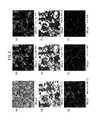
- FIG. 1 is an electron micrograph showing the outer appearance of the water absorbent particles prepared in Example 2.
- FIG. 2 is an EDX analytical photograph of a cross-section (cut surface) of the water absorbent particles prepared in Example 2.
- FIG. 3 is an X-ray diffraction image of a clay mineral.
- FIG. 4 is a schematic diagram of a DW apparatus to be used for measurement of the absorption factor.
- the present invention is a water absorbent comprising 100 parts by dry weight of a crosslinked naturally derived polymer and 10 to 100 parts by dry weight of a clay mineral, wherein the crosslinked naturally derived polymer and the clay mineral form a particle, and the clay mineral is present inside the particle.
- the naturally derived polymer to be used for the invention is not particularly restricted so long as it is a polymer that is naturally derived.
- a naturally derived polymer is a polymer obtained by fermentation with microorganisms or a polymer extracted from a natural substance, and this is often referred to as a “biopolymer”.
- Naturally derived polymers include, but are not limited to, poly(amino acid)s such as poly(glutamic acid) (hereunder, “PGA”), poly(aspartic acid), polylysine and polyarginine, as well as their salts, polysaccharides such as alginic acid, hyaluronic acid and chitosan, and chemically modified natural polymers such as carboxymethyl cellulose.
- poly(amino acid)s such as poly(glutamic acid) (hereunder, “PGA”), poly(aspartic acid), polylysine and polyarginine, as well as their salts, polysaccharides such as alginic acid, hyaluronic acid and chitosan, and chemically modified natural polymers such as carboxymethyl cellulose.
- Preferred naturally derived polymers are poly(glutamic acid) or carboxymethyl cellulose.
- the polyamino acids may also be copolymers.
- two or more different naturally derived polymers may be
- the naturally derived polymer may have a condensable functional group.
- the condensable functional groups contribute by reacting with the crosslinking agent, thereby crosslinking the naturally derived polymer.
- Examples of condensable functional groups include carboxyl groups and amino groups, with carboxyl groups being preferred because they also impart hydrophilicity.
- the crosslinking is accomplished by addition reaction, the presence or absence of condensable functional groups does not contribute to crosslinking, but the naturally derived polymer preferably has carboxyl groups in order to exhibit high water absorption.
- the naturally derived polymer is preferably hydrophilic, and is more preferably in the form of a water-soluble salt.
- a naturally derived polymer with a carboxyl group for example, is preferably in the form of a metal salt such as a sodium salt or potassium salt, or an ammonium salt, amine salt or the like, while a naturally derived polymer with an amino group is preferably in the form of an inorganic acid salt such as a hydrochloride or sulfate, or an organic acid salt such as an acetate.
- the molecular weight of the naturally derived polymer is not particularly restricted, but the weight-average molecular weight is preferably 10,000 to 13,000,000, more preferably 50,000 to 10,000,000 and even more preferably 300,000 to 5,000,000. If the molecular weight is too low, the number of uncrosslinked molecular chains per unit weight will increase and the amount of elution will increase, resulting in a low-strength gel. If the molecular weight is too high, the dissolved viscosity will increase, preventing homogeneous dispersion of the clay mineral or crosslinking agent.
- a crosslinked naturally derived polymer is a radiation-crosslinkable product obtained by reacting a naturally derived polymer with a crosslinking agent to form chemical crosslinking, or exposing a naturally derived polymer to radiation.
- the crosslinking will be described below.
- a clay mineral is a mineral that is a component of clay, and it is composed mainly of a laminar silicate mineral.
- Smectite group clay minerals are preferred for the clay mineral.
- Smectite group clay minerals include montmorillonite, beidellite and nontronite, among which montmorillonite is preferred.
- Bentonite is a clay composed mainly of montmorillonite and including accessory minerals such as quartz, and according to the invention, clays containing such clay minerals may also be used for the clay mineral.
- the crosslinked naturally derived polymer and the clay mineral form particles.
- the particle shapes are not particularly restricted but are preferably spherical.
- the particle sizes (circle equivalent diameters of projected area) are preferably 150 to 850 ⁇ m, more preferably 200 to 600 ⁇ m and even more preferably 300 to 400 ⁇ m. If the particles are too small, the gaps between particles during swelling will be reduced and blocking will take place when they are incorporated into the absorbent body. If the particles are too large, the area-to-weight ratio will be reduced and the moisture absorption speed will be lowered.
- the particle sizes (circle equivalent diameters of projected area) can be measured with an electron microscope.
- the clay mineral is present in the particle interiors. However, it is not necessary for all of the clay mineral to be present in the particle interiors, and a portion of the clay mineral may be exposed on the particle exteriors (outside surfaces).
- FIG. 1 shows an electron micrograph (100 ⁇ magnification) of the outer appearance of the water absorbent particles prepared in Example 2 below, and FIG. 2 shows EDX analytical photographs (250 ⁇ magnification) of particle cross-sections (cut surfaces).
- the water absorbent prepared in Example 2 the crosslinked naturally derived polymer and the clay mineral form particles, the clay mineral being present in the particle interiors.
- the clay mineral which is a laminar silicate, swells by dispersion in water and results in interlaminar opening. When a homogenizer is used for forceful dispersion, lumps are less likely to form, and therefore swelling is facilitated.
- the uncrosslinked naturally derived polymer dissolves in the clay mineral dispersion, some of the molecular chains of the naturally derived polymer also become incorporated between the opened interlayer regions. Crosslinking causes some of the molecular chains of the naturally derived polymer to become immobilized in a locked state, thereby reinforcing the lattice. Since the water absorbent of the invention has some or all of the molecular chains of the naturally derived polymer inserted between the laminar silicate layers, the interlayer distance is enlarged.
- FIG. 3 shows an X-ray diffraction diagram of the clay mineral.
- FIG. 3( a ) shows the X-ray diffraction pattern for the starting montmorillonite used in the examples, ( b ) the same for montmorillonite in the water absorbent of Example 2, and ( c ) the same for montmorillonite in the water absorbent of Example 4. Since the peaks were shifted leftward with the water absorbent ( b ) of Example 2 and the water absorbent ( c ) of the Example 4, compared to the starting montmorillonite ( a ), the interlayer regions were clearly enlarged.
- the present invention increases the gel strength by addition of a clay mineral.
- Gel strength can be increased by a method of increasing the amount of crosslinking agent added, in which case the crosslink density is higher so that the gel strength is greater even upon absorption of water. Because this crosslinking is by chemical bonding, the crosslinking points are strong and the density is higher, which are also factors that inhibit swelling deformation.
- the invention exhibits an effect of increased gel strength without increasing the amount of chemical crosslinking agent.
- the gel strength is increased by addition of a clay mineral as according to the invention, some of the molecular chains of the naturally derived polymer are inserted between the clay mineral layers, thereby increasing the gel strength, but since the linkages are not as strong as chemical bonds, a relative degree of freedom results compared to swelling deformation.
- the clay mineral content is 10 to 100 parts by weight (when dry), preferably 10 to 70 parts by weight (when dry) and more preferably 20 to 50 parts by weight (when dry) with respect to 100 parts by weight (when dry) of the crosslinked naturally derived polymer. If the clay mineral content is too low, the reinforcing effect will be inadequate and a sufficient gel strength will not be obtained. If the clay mineral content is too high, the water absorbing property will be impaired.
- the method for producing a water absorbent according to the invention includes a step of preparing a starting solution in which a naturally derived polymer is dissolved and a clay mineral is dispersed (hereunder also referred to as “starting solution preparation step”), and a step of adding a crosslinking agent to the starting solution and crosslinking the naturally derived polymer (hereunder also referred to as “crosslinking step”).
- the production method of the invention may also include one or more other steps from among a step of wet-granulating a hydrogel containing the crosslinked naturally derived polymer obtained in the step of crosslinking the naturally derived polymer (hereunder also referred to as “granulating step”), a step of adding a water-miscible organic solvent to the wet-granulated hydrogel and dewatering the hydrogel (hereunder also referred to as “dewatering step”), and a step of drying the dewatered hydrogel (hereunder also referred to as “drying step”).
- granulating step a step of wet-granulating a hydrogel containing the crosslinked naturally derived polymer obtained in the step of crosslinking the naturally derived polymer
- dewatering step a step of adding a water-miscible organic solvent to the wet-granulated hydrogel and dewatering the hydrogel
- drying step a step of drying the dewatered hydrogel
- the starting solution preparation step may be carried out by dissolving the naturally derived polymer in water and dispersing the clay mineral.
- the method of dissolution and dispersion is not restricted, and it may be accomplished by adding the naturally derived polymer and clay mineral to water, and stirring the mixture.
- the starting solution may be prepared by simultaneously adding the naturally derived polymer and clay mineral to water and stirring, or alternatively the starting solution may be prepared by adding the naturally derived polymer to water and stirring to prepare a naturally derived polymer aqueous solution and then adding the clay mineral to the naturally derived polymer aqueous solution and stirring to disperse the clay mineral in the naturally derived polymer aqueous solution, or the starting solution may be prepared by adding the clay mineral to water and stirring to prepare a clay mineral dispersion, and then adding the naturally derived polymer to the clay mineral dispersion and stirring to dissolve the naturally derived polymer in the clay mineral dispersion, or the starting solution may be prepared by separately preparing a naturally derived polymer aqueous solution and a clay mineral dispersion and mixing the naturally derived polymer aqueous solution and clay mineral dispersion together; however, from the viewpoint of more uniformly dispersing the clay mineral, preferably the clay mineral dispersion is prepared first and the
- the starting solution includes the naturally derived polymer, the clay mineral and water.
- the concentration of the naturally derived polymer in the starting solution is preferably 1 to 30 weight % (when dry), more preferably 3 to 20 weight % (when dry) and even more preferably 5 to 15 weight % (when dry). If the concentration of the naturally derived polymer is too low, the composite product yield will be low and the productivity will be poor. If the concentration of the naturally derived polymer is too high, the viscosity will increase, impairing the dispersibility of the clay mineral or crosslinking agent.
- the concentration of the clay mineral in the starting solution is preferably 0.06 to 30 weight % (when dry), more preferably 0.3 to 14 weight % (when dry) and even more preferably 1 to 5 weight % (when dry).
- the starting solution may also include, in addition to the naturally derived polymer, clay mineral and water, other substances (such as dispersing agents, emulsifying agents or organic solvents) in ranges that do not interfere with the effect of the invention.
- other substances such as dispersing agents, emulsifying agents or organic solvents
- the naturally derived polymer in the starting solution is then crosslinked.
- the crosslinking may be crosslinking by reaction of the naturally derived polymer with a crosslinking agent (chemical crosslinking) or crosslinking by exposure of the naturally derived polymer to radiation (radiation crosslinking), but chemical crosslinking is preferred from the viewpoint of crosslinking uniformity and productivity.
- the crosslinking agent is not particularly restricted so long as it is capable of crosslinking the naturally derived polymer.
- the crosslinking agent used may be a compound having two or more epoxy groups, such as ethyleneglycol diglycidyl ether, polyethyleneglycol diglycidyl ether or polypropyleneglycol diglycidyl ether.
- the crosslinking agent used may be a compound having two or more amino groups, for example, an alkylenediamine such as 1,2-ethylenediamine, 1,3-propanediamine, 1,4-butanediamine, 1,5-heptanediamine or 1,6-hexanediamine, or diethylenetramine, triethylenetetramine, tetraethylenepentamine, pentaethylenehexamine, polyethyleneimine or the like (hereunder also referred to as “polyamine”), or an amino group-containing polymer such as polylysine, chitosan or the like.
- an alkylenediamine such as 1,2-ethylenediamine, 1,3-propanediamine, 1,4-butanediamine, 1,5-heptanediamine or 1,6-hexanediamine, or diethylenetramine, triethylenetetramine, tetraethylenepentamine, pentaethylenehexamine, polyethyleneimine or the like (hereunder also referred to as “polyamine”), or an amino group-
- the crosslinking agent used may be a compound having two or more carboxyl groups, such as fumaric acid, maleic acid, itaconic acid, citraconic acid or trimellitic acid, or a carboxyl group-containing polymer such as polyacrylic acid, polymethacrylic acid, poly(glutamic acid), alginic acid, hyaluronic acid or the like.
- the amount of crosslinking agent used for crosslinking of the naturally derived polymer is preferably 0.5 to 25 parts by weight, more preferably 1 to 20 parts by weight and even more preferably 3 to 15 parts by weight with respect to 100 parts by weight of the naturally derived polymer. If the amount of crosslinking agent is too small, the crosslink density will tend to be lower and it can potentially be difficult to obtain a gel state. If the amount of crosslinking agent is too large, the crosslink density will tend to be higher and the degree of swelling of the obtained water absorbent can potentially be lowered.
- a condensation agent or condensation aid may also be used together with the crosslinking agent. When a condensation agent or condensation aid is used it is possible to more efficiently form amide bonds.
- a water-soluble carbodiimide may be mentioned as a condensation agent.
- a water-soluble carbodiimide is a compound having a carbodiimide group (—N ⁇ C ⁇ N—) in the molecule, the compound being water-soluble.
- Specific examples of water-soluble carbodiimides include 1-ethyl-3-(3-dimethylaminopropyl)carbodiimide and its salts, 1-cyclohexyl-3-(2-morpholinoethyl)carbodiimide-(meta)-p-toluenesulfuric acid and its salts, and dicyclohexylcarbodiimide, among which 1-ethyl-3-(3-dimethylaminopropyl)carbodiimide hydrochloride and 1-cyclohexyl-3-(2-morpholinoethyl)carbodiimide-(meta)-p-toluenesulfuric acid salts are preferred.
- the amount of condensation agent used may be 0 to 50 mol, preferably 1 to 40 mol and more preferably 2 to 30 mol with respect to 1 mol of the crosslinking agent used.
- N-hydroxyimide may be mentioned as a condensation aid.
- An N-hydroxyimide is a compound having an N-hydroxyimide group (—(C ⁇ O)—(N—OH)—(C ⁇ O)—) in the molecule. Such compounds are represented by the following general formula. R 1 —(C ⁇ O)—(N—OH)—(C ⁇ O)—R 2
- R 1 and R 2 may bond together to form a ring structure.
- Preferred is a compound wherein R 1 and R 2 bond so that the two carbons in R 1 and R 2 form a 5-membered ring with the N-hydroxyimide group.
- the N-hydroxyimide is preferably water-soluble.
- N-hydroxyimides that can be used include N-hydroxysuccinic acid imide, N-hydroxymaleic acid imide, N-hydroxyhexahydrophthalic acid imide, N,N′-dihydroxycyclohexanetetracarboxylic acid imide, N-hydroxyphthalic acid imide, N-hydroxytetrabromophthalic acid imide, N-hydroxytetrachlorophthalic acid imide, N-hydroxychlorendic acid imide, N-hydroxyhymic acid imide, N-hydroxytrimellitic acid imide, N,N′-dihydroxypyromellitic acid imide and N,N′-dihydroxynaphthalenetetracarboxylic acid imide.
- Preferred among these N-hydroxyimides is N-hydroxysuccinic acid imide.
- the amount of condensation aid used may be 0 to 50 mol, preferably 1 to 40 mol and more preferably 2 to 30 mol with respect to 1 mol of the crosslinking agent used.
- the amount of condensation aid used is preferably equimolar with the amount of condensation agent used.
- the conditions for the crosslinking step There are no particular restrictions on the conditions for the crosslinking step. It may be carried out at room temperature or with heating. If the temperature is too low, however, a very long time will be required for the crosslinking reaction, and therefore heating is preferably conducted.
- the temperature for the crosslinking step is preferably 10 to 100° C., more preferably 15 to 70° C. and even more preferably 20° C. to 50° C. If it is too high, the naturally derived polymer will tend to decompose.
- the step is therefore preferably carried out at near room temperature.
- the pH during the crosslinking reaction is not particularly restricted, but is preferably 5 to 12, more preferably 6 to 11 and even more preferably 7 to 10.
- the reaction time for the crosslinking step is preferably 5 minutes to 6 hours, more preferably 10 minutes to 3 hours and even more preferably 20 minutes to 2 hours.
- the reaction mixture may be stirred if necessary, or it may be stationed at rest. It is preferably stationed at rest.
- a gel is obtained in the reaction mixture.
- the reaction mixture is washed with water (preferably ion-exchanged water or distilled water) to remove the unreacted crosslinking agent, condensation agent and condensation aid in the reaction mixture, to obtain a gel in which the naturally derived polymer is crosslinked with the crosslinking agent.
- a hydrogel containing the crosslinked naturally derived polymer obtained in the crosslinking step is subjected to wet-granulating (granulating step).
- the hydrogel is granulated to a desired size in a wetted state (i.e. wet-granulated).
- the granulation is preferably first coarse granulation, followed by main granulation.
- the coarse granulation is carried out by, for example, stirring the hydrogel obtained from the crosslinking reaction, using a spatula or the like.
- the hydrogel is granulated using an apparatus suitable for wet-granulation, such as a homomixer, homogenizer, bead mill, pipe mixer or the like.
- granulated hydrogel refers to hydrogel particles.
- the mean particle size of the hydrogel particles may be appropriately set according to the purpose of use of the dry gel powder that is to be finally obtained, or according to the apparatus used for granulation, but it is preferably 10 ⁇ m to 10 mm and more preferably 100 ⁇ m to 3 mm.
- a water-miscible organic solvent may be added, as described below. Specifically, granulation may be carried out after adding a water-miscible organic solvent. By adding a water-miscible organic solvent, the hydrogel becomes dewatered and reduced in volume (shrunken), the viscosity of the dispersion during the wet-granulation is lowered, and the flow property is restored. Even when the viscosity has increased during granulation, the water-miscible organic solvent may be added during the procedure and granulation continued. The wet-granulating step and the subsequent dewatering step may thus be carried out simultaneously.
- a naturally derived polymer with a carboxyl group When a naturally derived polymer with a carboxyl group is used as the starting material, the carboxyl group portion of the naturally derived polymer is converted to a water-soluble salt form such as a sodium salt to prepare a hydrogel, as mentioned above.
- a hydrogel in salt form When a hydrogel in salt form is worked into a dry gel powder, it absorbs moisture in the atmosphere, potentially causing coalescence of the powder. After preparing the hydrogel, therefore, an inorganic acid or organic acid may be added to convert a portion of the salt form to the free acid form.
- a dry gel powder obtained from a hydrogel in free acid form has lower hygroscopicity than a dry gel powder in salt form, and therefore the powder is resistant to coalescence.
- inorganic acids and organic acids examples include sulfuric acid, hydrochloric acid, nitric acid and p-toluenesulfonic acid.
- An inorganic acid or organic acid is preferably added to the hydrogel particle by mixing with the water-miscible organic solvent. When an inorganic acid or organic acid is added, the hydrogel is neutralized homogeneously, yielding hydrogel particles in a homogeneous free acid form.
- a water-miscible organic solvent is added to the wet-granulated hydrogel and the hydrogel is dewatered (dewatering step).
- the hydrogel particles are dipped into the water-miscible organic solvent, the water in the hydrogel particles is released into the water-miscible organic solvent.
- the hydrogel particles being dewatered, sometimes shrink to fine particle sizes.
- unwanted substances such as the unreacted crosslinking agent used for crosslinking of the naturally derived polymer, or the condensation agent and condensation aid, are released from the hydrogel particles together with water.
- the water-miscible organic solvent is not particularly restricted. Examples that may be mentioned include lower alcohols such as methanol, ethanol, isopropanol, n-propanol and tertiary butanol, glycol ethers such as ethyleneglycol monomethyl ether, ethyleneglycol monoethyl ether, ethyleneglycol monoisopropyl ether, propyleneglycol monomethyl ether and propyleneglycol monoethyl ether, and acetone. Preferred among these are methanol, ethanol, isopropanol and acetone. These water-miscible organic solvents may be used alone or in mixtures of two or more, or two or more different solvents may be added successively depending on the dispersed state.
- lower alcohols such as methanol, ethanol, isopropanol, n-propanol and tertiary butanol
- glycol ethers such as ethyleneglycol monomethyl ether,
- Dipping of the hydrogel particles into the water-miscible organic solvent may be repeated several times.
- the solvent containing water that has been released from the hydrogel particles is removed by filtration or decantation, and fresh water-miscible organic solvent is added to the hydrogel particles.
- the hydrogel particles are further dewatered and shrink, resulting in fine particles with an extremely low water content.
- a different water-miscible organic solvent may even be used for each dipping.
- the amount of water-miscible organic solvent used will differ depending on its type, and on the amount of water and other factors during preparation of the hydrogel, but for a single dipping, it is preferably a 1-fold volume (equivolume) to 20-fold volume, more preferably a 2-fold volume to 10-fold volume, and even more preferably a 3-fold volume to 7-fold volume, with respect to the hydrogel.
- the time for dipping of the hydrogel particles in the water-miscible organic solvent will differ depending on the type of solvent and its amount, for example, but for a single dipping, it is preferably 1 minute to 2 hours, more preferably 2 minutes to 1 hour and even more preferably 3 minutes to 30 minutes, from the standpoint of manageability.
- the hydrogel particles may be rinsed with an appropriate fluid after dipping in the water-miscible organic solvent.
- the dewatered hydrogel is then dried (drying step).
- the hydrogel particles obtained after the dewatering step have a low water content, containing virtually no moisture.
- the water-miscible organic solvent may be removed by filtration or decantation, and then blow air-drying or stationary drying carried out at room temperature to 150° C., more preferably 35° C. to 125° C. and even more preferably 50° C. to 100° C., to obtain a dry gel powder. Since the hydrogel particles are therefore not exposed to harsh drying conditions, the particles do not coalesce together during the drying.
- the particle diameter of the obtained dry gel powder can be determined in consideration of the intended use of the dry gel powder, for example, and it is not particularly restricted. That is, a dry gel powder can be obtained having a desired particle diameter, depending on the granulating apparatus (homomixer, homogenizer or the like) and the granulating force used for the granulating step.
- a dry gel powder can be obtained having a desired particle diameter, depending on the granulating apparatus (homomixer, homogenizer or the like) and the granulating force used for the granulating step.
- the PGA-Na concentration was 7%.
- DETA diethylenetriamine
- NHS N-hydroxysuccinic acid imide
- EDC.HCl 1-ethyl-3-(3-dimethylaminopropyl)carbodiimide hydrochloride
- the obtained opaque hydrogel was coarsely granulated with a spatula.
- 20 g of methanol manufactured by Wako Pure Chemical Industries, Ltd.
- a homogenizer (AHG-160D, shaft generator HT1018, manufactured by As One Corp.) was used for wet-granulation under 750 rpm conditions.
- AHG-160D shaft generator HT1018, manufactured by As One Corp.
- the solvent was removed by decantation, another 20 g of methanol was added, and the mixture was stirred. This series of steps was repeated, carrying out dewatering until the hydrogel particles shrank and became white particles.
- the dewatered particles were blow air-dried under conditions of 70° C., 90 minutes, to obtain a dry gel powder water absorbent.
- a water absorbent was prepared by the same procedure as Example 1, except that the montmorillonite was changed to bentonite (“BENGEL HV” by Hojun Co., Ltd.).
- a water absorbent was prepared by the same procedure as Example 2, except that montmorillonite was not added.
- a homogenizer (AHG-160D, shaft generator HT1018, manufactured by As One Corp.) was used for dispersion at 1000 rpm for 3 minutes.
- the CMC-Na concentration was 15 weight %.
- EGDE ethyleneglycol diglycidyl ether
- crosslinking reaction was performed at 70° C. for 15 hours.
- the obtained hydrogel was coarsely granulated with a spatula, and then a 3-fold amount of acetone (manufactured by Wako Pure Chemical Industries, Ltd.) was added to the coarsely granulated hydrogel and a homogenizer (same as above) was used for dewatering and wet-granulating under 750 rpm condtions.
- the gel was filtered and then placed in a 3-fold amount of water:acetone (70:30) and stirred for washing of the gel while partially swelling it. After finally dewatering it again with acetone alone, it was dried for 1.5 hours in a 70° C. oven to obtain a dry gel powder water absorbent.
- the obtained synthetic powder was sieved to separate off the 150-750 ⁇ m portion, thereby obtaining the desired water absorbent.
- a water absorbent was prepared by the same procedure as Example 6, except that bentonite was not added.
- the water absorbents prepared in the examples and comparative examples were measured for water absorbent gel strength, absorption factor and gel liquid flow speed. The measurement results are shown in Table 1 and Table 2.
- a bag (10 ⁇ 20 cm) is prepared using a 250 mesh nylon net (N-NO.250HD by NBC Industry), and a 1.0 g sample of the water absorbent is placed in it.
- a 10.0 g portion of the sample is placed in a PP tube with a diameter of 27 mm (NEW PP sample tube No.5, 22 mL, manufactured by Maruemu Corp.).
- the start point is the point where movement begins from the 3rd decimal place according to the value measured by the digital force gauge, and the numerical value for the maximum load when the gel has been pressed for 10 seconds (10 mm) is read off and is recorded as the gel strength.
- the absorption factor of the water absorbent was measured by a non-pressure “DW” method (Demand Wettability method).
- the absorption factor is a measure of the continuous liquid absorption, with a higher absorption factor corresponding to more excellent continuous liquid absorption.
- the DW apparatus (Demand Wettability apparatus, manufactured by Taiyo Create Co., Ltd., using 100 mL burette) shown in FIG. 4 is used.
- 11 is the DW apparatus
- 12 is the burette
- 13 is a rubber stopper
- 14 is an air inlet tube
- 15 is a cock
- 16 is a cock
- 17 is a support plate
- 18 is a liquid outlet
- 19 is a cylinder
- 20 is a test solution.
- the test solution used is a 0.9% sodium chloride aqueous solution.
- the 0.9% sodium chloride aqueous solution is prepared in the following manner. A 3 liter beaker is placed on an electronic scale (after 0 resets), and ion-exchanged water is added to 27.0 g of sodium chloride (reagent grade A) to 3000.0 g. The mixture is then stirred to dissolution of the sodium chloride to prepare a test solution. The test solution is allowed to stand in an atmosphere at 20° C. ⁇ 65% RH, and the liquid temperature of the test solution is brought to 20° C. ⁇ 1° C.
- the measurement is conducted in an atmosphere of 20° C. ⁇ 65% RH (in a steady temperature and humidity room).
- test solution 20 is added to higher than point 0, with both cocks 15 , 16 of the DW apparatus 11 closed off, and the rubber stopper 13 is placed over the burette 12 to seal it.
- both cocks 15 , 16 were opened, and the liquid level was matched to point 0 while suctioning out the liquid flowing out from the liquid outlet 18 with the filter paper. After preparation, the cock 15 was closed.
- a 250 mesh nylon net (N-NO.250HD by NBC Industry) is cut to 100 ⁇ 100 mm and placed on the liquid outlet 18 .
- a cylinder 19 with a diameter of 30 mm is at the center section of the nylon net, and 1.00 g of the water absorbent sample is placed therein and the cylinder 19 is gently shaken to form a flat surface.
- the gel liquid flow speed is a measure of the continuous liquid permeability, with a greater gel liquid flow speed corresponding to more excellent continuous liquid permeability.
- the water absorbents of the examples had high gel strength due to the reinforcing effect of the clay mineral, and were also resistant to blocking and therefore exhibited a high absorption factor, i.e. a high continuous liquid drawing property, as well as a high gel liquid flow speed, i.e. high continuous liquid permeability.
- the water absorbent of the invention has high gel strength and an excellent absorption factor and gel liquid flow speed, and it can therefore be suitably used as a starting material to form an absorbent body for an absorbent article such as a disposable diaper or sanitary napkin.
Landscapes
- Chemical & Material Sciences (AREA)
- Health & Medical Sciences (AREA)
- Organic Chemistry (AREA)
- Chemical Kinetics & Catalysis (AREA)
- Analytical Chemistry (AREA)
- Life Sciences & Earth Sciences (AREA)
- Engineering & Computer Science (AREA)
- General Health & Medical Sciences (AREA)
- Materials Engineering (AREA)
- Epidemiology (AREA)
- Animal Behavior & Ethology (AREA)
- Public Health (AREA)
- Veterinary Medicine (AREA)
- Medicinal Chemistry (AREA)
- Polymers & Plastics (AREA)
- Dispersion Chemistry (AREA)
- Hematology (AREA)
- Geochemistry & Mineralogy (AREA)
- Inorganic Chemistry (AREA)
- Vascular Medicine (AREA)
- Heart & Thoracic Surgery (AREA)
- Biomedical Technology (AREA)
- Solid-Sorbent Or Filter-Aiding Compositions (AREA)
- Absorbent Articles And Supports Therefor (AREA)
- Compositions Of Macromolecular Compounds (AREA)
Applications Claiming Priority (3)
| Application Number | Priority Date | Filing Date | Title |
|---|---|---|---|
| JP2014-243371 | 2014-12-01 | ||
| JP2014243371A JP6234358B2 (ja) | 2014-12-01 | 2014-12-01 | 生分解性吸水剤 |
| PCT/JP2015/083631 WO2016088722A1 (ja) | 2014-12-01 | 2015-11-30 | 生分解性吸水剤 |
Publications (2)
| Publication Number | Publication Date |
|---|---|
| US20180311401A1 US20180311401A1 (en) | 2018-11-01 |
| US10183094B2 true US10183094B2 (en) | 2019-01-22 |
Family
ID=56091664
Family Applications (1)
| Application Number | Title | Priority Date | Filing Date |
|---|---|---|---|
| US15/527,916 Expired - Fee Related US10183094B2 (en) | 2014-12-01 | 2015-11-30 | Biodegradable water absorbent |
Country Status (5)
| Country | Link |
|---|---|
| US (1) | US10183094B2 (ja) |
| EP (1) | EP3228383B1 (ja) |
| JP (1) | JP6234358B2 (ja) |
| CN (1) | CN106999906A (ja) |
| WO (1) | WO2016088722A1 (ja) |
Cited By (6)
| Publication number | Priority date | Publication date | Assignee | Title |
|---|---|---|---|---|
| US20210045939A1 (en) * | 2018-03-20 | 2021-02-18 | Daio Paper Corporation | Tape-type disposable diaper |
| US20210059871A1 (en) * | 2018-03-20 | 2021-03-04 | Daio Paper Corporation | Tape-type disposable diaper |
| US11090198B2 (en) | 2014-06-02 | 2021-08-17 | Tethis, Inc. | Absorbent articles with biocompostable properties |
| US11154436B2 (en) | 2014-06-02 | 2021-10-26 | Tethis, Inc. | Absorbent articles with biocompostable properties |
| US20230058841A1 (en) * | 2020-05-26 | 2023-02-23 | Zymochem, Inc. | Biodegradable high-performance absorbent polymers and methods thereof |
| US11766366B2 (en) | 2019-11-01 | 2023-09-26 | Tethis, Inc. | Absorbent hygienic articles with sensors and biocompostable elements |
Families Citing this family (5)
| Publication number | Priority date | Publication date | Assignee | Title |
|---|---|---|---|---|
| IT202000016996A1 (it) * | 2020-07-13 | 2022-01-13 | Torino Politecnico | Scambiatore di calore e massa realizzato con un biocomposto idrogel di alginato-bentonite per catturare vapore acqueo, e relativo processo di produzione |
| JP2022148855A (ja) * | 2021-03-24 | 2022-10-06 | 国立大学法人 東京大学 | 異方性を有する高濃度ゲル又は多孔性材料の製造方法 |
| CN115337912A (zh) * | 2022-08-03 | 2022-11-15 | 河池学院 | 一种磁性交联型壳聚糖-聚乙烯亚胺/生物炭复合凝胶颗粒及制备方法 |
| CN115716924A (zh) * | 2022-11-15 | 2023-02-28 | 西北农林科技大学 | 一种高分子水凝胶及其制备方法、应用 |
| DE102023109314A1 (de) * | 2023-04-13 | 2024-10-17 | Stephan Schmidt Kg | Tonhaltige Zusammensetzung, Verfahren zu ihrer Herstellung und ihre Verwendung |
Citations (9)
| Publication number | Priority date | Publication date | Assignee | Title |
|---|---|---|---|---|
| JP2003033652A (ja) | 2001-07-26 | 2003-02-04 | Dainippon Ink & Chem Inc | 吸水性材料、及びそれを用いてなる血液吸収用物品 |
| WO2005030279A1 (en) | 2003-09-29 | 2005-04-07 | Le Groupe Lysac Inc. | Polysaccharide phyllosilicate absorbent or superabsorbent nanocomposite materials |
| JP2006291144A (ja) | 2005-04-14 | 2006-10-26 | Mitsui Chemicals Inc | 吸水性弾性体 |
| WO2007034795A1 (ja) | 2005-09-20 | 2007-03-29 | Genolac Bl Corporation | γ-ポリグルタミン酸架橋物及びその製造方法 |
| JP2008254165A (ja) | 2007-03-09 | 2008-10-23 | Japan Science & Technology Agency | ホウ素化合物を用いて得られる疎水性高分子のナノ構造体 |
| JP2008303319A (ja) | 2007-06-08 | 2008-12-18 | San-Dia Polymer Ltd | 吸水性ポリマーの製造方法及び吸収性樹脂粒子 |
| JP2009114391A (ja) | 2007-11-08 | 2009-05-28 | San-Dia Polymer Ltd | 吸収性樹脂粒子、この製造方法、これを含む吸収体及び吸収性物品 |
| WO2011038374A2 (en) | 2009-09-28 | 2011-03-31 | Haishan Xiong | Absorbent composition and methods thereof |
| WO2014162843A1 (ja) | 2013-04-05 | 2014-10-09 | 株式会社日本触媒 | 吸水剤の製造方法及び吸水剤 |
-
2014
- 2014-12-01 JP JP2014243371A patent/JP6234358B2/ja active Active
-
2015
- 2015-11-30 WO PCT/JP2015/083631 patent/WO2016088722A1/ja not_active Ceased
- 2015-11-30 EP EP15866226.2A patent/EP3228383B1/en active Active
- 2015-11-30 CN CN201580065361.7A patent/CN106999906A/zh active Pending
- 2015-11-30 US US15/527,916 patent/US10183094B2/en not_active Expired - Fee Related
Patent Citations (11)
| Publication number | Priority date | Publication date | Assignee | Title |
|---|---|---|---|---|
| JP2003033652A (ja) | 2001-07-26 | 2003-02-04 | Dainippon Ink & Chem Inc | 吸水性材料、及びそれを用いてなる血液吸収用物品 |
| WO2005030279A1 (en) | 2003-09-29 | 2005-04-07 | Le Groupe Lysac Inc. | Polysaccharide phyllosilicate absorbent or superabsorbent nanocomposite materials |
| US20050214541A1 (en) | 2003-09-29 | 2005-09-29 | Le Groupe Lysac Inc. | Polysaccharide phyllosilicate absorbent or superabsorbent nanocomposite materials |
| JP2007533780A (ja) | 2003-09-29 | 2007-11-22 | ル・グループ・リサック・インコーポレーテッド | 吸収性または高吸収性の多糖類層状珪酸塩ナノコンポジット材料 |
| JP2006291144A (ja) | 2005-04-14 | 2006-10-26 | Mitsui Chemicals Inc | 吸水性弾性体 |
| WO2007034795A1 (ja) | 2005-09-20 | 2007-03-29 | Genolac Bl Corporation | γ-ポリグルタミン酸架橋物及びその製造方法 |
| JP2008254165A (ja) | 2007-03-09 | 2008-10-23 | Japan Science & Technology Agency | ホウ素化合物を用いて得られる疎水性高分子のナノ構造体 |
| JP2008303319A (ja) | 2007-06-08 | 2008-12-18 | San-Dia Polymer Ltd | 吸水性ポリマーの製造方法及び吸収性樹脂粒子 |
| JP2009114391A (ja) | 2007-11-08 | 2009-05-28 | San-Dia Polymer Ltd | 吸収性樹脂粒子、この製造方法、これを含む吸収体及び吸収性物品 |
| WO2011038374A2 (en) | 2009-09-28 | 2011-03-31 | Haishan Xiong | Absorbent composition and methods thereof |
| WO2014162843A1 (ja) | 2013-04-05 | 2014-10-09 | 株式会社日本触媒 | 吸水剤の製造方法及び吸水剤 |
Non-Patent Citations (3)
| Title |
|---|
| Bao Yan et al., "Synthesis and swelling behaviors of sodium carboxymethyl cellulose-g-poly(AA-co-AM-co-AMPS)/MMT superabsorbent hydrogel", Carbohydrate Polymers, vol. 84, issue 1, pp. 76-82, ISSN 0144-8617 dated Feb. 11, 2011. |
| International Search Report from corresponding PCT application No. PCT/JP2015/083631 dated Feb. 16, 2016 (4 pgs). |
| Wang Xuman et al., "Preparation of poly(y-glutamic acid)/montmorillonite superabsorbent nanocomposite", Key Engineering Materials, vols. 531-532, pp. 609-613, ISSN 1013-9826 (2013). |
Cited By (10)
| Publication number | Priority date | Publication date | Assignee | Title |
|---|---|---|---|---|
| US11090198B2 (en) | 2014-06-02 | 2021-08-17 | Tethis, Inc. | Absorbent articles with biocompostable properties |
| US11154436B2 (en) | 2014-06-02 | 2021-10-26 | Tethis, Inc. | Absorbent articles with biocompostable properties |
| US12059334B2 (en) | 2014-06-02 | 2024-08-13 | Tethis, Inc. | Absorbent articles with biocompostable properties |
| US20210045939A1 (en) * | 2018-03-20 | 2021-02-18 | Daio Paper Corporation | Tape-type disposable diaper |
| US20210059871A1 (en) * | 2018-03-20 | 2021-03-04 | Daio Paper Corporation | Tape-type disposable diaper |
| US11766366B2 (en) | 2019-11-01 | 2023-09-26 | Tethis, Inc. | Absorbent hygienic articles with sensors and biocompostable elements |
| US20230058841A1 (en) * | 2020-05-26 | 2023-02-23 | Zymochem, Inc. | Biodegradable high-performance absorbent polymers and methods thereof |
| US11717805B2 (en) * | 2020-05-26 | 2023-08-08 | Zymochem, Inc. | Biodegradable high-performance absorbent polymers and methods thereof |
| US20240181428A1 (en) * | 2020-05-26 | 2024-06-06 | Zymochem, Inc. | Biodegradable high-performance absorbent polymers and methods thereof |
| US12053758B2 (en) * | 2020-05-26 | 2024-08-06 | Zymochem, Inc. | Biodegradable high-performance absorbent polymers and methods thereof |
Also Published As
| Publication number | Publication date |
|---|---|
| JP6234358B2 (ja) | 2017-11-22 |
| US20180311401A1 (en) | 2018-11-01 |
| JP2016104472A (ja) | 2016-06-09 |
| CN106999906A (zh) | 2017-08-01 |
| EP3228383A1 (en) | 2017-10-11 |
| EP3228383A4 (en) | 2017-11-15 |
| WO2016088722A1 (ja) | 2016-06-09 |
| EP3228383B1 (en) | 2019-12-25 |
Similar Documents
| Publication | Publication Date | Title |
|---|---|---|
| US10183094B2 (en) | Biodegradable water absorbent | |
| Dai et al. | Preparation of thermoresponsive alginate/starch ether composite hydrogel and its application to the removal of Cu (II) from aqueous solution | |
| Xu et al. | Morphological and swelling behavior of cellulose nanofiber (CNF)/poly (vinyl alcohol)(PVA) hydrogels: poly (ethylene glycol)(PEG) as porogen | |
| CN105026033B (zh) | 吸水剂 | |
| JP5940313B2 (ja) | 高分子吸着体 | |
| Sengel et al. | Halloysite-carboxymethyl cellulose cryogel composite from natural sources | |
| Wang et al. | Engineering novel polyelectrolyte complex membranes with improved mechanical properties and separation performance | |
| JP2010253359A (ja) | キレート性高分子化合物含有金属吸着材 | |
| JP2013166090A (ja) | ゲル状金属吸着材およびゲル状金属吸着材担持吸着体 | |
| JP6407204B2 (ja) | 生分解性吸水剤およびその製法 | |
| WO2021256038A1 (ja) | ゲル、多孔質体、及びゲル又は多孔質体の製造方法 | |
| Hakimi et al. | Radiation-induced admicellar polymerization of methacrylate acid for pH responsive cellulose nanofibrils | |
| CN116284964B (zh) | 一种纤维素微球吸附剂及其制备方法 | |
| Kalantari et al. | Evaluation of heavy metals removal by cross-linked (polyvinyl alcohol/chitosan/magnetic) nano fibrous membrane prepared by electro spinning technique | |
| Chen et al. | Preparation of chitin composite hydrogel for dye-contaminated water treatment | |
| CN115232251B (zh) | 一种离子化胺基聚合物微球及其制备方法和应用 | |
| WO2017061166A1 (ja) | 生分解性吸水剤およびその製法 | |
| US20170145179A1 (en) | Macroporous omniphilic sponges | |
| Kimna et al. | Microfluidic‐assisted preparation of nano and microscale chitosan based 3D composite materials: Comparison with conventional methods | |
| Zhang et al. | Synthesis and characterization of karaya gum/chitosan composite microspheres | |
| WO2021146301A1 (en) | Synthesis of cross-linked spherical polycationic bead adsorbents for heparin recovery | |
| Xu et al. | Porous carboxymethylcellulose/polyethyleneimine composite beads: formation process, enhanced physical properties, and pH-induced response mechanism | |
| CN112791705B (zh) | 一种具有多孔结构的dna/碳纳米管杂化水凝胶及其制备方法与应用 | |
| JP6881741B2 (ja) | 多孔質体及びその製造方法 | |
| Li | Green adsorbents based on functional-modified cellulose and copolymers for water clarification |
Legal Events
| Date | Code | Title | Description |
|---|---|---|---|
| AS | Assignment |
Owner name: UNICHARM CORPORATION, JAPAN Free format text: ASSIGNMENT OF ASSIGNORS INTEREST;ASSIGNORS:YAMAGUCHI, MASASHI;UYAMA, HIROSHI;REEL/FRAME:042469/0365 Effective date: 20170301 |
|
| FEPP | Fee payment procedure |
Free format text: PETITION RELATED TO MAINTENANCE FEES GRANTED (ORIGINAL EVENT CODE: PTGR); ENTITY STATUS OF PATENT OWNER: LARGE ENTITY |
|
| STCF | Information on status: patent grant |
Free format text: PATENTED CASE |
|
| FEPP | Fee payment procedure |
Free format text: MAINTENANCE FEE REMINDER MAILED (ORIGINAL EVENT CODE: REM.); ENTITY STATUS OF PATENT OWNER: LARGE ENTITY |
|
| LAPS | Lapse for failure to pay maintenance fees |
Free format text: PATENT EXPIRED FOR FAILURE TO PAY MAINTENANCE FEES (ORIGINAL EVENT CODE: EXP.); ENTITY STATUS OF PATENT OWNER: LARGE ENTITY |
|
| STCH | Information on status: patent discontinuation |
Free format text: PATENT EXPIRED DUE TO NONPAYMENT OF MAINTENANCE FEES UNDER 37 CFR 1.362 |
|
| FP | Lapsed due to failure to pay maintenance fee |
Effective date: 20230122 |