US10101756B2 - Systems and methods for reducing leakage power of a system on chip with integrated thermoelectric cooling - Google Patents
Systems and methods for reducing leakage power of a system on chip with integrated thermoelectric cooling Download PDFInfo
- Publication number
- US10101756B2 US10101756B2 US14/446,258 US201414446258A US10101756B2 US 10101756 B2 US10101756 B2 US 10101756B2 US 201414446258 A US201414446258 A US 201414446258A US 10101756 B2 US10101756 B2 US 10101756B2
- Authority
- US
- United States
- Prior art keywords
- thermoelectric
- soc
- thermoelectric coolers
- chip
- temperature
- Prior art date
- Legal status (The legal status is an assumption and is not a legal conclusion. Google has not performed a legal analysis and makes no representation as to the accuracy of the status listed.)
- Active, expires
Links
Images




Classifications
-
- G—PHYSICS
- G05—CONTROLLING; REGULATING
- G05D—SYSTEMS FOR CONTROLLING OR REGULATING NON-ELECTRIC VARIABLES
- G05D23/00—Control of temperature
- G05D23/19—Control of temperature characterised by the use of electric means
- G05D23/1917—Control of temperature characterised by the use of electric means using digital means
-
- G—PHYSICS
- G05—CONTROLLING; REGULATING
- G05B—CONTROL OR REGULATING SYSTEMS IN GENERAL; FUNCTIONAL ELEMENTS OF SUCH SYSTEMS; MONITORING OR TESTING ARRANGEMENTS FOR SUCH SYSTEMS OR ELEMENTS
- G05B13/00—Adaptive control systems, i.e. systems automatically adjusting themselves to have a performance which is optimum according to some preassigned criterion
- G05B13/02—Adaptive control systems, i.e. systems automatically adjusting themselves to have a performance which is optimum according to some preassigned criterion electric
- G05B13/0205—Adaptive control systems, i.e. systems automatically adjusting themselves to have a performance which is optimum according to some preassigned criterion electric not using a model or a simulator of the controlled system
-
- G—PHYSICS
- G06—COMPUTING OR CALCULATING; COUNTING
- G06F—ELECTRIC DIGITAL DATA PROCESSING
- G06F1/00—Details not covered by groups G06F3/00 - G06F13/00 and G06F21/00
- G06F1/16—Constructional details or arrangements
- G06F1/20—Cooling means
- G06F1/203—Cooling means for portable computers, e.g. for laptops
-
- G—PHYSICS
- G06—COMPUTING OR CALCULATING; COUNTING
- G06F—ELECTRIC DIGITAL DATA PROCESSING
- G06F1/00—Details not covered by groups G06F3/00 - G06F13/00 and G06F21/00
- G06F1/16—Constructional details or arrangements
- G06F1/20—Cooling means
- G06F1/206—Cooling means comprising thermal management
-
- G—PHYSICS
- G06—COMPUTING OR CALCULATING; COUNTING
- G06F—ELECTRIC DIGITAL DATA PROCESSING
- G06F1/00—Details not covered by groups G06F3/00 - G06F13/00 and G06F21/00
- G06F1/26—Power supply means, e.g. regulation thereof
- G06F1/32—Means for saving power
- G06F1/3203—Power management, i.e. event-based initiation of a power-saving mode
- G06F1/3206—Monitoring of events, devices or parameters that trigger a change in power modality
-
- G—PHYSICS
- G06—COMPUTING OR CALCULATING; COUNTING
- G06F—ELECTRIC DIGITAL DATA PROCESSING
- G06F1/00—Details not covered by groups G06F3/00 - G06F13/00 and G06F21/00
- G06F1/26—Power supply means, e.g. regulation thereof
- G06F1/32—Means for saving power
- G06F1/3203—Power management, i.e. event-based initiation of a power-saving mode
- G06F1/3234—Power saving characterised by the action undertaken
-
- H01L23/34—
-
- H01L23/38—
-
- H01L25/0652—
-
- H01L25/0655—
-
- H01L25/072—
-
- H—ELECTRICITY
- H10—SEMICONDUCTOR DEVICES; ELECTRIC SOLID-STATE DEVICES NOT OTHERWISE PROVIDED FOR
- H10D—INORGANIC ELECTRIC SEMICONDUCTOR DEVICES
- H10D89/00—Aspects of integrated devices not covered by groups H10D84/00 - H10D88/00
- H10D89/10—Integrated device layouts
- H10D89/105—Integrated device layouts adapted for thermal considerations
-
- H—ELECTRICITY
- H10—SEMICONDUCTOR DEVICES; ELECTRIC SOLID-STATE DEVICES NOT OTHERWISE PROVIDED FOR
- H10W—GENERIC PACKAGES, INTERCONNECTIONS, CONNECTORS OR OTHER CONSTRUCTIONAL DETAILS OF DEVICES COVERED BY CLASS H10
- H10W40/00—Arrangements for thermal protection or thermal control
-
- H—ELECTRICITY
- H10—SEMICONDUCTOR DEVICES; ELECTRIC SOLID-STATE DEVICES NOT OTHERWISE PROVIDED FOR
- H10W—GENERIC PACKAGES, INTERCONNECTIONS, CONNECTORS OR OTHER CONSTRUCTIONAL DETAILS OF DEVICES COVERED BY CLASS H10
- H10W40/00—Arrangements for thermal protection or thermal control
- H10W40/20—Arrangements for cooling
- H10W40/28—Arrangements for cooling comprising Peltier coolers
-
- H—ELECTRICITY
- H10—SEMICONDUCTOR DEVICES; ELECTRIC SOLID-STATE DEVICES NOT OTHERWISE PROVIDED FOR
- H10W—GENERIC PACKAGES, INTERCONNECTIONS, CONNECTORS OR OTHER CONSTRUCTIONAL DETAILS OF DEVICES COVERED BY CLASS H10
- H10W90/00—Package configurations
-
- H01L2924/00—
-
- H01L2924/0002—
-
- Y—GENERAL TAGGING OF NEW TECHNOLOGICAL DEVELOPMENTS; GENERAL TAGGING OF CROSS-SECTIONAL TECHNOLOGIES SPANNING OVER SEVERAL SECTIONS OF THE IPC; TECHNICAL SUBJECTS COVERED BY FORMER USPC CROSS-REFERENCE ART COLLECTIONS [XRACs] AND DIGESTS
- Y02—TECHNOLOGIES OR APPLICATIONS FOR MITIGATION OR ADAPTATION AGAINST CLIMATE CHANGE
- Y02D—CLIMATE CHANGE MITIGATION TECHNOLOGIES IN INFORMATION AND COMMUNICATION TECHNOLOGIES [ICT], I.E. INFORMATION AND COMMUNICATION TECHNOLOGIES AIMING AT THE REDUCTION OF THEIR OWN ENERGY USE
- Y02D10/00—Energy efficient computing, e.g. low power processors, power management or thermal management
-
- Y02D10/16—
Definitions
- Portable computing devices e.g., cellular telephones, smart phones, tablet computers, portable digital assistants (PDAs), and portable game consoles
- SoCs system-on-chips
- microprocessor cores embedded on a single substrate (e.g., a central processing unit (CPU), graphics processing unit (GPU), etc.), allowing users to execute complex and power intensive software applications.
- CPU central processing unit
- GPU graphics processing unit
- increased performance and functionality requirements present significant design and operational challenges for managing battery life and power consumption.
- One embodiment is a method for reducing leakage power of an SoC.
- One such method comprises monitoring a plurality of temperature differentials across a respective plurality of thermoelectric coolers on a system on chip (SoC).
- SoC system on chip
- Each of the thermoelectric coolers is dedicated to a corresponding one of a plurality of chip sections on the SoC.
- the thermoelectric coolers are controlled based on the plurality of temperature differentials to minimize a sum of a combined power consumption of the plurality of chip sections and the plurality of corresponding dedicated thermoelectric coolers.
- Another embodiment is a system for reducing leakage power of an SoC.
- One such system comprises an SoC and a thermoelectric cooler controller.
- the SoC comprises a plurality of chip sections. Each chip section has a dedicated and separately controlled thermoelectric cooler.
- the thermoelectric cooler controller comprises logic configured to: monitor a temperature differential across each of the respective thermoelectric coolers on the SoC; and control the plurality of thermoelectric coolers based on the plurality of temperature differentials to minimize a sum of a combined power consumption of the plurality of chip sections and the plurality of corresponding dedicated thermoelectric coolers on the SoC.
- Yet another embodiment comprises a computer program embodied in a computer-readable medium and executed by a processor for reducing leakage power of a system on chip (SoC).
- the computer program comprises logic configured to monitor a plurality of temperature differentials across a respective plurality of thermoelectric coolers on a system on chip (SoC). Each of the thermoelectric coolers is dedicated to a corresponding one of a plurality of chip sections on the SoC. Further logic is configured to control the plurality of thermoelectric coolers based on the plurality of temperature differentials to minimize a sum of a combined power consumption of the plurality of chip sections and the plurality of corresponding dedicated thermoelectric coolers.
- FIG. 1 a is a schematic diagram of an embodiment of a system on chip (SoC) comprising an array of dedicated thermoelectric coolers for optimizing thermoelectric cooling to minimize overall power consumption of the SoC.
- SoC system on chip
- FIG. 1 b is a schematic diagram of the SoC of FIG. 1 a illustrating a plurality of chip sections arranged underneath the corresponding dedicated thermoelectric coolers.
- FIG. 2 is a cross-sectional view of the SoC in FIGS. 1 a & 1 b illustrating an exemplary chip section and a dedicated thermoelectric cooler.
- FIG. 3 is a block diagram illustrating an embodiment of the SoC in FIG. 1 .
- FIG. 4 is flowchart illustrating an embodiment of a method for optimizing thermoelectric cooling to minimize overall power consumption of the SoC.
- FIG. 5 is a power consumption curve for an exemplary thermoelectric cooler illustrating an optimal operating point for minimizing combined power consumption of the thermoelectric cooler and the corresponding SoC chip section.
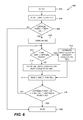
- FIG. 6 is a flowchart illustrating an embodiment of an algorithm implemented by the power minimization thermoelectric cooler controller in FIG. 3 .
- FIG. 7 is a flowchart illustrating another embodiment of an algorithm implemented by the power minimization thermoelectric cooler controller in FIG. 3 .
- FIG. 8 is a block diagram of an embodiment of a portable computer device comprising the system of FIG. 1 .
- an “application” may also include files having executable content, such as: object code, scripts, byte code, markup language files, and patches.
- an “application” referred to herein may also include files that are not executable in nature, such as documents that may need to be opened or other data files that need to be accessed.
- content may also include files having executable content, such as: object code, scripts, byte code, markup language files, and patches.
- content referred to herein, may also include files that are not executable in nature, such as documents that may need to be opened or other data files that need to be accessed.
- a component may be, but is not limited to being, a process running on a processor, a processor, an object, an executable, a thread of execution, a program, and/or a computer.
- an application running on a computing device and the computing device may be a component.
- One or more components may reside within a process and/or thread of execution, and a component may be localized on one computer and/or distributed between two or more computers.
- these components may execute from various computer readable media having various data structures stored thereon.
- the components may communicate by way of local and/or remote processes such as in accordance with a signal having one or more data packets (e.g., data from one component interacting with another component in a local system, distributed system, and/or across a network such as the Internet with other systems by way of the signal).
- a portable computing device may include a cellular telephone, a pager, a PDA, a smartphone, a navigation device, or a hand-held computer with a wireless connection or link.
- FIGS. 1 a and 1 b are schematic diagrams of a system-on-chip (SoC) 100 for implementing various embodiments of systems and methods for reducing leakage power.
- the SoC 100 comprises a plurality of thermoelectric coolers 104 arranged on a chip floorplan 102 such that each thermoelectric cooler 104 operates as a dedicated thermoelectric cooling device for a corresponding chip section 202 on the SoC 100 .
- the number, configuration, arrangement, etc. of the thermoelectric coolers 104 and chip sections 202 may vary depending on the particular type, characteristics, design, floorplan, and/or purpose of the SoC 100 .
- the embodiment of FIGS. 1 a and 1 b illustrate fifteen thermoelectric coolers 104 a - 104 o dedicated to fifteen corresponding chip sections 202 a - 202 o on the SoC 202 .
- a chip section 202 may be referred to as a chip block or intellectual property (IP) block and may comprise one or more units of logic, cell(s), or chip layout associated with the SoC 100 .
- a chip section 202 may comprise a central processing unit (CPU), a graphics processing unit (GPU), a digital signal processor (DSP), a mobile display processor, a video encoder, or other functional blocks or chip devices.
- each thermoelectric cooler 104 comprises a cold-side junction 206 and a hot-side junction 208 .
- the cold-side junction 206 is adjacent the corresponding chip section 202 being cooled by the thermoelectric cooler 104 .
- the hot-side junction 208 is adjacent, for example, a cooling component 204 .
- the cooling component 204 may comprise, for example, any cooling material, solution, or electronic component.
- the cooling component 204 may comprise a heat sink base or the SoC package.
- One or more sensors e.g., sensors 212 and 214 ) may be incorporated to monitor the temperature of the cold-side junction 206 (T C ) and the temperature of the hot-side junction 208 (T H ).
- thermoelectric cooling may be initiated by applying a voltage or current to the thermoelectric cooler 104 .
- the cooling comes at the cost of extra electrical power to operate the thermoelectric cooler 104 (P TEC ), resulting in total power consumption (P TOTAL ) equal to the sum of P BLOCK and P TEC .
- the thermoelectric cooler 104 may comprise two ceramic substrates that serve as a foundation and electrical insulation for a P-type die and an N-type die that are connected electrically in series and thermally in parallel between the ceramics.
- the ceramic substrates serve as insulation between the internal electrical elements and a heat sink that may be in contact with the hot-side junction 208 as well as an object against the cold-side junction 206 .
- An electrically conductive material such as, for example, copper pads attached to the ceramics, may maintain electrical connections inside the thermoelectric cooler 104 . It should be appreciated that the above description of components of the thermoelectric cooler 104 are for exemplary purposes only. The configuration, components, materials, etc. of the thermoelectric coolers 104 may be modified as desired.
- FIG. 3 illustrates an embodiment of the SoC 100 comprising a plurality of chip sections 202 with an associated array of dedicated, individually addressable thermoelectric coolers 104 .
- the SoC 100 further comprises a power-optimizing thermoelectric cooler controller 300 that may be electrically coupled, via a SoC bus 306 , with one or more of the chip sections 202 , sensors 212 and 214 , thermoelectric coolers 104 , and a power management component (e.g., PMIC 304 ).
- the controller 300 is configured to separately control the junction temperatures of the thermoelectric coolers 104 . It should be appreciated that the controller 300 may execute various algorithms for optimizing power consumption of the chip sections 202 and the thermoelectric coolers 104 .
- the power optimization algorithm(s) may be configured to minimize the overall power consumption of the plurality of chip sections 202 and the thermoelectric coolers 104 and, thereby, enable a longer battery life.
- the total power consumption (P TOTAL ) may be minimized for each thermoelectric cooler 104 and/or collectively minimized by summing the total power consumption (P TOTAL ) of each of the plurality of thermoelectric coolers 104 .
- the total power consumption (P TOTAL ) may be minimized by operating the thermoelectric cooler(s) at an optimal operating point.
- FIG. 5 is a graph 500 illustrating power consumption curves for an exemplary embodiment of a block 202 and a thermoelectric cooler 104 .
- Line 502 illustrates the power consumption of a thermoelectric cooler 104 (P TEC ) as a function of a temperature differential between the cold-side junction temperature (T j ) and the hot-side junction temperature (T H ).
- Curve 504 illustrates power consumption of a chip section 202 or IP block (P BLOCK ) as a function of the junction temperature differential (T j ⁇ T H ).
- a hypothetical operating point 508 illustrates a conventional approach to controlling a thermoelectric cooler 104 , which is designed merely for thermal management, not power minimization.
- the total power consumption (P TOTAL ) has a value P 0 represented by line 510 .
- the controller 300 enables thermoelectric cooling to be performed but at an optimal operating point 514 , which results in a significant reduction in total power consumption.
- the thermoelectric cooler 104 may be operated with a total power consumption P 1 (represented by line 511 ), where P 1 ⁇ P 0 .
- the controller 300 may turn on the thermoelectric cooler 104 and drive, for example, an input current to the optimal operating point 514 .
- the operating point 514 may be calculated by the controller 300 .
- the optimal operating point 514 may be defined by a predetermined temperature differential (e.g., line 516 ) based on, for example, the characteristics of the chip section 202 and/or the thermoelectric cooler 104 .
- FIG. 4 illustrates a method 400 for minimizing combined power consumption of a plurality of chip sections 202 and dedicated thermoelectric coolers 104 on a SoC 100 .
- a plurality of individually addressable thermoelectric coolers 104 are provided on the SoC 100 .
- Each thermoelectric cooler 104 is dedicated to a chip section 202 , and may be arranged as illustrated in FIGS. 1 a , 1 b , and 2 .
- the controller 300 may monitor a temperature differential (T j ⁇ T H ) across the respective thermoelectric coolers 104 .
- the junction temperatures may be determined by one or more sensors (e.g., sensors 212 and 214 ) and provided to, or read, by the controller 300 .
- the controller 300 may control the thermoelectric coolers 104 such that a sum of a combined power consumption of the chip sections 202 and the dedicated thermoelectric coolers 104 is minimized.
- the controller 300 may separately minimize combined power consumption (P TOTAL ) for a single thermoelectric cooler 104 , a group of thermoelectric coolers 104 , or all of the thermoelectric coolers 104 on the SoC 100 .
- FIG. 6 illustrates an embodiment of a power optimization algorithm 600 implemented by the controller 300 .
- the algorithm 600 may be periodically performed at a predetermined or calculated interval for each of the thermoelectric coolers 104 on the SoC 100 .
- the controller 300 reads the junction temperatures T j and T H for a first thermoelectric cooler 104 (TEC).
- TEC first thermoelectric cooler 104
- the controller 300 determines whether the temperature differential (T j ⁇ T H ) exceeds a critical operating point.
- the critical operating point may be determined by estimating the leakage power.
- the critical operating point may comprise a predetermined temperature differential, as illustrated in FIG. 5 . If the temperature differential does not exceed the critical operating point, the algorithm for TEC i may stop at block 620 . If the temperature differential exceeds the critical operating point, at block 608 , the controller 300 may turn on the thermoelectric cooler TEC i .
- the controller 300 determines whether the temperature differential is greater than an optimal operating point (e.g., operating point 514 — FIG. 5 ). If “yes”, at block 612 , the controller 300 may increase an input current to the thermoelectric cooler TEC i or increase a duty cycle % of the input current, with flow passing to block 616 to re-read the junction temperatures. If “no”, at block 614 , the controller 300 may decrease the input current to the thermoelectric cooler TEC i or increase the duty cycle % of the input current. At block 616 , the controller 300 reads the junction temperatures T j and T H .
- an optimal operating point e.g., operating point 514 — FIG. 5 .
- the controller determines whether the temperature differential is within a range close to the optimal point (e.g., (optimal point ⁇ X) ⁇ temperature differential ⁇ (optimal point+X).
- the value of X may be predetermined or calculated to define an operating state in which the temperature differential is considered to have reached or approximated the optimal point. If TEC i is considered to be operating at the optimal operating point, the process may stop at block 620 . If TEC i is not operating at the optimal operating point, flow may return to decision block 610 for further processing and control.
- FIG. 7 illustrates another embodiment of a power optimization algorithm 700 implemented by the controller 300 .
- Algorithm 700 is configured to maintain a junction temperature associated with a predetermined threshold.
- the algorithm 700 may be periodically performed at a predetermined or calculated interval for each of the thermoelectric coolers 104 on the SoC 100 .
- the controller 300 reads the junction temperatures T j and T H for a first thermoelectric cooler 104 (TEC i ).
- the controller 300 determines whether the temperature differential (T j ⁇ T H ) exceeds the threshold. If the temperature differential exceeds the threshold, the thermoelectric cooler TEC i is turned on at block 708 . If the temperate differential does not exceed the threshold, the process may stop at block 716 .
- the controller 300 may read the junction temperatures T j and T H and determine whether the temperature differential exceeds the threshold (decision block 712 ). If the threshold is exceeded, flow returns to block 710 . If the threshold is not exceeded, the controller 300 may turn off the thermoelectric cooler TEC i and stop the process at block 716 .
- the SoC 100 may be implemented in any integrated circuit, multi-chip package, or computing device, including a personal computer, a workstation, a server, a portable computing device (PCD), such as a cellular telephone, a smart phone, a portable digital assistant (PDA), a portable game console, a palmtop computer, or a tablet computer.
- FIG. 8 illustrates the SoC 100 incorporated in an exemplary portable computing device (PCD) 800 .
- the SoC 100 may include a multicore CPU 802 .
- the multicore CPU 802 may include a zeroth core 810 , a first core 812 , and an Nth core 814 .
- One of the cores may comprise GPU with one or more of the others comprising the CPU.
- a display controller 328 and a touch screen controller 330 may be coupled to the CPU 802 .
- the touch screen display 806 external to the on-chip system 100 may be coupled to the display controller 328 and the touch screen controller 330 .
- FIG. 8 further shows that a video encoder 334 (e.g., a phase alternating line (PAL) encoder, a sequential color a memoire (SECAM) encoder, or a national television system(s) committee (NTSC) encoder) is coupled to the multicore CPU 802 .
- a video amplifier 336 is coupled to the video encoder 334 and the touch screen display 806 .
- a video port 338 is coupled to the video amplifier 336 .
- a universal serial bus (USB) controller 340 is coupled to the multicore CPU 802 .
- a USB port 342 is coupled to the USB controller 340 .
- Memory 105 and a subscriber identity module (SIM) card 346 may also be coupled to the multicore CPU 802 .
- Memory 105 may reside on the SoC 100 or be coupled to the SoC 100 .
- the memory 105 may comprise a DRAM memory system.
- a digital camera 348 may be coupled to the multicore CPU 802 .
- the digital camera 348 is a charge-coupled device (CCD) camera or a complementary metal-oxide semiconductor (CMOS) camera.
- CCD charge-coupled device
- CMOS complementary metal-oxide semiconductor
- a stereo audio coder-decoder (CODEC) 350 may be coupled to the multicore CPU 802 .
- an audio amplifier 352 may coupled to the stereo audio CODEC 350 .
- a first stereo speaker 354 and a second stereo speaker 356 are coupled to the audio amplifier 352 .
- FIG. 8 shows that a microphone amplifier 358 may be also coupled to the stereo audio CODEC 350 .
- a microphone 360 may be coupled to the microphone amplifier 358 .
- a frequency modulation (FM) radio tuner 362 may be coupled to the stereo audio CODEC 350 .
- an FM antenna 364 is coupled to the FM radio tuner 362 .
- stereo headphones 366 may be coupled to the stereo audio CODEC 350 .
- FM frequency modulation
- FIG. 8 further illustrates that a radio frequency (RF) transceiver 368 may be coupled to the multicore CPU 802 .
- An RF switch 370 may be coupled to the RF transceiver 368 and an RF antenna 372 .
- a keypad 204 may be coupled to the multicore CPU 802 .
- a mono headset with a microphone 376 may be coupled to the multicore CPU 802 .
- a vibrator device 378 may be coupled to the multicore CPU 802 .
- FIG. 8 also shows that a power supply 380 may be coupled to the SoC 100 .
- the power supply 380 is a direct current (DC) power supply that provides power to the various components of the PCD 800 that require power.
- the power supply is a rechargeable DC battery or a DC power supply that is derived from an alternating current (AC) to DC transformer that is connected to an AC power source.
- DC direct current
- FIG. 8 further indicates that the PCD 800 may also include a network card 388 that may be used to access a data network (e.g., a local area network, a personal area network, or any other network).
- the network card 388 may be a Bluetooth network card, a WiFi network card, a personal area network (PAN) card, a personal area network ultra-low-power technology (PeANUT) network card, a television/cable/satellite tuner, or any other network card well known in the art.
- the network card 388 may be incorporated into a chip (i.e., the network card 388 may be a full solution in a chip, and may not be a separate network card 388 ).
- the touch screen display 806 , the video port 338 , the USB port 342 , the camera 348 , the first stereo speaker 354 , the second stereo speaker 356 , the microphone 360 , the FM antenna 364 , the stereo headphones 366 , the RF switch 370 , the RF antenna 372 , the keypad 374 , the mono headset 376 , the vibrator 378 , and the power supply 380 may be external to the SoC 100 .
- one or more of the method steps described herein may be stored in the memory as computer program instructions, such as the modules described above. These instructions may be executed by any suitable processor in combination or in concert with the corresponding module to perform the methods described herein.
- the functions described may be implemented in hardware, software, firmware, or any combination thereof. If implemented in software, the functions may be stored on or transmitted as one or more instructions or code on a computer-readable medium.
- Computer-readable media include both computer storage media and communication media including any medium that facilitates transfer of a computer program from one place to another.
- a storage media may be any available media that may be accessed by a computer.
- such computer-readable media may comprise RAM, ROM, EEPROM, NAND flash, NOR flash, M-RAM, P-RAM, R-RAM, CD-ROM or other optical disk storage, magnetic disk storage or other magnetic storage devices, or any other medium that may be used to carry or store desired program code in the form of instructions or data structures and that may be accessed by a computer.
- any connection is properly termed a computer-readable medium.
- the software is transmitted from a website, server, or other remote source using a coaxial cable, fiber optic cable, twisted pair, digital subscriber line (“DSL”), or wireless technologies such as infrared, radio, and microwave
- coaxial cable, fiber optic cable, twisted pair, DSL, or wireless technologies such as infrared, radio, and microwave are included in the definition of medium.
- Disk and disc includes compact disc (“CD”), laser disc, optical disc, digital versatile disc (“DVD”), floppy disk and blu-ray disc where disks usually reproduce data magnetically, while discs reproduce data optically with lasers. Combinations of the above should also be included within the scope of computer-readable media.
Landscapes
- Engineering & Computer Science (AREA)
- Theoretical Computer Science (AREA)
- Physics & Mathematics (AREA)
- General Physics & Mathematics (AREA)
- General Engineering & Computer Science (AREA)
- Human Computer Interaction (AREA)
- Automation & Control Theory (AREA)
- Computer Hardware Design (AREA)
- Cooling Or The Like Of Electrical Apparatus (AREA)
- Artificial Intelligence (AREA)
- Evolutionary Computation (AREA)
- Medical Informatics (AREA)
- Software Systems (AREA)
- Computer Vision & Pattern Recognition (AREA)
- Health & Medical Sciences (AREA)
- Power Sources (AREA)
- Cooling Or The Like Of Semiconductors Or Solid State Devices (AREA)
Priority Applications (6)
| Application Number | Priority Date | Filing Date | Title |
|---|---|---|---|
| US14/446,258 US10101756B2 (en) | 2014-07-29 | 2014-07-29 | Systems and methods for reducing leakage power of a system on chip with integrated thermoelectric cooling |
| CN201580041267.8A CN106663662B (zh) | 2014-07-29 | 2015-07-22 | 用于使用集成热电冷却来减少片上系统的泄漏功率的系统和方法 |
| KR1020177002228A KR20170037609A (ko) | 2014-07-29 | 2015-07-22 | 통합된 열전 냉각으로 시스템 온 칩의 누설 전력을 감소시키기 위한 시스템들 및 방법들 |
| PCT/US2015/041629 WO2016018699A1 (en) | 2014-07-29 | 2015-07-22 | Systems and methods for reducing leakage power of a system on chip with integrated thermoelectric cooling |
| JP2017503108A JP2017527889A (ja) | 2014-07-29 | 2015-07-22 | 統合熱電冷却を用いるシステムオンチップのリーク電力を低減させるためのシステムおよび方法 |
| EP15748361.1A EP3175317A1 (en) | 2014-07-29 | 2015-07-22 | Systems and methods for reducing leakage power of a system on chip with integrated thermoelectric cooling |
Applications Claiming Priority (1)
| Application Number | Priority Date | Filing Date | Title |
|---|---|---|---|
| US14/446,258 US10101756B2 (en) | 2014-07-29 | 2014-07-29 | Systems and methods for reducing leakage power of a system on chip with integrated thermoelectric cooling |
Publications (2)
| Publication Number | Publication Date |
|---|---|
| US20160033975A1 US20160033975A1 (en) | 2016-02-04 |
| US10101756B2 true US10101756B2 (en) | 2018-10-16 |
Family
ID=53801177
Family Applications (1)
| Application Number | Title | Priority Date | Filing Date |
|---|---|---|---|
| US14/446,258 Active 2035-11-26 US10101756B2 (en) | 2014-07-29 | 2014-07-29 | Systems and methods for reducing leakage power of a system on chip with integrated thermoelectric cooling |
Country Status (6)
| Country | Link |
|---|---|
| US (1) | US10101756B2 (https=) |
| EP (1) | EP3175317A1 (https=) |
| JP (1) | JP2017527889A (https=) |
| KR (1) | KR20170037609A (https=) |
| CN (1) | CN106663662B (https=) |
| WO (1) | WO2016018699A1 (https=) |
Cited By (1)
| Publication number | Priority date | Publication date | Assignee | Title |
|---|---|---|---|---|
| US20250087554A1 (en) * | 2023-09-12 | 2025-03-13 | Nxp Usa, Inc. | Thermal apparatus for an integrated circuit and methods of operation |
Families Citing this family (5)
| Publication number | Priority date | Publication date | Assignee | Title |
|---|---|---|---|---|
| US11169583B2 (en) * | 2018-08-07 | 2021-11-09 | Western Digital Technologies, Inc. | Methods and apparatus for mitigating temperature increases in a solid state device (SSD) |
| KR20220096437A (ko) * | 2020-12-31 | 2022-07-07 | 삼성전자주식회사 | 전력 관리 방법 및 장치 |
| US11930625B2 (en) | 2021-03-26 | 2024-03-12 | Baidu Usa Llc | Thermal management system and method for power optimization for cooling an electronic rack |
| US12327774B1 (en) * | 2021-05-24 | 2025-06-10 | Marvell Asia Pte Ltd | Meeting performance and temperature requirements in electronic circuits |
| KR20230132112A (ko) | 2022-03-08 | 2023-09-15 | 에스케이하이닉스 주식회사 | 발열 관리 회로 및 그 동작 방법, 이를 포함하는 전자 장치 및 데이터 처리 장치 |
Citations (27)
| Publication number | Priority date | Publication date | Assignee | Title |
|---|---|---|---|---|
| JPH0831994A (ja) | 1994-07-18 | 1996-02-02 | Fujitsu Ltd | マルチチップモジュール |
| US6230497B1 (en) | 1999-12-06 | 2001-05-15 | Motorola, Inc. | Semiconductor circuit temperature monitoring and controlling apparatus and method |
| US20020063327A1 (en) | 2000-11-30 | 2002-05-30 | Chu Richard C. | Electronic module with integrated programmable thermoelectric cooling assembly and method of fabrication |
| US6825687B2 (en) | 2002-08-29 | 2004-11-30 | Intel Corporation | Selective cooling of an integrated circuit for minimizing power loss |
| US20050007845A1 (en) | 2003-06-10 | 2005-01-13 | Walter Angerer | HIS data compression |
| US20050008072A1 (en) | 2003-06-10 | 2005-01-13 | Walter Angerer | Analog data compression |
| US20050052196A1 (en) | 2001-10-31 | 2005-03-10 | Intel Corporation | Active cooling to reduce leakage power |
| US20050078451A1 (en) | 2003-10-10 | 2005-04-14 | Ioan Sauciuc | Computer system having controlled cooling |
| US7301233B2 (en) | 2004-07-01 | 2007-11-27 | Samsung Electronics Co., Ltd. | Semiconductor chip package with thermoelectric cooler |
| US7436059B1 (en) | 2006-11-17 | 2008-10-14 | Sun Microsystems, Inc. | Thermoelectric cooling device arrays |
| US20090093917A1 (en) * | 2005-12-21 | 2009-04-09 | Seth Smith | Monitoring system |
| US20090293500A1 (en) * | 2005-06-24 | 2009-12-03 | Lei Chen | Device for Controlling a Thermo-Electric System |
| US7809965B2 (en) * | 2004-03-26 | 2010-10-05 | Hewlett-Packard Development Company, L.P. | Computer systems and related methods for cooling such systems |
| CN102082133A (zh) | 2009-11-30 | 2011-06-01 | 华为技术有限公司 | 一种温控散热装置 |
| US20110316606A1 (en) * | 2010-06-28 | 2011-12-29 | Markus Ladurner | Power Switch Temperature Control Device and Method |
| US20120039041A1 (en) * | 2009-05-22 | 2012-02-16 | Mowry Anthony C | Heat management using power management information |
| US20120143540A1 (en) * | 2010-12-01 | 2012-06-07 | Industrial Technology Research Institute | Self-powered power consumption detecting device and power consumption detecting method thereof |
| US8209989B2 (en) | 2007-03-30 | 2012-07-03 | Intel Corporation | Microarchitecture control for thermoelectric cooling |
| US20120287571A1 (en) * | 2011-05-11 | 2012-11-15 | Ez-Tech Corp (D/B/A Maingear) | Rotatable Fan Array Rotated Based on Computer Process Execution for Personal Computer |
| US20130037620A1 (en) * | 2011-08-12 | 2013-02-14 | Qualcomm Incorporated | Controlling air movers based on acoustic signature |
| US20130254563A1 (en) * | 2003-08-15 | 2013-09-26 | Apple Inc. | Methods and apparatuses for operating a data processing system |
| US20140012445A1 (en) * | 2010-12-17 | 2014-01-09 | Bayerische Motoren Werke Aktiengesellschaft | Temperature Control Method for an Electrochemical Energy Store in a Vehicle |
| US20140048111A1 (en) * | 2012-08-17 | 2014-02-20 | Thomas G. Hinsperger | Method and system for producing an electric current from a temperature differential |
| US20140176041A1 (en) * | 2012-12-20 | 2014-06-26 | Nvidia Corporation | Semiconductor thermoelectric module charger for mobile computing device |
| US8868947B2 (en) * | 2008-09-30 | 2014-10-21 | Intel Corporation | Fan control for determining a fan speed that is closer to an optimal fan speed based on an amount of measured change in system power consumption and temperature of a processor |
| US20150028337A1 (en) * | 2013-07-26 | 2015-01-29 | Infineon Technologies Ag | Monitoring and Controlling Temperatures in a Semiconductor Structure |
| US20150346798A1 (en) * | 2014-06-02 | 2015-12-03 | Advanced Micro Devices, Inc. | System and method for adjusting performance based on thermal conditions within a processor |
Family Cites Families (1)
| Publication number | Priority date | Publication date | Assignee | Title |
|---|---|---|---|---|
| JP2003332641A (ja) * | 2002-05-16 | 2003-11-21 | Seiko Instruments Inc | ペルチェ素子駆動回路 |
-
2014
- 2014-07-29 US US14/446,258 patent/US10101756B2/en active Active
-
2015
- 2015-07-22 CN CN201580041267.8A patent/CN106663662B/zh not_active Expired - Fee Related
- 2015-07-22 EP EP15748361.1A patent/EP3175317A1/en not_active Withdrawn
- 2015-07-22 JP JP2017503108A patent/JP2017527889A/ja active Pending
- 2015-07-22 KR KR1020177002228A patent/KR20170037609A/ko not_active Withdrawn
- 2015-07-22 WO PCT/US2015/041629 patent/WO2016018699A1/en not_active Ceased
Patent Citations (28)
| Publication number | Priority date | Publication date | Assignee | Title |
|---|---|---|---|---|
| JPH0831994A (ja) | 1994-07-18 | 1996-02-02 | Fujitsu Ltd | マルチチップモジュール |
| US6230497B1 (en) | 1999-12-06 | 2001-05-15 | Motorola, Inc. | Semiconductor circuit temperature monitoring and controlling apparatus and method |
| US20020063327A1 (en) | 2000-11-30 | 2002-05-30 | Chu Richard C. | Electronic module with integrated programmable thermoelectric cooling assembly and method of fabrication |
| US20050052196A1 (en) | 2001-10-31 | 2005-03-10 | Intel Corporation | Active cooling to reduce leakage power |
| US6825687B2 (en) | 2002-08-29 | 2004-11-30 | Intel Corporation | Selective cooling of an integrated circuit for minimizing power loss |
| US20050007845A1 (en) | 2003-06-10 | 2005-01-13 | Walter Angerer | HIS data compression |
| US20050008072A1 (en) | 2003-06-10 | 2005-01-13 | Walter Angerer | Analog data compression |
| US20130254563A1 (en) * | 2003-08-15 | 2013-09-26 | Apple Inc. | Methods and apparatuses for operating a data processing system |
| US20050078451A1 (en) | 2003-10-10 | 2005-04-14 | Ioan Sauciuc | Computer system having controlled cooling |
| CN1890878A (zh) | 2003-10-10 | 2007-01-03 | 英特尔公司 | 具有受控冷却的计算机系统 |
| US7809965B2 (en) * | 2004-03-26 | 2010-10-05 | Hewlett-Packard Development Company, L.P. | Computer systems and related methods for cooling such systems |
| US7301233B2 (en) | 2004-07-01 | 2007-11-27 | Samsung Electronics Co., Ltd. | Semiconductor chip package with thermoelectric cooler |
| US20090293500A1 (en) * | 2005-06-24 | 2009-12-03 | Lei Chen | Device for Controlling a Thermo-Electric System |
| US20090093917A1 (en) * | 2005-12-21 | 2009-04-09 | Seth Smith | Monitoring system |
| US7436059B1 (en) | 2006-11-17 | 2008-10-14 | Sun Microsystems, Inc. | Thermoelectric cooling device arrays |
| US8209989B2 (en) | 2007-03-30 | 2012-07-03 | Intel Corporation | Microarchitecture control for thermoelectric cooling |
| US8868947B2 (en) * | 2008-09-30 | 2014-10-21 | Intel Corporation | Fan control for determining a fan speed that is closer to an optimal fan speed based on an amount of measured change in system power consumption and temperature of a processor |
| US20120039041A1 (en) * | 2009-05-22 | 2012-02-16 | Mowry Anthony C | Heat management using power management information |
| CN102082133A (zh) | 2009-11-30 | 2011-06-01 | 华为技术有限公司 | 一种温控散热装置 |
| US20110316606A1 (en) * | 2010-06-28 | 2011-12-29 | Markus Ladurner | Power Switch Temperature Control Device and Method |
| US20120143540A1 (en) * | 2010-12-01 | 2012-06-07 | Industrial Technology Research Institute | Self-powered power consumption detecting device and power consumption detecting method thereof |
| US20140012445A1 (en) * | 2010-12-17 | 2014-01-09 | Bayerische Motoren Werke Aktiengesellschaft | Temperature Control Method for an Electrochemical Energy Store in a Vehicle |
| US20120287571A1 (en) * | 2011-05-11 | 2012-11-15 | Ez-Tech Corp (D/B/A Maingear) | Rotatable Fan Array Rotated Based on Computer Process Execution for Personal Computer |
| US20130037620A1 (en) * | 2011-08-12 | 2013-02-14 | Qualcomm Incorporated | Controlling air movers based on acoustic signature |
| US20140048111A1 (en) * | 2012-08-17 | 2014-02-20 | Thomas G. Hinsperger | Method and system for producing an electric current from a temperature differential |
| US20140176041A1 (en) * | 2012-12-20 | 2014-06-26 | Nvidia Corporation | Semiconductor thermoelectric module charger for mobile computing device |
| US20150028337A1 (en) * | 2013-07-26 | 2015-01-29 | Infineon Technologies Ag | Monitoring and Controlling Temperatures in a Semiconductor Structure |
| US20150346798A1 (en) * | 2014-06-02 | 2015-12-03 | Advanced Micro Devices, Inc. | System and method for adjusting performance based on thermal conditions within a processor |
Non-Patent Citations (2)
| Title |
|---|
| International Search Report and Written Opinion-PCT/US2015/041629-ISA/EPO-dated Dec. 10, 2015. |
| International Search Report and Written Opinion—PCT/US2015/041629—ISA/EPO—dated Dec. 10, 2015. |
Cited By (1)
| Publication number | Priority date | Publication date | Assignee | Title |
|---|---|---|---|---|
| US20250087554A1 (en) * | 2023-09-12 | 2025-03-13 | Nxp Usa, Inc. | Thermal apparatus for an integrated circuit and methods of operation |
Also Published As
| Publication number | Publication date |
|---|---|
| WO2016018699A9 (en) | 2016-03-24 |
| KR20170037609A (ko) | 2017-04-04 |
| CN106663662B (zh) | 2019-11-12 |
| US20160033975A1 (en) | 2016-02-04 |
| EP3175317A1 (en) | 2017-06-07 |
| WO2016018699A1 (en) | 2016-02-04 |
| JP2017527889A (ja) | 2017-09-21 |
| CN106663662A (zh) | 2017-05-10 |
Similar Documents
| Publication | Publication Date | Title |
|---|---|---|
| US10101756B2 (en) | Systems and methods for reducing leakage power of a system on chip with integrated thermoelectric cooling | |
| US9209816B2 (en) | Pre-heating for reduced subthreshold leakage | |
| CN105556415B (zh) | 用于利用热电冷却器维持恒定电话皮肤温度方法和装置以及计算机可读介质 | |
| US12093092B2 (en) | Heat transfer apparatus for a computer environment | |
| CN106133641B (zh) | 用于共享的功率域中的异构处理器之间的动态功率管理的装置、系统和方法 | |
| CN104583897B (zh) | 半导体器件和电子设备 | |
| CN108780349B (zh) | 用于在具有异构集群架构的片上系统中进行智能热管理的系统和方法 | |
| US9378536B2 (en) | CPU/GPU DCVS co-optimization for reducing power consumption in graphics frame processing | |
| KR101833601B1 (ko) | 휴대용 컴퓨팅 디바이스로부터 주위 온도를 추정하기 위한 시스템 및 방법 | |
| CN105009021B (zh) | 用于使用热阻值预测最佳功率电平以实现便携式计算设备中的热管理的系统和方法 | |
| KR101832578B1 (ko) | 휴대용 컴퓨팅 디바이스에 커플링하는 수신 디바이스의 열 정책을 관리하는 시스템 및 방법 | |
| CN110214298B (zh) | 用于便携式计算设备中的情境感知热管理和工作负荷调度的系统和方法 | |
| KR20140092328A (ko) | 누설 전류 측정으로부터 열 관리 폴리시를 결정하는 시스템 및 방법 | |
| US20180167878A1 (en) | Core frequency/count decision-based thermal mitigation optimization for a multi-core integrated circuit | |
| US20140245028A1 (en) | System and method for temperature driven selection of voltage modes in a portable computing device | |
| TWI877221B (zh) | 電源供應設備及電子系統 | |
| US8307226B1 (en) | Method, apparatus, and system for reducing leakage power consumption | |
| CN105068871B (zh) | 运算资源的控制方法和装置 | |
| KR101898501B1 (ko) | 이동 단말기 및 이의 제어 방법 | |
| Panwar et al. | Performance analysis of modified drain gating techniques for low power and high speed arithmetic circuits |
Legal Events
| Date | Code | Title | Description |
|---|---|---|---|
| AS | Assignment |
Owner name: QUALCOMM INCORPORATED, CALIFORNIA Free format text: ASSIGNMENT OF ASSIGNORS INTEREST;ASSIGNORS:MITTAL, RAJAT;PARK, HEE JUN;KANG, YOUNG HOON;SIGNING DATES FROM 20140804 TO 20140807;REEL/FRAME:033502/0264 |
|
| STCF | Information on status: patent grant |
Free format text: PATENTED CASE |
|
| MAFP | Maintenance fee payment |
Free format text: PAYMENT OF MAINTENANCE FEE, 4TH YEAR, LARGE ENTITY (ORIGINAL EVENT CODE: M1551); ENTITY STATUS OF PATENT OWNER: LARGE ENTITY Year of fee payment: 4 |