KR20180098557A - Laminated polyester film - Google Patents
Laminated polyester film Download PDFInfo
- Publication number
- KR20180098557A KR20180098557A KR1020187017941A KR20187017941A KR20180098557A KR 20180098557 A KR20180098557 A KR 20180098557A KR 1020187017941 A KR1020187017941 A KR 1020187017941A KR 20187017941 A KR20187017941 A KR 20187017941A KR 20180098557 A KR20180098557 A KR 20180098557A
- Authority
- KR
- South Korea
- Prior art keywords
- film
- polyester film
- less
- mpa
- stretching
- Prior art date
- Legal status (The legal status is an assumption and is not a legal conclusion. Google has not performed a legal analysis and makes no representation as to the accuracy of the status listed.)
- Granted
Links
Classifications
-
- C—CHEMISTRY; METALLURGY
- C08—ORGANIC MACROMOLECULAR COMPOUNDS; THEIR PREPARATION OR CHEMICAL WORKING-UP; COMPOSITIONS BASED THEREON
- C08J—WORKING-UP; GENERAL PROCESSES OF COMPOUNDING; AFTER-TREATMENT NOT COVERED BY SUBCLASSES C08B, C08C, C08F, C08G or C08H
- C08J7/00—Chemical treatment or coating of shaped articles made of macromolecular substances
- C08J7/04—Coating
- C08J7/042—Coating with two or more layers, where at least one layer of a composition contains a polymer binder
- C08J7/0423—Coating with two or more layers, where at least one layer of a composition contains a polymer binder with at least one layer of inorganic material and at least one layer of a composition containing a polymer binder
-
- B—PERFORMING OPERATIONS; TRANSPORTING
- B29—WORKING OF PLASTICS; WORKING OF SUBSTANCES IN A PLASTIC STATE IN GENERAL
- B29C—SHAPING OR JOINING OF PLASTICS; SHAPING OF MATERIAL IN A PLASTIC STATE, NOT OTHERWISE PROVIDED FOR; AFTER-TREATMENT OF THE SHAPED PRODUCTS, e.g. REPAIRING
- B29C55/00—Shaping by stretching, e.g. drawing through a die; Apparatus therefor
- B29C55/02—Shaping by stretching, e.g. drawing through a die; Apparatus therefor of plates or sheets
- B29C55/10—Shaping by stretching, e.g. drawing through a die; Apparatus therefor of plates or sheets multiaxial
- B29C55/12—Shaping by stretching, e.g. drawing through a die; Apparatus therefor of plates or sheets multiaxial biaxial
-
- B—PERFORMING OPERATIONS; TRANSPORTING
- B32—LAYERED PRODUCTS
- B32B—LAYERED PRODUCTS, i.e. PRODUCTS BUILT-UP OF STRATA OF FLAT OR NON-FLAT, e.g. CELLULAR OR HONEYCOMB, FORM
- B32B27/00—Layered products comprising a layer of synthetic resin
- B32B27/36—Layered products comprising a layer of synthetic resin comprising polyesters
-
- B32B7/005—
-
- B—PERFORMING OPERATIONS; TRANSPORTING
- B32—LAYERED PRODUCTS
- B32B—LAYERED PRODUCTS, i.e. PRODUCTS BUILT-UP OF STRATA OF FLAT OR NON-FLAT, e.g. CELLULAR OR HONEYCOMB, FORM
- B32B7/00—Layered products characterised by the relation between layers; Layered products characterised by the relative orientation of features between layers, or by the relative values of a measurable parameter between layers, i.e. products comprising layers having different physical, chemical or physicochemical properties; Layered products characterised by the interconnection of layers
- B32B7/03—Layered products characterised by the relation between layers; Layered products characterised by the relative orientation of features between layers, or by the relative values of a measurable parameter between layers, i.e. products comprising layers having different physical, chemical or physicochemical properties; Layered products characterised by the interconnection of layers with respect to the orientation of features
- B32B7/035—Layered products characterised by the relation between layers; Layered products characterised by the relative orientation of features between layers, or by the relative values of a measurable parameter between layers, i.e. products comprising layers having different physical, chemical or physicochemical properties; Layered products characterised by the interconnection of layers with respect to the orientation of features using arrangements of stretched films, e.g. of mono-axially stretched films arranged alternately
-
- B—PERFORMING OPERATIONS; TRANSPORTING
- B32—LAYERED PRODUCTS
- B32B—LAYERED PRODUCTS, i.e. PRODUCTS BUILT-UP OF STRATA OF FLAT OR NON-FLAT, e.g. CELLULAR OR HONEYCOMB, FORM
- B32B9/00—Layered products comprising a layer of a particular substance not covered by groups B32B11/00 - B32B29/00
-
- B—PERFORMING OPERATIONS; TRANSPORTING
- B32—LAYERED PRODUCTS
- B32B—LAYERED PRODUCTS, i.e. PRODUCTS BUILT-UP OF STRATA OF FLAT OR NON-FLAT, e.g. CELLULAR OR HONEYCOMB, FORM
- B32B9/00—Layered products comprising a layer of a particular substance not covered by groups B32B11/00 - B32B29/00
- B32B9/005—Layered products comprising a layer of a particular substance not covered by groups B32B11/00 - B32B29/00 comprising one layer of ceramic material, e.g. porcelain, ceramic tile
-
- B—PERFORMING OPERATIONS; TRANSPORTING
- B32—LAYERED PRODUCTS
- B32B—LAYERED PRODUCTS, i.e. PRODUCTS BUILT-UP OF STRATA OF FLAT OR NON-FLAT, e.g. CELLULAR OR HONEYCOMB, FORM
- B32B9/00—Layered products comprising a layer of a particular substance not covered by groups B32B11/00 - B32B29/00
- B32B9/04—Layered products comprising a layer of a particular substance not covered by groups B32B11/00 - B32B29/00 comprising such particular substance as the main or only constituent of a layer, which is next to another layer of the same or of a different material
- B32B9/045—Layered products comprising a layer of a particular substance not covered by groups B32B11/00 - B32B29/00 comprising such particular substance as the main or only constituent of a layer, which is next to another layer of the same or of a different material of synthetic resin
-
- C—CHEMISTRY; METALLURGY
- C08—ORGANIC MACROMOLECULAR COMPOUNDS; THEIR PREPARATION OR CHEMICAL WORKING-UP; COMPOSITIONS BASED THEREON
- C08G—MACROMOLECULAR COMPOUNDS OBTAINED OTHERWISE THAN BY REACTIONS ONLY INVOLVING UNSATURATED CARBON-TO-CARBON BONDS
- C08G63/00—Macromolecular compounds obtained by reactions forming a carboxylic ester link in the main chain of the macromolecule
- C08G63/02—Polyesters derived from hydroxycarboxylic acids or from polycarboxylic acids and polyhydroxy compounds
- C08G63/12—Polyesters derived from hydroxycarboxylic acids or from polycarboxylic acids and polyhydroxy compounds derived from polycarboxylic acids and polyhydroxy compounds
- C08G63/16—Dicarboxylic acids and dihydroxy compounds
-
- C—CHEMISTRY; METALLURGY
- C08—ORGANIC MACROMOLECULAR COMPOUNDS; THEIR PREPARATION OR CHEMICAL WORKING-UP; COMPOSITIONS BASED THEREON
- C08J—WORKING-UP; GENERAL PROCESSES OF COMPOUNDING; AFTER-TREATMENT NOT COVERED BY SUBCLASSES C08B, C08C, C08F, C08G or C08H
- C08J7/00—Chemical treatment or coating of shaped articles made of macromolecular substances
- C08J7/04—Coating
- C08J7/043—Improving the adhesiveness of the coatings per se, e.g. forming primers
-
- C—CHEMISTRY; METALLURGY
- C08—ORGANIC MACROMOLECULAR COMPOUNDS; THEIR PREPARATION OR CHEMICAL WORKING-UP; COMPOSITIONS BASED THEREON
- C08J—WORKING-UP; GENERAL PROCESSES OF COMPOUNDING; AFTER-TREATMENT NOT COVERED BY SUBCLASSES C08B, C08C, C08F, C08G or C08H
- C08J7/00—Chemical treatment or coating of shaped articles made of macromolecular substances
- C08J7/04—Coating
- C08J7/048—Forming gas barrier coatings
-
- B—PERFORMING OPERATIONS; TRANSPORTING
- B32—LAYERED PRODUCTS
- B32B—LAYERED PRODUCTS, i.e. PRODUCTS BUILT-UP OF STRATA OF FLAT OR NON-FLAT, e.g. CELLULAR OR HONEYCOMB, FORM
- B32B2255/00—Coating on the layer surface
- B32B2255/20—Inorganic coating
-
- B—PERFORMING OPERATIONS; TRANSPORTING
- B32—LAYERED PRODUCTS
- B32B—LAYERED PRODUCTS, i.e. PRODUCTS BUILT-UP OF STRATA OF FLAT OR NON-FLAT, e.g. CELLULAR OR HONEYCOMB, FORM
- B32B2255/00—Coating on the layer surface
- B32B2255/20—Inorganic coating
- B32B2255/205—Metallic coating
-
- B—PERFORMING OPERATIONS; TRANSPORTING
- B32—LAYERED PRODUCTS
- B32B—LAYERED PRODUCTS, i.e. PRODUCTS BUILT-UP OF STRATA OF FLAT OR NON-FLAT, e.g. CELLULAR OR HONEYCOMB, FORM
- B32B2307/00—Properties of the layers or laminate
- B32B2307/30—Properties of the layers or laminate having particular thermal properties
- B32B2307/306—Resistant to heat
-
- B—PERFORMING OPERATIONS; TRANSPORTING
- B32—LAYERED PRODUCTS
- B32B—LAYERED PRODUCTS, i.e. PRODUCTS BUILT-UP OF STRATA OF FLAT OR NON-FLAT, e.g. CELLULAR OR HONEYCOMB, FORM
- B32B2307/00—Properties of the layers or laminate
- B32B2307/30—Properties of the layers or laminate having particular thermal properties
- B32B2307/308—Heat stability
-
- B—PERFORMING OPERATIONS; TRANSPORTING
- B32—LAYERED PRODUCTS
- B32B—LAYERED PRODUCTS, i.e. PRODUCTS BUILT-UP OF STRATA OF FLAT OR NON-FLAT, e.g. CELLULAR OR HONEYCOMB, FORM
- B32B2307/00—Properties of the layers or laminate
- B32B2307/40—Properties of the layers or laminate having particular optical properties
- B32B2307/412—Transparent
-
- B—PERFORMING OPERATIONS; TRANSPORTING
- B32—LAYERED PRODUCTS
- B32B—LAYERED PRODUCTS, i.e. PRODUCTS BUILT-UP OF STRATA OF FLAT OR NON-FLAT, e.g. CELLULAR OR HONEYCOMB, FORM
- B32B2307/00—Properties of the layers or laminate
- B32B2307/50—Properties of the layers or laminate having particular mechanical properties
- B32B2307/514—Oriented
- B32B2307/518—Oriented bi-axially
-
- B—PERFORMING OPERATIONS; TRANSPORTING
- B32—LAYERED PRODUCTS
- B32B—LAYERED PRODUCTS, i.e. PRODUCTS BUILT-UP OF STRATA OF FLAT OR NON-FLAT, e.g. CELLULAR OR HONEYCOMB, FORM
- B32B2307/00—Properties of the layers or laminate
- B32B2307/70—Other properties
- B32B2307/704—Crystalline
-
- B—PERFORMING OPERATIONS; TRANSPORTING
- B32—LAYERED PRODUCTS
- B32B—LAYERED PRODUCTS, i.e. PRODUCTS BUILT-UP OF STRATA OF FLAT OR NON-FLAT, e.g. CELLULAR OR HONEYCOMB, FORM
- B32B2307/00—Properties of the layers or laminate
- B32B2307/70—Other properties
- B32B2307/724—Permeability to gases, adsorption
- B32B2307/7242—Non-permeable
-
- B—PERFORMING OPERATIONS; TRANSPORTING
- B32—LAYERED PRODUCTS
- B32B—LAYERED PRODUCTS, i.e. PRODUCTS BUILT-UP OF STRATA OF FLAT OR NON-FLAT, e.g. CELLULAR OR HONEYCOMB, FORM
- B32B2307/00—Properties of the layers or laminate
- B32B2307/70—Other properties
- B32B2307/724—Permeability to gases, adsorption
- B32B2307/7242—Non-permeable
- B32B2307/7244—Oxygen barrier
-
- B—PERFORMING OPERATIONS; TRANSPORTING
- B32—LAYERED PRODUCTS
- B32B—LAYERED PRODUCTS, i.e. PRODUCTS BUILT-UP OF STRATA OF FLAT OR NON-FLAT, e.g. CELLULAR OR HONEYCOMB, FORM
- B32B2307/00—Properties of the layers or laminate
- B32B2307/70—Other properties
- B32B2307/732—Dimensional properties
-
- B—PERFORMING OPERATIONS; TRANSPORTING
- B32—LAYERED PRODUCTS
- B32B—LAYERED PRODUCTS, i.e. PRODUCTS BUILT-UP OF STRATA OF FLAT OR NON-FLAT, e.g. CELLULAR OR HONEYCOMB, FORM
- B32B2307/00—Properties of the layers or laminate
- B32B2307/70—Other properties
- B32B2307/732—Dimensional properties
- B32B2307/734—Dimensional stability
-
- B—PERFORMING OPERATIONS; TRANSPORTING
- B32—LAYERED PRODUCTS
- B32B—LAYERED PRODUCTS, i.e. PRODUCTS BUILT-UP OF STRATA OF FLAT OR NON-FLAT, e.g. CELLULAR OR HONEYCOMB, FORM
- B32B2307/00—Properties of the layers or laminate
- B32B2307/70—Other properties
- B32B2307/732—Dimensional properties
- B32B2307/734—Dimensional stability
- B32B2307/736—Shrinkable
-
- B—PERFORMING OPERATIONS; TRANSPORTING
- B32—LAYERED PRODUCTS
- B32B—LAYERED PRODUCTS, i.e. PRODUCTS BUILT-UP OF STRATA OF FLAT OR NON-FLAT, e.g. CELLULAR OR HONEYCOMB, FORM
- B32B2311/00—Metals, their alloys or their compounds
- B32B2311/24—Aluminium
-
- B—PERFORMING OPERATIONS; TRANSPORTING
- B32—LAYERED PRODUCTS
- B32B—LAYERED PRODUCTS, i.e. PRODUCTS BUILT-UP OF STRATA OF FLAT OR NON-FLAT, e.g. CELLULAR OR HONEYCOMB, FORM
- B32B2315/00—Other materials containing non-metallic inorganic compounds not provided for in groups B32B2311/00 - B32B2313/04
-
- B—PERFORMING OPERATIONS; TRANSPORTING
- B32—LAYERED PRODUCTS
- B32B—LAYERED PRODUCTS, i.e. PRODUCTS BUILT-UP OF STRATA OF FLAT OR NON-FLAT, e.g. CELLULAR OR HONEYCOMB, FORM
- B32B2367/00—Polyesters, e.g. PET, i.e. polyethylene terephthalate
-
- C—CHEMISTRY; METALLURGY
- C08—ORGANIC MACROMOLECULAR COMPOUNDS; THEIR PREPARATION OR CHEMICAL WORKING-UP; COMPOSITIONS BASED THEREON
- C08G—MACROMOLECULAR COMPOUNDS OBTAINED OTHERWISE THAN BY REACTIONS ONLY INVOLVING UNSATURATED CARBON-TO-CARBON BONDS
- C08G2230/00—Compositions for preparing biodegradable polymers
-
- C—CHEMISTRY; METALLURGY
- C08—ORGANIC MACROMOLECULAR COMPOUNDS; THEIR PREPARATION OR CHEMICAL WORKING-UP; COMPOSITIONS BASED THEREON
- C08G—MACROMOLECULAR COMPOUNDS OBTAINED OTHERWISE THAN BY REACTIONS ONLY INVOLVING UNSATURATED CARBON-TO-CARBON BONDS
- C08G63/00—Macromolecular compounds obtained by reactions forming a carboxylic ester link in the main chain of the macromolecule
- C08G63/02—Polyesters derived from hydroxycarboxylic acids or from polycarboxylic acids and polyhydroxy compounds
- C08G63/12—Polyesters derived from hydroxycarboxylic acids or from polycarboxylic acids and polyhydroxy compounds derived from polycarboxylic acids and polyhydroxy compounds
-
- C—CHEMISTRY; METALLURGY
- C08—ORGANIC MACROMOLECULAR COMPOUNDS; THEIR PREPARATION OR CHEMICAL WORKING-UP; COMPOSITIONS BASED THEREON
- C08G—MACROMOLECULAR COMPOUNDS OBTAINED OTHERWISE THAN BY REACTIONS ONLY INVOLVING UNSATURATED CARBON-TO-CARBON BONDS
- C08G63/00—Macromolecular compounds obtained by reactions forming a carboxylic ester link in the main chain of the macromolecule
- C08G63/02—Polyesters derived from hydroxycarboxylic acids or from polycarboxylic acids and polyhydroxy compounds
- C08G63/12—Polyesters derived from hydroxycarboxylic acids or from polycarboxylic acids and polyhydroxy compounds derived from polycarboxylic acids and polyhydroxy compounds
- C08G63/123—Polyesters derived from hydroxycarboxylic acids or from polycarboxylic acids and polyhydroxy compounds derived from polycarboxylic acids and polyhydroxy compounds the acids or hydroxy compounds containing carbocyclic rings
-
- C—CHEMISTRY; METALLURGY
- C08—ORGANIC MACROMOLECULAR COMPOUNDS; THEIR PREPARATION OR CHEMICAL WORKING-UP; COMPOSITIONS BASED THEREON
- C08G—MACROMOLECULAR COMPOUNDS OBTAINED OTHERWISE THAN BY REACTIONS ONLY INVOLVING UNSATURATED CARBON-TO-CARBON BONDS
- C08G63/00—Macromolecular compounds obtained by reactions forming a carboxylic ester link in the main chain of the macromolecule
- C08G63/02—Polyesters derived from hydroxycarboxylic acids or from polycarboxylic acids and polyhydroxy compounds
- C08G63/12—Polyesters derived from hydroxycarboxylic acids or from polycarboxylic acids and polyhydroxy compounds derived from polycarboxylic acids and polyhydroxy compounds
- C08G63/123—Polyesters derived from hydroxycarboxylic acids or from polycarboxylic acids and polyhydroxy compounds derived from polycarboxylic acids and polyhydroxy compounds the acids or hydroxy compounds containing carbocyclic rings
- C08G63/127—Acids containing aromatic rings
-
- C—CHEMISTRY; METALLURGY
- C08—ORGANIC MACROMOLECULAR COMPOUNDS; THEIR PREPARATION OR CHEMICAL WORKING-UP; COMPOSITIONS BASED THEREON
- C08G—MACROMOLECULAR COMPOUNDS OBTAINED OTHERWISE THAN BY REACTIONS ONLY INVOLVING UNSATURATED CARBON-TO-CARBON BONDS
- C08G63/00—Macromolecular compounds obtained by reactions forming a carboxylic ester link in the main chain of the macromolecule
- C08G63/02—Polyesters derived from hydroxycarboxylic acids or from polycarboxylic acids and polyhydroxy compounds
- C08G63/12—Polyesters derived from hydroxycarboxylic acids or from polycarboxylic acids and polyhydroxy compounds derived from polycarboxylic acids and polyhydroxy compounds
- C08G63/16—Dicarboxylic acids and dihydroxy compounds
- C08G63/18—Dicarboxylic acids and dihydroxy compounds the acids or hydroxy compounds containing carbocyclic rings
-
- C—CHEMISTRY; METALLURGY
- C08—ORGANIC MACROMOLECULAR COMPOUNDS; THEIR PREPARATION OR CHEMICAL WORKING-UP; COMPOSITIONS BASED THEREON
- C08J—WORKING-UP; GENERAL PROCESSES OF COMPOUNDING; AFTER-TREATMENT NOT COVERED BY SUBCLASSES C08B, C08C, C08F, C08G or C08H
- C08J2367/00—Characterised by the use of polyesters obtained by reactions forming a carboxylic ester link in the main chain; Derivatives of such polymers
- C08J2367/02—Polyesters derived from dicarboxylic acids and dihydroxy compounds
-
- C—CHEMISTRY; METALLURGY
- C08—ORGANIC MACROMOLECULAR COMPOUNDS; THEIR PREPARATION OR CHEMICAL WORKING-UP; COMPOSITIONS BASED THEREON
- C08L—COMPOSITIONS OF MACROMOLECULAR COMPOUNDS
- C08L2203/00—Applications
- C08L2203/16—Applications used for films
-
- C—CHEMISTRY; METALLURGY
- C08—ORGANIC MACROMOLECULAR COMPOUNDS; THEIR PREPARATION OR CHEMICAL WORKING-UP; COMPOSITIONS BASED THEREON
- C08L—COMPOSITIONS OF MACROMOLECULAR COMPOUNDS
- C08L67/00—Compositions of polyesters obtained by reactions forming a carboxylic ester link in the main chain; Compositions of derivatives of such polymers
- C08L67/02—Polyesters derived from dicarboxylic acids and dihydroxy compounds
-
- Y—GENERAL TAGGING OF NEW TECHNOLOGICAL DEVELOPMENTS; GENERAL TAGGING OF CROSS-SECTIONAL TECHNOLOGIES SPANNING OVER SEVERAL SECTIONS OF THE IPC; TECHNICAL SUBJECTS COVERED BY FORMER USPC CROSS-REFERENCE ART COLLECTIONS [XRACs] AND DIGESTS
- Y10—TECHNICAL SUBJECTS COVERED BY FORMER USPC
- Y10T—TECHNICAL SUBJECTS COVERED BY FORMER US CLASSIFICATION
- Y10T428/00—Stock material or miscellaneous articles
- Y10T428/31504—Composite [nonstructural laminate]
- Y10T428/31678—Of metal
- Y10T428/31681—Next to polyester, polyamide or polyimide [e.g., alkyd, glue, or nylon, etc.]
-
- Y—GENERAL TAGGING OF NEW TECHNOLOGICAL DEVELOPMENTS; GENERAL TAGGING OF CROSS-SECTIONAL TECHNOLOGIES SPANNING OVER SEVERAL SECTIONS OF THE IPC; TECHNICAL SUBJECTS COVERED BY FORMER USPC CROSS-REFERENCE ART COLLECTIONS [XRACs] AND DIGESTS
- Y10—TECHNICAL SUBJECTS COVERED BY FORMER USPC
- Y10T—TECHNICAL SUBJECTS COVERED BY FORMER US CLASSIFICATION
- Y10T428/00—Stock material or miscellaneous articles
- Y10T428/31504—Composite [nonstructural laminate]
- Y10T428/31786—Of polyester [e.g., alkyd, etc.]
Landscapes
- Chemical & Material Sciences (AREA)
- Organic Chemistry (AREA)
- Health & Medical Sciences (AREA)
- Chemical Kinetics & Catalysis (AREA)
- Medicinal Chemistry (AREA)
- Polymers & Plastics (AREA)
- Engineering & Computer Science (AREA)
- Mechanical Engineering (AREA)
- Ceramic Engineering (AREA)
- Inorganic Chemistry (AREA)
- Laminated Bodies (AREA)
- Manufacture Of Macromolecular Shaped Articles (AREA)
- Shaping By String And By Release Of Stress In Plastics And The Like (AREA)
- Wrappers (AREA)
Abstract
우수한 기계 물성, 투명성, 내열성을 가짐과 함께, 가스 배리어성이 특히 우수한 적층 폴리에스테르 필름을 제공하는 것이다. 폴리에스테르 필름과, 무기 화합물을 주된 성분으로 하는 박막층을 구비한 적층 폴리에스테르 필름이며, 상기 폴리에스테르 필름은, 푸란디카르복실산을 주된 성분으로 하는 디카르복실산 성분과, 에틸렌글리콜을 주된 성분으로 하는 글리콜 성분을 포함하는 2축 배향 폴리에스테르 필름이고, 상기 박막층은, 상기 폴리에스테르 필름의 적어도 편면에 구비되어 있고, 상기 무기 화합물은, 산화알루미늄 및 산화규소 중 적어도 하나이고, 상기 적층 폴리에스테르 필름의 면 배향 계수 ΔP가 0.005 이상 0.200 이하이고, 두께가 1㎛ 이상 300㎛ 이하이고, 온도 23℃, 습도 65% 하에서의 산소 투과도가 0.1mL/㎡/일/MPa 이상 80mL/㎡/일/MPa 이하인 것을 특징으로 하는 적층 폴리에스테르 필름.A laminated polyester film having excellent mechanical properties, transparency, heat resistance and excellent gas barrier properties. 1. A laminated polyester film comprising a polyester film and a thin film layer containing an inorganic compound as a main component, wherein the polyester film comprises a dicarboxylic acid component containing furandicarboxylic acid as a main component and a dicarboxylic acid component containing ethylene glycol as a main component , Wherein the thin film layer is provided on at least one side of the polyester film, the inorganic compound is at least one of aluminum oxide and silicon oxide, the laminated polyester is a biaxially oriented polyester film, M 2 / day / MPa and not more than 80 mL / m 2 / day / MPa of not less than 0.1 mL / m 2 / day / MPa and a thickness of not less than 1 μm and not more than 300 μm and a temperature of 23 ° C. and a humidity of 65% By mass or less.
Description
본 발명은, 푸란디카르복실산 유닛을 갖는 폴리에스테르 필름과, 무기 화합물을 주된 성분으로 하는 박막층을 구비한 적층 폴리에스테르 필름에 관한 것이다. 상세하게는, 우수한 기계 물성, 투명성, 내열성을 가짐과 함께, 가스 배리어성이 특히 우수한 적층 폴리에스테르 필름에 관한 것이다.The present invention relates to a polyester film having a furandicarboxylic acid unit and a laminated polyester film having a thin film layer containing an inorganic compound as a main component. Specifically, the present invention relates to a laminated polyester film having excellent mechanical properties, transparency, heat resistance and excellent gas barrier properties.
내열성이나 기계적 물성이 우수한 열가소성 수지인 폴리에틸렌테레프탈레이트(PET)나 폴리부틸렌테레프탈레이트(PBT) 등의 폴리에스테르 수지는, 플라스틱 필름, 일렉트로닉스, 에너지, 포장 재료, 자동차 등의 매우 다양한 분야에서 이용되고 있다. 플라스틱 필름 중에서도 2축 연신 PET 필름은 기계 특성 강도, 내열성, 치수 안정성, 내약품성, 광학 특성 등과 비용의 밸런스가 우수한 점에서, 공업용, 포장용 분야에서 폭넓게 사용되고 있다.BACKGROUND ART Polyester resins such as polyethylene terephthalate (PET) and polybutylene terephthalate (PBT), which are thermoplastic resins excellent in heat resistance and mechanical properties, are used in a wide variety of fields such as plastic films, electronics, energy, have. Among biaxially stretched PET films, biaxially oriented PET films are widely used in industrial and packaging fields because of their excellent balance of mechanical strength, heat resistance, dimensional stability, chemical resistance, optical properties and cost.
공업용 필름의 분야에서는, 우수한 투명성을 갖는 점에서 액정 디스플레이나 플라즈마 디스플레이 등의 플랫 패널 디스플레이(FPD)용 기능 필름으로서 사용할 수 있다. 또한 내가수분해성을 부여한 PET 필름은 태양 전지 백시트용 필름으로서도 이용되고 있으며, 기능성 필름, 베이스 필름으로서 다양한 목적으로 사용되고 있다.In the field of industrial films, it can be used as a functional film for a flat panel display (FPD) such as a liquid crystal display or a plasma display in view of excellent transparency. The PET film imparted with hydrolysis resistance is also used as a film for a solar cell back sheet, and is used for various purposes as a functional film and a base film.
포장용 필름의 분야에서는, 식품 포장용, 보틀용 수축 라벨, 가스 배리어 필름 용도로서 이용되고 있다. 특히, 가스 배리어성이 우수한 필름은, 식품, 의약품, 전자 부품 등의 기밀성이 요구되는 포장 재료, 또는 가스 차단 재료로서 사용되며, 최근 수요가 높아지고 있다.In the field of wrapping film, it is used for packing foods, shrinkable labels for bottles, and gas barrier films. Particularly, a film having excellent gas barrier properties is used as a packaging material or a gas barrier material that requires airtightness such as foods, medicines, and electronic parts, and recent demand is increasing.
한편, 환경 배려형 또는 환경 지속형 재료로서, 생분해성을 갖는 수지나 바이오매스 유래의 원료를 사용한 수지가 주목받고 있다.On the other hand, resins using biodegradable resins or raw materials derived from biomass have been attracting attention as environmentally friendly or environmentally sustainable materials.
전술한 관점에서, PET 등의 석유 유도체를 대체하는 재생 가능한 중합체를 제공하는 것을 목표로 하여, 많은 검토가 이루어지고 있다. 푸란디카르복실산(FDCA)은, 열탕에서의 용해성이나 산성 시약에 대한 안정성의 면에서, 테레프탈산과 유사하며, 또한 평면 구조인 것도 알려져 있기 때문에, FDCA와 디올이 중축합된 푸란계의 재료가 제안되어 있다(특허문헌 1, 비특허문헌 1).From the above-mentioned point of view, many studies have been made aiming at providing a renewable polymer replacing a petroleum derivative such as PET. It is also known that furan dicarboxylic acid (FDCA) is similar to terephthalic acid in terms of solubility in hot water and stability to acidic reagents, and also has a planar structure. Therefore, a furan-based material in which FDCA and diol are polycondensed (Patent Document 1, Non-Patent Document 1).
이들 개시된 고분자의 물성은 융점만이며, 기계적 강도는 밝혀져 있지 않아, 푸란디카르복실산 유닛을 갖는 열가소성 수지 조성물이 공업용, 포장용 필름의 분야에서 사용할 수 있을지 불분명하였다.The physical properties of these disclosed polymers are only melting points, their mechanical strengths are unknown, and it is unclear whether a thermoplastic resin composition having a furandicarboxylic acid unit can be used in the fields of industrial and packaging films.
폴리부틸렌 푸란디카르복실레이트(PBF)를 중심으로 한 수종의 푸란디카르복실산 유닛을 갖는 열가소성 수지 조성물에 대하여, 중합도를 규정해 전기·전자 부품 등의 용도로 사용할 수 있는 고분자 화합물의 제안이 되어 있다(특허문헌 2). 또한, 환원 점도, 말단 산가를 규정해 기계적 강도가 우수한 폴리에스테르의 제안이 되어 있다(특허문헌 3, 4).A polymer composition is defined for a thermoplastic resin composition having several kinds of furandicarboxylic acid units centered on polybutylene furan dicarboxylate (PBF), and a proposal of a polymer compound that can be used for electric and electronic parts and the like (Patent Document 2). In addition, a polyester having a reduced viscosity and a terminal acid value and having excellent mechanical strength has been proposed (Patent Documents 3 and 4).
그러나, 특허문헌 2에서, 개시되어 있는 PBF의 열 프레스 성형품의 투명성은 낮아, 공업용, 포장용 필름의 분야에서의 사용은 제한된다. 특허문헌 3, 4에 개시되어 있는 푸란디카르복실산구조의 200㎛ 시트 제품의 기계 특성에 대하여, 파단 신도, 파단 강도 둘 다 낮아서, 공업용, 포장용 필름의 분야에서 사용하는 것은 고려할 수 없었다.However, in Patent Document 2, the transparency of the heat press molded article of PBF disclosed is low, and its use in the fields of industrial use and packaging films is limited. The mechanical properties of the 200 μm sheet product of the furan dicarboxylic acid structure disclosed in Patent Documents 3 and 4 were both low in breaking elongation and breaking strength and could not be considered for use in the fields of industrial use and packaging films.
폴리에틸렌 푸란디카르복실레이트(PEF), PEF 유도체 및 PEF 유도체와 공중합 폴리에스테르 등의 블렌드에 의해 얻어진 시트의 1축 연신 필름의 검토가 이루어져 있다(특허문헌 5, 6).Uniaxially oriented films of sheets obtained by blending polyethylene furandicarboxylate (PEF), PEF derivatives and PEF derivatives with copolymer polyester have been studied (Patent Documents 5 and 6).
특허문헌 5에서는, 배합물의 종류, 배합 비율에 의해 푸란디카르복실산 유닛을 갖는 열가소성 수지 조성물로 이루어지는 시트에 비하여, 그것을 5 내지 16배로 1축 연신한 필름의 파단 신도가 향상되는 것이 기재되어 있다. 그러나, 파단 신도가 향상되는 것이 널리 알려져 있는 시클로헥산디메탄올 공중합 PET를 배합하지 않는 한, 파단 신도의 큰 향상은 인정되지 않아, 한정적인 배합 비율에 따른 효과라고 말하지 않을 수 없으며, 공업용, 포장용 필름의 분야에서 사용된 적도 없었다.Patent Document 5 discloses that the stretching elongation of a film obtained by uniaxially stretching it by 5 to 16 times is improved compared to a sheet comprising a thermoplastic resin composition having a furan dicarboxylic acid unit depending on the kind and blend ratio of the blend . However, unless the cyclohexane dimethanol copolymerized PET, which is known to be improved in elongation at break, is added, a significant improvement in the elongation at break is not recognized, and it is inevitably referred to as an effect depending on a limited blending ratio. Have never been used in the field of.
특허문헌 6에서는 압연 롤을 사용하여 1.6배 정도로 1축 연신을 행한 PEF 필름이 개시되어 있다. 가스 배리어성이 우수한 플라스틱 필름임이 나타나 있지만, PEF가 갖는 화학 구조 유래의 배리어성의 이점을 나타낸 것에 지나지 않고, 포장 재료로서 중요한 기계적 강도는 밝혀져 있지 않으며, 푸란디카르복실산 유닛을 갖는 포장용 가스 배리어 필름의 분야에서 사용된 적도 없었다.Patent Document 6 discloses a PEF film in which uniaxial stretching is performed at about 1.6 times using a rolling roll. It has been shown that it is a plastic film having excellent gas barrier properties but merely shows the advantage of the barrier property derived from the chemical structure of PEF and the mechanical strength which is important as a packaging material is not known and the gas barrier film for packaging having a furandicarboxylic acid unit Have never been used in the field of.
현재, 상기 특허 문헌에 제안된 푸란디카르복실산을 갖는 수지 조성물이 PET 대체로서 검토되고 있다. 그러나, 기계 특성이 뒤떨어지기 때문에, 공업용, 포장용 필름에 사용될 수 없다. 또한 내열성, 투명성의 검토도 행해지지 않아, 공업용, 포장용 필름으로서 적용할 수 있을지가 불분명하다.Presently, the resin composition having furandicarboxylic acid proposed in the above patent document is being studied as a substitute for PET. However, since the mechanical properties are inferior, it can not be used for industrial and packaging films. Further, heat resistance and transparency are not examined, and it is unclear whether it can be applied to industrial and packaging films.
또한, 식품 포장에 있어서는, 산소나 수증기 등이 내부에 투과됨으로써, 내용물을 변질시켜버리기 때문에, 우수한 배리어성이 요구된다. 근년, 재해용 비축 식료의 수요의 증가도 있어, 내용물을 장기간 변질시키지 않기 위해서, 더욱 높은 배리어성이 요구된다.Further, in food packaging, since oxygen and water vapor penetrate the inside of the food, the contents are altered, and therefore excellent barrier property is required. In recent years, there has been an increase in demand for non-stocked food for disasters, and further barrier property is required in order not to deteriorate contents for a long period of time.
또한, 환경 의식이 높아지고도 있어, 바이오매스 유래 원료로 이루어지는 필름의 수요가 높아지고 있다.In addition, environmental awareness is increasing, and the demand for films made from biomass-derived raw materials is increasing.
본 발명은, 바이오매스 유래의 푸란디카르복실산 유닛을 갖는 폴리에스테르 필름과, 무기 화합물을 주된 성분으로 하는 박막층을 구비하고 있으며, 공업용, 포장용 등에 사용할 수 있는 적층 폴리에스테르 필름으로서, 우수한 기계적 물성, 투명성, 내열성을 가짐과 함께, 가스 배리어성이 특히 우수한 적층 폴리에스테르 필름을 제공하는 것을 목적으로 한다.The present invention relates to a laminated polyester film which is provided with a polyester film having a furan dicarboxylic acid unit derived from a biomass and a thin film layer containing an inorganic compound as a main component and which can be used for industrial use, , Transparency, heat resistance, and particularly excellent gas barrier properties.
즉 본 발명의 필름은, 폴리에스테르 필름과, 무기 화합물을 주된 성분으로 하는 박막층을 구비한 적층 폴리에스테르 필름이며, 상기 폴리에스테르 필름은, 푸란디카르복실산을 주된 성분으로 하는 디카르복실산 성분과, 에틸렌글리콜을 주된 성분으로 하는 글리콜 성분을 포함하는 2축 배향 폴리에스테르 필름이고, 상기 박막층은, 상기 폴리에스테르 필름의 적어도 편면에 구비되어 있고, 상기 무기 화합물은, 산화알루미늄 및 산화규소 중 적어도 하나이고, 상기 적층 폴리에스테르 필름의 면 배향 계수 ΔP가 0.005 이상 0.200 이하이고, 두께가 1㎛ 이상 300㎛ 이하이고, 온도 23℃, 습도 65% 하에서의 산소 투과도가 0.1mL/㎡/일/MPa 이상 80mL/㎡/일/MPa 이하인 것을 특징으로 하는 적층 폴리에스테르 필름이다.That is, the film of the present invention is a laminated polyester film comprising a polyester film and a thin film layer containing an inorganic compound as a main component, and the polyester film comprises a dicarboxylic acid component containing furandicarboxylic acid as a main component And a glycol component containing ethylene glycol as a main component, wherein the thin film layer is provided on at least one side of the polyester film, and the inorganic compound is at least one of aluminum oxide and silicon oxide M2 / day / MPa or more of oxygen permeability at a temperature of 23 占 폚 under a humidity of 65% and a thickness of 1 占 퐉 or more and 300 占 퐉 or less and a planar orientation coefficient? P of 0.005 or more and 0.200 or less, M < 2 > / day / MPa.
본 발명의 필름은, 바람직하게는 150℃, 30분간 가열했을 때의 열수축률이 0.01% 이상 30% 이하이고, 보다 바람직하게는, 0.01% 이상 20% 이하이며, 더 바람직하게는, 0.01% 이상 10% 이하이다.The film of the present invention preferably has a heat shrinkage rate of 0.01% or more and 30% or less, more preferably 0.01% or more and 20% or less, and more preferably 0.01% or more 10% or less.
또한, 본 발명의 필름은, 면 배향 계수 ΔP가 0.100 이상 0.200 이하인 것이 바람직하다.The film of the present invention preferably has a plane orientation coefficient? P of not less than 0.100 and not more than 0.200.
푸란디카르복실산 유닛을 갖는 폴리에스테르 필름을 구비한 적층 폴리에스테르 필름으로 함으로써, 우수한 기계 물성, 투명성, 내열성이 우수하기 때문에, 공업용, 포장용 필름으로서 바람직하게 사용할 수 있다. 또한, 더 바람직한 실시 형태에 의하면, 놀랍게도 PET 필름과 동등한 강도와 열 안정성을 갖고, 나아가 PET 필름을 훨씬 능가하는 가스 차단성을 갖고, 식품, 의약품, 전자 부품 등의 기밀성이 요구되는 포장 재료, 또는 가스 차단 재료를 제공할 수 있다.By using a laminated polyester film having a polyester film having a furandicarboxylic acid unit, excellent mechanical properties, transparency, and heat resistance are excellent, it can be preferably used for industrial and packaging films. Further, according to a more preferred embodiment, surprisingly, it is possible to provide a packaging material which has strength and heat stability equivalent to those of a PET film and which has gas barrier properties far exceeding that of a PET film and which requires airtightness of food, medicine, A gas barrier material can be provided.
본 발명의 적층 폴리에스테르 필름은, 폴리에스테르 필름과, 무기 화합물을 주된 성분으로 하는 박막층을 구비하고 있고, 상기 박막층은, 상기 폴리에스테르 필름의 적어도 편면에 구비된다.The laminated polyester film of the present invention comprises a polyester film and a thin film layer containing an inorganic compound as a main component, and the thin film layer is provided on at least one side of the polyester film.
<폴리에스테르 필름><Polyester film>
본 발명에서 사용되는 폴리에스테르 필름은, 디카르복실산 성분으로서 주로 푸란디카르복실산이 포함되고, 글리콜 성분으로서 주로 에틸렌글리콜이 포함되는 폴리에틸렌 푸란디카르복실레이트 수지를 포함하는 2축 배향 폴리에스테르 필름이다. 여기서, 폴리에틸렌 푸란디카르복실레이트 수지는, 에틸렌글리콜 및 푸란디카르복실산을 주된 구성 성분으로서 함유한다. 「주로」란, 디카르복실산 전체 성분 100몰% 중, 푸란디카르복실산이 80몰% 이상이며, 글리콜 전체 성분 100몰% 중, 에틸렌글리콜이 80몰% 이상이다.The polyester film used in the present invention is a biaxially oriented polyester film comprising a polyethylene furandicarboxylate resin mainly containing furandicarboxylic acid as a dicarboxylic acid component and mainly containing ethylene glycol as a glycol component to be. Here, the polyethylene furan dicarboxylate resin contains ethylene glycol and furandicarboxylic acid as main components. The " main " is 80 mol% or more of furandicarboxylic acid in 100 mol% of all the dicarboxylic acid components, and 80 mol% or more of ethylene glycol in 100 mol% of all glycol components.
본 발명의 목적을 저해하지 않는 범위이면, 다른 디카르복실산 성분 및 글리콜 성분을 공중합시켜도 된다. 다른 디카르복실산 성분 및 글리콜 성분의 공중합량은, 전체 디카르복실산 성분 혹은 전체 글리콜 성분에 대해서, 각각 20몰% 미만이며, 10몰% 이하인 것이 바람직하고, 5몰% 이하인 것이 특히 바람직하다.Other dicarboxylic acid component and glycol component may be copolymerized insofar as the object of the present invention is not hindered. The copolymerization amount of the other dicarboxylic acid component and the glycol component is preferably less than 20 mol%, more preferably not more than 10 mol%, and particularly preferably not more than 5 mol%, based on the total dicarboxylic acid component or the total glycol component .
상기 다른 디카르복실산 성분으로서는, 테레프탈산이나 이소프탈산, 프탈산, 나프탈렌 디카르복실산, 4,4'-디카르복시비페닐, 5-나트륨술포이소프탈산 등의 방향족 디카르복실산, 1,4-시클로헥산디카르복실산, 1,3-시클로헥산디카르복실산, 1,2-시클로헥산디카르복실산, 2,5-노르보르넨디카르복실산, 테트라히드로프탈산 등의 지환족 디카르복실산이나, 옥살산, 말론산, 숙신산, 아디프산, 아젤라산, 세바스산, 운데칸이산, 도데칸이산, 옥타데칸이산, 푸마르산, 말레산, 이타콘산, 메사콘산, 시트라콘산, 다이머산 등의 지방족 디카르복실산 등을 들 수 있다.Examples of the other dicarboxylic acid component include aromatic dicarboxylic acids such as terephthalic acid, isophthalic acid, phthalic acid, naphthalene dicarboxylic acid, 4,4'-dicarboxybiphenyl and 5-sodium sulfoisophthalic acid, Cyclohexanedicarboxylic acid, 1,2-cyclohexanedicarboxylic acid, 2,5-norbornenedicarboxylic acid, tetrahydrophthalic acid, and other alicyclic dicarboxylic acids such as cyclohexane dicarboxylic acid, 1,3-cyclohexane dicarboxylic acid, There may be mentioned carboxylic acids such as acetic acid, maleic acid, maleic acid, maleic acid, maleic acid, maleic acid, itaconic acid, mesaconic acid, citraconic acid, dimer And aliphatic dicarboxylic acids such as acetic acid and the like.
상기 다른 글리콜 성분으로서는, 1,2-프로판디올, 1,3-프로판디올, 1,2-부탄디올, 1,3-부탄디올, 1,4-부탄디올, 2-메틸-1,3-프로판디올, 2-아미노-2-에틸-1,3-프로판디올, 2-아미노-2-메틸-1,3-프로판디올, 1,10-데칸디올, 디메틸올트리시클로데칸, 디에틸렌글리콜, 트리에틸렌글리콜 등의 지방족 글리콜, 비스페놀 A, 비스페놀 S, 비스페놀 C, 비스페놀 Z, 비스페놀 AP, 4,4'-비페놀의 에틸렌 옥시드 부가체 또는 프로필렌옥시드 부가체, 1,2-시클로헥산디메탄올, 1,3-시클로헥산디메탄올, 1,4-시클로헥산디메탄올 등의 지환족 글리콜, 폴리에틸렌글리콜, 폴리프로필렌글리콜 등을 들 수 있다.Examples of the other glycol component include 1,2-propanediol, 1,3-propanediol, 1,2-butanediol, 1,3-butanediol, 1,4-butanediol, Amino-2-methyl-1,3-propanediol, 1,10-decanediol, dimethyloltricyclodecane, diethylene glycol, triethylene glycol, etc. Aliphatic glycols, bisphenol A, bisphenol S, bisphenol C, bisphenol Z, bisphenol AP, ethylene oxide adducts or propylene oxide adducts of 4,4'-biphenol, 1,2-cyclohexanedimethanol, Alicyclic glycols such as 3-cyclohexane dimethanol and 1,4-cyclohexane dimethanol, polyethylene glycol, and polypropylene glycol.
이러한 폴리에틸렌 푸란디카르복실레이트 수지의 중합법으로서는, 푸란디카르복실산과 에틸렌글리콜 및 필요에 따라 다른 디카르복실산 성분 및 글리콜 성분을 직접 반응시키는 직접 중합법, 및 푸란디카르복실산의 디메틸 에스테르(필요에 따라 다른 디카르복실산의 메틸에스테르를 포함)와 에틸렌글리콜(필요에 따라 다른 글리콜 성분을 포함)을 에스테르 교환 반응시키는 에스테르 교환법 등의 임의의 제조 방법이 이용될 수 있다.Examples of the polymerization method of such a polyethylene furan dicarboxylate resin include a direct polymerization method in which furandicarboxylic acid and ethylene glycol and, if necessary, other dicarboxylic acid components and glycol components are directly reacted, and a dimethyl ester of furandicarboxylic acid (Including a methyl ester of other dicarboxylic acid, if necessary) and an ethylene glycol (including other glycol components as needed) are subjected to an ester exchange reaction.
본 발명에서 사용되는 폴리에스테르 필름의 수지 성분으로서, 폴리아미드, 폴리스티렌, 폴리올레핀, 및 상기 이외의 폴리에스테르 등의 다른 수지를 포함해도 되지만, 폴리에스테르 필름의 기계 특성, 내열성의 관점에서, 다른 수지의 함유량은 폴리에스테르 필름의 전체 수지 성분에 대해서 30질량% 이하, 나아가 20질량% 이하, 더 나아가서는 10질량% 이하, 특히는 5질량% 이하인 것이 바람직하고, 0질량%(폴리에스테르 필름의 전체 수지 성분이 실질적으로 폴리에틸렌 푸란디카르복실레이트 수지)인 것이 가장 바람직하다.As the resin component of the polyester film used in the present invention, other resins such as polyamide, polystyrene, polyolefin, and polyester other than the above may be contained. However, from the viewpoints of the mechanical properties and heat resistance of the polyester film, The content is preferably 30% by mass or less, more preferably 20% by mass or less, further preferably 10% by mass or less, particularly 5% by mass or less based on the total resin component of the polyester film, and 0% Most preferably the component is substantially a polyethylene furan dicarboxylate resin).
또한, 상기 폴리에틸렌 푸란디카르복실레이트 수지의 고유 점도는, 0.30dl/g 이상 1.20dl/g 이하의 범위가 바람직하며, 보다 바람직하게는 0.55dl/g 이상 1.00dl/g 이하이고, 더 바람직하게는 0.70dl/g 이상 0.95dl/g 이하이다. 고유 점도가, 0.30dl/g보다도 낮으면 폴리에스테르 필름이 인열되기 쉬워지고, 1.20dl/g보다 높으면 여과압 상승이 커져서 고정밀도 여과가 곤란해져서, 필터를 통해 수지를 압출하는 것이 곤란해진다.The intrinsic viscosity of the polyethylene furan dicarboxylate resin is preferably in the range of 0.30 dl / g to 1.20 dl / g, more preferably 0.55 dl / g to 1.00 dl / g, Is not less than 0.70 dl / g and not more than 0.95 dl / g. If the intrinsic viscosity is lower than 0.30 dl / g, the polyester film tends to be tearable. If the intrinsic viscosity is higher than 1.20 dl / g, the increase of the filtration pressure becomes large and high-precision filtration becomes difficult, and it becomes difficult to extrude the resin through the filter.
또한, 상기 폴리에스테르 필름의 수지의 고유 점도는, 0.30dl/g 이상 1.20dl/g 이하의 범위가 바람직하며, 보다 바람직하게는 0.55dl/g 이상 1.00dl/g 이하이고, 더 바람직하게는 0.70dl/g 이상 0.95dl/g 이하이다. 고유 점도가 0.30dl/g보다도 낮으면, 폴리에스테르 필름이 인열되기 쉬워지고, 고유 점도가 1.20dl/g보다 높으면, 기계적 특성을 높게 하는 효과가 포화 상태로 된다.The intrinsic viscosity of the resin of the polyester film is preferably in the range of 0.30 dl / g to 1.20 dl / g, more preferably 0.55 dl / g or more and 1.00 dl / g or less, still more preferably 0.70 dl / dl / g and not more than 0.95 dl / g. If the intrinsic viscosity is lower than 0.30 dl / g, the polyester film tends to be tearable. If the intrinsic viscosity is higher than 1.20 dl / g, the effect of increasing the mechanical properties is saturated.
<박막층><Thin Film Layer>
본 발명에서 사용되는 박막층은, 무기 화합물을 주된 성분으로 하고 있으며, 무기 화합물은, 산화알루미늄 및 산화규소 중 적어도 하나이다. 여기에서의 「주된 성분」이란, 박막층을 구성하는 성분 100질량%에 대해서, 산화알루미늄 및 산화규소의 합계량이 50질량% 초과인 것을 의미하고, 바람직하게는 70질량% 이상, 보다 바람직하게는 90질량% 이상, 가장 바람직하게는 100질량%(산화알루미늄, 산화규소 이외의 성분이 박막층을 구성하는 성분으로서 함유되어 있지 않음)이다. 여기서 말하는 산화알루미늄이란, AlO, Al2O, Al2O3 등의 각종 알루미늄 산화물 중 적어도 1종 이상을 포함하고, 각종 알루미늄 산화물의 함유율은 박막층의 제조 조건에 의해 조정할 수 있다. 산화규소란, SiO, SiO2, Si3O2 등의 각종 규소 산화물 중 적어도 1종 이상을 포함하며, 각종 규소 산화물의 함유율은 박막층의 제조 조건에 의해 조정할 수 있다. 산화알루미늄 또는 산화규소에는, 성분 중에, 특성이 손상되지 않는 범위에서 미량(전체 성분에 대해 많아야 3질량%까지)의 다른 성분을 포함하고 있어도 된다.The thin film layer used in the present invention contains an inorganic compound as a main component, and the inorganic compound is at least one of aluminum oxide and silicon oxide. The "main component" herein means that the total amount of aluminum oxide and silicon oxide exceeds 50 mass%, preferably 70 mass% or more, and more preferably 90 mass% or more, with respect to 100 mass% And most preferably 100 mass% (aluminum oxide and components other than silicon oxide are not contained as components constituting the thin film layer). Wherein the aluminum oxide is to say, AlO, Al 2 O, Al 2 O 3 , And the content of various aluminum oxides can be adjusted by the production conditions of the thin film layer. Examples of the silicon oxide include SiO, SiO 2 , Si 3 O 2 And the content of various silicon oxides can be adjusted by the production conditions of the thin film layer. Aluminum oxide or silicon oxide may contain a minor amount (up to 3% by mass of the total components) of other components in the component so long as the properties are not impaired.
박막층의 두께로서는, 특별히 한정되지 않지만, 필름의 가스 배리어성 및 가요성의 관점에서는, 5 내지 500㎚가 바람직하고, 보다 바람직하게는 10 내지 200㎚이며, 더 바람직하게는 15 내지 50㎚이다. 박막층의 막 두께가 5㎚ 미만에서는, 만족할만한 가스 배리어성이 얻어지기 어려워질 우려가 있으며, 한편, 500㎚를 초과해도, 그에 상당하는 가스 배리어성의 향상의 효과는 얻어지지 않으며, 내굴곡성이나 제조 비용의 관점에서 오히려 불리해진다.The thickness of the thin film layer is not particularly limited, but is preferably from 5 to 500 nm, more preferably from 10 to 200 nm, and further preferably from 15 to 50 nm from the viewpoints of gas barrier properties and flexibility of the film. When the thickness of the thin film layer is less than 5 nm, satisfactory gas barrier properties may not be obtained satisfactorily. On the other hand, when the thickness exceeds 500 nm, the effect of improving the gas barrier property equivalent thereto is not obtained, It becomes rather disadvantageous in terms of cost.
<적층 폴리에스테르 필름의 물성>≪ Physical properties of laminated polyester film &
본 발명의 적층 폴리에스테르 필름의 면 배향 계수(ΔP)는 0.005 이상 0.200 이하이고, 바람직하게는 0.020 이상 0.195 이하이고, 보다 바람직하게는 0.100 이상 0.195 이하이고, 더 바람직하게는 0.110 이상 0.195 이하이고, 보다 더 바람직하게는 0.120 이상 0.195 이하이고, 보다 한층 바람직하게는 0.130 이상 0.190 이하이고, 더 한층 바람직하게는 0.135 이상 0.180 이하이고, 특히 바람직하게는 0.140 이상 0.170 이하이며, 가장 바람직하게는 0.145 이상 0.160 이하이다. 면 배향 계수(ΔP)가 0.005 미만에서는, 필름의 기계 특성이 불충분해져서, 필름의 인쇄나 제대(製袋) 등의 후 가공이 곤란해지고, 후 인쇄나 코팅을 행할 때 인쇄기나 코터 위에서 필름이 절단되는 일 등이 발생하기 때문에 바람직하지 않다. 면 배향 계수는, JIS K 7142-1996 5.1(A법)에 의해, 나트륨 D선을 광원으로서 아베 굴절계에 의해 필름 면내의 기계 방향(MD 방향)의 굴절률(nx), 그의 직각 방향(TD 방향)의 굴절률(ny) 및 두께 방향의 굴절률(nz)을 측정하고, 하기 식에 의해 면 배향 계수(ΔP)를 산출할 수 있다.The planar orientation coefficient? P of the laminated polyester film of the present invention is 0.005 or more and 0.200 or less, preferably 0.020 or more and 0.195 or less, more preferably 0.100 or more and 0.195 or less, more preferably 0.110 or more and 0.195 or less, More preferably 0.120 or more and 0.195 or less, still more preferably 0.130 or more and 0.190 or less, still more preferably 0.135 or more and 0.180 or less, particularly preferably 0.140 or more and 0.170 or less, and most preferably 0.145 or more and 0.160 or less Or less. When the planar orientation coefficient? P is less than 0.005, the mechanical properties of the film become insufficient, which makes it difficult to perform post-processing such as printing of a film or a bag. Further, when the film is post- And so on. The planar orientation coefficient is determined by the refractive index nx in the machine direction (MD direction) in the film plane, the direction perpendicular thereto (TD direction), and the refractive index And the refractive index nz of the thickness direction can be measured and the planar orientation coefficient AP can be calculated by the following equation.

양면에 박막층이 구비되어 있는 경우도 마찬가지의 방법으로 측정할 수 있다.The case where the thin film layer is provided on both surfaces can also be measured by the same method.
본 발명의 적층 폴리에스테르 필름은, 150℃에서 30분간 가열했을 때의 열수축률(이하, 단순히 '열수축률'이라고 함)이 MD 방향 및 TD 방향 모두 50% 이하인 것이 바람직하고, 보다 바람직하게는 30% 이하이고, 더 바람직하게는 20% 이하이고, 보다 더 바람직하게는 10% 이하이고, 특히 바람직하게는 8% 이하이며, 가장 바람직하게는 4.5% 이하이다. 열수축률이 크면 인쇄 시의 색 편차, 인쇄기나 코터 위에서의 필름의 신장 발생에 의해 인쇄나 코팅 실시가 곤란해지거나, 및 고열화에서의 필름의 변형에 의한 외관 불량 등이 발생하거나 한다. 상기 열수축률은 낮은 것이 바람직하지만, 제조상의 관점에서는 0.01%가 하한이라고 생각된다.The laminated polyester film of the present invention preferably has a heat shrinkage rate (hereinafter simply referred to as "heat shrinkage ratio") when heated at 150 ° C. for 30 minutes in both the MD and TD directions of 50% or less, more preferably 30 %, More preferably not more than 20%, even more preferably not more than 10%, particularly preferably not more than 8%, and most preferably not more than 4.5%. If the heat shrinkage ratio is large, color deviation upon printing, elongation of the film on the printing machine or the coater may cause difficulties in printing and coating, and appearance defects due to deformation of the film in high temperature. The heat shrinkage rate is preferably low, but from the viewpoint of production, 0.01% is considered to be the lower limit.
본 발명에 있어서, 온도 23℃, 습도 65% 하에서의 적층 폴리에스테르 필름의 산소 투과도는, 0.1mL/㎡/일/MPa 이상 80mL/㎡/일/MPa 이하이고, 바람직하게는 0.1mL/㎡/일/MPa 이상 50mL/㎡/일/MPa 이하이고, 보다 바람직하게는 0.1mL/㎡/일/MPa 이상 30mL/㎡/일/MPa 이하이며, 더 바람직하게는 0.1mL/㎡/일/MPa 이상 10mL/㎡/일/MPa 이하이다. 80mL/㎡/일/MPa를 초과하면, 필름을 투과한 산소에 의해 물질이 열화되거나 식품의 보존성이 불량해질 우려가 있다. 또한, 필름의 제조상의 관점에서, 0.1mL/㎡/일/MPa가 하한이라고 생각된다.In the present invention, the oxygen permeability of the laminated polyester film at a temperature of 23 캜 and a humidity of 65% is 0.1 mL / m 2 / day / MPa to 80 mL / m 2 / day / MPa, preferably 0.1 mL / M 2 / day / MPa, more preferably not less than 0.1 mL / m 2 / day / MPa and not more than 30 mL / m 2 / day / MPa, more preferably not less than 0.1 mL / / M 2 / day / MPa. If it is more than 80 mL / m 2 / day / MPa, there is a possibility that the oxygen permeated through the film deteriorates the material or the storage stability of the food becomes poor. From the viewpoint of production of the film, it is considered that the lower limit of 0.1 mL / m 2 / day / MPa is considered.
또한, 필름에 인쇄, 코팅 등의 방법 및 공압출 등에 의한 방법 등을 부여함으로써, 또한 산소 투과도를 개선하는 것도 가능하다.Further, it is also possible to improve the oxygen permeability by applying a method such as printing, coating or the like to the film or a method by coextrusion or the like.
본 발명에 있어서, 온도 37.8℃, 습도 90% 하에서의 폴리에스테르 필름의 수증기 투과도는, 바람직하게는 0.1g/㎡/일 이상 20g/㎡/일 이하이고, 보다 바람직하게는 10g/㎡/일 이하이고, 보다 바람직하게는 8g/㎡/일 이하이며, 보다 더 바람직하게는 5g/㎡/일 이하이다. 20g/㎡/일을 초과하면, 필름을 투과한 수증기에 의해 물질이 열화되거나 식품의 보존성이 불량해질 우려가 있다. 필름의 제조상의 관점에서 0.1g/㎡/일이 하한이라고 생각된다. 또한, 필름에 인쇄, 코팅 등의 방법 및 공압출 등에 의한 방법 등을 부여함으로써, 또한 수증기 투과도를 개선하는 것도 가능하다.In the present invention, the water vapor permeability of the polyester film under a temperature of 37.8 DEG C and a humidity of 90% is preferably 0.1 g / m2 / day or more and 20 g / m2 / day or less, more preferably 10 g / m2 / day or less , More preferably not more than 8 g / m 2 / day, and even more preferably not more than 5 g / m 2 / day. If it exceeds 20 g / m 2 / day, the material may deteriorate due to water vapor permeated through the film or the preservability of the food may be poor. From the viewpoint of the production of the film, 0.1 g / m 2 / day is considered to be the lower limit. Further, it is also possible to improve the water vapor permeability by giving the film a method such as printing, coating, co-extrusion or the like.
본 발명의 적층 폴리에스테르 필름은, 푸란디카르복실산 유닛을 갖는 폴리에스테르 그 자체는 높은 산소 배리어성(낮은 산소 투과도)의 특성을 갖지만, 후술하는 연신 공정의 조건을 만족시킨 폴리에스테르 필름으로 함으로써, 산소 배리어성은 더욱 양호화된다.In the laminated polyester film of the present invention, the polyester itself having the furandicarboxylic acid unit has a characteristic of high oxygen barrier property (low oxygen permeability), but it can be a polyester film satisfying the conditions of a stretching process described later , The oxygen barrier property is further improved.
적층 폴리에스테르 필름 면내의 MD 방향 및 그의 직각 방향(TD 방향)의 굴절률(nx)(ny)이, 1.5700 이상이 바람직하고, 보다 바람직하게는 1.6000 이상이며, 더 바람직하게는 1.6200 이상이다. nx와 ny를 1.5700 이상으로 함으로써, 충분한 필름 파단 강도나 파단 신도가 얻어지기 때문에, 필름의 기계 특성이 충분해지고, 필름에 대한 인쇄나 제대 등의 후 가공이 용이하게 되어, 후 인쇄나 코팅을 행할 때 인쇄기나 코터 위에서 필름이 절단되는 일 등이 발생하기 어렵기 때문에 바람직하다. 또한, 제조상의 관점이나 열수축률의 관점에서, nx와 ny는 1.7000 미만이 바람직하다.The refractive index nx (ny) in the MD direction and the direction perpendicular thereto (TD direction) in the surface of the laminated polyester film is preferably 1.5700 or more, more preferably 1.6000 or more, and further preferably 1.6200 or more. When nx and ny are set to 1.5700 or more, sufficient film breaking strength and elongation at break can be obtained, so that the mechanical properties of the film become sufficient and post-processing such as printing or stripping of the film becomes easy, So that it is difficult to cause the film to be cut on the printer or the coater. Further, nx and ny are preferably less than 1.7000 from the viewpoint of production and the heat shrinkage ratio.
본 발명의 적층 폴리에스테르 필름은, 그 파단 강도가 MD 방향 및 TD 방향 모두 75MPa 이상인 것이 바람직하다. 파단 강도의 바람직한 하한은 100MPa, 보다 바람직한 하한은 150MPa, 더 바람직한 하한은 200MPa, 보다 더 바람직한 하한은 220MPa이다. 파단 강도가 75MPa 미만에서는, 필름의 역학적 강도가 불충분해져서, 필름의 가공 공정에서 신장, 어긋남 등의 문제를 일으키기 쉬워지므로 바람직하지 않다. 제조상의 관점을 고려하여, 파단 강도의 상한은 1000MPa이다.The laminated polyester film of the present invention preferably has a breaking strength of 75 MPa or more in both the MD and TD directions. The lower limit of the breaking strength is preferably 100 MPa, more preferably 150 MPa, still more preferably 200 MPa, and still more preferably 220 MPa. If the breaking strength is less than 75 MPa, the mechanical strength of the film becomes insufficient, which tends to cause problems such as elongation and deviation in the processing step of the film. Considering the manufacturing viewpoint, the upper limit of the breaking strength is 1000 MPa.
본 발명의 적층 폴리에스테르 필름은, 그의 파단 신도가 MD 방향 및 TD 방향 모두 10% 이상인 것이 바람직하다. 파단 신도의 바람직한 하한은 15%, 더 바람직한 하한은 20%, 특히 바람직한 하한은 30%이다. 파단 신도가 10% 미만에서는, 필름의 역학적 신도가 불충분해져서, 필름의 가공 공정에서 균열, 파열 등의 문제가 발생되기 쉬워지므로 바람직하지 않다. 제조상의 관점을 고려하여, 파단 신도의 상한은 300%이다. 파단 신도의 상한은, 바람직하게는 150%, 보다 바람직하게는 100%, 더 바람직하게는 80%이다.In the laminated polyester film of the present invention, the elongation at break is preferably 10% or more in both the MD and TD directions. A preferred lower limit of the elongation at break is 15%, a more preferred lower limit is 20%, and a particularly preferable lower limit is 30%. If the elongation at break is less than 10%, the mechanical elongation of the film becomes insufficient, and problems such as cracking and breakage tend to occur in the processing step of the film. Considering the manufacturing viewpoint, the upper limit of the elongation at break is 300%. The upper limit of the elongation at break is preferably 150%, more preferably 100%, and even more preferably 80%.
본 발명의 적층 폴리에스테르 필름은, 전체 광선 투과율이 75% 이상인 것이 바람직하다. 필름의 결점이 되는 내부 이물의 검출 정밀도를 향상시키기 위해서는, 투명성이 높은 것이 바람직하다. 그로 인해, 본 발명의 적층 폴리에스테르 필름의 전체 광선 투과율은 75% 이상이 바람직하고, 80% 이상이 보다 바람직하고, 88.5% 이상이 더욱 바람직하며, 89% 이상이 특히 바람직하다. 필름의 결점이 되는 내부 이물의 검출 정밀도를 향상시키기 위해서는, 전체 광선 투과율은 높으면 높을수록 좋지만, 100%의 전체 광선 투과율은 기술적으로 달성 곤란하다.The laminated polyester film of the present invention preferably has a total light transmittance of 75% or more. In order to improve the detection accuracy of the internal foreign matter which is a defect of the film, it is preferable that the film has high transparency. Therefore, the total light transmittance of the laminated polyester film of the present invention is preferably 75% or more, more preferably 80% or more, still more preferably 88.5% or more, and particularly preferably 89% or more. In order to improve the detection accuracy of the internal foreign matter, which is a defect of the film, the higher the total light transmittance is, the better, but the 100% total light transmittance is technically difficult to achieve.
본 발명의 적층 폴리에스테르 필름은, 헤이즈가 15% 이하인 것이 바람직하다. 식품 포장 용도에 있어서 내용물의 결점 검사를 행하기 위해서는, 필름의 탁도가 적은 것이 바람직하다. 그로 인해, 본 발명의 적층 폴리에스테르 필름에 있어서의 헤이즈는 15% 이하인 것이 바람직하고, 8% 이하인 것이 보다 바람직하고, 3% 이하인 것이 더욱 바람직하며, 1% 이하가 특히 바람직하다. 헤이즈는 낮은 편이 바람직하지만, 푸란디카르복실산 유닛을 갖는 폴리에스테르 필름 고유의 굴절률로부터, 0.1%가 하한이라고 생각된다.The laminated polyester film of the present invention preferably has a haze of 15% or less. In the food packaging application, in order to inspect the contents for defects, it is preferable that the film has low turbidity. Therefore, the haze of the laminated polyester film of the present invention is preferably 15% or less, more preferably 8% or less, still more preferably 3% or less, and particularly preferably 1% or less. It is preferable that the haze is lower, but it is considered that the lower limit is 0.1% from the inherent refractive index of the polyester film having the furandicarboxylic acid unit.
본 발명의 적층 폴리에스테르 필름의 두께는 1㎛ 이상 300㎛ 이하이고, 바람직하게는 5㎛ 이상 200㎛ 이하이며, 더 바람직하게는 10㎛ 이상 100㎛ 이하, 특히 바람직하게는 10㎛ 이상 40㎛ 이하이다. 두께가 300㎛를 초과하면 비용면에서 문제가 있고, 포장 재료로서 사용한 경우에 시인성이 저하되기 쉬워진다. 또한, 두께가 1㎛에 미치지 못할 경우에는, 기계적 특성이 저하되어, 필름으로서의 기능을 완수할 수 없을 우려가 있다.The thickness of the laminated polyester film of the present invention is 1 탆 to 300 탆, preferably 5 탆 to 200 탆, more preferably 10 탆 to 100 탆, particularly preferably 10 탆 to 40 탆 to be. If the thickness exceeds 300 탆, there is a problem in terms of cost and visibility tends to be lowered when used as a packaging material. In addition, if the thickness is less than 1 占 퐉, the mechanical properties are deteriorated and the function as a film may not be achieved.
본 발명의 적층 폴리에스테르 필름의 제조 방법에 대하여 설명한다. PEF 펠릿을 사용한 대표예에 대하여 상세히 설명하지만, 이것으로 한정되는 것은 물론 아니다.The method for producing the laminated polyester film of the present invention will be described. Representative examples using PEF pellets are described in detail, but are not limited thereto.
우선, 필름 원료를 수분율이 200ppm 미만으로 되도록, 건조 혹은 열풍 건조한다. 이어서, 각 원료를 계량, 혼합하여 압출기에 공급하고, 시트상으로 용융 압출을 행한다. 이어서, 용융 상태의 시트를, 정전 인가법을 이용하여 회전 금속 롤(캐스팅 롤)에 밀착시켜 냉각 고화하여, 미 PEF 시트를 얻는다.First, the film raw material is dried or hot-air dried so that the water content becomes less than 200 ppm. Subsequently, each raw material is metered and mixed, fed to an extruder, and melt extruded into a sheet. Then, the molten sheet is closely adhered to a rotating metal roll (casting roll) by electrostatic application to cool and solidify to obtain a non-PEF sheet.
또한, 용융 수지가 220 내지 280℃로 유지된 임의의 장소에서, 수지 중에 포함되는 이물을 제거하기 위해서 고정밀도 여과를 행할 수 있다. 용융 수지의 고정밀도 여과에 사용되는 여과재는 특별히 한정은 되지 않지만, 스테인리스 소결체의 여과재의 경우, Si, Ti, Sb, Ge, Cu를 주성분으로 하는 응집물 및 고융점 유기물의 제거 성능이 우수해 적합하다.High-precision filtration can also be performed in order to remove foreign matter contained in the resin at any place where the molten resin is maintained at 220 to 280 ° C. The filter material used for the high-precision filtration of the molten resin is not particularly limited, but in the case of the filter material of the stainless steel sintered body, it is excellent because of its excellent ability to remove aggregates and high-melting point organic materials containing Si, Ti, Sb, Ge, .
표층(a층)과 중간층(b층)을 공압출 적층하는 경우에는, 2대 이상의 압출기를 사용하여, 각 층의 원료를 압출하고, 다층 피드 블록(예를 들어 각형 합류부를 갖는 합류 블록)을 사용하여 양쪽 층을 합류시켜, 슬릿상 다이로부터 시트상으로 압출하고, 캐스팅 롤 위에서 냉각 고화시켜 미연신 필름을 만든다. 또는 다층 피드 블록을 사용하는 대신에 멀티 매니폴드 다이를 사용해도 된다.In the case of co-extruding the surface layer (a layer) and the intermediate layer (b layer), two or more extruders are used to extrude the raw material of each layer and a multilayer feed block (for example, a confluence block having a rectangular- The two layers are joined together, extruded from the slit-on die into the sheet, and cooled and solidified on a casting roll to form an unoriented film. Alternatively, instead of using a multi-layer feed block, a multi-manifold die may be used.
다음으로, 상기 방법으로 얻어진 미연신 필름을 2축 연신하고, 이어서 열처리를 행한다.Next, the unstretched film obtained by the above method is biaxially stretched, and then heat treatment is performed.
예를 들어, 푸란디카르복실산 유닛을 갖는 2축 배향 폴리에스테르 필름을 제조하는 경우, MD 방향 또는 TD 방향으로 1축 연신을 행하고, 이어서 직교 방향으로 연신하는 순차 2축 연신 방법, MD 방향 및 TD 방향으로 동시에 연신하는 동시 2축 연신 방법, 또한 동시 2축 연신할 때의 구동 방법으로서 리니어 모터를 사용하는 방법을 채용할 수 있다. 순차 2축 연신 방법의 경우, MD 연신은 가열 롤을 사용하여 속도 차를 만들어서 MD 방향으로 연신함으로써 가능해진다. 가열에 적외선 히터 등을 병용하는 것도 가능하다. 계속해서 행하는 TD 연신은, MD 연신한 시트를 텐터에 유도하고, 양 단부를 클립으로 파지하고, 가열하면서 TD 방향으로 연신함으로써 가능해진다. TD 연신 후의 필름은, 텐터 내에서 계속해서 열처리를 행한다. 열처리는, TD 연신으로 인장한 채 행하는 것도 가능하지만, TD 방향으로 이완시키면서 처리하는 것도 가능하다. 열처리 후의 필름은, 양 단부를 잘라내어 와인더로 권취하는 것도 가능하다.For example, in the case of producing a biaxially oriented polyester film having a furandicarboxylic acid unit, a sequential biaxial stretching method in which uniaxial stretching is performed in the MD direction or the TD direction and then stretching is performed in the orthogonal direction, A simultaneous biaxial stretching method of simultaneous stretching in the TD direction, and a method of using a linear motor as a driving method in simultaneous biaxial stretching. In the case of the sequential biaxial stretching method, MD stretching can be achieved by making a speed difference using a heating roll and stretching in the MD direction. It is also possible to use an infrared heater or the like in combination with heating. The subsequent TD stretching can be achieved by introducing the MD stretched sheet into a tenter, grasping both ends with a clip, and stretching in the TD direction while heating. The TD stretched film is continuously subjected to heat treatment in the tenter. The heat treatment can be performed while stretching by TD stretching, but it is also possible to perform the treatment while relaxing in the TD direction. It is also possible to cut both ends of the film after the heat treatment and wind it up with a winder.
특허문헌 5, 6에는, 1.6 내지 16배의 1축 연신을 행한 PEF·PEF 유도체 필름의 제조 방법이 개시되어 있다. 그러나, 상기 개시된 방법에서는, 공업용, 포장용으로서 이용할 수 있는 기계적 특성을 달성할 수는 없다. 따라서, 본원 발명자는 예의 검토를 행한 결과, 이하와 같은 연신 방법 (ⅰ) 내지 (ⅶ)을 행함으로써, 높은 기계적 특성을 달성하기에 이르렀다. 또한, 이하의 (ⅷ)에 기재된 바와 같이 박막층을 제조함으로써, 높은 배리어성을 달성하기에 이르렀다.Patent Documents 5 and 6 disclose a method for producing a PEF / PEF derivative film in which uniaxial stretching is 1.6 to 16 times. However, the above-described method can not achieve the mechanical properties usable for industrial use and packaging. Therefore, the present inventors have conducted intensive studies and, as a result, have achieved high mechanical properties by carrying out the following stretching methods (i) to (iii). In addition, by producing a thin film layer as described in the following (e), high barrier properties are achieved.
(ⅰ) 필름의 MD 방향의 연신 배율의 제어(I) Control of the stretching magnification of the film in the MD direction
본 발명에서 사용되는 폴리에스테르 필름을 얻기 위해서는 1.1 내지 10.0배의 범위에서 MD 방향으로 연신을 행하는 것이 바람직하다. 1.1배 이상(바람직하게는 1.5배 이상)에서 MD 방향으로 연신함으로써, 면 배향 계수 ΔP가 0.005 이상인 필름을 제조할 수 있다. 바람직하게는, MD 방향의 연신 배율이 2.5배 이상, 보다 바람직하게는 3.5배 이상, 더 바람직하게는 4.0배 이상, 특히 바람직하게는 4.5배 이상이다. 2.5배 이상으로 함으로써 ΔP가 0.02 이상, 나아가서는 MD 및 TD 방향의 굴절률 nx, ny가 1.5700 이상으로 되고, 필름 파단 강도가 100MPa 이상 또한 필름 파단 신도가 15% 이상인 역학적 특성이 우수한 필름으로 할 수 있다. MD 방향의 연신 배율이 10.0배 이하이면 파단의 빈도가 적어져서 바람직하다. MD 연신 배율을 높게 하여 적절하게 분자쇄를 배향시킴으로써, 열고정 공정의 온도를 높게 할 수 있어, 열수축률을 내릴 수 있다.In order to obtain the polyester film used in the present invention, it is preferable to conduct stretching in the MD direction in the range of 1.1 to 10.0 times. A film having a planar orientation coefficient? P of 0.005 or more can be produced by stretching in the MD direction at 1.1 times or more (preferably 1.5 times or more). Preferably, the draw ratio in the MD direction is at least 2.5 times, more preferably at least 3.5 times, more preferably at least 4.0 times, particularly preferably at least 4.5 times. It is possible to obtain a film having excellent mechanical properties such that the refractive index nx, ny in the MD and TD directions is 1.5700 or more, the film breaking strength is 100 MPa or more, and the film elongation at break is 15% or more . When the draw ratio in the MD direction is 10.0 times or less, the frequency of breakage is reduced, which is preferable. By increasing the MD stretching ratio and orienting the molecular chains appropriately, the temperature of the heat fixing step can be increased, and the heat shrinkage rate can be lowered.
(ⅱ) 필름의 MD 방향의 연신 온도의 제어(Ii) Control of stretching temperature in the MD direction of the film
본 발명에서 사용되는 폴리에스테르 필름을 얻기 위해서는 90℃ 이상 150℃ 이하의 범위에서 MD 방향으로 연신을 행하는 것이 바람직하다. 더 바람직하게는 100℃ 이상 125℃ 이하이다. MD 방향의 연신 온도가 90℃ 이상에서는 파단의 빈도가 적어져서 바람직하다. 150℃ 이하이면 균일하게 연신을 할 수 있기 때문에 바람직하다.In order to obtain the polyester film to be used in the present invention, it is preferable to conduct stretching in the MD direction within a range of 90 占 폚 to 150 占 폚. More preferably not lower than 100 ° C but not higher than 125 ° C. When the stretching temperature in the MD direction is 90 DEG C or more, the frequency of breakage is reduced, which is preferable. If it is 150 DEG C or less, stretching can be performed uniformly, which is preferable.
(ⅲ) 필름의 TD 방향의 연신 배율의 제어(Iii) Control of the stretching magnification in the TD direction of the film
본 발명에서 사용되는 폴리에스테르 필름을 얻기 위해서는 1.1 내지 10.0배의 범위에서 TD 방향으로 연신을 행하는 것이 바람직하다. 1.1배 이상(바람직하게는 1.5배 이상) TD 연신함으로써, 면 배향 계수 ΔP가 0.005를 초과하는 필름을 제조할 수 있다. 바람직하게는, TD 방향의 연신 배율이 3.0배 이상, 보다 바람직하게는 3.5배 이상, 더 바람직하게는 4.0배 이상, 특히 바람직하게는 4.5배 이상이다. TD 방향의 연신 배율을 3.0배 이상으로 함으로써 ΔP가 0.02 이상, 나아가서는 MD 방향 및 TD 방향의 굴절률 nx, ny가 1.5700 이상으로 되고, 필름 파단 강도가 75MPa 이상 또한 필름 파단 신도가 15% 이상인 역학적 특성이 우수한 필름으로 할 수 있다. TD 방향의 연신 배율이 10.0배 이하이면 파단의 빈도가 적어져서 바람직하다.In order to obtain the polyester film used in the present invention, it is preferable to conduct stretching in the TD direction within the range of 1.1 to 10.0 times. By TD stretching at least 1.1 times (preferably at least 1.5 times), a film having a plane orientation coefficient? P of more than 0.005 can be produced. The stretching magnification in the TD direction is preferably at least 3.0 times, more preferably at least 3.5 times, more preferably at least 4.0 times, particularly preferably at least 4.5 times. The refractive index nx, ny in the MD and TD directions is 1.5700 or more, the film breaking strength is 75 MPa or more, and the film breaking elongation is 15% or more by setting the stretching magnification in the TD direction to 3.0 or more, Can be made into an excellent film. If the stretch ratio in the TD direction is 10.0 times or less, the frequency of breakage is reduced, which is preferable.
(ⅳ) TD 방향의 연신 온도의 제어(Iv) Control of stretching temperature in the TD direction
본 발명에서 사용되는 폴리에스테르 필름을 얻기 위해서는 80℃ 이상 200℃ 이하의 범위에서 TD 방향으로 연신을 행하는 것이 바람직하다. 더 바람직하게는 95℃ 이상 135℃ 이하이다. TD 방향의 연신 온도가 80℃ 이상에서는 파단의 빈도가 적어져서 바람직하다. 200℃ 이하이면 균일하게 연신을 할 수 있기 때문에 바람직하다.In order to obtain the polyester film to be used in the present invention, it is preferable to conduct stretching in the TD direction at a temperature of 80 占 폚 or more and 200 占 폚 or less. More preferably not lower than 95 ° C but not higher than 135 ° C. When the stretching temperature in the TD direction is 80 DEG C or more, the frequency of breakage is reduced, which is preferable. If it is 200 DEG C or less, stretching can be performed uniformly, which is preferable.
(ⅴ) 필름의 열고정 온도의 제어(V) control of the heat fixing temperature of the film
본 발명에서 사용되는 폴리에스테르 필름을 얻기 위해서는 110℃ 이상 220℃ 이하의 범위에서 열고정 처리를 행하는 것이 바람직하다. 열고정 처리의 온도가 220℃ 이하(바람직하게는 210℃ 이하)이면 필름이 불투명해지기 어렵고, 용융 파단의 빈도가 적어져서 바람직하다. 열고정 온도를 높게 하면 열수축률이 저감되기 때문에 바람직하고, 120℃ 이상이 보다 바람직하고, 140℃ 이상이 더 바람직하고, 160℃ 이상이 보다 더 바람직하고, 175℃ 이상이 특히 바람직하며, 185℃ 이상이 가장 바람직하다. 열고정 처리에 의해 면 배향 계수 ΔP가 커지는 경향이 있다.In order to obtain the polyester film used in the present invention, it is preferable to perform the heat setting treatment at a temperature of 110 ° C or more and 220 ° C or less. When the temperature of the heat fixing treatment is 220 占 폚 or lower (preferably 210 占 폚 or lower), the film is less likely to become opaque and the frequency of melt fracture is reduced. More preferably at least 120 deg. C, more preferably at least 140 deg. C, even more preferably at least 160 deg. C, particularly preferably at least 175 deg. C, more preferably at least 185 deg. C Or more. The surface orientation coefficient? P tends to be increased by the heat fixing treatment.
(ⅵ) TD 방향의 완화 온도의 제어(Vi) Control of relaxation temperature in TD direction
본 발명에서 사용되는 폴리에스테르 필름을 얻기 위해서는 100℃ 이상 200℃ 이하의 범위에서 TD 방향으로 완화 처리를 행하는 것이 바람직하다. TD 방향의 완화 온도는, 바람직하게는 165℃ 이상 195℃ 이하, 더 바람직하게는 175℃ 이상 195℃ 이하이다. 이에 의해, 열수축률을 저감할 수 있기 때문에 바람직하다.In order to obtain the polyester film to be used in the present invention, it is preferable to carry out the relaxation treatment in the TD direction within the range of 100 占 폚 to 200 占 폚. The relaxation temperature in the TD direction is preferably 165 占 폚 or higher and 195 占 폚 or lower, and more preferably 175 占 폚 or higher and 195 占 폚 or lower. This is preferable because heat shrinkage can be reduced.
(ⅶ) TD 방향의 완화율의 제어(Ⅶ) Control of relaxation rate in TD direction
본 발명에서 사용되는 폴리에스테르 필름을 얻기 위해서는 TD 방향의 완화율을 0.5% 이상 10.0% 이하의 범위에서 행하는 것이 바람직하다. TD 방향의 완화율은, 바람직하게는 2% 이상 6% 이하이다. 이에 의해, 열수축률을 저감할 수 있기 때문에 바람직하다.In order to obtain the polyester film used in the present invention, it is preferable to perform the relaxation rate in the TD direction within the range of 0.5% or more and 10.0% or less. The relaxation rate in the TD direction is preferably 2% or more and 6% or less. This is preferable because heat shrinkage can be reduced.
(ⅷ) 박막층의 제조 방법(Ⅷ) Manufacturing method of thin film layer
박막층의 제조에는, 진공 증착법, 스퍼터법, 이온 플레이팅 등의 PVD법(물리 증착법), 혹은, CVD법(화학 증착법) 등의 공지된 제법이 적절히 이용되지만, 물리 증착법인 것이 바람직하고, 그 중에서도 진공 증착법인 것이 보다 바람직하다. 예를 들어, 진공 증착법에 있어서는, 증착원 재료로서 Al2O3과 SiO2의 혼합물이나 Al과 SiO2의 혼합물 등이 사용되고, 가열 방식으로서는, 저항 가열, 고주파 유도 가열, 전자빔 가열 등을 사용할 수 있다. 또한, 반응성 가스로서, 산소, 질소, 수증기 등을 도입하거나, 오존 첨가, 이온 어시스트 등의 수단을 이용한 반응성 증착을 사용해도 된다. 또한, 기판에 바이어스 등을 가하거나, 기판 온도를 상승, 혹은 냉각하거나 등, 본 발명의 목적을 손상시키지 않는 한, 제조 조건을 변경해도 된다. 스퍼터법이나 CVD법 등의 다른 제조법이라도 마찬가지이다.A known method such as a PVD method (physical vapor deposition method) or a CVD method (chemical vapor deposition method) such as a vacuum vapor deposition method, a sputtering method or an ion plating method is suitably used for the production of the thin film layer, Vacuum vapor deposition is more preferable. For example, in the vacuum deposition method, a mixture of Al 2 O 3 and SiO 2 , a mixture of Al and SiO 2 , or the like is used as an evaporation source material, and a resistance heating method, a high frequency induction heating method, have. As the reactive gas, oxygen, nitrogen, water vapor or the like may be introduced, or reactive deposition using means such as ozone addition or ion assist may be used. Further, the manufacturing conditions may be changed so long as the purpose of the present invention is not impaired, such as by applying a bias to the substrate, raising the substrate temperature, or cooling the substrate. The same applies to other manufacturing methods such as the sputtering method and the CVD method.
본 발명에서 사용되는 폴리에스테르 필름은, 미연신 필름을 기계 방향 및 그의 직각 방향으로 연신하여 연신 필름으로 하는 연신 공정과, 상기 연신 필름을 완화하는 완화 공정을 구비하는 폴리에스테르 필름의 제조 방법에 의해 제조되는 것이지만, 상기 기술 사상의 범위이면, 상기 구체적으로 개시된 방법으로 한정되는 것은 아니다. 본 발명의 필름을 제조하는 데 있어서 중요한 것은, 상기 기술 사상에 기초하여, 전술한 제조 조건에 대하여 극히 좁은 범위로 고정밀도의 제어를 하는 것이다.The polyester film used in the present invention is a polyester film obtained by stretching an unstretched film in a machine direction and a direction perpendicular thereto to form a stretched film and a method for producing a polyester film comprising a relaxation step for relaxing the stretched film However, the scope of the technical idea is not limited to the specifically disclosed method. What is important in producing the film of the present invention is to perform highly precise control in an extremely narrow range with respect to the above-described manufacturing conditions based on the above-described technical idea.
본 발명에서 사용되는 폴리에스테르 필름은, 필름의 파단 강도, 파단 신도와 열수축률은, 전술한 연신과 열처리 조건을 독립적으로 또는 조합하여 제어하는 것이 가능하다. 그들은 임의로 선택할 수 있지만, 바람직한 조건으로서, 상기 (ⅰ) 내지 (ⅶ)을 조합함으로써, 면 배향 계수(ΔP)가 0.100 이상(바람직하게는 0.140 이상), 열수축률이 8% 이하(바람직하게는 4.5% 이하), 필름 파단 강도가 150MPa 이상(보다 바람직하게는 250MPa 이상), 파단 신도가 40% 이상인 필름을 얻을 수 있다.In the polyester film used in the present invention, the breaking strength, the elongation at break and the heat shrinkage ratio of the film can be controlled independently or in combination with the above-described stretching and heat treatment conditions. They can be arbitrarily selected. As a preferable condition, by combining (i) to (iii) above, it is possible to obtain a resin composition having a planar orientation coefficient P of not less than 0.100 (preferably not less than 0.140) and a heat shrinkage of not more than 8% % Or less), a film breaking strength of 150 MPa or more (more preferably 250 MPa or more) and a breaking elongation of 40% or more.
예를 들어, MD 방향의 연신 배율 및 TD 방향의 연신 배율을 높게 하고, 보다 높은 온도에서 열고정 처리를 행하는 것이, 열수축률이 8% 이하, 필름 파단 강도가 150MPa 이상인 필름을 얻기 위해서 유효하다. 구체적으로는, MD 방향의 연신 배율을 4.0배 이상(바람직하게는 4.5배 이상), TD 방향의 연신 배율을 4.0배 이상 (바람직하게는 4.5배 이상)으로 하고, 열고정 공정의 온도를 165℃ 이상으로 함으로써, 필름의 파단 강도가 150MPa 이상 열수축률이 8% 이하, 면 배향 계수(ΔP)가 0.100 이상인 필름을 얻을 수 있다.For example, it is effective to obtain a film having a heat shrinkage ratio of 8% or less and a film breaking strength of 150 MPa or more by increasing the draw ratio in the MD direction and the draw ratio in the TD direction and performing heat setting treatment at a higher temperature. Concretely, the stretching magnification in the MD direction is 4.0 times or more (preferably 4.5 times or more), the stretching magnification in the TD direction is 4.0 times or more (preferably 4.5 times or more) and the temperature of the heat fixing step is 165 占 폚 , A film having a breaking strength of 150 MPa or more and a heat shrinkage of 8% or less and a plane orientation coefficient (P) of 0.100 or more can be obtained.
또한, 제조한 연신 필름 위에 상기 (ⅷ)의 제조 방법에 의해 박막층을 상기 폴리에스테르 필름과 조합함으로써, 온도 23℃, 습도 65% 하에서의 산소 투과도가 0.1 내지 80mL/㎡/일/MPa인 적층 폴리에스테르 필름으로 하는 것이 가능하다.The laminated polyester having an oxygen permeability of 0.1 to 80 mL / m < 2 > / day / MPa at a temperature of 23 DEG C and a humidity of 65% by combining the thin film layer with the polyester film by the above- It is possible to make a film.
본 필름의 연신 공정 중 또는 연신 종료 후에, 코로나 처리나 플라스마 처리를 행하는 것도 가능하다. 또한, 수지나 가교제, 입자 등을 적절히 혼합하고, 용제로 용해한 액체 또는 분산액을 코팅함으로써, 슬립성, 블로킹 방지성, 대전 방지성, 접착 용이성 등을 부여하는 것도 가능하다. 또한, 본 발명의 필름 중에 각종 안정제, 안료, UV 흡수제 등을 넣어도 된다.It is also possible to perform the corona treatment or the plasma treatment during or after the stretching process of the present film. It is also possible to impart slipperiness, anti-blocking property, antistatic property, adhesion easiness, and the like by appropriately mixing a resin, a crosslinking agent, particles and the like, and coating a liquid or a dispersion solution with a solvent. Various stabilizers, pigments, UV absorbers and the like may be added to the film of the present invention.
또한, 연신, 열처리가 종료된 필름을 표면 처리함으로써, 기능을 향상시킬 수 있다. 예를 들어 인쇄나 코팅 등을 들 수 있다.Further, the function can be improved by surface-treating the stretched film and the heat-treated film. For example, printing or coating.
또한, 연신, 열처리가 종료된 필름이나 표면 처리된 필름을 종이와 맞대 붙임으로써, 포장체, 라벨, 의장 시트 등에 사용할 수 있다.Further, a film or a surface-treated film that has been subjected to stretching or heat treatment may be used to face a sheet of paper to be used as a package, a label, a design sheet, and the like.
본원은, 2015년 12월 28일에 출원된 일본 특허출원 제2015-257295호에 기초하는 우선권의 이익을 주장하는 것이다. 2015년 12월 28일에 출원된 일본 특허출원 제2015-257295호의 명세서의 전체 내용이, 본원에 참고를 위해 원용된다.This application claims the benefit of priority based on Japanese Patent Application No. 2015-257295 filed on December 28, 2015. The entire contents of the specification of Japanese Patent Application No. 2015-257295 filed on December 28, 2015 are incorporated herein by reference.
실시예Example
다음으로, 본 발명의 효과를 실시예 및 비교예를 이용하여 설명한다. 우선, 본 발명에서 사용한 특성값의 평가 방법을 하기에 나타낸다. 또한, (1) 내지 (6) 및 (8) 내지 (10)에 있어서는, 실시예에서는 적층 폴리에스테르 필름을 사용하여 각종 물성을 측정하고, 비교예에서는 폴리에스테르 필름을 사용하여 각종 물성을 측정하였다.Next, the effects of the present invention will be described with reference to examples and comparative examples. First, a method of evaluating the characteristic values used in the present invention is described below. In Examples (1) to (6) and (8) to (10), various physical properties were measured using a laminated polyester film in Examples, and various properties were measured using a polyester film in Comparative Examples .
(1) 파단 강도, 파단 신도(1) Breaking strength, breaking extension
필름의 MD 방향 및 TD 방향에 대해서, 각각 길이 140㎜ 및 폭 10㎜의 직사각형으로 시료를 한쪽 날 커터로 잘라내었다. 이어서, 오토그래프 AG-IS(가부시키가이샤 시마즈 세이사쿠쇼 제조)를 사용하여 직사각형 시료를 인장시켜, 얻어진 하중-변형 곡선으로부터 각 방향의 파단 강도(MPa) 및 파단 신도(%)를 구하였다.The sample was cut into a rectangular shape having a length of 140 mm and a width of 10 mm with a single-blade cutter with respect to the MD and TD directions of the film. Subsequently, a rectangular specimen was stretched using Autograph AG-IS (manufactured by Shimadzu Seisakusho Co., Ltd.), and the fracture strength (MPa) and elongation at break (%) in each direction were obtained from the obtained load-strain curves.
또한, 측정은 25℃의 분위기하에서, 척간 거리 40㎜, 크로스헤드 속도 100㎜/분, 로드셀 1kN의 조건에서 행하였다. 또한, 이 측정은 5회 행하고, 평가에는 평균값을 사용하였다.The measurement was carried out under an atmosphere of 25 캜 at a chuck distance of 40 mm, a crosshead speed of 100 mm / min, and a load cell of 1 kN. This measurement was performed five times, and an average value was used for evaluation.
(2) 면 배향 계수(ΔP)(2) Plane orientation coefficient (? P)
JIS K 7142-1996 5.1(A 법)에 의해, 나트륨 D선을 광원으로 하여 아베 굴절계에 의해 폴리에스테르 필름의 필름 면내의 MD 방향의 굴절률(nx) 및 그의 직각 방향의 굴절률(ny), 두께 방향의 굴절률(nz)을 측정하고, 하기 식에 의해 면 배향 계수(ΔP)를 산출하였다. 또한, 접촉액은 요오드화 메틸렌을 사용하였다.Using the sodium D line as a light source, the refractive index (nx) in the MD direction and the refractive index (ny) in the film direction of the polyester film in the direction perpendicular to the film surface of the polyester film were measured by JIS K 7142-1996 5.1 (Nz) of the substrate was measured, and the planar orientation coefficient? P was calculated by the following formula. The contact liquid used was methylene iodide.

박막층이 편면인 경우: 박막층과 반대측의 면을 3회 측정하고, 그들의 평균값으로 하였다.When the thin film layer was one-side: The side opposite to the thin film layer was measured three times, and the average value was determined.
박막층이 양면인 경우: 박막층의 면을 각각 3회 측정하고, 그들의 평균값으로 하였다.When the Thin Film Layer Was Both Sides: The surfaces of the thin film layer were each measured three times, and the average value thereof was determined.
(3) 전체 광선 투과율, 헤이즈(3) Total light transmittance, haze
JIS K 7136 「플라스틱 투명 재료의 헤이즈의 구하는 방법」에 준거하여 측정하였다. 측정기에는, 니폰 덴쇼쿠 고교사 제조 NDH-5000형 탁도계를 사용하였다.And measured according to JIS K 7136 " Method for obtaining haze of plastic transparent material ". NDH-5000 turbidimeter manufactured by Nippon Denshoku Kogyo Co., Ltd. was used as the measuring instrument.
(4) 열수축률(MD 방향 및 TD 방향의 열수축률)(4) Heat shrinkage rate (heat shrinkage rate in MD direction and TD direction)
측정할 방향에 대해서, 필름을 폭 10㎜, 길이 250㎜로 잘라내고, 150㎜ 간격으로 표시를 하고, 5gf의 일정 장력하에서 표시 간격(A)를 측정하였다. 이어서, 필름을 150℃의 분위기 중의 오븐에 넣고, 무하중하에서 150±3℃에서 30분간 가열 처리한 후, 5gf의 일정 장력하에서 표시 간격(B)를 측정하였다. 이하의 식으로부터 열수축률을 구하였다.With respect to the measurement direction, the film was cut into a film having a width of 10 mm and a length of 250 mm, and marking was performed at intervals of 150 mm, and the display interval A was measured under a constant tension of 5 gf. Subsequently, the film was placed in an oven in an atmosphere at 150 캜, heated at 150 캜 3 캜 for 30 minutes under no load, and then the display interval B was measured under a constant tension of 5 gf. The heat shrinkage ratio was obtained from the following formula.
열수축률(%)={(A-B)/A}×100Heat shrinkage percentage (%) = {(A-B) / A} 100
(5) 산소 투과율(5) Oxygen permeability
산소 투과도는, JIS K 7126-2A법에 준거하여, 산소 투과도 측정 장치(모콘(MOCON)사 제조 OX-TRAN2/21)를 사용하여, 온도 23℃, 습도 65%의 조건에서 측정을 행하였다. 박막층과 반대측의 면을 조습측이 되도록 장착하였다.The oxygen permeability was measured under the conditions of a temperature of 23 DEG C and a humidity of 65% using an oxygen permeability measuring device (OX-TRAN2 / 21 manufactured by MOCON CORPORATION) according to JIS K 7126-2A method. The surface opposite to the thin film layer was mounted so as to be on the humidity side.
(6) 수증기 투과율(6) Water vapor permeability
수증기 투과율은, JIS K 7129B법에 준거하여, 수증기 투과도 측정 장치(모콘사 제조 PERMATRAN-W3/33)를 사용하여, 온도 37.8℃, 습도 90%의 조건에서 측정을 행하였다. 박막층과 반대측의 면을 고습도측이 되도록 장착하였다.The water vapor permeability was measured under the conditions of a temperature of 37.8 DEG C and a humidity of 90% using a water vapor permeability measuring apparatus (PERMATRAN-W3 / 33 manufactured by Monson Co., Ltd.) in accordance with JIS K 7129B method. The side opposite to the thin film layer was mounted so as to be on the high humidity side.
(7) 고유 점도(Ⅳ)(7) Intrinsic viscosity (IV)
폴리에스테르 수지를 분쇄하여 건조한 후, 파라클로로페놀/테트라클로로에탄=75/25(중량비)의 혼합 용매에 용해하였다. 우벨로데(Ubbelohde) 점도계를 사용하여, 30℃에서 0.4g/dl의 농도의 용액의 유하 시간 및 용매만의 유하 시간을 측정하고, 그들의 시간 비율로부터, 허긴스(Huggins)의 식을 이용하여, 허긴스의 상수가 0.38이라고 가정하여 폴리에스테르 수지의 고유 점도를 산출하였다.The polyester resin was pulverized and dried, and then dissolved in a mixed solvent of para-chlorophenol / tetrachloroethane = 75/25 (weight ratio). Using a Ubbelohde viscometer, the dripping time of a solution at a concentration of 0.4 g / dl at 30 ° C and the dripping time of only the solvent were measured, and from the time ratio thereof, using the Huggins equation , And the Huggins' constant was 0.38, thereby calculating the intrinsic viscosity of the polyester resin.
(8) 필름 두께(8) Film thickness
밀리트론을 사용하여, 측정할 필름의 임의의 4 개소로부터 5㎝각(角) 샘플 4장을 잘라내고, 1매당 각 5점(총 20점)에서 측정하여 평균값을 필름 두께로 하였다.Four sheets of 5 cm square pieces were cut out from arbitrary four places of the film to be measured using Millitron and measured at five points (total 20 points) per one sheet, and the average value was determined as the film thickness.
(9) 포장 용기의 산소 투과성 시험(9) Oxygen permeability test of packaging container
ⅰ) 정색액의 제조I) Preparation of color developing solution
물 2L와 분말 한천 6.6g을 유리 용기에 넣어 95℃의 탕 중에 용기를 침지하여 1시간 이상 가열하여 한천을 완전히 용해시킨다. 50메쉬의 금속망을 사용하여 용액을 여과하여 겔화한 이물을 제거한다. 용액에 메틸렌 블루 0.04g을 첨가한다. 사전에 질소를 15분 이상 유통시킨 글로브 박스 내에서 용액에 하이드로술파이트 나트륨 1.25g을 첨가하여 균일하게 혼합함으로써 정색액(무색)을 얻을 수 있었다.2 L of water and 6.6 g of agar powder are placed in a glass container, the container is immersed in a bath at 95 ° C. and heated for 1 hour or longer to completely dissolve the agar. The solution is filtered using a 50 mesh metal mesh to remove gelled foreign matter. 0.04 g of methylene blue is added to the solution. 1.25 g of sodium hydrosulfite was added to the solution in advance in a glove box in which nitrogen was circulated for 15 minutes or more and uniformly mixed to obtain a coloring solution (colorless).
ⅱ) 필름 포장 용기의 제조Ii) Production of film packaging containers
실시예에서 제조한 적층 폴리에스테르 필름 또는 비교예에서 제조한 폴리에스테르 필름에 폴리에스테르계 접착제를 도포 후, 두께 40㎛의 선상 저밀도 폴리에틸렌 필름(LLDPE 필름: 도요보사 제조 L4102)을 드라이 라미네이트하고, 40℃의 환경하에서 3일간 에이징을 행하여 라미네이트 필름으로 하였다. 이 라미네이트 필름을 사용하고, 내측 치수: 가로 70㎜×세로 105㎜의 3면 밀봉 백을 제조하였다.A polyester-based adhesive was applied to the laminated polyester film prepared in the examples or the comparative example, and then a 40 占 퐉 -thick linear low density polyethylene film (LLDPE film: L4102 manufactured by Toyobo Co., Ltd.) was dry-laminated, Deg.] C for 3 days to obtain a laminated film. Using this laminated film, a three-sided sealing bag having an inside dimension of 70 mm in width x 105 mm in length was produced.
ⅲ) 정색액의 충전Iii) Charging of color developing solution
사전에 질소를 15분 이상 유통시킨 글로브 박스 내에서 3면 밀봉 백에 약30mL의 정색액을 넣고, 질소를 충전한 후에 밀봉기로 백을 닫아서, 정색액이 충전된 포장 용기를 얻을 수 있었다.About 30 mL of the coloring solution was put in a three-sided sealing bag in advance in a glove box in which nitrogen had been circulated for 15 minutes or longer. After filling with nitrogen, the bag was closed with a sealing machine to obtain a packaging container filled with a coloring solution.
ⅳ) 산소 투과성 시험Iv) Oxygen permeability test
한천을 실온에서 고형화시킨 후, 정색액이 충전된 포장 용기를 40℃의 항온 실로 옮겨 72시간 후의 색 변화를 관찰한다. 색 변화에 대하여 하기 기준으로 판정하여, A를 합격으로 하였다.The agar was solidified at room temperature, and the packaging container filled with the color developing solution was transferred to a constant temperature chamber at 40 ° C to observe the color change after 72 hours. The color change was judged by the following criteria, and A was regarded as acceptable.
A: 색의 변화가 거의 없음A: Almost no change in color
B: 색의 변화가 상당함B: The color change is significant.
(10) 적층 폴리에스테르 필름의 내열성 시험(10) Heat resistance test of laminated polyester film
적층 폴리에스테르 필름을 세로 100㎜×가로 100㎜로 커트한 필름 샘플을 준비한다. 필름 샘플을 130℃로 가열한 오븐 내에 5분간 넣고, 외관의 변화를 관찰한다. 외관 변화에 대하여 하기 기준으로 판정하여, A, B, 및 C를 합격으로 하였다.A laminated polyester film is cut into 100 mm long × 100 mm wide film samples. The film sample was placed in an oven heated to 130 캜 for 5 minutes, and the change in appearance was observed. The change in appearance was judged based on the following criteria, and A, B, and C were passed.
A: 외관의 변화가 거의 없음A: Almost no change in appearance
B: 대략 상기 A의 레벨이지만, 필름 단부에만 변형이 보임B: Approximately the level of A, but deformation only at the end of the film
C: 외관의 변화가 조금 있음C: A little change in appearance
D: 외관의 변화가 상당함D: Appearance changes are significant
(11) 박막층의 조성·막 두께(11) Composition and thickness of thin film layer
무기 화합물의 조성 막 두께는 형광 X선 분석 장치(리가쿠사 제조 ZSX100e)를 사용하여, 미리 작성한 검량선에 의해 막 두께 조성을 측정하였다. 또한, 여기 X선관의 조건으로서 50㎸, 70㎃로 하였다.Composition of Inorganic Compound The film thickness of the film was measured with a calibration curve previously prepared using a fluorescent X-ray analyzer (ZSX100e manufactured by Rigaku Corporation). The conditions of the excitation X-ray tube were set to 50 kV and 70 mA.
검량선은 이하의 수순으로 구한 것이다.The calibration curve is obtained by the following procedure.
산화알루미늄과 산화규소로 이루어지는 무기 화합물 박막을 갖는 필름을 몇 종류 제조하여, 유도 결합 플라스마 발광법(ICP법)으로 산화알루미늄과 산화규소 각각의 부착량을 구하였다. 이어서, 부착량을 구한 각 필름을 형광 X선 분석 장치(리가쿠사 제조 ZSX100e, 여기 X선관의 조건: 50kv, 70㎃)로 분석함으로써 각 샘플의 산화알루미늄과 산화규소의 형광 X선 강도를 구하였다. 그리고, 형광 X선 강도와 ICP로 구한 부착량의 관계를 구해 검량선을 작성하였다.Several kinds of films each having an inorganic compound thin film composed of aluminum oxide and silicon oxide were prepared and the amounts of deposition of aluminum oxide and silicon oxide were determined by inductively coupled plasma light emission method (ICP method). Subsequently, each film having the adhesion amount was analyzed by a fluorescent X-ray analyzer (ZSX100e manufactured by Rigaku Corporation, condition of excitation X-ray tube: 50 kv, 70 mA) to determine the fluorescent X-ray intensity of aluminum oxide and silicon oxide of each sample. Then, the relationship between the fluorescent X-ray intensity and the adhesion amount obtained by ICP was determined and a calibration curve was prepared.
ICP로 구한 부착량은 기본적으로 질량이므로 이것을 막 두께 조성으로 하기 위해서 이하와 같이 변환하였다.Since the adhesion amount obtained by ICP is basically a mass, it is converted as follows to make it a film thickness composition.
막 두께는, 무기 산화 박막의 밀도가 벌크 밀도의 8할인 것으로 하고, 또한 산화알루미늄과 산화규소가 혼합된 상태여도 각각 부피를 유지하도록 하여 산출하였다.The film thickness was calculated by setting the density of the inorganic oxide thin film to be 8 discounts of the bulk density and keeping the volume even if aluminum oxide and silicon oxide were mixed.
막 중에서의 산화알루미늄의 함유율 wa(질량%), 막 중에서의 산화규소의 함유량 ws(질량%)는, 산화알루미늄의 단위 면적당 부착량을 Ma(g/㎠), 산화규소의 단위 면적당 부착량을 Ms(g/㎠)로 하면, 각각 하기 식 (1), (2)로 구해진다.The content of aluminum oxide in the film wa (mass%) and the content of silicon oxide in the film ws (mass%) are represented by Ma (g / cm2) g / cm < 2 >), respectively, are obtained by the following formulas (1) and (2).

즉, 산화알루미늄의 단위 면적당 부착량을 Ma(g/㎠), 그 벌크의 밀도를 ρa(3.97g/㎤)로 하고, 산화규소의 단위 면적당 부착량을 Ms(g/㎠), 그 벌크의 밀도를 ρs(2.65g/㎤)로 하면, 막 두께 t(㎚)는 하기 식 (3)으로 구해진다.That is, assuming that the adhesion amount per unit area of aluminum oxide is Ma (g / cm2) and the bulk density thereof is pa (3.97 g / cm3), the adhesion amount per unit area of silicon oxide is Ms (g / (2.65 g / cm 3), the film thickness t (nm) is obtained by the following equation (3).

형광 X선 분석 장치로 측정한 막 두께의 값은, TEM으로 실제로 계측한 막 두께와 근사한 것이었다.The value of the film thickness measured by the fluorescent X-ray analyzer was close to the film thickness actually measured by the TEM.
(비교예 1)(Comparative Example 1)
원료로서, 아반티움(Avantium)사 제조의 폴리에틸렌 2,5-푸란디카르복실레이트, IV=0.90을 사용하였다. 100℃에서 24시간 감압 건조(1Torr)한 후, 2축 압출기 (스크루 직경 30㎜, L/D=25)에 공급하였다. 2축 압출기에 공급된 원료를, 압출기의 용융부, 혼련부, 배관, 기어 펌프까지의 수지 온도는 270℃, 그 후의 배관에서는 275℃로 하고, T다이(구금)로부터 시트상으로 용융 압출하였다.As the raw material, polyethylene 2,5-furandicarboxylate (IV = 0.90) manufactured by Avantium was used. (1 Torr) at 100 占 폚 for 24 hours, and then fed to a twin-screw extruder (screw diameter 30 mm, L / D = 25). The feedstock fed to the twin-screw extruder was melted and extruded from a T-die (nip) into a sheet by setting the resin temperature at 270 ° C to the melting section, kneading section, pipe, and gear pump of the extruder at 275 ° C .
그리고, 압출한 수지를, 표면 온도 20℃의 냉각 드럼 위에 캐스팅하여 정전 인가법을 이용하여 냉각 드럼 표면에 밀착시켜 냉각 고화하여, 두께 250㎛의 미연신 필름을 제조하였다.Then, the extruded resin was cast on a cooling drum having a surface temperature of 20 ° C and adhered to the surface of the cooling drum by electrostatic application to cool and solidify to produce an undrawn film having a thickness of 250 μm.
얻어진 미연신 시트를, 120℃로 가열된 롤 군으로 필름 온도를 승온한 후 주속 차가 있는 롤 군으로, MD 방향으로 5배로 연신하였다.The obtained non-stretched sheet was heated in a roll group heated at 120 占 폚 to raise the film temperature and then stretched in the MD direction five times with rolls having peripheral speed.
다음으로, 얻어진 1축 연신 필름을 텐터로 유도하여 클립으로 파지하고, TD 연신을 행하였다. 반송 속도는 5m/분으로 하였다. TD 연신 온도는 105℃, TD 연신 배율은 5배로 하였다. 이어서, 200℃에서 12초간의 열처리를 행하고, 190℃에서 5%의 이완 처리를 행하여, 푸란디카르복실산 유닛을 갖는 폴리에스테르 필름을 얻었다. 얻어진 필름 물성을 표 2에 나타낸다.Next, the obtained uniaxially stretched film was led to a tenter and gripped with a clip, and TD stretching was performed. The conveying speed was 5 m / min. The TD stretching temperature was 105 占 폚, and the TD stretching magnification was 5 times. Subsequently, heat treatment was performed at 200 캜 for 12 seconds, and a relaxation treatment of 5% at 190 캜 was carried out to obtain a polyester film having a furandicarboxylic acid unit. Table 2 shows the physical properties of the obtained film.
MD 방향의 연신 온도를 120℃로 하여 MD 방향으로 5배로 연신하고, TD 방향의 연신 온도를 105℃로 하여 TD 방향으로 5배로 연신하고, 열고정 온도를 200℃로 하여 얻어진 폴리에스테르 필름의 물성은, 열수축률이 MD 방향에서 3.3%, TD 방향에서 4.3%이며, 파단 강도가 MD 방향에서 275MPa, TD 방향에서 252MPa이며, 면 배향 계수(ΔP)는 0.143이었다. 비교예 1의 필름은 산소 투과도가 107mL/㎡/일/MPa 이하로 산소 투과도가 높기 때문에, 가스 배리어성이 불충분하였다.The stretching temperature in the MD direction was changed to 120 占 폚 in the MD direction by 5 times, the stretching temperature in the TD direction was changed to 105 占 폚 and stretched 5 times in the TD direction, Had a heat shrinkage ratio of 3.3% in the MD direction and 4.3% in the TD direction. The breaking strength was 275 MPa in the MD direction and 252 MPa in the TD direction, and the planar orientation coefficient? P was 0.143. In the film of Comparative Example 1, the oxygen permeability was 107 mL / m 2 / day / MPa or less, and the oxygen permeability was insufficient.
(비교예 2)(Comparative Example 2)
미연신 필름의 두께를 300㎛로 하는 것 이외에는, 비교예 1에 기재된 바와 마찬가지의 방법으로 폴리에스테르 필름을 얻었다. 얻어진 필름 물성을 표 2에 나타낸다.A polyester film was obtained in the same manner as described in Comparative Example 1 except that the thickness of the unstretched film was 300 mu m. Table 2 shows the physical properties of the obtained film.
(비교예 3 내지 6)(Comparative Examples 3 to 6)
폴리에스테르 필름의 제막 조건을 표 2와 같이 변경하는 것 이외에는, 비교예 1에 기재된 바와 마찬가지의 방법으로 폴리에스테르 필름을 얻었다. 얻어진 필름 물성을 표 2에 나타낸다.A polyester film was obtained in the same manner as described in Comparative Example 1 except that the film forming conditions of the polyester film were changed as shown in Table 2. [ Table 2 shows the physical properties of the obtained film.
(비교예 7)(Comparative Example 7)
사용하는 원료를 아반티움사 제조 폴리(에틸렌 2,5-푸란디카르복실레이트), IV=0.80과 아반티움사 제조의 폴리(에틸렌 2,5-푸란디카르복실레이트), IV=0.70을 50:50 비율로 드라이 블렌드한 것으로 하고, 제막 조건을 표 2와 같이 변경하는 것 이외에는, 비교예 1에 기재된 마찬가지의 방법으로 폴리에스테르 필름을 얻었다. 얻어진 필름 물성을 표 2에 나타낸다.(Ethylene 2,5-furandicarboxylate) manufactured by Avanti Corp., IV = 0.80 and poly (ethylene 2,5-furandicarboxylate) manufactured by Avantium Corp., IV = 0.70 in a ratio of 50:50 Except that the film-forming conditions were changed as shown in Table 2, polyester films were obtained in the same manner as described in Comparative Example 1. The results are shown in Table 2. < tb > < TABLE > Table 2 shows the physical properties of the obtained film.
MD 방향의 연신 온도를 95℃로 하여 MD 방향으로 2.5배로 연신하고, TD 방향의 연신 온도를 85℃로 하여 TD 방향으로 3배로 연신하고, 열고정 온도를 120℃로 하여 얻어진 폴리에스테르 필름의 물성은, 150℃에서 30분간의 열수축률이 MD 방향에서 21%, TD 방향에서 27%이며, 파단 강도가 MD 방향에서 94MPa, TD 방향에서 134MPa이며, 면 배향 계수(ΔP)는 0.0235였다. 비교예 7의 필름은 산소 투과도가 121mL/㎡/일/MPa 이하로 산소 투과도가 높기 때문에, 가스 배리어성이 불충분하였다.The stretching temperature in the MD direction was 95 ° C and the stretching temperature was 2.5 times in the MD direction. The stretching temperature in the TD direction was 85 ° C and stretched three times in the TD direction, and the heat fixing temperature was 120 ° C. Had a heat shrinkage rate of 21% in the MD direction and 27% in the TD direction at 150 DEG C for 30 minutes, a breaking strength of 94 MPa in the MD direction and 134 MPa in the TD direction and a planar orientation coefficient? P of 0.0235. The film of Comparative Example 7 had an oxygen permeability of 121 mL / m < 2 > / day / MPa or less, and thus the gas barrier property was insufficient.
(비교예 8)(Comparative Example 8)
열고정 온도를 200℃, TD 방향의 완화 온도를 190℃로 변경한 것 이외에는 비교예 7과 마찬가지의 방법으로 연신하였지만, 열고정 처리의 공정에서 파단하여 연신 필름을 얻을 수 없었다. MD 연신 배율이 2.5배로 TD 연신 배율이 3.0배인 경우, 열고정 온도를 200℃로 하면 필름이 견디지 못하고, 파단해버렸다.The stretching was performed in the same manner as in Comparative Example 7 except that the heat fixing temperature was changed to 200 占 폚 and the relaxation temperature in the TD direction was changed to 190 占 폚. When the MD stretching magnification was 2.5 times and the TD stretching magnification was 3.0 times, when the heat fixing temperature was set to 200 占 폚, the film could not stand and was broken.
(비교예 9)(Comparative Example 9)
폴리에스테르 필름의 제막 조건을 표 2와 같이 변경하는 것 이외에는 비교예 1에 기재된 바와 마찬가지의 방법으로 폴리에스테르 필름을 제막하려고 한바, 열고정 공정에서 파단하여 연신 필름을 얻을 수 없었다. MD 연신 배율이 3.4배이고 TD 연신 배율이 4.0배인 경우, 열고정 온도를 200℃로 하면 필름이 견디지 못하고, 파단해버렸다.A polyester film was tried to be formed in the same manner as described in Comparative Example 1 except that the film forming conditions of the polyester film were changed as shown in Table 2, but a stretched film could not be obtained by breaking in the heat setting step. When the MD stretching magnification was 3.4 times and the TD stretching magnification was 4.0 times, when the heat fixing temperature was set to 200 占 폚, the film could not stand and was broken.
(실시예 1)(Example 1)
증착원으로서, 3 내지 5㎜ 정도의 크기의 입자상 Al2O3(순도 99.5%)과 SiO2(순도 99.9%)을 사용하여, 전자빔 증착법으로, 비교예 1에서 얻어진 폴리에스테르 필름 위에 Al2O3과 SiO2을 동시에 증착하여 Al2O3-SiO2계 박막층의 형성을 행하였다. 증착 재료는, 직경 40㎜의 원형의 도가니를 카본 판으로 2개로 구획하고, 각각에 입상의 Al2O3, 입상의 SiO2을 혼합하지 않고 투입하였다. 또한, 상기 푸란디카르복실산 유닛을 갖는 폴리에스테르 필름을 지지판에 설치하였다. 가열원으로서 1대의 전자총을 사용하여, Al2O3과 SiO2의 각각을 시분할하여 전자빔을 조사하여 가열하고, 푸란디카르복실산 유닛을 갖는 폴리에스테르 필름 표면에 가열 기화하여 Al2O3과 SiO2을 혼합해 증착시켰다. 그때의 전자총의 에미션 전류는 205㎃, 가속 전압은 6㎸, 도가니에 투입된 산화알루미늄에는 160㎃×6㎸ 상당의, 산화규소에는 45㎃×6㎸ 상당의 전력 투입이 되었다. 증착 시의 진공압은 1.1×10⁻⁴Pa로 하고, 필름의 지지체의 온도를 23℃로 하였다. 박막층의 두께는 제막 속도를 변경함으로써 수정 진동자식 막후계를 사용하여 약 20㎚로 되도록 증착하여, 적층 폴리에스테르 필름을 얻었다. 얻어진 필름 물성을 표 1에 나타낸다.As the evaporation source, particulate Al 2 O 3 to the 5㎜ about the size of 3 (purity: 99.5%) of SiO 2 by using (purity 99.9%), with an electron beam deposition method, Al 2 O over the polyester film obtained in Comparative Example 1 3 and SiO 2 were simultaneously vapor-deposited to form an Al 2 O 3 -SiO 2 thin film layer. As the evaporation material, a circular crucible having a diameter of 40 mm was partitioned into two pieces by a carbon plate, and granular Al 2 O 3 and granular SiO 2 were not mixed. Further, a polyester film having the furandicarboxylic acid unit was provided on a support plate. Al 2 O 3 and SiO 2 were each time-divided by using one electron gun as a heating source, irradiated with an electron beam and heated, and heated to a surface of a polyester film having a furandicarboxylic acid unit to obtain Al 2 O 3 SiO 2 were mixed and deposited. At this time, the emission current of the electron gun was 205 mA, the acceleration voltage was 6 kV, the power of 160 ㎃ x 6 kV equivalent to aluminum oxide injected into the crucible, and 45 ㎃ x 6 kV was injected into silicon oxide. The vacuum pressure at the time of deposition was 1.1 10 -4 Pa, and the temperature of the support of the film was 23 캜. The thickness of the thin film layer was changed to a film-forming speed so as to be about 20 nm by using a quartz oscillator film thickness meter to obtain a laminated polyester film. Table 1 shows the physical properties of the obtained film.
MD 방향의 연신 온도를 120℃로 하여 MD 방향으로 5배로 연신하고, TD 방향의 연신 온도를 105℃로 하여 TD 방향으로 5배로 연신함으로써, 열고정 온도를 200℃까지 높일 수 있었다. 얻어진 적층 폴리에스테르 필름의 물성은, 두께가 12㎛, 열수축률이 MD 방향에서 3.1%, TD 방향에서 4.1%이며, 파단 강도가 MD 방향에서 287MPa, TD 방향에서 251MPa이며, 면 배향 계수(ΔP)는 0.146이며, 산소 투과도는 7.6mL/㎡/일/MPa이며, 우수한 기계 물성, 투명성, 내열성을 가짐과 함께, 가스 배리어성이 특히 우수한 적층 폴리에스테르 필름을 얻을 수 있었다.The stretching temperature in the MD direction was increased to 5 占 at the stretching temperature of 120 占 폚 and stretching was performed at the stretching temperature in the TD direction at 105 占 폚 and 5 times in the TD direction. The physical properties of the obtained laminated polyester film were 12 占 퐉 in thickness and 3.1% in the MD direction and 4.1% in the TD direction with a thickness shrinkage rate of 287 MPa in the MD direction and 251 MPa in the TD direction, Of 0.146 and an oxygen permeability of 7.6 mL / m 2 / day / MPa to obtain a laminated polyester film having excellent mechanical properties, transparency, heat resistance and excellent gas barrier properties.
(실시예 2)(Example 2)
폴리에스테르 필름을 비교예 2에서 얻어진 폴리에스테르 필름으로 변경하는 것 이외에는, 실시예 1에 기재된 바와 마찬가지의 방법에 의해 적층 폴리에스테르 필름을 얻었다. 얻어진 필름 물성을 표 1에 나타낸다.A laminated polyester film was obtained in the same manner as described in Example 1, except that the polyester film was changed to the polyester film obtained in Comparative Example 2. Table 1 shows the physical properties of the obtained film.
MD 방향의 연신 온도를 120℃로 하여 MD 방향으로 5배로 연신하고, TD 방향의 연신 온도를 105℃로 하여 TD 방향으로 5배로 연신함으로써, 열고정 온도를 200℃까지 높일 수 있었다. 얻어진 적층 폴리에스테르 필름의 물성은, 두께가 15.5㎛, 열수축률이 MD 방향에서 4.1%, TD 방향에서 3.9%이며, 파단 강도가 MD 방향에서 263MPa, TD 방향에서 258MPa이며, 면 배향 계수(ΔP)는 0.148이며, 산소 투과도는 7.8mL/㎡/일/MPa이며, 우수한 기계 물성, 투명성, 내열성을 가짐과 함께, 가스 배리어성이 특히 우수한 적층 폴리에스테르 필름을 얻을 수 있었다.The stretching temperature in the MD direction was increased to 5 占 at the stretching temperature of 120 占 폚 and stretching was performed at the stretching temperature in the TD direction at 105 占 폚 and 5 times in the TD direction. The physical properties of the obtained laminated polyester film were 15.5 占 퐉 in thickness, 4.1% in the MD direction, 3.9% in the TD direction, and 263 MPa in the MD direction and 258 MPa in the TD direction, Of 0.148 and an oxygen permeability of 7.8 mL / m 2 / day / MPa to obtain a laminated polyester film having excellent mechanical properties, transparency, heat resistance and excellent gas barrier properties.
(실시예 3 내지 6)(Examples 3 to 6)
박막층의 두께, 조성을 표 1과 같이 변경하기 위해서, 전류, 전력, 제막 속도 등의 증착 조건을 변경하는 것 이외에는, 실시예 2에 기재된 바와 마찬가지의 방법으로 적층 폴리에스테르 필름을 얻었다. 얻어진 필름 물성을 표 1에 나타낸다.A laminated polyester film was obtained in the same manner as described in Example 2 except that the conditions for deposition such as current, electric power, and film forming rate were changed in order to change the thickness and composition of the thin film layer as shown in Table 1. [ Table 1 shows the physical properties of the obtained film.
(실시예 7 내지 10)(Examples 7 to 10)
증착에 사용하는 폴리에스테르 필름의 제막 조건을 표 1과 같이 변경하는 것 이외에는, 실시예 1에 기재된 바와 마찬가지의 방법으로 적층 폴리에스테르 필름을 얻었다. 얻어진 필름 물성을 표 1에 나타낸다.A laminated polyester film was obtained in the same manner as described in Example 1, except that the film forming conditions of the polyester film used for the deposition were changed as shown in Table 1. Table 1 shows the physical properties of the obtained film.
(실시예 11)(Example 11)
폴리에스테르 필름을 비교예 7에서 얻어진 폴리에스테르 필름으로 변경하는 것 이외에는, 실시예 1에 기재된 바와 마찬가지의 방법으로 적층 폴리에스테르 필름을 얻었다. 얻어진 필름 물성을 표 1에 나타낸다.A laminated polyester film was obtained in the same manner as described in Example 1 except that the polyester film was changed to the polyester film obtained in Comparative Example 7. [ Table 1 shows the physical properties of the obtained film.
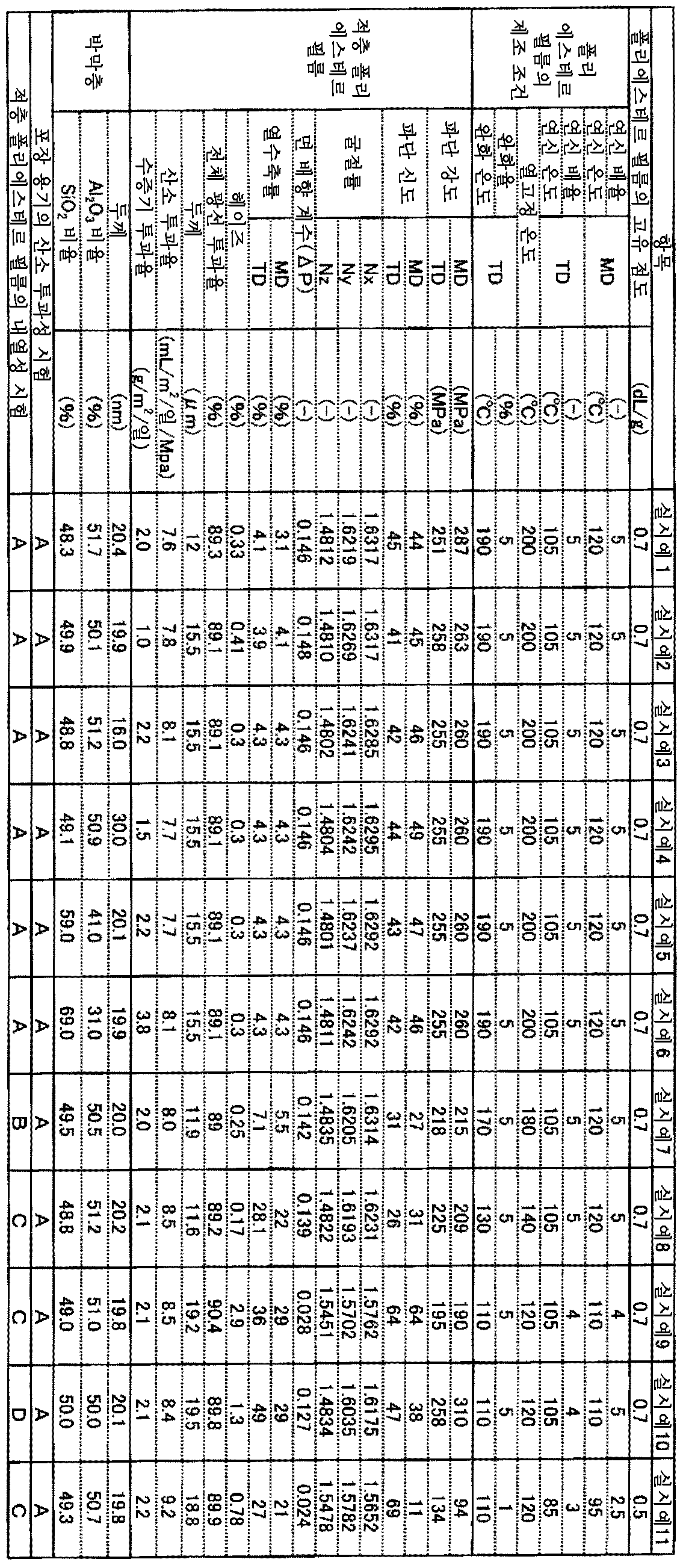
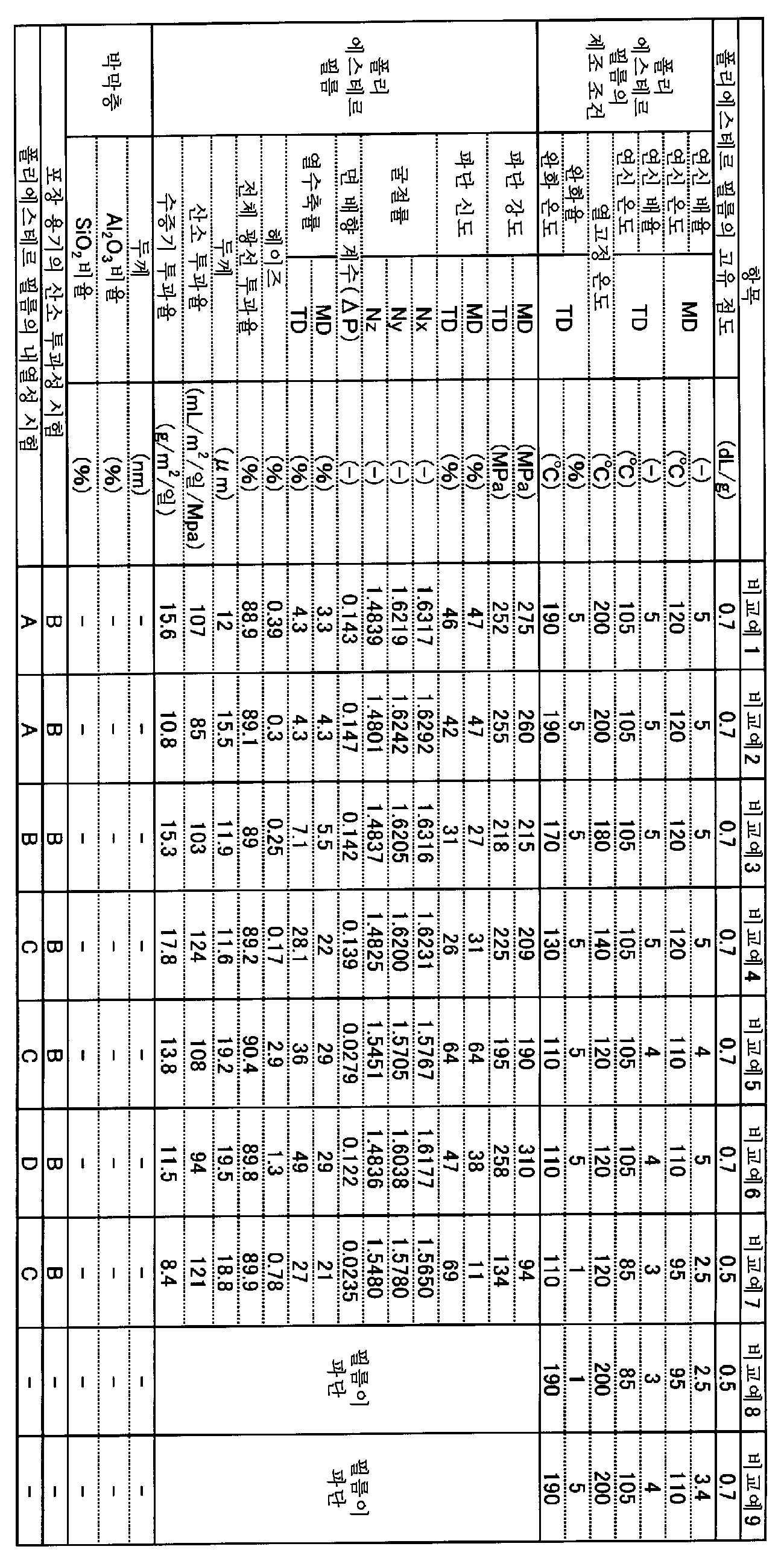
Claims (5)
상기 폴리에스테르 필름은, 푸란디카르복실산을 주된 성분으로 하는 디카르복실산 성분과, 에틸렌글리콜을 주된 성분으로 하는 글리콜 성분을 포함하는 2축 배향 폴리에스테르 필름이고,
상기 박막층은, 상기 폴리에스테르 필름의 적어도 편면에 구비되어 있고,
상기 무기 화합물은, 산화알루미늄 및 산화규소 중 적어도 하나이고,
상기 적층 폴리에스테르 필름의 면 배향 계수 ΔP가 0.005 이상 0.200 이하이고, 두께가 1㎛ 이상 300㎛ 이하이고, 온도 23℃, 습도 65% 하에서의 산소 투과도가 0.1mL/㎡/일/MPa 이상 80mL/㎡/일/MPa 이하인 것을 특징으로 하는 적층 폴리에스테르 필름.A laminated polyester film comprising a polyester film and a thin film layer containing an inorganic compound as a main component,
The polyester film is a biaxially oriented polyester film comprising a dicarboxylic acid component having furandicarboxylic acid as a main component and a glycol component having ethylene glycol as a main component,
The thin film layer is provided on at least one surface of the polyester film,
Wherein the inorganic compound is at least one of aluminum oxide and silicon oxide,
M 2 / day / MPa or more and 80 mL / m 2 or less at a temperature of 23 ° C and a humidity of 65% and a thickness of 1 μm or more and 300 μm or less and a planar orientation coefficient ΔP of 0.005 or more and 0.200 or less, / Day / MPa. ≪ / RTI >
Applications Claiming Priority (3)
| Application Number | Priority Date | Filing Date | Title |
|---|---|---|---|
| JP2015257295 | 2015-12-28 | ||
| JPJP-P-2015-257295 | 2015-12-28 | ||
| PCT/JP2016/088617 WO2017115736A1 (en) | 2015-12-28 | 2016-12-26 | Laminated polyester film |
Publications (2)
| Publication Number | Publication Date |
|---|---|
| KR20180098557A true KR20180098557A (en) | 2018-09-04 |
| KR102639403B1 KR102639403B1 (en) | 2024-02-23 |
Family
ID=59225679
Family Applications (1)
| Application Number | Title | Priority Date | Filing Date |
|---|---|---|---|
| KR1020187017941A Active KR102639403B1 (en) | 2015-12-28 | 2016-12-26 | Laminated polyester film |
Country Status (9)
| Country | Link |
|---|---|
| US (1) | US11318662B2 (en) |
| EP (1) | EP3398768B1 (en) |
| JP (1) | JP7009216B2 (en) |
| KR (1) | KR102639403B1 (en) |
| CN (1) | CN108472928B (en) |
| AU (1) | AU2016381909B2 (en) |
| MX (1) | MX2018007872A (en) |
| TW (1) | TWI799369B (en) |
| WO (1) | WO2017115736A1 (en) |
Families Citing this family (20)
| Publication number | Priority date | Publication date | Assignee | Title |
|---|---|---|---|---|
| US11325362B2 (en) * | 2015-12-28 | 2022-05-10 | Toyobo Co., Ltd. | Layered polyester film |
| US11318662B2 (en) * | 2015-12-28 | 2022-05-03 | Toyobo Co., Ltd. | Layered polyester film |
| TWI751868B (en) | 2016-03-30 | 2022-01-01 | 日商東洋紡股份有限公司 | Polyester film, manufacturing method thereof, and polyester film roll |
| WO2018159648A1 (en) * | 2017-03-01 | 2018-09-07 | 東洋紡株式会社 | Method for producing polyester film having furandicarboxylic acid unit |
| CN110382232B (en) * | 2017-03-01 | 2021-09-28 | 东洋纺株式会社 | Laminate comprising polyester film having furandicarboxylic acid unit and heat-sealable resin layer, and packaging bag |
| WO2019145108A1 (en) * | 2018-01-24 | 2019-08-01 | Tetra Laval Holdings & Finance S.A. | Barrier film and laminated packaging material comprising the film and packaging container made therefrom |
| JP7581881B2 (en) * | 2018-12-06 | 2024-11-13 | 東洋紡株式会社 | Laminate and packaging using same |
| KR102853108B1 (en) | 2019-02-08 | 2025-09-02 | 도요보 가부시키가이샤 | Folding displays and mobile terminal devices |
| US11997916B2 (en) | 2019-02-08 | 2024-05-28 | Toyobo Co., Ltd. | Polyester film and use thereof |
| US11926720B2 (en) | 2019-05-28 | 2024-03-12 | Toyobo Co., Ltd. | Polyester film and application therefor |
| KR102815003B1 (en) | 2019-05-28 | 2025-05-30 | 도요보 가부시키가이샤 | Polyester films, laminated films and their uses |
| US12354504B2 (en) | 2019-05-28 | 2025-07-08 | Toyobo Co., Ltd. | Transparent conductive polyester film and use of same |
| CN113874212B (en) | 2019-05-28 | 2023-10-24 | 东洋纺株式会社 | Laminated films and their uses |
| JP7757610B2 (en) | 2019-05-30 | 2025-10-22 | 東洋紡株式会社 | Polarizing plates for foldable displays |
| EP3978967A4 (en) | 2019-05-30 | 2023-07-12 | Toyobo Co., Ltd. | FOLDABLE SCREEN |
| CN114096596B (en) | 2019-07-12 | 2023-11-03 | 东洋纺株式会社 | Hard coating film for folding display and use thereof |
| WO2021010159A1 (en) | 2019-07-12 | 2021-01-21 | 東洋紡株式会社 | Hard coating film for foldable display, and application of said film |
| CN113548312B (en) * | 2020-04-23 | 2022-07-29 | 内蒙古伊利实业集团股份有限公司 | High-light-resistance high-barrier heat-shrinkable polyester film and preparation method and application thereof |
| AT525125B1 (en) * | 2021-06-02 | 2023-02-15 | Constantia Pirk Gmbh & Co Kg | Recyclable paper packaging laminate with a thin barrier film and good tear properties |
| WO2024202870A1 (en) * | 2023-03-24 | 2024-10-03 | 東洋紡株式会社 | Polyester film |
Citations (7)
| Publication number | Priority date | Publication date | Assignee | Title |
|---|---|---|---|---|
| US2551731A (en) | 1946-11-12 | 1951-05-08 | Celanese Corp | Polyesters from heterocyclic components |
| JP2003200546A (en) * | 2002-01-09 | 2003-07-15 | Toray Ind Inc | Polyester film for evaporation and evaporated polyester film |
| JP4881127B2 (en) | 2005-11-07 | 2012-02-22 | キヤノン株式会社 | Polymer compound and synthesis method thereof |
| JP2012229395A (en) | 2011-04-11 | 2012-11-22 | Canon Inc | Plastic film |
| JP2013155389A (en) | 2007-04-24 | 2013-08-15 | Mitsubishi Chemicals Corp | Polyester including furan structure |
| WO2014100265A1 (en) * | 2012-12-20 | 2014-06-26 | Dow Global Technologies Llc | Multilayer films of fdca-based polyesters |
| JP2015506389A (en) | 2011-12-29 | 2015-03-02 | ナチュラ コスメティコス ソシエダッド アノニマ | Process for the production of poly (ethylene 2,5-furandicarboxylate) from 2,5-furandicarboxylic acid, its use, its polyester compounds and blends |
Family Cites Families (64)
| Publication number | Priority date | Publication date | Assignee | Title |
|---|---|---|---|---|
| US4439479A (en) | 1982-01-15 | 1984-03-27 | Teijin Limited | Slippery biaxially stretched polyester films |
| FR2644105B1 (en) | 1989-03-08 | 1991-07-05 | Rhone Poulenc Films | COMPOSITE POLYESTER FILMS, PROCESS FOR OBTAINING SAME AND USE THEREOF AS A SUBSTRATE FOR APPLICATION FINISHES |
| US5096784A (en) | 1989-12-20 | 1992-03-17 | Hoechst Celanese Corporation | Polyester film with nodule surface |
| USH1982H1 (en) | 1996-06-20 | 2001-08-07 | Eastman Chemical Company | Primer coated amorphous plastic films |
| JP4247847B2 (en) * | 1997-06-27 | 2009-04-02 | 東レ株式会社 | Polyester film for transparent deposition |
| EP0962486B1 (en) | 1998-06-05 | 2003-12-17 | Teijin Limited | Antistatic polyester film and process for producing the same |
| JP2000119414A (en) * | 1998-10-13 | 2000-04-25 | Toray Ind Inc | Polyester film for vapor deposition |
| JP2001001399A (en) | 1999-06-17 | 2001-01-09 | Unitika Ltd | Gas barrier polyester film and production thereof |
| JP2001232739A (en) * | 2000-02-23 | 2001-08-28 | Toray Ind Inc | Film for vapor deposition and vapor deposited film using the same |
| JP5142421B2 (en) * | 2000-06-05 | 2013-02-13 | 東レ株式会社 | Biaxially oriented polyethylene terephthalate film for transparent deposition |
| JP4834923B2 (en) * | 2001-06-18 | 2011-12-14 | 東レ株式会社 | Deposition polyester film and deposition polyester film |
| JP2003071969A (en) | 2001-09-04 | 2003-03-12 | Toyo Metallizing Co Ltd | Transparent gas barrier film |
| JP3982385B2 (en) * | 2001-11-27 | 2007-09-26 | Jfeスチール株式会社 | Resin film for laminating metal plate, method for producing the same, resin laminated metal plate and method for producing the same |
| KR100909752B1 (en) * | 2002-03-07 | 2009-07-29 | 도레이 카부시키가이샤 | Polyester film and gas barrier polyester film |
| DE10301786A1 (en) | 2003-01-20 | 2004-07-29 | Mitsubishi Polyester Film Gmbh | Coextruded, at least two layer, transparent biaxially orientated polyester film, useful for printing or metallization and for the packaging of foodstuffs, has a layer of a cross-linked acrylic coating applied as an aqueous dispersion |
| KR100925110B1 (en) | 2005-04-28 | 2009-11-05 | 도요 보세키 가부시키가이샤 | Thermobondable polyester film, process for production of IC cards or IC tags with the same, and IC cards and IC tags |
| JP2007118476A (en) * | 2005-10-31 | 2007-05-17 | Toray Ind Inc | Biaxially oriented polyester film for packaging |
| WO2008011295A2 (en) * | 2006-07-17 | 2008-01-24 | Toray Plastics (America), Inc. | Biaxially oriented laminated polyester film for transfer applications |
| WO2008021884A2 (en) | 2006-08-08 | 2008-02-21 | Toray Plastics (America) , Inc. Lumirror Divison | Anti-iridescent easy handling ultraclear thermoplastic film |
| WO2009110337A1 (en) | 2008-03-05 | 2009-09-11 | 東レ株式会社 | Polyester resin for thermoformed optical film and biaxially oriented polyester film obtained from the same |
| IT1387503B (en) | 2008-05-08 | 2011-04-13 | Novamont Spa | ALYPATIC-AROMATIC BIODEGRADABLE POLYESTER |
| WO2010123087A1 (en) * | 2009-04-23 | 2010-10-28 | 帝人デュポンフィルム株式会社 | Biaxially stretched polyester film for solar battery |
| AU2010289576B2 (en) | 2009-09-02 | 2015-07-16 | E. I. Du Pont De Nemours And Company | Polyester films with improved oil repellency |
| WO2011030896A1 (en) * | 2009-09-14 | 2011-03-17 | 三菱樹脂株式会社 | Biaxially oriented polyester film for solar cell back surface sealing |
| CN101899145B (en) | 2010-07-28 | 2012-07-11 | 江南大学 | A kind of preparation method of 2,5-furandicarboxylic acid base polyester |
| JP5635366B2 (en) | 2010-10-27 | 2014-12-03 | 帝人デュポンフィルム株式会社 | Method for producing polyester film for solar cell back surface protective film and polyester film for solar cell back surface protective film |
| JP5757391B2 (en) * | 2010-11-02 | 2015-07-29 | 大日本印刷株式会社 | Barrier film and laminate using the same |
| US8871319B2 (en) * | 2011-04-12 | 2014-10-28 | The Procter & Gamble Company | Flexible barrier packaging derived from renewable resources |
| US20120288692A1 (en) | 2011-04-12 | 2012-11-15 | Norman Scott Broyles | Renewably sourced films and methods of forming same |
| EP2527142A1 (en) | 2011-05-24 | 2012-11-28 | Cryovac, Inc. | Multilayer polyester film for ready meals |
| US10137625B2 (en) * | 2011-07-08 | 2018-11-27 | Toray Plastics (America), Inc. | Biaxially oriented bio-based polyester films and laminates |
| US20130344345A1 (en) * | 2011-07-08 | 2013-12-26 | Toray Plastics (America), Inc. | Biaxially oriented bio-based polyester window films and laminates |
| US10800878B2 (en) * | 2011-10-14 | 2020-10-13 | Eastman Chemical Company | Polyester compositions containing furandicarboxylic acid or an ester thereof, cyclobutanediol and ethylene glycol |
| MX351452B (en) * | 2011-10-24 | 2017-10-16 | Furanix Technologies Bv | PROCESS TO PREPARE A POLYMERIC PRODUCT THAT HAS A 2,5-FURANDICARBOXYLATE PORTION WITHIN THE POLYMER STRUCTURE TO BE USED IN BOTTLE, FILM OR FIBER APPLICATIONS. |
| TW201336667A (en) | 2011-12-16 | 2013-09-16 | Saudi Basic Ind Corp | Uniaxially-oriented films comprising thermoplastic polyesters |
| KR102002798B1 (en) * | 2012-01-24 | 2019-07-23 | 도레이 카부시키가이샤 | Polyester film and manufacturing process therefor |
| US20140004286A1 (en) * | 2012-06-27 | 2014-01-02 | Toray Plastics (America), Inc. | Lighter than air balloons from laminates comprising bio-based polyester films and bio-based polyethylene films |
| WO2014021396A1 (en) | 2012-08-03 | 2014-02-06 | 東洋紡株式会社 | Polyester film and method for producing same |
| WO2014030474A1 (en) * | 2012-08-21 | 2014-02-27 | 東レ株式会社 | Biaxially oriented polyethylene terephthalate film and method for producing same |
| JP2014073598A (en) | 2012-10-03 | 2014-04-24 | Toray Ind Inc | Gas barrier film |
| WO2014100256A2 (en) | 2012-12-20 | 2014-06-26 | Dow Global Technologies Llc | Fdca-based polyesters |
| WO2014100254A1 (en) * | 2012-12-20 | 2014-06-26 | Dow Global Technologies Llc | Barrier films of fdca-based polyesters |
| CN105143967B (en) * | 2013-04-19 | 2019-02-19 | 东洋纺株式会社 | Liquid crystal display device, polarizing plate and polarizing plate protective film |
| KR102245444B1 (en) | 2013-04-26 | 2021-04-29 | 도요보 가부시키가이샤 | Polyester film for sealant use, laminate, and packaging bag |
| CN104228245A (en) | 2013-06-09 | 2014-12-24 | 杜邦公司 | Laminated body containing low-temperature heat-sealing layer containing poly(propylene-glycol succinate) or poly(terephthalate-co-propylene-glycol succinate) |
| US9580798B2 (en) | 2013-06-27 | 2017-02-28 | Flex Films (Usa) Inc. | High-barrier polyethylene terephthalate film |
| CN105682893A (en) | 2013-11-13 | 2016-06-15 | 东洋纺株式会社 | Biaxially stretched polyester film and method for producing same |
| EP3085723B1 (en) | 2013-12-19 | 2022-02-02 | Toyobo Co., Ltd. | Polyester resin |
| JP6387625B2 (en) | 2014-02-24 | 2018-09-12 | 大日本印刷株式会社 | Method for producing gas barrier film |
| CN106061729A (en) | 2014-03-07 | 2016-10-26 | 3M创新有限公司 | Durable extruded dyed polyester film |
| KR102201815B1 (en) * | 2014-08-25 | 2021-01-12 | 퓨라닉스 테크놀러지스 비.브이. | Process for producing an oriented film comprising poly(ethylene-2,5-furandicarboxylate |
| TWI535780B (en) | 2014-10-24 | 2016-06-01 | 財團法人工業技術研究院 | Polyester blend |
| EP3250377B1 (en) | 2015-01-28 | 2022-01-05 | Dow Global Technologies LLC | Multilayer film structures comprising renewable polyester compositions |
| KR102713724B1 (en) | 2015-07-03 | 2024-10-04 | 테트라 라발 홀딩스 앤드 피낭스 소시에떼아노님 | Device for processing web substrates in plasma-enhanced processing |
| EP3344687B1 (en) | 2015-09-02 | 2024-05-22 | Toyobo Co., Ltd. | Polyester film containing furandicarboxylate unit |
| MX393422B (en) * | 2015-10-29 | 2025-03-24 | Tetra Laval Holdings & Finance | LAMINATED BARRIER FILM AND EDGE COVERING TAPE FOR PACKAGING. |
| US11318662B2 (en) * | 2015-12-28 | 2022-05-03 | Toyobo Co., Ltd. | Layered polyester film |
| US11325362B2 (en) * | 2015-12-28 | 2022-05-10 | Toyobo Co., Ltd. | Layered polyester film |
| TWI751868B (en) * | 2016-03-30 | 2022-01-01 | 日商東洋紡股份有限公司 | Polyester film, manufacturing method thereof, and polyester film roll |
| US20170368807A1 (en) | 2016-06-28 | 2017-12-28 | Toray Plastics (America), Inc. | Formable polyester films |
| JP6890587B2 (en) | 2016-07-15 | 2021-06-18 | 株式会社クラレ | Sealant film and its manufacturing method |
| WO2018097728A1 (en) | 2016-11-28 | 2018-05-31 | Furanix Technologies B.V. | Thermoformed article of poly(ethylene 2,5 furandicarboxylate) polyester |
| WO2018159648A1 (en) * | 2017-03-01 | 2018-09-07 | 東洋紡株式会社 | Method for producing polyester film having furandicarboxylic acid unit |
| CN110382232B (en) * | 2017-03-01 | 2021-09-28 | 东洋纺株式会社 | Laminate comprising polyester film having furandicarboxylic acid unit and heat-sealable resin layer, and packaging bag |
-
2016
- 2016-12-26 US US16/066,212 patent/US11318662B2/en active Active
- 2016-12-26 CN CN201680076573.XA patent/CN108472928B/en active Active
- 2016-12-26 JP JP2017559174A patent/JP7009216B2/en active Active
- 2016-12-26 TW TW105143160A patent/TWI799369B/en active
- 2016-12-26 KR KR1020187017941A patent/KR102639403B1/en active Active
- 2016-12-26 WO PCT/JP2016/088617 patent/WO2017115736A1/en not_active Ceased
- 2016-12-26 EP EP16881711.2A patent/EP3398768B1/en active Active
- 2016-12-26 MX MX2018007872A patent/MX2018007872A/en unknown
- 2016-12-26 AU AU2016381909A patent/AU2016381909B2/en active Active
Patent Citations (8)
| Publication number | Priority date | Publication date | Assignee | Title |
|---|---|---|---|---|
| US2551731A (en) | 1946-11-12 | 1951-05-08 | Celanese Corp | Polyesters from heterocyclic components |
| JP2003200546A (en) * | 2002-01-09 | 2003-07-15 | Toray Ind Inc | Polyester film for evaporation and evaporated polyester film |
| JP4881127B2 (en) | 2005-11-07 | 2012-02-22 | キヤノン株式会社 | Polymer compound and synthesis method thereof |
| JP2013155389A (en) | 2007-04-24 | 2013-08-15 | Mitsubishi Chemicals Corp | Polyester including furan structure |
| JP2015098612A (en) | 2007-04-24 | 2015-05-28 | 三菱化学株式会社 | Polyester containing furan structure |
| JP2012229395A (en) | 2011-04-11 | 2012-11-22 | Canon Inc | Plastic film |
| JP2015506389A (en) | 2011-12-29 | 2015-03-02 | ナチュラ コスメティコス ソシエダッド アノニマ | Process for the production of poly (ethylene 2,5-furandicarboxylate) from 2,5-furandicarboxylic acid, its use, its polyester compounds and blends |
| WO2014100265A1 (en) * | 2012-12-20 | 2014-06-26 | Dow Global Technologies Llc | Multilayer films of fdca-based polyesters |
Non-Patent Citations (1)
| Title |
|---|
| Y. Hachihama, T. Shono, and K. Hyono, Technol. Repts. Osaka Univ., 8, 475 (1958) |
Also Published As
| Publication number | Publication date |
|---|---|
| JP7009216B2 (en) | 2022-01-25 |
| EP3398768A1 (en) | 2018-11-07 |
| EP3398768B1 (en) | 2022-01-26 |
| JPWO2017115736A1 (en) | 2018-10-18 |
| MX2018007872A (en) | 2019-01-31 |
| US20200269559A1 (en) | 2020-08-27 |
| AU2016381909A1 (en) | 2018-07-12 |
| KR102639403B1 (en) | 2024-02-23 |
| WO2017115736A1 (en) | 2017-07-06 |
| TWI799369B (en) | 2023-04-21 |
| CN108472928A (en) | 2018-08-31 |
| TW201736140A (en) | 2017-10-16 |
| EP3398768A4 (en) | 2019-09-04 |
| CN108472928B (en) | 2020-05-12 |
| AU2016381909B2 (en) | 2020-10-15 |
| US11318662B2 (en) | 2022-05-03 |
Similar Documents
| Publication | Publication Date | Title |
|---|---|---|
| US11318662B2 (en) | Layered polyester film | |
| KR102582918B1 (en) | Polyester film containing furandicarboxylate units | |
| TWI813557B (en) | Manufacturing method of biaxially oriented polyester film | |
| CN106459441B (en) | Biaxially stretched polybutylene terephthalate film, method for producing same, and gas barrier laminated film | |
| KR20180132728A (en) | Polyester film | |
| WO2017115737A1 (en) | Laminated polyester film | |
| TW202449036A (en) | Polyester film | |
| JP2002103444A (en) | Biaxially oriented polyester film and its production method |
Legal Events
| Date | Code | Title | Description |
|---|---|---|---|
| PA0105 | International application |
Patent event date: 20180625 Patent event code: PA01051R01D Comment text: International Patent Application |
|
| PG1501 | Laying open of application | ||
| N231 | Notification of change of applicant | ||
| PN2301 | Change of applicant |
Patent event date: 20201015 Comment text: Notification of Change of Applicant Patent event code: PN23011R01D |
|
| A201 | Request for examination | ||
| PA0201 | Request for examination |
Patent event code: PA02012R01D Patent event date: 20210914 Comment text: Request for Examination of Application |
|
| E902 | Notification of reason for refusal | ||
| PE0902 | Notice of grounds for rejection |
Comment text: Notification of reason for refusal Patent event date: 20230616 Patent event code: PE09021S01D |
|
| E701 | Decision to grant or registration of patent right | ||
| PE0701 | Decision of registration |
Patent event code: PE07011S01D Comment text: Decision to Grant Registration Patent event date: 20231227 |
|
| GRNT | Written decision to grant | ||
| PR0701 | Registration of establishment |
Comment text: Registration of Establishment Patent event date: 20240219 Patent event code: PR07011E01D |
|
| PR1002 | Payment of registration fee |
Payment date: 20240220 End annual number: 3 Start annual number: 1 |
|
| PG1601 | Publication of registration |