KR20180098366A - Polyimide material, process for its preparation and polyimide precursor composition - Google Patents
Polyimide material, process for its preparation and polyimide precursor composition Download PDFInfo
- Publication number
- KR20180098366A KR20180098366A KR1020187021502A KR20187021502A KR20180098366A KR 20180098366 A KR20180098366 A KR 20180098366A KR 1020187021502 A KR1020187021502 A KR 1020187021502A KR 20187021502 A KR20187021502 A KR 20187021502A KR 20180098366 A KR20180098366 A KR 20180098366A
- Authority
- KR
- South Korea
- Prior art keywords
- polyimide
- group
- polyimide precursor
- alicyclic structure
- film
- Prior art date
- Legal status (The legal status is an assumption and is not a legal conclusion. Google has not performed a legal analysis and makes no representation as to the accuracy of the status listed.)
- Granted
Links
- 0 CCC*(CC)*C(C(I*(C(*)=O)(C(NC(C)(CC)CCC)=O)C(O)=O)=O)=C Chemical compound CCC*(CC)*C(C(I*(C(*)=O)(C(NC(C)(CC)CCC)=O)C(O)=O)=O)=C 0.000 description 6
- ZVMJRWDJHNHEDY-UHFFFAOYSA-N CC(C=CCC1)C1=C Chemical compound CC(C=CCC1)C1=C ZVMJRWDJHNHEDY-UHFFFAOYSA-N 0.000 description 1
- KKDZMSWHDHBHEU-UHFFFAOYSA-N CC1C(C)C=CCC1 Chemical compound CC1C(C)C=CCC1 KKDZMSWHDHBHEU-UHFFFAOYSA-N 0.000 description 1
- ADNHKZRYBOUYGM-UHFFFAOYSA-N CC1C(CC2)CC2C1C Chemical compound CC1C(CC2)CC2C1C ADNHKZRYBOUYGM-UHFFFAOYSA-N 0.000 description 1
Classifications
-
- C—CHEMISTRY; METALLURGY
- C08—ORGANIC MACROMOLECULAR COMPOUNDS; THEIR PREPARATION OR CHEMICAL WORKING-UP; COMPOSITIONS BASED THEREON
- C08L—COMPOSITIONS OF MACROMOLECULAR COMPOUNDS
- C08L79/00—Compositions of macromolecular compounds obtained by reactions forming in the main chain of the macromolecule a linkage containing nitrogen with or without oxygen or carbon only, not provided for in groups C08L61/00 - C08L77/00
- C08L79/04—Polycondensates having nitrogen-containing heterocyclic rings in the main chain; Polyhydrazides; Polyamide acids or similar polyimide precursors
- C08L79/08—Polyimides; Polyester-imides; Polyamide-imides; Polyamide acids or similar polyimide precursors
-
- C—CHEMISTRY; METALLURGY
- C08—ORGANIC MACROMOLECULAR COMPOUNDS; THEIR PREPARATION OR CHEMICAL WORKING-UP; COMPOSITIONS BASED THEREON
- C08G—MACROMOLECULAR COMPOUNDS OBTAINED OTHERWISE THAN BY REACTIONS ONLY INVOLVING UNSATURATED CARBON-TO-CARBON BONDS
- C08G73/00—Macromolecular compounds obtained by reactions forming a linkage containing nitrogen with or without oxygen or carbon in the main chain of the macromolecule, not provided for in groups C08G12/00 - C08G71/00
- C08G73/06—Polycondensates having nitrogen-containing heterocyclic rings in the main chain of the macromolecule
- C08G73/10—Polyimides; Polyester-imides; Polyamide-imides; Polyamide acids or similar polyimide precursors
-
- C—CHEMISTRY; METALLURGY
- C08—ORGANIC MACROMOLECULAR COMPOUNDS; THEIR PREPARATION OR CHEMICAL WORKING-UP; COMPOSITIONS BASED THEREON
- C08J—WORKING-UP; GENERAL PROCESSES OF COMPOUNDING; AFTER-TREATMENT NOT COVERED BY SUBCLASSES C08B, C08C, C08F, C08G or C08H
- C08J5/00—Manufacture of articles or shaped materials containing macromolecular substances
- C08J5/18—Manufacture of films or sheets
-
- C—CHEMISTRY; METALLURGY
- C08—ORGANIC MACROMOLECULAR COMPOUNDS; THEIR PREPARATION OR CHEMICAL WORKING-UP; COMPOSITIONS BASED THEREON
- C08K—Use of inorganic or non-macromolecular organic substances as compounding ingredients
- C08K5/00—Use of organic ingredients
- C08K5/16—Nitrogen-containing compounds
- C08K5/34—Heterocyclic compounds having nitrogen in the ring
- C08K5/3467—Heterocyclic compounds having nitrogen in the ring having more than two nitrogen atoms in the ring
- C08K5/3472—Five-membered rings
-
- C—CHEMISTRY; METALLURGY
- C08—ORGANIC MACROMOLECULAR COMPOUNDS; THEIR PREPARATION OR CHEMICAL WORKING-UP; COMPOSITIONS BASED THEREON
- C08K—Use of inorganic or non-macromolecular organic substances as compounding ingredients
- C08K5/00—Use of organic ingredients
- C08K5/16—Nitrogen-containing compounds
- C08K5/34—Heterocyclic compounds having nitrogen in the ring
- C08K5/3467—Heterocyclic compounds having nitrogen in the ring having more than two nitrogen atoms in the ring
- C08K5/3472—Five-membered rings
- C08K5/3475—Five-membered rings condensed with carbocyclic rings
-
- C—CHEMISTRY; METALLURGY
- C09—DYES; PAINTS; POLISHES; NATURAL RESINS; ADHESIVES; COMPOSITIONS NOT OTHERWISE PROVIDED FOR; APPLICATIONS OF MATERIALS NOT OTHERWISE PROVIDED FOR
- C09D—COATING COMPOSITIONS, e.g. PAINTS, VARNISHES OR LACQUERS; FILLING PASTES; CHEMICAL PAINT OR INK REMOVERS; INKS; CORRECTING FLUIDS; WOODSTAINS; PASTES OR SOLIDS FOR COLOURING OR PRINTING; USE OF MATERIALS THEREFOR
- C09D179/00—Coating compositions based on macromolecular compounds obtained by reactions forming in the main chain of the macromolecule a linkage containing nitrogen, with or without oxygen, or carbon only, not provided for in groups C09D161/00 - C09D177/00
- C09D179/04—Polycondensates having nitrogen-containing heterocyclic rings in the main chain; Polyhydrazides; Polyamide acids or similar polyimide precursors
- C09D179/08—Polyimides; Polyester-imides; Polyamide-imides; Polyamide acids or similar polyimide precursors
-
- C—CHEMISTRY; METALLURGY
- C08—ORGANIC MACROMOLECULAR COMPOUNDS; THEIR PREPARATION OR CHEMICAL WORKING-UP; COMPOSITIONS BASED THEREON
- C08J—WORKING-UP; GENERAL PROCESSES OF COMPOUNDING; AFTER-TREATMENT NOT COVERED BY SUBCLASSES C08B, C08C, C08F, C08G or C08H
- C08J2379/00—Characterised by the use of macromolecular compounds obtained by reactions forming in the main chain of the macromolecule a linkage containing nitrogen with or without oxygen, or carbon only, not provided for in groups C08J2361/00 - C08J2377/00
- C08J2379/04—Polycondensates having nitrogen-containing heterocyclic rings in the main chain; Polyhydrazides; Polyamide acids or similar polyimide precursors
- C08J2379/08—Polyimides; Polyester-imides; Polyamide-imides; Polyamide acids or similar polyimide precursors
Landscapes
- Chemical & Material Sciences (AREA)
- Chemical Kinetics & Catalysis (AREA)
- Organic Chemistry (AREA)
- Health & Medical Sciences (AREA)
- Medicinal Chemistry (AREA)
- Polymers & Plastics (AREA)
- Engineering & Computer Science (AREA)
- Manufacturing & Machinery (AREA)
- Materials Engineering (AREA)
- Life Sciences & Earth Sciences (AREA)
- Wood Science & Technology (AREA)
- Macromolecular Compounds Obtained By Forming Nitrogen-Containing Linkages In General (AREA)
- Compositions Of Macromolecular Compounds (AREA)
- Manufacture Of Macromolecular Shaped Articles (AREA)
Abstract
폴리이미드 필름의 종래부터의 특징을 살리면서, 자외선 내구성을 향상시킨 폴리이미드 재료를 제공한다. 이 폴리이미드 재료는, 폴리이미드와 자외선 흡수제를 함유하고, 0.5% 중량 감소 온도가 200℃를 초과하는 것을 특징으로 한다.A polyimide material improved in ultraviolet durability while taking advantage of the conventional characteristics of the polyimide film is provided. This polyimide material contains a polyimide and an ultraviolet absorber and is characterized in that the 0.5% weight reduction temperature exceeds 200 캜.
Description
본 발명은 자외선 내구성이 우수한 폴리이미드 재료에 관한 것이다.The present invention relates to a polyimide material having excellent ultraviolet durability.
폴리이미드 필름은, 내열성, 내약품성, 기계적 강도, 전기 특성, 치수 안정성 등이 우수한 점에서, 전기·전자 디바이스 분야, 반도체 분야 등의 분야에서 널리 사용되어 왔다. 한편, 근년, 고도 정보화 사회의 도래에 수반하여, 광통신 분야의 광 파이버나 광 도파로 등, 표시 장치 분야의 액정 배향막이나 컬러 필터용 보호막 등의 광학 재료의 개발이 진행되고 있다. 특히 표시 장치 분야에서, 유리 기판의 대체로서 경량이며 플렉시블성이 우수한 플라스틱 기판의 검토나, 구부리거나 둥글게 하는 것이 가능한 디스플레이의 개발이 활발히 행해지고 있다. 이 때문에, 그와 같은 용도에 사용할 수 있는, 보다 고성능의 광학 재료가 요구되고 있다.BACKGROUND ART Polyimide films have been widely used in fields such as electric / electronic devices and semiconductor fields in view of excellent heat resistance, chemical resistance, mechanical strength, electrical characteristics, dimensional stability and the like. In recent years, along with the advent of a highly information-oriented society, optical materials such as optical alignment films for liquid crystal display devices and protective films for color filters, such as optical fibers and optical waveguides in the field of optical communication, have been developed. Particularly in the field of display devices, there has been actively studied a plastic substrate which is lightweight and excellent in flexibility as a substitute for a glass substrate, and development of a display capable of bending or rounding. For this reason, there is a demand for a higher-performance optical material that can be used for such applications.
방향족 폴리이미드는, 분자 내 공액이나 전하 이동 착체의 형성에 의해, 본질적으로 황갈색으로 착색된다. 이 때문에 착색을 억제하는 수단으로서, 예를 들어 분자 내로의 불소 원자의 도입, 주쇄로의 굴곡성의 부여, 측쇄로서 부피가 큰 기의 도입 등에 의해, 분자 내 공액이나 전하 이동 착체의 형성을 저해하여, 투명성을 발현시키는 방법이 제안되어 있다(예를 들어, 특허문헌 1).The aromatic polyimide is essentially colored yellowish brown by intramolecular conjugation or formation of charge transfer complexes. Therefore, as a means for suppressing coloring, for example, introduction of fluorine atoms into a molecule, impartation of flexibility to a main chain, introduction of a bulky group as a side chain, and the like inhibit intramolecular conjugation or formation of a charge transfer complex , And a method of developing transparency has been proposed (for example, Patent Document 1).
또한, 원리적으로 전하 이동 착체를 형성하지 않는 반지환식 또는 전지환식 폴리이미드를 사용함으로써 투명성을 발현시키는 방법도 제안되어 있다(예를 들어, 특허문헌 2 내지 5).Further, a method of expressing transparency by using a ring-cyclic or battery cyclic polyimide which does not form a charge-transfer complex in principle has also been proposed (for example, Patent Documents 2 to 5).
종래부터, 폴리이미드의 특성을 살린 용도가 개발되어 있지만, 폴리이미드는, 일반적으로 자외선 영역에 흡수를 갖고 있기 때문에, 내광성, 특히 자외선 영역의 광에 대한 내구성이 부족한 경우가 있다. 특허문헌 6(일본 특허 공개 제2004-258544)에는, 자외선 흡수제와 특정한 폴리이미드를 함유하는 용액을 기재 상에 도포함으로써 얻어진 위상차 필름이 기재되어 있다.Conventionally, polyimide has been developed to take advantage of the characteristics of polyimide. However, since polyimide generally has absorption in the ultraviolet region, there is a case where light resistance, particularly durability against light in the ultraviolet region, is insufficient. Patent Document 6 (Japanese Patent Laid-Open No. 2004-258544) discloses a retardation film obtained by applying a solution containing an ultraviolet absorber and a specific polyimide on a substrate.
특허문헌 7(중국 특허 출원 공개 제103897391호 명세서)에는, 폴리이미드, 나노 파우더, 광 경화제, 산화 방지제, 자외선 흡수제 및 광 안정제를 혼합하고, 220 내지 290℃의 범위에서 압출 성형하여 광 경화성 폴리이미드 필름을 제조하는 것이 기재되어 있다. 그리고, 이 광 경화성 폴리이미드 필름을 태양 전지에 사용함으로써, 태양 전지의 성능이 향상되는 것이 기재되어 있다.In Patent Document 7 (Chinese Patent Application Laid-Open No. 103897391), polyimide, a nano powder, a photo-curing agent, an antioxidant, an ultraviolet absorber and a light stabilizer are mixed and extruded at 220 to 290 ° C to form a photo- To produce a film. It is described that the performance of a solar cell is improved by using this photocurable polyimide film for a solar cell.
특허문헌 8(일본 특허 공개 평 10-148835호 공보)은 광 조사에 의해 발생하는 전기적 특성의 열화 및 잔상의 문제를 해결하기 위해서, 배향막에 자외선 흡수제를 첨가하는 기술을 개시하고 있다([0006] 등). 배향막의 재료로서, 폴리이미드를 들고 있으며, 실시예에서는, 데카메틸렌비스트리멜리테이트 이무수물과 3,3',4,4'-비시클로헥실테트라카르복실산 이무수물을 4/6의 비율로 함유하는 테트라카르복실산 성분과, 파라페닐렌디아민 및 4,4'-디아미노디페닐메탄을 함유하는 디아민 성분을 반응하여 얻어지는 폴리아미드산에 자외선 흡수제를 첨가하여 액정 배향막용의 폴리아미드산 용액을 제조하는 것, 및 그것을 사용하여 180℃에서 가열하여 배향막을 형성하는 것이 기재되어 있다.[0006] Patent Document 8 (Japanese Unexamined Patent Publication (Kokai) No. 10-148835) discloses a technique of adding an ultraviolet absorber to an alignment film in order to solve the problem of deterioration of electrical characteristics and after-image caused by light irradiation Etc). In the examples, decamethylene bistrimellitate dianhydride and 3,3 ', 4,4'-bicyclohexyltetracarboxylic dianhydride were mixed at a ratio of 4/6 An ultraviolet absorber is added to a polyamic acid obtained by reacting a tetracarboxylic acid component containing tetracarboxylic acid and a diamine component containing paraphenylenediamine and 4,4'-diaminodiphenylmethane to prepare a polyamic acid solution And an alignment film is formed by heating at 180 占 폚 using it.
특허문헌 9(일본 특허 공개 소62-184055호 공보)에는, 액정 표시 소자 등에서 사용되는 차광막 제조를 위해, 자외선 흡수제를 포함하는 차광막용의 폴리아미드산 조성물 및 그것을 사용한 차광막이 기재되어 있다.Patent Document 9 (Japanese Patent Application Laid-Open No. 62-184055) discloses a polyamic acid composition for a light-shielding film containing an ultraviolet absorber and a light-shielding film using the polyamic acid composition for producing a light-shielding film used in a liquid crystal display device or the like.
특허문헌 10에는, 폴리이미드, 퀴논디아지드 구조를 갖는 화합물 및 자외선 흡수제를 포함하는 감광성 수지 조성물 및 그것을 사용하여 형성한 보호막이 기재되어 있다.Patent Document 10 discloses a photosensitive resin composition comprising a polyimide, a compound having a quinonediazide structure and an ultraviolet absorber, and a protective film formed using the same.
그러나, 특허문헌 6은, 폴리이미드의 광학 이방성에만 착안한 기술이며, 내열성, 내약품성, 기계적 강도, 전기 특성, 치수 안정성 등의 폴리이미드의 특성을 충분히 활용하는 기술은 아니다. 충분한 내열성, 내약품성, 기계적 강도, 전기 특성, 치수 안정성 등을 갖는 폴리이미드(필름, 코팅층)를 제조하기 위해서는, 고온 가열 처리가 필요하다. 그러나, 특허문헌 6에서는, 40 내지 200℃의 범위의 비교적 저온의 가열이 시사되어 있을 뿐이며, 충분한 내열성을 갖지 않는다. 또한, 특허문헌 6의 기술에서는, 폴리이미드의 종류가 특정한 가용성 폴리이미드에 한정되어 있어, 용도가 현저하게 제한된다.However, Patent Document 6 is a technique focused only on the optical anisotropy of polyimide, and is not a technique that fully exploits the properties of polyimide such as heat resistance, chemical resistance, mechanical strength, electrical characteristics, dimensional stability and the like. In order to produce a polyimide (film, coating layer) having sufficient heat resistance, chemical resistance, mechanical strength, electrical characteristics, dimensional stability, etc., a high temperature heat treatment is required. However, in Patent Document 6, heating at a relatively low temperature in the range of 40 to 200 占 폚 is merely indicated and does not have sufficient heat resistance. Further, in the technique of Patent Document 6, since the kind of polyimide is limited to a specific soluble polyimide, the use thereof is remarkably limited.
특허문헌 7에서는, 상술한 바와 같이, 자외선 흡수제를 함유하는 광 경화성 폴리이미드 필름을 사용함으로써, 태양 전지의 성능이 향상되는 것이 기재되어 있지만, 자외선 흡수제에 의해 폴리이미드(바로 그 자체)의 자외선 내구성을 향상시키는 것은 시사하고 있지 않다. 즉, 특허문헌 7은, 광 경화제를 포함하는 조성물 이외의 경우에 있어서, 폴리이미드에 자외선 흡수제를 첨가하는 것은 전혀 교시하고 있지 않다. 또한, 필름의 형성을, 220 내지 290℃의 범위의 압출 성형으로 행하고 있는 것으로부터 보아서, 함유되는 폴리이미드는 290℃ 이하의 융점을 갖는 내열성이 낮은 폴리이미드이다. 광 경화제 등의 첨가제를 첨가하는 것은, 그 자체, 물성을 저하시키거나, 가교에 의해 기계적 특성, 예를 들어 파단 신도를 저하시키거나 할 것으로 생각된다. 따라서, 폴리이미드의 특성을 충분히 활용하기 위해서는, 광 경화제를 함유하지 않는 것이 바람직하다.Patent Document 7 discloses that the performance of a solar cell is improved by using a photo-curable polyimide film containing an ultraviolet absorber as described above. However, the ultraviolet durability of the polyimide (itself) Is not suggested. That is, Patent Document 7 does not teach the addition of an ultraviolet absorber to a polyimide at all in the case of a composition other than a composition containing a photo-curing agent. In addition, the formation of the film is performed by extrusion molding at a temperature in the range of 220 to 290 DEG C, and the contained polyimide is a polyimide having a low heat resistance with a melting point of 290 DEG C or lower. It is believed that the addition of an additive such as a photo-curing agent will lower the physical properties of the resin itself or lower the mechanical properties, for example, the elongation at break, by crosslinking. Therefore, in order to fully utilize the characteristics of the polyimide, it is preferable that it does not contain a photo-curing agent.
특허문헌 8은, 상술한 바와 같이, 액정 배향막 특유의 문제를 해결하기 위한 폴리아미드산 용액 및 그것을 사용하여 형성한 배향막을 개시하고 있지만, 액정 배향막 이외의 용도에서, 폴리이미드에 자외선 흡수제를 첨가하는 것은 전혀 교시하고 있지 않다. 또한, 배향막 형성의 온도가 180℃로 낮아, 폴리이미드의 내열성이 불충분하다. 또한, 개시된 폴리이미드 자체도 기계적 특성이나 내열성의 점에서 불충분하다.Patent Document 8 discloses a polyamic acid solution and an alignment film formed using the polyamic acid solution for solving the problem peculiar to the liquid crystal alignment film as described above. However, in applications other than the liquid crystal alignment film, an ultraviolet absorber is added to the polyimide It does not teach at all. In addition, the temperature for forming the alignment film is as low as 180 占 폚, and the heat resistance of the polyimide is insufficient. In addition, the disclosed polyimide itself is also insufficient in terms of mechanical properties and heat resistance.
특허문헌 9는, 차광막 형성을 위해, 즉, 광(자외선)을 차광하기 위하여 자외선 흡수제를 첨가하는 것은 기재하고 있지만, 폴리이미드의 자외선 내구성을 향상시키는 것은 교시하고 있지 않다. 특허문헌 9는, 차광막 형성이 목적이기 때문에, 폴리이미드에 자외선 흡수제를 첨가하고 또한 헤이즈나 착색(황색도)을 작게 하는 것은 전혀 교시하고 있지 않다.Patent Document 9 discloses adding ultraviolet absorber to shield light (ultraviolet ray) for forming a light-shielding film, but does not teach to improve ultraviolet durability of polyimide. Patent Document 9 does not teach at all to add an ultraviolet absorber to polyimide and to reduce haze and coloring (yellowing degree) because it is the purpose of forming a light-shielding film.
특허문헌 10은, 유기 EL 표시 소자의 TFT에 있어서의 자외선의 영향을 저감할 목적으로, 그의 보호막 내에 자외선 흡수제를 첨가하는 것은 기재하고 있지만(0218), 폴리이미드의 자외선 내구성을 향상시키는 것은 교시하고 있지 않다. 즉, 특허문헌 10은, 폴리이미드 수지와 함께 퀴논디아지드 구조를 갖는 화합물을 함유하는 감광성 수지 조성물 이외의 용도에서, 폴리이미드에 자외선 흡수제를 첨가하는 것은 전혀 교시하고 있지 않다.Patent Document 10 describes the addition of an ultraviolet absorber in its protective film for the purpose of reducing the influence of ultraviolet rays in the TFT of the organic EL display element (0218), but it is taught to improve the ultraviolet durability of the polyimide It is not. That is, Patent Document 10 does not teach the addition of an ultraviolet absorber to a polyimide in applications other than the photosensitive resin composition containing a compound having a quinone diazide structure together with a polyimide resin.
이상과 같이, 폴리이미드의 종래부터의 특징을 살리면서, 자외선 내구성을 향상시키는 것은, 아직 해결되어 있지 않았다. 따라서, 본 발명은 폴리이미드의 종래부터의 특징을 살리면서, 자외선 내구성이 우수한 폴리이미드 재료, 그의 제조 방법 및 그의 제조를 위하여 사용되는 폴리이미드 전구체 조성물을 제공하는 것을 목적으로 한다.As described above, improving the ultraviolet durability while taking advantage of the conventional characteristics of polyimide has not been solved yet. Accordingly, it is an object of the present invention to provide a polyimide material having excellent ultraviolet durability, a method for producing the same, and a polyimide precursor composition for use in the production thereof while taking advantage of the conventional characteristics of polyimide.
본 발명의 권리는, 첨부된 특허 청구 범위에 의해 정해진다. 한편, 본 출원의 주요한 개시 사항을 정리하면 이하와 같다.The rights of the present invention are defined by the appended claims. The main disclosures of the present application are summarized below.
1. 폴리이미드와,1. Polyimide,
자외선 흡수제Ultraviolet absorber
를 함유하며,Lt; / RTI >
0.5% 중량 감소 온도가 200℃를 초과하는 것0.5% weight reduction Temperature exceeding 200 ℃
것을 특징으로 하는 폴리이미드 재료.Lt; RTI ID = 0.0 > polyimide < / RTI >
2. 헤이즈값이 15% 이하인 것을 특징으로 하는 상기 항 1에 기재된 폴리이미드 재료.2. The polyimide material according to item 1, which has a haze value of 15% or less.
3. 자외선 조사 시험 전후에서의 황색도의 변화 ΔYI가 8 이하인 것을 특징으로 하는 상기 항 1 또는 2에 기재된 폴리이미드 재료;3. Polyimide material according to item 1 or 2, characterized in that the change in yellowness before and after the ultraviolet irradiation test? YI is 8 or less;
단, 상기 자외선 조사 시험의 조건은, QUV-313 램프를 사용하고, 310nm에서의 조도 0.59W/㎡, 온도 50℃, 조사 시간 24시간이다.However, the conditions of the ultraviolet irradiation test were a QUV-313 lamp, an illuminance at 310 nm of 0.59 W / m 2, a temperature of 50 캜, and an irradiation time of 24 hours.
4. 상기 폴리이미드가, 하기 일반식 (1)로 표시되는 반복 단위를 포함하는 것을 특징으로 하는 상기 항 1 내지 3 중 어느 한 항에 기재된 폴리이미드 재료.4. The polyimide material according to any one of items 1 to 3, wherein the polyimide comprises a repeating unit represented by the following general formula (1).
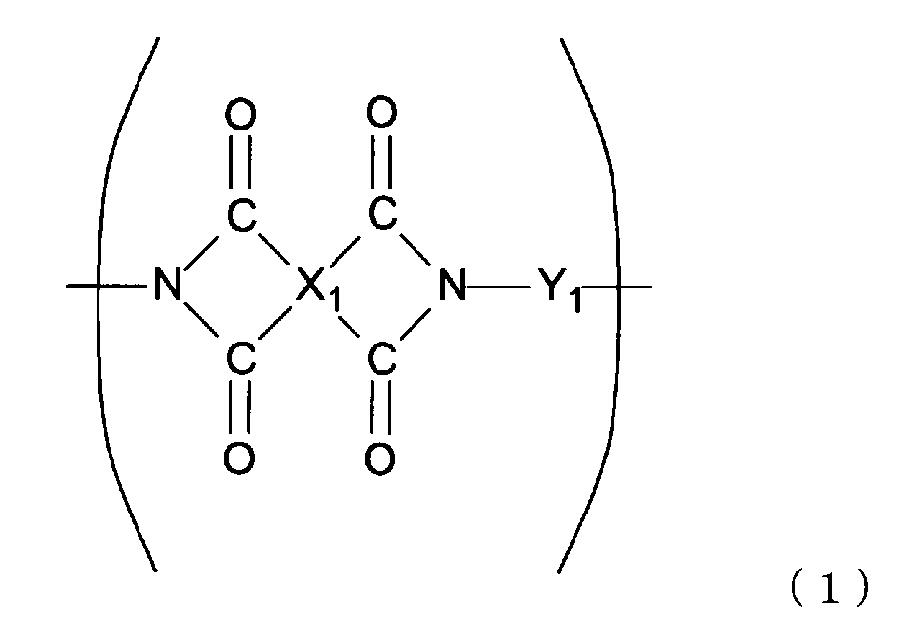
(식 중, X1은 방향족환 또는 지환 구조를 갖는 4가의 기이며, Y1은 방향족환 또는 지환 구조를 갖는 2가의 기이다.)(Wherein X 1 is an aromatic ring or a tetravalent group having an alicyclic structure, and Y 1 is a divalent group having an aromatic ring or alicyclic structure)
5. X1이 지환 구조를 갖는 4가의 기이며, Y1이 지환 구조를 갖는 2가의 기인 일반식 (1)로 표시되는 반복 단위의 함유량이, 전체 반복 단위에 대하여 50몰% 이하인 것을 특징으로 하는 상기 항 4에 기재된 폴리이미드 재료.5. The positive resist composition according to claim 1 , wherein X 1 is a tetravalent group having an alicyclic structure, and Y 1 is a bivalent group having an alicyclic structure, wherein the content of the repeating unit represented by the general formula (1) is 50 mol% Is the polyimide material according to item 4 above.
6. 일반식 (1) 중의 X1이 방향족환을 갖는 4가의 기이며, Y1이 방향족환을 갖는 2가의 기인 것을 특징으로 하는 상기 항 4에 기재된 폴리이미드 재료.6. The polyimide material according to item 4, wherein X 1 in the general formula (1) is a tetravalent group having an aromatic ring and Y 1 is a divalent group having an aromatic ring.
7. 일반식 (1) 중의 X1이 지환 구조를 갖는 4가의 기이며, Y1이 방향족환을 갖는 2가의 기인 것을 특징으로 하는 상기 항 4에 기재된 폴리이미드 재료.7. The polyimide material according to item 4, wherein X 1 in the general formula (1) is a tetravalent group having an alicyclic structure and Y 1 is a divalent group having an aromatic ring.
8. 일반식 (1) 중의 X1이 방향족환을 갖는 4가의 기이며, Y1이 지환 구조를 갖는 2가의 기인 것을 특징으로 하는 상기 항 4에 기재된 폴리이미드 재료.8. The polyimide material according to item 4, wherein X 1 in the general formula (1) is a tetravalent group having an aromatic ring and Y 1 is a divalent group having an alicyclic structure.
9. 필름 또는 코팅층의 형태인 상기 항 1 내지 8 중 어느 한 항에 기재된 폴리이미드 재료.9. The polyimide material according to any one of items 1 to 8 above, which is in the form of a film or a coating layer.
10. 상기 자외선 흡수제가, 벤조트리아졸 화합물 또는 벤조트리아졸 화합물의 가열 변성물로부터 선택되는 것을 특징으로 하는 상기 항 1 내지 9 중 어느 한 항에 기재된 폴리이미드 재료.10. The polyimide material according to any one of items 1 to 9, wherein the ultraviolet absorber is selected from heat-denatured products of a benzotriazole compound or a benzotriazole compound.
11. 폴리이미드 전구체, 자외선 흡수제 및 용매를 함유하는 폴리이미드 전구체 조성물, 또는 폴리이미드, 자외선 흡수제 및 용매를 함유하는 폴리이미드 용액 조성물을, 200℃를 초과하는 온도에서 가열 처리하는 것을 특징으로 하는 폴리이미드 재료의 제조 방법.11. A polyimide precursor composition comprising a polyimide precursor composition, a polyimide precursor composition containing a polyimide precursor, an ultraviolet absorber and a solvent, or a polyimide precursor composition containing a polyimide, an ultraviolet absorber and a solvent, Lt; / RTI >
12. 상기 폴리이미드 전구체 조성물에 함유되는 상기 폴리이미드 전구체가, 하기 일반식 (A1)로 표시되는 반복 단위를 포함하는 것을 특징으로 하는 상기 항 11에 기재된 폴리이미드 재료의 제조 방법.12. The method for producing a polyimide material according to item 11, wherein the polyimide precursor contained in the polyimide precursor composition comprises a repeating unit represented by the following formula (A1).
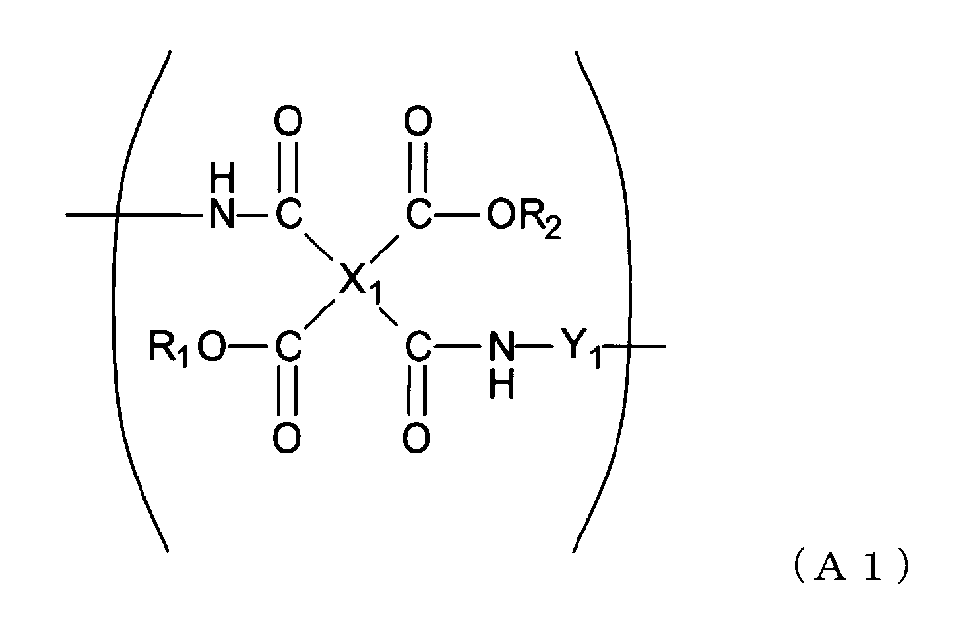
(식 중, X1은 방향족환 또는 지환 구조를 갖는 4가의 기이며, Y1은 방향족환 또는 지환 구조를 갖는 2가의 기이며, R1, R2는 각각 독립적으로 수소, 탄소수 1 내지 6, 바람직하게는 탄소수 1 내지 3의 알킬기, 또는 탄소수 3 내지 9의 알킬 실릴기이다.)(Wherein X 1 is an aromatic ring or a tetravalent group having an alicyclic structure, Y 1 is a divalent group having an aromatic ring or alicyclic structure, R 1 and R 2 are each independently hydrogen, Preferably an alkyl group having 1 to 3 carbon atoms or an alkylsilyl group having 3 to 9 carbon atoms.
13. 상기 폴리이미드 용액 조성물에 함유되는 상기 폴리이미드가, 상기 항 4에서 정의된 일반식 (1)로 표시되는 반복 단위를 포함하는 것을 특징으로 하는 상기 항 11에 기재된 폴리이미드 재료의 제조 방법.13. The method for producing a polyimide material as described in the item 11, wherein the polyimide contained in the polyimide solution composition comprises a repeating unit represented by the general formula (1) defined in the item 4.
14. 상기 폴리이미드 전구체 조성물 또는 상기 폴리이미드 용액 조성물을 기재 상에 도포하는 공정과,14. A method for producing a polyimide precursor composition, comprising the steps of: applying the polyimide precursor composition or the polyimide solution composition onto a substrate;
기재 상에 도포된 폴리이미드 전구체 조성물 또는 폴리이미드 용액 조성물을 가열 처리하는 공정A step of heat-treating the polyimide precursor composition or the polyimide solution composition coated on the substrate
을 갖는 것을 특징으로 하는 상기 항 11에 기재된 폴리이미드 재료의 제조 방법.Wherein the polyimide material is a polyimide precursor.
15. 상기 가열 처리 온도가 250℃ 이상인 것을 특징으로 하는 상기 항 11 내지 14 중 어느 한 항에 기재된 폴리이미드 재료의 제조 방법.15. The process for producing a polyimide material according to any one of items 11 to 14, wherein the heat treatment temperature is 250 占 폚 or higher.
16. 상기 자외선 흡수제가, 벤조트리아졸 화합물 또는 벤조트리아졸 화합물의 가열 변성물로부터 선택되는 것을 특징으로 하는 상기 항 11 내지 15 중 어느 한 항에 기재된 폴리이미드 재료의 제조 방법.16. A process for producing a polyimide material as described in any one of items 11 to 15, wherein the ultraviolet absorber is selected from heat-denatured products of a benzotriazole compound or a benzotriazole compound.
17. 상기 벤조트리아졸 화합물이, 식 (100) 및 식 (101)로 표시되는 화합물로부터 선택되는 것을 특징으로 하는 상기 항 16에 기재된 폴리이미드 재료의 제조 방법.17. The method for producing a polyimide material according to item 16, wherein the benzotriazole compound is selected from compounds represented by formula (100) and formula (101).
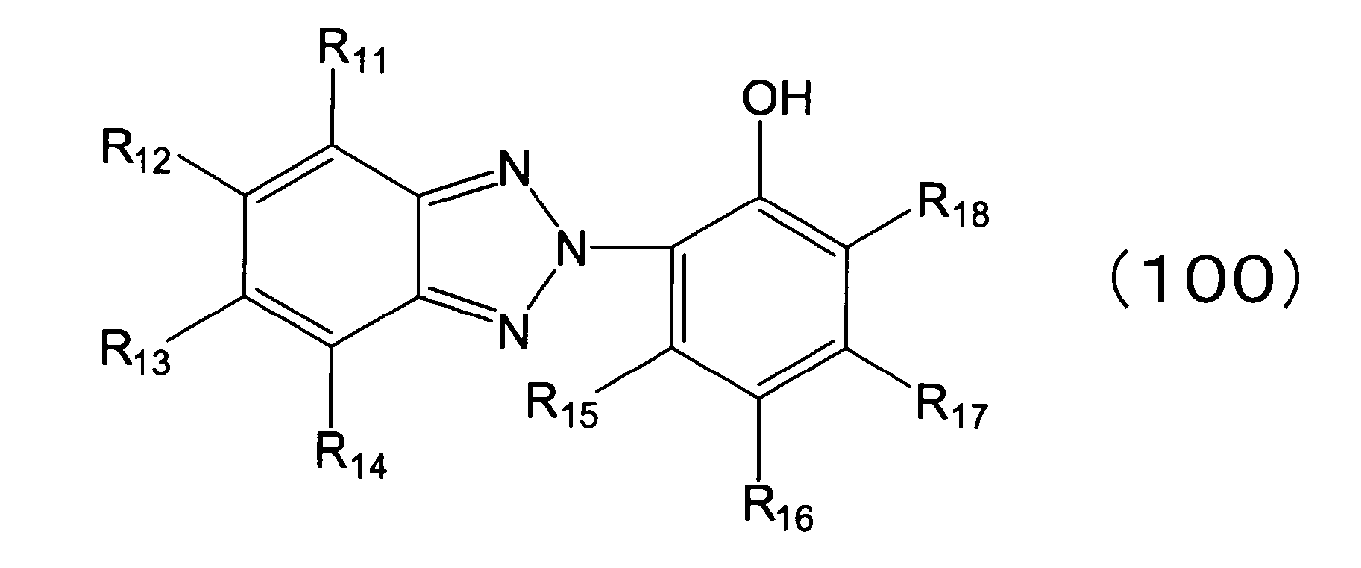
(식 중, R11 내지 R18은 유기기를 나타낸다.)(Wherein R 11 to R 18 represent an organic group).

(식 중, R31 내지 R37 및 R41 내지 R47은, R11 내지 R18에 대하여 부여되는 의미를 나타내며, X는 2가의 유기기이다.)(Wherein R 31 to R 37 and R 41 to R 47 have the meanings given for R 11 to R 18 , and X is a divalent organic group.)
18. 상기 벤조트리아졸 화합물이,Wherein the benzotriazole compound is a compound represented by formula
(a) 식 (100)으로 표시되고, 그 때, R11 내지 R18이, 서로 독립적으로 H, 아릴, 또는 치환 또는 비치환된 말레이미드기(알킬에의 치환 위치는 N임)로 치환되어 있어도 되는 탄소수 1 내지 20의 알킬이며, 단 알킬 중의 -CH2-기는 -COO- 또는 -OCO-로 치환되어 있어도 되고; Cl을 식 중에 갖지 않고, R11 내지 R18 중, 합계하여 방향환을 2개 이상 포함하지 않는 화합물; 및(100), wherein R 11 to R 18 are independently of each other H, aryl, or a substituted or unsubstituted maleimide group (the substitution position for the alkyl is N) And the -CH 2 - group in the alkyl may be substituted with -COO- or -OCO-; A compound which does not contain Cl in the formula and does not contain two or more aromatic rings in total among R 11 to R 18 ; And
(b) 식 (101)로 표시되고, 그 때, R31 내지 R37 및 R41 내지 R47이, 서로 독립적으로 H, 아릴, 또는 치환 또는 비치환된 말레이미드기(알킬에의 치환 위치는 N임)로 치환되어 있어도 되는 탄소수 1 내지 20의 알킬이며, 단 알킬 중의 -CH2-기는 -COO- 또는 -OCO-로 치환되어 있어도 되고; X는, 탄소수 1 내지 20의 알킬렌이며, 단 알킬 중의 -CH2-기는 -COO- 또는 -OCO-로 치환되어 있어도 되고; Cl을 식 중에 갖지 않고, R31 내지 R37, R41 내지 R47 및 X 중에, 합계하여 방향환을 2개 이상 포함하지 않는 화합물wherein R 31 to R 37 and R 41 to R 47 independently represent H, aryl, or a substituted or unsubstituted maleimide group (the substitution position for the alkyl is N, and the -CH 2 - group in the alkyl group may be substituted with -COO- or -OCO-; X is alkylene having 1 to 20 carbon atoms, the -CH 2 - group in the alkyl may be substituted with -COO- or -OCO-; Cl does not exist in the formula and R 31 to R 37 , R 41 to R 47 and X, which do not contain two or more aromatic rings in total,
로 이루어지는 군에서 선택되는 것을 특징으로 하는 항 17에 기재된 폴리이미드 재료의 제조 방법.Wherein the polyimide precursor is selected from the group consisting of polyimide precursors and polyimide precursors.
19. 폴리이미드 전구체,19. Polyimide precursor,
자외선 흡수제, 및Ultraviolet absorber, and
용매menstruum
를 함유하는 것을 특징으로 하는 폴리이미드 전구체 조성물.Wherein the polyimide precursor composition further comprises a polyimide precursor composition.
20. 상기 폴리이미드 전구체가, 상기 항 12 중에서 정의되는 폴리이미드 전구체인 것을 특징으로 하는 상기 항 19에 기재된 폴리이미드 전구체 조성물.20. The polyimide precursor composition according to Item 19, wherein the polyimide precursor is a polyimide precursor defined in Item 12 above.
21. 상기 자외선 흡수제가, 벤조트리아졸 화합물 또는 벤조트리아졸 화합물의 가열 변성물로부터 선택되는 것을 특징으로 하는 상기 항 19 또는 20에 기재된 폴리이미드 전구체 조성물.21. The polyimide precursor composition according to item 19 or 20, wherein the ultraviolet absorber is selected from heat-denatured products of a benzotriazole compound or a benzotriazole compound.
22. 상기 벤조트리아졸 화합물이, 식 (100) 및 식 (101)로 표시되는 화합물로부터 선택되는 것을 특징으로 하는 상기 항 21에 기재된 폴리이미드 전구체 조성물.22. The polyimide precursor composition according to item 21, wherein the benzotriazole compound is selected from compounds represented by formulas (100) and (101).
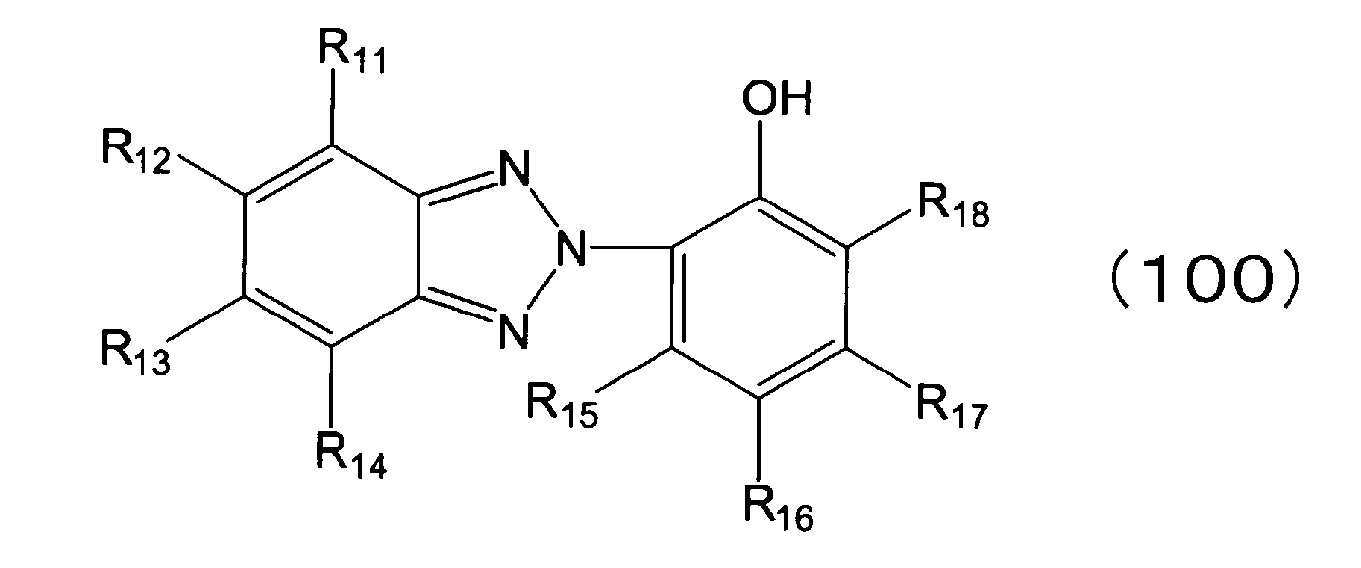
(식 중, R11 내지 R18은 유기기를 나타낸다.)(Wherein R 11 to R 18 represent an organic group).

(식 중, R31 내지 R37 및 R41 내지 R47은, R11 내지 R18에 대하여 부여되는 의미를 나타내며, X는 2가의 유기기이다.)(Wherein R 31 to R 37 and R 41 to R 47 have the meanings given for R 11 to R 18 , and X is a divalent organic group.)
23. 상기 벤조트리아졸 화합물이,Wherein the benzotriazole compound is
(a) 식 (100)으로 표시되고, 그 때, R11 내지 R18이, 서로 독립적으로 H, 아릴, 또는 치환 또는 비치환된 말레이미드기(알킬에의 치환 위치는 N임)로 치환되어 있어도 되는 탄소수 1 내지 20의 알킬이며, 단 알킬 중의 -CH2-기는 -COO- 또는 -OCO-로 치환되어 있어도 되고; Cl을 식 중에 갖지 않고, R11 내지 R18 중, 합계하여 방향환을 2개 이상 포함하지 않는 화합물; 및(100), wherein R 11 to R 18 are independently of each other H, aryl, or a substituted or unsubstituted maleimide group (the substitution position for the alkyl is N) And the -CH 2 - group in the alkyl may be substituted with -COO- or -OCO-; A compound which does not contain Cl in the formula and does not contain two or more aromatic rings in total among R 11 to R 18 ; And
(b) 식 (101)로 표시되고, 그 때, R31 내지 R37 및 R41 내지 R47이, 서로 독립적으로 H, 아릴, 또는 치환 또는 비치환된 말레이미드기(알킬에의 치환 위치는 N임)로 치환되어 있어도 되는 탄소수 1 내지 20의 알킬이며, 단 알킬 중의 -CH2-기는 -COO- 또는 -OCO-로 치환되어 있어도 되고; X는, 탄소수 1 내지 20의 알킬렌이며, 단 알킬 중의 -CH2-기는 -COO- 또는 -OCO-로 치환되어 있어도 되고; Cl을 식 중에 갖지 않고, R31 내지 R37, R41 내지 R47 및 X 중에, 합계하여 방향환을 2개 이상 포함하지 않는 화합물wherein R 31 to R 37 and R 41 to R 47 independently represent H, aryl, or a substituted or unsubstituted maleimide group (the substitution position for the alkyl is N, and the -CH 2 - group in the alkyl group may be substituted with -COO- or -OCO-; X is alkylene having 1 to 20 carbon atoms, the -CH 2 - group in the alkyl may be substituted with -COO- or -OCO-; Cl does not exist in the formula and R 31 to R 37 , R 41 to R 47 and X, which do not contain two or more aromatic rings in total,
로 이루어지는 군에서 선택되는 것을 특징으로 하는 상기 항 22에 기재된 폴리이미드 전구체 조성물.The polyimide precursor composition according to item 22, wherein the polyimide precursor composition is selected from the group consisting of polyimide precursors and polyimide precursors.
상기 개시 사항에 더하여, 또한 본 출원의 바람직한 실시 형태는, 다음에 드는 특징의 1개 또는 2개 이상을 갖는다.In addition to the foregoing disclosure, the preferred embodiments of the present application also have one or more of the following features.
폴리이미드 재료에 대해서,For the polyimide material,
(a-1) 광 감수성 성분 및 광 감수성 성분에서 유래되는 변성물을 함유하지 않는 것;(a-1) not containing a photosensitizing component and a modified product derived from the photosensitizing component;
(a-2) 폴리이미드 재료가, 헤이즈값이 15% 이하이거나, 또는 황색도(YI)가 자외선 조사 시험의 전후의 양쪽에서 15 이하이거나, 또는, 물질로서의 폴리이미드 재료로서, 5 내지 100㎛의 범위 중 적어도 하나의 두께를 갖는 필름 또는 코팅막을 형성했을 때에, 헤이즈값이 15% 이하이거나, 또는 황색도(YI)가 자외선 조사 시험의 전후의 양쪽에서 15 이하인 것(단, 상기 자외선 조사 시험의 조건은, QUV-313 램프를 사용하고, 310nm에서의 조도 0.59W/㎡, 온도 50℃, 조사 시간 24시간임);(a-2) the polyimide material has a haze value of 15% or less, or a yellowness degree (YI) of 15 or less both before and after the ultraviolet ray irradiation test, or as a polyimide material as a material, (YI) is 15 or less both before and after the ultraviolet ray irradiation test when the film or coating film having a thickness of at least one of the ranges of the ultraviolet ray irradiation test Condition using a QUV-313 lamp, illumination at 310 nm of 0.59 W / m 2, temperature of 50 캜, irradiation time of 24 hours);
(a-3) 일반식 (1)의 X1이 지환 구조를 갖는 4가의 기인 반복 단위를 전체 반복 단위 중의 60% 초과의 비율로 함유하는 것(단, X1이 지환 구조를 갖는 4가의 기이며 또한 Y1이 지환 구조를 갖는 2가의 기인 일반식 (1)로 표시되는 반복 단위의 함유량은, 전체 반복 단위에 대하여 50몰% 이하임);(a-3) a compound wherein X 1 in formula (1) contains repeating units having a tetravalent group having an alicyclic structure in a proportion of more than 60% of all repeating units (provided that X 1 is a tetravalent group having an alicyclic structure And the content of the repeating unit represented by the general formula (1) wherein Y 1 is a bivalent group having an alicyclic structure is 50 mol% or less based on the total repeating units;
(a-4) 일반식 (1)의 Y1이, 2,2'-비스(트리플루오로메틸)벤지딘 및 m-톨리딘으로부터 선택되는 적어도 하나로부터 유도되는 기인 반복 단위를, 전체 반복 단위 중의 50% 이상의 비율로 함유하는 것;(a-4) A process for producing a polymer comprising repeating units in which Y 1 in the general formula (1) is a group derived from at least one selected from 2,2'-bis (trifluoromethyl) benzidine and m- Containing at least 50%;
(a-5) 상기 폴리이미드의 융점이 300℃ 이상인 것;(a-5) the polyimide has a melting point of 300 ° C or higher;
(a-6) 상기 폴리이미드가, 주쇄에 탄소 원자수 4를 초과하는 메틸렌 장쇄를 함유하지 않는 것;(a-6) the polyimide does not contain a methylene long chain having more than 4 carbon atoms in its main chain;
(a-7) 배향막이 아닌 것.(a-7) Not an alignment film.
폴리이미드 전구체 조성물에 대해서,For the polyimide precursor composition,
(b-1) 액정 배향막 용도가 아닌 것;(b-1) not intended for liquid crystal alignment films;
(b-2) 폴리이미드 전구체 조성물을 사용하여, 5 내지 100㎛의 범위 중 적어도 하나의 두께를 갖는 폴리이미드 필름 또는 폴리이미드 코팅막을 형성했을 때에, 헤이즈값이 15% 이하이거나, 또는 황색도(YI)가 자외선 조사 시험의 전후의 양쪽에서 15 이하인 폴리이미드 재료가 얻어지는 것(단, 상기 자외선 조사 시험의 조건은, QUV-313 램프를 사용하고, 310nm에서의 조도 0.59W/㎡, 온도 50℃, 조사 시간 24시간임);when the polyimide film or polyimide coating film having at least one thickness in the range of 5 to 100 mu m is formed using the polyimide precursor composition (b-2), the haze value is 15% or less, or the yellowness degree YI) of 15 or less on both sides before and after the ultraviolet ray irradiation test (provided that the conditions of the ultraviolet ray irradiation test were as follows: a QUV-313 lamp was used, the illuminance at 310 nm was 0.59 W / , Irradiation time 24 hours);
(b-3) 폴리이미드 전구체가, 일반식 (A1)의 X1이 지환 구조를 갖는 4가의 기인 반복 단위를, 전체 반복 단위 중의 60% 초과의 비율로 함유하는 것(단, X1이 지환 구조를 갖는 4가의 기이며 또한 Y1이 지환 구조를 갖는 2가의 기인 일반식 (A1)로 표시되는 반복 단위의 함유량은, 전체 반복 단위에 대하여 50몰% 이하임);(b-3) is a polyimide precursor, to contain the general formula (A1) of X 1 is a tetravalent group repeating unit having an alicyclic structure, at a rate of 60% in the total repeating units than (where, X 1 is a cycloaliphatic And the content of the repeating unit represented by the formula (A1), which is a bivalent group having Y 1 in the alicyclic structure, is 50 mol% or less based on the total repeating units;
(b-4) 폴리이미드 전구체가, 일반식 (A1)의 Y1이, 2,2'-비스(트리플루오로메틸)벤지딘 및 m-톨리딘으로부터 선택되는 적어도 하나로부터 유도되는 기인 반복 단위를, 전체 반복 단위 중의 50% 이상의 비율로 함유하는 것;wherein the polyimide precursor (b-4) comprises a repeating unit in which Y 1 in formula (A1) is a group derived from at least one selected from 2,2'-bis (trifluoromethyl) benzidine and m- Containing at least 50% of the total repeating units;
(b-5) 폴리이미드 전구체가, 주쇄에 탄소 원자수 4를 초과하는 메틸렌 장쇄를 함유하지 않는 것.(b-5) The polyimide precursor does not contain a methylene long chain having more than 4 carbon atoms in its main chain.
본 발명에 따르면, 폴리이미드의 종래부터의 특징 외에 자외선 내구성이 우수한 폴리이미드 재료를 제공할 수 있다.According to the present invention, it is possible to provide a polyimide material having excellent ultraviolet durability in addition to the conventional characteristics of polyimide.
본 발명의 폴리이미드는, 필름, 코팅층의 형태의 것이 특히 바람직하다. 특히, 투명성이 높은 폴리이미드를 사용한 경우, 투명성을 손상시킬 일 없이, 특성이 우수한 폴리이미드 필름에 양호한 자외선 내성을 부여할 수 있다. 이에 의해, 폴리이미드의 용도를 현저하게 확장할 수 있다.The polyimide of the present invention is particularly preferably in the form of a film or a coating layer. Particularly, when polyimide having high transparency is used, good UV resistance can be imparted to a polyimide film having excellent properties without impairing transparency. Thereby, the use of polyimide can be remarkably extended.
본 발명에 있어서, 용어 「폴리이미드 재료」를, 물질로서의 「폴리이미드」와 구별하기 위하여 사용한다. 즉, 용어 「폴리이미드 재료」는, 폴리이미드와 자외선 흡수제를 함유하는 것으로서 정의되고, 또한, 고체 상태의 것을 의미하고, 용액을 포함하지 않는 것으로 한다. 예를 들어, 필름, 코팅층(다른 기재 상에 형성된 것), 분체, 괴상물의 형태로 존재하는 것이다. 또한, 폴리이미드 전구체는, 그것을 처리함으로써, 폴리이미드를 부여하는 것을 의미한다.In the present invention, the term "polyimide material" is used to distinguish it from "polyimide" as a material. That is, the term " polyimide material " is defined as containing a polyimide and an ultraviolet absorber, and also means in a solid state and does not include a solution. For example, in the form of a film, a coating layer (formed on another substrate), a powder, and a mass. Further, the polyimide precursor means to impart polyimide by treating it.
이하에, 본 발명의 폴리이미드 재료에 함유되는 폴리이미드 및 자외선 흡수제, 및 폴리이미드 재료의 제조 방법을 설명한다. 본 발명의 폴리이미드 전구체 조성물은, 폴리이미드 재료의 제조 방법 중에서 설명한다.Hereinafter, the polyimide and ultraviolet absorber contained in the polyimide material of the present invention and the method for producing the polyimide material will be described. The polyimide precursor composition of the present invention is described in a production method of a polyimide material.
<<폴리이미드>><< Polyimide >>
본 발명의 폴리이미드 재료에 함유되는 폴리이미드는, 특별히 한정되지 않고 테트라카르복실산 성분 및 디아민 성분이, 적절히, 방향족 화합물 및 지환식 화합물로부터 선택되는 폴리이미드로 구성된다. 예를 들어, 전방향족 폴리이미드, 반지환식 폴리이미드, 전지환식 폴리이미드를 들 수 있다.The polyimide contained in the polyimide material of the present invention is not particularly limited, and the tetracarboxylic acid component and the diamine component are suitably composed of a polyimide selected from an aromatic compound and an alicyclic compound. Examples thereof include wholly aromatic polyimides, ring-cyclic polyimides, and battery-cycled polyimides.
즉, 본 발명에 있어서 사용되는 폴리이미드는, 하기 일반식 (1)로 표시되는 반복 단위를 함유한다.That is, the polyimide used in the present invention contains a repeating unit represented by the following general formula (1).
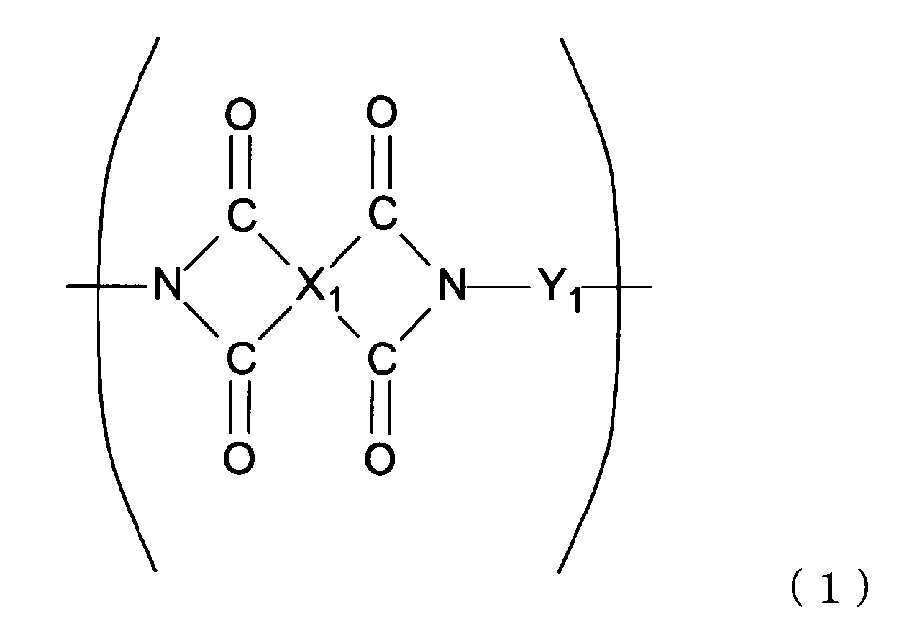
(식 중, X1은 방향족환 또는 지환 구조를 갖는 4가의 기이며, Y1은 방향족환 또는 지환 구조를 갖는 2가의 기이다.)(Wherein X 1 is an aromatic ring or a tetravalent group having an alicyclic structure, and Y 1 is a divalent group having an aromatic ring or alicyclic structure)
특별히 한정되는 것은 아니지만, 얻어지는 폴리이미드 재료가 내열성이 우수하기 때문에, 일반식 (1) 중의 X1이 방향족환을 갖는 4가의 기이며, Y1이 방향족환을 갖는 2가의 기인 것이 바람직하다. 또한, 얻어지는 폴리이미드 재료가 내열성이 우수함과 동시에 투명성이 우수하기 때문에, X1이 지환 구조를 갖는 4가의 기이며, Y1이 방향족환을 갖는 2가의 기인 것이 바람직하다. 또한, 얻어지는 폴리이미드 재료가 내열성이 우수함과 동시에 치수 안정성이 우수하기 때문에, X1이 방향족환을 갖는 4가의 기이며, Y1이 지환 구조를 갖는 2가의 기인 것이 바람직하다.It is preferable that X 1 in the general formula (1) is a tetravalent group having an aromatic ring and Y 1 is a divalent group having an aromatic ring because the obtained polyimide material is excellent in heat resistance. It is also preferable that X 1 is a tetravalent group having an alicyclic structure and Y 1 is a divalent group having an aromatic ring because the obtained polyimide material has excellent heat resistance and excellent transparency. It is also preferable that X 1 is a tetravalent group having an aromatic ring and Y 1 is a divalent group having an alicyclic structure because the resulting polyimide material is excellent in heat resistance and dimensional stability.
얻어지는 폴리이미드 재료의 특성, 예를 들어, 투명성, 기계적 특성, 또는 내열성 등의 점에서, X1이 지환 구조를 갖는 4가의 기이며, Y1이 지환 구조를 갖는 2가의 기인 식 (1)로 표시되는 반복 단위의 함유량은, 전체 반복 단위에 대하여 바람직하게는 50몰% 이하, 보다 바람직하게는 30몰% 이하 또는 30몰% 미만, 보다 바람직하게는 10몰% 이하인 것이 바람직하다.(1) in which X 1 is a tetravalent group having an alicyclic structure and Y 1 is a divalent group having an alicyclic structure, from the viewpoints of characteristics of the obtained polyimide material, for example, transparency, mechanical properties, The content of the repeating unit to be displayed is preferably 50 mol% or less, more preferably 30 mol% or less, or 30 mol% or less, and more preferably 10 mol% or less, based on the total repeating units.
어떤 실시 양태에 있어서는, X1이 방향족환을 갖는 4가의 기이며, Y1이 방향족환을 갖는 2가의 기인 상기 식 (1)의 반복 단위의 1종 이상의 함유량이, 합계로, 전체 반복 단위에 대하여 바람직하게는 50몰% 이상, 보다 바람직하게는 70몰% 이상, 보다 바람직하게는 80몰% 이상, 더욱 바람직하게는 90몰% 이상, 특히 바람직하게는 100몰%인 것이 바람직하다. 이 실시 양태에 있어서, 특히 고투명성의 폴리이미드 재료가 요구되는 경우에는, 폴리이미드는 불소 원자를 함유하는 것이 바람직하다. 즉, 폴리이미드가, X1이 불소 원자를 함유하는 방향족환을 갖는 4가의 기인 상기 일반식 (1)의 반복 단위 및/또는 Y1이 불소 원자를 함유하는 방향족환을 갖는 2가의 기인 상기 일반식 (1)의 반복 단위의 1종 이상을 포함하는 것이 바람직하다.In one embodiment, the content of at least one of the repeating units of the formula (1), in which X 1 is a tetravalent group having an aromatic ring and Y 1 is a divalent group having an aromatic ring, Is preferably 50 mol% or more, more preferably 70 mol% or more, still more preferably 80 mol% or more, still more preferably 90 mol% or more, particularly preferably 100 mol%. In this embodiment, when a highly transparent polyimide material is required, the polyimide preferably contains a fluorine atom. That is, when the polyimide is a repeating unit represented by the general formula (1) wherein X 1 is a tetravalent group having an aromatic ring containing an aromatic ring and / or a repeating unit represented by the general formula (1) in which Y 1 is a divalent group having an aromatic ring containing a fluorine atom It is preferable to include at least one repeating unit of the formula (1).
어떤 실시 양태에 있어서는, 폴리이미드는, X1이 지환 구조를 갖는 4가의 기이며, Y1이 방향족환을 갖는 2가의 기인 상기 일반식 (1)의 반복 단위의 1종 이상의 함유량이, 합계로, 전체 반복 단위에 대하여 바람직하게는 50몰% 이상, 보다 바람직하게는 70몰% 이상, 보다 바람직하게는 80몰% 이상, 더욱 바람직하게는 90몰% 이상, 특히 바람직하게는 100몰%인 것이 바람직하다.In one embodiment, the polyimide is a tetravalent group in which X 1 is an alicyclic structure and the content of at least one of the repeating units of the general formula (1) in which Y 1 is a divalent group having an aromatic ring , Preferably 50 mol% or more, more preferably 70 mol% or more, still more preferably 80 mol% or more, still more preferably 90 mol% or more, particularly preferably 100 mol% desirable.
어떤 실시 양태에 있어서는, 폴리이미드는, X1이 방향족환을 갖는 4가의 기이며, Y1이 지환 구조를 갖는 2가의 기인 상기 식 (1)의 반복 단위의 1종 이상의 함유량이, 합계로, 전체 반복 단위에 대하여 바람직하게는 50몰% 이상, 보다 바람직하게는 70몰% 이상, 보다 바람직하게는 80몰% 이상, 더욱 바람직하게는 90몰% 이상, 특히 바람직하게는 100몰%인 것이 바람직하다.In one embodiment, the polyimide is a tetravalent group in which X 1 is an aromatic ring, and Y 1 is a bivalent group having an alicyclic structure, the content of at least one of the repeating units of the formula (1) Is preferably 50 mol% or more, more preferably 70 mol% or more, still more preferably 80 mol% or more, still more preferably 90 mol% or more, particularly preferably 100 mol%, based on the total repeating units Do.
X1의 방향족환을 갖는 4가의 기로서는, 탄소수가 6 내지 40의 방향족환을 갖는 4가의 기가 바람직하다.The tetravalent group having an aromatic ring of X < 1 > is preferably a tetravalent group having an aromatic ring having 6 to 40 carbon atoms.
방향족환을 갖는 4가의 기로서는, 예를 들어, 하기의 것을 들 수 있다.Examples of the tetravalent group having an aromatic ring include the following groups.

(식 중, Z1은 직접 결합, 또는, 하기의 2가의 기:(Wherein Z 1 represents a direct bond or a divalent group represented by the following formula:

의 어느 것이다. 단, 식 중의 Z2는, 2가의 유기기, Z3, Z4는 각각 독립적으로 아미드 결합, 에스테르 결합, 카르보닐 결합이며, Z5는 방향환을 포함하는 유기기이다.). Z 2 in the formula represents a divalent organic group, Z 3 and Z 4 each independently represent an amide bond, an ester bond or a carbonyl bond, and Z 5 represents an organic group containing an aromatic ring.)
Z2로서는, 구체적으로는, 탄소수 2 내지 24의 지방족 탄화수소기, 탄소수 6 내지 24의 방향족 탄화수소기를 들 수 있다.Specific examples of Z 2 include an aliphatic hydrocarbon group having 2 to 24 carbon atoms and an aromatic hydrocarbon group having 6 to 24 carbon atoms.
Z5로서는, 구체적으로는, 탄소수 6 내지 24의 방향족 탄화수소기를 들 수 있다.Specific examples of Z 5 include an aromatic hydrocarbon group having 6 to 24 carbon atoms.
방향족환을 갖는 4가의 기로서는, 얻어지는 폴리이미드 재료의 고내열성과 고투명성을 양립할 수 있으므로, 하기의 것이 특히 바람직하다.As the tetravalent group having an aromatic ring, the polyimide material to be obtained can have both high heat resistance and high transparency, and the following are particularly preferable.

(식 중, Z1은 직접 결합, 또는, 헥사플루오로이소프로필리덴 결합이다.)(Wherein Z 1 is a direct bond or a hexafluoroisopropylidene bond).
여기서, 얻어지는 폴리이미드 재료의 고내열성, 고투명성, 저선열팽창 계수를 양립할 수 있으므로, Z1은 직접 결합인 것이 보다 바람직하다.Here, since the polyimide material to be obtained can have both high heat resistance, high transparency and low linear thermal expansion coefficient, it is more preferable that Z 1 is a direct bond.
X1이 방향족환을 갖는 4가의 기인 일반식 (1)의 반복 단위를 부여하는 테트라카르복실산 성분으로서는, 예를 들어, 2,2-비스(3,4-디카르복시페닐)헥사플루오로프로판, 4-(2,5-디옥소테트라히드로푸란-3-일)-1,2,3,4-테트라히드로나프탈렌-1,2-디카르복실산, 피로멜리트산, 3,3',4,4'-벤조페논테트라카르복실산, 3,3',4,4'-비페닐테트라카르복실산, 2,3,3',4'-비페닐테트라카르복실산, 4,4'-옥시디프탈산, 비스(3,4-디카르복시페닐)술폰, m-터페닐-3,4,3',4'-테트라카르복실산, p-터페닐-3,4,3',4'-테트라카르복실산, 비스카르복시페닐디메틸실란, 비스디카르복시페녹시디페닐술피드, 술포닐디프탈산이나, 이들의 테트라카르복실산 이무수물, 테트라카르복실산실릴에스테르, 테트라카르복실산에스테르, 테트라카르복실산클로라이드 등의 유도체를 들 수 있다. X1이 불소 원자를 함유하는 방향족환을 갖는 4가의 기인 일반식 (1)의 반복 단위를 부여하는 테트라카르복실산 성분으로서는, 예를 들어, 2,2-비스(3,4-디카르복시페닐)헥사플루오로프로판이나, 이것의 테트라카르복실산 이무수물, 테트라카르복실산실릴에스테르, 테트라카르복실산에스테르, 테트라카르복실산클로라이드 등의 유도체를 들 수 있다. 테트라카르복실산 성분은, 단독으로 사용해도 되고, 또한 복수종을 조합하여 사용할 수도 있다.Examples of the tetracarboxylic acid component for imparting the repeating unit represented by the general formula (1), in which X 1 is a tetravalent group having an aromatic ring, include 2,2-bis (3,4-dicarboxyphenyl) hexafluoropropane , 4- (2,5-dioxotetrahydrofuran-3-yl) -1,2,3,4-tetrahydronaphthalene-1,2-dicarboxylic acid, pyromellitic acid, 3,3 ' , 4'-benzophenonetetracarboxylic acid, 3,3 ', 4,4'-biphenyltetracarboxylic acid, 2,3,3', 4'-biphenyltetracarboxylic acid, 4,4'- (3,4-dicarboxyphenyl) sulfone, m-terphenyl-3,4,3 ', 4'-tetracarboxylic acid, p-terphenyl- -Tetracarboxylic acid, biscarboxyphenyldimethylsilane, bisdicarboxyphenoxydiphenylsulfide, and sulfonyldiphthalic acid, and tetracarboxylic acid dianhydride, tetracarboxylic acid silyl ester, tetracarboxylic acid ester, tetracarboxylic acid dianhydride, And a derivative of a carboxylic acid chloride or the like. Examples of the tetracarboxylic acid component for imparting the repeating unit represented by the general formula (1) in which X 1 is a tetravalent group having an aromatic ring containing a fluorine atom include 2,2-bis (3,4-dicarboxyphenyl ) Hexafluoropropane, its derivatives such as tetracarboxylic acid dianhydride, tetracarboxylic acid silyl ester, tetracarboxylic acid ester, and tetracarboxylic acid chloride. The tetracarboxylic acid component may be used alone or in combination of a plurality of species.
X1의 지환 구조를 갖는 4가의 기로서는, 탄소수가 4 내지 40의 지환 구조를 갖는 4가의 기가 바람직하고, 적어도 하나의 지방족 4 내지 12원환, 보다 바람직하게는 지방족 4원환 또는 지방족 6원환을 갖는 것이 보다 바람직하다. 바람직한 지방족 4원환 또는 지방족 6원환을 갖는 4가의 기로서는, 하기의 것을 들 수 있다.The tetravalent group having an alicyclic structure represented by X < 1 > is preferably a tetravalent group having an alicyclic structure having 4 to 40 carbon atoms, and is preferably a tetravalent group having at least one aliphatic 4 to 12-membered ring, more preferably an aliphatic 4-membered ring or aliphatic 6-membered ring Is more preferable. Preferable examples of the tetravalent group having an aliphatic 4-membered ring or an aliphatic 6-membered ring include the following.

(식 중, R31 내지 R38은, 각각 독립적으로 직접 결합, 또는, 2가의 유기기이다. R41 내지 R47은, 각각 독립적으로 식: -CH2-, -CH=CH-, -CH2CH2-, -O-, -S-로 표시되는 기로 이루어지는 군에서 선택되는 1종을 나타낸다. R48은 방향환 또는 지환 구조를 포함하는 유기기이다.)(Wherein, R 31 to R 38 are each independently a direct bond, or a bivalent organic group R 41 to R 47 are, each independently represent a formula:. -CH 2 -, -CH = CH-, -CH 2 CH 2 -, -O-, and -S-, and R 48 is an organic group containing an aromatic ring or an alicyclic structure.
R31, R32, R33, R34, R35, R36, R37, R38로서는, 구체적으로는, 직접 결합, 또는, 탄소수 1 내지 6의 지방족 탄화수소기, 또는, 산소 원자(-O-), 황 원자(-S-), 카르보닐 결합, 에스테르 결합, 아미드 결합을 들 수 있다.Specific examples of R 31 , R 32 , R 33 , R 34 , R 35 , R 36 , R 37 and R 38 include a direct bond or an aliphatic hydrocarbon group having 1 to 6 carbon atoms or an oxygen atom -), a sulfur atom (-S-), a carbonyl bond, an ester bond, and an amide bond.
R48로서 방향환을 포함하는 유기기로서는, 예를 들어, 하기의 것을 들 수 있다.As the organic group containing an aromatic ring as R 48 , for example, the following may be mentioned.
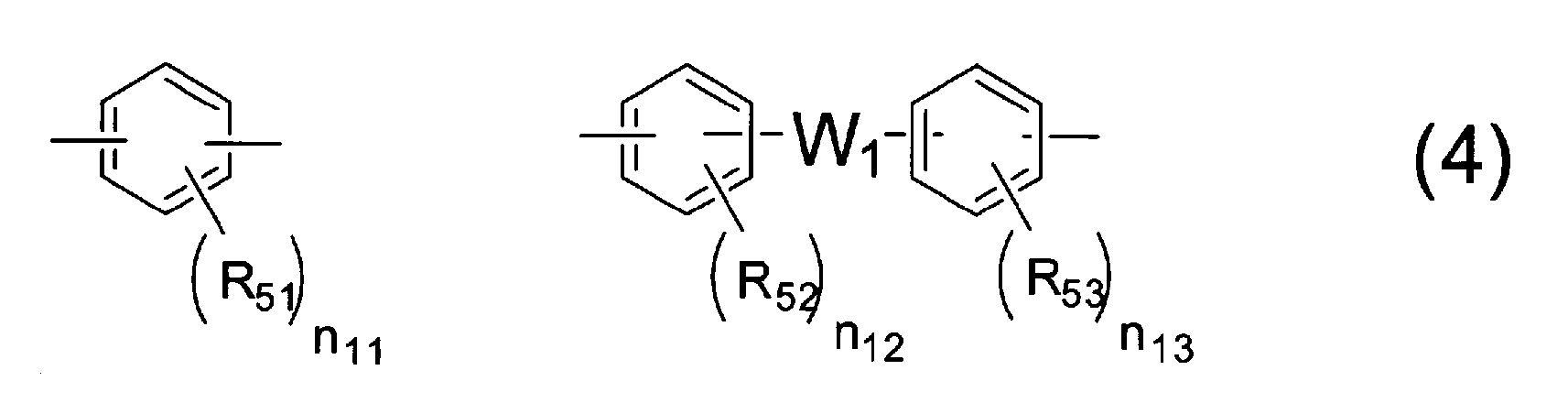
(식 중, W1은 직접 결합, 또는, 2가의 유기기이며, n11 내지 n13은, 각각 독립적으로 0 내지 4의 정수를 나타내고, R51, R52, R53은, 각각 독립적으로 탄소수 1 내지 6의 알킬기, 할로겐기, 수산기, 카르복실기, 또는 트리플루오로메틸기이다.)(Wherein W 1 is a direct bond or a divalent organic group; n 11 to n 13 each independently represent an integer of 0 to 4; R 51 , R 52 and R 53 each independently represent a carbon number An alkyl group having 1 to 6 carbon atoms, a halogen group, a hydroxyl group, a carboxyl group, or a trifluoromethyl group.
W1로서는, 구체적으로는, 직접 결합, 하기의 식 (5)로 표시되는 2가의 기, 하기의 식 (6)으로 표시되는 2가의 기를 들 수 있다.Specific examples of W 1 include a direct bond, a divalent group represented by the following formula (5) and a divalent group represented by the following formula (6).

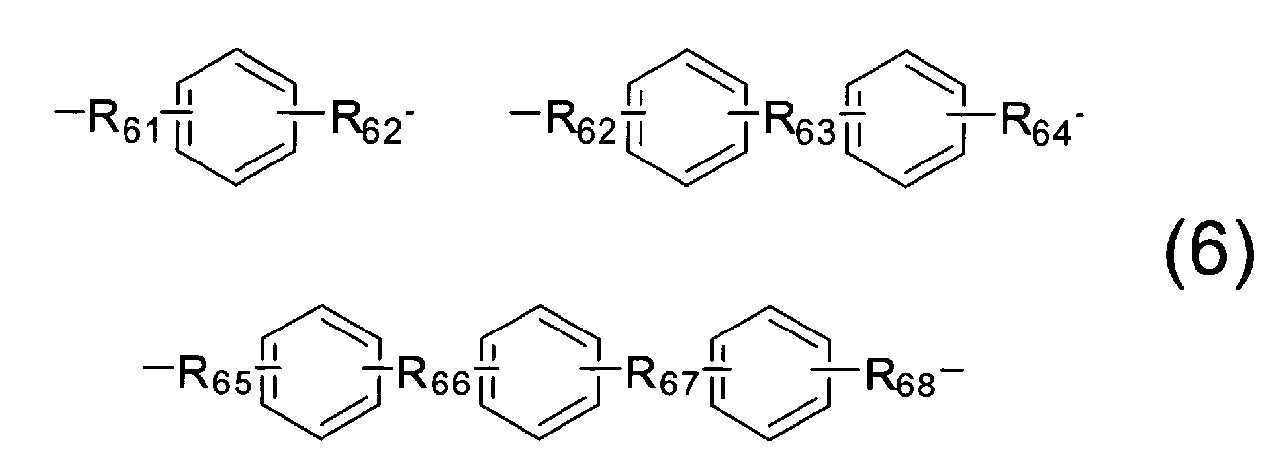
(식 (6) 중의 R61 내지 R68은, 각각 독립적으로 직접 결합 또는 상기 식 (5)로 표시되는 2가의 기의 어느 것을 나타낸다.)(Wherein R 61 to R 68 in the formula (6) each independently represent a direct bond or a divalent group represented by the formula (5)).
지환 구조를 갖는 4가의 기로서는, 얻어지는 폴리이미드의 고내열성, 고투명성, 저선열팽창 계수를 양립할 수 있으므로, 하기의 것이 특히 바람직하다.As the tetravalent group having an alicyclic structure, the polyimide obtained can be compatible with the high heat resistance, high transparency and low linear thermal expansion coefficient of the obtained polyimide.

X1이 지환 구조를 갖는 4가의 기인 식 (1)의 반복 단위를 부여하는 테트라카르복실산 성분으로서는, 예를 들어, 1,2,3,4-시클로부탄테트라카르복실산, 이소프로필리덴디페녹시비스프탈산, 시클로헥산-1,2,4,5-테트라카르복실산, [1,1'-비(시클로헥산)]-3,3',4,4'-테트라카르복실산, [1,1'-비(시클로헥산)]-2,3,3',4'-테트라카르복실산, [1,1'-비(시클로헥산)]-2,2',3,3'-테트라카르복실산, 4,4'-메틸렌비스(시클로헥산-1,2-디카르복실산), 4,4'-(프로판-2,2-디일)비스(시클로헥산-1,2-디카르복실산), 4,4'-옥시비스(시클로헥산-1,2-디카르복실산), 4,4'-티오비스(시클로헥산-1,2-디카르복실산), 4,4'-술포닐비스(시클로헥산-1,2-디카르복실산), 4,4'-(디메틸실란디일)비스(시클로헥산-1,2-디카르복실산), 4,4'-(테트라플루오로프로판-2,2-디일)비스(시클로헥산-1,2-디카르복실산), 옥타히드로펜탈렌-1,3,4,6-테트라카르복실산, 비시클로[2.2.1]헵탄-2,3,5,6-테트라카르복실산, 6-(카르복시메틸)비시클로[2.2.1]헵탄-2,3,5-트리카르복실산, 비시클로[2.2.2]옥탄-2,3,5,6-테트라카르복실산, 비시클로[2.2.2]옥트-5-엔-2,3,7,8-테트라카르복실산, 트리시클로[4.2.2.02,5]데칸-3,4,7,8-테트라카르복실산, 트리시클로[4.2.2.02,5]데크-7-엔-3,4,9,10-테트라카르복실산, 9-옥사트리시클로[4.2.1.02,5]노난-3,4,7,8-테트라카르복실산, 노르보르난-2-스피로-α-시클로펜타논-α'-스피로-2''-노르보르난5,5'',6,6''-테트라카르복실산, (4arH,8acH)-데카히드로-1t,4t:5c,8c-디메타노나프탈렌-2c,3c,6c,7c-테트라카르복실산, (4arH,8acH)-데카히드로-1t,4t:5c,8c-디메타노나프탈렌-2t,3t,6c,7c-테트라카르복실산이나, 이들의 테트라카르복실산 이무수물, 테트라카르복실산실릴에스테르, 테트라카르복실산에스테르, 테트라카르복실산클로라이드 등의 유도체를 들 수 있다. 테트라카르복실산 성분은, 단독으로 사용해도 되고, 또한 복수종을 조합하여 사용할 수도 있다.Examples of the tetracarboxylic acid component to which the repeating unit represented by formula (1), wherein X 1 is a tetravalent group having an alicyclic structure, include 1,2,3,4-cyclobutane tetracarboxylic acid, Tetracarboxylic acid, [1,1'-bis (cyclohexane)] - 3,3 ', 4,4'-tetracarboxylic acid, [ (Cyclohexane)] - 2,3,3 ', 4'-tetracarboxylic acid, [1,1'-non (cyclohexane)] - 2,2', 3,3'- Tetracarboxylic acid, 4,4'-methylenebis (cyclohexane-1,2-dicarboxylic acid), 4,4 '- (propane-2,2-diyl) bis (cyclohexane- (Cyclohexane-1,2-dicarboxylic acid), 4,4'-thiobis (cyclohexane-1,2-dicarboxylic acid), 4,4'-oxybis (Cyclohexane-1,2-dicarboxylic acid), 4,4'- (dimethylsilanediyl) bis (cyclohexane-1,2-dicarboxylic acid), 4,4'- (Tetrafluoropropane-2,2-diyl) bis (cyclohexane-1,2-dicarboxylic acid), octahydrobenzene Tetracarboxylic acid, bicyclo [2.2.1] heptane-2,3,5,6-tetracarboxylic acid, 6- (carboxymethyl) bicyclo [2.2.1] heptane -2,3,5-tricarboxylic acid, bicyclo [2.2.2] octane-2,3,5,6-tetracarboxylic acid, bicyclo [2.2.2] oct- , 7,8-tetracarboxylic acid, tricyclo [4.2.2.02,5] decane-3,4,7,8-tetracarboxylic acid, tricyclo [4.2.2.02,5] , 4,9,10-tetracarboxylic acid, 9-oxatricyclo [4.2.1.02,5] nonane-3,4,7,8-tetracarboxylic acid, norbornane-2-spiro- Tetraacetic acid, (4arH, 8acH) -decahydro-1t, 4t: 5c, 8c-di (4arH, 8acH) -decahydro-1t, 4t: 5c, 8c-dimethanonaphthalene-2t, 3t, 6c, 7c-tetracarboxylic acid An acid, a tetracarboxylic acid dianhydride, a tetracarboxylic acid silyl ester, a tetracarboxylic acid ester, a tetracarboxylic acid dianhydride, There may be mentioned derivatives of the acids, such as chloride. The tetracarboxylic acid component may be used alone or in combination of a plurality of species.
Y1의 방향족환을 갖는 2가의 기로서는, 탄소수가 6 내지 40, 더욱 바람직하게는 탄소수가 6 내지 20의 방향족환을 갖는 2가의 기가 바람직하다.The divalent group having an aromatic ring of Y 1 is preferably a divalent group having an aromatic ring having 6 to 40 carbon atoms, more preferably 6 to 20 carbon atoms.
방향족환을 갖는 2가의 기로서는, 예를 들어, 하기의 것을 들 수 있다.Examples of the divalent group having an aromatic ring include the following.

(식 중, W1은 직접 결합, 또는, 2가의 유기기이며, n11 내지 n13은, 각각 독립적으로 0 내지 4의 정수를 나타내고, R51, R52, R53은, 각각 독립적으로 탄소수 1 내지 6의 알킬기, 할로겐기, 수산기, 카르복실기, 또는 트리플루오로메틸기이다.)(Wherein W 1 is a direct bond or a divalent organic group; n 11 to n 13 each independently represent an integer of 0 to 4; R 51 , R 52 and R 53 each independently represent a carbon number An alkyl group having 1 to 6 carbon atoms, a halogen group, a hydroxyl group, a carboxyl group, or a trifluoromethyl group.
W1로서는, 구체적으로는, 직접 결합, 하기의 식 (5)로 표시되는 2가의 기, 하기의 식 (6)으로 표시되는 2가의 기를 들 수 있다.Specific examples of W 1 include a direct bond, a divalent group represented by the following formula (5) and a divalent group represented by the following formula (6).
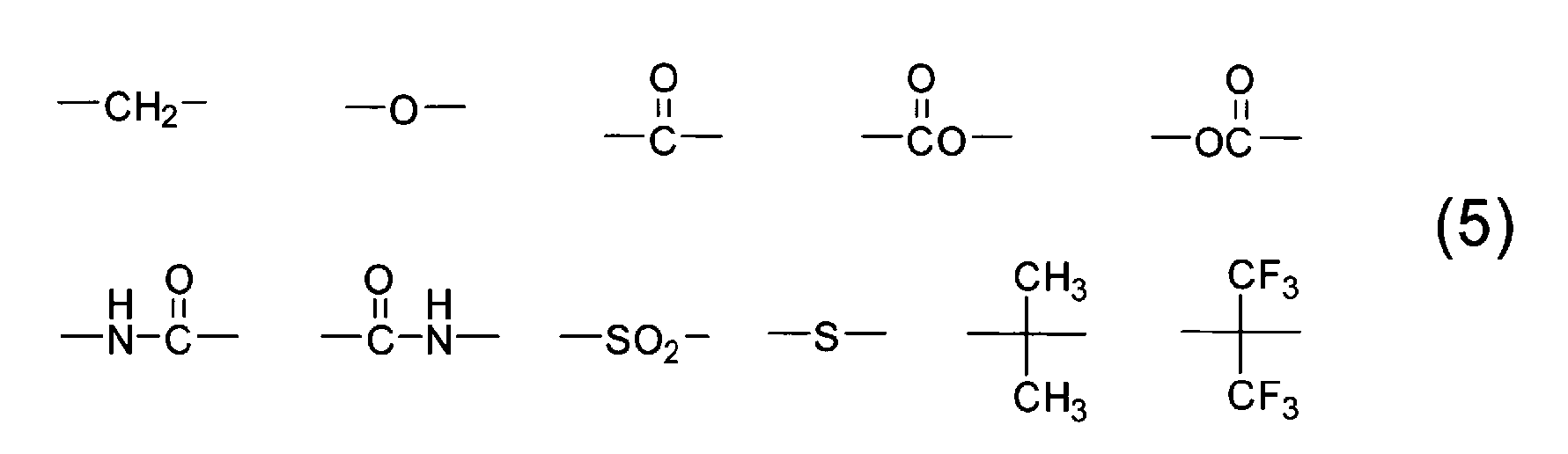

(식 (6) 중의 R61 내지 R68은, 각각 독립적으로 직접 결합 또는 상기 식 (5)로 표시되는 2가의 기의 어느 것을 나타낸다.)(Wherein R 61 to R 68 in the formula (6) each independently represent a direct bond or a divalent group represented by the formula (5)).
여기서, 얻어지는 폴리이미드의 고내열성, 고투명성, 저선열팽창 계수를 양립할 수 있으므로, W1은, 직접 결합, 또는 식: -NHCO-, -CONH-, -COO-, -OCO-로 표시되는 기로 이루어지는 군에서 선택되는 1종인 것이 특히 바람직하다. 또한, W1이, R61 내지 R68이 직접 결합, 또는 식: -NHCO-, -CONH-, -COO-, -OCO-로 표시되는 기로 이루어지는 군에서 선택되는 1종인 상기 식 (6)으로 표시되는 2가의 기의 어느 것인 것도 특히 바람직하다.Here, W 1 is a direct bond or a group represented by the formula: -NHCO-, -CONH-, -COO-, and -OCO- because the resulting polyimide has both high heat resistance, high transparency and low linear thermal expansion coefficient. Is particularly preferable. In addition, the W 1, R 61 to R 68 is a direct bond, or a group represented by the formula: a -NHCO-, -CONH-, 1 species of the formula (6) is selected from -COO-, -OCO- group consisting of groups represented by It is particularly preferable that the divalent group to be represented is any.
Y1이 방향족환을 갖는 2가의 기인 일반식 (1)의 반복 단위를 부여하는 디아민 성분으로서는, 예를 들어, p-페닐렌디아민, m-페닐렌디아민, 벤지딘, 3,3'-디아미노-비페닐, 2,2'-비스(트리플루오로메틸)벤지딘, 3,3'-비스(트리플루오로메틸)벤지딘, m-톨리딘, 4,4'-디아미노벤즈아닐리드, 3,4'-디아미노벤즈아닐리드, N,N'-비스(4-아미노페닐)테레프탈아미드, N,N'-p-페닐렌비스(p-아미노벤즈아미드), 4-아미노페녹시-4-디아미노벤조에이트, 비스(4-아미노페닐)테레프탈레이트, 비페닐-4,4'-디카르복실산비스(4-아미노페닐)에스테르, p-페닐렌비스(p-아미노벤조에이트), 비스(4-아미노페닐)-[1,1'-비페닐]-4,4'-디카르복실레이트, [1,1'-비페닐]-4,4'-디일비스(4-아미노벤조에이트), 4,4'-옥시디아닐린, 3,4'-옥시디아닐린, 3,3'-옥시디아닐린, p-메틸렌비스(페닐렌디아민), 1,3-비스(4-아미노페녹시)벤젠, 1,3-비스(3-아미노페녹시)벤젠, 1,4-비스(4-아미노페녹시)벤젠, 4,4'-비스(4-아미노페녹시)비페닐, 4,4'-비스(3-아미노페녹시)비페닐, 2,2-비스(4-(4-아미노페녹시)페닐)헥사플루오로프로판, 2,2-비스(4-아미노페닐)헥사플루오로프로판, 비스(4-아미노페닐)술폰, 3,3'-비스(트리플루오로메틸)벤지딘, 3,3'-비스((아미노페녹시)페닐)프로판, 2,2'-비스(3-아미노-4-히드록시페닐)헥사플루오로프로판, 비스(4-(4-아미노페녹시)디페닐)술폰, 비스(4-(3-아미노페녹시)디페닐)술폰, 옥타플루오로벤지딘, 3,3'-디메톡시-4,4'-디아미노비페닐, 3,3'-디클로로-4,4'-디아미노비페닐, 3,3'-디플루오로-4,4'-디아미노비페닐, 2,4-비스(4-아미노아닐리노)-6-아미노-1,3,5-트리아진, 2,4-비스(4-아미노아닐리노)-6-메틸아미노-1,3,5-트리아진, 2,4-비스(4-아미노아닐리노)-6-에틸아미노-1,3,5-트리아진, 2,4-비스(4-아미노아닐리노)-6-아닐리노-1,3,5-트리아진을 들 수 있다. Y1이 불소 원자를 함유하는 방향족환을 갖는 2가의 기인 일반식 (1)의 반복 단위를 부여하는 디아민 성분으로서는, 예를 들어, 2,2'-비스(트리플루오로메틸)벤지딘, 3,3'-비스(트리플루오로메틸)벤지딘, 2,2-비스[4-(4-아미노페녹시)페닐]헥사플루오로프로판, 2,2-비스(4-아미노페닐)헥사플루오로프로판, 2,2'-비스(3-아미노-4-히드록시페닐)헥사플루오로프로판을 들 수 있다. 디아민 성분은, 단독으로 사용해도 되고, 또한 복수종을 조합하여 사용할 수도 있다.Examples of the diamine component giving the repeating unit of the general formula (1), in which Y 1 is a divalent group having an aromatic ring, include p-phenylenediamine, m-phenylenediamine, benzidine, 3,3'-diamino -Biphenyl, 2,2'-bis (trifluoromethyl) benzidine, 3,3'-bis (trifluoromethyl) benzidine, m-tolidine, 4,4'- diaminobenzanilide, 3,4 (4-aminophenyl) terephthalamide, N, N'-p-phenylenebis (p-aminobenzamide), 4-aminophenoxy-4-diamino Bis (4-aminophenyl) terephthalate, biphenyl-4,4'-dicarboxylic acid bis (4-aminophenyl) ester, p-phenylenebis (p- aminobenzoate), bis -Aminophenyl) - [1,1'-biphenyl] -4,4'-dicarboxylate, [1,1'-biphenyl] -4,4'-diyl bis (4-aminobenzoate) Oxydianiline, 3,4'-oxydianiline, 3,3'-oxydianiline, p-methylenebis (phenylenediamine), 1,3-bis Bis (4-aminophenoxy) benzene, 1,4-bis (4-aminophenoxy) benzene, Bis (4-aminophenoxy) phenyl) hexafluoropropane, 2,2-bis (4-aminophenoxy) Bis (trifluoromethyl) benzidine, 3,3'-bis ((aminophenoxy) phenyl) propane, 2,2'-bis Bis (4- (3-aminophenoxy) diphenyl) sulfone, bis (4- Benzidine, 3,3'-dimethoxy-4,4'-diaminobiphenyl, 3,3'-dichloro-4,4'-diaminobiphenyl, 3,3'-difluoro- Amino-1,3,5-triazine, 2,4-bis (4-aminoanilino) -6-methylamino- 1,3,5-triazine, 2,4-bis (4-aminoanilino) -6-ethylamino- Gene, 2, 4-bis-6-anilino-1,3,5-triazine (4-amino-anilino). Examples of the diamine component for giving the repeating unit of the formula (1), wherein Y 1 is a divalent group having an aromatic ring containing a fluorine atom, include 2,2'-bis (trifluoromethyl) benzidine, Bis (4-aminophenoxy) phenyl] hexafluoropropane, 2,2-bis (4-aminophenyl) hexafluoropropane, 2,2'-bis (3-amino-4-hydroxyphenyl) hexafluoropropane. The diamine component may be used alone or in combination of plural kinds.
Y1의 지환 구조를 갖는 2가의 기로서는, 탄소수가 4 내지 40의 지환 구조를 갖는 2가의 기가 바람직하고, 적어도 하나의 지방족 4 내지 12원환, 보다 바람직하게는 지방족 6원환을 갖는 것이 더욱 바람직하다.The divalent group having an alicyclic structure of Y 1 is preferably a divalent group having an alicyclic structure having 4 to 40 carbon atoms, more preferably at least one aliphatic 4 to 12-membered ring, more preferably an aliphatic 6-membered ring .
지환 구조를 갖는 2가의 기로서는, 예를 들어, 하기의 것을 들 수 있다.Examples of the divalent group having an alicyclic structure include the following.
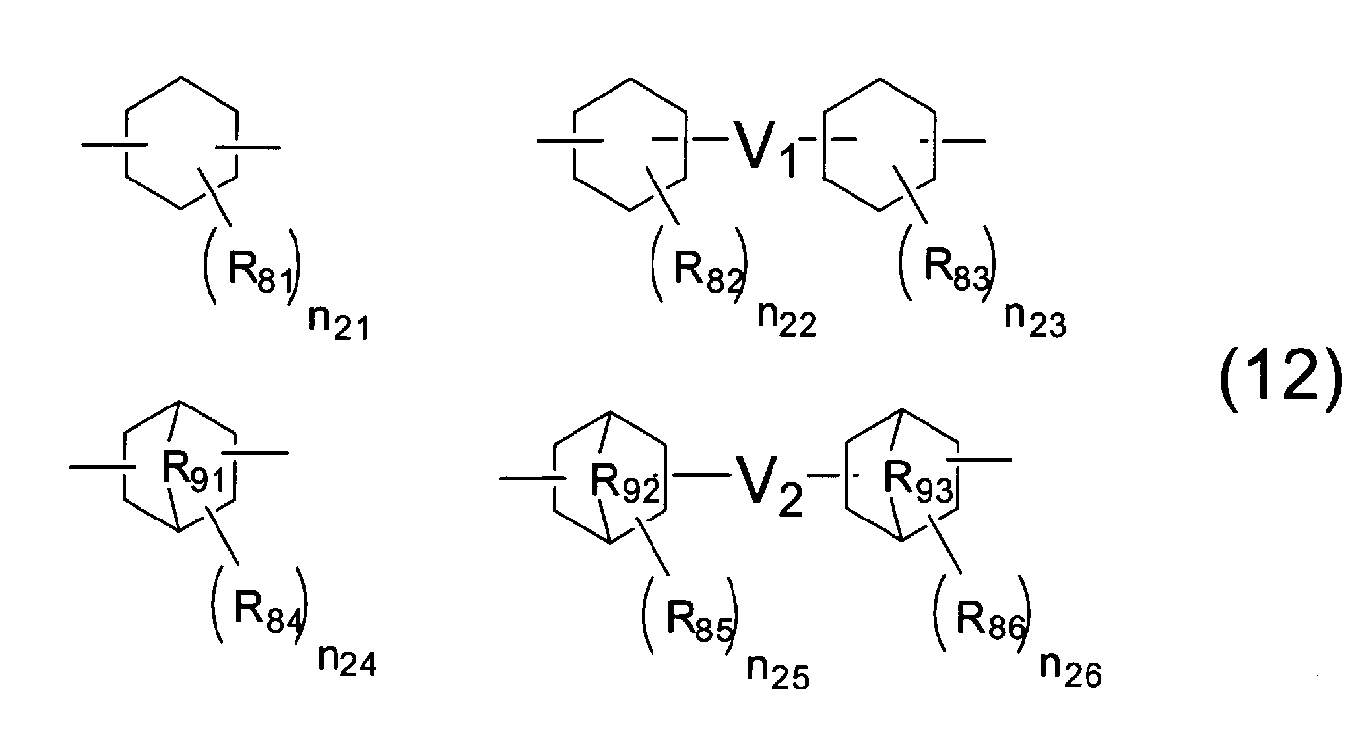
(식 중, V1, V2는, 각각 독립적으로 직접 결합, 또는, 2가의 유기기이며, n21 내지 n26은, 각각 독립적으로 0 내지 4의 정수를 나타내고, R81 내지 R86은, 각각 독립적으로 탄소수 1 내지 6의 알킬기, 할로겐기, 수산기, 카르복실기, 또는 트리플루오로메틸기이며, R91, R92, R93은, 각각 독립적으로 식: -CH2-, -CH=CH-, -CH2CH2-, -O-, -S-로 표시되는 기로 이루어지는 군에서 선택되는 1종이다.)(Wherein, V 1 and V 2 are each independently a direct bond or a divalent organic group; n 21 to n 26 each independently represent an integer of 0 to 4; and R 81 to R 86 , R 91 , R 92 and R 93 are each independently selected from the group consisting of -CH 2 -, -CH = CH-, -CH = CH-, -NH-, -CH 2 CH 2 -, -O-, and -S-.
V1, V2로서는, 구체적으로는, 직접 결합 및 상기한 식 (5)로 표시되는 2가의 기를 들 수 있다.Specific examples of V 1 and V 2 include a direct bond and a divalent group represented by the above formula (5).
지환 구조를 갖는 2가의 기로서는, 얻어지는 폴리이미드의 고내열성, 저선열팽창 계수를 양립할 수 있으므로, 하기의 것이 특히 바람직하다.As the bivalent group having an alicyclic structure, the following can be particularly preferable because the resulting polyimide can have both high heat resistance and low linear thermal expansion coefficient.

지환 구조를 갖는 2가의 기로서는, 그 중에서도, 하기의 것이 바람직하다.As the divalent group having an alicyclic structure, the following are preferable.

Y1이 지환 구조를 갖는 2가의 기인 일반식 (1)의 반복 단위를 부여하는 디아민 성분으로서는, 예를 들어, 1,4-디아미노시클로헥산, 1,4-디아미노-2-메틸시클로헥산, 1,4-디아미노-2-에틸시클로헥산, 1,4-디아미노-2-n-프로필시클로헥산, 1,4-디아미노-2-이소프로필시클로헥산, 1,4-디아미노-2-n-부틸시클로헥산, 1,4-디아미노-2-이소부틸시클로헥산, 1,4-디아미노-2-sec-부틸시클로헥산, 1,4-디아미노-2-tert-부틸시클로헥산, 1,2-디아미노시클로헥산, 1,3-디아미노시클로부탄, 1,4-비스(아미노메틸)시클로헥산, 1,3-비스(아미노메틸)시클로헥산, 디아미노비시클로헵탄, 디아미노메틸비시클로헵탄, 디아미노옥시비시클로헵탄, 디아미노메틸옥시비시클로헵탄, 이소포론디아민, 디아미노트리시클로데칸, 디아미노메틸트리시클로데칸, 비스(아미노시클로헥실)메탄, 비스(아미노시클로헥실)이소프로필리덴, 6,6'-비스(3-아미노페녹시)-3,3,3',3'-테트라메틸-1,1'-스피로비인단, 6,6'-비스(4-아미노페녹시)-3,3,3',3'-테트라메틸-1,1'-스피로비인단을 들 수 있다. 디아민 성분은, 단독으로 사용해도 되고, 또한 복수종을 조합하여 사용할 수도 있다.Examples of the diamine component for giving the repeating unit represented by the general formula (1), wherein Y 1 is a bivalent group having an alicyclic structure, include 1,4-diaminocyclohexane, 1,4-diamino-2-methylcyclohexane Diamino-2-ethylcyclohexane, 1,4-diamino-2-n-propylcyclohexane, 1,4-diamino-2-isopropylcyclohexane, 2-n-butylcyclohexane, 1,4-diamino-2-isobutylcyclohexane, 1,4-diamino-2-sec-butylcyclohexane, (Aminomethyl) cyclohexane, 1,3-bis (aminomethyl) cyclohexane, diaminobicycloheptane, 1,2-diaminocyclohexane, 1,3-diaminocyclobutane, (Aminocyclohexyl) methane, bis (aminocyclohexyl) methane, diaminomethylbicycloheptane, diaminomethylbicycloheptane, diaminomethyloxybicycloheptane, isophoronediamine, diaminotricyclodecane, diaminomethyltricyclodecane, bis Isopropylidene, 6,6'-bis (3-aminophenoxy) -3,3,3 ', 3'-tetramethyl-1,1'-spirobiindane, 6,6'-bis 4-aminophenoxy) -3,3,3 ', 3'-tetramethyl-1,1'-spirobiindane. The diamine component may be used alone or in combination of plural kinds.
상기 일반식 (1)로 표시되는 반복 단위 중 적어도 1종을 포함하는 폴리이미드는, 상기 일반식 (1)로 표시되는 반복 단위 이외의, 다른 반복 단위를 포함할 수 있다.The polyimide including at least one of the repeating units represented by the general formula (1) may contain other repeating units other than the repeating units represented by the general formula (1).
다른 반복 단위를 부여하는 테트라카르복실산 성분 및 디아민 성분으로서는, 특별히 한정되지 않고 다른 공지된 지방족 테트라카르복실산류, 공지된 지방족 디아민류 모두 사용할 수 있다. 다른 테트라카르복실산 성분도, 단독으로 사용해도 되고, 또한 복수종을 조합하여 사용할 수도 있다. 다른 디아민 성분도, 단독으로 사용해도 되고, 또한 복수종을 조합하여 사용할 수도 있다.The tetracarboxylic acid component and the diamine component for imparting other repeating units are not particularly limited and other known aliphatic tetracarboxylic acids and known aliphatic diamines can be used. Other tetracarboxylic acid components may be used alone, or a plurality of species may be used in combination. Other diamine components may be used singly or in combination of plural kinds.
상기 식 (1)로 표시되는 반복 단위 이외의, 다른 반복 단위의 함유량은, 전체 반복 단위에 대하여 바람직하게는 30몰% 이하 또는 30몰% 미만, 보다 바람직하게는 20몰% 이하, 더욱 바람직하게는 10몰% 이하인 것이 바람직하다.The content of other repeating units other than the repeating units represented by the formula (1) is preferably 30 mol% or less, or 30 mol% or less, more preferably 20 mol% or less, Is preferably 10 mol% or less.
이상 중에서도, 본 발명의 바람직한 일 실시 형태는, 일반식 (1)의 X1이 지환 구조를 갖는 4가의 기인 반복 단위를 전체 반복 단위 중의 60% 초과, 보다 바람직하게는 70몰% 이상, 보다 바람직하게는 80몰% 이상, 더욱 바람직하게는 90몰% 이상, 특히 바람직하게는 100몰%의 비율로 포함한다. 지환 구조가 100% 미만인 경우, 나머지의 부분은, X1이 방향족환을 갖는 4가의 기인 것이 바람직하다. 바람직한 지환 구조를 갖는 4가의 기 및 방향족환을 갖는 4가의 기는 상기에서 설명한 바와 같다. 또한, Y1은 방향족환을 갖는 2가의 기 및 지환 구조를 갖는 2가의 기의 어느 쪽이어도 되지만, 전술한 바와 같이 X1이 지환 구조를 갖는 4가의 기이며, Y1이 지환 구조를 갖는 2가의 기인 식 (1)로 표시되는 반복 단위의 함유량은, 전체 반복 단위에 대하여 바람직하게는 50몰% 이하, 보다 바람직하게는 30몰% 이하 또는 30몰% 미만, 보다 바람직하게는 10몰% 이하인 것이 바람직하다.Among the above, a preferred embodiment of the present invention is that a repeating unit in which X 1 in the general formula (1) is a tetravalent group having an alicyclic structure in an amount of more than 60%, more preferably not less than 70% , More preferably not less than 80 mol%, more preferably not less than 90 mol%, particularly preferably not more than 100 mol%. When the alicyclic structure is less than 100%, the remaining portion is preferably a tetravalent group in which X 1 has an aromatic ring. The tetravalent group having a preferable alicyclic structure and the tetravalent group having an aromatic ring are as described above. Y 1 may be either a divalent group having an aromatic ring or a divalent group having an alicyclic structure. However, as described above, when X 1 is a tetravalent group having an alicyclic structure and Y 1 is an alicyclic structure, The content of the repeating unit represented by formula (1) represented by formula (1) is preferably 50 mol% or less, more preferably 30 mol% or less, or 30 mol% or less, and more preferably 10 mol% or less .
또한, 본 발명의 다른 바람직한 일 실시 형태는, 일반식 (1)의 Y1이, 2,2'-비스(트리플루오로메틸)벤지딘 및 m-톨리딘으로부터 선택되는 적어도 하나로부터 유도되는 구조를 함유하고, 바람직하게는 전체 반복 단위 중의 50% 이상, 보다 바람직하게는 50% 초과, 더욱 바람직하게는 60% 이상, 더욱 바람직하게는 70% 이상이며, 100%도 바람직하다. 이 구조가 100%이 아닐 경우의 나머지 Y1은, 예를 들어 방향족환을 갖는 2가의 기이면 된다. 또한, X1은 방향족환을 갖는 4가의 기 또는 지환 구조를 갖는 4가의 기의 어느 쪽이어도 되고, 어떤 실시 형태에 있어서는 방향족환을 갖는 4가의 기가 보다 바람직하고, 또한 다른 실시 형태에 있어서는 지환 구조를 갖는 4가의 기가 보다 바람직하다. 바람직한 기는 상기에서 설명한 바와 같다.Another preferred embodiment of the present invention is a composition wherein Y 1 in the general formula (1) is derived from at least one selected from 2,2'-bis (trifluoromethyl) benzidine and m-tolidine , Preferably 50% or more, more preferably 50% or more, still more preferably 60% or more, still more preferably 70% or more, and 100% of the total repeating units. When the structure is not 100%, the remaining Y < 1 > may be, for example, a divalent group having an aromatic ring. X 1 may be either a tetravalent group having an aromatic ring or a tetravalent group having an alicyclic structure, and in some embodiments, a tetravalent group having an aromatic ring is more preferable, and in another embodiment, Is more preferable. Preferred groups are as described above.
또한, 본 발명에서는, 폴리이미드는, 주쇄 중에 메틸렌 장쇄를 포함하지 않는 것이 바람직하다. 특허문헌 8(일본 특허 공개 평 10-148835호 공보)에서는, 데카메틸렌비스트리멜리테이트 이무수물과 같은 메틸렌 장쇄(데카메틸렌)를 포함하는 성분을 사용하고 있지만, 주쇄에 장쇄 메틸렌기를 포함하면 기계적 강도, 내열성이 저하된다. 따라서, 본 발명에 있어서, 주쇄에 존재해도 되는 메틸렌쇄의 길이는, 탄소 원자수 4(테트라메틸렌기) 이하이고, 바람직하게는 탄소 원자수 3(프로필렌기) 이하, 보다 바람직하게는 탄소 원자수 2(에틸렌기) 이하, 또한 보다 바람직하게는 탄소 원자수 1(메틸렌기) 이하이고, 주쇄 중에 메틸렌쇄가 존재하지 않는 것도 바람직하다.In the present invention, it is preferable that the polyimide does not contain a methylene long chain in the main chain. In Patent Document 8 (Japanese Unexamined Patent Publication (Kokai) No. 10-148835), a component containing methylene long chain (decamethylene) such as decamethylene bistrimellitate dianhydride is used, but when a long chain methylene group is contained in the main chain, , The heat resistance is lowered. Therefore, in the present invention, the length of the methylene chain which may be present in the main chain is 4 or less (tetramethylene group), preferably 3 or less in carbon number (propylene group) 2 (ethylene group) or less, more preferably 1 or less (methylene group) carbon atoms, and no methylene chain in the main chain.
또한, 본 발명의 다른 바람직한 일 실시 형태에 있어서는, 필름으로 했을 때의 파단 강도가 100MPa 이상이 되는 폴리이미드(및 폴리이미드 재료)인 것이 바람직하다. 파단 강도는, 예를 들어 5 내지 100㎛ 정도의 막 두께의 필름으로부터 얻어지는 값을 사용할 수 있다. 또한, 이 파단 강도는, 폴리이미드 전구체 용액 조성물 또는 폴리이미드 용액 조성물의 도포막을, 바람직하게는 최고 온도 260℃에서 가열하여 얻어지는 필름에 대하여 얻어지는 값이다.In another preferred embodiment of the present invention, it is preferable that the film is made of polyimide (and polyimide material) having a breaking strength of 100 MPa or more. As the breaking strength, for example, a value obtained from a film having a thickness of about 5 to 100 mu m can be used. The breaking strength is a value obtained for a film obtained by heating a coating film of a polyimide precursor solution composition or a polyimide solution composition, preferably at a maximum temperature of 260 占 폚.
또한, 본 발명의 다른 바람직한 일 실시 형태에 있어서는, 폴리이미드(및 폴리이미드 재료)는 300℃ 이상의 융점을 갖는 것이 바람직하다. 여기서, 융점은, 시차 주사 열량 분석에 의해 결정할 수 있다. 또한 400℃ 이상의 융점을 갖는 것이 더욱 바람직하다. 여기서, 「xx℃ 이상의 융점을 갖는」란, 폴리이미드가 융점을 나타내지 않는 경우를 포함한다(융점을 나타내기 전에 고온에서 열분해를 일으킴).In another preferred embodiment of the present invention, the polyimide (and the polyimide material) preferably has a melting point of at least 300 캜. Here, the melting point can be determined by differential scanning calorimetry analysis. And more preferably 400 占 폚 or higher. Here, " having a melting point of at least xx DEG C " includes the case where the polyimide does not exhibit a melting point (causing pyrolysis at a high temperature before exhibiting a melting point).
300℃ 이상의 융점을 나타내는 폴리이미드로서는, 테트라카르복실산 성분이, 2,2-비스(3,4-디카르복시페닐)헥사플루오로프로판, 피로멜리트산, 3,3',4,4'-벤조페논테트라카르복실산, 3,3',4,4'-비페닐테트라카르복실산, 2,3,3',4'-비페닐테트라카르복실산, 4,4'-옥시디프탈산, 비스(3,4-디카르복시페닐)술폰, m-터페닐-3,4,3',4'-테트라카르복실산, p-터페닐-3,4,3',4'-테트라카르복실산, 1,2,3,4-시클로부탄테트라카르복실산, 시클로헥산-1,2,4,5-테트라카르복실산, [1,1'-비(시클로헥산)]-3,3',4,4'-테트라카르복실산, [1,1'-비(시클로헥산)]-2,3,3',4'-테트라카르복실산, [1,1'-비(시클로헥산)]-2,2',3,3'-테트라카르복실산, 옥타히드로펜탈렌-1,3,4,6-테트라카르복실산, 비시클로[2.2.1]헵탄-2,3,5,6-테트라카르복실산, 6-(카르복시메틸)비시클로[2.2.1]헵탄-2,3,5-트리카르복실산, 비시클로[2.2.2]옥탄-2,3,5,6-테트라카르복실산, 비시클로[2.2.2]옥트-5-엔-2,3,7,8-테트라카르복실산, 트리시클로[4.2.2.02,5]데칸-3,4,7,8-테트라카르복실산, 트리시클로[4.2.2.02,5]데크-7-엔-3,4,9,10-테트라카르복실산, 9-옥사트리시클로[4.2.1.02,5]노난-3,4,7,8-테트라카르복실산, 노르보르난-2-스피로-α-시클로펜타논-α'-스피로-2''-노르보르난5,5'',6,6''-테트라카르복실산, (4arH,8acH)-데카히드로-1t,4t:5c,8c-디메타노나프탈렌-2c,3c,6c,7c-테트라카르복실산, (4arH,8acH)-데카히드로-1t,4t:5c,8c-디메타노나프탈렌-2t,3t,6c,7c-테트라카르복실산 및 이들의 테트라카르복실산 이무수물, 테트라카르복실산실릴에스테르, 테트라카르복실산에스테르, 테트라카르복실산클로라이드 등의 유도체로부터 선택되고,As the polyimide having a melting point of 300 캜 or higher, the tetracarboxylic acid component is preferably selected from the group consisting of 2,2-bis (3,4-dicarboxyphenyl) hexafluoropropane, pyromellitic acid, 3,3 ' Benzophenone tetracarboxylic acid, 3,3 ', 4,4'-biphenyltetracarboxylic acid, 2,3,3', 4'-biphenyltetracarboxylic acid, 4,4'-oxydiphthalic acid, Bis (3,4-dicarboxyphenyl) sulfone, m-terphenyl-3,4,3 ', 4'-tetracarboxylic acid, p-terphenyl-3,4,3' Acid, 1,2,3,4-cyclobutane tetracarboxylic acid, cyclohexane-1,2,4,5-tetracarboxylic acid, [1,1'-non (cyclohexane)] - 3,3 ' , 4,4'-tetracarboxylic acid, [1,1'-non (cyclohexane)] - 2,3,3 ', 4'-tetracarboxylic acid, [1,1'-non (cyclohexane) ] -2,2 ', 3,3'-tetracarboxylic acid, octahydropentalene-1,3,4,6-tetracarboxylic acid, bicyclo [2.2.1] heptane- Tetracarboxylic acid, 6- (carboxymethyl) bicyclo [2.2.1] heptane-2,3,5-tricarboxylic acid, bicyclo [2.2.2] octane -2,3,5,6-tetracarboxylic acid, bicyclo [2.2.2] oct-5-ene-2,3,7,8-tetracarboxylic acid, tricyclo [4.2.2.02,5] decane -3,4,7,8-tetracarboxylic acid, tricyclo [4.2.2.02,5] dec-7-ene-3,4,9,10-tetracarboxylic acid, 9-oxatricyclo [4.2. Spiro- [alpha] -cyclopentanone-alpha ' -spiro-2 " -norbornane 5,5 " (4arH, 8acH) -decahydro-1t, 4t: 5c, 8c-dimethanonaphthalene-2c, 3c, 6c, 7c-tetracarboxylic acid, 8cH) -decahydro-1t, 4t: 5c, 8c-dimethanonaphthalene-2t, 3t, 6c, 7c-tetracarboxylic acid and their tetracarboxylic acid dianhydride, tetracarboxylic acid silyl ester, A carboxylic acid ester, a carboxylic acid ester, a tetracarboxylic acid chloride,
디아민 성분이, p-페닐렌디아민, m-페닐렌디아민, 벤지딘, 3,3'-디아미노-비페닐, 2,2'-비스(트리플루오로메틸)벤지딘, 3,3'-비스(트리플루오로메틸)벤지딘, m-톨리딘, 4,4'-디아미노벤즈아닐리드, 3,4'-디아미노벤즈아닐리드, N,N'-비스(4-아미노페닐)테레프탈아미드, N,N'-p-페닐렌비스(p-아미노벤즈아미드), 4-아미노페녹시-4-디아미노벤조에이트, 비스(4-아미노페닐)테레프탈레이트, 비페닐-4,4'-디카르복실산비스(4-아미노페닐)에스테르, p-페닐렌비스(p-아미노벤조에이트), 비스(4-아미노페닐)-[1,1'-비페닐]-4,4'-디카르복실레이트, [1,1'-비페닐]-4,4'-디일비스(4-아미노벤조에이트), 4,4'-옥시디아닐린, 3,4'-옥시디아닐린, 3,3'-옥시디아닐린, p-메틸렌비스(페닐렌디아민), 1,3-비스(4-아미노페녹시)벤젠, 1,3-비스(3-아미노페녹시)벤젠, 1,4-비스(4-아미노페녹시)벤젠, 4,4'-비스(4-아미노페녹시)비페닐, 4,4'-비스(3-아미노페녹시)비페닐, 2,2-비스(4-(4-아미노페녹시)페닐)헥사플루오로프로판, 2,2-비스(4-아미노페닐)헥사플루오로프로판, 비스(4-아미노페닐)술폰, 3,3'-비스(트리플루오로메틸)벤지딘, 3,3'-비스((아미노페녹시)페닐)프로판, 2,2'-비스(3-아미노-4-히드록시페닐)헥사플루오로프로판, 비스(4-(4-아미노페녹시)디페닐)술폰, 비스(4-(3-아미노페녹시)디페닐)술폰, 옥타플루오로벤지딘, 3,3'-디메톡시-4,4'-디아미노비페닐, 3,3'-디클로로-4,4'-디아미노비페닐, 3,3'-디플루오로-4,4'-디아미노비페닐, 2,4-비스(4-아미노아닐리노)-6-아미노-1,3,5-트리아진, 2,4-비스(4-아미노아닐리노)-6-메틸아미노-1,3,5-트리아진, 2,4-비스(4-아미노아닐리노)-6-에틸아미노-1,3,5-트리아진, 2,4-비스(4-아미노아닐리노)-6-아닐리노-1,3,5-트리아진, 1,4-디아미노시클로헥산, 1,4-디아미노-2-메틸시클로헥산, 1,4-디아미노-2-에틸시클로헥산, 1,4-디아미노-2-n-프로필시클로헥산, 1,4-디아미노-2-이소프로필시클로헥산, 1,4-디아미노-2-n-부틸시클로헥산, 1,4-디아미노-2-이소부틸시클로헥산, 1,4-디아미노-2-sec-부틸시클로헥산, 1,4-디아미노-2-tert-부틸시클로헥산, 1,2-디아미노시클로헥산, 1,3-디아미노시클로부탄, 1,4-비스(아미노메틸)시클로헥산, 1,3-비스(아미노메틸)시클로헥산, 디아미노비시클로헵탄, 디아미노메틸비시클로헵탄, 디아미노옥시비시클로헵탄, 디아미노메틸옥시비시클로헵탄, 이소포론디아민으로부터 선택되는 것을 들 수 있다. 또한, 실시예에서 합성한 폴리이미드는, 모두 300℃ 이상의 융점을 갖는다.Wherein the diamine component is at least one selected from the group consisting of p-phenylenediamine, m-phenylenediamine, benzidine, 3,3'-diamino-biphenyl, 2,2'-bis (trifluoromethyl) benzidine, Diaminobenzanilide, N, N'-bis (4-aminophenyl) terephthalamide, N, N aminophenoxy-4-diaminobenzoate, bis (4-aminophenyl) terephthalate, biphenyl-4,4'-dicarboxylic acid Bis (4-aminophenyl) - [1,1'-biphenyl] -4,4'-dicarboxylate, p-phenylenebis (p- aminobenzoate) [1,1'-biphenyl] -4,4'-diyl bis (4-aminobenzoate), 4,4'-oxydianiline, 3,4'-oxydianiline, Aniline, p-methylenebis (phenylenediamine), 1,3-bis (4-aminophenoxy) benzene, 1,3- Benzene, 4,4'-bis (4- Bis (4-aminophenoxy) phenyl) hexafluoropropane, 2,2-bis (4-aminophenoxy) Bis ((aminophenoxy) phenyl) propane, 3,3'-bis (trifluoromethyl) benzidine, (4-aminophenoxy) diphenyl sulfone, bis (4- (3-aminophenoxy) di Phenyl) sulfone, octafluorobenzidine, 3,3'-dimethoxy-4,4'-diaminobiphenyl, 3,3'-dichloro-4,4'-diaminobiphenyl, 3,3'-di Fluoro-4,4'-diaminobiphenyl, 2,4-bis (4-aminoanilino) -6-amino-1,3,5-triazine, 2,4- ) -6-methylamino-1,3,5-triazine, 2,4-bis (4-aminoanilino) -6-ethylamino-1,3,5-triazine, 2,4- -Aminoanilino) -6-anilino-1,3,5-triazine, 1,4-diaminocyclohexane, 1,4- Amino-2-methylcyclohexane, 1,4-diamino-2-ethylcyclohexane, 1,4-diamino-2-n-propylcyclohexane, Diamino-2-sec-butylcyclohexane, 1,4-diamino-2-n-butylcyclohexane, 1,4-diamino-2-isobutylcyclohexane, (Aminomethyl) cyclohexane, 1,3-bis (aminomethyl) cyclohexane, 1,2-diaminocyclohexane, 1,3-diaminocyclohexane, , Diaminobicycloheptane, diaminomethylbicycloheptane, diaminooxybicycloheptane, diaminomethyloxybicycloheptane, isophoronediamine, and the like. In addition, the polyimide synthesized in the examples all has a melting point of 300 캜 or higher.
<<자외선 흡수제>><< UV absorber >>
본 발명에 함유되는 자외선 흡수제는, 본 발명의 목적을 달성할 수 있는 범위에 있어서, 임의의 적절한 자외선 흡수제를 채용할 수 있다. 예를 들어, 벤조트리아졸계 자외선 흡수제, 벤조페논계 자외선 흡수제, 벤조에이트계 자외선 흡수제, 트리아진계 자외선 흡수제, 힌더드 아민계 자외선 흡수제, 무기 입자계 자외선 흡수제, 기타, 옥살산아닐리드계 자외선 흡수제나 말론산에스테르계 자외선 흡수제 등의 유기계 자외선 흡수제를 들 수 있다. 본 발명에 있어서는, 자외선 흡수제는 1종만 사용해도 되고, 2종 이상을 병용해도 된다. 그 중에서도, 벤조트리아졸계 자외선 흡수제 및 트리아진계 자외선 흡수제가 바람직하고, 벤조트리아졸계 자외선 흡수제가 보다 바람직하다. 벤조트리아졸계 화합물 중에서도 바람직한 구조는, 식 (100) 및 식 (101)에 의해 후술한다.The ultraviolet absorbent contained in the present invention may be any suitable ultraviolet absorbent insofar as the object of the present invention can be achieved. Examples of the ultraviolet absorber include benzotriazole ultraviolet absorbers, benzophenone ultraviolet absorbers, benzoate ultraviolet absorbers, triazine ultraviolet absorbers, hindered amine ultraviolet absorbers, inorganic particle ultraviolet absorbers, and other oxalic anilide ultraviolet absorbers or malonic acids Based ultraviolet absorber, and ester-based ultraviolet absorber. In the present invention, the ultraviolet absorber may be used alone or in combination of two or more. Above all, a benzotriazole-based ultraviolet absorber and a triazine-based ultraviolet absorber are preferable, and a benzotriazole-based ultraviolet absorber is more preferable. A preferred structure among the benzotriazole-based compounds will be described later by the formulas (100) and (101).
벤조트리아졸계 자외선 흡수제로서는, 예를 들어, 2-(2'-히드록시-5'-메틸페닐)벤조트리아졸, 2-(2'-히드록시-3'-tert-부틸-5'-메틸페닐)-5-클로로벤조트리아졸, 2-(2'-히드록시-3',5'-디-tert-아밀페닐)벤조트리아졸, 2-(2'-히드록시-5'-tert-옥틸페닐)벤조트리아졸, 2,2'-메틸렌비스[6-(2H-벤조트리아졸-2-일)-4-tert-옥틸페놀], 2-(2H-벤조트리아졸-2-일)-4-(1,1,3,3-테트라메틸부틸)페놀, 2-(2'-히드록시-5'-tert-부틸페닐)-2H-벤조트리아졸, 2-(2H-벤조트리아졸-2-일)-4,6-비스(1-메틸-1-페닐에틸)페놀, 2-(2H-벤조트리아졸-2-일)-6-(1-메틸-1-페닐에틸)-4-(1,1,3,3-테트라메틸부틸)페놀, 2,2'-메틸렌비스[4-(1,1,3,3-테트라메틸부틸)-6-(2H-벤조트리아졸-2-일)페놀], 2-(3,5-디-tert-부틸-2-히드록시페닐)-5-클로로벤조트리아졸, 2-(2H-벤조트리아졸-2-일)-p-크레졸, 2-(2H-벤조트리아졸-2-일)-4,6-비스(1-메틸-1-페닐에틸)페놀, 2-벤조트리아졸-2-일-4,6-디-tert-부틸페놀, 2-[5-클로로(2H)-벤조트리아졸-2-일]-4-메틸-6-(tert-부틸)페놀, 2-(2H-벤조트리아졸-2-일)-4,6-디-tert-부틸페놀, 2-(2H-벤조트리아졸-2-일)-4-(1,1,3,3-테트라메틸부틸)페놀, 2-(2H-벤조트리아졸-2-일)-4-메틸-6-(3,4,5,6-테트라히드로프탈이미딜메틸)페놀, 메틸3-(3-(2H-벤조트리아졸-2-일)-5-tert-부틸-4-히드록시페닐)프로피오네이트/폴리에틸렌글리콜300의 반응 생성물, 2-(2H-벤조트리아졸-2-일)-6-(직쇄 및 측쇄 도데실)-4-메틸페놀을 들 수 있다.Examples of the benzotriazole ultraviolet absorber include 2- (2'-hydroxy-5'-methylphenyl) benzotriazole, 2- (2'-hydroxy-3'- (2'-hydroxy-3 ', 5'-di-tert-amylphenyl) benzotriazole, 2- ) Benzotriazole, 2,2'-methylenebis [6- (2H-benzotriazol-2-yl) -4-tert-octylphenol] - (1,1,3,3-tetramethylbutyl) phenol, 2- (2'-hydroxy-5'-tert-butylphenyl) -2H- benzotriazole, 2- (1-methyl-1-phenylethyl) phenol, 2- (2H-benzotriazol-2-yl) (1,1,3,3-tetramethylbutyl) phenol, 2,2'-methylenebis [4- (1,1,3,3-tetramethylbutyl) -6- (2H-benzotriazol- Phenol], 2- (3,5-di-tert-butyl-2-hydroxyphenyl) -5- chlorobenzotriazole, 2- (2H-benzotriazol- Synthesis of 2- (2H-benzotriazol-2-yl) -4,6-bis (1-methyl- ) Phenol, 2-benzotriazol-2-yl-4,6-di-tert-butylphenol and 2- [5-chloro (2H) butylphenol, 2- (2H-benzotriazol-2-yl) -4,6-di-tert- Tetramethylbutyl) phenol, 2- (2H-benzotriazol-2-yl) -4-methyl-6- (3,4,5,6-tetrahydrophthalimidyl) The reaction product of methyl 3- (3- (2H-benzotriazol-2-yl) -5-tert-butyl-4-hydroxyphenyl) propionate / polyethylene glycol 300, 2- (2H-benzotriazole- 2-yl) -6- (straight chain and branched dodecyl) -4-methylphenol.
구체적인 벤조트리아졸계 자외선 흡수제로서는, BASF사의 Tinuvin PS, Tinuvin 109, Tinuvin 1130, Tinuvin 171, Tinuvin 326, Tinuvin 328, Tinuvin 384-2, Tinuvin 99-2, Tinuvin 900, Tinuvin 928, Tinuvin Carboprotect, 스미까 켐텍스사의 Sumisorb 200, Sumisorb 250, Sumisorb 300, Sumisorb 340, Sumisorb 350, ADEKA사의 LA-29, LA-31, LA-32, LA-36, 죠호쿠가가꾸 고교사의 JF-77, JF-79, JF-80, JF-83, JF-832, JAST-500, 케미프로 가세이사의 KEMISORB 71, KEMISORB 73, KEMISORB 74, KEMISORB 79, KEMISORB 279, 시프로 가세이사의 SEESORB 701, SEESORB 703, SEESORB 704, SEESORB 706, SEESORB 707, SEESORB 709 등을 들 수 있다.Specific examples of the benzotriazole ultraviolet absorber include Tinuvin PS, Tinuvin 109, Tinuvin 1130, Tinuvin 171, Tinuvin 326, Tinuvin 328, Tinuvin 384-2, Tinuvin 99-2, Tinuvin 900, Tinuvin 928, Tinuvin Carboprotect, Sumisorb 200, Sumisorb 250, Sumisorb 300, Sumisorb 340, Sumisorb 350, ADEKA LA-29, LA-31, LA-32 and LA-36 JF-77, JF-79 and JF KEMISORB 71, KEMISORB 73, KEMISORB 74, KEMISORB 79, KEMISORB 279, Sifro Gassée's SEESORB 701, SEESORB 703, SEESORB 704, SEESORB of JF-83, JF-832, JAST- 706, SEESORB 707, SEESORB 709, and the like.
벤조트리아졸계 자외선 흡수제로서는, 특별히 한정되지 않지만, 하기 일반식 (100)으로 표시할 수도 있다.The benzotriazole-based ultraviolet absorber is not particularly limited, but may be represented by the following general formula (100).
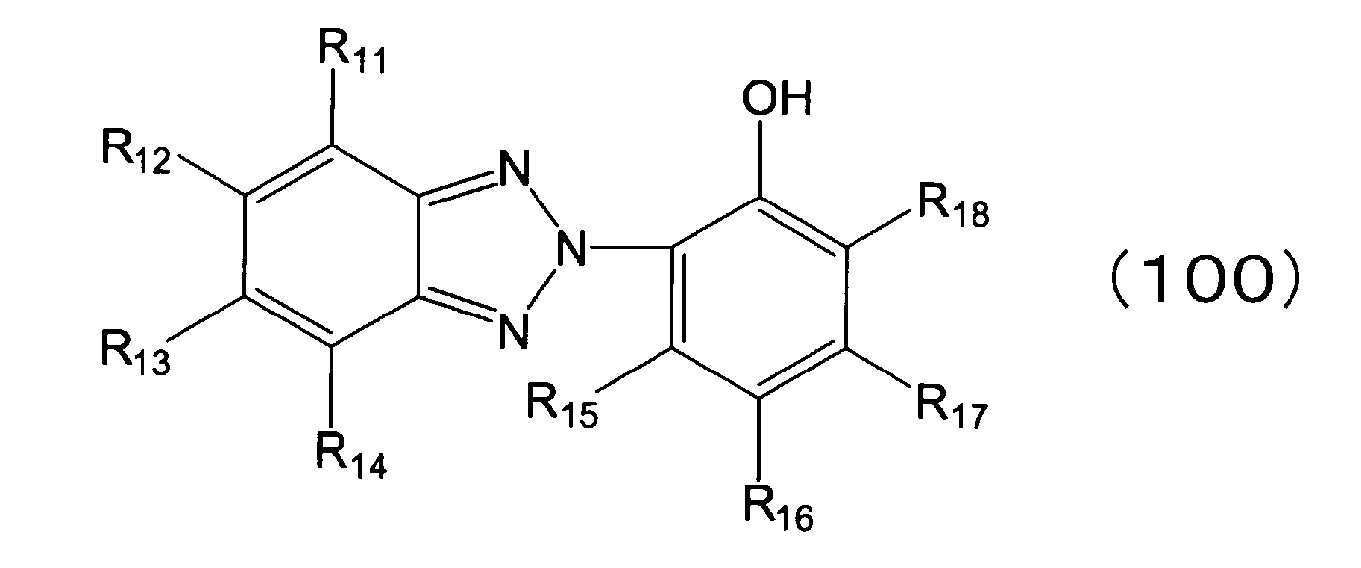
(식 중, R11 내지 R18은 유기기를 나타낸다.)(Wherein R 11 to R 18 represent an organic group).
바람직하게는, R11 내지 R18은, 서로 독립적으로 H, Cl 또는 치환기로 치환되어 있어도 되는 탄소수 1 내지 20, 바람직하게는 탄소수 10까지의 알킬이다. 알킬에 대한 치환기로서는, 페닐 등의 아릴, 치환 또는 비치환된 말레이미드기(알킬에의 치환 위치는 N임) 등을 들 수 있다. 단 알킬 중의 -CH2-기는 -COO- 또는 -OCO-로 치환되어 있어도 된다. 알킬은, 바람직하게는 분지 알킬이거나 치환기를 갖고 있다.Preferably, R 11 to R 18 are independently H, Cl or alkyl having 1 to 20 carbon atoms, preferably 10 carbon atoms, which may be substituted with a substituent. Examples of the substituent for the alkyl include aryl such as phenyl and substituted or unsubstituted maleimide group (the substitution position of the alkyl is N). The -CH 2 - group in the lower alkyl may be substituted with -COO- or -OCO-. Alkyl is preferably branched alkyl or has a substituent.
R11 내지 R14는, 보다 바람직하게는 H이다. R15 및 R17은, 보다 바람직하게는 H이다. R16, R18은, 보다 바람직하게는 서로 독립적으로 H, 상기에서 정의된 알킬, 바람직하게는 탄소수 10까지의 알킬이다.More preferably, R 11 to R 14 are H. More preferably R < 15 > and R < 17 > R 16 and R 18 are more preferably independently of each other H, alkyl defined above, preferably alkyl having up to 10 carbon atoms.
또한, 벤조트리아졸 화합물은, 식 (100)으로 표시되는 구조의 2개 이상이, R11 내지 R18 각각 하나를 공통으로 하여 결합한 구조를 갖고 있어도 된다. 예를 들어, 식 (100)으로 표시되는 제1 구조 중의 R11 내지 R18의 하나와, 식 (100)으로 표시되는 제2 구조 중의 R11 내지 R18의 하나가 공통되어서 2가의 유기기를 나타내고, 제1 구조와 제2 구조가 결합하고 있어도 된다. 공통되는 유기기로서는, 탄소수 1 내지 20, 바람직하게는 1 내지 10의 알킬렌이 바람직하다. 식 (100)으로 표시되는 구조의 2개가 연결된 화합물의 일례는, 식 (101)로 표시된다.Further, the benzotriazole compound may have a structure in which two or more of the structures represented by formula (100) are bonded in common by one of R 11 to R 18 . For example, one of the 1 R 11 to R 18 in the structure represented by the formula (100), being one of the two R 11 to R 18 in the structure represented by the formula (100) common represents a divalent organic group , The first structure and the second structure may be combined. As a common organic group, alkylene having 1 to 20 carbon atoms, preferably 1 to 10 carbon atoms is preferable. An example of a compound in which two of the structures represented by formula (100) are connected is represented by formula (101).

(식 중, R31 내지 R37 및 R41 내지 R47은, R11 내지 R18에 대하여 부여되는 의미를 나타내며, X는 2가의 유기기이다.)(Wherein R 31 to R 37 and R 41 to R 47 have the meanings given for R 11 to R 18 , and X is a divalent organic group.)
R31 내지 R37 및 R41 내지 R47의 바람직한 의미는, 위에서 R11 내지 R18에 대하여 부여된 바와 같다. 특히, R31 내지 R34 및 R41 내지 R44는, 보다 바람직하게는 H이며, R35, R37, R45 및 R47은, 보다 바람직하게는 H이다. R36, R46은, 보다 바람직하게는 서로 독립적으로 H, 상기에서 정의된 알킬, 바람직하게는 탄소수 10까지의 알킬이다. X는, 식 (100) 중의 R18이 연결된 구조에 대응하고, 바람직하게는 탄소수 1 내지 20, 보다 바람직하게는 1 내지 10의 알킬렌이다.Preferred meanings of R 31 to R 37 and R 41 to R 47 are the same as those given above for R 11 to R 18 . In particular, R 31 to R 34 and R 41 to R 44 are more preferably H, and R 35 , R 37 , R 45 and R 47 are more preferably H. R 36 and R 46 are more preferably independently of each other H, alkyl defined above, preferably alkyl having up to 10 carbon atoms. X corresponds to the structure in which R < 18 > in formula (100) is linked, and is preferably an alkylene having 1 to 20 carbon atoms, more preferably 1 to 10 carbon atoms.
이 구조의 일례는, 후술하는 LA-31이다. An example of this structure is LA-31 described later.
특별히 한정되지 않지만, 벤조트리아졸계 자외선 흡수제로서는, 내열성이나 투과율의 관점으로부터 식 (100)에 대해서는 R11 내지 R18 중, 식 (101)에 대해서는 R31 내지 R37, R41 내지 R47 및 X 중에 Cl을 포함하지 않는 것이 보다 바람직하다.As the benzotriazole-based ultraviolet absorber, R 31 to R 37 , R 41 to R 47, and X (in terms of formula (101)) among R 11 to R 18 are preferred from the viewpoint of heat resistance and transmittance, It is more preferable that Cl does not be contained in the compound.
특별히 한정되지 않지만, 벤조트리아졸계 자외선 흡수제로서는, 폴리이미드와의 상용성의 관점으로부터 식 (100)에 대해서는 R11 내지 R18 중, 식 (101)에 대해서는 R31 내지 R37, R41 내지 R47 및 X 중에, 합계하여 방향환을 2개 이상 포함하지 않는 것이 보다 바람직하다. 하나의 화합물의 이들 기 중에 합계하여, 방향환을 2개 이상 포함하면, 얻어지는 폴리이미드 필름에 헤이즈가 발생하는 경우가 있다. 더욱 바람직하게는, 식 (100)에 대해서는 R11 내지 R18 중, 식 (101)에 대해서는 R31 내지 R37, R41 내지 R47 및 X 중에, 방향환을 포함하지 않는 것이 바람직하다.As the benzotriazole-based ultraviolet absorber, R 31 to R 37 , R 41 to R 47 (in the case of formula (100)) among R 11 to R 18 are preferable from the viewpoint of compatibility with polyimide, And X are more preferably two or more aromatic rings in total. When two or more aromatic rings are included in total of these groups of one compound, haze may be generated in the resulting polyimide film. More preferably, R 31 to R 37 , R 41 to R 47 and X in Formula (101) do not include an aromatic ring among R 11 to R 18 in Formula (100).
트리아진계 자외선 흡수제로서는, 2-(4,6-디페닐-1,3,5-트리아진-2-일)-5-[(헥실)옥시]-페놀, 2-(4,6-비스(2,4-디메틸페닐)-1,3,5-트리아진-2-일)-5-히드록시페닐, 2,4-비스[2-히드록시-4-부톡시페닐]-6-(2,4-디부톡시페닐)-1,3,5-트리아진, 2-(4,6-디페닐-1,3,5-트리아진-2-일)-5-[2-(2-에틸헥사노일옥시)에톡시]페놀, 2,4,6-트리스(2-히드록시-4-헥시록시-3-메틸페닐)-1,3,5-트리아진을 들 수 있다.Examples of the triazine type ultraviolet absorber include 2- (4,6-diphenyl-1,3,5-triazin-2-yl) -5 - [(hexyl) oxy] (2,4-dimethylphenyl) -1,3,5-triazin-2-yl) -5-hydroxyphenyl, 2,4-bis [2-hydroxy-4-butoxyphenyl] -6- , 4-dibutoxyphenyl) -1,3,5-triazine, 2- (4,6-diphenyl-1,3,5-triazin- Hexanoyloxy) ethoxy] phenol and 2,4,6-tris (2-hydroxy-4-hexyloxy-3-methylphenyl) -1,3,5-triazine.
구체적인 트리아진계 자외선 방지제로서는, BASF사의 Tinuvin 460, Tinuvin 479, Tinuvin 477, Tinuvin 400, Tinuvin 405, Tinuvin 1577ED, ADEKA사의 LA-46, LA-F70 등을 들 수 있다.Examples of specific triazine ultraviolet ray preventive agents include Tinuvin 460, Tinuvin 479, Tinuvin 477, Tinuvin 400, Tinuvin 405, Tinuvin 1577ED from BASF, LA-46 and LA-F70 from ADEKA.
트리아진계 자외선 흡수제로서는, 특별히 한정되지 않지만, 하기 일반식과 같이 나타낼 수도 있다.The triazine-based ultraviolet absorber is not particularly limited, but may be represented by the following general formula.
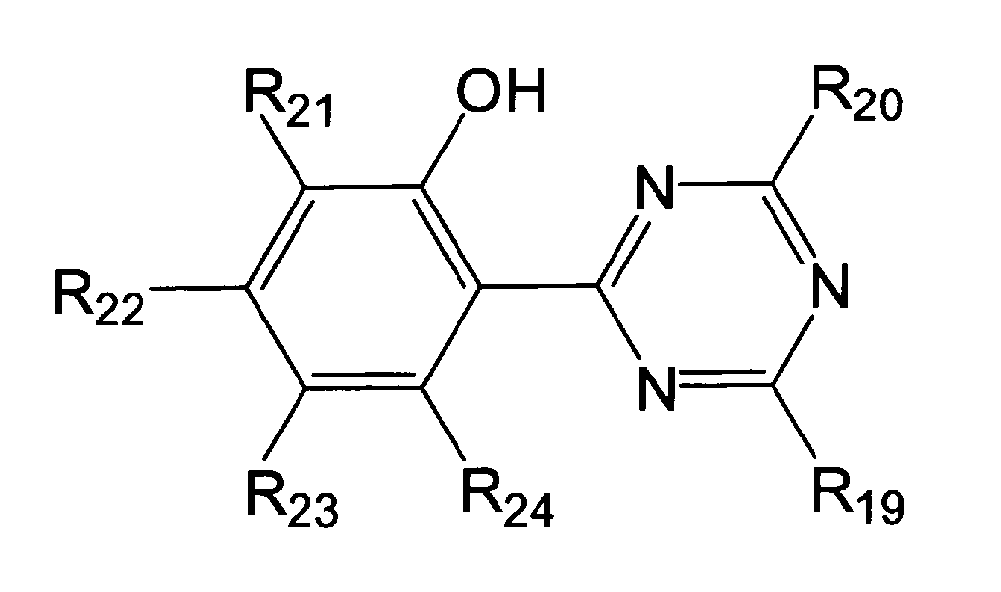
(식 중, R19 내지 R24는 유기기를 나타낸다.)(Wherein R 19 to R 24 represent an organic group).
바람직하게는, R19 내지 R24는, 서로 독립적으로 H, 치환기로 치환되어 있어도 되는 탄소수 1 내지 30의 알킬 또는 페닐 등의 아릴이다. 알킬 및 아릴에 대한 치환기로서는, -OH 등을 들 수 있다. 단 알킬 중의 -CH2-기는 -O-, -COO- 또는 -OCO-로 치환되어 있어도 된다. 알킬은, 바람직하게는 분지 알킬이거나 치환기를 갖고 있다.Preferably, R 19 to R 24 are independently of each other H, alkyl of 1 to 30 carbon atoms which may be substituted with a substituent, or aryl such as phenyl. Examples of the substituent for alkyl and aryl include -OH and the like. The -CH 2 - group in the lower alkyl may be substituted with -O-, -COO- or -OCO-. Alkyl is preferably branched alkyl or has a substituent.
R19 및 R20은, 바람직하게는 방향환을 포함한다. 더욱 바람직하게는, 방향환이 -OH로 치환되어 있다. R21 내지 R24는 바람직하게는 서로 독립적으로 H, 상기에서 정의된 알킬 또는 아릴이다.R 19 and R 20 preferably include an aromatic ring. More preferably, the aromatic ring is substituted with -OH. R 21 to R 24 are preferably independently of each other H, alkyl or aryl as defined above.
벤조페논계 자외선 흡수제로서는, 2-히드록시-4-n-옥톡시벤조페논, 2,4-디히드록시벤조페논, 2-히드록시-4-메톡시벤조페논, 4-도데실옥시-2-히드록시벤조페논, 4-벤질옥시-2-히드록시벤조페논, 2,2',4,4'-테트라히드록시벤조페논, 2,2'-디히드록시-4,4'-디메톡시벤조페논, 1,4-비스(4-벤조일-3-히드록시 페녹시)-부탄Examples of the benzophenone ultraviolet absorber include 2-hydroxy-4-n-octoxybenzophenone, 2,4-dihydroxybenzophenone, 2-hydroxy-4-methoxybenzophenone, -Hydroxybenzophenone, 4-benzyloxy-2-hydroxybenzophenone, 2,2 ', 4,4'-tetrahydroxybenzophenone, 2,2'-dihydroxy-4,4'-dimethoxy Benzophenone, 1,4-bis (4-benzoyl-3-hydroxyphenoxy) -butane
구체적인 벤조페논계 자외선 방지제로서는, BASF사의 Chimassorb 81, Chimassorb 90, ADEKA사의 1413, 시프로 가세이사의 SEESORB 100, SEESORB 101, SEESORB 101S, SEESORB 102, SEESORB 103, SEESORB 105, SEESORB 106, SEESORB 107, SEESORB 151, 스미까 켐텍스사의 Sumisorb 130, 케미프로 가세이사의 KEMISORB 10, KEMISORB 11, KEMISORB 11S, KEMISORB 12 등을 들 수 있다.Specific examples of the benzophenone ultraviolet ray preventive include Chimassorb 81, Chimassorb 90, BASF 1413, ADEKA 1413, SEFORB 100, SEESORB 101, SEESORB 101S, SEESORB 102, SEESORB 103, SEESORB 105, SEESORB 106, SEESORB 107, SEESORB 151, SUMISORB 130 from SumikaChemTex, KEMISORB 10, KEMISORB 11, KEMISORB 11S and KEMISORB 12 from Chemipro Gaseous.
자외선 흡수제의 첨가량은 얻어지는 폴리이미드 100질량부에 대하여 바람직하게는, 0.01 내지 5부, 더욱 바람직하게는 0.1 내지 4부, 특히 바람직하게는 0.5 내지 2부이다. 자외선 흡수제의 양이 많으면, 광학 특성이나 내열성 등의 폴리이미드의 특성이 저하되거나, 필름에 헤이즈가 발생하거나 하는 경우가 있다.The amount of the ultraviolet absorber to be added is preferably 0.01 to 5 parts, more preferably 0.1 to 4 parts, particularly preferably 0.5 to 2 parts based on 100 parts by mass of the polyimide obtained. If the amount of the ultraviolet absorber is large, the characteristics of the polyimide such as optical properties and heat resistance may be deteriorated or haze may be generated in the film.
본 발명에 있어서, 자외선 흡수제는, 폴리이미드 재료 중에서 자외선 흡수제의 효과를 달성할 수 있는 것이다. 따라서, 상기 화합물이 그대로의 구조로 폴리이미드 재료 중에 존재하고 있어도 되고, 또는 상기 화합물이, 가열 처리에 의해, 자외선 흡수의 효과를 여전히 갖는 변성물로 변성되어 있어도 된다.In the present invention, the ultraviolet absorber is capable of achieving the effect of the ultraviolet absorber in the polyimide material. Therefore, the compound may be present in the polyimide material as it is, or the compound may be modified with a modified product still having the effect of ultraviolet absorption by heat treatment.
자외선 흡수제는, 폴리이미드와 균일하게 혼합되어 있는 것이 바람직하다. 이것을 위해서는, 다음 항에서 설명한 바와 같이, 폴리이미드 전구체 조성물 또는 폴리이미드 용액 조성물을 제조하고, 이것을 열처리하여 폴리이미드 재료를 제조하는 것이 바람직하다.The ultraviolet absorber is preferably uniformly mixed with the polyimide. For this purpose, it is preferable to prepare a polyimide precursor composition or a polyimide solution composition and heat-treat the polyimide precursor composition or polyimide solution composition as described in the next section.
이상과 같은 본 발명의 폴리이미드 재료는, 자외선 내구성이 개선되어, 자외선 조사에 의한 착색이 작다. 즉, 자외선 내구성을, 자외선 조사 시험 전후의 황색도(YI)의 변화 ΔYI로 평가했을 때, 자외선 흡수제를 함유하지 않는 폴리이미드 재료(대조 재료)의 ΔYI와 비교하여, 본 발명의 폴리이미드 재료는, 바람직하게는 20% 이상의 개선(ΔYI가, 대조 재료의 ΔYI의 80% 이하로 개선된 것을 의미한다.), 보다 바람직하게는 30% 이상의 개선(ΔYI가, 대조 재료의 ΔYI의 70% 이하), 더욱 바람직하게는 40% 이상 (ΔYI가, 대조 재료의 ΔYI의 60% 이하)의 개선이 달성되어 있다. 여기서, 자외선 조사 시험 조건은, Q-LAB사의 QUV-313 램프를 사용하고, 310nm에서의 조도 0.59W/㎡, 온도 50℃, 조사 시간 24시간이다.The polyimide material of the present invention as described above has improved ultraviolet durability and is less colored by ultraviolet irradiation. That is, when the ultraviolet durability was evaluated by the change? YI of yellowness (YI) before and after the ultraviolet ray irradiation test, the polyimide material of the present invention was compared with? YI of the polyimide material (control material) , Preferably 20% or more (ΔYI means improvement to 80% or less of ΔYI of the control material), more preferably 30% or more improvement (ΔYI is 70% or less of ΔYI of the control material) , More preferably 40% or more (DELTA YI is 60% or less of DELTA YI of the control material). Here, the ultraviolet ray irradiation test conditions were a QUV-313 lamp of Q-LAB, an illuminance at 310 nm of 0.59 W / m 2, a temperature of 50 캜, and an irradiation time of 24 hours.
ΔYI의 값에 대해서는, 폴리이미드의 종류에도 의존하므로 한정되지 않지만, 바람직하게는 10 이하, 보다 바람직하게는 8 이하, 또한 보다 바람직하게는 7 이하, 또한 보다 바람직하게는 6 이하, 가장 바람직하게는 5 이하이다. 바람직하게는 0 이상이다.The value of DELTA YI is not limited because it depends on the type of polyimide, but is preferably 10 or less, more preferably 8 or less, still more preferably 7 or less, still more preferably 6 or less, and most preferably, 5 or less. Preferably 0 or more.
또한, 황색도(YI)의 값에 대해서는, 자외선 조사 시험 전후의 양쪽에서, 15 이하, 바람직하게는 10.5 이하이다. 바람직하게는 0 이상이다.The value of the yellowness index (YI) is 15 or less, preferably 10.5 or less, both before and after the ultraviolet irradiation test. Preferably 0 or more.
상기 ΔYI의 개선의 정도, ΔYI의 값 및 YI의 값에 대해서는, 폴리이미드 재료가, 필름이나 코팅층의 형태일 때, 필름이나 코팅층인 본 발명의 폴리이미드 재료는, 두께에 관계 없이 상기 개선이나 값이 달성되는 것이 바람직하다. 물질로서의 폴리이미드 재료에 있어서는, 5㎛ 내지 100㎛의 범위 중 적어도 하나의 두께를 갖는 필름 또는 코팅층을 형성했을 때에, 상기 개선이나 값이 달성되는 것이 바람직하다.As for the degree of improvement of DELTA YI, the value of DELTA YI, and the value of YI, the polyimide material of the present invention, which is a film or a coating layer when the polyimide material is in the form of a film or a coating layer, Is achieved. In the polyimide material as the material, it is preferable that the improvement or the value is achieved when a film or a coating layer having at least one thickness in the range of 5 mu m to 100 mu m is formed.
또한, 본 발명의 폴리이미드 재료는, 헤이즈값이 15% 이하인 것이 바람직하고, 보다 바람직하게는 10% 이하, 더욱 바람직하게는 5% 이하, 가장 바람직하게는 2% 이하이다. 헤이즈의 값은, 폴리이미드 재료가, 필름이나 코팅층의 형태일 때, 필름이나 코팅층인 본 발명의 폴리이미드 재료는, 두께에 관계 없이 상기 헤이즈의 값이 달성되는 것이 바람직하다. 물질로서의 폴리이미드 재료에 있어서는, 5㎛ 내지 100㎛의 범위 중 적어도 하나의 두께를 갖는 필름 또는 코팅층을 형성했을 때에, 상기 값이 달성되는 것이 바람직하다.The polyimide material of the present invention preferably has a haze value of 15% or less, more preferably 10% or less, further preferably 5% or less, and most preferably 2% or less. The haze value is preferably such that the haze value is achieved regardless of the thickness of the polyimide material of the present invention, which is a film or a coating layer, when the polyimide material is in the form of a film or a coating layer. In the case of the polyimide material as the material, it is preferable that the above value is achieved when a film or coating layer having at least one thickness in the range of 5 mu m to 100 mu m is formed.
또한, 본 발명의 폴리이미드 재료는, 광투과율이 높은 것도 바람직하고, 400nm 투과율이, 바람직하게는 50% 이상, 보다 바람직하게는 60% 이상이며, 더욱 바람직하게는 70% 이상, 가장 바람직하게는 80% 이상이다. 광투과율의 값은, 폴리이미드 재료가, 필름이나 코팅층의 형태일 때, 필름이나 코팅층인 본 발명의 폴리이미드 재료는, 두께에 관계 없이 상기 광투과율의 값이 달성되는 것이 바람직하다. 물질로서의 폴리이미드 재료에 있어서는, 5㎛ 내지 100㎛의 범위 중 적어도 하나의 두께를 갖는 필름 또는 코팅층을 형성했을 때에, 상기 값이 달성되는 것이 바람직하다.The polyimide material of the present invention preferably has a high light transmittance. The transmittance at 400 nm is preferably 50% or more, more preferably 60% or more, further preferably 70% or more, and most preferably, 80% or more. The value of the light transmittance is preferably such that the value of the light transmittance is achieved regardless of the thickness of the polyimide material of the present invention which is a film or a coating layer when the polyimide material is in the form of a film or a coating layer. In the case of the polyimide material as the material, it is preferable that the above value is achieved when a film or coating layer having at least one thickness in the range of 5 mu m to 100 mu m is formed.
본 발명에 있어서, 폴리이미드는, 그 자체가 바람직한 기계적 성능, 내열성, 및 기타의 특성을 갖도록 선택된다. 그 때문에, 본 발명의 폴리이미드 재료는, 광 감수성 성분(즉 감광성 성분), 예를 들어 광 경화제(광 라디칼 발생제, 광 양이온 발생제, 광 음이온 발생제 등), 감광제 성분(퀴논디아지드 구조를 갖는 화합물, 기타 포토레지스트에 사용되는 감광성 화합물 등), 및 기타의 광 감수성 성분 또는 이들 광 감수성 성분에서 유래되는 변성물(분해물이나 중합체에 도입된 것 등)을 포함하지 않는다. 이러한 성분을 포함함으로써, 목적으로 하는 폴리이미드 본래의 성능이 손상되기 때문이다.In the present invention, the polyimide is selected so as to have a desirable mechanical performance, heat resistance, and other characteristics per se. For this reason, the polyimide material of the present invention is a polyimide material having a light-sensitive component (that is, a photosensitive component) such as a photo-curing agent (photo radical generator, photo cation generator, photo anion generator, , A photosensitive compound used in other photoresists, etc.), and other photosensitizing components or modified products derived from these photosensitizing components (such as those introduced into degradation products or polymers). The inclusion of such components impairs the original polyimide performance.
또한, 본 발명의 폴리이미드 재료는, 필름이나 코팅층 등의 기계적 강도가 필요한 용도로 사용되는 것이 의도되고 있고, 액정 표시 장치의 배향막과 같은 얇음이 요구되는 한편 기계적 특성 및/또는 내열성이 필요가 없는 용도에서의 사용은 의도되고 있지 않다. 본 발명에서는, 예를 들어 막 두께로서는 후술하는 소정의 두께로 형성되는 것이 바람직하다. 또한, 본 발명은 배향성을 의도한 데카메틸렌비스트리멜리테이트 이무수물과 같은 장쇄 메틸렌기를 포함하는 성분을 함유하지 않는다는(전술한 바와 같음) 점에 있어서도, 배향막 용도가 아니다.The polyimide material of the present invention is intended to be used for applications requiring mechanical strength such as a film or a coating layer and is required to have a thickness as thin as an alignment film of a liquid crystal display device and does not require mechanical properties and / It is not intended for use. In the present invention, for example, the film thickness is preferably formed to have a predetermined thickness described later. Further, the present invention is not an alignment film application in that it does not contain a component containing a long-chain methylene group such as decamethylene bistrimellitate dianhydride, which is intended for orientation, (as described above).
또한, 본 발명의 폴리이미드 재료는, 광투과성의 필름이나 코팅층으로서 사용되는 것이 바람직하고, 광 차폐성이 작은 것이 바람직하다. 특히 가시광 영역에 흡수를 갖는 염료, 안료 및 카본 블랙 등은 함유하지 않는 것이 바람직하다.Further, the polyimide material of the present invention is preferably used as a light-transmitting film or a coating layer, and preferably has a small light shielding property. Particularly, it is preferable not to contain a dye, pigment, carbon black or the like having absorption in the visible light region.
<<폴리이미드 전구체 조성물, 폴리이미드 용액 조성물 및 폴리이미드 재료의 제조 방법>><< Polyimide Precursor Composition, Polyimide Solution Composition and Manufacturing Method of Polyimide Material >>
다음으로 본 발명의 폴리이미드 재료의 제조 방법에 대하여 설명한다. 본 발명의 폴리이미드 재료는, 폴리이미드 전구체 조성물 또는 폴리이미드 용액 조성물을 가열 처리함으로써 얻어진다. 본 발명의 폴리이미드 전구체 조성물은, 폴리이미드 전구체, 자외선 흡수제 및 용매를 함유한다. 폴리이미드 전구체와 자외선 흡수제는, 용매 중에 용해되어 있는 것이 바람직하다. 또한, 폴리이미드 용액 조성물은, 폴리이미드, 자외선 흡수제 및 용매를 함유한다. 폴리이미드 및 자외선 흡수제는, 용매 중에 용해되어 있는 것이 바람직하다.Next, a method for producing the polyimide material of the present invention will be described. The polyimide material of the present invention is obtained by heat-treating a polyimide precursor composition or a polyimide solution composition. The polyimide precursor composition of the present invention contains a polyimide precursor, an ultraviolet absorber, and a solvent. The polyimide precursor and the ultraviolet absorber are preferably dissolved in a solvent. Further, the polyimide solution composition contains a polyimide, an ultraviolet absorber and a solvent. The polyimide and ultraviolet absorber are preferably dissolved in a solvent.
폴리이미드 전구체는, 전술한 폴리이미드를 부여하는 화학 구조를 갖는다. 즉, 폴리이미드 전구체는, 하기 일반식 (A1)로 표시되는 반복 단위를 함유한다.The polyimide precursor has a chemical structure giving the above-mentioned polyimide. That is, the polyimide precursor contains a repeating unit represented by the following general formula (A1).

(식 중, X1은 방향족환 또는 지환 구조를 갖는 4가의 기이며, Y1은 방향족환 또는 지환 구조를 갖는 2가의 기이며, R1, R2는 각각 독립적으로 수소, 탄소수 1 내지 6, 바람직하게는 탄소수 1 내지 3의 알킬기, 또는 탄소수 3 내지 9의 알킬 실릴기이다.)(Wherein X 1 is an aromatic ring or a tetravalent group having an alicyclic structure, Y 1 is a divalent group having an aromatic ring or alicyclic structure, R 1 and R 2 are each independently hydrogen, Preferably an alkyl group having 1 to 3 carbon atoms or an alkylsilyl group having 3 to 9 carbon atoms.
식 (A1)에 있어서, X1 및 Y1의 바람직한 정의 및 조합은, 모두 식 (1)에 대하여 설명한 것과 동일하다. 또한, 폴리이미드 전구체는, 식 (A1)로 표시되는 반복 단위 이외의, 다른 반복 단위를 포함할 수 있고, 그 구조나 비율에 대해서는 폴리이미드에 대하여 설명한 것과 동일하다.In formula (A1), preferred definitions and combinations of X 1 and Y 1 are the same as those described for formula (1). The polyimide precursor may contain another repeating unit other than the repeating unit represented by the formula (A1), and the structure and ratio thereof are the same as those described for the polyimide.
식 (A1)에 있어서, R1 및 R2가 수소일 경우, 폴리이미드의 제조가 용이한 경향이 있다. R1 및 R2는, 후술하는 제조 방법에 따라, 그 관능기의 종류, 및 관능기의 도입율을 변화시킬 수 있다.In the formula (A1), when R 1 and R 2 are hydrogen, the production of the polyimide tends to be easy. R 1 and R 2 can change the type of the functional group and the introduction ratio of the functional group according to a production method described later.
본 발명에 사용되는 폴리이미드 전구체(상기 식 (A1)로 표시되는 반복 단위 중 적어도 1종을 포함하는 폴리이미드 전구체)는 R1 및 R2가 취하는 화학 구조에 따라,The polyimide precursor to be used in the present invention (the polyimide precursor containing at least one kind of repeating unit represented by the formula (A1)), depending on the chemical structure of R 1 and R 2 taken,
1) 폴리아미드산(R1 및 R2가 수소),1) a polyamic acid (R 1 and R 2 are hydrogen),
2) 폴리아미드산에스테르(R1 및 R2의 적어도 일부가 알킬기),2) a polyamide acid ester (at least a part of R 1 and R 2 is an alkyl group)
3) 4) 폴리아미드산실릴에스테르(R1 및 R2의 적어도 일부가 알킬 실릴기),3) 4) polyamic acid silyl ester (at least a part of R 1 and R 2 is an alkylsilyl group),
로 분류할 수 있다. 그리고, 폴리이미드 전구체는, 이 분류마다, 이하의 제조 방법에 의해 용이하게 제조할 수 있다. 단, 본 발명에서 사용되는 폴리이미드 전구체의 제조 방법은, 이하의 제조 방법에 한정되는 것은 아니다.. The polyimide precursor can be easily produced by the following production method for each classification. However, the method for producing the polyimide precursor used in the present invention is not limited to the following production methods.
1) 폴리아미드산1) Polyamic acid
폴리이미드 전구체는, 용매 중에서 테트라카르복실산 성분으로서의 테트라카르복실산 이무수물과 디아민 성분을 대략 등몰, 바람직하게는 테트라카르복실산 성분에 대한 디아민 성분의 몰비[디아민 성분의 몰수/테트라카르복실산 성분의 몰수]가 바람직하게는 0.90 내지 1.10, 보다 바람직하게는 0.95 내지 1.05의 비율로, 예를 들어 120℃ 이하의 비교적 저온도에서 이미드화를 억제하면서 반응함으로써, 폴리이미드 전구체 용액으로서 적합하게 얻을 수 있다.The polyimide precursor is a polyimide precursor which has a molar ratio of the diamine component to the tetracarboxylic acid component [mol of the diamine component / tetracarboxylic acid Component is preferably in the range of 0.90 to 1.10, more preferably 0.95 to 1.05, for example, at a relatively low temperature of 120 占 폚 or less while suppressing imidization, thereby obtaining a polyimide precursor solution .
한정하는 것이 아니지만, 보다 구체적으로는, 유기 용제 또는 물에 디아민을 용해하고, 이 용액에 교반하면서, 테트라카르복실산 이무수물을 서서히 첨가하고, 0 내지 120℃, 바람직하게는 5 내지 80℃의 범위에서 1 내지 72시간 교반함으로써, 폴리이미드 전구체가 얻어진다. 80℃ 이상에서 반응시키는 경우, 분자량이 중합 시의 온도 이력에 의존하여 변동하고, 또한 열에 의해 이미드화가 진행하기 때문에, 폴리이미드 전구체를 안정적으로 제조할 수 없게 될 가능성이 있다. 상기 제조 방법에서의 디아민과 테트라카르복실산 이무수물의 첨가 순서는, 폴리이미드 전구체의 분자량이 높아지기 쉽기 때문에 바람직하다. 또한, 상기 제조 방법의 디아민과 테트라카르복실산 이무수물의 첨가 순서를 반대로 하는 것도 가능하고, 석출물이 저감한다는 점에서 바람직하다. 용매로서 물을 사용하는 경우에는, 1,2-디메틸이미다졸 등의 이미다졸류, 또는 트리에틸아민 등의 염기를, 생성하는 폴리아미드산(폴리이미드 전구체)의 카르복실기에 대하여 바람직하게는 0.8배 당량 이상의량으로 첨가하는 것이 바람직하다.More specifically, a tetracarboxylic acid dianhydride is gradually added while stirring the solution and the diamine is dissolved in an organic solvent or water, and the solution is stirred at a temperature of 0 to 120 캜, preferably 5 to 80 캜 , For 1 to 72 hours, to obtain a polyimide precursor. When the reaction is carried out at 80 占 폚 or higher, there is a possibility that the polyimide precursor can not be stably produced because the molecular weight fluctuates depending on the temperature history at the time of polymerization and the imidization proceeds by heat. The order of adding the diamine and the tetracarboxylic dianhydride in the above production method is preferable because the molecular weight of the polyimide precursor tends to be high. Further, the order of addition of the diamine and the tetracarboxylic dianhydride of the above production method may be reversed, and it is preferable from the viewpoint of reducing the precipitate. When water is used as the solvent, imidazoles such as 1,2-dimethylimidazole and the like, or bases such as triethylamine are added to the resulting polyamic acid (polyimide precursor) It is preferably added in an amount equal to or greater than the amount equivalent to the equivalent amount.
2) 폴리아미드산에스테르2) Polyamide acid ester
테트라카르복실산 이무수물을 임의의 알코올과 반응시켜, 디에스테르디카르복실산을 얻은 후, 염소화 시약(티오닐클로라이드, 옥살릴클로라이드 등)과 반응시켜, 디에스테르디카르복실산클로라이드를 얻는다. 이 디에스테르디카르복실산클로라이드와 디아민을 -20 내지 120℃, 바람직하게는 -5 내지 80℃의 범위에서 1 내지 72시간 교반함으로써, 폴리이미드 전구체가 얻어진다. 80℃ 이상에서 반응시키는 경우, 분자량이 중합 시의 온도 이력에 의존하여 변동하고, 또한 열에 의해 이미드화가 진행하기 때문에, 폴리이미드 전구체를 안정적으로 제조할 수 없게 될 가능성이 있다. 또한, 디에스테르디카르복실산과 디아민을, 인계 축합제나, 카르보디이미드 축합제 등을 사용하여 탈수 축합함으로써도, 간편하게 폴리이미드 전구체가 얻어진다.The tetracarboxylic dianhydride is reacted with an arbitrary alcohol to obtain a diester dicarboxylic acid and then reacted with a chlorinating reagent (thionyl chloride, oxalyl chloride, etc.) to obtain diester dicarboxylic acid chloride. The diimide precursor is obtained by stirring the diester dicarboxylic acid chloride with diamine at -20 to 120 ° C, preferably -5 to 80 ° C for 1 to 72 hours. When the reaction is carried out at 80 占 폚 or higher, there is a possibility that the polyimide precursor can not be stably produced because the molecular weight fluctuates depending on the temperature history at the time of polymerization and the imidization proceeds by heat. Also, a polyimide precursor can be obtained easily by dehydrating and condensing a diester dicarboxylic acid and a diamine using a phosphorus-containing condensing agent, a carbodiimide condensing agent or the like.
이 방법으로 얻어지는 폴리이미드 전구체는 안정적이기 때문에, 물이나 알코올 등의 용제를 첨가하여 재침전 등의 정제를 행할 수도 있다.Since the polyimide precursor obtained by this method is stable, it is also possible to carry out purification such as re-precipitation by adding a solvent such as water or alcohol.
3) 폴리아미드산실릴에스테르(간접법)3) Polyamidic acid silyl ester (indirect method)
미리, 디아민과 실릴화제를 반응시켜, 실릴화된 디아민을 얻는다. 필요에 따라, 증류 등에 의해 실릴화된 디아민의 정제를 행한다. 그리고, 탈수된 용제 중에 실릴화된 디아민을 용해시켜 두고, 교반하면서, 테트라카르복실산 이무수물을 서서히 첨가하고, 0 내지 120℃, 바람직하게는 5 내지 80℃의 범위에서 1 내지 72시간 교반함으로써, 폴리이미드 전구체가 얻어진다. 80℃ 이상에서 반응시키는 경우, 분자량이 중합 시의 온도 이력에 의존하여 변동하고, 또한 열에 의해 이미드화가 진행하기 때문에, 폴리이미드 전구체를 안정적으로 제조할 수 없게 될 가능성이 있다.A silylating agent is reacted with a diamine in advance to obtain a silylated diamine. If necessary, the silylated diamine is purified by distillation or the like. Then, the silylated diamine is dissolved in the dehydrated solvent, the tetracarboxylic dianhydride is gradually added while stirring, and the mixture is stirred at 0 to 120 ° C, preferably 5 to 80 ° C for 1 to 72 hours , A polyimide precursor is obtained. When the reaction is carried out at 80 占 폚 or higher, there is a possibility that the polyimide precursor can not be stably produced because the molecular weight fluctuates depending on the temperature history at the time of polymerization and the imidization proceeds by heat.
4) 폴리아미드산실릴에스테르(직접법)4) Polyamide acid silyl ester (direct method)
1)의 방법으로 얻어진 폴리아미드산 용액과 실릴화제를 혼합하고, 0 내지 120℃, 바람직하게는 5 내지 80℃의 범위에서 1 내지 72시간 교반함으로써, 폴리이미드 전구체가 얻어진다. 80℃ 이상에서 반응시키는 경우, 분자량이 중합 시의 온도 이력에 의존하여 변동하고, 또한 열에 의해 이미드화가 진행하기 때문에, 폴리이미드 전구체를 안정적으로 제조할 수 없게 될 가능성이 있다.1) and a silylating agent are mixed and stirred at 0 to 120 캜, preferably 5 to 80 캜 for 1 to 72 hours to obtain a polyimide precursor. When the reaction is carried out at 80 占 폚 or higher, there is a possibility that the polyimide precursor can not be stably produced because the molecular weight fluctuates depending on the temperature history at the time of polymerization and the imidization proceeds by heat.
3)의 방법, 및 4)의 방법에서 사용하는 실릴화제로서, 염소를 함유하지 않는 실릴화제를 사용하는 것은, 실릴화된 폴리아미드산, 또는, 얻어진 폴리이미드를 정제할 필요가 없기 때문에 바람직하다. 염소 원자를 포함하지 않는 실릴화제로서는, N,O-비스(트리메틸실릴)트리플루오로아세트아미드, N,O-비스(트리메틸실릴)아세트아미드, 헥사메틸디실라잔을 들 수 있다. 불소 원자를 포함하지 않고 저비용인 점에서, N,O-비스(트리메틸실릴)아세트아미드, 헥사메틸디실라잔이 특히 바람직하다.The use of a silylating agent containing no chlorine as the silylating agent used in the methods 3) and 4) is preferable because it is not necessary to purify the silylated polyamic acid or the obtained polyimide . Examples of the silylating agent not containing a chlorine atom include N, O-bis (trimethylsilyl) trifluoroacetamide, N, O-bis (trimethylsilyl) acetamide and hexamethyldisilazane. Particularly preferred are N, O-bis (trimethylsilyl) acetamide and hexamethyldisilazane in that they do not contain fluorine atoms and are inexpensive.
또한, 3)의 방법의 디아민실릴화 반응에는, 반응을 촉진하기 위해서, 피리딘, 피페리딘, 트리에틸아민 등의 아민계 촉매를 사용할 수 있다. 이 촉매는 폴리이미드 전구체의 중합 촉매로서, 그대로 사용할 수 있다.In the diamine silylation reaction of the method 3), amine catalysts such as pyridine, piperidine, and triethylamine can be used to accelerate the reaction. This catalyst can be used as it is as a polymerization catalyst for the polyimide precursor.
폴리이미드 전구체를 제조할 때에 사용하는 용매는, 물이나, 예를 들어 N,N-디메틸포름아미드, N,N-디메틸아세트아미드, N-메틸-2-피롤리돈, 1,3-디메틸-2-이미다졸리디논, 디메틸술폭시드 등의 비프로톤성 용매가 바람직하고, 원료 단량체 성분과 생성되는 폴리이미드 전구체가 용해되기만 하면, 어떤 종류의 용매일지라도 문제는 없이 사용할 수 있으므로, 특별히 그 구조에 한정되지는 않는다. 용매로서, 물이나, N,N-디메틸포름아미드, N,N-디메틸아세트아미드, N-메틸피롤리돈 등의 아미드 용매, γ-부티로락톤, γ-발레로락톤, δ-발레로락톤, γ-카프로락톤, ε-카프로락톤, α-메틸-γ-부티로락톤 등의 환상 에스테르 용매, 에틸렌카르보네이트, 프로필렌카르보네이트 등의 카르보네이트 용매, 트리에틸렌글리콜 등의 글리콜계 용매, m-크레졸, p-크레졸, 3-클로로페놀, 4-클로로페놀 등의 페놀계 용매, 아세토페논, 1,3-디메틸-2-이미다졸리디논, 술포란, 디메틸술폭시드 등이 바람직하게 채용된다. 또한, 기타의 일반적인 유기 용제, 즉 페놀, o-크레졸, 아세트산부틸, 아세트산에틸, 아세트산이소부틸, 프로필렌글리콜메틸아세테이트, 에틸셀로솔브, 부틸셀로솔브, 2-메틸셀로솔브아세테이트, 에틸셀로솔브아세테이트, 부틸셀로솔브아세테이트, 테트라히드로푸란, 디메톡시에탄, 디에톡시에탄, 디부틸에테르, 디에틸렌글리콜디메틸에테르, 메틸이소부틸케톤, 디이소부틸케톤, 시클로펜타논, 시클로헥사논, 메틸에틸케톤, 아세톤, 부탄올, 에탄올, 크실렌, 톨루엔, 클로로벤젠, 테르펜, 미네랄 스피릿, 석유 나프타계 용매 등도 사용할 수 있다. 또한, 용매는, 복수종을 조합하여 사용할 수도 있다.The solvent used in the production of the polyimide precursor may be water or a solvent such as N, N-dimethylformamide, N, N-dimethylacetamide, N-methyl-2-pyrrolidone, An aprotic solvent such as 2-imidazolidinone or dimethylsulfoxide is preferable and any solvent can be used without any problem as long as the raw monomer component and the resulting polyimide precursor are dissolved, But is not limited to. Examples of the solvent include water and amide solvents such as N, N-dimethylformamide, N, N-dimethylacetamide and N-methylpyrrolidone,? -Butyrolactone,? -Valerolactone, , cyclic ester solvents such as? -caprolactone,? -caprolactone and? -methyl-? -butyrolactone, carbonate solvents such as ethylene carbonate and propylene carbonate, glycol solvents such as triethylene glycol , phenol type solvents such as m-cresol, p-cresol, 3-chlorophenol and 4-chlorophenol, acetophenone, 1,3-dimethyl-2-imidazolidinone, sulfolane, dimethyl sulfoxide Is adopted. Other conventional organic solvents such as phenol, o-cresol, butyl acetate, ethyl acetate, isobutyl acetate, propylene glycol methyl acetate, ethyl cellosolve, butyl cellosolve, 2-methyl cellosolve acetate, ethyl cell But are not limited to, benzoic acid, benzoic acid, benzoic acid, benzoic acid, benzoic acid, isophthalic acid, benzoic acid, benzoic acid, Methyl ethyl ketone, acetone, butanol, ethanol, xylene, toluene, chlorobenzene, terpene, mineral spirit, and petroleum naphtha type solvents. Further, a plurality of kinds of solvents may be used in combination.
폴리이미드 전구체의 대수 점도는, 특별히 한정되지 않지만, 30℃에서의 농도 0.5g/dL의 N,N-디메틸아세트아미드 용액에 있어서의 대수 점도가 0.2dL/g 이상, 보다 바람직하게는 0.3dL/g 이상, 특히 바람직하게는 0.4dL/g 이상인 것이 바람직하다. 대수 점도가 0.2dL/g 이상에서는, 폴리이미드 전구체의 분자량이 높고, 얻어지는 폴리이미드의 기계 강도나 내열성이 우수하다.The logarithmic viscosity of the polyimide precursor is not particularly limited, but the logarithmic viscosity in the N, N-dimethylacetamide solution at a concentration of 0.5 g / dL at 30 DEG C is preferably 0.2 dL / g or more, more preferably 0.3 dL / g or more, particularly preferably 0.4 dL / g or more. When the logarithmic viscosity is 0.2 dL / g or more, the molecular weight of the polyimide precursor is high, and the obtained polyimide has excellent mechanical strength and heat resistance.
본 발명의 폴리이미드 전구체 조성물 중에 포함되는 용매는, 폴리이미드 전구체와 자외선 흡수제가 용해되는 것이기만 하면 특별히 한정되지 않는다. 용매의 구체예로서는, 상술한 폴리이미드 전구체를 제조할 때에 사용하는 용매를 들 수 있고, 폴리이미드 전구체를 제조할 때에 사용한 용매를 그대로 사용할 수 있다.The solvent contained in the polyimide precursor composition of the present invention is not particularly limited so long as the polyimide precursor and the ultraviolet absorber are dissolved. As specific examples of the solvent, there may be mentioned a solvent used for producing the above-mentioned polyimide precursor, and the solvent used for producing the polyimide precursor can be used as it is.
본 발명의 폴리이미드 전구체 조성물 중에 포함되는 자외선 흡수제로서는, 폴리이미드 재료의 항에서 설명한 자외선 흡수제를 사용할 수 있고, 바람직한 것도 동일하다. 자외선 흡수제의 첨가 시기는, 특별히 한정되지 않고 통상은, 폴리이미드 전구체의 용액을 제조한 후에 자외선 흡수제를 첨가하는데, 디아민 성분과 테트라카르복실산 성분을 반응시키기 전에 용매 중에 자외선 흡수제를 첨가해도 된다. 또한, 첨가 시에는 자외선 흡수제를 미리 용매에 용해하여 용액으로 한 것을 첨가하는 것이 바람직하다.As the ultraviolet absorber contained in the polyimide precursor composition of the present invention, the ultraviolet absorber described in the section of the polyimide material can be used, and preferable ones are the same. The time of adding the ultraviolet absorber is not particularly limited and usually an ultraviolet absorber is added after preparing the solution of the polyimide precursor. The ultraviolet absorber may be added to the solvent before reacting the diamine component and the tetracarboxylic acid component. In addition, when added, it is preferable to add an ultraviolet absorber dissolved in a solvent in advance as a solution.
본 발명의 폴리이미드 전구체 조성물에는, 필요에 따라, 화학 이미드화제 (무수 아세트산 등의 산 무수물이나, 피리딘, 이소퀴놀린 등의 아민 화합물), 산화 방지제, 필러(실리카 등의 무기 입자 등), 염료, 안료, 실란 커플링제 등의 커플링제, 프라이머, 난연재, 소포제, 레벨링제, 레올로지 컨트롤제(유동 보조제), 박리제 등을 함유할 수 있다. 단, 투명성이 요구되는 용도에서는, 광투과율이나 헤이즈값을 저감시키는 염료 및 안료는 함유하지 않는 것이 바람직하다. 기타의 첨가제에 대해서도, 광투과율이나 헤이즈값을 저감시키지 않도록, 그 종류 및 양이 적절히 선택되는 것이 바람직하다.The polyimide precursor composition of the present invention may contain, if necessary, a chemical imidization agent (an acid anhydride such as acetic anhydride or an amine compound such as pyridine or isoquinoline), an antioxidant, a filler (inorganic particles such as silica) , A coupling agent such as a pigment and a silane coupling agent, a primer, a flame retardant, a defoaming agent, a leveling agent, a rheology control agent (flow aid), a release agent and the like. However, in applications where transparency is required, it is preferable not to contain dyes and pigments that reduce light transmittance and haze value. For other additives, it is preferable that the kind and amount thereof are suitably selected so as not to reduce the light transmittance and the haze value.
폴리이미드 용액 조성물의 경우, 함유되는 폴리이미드는 「본 발명의 폴리이미드 재료」에서 설명한 폴리이미드이며, 또한 용매에 용해 가능한 폴리이미드이다. 용매는, 전술한 폴리이미드 전구체를 제조할 때에 사용되는 용매로서 설명한 것 중에서 폴리이미드에 맞춰서 적절히 선택할 수 있다. 또한, 함유되는 자외선 흡수제도, 폴리이미드 재료의 항에서 설명한 자외선 흡수제를 사용한다.In the case of the polyimide solution composition, the contained polyimide is a polyimide described in " the polyimide material of the present invention ", and is also a polyimide soluble in a solvent. The solvent can be appropriately selected in accordance with the polyimide among those described as the solvent used in the production of the above-mentioned polyimide precursor. In addition, the ultraviolet absorber included in the polyimide material is used.
폴리이미드 용액 조성물의 제조 방법으로서는, 전술한 폴리이미드 전구체의 용액(자외선 흡수제는, 바람직하게는 함유되어 있지 않음)을 용액 중에서 이미드화 처리하고(열 이미드화, 화학 이미드화), 폴리이미드 전구체를 폴리이미드로 전환하고, 그대로 폴리이미드 용액으로서 사용하거나, 이미드화 반응 후의 반응 혼합물을 빈용매에 투입하여 폴리이미드를 석출시킨 후, 얻어진 폴리이미드를 용매에 용해해도 된다. 또한, 전술한 폴리이미드 전구체의 용액(필요에 따라 이미드화 촉매나 탈수제를 함유함)을 예를 들어 기재 상에 유연하고, 가열 처리하여 건조, 이미드화하고(열 이미드화, 화학 이미드화), 얻어진 폴리이미드를 용매에 용해해도 된다. 자외선 흡수제는, 폴리이미드의 용액을 제조한 후에 첨가하는 것이 바람직하다.The polyimide solution composition may be prepared by imidizing a solution of the above-mentioned polyimide precursor (preferably, not containing an ultraviolet absorber) in solution (thermal imidization and chemical imidization) The polyimide may be converted into polyimide and used as the polyimide solution as it is, or the reaction mixture after the imidation reaction may be introduced into a poor solvent to precipitate the polyimide, and then the obtained polyimide may be dissolved in the solvent. The solution of the above-described polyimide precursor (containing an imidization catalyst and a dehydrating agent if necessary) is plied on the substrate, for example, is heat-treated, dried and imidized (thermal imidization and chemical imidization) The obtained polyimide may be dissolved in a solvent. The ultraviolet absorber is preferably added after the solution of the polyimide is prepared.
폴리이미드 용액 조성물 중에 포함되는 폴리이미드는, 특정한 실시 형태에 있어서는, 투명성이나 기계적 강도 등의 관점에서, 식 (1)에 있어서, (i) X1이 지환 구조를 갖는 4가의 기이며, Y1이 지환 구조를 갖는 2가의 기이거나, (ii) X1이 지환 구조를 갖는 4가의 기이며, Y1이 방향족환을 갖는 2가의 기이거나, (iii) X1이 방향족환을 갖는 4가의 기이며, Y1이 지환 구조를 갖는 2가의 기이거나, 또는 (iv) X1이 F를 포함하는 방향족환을 갖는 4가의 기와 F를 포함하지 않는 방향족환을 갖는 4가의 기이며, Y1이 방향족환을 갖는 2가의 기인 것이 바람직하다.(I) X 1 is a quadrivalent group having an alicyclic structure, and Y 1 (a) is an alicyclic structure, and X 1 is a tetravalent group having an alicyclic structure, in terms of transparency and mechanical strength, etc., in the polyimide solution composition, (Ii) a tetravalent group in which X 1 is an alicyclic structure and Y 1 is a divalent group having an aromatic ring, or (iii) a tetravalent group in which X 1 is an aromatic ring and, Y 1 is or a divalent group having an alicyclic structure, or (iv) X 1 is a tetravalent group having an aromatic ring that does not include a tetravalent group F having an aromatic ring containing F, Y 1 is an aromatic Is preferably a divalent group having a ring.
본 발명의 폴리이미드 재료는, 상술한 폴리이미드 전구체 조성물 또는 폴리이미드 용액 조성물을, 200℃를 초과하는 온도에서 가열 처리함으로써 얻어진다. 폴리이미드 전구체 조성물을 사용한 경우에는, 용매가 제거됨과 함께 이미드화가 진행하여 폴리이미드(고체, 예를 들어 필름이나 코팅층)로 전환된다. 폴리이미드 용액 조성물의 경우에도, 고온에서 열처리됨으로써 용매가 제거되어, 폴리이미드(고체, 예를 들어 필름이나 코팅층)가 얻어진다. 어느 경우이든, 최종적으로는 200℃를 초과하는 고온에서 열처리되기 때문에, 열적 특성, 기계적 특성이 안정되어, 폴리이미드 본래의 우수한 특성을 갖는 폴리이미드 재료가 얻어진다. 가열 처리 온도는, 바람직하게는 250℃ 이상이다.The polyimide material of the present invention is obtained by subjecting the above-described polyimide precursor composition or polyimide solution composition to a heat treatment at a temperature exceeding 200 캜. When a polyimide precursor composition is used, the solvent is removed and imidization proceeds to convert the polyimide (solid, for example, a film or a coating layer). Even in the case of the polyimide solution composition, the solvent is removed by heat treatment at a high temperature to obtain a polyimide (solid, for example, a film or a coating layer). In any case, since the heat treatment is finally performed at a high temperature exceeding 200 캜, the thermal property and the mechanical property are stabilized, and a polyimide material having excellent properties inherent to the polyimide is obtained. The heat treatment temperature is preferably 250 DEG C or higher.
고온에서 가열하는 것은, 특성이 우수한 폴리이미드(특히 필름이나 코팅층)를 얻기 위하여 필수적이지만, 자외선 흡수제의 증발이나 분해가 걱정되었다. 그러나, 자외선 흡수제를 함유하는 상태에서 고온 가열해도, 충분한 자외선 내구성을 갖는 폴리이미드 재료가 얻어진 것은, 본 발명자에게 있어서도 예상 외였다.Heating at a high temperature is indispensable for obtaining a polyimide having excellent properties (particularly a film or a coating layer), but there is concern about evaporation or decomposition of the ultraviolet absorbent. However, it was also unexpected to the present inventors that a polyimide material having sufficient ultraviolet durability was obtained even by heating at a high temperature in a state containing an ultraviolet absorber.
폴리이미드 재료의 바람직한 1 형태인 폴리이미드 필름의 제조 방법의 일례를 설명한다.An example of a method for producing a polyimide film which is one preferred form of a polyimide material will be described.
폴리이미드 필름의 제조 방법의 예로서, 예를 들어, 폴리이미드 전구체 조성물을 기재 상에 유연하고, 이 기재 상의 폴리이미드 전구체 조성물을, 예를 들어 100 내지 500℃, 바람직하게는 200 내지 500℃, 보다 바람직하게는 250 내지 450℃ 정도의 온도에서 가열 처리하여, 용매를 제거하면서, 폴리이미드 전구체를 이미드화하는 방법을 들 수 있다. 또한, 가열 프로파일은 특별히 한정되지 않고 적절히 선택할 수 있다.As an example of the production method of the polyimide film, for example, a polyimide precursor composition is plied on a substrate and the polyimide precursor composition on the substrate is heated at a temperature of, for example, 100 to 500 占 폚, preferably 200 to 500 占 폚, More preferably, the polyimide precursor is imidized while removing the solvent by heat treatment at a temperature of about 250 to 450 ° C. The heating profile is not particularly limited and can be appropriately selected.
또한, 폴리이미드 전구체 조성물을 기재 상에 유연하고, 바람직하게는 180℃ 이하의 온도 범위에서 건조하고, 기재 상에 폴리이미드 전구체 조성물의 막을 형성하고, 얻어진 폴리이미드 전구체 조성물의 막을 기재 상으로부터 박리하고, 그 막의 단부를 고정한 상태에서, 또는 막의 단부를 고정하지 않고, 예를 들어 100 내지 500℃, 바람직하게는 200 내지 500℃, 보다 바람직하게는 250 내지 450℃ 정도의 온도에서 가열 처리하고, 폴리이미드 전구체를 이미드화함으로써도, 폴리이미드 필름을 적합하게 제조할 수 있다.Further, the polyimide precursor composition is plied on the substrate, preferably dried at a temperature of 180 DEG C or lower, to form a film of the polyimide precursor composition on the substrate, the film of the obtained polyimide precursor composition is peeled from the substrate surface Heat treatment is carried out at a temperature of, for example, 100 to 500 占 폚, preferably 200 to 500 占 폚, and more preferably 250 to 450 占 폚, in a state where the end portion of the film is fixed or the end portion of the film is not fixed, The polyimide film can be suitably produced even by imidizing the polyimide precursor.
또한, 폴리이미드 용액 조성물을 사용하는 경우에도 마찬가지로, 폴리이미드 용액 조성물을 기재 상에 유연하고, 예를 들어 200초 내지 500℃, 바람직하게는 250 내지 500℃, 보다 바람직하게는 250 내지 450℃ 정도의 온도에서 가열 처리하여, 용매를 제거함으로써, 폴리이미드 필름을 적합하게 제조할 수 있다. 또한, 이 경우에도, 가열 프로파일은 특별히 한정되지 않고 적절히 선택할 수 있다.Also, when the polyimide solution composition is used, the polyimide solution composition is also flexible on the substrate, for example, at a temperature of 200 to 500 ° C, preferably 250 to 500 ° C, more preferably 250 to 450 ° C , And the solvent is removed, whereby a polyimide film can be suitably produced. Also in this case, the heating profile is not particularly limited and can be appropriately selected.
폴리이미드 필름(및 폴리이미드 코팅막)은 특별히 한정되지 않지만, 100℃부터 250℃까지의 선열팽창 계수가, 바람직하게는 60ppm/K 이하, 보다 바람직하게는 50ppm/K 이하일 수 있다.The polyimide film (and the polyimide coating film) is not particularly limited, but may have a coefficient of linear thermal expansion of 100 to 250 占 폚, preferably 60 ppm / K or less, and more preferably 50 ppm / K or less.
폴리이미드 필름(및 폴리이미드 코팅막)은 특별히 한정되지 않지만, 전체 광투과율(파장 380nm 내지 780nm의 평균 광투과율)이 바람직하게는 68% 이상, 보다 바람직하게는 70% 이상, 보다 바람직하게는 75% 이상, 특히 바람직하게는 80% 이상일 수 있다. 디스플레이 용도 등에서 사용하는 경우, 전체 광투과율이 낮으면 광원을 강하게 할 필요가 있어, 에너지가 든다고 하는 문제 등을 발생시키는 경우가 있다.The polyimide film (and the polyimide coating film) is not particularly limited, but preferably has a total light transmittance (an average light transmittance at a wavelength of 380 nm to 780 nm) of preferably 68% or more, more preferably 70% Or more, particularly preferably 80% or more. When it is used for a display purpose or the like, if the total light transmittance is low, it is necessary to make the light source strong, which may cause problems such as energy consumption.
폴리이미드 필름(및 폴리이미드 코팅막)의 내열성의 지표인 5% 중량 감소 온도는, 특별히 한정되지 않지만, 바람직하게는 400℃ 이상, 보다 바람직하게는 430℃ 이상, 더욱 바람직하게는 450℃ 이상일 수 있다.The 5% weight reduction temperature which is an index of the heat resistance of the polyimide film (and the polyimide coating film) is not particularly limited, but it may preferably be 400 占 폚 or higher, more preferably 430 占 폚 or higher, and still more preferably 450 占 폚 or higher .
또한, 폴리이미드 필름(및 폴리이미드 코팅막)의 내열성의 지표로서, 0.5% 중량 감소 온도도 중요하다. 0.5% 중량 감소 온도는, 재료로부터 함유 성분이나 분해물 성분이 방출되는 온도의 지표가 된다. 폴리이미드 재료의 0.5% 중량 감소 온도가 높은(예를 들어 200℃를 초과하는 온도) 경우, 폴리이미드 재료를 사용하는 제조 공정에 있어서, 함유 성분이나 분해물 성분의 방출이 거의 없는 것을 의미한다. 따라서, 폴리이미드 재료(예를 들어 폴리이미드 필름)를 사용하는 제품의 제조 공정에 있어서, 장치나 다른 부품의 오염을 저감할 수 있다. 예를 들어 증착 등의 공정에 있어서, 장치의 오염이 저감되어, 제조 공정의 간략화, 제조 비용의 저감, 수율의 향상의 점에서 유리하다.Further, as an index of the heat resistance of the polyimide film (and the polyimide coating film), a 0.5% weight reduction temperature is also important. The 0.5% weight reduction temperature is an index of the temperature at which the contained component or decomposition component is released from the material. When the 0.5% weight reduction temperature of the polyimide material is high (for example, a temperature exceeding 200 캜), it means that there is little release of the contained component or decomposed component in the manufacturing process using the polyimide material. Therefore, contamination of apparatus and other parts can be reduced in a manufacturing process of a product using a polyimide material (for example, a polyimide film). For example, it is advantageous in that the contamination of the apparatus is reduced in a process such as vapor deposition to simplify the manufacturing process, reduce the manufacturing cost, and improve the yield.
또한, 폴리이미드 필름(및 폴리이미드 코팅막)의 두께는, 용도에 따라 다르지만, 바람직하게는 0.1㎛ 내지 250㎛, 보다 바람직하게는 1㎛ 내지 150㎛, 더욱 바람직하게는 3㎛ 내지 120㎛, 특히 바람직하게는 5㎛ 내지 100㎛이다. 폴리이미드 필름을 광이 투과하는 용도로 사용하는 경우, 폴리이미드 필름이 너무 두꺼우면 광투과율이 낮아질 우려가 있다.The thickness of the polyimide film (and the polyimide coating film) varies depending on the application, but is preferably 0.1 to 250 탆, more preferably 1 to 150 탆, further preferably 3 to 120 탆, Preferably from 5 탆 to 100 탆. When the polyimide film is used for the purpose of transmitting light, when the polyimide film is too thick, the light transmittance may be lowered.
실시예Example
이하, 실시예 및 비교예에 의해 본 발명을 더 설명한다. 또한, 본 발명은 이하의 실시예에 한정되는 것은 아니다.Hereinafter, the present invention will be further described with reference to examples and comparative examples. The present invention is not limited to the following examples.
<바니시의 평가><Evaluation of varnish>
폴리이미드 전구체 용액, 또는 폴리이미드 용액에 자외선 흡수제를 녹인 용액을 첨가하고, 교반 후의 바니시의 균일성을 눈으로 평가하였다. 균일: ○ 불균일(녹고 남음 등): ×A polyimide precursor solution or a solution in which a UV absorber was dissolved in a polyimide solution was added and the uniformity of the varnish after stirring was visually evaluated. Uniformity: ○ Unevenness (Melting and Remaining): ×
<폴리이미드 필름의 평가>≪ Evaluation of polyimide film &
[400nm 광투과율][400 nm light transmittance]
자외 가시 분광 광도계/V-650DS(니혼분코제)를 사용하여, 폴리이미드 필름의 파장 400nm에서의 광투과율을 측정하였다.Using an ultraviolet visible spectrophotometer / V-650DS (manufactured by Nippon Bunko), the light transmittance of the polyimide film at a wavelength of 400 nm was measured.
[YI][YI]
자외 가시 분광 광도계/V-650DS(니혼분코제)를 사용하여, ASTEM E313의 규격에 준거하여, 폴리이미드 필름의 YI를 측정하였다. 광원은 D65, 시야각은 2°로 하였다.Using an ultraviolet visible spectrophotometer / V-650DS (manufactured by Nippon Bunko), the YI of the polyimide film was measured according to the standard of ASTEM E313. The light source was D65, and the viewing angle was 2 DEG.
[자외선 조사 전후의 YI의 변화량 ΔYI][Amount of change in YI before and after ultraviolet irradiation? YI]
ΔYI=YIA-YIB ΔYI = YI A B -YI
YIA: 자외선 조사 시험 후의 폴리이미드 필름의 YIYI A : YI of polyimide film after ultraviolet ray irradiation test
YIB: 자외선 조사 시험 전의 폴리이미드 필름의 YIYI B : YI of the polyimide film before the ultraviolet ray irradiation test
[헤이즈][Hayes]
탁도계/NDH2000(닛본 덴쇼꾸 고교제)을 사용하여, JIS K7136의 규격에 준거하여, 폴리이미드 필름의 헤이즈를 측정하였다.Using a turbidimeter / NDH2000 (manufactured by Nippon Denshoku Kogyo), the haze of the polyimide film was measured in accordance with the standard of JIS K7136.
[인장 탄성률, 파단점 신도, 파단점 강도][Tensile modulus, elongation at break, elongation at break]
폴리이미드 필름을 IEC-540(S) 규격의 덤벨 형상으로 펀칭하여 시험편(폭: 4mm)으로 하고, ORIENTEC사제 TENSILON을 사용하여, 척간 길이 30mm, 인장 속도 2mm/분으로, 초기의 인장 탄성률, 파단점 신도를 측정하였다.The polyimide film was punched into a dumbbell shape of the IEC-540 (S) standard to obtain a test piece (width: 4 mm). Using a TENSILON manufactured by ORIENTEC, the initial tensile modulus and wave length at a chuck length of 30 mm and a tensile rate of 2 mm / The end point elongation was measured.
[0.5% 중량 감소 온도][0.5% weight reduction temperature]
폴리이미드 필름을 시험편으로 하고, TA 인스트루먼트사제 열량계 측정 장치(Q5000IR)를 사용하여, 질소 기류 중, 승온 속도 10℃/분으로 25℃부터 600℃까지 승온하였다. 얻어진 중량 곡선으로부터, 0.5% 중량 감소 온도를 구하였다.Using a polyimide film as a test piece, the temperature was elevated from 25 占 폚 to 600 占 폚 at a heating rate of 10 占 폚 / min in a nitrogen stream by using a calorimeter (Q5000IR) manufactured by TA Instruments. From the weight curve obtained, a 0.5% weight reduction temperature was obtained.
[자외선 조사 시험][Ultraviolet ray irradiation test]
Q-LAB사제의 QUV 웨더 미터 Q-UV SE형(Q패널)을 사용하여, 광원을 UVB-313, 시험 온도를 50℃(블랙 패널 온도), 시험 조도를 0.59W/㎡(310nm), 시험 시간을 24h의 조건에서 행하였다.The light source was UVB-313, the test temperature was 50 占 폚 (black panel temperature), the test illuminance was 0.59 W / m2 (310 nm), and the test was conducted using a QUV Weathermeter Q-UV SE type (Q panel) And the time was 24 hours.
이하의 각 예에서 사용한 원재료의 약칭, 순도 등은, 다음과 같다.The abbreviations, purity and the like of the raw materials used in the following examples are as follows.
[디아민 성분][Diamine component]
4,4'-ODA: 4,4'-옥시디아닐린〔순도: 99.9%(GC 분석)〕4,4'-ODA: 4,4'-oxydianiline [Purity: 99.9% (GC analysis)]
BAFL: 9,9-비스(4-아미노페닐)플루오렌BAFL: 9,9-bis (4-aminophenyl) fluorene
m-TD: 2,2'-디메틸-4,4'-디아미노비페닐〔순도: 99.85%(GC 분석)〕m-TD: 2,2'-dimethyl-4,4'-diaminobiphenyl [purity: 99.85% (GC analysis)]
TFMB: 2,2'-비스(트리플루오로메틸)벤지딘〔순도: 99.83%(GC 분석)〕TFMB: 2,2'-bis (trifluoromethyl) benzidine [Purity: 99.83% (GC analysis)]
tra-DACH: 트랜스-1,4-디아미노시클로헥산〔순도: 99.1%(GC 분석)〕tra-DACH: trans-1,4-diaminocyclohexane [purity: 99.1% (GC analysis)]
DABAN: 4,4'-디아미노벤즈아닐리드〔순도: 99.90%(GC 분석)〕DABAN: 4,4'-diaminobenzanilide [Purity: 99.90% (GC analysis)]
PPD: p-페닐렌디아민〔순도: 99.9%(GC 분석)〕PPD: p-phenylenediamine [purity: 99.9% (GC analysis)]
BAPB: 4,4'-비스(4-아미노페녹시)비페닐BAPB: 4,4'-bis (4-aminophenoxy) biphenyl
TPE-Q: 1,4-비스(4-아미노페녹시)벤젠TPE-Q: 1,4-bis (4-aminophenoxy) benzene
[테트라카르복실산 성분][Component of tetracarboxylic acid]
CBDA: 1,2,3,4-시클로부탄테트라카르복실산 이무수물〔순도: 99.9%(GC 분석)〕CBDA: 1,2,3,4-Cyclobutanetetracarboxylic acid dianhydride [Purity: 99.9% (GC analysis)]
6FDA: 4,4'-(2,2-헥사플루오로이소프로필렌)디프탈산 이무수물〔순도 99.77%(H-NMR 분석)〕6FDA: 4,4 '- (2,2-hexafluoroisopropylene) diphthalic acid dianhydride [purity 99.77% (1 H-NMR analysis)]
PPHT: (옥타히드로-1,3-디옥소-5-이소벤조푸란 카르복실산)1,4-페닐렌디아미드PPHT: (octahydro-1,3-dioxo-5-isobenzofuranocarboxylic acid) 1,4-Phenylenediamide
CpODA: 노르보르난-2-스피로-α-시클로펜타논-α'-스피로-2''-노르보르난-5,5'',6,6''-테트라카르복실산 이무수물CpODA: norbornane-2-spiro- [alpha] -cyclopentanone- [alpha] ' -spiro-2 " -norbornane-5,5 ", 6,6 "- tetracarboxylic acid dianhydride
PMDA-HS: 1R,2S,4S,5R-시클로헥산 테트라카르복실산 이무수물〔순도: 99.9%(GC 분석)〕PMDA-HS: 1R, 2S, 4S, 5R-cyclohexanetetracarboxylic dianhydride [purity: 99.9% (GC analysis)]
s-BPDA: 3,3',4,4'-비페닐테트라카르복실산 이무수물〔순도 99.9%(H-NMR 분석)〕s-BPDA: 3,3 ', 4,4'-biphenyltetracarboxylic acid dianhydride [purity 99.9% (1 H-NMR analysis)]
a-BPDA: 2,3,3',4'-비페닐테트라카르복실산 이무수물〔순도 99.9%(H-NMR 분석)〕a-BPDA: 2,3,3 ', 4'-biphenyltetracarboxylic acid dianhydride [purity 99.9% (1 H-NMR analysis)]
DNDAxx: (4arH,8acH)-데카히드로-1t,4t:5c,8c-디메타노나프탈렌-2t,3t,6c,7c-테트라카르복실산 이무수물〔DNDAxx로서의 순도: 99.2%(GC 분석)〕DNDAxx: (4arH, 8acH) -decahydro-1t, 4t: 5c, 8c-dimethanonaphthalene-2t, 3t, 6c, 7c-tetracarboxylic dianhydride [purity as DNDAxx: 99.2%
[용매][menstruum]
DMAc: N,N-디메틸아세트아미드DMAc: N, N-dimethylacetamide
NMP: N-메틸-2-피롤리돈NMP: N-methyl-2-pyrrolidone
MIBK: 메틸이소부틸케톤MIBK: methyl isobutyl ketone
[자외선 흡수제][UV absorber]

테트라카르복실산 성분 및 디아민 성분의 구조식을 아래에 표시한다.The structural formulas of the tetracarboxylic acid component and the diamine component are shown below.
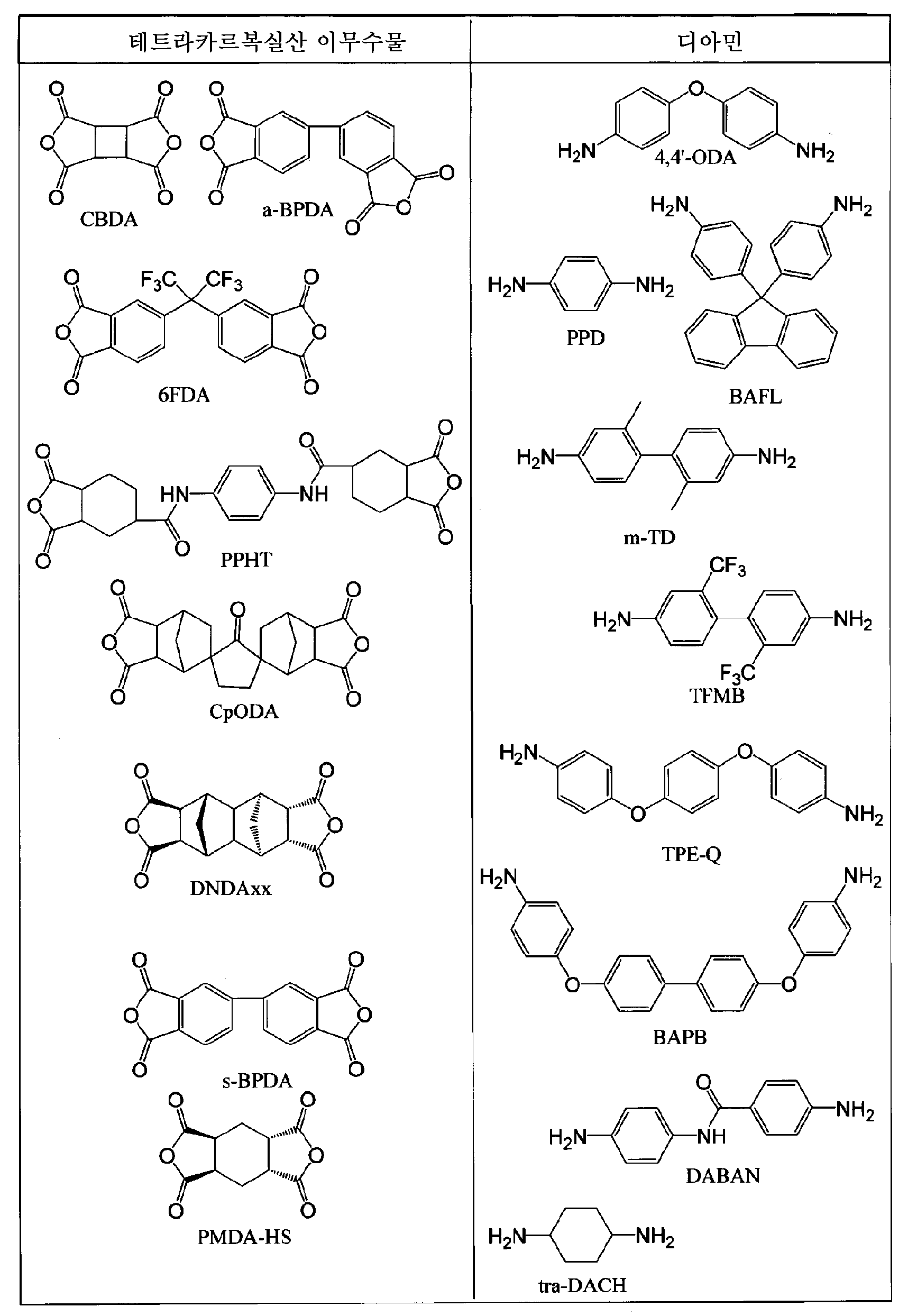
자외선 흡수제의 구조식을 아래에 표시한다.The structural formula of the ultraviolet absorber is shown below.
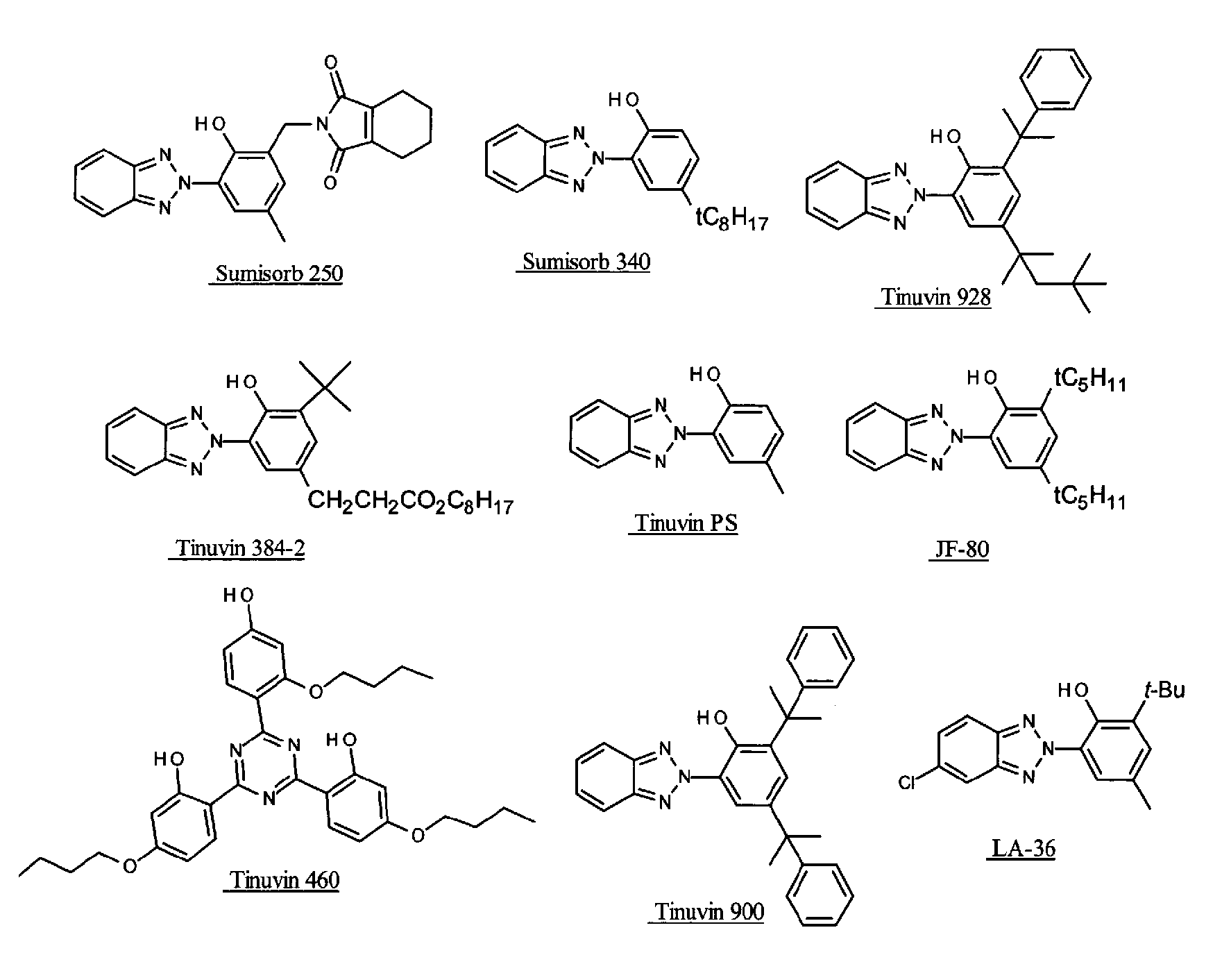
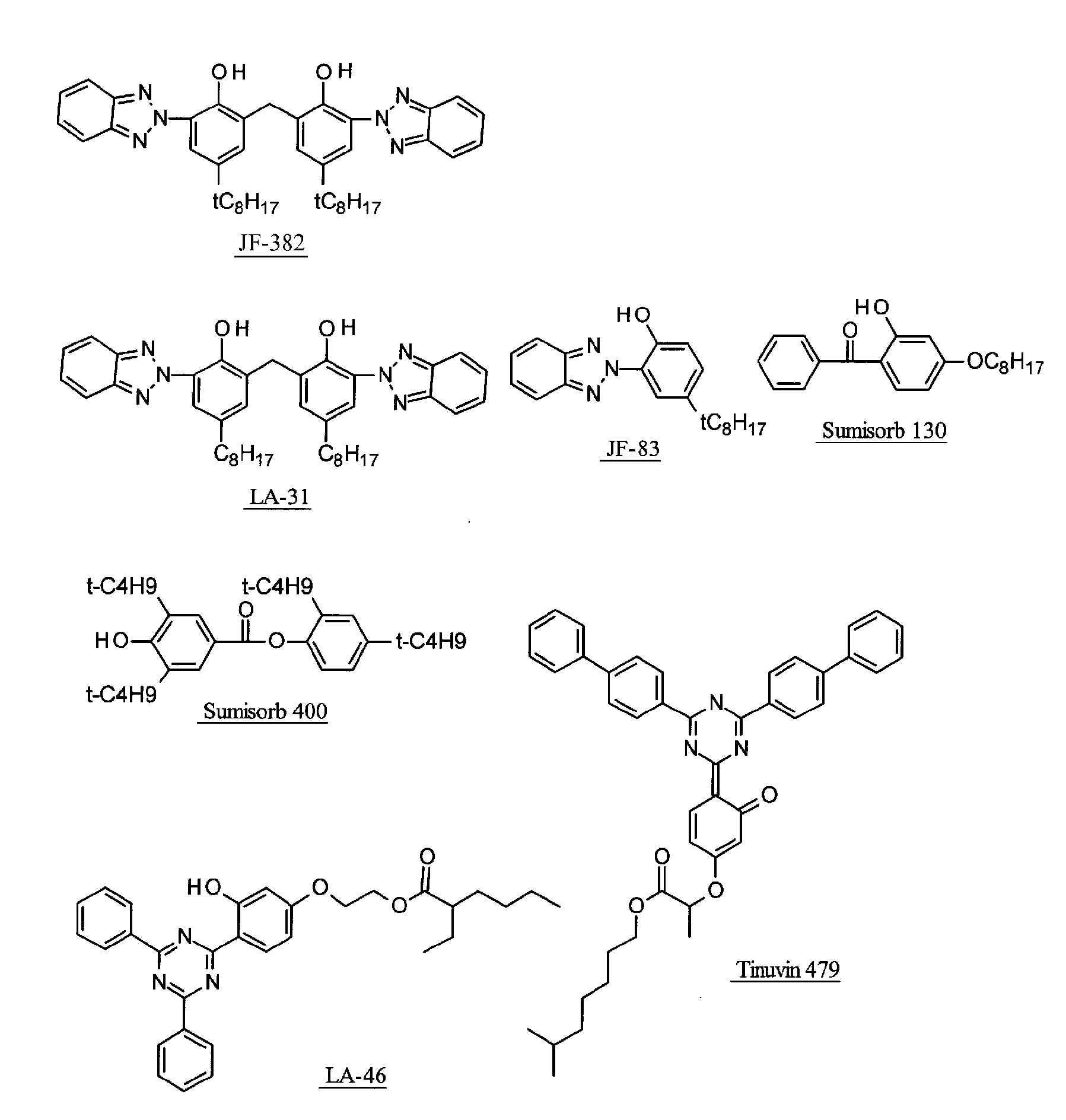
〔폴리아미드산 용액 1〕[Polyamic acid solution 1]
질소 가스로 치환한 반응 용기 중에 m-TD 2.12g(10밀리몰)을 넣고, DMAc를, 투입 단량체 총 질량(디아민 성분과 카르복실산 성분의 총합)이 12질량%로 되는 양인 31.33g을 첨가하고, 실온에서 1시간 교반하였다. 이 용액에 CBDA 1.76g(9밀리몰)과 CpODA 0.38g(1밀리몰)을 서서히 첨가하였다. 실온에서 12시간 교반하였다. 이 용액에 1,2-디메틸이미다졸 0.096g와 DMAc 0.096g의 혼합 용액을 첨가하고, 실온에서 1시간 교반하여, 균일하고 점조한 폴리이미드 전구체 용액(폴리아미드산 용액 1)을 얻었다.2.12 g (10 mmol) of m-TD was placed in a reactor purged with nitrogen gas, and DMAc was added to 31.33 g which is a total amount of the charged monomers (total sum of diamine component and carboxylic acid component) of 12 mass% , And the mixture was stirred at room temperature for 1 hour. To this solution was slowly added 1.76 g (9 mmol) of CBDA and 0.38 g (1 mmol) of CpODA. And the mixture was stirred at room temperature for 12 hours. To this solution was added a mixed solution of 0.096 g of 1,2-dimethylimidazole and 0.096 g of DMAc, and the mixture was stirred at room temperature for 1 hour to obtain a uniform and viscous polyimide precursor solution (polyamic acid solution 1).
〔폴리아미드산 용액 2〕[Polyamic acid solution 2]
질소 가스로 치환한 반응 용기 중에 4,4'-ODA 1.40g(7밀리몰)과 BAFL 1.05g(3밀리몰)을 넣고, NMP를, 투입 단량체 총 질량(디아민 성분과 카르복실산 성분의 총합)이 15질량%로 되는 양인 39.21g을 첨가하고, 실온에서 1시간 교반하였다. 이 용액에 PPHT 3.51g(7.5밀리몰)과 CpODA 0.96g(2.5밀리몰)을 서서히 첨가하였다. 실온에서 12시간 교반하여, 균일하고 점조한 폴리이미드 전구체 용액(폴리아미드산 용액 2)을 얻었다.1.40 g (7 mmol) of 4,4'-ODA and 1.05 g (3 mmol) of BAFL were placed in a reactor purged with nitrogen gas and NMP was added to the reaction vessel under a nitrogen atmosphere so that the total mass of the charged monomers (total of diamine component and carboxylic acid component) 15% by mass, was added to the solution, and the mixture was stirred at room temperature for 1 hour. 3.51 g (7.5 mmol) of PPHT and 0.96 g (2.5 mmol) of CpODA were slowly added to the solution. Followed by stirring at room temperature for 12 hours to obtain a homogeneous and viscous polyimide precursor solution (polyamic acid solution 2).
〔폴리이미드 용액 1〕[Polyimide solution 1]
질소 가스로 치환한 반응 용기 중에 TFMB 3.20g(10밀리몰)을 넣고, DMAc를, 투입 단량체 총 질량(디아민 성분과 카르복실산 성분의 총합)이 20질량%로 되는 양인 30.58g을 첨가하고, 실온에서 1시간 교반하였다. 이 용액에 6FDA 4.44g(10밀리몰)을 서서히 첨가하였다. 실온에서 12시간, 160℃에서 12시간 교반하고, 50℃까지 온도를 낮추고, DMAc 30.58g을 첨가하고, 50℃에서 3시간 교반하였다. 이 용액을 물 500mL에 천천히 적하하고, 폴리이미드를 침전시켰다. 폴리이미드를 회수, 건조하고, MIBK에 용해시켜, 20질량%의 균일하고 점조한 폴리이미드 용액(폴리이미드 용액 1)을 얻었다.3.20 g (10 mmol) of TFMB was placed in a reaction vessel substituted with nitrogen gas, and DMAc was added to 30.58 g which was a total amount of the monomer (sum of diamine component and carboxylic acid component) of 20 mass% Lt; / RTI > for 1 hour. To this solution was slowly added 4.44 g (10 mmol) of 6FDA. The mixture was stirred at room temperature for 12 hours and at 160 ° C for 12 hours. The temperature was lowered to 50 ° C, 30.58 g of DMAc was added, and the mixture was stirred at 50 ° C for 3 hours. This solution was slowly dropped into 500 mL of water, and polyimide was precipitated. The polyimide was recovered, dried and dissolved in MIBK to obtain a uniform and viscous polyimide solution (polyimide solution 1) of 20 mass%.
〔폴리아미드산 용액 3〕[Polyamic acid solution 3]
질소 가스로 치환한 반응 용기 중에 m-TD 2.12g(10밀리몰)을 넣고, DMAc를, 투입 단량체 총 질량(디아민 성분과 카르복실산 성분의 총합)이 12질량%로 되는 양인 31.33g을 첨가하고, 실온에서 1시간 교반하였다. 이 용액에 CBDA 1.76g(9밀리몰)과 CpODA 0.38g(1밀리몰)을 서서히 첨가하였다. 실온에서 12시간 교반하였다. 이 용액에 1,2-디메틸이미다졸 0.192g와 DMAc 0.192g의 혼합 용액을 첨가하고, 실온에서 1시간 교반하여, 균일하고 점조한 폴리이미드 전구체 용액(폴리아미드산 용액 3)을 얻었다.2.12 g (10 mmol) of m-TD was placed in a reactor purged with nitrogen gas, and DMAc was added to 31.33 g which is a total amount of the charged monomers (total sum of diamine component and carboxylic acid component) of 12 mass% , And the mixture was stirred at room temperature for 1 hour. To this solution was slowly added 1.76 g (9 mmol) of CBDA and 0.38 g (1 mmol) of CpODA. And the mixture was stirred at room temperature for 12 hours. To this solution was added a mixed solution of 0.192 g of 1,2-dimethylimidazole and 0.192 g of DMAc, followed by stirring at room temperature for 1 hour to obtain a homogeneous and viscous polyimide precursor solution (polyamic acid solution 3).
〔폴리아미드산 용액 4〕[Polyamic acid solution 4]
질소 가스로 치환한 반응 용기 중에 m-TD 2.12g(10밀리몰)을 넣고, DMAc를, 투입 단량체 총 질량(디아민 성분과 카르복실산 성분의 총합)이 12질량%로 되는 양인 31.33g을 첨가하고, 실온에서 1시간 교반하였다. 이 용액에 CBDA 1.76g(9밀리몰)과 CpODA 0.38g(1밀리몰)을 서서히 첨가하였다. 실온에서 12시간 교반하였다. 이 용액에 1,2-디메틸이미다졸 0.384g와 DMAc 0.384g의 혼합 용액을 첨가하고, 실온에서 1시간 교반하여, 균일하고 점조한 폴리이미드 전구체 용액(폴리아미드산 용액 4)을 얻었다.2.12 g (10 mmol) of m-TD was placed in a reactor purged with nitrogen gas, and DMAc was added to 31.33 g which is a total amount of the charged monomers (total sum of diamine component and carboxylic acid component) of 12 mass% , And the mixture was stirred at room temperature for 1 hour. To this solution was slowly added 1.76 g (9 mmol) of CBDA and 0.38 g (1 mmol) of CpODA. And the mixture was stirred at room temperature for 12 hours. To this solution was added a mixed solution of 0.384 g of 1,2-dimethylimidazole and 0.384 g of DMAc, and the mixture was stirred at room temperature for 1 hour to obtain a uniform and viscous polyimide precursor solution (polyamic acid solution 4).
〔폴리아미드산 용액 5〕[Polyamic acid solution 5]
질소 가스로 치환한 반응 용기 중에 4,4'-ODA 20.02g(0.100몰)을 넣고, DMAc를, 투입 단량체 총 질량(디아민 성분과 카르복실산 성분의 총합)이 17질량%로 되는 양인 207.21g을 첨가하고, 실온에서 1시간 교반하였다. 이 용액에 PMDA-HS 22.41g(0.100몰)을 서서히 첨가하였다. 실온에서 12시간 교반하여, 균일하고 점조한 폴리이미드 전구체 용액(폴리아미드산 용액 5)을 얻었다.20.02 g (0.100 mol) of 4,4'-ODA was placed in a reaction vessel which was substituted with nitrogen gas, and DMAc was added to 207.21 g (corresponding to the sum total of the diamine component and the carboxylic acid component) of 17 mass% And the mixture was stirred at room temperature for 1 hour. To this solution was slowly added 22.41 g (0.100 mol) of PMDA-HS. Followed by stirring at room temperature for 12 hours to obtain a homogeneous and viscous polyimide precursor solution (polyamic acid solution 5).
〔폴리아미드산 용액 6〕[Polyamic acid solution 6]
질소 가스로 치환한 반응 용기 중에 tra-DACH10.81g(0.100몰)을 넣고, DMAc를, 투입 단량체 총 질량(디아민 성분과 카르복실산 성분의 총합)이 12질량%로 되는 양인 2950.64g을 첨가하고, 실온에서 1시간 교반하였다. 이 용액에 s-BPDA 28.69g(0.0975몰)과 a-BPDA 0.74g(0.0025몰)을 서서히 첨가하였다. 50℃에서 12시간 교반하여, 균일하고 점조한 폴리이미드 전구체 용액(폴리아미드산 용액 6)을 얻었다.(0.100 mol) of tra-DACH was placed in a reaction vessel substituted with nitrogen gas and DMAc was added in an amount of 2950.64 g which is a total amount of the charged monomers (total sum of diamine component and carboxylic acid component) of 12 mass% , And the mixture was stirred at room temperature for 1 hour. 28.69 g (0.0975 mol) of s-BPDA and 0.74 g (0.0025 mol) of a-BPDA were gradually added to this solution. Followed by stirring at 50 DEG C for 12 hours to obtain a homogeneous and viscous polyimide precursor solution (polyamic acid solution 6).
〔폴리아미드산 용액 7〕[Polyamic acid solution 7]
질소 가스로 치환한 반응 용기 중에 4,4'-ODA 20.02g(0.100몰)을 넣고, DMAc를, 투입 단량체 총 질량(디아민 성분과 카르복실산 성분의 총합)이 20질량%로 되는 양인 233.85g을 첨가하고, 실온에서 1시간 교반하였다. 이 용액에 CpODA 38.44g(0.100몰)을 서서히 첨가하였다. 실온에서 12시간 교반하여, 균일하고 점조한 폴리이미드 전구체 용액(폴리아미드산 용액 5)을 얻었다.20.02 g (0.100 mol) of 4,4'-ODA was placed in a reactor purged with nitrogen gas, and DMAc was charged to 233.85 g (a total amount of diamine component and carboxylic acid component) of 20 mass% And the mixture was stirred at room temperature for 1 hour. 38.44 g (0.100 mol) of CpODA was gradually added to this solution. Followed by stirring at room temperature for 12 hours to obtain a homogeneous and viscous polyimide precursor solution (polyamic acid solution 5).
〔폴리아미드산 용액 8〕[Polyamic acid solution 8]
질소 가스로 치환한 반응 용기 중에 m-TD 1.87g(8.8밀리몰)과 TPE-Q 0.35g(1.2밀리몰)을 넣고, DMAc를, 투입 단량체 총 질량(디아민 성분과 카르복실산 성분의 총합)이 15질량%로 되는 양인 24.37g을 첨가하고, 실온에서 1시간 교반하였다. 이 용액에 CBDA 1.76g(9밀리몰)과 CpODA 0.38g(1밀리몰)을 서서히 첨가하였다. 실온에서 12시간 교반하였다. 이 용액에 1,2-디메틸이미다졸 0.384g와 DMAc 0.384g의 혼합 용액을 첨가하고, 실온에서 1시간 교반하여, 균일하고 점조한 폴리이미드 전구체 용액(폴리아미드산 용액 8)을 얻었다.1.87 g (8.8 mmol) of m-TD and 0.35 g (1.2 mmol) of TPE-Q were placed in a reactor purged with nitrogen gas and DMAc was added to the reactor so that the total monomer mass (sum of diamine component and carboxylic acid component) 24.37 g in terms of mass% was added, and the mixture was stirred at room temperature for 1 hour. To this solution was slowly added 1.76 g (9 mmol) of CBDA and 0.38 g (1 mmol) of CpODA. And the mixture was stirred at room temperature for 12 hours. To this solution was added a mixed solution of 0.384 g of 1,2-dimethylimidazole and 0.384 g of DMAc, and the mixture was stirred at room temperature for 1 hour to obtain a uniform and viscous polyimide precursor solution (polyamic acid solution 8).
〔폴리아미드산 용액 9〕[Polyamic acid solution 9]
질소 가스로 치환한 반응 용기 중에 m-TD 1.61g(7.6밀리몰)과 TPE-Q 0.70g(1.2밀리몰)을 넣고, DMAc를, 투입 단량체 총 질량(디아민 성분과 카르복실산 성분의 총합)이 15질량%로 되는 양인 24.91g을 첨가하고, 실온에서 1시간 교반하였다. 이 용액에 CBDA 1.76g(9밀리몰)과 CpODA 0.38g(1밀리몰)을 서서히 첨가하였다. 실온에서 12시간 교반하였다. 이 용액에 1,2-디메틸이미다졸 0.384g와 DMAc 0.384g의 혼합 용액을 첨가하고, 실온에서 1시간 교반하여, 균일하고 점조한 폴리이미드 전구체 용액(폴리아미드산 용액 9)을 얻었다.1.61 g (7.6 mmol) of m-TD and 0.70 g (1.2 mmol) of TPE-Q were placed in a reactor purged with nitrogen gas and DMAc was added to the reactor under a nitrogen atmosphere so that the total mass of the charged monomers (sum of diamine component and carboxylic acid component) 24.91 g in terms of mass% was added, and the mixture was stirred at room temperature for 1 hour. To this solution was slowly added 1.76 g (9 mmol) of CBDA and 0.38 g (1 mmol) of CpODA. And the mixture was stirred at room temperature for 12 hours. To this solution was added a mixed solution of 0.384 g of 1,2-dimethylimidazole and 0.384 g of DMAc, followed by stirring at room temperature for 1 hour to obtain a homogeneous and viscous polyimide precursor solution (polyamic acid solution 9).
〔폴리아미드산 용액 10〕[Polyamic acid solution 10]
질소 가스로 치환한 반응 용기 중에 m-TD 1.27g(6.0밀리몰)과 TPE-Q 1.17g(1.2밀리몰)을 넣고, DMAc를, 투입 단량체 총 질량(디아민 성분과 카르복실산 성분의 총합)이 15질량%로 되는 양인 25.64g을 첨가하고, 실온에서 1시간 교반하였다. 이 용액에 CBDA 1.76g(9밀리몰)과 CpODA 0.38g(1밀리몰)을 서서히 첨가하였다. 실온에서 12시간 교반하였다. 이 용액에 1,2-디메틸이미다졸 0.384g와 DMAc 0.384g의 혼합 용액을 첨가하고, 실온에서 1시간 교반하여, 균일하고 점조한 폴리이미드 전구체 용액(폴리아미드산 용액 10)을 얻었다.1.27 g (6.0 mmol) of m-TD and 1.17 g (1.2 mmol) of TPE-Q were placed in a reactor purged with nitrogen gas and DMAc was added to the reactor so that the total mass of the charged monomers (total of diamine component and carboxylic acid component) 25.64 g in terms of mass% was added, and the mixture was stirred at room temperature for 1 hour. To this solution was slowly added 1.76 g (9 mmol) of CBDA and 0.38 g (1 mmol) of CpODA. And the mixture was stirred at room temperature for 12 hours. To this solution was added a mixed solution of 0.384 g of 1,2-dimethylimidazole and 0.384 g of DMAc, followed by stirring at room temperature for 1 hour to obtain a homogeneous and viscous polyimide precursor solution (polyamic acid solution 10).
〔폴리아미드산 용액 11〕[Polyamic acid solution 11]
질소 가스로 치환한 반응 용기 중에 m-TD 2.12g(10밀리몰)을 넣고, DMAc를, 투입 단량체 총 질량(디아민 성분과 카르복실산 성분의 총합)이 20질량%로 되는 양인 24.71g을 첨가하고, 실온에서 1시간 교반하였다. 이 용액에 PMDA-HS 2.24g(10밀리몰)을 서서히 첨가하였다. 실온에서 12시간 교반하여, 균일하고 점조한 폴리이미드 전구체 용액(폴리아미드산 용액 11)을 얻었다.2.12 g (10 mmol) of m-TD was placed in a reaction vessel purged with nitrogen gas, and 24.71 g of DMAc, which is a total amount of the charged monomers (total sum of diamine component and carboxylic acid component) of 20 mass% , And the mixture was stirred at room temperature for 1 hour. To this solution was slowly added 2.24 g (10 mmol) of PMDA-HS. Followed by stirring at room temperature for 12 hours to obtain a uniform and viscous polyimide precursor solution (polyamic acid solution 11).
〔폴리아미드산 용액 12〕[Polyamic acid solution 12]
질소 가스로 치환한 반응 용기 중에 TFMB 3.20g(10밀리몰)을 넣고, DMAc를, 투입 단량체 총 질량(디아민 성분과 카르복실산 성분의 총합)이 25질량%로 되는 양인 23.66g을 첨가하고, 실온에서 1시간 교반하였다. 이 용액에 PPHT 4.69g(10밀리몰)을 서서히 첨가하였다. 실온에서 12시간 교반하여, 균일하고 점조한 폴리이미드 전구체 용액(폴리아미드산 용액 12)을 얻었다.3.20 g (10 mmol) of TFMB was placed in a reaction vessel substituted with nitrogen gas, and DMAc was added to 23.66 g which was a total amount of the charged monomers (total of diamine component and carboxylic acid component) of 25 mass% Lt; / RTI > for 1 hour. To this solution was slowly added 4.69 g (10 mmol) of PPHT. Followed by stirring at room temperature for 12 hours to obtain a homogeneous and viscous polyimide precursor solution (polyamic acid solution 12).
〔폴리아미드산 용액 13〕[Polyamic acid solution 13]
질소 가스로 치환한 반응 용기 중에 TFMB 3.20g(10밀리몰)을 넣고, DMAc를, 투입 단량체 총 질량(디아민 성분과 카르복실산 성분의 총합)이 20질량%로 되는 양인 20.64g을 첨가하고, 실온에서 1시간 교반하였다. 이 용액에 CBDA 1.96g(10밀리몰)을 서서히 첨가하였다. 실온에서 12시간 교반하여, 균일하고 점조한 폴리이미드 전구체 용액(폴리아미드산 용액 13)을 얻었다.3.20 g (10 mmol) of TFMB was placed in a reaction vessel substituted with nitrogen gas, and DMAc was added to 20.64 g of 20% by mass of the total mass of the charged monomers (sum of diamine component and carboxylic acid component) Lt; / RTI > for 1 hour. To this solution was slowly added 1.96 g (10 mmol) of CBDA. Followed by stirring at room temperature for 12 hours to obtain a homogeneous and viscous polyimide precursor solution (polyamic acid solution 13).
〔폴리아미드산 용액 14〕[Polyamic acid solution 14]
질소 가스로 치환한 반응 용기 중에 DABAN 1.59g(7밀리몰)과 PPD 0.14g(1밀리몰)과 BAPB 0.93g(2밀리몰)을 넣고, NMP를, 투입 단량체 총 질량(디아민 성분과 카르복실산 성분의 총합)이 22질량%로 되는 양인 24.85g을 첨가하고, 실온에서 1시간 교반하였다. 이 용액에 DNDAxx 3.95g(10밀리몰)을 서서히 첨가하였다. 실온에서 12시간 교반하여, 균일하고 점조한 폴리이미드 전구체 용액(폴리아미드산 용액 14)을 얻었다.1.59 g (7 mmol) of DABAN, 0.14 g (1 mmol) of PPD and 0.93 g (2 mmol) of BAPB were placed in a reaction vessel substituted with nitrogen gas, and NMP was added to the reactor to adjust the total amount of monomers (diamine component and carboxylic acid component Total amount) of 22% by mass was added, and the mixture was stirred at room temperature for 1 hour. To this solution 3.95 g (10 mmol) of DNDAxx was slowly added. Followed by stirring at room temperature for 12 hours to obtain a homogeneous and viscous polyimide precursor solution (polyamic acid solution 14).
〔폴리아미드산 용액 15〕[Polyamic acid solution 15]
질소 가스로 치환한 반응 용기 중에 TFMB 3.20g(10밀리몰)을 넣고, DMAc를, 투입 단량체 총 질량(디아민 성분과 카르복실산 성분의 총합)이 20질량%로 되는 양인 28.16g을 첨가하고, 실온에서 1시간 교반하였다. 이 용액에 CpODA 3.84g(10밀리몰)을 서서히 첨가하였다. 실온에서 12시간 교반하여, 균일하고 점조한 폴리이미드 전구체 용액(폴리아미드산 용액 15)을 얻었다.3.20 g (10 mmol) of TFMB was placed in a reaction vessel substituted with nitrogen gas, and DMAc was added to 28.16 g which was a total amount of the charged monomers (total of diamine component and carboxylic acid component) of 20 mass% Lt; / RTI > for 1 hour. 3.84 g (10 mmol) of CpODA was slowly added to this solution. Followed by stirring at room temperature for 12 hours to obtain a homogeneous and viscous polyimide precursor solution (polyamic acid solution 15).
〔폴리아미드산 용액 16〕[Polyamic acid solution 16]
질소 가스로 치환한 반응 용기 중에 TFMB 3.20g(10밀리몰)을 넣고, DMAc를, 투입 단량체 총 질량(디아민 성분과 카르복실산 성분의 총합)이 20질량%로 되는 양인 28.76g을 첨가하고, 실온에서 1시간 교반하였다. 이 용액에 6FDA 3.11g(7밀리몰)과 s-BPDA 0.88g(3밀리몰)을 서서히 첨가하였다. 실온에서 12시간 교반하여, 균일하고 점조한 폴리이미드 전구체 용액(폴리아미드산 용액 16)을 얻었다.3.20 g (10 mmol) of TFMB was placed in a reaction vessel substituted with nitrogen gas, and DMAc was added to 28.76 g of a total amount of monomers (sum of diamine component and carboxylic acid component) of 20 mass% Lt; / RTI > for 1 hour. To this solution was slowly added 3.11 g (7 mmol) of 6FDA and 0.88 g (3 mmol) of s-BPDA. Followed by stirring at room temperature for 12 hours to obtain a homogeneous and viscous polyimide precursor solution (polyamic acid solution 16).
〔실시예 1〕[Example 1]
LA-46을 DMAc에 용해시킨 용액을, 얻어지는 폴리이미드 100중량부에 대하여 2중량부로 되는 양을 폴리아미드산 용액 1에 첨가하고, 실온에서 1시간 교반하여, 균일하고 점조한 폴리이미드 전구체 조성물을 얻었다. 바니시의 평가 결과를 표 2에 나타내었다.A solution obtained by dissolving LA-46 in DMAc in an amount of 2 parts by weight based on 100 parts by weight of the obtained polyimide was added to the polyamic acid solution 1 and stirred at room temperature for 1 hour to obtain a uniform and viscous polyimide precursor composition . The evaluation results of the varnish are shown in Table 2.
PTFE제 멤브레인 필터로 여과한 폴리이미드 전구체 조성물을 유리 기판에 도포하고, 질소 분위기 하에서, 그대로 위에서 실온부터 260℃까지 가열하여 열적으로 이미드화를 행하여, 무색 투명한 폴리이미드 필름/유리 적층체를 얻었다. 이어서, 얻어진 폴리이미드 필름/유리 적층체를 물에 침지한 후 박리하고, 건조하여, 폴리이미드 필름을 얻었다. 폴리이미드 필름의 평가 결과를 표 2에 나타내었다.The polyimide precursor composition filtered through a PTFE membrane filter was coated on a glass substrate and thermally imidated by heating from room temperature to 260 캜 in a nitrogen atmosphere to obtain a colorless transparent polyimide film / glass laminate. Subsequently, the obtained polyimide film / glass laminate was immersed in water and peeled off and dried to obtain a polyimide film. The evaluation results of the polyimide film are shown in Table 2.
〔실시예 2 내지 19, 비교예 2, 참고예 1 내지 3〕[Examples 2 to 19, Comparative Example 2, Reference Examples 1 to 3]
LA-46 대신 표에 기재된 자외선 흡수제를 사용하고, 표에 기재된 양으로 되도록 폴리아미드산 용액 1에 첨가한 것 이외에는 실시예 1과 동일한 조작을 행하였다. 바니시 및 폴리이미드 필름의 평가 결과를 표 2에 나타내었다.The procedure of Example 1 was repeated except that the ultraviolet absorber described in the table was used instead of LA-46 and added to the polyamic acid solution 1 in an amount as shown in the table. The evaluation results of varnishes and polyimide films are shown in Table 2.
〔비교예 1〕[Comparative Example 1]
PTFE제 멤브레인 필터로 여과한 폴리아미드산 용액 1을 유리 기판에 도포하고, 질소 분위기 하에서, 그대로 위에서 실온부터 260℃까지 가열하여 열적으로 이미드화를 행하여, 무색 투명한 폴리이미드 필름/유리 적층체를 얻었다. 이어서, 얻어진 폴리이미드 필름/유리 적층체를 물에 침지한 후 박리하고, 건조하여, 폴리이미드 필름을 얻었다. 폴리이미드 필름의 평가 결과를 표 2에 나타내었다.The polyamic acid solution 1 filtered through a PTFE membrane filter was applied to a glass substrate and thermally imidated by heating from room temperature to 260 ° C in a nitrogen atmosphere to obtain a colorless transparent polyimide film / glass laminate . Subsequently, the obtained polyimide film / glass laminate was immersed in water and peeled off and dried to obtain a polyimide film. The evaluation results of the polyimide film are shown in Table 2.
〔실시예 20〕[Example 20]
Sumisorb 340을 NMP에 용해시킨 용액을, 얻어지는 폴리이미드 100중량부에 대하여 2중량부로 되는 양을 폴리아미드산 용액 2에 첨가하고, 실온에서 1시간 교반하여, 균일하고 점조한 폴리이미드 전구체 조성물을 얻었다. 바니시의 평가 결과를 표 2에 나타내었다.A solution obtained by dissolving Sumisorb 340 in NMP in an amount of 2 parts by weight based on 100 parts by weight of the obtained polyimide was added to the polyamic acid solution 2 and stirred at room temperature for 1 hour to obtain a uniform and viscous polyimide precursor composition . The evaluation results of the varnish are shown in Table 2.
PTFE제 멤브레인 필터로 여과한 폴리이미드 전구체 조성물을 유리 기판에 도포하고, 질소 분위기 하에서, 그대로 위에서 실온부터 350℃까지 가열하여 열적으로 이미드화를 행하여, 무색 투명한 폴리이미드 필름/유리 적층체를 얻었다. 이어서, 얻어진 폴리이미드 필름/유리 적층체를 물에 침지한 후 박리하고, 건조하여, 폴리이미드 필름을 얻었다. 폴리이미드 필름의 평가 결과를 표 2에 나타내었다.The polyimide precursor composition filtered through a PTFE membrane filter was applied to a glass substrate and thermally imidized by heating from room temperature to 350 DEG C in a nitrogen atmosphere to obtain a colorless transparent polyimide film / glass laminate. Subsequently, the obtained polyimide film / glass laminate was immersed in water and peeled off and dried to obtain a polyimide film. The evaluation results of the polyimide film are shown in Table 2.
〔비교예 3〕[Comparative Example 3]
PTFE제 멤브레인 필터로 여과한 폴리아미드산 용액 2를 유리 기판에 도포하고, 질소 분위기 하에서, 그대로 위에서 실온부터 350℃까지 가열하여 열적으로 이미드화를 행하여, 무색 투명한 폴리이미드 필름/유리 적층체를 얻었다. 이어서, 얻어진 폴리이미드 필름/유리 적층체를 물에 침지한 후 박리하고, 건조하여, 폴리이미드 필름을 얻었다. 폴리이미드 필름의 평가 결과를 표 2에 나타내었다.The polyamic acid solution 2 filtered through a PTFE membrane filter was applied to a glass substrate and thermally imidated by heating from room temperature to 350 DEG C in a nitrogen atmosphere to obtain a colorless transparent polyimide film / glass laminate . Subsequently, the obtained polyimide film / glass laminate was immersed in water, peeled off, and dried to obtain a polyimide film. The evaluation results of the polyimide film are shown in Table 2.
〔비교예 4, 5〕[Comparative Examples 4 and 5]
Tinuvin 384-2를 MIBK에 용해시킨 용액을, 얻어지는 폴리이미드 100중량부에 대하여 1중량부로 되는 양을 폴리이미드 용액 1에 첨가하고, 실온에서 1시간 교반하여, 균일하고 점조한 폴리이미드 용액 조성물을 얻었다. 바니시의 평가 결과를 표 2에 나타내었다.A solution obtained by dissolving Tinuvin 384-2 in MIBK was added to polyimide solution 1 in an amount of 1 part by weight based on 100 parts by weight of the obtained polyimide and stirred at room temperature for 1 hour to obtain a uniform and viscous polyimide solution composition . The evaluation results of the varnish are shown in Table 2.
PTFE제 멤브레인 필터로 여과한 폴리이미드 용액 조성물을 유리 기판에 도포하고, 질소 분위기 하에서, 그대로 위에서 실온부터 130℃와 200℃(각각 비교예 4와 5)까지 가열하여 열적으로 이미드화를 행하여, 무색 투명한 폴리이미드 필름/유리 적층체를 얻었다. 이어서, 얻어진 폴리이미드 필름/유리 적층체를 물에 침지한 후 박리하고, 건조하여, 폴리이미드 필름을 얻었다. 폴리이미드 필름의 평가 결과를 표 2에 나타내었다.The polyimide solution composition filtered through a PTFE membrane filter was applied to a glass substrate and thermally imidated by heating from room temperature to 130 ° C and 200 ° C (Comparative Examples 4 and 5, respectively) in a nitrogen atmosphere, A transparent polyimide film / glass laminate was obtained. Subsequently, the obtained polyimide film / glass laminate was immersed in water and peeled off and dried to obtain a polyimide film. The evaluation results of the polyimide film are shown in Table 2.
〔실시예 21 내지 23〕[Examples 21 to 23]
LA-46 대신에 표 3에 기재된 자외선 흡수제(Tinuvin PS)를 사용하고, 표 3에 기재된 양(2중량부)으로 되도록 폴리아미드산 용액 1에 첨가한 것 이외에는 실시예 1과 동일한 조작을 행하였다. 단, 폴리이미드 전구체 조성물의 도포량을 변화시킨 결과, 폴리이미드 필름의 두께가 표 3과 같이 되었다(다른 실시예, 비교예에서도 동일함). 바니시 및 폴리이미드 필름의 평가 결과를 표 3에 나타내었다.The procedure of Example 1 was repeated except that the ultraviolet absorbent (Tinuvin PS) shown in Table 3 was used in place of LA-46 and the resultant was added to the polyamic acid solution 1 so as to be the amount (2 parts by weight) . However, as a result of changing the application amount of the polyimide precursor composition, the thickness of the polyimide film was as shown in Table 3 (the same is true in other examples and comparative examples). The evaluation results of varnishes and polyimide films are shown in Table 3.
〔실시예 24〕[Example 24]
폴리아미드산 용액 1 대신에 폴리아미드산 용액 3을 사용한 것 이외에는, 실시예 21과 동일한 조작을 행하였다. 바니시 및 폴리이미드 필름의 평가 결과를 표 3에 나타내었다.The procedure of Example 21 was repeated except that polyamic acid solution 3 was used instead of polyamic acid solution 1. The evaluation results of varnishes and polyimide films are shown in Table 3.
〔실시예 25, 26〕[Examples 25, 26]
자외선 흡수제(Tinuvin PS)의 양을 표 3에 기재된 양으로 되도록 하고, 폴리아미드산 용액 4를 사용한 것 이외에는, 실시예 1과 동일한 조작을 행하였다. 바니시 및 폴리이미드 필름의 평가 결과를 표 3에 나타내었다.The same procedure as in Example 1 was carried out except that the amount of the ultraviolet absorber (Tinuvin PS) was adjusted to the amount described in Table 3, and the polyamic acid solution 4 was used. The evaluation results of varnishes and polyimide films are shown in Table 3.
〔비교예 6 내지 8〕[Comparative Examples 6 to 8]
자외선 흡수제를 사용하지 않고, 폴리아미드산 용액 1(비교예 8), 폴리아미드산 용액 3(비교예 9), 폴리아미드산 용액 4(비교예 10)를 각각 사용하고, 실시예 1과 동일한 조작을 행하였다. 바니시 및 폴리이미드 필름의 평가 결과를 표 3에 나타내었다.Polyamic acid solution 1 (Comparative Example 8), polyamic acid solution 3 (Comparative Example 9), and polyamic acid solution 4 (Comparative Example 10) were used in place of the ultraviolet absorber, . The evaluation results of varnishes and polyimide films are shown in Table 3.
〔실시예 27, 28〕[Examples 27, 28]
표 3에 기재된 자외선 흡수제(Tinuvin PS) 및 폴리아미드산 용액을, 표 3에 기재된 양으로 사용하고, 실시예 1과 동일한 조작을 행하여, 균일하고 점조한 폴리이미드 전구체 조성물을 얻었다. 바니시의 평가 결과를 표 3에 나타내었다. 온도를 350℃까지 가열하여 이미드화를 행한 것 이외에는, 실시예 1과 마찬가지로 하여 폴리이미드 필름을 얻었다. 폴리이미드 필름의 평가 결과를 표 3에 나타내었다.Using the ultraviolet absorber (Tinuvin PS) and the polyamic acid solution described in Table 3 in the amounts shown in Table 3, the same operations as in Example 1 were carried out to obtain a uniform and viscous polyimide precursor composition. The evaluation results of the varnish are shown in Table 3. A polyimide film was obtained in the same manner as in Example 1 except that imidization was carried out by heating the temperature to 350 占 폚. The evaluation results of the polyimide film are shown in Table 3.
〔비교예 9, 10〕[Comparative Examples 9 and 10]
자외선 흡수제를 사용하지 않고, 폴리아미드산 용액 5(비교예 9), 폴리아미드산 용액 6(비교예 10을 사용하고, 실시예 1과 동일한 조작을 행하여, 균일하고 점조한 폴리이미드 전구체 조성물을 얻었다. 바니시의 평가 결과를 표 3에 나타내었다. 온도를 350℃까지 가열하여 이미드화를 행한 것 이외에는, 실시예 1과 마찬가지로 하여 폴리이미드 필름을 얻었다. 폴리이미드 필름의 평가 결과를 표 3에 나타내었다.A uniform and viscous polyimide precursor composition was obtained by using the polyamic acid solution 5 (Comparative Example 9) and the polyamic acid solution 6 (Comparative Example 10) in the same manner as in Example 1 without using an ultraviolet absorber . The evaluation results of the varnish are shown in Table 3. A polyimide film was obtained in the same manner as in Example 1 except that imidization was carried out by heating to 350 DEG C. The evaluation results of the polyimide film are shown in Table 3 .
〔실시예 29〕[Example 29]
표 3에 기재된 자외선 흡수제(Tinuvin PS) 및 폴리아미드산 용액(폴리아미드산 용액 7)을 표 3에 기재된 양으로 사용하고, 실시예 1과 동일한 조작을 행하여, 균일하고 점조한 폴리이미드 전구체 조성물을 얻었다. 바니시의 평가 결과를 표 3에 나타내었다. 온도를 400℃까지 가열하여 이미드화를 행한 것 이외에는, 실시예 1과 마찬가지로 하여 폴리이미드 필름을 얻었다. 폴리이미드 필름의 평가 결과를 표 3에 나타내었다.Using the ultraviolet absorber (Tinuvin PS) and polyamic acid solution (polyamic acid solution 7) shown in Table 3 in the amounts shown in Table 3, the same operations as in Example 1 were carried out to obtain a uniform and viscous polyimide precursor composition . The evaluation results of the varnish are shown in Table 3. A polyimide film was obtained in the same manner as in Example 1 except that imidization was carried out by heating the temperature to 400 占 폚. The evaluation results of the polyimide film are shown in Table 3.
〔비교예 11〕[Comparative Example 11]
자외선 흡수제를 사용하지 않고, 폴리아미드산 용액 7을 사용하고, 실시예 1과 동일한 조작을 행하여, 균일하고 점조한 폴리이미드 전구체 조성물을 얻었다. 바니시의 평가 결과를 표 3에 나타내었다. 온도를 400℃까지 가열하여 이미드화를 행한 것 이외에는, 실시예 1과 마찬가지로 하여 폴리이미드 필름을 얻었다. 폴리이미드 필름의 평가 결과를 표 3에 나타내었다.A uniform and viscous polyimide precursor composition was obtained by carrying out the same operation as in Example 1 except that the polyamic acid solution 7 was used without using an ultraviolet absorber. The evaluation results of the varnish are shown in Table 3. A polyimide film was obtained in the same manner as in Example 1 except that imidization was carried out by heating the temperature to 400 占 폚. The evaluation results of the polyimide film are shown in Table 3.
〔실시예 30〕[Example 30]
자외선 흡수제(Tinuvin PS)를 DMAc에 용해시킨 용액을, 얻어지는 폴리이미드 100중량부에 대하여 2중량부로 되는 양을 폴리아미드산 용액 8에 첨가하고, 실온에서 1시간 교반하여, 균일하고 점조한 폴리이미드 전구체 조성물을 얻었다. 바니시의 평가 결과를 표 4에 나타내었다.A solution obtained by dissolving an ultraviolet absorber (Tinuvin PS) in DMAc was added to the polyamic acid solution 8 in an amount of 2 parts by weight based on 100 parts by weight of the resulting polyimide, and the mixture was stirred at room temperature for 1 hour to obtain a uniform and viscous polyimide To obtain a precursor composition. The evaluation results of the varnish are shown in Table 4.
PTFE제 멤브레인 필터로 여과한 폴리이미드 전구체 조성물을 유필렉스(등록 상표)-125S 상에 도포하고, 질소 분위기 하에서, 그대로 위에서 실온부터 260℃까지 가열하여 열적으로 이미드화를 행하여, 무색 투명한 폴리이미드 필름/유필렉스(등록 상표)-125S 적층체를 얻었다. 이어서, 얻어진 폴리이미드 필름/유필렉스(등록 상표)-125S 적층체로부터 폴리이미드 필름 박리하였다. 또한, 박리는 물 등에 침지하지 않더라도, 용이하게 박리 가능하였다. 얻어진 폴리이미드 필름의 평가 결과를 표 4에 나타내었다.The polyimide precursor composition filtered through a PTFE membrane filter was coated on Yufilex (registered trademark) -125S and thermally imidized by heating from room temperature to 260 ° C in a nitrogen atmosphere to obtain a colorless transparent polyimide film / Yupilex (registered trademark) -125S laminated body was obtained. Then, the polyimide film was peeled from the obtained polyimide film / Yufilex (registered trademark) -125S laminate. Further, the peeling was easily peelable even if it was not immersed in water or the like. The evaluation results of the obtained polyimide film are shown in Table 4.
〔비교예 12〕[Comparative Example 12]
자외선 흡수제를 사용하지 않고, 폴리아미드산 용액 8을 사용하고, 실시예 30과 동일한 조작을 행하였다. 바니시 및 폴리이미드 필름의 평가 결과를 표 4에 나타내었다.The same operation as in Example 30 was carried out using polyamic acid solution 8 without using an ultraviolet absorber. The evaluation results of varnishes and polyimide films are shown in Table 4.
〔실시예 31 내지 33〕[Examples 31 to 33]
자외선 흡수제(Tinuvin PS)의 양을 표 4에 기재된 양으로 되도록 하고, 폴리아미드산 용액 9를 사용한 것 이외에는, 실시예 30과 동일한 조작을 행하였다. 바니시 및 폴리이미드 필름의 평가 결과를 표 4에 나타내었다.The procedure of Example 30 was repeated except that the amount of the ultraviolet absorber (Tinuvin PS) was adjusted to the amount described in Table 4, and the polyamic acid solution 9 was used. The evaluation results of varnishes and polyimide films are shown in Table 4.
〔비교예 13〕[Comparative Example 13]
자외선 흡수제를 사용하지 않고, 폴리아미드산 용액 9를 사용하고, 실시예 30과 동일한 조작을 행하였다. 바니시 및 폴리이미드 필름의 평가 결과를 표 4에 나타내었다.The procedure of Example 30 was repeated except that the ultraviolet absorber was not used and polyamic acid solution 9 was used. The evaluation results of varnishes and polyimide films are shown in Table 4.
〔실시예 34〕[Example 34]
자외선 흡수제(Tinuvin PS)의 양을 표 4에 기재된 양으로 되도록 하고, 폴리아미드산 용액 10을 사용한 것 이외에는, 실시예 30과 동일한 조작을 행하였다. 바니시 및 폴리이미드 필름의 평가 결과를 표 4에 나타내었다.The procedure of Example 30 was repeated except that the amount of the ultraviolet absorber (Tinuvin PS) was adjusted to the amount described in Table 4, and the polyamic acid solution 10 was used. The evaluation results of varnishes and polyimide films are shown in Table 4.
〔비교예 14〕[Comparative Example 14]
자외선 흡수제를 사용하지 않고, 폴리아미드산 용액 10을 사용하고, 실시예 30과 동일한 조작을 행하였다. 바니시 및 폴리이미드 필름의 평가 결과를 표 4에 나타내었다.The procedure of Example 30 was repeated except that the ultraviolet absorber was not used and the polyamic acid solution 10 was used. The evaluation results of varnishes and polyimide films are shown in Table 4.
〔실시예 35〕[Example 35]
Sumisorb 250을 DMAc에 용해시킨 용액을, 얻어지는 폴리이미드 100중량부에 대하여 2중량부로 되는 양을 폴리아미드산 용액 11에 첨가하고, 실온에서 1시간 교반하여, 균일하고 점조한 폴리이미드 전구체 조성물을 얻었다. 바니시의 평가 결과를 표 4에 나타내었다.A solution obtained by dissolving Sumisorb 250 in DMAc was added to the polyamic acid solution 11 in an amount of 2 parts by weight based on 100 parts by weight of the obtained polyimide and stirred at room temperature for 1 hour to obtain a uniform and viscous polyimide precursor composition . The evaluation results of the varnish are shown in Table 4.
PTFE제 멤브레인 필터로 여과한 폴리이미드 전구체 조성물을 유필렉스(등록 상표)-125S 상에 도포하고, 질소 분위기 하에서, 그대로 위에서 실온부터 350℃까지 가열하여 열적으로 이미드화를 행하여, 무색 투명한 폴리이미드 필름/유필렉스(등록 상표)-125S 적층체를 얻었다. 이어서, 얻어진 폴리이미드 필름/유필렉스(등록 상표)-125S 적층체로부터 폴리이미드 필름 박리하였다. 또한, 박리는 물 등에 침지하지 않더라도, 용이하게 박리 가능하였다. 얻어진 폴리이미드 필름의 평가 결과를 표 4에 나타내었다.The polyimide precursor composition filtered through a PTFE membrane filter was applied to Yupilex (registered trademark) -125S and thermally imidated by heating from room temperature to 350 DEG C in a nitrogen atmosphere to form a colorless transparent polyimide film / Yupilex (registered trademark) -125S laminated body was obtained. Then, the polyimide film was peeled from the obtained polyimide film / Yufilex (registered trademark) -125S laminate. Further, the peeling was easily peelable even if it was not immersed in water or the like. The evaluation results of the obtained polyimide film are shown in Table 4.
〔비교예 15〕[Comparative Example 15]
자외선 흡수제를 사용하지 않고, 폴리아미드산 용액 11을 사용하고, 실시예 35와 동일한 조작을 행하였다. 바니시 및 폴리이미드 필름의 평가 결과를 표 4에 나타내었다.The procedure of Example 35 was repeated, except that the polyamic acid solution 11 was used without using an ultraviolet absorber. The evaluation results of varnishes and polyimide films are shown in Table 4.
〔실시예 36〕[Example 36]
Sumisorb 250을 DMAc에 용해시킨 용액을, 얻어지는 폴리이미드 100중량부에 대하여 2중량부로 되는 양을 폴리아미드산 용액 12에 첨가하고, 실온에서 1시간 교반하여, 균일하고 점조한 폴리이미드 전구체 조성물을 얻었다. 바니시의 평가 결과를 표 4에 나타내었다.A solution obtained by dissolving Sumisorb 250 in DMAc was added to the polyamic acid solution 12 in an amount of 2 parts by weight based on 100 parts by weight of the obtained polyimide and stirred at room temperature for 1 hour to obtain a uniform and viscous polyimide precursor composition . The evaluation results of the varnish are shown in Table 4.
PTFE제 멤브레인 필터로 여과한 폴리이미드 전구체 조성물을 유필렉스(등록 상표)-125S 상에 도포하고, 질소 분위기 하에서, 그대로 위에서 실온부터 350℃까지 가열하여 열적으로 이미드화를 행하여, 무색 투명한 폴리이미드 필름/유필렉스(등록 상표)-125S 적층체를 얻었다. 이어서, 얻어진 폴리이미드 필름/유필렉스(등록 상표)-125S 적층체로부터 폴리이미드 필름 박리하였다. 또한, 박리는 물 등에 침지하지 않더라도, 용이하게 박리 가능하였다. 얻어진 폴리이미드 필름의 평가 결과를 표 4에 나타내었다.The polyimide precursor composition filtered through a PTFE membrane filter was applied to Yufilex (registered trademark) -125S and thermally imidated by heating from room temperature to 350 DEG C in a nitrogen atmosphere to form a colorless transparent polyimide film / Yupilex (registered trademark) -125S laminated body was obtained. Then, the polyimide film was peeled from the obtained polyimide film / Yufilex (registered trademark) -125S laminate. Further, the peeling was easily peelable even if it was not immersed in water or the like. The evaluation results of the obtained polyimide film are shown in Table 4.
〔비교예 16〕[Comparative Example 16]
자외선 흡수제를 사용하지 않고, 폴리아미드산 용액 12를 사용하고, 실시예 36과 동일한 조작을 행하였다. 바니시 및 폴리이미드 필름의 평가 결과를 표 4에 나타내었다.The same operation as in Example 36 was carried out using the polyamic acid solution 12 without using an ultraviolet absorber. The evaluation results of varnishes and polyimide films are shown in Table 4.
〔실시예 37〕[Example 37]
Sumisorb 250을 DMAc에 용해시킨 용액을, 얻어지는 폴리이미드 100중량부에 대하여 2중량부로 되는 양을 폴리아미드산 용액 13에 첨가하고, 실온에서 1시간 교반하여, 균일하고 점조한 폴리이미드 전구체 조성물을 얻었다. 바니시의 평가 결과를 표 4에 나타내었다.A solution obtained by dissolving Sumisorb 250 in DMAc was added to the polyamic acid solution 13 in an amount of 2 parts by weight based on 100 parts by weight of the obtained polyimide and stirred at room temperature for 1 hour to obtain a uniform and viscous polyimide precursor composition . The evaluation results of the varnish are shown in Table 4.
PTFE제 멤브레인 필터로 여과한 폴리이미드 전구체 조성물을 유필렉스(등록 상표)-125S 상에 도포하고, 질소 분위기 하에서, 그대로 위에서 실온부터 350℃까지 가열하여 열적으로 이미드화를 행하여, 무색 투명한 폴리이미드 필름/유필렉스(등록 상표)-125S 적층체를 얻었다. 이어서, 얻어진 폴리이미드 필름/유필렉스(등록 상표)-125S 적층체로부터 폴리이미드 필름 박리하였다. 또한, 박리는 물 등에 침지하지 않더라도, 용이하게 박리 가능하였다. 얻어진 폴리이미드 필름의 평가 결과를 표 4에 나타내었다.The polyimide precursor composition filtered through a PTFE membrane filter was applied to Yufilex (registered trademark) -125S and thermally imidated by heating from room temperature to 350 DEG C in a nitrogen atmosphere to form a colorless transparent polyimide film / Yupilex (registered trademark) -125S laminated body was obtained. Then, the polyimide film was peeled from the obtained polyimide film / Yufilex (registered trademark) -125S laminate. Further, the peeling was easily peelable even if it was not immersed in water or the like. The evaluation results of the obtained polyimide film are shown in Table 4.
〔비교예 17〕[Comparative Example 17]
자외선 흡수제를 사용하지 않고, 폴리아미드산 용액 13을 사용하고, 실시예 37과 동일한 조작을 행하였다. 바니시 및 폴리이미드 필름의 평가 결과를 표 4에 나타내었다.The same operation as in Example 37 was carried out using the polyamic acid solution 13 without using an ultraviolet absorber. The evaluation results of varnishes and polyimide films are shown in Table 4.
〔실시예 38〕[Example 38]
Tinuvin PS를 NMP에 용해시킨 용액을, 얻어지는 폴리이미드 100중량부에 대하여 2중량부로 되는 양을 폴리아미드산 용액 14에 첨가하고, 실온에서 1시간 교반하여, 균일하고 점조한 폴리이미드 전구체 조성물을 얻었다. 바니시의 평가 결과를 표 4에 나타내었다.A solution obtained by dissolving Tinuvin PS in NMP in an amount of 2 parts by weight based on 100 parts by weight of the obtained polyimide was added to the polyamic acid solution 14 and stirred at room temperature for 1 hour to obtain a uniform and viscous polyimide precursor composition . The evaluation results of the varnish are shown in Table 4.
PTFE제 멤브레인 필터로 여과한 폴리이미드 전구체 조성물을 유필렉스(등록 상표)-125S 상에 도포하고, 질소 분위기 하에서, 그대로 위에서 실온부터 430℃까지 가열하여 열적으로 이미드화를 행하여, 무색 투명한 폴리이미드 필름/유필렉스(등록 상표)-125S 적층체를 얻었다. 이어서, 얻어진 폴리이미드 필름/유필렉스(등록 상표)-125S 적층체로부터 폴리이미드 필름 박리하였다. 또한, 박리는 물 등에 침지하지 않더라도, 용이하게 박리 가능하였다. 얻어진 폴리이미드 필름의 평가 결과를 표 4에 나타내었다.The polyimide precursor composition filtered through a PTFE membrane filter was applied to Yufilex (registered trademark) -125S and thermally imidated by heating from room temperature to 430 캜 under a nitrogen atmosphere to obtain a colorless transparent polyimide film / Yupilex (registered trademark) -125S laminated body was obtained. Then, the polyimide film was peeled from the obtained polyimide film / Yufilex (registered trademark) -125S laminate. Further, the peeling was easily peelable even if it was not immersed in water or the like. The evaluation results of the obtained polyimide film are shown in Table 4.
〔비교예 18〕[Comparative Example 18]
자외선 흡수제를 사용하지 않고, 폴리아미드산 용액 14를 사용하고, 실시예 38과 동일한 조작을 행하였다. 바니시 및 폴리이미드 필름의 평가 결과를 표 4에 나타내었다.The procedure of Example 38 was repeated, except that the polyamic acid solution 14 was used without using an ultraviolet absorber. The evaluation results of varnishes and polyimide films are shown in Table 4.
〔실시예 39〕[Example 39]
Tinuvin PS를 DMAc에 용해시킨 용액을, 얻어지는 폴리이미드 100중량부에 대하여 2중량부로 되는 양을 폴리아미드산 용액 15에 첨가하고, 실온에서 1시간 교반하여, 균일하고 점조한 폴리이미드 전구체 조성물을 얻었다. 바니시의 평가 결과를 표 4에 나타내었다.A solution obtained by dissolving Tinuvin PS in DMAc in an amount of 2 parts by weight based on 100 parts by weight of the obtained polyimide was added to the polyamic acid solution 15 and stirred at room temperature for 1 hour to obtain a uniform and viscous polyimide precursor composition . The evaluation results of the varnish are shown in Table 4.
PTFE제 멤브레인 필터로 여과한 폴리이미드 전구체 조성물을 유필렉스(등록 상표)-125S 상에 도포하고, 질소 분위기 하에서, 그대로 위에서 실온부터 410℃까지 가열하여 열적으로 이미드화를 행하여, 무색 투명한 폴리이미드 필름/유필렉스(등록 상표)-125S 적층체를 얻었다. 이어서, 얻어진 폴리이미드 필름/유필렉스(등록 상표)-125S 적층체로부터 폴리이미드 필름 박리하였다. 또한, 박리는 물 등에 침지하지 않더라도, 용이하게 박리 가능하였다. 얻어진 폴리이미드 필름의 평가 결과를 표 4에 나타내었다.The polyimide precursor composition filtered through a PTFE membrane filter was coated on Yupilex 占 -125S and thermally imidated by heating from room temperature to 410 占 폚 in a nitrogen atmosphere to obtain a colorless transparent polyimide film / Yupilex (registered trademark) -125S laminated body was obtained. Then, the polyimide film was peeled from the obtained polyimide film / Yufilex (registered trademark) -125S laminate. Further, the peeling was easily peelable even if it was not immersed in water or the like. The evaluation results of the obtained polyimide film are shown in Table 4.
〔비교예 19〕[Comparative Example 19]
자외선 흡수제를 사용하지 않고, 폴리아미드산 용액 15를 사용하고, 실시예 39와 동일한 조작을 행하였다. 바니시 및 폴리이미드 필름의 평가 결과를 표 4에 나타내었다.The procedure of Example 39 was repeated, except that the polyamic acid solution 15 was used without using an ultraviolet absorber. The evaluation results of varnishes and polyimide films are shown in Table 4.
〔실시예 40〕[Example 40]
Tinuvin PS를 DMAc에 용해시킨 용액을, 얻어지는 폴리이미드 100중량부에 대하여 2중량부로 되는 양을 폴리아미드산 용액 16에 첨가하고, 실온에서 1시간 교반하여, 균일하고 점조한 폴리이미드 전구체 조성물을 얻었다. 바니시의 평가 결과를 표 4에 나타내었다.A solution obtained by dissolving Tinuvin PS in DMAc was added to the polyamic acid solution 16 in an amount of 2 parts by weight based on 100 parts by weight of the obtained polyimide and stirred at room temperature for 1 hour to obtain a uniform and viscous polyimide precursor composition . The evaluation results of the varnish are shown in Table 4.
PTFE제 멤브레인 필터로 여과한 폴리이미드 전구체 조성물을 유필렉스(등록 상표)-125S 상에 도포하고, 질소 분위기 하에서, 그대로 위에서 실온부터 350℃까지 가열하여 열적으로 이미드화를 행하여, 무색 투명한 폴리이미드 필름/유필렉스(등록 상표)-125S 적층체를 얻었다. 이어서, 얻어진 폴리이미드 필름/유필렉스(등록 상표)-125S 적층체로부터 폴리이미드 필름 박리하였다. 또한, 박리는 물 등에 침지하지 않더라도, 용이하게 박리 가능하였다. 얻어진 폴리이미드 필름의 평가 결과를 표 4에 나타내었다.The polyimide precursor composition filtered through a PTFE membrane filter was applied to Yufilex (registered trademark) -125S and thermally imidated by heating from room temperature to 350 DEG C in a nitrogen atmosphere to form a colorless transparent polyimide film / Yupilex (registered trademark) -125S laminated body was obtained. Then, the polyimide film was peeled from the obtained polyimide film / Yufilex (registered trademark) -125S laminate. Further, the peeling was easily peelable even if it was not immersed in water or the like. The evaluation results of the obtained polyimide film are shown in Table 4.
〔비교예 20〕[Comparative Example 20]
자외선 흡수제를 사용하지 않고, 폴리아미드산 용액 16을 사용하고, 실시예 40과 동일한 조작을 행하였다. 바니시 및 폴리이미드 필름의 평가 결과를 표 4에 나타내었다.The same operation as in Example 40 was carried out using the polyamic acid solution 16 without using an ultraviolet absorber. The evaluation results of varnishes and polyimide films are shown in Table 4.
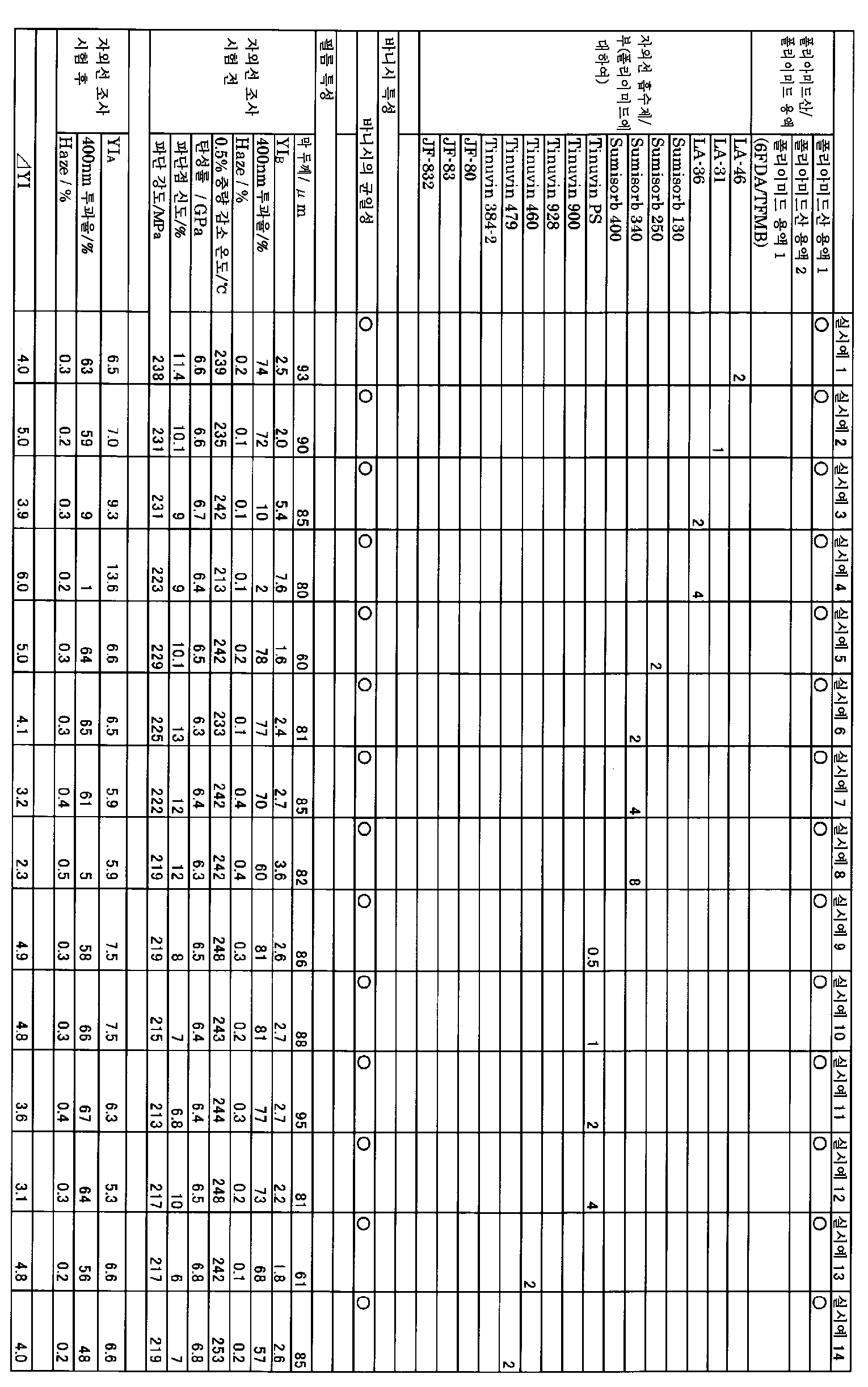
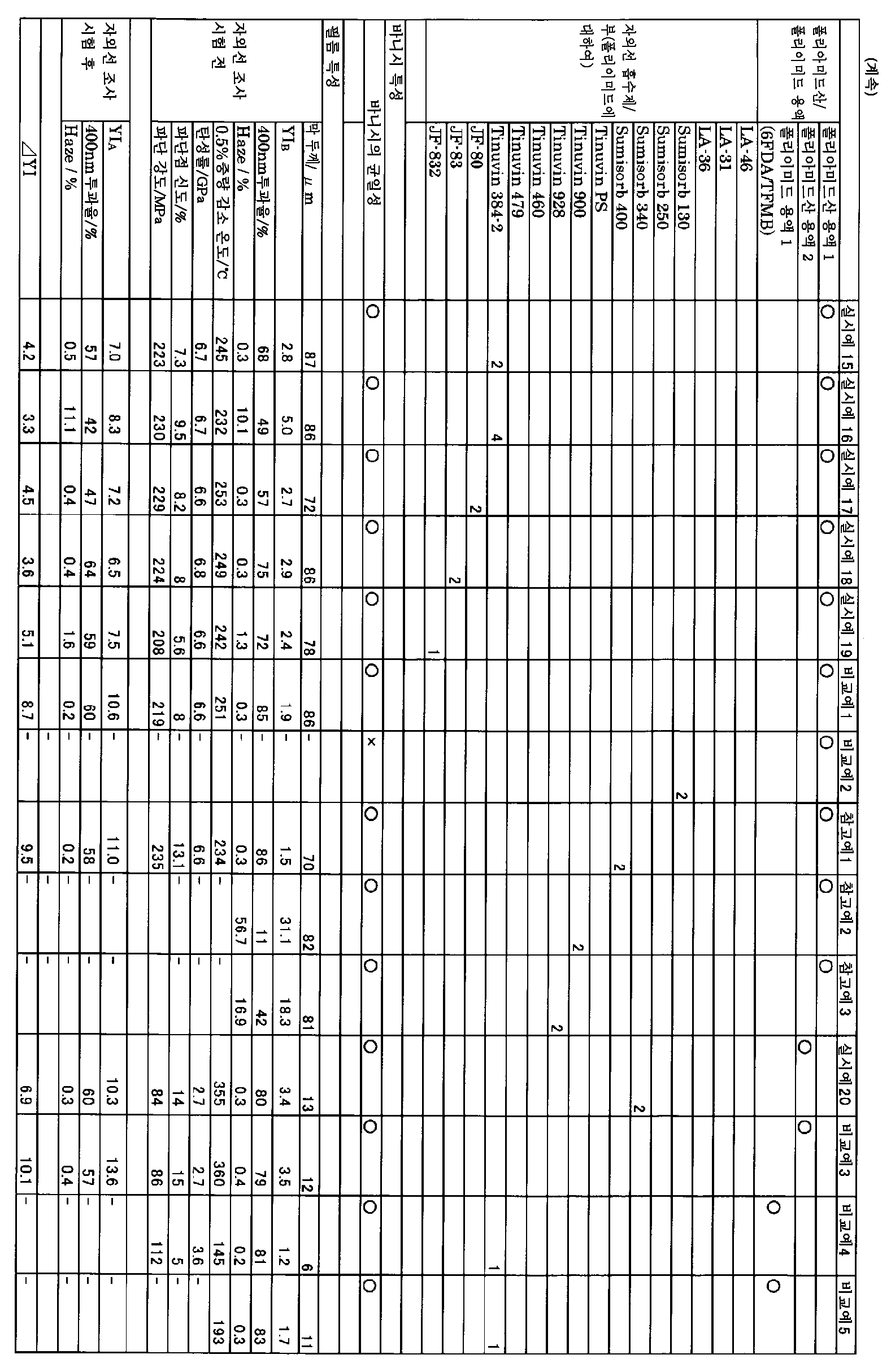
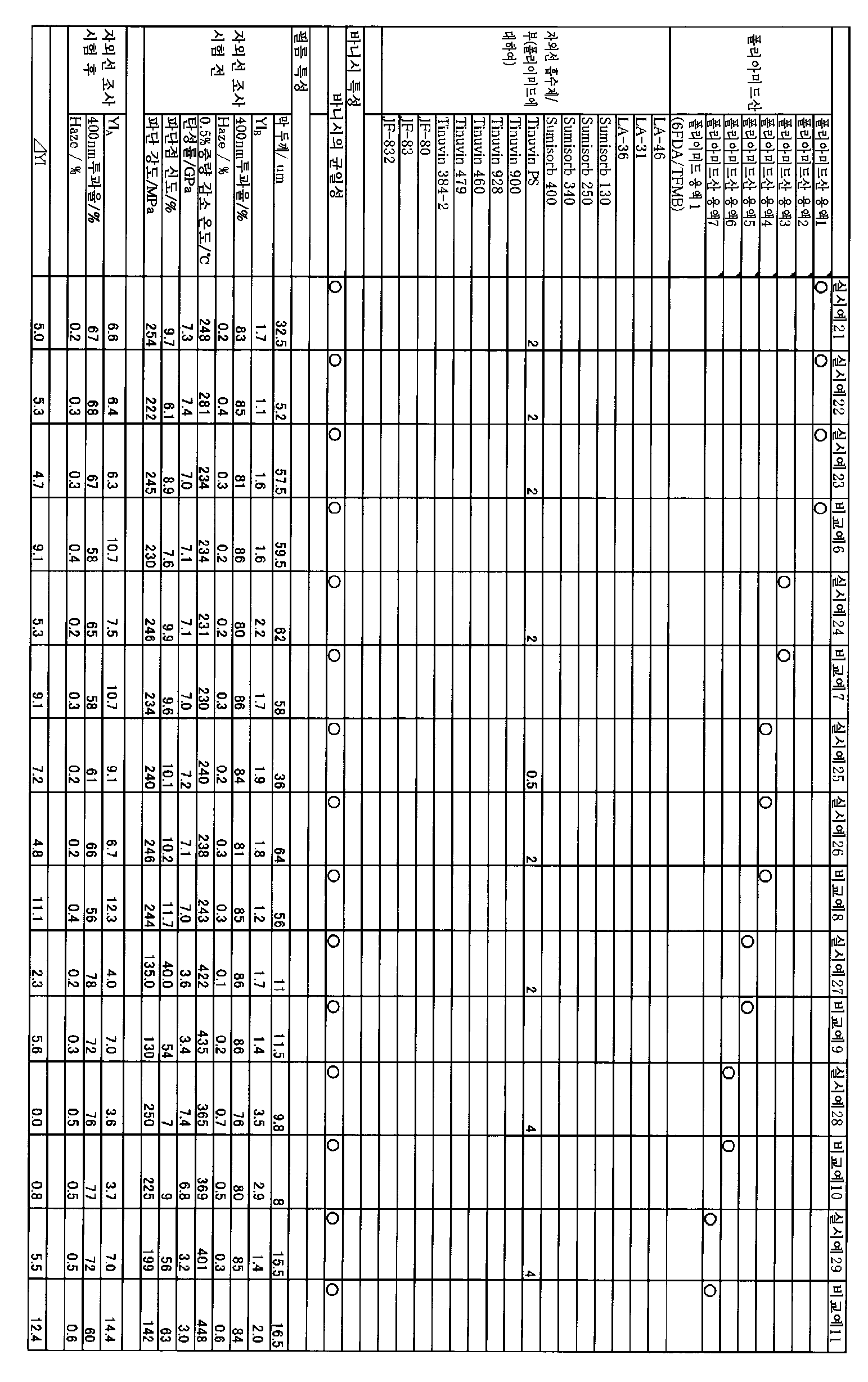

본 발명에 따르면, 폴리이미드 재료(예를 들어 폴리이미드 필름이나 코팅재)의 종래부터의 특징, 예를 들어 내약품성, 기계적 강도, 전기 특성, 치수 안정성 등을 살리면서, 자외선 내구성을 향상시킨 폴리이미드 재료를 제공할 수 있다. 이 폴리이미드 재료는, 특히 디스플레이용, 터치 패널용, 태양 전지용 등의 기판, 보호 필름, 보호층 등으로서 적합하게 사용할 수 있다.According to the present invention, it is possible to provide a polyimide film having improved ultraviolet durability while taking advantage of conventional characteristics of a polyimide material (for example, a polyimide film or a coating material) such as chemical resistance, mechanical strength, electrical characteristics, dimensional stability, Material can be provided. This polyimide material can be suitably used as a substrate, a protective film, a protective layer and the like, particularly for a display, a touch panel, and a solar cell.
Claims (30)
자외선 흡수제
를 함유하는 폴리이미드 재료이며, 다음 조건:
(i) 0.5% 중량 감소 온도가 200℃를 초과하는 것;
(ii) 광 감수성 성분 및 광 감수성 성분에서 유래되는 변성물을 함유하지 않는 것;
(iii) 헤이즈값이 15% 이하이거나, 또는 황색도(YI)가 자외선 조사 시험의 전후의 양쪽에서 15 이하이거나, 또는, 물질로서의 폴리이미드 재료로서, 5 내지 100㎛의 범위 중 적어도 하나의 두께를 갖는 필름 또는 코팅막을 형성했을 때에, 헤이즈값이 15% 이하이거나, 또는 황색도(YI)가 자외선 조사 시험의 전후의 양쪽에서 15 이하인 것(단, 상기 자외선 조사 시험의 조건은, QUV-313 램프를 사용하고, 310nm에서의 조도 0.59W/㎡, 온도 50℃, 조사 시간 24시간임);
을 동시에 충족시키는 것을 특징으로 하는 폴리이미드 재료.Polyimide,
Ultraviolet absorber
And the following conditions are satisfied:
(i) a 0.5% weight loss temperature exceeding 200 ° C;
(ii) not containing a photosensitizing component and a modified product derived from the photosensitizing component;
(iii) a haze value of not more than 15%, or a yellowness degree (YI) of not more than 15 both before and after the ultraviolet ray irradiation test, or as a polyimide material as a material, (YI) is 15 or less both before and after the ultraviolet ray irradiation test when the film or coating film having the haze value of 15% or less or the yellowness value (YI) Lamp at an illuminance of 0.59 W / m < 2 > at 310 nm, temperature of 50 DEG C, irradiation time of 24 hours);
Of the polyimide material.
단, 상기 자외선 조사 시험의 조건은, QUV-313 램프를 사용하고, 310nm에서의 조도 0.59W/㎡, 온도 50℃, 조사 시간 24시간이다.The polyimide material according to claim 1, wherein the change in yellowness before and after the ultraviolet ray test ΔYI is 8 or less;
However, the conditions of the ultraviolet irradiation test were a QUV-313 lamp, an illuminance at 310 nm of 0.59 W / m 2, a temperature of 50 캜, and an irradiation time of 24 hours.
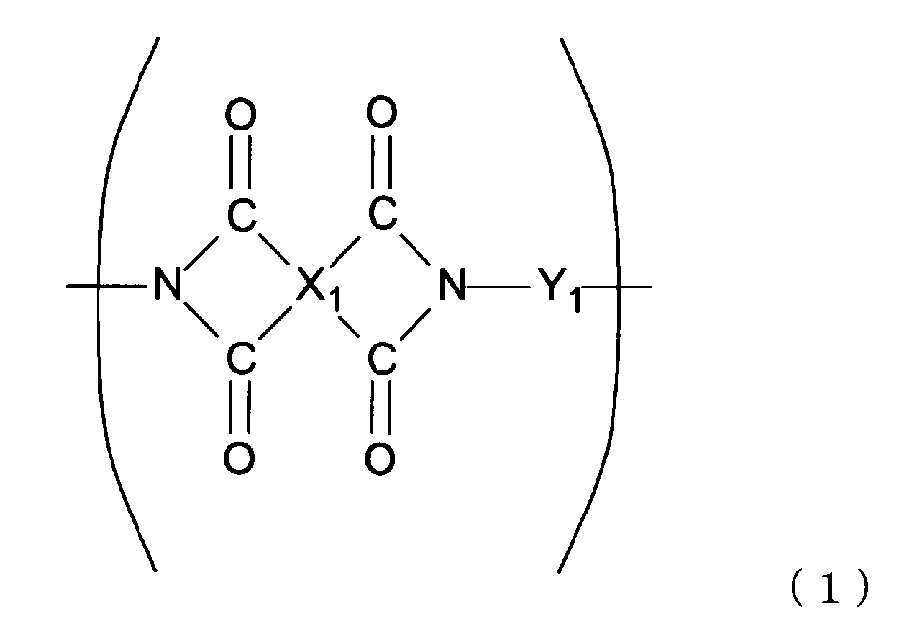
(식 중, X1은 방향족환 또는 지환 구조를 갖는 4가의 기이며, Y1은 방향족환 또는 지환 구조를 갖는 2가의 기이다.)The polyimide material according to claim 1 or 2, wherein the polyimide comprises a repeating unit represented by the following general formula (1).
(Wherein X 1 is an aromatic ring or a tetravalent group having an alicyclic structure, and Y 1 is a divalent group having an aromatic ring or alicyclic structure)
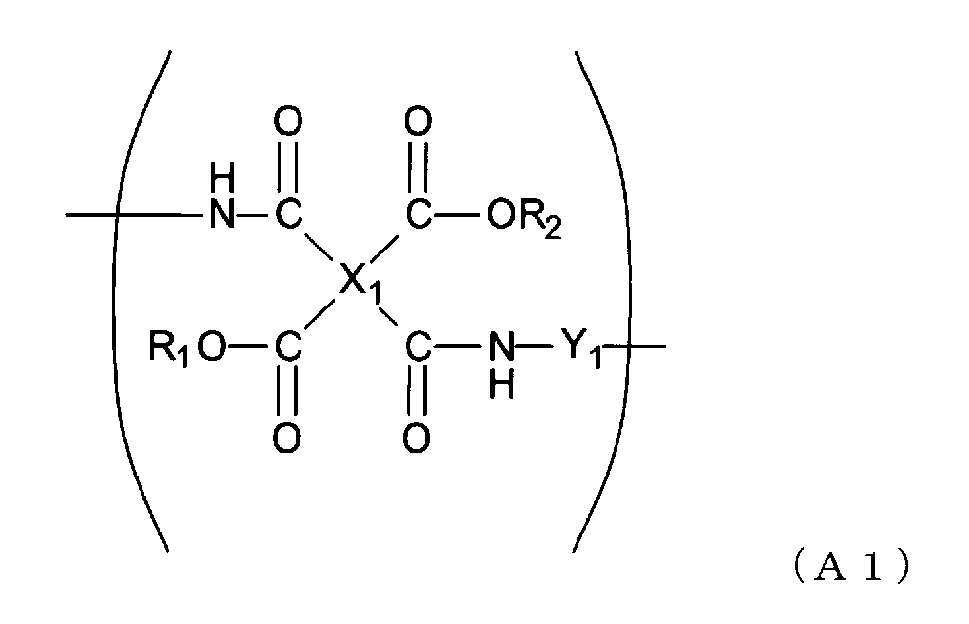
(식 중, X1은 방향족환 또는 지환 구조를 갖는 4가의 기이며, Y1은 방향족환 또는 지환 구조를 갖는 2가의 기이며, R1, R2는 각각 독립적으로 수소, 탄소수 1 내지 6의 알킬기, 또는 탄소수 3 내지 9의 알킬 실릴기이다.)The method for producing a polyimide material according to claim 15, wherein the polyimide precursor contained in the polyimide precursor composition comprises a repeating unit represented by the following general formula (A1).
(Wherein X 1 is an aromatic ring or a tetravalent group having an alicyclic structure, Y 1 is a divalent group having an aromatic ring or alicyclic structure, R 1 and R 2 are each independently hydrogen, An alkyl group, or an alkylsilyl group having 3 to 9 carbon atoms.)
기재 상에 도포된 폴리이미드 전구체 조성물 또는 폴리이미드 용액 조성물을 가열 처리하는 공정
을 갖는 것을 특징으로 하는 폴리이미드 재료의 제조 방법.16. The method of claim 15, further comprising: applying the polyimide precursor composition or the polyimide solution composition onto a substrate;
A step of heat-treating the polyimide precursor composition or the polyimide solution composition coated on the substrate
Wherein the polyimide material is a polyimide material.
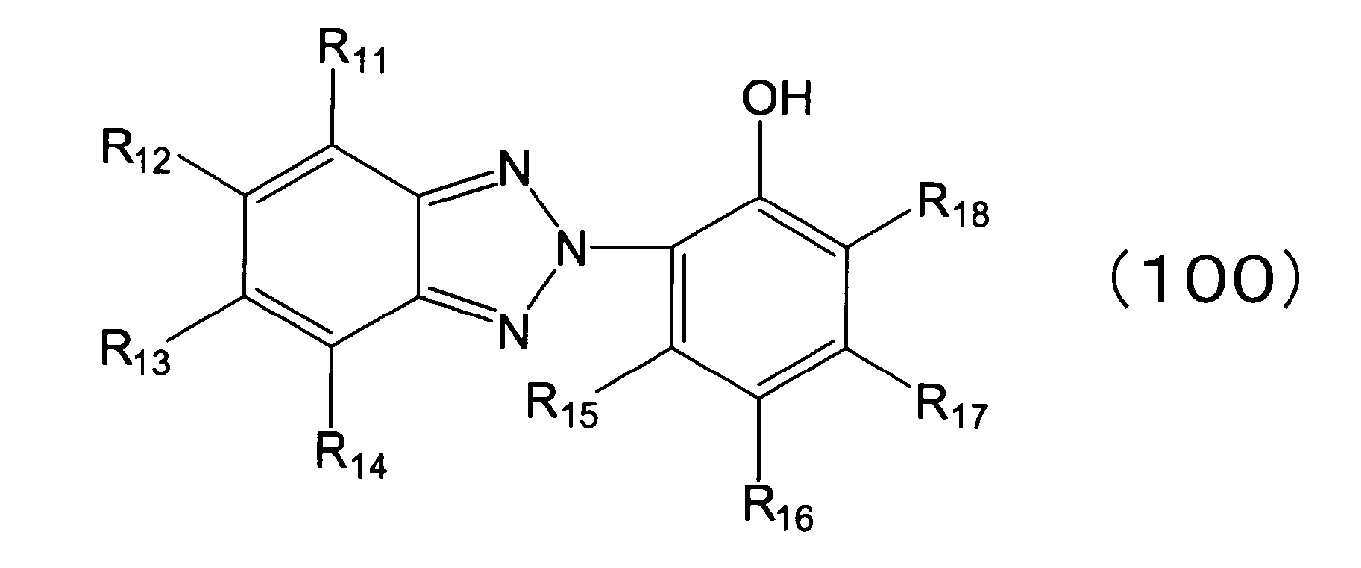
(식 중, R11 내지 R18은 유기기를 나타낸다.)

(식 중, R31 내지 R37 및 R41 내지 R47은, R11 내지 R18에 대하여 부여되는 의미를 나타내며, X는 2가의 유기기이다.)The method for producing a polyimide material according to claim 20, wherein the benzotriazole compound is selected from the compounds represented by formulas (100) and (101).
(Wherein R 11 to R 18 represent an organic group).
(Wherein R 31 to R 37 and R 41 to R 47 have the meanings given for R 11 to R 18 , and X is a divalent organic group.)
(a) 식 (100)으로 표시되고, 그 때, R11 내지 R18이, 서로 독립적으로 H, 아릴, 또는 치환 또는 비치환된 말레이미드기(알킬에의 치환 위치는 N임)로 치환되어 있어도 되는 탄소수 1 내지 20의 알킬이며, 단 알킬 중의 -CH2-기는 -COO- 또는 -OCO-로 치환되어 있어도 되고; Cl을 식 중에 갖지 않고, R11 내지 R18 중, 합계하여 방향환을 2개 이상 포함하지 않는 화합물; 및
(b) 식 (101)로 표시되고, 그 때, R31 내지 R37 및 R41 내지 R47이, 서로 독립적으로 H, 아릴, 또는 치환 또는 비치환된 말레이미드기(알킬에의 치환 위치는 N임)로 치환되어 있어도 되는 탄소수 1 내지 20의 알킬이며, 단 알킬 중의 -CH2-기는 -COO- 또는 -OCO-로 치환되어 있어도 되고; X는, 탄소수 1 내지 20의 알킬렌이며, 단 알킬 중의 -CH2-기는 -COO- 또는 -OCO-로 치환되어 있어도 되고; Cl을 식 중에 갖지 않고, R31 내지 R37, R41 내지 R47 및 X 중에, 합계하여 방향환을 2개 이상 포함하지 않는 화합물
로 이루어지는 군에서 선택되는 것을 특징으로 하는 폴리이미드 재료의 제조 방법.22. The method of claim 21, wherein the benzotriazole compound is selected from the group consisting of:
(100), wherein R 11 to R 18 are independently of each other H, aryl, or a substituted or unsubstituted maleimide group (the substitution position for the alkyl is N) And the -CH 2 - group in the alkyl may be substituted with -COO- or -OCO-; A compound which does not contain Cl in the formula and does not contain two or more aromatic rings in total among R 11 to R 18 ; And
wherein R 31 to R 37 and R 41 to R 47 independently represent H, aryl, or a substituted or unsubstituted maleimide group (the substitution position for the alkyl is N, and the -CH 2 - group in the alkyl group may be substituted with -COO- or -OCO-; X is alkylene having 1 to 20 carbon atoms, the -CH 2 - group in the alkyl may be substituted with -COO- or -OCO-; Cl does not exist in the formula and R 31 to R 37 , R 41 to R 47 and X, which do not contain two or more aromatic rings in total,
≪ RTI ID = 0.0 > 1, < / RTI >
자외선 흡수제, 및
용매
를 함유하는 폴리이미드 전구체 조성물이며, 다음 조건 (i) 및 (ii):
(i) 액정 배향막 용도가 아닌 것;
(ii) 폴리이미드 전구체 조성물을 사용하여, 5 내지 100㎛의 범위 중 적어도 하나의 두께를 갖는 폴리이미드 필름 또는 폴리이미드 코팅막을 형성했을 때에, 헤이즈값이 15% 이하이거나, 또는 황색도(YI)가 자외선 조사 시험의 전후의 양쪽에서 15 이하인 폴리이미드 재료가 얻어지는 것(단, 상기 자외선 조사 시험의 조건은, QUV-313 램프를 사용하고, 310nm에서의 조도 0.59W/㎡, 온도 50℃, 조사 시간 24시간임);
을 동시에 충족시키는 것을 특징으로 하는 폴리이미드 전구체 조성물.Polyimide precursor,
Ultraviolet absorber, and
menstruum
(Ii) a polyimide precursor composition comprising:
(i) not intended for liquid crystal alignment films;
(YI) when the polyimide film or the polyimide coating film having at least one thickness in the range of 5 to 100 mu m is formed using the polyimide precursor composition (ii) and the haze value is not more than 15% Wherein the UV irradiation test was conducted under the conditions of an illuminance of 0.59 W / m < 2 > at a temperature of 310 nm, a temperature of 50 DEG C at a temperature of 50 DEG C using a QUV-313 lamp, Hour 24 hours);
And the polyimide precursor composition satisfies at the same time.

(식 중, R11 내지 R18은 유기기를 나타낸다.)
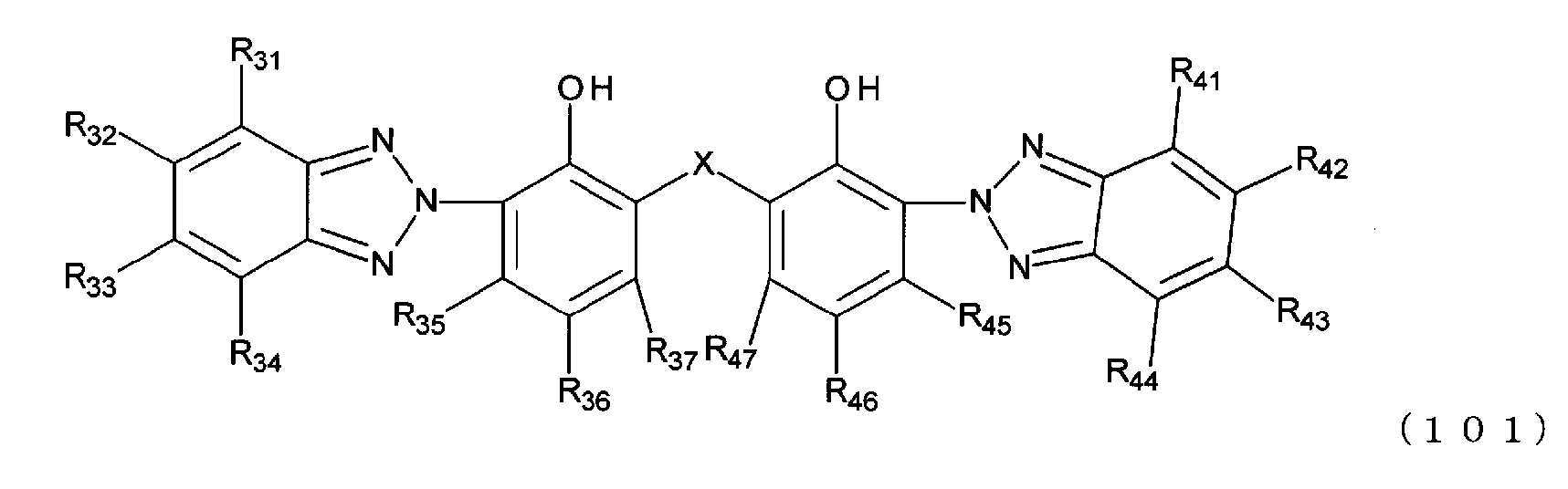
(식 중, R31 내지 R37 및 R41 내지 R47은, R11 내지 R18에 대하여 부여되는 의미를 나타내며, X는 2가의 유기기이다.)The polyimide precursor composition according to claim 28, wherein the benzotriazole compound is selected from compounds represented by formulas (100) and (101).
(Wherein R 11 to R 18 represent an organic group).
(Wherein R 31 to R 37 and R 41 to R 47 have the meanings given for R 11 to R 18 , and X is a divalent organic group.)
(a) 식 (100)으로 표시되고, 그 때, R11 내지 R18이, 서로 독립적으로 H, 아릴, 또는 치환 또는 비치환된 말레이미드기(알킬에의 치환 위치는 N임)로 치환되어 있어도 되는 탄소수 1 내지 20의 알킬이며, 단 알킬 중의 -CH2-기는 -COO- 또는 -OCO-로 치환되어 있어도 되고; Cl을 식 중에 갖지 않고, R11 내지 R18 중, 합계하여 방향환을 2개 이상 포함하지 않는 화합물; 및
(b) 식 (101)로 표시되고, 그 때, R31 내지 R37 및 R41 내지 R47이, 서로 독립적으로 H, 아릴, 또는 치환 또는 비치환된 말레이미드기(알킬에의 치환 위치는 N임)로 치환되어 있어도 되는 탄소수 1 내지 20의 알킬이며, 단 알킬 중의 -CH2-기는 -COO- 또는 -OCO-로 치환되어 있어도 되고; X는, 탄소수 1 내지 20의 알킬렌이며, 단 알킬 중의 -CH2-기는 -COO- 또는 -OCO-로 치환되어 있어도 되고; Cl을 식 중에 갖지 않고, R31 내지 R37, R41 내지 R47 및 X 중에, 합계하여 방향환을 2개 이상 포함하지 않는 화합물
로 이루어지는 군에서 선택되는 것을 특징으로 하는 폴리이미드 전구체 조성물.30. The method of claim 29, wherein the benzotriazole compound is selected from the group consisting of:
(100), wherein R 11 to R 18 are independently of each other H, aryl, or a substituted or unsubstituted maleimide group (the substitution position for the alkyl is N) And the -CH 2 - group in the alkyl may be substituted with -COO- or -OCO-; A compound which does not contain Cl in the formula and does not contain two or more aromatic rings in total among R 11 to R 18 ; And
wherein R 31 to R 37 and R 41 to R 47 independently represent H, aryl, or a substituted or unsubstituted maleimide group (the substitution position for the alkyl is N, and the -CH 2 - group in the alkyl group may be substituted with -COO- or -OCO-; X is alkylene having 1 to 20 carbon atoms, the -CH 2 - group in the alkyl may be substituted with -COO- or -OCO-; Cl does not exist in the formula and R 31 to R 37 , R 41 to R 47 and X, which do not contain two or more aromatic rings in total,
≪ / RTI > wherein the polyimide precursor composition is selected from the group consisting of polyimide precursors.
Priority Applications (1)
| Application Number | Priority Date | Filing Date | Title |
|---|---|---|---|
| KR1020247035887A KR20240159642A (en) | 2015-12-28 | 2016-12-27 | Polyimide material, method for producing same, and polyimide precursor composition used for production of same |
Applications Claiming Priority (3)
| Application Number | Priority Date | Filing Date | Title |
|---|---|---|---|
| JPJP-P-2015-255722 | 2015-12-28 | ||
| JP2015255722 | 2015-12-28 | ||
| PCT/JP2016/088983 WO2017115818A1 (en) | 2015-12-28 | 2016-12-27 | Polyimide material, method for producing same, and polyimide precursor composition used for production of same |
Related Child Applications (1)
| Application Number | Title | Priority Date | Filing Date |
|---|---|---|---|
| KR1020247035887A Division KR20240159642A (en) | 2015-12-28 | 2016-12-27 | Polyimide material, method for producing same, and polyimide precursor composition used for production of same |
Publications (2)
| Publication Number | Publication Date |
|---|---|
| KR20180098366A true KR20180098366A (en) | 2018-09-03 |
| KR102724929B1 KR102724929B1 (en) | 2024-11-04 |
Family
ID=59224768
Family Applications (2)
| Application Number | Title | Priority Date | Filing Date |
|---|---|---|---|
| KR1020247035887A Pending KR20240159642A (en) | 2015-12-28 | 2016-12-27 | Polyimide material, method for producing same, and polyimide precursor composition used for production of same |
| KR1020187021502A Active KR102724929B1 (en) | 2015-12-28 | 2016-12-27 | Polyimide material, method for producing the same, and polyimide precursor composition used in producing the same |
Family Applications Before (1)
| Application Number | Title | Priority Date | Filing Date |
|---|---|---|---|
| KR1020247035887A Pending KR20240159642A (en) | 2015-12-28 | 2016-12-27 | Polyimide material, method for producing same, and polyimide precursor composition used for production of same |
Country Status (5)
| Country | Link |
|---|---|
| JP (4) | JP2017119821A (en) |
| KR (2) | KR20240159642A (en) |
| CN (1) | CN108431136B (en) |
| TW (1) | TWI758269B (en) |
| WO (1) | WO2017115818A1 (en) |
Cited By (2)
| Publication number | Priority date | Publication date | Assignee | Title |
|---|---|---|---|---|
| KR20210075610A (en) * | 2019-12-13 | 2021-06-23 | 주식회사 두산 | Polyimide film having excellent weather resistance |
| KR20240047642A (en) | 2022-10-05 | 2024-04-12 | 인천대학교 산학협력단 | Electrolyte for lithium ion battery containing n-(4-fluorophenyl)maleimide and lithium ion battery including the same |
Families Citing this family (26)
| Publication number | Priority date | Publication date | Assignee | Title |
|---|---|---|---|---|
| JP2017119821A (en) * | 2015-12-28 | 2017-07-06 | 宇部興産株式会社 | Polyimide material and method for producing the same |
| JP6917187B2 (en) * | 2016-05-10 | 2021-08-11 | 住友化学株式会社 | Optical film and flexible devices using it |
| WO2018051888A1 (en) * | 2016-09-13 | 2018-03-22 | Jxtgエネルギー株式会社 | Polyimide, polyamic acid, solutions thereof, and film using polyimide |
| TWI803315B (en) * | 2017-08-01 | 2023-05-21 | 日商旭化成股份有限公司 | Semiconductor device and manufacturing method thereof |
| KR102692868B1 (en) * | 2017-09-29 | 2024-08-08 | 미쯔비시 가스 케미칼 컴파니, 인코포레이티드 | Polyimide resin, polyimide varnish and polyimide film |
| WO2019073970A1 (en) * | 2017-10-11 | 2019-04-18 | 株式会社カネカ | Polyimide resin composition, and polyimide film and production method therefor |
| WO2019078051A1 (en) * | 2017-10-16 | 2019-04-25 | 大日本印刷株式会社 | Polyimide film, polyimide film production method, laminate, surface material for display, touch panel member, liquid crystal display device, and organic electroluminescence display device |
| KR102264420B1 (en) | 2017-11-03 | 2021-06-11 | 주식회사 엘지화학 | Polyimide film for display substrates |
| KR102663662B1 (en) * | 2018-02-05 | 2024-05-08 | 미쯔비시 가스 케미칼 컴파니, 인코포레이티드 | Polyimide resin composition and polyimide film |
| KR102602854B1 (en) * | 2018-06-05 | 2023-11-16 | 주식회사 동진쎄미켐 | The polyimide composition and a polyimide film having excellent ultraviolet stability prepared therefrom |
| KR102093299B1 (en) * | 2018-09-28 | 2020-06-01 | 스미또모 가가꾸 가부시키가이샤 | Optical film |
| CN109796761A (en) * | 2018-12-25 | 2019-05-24 | 努比亚技术有限公司 | Display screen component, preparation method and display terminal |
| JP7397683B2 (en) * | 2019-01-25 | 2023-12-13 | 住友化学株式会社 | Laminated body for organic EL display and circularly polarizing plate used therein |
| KR20200092884A (en) * | 2019-01-25 | 2020-08-04 | 스미또모 가가꾸 가부시끼가이샤 | Laminate for organic electroluminescent display and circularly polarizing plate used in the laminate |
| CN110007391A (en) * | 2019-04-12 | 2019-07-12 | 徐圣最 | A kind of low temperature preparation method of polyimide coating optical fiber |
| WO2020255890A1 (en) * | 2019-06-20 | 2020-12-24 | Jfeケミカル株式会社 | Polyimide solution and polyimide |
| JP7264264B2 (en) * | 2019-09-20 | 2023-04-25 | Ube株式会社 | Polyimide precursor composition and method for producing flexible electronic device |
| JP7226460B2 (en) * | 2020-01-31 | 2023-02-21 | Ube株式会社 | Polyimide precursor composition and polyimide film/substrate laminate |
| JP7400948B2 (en) * | 2020-03-27 | 2023-12-19 | Ube株式会社 | Polyimide precursor composition and polyimide film/base material laminate |
| CN111592759A (en) * | 2020-05-14 | 2020-08-28 | 深圳市华星光电半导体显示技术有限公司 | Modified polyamic acid material and application thereof |
| JP7476464B2 (en) * | 2020-09-08 | 2024-05-01 | エルジー・ケム・リミテッド | Polyimide resin film, display device substrate using same, and optical device |
| WO2022107545A1 (en) * | 2020-11-20 | 2022-05-27 | 日産化学株式会社 | Liquid crystal aligning agent, liquid crystal alignment film, and liquid crystal display element |
| JP7684078B2 (en) * | 2021-04-14 | 2025-05-27 | 株式会社カネカ | Optical Film |
| WO2024063048A1 (en) | 2022-09-20 | 2024-03-28 | 大日本印刷株式会社 | Laminate, touch panel member, and display device |
| KR102868886B1 (en) * | 2022-11-30 | 2025-10-14 | 피아이첨단소재 주식회사 | Polyimide film and manufacturing method thereof |
| CN120307724A (en) * | 2025-05-14 | 2025-07-15 | 华东理工大学 | A protective enhancement film and a preparation method thereof |
Citations (12)
| Publication number | Priority date | Publication date | Assignee | Title |
|---|---|---|---|---|
| JPS62184055A (en) | 1986-02-07 | 1987-08-12 | Toshiba Corp | Polyamic acid composition |
| JPH10148835A (en) | 1996-11-19 | 1998-06-02 | Hitachi Chem Co Ltd | Liquid crystal alignment film |
| JP2004258544A (en) | 2003-02-27 | 2004-09-16 | Nitto Denko Corp | Retardation film |
| JP2009286706A (en) | 2008-05-27 | 2009-12-10 | Iwatani Industrial Gases Corp | New (1r,2s,4s,5r)-cyclohexanetetracarboxylic acid dianhydride and utilization thereof |
| JP2010538103A (en) | 2007-08-27 | 2010-12-09 | コーロン インダストリーズ,インコーポレイテッド | Polyimide film |
| JP2012041529A (en) | 2010-07-22 | 2012-03-01 | Ube Industries Ltd | Polyimide precursor, method for producing the same, and polyimide |
| JP2014032951A (en) | 2012-07-12 | 2014-02-20 | Jsr Corp | Organic el element, radiation-sensitive resin composition, and cured film |
| WO2014046064A1 (en) | 2012-09-18 | 2014-03-27 | 宇部興産株式会社 | Polyimide precursor, polyimide, polyimide film, varnish, and substrate |
| JP2014092775A (en) | 2012-11-07 | 2014-05-19 | Jsr Corp | Liquid crystal orientation agent, liquid crystal orientation film, and liquid crystal display element |
| CN103897391A (en) | 2012-12-31 | 2014-07-02 | 中原工学院 | Photo-curing polyimide membrane for thin-film solar cell and preparation method of photo-curing polyimide membrane |
| JP2015093966A (en) * | 2013-11-13 | 2015-05-18 | デクセリアルズ株式会社 | Polyimide, polyimide solution, molded body and optical device |
| KR20150125324A (en) * | 2014-04-30 | 2015-11-09 | 주식회사 엘지화학 | Polyimide-based film and mehtod for preparing same |
Family Cites Families (9)
| Publication number | Priority date | Publication date | Assignee | Title |
|---|---|---|---|---|
| US3897391A (en) | 1971-11-01 | 1975-07-29 | Gen Electric | Process for preparing polycarbonate |
| JP2005083994A (en) * | 2003-09-10 | 2005-03-31 | Sekisui Chem Co Ltd | Method for producing electrode for electrochemical analysis |
| JP2005139433A (en) * | 2003-10-15 | 2005-06-02 | Toray Ind Inc | Light-resistant resin composition and organic electroluminescent device using the same |
| JP5109249B2 (en) * | 2005-11-07 | 2012-12-26 | 住友ベークライト株式会社 | Resin composition, laminate, wiring board and method for manufacturing wiring board |
| CN101674923B (en) * | 2007-05-24 | 2013-01-09 | 三菱瓦斯化学株式会社 | Process and apparatus for production of colorless transparent resin film |
| JP2010148835A (en) * | 2008-12-25 | 2010-07-08 | Tomoko Sato | Earring |
| JP6206187B2 (en) * | 2011-11-29 | 2017-10-04 | 日産化学工業株式会社 | Liquid crystal aligning agent, liquid crystal alignment film, and liquid crystal display element using the same |
| KR102002611B1 (en) * | 2015-07-22 | 2019-07-22 | 스미또모 가가꾸 가부시키가이샤 | A resin film, a laminate, an optical member, a display member, and a front plate |
| JP2017119821A (en) * | 2015-12-28 | 2017-07-06 | 宇部興産株式会社 | Polyimide material and method for producing the same |
-
2016
- 2016-09-06 JP JP2016173866A patent/JP2017119821A/en not_active Withdrawn
- 2016-12-27 JP JP2017559224A patent/JP7262924B2/en active Active
- 2016-12-27 KR KR1020247035887A patent/KR20240159642A/en active Pending
- 2016-12-27 KR KR1020187021502A patent/KR102724929B1/en active Active
- 2016-12-27 WO PCT/JP2016/088983 patent/WO2017115818A1/en not_active Ceased
- 2016-12-27 CN CN201680076063.2A patent/CN108431136B/en active Active
- 2016-12-28 TW TW105143559A patent/TWI758269B/en active
-
2017
- 2017-04-27 JP JP2017088160A patent/JP6358358B2/en active Active
-
2021
- 2021-02-24 JP JP2021027545A patent/JP2021088721A/en active Pending
Patent Citations (12)
| Publication number | Priority date | Publication date | Assignee | Title |
|---|---|---|---|---|
| JPS62184055A (en) | 1986-02-07 | 1987-08-12 | Toshiba Corp | Polyamic acid composition |
| JPH10148835A (en) | 1996-11-19 | 1998-06-02 | Hitachi Chem Co Ltd | Liquid crystal alignment film |
| JP2004258544A (en) | 2003-02-27 | 2004-09-16 | Nitto Denko Corp | Retardation film |
| JP2010538103A (en) | 2007-08-27 | 2010-12-09 | コーロン インダストリーズ,インコーポレイテッド | Polyimide film |
| JP2009286706A (en) | 2008-05-27 | 2009-12-10 | Iwatani Industrial Gases Corp | New (1r,2s,4s,5r)-cyclohexanetetracarboxylic acid dianhydride and utilization thereof |
| JP2012041529A (en) | 2010-07-22 | 2012-03-01 | Ube Industries Ltd | Polyimide precursor, method for producing the same, and polyimide |
| JP2014032951A (en) | 2012-07-12 | 2014-02-20 | Jsr Corp | Organic el element, radiation-sensitive resin composition, and cured film |
| WO2014046064A1 (en) | 2012-09-18 | 2014-03-27 | 宇部興産株式会社 | Polyimide precursor, polyimide, polyimide film, varnish, and substrate |
| JP2014092775A (en) | 2012-11-07 | 2014-05-19 | Jsr Corp | Liquid crystal orientation agent, liquid crystal orientation film, and liquid crystal display element |
| CN103897391A (en) | 2012-12-31 | 2014-07-02 | 中原工学院 | Photo-curing polyimide membrane for thin-film solar cell and preparation method of photo-curing polyimide membrane |
| JP2015093966A (en) * | 2013-11-13 | 2015-05-18 | デクセリアルズ株式会社 | Polyimide, polyimide solution, molded body and optical device |
| KR20150125324A (en) * | 2014-04-30 | 2015-11-09 | 주식회사 엘지화학 | Polyimide-based film and mehtod for preparing same |
Cited By (2)
| Publication number | Priority date | Publication date | Assignee | Title |
|---|---|---|---|---|
| KR20210075610A (en) * | 2019-12-13 | 2021-06-23 | 주식회사 두산 | Polyimide film having excellent weather resistance |
| KR20240047642A (en) | 2022-10-05 | 2024-04-12 | 인천대학교 산학협력단 | Electrolyte for lithium ion battery containing n-(4-fluorophenyl)maleimide and lithium ion battery including the same |
Also Published As
| Publication number | Publication date |
|---|---|
| JP2017125220A (en) | 2017-07-20 |
| JP6358358B2 (en) | 2018-07-18 |
| JP2021088721A (en) | 2021-06-10 |
| TWI758269B (en) | 2022-03-21 |
| CN108431136B (en) | 2021-07-30 |
| JPWO2017115818A1 (en) | 2018-12-13 |
| JP7262924B2 (en) | 2023-04-24 |
| TW201736441A (en) | 2017-10-16 |
| KR102724929B1 (en) | 2024-11-04 |
| KR20240159642A (en) | 2024-11-05 |
| WO2017115818A1 (en) | 2017-07-06 |
| CN108431136A (en) | 2018-08-21 |
| JP2017119821A (en) | 2017-07-06 |
Similar Documents
| Publication | Publication Date | Title |
|---|---|---|
| KR102724929B1 (en) | Polyimide material, method for producing the same, and polyimide precursor composition used in producing the same | |
| JP6721070B2 (en) | Polyimide precursor composition, method for producing polyimide, polyimide, polyimide film, and substrate | |
| KR102482608B1 (en) | Polyimide film, polyimide precursor, and polyimide | |
| KR102519088B1 (en) | Polyimide precursor, polyimide, and polyimide film | |
| JP6627510B2 (en) | Polyimide precursor composition, method for producing polyimide, polyimide, polyimide film, and substrate | |
| KR102062421B1 (en) | Polyimide precursor, polyimide, varnish, polyimide film, and substrate | |
| US10174166B2 (en) | Polyimide precursor, polyimide, varnish, polyimide film, and substrate | |
| JP6919564B2 (en) | Polyimide precursor composition and polyimide composition | |
| US20160297995A1 (en) | Polyimide precursor, polyimide, polyimide film, varnish, and substrate | |
| KR20190082281A (en) | A laminate comprising a polyimide film and a hard coat layer | |
| KR20150021527A (en) | Polyimide precursor and polyimide | |
| WO2019131894A1 (en) | Polyimide precursor, polyimide, polyimide film, varnish and substrate | |
| CN111133034A (en) | Polyimide resin, polyimide varnish and polyimide film |
Legal Events
| Date | Code | Title | Description |
|---|---|---|---|
| PA0105 | International application |
Patent event date: 20180725 Patent event code: PA01051R01D Comment text: International Patent Application |
|
| PG1501 | Laying open of application | ||
| A201 | Request for examination | ||
| PA0201 | Request for examination |
Patent event code: PA02012R01D Patent event date: 20211216 Comment text: Request for Examination of Application |
|
| E902 | Notification of reason for refusal | ||
| PE0902 | Notice of grounds for rejection |
Comment text: Notification of reason for refusal Patent event date: 20231108 Patent event code: PE09021S01D |
|
| E701 | Decision to grant or registration of patent right | ||
| PE0701 | Decision of registration |
Patent event code: PE07011S01D Comment text: Decision to Grant Registration Patent event date: 20240812 |
|
| A107 | Divisional application of patent | ||
| PA0104 | Divisional application for international application |
Comment text: Divisional Application for International Patent Patent event code: PA01041R01D Patent event date: 20241028 |
|
| GRNT | Written decision to grant | ||
| PR0701 | Registration of establishment |
Comment text: Registration of Establishment Patent event date: 20241029 Patent event code: PR07011E01D |
|
| PR1002 | Payment of registration fee |
Payment date: 20241030 End annual number: 3 Start annual number: 1 |
|
| PG1601 | Publication of registration |