KR20080098487A - A semiconductor device, a display device and an electronic device including the semiconductor device - Google Patents
A semiconductor device, a display device and an electronic device including the semiconductor device Download PDFInfo
- Publication number
- KR20080098487A KR20080098487A KR1020087018781A KR20087018781A KR20080098487A KR 20080098487 A KR20080098487 A KR 20080098487A KR 1020087018781 A KR1020087018781 A KR 1020087018781A KR 20087018781 A KR20087018781 A KR 20087018781A KR 20080098487 A KR20080098487 A KR 20080098487A
- Authority
- KR
- South Korea
- Prior art keywords
- transistor
- terminal
- level
- potential
- output terminal
- Prior art date
- Legal status (The legal status is an assumption and is not a legal conclusion. Google has not performed a legal analysis and makes no representation as to the accuracy of the status listed.)
- Granted
Links
Images



Classifications
-
- H—ELECTRICITY
- H10—SEMICONDUCTOR DEVICES; ELECTRIC SOLID-STATE DEVICES NOT OTHERWISE PROVIDED FOR
- H10D—INORGANIC ELECTRIC SEMICONDUCTOR DEVICES
- H10D86/00—Integrated devices formed in or on insulating or conducting substrates, e.g. formed in silicon-on-insulator [SOI] substrates or on stainless steel or glass substrates
- H10D86/40—Integrated devices formed in or on insulating or conducting substrates, e.g. formed in silicon-on-insulator [SOI] substrates or on stainless steel or glass substrates characterised by multiple TFTs
- H10D86/60—Integrated devices formed in or on insulating or conducting substrates, e.g. formed in silicon-on-insulator [SOI] substrates or on stainless steel or glass substrates characterised by multiple TFTs wherein the TFTs are in active matrices
-
- G—PHYSICS
- G09—EDUCATION; CRYPTOGRAPHY; DISPLAY; ADVERTISING; SEALS
- G09G—ARRANGEMENTS OR CIRCUITS FOR CONTROL OF INDICATING DEVICES USING STATIC MEANS TO PRESENT VARIABLE INFORMATION
- G09G3/00—Control arrangements or circuits, of interest only in connection with visual indicators other than cathode-ray tubes
- G09G3/20—Control arrangements or circuits, of interest only in connection with visual indicators other than cathode-ray tubes for presentation of an assembly of a number of characters, e.g. a page, by composing the assembly by combination of individual elements arranged in a matrix no fixed position being assigned to or needed to be assigned to the individual characters or partial characters
- G09G3/34—Control arrangements or circuits, of interest only in connection with visual indicators other than cathode-ray tubes for presentation of an assembly of a number of characters, e.g. a page, by composing the assembly by combination of individual elements arranged in a matrix no fixed position being assigned to or needed to be assigned to the individual characters or partial characters by control of light from an independent source
- G09G3/36—Control arrangements or circuits, of interest only in connection with visual indicators other than cathode-ray tubes for presentation of an assembly of a number of characters, e.g. a page, by composing the assembly by combination of individual elements arranged in a matrix no fixed position being assigned to or needed to be assigned to the individual characters or partial characters by control of light from an independent source using liquid crystals
-
- G—PHYSICS
- G02—OPTICS
- G02F—OPTICAL DEVICES OR ARRANGEMENTS FOR THE CONTROL OF LIGHT BY MODIFICATION OF THE OPTICAL PROPERTIES OF THE MEDIA OF THE ELEMENTS INVOLVED THEREIN; NON-LINEAR OPTICS; FREQUENCY-CHANGING OF LIGHT; OPTICAL LOGIC ELEMENTS; OPTICAL ANALOGUE/DIGITAL CONVERTERS
- G02F1/00—Devices or arrangements for the control of the intensity, colour, phase, polarisation or direction of light arriving from an independent light source, e.g. switching, gating or modulating; Non-linear optics
- G02F1/01—Devices or arrangements for the control of the intensity, colour, phase, polarisation or direction of light arriving from an independent light source, e.g. switching, gating or modulating; Non-linear optics for the control of the intensity, phase, polarisation or colour
- G02F1/13—Devices or arrangements for the control of the intensity, colour, phase, polarisation or direction of light arriving from an independent light source, e.g. switching, gating or modulating; Non-linear optics for the control of the intensity, phase, polarisation or colour based on liquid crystals, e.g. single liquid crystal display cells
- G02F1/133—Constructional arrangements; Operation of liquid crystal cells; Circuit arrangements
- G02F1/136—Liquid crystal cells structurally associated with a semi-conducting layer or substrate, e.g. cells forming part of an integrated circuit
- G02F1/1362—Active matrix addressed cells
- G02F1/13624—Active matrix addressed cells having more than one switching element per pixel
-
- G—PHYSICS
- G09—EDUCATION; CRYPTOGRAPHY; DISPLAY; ADVERTISING; SEALS
- G09G—ARRANGEMENTS OR CIRCUITS FOR CONTROL OF INDICATING DEVICES USING STATIC MEANS TO PRESENT VARIABLE INFORMATION
- G09G3/00—Control arrangements or circuits, of interest only in connection with visual indicators other than cathode-ray tubes
- G09G3/20—Control arrangements or circuits, of interest only in connection with visual indicators other than cathode-ray tubes for presentation of an assembly of a number of characters, e.g. a page, by composing the assembly by combination of individual elements arranged in a matrix no fixed position being assigned to or needed to be assigned to the individual characters or partial characters
-
- G—PHYSICS
- G09—EDUCATION; CRYPTOGRAPHY; DISPLAY; ADVERTISING; SEALS
- G09G—ARRANGEMENTS OR CIRCUITS FOR CONTROL OF INDICATING DEVICES USING STATIC MEANS TO PRESENT VARIABLE INFORMATION
- G09G3/00—Control arrangements or circuits, of interest only in connection with visual indicators other than cathode-ray tubes
- G09G3/20—Control arrangements or circuits, of interest only in connection with visual indicators other than cathode-ray tubes for presentation of an assembly of a number of characters, e.g. a page, by composing the assembly by combination of individual elements arranged in a matrix no fixed position being assigned to or needed to be assigned to the individual characters or partial characters
- G09G3/22—Control arrangements or circuits, of interest only in connection with visual indicators other than cathode-ray tubes for presentation of an assembly of a number of characters, e.g. a page, by composing the assembly by combination of individual elements arranged in a matrix no fixed position being assigned to or needed to be assigned to the individual characters or partial characters using controlled light sources
- G09G3/30—Control arrangements or circuits, of interest only in connection with visual indicators other than cathode-ray tubes for presentation of an assembly of a number of characters, e.g. a page, by composing the assembly by combination of individual elements arranged in a matrix no fixed position being assigned to or needed to be assigned to the individual characters or partial characters using controlled light sources using electroluminescent panels
- G09G3/32—Control arrangements or circuits, of interest only in connection with visual indicators other than cathode-ray tubes for presentation of an assembly of a number of characters, e.g. a page, by composing the assembly by combination of individual elements arranged in a matrix no fixed position being assigned to or needed to be assigned to the individual characters or partial characters using controlled light sources using electroluminescent panels semiconductive, e.g. using light-emitting diodes [LED]
- G09G3/3208—Control arrangements or circuits, of interest only in connection with visual indicators other than cathode-ray tubes for presentation of an assembly of a number of characters, e.g. a page, by composing the assembly by combination of individual elements arranged in a matrix no fixed position being assigned to or needed to be assigned to the individual characters or partial characters using controlled light sources using electroluminescent panels semiconductive, e.g. using light-emitting diodes [LED] organic, e.g. using organic light-emitting diodes [OLED]
- G09G3/3225—Control arrangements or circuits, of interest only in connection with visual indicators other than cathode-ray tubes for presentation of an assembly of a number of characters, e.g. a page, by composing the assembly by combination of individual elements arranged in a matrix no fixed position being assigned to or needed to be assigned to the individual characters or partial characters using controlled light sources using electroluminescent panels semiconductive, e.g. using light-emitting diodes [LED] organic, e.g. using organic light-emitting diodes [OLED] using an active matrix
- G09G3/3233—Control arrangements or circuits, of interest only in connection with visual indicators other than cathode-ray tubes for presentation of an assembly of a number of characters, e.g. a page, by composing the assembly by combination of individual elements arranged in a matrix no fixed position being assigned to or needed to be assigned to the individual characters or partial characters using controlled light sources using electroluminescent panels semiconductive, e.g. using light-emitting diodes [LED] organic, e.g. using organic light-emitting diodes [OLED] using an active matrix with pixel circuitry controlling the current through the light-emitting element
- G09G3/3241—Control arrangements or circuits, of interest only in connection with visual indicators other than cathode-ray tubes for presentation of an assembly of a number of characters, e.g. a page, by composing the assembly by combination of individual elements arranged in a matrix no fixed position being assigned to or needed to be assigned to the individual characters or partial characters using controlled light sources using electroluminescent panels semiconductive, e.g. using light-emitting diodes [LED] organic, e.g. using organic light-emitting diodes [OLED] using an active matrix with pixel circuitry controlling the current through the light-emitting element the current through the light-emitting element being set using a data current provided by the data driver, e.g. by using a two-transistor current mirror
- G09G3/325—Control arrangements or circuits, of interest only in connection with visual indicators other than cathode-ray tubes for presentation of an assembly of a number of characters, e.g. a page, by composing the assembly by combination of individual elements arranged in a matrix no fixed position being assigned to or needed to be assigned to the individual characters or partial characters using controlled light sources using electroluminescent panels semiconductive, e.g. using light-emitting diodes [LED] organic, e.g. using organic light-emitting diodes [OLED] using an active matrix with pixel circuitry controlling the current through the light-emitting element the current through the light-emitting element being set using a data current provided by the data driver, e.g. by using a two-transistor current mirror the data current flowing through the driving transistor during a setting phase, e.g. by using a switch for connecting the driving transistor to the data driver
-
- G—PHYSICS
- G09—EDUCATION; CRYPTOGRAPHY; DISPLAY; ADVERTISING; SEALS
- G09G—ARRANGEMENTS OR CIRCUITS FOR CONTROL OF INDICATING DEVICES USING STATIC MEANS TO PRESENT VARIABLE INFORMATION
- G09G3/00—Control arrangements or circuits, of interest only in connection with visual indicators other than cathode-ray tubes
- G09G3/20—Control arrangements or circuits, of interest only in connection with visual indicators other than cathode-ray tubes for presentation of an assembly of a number of characters, e.g. a page, by composing the assembly by combination of individual elements arranged in a matrix no fixed position being assigned to or needed to be assigned to the individual characters or partial characters
- G09G3/34—Control arrangements or circuits, of interest only in connection with visual indicators other than cathode-ray tubes for presentation of an assembly of a number of characters, e.g. a page, by composing the assembly by combination of individual elements arranged in a matrix no fixed position being assigned to or needed to be assigned to the individual characters or partial characters by control of light from an independent source
- G09G3/36—Control arrangements or circuits, of interest only in connection with visual indicators other than cathode-ray tubes for presentation of an assembly of a number of characters, e.g. a page, by composing the assembly by combination of individual elements arranged in a matrix no fixed position being assigned to or needed to be assigned to the individual characters or partial characters by control of light from an independent source using liquid crystals
- G09G3/3611—Control of matrices with row and column drivers
- G09G3/3674—Details of drivers for scan electrodes
-
- G—PHYSICS
- G11—INFORMATION STORAGE
- G11C—STATIC STORES
- G11C19/00—Digital stores in which the information is moved stepwise, e.g. shift registers
- G11C19/28—Digital stores in which the information is moved stepwise, e.g. shift registers using semiconductor elements
-
- G—PHYSICS
- G11—INFORMATION STORAGE
- G11C—STATIC STORES
- G11C19/00—Digital stores in which the information is moved stepwise, e.g. shift registers
- G11C19/28—Digital stores in which the information is moved stepwise, e.g. shift registers using semiconductor elements
- G11C19/287—Organisation of a multiplicity of shift registers
-
- H—ELECTRICITY
- H03—ELECTRONIC CIRCUITRY
- H03K—PULSE TECHNIQUE
- H03K19/00—Logic circuits, i.e. having at least two inputs acting on one output; Inverting circuits
- H03K19/003—Modifications for increasing the reliability for protection
-
- H—ELECTRICITY
- H03—ELECTRONIC CIRCUITRY
- H03K—PULSE TECHNIQUE
- H03K19/00—Logic circuits, i.e. having at least two inputs acting on one output; Inverting circuits
- H03K19/003—Modifications for increasing the reliability for protection
- H03K19/00369—Modifications for compensating variations of temperature, supply voltage or other physical parameters
-
- H—ELECTRICITY
- H03—ELECTRONIC CIRCUITRY
- H03K—PULSE TECHNIQUE
- H03K19/00—Logic circuits, i.e. having at least two inputs acting on one output; Inverting circuits
- H03K19/20—Logic circuits, i.e. having at least two inputs acting on one output; Inverting circuits characterised by logic function, e.g. AND, OR, NOR, NOT circuits
-
- H—ELECTRICITY
- H03—ELECTRONIC CIRCUITRY
- H03K—PULSE TECHNIQUE
- H03K3/00—Circuits for generating electric pulses; Monostable, bistable or multistable circuits
- H03K3/02—Generators characterised by the type of circuit or by the means used for producing pulses
- H03K3/353—Generators characterised by the type of circuit or by the means used for producing pulses by the use, as active elements, of field-effect transistors with internal or external positive feedback
- H03K3/356—Bistable circuits
-
- H—ELECTRICITY
- H03—ELECTRONIC CIRCUITRY
- H03K—PULSE TECHNIQUE
- H03K3/00—Circuits for generating electric pulses; Monostable, bistable or multistable circuits
- H03K3/02—Generators characterised by the type of circuit or by the means used for producing pulses
- H03K3/353—Generators characterised by the type of circuit or by the means used for producing pulses by the use, as active elements, of field-effect transistors with internal or external positive feedback
- H03K3/356—Bistable circuits
- H03K3/356104—Bistable circuits using complementary field-effect transistors
-
- H—ELECTRICITY
- H10—SEMICONDUCTOR DEVICES; ELECTRIC SOLID-STATE DEVICES NOT OTHERWISE PROVIDED FOR
- H10D—INORGANIC ELECTRIC SEMICONDUCTOR DEVICES
- H10D86/00—Integrated devices formed in or on insulating or conducting substrates, e.g. formed in silicon-on-insulator [SOI] substrates or on stainless steel or glass substrates
- H10D86/40—Integrated devices formed in or on insulating or conducting substrates, e.g. formed in silicon-on-insulator [SOI] substrates or on stainless steel or glass substrates characterised by multiple TFTs
-
- H—ELECTRICITY
- H10—SEMICONDUCTOR DEVICES; ELECTRIC SOLID-STATE DEVICES NOT OTHERWISE PROVIDED FOR
- H10D—INORGANIC ELECTRIC SEMICONDUCTOR DEVICES
- H10D86/00—Integrated devices formed in or on insulating or conducting substrates, e.g. formed in silicon-on-insulator [SOI] substrates or on stainless steel or glass substrates
- H10D86/40—Integrated devices formed in or on insulating or conducting substrates, e.g. formed in silicon-on-insulator [SOI] substrates or on stainless steel or glass substrates characterised by multiple TFTs
- H10D86/441—Interconnections, e.g. scanning lines
-
- G—PHYSICS
- G09—EDUCATION; CRYPTOGRAPHY; DISPLAY; ADVERTISING; SEALS
- G09G—ARRANGEMENTS OR CIRCUITS FOR CONTROL OF INDICATING DEVICES USING STATIC MEANS TO PRESENT VARIABLE INFORMATION
- G09G2300/00—Aspects of the constitution of display devices
- G09G2300/04—Structural and physical details of display devices
- G09G2300/0404—Matrix technologies
- G09G2300/0408—Integration of the drivers onto the display substrate
-
- G—PHYSICS
- G09—EDUCATION; CRYPTOGRAPHY; DISPLAY; ADVERTISING; SEALS
- G09G—ARRANGEMENTS OR CIRCUITS FOR CONTROL OF INDICATING DEVICES USING STATIC MEANS TO PRESENT VARIABLE INFORMATION
- G09G2300/00—Aspects of the constitution of display devices
- G09G2300/08—Active matrix structure, i.e. with use of active elements, inclusive of non-linear two terminal elements, in the pixels together with light emitting or modulating elements
- G09G2300/0809—Several active elements per pixel in active matrix panels
-
- G—PHYSICS
- G09—EDUCATION; CRYPTOGRAPHY; DISPLAY; ADVERTISING; SEALS
- G09G—ARRANGEMENTS OR CIRCUITS FOR CONTROL OF INDICATING DEVICES USING STATIC MEANS TO PRESENT VARIABLE INFORMATION
- G09G2310/00—Command of the display device
- G09G2310/02—Addressing, scanning or driving the display screen or processing steps related thereto
- G09G2310/0264—Details of driving circuits
- G09G2310/0286—Details of a shift registers arranged for use in a driving circuit
-
- G—PHYSICS
- G09—EDUCATION; CRYPTOGRAPHY; DISPLAY; ADVERTISING; SEALS
- G09G—ARRANGEMENTS OR CIRCUITS FOR CONTROL OF INDICATING DEVICES USING STATIC MEANS TO PRESENT VARIABLE INFORMATION
- G09G2310/00—Command of the display device
- G09G2310/02—Addressing, scanning or driving the display screen or processing steps related thereto
- G09G2310/0264—Details of driving circuits
- G09G2310/0289—Details of voltage level shifters arranged for use in a driving circuit
-
- G—PHYSICS
- G09—EDUCATION; CRYPTOGRAPHY; DISPLAY; ADVERTISING; SEALS
- G09G—ARRANGEMENTS OR CIRCUITS FOR CONTROL OF INDICATING DEVICES USING STATIC MEANS TO PRESENT VARIABLE INFORMATION
- G09G2310/00—Command of the display device
- G09G2310/02—Addressing, scanning or driving the display screen or processing steps related thereto
- G09G2310/0264—Details of driving circuits
- G09G2310/0297—Special arrangements with multiplexing or demultiplexing of display data in the drivers for data electrodes, in a pre-processing circuitry delivering display data to said drivers or in the matrix panel, e.g. multiplexing plural data signals to one D/A converter or demultiplexing the D/A converter output to multiple columns
-
- G—PHYSICS
- G09—EDUCATION; CRYPTOGRAPHY; DISPLAY; ADVERTISING; SEALS
- G09G—ARRANGEMENTS OR CIRCUITS FOR CONTROL OF INDICATING DEVICES USING STATIC MEANS TO PRESENT VARIABLE INFORMATION
- G09G2310/00—Command of the display device
- G09G2310/08—Details of timing specific for flat panels, other than clock recovery
-
- G—PHYSICS
- G09—EDUCATION; CRYPTOGRAPHY; DISPLAY; ADVERTISING; SEALS
- G09G—ARRANGEMENTS OR CIRCUITS FOR CONTROL OF INDICATING DEVICES USING STATIC MEANS TO PRESENT VARIABLE INFORMATION
- G09G2330/00—Aspects of power supply; Aspects of display protection and defect management
- G09G2330/02—Details of power systems and of start or stop of display operation
- G09G2330/021—Power management, e.g. power saving
-
- G—PHYSICS
- G09—EDUCATION; CRYPTOGRAPHY; DISPLAY; ADVERTISING; SEALS
- G09G—ARRANGEMENTS OR CIRCUITS FOR CONTROL OF INDICATING DEVICES USING STATIC MEANS TO PRESENT VARIABLE INFORMATION
- G09G3/00—Control arrangements or circuits, of interest only in connection with visual indicators other than cathode-ray tubes
- G09G3/20—Control arrangements or circuits, of interest only in connection with visual indicators other than cathode-ray tubes for presentation of an assembly of a number of characters, e.g. a page, by composing the assembly by combination of individual elements arranged in a matrix no fixed position being assigned to or needed to be assigned to the individual characters or partial characters
- G09G3/22—Control arrangements or circuits, of interest only in connection with visual indicators other than cathode-ray tubes for presentation of an assembly of a number of characters, e.g. a page, by composing the assembly by combination of individual elements arranged in a matrix no fixed position being assigned to or needed to be assigned to the individual characters or partial characters using controlled light sources
- G09G3/30—Control arrangements or circuits, of interest only in connection with visual indicators other than cathode-ray tubes for presentation of an assembly of a number of characters, e.g. a page, by composing the assembly by combination of individual elements arranged in a matrix no fixed position being assigned to or needed to be assigned to the individual characters or partial characters using controlled light sources using electroluminescent panels
- G09G3/32—Control arrangements or circuits, of interest only in connection with visual indicators other than cathode-ray tubes for presentation of an assembly of a number of characters, e.g. a page, by composing the assembly by combination of individual elements arranged in a matrix no fixed position being assigned to or needed to be assigned to the individual characters or partial characters using controlled light sources using electroluminescent panels semiconductive, e.g. using light-emitting diodes [LED]
- G09G3/3208—Control arrangements or circuits, of interest only in connection with visual indicators other than cathode-ray tubes for presentation of an assembly of a number of characters, e.g. a page, by composing the assembly by combination of individual elements arranged in a matrix no fixed position being assigned to or needed to be assigned to the individual characters or partial characters using controlled light sources using electroluminescent panels semiconductive, e.g. using light-emitting diodes [LED] organic, e.g. using organic light-emitting diodes [OLED]
- G09G3/3225—Control arrangements or circuits, of interest only in connection with visual indicators other than cathode-ray tubes for presentation of an assembly of a number of characters, e.g. a page, by composing the assembly by combination of individual elements arranged in a matrix no fixed position being assigned to or needed to be assigned to the individual characters or partial characters using controlled light sources using electroluminescent panels semiconductive, e.g. using light-emitting diodes [LED] organic, e.g. using organic light-emitting diodes [OLED] using an active matrix
- G09G3/3258—Control arrangements or circuits, of interest only in connection with visual indicators other than cathode-ray tubes for presentation of an assembly of a number of characters, e.g. a page, by composing the assembly by combination of individual elements arranged in a matrix no fixed position being assigned to or needed to be assigned to the individual characters or partial characters using controlled light sources using electroluminescent panels semiconductive, e.g. using light-emitting diodes [LED] organic, e.g. using organic light-emitting diodes [OLED] using an active matrix with pixel circuitry controlling the voltage across the light-emitting element
-
- G—PHYSICS
- G09—EDUCATION; CRYPTOGRAPHY; DISPLAY; ADVERTISING; SEALS
- G09G—ARRANGEMENTS OR CIRCUITS FOR CONTROL OF INDICATING DEVICES USING STATIC MEANS TO PRESENT VARIABLE INFORMATION
- G09G3/00—Control arrangements or circuits, of interest only in connection with visual indicators other than cathode-ray tubes
- G09G3/20—Control arrangements or circuits, of interest only in connection with visual indicators other than cathode-ray tubes for presentation of an assembly of a number of characters, e.g. a page, by composing the assembly by combination of individual elements arranged in a matrix no fixed position being assigned to or needed to be assigned to the individual characters or partial characters
- G09G3/22—Control arrangements or circuits, of interest only in connection with visual indicators other than cathode-ray tubes for presentation of an assembly of a number of characters, e.g. a page, by composing the assembly by combination of individual elements arranged in a matrix no fixed position being assigned to or needed to be assigned to the individual characters or partial characters using controlled light sources
- G09G3/30—Control arrangements or circuits, of interest only in connection with visual indicators other than cathode-ray tubes for presentation of an assembly of a number of characters, e.g. a page, by composing the assembly by combination of individual elements arranged in a matrix no fixed position being assigned to or needed to be assigned to the individual characters or partial characters using controlled light sources using electroluminescent panels
- G09G3/32—Control arrangements or circuits, of interest only in connection with visual indicators other than cathode-ray tubes for presentation of an assembly of a number of characters, e.g. a page, by composing the assembly by combination of individual elements arranged in a matrix no fixed position being assigned to or needed to be assigned to the individual characters or partial characters using controlled light sources using electroluminescent panels semiconductive, e.g. using light-emitting diodes [LED]
- G09G3/3208—Control arrangements or circuits, of interest only in connection with visual indicators other than cathode-ray tubes for presentation of an assembly of a number of characters, e.g. a page, by composing the assembly by combination of individual elements arranged in a matrix no fixed position being assigned to or needed to be assigned to the individual characters or partial characters using controlled light sources using electroluminescent panels semiconductive, e.g. using light-emitting diodes [LED] organic, e.g. using organic light-emitting diodes [OLED]
- G09G3/3266—Details of drivers for scan electrodes
-
- G—PHYSICS
- G09—EDUCATION; CRYPTOGRAPHY; DISPLAY; ADVERTISING; SEALS
- G09G—ARRANGEMENTS OR CIRCUITS FOR CONTROL OF INDICATING DEVICES USING STATIC MEANS TO PRESENT VARIABLE INFORMATION
- G09G3/00—Control arrangements or circuits, of interest only in connection with visual indicators other than cathode-ray tubes
- G09G3/20—Control arrangements or circuits, of interest only in connection with visual indicators other than cathode-ray tubes for presentation of an assembly of a number of characters, e.g. a page, by composing the assembly by combination of individual elements arranged in a matrix no fixed position being assigned to or needed to be assigned to the individual characters or partial characters
- G09G3/34—Control arrangements or circuits, of interest only in connection with visual indicators other than cathode-ray tubes for presentation of an assembly of a number of characters, e.g. a page, by composing the assembly by combination of individual elements arranged in a matrix no fixed position being assigned to or needed to be assigned to the individual characters or partial characters by control of light from an independent source
- G09G3/36—Control arrangements or circuits, of interest only in connection with visual indicators other than cathode-ray tubes for presentation of an assembly of a number of characters, e.g. a page, by composing the assembly by combination of individual elements arranged in a matrix no fixed position being assigned to or needed to be assigned to the individual characters or partial characters by control of light from an independent source using liquid crystals
- G09G3/3611—Control of matrices with row and column drivers
- G09G3/3674—Details of drivers for scan electrodes
- G09G3/3677—Details of drivers for scan electrodes suitable for active matrices only
-
- G—PHYSICS
- G09—EDUCATION; CRYPTOGRAPHY; DISPLAY; ADVERTISING; SEALS
- G09G—ARRANGEMENTS OR CIRCUITS FOR CONTROL OF INDICATING DEVICES USING STATIC MEANS TO PRESENT VARIABLE INFORMATION
- G09G3/00—Control arrangements or circuits, of interest only in connection with visual indicators other than cathode-ray tubes
- G09G3/20—Control arrangements or circuits, of interest only in connection with visual indicators other than cathode-ray tubes for presentation of an assembly of a number of characters, e.g. a page, by composing the assembly by combination of individual elements arranged in a matrix no fixed position being assigned to or needed to be assigned to the individual characters or partial characters
- G09G3/34—Control arrangements or circuits, of interest only in connection with visual indicators other than cathode-ray tubes for presentation of an assembly of a number of characters, e.g. a page, by composing the assembly by combination of individual elements arranged in a matrix no fixed position being assigned to or needed to be assigned to the individual characters or partial characters by control of light from an independent source
- G09G3/36—Control arrangements or circuits, of interest only in connection with visual indicators other than cathode-ray tubes for presentation of an assembly of a number of characters, e.g. a page, by composing the assembly by combination of individual elements arranged in a matrix no fixed position being assigned to or needed to be assigned to the individual characters or partial characters by control of light from an independent source using liquid crystals
- G09G3/3611—Control of matrices with row and column drivers
- G09G3/3696—Generation of voltages supplied to electrode drivers
Landscapes
- Engineering & Computer Science (AREA)
- Physics & Mathematics (AREA)
- Computer Hardware Design (AREA)
- General Physics & Mathematics (AREA)
- Theoretical Computer Science (AREA)
- Mathematical Physics (AREA)
- Chemical & Material Sciences (AREA)
- Crystallography & Structural Chemistry (AREA)
- Nonlinear Science (AREA)
- Computing Systems (AREA)
- General Engineering & Computer Science (AREA)
- Microelectronics & Electronic Packaging (AREA)
- Optics & Photonics (AREA)
- Control Of Indicators Other Than Cathode Ray Tubes (AREA)
- Shift Register Type Memory (AREA)
- Liquid Crystal Display Device Control (AREA)
- Logic Circuits (AREA)
- Control Of El Displays (AREA)
- Electronic Switches (AREA)
- Liquid Crystal (AREA)
- Devices For Indicating Variable Information By Combining Individual Elements (AREA)
Abstract
동작을 불안정하게 함이 없이 각 트랜지스터의 특성 열화를 억제할 수 있는 반도체장치를 제공하는 것을 과제로 한다. 비선택 기간에서, 트랜지스터가 일정 시간 간격으로 온(ON)으로 됨으로써, 시프트 레지스터 회로의 출력 단자에 전원 전위를 공급한다. 그리고, 시프트 레지스터 회로의 출력 단자에는 이 트랜지스터를 통하여 전원 전위가 공급된다. 이 트랜지스터는 비선택 기간에 항상 온으로 되지 않으므로, 이 트랜지스터의 스레시홀드 전압 시프트가 억제될 수 있다. 또한, 시프트 레지스터 회로의 출력 단자에는 이 트랜지스터를 통하여 일정 시간 간격으로 전원 전위가 공급된다. 따라서, 시프트 레지스터 회로는 출력 단자에서 노이즈가 발생하는 것을 억제할 수 있다.An object of the present invention is to provide a semiconductor device capable of suppressing deterioration of characteristics of each transistor without destabilizing operation. In the non-selection period, the transistor is turned ON at regular time intervals, thereby supplying a power supply potential to the output terminal of the shift register circuit. The power supply potential is supplied to the output terminal of the shift register circuit through this transistor. Since this transistor is not always turned on in the non-selection period, the threshold voltage shift of this transistor can be suppressed. The power supply potential is supplied to the output terminal of the shift register circuit at regular time intervals through this transistor. Therefore, the shift register circuit can suppress the occurrence of noise at the output terminal.
Description
본 발명은 반도체장치에 관한 것이다. 특히, 본 발명은 트랜지스터를 사용하여 구성되는 시프트 레지스터에 관한 것이다. 또한, 본 발명은 반도체장치를 구비하는 표시장치, 및 이 표시장치를 구비하는 전자기기에 관한 것이다.The present invention relates to a semiconductor device. In particular, the present invention relates to shift registers constructed using transistors. The present invention also relates to a display device having a semiconductor device, and an electronic device including the display device.
근년, 액정 텔레비젼 등의 대형 표시장치가 증가하기 때문에, 액정 표시장치나 발광장치 등의 표시장치가 활발하게 개발되고 있다. 특히, 절연체 위에 비정질 반도체에 의해 형성된 트랜지스터를 사용하여, 화소 회로, 및 시프트 레지스터 회로 등을 포함하는 구동회로(이하, 내부 회로라고 한다)를 동일 기판 위에 형성하는 기술은, 저소비전력화 및 저비용화에 크게 공헌하기 때문에, 활발하게 개발되고 있다. 절연체 위에 형성된 내부 회로는 FPC 등을 통하여 절연체 외측에 배치된 컨트롤러 IC 등(이하, 외부 회로라고 한다)에 접속되고, 그의 동작이 제어되고 있다.In recent years, since large display apparatuses, such as a liquid crystal television, increase, the display apparatuses, such as a liquid crystal display device and a light-emitting device, are actively developed. In particular, a technique of forming a driving circuit (hereinafter referred to as an internal circuit) including a pixel circuit and a shift register circuit on the same substrate by using a transistor formed of an amorphous semiconductor on an insulator has a low power consumption and a low cost. Because it contributes greatly, it is actively developed. The internal circuit formed on the insulator is connected to a controller IC or the like (hereinafter referred to as an external circuit) arranged outside the insulator through the FPC or the like, and its operation is controlled.
또한, 절연체 위에 형성되는 내부 회로로서, 비정질 반도체로 된 트랜지스터를 사용하여 구성되는 시프트 레지스터 회로가 고안되었다(문헌 1: PCT 국제공고 95/31804호 공보 참조).In addition, as an internal circuit formed on an insulator, a shift register circuit constructed using a transistor made of an amorphous semiconductor has been devised (see Document 1: PCT International Publication No. 95/31804).
그러나, 시프트 레지스터 회로는 출력 단자가 플로팅(floating) 상태가 되는 기간을 가지기 때문에, 출력 단자에 노이즈(noise)가 발생하기 쉽다. 이 출력 단자에 발생한 노이즈에 때문에, 시프트 레지스터 회로의 오동작이 일어난다.However, since the shift register circuit has a period in which the output terminal is in a floating state, noise is likely to occur at the output terminal. Due to noise generated at this output terminal, malfunction of the shift register circuit occurs.
상기 문제점을 해결하기 위해, 출력 단자가 플로팅 상태로 되지 않는 시프트 레지스터 회로가 고안되었다. 이 시프트 레지스터 회로는 소위 스태틱(static) 구동에 의해 동작한다(문헌 2: 일본국 공개특허공고 2004-78172호 공보 참조).In order to solve the above problem, a shift register circuit has been devised in which the output terminal does not become a floating state. This shift register circuit operates by so-called static driving (see Document 2: JP-A-2004-78172).
문헌 2에 개시된 시프트 레지스터 회로는 스태틱 구동을 실현할 수 있다. 따라서, 이 시프트 레지스터 회로에서는 출력 단자가 플로팅 상태로 되지 않기 때문에, 출력 단자에 발생하는 노이즈를 줄일 수 있다.The shift register circuit disclosed in
상기 문헌 2에 개시된 시프트 레지스터 회로에서는, 그의 동작 기간이, 1 선택 신호를 출력하는 선택 기간과, 비선택 신호를 출력하는 비선택 기간으로 나누어져 있고, 이들 동작 기간 중 대부분의 기간이 비선택 기간이 된다. 비선택 기간에서는, 출력 단자에 트랜지스터를 통하여 저전위를 공급하고 있다. 즉, 이 출력 단자에 저전위를 공급하기 위한 트랜지스터는 시프트 레지스터 회로의 동작 기간 중 대부분의 기간에 온(ON)으로 되어 있다.In the shift register circuit disclosed in
비정질 반도체를 사용하여 제작되는 트랜지스터의 특성은, 그 트랜지스터가 온으로 되는 시간, 및 그 트랜지스터에 인가하는 전위에 따라 열화(劣化)하는 것으로 알려져 있다. 그 중에서도, 트랜지스터의 스레시홀드 전압이 상승하는 스레시홀드 전압 시프트(shift)는 트랜지스터의 특성이 열화할 때 현저하게 된다. 이 스레시홀드 전압 시프트가 시프트 레지스터 회로의 오동작의 큰 원인 중의 하나이다.It is known that the characteristics of a transistor produced using an amorphous semiconductor deteriorate depending on the time when the transistor is turned on and the potential applied to the transistor. Among them, the threshold voltage shift at which the threshold voltage of the transistor rises becomes remarkable when the characteristics of the transistor deteriorate. This threshold voltage shift is one of the major causes of malfunction of the shift register circuit.
이와 같은 문제점을 감안하여, 본 발명은, 비선택 기간에서도 노이즈가 적고, 또한, 트랜지스터의 열화를 억제할 수 있는 시프트 레지스터 회로, 이 시프트 레지스터 회로를 구비하는 반도체장치 또는 표시장치, 및 이 표시장치를 구비하는 전자기기를 제공하는 것을 목적으로 한다.In view of such a problem, the present invention provides a shift register circuit having a low noise even in a non-selection period and capable of suppressing deterioration of a transistor, a semiconductor device or display device including the shift register circuit, and this display device. It is an object to provide an electronic device having a.
본 발명에서는, 반도체장치에 포함되는 트랜지스터가 항상 온으로 되는 것을 없애어, 이 트랜지스터의 특성 열화를 억제한다.In the present invention, the transistor included in the semiconductor device is always turned on, thereby suppressing deterioration of the characteristics of the transistor.
본 발명의 일 양태에 따른 반도체장치는, 제1 트랜지스터, 제2 트랜지스터, 제3 트랜지스터, 인버터, 제1 배선, 제2 배선, 및 제3 배선을 포함하고, 제1 트랜지스터의 제1 단자가 제1 배선에 전기적으로 접속되고, 제1 트랜지스터의 제2 단자가 제2 트랜지스터의 제2 단자에 전기적으로 접속되고, 제1 트랜지스터의 게이트 단자가 인버터의 제1 단자에 전기적으로 접속되고, 제2 트랜지스터의 제1 단자가 제2 배선에 전기적으로 접속되고, 제2 트랜지스터의 게이트 단자가 제3 트랜지스터의 제2 단자에 전기적으로 접속되고, 제3 트랜지스터의 제1 단자가 제3 배선에 전기적으로 접속되고, 제3 트랜지스터의 게이트 단자가 인버터의 제2 단자에 전기적으로 접속되고, 제1 트랜지스터의 게이트 단자는 이 제1 트랜지스터의 게이트 단자를 플로팅 상태로 하기 위한 트랜지스터에 전기적으로 접속되어 있다.A semiconductor device according to an aspect of the present invention includes a first transistor, a second transistor, a third transistor, an inverter, a first wiring, a second wiring, and a third wiring, and the first terminal of the first transistor Electrically connected to one wiring, a second terminal of the first transistor is electrically connected to a second terminal of the second transistor, a gate terminal of the first transistor is electrically connected to a first terminal of the inverter, and a second transistor A first terminal of is electrically connected to the second wiring, a gate terminal of the second transistor is electrically connected to a second terminal of the third transistor, and a first terminal of the third transistor is electrically connected to the third wiring The gate terminal of the third transistor is electrically connected to the second terminal of the inverter, and the gate terminal of the first transistor is a transistor for floating the gate terminal of the first transistor. It is electrically connected to the jitter.
본 발명의 일 양태에 따른 반도체장치는, 제1 트랜지스터, 제2 트랜지스터, 제3 트랜지스터, 제4 트랜지스터, 제5 트랜지스터, 제1 배선, 제2 배선, 제3 배선, 및 제4 배선을 포함하고, 제1 트랜지스터의 제1 단자가 제1 배선에 전기적으로 접속되고, 제1 트랜지스터의 제2 단자가 제2 트랜지스터의 제2 단자에 전기적으로 접속되고, 제1 트랜지스터의 게이트 단자가 제4 트랜지스터의 게이트 단자에 전기적으로 접속되고, 제2 트랜지스터의 제1 단자가 제2 배선에 전기적으로 접속되고, 제2 트랜지스터의 게이트 단자가 제3 트랜지스터의 제2 단자에 전기적으로 접속되고, 제3 트랜지스터의 제1 단자가 제3 배선에 전기적으로 접속되고, 제3 트랜지스터의 게이트 단자가 제4 트랜지스터의 제2 단자 및 제5 트랜지스터의 제2 단자에 전기적으로 접속되고, 제4 트랜지스터의 제1 단자가 제2 배선에 전기적으로 접속되고, 제5 트랜지스터의 제1 단자가 제4 배선에 전기적으로 접속되고, 제5 트랜지스터의 게이트 단자가 제4 배선에 전기적으로 접속되고, 제1 트랜지스터의 게이트 단자는 이 제1 트랜지스터의 게이트 단자를 플로팅 상태로 하기 위한 트랜지스터에 전기적으로 접속되어 있다.A semiconductor device according to an aspect of the present invention includes a first transistor, a second transistor, a third transistor, a fourth transistor, a fifth transistor, a first wiring, a second wiring, a third wiring, and a fourth wiring. The first terminal of the first transistor is electrically connected to the first wiring, the second terminal of the first transistor is electrically connected to the second terminal of the second transistor, and the gate terminal of the first transistor is connected to the fourth transistor. Electrically connected to the gate terminal, the first terminal of the second transistor is electrically connected to the second wiring, the gate terminal of the second transistor is electrically connected to the second terminal of the third transistor, One terminal is electrically connected to the third wiring, the gate terminal of the third transistor is electrically connected to the second terminal of the fourth transistor and the second terminal of the fifth transistor, and the fourth transistor is A first terminal of is electrically connected to the second wiring, a first terminal of the fifth transistor is electrically connected to the fourth wiring, a gate terminal of the fifth transistor is electrically connected to the fourth wiring, and the first transistor The gate terminal of is electrically connected to a transistor for bringing the gate terminal of this first transistor into a floating state.
본 발명의 일 양태에 따른 반도체장치는, 제1 트랜지스터, 제2 트랜지스터, 제3 트랜지스터, 제4 트랜지스터, 제5 트랜지스터, 제6 트랜지스터, 제1 배선, 제2 배선, 제3 배선, 제4 배선, 및 제5 배선을 포함하고, 제1 트랜지스터의 제1 단자가 제1 배선에 전기적으로 접속되고, 제1 트랜지스터의 제2 단자가 제2 트랜지스터의 제2 단자에 전기적으로 접속되고, 제1 트랜지스터의 게이트 단자가 제4 트랜지스터의 게이트 단자 및 제6 트랜지스터의 제2 단자에 전기적으로 접속되고, 제2 트랜지스터의 제1 단자가 제2 배선에 전기적으로 접속되고, 제2 트랜지스터의 게이트 단자가 제3 트랜지스터의 제2 단자에 전기적으로 접속되고, 제3 트랜지스터의 제1 단자가 제3 배선에 전기적으로 접속되고, 제3 트랜지스터의 게이트 단자가 제4 트랜지스터의 제2 단자 및 제5 트랜지스터의 제2 단자에 전기적으로 접속되고, 제4 트랜지스터의 제1 단자가 제2 배선에 전기적으로 접속되고, 제5 트랜지스터의 제1 단자가 제4 배선에 전기적으로 접속되고, 제5 트랜지스터의 게이트 단자가 제4 배선에 전기적으로 접속되고, 제6 트랜지스터의 제1 단자가 제4 배선에 전기적으로 접속되고, 제6 트랜지스터의 게이트 단자가 제5 배선에 전기적으로 접속되어 있다.A semiconductor device according to an aspect of the present invention includes a first transistor, a second transistor, a third transistor, a fourth transistor, a fifth transistor, a sixth transistor, a first wiring, a second wiring, a third wiring, and a fourth wiring. And a fifth wiring, wherein the first terminal of the first transistor is electrically connected to the first wiring, the second terminal of the first transistor is electrically connected to the second terminal of the second transistor, and the first transistor Is connected to the gate terminal of the fourth transistor and the second terminal of the sixth transistor, the first terminal of the second transistor is electrically connected to the second wiring, and the gate terminal of the second transistor is connected to the third terminal. Is electrically connected to the second terminal of the transistor, the first terminal of the third transistor is electrically connected to the third wiring, and the gate terminal of the third transistor is connected to the second terminal and the fifth transistor of the fourth transistor. Electrically connected to the second terminal of the stator, the first terminal of the fourth transistor is electrically connected to the second wiring, the first terminal of the fifth transistor is electrically connected to the fourth wiring, and the gate of the fifth transistor The terminal is electrically connected to the fourth wiring, the first terminal of the sixth transistor is electrically connected to the fourth wiring, and the gate terminal of the sixth transistor is electrically connected to the fifth wiring.
본 발명의 일 양태에 따른 반도체장치는, 제1 트랜지스터, 제2 트랜지스터, 제3 트랜지스터, 제4 트랜지스터, 제5 트랜지스터, 제6 트랜지스터, 제7 트랜지스터, 제1 배선, 제2 배선, 제3 배선, 제4 배선, 및 제5 배선을 포함하고, 제1 트랜지스터의 제1 단자가 제1 배선에 전기적으로 접속되고, 제1 트랜지스터의 제2 단자가 제2 트랜지스터의 제2 단자에 전기적으로 접속되고, 제1 트랜지스터의 게이트 단자가 제4 트랜지스터의 게이트 단자, 제6 트랜지스터의 제2 단자, 및 제7 트랜지스터의 제2 단자에 전기적으로 접속되고, 제2 트랜지스터의 제1 단자가 제2 배선에 전기적으로 접속되고, 제2 트랜지스터의 게이트 단자가 제3 트랜지스터의 제2 단자 및 제7 트랜지스터의 게이트 단자에 전기적으로 접속되고, 제3 트랜지스터의 제1 단자가 제3 배선에 전기적으로 접속되고, 제3 트랜지스터의 게이트 단자가 제4 트랜지스터의 제2 단자 및 제5 트랜지스터의 제2 단자에 전기적으로 접속되고, 제4 트랜지스터의 제1 단자가 제2 배선에 전기적으로 접속되고, 제5 트랜지스터의 제1 단자가 제4 배선에 전기적으로 접속되고, 제5 트랜지스터의 게이트 단자가 제4 배선에 전기적으로 접속되고, 제6 트랜지스터의 제1 단자가 제4 배선에 전기적으로 접속되고, 제6 트랜지스터의 게이트 단자가 제5 배선에 전기적으로 접속되고, 제7 트랜지스터의 제1 단자가 제2 배선에 전기적으로 접속되어 있다.A semiconductor device according to an aspect of the present invention includes a first transistor, a second transistor, a third transistor, a fourth transistor, a fifth transistor, a sixth transistor, a seventh transistor, a first wiring, a second wiring, and a third wiring. And a fourth wiring and a fifth wiring, wherein the first terminal of the first transistor is electrically connected to the first wiring, the second terminal of the first transistor is electrically connected to the second terminal of the second transistor, The gate terminal of the first transistor is electrically connected to the gate terminal of the fourth transistor, the second terminal of the sixth transistor, and the second terminal of the seventh transistor, and the first terminal of the second transistor is electrically connected to the second wiring. Is connected to the gate terminal of the second transistor and the gate terminal of the seventh transistor, and the first terminal of the third transistor is electrically connected to the third wiring. The gate terminal of the third transistor is electrically connected to the second terminal of the fourth transistor and the second terminal of the fifth transistor, and the first terminal of the fourth transistor is electrically connected to the second wiring. A first terminal of is electrically connected to the fourth wiring, a gate terminal of the fifth transistor is electrically connected to the fourth wiring, a first terminal of the sixth transistor is electrically connected to the fourth wiring, and a sixth transistor The gate terminal of is electrically connected to the fifth wiring, and the first terminal of the seventh transistor is electrically connected to the second wiring.
본 발명의 일 양태에 따른 반도체장치는, 제1 트랜지스터, 제2 트랜지스터, 제3 트랜지스터, 제4 트랜지스터, 제5 트랜지스터, 제6 트랜지스터, 제7 트랜지스터, 제8 트랜지스터, 제1 배선, 제2 배선, 제3 배선, 제4 배선, 제5 배선, 및 제6 배선을 포함하고, 제1 트랜지스터의 제1 단자가 제1 배선에 전기적으로 접속되고, 제1 트랜지스터의 제2 단자가 제2 트랜지스터의 제2 단자에 전기적으로 접속되고, 제1 트랜지스터의 게이트 단자가 제4 트랜지스터의 게이트 단자, 제6 트랜지스터의 제2 단자, 제7 트랜지스터의 제2 단자, 및 제8 트랜지스터의 제2 단자에 전기적으로 접속되고, 제2 트랜지스터의 제1 단자가 제2 배선에 전기적으로 접속되고, 제2 트랜지스터의 게이트 단자가 제3 트랜지스터의 제2 단자 및 제7 트랜지스터의 게이트 단자에 전기적으로 접속되고, 제3 트랜지스터의 제1 단자가 제3 배선에 전기적으로 접속되고, 제3 트랜지스터의 게이트 단자가 제4 트랜지스터의 제2 단자 및 제5 트랜지스터의 제2 단자에 전기적으로 접속되고, 제4 트랜지스터의 제1 단자가 제2 배선에 전기적으로 접속되고, 제5 트랜지스터의 제1 단자가 제4 배선에 전기적으로 접속되고, 제5 트랜지스터의 게이트 단자가 제4 배선에 전기적으로 접속되고, 제6 트랜지스터의 제1 단자가 제4 배선에 전기적으로 접속되고, 제6 트랜지스터의 게이트 단자가 제5 배선에 전기적으로 접속되고, 제7 트랜지스터의 제1 단자가 제2 배선에 전기적으로 접속되고, 제8 트랜지스터의 제1 단자가 제2 배선에 전기적으로 접속되고, 제8 트랜지스터의 게이트 단자가 제6 배선에 전기적으로 접속되어 있다.A semiconductor device according to an aspect of the present invention includes a first transistor, a second transistor, a third transistor, a fourth transistor, a fifth transistor, a sixth transistor, a seventh transistor, an eighth transistor, a first wiring, and a second wiring. And a third wiring, a fourth wiring, a fifth wiring, and a sixth wiring, wherein the first terminal of the first transistor is electrically connected to the first wiring, and the second terminal of the first transistor is connected to the second transistor. Electrically connected to a second terminal, the gate terminal of the first transistor being electrically connected to the gate terminal of the fourth transistor, the second terminal of the sixth transistor, the second terminal of the seventh transistor, and the second terminal of the eighth transistor The first terminal of the second transistor is electrically connected to the second wiring, the gate terminal of the second transistor is electrically connected to the second terminal of the third transistor and the gate terminal of the seventh transistor, The first terminal of the transistor is electrically connected to the third wiring, the gate terminal of the third transistor is electrically connected to the second terminal of the fourth transistor and the second terminal of the fifth transistor, and the first terminal of the fourth transistor. Is electrically connected to the second wiring, the first terminal of the fifth transistor is electrically connected to the fourth wiring, the gate terminal of the fifth transistor is electrically connected to the fourth wiring, and the first terminal of the sixth transistor Is electrically connected to the fourth wiring, the gate terminal of the sixth transistor is electrically connected to the fifth wiring, the first terminal of the seventh transistor is electrically connected to the second wiring, and the first terminal of the eighth transistor Is electrically connected to the second wiring, and the gate terminal of the eighth transistor is electrically connected to the sixth wiring.
또한, 본 발명에서, 상기 제4 트랜지스터의 채널 길이(L) 대 채널 폭(W)의 비(W/L)는 상기 제5 트랜지스터의 채널 길이(L) 대 채널 폭(W)의 비(W/L)의 10배 이상이어도 좋다.Further, in the present invention, the ratio W / L of the channel length L to the channel width W of the fourth transistor is the ratio W of the channel length L to the channel width W of the fifth transistor. / L) may be 10 times or more.
또한, 본 발명에서, 상기 제1 트랜지스터와 상기 제3 트랜지스터는 동일한 도전형을 가져도 좋다.In the present invention, the first transistor and the third transistor may have the same conductivity type.
또한, 본 발명에서, 상기 제1 트랜지스터와 상기 제4 트랜지스터는 n채널형 트랜지스터이어도 좋고, p채널형 트랜지스터이어도 좋다.In the present invention, the first transistor and the fourth transistor may be n-channel transistors or p-channel transistors.
또한, 본 발명에서, 상기 제1 트랜지스터의 제2 단자와 상기 제1 트랜지스터의 게이트 단자와의 사이에 전기적으로 접속된 커패시터가 제공되어 있어도 좋다.In the present invention, a capacitor electrically connected between the second terminal of the first transistor and the gate terminal of the first transistor may be provided.
또한, 본 발명에서, 상기 커패시터 대신에, MOS 트랜지스터를 사용하여, 용량(커패시턴스)이 형성되어도 좋다.In the present invention, instead of the capacitor, a capacitor (capacitance) may be formed using a MOS transistor.
또한, 본 발명에서, 상기 커패시터는 제1 전극, 제2 전극, 및 제1 전극과 제2 전극 사이에 보유된 절연체를 포함하고, 상기 제1 전극은 반도체층이고, 상기 제2 전극은 게이트 배선층이고, 상기 절연체는 게이트 절연막이어도 좋다.In the present invention, the capacitor includes a first electrode, a second electrode, and an insulator held between the first electrode and the second electrode, the first electrode is a semiconductor layer, and the second electrode is a gate wiring layer. The insulator may be a gate insulating film.
또한, 본 발명에서, 상기 제1 배선에는 클록 신호가 공급되고, 상기 제3 배선에는 상기 클록 신호와 위상이 180도 다른 반전된 클록 신호가 공급되어도 좋다.In the present invention, a clock signal may be supplied to the first wiring, and an inverted clock signal different in phase from the clock signal may be supplied to the third wiring.
본 발명의 일 양태에 따른 표시장치는 다수의 화소와 구동회로를 포함하고, 상기 다수의 화소 각각은 상기 구동회로에 의해 제어되고, 상기 구동회로는 다수의 트랜지스터와, 상기 다수의 트랜지스터 각각을 항상 온으로 되지 않게 하는 회로를 포함한다.A display device according to an aspect of the present invention includes a plurality of pixels and a driving circuit, each of the plurality of pixels being controlled by the driving circuit, and the driving circuit always includes a plurality of transistors and each of the plurality of transistors. It includes a circuit that does not turn on.
또한, 본 발명에서, 상기 구동회로는 상기 설명한 반도체장치를 포함하고 있어도 좋다.In the present invention, the driving circuit may include the semiconductor device described above.
또한, 본 발명에서, 상기 다수의 화소 각각은 적어도 하나의 트랜지스터를 포함하고, 상기 다수의 화소 각각에 포함되는 트랜지스터와, 상기 구동회로에 ㅗ함되는 트랜지스터는 동일한 도전형을 가져도 좋다.In the present invention, each of the plurality of pixels includes at least one transistor, and the transistors included in each of the plurality of pixels and the transistors included in the driving circuit may have the same conductivity type.
또한, 본 발명에서, 상기 다수의 화소 각각과 상기 구동회로는 동일 기판 위에 형성되어도 좋다.In the present invention, each of the plurality of pixels and the driving circuit may be formed on the same substrate.
또한, 본 발명의 표시장치는 전자기기에 적용될 수도 있다.In addition, the display device of the present invention may be applied to an electronic device.
상기와 같이, 본 발명에서는, 제2 트랜지스터 및 제7 트랜지스터를 항상 온으로 되지 않게 하기 위해, 제3 배선에 공급되는 신호에 의해, 제2 트랜지스터 및 제7 트랜지스터의 온 또는 오프를 제어하는 것이다.As described above, in the present invention, in order not to always turn on the second transistor and the seventh transistor, the on or off of the second transistor and the seventh transistor are controlled by the signal supplied to the third wiring.
또한, 제1 트랜지스터가 온으로 된 때 제2 트랜지스터가 온으로 되지 않도록 하기 위해, 제1 트랜지스터의 게이트 단자를 인버터를 통하여 제2 트랜지스터의 게이트 단자에 접속함으로써, 제3 트랜지스터를 오프로 하고 있다. 제3 트랜지스터가 오프로 되기 전에 제2 트랜지스터가 오프로 되어 있으면, 제2 트랜지스터는 계속 오프로 된다. 따라서, 제1 배선과 제2 배선은 제1 트랜지스터 및 제2 트랜지스터를 통하여 도통하는 일은 없다.In order to prevent the second transistor from turning on when the first transistor is turned on, the third transistor is turned off by connecting the gate terminal of the first transistor to the gate terminal of the second transistor through an inverter. If the second transistor is off before the third transistor is off, the second transistor continues to be off. Therefore, the first wiring and the second wiring do not conduct via the first transistor and the second transistor.
또한, 제1 트랜지스터가 온이고 제2 트랜지스터가 오프일 때, 제1 배선의 전위가 변화하면, 제1 트랜지스터의 제2 단자의 전위도 변화한다. 이때, 제1 트랜지스터의 게이트 단자가 플로팅 상태이면, 제1 트랜지스터의 게이트 단자의 전위는 커패시터의 용량 결합에 의해 동시에 변화한다. 여기서, 제1 트랜지스터의 게이트 단자의 전위가 제1 배선의 전위와 제1 트랜지스터의 스레시홀드 전압과의 합 이상 또는 이하의 값까지 변화하면, 제1 트랜지스터는 계속 온으로 된다. 이와 같이, 본 발명은, 제1 배선의 전위가 변화하여도, 제1 트랜지스터를 온으로 하여 제1 트랜지스터의 제1 단자와 제2 단자를 같은 전위로 하는 기능도 가진다.In addition, when the potential of the first wiring changes when the first transistor is on and the second transistor is off, the potential of the second terminal of the first transistor also changes. At this time, when the gate terminal of the first transistor is in a floating state, the potential of the gate terminal of the first transistor is simultaneously changed by capacitive coupling of the capacitor. Here, when the potential of the gate terminal of the first transistor changes to a value that is equal to or greater than or equal to the sum of the potential of the first wiring and the threshold voltage of the first transistor, the first transistor is continuously turned on. As described above, the present invention also has a function of turning on the first transistor and turning the first terminal and the second terminal of the first transistor to the same potential even when the potential of the first wiring changes.
또한, 본 명세서에 기재된 스위치는, 예를 들어, 전기적인 스위치, 또는 기계적인 스위치를 사용할 수 있다. 즉, 전류의 흐름을 제어할 수 있는 것이면 어느 소자라도 사용할 수 있어, 스위치가 특정의 것에 한정되지 않는다. 예를 들어, 트랜지스터이어도 좋고, 다이오드(예를 들어, PN 접합 다이오드, PIN 접합 다이오드, 쇼트키 다이오드(Schottky diode), 다이오드 접속의 트랜지스터 등)이어도 좋고, 그것들을 조합한 논리회로이어도 좋다. 따라서, 스위치로서 트랜지스터를 사용하는 경우, 그 트랜지스터는 단순한 스위치로서 동작하기 때문에, 그 트랜지스터의 극성(도전형)은 특별히 한정되지 않는다. 그러나, 오프 전류가 적은 것이 바람직한 경우, 오프 전류가 적은 극성의 트랜지스터를 사용하는 것이 바람직하다. 오프 전류가 적은 트랜지스터의 예로서는, LDD 영역을 가지는 트랜지스터, 멀티게이트 구조를 가지는 트랜지스터 등을 들 수 있다. 또한, 스위치로서 동작하는 트랜지스터의 소스 단자의 전위가 저전위측 전원(예를 들어, Vss, GND, 또는 0 V)에 가까운 상태의 경우는 n채널형 트랜지스터를 사용하고, 반대로, 소스 단자의 전위가 고전위측 전원(예를 들어, Vdd)에 가까운 상태의 경우는 p채널형 트랜지스터를 사용하는 것이 바람직하다. 왜냐하면, 트랜지스터의 게이트와 소스 사이의 전압의 절대값을 크게 할 수 있기 때문에, 스위치로서 기능시킬 때 동작시키기 쉽기 때문이다. 또한, n채널형 트랜지스터와 p채널형 트랜지스터 양쪽 모두를 사용하여, CMOS형 스위치로 하여도 좋다.In addition, the switch described in this specification can use an electrical switch or a mechanical switch, for example. In other words, any element can be used as long as the flow of current can be controlled, and the switch is not limited to a specific one. For example, a transistor may be sufficient, a diode (for example, a PN junction diode, a PIN junction diode, a Schottky diode, a transistor of a diode connection, etc.) may be sufficient, and the logic circuit which combined them may be sufficient. Therefore, when using a transistor as a switch, since the transistor operates as a simple switch, the polarity (conductive type) of the transistor is not particularly limited. However, when it is desirable to have a low off current, it is preferable to use a transistor having a polarity with a low off current. As an example of a transistor with few off currents, the transistor which has LDD area | region, the transistor which has a multi-gate structure, etc. are mentioned. In the case where the potential of the source terminal of the transistor operating as a switch is close to the low potential power supply (for example, Vss, GND, or 0 V), an n-channel transistor is used. On the contrary, the potential of the source terminal is used. Is preferably close to a high potential power supply (for example, Vdd), it is preferable to use a p-channel transistor. This is because the absolute value of the voltage between the gate and the source of the transistor can be increased, so that it is easy to operate when functioning as a switch. In addition, both an n-channel transistor and a p-channel transistor may be used to form a CMOS switch.
또한, 본 발명에서는, "접속되어 있다" 라는 기재는, "전기적으로 접속되어 있다" 라는 기재와 동의(同義)이다. 따라서, 소자들 사이에 다른 소자나 스위치 가 개재되어 있어도 좋다.In addition, in this invention, description of "connected" is synonymous with the description of "electrically connected." Therefore, other elements or switches may be interposed between the elements.
또한, 표시소자, 표시소자를 가지는 장치인 표시장치, 발광소자, 및 발광소자를 가지는 장치인 발광장치는 다양한 형태를 이용할 수 있고, 다양한 소자를 포함할 수 있다. 예를 들어, EL 소자(예를 들어, 유기 EL 소자, 무기 EL 소자, 또는 유기물과 무기물 모두를 함유하는 EL 소자), 전자 방출 소자, 액정 소자, 전자 잉크 등, 전기 자기적 작용에 의해 콘트라스트가 변화하는 표시 매체를 적용할 수 있다. 또한, EL 소자를 사용한 표시장치로서는 EL 디스플레이가 있고, 전자 방출 소자를 사용한 표시장치로서는 전계 방출 디스플레이(FED)나 SED 방식 평면형 디스플레이(SED: Surface-conduction Electron-emitter Display) 등이 있고, 액정 소자를 사용한 표시장치로서는 액정 디스플레이가 있고, 전자 잉크를 사용한 표시장치로서는 전자 페이퍼가 있다.In addition, the display device, the display device as the device having the display element, the light emitting element, and the light emitting device as the device having the light emitting element may use various forms and may include various elements. For example, contrast can be reduced by electromagnetism such as an EL element (for example, an organic EL element, an inorganic EL element, or an EL element containing both organic and inorganic substances), an electron emission element, a liquid crystal element, and an electronic ink. Changing display media can be applied. In addition, a display device using an EL element is an EL display, and a display device using an electron emission element is a field emission display (FED), an SED type flat panel display (SED: Surface-conduction Electron-emitter Display), or the like. A display device using the above is a liquid crystal display, and a display device using the electronic ink includes electronic paper.
또한, 본 발명에서, 적용될 수 있는 트랜지스터의 종류에 한정은 없고, 비정질 실리콘이나 다결정 실리콘으로 대표되는 비(非)단결정 반도체막을 사용한 박막 트랜지스터(TFT), 반도체 기판이나 SOI 기판을 사용하여 형성되는 트랜지스터, MOS형 트랜지스터, 접합형 트랜지스터, 바이폴러 트랜지스터, ZnO 또는 a-InGaZnO 등의 화합물 반도체를 사용한 트랜지스터, 유기 반도체나 카본 나노튜브를 사용한 트랜지스터, 그 외의 트랜지스터가 적용될 수 있다. 또한, 트랜지스터가 형성되는 기판의 종류에 한정은 없고, 단결정 기판, SOI 기판, 유리 기판, 플라스틱 기판 등 위에 트랜지스터를 배치할 수 있다.In addition, in the present invention, there is no limitation on the type of transistor that can be applied, and a thin film transistor (TFT) using a non-monocrystalline semiconductor film represented by amorphous silicon or polycrystalline silicon, a transistor formed using a semiconductor substrate or an SOI substrate. MOS transistors, junction transistors, bipolar transistors, transistors using compound semiconductors such as ZnO or a-InGaZnO, transistors using organic semiconductors or carbon nanotubes, and other transistors can be used. In addition, the type of substrate on which the transistor is formed is not limited, and the transistor can be disposed on a single crystal substrate, an SOI substrate, a glass substrate, a plastic substrate, or the like.
또한, 이미 설명한 바와 같이, 본 발명에서는 각종 타입의 트랜지스터가 사용될 수 있고, 그러한 트랜지스터는 각종 타입의 기판 위에 형성될 수도 있다. 따라서, 회로 전부가 유리 기판 위에 형성되어 있어도 좋고, 플라스틱 기판 위에 형성되어 있어도 좋고, 단결정 기판 위에 형성되어 있어도 좋고, SOI 기판 위에 형성되어 있어도 좋고, 임의의 다른 기판 위에 형성되어 있어도 좋다. 또는, 회로들의 일부가 어떤 기판 위에 형성되고, 회로들의 다른 일부가 다른 기판 위에 형성되어 있어도 좋다. 즉, 회로의 전부가 동일 기판 위에 형성되어 있지 않아도 좋다. 예를 들어, 회로의 일부는 유리 기판 위에 트랜지스터를 사용하여 형성하고, 회로의 다른 일부는 단결정 기판 위에 형성하고, 그 IC 칩을 COG(Chip On Glass)에 의해 유리 기판에 접속하여도 좋다. 또는, 그 IC 칩을 TAB(Tape Automated Bonding)나 인쇄 회로판을 사용하여 유리 기판에 접속하여도 좋다.In addition, as already described, various types of transistors may be used in the present invention, and such transistors may be formed on various types of substrates. Therefore, the whole circuit may be formed on the glass substrate, may be formed on the plastic substrate, may be formed on the single crystal substrate, may be formed on the SOI substrate, or may be formed on any other substrate. Alternatively, some of the circuits may be formed on one substrate and another part of the circuits may be formed on another substrate. In other words, all of the circuits may not be formed on the same substrate. For example, a part of the circuit may be formed using a transistor on a glass substrate, another part of the circuit may be formed on a single crystal substrate, and the IC chip may be connected to the glass substrate by COG (Chip On Glass). Alternatively, the IC chip may be connected to a glass substrate using TAB (Tape Automated Bonding) or a printed circuit board.
또한, 트랜지스터의 구성은 특별히 한정되는 것은 아니다. 예를 들어, 2개 이상의 게이트를 가지는 멀티게이트 구조를 사용하여도 좋고, 또한, 채널의 상하에 게이트 전극이 배치되어 있는 구조이어도 좋고, 채널 위에 게이트 전극이 배치되어 있는 구조이어도 좋고, 채널 아래에 게이트 전극이 배치되어 있는 구조이어도 좋고, 순 스태거 구조이어도 좋고, 역 스태거 구조이어도 좋고, 채널 영역이 다수의 영역으로 나누어져 있는 구조이어도 좋고, 나누어진 영역들이 병렬로 또는 직렬로 접속되어 있어는 구조이어도 좋고, 채널(또는 그의 일부)에 소스 전극이나 드레인 전극이 중첩되어 있어도 좋고, LDD(Lightly Doped Drain) 영역이 제공되어 있어도 좋다.In addition, the structure of a transistor is not specifically limited. For example, a multi-gate structure having two or more gates may be used, a structure in which a gate electrode is disposed above and below the channel, a structure in which a gate electrode is disposed above the channel, and may be below the channel. The structure in which the gate electrode is arranged may be arranged, the forward stagger structure may be sufficient, the reverse stagger structure may be sufficient, the channel region may be divided into a plurality of regions, or the divided regions may be connected in parallel or in series. May have a structure, a source electrode or a drain electrode may be superimposed on a channel (or a part thereof), or a lightly doped drain (LDD) region may be provided.
또한, 본 명세서에서는, 1 화소란, 화상의 최소 단위를 나타내는 것으로 한다. 따라서, R(적), G(녹), B(청)의 색 요소로 이루어지는 풀 컬러 표시장치의 경우에는, 1 화소란, R의 색 요소의 도트와, G의 색 요소의 도트와, B의 색 요소의 도트로 구성되는 것으로 한다.In addition, in this specification, 1 pixel shall represent the minimum unit of an image. Therefore, in the case of a full-color display device consisting of color elements of R (red), G (green), and B (blue), one pixel means dots of R color elements, dots of G color elements, and B. Shall be composed of dots of color elements.
또한, 본 명세서에서, 화소들이 매트릭스로 배치되어 있다 라는 것은, 수직방향 줄무늬와 횡방향 줄무늬를 조합시킨 소위 격자 패턴으로 화소들이 배치되어 있는 경우 뿐만 아니라, 3색의 색 요소(예를 들어, RGB)로 풀 컬러 표시를 행하는 경우에 3개의 색 요소의 도트가 소위 델타 패턴으로 배치되어 있는 경우도 포함하는 것으로 한다. 또한, 색 요소의 도트마다 발광 영역의 크기가 달라도 좋다.In addition, in the present specification, the pixels are arranged in a matrix, not only when the pixels are arranged in a so-called lattice pattern combining vertical stripes and horizontal stripes, but also three color elements (eg, RGB). In the case of performing full color display, the case where the dots of three color elements are arranged in a so-called delta pattern is also included. Further, the size of the light emitting area may be different for each dot of the color element.
트랜지스터란, 게이트, 드레인, 소스의 적어도 3개의 단자를 가지는 소자이고, 드레인 영역과 소스 영역 사이에 채널 영역을 가진다. 여기서, 트랜지스터의 소스 영역과 드레인 영역은 트랜지스터의 구조나 동작 조건 등에 따라 바뀌기 때문에, 어느 것이 소스 영역 또는 드레인 영역인지를 한정하는 것은 곤란하다. 따라서, 본 명세서에서는, 소스 영역 및 드레인 영역으로서 기능하는 영역들 중 한쪽 영역을 제1 단자라고 표기하고, 다른 한쪽 영역을 제2 단자라고 표기한다.A transistor is an element having at least three terminals of a gate, a drain, and a source, and has a channel region between the drain region and the source region. Here, since the source region and the drain region of the transistor change depending on the structure, operating conditions, and the like of the transistor, it is difficult to limit which is the source region or the drain region. Therefore, in the present specification, one of the regions serving as the source region and the drain region is referred to as a first terminal, and the other region is referred to as a second terminal.
또한, 본 명세서에서, 반도체장치란, 반도체소자(예를 들어, 트랜지스터 또는 다이오드)를 포함하는 회로를 가지는 장치를 말한다. 또한, 반도체 특성을 이용함으로써 기능할 수 있는 장치 전반이어도 좋다. 또한, 표시장치란, 기판 위에 형성된 액정 소자나 EL 소자 등의 표시 소자를 포함하는 다수의 화소가 그들 화소를 구동시키는 주변 구동회로와 동일 기판 위에 형성된 표시 패널 자체 뿐만 아니라, 거기에 플렉서블 인쇄 회로(FPC)나 프린트 배선판(PWB)이 부착된 것도 포함한다. 또한, 발광장치란, EL 소자나 FED에 사용하는 소자 등의 자기발광형 표시 소자를 사용하고 있는 표시장치를 말한다.In addition, in this specification, a semiconductor device means the apparatus which has the circuit containing a semiconductor element (for example, a transistor or a diode). Moreover, the general apparatus which can function by utilizing semiconductor characteristics may be sufficient. The display device is not only a display panel itself formed on the same substrate as a peripheral drive circuit for driving a plurality of pixels including a display element such as a liquid crystal element or an EL element formed on the substrate, but also a flexible printed circuit ( FPC) and the printed wiring board (PWB) are also attached. In addition, the light emitting device refers to a display device using self-luminous display elements such as an EL element or an element used in an FED.
본 발명의 반도체장치는 제3 배선에 공급되는 신호에 의해 온/오프가 제어되는 트랜지스터를 일정 시간 간격으로 온(ON)으로 할 수 있다. 이렇게 함으로써, 본 발명의 반도체장치를 사용한 시프트 레지스터 회로의 트랜지스터는 비선택 기간에 항상 온으로 되지 않으므로, 이 트랜지스터의 스레시홀드 전압 시프트가 억제될 수 있다. 또한, 본 발명의 반도체장치를 사용한 시프트 레지스터 회로의 출력 단자에는 이 트랜지스터를 통하여 일정 시간 간격으로 전원 전위가 공급된다. 따라서, 본 발명의 반도체장치를 사용한 시프트 레지스터 회로는 출력 단자에 발생하는 노이즈를 억제할 수 있다.In the semiconductor device of the present invention, the transistor whose ON / OFF is controlled by the signal supplied to the third wiring can be turned ON at regular time intervals. By doing so, the transistor of the shift register circuit using the semiconductor device of the present invention is not always turned on in the non-selection period, so that the threshold voltage shift of this transistor can be suppressed. The power supply potential is supplied to the output terminal of the shift register circuit using the semiconductor device of the present invention at regular intervals through this transistor. Therefore, the shift register circuit using the semiconductor device of the present invention can suppress noise generated at the output terminal.
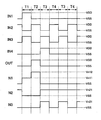
도 1은 실시형태 1을 나타내는 도면.1 is a
도 2는 실시형태 1을 나타내는 타이밍 차트.2 is a timing
도 3은 실시형태 1을 나타내는 도면.3 shows a first embodiment.
도 4는 실시형태 1을 나타내는 도면.4 is a
도 5는 실시형태 1을 나타내는 도면.5 shows a first embodiment;
도 6은 실시형태 1을 나타내는 도면.6 shows a first embodiment;
도 7은 실시형태 1을 나타내는 도면.7 shows a first embodiment.
도 8은 실시형태 1을 나타내는 도면.8 shows a first embodiment.
도 9는 실시형태 1을 나타내는 도면.9 is a
도 10은 실시형태 1을 나타내는 도면.10 is a
도 11은 실시형태 1을 나타내는 도면.11 is a
도 12는 실시형태 1을 나타내는 타이밍 차트.12 is a timing
도 13은 실시형태 1을 나타내는 도면.FIG. 13 shows a first embodiment; FIG.
도 14는 실시형태 1을 나타내는 도면.14 is a
도 15는 실시형태 1을 나타내는 도면.FIG. 15 shows a first embodiment;
도 16은 실시형태 1을 나타내는 도면.16 shows a first embodiment.
도 17은 실시형태 2를 나타내는 도면.17 shows a second embodiment.
도 18은 실시형태 2를 나타내는 타이밍 차트.18 is a timing
도 19는 실시형태 2를 나타내는 타이밍 차트.19 is a timing
도 20은 실시형태 3을 나타내는 도면.20 shows a third embodiment.
도 21은 실시형태 3을 나타내는 도면.21 shows a third embodiment.
도 22는 실시형태 3을 나타내는 도면.22 is a
도 23은 실시형태 3을 나타내는 도면.23 is a
도 24는 실시형태 3을 나타내는 도면.24 shows a third embodiment.
도 25는 실시형태 3을 나타내는 도면.25 shows a third embodiment.
도 26은 실시형태 3을 나타내는 도면.FIG. 26 shows a third embodiment;
도 27은 실시형태 3을 나타내는 도면.27 shows a third embodiment;
도 28은 실시형태 3을 나타내는 도면.28 shows a third embodiment.
도 29는 실시형태 3을 나타내는 도면.29 shows a third embodiment.
도 30은 실시형태 3을 나타내는 도면.30 shows a third embodiment;
도 31은 실시형태 3을 나타내는 도면.31 shows a third embodiment.
도 32는 실시형태 3을 나타내는 도면.32 shows a third embodiment;
도 33은 실시형태 3을 나타내는 도면.33 shows a third embodiment.
도 34는 실시형태 3을 나타내는 도면.34 shows a third embodiment;
도 35는 실시형태 3을 나타내는 도면.35 shows a third embodiment;
도 36은 실시형태 3을 나타내는 도면.36 shows a third embodiment.
도 37은 실시형태 3을 나타내는 도면.37 shows a third embodiment;
도 38은 실시형태 3을 나타내는 도면.38 shows a third embodiment;
도 39는 실시형태 3을 나타내는 도면.39 shows a third embodiment;
도 40은 실시형태 3을 나타내는 도면.40 shows a third embodiment;
도 41은 실시형태 3을 나타내는 도면.41 shows a third embodiment;
도 42는 실시형태 3을 나타내는 도면.42 shows a third embodiment.
도 43은 실시형태 3을 나타내는 도면.43 shows a third embodiment;
도 44는 실시형태 3을 나타내는 도면.44 shows a third embodiment.
도 45는 실시형태 3을 나타내는 도면.45 shows a third embodiment.
도 46은 실시형태 3을 나타내는 도면.46 shows a third embodiment;
도 47은 실시형태 3을 나타내는 도면.47 shows a third embodiment;
도 48은 실시형태 3을 나타내는 도면.48 shows a third embodiment;
도 49는 실시형태 3을 나타내는 도면.FIG. 49 shows a third embodiment;
도 50은 실시형태 3을 나타내는 도면.50 shows a third embodiment;
도 51은 실시형태 3을 나타내는 도면.FIG. 51 shows a third embodiment;
도 52는 실시형태 3을 나타내는 도면.52 shows a third embodiment;
도 53은 실시형태 3을 나타내는 도면.53 shows a third embodiment;
도 54는 실시형태 3을 나타내는 도면.54 shows a third embodiment;
도 55는 실시형태 3을 나타내는 도면.55 shows a third embodiment;
도 56은 실시형태 3을 나타내는 도면.56 shows a third embodiment;
도 57은 실시형태 3을 나타내는 도면.57 shows a third embodiment;
도 58은 실시형태 3을 나타내는 도면.58 shows a third embodiment.
도 59는 실시형태 3을 나타내는 도면.59 shows a third embodiment;
도 60은 실시형태 3을 나타내는 도면.60 shows a third embodiment;
도 61은 실시형태 3을 나타내는 도면.61 shows a third embodiment;
도 62는 실시형태 3을 나타내는 도면.62 shows a third embodiment;
도 63은 실시형태 3을 나타내는 도면.63 shows a third embodiment;
도 64는 실시형태 3을 나타내는 도면.64 shows a third embodiment;
도 65는 실시형태 3을 나타내는 도면.65 shows a third embodiment;
도 66은 실시형태 3을 나타내는 도면.66 shows a third embodiment;
도 67은 실시형태 3을 나타내는 도면.67 shows a third embodiment;
도 68은 실시형태 3을 나타내는 도면.68 shows a third embodiment;
도 69는 실시형태 3을 나타내는 도면.69 shows a third embodiment;
도 70은 실시형태 3을 나타내는 도면.70 shows a third embodiment;
도 71은 실시형태 3을 나타내는 도면.71 shows a third embodiment;
도 72는 실시형태 3을 나타내는 도면.72 shows a third embodiment.
도 73은 실시형태 3을 나타내는 도면.73 shows a third embodiment;
도 74는 실시형태 3을 나타내는 도면.74 shows a third embodiment;
도 75는 실시형태 3을 나타내는 도면.75 shows a third embodiment;
도 76은 실시형태 3을 나타내는 도면.76 shows a third embodiment.
도 77은 실시형태 3을 나타내는 도면.77 shows a third embodiment;
도 78은 실시형태 3을 나타내는 도면.78 shows a third embodiment;
도 79는 실시형태 3을 나타내는 도면.79 shows a third embodiment;
도 80은 실시형태 3을 나타내는 도면.80 shows a third embodiment;
도 81은 실시형태 3을 나타내는 도면.81 shows a third embodiment.
도 82는 실시형태 3을 나타내는 도면.82 shows a third embodiment;
도 83은 실시형태 3을 나타내는 도면.83 shows the third embodiment;
도 84는 실시형태 3을 나타내는 도면.84 shows a third embodiment;
도 85는 실시형태 3을 나타내는 도면.85 shows a third embodiment.
도 86은 실시형태 3을 나타내는 도면.86 shows a third embodiment;
도 87은 실시형태 3을 나타내는 도면.87 shows a third embodiment;
도 88은 실시형태 4를 나타내는 도면.88 shows a fourth embodiment;
도 89는 실시형태 4를 나타내는 도면.89 shows a fourth embodiment;
도 90은 실시형태 4를 나타내는 도면.90 shows a fourth embodiment.
도 91은 실시형태 4를 나타내는 도면.91 shows a fourth embodiment;
도 92는 실시예 1을 나타내는 도면.92 shows Example 1;
도 93은 실시예 1을 나타내는 도면.93 is a view showing Example 1;
도 94는 실시예 1을 나타내는 도면.94 is a view showing Example 1;
도 95는 실시예 2를 나타내는 도면.95 shows Example 2;
도 96은 실시예 3을 나타내는 도면.96 shows Example 3;
도 97은 실시예 3을 나타내는 도면.97 shows Example 3;
도 98은 실시예 3을 나타내는 도면.98 is a view showing Example 3;
도 99는 실시예 3을 나타내는 도면.99 shows Example 3;
도 100(A) 및 도 100(B)는 실시예 4를 나타내는 도면.100A and 100B show the fourth embodiment.
도 101(A) 및 도 101(B)는 실시예 4를 나타내는 도면.101A and 101B show the fourth embodiment.
도 102(A) 및 도 102(B)는 실시예 4를 나타내는 도면.102 (A) and 102 (B) show a fourth embodiment.
도 103(A) 및 도 103(B)는 실시예 4를 나타내는 도면.103 (A) and 103 (B) show a fourth embodiment.
도 104(A)∼도 104(C)는 실시예 4를 나타내는 도면.104A to 104C show Example 4;
도 105는 실시예 4를 나타내는 도면.105 is a view showing Example 4;
도 106(A) 및 도 106(B)는 실시예 4를 나타내는 도면.106A and 106B show a fourth embodiment.
도 107(A) 및 도 107(B)는 실시예 4를 나타내는 도면.107 (A) and 107 (B) show a fourth embodiment.
도 108(A) 및 도 108(B)는 실시예 4를 나타내는 도면.108 (A) and 108 (B) show a fourth embodiment.
도 109(A) 및 도 109(B)는 실시예 4를 나타내는 도면.109 (A) and 109 (B) show a fourth embodiment.
도 110(A) 및 도 110(B)는 실시예 4를 나타내는 도면.110A and 110B show a fourth embodiment.
도 111(A) 및 도 111(B)는 실시예 4를 나타내는 도면.111 (A) and 111 (B) show a fourth embodiment.
도 112는 실시예 7을 나타내는 도면.112 shows the seventh embodiment;
도 113은 실시예 7을 나타내는 도면.113 shows the seventh embodiment;
도 114(A) 및 도 114(B)는 실시예 7을 나타내는 도면.114 (A) and 114 (B) show a seventh embodiment.
도 115(A) 및 도 115(B)는 실시예 7을 나타내는 도면.115 (A) and 115 (B) show a seventh embodiment.
도 116은 실시예 6을 나타내는 도면.116 is a diagram showing Example 6;
도 117(A)∼도 117(H)는 실시예 7을 나타내는 도면.117 (A) to 117 (H) are views showing the seventh embodiment.
도 118은 실시예 3을 나타내는 도면.118 is a view showing Example 3. FIG.
도 119는 실시예 3을 나타내는 도면.119 shows Example 3;
도 120은 실시예 3을 나타내는 도면.120 is a view showing Example 3. FIG.
도 121은 실시예 3을 나타내는 도면.121 is a view showing Example 3;
도 122는 실시형태 4를 나타내는 도면.122 shows a fourth embodiment;
도 123은 실시형태 5를 나타내는 도면.123 shows a fifth embodiment;
도 124는 실시형태 3을 나타내는 도면.124 shows a third embodiment;
도 125는 실시형태 3을 나타내는 도면.125 shows the third embodiment;
이하, 본 발명을 실시형태 및 실시예에 의해 도면을 참조하여 설명한다. 그러나, 본 발명은 많은 다른 양태로 실시하는 것이 가능하고, 본 발명의 취지 및 그 범위로부터 벗어남이 없이 그의 형태 및 상세한 사항을 다양하게 변경할 수 있다는 것은 당업자라면 용이하게 이해할 수 있을 것이다. 따라서, 본 발명은 실시형태 및 실시예의 기재 내용에 한정하여 해석되는 것은 아니다.EMBODIMENT OF THE INVENTION Hereinafter, this invention is demonstrated with reference to drawings by embodiment and an Example. However, it will be readily apparent to one skilled in the art that the present invention may be embodied in many other aspects, and that the form and details thereof may be variously changed without departing from the spirit and scope of the present invention. Therefore, this invention is not limited to description of embodiment and Example.
[실시형태 1]
도 1은 본 발명의 시프트 레지스터 회로에 포함되는 플립플롭 회로(10)의 일 형태를 나타낸다. 본 발명의 시프트 레지스터 회로는 플립플롭 회로(10)를 다수 단(stage) 가지고 있다. 도 1에 나타내는 플립플롭 회로(10)는 트랜지스터(11), 트랜지스터(12), 트랜지스터(13), 트랜지스터(14), 트랜지스터(15), 트랜지스터(16), 트랜지스터(17), 트랜지스터(18), 및 2개의 전극을 가지는 커패시터(19)를 포함하고 있다. 그러나, 커패시터(19)는, 트랜지스터(12)의 게이트 용량이 커패시터(19)로서 사용할 수 있는 경우에는 반드시 필요하지는 않다.1 shows one form of flip-
플립플롭 회로(10)에 나타내는 바와 같이, 트랜지스터(11)의 게이트 단자가 입력 단자(IN1)에 접속되고, 트랜지스터(11)의 제1 단자가 제1 전원에 접속되고, 트랜지스터(11)의 제2 단자가 트랜지스터(12)의 게이트 단자, 트랜지스터(14)의 제2 단자, 트랜지스터(15)의 게이트 단자, 트랜지스터(17)의 제2 단자, 및 커패시터(19)의 제2 전극에 접속되어 있다. 트랜지스터(15)의 제1 단자가 제2 전원에 접속되고, 트랜지스터(15)의 제2 단자가 트랜지스터(16)의 제2 단자 및 트랜지스터(18)의 게이트 단자에 접속되어 있다. 트랜지스터(16)의 게이트 단자 및 제1 단 자가 제1 전원에 접속되어 있다. 트랜지스터(18)의 제1 단자가 입력 단자(IN3)에 접속되고, 트랜지스터(18)의 제2 단자가 트랜지스터(13)의 게이트 단자 및 트랜지스터(14)의 게이트 단자에 접속되어 있다. 트랜지스터(13)의 제1 단자가 제2 전원에 접속되고, 트랜지스터(13)의 제2 단자가 커패시터(19)의 제1 전극, 트랜지스터(12)의 제2 단자, 및 출력 단자(OUT)에 접속되어 있다. 트랜지스터(12)의 제1 단자가 입력 단자(IN2)에 접속되어 있다. 트랜지스터(14)의 제1 단자가 제2 전원에 접속되어 있다. 트랜지스터(17)의 게이트 단자가 입력 단자(IN4)에 접속되고, 트랜지스터(17)의 제1 단자가 제2 전원에 접속되어 있다.As shown in the flip-
또한, 플립플롭 회로(10)에서, 트랜지스터(11)의 제2 단자, 트랜지스터(12)의 게이트 단자, 트랜지스터(14)의 제2 단자, 트랜지스터(15)의 게이트 단자, 트랜지스터(17)의 제2 단자, 및 커패시터(19)의 제2 전극의 노드(node)를 N1로 나타낸다. 트랜지스터(15)의 제2 단자, 트랜지스터(16)의 제2 단자, 및 트랜지스터(18)의 게이트 단자의 노드를 N2로 나타낸다. 트랜지스터(13)의 게이트 단자, 트랜지스터(14)의 게이트 단자, 및 트랜지스터(18)의 제2 단자의 노드를 N3으로 나타낸다.In the flip-
또한, 제1 전원에는 전원 전위(VDD)가 공급되고, 제2 전원에는 전원 전위(VSS)가 공급된다. 제1 전원의 전원 전위(VDD)와 제2 전원의 전원 전위(VSS)와의 전위차(VDD-VSS)가 플립플롭 회로(10)의 전원 전압에 상당한다. 또한, 전원 전위(VDD)는 전원 전위(VSS)보다 높은 전위이다.In addition, a power supply potential VDD is supplied to the first power supply, and a power supply potential VSS is supplied to the second power supply. The potential difference VDD-VSS between the power supply potential VDD of the first power supply and the power supply potential VSS of the second power supply corresponds to the power supply voltage of the flip-
또한, 입력 단자(IN1∼IN4) 각각에는 제어 신호가 공급된다. 또한, 출력 단 자(OUT)는 출력 신호를 출력한다. 입력 단자(IN1)에는 전단(前段)의 플립플롭 회로(10)의 출력 신호가 제어 신호로서 공급된다. 입력 단자(IN4)에는 다음 단의 플립플롭 회로(10)의 출력 신호가 제어 신호로서 공급된다.In addition, a control signal is supplied to each of the input terminals IN1 to IN4. In addition, the output terminal OUT outputs an output signal. The output signal of the preceding flip-
또한, 트랜지스터(11∼18) 각각은 n채널형 트랜지스터이다. 그러나, 트랜지스터(11∼18) 각각은 p채널형 트랜지스터이어도 좋다.Each of the
다음에, 도 2에 나타내는 타이밍 차트를 사용하여, 도 1에 나타내는 플립플롭 회로(10)의 동작에 대하여 설명한다. 도 2는, 도 1에 나타낸 입력 단자(IN1∼IN4) 각각에 공급되는 제어 신호와, 출력 단자(OUT)로부터 출력되는 출력 신호와, 노드(N1∼N3)의 전위의 타이밍 차트를 나타내고 있다. 또한, 도 2에 나타내는 타이밍 차트는 편의상, 기간(T1∼T4)으로 분할되어 있다.Next, the operation of the flip-
또한, 기간(T4) 이후의 기간에서는, 기간(T3)과 기간(T4)을 순차로 반복한다. 또한, 도 2에서는, 기간(T1)을 선택 준비 기간이라고 정의하고, 기간(T2)을 선택 기간이라고 정의하고, 기간(T3) 및 기간(T4)을 비선택 기간이라고 정의한다. 즉, 하나의 선택 준비 기간과, 하나의 선택 기간과, 다수의 비선택 기간을 순차로 반복하고 있다.In the period after the period T4, the period T3 and the period T4 are repeated in sequence. In addition, in FIG. 2, the period T1 is defined as a selection preparation period, the period T2 is defined as a selection period, and the periods T3 and T4 are defined as a non-selection period. That is, one selection preparation period, one selection period, and many non-selection periods are repeated in sequence.
또한, 도 2에 나타내는 타이밍 차트에서는, 제어 신호 및 출력 신호 각각은 2개의 값을 가지고 있다. 즉, 이들 신호 각각은 디지털 신호이고, 디지털 신호의 전위들 중 하나는, 그 디지털 신호가 H 신호일 때는 제1 전원의 전원 전위와 같은 전위인 VDD(이하, 전위(VDD) 또는 H 레벨이라고도 한다)이고, 그 디지털 신호가 L 신호일 때는 제2 전원의 전원 전위와 같은 전위인 VSS(이하, 전위(VSS) 또는 L 레 벨이라고도 한다)이다.In addition, in the timing chart shown in FIG. 2, each of the control signal and the output signal has two values. That is, each of these signals is a digital signal, and one of the potentials of the digital signal is VDD (hereinafter referred to as potential VDD or H level), which is the same potential as the power supply potential of the first power supply when the digital signal is the H signal. When the digital signal is an L signal, it is VSS (hereinafter, also referred to as potential VSS or L level) which is the same potential as the power supply potential of the second power supply.
또한, 도 3∼도 6은 각각 기간(T1)∼기간(T4)에서의 동작에 대응한 플립플롭 회로(10)의 접속 상태를 나타내고 있다.3 to 6 show the connected state of the flip-
또한, 도 3∼도 6에서, 실선으로 나타낸 트랜지스터는 온(ON) 상태에 있는 것을 나타내고, 점선으로 나타낸 트랜지스터는 오프(OFF) 상태에 있는 것을 나타낸다. 실선으로 나타낸 배선은 전원 또는 입력 단자에 접속되어 있는 것을 나타내고, 점선으로 나타낸 배선은 전원 또는 입력 단자에 접속되어 있지 않은 것을 나타낸다.3 to 6 show that the transistor shown by the solid line is in the ON state, and the transistor shown by the dotted line is in the OFF state. The wiring shown by the solid line shows that it is connected to a power supply or an input terminal, and the wiring shown by the dotted line shows that it is not connected to a power supply or an input terminal.
다음에, 도 3∼도 6을 사용하여, 각 기간마다의 동작에 대하여 설명한다.Next, the operation of each period will be described with reference to FIGS. 3 to 6.
먼저, 기간(T1)에서의 플립플롭 회로(10)의 동작에 대하여 도 3을 사용하여 설명한다. 도 3은 기간(T1)에서의 플립플롭 회로(10)의 접속 상태를 나타내는 도면이다.First, the operation of the flip-
기간(T1)에서는, 입력 단자(IN1)는 H 레벨이 되어, 트랜지스터(11)가 온으로 된다. 입력 단자(IN4)는 L 레벨이 되어, 트랜지스터(17)가 오프로 된다. 노드(N3)는 후에 설명하는 기간(T3)에서 얻은 VSS로 유지되기 때문에, 트랜지스터(14)가 오프로 된다. 노드(N1)는 트랜지스터(11)를 통하여 제1 전원에 전기적으로 접속되고, 노드(N1)의 전위가 상승하여 Vn11이 된다. 노드(N1)가 Vn11이 되면, 트랜지스터(11)가 오프로 된다. 여기서, Vn11은 전원 전위(VDD)로부터 트랜지스터(11)의 스레시홀드 전압(Vth11)을 뺀 값(VDD-Vth11)이다. 또한, Vn11은 트랜지스터(12) 및 트랜지스터(15)를 온으로 할 수 있는 전위이다.In the period T1, the input terminal IN1 is at the H level, and the
노드(N1)의 전위가 Vn11이 되면, 트랜지스터(11)가 오프로 되고, 트랜지스터(12) 및 트랜지스터(15)가 온으로 된다. 노드(N2)는 트랜지스터(15)를 통하여 제2 전원에 전기적으로 접속되고, 트랜지스터(16)를 통하여 제1 전원에 전기적으로 접속되고, 노드(N2)의 전위가 상승하여 Vn21이 된다. 여기서, Vn21은 트랜지스터(16) 및 트랜지스터(15)의 동작점에 의해 결정된다. 또한, 트랜지스터(15)와 트랜지스터(16)는 그 2개의 트랜지스터를 사용하여 인버터를 구성한다. 따라서, 트랜지스터(15)의 게이트 단자(노드(N1))에 H 레벨의 신호가 입력된 때, 노드(N2)에는 L 레벨의 신호가 입력된다. 여기서, Vn21은 트랜지스터(18)를 오프로 할 수 있는 전위이다. 따라서, 입력 단자(IN3)가 H 레벨이어도 트랜지스터(18)가 오프이기 때문에, 노드(N3)는 VSS로 유지될 수 있다. 입력 단자(IN2)가 L 레벨이 되고 출력 단자(OUT)가 트랜지스터(12)를 통하여 입력 단자(IN2)에 전기적으로 접속되기 때문에, 출력 단자(OUT)의 전위는 VSS가 된다.When the potential of the node N1 becomes Vn11, the
노드(N2)의 전위가 Vn21이 되고 트랜지스터(18)가 오프이기 때문에, 노드(N3)는 VSS로 유지되고, 트랜지스터(13) 및 트랜지스터(14)는 오프로 된다.Since the potential of the node N2 is Vn21 and the
이상의 동작에 의해, 기간(T1)에서는, 트랜지스터(12)를 온으로 하고, 출력 단자(OUT)를 L 레벨로 한다. 또한, 트랜지스터(11)가 오프이므로, 노드(N1)를 플로팅(floating) 상태로 한다.By the above operation, in the period T1, the
다음에, 기간(T2)에서의 플립플롭 회로(10)의 동작에 대하여 도 4를 사용하여 설명한다. 도 4는 기간(T2)에서의 플립플롭 회로(10)의 접속 상태를 나타내는 도면이다.Next, the operation of the flip-
기간(T2)에서는, 입력 단자(IN1)는 L 레벨이 되고, 트랜지스터(11)는 오프이다. 입력 단자(IN4)는 L 레벨인 채이고, 트랜지스터(17)는 오프이다. 따라서, 노드(N1)는 기간(T1)에서부터 계속 플로팅 상태에 있어, 기간(T1)에서의 전위(Vn11)를 유지한다.In the period T2, the input terminal IN1 is at the L level, and the
노드(N1)의 전위는 Vn11로 유지되기 때문에, 트랜지스터(12)는 온이다. 그리고, 입력 단자(IN2)는 H 레벨이 된다. 그 다음, 출력 단자(OUT)가 트랜지스터(12)를 통하여 입력 단자(IN2)에 전기적으로 접속되기 때문에, 출력 단자(OUT)의 전위가 VSS로부터 상승한다. 노드(N1)의 전위는 커패시터(19)의 용량 결합에 의해 Vn12로 바뀌어, 트랜지스터(12)의 온 상태를 유지한다. 소위 부트스트랩(bootstrap) 동작이 행해진다. 그 결과, 출력 단자(OUT)의 전위는 입력 단자(IN2)의 전위인 VDD와 같은 전위까지 상승한다. 또한, Vn12는 전위(VDD)와 트랜지스터(12)의 스레시홀드 전압(Vth12)과의 합 이상의 값이다.Since the potential of the node N1 is held at Vn11, the
노드(N1)의 전위가 Vn12가 되어도, 트랜지스터(15)는 계속 온 상태에 있다. 따라서, 노드(N2)의 전위 및 노드(N3)의 전위는 기간(T1)일 때의 전위와 같은 전위가 된다.Even when the potential of the node N1 becomes Vn12, the
이상의 동작에 의해, 기간(T2)에서는, 부트스트랩 동작에 의해, 플로팅 상태의 노드(N1)의 전위를 상승시킴으로써, 트랜지스터(12)가 계속 온 상태로 된다. 따라서, 출력 단자(OUT)의 전위를 VDD로 하여, 출력 단자(OUT)를 H 레벨로 한다.By the above operation, in the period T2, the
다음에, 기간(T3)에서의 플립플롭 회로(10)의 동작에 대하여 도 5를 사용하여 설명한다. 도 5는 기간(T3)에서의 플립플롭 회로(10)의 접속 상태를 나타내는 도면이다.Next, the operation of the flip-
기간(T3)에서는, 입력 단자(IN1)는 L 레벨인 채이고, 트랜지스터(11)는 오프이다. 입력 단자(IN4)는 H 레벨이 되어, 트랜지스터(17)를 온으로 한다. 그러면, 노드(N1)는 트랜지스터(17)를 통하여 제2 전원에 전기적으로 접속되어, 노드(N1)의 전위가 VSS가 된다.In the period T3, the input terminal IN1 remains at the L level, and the
노드(N1)의 전위는 VSS가 되어, 트랜지스터(12) 및 트랜지스터(15)를 오프로 한다. 노드(N2)는 트랜지스터(16)를 통하여 제1 전원에 전기적으로 접속되어 있으므로, 노드(N2)의 전위가 상승하여 Vn22가 된다. 여기서, Vn22는 전원 전위(VDD)로부터 트랜지스터(16)의 스레시홀드 전압(Vth16)을 뺀 값(VDD-Vth16)이다. 또한, Vn22는 트랜지스터(18)를 온으로 할 수 있는 전위이다.The potential of the node N1 is VSS, and the
노드(N2)의 전위가 Vn22가 되면, 트랜지스터(18)가 온으로 된다. 그리고, 입력 단자(IN3)는 H 레벨로 되어 있으므로, 노드(N3)는 트랜지스터(18)를 통하여 입력 단자(IN3)에 전기적으로 접속되고, 노드(N3)의 전위가 Vn31이 된다. 여기서, Vn31은 노드(N2)의 전위인 Vn22로부터 트랜지스터(18)의 스레시홀드 전압(Vth18)을 뺀 값(Vn22-Vth18)이다. 또한, Vn31은 전원 전위(VDD)로부터 트랜지스터(16)의 스레시홀드 전압(Vth16) 및 트랜지스터(18)의 스레시홀드 전압(Vth18)을 뺀 값(VDD-Vth16-Vth18)에 상당한다. 또한, Vn31은 트랜지스터(13) 및 트랜지스터(14)를 온으로 할 수 있는 전위이다.When the potential of the node N2 becomes Vn22, the
노드(N3)의 전위가 Vn31이 되면, 트랜지스터(13)가 온으로 된다. 그리고, 출력 단자(OUT)는 트랜지스터(13)를 통하여 제2 전원에 전기적으로 접속되어 있으 므로, 출력 단자(OUT)의 전위가 VSS가 된다.When the potential of the node N3 becomes Vn31, the
이상의 동작에 의해, 기간(T3)에서는, 노드(N1)에 VSS가 공급되어, 트랜지스터(12) 및 트랜지스터(15)를 오프로 하고 있다. 또한, 노드(N3)를 H 레벨로 하여, 트랜지스터(13) 및 트랜지스터(14)를 온으로 하고 있다. 따라서, 출력 단자(OUT)의 전위를 VSS로 하여, 출력 단자(OUT)를 L 레벨로 하고 있다.By the above operation, in the period T3, VSS is supplied to the node N1, and the
다음에, 기간(T4)에서의 플립플롭 회로(10)의 동작에 대하여 도 6을 사용하여 설명한다. 도 6은 기간(T4)에서의 플립플롭 회로(10)의 접속 상태를 나타내는 도면이다.Next, the operation of the flip-
기간(T4)에서는, 입력 단자(IN3)는 L 레벨이 되고, 노드(N3)의 전위가 VSS가 된다. 따라서, 트랜지스터(13)와 트랜지스터(14)가 오프로 된다. 입력 단자(IN4)는 L 레벨이 되어, 트랜지스터(17)를 오프로 한다. 따라서, 노드(N1)는 플로팅 상태가 되고, 노드(N1)의 전위는 VSS로 유지된다.In the period T4, the input terminal IN3 becomes L level, and the potential of the node N3 becomes VSS. Thus, the
노드(N1)의 전위는 VSS인 채이므로, 트랜지스터(12)와 트랜지스터(15)는 계속 오프인 채이다. 따라서, 노드(N2)는 계속 Vn22인 채이고, 트랜지스터(18)가 계속 온인 채이다.Since the potential of the node N1 remains VSS, the
트랜지스터(12) 및 트랜지스터(13)는 오프이기 때문에, 출력 단자(OUT)는 플로팅 상태가 된다. 따라서, 출력 단자(OUT)의 전위는 VSS로 유지된다.Since the
이상의 동작에 의해, 기간(T4)에서는, 출력 단자(OUT)의 전위가 VSS로 유지되어, 트랜지스터(13) 및 트랜지스터(14)를 오프로 할 수 있다. 이와 같이 트랜지스터(13) 및 트랜지스터(14)는 항상 온으로 되지 않기 때문에, 트랜지스터(13) 및 트랜지스터(14)의 특성 열화를 억제할 수 있다.By the above operation, in the period T4, the potential of the output terminal OUT is maintained at VSS, so that the
기간(T1)∼기간(T4)의 관계에 대하여 설명한다. 기간(T1)의 다음 기간은 기간(T2)이고, 기간(T2)의 다음 기간은 기간(T3)이고, 기간(T3)의 다음 기간은 기간(T4)이다. 여기서, 기간(T4)의 다음 기간은 기간(T1) 또는 기간(T3)이다. 즉, 기간(T4)의 다음 기간은, 입력 단자(IN1)가 H 레벨이 되면 기간(T1)이 되고, 입력 단자(IN1)가 L 레벨인 채이면 기간(T3)이 된다. 또한, 기간(T3)이 기간(T4)의 다음 기간인 경우에는, 입력 단자(IN4)는 L 레벨인 채이고, 트랜지스터(17)는 계속 오프인 채이다.The relationship between the period T1-the period T4 is demonstrated. The next period of the period T1 is the period T2, the next period of the period T2 is the period T3, and the next period of the period T3 is the period T4. Here, the next period of the period T4 is the period T1 or the period T3. That is, the period following the period T4 becomes the period T1 when the input terminal IN1 becomes H level, and becomes the period T3 when the input terminal IN1 remains L level. In addition, when the period T3 is the period following the period T4, the input terminal IN4 remains at the L level, and the
여기서, 트랜지스터(11∼18) 및 커패시터(19)의 기능에 대하여 이하에 설명한다.Here, the functions of the
트랜지스터(11)는, 입력 단자(IN1)에 공급되는 제어 신호에 따라, 제1 전원과 노드(N1)를 접속할지 접속하지 않을지를 선택하는 스위치로서의 기능을 가진다. 기간(T1)에서, 트랜지스터(11)는 노드(N1)에 전원 전위(VDD)를 공급하고, 노드(N1)의 전위가 Vn11이 되면 오프로 되는 기능을 가진다.The
또한, 트랜지스터(11)는 입력 단자(IN1)에 공급되는 제어 신호에 따라 노드(N1)를 플로팅 상태(부유 상태)로 하는 기능을 가진다. 기간(T1) 및 기간(T2)에서, 트랜지스터(11)는 노드(N1)의 전위가 Vn11 이상이 되면 오프로 되는 기능을 가진다.In addition, the
트랜지스터(12)는 노드(N1)의 전위에 따라, 입력 단자(IN2)와 출력 단자(OUT)를 접속할지 접속하지 않을지를 선택하는 스위치로서의 기능을 가진다. 기 간(T1)에서, 트랜지스터(12)는 출력 단자(OUT)에 VSS를 공급하는 기능을 가진다. 기간(T2)에서, 트랜지스터(12)는 출력 단자(OUT)에 VDD를 공급하는 기능을 가진다.The
트랜지스터(13)는 노드(N3)의 전위에 따라, 제2 전원과 출력 단자(OUT)를 접속할지 접속하지 않을지를 선택하는 스위치로서의 기능을 가진다. 기간(T3)에서, 트랜지스터(13)는 출력 단자(OUT)에 전원 전위(VSS)를 공급하는 기능을 가진다.The
트랜지스터(14)는 노드(N3)의 전위에 따라, 제2 전원과 노드(N1)를 접속할지 접속하지 않을지를 선택하는 스위치로서의 기능을 가진다. 기간(T3)에서, 트랜지스터(14)는 노드(N1)에 전원 전위(VSS)를 공급하는 기능을 가진다.The
트랜지스터(15)는 노드(N1)의 전위에 따라, 제2 전원과 노드(N2)를 접속할지 접속하지 않을지를 선택하는 스위치로서의 기능을 가진다. 기간(T1) 및 기간(T2)에서, 트랜지스터(15)는 노드(N2)에 전원 전위(VSS)를 공급하는 기능을 가진다.The
트랜지스터(16)는, 입력 단자가 제1 전원에 접속되고 출력 단자가 노드(N2)에 접속된 다이오드로서의 기능을 가진다.The
트랜지스터(17)는 입력 단자(IN4)에 공급되는 제어 신호에 따라, 제2 전원과 노드(N1)를 접속할지 접속하지 않을지를 선택하는 스위치로서의 기능을 가진다. 기간(T2) 후의 기간(T3)에서, 트랜지스터(17)는 노드(N1)에 전원 전위(VSS)를 공급하는 기능을 가진다.The
트랜지스터(18)는 노드(N2)의 전위에 따라, 입력 단자(IN3)와 노드(N3)를 접속할지 접속하지 않을지를 선택하는 스위치로서의 기능을 가진다. 기간(T3)에서, 트랜지스터(18)는 노드(N3)에 VDD를 공급하는 기능을 가진다. 또한, 기간(T4)에 서, 트랜지스터(18)는 노드(N3)에 VSS를 공급하는 기능을 가진다.The
커패시터(19)는 출력 단자(OUT)의 전위에 따라 노드(N1)의 전위를 변화시키는 기능을 가진다. 기간(T2)에서, 커패시터(19)는 출력 단자(OUT)의 전위의 상승에 의해 노드(N1)의 전위를 상승시키는 기능을 가진다.The
이와 같이, 도 1에 나타내는 플립플롭 회로(10)에서는, 트랜지스터(13) 및 트랜지스터(14)가 기간(T3)에서는 온으로 되고, 기간(T4)에서는 오프로 됨으로써, 트랜지스터(13) 및 트랜지스터(14)가 항상 온으로 되는 것을 피할 수 있다. 따라서, 트랜지스터(13) 및 트랜지스터(14)의 특성 열화가 억제될 수 있다. 따라서, 도 1에 나타내는 플립플롭 회로(10)에서는, 트랜지스터(13) 및 트랜지스터(14)의 특성 열화에 의한 오동작도 억제할 수 있다.Thus, in the flip-
또한, 트랜지스터(13) 및 트랜지스터(14)가 온으로 된 때, 전원 전위(VSS)가 출력 단자(OUT) 및 노드(N1)에 공급된다. 따라서, 도 1에 나타내는 플립플롭 회로(10)에서는, 일정 시간 간격으로 출력 단자(OUT) 및 노드(N1)에 전원 전위(VSS)를 공급할 수 있어, 출력 단자(OUT) 및 노드(N1)의 전위의 변동을 줄일 수 있다.In addition, when the
또한, 도 1에 나타낸 플립플롭 회로(10)는 모두 n채널형 트랜지스터로 구성되어 있으므로, 반도체층으로서 아모르퍼스(amorphous) 실리콘을 사용할 수 있어, 제조 공정의 간략화를 도모할 수 있다. 따라서, 제조 비용의 삭감이나 제품 수율의 향상을 도모할 수 있다. 또한, 대형의 표시 패널을 작성하는 것도 가능하게 된다. 또한, 본 발명의 플립플롭 회로를 사용함으로써, 특성이 열화하기 쉬운 아모르퍼스 실리콘으로 된 트랜지스터를 사용하여도, 반도체장치의 수명을 길게 할 수 있다.In addition, since the flip-
또한, 기간(T1)∼기간(T4)에서, 각각 도 3∼도 6의 상태를 만족하도록 플립플롭 회로(10)에 트랜지스터 또는 스위치 등의 소자가 제공되어도 좋다.In the periods T1 to T4, elements such as transistors or switches may be provided in the flip-
또한, 커패시터(19)는 게이트 배선층과 반도체층을 사용하여 형성되는 것이 바람직하다. 게이트 배선층과 반도체층은 게이트 절연막을 사이에 두고 적층된다. 게이트 절연막의 막 두께는 층간막 등의 다른 절연층보다 매우 얇기 때문에, 커패시터는, 게이트 절연막을 절연체로서 사용하면 소면적 및 대용량이 된다.In addition, the
또한, 트랜지스터(15)의 사이즈(W/L)는 트랜지스터(16)의 사이즈보다 큰 것이 바람직하다. 여기서, W는 트랜지스터의 채널 폭을 나타내고, L은 트랜지스터의 채널 길이를 나타낸다. 트랜지스터(15)가 온으로 되는 경우, 노드(N2)의 전위는 트랜지스터(15)와 트랜지스터(16)의 동작점에 의해 결정된다. 즉, 트랜지스터(15)의 사이즈가 트랜지스터(16)의 사이즈보다 충분히 크지 않으면, 노드(N2)의 전위가 높아져, 트랜지스터(18)가 오프로 될 수 없게 된다. 따라서, 트랜지스터(18)를 오프로 하기 위해, 트랜지스터(15)의 사이즈는 트랜지스터(16)의 사이즈보다 충분히 크게 할 필요가 있다.In addition, the size (W / L) of the
또한, 트랜지스터(15)의 사이즈는 트랜지스터(16)의 사이즈의 4배 이상인 것이 바람직하고, 더 바람직하게는, 10배 이상이다. 전원 전압이 낮을 때는, 트랜지스터(15) 대 트랜지스터(16)의 사이즈 비는 4:1 정도이면 되지만, 전원 전압이 높게 되면, 그 사이즈 비는 10:1 정도일 필요가 있다.In addition, the size of the
여기서, 레벨 시프트 회로 등이 플립플롭 회로(10)의 출력 단자(OUT)에 접속 되어 있는 경우는, 트랜지스터(15) 대 트랜지스터(16)의 사이즈 비는 4:1 이상이 바람직하다. 왜냐하면, 플립플롭 회로(10)의 출력 신호의 진폭 전압이 레벨 시프트 회로 등에 의해 증가하여, 플립플롭 회로(10)가 낮은 전원 전압에서 동작하는 경우가 많기 때문이다.Here, when the level shift circuit or the like is connected to the output terminal OUT of the flip-
또는, 레벨 시프트 회로 등이 플립플롭 회로(10)의 출력 단자(OUT)에 접속되어 있지 않은 경우는, 트랜지스터(15) 대 트랜지스터(16)의 사이즈 비는 10:1 이상이 바람직하다. 왜냐하면, 플립플롭 회로(10)의 출력 신호가 레벨 시프트하지 않고 어떠한 동작에 적용되어, 플립플롭 회로(10)가 높은 전원 전압에서 동작하는 경우가 많기 때문이다.Alternatively, when the level shift circuit or the like is not connected to the output terminal OUT of the flip-
또한, 전원 전위 및 제어 신호의 전위 각각은, 대상으로 하는 트랜지스터의 온/오프를 제어할 수 있다면, 어떠한 전위이어도 좋다.The potential of the power supply potential and the control signal may be any potential as long as it is possible to control the on / off of the target transistor.
예를 들어, 전원 전위(VDD)는 제어 신호의 H 레벨 전위보다 높아도 좋다. 왜냐하면, 노드(N3)의 전위가 Vn31(VDD-Vth16-Vth18)이어서, 전원 전위(VDD)가 높아지면 노드(N3)의 전위(Vn31)도 높아지기 때문이다. 따라서, 트랜지스터(13) 및 트랜지스터(14)의 스레시홀드 전압이 트랜지스터(13) 및 트랜지스터(14)의 특성 열화에 때문에 높아지더라도, 트랜지스터(13) 및 트랜지스터(14)는 확실히 온으로 될 수 있다.For example, the power supply potential VDD may be higher than the H level potential of the control signal. This is because the potential of the node N3 is Vn31 (VDD-Vth16-Vth18). When the power supply potential VDD is high, the potential Vn31 of the node N3 also increases. Thus, even if the threshold voltages of the
또한, 전원 전위(VDD)는, 각 트랜지스터의 온/오프를 제어할 수 있다면, 제어 신호의 H 레벨 전위보다 낮아도 좋다.The power supply potential VDD may be lower than the H level potential of the control signal as long as it can control the on / off of each transistor.
또한, 커패시터(19)는, 트랜지스터(12)의 게이트 단자와 제2 단자와의 사이 의 게이트 용량(기생 용량)이 충분히 크다면, 반드시 필요하지는 않다.In addition, the
예를 들어, 도 7의 플립플롭 회로(70)에서와 같이, 커패시터(19)를 접속하지 않아도 좋다. 따라서, 플립플롭 회로(70)의 소자수가 플립플롭 회로(10)의 소자수보다 하나 적게 되므로, 플립플롭 회로(70)에서는 각 소자를 고밀도로 배치할 수 있다.For example, as in the flip-
또한, 다른 예로서, 도 10의 플립플롭 회로(100)에서와 같이, 트랜지스터(101)를 사용하여 커패시터를 형성하여도 좋다. 왜냐하면, 트랜지스터(101)가 온일 때, 트랜지스터(101)의 게이트 용량이 커패시터로서 충분히 기능하기 때문이다.As another example, as in the flip-
또한, 기간(T1) 및 기간(T2)(부트스트랩 동작시)에서, 트랜지스터(101)는 온이기 때문에, 채널 영역이 트랜지스터(101)에 형성되어, 트랜지스터(101)가 커패시터로서 기능한다. 한편, 기간(T3) 및 기간(T4)(부트스트랩 동작을 하고 있지 않을 때)에서, 트랜지스터(101)는 오프이기 때문에, 채널 영역이 트랜지스터(101)에 형성되지 않으므로, 트랜지스터(101)는 커패시터로서 기능하지 않거나, 작은 커패시터로서 기능한다.In the period T1 and the period T2 (at the bootstrap operation), since the transistor 101 is on, a channel region is formed in the transistor 101, so that the transistor 101 functions as a capacitor. On the other hand, in the period T3 and the period T4 (when the bootstrap operation is not performed), since the transistor 101 is off, no channel region is formed in the transistor 101, so that the transistor 101 is a capacitor. It does not function as or functions as a small capacitor.
여기서, 앞에서 설명한 도 10의 플립플롭 회로(100)에서와 같이 트랜지스터(101)를 사용하여 커패시터를 형성함으로써, 트랜지스터(101)는 필요할 때(기간(T1) 및 기간(T2))만 커패시터로서 기능하고, 불필요한 때(기간(T3) 및 기간(T4))에는 커패시터로서 기능하지 않으므로, 플립플롭 회로(100)는 노드(N1) 및 출력 단자(OUT)의 전위의 변화에 기인하여 오동작하기 어려워진다.Here, by forming the capacitor using the transistor 101 as in the flip-
또한, 트랜지스터(101)는 트랜지스터(12)와 같은 극성을 가진다.In addition, the transistor 101 has the same polarity as the
또한, 트랜지스터(11)의 제1 단자는, 노드(N1)를 플로팅 상태로 할 수 있다면, 기간(T1) 및 기간(T2)에서 어디에 접속되어도 좋다.The first terminal of the
예를 들어, 도 8의 플립플롭 회로(80)에서와 같이, 트랜지스터(11)의 제1 단자는 입력 단자(IN1)에 접속되어도 좋다. 왜냐하면, 트랜지스터(11)의 제1 단자가 입력 단자(IN1)에 접속되어도, 기간(T1) 및 기간(T2)에서 노드(N1)를 플로팅 상태로 할 수 있기 때문이다.For example, as in the flip-
또한, 도 1의 플립플롭 회로(10)에서, 입력 단자(IN1)의 전위가 변화하면, 트랜지스터(11)의 제1 단자와 게이트 단자와의 사이의 기생 용량에 의해 제1 전원에 노이즈가 발생한다. 또한, 트랜지스터(11)의 온/오프에 의해 제1 전원으로부터 노드(N1)에 전류가 공급되면, 그 전류에 기인한 전압 강하에 의해 제1 전원에 노이즈가 발생한다. 그러한 노이즈는 입력 단자(IN1)의 전위의 변화에 의해 발생한다.In the flip-
여기서, 앞에서 설명한 도 8의 플립플롭 회로(80)와 같이 접속함으로써, 앞에서 설명한 노이즈를 억제할 수 있다. 또한, 제1 전원에서의 노이즈가 억제됨으로써, 제1 전원을 사용하는 다른 회로가 안정적으로 동작할 수 있다.Here, by connecting the same as the flip-
또한, 제1 전원을 사용하는 다른 회로란, 플립플롭 회로(80)의 출력 단자(OUT)에 접속되는 인버터 회로, 레벨 시프트 회로, 래치 회로, 또는 PWC 회로 등에 상당한다.The other circuit using the first power supply corresponds to an inverter circuit, a level shift circuit, a latch circuit, a PWC circuit, or the like connected to the output terminal OUT of the flip-
또한, 트랜지스터(16)는, 트랜지스터(15)와 함께 인버터 회로를 구성할 수 있다면 어떠한 소자라도 사용할 수 있다. 트랜지스터(16)는 반드시 정류성을 가질 필요는 없고, 전류가 흐르 전압이 발생하는 소자라면 어떠한 소자라도 사용할 수 있다.In addition, as long as the
예를 들어, 도 9의 플립플롭 회로(90)에서와 같이, 트랜지스터(16) 대신에 저항 소자(레지스터)(91)를 접속하여도 좋다. 왜냐하면, 트랜지스터(16) 대신에 저항 소자(91)를 접속하여도, 저항 소자(91)와 트랜지스터(15)를 사용하여 인버터 회로를 구성할 수 있기 때문이다.For example, as in the flip-
또한, 트랜지스터(15)가 오프일 때, 노드(N2)의 전위는 제1 전원의 전위와 같은 전위인 VDD가 된다. 또한, 이때의 노드(N3)의 전위는 전원 전위(VDD)로부터 트랜지스터(18)의 스레시홀드 전압(Vth18)을 뺀 값(VDD-Vth18)이 된다.In addition, when the
여기서, 앞에서 설명한 도 9의 플립플롭 회로(90)에서와 같이 트랜지스터(16) 대신에 저항 소자(91)를 사용함으로써, 각 트랜지스터의 스레시홀드 전압이 특성 열화에 의해 높아지더라도, 노드(N2)의 전위는 VDD가 되고, 노드(N3)의 전위는 트랜지스터(18)의 스레시홀드 전압(Vth18)만큼 VDD보다 낮아질 뿐이므로, 트랜지스터(13) 및 트랜지스터(14)가 쉽게 온으로 될 수 있다.Here, by using the
또한, 입력 단자(IN1), 입력 단자(IN2), 입력 단자(IN3), 및 입력 단자(IN4) 각각에 제어 신호가 공급되지만, 본 발명이 반드시 이것에 한정되는 것은 아니다.In addition, although a control signal is supplied to each of input terminal IN1, input terminal IN2, input terminal IN3, and input terminal IN4, this invention is not necessarily limited to this.
예를 들어, 입력 단자(IN1), 입력 단자(IN2), 입력 단자(IN3), 및 입력 단자(IN4) 각각에 전원 전위(VDD)가 공급되어도 좋고, 전원 전위(VSS)가 공급되어도 좋고, 또는 다른 전위가 공급되어도 좋다.For example, the power supply potential VDD may be supplied to each of the input terminal IN1, the input terminal IN2, the input terminal IN3, and the input terminal IN4, the power supply potential VSS may be supplied, Alternatively, another potential may be supplied.
또한, 트랜지스터(11)의 제1 단자 및 트랜지스터(16)의 제1 단자는 제1 전원 에 접속되어 있지만, 본 발명이 반드시 이것에 한정되는 것은 아니다.In addition, although the 1st terminal of the
예를 들어, 트랜지스터(11)의 제1 단자 및 트랜지스터(16)의 제1 단자는 각기 다른 전원에 접속되어도 좋다. 이때, 트랜지스터(16)의 제1 단자에 접속되는 전원의 전위는 트랜지스터(11)의 제1 단자에 접속되는 전원의 전위보다 높은 것이 바람직하다.For example, the first terminal of the
다른 예로서, 트랜지스터(11)의 제1 단자 및 트랜지스터(16)의 제1 단자 각각에 제어 신호가 공급되어도 좋다.As another example, a control signal may be supplied to each of the first terminal of the
또한, 트랜지스터(13)의 제1 단자, 트랜지스터(14)의 제1 단자, 및 트랜지스터(17)의 제1 단자는 제2 전원에 접속되어 있지만, 본 발명이 반드시 이것에 한정되는 것은 아니다.In addition, although the 1st terminal of the
예를 들어, 트랜지스터(13)의 제1 단자, 트랜지스터(14)의 제1 단자, 및 트랜지스터(17)의 제1 단자는 각기 다른 전원에 접속되어도 좋다.For example, the first terminal of the
다른 예로서, 트랜지스터(13)의 제1 단자, 트랜지스터(14)의 제1 단자, 및 트랜지스터(17)의 제1 단자 각각에 제어 신호가 공급되어도 좋다.As another example, a control signal may be supplied to each of the first terminal of the
도 1에서 나타낸 플립플롭 회로(10)는 모두 n채널형 트랜지스터를 사용하여 구성하고 있지만, 모두 p채널형 트랜지스터를 사용하여 구성하여도 좋다. 여기서, 모두 p채널형 트랜지스터를 사용하여 구성한 경우의 플립플롭 회로를 도 11에 나타낸다.Although the flip-
도 11은, 본 발명의 시프트 레지스터 회로에 포함되는 플립플롭 회로(110)의 일 형태를 나타낸다. 본 발명의 시프트 레지스터 회로는 플립플롭 회로(110)를 다 수 단 가지고 있다. 도 11에 나타내는 플립플롭 회로(110)는 트랜지스터(111), 트랜지스터(112), 트랜지스터(113), 트랜지스터(114), 트랜지스터(115), 트랜지스터(116), 트랜지스터(117), 트랜지스터(118), 및 2개의 전극을 가지는 커패시터(119)를 포함하고 있다. 그러나, 커패시터(119)는, 트랜지스터(112)의 게이트 용량으로 커패시터(119)를 대용할 수 있는 경우에는 반드시 필요한 것은 아니다.11 shows one form of the flip-
플립플롭 회로(110)에 나타내는 바와 같이, 트랜지스터(111)의 게이트 단자가 입력 단자(IN1)에 접속되고, 트랜지스터(111)의 제1 단자가 제1 전원에 접속되고, 트랜지스터(111)의 제2 단자가 트랜지스터(112)의 게이트 단자, 트랜지스터(114)의 제2 단자, 트랜지스터(115)의 게이트 단자, 트랜지스터(117)의 제2 단자, 및 커패시터(119)의 제2 전극에 접속되어 있다. 트랜지스터(115)의 제1 단자가 제2 전원에 접속되고, 트랜지스터(115)의 제2 단자가 트랜지스터(116)의 제2 단자 및 트랜지스터(118)의 게이트 단자에 접속되어 있다. 트랜지스터(116)의 게이트 단자 및 제1 단자가 제1 전원에 접속되어 있다. 트랜지스터(118)의 제1 단자가 입력 단자(IN3)에 접속되고, 트랜지스터(118)의 제2 단자가 트랜지스터(113)의 게이트 단자 및 트랜지스터(114)의 게이트 단자에 접속되어 있다. 트랜지스터(113)의 제1 단자가 제2 전원에 접속되고, 트랜지스터(113)의 제2 단자가 커패시터(119)의 제1 전극, 트랜지스터(112)의 제2 단자, 및 출력 단자(OUT)에 접속되어 있다. 트랜지스터(112)의 제1 단자가 입력 단자(IN2)에 접속되어 있다. 트랜지스터(114)의 제1 단자가 제2 전원에 접속되어 있다. 트랜지스터(117)의 게이트 단자가 입력 단자(IN4)에 접속되고, 트랜지스터(117)의 제1 단자가 제2 전원에 접속되어 있다.As shown in the flip-
또한, 플립플롭 회로(110)에서는, 트랜지스터(111)의 제2 단자, 트랜지스터(112)의 게이트 단자, 트랜지스터(114)의 제2 단자, 트랜지스터(115)의 게이트 단자, 트랜지스터(117)의 제2 단자, 및 커패시터(119)의 제2 전극의 노드를 N1로 나타낸다. 트랜지스터(115)의 제2 단자, 트랜지스터(116)의 제2 단자, 및 트랜지스터(118)의 게이트 단자의 노드를 N2로 나타낸다. 트랜지스터(113)의 게이트 단자, 트랜지스터(114)의 게이트 단자, 및 트랜지스터(118)의 제2 단자의 노드를 N3으로 나타낸다.In the flip-
또한, 제1 전원에는 전원 전위(VSS)가 공급되고, 제2 전원에는 전원 전위(VDD)가 공급된다. 제1 전원의 전원 전위(VSS)와 제2 전원의 전원 전위(VDD)와의 전위차(VDD-VSS)가, 플립플롭 회로(110)의 전원 전압에 상당한다. 또한, 전원 전위(VDD)는 전원 전위(VSS)보다 높은 전위이다.In addition, the power supply potential VSS is supplied to the first power supply, and the power supply potential VDD is supplied to the second power supply. The potential difference VDD-VSS between the power supply potential VSS of the first power supply and the power supply potential VDD of the second power supply corresponds to the power supply voltage of the flip-
또한, 입력 단자(IN1∼IN4) 각각에는 제어 신호가 공급된다. 또한, 출력 단자(OUT)는 출력 신호를 출력한다. 입력 단자(IN1)에는 전단의 플립플롭 회로(110)의 출력 신호가 제어 신호로서 공급되고, 입력 단자(IN4)에는 다음 단의 플립플롭 회로(110)의 출력 신호가 제어 신호로서 공급된다.In addition, a control signal is supplied to each of the input terminals IN1 to IN4. In addition, the output terminal OUT outputs an output signal. The output signal of the flip-
또한, 트랜지스터(111∼118) 각각은 p채널형 트랜지스터이다. 그러나, 트랜지스터(111∼118) 각각이 n채널형 트랜지스터이어도 좋다.Each of the
다음에, 도 12에 나타낸 타이밍 차트를 사용하여, 도 11에 나타낸 플립플롭 회로(110)의 동작에 대하여 설명한다. 도 12는, 도 11에 나타낸 입력 단자(IN1∼IN4) 각각에 공급되는 제어 신호와, 출력 단자(OUT)로부터 출력되는 출력 신호와, 노드(N1∼N3)의 전위의 타이밍 차트를 나타내고 있다. 또한, 제어 신호 및 출력 신호의 타이밍에 대해서는, H 레벨 및 L 레벨이, 플립플롭 회로가 모두 n채널형 트랜지스터로 구성되는 경우(도 1)의 것으로부터 반전되어 있다. 또한, 도 12에 나타낸 타이밍 차트는 편의상, 기간(T1)∼기간(T4)으로 나누어져 있다.Next, the operation of the flip-
또한, 기간(T4) 이후의 기간에서는, 기간(T3)과 기간(T4)이 순차로 반복하고 있다. 또한, 도 12에서, 기간(T1)을 선택 준비 기간이라고 정의하고, 기간(T2)을 선택 기간이라고 정의하고, 기간(T3) 및 기간(T4)을 비선택 기간이라고 정의한다. 즉, 하나의 선택 준비 기간과, 하나의 선택 기간과, 다수의 비선택 기간을 순차로 반복하고 있다.In the period after the period T4, the period T3 and the period T4 are sequentially repeated. 12, the period T1 is defined as the selection preparation period, the period T2 is defined as the selection period, and the periods T3 and T4 are defined as the non-selection period. That is, one selection preparation period, one selection period, and many non-selection periods are repeated in sequence.
또한, 도 12에 나타낸 타이밍 차트에서는, 제어 신호와 출력 신호 각각이 2개 값을 가진 디지털 신호이다. 디지털 신호의 2개 값 중 하나는, 그 디지털 신호가 H 신호일 때 제2 전원의 전원 전위와 같은 전위인 VDD(이하, 전위(VDD) 또는 H 레벨이라고도 한다)이고, 디지털 신호의 2개 값 중 다른 하나는, 그 디지털 신호가 L 신호일 때 제1 전원의 전원 전위와 같은 전위인 VSS(이하, 전위(VSS) 또는 L 레벨이라고도 한다)이다.In addition, in the timing chart shown in FIG. 12, each of the control signal and the output signal is a digital signal having two values. One of the two values of the digital signal is VDD (hereinafter also referred to as potential VDD or H level) which is the same potential as the power supply potential of the second power supply when the digital signal is the H signal, and of the two values of the digital signal. The other is VSS (hereinafter also referred to as potential VSS or L level) which is the same potential as the power supply potential of the first power supply when the digital signal is an L signal.
다음에, 플립플롭 회로(110)의 각 기간마다의 동작에 대하여 설명한다.Next, the operation of each period of the flip-
먼저, 기간(T1)에서의 플립플롭 회로(110)의 동작에 대하여 설명한다.First, the operation of the flip-
기간(T1)에서는, 입력 단자(IN1)는 L 레벨이 되어 트랜지스터(111)를 온으로 하고, 입력 단자(IN4)는 H 레벨이 되어 트랜지스터(117)를 오프로 한다. 노드(N3)는 후에 설명하는 기간(T3)에서 얻은 VDD로 유지되기 때문에, 트랜지스터(114)는 오프로 된다. 노드(N1)는 트랜지스터(111)를 통하여 제1 전원에 전기적으로 접속되고, 노드(N1)의 전위가 낮아져 Vn11이 된다. 노드(N1)가 Vn11이 되면, 트랜지스터(111)가 오프로 된다. 여기서, Vn11은 전원 전위(VSS)와 트랜지스터(111)의 스레시홀드 전압(Vth111)의 절대값과의 합이 되는 값(VSS+│Vth111│)이다. 또한, Vn11은 트랜지스터(112) 및 트랜지스터(115)를 온으로 할 수 있는 전위이다.In the period T1, the input terminal IN1 becomes L level to turn on the
노드(N1)의 전위가 Vn11이 되면, 트랜지스터(111)가 오프로 되고, 트랜지스터(112) 및 트랜지스터(115)가 온으로 된다. 노드(N2)는 트랜지스터(115)를 통하여 제2 전원에 전기적으로 접속되고, 트랜지스터(116)를 통하여 제1 전원에 전기적으로 접속되고, 노드(N2)의 전위가 Vn21이 된다. 여기서, Vn21은 트랜지스터(116)와 트랜지스터(115)의 동작점에 의해 결정된다. 또한, 트랜지스터(115)와 트랜지스터(116)는 그 2개의 트랜지스터를 사용한 인버터를 구성한다. 따라서, 트랜지스터(115)의 게이트 단자(노드(N1))에 L 레벨 신호가 입력된 때, 노드(N2)에는 H 레벨 신호가 입력된다. 여기서, Vn21은 트랜지스터(118)를 오프로 할 수 있는 전위이다. 따라서, 입력 단자(IN3)가 L 레벨이어도 트랜지스터(118)는 오프이기 때문에, 노드(N3)는 VDD로 유지될 수 있다. 입력 단자(IN2)는 H 레벨이 되고, 출력 단자(OUT)는 트랜지스터(112)를 통하여 입력 단자(IN2)에 전기적으로 접속되어 있으므로, 출력 단자(OUT)의 전위는 VDD가 된다.When the potential of the node N1 becomes Vn11, the
노드(N2)의 전위는 Vn21이 되고, 트랜지스터(118)가 오프이기 때문에, 노드(N3)는 VDD로 유지되고, 트랜지스터(113) 및 트랜지스터(114)가 오프로 된다.Since the potential of the node N2 is Vn21 and the
이상의 동작에 의해, 기간(T1)에서는, 트랜지스터(112)가 온이고, 출력 단 자(OUT)는 H 레벨로 하고 있다. 또한, 트랜지스터(111)가 오프이므로, 노드(N1)는 플로팅 상태로 하고 있다.By the above operation, in the period T1, the
다음에, 기간(T2)에서의 플립플롭 회로(110)의 동작에 대하여 설명한다.Next, the operation of the flip-
기간(T2)에서는, 입력 단자(IN1)는 H 레벨이 되고, 트랜지스터(111)는 오프이다. 입력 단자(IN4)는 H 레벨인 채이고, 트랜지스터(117)는 오프이다. 따라서, 노드(N1)는 기간(T1)에서부터 계속 플로팅 상태가 되어, 기간(T1)에서의 전위(Vn11)을 유지한다.In the period T2, the input terminal IN1 is at the H level, and the
노드(N1)의 전위는 Vn11로 유지되고 있기 때문에, 트랜지스터(112)는 온이다. 그리고, 입력 단자(IN2)는 H 레벨이 된다. 그러면, 출력 단자(OUT)는 트랜지스터(112)를 통하여 입력 단자(IN2)에 전기적으로 접속되기 때문에, 출력 단자(OUT)의 전위가 VDD로부터 감소한다. 노드(N1)의 전위는 커패시터(119)의 용량 결합에 의해 Vn12로 변화하여, 트랜지스터(112)의 온 상태를 계속 유지한다. 소위 부트스트랩 동작이 행해진다. 그 결과, 출력 단자(OUT)의 전위는 입력 단자(IN2)의 전위인 VSS와 동일한 전위까지 감소한다. 또한, Vn12는, 전위(VSS)로부터 트랜지스터(112)의 스레시홀드 전압(Vth112)의 절대값을 뺀 값(VSS-│Vth112│) 이하인 값이다. 입력 단자(IN2)는 L 레벨로 되어 있고, 출력 단자(OUT)는 트랜지스터(112)를 통하여 입력 단자(IN2)에 전기적으로 접속되어 있으므로, 출력 단자(OUT)의 전위는 VSS가 된다.Since the potential of the node N1 is held at Vn11, the
노드(N1)의 전위가 Vn12가 되어도, 트랜지스터(115)는 계속 온 상태에 있다. 따라서, 노드(N2)의 전위 및 노드(N3)의 전위는 기간(T1)에서와 동일한 전위가 된 다.Even when the potential of the node N1 becomes Vn12, the
이상의 동작에 의해, 기간(T2)에서는, 부트스트랩 동작에 의해, 플로팅 상태의 노드(N1)의 전위를 낮춤으로써, 출력 단자(OUT)를 VSS로 하고 있다.By the above operation, in the period T2, the output terminal OUT is set to VSS by lowering the potential of the node N1 in the floating state by the bootstrap operation.
다음에, 기간(T3)에서의 플립플롭 회로(110)의 동작에 대하여 설명한다.Next, the operation of the flip-
기간(T3)에서는, 입력 단자(IN1)는 H 레벨인 채이고, 트랜지스터(111)는 오프이다. 입력 단자(IN4)는 L 레벨이 되어 트랜지스터(117)를 온으로 한다. 그러면, 노드(N1)는 트랜지스터(117)를 통하여 제2 전원에 전기적으로 접속되어, 노드(N1)의 전위가 VDD가 된다.In the period T3, the input terminal IN1 remains at the H level, and the
노드(N1)의 전위는 VDD가 되어, 트랜지스터(112) 및 트랜지스터(115)를 오프로 한다. 노드(N2)는 트랜지스터(116)를 통하여 제1 전원에 전기적으로 접속되어 있으므로, 노드(N2)의 전위가 감소하여 Vn22가 된다. 여기서, Vn22는, 전원 전위(VSS)와 트랜지스터(116)의 스레시홀드 전압(Vth116)의 절대값과의 합이 되는 값(VSS+│Vth116│)이다. 또한, Vn22는 트랜지스터(118)를 온으로 할 수 있는 전위이다.The potential of the node N1 is VDD, and the
노드(N2)의 전위가 Vn22가 되면, 트랜지스터(118)가 온으로 된다. 그리고, 입력 단자(IN3)는 L 레벨로 되어 있으므로, 노드(N3)는 트랜지스터(118)를 통하여 입력 단자(IN3)에 전기적으로 접속되고, 노드(N3)의 전위가 Vn31이 된다. 여기서, Vn31은, 노드(N2)의 전위인 Vn22와 트랜지스터(118)의 스레시홀드 전압(Vth118)의 절대값과의 합이 되는 값(Vn22+│Vth118│)이 된다. 또한, Vn31은, 전원 전위(VSS)와 트랜지스터(116)의 스레시홀드 전압(Vth116)의 절대값 및 트랜지스 터(118)의 스레시홀드 전압(Vth118)의 절대값과의 합이 되는 값(VSS+│Vth116│+│Vth118│)에 상당한다. 또한, Vn31은 트랜지스터(113) 및 트랜지스터(114)를 온으로 할 수 있는 전압이다.When the potential of the node N2 becomes Vn22, the
노드(N3)의 전위가 Vn31이 되면, 트랜지스터(113)가 온으로 된다. 그리고, 출력 단자(OUT)는 트랜지스터(113)를 통하여 제2 전원에 전기적으로 접속되어 있으므로, 출력 단자(OUT)의 전위가 VDD가 된다.When the potential of the node N3 becomes Vn31, the
이상의 동작에 의해, 기간(T3)에서는, 노드(N1)에 VDD가 공급되어 트랜지스터(112) 및 트랜지스터(115)를 오프로 한다. 또한, 노드(N3)가 L 레벨로 되어 트랜지스터(113) 및 트랜지스터(114)를 온으로 한다. 따라서, 출력 단자(OUT)의 전위가 VDD로 되어, 출력 단자(OUT)가 H 레벨을 가진다.By the above operation, in the period T3, VDD is supplied to the node N1 to turn off the
다음에, 기간(T4)에서의 플립플롭 회로(110)의 동작에 대하여 설명한다.Next, the operation of the flip-
기간(T4)에서는, 입력 단자(IN3)는 H 레벨이 되고, 노드(N3)의 전위가 VDD가 된다. 따라서, 트랜지스터(113)와 트랜지스터(114)가 오프로 된다. 입력 단자(IN4)는 H 레벨이 되어 트랜지스터(117)를 오프로 한다. 따라서, 노드(N1)는 플로팅 상태가 되고, 노드(N1)의 전위는 VDD로 유지된다.In the period T4, the input terminal IN3 is at the H level, and the potential of the node N3 is at VDD. Thus, the
노드(N1)의 전위는 VDD인 채이므로, 트랜지스터(112)와 트랜지스터(115)는 계속 오프인 채이다. 따라서, 노드(N2)는 Vn22인 채이고, 트랜지스터(118)는 계속 오프인 채이다.Since the potential of the node N1 remains VDD, the
트랜지스터(112) 및 트랜지스터(113)는 오프이기 때문에, 출력 단자(OUT)는 플로팅 상태가 된다. 따라서, 출력 단자(OUT)의 전위는 VDD로 유지된다.Since the
이상의 동작에 의해, 기간(T4)에서는, 출력 단자(OUT)의 전위가 VDD로 유지되어 트랜지스터(113) 및 트랜지스터(114)를 오프로할 수 있다. 이와 같이 트랜지스터(113) 및 트랜지스터(114)는 항상 온이 되지 않기 때문에, 트랜지스터(113) 및 트랜지스터(114)의 특성 열화를 억제할 수 있다.By the above operation, in the period T4, the potential of the output terminal OUT is maintained at VDD, so that the
기간(T1)∼기간(T4)의 관계에 대하여 설명한다. 기간(T1)의 다음 기간은 기간(T2)이고, 기간(T2)의 다음 기간은 기간(T3)이고, 기간(T3)의 다음 기간은 기간(T4)이다. 여기서, 기간(T4)의 다음 기간은 기간(T1) 또는 기간(T3)이다. 즉, 기간(T4)의 다음 기간은, 입력 단자(IN1)가 L 레벨이 되면 기간(T1)이 되고, 입력 단자(IN1)가 H 레벨인 채이면 기간(T3)이 된다. 또한, 기간(T3)이 기간(T4)의 다음 기간인 경우는, 입력 단자(IN4)는 H 레벨인 채이고, 트랜지스터(117)는 오프인 채이다.The relationship between the period T1-the period T4 is demonstrated. The next period of the period T1 is the period T2, the next period of the period T2 is the period T3, and the next period of the period T3 is the period T4. Here, the next period of the period T4 is the period T1 or the period T3. That is, the period following the period T4 becomes the period T1 when the input terminal IN1 becomes L level, and becomes the period T3 when the input terminal IN1 remains H level. In addition, when the period T3 is the period following the period T4, the input terminal IN4 remains at the H level, and the
여기서, 트랜지스터(111)∼트랜지스터(118), 및 커패시터(119)는 각각 도 1에 나타낸 트랜지스터(11)∼트랜지스터(18), 및 커패시터(19)와 같은 기능을 가진다.Here, the
이와 같이, 도 11에 나타내는 플립플롭 회로(110)에서는, 트랜지스터(113), 및 트랜지스터(114)가 기간(T3)에서 온으로 되고, 기간(T4)에서 오프로 됨으로써, 트랜지스터(113) 및 트랜지스터(114)가 항상 온이 되는 것을 피할 수 있다. 따라서, 트랜지스터(113) 및 트랜지스터(114)의 특성 열화가 억제될 수 있다. 따라서, 도 11에 나타내는 플립플롭 회로(110)에서는, 트랜지스터(113) 및 트랜지스터(114)의 특성 열화에 기인한 오동작도 억제할 수 있다.As described above, in the flip-
또한, 트랜지스터(113) 및 트랜지스터(114)가 온으로 되면, 전원 전위(VDD)가 출력 단자(OUT) 및 노드(N1)에 공급된다. 따라서, 도 11에 나타내는 플립플롭 회로(110)에서는, 일정 시간 간격으로 출력 단자(OUT) 및 노드(N1)에 전원 전위(VDD)를 공급할 수 있어, 출력 단자(OUT) 및 노드(N1)의 전위의 변동을 줄일 수 있다.In addition, when the
또한, 도 11에 나타낸 플립플롭 회로(110)에서는, 반도체층에 폴리실리콘을 사용할 수 있어, 제조 공정의 간략화를 도모할 수 있다. 따라서, 제조 비용의 삭감 및 제품 수율의 향상을 도모할 수 있다. 또한, 폴리실리콘의 특성은 열화하기 어렵기 때문에, 반도체층에 아모르퍼스 실리콘을 사용한 경우보다, 반도체장치의 수명을 길게 할 수 있다. 또한, 본 발명의 플립플롭 회로를 사용함으로써, 반도체장치의 수명을 더욱 길게 할 수 있다. 또한, 폴리실리콘을 사용한 트랜지스터의 이동도가 높기 때문에, 플립플롭 회로(110)는 고속동작이 가능하게 된다.In addition, in the flip-
또한, 커패시터(119)는 게이트 배선층과 반도체층을 사용하여 형성되는 것이 바람직하다. 게이트 배선층과 반도체층은 게이트 절연막을 사이에 두고 적층되어 있다. 게이트 절연막의 막 두께는 층간막 등의 다른 절연층보다 매우 얇기 때문에, 커패시터는 게이트 절연막을 절연체로서 사용하면 소면적 및 대용량이 된다.In addition, the
또한, 트랜지스터(115)의 사이즈(W/L)는 트랜지스터(116)의 사이즈보다 큰 것이 바람직하다. 여기서, W는 트랜지스터의 채널 폭을 나타내고, L은 트랜지스터의 채널 길이를 나타낸다. 트랜지스터(115)가 온일 때, 노드(N2)의 전위는 트랜지스터(115)와 트랜지스터(116)의 동작점에 의해 결정된다. 즉, 트랜지스터(115)의 사이즈가 트랜지스터(116)의 사이즈보다 충분히 크지 않으면, 노드(N2)의 전위가 높아져, 트랜지스터(118)가 오프로 될 수 없게 된다. 따라서, 트랜지스터(118)를 오프로 하기 위해, 트랜지스터(115)의 사이즈는 트랜지스터(116)의 사이즈보다 충분히 크게 할 필요가 있다.In addition, the size (W / L) of the
또한, 트랜지스터(115)의 사이즈는 트랜지스터(116)의 사이즈의 4배 이상인 것이 바람직하고, 더 바람직하게는 10배 이상이다. 전원 전압이 낮을 때는, 트랜지스터(115) 대 트랜지스터(116)의 사이즈 비는 4:1 정도이면 좋지만, 전원 전압이 높아지면, 트랜지스터(115) 대 트랜지스터(116)의 사이즈 비는 10:1 정도일 필요가 있다.In addition, the size of the
여기서, 레벨 시프트 회로 등이 플립플롭 회로(110)의 출력 단자(OUT)에 접속되어 있는 경우는, 트랜지스터(115) 대 트랜지스터(116)의 사이즈 비는 4:1 이상이 바람직하다. 왜냐하면, 플립플롭 회로(110)의 출력 신호의 진폭 전압이 레벨 시프트 회로 등에 의해 증가하여, 플립플롭 회로(110)가 낮은 전원 전압에서 동작하는 경우가 많기 때문이다.Here, when the level shift circuit or the like is connected to the output terminal OUT of the flip-
또는, 레벨 시프트 회로 등이 플립플롭 회로(110)의 출력 단자(OUT)에 접속되어 있지 않는 경우는, 트랜지스터(115) 대 트랜지스터(116)의 사이즈 비는 10:1 이상이 바람직하다. 왜냐하면, 플립플롭 회로(110)의 출력 신호는 레벨 시프트하지 않고 어떠한 동작에 적용되어, 플립플롭 회로(110)가 높은 전원 전압에서 동작하는 경우가 많기 때문이다.Alternatively, when the level shift circuit or the like is not connected to the output terminal OUT of the flip-
또한, 전원 전위 및 제어 신호의 전위 각각은, 대상으로 하는 트랜지스터의 온/오프를 제어할 수 있다면, 어떠한 전위이어도 좋다.The potential of the power supply potential and the control signal may be any potential as long as it is possible to control the on / off of the target transistor.
예를 들어, 전원 전위(VSS)는 제어 신호의 L 레벨 전위보다 낮은 전위이어도 좋다. 왜냐하면, 노드(N3)의 전위는 Vn31(VSS+│Vth16│+│Vth18│)이어서, 전원 전위(VSS)가 낮아지면, 노드(N3)의 전위(Vn31)도 낮아지기 때문이다. 따라서, 트랜지스터(113) 및 트랜지스터(114)의 스레시홀드 전압이 트랜지스터(113) 및 트랜지스터(114)의 특성 열화에 기인하여 낮아져도, 트랜지스터(113) 및 트랜지스터(114)는 확실하게 온으로 될 수 있다.For example, the power supply potential VSS may be a potential lower than the L level potential of the control signal. This is because the potential of the node N3 is Vn31 (VSS + | Vth16 | + | Vth18 |). When the power supply potential VSS is lowered, the potential Vn31 of the node N3 is also lowered. Therefore, even when the threshold voltages of the
또한, 전원 전위(VSS)는, 각 트랜지스터의 온/오프를 제어할 수 있다면, 제어 신호의 L 레벨 전위보다 높은 전위이어도 좋다.The power supply potential VSS may be a potential higher than the L level potential of the control signal as long as it can control the on / off of each transistor.
또한, 커패시터(119)는, 트랜지스터(112)의 게이트 단자와 제2 단자 사이의 게이트 용량(기생 용량)이 충분히 크다면, 반드시 필요하지는 않다.The
예를 들어, 도 13의 플립플롭 회로(130)에서와 같이, 커패시터(119)를 접속하지 않아도 좋다. 따라서, 플립플롭 회로(130)의 소자수가 플립플롭 회로(110)의 소자수보다 하나 적게 되므로, 플립플롭 회로(130)에서는 각 소자를 고밀도로 배치할 수 있다.For example, as in the flip-flop circuit 130 of FIG. 13, the
또한, 다른 예로서, 도 16의 플립플롭 회로(160)에서와 같이, 트랜지스터(161)를 사용하여 커패시터를 형성하여도 좋다. 왜냐하면, 트랜지스터(161)가 온일 때, 트랜지스터(161)의 게이트 용량이 커패시터로서 충분히 기능하기 때문이다.As another example, as in the flip-
또한, 기간(T1) 및 기간(T2)(부트스트랩 동작시)에서는 트랜지스터(161)가 온이기 때문에, 채널 영역이 트랜지스터(161)에 형성되어, 트랜지스터(161)가 커패시터로서 기능한다. 한편, 기간(T3) 및 기간(T4)(부트스트랩 동작을 하고 있지 않을 때)에서는 트랜지스터(161)가 오프이기 때문에, 채널 영역이 트랜지스터(101)에 형성되지 않아서, 트랜지스터(161)는 커패시터로서 기능하지 않거나, 작은 커패시터로서 기능한다.In the period T1 and the period T2 (in the bootstrap operation), since the
여기서, 앞에서 설명한 도 16의 플립플롭 회로(160)에서와 같이, 트랜지스터(161)를 사용하여 커패시터를 형성함으로써, 트랜지스터(161)는 필요할 때(기간(T1) 및 기간(T2))만 커패시터로서 기능하고, 불필요할 때(기간(T3) 및 기간(T4))에는 커패시터로서 기능하지 않으므로, 플립플롭 회로(160)는 노드(N1) 및 출력 단자(OUT)의 전위의 변화에 기인하여 오동작하기가 어렵게 된다.Here, as in the flip-
또한, 트랜지스터(161)는 트랜지스터(112)와 같은 극성을 가진다.In addition, the
또한, 트랜지스터(111)의 제1 단자는 기간(T1) 및 기간(T2)에서, 노드(N1)를 플로팅 상태로 할 수 있다면, 어디에 접속되어도 좋다.Further, the first terminal of the
예를 들어, 도 14의 플립플롭 회로(140)에서와 같이, 트랜지스터(111)의 제1 단자는 입력 단자(IN1)에 접속되어도 좋다. 왜냐하면, 트랜지스터(111)의 제1 단자가 입력 단자(IN1)에 접속되어도, 기간(T1) 및 기간(T2)에서 노드(N1)를 플로팅 상태로 할 수 있기 때문이다.For example, as in the flip-
또한, 도 11의 플립플롭 회로(110)에서, 입력 단자(IN1)의 전위가 변화하면, 트랜지스터(111)의 제1 단자와 게이트 단자와의 사이의 기생 용량에 의해 제1 전원에 노이즈가 발생한다. 또한, 트랜지스터(111)의 온/오프에 의해 제1 전원으로부 터 노드(N1)에 전류가 공급되면, 그 전류에 기인한 전압 강하에 의해 제1 전원에 노이즈가 발생한다. 그러한 노이즈는 입력 단자(IN1)의 전위의 변화에 의해 발생한다.In the flip-
여기서, 앞에서 설명한 도 14의 플립플롭 회로(140)에서와 같이 접속함으로써, 앞에서 설명한 노이즈를 억제할 수 있다. 또한, 제1 전원의 노이즈가 억제됨으로써, 제1 전원을 사용하는 다른 회로가 안정적으로 동작할 수 있다.Here, by connecting as in the flip-
또한, 제1 전원을 사용하는 다른 회로란, 플립플롭 회로(140)의 출력 단자(OUT)에 접속되는 인버터 회로, 레벨 시프트 회로, 래치 회로, 또는 PWC 회로 등에 상당한다.The other circuit using the first power supply corresponds to an inverter circuit, a level shift circuit, a latch circuit, a PWC circuit, or the like connected to the output terminal OUT of the flip-
또한, 트랜지스터(116)는 트랜지스터(115)와 함께 인버터 회로를 구성할 수 있다면 어떠한 소자라도 사용할 수 있다. 트랜지스터(116)는 반드시 정류성을 가질 필요는 없고, 전류가 흐르면 전압이 발생하는 소자라면 어떠한 소자라도 사용할 수 있다.In addition, the
예를 들어, 도 15의 플립플롭 회로(150)에서와 같이, 트랜지스터(116) 대신에 저항 소자(레지스터)(151)를 접속하여도 좋다. 왜냐하면, 트랜지스터(116) 대신에 저항 소자(151)를 접속하여도, 저항 소자(151)와 트랜지스터(115)를 사용하여 인버터 회로를 구성할 수 있기 때문이다.For example, as in the flip-flop circuit 150 of FIG. 15, a resistance element (register) 151 may be connected instead of the
또한, 트랜지스터(115)가 오프일 때, 노드(N2)의 전위는 제1 전원의 전위와 같은 전위인 VSS가 된다. 또한, 이때의 노드(N3)의 전위는, 전원 전위(VSS)와 트랜지스터(118)의 스레시홀드 전압(Vth118)의 절대값과의 합이 되는 값(VSS+│ Vth118│)이 된다.In addition, when the
여기서, 앞에서 설명한 도 15의 플립플롭 회로(150)에서와 같이, 트랜지스터(116) 대신에 저항 소자(151)를 사용함으로써, 각 트랜지스터의 스레시홀드 전압이 특성 열화에 기인하여 높아져도, 노드(N2)의 전위는 VSS가 되고, 노드(N3)의 전위는 트랜지스터(118)의 스레시홀드 전압(Vth118)만큼 VSS보다 높아질 뿐이므로, 트랜지스터(113) 및 트랜지스터(114)가 쉽게 온으로 될 수 있다.Here, as in the flip-flop circuit 150 of FIG. 15 described above, by using the
또한, 입력 단자(IN1), 입력 단자(IN2), 입력 단자(IN3), 및 입력 단자(IN4) 각각에 제어 신호가 공급되지만, 본 발명이 반드시 이것에 한정되는 것은 아니다.In addition, although a control signal is supplied to each of input terminal IN1, input terminal IN2, input terminal IN3, and input terminal IN4, this invention is not necessarily limited to this.
예를 들어, 입력 단자(IN1), 입력 단자(IN2), 입력 단자(IN3), 및 입력 단자(IN4) 각각에 전원 전위(VDD)가 공급되어도 좋고, 전원 전위(VSS)가 공급되어도 좋고, 또는 다른 전위가 공급되어도 좋다.For example, the power supply potential VDD may be supplied to each of the input terminal IN1, the input terminal IN2, the input terminal IN3, and the input terminal IN4, the power supply potential VSS may be supplied, Alternatively, another potential may be supplied.
또한, 트랜지스터(111)의 제1 단자 및 트랜지스터(116)의 제1 단자는 제1 전원에 접속되어 있지만, 본 발명이 반드시 이것에 한정되는 것은 아니다.In addition, although the 1st terminal of the
예를 들어, 트랜지스터(111)의 제1 단자 및 트랜지스터(116)의 제1 단자는 각기 다른 전원에 접속되어도 좋다. 이때, 트랜지스터(116)의 제1 단자에 접속된 전원의 전위는 트랜지스터(111)의 제1 단자에 접속된 전원의 전위보다 높은 것이 바람직하다.For example, the first terminal of the
다른 예로서, 트랜지스터(111)의 제1 단자 및 트랜지스터(116)의 제1 단자 각각에 제어 신호가 공급되어도 좋다.As another example, a control signal may be supplied to each of the first terminal of the
또한, 트랜지스터(113)의 제1 단자, 트랜지스터(114)의 제1 단자, 및 트랜지 스터(117)의 제1 단자는 제2 전원에 접속되어 있지만, 본 발명이 반드시 이것에 한정되는 것은 아니다.The first terminal of the
예를 들어, 트랜지스터(113)의 제1 단자, 트랜지스터(114)의 제1 단자, 및 트랜지스터(117)의 제1 단자는 각기 다른 전원에 접속되어도 좋다.For example, the first terminal of the
또한, 본 실시형태는 본 명세서 중의 다른 실시형태 및 실시예의 어떠한 기재와도 자유롭게 조합하여 실시될 수 있다. 즉, 비선택 기간에서, 본 발명의 시프트 레지스터 회로의 트랜지스터가 일정 시간 간격으로 온으로 됨으로써, 출력 단자에 전원 전위가 공급된다. 따라서, 시프트 레지스터 회로의 출력 단자에는 이 트랜지스터를 통하여 전원 전위가 공급된다. 이 트랜지스터는 비선택 기간에 항상 온으로 되지 않으므로, 이 트랜지스터의 스레시홀드 전압 시프트가 억제될 수 있다. 또한, 시프트 레지스터 회로의 출력 단자에는 이 트랜지스터를 통하여 일정 시간 간격으로 전원 전위가 공급된다. 따라서, 시프트 레지스터 회로는 출력 단자에서 노이즈가 발생하는 것을 억제할 수 있다.In addition, this embodiment can be implemented in free combination with any description of the other embodiment and Example in this specification. That is, in the non-selection period, the transistors of the shift register circuit of the present invention are turned on at regular time intervals, whereby a power supply potential is supplied to the output terminal. Therefore, the power supply potential is supplied to the output terminal of the shift register circuit through this transistor. Since this transistor is not always turned on in the non-selection period, the threshold voltage shift of this transistor can be suppressed. The power supply potential is supplied to the output terminal of the shift register circuit at regular time intervals through this transistor. Therefore, the shift register circuit can suppress the occurrence of noise at the output terminal.
[실시형태 2]
본 실시형태에서는 본 발명의 시프트 레지스터 회로의 구성에 대하여 설명한다.In this embodiment, the structure of the shift register circuit of the present invention will be described.
도 17은 본 발명의 시프트 레지스터 회로의 일 형태를 나타낸다. 도 17에 나타내는 시프트 레지스터 회로는 다수의 플립플롭 회로(171), 제어 신호선(172), 제어 신호선(173), 및 제어 신호선(174)을 포함하고 있다.Fig. 17 shows one embodiment of the shift register circuit of the present invention. The shift register circuit shown in FIG. 17 includes a plurality of flip-
도 17의 시프트 레지스터 회로에 나타내는 바와 같이, 각 플립플롭 회 로(171)의 입력 단자(IN1)가 전단의 플립플롭 회로(171)의 출력 단자(OUT)에 접속되어 있다. 출력 단자(OUT)는 다음 단의 플립플롭 회로(171)의 입력 단자(IN1), 전단의 플립플롭 회로(171)의 입력 단자(IN4), 및 시프트 레지스터 회로의 출력 단자(SRout)에 접속되어 있다. 또한, 제1 단의 플립플롭 회로(171)의 입력 단자(IN1)는 제어 신호선(172)에 접속되어 있다. 또한, 최종 단의 플립플롭 회로(171)의 입력 단자(IN4)는 전원에 접속되어 있다. 홀수 단의 플립플롭 회로(171)에서는, 입력 단자(IN2)가 제어 신호선(173)에 접속되고, 입력 단자(IN3)가 제어 신호선(174)에 접속되어 있다. 한편, 짝수 단의 플립플롭 회로(171)에서는, 입력 단자(IN2)가 제어 신호선(174)에 접속되고, 입력 단자(IN3)가 제어 신호선(173)에 접속되어 있다.As shown in the shift register circuit of FIG. 17, the input terminal IN1 of each flip-
또한, 플립플롭 회로(171)로서는, 실시형태 1에서 나타낸 플립플롭 회로와 같은 것을 사용할 수 있다.In addition, as the flip-
또한, 플립플롭 회로(171)의 입력 단자(IN1∼IN4) 및 출력 단자(OUT)로서는, 실시형태 1에서 설명한 것과 같은 것을 사용할 수 있다.As the input terminals IN1 to IN4 and the output terminal OUT of the flip-
또한, 본 발명의 시프트 레지스터 회로의 제1 단의 출력 단자(SRout)를 SRout1이라 표기하고, 제2 단의 출력 단자(SRout)를 SRout2라 표기하고, 제3 단의 출력 단자(SRout)를 SRout3이라 표기하고, 제4 단의 출력 단자(SRout)를 SRout4라 표기하고, n번째 단의 출력 단자(SRout)를 SRoutn이라 표기한다.In addition, the output terminal SRout of the first stage of the shift register circuit of the present invention is denoted as SRout1, the output terminal SRout of the second stage is denoted as SRout2, and the output terminal SRout of the third stage is denoted by SRout3. The output terminal SRout of the fourth stage is denoted as SRout4, and the output terminal SRout of the nth stage is denoted as SRoutn.
또한, 플립플롭 회로(171)에서는, 편의상, 전원 및 전원선을 도시하지 않았다. 전원 및 전원선에는, 실시형태 1에서 설명한 제1 전원 및 제2 전원을 사용할 수 있다. 따라서, 제1 전원의 전원 전위(VDD)와 제2 전원의 전원 전위(VSS)와의 전위차(VDD-VSS)가 플립플롭 회로(171)의 전원 전압에 상당한다.In the flip-
또한, 제어 신호선(172)∼제어 신호선(174)에는, 각각 제어 신호(SSP), 제어 신호(CK), 제어 신호(CKB)가 공급된다. 또한, 시프트 레지스터 회로의 출력 단자(SRout1∼SRout4) 및 출력 단자(SRoutn)에는, 각각 제1 단∼제4 단 및 n번째 단의 플립플롭 회로(171)의 출력 신호가 공급된다.The control signal SSP, the control signal CK, and the control signal CKB are supplied to the
다음에, 도 18에 나타낸 타이밍 차트를 사용하여, 도 17에 나타낸 시프트 레지스터 회로의 동작에 대하여 설명한다. 도 18은, 제어 신호선(172∼174)에 각각 공급되는 제어 신호(SSP), 제어 신호(CK), 제어 신호(CKB)와, 출력 단자(SRout1∼SRout4) 및 출력 단자(SRoutn)의 출력 신호의 타이밍 차트를 나타내고 있다. 또한, 도 18에 나타내는 타이밍 차트는 편의상, 기간(T0)∼기간(T5), 기간(Tn), 및 기간(Tn+1)으로 나누어져 있다.Next, the operation of the shift register circuit shown in FIG. 17 will be described using the timing chart shown in FIG. 18. 18 shows control signals SSP, control signals CK, control signals CKB, and output signals of output terminals SRout1 to SRout4 and output terminals SRoutn, which are respectively supplied to the
또한, 도 18은 플립플롭 회로(171)의 트랜지스터로서 n채널형 트랜지스터를 사용한 경우의 타이밍 차트이다. 즉, 도 18은 플립플롭 회로(171)로서 도 1 및 도 7∼도 10에 나타낸 플립플롭 회로를 사용한 경우의 타이밍 차트이다.18 is a timing chart when an n-channel transistor is used as the transistor of the flip-
또한, 도 18에 나타내는 타이밍 차트에서는, 제어 신호 및 출력 신호 각각이 실시형태 1과 같이 2개 값을 가지는 디지털 신호이다.In the timing chart shown in FIG. 18, each of the control signal and the output signal is a digital signal having two values as in the first embodiment.
도 17에 나타내는 시프트 레지스터 회로의 동작에 대하여 도 18을 참조하여 설명한다.The operation of the shift register circuit shown in FIG. 17 will be described with reference to FIG. 18.
먼저, 기간(T0)에서의 시프트 레지스터 회로의 동작에 대하여 설명한다. 기 간(T0)에서는, 제어 신호(SSP)가 H 레벨이 되고, 제어 신호(CK)가 L 레벨이 되고, 제어 신호(CKB)가 H 레벨이 된다.First, the operation of the shift register circuit in the period T0 will be described. In the period T0, the control signal SSP becomes H level, the control signal CK becomes L level, and the control signal CKB becomes H level.
제1 단의 플립플롭 회로(171)에서, 입력 단자(IN1)가 H 레벨이 되고, 입력 단자(IN2)가 L 레벨이 되고, 입력 단자(IN3)가 H 레벨이 되고, 입력 단자(IN4)가 L 레벨이 된다. 따라서, 출력 단자(OUT)는 L 레벨이 된다. 이 상태는, 도 2에 나타내는 기간(T1)에서의 타이밍 차트의 것과 같다.In the flip-
제1 단을 제외한 홀수 단의 플립플롭 회로(171)에서, 입력 단자(IN1)가 L 레벨이 되고, 입력 단자(IN2)가 L 레벨이 되고, 입력 단자(IN3)가 H 레벨이 되고, 입력 단자(IN4)가 L 레벨이 된다. 따라서, 출력 단자(OUT)는 L 레벨이 된다. 이 상태는 도 2에 나타내는 기간(T3)에서의 타이밍 차트의 것과 같다.In the odd flip-
짝수 단의 플립플롭 회로(171)에서, 입력 단자(IN1)가 L 레벨이 되고, 입력 단자(IN2)가 H 레벨이 되고, 입력 단자(IN3)가 L 레벨이 되고, 입력 단자(IN4)가 L 레벨이 된다. 따라서, 출력 단자(OUT)는 L 레벨이 된다. 이 상태는 도 2에 나타내는 기간(T4)에서의 타이밍 차트의 것과 같다.In the even-numbered flip-
이렇게 하여, 시프트 레지스터 회로의 모든 출력 단자(SRout)가 L 레벨이 된다.In this way, all the output terminals SRout of the shift register circuit become L level.
다음에, 기간(T1)에서의 시프트 레지스터 회로의 동작에 대하여 설명한다. 기간(T1)에서는, 제어 신호(SSP)가 L 레벨이 되고, 제어 신호(CK)가 H 레벨이 되고, 제어 신호(CKB)가 L 레벨이 된다.Next, the operation of the shift register circuit in the period T1 will be described. In the period T1, the control signal SSP becomes L level, the control signal CK becomes H level, and the control signal CKB becomes L level.
제1 단의 플립플롭 회로(171)에서, 입력 단자(IN1)가 L 레벨이 되고, 입력 단자(IN2)가 H 레벨이 되고, 입력 단자(IN3)가 L 레벨이 되고, 입력 단자(IN4)가 L 레벨인 채이다. 따라서, 출력 단자(OUT)는 H 레벨이 된다. 이 상태는 도 2에 나타내는 기간(T2)에서의 타이밍 차트의 것과 같다.In the flip-
제2 단의 플립플롭 회로(171)에서, 입력 단자(IN1)가 H 레벨이 되고, 입력 단자(IN2)가 L 레벨이 되고, 입력 단자(IN3)가 H 레벨이 되고, 입력 단자(IN4)가 L 레벨인 채이다. 따라서, 출력 단자(OUT)는 L 레벨인 채이다. 이 상태는 도 2에 나타내는 기간(T1)에서의 타이밍 차트의 것과 같다.In the flip-
제1 단을 제외한 홀수 단의 플립플롭 회로(171)에서, 입력 단자(IN1)가 L 레벨인 채이고, 입력 단자(IN2)가 H 레벨이 되고, 입력 단자(IN3)가 L 레벨이 되고, 입력 단자(IN4)가 L 레벨인 채이다. 따라서, 출력 단자(OUT)는 L 레벨인 채이다. 이 상태는 도 2에 나타내는 기간(T4)에서의 타이밍 차트의 것과 같다.In the odd flip-
제2 단을 제외한 짝수 단의 플립플롭 회로(171)에서, 입력 단자(IN1)가 L 레벨인 채이고, 입력 단자(IN2)가 L 레벨이 되고, 입력 단자(IN3)가 H 레벨이 되고, 입력 단자(IN4)가 L 레벨인 채이다. 따라서, 출력 단자(OUT)는 L 레벨인 채이다. 이 상태는 도 2에 나타내는 기간(T3)에서의 타이밍 차트의 것과 같다.In the even-numbered flip-
이렇게 하여, 시프트 레지스터 회로의 출력 단자(SRout1)가 H 레벨이 되고, 다른 출력 단자(SRout)는 L 레벨인 채이다.In this way, the output terminal SRout1 of the shift register circuit is at the H level, and the other output terminal SRout is at the L level.
다음에, 기간(T2)에서의 시프트 레지스터 회로의 동작에 대하여 설명한다. 기간(T2)에서는, 제어 신호(SSP)가 L 레벨이 되고, 제어 신호(CK)가 L 레벨이 되고, 제어 신호(CKB)가 H 레벨이 된다.Next, the operation of the shift register circuit in the period T2 will be described. In the period T2, the control signal SSP becomes L level, the control signal CK becomes L level, and the control signal CKB becomes H level.
제1 단의 플립플롭 회로(171)에서, 입력 단자(IN1)가 L 레벨인 채이고, 입력 단자(IN2)가 L 레벨이 되고, 입력 단자(IN3)가 L 레벨이 되고, 입력 단자(IN4)가 H 레벨이 된다. 따라서, 출력 단자(OUT)는 L 레벨이 된다. 이 상태는 도 2에 나타내는 기간(T3)에서의 타이밍 차트의 것과 같다.In the flip-
제2 단의 플립플롭 회로(171)에서, 입력 단자(IN1)가 L 레벨이 되고, 입력 단자(IN2)가 H 레벨이 되고, 입력 단자(IN3)가 L 레벨이 되고, 입력 단자(IN4)가 L 레벨인 채이다. 따라서, 출력 단자(OUT)는 H 레벨이 된다. 이 상태는 도 2에 나타내는 기간(T2)에서의 타이밍 차트의 것과 같다.In the flip-
제3 단의 플립플롭 회로(171)에서, 입력 단자(IN1)가 H 레벨이 되고, 입력 단자(IN2)가 L 레벨이 되고, 입력 단자(IN3)가 H 레벨이 되고, 입력 단자(IN4)가 L 레벨인 채이다. 따라서, 출력 단자(OUT)는 L 레벨인 채이다. 이 상태는 도 2에 나타내는 기간(T1)에서의 타이밍 차트의 것과 같다.In the flip-
제1 단 및 제3 단을 제외한 홀수 단의 플립플롭 회로(171)에서, 입력 단자(IN1)가 L 레벨인 채이고, 입력 단자(IN2)가 L 레벨이 되고, 입력 단자(IN3)가 H 레벨이 되고, 입력 단자(IN4)가 L 레벨인 채이다. 따라서, 출력 단자(OUT)는 L 레벨인 채이다. 이 상태는 도 2에 나타내는 기간(T3)에서의 타이밍 차트의 것과 같다.In the odd-side flip-
제2 단을 제외한 짝수 단의 플립플롭 회로(171)에서, 입력 단자(IN1)가 L 레벨인 채이고, 입력 단자(IN2)가 H 레벨이 되고, 입력 단자(IN3)가 L 레벨이 되고, 입력 단자(IN4)가 L 레벨인 채이다. 따라서, 출력 단자(OUT)는 L 레벨인 채이다. 이 상태는 도 2에 나타내는 기간(T4)에서의 타이밍 차트의 것과 같다.In the even-numbered flip-
이렇게 하여, 시프트 레지스터 회로의 출력 단자(SRout1)가 L 레벨이 되고, 출력 단자(SRout2)가 H 레벨이 되고, 다른 출력 단자(SRout)는 L 레벨인 채이다.In this way, the output terminal SRout1 of the shift register circuit becomes L level, the output terminal SRout2 becomes H level, and the other output terminal SRout remains L level.
이후의 기간에서도 마찬가지로, 기간(T3)에서는 시프트 레지스터 회로의 출력 단자(SRout3)가 H 레벨이 되고, 기간(T4)에서는 시프트 레지스터 회로의 출력 단자(SRout4)가 H 레벨이 되고, 기간(T5)에서는 시프트 레지스터 회로의 제5 단의 출력 단자(SRout5)가 H 레벨이 되고, 기간(Tn)에서는 시프트 레지스터 회로의 n번째 단의 출력 단자(SRoutn)가 H 레벨이 된다. 이와 같이, 시프트 레지스터 회로의 출력 단자들은 1 기간만 순차로 H 레벨이 된다. 또한, 1 기간이란, 제어 신호(CK) 또는 제어 신호(CKB)의 반주기에 상당한다.Similarly in the subsequent period, in the period T3, the output terminal SRout3 of the shift register circuit is at the H level, and in the period T4, the output terminal SRout4 of the shift register circuit is at the H level, and in the period T5. In this case, the output terminal SRout5 of the fifth stage of the shift register circuit is at the H level, and the output terminal SRoutn at the nth stage of the shift register circuit is at the H level in the period Tn. As such, the output terminals of the shift register circuit become H level in sequence for only one period. Note that one period corresponds to a half period of the control signal CK or the control signal CKB.
이상의 동작에 의해, 도 17에 나타내는 시프트 레지스터 회로의 출력 단자(SRout)를 1단씩 H 레벨로 할 수 있다. 또한, 플립플롭 회로(171)로서, 실시형태 1에서 나타낸 플립플롭 회로를 사용함으로써, 도 17에 나타내는 플립플롭 회로는 트랜지스터의 특성 열화에 기인한 오동작을 일으키기 어렵고, 출력 신호의 노이즈가 적어진다.By the above operation, the output terminal SRout of the shift register circuit shown in FIG. 17 can be set to the H level one by one. In addition, by using the flip-flop circuit shown in the first embodiment as the flip-
도 18은 플립플롭 회로(171)의 트랜지스터가 n채널형 트랜지스터인 경우의 타이밍 차트를 나타내었지만, 도 19는 플립플롭 회로(171)의 트랜지스터가 p채널형 트랜지스터인 경우의 타이밍 차트를 나타낸다. 즉, 도 19는 플립플롭 회로(171)로서 도 11 및 도 13∼도 16에 나타낸 플립플롭 회로를 사용한 경우의 타이밍 차트이다.FIG. 18 shows a timing chart when the transistor of the flip-
다음에, 도 19에 나타내는 타이밍 차트를 사용하여, 도 17에 나타내는 시프트 레지스터 회로의 동작에 대하여 설명한다. 도 19는 도 17에 나타낸 제어 신호선(172∼174)에 각각 공급되는 제어 신호(SSP), 제어 신호(CK), 제어 신호(CKB)와, 출력 단자(SRout1∼SRout4) 및 출력 단자(SRoutn)의 출력 신호의 타이밍 차트를 나타내고 있다. 또한, 도 19에 나타내는 타이밍 차트는 편의상, 기간(T0)∼기간(T5), 기간(Tn), 및 기간(Tn+1)으로 나누어져 있다. 또한, 제어 신호 및 출력 신호의 타이밍에 대해서는, H 레벨 및 L 레벨이 플립플롭 회로(171)가 모두 n채널형 트랜지스터로 구성되는 경우(도 18)의 것으로부터 반전되어 있다.Next, the operation of the shift register circuit shown in FIG. 17 will be described using the timing chart shown in FIG. 19. FIG. 19 shows the control signal SSP, the control signal CK, the control signal CKB, and the output terminals SRout1 to SRout4 and the output terminal SRoutn, which are respectively supplied to the
또한, 도 19에 나타내는 타이밍 차트에서는, 제어 신호 및 출력 신호 각각이 실시형태 1과 같은 2개 값을 가지는 디지털 신호이다.In the timing chart shown in FIG. 19, each of the control signal and the output signal is a digital signal having two values as in the first embodiment.
도 17에 나타내는 시프트 레지스터 회로의 동작에 대하여 도 19를 참조하여 설명한다.The operation of the shift register circuit shown in FIG. 17 will be described with reference to FIG. 19.
먼저, 기간(T0)에서의 시프트 레지스터 회로의 동작에 대하여 설명한다. 기간(T0)에서는, 제어 신호(SSP)가 L 레벨이 되고, 제어 신호(CK)가 H 레벨이 되고, 제어 신호(CKB)가 L 레벨이 된다.First, the operation of the shift register circuit in the period T0 will be described. In the period T0, the control signal SSP becomes L level, the control signal CK becomes H level, and the control signal CKB becomes L level.
제1 단의 플립플롭 회로(171)에서, 입력 단자(IN1)가 L 레벨이 되고, 입력 단자(IN2)가 H 레벨이 되고, 입력 단자(IN3)가 L 레벨이 되고, 입력 단자(IN4)가 H 레벨이 된다. 따라서, 출력 단자(OUT)는 H 레벨이 된다. 이 상태는 도 12에 나타내는 기간(T1)에서의 타이밍 차트의 것과 같다.In the flip-
제1 단을 제외한 홀수 단의 플립플롭 회로(171)에서, 입력 단자(IN1)가 L 레 벨이 되고, 입력 단자(IN2)가 H 레벨이 되고, 입력 단자(IN3)가 L 레벨이 되고, 입력 단자(IN4)가 H 레벨이 된다. 따라서, 출력 단자(OUT)는 H 레벨이 된다. 이 상태는 도 12에 나타내는 기간(T2)에서의 타이밍 차트의 것과 같다.In the odd flip-
짝수 단의 플립플롭 회로(171)에서, 입력 단자(IN1)가 H 레벨이 되고, 입력 단자(IN2)가 L 레벨이 되고, 입력 단자(IN3)가 H 레벨이 되고, 입력 단자(IN4)가 H 레벨이 된다. 따라서, 출력 단자(OUT)는 H 레벨이 된다. 이 상태는 도 12에 나타내는 기간(T4)에서의 타이밍 차트의 것과 같다.In the even-numbered flip-
이렇게 하여, 시프트 레지스터 회로의 모든 출력 단자(SRout)가 H 레벨이 된다.In this way, all the output terminals SRout of the shift register circuit become H level.
다음에, 기간(T1)에서의 시프트 레지스터 회로의 동작에 대하여 설명한다. 기간(T1)에서는, 제어 신호(SSP)가 H 레벨이 되고, 제어 신호(CK)가 L 레벨이 되고, 제어 신호(CKB)가 H 레벨이 된다.Next, the operation of the shift register circuit in the period T1 will be described. In the period T1, the control signal SSP becomes H level, the control signal CK becomes L level, and the control signal CKB becomes H level.
제1 단의 플립플롭 회로(171)에서, 입력 단자(IN1)가 H 레벨이 되고, 입력 단자(IN2)가 L 레벨이 되고, 입력 단자(IN3)가 H 레벨이 되고, 입력 단자(IN4)가 H 레벨인 채이다. 따라서, 출력 단자(OUT)는 L 레벨이 된다. 이 상태는 도 12에 나타내는 기간(T2)에서의 타이밍 차트의 것과 같다.In the flip-
제2 단의 플립플롭 회로(171)에서, 입력 단자(IN1)가 L 레벨이 되고, 입력 단자(IN2)가 H 레벨이 되고, 입력 단자(IN3)가 L 레벨이 되고, 입력 단자(IN4)가 H 레벨인 채이다. 따라서, 출력 단자(OUT)는 H 레벨인 채이다. 이 상태는 도 12에 나타내는 기간(T1)에서의 타이밍 차트의 것과 같다.In the flip-
제1 단을 제외한 홀수 단의 플립플롭 회로(171)에서, 입력 단자(IN1)가 H 레벨인 채이고, 입력 단자(IN2)가 L 레벨이 되고, 입력 단자(IN3)가 H 레벨이 되고, 입력 단자(IN4)가 H 레벨인 채이다. 따라서, 출력 단자(OUT)는 H 레벨인 채이다. 이 상태는 도 12에 나타내는 기간(T4)에서의 타이밍 차트의 것과 같다.In the odd flip-
제2 단을 제외한 짝수 단의 플립플롭 회로(171)에서, 입력 단자(IN1)가 H 레벨인 채이고, 입력 단자(IN2)가 H 레벨이 되고, 입력 단자(IN3)가 L 레벨이 되고, 입력 단자(IN4)가 H 레벨인 채이다. 따라서, 출력 단자(OUT)는 H 레벨인 채이다. 이 상태는 도 12에 나타내는 기간(T3)에서의 타이밍 차트의 것과 같다.In the even-numbered flip-
이렇게 하여, 시프트 레지스터 회로의 출력 단자(SRout1)가 L 레벨이 되고, 다른 출력 단자(SRout)들은 H 레벨인 채이다.In this way, the output terminal SRout1 of the shift register circuit becomes L level, and the other output terminals SRout remain H level.
다음에, 기간(T2)에서의 시프트 레지스터 회로의 동작에 대하여 설명한다. 기간(T2)에서는, 제어 신호(SSP)가 H 레벨이 되고, 제어 신호(CK)가 H 레벨이 되고, 제어 신호(CKB)가 L 레벨이 된다.Next, the operation of the shift register circuit in the period T2 will be described. In the period T2, the control signal SSP becomes H level, the control signal CK becomes H level, and the control signal CKB becomes L level.
제1 단의 플립플롭 회로(171)에서, 입력 단자(IN1)가 H 레벨인 채이고, 입력 단자(IN2)가 H 레벨이 되고, 입력 단자(IN3)가 L 레벨이 되고, 입력 단자(IN4)가 L 레벨이 된다. 따라서, 출력 단자(OUT)는 H 레벨이 된다. 이 상태는 도 12에 나타내는 기간(T3)에서의 타이밍 차트의 것과 같다.In the flip-
제2 단의 플립플롭 회로(171)에서, 입력 단자(IN1)가 H 레벨이 되고, 입력 단자(IN2)가 L 레벨이 되고, 입력 단자(IN3)가 H 레벨이 되고, 입력 단자(IN4)가 H 레벨인 채이다. 따라서, 출력 단자(OUT)는 L 레벨이 된다. 이 상태는 도 12에 나 타내는 기간(T2)에서의 타이밍 차트의 것과 같다.In the flip-
제3 단의 플립플롭 회로(171)에서, 입력 단자(IN1)가 L 레벨이 되고, 입력 단자(IN2)가 H 레벨이 되고, 입력 단자(IN3)가 L 레벨이 되고, 입력 단자(IN4)가 H 레벨인 채이다. 따라서, 출력 단자(OUT)는 H 레벨인 채이다. 이 상태는 도 12에 나타내는 기간(T1)에서의 타이밍 차트의 것과 같다.In the flip-
제1 단 및 제3 단을 제외한 홀수 단의 플립플롭 회로(171)에서, 입력 단자(IN1)가 H 레벨인 채이고, 입력 단자(IN2)가 H 레벨이 되고, 입력 단자(IN3)가 L 레벨이 되고, 입력 단자(IN4)가 H 레벨인 채이다. 따라서, 출력 단자(OUT)는 H 레벨인 채이다. 이 상태는 도 12에 나타내는 기간(T3)에서의 타이밍 차트의 것과 같다.In the odd-side flip-
제2 단을 제외한 짝수 단의 플립플롭 회로(171)에서, 입력 단자(IN1)가 H 레벨인 채이고, 입력 단자(IN2)가 L 레벨이 되고, 입력 단자(IN3)가 H 레벨이 되고, 입력 단자(IN4)가 H 레벨인 채이다. 따라서, 출력 단자(OUT)는 H 레벨인 채이다. 이 상태는 도 12에 나타내는 기간(T4)에서의 타이밍 차트의 것과 같다.In the even-numbered flip-
이렇게 하여, 시프트 레지스터 회로의 출력 단자(SRout1)가 H 레벨이 되고, 출력 단자(SRout2)가 L 레벨이 되고, 다른 출력 단자(SRout)들은 H 레벨인 채이다.In this way, the output terminal SRout1 of the shift register circuit becomes H level, the output terminal SRout2 becomes L level, and the other output terminals SRout remain H level.
이후의 기간에서도 마찬가지로, 기간(T3)에서는 시프트 레지스터 회로의 출력단자(SRout3)가 L 레벨이 되고, 기간(T4)에서는 시프트 레지스터 회로의 출력 단자(SRout4)가 L 레벨이 되고, 기간(T5)에서는 시프트 레지스터 회로의 제5 단의 출력 단자(SRout5)가 L 레벨이 되고, 기간(Tn)에서는 시프트 레지스터 회로의 n번째 단의 출력 단자(SRoutn)가 L 레벨이 된다. 이와 같이, 시프트 레지스터 회로의 출력 단자들은 1 기간만 순차로 L 레벨이 된다. 또한, 1 기간이란, 제어 신호(CK) 또는 제어 신호(CKB)의 반주기에 상당한다.Similarly in the subsequent period, in the period T3, the output terminal SRout3 of the shift register circuit becomes L level, and in the period T4, the output terminal SRout4 of the shift register circuit becomes L level, and the period T5. In this case, the output terminal SRout5 of the fifth stage of the shift register circuit becomes L level, and the output terminal SRoutn of the nth stage of the shift register circuit becomes L level in the period Tn. In this way, the output terminals of the shift register circuit become L levels sequentially for only one period. Note that one period corresponds to a half period of the control signal CK or the control signal CKB.
이상의 동작에 의해, 도 17에 나타내는 시프트 레지스터 회로의 출력 단자(SRout)를 1단씩 L 레벨로 할 수 있다. 또한, 플립플롭 회로(171)로서, 실시형태 1에서 나타낸 플립플롭 회로를 사용함으로써, 도 17에 나타내는 플립플롭 회로는 트랜지스터의 특성 열화에 기인한 오동작을 일으키기 어렵고, 출력 신호의 노이즈가 적어진다.By the above operation, the output terminal SRout of the shift register circuit shown in FIG. 17 can be set to the L level one by one. In addition, by using the flip-flop circuit shown in the first embodiment as the flip-
또한, 플립플롭 회로(171)는, 제1 단부터 순차로 시프트 레지스터 회로의 출력 단자(SRout)들에 선택 신호를 공급할 수 있다면, 어떤 플립플롭 회로이어도 좋다.The flip-
또한, 플립플롭 회로(171)의 출력 단자(OUT)는 어떠한 소자 및 회로를 통하여서도 시프트 레지스터 회로의 출력 단자(SRout)에 접속될 수 있다. 어떠한 소자 및 회로란, 인버터 회로, 버퍼 회로, NAND 회로, NOR 회로, 트리스테이트(tristate) 버퍼 회로, PWC 회로 등의 논리회로, 스위치, 저항 소자, 커패시터, 다른 소자 등에 상당한다. 또한, 이들 소자 또는 회로를 조합시킴으로써, 다양한 회로를 구성할 수 있다.In addition, the output terminal OUT of the flip-
또한, 제어 신호선(172∼174) 각각에 제어 신호가 공급되지만, 본 발명이 반드시 이것에 한정되는 것은 아니다.In addition, although a control signal is supplied to each of the
예를 들어, 제어 신호선(172∼174) 각각에 전원 전위(VDD)가 공급되어도 좋 고, 전원 전위(VSS)가 공급되어도 좋고, 또는 다른 전위가 공급되어도 좋다.For example, the power supply potential VDD may be supplied to each of the
또한, 제어 신호선(173)에는 제어 신호(CK)가 공급되고, 제어 신호선(174)에는 제어 신호(CKB)가 공급되지만, 본 발명이 반드시 이것에 한정되는 것은 아니다.The control signal CK is supplied to the
예를 들어, 제어 신호선(173)에는 제어 신호(CK)를 공급하고, 제어 신호선(174)에는 인버터 회로를 통하여 제어 신호(CK)의 반전 신호를 공급하여도 좋다. 또는, 제어 신호선(173)에는 인버터 회로를 통하여 제어 신호(CKB)의 반전 신호를 공급하고, 제어 신호선(174)에는 제어 신호(CKB)를 공급하여도 좋다. 또한, 이 인버터 회로는 시프트 레지스터 회로와 동일 기판 위에 형성되는 것이 바람직하다.For example, the control signal CK may be supplied to the
또한, 최종 단의 플립플롭 회로(171)의 입력 단자(IN4)는 전원에 접속되어 있지만, 본 발명이 반드시 이것에 한정되는 것은 아니다.In addition, although the input terminal IN4 of the flip-
예를 들어, 최종 단의 플립플롭 회로(171)의 입력 단자(IN4)는 제어 신호선(172∼174) 중의 어느 하나에 접속되어도 좋고, 다른 제어 신호에 접속되어도 좋고, 또는 다른 단의 플립플롭 회로(171)의 출력 단자(OUT)에 접속되어도 좋다.For example, the input terminal IN4 of the flip-
또한, 본 실시형태는 본 명세서 중의 다른 실시형태 및 실시예의 어떠한 기재와도 자유롭게 조합하여 실시될 수 있다. 즉, 비선택 기간에서, 본 발명의 시프트 레지스터 회로의 트랜지스터가 일정 시간 간격으로 온으로 됨으로써, 출력 단자에 전원 전위를 공급한다. 따라서, 시프트 레지스터 회로의 출력 단자에는 이 트랜지스터를 통하여 전원 전위가 공급된다. 이 트랜지스터는 비선택 기간에 항상 온으로 되지 않으므로, 이 트랜지스터의 스레시홀드 전압 시프트가 억제될 수 있다. 또한, 시프트 레지스터 회로의 출력 단자에는 이 트랜지스터를 통하여 일정 시간 간격으로 전원 전위가 공급된다. 따라서, 시프트 레지스터 회로는 출력 단자에서 노이즈가 발생하는 것을 억제할 수 있다.In addition, this embodiment can be implemented in free combination with any description of the other embodiment and Example in this specification. That is, in the non-selection period, the transistors of the shift register circuit of the present invention are turned on at regular time intervals, thereby supplying a power supply potential to the output terminal. Therefore, the power supply potential is supplied to the output terminal of the shift register circuit through this transistor. Since this transistor is not always turned on in the non-selection period, the threshold voltage shift of this transistor can be suppressed. The power supply potential is supplied to the output terminal of the shift register circuit at regular time intervals through this transistor. Therefore, the shift register circuit can suppress the occurrence of noise at the output terminal.
[실시형태 3]
본 실시형태에서는 구동회로의 일부로서, 실시형태 1에서 설명한 플립플롭 회로, 및 실시형태 2에서 설명한 시프트 레지스터 회로 등을 사용한 경우의 구성예에 대하여 설명한다.In this embodiment, a configuration example in the case of using the flip-flop circuit described in
게이트 드라이버에 적용될 수 있는 구동회로의 구성예를 도 20∼도 27을 참조하여 설명한다. 그러나, 도 20∼도 27의 구동회로는 게이트 드라이버 뿐만 아니라, 어떠한 회로 구성에도 적용될 수 있다.A configuration example of a driving circuit that can be applied to a gate driver will be described with reference to FIGS. 20 to 27. However, the driving circuits of Figs. 20 to 27 can be applied to any circuit configuration as well as the gate driver.
도 20은 본 발명의 게이트 드라이버의 일 형태를 나타낸다. 본 발명의 게이트 드라이버는 시프트 레지스터 회로(200)와 버퍼 회로(201)를 포함하고 있다.20 shows one embodiment of the gate driver of the present invention. The gate driver of the present invention includes a
도 20의 게이트 드라이버에 나타내는 바와 같이, 시프트 레지스터 회로(200)의 출력 단자(SRout)가 버퍼 회로(201)를 통하여 게이트 드라이버의 출력 단자(GDout)에 접속되어 있다.As shown in the gate driver of FIG. 20, the output terminal SRout of the
또한, 시프트 레지스터 회로(200)는 실시형태 2에서 설명한 것과 같은 것으로 한다.The
또한, 시프트 레지스터 회로(200)의 출력 단자(SRout1∼SRout4) 및 출력 단자(SRoutn)는 실시형태 2에서 설명한 것과 같은 것으로 한다.The output terminals SRout1 to SRout4 and the output terminals SRoutn of the
또한, 본 발명의 게이트 드라이버의 제1 단의 출력 단자(GDout)를 GDout1이라 표기하고, 제2 단의 출력 단자(GDout)를 GDout2라 표기하고, 제3 단의 출력 단 자(GDout)를 GDout3이라 표기하고, n번째 단의 출력 단자(GDout)를 GDoutn이라 라 표기한다.In addition, the output terminal GDout of the first stage of the gate driver of the present invention is denoted by GDout1, the output terminal GDout of the second stage is denoted by GDout2, and the output terminal GDout of the third stage is denoted by GDout3. The output terminal GDout of the nth stage is referred to as GDoutn.
또한, 버퍼 회로(201)는 인버터 회로, 버퍼 회로, NAND 회로, NOR 회로, 트리스테이트 버퍼 회로, PWC 회로 등의 논리회로, 스위치, 저항 소자, 커패시터, 또는 다른 소자 등을 포함하고 있다. 또한, 이들 소자 및 회로를 조합하는 것에 의해, 다양한 회로를 구성할 수 있다.In addition, the
또한, 도 20의 게이트 드라이버에서는, 편의상, 전원선 및 제어 신호선을 나타내지 않았다.In addition, in the gate driver of FIG. 20, the power supply line and the control signal line are not shown for convenience.
또한, 시프트 레지스터 회로(200)가 n채널형 트랜지스터를 사용하여 구성되는 경우, 버퍼 회로(201)도 n채널형 트랜지스터를 사용하여 구성되는 것이 바람직하다. 시프트 레지스터 회로(200)가 p채널형 트랜지스터를 사용하여 구성되는 경우, 버퍼 회로(201)도 p채널형 트랜지스터를 사용하여 구성되는 것이 바람직하다.In addition, when the
또한, 시프트 레지스터 회로(200)가 n채널형 트랜지스터를 사용하여 구성되는 경우, 시프트 레지스터 회로(200)의 출력 신호는 도 18의 타이밍 차트의 것과 같다. 시프트 레지스터 회로(200)가 p채널형 트랜지스터를 사용하여 구성되는 경우, 시프트 레지스터 회로(200)의 출력 신호는 도 19의 타이밍 차트의 것과 같다.In addition, when the
여기서, 버퍼 회로(201)의 구체적인 구성예에 대하여 설명한다. 도 21∼도 27은 버퍼 회로를 포함하는 게이트 드라이버의 구성예를 나타낸다. 그러나, 버퍼 회로(201)는 도 21∼도 27의 구성에 한정되는 것은 아니다.Here, a specific configuration example of the
도 21은, 본 발명의 버퍼 회로를 포함하는 게이트 드라이버의 일 형태를 구 체적으로 나타낸다. 도 21의 게이트 드라이버는 시프트 레지스터 회로(200)와 버퍼 회로(210)를 포함하고 있다. 버퍼 회로(210)는 제1 단의 인버터 회로(211A)와, 제2 단의 인버터 회로(211B)를 가지고 있다.21 specifically shows one embodiment of a gate driver including the buffer circuit of the present invention. The gate driver of FIG. 21 includes a
도 21의 게이트 드라이버에 나타내는 바와 같이, 시프트 레지스터 회로(200)의 출력 단자(SRout)는 버퍼 회로(210)를 통하여 게이트 드라이버의 출력 단자(GDout)에 접속되어 있다.As shown in the gate driver of FIG. 21, the output terminal SRout of the
버퍼 회로(210)의 접속 관계에 대하여 설명한다. 인버터 회로(211A)의 입력 단자(IN)가 시프트 레지스터 회로(200)의 출력 단자(SRout)에 접속되고, 인버터 회로(211A)의 출력 단자(OUT)가 인버터 회로(211B)의 입력 단자(IN)에 접속되어 있다. 인버터 회로(211B)의 출력 단자(OUT)가 게이트 드라이버의 출력 단자(GDout)에 접속되어 있다. 즉, 버퍼 회로(210)에서, 2개의 인버터 회로(211A, 211B)가 각 단의 시프트 레지스터 회로(200)의 출력 단자(SRout)마다 직렬로 접속되어 있다.The connection relationship of the
출력 단자(SRout)가 H 레벨인 경우와 L 레벨인 경우에 있어서의 도 21의 게이트 드라이버의 동작에 대하여 각각 설명한다.The operation of the gate driver in FIG. 21 when the output terminal SRout is at the H level and at the L level will be described, respectively.
먼저, 출력 단자(SRout)가 H 레벨인 경우에 대하여 설명한다. 출력 단자(SRout)는 2개의 인버터 회로(211A, 211B)를 통하여 출력 단자(GDout)에 접속되어 있으므로, 출력 단자(GDout)가 H 레벨이 된다.First, the case where the output terminal SRout is at the H level will be described. The output terminal SRout is connected to the output terminal GDout via two
다음에, 출력 단자(SRout)가 L 레벨인 경우에 대하여 설명한다. 출력 단자(SRout)는 2개의 인버터 회로(211A, 211B)를 통하여 출력 단자(GDout)에 접속되어 있으므로, 출력 단자(GDout)가 L 레벨이 된다.Next, the case where the output terminal SRout is at the L level will be described. The output terminal SRout is connected to the output terminal GDout via two
이상의 동작에 의해, 출력 단자(SRout)가 H 레벨이 되면, 출력 단자(GDout)가 H 레벨이 된다. 또한, 출력 단자(SRout)가 L 레벨이 되면, 출력 단자(GDout)가 L 레벨이 된다.By the above operation, when the output terminal SRout becomes H level, the output terminal GDout becomes H level. In addition, when the output terminal SRout becomes L level, the output terminal GDout becomes L level.
또한, 인버터 회로(211A, 211B)는 정류 작용을 가지므로, 출력 단자(SRout)의 노이즈가 게이트 드라이버의 출력 단자(GDout)에 영향을 주는 것을 억제할 수 있다.In addition, since the
또한, 버퍼 회로(210)에서 2개의 인버터 회로(211A, 211B)가 직렬로 접속되어 있지만, 다수의 인버터 회로(211)가 직렬로 접속되어 있어도 좋다. 예를 들어, 홀수개의 인버터 회로(211)가 직렬로 접속되어 있는 경우, 출력 단자(GDout)는 출력 단자(SRout)와 반대의 레벨이 된다. 짝수개의 인버터 회로(211)가 직렬로 접속되어 있는 경우, 출력 단자(GDout)는 출력 단자(SRout)와 같은 레벨이 된다.In addition, although two
또한, 버퍼 회로(210)에서 2개의 인버터 회로(211A, 211B)가 직렬로 접속되어 있지만, 다수의 인버터 회로(211)가 병렬로 접속되어 있어도 좋다. 이렇게 하면, 인버터 회로(211A, 211B)의 전류 밀도가 작아지기 때문에, 인버터 회로(211A, 211B)를 구성하는 소자의 특성 열화가 억제될 수 있다.In addition, although two
도 22는 본 발명의 버퍼 회로를 포함하는 게이트 드라이버의 다른 형태를 구체적으로 나타낸다. 도 22의 게이트 드라이버는 시프트 레지스터 회로(200), 버퍼 회로(220), 및 제어 신호선(222)을 포함하고 있다. 버퍼 회로(210)는 NAND 회로(221)를 가지고 있다.Figure 22 specifically illustrates another form of gate driver including the buffer circuit of the present invention. The gate driver of FIG. 22 includes a
도 22의 게이트 드라이버에 나타내는 바와 같이, 시프트 레지스터 회로(200) 의 출력 단자(SRout)는 버퍼 회로(220)를 통하여 게이트 드라이버의 출력 단자(GDout)에 접속되어 있다.As shown in the gate driver of FIG. 22, the output terminal SRout of the
버퍼 회로(220)의 접속 관계에 대하여 설명한다. NAND 회로(221)의 입력 단자(IN1)가 제어 신호선(222)에 접속되고, NAND 회로(221)의 입력 단자(IN2)가 시프트 레지스터 회로(200)의 출력 단자(SRout)에 접속되고, NAND 회로(221)의 출력 단자(OUT)가 게이트 드라이버의 출력 단자(GDout)에 접속되어 있다.The connection relationship of the
또한, 제어 신호선(222)에는 인에이블(enable) 신호(En)가 공급된다. 인에이블 신호(En)는 디지털 신호이다.In addition, an enable signal En is supplied to the
제어 신호선(222)이 H 레벨인 경우와 L 레벨인 경우, 출력 단자(SRout)가 H 레벨인 경우와 L 레벨인 경우에 있어서의 도 22의 게이트 드라이버의 동작에 대하여 각각 설명한다.The operation of the gate driver of FIG. 22 when the
먼저, 제어 신호선(222)이 H 레벨이고 출력 단자(SRout)가 H 레벨인 경우에 대하여 설명한다. NAND 회로(221)의 입력 단자(IN1)가 H 레벨이 되고, NAND 회로(221)의 입력 단자(IN2)가 H 레벨이 된다. 따라서, NAND 회로(221)의 출력 단자(OUT)는 L 레벨이 되므로, 게이트 드라이버의 출력 단자(GDout)가 L 레벨이 된다.First, the case where the
다음에, 제어 신호선(222)이 H 레벨이고 출력 단자(SRout)가 L 레벨인 경우에 대하여 설명한다. NAND 회로(221)의 입력 단자(IN1)가 H 레벨이 되고, NAND 회로(221)의 입력 단자(IN2)가 L 레벨이 된다. 따라서, NAND 회로(221)의 출력 단자(OUT)는 H 레벨이 되므로, 게이트 드라이버의 출력 단자(GDout)가 H 레벨이 된 다.Next, the case where the
다음에, 제어 신호선(222)이 L 레벨이고 출력 단자(SRout)가 H 레벨인 경우에 대하여 설명한다. NAND 회로(221)의 입력 단자(IN1)가 L 레벨이 되고, NAND 회로(221)의 입력 단자(IN2)가 H 레벨이 된다. 따라서, NAND 회로(221)의 출력 단자(OUT)는 H 레벨이 되므로, 게이트 드라이버의 출력 단자(GDout)가 H 레벨이 된다.Next, the case where the
다음에, 제어 신호선(222)이 L 레벨이고 출력 단자(SRout)가 L 레벨인 경우에 대하여 설명한다. NAND 회로(221)의 입력 단자(IN1)가 L 레벨이 되고, NAND 회로(221)의 입력 단자(IN2)가 L 레벨이 된다. 따라서, NAND 회로(221)의 출력 단자(OUT)는 H 레벨이 되므로, 게이트 드라이버의 출력 단자(GDout)가 H 레벨이 된다.Next, the case where the
이상의 동작에 의해, 제어 신호선(222)이 H 레벨인 경우, 출력 단자(SRout)가 H 레벨일 때 게이트 드라이버의 출력 단자(GDout)는 L 레벨이 되고, 출력 단자(SRout)가 L 레벨일 때 게이트 드라이버의 출력 단자(GDout)는 H 레벨이 된다. 제어 신호선(222)이 L 레벨인 경우에는, 출력 단자(SRout)의 전위에 관계없이, 게이트 드라이버의 출력 단자(GDout)는 H 레벨이 된다.By the above operation, when the
이와 같이, 게이트 드라이버의 출력 신호는 인에이블 신호(En)에 의해 임의로 변경될 수 있다. 도 22의 게이트 드라이버에서는, 소위 펄스폭 제어(PWC)를 행할 수 있다.As such, the output signal of the gate driver may be arbitrarily changed by the enable signal En. In the gate driver of FIG. 22, so-called pulse width control (PWC) can be performed.
여기서, 펄스폭 제어는, 인에이블 신호(En)가 L 레벨일 때 출력 단자(SRout) 의 전위에 관계없이 출력 단자(GDout)가 H 레벨이 되는 것을 이용하여 행해진다. 즉, 시프트 레지스터 회로(200)의 출력 신호가 어떤 L 레벨의 펄스폭(주기)을 가져도, 인에이블 신호(En)를 L 레벨로 함으로써, 그 출력 신호를 짧게 할 수 있다.Here, the pulse width control is performed using the output terminal GDout being at the H level regardless of the potential of the output terminal SRout when the enable signal En is at the L level. That is, even if the output signal of the
또한, NAND 회로(221)는 2개의 입력 단자를 가지고 있지만, 입력 단자들 중 어느 하나에 시프트 레지스터 회로(200)의 출력 신호가 공급된다면, NAND 회로(221)의 입력 단자의 수는 몇 개라도 좋다. NAND 회로(221)의 입력 단자가 다수이면, 버퍼 회로(220)는 보다 정확하게 게이트 드라이버의 출력 신호를 제어할 수 있다.Further, the
또한, 도 24의 버퍼 회로(240)에서와 같이, 출력 단자(SRout)는 인버터 회로(211)를 통하여 NAND 회로(221)의 입력 단자(IN2)에 접속되어도 좋다. 이 경우, 제어 신호선(222)이 H 레벨인 경우, 출력 단자(SRout)가 H 레벨일 때, 게이트 드라이버의 출력 단자(GDout)는 H 레벨이 되고, 출력 단자(SRout)가 L 레벨일 때, 게이트 드라이버의 출력 단자(GDout)는 L 레벨이 된다. 제어 신호선(222)이 L 레벨인 경우는, 출력 단자(SRout)의 전위에 관계없이, 게이트 드라이버의 출력 단자(GDout)는 H 레벨이 된다.In addition, as in the
또한, 도 26의 버퍼 회로(260)에서와 같이, NAND 회로(221)의 출력 단자(OUT)는 인버터 회로(211)를 통하여 게이트 드라이버의 출력 단자(GDout)에 접속되어 있어도 좋다. 이 경우, 제어 신호선(222)이 H 레벨인 경우, 출력 단자(SRout)가 H 레벨일 때, 게이트 드라이버의 출력 단자(GDout)는 H 레벨이 되고, 출력 단자(SRout)가 L 레벨일 때, 게이트 드라이버의 출력 단자(GDout)는 L 레벨이 된다. 제어 신호선(222)이 L 레벨인 경우는, 출력 단자(SRout)의 전위에 관계없이, 게이트 드라이버의 출력 단자(GDout)는 L 레벨이 된다.In addition, as in the
또한, 제어 신호선(222)에는 인에이블 신호(En)가 공급되지만, 본 발명은 이것에 한정되는 것은 아니다.The enable signal En is supplied to the
예를 들어, 제어 신호선(222)에는 다른 제어 신호가 공급되어도 좋다.For example, another control signal may be supplied to the
다른 예로서, 제어 신호선(222)에는 전원이 공급되어도 좋다.As another example, power may be supplied to the
도 23은 본 발명의 버퍼 회로를 포함하는 게이트 드라이버의 다른 형태를 구체적으로 나타낸다. 도 23의 게이트 드라이버는 시프트 레지스터 회로(200), 버퍼 회로(230), 및 제어 신호선(222)을 포함하고 있다. 버퍼 회로(230)는 NOR 회로(231)를 가지고 있다.Figure 23 specifically illustrates another form of gate driver including a buffer circuit of the present invention. The gate driver of FIG. 23 includes a
도 23의 게이트 드라이버에 나타내는 바와 같이, 시프트 레지스터 회로(200)의 출력 단자(SRout)는 버퍼 회로(230)를 통하여 게이트 드라이버의 출력 단자(GDout)에 접속되어 있다.As shown in the gate driver of FIG. 23, the output terminal SRout of the
버퍼 회로(230)의 접속 관계에 대하여 설명한다. NOR 회로(231)의 입력 단자(IN1)가 제어 신호선(222)에 접속되고, NOR 회로(231)의 입력 단자(IN2)가 시프트 레지스터 회로(200)의 출력 단자(SRout)에 접속되고, NOR 회로(231)의 출력 단자(OUT)가 게이트 드라이버의 출력 단자(GDout)에 접속되어 있다.The connection relationship of the
또한, 제어 신호선(222)에는 인에이블 신호(En)가 공급된다.In addition, the enable signal En is supplied to the
제어 신호선(222)이 H 레벨인 경우와 L 레벨인 경우, 시프트 레지스터 회로(200)의 출력 단자(SRout)가 H 레벨인 경우와 L 레벨인 경우에 있어서의 도 23의 게이트 드라이버의 동작에 대하여 각각 설명한다.Operation of the gate driver of FIG. 23 when the
먼저, 제어 신호선(222)이 H 레벨이고, 시프트 레지스터 회로(200)의 출력 단자(SRout)가 H 레벨인 경우에 대하여 설명한다. NOR 회로(231)의 입력 단자(IN1)가 H 레벨이 되고, NOR 회로(231)의 입력 단자(IN2)가 H 레벨이 된다. 따라서, NOR 회로의 출력 단자(OUT)는 L 레벨이 되므로, 게이트 드라이버의 출력 단자(GDout)가 L 레벨이 된다.First, the case where the
다음에, 제어 신호선(222)이 H 레벨이고, 시프트 레지스터 회로(200)의 출력 단자(SRout)가 L 레벨인 경우에 대하여 설명한다. NOR 회로(231)의 입력 단자(IN1)가 H 레벨이 되고, NOR 회로(231)의 입력 단자(IN2)가 L 레벨이 된다. 따라서, NOR 회로의 출력 단자(OUT)는 L 레벨이 되므로, 게이트 드라이버의 출력 단자(GDout)가 L 레벨이 된다.Next, the case where the
다음에, 제어 신호선(222)이 L 레벨이고, 시프트 레지스터 회로(200)의 출력 단자(SRout)가 H 레벨인 경우에 대하여 설명한다. NOR 회로(231)의 입력 단자(IN1)가 L 레벨이 되고, NOR 회로(231)의 입력 단자(IN2)가 H 레벨이 된다. 따라서, NOR 회로의 출력 단자(OUT)는 L 레벨이 되므로, 게이트 드라이버의 출력 단자(GDout)가 L 레벨이 된다.Next, the case where the
다음에, 제어 신호선(222)이 L 레벨이고, 시프트 레지스터 회로(200)의 출력 단자(SRout)가 L 레벨인 경우에 대하여 설명한다. NOR 회로(231)의 입력 단자(IN1)가 L 레벨이 되고, NOR 회로(231)의 입력 단자(IN2)가 L 레벨이 된다. 따라서, NOR 회로의 출력 단자(OUT)는 H 레벨이 되므로, 게이트 드라이버의 출력 단 자(GDout)가 H 레벨이 된다.Next, the case where the
이상의 동작에 의해, 제어 신호선(222)이 H 레벨이면, 출력 단자(SRout)의 전위에 관계없이, 게이트 드라이버의 출력 단자(GDout)가 L 레벨이 된다. 제어 신호선(222)이 L 레벨이면, 출력 단자(SRout)가 H 레벨일 때, 게이트 드라이버의 출력 단자(GDout)가 L 레벨이 되고, 출력 단자(SRout)가 L 레벨일 때, 게이트 드라이버의 출력 단자(GDout)가 H 레벨이 된다.By the above operation, when the
이와 같이, 게이트 드라이버의 출력 단자(GDout)는 인에이블 신호(En)에 의해 임의로 변경될 수 있다. 도 23의 게이트 드라이버에서는, 소위 펄스폭 제어(PWC)를 행할 수 있다.As such, the output terminal GDout of the gate driver may be arbitrarily changed by the enable signal En. In the gate driver of FIG. 23, so-called pulse width control (PWC) can be performed.
여기서, 펄스폭 제어는, 인에이블 신호(En)가 H 레벨일 때 출력 단자(SRout)의 전위에 관계없이 출력 단자(GDout)가 L 레벨이 되는 것을 이용하여 행한다. 즉, 시프트 레지스터 회로(200)의 출력 신호가 어떤 H 레벨 펄스폭(주기)을 가져도, 인에이블 신호(En)를 H 레벨로 함으로써, 그 출력 신호를 짧게 할 수 있다.Here, the pulse width control is performed by using the output terminal GDout having the L level regardless of the potential of the output terminal SRout when the enable signal En is at the H level. That is, even if the output signal of the
또한, NOR 회로(231)는 2개의 입력 단자를 가지고 있지만, 입력 단자들 중 어느 하나에 시프트 레지스터 회로(200)의 출력 신호가 공급된다면, NOR 회로(231)의 입력 단자는 몇 개이어도 좋다. NOR 회로(231)의 입력 단자가 다수이면, 버퍼 회로(230)는 보다 정확하게 게이트 드라이버의 출력 신호를 제어할 수 있다.In addition, although the NOR
또한, 도 25의 버퍼 회로(250)에서와 같이, 시프트 레지스터 회로(200)의 출력 단자(SRout)는 인버터 회로(211)를 통하여 NOR 회로(231)의 입력 단자(IN2)에 접속되어도 좋다. 이 경우, 제어 신호선(222)이 H 레벨이면, 출력 단자(SRout)의 전위에 관계없이 게이트 드라이버의 출력 단자(GDout)는 L 레벨이 된다. 제어 신호선(222)이 L 레벨이면, 출력 단자(SRout)가 H 레벨일 때 게이트 드라이버의 출력 단자(GDout)는 H 레벨이 되고, 출력 단자(SRout)가 L 레벨일 때 게이트 드라이버의 출력 단자(GDout)는 L 레벨이 된다.In addition, as in the
또한, 도 27의 버퍼 회로(270)에서와 같이, NOR 회로(231)의 출력 단자(OUT)는 인버터 회로(211)를 통하여 게이트 드라이버의 출력 단자(GDout)에 접속되어도 좋다. 이 경우, 제어 신호선(222)이 H 레벨이면, 출력 단자(SRout)의 전위에 관계없이 게이트 드라이버의 출력 단자(GDout)는 H 레벨이 된다. 제어 신호선(222)이 L 레벨이면, 출력 단자(SRout)가 H 레벨일 때, 게이트 드라이버의 출력 단자(GDout)는 H 레벨이 되고, 출력 단자(SRout)가 L 레벨일 때, 게이트 드라이버의 출력 단자(GDout)는 L 레벨의 신호를 출력한다.In addition, as in the
여기서, 인버터 회로(211)에 적용할 수 있는 구성예에 대하여 설명한다.Here, a configuration example applicable to the
도 28은 인버터 회로(211)의 일 형태를 나타낸다. 도 28의 인버터 회로(280)는 트랜지스터(281) 및 트랜지스터(282)를 가지고 있다.28 shows one form of the
도 28의 인버터 회로(280)에 나타내는 바와 같이, 트랜지스터(281)의 제1 단자가 제2 전원에 접속되고, 트랜지스터(281)의 제2 단자가 트랜지스터(282)의 제2 단자 및 출력 단자(OUT)에 접속되고, 트랜지스터(281)의 게이트 단자가 입력 단자(IN)에 접속되어 있다. 트랜지스터(282)의 제1 단자가 제1 전원에 접속되고, 트랜지스터(282)의 게이트 단자가 제1 전원에 접속되어 있다.As shown in the
또한, 제1 전원에는 전원 전위(VDD)가 공급되고, 제2 전원에는 전원 전 위(VSS)가 공급된다. 제1 전원의 전원 전위(VDD)와 제2 전원의 전원 전위(VSS)와의 전위차(VDD-VSS)가 인버터 회로(280)의 전원 전압에 상당한다. 또한, 전원 전위(VDD)는 전원 전위(VSS)보다 높은 전위이다.In addition, a power supply potential VDD is supplied to the first power supply, and a power supply potential VSS is supplied to the second power supply. The potential difference VDD-VSS between the power supply potential VDD of the first power supply and the power supply potential VSS of the second power supply corresponds to the power supply voltage of the
또한, 입력 단자(IN)에는 디지털 제어 신호가 공급된다. 또한, 출력 단자(OUT)는 출력 신호를 출력한다.In addition, a digital control signal is supplied to the input terminal IN. In addition, the output terminal OUT outputs an output signal.
또한, 트랜지스터(281)와 트랜지스터(282) 각각은 n채널형 트랜지스터이다.In addition, each of the
입력 단자(IN)가 H 레벨인 경우와 L 레벨인 경우에 있어서의 도 28의 인버터 회로(280)의 동작에 대하여 각각 설명한다.The operation of the
먼저, 입력 단자(IN)가 H 레벨인 경우에 대하여 설명한다. 입력 단자(IN)가 H 레벨이 되면, 트랜지스터(281)가 온으로 된다. 출력 단자(OUT)는 트랜지스터(281)를 통하여 제2 전원에 전기적으로 접속되고, 트랜지스터(282)를 통하여 제1 전원에 전기적으로 접속되어, 출력 단자(OUT)의 전위가 낮아진다. 이때의 출력 단자(OUT)의 전위는 트랜지스터(281)와 트랜지스터(282)의 동작점에 의해 결정되어, 출력 단자(OUT)가 L 레벨이 된다.First, the case where the input terminal IN is at the H level will be described. When the input terminal IN is at the H level, the
다음에, 입력 단자(IN)가 L 레벨인 경우에 대하여 설명한다. 입력 단자(IN)가 L 레벨이 되면, 트랜지스터(281)가 오프로 된다. 출력 단자(OUT)는 트랜지스터(282)를 통하여 제1 전원에 전기적으로 접속되고, 출력 단자(OUT)의 전위가 상승한다. 이때의 출력 단자(OUT)의 전위는 전원 전위(VDD)로부터 트랜지스터(282)의 스레시홀드 전압(Vth282)을 뺀 값(VDD-Vth282)이 되어, 출력 단자(OUT)가 H 레벨이 된다.Next, the case where the input terminal IN is at the L level will be described. When the input terminal IN is at the L level, the
또한, 트랜지스터(282)는 정류성을 가지고 있을 필요는 없고, 전류가 흐르면 전압이 발생하는 소자라면 어떠한 소자라도 사용할 수 있다. 예를 들어, 도 32의 인버터 회로(320)에서와 같이, 트랜지스터(282) 대신에 저항 소자(321)를 접속하여도 좋다.In addition, the
여기서, 트랜지스터(281) 및 트랜지스터(282)의 기능에 대하여 이하에 설명한다.Here, the functions of the
트랜지스터(281)는 입력 단자(IN)의 전위에 따라, 제2 전원과 출력 단자(OUT)를 접속할지 접속하지 않을지를 선택하는 스위치로서의 기능을 가진다. 입력 단자(IN)가 H 레벨일 때, 트랜지스터(281)는 출력 단자(OUT)에 전원 전위(VSS)를 공급하는 기능을 가진다.The
트랜지스터(282)는 다이오드로서의 기능을 가진다.
도 29는 인버터 회로(211)의 다른 일 형태를 나타낸다. 도 29의 인버터 회로(290)는 트랜지스터(291), 트랜지스터(292), 트랜지스터(293), 및 2개의 전극을 가지는 커패시터(294)를 가지고 있다. 또한, 커패시터(294)는 반드시 필요하지는 않다.29 shows another embodiment of the
도 29의 인버터 회로(290)에 나타내는 바와 같이, 트랜지스터(291)의 제1 단자가 제2 전원에 접속되고, 트랜지스터(291)의 제2 단자가 트랜지스터(292)의 제2 단자, 커패시터(294)의 제2 전극, 및 출력 단자(OUT)에 접속되고, 트랜지스터(291)의 게이트 단자가 입력 단자(IN)에 접속되어 있다. 트랜지스터(292)의 제1 단자가 제1 전원에 접속되고, 트랜지스터(292)의 게이트 단자가 트랜지스터(293)의 제2 단 자 및 커패시터(294)의 제1 전극에 접속되어 있다. 트랜지스터(293)의 제1 단자가 제1 전원에 접속되고, 트랜지스터(293)의 게이트 단자가 제1 전원에 접속되어 있다.As shown in the
또한, 제1 전원, 제2 전원, 입력 단자(IN), 및 출력 단자(OUT)는 도 28의 것과 같은 것을 사용할 수 있다.The first power source, the second power source, the input terminal IN, and the output terminal OUT may be the same as those shown in FIG. 28.
또한, 트랜지스터(291∼293) 각각은 n채널형 트랜지스터이다.In addition, each of the
입력 단자(IN)가 H 레벨인 경우와 L 레벨인 경우에 있어서의 도 29의 인버터 회로(290)의 동작에 대하여 각각 설명한다.The operation of the
먼저, 입력 단자(IN)가 H 레벨인 경우에 대하여 설명한다. 입력 단자(IN)가 H 레벨이 되면, 트랜지스터(291)가 온으로 된다. 트랜지스터(292)의 게이트 단자의 전위는 전원 전위(VDD)로부터 트랜지스터(293)의 스레시홀드 전압(Vth293)을 뺀 값(VDD-Vth293)이 되어, 트랜지스터(292)는 온이 된다. 또한, 트랜지스터(292)의 게이트 단자는 플로팅 상태에 있다.First, the case where the input terminal IN is at the H level will be described. When the input terminal IN is at the H level, the
따라서, 출력 단자(OUT)는 트랜지스터(291)를 통하여 제2 전원에 전기적으로 접속되고, 트랜지스터(292)를 통하여 제1 전원에 전기적으로 접속되어, 출력 단자(OUT)의 전위가 낮아진다. 이때의 출력 단자(OUT)의 전위는 트랜지스터(291)와 트랜지스터(292)의 동작점에 의해 결정되어, 출력 단자(OUT)가 L 레벨이 된다.Therefore, the output terminal OUT is electrically connected to the second power supply through the
다음에, 입력 단자(IN)가 L 레벨인 경우에 대하여 설명한다. 입력 단자(IN)가 L 레벨이 되면, 트랜지스터(291)가 오프로 된다. 트랜지스터(292)의 게이트 단자의 전위는 전원 전위(VDD)로부터 트랜지스터(293)의 스레시홀드 전압(Vth293)을 뺀 값(VDD-Vth293)이 되어, 트랜지스터(292)는 온이 된다. 또한, 트랜지스터(292)의 게이트 단자는 플로팅 상태에 있다.Next, the case where the input terminal IN is at the L level will be described. When the input terminal IN becomes L level, the
따라서, 출력 단자(OUT)는 트랜지스터(292)를 통하여 제1 전원에 전기적으로 접속되고, 출력 단자(OUT)의 전위가 상승한다. 트랜지스터(292)의 게이트 단자의 전위는 커패시터(294)의 용량 결합에 따라, 전원 전위(VDD)와 트랜지스터(292)의 스레시홀드 전압(Vth292)과의 합 이상의 값까지 상승하여, 트랜지스터(292)가 계속 온 상태에 있다. 소위 부트스트랩 동작이 행해진다. 따라서, 이때의 출력 단자(OUT)의 전위는 VDD가 되고, 출력 단자(OUT)가 H 레벨이 된다.Therefore, the output terminal OUT is electrically connected to the first power supply through the
이와 같이, 도 29의 인버터 회로(290)에서는 부트스트랩 동작에 의해, 출력 단자(OUT)의 H 레벨 전위를 제1 전원의 전원 전위(VDD)까지 상승시킬 수 있다.As described above, in the
또한, 도 29의 인버터 회로(290)의 회로 구성은, 입력 단자(IN)가 L 레벨일 때 부트스트랩 동작을 행할 수 있다면, 도 29의 회로 구성에 한정되는 것은 아니다. 입력 단자(IN)가 H 레벨일 때는, 트랜지스터(292)의 게이트 단자에 전위가 공급되어도 좋다.The circuit configuration of the
예를 들어, 도 33의 인버터 회로(330)에서와 같이, 트랜지스터(331)를 추가하여도 좋다. 왜냐하면, 출력 단자(OUT)가 L 레벨일 때 출력 단자(OUT)의 전위를 VSS로 할 수 있기 때문이다. 즉, 입력 단자(IN)가 H 레벨일 때 트랜지스터(331)가 온으로 되기 때문에, 트랜지스터(292)의 게이트 단자가 L 레벨이 된다. 그리고, 트랜지스터(292)는 오프로 되어, 출력 단자(OUT)는 트랜지스터(291)를 통하여 제2 전원에만 전기적으로 접속된다.For example, as in the
또한, 트랜지스터(331)는 n채널형 트랜지스터이다.The
다른 예로서, 도 36의 인버터 회로(360)에서와 같이, 트랜지스터(293)의 제1 단자가 입력 단자(INb)에 접속되어도 좋다. 왜냐하면, 출력 단자(OUT)가 L 레벨일 때 출력 단자(OUT)의 전위를 VSS로 할 수 있기 때문이다. 즉, 입력 단자(IN)가 H 레벨일 때, 입력 단자(INb)가 L 레벨이 되기 때문에, 트랜지스터(292)의 게이트 단자가 L 레벨이 된다. 그리고, 트랜지스터(292)는 오프로 되어, 출력 단자(OUT)가 트랜지스터(291)를 통하여 제2 전원에만 전기적으로 접속된다.As another example, as in the
또한, 입력 단자(INb)에는 입력 단자(IN)의 신호의 반전 신호가 공급된다. 또한, 입력 단자(INb)에 공급되는 신호를 생성하는 방법에 대하여 설명한다.In addition, the inverted signal of the signal of the input terminal IN is supplied to the input terminal INb. In addition, a method of generating a signal supplied to the input terminal INb will be described.
예를 들어, 도 124에 나타내는 바와 같이, 입력 단자(INb)에는 입력 단자(IN)의 신호가 인버터 회로(1241)를 통하여 공급되어도 좋다. 또한, 인버터 회로(1241)로서, 도 28∼도 35에 나타낸 인버터 회로를 적용할 수 있다.For example, as shown in FIG. 124, the signal of the input terminal IN may be supplied to the input terminal INb through the
또한, 입력 단자(INb)에는 입력 단자(IN)의 신호의 반전 신호가 반드시 공급되는 것은 아니다. 이하에, 입력 신호(INb)에 공급되는 신호에 대하여 설명한다.In addition, the inverted signal of the signal of the input terminal IN is not necessarily supplied to the input terminal INb. Hereinafter, the signal supplied to the input signal INb is demonstrated.
예를 들어, 입력 단자(IN)가 n번째 단의 출력 단자(SRoutn)에 접속되어 있는 경우, 입력 단자(INb)는 n-1번째 단의 출력 단자(SRoutn-1)에 접속되어도 좋다.For example, when the input terminal IN is connected to the output terminal SRoutn of the nth stage, the input terminal INb may be connected to the output terminal SRoutn-1 of the n-1st stage.
다른 예로서, 입력 단자(IN)가 n번째 단의 출력 단자(SRoutn)에 접속되어 있는 경우, 입력 단자(INb)는 n+1번째 단의 출력 단자(SRoutn+1)에 접속되어도 좋다.As another example, when the input terminal IN is connected to the output terminal SRoutn of the nth stage, the input terminal INb may be connected to the output terminal SRoutn + 1 of the n + 1st stage.
다른 예로서, 입력 단자(IN)가 n번째 단의 출력 단자(SRout)에 접속되어 있 는 경우, 입력 단자(INb)는 n번째 단의 플립플롭 회로의 노드(N2)에 접속되어도 좋다. 왜냐하면, 비선택 기간에서, 플립플롭 회로의 노드(N2)의 전위는 출력 단자(SRout)의 전위와 반전 전위이므로, 플립플롭 회로의 노드(N2)의 전위는 반전 신호로서 이용될 수 있기 때문이다. 따라서, 인버터 회로(360)의 입력 단자(INb)에 플립플롭 회로의 노드(N2)의 전위를 공급함으로써, 반전 신호를 생성하기 위한 인버터 회로가 불필요하게 된다.As another example, when the input terminal IN is connected to the output terminal SRout of the nth stage, the input terminal INb may be connected to the node N2 of the flip-flop circuit of the nth stage. This is because in the non-selection period, since the potential of the node N2 of the flip-flop circuit is the inverted potential and the potential of the output terminal SRout, the potential of the node N2 of the flip-flop circuit can be used as the inverting signal. . Therefore, by supplying the potential of the node N2 of the flip-flop circuit to the input terminal INb of the
다른 예로서, 입력 단자(INb)에 제어 신호(디지털값)이 공급되면, 도 36의 인버터 회로는 트리스테이트 버퍼 회로로서 동작할 수 있다. 왜냐하면, 입력 단자(IN)가 L 레벨이 되고, 입력 단자(INb)가 L 레벨이 되면, 트랜지스터(291) 및 트랜지스터(292)가 오프로 되어, 출력 단자(OUT)는 어느 전원에도 접속되지 않기 때문이다. 따라서, 인버터 회로(360)가 트리스테이트 버퍼 회로 또는 인버터 회로로서의 기능을 가질 수 있다.As another example, when a control signal (digital value) is supplied to the input terminal INb, the inverter circuit of FIG. 36 can operate as a tristate buffer circuit. This is because when the input terminal IN becomes L level and the input terminal INb becomes L level, the
이와 같이, 인버터 회로(360)의 입력 단자(INb)에는 다양한 방법으로 신호를 공급할 수 있다.As such, the signal may be supplied to the input terminal INb of the
이하에, 도 29의 응용예에 대하여 더 설명한다.Below, the application example of FIG. 29 is further demonstrated.
다른 예로서, 도 39의 인버터 회로(390)에서와 같이, 트랜지스터(293)의 제1 단자 및 게이트 단자가 입력 단자(INb)에 접속되고, 트랜지스터(391)가 추가되어도 좋다. 왜냐하면, 출력 단자(OUT)가 L 레벨일 때, 출력 단자(OUT)의 전위를 VSS로 할 수 있기 때문이다. 즉, 입력 단자(INb)가 L 레벨일 때, 트랜지스터(292)의 게이트 단자가 L 레벨이 된다. 그리고, 트랜지스터(292)는 오프로 되어, 출력 단 자(OUT)는 트랜지스터(291)를 통하여 제2 전원에만 전기적으로 접속된다.As another example, as in the
또한, 커패시터(294)로서는, 용량성을 가지는 소자라면 어떠한 소자라도 사용할 수 있다. 예를 들어, 도 30의 인버터 회로(300), 도 34의 인버터 회로(340), 도 37의 인버터 회로(370), 및 도 40의 인버터 회로(400)에서와 같이, 커패시터(294) 대신에 각각 트랜지스터(301), 트랜지스터(341), 트랜지스터(371), 트랜지스터(401)를 접속하여도 좋다.As the
또한, 커패시터(294)는, 트랜지스터(292)의 제2 단자와 게이트 단자와의 사이의 용량값이 충분히 크다면, 반드시 필요하지는 않다. 예를 들어, 도 31의 인버터 회로(310), 도 35의 인버터 회로(350), 도 38의 인버터 회로(380), 및 도 41의 인버터 회로(410)에서와 같이, 커패시터(294)를 접속하지 않아도 좋다.The
여기서, 트랜지스터(291∼293), 트랜지스터(301), 트랜지스터(331), 트랜지스터(341), 및 커패시터(294)의 기능에 대하여 이하에 설명한다.Here, the functions of the
트랜지스터(291)는 입력 단자(IN)의 전위에 따라, 제2 전원과 출력 단자(OUT)를 접속할지 접속하지 않을지를 선택하는 스위치로서의 기능을 가진다. 입력 단자(IN)가 H 레벨일 때, 트랜지스터(291)는 출력 단자(OUT)에 전원 전위(VSS)를 공급하는 기능을 가진다.The
트랜지스터(292)는 제1 전원과 출력 단자(OUT)를 접속할지 접속하지 않을지를 선택하는 스위치로서의 기능을 가진다.The
트랜지스터(293)는 다이오드로서의 기능을 가진다. 또한, 트랜지스터(293)는 트랜지스터(292)의 게이트 단자를 플로팅 상태로 하는 기능을 가진다.The
트랜지스터(301)는 출력 단자(OUT)와 트랜지스터(292)의 게이트 단자와의 사이에 접속된 커패시터로서의 기능을 가진다. 입력 단자(IN)가 L 레벨일 때, 트랜지스터(301)는 트랜지스터(292)의 게이트 단자의 전위를 상승시키는 기능을 가진다.The
트랜지스터(331)는 입력 단자(IN)의 전위에 따라, 제2 전원과 트랜지스터(292)의 게이트 단자를 접속할지 접속하지 않을지를 선택하는 스위치로서의 기능을 가진다.The
트랜지스터(341)는 출력 단자(OUT)와 트랜지스터(292)의 게이트 단자와의 사이에 접속된 커패시터로서의 기능을 가진다. 입력 단자(IN)가 L 레벨일 때, 트랜지스터(341)는 출력 단자(OUT)의 전위의 상승에 의해, 트랜지스터(292)의 게이트 단자의 전위를 상승시키는 기능을 가진다.The
커패시터(294)는 출력 단자(OUT)의 전위에 따라 트랜지스터(292)의 게이트 단자의 전위를 변화시키기 위한 기능을 가진다. 입력 단자(IN)가 L 레벨일 때, 커패시터(294)는 출력 단자(OUT)의 전위의 상승에 의해 트랜지스터(292)의 게이트 단자의 전위를 상승시키는 기능을 가진다.The
이와 같이, 도 28∼도 41의 인버터 회로에서는, H 레벨의 신호를 출력할 때, 전원 전위(VDD)를 변경함으로써, 출력 단자(OUT)의 전위를 자유롭게 바꿀 수 있다. 즉, 도 28∼도 41의 인버터 회로는 인버터 회로로서 동작할 뿐만 아니라, 레벨 시프트 회로로도 동작할 수 있다.Thus, in the inverter circuit of FIGS. 28-41, when outputting the H level signal, the potential of the output terminal OUT can be changed freely by changing the power supply potential VDD. That is, the inverter circuits of Figs. 28 to 41 can operate not only as inverter circuits but also as level shift circuits.
도 28∼도 41에서는 모두 n채널형 트랜지스터를 사용하여 구성된 인버터 회 로들에 대하여 설명하였지만, 그 인버터 회로들이 모두 p채널형 트랜지스터를 사용하여 구성되어도 좋다. 여기서, 모두 p채널형 트랜지스터를 사용하여 구성된 인버터 회로를 도 58∼도 71에 나타낸다.Although all inverter circuits constructed using n-channel transistors have been described with reference to FIGS. 28 to 41, all of the inverter circuits may be configured using p-channel transistors. 58 to 71 show inverter circuits all constructed using p-channel transistors.
도 58은 인버터 회로(211)의 일 형태를 나타낸다. 도 58의 인버터 회로(580)는 트랜지스터(581)와 트랜지스터(582)를 가지고 있다.58 shows one form of the
도 58의 인버터 회로(580)에 나타내는 바와 같이, 트랜지스터(581)의 제1 단자가 제2 전원에 접속되고, 트랜지스터(581)의 제2 단자가 트랜지스터(582)의 제2 단자 및 출력 단자(OUT)에 접속되고, 트랜지스터(581)의 게이트 단자가 입력 단자(IN)에 접속되어 있다. 트랜지스터(582)의 제1 단자가 제1 전원에 접속되고, 트랜지스터(582)의 게이트 단자가 제1 전원에 접속되어 있다.As shown in the
또한, 제1 전원에는 전원 전위(VSS)가 공급되고, 제2 전원에는 전원 전위(VDD)가 공급된다. 제1 전원의 전원 전위(VSS)와 제2 전원의 전원 전위(VDD)와의 전위차(VDD-VSS)가 인버터 회로(580)의 전원 전압에 상당한다. 또한, 전원 전위(VDD)는 전원 전위(VSS)보다 높은 전위이다.In addition, the power supply potential VSS is supplied to the first power supply, and the power supply potential VDD is supplied to the second power supply. The potential difference VDD-VSS between the power supply potential VSS of the first power supply and the power supply potential VDD of the second power supply corresponds to the power supply voltage of the
또한, 입력 단자(IN)에는 디지털 제어 신호가 공급된다. 또한, 출력 단자(OUT)는 출력 신호를 출력한다.In addition, a digital control signal is supplied to the input terminal IN. In addition, the output terminal OUT outputs an output signal.
또한, 트랜지스터(581)와 트랜지스터(582) 각각은 p채널형 트랜지스터이다.In addition, each of the
입력 단자(IN)가 H 레벨인 경우와 L 레벨인 경우에 있어서의 도 58의 인버터 회로(580)의 동작에 대하여 각각 설명한다.The operation of the
먼저, 입력 단자(IN)가 H 레벨인 경우에 대하여 설명한다. 입력 단자(IN)가 H 레벨이 되면, 트랜지스터(581)가 오프로 된다. 출력 단자(OUT)는 트랜지스터(582)를 통하여 제1 전원에 전기적으로 접속되고, 출력 단자(OUT)의 전위가 낮아진다. 이때의 출력 단자(OUT)의 전위는 전원 전위(VSS)와 트랜지스터(582)의 스레시홀드 전압(Vth582)의 절대값과의 합이 되는 값(VSS+│Vth582│)이 되어, 출력 단자(OUT)가 L 레벨이 된다.First, the case where the input terminal IN is at the H level will be described. When the input terminal IN is at the H level, the
다음에, 입력 단자(IN)가 L 레벨인 경우에 대하여 설명한다. 입력 단자(IN)가 L 레벨이 되면, 트랜지스터(581)가 온으로 된다. 출력 단자(OUT)는 트랜지스터(581)를 통하여 제2 전원에 전기적으로 접속되고, 트랜지스터(582)를 통하여 제1 전원에 전기적으로 접속되어, 출력 단자(OUT)의 전위가 상승한다. 이때의 출력 단자(OUT)의 전위는 트랜지스터(581)와 트랜지스터(582)의 동작점에 의해 결정되어, 출력 단자(OUT)가 H 레벨이 된다.Next, the case where the input terminal IN is at the L level will be described. When the input terminal IN is at the L level, the
또한, 트랜지스터(582)는 정류성을 가지고 있을 필요는 없고, 전류가 흐르면 전압이 발생하는 소자라면 어떠한 소자라도 사용할 수 있다. 예를 들어, 도 62의 인버터 회로(620)에서와 같이, 트랜지스터(582) 대신에 저항 소자(621)를 접속하여도 좋다.Note that the
여기서, 트랜지스터(581)와 트랜지스터(582)의 기능에 대하여 이하에 설명한다.Here, the functions of the
트랜지스터(581)는 입력 단자(IN)의 전위에 따라, 제2 전원과 출력 단자(OUT)를 접속할지 접속하지 않을지를 선택하는 스위치로서의 기능을 가진다. 입력 단자(IN)가 L 레벨일 때, 트랜지스터(581)는 출력 단자(OUT)에 전원 전위(VDD) 를 공급하는 기능을 가진다.The
트랜지스터(582)는 다이오드로서의 기능을 가진다.The
도 59는 인버터 회로(211)의 다른 일 형태를 나타낸다. 도 59에 나타낸 인버터 회로(590)는 트랜지스터(591), 트랜지스터(592), 트랜지스터(593), 및 2개의 전극을 가지는 커패시터(594)를 가지고 있다. 또한, 커패시터(594)는 반드시 필요한 것은 아니다.59 shows another embodiment of the
도 59의 인버터 회로(590)에 나타내는 바와 같이, 트랜지스터(591)의 제1 단자가 제2 전원에 접속되고, 트랜지스터(591)의 제2 단자가 트랜지스터(592)의 제2 단자, 커패시터(594)의 제2 전극, 및 출력 단자(OUT)에 접속되고, 트랜지스터(591)의 게이트 단자가 입력 단자(IN)에 접속되어 있다. 트랜지스터(592)의 제1 단자가 제1 전원에 접속되고, 트랜지스터(592)의 게이트 단자가 트랜지스터(593)의 제2 단자, 및 커패시터(594)의 제1 전극에 접속되어 있다. 트랜지스터(593)의 제1 단자가 제1 전원에 접속되고, 트랜지스터(593)의 게이트 단자가 제1 전원에 접속되어 있다.As shown in the
또한, 제1 전원, 제2 전원, 입력 단자(IN), 및 출력 단자(OUT)는 도 58에 나타낸 것과 같은 것을 사용할 수 있다.The first power source, the second power source, the input terminal IN, and the output terminal OUT may be the same as those shown in FIG. 58.
또한, 트랜지스터(591∼593) 각각은 p채널형 트랜지스터이다.In addition, each of the
입력 단자(IN)가 H 레벨인 경우와 L 레벨인 경우에 있어서의 도 59의 인버터 회로(590)의 동작에 대하여 각각 설명한다.The operation of the
먼저, 입력 단자(IN)가 H 레벨인 경우에 대하여 설명한다. 입력 단자(IN)가 H 레벨이 되면, 트랜지스터(591)가 오프로 된다. 트랜지스터(592)의 게이트 단자의 전위는 전원 전위(VSS)와 트랜지스터(593)의 스레시홀드 전압(Vth593)의 절대값과의 합이 되는 값(VSS+│Vth593│)이 되어, 트랜지스터(592)가 온으로 된다. 또한, 트랜지스터(592)의 게이트 단자는 플로팅 상태로 된다.First, the case where the input terminal IN is at the H level will be described. When the input terminal IN is at the H level, the
따라서, 출력 단자(OUT)는 트랜지스터(592)를 통하여 제1 전원에 전기적으로 접속되어, 출력 단자(OUT)의 전위가 낮아진다. 트랜지스터(592)의 게이트 단자의 전위는 커패시터(594)의 용량 결합에 따라, 전원 전위(VSS)로부터 트랜지스터(592)의 스레시홀드 전압(Vth592)의 절대값(│Vth592│)을 뺀 값(VSS-│Vth592│) 이하의 값까지 낮아지고, 트랜지스터(592)가 계속 온 상태에 있다. 소위 부트스트랩 동작이 행해진다. 따라서, 이때의 출력 단자(OUT)의 전위는 VSS가 되고, 출력 단자(OUT)가 L 레벨이 된다.Therefore, the output terminal OUT is electrically connected to the first power supply through the
다음에, 입력 단자(IN)가 L 레벨인 경우에 대하여 설명한다. 입력 단자(IN)가 L 레벨이 되면, 트랜지스터(591)가 온으로 된다. 트랜지스터(592)의 게이트 단자의 전위는 전원 전위(VSS)와 트랜지스터(593)의 스레시홀드 전압의 절대값(│Vth593│)과의 합이 되는 값(VSS+│Vth593│)이 되어, 트랜지스터(592)가 온으로 된다. 또한, 트랜지스터(592)의 게이트 단자는 플로팅 상태로 된다.Next, the case where the input terminal IN is at the L level will be described. When the input terminal IN is at the L level, the
따라서, 출력 단자(OUT)는 트랜지스터(591)를 통하여 제2 전원에 전기적으로 접속되고, 트랜지스터(592)를 통하여 제1 전원에 전기적으로 접속되고, 출력 단자(OUT)의 전위가 상승한다. 이때의 출력 단자(OUT)의 전위는 트랜지스터(591)와 트랜지스터(592)의 동작점에 의해 결정되어, 출력 단자(OUT)가 H 레벨이 된다.Therefore, the output terminal OUT is electrically connected to the second power supply through the
이와 같이, 도 59의 인버터 회로(590)에서는 부트스트랩 동작에 의해, 출력 단자(OUT)의 L 레벨 전위를 제1 전원의 전원 전위(VSS)까지 낮출 수 있다.As described above, in the
또한, 도 59의 인버터 회로(590)의 회로 구성은 입력 단자(IN)가 H 레벨일 때 부트스트랩 동작을 행할 수 있다면, 도 59의 회로 구성에 한정되는 것은 아니다. 입력 단자(IN)가 L 레벨일 때, 트랜지스터(592)의 게이트 단자에 전위를 공급하여도 좋다.The circuit configuration of the
예를 들어, 도 63의 인버터 회로(630)에서와 같이, 트랜지스터(631)를 추가하여도 좋다. 왜냐하면, 출력 단자(OUT)가 H 레벨일 때, 출력 단자(OUT)의 전위를 VDD로 할 수 있기 때문이다. 즉, 입력 단자(IN)가 L 레벨일 때 트랜지스터(631)가 온으로 되기 때문에, 트랜지스터(592)의 게이트 단자가 H 레벨이 된다. 그리고, 트랜지스터(592)는 오프로 되어, 출력 단자(OUT)는 트랜지스터(591)를 통하여 제2 전원에만 전기적으로 접속된다.For example, as in the
또한, 트랜지스터(631)는 p채널형 트랜지스터이다.The
다른 예로서, 도 66의 인버터 회로(660)에서와 같이, 트랜지스터(593)의 제1 단자가 입력 단자(INb)에 접속되어도 좋다. 왜냐하면, 출력 단자(OUT)가 H 레벨일 때, 출력 단자(OUT)의 전위를 VDD로 할 수 있기 때문이다. 즉, 입력 단자(IN)가 L 레벨일 때, 입력 단자(INb)가 H 레벨이 되기 때문에, 트랜지스터(592)의 게이트 단자가 H 레벨이 된다. 그리고, 트랜지스터(592)는 오프로 되어, 출력 단자(OUT)는 트랜지스터(591)를 통하여 제2 전원에만 전기적으로 접속된다.As another example, as in the
또한, 입력 단자(INb)에는 입력 단자(IN)의 신호의 반전 신호가 공급된다. 또한, 그 입력 단자(INb)로서는 도 36의 입력 단자(INb)와 같은 것을 사용할 수 있다.In addition, the inverted signal of the signal of the input terminal IN is supplied to the input terminal INb. In addition, as the input terminal INb, the same thing as the input terminal INb of FIG. 36 can be used.
예를 들어, 도 125에 나타내는 바와 같이, 입력 단자(INb)에는, 입력 단자(IN)에 입력되는 신호를 인버터 회로(1251)를 통하여 공급하여도 좋다. 또한, 인버터 회로(1251)로서는, 도 58∼도 65에 나타낸 인버터 회로를 적용할 수 있다.For example, as shown in FIG. 125, the signal input to the input terminal IN may be supplied to the input terminal INb through the
또한, 도 36은, 인버터 회로(360)가 입력 단자(INb)에 제어 신호를 공급함으로써 트리스테이트 버퍼 회로로도 기능하는 것을 나타낸다. 여기서, 도 66에 나타낸 인버터 회로(660)도 마찬가지로, 입력 단자(INb)에 제어 신호를 공급함으로써 트리스테이트 버퍼 회로로도 기능할 수 있다. 즉, 입력 단자(IN)가 H 레벨이 되고, 입력 단자(INb)가 H 레벨이 되면, 트랜지스터(591)와 트랜지스터(592)가 오프로 되어, 출력 단자(OUT)는 어느 전원에도 접속되지 않으므로, 인버터 회로(660)는 트리스테이트 버퍼 회로로서 기능할 수 있다.36 shows that the
이하에, 도 59의 응용예에 대하여 더 설명한다.Below, the application example of FIG. 59 is further demonstrated.
다른 예로서, 도 69의 인버터 회로(690)에서와 같이, 트랜지스터(593)의 제1 단자 및 게이트 단자가 입력 단자(INb)에 접속되고, 트랜지스터(631)가 추가되어도 좋다. 왜냐하면, 출력 단자(OUT)가 H 레벨일 때, 출력 단자(OUT)의 전위를 VDD로 할 수 있기 때문이다. 즉, 입력 단자(INb)가 H 레벨일 때, 트랜지스터(592)의 게이트 단자가 H 레벨이 된다. 그리고, 트랜지스터(592)는 오프로 되어, 출력 단자(OUT)는 트랜지스터(591)를 통하여 제2 전원에만 전기적으로 접속된다.As another example, as in the
또한, 커패시터(594)는, 용량성을 가지는 소자라면 어떠한 소자라도 사용할 수 있다. 예를 들어, 도 60의 인버터 회로(600), 도 64의 인버터 회로(640), 도 67의 인버터 회로(670), 및 도 70의 인버터 회로(700)에서와 같이, 커패시터(594) 대신에 각각 트랜지스터(601), 트랜지스터(641), 트랜지스터(671), 트랜지스터(701)를 접속하여도 좋다.As the
또한, 커패시터(594)는, 트랜지스터(592)의 제2 단자와 게이트 단자와의 사이의 용량값이 충분히 크다면, 반드시 필요하지는 않다. 예를 들어, 도 61의 인버터 회로(610), 도 65의 인버터 회로(650), 도 68의 인버터 회로(680), 및 도 71의 인버터 회로(710)에서와 같이, 커패시터(594)를 접속하지 않아도 좋다.In addition, the
여기서, 트랜지스터(591∼593), 트랜지스터(601), 트랜지스터(631), 트랜지스터(641), 및 커패시터(594)의 기능에 대하여 이하에 설명한다.Here, the functions of the
트랜지스터(591)는 입력 단자(IN)의 전위에 따라, 제2 전원과 출력 단자(OUT)를 접속할지 접속하지 않을지를 결정하는 스위치로서의 기능을 가진다. 입력 단자(IN)가 L 레벨일 때, 트랜지스터(591)는 출력 단자(OUT)에 전원 전위(VDD)를 공급하는 기능을 가진다.The
트랜지스터(592)는 제1 전원과 출력 단자(OUT)를 접속할지 접속하지 않을지를 결정하는 스위치로서의 기능을 가진다.The
트랜지스터(593)는 다이오드로서의 기능을 가진다. 또한, 트랜지스터(593)는 트랜지스터(592)의 게이트 단자를 플로팅 상태로 하는 기능을 가진다.The
트랜지스터(601)는 출력 단자(OUT)와 트랜지스터(592)의 게이트 단자와의 사이에 접속된 커패시터로서의 기능을 가진다. 입력 단자(IN)가 H 레벨일 때, 트랜 지스터(601)는 트랜지스터(592)의 게이트 단자의 전위를 낮추는 기능을 가진다.The
트랜지스터(631)는 입력 단자(IN)의 전위에 따라, 제2 전원과 트랜지스터(592)의 게이트 단자를 접속할지 접속하지 않을지를 결정하는 스위치로서의 기능을 가진다. 입력 단자(IN)가 L 레벨일 때, 트랜지스터(631)는 트랜지스터(592)의 게이트 단자에 전원 전위(VDD)를 공급하는 기능을 가진다.The
트랜지스터(641)는 출력 단자(OUT)와 트랜지스터(592)의 게이트 단자와의 사이에 접속된 커패시터로서의 기능을 가진다. 입력 단자(IN)가 L 레벨일 때, 커패시터(594)는 출력 단자(OUT)의 전위의 하강에 의해, 트랜지스터(592)의 게이트 단자의 전위를 하강시키는 기능을 가진다.The
커패시터(594)는 출력 단자(OUT)의 전위에 따라 트랜지스터(592)의 게이트 단자의 전위를 변경하기 위한 기능을 가진다. 입력 단자(IN)가 H 레벨일 때, 커패시터(594)는 출력 단자(OUT)의 전위의 하강에 의해 트랜지스터(592)의 게이트 단자의 전위를 낮추는 기능을 가진다.The
이와 같이, 도 58∼도 71의 인버터 회로들은 L 레벨 신호를 출력할 때 전원 전위(VSS)를 변경함으로써 출력 단자(OUT)의 전위를 자유롭게 바꿀 수 있다. 즉, 도 58∼도 71의 인버터 회로들은 인버터 회로로서 동작할 뿐만 아니라, 레벨 시프트 회로로도 동작할 수 있다.As described above, the inverter circuits of FIGS. 58 to 71 can freely change the potential of the output terminal OUT by changing the power supply potential VSS when outputting the L level signal. That is, the inverter circuits of Figs. 58 to 71 can operate not only as inverter circuits but also as level shift circuits.
여기서, NAND 회로(221)에 적용할 수 있는 몇 몇 구성예에 대하여 설명한다.Here, some configuration examples applicable to the
도 42는 NAND 회로(221)의 일 형태를 나타낸다. 도 42의 NAND 회로(420)는 트랜지스터(421), 트랜지스터(422), 및 트랜지스터(423)를 가지고 있다.42 shows one form of the
도 42의 NAND 회로(420)에 나타내는 바와 같이, 트랜지스터(421)의 제1 단자가 제2 전원에 접속되고, 트랜지스터(421)의 제2 단자가 트랜지스터(422)의 제1 단자에 접속되고, 트랜지스터(421)의 게이트 단자가 입력 단자(IN1)에 접속되어 있다. 트랜지스터(422)의 제2 단자가 트랜지스터(423)의 제1 단자 및 출력 단자(OUT)에 접속되고, 트랜지스터(422)의 게이트 단자가 입력 단자(IN2)에 접속되어 있다. 트랜지스터(423)의 제2 단자가 제1 전원에 접속되고, 트랜지스터(423)의 게이트 단자가 제1 전원에 접속되어 있다.As shown in the
또한, 제1 전원에는 전원 전위(VDD)가 공급되고, 제2 전원에는 전원 전위(VSS)가 공급된다. 제1 전원의 전원 전위(VDD)와 제2 전원의 전원 전위(VSS)와의 전위차(VDD-VSS)가 NAND 회로(420)의 전원 전압에 상당한다. 또한, 전원 전위(VDD)는 전원 전위(VSS)보다 높은 전위이다.In addition, a power supply potential VDD is supplied to the first power supply, and a power supply potential VSS is supplied to the second power supply. The potential difference VDD-VSS between the power supply potential VDD of the first power supply and the power supply potential VSS of the second power supply corresponds to the power supply voltage of the
또한, 입력 단자(IN1) 및 입력 단자(IN2) 각각에는 디지털 제어 신호가 공급된다. 또한, 출력 단자(OUT)는 출력 신호를 출력한다.In addition, a digital control signal is supplied to each of the input terminal IN1 and the input terminal IN2. In addition, the output terminal OUT outputs an output signal.
또한, 트랜지스터(421∼423) 각각은 n채널형 트랜지스터이다.Each of the
입력 단자(IN1)가 H 레벨인 경우와 L 레벨인 경우, 및 입력 단자(IN2)가 H 레벨인 경우와 L 레벨인 경우에 있어서의 도 42의 NAND 회로(420)의 동작에 대하여 각각 설명한다.Operations of the
먼저, 입력 단자(IN1)가 H 레벨이고, 입력 단자(IN2)가 H 레벨인 경우에 대하여 설명한다. 입력 단자(IN1)가 H 레벨이 되면, 트랜지스터(421)가 온으로 된다. 입력 단자(IN2)가 H 레벨이 되면, 트랜지스터(422)가 온으로 된다.First, the case where the input terminal IN1 is at the H level and the input terminal IN2 is at the H level will be described. When the input terminal IN1 is at the H level, the
따라서, 출력 단자(OUT)는 트랜지스터(421)와 트랜지스터(422)를 통하여 제2 전원에 전기적으로 접속되고, 트랜지스터(423)를 통하여 제1 전원에 전기적으로 접속되어, 출력 단자(OUT)의 전위가 낮아진다. 이때의 출력 단자(OUT)의 전위는 트랜지스터(421)와 트랜지스터(422)와 트랜지스터(423)의 동작점에 의해 결정되어, 출력 단자(OUT)는 L 레벨이 된다.Therefore, the output terminal OUT is electrically connected to the second power supply through the
다음에, 입력 단자(IN1)가 H 레벨이고, 입력 단자(IN2)가 L 레벨인 경우에 대하여 설명한다. 입력 단자(IN1)가 H 레벨이 되면, 트랜지스터(421)가 온으로 된다. 입력 단자(IN2)가 L 레벨이 되면, 트랜지스터(422)가 오프로 된다.Next, the case where the input terminal IN1 is at the H level and the input terminal IN2 is at the L level will be described. When the input terminal IN1 is at the H level, the
따라서, 출력 단자(OUT)는 트랜지스터(423)를 통하여 제1 전원에 전기적으로 접속되고, 출력 단자(OUT)의 전위가 상승한다. 이때의 출력 단자(OUT)의 전위는 전원 전위(VDD)로부터 트랜지스터(423)의 스레시홀드 전압(Vth423)을 뺀 값(VDD-Vth423)이 되어, 출력 단자(OUT)가 H 레벨이 된다.Therefore, the output terminal OUT is electrically connected to the first power supply through the
다음에, 입력 단자(IN1)가 L 레벨이고, 입력 단자(IN2)가 H 레벨인 경우에 대하여 설명한다. 입력 단자(IN1)가 L 레벨이 되면, 트랜지스터(421)가 오프로 된다. 입력 단자(IN2)가 H 레벨이 되면, 트랜지스터(422)가 온으로 된다.Next, the case where the input terminal IN1 is at the L level and the input terminal IN2 is at the H level will be described. When the input terminal IN1 is at the L level, the
따라서, 출력 단자(OUT)는 트랜지스터(423)를 통하여 제1 전원에 전기적으로 접속되고, 출력 단자(OUT)의 전위가 상승한다. 이때의 출력 단자(OUT)의 전위는 전원 전위(VDD)로부터 트랜지스터(423)의 스레시홀드 전압(Vth423)을 뺀 값(VDD-Vth423)이 되어, 출력 단자(OUT)가 H 레벨이 된다.Therefore, the output terminal OUT is electrically connected to the first power supply through the
다음에, 입력 단자(IN1)가 L 레벨이고, 입력 단자(IN2)가 L 레벨인 경우에 대하여 설명한다. 입력 단자(IN1)가 L 레벨이 되면, 트랜지스터(421)가 오프로 된다. 입력 단자(IN2)가 L 레벨이 되면, 트랜지스터(422)가 오프로 된다.Next, the case where the input terminal IN1 is at L level and the input terminal IN2 is at L level will be described. When the input terminal IN1 is at the L level, the
따라서, 출력 단자(OUT)는 트랜지스터(423)를 통하여 제1 전원에 전기적으로 접속되고, 출력 단자(OUT)의 전위가 상승한다. 이때의 출력 단자(OUT)의 전위는 전원 전위(VDD)로부터 트랜지스터(423)의 스레시홀드 전압(Vth423)을 뺀 값(VDD-Vth423)이 되어, 출력 단자(OUT)가 H 레벨이 된다.Therefore, the output terminal OUT is electrically connected to the first power supply through the
또한, 트랜지스터(423)는 정류성을 가지고 있을 필요는 없고, 전류가 흐르면 전압이 발생하는 소자라면 어떠한 소자라도 사용할 수 있다. 예를 들어, 도 46의 NAND 회로(460)에서와 같이, 트랜지스터(423) 대신에 저항 소자(461)를 접속하여도 좋다.In addition, the
여기서, 트랜지스터(421∼423)의 기능에 대하여 이하에 설명한다.Here, the functions of the
트랜지스터(421)는 입력 단자(IN1)의 전위에 따라, 제2 전원과 트랜지스터(422)의 제1 단자를 접속할지 접속하지 않을지를 결정하는 스위치로서의 기능을 가진다.The
트랜지스터(422)는 입력 단자(IN2)의 전위에 따라, 트랜지스터(421)의 제2 단자와 출력 단자(OUT)를 접속할지 접속하지 않을지를 결정하는 스위치로서의 기능을 가진다.The
트랜지스터(423)는 다이오드로서의 기능을 가진다.The
도 43은 NAND 회로(221)의 다른 일 형태를 나타낸다. 도 43의 NAND 회로(430)는 트랜지스터(431), 트랜지스터(432), 트랜지스터(433), 트랜지스터(434), 및 커패시터(435)를 가지고 있다.43 shows another embodiment of the
도 43의 NAND 회로(430)에 나타내는 바와 같이, 트랜지스터(431)의 제1 단자가 제2 전원에 접속되고, 트랜지스터(431)의 제2 단자가 트랜지스터(432)의 제1 단자에 접속되고, 트랜지스터(431)의 게이트 단자가 입력 단자(IN1)에 접속되어 있다. 트랜지스터(432)의 제2 단자가 트랜지스터(433)의 제2 단자, 커패시터(435)의 제2 전극, 및 출력 단자(OUT)에 접속되고, 트랜지스터(432)의 게이트 단자가 입력 단자(IN2)에 접속되어 있다. 트랜지스터(433)의 제1 단자가 제1 전원에 접속되고, 트랜지스터(433)의 게이트 단자가 트랜지스터(434)의 제2 단자 및 커패시터(435)의 제1 전극에 접속되어 있다. 트랜지스터(434)의 제1 단자가 제1 전원에 접속되고, 트랜지스터(434)의 게이트 단자가 제1 전원에 접속되어 있다.As shown in the
또한, 제1 전원, 제2 전원, 입력 단자(IN1), 입력 단자(IN2), 및 출력 단자(OUT)는 도 42에 나타낸 것과 같은 것을 사용할 수 있다.The first power source, the second power source, the input terminal IN1, the input terminal IN2, and the output terminal OUT may be the same as those shown in FIG. 42.
또한, 트랜지스터(431∼434) 각각은 n채널형 트랜지스터이다.In addition, each of the
입력 단자(IN1)가 H 레벨인 경우와 L 레벨인 경우, 및 입력 단자(IN2)가 H 레벨인 경우와 L 레벨인 경우에 있어서의 도 43의 NAND 회로(430)의 동작에 대하여 각각 설명한다.The operation of the
먼저, 입력 단자(IN)가 H 레벨이고, 입력 단자(IN2)가 H 레벨인 경우에 대하여 설명한다. 입력 단자(IN1)가 H 레벨이 되면, 트랜지스터(431)가 온으로 된다. 입력 단자(IN2)가 H 레벨이 되면, 트랜지스터(432)가 온으로 된다. 트랜지스터(433)의 게이트 단자의 전위는 전원 전위(VDD)로부터 트랜지스터(434)의 스레시 홀드 전압(Vth434)을 뺀 값(VDD-Vth434)이 되어, 트랜지스터(433)가 온으로 된다.First, the case where the input terminal IN is at the H level and the input terminal IN2 is at the H level will be described. When the input terminal IN1 is at the H level, the
따라서, 출력 단자(OUT)는 트랜지스터(431)와 트랜지스터(432)를 통하여 제2 전원에 전기적으로 접속되고, 트랜지스터(433)를 통하여 제1 전원에 전기적으로 접속되어, 출력 단자(OUT)의 전위가 낮아진다. 이때의 출력 단자(OUT)의 전위는 트랜지스터(431)와 트랜지스터(432)와 트랜지스터(433)의 동작점에 의해 결정되어, 출력 단자(OUT)가 L 레벨이 된다.Accordingly, the output terminal OUT is electrically connected to the second power supply through the
다음에, 입력 단자(IN1)가 H 레벨이고, 입력 단자(IN2)가 L 레벨인 경우에 대하여 설명한다. 입력 단자(IN1)가 H 레벨이 되면, 트랜지스터(431)가 온으로 된다. 입력 단자(IN2)가 L 레벨이 되면, 트랜지스터(432)가 오프로 된다. 트랜지스터(433)의 게이트 단자의 전위는 전원 전위(VDD)로부터 트랜지스터(434)의 스레시홀드 전압(Vth434)을 뺀 값(VDD-Vth434)이 되어, 트랜지스터(433)가 온으로 된다. 또한, 트랜지스터(433)의 게이트 단자는 플로팅 상태로 된다.Next, the case where the input terminal IN1 is at the H level and the input terminal IN2 is at the L level will be described. When the input terminal IN1 is at the H level, the
따라서, 출력 단자(OUT)는 트랜지스터(433)를 통하여 제1 전원에 전기적으로 접속되고, 출력 단자(OUT)의 전위가 상승한다. 트랜지스터(433)의 게이트 단자의 전위는 커패시터(435)의 용량 결합에 따라, 전원 전위(VDD)와 트랜지스터(433)의 스레시홀드 전압(Vth433)과의 합 이상의 값까지 상승하여, 트랜지스터(433)가 계속 온 상태에 있다. 소위 부트스트랩 동작이 행해진다. 이때의 출력 단자(OUT)의 전위는 VDD가 되어, 출력 단자(OUT)가 H 레벨이 된다.Therefore, the output terminal OUT is electrically connected to the first power supply through the
다음에, 입력 단자(IN1)가 L 레벨이고, 입력 단자(IN2)가 H 레벨인 경우에 대하여 설명한다. 입력 단자(IN1)가 L 레벨이 되면, 트랜지스터(431)가 오프로 된 다. 입력 단자(IN2)가 H 레벨이 되면, 트랜지스터(432)가 온으로 된다. 트랜지스터(433)의 게이트 단자의 전위는 전원 전위(VDD)로부터 트랜지스터(434)의 스레시홀드 전압(Vth434)을 뺀 값(VDD-Vth434)이 되어, 트랜지스터(433)가 온으로 된다. 또한, 트랜지스터(433)의 게이트 단자는 플로팅 상태로 된다.Next, the case where the input terminal IN1 is at the L level and the input terminal IN2 is at the H level will be described. When the input terminal IN1 becomes L level, the
따라서, 출력 단자(OUT)는 트랜지스터(433)를 통하여 제1 전원에 전기적으로 접속되고, 출력 단자(OUT)의 전위가 상승한다. 트랜지스터(433)의 게이트 단자의 전위는 커패시터(435)의 용량 결합에 따라, 전원 전위(VDD)와 트랜지스터(433)의 스레시홀드 전압(Vth433)과의 합 이상의 값까지 상승하여, 트랜지스터(433)가 계속 온 상태에 있다. 소위 부트스트랩 동작이 행해진다. 따라서, 이때의 출력 단자(OUT)의 전위는 VDD가 되어, 출력 단자(OUT)가 H 레벨이 된다.Therefore, the output terminal OUT is electrically connected to the first power supply through the
다음에, 입력 단자(IN1)가 L 레벨이고, 입력 단자(IN2)가 L 레벨인 경우에 대하여 설명한다. 입력 단자(IN1)가 L 레벨이 되면, 트랜지스터(431)가 오프로 된다. 입력 단자(IN2)가 L 레벨이 되면, 트랜지스터(432)가 오프로 된다. 트랜지스터(433)의 게이트 단자의 전위는 전원 전위(VDD)로부터 트랜지스터(434)의 스레시홀드 전압(Vth434)을 뺀 값(VDD-Vth434)이 되어, 트랜지스터(433)가 온으로 된다. 또한, 트랜지스터(433)의 게이트 단자는 플로팅 상태로 된다.Next, the case where the input terminal IN1 is at L level and the input terminal IN2 is at L level will be described. When the input terminal IN1 is at L level, the
따라서, 출력 단자(OUT)는 트랜지스터(433)를 통하여 제1 전원에 전기적으로 접속되고, 출력 단자(OUT)의 전위가 상승한다. 트랜지스터(433)의 게이트 단자의 전위는 커패시터(435)의 용량 결합에 따라, 전원 전위(VDD)와 트랜지스터(433)의 스레시홀드 전압(Vth433)과의 합 이상의 값까지 상승하여, 트랜지스터(433)가 계속 온 상태에 있다. 소위 부트스트랩 동작이 행해진다. 따라서, 이때의 출력 단자(OUT)의 전위는 VDD가 되어, 출력 단자(OUT)가 H 레벨이 된다.Therefore, the output terminal OUT is electrically connected to the first power supply through the
이와 같이, 도 43의 NAND 회로(430)에서는 부트스트랩 동작에 의해, 출력 단자(OUT)의 H 레벨 전위를 제1 전원의 전원 전위(VDD)까지 상승시킬 수 있다.In this manner, in the
또한, 도 43의 NAND 회로(430)의 회로 구성은. 입력 단자(IN1) 또는 입력 단자(IN2)가 L 레벨일 때 부트스트랩 동작을 행할 수 있다면, 도 43의 회로 구성에 한정되는 것은 아니다. 입력 단자(IN1) 및 입력 단자(IN2)가 H 레벨일 때, 트랜지스터(433)의 게이트 단자에 전위를 공급하여도 좋다.In addition, the circuit structure of the
예를 들어, 도 47의 NAND 회로(470)에서와 같이, 트랜지스터(471)와 트랜지스터(472)를 추가하여도 좋다. 왜냐하면, 출력 단자(OUT)가 L 레벨일 때, 출력 단자(OUT)의 전위를 VSS로 할 수 있기 때문이다. 즉, 입력 단자(IN1) 및 입력 단자(IN2)가 H 레벨일 때, 트랜지스터(471) 및 트랜지스터(472)가 온으로 되기 때문에, 트랜지스터(433)의 게이트 단자가 L 레벨이 된다. 그리고, 트랜지스터(433)는 오프로 되어, 출력 단자(OUT)는 트랜지스터(431) 및 트랜지스터(432)를 통하여 제2 전원에만 전기적으로 접속된다.For example, as in the
또한, 트랜지스터(471) 및 트랜지스터(472)는 각각 n채널형 트랜지스터이다.In addition, the
또한, 커패시터(435)는 용량성을 가지는 소자라면 어떠한 소자라도 사용할 수 있다. 예를 들어, 도 44의 NAND 회로(440) 및 도 48의 NAND 회로(480)에서와 같이, 커패시터(435) 대신에 각각 트랜지스터(441) 및 트랜지스터(481)를 접속하여도 좋다.The
또한, 커패시터(435)는, 트랜지스터(433)의 제2 단자와 게이트 단자와의 사이의 용량값이 충분히 크다면, 반드시 필요하지는 않다. 예를 들어, 도 45의 NAND 회로(450) 및 도 49의 NAND 회로(490)에서와 같이, 커패시터(435)를 접속하지 않아도 좋다.The
여기서, 트랜지스터(431∼434), 트랜지스터(441), 트랜지스터(471), 트랜지스터(472), 트랜지스터(481), 커패시터(435)의 기능에 대하여 이하에 설명한다.Here, the functions of the
트랜지스터(431)는 입력 단자(IN1)의 전위에 따라, 제2 전원과 트랜지스터(432)의 제1 단자를 접속할지 접속하지 않을지를 결정하는 스위치로서의 기능을 가진다.The
트랜지스터(432)는 입력 단자(IN2)의 전위에 따라, 트랜지스터(432)의 제2 단자와 출력 단자(OUT)를 접속할지 접속하지 않을지를 결정하는 스위치로서의 기능을 가진다.The
트랜지스터(433)는 제1 전원과 출력 단자(OUT)를 접속할지 접속하지 않을지를 결정하는 스위치로서의 기능을 가진다.The
트랜지스터(434)는 다이오드로서의 기능을 가진다. 또한, 트랜지스터(434)는 트랜지스터(433)의 게이트 단자를 플로팅 상태로 하는 기능을 가진다.
트랜지스터(441)는 출력 단자(OUT)와 트랜지스터(433)의 게이트 단자와의 사이에 접속된 커패시터로서의 기능을 가진다. 입력 단자(IN1) 또는 입력 단자(IN2)가 L 레벨일 때, 트랜지스터(441)는 트랜지스터(433)의 게이트 단자의 전위를 상승시키는 기능을 가진다.The
트랜지스터(471)는 입력 단자(IN1)의 전위에 따라, 제2 전원과 트랜지스터(472)의 제1 단자를 접속할지 접속하지 않을지를 결정하는 스위치로서의 기능을 가진다.The
트랜지스터(472)는 입력 단자(IN2)의 전위에 따라, 트랜지스터(471)의 제1 단자와 트랜지스터(433)의 게이트 단자를 접속할지 접속하지 않을지를 결정하는 스위치로서의 기능을 가진다.The
트랜지스터(481)는 출력 단자(OUT)와 트랜지스터(433)의 게이트 단자와의 사이에 접속된 커패시터로서의 기능을 가진다. 입력 단자(IN1) 또는 입력 단자(IN2)가 L 레벨일 때, 트랜지스터(441)는 트랜지스터(433)의 게이트 단자의 전위를 상승시키는 기능을 가진다.The
커패시터(435)는 출력 단자(OUT)의 전위에 따라 트랜지스터(433)의 게이트 단자의 전위를 변경하기 위한 기능을 가진다. 입력 단자(IN1) 또는 입력 단자(IN2)가 L 레벨일 때, 커패시터(435)는 트랜지스터(433)의 게이트 단자의 전위를 상승시키는 기능을 가진다.The
이와 같이, 도 42∼도 49의 NAND 회로에서는, H 레벨 신호를 출력하는 경우 전원 전위(VDD)를 변경함으로써, 출력 단자(OUT)의 전위를 자유롭게 바꿀 수 있다. 즉, 도 42∼도 49의 NAND 회로는 인버터 회로로서 동작할 뿐만 아니라, 레벨 시프트 회로로도 동작할 수 있다.As described above, in the NAND circuits of FIGS. 42 to 49, when the H level signal is output, the potential of the output terminal OUT can be freely changed by changing the power supply potential VDD. That is, the NAND circuits of Figs. 42 to 49 can operate not only as inverter circuits but also as level shift circuits.
도 42∼도 49에서는 모두 n채널형 트랜지스터를 사용하여 구성된 NAND 회로에 대하여 설명하였지만, NAND 회로는 모두 p채널형 트랜지스터를 사용하여 구성되 어도 좋다. 여기서, 모두 p채널형 트랜지스터를 사용하여 구성된 NAND 회로를 도 80∼도 87에 나타낸다.Although all the NAND circuits comprised using n-channel transistors were demonstrated in FIGS. 42-49, all NAND circuits may be comprised using p-channel transistors. Here, Figs. 80 to 87 show NAND circuits all constructed using p-channel transistors.
도 80은 NAND 회로(221)의 다른 일 형태를 나타낸다. 도 80의 NAND 회로(800)는 트랜지스터(801), 트랜지스터(802), 및 트랜지스터(803)를 가지고 있다.80 shows another embodiment of the
도 80의 NAND 회로(800)에 나타내는 바와 같이, 트랜지스터(801)의 제1 단자가 제2 전원에 접속되고, 트랜지스터(801)의 제2 단자가 트랜지스터(802)의 제2 단자, 트랜지스터(803)의 제2 단자, 및 출력 단자(OUT)에 접속되고, 트랜지스터(801)의 게이트 단자가 입력 단자(IN1)에 접속되어 있다. 트랜지스터(802)의 제1 단자가 제2 전원에 접속되고, 트랜지스터(802)의 게이트 단자가 입력 단자(IN2)에 접속되어 있다. 트랜지스터(803)의 제1 단자가 제1 전원에 접속되고, 트랜지스터(803)의 게이트 단자가 제1 전원에 접속되어 있다.As shown in the
또한, 제1 전원에는 전원 전위(VSS)가 공급되고, 제2 전원에는 전원 전위(VDD)가 공급된다. 제1 전원의 전원 전위(VSS)와 제2 전원의 전원 전위(VDD)와의 전위차(VDD-VSS)가 NAND 회로(800)의 전원 전압에 상당한다. 또한, 전원 전위(VDD)는 전원 전위(VSS)보다 높은 전위이다.In addition, the power supply potential VSS is supplied to the first power supply, and the power supply potential VDD is supplied to the second power supply. The potential difference VDD-VSS between the power supply potential VSS of the first power supply and the power supply potential VDD of the second power supply corresponds to the power supply voltage of the
또한, 입력 단자(IN1) 및 입력 단자(IN2) 각각에는 디지털 제어 신호가 공급된다. 또한, 출력 단자(OUT)는 출력 신호를 출력한다.In addition, a digital control signal is supplied to each of the input terminal IN1 and the input terminal IN2. In addition, the output terminal OUT outputs an output signal.
또한, 트랜지스터(801∼803) 각각은 p채널형 트랜지스터이다.Each of the
입력 단자(IN1)가 H 레벨인 경우와 L 레벨인 경우, 및 입력 단자(IN2)가 H 레벨인 경우와 L 레벨인 경우에 있어서의 도 80의 NAND 회로(800)의 동작에 대하여 각각 설명한다.The operation of the
먼저, 입력 단자(IN1)가 H 레벨이고, 입력 단자(IN2)가 H 레벨인 경우에 대하여 설명한다. 입력 단자(IN1)가 H 레벨이 되면, 트랜지스터(801)가 오프로 된다. 입력 단자(IN2)가 H 레벨이 되면, 트랜지스터(802)가 오프로 된다.First, the case where the input terminal IN1 is at the H level and the input terminal IN2 is at the H level will be described. When the input terminal IN1 is at the H level, the
따라서, 출력 단자(OUT)는 트랜지스터(803)를 통하여 제1 전원에 전기적으로 접속되고, 출력 단자(OUT)의 전위가 낮아진다. 이때의 출력 단자(OUT)의 전위는 전원 전위(VSS)와 트랜지스터(803)의 스레시홀드 전압(Vth803)의 절대값과의 합이 되는 값(VSS+│Vth803│)이 되어, 출력 단자(OUT)가 L 레벨이 된다.Therefore, the output terminal OUT is electrically connected to the first power supply through the
다음에, 입력 단자(IN1)가 H 레벨이고, 입력 단자(IN2)가 L 레벨인 경우에 대하여 설명한다. 입력 단자(IN1)가 H 레벨이 되면, 트랜지스터(801)가 오프로 된다. 입력 단자(IN2)가 L 레벨이 되면, 트랜지스터(802)가 온으로 된다.Next, the case where the input terminal IN1 is at the H level and the input terminal IN2 is at the L level will be described. When the input terminal IN1 is at the H level, the
따라서, 출력 단자(OUT)는 트랜지스터(802)를 통하여 제2 전원에 전기적으로 접속되고, 트랜지스터(803)를 통하여 제1 전원에 전기적으로 접속되어, 출력 단자(OUT)의 전위가 상승한다. 이때의 출력 단자(OUT)의 전위는 트랜지스터(802)와 트랜지스터(803)의 동작점에 의해 결정되어, 출력 단자(OUT)가 H 레벨이 된다.Therefore, the output terminal OUT is electrically connected to the second power supply through the
다음에, 입력 단자(IN1)가 L 레벨이고, 입력 단자(IN2)가 H 레벨인 경우에 대하여 설명한다. 입력 단자(IN1)가 L 레벨이 되면, 트랜지스터(801)가 온으로 된다. 입력 단자(IN2)가 H 레벨이 되면, 트랜지스터(802)가 오프로 된다.Next, the case where the input terminal IN1 is at the L level and the input terminal IN2 is at the H level will be described. When the input terminal IN1 is at the L level, the
따라서, 출력 단자(OUT)는 트랜지스터(801)를 통하여 제2 전원에 전기적으로 접속되고, 트랜지스터(803)를 통하여 제1 전원에 전기적으로 접속되어, 출력 단 자(OUT)의 전위가 상승한다. 이때의 출력 단자(OUT)의 전위는 트랜지스터(801)와 트랜지스터(803)의 동작점에 의해 결정되어, 출력 단자(OUT)가 H 레벨이 된다.Therefore, the output terminal OUT is electrically connected to the second power supply through the
다음에, 입력 단자(IN1)가 L 레벨이고, 입력 단자(IN2)가 L 레벨인 경우에 대하여 설명한다. 입력 단자(IN1)가 L 레벨이 되면, 트랜지스터(801)가 온으로 된다. 입력 단자(IN2)가 L 레벨이 되면, 트랜지스터(802)가 온으로 된다.Next, the case where the input terminal IN1 is at L level and the input terminal IN2 is at L level will be described. When the input terminal IN1 is at the L level, the
따라서, 출력 단자(OUT)는 트랜지스터(801)를 통하여 제2 전원에 전기적으로 접속되고, 트랜지스터(802)를 통하여 제2 전원에 전기적으로 접속되고, 트랜지스터(803)를 통하여 제1 전원에 전기적으로 접속되어, 출력 단자(OUT)의 전위가 상승한다. 이때의 출력 단자(OUT)의 전위는 트랜지스터(801)와 트랜지스터(802)와 트랜지스터(803)의 동작점에 의해 결정되어, 출력 단자(OUT)가 H 레벨이 된다.Accordingly, the output terminal OUT is electrically connected to the second power supply through the
또한, 트랜지스터(803)는 정류성을 가지고 있을 필요는 없고, 전류가 흐르면 전압이 발생하는 소자라면 어떠한 소자라도 사용할 수 있다. 예를 들어, 도 84의 NAND 회로(840)에서와 같이, 트랜지스터(803) 대신에 저항 소자(841)를 접속하여도 좋다.In addition, the
여기서, 트랜지스터(801∼803)의 기능에 대하여 이하에 설명한다.Here, the functions of the
트랜지스터(801)는 입력 단자(IN1)의 전위에 따라, 제2 전원과 출력 단자(OUT)를 접속할지 접속하지 않을지를 결정하는 스위치로서의 기능을 가진다. 입력 단자(IN1)가 L 레벨일 때, 트랜지스터(801)는 출력 단자(OUT)에 전원 전위(VDD)를 공급하는 기능을 가진다.The
트랜지스터(802)는 입력 단자(IN2)의 전위에 따라, 제2 전원과 출력 단 자(OUT)를 접속할지 접속하지 않을지를 결정하는 스위치로서의 기능을 가진다. 입력 단자(IN2)가 L 레벨일 때, 트랜지스터(802)는 출력 단자(OUT)에 전원 전위(VDD)를 공급하는 기능을 가진다.The
트랜지스터(803)는 다이오드로서의 기능을 가진다.The
도 81은 NAND 회로(221)의 다른 일 형태를 나타낸다. 도 81의 NAND 회로(810)는 트랜지스터(811), 트랜지스터(812), 트랜지스터(813), 트랜지스터(814), 및 커패시터(815)를 가지고 있다.81 shows another embodiment of the
도 81의 NAND 회로(810)에 나타내는 바와 같이, 트랜지스터(811)의 제1 단자가 제2 전원에 접속되고, 트랜지스터(811)의 제2 단자가 트랜지스터(812)의 제2 단자, 트랜지스터(813)의 제2 단자, 커패시터(815)의 제1 전극에 접속되고, 트랜지스터(811)의 게이트 단자가 입력 단자(IN1)에 접속되어 있다. 트랜지스터(812)의 제1 단자가 제2 전원에 접속되고, 트랜지스터(812)의 게이트 단자가 입력 단자(IN2)에 접속되어 있다. 트랜지스터(813)의 제1 단자가 제1 전원에 접속되고, 트랜지스터(813)의 게이트 단자가 트랜지스터(814)의 제2 단자 및 커패시터(815)의 제2 전극에 접속되어 있다. 트랜지스터(814)의 제1 단자가 제1 전원에 접속되고, 트랜지스터(814)의 게이트 단자가 제1 전원에 접속되어 있다.As shown in the
또한, 제1 전원, 제2 전원, 입력 단자(IN1), 입력 단자(IN2), 및 출력 단자(OUT)는 도 80에 나타낸 것과 같은 것을 사용할 수 있다.The first power source, the second power source, the input terminal IN1, the input terminal IN2, and the output terminal OUT may be the same as those shown in FIG. 80.
또한, 트랜지스터(811∼814) 각각은 p채널형 트랜지스터이다.Each of the
입력 단자(IN1)가 H 레벨인 경우와 L 레벨인 경우, 및 입력 단자(IN2)가 H 레벨인 경우와 L 레벨인 경우에 있어서의 도 81의 NAND 회로(810)의 동작에 대하여 각각 설명한다.The operation of the
먼저, 입력 단자(IN1)가 H 레벨이고, 입력 단자(IN2)가 H 레벨인 경우에 대하여 설명한다. 입력 단자(IN1)가 H 레벨이 되면, 트랜지스터(811)가 오프로 된다. 입력 단자(IN2)가 H 레벨이 되면, 트랜지스터(812)가 오프로 된다. 트랜지스터(813)의 게이트 단자의 전위는 전원 전위(VSS)와 트랜지스터(814)의 스레시홀드 전압(Vth814)의 절대값과의 합이 되는 값(VSS+│Vth(814)│)이 되어, 트랜지스터(813)가 온으로 된다. 또한, 트랜지스터(813)의 게이트 단자는 플로팅 상태로 된다.First, the case where the input terminal IN1 is at the H level and the input terminal IN2 is at the H level will be described. When the input terminal IN1 is at the H level, the
따라서, 출력 단자(OUT)는 트랜지스터(813)를 통하여 제1 전원에 전기적으로 접속되고, 출력 단자(OUT)의 전위가 낮아진다. 트랜지스터(813)의 게이트 단자의 전위는 커패시터(815)의 용량 결합에 따라, 전원 전위(VSS)로부터 트랜지스터(813)의 스레시홀드 전압(Vth813)의 절대값을 뺀 값(VSS-│Vth813│) 이하의 값까지 낮아져, 트랜지스터(813)가 계속 온 상태에 있다. 소위 부트스트랩 동작이 행해진다. 이때의 출력 단자(OUT)의 전위는 VSS가 되어, 출력 단자(OUT)가 L 레벨이 된다.Therefore, the output terminal OUT is electrically connected to the first power supply through the
다음에, 입력 단자(IN)가 H 레벨이고, 입력 단자(IN2)가 L 레벨인 경우에 대하여 설명한다. 입력 단자(IN1)가 H 레벨이 되면, 트랜지스터(811)가 오프로 된다. 입력 단자(IN2)가 L 레벨이 되면, 트랜지스터(812)가 온으로 된다. 트랜지스터(813)의 게이트 단자의 전위는 전원 전위(VSS)와 트랜지스터(814)의 스레시홀드 전압(Vth814)의 절대값과의 합이 되는 값(Vss+│Vth814│)이 되어, 트랜지스터(813)가 온으로 된다. 또한, 트랜지스터(813)의 게이트 단자는 플로팅 상태로 된다.Next, the case where the input terminal IN is at the H level and the input terminal IN2 is at the L level will be described. When the input terminal IN1 is at the H level, the
따라서, 출력 단자(OUT)는 트랜지스터(812)를 통하여 제2 전원에 전기적으로 접속되고, 트랜지스터(813)를 통하여 제1 전원에 전기적으로 접속되어, 출력 단자(OUT)의 전위가 상승한다. 이때의 출력 단자(OUT)의 전위는 트랜지스터(812)와 트랜지스터(813)의 동작점에 의해 결정되어, 출력 단자(OUT)가 H 레벨이 된다.Therefore, the output terminal OUT is electrically connected to the second power supply through the
다음에, 입력 단자(IN)가 L 레벨이고, 입력 단자(IN2)가 H 레벨인 경우에 대하여 설명한다. 입력 단자(IN1)가 H 레벨이 되면, 트랜지스터(811)가 온로 된다. 입력 단자(IN2)가 H 레벨이 되면, 트랜지스터(812)가 오프로 된다. 트랜지스터(813)의 게이트 단자의 전위는 전원 전위(VSS)와 트랜지스터(814)의 스레시홀드 전압(Vth814)의 절대값과의 합이 되는 값(Vss+│Vth(814)│)이 되어, 트랜지스터(813)가 온으로 된다. 또한, 트랜지스터(813)의 게이트 단자는 플로팅 상태로 된다.Next, the case where the input terminal IN is at the L level and the input terminal IN2 is at the H level will be described. When the input terminal IN1 is at the H level, the
따라서, 출력 단자(OUT)는 트랜지스터(811)를 통하여 제2 전원에 전기적으로 접속되고, 트랜지스터(813)를 통하여 제1 전원에 전기적으로 접속되어, 출력 단자(OUT)의 전위가 상승한다. 이때의 출력 단자(OUT)의 전위는 트랜지스터(811)와 트랜지스터(813)의 동작점에 의해 결정되어, 출력 단자(OUT)가 H 레벨이 된다.Therefore, the output terminal OUT is electrically connected to the second power supply through the
다음에, 입력 단자(IN)가 L 레벨이고, 입력 단자(IN2)가 L 레벨인 경우에 대하여 설명한다. 입력 단자(IN1)가 L 레벨이 되면, 트랜지스터(811)가 온으로 된 다. 입력 단자(IN2)가 L 레벨이 되면, 트랜지스터(812)가 온으로 된다. 트랜지스터(813)의 게이트 단자의 전위는 전원 전위(VSS)와 트랜지스터(814)의 스레시홀드 전압(Vth814)의 절대값과의 합이 되는 값(Vss+│Vth(814)│)이 되어, 트랜지스터(813)가 온으로 된다. 또한, 트랜지스터(813)의 게이트 단자는 플로팅 상태로 된다.Next, the case where the input terminal IN is at the L level and the input terminal IN2 is at the L level will be described. When the input terminal IN1 is at the L level, the
따라서, 출력 단자(OUT)는 트랜지스터(811)를 통하여 제2 전원에 전기적으로 접속되고, 트랜지스터(812)를 통하여 제2 전원에 전기적으로 접속되고, 트랜지스터(813)를 통하여 제1 전원에 전기적으로 접속되어, 출력 단자(OUT)의 전위가 상승한다. 이때의 출력 단자(OUT)의 전위는 트랜지스터(811)와 트랜지스터(812)와 트랜지스터(813)의 동작점에 의해 결정되어, 출력 단자(OUT)가 H 레벨이 된다.Accordingly, the output terminal OUT is electrically connected to the second power supply through the
이와 같이, 도 81의 NAND 회로(810)에서는 부트스트랩 동작에 의해, 출력 단자(OUT)의 L 레벨 전위를 제1 전원의 전원 전위(VSS)까지 낮출 수 있다.As described above, in the
또한, 도 81의 NAND 회로(810)의 회로 구성은, 입력 단자(IN1) 및 입력 단자(IN2)가 H 레벨일 때 부트스트랩 동작을 행할 수 있다면, 도 81의 회로 구성에 한정되는 것은 아니다. 입력 단자(IN1) 또는 입력 단자(IN2)가 L 레벨일 때, 트랜지스터(813)의 게이트 단자에 전위를 공급하여도 좋다.The circuit configuration of the
예를 들어, 도 85의 NAND 회로(850)에서와 같이, 트랜지스터(851) 및 트랜지스터(852)를 추가하여도 좋다. 왜냐하면, 출력 단자(OUT)가 H 레벨일 때 출력 단자(OUT)의 전위를 VDD로 할 수 있기 때문이다. 즉, 입력 단자(IN1) 또는 입력 단자(IN2)가 L 레벨일 때, 트랜지스터(851) 또는 트랜지스터(852)가 온으로 되기 때 문에, 트랜지스터(813)의 게이트 단자가 H 레벨이 된다. 그리고, 트랜지스터(813)는 오프로 되어, 출력 단자(OUT)는 트랜지스터(811) 또는 트랜지스터(812)를 통하여 제2 전원에만 전기적으로 접속된다.For example, as in the
또한, 트랜지스터(851)와 트랜지스터(852) 각각은 p채널형 트랜지스터이다.In addition, each of the
또한, 커패시터(815)는, 용량성을 가지는 소자라면 어떠한 소자라도 사용할 수 있다. 예를 들어, 도 82의 NAND 회로(820) 및 도 86의 NAND 회로(860)에서와 같이, 커패시터(815) 대신에 각각 트랜지스터(821)와 트랜지스터(861)를 접속하여도 좋다.The
또한, 커패시터(815)는, 트랜지스터(813)의 제2 단자와 게이트 단자와의 사이의 용량값이 충분히 크다면, 반드시 필요하지는 않다. 예를 들어, 도 83의 NAND 회로(830) 및 도 87의 NAND 회로(870)에서와 같이, 커패시터(815)를 접속하지 않아도 좋다.In addition, the
여기서, 트랜지스터(811∼814), 트랜지스터(821), 트랜지스터(851), 트랜지스터(852), 트랜지스터(861), 커패시터(815)의 기능에 대하여 이하에 설명한다.Here, the functions of the
트랜지스터(811)는 입력 단자(IN1)의 전위에 따라, 제2 전원과 출력 단자(OUT)를 접속할지 접속하지 않을지를 결정하는 스위치로서의 기능을 가진다. 입력 단자(IN1)가 L 레벨일 때, 트랜지스터(811)는 출력 단자(OUT)에 전원 전위(VDD)를 공급하는 기능을 가진다.The
트랜지스터(812)는 입력 단자(IN2)의 전위에 따라, 제2 전원과 출력 단자(OUT)를 접속할지 접속하지 않을지를 결정하는 스위치의 기능을 가진다. 입력 단자(IN2)가 L 레벨일 때, 트랜지스터(812)는 출력 단자(OUT)에 전원 전위(VDD)를 공급하는 기능을 가진다.The
트랜지스터(813)는 제1 전원과 출력 단자(OUT)를 접속할지 접속하지 않을지를 결정하는 스위치로서의 기능을 가진다.The
트랜지스터(814)는 다이오드로서의 기능을 가진다. 또한, 트랜지스터(814)는 트랜지스터(813)의 게이트 단자를 플로팅 상태로 하는 기능을 가진다.
트랜지스터(821)는 출력 단자(OUT)와 트랜지스터(813)의 게이트 단자와의 사이에 접속된 커패시터로서의 기능을 가진다. 입력 단자(IN1) 및 입력 단자(IN2)가 H 레벨일 때, 트랜지스터(821)는 트랜지스터(813)의 게이트 단자의 전위를 낮추는 기능을 가진다.The
트랜지스터(851)는 입력 단자(IN1)의 전위에 따라, 제2 전원과 트랜지스터(813)의 게이트 단자를 접속할지 접속하지 않을지를 결정하는 스위치로서의 기능을 가진다. 입력 단자(IN1)가 L 레벨일 때, 트랜지스터(851)는 트랜지스터(813)의 게이트 단자에 전원 전위(VDD)를 공급하는 기능을 가진다.The
트랜지스터(852)는 입력 단자(IN2)의 전위에 따라, 제2 전원과 트랜지스터(813)의 게이트 단자를 접속할지 접속하지 않을지를 결정하는 스위치로서의 기능을 가진다. 입력 단자(IN2)가 L 레벨일 때, 트랜지스터(852)는 트랜지스터(813)의 게이트 단자에 전원 전위(VDD)를 공급하는 기능을 가진다.The
트랜지스터(861)는 출력 단자(OUT)와 트랜지스터(813)의 게이트 단자와의 사이에 접속된 커패시터로서의 기능을 가진다. 입력 단자(IN1) 및 입력 단자(IN2)가 H 레벨일 때, 트랜지스터(861)는 트랜지스터(813)의 게이트 단자의 전위를 낮추는 기능을 가진다.The
커패시터(815)는 출력 단자(OUT)의 전위에 따라 트랜지스터(813)의 게이트 단자의 전위를 변경하기 위한 기능을 가진다. 입력 단자(IN1) 또는 입력 단자(IN2)가 H 레벨일 때, 커패시터(815)는 트랜지스터(813)의 게이트 단자의 전위를 낮추는 기능을 가진다.The
이와 같이, 도 81∼도 87의 NAND 회로에서는, L 레벨 신호를 출력할 때, 전원 전위(VSS)를 변경함으로써, 출력 단자(OUT)의 전위를 자유롭게 바꿀 수 있다. 즉, 도 81∼도 87의 NAND 회로는 NAND 회로로서 동작할 뿐만 아니라, 레벨 시프트 회로로도 동작할 수 있다.As described above, in the NAND circuits of FIGS. 81 to 87, when the L level signal is output, the potential of the output terminal OUT can be freely changed by changing the power supply potential VSS. That is, the NAND circuits of Figs. 81 to 87 can operate not only as NAND circuits but also as level shift circuits.
여기서, NOR 회로(231)에 적용할 수 있는 몇 몇 구성예에 대하여 설명한다.Here, some configuration examples applicable to the NOR
도 50은 NOR 회로(231)의 일 형태를 나타낸다. 도 50의 NOR 회로(500)는 트랜지스터(501), 트랜지스터(502), 및 트랜지스터(503)를 가지고 있다.50 shows one form of the NOR
도 50의 NOR 회로(500)에 나타내는 바와 같이, 트랜지스터(501)의 제1 단자가 제2 전원에 접속되고, 트랜지스터(501)의 제2 단자가 트랜지스터(502)의 제2 단자, 트랜지스터(503)의 제2 단자, 및 출력 단자(OUT)에 접속되고, 트랜지스터(501)의 게이트 단자가 입력 단자(IN1)에 접속되어 있다. 트랜지스터(502)의 제1 단자가 제2 전원에 접속되고, 트랜지스터(502)의 게이트 단자가 입력 단자(IN2)에 접속되어 있다. 트랜지스터(503)의 제1 단자가 제1 전원에 접속되고, 트랜지스터(503)의 게이트 단자가 제1 전원에 접속되어 있다.As shown in the NOR
또한, 제1 전원에는 전원 전위(VDD)가 공급되고, 제2 전원에는 전원 전위(VSS)가 공급된다. 제1 전원의 전원 전위(VDD)와 제2 전원의 전원 전위(VSS)와의 전위차(VDD-VSS)가 NOR 회로(500)의 전원 전압에 상당한다. 또한, 전원 전위(VDD)는 전원 전위(VSS)보다 높은 전위이다.In addition, a power supply potential VDD is supplied to the first power supply, and a power supply potential VSS is supplied to the second power supply. The potential difference VDD-VSS between the power supply potential VDD of the first power supply and the power supply potential VSS of the second power supply corresponds to the power supply voltage of the NOR
또한, 입력 단자(IN1) 및 입력 단자(IN2) 각각에는 디지털 제어 신호가 공급된다. 또한, 출력 단자(OUT)는 출력 신호를 출력한다.In addition, a digital control signal is supplied to each of the input terminal IN1 and the input terminal IN2. In addition, the output terminal OUT outputs an output signal.
또한, 트랜지스터(501∼503) 각각은 n채널형 트랜지스터이다.Each of the
입력 단자(IN1)가 H 레벨인 경우와 L 레벨인 경우, 및 입력 단자(IN2)가 H 레벨인 경우와 L 레벨인 경우에 있어서의 도 50의 NOR 회로(500)의 동작에 대하여 각각 설명한다.The operation of the NOR
먼저, 입력 단자(IN1)가 H 레벨이고, 입력 단자(IN2)가 H 레벨인 경우에 대하여 설명한다. 입력 단자(IN1)가 H 레벨이 되면, 트랜지스터(501)가 온으로 된다. 입력 단자(IN2)가 H 레벨이 되면, 트랜지스터(502)가 온으로 된다.First, the case where the input terminal IN1 is at the H level and the input terminal IN2 is at the H level will be described. When the input terminal IN1 is at the H level, the
따라서, 출력 단자(OUT)는 트랜지스터(501) 및 트랜지스터(502)를 통하여 제2 전원에 전기적으로 접속되고, 트랜지스터(503)를 통하여 제1 전원에 전기적으로 접속되어, 출력 단자(OUT)의 전위가 낮아진다. 이때의 출력 단자(OUT)의 전위는 트랜지스터(501)와 트랜지스터(502)와 트랜지스터(503)의 동작점에 의해 결정되어, 출력 단자(OUT)가 L 레벨이 된다.Therefore, the output terminal OUT is electrically connected to the second power supply through the
다음에, 입력 단자(IN1)가 H 레벨이고, 입력 단자(IN2)가 L 레벨인 경우에 대하여 설명한다. 입력 단자(IN1)가 H 레벨이 되면, 트랜지스터(501)가 온으로 된 다. 입력 단자(IN2)가 L 레벨이 되면, 트랜지스터(502)가 오프로 된다.Next, the case where the input terminal IN1 is at the H level and the input terminal IN2 is at the L level will be described. When the input terminal IN1 is at the H level, the
따라서, 출력 단자(OUT)는 트랜지스터(501)를 통하여 제2 전원에 전기적으로 접속되고, 트랜지스터(503)를 통하여 제1 전원에 전기적으로 접속되어, 출력 단자(OUT)의 전위가 낮아진다. 이때의 출력 단자(OUT)의 전위는 트랜지스터(501)와 트랜지스터(503)의 동작점에 의해 결정되어, 출력 단자(OUT)가 L 레벨이 된다.Therefore, the output terminal OUT is electrically connected to the second power supply through the
다음에, 입력 단자(IN1)가 L 레벨이고, 입력 단자(IN2)가 H 레벨인 경우에 대하여 설명한다. 입력 단자(IN1)가 L 레벨이 되면, 트랜지스터(501)가 오프로 된다. 입력 단자(IN2)가 H 레벨이 되면, 트랜지스터(502)가 온으로 된다.Next, the case where the input terminal IN1 is at the L level and the input terminal IN2 is at the H level will be described. When the input terminal IN1 is at the L level, the
따라서, 출력 단자(OUT)는 트랜지스터(502)를 통하여 제2 전원에 전기적으로 접속되고, 트랜지스터(503)를 통하여 제1 전원에 전기적으로 접속되어, 출력 단자(OUT)의 전위가 낮아진다. 이때의 출력 단자(OUT)의 전위는 트랜지스터(502)와 트랜지스터(503)의 동작점에 의해 결정되어, 출력 단자(OUT)가 L 레벨이 된다.Therefore, the output terminal OUT is electrically connected to the second power supply through the
다음에, 입력 단자(IN1)가 L 레벨이고, 입력 단자(IN2)가 L 레벨인 경우에 대하여 설명한다. 입력 단자(IN1)가 L 레벨이 되면, 트랜지스터(501)가 오프로 된다. 입력 단자(IN2)가 L 레벨이 되면, 트랜지스터(502)가 오프로 된다.Next, the case where the input terminal IN1 is at L level and the input terminal IN2 is at L level will be described. When the input terminal IN1 is at the L level, the
따라서, 출력 단자(OUT)는 트랜지스터(503)를 통하여 제1 전원에 전기적으로 접속되어, 출력 단자(OUT)의 전위가 상승한다. 이때의 출력 단자(OUT)의 전위는 전원 전위(VDD)로부터 트랜지스터(503)의 스레시홀드 전압(Vth503)을 뺀 값(VDD-Vth503)이 되어, 출력 단자(OUT)가 H 레벨이 된다.Therefore, the output terminal OUT is electrically connected to the first power supply via the
또한, 트랜지스터(503)는 정류성을 가지고 있을 필요는 없고, 전류가 흐르면 전압이 발생하는 소자라면 어떠한 소자라도 사용할 수 있다. 예를 들어, 도 54의 NOR 회로(540)에서와 같이, 트랜지스터(503) 대신에 저항 소자(541)를 접속하여도 좋다.In addition, the
여기서, 트랜지스터(501∼503)의 기능에 대하여 이하에 설명한다.Here, the functions of the
트랜지스터(501)는 입력 단자(IN1)의 전위에 따라, 제2 전원과 출력 단자(OUT)를 접속할지 접속하지 않을지를 선택하는 스위치로서의 기능을 가진다.The
트랜지스터(502)는 입력 단자(IN2)의 전위에 따라, 제2 전원과 출력 단자(OUT)를 접속할지 접속하지 않을지를 선택하는 스위치로서의 기능을 가진다.The
트랜지스터(503)는 다이오드로서의 기능을 가진다.The
도 51은 NOR 회로(231)의 다른 일 형태를 나타낸다. 도 51의 NOR 회로(510)는 트랜지스터(511), 트랜지스터(512), 트랜지스터(513), 트랜지스터(514), 및 2개의 전극을 가지는 커패시터(515)를 가지고 있다.51 shows another embodiment of the NOR
도 51의 NOR 회로(510)에 나타내는 바와 같이, 트랜지스터(511)의 제1 단자가 제2 전원에 접속되고, 트랜지스터(511)의 제2 단자가 트랜지스터(512)의 제2 단자, 트랜지스터(513)의 제2 단자, 커패시터(515)의 제2 전극, 및 출력 단자(OUT)에 접속되고, 트랜지스터(511)의 게이트 단자가 입력 단자(IN1)에 접속되어 있다. 트랜지스터(512)의 제1 단자가 제2 전원에 접속되고, 트랜지스터(512)의 게이트 단자가 입력 단자(IN2)에 접속되어 있다. 트랜지스터(513)의 제1 단자가 제1 전원에 접속되고, 트랜지스터(513)의 게이트 단자가 트랜지스터(514)의 제2 단자 및 커패시터(515)의 제1 전극에 접속되어 있다. 트랜지스터(514)의 제1 단자가 제1 전원 에 접속되고, 트랜지스터(514)의 게이트 단자가 제1 전원에 접속되어 있다.As illustrated in the NOR
또한, 제1 전원, 제2 전원, 입력 단자(IN1), 입력 단자(IN2), 및 출력 단자(OUT)는 도 50의 것과 같은 것을 사용할 수 있다.In addition, the same thing as that of FIG. 50 can be used for a 1st power supply, a 2nd power supply, an input terminal IN1, an input terminal IN2, and an output terminal OUT.
또한, 트랜지스터(511∼514) 각각은 n채널형 트랜지스터이다.Each of the
입력 단자(IN1)가 H 레벨인 경우와 L 레벨인 경우, 및 입력 단자(IN2)가 H 레벨인 경우와 L 레벨인 경우에 있어서의 도 51의 NOR 회로(510)의 동작에 대하여 각각 설명한다.The operation of the NOR
먼저, 입력 단자(IN)가 H 레벨이고, 입력 단자(IN2)가 H 레벨인 경우에 대하여 설명한다. 입력 단자(IN1)가 H 레벨이 되면, 트랜지스터(511)가 온으로 된다. 입력 단자(IN2)가 H 레벨이 되면, 트랜지스터(512)가 온으로 된다. 트랜지스터(513)의 게이트 단자의 전위는 전원 전위(VDD)로부터 트랜지스터(514)의 스레시홀드 전압(Vth514)을 뺀 값(VDD-Vth514)이 되고, 트랜지스터(513)가 온으로 된다. 또한, 트랜지스터(513)의 게이트 단자는 플로팅 상태로 된다.First, the case where the input terminal IN is at the H level and the input terminal IN2 is at the H level will be described. When the input terminal IN1 is at the H level, the
따라서, 출력 단자(OUT)는 트랜지스터(511) 및 트랜지스터(512)를 통하여 제2 전원에 전기적으로 접속되고, 트랜지스터(513)를 통하여 제1 전원에 전기적으로 접속되어, 출력 단자(OUT)의 전위가 낮아진다. 이때의 출력 단자(OUT)의 전위는 트랜지스터(511)와 트랜지스터(512)와 트랜지스터(513)의 동작점에 의해 결정되어, 출력 단자(OUT)가 L 레벨이 된다.Therefore, the output terminal OUT is electrically connected to the second power supply through the
다음에, 입력 단자(IN1)가 H 레벨이고, 입력 단자(IN2)가 L 레벨인 경우에 대하여 설명한다. 입력 단자(IN1)가 H 레벨이 되면, 트랜지스터(511)가 온으로 된 다. 입력 단자(IN2)가 L 레벨이 되면, 트랜지스터(512)가 오프로 된다. 트랜지스터(513)의 게이트 단자의 전위는 전원 전위(VDD)로부터 트랜지스터(514)의 스레시홀드 전압(Vth514)을 뺀 값(VDD-Vth514)이 되고, 트랜지스터(513)가 온으로 된다. 또한, 트랜지스터(513)의 게이트 단자는 플로팅 상태로 된다.Next, the case where the input terminal IN1 is at the H level and the input terminal IN2 is at the L level will be described. When the input terminal IN1 is at the H level, the
따라서, 출력 단자(OUT)는 트랜지스터(511)를 통하여 제2 전원에 전기적으로 접속되고, 트랜지스터(513)를 통하여 제1 전원에 전기적으로 접속되어, 출력 단자(OUT)의 전위가 낮아진다. 이때의 출력 단자(OUT)의 전위는 트랜지스터(511)와 트랜지스터(512)와 트랜지스터(513)의 동작점에 의해 결정되어, 출력 단자(OUT)가 L 레벨이 된다.Therefore, the output terminal OUT is electrically connected to the second power supply through the
다음에, 입력 단자(IN)가 L 레벨이고, 입력 단자(IN2)가 H 레벨인 경우에 대하여 설명한다. 입력 단자(IN1)가 L 레벨이 되면, 트랜지스터(511)가 오프로 된다. 입력 단자(IN2)가 H 레벨이 되면, 트랜지스터(512)가 온으로 된다. 트랜지스터(513)의 게이트 단자의 전위는 전원 전위(VDD)로부터 트랜지스터(514)의 스레시홀드 전압(Vth514)을 뺀 값(VDD-Vth514)이 되고, 트랜지스터(513)가 온으로 된다. 또한, 트랜지스터(513)의 게이트 단자는 플로팅 상태로 된다.Next, the case where the input terminal IN is at the L level and the input terminal IN2 is at the H level will be described. When the input terminal IN1 is at L level, the
따라서, 출력 단자(OUT)는 트랜지스터(512)를 통하여 제2 전원에 전기적으로 접속되고, 트랜지스터(513)를 통하여 제1 전원에 전기적으로 접속되어, 출력 단자(OUT)의 전위가 낮아진다. 이때의 출력 단자(OUT)의 전위는 트랜지스터(511)와 트랜지스터(512)와 트랜지스터(513)의 동작점에 의해 결정되고, 출력 단자(OUT)가 L 레벨이 된다.Therefore, the output terminal OUT is electrically connected to the second power supply through the
다음에, 입력 단자(IN)가 L 레벨이고, 입력 단자(IN2)가 L 레벨인 경우에 대하여 설명한다. 입력 단자(IN1)가 L 레벨이 되면, 트랜지스터(511)가 오프로 된다. 입력 단자(IN2)가 L 레벨이 되면, 트랜지스터(512)가 오프로 된다. 트랜지스터(513)의 게이트 단자의 전위는 전원 전위(VDD)로부터 트랜지스터(514)의 스레시홀드 전압(Vth514)을 뺀 값(VDD-Vth514)이 되고, 트랜지스터(513)가 온으로 된다. 또한, 트랜지스터(513)의 게이트 단자는 플로팅 상태로 된다.Next, the case where the input terminal IN is at the L level and the input terminal IN2 is at the L level will be described. When the input terminal IN1 is at L level, the
따라서, 출력 단자(OUT)는 트랜지스터(513)를 통하여 제1 전원에 전기적으로 접속되어, 출력 단자(OUT)의 전위가 상승한다. 트랜지스터(513)의 게이트 단자의 전위는 커패시터(515)의 용량 결합에 따라, 전원 전위(VDD)와 트랜지스터(513)의 스레시홀드 전압(Vth513)과의 합 이상의 값까지 상승하여, 트랜지스터(513)가 계속 온 상태에 있다. 소위 부트스트랩 동작이 행해진다. 이때의 출력 단자(OUT)의 전위는 VDD가 되고, 출력 단자(OUT)가 H 레벨이 된다.Therefore, the output terminal OUT is electrically connected to the first power supply through the
이와 같이, 도 51의 NOR 회로(510)에서는 부트스트랩 동작에 의해, 출력 단자(OUT)의 전위를 H 레벨로부터 제1 전원의 전원 전위(VDD)까지 상승시킬 수 있다.As described above, in the NOR
또한, 도 51의 NOR 회로(510)는, 입력 단자(IN1) 및 입력 단자(IN2)가 L 레벨일 때 부트스트랩 동작을 행할 수 있다면, 도 51의 회로 구성에 한정되는 것은 아니다. 입력 단자(IN1) 또는 입력 단자(IN2)가 H 레벨일 때, 트랜지스터(513)의 게이트 단자에 전위를 공급하여도 좋다.The NOR
예를 들어, 도 55의 NOR 회로(550)와 같이, 트랜지스터(551)와 트랜지스터(552)를 추가하여도 좋다. 왜냐하면, 출력 단자(OUT)가 L 레벨일 때, 출력 단 자(OUT)의 전위를 VSS로 할 수 있기 때문이다. 즉, 입력 단자(IN1)와 입력 단자(IN2) 중의 어느 한쪽 또는 양쪽 모두가 H 레벨일 때, 트랜지스터(551)와 트랜지스터(552) 중의 어느 한쪽 또는 양쪽 모두가 온으로 되므로, 트랜지스터(513)의 게이트 단자가 L 레벨이 되고, 이어서, 트랜지스터(513)가 오프로 되고, 출력 단자(OUT)는 트랜지스터(511)와 트랜지스터(512) 중의 어느 한쪽 또는 양쪽 모두를 통하여 제2 전원에만 전기적으로 접속되기 때문이다.For example, as in the NOR
또한, 트랜지스터(551)와 트랜지스터(552) 각각은 n채널형 트랜지스터이다.In addition, each of the
또한, 커패시터(515)는, 용량성을 가지는 소자라면 어떠한 소자라도 사용할 수 있다. 예를 들어, 도 52의 NOR 회로(520) 및 도 56의 NOR 회로(560)에서와 같이, 커패시터(515) 대신에, 각각 트랜지스터(521) 및 트랜지스터(561)를 접속하여도 좋다.As the
또한, 커패시터(515)는, 트랜지스터(513)의 제2 단자와 게이트 단자와의 사이의 용량값이 충분히 크다면, 반드시 필요하지는 않다. 예를 들어, 도 53의 NOR 회로(530) 및 도 57의 NOR 회로(570)에서와 같이, 커패시터(515)를 접속하지 않아도 좋다.The
여기서, 트랜지스터(511∼514), 트랜지스터(521), 트랜지스터(551), 트랜지스터(552), 트랜지스터(561), 커패시터(515)의 기능에 대하여 이하에 설명한다.Here, the functions of the
트랜지스터(511)는 입력 단자(IN1)의 전위에 따라, 제2 전원과 출력 단자(OUT)를 접속할지 접속하지 않을지를 선택하는 스위치로서의 기능을 가진다. 입력 단자(IN1)가 H 레벨일 때, 출력 단자(OUT)에 전원 전위(VSS)가 공급된다.The
트랜지스터(512)는 입력 단자(IN2)의 전위에 따라, 제2 전원과 출력 단자(OUT)를 접속할지 접속하지 않을지를 선택하는 스위치로서의 기능을 가진다. 입력 단자(IN2)가 H 레벨일 때, 출력 단자(OUT)에 전원 전위(VSS)가 공급된다.The
트랜지스터(513)는 제1 전원과 출력 단자(OUT)를 접속할지 접속하지 않을지를 선택하는 스위치로서의 기능을 가진다.The
트랜지스터(514)는 다이오드로서의 기능을 가진다. 또한, 트랜지스터(514)는 트랜지스터(513)의 게이트 단자를 플로팅 상태로 하는 기능을 가진다.
트랜지스터(521)는 출력 단자(OUT)와 트랜지스터(513)의 게이트 단자와의 사이에 접속된 커패시터로서의 기능을 가진다. 입력 단자(IN1) 및 입력 단자(IN2)가 L 레벨일 때, 트랜지스터(521)는 트랜지스터(513)의 게이트 단자의 전위를 상승시키는 기능을 가진다.The
트랜지스터(551)는 입력 단자(IN1)의 전위에 따라, 제2 전원과 트랜지스터(513)의 게이트 단자를 접속할지 접속하지 않을지를 선택하는 스위치로서의 기능을 가진다. 입력 단자(IN1)가 H 레벨일 때, 트랜지스터(551)는 트랜지스터(513)의 게이트 단자에 전원 전위(VSS)를 공급하는 기능을 가진다.The
트랜지스터(552)는 입력 단자(IN2)의 전위에 따라, 제2 전원과 트랜지스터(513)의 게이트 단자를 접속할지 접속하지 않을지를 선택하는 스위치로서의 기능을 가진다. 입력 단자(IN2)가 H 레벨일 때, 트랜지스터(552)는 트랜지스터(513)의 게이트 단자에 전원 전위(VSS)를 공급하는 기능을 가진다.The
트랜지스터(561)는 출력 단자(OUT)와 트랜지스터(513)의 게이트 단자와의 사 이에 접속된 커패시터로서의 기능을 가진다. 입력 단자(IN1) 및 입력 단자(IN2)가 L 레벨일 때, 트랜지스터(561)는 트랜지스터(513)의 게이트 단자의 전위를 상승시키는 기능을 가진다.The
커패시터(515)는 출력 단자(OUT)의 전위에 따라 트랜지스터(513)의 게이트 단자의 전위를 변경하기 위한 기능을 가진다. 입력 단자(IN1) 및 입력 단자(IN2)가 L 레벨일 때, 커패시터(515)는 트랜지스터(513)의 게이트 단자의 전위를 상승시키는 기능을 가진다.The
이와 같이, 도 50∼도 57의 NOR 회로에서는, H 레벨 신호를 출력할 때, 전원 전위(VDD)를 변경함으로써 출력 단자(OUT)의 전위를 자유롭게 바꿀 수 있다. 즉, 도 50∼도 57의 NOR 회로들 각각은 인버터 회로로서 동작할 뿐만 아니라, 레벨 시프트 회로로도 동작할 수 있다.Thus, in the NOR circuit of FIGS. 50-57, when outputting an H level signal, the potential of the output terminal OUT can be changed freely by changing the power supply potential VDD. That is, each of the NOR circuits of FIGS. 50 to 57 may operate not only as an inverter circuit but also as a level shift circuit.
도 50∼도 57의 NOR 회로는 모두 n채널형 트랜지스터를 사용하여 구성되어 있는 경우에 대하여 설명하였지만, 모두 p채널형 트랜지스터를 사용하여 구성되어도 좋다. 여기서, 모두 p채널형 트랜지스터를 사용하여 구성된 경우의 인버터 회로를 도 72∼도 79에 나타낸다.Although the case where all the NOR circuits of FIGS. 50-57 were comprised using n-channel transistor was demonstrated, all may be comprised using p-channel transistor. Here, the inverter circuits in the case where all of them are configured using p-channel transistors are shown in Figs.
도 72는 NOR 회로(231)의 다른 일 형태를 나타낸다. 도 72의 NOR 회로(720)는 트랜지스터(721), 트랜지스터(722), 및 트랜지스터(723)를 가지고 있다.72 shows another embodiment of the NOR
도 72의 NOR 회로(720)에 나타내는 바와 같이, 트랜지스터(721)의 제1 단자가 제2 전원에 접속되고, 트랜지스터(721)의 제2 단자가 트랜지스터(722)의 제1 단자에 접속되고, 트랜지스터(721)의 게이트 단자가 입력 단자(IN1)에 접속되어 있 다. 트랜지스터(722)의 제2 단자가 트랜지스터(723)의 제2 단자 및 출력 단자(OUT)에 접속되고, 트랜지스터(722)의 게이트 단자가 입력 단자(IN2)에 접속되어 있다. 트랜지스터(723)의 제1 단자가 제1 전원에 접속되고, 트랜지스터(723)의 게이트 단자가 제1 전원에 접속되어 있다.As shown in the NOR
또한, 제1 전원에는 전원 전위(VSS)가 공급되고, 제2 전원에는 전원 전위(VDD)가 공급된다. 제1 전원의 전원 전위(VSS)와 제2 전원의 전원 전위(VDD)와의 전위차(VDD-VSS)가, NOR 회로(720)의 전원 전압에 상당한다. 또한, 전원 전위(VDD)는 전원 전위(VSS)보다 높은 전위이다.In addition, the power supply potential VSS is supplied to the first power supply, and the power supply potential VDD is supplied to the second power supply. The potential difference VDD-VSS between the power supply potential VSS of the first power supply and the power supply potential VDD of the second power supply corresponds to the power supply voltage of the NOR
또한, 입력 단자(IN1) 및 입력 단자(IN2) 각각에는 제어 신호가 공급된다. 또한, 출력 단자(OUT)는 출력 신호를 출력한다.In addition, a control signal is supplied to each of the input terminal IN1 and the input terminal IN2. In addition, the output terminal OUT outputs an output signal.
또한, 트랜지스터(721∼723) 각각은 p채널형 트랜지스터이다.Each of the
입력 단자(IN1)가 H 레벨인 경우와 L 레벨인 경우, 및 입력 단자(IN2)가 H 레벨인 경우와 L 레벨인 경우에 있어서의 도 72의 NOR 회로(720)의 동작에 대하여각각 설명한다.The operation of the NOR
먼저, 입력 단자(IN1)가 H 레벨이고, 입력 단자(IN2)가 H 레벨인 경우에 대하여 설명한다. 입력 단자(IN1)가 H 레벨이 되면, 트랜지스터(721)가 오프로 된다. 입력 단자(IN2)가 H 레벨이 되면, 트랜지스터(722)가 오프로 된다.First, the case where the input terminal IN1 is at the H level and the input terminal IN2 is at the H level will be described. When the input terminal IN1 is at the H level, the
따라서, 출력 단자(OUT)는 트랜지스터(723)를 통하여 제1 전원에 전기적으로 접속되어, 출력 단자(OUT)의 전위가 낮아진다. 이때의 출력 단자(OUT)의 전위는 전원 전위(VSS)와 트랜지스터(723)의 스레시홀드 전압(Vth723)의 절대값과의 합이 되는 값(VSS+│Vth723│)이 되고, 출력 단자(OUT)가 L 레벨이 된다.Therefore, the output terminal OUT is electrically connected to the first power supply through the
다음에, 입력 단자(IN1)가 H 레벨이고, 입력 단자(IN2)가 L 레벨인 경우에 대하여 설명한다. 입력 단자(IN1)가 H 레벨이 되면, 트랜지스터(721)가 오프로 된다. 입력 단자(IN2)가 L 레벨이 되면, 트랜지스터(722)가 온으로 된다.Next, the case where the input terminal IN1 is at the H level and the input terminal IN2 is at the L level will be described. When the input terminal IN1 is at the H level, the
따라서, 출력 단자(OUT)는 트랜지스터(723)를 통하여 제1 전원에 전기적으로 접속되어, 출력 단자(OUT)의 전위가 낮아진다. 이때의 출력 단자(OUT)의 전위는 전원 전위(VSS)와 트랜지스터(723)의 스레시홀드 전압(Vth723)의 절대값과의 합이 되는 값(VSS+│Vth723│)이 되고, 출력 단자(OUT)가 L 레벨이 된다.Therefore, the output terminal OUT is electrically connected to the first power supply through the
다음에, 입력 단자(IN1)가 L 레벨이고, 입력 단자(IN2)가 H 레벨인 경우에 대하여 설명한다. 입력 단자(IN1)가 L 레벨이 되면, 트랜지스터(721)가 온으로 된다. 입력 단자(IN2)가 H 레벨이 되면, 트랜지스터(722)가 오프로 된다.Next, the case where the input terminal IN1 is at the L level and the input terminal IN2 is at the H level will be described. When the input terminal IN1 is at L level, the
따라서, 출력 단자(OUT)는 트랜지스터(723)를 통하여 제1 전원에 전기적으로 접속되어, 출력 단자(OUT)의 전위가 낮아진다. 이때의 출력 단자(OUT)의 전위는 전원 전위(VSS)와 트랜지스터(723)의 스레시홀드 전압(Vth723)의 절대값과의 합이 되는 값(VSS+│Vth723│)이 되고, 출력 단자(OUT)가 L 레벨이 된다.Therefore, the output terminal OUT is electrically connected to the first power supply through the
다음에, 입력 단자(IN1)가 L 레벨이고, 입력 단자(IN2)가 L 레벨인 경우에 대하여 설명한다. 입력 단자(IN1)가 L 레벨이 되면, 트랜지스터(721)가 온으로 된다. 입력 단자(IN2)가 L 레벨이 되면, 트랜지스터(722)가 온으로 된다.Next, the case where the input terminal IN1 is at L level and the input terminal IN2 is at L level will be described. When the input terminal IN1 is at L level, the
따라서, 출력 단자(OUT)는 트랜지스터(721) 및 트랜지스터(722)를 통하여 제2 전원에 전기적으로 접속되고, 트랜지스터(723)를 통하여 제1 전원에 전기적으로 접속되어, 출력 단자(OUT)의 전위가 상승한다. 이때의 출력 단자(OUT)의 전위는 트랜지스터(721)와 트랜지스터(722)와 트랜지스터(723)의 동작점에 의해 결정되고, 출력 단자(OUT)가 H 레벨이 된다.Accordingly, the output terminal OUT is electrically connected to the second power supply through the
또한, 트랜지스터(723)는 정류성을 가지고 있을 필요는 없고, 전류가 흐르면 전압이 발생하는 소자라면 어떠한 소자라도 사용할 수 있다. 예를 들어, 도 76의 NOR 회로(760)와 같이, 트랜지스터(723) 대신에 저항 소자(761)를 접속하여도 좋다.In addition, the
여기서, 트랜지스터(721∼723)의 기능에 대하여 이하에 설명한다.Here, the functions of the
트랜지스터(721)는 입력 단자(IN1)의 전위에 따라, 제2 전원과 트랜지스터(722)의 제1 단자를 접속할지 접속하지 않을지를 선택하는 스위치로서의 기능을 가진다.The
트랜지스터(722)는 입력 단자(IN2)의 전위에 따라, 트랜지스터(721)의 제2 단자와 출력 단자(OUT)를 접속할지 접속하지 않을지를 선택하는 스위치로서의 기능을 가진다.The
트랜지스터(723)는 다이오드로서의 기능을 가진다.
도 73은 NOR 회로(231)의 다른 일 형태를 나타낸다. 도 73의 NOR 회로(730)는 트랜지스터(731), 트랜지스터(732), 트랜지스터(733), 트랜지스터(734), 및 2개의 전극을 가지는 커패시터(735)를 가지고 있다.73 shows another embodiment of the NOR
도 73의 NOR 회로(730)에 나타내는 바와 같이, 트랜지스터(731)의 제1 단자가 제2 전원에 접속되고, 트랜지스터(731)의 제2 단자가 트랜지스터(732)의 제1 단 자에 접속되고, 트랜지스터(731)의 게이트 단자가 입력 단자(IN1)에 접속되어 있다. 트랜지스터(732)의 제2 단자가 트랜지스터(733)의 제2 단자, 커패시터(735)의 제2 전극, 및 출력 단자(OUT)에 접속되고, 트랜지스터(732)의 게이트 단자가 입력 단자(IN2)에 접속되어 있다. 트랜지스터(733)의 제1 단자가 제1 전원에 접속되고, 트랜지스터(733)의 게이트 단자가 트랜지스터(734)의 제2 단자 및 커패시터(735)의 제1 전극에 접속되어 있다. 트랜지스터(734)의 제1 단자가 제1 전원에 접속되고, 트랜지스터(734)의 게이트 단자가 제1 전원에 접속되어 있다.As shown in the NOR
또한, 제1 전원, 제2 전원, 입력 단자(IN1), 입력 단자(IN2), 및 출력 단자(OUT)는 도 72에서의 것과 같은 것을 사용할 수 있다.The first power source, the second power source, the input terminal IN1, the input terminal IN2, and the output terminal OUT may be the same as those in FIG. 72.
또한, 트랜지스터(731∼734) 각각은 p채널형 트랜지스터이다.Each of the
입력 단자(IN1)가 H 레벨인 경우와 L 레벨인 경우, 및 입력 단자(IN2)가 H 레벨인 경우와 L 레벨인 경우에 있어서의 도 73의 NOR 회로(730)의 동작에 대하여 각각 설명한다.The operation of the NOR
먼저, 입력 단자(IN1)가 H 레벨이고, 입력 단자(IN2)가 H 레벨인 경우에 대하여 설명한다. 입력 단자(IN1)가 H 레벨이 되면, 트랜지스터(731)가 오프로 된다. 입력 단자(IN2)가 H 레벨이 되면, 트랜지스터(732)가 오프로 된다. 트랜지스터(733)의 게이트 단자의 전위는 전원 전위(VSS)와 트랜지스터(734)의 스레시홀드 전압(Vth734)의 절대값을 합한 값(VSS+│Vth734│)이 되고, 트랜지스터(733)가 온으로 된다. 또한, 트랜지스터(733)의 게이트 단자는 플로팅 상태로 된다.First, the case where the input terminal IN1 is at the H level and the input terminal IN2 is at the H level will be described. When the input terminal IN1 is at the H level, the
따라서, 출력 단자(OUT)는 트랜지스터(733)를 통하여 제1 전원에 전기적으로 접속되어, 출력 단자(OUT)의 전위가 낮아진다. 트랜지스터(733)의 게이트 단자의 전위는 커패시터(735)의 용량 결합에 따라, 전원 전위(VSS)로부터 트랜지스터(733)의 스레시홀드 전압(Vth733)의 절대값을 뺀 값(VSS-│Vth733│) 이하의 값까지 낮아지고, 트랜지스터(733)가 계속 온 상태에 있다. 소위 부트스트랩 동작이 행해진다. 이때의 출력 단자(OUT)의 전위는 VSS가 되고, 출력 단자(OUT)가 L 레벨이 된다.Therefore, the output terminal OUT is electrically connected to the first power supply via the
다음에, 입력 단자(IN1)가 H 레벨이고, 입력 단자(IN2)가 L 레벨인 경우에 대하여 설명한다. 입력 단자(IN1)가 H 레벨이 되면, 트랜지스터(731)가 오프로 된다. 입력 단자(IN2)가 L 레벨이 되면, 트랜지스터(732)가 온으로 된다. 트랜지스터(733)의 게이트 단자의 전위는 전원 전위(VSS)와 트랜지스터(734)의 스레시홀드 전압(Vth734)의 절대값과의 합이 되는 값(VSS+│Vth734│)이 되고, 트랜지스터(733)가 온으로 된다. 또한, 트랜지스터(733)의 게이트 단자는 플로팅 상태로 된다.Next, the case where the input terminal IN1 is at the H level and the input terminal IN2 is at the L level will be described. When the input terminal IN1 is at the H level, the
따라서, 출력 단자(OUT)는 트랜지스터(733)를 통하여 제1 전원에 전기적으로 접속되어, 출력 단자(OUT)의 전위가 낮아진다. 트랜지스터(733)의 게이트 단자의 전위는 커패시터(735)의 용량 결합에 따라, 전원 전위(VSS)로부터 트랜지스터(733)의 스레시홀드 전압(Vth733)의 절대값을 뺀 값(VSS-│Vth733│) 이하의 값까지 낮아지고, 트랜지스터(733)가 계속 온 상태에 있다. 소위 부트스트랩 동작이 행해진다. 이때의 출력 단자(OUT)의 전위는 VSS가 되고, 출력 단자(OUT)가 L 레벨이 된다.Therefore, the output terminal OUT is electrically connected to the first power supply via the
다음에, 입력 단자(IN1)가 L 레벨이고, 입력 단자(IN2)가 H 레벨인 경우에 대하여 설명한다. 입력 단자(IN1)가 L 레벨이 되면, 트랜지스터(731)가 온으로 된다. 입력 단자(IN2)가 H 레벨이 되면, 트랜지스터(732)가 오프로 된다. 트랜지스터(733)의 게이트 단자의 전위는 전원 전위(VSS)와 트랜지스터(734)의 스레시홀드 전압(Vth734)의 절대값과의 합이 되는 값(VSS+│Vth734│)이 되고, 트랜지스터(733)가 온으로 된다. 또한, 트랜지스터(733)의 게이트 단자는 플로팅 상태로 된다.Next, the case where the input terminal IN1 is at the L level and the input terminal IN2 is at the H level will be described. When the input terminal IN1 is at the L level, the
따라서, 출력 단자(OUT)는 트랜지스터(733)를 통하여 제1 전원에 전기적으로 접속되어, 출력 단자(OUT)의 전위가 낮아진다. 트랜지스터(733)의 게이트 단자의 전위는 커패시터(735)의 용량 결합에 따라, 전원 전위(VSS)로부터 트랜지스터(733)의 스레시홀드 전압(Vth733)의 절대값을 뺀 값(VSS-│Vth733│) 이하의 값까지 낮아지고, 트랜지스터(733)가 계속 온 상태에 있다. 소위 부트스트랩 동작이 행해진다. 이때의 출력 단자(OUT)의 전위는 VSS가 되고, 출력 단자(OUT)가 L 레벨이 된다.Therefore, the output terminal OUT is electrically connected to the first power supply via the
다음에, 입력 단자(IN1)가 L 레벨이고, 입력 단자(IN2)가 L 레벨인 경우에 대하여 설명한다. 입력 단자(IN1)가 L 레벨이 되면, 트랜지스터(731)가 온으로 된다. 입력 단자(IN2)가 L 레벨이 되면, 트랜지스터(732)가 온으로 된다. 트랜지스터(733)의 게이트 단자의 전위는 전원 전위(VSS)와 트랜지스터(734)의 스레시홀드 전압(Vth734)의 절대값과의 합이 되는 값(VSS+│Vth734│)이 되고, 트랜지스터(733)가 온으로 된다. 또한, 트랜지스터(733)의 게이트 단자는 플로팅 상태로 된다.Next, the case where the input terminal IN1 is at L level and the input terminal IN2 is at L level will be described. When the input terminal IN1 is at the L level, the
따라서, 출력 단자(OUT)는 트랜지스터(731) 및 트랜지스터(732)를 통하여 제2 전원에 전기적으로 접속되고, 트랜지스터(733)를 통하여 제1 전원에 전기적으로 접속되어, 출력 단자(OUT)의 전위가 상승한다. 이때의 출력 단자(OUT)의 전위는 트랜지스터(731)와 트랜지스터(732)와 트랜지스터(733)의 동작점에 의해 결정되고, 출력 단자(OUT)가 H 레벨이 된다.Accordingly, the output terminal OUT is electrically connected to the second power supply through the
이와 같이, 도 73의 NOR 회로(730)에서는 부트스트랩 동작에 의해, 출력 단자(OUT)의 전위를 L 레벨로부터 제1 전원의 전원 전위(VSS)까지 낮출 수 있다.As described above, in the NOR
또한, 도 73의 NOR 회로(730)는, 입력 단자(IN1) 또는 입력 단자(IN2)가 H 레벨일 때 부트스트랩 동작을 행할 수 있다면, 도 73의 회로 구성에 한정되는 것은 아니다. 입력 단자(IN1) 및 입력 단자(IN2)가 L 레벨일 때, 트랜지스터(733)의 게이트 단자에 전위를 공급하여도 좋다.The NOR
예를 들어, 도 77의 NOR 회로(770)에서와 같이, 트랜지스터(771)와 트랜지스터(772)를 추가하여도 좋다. 왜냐하면, 출력 단자(OUT)가 H 레벨일 때, 출력 단자(OUT)의 전위를 VDD로 할 수 있기 때문이다. 즉, 입력 단자(IN1) 및 입력 단자(IN2)가 L 레벨일 때, 트랜지스터(771)와 트랜지스터(772)가 온으로 되므로, 트랜지스터(733)의 게이트 단자가 H 레벨이 되고, 이어서, 트랜지스터(733)가 오프로 되고, 출력 단자(OUT)는 트랜지스터(731) 또는 트랜지스터(732)를 통하여 제2 전원에만 전기적으로 접속되기 때문이다.For example, as in the NOR
또한, 트랜지스터(771) 및 트랜지스터(772) 각각은 p채널형 트랜지스터이다.In addition, each of the
또한, 커패시터(735)는, 용량성을 가지는 소자라면 어떠한 소자라도 사용할 수 있다. 예를 들어, 도 74의 NOR 회로(740) 및 도 78의 NAND 회로(780)에서와 같이, 커패시터(735) 대신에 트랜지스터(741) 및 트랜지스터(781) 각각을 접속하여도 좋다.The
또한, 커패시터(735)는, 트랜지스터(733)의 제2 단자와 게이트 단자와의 사이의 용량값이 충분히 크다면, 반드시 필요하지는 않다. 예를 들어, 도 75의 NOR 회로(750) 및 도 79의 NOR 회로(790)에서와 같이, 커패시터(735)를 접속하지 않아도 좋다.In addition, the
여기서, 트랜지스터(731∼734), 트랜지스터(741), 트랜지스터(771), 트랜지스터(772), 트랜지스터(781), 커패시터(735)의 기능에 대하여 이하에 설명한다.Here, the functions of the
트랜지스터(731)는 입력 단자(IN1)의 전위에 따라, 제2 전원과 트랜지스터(732)의 제1 단자를 접속할지 접속하지 않을지를 선택하는 스위치로서의 기능을 가진다.The
트랜지스터(732)는 입력 단자(IN2)의 전위에 따라, 트랜지스터(731)의 제2 단자와 출력 단자(OUT)를 선택하는 스위치로서의 기능을 가진다.The
트랜지스터(733)는 제1 전원과 출력 단자(OUT)를 접속할지 접속하지 않을지를 선택하는 스위치로서의 기능을 가진다.The
트랜지스터(734)는 다이오드로서의 기능을 가진다. 또한, 트랜지스터(734)는 트랜지스터(733)의 게이트 단자를 플로팅 상태로 하는 기능을 가진다.
트랜지스터(741)는 출력 단자(OUT)와 트랜지스터(733)의 게이트 단자와의 사 이에 접속된 커패시터로서의 기능을 가진다. 입력 단자(IN1)와 입력 단자(IN2) 중의 어느 한쪽 또는 양쪽 모두가 H 레벨일 때, 트랜지스터(741)는 트랜지스터(733)의 게이트 단자의 전위를 낮추는 기능을 가진다.The
트랜지스터(771)는 입력 단자(IN1)의 전위에 따라, 제2 전원과 트랜지스터(772)의 제1 단자와 접속할지 접속하지 않을지를 선택하는 스위치로서의 기능을 가진다.The
트랜지스터(772)는 입력 단자(IN2)의 전위에 따라, 트랜지스터(771)의 제1 단자와 트랜지스터(733)의 게이트 단자를 접속할지 접속하지 않을지를 선택하는 스위치로서의 기능을 가진다.The
트랜지스터(781)는 출력 단자(OUT)와 트랜지스터(733)의 게이트 단자와의 사이에 접속된 커패시터로서의 기능을 가진다. 입력 단자(IN1)와 입력 단자(IN2) 중의 어느 한쪽 또는 양쪽 모두가 H 레벨일 때, 트랜지스터(781)는 트랜지스터(733)의 게이트 단자의 전위를 낮추는 기능을 가진다.The
커패시터(735)는 출력 단자(OUT)의 전위에 따라, 트랜지스터(733)의 게이트 단자의 전위를 변경하기 위한 기능을 가진다. 입력 단자(IN1)와 입력 단자(IN2) 중의 어느 한쪽 또는 양쪽 모두가 L 레벨일 때, 커패시터(735)는 트랜지스터(733)의 게이트 단자의 전위를 낮추는 기능을 가진다.The
이와 같이, 도 73∼도 78의 NOR 회로에서는, L 레벨 신호를 출력할 때, 전원 전위(VSS)를 변경함으로써, 출력 단자(OUT)의 전위를 자유롭게 바꿀 수 있다. 즉, 도 73∼도 78의 NOR 회로들 각각은 인버터 회로로서 동작할 뿐만 아니라, 레벨 시 프트 회로로도 동작할 수 있다.Thus, in the NOR circuit of FIGS. 73-78, when outputting an L level signal, the potential of the output terminal OUT can be changed freely by changing the power supply potential VSS. That is, each of the NOR circuits of FIGS. 73 to 78 may operate not only as an inverter circuit but also as a level shift circuit.
또한, 인버터 회로(211), NAND 회로(221), 및 NOR 회로(231)로서, 도 28∼도 87의 회로 구성을 사용하므로, 시프트 레지스터 회로(200)를 동작시키기 위한 마진(margin)이 커진다. 왜냐하면, 인버터 회로(211), NAND 회로(221), 및 NOR 회로(231)에서는 하나의 트랜지스터의 게이트 단자가 출력 단자(SRout)에 접속되어 있기 때문이다. 따라서, 출력 단자(SRout)의 부하 용량이 작아지기 때문에, 시프트 레지스터 회로(200)를 동작시키기 위한 마진을 크게 할 수 있다.In addition, since the circuit configuration of FIGS. 28 to 87 is used as the
또한, 도 28∼도 87에 나타낸 인버터 회로, NAND 회로, 및 NOR 회로는 각각 동일한 극성의 트랜지스터들을 사용하여 구성되어 있다. 따라서, 이들 트랜지스터의 극성이 동일 기판 위의 다른 트랜지스터의 극성과 같으면, 제조 공정의 간략화를 도모할 수 있다. 따라서, 제조 비용의 삭감 및 제품 수율의 향상을 도모할 수 있다.Incidentally, the inverter circuit, the NAND circuit, and the NOR circuit shown in Figs. 28 to 87 are each configured by using transistors of the same polarity. Therefore, if the polarities of these transistors are the same as the polarities of other transistors on the same substrate, the manufacturing process can be simplified. Therefore, the manufacturing cost can be reduced and the product yield can be improved.
또한, 도 28∼도 87에 나타낸 제1 전원 및 제2 전원에는 전원 전위(VDD) 또는 전원 전위(VSS)가 공급되지만, 본 발명이 반드시 이것에 한정되는 것은 아니다.In addition, although the power supply potential VDD or the power supply potential VSS is supplied to the 1st power supply and the 2nd power supply shown in FIGS. 28-87, this invention is not necessarily limited to this.
예를 들어, 도 28∼도 87의 제1 전원 및 제2 전원 각각에 상이한 전위가 공급되어도 좋다.For example, different potentials may be supplied to each of the first power supply and the second power supply in FIGS. 28 to 87.
다른 예로서, 도 28∼도 87의 제1 전원 및 제2 전원 각각에 제어 신호가 공급되어도 좋다.As another example, a control signal may be supplied to each of the first power supply and the second power supply in FIGS. 28 to 87.
또한, 도 28∼도 87의 입력 단자들 각각에 제어 신호가 공급되지만, 본 발명이 반드시 이것에 한정되는 것은 아니다.In addition, although a control signal is supplied to each of the input terminals of FIGS. 28 to 87, the present invention is not necessarily limited thereto.
예를 들어, 도 28∼도 87의 입력 단자에 전원 전압이 공급되어도 좋다.For example, a power supply voltage may be supplied to the input terminal of FIGS. 28-87.
또한, 본 실시형태는 본 명세서 중의 다른 실시형태 및 실시예의 어떠한 기재와도 자유롭게 조합하여 실시될 수 있다. 즉, 비선택 기간에서, 본 발명의 시프트 레지스터 회로의 트랜지스터가 일정 시간 간격으로 온으로 됨으로써, 출력 단자에 전원 전위를 공급한다. 따라서, 시프트 레지스터 회로의 출력 단자는 이 트랜지스터를 통하여 전원 전위가 공급된다. 이 트랜지스터는 비선택 기간에 항상 온으로 되지 않으므로, 이 트랜지스터의 스레시홀드 전압 시프트가 억제될 수 있다. 또한, 시프트 레지스터 회로의 출력 단자에는 이 트랜지스터를 통하여 일정 시간 간격으로 전원 전위가 공급된다. 따라서, 이 시프트 레지스터 회로는 출력 단자에서 노이즈가 발생하는 것을 억제할 수 있다.In addition, this embodiment can be implemented in free combination with any description of the other embodiment and Example in this specification. That is, in the non-selection period, the transistors of the shift register circuit of the present invention are turned on at regular time intervals, thereby supplying a power supply potential to the output terminal. Therefore, the output terminal of the shift register circuit is supplied with a power supply potential through this transistor. Since this transistor is not always turned on in the non-selection period, the threshold voltage shift of this transistor can be suppressed. The power supply potential is supplied to the output terminal of the shift register circuit at regular time intervals through this transistor. Therefore, this shift register circuit can suppress the occurrence of noise at the output terminal.
[실시형태 4]
본 실시형태에서는, 실시형태 3에서 설명한 구동회로와는 다른 구성에 대하여 설명한다.In this embodiment, a configuration different from the driving circuit described in the third embodiment will be described.
구동회로로서, 소스 드라이버에 적용할 수 있는 구성예를 도 88∼도 91을 참조하여 설명한다. 도 88∼도 91의 구동회로는 소스 드라이버 뿐만 아니라, 어떠한 회로 구성에도 적용될 수 있다.As a driving circuit, a configuration example applicable to a source driver will be described with reference to FIGS. 88 to 91. 88 to 91 can be applied to any circuit configuration as well as the source driver.
도 88은 본 발명의 소스 드라이버의 일 형태를 나타낸다. 본 발명의 소스 드라이버는 시프트 레지스터 회로(880), 다수의 스위치(SW), 및 비디오 신호선(881)을 포함하고 있다.88 shows one form of the source driver of the present invention. The source driver of the present invention includes a
도 88의 소스 드라이버에 나타내는 바와 같이, 비디오 신호선(881)이 스위 치(SW)의 제1 단자에 접속되고, 스위치(SW)의 제2 단자가 출력 단자(SDout)에 접속되어 있다. 스위치(SW)의 제어 단자는 시프트 레지스터 회로(880)의 출력 단자(SRout)에 접속되어 있다.As shown by the source driver of FIG. 88, the
또한, 시프트 레지스터 회로(880)는 실시형태 2에서 설명한 것과 마찬가지로 한다. 또한, 시프트 레지스터 회로(880)에는 실시형태 3에서 설명한 게이트 드라이버를 적용하여도 좋다.The
또한, 시프트 레지스터 회로(880)의 출력 단자(SRout1∼SRout4) 및 출력 단자(SRoutn)는 실시형태 2에서 설명한 것과 같은 것이어도 좋다.The output terminals SRout1 to SRout4 and the output terminals SRoutn of the
또한, 본 발명의 소스 드라이버의 제1 단의 출력 단자(SDout)를 출력 단자(SDout1)로 하고, 제2 단의 출력 단자(SDout)를 출력 단자(SDout2)로 하고, 제3 단의 출력 단자(SDout)를 출력 단자(SDout3)로 하고, n번째 단의 출력 단자(SDout)를 출력 단자(SDoutn)로 한다.Further, the output terminal SDout of the first stage of the source driver of the present invention is the output terminal SDout1, the output terminal SDout of the second stage is the output terminal SDout2, and the output terminal of the third stage. SDout is the output terminal SDout3, and the n-th stage output terminal SDout is the output terminal SDoutn.
또한, 도 88의 소스 드라이버에서는, 편의상, 전원선 및 제어 신호선을 나타내지 않았다.In addition, the source driver of FIG. 88 does not show a power supply line and a control signal line for convenience.
또한, 시프트 레지스터 회로(880)가 n채널형 트랜지스터를 사용하여 구성되어는 경우, 시프트 레지스터 회로(880)의 출력 신호는 도 18의 타이밍 차트와 마찬가지이다. 시프트 레지스터 회로(880)가 p채널형 트랜지스터를 사용하여 구성되는 경우, 시프트 레지스터 회로(880)의 출력 신호는 도 19의 타이밍 차트와 마찬가지이다.In addition, when the
또한, 비디오 신호선(881)에는 비디오 신호가 공급된다. 비디오 신호는 전 류이어도 좋고 전압이어도 좋고, 아날로그 신호이어도 좋고 디지털 신호이어도 좋다. 비디오 신호는 아날로그 전압인 것이 바람직하다. 왜냐하면, 많은 외부 회로는 액정 표시장치용의 것이 많기 때문이다. 즉, 비디오 신호가 아날로그 전압이면, 외부 회로로서 기존의 저렴한 회로를 사용할 수 있기 때문이다.In addition, a video signal is supplied to the
시프트 레지스터 회로(880)의 출력 단자(SRout)가 H 레벨인 경우와 L 레벨인 경우에 있어서의 도 88의 소스 드라이버의 동작에 대하여 각각 설명한다.The operation of the source driver of FIG. 88 in the case where the output terminal SRout of the
또한, 편의상, 도 88의 스위치(SW)는 제어 단자가 H 레벨일 때 온으로 되고, 제어 단자가 L 레벨일 때 오프로 되는 것으로 한다. 물론, 스위치(SW)는 제어 단자가 H 레벨일 때 오프로 되고, 제어 단자가 L 레벨일 때 온으로 되어도 좋다.For convenience, the switch SW in Fig. 88 is turned on when the control terminal is at the H level, and is turned off when the control terminal is at the L level. Of course, the switch SW may be turned off when the control terminal is at the H level, and may be turned on when the control terminal is at the L level.
먼저, 출력 단자(SRout)가 H 레벨인 경우에 대하여 설명한다. 시프트 레지스터 회로의 출력 단자(SRout)가 H 레벨이 되면, 스위치(SW)가 온으로 된다. 스위치(SW)는 온으로 되면, 비디오 신호선(881)이 스위치(SW)를 통하여 소스 드라이버의 출력 단자(SRout)에 접속된다.First, the case where the output terminal SRout is at the H level will be described. When the output terminal SRout of the shift register circuit becomes H level, the switch SW is turned on. When the switch SW is turned on, the
따라서, 소스 드라이버의 출력 단자(SDout)는 비디오 신호선(881)과 동일한 전위 또는 동일한 전류를 가지기 때문에, 소스 드라이버가 비디오 신호를 출력한다.Therefore, since the output terminal SDout of the source driver has the same potential or the same current as the
다음에, 출력 단자(SRout)가 L 레벨인 경우에 대하여 설명한다. 시프트 레지스터 회로의 출력 단자(SRout)가 L 레벨이 되면, 스위치(SW)가 오프로 된다. 스위치(SW)는 오프로 되면, 비디오 신호선(881)이 소스 드라이버의 출력 단자(SRout)에 접속되지 않게 된다.Next, the case where the output terminal SRout is at the L level will be described. When the output terminal SRout of the shift register circuit becomes L level, the switch SW is turned off. When the switch SW is turned off, the
따라서, 소스 드라이버의 출력 단자(SDout)는 비디오 신호선(881)의 전위에 의해 영향을 받지 않게 되기 때문에, 소스 드라이버가 비디오 신호를 출력하지 않게 된다.Therefore, since the output terminal SDout of the source driver is not affected by the potential of the
실시형태 2에서 설명한 바와 같이, 시프트 레지스터 회로(880)가 n채널형 트랜지스터로 구성되는 경우, 시프트 레지스터 회로(880)는 출력 단자(SRout1)로부터 순차로 H 레벨이 된다. 즉, 도 88에 나타내는 스위치(SW)는 스위치(SW1)(제1 열의)로부터 순차로 온으로 되고, 소스 드라이버의 출력 단자(SDout)는 출력 단자(SDout1)(제1 열의)로부터 순차로 비디오 신호와 동일한 전위 또는 동일한 전류가 된다.As described in the second embodiment, when the
또한, 시프트 레지스터 회로(880)가 H 레벨의 신호를 출력할 때마다 비디오 신호는 바꿈으로써, 도 88에 나타내는 소스 드라이버가 출력 단자(SDout1)로부터 순차로 상이한 비디오 신호들을 출력할 수 있다.In addition, whenever the
또한, 시프트 레지스터 회로(880)의 각 출력 단자(SRout)는 하나의 스위치를 제어하지만, 본 발명이 반드시 이것에 한정되는 것은 아니다. 시프트 레지스터 회로(880)의 각 출력 단자(SRout)가 다수의 스위치(SW)를 제어하여도 좋다. 그 경우, 비디오 신호선도 다수로 하고, 각각 스위치(SW)의 제1 단자에 접속하면 좋다.In addition, although each output terminal SRout of the
예를 들어, 도 89의 소스 드라이버에서와 같이, 시프트 레지스터 회로(880)의 하나의 출력 단자(SRout)가 3개의 스위치(SW)를 제어하여도 좋다. 왜냐하면, 3개의 스위치의 제1 단자에는 비디오 신호선(891), 비디오 신호선(892), 및 비디오 신호선(893)이 접속되어, 소스 드라이버의 3개의 출력 단자(SDout)가 동시에 비디 오 신호를 출력할 수 있기 때문이다. 따라서, 시프트 레지스터 회로(880)의 동작 주파수를 낮게 할 수 있기 때문에, 시프트 레지스터 회로(880)의 소비전력이 억제된다.For example, as in the source driver of FIG. 89, one output terminal SRout of the
또한, 스위치(SW)로서는, 예를 들어, 전기적 스위치 또는 기계적 스위치를 사용할 수 있다. 즉, 전류의 흐름을 제어할 수 있는 것이라면 좋고, 특정의 것에 한정되지 않는다. 트랜지스터이어도 좋고, 다이오드이어도 좋고, 그것들을 조합한 논리회로이어도 좋다. 따라서, 스위치로서 트랜지스터를 사용하는 경우, 그 트랜지스터는 단순한 스위치로서 동작하기 때문에, 트랜지스터의 극성(도전형)은 특별히 한정되지 않는다. 그러나, 오프 전류가 적은 것이 바람직한 경우, 오프 전류가 적은 쪽의 극성을 가지는 트랜지스터를 사용하는 것이 바람직하다. 오프 전류가 적은 트랜지스터로서는, LDD 영역을 가지는 트랜지스터, 멀티게이트 구조를 가지는 트랜지스터 등이 있다. 또한, 스위치로서 동작하는 트랜지스터의 소스 단자의 전위가 저전위측 전원(Vss, GND, 0 V 등)에 가까운 상태에서 동작하는 경우는 n채널형 트랜지스터를 사용하는 것이 바람직하고, 반대로, 트랜지스터의 소스 단자의 전위가 고전위측 전원(Vdd 등)에 가까운 상태에서 동작하는 경우는 p채널형 트랜지스터를 사용하는 것이 바람직하다. 왜냐하면, 게이트-소스간 전압의 절대값을 크게 할 수 있기 때문에, 스위치로서 기능시킬 때 동작시키기 쉽기 때문이다. 또한, n채널형 트랜지스터와 p채널형 트랜지스터 모두를 사용하여, CMOS형 스위치로 하여도 좋다.As the switch SW, for example, an electrical switch or a mechanical switch can be used. That is, as long as it can control the flow of electric current, it is not limited to a specific thing. It may be a transistor, a diode, or a logic circuit combining them. Therefore, when using a transistor as a switch, since the transistor operates as a simple switch, the polarity (conductive type) of the transistor is not particularly limited. However, when it is preferable that the off current is small, it is preferable to use a transistor having the polarity of the one with the less off current. Examples of the transistors with low off current include transistors having an LDD region, transistors having a multi-gate structure, and the like. In the case where the potential of the source terminal of the transistor acting as a switch is close to the low potential power source (Vss, GND, 0 V, etc.), it is preferable to use an n-channel transistor. It is preferable to use a p-channel transistor when operating at a state where the potential of the terminal is close to the high potential power supply (Vdd or the like). This is because the absolute value of the gate-source voltage can be increased, so that it is easy to operate when functioning as a switch. In addition, a CMOS switch may be used by using both an n-channel transistor and a p-channel transistor.
예를 들어, 도 90의 소스 드라이버에서와 같이, 스위치(SW)로서 트랜지스 터(901)를 접속하여도 좋다. 이 트랜지스터(901)는 시프트 레지스터 회로(880)에 의해 그의 온·오프가 제어된다. 트랜지스터(901)가 온으로 된 때, 소스 드라이버의 출력 단자(SDout)가 비디오 신호를 출력한다.For example, as in the source driver of FIG. 90, the
또한, 트랜지스터(901)는 n채널형 트랜지스터이다.The
또한, 트랜지스터(901)는 시프트 레지스터 회로(880)의 출력 단자(SRout)의 전위에 따라, 비디오 신호선(881)과 소스 드라이버의 출력 단자(SDout)를 접속할지 접속하지 않을지를 선택하는 스위치로서의 기능을 가진다. 시프트 레지스터 회로(880)의 출력 단자(SRout)가 H 레벨일 때, 트랜지스터(901)는 소스 드라이버의 출력 단자(SDout)에 비디오 신호를 공급한다.The
또한, 이때의 시프트 레지스터 회로(880)는 n채널형 트랜지스터를 사용하여 구성되는 것이 바람직하다. 시프트 레지스터 회로(880)가 n채널형 트랜지스터를 사용하여 구성되면, 제조 공정의 간략화를 도모할 수 있다. 따라서, 제조 비용의 삭감 및 제품 수율의 향상을 도모할 수 있다.In this case, the
다른 예로서, 도 91의 소스 드라이버에서와 같이, 스위치(SW)로서 트랜지스터(911)를 접속하여도 좋다. 이 트랜지스터(911)는 시프트 레지스터 회로(880)에 의해 그의 온·오프가 제어되고 있다. 트랜지스터(911)가 온으로 된 때, 소스 드라이버 회로의 출력 단자(SDout)가 비디오 신호를 출력한다.As another example, as in the source driver of FIG. 91, the
또한, 트랜지스터(911)는 p채널형 트랜지스터이다.In addition, the
또한, 트랜지스터(911)는 시프트 레지스터 회로(880)의 출력 단자(SRout)의 전위에 따라, 비디오 신호선(881)과 소스 드라이버의 출력 단자(SDout)를 접속할지 접속하지 않을지를 선택하는 스위치로서의 기능을 가진다. 시프트 레지스터 회로(880)의 출력 단자(SRout)가 L 레벨일 때, 트랜지스터(911)는 소스 드라이버의 출력 단자(SDout)에 비디오 신호를 공급한다.The
또한, 이때의 시프트 레지스터 회로(880)는 p채널형 트랜지스터를 사용하여 구성되는 것이 바람직하다. 시프트 레지스터 회로(880)가 p채널형 트랜지스터를 사용하여 구성되면, 제조 공정의 간략화를 도모할 수 있다. 따라서, 제조 비용의 삭감 및 제품 수율의 향상을 도모할 수 있다.In this case, the
또한, 본 실시형태는 본 명세서 중의 다른 실시형태 및 실시예의 어떠한 기재와도 자유롭게 조합하여 실시될 수 있다. 즉, 비선택 기간에서, 본 발명의 시프트 레지스터 회로의 트랜지스터가 일정 시간 간격으로 온으로 되어, 출력 단자에 전원 전위를 공급한다. 따라서, 시프트 레지스터 회로의 출력 단자에는 이 트랜지스터를 통하여 전원 전위가 공급된다. 이 트랜지스터는 비선택 기간에 항상 온으로 되지 않기 때문에, 이 트랜지스터의 스레시홀드 전압 시프트가 억제될 수 있다. 또한, 시프트 레지스터 회로의 출력 단자에는 이 트랜지스터를 통하여 일정 시간 간격으로 전원 전위가 공급된다. 따라서, 시프트 레지스터 회로는 출력 단자에서 노이즈가 발생하는 것을 억제할 수 있다.In addition, this embodiment can be implemented in free combination with any description of the other embodiment and Example in this specification. That is, in the non-selection period, the transistors of the shift register circuit of the present invention are turned on at regular time intervals to supply a power supply potential to the output terminal. Therefore, the power supply potential is supplied to the output terminal of the shift register circuit through this transistor. Since this transistor is not always turned on in the non-selection period, the threshold voltage shift of this transistor can be suppressed. The power supply potential is supplied to the output terminal of the shift register circuit at regular time intervals through this transistor. Therefore, the shift register circuit can suppress the occurrence of noise at the output terminal.
[실시형태 5]
본 실시형태에서는, 실시형태 1에서 나타낸 플립플롭 회로의 레이아웃도를 설명한다.In this embodiment, the layout of the flip-flop circuit shown in
도 1에 나타낸 플립플롭 회로(10)의 레이아웃도를 도 122에 나타낸다.The layout diagram of the flip-
도 122에 나타내는 플립플롭 회로의 레이아웃도는, 플립플롭 회로가 아모르퍼스 실리콘으로 된 트랜지스터를 사용하여 구성되는 경우를 나타낸다.The layout of the flip-flop circuit shown in FIG. 122 shows the case where a flip-flop circuit is comprised using the transistor which consists of amorphous silicon.
도 122의 플립플롭 회로는 전원선(12201), 제어선(12202), 제어선(12203), 제어선(12204), 제어선(12205), 전원선(12206), 출력 단자(12207), 트랜지스터(11), 트랜지스터(12), 트랜지스터(13), 트랜지스터(14), 트랜지스터(15), 트랜지스터(16), 트랜지스터(17), 및 트랜지스터(18)를 포함하고 있다.The flip-flop circuit of FIG. 122 includes a
또한, 부호 12208은 반도체층을 나타내고, 12209는 게이트 전극 및 게이트 배선층을 나타내고, 12210은 제2 배선층을 나타내고, 12211은 콘택트층을 나타낸다.
도 122에 나타내는 플립플롭 회로의 접속 관계에 대하여 설명한다. 플립플롭 회로(10)에 나타내는 바와 같이, 트랜지스터(11)의 게이트 단자가 입력 단자(IN1)에 접속되고, 트랜지스터(11)의 제1 단자가 제1 전원에 접속되고, 트랜지스터(11)의 제2 단자가 트랜지스터(12)의 게이트 단자, 트랜지스터(14)의 제2 단자, 트랜지스터(15)의 게이트 단자, 트랜지스터(17)의 제2 단자, 및 커패시터(19)의 제2 전극에 접속되어 있다. 트랜지스터(15)의 제1 단자가 제2 전원에 접속되고, 트랜지스터(15)의 제2 단자가 트랜지스터(16)의 제2 단자 및 트랜지스터(18)의 게이트 단자에 접속되어 있다. 트랜지스터(16)의 게이트 단자 및 제1 단자가 제1 전원에 접속되어 있다. 트랜지스터(18)의 제1 단자가 입력 단자(IN3)에 접속되고, 트랜지스터(18)의 제2 단자가 트랜지스터(13)의 게이트 단자 및 트랜지스터(14)의 게이트 단자에 접속되어 있다. 트랜지스터(13)의 제1 단자가 제2 전원에 접속되고, 트랜지스터(13)의 제2 단자가 커패시터(19)의 제1 전극, 트랜지스터(12)의 제2 단자, 및 출력 단자(OUT)에 접속되어 있다. 트랜지스터(12)의 제1 단자가 입력 단자(IN2)에 접속되어 있다. 트랜지스터(14)의 제1 단자가 제2 전원에 접속되어 있다. 트랜지스터(17)의 게이트 단자가 입력 단자(IN4)에 접속되고, 트랜지스터(17)의 제1 단자가 제2 전원에 접속되어 있다.The connection relationship of the flip-flop circuit shown in FIG. 122 is demonstrated. As shown in the flip-
또한, 도 122의 트랜지스터(11∼18)는 도 1의 트랜지스터(11∼18)에 각각 대응한다. 도 122의 제어선(12204), 제어선(12202), 제어선(12203), 및 제어선(12205)은 도 1의 입력 단자(IN1)∼입력 단자(IN4)에 각각 대응한다. 출력 단자(12207)는 도 1의 출력 단자(OUT)에 대응한다.The
또한, 도 122의 플립플롭 회로의 레이아웃도에서, 트랜지스터(15)의 채널 영역의 형상이 U자형이다. 또한, 앞에서도 설명한 바와 같이, 트랜지스터(15)의 사이즈는 클 필요가 있다. 따라서, 도 122의 트랜지스터(15)와 같이, 채널 영역을 U자형으로 함으로써, 트랜지스터(15)를 소면적으로 하고, 또한, 트랜지스터(15)의 사이즈(또는 W/L비)를 크게 할 수 있다.In the layout diagram of the flip-flop circuit of FIG. 122, the channel region of the
또한, 제어선(12202) 및 제어선(12203)의 배선폭은 전원선(12201)의 것보다 크다. 또한, 도 122의 플립플롭 회로에서는, 제어선(12202) 및 제어선(12203)에 의해, 플립 플립플롭 회로에 전원선(12201)보다 많은 전류 또는 전압을 공급하고 있다. 따라서, 제어선(12202) 및 제어선(12203)의 배선폭이 크면, 제어선(12202) 및 제어선(12203)의 전압 강하의 영향을 작게 할 수 있다.In addition, the wiring width of the
또한, 도 122의 플립플롭 회로는 아모르퍼스 실리콘으로 된 트랜지스터를 사 용하여 구성되어 있지만, 본 발명이 이것에 한정되는 것은 아니다.In addition, although the flip-flop circuit of FIG. 122 is comprised using the transistor made from amorphous silicon, this invention is not limited to this.
예를 들어, 도 123의 플립플롭 회로에서와 같이, 플립플롭 회로가 폴리실리콘으로 된 트랜지스터를 사용하여 구성되어도 좋다.For example, as in the flip-flop circuit of FIG. 123, the flip-flop circuit may be configured using a transistor made of polysilicon.
여기서, 플립플롭 회로가 폴리실리콘으로 된 트랜지스터를 사용하여 구성되는 경우에 대하여 설명한다.Here, the case where the flip-flop circuit is constructed using the transistor made of polysilicon is demonstrated.
도 123의 플립플롭 회로는 전원선(12201), 제어선(12202), 제어선(12203), 제어선(12204), 제어선(12205), 전원선(12206), 출력 단자(12207), 트랜지스터(11), 트랜지스터(12), 트랜지스터(13), 트랜지스터(14), 트랜지스터(15), 트랜지스터(16), 트랜지스터(17), 및 트랜지스터(18)를 포함하고 있다.The flip-flop circuit of FIG. 123 includes a
또한, 부호 12208은 반도체층을 나타내고, 12209는 게이트 전극 및 게이트 배선층을 나타내고, 12210은 제2 배선층을 나타내고, 12211은 콘택트층을 나타낸다.
도 123에 나타내는 플립플롭 회로의 접속 관계에 대하여 설명한다. 플립플롭 회로(10)에 나타내는 바와 같이, 트랜지스터(11)의 게이트 단자가 입력 단자(IN1)에 접속되고, 트랜지스터(11)의 제1 단자가 제1 전원에 접속되고, 트랜지스터(11)의 제2 단자가 트랜지스터(12)의 게이트 단자, 트랜지스터(14)의 제2 단자, 트랜지스터(15)의 게이트 단자, 트랜지스터(17)의 제2 단자, 및 커패시터(19)의 제2 전극에 접속되어 있다. 트랜지스터(15)의 제1 단자가 제2 전원에 접속되고, 트랜지스터(15)의 제2 단자가 트랜지스터(16)의 제2 단자 및 트랜지스터(18)의 게이트 단자에 접속되어 있다. 트랜지스터(16)의 게이트 단자 및 제1 단자가 제1 전원 에 접속되어 있다. 트랜지스터(18)의 제1 단자가 입력 단자(IN3)에 접속되고, 트랜지스터(18)의 제2 단자가 트랜지스터(13)의 게이트 단자 및 트랜지스터(14)의 게이트 단자에 접속되어 있다. 트랜지스터(13)의 제1 단자가 제2 전원에 접속되고, 트랜지스터(13)의 제2 단자가 커패시터(19)의 제1 전극, 트랜지스터(12)의 제2 단자, 및 출력 단자(OUT)에 접속되어 있다. 트랜지스터(12)의 제1 단자가 입력 단자(IN2)에 접속되어 있다. 트랜지스터(14)의 제1 단자가 제2 전원에 접속되어 있다. 트랜지스터(17)의 게이트 단자가 입력 단자(IN4)에 접속되고, 트랜지스터(17)의 제1 단자가 제2 전원에 접속되어 있다.The connection relationship of the flip-flop circuit shown in FIG. 123 is demonstrated. As shown in the flip-
또한, 전원선(12201), 제어선(12202), 제어선(12203), 제어선(12204), 제어선(12205), 전원선(12206), 출력 단자(12207), 트랜지스터(11), 트랜지스터(12), 트랜지스터(13), 트랜지스터(14), 트랜지스터(15), 트랜지스터(16), 트랜지스터(17), 및 트랜지스터(18)는 도 122의 것과 같은 것을 사용할 수 있다.In addition, the
또한, 반도체층(12208), 게이트 배선층(12209)(게이트 전극층), 제2 배선층(12210), 및 콘택트층(12211)은 도 122의 것과 같은 것을 사용할 수 있다.In addition, the
또한, 도 123의 플립플롭 회로의 레이아웃도에서, 트랜지스터(13)의 게이트 단자와 트랜지스터(14)의 게이트 단자가 제2 배선층(12210)을 통하여 서로 접속되어 있어, 게이트 배선층(12209)을 짧게 할 수 있다. 게이트 배선층(12209)이 길면, 반도체장치의 제조 공정에서, 게이트 배선층(12209)을 통하여 정전 파괴가 일어나기 쉬워진다는 것은 알려져 있다. 따라서, 트랜지스터(13)의 게이트 단자와 트랜지스터(14)의 게이트 단자를 제2 배선층(12210)을 통하여 서로 접속함으로써, 게이트 배선층(12209)을 통한 정전 파괴를 억제할 수 있다. 또한, 정전 파괴를 억제함으로써, 제품 수율의 향상, 생산성의 향상, 반도체장치의 장수명화 등의 이점이 얻어진다.In addition, in the layout diagram of the flip-flop circuit of FIG. 123, the gate terminal of the
또한, 트랜지스터(15)는 다수의 채널 영역을 가지고 있다. 이와 같이, 채널 영역을 다수의 영역으로 분할함으로써, 트랜지스터(15)의 발열을 작게 할 수 있고, 트랜지스터(15)의 특성 열화를 억제할 수 있다.In addition, the
또한, 본 실시형태는 본 명세서 중의 다른 실시형태 및 실시예의 어떠한 기재와도 자유롭게 조합하여 실시될 수 있다. 즉, 비선택 기간에서, 본 발명의 시프트 레지스터 회로의 트랜지스터가 일정 시간 간격으로 온으로 됨으로써, 출력 단자에 전원 전위를 공급한다. 따라서, 시프트 레지스터 회로의 출력 단자에는 이 트랜지스터를 통하여 전원 전위가 공급된다. 이 트랜지스터는 비선택 기간에 항상 온으로 되지 않으므로, 이 트랜지스터의 스레시홀드 전압 시프트가 억제될 수 있다. 또한, 시프트 레지스터 회로의 출력 단자에는 이 트랜지스터를 통하여 일정 시간 간격으로 전원 전위가 공급된다. 따라서, 시프트 레지스터 회로는 출력 단자에서 노이즈가 발생하는 것을 억제할 수 있다.In addition, this embodiment can be implemented in free combination with any description of the other embodiment and Example in this specification. That is, in the non-selection period, the transistors of the shift register circuit of the present invention are turned on at regular time intervals, thereby supplying a power supply potential to the output terminal. Therefore, the power supply potential is supplied to the output terminal of the shift register circuit through this transistor. Since this transistor is not always turned on in the non-selection period, the threshold voltage shift of this transistor can be suppressed. The power supply potential is supplied to the output terminal of the shift register circuit at regular time intervals through this transistor. Therefore, the shift register circuit can suppress the occurrence of noise at the output terminal.
[실시예 1]Example 1
본 실시예에서는, 표시장치, 게이트 드라이버, 및 소스 드라이버 등의 구성에 대하여 설명한다. 또한, 본 발명의 반도체장치는 게이트 드라이버 또는 소스 드라이버의 일부에 적용될 수 있다.In the present embodiment, the configuration of the display device, the gate driver, the source driver, and the like will be described. In addition, the semiconductor device of the present invention can be applied to a part of a gate driver or a source driver.
도 92는 본 발명을 적용한 표시장치의 일 형태를 나타낸다. 본 발명을 적용 한 표시장치(920)는, 화소 영역(921), 게이트 드라이버(922), 제어 신호선(923), 및 FPC(926)를 가지고 있다. 화소 영역(921)은 화소를 가지고 있고, 화소는 표시 소자, 및 그 표시 소자를 제어하는 회로를 가지고 있다.92 shows one embodiment of a display device to which the present invention is applied. The
도 92에서, FPC(926)가 제어 신호선(923) 및 소스 신호선(924)에 접속되어 있고, 게이트 드라이버(922)가 제어 신호선(923) 및 게이트 신호선(925)과 접속되어 있다.In FIG. 92, the
또한, 게이트 드라이버(922)는 실시형태 3에서 설명한 것과 같은 것을 사용할 수 있다.In addition, the
또한, 게이트 드라이버(922)의 수는 1개 이상이어도 좋다.The number of
이미 설명한 바와 같이, 표시 소자를 가지는 장치인 표시장치, 또는 발광소자를 가지는 장치인 발광장치는 다양한 형태를 사용하거나, 다양한 소자를 가질 수 있다. 예를 들어, EL 소자(유기 EL 소자, 무기 EL 소자, 또는 유기물과 무기물을 포함하는 EL 소자), 전자 방출 소자, 액정 소자, 전자 잉크 등, 전기 또는 자기적 작용에 의해 콘트라스트가 변화하는 표시 매체를 적용할 수 있다. 또한, EL 소자를 사용한 표시장치로서는 EL 디스플레이가 있고, 전자 방출 소자를 사용한 표시장치로서는 전계 방출 디스플레이(FED)나 SED 방식 평면형 디스플레이(SED: Surface-conduction Electron-emitter Display) 등이 있고, 액정 소자를 사용한 표시장치로서는 액정 디스플레이가 있고, 전자 잉크를 사용한 표시장치로서는 전자 페이퍼가 있다.As described above, the display device which is a device having a display element or the light emitting device which is a device having a light emitting element may use various forms or may have various elements. For example, a display medium whose contrast is changed by an electric or magnetic action such as an EL element (an organic EL element, an inorganic EL element, or an EL element containing an organic substance and an inorganic substance), an electron emitting element, a liquid crystal element, an electronic ink, or the like Can be applied. In addition, a display device using an EL element is an EL display, and a display device using an electron emission element is a field emission display (FED), an SED type flat panel display (SED: Surface-conduction Electron-emitter Display), or the like. A display device using the above is a liquid crystal display, and a display device using the electronic ink includes electronic paper.
표시장치(920)의 동작에 대하여 간단히 설명한다.The operation of the
게이트 드라이버(922)는 게이트 신호선(925)을 통하여, 화소 영역(921)에 선택 신호를 순차로 출력한다. 외부 회로가 FPC(926) 및 소스 신호선(924)을 통하여, 화소 영역(921)에 비디오 신호를 순차로 출력한다. 외부 회로는 도시하지 않았다. 화소 영역(921)에서는, 비디오 신호에 따라 광 상태를 제어함으로써, 화상이 표시된다.The
또한, 외부 회로로부터 제어 신호선(923)에 제어 신호가 공급되고, 그 제어 신호에 의해 게이트 드라이버(922)가 제어된다. 예를 들어, 제어 신호로서, 스타트 펄스, 클록 신호, 반전된 클록 신호 등이 사용된다.The control signal is supplied to the
또한, 비디오 신호는 전압값의 입력이어도 좋고 전류값의 입력이어도 좋다. 예를 들어, 표시 소자로서 액정 소자를 사용하는 경우, 비디오 신호는 전압값의 입력인 것이 바람직하다. 왜냐하면, 액정 소자는 전계에 의해 액정 소자의 틸트(tilt)가 제어되어, 전압값을 가지는 비디오 신호에 의해 용이하게 제어될 수 있기 때문이다.The video signal may be input of a voltage value or input of a current value. For example, when using a liquid crystal element as a display element, it is preferable that a video signal is input of a voltage value. This is because the tilt of the liquid crystal element is controlled by the electric field so that the liquid crystal element can be easily controlled by the video signal having the voltage value.
또한, 비디오 신호는 디지털값이어도 좋고 아날로그값이어도 좋다. 예를 들어, 표시 소자로서 액정 소자를 사용하는 경우, 비디오 신호는 아날로그값인 것이 바람직하다. 왜냐하면, 액정 소자의 응답 속도가 느려, 액정 소자가 1 프레임 기간에 한 번만 아날로그값의 비디오 신호를 공급함으로써 제어될 수 있기 때문이다.The video signal may be a digital value or an analog value. For example, when using a liquid crystal element as a display element, it is preferable that a video signal is an analog value. This is because the response speed of the liquid crystal element is slow, and the liquid crystal element can be controlled by supplying an analog value video signal only once in one frame period.
또한, FPC(926)는 하나의 FPC(926)로 구성되어 있지만, 본 발명이 반드시 이것에 한정되는 것은 아니다. FPC(926)는 다수의 FPC로 분할되어 있어도 좋다.In addition, although the
예를 들어, 도 93의 표시장치(920)에서와 같이, FPC(926)가 3개로 분할되어 있어도 좋다. 왜냐하면, 표시장치가 큰 경우, 또는 FPC(926)와 표시장치(920)와의 접속수가 많은 경우에도, 기존의 FPC 및 기존의 FPC 압착 장치를 이용할 수 있음으로써, 제조 비용을 억제할 수 있기 때문이다. 또한, FPC(926)와 표시장치(920)와의 접속이 실패한 경우, 그 접속이 실패한 FPC(926)만 바꾸면 되기 때문에, 제조 비용을 억제할 수 있다.For example, as in the
또한, 비디오 신호는 어떤 회로 및 어떤 소자를 통해서도 화소 영역(921)에 출력될 수 있다.In addition, the video signal may be output to the
예를 들어, 도 94에 나타낸 바와 같이, 비디오 신호는 신호선 제어 회로(941)를 통하여 화소 영역(921)에 출력되어도 좋다. 왜냐하면, 신호선 제어 회로(941)가 다양한 기능을 가지고 있다면, 외부 회로의 구성이 간단하게 되므로, 표시장치 전체로서의 비용이 저렴될 수 있기 때문이다. 또한, FPC(926)와 표시장치(920)와의 접속수가 대폭으로 적어질 수 있다.For example, as shown in FIG. 94, the video signal may be output to the
또한, 신호선 제어 회로(941)에는 제어 신호선(942)에 의해 비디오 신호와 제어 신호가 공급된다.The video signal and the control signal are supplied to the signal
이와 같이, 본 발명의 표시장치에는 다양한 구성을 적용할 수 있다.As such, various configurations can be applied to the display device of the present invention.
또한, 본 실시예에서는, 다양한 표시장치의 구성을 나타내었지만, 본 발명의 표시장치의 구성은 이들 표시장치에 한정되는 것은 아니다.In addition, although the structure of various display apparatuses was shown in this embodiment, the structure of the display apparatus of this invention is not limited to these display apparatuses.
또한, 본 실시예는 본 명세서 중의 다른 실시형태 및 실시예의 어떠한 기재와도 자유롭게 조합하여 실시될 수 있다. 즉, 비선택 기간에서, 트랜지스터가 일정 시간 간격으로 온으로 됨으로써, 본 발명의 시프트 레지스터 회로를 구비하는 게이트 드라이버 및 소스 드라이버가 출력 단자에 전원 전위를 공급한다. 따라서, 시프트 레지스터 회로의 출력 단자에는 이 트랜지스터를 통하여 전원 전위가 공급된다. 이 트랜지스터는 비선택 기간에 항상 온으로 되지 않기 때문에, 이 트랜지스터의 스레시홀드 전압 시프트가 억제될 수 있다. 또한, 시프트 레지스터 회로의 출력 단자에는 이 트랜지스터를 통하여 일정 시간 간격으로 전원 전위가 공급된다. 따라서, 시프트 레지스터 회로는 출력 단자에서 노이즈가 발생하는 것을 억제할 수 있다.In addition, this Example can be implemented in free combination with any description of other embodiment and Example in this specification. That is, in the non-selection period, the transistors are turned on at regular time intervals, whereby the gate driver and source driver including the shift register circuit of the present invention supply the power supply potential to the output terminal. Therefore, the power supply potential is supplied to the output terminal of the shift register circuit through this transistor. Since this transistor is not always turned on in the non-selection period, the threshold voltage shift of this transistor can be suppressed. The power supply potential is supplied to the output terminal of the shift register circuit at regular time intervals through this transistor. Therefore, the shift register circuit can suppress the occurrence of noise at the output terminal.
[실시예 2]Example 2
다음에, 실시예 1에서 설명한 신호선 제어 회로(941)의 구체적인 구성을 설명한다.Next, a specific configuration of the signal
또한, 신호선 제어 회로(941)로서, 실시형태 4에서 설명한 소스 드라이버를 적용할 수 있다.As the signal
도 95는, 실시형태 4에서 설명한 소스 드라이버와는 다른 신호선 제어 회로(941)의 일 형태를 나타낸다. 도 95의 신호선 제어 회로(950)는 다수의 스위치(SW)를 가지고 있다.95 shows one embodiment of a signal
도 95에 나타내는 바와 같이, 비디오 신호선(954)이 스위치(SW1)의 제1 단자, 스위치(SW2)의 제1 단자, 및 스위치(SW3)의 제1 단자에 접속되어 있다. 스위치(SW1)의 제2 단자가 소스 신호선(955)에 접속되고, 스위치(SW2)의 제2 단자가 소스 신호선(956)에 접속되고, 스위치(SW3)의 제2 단자가 소스 신호선(957)에 접속되어 있다. 스위치(SW1)의 제어 단자는 제어 신호선(951)에 접속되고, 스위치(SW2) 의 제어 단자는 제어 신호선(952)에 접속되고, 스위치(SW3)의 제어 단자는 제어 신호선(953)에 접속되어 있다. 또한, 비디오 신호선(954), 제어 신호선(951), 제어 신호선(952) 및 제어 신호선(953)은 FPC를 통하여 외부 회로에 접속되어 있다.As shown in FIG. 95, the
또한, 제어 신호선(951)에는 제어 신호 A가 공급되고, 제어 신호선(952)에는 제어 신호 B가 공급되고, 제어 신호선(953)에는 제어 신호 C가 공급된다. 비디오 신호선(954)에는 비디오 신호가 공급된다.The control signal A is supplied to the
이미 설명한 바와 같이, 스위치(SW1∼SW3)로서는, 예를 들어, 전기적인 스위치 또는 기계적인 스위치를 사용할 수 있다. 즉, 그 스위치는 전류의 흐름을 제어할 수 있는 것이면 되고, 특정의 것에 한정되는 것은 아니다. 트랜지스터이어도 좋고, 다이오드이어도 좋고, 그것들을 조합한 논리회로이어도 좋다. 따라서, 스위치로서 트랜지스터를 사용하는 경우, 그 트랜지스터는 단순한 스위치로서 동작하기 때문에, 트랜지스터의 극성(도전형)은 특별히 한정되지 않는다. 그러나, 오프 전류가 적은 것이 바람직한 경우, 오프 전류가 적은 쪽의 극성의 트랜지스터를 사용하는 것이 바람직하다. 오프 전류가 적은 트랜지스터로서는, LDD 영역을 가진 트랜지스터, 멀티게이트 구조를 가진 트랜지스터 등을 사용할 수 있다. 또한, 스위치로서 동작하는 트랜지스터의 소스 단자의 전위가 저전위측 전원(Vss, GND, 0 V 등)에 가까운 상태에서 동작하는 경우는 n채널형 트랜지스터을 사용하는 것이 바람직하고, 반대로, 트랜지스터의 소스 단자의 전위가 고전위측 전원(Vdd 등)에 가까운 상태에서 동작하는 경우는 p채널형 트랜지스터를 사용하는 것이 바람직하다. 왜냐하면, 트랜지스터는 그의 게이트-소스간 전압의 절대값을 크게 할 수 있기 때 문에, 스위치로서 용이하게 기능할 수 있기 때문이다. 또한, n채널형 트랜지스터와 p채널형 트랜지스터 양쪽 모두를 사용하여 CMOS형 스위치로 하여도 좋다.As described above, as the switches SW1 to SW3, for example, an electrical switch or a mechanical switch can be used. That is, the switch just needs to be able to control the flow of electric current, and is not limited to a specific thing. It may be a transistor, a diode, or a logic circuit combining them. Therefore, when using a transistor as a switch, since the transistor operates as a simple switch, the polarity (conductive type) of the transistor is not particularly limited. However, when it is preferable that the off current is small, it is preferable to use the transistor of the polarity with the less off current. As the transistor with less off current, a transistor having an LDD region, a transistor having a multi-gate structure, or the like can be used. In the case where the potential of the source terminal of the transistor operating as a switch is close to the low potential power source (Vss, GND, 0 V, etc.), it is preferable to use an n-channel transistor, and conversely, the source terminal of the transistor It is preferable to use a p-channel transistor in the case where the potential of is operated near the high potential power supply (Vdd or the like). This is because a transistor can easily function as a switch because it can increase the absolute value of its gate-source voltage. In addition, a CMOS switch may be used by using both an n-channel transistor and a p-channel transistor.
도 95의 신호선 제어 회로(950)의 동작에 대하여 설명한다.The operation of the signal
제어 신호 A, 제어 신호 B, 및 제어 신호 C는 스위치(SW1), 스위치(SW2), 및 스위치(SW3)를 순차로 온으로 하는 신호이다. 비디오 신호의 값은 스위치(SW1), 스위치(SW2), 및 스위치(SW3)의 온·오프 상태에 따라 변경된다.The control signal A, the control signal B, and the control signal C are signals which turn on the switch SW1, the switch SW2, and the switch SW3 sequentially. The value of the video signal is changed in accordance with the on / off states of the switch SW1, the switch SW2, and the switch SW3.
먼저, 스위치(SW1)가 제어 신호 A에 의해 온으로 된다. 이때, 스위치(SW2)가 제어 신호 B에 의해 오프로 되고, 스위치(SW3)가 제어 신호 C에 의해 오프로 된다. 따라서, 비디오 신호는 비디오 신호선(954) 및 스위치(SW1)를 통하여 소스 신호선(955)에 공급된다. 이때, 스위치(SW2) 및 스위치(SW3)는 오프이기 때문에, 비디오 신호가 소스 신호선(956) 및 소스 신호선(957)에는 공급되지 않는다.First, the switch SW1 is turned on by the control signal A. FIG. At this time, the switch SW2 is turned off by the control signal B, and the switch SW3 is turned off by the control signal C. FIG. Thus, the video signal is supplied to the
다음에, 스위치(SW2)가 제어 신호 B에 의해 온으로 된다. 이때, 스위치(SW1)가 제어 신호 A에 의해 오프로 되고, 스위치(SW3)가 제어 신호 C에 의해 오프로 된다. 따라서, 비디오 신호는 비디오 신호선(954) 및 스위치(SW2)를 통하여 소스 신호선(956)에 공급된다. 이때, 스위치(SW1) 및 스위치(SW3)는 오프이기 때문에, 비디오 신호가 소스 신호선(955) 및 소스 신호선(957)에는 공급되지 않는다.Next, the switch SW2 is turned on by the control signal B. FIG. At this time, the switch SW1 is turned off by the control signal A, and the switch SW3 is turned off by the control signal C. FIG. Thus, the video signal is supplied to the
다음에, 스위치(SW3)가 제어 신호 C에 의해 온으로 된다. 이때, 스위치(SW1)가 제어 신호 A에 의해 오프로 되고, 스위치(SW3)가 제어 신호 B에 의해 오프로 된다. 따라서, 비디오 신호는 비디오 신호선(954) 및 스위치(SW3)를 통하여 소스 신호선(957)에 공급된다. 이때, 스위치(SW1) 및 스위치(SW2)는 오프이기 때 문에, 비디오 신호가 소스 신호선(955) 및 소스 신호선(956)에는 공급되지 않는다.Next, the switch SW3 is turned on by the control signal C. FIG. At this time, the switch SW1 is turned off by the control signal A, and the switch SW3 is turned off by the control signal B. Thus, the video signal is supplied to the source signal line 957 through the
이상과 같은 동작에 의해, 비디오 신호는 하나의 비디오 신호선(954)을 사용하여 소스 신호선(955), 소스 신호선(956), 및 소스 신호선(957)의 3개 선에 공급된다. 즉, 비디오 신호선(954)의 수는 소스 신호선의 수의 1/3이 되기 때문에, FPC와 표시장치와의 접속수가 대폭으로 저감된다. 따라서, FPC와 표시장치와의 접속 실패의 확률이 대폭으로 작아진다.By the above operation, the video signal is supplied to three lines of the
또한, 도 95의 신호선 제어 회로(950)는 3개의 스위치(SW)를 가지고 있지만, 본 발명이 이것에 한정되는 것은 아니다. 스위치(SW)는 제한되지 않는다. 제어 신호의 수는 스위치(SW)의 수에 대응하여 변경될 필요가 있다. 예를 들어, 스위치(SW)가 4개인 경우, 제어 신호는 4개로 한다.In addition, although the signal
또한, 도 95의 신호선 제어 회로(950)는, 스위치(SW1∼SW3)가 모두 온을 되지 않는 기간을 가져도 좋다. 왜냐하면, 크로스토크 등의 화상 불량이 억제될 수 있기 때문이다. 즉, 새로운 비디오 신호가 소스 신호선에 공급되는 경우, 소스 신호선의 전위가 바로 변화하지는 않는다. 왜냐하면, 이전의 전위의 영향이 소스 신호선에 남아 있는 일이 있기 때문에, 크로스토크 등의 화상 불량이 발생하기 때문이다. 이 기간은 다음 행의 기입을 위한 준비 기간이다.In addition, the signal
또한, 제어 신호 A, 제어 신호 B, 및 제어 신호 C는 실시형태 2의 시프트 레지스터 회로에 의해 공급되어도 좋다. 이때, 시프트 레지스터 회로는 3개 이상의 플립플롭 회로를 포함한다. 시프트 레지스터 회로는 3개 이상의 플립플롭 회로, 5개 이하의 플립플롭 회로를 가지고 있는 것이 바람직하다.In addition, the control signal A, the control signal B, and the control signal C may be supplied by the shift register circuit of the second embodiment. In this case, the shift register circuit includes three or more flip-flop circuits. The shift register circuit preferably has three or more flip-flop circuits and five or less flip-flop circuits.
또한, 표시장치(920)에서, 신호선 제어 회로(950)를 동일 기판 위에 형성함으로써, FPC와 표시장치(920)와의 접속수를 더 줄일 수 있다.In the
이와 같이, 본 발명의 표시장치에는 다양한 신호선 제어 회로를 사용할 수 있다.In this manner, various signal line control circuits can be used for the display device of the present invention.
또한, 본 실시예에서는, 다양한 신호선 제어 회로를 나타내었지만, 본 발명의 표시장치에 적용할 수 있는 신호선 제어 회로는 이들 신호선 제어 회로에 한정되는 것은 아니다.In addition, although various signal line control circuits are shown in this embodiment, the signal line control circuits applicable to the display device of the present invention are not limited to these signal line control circuits.
또한, 본 실시예는 본 명세서 중의 다른 실시형태 및 실시예의 어떠한 기재와도 자유롭게 조합하여 실시될 수 있다. 즉, 비선택 기간에서, 트랜지스터가 일정 시간 간격으로 온으로 됨으로써, 본 발명의 시프트 레지스터 회로를 구비하는 신호선 제어 회로가 출력 단자에 전원 전위를 공급한다. 따라서, 시프트 레지스터 회로의 출력 단자에는 이 트랜지스터를 통하여 전원 전위가 공급된다. 이 트랜지스터는 비선택 기간에 항상 온으로 되지 않으므로, 이 트랜지스터의 스레시홀드 전압 시프트가 억제될 수 있다. 또한, 시프트 레지스터 회로의 출력 단자에는 이 트랜지스터를 통하여 일정 시간 간격으로 전원 전위가 공급된다. 따라서, 시프트 레지스터 회로는 출력 단자에서 노이즈가 발생하는 것을 억제할 수 있다.In addition, this Example can be implemented in free combination with any description of other embodiment and Example in this specification. That is, in the non-selection period, the transistors are turned on at regular time intervals, whereby the signal line control circuit including the shift register circuit of the present invention supplies the power supply potential to the output terminal. Therefore, the power supply potential is supplied to the output terminal of the shift register circuit through this transistor. Since this transistor is not always turned on in the non-selection period, the threshold voltage shift of this transistor can be suppressed. The power supply potential is supplied to the output terminal of the shift register circuit at regular time intervals through this transistor. Therefore, the shift register circuit can suppress the occurrence of noise at the output terminal.
[실시예 3]Example 3
다음에, 실시예 1에서 설명한 화소의 구체적인 구성을 설명한다.Next, the specific structure of the pixel demonstrated in Example 1 is demonstrated.
도 96는 화소의 일 형태를 나타낸다. 도 96의 화소(960)는 트랜지스터(961), 2개의 전극을 가진 액정 소자(962), 2개의 전극을 가진 커패시터(963)를 가지고 있다.96 illustrates one type of pixel. The
도 96의 화소(960)에 나타내는 바와 같이, 트랜지스터(961)의 제1 단자가 소스 신호선(924)에 접속되고, 트랜지스터(961)의 제2 단자가 액정 소자(962)의 제1 전극 및 커패시터(963)의 제1 전극에 접속되고, 트랜지스터(961)의 게이트 단자가 게이트 신호선(925)에 접속되어 있다. 액정 소자(962)의 제2 전극이 대향 전극(964)이다. 커패시터(963)의 제2 전극이 공통선(965)에 접속되어 있다.As illustrated in the
또한, 소스 신호선(924)에는 비디오 신호가 공급되고, 게이트 신호선(925)에는 선택 신호가 공급된다. 또한, 소스 신호선(924) 및 게이트 신호선(925)은 실시예 1에서의 것과 같은 것을 사용할 수 있다.The video signal is supplied to the
또한, 공통선(965)에는 공통 전위가 공급되고, 대향 전극(964)에는 기판 전위가 공급된다. 공통 전위 및 기판 전위는 일정한 전위이다.The common potential is supplied to the
또한, 트랜지스터(961)는 n채널형 트랜지스터이다.In addition, the
게이트 신호선(925)에 선택 신호가 공급되는 경우(H 레벨)와 선택 신호가 공급되지 않는 경우(L 레벨)에 있어서의 도 96의 화소(960)의 동작에 대하여 각각 설명한다. 또한, 게이트 신호선(925)에 선택 신호가 공급되는 기간을 제1 기간이라 하고, 선택 신호가 공급되지 않는 기간을 제2 기간이라 한다.The operation of the
먼저, 제1 기간에 대하여 설명한다. 게이트 신호선(925)이 H 레벨이 되고, 트랜지스터(961)가 온으로 된다. 소스 신호선(924)은 액정 소자(962)의 제1 전극 및 커패시터(963)의 제1 전극에 전기적으로 접속되고, 액정 소자(962)의 제1 전극 및 커패시터(963)의 제1 전극의 전위가 소스 신호선(924)의 전위와 같은 전위가 된 다.First, the first period will be described. The
여기서, 소스 신호선(924)의 전위는 비디오 신호에 대응한 전위이다.Here, the potential of the
액정 소자(962)의 광 투과율이 비디오 신호에 대응한 전위에 의해 결정된다. 커패시터(963)에는 비디오 신호에 대응한 전위가 보유된다.The light transmittance of the
다음에, 제2 기간에 대하여 설명한다. 게이트 신호선(925)이 L 레벨이 되고, 트랜지스터(961)가 오프로 된다. 소스 신호선(924)은 액정 소자(962)의 제1 전극 및 커패시터(963)의 제1 전극에 전기적으로 접속되지 않게 된다. 따라서, 이전에 입력된 비디오 신호에 대응한 전위가 액정 소자(962)의 제1 전극 및 커패시터(963)의 제1 전극의 전위로서 유지되기 때문에, 액정 소자(962)의 광 투과율도 유지된다.Next, the second period will be described. The
여기서, 트랜지스터(961) 및 커패시터(963)의 기능에 대하여 이하에 설명한다.Here, the functions of the
트랜지스터(961)는, 게이트 신호선(925)의 전위에 따라, 소스 신호선(924)을 액정 소자(962)의 제1 전극 및 커패시터(963)의 제1 전극에 접속할지 접속하지 않을지를 선택하는 스위치로서의 기능을 가진다. 제1 기간에서, 트랜지스터(961)는 화소(960)에 비디오 신호를 공급하는 기능을 가진다.The
커패시터(963)는 비디오 신호를 보유하는 기능을 가진다. 제1 기간에서, 비디오 신호가 커패시터(963)에 공급되고, 커패시터(963)는 비디오 신호를 보유하는 기능을 가진다. 제2 기간에서, 커패시터(963)는 다음의 제1 기간까지 비디오 신호를 보유하는 기능을 가진다.
이와 같이, 화소(960)는 액티브 구동을 할 수 있다. 또한, 화소(960)와 동일 기판 위의 다른 트랜지스터가 n채널형 트랜지스터이면, 제조 공정의 간략화를 도모할 수 있다. 따라서, 제조 비용의 삭감 및 제품 수율의 향상을 도모할 수 있다.As such, the
또한, 커패시터(963)의 제2 전극은, 화소(960)의 동작 기간 중에 커패시터(963)의 제2 전극이 일정한 전위로 유지된면, 어디에 접속되어도 좋다. 예를 들어, 커패시터(963)의 제2 전극은 이전 행의 게이트 신호선(925)에 접속되도 좋다. 왜냐하면, 공통선(965)이 필요 없게 되어, 화소(960)의 개구율이 증대되기 때문이다.The second electrode of the
또한, 대향 전극(964)에는 일정한 전위가 공급되지만, 본 발명이 이것에 한정되는 것은 아니다. 예를 들어, 화소(960)가 반전 구동하는 경우, 대향 전극(964)의 전위는 반전 구동에 대응하여 변경되어도 좋다. 이때, 비디오 신호가 정(正)의 전위인 경우, 대향 전극(964)의 전위가 부(負)의 전위가 된다. 또한, 비디오 신호가 부의 전위인 경우, 대향 전극(964)의 전위가 정의 전위가 된다.The
도 96의 화소가 n채널형 트랜지스터를 사용하여 구성되어 있는 경우에 대하여 설명하였지만, p채널형 트랜지스터를 사용하여 구성되어도 좋다. 여기서, p채널형 트랜지스터를 사용하여 구성된 경우의 화소를 도 120에 나타낸다.Although the case where the pixel of FIG. 96 is comprised using an n-channel transistor was demonstrated, you may be comprised using a p-channel transistor. Here, FIG. 120 shows a pixel in the case of using the p-channel transistor.
도 120은 화소의 일 형태를 나타낸다. 도 120의 화소(1200)는 트랜지스터(1201), 2개의 전극을 가진 액정 소자(962), 2개의 전극을 가진 커패시터(963)를 가지고 있다.120 illustrates one type of pixel. The
도 120의 화소(1200)에 나타내는 바와 같이, 트랜지스터(1201)의 제1 단자가 소스 신호선(924)에 접속되고, 트랜지스터(1201)의 제2 단자가 액정 소자(962)의 제1 전극 및 커패시터(963)의 제1 전극에 접속되고, 트랜지스터(1201)의 게이트 단자가 게이트 신호선(925)에 접속되어 있다. 액정 소자(962)의 제2 전극이 대향 전극(964)이다. 커패시터(963)의 제2 전극이 공통선(965)에 접속되어 있다.As shown in the
또한, 소스 신호선(924)에는 비디오 신호가 공급되고, 게이트 신호선(925)에는 선택 신호가 공급된다. 또한, 소스 신호선(924) 및 게이트 신호선(925)은 실시예 1에서의 것과 같은 것을 사용할 수 있다.The video signal is supplied to the
또한, 공통선(965)에는 공통 전위가 공급되고, 대향 전극(964)에는 기판 전위가 공급된다. 공통 전위와 기판 전위는 일정한 전위이다.The common potential is supplied to the
또한, 액정 소자(962), 커패시터(963), 대향 전극(964), 및 공통선(965)은 도 96의 것과 같은 것을 사용할 수 있다.In addition, the
또한, 트랜지스터(1201)는 p채널형 트랜지스터이다.The
게이트 신호선(925)에 선택 신호가 공급되는 경우(L 레벨)와 선택 신호가 공급되지 않는 경우(H 레벨)에 있어서의 도 120의 화소(1200)의 동작에 대하여 각각 설명한다. 또한, 게이트 신호선(925)에 선택 신호가 공급되는 기간을 제1 기간이라 하고, 선택 신호가 공급되지 않는 기간을 제2 기간이라 한다.The operation of the
먼저, 제1 기간에 대하여 설명한다. 게이트 신호선(925)이 L 레벨이 되고, 트랜지스터(1201)가 온으로 된다. 소스 신호선(924)은 액정 소자(962)의 제1 전극 및 커패시터(963)의 제1 전극에 전기적으로 접속되고, 액정 소자(962)의 제1 전극 및 커패시터(963)의 제1 전극의 전위가 소스 신호선(924)의 전위와 같은 전위가 된다.First, the first period will be described. The
여기서, 소스 신호선(924)의 전위는 비디오 신호에 대응한 전위이다.Here, the potential of the
액정 소자(962)의 광 투과율이 비디오 신호에 대응한 전위에 의해 결정된다. 커패시터(963)에는 비디오 신호에 대응한 전위가 보유된다.The light transmittance of the
다음에, 제2 기간에 대하여 설명한다. 게이트 신호선(925)이 H 레벨이 되고, 트랜지스터(1201)가 오프로 된다. 소스 신호선(924)은 액정 소자(962)의 제1 전극 및 커패시터(963)의 제1 전극에 전기적으로 접속되지 않게 된다. 따라서, 이전에 입력된 비디오 신호에 대응한 전위가 액정 소자(962)의 제1 전극 및 커패시터(963)의 제1 전극의 전위로서 유지되기 때문에, 액정 소자(962)의 광 투과율도 유지된다.Next, the second period will be described. The
여기서, 트랜지스터(1201) 및 커패시터(963)의 기능에 대하여 이하에 설명한다.Here, the functions of the
트랜지스터(1201)는, 게이트 신호선(925)의 전위에 따라, 소스 신호선(924)을 액정 소자(962)의 제1 단자 및 커패시터(963)의 제1 전극에 접속할지 접속하지 않을지를 선택하는 스위치로서의 기능을 가진다. 제1 기간에서, 트랜지스터(1201)는 화소(1200)에 비디오 신호를 공급하는 기능을 가진다.The
이와 같이, 화소(1200)는 액티브 구동을 할 수 있다. 또한, 화소(1200)와 동일 기판 위의 다른 트랜지스터가 p채널형 트랜지스터이면, 제조 공정의 간략화를 도모할 수 있다. 따라서, 제조 비용의 삭감 및 제품 수율의 향상을 도모할 수 있 다.As such, the
또한, 커패시터(963)의 제2 전극은, 화소(1200)의 동작 기간 중에 커패시터(963)의 제2 전극이 일정한 전위로 유지된다면, 어디에 접속되어도 좋다. 예를 들어, 커패시터(963)의 제2 전극은 이전 행의 게이트 신호선(925)에 접속되어도 좋다. 왜냐하면, 공통선(965)이 필요 없게 되어, 화소(1200)의 개구율이 증대되기 때문이다.In addition, the second electrode of the
또한, 대향 전극(964)에는 일정한 전위가 공급되지만, 본 발명이 이것에 한정되는 것은 아니다. 예를 들어, 화소(1200)가 반전 구동하는 경우, 대향 전극(964)의 전위는 반전 구동에 대응하여 변경되어도 좋다. 이때, 비디오 신호가 정의 전위인 경우, 대향 전극(964)의 전위가 부의 전위가 된다. 또한, 비디오 신호가 부의 전위인 경우, 대향 전극(964)의 전위가 정의 전위가 된다.The
도 97은 화소의 다른 일 형태를 나타낸다. 도 97의 화소(970)는 트랜지스터(971), 트랜지스터(972), 2개의 전극을 가진 표시 소자(973), 및 2개의 전극을 가진 커패시터(974)를 가지고 있다.97 shows another embodiment of the pixel. The
도 97의 화소(970)에 나타내는 바와 같이, 트랜지스터(971)의 제1 단자가 소스 신호선(924)에 접속되고, 트랜지스터(971)의 제2 단자가 트랜지스터(972)의 게이트 단자 및 커패시터(974)의 제1 전극에 접속되고, 트랜지스터(971)의 게이트 단자가 게이트 신호선(925)에 접속되어 있다. 커패시터(974)의 제2 전극이 전원선(976)에 접속되어 있다. 트랜지스터(972)의 제1 단자가 전원선(976)에 접속되고, 트랜지스터(972)의 제2 단자가 표시 소자(973)의 제1 전극에 접속되어 있다. 표시 소자(973)의 제2 전극은 공통 전극(975)이다.As shown in the
또한, 소스 신호선(924)에는 비디오 신호가 공급되고, 게이트 신호선(925)에는 선택 신호가 공급된다. 또한, 소스 신호선(924) 및 게이트 신호선(925)은 실시예 1에서의 것과 같은 것을 사용할 수 있다.The video signal is supplied to the
또한, 전원선(976)에는 양극(anode) 전위가 공급되고, 공통 전극(975)에는 음극(cathode) 전위가 공급된다. 또한, 양극 전위는 음극 전위보다 높은 전위이다.In addition, an anode potential is supplied to the
또한, 트랜지스터(971) 및 트랜지스터(972) 각각은 n채널형 트랜지스터이다.In addition, each of the
게이트 신호선(925)에 선택 신호가 공급되는 경우(H 레벨)와 공급되지 않는 경우(L 레벨)에 있어서의 도 97의 화소(970)의 동작에 대하여 각각 설명한다. 또한, 게이트 신호선(925)에 선택 신호가 공급되는 기간을 제1 기간이라 하고, 선택 신호가 공급되지 않는 기간을 제2 기간이라 한다.The operation of the
먼저, 제1 기간에 대하여 설명한다. 게이트 신호선(925)이 H 레벨이 되고, 트랜지스터(971)가 온으로 된다. 소스 신호선(924)은 트랜지스터(972)의 게이트 단자 및 커패시터(974)의 제1 전극에 전기적으로 접속되고, 트랜지스터(972)의 게이트 단자 및 커패시터(974)의 제1 전극의 전위가 소스 신호선(924)의 전위와 같은 전위가 된다.First, the first period will be described. The
여기서, 소스 신호선(924)의 전위는 비디오 신호에 대응한 전위이다.Here, the potential of the
트랜지스터(972)의 전류값은 비디오 신호에 대응한 전위와 트랜지스터(972)의 제2 단자의 전위와의 전위차(Vgs)에 의해 결정되고, 트랜지스터(972)와 같은 전 류가 표시 소자(973)에 흐른다. 이 경우, 트랜지스터(972)와 표시 소자(973)의 동작점은 포화 영역에 설정될 필요가 있다. 이렇게 하여, 비디오 신호에 의해, 표시 소자(973)의 전류값을 자유롭게 결정할 수 있다.The current value of the
또한, 트랜지스터(972)와 표시 소자(973)의 동작점이 선형 영역에 설정되는 경우, 표시 소자(973)의 제1 전극은 트랜지스터(972)를 통하여 전원선(976)에 전기적으로 접속되고, 전원선(976)의 전위와 대략 동일한 전압이 표시 소자(973)의 제1 전극에 인가된다. 또한, 트랜지스터(972)와 표시 소자(973)의 동작점을 선형 영역에 설정하는 것이 유리한데, 그 이유는, 트랜지스터(972)의 전류값이 트랜지스터(972)의 특성 편차 및 열화의 영향을 받지 않기 때문이다.In addition, when the operating points of the
다음에, 게이트 신호선(925)에 선택 신호가 공급되지 않는 경우에 대하여 설명한다. 게이트 신호선(925)이 L 레벨이 되고, 트랜지스터(971)가 오프로 된다. 소스 신호선(924)은 트랜지스터(972)의 제2 단자에 전기적으로 접속되지 않게 된다. 따라서, 이전에 입력된 비디오 신호에 대응한 전위가 트랜지스터(972)의 제2 단자의 전위로서 유지되기 때문에, 트랜지스터(972)의 Vgs는 그대로 유지된다. 따라서, 표시 소자(973)의 전류값도 그대로 유지된다.Next, the case where the selection signal is not supplied to the
여기서, 트랜지스터(971), 트랜지스터(972), 및 커패시터(974)의 기능에 대하여 이하에 설명한다.Here, the functions of the
트랜지스터(971)는, 게이트 신호선(925)의 전위에 따라, 소스 신호선(924)을 트랜지스터(972)의 게이트 단자 및 커패시터(974)의 제1 전극에 접속할지 접속하지 않을지를 선택하는 스위치로서의 기능을 가진다. 제1 기간에서, 트랜지스터(971) 는 화소(970)에 비디오 신호를 공급하는 기능을 가진다.The
트랜지스터(972)는, 트랜지스터(972)의 게이트 단자 및 커패시터(974)의 제1 전극의 전위에 따라, 표시 소자(973)에 전류 또는 전압을 공급하는 구동 트랜지스터로서의 기능을 가진다. 또한, 트랜지스터(972)와 표시 소자(973)의 동작점이 포화 영역에 설정되는 경우, 트랜지스터(972)는 표시 소자(973)에 전류를 공급하는 전류원으로서의 기능을 가진다. 또한, 트랜지스터(972)와 표시 소자(973)의 동작점이 선형 영역에 설정되는 경우에는, 트랜지스터(972)는 전원선(976)과 표시 소자(973)의 제1 전극을 접속할지 접속하지 않을지를 선택하는 스위치로서의 기능을 가진다.The
커패시터(974)는 비디오 신호를 보유하는 기능을 가진다. 제1 기간에서, 비디오 신호가 커패시터(974)에 공급되고, 커패시터(974)는 비디오 신호를 보유하는 기능을 가진다. 제2 기간에서, 커패시터(974)는 다음의 제1 기간까지 비디오 신호를 보유하는 기능을 가진다.
이와 같이, 화소(970)는 액티브 구동을 할 수 있다. 또한, 화소(970)와 동일 기판 위의 다른 트랜지스터가 n채널형 트랜지스터이면, 제조 공정의 간략화를 도모할 수 있다. 따라서, 제조 비용의 삭감 및 제품 수율의 향상을 도모할 수 있다.As such, the
또한, 커패시터(974)의 제2 전극은, 화소(970)의 동작 기간 중에 커패시터(974)의 제2 전극이 일정한 전위로 유자된다면, 어디에 접속되어도 좋다. 예를 들어, 커패시터(974)의 제2 전극이 이전 행의 게이트 신호선(925)에 접속되어도 좋 다.Further, the second electrode of the
다른 예로서, 도 98의 화소(980)에서와 같이, 커패시터(974)의 제2 전극이 트랜지스터(972)의 제2 단자에 접속되어도 좋다. 왜냐하면, 트랜지스터(972)의 게이트 단자의 전위는 트랜지스터(972)의 제2 단자의 전위의 변화에 따라 변화하므로, 보다 정확한 전류가 표시 소자에 공급되기 때문이다. 즉, 트랜지스터(972)의 제2 단자의 전위가 변동하면, 트랜지스터(972)의 게이트 단자의 전위는 커패시터(974)의 용량 결합에 따라 동시에 변동한다. 소위 부트스트랩 동작을 행한다.As another example, as in the
도 97의 화소는 모두 n채널형 트랜지스터를 사용하여 구성되어 있는 경우에 대하여 설명하였지만, 모두 p채널형 트랜지스터를 사용하여 구성되어도 좋다. 여기서, 모두 p채널형 트랜지스터를 사용하여 구성된 경우의 화소를 도 121에 나타낸다.Although the case where all the pixels of FIG. 97 are comprised using n-channel transistor was demonstrated, all the pixels may be comprised using p-channel transistor. Here, FIG. 121 shows the pixels in the case where all are configured using the p-channel transistor.
도 121은 화소의 다른 일 형태를 나타낸다. 도 121의 화소(1210)는 트랜지스터(1211), 트랜지스터(1212), 2개의 전극을 가진 표시 소자(973), 및 2개의 전극을 가진 커패시터(974)를 가지고 있다.121 shows another embodiment of the pixel. The
도 121의 화소(1210)에 나타내는 바와 같이, 트랜지스터(1211)의 제1 단자가 소스 신호선(924)에 접속되고, 트랜지스터(1211)의 제2 단자가 트랜지스터(1212)의 게이트 단자 및 커패시터(974)의 제1 전극에 접속되고, 트랜지스터(1211)의 게이트 단자가 게이트 신호선(925)에 접속되어 있다. 커패시터(974)의 제2 전극이 전원선(976)에 접속되어 있다. 트랜지스터(1212)의 제1 단자가 전원선(976)에 접속되고, 트랜지스터(1212)의 제2 단자가 표시 소자(973)의 제1 전극에 접속되어 있다. 표시 소자(973)의 제2 전극은 공통 전극(975)이다.As shown in the
또한, 소스 신호선(924)에는 비디오 신호가 공급되고, 게이트 신호선(925)에는 선택 신호가 공급된다. 또한, 소스 신호선(924) 및 게이트 신호선(925)은 실시예 1에서의 것과 같은 것을 사용할 수 있다.The video signal is supplied to the
또한, 전원선(976)에는 양극 전위가 공급되고, 공통 전극(975)에는 음극 전위가 공급된다. 또한, 양극 전위는 음극 전위보다 높은 전위이다.The anode potential is supplied to the
또한, 표시 소자(973), 커패시터(974), 공통 전극(975), 및 전원선(976)은 도 97에서의 것과 같은 것을 사용할 수 있다.In addition, as the
또한, 트랜지스터(1211) 및 트랜지스터(1212) 각각은 p채널형 트랜지스터이다.In addition, each of the
게이트 신호선(925)에 선택 신호가 공급되는 경우(L 레벨)와 공급되지 않는 경우(H 레벨)에 있어서의 도 121의 화소(1210)의 동작에 대하여 각각 설명한다. 또한, 게이트 신호선(925)에 선택 신호가 공급되는 기간을 제1 기간이라 하고, 선택 신호가 공급되지 않는 기간을 제2 기간이라 한다.The operation of the
먼저, 제1 기간에 대하여 설명한다. 게이트 신호선(925)이 L 레벨이 되고, 트랜지스터(1211)가 온으로 된다. 소스 신호선(924)은 트랜지스터(1212)의 게이트 단자 및 커패시터(974)의 제1 전극에 전기적으로 접속되고, 트랜지스터(1212)의 게이트 단자 및 커패시터(974)의 제1 전극의 전위가 소스 신호선(924)의 전위와 같은 전위가 된다.First, the first period will be described. The
여기서, 소스 신호선(924)의 전위는 비디오 신호에 대응한 전위이다.Here, the potential of the
트랜지스터(1212)의 전류값은 비디오 신호에 대응한 전위와 전원선(976)의 전위와의 전위차(Vgs)에 의해 결정되고, 같은 전류가 표시 소자(973)에 흐른다. 이 경우, 트랜지스터(1212)와 표시 소자(973)의 동작점이 포화 영역에 설정될 필요가 있다. 이렇게 하여, 비디오 신호에 의해, 표시 소자(973)의 전류값이 자유롭게 결정될 수 있다.The current value of the
또한, 트랜지스터(1212)와 표시 소자(973)의 동작점이 선형 영역에 설정되는 경우, 표시 소자(973)의 제1 전극이 트랜지스터(1212)를 통하여 전원선(976)에 전기적으로 접속되어, 표시 소자(973)의 제1 전극의 전위가 인가된다. 또한, 트랜지스터(1212)와 표시 소자(973)의 동작점이 선형 영역에 설정되는 것이 유리한데, 그 이유는 트랜지스터(1212)의 전류값은 트랜지스터(1212)의 특성 편차 및 열화의 영향을 받지 않기 때문이다.In addition, when the operating points of the
다음에, 게이트 신호선(925)에 선택 신호가 공급되지 않는 경우에 대하여 설명한다. 게이트 신호선(925)이 H 레벨이 되고, 트랜지스터(1211)가 오프로 된다. 소스 신호선(924)은 트랜지스터(1212)의 제2 단자에 전기적으로 접속되지 않게 된다. 따라서, 이전에 입력된 비디오 신호에 대응한 전위가 트랜지스터(1212)의 제2 단자의 전위로서 유지되기 때문에, 트랜지스터(1212)의 Vgs는 그대로 유지된다. 따라서, 표시 소자(973)의 전류값도 그대로 유지된다.Next, the case where the selection signal is not supplied to the
여기서, 트랜지스터(1211) 및 트랜지스터(1212)의 기능에 대하여 이하에 설명한다.Here, the functions of the
트랜지스터(1211)는, 게이트 신호선(925)의 전위에 따라, 소스 신호선(924) 을 트랜지스터(1212)의 게이트 단자 및 커패시터(974)의 제1 단자에 접속할지 접속하지 않을지를 선택하는 스위치로서의 기능을 가진다. 제1 기간에서, 트랜지스터(1211)는 화소(1210)에 비디오 신호를 공급하는 기능을 가진다.The
트랜지스터(1212)는, 트랜지스터(1212)의 게이트 단자 및 커패시터(974)의 제2 전극의 전위에 따라, 표시 소자(973)에 전류 또는 전압을 공급하는 구동 트랜지스터로서의 기능을 가진다. 또한, 트랜지스터(1212)와 표시 소자(973)의 동작점이 포화 영역에 설정되는 경우, 트랜지스터(1212)는 표시 소자(973)에 전류를 공급하는 전류원으로서의 기능을 가진다. 또한, 트랜지스터(1212)와 표시 소자(973)의 동작점이 선형 영역에 설정되는 경우에는, 트랜지스터(1212)는 전원선(976)과 표시 소자(973)의 제1 전극을 접속할지 접속하지 않을지를 선택하는 스위치로서의 기능을 가진다.The
이와 같이, 화소(970)는 액티브 구동을 할 수 있다. 또한, 화소(970)와 동일 기판 위의 다른 트랜지스터가 n채널형 트랜지스터이면, 제조 공정의 간략화를 도모할 수 있다. 따라서, 제조 비용의 삭감 및 제품 수율의 향상을 도모할 수 있다.As such, the
또한, 커패시터(974)의 제2 전극은, 화소(1210)의 동작 기간 중에 커패시터(974)의 제2 전극이 일정한 전위로 유지된다면, 어디에 접속되어도 좋다. 예를 들어, 커패시터(974)의 제2 전극은, 이전 행의 게이트 신호선(925)에 접속되어도 좋다.In addition, the second electrode of the
도 99는 화소의 다른 일 형태를 나타낸다. 도 99의 화소(990)는 트랜지스 터(991), 트랜지스터(992), 트랜지스터(993), 2개의 전극을 가진 표시 소자(973), 2개의 전극을 가진 커패시터(994)를 가지고 있다.99 shows another embodiment of the pixel. The pixel 990 of FIG. 99 has a
도 99의 화소(990)에 나타내는 바와 같이, 트랜지스터(991)의 제1 단자가 소스 신호선(924)에 접속되고, 트랜지스터(991)의 제2 단자가 트랜지스터(992)의 제2 단자, 커패시터(994)의 제1 전극, 및 표시 소자(973)의 제1 전극에 접속되어 있다. 트랜지스터(992)의 제1 단자가 전원선(995)에 접속되고, 트랜지스터(992)의 게이트 단자가 트랜지스터(993)의 제2 단자 및 커패시터(994)의 제2 전극에 접속되어 있다. 트랜지스터(993)의 제1 단자가 게이트 신호선(925)에 접속되고, 트랜지스터(993)의 게이트 단자가 전원선(995)에 접속되어 있다. 표시 소자(973)의 제2 전극은 공통 전극(975)이다.As shown in the pixel 990 of FIG. 99, the first terminal of the
또한, 소스 신호선(924)에는 비디오 신호가 공급되고, 게이트 신호선(925)에는 선택 신호가 공급된다. 또한, 소스 신호선(924) 및 게이트 신호선(925)는 실시예 1에서의 것과 같은 것을 사용할 수 있다.The video signal is supplied to the
또한, 비디오 신호는 아날로그 전류이다.The video signal is also an analog current.
또한, 전원선(995)에는 제어 전위가 공급되고, 공통 전극에는 음극 전위가 공급된다. 또한, 제어 전위는 화소(990)의 동작에 의해 변화한다.The control potential is supplied to the
또한, 표시 소자(973) 및 공통 전극(975)은 도 97에서의 것과 같은 것을 사용할 수 있다.In addition, as the
또한, 트랜지스터(991∼993) 각각은 n채널형 트랜지스터이다.Note that each of the
게이트 신호선(925)에 선택 신호가 공급되는 경우(H 레벨)와 공급되지 않는 경우(L 레벨)에 있어서의 도 99의 화소(990)의 동작에 대하여 각각 설명한다. 또한, 게이트 신호선(925)에 선택 신호가 공급되는 기간을 제1 기간이라 하고, 선택 신호가 공급되지 않은 기간을 제2 기간이라 한다.The operation of the pixel 990 of FIG. 99 in the case where the selection signal is supplied to the gate signal line 925 (H level) and when it is not supplied (L level) will be described. The period in which the selection signal is supplied to the
먼저, 제1 기간에 대하여 설명한다. 게이트 신호선(925)이 H 레벨이 되고, 트랜지스터(991) 및 트랜지스터(993)가 온으로 된다. 트랜지스터(992)의 제1 단자와 게이트 단자가 트랜지스터(993)를 통하여 전기적으로 접속되고, 트랜지스터(992)는 다이오드 접속된다. 또한, 소스 신호선(924)은 트랜지스터(992)의 제2 단자, 커패시터(994)의 제1 전극, 및 표시 소자(973)의 제1 전극에 전기적으로 접속된다.First, the first period will be described. The
이때, 전원선(995)의 전위는, 표시 소자(973)의 제1 전극의 전위가 공통 전극(975)의 전위보다 낮은 전위가 되도록 설정된다.At this time, the potential of the
비디오 신호에 대해서는, 전원선(995)으로부터 트랜지스터(992) 및 트랜지스터(991)를 통하여 소스 신호선(924)에 흐르는 아날로그 전류를 화소(990)에 공급한다. 그리고, 트랜지스터(992)에는 비디오 신호와 같은 전류가 공급된다. 트랜지스터(992)는 다이오드 접속되어 있으므로, 커패시터(994)에는 그때의 트랜지스터(992)의 제1 단자와 게이트 단자와의 사이의 전압(Vgs)이 보유된다.For the video signal, the analog current flowing from the
또한, 표시 소자(973)의 제1 전극의 전위는 공통 전극의 전위보다 낮기 때문에, 표시 소자(973)가 발광하지 않는다.In addition, since the potential of the first electrode of the
다음에, 제2 기간에 대하여 설명한다. 게이트 신호선(925)이 L 레벨이 되고, 트랜지스터(991) 및 트랜지스터(993)가 오프로 된다. 트랜지스터(992)의 제1 단자와 게이트 단자가 트랜지스터(993)를 통하여 전기적으로 접속되지 않게 되고, 트랜지스터(992)는 다이오드 접속되지 않게 된다. 또한, 소스 신호선(924)은 트랜지스터(992)의 제2 단자, 커패시터(994)의 제1 전극, 및 표시 소자(973)의 제1 전극에 전기적으로 접속되지 않게 된다.Next, the second period will be described. The
이때, 전원선(995)의 전위는 표시 소자(973)의 제1 전극의 전위가 공통 전극(975)의 전위보다 높은 전위가 되도록 설정된다.At this time, the potential of the
커패시터(994)에는, 트랜지스터(992)가 비디오 신호와 같은 전류를 공급하는 전압이 보유되어 있다. 전원선(995)의 전위가 상승하면, 커패시터(994)의 제1 전극의 전위도 상승한다. 여기서, 트랜지스터(992)의 게이트 단자의 전위는 커패시터(994)의 용량 결합에 의해 상승하고, 트랜지스터(992)의 Vgs는 그대로 유지된다. 따라서, 표시 소자(973)에는 비디오 신호와 같은 전류가 공급된다.The
여기서, 트랜지스터(991∼993), 및 커패시터(994)의 기능에 대하여 이하에 설명한다.Here, the functions of the
트랜지스터(991)는, 게이트 신호선(925)의 전위에 따라, 소스 신호선(924)을 트랜지스터(992)의 제2 단자, 커패시터(994)의 제1 전극, 및 표시 소자(973)의 제1 전극에 접속할지 접속하지 않을지를 선택하는 스위치로서의 기능을 가진다. 제1 기간에서, 트랜지스터(991)는 화소(990)에 비디오 신호를 공급하는 기능을 가진다.The
트랜지스터(992)는, 트랜지스터(992)의 게이트 단자, 트랜지스터(993)의 제2 단자, 및 커패시터(994)의 제2 전극의 전위에 따라, 표시 소자(973)에 전류를 공급하는 전류원으로서의 기능을 가진다.The
트랜지스터(993)는, 트랜지스터(992)의 제1 단자와 트랜지스터(992)의 게이트 단자를 접속할지 접속하지 않을지를 선택하는 스위치로서의 기능을 가진다. 제1 기간에서, 트랜지스터(993)는 트랜지스터(992)를 다이오드 접속으로 하는 기능을 가진다.The
커패시터(994)는, 표시 소자(973)의 제1 전극의 전위에 따라 트랜지스터(992)의 게이트 단자의 전위를 변경하는 기능을 가진다. 제2 기간에서, 커패시터(994)는 표시 소자(973)의 제1 전극의 전위를 상승시킴으로써 트랜지스터(992)의 게이트 단자의 전위를 상승시키는 기능을 가진다.The
이와 같이, 화소(990)는 액티브 구동을 할 수 있다. 또한, 화소(990)와 동일 기판 위의 다른 트랜지스터가 n채널형 트랜지스터이면, 제조 공정의 간략화를 도모할 수 있다. 따라서, 제조 비용의 삭감 및 제품 수율의 향상을 도모할 수 있다.As such, the pixel 990 can perform active driving. If the other transistors on the same substrate as the pixel 990 are n-channel transistors, the manufacturing process can be simplified. Therefore, the manufacturing cost can be reduced and the product yield can be improved.
도 118은 화소의 다른 일 형태를 나타낸다. 도 118의 화소(1180)는 트랜지스터(1181), 트랜지스터(1182), 트랜지스터(1183), 트랜지스터(1184), 2개의 전극을 가진 표시 소자(973), 및 2개의 전극을 가진 커패시터(974)를 가지고 있다.118 shows another embodiment of the pixel. The
도 118의 화소(1180)에 나타내는 바와 같이, 트랜지스터(1181)의 제1 단자가 소스 신호선(924)에 접속되고, 트랜지스터(1181)의 제2 단자가 트랜지스터(1182)의 제2 단자, 트랜지스터(1183)의 게이트 단자, 트랜지스터(1184)의 게이트 단자, 및 커패시터(974)의 제2 전극에 접속되고, 트랜지스터(1181)의 게이트 단자가 게이트 신호선(925)에 접속되어 있다. 트랜지스터(1182)의 제1 단자가 트랜지스터(1183) 의 제1 단자에 접속되고, 트랜지스터(1182)의 게이트 단자가 게이트 신호선(925)에 접속되어 있다. 트랜지스터(1183)의 제2 단자가 트랜지스터(1184)의 제2 단자 및 표시 소자(973)의 제1 전극에 접속되어 있다. 트랜지스터(1184)의 제1 단자가 전원선(976)에 접속되어 있다. 커패시터(974)의 제2 전극이 전원선(976)에 접속되어 있다. 표시 소자(973)의 제2 전극은 공통 전극(975)이다.As shown in the
또한, 소스 신호선(924)에는 비디오 신호가 공급되고, 게이트 신호선(925)에는 선택 신호가 공급된다. 또한, 소스 신호선(924) 및 게이트 신호선(925)은 실시예 1에서의 것과 같은 것을 사용할 수 있다.The video signal is supplied to the
또한, 비디오 신호는 아날로그 전류이다.The video signal is also an analog current.
또한, 전원선(976)에는 양극 전위가 공급되고, 공통 전극(975)에는 음극 전위가 공급된다. 또한, 양극 전위는 음극 전위보다 높은 전위이다.The anode potential is supplied to the
또한, 표시 소자(973), 공통 전극(975), 및 전원선(976)은 도 97에서와 것과 같은 것을 사용할 수 있다.In addition, as the
또한, 트랜지스터(1181∼1184)는 각각 n채널형 트랜지스터이다.The transistors 1181-1184 are n-channel transistors, respectively.
게이트 신호선(925)에 선택 신호가 공급되는 경우(H 레벨)와 공급되지 않는 경우(L 레벨)에 있어서의 도 118의 화소(1180)의 동작에 대하여 각각 설명한다. 또한, 게이트 신호선(925)에 선택 신호가 공급되는 기간을 제1 기간이라 하고, 선택 신호가 공급되지 않는 기간을 제2 기간이라 한다.The operation of the
먼저, 제1 기간에 대하여 설명한다. 게이트 신호선(925)이 H 레벨이 되고, 트랜지스터(1181) 및 트랜지스터(1182)가 온으로 된다. 트랜지스터(1183)의 제1 단자와 게이트 단자가 트랜지스터(1182)를 통하여 전기적으로 접속되고, 트랜지스터(1183)가 다이오드 접속된다. 또한, 소스 신호선(924)은 트랜지스터(1182)의 제1 단자, 트랜지스터(1183)의 게이트 단자, 트랜지스터(1184)의 게이트 단자, 및 커패시터(974)의 제2 전극에 전기적으로 접속된다.First, the first period will be described. The
비디오 신호에 대해서는, 소스 신호선(924)으로부터 트랜지스터(1181), 트랜지스터(1182), 트랜지스터(1183), 및 표시 소자(973)를 통하여 공통 전극(975)에 흐르는 아날로그 전류를 화소(1180)에 공급한다. 그리고, 트랜지스터(1183)에는 비디오 신호와 같은 전류가 공급된다. 트랜지스터(1183)의 게이트 단자, 트랜지스터(1184)의 게이트 단자, 및 커패시터(974)의 제2 전극이 서로 접속되어 있으므로, 커패시터(974)의 제2 전극에는 그때의 트랜지스터(1183)의 게이트 단자의 전위가 보유된다.For the video signal, the analog current flowing from the
다음에, 제2 기간에 대하여 설명한다. 게이트 신호선(925)이 L 레벨이 되고, 트랜지스터(1181) 및 트랜지스터(1182)가 오프로 된다. 트랜지스터(1183)의 제1 단자와 게이트 단자가 트랜지스터(1182)를 통하여 전기적으로 접속되지 않게 된다. 또한, 소스 신호선(924)은 트랜지스터(1182)의 제1 단자, 트랜지스터(1183)의 게이트 단자, 트랜지스터(1184)의 게이트 단자, 및 커패시터(974)의 제2 전극에 전기적으로 접속되지 않게 된다.Next, the second period will be described. The
커패시터(974)에는 비디오 신호에 대응한 전위가 보유되어 있다. 즉, 트랜지스터(1183)의 게이트 단자의 전위는 제1 기간에 취득한 전위와 같다. 따라서, 트랜지스터(1184)의 게이트 단자의 전위도 커패시터(974)의 제2 전극의 전위와 같 기 때문에, 트랜지스터(1184)는 표시 소자(973)에 비디오 신호에 대응한 전류를 공급할 수 있다.The
여기서, 트랜지스터(1181∼1184)의 기능에 대하여 이하에 설명한다.Here, the functions of the
트랜지스터(1181)는, 게이트 신호선(925)의 전위에 따라, 소스 신호선(924)을 트랜지스터(1182)의 제1 단자, 트랜지스터(1183)의 게이트 단자, 트랜지스터(1184)의 게이트 단자, 및 커패시터(974)의 제2 전극에 접속할지 접속하지 않을지를 선택하는 스위치로서의 기능을 가진다. 제1 기간에서, 트랜지스터(1181)는 화소(1180)에 비디오 신호를 공급하는 기능을 가진다.The
트랜지스터(1182)는, 게이트 신호선(925)의 전위에 따라, 트랜지스터(1183)의 제1 단자와 트랜지스터(1183)의 게이트 단자를 접속할지 접속하지 않을지를 선택하는 스위치로서의 기능을 가진다. 제1 기간에서, 트랜지스터(1182)는 트랜지스터(1183)를 다이오드 접속하는 기능을 가진다.The
트랜지스터(1183)는, 비디오 신호에 따라, 표시 소자(973)의 제1 전극의 전위와 트랜지스터(1184)의 게이트 단자의 전위를 결정하는 기능을 가진다.The
트랜지스터(1184)는, 커패시터(974)의 제2 전극의 전위에 따라, 표시 소자(973)에 전류를 공급하는 전류원으로서의 기능을 가진다.The
이와 같이, 화소(1180)는 액티브 구동을 할 수 있다. 또한, 화소(1180)와 동일 기판 위의 다른 트랜지스터가 n채널형 트랜지스터이면, 제조 공정의 간략화를 도모할 수 있다. 따라서, 제조 비용의 삭감 및 제품 수율의 향상을 도모할 수 있다.As such, the
또한, 커패시터(974)의 제1 전극은, 화소(1180)의 동작 기간 중에 커패시터(974)의 제1 전극이 일정한 전위로 유지된다면, 어디에 접속되어도 좋다. 예를 들어, 커패시터(974)의 제1 전극은 이전 행의 게이트 신호선(925)에 접속되어도 좋다.Further, the first electrode of the
다른 예로서, 도 119의 화소(1190)에서와 같이, 커패시터(974)의 제1 전극은 트랜지스터(1184)의 제2 단자에 접속되어도 좋다. 왜냐하면, 트랜지스터(1184)의 게이트 단자의 전위는 트랜지스터(1184)의 제2 단자의 전위의 변화에 따라 변화하므로, 보다 정확한 전류가 표시 소자에 공급되기 때문이다. 즉, 트랜지스터(1183)의 사이즈가 트랜지스터(1184)의 사이즈와 다르면, 표시 소자(973)에 공급되는 전류도 달라지기 때문에, 제1 기간에서의 표시 소자(973)의 제1 전극의 전위가 제2 기간에서의 그의 전위와 다르다. 따라서, 트랜지스터(1184)의 게이트 단자의 전위는 커패시터(974)의 용량 결합에 따라 동시에 변동한다. 소위 부트스트랩 동작을 행한다.As another example, as in the
이와 같이, 본 발명의 표시장치에는 다양한 화소를 사용할 수 있다.As described above, various pixels can be used for the display device of the present invention.
또한, 본 실시예에서는 다양한 화소를 나타내었지만, 본 발명의 표시장치에 사용할 수 있는 화소는 이들 화소에 한정되는 것은 아니다.Although various pixels are shown in the present embodiment, the pixels that can be used in the display device of the present invention are not limited to these pixels.
또한, 본 실시예는 본 명세서 중의 다른 실시형태 및 실시예의 어떠한 기재와도 자유롭게 조합하여 실시될 수 있다. 즉, 비선택 기간에서, 트랜지스터가 일정 시간 간격으로 온으로 됨으로써, 본 실시예에서 설명한 화소에 접속되는 본 발명의 시프트 레지스터 회로가 출력 단자에 전원 전위를 공급한다. 따라서, 시프트 레지스터 회로의 출력 단자에는 이 트랜지스터를 통하여 전원 전위가 공급된다. 이 트랜지스터는 비선택 기간에 항상 온으로 되지 않기 때문에, 이 트랜지스터의 스레시홀드 전압 시프트가 억제될 수 있다. 또한, 시프트 레지스터 회로의 출력 단자에는 이 트랜지스터를 통하여 일정 시간 간격으로 전원 전위가 공급된다. 따라서, 시프트 레지스터 회로는 출력 단자에서 노이즈가 발생하는 것을 억제할 수 있다.In addition, this Example can be implemented in free combination with any description of other embodiment and Example in this specification. That is, in the non-selection period, the transistors are turned on at regular time intervals, so that the shift register circuit of the present invention connected to the pixel described in this embodiment supplies the power supply potential to the output terminal. Therefore, the power supply potential is supplied to the output terminal of the shift register circuit through this transistor. Since this transistor is not always turned on in the non-selection period, the threshold voltage shift of this transistor can be suppressed. The power supply potential is supplied to the output terminal of the shift register circuit at regular time intervals through this transistor. Therefore, the shift register circuit can suppress the occurrence of noise at the output terminal.
[실시예 4]Example 4
본 실시예에서는 상기 실시예에서 나타낸 화소 구성을 가지는 표시 패널의 구성에 대하여 도 100(A) 및 도 100(B)를 사용하여 설명한다.In the present embodiment, the configuration of the display panel having the pixel configuration shown in the above embodiment will be described using Figs. 100A and 100B.
도 100(A)는 표시 패널을 나타내는 상면도이고, 도 100(B)는 도 100(A)의 선 A-A'에 따른 단면도이다. 이 표시 패널은, 점선으로 나타낸 신호선 제어 회로(6701), 화소부(6702), 제1 게이트 드라이버(6703), 및 제2 게이트 드라이버(6706)를 포함한다. 또한, 이 표시 패널은 봉지(封止) 기판(6704)과 시일(seal)재(6705)로 포함하고, 시일재(6705)로 둘러싸인 내측은 공간(6707)으로 되어 있다.FIG. 100A is a top view of the display panel, and FIG. 100B is a cross-sectional view taken along the line A-A 'of FIG. 100A. This display panel includes a signal
또한, 배선(6708)은 제1 게이트 드라이버(6703), 제2 게이트 드라이버(6706) 및 신호선 제어 회로(6701)에 입력되는 신호를 전송하기 위한 배선이고, 외부 입력 단자로서 기능하는 FPC(6709)(Flexible Print Circuit)로부터 비디오 신호, 클록 신호, 스타트 신호 등을 받는다. FPC(6709)와 표시 패널과의 접속부 위에는 IC 칩(6719)(메모리 회로나, 버퍼 회로 등을 포함하는 반도체 칩)이 COG(Chip On Glass) 등에 의해 실장되어 있다. 또한, 여기서는 FPC만이 도시되어 있지만, 이 FPC에는 프린트 배선판(PWB)이 부착되어 있어도 좋다. 본 명세서에서의 표시장치란, 표시 패널 본체뿐만 아니라, 표시 패널 본체에 FPC 또는 PWB가 부착된 상태도 포함하는 것으로 하고, 또한, IC 칩 등이 실장된 표시 패널을 포함하는 것으로 한다.The
다음에, 단면 구조에 대하여 도 100(B)를 사용하여 설명한다. 기판(6710) 위에는, 화소부(6702)와 주변 구동회로(제1 게이트 드라이버(6703), 제2 게이트 드라이버(6706) 및 신호선 제어 회로(6701))가 형성되어 있지만, 여기서는 신호선 제어 회로(6701)와 화소부(6702)가 도시되어 있다.Next, the cross-sectional structure will be described with reference to FIG. 100 (B). On the
또한, 신호선 제어 회로(6701)는 n채널형 트랜지스터(6720)나 n채널형 트랜지스터(6721)와 같은 단극성의 트랜지스터를 사용하여 구성된다. 또한, 화소 구성에는, 도 96∼도 99, 도 118, 및 도 119의 화소 구성 중 어느 것을 적용함으로써, 단극성의 트랜지스터를 사용하여 화소를 구성할 수 있다. 따라서, 주변 구동회로를 n채널형 트랜지스터로 구성하면, 단극성 표시 패널을 제작할 수 있다. 물론, 단극성의 트랜지스터뿐만 아니라 p채널형 트랜지스터도 사용하여 CMOS 회로를 형성하여도 좋다.The signal
또한, n채널형 트랜지스터(6720) 및 n채널형 트랜지스터(6721)가 p채널형 트이었던 경우, 도 120이나 도 121의 화소 구성을 적용함으로써 단극성의 트랜지스터를 사용하여 화소를 구성할 수 있다. 따라서, 주변 구동회로를 p채널형 트랜지스터로 구성하면, 단극성 표시 패널을 작성할 수 있다. 물론, 단극성의 트랜지스터뿐만 아니라 n채널형 트랜지스터도 사용하여 CMOS 회로를 형성하여도 좋다.In addition, when the n-
또한, 본 실시예에서는, 화소부와 동일 기판 위에 주변 구동회로를 일체로 형성한 표시 패널을 나타내지만, 반드시 그렇게 할 필요는 없고, 주변 구동회로의 전부 또는 일부를 IC 칩 등에 형성하고, 그 IC 칩을 COG 등으로 실장하여도 좋다. 그 경우, 구동회로는 단극성으로 할 필요가 없고, n채널형 트랜지스터와 p채널형 트랜지스터를 조합하여 사용할 수 있다.In this embodiment, the display panel in which the peripheral drive circuits are integrally formed on the same substrate as the pixel portion is shown. However, it is not necessary to do so. The chip may be mounted by COG or the like. In this case, the driving circuit need not be monopolar, and it is possible to use an n-channel transistor and a p-channel transistor in combination.
또한, 화소부(6702)는 트랜지스터(6711)와 트랜지스터(6712)를 가지고 있다. 또한, 트랜지스터(6712)의 소스 전극은 제1 전극(화소 전극(6713))에 접속되어 있다. 또한, 화소 전극(6713)의 단부를 덮도록 절연물(6714)이 형성되어 있다. 여기서는 절연물(6714)에 포지티브형의 감광성 아크릴 수지막을 사용한다.In addition, the
또한, 커버리지를 양호한 것으로 하기 위해, 절연물(6714)의 상단부 또는 하단부에 곡률을 가지는 곡면이 형성되도록 한다. 예를 들어, 절연물(6714)의 재료로서 포지티브형의 감광성 아크릴을 사용한 경우, 절연물(6714)의 상단부에만 곡률 반경(0.2 ㎛∼3 ㎛)을 가지는 곡면을 가지게 하는 것이 바람직하다. 또한, 절연물(6714)로서, 광에 의해 에천트에 불용해성이 되는 네거티브형의 감광성 아크릴, 또는 광에 의해 에천트에 용해성이 되는 포지티브형의 감광성 아크릴을 사용할 수 있다.Further, in order to make the coverage good, a curved surface having a curvature is formed at the upper end or the lower end of the
화소 전극(6713) 위에는, 유기 화합물을 함유하는 층(6716) 및 제2 전극(대향 전극(6717))이 형성되어 있다. 여기서, 양극으로서 기능하는 화소 전극(6713)에 사용하는 재료로서는, 일 함수가 큰 재료를 사용하는 것이 바람직하다. 예를 들어, ITO(인듐 주석 산화물)막, 인듐 아연 산화물(IZO)막, 질화티탄막, 크롬막, 텅스텐막, Zn막, Pt막 등의 단층막 외에, 질화티탄막과 알루미늄을 주성분으로 하는 막과의 적층, 질화티탄막과 알루미늄을 주성분으로 하는 막과 질화티탄막과의 3층 구조 등을 사용할 수 있다. 또한, 적층 구조의 경우, 배선으로서의 저항도 낮고, 양호한 오믹 콘택트(ohmic contact)를 취할 수 있고, 더욱 양극으로서 기능시킬 수 있다.On the
또한, 유기 화합물을 함유하는 층(6716)은, 증착 마스크를 사용한 증착법, 또는 잉크젯법에 의해 형성된다. 유기 화합물을 함유하는 층(6716)의 일부에, 원소 주기율표의 4족에 속하는 금속의 착체를 사용하고, 저분자계 재료 또는 고분자계 재료를 조합하여 사용하여도 좋다. 또한, 유기 화합물을 함유하는 층에 사용하는 재료로서는, 통상, 유기 화합물을 단층 또는 적층으로 하여 사용하는 경우가 많지만, 본 실시예에서는, 유기 화합물로 형성된 막의 일부에 무기 화합물을 사용하는 구성도 포함하는 것으로 한다. 또한, 공지의 삼중항 재료를 사용하는 것도 가능하다.In addition, the
또한, 유기 화합물을 함유하는 층(6716) 위에 형성되는 대향 전극(6717)에 사용하는 재료로서는, 일 함수가 작은 재료(Al, Ag, Li, Ca, 또는 이들의 합금, 예를 들어, MgAg, MgIn, AlLi, 불화칼슘, 또는 질화칼슘)를 사용하면 좋다. 또한, 유기 화합물을 함유하는 층(6716)에서 생긴 광이 대향 전극(6717)을 투과하는 경우에는, 대향 전극(6717)(음극)으로서, 막 두께를 얇게 한 금속 박막과 투명 도전막(ITO(인듐 주석 산화물), 산화인듐 산화아연 합금(In2O3-ZnO), 산화아연(ZnO) 등 으로 된)과의 적층을 사용하는 것이 좋다.In addition, as a material used for the counter electrode 6417 formed on the
또한, 시일재(6705)로 봉지 기판(6704)을 기판(6710)에 부착시킴으로써, 기판(6710), 봉지 기판(6704), 및 시일재(6705)로 둘러싸인 공간(6707)에 발광소자(6718)가 제공된 구조로 된다. 또한, 공간(6707)에 불활성 기체(질소, 아르곤 등)뿐만 아니라 시일재(6705)가 충전되는 구성도 포함하는 것으로 한다.Further, by attaching the
또한, 시일재(6705)에는 에폭시계 수지를 사용하는 것이 바람직하다. 또한, 시일재의 재료는 수분이나 산소를 가능한 한 투과하지 않는 재료인 것이 바람직하다. 또한, 봉지 기판(6704)에 사용하는 재료로서, 유리 기판이나 석영 기판 외에, FRP(Fiberglass-Reinforced Plastics), PVF(폴리비닐 플루오라이드), 마일러, 폴리에스터 또는 아크릴 등으로 이루어지는 플라스틱 기판을 사용할 수 있다.In addition, it is preferable to use an epoxy resin for the sealing
이상과 같이 하여, 본 발명의 화소 구성을 가지는 표시 패널을 얻을 수 있다. 또한, 상기한 구성은 일 예일 뿐이고, 본 발명의 표시 패널의 구성은 이것에 한정되지 않는다.As described above, the display panel having the pixel configuration of the present invention can be obtained. In addition, the said structure is only an example and the structure of the display panel of this invention is not limited to this.
도 100(A) 및 도 100(B)에 나타내는 바와 같이, 신호선 제어 회로(6701), 화소부(6702), 제1 게이트 드라이버(6703), 및 제2 게이트 드라이버(6706)를 동일 기판 위에 형성함으로써, 표시장치의 저비용화를 도모할 수 있다. 또한, 이 경우, 신호선 제어 회로(6701), 화소부(6702), 제1 게이트 드라이버(6703), 및 제2 게이트 드라이버(6706)에 단극성의 트랜지스터를 사용함으로써, 제작 공정의 간략화를 도모할 수 있으므로, 더욱 저비용화를 도모할 수 있다.As shown in Figs. 100A and 100B, the signal
또한, 표시 패널의 구성은, 도 100(A)에 나타낸 바와 같이 신호선 제어 회 로(6701), 화소부(6702), 제1 게이트 드라이버(6703), 및 제2 게이트 드라이버(6706)가 동일 기판 위에 형성된 구성에 한정되지 않고, 신호선 제어 회로(6701)에 상당하는 도 101(A)에 나타내는 신호선 제어 회로(6801)를 IC 칩 위에 형성하고, COG 등에 의해 표시 패널에 실장한 구성으로 하여도 좋다. 또한, 도 101(A)의 기판(6800), 화소부(6802), 제1 게이트 드라이버(6803), 제2 게이트 드라이버(6804), FPC(6805), IC 칩(6806), IC 칩(6807), 봉지 기판(6808), 및 시일재(6809)는 도 100(A)의 기판(6710), 화소부(6702), 제1 게이트 드라이버(6703), 제2 게이트 드라이버(6706), FPC(6709), IC 칩(6719), 봉지 기판(6704), 및 시일재(6705)에 각각 상당한다.In addition, as shown in FIG. 100A, the display panel has a structure in which the signal
즉, 고속 동작이 요구되는 신호선 제어 회로만을, CMOS 등을 사용하여 IC 칩에 형성하여, 저소비전력화를 도모한다. 또한, IC 칩으로서 실리콘 웨이퍼 등으로 형성된 반도체 칩을 사용함으로써, 더욱 고속의 동작 및 저소비전력화를 도모할 수 있다.In other words, only the signal line control circuit requiring high speed operation is formed in the IC chip using CMOS or the like to achieve low power consumption. In addition, by using a semiconductor chip formed of a silicon wafer or the like as the IC chip, higher speed operation and lower power consumption can be attained.
그리고, 제1 게이트 드라이버(6803) 및 제2 게이트 드라이버(6804)를 화소부(6802)와 동일 기판 위에 형성함으로써, 저비용화를 도모할 수 있다. 그리고, 제1 게이트 드라이버(6803), 제2 게이트 드라이버(6804), 및 화소부(6802)에 단극성의 트랜지스터를 사용함으로써, 더욱 저비용화를 도모할 수 있다. 화소부(6802)에 포함되는 화소의 구성으로서는, 실시예 3에서 나타낸 화소를 적용할 수 있다.The first gate driver 6603 and the
이렇게 하여, 고정세한 표시장치의 저비용화를 도모할 수 있다. 또한, FPC(6805)와 기판(6800)과의 접속부에 기능 회로(메모리나 버퍼)를 포함하는 IC 칩 을 실장함으로써, 기판 면적을 유효하게 이용할 수 있다.In this way, the cost of the high-definition display device can be reduced. In addition, by mounting an IC chip including a functional circuit (memory or buffer) at the connection portion between the
또한, 도 100(A)에 나타낸 신호선 제어 회로(6701), 제1 게이트 드라이버(6703), 및 제2 게이트 드라이버(6706)에 상당하는 도 101(B)의 신호선 제어 회로(6811), 제1 게이트 드라이버(6814), 및 제2 게이트 드라이버(6813)를 IC 칩 위에 형성하고, COG 등에 의해 표시 패널에 실장한 구성으로 하여도 좋다. 이 경우에는, 고정세한 표시장치의 저소비전력화를 도모할 수 있다. 따라서, 소비전력이 더욱 적은 표시장치로 얻기 위해서는, 화소부에 사용되는 트랜지스터의 반도체층에는 아모르퍼스 실리콘을 사용하는 것이 바람직하다. 또한, 도 101(B)의 기판(6810), 화소부(6812), FPC(6815), IC 칩(6816), IC 칩(6817), 봉지 기판(6818), 및 시일재(6819)는 도 100(A)의 기판(6710), 화소부(6702), FPC(6709), IC 칩(6719), 봉지 기판(6704), 및 시일재(6705)에 각각 상당한다.The signal
또한, 화소부(6812)의 트랜지스터의 반도체층에 아모르퍼스 실리콘을 사용함으로써, 더욱 저비용화를 도모할 수 있다. 또한, 대형의 표시 패널을 제작하는 것도 가능하게 된다.Further, by using amorphous silicon in the semiconductor layer of the transistor of the
또한, 화소의 행 방향 및 열 방향에, 제2 게이트 드라이버, 제1 게이트 드라이버, 및 신호선 제어 회로를 제공하지 않아도 좋다. 예를 들어, 도 102(A)에 나타내는 바와 같이 IC 칩 위에 형성된 주변 구동회로(6901)가, 도 101(B)에 나타내는 제1 게이트 드라이버(6814), 제2 게이트 드라이버(6813), 및 신호선 제어 회로(6811)의 기능을 가지도록 하여도 좋다. 또한, 도 102(A)의 기판(6900), 화소부(6902), FPC(6904), IC 칩(6905), IC 칩(6906), 봉지 기판(6907), 및 시일 재(6908)는 도 100(A)의 기판(6710), 화소부(6702), FPC(6709), IC 칩(6719), 봉지 기판(6704), 및 시일재(6705)에 각각 상당한다.In addition, it is not necessary to provide the second gate driver, the first gate driver, and the signal line control circuit in the row direction and the column direction of the pixel. For example, as shown in FIG. 102A, the
또한, 도 102(A)의 표시장치의 배선의 접속을 설명하는 모식도를 도 102(B)에 나타낸다. 이 표시장치는 기판(6910), 주변 구동회로(6911), 화소부(6912), FPC(6913), 및 FPC(6914)를 포함한다. FPC(6913)로부터 주변 구동회로(6911)에 외부로부터의 신호 및 전원 전위가 입력된다. 그리고, 주변 구동회로(6911)로부터의 출력은, 화소부(6912)에 포함되는 화소에 접속된 행 방향 및 열 방향의 배선에 입력된다.FIG. 102B is a schematic diagram illustrating the connection of the wirings of the display device of FIG. 102A. This display device includes a
또한, 도 103(A) 및 도 103(B)는 발광소자(6718)에 적용할 수 있는 발광소자의 예를 나타낸다. 즉, 상기 실시예들에서 나타낸 화소에 적용할 수 있는 발광소자의 구성에 대하여 도 103(A) 및 도 103(B)를 참조하여 설명한다.103A and 103B show an example of a light emitting element that can be applied to the
도 103(A)의 발광소자는, 기판(7001) 위에 양극(7002), 정공 주입 재료로 형성된 정공 주입층(7003), 정공 수송 재료로 형성된 정공 수송층(7004), 발광층(7005), 전자 수송 재료로 형성된 전자 수송층(7006), 전자 주입 재료로 형성된 전자 주입층(7007), 및 음극(7008)을 적층시킨 소자 구조이다. 여기서, 발광층(7005)은 일 종류의 발광재료만으로 형성되기도 하지만, 2 종류 이상의 재료로 형성되어도 좋다. 또한, 본 발명의 소자의 구조는 이 구조에 한정되는 것은 아니다.103A shows an
또한, 도 103(A)에 나타낸 각 기능층을 적층한 적층 구조 외에, 고분자 화합물을 사용하여 형성한 소자, 발광층에 삼중항 여기 상태로부터 복귀할 때 발광하는 삼중항 발광재료를 이용한 고효율 소자 등, 변형은 다방면에 걸친다. 이들 변형은, 정공 블록층에 의해 캐리어의 재결합 영역을 제어하여 발광 영역을 2개의 영역으로 분할함으로써 얻어지는 백색 발광소자 등에도 응용할 수 있다.In addition to the laminated structure in which each functional layer shown in Fig. 103 (A) is laminated, a device formed using a polymer compound, a high efficiency device using a triplet light emitting material that emits light upon returning from the triplet excited state to the light emitting layer, and the like, Deformation is multifaceted. These modifications can also be applied to white light emitting devices and the like obtained by controlling the recombination region of the carrier by the hole block layer and dividing the light emitting region into two regions.
도 103(A)에 나타내는 본 발명의 소자의 제작방법으로는, 먼저, 양극(7002)(ITO)을 가지는 기판(7001) 위에 정공 주입 재료, 정공 수송 재료, 및 발광재료를 순차로 퇴적한다. 다음에, 전자 수송 재료와 전자 주입 재료를 퇴적하고, 마지막으로 음극(7008)을 증착에 의해 형성한다.In the method of manufacturing the device of the present invention shown in Fig. 103A, first, a hole injection material, a hole transport material, and a light emitting material are sequentially deposited on a
다음에, 정공 주입 재료, 정공 수송 재료, 전자 수송 재료, 전자 주입 재료, 발광재료에 적합한 재료에 대하여 이하에 설명한다.Next, materials suitable for a hole injection material, a hole transport material, an electron transport material, an electron injection material, and a light emitting material will be described below.
정공 주입 재료로서는, 포르피린계 화합물, 프탈로시아닌(이하, "H2Pc"라고 기재한다), 구리 프탈로시아닌(이하 "CuPc"라고 기재한다) 등의 유기 화합물이 유용하다. 또한, 사용하는 정공 수송 재료보다 이온화 포텐셜의 값이 작고, 또한, 정공 수송 기능을 가지는 재료도 정공 주입 재료로서 사용할 수 있다. 도전성 고분자 화합물에 화학 도핑을 실시한 재료도 있고, 예를 들어, 폴리스티렌 술폰산(이하, "PSS"라고 기재한다)을 도핑한 폴리에틸렌 디옥시티오펜(이하, "PEDOT"라고 기재한다), 폴리아닐린 등을 들 수 있다. 또한, 절연성의 고분자 화합물도 양극의 평탄화의 점에서 유효하고, 폴리이미드(이하 "PI"라고 기재한다)도 자주 사용된다. 또한, 무기 화합물도 사용되고, 금이나 백금 등의 금속의 박막 뿐만 아니라, 산화알루미늄(이하, "알루미나"라고 기재한다)의 초박막 등이 있다.As the hole injection material, organic compounds such as a porphyrin compound, phthalocyanine (hereinafter referred to as "H 2 Pc") and copper phthalocyanine (hereinafter referred to as "CuPc") are useful. Further, a material having an ionization potential smaller than that of the hole transporting material to be used and having a hole transporting function can also be used as the hole injection material. There are also materials that are chemically doped to the conductive polymer compound, and examples thereof include polyethylene dioxythiophene (hereinafter referred to as "PEDOT") and polyaniline doped with polystyrene sulfonic acid (hereinafter referred to as "PSS"). Can be. Moreover, an insulating high molecular compound is also effective at the point of planarization of an anode, and polyimide (it describes as "PI" hereafter) is also frequently used. In addition, an inorganic compound is also used, and there are not only a thin film of metal such as gold or platinum, but also an ultra thin film of aluminum oxide (hereinafter referred to as "alumina").
정공 수송 재료로서 가장 널리 사용되고 있는 것은 방향족 아민계 화합물(즉, 벤젠 고리-질소의 결합을 가지는 화합물)이다. 정공 수송 재료로서 널리 사용되고 있는 재료로서는, 4,4'-비스(디페닐아미노)-비페닐(이하, "TAD"라고 기재한다), 그의 유도체인 4,4'-비스[N-(3-메틸페닐)-N-페닐-아미노]-비페닐(이하, "TPD"라고 기재한다), 4,4'-비스[N-(1-나프틸)-N-페닐-아미노]-비페닐(이하, "α-NPD"라고 기재한다)이 있고, 또한, 4,4',4''-트리스(N,N-디페닐-아미노)-트리페닐아민(이하, "TDATA"라고 기재한다), 4,4',4''-트리스[N-(3-메틸페닐)-N-페닐-아미노]-트리페닐아민(이하, "MTDATA"라고 기재한다) 등의 스타버스트형 방향족 아민 화합물을 들 수 있다.The most widely used hole transport materials are aromatic amine compounds (i.e. compounds having a bond of benzene ring-nitrogen). As a material widely used as a hole transporting material, 4,4'-bis (diphenylamino) -biphenyl (hereinafter referred to as "TAD") and its
전자 수송 재료로서는, 금속 착체가 자주 사용되고, Alq, BAlq, 트리스(4-메틸-8-퀴놀리놀라토)알루미늄(이하, "Almq"라고 기재한다), 비스(10-하이드록시벤조[h]-퀴놀리나토)베릴륨(이하, "Bebq"라고 기재한다) 등의 퀴놀린 골격 또는 벤조퀴놀린 골격을 가지는 금속 착체 등이 있다. 또한, 비스[2-(2-하이드록시페닐)-벤조옥사졸라토]아연(이하, "Zn(BOX)2"라고 기재한다), 비스[2-(2-하이드록시페닐)-벤조티아졸라토]아연(이하, "Zn(BTZ)2"라고 기재한다) 등의 옥사졸계 또는 티아졸계 배위자를 가지는 금속 착체도 있다. 또한, 금속 착체 이외에도, 2-(4-비페닐릴)-5-(4-tert-부틸페닐)-1,3,4-옥사디아졸(이하, "PBD"라고 기재한다), OXD-7 등의 옥사디아졸 유도체, TAZ, 3-(4-tert-부틸페닐)-4-(4-에틸페닐)-5-(4-비페닐릴)-2,3,4-트리아졸(이하, "p-EtTAZ"라고 기재한다) 등의 트리아졸 유도체, 바소페난트 롤린(이하, "BPhen"라고 기재한다), BCP 등의 페난트롤린 유도체가 전자 수송성을 가진다.As the electron transporting material, metal complexes are often used, and Alq, BAlq, tris (4-methyl-8-quinolinolato) aluminum (hereinafter referred to as "Almq"), bis (10-hydroxybenzo [h] And a metal complex having a quinoline skeleton or a benzoquinoline skeleton, such as -quinolinato) beryllium (hereinafter referred to as "Bebq"). In addition, bis [2- (2-hydroxyphenyl) -benzooxazolato] zinc (hereinafter referred to as "Zn (BOX) 2 "), bis [2- (2-hydroxyphenyl) -benzothiazola There is also a metal complex having an oxazole- or thiazole-based ligand such as earth] zinc (hereinafter referred to as "Zn (BTZ) 2 "). In addition to the metal complex, 2- (4-biphenylyl) -5- (4-tert-butylphenyl) -1,3,4-oxadiazole (hereinafter referred to as "PBD") and OXD-7 Oxadiazole derivatives such as TAZ, 3- (4-tert-butylphenyl) -4- (4-ethylphenyl) -5- (4-biphenylyl) -2,3,4-triazole (hereinafter, Triazole derivatives, such as "p-EtTAZ", phenanthroline derivatives such as vasophenanthrollin (hereinafter referred to as "BPhen") and BCP, have electron transporting properties.
전자 주입 재료로서는, 위에서 설명한 전자 수송 재료를 사용할 수 있다. 그 외에, 불화칼슘, 불화리튬, 불화세슘 등의 금속 할로겐화물이나, 산화리튬 등의 알칼리 금속 산화물과 같은 절연물의 초박막이 자주 사용된다. 또한, 리튬 아세틸 아세토네이트(이하, "Li(acac)"라고 기재한다)나, 8-퀴놀리놀라토-리튬(이하, "Liq"라고 기재한다) 등의 알칼리 금속 착체도 유효하다.As the electron injection material, the electron transport material described above can be used. In addition, ultra-thin films of metal halides such as calcium fluoride, lithium fluoride and cesium fluoride, and insulators such as alkali metal oxides such as lithium oxide are often used. Alkali metal complexes such as lithium acetyl acetonate (hereinafter referred to as "Li (acac)") and 8-quinolinolato-lithium (hereinafter referred to as "Liq") are also effective.
발광재료로서는, 앞에서 설명한 Alq, Almq, BeBq, BAlq, Zn(BOX)2, Zn(BTZ)2 등의 금속 착체 외에, 각종 형광 색소가 유효하다. 형광 색소로서는, 청색의 4,4'-비스(2,2-디페닐-비닐)-비페닐이나, 적등색의 4-(디시아노메틸렌)-2-메틸-6-(p-디메틸아미노스티릴)-4H-피란 등이 있다. 또한, 삼중항 발광재료도 가능하고, 백금 또는 이리듐을 중심 금속으로 하는 착체가 주체이다. 삼중항 발광재료로서, 트리스(2-페닐피리딘)이리듐, 비스(2-(4'-톨릴)피리디나토-N,C2')아세틸아세토나토 이리듐(이하 "acacIr(tpy)2"라고 기재한다), 2,3,7,8,12,13,17,18-옥타에틸-21H,23H-포르피린 백금 등이 알려져 있다.As the light emitting material, various fluorescent dyes are effective in addition to metal complexes such as Alq, Almq, BeBq, BAlq, Zn (BOX) 2 and Zn (BTZ) 2 described above . Examples of fluorescent dyes include blue 4,4'-bis (2,2-diphenyl-vinyl) -biphenyl and red-red 4- (dicyanomethylene) -2-methyl-6- (p-dimethylaminosty Reel) -4H-pyran and the like. In addition, triplet light emitting materials are also possible, and a complex mainly composed of platinum or iridium is the main metal. As a triplet light emitting material, tris (2-phenylpyridine) iridium, bis (2- (4'-tolyl) pyridinato-N, C 2 ' ) acetylacetonato iridium (hereinafter referred to as "acacIr (tpy) 2 ") 2,3,7,8,12,13,17,18-octaethyl-21H, 23H-porphyrin platinum and the like are known.
이상에서 설명한 바와 같은 각 기능을 가지는 재료를 각각 조합하여 사용함으로써, 고신뢰성의 발광소자를 제작할 수 있다.By using a combination of materials having respective functions as described above, a highly reliable light emitting device can be produced.
또한, 실시예 3에서 나타낸 표시 소자(973)로서, 도 103(B)에 나타내는 바와 같이 도 103(A)와는 반대의 순서로 층을 형성한 발광소자를 사용할 수 있다. 즉, 기판(7011) 위에, 음극(7018), 전자 주입 재료로 형성된 전자 주입층(7017), 전자 수송 재료로 형성된 전자 수송층(7016), 발광층(7015), 정공 수송 재료로 형성된 정공 수송층(7014), 정공 주입 재료로 형성된 정공 주입층(7013), 및 양극(7012)을 순차로 적층한 소자 구조이다.As the
또한, 발광소자의 양극과 음극 중의 적어도 한쪽이 발광을 취출하기 위해 투명할 필요가 있다. 그리고, 기판 위에 트랜지스터 및 발광소자를 형성하고, 기판의 반대측의 면으로부터 발광을 취출하는 상면 사출 구조, 기판측의 면으로부터 발광을 취출하는 하면 사출 구조, 및 기판측의 면과 기판의 반대측의 면으로부터 발광을 취출하는 양면 사출 구조의 발광소자가 있고, 본 발명의 화소 구성은 어느 사출 구조의 발광소자에도 적용할 수 있다.In addition, at least one of the anode and the cathode of the light emitting element needs to be transparent in order to take out light emission. Then, a transistor and a light emitting element are formed on the substrate, the upper surface emitting structure for emitting light from the surface on the opposite side of the substrate, the lower surface emitting structure for emitting light from the surface on the substrate side, and the surface on the substrate side and the surface opposite to the substrate. There is a light emitting device having a double-sided injection structure for taking out light emission from the light source, and the pixel configuration of the present invention can be applied to any light emitting device having any injection structure.
상면 사출 구조의 발광소자에 대하여 도 104(A)를 참조하여 설명한다.A light emitting device having a top emitting structure will be described with reference to FIG. 104 (A).
기판(7100) 위에 구동용 TFT(7101)가 형성되고, 구동용 TFT(7101)의 소스 전극에 접하여 제1 전극(7102)이 형성되고, 그 위에, 유기 화합물을 함유하는 층(7103)과 제2 전극(7104)이 형성되어 있다.A
또한, 제1 전극(7102)은 발광소자의 양극이고, 제2 전극(7104)은 발광소자의 음극이다. 즉, 제1 전극(7102)과 제2 전극(7104) 사이에, 유기 화합물을 함유하는 층(7103)이 끼어진 영역이 발광소자가 된다.The
또한, 여기서, 양극으로서 기능하는 제1 전극(7102)에 사용하는 재료로서는, 일 함수가 큰 재료를 사용하는 것이 바람직하다. 예를 들어, 질화티탄막, 크롬막, 텅스텐막, Zn막, Pt막 등의 단층막, 질화티탄과 알루미늄을 주성분으로 하는 막과 의 적층, 질화티탄막과 알루미늄을 주성분으로 하는 막과 질화티탄막과의 3층 구조 등을 사용할 수 있다. 또한, 적층 구조의 경우, 배선으로서의 저항도 낮고, 양호한 오믹 콘택트를 취할 수 있고, 더욱 양극으로서 기능시킬 수 있다. 광을 반사하는 금속막을 사용함으로써, 광을 투과시키지 않는 양극을 형성할 수 있다.In addition, as a material used for the
또한, 음극으로서 기능하는 제2 전극(7104)에 사용하는 재료로서는, 일 함수가 작은 재료(Al, Ag, Li, Ca, 또는 이들의 합금, 예를 들어, MgAg, MgIn, AlLi, 불화칼슘, 또는 질화칼슘)으로 형성된 금속 박막과, 투명 도전막(ITO(인듐 주석 산화물), 인듐 아연 산화물(IZO), 산화아연(ZnO) 등으로 된)과의 적층을 사용하는 것이 좋다. 얇은 금속 박막과 투광성을 가지는 투명 도전막을 사용함으로써, 광을 투과시킬 수 있는 음극을 형성할 수 있다.As a material used for the
이렇게 하여, 도 104(A)에서 화살표로 나타내는 바와 같이, 발광소자로부터의 광을 상면으로부터 취출할 수 있다. 즉, 도 100(A) 및 도 100(B)에 나타낸 표시 패널에 적용한 경우에는, 봉지 기판(6704)측으로 광이 사출하게 된다. 따라서, 상면 사출 구조의 발광소자를 표시장치에 사용하는 경우에는, 봉지 기판(6704)으로서, 투광성을 가지는 기판을 사용한다.In this way, as shown by an arrow in FIG. 104 (A), light from the light emitting element can be taken out from the upper surface. That is, when applied to the display panels shown in FIGS. 100A and 100B, light is emitted to the
또한, 광학 필름을 제공하는 경우에는, 봉지 기판(6704)에 광학 필름을 제공하면 좋다.In addition, when providing an optical film, what is necessary is just to provide an optical film to the sealing
또한, 제1 전극(7102)에는, 음극으로서 기능하고 일 함수가 작은, MgAg, MgIn, AlLi 등의 재료로 형성된 금속막을 사용할 수 있다. 그리고, 제2 전극(7104)에는, ITO(인듐 주석 산화물)막, 인듐 아연 산화물(IZO) 등의 투명 도전막 을 사용할 수 있다. 따라서, 이 구성에 따르면, 상면 사출의 투과율을 높게 할 수 있다.As the
또한, 하면 사출 구조의 발광소자에 대하여 도 104(B)를 참조하여 설명한다. 광 사출 구조 이외는 도 104(A)와 같은 구조의 발광소자이므로, 같은 부호를 사용하여 설명한다.In addition, a light emitting device having a lower surface injection structure will be described with reference to FIG. 104 (B). Except for the light emitting structure, since it is a light emitting device having the structure as shown in FIG.
여기서, 양극으로서 기능하는 제1 전극(7102)에 사용하는 재료로서는, 일 함수가 큰 재료를 사용하는 것이 바람직하다. 예를 들어, ITO(인듐 주석 산화물)막, 인듐 아연 산화물(IZO)막 등의 투명 도전막을 사용할 수 있다. 투광성을 가지는 투명 도전막을 사용함으로써, 광을 투과시킬 수 있는 양극을 형성할 수 있다.Here, as a material used for the
또한, 음극으로서 기능하는 제2 전극(7104)에 사용하는 재료로서는, 일 함수가 작은 재료(Al, Ag, Li, Ca, 또는 이들의 합금, 에를 들어, MgAg, MgIn, AlLi, 불화칼슘, 또는 Ca3N2)로 형성된 금속막을 사용할 수 있다. 광을 반사하는 금속막을 사용함으로써, 광이 투과하지 않는 음극을 형성할 수 있다.As a material used for the
이렇게 하여, 도 104(B)에서 화살표로 나타내는 바와 같이 발광소자로부터의 광을 하면으로부터 취출할 수 있다. 즉, 도 100(A) 및 도 100(B)의 표시 패널에 적용한 경우에는, 기판(6710)측으로 광이 사출하게 된다. 따라서, 하면 사출 구조의 발광소자를 표시장치에 사용하는 경우에는, 기판(6710)은 투광성을 가지는 기판을 사용한다.In this way, light from the light emitting element can be taken out from the lower surface as indicated by an arrow in FIG. 104 (B). That is, when applied to the display panels of FIGS. 100A and 100B, light is emitted to the
또한, 광학 필름을 제공하는 경우에는, 기판(6710)에 광학 필름을 제공하면 좋다.In addition, when providing an optical film, what is necessary is just to provide an optical film to the board |
또한, 양면 사출 구조의 발광소자에 대하여 도 104(C)를 참조하여 설명한다. 광 사출 구조 이외는 도 104(A)와 같은 구조의 발광소자이기 때문에, 같은 부호를 사용하여 설명한다.In addition, a light emitting element having a double-sided injection structure will be described with reference to Fig. 104 (C). Since it is a light emitting element of the structure similar to FIG. 104 (A) except the light emitting structure, it demonstrates using the same code | symbol.
여기서, 양극으로서 기능하는 제1 전극(7102)에 사용하는 재료로서는, 일 함수가 큰 재료를 사용하는 것이 바람직하다. 예를 들어, ITO(인듐 주석 산화물)막, 인듐 아연 산화물(IZO)막 등의 투명 도전막을 사용할 수 있다. 투광성을 가지는 투명 도전막을 사용함으로써, 광을 투과시킬 수 있는 양극을 형성할 수 있다.Here, as a material used for the
또한, 음극으로서 기능하는 제2 전극(7104)에 사용하는 재료로서는, 일 함수가 작은 재료(Al, Ag, Li, Ca, 또는 이들의 합금, 예를 들어, MgAg, MgIn, AlLi, 불화칼슘, 또는 질화칼슘)으로 형성된 금속 박막과, 투명 도전막(ITO(인듐 주석 산화물), 산화인듐 산화아연 합금(In2O3-ZnO), 산화아연(ZnO) 등)과의 적층을 사용하는 것이 좋다. 얇은 금속 박막과, 투광성을 가지는 투명 도전막을 사용함으로써 광을 투과시킬 수 있는 음극을 형성할 수 있다.As a material used for the
이렇게 하여, 도 104(C)에서 화살표로 나타내는 바와 같이 발광소자로부터의 광을 양면으로부터 취출할 수 있다. 즉, 도 100(A) 및 도 100(B)의 표시 패널에 적용한 경우에는, 기판(6710)측과 봉지 기판(6704)측으로 광이 사출하게 된다. 따라서, 양면 사출 구조의 발광소자를 표시장치에 사용하는 경우에는, 기판(6710) 및 봉지 기판(6704) 모두에, 투광성을 가지는 기판을 사용한다.In this way, the light from the light emitting element can be taken out from both sides as indicated by the arrow in FIG. 104 (C). That is, when applied to the display panels of FIGS. 100A and 100B, light is emitted to the
또한, 광학 필름을 제공하는 경우에는 기판(6710) 및 봉지 기판(6704)의 양쪽에 광학 필름을 제공하면 좋다.In the case of providing the optical film, the optical film may be provided on both the
또한, 백색 발광소자와 컬러 필터를 사용하여 풀 컬러 표시를 실현하는 표시장치에도 본 발명을 적용하는 것이 가능하다.It is also possible to apply the present invention to a display device that realizes full color display using a white light emitting element and a color filter.
도 105에 나타내는 바와 같이, 기판(7200) 위에 하지막(7202)이 형성되고, 그 위에 구동용 TFT(7201)가 형성되고, 구동용 TFT(7201)의 소스 전극에 접하여 제1 전극(7203)이 형성되고, 그 위에, 유기 화합물을 함유하는 층(7204)과 제2 전극(7205)이 형성된다.As shown in FIG. 105, a
또한, 제1 전극(7203)은 발광소자의 양극이고, 제2 전극(7205)은 발광소자의 음극이다. 즉, 제1 전극(7203)과 제2 전극(7205) 사이에, 유기 화합물을 함유하는 층(7204)이 끼어진 영역이 발광소자가 된다. 도 105의 구성에서는, 백색 광을 발광한다. 그리고, 발광소자의 상부에 적색 컬러 필터(7206R), 녹색 컬러 필터(7206G), 청색 컬러 필터(7206B)를 제공하여, 풀 컬러 표시를 행할 수 있다. 또한, 이들 컬러 필터를 분리하는 블랙 매트릭스(BM)(7207)가 제공되어 있다.The first electrode 7203 is an anode of the light emitting element, and the
상기한 발광소자의 구성은 조합하여 사용될 수 있고, 본 발명의 화소 구성을 가지는 표시장치에 적용될 수 있다. 또한, 상기한 표시 패널 및 발광소자의 구성은 예일 뿐이고, 본 발명의 화소 구성은 다른 구성의 표시장치에 적용할 수도 있음은 물론이다.The above-described configuration of the light emitting device can be used in combination, and can be applied to the display device having the pixel configuration of the present invention. In addition, the above-described configuration of the display panel and the light emitting element is merely an example, and the pixel configuration of the present invention may be applied to a display device having another configuration.
다음에, 표시 패널의 화소부의 부분 단면도를 설명한다.Next, a partial cross-sectional view of the pixel portion of the display panel will be described.
먼저, 트랜지스터의 반도체층에 결정성 반도체막(폴리실리콘(p-Si:H)막)을 사용한 경우에 대하여 도 106(A) 및 도 106(B)와 도 107(A) 및 도 107(B)를 사용하여 설명한다.First, the case where a crystalline semiconductor film (polysilicon (p-Si: H) film) is used for the semiconductor layer of the transistor is shown in FIGS. 106 (A) and 106 (B) and FIGS. 107 (A) and 107 (B). To be described.
여기서, 반도체층은, 예를 들어, 공지의 성막법에 의해 기판 위에 아모르퍼스 실리콘(a-Si)막을 형성하여 얻어진다. 또한, 아모르퍼스 실리콘막에 한정되지 않고, 비정질 구조를 가지는 어떠한 반도체막(미(微)결정 반도체막을 포함한다)이라도 사용할 수 있다. 또한, 비정질 실리콘 게르마늄막 등의, 비정질 구조를 가지는 화합물 반도체막이어도 좋다.Here, a semiconductor layer is obtained by forming an amorphous silicon (a-Si) film | membrane on a board | substrate, for example by a well-known film-forming method. In addition, not only an amorphous silicon film but also any semiconductor film (including a microcrystalline semiconductor film) having an amorphous structure can be used. Further, a compound semiconductor film having an amorphous structure, such as an amorphous silicon germanium film, may be used.
그 다음, 아모르퍼스 실리콘막을, 레이저 결정화법이나, RTA나 퍼니스 어닐로를 사용한 열결정화법이나, 결정화를 조장하는 금속 원소를 사용한 열 결정화법 등에 의해 결정화시킨다. 물론, 그러한 결정화법들을 조합하여 행하여도 좋다.Next, the amorphous silicon film is crystallized by laser crystallization, thermal crystallization using RTA or furnace annealing, thermal crystallization using metal elements that promote crystallization, or the like. Of course, such crystallization methods may be combined.
상기한 결정화의 결과로, 비정질 반도체막의 일부에 결정화된 영역이 형성된다.As a result of the above crystallization, crystallized regions are formed in a part of the amorphous semiconductor film.
또한, 부분적으로 결정성이 높아진 결정성 반도체막을 소망의 형상으로 패터닝하여, 결정화된 영역으로부터 섬 형상의 반도체막을 형성한다. 이 반도체막을 트랜지스터의 반도체층으로서 사용한다.In addition, a crystalline semiconductor film having a high crystallinity is partially patterned into a desired shape to form an island-shaped semiconductor film from the crystallized region. This semiconductor film is used as the semiconductor layer of the transistor.
도 106(A)에 나타내는 바와 같이, 기판(26101) 위에 하지막(26102)이 형성되고, 그 위에 반도체층이 형성되어 있다. 반도체층은 구동 트랜지스터(26118)의 채널 형성 영역(26103), 및 소스 영역 또는 드레인 영역이 되는 불순물 영역(26105), 및 커패시터(26119)의 하부 전극이 되는 채널 형성 영역(26106), LDD 영역(26107) 및 불순물 영역(26108)을 가진다. 또한, 채널 형성 영역(26103) 및 채널 형성 영 역(26106)에는 채널 도핑이 행해져도 좋다.As shown in FIG. 106A, a
기판으로는, 유리 기판, 석영 기판, 세라믹 기판, 플라스틱 기판 등을 사용할 수 있다. 또한, 하지막(26102)으로서는, 질화알루미늄(AlN), 산화규소(SiO2), 산화질화규소(SiOxNy) 등의 단층이나 이들의 적층을 사용할 수 있다.As the substrate, a glass substrate, a quartz substrate, a ceramic substrate, a plastic substrate, or the like can be used. As the
반도체층 위에는 게이트 절연막(26109)을 사이에 두고 게이트 전극(26110) 및 커패시터의 상부 전극(26111)이 형성되어 있다.The
구동 트랜지스터(26118) 및 커패시터(26119)를 덮도록 층간절연물(26112)이 형성되고, 층간절연물(26112) 위에 콘택트 홀을 통하여 불순물 영역(26105)과 접하도록 배선(26113)이 형성되어 있다. 배선(26113)에 접하여 화소 전극(26114)이 형성되고, 화소 전극(26114)의 단부 및 배선(26113)을 덮도록 제2 층간절연물(26115)이 형성되어 있다. 여기서는, 제2 층간절연물(26115)이 포지티브형의 감광성 아크릴 수지막을 사용하여 형성되어 있다. 그리고, 화소 전극(26114) 위에 유기 화합물을 함유하는 층(26116) 및 대향 전극(26117)이 형성되고, 화소 전극(26114)과 대향 전극(26117) 사이에 유기 화합물을 함유하는 층(26116)이 끼어진 영역에 발광소자(26120)가 형성되어 있다.An
또한, 도 106(B)에 나타내는 바와 같이, 커패시터(26119)의 하부 전극의 일부를 구성하는 LDD 영역이 상부 전극(26111)과 겹치는 영역(26202)을 형성하여도 좋다. 또한, 도 106(A)와 공통되는 부분에 공통의 부호를 사용하고, 그의 설명은 생략한다.As shown in FIG. 106B, a
또한, 도 107(A)에 나타내는 바와 같이, 구동 트랜지스터(26118)의 불순물 영역(26105)과 접하는 배선(26113)과 같은 층에 형성된 제2 상부 전극(26301)을 가지고 있어도 좋다. 또한, 도 106(A)와 공통되는 부분에 공통의 부호를 사용하고, 그의 설명은 생략한다. 제2 상부 전극(26301)과 상부 전극(26111) 사이에 층간절연물(26112)을 끼워, 제2 커패시터를 구성하고 있다. 또한, 제2 상부 전극(26301)은 불순물 영역(26108)과 접하여 있기 때문에, 상부 전극(26111)과 채널 형성 영역(26106) 사이에 게이트 절연막(26109)이 끼어진 구성을 가지는 제1 커패시터와, 상부 전극(26111)과 제2 상부 전극(26301) 사이에 층간절연물(26112)이 끼어진 구성을 가지는 제2 커패시터가 병렬로 접속되어, 제1 커패시터와 제2 커패시터를 가지는 커패시터(26302)를 구성하고 있다. 이 커패시터(26302)의 용량은 제1 커패시터의 용량과 제2 커패시터의 용량을 합한 용량이기 때문에, 작은 면적으로 큰 용량의 커패시터를 형성할 수 있다. 즉, 본 발명의 화소 구성의 커패시터를 사용하면 개구율을 더욱 향상시킬 수 있다.As shown in FIG. 107A, the second
또는, 도 107(B)에 나타내는 커패시터의 구성으로 하여도 좋다. 기판(27101) 위에 하지막(27102)이 형성되고, 그 위에 반도체층이 형성되어 있다. 반도체층은 구동 트랜지스터(27118)의 채널 형성 영역(27103), 및 소스 영역 또는 드레인 영역이 되는 불순물 영역(27105)을 포함한다. 또한, 채널 형성 영역(27103)에 채널 도핑이 행해져 있어도 좋다.Alternatively, the configuration shown in FIG. 107 (B) may be used. An
기판으로는, 유리 기판, 석영 기판, 세라믹 기판, 플라스틱 기판 등을 사용 할 수 있다. 또한, 하지막(27102)으로서는, 질화알루미늄(AlN), 산화규소(SiO2), 산화질화규소(SiOxNy) 등의 단층이나 이들의 적층을 사용할 수 있다.As the substrate, a glass substrate, a quartz substrate, a ceramic substrate, a plastic substrate, or the like can be used. As the
반도체층 위에는 게이트 절연막(27106)을 사이에 두고 게이트 전극(27107) 및 제1 전극(27108)이 형성되어 있다.On the semiconductor layer, a
구동 트랜지스터(27118) 및 제1 전극(27108)을 덮도록 제1 층간절연물(27109)이 형성되고, 제1 층간절연물(27109) 위에 콘택트 홀을 통하여 불순물 영역(27105)과 접하도록 배선(27110)이 형성되어 있다. 또한, 배선(27110)과 같은 재료로 같은 층에 제2 전극(27111)이 형성되어 있다.A
또한, 배선(27110) 및 제2 전극(27111)을 덮도록 제3 층간절연물(27112)이 형성되고, 제2 층간절연물(27112) 위에 콘택트 홀을 통하여 배선(27110)과 접하여 화소 전극(27113)이 형성되어 있다. 또한, 화소 전극(27113)과 같은 재료로 같은 층에 제3 전극(27114)이 형성되어 있다. 여기서, 제1 전극(27108), 제2 전극(27111), 및 제3 전극(27114)으로 커패시터(27119)가 형성된다.In addition, a
화소 전극(27113)과 제3 전극(27114)의 단부를 덮도록 제3 층간절연물(27115)이 형성되고, 제3 층간절연물(27115) 및 제3 전극(27114) 위에, 유기 화합물을 함유하는 층(27116) 및 대향 전극(27117)이 형성되고, 화소 전극(27113)과 대향 전극(27117) 사이에 유기 화합물을 함유하는 층(27116)이 끼어진 영역에 발광소자(27120)가 형성되어 있다.A
상기한 바와 같이, 결정성 반도체막을 반도체층에 사용한 트랜지스터의 구성 의 예로서, 도 106(A) 및 도 106(B)와 도 107(A) 및 도 107(B)에 나타낸 구성을 들 수 있다. 또한, 도 106(A) 및 도 106(B)와 도 107(A) 및 도 107(B)에 나타낸 구성을 가지는 트랜지스터는 탑 게이트형 트랜지스터의 예이다. 즉, 트랜지스터는 p채널형 트랜지스터이어도 좋고 n채널형 트랜지스터이어도 좋다. n채널형 트랜지스터의 경우에는, LDD 영역은 게이트 전극과 겹치도록 형성되어도 좋고, 게이트 전극과 겹치지 않아도 좋고, 또는 LDD 영역의 일부가 게이트 전극과 겹치도록 형성되어도 좋다. 또한, 게이트 전극은 테이퍼 형상을 가져도 좋고, 게이트 전극의 테이퍼부의 하부에 LDD 영역이 자기정합적으로 형성되어 있어도 좋다. 또한, 게이트 전극의 수는 2개에 한정되지 않고, 3개 이상의 게이트 전극을 가지는 멀티게이트 구조이어도 좋고, 하나의 게이트 전극이어도 좋다.As described above, examples of the structure of the transistor using the crystalline semiconductor film as the semiconductor layer include the structures shown in FIGS. 106A and 106B, 107A and 107B. . Note that the transistors having the configurations shown in Figs. 106A and 106B, and 107A and 107B are examples of top gate transistors. In other words, the transistor may be a p-channel transistor or an n-channel transistor. In the case of an n-channel transistor, the LDD region may be formed to overlap the gate electrode, may not overlap the gate electrode, or may be formed so that a part of the LDD region overlaps the gate electrode. In addition, the gate electrode may have a tapered shape, and an LDD region may be formed in a self-aligned manner under the tapered portion of the gate electrode. The number of gate electrodes is not limited to two, but may be a multi-gate structure having three or more gate electrodes, or one gate electrode.
본 발명의 화소에 포함되는 트랜지스터의 반도체층(채널 형성 영역, 소스 영역, 드레인 영역 등)에 결정성 반도체막을 사용함으로써, 예를 들어, 도 100(A) 및 도 100(B)의 화소부(6702)와 동일 기판 위에, 제1 게이트 드라이버(6703), 제2 게이트 드라이버(6706), 및 신호선 제어 회로(6701)를 형성하는 것이 용이하게 된다.By using the crystalline semiconductor film for the semiconductor layer (channel formation region, source region, drain region, etc.) of the transistor included in the pixel of the present invention, for example, the pixel portion of FIGS. 100A and 100B ( It is easy to form the
또한, 반도체층에 폴리실리콘(p-Si:H)을 사용하는 트랜지스터의 구성으로서, 도 108(A) 및 도 108(B) 각각은, 기판과 반도체층 사이에 게이트 전극이 끼어진 구조, 즉, 반도체층 아래에 게이트 전극이 위치하는 보텀 게이트 구조를 가지는 트랜지스터를 사용한 표시 패널의 부분 단면을 나타낸다.Also, as a configuration of a transistor using polysilicon (p-Si: H) as a semiconductor layer, each of FIGS. 108A and 108B has a structure in which a gate electrode is sandwiched between a substrate and a semiconductor layer, that is, The partial cross section of the display panel using the transistor which has a bottom gate structure in which a gate electrode is located under a semiconductor layer is shown.
기판(7501) 위에 하지막(7502)이 형성되어 있다. 또한, 하지막(7502) 위에 게이트 전극(7503)이 형성되어 있다. 또한, 게이트 전극과 같은 층에 같은 재료로 제1 전극(7504)이 형성되어 있다. 게이트 전극(7503)의 재료로서는, 인이 첨가된 다결정 실리콘을 사용할 수 있다. 다결정 실리콘 외에, 금속과 실리콘의 화합물인 실리사이드가 사용될 수도 있다.An
그리고, 게이트 전극(7503) 및 제1 전극(7504)을 덮도록 게이트 절연막(7505)이 형성되어 있다. 게이트 절연막(7505)으로서는, 산화규소막, 질화규소막 등이 사용된다.The
또한, 게이트 절연막(7505) 위에 반도체층이 형성되어 있다. 반도체층은 구동 트랜지스터(7522)의 채널 형성 영역(7506), LDD 영역(7507), 및 소스 영역 또는 드레인 영역이 되는 불순물 영역(7508), 및 커패시터(7523)의 제2 전극이 되는 채널 형성 영역(7509), LDD 영역(7510), 및 불순물 영역(7511)을 포함한다. 또한, 채널 형성 영역(7506) 및 채널 형성 영역(7509)에는 채널 도핑이 행해져 있어도 좋다.In addition, a semiconductor layer is formed over the
기판으로는, 유리 기판, 석영 기판, 세라믹 기판, 플라스틱 기판 등을 사용할 수 있다. 또한, 하지막(7502)으로서는, 질화알루미늄(AlN), 산화규소(SiO2), 산화질화규소(SiOxNy) 등의 단층이나 이들의 적층을 사용할 수 있다.As the substrate, a glass substrate, a quartz substrate, a ceramic substrate, a plastic substrate, or the like can be used. As the
반도체층을 덮도록 제1 층간절연물(7512)이 형성되고, 제1 층간절연물(7512) 위에 콘택트 홀을 통하여 불순물 영역(7508)과 접하도록 배선(7513)이 형성되어 있다. 또한, 배선(7513)과 같은 층에 같은 재료로 제3 전극(7514)이 형성되어 있다. 제1 전극(7504), 제2 전극, 제3 전극(7514)에 의해 커패시터(7523)가 구성되어 있 다.A
또한, 제1 층간절연물(7512)에는 개구부(7515)가 형성되어 있다. 구동 트랜지스터(7522), 커패시터(7523) 및 개구부(7515)를 덮도록 제2 층간절연물(7516)이 형성되고, 제2 층간절연물(7516) 위에 콘택트 홀을 통하여 화소 전극(7517)이 형성되어 있다. 그리고, 화소 전극(7517)의 단부를 덮도록 절연물(7518)이 형성되어 있다. 절연물(7518)로서는, 예를 들어, 포지티브형의 감광성 아크릴 수지막을 사용할 수 있다. 그리고, 화소 전극(7517) 위에, 유기 화합물을 함유하는 층(7519) 및 대향 전극(7520)이 형성되고, 화소 전극(7517)과 대향 전극(7520) 사이에 유기 화합물을 함유하는 층(7519)이 끼어진 영역에 발광소자(7521)가 형성되어 있다. 그리고, 발광소자(7521)의 하부에 개구부(7515)가 위치하고 있다. 즉, 발광소자(7521)로부터의 발광을 기판측으로부터 취출할 때, 개구부(7515)가 제공되어 있기 때문에 투과율이 향상될 수 있다.In addition, an
또한, 도 108(A)의 화소 전극(7517)과 같은 층에 같은 재료로 제4 전극(7524)을 형성한 도 108(B)에 나타낸 구성으로 하여도 좋다. 그러면, 제1 전극(7504), 제2 전극, 제3 전극(7514) 및 제4 전극(7524)에 의해 커패시터(7523)를 형성할 수 있다.In addition, the structure shown in FIG. 108 (B) in which the
다음에, 트랜지스터의 반도체층에 아모르퍼스 실리콘(a-Si:H)막을 사용한 경우에 대하여 설명한다. 도 109(A) 및 도 109(B)는 탑 게이트형 트랜지스터의 경우를 나타내고, 도 110(A) 및 도 110(B)와 도 111(A) 및 도 111(B)는 보텀 게이트형 트랜지스터의 경우를 나타낸다.Next, the case where an amorphous silicon (a-Si: H) film is used for the semiconductor layer of a transistor is demonstrated. 109 (A) and 109 (B) show the case of the top gate transistor, and FIGS. 110 (A) and 110 (B) and 111 (A) and 111 (B) show the bottom gate transistor. The case is shown.
도 109(A)는 반도체층에 아모르퍼스 실리콘을 사용한 순스태거 구조의 트랜지스터의 단면을 나타낸다. 기판(7601) 위에 하지막(7602)이 형성되어 있다. 또한, 하지막(7602) 위에 화소 전극(7603)이 형성되어 있다. 또한, 화소 전극(7603)과 같은 층에 같은 재료로 제1 전극(7604)이 형성되어 있다.Fig. 109 (A) shows a cross section of a transistor of a forward stagger structure using amorphous silicon as a semiconductor layer. An
기판으로서는, 유리 기판, 석영 기판, 세라믹 기판, 플라스틱 기판 등을 사용할 수 있다. 또한, 하지막(7602)으로서는, 질화알루미늄(AlN), 산화규소(SiO2), 산화질화규소(SiOxNy) 등의 단층이나 이들의 적층을 사용할 수 있다.As the substrate, a glass substrate, a quartz substrate, a ceramic substrate, a plastic substrate, or the like can be used. As the
또한, 하지막(7602) 위에 배선(7605) 및 배선(7606)이 형성되고, 화소 전극(7603)의 단부가 배선(7605)으로 덮여 있다. 배선(7605) 및 배선(7606)의 상부에, n형의 도전형을 가지는 n형 반도체층(7607) 및 n형 반도체층(7608)이 각각 형성되어 있다. 또한, 배선(7605)과 배선(7606)의 사이에서 하지막(7602) 위에 반도체층(7609)이 형성되어 있다. 그리고, 반도체층(7609)의 일부는 n형 반도체층(7607) 및 n형 반도체층(7608) 위에까지 연장되어 있다. 또한, 이 반도체층은 아모르퍼스 실리콘(a-Si:H)막, 미(微)결정 반도체(μ-Si:H)막 등의 비(非)결정성 반도체막으로 형성되어 있다. 또한, 반도체층(7609) 위에 게이트 절연막(7610)이 형성되어 있다. 또한, 게이트 절연막(7610)과 같은 층에 같은 재료로 이루어지는 절연막(7611)이 제1 전극(7604) 위에도 형성되어 있다. 또한, 게이트 절연막(7610)으로서는 산화규소막이나 질화규소막 등이 사용된다.Further, a
또한, 게이트 절연막(7610) 위에 게이트 전극(7612)이 형성되어 있다. 또 한, 게이트 전극과 같은 층에 같은 재료로 된 제2 전극(7613)이 절연막(7611)을 사이에 두고 제1 전극(7604) 위에 형성되어 있다. 제1 전극(7604)과 제2 전극(7613) 사이에 절연막(7611)이 끼어진 커패시터(7619)가 형성되어 있다. 또한, 화소 전극(7603)의 단부, 구동 트랜지스터(7618), 및 커패시터(7619)를 덮도록 층간절연물(7614)이 형성되어 있다.A
층간절연물(7614) 및 그 층간절연물(7614)의 개구부에 위치하는 화소 전극(7603) 위에, 유기 화합물을 함유하는 층(7615) 및 대향 전극(7616)이 형성되어 있다. 화소 전극(7603)과 대향 전극(7616) 사이에 유기 화합물을 함유하는 층(7615)이 끼어진 영역에 발광소자(7617)가 형성된다.On the
또한, 도 109(A)에 나타내는 제1 전극(7604) 대신에, 도 109(B)에 나타내는 바와 같은 제1 전극(7620)이 형성되어도 좋다. 제1 전극(7620)은 배선(7605) 및 배선(7606)과 같은 층에 같은 재료로 형성되어 있다.In addition, instead of the
또한, 도 110(A) 및 도 110(B)는 반도체층에 아모르퍼스 실리콘을 사용한 보텀 게이트형 트랜지스터를 포함하는 표시 패널의 부분 단면을 나타낸다.110A and 110B show partial cross-sections of a display panel including a bottom gate type transistor using amorphous silicon in a semiconductor layer.
기판(7701) 위에 하지막(7702)이 형성되어 있다. 또한, 하지막(7702) 위에 게이트 전극(7703)이 형성되어 있다. 또한, 게이트 전극과 같은 층에 같은 재료로 제1 전극(7704)이 형성되어 있다. 게이트 전극(7703)의 재료로서는, 인이 첨가된 다결정 실리콘을 사용할 수 있다. 다결정 실리콘 외에, 금속과 실리콘의 화합물인 실리사이드가 사용되어도 좋다.An
또한, 게이트 전극(7703) 및 제1 전극(7704)을 덮도록 게이트 절연막(7705) 이 형성되어 있다. 게이트 절연막(7705)으로서는, 산화규소막이나 질화규소막 등이 사용된다.Further, a
또한, 게이트 절연막(7705) 위에 반도체층(7706)이 형성되어 있다. 또한, 반도체층(7706)과 같은 층에 같은 재료로 반도체층(7707)이 형성되어 있다.A
기판으로서는, 유리 기판, 석영 기판, 세라믹 기판, 플라스틱 기판 등을 사용할 수 있다. 또한, 하지막(7602)으로서는, 질화알루미늄(AlN), 산화규소(SiO2), 산화질화규소(SiOxNy) 등의 단층이나 이들의 적층을 사용할 수 있다.As the substrate, a glass substrate, a quartz substrate, a ceramic substrate, a plastic substrate, or the like can be used. As the
반도체층(7706) 위에는, n형의 도전성을 가지는 n형 반도체층(7708, 7709)이 형성되고, 반도체층(7707) 위에는 n형 반도체층(7710)이 형성되어 있다.The n-
n형 반도체층(7708, 7709) 위에는 각각 배선(7711, 7712)이 형성되고, n형 반도체층(7710) 위에는, 배선(7711) 및 배선(7712)과 같은 층에 같은 재료로 이루어지는 도전층(7713)이 형성되어 있다.
반도체층(7707), n형 반도체층(7710) 및 도전층(7713)으로 제2 전극이 구성된다. 또한, 이 제2 전극과 제1 전극(7704) 사이에 게이트 절연막(7705)이 끼어진 구조의 커패시터(7720)가 형성되어 있다.The second electrode is composed of the
또한, 배선(7711)의 한쪽 단부는 연장되어 있고, 그 연장되어 있는 배선(7711)의 상부에 접하도록 화소 전극(7714)이 형성되어 있다.One end of the
또한, 화소 전극(7714)의 단부, 구동 트랜지스터(7719) 및 커패시터(7720)를 덮도록 절연물(7715)이 형성되어 있다.An
화소 전극(7714) 및 절연물(7715) 위에는, 유기 화합물을 함유하는 층(7716) 및 대향 전극(7717)이 형성되어 있다. 화소 전극(7714)과 대향 전극(7717) 사이에 유기 화합물을 함유하는 층(7716)이 끼어진 영역에 발광소자(7718)가 형성된다.On the
커패시터의 제2 전극의 일부가 되는 반도체층(7707) 및 n형 반도체층(7710)은 반드시 형성될 필요는 없다. 즉 제2 전극은 도전층(7713)으로 될 수 있으므로, 커패시터는 제1 전극(7704)과 도전층(7713) 사이에 게이트 절연막이 끼어진 구조를 가질 수도 있다.The
또한, 도 110(A)에서, 배선(7711)을 형성하기 전에 화소 전극(7714)을 형성하여, 도 110(B)에 나타내는 바와 같이, 화소 전극(7714)으로 이루어진 제2 전극(7721)과 제1 전극(7704) 사이에 게이트 절연막(7705)이 끼어진 구조를 가지는 커패시터(7720)를 형성할 수도 있다.In addition, in FIG. 110A, the
또한, 도 110(A) 및 도 110(B)는 역스태거형의 채널 에치(channel-etch) 구조의 트랜지스터를 나타내었지만, 채널 보호 구조의 트랜지스터이어도 좋다. 채널 보호 구조의 트랜지스터에 대하여 도 111(A) 및 도 111(B)를 참조하여 설명한다.110 (A) and 110 (B) show a transistor having a channel etch structure having an inverse staggered type, the transistor having a channel protection structure may be used. The transistor of the channel protection structure will be described with reference to FIGS. 111A and 111B.
도 111(A)에 나타내는 채널 보호 구조의 트랜지스터는, 반도체층(7706)의 채널이 형성될 영역 위에 에칭 마스크로서 기능하는 절연물(7801)이 제공되어 있는 점에서 도 110(A)에 나타낸 채널 에치 구조의 구동 트랜지스터(7719)와 다르다. 그 점 외의 다른 공통되는 부분에는 동일 부호를 사용하고 있다.The transistor of the channel protection structure shown in FIG. 111A has a channel etch shown in FIG. 110A in that an
또한, 마찬가지로, 도 111(B)에 나타내는 채널 보호 구조의 트랜지스터는, 반도체층(7706)의 채널이 형성될 영역 위에 에칭 마스크로서 기능하는 절연 물(7802)이 제공되어 있는 점에서 도 110(B)에 나타낸 채널 에치 구조의 구동 트랜지스터(7719)와 다르다. 그 점 외의 다른 공통되는 부분에는 동일 부호를 사용하고 있다.Similarly, the transistor of the channel protection structure shown in FIG. 111B has an insulating
본 발명의 화소에 포함되는 트랜지스터의 반도체층(채널 형성 영역, 소스 영역, 드레인 영역 등)으로서 비정질 반도체막을 사용함으로써, 제조 비용을 삭감할 수 있다. 예를 들어, 실시예 3에서 나타낸 화소 구성을 사용함으로써, 비정질 반도체막을 적용하는 것이 가능하다.Manufacturing costs can be reduced by using an amorphous semiconductor film as a semiconductor layer (channel formation region, source region, drain region, etc.) of the transistor included in the pixel of the present invention. For example, by using the pixel configuration shown in
또한, 본 발명의 화소 구성을 적용할 수 있는 트랜지스터의 구조 및 커패시터의 구조는 상기한 구성에 한정되지 않고, 다양한 구성의 트랜지스터 및 커패시터를 사용할 수 있다.In addition, the structure of the transistor and the structure of the capacitor to which the pixel configuration of the present invention can be applied are not limited to the above-described configuration, and transistors and capacitors of various configurations can be used.
또한, 본 실시예는 본 명세서 중의 다른 실시형태 및 실시예의 어떠한 기재와도 자유롭게 조합하여 실시될 수 있다. 즉, 비선택 기간에서, 트랜지스터가 일정 시간 간격으로 온으로 됨으로써, 본 실시예에서 나타낸 표시 패널에 접속되는 본 발명의 시프트 레지스터 회로가 출력 단자에 전원 전위를 공급한다. 따라서, 시프트 레지스터 회로의 출력 단자에는 이 트랜지스터를 통하여 전원 전위가 공급된다. 이 트랜지스터는 비선택 기간에 항상 온으로 되지 않으므로, 이 트랜지스터의 스레시홀드 전압 시프트가 억제될 수 있다. 또한, 시프트 레지스터 회로의 출력 단자에는 이 트랜지스터를 통하여 일정 시간 간격으로 전원 전위가 공급된다. 따라서, 시프트 레지스터 회로는 출력 단자에서 노이즈가 발생하는 것을 억제할 수 있다.In addition, this Example can be implemented in free combination with any description of other embodiment and Example in this specification. That is, in the non-selection period, the transistors are turned on at regular time intervals so that the shift register circuit of the present invention connected to the display panel shown in this embodiment supplies the power supply potential to the output terminal. Therefore, the power supply potential is supplied to the output terminal of the shift register circuit through this transistor. Since this transistor is not always turned on in the non-selection period, the threshold voltage shift of this transistor can be suppressed. The power supply potential is supplied to the output terminal of the shift register circuit at regular time intervals through this transistor. Therefore, the shift register circuit can suppress the occurrence of noise at the output terminal.
[실시예 5]Example 5
본 발명의 표시장치는 다양한 전자기기에 적용될 수 있다. 구체적으로는 전자기기의 표시부에 적용될 수 있다. 그와 같은 전자기기로서, 비디오 카메라와 디지털 카메라 등의 카메라, 고글형 디스플레이, 내비게이션 시스템, 음향 재생장치(카 오디오, 오디오 컴포넌트 등), 컴퓨터, 게임기기, 휴대형 정보 단말기(모바일 컴퓨터, 휴대 전화기, 휴대형 게임기 또는 전자 서적 등), 기록 매체를 구비한 화상 재생장치(구체적으로는, DVD(Digital Versatile Disc) 등의 기록 매체를 재생하고 그 화상을 표시할 수 있는 디스플레이를 구비한 장치) 등을 들 수 있다.The display device of the present invention can be applied to various electronic devices. Specifically, the present invention may be applied to a display unit of an electronic device. Such electronic devices include cameras such as video cameras and digital cameras, goggle displays, navigation systems, sound reproduction devices (car audio, audio components, etc.), computers, game machines, portable information terminals (mobile computers, mobile phones, A portable game machine or an electronic book, etc.), an image reproducing apparatus provided with a recording medium (specifically, a device provided with a display capable of reproducing a recording medium such as a DVD (Digital Versatile Disc) and displaying the image). Can be.
도 117(A)는, 케이스(84101), 지지대(84102), 표시부(84103) 등을 포함하는 디스플레이를 나타낸다. 본 발명의 화소 구성을 가지는 표시장치를 표시부(84103)에 사용할 수 있다. 또한, 이 디스플레이에는, 퍼스널 컴퓨터용, 텔레비전 방송 수신용, 광고 표시용 등의 모든 정보 표시용 표시장치가 포함된다. 본 발명의 화소 구성을 가지는 표시장치를 표시부(84103)에 사용한 디스플레이는 소비전력을 억제하면서, 표시 불량을 방지할 수 있다. 또한, 저비용화를 도모하는 것도 가능하다.117 (A) shows a display including a
근년, 디스플레이의 대형화의 요구가 높아지고 있다. 그리고, 디스플레이의 대형화에 따라, 가격의 상승이 문제가 되고 있다. 따라서, 제조 비용을 가능한 한 많이 삭감하고, 고품질의 제품을 가능한 한 저가격으로 제공하는 것이 과제가 된다.In recent years, the demand for enlargement of a display is increasing. As the size of the display increases, the increase in price becomes a problem. Therefore, it is a problem to reduce the manufacturing cost as much as possible and to provide a high quality product at the lowest possible price.
예를 들어, 실시예 3에서 나타내는 화소 구성을 표시 패널의 화소부에 적용 함으로써, 단극성의 트랜지스터를 사용하여 구성된 표시 패널을 제공할 수 있다. 따라서, 공정수를 줄여 제조 비용을 삭감할 수 있다.For example, by applying the pixel configuration shown in the third embodiment to the pixel portion of the display panel, a display panel constructed using a monopolar transistor can be provided. Therefore, manufacturing cost can be reduced by reducing the number of processes.
또한, 도 100(A)에 나타내는 바와 같이 화소부와 주변 구동회로를 동일 기판 위에 형성함으로써, 단극성의 트랜지스터로 이루어지는 회로를 사용하여 표시 패널을 형성할 수 있다.As shown in Fig. 100A, by forming the pixel portion and the peripheral driving circuit on the same substrate, the display panel can be formed using a circuit composed of a monopolar transistor.
또한, 화소부에 포함되는 회로의 트랜지스터의 반도체층에 비정질 반도체(예를 들어, 아모르퍼스 실리콘(a-Si:H))을 사용함으로써, 제조공정을 간략화하고, 더욱 비용 삭감을 도모할 수 있다. 이 경우에는, 도 101(B) 및 도 102(A)에 나타낸 바와 같이, 화소부의 주변의 구동회로를 IC 칩 위에 형성하고, COG 등으로 표시 패널에 실장하면 좋다. 이와 같이, 비정질 반도체를 사용함으로써, 디스플레이의 대형화가 용이하게 된다.In addition, by using an amorphous semiconductor (for example, amorphous silicon (a-Si: H)) for the semiconductor layer of the transistor of the circuit included in the pixel portion, the manufacturing process can be simplified and the cost can be further reduced. . In this case, as shown in Figs. 101B and 102A, a driving circuit around the pixel portion may be formed on the IC chip and mounted on the display panel with COG or the like. In this way, the use of the amorphous semiconductor facilitates the enlargement of the display.
도 117(B)는, 본체(84201), 표시부(84202), 수상부(84203), 조작 키(84204), 외부 접속 포트(84205), 셔터(84206) 등을 포함하는 카메라를 나타낸다.117 (B) shows a camera including a
근년, 디지털 카메라 등의 고성능화에 따라, 생산 경쟁이 격화(激化)하고 있다. 그리하여, 고성능의 제품을 가능한 한 저가격으로 제공하는 것이 중요하다. 본 발명의 화소 구성을 가지는 표시장치를 표시부(84202)에 사용한 디지털 카메라는 소비전력을 억제하면서, 표시 불량을 방지할 수 있다. 또한, 저비용화를 도모하는 것도 가능하다.In recent years, production competition has intensified with the increase in the performance of digital cameras and the like. Thus, it is important to provide a high performance product at the lowest possible cost. The digital camera using the display device having the pixel configuration of the present invention for the
예를 들어, 실시예 3에서 나타내는 화소 구성을 화소부에 사용함으로써, 단극성의 트랜지스터로 화소부를 구성할 수 있다. 또한, 도 101(A)에 나타내는 바와 같이, 동작 속도가 높은 신호선 제어 회로를 IC 칩 위에 형성하고, 동작 속도가 비교적 낮은 게이트 드라이버를 화소부와 동일 기판 위에 단극성의 트랜지스터로 구성되는 회로로 형성함으로써, 고성능화를 실현하여, 저비용화를 도모할 수 있다. 또한, 화소부와, 화소부와 동일 기판 위에 형성되는 게이트 드라이버에 포함되는 트랜지스터의 반도체층에 아모르퍼스 실리콘과 같은 비정질 반도체를 사용함으로써 더욱 더 저비용화를 도모할 수 있다.For example, by using the pixel structure shown in Example 3 in the pixel portion, the pixel portion can be configured by a monopolar transistor. As shown in Fig. 101A, a signal line control circuit having a high operating speed is formed on an IC chip, and a gate driver having a relatively low operating speed is formed of a circuit composed of unipolar transistors on the same substrate as the pixel portion. By doing so, high performance can be realized and cost can be reduced. Further, by using an amorphous semiconductor such as amorphous silicon as the pixel portion and the semiconductor layer of the transistor included in the gate driver formed on the same substrate as the pixel portion, the cost can be further reduced.
도 117(C)는, 본체(84301), 케이스(84302), 표시부(84303), 키보드(84304), 외부 접속 포트(84305), 포인팅 디바이스(84306) 등을 포함하는 컴퓨터를 나타낸다. 본 발명의 화소 구성을 가지는 표시장치를 표시부(84303)에 사용한 컴퓨터는 소비전력을 억제하면서, 표시 불량을 방지할 수 있다. 또한, 저비용화를 도모하는 것도 가능하다.117 (C) shows a computer including a
도 117(D)는, 본체(84401), 표시부(84402), 스위치(84403), 조작 키(84404), 적외선 포트(84405) 등을 포함하는 모바일 컴퓨터를 나타낸다. 본 발명의 화소 구성을 가지는 표시장치를 표시부(84402)에 사용한 모바일 컴퓨터는 소비전력을 억제하면서, 표시 불량을 방지할 수 있다. 또한, 저비용화를 도모하는 것도 가능하다.117 (D) shows a mobile computer including a
도 117(E)는 기록 매체를 구비한 휴대형 화상 재생장치(구체적으로는, DVD 플레이어)를 나타내고, 이 화상 재생장치는 본체(84501), 케이스(84502), 표시부 A(84503), 표시부 B(84504), 기록 매체 판독부(84505), 조작 키(84506), 스피커부(84507) 등을 포함한다. 표시부 A(84503)는 주로 화상 정보를 표시하고, 표시부 B(84504)는 주로 문자 정보를 표시한다. 본 발명의 화소 구성을 가지는 표시장치 를 표시부 A(84503) 및 표시부 B(84504)에 사용한 화상 재생장치는 소비전력을 억제하면서, 표시 불량을 방지할 수 있다. 또한, 저비용화를 도모하는 것도 가능하다.117 (E) shows a portable image reproducing apparatus (specifically, a DVD player) provided with a recording medium, which includes a main body 8901, a
도 117(F)는, 본체(84601), 표시부(84602), 이어폰(84603), 지지부(84604)를 포함하는 고글형 디스플레이를 나타낸다. 본 발명의 화소 구성을 가지는 표시장치를 표시부(84602)에 사용한 고글형 디스플레이는 소비전력을 억제하면서, 표시 불량을 방지할 수 있다. 또한, 저비용화를 도모하는 것도 가능하다.117 (F) shows a goggle type display including a
도 117(G)는, 케이스(84701), 표시부(84702), 스피커부(84703), 조작 키(84704), 기억 매체 삽입부(84705) 등을 포함하는 휴대형 게임기를 나타낸다. 본 발명의 화소 구성을 가지는 표시장치를 표시부(84702)에 사용한 휴대형 게임기는 소비전력을 억제하면서, 표시 불량을 방지할 수 있다. 또한, 저비용화를 도모하는 것도 가능하다.117 (G) shows a portable game machine including a
도 117(H)는 텔레비전 수상 기능을 가진 디지털 카메라를 나타내고, 이 디지털 카메라는 본체(84801), 표시부(84802), 조작 키(84803), 스피커(84804), 셔터(84805), 수상부(84806), 안테나(84807) 등을 포함한다. 본 발명의 화소 구성을 가지는 표시장치를 표시부(84802)에 사용한, 텔레비전 수상 기능을 가진 디지털 카메라는 소비전력을 억제하면서, 표시 불량을 방지할 수 있다. 또한, 화소의 개구율이 높고, 고정세한 표시가 가능하게 된다. 또한, 저비용화를 도모하는 것도 가능하다.117 (H) shows a digital camera having a television award function, which is a
예를 들어, 도 96∼도 99, 도 118, 및 도 119의 화소 구성을 화소부에 사용 함으로써, 화소의 개구율을 증대시킬 수 있다. 구체적으로는, 발광소자를 구동하는 구동 트랜지스터에 n채널형 트랜지스터를 사용함으로써 개구율이 증대될 수 있다. 따라서, 고정세한 표시부를 가지는, 텔레비전 수상 기능을 가진 디지털 카메라가 제공될 수 있다.For example, by using the pixel structures in FIGS. 96 to 99, 118, and 119 in the pixel portion, the aperture ratio of the pixels can be increased. Specifically, the aperture ratio can be increased by using an n-channel transistor as the driving transistor for driving the light emitting element. Thus, a digital camera having a television award function having a high definition display portion can be provided.
텔레비전 수상 기능을 가진 디지털 카메라는 다기능화되고, 텔레비전 시청 등에 사용 빈도가 높아지는 한편, 1회 충전 당 배터리 수명을 길게 하는 것이 요구된다.Digital cameras having a television award function are required to be multifunctional, increase the frequency of use for watching TV, and increase battery life per charge.
예를 들어, 도 101(B) 및 도 102(A)에 나타내는 바와 같이, 주변 구동회로를 IC 칩 위에 형성하고 CMOS 등을 사용함으로써, 저소비전력화를 도모하는 것이 가능하다.For example, as shown in Figs. 101B and 102A, the peripheral drive circuit is formed on an IC chip and CMOS can be used to achieve low power consumption.
이상과 같이, 본 발명은 각종 전자기기에 적용될 수 있다.As described above, the present invention can be applied to various electronic devices.
또한, 본 실시예는 본 명세서 중의 다른 실시형태 및 실시예의 어떠한 기재와도 자유롭게 조합하여 실시될 수 있다. 즉, 비선택 기간에서, 트랜지스터가 일정 시간 간격으로 온으로 됨으로써, 본 실시예에서 기재한 전자기기에 접속되는 본 발명의 시프트 레지스터 회로가 출력 단자에 전원 전위를 공급한다. 따라서, 시프트 레지스터 회로의 출력 단자에는 이 트랜지스터를 통하여 전원 전위가 공급된다. 이 트랜지스터는 비선택 기간에 항상 온으로 되지 않으므로, 이 트랜지스터의 스레시홀드 전압 시프트가 억제될 수 있다. 또한, 시프트 레지스터 회로의 출력 단자에는 이 트랜지스터를 통하여 일정 시간 간격으로 전원 전위가 공급된다. 따라서, 시프트 레지스터 회로는 출력 단자에서 노이즈가 발생하는 것을 억제할 수 있다.In addition, this Example can be implemented in free combination with any description of other embodiment and Example in this specification. That is, in the non-selection period, the transistors are turned on at regular time intervals, so that the shift register circuit of the present invention connected to the electronic apparatus described in this embodiment supplies a power supply potential to the output terminal. Therefore, the power supply potential is supplied to the output terminal of the shift register circuit through this transistor. Since this transistor is not always turned on in the non-selection period, the threshold voltage shift of this transistor can be suppressed. The power supply potential is supplied to the output terminal of the shift register circuit at regular time intervals through this transistor. Therefore, the shift register circuit can suppress the occurrence of noise at the output terminal.
[실시예 6]Example 6
본 실시예에서, 본 발명의 화소 구성을 사용한 표시장치를 표시부에 가지는 휴대 전화기의 구성예에 대하여 도 116을 사용하여 설명한다.In the present embodiment, a configuration example of a mobile phone having a display unit using the pixel configuration of the present invention in the display unit will be described with reference to FIG.
표시 패널(8301)은 하우징(8330)에 착탈 가능하게 조립된다. 하우징(8330)의 형상 및 사이즈는 표시 패널(8301)의 사이즈에 맞추어 적절히 변경될 수 있다. 표시 패널(8301)을 고정한 하우징(8330)은 인쇄 회로 기판(8331)에 끼워져 모듈로서 조립된다.The
표시 패널(8301)은 FPC(8313)를 통하여 인쇄 회로 기판(8331)에 접속된다. 인쇄 회로 기판(8331) 위에는, 스피커(8332), 마이크로폰(8333), 송수신 회로(8334), CPU 및 컨트롤러 등을 포함하는 신호 처리 회로(8335)가 제공되어 있다. 이와 같은 모듈, 입력 유닛(8336), 배터리(8337), 및 안테나(8340)를 조합하여 케이스(8339)내에 수납한다. 표시 패널(8301)의 화소부는 케이스(8339)에 형성된 개구창으로부터 시인(視認)되도록 제공된다.The
표시 패널(8301)에서, 화소부와, 주변 구동회로의 일부(다수의 구동회로 중 동작 주파수가 낮은 구동회로)를 동일 기판 위에 트랜지스터를 사용하여 형성하고, 주변 구동회로의 일부(다수의 구동회로 중 동작 주파수가 높은 구동회로)를 IC 칩 위에 형성하고, 그 IC 칩을 COG(Chip On Glass)에 의해 표시 패널(8301)에 실장하여도 좋다. 또는, 그 IC 칩을 TAB(Tape Automated Bonding) 또는 인쇄 회로 기판을 사용하여 유리 기판에 접속하여도 좋다. 이와 같은 구성으로 함으로써, 표시장치의 저소비전력화를 도모하고, 휴대 전화기의 1회 충전 당 배터리 수명을 길게 할 수 있다. 또한, 휴대 전화기의 저비용화를 도모할 수 있다.In the
또한, 화소부에는, 상기 실시예들에서 나타낸 화소 구성을 적절히 적용할 수 있다.In addition, the pixel configuration shown in the above embodiments can be appropriately applied to the pixel portion.
예를 들어, 실시예 3에서 나타내는 화소 구성 등을 적용함으로써, 제조 공정수를 삭감할 수 있다. 즉, 화소부 및 화소부와 동일 기판 위에 형성된 주변 구동회로를 단극성의 트랜지스터로 구성함으로써, 저비용화를 실현할 수 있다.For example, the number of manufacturing processes can be reduced by applying the pixel structure etc. which are shown in Example 3. FIG. That is, the cost reduction can be realized by configuring the pixel portion and the peripheral driving circuit formed on the same substrate as the pixel portion with a monopolar transistor.
또한, 더욱 소비전력의 저감을 도모하기 위해, 도 101(B) 및 도 102(A)에 나타내는 바와 같이, 기판 위에 트랜지스터를 사용하여 화소부를 형성하고, 모든 주변 구동회로를 IC 칩 위에 형성하고, 그 IC 칩을 COG(Chip On Glass) 등에 의해 표시 패널에 실장하여도 좋다.In addition, in order to further reduce power consumption, as shown in Figs. 101B and 102A, a pixel portion is formed on a substrate using a transistor, and all peripheral drive circuits are formed on an IC chip. The IC chip may be mounted on the display panel by COG (Chip On Glass) or the like.
또한, 본 실시예에서 나타낸 구성은 휴대 전화기의 일례이고, 본 발명의 화소 구성은 이와 같은 구성의 휴대 전화기에 한정되지 않고, 다양한 구성의 휴대 전화기에도 적용될 수 있다.Note that the configuration shown in this embodiment is an example of a mobile phone, and the pixel configuration of the present invention is not limited to the mobile phone of such a configuration, but can also be applied to mobile phones of various configurations.
또한, 본 실시예는 본 명세서 중의 다른 실시형태 및 실시예의 어떠한 기재와도 자유롭게 조합하여 실시될 수 있다. 즉, 비선택 기간에서, 트랜지스터가 일정 시간 간격으로 온으로 됨으로써, 본 실시예에서 기재한 휴대 전화기에 포함되는 본 발명의 시프트 레지스터 회로가 출력 단자에 전원 전위를 공급한다. 따라서, 시프트 레지스터 회로의 출력 단자에는 이 트랜지스터를 통하여 전원 전위가 공급된다. 이 트랜지스터는 비선택 기간에 항상 온으로 되지 않으므로, 이 트랜지스터의 스레시홀드 전압 시프트가 억제될 수 있다. 또한, 시프트 레지스터 회로의 출 력 단자에는 이 트랜지스터를 통하여 일정 시간 간격으로 전원 전위가 공급된다. 따라서, 시프트 레지스터 회로는 출력 단자에서 노이즈가 발생하는 것을 억제할 수 있다.In addition, this Example can be implemented in free combination with any description of other embodiment and Example in this specification. That is, in the non-selection period, the transistors are turned on at regular time intervals, so that the shift register circuit of the present invention included in the mobile phone described in this embodiment supplies a power supply potential to the output terminal. Therefore, the power supply potential is supplied to the output terminal of the shift register circuit through this transistor. Since this transistor is not always turned on in the non-selection period, the threshold voltage shift of this transistor can be suppressed. The power supply potential is supplied to the output terminal of the shift register circuit at regular time intervals through this transistor. Therefore, the shift register circuit can suppress the occurrence of noise at the output terminal.
[실시예 7]Example 7
본 실시예에서는, 본 발명의 화소 구성을 사용한 표시장치를 표시부에 가지는 전자기기, 특히 EL 모듈을 구비하는 텔레비전 수상기의 구성예에 대하여 설명한다.In the present embodiment, an example of the configuration of an electronic apparatus having a display unit using the pixel configuration of the present invention in the display unit, in particular, a television receiver having an EL module will be described.
도 112는 표시 패널(7901)과 회로 기판(7911)을 조합한 EL 모듈을 나타내고 있다. 표시 패널(7901)은 화소부(7902), 주사선 구동회로(7903) 및 신호선 구동회로(7904)를 포함하고 있다. 회로 기판(7911) 위에는, 컨트롤 회로(7912), 신호 분할 회로(7913) 등이 형성되어 있다. 표시 패널(7901)과 회로 기판(7911)은 접속 배선(7914)에 의해 서로 접속되어 있다. 접속 배선으로서는, FPC 등을 사용할 수 있다.112 shows an EL module combining the
표시 패널(7901)에서, 화소부(7902)와 주변 구동회로의 일부(다수의 구동회로 중 동작 주파수가 낮은 구동회로)를 동일 기판 위에 트랜지스터를 사용하여 형성하고, 주변 구동회로의 일부(다수의 구동회로 중 동작 주파수가 높은 구동회로)를 IC 칩 위에 형성하고, 그 IC 칩을 COG(Chip On Glass) 등에 의해 표시 패널(7901)에 실장하면 좋다. 또는, 그 IC 칩을 TAB(Tape Automated Bonding) 또는 인쇄 회로 기판을 사용하여 표시 패널(7901)에 실장하여도 좋다.In the
또한, 화소부로서는, 상기 실시예들에서 나타낸 화소 구성을 적절히 적용할 수 있다.As the pixel portion, the pixel configuration shown in the above embodiments can be appropriately applied.
예를 들어, 실시예 3에서 나타내는 화소 구성 등을 적용함으로써, 제조 공정수를 삭감할 수 있다. 즉, 화소부 및 화소부와 동일 기판 위에 형성된 주변 구동회로를 단극성의 트랜지스터로 구성함으로써, 저비용화를 실현할 수 있다.For example, the number of manufacturing processes can be reduced by applying the pixel structure etc. which are shown in Example 3. FIG. That is, the cost reduction can be realized by configuring the pixel portion and the peripheral driving circuit formed on the same substrate as the pixel portion with a monopolar transistor.
또한, 더욱 소비전력의 저감을 도모하기 위해, 유리 기판 위에 트랜지스터를 사용하여 화소부를 형성하고, 모든 주변 구동회로를 IC 칩 위에 형성하고, 그 IC 칩을 COG(Chip On Glass) 등에 의해 표시 패널에 실장하여도 좋다.Further, in order to further reduce power consumption, a pixel portion is formed on the glass substrate using a transistor, all peripheral driving circuits are formed on the IC chip, and the IC chip is mounted on the display panel by COG (Chip On Glass) or the like. You may mount it.
또한, 상기 실시예들의 도 96∼도 99, 도 118, 및 도 119에 나타낸 화소 구성을 적용함으로써, n채널형 트랜지스터만으로 화소를 구성할 수 있기 때문에, 비정질 반도체(예를 들어, 아모르퍼스 실리콘)를 트랜지스터의 반도체층에 적용하는 것이 가능하게 된다. 즉, 균일한 결정성 반도체막을 형성하는 것이 곤란한 대형의 표시장치의 제작이 가능하게 된다. 또한, 화소를 구성하는 트랜지스터의 반도체층에 비정질 반도체막을 사용함으로써, 제조 공정수를 삭감할 수 있어, 제조 비용의 삭감도 도모할 수 있다.Further, by applying the pixel configurations shown in Figs. 96 to 99, 118, and 119 of the above embodiments, a pixel can be constituted only by an n-channel transistor, and therefore, an amorphous semiconductor (for example, amorphous silicon). Can be applied to a semiconductor layer of a transistor. In other words, it is possible to manufacture a large display device in which it is difficult to form a uniform crystalline semiconductor film. In addition, by using an amorphous semiconductor film for the semiconductor layer of the transistors constituting the pixel, the number of manufacturing steps can be reduced, and the manufacturing cost can be reduced.
또한, 비정질 반도체막을 화소를 구성하는 트랜지스터의 반도체층에 적용하는 경우에는, 기판 위에 트랜지스터를 사용하여 화소부를 형성하고, 모든 주변 구동회로를 IC 칩 위에 형성하고, 그 IC 칩을 COG(Chip On Glass)에 의해 표시 패널에 실장하는 것이 바람직하다. 또한, 도 101(B)는, 기판 위에 화소부를 형성하고, 그 기판 위에, 주변 구동회로를 구비한 IC 칩을 COG 등에 의해 실장한 구성의 일례를 나타내고 있다.In addition, when the amorphous semiconductor film is applied to a semiconductor layer of a transistor constituting a pixel, a pixel portion is formed using a transistor on a substrate, all peripheral driving circuits are formed on an IC chip, and the IC chip is COG (Chip On Glass). Is preferably mounted on the display panel. FIG. 101B shows an example of a configuration in which a pixel portion is formed on a substrate, and an IC chip equipped with a peripheral drive circuit is mounted on the substrate by COG or the like.
이 EL 모듈에 의해 EL 텔레비전 수상기를 완성시킬 수 있다. 도 113은, EL 텔레비전 수상기의 주요 구성을 나타내는 블록도이다. 튜너(8001)는 영상 신호와 음성 신호를 수신한다. 영상 신호는 영상 신호 증폭 회로(8002)와, 그 영상 신호 증폭 회로(8002)로부터 출력되는 신호를 적, 녹, 청의 각 색에 대응한 색 신호로 변환하는 영상 신호 처리 회로(8003)와, 그 영상 신호를 구동회로의 입력 사양으로 변환하는 컨트롤 회로(8012)에 의해 처리된다. 컨트롤 회로(8012)는 주사선측과 신호선측에 각각 신호를 출력한다. 디지털 구동하는 경우에는, 신호선측에 신호 분할 회로(8013)를 제공하여, 입력 디지털 신호를 m개의 신호로 분할하여 공급하는 구성으로 하여도 좋다.This EL module can complete the EL television receiver. Fig. 113 is a block diagram showing the main configuration of an EL television receiver. The
튜너(8001)로 수신한 신호 중 음성 신호는 음성 신호 증폭 회로(8004)에 보내지고, 그의 출력이 음성 신호 처리 회로(8005)를 거쳐 스피커(8007)에 공급된다. 제어 회로(8008)는 수신국(수신 주파수) 및 음량의 제어 데이터를 입력부(8009)로부터 받아, 튜너(8001) 및 음성 신호 처리 회로(8005)에 신호를 송출한다.Of the signals received by the
또한, 도 114(A)는 도 113과는 다른 형태의 EL 모듈을 조립한 텔레비전 수상기를 나타낸다. 도 114(A)에서, 표시 화면(8102)은 EL 모듈로 구성되어 있다. 또한, 스피커(8103), 조작 스위치(8104) 등이 하우징(8101) 내에 적절히 구비되어 있다.Fig. 114A shows a television receiver in which an EL module of a different form from that in Fig. 113 is assembled. In Fig. 114A, the
또한, 도 114(B)는 휴대형 무선 디스플레이를 구비한 텔레비전 수상기를 나타낸다. 케이스(8112)에는 배터리 및 신호 수신기가 내장되어 있고, 그 배터리에 의해 표시부(8113)와 스피커부(8117)를 구동시킨다. 배터리는 배터리 충전 기(8110)에 의해 반복하여 충전될 수 있다. 또한, 배터리 충전기(8110)는 영상 신호를 송수신 하는 것이 가능하고, 그 영상 신호를 디스플레이의 신호 수신기에 송신할 수 있다. 케이스(8112)는 조작 키(8116)에 의해 제어된다. 또한, 도 114(B)에 나타내는 장치는, 조작 키(8116)를 조작함으로써 케이스(8112)로부터 배터리 충전기(8110)에 신호를 보내는 것도 가능하기 때문에, 영상 음성 쌍방향 통신 장치라고도 할 수 있다. 또한, 이 장치는, 조작 키(8116)를 조작함으로써 케이스(8112)로부터 배터리 충전기(8110)에 신호를 보내고, 배터리 충전기(8110)에 의해 송신할 수 있는 신호를 다른 전자기기에 수신시키는 것에 의해, 다른 전자기기의 통신 제어도 가능하기 때문에, 범용 원격 제어 장치라고도 할 수 있다. 본 발명은 표시부(8113)에 적용될 수 있다.Fig. 114B also shows a television receiver equipped with a portable wireless display. The
도 115(A)는 표시 패널(8201)과 인쇄 배선 기판(8202)을 조합한 모듈을 나타내고 있다. 표시 패널(8201)은, 다수의 화소가 형성된 화소부(8203), 제1 게이트 드라이버(8204), 제2 게이트 드라이버(8205), 및 선택된 화소에 비디오 신호를 공급하는 신호선 구동회로(8206)를 구비하고 있다.115A shows a module in which the
인쇄 배선 기판(8202)에는, 컨트롤러(8207), 중앙 처리 유닛(CPU)(8208), 메모리(8209), 전원 회로(8210), 음성 처리 회로(8211), 송수신 회로(8212) 등이 구비되어 있다. 인쇄 배선 기판(8202)은 FPC(플렉서블 인쇄 회로)(8213)를 통하여 표시 패널(8201)에 접속되어 있다. 인쇄 배선 기판(8202)은, 커패시터, 버퍼 회로 등을 설치하여, 전원 전압이나 신호에 노이즈가 실리거나, 신호의 상승이 둔해지거나 하는 것을 방지하는 구성으로 하여도 좋다. 또한, 컨트롤러(8207), 음성 처리 회로(8211), 메모리(8209), CPU(8208), 전원 회로(8210) 등은 COG(Chip On Glass) 방식을 사용하여 표시 패널(8201)에 실장될 수도 있다. COG 방식을 사용함으로써, 인쇄 배선 기판(8202)의 사이즈를 축소할 수 있다.The printed
인쇄 배선 기판(8202)에 구비된 인터페이스부(I/F부)(8214)를 통하여 각종 제어 신호의 입출력된다. 또한, 안테나와의 사이에서 신호의 송수신을 행하기 위한 안테나용 포트(8215)가 인쇄 배선 기판(8202)에 제공되어 있다.Various control signals are inputted and outputted through the interface portion (I / F portion) 8214 provided on the printed
도 115(B)는 도 115(A)에 나타낸 모듈의 블록도를 나타낸다. 이 모듈은, 메모리(8209)로서 VRAM(8216), DRAM(8217), 플래시 메모리(8218) 등을 포함하고 있다. VRAM(8216)에는, 패널에 표시하는 화상의 데이터가 가억되어 있고, DRAM(8217)에는, 화상 데이터 또는 음성 데이터가 가억되어 있고, 플래시 메모리(8218)에는 각종 프로그램이 기억되어 있다.FIG. 115B shows a block diagram of the module shown in FIG. 115A. This module includes a
전원 회로(8210)는, 표시 패널(8201), 컨트롤러(8207), CPU(8208), 음성 처리 회로(8211), 메모리(8209), 송수신 회로(8212)를 동작시키는 전력을 공급한다. 또한, 패널의 사양에 따라서는, 전원 회로(8210)에 전류원이 구비되어 있는 경우도 있다.The
CPU(8208)는 제어 신호 생성 회로(8220), 디코더(8221), 레지스터(8222), 연산 회로(8223), RAM(8224), CPU(8208)용의 인터페이스(8219) 등을 가지고 있다. 인터페이스(8219)를 통하여 CPU(8208)에 입력된 각종 신호는 일단 레지스터(8222)에 보유된 후, 연산 회로(8223), 디코더(8221) 등에 입력된다. 연산 회로(8223)에서는, 입력된 신호에 의거하여 연산을 행하여, 각종 명령을 보내는 장소를 지정한 다. 한편, 디코더(8221)에 입력된 신호는 디코드되고, 제어 신호 생성 회로(8220)에 입력된다. 제어 신호 생성 회로(8220)는 입력된 신호에 의거하여, 각종 명령을 포함하는 신호를 생성하고, 그 신호를, 연산 회로(8223)에 의해 지정된 장소, 구체적으로는, 메모리(8209), 송수신 회로(8212), 음성 처리 회로(8211), 컨트롤러(8207) 등에 보낸다.The
메모리(8209), 송수신 회로(8212), 음성 처리 회로(8211), 컨트롤러(8207)는 각각 받은 명령에 따라 동작한다. 이하, 그 동작에 대하여 간단히 설명한다.The
입력 수단(8225)으로부터 입력된 신호는, I/F부(8214)를 통하여 인쇄 배선 기판(8202)에 실장된 CPU(8208)에 보내진다. 제어 신호 생성 회로(8220)는 포인팅 디바이스나 키보드 등의 입력 유닛(8225)으로부터 보내진 신호에 따라, VRAM(8216)에 기억되어 있는 화상 데이터를 소정의 포맷으로 변환하고, 변환된 데이터를 컨트롤러(8207)에 송신한다.The signal input from the input means 8225 is sent to the
컨트롤러(8207)는, 패널의 사양에 맞추어, CPU(8208)로부터 보내진 화상 데이터를 포함하는 신호의 데이터 처리를 행하고, 그 신호를 표시 패널(8201)에 공급한다. 또한, 컨트롤러(8207)는, 전원 회로(8210)로부터 입력된 전원 전압이나 CPU(8208)로부터 입력된 각종 신호에 의거하여, Hsync 신호, Vsync 신호, 클록 신호(CLK), 교류 전압(AC Cont), 전환 신호(L/R)를 생성하고, 그 신호들을 표시 패널(8201)에 공급한다.The
송수신 회로(8212)에서는, 안테나(8228)에서 전파로서 송수신되는 신호가 처리된다. 구체적으로는, 송수신 회로(8212)는 아이솔레이터(isolator), 밴드 패스 필터, VCO(Voltage Controlled Oscillator), LPF(Low Pass Filter), 커플러, 발런(balun) 등의 고주파 회로를 포함하고 있다. 송수신 회로(8212)에서 송수신되는 신호 중 음성 정보를 포함하는 신호가 CPU(8208)로부터의 명령에 따라 음성 처리 회로(8211)에 보내진다.In the transmission /
CPU(8208)로부터의 명령에 따라 보내진 음성 정보를 포함하는 신호는 음성 처리 회로(8211)에서 음성 신호로 복조되어, 스피커(8227)에 보내진다. 또한, 마이크로폰(8226)으로부터 보내진 음성 신호는 음성 처리 회로(8211)에서 변조되어, CPU(8208)로부터의 명령에 따라 송수신 회로(8212)에 보내진다.The signal including the voice information sent in response to a command from the
컨트롤러(8207), CPU(8208), 전원 회로(8210), 음성 처리 회로(8211), 메모리(8209)는 본 실시예에 따른 패키지로서 실장될 수 있다.The
물론, 본 발명은 텔레비전 수상기에 한정되는 것은 아니고, 퍼스널 컴퓨터의 모니터를 비롯하여, 철도역이나 공항 등의 정보 표시반이나 가두의 광고 표시반 등 특히 대면적의 표시 매체로서 다양한 용도에 적용될 수 있다.Of course, the present invention is not limited to a television receiver, but can be applied to various applications as a display medium of a large area, such as a display of a personal computer, an information display panel such as a railway station or an airport, or an advertisement display panel of a street.
또한, 본 실시예는 본 명세서 중의 다른 실시형태 및 실시예의 어떠한 기재와도 자유롭게 조합하여 실시될 수 있다. 즉, 비선택 기간에서, 트랜지스터가 일정 시간 간격으로 온으로 됨으로써, 본 실시예에서 기재한 전자기기에 포함되는 본 발명의 시프트 레지스터 회로가 출력 단자에 전원 전위를 공급한다. 따라서, 시프트 레지스터 회로의 출력 단자에는 이 트랜지스터를 통하여 전원 전위가 공급된다. 이 트랜지스터는 비선택 기간에 항상 온으로 되지 않기 때문에, 이 트랜지스터의 스레시홀드 전압 시프트가 억제될 수 있다. 또한, 시프트 레지스터 회로의 출력 단자에는 이 트랜지스터를 통하여 일정 시간 간격으로 전원 전위가 공급된다. 따라서, 시프트 레지스터 회로는 출력 단자에서 노이즈가 발생하는 것을 억제할 수 있다.In addition, this Example can be implemented in free combination with any description of other embodiment and Example in this specification. That is, in the non-selection period, the transistors are turned on at regular time intervals, so that the shift register circuit of the present invention included in the electronic apparatus described in this embodiment supplies a power supply potential to the output terminal. Therefore, the power supply potential is supplied to the output terminal of the shift register circuit through this transistor. Since this transistor is not always turned on in the non-selection period, the threshold voltage shift of this transistor can be suppressed. The power supply potential is supplied to the output terminal of the shift register circuit at regular time intervals through this transistor. Therefore, the shift register circuit can suppress the occurrence of noise at the output terminal.
Claims (15)
Applications Claiming Priority (3)
| Application Number | Priority Date | Filing Date | Title |
|---|---|---|---|
| JP2006001941 | 2006-01-07 | ||
| JPJP-P-2006-00001941 | 2006-01-07 | ||
| PCT/JP2006/326348 WO2007080813A1 (en) | 2006-01-07 | 2006-12-26 | Semiconductor device, and display device and electronic device having the same |
Related Child Applications (1)
| Application Number | Title | Priority Date | Filing Date |
|---|---|---|---|
| KR1020137024994A Division KR101437086B1 (en) | 2006-01-07 | 2006-12-26 | Semiconductor device, and display device and electronic device having the same |
Publications (2)
| Publication Number | Publication Date |
|---|---|
| KR20080098487A true KR20080098487A (en) | 2008-11-10 |
| KR101424794B1 KR101424794B1 (en) | 2014-08-01 |
Family
ID=38256222
Family Applications (2)
| Application Number | Title | Priority Date | Filing Date |
|---|---|---|---|
| KR1020087018781A Active KR101424794B1 (en) | 2006-01-07 | 2006-12-26 | A semiconductor device, a display device having the semiconductor device, and an electronic device |
| KR1020137024994A Active KR101437086B1 (en) | 2006-01-07 | 2006-12-26 | Semiconductor device, and display device and electronic device having the same |
Family Applications After (1)
| Application Number | Title | Priority Date | Filing Date |
|---|---|---|---|
| KR1020137024994A Active KR101437086B1 (en) | 2006-01-07 | 2006-12-26 | Semiconductor device, and display device and electronic device having the same |
Country Status (5)
| Country | Link |
|---|---|
| US (6) | US8742811B2 (en) |
| JP (6) | JP5371158B2 (en) |
| KR (2) | KR101424794B1 (en) |
| TW (4) | TWI517178B (en) |
| WO (1) | WO2007080813A1 (en) |
Cited By (7)
| Publication number | Priority date | Publication date | Assignee | Title |
|---|---|---|---|---|
| KR20130025089A (en) * | 2011-09-01 | 2013-03-11 | 삼성디스플레이 주식회사 | Gate driving circuit, display substrate having the same and method of manufacturing the display substrate |
| KR101257627B1 (en) * | 2011-02-15 | 2013-04-29 | 가부시키가이샤 히타치세이사쿠쇼 | Semiconductor device |
| US9934747B2 (en) | 2009-09-16 | 2018-04-03 | Semiconductor Energy Laboratory Co., Ltd. | Semiconductor device and electronic appliance |
| KR20180107284A (en) * | 2008-11-28 | 2018-10-01 | 가부시키가이샤 한도오따이 에네루기 켄큐쇼 | Semiconductor device, display device and electronic device including the same |
| KR20190120148A (en) * | 2009-01-22 | 2019-10-23 | 가부시키가이샤 한도오따이 에네루기 켄큐쇼 | Method for driving display device |
| KR20210127796A (en) * | 2011-08-29 | 2021-10-22 | 가부시키가이샤 한도오따이 에네루기 켄큐쇼 | Semiconductor device |
| KR20210144959A (en) * | 2009-12-04 | 2021-11-30 | 가부시키가이샤 한도오따이 에네루기 켄큐쇼 | Semiconductor device |
Families Citing this family (62)
| Publication number | Priority date | Publication date | Assignee | Title |
|---|---|---|---|---|
| KR101424794B1 (en) * | 2006-01-07 | 2014-08-01 | 가부시키가이샤 한도오따이 에네루기 켄큐쇼 | A semiconductor device, a display device having the semiconductor device, and an electronic device |
| US8330492B2 (en) * | 2006-06-02 | 2012-12-11 | Semiconductor Energy Laboratory Co., Ltd. | Liquid crystal display device and electronic device |
| US8786793B2 (en) * | 2007-07-27 | 2014-07-22 | Semiconductor Energy Laboratory Co., Ltd. | Display device and manufacturing method thereof |
| US8314765B2 (en) | 2008-06-17 | 2012-11-20 | Semiconductor Energy Laboratory Co., Ltd. | Driver circuit, display device, and electronic device |
| EP2172977A1 (en) | 2008-10-03 | 2010-04-07 | Semiconductor Energy Laboratory Co., Ltd. | Display device |
| US8106400B2 (en) * | 2008-10-24 | 2012-01-31 | Semiconductor Energy Laboratory Co., Ltd. | Semiconductor device and method for manufacturing the same |
| WO2010047217A1 (en) | 2008-10-24 | 2010-04-29 | Semiconductor Energy Laboratory Co., Ltd. | Semiconductor device and method for manufacturing the same |
| KR101432764B1 (en) * | 2008-11-13 | 2014-08-21 | 가부시키가이샤 한도오따이 에네루기 켄큐쇼 | Method for manufacturing semiconductor device |
| US8232947B2 (en) | 2008-11-14 | 2012-07-31 | Semiconductor Energy Laboratory Co., Ltd. | Liquid crystal display device |
| TWI664619B (en) | 2009-01-16 | 2019-07-01 | 日商半導體能源研究所股份有限公司 | Liquid crystal display device and electronic device including the same |
| US8872751B2 (en) | 2009-03-26 | 2014-10-28 | Semiconductor Energy Laboratory Co., Ltd. | Liquid crystal display device having interconnected transistors and electronic device including the same |
| KR101752640B1 (en) * | 2009-03-27 | 2017-06-30 | 가부시키가이샤 한도오따이 에네루기 켄큐쇼 | Semiconductor device |
| KR101476817B1 (en) | 2009-07-03 | 2014-12-26 | 가부시키가이샤 한도오따이 에네루기 켄큐쇼 | Display device including transistor and manufacturing method thereof |
| TWI718565B (en) | 2009-09-10 | 2021-02-11 | 日商半導體能源研究所股份有限公司 | Semiconductor device and display device |
| WO2011070929A1 (en) | 2009-12-11 | 2011-06-16 | Semiconductor Energy Laboratory Co., Ltd. | Semiconductor device and electronic device |
| DE112011106202B4 (en) | 2010-03-02 | 2023-10-05 | Semiconductor Energy Laboratory Co., Ltd. | Pulse signal output circuit and shift register |
| US9070776B2 (en) | 2011-04-15 | 2015-06-30 | Semiconductor Energy Laboratory Co., Ltd. | Semiconductor device and driving method thereof |
| US9466618B2 (en) | 2011-05-13 | 2016-10-11 | Semiconductor Energy Laboratory Co., Ltd. | Semiconductor device including two thin film transistors and method of manufacturing the same |
| TWI562156B (en) | 2011-05-13 | 2016-12-11 | Semiconductor Energy Lab Co Ltd | Semiconductor device |
| US8878589B2 (en) * | 2011-06-30 | 2014-11-04 | Semiconductor Energy Laboratory Co., Ltd. | Semiconductor device and driving method thereof |
| US8736315B2 (en) * | 2011-09-30 | 2014-05-27 | Semiconductor Energy Laboratory Co., Ltd. | Semiconductor device |
| JP6099372B2 (en) * | 2011-12-05 | 2017-03-22 | 株式会社半導体エネルギー研究所 | Semiconductor device and electronic equipment |
| JP2013130802A (en) | 2011-12-22 | 2013-07-04 | Semiconductor Energy Lab Co Ltd | Semiconductor device, image display device, storage device, and electronic apparatus |
| US8994439B2 (en) | 2012-04-19 | 2015-03-31 | Semiconductor Energy Laboratory Co., Ltd. | Semiconductor device, image display device, storage device, and electronic device |
| KR101939233B1 (en) * | 2012-05-11 | 2019-04-10 | 엘지디스플레이 주식회사 | Image display device and method of driving the same |
| CN104285177B (en) * | 2012-05-16 | 2017-10-27 | 夏普株式会社 | Liquid crystal display |
| US9742378B2 (en) | 2012-06-29 | 2017-08-22 | Semiconductor Energy Laboratory Co., Ltd. | Pulse output circuit and semiconductor device |
| US8847634B1 (en) * | 2013-05-04 | 2014-09-30 | Texas Instruments Incorporated | High-speed unity-gain input buffer having improved linearity and stability with a low supply voltage |
| KR102081910B1 (en) | 2013-06-12 | 2020-02-27 | 삼성디스플레이 주식회사 | Capacitor, driving circuit comprising the capacitor, and display device comprising the driving circuit |
| CN103927996B (en) * | 2013-06-26 | 2016-12-28 | 上海中航光电子有限公司 | Shift register, gate driver circuit and display device |
| TW201503156A (en) | 2013-07-15 | 2015-01-16 | Zhi-Cheng Xiao | Semiconductor memory not requiring sensing amplifier |
| TWI646782B (en) * | 2014-04-11 | 2019-01-01 | 日商半導體能源研究所股份有限公司 | Holding circuit, driving method of holding circuit, and semiconductor device including holding circuit |
| US10199006B2 (en) | 2014-04-24 | 2019-02-05 | Semiconductor Energy Laboratory Co., Ltd. | Semiconductor device, display module, and electronic device |
| US9735614B2 (en) * | 2014-05-18 | 2017-08-15 | Nxp Usa, Inc. | Supply-switching system |
| TWI500015B (en) * | 2014-06-20 | 2015-09-11 | Au Optronics Corp | Bi-direction circuit, gate driver and testing circuit utilizing the same |
| KR102397388B1 (en) * | 2014-07-24 | 2022-05-13 | 가부시키가이샤 한도오따이 에네루기 켄큐쇼 | Semiconductor device, display module, and electronic appliance |
| KR102230370B1 (en) * | 2014-08-06 | 2021-03-23 | 엘지디스플레이 주식회사 | Display Device |
| JP6521794B2 (en) | 2014-09-03 | 2019-05-29 | 株式会社半導体エネルギー研究所 | Semiconductor device and electronic device |
| CN104282279B (en) * | 2014-09-28 | 2016-09-28 | 京东方科技集团股份有限公司 | Shift register cell, shift register, gate driver circuit and display device |
| TWI544474B (en) | 2014-11-19 | 2016-08-01 | 友達光電股份有限公司 | Shift register |
| DE102015208273A1 (en) * | 2015-05-05 | 2016-11-10 | Siemens Aktiengesellschaft | Method and device for displaying a process occurrence of at least one railway safety device and railway safety system with such a device |
| US9666606B2 (en) * | 2015-08-21 | 2017-05-30 | Semiconductor Energy Laboratory Co., Ltd. | Semiconductor device and electronic device |
| JP6527436B2 (en) * | 2015-09-24 | 2019-06-05 | ルネサスエレクトロニクス株式会社 | Electronic device |
| US10297331B2 (en) | 2015-10-30 | 2019-05-21 | Semiconductor Energy Laboratory Co., Ltd. | Semiconductor device and electronic device |
| KR101888911B1 (en) * | 2015-12-02 | 2018-08-17 | 엘지디스플레이 주식회사 | Display device and printed circuit board for supplying voltage to the display device |
| CN105632446B (en) | 2016-03-30 | 2019-10-18 | 京东方科技集团股份有限公司 | GOA unit and driving method thereof, GOA circuit, display device |
| KR102511947B1 (en) | 2016-06-17 | 2023-03-21 | 삼성디스플레이 주식회사 | Stage and Organic Light Emitting Display Device Using the same |
| CN105976786B (en) * | 2016-07-21 | 2018-04-20 | 京东方科技集团股份有限公司 | Drive element of the grid and its driving method, gate driving circuit and display device |
| TWI625847B (en) * | 2016-09-09 | 2018-06-01 | 友達光電股份有限公司 | Pixel structure and its making method |
| JP6841099B2 (en) * | 2017-03-15 | 2021-03-10 | セイコーエプソン株式会社 | Semiconductor devices, light emission control circuits, and electronic devices |
| JP6904769B2 (en) * | 2017-04-20 | 2021-07-21 | 株式会社半導体エネルギー研究所 | Display device |
| CN107402464B (en) * | 2017-07-21 | 2019-12-24 | 惠科股份有限公司 | An electrostatic discharge circuit and display panel |
| CN108281123B (en) * | 2018-03-30 | 2020-03-10 | 京东方科技集团股份有限公司 | Shift register unit, gate driving circuit, display device and driving method |
| CN109192171A (en) * | 2018-10-24 | 2019-01-11 | 京东方科技集团股份有限公司 | Shift register cell and driving method, gate driving circuit, display device |
| WO2020089729A1 (en) * | 2018-11-02 | 2020-05-07 | 株式会社半導体エネルギー研究所 | Semiconductor device and electronic apparatus |
| KR102633064B1 (en) | 2018-11-12 | 2024-02-06 | 삼성디스플레이 주식회사 | Stage and emission control driver having the same |
| WO2020161552A1 (en) | 2019-02-05 | 2020-08-13 | 株式会社半導体エネルギー研究所 | Display apparatus and electronic equipment |
| TW202513513A (en) * | 2019-06-14 | 2025-04-01 | 日商半導體能源研究所股份有限公司 | Light-emitting device, light-emitting apparatus, electronic device, and lighting device |
| JP7525120B2 (en) | 2019-11-20 | 2024-07-30 | 京東方科技集團股▲ふん▼有限公司 | Display substrate, manufacturing method thereof, and display device |
| CN111369948B (en) * | 2020-03-30 | 2022-02-15 | 昆山国显光电有限公司 | Shift register unit and control method thereof, gate drive circuit and display device |
| TWI730722B (en) * | 2020-04-14 | 2021-06-11 | 友達光電股份有限公司 | Driving device and display device |
| CN111796463B (en) * | 2020-07-13 | 2023-11-28 | Tcl华星光电技术有限公司 | display module |
Family Cites Families (61)
| Publication number | Priority date | Publication date | Assignee | Title |
|---|---|---|---|---|
| US3506851A (en) * | 1966-12-14 | 1970-04-14 | North American Rockwell | Field effect transistor driver using capacitor feedback |
| JPS58182196A (en) * | 1982-04-19 | 1983-10-25 | Sony Corp | Signal transmitting circuit |
| JP3189990B2 (en) | 1991-09-27 | 2001-07-16 | キヤノン株式会社 | Electronic circuit device |
| US5612563A (en) * | 1992-03-02 | 1997-03-18 | Motorola Inc. | Vertically stacked vertical transistors used to form vertical logic gate structures |
| JP2770647B2 (en) * | 1992-05-07 | 1998-07-02 | 日本電気株式会社 | Output circuit for electronic display device drive circuit |
| US5410583A (en) | 1993-10-28 | 1995-04-25 | Rca Thomson Licensing Corporation | Shift register useful as a select line scanner for a liquid crystal display |
| US5712653A (en) * | 1993-12-27 | 1998-01-27 | Sharp Kabushiki Kaisha | Image display scanning circuit with outputs from sequentially switched pulse signals |
| US5467026A (en) * | 1994-01-18 | 1995-11-14 | Hewlett-Packard Company | Pseudo-NMOS logic circuits with negligible static current during quiescent current testing |
| FR2720185B1 (en) | 1994-05-17 | 1996-07-05 | Thomson Lcd | Shift register using M.I.S. of the same polarity. |
| US5949398A (en) * | 1996-04-12 | 1999-09-07 | Thomson Multimedia S.A. | Select line driver for a display matrix with toggling backplane |
| KR100242244B1 (en) * | 1997-08-09 | 2000-02-01 | 구본준 | Scanning circuit |
| DE19950860B4 (en) | 1998-10-21 | 2009-08-27 | Lg Display Co., Ltd. | shift register |
| KR100438525B1 (en) | 1999-02-09 | 2004-07-03 | 엘지.필립스 엘시디 주식회사 | Shift Register Circuit |
| KR100281336B1 (en) | 1998-10-21 | 2001-03-02 | 구본준 | Shift register circuit |
| JP4666722B2 (en) | 1999-06-28 | 2011-04-06 | 株式会社半導体エネルギー研究所 | EL display device and electronic device |
| TW515109B (en) | 1999-06-28 | 2002-12-21 | Semiconductor Energy Lab | EL display device and electronic device |
| TW538400B (en) * | 1999-11-01 | 2003-06-21 | Sharp Kk | Shift register and image display device |
| JP3873165B2 (en) | 2000-06-06 | 2007-01-24 | カシオ計算機株式会社 | Shift register and electronic device |
| US6611248B2 (en) | 2000-05-31 | 2003-08-26 | Casio Computer Co., Ltd. | Shift register and electronic apparatus |
| KR100752602B1 (en) | 2001-02-13 | 2007-08-29 | 삼성전자주식회사 | Shift resister and liquid crystal display using the same |
| TW525139B (en) | 2001-02-13 | 2003-03-21 | Samsung Electronics Co Ltd | Shift register, liquid crystal display using the same and method for driving gate line and data line blocks thereof |
| JP4761643B2 (en) | 2001-04-13 | 2011-08-31 | 東芝モバイルディスプレイ株式会社 | Shift register, drive circuit, electrode substrate, and flat display device |
| JP4785271B2 (en) * | 2001-04-27 | 2011-10-05 | 株式会社半導体エネルギー研究所 | Liquid crystal display device, electronic equipment |
| JP4439761B2 (en) | 2001-05-11 | 2010-03-24 | 株式会社半導体エネルギー研究所 | Liquid crystal display device, electronic equipment |
| TW582005B (en) | 2001-05-29 | 2004-04-01 | Semiconductor Energy Lab | Pulse output circuit, shift register, and display device |
| US6788108B2 (en) | 2001-07-30 | 2004-09-07 | Semiconductor Energy Laboratory Co., Ltd. | Semiconductor device |
| JP4887585B2 (en) | 2001-08-24 | 2012-02-29 | パナソニック株式会社 | Display panel and information display device using the same |
| JP3699674B2 (en) * | 2001-11-28 | 2005-09-28 | 松下電器産業株式会社 | Signal transmission circuit, solid-state imaging device, camera, and display device |
| US20030052848A1 (en) | 2001-09-20 | 2003-03-20 | Matsushita Electric Industrial Co., Ltd | Signal transmission circuit, solid-state imaging device, camera and liquid crystal display |
| CN100428319C (en) * | 2002-04-08 | 2008-10-22 | 三星电子株式会社 | Drive circuit and liquid crystal display |
| TWI298478B (en) * | 2002-06-15 | 2008-07-01 | Samsung Electronics Co Ltd | Method of driving a shift register, a shift register, a liquid crystal display device having the shift register |
| JP2006054499A (en) | 2002-07-09 | 2006-02-23 | Renesas Technology Corp | Semiconductor integrated circuit device and semiconductor system using the same |
| TW564429B (en) * | 2002-08-08 | 2003-12-01 | Au Optronics Corp | Shift register circuit |
| TWI282081B (en) * | 2002-08-13 | 2007-06-01 | Au Optronics Corp | Shift register circuit |
| JP3764135B2 (en) * | 2002-10-31 | 2006-04-05 | Necエレクトロニクス株式会社 | Level shifter |
| JP4339103B2 (en) | 2002-12-25 | 2009-10-07 | 株式会社半導体エネルギー研究所 | Semiconductor device and display device |
| JP4425547B2 (en) | 2003-01-17 | 2010-03-03 | 株式会社半導体エネルギー研究所 | Pulse output circuit, shift register, and electronic device |
| KR100917009B1 (en) | 2003-02-10 | 2009-09-10 | 삼성전자주식회사 | Transistor driving method and shift register driving method and shift register for performing the same |
| KR100490623B1 (en) * | 2003-02-24 | 2005-05-17 | 삼성에스디아이 주식회사 | Buffer circuit and active matrix display device using the same |
| JPWO2004079910A1 (en) * | 2003-03-07 | 2006-06-08 | 住友電気工業株式会社 | Logical operation element and logical operation circuit using field emission type micro electron emitter |
| US7369111B2 (en) * | 2003-04-29 | 2008-05-06 | Samsung Electronics Co., Ltd. | Gate driving circuit and display apparatus having the same |
| KR100913303B1 (en) * | 2003-05-06 | 2009-08-26 | 삼성전자주식회사 | LCD Display |
| CN100353459C (en) * | 2003-06-04 | 2007-12-05 | 友达光电股份有限公司 | Shift register circuit |
| JP4043409B2 (en) * | 2003-06-17 | 2008-02-06 | 三菱電機株式会社 | Level conversion circuit |
| KR20050079718A (en) | 2004-02-06 | 2005-08-11 | 삼성전자주식회사 | Shift register and display apparatus including the same |
| KR101032945B1 (en) * | 2004-03-12 | 2011-05-09 | 삼성전자주식회사 | Shift register and display device including same |
| JP2005285168A (en) | 2004-03-29 | 2005-10-13 | Alps Electric Co Ltd | Shift register and liquid crystal driving circuit using the same |
| KR101023726B1 (en) * | 2004-03-31 | 2011-03-25 | 엘지디스플레이 주식회사 | Shift register |
| TWI393093B (en) * | 2004-06-30 | 2013-04-11 | Samsung Display Co Ltd | Shift register, display device having the shift register, and driving method thereof |
| JP2006091845A (en) * | 2004-08-27 | 2006-04-06 | Seiko Epson Corp | Electro-optical device driving circuit and driving method thereof, and electro-optical device and electronic apparatus |
| KR101137880B1 (en) * | 2004-12-31 | 2012-04-20 | 엘지디스플레이 주식회사 | Shift Register And Method For Driving The Same |
| KR101107703B1 (en) * | 2005-05-26 | 2012-01-25 | 엘지디스플레이 주식회사 | Shift register |
| US7203264B2 (en) * | 2005-06-28 | 2007-04-10 | Wintek Corporation | High-stability shift circuit using amorphous silicon thin film transistors |
| KR100624114B1 (en) * | 2005-08-01 | 2006-09-15 | 삼성에스디아이 주식회사 | Scan driving device of organic light emitting device |
| JP5132884B2 (en) * | 2005-12-28 | 2013-01-30 | 三菱電機株式会社 | Shift register circuit and image display apparatus including the same |
| JP5164383B2 (en) * | 2006-01-07 | 2013-03-21 | 株式会社半導体エネルギー研究所 | Semiconductor device, display device, liquid crystal display device, display module, and electronic apparatus |
| KR101424794B1 (en) * | 2006-01-07 | 2014-08-01 | 가부시키가이샤 한도오따이 에네루기 켄큐쇼 | A semiconductor device, a display device having the semiconductor device, and an electronic device |
| US8330492B2 (en) * | 2006-06-02 | 2012-12-11 | Semiconductor Energy Laboratory Co., Ltd. | Liquid crystal display device and electronic device |
| KR100748360B1 (en) * | 2006-08-08 | 2007-08-09 | 삼성에스디아이 주식회사 | Logic gate, scan driver and organic light emitting display using same |
| KR100748358B1 (en) * | 2006-08-08 | 2007-08-09 | 삼성에스디아이 주식회사 | A logic gate, a scan driver using the same, and an organic light emitting display |
| JP5079301B2 (en) * | 2006-10-26 | 2012-11-21 | 三菱電機株式会社 | Shift register circuit and image display apparatus including the same |
-
2006
- 2006-12-26 KR KR1020087018781A patent/KR101424794B1/en active Active
- 2006-12-26 WO PCT/JP2006/326348 patent/WO2007080813A1/en not_active Ceased
- 2006-12-26 KR KR1020137024994A patent/KR101437086B1/en active Active
-
2007
- 2007-01-03 TW TW104105029A patent/TWI517178B/en active
- 2007-01-03 TW TW102143814A patent/TWI480886B/en active
- 2007-01-03 TW TW096100222A patent/TWI425522B/en active
- 2007-01-03 TW TW102143761A patent/TWI483267B/en active
- 2007-01-04 US US11/649,876 patent/US8742811B2/en active Active
-
2012
- 2012-04-02 JP JP2012083448A patent/JP5371158B2/en active Active
- 2012-08-29 JP JP2012188696A patent/JP5634457B2/en active Active
-
2013
- 2013-08-08 JP JP2013164725A patent/JP5371161B1/en active Active
- 2013-09-13 JP JP2013190249A patent/JP5629811B2/en active Active
- 2013-12-30 US US14/143,535 patent/US9406699B2/en active Active
-
2014
- 2014-03-27 JP JP2014066054A patent/JP5712310B2/en active Active
-
2015
- 2015-01-08 JP JP2015001970A patent/JP5808508B2/en active Active
-
2016
- 2016-07-28 US US15/222,378 patent/US10325932B2/en active Active
-
2019
- 2019-06-13 US US16/440,528 patent/US11133335B2/en active Active
-
2021
- 2021-09-16 US US17/476,748 patent/US11563037B2/en active Active
-
2022
- 2022-12-13 US US18/080,096 patent/US12027532B2/en active Active
Cited By (33)
| Publication number | Priority date | Publication date | Assignee | Title |
|---|---|---|---|---|
| US11776483B2 (en) | 2008-11-28 | 2023-10-03 | Semiconductor Energy Laboratory Co., Ltd. | Display device and electronic device including the same |
| KR20190135554A (en) * | 2008-11-28 | 2019-12-06 | 가부시키가이샤 한도오따이 에네루기 켄큐쇼 | Semiconductor device, display device and electronic device including the same |
| US11527208B2 (en) | 2008-11-28 | 2022-12-13 | Semiconductor Energy Laboratory Co., Ltd. | Display device and electronic device including the same |
| US10971075B2 (en) | 2008-11-28 | 2021-04-06 | Semiconductor Energy Laboratory Co., Ltd. | Display device and electronic device including the same |
| US12046203B2 (en) | 2008-11-28 | 2024-07-23 | Semiconductor Energy Laboratory Co., Ltd. | Display device and electronic device including the same |
| KR20190028563A (en) * | 2008-11-28 | 2019-03-18 | 가부시키가이샤 한도오따이 에네루기 켄큐쇼 | Semiconductor device, display device and electronic device including the same |
| US10304873B2 (en) | 2008-11-28 | 2019-05-28 | Semiconductor Energy Laboratory Co., Ltd. | Display device and electronic device including the same |
| KR20190091370A (en) * | 2008-11-28 | 2019-08-05 | 가부시키가이샤 한도오따이 에네루기 켄큐쇼 | Semiconductor device, display device and electronic device including the same |
| US12131706B2 (en) | 2008-11-28 | 2024-10-29 | Semiconductor Energy Laboratory Co., Ltd. | Display device and electronic device including the same |
| US11250785B2 (en) | 2008-11-28 | 2022-02-15 | Semiconductor Energy Laboratory Co., Ltd. | Display device and electronic device including the same |
| KR20180107284A (en) * | 2008-11-28 | 2018-10-01 | 가부시키가이샤 한도오따이 에네루기 켄큐쇼 | Semiconductor device, display device and electronic device including the same |
| US10629134B2 (en) | 2008-11-28 | 2020-04-21 | Semiconductor Energy Laboratory Co., Ltd. | Display device and electronic device including the same |
| US10878736B2 (en) | 2009-01-22 | 2020-12-29 | Semiconductor Energy Laboratory Co., Ltd. | Method for driving display device |
| US10896633B2 (en) | 2009-01-22 | 2021-01-19 | Semiconductor Energy Laboratory Co., Ltd. | Method for driving display device |
| US11551596B2 (en) | 2009-01-22 | 2023-01-10 | Semiconductor Energy Laboratory Co., Ltd. | Method for driving display device |
| KR20190120148A (en) * | 2009-01-22 | 2019-10-23 | 가부시키가이샤 한도오따이 에네루기 켄큐쇼 | Method for driving display device |
| US12062310B2 (en) | 2009-01-22 | 2024-08-13 | Semiconductor Energy Laboratory Co., Ltd. | Method for driving display device |
| KR20220098329A (en) * | 2009-01-22 | 2022-07-12 | 가부시키가이샤 한도오따이 에네루기 켄큐쇼 | Method for driving display device |
| KR20220010568A (en) * | 2009-01-22 | 2022-01-25 | 가부시키가이샤 한도오따이 에네루기 켄큐쇼 | Method for driving display device |
| US10446103B2 (en) | 2009-09-16 | 2019-10-15 | Semiconductor Energy Laboratory Co., Ltd. | Semiconductor device and electronic appliance |
| US10181304B2 (en) | 2009-09-16 | 2019-01-15 | Semiconductor Energy Laboratory Co., Ltd. | Semiconductor device and electronic appliance |
| US12400617B2 (en) | 2009-09-16 | 2025-08-26 | Semiconductor Energy Laboratory Co., Ltd. | Semiconductor device and electronic appliance |
| US9934747B2 (en) | 2009-09-16 | 2018-04-03 | Semiconductor Energy Laboratory Co., Ltd. | Semiconductor device and electronic appliance |
| US11545105B2 (en) | 2009-09-16 | 2023-01-03 | Semiconductor Energy Laboratory Co., Ltd. | Semiconductor device and electronic appliance |
| US10902814B2 (en) | 2009-09-16 | 2021-01-26 | Semiconductor Energy Laboratory Co., Ltd. | Semiconductor device and electronic appliance |
| US11984093B2 (en) | 2009-09-16 | 2024-05-14 | Semiconductor Energy Laboratory Co., Ltd. | Semiconductor device and electronic appliance |
| US11728349B2 (en) | 2009-12-04 | 2023-08-15 | Semiconductor Energy Laboratory Co., Ltd. | Display device and electronic device including the same |
| KR20210144959A (en) * | 2009-12-04 | 2021-11-30 | 가부시키가이샤 한도오따이 에네루기 켄큐쇼 | Semiconductor device |
| KR20220149630A (en) * | 2009-12-04 | 2022-11-08 | 가부시키가이샤 한도오따이 에네루기 켄큐쇼 | Semiconductor device |
| KR101257627B1 (en) * | 2011-02-15 | 2013-04-29 | 가부시키가이샤 히타치세이사쿠쇼 | Semiconductor device |
| KR20230078833A (en) * | 2011-08-29 | 2023-06-02 | 가부시키가이샤 한도오따이 에네루기 켄큐쇼 | Semiconductor device |
| KR20210127796A (en) * | 2011-08-29 | 2021-10-22 | 가부시키가이샤 한도오따이 에네루기 켄큐쇼 | Semiconductor device |
| KR20130025089A (en) * | 2011-09-01 | 2013-03-11 | 삼성디스플레이 주식회사 | Gate driving circuit, display substrate having the same and method of manufacturing the display substrate |
Also Published As
Similar Documents
| Publication | Publication Date | Title |
|---|---|---|
| US12027532B2 (en) | Semiconductor device, and display device and electronic device having the same | |
| JP5164383B2 (en) | Semiconductor device, display device, liquid crystal display device, display module, and electronic apparatus | |
| CN102142226B (en) | Display device, and method of driving display device | |
| KR101307164B1 (en) | Display device and electronic device | |
| KR101239162B1 (en) | Display device and driving method thereof, semiconductor device, and electronic apparatus | |
| JP2022046604A (en) | Semiconductor device | |
| KR20080056098A (en) | Semiconductor device and driving method of semiconductor device | |
| JP5057731B2 (en) | Display device, module, and electronic device |
Legal Events
| Date | Code | Title | Description |
|---|---|---|---|
| PA0105 | International application |
Patent event date: 20080730 Patent event code: PA01051R01D Comment text: International Patent Application |
|
| PG1501 | Laying open of application | ||
| A201 | Request for examination | ||
| PA0201 | Request for examination |
Patent event code: PA02012R01D Patent event date: 20111110 Comment text: Request for Examination of Application |
|
| E902 | Notification of reason for refusal | ||
| PE0902 | Notice of grounds for rejection |
Comment text: Notification of reason for refusal Patent event date: 20130723 Patent event code: PE09021S01D |
|
| A107 | Divisional application of patent | ||
| PA0104 | Divisional application for international application |
Comment text: Divisional Application for International Patent Patent event code: PA01041R01D Patent event date: 20130923 |
|
| E902 | Notification of reason for refusal | ||
| PE0902 | Notice of grounds for rejection |
Comment text: Notification of reason for refusal Patent event date: 20140110 Patent event code: PE09021S01D |
|
| E701 | Decision to grant or registration of patent right | ||
| PE0701 | Decision of registration |
Patent event code: PE07011S01D Comment text: Decision to Grant Registration Patent event date: 20140520 |
|
| GRNT | Written decision to grant | ||
| PR0701 | Registration of establishment |
Comment text: Registration of Establishment Patent event date: 20140723 Patent event code: PR07011E01D |
|
| PR1002 | Payment of registration fee |
Payment date: 20140724 End annual number: 3 Start annual number: 1 |
|
| PG1601 | Publication of registration | ||
| FPAY | Annual fee payment |
Payment date: 20170616 Year of fee payment: 4 |
|
| PR1001 | Payment of annual fee |
Payment date: 20170616 Start annual number: 4 End annual number: 4 |
|
| FPAY | Annual fee payment |
Payment date: 20180628 Year of fee payment: 5 |
|
| PR1001 | Payment of annual fee |
Payment date: 20180628 Start annual number: 5 End annual number: 5 |
|
| FPAY | Annual fee payment |
Payment date: 20190627 Year of fee payment: 6 |
|
| PR1001 | Payment of annual fee |
Payment date: 20190627 Start annual number: 6 End annual number: 6 |
|
| PR1001 | Payment of annual fee |
Payment date: 20200630 Start annual number: 7 End annual number: 7 |
|
| PR1001 | Payment of annual fee |
Payment date: 20210629 Start annual number: 8 End annual number: 8 |
|
| PR1001 | Payment of annual fee |
Payment date: 20230615 Start annual number: 10 End annual number: 10 |
|
| PR1001 | Payment of annual fee |
Payment date: 20240619 Start annual number: 11 End annual number: 11 |
|
| PR1001 | Payment of annual fee |
Payment date: 20250616 Start annual number: 12 End annual number: 12 |