KR102188552B1 - Wireless communication system, wireless terminal and time synchronization method - Google Patents
Wireless communication system, wireless terminal and time synchronization method Download PDFInfo
- Publication number
- KR102188552B1 KR102188552B1 KR1020187032976A KR20187032976A KR102188552B1 KR 102188552 B1 KR102188552 B1 KR 102188552B1 KR 1020187032976 A KR1020187032976 A KR 1020187032976A KR 20187032976 A KR20187032976 A KR 20187032976A KR 102188552 B1 KR102188552 B1 KR 102188552B1
- Authority
- KR
- South Korea
- Prior art keywords
- time
- clock
- information
- timing information
- correction
- Prior art date
- Legal status (The legal status is an assumption and is not a legal conclusion. Google has not performed a legal analysis and makes no representation as to the accuracy of the status listed.)
- Active
Links
Images


Classifications
-
- H—ELECTRICITY
- H04—ELECTRIC COMMUNICATION TECHNIQUE
- H04L—TRANSMISSION OF DIGITAL INFORMATION, e.g. TELEGRAPHIC COMMUNICATION
- H04L7/00—Arrangements for synchronising receiver with transmitter
- H04L7/02—Speed or phase control by the received code signals, the signals containing no special synchronisation information
- H04L7/027—Speed or phase control by the received code signals, the signals containing no special synchronisation information extracting the synchronising or clock signal from the received signal spectrum, e.g. by using a resonant or bandpass circuit
-
- H—ELECTRICITY
- H04—ELECTRIC COMMUNICATION TECHNIQUE
- H04W—WIRELESS COMMUNICATION NETWORKS
- H04W56/00—Synchronisation arrangements
- H04W56/001—Synchronization between nodes
-
- G—PHYSICS
- G04—HOROLOGY
- G04R—RADIO-CONTROLLED TIME-PIECES
- G04R20/00—Setting the time according to the time information carried or implied by the radio signal
- G04R20/26—Setting the time according to the time information carried or implied by the radio signal the radio signal being a near-field communication signal
-
- G—PHYSICS
- G04—HOROLOGY
- G04G—ELECTRONIC TIME-PIECES
- G04G5/00—Setting, i.e. correcting or changing, the time-indication
-
- G—PHYSICS
- G04—HOROLOGY
- G04G—ELECTRONIC TIME-PIECES
- G04G7/00—Synchronisation
- G04G7/02—Synchronisation by radio
-
- G—PHYSICS
- G04—HOROLOGY
- G04R—RADIO-CONTROLLED TIME-PIECES
- G04R20/00—Setting the time according to the time information carried or implied by the radio signal
- G04R20/02—Setting the time according to the time information carried or implied by the radio signal the radio signal being sent by a satellite, e.g. GPS
-
- H—ELECTRICITY
- H04—ELECTRIC COMMUNICATION TECHNIQUE
- H04L—TRANSMISSION OF DIGITAL INFORMATION, e.g. TELEGRAPHIC COMMUNICATION
- H04L7/00—Arrangements for synchronising receiver with transmitter
-
- H—ELECTRICITY
- H04—ELECTRIC COMMUNICATION TECHNIQUE
- H04W—WIRELESS COMMUNICATION NETWORKS
- H04W56/00—Synchronisation arrangements
- H04W56/001—Synchronization between nodes
- H04W56/0015—Synchronization between nodes one node acting as a reference for the others
-
- H—ELECTRICITY
- H04—ELECTRIC COMMUNICATION TECHNIQUE
- H04W—WIRELESS COMMUNICATION NETWORKS
- H04W84/00—Network topologies
- H04W84/02—Hierarchically pre-organised networks, e.g. paging networks, cellular networks, WLAN [Wireless Local Area Network] or WLL [Wireless Local Loop]
- H04W84/10—Small scale networks; Flat hierarchical networks
- H04W84/12—WLAN [Wireless Local Area Networks]
Landscapes
- Engineering & Computer Science (AREA)
- Physics & Mathematics (AREA)
- General Physics & Mathematics (AREA)
- Computer Networks & Wireless Communication (AREA)
- Signal Processing (AREA)
- Radar, Positioning & Navigation (AREA)
- Remote Sensing (AREA)
- Synchronisation In Digital Transmission Systems (AREA)
- Electric Clocks (AREA)
- Mobile Radio Communication Systems (AREA)
Abstract
시각 동기 시스템은, 제1 무선 장치와 제2 무선 장치를 가진다. 제1 무선 장치의 무선부는, 타이밍 정보와, 제1 클록으로부터 취득한 시각이며 타이밍 정보가 송신된 시각인 송신 시각에 관한 시각 정보를 개별적으로 무선 송신한다. 제2 무선 장치의 무선부는, 무선 송신된 타이밍 정보와 시각 정보를 개별적으로 수신한다. 제2 무선 장치의 보정부는, 무선부가 타이밍 정보를 수신하였을 때의 제2 클록이 나타내는 시각인 참조 시각과, 시각 정보로부터 얻어진 송신 시각에 기초하여, 제2 클록을 보정한다.The time synchronization system includes a first wireless device and a second wireless device. The radio unit of the first radio device individually wirelessly transmits timing information and time information about a transmission time that is a time acquired from the first clock and a time at which the timing information was transmitted. The radio unit of the second radio device individually receives timing information and time information transmitted wirelessly. The correction unit of the second wireless device corrects the second clock based on the reference time, which is a time indicated by the second clock when the wireless unit receives the timing information, and the transmission time obtained from the time information.
Description
본 발명은 무선 통신 시스템, 무선 단말 및 시각 동기 방법에 관한 것이다.The present invention relates to a wireless communication system, a wireless terminal, and a time synchronization method.
본원은, 2016년 5월 18일에 일본 출원된 특원 2016-099714호에 기초하여 우선권을 주장하고, 그 내용을 여기에 원용한다.This application claims priority based on Japanese Patent Application No. 2016-099714 for which it applied on May 18, 2016, and uses the content here.
2개의 장치 간 혹은 2개의 모듈 간에 있어서, 한쪽의 장치 혹은 모듈이 갖는 시각 정보를 다른 쪽의 장치 혹은 모듈에 전송하고, 다른 쪽의 장치 혹은 모듈이 보유하고 있는 시각을 한쪽의 장치 혹은 모듈이 갖는 시각에 동기하는 경우가 있다. 예를 들어, 조립 제어(built-in control)에서의 모듈 간의 동기에는, 실시간 OS(Operation System)에서의 인터럽트(interrupt) 처리로 처리 지터(processing jitter)를 억제하는 연구가 이루어져 있다. 또한, NTP(Network Time Protocol)에서는, 네트워크를 경유하여 시각 서버에 액세스한 장치가 시각 서버로부터 발송되는 시각 정보에 자체 장치에서 보유하는 클록을 맞춤으로써 시각을 동기 한다. NTP에서는, 네트워크상의 기기(라우터, 스위치 등)에서의 중계 기구가 초래하는 전송 변동을 억제하는 연구가 이루어져 있다.Between two devices or between two modules, one device or module transmits the time information of one device or module to the other device or module, and one device or module has the time held by the other device or module. Sometimes it is synchronized with the time. For example, in the synchronization between modules in built-in control, research has been made to suppress processing jitter by processing an interrupt in a real-time OS (Operation System). Further, in NTP (Network Time Protocol), a device that has accessed a time server via a network synchronizes the time by matching a clock held by its own device to time information sent from the time server. In NTP, research has been conducted to suppress transmission fluctuations caused by relay mechanisms in devices (routers, switches, etc.) on a network.
무선 LAN(Local Area Network)에서는, TSF(Timing Synchronization Function)라고 불리는, 기지국과 단말 사이에서 시각 동기를 취하기 위한 기능이 구비되어 있다. 기지국은, 주기적으로 송신하는 비콘 신호를 이용하여 자신이 보유하는 클록의 값을 단말에 알린다. 그 비콘 신호를 수신한 단말은, 그 중에 설정되어 있는 클록 값에 자체 국의 클록을 맞춘다(예를 들어, 비특허문헌 1 참조).In a wireless LAN (Local Area Network), a function called TSF (Timing Synchronization Function) is provided for time synchronization between a base station and a terminal. The base station informs the terminal of the value of the clock it possesses by using a beacon signal periodically transmitted. The terminal receiving the beacon signal adjusts the clock of its own station to the clock value set therein (see, for example, Non-Patent Document 1).
실시간 OS를 기초로 한 조립 모듈은 특별한 하드웨어 구성으로 이루어지기 때문에, 범용성이 부족하고 고가의 장치로 이루어지기 쉽다. 그 때문에, 저가와 범용성을 요건으로 하는 센서 네트워크의 단말에는 유효하지 않다.Since the assembly module based on the real-time OS consists of a special hardware configuration, it lacks versatility and tends to be made into an expensive device. Therefore, it is not effective for a terminal of a sensor network requiring low cost and versatility.
한편, NTP는 네트워크에 접속한 범용 장치에 제공할 수 있지만, 편도 전송 지연이 비록 일정해도, 애플리케이션 층과 물리 층 사이의 처리에 발생하는 처리 시간의 변동에 의해 시각 동기의 정밀도는 수십 밀리초 정도밖에 얻지 못한다.On the other hand, NTP can be provided to general-purpose devices connected to the network, but even if the one-way transmission delay is constant, the accuracy of time synchronization is about tens of milliseconds due to fluctuations in processing time occurring in the processing between the application layer and the physical layer. You can only get it.
무선 LAN을 비롯한 통신용 무선 규격에서는, MAC(Medium Access Control) 층에서의 자율적인 송신 대기나 자동적인 재송 제어가 자주 발생하기 때문에 통신에 관한 시간에 불확실성이 생긴다. 따라서, 시각 정보가 포함되는 신호를 수신한 단말이 자체 국의 클록을 맞출 때, 그 클록 값이 정확한 값에서 크게 괴리(乖離)되어 있을 가능성이 있다.In wireless standards for communication including wireless LANs, since autonomous transmission standby or automatic retransmission control frequently occurs at the MAC (Medium Access Control) layer, uncertainty arises in the time for communication. Accordingly, when a terminal receiving a signal including time information sets the clock of its own station, there is a possibility that the clock value is greatly deviated from the correct value.
상기 사정을 감안하여, 본 발명은 무선에 의해 통신하는 장치 사이에서 클록을 고정밀도로 동기시킬 수 있는 무선 통신 시스템, 무선 단말 및 시각 동기 방법을 제공하는 것을 목적으로 하고 있다.In view of the above circumstances, an object of the present invention is to provide a wireless communication system, a wireless terminal, and a time synchronization method capable of highly accurate synchronization of clocks between devices that communicate by wireless.
본 발명의 제1 실시형태에서의 무선 통신 시스템은, 제1 무선 장치와 제2 무선 장치를 구비하는 무선 통신 시스템으로서, 상기 제1 무선 장치는, 제1 클록; 및 타이밍 정보와, 상기 제1 클록으로부터 취득한 시각이며 상기 타이밍 정보가 송신된 시각인 송신 시각에 관한 시각 정보를 개별적으로 무선 송신하는 무선 송신부;를 구비하고, 상기 제2 무선 장치는, 제2 클록; 무선 송신된 상기 타이밍 정보와 상기 시각 정보를 개별적으로 수신하는 무선 수신부; 및 상기 무선 수신부가 상기 타이밍 정보를 수신하였을 때의 상기 제2 클록이 나타내는 시각인 참조 시각과, 상기 시각 정보로부터 얻어진 상기 송신 시각에 기초하여, 상기 제2 클록을 보정하는 보정부;를 구비한다.A wireless communication system according to a first embodiment of the present invention is a wireless communication system including a first wireless device and a second wireless device, the first wireless device comprising: a first clock; And a wireless transmitter for individually wirelessly transmitting timing information and time information about a transmission time that is a time acquired from the first clock and a time at which the timing information was transmitted, wherein the second wireless device comprises: a second clock ; A wireless receiver for separately receiving the timing information and the time information transmitted wirelessly; And a correction unit for correcting the second clock based on a reference time, which is a time indicated by the second clock when the wireless reception unit receives the timing information, and the transmission time obtained from the time information. .
본 발명의 제2 실시형태에 의하면, 상기 제1 실시형태의 무선 통신 시스템에 있어서, 상기 보정부는, 상기 무선 수신부가 상기 타이밍 정보에 관한 무선 프레임의 동기를 검출하였을 때를 상기 타이밍 정보를 수신하였을 때로 한다.According to a second embodiment of the present invention, in the wireless communication system of the first embodiment, the correction unit may receive the timing information when the radio receiver detects synchronization of a radio frame related to the timing information. Sometimes.
본 발명의 제3 실시형태에 의하면, 상기 제2 실시형태의 무선 통신 시스템에 있어서, 상기 보정부는, 상기 참조 시각과 상기 송신 시각과 상기 타이밍 정보의 전송 시간에 기초하여 상기 제2 클록을 보정한다.According to a third embodiment of the present invention, in the wireless communication system of the second embodiment, the correction unit corrects the second clock based on the reference time, the transmission time, and the transmission time of the timing information. .
본 발명의 제4 실시형태에 의하면, 상기 제1, 제2 및 제3 실시형태 중 어느 하나의 무선 통신 시스템에 있어서, 상기 제2 무선 장치는, 상기 제2 클록의 시각 보정에 관한 이력 정보를 기록하는 기록부를 더 구비하고, 상기 보정부는, 상기 이력 정보에 기초하여 상기 제2 클록의 시각의 편차 경향을 산출하고, 산출한 상기 경향과, 상기 타이밍 정보를 수신하고 나서 상기 시각 정보를 수신하기에 이르기까지의 경과 시간에 기초하여, 상기 경과 시간에서의 상기 제2 클록의 시각의 편차를 더 보정한다.According to a fourth embodiment of the present invention, in the wireless communication system of any one of the first, second and third embodiments, the second wireless device stores history information related to time correction of the second clock. And a recording unit for recording, wherein the correction unit calculates a time deviation tendency of the second clock based on the history information, and receives the time information after receiving the calculated tendency and the timing information. On the basis of the elapsed time to elapsed time, the deviation of the time of the second clock in the elapsed time is further corrected.
본 발명의 제5 실시형태에 의하면, 상기 제4 실시형태의 무선 통신 시스템에 있어서, 상기 이력 정보는, 상기 제2 클록의 시각 보정을 행한 시각 정보를 포함하고, 상기 보정부는, 과거에 상기 제2 클록을 보정하고 나서 다음에 시각을 보정하기까지의 기간과, 상기 타이밍 정보를 수신하고 나서 상기 시각 정보를 수신하기에 이르기까지의 경과 시간에 기초하여, 상기 경과 시간에서의 상기 제2 클록의 시각의 편차를 보정한다.According to a fifth embodiment of the present invention, in the wireless communication system of the fourth embodiment, the history information includes time information on which time correction of the second clock has been performed, and the correction unit 2 Based on the period from correcting the clock to the next time correction and the time elapsed from receiving the timing information to receiving the time information, the second clock at the elapsed time Correct the deviation of the time.
본 발명의 제6 실시형태에 의하면, 상기 제4 실시형태의 무선 통신 시스템에 있어서, 상기 이력 정보는, 상기 제2 클록의 시각 보정을 행한 시각과, 상기 시각에서의 상기 제2 클록의 보정 폭 정보를 포함하고, 상기 보정부는, 시각 보정하고 나서 다음 시각 보정을 하기에 이르기까지의 기간과 상기 보정 폭에 기초하여 상기 제2 클록의 일정 시간에서의 편차를 산출하고, 산출한 상기 일정 시간에서의 편차와, 상기 타이밍 정보를 수신하고 나서 상기 시각 정보를 수신하기에 이르기까지의 경과 시간에 기초하여, 상기 경과 시간에서의 상기 제2 클록의 시각의 편차를 보정한다.According to a sixth embodiment of the present invention, in the wireless communication system of the fourth embodiment, the history information is a time at which time correction of the second clock is performed, and a correction width of the second clock at the time. Information, and the correction unit calculates a deviation of the second clock at a fixed time based on the correction width and a period from time correction to the next time correction, and at the calculated fixed time A deviation of the second clock in the elapsed time is corrected based on a deviation of and a time elapsed between receiving the timing information and receiving the time information.
본 발명의 제7 실시형태에서의 무선 단말은, 무선 기지국과 무선 단말을 구비하는 무선 통신 시스템에서의 무선 단말로서, 상기 무선 기지국으로부터 송신되는 타이밍 정보와, 상기 타이밍 정보가 송신되었을 때에 상기 무선 기지국에 구비되는 제1 클록이 나타내는 시각인 송신 시각에 관한 시각 정보를 개별적으로 수신하는 무선 수신부; 제2 클록; 및 상기 무선 수신부가 상기 타이밍 정보를 수신하였을 때의 상기 제2 클록이 나타내는 시각인 참조 시각과, 상기 시각 정보로부터 얻어지는 상기 송신 시각에 기초하여, 상기 제2 클록을 보정하는 보정부;를 구비한다.A radio terminal in a seventh embodiment of the present invention is a radio terminal in a radio communication system including a radio base station and a radio terminal, and includes timing information transmitted from the radio base station and the radio base station when the timing information is transmitted. A wireless receiver for individually receiving time information about a transmission time, which is a time indicated by a first clock provided in the device; A second clock; And a correction unit for correcting the second clock based on a reference time, which is a time indicated by the second clock when the wireless reception unit receives the timing information, and the transmission time obtained from the time information. .
본 발명의 제8 실시형태에서의 시각 동기 방법은, 제1 무선 장치와 제2 무선 장치를 구비하는 무선 통신 시스템이 실행하는 시각 동기 방법으로서, 상기 제1 무선 장치가, 타이밍 정보와, 상기 제1 무선 장치에 구비되는 제1 클록으로부터 취득한 시각이며 상기 타이밍 정보가 송신된 시각인 송신 시각에 관한 시각 정보를 개별적으로 무선 송신하는 송신 단계; 상기 제2 무선 장치가, 무선 송신된 상기 타이밍 정보와 상기 시각 정보를 개별적으로 수신하는 수신 단계; 및 상기 타이밍 정보를 수신하였을 때의 상기 제2 무선 장치에 구비되는 제2 클록이 나타내는 시각인 참조 시각과, 상기 시각 정보로부터 얻어진 상기 송신 시각에 기초하여, 상기 제2 클록을 보정하는 보정 단계;를 가진다.The time synchronization method in the eighth embodiment of the present invention is a time synchronization method executed by a wireless communication system including a first wireless device and a second wireless device, wherein the first wireless device includes timing information and the first wireless device. 1 a transmission step of individually wirelessly transmitting time information about a transmission time that is a time acquired from a first clock provided in a wireless device and is a time at which the timing information was transmitted; A receiving step of separately receiving the timing information and the time information transmitted by the second wireless device; And a correction step of correcting the second clock based on a reference time, which is a time indicated by a second clock provided in the second wireless device when the timing information is received, and the transmission time obtained from the time information. Have.
본 발명의 제9 실시형태에 의하면, 상기 제8 실시형태의 시각 동기 방법에 있어서, 상기 보정 단계에서는, 상기 타이밍 정보에 관한 무선 프레임의 동기가 검출되었을 때를 상기 타이밍 정보를 수신하였을 때로 한다.According to a ninth embodiment of the present invention, in the time synchronization method of the eighth embodiment, in the correction step, when synchronization of a radio frame related to the timing information is detected, the timing information is received.
본 발명의 제10 실시형태에 의하면, 상기 제9 실시형태의 시각 동기 방법에 있어서, 상기 보정 단계에서는, 상기 제2 무선 장치가 상기 참조 시각과 상기 송신 시각과 상기 타이밍 정보의 전송 시간에 기초하여 상기 제2 클록을 보정한다.According to a tenth embodiment of the present invention, in the time synchronization method of the ninth embodiment, in the correction step, the second radio device is based on the reference time, the transmission time, and the transmission time of the timing information. The second clock is corrected.
본 발명의 제11 실시형태에 의하면, 상기 제8, 제9 및 제10 실시형태 중 어느 하나의 시각 동기 방법에 있어서, 상기 제2 무선 장치가 상기 제2 클록의 시각 보정에 관한 이력 정보를 기록하는 기록 단계를 더 가지며, 상기 보정 단계에서는, 상기 이력 정보에 기초하여 상기 제2 클록의 시각의 편차 경향을 산출하고, 산출한 상기 경향과, 상기 타이밍 정보를 수신하고 나서 상기 시각 정보를 수신하기에 이르기까지의 경과 시간에 기초하여, 상기 경과 시간 사이에서의 상기 제2 클록의 시각의 편차를 보정한다.According to an eleventh embodiment of the present invention, in the time synchronization method of any one of the eighth, ninth, and tenth embodiments, the second radio device records history information regarding time correction of the second clock. And in the correction step, calculating a time deviation tendency of the second clock based on the history information, receiving the calculated trend and the timing information, and then receiving the time information. On the basis of the elapsed time to elapsed time, the deviation of the time of the second clock between the elapsed times is corrected.
본 발명의 제12 실시형태에 의하면, 상기 제11 실시형태의 시각 동기 방법에 있어서, 상기 이력 정보는 상기 제2 클록의 시각 보정을 행한 시각 정보를 포함하고, 상기 보정 단계에서는, 과거에 상기 제2 클록을 보정하고 나서 다음에 시각을 보정하기에 이르기까지의 기간과, 상기 타이밍 정보를 수신하고 나서 상기 시각 정보를 수신하기에 이르기까지의 경과 시간에 기초하여, 상기 경과 시간에서의 상기 제2 클록의 시각의 편차를 보정한다.According to a twelfth embodiment of the present invention, in the time synchronization method of the eleventh embodiment, the history information includes time information on which time correction of the second clock has been performed, and in the correction step, 2 Based on the period from correcting the clock to the next time correction and the elapsed time from receiving the timing information to receiving the time information, the second at the elapsed time Correct the deviation of the clock time.
본 발명의 제13 실시형태에 의하면, 상기 제11 실시형태의 시각 동기 방법에 있어서, 상기 이력 정보는, 상기 제2 클록의 시각 보정을 행한 시각과, 상기 시각에서의 상기 제2 클록의 보정 폭 정보를 포함하고, 상기 보정 단계에서는, 시각 보정하고 나서 다음 시각 보정을 하기에 이르기까지의 기간과 상기 보정 폭에 기초하여 상기 제2 클록의 일정 시간에서의 편차를 산출하고, 산출한 상기 일정 시간에서의 편차와, 상기 타이밍 정보를 수신하고 나서 상기 시각 정보를 수신하기에 이르기까지의 경과 시간에 기초하여, 상기 경과 시간에서의 상기 제2 클록의 시각의 편차를 보정한다.According to a thirteenth embodiment of the present invention, in the time synchronization method of the eleventh embodiment, the history information is a time at which time correction of the second clock is performed, and a correction width of the second clock at the time. Information, and in the correction step, a deviation from a predetermined time of the second clock is calculated based on the correction width and a period from time correction to the next time correction, and the calculated predetermined time On the basis of the deviation of at and the elapsed time from receiving the timing information to receiving the time information, the deviation of the time of the second clock in the elapsed time is corrected.
본 발명에 의해, 무선에 의해 통신하는 장치 사이에서 클록을 고정밀도로 동기시키는 것이 가능해진다.According to the present invention, it becomes possible to synchronize clocks with high precision between devices that communicate by wireless.
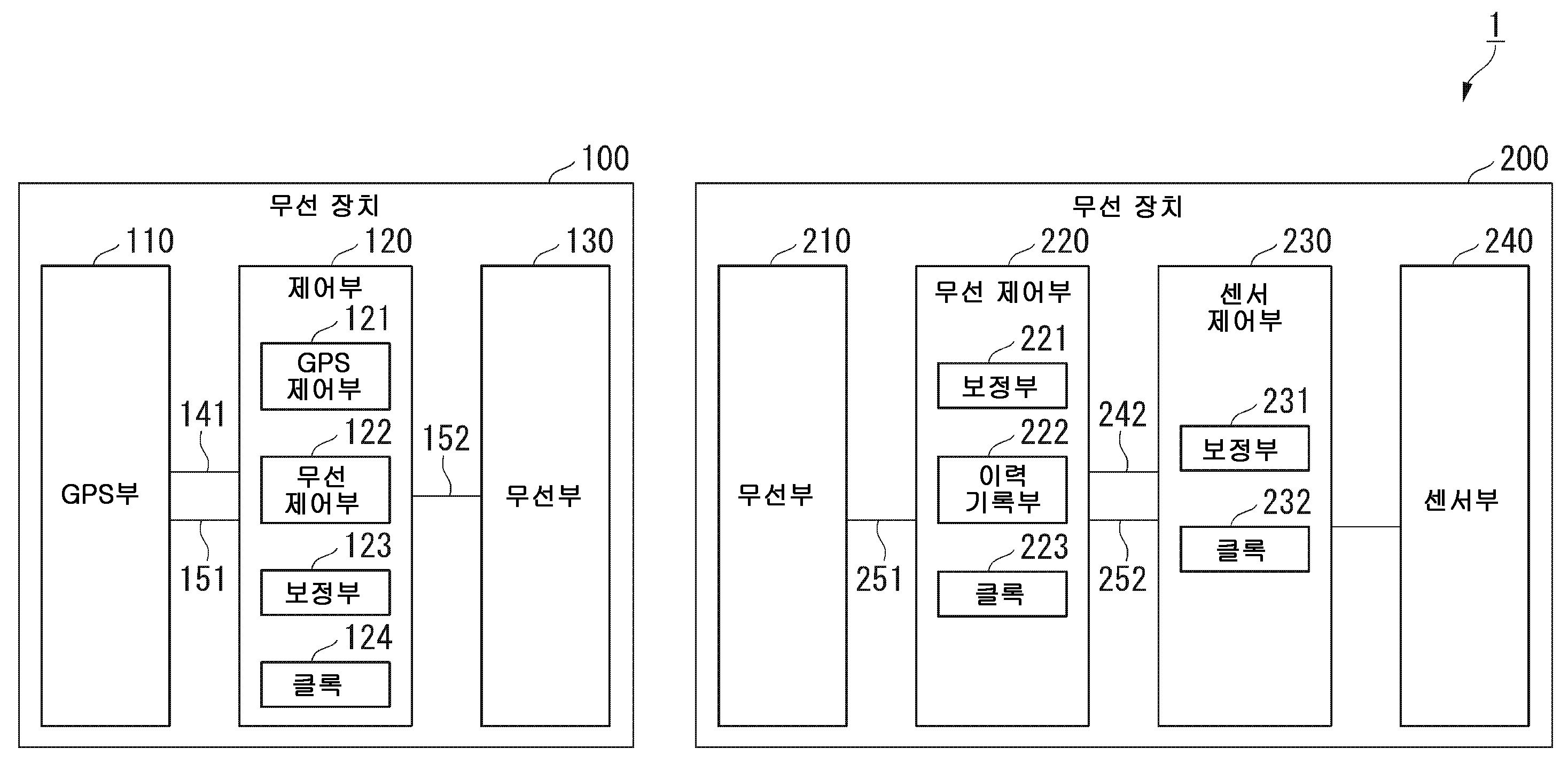
도 1은 본 발명의 제1 실시형태에 의한 무선 통신 시스템의 구성을 나타내는 도면이다.
도 2는 제1 실시형태에 의한 무선 통신 시스템에서의 시각 동기의 시퀀스도이다.
도 3은 제1 실시형태에 의한 시각 보정의 미세조정의 예를 나타내는 도면이다.
도 4는 제1 실시형태에 의한 시각 보정의 미세조정의 예를 나타내는 도면이다.
도 5는 제2 실시형태에 의한 무선 통신 시스템에서의 시각 동기의 시퀀스도이다.
도 6은 제3 실시형태의 시각 동기 시스템의 동작을 나타내는 시퀀스도이다.
도 7은 제4 실시형태의 시각 동기 시스템의 동작을 나타내는 시퀀스도이다.1 is a diagram showing the configuration of a wireless communication system according to a first embodiment of the present invention.
2 is a sequence diagram of time synchronization in the wireless communication system according to the first embodiment.
3 is a diagram showing an example of fine adjustment of time correction according to the first embodiment.
4 is a diagram showing an example of fine adjustment of time correction according to the first embodiment.
5 is a sequence diagram of time synchronization in the wireless communication system according to the second embodiment.
6 is a sequence diagram showing the operation of the time synchronization system of the third embodiment.
7 is a sequence diagram showing the operation of the time synchronization system of the fourth embodiment.
이하, 도면을 참조하면서 본 발명의 실시형태를 상세하게 설명한다.Hereinafter, embodiments of the present invention will be described in detail with reference to the drawings.
(제1 실시형태)(First embodiment)
도 1은 제1 실시형태에 의한 시각 동기 시스템(1)의 구성을 나타내는 도면이다. 도 1에 도시된 시각 동기 시스템(1)은 무선 장치(100)(제1 무선 장치, 무선 기지국) 및 무선 장치(200)(제2 무선 장치, 무선 단말)를 구비한다. 시각 동기 시스템(1)은 복수의 무선 장치를 구비하는 무선 통신 시스템에 포함된다.1 is a diagram showing a configuration of a
무선 장치(100)는, GPS(Global Positioning System)부(110), 제어부(120) 및 무선부(130)(무선 송신부)를 구비한다. GPS부(110) 및 제어부(120)의 사이는, 펄스 회선(141) 및 시리얼 회선(151)에 의해 접속된다. 제어부(120) 및 무선부(130)의 사이는 시리얼 회선(152)에 의해 접속된다.The
GPS부(110))는 GPS를 탑재한 GPS 모듈이다. GPS부(110))는 GPS 위성의 시각 정보를 수신한다. 제어부(120)는, 예를 들어 CPU(central processing unit)나 각종 메모리에 의해 구성되는 제어 모듈이다. 제어부(120)는 각 부의 제어나 각종 연산을 행한다. 제어부(120)는 GPS 제어부(121), 무선 제어부(122), 보정부(123) 및 클록(124)(제1 클록)을 구비한다. GPS 제어부(121)는 GPS부(110))를 제어한다. 무선 제어부(122)는 무선부(130)를 제어한다. 보정부(123)는 클록(124)의 시각 보정을 행한다. 무선부(130)는 무선 모듈로서, RF(Radio Frequency: 무선 주파수) 신호를 송수신한다.The
또, 무선 장치(100)는 제어부(120) 외부에 클록(124)을 구비해도 된다.Further, the
무선 장치(200)는 무선부(210)(무선 수신부), 무선 제어부(220), 센서 제어부(230) 및 센서부(240)를 구비한다. 무선부(210) 및 무선 제어부(220)의 사이는 시리얼 회선(251)에 의해 접속된다. 무선 제어부(220) 및 센서 제어부(230)의 사이는, 펄스 회선(242) 및 시리얼 회선(252)에 의해 접속된다.The
무선부(210)는 무선 모듈로서, RF 신호를 송수신한다. 무선 제어부(220)는 무선부(210)를 제어하는 모듈로서, 예를 들어 CPU나 각종 메모리에 의해 구성된다. 무선 제어부(220)는 보정부(221), 이력 기록부(222) 및 클록(223)(제2 클록)을 구비한다. 보정부(221)는 클록(223)의 시각 보정을 행한다. 이력 기록부(222)는 클록(223)의 시각 보정에 관한 이력 정보를 기록한다.The
센서 제어부(230)는 센서부(240)를 제어하는 모듈이다. 센서 제어부(230)는 보정부(231) 및 클록(232)을 구비한다. 보정부(231)는 클록(232)의 시각 보정을 행한다. 센서부(240)는 임의의 센서를 구비한 센서 모듈이다.The
또, 무선 장치(200)는 클록(223)을 무선 제어부(220) 외부에 구비해도 된다.Further, the
또한, 무선 장치(200)는 센서부(240), 또는 센서 제어부(230) 및 센서부(240)를 무선 장치(200) 외부에 구비해도 된다. 또한, 센서 제어부(230) 및 센서부(240)가 하나의 센서 모듈에 구비되어도 된다.Further, the
도 2는 시각 동기 시스템(1)에서의 시각 동기의 시퀀스도이다. 도 2에서는, 무선 장치(100)가 무선 기지국(10)이며 무선 장치(200)가 단말국(20)인 경우의 예를 나타내고 있다. 무선 기지국(10)은 1대 이상의 단말국(20)에 대해 무선 회선을 통해 시각 정보를 동보(同報; broadcast)하고, 무선 기지국(10)과 단말국(20) 사이에 시각 동기를 도모한다.2 is a sequence diagram of time synchronization in the
도 2를 이용하여 무선 기지국(10) 내 모듈 간의 시각 동기에 대해 설명한다.Time synchronization between modules in the
무선 기지국(10)의 제어부(120)는, 수신한 GPS 위성의 시각 정보를 GPS부(110)로부터 시리얼 회선(151)으로 취득한 것으로는 제어부(120)의 부하에 따라 취득시에 시간의 변동을 일으켜 정확하게 그 시각 정보를 취득할 수 없다. 그래서, 무선 기지국(10)에는, GPS부(110)와 제어부(120) 사이에 펄스 회선(141)과 시리얼 회선(151)이 병설(倂設)되고, GPS부(110)는 펄스 회선(141)을 이용하여 타이밍 정보를 제어부(120)에 전송한다. 구체적으로, GPS부(110)는 시각 정보보다 먼저 펄스 회선(141)에 의해 SYNC(펄스)를 타이밍 정보로서 전송한다(단계 S11). GPS부(110)로부터 매초 출력되는 PPS(pulse per second) 신호를 타이밍 정보로 이용해도 된다.The
제어부(120)는 이 타이밍 정보를 인터럽트에 의해 바로 수신한다. 제어부(120)의 보정부(123)는 타이밍 정보의 수신시에 제어부(120)가 갖는 클록(124)에서의 시각(이하, 「참조 시각」이라고 함)(t1)을 참조하여 기록한다. 한편, GPS부(110)도, SYNC(펄스)에 의한 타이밍 정보를 전송할 때에 GPS 위성의 시각(T1)을 참조하여 기록한다. 그리고 GPS부(110)는 GPS 위성으로부터 수신한 시각(T1)에 관한 정보인 시각 정보(T1)를 시리얼 회선으로 전송한다(단계 S12). 즉, 시각 정보(T1)는 시각(T1)을 취득 가능한 정보이다.The
제어부(120)는 시각 정보(T1)를 시리얼 회선(151)을 통해 수신한다. 제어부(120)의 보정부(123)는 시각 정보(T1)로부터 GPS 위성의 시각(T1)을 취득한다. 보정부(123)는 기록해 둔 참조 시각(t1)과, 시각 정보(T1)로부터 얻어진 시각(T1)에 기초하여, 자체 모듈이 갖는 클록(124)을 보정한다. 구체적으로, 보정부(123)는 참조 시각(t1)과 시각(T1)의 차분(t1-T1)을 보정 폭으로 하고, 클록(124)의 시각이 보정 폭을 감산한 시각으로 이루어지도록 클록(124)의 시각 보정을 행한다. 이때, 보정부(123)는 제어부(120)가 타이밍 정보를 수신하고 나서 GPS 위성의 시각에 관한 시각 정보를 수신하기에 이르기까지의 경과 시간을 계측하고, 그 시간도 고려하여 클록(124)의 시각 보정을 행해도 된다. 보정부(123)는 이 경과 시간을 고려한 시각 보정을 후술하는 도 3 또는 도 4에 도시된 처리와 동일한 처리에 의해 행한다. 이 경우, 제어부(120)에, 클록(124)의 시각 보정에 관한 이력 정보를 기록하는 이력 기록부를 마련한다.The
도 2를 이용하여 무선 기지국(10)과 단말국(20) 사이의 시각 동기에 대해 설명한다.Time synchronization between the
무선 기지국(10)의 무선부(130)는 정형 포맷의 신호를 타이밍 정보로서 무선 회선을 통해 송신한다. 이때, CSMA/CA 등의 랜덤 액세스 제어나 재송 제어를 수반하는 경우, 무선 기지국(10)의 제어부(120)가 실제 송신 타이밍을 제어할 수는 없다. 따라서, 단말국(20)이 상기 타이밍 정보를 수신하기에 이르기까지는 랜덤 액세스 제어나 재송 제어로 발생하는 지연이 가산되어, 단말국(20)은 정확한 시각에 타이밍 정보를 취득할 수 없다. 그래서 무선 기지국(10)과 단말국(20) 사이에서 타이밍 정보와 시각 정보를 각각 개별적으로 전송한다.The
구체적으로, 무선 기지국(10)의 무선부(130)는 먼저 SYNC를 타이밍 정보로서 무선에 의해 전송한다(단계 S21). 타이밍 정보는 송신의 우선도를 높이는 것이 바람직하다. 또한, 타이밍 정보는 단말국(20)의 무선부(210)에서의 수신 동작에 필요로 하는 시간을 가능한 한 짧게 하기 위해 짧은 프레임 길이의 프레임으로 설정하는 것이 바람직하다.Specifically, the
단말국(20)의 무선부(210)는 무선 기지국(10)으로부터 타이밍 정보를 무선에 의해 수신한다. 또, 무선 기지국(10)의 무선부(130)가 무선 신호를 송신하고 나서 단말국(20)의 무선부(210)가 그 무선 신호를 수신하기에 이르기까지에 관한 시간은 CSMA/CA 등의 제어에 의한 지연보다 충분히 작다. 무선부(210)는 타이밍 정보를 수신하면 바로 인터럽트에 의해 무선 제어부(220)에 타이밍 정보를 출력한다. 무선 제어부(220)의 보정부(221)는 인터럽트에 의해 바로 타이밍 정보를 수신하고, 그때의 클록(223)에서의 시각인 참조 시각(t2)을 참조하여 기록한다. 한편, 무선 기지국(10)의 보정부(123)도, 무선부(130)가 타이밍 정보를 전송할 때에 자체 국이 갖는 클록(124)에서의 시각(T2)을 참조하여 기록한다. 즉, 시각(T2)은 무선 기지국(10)이 타이밍 정보를 송신한 시각이다. 참조 시각(t2)은 단말국(20)이 타이밍 정보를 수신한 시각이다.The
무선 기지국(10)의 보정부(123)는 클록(124)의 시각(T2)에 관한 정보인 시각 정보(T2)를 시리얼 회선(152)을 이용하여 무선부(130)에 전송한다. 시각 정보(T2)는 시각(T2)을 취득 가능한 정보이다. 무선부(130)는 시각 정보(T2)를 무선 송신한다(단계 S22).The
단말국(20)에 있어서, 무선 제어부(220)의 보정부(221)는, 수신한 시각 정보(T2)로부터 무선 기지국(10)의 클록(124)의 시각(T2)을 취득한다. 보정부(221)는, 기록해 둔 참조 시각(t2)과, 시각 정보(T2)로부터 취득한 시각(T2)에 기초하여 클록(223)을 보정한다. 구체적으로, 보정부(221)는 참조 시각(t2)으로부터 시각(T2)을 감산하여 얻어지는 차분(t2-T2)을 보정 폭으로 하고, 클록(223)의 시각이 보정 폭을 감산한 시각으로 이루어지도록 클록(223)의 시각을 보정한다.In the
또한, 보정부(221)는 클록(223)의 시각 보정을 행할 때, 단말국(20)이 타이밍 정보를 수신하고 나서 무선 기지국(10)이 갖는 클록(124)의 시각에 관한 정보인 시각 정보를 수신하기에 이르기까지의 경과 시간(Δt)을 계측하고, 그 경과 시간(Δt)을 더 고려해도 된다. 도 3을 이용하여 경과 시간(Δt)을 더 고려한 시각 보정에 대해 설명한다.In addition, when correcting the time of the
도 3은 시각 보정의 미세조정의 예를 나타내는 도면이다. 도 3에서는, 타이밍 정보의 도래 시각과 시각 정보의 도래 시각 사이에 발생하는 편차(deviation)를 미세조정하는 예를 나타내고 있다.3 is a diagram showing an example of fine adjustment of time correction. In Fig. 3, an example of finely adjusting the deviation occurring between the arrival time of timing information and the arrival time of time information is shown.
무선 기지국(10)이 타이밍 정보를 송신하였을 때의 클록(124)의 시각을 T, 단말국(20)이 타이밍 정보를 수신하였을 때의 클록(223)의 참조 시각을 t, 시각(T)이 설정된 시각 정보를 시각 정보(T)라고 한다. 이력 기록부(222)는, 전회(前回) 보정부(221)가 클록(223)의 시각 보정을 행한 시각을 이력 정보에 기록해 둔다. 보정부(221)는 전회 클록(223)의 시각 보정을 행한 시각에서부터 타이밍 정보를 수신하였을 때의 참조 시각(t)에 이르기까지의 기간(P)과 경과 시간(Δt)에 기초하여, 경과 시간(Δt) 동안의 클록(223)의 편차를 추정한다. 이 펀차는, 예를 들어 (t-T)×Δt/P와 같이 추정된다. 보정부(221)는 클록(223)의 시각 보정시에 그 편차도 추가하여 보정한다. 즉, 보정부(221)는 (t-T)×(1+Δt/P)를 보정 폭으로 하고, 클록(223)의 시각이 보정 폭을 감산한 시각으로 이루어지도록 클록(223)의 시각 보정을 행한다.T is the time of the
도 4는 시각 보정의 미세조정의 다른 예를 나타내는 도면이다. 도 4에서는, 지금까지의 시각 보정의 이력에 기초하여 시각 보정의 미세조정을 행하는 예를 나타내고 있다.4 is a diagram showing another example of fine adjustment of visual correction. In Fig. 4, an example of fine adjustment of time correction is shown based on the history of time correction so far.
단말국(20)의 이력 기록부(222)는 시각 보정 때마다 보정부(221)가 클록(223)의 시각 보정을 행한 시각과, 그 시각 보정에서의 클록(223)의 보정 폭을 대응시켜 기록해 둔다. 보정부(221)가 클록(223)의 시각 보정을 행한 시각은 보정 후의 시각이다. 보정부(221)는 이 시각과 보정 폭에 기초하여, 일정 기간에서의 클록(223)의 편차 폭(M)을 가산 평균 등의 통계적 수법에 의해 추정한다. 보정부(221)는, 추정한 편차 폭(M)과 경과 시간(Δt)에 기초하여 경과 시간(Δt) 동안의 클록(223)의 편차(예를 들어 M×Δt)를 추정하고, 보정시에 그 편차도 추가한다.The
구체적으로, 이력 기록부(222)는, 보정부(221)가 n번째(n=1, 2, …)의 시각 보정을 행하였을 때에, 시각 정보로부터 취득한 시각(Tn)과, 클록(223)의 보정 폭((tn-Tn)+Mn×Δtn)을 대응시켜 기록해 둔다. tn은, n번째 시각 보정시의 참조 시각이다. 또한, Mn은, n번째 시각 보정시의 일정 기간에서의 클록(223)의 편차 폭이다. Δtn은, n번째 시각 보정시에 단말국(20)이 타이밍 정보를 수신하고 나서 시각 정보를 수신하기에 이르기까지의 경과 시간(Δt)이다. 이 경우, 일정 기간에서의 클록(223)의 편차 폭(M)은, 과거 N번(N은 2 이상의 정수임)의 시각 보정을 행하였을 때의 정보를 이용하여 식(1)에 나타내는 MN으로서 산출된다. 보정부(221)는, ((t-T)+M×Δt)를 보정 폭으로 하고, 클록(223)의 시각이 보정 폭을 감산한 시각으로 이루어지도록 클록(223)의 시각 보정을 행한다.Specifically, the

도 2를 이용하여 단말국(20)에서의 모듈 간의 시각 동기에 대해 설명한다. 단말국(20) 내에는, 무선부(210)를 제어하는 무선 제어부(220) 및 클록(223)과, 센서부(240)를 제어하는 센서 제어부(230) 및 클록(232)이 개별적으로 존재한다. 이와 같이, 단말국에는, 무선부를 제어하는 모듈 및 클록과 센서 등을 제어하는 모듈 및 클록이 개별적으로 존재하는 경우가 있다. 그 경우, 무선부(210)를 제어하는 무선 제어부(220)는 센서부(240)를 제어하는 센서 제어부(230)와의 사이에서 시각 동기를 도모할 필요가 있다. 센서 제어부(230)는, 무선 제어부(220)가 갖는 클록(223)의 시각을 무선 제어부(220)로부터 시리얼 회선(252)으로 취득한 것으로는 센서 제어부(230)의 부하에 따라 취득시에 시간의 변동을 일으켜 정확하게 상기 시각을 취득할 수 없다. 그래서 무선 제어부(220)와 센서 제어부(230)의 사이에 펄스 회선(242)과 시리얼 회선(252)이 병설되고, 무선 제어부(220)는 펄스 회선(242)을 이용하여 타이밍 정보를 센서 제어부(230)에 전송한다. 구체적으로, 무선 제어부(220)의 보정부(221)는 시각 정보보다 먼저 타이밍 정보를 센서 제어부(230)에 펄스 회선(242)을 통해 전송한다(단계 S31).Time synchronization between modules in the
센서 제어부(230)는 이 타이밍 정보를 인터럽트에 의해 바로 수신한다. 센서 제어부(230)의 보정부(231)는, 타이밍 정보의 수신시에 센서 제어부(230)가 갖는 클록(232)의 시각(이하, 「참조 시각」이라고 함)(t3)을 참조하여 기록한다. 한편, 무선 제어부(220)의 보정부(221)도 타이밍 정보를 전송할 때에 무선 제어부(220)가 갖는 클록(223)의 시각(T3)을 참조하여 기록한다. 그리고 무선 제어부(220)의 보정부(221)는, 클록(223)의 시각(T3)에 관한 정보를 시리얼 회선(252)에 의해 센서 제어부(230)에 전송한다(단계 S32).The
센서 제어부(230)는 시각 정보(T3)를 시리얼 회선(252)을 통해 수신한다. 센서 제어부(230)의 보정부(231)는, 시각 정보(T3)로부터 무선 제어부(220)가 갖는 클록(223)이 나타내고 있던 시각(T3)을 취득한다. 보정부(231)는, 기록해 둔 참조 시각(t3)과, 시각 정보(T3)로부터 얻어진 시각(T3)에 기초하여, 자체 모듈이 갖는 클록(232)을 보정한다. 구체적으로, 보정부(231)는 참조 시각(t3)과 시각(T3)의 차분(t3-T3)을 보정 폭으로 하고, 클록(232)이 나타내는 시각이 보정 폭을 감산한 시각으로 이루어지도록 클록(232)의 시각 보정을 행한다. 이때, 보정부(231)는, 센서 제어부(230)가 타이밍 정보를 수신하고 나서 무선 제어부(220)가 갖는 클록(223)의 시각에 관한 시각 정보를 수신하기에 이르기까지의 경과 시간을 계측하고, 그 경과 시간도 고려하여 클록(232)의 시각 보정을 행해도 된다. 보정부(231)는, 이 경과 시간을 고려한 시각 보정을 도 3 또는 도 4에 도시된 처리와 동일한 처리에 의해 행한다. 이 경우, 센서 제어부(230)에, 클록(232)의 시각 보정에 관한 이력 정보를 기록하는 이력 기록부를 마련한다.The
또, 상기에서는, 무선 기지국(10)이 타이밍 정보 및 시각 정보를 동보 송신하는 경우에 대해 설명하였지만, 특정의 단말국(20) 앞으로 송신해도 된다.In the above, the case where the
본 실시형태에 의하면, 무선 장치(100)와 무선 장치(200) 사이에서 클록을 동기시키기 위해, 무선 장치(100)의 무선부(130)는, 타이밍 정보와, 자체 장치의 클록(124)으로부터 취득한 시각이며 타이밍 정보를 송신하였을 때의 시각인 송신 시각에 관한 시각 정보를 개별적으로 무선 송신한다. 무선 장치(200)의 무선부(210)는 무선 송신된 타이밍 정보와 시각 정보를 개별적으로 수신한다. 무선 장치(200)의 보정부(221)는, 타이밍 정보를 수신하였을 때의 자체 장치의 클록(223)의 시각인 참조 시각과, 시각 정보로부터 얻어진 송신 시각에 기초하여, 클록(223)의 시각을 보정한다.According to this embodiment, in order to synchronize the clock between the
무선 장치(200)의 이력 기록부(222)가 클록(223)의 시각 보정에 관한 이력 정보를 기록해 둠으로써, 보정부(221)는, 이 이력 정보에 기초하여 산출한 클록(223)의 시각의 편차 경향과, 타이밍 정보를 수신하고 나서 시각 정보를 수신하기에 이르기까지의 경과 시간에 기초하여, 이 경과 시간에서의 클록(223)의 시각의 편차를 더 보정할 수 있다.The
예를 들어, 보정부(221)는, 과거에 클록(223)의 시각을 보정하고 나서 다음 시각을 보정하기에 이르기까지의 기간과, 타이밍 정보를 수신하고 나서 시각 정보를 수신하기에 이르기까지의 경과 시간에 기초하여, 이 경과 시간에서의 클록(223)의 시각의 편차를 보정한다.For example, the
또한, 예를 들어, 보정부(221)는, 시각 보정하고 나서 다음 시각 보정을 하기에 이르기까지의 기간과 보정 폭의 정보를 이력 정보로부터 취득하고, 취득한 이들 정보에 기초하여 클록(223)의 일정 시간에서의 편차를 산출한다. 보정부(221)는, 산출한 일정 시간에서의 편차와, 타이밍 정보를 수신하고 나서 시각 정보를 수신하기에 이르기까지의 경과 시간에 기초하여, 이 경과 시간에서의 클록(223)의 시각의 편차를 보정한다.In addition, for example, the
이에 의해, 무선 장치(100)와 무선 장치(200) 사이에서 클록을 고정밀도이고 저가로 동기시키는 것이 가능해진다.Thereby, it becomes possible to synchronize the clock between the
(제2 실시형태)(Second embodiment)
본 실시형태의 시각 동기 시스템은, 제1 실시형태와 같이, 무선 기지국으로부터 단말국에 대해 무선 회선을 통해 시각 정보를 동보하고, 무선 기지국과 단말국 사이에서 시각 동기를 도모한다. 단, 본 실시형태의 시각 동기 시스템은, 모듈 간에 시각 동기를 행할 때에 타이밍 정보에 앞서서 그 타이밍 정보의 송신 시각을 나타내는 시각 정보를 송신한다. 이하, 제1 실시형태와의 다른 점을 중심으로 설명한다.As in the first embodiment, the time synchronization system of the present embodiment broadcasts time information from the radio base station to the terminal station via a radio line, and achieves time synchronization between the radio base station and the terminal station. However, the time synchronization system of this embodiment transmits time information indicating the transmission time of the timing information prior to the timing information when time synchronization is performed between modules. Hereinafter, the difference from the first embodiment will be mainly described.
본 실시형태의 시각 동기 시스템의 구성은, 도 1에 도시된 제1 실시형태의 시각 동기 시스템(1)과 동일하다. 즉, 무선 장치(100)는 GPS 모듈을 탑재하여 GPS 위성의 시각을 수신할 수 있다.The configuration of the time synchronization system of this embodiment is the same as that of the
도 5는 본 실시형태의 시각 동기 시스템의 동작을 나타내는 시퀀스도이다. 도 5에서는, 무선 장치(100)가 무선 기지국(10a)이며 무선 장치(200)가 단말국(20a)인 경우의 예를 나타내고 있다. 또, 무선 기지국(10a)과 단말국(20a) 사이의 시각 동기는, 제1 실시형태에서의 무선 기지국(10)과 단말국(20) 사이의 시각 동기와 동일하기 때문에 설명을 생략한다.5 is a sequence diagram showing the operation of the time synchronization system of this embodiment. In Fig. 5, an example in which the
도 5를 이용하여 무선 기지국(10a) 내에서의 모듈 간의 시각 동기에 대해 설명한다. 무선 기지국(10a)은, 제1 실시형태의 무선 기지국(10)과 같이, GPS부(110)와 제어부(120)의 사이에 펄스 회선(141)과 시리얼 회선(151)이 병설된다. GPS부(110)는 펄스 회선으로 타이밍 정보를 제어부(120)에 전송한다. 그러나 제1 실시형태와 달리, GPS부(110)는, 시리얼 회선(151)을 이용하여 GPS 위성의 시각(T4)에 관한 정보인 시각 정보(T4)를 시각(T4)보다 전에 미리 전송한다(단계 S51). 단, GPS 위성의 시각에 관한 정보는, 시리얼 회선(151)으로 전송할 때에 발생하는 시간의 변동 이하의 단위 정보를 포함하지 않아도 된다. 제어부(120)의 보정부(123)는, GPS부(110)로부터 시각 정보(T4)를 수신하면, 시각 정보(T4)로부터 GPS 위성의 시각(T4)을 취득하여 기록한다.Time synchronization between modules in the
그리고 GPS부(110)는, GPS 위성의 시각(T4)에 관한 정초(正秒; zero-second) 등의 타이밍에 펄스 회선(141)을 이용하여 타이밍 정보를 전송한다(단계 S52). 제어부(120)는 이 타이밍 정보를 인터럽트에 의해 바로 수신한다. 제어부(120)의 보정부(123)는, 이미 취득되어 있는 GPS 위성의 시각(T4)에 관한 정보와, 시각(T4)에 관한 타이밍 정보의 수신에 기초하여, 자체 모듈이 갖는 클록(124)을 보정한다. 즉, 보정부(123)는, 이 타이밍 정보를 수신한 타이밍을 단계 S51에서 먼저 수신한 GPS 위성의 시각(T4)에 관한 정초 등의 타이밍으로 파악하고 클록(124)을 보정한다. 그 때문에, 타이밍 정보의 송신 타이밍이 GPS 위성의 시각에 관한 정초 등의 타이밍인 것을 GPS부(110)와 제어부(120) 사이에서 미리 공유할 필요가 있다. 그러나 제1 실시형태와 같이, GPS부(110)가 타이밍 정보의 송신 시각을 기록하거나, 제어부(120)가 타이밍 정보의 수신 시각과 시각 정보의 수신 시각을 자체 모듈이 갖는 클록(124)을 참조하여 기록할 필요가 없다.Then, the
도 5에 도시된 단계 S61~단계 S62에서의 무선 기지국(10a)과 단말국(20a) 사이의 시각 동기의 시퀀스는, 도 2에 도시된 제1 실시형태의 단계 S21~단계 S22에서의 무선 기지국(10)과 단말국(20) 사이의 시각 동기의 시퀀스와 동일하다.The sequence of time synchronization between the
도 5를 이용하여 단말국(20a) 내에서의 모듈 간의 시각 동기에 대해 설명한다. 단말국(20a)은, 제1 실시형태의 단말국(20)과 같이, 무선 제어부(220)와 센서 제어부(230) 사이에 펄스 회선(242)과 시리얼 회선(252)이 병설된다. 무선 제어부(220)의 보정부(221)는, 펄스 회선(242)을 이용하여 타이밍 정보를 센서 제어부(230)에 전송한다. 그러나 제1 실시형태와 달리, 무선 제어부(220)의 보정부(221)는, 시리얼 회선(252)을 이용하여 자체 모듈이 갖는 클록(223)의 시각(T5)에 관한 정보인 시각 정보(T5)를 타이밍 정보보다 전에 미리 전송한다(단계 S71). 단, 클록(223)의 시각에 관한 정보는, 시리얼 회선(252)으로 전송할 때에 발생하는 시간의 변동 이하의 단위 정보를 포함하지 않아도 된다. 센서 제어부(230)의 보정부(231)는 시각 정보(T5)를 수신하면, 시각 정보(T5)로부터 시각(T5)을 취득하여 기록한다.Time synchronization between modules in the
무선 제어부(220)의 보정부(221)는, 클록(223)의 시각(T5)에 관한 정초 등의 타이밍에 펄스 회선(242)을 이용하여 타이밍 정보를 센서 제어부(230)에 전송한다(단계 S72). 센서 제어부(230)는, 이 타이밍 정보를 인터럽트에 의해 바로 수신한다. 센서 제어부(230)의 보정부(231)는, 앞의 무선 제어부(220)가 갖는 클록(223)의 시각(T5)에 관한 정보와, 시각(T5)에 관한 타이밍 정보의 수신에 기초하여, 자체 모듈이 갖는 클록(232)을 보정한다. 즉, 보정부(231)는, 이 타이밍 정보를 수신한 타이밍을 단계 S71에서 먼저 수신한 무선 제어부(220)가 갖는 클록(223)의 시각(T5)에 관한 정초 등의 타이밍으로 파악하고 자체 모듈이 갖는 클록(233)을 보정한다. 그 때문에, 타이밍 정보의 송신 타이밍이 무선 제어부(220)가 갖는 클록(223)의 시각에 관한 정초 등의 타이밍인 것을 무선 제어부(220)와 센서 제어부(230) 사이에서 미리 공유할 필요가 있다. 그러나 제2 실시형태에서는, 제1 실시형태와 같이 무선 제어부(220)가 타이밍 정보의 송신 시각을 기록하거나, 센서 제어부(230)가 타이밍 정보의 수신 시각과 시각 정보의 수신 시각을 자체 모듈이 갖는 클록(232)을 참조하여 기록할 필요가 없다.The
(제3 실시형태)(3rd embodiment)
제3 실시형태에서의 시각 동기 시스템은, 제1 및 제2 실시형태와 같이 무선 통신 시스템에 포함된다. 시각 동기 시스템은, 무선 기지국으로부터 단말국에 대해 무선 회선을 통해 시각 정보를 동보하고, 무선 기지국과 단말국 사이에서 시각 동기를 도모한다. 무선 기지국은, GPS 위성으로부터 수신한 신호로부터 시각 및 PPS 신호를 취득하는 GPS부를 구비한다. 제3 실시형태에서도 제1 및 제2 실시형태와 같이, 무선 기지국은, GPS부에 의해 취득되는 정확한 시각을 이용하여 자체 국의 클록과 단말국의 클록의 동기를 도모한다. 제3 실시형태에서의 무선 기지국은, 제1 실시형태에서 설명한 무선 장치(100)가 구비하는 구성과 동일한 구성을 구비한다. 제3 실시형태에서의 단말국은, 제1 실시형태에서 설명한 무선 장치(200)가 구비하는 구성과 동일한 구성을 구비한다.The time synchronization system in the third embodiment is included in the wireless communication system as in the first and second embodiments. The time synchronization system broadcasts time information from a wireless base station to a terminal station via a wireless line, and attempts time synchronization between the wireless base station and the terminal station. The wireless base station includes a GPS unit that acquires time and PPS signals from signals received from GPS satellites. In the third embodiment as well as in the first and second embodiments, the wireless base station attempts to synchronize the clock of its own station with the clock of the terminal station by using the correct time acquired by the GPS unit. The radio base station in the third embodiment has the same configuration as that of the
무선 기지국에서의 GPS부(110)와 제어부(120) 사이에서의 시각 동기는, 제1 또는 제2 실시형태에서의 시각 동기와 동일하다. 단말국에서의 무선 제어부(220)와 센서 제어부(230) 사이에서의 시각 동기도, 제1 또는 제2 실시형태에서의 시각 동기와 동일하다. 이하, 무선 기지국과 단말국 사이에서의 시각 동기에 대해 설명한다.The time synchronization between the
무선 기지국은, 미리 정해진 포맷을 갖는 신호를 타이밍 정보(SYNC)로서 무선 회선을 통해 송신한다. 타이밍 정보를 송신하는 무선 프레임의 프레임 길이는 고정 길이이다. 타이밍 정보의 포맷에서는, 무선 프레임의 선두에 배치되는 프리앰블(preamble)에 이어서 무선 프레임에 포함되는 신호가 타이밍 정보임을 나타내는 동기 워드가 배치되어 있다. 동기 워드는, 미리 정해진 신호 패턴이다. 단말국이 동기 워드를 포함한 신호를 수신한 경우, 단말국은 수신한 신호에 대한 복조 및 복호를 행하지 않고도 동기 워드를 검출할 수 있다. 동기 워드는, 프리앰블로서 무선 프레임의 선두에 배치되어도 된다.The radio base station transmits a signal having a predetermined format as timing information (SYNC) via a radio line. The frame length of a radio frame transmitting timing information is a fixed length. In the timing information format, following a preamble arranged at the head of the radio frame, a sync word indicating that a signal included in the radio frame is timing information is arranged. The sync word is a predetermined signal pattern. When the terminal station receives a signal including a sync word, the terminal station can detect the sync word without performing demodulation and decoding on the received signal. The sync word may be placed at the head of the radio frame as a preamble.
CSMA/CA 등을 이용한 랜덤 액세스 제어나 재송 제어가 이루어지는 경우, 기지국 장치가 타이밍 정보를 송신하는 송신 타이밍을 제어하는 것은 곤란하다. 기지국 장치가 타이밍 정보를 송신하는 처리를 개시하고 나서 단말국이 타이밍 정보를 수신하는 처리를 완료하기에 이르기까지의 시간에는, 랜덤 액세스 제어나 재송 제어에 의해 발생하는 지연이 포함된다. 따라서, 소정의 타이밍에 기지국 장치가 타이밍 정보를 송신하고, 그 타이밍에서 단말국 장치가 타이밍 정보를 수신하는 것은 곤란하다.When random access control or retransmission control using CSMA/CA or the like is performed, it is difficult for the base station apparatus to control the transmission timing at which timing information is transmitted. The time between the base station apparatus starting the process of transmitting timing information and the terminal station completing the process of receiving the timing information includes a delay caused by random access control or retransmission control. Therefore, it is difficult for the base station apparatus to transmit timing information at a predetermined timing, and for the terminal station apparatus to receive the timing information at that timing.
제3 실시형태의 시각 동기 시스템은, 제1 실시형태의 시각 동기 시스템(1)과 같이, 무선 기지국이 타이밍 정보와 시각 정보를 개별적으로 전송하고, 단말국이 지연의 영향을 저감시킨 시각 동기를 행한다.In the time synchronization system of the third embodiment, as in the
도 6은 제3 실시형태의 시각 동기 시스템의 동작을 나타내는 시퀀스도이다. 도 6에서는, 무선 장치(100)가 무선 기지국(10b)이며 무선 장치(200)가 단말국(20b)인 경우를 나타내고 있다.6 is a sequence diagram showing the operation of the time synchronization system of the third embodiment. In Fig. 6, the case where the
도 6을 참조하여 제3 실시형태의 시각 동기 방법에서의 무선 기지국(10b)의 동작에 대해 설명한다. 무선 기지국(10b)에서 시각 동기의 동작이 개시되면, 무선 제어부(122)는, 무선부(130)에 대해 타이밍 정보의 송신을 지시한다(단계 S101). 무선부(130)는 송신권을 획득하기 위해 캐리어 센스(carrier sensing; CS)를 행한다. 무선부(130)는, 송신권을 획득하면, 캐리어 센스가 완료되었음을 무선 제어부(122)에 통지하고(단계 S102), 타이밍 정보(SYNC)의 송신을 개시한다(단계 S103).An operation of the
무선부(130)는 타이밍 정보를 다 송신하면, 타이밍 정보의 송신이 완료되었음을 무선 제어부(122)에 통지한다(단계 S104). 무선 제어부(122)는, 무선부(130)로부터 송신 완료가 통지되면, 클록(124)이 나타내는 시각(T2)을 취득한다. 무선 제어부(122)는, 취득한 시각을 무선부(130)에 의한 타이밍 정보의 송신이 완료된 송신 시각으로서 기억한다. 무선 제어부(122)는, 무선부(130)에 대해 송신 시각을 나타내는 정보를 포함한 시각 정보의 송신을 지시한다(단계 S105). 무선부(130)는, 캐리어 센스에 의해 송신권을 획득한 후에 시각 정보를 송신한다(단계 S106).When all the timing information is transmitted, the
단말국(20b)에 있어서, 무선 기지국(10b)으로부터 송신된 타이밍 정보(SYNC)를 무선부(210)가 수신한 경우, 무선부(210)는 동기 워드를 검출한다. 무선부(210)는, 동기 워드를 검출하였음을 무선 제어부(220)에 통지한다(단계 S201). 무선 제어부(220)는 동기 워드 검출의 통지를 받으면, 클록(223)이 나타내는 시각(T'6)을 참조 시각으로서 취득하고, 취득한 시각(T'6)을 기억한다. 즉, 무선 제어부(220)는, 동기 워드가 검출되었을 때를 타이밍 정보를 수신하였을 때라고 판정하고 시각(T'6)을 기억한다.In the
무선부(210)는, 수신한 타이밍 정보의 신호에 대한 신호 처리를 완료하면, 신호 처리가 완료되었음을 무선 제어부(220)에 통지한다(단계 S202). 신호 처리에는, 예를 들어 타이밍 정보의 신호에 포함되는 PHR 헤더에 대한 처리, 페이로드에 포함되는 데이터의 복조, CRC를 이용한 오류 검출 등의 처리가 포함된다. 무선부(210)는, 무선 기지국(10b)으로부터 시각 정보를 수신하고, 시각 정보로부터 송신 시각(T2)을 취득한다. 무선부(210)는, 송신 시각(T2)을 무선 제어부(220)에 통지한다(단계 S203). 무선 제어부(220)는, 송신 시각(T2)을 취득하면 클록(223)을 보정한다.When the signal processing of the signal of the received timing information is completed, the
무선 제어부(220)의 보정부(221)는, 기억한 참조 시각(T'6)과, 통지된 송신 시각(T2)과, 타이밍 정보의 프레임 길이에 기초하여 클록(223)을 보정한다. 보정부(221)는, 타이밍 정보의 수신에 소요되는 시간(t6)을 산출하기 위해 타이밍 정보의 프레임 길이를 이용한다. 타이밍 정보의 전송에 소요되는 시간(t6)은, 무선부(210)가 타이밍 정보의 수신을 개시하고 나서 무선부(210)가 타이밍 정보의 수신을 완료하기에 이르기까지의 시간이다. 시간(t6)은, 타이밍 정보의 전송 시간이라고 해도 된다. 무선 기지국(10b)과 단말국(20b) 사이에서의 무선 통신에 이용되는 전송 속도는 미리 정해져 있기 때문에, 보정부(221)는 타이밍 정보의 프레임 길이와 전송 속도로부터 시간(t6)을 산출할 수 있다. 보정부(221)는, 타이밍 정보의 프레임 길이 대신에 타이밍 정보의 데이터량을 이용하여 시간(t6)을 산출해도 된다.The
무선 기지국(10b)에서부터 단말국(20b)에 이르기까지의 전송 구간에서의 전송 시간을 거의 제로로 하여, 보정부(221)는, 시각(T'6)과 시간(t6)으로부터 무선 기지국(10b)이 타이밍 정보의 송신을 완료하였을 때의 클록(223)이 나타내는 시각(T6=T'6+t6)을 추정한다. 보정부(221)는, 송신 시각(T2)과 시각(T6)의 차분(T6-T2)을 보정 폭으로서 이용하여 클록(223)을 보정한다.By setting the transmission time in the transmission section from the
제3 실시형태에서도, 무선 제어부(220)는, 도 3 또는 도 4에 도시된, 무선 기지국(10b)에서부터 송신 시각을 취득하기에 이르기까지 경과한 경과 시간(Δt)에 기초한 시각 보정을 적용해도 된다. 즉, 보정부(221)는, 차분(T6-T2)과, 경과 시간(Δt)에서의 시각 편차에 기초하여 클록(223)을 보정해도 된다. 경과 시간(Δt)에서의 시각 편차는, 시각(T6)에서부터 시각 정보를 취득하기에 이르기까지의 경과 시간(Δt)에서 클록(124)과 클록(223) 사이에서 발생하는 시각 편차이다.Even in the third embodiment, the
무선부(210)가 타이밍 정보의 신호에 대한 신호 처리를 완료하기에 이르기까지 소요되는 시간은, 무선부(210)의 처리 속도, 처리 부하에 따라 변화하는 경우가 있다. 제3 실시형태에서는, 무선부(210)가 동기 워드의 검출을 무선 제어부(220)에 통지함으로써, 타이밍 정보의 수신이 개시된 타이밍을 무선 제어부(220)가 취득할 수 있다. 동기 워드의 검출은, 무선부(210)의 처리 속도, 처리 부하의 영향을 거의 받지 않는다. 그 때문에, 동기 워드가 검출된 시각(T'6)과 타이밍 정보의 전송에 소요되는 시간(t6)을 이용함으로써, 보정부(221)는 무선 기지국(10b)이 타이밍 정보의 송신을 완료하였을 때의 클록(223)의 시각을 취득할 수 있다.The time required for the
제3 실시형태에서의 단말국(20b)은, MAC층에서의 자율적인 송신 대기에 수반하는 지연과 수신 처리에 의해 발생하는 지연의 영향을 억제하여 클록(223)을 클록(124)에 동기시킬 수 있다.In the third embodiment, the
(제4 실시형태)(4th embodiment)
제4 실시형태에서의 시각 동기 시스템은, 제1, 제2 및 제3 실시형태와 같이 무선 통신 시스템에 포함된다. 제4 실시형태는, 무선 기지국에서 타이밍 정보의 송신이 완료되었을 때의 클록(223)이 나타내는 시각을 추정하는 순서가 제3 실시형태와 다르다.The time synchronization system in the fourth embodiment is included in a wireless communication system like in the first, second, and third embodiments. The fourth embodiment differs from the third embodiment in the procedure of estimating the time indicated by the
도 7은, 제4 실시형태의 시각 동기 시스템의 동작을 나타내는 시퀀스도이다. 도 7에서는, 무선 장치(100)가 무선 기지국(10c)이며 무선 장치(200)가 단말국(20c)인 경우를 나타내고 있다. 제4 실시형태의 시각 동기 방법에서의 무선 기지국(10c)의 동작은 제3 실시형태의 무선 기지국(10b)의 동작(단계 S101~S105)과 동일하므로, 중복되는 설명을 생략한다.7 is a sequence diagram showing the operation of the time synchronization system according to the fourth embodiment. In FIG. 7, the case where the
도 7을 참조하여 제4 실시형태의 시각 동기 방법에서의 단말국(20c)의 동작을 설명한다. 단말국(20b)에 있어서, 무선 기지국(10c)으로부터 송신된 타이밍 정보(SYNC)를 무선부(210)가 수신한 경우, 무선부(210)는 동기 워드를 검출한다. 무선부(210)는, 동기 워드를 검출하였음을 무선 제어부(220)에 통지한다(단계 S211). 무선 제어부(220)는, 동기 워드 검출의 통지를 받으면 클록(223)이 나타내는 시각(T'6)을 취득하고, 취득한 시각(T'6)을 기억한다.The operation of the
무선부(210)는, 수신한 타이밍 정보의 신호에 대한 신호 처리를 완료하면, 신호 처리가 완료되었음을 무선 제어부(220)에 통지한다(단계 S212). 무선 제어부(220)는, 신호 처리 완료의 통지를 받으면 클록(223)이 나타내는 시각(T'7)을 완료 시각으로서 취득하고, 취득한 시각(T'7)을 기억한다. 무선부(210)는, 무선 기지국(10b)으로부터 시각 정보를 수신하고, 시각 정보로부터 송신 시각(T2)을 취득한다. 송신부(210)는, 송신 시각(T2)을 무선 제어부(220)에 통지한다(단계 S213). 무선 제어부(220)는, 송신 시각(T2)을 취득하면 클록(223)을 보정한다.When the signal processing of the signal of the received timing information is completed, the
보정부(221)는, 기억한 시각(T'6) 및 시각(T'7)과, 통지된 송신 시각(T2)과, 타이밍 정보의 프레임 길이에 기초하여 클록(223)을 보정한다. 보정부(221)는, 타이밍 정보의 프레임 길이와, 무선 기지국(10c)과 단말국(20c) 사이에서의 무선 통신에 이용되는 전송 속도로부터 타이밍 정보의 수신에 소요되는 시간(t6)을 산출한다. 보정부(221)는, 시각(T'6)에서부터 시각(T'7)에 이르기까지의 시간(t'7)을 산출한다. 보정부(221)는, 산출한 시간(t'7)과 시간(t6)으로부터 무선부(210)가 타이밍 정보를 포함한 신호에 대한 신호 처리에 소요되는 시간(t7=t'7-t6)을 산출한다. 신호 처리에는, 예를 들어 타이밍 정보의 신호에 포함되는 PHR 헤더에 대한 처리, 페이로드에 포함되는 데이터의 복조, CRC를 이용한 오류 검출 등의 처리가 포함된다.The
무선 기지국(10c)에서부터 단말국(20c)에 이르기까지의 전송 구간에서의 전송 시간을 거의 제로로 하여, 보정부(221)는, 시각(T'7)과 시간(t7)으로부터 무선 기지국(10c)이 타이밍 정보의 송신을 완료하였을 때의 클록(223)이 나타내는 시각(T7=T'7-t7)을 추정한다. 보정부(221)는, 송신 시각(T2)과 시각(T7)의 차분(T7-T2)을 보정 폭으로서 이용하여 클록(223)을 보정한다.The transmission time in the transmission section from the
제4 실시형태에서도, 보정부(221)는, 도 3 또는 도 4에 도시된, 무선 기지국(10c)에서부터 송신 시각을 취득하기에 이르기까지 경과한 경과 시간(Δt)에 기초한 시각 보정을 적용해도 된다. 즉, 차분(T7-T2)과, 시각(T7)에서부터 시각 정보를 취득하기에 이르기까지의 경과 시간(Δt)에서 발생하는 클록(124)과 클록(223)의 시각 편차에 기초하여, 보정부(221)는 클록(223)을 보정해도 된다. 보정부(221)는, 시각(T'7)을 기점으로 경과 시간(Δt)을 계측해도 된다.Even in the fourth embodiment, the
제4 실시형태의 단말국(20c)에서는, 무선부(210)가 타이밍 정보에 대한 신호 처리의 완료를 무선 제어부(220)에 통지한다. 무선 제어부(220)의 보정부(221)는, 참조 시각(T'6)과, 타이밍 정보의 수신에 소요되는 시간(t6)과, 신호 처리의 완료가 통지되었을 때에 클록(223)이 나타내는 시각(T'7)인 완료 시각에 기초하여, 무선부(210)가 타이밍 정보를 포함한 신호에 대한 신호 처리에 소요되는 시간(t7)을 산출한다. 보정부(221)는, 산출한 시간(t7)과 완료 시각(T'7)에 기초하여 클록(223)을 보정한다. 이상의 동작에 의해, 제4 실시형태에서의 단말국(20c)은, MAC층에서의 자율적인 송신 대기에 수반하는 지연과 수신 처리에 의해 발생하는 지연의 영향을 억제하여 클록(124)과 클록(223)을 동기시킬 수 있다.In the
상술한 실시형태에 의하면, 시각 동기 시스템은, 시각 동기에 관한 정보인 시각 정보로부터 타이밍에 관한 정보인 타이밍 정보를 분리하고, 시각 정보와 타이밍 정보를 따로따로 전송한다. 이에 의해, 특별한 하드웨어 구성을 수반하지 않고 무선 장치 간 혹은 무선 장치 내 모듈 간의 고정밀도(수십μ초 정도)의 시각 동기를 달성할 수 있다.According to the above-described embodiment, the time synchronization system separates timing information, which is information about timing, from time information, which is information about time synchronization, and transmits the time information and timing information separately. Thereby, it is possible to achieve high-precision time synchronization (on the order of tens of microseconds) between wireless devices or between modules in wireless devices without requiring a special hardware configuration.
구체적으로, 무선 장치 간의 타이밍 정보의 전송에는 무선 회선을 이용하고, 무선 장치 내의 모듈 간의 타이밍 정보의 전송에는 펄스 회선 등의 범용적이고 고속의 회선을 이용한다.Specifically, a wireless line is used for transmission of timing information between wireless devices, and a general high-speed line such as a pulse line is used for transmission of timing information between modules in a wireless device.
무선 장치(또는 모듈)는, 타이밍 정보를 다른 무선 장치(또는 모듈)에 송신하고, 그 타이밍 정보의 송신 시각을 자체 장치(또는 모듈)의 클록으로부터 취득한다. 그리고 무선 장치(또는 모듈)는, 타이밍 정보를 송신한 후에, 취득한 시각을 설정한 시각 정보를 다른 무선 장치(또는 모듈)에 송신한다. 이에 의해, 통신에 관한 시간의 불확실성을 회피한다.The wireless device (or module) transmits timing information to another wireless device (or module), and acquires the transmission time of the timing information from the clock of its own device (or module). Then, after transmitting the timing information, the wireless device (or module) transmits the time information for setting the acquired time to another wireless device (or module). This avoids the uncertainty of the time for communication.
또는, 모듈 간에 있어서, 타이밍 정보가 시각 정보에 관련된 정초(정밀리초 등도 포함함)를 나타내는 정보임을 사전에 규정해 둔다. 시각 정보가 타이밍 정보로 나타내는 타이밍(초)보다 단위가 큰 시각을 나타내도록 함으로써, 시각 정보의 처리에 관한 시간의 변동을 무시할 수 있다.Alternatively, between the modules, it is prescribed in advance that the timing information is information indicating the beginning (including precision seconds, etc.) related to the time information. By making the time information indicate a time in which the unit is larger than the timing (seconds) indicated by the timing information, it is possible to ignore the change in time related to the processing of the time information.
상기 실시형태에 의하면, 무선에 의해 통신하는 장치 간 혹은 모듈 간에서 시각 동기를 도모함에 있어서, 특별한 하드웨어 구성을 가지지 않고 범용성이 풍부하며 저가로 고도(수십μ초 정도)의 동기 정밀도를 달성할 수 있다.According to the above embodiment, in achieving time synchronization between devices or modules communicating by wireless, it is possible to achieve a high degree of synchronization accuracy (about several tens of microseconds) at low cost, rich in versatility without having a special hardware configuration. have.
이상, 본 발명의 실시형태에 대해 도면을 참조하여 상술하였지만, 구체적인 구성은 본 실시형태에 한정되는 것은 아니고, 본 발명의 요지를 벗어나지 않는 범위의 설계 등도 포함된다.As mentioned above, although an embodiment of the present invention has been described above with reference to the drawings, the specific configuration is not limited to the present embodiment, and designs and the like within a range not departing from the gist of the present invention are also included.
[산업상 이용가능성][Industrial availability]
본 발명은, 장치 간 또는 모듈 간의 시각 동기에 이용 가능하다.The present invention can be used for time synchronization between devices or modules.
[부호의 설명][Explanation of code]
1…시각 동기 시스템One… Visual synchronization system
10, 10a…무선 기지국10, 10a... Wireless base station
20, 20a…단말국20, 20a... Terminal station
100, 200…무선 장치100, 200... Wireless device
110…GPS부110... GPS part
120…제어부120... Control unit
121…GPS 제어부121... GPS control unit
122, 220…무선 제어부122, 220... Wireless control unit
123, 221, 231…보정부123, 221, 231... Correction
124, 223, 232…클록124, 223, 232... Clock
130, 210…무선부130, 210... Radio
141, 142, 242…펄스 회선141, 142, 242... Pulse line
151, 152, 251, 252…시리얼 회선151, 152, 251, 252... Serial line
222…이력 기록부222... History register
230…센서 제어부230... Sensor control unit
240…센서부240... Sensor
Claims (15)
상기 제1 무선 장치는,
제1 클록; 및
타이밍 정보와, 상기 제1 클록으로부터 취득한 시각이며 상기 타이밍 정보의 송신이 완료된 송신 시각을 나타내는 시각 정보를 개별적으로 무선 송신하는 무선 송신부;
를 구비하고,
상기 제2 무선 장치는,
제2 클록;
무선 송신된 상기 타이밍 정보와 상기 시각 정보를 개별적으로 수신하는 무선 수신부; 및
상기 타이밍 정보의 프레임 길이 또는 데이터량으로부터 상기 타이밍 정보의 수신에 소요되는 시간을 산출하고, 상기 무선 수신부가 상기 타이밍 정보에 관한 무선 프레임의 동기를 검출하였을 때의 상기 제2 클록이 나타내는 시각인 참조 시각과, 상기 시각 정보에서 보이는 상기 송신 시각과 산출한 상기 타이밍 정보의 수신에 소요되는 시간에 기초하여, 상기 제2 클록을 보정하는 보정부;
를 구비하며,
상기 무선 수신부는, 상기 타이밍 정보의 수신에 관한 신호 처리의 완료를 상기 보정부에 통지하고,
상기 보정부는, 상기 신호 처리의 완료가 통지된 때에 상기 제2 클록이 나타내는 시각을 완료 시각으로 취득하며, 상기 참조 시각과 상기 완료 시각과의 차분으로부터, 산출한 상기 타이밍 정보의 수신에 소요되는 시간을 감산하여, 상기 신호 처리에 소요된 시간을 산출하고, 상기 완료 시각으로부터 상기 신호 처리에 소요된 시간을 감산하여 얻어진 시각과 상기 송신 시각과의 차분을 이용하여 상기 제2 클록을 보정하는, 무선 통신 시스템.A wireless communication system comprising a first wireless device and a second wireless device,
The first wireless device,
A first clock; And
A wireless transmission unit for individually wirelessly transmitting timing information and time information obtained from the first clock and indicating a transmission time at which transmission of the timing information is completed;
And,
The second wireless device,
A second clock;
A wireless receiver for separately receiving the timing information and the time information transmitted wirelessly; And
A reference that is a time indicated by the second clock when the time required for reception of the timing information is calculated from the frame length or the amount of data of the timing information, and when the radio receiver detects synchronization of the radio frame with respect to the timing information A correction unit for correcting the second clock based on a time, the transmission time seen in the time information, and a time required to receive the calculated timing information;
And,
The radio receiving unit notifies the correction unit of the completion of signal processing related to reception of the timing information,
The correction unit acquires a time indicated by the second clock as a completion time when the completion of the signal processing is notified, and a time required to receive the timing information calculated from a difference between the reference time and the completion time By subtracting, calculating the time required for the signal processing, and correcting the second clock by using the difference between the transmission time and the time obtained by subtracting the time required for the signal processing from the completion time Communication system.
상기 보정부는, 상기 참조 시각과 상기 송신 시각과 상기 타이밍 정보의 전송 시간에 기초하여 상기 제2 클록을 보정하는, 무선 통신 시스템.The method according to claim 1,
The correction unit corrects the second clock based on the reference time, the transmission time, and a transmission time of the timing information.
상기 제2 무선 장치는,
상기 제2 클록의 시각 보정에 관한 이력 정보를 기록하는 기록부;
를 더 구비하고,
상기 보정부는, 상기 이력 정보에 기초하여 상기 제2 클록의 시각의 편차 경향을 산출하고, 산출한 상기 경향과, 상기 타이밍 정보를 수신하고 나서 상기 시각 정보를 수신하기에 이르기까지의 경과 시간에 기초하여, 상기 경과 시간에서의 상기 제2 클록의 시각의 편차를 더 보정하는, 무선 통신 시스템.The method according to claim 1 or 3,
The second wireless device,
A recording unit for recording history information related to time correction of the second clock;
Further comprising,
The correction unit calculates a deviation tendency of the time of the second clock based on the history information, and based on the calculated trend and a time elapsed from receiving the timing information to receiving the time information Thus, a wireless communication system for further correcting a time difference of the second clock in the elapsed time.
상기 이력 정보는, 상기 제2 클록의 시각 보정을 행한 시각 정보를 포함하고,
상기 보정부는, 과거에 상기 제2 클록을 보정하고 나서 다음에 시각을 보정하기에 이르기까지의 기간과, 상기 타이밍 정보를 수신하고 나서 상기 시각 정보를 수신하기에 이르기까지의 경과 시간에 기초하여, 상기 경과 시간에서의 상기 제2 클록의 시각의 편차를 보정하는, 무선 통신 시스템.The method of claim 4,
The history information includes time information at which time correction of the second clock is performed,
The correction unit is based on a period from correcting the second clock in the past to correcting the next time, and an elapsed time from receiving the timing information to receiving the time information, A wireless communication system for correcting a time difference of the second clock in the elapsed time.
상기 이력 정보는, 상기 제2 클록의 시각 보정을 행한 시각과, 상기 시각에서의 상기 제2 클록의 보정 폭 정보를 포함하고,
상기 보정부는, 시각 보정하고 나서 다음 시각 보정을 하기에 이르기까지의 기간과 상기 보정 폭에 기초하여 상기 제2 클록의 일정 시간에서의 편차를 산출하고, 산출한 상기 일정 시간에서의 편차와, 상기 타이밍 정보를 수신하고 나서 상기 시각 정보를 수신하기에 이르기까지의 경과 시간에 기초하여, 상기 경과 시간에서의 상기 제2 클록의 시각의 편차를 보정하는, 무선 통신 시스템.The method of claim 4,
The history information includes a time at which time correction of the second clock was performed, and correction width information of the second clock at the time,
The correction unit calculates a deviation at a fixed time of the second clock based on the correction width and a period from time correction to the next time correction, and the calculated deviation at the fixed time, and the A wireless communication system for correcting a time difference of the second clock in the elapsed time based on an elapsed time from receiving timing information to receiving the time information.
상기 무선 기지국으로부터 송신되는 타이밍 정보와, 상기 무선 기지국이 상기 타이밍 정보의 송신을 완료하였을 때에 상기 무선 기지국에 구비되는 제1 클록이 나타내는 시각인 송신 시각을 나타내는 시각 정보를 개별적으로 수신하는 무선 수신부;
제2 클록; 및
상기 타이밍 정보의 프레임 길이 또는 데이터량으로부터 상기 타이밍 정보의 수신에 소요되는 시간을 산출하고, 상기 무선 수신부가 상기 타이밍 정보에 관한 무선 프레임의 동기를 검출하였을 때의 상기 제2 클록이 나타내는 시각인 참조 시각과, 상기 시각 정보에서 보이는 상기 송신 시각과, 산출한 상기 타이밍 정보의 수신에 소요되는 시간에 기초하여, 상기 제2 클록을 보정하는 보정부;
를 구비하며,
상기 무선 수신부는, 상기 타이밍 정보의 수신에 관한 신호 처리의 완료를 상기 보정부에 통지하고,
상기 보정부는, 상기 신호 처리의 완료가 통지된 때에 상기 제2 클록이 나타내는 시각을 완료 시각으로 취득하며, 상기 참조 시각과 상기 완료 시각과의 차분으로부터, 산출한 상기 타이밍 정보의 수신에 소요되는 시간을 감산하여, 상기 신호 처리에 소요된 시간을 산출하고, 상기 완료 시각으로부터 상기 신호 처리에 소요된 시간을 감산하여 얻어진 시각과 상기 송신 시각과의 차분을 이용하여 상기 제2 클록을 보정하는, 무선 단말.As a wireless terminal in a wireless communication system comprising a wireless base station and a wireless terminal,
A radio reception unit for separately receiving timing information transmitted from the radio base station and time information indicating a transmission time, which is a time indicated by a first clock provided in the radio base station when the radio base station completes transmission of the timing information;
A second clock; And
A reference that is a time indicated by the second clock when the time required for reception of the timing information is calculated from the frame length or the amount of data of the timing information, and when the radio receiver detects synchronization of the radio frame with respect to the timing information A correction unit correcting the second clock based on a time, the transmission time seen in the time information, and a time required to receive the calculated timing information;
And,
The radio receiving unit notifies the correction unit of the completion of signal processing related to reception of the timing information,
The correction unit acquires a time indicated by the second clock as a completion time when the completion of the signal processing is notified, and a time required to receive the timing information calculated from a difference between the reference time and the completion time By subtracting, calculating the time required for the signal processing, and correcting the second clock by using the difference between the transmission time and the time obtained by subtracting the time required for the signal processing from the completion time Terminal.
상기 제1 무선 장치가, 타이밍 정보와, 상기 제1 무선 장치에 구비되는 제1 클록으로부터 취득한 시각이며 상기 타이밍 정보의 송신이 완료된 송신 시각을 나타내는 시각 정보를 개별적으로 무선 송신하는 송신 단계;
상기 제2 무선 장치가, 무선 송신된 상기 타이밍 정보와 상기 시각 정보를 개별적으로 수신하는 수신 단계;
상기 제2 무선 장치가, 상기 타이밍 정보의 수신에 관한 신호 처리를 완료한 때에 상기 제2 클록이 나타내는 시각을 완료 시각으로서 취득하는 취득 단계;
상기 제2 무선 장치가, 상기 타이밍 정보의 프레임 길이 또는 데이터량으로부터 상기 타이밍 정보의 수신에 소요되는 시간을 산출하는 산출 단계; 및
상기 제2 무선 장치가, 상기 타이밍 정보에 관한 무선 프레임의 동기를 검출하였을 때의 상기 제2 무선 장치에 구비되는 제2 클록이 나타내는 시각인 참조 시각과, 상기 시각 정보에서 보이는 상기 송신 시각과, 산출한 상기 타이밍 정보의 수신에 소요되는 시간에 기초하여, 제2 클록을 보정하는 보정 단계;
를 가지며,
상기 보정 단계에서는, 상기 제2 무선 장치가, 상기 참조 시각과 상기 완료 시각과의 차분으로부터, 산출한 상기 타이밍 정보의 수신에 소요되는 시간을 감산하여, 상기 신호 처리에 소요된 시간을 산출하고, 상기 완료 시각으로부터 상기 신호 처리에 소요된 시간을 감산하여 얻어진 시각과 상기 송신 시각과의 차분을 이용하여 상기 제2 클록을 보정하는, 시각 동기 방법.A time synchronization method executed by a wireless communication system including a first wireless device and a second wireless device, comprising:
A transmission step of individually wirelessly transmitting, by the first wireless device, timing information and time information obtained from a first clock provided in the first wireless device and indicating a transmission time at which transmission of the timing information is completed;
A receiving step of separately receiving the timing information and the time information transmitted by the second wireless device;
An acquisition step of acquiring, as a completion time, a time indicated by the second clock when the second wireless device has completed processing a signal relating to reception of the timing information;
A calculation step of calculating, by the second wireless device, a time required for reception of the timing information from a frame length or data amount of the timing information; And
A reference time that is a time indicated by a second clock provided in the second wireless device when the second wireless device detects synchronization of a radio frame related to the timing information, the transmission time shown in the time information, A correction step of correcting a second clock based on the calculated time required to receive the timing information;
Has,
In the correction step, the second wireless device calculates the time required for the signal processing by subtracting the time required for reception of the calculated timing information from the difference between the reference time and the completion time, A time synchronization method, wherein the second clock is corrected using a difference between the transmission time and a time obtained by subtracting the time required for the signal processing from the completion time.
상기 보정 단계에서는, 상기 제2 무선 장치가, 상기 참조 시각과 상기 송신 시각과 상기 타이밍 정보의 전송 시간에 기초하여 상기 제2 클록을 보정하는, 시각 동기 방법.The method of claim 8,
In the correction step, the second radio device corrects the second clock based on the reference time, the transmission time, and a transmission time of the timing information.
상기 제2 무선 장치가, 상기 제2 클록의 시각 보정에 관한 이력 정보를 기록하는 기록 단계;
를 더 가지며,
상기 보정 단계에서는, 상기 이력 정보에 기초하여 상기 제2 클록의 시각의 편차 경향을 산출하고, 산출한 상기 경향과, 상기 타이밍 정보를 수신하고 나서 상기 시각 정보를 수신하기에 이르기까지의 경과 시간에 기초하여, 상기 경과 시간에서의 상기 제2 클록의 시각의 편차를 더 보정하는 것을 특징으로 하는, 시각 동기 방법.The method according to claim 8 or 10,
A recording step of recording, by the second wireless device, history information regarding time correction of the second clock;
Has more,
In the correction step, a deviation trend of the time of the second clock is calculated based on the history information, and the calculated trend and the elapsed time from receiving the timing information to receiving the time information A time synchronization method, characterized by further correcting a time difference of the second clock in the elapsed time.
상기 이력 정보는, 상기 제2 클록의 시각 보정을 행한 시각 정보를 포함하고,
상기 보정 단계에서는, 과거에 상기 제2 클록을 보정하고 나서 다음에 시각을 보정하기에 이르기까지의 기간과, 상기 타이밍 정보를 수신하고 나서 상기 시각 정보를 수신하기에 이르기까지의 경과 시간에 기초하여, 상기 경과 시간에서의 상기 제2 클록의 시각의 편차를 보정하는, 시각 동기 방법.The method of claim 11,
The history information includes time information at which time correction of the second clock is performed,
In the correction step, based on a period from correcting the second clock in the past to correcting the next time, and the elapsed time from receiving the timing information to receiving the time information. And correcting a time difference of the second clock in the elapsed time.
상기 이력 정보는, 상기 제2 클록의 시각 보정을 행한 시각과, 상기 시각에서의 상기 제2 클록의 보정 폭 정보를 포함하고,
상기 보정 단계에서는, 시각 보정하고 나서 다음 시각 보정을 하기에 이르기까지의 기간과 상기 보정 폭에 기초하여 상기 제2 클록의 일정 시간에서의 편차를 산출하고, 산출한 상기 일정 시간에서의 편차와, 상기 타이밍 정보를 수신하고 나서 상기 시각 정보를 수신하기에 이르기까지의 경과 시간에 기초하여, 상기 경과 시간에서의 상기 제2 클록의 시각의 편차를 보정하는, 시각 동기 방법.The method of claim 11,
The history information includes a time at which time correction of the second clock was performed, and correction width information of the second clock at the time,
In the correction step, a deviation at a fixed time of the second clock is calculated based on the correction width and a period from time correction to the next time correction, and the calculated deviation at the fixed time, A time synchronization method for correcting a time difference of the second clock in the elapsed time based on an elapsed time from receiving the timing information until receiving the time information.
상기 보정부는, 상기 참조 시각과 산출한 상기 타이밍 정보의 수신에 소요되는 시간의 가산 결과와, 상기 송신 시각과의 차분을 이용하여 상기 제2 클록을 보정하는, 무선 통신 시스템.The method according to claim 1,
The correction unit corrects the second clock by using a difference between the reference time and the time required for reception of the calculated timing information and the transmission time.
Applications Claiming Priority (3)
| Application Number | Priority Date | Filing Date | Title |
|---|---|---|---|
| JPJP-P-2016-099714 | 2016-05-18 | ||
| JP2016099714 | 2016-05-18 | ||
| PCT/JP2017/018678 WO2017200043A1 (en) | 2016-05-18 | 2017-05-18 | Wireless communication system, wireless terminal, and time synchronization method |
Publications (2)
| Publication Number | Publication Date |
|---|---|
| KR20180136488A KR20180136488A (en) | 2018-12-24 |
| KR102188552B1 true KR102188552B1 (en) | 2020-12-08 |
Family
ID=60325439
Family Applications (1)
| Application Number | Title | Priority Date | Filing Date |
|---|---|---|---|
| KR1020187032976A Active KR102188552B1 (en) | 2016-05-18 | 2017-05-18 | Wireless communication system, wireless terminal and time synchronization method |
Country Status (5)
| Country | Link |
|---|---|
| US (1) | US11115941B2 (en) |
| JP (1) | JP6649475B2 (en) |
| KR (1) | KR102188552B1 (en) |
| CN (1) | CN109155729B (en) |
| WO (1) | WO2017200043A1 (en) |
Families Citing this family (15)
| Publication number | Priority date | Publication date | Assignee | Title |
|---|---|---|---|---|
| US10257798B1 (en) | 2018-05-18 | 2019-04-09 | OPNT Holding B.V. | Synchronizing clocks in a wireless system |
| WO2020059407A1 (en) * | 2018-09-20 | 2020-03-26 | 株式会社日立国際電気 | Wireless communication system and wireless communication device |
| JP6591017B1 (en) * | 2018-09-21 | 2019-10-16 | 東芝デベロップメントエンジニアリング株式会社 | Wireless sensor device and wireless sensor system |
| JP7070290B2 (en) * | 2018-09-27 | 2022-05-18 | 沖電気工業株式会社 | Communication equipment, aggregation equipment, communication systems and control programs |
| WO2020128622A2 (en) * | 2018-12-21 | 2020-06-25 | Lenovo (Singapore) Pte. Ltd. | Reporting power headroom |
| EP4284081A3 (en) * | 2019-01-09 | 2024-06-05 | Mitsubishi Electric Corporation | Communication system and communication terminal |
| CN111132291B (en) * | 2020-01-03 | 2022-09-27 | 中科芯集成电路有限公司 | LPWAN synchronous awakening method based on LoRa |
| WO2021166239A1 (en) * | 2020-02-21 | 2021-08-26 | 三菱電機株式会社 | Interface converting device, control circuit, storage medium, and abnormality detecting method |
| WO2021191502A1 (en) * | 2020-03-26 | 2021-09-30 | Nokia Technologies Oy | Network time monitoring and adjustment |
| DE102020003627A1 (en) | 2020-06-18 | 2021-12-23 | Diehl Metering Systems Gmbh | Time synchronization in a counter arrangement |
| GB2599953A (en) * | 2020-10-16 | 2022-04-20 | Canon Kk | Method and apparatus for synchronising apparatuses of a wireless network |
| EP4238489A4 (en) * | 2021-01-29 | 2024-06-12 | Samsung Electronics Co., Ltd. | Electronic device and method for synchronizing times of different data records |
| US11876608B2 (en) * | 2021-02-22 | 2024-01-16 | Hitachi, Ltd | Redundant control system |
| US12238663B2 (en) | 2022-07-21 | 2025-02-25 | Tokyo Electron Limited | Wireless communication system, wireless communication method, control device, and control method |
| WO2024134755A1 (en) * | 2022-12-20 | 2024-06-27 | 日本電信電話株式会社 | Packet monitoring device, method, and program |
Citations (4)
| Publication number | Priority date | Publication date | Assignee | Title |
|---|---|---|---|---|
| US20060002681A1 (en) | 2004-07-01 | 2006-01-05 | Skipjam Corp. | Method and system for synchronization of digital media playback |
| US20080273521A1 (en) * | 2007-05-03 | 2008-11-06 | Samsung Electronics Co., Ltd. | Method and system for accurate clock synchronization for communication networks |
| JP2009111654A (en) * | 2007-10-30 | 2009-05-21 | National Institute Of Information & Communication Technology | Time synchronization processing system, time information distribution device, time synchronization processing device, time information distribution program, and time synchronization processing program |
| JP2015114290A (en) * | 2013-12-13 | 2015-06-22 | オムロン株式会社 | Time correction device, measurement device, and time correction method |
Family Cites Families (13)
| Publication number | Priority date | Publication date | Assignee | Title |
|---|---|---|---|---|
| US7065703B2 (en) * | 2001-02-14 | 2006-06-20 | Conexant Systems, Inc. | Synchronization of a communications system |
| JP4325400B2 (en) * | 2003-12-26 | 2009-09-02 | 日本電気株式会社 | Data transmission / reception system conflict avoidance control method, data transmission / reception system, and data transmission / reception system terminal |
| US7409022B2 (en) | 2004-10-01 | 2008-08-05 | Mitsubishi Electric Research Laboratories, Inc. | Synchronizing clocks in wireless personal area networks |
| JP2009194822A (en) * | 2008-02-18 | 2009-08-27 | Kyocera Corp | Wireless communication system, master base station, slave base station, and communication control method |
| JP5217999B2 (en) * | 2008-12-12 | 2013-06-19 | 沖電気工業株式会社 | Propagation delay time adjustment method, propagation delay time adjustment system, propagation delay time adjustment device, propagation delay time adjustment program, and node device |
| CN102013970B (en) * | 2010-12-23 | 2013-07-10 | 北京北方烽火科技有限公司 | Clock synchronization method and device thereof as well as base station clock device |
| CN102231908A (en) * | 2011-07-11 | 2011-11-02 | 北京大学 | Uplink signal timing synchronous prediction compensation method used for satellite mobile communication |
| CN103457685B (en) * | 2012-05-29 | 2015-09-09 | 中国科学院沈阳自动化研究所 | High precision time synchronization method for industrial wireless network based on predictive compensation |
| JP2014023090A (en) * | 2012-07-23 | 2014-02-03 | Sumitomo Electric Ind Ltd | Receiver and radio communication system |
| CN103901942B (en) * | 2012-12-28 | 2017-07-04 | 联芯科技有限公司 | For the calibration method and device of the clock accuracy of terminal |
| CN105187187B (en) * | 2015-06-26 | 2018-03-30 | 上海东土远景工业科技有限公司 | Clock correcting method based on PTP protocol |
| US20170135053A1 (en) * | 2015-07-30 | 2017-05-11 | Qulsar, Inc. | Localized Timing Distribution Using Radio Signals |
| JP6478935B2 (en) * | 2016-03-16 | 2019-03-06 | 株式会社東芝 | Vehicle communication device, roadside communication device, and communication system |
-
2017
- 2017-05-18 KR KR1020187032976A patent/KR102188552B1/en active Active
- 2017-05-18 WO PCT/JP2017/018678 patent/WO2017200043A1/en not_active Ceased
- 2017-05-18 JP JP2018518354A patent/JP6649475B2/en active Active
- 2017-05-18 US US16/097,494 patent/US11115941B2/en active Active
- 2017-05-18 CN CN201780029163.4A patent/CN109155729B/en active Active
Patent Citations (4)
| Publication number | Priority date | Publication date | Assignee | Title |
|---|---|---|---|---|
| US20060002681A1 (en) | 2004-07-01 | 2006-01-05 | Skipjam Corp. | Method and system for synchronization of digital media playback |
| US20080273521A1 (en) * | 2007-05-03 | 2008-11-06 | Samsung Electronics Co., Ltd. | Method and system for accurate clock synchronization for communication networks |
| JP2009111654A (en) * | 2007-10-30 | 2009-05-21 | National Institute Of Information & Communication Technology | Time synchronization processing system, time information distribution device, time synchronization processing device, time information distribution program, and time synchronization processing program |
| JP2015114290A (en) * | 2013-12-13 | 2015-06-22 | オムロン株式会社 | Time correction device, measurement device, and time correction method |
Also Published As
| Publication number | Publication date |
|---|---|
| JPWO2017200043A1 (en) | 2018-11-22 |
| JP6649475B2 (en) | 2020-02-19 |
| WO2017200043A1 (en) | 2017-11-23 |
| CN109155729B (en) | 2022-04-05 |
| US11115941B2 (en) | 2021-09-07 |
| CN109155729A (en) | 2019-01-04 |
| KR20180136488A (en) | 2018-12-24 |
| US20190150106A1 (en) | 2019-05-16 |
Similar Documents
| Publication | Publication Date | Title |
|---|---|---|
| CN109155729B (en) | Wireless communication system, wireless terminal, and time synchronization method | |
| US10999809B2 (en) | Timing advance for satellite-based communications | |
| US12149333B2 (en) | Timing advance for satellite-based communications using a satellite with enhanced processing capabilities | |
| KR100946604B1 (en) | Method, apparatus, and system for synchronizing cellular communication system with satellite positioning system time | |
| KR100712577B1 (en) | Wireless position measurement system and position measurement center apparatus | |
| US6763241B2 (en) | Data communications synchronization using GPS receiver | |
| JP5166203B2 (en) | Sensor network system, sensor node, and base station | |
| JP6048843B2 (en) | Multilayer wireless communication system | |
| CN112600637A (en) | Wireless broadcast time service calibration method, device and computer readable storage medium | |
| US20140301375A1 (en) | Timing advance method for synchronized wifi network | |
| WO2009024945A2 (en) | Synchronisation method | |
| JPH09186641A (en) | Earth trajectory telephone system | |
| CN111107623A (en) | System clock synchronization method | |
| CN112272360A (en) | Current differential protection data synchronization method and system based on 5G network time synchronization | |
| KR101876251B1 (en) | Method and Apparatus for controlling location measurement | |
| EP2398173A1 (en) | Remote I/O system and synchronization method in the same | |
| EP4250751B1 (en) | Depth camera, device for collecting depth image, muilti-sensor fusion system and autonomous mobile device | |
| KR101100982B1 (en) | Wireless communication method and wireless communication device | |
| KR20130096319A (en) | Method and apparatus to derive system timing at a wireless base station | |
| JP2008244666A (en) | Mobile wireless communication system | |
| EP2099146A1 (en) | Network clock for mobile phones | |
| JP2012247237A (en) | Gps positioning system and gps positioning method | |
| JPH06252814A (en) | Automatic initial acquisition time division multiple access equipment |
Legal Events
| Date | Code | Title | Description |
|---|---|---|---|
| A201 | Request for examination | ||
| E13-X000 | Pre-grant limitation requested |
St.27 status event code: A-2-3-E10-E13-lim-X000 |
|
| P11-X000 | Amendment of application requested |
St.27 status event code: A-2-2-P10-P11-nap-X000 |
|
| P13-X000 | Application amended |
St.27 status event code: A-2-2-P10-P13-nap-X000 |
|
| PA0105 | International application |
St.27 status event code: A-0-1-A10-A15-nap-PA0105 |
|
| PA0201 | Request for examination |
St.27 status event code: A-1-2-D10-D11-exm-PA0201 |
|
| PG1501 | Laying open of application |
St.27 status event code: A-1-1-Q10-Q12-nap-PG1501 |
|
| E902 | Notification of reason for refusal | ||
| PE0902 | Notice of grounds for rejection |
St.27 status event code: A-1-2-D10-D21-exm-PE0902 |
|
| P11-X000 | Amendment of application requested |
St.27 status event code: A-2-2-P10-P11-nap-X000 |
|
| P13-X000 | Application amended |
St.27 status event code: A-2-2-P10-P13-nap-X000 |
|
| E90F | Notification of reason for final refusal | ||
| PE0902 | Notice of grounds for rejection |
St.27 status event code: A-1-2-D10-D21-exm-PE0902 |
|
| E13-X000 | Pre-grant limitation requested |
St.27 status event code: A-2-3-E10-E13-lim-X000 |
|
| P11-X000 | Amendment of application requested |
St.27 status event code: A-2-2-P10-P11-nap-X000 |
|
| P13-X000 | Application amended |
St.27 status event code: A-2-2-P10-P13-nap-X000 |
|
| E701 | Decision to grant or registration of patent right | ||
| PE0701 | Decision of registration |
St.27 status event code: A-1-2-D10-D22-exm-PE0701 |
|
| GRNT | Written decision to grant | ||
| PR0701 | Registration of establishment |
St.27 status event code: A-2-4-F10-F11-exm-PR0701 |
|
| PR1002 | Payment of registration fee |
St.27 status event code: A-2-2-U10-U12-oth-PR1002 Fee payment year number: 1 |
|
| PG1601 | Publication of registration |
St.27 status event code: A-4-4-Q10-Q13-nap-PG1601 |
|
| PR1001 | Payment of annual fee |
St.27 status event code: A-4-4-U10-U11-oth-PR1001 Fee payment year number: 4 |
|
| PR1001 | Payment of annual fee |
St.27 status event code: A-4-4-U10-U11-oth-PR1001 Fee payment year number: 5 |
|
| PN2301 | Change of applicant |
St.27 status event code: A-5-5-R10-R13-asn-PN2301 St.27 status event code: A-5-5-R10-R11-asn-PN2301 |
|
| R11 | Change to the name of applicant or owner or transfer of ownership requested |
Free format text: ST27 STATUS EVENT CODE: A-5-5-R10-R11-ASN-PN2301 (AS PROVIDED BY THE NATIONAL OFFICE) |
|
| R13 | Change to the name of applicant or owner recorded |
Free format text: ST27 STATUS EVENT CODE: A-5-5-R10-R13-ASN-PN2301 (AS PROVIDED BY THE NATIONAL OFFICE) |