JP5588198B2 - Ferritic stainless steel with excellent oxidation resistance, secondary work brittleness resistance and weldability - Google Patents
Ferritic stainless steel with excellent oxidation resistance, secondary work brittleness resistance and weldability Download PDFInfo
- Publication number
- JP5588198B2 JP5588198B2 JP2010045751A JP2010045751A JP5588198B2 JP 5588198 B2 JP5588198 B2 JP 5588198B2 JP 2010045751 A JP2010045751 A JP 2010045751A JP 2010045751 A JP2010045751 A JP 2010045751A JP 5588198 B2 JP5588198 B2 JP 5588198B2
- Authority
- JP
- Japan
- Prior art keywords
- mass
- stainless steel
- less
- ferritic stainless
- steel
- Prior art date
- Legal status (The legal status is an assumption and is not a legal conclusion. Google has not performed a legal analysis and makes no representation as to the accuracy of the status listed.)
- Active
Links
Images
Landscapes
- Heat Treatment Of Sheet Steel (AREA)
Description
本発明は、耐酸化性、耐二次加工脆性及び溶接性に優れたフェライト系ステンレス鋼に関するものである。 The present invention relates to a ferritic stainless steel excellent in oxidation resistance, secondary work brittleness resistance and weldability.
Fe−Cr−Alフェライト系ステンレス鋼は、非常に優れた耐高温酸化性を示すことを特徴とし、電熱器の発熱体、燃焼筒、自動車排ガス経路の触媒コンバーター等、高温に曝される部品の材料に使用されている。Fe−Cr−Alフェライト系ステンレス鋼が優れた耐高温酸化性を示すのは、高温下で材料表面に主にAl系酸化物からなる強固で緻密な酸化皮膜を形成し、これが酸化に対して保護層の役割を果たすからである。 Fe-Cr-Al ferritic stainless steel is characterized by very high-temperature oxidation resistance, and is used for parts exposed to high temperatures such as heating elements of electric heaters, combustion cylinders, catalytic converters in automobile exhaust gas paths, etc. Used in materials. Fe-Cr-Al ferritic stainless steel exhibits excellent high-temperature oxidation resistance because it forms a strong and dense oxide film consisting mainly of Al-based oxides on the surface of the material at high temperatures. It is because it plays the role of a protective layer.
自動車分野において、自動車の排ガス規制の強化による排ガス温度の上昇に伴い、耐熱性に優れた鋼が必要とされつつある。エンジンに隣接したエキゾーストマニホールド部や排ガス経路部に設置されている排ガスセンサー等に用いられる材料は、500℃以上の高温に曝されるため、優れた耐高温酸化性が要求される。また、それらの部品は製品形状が複雑で多段絞りが施されることもあるため、材料の二次加工性、特に耐二次加工脆性も重要となる。 In the automobile field, as the exhaust gas temperature rises due to the strengthening of exhaust gas regulations for automobiles, steel with excellent heat resistance is being required. Materials used for an exhaust manifold sensor adjacent to an engine or an exhaust gas sensor installed in an exhaust gas passage section are exposed to a high temperature of 500 ° C. or higher, and hence excellent high-temperature oxidation resistance is required. Further, since these parts have complicated product shapes and may be subjected to multistage drawing, the secondary workability of the material, particularly the secondary work brittleness resistance is also important.
一般にフェライト系ステンレス鋼の二次加工性を向上させる元素としてBが知られている。Bを添加して加工性を改善したFe−Cr−Al系フェライト系ステンレス鋼は、例えば特許文献1に開示されている。特許文献1によると、Bの添加によって、成形時の二次加工割れを防止する効果があるとされている。 In general, B is known as an element that improves the secondary workability of ferritic stainless steel. An Fe—Cr—Al ferritic stainless steel in which workability is improved by adding B is disclosed, for example, in Patent Document 1. According to Patent Document 1, it is said that the addition of B has an effect of preventing secondary processing cracks during molding.
例えば、排ガスセンサーのセンサー素子カバーに用いられる材料として、高級品種であるSUS310Sが主に採用されているが、コスト低減の観点からフェライト系ステンレスを適用できれば工業的な価値は非常に高いといえる。ここで、排ガスセンサーは、水蒸気を含む最高1050℃の排ガス雰囲気に曝されるため、耐酸化性に優れるFe−Cr−Alフェライト系ステンレス鋼は、本用途に好適といえる。 For example, as a material used for the sensor element cover of the exhaust gas sensor, SUS310S which is a high-grade product is mainly adopted. However, if ferritic stainless steel can be applied from the viewpoint of cost reduction, it can be said that the industrial value is very high. Here, since the exhaust gas sensor is exposed to an exhaust gas atmosphere containing water vapor at a maximum of 1050 ° C., it can be said that Fe—Cr—Al ferritic stainless steel having excellent oxidation resistance is suitable for this application.
しかしながら、排ガスセンサーのセンサー素子カバーに用いられる材料は、厳しい条件で複雑な加工が施されるところ、オーステナイト系ステンレス鋼よりも伸び、張り出し性及び二次加工性等に劣るフェライト系ステンレス鋼では、特に多段成形において冬季に脆性的な割れが発生することがある。さらに、上述の部品は加工後に溶接を施されることが多く、溶接時の高温割れに対する感受性も十分に考慮する必要がある。 However, the material used for the sensor element cover of the exhaust gas sensor is subjected to complicated processing under severe conditions, but in ferritic stainless steel, which is longer than austenitic stainless steel and inferior in overhanging property and secondary workability, In particular, in multi-stage molding, brittle cracks may occur in winter. Furthermore, the above-mentioned parts are often welded after processing, and it is necessary to sufficiently consider the sensitivity to hot cracking during welding.
このように加工性及び溶接性の観点から、耐高温酸化性に優れた従来のFe−Cr−Alフェライト系ステンレス鋼であっても、要求特性を十分に満たすものとはいえなくなっている。 Thus, from the viewpoint of workability and weldability, even conventional Fe—Cr—Al ferritic stainless steels excellent in high-temperature oxidation resistance cannot be said to sufficiently satisfy the required characteristics.
また、特許文献1に記載の鋼におけるAlの含有量は、その鋼を燃焼機器部材に用いる場合、2.5質量%未満であり、これでは、1000℃を超える水蒸気雰囲気中の耐酸化性が、Alを3質量%含有するSUH21相当の鋼に本質的に及ばない可能性がある。また、特許文献1では、2.5質量%以上のAlの添加では、加工性及び溶接性に劣ることを開示しており、その改善方法は述べられていない。 Further, the content of Al in the steel described in Patent Document 1 is less than 2.5% by mass when the steel is used as a combustion equipment member, and in this case, the oxidation resistance in a steam atmosphere exceeding 1000 ° C. There is a possibility that it does not substantially reach the steel equivalent to SUH21 containing 3% by mass of Al. Patent Document 1 discloses that the addition of 2.5% by mass or more of Al is inferior in workability and weldability, and does not describe an improvement method.
本発明は、上記事情にかんがみてなされたものであり、高温の排ガスに曝される部品で使用されても酸化され難く、かつ、耐二次加工脆性及び溶接性に優れるフェライト系ステンレス鋼を提供することを目的とする。 The present invention has been made in view of the above circumstances, and provides a ferritic stainless steel that is not easily oxidized even when used in components exposed to high-temperature exhaust gas, and has excellent secondary work brittleness resistance and weldability. The purpose is to do.
本発明者らは、上記目的を達成すべく鋭意研究を重ねた結果、特定の2種の元素の組成比と、フェライト系ステンレス鋼の粒界に存在する特定成分の割合とを所定の範囲内に調整することで、フェライト系ステンレス鋼の耐高温酸化性、耐二次加工脆性及び溶接性を良好にすることができることを見出し、本発明を完成するに至った。 As a result of intensive studies to achieve the above object, the present inventors have determined that the composition ratio of the two specific elements and the ratio of the specific component present at the grain boundary of the ferritic stainless steel are within a predetermined range. By adjusting to, it was found that the high temperature oxidation resistance, secondary work brittleness resistance and weldability of the ferritic stainless steel can be improved, and the present invention has been completed.
すなわち、本発明は、C:0.03質量%以下と、Si:0.5質量%以下と、Mn:1.0質量%以下と、P:0.04質量%以下と、S:0.01質量%以下と、Ni:0.6質量%以下と、Cr:15〜20質量%と、N:0.03質量%以下と、Ti:0.5質量%以下と、B:0.0005〜0.003質量%と、Al:2.5質量%以上4.0質量%未満とを含み、残部がFe及び不可避的不純物からなる組成を有するフェライト系ステンレス鋼であって、下記式(1)で表される条件を満足し、かつ、粒界析出物に占めるCr2Bの割合が面積率で20%以下である、耐酸化性、耐二次加工脆性及び溶接性に優れたに優れたフェライト系ステンレス鋼である。
WTi/WB≧100 (1)
ここで、式中、WTi及びWBはそれぞれ、フェライト系ステンレス鋼の総質量に対するTi及びBの含有割合(単位:質量%)を示す。
That is, the present invention includes C: 0.03% by mass or less, Si: 0.5% by mass or less, Mn: 1.0% by mass or less, P: 0.04% by mass or less, and S: 0.00%. 01 mass% or less, Ni: 0.6 mass% or less, Cr: 15-20 mass%, N: 0.03 mass% or less, Ti: 0.5 mass% or less, B: 0.0005 And a ferritic stainless steel having a composition comprising Fe and unavoidable impurities, the balance being represented by the following formula (1): ˜0.003 mass% and Al: 2.5 mass% or more and less than 4.0 mass% ), And the ratio of Cr2B in the grain boundary precipitates is 20% or less in terms of area ratio, which is excellent in oxidation resistance, secondary work brittleness resistance and weldability. Stainless steel.
W Ti / W B ≧ 100 (1)
Here, in the formula, the content of W Ti and W and B are, Ti and B to the total weight of the ferritic stainless steel: shows the (unit weight%).
本発明者らは、18Cr−3Al−Ti鋼を基準にして、耐酸化性、耐二次加工脆性及び溶接性に及ぼす各元素と析出物との影響を検討した。その結果、フェライト系ステンレス鋼(以下、単に「鋼」ともいう。)がBを0.0005質量%以上含有することにより、耐二次加工脆性を改善できるだけでなく、耐酸化性も向上できることを確認した。この理由はまだ明らかにできていないが、本発明者らはその理由の一つを下記のように考えている。すなわち、Bが、PやSよりも優先的に鋼における酸化物と母材との界面又は粒界に拡散し偏析することで、界面強度及び粒界強度を上昇させ、耐酸化性及び耐二次加工脆性に有害なPやSの粒界への偏析を抑制することができる。それと共に、Bが粒界に偏析することで粒界自体の強化にも寄与するものと推察される。ただし、鋼がBを、0.003質量%を超える量含有すると、溶接性に加えて、靭性及び熱間加工性に影響を及ぼすため、Bの含有割合は上述の範囲とするのがよいことを知見した。 The present inventors examined the influence of each element and precipitates on oxidation resistance, secondary work brittleness resistance and weldability on the basis of 18Cr-3Al-Ti steel. As a result, the fact that ferritic stainless steel (hereinafter also simply referred to as “steel”) contains 0.0005% by mass or more of B can not only improve the secondary work brittleness resistance but also improve the oxidation resistance. confirmed. The reason for this has not been clarified yet, but the present inventors consider one of the reasons as follows. That is, B diffuses and segregates at the interface or grain boundary between the oxide and the base metal in steel preferentially over P and S, thereby increasing the interfacial strength and grain boundary strength. Segregation to the grain boundary of P or S, which is harmful to the next processing brittleness, can be suppressed. At the same time, it is presumed that B segregates at the grain boundaries and contributes to strengthening of the grain boundaries themselves. However, if the steel contains B in an amount exceeding 0.003% by mass, it affects the toughness and hot workability in addition to weldability, so the B content should be in the above range. I found out.
本発明者らはさらに、これらの効果を十分に発揮させるためには、鋼の粒界にボライド(ホウ化物、ここでは主としてCr2B)が析出していないことが必要となることを見出した。ボライドが形成されると、Bによる他の元素の偏析抑制や粒界強化という効果はかえって低下してしまうため、耐酸化性及び耐二次加工脆性の向上効果が低減する。そして、鋼の粒界へのボライドの形成を容易に抑制するためには、上記式(1)で表される条件を満足するように鋼中のTiとBとの組成比を調整すればよいことを新たに知見し、本発明を完成するに至ったのである。 Furthermore, the present inventors have found that in order to fully exhibit these effects, it is necessary that no boride (boride, here mainly Cr 2 B) is precipitated at the grain boundaries of the steel. . When boride is formed, the effects of suppressing segregation of other elements by B and strengthening the grain boundaries are rather lowered, so that the effect of improving oxidation resistance and secondary work brittleness resistance is reduced. And in order to easily suppress the formation of boride at the grain boundaries of the steel, the composition ratio of Ti and B in the steel should be adjusted so as to satisfy the condition represented by the above formula (1). This is a new finding and the present invention has been completed.
本発明のフェライト系ステンレス鋼は、希土類元素及びCaからなる群より選択される1種以上の元素0.10質量%以下を更に含むと好ましい。これにより、フェライト系ステンレス鋼の耐高温酸化性が更に向上する。 The ferritic stainless steel of the present invention preferably further contains 0.10% by mass or less of one or more elements selected from the group consisting of rare earth elements and Ca. Thereby, the high temperature oxidation resistance of ferritic stainless steel is further improved.
本発明のフェライト系ステンレス鋼は、Mo:0.05〜0.5質量%、Nb:0.4質量%以下、Cu:0.05〜0.5質量%、V:0.05〜0.5質量%、W:0.05〜0.5質量%及びZr:0.05〜0.5質量%からなる群より選択される1種以上の元素を更に含むと好ましい。このような元素を含むフェライト系ステンレス鋼は、靱性が改善したり、高温強度が向上したり、変形し難くなったりする。 The ferritic stainless steel of the present invention has Mo: 0.05 to 0.5 mass%, Nb: 0.4 mass% or less, Cu: 0.05 to 0.5 mass%, V: 0.05 to 0.00%. It is preferable to further contain one or more elements selected from the group consisting of 5% by mass, W: 0.05 to 0.5% by mass, and Zr: 0.05 to 0.5% by mass. Ferritic stainless steel containing such elements has improved toughness, improved high-temperature strength, and is less likely to deform.
本発明のフェライト系ステンレス鋼は、粒界におけるBの平均含有割合が粒内におけるBの平均含有割合の1.2倍以上であると好ましい。かかるフェライト系ステンレス鋼は、耐酸化性及び耐二次加工脆性の向上効果が更に高くなる。本発明のフェライト系ステンレス鋼は、落重試験による遷移温度が−20℃以下であると好ましい。かかるフェライト系ステンレス鋼は、特に耐二次加工脆性に一層優れたものとなる。 In the ferritic stainless steel of the present invention, the average content ratio of B in the grain boundary is preferably 1.2 times or more of the average content ratio of B in the grains. Such a ferritic stainless steel further improves the effect of improving oxidation resistance and secondary work brittleness resistance. The ferritic stainless steel of the present invention preferably has a transition temperature by a drop weight test of -20 ° C or lower. Such ferritic stainless steel is particularly excellent in resistance to secondary work brittleness.
本発明のフェライト系ステンレス鋼は、板厚減少率が10%を超える加工を施され、かつ、500℃以上の高温環境下に曝される部品の材料として用いられると、本発明による上述の効果を有効に活用することができるので好ましい。 When the ferritic stainless steel of the present invention is processed as a material of a part that is subjected to processing with a plate thickness reduction rate exceeding 10% and is exposed to a high temperature environment of 500 ° C. or higher, the above-described effects of the present invention are achieved. Can be used effectively, which is preferable.
本発明によれば、高温の排ガスに曝される部品で使用されても酸化され難く、かつ、二次加工性及び溶接性に優れるフェライト系ステンレス鋼を提供することができる。 According to the present invention, it is possible to provide a ferritic stainless steel that is hardly oxidized even when used in a part that is exposed to high-temperature exhaust gas, and that is excellent in secondary workability and weldability.
以下、必要に応じて図面を参照しつつ、本発明を実施するための形態(以下、単に「本実施形態」という。)について詳細に説明する。なお、図面中、同一要素には同一符号を付すこととし、重複する説明は省略する。また、上下左右等の位置関係は、特に断らない限り、図面に示す位置関係に基づくものとする。更に、図面の寸法比率は図示の比率に限られるものではない。また、特記しない限り、各元素の含有割合(単位:質量%)は、フェライト系ステンレス鋼の全量を基準とする。 Hereinafter, a form for carrying out the present invention (hereinafter simply referred to as “the present embodiment”) will be described in detail with reference to the drawings as necessary. In the drawings, the same elements are denoted by the same reference numerals, and redundant description is omitted. Further, the positional relationship such as up, down, left and right is based on the positional relationship shown in the drawings unless otherwise specified. Further, the dimensional ratios in the drawings are not limited to the illustrated ratios. Unless otherwise specified, the content of each element (unit: mass%) is based on the total amount of ferritic stainless steel.
本実施形態のフェライト系ステンレス鋼は、C:0.03質量%以下と、Si:0.5質量%以下と、Mn:1.0質量%以下と、P:0.04質量%以下と、S:0.01質量%以下と、Ni:0.6質量%以下と、Cr:15〜20質量%と、N:0.03質量%以下と、Ti:0.5質量%以下と、B:0.0005〜0.003質量%と、Al:1.5質量%以上4.0質量%未満とを含み、残部がFe及び不可避的不純物からなる組成を有するフェライト系ステンレス鋼であって、下記式(1)で表される条件を満足し、かつ、粒界析出物に占めるCr2Bの割合が面積率で20%以下である。
WTi/WB≧100 (1)
ここで、式中、WTi及びWBはそれぞれ、フェライト系ステンレス鋼の総質量に対するTi及びBの含有割合(単位:質量%)を示す。
Ferritic stainless steel of the present embodiment, C: 0.03% by mass or less, Si: 0.5% by mass or less, Mn: 1.0% by mass or less, P: 0.04% by mass or less, S: 0.01 mass% or less, Ni: 0.6 mass% or less, Cr: 15-20 mass%, N: 0.03 mass% or less, Ti: 0.5 mass% or less, B : Ferrite stainless steel having a composition comprising 0.0005-0.003% by mass and Al: 1.5% by mass or more and less than 4.0% by mass, the balance being Fe and inevitable impurities, The ratio represented by the following formula (1) is satisfied, and the proportion of Cr 2 B in the grain boundary precipitates is 20% or less in terms of area ratio.
W Ti / W B ≧ 100 (1)
Here, in the formula, the content of W Ti and W and B are, Ti and B to the total weight of the ferritic stainless steel: shows the (unit weight%).
本実施形態のフェライト系ステンレス鋼は、高温強度、特にクリープ特性を改善するために、Cを含有する。ただし、Cの含有割合が高いと、異常酸化が発生しやすくなる。また、Alを多く含むフェライト系ステンレス鋼においては、Cの含有割合が高くなると、スラブやホットコイルの靭性が劣化し、製造性が劣化する。したがって、本実施形態において、Cの含有割合の上限を0.03質量%以下に限定する。なお、Cの含有割合の下限は、特に限定されず、例えば、0.002質量%である。 The ferritic stainless steel of this embodiment contains C in order to improve high temperature strength, particularly creep characteristics. However, when the content ratio of C is high, abnormal oxidation tends to occur. Further, in a ferritic stainless steel containing a large amount of Al, when the content ratio of C increases, the toughness of the slab and the hot coil deteriorates and the manufacturability deteriorates. Therefore, in this embodiment, the upper limit of the C content is limited to 0.03% by mass or less. In addition, the minimum of the content rate of C is not specifically limited, For example, it is 0.002 mass%.
本実施形態のフェライト系ステンレス鋼において、Siは、赤スケールの生成を抑制する効果を奏する。この観点から、Siの含有割合は好ましくは0.25質量%以上である。ただし、Siを過剰に添加すると、フェライト系ステンレス鋼の靭性及び加工性が低下する。また、Alを含む鋼において、Si酸化物の生成が緻密なAl系酸化物層の形成を阻害し、耐高温酸化性を低下させる。これらの観点から、Siの含有割合は0.5質量%以下である。 In the ferritic stainless steel of this embodiment, Si has an effect of suppressing the generation of red scale. In this respect, the Si content is preferably 0.25% by mass or more. However, when Si is added excessively, the toughness and workability of the ferritic stainless steel are lowered. In addition, in steel containing Al, the formation of Si oxides inhibits the formation of a dense Al-based oxide layer and reduces high-temperature oxidation resistance. From these viewpoints, the Si content is 0.5 mass% or less.
本実施形態のフェライト系ステンレス鋼は、高温酸化を抑制する観点、特にスケール剥離性を抑制する観点から、Mnを含有する。ただし、Mnは、Mn系酸化物を生成して、緻密なAl系酸化物層の形成を阻害するため、過剰に添加すると耐高温酸化性に影響を及ぼす。そこで、耐高温酸化性を高く維持するために、Mnの含有割合を1.0質量%以下に限定し、0.5質量%以下が好ましい。一方、Mnの含有割合の下限は特に限定されない。 The ferritic stainless steel of this embodiment contains Mn from the viewpoint of suppressing high-temperature oxidation, particularly from the viewpoint of suppressing scale peelability. However, Mn generates a Mn-based oxide and inhibits the formation of a dense Al-based oxide layer. Therefore, when Mn is added excessively, the high-temperature oxidation resistance is affected. Therefore, in order to maintain high resistance to high temperature oxidation, the Mn content is limited to 1.0% by mass or less, and preferably 0.5% by mass or less. On the other hand, the lower limit of the content ratio of Mn is not particularly limited.
本実施形態のフェライト系ステンレス鋼において、Pは、耐高温酸化性及び熱延板の靭性に影響を及ぼすので、その含有割合を0.04質量%以下に限定する。 In the ferritic stainless steel of this embodiment, P affects the high-temperature oxidation resistance and the toughness of the hot-rolled sheet, so the content ratio is limited to 0.04% by mass or less.
本実施形態のフェライト系ステンレス鋼において、Sは、鋼中に不可避的に含まれる元素であり、A1系酸化皮膜の形成を著しく阻害する。したがって、Sの含有割合は0.01質量%以下であり、0.005質量%以下であると好ましい。 In the ferritic stainless steel of the present embodiment, S is an element inevitably contained in the steel, and remarkably inhibits the formation of the A1 oxide film. Therefore, the content ratio of S is 0.01% by mass or less, and preferably 0.005% by mass or less.
本実施形態のフェライト系ステンレス鋼において、Niは、鋼中に不可避的に含まれるが、靱性の改善という観点から好ましい元素である。ただし、Niを多量に含有すると、耐酸化性が低下するため、Niの含有割合は0.6質量%以下、好ましくは0.25質量%以下に限定する。 In the ferritic stainless steel of the present embodiment, Ni is inevitably contained in the steel, but is a preferable element from the viewpoint of improving toughness. However, if Ni is contained in a large amount, the oxidation resistance decreases, so the Ni content is limited to 0.6% by mass or less, preferably 0.25% by mass or less.
本実施形態のフェライト系ステンレス鋼において、Crは耐高温酸化性を向上させる元素として基本的かつ有効な元素であり、良好な耐高温酸化性を得るためには、その含有割合は15質量%以上が必要である。一方、Crを過剰に添加すると、スラブやホットコイルの靭性を低下させる。したがって、Crの含有割合は15〜20質量%に限定し、好ましくは17質量%以上19質量%未満である。 In the ferritic stainless steel of the present embodiment, Cr is a basic and effective element as an element for improving high-temperature oxidation resistance. In order to obtain good high-temperature oxidation resistance, the content is 15 mass% or more. is necessary. On the other hand, when Cr is added excessively, the toughness of the slab or hot coil is lowered. Therefore, the content ratio of Cr is limited to 15 to 20% by mass, and is preferably 17% by mass or more and less than 19% by mass.
本実施形態のフェライト系ステンレス鋼は、高温強度、特にクリープ特性を改善するために、Nを含有する。ただし、Nは鋼中のAlと結合してAlNを形成し、異常酸化の起点となる。したがって、耐高温酸化性の向上のため、Nの含有割合は0.03質量%以下に限定する。なお、Nの含有割合の下限は、特に限定されず、例えば、0.002質量%である。 The ferritic stainless steel of this embodiment contains N in order to improve high temperature strength, particularly creep characteristics. However, N combines with Al in the steel to form AlN, which becomes a starting point for abnormal oxidation. Therefore, in order to improve the high temperature oxidation resistance, the N content is limited to 0.03% by mass or less. In addition, the minimum of the content rate of N is not specifically limited, For example, it is 0.002 mass%.
本実施形態のフェライト系ステンレス鋼において、Alは、Crと同様、耐高温酸化性を得るために最も重要な元素である。優れた耐高温酸化性は、鋼の表面に形成される緻密なAl系酸化物層によって得られる。このAl系酸化物層を形成する観点から、Alの含有割合は1.5質量%以上である。一方、Alを過剰に含有させるとスラブやホットコイルの靭性が劣化するので、その含有割合は4.0質量%未満とする。なお、Alの含有割合が3.5質量%未満であっても、優れた耐高温酸化性が得られるので、製造性、特に熱間加工性及び酸洗性を重視する場合には、Alの含有割合を3.5%未満としてもよい。さらに、より優れた薄肉化又は耐酸化性を要求する場合、Alの含有割合は、好ましくは2.5質量%以上3.5質量%未満、より好ましくは3.0質量%超3.5質量%未満である。 In the ferritic stainless steel of this embodiment, Al is the most important element for obtaining high-temperature oxidation resistance, like Cr. Excellent high temperature oxidation resistance is obtained by a dense Al-based oxide layer formed on the surface of the steel. From the viewpoint of forming this Al-based oxide layer, the Al content is 1.5% by mass or more. On the other hand, if the Al content is excessive, the toughness of the slab or hot coil deteriorates, so the content ratio is less than 4.0% by mass. Even if the Al content is less than 3.5% by mass, excellent high-temperature oxidation resistance can be obtained. Therefore, when emphasizing manufacturability, particularly hot workability and pickling, The content ratio may be less than 3.5%. Furthermore, in the case of requesting better thinning or oxidation resistance, the Al content is preferably 2.5% by mass or more and less than 3.5% by mass, more preferably more than 3.0% by mass and more than 3.5% by mass. %.
本実施形態のフェライト系ステンレス鋼は、鋼中の固溶C及びNとの結合によりそれらを固定して延性、加工性及び製造性(熱延板の靱性)を向上させる目的から、Tiを含む。また、鋼がTiを含有することにより、鋼表面に形成された酸化皮膜の密着性をより高めることができる。これらの観点から、Tiの含有割合は0.1質量%を超えることが好ましい。一方、Tiの含有割合が高くなり過ぎると、鋼表面の酸化皮膜中にTi系酸化物が生成し、Al系酸化皮膜の欠陥部を増加させて耐高温酸化性を低下させる。また、Tiの含有割合が高くなり過ぎると、Tiが酸化皮膜中に濃化して、鋼の高温での変形を増大させる。これらの観点から、Tiの含有割合は0.5質量%以下であり、0.3質量%以下が好ましい。 The ferritic stainless steel of this embodiment contains Ti for the purpose of improving the ductility, workability and manufacturability (toughness of hot-rolled sheet) by fixing them by bonding with solid solution C and N in the steel. . Moreover, when steel contains Ti, the adhesiveness of the oxide film formed on the steel surface can be improved more. From these viewpoints, the Ti content is preferably more than 0.1% by mass. On the other hand, if the Ti content is too high, Ti-based oxides are generated in the oxide film on the steel surface, increasing the defects in the Al-based oxide film and reducing high-temperature oxidation resistance. Moreover, when the content rate of Ti becomes high too much, Ti will concentrate in an oxide film and will increase the deformation | transformation at high temperature of steel. From these viewpoints, the Ti content is 0.5 mass% or less, preferably 0.3 mass% or less.
本実施形態のフェライト系ステンレス鋼は、耐二次加工脆性及び耐酸化性を改善する観点から、Bを含む。Bが、PやSよりも優先的に鋼における酸化物と母材との界面又は粒界に拡散し偏析することで、界面強度及び粒界強度を上昇させ、耐酸化性及び耐二次加工脆性に有害なPやSの粒界への偏析を抑制することができると考えられる。また、Bが粒界に偏析することで粒界自体の強化にも寄与するものと推察される。かかる観点から、Bの含有割合は0.0005質量%以上である。ただし、Bの含有割合が0.003質量%を超えると、ボライドが粒界に形成するようになり、溶接性に加えて、靭性及び熱間加工性に悪影響を及ぼすため、Bの含有割合は0.003質量%以下である。これらの観点からBの含有割合は、0.0005質量%以上0.002質量%未満であると好ましい。 The ferritic stainless steel of this embodiment contains B from the viewpoint of improving secondary work brittleness resistance and oxidation resistance. B is preferentially diffused and segregated at the interface or grain boundary between the oxide and base material in steel over P and S, thereby increasing the interface strength and grain boundary strength, thereby providing oxidation resistance and secondary processing resistance. It is thought that segregation to the grain boundary of P and S harmful to brittleness can be suppressed. Further, it is presumed that B segregates at the grain boundaries and contributes to strengthening of the grain boundaries themselves. From this viewpoint, the content ratio of B is 0.0005% by mass or more. However, if the B content exceeds 0.003 mass%, boride will form at the grain boundaries, and in addition to weldability, it will adversely affect toughness and hot workability. 0.003 mass% or less. From these viewpoints, the content ratio of B is preferably 0.0005% by mass or more and less than 0.002% by mass.
本実施形態のフェライト系ステンレス鋼は、上記式(1)で表される条件を満足する。これにより、鋼のB粒界偏析を促進することができる。そのことで、耐酸化性及び耐二次加工脆性が更に改善される。かかる観点から、本実施形態の鋼は、下記式(2)で表される条件を満足することが好ましい。また、WTi/WBの上限は特に限定されず、1000であってもよい。
WTi/WB≧150 (2)
ここで、式中、WTi及びWBは上記式(1)におけるものと同義である。
The ferritic stainless steel of this embodiment satisfies the condition represented by the above formula (1). Thereby, B grain boundary segregation of steel can be promoted. As a result, the oxidation resistance and the secondary work brittleness resistance are further improved. From this viewpoint, it is preferable that the steel of the present embodiment satisfies the condition represented by the following formula (2). The upper limit of W Ti / W B are not particularly limited, and may be 1000.
W Ti / W B ≧ 150 (2)
Here, in the formula, W Ti and W B has the same meaning as in the formula (1).
上記式(1)で表される条件を満足しない場合、製造時に大気中から鋼材中に進入するNとBとが優先的に結合し、BNを形成する。このことにより、Bの粒界偏析の効果を十分に発揮し難くなる。一方、上記式(1)で表される条件を満足する場合、Tiが優先的にNと反応してTiNを形成するため、固溶するBの量が増え、粒界にBが偏析しやすくなると考えられる。 When the condition represented by the above formula (1) is not satisfied, N and B entering the steel material from the atmosphere at the time of manufacture are preferentially combined to form BN. This makes it difficult to sufficiently exhibit the effect of B grain boundary segregation. On the other hand, when the condition represented by the above formula (1) is satisfied, Ti preferentially reacts with N to form TiN, so that the amount of B that dissolves increases and B tends to segregate at the grain boundaries. It is considered to be.
本実施形態のフェライト系ステンレス鋼は、耐高温酸化性を更に改善する観点から、希土類元素(REM)及びCaからなる群より選択される1種以上の元素を含有すると好ましい。Y、La及びCe等の希土類元素、並びにCaは、鋼材表面に形成されるAl系酸化皮膜を安定化させ、また、マトリックスと酸化皮膜との密着性を改善することにより、耐高温酸化性を向上させると考えられる。このような効果は、フェライト系ステンレス鋼が上記元素を0.01質量%以上含有すると一層有効に奏されるので好ましい。一方、上記元素を過剰に添加すると、熱間加工性や靭性を劣化させたり、異常酸化の起点となる介在物が生成しやすくなって、耐高温酸化性が低下したりする。したがって、希土類元素及びCaからなる群より選択される1種以上の元素の含有割合は、0.10質量%以下であると好ましく、0.05質量%以下であるとより好ましい。 The ferritic stainless steel of the present embodiment preferably contains one or more elements selected from the group consisting of rare earth elements (REM) and Ca from the viewpoint of further improving the high temperature oxidation resistance. Rare earth elements such as Y, La and Ce, and Ca stabilize the Al-based oxide film formed on the surface of the steel material, and improve the adhesion between the matrix and the oxide film, thereby improving high-temperature oxidation resistance. It is thought to improve. Such an effect is preferable when the ferritic stainless steel contains the above element in an amount of 0.01% by mass or more because it is more effective. On the other hand, when the above elements are added excessively, hot workability and toughness are deteriorated, and inclusions that are the starting point of abnormal oxidation are likely to be generated, and the high-temperature oxidation resistance is lowered. Therefore, the content ratio of one or more elements selected from the group consisting of rare earth elements and Ca is preferably 0.10% by mass or less, and more preferably 0.05% by mass or less.
本実施形態のフェライト系ステンレス鋼は、鋼中の固溶C及びNとの結合によりそれらを固定して靱性を著しく改善する観点から、Nb、V及びZrからなる群より選択される1種以上の元素を含むと好ましい。また、Nb、Mo、Cu及びWからなる群より選択される1種以上の元素を鋼に添加すると、鋼の高温強度が増大すると共に、酸化皮膜が成長する過程で生じる応力を緩和させて、鋼の変形を防止するので好ましい。特にNbを鋼に添加すると、Tiの酸化皮膜中での濃化が抑制され高温での変形が抑制できる。一方、それらの元素を過剰に添加すると、鋼の靱性が劣化する傾向にある。これらの観点から、本実施形態のフェライト系ステンレス鋼は、Mo:0.05〜0.5質量%、Nb:0.4質量%以下、Cu:0.05〜0.5質量%、V:0.05〜0.5質量%、W:0.05〜0.5質量%及びZr:0.05〜0.5質量%からなる群より選択される1種以上の元素を更に含むと好ましい。 The ferritic stainless steel of the present embodiment is one or more selected from the group consisting of Nb, V and Zr from the viewpoint of remarkably improving toughness by fixing them by bonding with solute C and N in the steel. It is preferable that these elements are included. Further, when one or more elements selected from the group consisting of Nb, Mo, Cu and W are added to the steel, the high-temperature strength of the steel is increased and the stress generated in the process of growing the oxide film is relieved, This is preferable because it prevents deformation of the steel. In particular, when Nb is added to steel, concentration of Ti in the oxide film is suppressed, and deformation at high temperatures can be suppressed. On the other hand, when these elements are added excessively, the toughness of steel tends to deteriorate. From these viewpoints, the ferritic stainless steel of the present embodiment has Mo: 0.05 to 0.5 mass%, Nb: 0.4 mass% or less, Cu: 0.05 to 0.5 mass%, V: Preferably, it further contains one or more elements selected from the group consisting of 0.05 to 0.5 mass%, W: 0.05 to 0.5 mass%, and Zr: 0.05 to 0.5 mass%. .
本実施形態のフェライト系ステンレス鋼において、粒界析出物に占めるCr2Bの割合は、面積率で20%以下である。これにより、Bによる他の元素の偏析抑制効果や粒界強化を確保することが可能となる。この面積率は、結晶粒界における析出物20箇所(ただし、1つの粒子の粒界について1箇所)に対して、TEMの電子線回折パターンを確認し、その20箇所に対するCr2Bの回折パターンを同定できない箇所の割合(百分率)を100から差し引いて求められる。 In the ferritic stainless steel of this embodiment, the proportion of Cr 2 B in the grain boundary precipitates is 20% or less in terms of area ratio. Thereby, it becomes possible to ensure the segregation suppressing effect and grain boundary strengthening of other elements by B. This area ratio is confirmed by confirming the electron beam diffraction pattern of TEM at 20 precipitates at the crystal grain boundary (one at each grain boundary), and the diffraction pattern of Cr 2 B at the 20 locations. Is obtained by subtracting from 100 the percentage (percentage) of the parts that cannot be identified.
本実施形態のフェライト系ステンレス鋼において、粒界におけるBの平均含有割合が粒内におけるBの平均含有割合の1.2倍以上であると好ましい。これにより、鋼の耐酸化性及び耐二次加工脆性を更に向上させることができる。粒内に対する粒界におけるBの平均含有割合の比(Bの偏析状態)は、下記のようにして1.2倍以上か否かを判断される。鋼の試験片断面に対して、SIMS(二次イオン質量分析計)で結晶粒界を横切るように5箇所線分析し(ただし、1つの粒子について1箇所)、結晶粒界から100nm以内のBのピーク強度(ピーク高さ)が、(結晶粒界から100nmを超えて離れた)粒内におけるBのピーク強度(ピーク高さ)の1.2倍以上(ピークが複数存在する場合は、それらのピーク高さの相加平均で比較する。)となる箇所が3箇所以上となった場合に、粒界におけるBの平均含有割合が粒内におけるBの平均含有割合の1.2倍以上であるとする。 In the ferritic stainless steel of this embodiment, it is preferable that the average content ratio of B in the grain boundary is 1.2 times or more of the average content ratio of B in the grains. Thereby, the oxidation resistance and secondary work brittleness resistance of steel can be further improved. It is judged whether the ratio of the average content ratio of B at the grain boundary with respect to the inside of the grains (B segregation state) is 1.2 times or more as follows. The cross section of the test piece of steel was subjected to line analysis at five points so as to cross the grain boundary by SIMS (secondary ion mass spectrometer) (however, one point per particle), and B within 100 nm from the grain boundary. The peak intensity (peak height) is 1.2 times or more of the peak intensity (peak height) of B in the grains (away from the grain boundary by more than 100 nm) (if there are multiple peaks, The average content ratio of B in the grain boundary is 1.2 times or more of the average content ratio of B in the grains. Suppose there is.
上記粒界析出物に占めるCr2Bの割合及び粒内に対する粒界におけるBの平均含有割合の比は、鋼を製造する際の各工程、例えば最終焼鈍の工程、の種々の条件、例えば、冷却速度、を調整することにより、制御することが可能となる。 The ratio of Cr 2 B occupying the grain boundary precipitates and the ratio of the average content ratio of B at the grain boundaries relative to the inside of the grains are various conditions for each step in producing the steel, for example, the final annealing step, for example, It becomes possible to control by adjusting the cooling rate.
本実施形態のフェライト系ステンレス鋼は、各元素の組成を上述の範囲で調整することにより、落重試験による遷移温度を−20℃以下、好ましくは−40以下に制御することができる。その遷移温度は、フェライト系ステンレス鋼の耐二次加工脆性の指標となるものであり、数値が小さくなるほど、耐二次加工脆性に優れると判断される。この落重試験による遷移温度は、下記実施例に記載の方法に準じて測定される。 The ferritic stainless steel of this embodiment can control the transition temperature by a drop weight test to -20 degrees C or less, Preferably to -40 or less by adjusting the composition of each element in the above-mentioned range. The transition temperature serves as an index of secondary work embrittlement resistance of ferritic stainless steel, and it is judged that the smaller the value, the better the secondary work embrittlement resistance. The transition temperature by this drop weight test is measured according to the method described in the following Example.
本実施形態の鋼材は、上記フェライト系ステンレス鋼からなるものである。その鋼材は、圧延、鍛造、引き抜き及び鋳造など公知の各種方法により所望の形状に加工されたものであってよい。鋼材としてより具体的には、鋼板、鋼帯、鋼管、条鋼、形鋼、棒鋼及び線材が挙げられる。 The steel material of this embodiment consists of the said ferritic stainless steel. The steel material may be processed into a desired shape by various known methods such as rolling, forging, drawing, and casting. More specifically, examples of the steel material include a steel plate, a steel strip, a steel pipe, a steel bar, a shape steel, a bar steel, and a wire rod.
従来のフェライト系ステンレス鋼は、耐酸化性の改善を試みると、その部品への成形性及び溶接性が十分でなかったり、加工難易度が高くなりユーザーでの加工割れが発生しやすくなったりする。また、耐高温脆化性の改善を試みた従来のフェライト系ステンレス鋼は、非常に高価な元素であるZr及びLaが必須元素となるものもあり、経済性の観点から優れたものとはいえない。このように、従来のフェライト系ステンレス鋼は耐二次加工脆性、溶接性及び耐酸化性、特に1000℃程度の耐高温酸化性とを同時に満足させるものではない。 When trying to improve the oxidation resistance of conventional ferritic stainless steels, the formability and weldability to the parts are not sufficient, and the processing difficulty becomes high and it is easy for the user to generate processing cracks. . In addition, conventional ferritic stainless steels that have attempted to improve high temperature embrittlement resistance include Zr and La, which are very expensive elements, as essential elements, and are not excellent from the viewpoint of economy. Absent. Thus, the conventional ferritic stainless steel does not satisfy the secondary work brittleness resistance, weldability and oxidation resistance, particularly high temperature oxidation resistance of about 1000 ° C. at the same time.
一方、本実施形態のフェライト系ステンレス鋼及びそのフェライト形ステンレス鋼からなる鋼材は、耐高温酸化性、特に1000℃程度の耐高温酸化性に優れ、しかも耐二次加工脆性及び溶接性、特に低温における耐二次加工脆性及び溶接性に優れている。したがって、本実施形態のフェライト系ステンレス鋼及びその鋼からなる鋼材は、500℃以上、より好ましくは1000℃程度の高温に曝される環境下で用いられ、かつ、冬場の低温時に加工したり複雑な形状及び微細な形状に加工したり、溶接したりして得られる二次加工品に好適に用いられる。また、上述の二次加工品への加工は、板厚減少率(加工前の板厚に対する加工前後の板厚差の割合)が10%を超えるような加工であると、本発明による効果を有効に活用することができる。そのような二次加工品としては、例えば、排ガスセンサー(より具体的には、O2センサー、A/Fセンサー、NOxセンサー、温度センサー)のセンサー素子カバーなどの自動車排ガス経路部材、電熱器の発熱体、ストーブの燃焼筒及び反射板、燃料電池の改質器及び固体酸化物型燃料電池(より具体的には、例えば触媒の担体)が挙げられる。 On the other hand, the ferritic stainless steel and the ferritic stainless steel of this embodiment are excellent in high-temperature oxidation resistance, particularly high-temperature oxidation resistance of about 1000 ° C., and also have secondary work brittleness resistance and weldability, particularly low temperature. Excellent in secondary work brittleness resistance and weldability. Therefore, the ferritic stainless steel of this embodiment and the steel material made of the steel are used in an environment exposed to a high temperature of 500 ° C. or higher, more preferably about 1000 ° C., and are processed or complicated at low temperatures in winter. It is suitably used for a secondary processed product obtained by processing into a fine shape and a fine shape or welding. In addition, the above-mentioned processing to the secondary processed product is the processing in which the plate thickness reduction rate (the ratio of the plate thickness difference before and after processing to the plate thickness before processing) exceeds 10%, the effect of the present invention is achieved. It can be used effectively. Such secondary processed products include, for example, automobile exhaust gas path members such as sensor element covers of exhaust gas sensors (more specifically, O 2 sensors, A / F sensors, NOx sensors, temperature sensors), electric heaters, etc. Examples include a heating element, a stove combustion cylinder and a reflector, a fuel cell reformer, and a solid oxide fuel cell (more specifically, for example, a catalyst carrier).
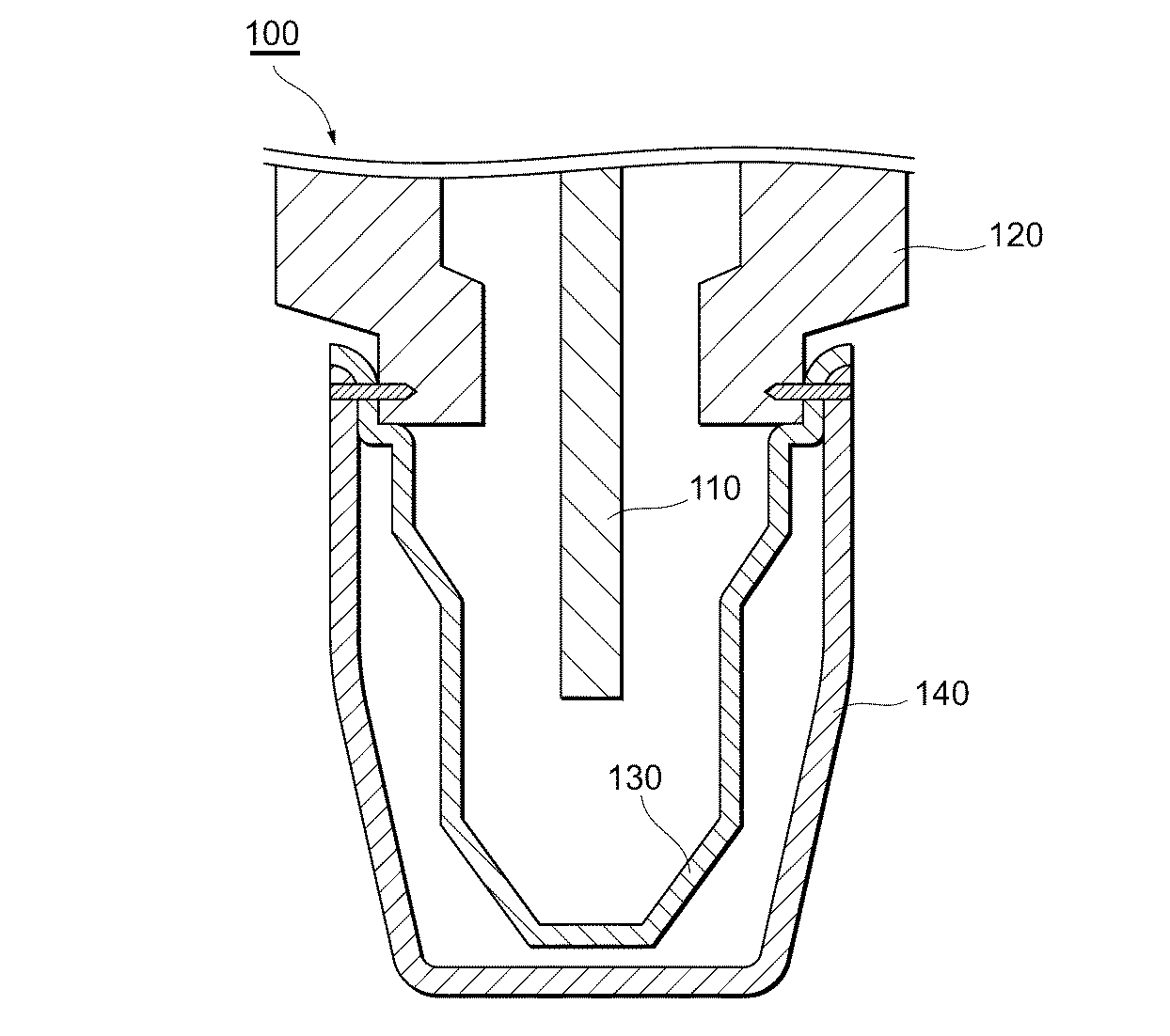
これらのうち、自動車排ガス経路部材の1種である、O2センサー(又はA/Fセンサー)などの排ガスセンサーについて説明する。図1は、本実施形態に係る排ガスセンサーを部分的に示す模式断面図である。この排ガスセンサー100は、排ガス中の酸素ガス濃度を検出するためのセンサー素子110と、そのセンサー素子110を保持する素子保持部材(図示せず)と、その素子保持部材を内側に保持するハウジング120と、ハウジングの端部を外周側から覆うように設けた内部カバー130と、その内部カバーの更に外側を覆うように設けた外部カバー140とを備える。ハウジング120、内部カバー130及び外部カバー140は、それらの重複部分で全周溶接を施されて接合している。本実施形態に係る鋼材は、内部カバー130及び外部カバー140に採用されている。これらの内部カバー130及び外部カバー140は、鋼板を深絞り成形により加工して得られたものである。
Among these, an exhaust gas sensor such as an O 2 sensor (or A / F sensor), which is a kind of automobile exhaust gas path member, will be described. FIG. 1 is a schematic cross-sectional view partially showing an exhaust gas sensor according to the present embodiment. The
内部カバー130及び外部カバー140は、その厚さが例えば1mm未満と薄く、寸法も直径で1.5〜2.0cm程度と小さいものである。しかも、排ガスセンサー100は、1000℃程度の高温で酸素ガスなどの酸化性ガスを含む排ガスに曝される。したがって、内部カバー130及び外部カバー140には優れた高温耐酸化性と共に、耐二次加工脆性も要求されるところ、本実施形態の鋼材を採用することにより、その要求を満足することが可能となる。
The
本実施形態のフェライト系ステンレス鋼は、上記組成を有する以外は、常法により製造することができる。また、本実施形態の鋼材及び二次加工品は、そのフェライト系ステンレス鋼を用いる以外は、常法により製造することができる。 The ferritic stainless steel of this embodiment can be manufactured by a conventional method except for having the above composition. Moreover, the steel material and secondary processed product of this embodiment can be manufactured by a conventional method except using the ferritic stainless steel.
以上、本発明を実施するための形態について説明したが、本発明は本実施形態に限定されるものではない。本発明は、その要旨を逸脱しない範囲で様々な変形が可能である。 As mentioned above, although the form for implementing this invention was demonstrated, this invention is not limited to this embodiment. The present invention can be variously modified without departing from the gist thereof.
以下、実施例によって本発明を更に詳細に説明するが、本発明はこれらの実施例に限定されるものではない。 EXAMPLES Hereinafter, although an Example demonstrates this invention further in detail, this invention is not limited to these Examples.
(鋼板の作製)
表1に示す組成(単位:質量部)を有する供試材を真空溶解炉で溶製してインゴットに鋳造した。得られたインゴットに熱間圧延を施した後、950℃での焼鈍及び冷間圧延を繰り返して、0.5mm厚さ及び0.05mm厚さの鋼板を作製した。最終焼鈍では、950℃で3分間保持し、その後、300℃まで30℃/秒以上の速度で冷却した。表1中「−」は検出限界以下であることを示し、Ti又はBが検出限界以下である場合はWTi/WBを算出することはできなかったため、これも「−」で示した。
(Production of steel plate)
A specimen having the composition (unit: part by mass) shown in Table 1 was melted in a vacuum melting furnace and cast into an ingot. After subjecting the obtained ingot to hot rolling, annealing at 950 ° C. and cold rolling were repeated to produce steel sheets having thicknesses of 0.5 mm and 0.05 mm. In the final annealing, it was held at 950 ° C. for 3 minutes, and then cooled to 300 ° C. at a rate of 30 ° C./second or more. In the table 1, "-" indicates that this is below the detection limit, because when Ti or B is below the detection limit was not possible to calculate the W Ti / W B, which is also - indicated by "".
得られた鋼板について、上述のようにして、粒界析出物に占めるCr2Bの割合及び粒内に対する粒界におけるBの平均含有割合の比を導出した。Cr2Bの割合は、面積率が20%以下である場合を「○」と評価し、20%を超える場合を「×」と評価した。また、Bの平均含有割合の比が1.2倍以上である場合を、Bの偏析状態が「○」と評価し、そうでない場合を、Bの偏析状態が「×」と評価した。 The obtained steel sheets, as described above, to derive the average content ratio of B at the grain boundaries relative to Cr 2 ratio and the grains of B occupying the grain boundary precipitates. As for the proportion of Cr 2 B, the case where the area ratio was 20% or less was evaluated as “◯”, and the case where it exceeded 20% was evaluated as “x”. Moreover, when the ratio of the average content ratio of B was 1.2 times or more, the segregation state of B was evaluated as “◯”, and when it was not, the segregation state of B was evaluated as “x”.
(酸化増量の測定)
得られた0.5mm又は0.05mm厚さの鋼板から、25mm×35mmの大きさの主面を有する試験片を切り出した。その試験片をエレマ電気炉に収納した後、10%の水蒸気を含む空気雰囲気下、0.5mm厚さの鋼板について炉内温度1250℃で400時間、0.05mm厚さの鋼板について炉内温度1000℃で200時間の連続酸化試験を実施した。その試験前後における試験片の質量変化を測定した。0.5mm厚さの鋼板について、試験後の質量の増分が試験前の質量よりも10mg/cm2以下である場合を耐酸化性が良好であるとして「○」、10mg/cm2を超える場合を耐酸化性が良好でないとして「×」と評価した。0.05mm厚さの鋼板について、試験片の片方の主面(空気雰囲気に接していた方の主面)への異常スケールの付着割合が、その面積の50%以上であった場合、耐酸化性が良好でなく異常酸化と判断し「×」と評価し、その面積の50%未満であった場合、耐酸化性が良好であり異常酸化ではないと判断し「○」と評価した。
(Measurement of oxidation increase)
A test piece having a main surface of 25 mm × 35 mm was cut out from the obtained 0.5 mm or 0.05 mm thick steel sheet. After storing the test piece in the Elema electric furnace, in an air atmosphere containing 10% water vapor, a 0.5 mm-thick steel sheet was heated at a furnace temperature of 1250 ° C. for 400 hours, and a 0.05 mm-thick steel sheet was heated in the furnace. A continuous oxidation test was conducted at 1000 ° C. for 200 hours. The mass change of the test piece before and after the test was measured. For a steel sheet with a thickness of 0.5 mm, when the increase in mass after the test is 10 mg / cm 2 or less than the mass before the test, the oxidation resistance is good, and “O” exceeds 10 mg / cm 2 Was evaluated as “x” because the oxidation resistance was not good. For a 0.05 mm thick steel plate, when the proportion of abnormal scale attached to one main surface of the test piece (the main surface in contact with the air atmosphere) was 50% or more of the area, oxidation resistance When it was less than 50% of the area, it was judged that the oxidation resistance was good and was not abnormal oxidation, and was evaluated as “◯”.
(落重試験による遷移温度の測定)
上述のようにして得られた0.5mm厚さの鋼板から、ブランク材をφ40mmのサイズで打ち抜き、そのブランク材に対して絞り比2.25の絞り加工を施した。こうして得られた加工品を用いて、種々温度を変化させて落重試験を行った。落重試験は、衝撃荷重を加えるための分銅(質量3kg)を高さ100mmのところから加工品に落下(3J・mの衝撃エネルギーに相当)させることで行い、加工品に分銅が衝突することで割れが発生した時の温度を遷移温度とした。この遷移温度が−20℃以下である場合、耐二次加工脆性が良好であるとして「○」と評価し、−20℃を超える場合、耐二次加工脆性が良好でないとして「×」と評価した。
(Measurement of transition temperature by drop weight test)
A blank material was punched out with a size of φ40 mm from the steel plate having a thickness of 0.5 mm obtained as described above, and the blank material was subjected to drawing processing with a drawing ratio of 2.25. Using the processed product thus obtained, a drop weight test was performed at various temperatures. The drop weight test is performed by dropping a weight (3 kg in mass) for applying an impact load onto a work piece from a height of 100 mm (corresponding to an impact energy of 3 J · m), and the weight collides with the work piece. The temperature at which cracking occurred was taken as the transition temperature. When this transition temperature is −20 ° C. or lower, it is evaluated as “◯” because the secondary work brittleness resistance is good, and when it exceeds −20 ° C., it is evaluated as “x” because the secondary work brittleness resistance is not good. did.
(溶接性の評価)
上述のようにして最終焼鈍を施した後の鋼板を、厚さ1.2mm、幅40mm、長さ200mmのサイズに加工して溶接性評価用の試験片を得た。引張試験により試験片に10%の歪を与えた後、気温約10℃、溶接速度30cm/分、溶接電流105Aの条件で、試験片の主面中央部にTIGなめ付け溶接を施し、溶接後の割れの有無を目視にて確認した。割れが認められた場合を溶接性が良好でないとして「×」と評価し、割れが認められなかった場合を溶接性が良好であるとして「○」と評価した。
(Evaluation of weldability)
The steel sheet after the final annealing as described above was processed into a size of 1.2 mm in thickness, 40 mm in width, and 200 mm in length to obtain a test piece for weldability evaluation. After applying 10% strain to the test piece by a tensile test, TIG tanning welding was applied to the center of the main surface of the test piece under the conditions of an air temperature of about 10 ° C., a welding speed of 30 cm / min, and a welding current of 105 A. The presence or absence of cracks was confirmed visually. When the crack was recognized, it was evaluated as “x” because the weldability was not good, and when the crack was not recognized, it was evaluated as “◯” because the weldability was good.
それぞれの試験結果を表2に示す。表2の試験結果にみられるように、本発明鋼No.1〜10は、いずれも耐酸化性、二次加工性及び溶接性に優れており、Bの偏析、ボライドの抑制について、それぞれ満足している。 Each test result is shown in Table 2. As can be seen from the test results in Table 2, steel No. 1 of the present invention. Nos. 1 to 10 are excellent in oxidation resistance, secondary workability and weldability, and are satisfied with respect to segregation of B and suppression of boride.
一方、比較鋼No.11〜19は、いずれも耐酸化性及び耐二次加工脆性の特性を両立せず不十分である。これらのうち比較鋼No.12は、Alの含有割合を少なくすることで耐二次加工脆性は良好となるが、Alの含有割合が少ない故に、均一なAl2O3皮膜を形成できず耐酸化性が良好ではない結果となったと推察される。また、比較鋼No.14は、Crの含有割合を少なくしたことで耐酸化性が良好ではなかったと推察される。比較鋼No.18及び19は、耐酸化性は良好であるものの、耐二次加工脆性が良好ではなかった。 On the other hand, Comparative Steel No. Nos. 11 to 19 are inadequate because they are incompatible with the properties of oxidation resistance and secondary work brittleness. Among these, comparative steel No. No. 12 shows that the secondary work brittleness resistance is improved by reducing the Al content ratio, but because the Al content ratio is small, a uniform Al 2 O 3 film cannot be formed and the oxidation resistance is not good. It is guessed that it became. Comparative steel No. No. 14 is presumed that the oxidation resistance was not good because the Cr content was reduced. Comparative steel No. Although 18 and 19 had good oxidation resistance, secondary work brittleness resistance was not good.
本発明によれば、500℃以上、特に1000℃程度の高温環境に曝される部品に用いられても酸化が抑制され、しかも、溶接性及び耐二次加工脆性、特に低温における溶接性及び耐二次加工脆性に優れるフェライト系ステンレス鋼を提供することができる。したがって、そのような環境下に置かれ又はそのような環境下で加工され、複雑又は微細な形状を有する二次加工品に用いると有用である。 According to the present invention, oxidation is suppressed even when used in a part exposed to a high temperature environment of 500 ° C. or more, particularly about 1000 ° C., and weldability and secondary work brittleness resistance, particularly low temperature weldability and resistance. A ferritic stainless steel having excellent secondary work brittleness can be provided. Therefore, it is useful to be used for a secondary processed product that is placed in or processed under such an environment and has a complicated or fine shape.
100…排ガスセンサー、110…センサー素子、120…ハウジング、130…内部カバー、140…外部カバー。
DESCRIPTION OF
Claims (6)
下記式(1)で表される条件を満足し、かつ、粒界析出物に占めるCr2Bの割合が面積率で20%以下である、耐酸化性、耐二次加工脆性及び溶接性に優れたフェライト系ステンレス鋼。
WTi/WB≧100 (1)
(式中、WTi及びWBはそれぞれ、前記フェライト系ステンレス鋼の総質量に対するTi及びBの含有割合(単位:質量%)を示す。) C: 0.03% by mass or less, Si: 0.5% by mass or less, Mn: 1.0% by mass or less, P: 0.04% by mass or less, S: 0.01% by mass or less, Ni: 0.6% by mass or less, Cr: 15-20% by mass, N: 0.03% by mass or less, Ti: 0.5% by mass or less, and B: 0.0005-0.003% by mass And Al: 2.5 mass% or more and less than 4.0 mass%, and a ferritic stainless steel having a composition in which the balance is composed of Fe and inevitable impurities,
The condition represented by the following formula (1) is satisfied, and the ratio of Cr2B in the grain boundary precipitates is 20% or less in terms of area ratio, which is excellent in oxidation resistance, secondary work brittleness resistance and weldability. Ferritic stainless steel.
W Ti / W B ≧ 100 (1)
(Wherein, the content of W Ti and W and B are, Ti and B to the total weight of the ferritic stainless steel (unit: mass%) shows a.)
Priority Applications (1)
| Application Number | Priority Date | Filing Date | Title |
|---|---|---|---|
| JP2010045751A JP5588198B2 (en) | 2010-03-02 | 2010-03-02 | Ferritic stainless steel with excellent oxidation resistance, secondary work brittleness resistance and weldability |
Applications Claiming Priority (1)
| Application Number | Priority Date | Filing Date | Title |
|---|---|---|---|
| JP2010045751A JP5588198B2 (en) | 2010-03-02 | 2010-03-02 | Ferritic stainless steel with excellent oxidation resistance, secondary work brittleness resistance and weldability |
Publications (2)
| Publication Number | Publication Date |
|---|---|
| JP2011179088A JP2011179088A (en) | 2011-09-15 |
| JP5588198B2 true JP5588198B2 (en) | 2014-09-10 |
Family
ID=44690907
Family Applications (1)
| Application Number | Title | Priority Date | Filing Date |
|---|---|---|---|
| JP2010045751A Active JP5588198B2 (en) | 2010-03-02 | 2010-03-02 | Ferritic stainless steel with excellent oxidation resistance, secondary work brittleness resistance and weldability |
Country Status (1)
| Country | Link |
|---|---|
| JP (1) | JP5588198B2 (en) |
Families Citing this family (11)
| Publication number | Priority date | Publication date | Assignee | Title |
|---|---|---|---|---|
| JP2011190524A (en) * | 2010-03-17 | 2011-09-29 | Nisshin Steel Co Ltd | Ferritic stainless steel having excellent oxidation resistance, secondary processing brittleness resistance and weld zone toughness |
| MY175890A (en) * | 2012-09-25 | 2020-07-14 | Jfe Steel Corp | Ferritic stainless steel |
| JP5561447B1 (en) * | 2012-12-17 | 2014-07-30 | Jfeスチール株式会社 | Stainless steel plate and stainless steel foil |
| JP6417146B2 (en) * | 2014-08-05 | 2018-10-31 | 日新製鋼株式会社 | Ferritic stainless steel welded structure and heat resistant member for solid oxide fuel cell |
| JP6053994B1 (en) * | 2015-10-29 | 2016-12-27 | 新日鐵住金ステンレス株式会社 | Ferritic stainless steel for fuel cells with excellent creep resistance and method for producing the same |
| WO2017073093A1 (en) * | 2015-10-29 | 2017-05-04 | 新日鐵住金ステンレス株式会社 | Ferritic stainless steel for fuel cell with excellent anti-creep strength and manufacturing method therefor |
| JP6655962B2 (en) * | 2015-11-27 | 2020-03-04 | 日鉄ステンレス株式会社 | Al-containing ferritic stainless steel welded joint with excellent 475 ° C brittle resistance |
| JP6300841B2 (en) * | 2016-01-28 | 2018-03-28 | 新日鐵住金ステンレス株式会社 | Al-containing ferritic stainless steel with excellent high-temperature strength |
| JP6971185B2 (en) * | 2018-03-27 | 2021-11-24 | 日鉄ステンレス株式会社 | Ferritic stainless steel welded joints and fuel cell components |
| JP7292314B2 (en) * | 2018-05-22 | 2023-06-16 | エービー サンドビック マテリアルズ テクノロジー | Tubular elements and tubular assemblies |
| JP7050584B2 (en) * | 2018-06-06 | 2022-04-08 | 日本特殊陶業株式会社 | Sensor |
Family Cites Families (4)
| Publication number | Priority date | Publication date | Assignee | Title |
|---|---|---|---|---|
| JP3474829B2 (en) * | 2000-05-02 | 2003-12-08 | 新日本製鐵株式会社 | Heat-resistant ferritic stainless steel for catalyst support with excellent weldability and workability |
| JP4236503B2 (en) * | 2003-04-04 | 2009-03-11 | 新日鐵住金ステンレス株式会社 | Al-containing heat-resistant ferritic stainless steel sheet excellent in workability and oxidation resistance and method for producing the same |
| JP4265751B2 (en) * | 2003-04-28 | 2009-05-20 | 新日鐵住金ステンレス株式会社 | Ferritic stainless steel sheet with excellent secondary workability and its manufacturing method |
| JP4986975B2 (en) * | 2008-10-24 | 2012-07-25 | 新日鐵住金ステンレス株式会社 | Al-containing heat-resistant ferritic stainless steel sheet excellent in workability and oxidation resistance and method for producing the same |
-
2010
- 2010-03-02 JP JP2010045751A patent/JP5588198B2/en active Active
Also Published As
| Publication number | Publication date |
|---|---|
| JP2011179088A (en) | 2011-09-15 |
Similar Documents
| Publication | Publication Date | Title |
|---|---|---|
| JP2011179088A (en) | Ferritic stainless steel having excellent oxidation resistance, secondary working brittleness resistance and weldability | |
| JP5600012B2 (en) | Ferritic stainless steel with excellent oxidation resistance and secondary work brittleness resistance, as well as steel and secondary work products | |
| TWI493057B (en) | Fat iron stainless steel | |
| JP4386144B2 (en) | Ferritic stainless steel with excellent heat resistance | |
| US8153055B2 (en) | Ferritic stainless steel with excellent heat resistance | |
| JP5387057B2 (en) | Ferritic stainless steel with excellent heat resistance and toughness | |
| JP5609571B2 (en) | Ferritic stainless steel with excellent oxidation resistance | |
| CN103874779B (en) | Ferritic stainless steel | |
| JP5780716B2 (en) | Ferritic stainless steel with excellent oxidation resistance and secondary workability | |
| JP2011190524A (en) | Ferritic stainless steel having excellent oxidation resistance, secondary processing brittleness resistance and weld zone toughness | |
| TWI503423B (en) | Ferritic stainless steel | |
| JP5658893B2 (en) | Ferritic stainless steel sheet with excellent heat resistance and method for producing the same | |
| MX2013004053A (en) | Ferritic stainless steel excellent in heat resistance and workability. | |
| JP5703075B2 (en) | Ferritic stainless steel plate with excellent heat resistance | |
| JPWO2015141674A1 (en) | Ferritic stainless steel sheet for tailored blanks, tailored blanks excellent in formability, and manufacturing method thereof | |
| JP2009235572A (en) | Ferritic stainless steel having excellent heat resistance and shape-fixability | |
| JP6665936B2 (en) | Ferritic stainless steel | |
| JP5796397B2 (en) | Ferritic stainless steel with excellent thermal fatigue properties and oxidation resistance | |
| JP2014214321A (en) | Ferritic stainless steel excellent in thermal fatigue characteristics | |
| JP2021195574A (en) | Ferritic stainless steel sheet, method for producing ferritic stainless steel sheet, and automobile exhaust system parts | |
| JP2021195573A (en) | Ferritic stainless steel sheet, manufacturing method of ferritic stainless steel sheet and automobile exhaust system parts | |
| JP2021195575A (en) | Ferritic stainless steel sheet, method for producing ferritic stainless steel sheet, and automobile exhaust system parts | |
| JP2019173115A (en) | Ferritic stainless steel sheet excellent in high temperature salt damage resistance and automobile exhaust system component | |
| JP2009046717A (en) | Alloy foil with excellent strength and oxidation resistance at high temperatures |
Legal Events
| Date | Code | Title | Description |
|---|---|---|---|
| A621 | Written request for application examination |
Free format text: JAPANESE INTERMEDIATE CODE: A621 Effective date: 20130225 |
|
| A977 | Report on retrieval |
Free format text: JAPANESE INTERMEDIATE CODE: A971007 Effective date: 20140220 |
|
| A131 | Notification of reasons for refusal |
Free format text: JAPANESE INTERMEDIATE CODE: A131 Effective date: 20140324 |
|
| A521 | Request for written amendment filed |
Free format text: JAPANESE INTERMEDIATE CODE: A523 Effective date: 20140523 |
|
| TRDD | Decision of grant or rejection written | ||
| A01 | Written decision to grant a patent or to grant a registration (utility model) |
Free format text: JAPANESE INTERMEDIATE CODE: A01 Effective date: 20140716 |
|
| A61 | First payment of annual fees (during grant procedure) |
Free format text: JAPANESE INTERMEDIATE CODE: A61 Effective date: 20140725 |
|
| R150 | Certificate of patent or registration of utility model |
Ref document number: 5588198 Country of ref document: JP Free format text: JAPANESE INTERMEDIATE CODE: R150 |
|
| S111 | Request for change of ownership or part of ownership |
Free format text: JAPANESE INTERMEDIATE CODE: R313111 |
|
| S533 | Written request for registration of change of name |
Free format text: JAPANESE INTERMEDIATE CODE: R313533 |
|
| R350 | Written notification of registration of transfer |
Free format text: JAPANESE INTERMEDIATE CODE: R350 |
|
| R360 | Written notification for declining of transfer of rights |
Free format text: JAPANESE INTERMEDIATE CODE: R360 |
|
| R360 | Written notification for declining of transfer of rights |
Free format text: JAPANESE INTERMEDIATE CODE: R360 |
|
| R371 | Transfer withdrawn |
Free format text: JAPANESE INTERMEDIATE CODE: R371 |
|
| S111 | Request for change of ownership or part of ownership |
Free format text: JAPANESE INTERMEDIATE CODE: R313111 |
|
| R350 | Written notification of registration of transfer |
Free format text: JAPANESE INTERMEDIATE CODE: R350 |
|
| R250 | Receipt of annual fees |
Free format text: JAPANESE INTERMEDIATE CODE: R250 |
|
| R250 | Receipt of annual fees |
Free format text: JAPANESE INTERMEDIATE CODE: R250 |
|
| R250 | Receipt of annual fees |
Free format text: JAPANESE INTERMEDIATE CODE: R250 |
|
| R250 | Receipt of annual fees |
Free format text: JAPANESE INTERMEDIATE CODE: R250 |
|
| R250 | Receipt of annual fees |
Free format text: JAPANESE INTERMEDIATE CODE: R250 |
|
| R250 | Receipt of annual fees |
Free format text: JAPANESE INTERMEDIATE CODE: R250 |
|
| S111 | Request for change of ownership or part of ownership |
Free format text: JAPANESE INTERMEDIATE CODE: R313111 |
|
| R350 | Written notification of registration of transfer |
Free format text: JAPANESE INTERMEDIATE CODE: R350 |