JP4937745B2 - polyamide - Google Patents
polyamide Download PDFInfo
- Publication number
- JP4937745B2 JP4937745B2 JP2006529021A JP2006529021A JP4937745B2 JP 4937745 B2 JP4937745 B2 JP 4937745B2 JP 2006529021 A JP2006529021 A JP 2006529021A JP 2006529021 A JP2006529021 A JP 2006529021A JP 4937745 B2 JP4937745 B2 JP 4937745B2
- Authority
- JP
- Japan
- Prior art keywords
- group
- polyamide
- formula
- compound
- resin
- Prior art date
- Legal status (The legal status is an assumption and is not a legal conclusion. Google has not performed a legal analysis and makes no representation as to the accuracy of the status listed.)
- Expired - Lifetime
Links
Classifications
-
- G—PHYSICS
- G03—PHOTOGRAPHY; CINEMATOGRAPHY; ANALOGOUS TECHNIQUES USING WAVES OTHER THAN OPTICAL WAVES; ELECTROGRAPHY; HOLOGRAPHY
- G03F—PHOTOMECHANICAL PRODUCTION OF TEXTURED OR PATTERNED SURFACES, e.g. FOR PRINTING, FOR PROCESSING OF SEMICONDUCTOR DEVICES; MATERIALS THEREFOR; ORIGINALS THEREFOR; APPARATUS SPECIALLY ADAPTED THEREFOR
- G03F7/00—Photomechanical, e.g. photolithographic, production of textured or patterned surfaces, e.g. printing surfaces; Materials therefor, e.g. comprising photoresists; Apparatus specially adapted therefor
- G03F7/004—Photosensitive materials
- G03F7/075—Silicon-containing compounds
- G03F7/0757—Macromolecular compounds containing Si-O, Si-C or Si-N bonds
-
- C—CHEMISTRY; METALLURGY
- C08—ORGANIC MACROMOLECULAR COMPOUNDS; THEIR PREPARATION OR CHEMICAL WORKING-UP; COMPOSITIONS BASED THEREON
- C08G—MACROMOLECULAR COMPOUNDS OBTAINED OTHERWISE THAN BY REACTIONS ONLY INVOLVING UNSATURATED CARBON-TO-CARBON BONDS
- C08G73/00—Macromolecular compounds obtained by reactions forming a linkage containing nitrogen with or without oxygen or carbon in the main chain of the macromolecule, not provided for in groups C08G12/00 - C08G71/00
- C08G73/06—Polycondensates having nitrogen-containing heterocyclic rings in the main chain of the macromolecule
- C08G73/10—Polyimides; Polyester-imides; Polyamide-imides; Polyamide acids or similar polyimide precursors
- C08G73/14—Polyamide-imides
-
- G—PHYSICS
- G03—PHOTOGRAPHY; CINEMATOGRAPHY; ANALOGOUS TECHNIQUES USING WAVES OTHER THAN OPTICAL WAVES; ELECTROGRAPHY; HOLOGRAPHY
- G03F—PHOTOMECHANICAL PRODUCTION OF TEXTURED OR PATTERNED SURFACES, e.g. FOR PRINTING, FOR PROCESSING OF SEMICONDUCTOR DEVICES; MATERIALS THEREFOR; ORIGINALS THEREFOR; APPARATUS SPECIALLY ADAPTED THEREFOR
- G03F7/00—Photomechanical, e.g. photolithographic, production of textured or patterned surfaces, e.g. printing surfaces; Materials therefor, e.g. comprising photoresists; Apparatus specially adapted therefor
- G03F7/004—Photosensitive materials
- G03F7/038—Macromolecular compounds which are rendered insoluble or differentially wettable
- G03F7/0387—Polyamides or polyimides
-
- G—PHYSICS
- G03—PHOTOGRAPHY; CINEMATOGRAPHY; ANALOGOUS TECHNIQUES USING WAVES OTHER THAN OPTICAL WAVES; ELECTROGRAPHY; HOLOGRAPHY
- G03F—PHOTOMECHANICAL PRODUCTION OF TEXTURED OR PATTERNED SURFACES, e.g. FOR PRINTING, FOR PROCESSING OF SEMICONDUCTOR DEVICES; MATERIALS THEREFOR; ORIGINALS THEREFOR; APPARATUS SPECIALLY ADAPTED THEREFOR
- G03F7/00—Photomechanical, e.g. photolithographic, production of textured or patterned surfaces, e.g. printing surfaces; Materials therefor, e.g. comprising photoresists; Apparatus specially adapted therefor
- G03F7/004—Photosensitive materials
- G03F7/038—Macromolecular compounds which are rendered insoluble or differentially wettable
- G03F7/0388—Macromolecular compounds which are rendered insoluble or differentially wettable with ethylenic or acetylenic bands in the side chains of the photopolymer
Landscapes
- Physics & Mathematics (AREA)
- Spectroscopy & Molecular Physics (AREA)
- General Physics & Mathematics (AREA)
- Chemical & Material Sciences (AREA)
- Medicinal Chemistry (AREA)
- Chemical Kinetics & Catalysis (AREA)
- Health & Medical Sciences (AREA)
- Polymers & Plastics (AREA)
- Organic Chemistry (AREA)
- Materials For Photolithography (AREA)
- Macromolecular Compounds Obtained By Forming Nitrogen-Containing Linkages In General (AREA)
- Macromonomer-Based Addition Polymer (AREA)
- Polyamides (AREA)
- Other Resins Obtained By Reactions Not Involving Carbon-To-Carbon Unsaturated Bonds (AREA)
Description
本発明は、耐熱性樹脂の前駆体となるポリアミド、及び該ポリアミドを含む感光性を有する樹脂組成物、該樹脂組成物からなる硬化レリーフパターンの形成方法、並びに該硬化レリーフパターンを有してなる半導体装置及びその製造方法に関する。更に詳しくは、高耐熱性を有し、電子部品の絶縁材料、並びに半導体装置における表面保護膜、層間絶縁膜、及びα線遮蔽膜などの用途に好適に用いることができるポリアミドイミド樹脂を与える前駆体となるポリアミドに関する。 The present invention comprises a polyamide as a precursor of a heat resistant resin, a photosensitive resin composition containing the polyamide, a method for forming a cured relief pattern comprising the resin composition, and the cured relief pattern. The present invention relates to a semiconductor device and a manufacturing method thereof. More specifically, it is a precursor that provides a polyamide-imide resin that has high heat resistance and can be used suitably for applications such as insulating materials for electronic parts and surface protective films, interlayer insulating films, and α-ray shielding films in semiconductor devices. It relates to the body polyamide.
従来、電子部品の絶縁材料、並びに半導体装置の表面保護膜、層間絶縁膜、及びα線遮蔽膜などには、優れた耐熱性、電気特性、及び機械特性を併せ持つポリイミド樹脂からなる塗膜が広く用いられてきた。 Conventionally, a coating film made of a polyimide resin having excellent heat resistance, electrical characteristics, and mechanical characteristics has been widely used for insulating materials for electronic parts, and surface protective films, interlayer insulating films, and α-ray shielding films for semiconductor devices. Has been used.
このポリイミド樹脂塗膜を形成するにあたっては、非感光性ポリイミド樹脂前駆体組成物、又は感光性ポリイミド樹脂前駆体組成物を使用することが可能である。後者の形で供されるものを基板上に塗布し、所望のパターニングマスクを介して活性光線で露光し、現像し、加熱することにより、耐熱性を有するポリイミド樹脂からなる硬化レリーフパターン層をより容易に形成させることができる。 In forming this polyimide resin coating film, it is possible to use a non-photosensitive polyimide resin precursor composition or a photosensitive polyimide resin precursor composition. The latter provided in the latter form is coated on a substrate, exposed with actinic rays through a desired patterning mask, developed, and heated to further form a cured relief pattern layer made of a polyimide resin having heat resistance. It can be formed easily.
従って、硬化レリーフパターンを形成する必要のない塗膜としてポリイミド樹脂を使用する場合には、非感光性又は感光性のどちらのポリイミド樹脂前駆体組成物でもよいが、ポリイミド樹脂からなる硬化レリーフパターン層を有してなる半導体装置を製造するためにポリイミド樹脂を使用する場合には、感光性ポリイミド樹脂前駆体組成物は非感光性ポリイミド樹脂前駆体組成物に比べて大幅な工程短縮が可能となるという利点を有する。 Therefore, when a polyimide resin is used as a coating film that does not need to form a cured relief pattern, either a non-photosensitive or photosensitive polyimide resin precursor composition may be used, but a cured relief pattern layer made of a polyimide resin. In the case of using a polyimide resin to produce a semiconductor device having a photosensitive resin composition, the photosensitive polyimide resin precursor composition can be significantly shortened in process compared to the non-photosensitive polyimide resin precursor composition. Has the advantage.
感光性ポリイミド樹脂前駆体組成物が使用され始めた当初は、超高圧水銀灯のg線(波長436nm)による露光が通常行われていたが、現在はより解像度の高いi線(波長365nm)による露光が主流である。i線露光用の組成物に使用する感光性ポリイミド樹脂前駆体組成物としてはi線透過率の高いものが好ましく、ジフェニルエーテル−3,3’,4,4’−テトラカルボン酸とジアミン化合物とを縮合させたポリイミド樹脂前駆体を含む組成物等が提案されている(例えば、特開平6−342211号公報参照)。 At the beginning of the use of the photosensitive polyimide resin precursor composition, exposure with g-line (wavelength 436 nm) of an ultra-high pressure mercury lamp was normally performed, but now exposure with i-line (wavelength 365 nm) with higher resolution is performed. Is the mainstream. As a photosensitive polyimide resin precursor composition used for the composition for i-line exposure, a high i-line transmittance is preferable, and diphenyl ether-3,3 ′, 4,4′-tetracarboxylic acid and a diamine compound are used. A composition containing a condensed polyimide resin precursor has been proposed (for example, see JP-A-6-342211).
近年、半導体装置のプリント配線板への実装方法が、従来の金属ピンと錫−鉛共晶ハンダによる実装方法から、より高密度実装が可能なCSP(チップサイズパッケージング)などのポリイミド樹脂塗膜が直接ハンダバンプに接触する構造へと変化しつつある。つまり、ポリイミド樹脂塗膜がハンダバンプのリフロー工程などにおいて、フラックスに接触する状況が生じ、よりいっそうの耐熱性が要求されるようになってきた。 In recent years, the mounting method of a semiconductor device on a printed wiring board is different from the conventional mounting method using a metal pin and tin-lead eutectic solder, and a polyimide resin coating film such as CSP (chip size packaging) capable of mounting at higher density. The structure is in direct contact with solder bumps. That is, the polyimide resin coating film comes into contact with the flux in a solder bump reflow process and the like, and further heat resistance has been required.
また、半導体装置の製造工程では、高効率化及び低コスト化の観点から、基板であるシリコンウェハーの径を300mmへと大径化する動きが著しい。感光性ポリイミド樹脂前駆体組成物をシリコンウェハー上に塗布し加熱によってポリイミド樹脂塗膜に変換する過程において、残留応力によってシリコンウェハーにそりが発生する。つまり、ポリイミド樹脂塗膜が大径のシリコンウェハーに使用される状況が生じ、よりいっそうの残留応力の低減が要求されるようになってきた。 Further, in the manufacturing process of semiconductor devices, from the viewpoint of high efficiency and low cost, there is a significant movement to increase the diameter of a silicon wafer as a substrate to 300 mm. In the process of applying the photosensitive polyimide resin precursor composition onto a silicon wafer and converting it to a polyimide resin coating film by heating, warpage occurs in the silicon wafer due to residual stress. That is, the situation where a polyimide resin coating film is used for a large-diameter silicon wafer has arisen, and a further reduction in residual stress has been demanded.
しかしながら、一般に、前述のi線露光用の組成物から得られたポリイミド樹脂塗膜は、g線露光用の組成物から得られたポリイミド樹脂塗膜に比較して、ガラス転移温度がより低く、残留応力がより高いものが多い。そこで、ガラス転移温度に代表されるポリイミド樹脂塗膜の耐熱性を向上させる方法が各種提案されている。一例をあげると、感光性ポリイミド樹脂前駆体組成物にメラミン樹脂を添加した組成物が提案されている(国際公開第2004/008252号パンフレット参照)。また、ポリイミド樹脂塗膜の残留応力を低減させる方法も各種提案されている。一例をあげると、シロキサンからなる繰返し単位を有するテトラカルボン酸化合物とジアミン化合物とを縮合させたポリイミド樹脂前駆体を含む組成物が提案されている(特開2001−154365号公報参照)。 However, in general, the polyimide resin coating film obtained from the aforementioned i-line exposure composition has a lower glass transition temperature than the polyimide resin coating film obtained from the g-line exposure composition, Many have higher residual stress. Therefore, various methods for improving the heat resistance of the polyimide resin coating film represented by the glass transition temperature have been proposed. As an example, a composition in which a melamine resin is added to a photosensitive polyimide resin precursor composition has been proposed (see International Publication No. 2004/008252 pamphlet). Various methods for reducing the residual stress of the polyimide resin coating have also been proposed. As an example, a composition containing a polyimide resin precursor obtained by condensing a tetracarboxylic acid compound having a repeating unit composed of siloxane and a diamine compound has been proposed (see JP 2001-154365 A).
なお、特開平5−27245号公報には、5−ヒドロキシイソフタル酸ドデカノアートクロライド等の特定構造の酸成分とテレフタル酸等の特定構造の酸成分とを特定のモル比で用い、ジアミノジフェニルエーテル等のジアミン成分と反応させて得たポリアミド樹脂、及び該樹脂を含有する組成物が開示されている。しかしながら、該樹脂は液晶配向膜を用途とするポリアミドであって耐熱性樹脂の前駆体となるポリアミドではない。 In JP-A-5-27245, an acid component having a specific structure such as 5-hydroxyisophthalic acid dodecanoate chloride and an acid component having a specific structure such as terephthalic acid are used in a specific molar ratio, and diaminodiphenyl ether or the like. A polyamide resin obtained by reacting with a diamine component and a composition containing the resin are disclosed. However, the resin is a polyamide that uses a liquid crystal alignment film and is not a polyamide that becomes a precursor of a heat-resistant resin.
上述のように、感光性ポリイミドの技術分野においては、硬化後のポリイミド樹脂塗膜のガラス転移温度を向上させる方法、及び硬化後のポリイミド樹脂塗膜の残留応力を低く保った上でガラス転移温度を向上させる方法が望まれている。 As described above, in the technical field of photosensitive polyimide, a method for improving the glass transition temperature of the cured polyimide resin coating, and a glass transition temperature after keeping the residual stress of the cured polyimide resin coating low. There is a demand for a method for improving the above.
本発明は、加熱によって高耐熱性を有する樹脂となるポリアミドを提供することを目的とする。また、加熱によって高耐熱性を有する樹脂となるのみならず硬化後の塗膜の残留応力が低いポリアミドを提供することを目的とする。さらに、該ポリアミドを含み、ネガ型感光性を有する樹脂組成物を提供することを目的とする。さらに、該組成物を用いた硬化レリーフパターンの形成方法、該方法を含有する半導体装置の製造方法、および該組成物を硬化させて得られる樹脂からなる塗膜を有する半導体装置を提供することを目的とする。 An object of this invention is to provide the polyamide used as resin which has high heat resistance by heating. It is another object of the present invention to provide a polyamide which not only becomes a resin having high heat resistance by heating but also has a low residual stress of a cured coating film. Furthermore, it aims at providing the resin composition which contains this polyamide and has negative photosensitivity. Furthermore, there are provided a method for forming a cured relief pattern using the composition, a method for producing a semiconductor device containing the method, and a semiconductor device having a coating film made of a resin obtained by curing the composition. Objective.
本発明者らは、テトラカルボン酸化合物とジアミン化合物とを重縮合させたポリイミド樹脂前駆体において、熱架橋基を有する化合物を共重縮合させることによって加熱による硬化反応後の樹脂の耐熱性を向上させようとの着想を抱いた。本発明者らが鋭意検討した結果、テトラカルボン酸化合物に特定の官能基を有するフタル酸化合物を共重縮合させたポリアミドにより耐熱性が向上すること、及び該ポリアミドが有するジアミン単位の一部をシロキサン結合を有するジアミン単位とすることにより硬化後の塗膜の残留応力が減少することを見出し、本発明をなすに至った。 In the polyimide resin precursor obtained by polycondensation of a tetracarboxylic acid compound and a diamine compound, the present inventors improve the heat resistance of the resin after a curing reaction by heating by copolycondensation of a compound having a thermal crosslinking group. I had the idea of letting you do it. As a result of intensive studies by the present inventors, heat resistance is improved by a polyamide obtained by copolycondensation of a phthalic acid compound having a specific functional group with a tetracarboxylic acid compound, and a part of the diamine unit of the polyamide is obtained. It has been found that the residual stress of the coating film after curing is reduced by using a diamine unit having a siloxane bond, and the present invention has been made.
すなわち、本発明の第一は、化学式(1)で表される構造を有するポリアミドである。 That is, the first of the present invention is a polyamide having a structure represented by the chemical formula (1).
(式中のm及びnは、m≧1、n≧1、2≦(m+n)≦150、及び0.3≦m/(m+n)≦0.9を満たす整数である。また、繰り返し単位の配列は、ブロック的であってもランダム的であってもかまわない。式中のR1及びR2は、それぞれ独立に光重合性の不飽和結合を有する少なくとも1つの1価の有機基を示し、−COOR1基及び−COOR2基と、それらに隣接する−CONH−基とは、互いにオルト位置にある。式中のX1は、少なくとも1つの4価の芳香族基を示す。式中のX2は、少なくとも1つの3価の芳香族基を示す。式中のY1及びY2は、それぞれ独立に少なくとも1つの2価の有機基を示す。式中のZは、下記化学式(2)で表される基の中から選択される少なくとも1つの1価の有機基を示す。)(M and n in the formula are integers satisfying m ≧ 1, n ≧ 1, 2 ≦ (m + n) ≦ 150, and 0.3 ≦ m / (m + n) ≦ 0.9. The arrangement may be block or random, wherein R 1 and R 2 each independently represents at least one monovalent organic group having a photopolymerizable unsaturated bond. , -COOR 1 group and -COOR 2 group and the adjacent -CONH- group are in the ortho positions to each other, wherein X 1 represents at least one tetravalent aromatic group. X 2 in the formula represents at least one trivalent aromatic group, wherein Y 1 and Y 2 each independently represent at least one divalent organic group, and Z in the formula represents the following chemical formula ( 2 represents at least one monovalent organic group selected from the group represented by 2).
本発明のポリアミドにおいては、前記Y1及びY2の一部が、下記化学式(3)で表される2価のシロキサン基であることが好ましい。In the polyamide of the present invention, it is preferable that a part of Y 1 and Y 2 is a divalent siloxane group represented by the following chemical formula (3).
本発明の第二は、上記ポリアミド100質量部、及び光重合開始剤0.5〜20質量部を含むネガ型感光性を有する樹脂組成物である。 The second of the present invention is a resin composition having negative photosensitivity containing 100 parts by mass of the polyamide and 0.5 to 20 parts by mass of a photopolymerization initiator.
本発明の第三は、上記樹脂組成物を基板上に塗布する工程、得られた塗膜をパターニングマスクを介して活性光線で露光するか、又は化学線を直接照射する工程、塗膜の未露光部又は未照射部を現像液により溶解除去する工程、得られたネガ型レリーフパターンを200〜400℃で加熱する工程を含む、硬化レリーフパターンの形成方法である。
本発明の硬化レリーフパターンの形成方法においては、活性光線がi線であることが好ましい。The third of the present invention is a step of applying the resin composition on a substrate, exposing the obtained coating film with an actinic ray through a patterning mask, or directly irradiating actinic radiation, It is a method for forming a cured relief pattern, comprising a step of dissolving and removing an exposed portion or an unirradiated portion with a developer, and a step of heating the obtained negative relief pattern at 200 to 400 ° C.
In the method for forming a cured relief pattern of the present invention, the actinic ray is preferably i-line.
本発明の第四は、上記硬化レリーフパターンの形成方法を包含する、半導体装置の製造方法である。 A fourth aspect of the present invention is a method for manufacturing a semiconductor device including the method for forming the cured relief pattern.
本発明の第五は、上記樹脂組成物を硬化させた樹脂からなる塗膜を有する半導体装置である。 A fifth aspect of the present invention is a semiconductor device having a coating film made of a resin obtained by curing the resin composition.
本発明のポリアミドは、耐熱性に優れるまたは耐熱性に優れ低残留応力の、ポリアミドイミド樹脂の前駆体として使用できる。 The polyamide of the present invention can be used as a precursor of a polyamideimide resin having excellent heat resistance or excellent heat resistance and low residual stress.
本発明の樹脂組成物は、ネガ型感光性を有することによって硬化レリーフパターンを容易に形成でき、しかも加熱硬化後のポリアミドイミド樹脂は耐熱性に優れる、または耐熱性に優れ低残留応力という効果を有する。 The resin composition of the present invention can easily form a cured relief pattern by having negative photosensitivity, and the polyamide-imide resin after heat curing is excellent in heat resistance or has excellent heat resistance and low residual stress. Have.
本発明の硬化レリーフパターンの形成方法は、耐熱性に優れる、または耐熱性に優れ低残留応力のポリアミドイミド樹脂塗膜からなる硬化レリーフパターンを基板上に容易に形成することができるという効果を有する。 The method for forming a cured relief pattern of the present invention has the effect that a cured relief pattern comprising a polyamideimide resin coating film having excellent heat resistance or excellent heat resistance and low residual stress can be easily formed on a substrate. .
本発明の半導体装置の製造方法は、層間絶縁膜、又は表面保護膜として耐熱性に優れる、または耐熱性に優れ低残留応力の硬化レリーフパターンを有する半導体装置を容易に製造することができるという効果を有する。 The method of manufacturing a semiconductor device of the present invention has an effect that a semiconductor device having excellent heat resistance as an interlayer insulating film or surface protective film, or having a cured relief pattern having excellent heat resistance and low residual stress can be easily manufactured. Have
本発明の半導体装置は、層間絶縁膜、又は表面保護膜として耐熱性に優れる、または耐熱性に優れ低残留応力の硬化レリーフパターンを有する半導体装置を提供する。 The semiconductor device of the present invention provides a semiconductor device having a cured relief pattern having excellent heat resistance as an interlayer insulating film or surface protective film, or having excellent heat resistance and low residual stress.
以下、本発明を具体的に説明する。
<ポリアミドと樹脂組成物>
本発明のポリアミドと、本発明の樹脂組成物を構成する各成分について、以下具体的に説明する。Hereinafter, the present invention will be specifically described.
<Polyamide and resin composition>
The polyamide of the present invention and each component constituting the resin composition of the present invention will be specifically described below.
(A)ポリアミド
本発明のポリアミドは、下記化学式(1)で表される構造を有するポリアミドである。該ポリアミドは、有機基R1及びR2が有する不飽和結合が光重合性を有することにより、光重合開始剤を添加することによってネガ型の感光性を有する樹脂組成物とすることができる。また、該ポリアミドは、−COOR1基及び−COOR2基と、それらに隣接する−CONH−基とが、200〜400℃で加熱することによりイミド結合しポリアミドイミド樹脂に変換されるものである。(A) Polyamide The polyamide of the present invention is a polyamide having a structure represented by the following chemical formula (1). The polyamide can be made into a resin composition having negative photosensitivity by adding a photopolymerization initiator because the unsaturated bonds of the organic groups R 1 and R 2 have photopolymerizability. In addition, the polyamide is one in which —COOR 1 group and —COOR 2 group and an adjacent —CONH— group are imide-bonded by heating at 200 to 400 ° C. to be converted into a polyamide-imide resin. .
(式中のm及びnは、m≧1、n≧1、2≦(m+n)≦150、及び0.3≦m/(m+n)≦0.9を満たす整数である。また、繰り返し単位の配列は、ブロック的であってもランダム的であってもかまわない。式中のR1及びR2は、それぞれ独立に光重合性の不飽和結合を有する少なくとも1つの1価の有機基を示し、−COOR1基及び−COOR2基と、それらに隣接する−CONH−基とは、互いにオルト位置にある。式中のX1は、少なくとも1つの4価の芳香族基を示す。式中のX2は、少なくとも1つの3価の芳香族基を示す。式中のY1及びY2は、それぞれ独立に少なくとも1つの2価の有機基を示す。式中のZは、下記化学式(2)で表される基の中から選択される少なくとも1つの1価の有機基を示す。)(M and n in the formula are integers satisfying m ≧ 1, n ≧ 1, 2 ≦ (m + n) ≦ 150, and 0.3 ≦ m / (m + n) ≦ 0.9. The arrangement may be block or random, wherein R 1 and R 2 each independently represents at least one monovalent organic group having a photopolymerizable unsaturated bond. , -COOR 1 group and -COOR 2 group and the adjacent -CONH- group are in the ortho positions to each other, wherein X 1 represents at least one tetravalent aromatic group. X 2 in the formula represents at least one trivalent aromatic group, wherein Y 1 and Y 2 each independently represent at least one divalent organic group, and Z in the formula represents the following chemical formula ( 2 represents at least one monovalent organic group selected from the group represented by 2).
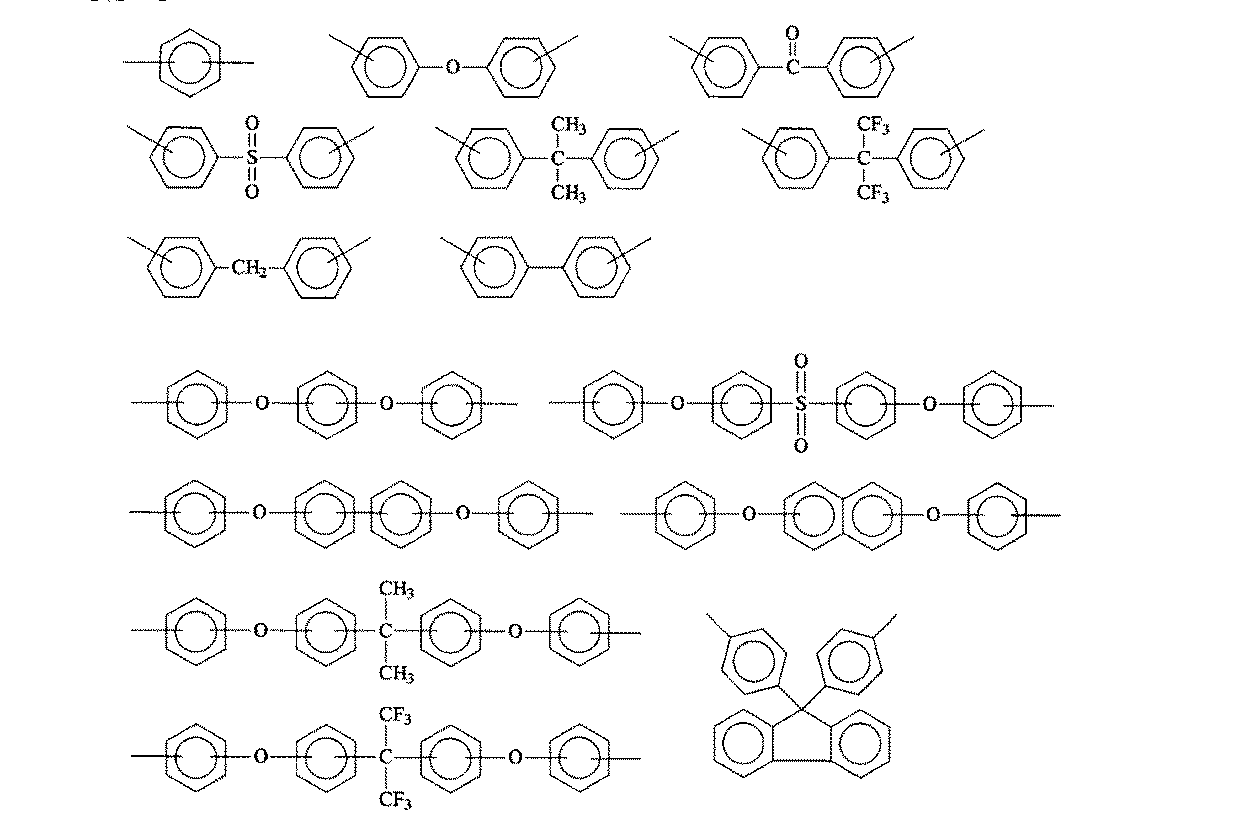
前記化学式(1)中のX1は、i線透過率が高いという観点から、以下の構造で表される基の中から選ばれる少なくとも1つの4価の芳香族基であることが好ましい。X 1 in the chemical formula (1) is preferably at least one tetravalent aromatic group selected from the groups represented by the following structures from the viewpoint of high i-line transmittance.
前記化学式(1)中のX2は、以下の構造で表される基の中から選ばれる少なくとも1つの3価の芳香族基であることが好ましく、5−アミノイソフタル酸からカルボン酸基及びアミノ基を除いた芳香族基であることがより好ましい。X 2 in the chemical formula (1) is preferably at least one trivalent aromatic group selected from the groups represented by the following structures, from 5-aminoisophthalic acid to a carboxylic acid group and amino An aromatic group excluding the group is more preferable.
前記化学式(1)中のY1及びY2は、2価の芳香族基、及びシロキサン結合を有する2価の有機基からなる群から選択される少なくとも1つの2価の有機基であることが好ましい。また、上記Y1及びY2の一部が2価の芳香族基であり、残部がシロキサン結合を有する2価の有機基であることがより好ましい。ここで、Y1とY2は同一であっても、異なっていても良い。Y 1 and Y 2 in the chemical formula (1) are at least one divalent organic group selected from the group consisting of a divalent aromatic group and a divalent organic group having a siloxane bond. preferable. More preferably, a part of Y 1 and Y 2 is a divalent aromatic group, and the remainder is a divalent organic group having a siloxane bond. Here, Y 1 and Y 2 may be the same or different.
前記2価の芳香族基としては、i線透過率が高いという観点から、以下の構造で表される基の中から選ばれる少なくとも1つの基であることが好ましい。 The divalent aromatic group is preferably at least one group selected from groups represented by the following structures from the viewpoint of high i-line transmittance.
前記シロキサン結合を有する2価の有機基としては、化学式(3)で表される少なくとも1つの基であることが好ましい。 The divalent organic group having a siloxane bond is preferably at least one group represented by the chemical formula (3).
上記化学式(3)中のR5及びR8は、メチレン基、エチレン基、プロピレン基、ブチレン基、及びフェニレン基からなる群から選ばれる少なくとも1つの2価の有機基であることが好ましい。また、R6及びR7は、メチル基、エチル基、プロピル基、ブチル基、及びフェニル基からなる群から選ばれる少なくとも1つの1価の有機基であることが好ましい。繰返し単位の数pは、2〜50の整数であることが好ましい。R 5 and R 8 in the chemical formula (3) are preferably at least one divalent organic group selected from the group consisting of a methylene group, an ethylene group, a propylene group, a butylene group, and a phenylene group. R 6 and R 7 are preferably at least one monovalent organic group selected from the group consisting of a methyl group, an ethyl group, a propyl group, a butyl group, and a phenyl group. The number p of repeating units is preferably an integer of 2 to 50.
このようなシロキサン結合を有する2価の有機基は、ジアミノポリシロキサン化合物を用いることによってポリアミドに導入することができる。該ジアミノポリシロキサン化合物の具体例としては、X22−161AS、X22−161A、及びX22−161B(以上、信越化学工業製)、並びにFM3311(チッソ株式会社製)などを好適に使用することができる。該ジアミノポリシロキサン化合物の数平均分子量は、400〜4000であることが好ましく、800〜2000であることがより好ましい。分子量が400以上であれば残留応力の低下効果が発現し、4000以下であればポリアミドを生成するためのアミド重縮合反応が円滑に進行しやすい。 Such a divalent organic group having a siloxane bond can be introduced into the polyamide by using a diaminopolysiloxane compound. As specific examples of the diaminopolysiloxane compound, X22-161AS, X22-161A, X22-161B (manufactured by Shin-Etsu Chemical Co., Ltd.), FM3311 (manufactured by Chisso Corporation), and the like can be suitably used. The number average molecular weight of the diaminopolysiloxane compound is preferably 400 to 4000, and more preferably 800 to 2000. If the molecular weight is 400 or more, the effect of lowering the residual stress is exhibited, and if it is 4000 or less, the amide polycondensation reaction for producing polyamide tends to proceed smoothly.
(ハーフアシッド/ハーフエステル体の合成)
本発明のポリアミドは、以下のようにして好適に合成することができる。
第一に、4価の芳香族基X1を有する芳香族テトラカルボン酸二無水物1モルと、光重合性の不飽和結合を有するアルコール類2モルとを反応させて、4つのカルボン酸基のうち2つがエステル結合し残りの2つが酸であるジカルボン酸(以下、「ハーフアシッド/ハーフエステル体」という。)を合成する。(Synthesis of half acid / half ester)
The polyamide of the present invention can be suitably synthesized as follows.
First, 1 mol of an aromatic tetracarboxylic dianhydride having a tetravalent aromatic group X 1 is reacted with 2 mol of an alcohol having a photopolymerizable unsaturated bond to give 4 carboxylic acid groups. Among them, a dicarboxylic acid (hereinafter referred to as “half-acid / half-ester body”) in which two of them are ester-bonded and the remaining two are acids is synthesized.
上述の芳香族テトラカルボン酸二無水物としては、無水ピロメリット酸、ジフェニルエーテル−3,3’,4,4’−テトラカルボン酸二無水物、ベンゾフェノン−3,3’,4,4’−テトラカルボン酸二無水物、ビフェニル−3,3’,4,4’−テトラカルボン酸二無水物、ジフェニルスルホン−3,3’,4,4’−テトラカルボン酸二無水物、ジフェニルメタン−3,3’,4,4’−テトラカルボン酸二無水物、2,2−ビス(3,4−無水フタル酸)プロパン、及び2,2−ビス(3,4−無水フタル酸)−1,1,1,3,3,3−ヘキサフルオロプロパンなどが好ましい。これらは単独で用いることが出来るのは勿論のこと、2種以上を混合して用いてもよい。 Examples of the aromatic tetracarboxylic dianhydride include pyromellitic anhydride, diphenyl ether-3,3 ′, 4,4′-tetracarboxylic dianhydride, benzophenone-3,3 ′, 4,4′-tetra. Carboxylic dianhydride, biphenyl-3,3 ', 4,4'-tetracarboxylic dianhydride, diphenylsulfone-3,3', 4,4'-tetracarboxylic dianhydride, diphenylmethane-3,3 ', 4,4'-tetracarboxylic dianhydride, 2,2-bis (3,4-phthalic anhydride) propane, and 2,2-bis (3,4-phthalic anhydride) -1,1, 1,3,3,3-hexafluoropropane and the like are preferable. Of course, these can be used alone or in combination of two or more.
また、上述の光重合性の不飽和結合を有するアルコール類としては、2−ヒドロキシエチルアクリレート、1−アクリロイルオキシ−3−プロピルアルコール、2−アクリルアミドエチルアルコール、メチロールビニルケトン、2−ヒドロキシエチルビニルケトン、2−ヒドロキシ−3−メトキシプロピルアクリレート、2−ヒドロキシ−3−ブトキシプロピルアクリレート、2−ヒドロキシ−3−フェノキシプロピルアクリレート、2−ヒドロキシ−3−ブトキシプロピルアクリレート、2−ヒドロキシ−3−t−ブトキシプロピルアクリレート、2−ヒドロキシ−3−シクロヘキシルオキシプロピルアクリレート、2−ヒドロキシエチルメタクリレート、1−メタクリロイルオキシ−3−プロピルアルコール、2−メタクリルアミドエチルアルコール、2−ヒドロキシ−3−メトキシプロピルメタクリレート、2−ヒドロキシ−3−ブトキシプロピルメタクリレート、2−ヒドロキシ−3−フェノキシプロピルメタクリレート、2−ヒドロキシ−3−ブトキシプロピルメタクリレート、2−ヒドロキシ−3−t−ブトキシプロピルメタクリレート、及び2−ヒドロキシ−3−シクロヘキシルオキシプロピルメタクリレートなどが好ましい。これらは単独で用いることが出来るのは勿論のこと、2種以上を混合して用いてもよい。 Examples of the alcohol having a photopolymerizable unsaturated bond include 2-hydroxyethyl acrylate, 1-acryloyloxy-3-propyl alcohol, 2-acrylamidoethyl alcohol, methylol vinyl ketone, 2-hydroxyethyl vinyl ketone. 2-hydroxy-3-methoxypropyl acrylate, 2-hydroxy-3-butoxypropyl acrylate, 2-hydroxy-3-phenoxypropyl acrylate, 2-hydroxy-3-butoxypropyl acrylate, 2-hydroxy-3-t-butoxy Propyl acrylate, 2-hydroxy-3-cyclohexyloxypropyl acrylate, 2-hydroxyethyl methacrylate, 1-methacryloyloxy-3-propyl alcohol, 2-methacrylamide eth Alcohol, 2-hydroxy-3-methoxypropyl methacrylate, 2-hydroxy-3-butoxypropyl methacrylate, 2-hydroxy-3-phenoxypropyl methacrylate, 2-hydroxy-3-butoxypropyl methacrylate, 2-hydroxy-3-t- Butoxypropyl methacrylate and 2-hydroxy-3-cyclohexyloxypropyl methacrylate are preferred. Of course, these can be used alone or in combination of two or more.
なお、上記の光重合性の不飽和結合を有するアルコール類に、炭素数1〜4の飽和脂肪族アルコール、例えば、メタノール、エタノール、n−プロパノール、イソプロパノール、n−ブタノール、またはtert−ブタノールなどを一部混合して用いることもできる。 In addition, the alcohol having the photopolymerizable unsaturated bond is substituted with a saturated aliphatic alcohol having 1 to 4 carbon atoms such as methanol, ethanol, n-propanol, isopropanol, n-butanol, or tert-butanol. A part of the mixture can be used.
ハーフアシッド/ハーフエステル体は、上述の芳香族テトラカルボン酸二無水物と光重合性の不飽和結合を有するアルコール類とを、ピリジンなどの塩基性触媒の存在下、溶媒中で撹拌しながら溶解、混合してエステル化することにより得ることができる。 The half acid / half ester compound dissolves the above-mentioned aromatic tetracarboxylic dianhydride and alcohols having a photopolymerizable unsaturated bond with stirring in a solvent in the presence of a basic catalyst such as pyridine. Can be obtained by mixing and esterifying.
上述の溶媒としては、アミド類、スルホキシド類、テトラメチル尿素、ケトン類、エステル類、ラクトン類、エーテル類、ハロゲン化炭化水素類、炭化水素類が好ましい。例としては、アセトン、メチルエチルケトン、メチルイソブチルケトン、シクロヘキサノン、酢酸メチル、酢酸エチル、酢酸ブチル、シュウ酸ジエチル、エチレングリコールジメチルエーテル、ジエチレングリコールジメチルエーテル、テトラヒドロフラン、ジクロロメタン、1,2−ジクロロエタン、1,4−ジクロロブタン、クロロベンゼン、o−ジクロロベンゼン、ヘキサン、ヘプタン、ベンゼン、トルエン、キシレン等が挙げられる。これらの中で、ハーフアシッド/ハーフエステル体、およびこれとジアミン化合物とのアミド重縮合生成物であるポリアミドイミド樹脂前駆体を完全に溶解するものがより好ましい。例としては、N−メチル−2−ピロリドン、N,N−ジメチルアセトアミド、N,N−ジメチルホルムアミド、ジメチルスルホキシド、テトラメチル尿素、ガンマブチロラクトン等が挙げられる。これらの溶媒は必要に応じて、単独でも混合して用いることもできる。 As the above-mentioned solvent, amides, sulfoxides, tetramethylurea, ketones, esters, lactones, ethers, halogenated hydrocarbons, and hydrocarbons are preferable. Examples include acetone, methyl ethyl ketone, methyl isobutyl ketone, cyclohexanone, methyl acetate, ethyl acetate, butyl acetate, diethyl oxalate, ethylene glycol dimethyl ether, diethylene glycol dimethyl ether, tetrahydrofuran, dichloromethane, 1,2-dichloroethane, 1,4-dichlorobutane. Chlorobenzene, o-dichlorobenzene, hexane, heptane, benzene, toluene, xylene and the like. Among these, those that completely dissolve the half-acid / half-ester body and the polyamide-imide resin precursor that is an amide polycondensation product of this and a diamine compound are more preferable. Examples include N-methyl-2-pyrrolidone, N, N-dimethylacetamide, N, N-dimethylformamide, dimethyl sulfoxide, tetramethylurea, gamma butyrolactone and the like. These solvents can be used alone or in combination as required.
(フタル酸系化合物封止体の合成)
第ニに、3価の芳香族基X2を有する、アミノ基で置換されたフタル酸、アミノ基で置換されたイソフタル酸、及び、アミノ基で置換されたテレフタル酸からなる群から選ばれた少なくとも1つ以上の化合物(以下、「フタル酸系化合物」という。)1モルと、アミノ基と反応する化合物1モルとを反応させて、該フタル酸系化合物のアミノ基を後述の熱架橋基または保護基を有する化合物(以下、「封止剤」という。)によってブロックした化合物(以下、「フタル酸系化合物封止体」という。)を合成する。これらは単独でもよいし、混合して用いてもよい。(Synthesis of encapsulated phthalic acid compound)
Second, selected from the group consisting of phthalic acid substituted with an amino group, isophthalic acid substituted with an amino group, and terephthalic acid substituted with an amino group, having a trivalent aromatic group X 2 By reacting 1 mol of at least one compound (hereinafter referred to as “phthalic acid compound”) with 1 mol of a compound that reacts with an amino group, the amino group of the phthalic acid compound is converted into a thermal crosslinking group described later. Alternatively, a compound blocked with a compound having a protecting group (hereinafter referred to as “sealing agent”) (hereinafter referred to as “phthalic acid compound sealing body”) is synthesized. These may be used alone or in combination.
上述のフタル酸系化合物封止体は、フタル酸系化合物のアミノ基と、熱架橋基を有する、酸クロリド、酸無水物、イソシアネート化合物、またはエポキシ化合物等(以下、「熱架橋性化合物」という。)とを反応させることで得ることが出来る。該熱架橋基としては、150〜400℃の範囲で架橋反応を起こすものが望ましく、ノルボルネン基、グリシジル基、シクロヘキセン基、エチニル基、アリル基、アルデヒド基、ベンゾシクロブテン基、フリル基、フルフリル基、ジメトキシジメチルアミノ基、ジヒドロキシジメチルアミノ基、アルキニル基、アルケニル基、オキセタン基、メタクリレート基、アクリレート基、シアノ基、チオフェン基、マレイミド基、及びグアナミン基が好ましい。フタル酸系化合物を上記熱架橋基でブロックした構造とすると、ポリアミド樹脂塗膜を加熱により硬化させる工程で、これら熱架橋基を分子間架橋させることが出来、塗膜の耐熱性を向上させることができる。 The above-mentioned phthalic acid compound encapsulated body has an acid chloride, an acid anhydride, an isocyanate compound, an epoxy compound or the like having an amino group of the phthalic acid compound and a thermal crosslinking group (hereinafter referred to as “thermal crosslinking compound”). .) Can be obtained by reaction. The thermal crosslinking group preferably has a crosslinking reaction in the range of 150 to 400 ° C., and is a norbornene group, glycidyl group, cyclohexene group, ethynyl group, allyl group, aldehyde group, benzocyclobutene group, furyl group, furfuryl group. , Dimethoxydimethylamino group, dihydroxydimethylamino group, alkynyl group, alkenyl group, oxetane group, methacrylate group, acrylate group, cyano group, thiophene group, maleimide group, and guanamine group are preferred. When the structure in which the phthalic acid compound is blocked with the above-mentioned thermal crosslinking group is used, the thermal crosslinking group can be cross-linked between molecules in the process of curing the polyamide resin coating film by heating, thereby improving the heat resistance of the coating film. Can do.
該熱架橋基を有する酸クロリドとしては、不飽和二重結合又は三重結合を有する酸クロリドが好ましく、環状もしくは非環状のアルケニル基を有する炭素数が3〜11の酸クロリド、又は、環状もしくは非環状のアルキニル基を有する炭素数が3〜11の酸クロリドがより好ましい。具体的には、3−シクロヘキセン−1カルボン酸クロリド、2−フランカルボン酸クロリド、クロトン酸クロリド、ケイ皮酸クロリド、メタクリル酸クロリド、アクリル酸クロリド、p−スチレンスルホニルクロリド、及びチオフェン−2−アセチルクロリドがあげられる。 As the acid chloride having a thermal crosslinking group, an acid chloride having an unsaturated double bond or a triple bond is preferable, and an acid chloride having 3 to 11 carbon atoms having a cyclic or acyclic alkenyl group, or cyclic or non-cyclic. An acid chloride having 3 to 11 carbon atoms and having a cyclic alkynyl group is more preferable. Specifically, 3-cyclohexene-1 carboxylic acid chloride, 2-furancarboxylic acid chloride, crotonic acid chloride, cinnamic acid chloride, methacrylic acid chloride, acrylic acid chloride, p-styrenesulfonyl chloride, and thiophen-2-acetyl Chloride.
該熱架橋基を有する酸無水物としては、不飽和二重結合又は三重結合を有する酸無水物が好ましく、環状もしくは非環状のアルケニル基を有する炭素数が4〜12の酸無水物、又は、環状もしくは非環状のアルキニル基を有する炭素数が4〜12の酸無水物がより好ましい。具体的には、5−ノルボルネン−2,3−ジカルボン酸無水物、エキソ−3,6−エポキシ−1,2,3,6−テトラヒドロフタル酸無水物、3−エチニル−1,2−フタル酸無水物、4−エチニル−1,2−フタル酸無水物、シス−4−シクロヘキセン−1,2−ジカルボン酸無水物、1−シクロヘキセン−1,2−ジカルボン酸無水物、マレイン酸無水物、無水シトラコン酸、無水イタコン酸、無水エンドメチレンテトラヒドロフタル酸、メチルエンドメチレンテトラヒドロフタル酸無水物、アリルスクシン酸無水物、及びメチルテトラヒドロ無水フタル酸があげられる。 As the acid anhydride having the thermal crosslinking group, an acid anhydride having an unsaturated double bond or a triple bond is preferable, and a cyclic or acyclic alkenyl group having 4 to 12 carbon atoms, or An acid anhydride having 4 to 12 carbon atoms and having a cyclic or acyclic alkynyl group is more preferred. Specifically, 5-norbornene-2,3-dicarboxylic acid anhydride, exo-3,6-epoxy-1,2,3,6-tetrahydrophthalic acid anhydride, 3-ethynyl-1,2-phthalic acid Anhydride, 4-ethynyl-1,2-phthalic anhydride, cis-4-cyclohexene-1,2-dicarboxylic anhydride, 1-cyclohexene-1,2-dicarboxylic anhydride, maleic anhydride, anhydrous Citraconic acid, itaconic anhydride, endomethylenetetrahydrophthalic anhydride, methylendomethylenetetrahydrophthalic anhydride, allyl succinic anhydride, and methyltetrahydrophthalic anhydride.
該熱架橋基を有するイソシアネートとしては、不飽和二重結合又は三重結合を有するイソシアネートが好ましく、環状もしくは非環状のアルケニル基を有する炭素数が5〜15のイソシアネート、又は、環状もしくは非環状のアルキニル基を有する炭素数が5〜15のイソシアネートがより好ましい。具体的には、3−イソプロペニル−α,α−ジメチルベンジルイソシアネートがあげられる。 As the isocyanate having the thermal crosslinking group, an isocyanate having an unsaturated double bond or a triple bond is preferable, an isocyanate having a cyclic or acyclic alkenyl group having 5 to 15 carbon atoms, or a cyclic or acyclic alkynyl. An isocyanate having 5 to 15 carbon atoms having a group is more preferable. Specific examples include 3-isopropenyl-α, α-dimethylbenzyl isocyanate.
該熱架橋基を有するエポキシ化合物としては、不飽和二重結合又は三重結合を有するエポキシ化合物が好ましく、環状もしくは非環状のアルケニル基を有する炭素数が5〜15のエポキシ化合物、又は、環状もしくは非環状のアルキニル基を有する炭素数が5〜15のエポキシ化合物がより好ましい。具体的には、グリシジルメタクリレート、及びアリルグリシジルエーテルがあげられる。 As the epoxy compound having a thermal crosslinking group, an epoxy compound having an unsaturated double bond or a triple bond is preferable, an epoxy compound having a cyclic or acyclic alkenyl group and having 5 to 15 carbon atoms, or cyclic or non-cyclic. An epoxy compound having 5 to 15 carbon atoms and having a cyclic alkynyl group is more preferable. Specific examples include glycidyl methacrylate and allyl glycidyl ether.
フタル酸系化合物封止体は、フタル酸系化合物のアミノ基を、ウレア型、ウレタン型、エステル型、アシル型、アラルキル型、シリコ−ン型等の保護基で保護することで得ることもできる。フタル酸系化合物を上記保護基で保護した構造とすると、ポリアミド樹脂膜を加熱硬化させる工程で、これら保護基が脱離してアミノ基が再生し、ポリマー主鎖の一部、または末端部と反応して分子間架橋させることが出来、耐熱性を向上させることができる。 The sealed phthalic acid compound can also be obtained by protecting the amino group of the phthalic acid compound with a protecting group such as a urea type, urethane type, ester type, acyl type, aralkyl type, or silicon type. . When the phthalic acid compound is protected with the above protecting group, the polyamide resin film is heated and cured to remove the protecting group and regenerate the amino group, reacting with a part of the polymer main chain or the terminal part. Thus, intermolecular crosslinking can be performed, and heat resistance can be improved.
フタル酸系化合物のアミノ基をウレア型保護基で保護するには、フタル酸系化合物とモノイソシアネート化合物を反応させればよい。該モノイソシアネート化合物としては、フェニルイソシアネート、n−ブチルイソシアネート、n−オクタデシルイソシアネート、o−トルイルイソシアネート、及び2−アクリロイルオキシエチルイソシアネート、2−メタクリロイルオキシエチルイソシアネートなどがあげられる。 In order to protect the amino group of the phthalic acid compound with a urea-type protecting group, the phthalic acid compound and the monoisocyanate compound may be reacted. Examples of the monoisocyanate compound include phenyl isocyanate, n-butyl isocyanate, n-octadecyl isocyanate, o-toluyl isocyanate, 2-acryloyloxyethyl isocyanate, and 2-methacryloyloxyethyl isocyanate.
フタル酸系化合物のアミノ基をウレタン型保護基で保護するには、フタル酸系化合物と、アルコキシカルボニルクロリドまたは炭酸ジアルキルを反応させればよい。該アルコキシカルボニル基としては、ベンジルオキシカルボニル基、メチルオキシカルボニル基、エチルオキシカルボニル基、プロピルオキシカルボニル基、イソブチルオキシカルボニル基、tert−ブチルオキシカルボニル基、p−ニトロベンジルオキシカルボニル基、p−メトキシベンジルオキシカルボニル基、イソボルニルベンジルオキシカルボニル基、及びp−ビフェニルイソプロピルベンジルオキシカルボニル基などがあげられる。 In order to protect the amino group of the phthalic acid compound with a urethane-type protecting group, the phthalic acid compound may be reacted with alkoxycarbonyl chloride or dialkyl carbonate. Examples of the alkoxycarbonyl group include benzyloxycarbonyl group, methyloxycarbonyl group, ethyloxycarbonyl group, propyloxycarbonyl group, isobutyloxycarbonyl group, tert-butyloxycarbonyl group, p-nitrobenzyloxycarbonyl group, p-methoxy. Examples thereof include a benzyloxycarbonyl group, an isobornylbenzyloxycarbonyl group, and a p-biphenylisopropylbenzyloxycarbonyl group.
フタル酸系化合物のアミノ基をアシル型保護基で保護するには、フタル酸系化合物と、アシルクロリドを反応させればよい。該アシル基としては、ホルミル基、フタロイル基、ジチアスクシノイル基、トシル基、メシル基、o−ニトロフェニルスルフェニル基、o−ニトロピリジンスルフェニル基、ジフェニルホスフィニル基、アクリロイル基、メタクリロイル基、クロトノイル基、及びシンナモイル基などがあげられる。 In order to protect the amino group of the phthalic acid compound with an acyl-type protecting group, a phthalic acid compound and acyl chloride may be reacted. As the acyl group, formyl group, phthaloyl group, dithiasuccinoyl group, tosyl group, mesyl group, o-nitrophenylsulfenyl group, o-nitropyridinesulfenyl group, diphenylphosphinyl group, acryloyl group, methacryloyl Group, crotonoyl group, cinnamoyl group and the like.
フタル酸系化合物のアミノ基をアラルキル型保護基で保護するには、フタル酸系化合物とアラルキルクロリドを反応させればよい。該アラルキル型保護基としては、トリフェニルメチル基があげられる。 In order to protect the amino group of the phthalic acid compound with an aralkyl-type protecting group, the phthalic acid compound and aralkyl chloride may be reacted. Examples of the aralkyl type protecting group include a triphenylmethyl group.
フタル酸系化合物のアミノ基をシリコ−ン型保護基で保護するには、フタル酸系化合物とシリル化剤を反応させればよい。該シリコ−ン型保護基としては、トリメチルシリル基、トリエチルシリル基、t−ブチルジメチルシリル基、及びt−ブチルジフェニルシリル基などがあげられる。また、該シリル化剤としては、トリメチルクロロシラン、ヘキサメチルジシラザン、N,O−ビス(トリメチルシリル)アセトアミド、ビス(トリメチルシリル)トリフルオロアセトアミド、N,N−ジメチルアミノトリメチルシラン、ジメチルアミノトリメチルシラン、トリメチルシリルジフェニル尿素、及びビス(トリメチルシリル)尿素などがあげられる。 In order to protect the amino group of the phthalic acid compound with a silicone-type protecting group, the phthalic acid compound and a silylating agent may be reacted. Examples of the silicone-type protecting group include a trimethylsilyl group, a triethylsilyl group, a t-butyldimethylsilyl group, and a t-butyldiphenylsilyl group. Examples of the silylating agent include trimethylchlorosilane, hexamethyldisilazane, N, O-bis (trimethylsilyl) acetamide, bis (trimethylsilyl) trifluoroacetamide, N, N-dimethylaminotrimethylsilane, dimethylaminotrimethylsilane, and trimethylsilyl. Examples thereof include diphenylurea and bis (trimethylsilyl) urea.
これらのフタル酸系化合物封止体としては、フタル酸系化合物が5−アミノイソフタル酸(以下、「AIPA」と略す。)であるものが、加熱による硬化後に耐熱性が高いポリアミドイミド樹脂を得ることができるために好ましい。AIPAのアミノ基に熱架橋性二重結合を有する熱架橋基を導入したものが、加熱による硬化後の耐熱性をより高く出来るためにより好ましい。例としては、5−ノルボルネン−2,3−ジカルボン酸無水物とAIPAの反応物(AIPA−N)があげられる。また、AIPAのアミノ基に光重合性二重結合を有する保護基を導入したものが、リソグラフィー時の感度、解像度等の感光特性により優れるためより好ましい。例としては、2−メタクリロイルオキシエチルイソシアネートとAIPAの反応物(AIPA−M)があげられる。 As these phthalic acid-based compound sealing bodies, those in which the phthalic acid-based compound is 5-aminoisophthalic acid (hereinafter abbreviated as “AIPA”) obtains a polyamideimide resin having high heat resistance after curing by heating. This is preferable because it can be performed. It is more preferable to introduce a heat crosslinkable group having a heat crosslinkable double bond into the amino group of AIPA because the heat resistance after curing by heating can be further increased. An example is a reaction product of 5-norbornene-2,3-dicarboxylic anhydride and AIPA (AIPA-N). Further, it is more preferable to introduce a protective group having a photopolymerizable double bond into the amino group of AIPA because it is excellent in the photosensitive properties such as sensitivity and resolution during lithography. An example is a reaction product of 2-methacryloyloxyethyl isocyanate and AIPA (AIPA-M).
フタル酸系化合物と、上述の封止剤とを、ピリジンなどの塩基性触媒の存在下溶媒中で撹拌溶解、混合することにより、アミノ基と封止剤との反応が進行し、所望のフタル酸系化合物封止体を得ることができる。 By stirring and dissolving the phthalic acid compound and the above-described sealing agent in a solvent in the presence of a basic catalyst such as pyridine, the reaction between the amino group and the sealing agent proceeds, and the desired phthalate is obtained. An acid compound encapsulant can be obtained.
上述の溶媒としては、アミド類、スルホキシド類、テトラメチル尿素、ケトン類、エステル類、ラクトン類、エーテル類、ハロゲン化炭化水素類、炭化水素類が好ましい。例としては、アセトン、メチルエチルケトン、メチルイソブチルケトン、シクロヘキサノン、酢酸メチル、酢酸エチル、酢酸ブチル、シュウ酸ジエチル、エチレングリコールジメチルエーテル、ジエチレングリコールジメチルエーテル、テトラヒドロフラン、ジクロロメタン、1,2−ジクロロエタン、1,4−ジクロロブタン、クロロベンゼン、o−ジクロロベンゼン、ヘキサン、ヘプタン、ベンゼン、トルエン、キシレン等が挙げられる。これらの中で、ハーフアシッド/ハーフエステル体、およびこれとジアミン化合物とのアミド重縮合生成物であるポリアミドイミド樹脂前駆体を完全に溶解するものがより好ましい。例としては、N−メチル−2−ピロリドン、N,N−ジメチルアセトアミド、N,N−ジメチルホルムアミド、ジメチルスルホキシド、テトラメチル尿素、ガンマブチロラクトン等が挙げられる。これらの溶媒は必要に応じて、単独でも混合して用いることもできる。
酸クロリド体など、上記封止剤の種類によっては、封止反応の過程で塩化水素が副生するものがある。この場合は、以降の工程汚染を防止する意味からも、一旦水再沈して水洗乾燥したり、イオン交換樹脂カラムを通すなど、適宜精製を行うことが好ましい。As the above-mentioned solvent, amides, sulfoxides, tetramethylurea, ketones, esters, lactones, ethers, halogenated hydrocarbons, and hydrocarbons are preferable. Examples include acetone, methyl ethyl ketone, methyl isobutyl ketone, cyclohexanone, methyl acetate, ethyl acetate, butyl acetate, diethyl oxalate, ethylene glycol dimethyl ether, diethylene glycol dimethyl ether, tetrahydrofuran, dichloromethane, 1,2-dichloroethane, 1,4-dichlorobutane. Chlorobenzene, o-dichlorobenzene, hexane, heptane, benzene, toluene, xylene and the like. Among these, those that completely dissolve the half-acid / half-ester body and the polyamide-imide resin precursor that is an amide polycondensation product of this and a diamine compound are more preferable. Examples include N-methyl-2-pyrrolidone, N, N-dimethylacetamide, N, N-dimethylformamide, dimethyl sulfoxide, tetramethylurea, gamma butyrolactone and the like. These solvents can be used alone or in combination as required.
Depending on the type of the sealing agent, such as an acid chloride body, hydrogen chloride is produced as a by-product during the sealing reaction. In this case, from the viewpoint of preventing subsequent process contamination, it is preferable to carry out purification as appropriate, for example, by re-precipitation in water and then washing and drying, or passing through an ion exchange resin column.
(ポリアミドの合成)
第三に、前述したハーフアシッド/ハーフエステル体とフタル酸系化合物封止体とを脱水縮合剤により混合ポリ酸無水物とした後に、2価の有機基Y1を有するジアミン化合物及び2価の有機基Y2を有するジアミン化合物を溶媒に溶解または分散させておいたものを滴下投入し、アミド重縮合させることにより、目的のポリアミドを得ることが出来る。(Polyamide synthesis)
Thirdly, after making the half acid / half ester body and the phthalic acid compound encapsulated body into a mixed polyanhydride with a dehydration condensation agent, a diamine compound having a divalent organic group Y 1 and a divalent compound A target polyamide can be obtained by dropping a diamine compound having an organic group Y 2 dissolved or dispersed in a solvent and subjecting it to amide polycondensation.
ハーフアシッド/ハーフエステル体とフタル酸系化合物封止体との共重縮合比は、前述の化学式(1)におけるm/(m+n)で表され、好ましくはモル比で0.3〜0.9の範囲であり、より好ましくは0.5〜0.8の範囲である。m/(m+n)比が0.9以下であれば耐熱性が向上する効果が得られ好ましく、0.3以上であれば光感度等のリソグラフィー性能に優れるので好ましい。
上記ハーフアシッド/ハーフエステル体とフタル酸系化合物封止体との混合方法には、特に制約はない。それぞれ精製単離したものを混合して溶媒に再溶解してもよいし、一方の反応溶液に単離したもう一方を再溶解する方法でもよいし、別々に調整した反応溶液同士を混合する方法でもよい。The copolycondensation ratio of the half acid / half ester body and the phthalic acid compound encapsulated body is represented by m / (m + n) in the above-described chemical formula (1), and preferably 0.3 to 0.9 in molar ratio. More preferably, it is the range of 0.5-0.8. If the m / (m + n) ratio is 0.9 or less, the effect of improving the heat resistance is preferably obtained, and if it is 0.3 or more, the lithography performance such as photosensitivity is excellent, which is preferable.
There are no particular restrictions on the method of mixing the half acid / half ester body and the phthalic acid compound encapsulant. Each purified and isolated product may be mixed and redissolved in a solvent, the other isolated in one reaction solution may be redissolved, or the reaction solutions prepared separately may be mixed together But you can.
上記脱水縮合剤としては、例えば、ジシクロヘキシルカルボジイミド、1−エトキシカルボニル−2−エトキシ−1,2−ジヒドロキノリン、1,1’−カルボニルジオキシ−ジ−1,2,3−ベンゾトリアゾール、N,N’−ジスクシンイミジルカーボネートなどが好ましいものとしてあげられる。 Examples of the dehydrating condensing agent include dicyclohexylcarbodiimide, 1-ethoxycarbonyl-2-ethoxy-1,2-dihydroquinoline, 1,1′-carbonyldioxy-di-1,2,3-benzotriazole, N, N′-disuccinimidyl carbonate and the like are preferred.
ジアミン化合物としては、2価の芳香族ジアミン化合物、及び前述したジアミノポリシロキサン化合物からなる群から選択される少なくとも1つのジアミン化合物であることが好ましい。また、上記Y1及びY2の一部が2価の芳香族基であり、残部がシロキサン結合を有する2価の有機基であることがより好ましい。The diamine compound is preferably at least one diamine compound selected from the group consisting of a divalent aromatic diamine compound and the aforementioned diaminopolysiloxane compound. More preferably, a part of Y 1 and Y 2 is a divalent aromatic group, and the remainder is a divalent organic group having a siloxane bond.
上述の芳香族ジアミン化合物としては、p−フェニレンジアミン、m−フェニレンジアミン、4,4’−ジアミノジフェニルエーテル、3,4’−ジアミノジフェニルエーテル、3,3’−ジアミノジフェニルエーテル、4,4’−ジアミノジフェニルスルフィド、3,4’−ジアミノジフェニルスルフィド、3,3’−ジアミノジフェニルスルフィド、4,4’−ジアミノジフェニルスルホン、3,4’−ジアミノジフェニルスルホン、3,3’−ジアミノジフェニルスルホン、4,4’−ジアミノビフェニル、3,4’−ジアミノビフェニル、3,3’−ジアミノビフェニル、4,4’−ジアミノベンゾフェノン、3,4’−ジアミノベンゾフェノン、3,3’−ジアミノベンゾフェノン、4,4’−ジアミノジフェニルメタン、3,4’−ジアミノジフェニルメタン、3,3’−ジアミノジフェニルメタン、1,4−ビス(4−アミノフェノキシ)ベンゼン、1,3−ビス(4−アミノフェノキシ)ベンゼン、1,3−ビス(3−アミノフェノキシ)ベンゼン、ビス〔4−(4−アミノフェノキシ)フェニル〕スルホン、ビス〔4−(3−アミノフェノキシ)フェニル〕スルホン、4,4−ビス(4−アミノフェノキシ)ビフェニル、4,4−ビス(3−アミノフェノキシ)ビフェニル、ビス〔4−(4−アミノフェノキシ)フェニル〕エーテル、ビス〔4−(3−アミノフェノキシ)フェニル〕エーテル、1,4−ビス(4−アミノフェニル)ベンゼン、1,3−ビス(4−アミノフェニル)ベンゼン、9,10−ビス(4−アミノフェニル)アントラセン、2,2−ビス(4−アミノフェニル)プロパン、2,2−ビス(4−アミノフェニル)ヘキサフルオロプロパン、2,2−ビス〔4−(4−アミノフェノキシ)フェニル〕プロパン、2,2−ビス〔4−(4−アミノフェノキシ)フェニル〕ヘキサフルオロプロパン、1,4−ビス(3−アミノプロピルジメチルシリル)ベンゼン、オルト−トリジンスルホン、9,9−ビス(4−アミノフェニル)フルオレン、並びにこれらのベンゼン環上の水素原子の一部が、メチル基、エチル基、ヒドロキシメチル基、ヒドロキシエチル基、及びハロゲン原子からなる群から選択される1つ以上の基で置換されたジアミン化合物があげられる。このベンゼン環上の水素原子が置換されたジアミン化合物の例としては、3,3’−ジメチル−4,4’−ジアミノビフェニル、2,2’−ジメチル−4,4’−ジアミノビフェニル、3,3’−ジメチル−4,4’−ジアミノジフェニルメタン、2,2’−ジメチル− 4,4’−ジアミノジフェニルメタン、3,3’−ジメチトキシ−4,4’−ジアミノビフェニル、3,3’−ジクロロ−4,4’−ジアミノビフェニル、およびこれらの混合物などが挙げられる。 Examples of the aromatic diamine compound include p-phenylenediamine, m-phenylenediamine, 4,4′-diaminodiphenyl ether, 3,4′-diaminodiphenyl ether, 3,3′-diaminodiphenyl ether, 4,4′-diaminodiphenyl. Sulfide, 3,4′-diaminodiphenylsulfide, 3,3′-diaminodiphenylsulfide, 4,4′-diaminodiphenylsulfone, 3,4′-diaminodiphenylsulfone, 3,3′-diaminodiphenylsulfone, 4,4 '-Diaminobiphenyl, 3,4'-diaminobiphenyl, 3,3'-diaminobiphenyl, 4,4'-diaminobenzophenone, 3,4'-diaminobenzophenone, 3,3'-diaminobenzophenone, 4,4'- Diaminodiphenylmethane, 3,4 -Diaminodiphenylmethane, 3,3'-diaminodiphenylmethane, 1,4-bis (4-aminophenoxy) benzene, 1,3-bis (4-aminophenoxy) benzene, 1,3-bis (3-aminophenoxy) benzene Bis [4- (4-aminophenoxy) phenyl] sulfone, bis [4- (3-aminophenoxy) phenyl] sulfone, 4,4-bis (4-aminophenoxy) biphenyl, 4,4-bis (3- Aminophenoxy) biphenyl, bis [4- (4-aminophenoxy) phenyl] ether, bis [4- (3-aminophenoxy) phenyl] ether, 1,4-bis (4-aminophenyl) benzene, 1,3- Bis (4-aminophenyl) benzene, 9,10-bis (4-aminophenyl) anthracene, 2,2-bis 4-aminophenyl) propane, 2,2-bis (4-aminophenyl) hexafluoropropane, 2,2-bis [4- (4-aminophenoxy) phenyl] propane, 2,2-bis [4- (4 -Aminophenoxy) phenyl] hexafluoropropane, 1,4-bis (3-aminopropyldimethylsilyl) benzene, ortho-tolidine sulfone, 9,9-bis (4-aminophenyl) fluorene, and on these benzene rings Examples thereof include diamine compounds in which a part of hydrogen atoms is substituted with one or more groups selected from the group consisting of a methyl group, an ethyl group, a hydroxymethyl group, a hydroxyethyl group, and a halogen atom. Examples of diamine compounds in which hydrogen atoms on the benzene ring are substituted include 3,3′-dimethyl-4,4′-diaminobiphenyl, 2,2′-dimethyl-4,4′-diaminobiphenyl, 3, 3'-dimethyl-4,4'-diaminodiphenylmethane, 2,2'-dimethyl-4,4'-diaminodiphenylmethane, 3,3'-dimethoxy-4,4'-diaminobiphenyl, 3,3'-dichloro- 4,4′-diaminobiphenyl, and mixtures thereof.
混合ポリ酸無水物とジアミン化合物とのアミド化反応終了後、反応液中に析出してきたジシクロヘキシルウレア等の脱水縮合剤由来の析出物を必要に応じて濾別する。続いて、反応液中に、水もしくは脂肪族低級アルコール、またはその混合液などの、ポリアミドの貧溶媒を投入してポリアミドを析出させる。更に、析出したポリアミドを溶媒に再溶解させ、再沈析出操作を繰り返すことによって精製し、真空乾燥を行い、目的のポリアミドを単離する。なお、精製度を更に向上させるために、このポリアミドの溶液をイオン交換樹脂を有機溶媒で膨潤させて充填したカラムに通し、イオン性不純物を除去してもよい。 After completion of the amidation reaction of the mixed polyanhydride and the diamine compound, a precipitate derived from a dehydrating condensing agent such as dicyclohexylurea that has precipitated in the reaction solution is filtered off as necessary. Subsequently, a poor polyamide solvent such as water, an aliphatic lower alcohol, or a mixture thereof is added to the reaction solution to precipitate the polyamide. Further, the precipitated polyamide is redissolved in a solvent and purified by repeating the reprecipitation precipitation, followed by vacuum drying to isolate the target polyamide. In order to further improve the degree of purification, the polyamide solution may be passed through a column packed with an ion exchange resin swollen with an organic solvent to remove ionic impurities.
ジアミン化合物として芳香族ジアミン化合物とジアミノポリシロキサン化合物とを併用する場合には、本発明のポリアミドにおける芳香族ジアミン化合物/ジアミノポリシロキサン化合物比は、98/2〜80/20(モル%)が好ましく、より好ましくは、95/5〜85/15(モル%)である。ジアミノポリシロキサン化合物の共重縮合比率が2モル%以上であると残留応力が低下するという効果が発現して好ましく、20モル%以内であれば、溶媒への溶解性が高く好ましい。 When an aromatic diamine compound and a diaminopolysiloxane compound are used in combination as the diamine compound, the aromatic diamine compound / diaminopolysiloxane compound ratio in the polyamide of the present invention is preferably 98/2 to 80/20 (mol%). More preferably, it is 95/5 to 85/15 (mol%). When the copolycondensation ratio of the diaminopolysiloxane compound is 2 mol% or more, the effect of lowering the residual stress is preferable, and when it is within 20 mol%, the solubility in a solvent is high.
また、芳香族ジアミン化合物とジアミノポリシロキサン化合物とを併用する場合には、芳香族ジアミン化合物に由来する繰り返し単位とジアミノポリシロキサン化合物に由来する繰り返し単位の配列はブロック性を有することが残留応力の低下のためにより好ましい。繰り返し単位の配列がブロック性を有するポリアミドは、以下の製造方法で合成することができる。
まず、前述の混合ポリ酸無水物に、芳香族ジアミン化合物の希釈溶液を滴下投入し、0〜5℃で2〜3時間撹拌して芳香族ジアミン化合物と酸成分からなるオリゴマーブロックを調整する。次に、ジアミノポリシロキサン化合物の希釈溶液を滴下投入し、更に室温で2〜3時間反応させることによりジアミノポリシロキサン化合物と酸成分からなるオリゴマーブロックを結合させる。In addition, when the aromatic diamine compound and the diaminopolysiloxane compound are used in combination, the arrangement of the repeating unit derived from the aromatic diamine compound and the repeating unit derived from the diaminopolysiloxane compound has a block property that causes residual stress. More preferred for lowering. A polyamide having a repeating unit arrangement having a block property can be synthesized by the following production method.
First, a dilute solution of an aromatic diamine compound is added dropwise to the above-mentioned mixed polyanhydride and stirred at 0 to 5 ° C. for 2 to 3 hours to prepare an oligomer block composed of an aromatic diamine compound and an acid component. Next, a diaminopolysiloxane compound diluted solution is added dropwise, and further reacted at room temperature for 2 to 3 hours to bond the diaminopolysiloxane compound and the oligomer block composed of an acid component.
(B)光重合開始剤
本発明のネガ型感光性を有する樹脂組成物には、前述したポリアミドに光重合開始剤を添加する。好ましいものとしては以下の化合物が挙げられ、特に光感度の点で、(6)のオキシム類が、より好ましい。これらの使用にあたっては、単独でも2種以上の混合物でもかまわない。
(1)ベンゾフェノン、o−ベンゾイル安息香酸メチル、4−ベンゾイル−4’−メチルジフェニルケトン、ジベンジルケトン、フルオレノンなどのベンゾフェノン誘導体
(2)2,2’−ジエトキシアセトフェノン、2−ヒドロキシ−2−メチルプロピオフェノン、1−ヒドロキシシクロヘキシルフェニルケトンなどのアセトフェノン誘導体
(3)チオキサントン、2−メチルチオキサントン、2−イソプロピルチオキサントン、ジエチルチオキサントンなどのチオキサントン誘導体
(4)ベンジル、ベンジルジメチルケタール、ベンジル−β−メトキシエチルアセタールなどのベンジル誘導体
(5)ベンゾイン、ベンゾインメチルエーテルなどのベンゾイン誘導体
(6)1−フェニル−1,2−ブタンジオン−2−(O−メトキシカルボニル)オキシム、1−フェニル−1,2−プロパンジオン−2−(O−メトキシカルボニル)オキシム、1−フェニル−1,2−プロパンジオン−2−(O−エトキシカルボニル)オキシム、1−フェニル−1,2−プロパンジオン−2−(O−ベンゾイル)オキシム、1,3−ジフェニルプロパントリオン−2−(O−エトキシカルボニル)オキシム、1−フェニル−3−エトキシプロパントリオン−2−(O−ベンゾイル)オキシムなどのオキシム類
光重合開始剤の添加量は、本発明のポリアミド100質量部に対して、0.5〜20質量部とするのが好ましく、1〜10質量部とするのがより好ましい。添加量が0.5質量部以上であれば、光感度が高くなるので好ましく、添加量が20質量部以下であれば、塗膜の基板面付近まで十分に硬化させることができるので好ましい。(B) Photopolymerization initiator A photopolymerization initiator is added to the above-described polyamide in the negative photosensitive resin composition of the present invention. Preferable examples include the following compounds, and oximes (6) are more preferable particularly from the viewpoint of photosensitivity. In using these, it may be individual or a mixture of two or more.
(1) Benzophenone, benzophenone derivatives such as methyl o-benzoylbenzoate, 4-benzoyl-4′-methyldiphenyl ketone, dibenzyl ketone, and fluorenone (2) 2,2′-diethoxyacetophenone, 2-hydroxy-2- Acetophenone derivatives such as methylpropiophenone and 1-hydroxycyclohexyl phenyl ketone (3) thioxanthone derivatives such as thioxanthone, 2-methylthioxanthone, 2-isopropylthioxanthone and diethylthioxanthone (4) benzyl, benzyldimethyl ketal, benzyl-β-methoxy Benzyl derivatives such as ethyl acetal (5) Benzoin derivatives such as benzoin and benzoin methyl ether (6) 1-phenyl-1,2-butanedione-2- (O-methoxycarbonyl) ) Oxime, 1-phenyl-1,2-propanedione-2- (O-methoxycarbonyl) oxime, 1-phenyl-1,2-propanedione-2- (O-ethoxycarbonyl) oxime, 1-phenyl-1 , 2-propanedione-2- (O-benzoyl) oxime, 1,3-diphenylpropanetrione-2- (O-ethoxycarbonyl) oxime, 1-phenyl-3-ethoxypropanetrione-2- (O-benzoyl) Oximes such as oximes The addition amount of the photopolymerization initiator is preferably 0.5 to 20 parts by mass and more preferably 1 to 10 parts by mass with respect to 100 parts by mass of the polyamide of the present invention. If the addition amount is 0.5 parts by mass or more, the photosensitivity is increased, and if the addition amount is 20 parts by mass or less, it is preferable because it can be sufficiently cured to the vicinity of the substrate surface of the coating film.
(C)溶媒
本発明のネガ型感光性を有する樹脂組成物においては、溶媒を添加して粘度を調整することが好ましい。好適な溶媒としては、N,N−ジメチルホルムアミド、N−メチル−2−ピロリドン、N−エチル−2−ピロリドン、N,N−ジメチルアセトアミド、ジメチルスルホキシド、ヘキサメチルホスホルアミド、ピリジン、シクロペンタノン、γ−ブチロラクトン、α−アセチル−γ−ブチロラクトン、テトラメチル尿素、1,3−ジメチル−2−イミダゾリノン、N−シクロヘキシル−2−ピロリドンなどが挙げられ、これらは単独または二種以上の組合せで用いることができる。これらの中でも、N−メチル−2−ピロリドンやγ−ブチロラクトンが、特に好ましい。
これらの溶媒は、塗布膜厚、粘度に応じて、本発明の樹脂組成物に適宜加えることができるが、本発明のポリアミド100質量部に対し、溶媒100〜1000質量部の範囲で用いることが好ましい。(C) Solvent
In the resin composition having negative photosensitivity of the present invention, it is preferable to adjust the viscosity by adding a solvent. Suitable solvents include N, N-dimethylformamide, N-methyl-2-pyrrolidone, N-ethyl-2-pyrrolidone, N, N-dimethylacetamide, dimethyl sulfoxide, hexamethylphosphoramide, pyridine, cyclopentanone , Γ-butyrolactone, α-acetyl-γ-butyrolactone, tetramethylurea, 1,3-dimethyl-2-imidazolinone, N-cyclohexyl-2-pyrrolidone, etc., and these may be used alone or in combination of two or more. Can be used. Among these, N-methyl-2-pyrrolidone and γ-butyrolactone are particularly preferable.
These solvents can be appropriately added to the resin composition of the present invention depending on the coating film thickness and viscosity, but they are used in the range of 100 to 1000 parts by mass of the solvent with respect to 100 parts by mass of the polyamide of the present invention. preferable.
さらに本発明の樹脂組成物の経時的な保存安定性を向上させるために、上記に記載した溶媒に加えて、以下に示すようなアルコール類を併用することもできる。
これらのアルコール類としては、メチルアルコール、エチルアルコール、n−プロピルアルコール、イソプロピルアルコール、n−ブチルアルコール、イソブチルアルコール、t−ブチルアルコール、ベンジルアルコール、乳酸エチル、乳酸ブチル、プロピレングリコールモノメチルエーテル、プロピレングリコールモノエチルエーテル、プロピレングリコールモノ(n−プロピル)エーテル、エチレングリコールモノメチルエーテル、エチレングリコールモノエチルエーテル、エチレングリコールモノ(n−プロピル)エーテル、エチレングリコールモノフェニルエーテル、エチレングリコールモノベンジルエーテル、ジエチレングリコールモノフェニルエーテル、等のモノアルコール類、エチレングリコール、プロピレングリコール等のジアルコール類を挙げることができる。これらの中でも、ベンジルアルコール、エチレングリコールモノフェニルエーテルが特に好ましい。
これらアルコール類が溶媒中に占める含量が50質量%以下であると、ポリアミドの溶解性が良好であるため好ましい。Furthermore, in order to improve the storage stability of the resin composition of the present invention over time, in addition to the solvents described above, alcohols as shown below can be used in combination.
These alcohols include methyl alcohol, ethyl alcohol, n-propyl alcohol, isopropyl alcohol, n-butyl alcohol, isobutyl alcohol, t-butyl alcohol, benzyl alcohol, ethyl lactate, butyl lactate, propylene glycol monomethyl ether, propylene glycol. Monoethyl ether, propylene glycol mono (n-propyl) ether, ethylene glycol monomethyl ether, ethylene glycol monoethyl ether, ethylene glycol mono (n-propyl) ether, ethylene glycol monophenyl ether, ethylene glycol monobenzyl ether, diethylene glycol monophenyl Monoalcohols such as ether, ethylene glycol, propylene glycol, etc. Mention may be made of the alcohol. Among these, benzyl alcohol and ethylene glycol monophenyl ether are particularly preferable.
The content of these alcohols in the solvent is preferably 50% by mass or less because the solubility of the polyamide is good.
(d)光重合性の不飽和二重結合基を有するモノマー
本発明のネガ型感光性を有する樹脂組成物には、感光特性向上のために、光重合性の不飽和二重結合基を有するモノマー(以下、「光重合性モノマー」という。)を添加することができる。
このような光重合性モノマーとしては、光重合開始剤により重合可能な(メタ)アクリル化合物が好ましく、例えば、ポリエチレングリコールジアクリレート(各エチレングリコールユニットの数2〜20)、ポリエチレングリコールジメタクリレート(各エチレングリコールユニットの数2〜20)、ポリ(1,2−プロピレングリコール)ジアクリレート、ポリ(1,2−プロピレングリコール)ジメタクリレート、ペンタエリスリトールジアクリレート、ペンタエリスリトールジメタクリレート、グリセロールジアクリレート、グリセロールジメタクリレート、ジペンタエリスリトールヘキサアクリレート、メチレンビスアクリルアミド、N−メチロールアクリルアミド、エチレングリコールジグリシジルエーテル−メタクリル酸付加物、グリセロールジグリシジルエーテル−アクリル酸付加物、ビスフェノールAジグリシジルエーテル−アクリル酸付加物、ビスフェノールAジグリシジルエーテル−メタクリル酸付加物、N,N’−ビス(2−メタクリロイルオキシエチル)尿素などが挙げられる。また、これらの使用にあたっては、必要に応じて、単独でも2種以上を混合して用いてもかまわない。
光重合性モノマーの添加量は、本発明のポリアミド100質量部に対して、0〜50質量部であることが好ましく、1〜20質量部であることがより好ましい。(D) Monomer having a photopolymerizable unsaturated double bond group The resin composition having negative photosensitivity of the present invention has a photopolymerizable unsaturated double bond group in order to improve photosensitive properties. A monomer (hereinafter referred to as “photopolymerizable monomer”) can be added.
As such a photopolymerizable monomer, a (meth) acrylic compound that can be polymerized by a photopolymerization initiator is preferable. For example, polyethylene glycol diacrylate (number of ethylene glycol units 2 to 20), polyethylene glycol dimethacrylate (each Number of ethylene glycol units 2-20), poly (1,2-propylene glycol) diacrylate, poly (1,2-propylene glycol) dimethacrylate, pentaerythritol diacrylate, pentaerythritol dimethacrylate, glycerol diacrylate, glycerol di Methacrylate, dipentaerythritol hexaacrylate, methylenebisacrylamide, N-methylolacrylamide, ethylene glycol diglycidyl ether-methacrylic acid addition Glycerol diglycidyl ether-acrylic acid adduct, bisphenol A diglycidyl ether-acrylic acid adduct, bisphenol A diglycidyl ether-methacrylic acid adduct, N, N′-bis (2-methacryloyloxyethyl) urea, etc. It is done. Moreover, in using these, you may use individually or in mixture of 2 or more types as needed.
The addition amount of the photopolymerizable monomer is preferably 0 to 50 parts by mass and more preferably 1 to 20 parts by mass with respect to 100 parts by mass of the polyamide of the present invention.
(e)増感剤
本発明のネガ型感光性を有する樹脂組成物には、所望に応じ、光感度向上のための増感剤を添加することができる。
このような増感剤としては、例えば、ミヒラーズケトン、4,4’−ビス(ジエチルアミノ)ベンゾフェノン、2,5−ビス(4’−ジエチルアミノベンジリデン)シクロペンタノン、2,6−ビス(4’−ジエチルアミノベンジリデン)シクロヘキサノン、2,6−ビス(4’−ジメチルアミノベンジリデン)−4−メチルシクロヘキサノン、2,6−ビス(4’−ジエチルアミノベンジリデン)−4−メチルシクロヘキサノン、4,4’−ビス(ジメチルアミノ)カルコン、4,4’−ビス(ジエチルアミノ)カルコン、2−(4’−ジメチルアミノシンナミリデン)インダノン、2−(4’−ジメチルアミノベンジリデン)インダノン、2−(p−4’−ジメチルアミノビフェニル)ベンゾチアゾール、1,3−ビス(4−ジメチルアミノベンジリデン)アセトン、1,3−ビス(4−ジエチルアミノベンジリデン)アセトン、3,3’−カルボニル−ビス(7−ジエチルアミノクマリン)、3−アセチル−7−ジメチルアミノクマリン、3−エトキシカルボニル−7−ジメチルアミノクマリン、3−ベンジロキシカルボニル−7−ジメチルアミノクマリン、3−メトキシカルボニル−7−ジエチルアミノクマリン、3−エトキシカルボニル−7−ジエチルアミノクマリン、N−フェニル−N−エチルエタノールアミン、N−フェニルジエタノールアミン、N−p−トリルジエタノールアミン、N−フェニルエタノールアミン、N,N−ビス(2−ヒドロキシエチル)アニリン、4−モルホリノベンゾフェノン、4−ジメチルアミノ安息香酸イソアミル、4−ジエチルアミノ安息香酸イソアミル、ベンズトリアゾール、2−メルカプトベンズイミダゾール、1−フェニル−5−メルカプト−1,2,3,4−テトラゾール、1−シクロヘキシル−5−メルカプト−1,2,3,4−テトラゾール、1−(tert−ブチル)−5−メルカプト−1,2,3,4−テトラゾール、2−メルカプトベンゾチアゾール、2−(p−ジメチルアミノスチリル)ベンズオキサゾール、2−(p−ジメチルアミノスチリル)ベンズチアゾール、2−(p−ジメチルアミノスチリル)ナフト(1,2−p)チアゾール、2−(p−ジメチルアミノベンゾイル)スチレンなどが挙げられる。これらの中で、ベンズトリアゾール、2−メルカプトベンズイミダゾール、1−フェニル−5−メルカプト−1,2,3,4−テトラゾール、1−シクロヘキシル−5−メルカプト−1,2,3,4−テトラゾール、及び1−(tert−ブチル)−5−メルカプト−1,2,3,4−テトラゾールからなる群から選ばれる1つ以上の増感剤を添加することが好ましい。また、使用にあたっては、単独でも2種以上の混合物でもかまわない。
増感剤の添加量は、本発明のポリアミド100質量部に対して0〜15質量部であることが好ましく、1〜10質量部であることがより好ましい。(E) Sensitizer A sensitizer for improving photosensitivity can be added to the resin composition having negative photosensitivity of the present invention as desired.
Examples of such a sensitizer include Michler's ketone, 4,4′-bis (diethylamino) benzophenone, 2,5-bis (4′-diethylaminobenzylidene) cyclopentanone, and 2,6-bis (4′-diethylamino). Benzylidene) cyclohexanone, 2,6-bis (4′-dimethylaminobenzylidene) -4-methylcyclohexanone, 2,6-bis (4′-diethylaminobenzylidene) -4-methylcyclohexanone, 4,4′-bis (dimethylamino) ) Chalcone, 4,4′-bis (diethylamino) chalcone, 2- (4′-dimethylaminocinnamylidene) indanone, 2- (4′-dimethylaminobenzylidene) indanone, 2- (p-4′-dimethylamino) Biphenyl) benzothiazole, 1,3-bis (4-dimethylaminobenzylide) ) Acetone, 1,3-bis (4-diethylaminobenzylidene) acetone, 3,3′-carbonyl-bis (7-diethylaminocoumarin), 3-acetyl-7-dimethylaminocoumarin, 3-ethoxycarbonyl-7-dimethyl Aminocoumarin, 3-benzyloxycarbonyl-7-dimethylaminocoumarin, 3-methoxycarbonyl-7-diethylaminocoumarin, 3-ethoxycarbonyl-7-diethylaminocoumarin, N-phenyl-N-ethylethanolamine, N-phenyldiethanolamine, Np-tolyldiethanolamine, N-phenylethanolamine, N, N-bis (2-hydroxyethyl) aniline, 4-morpholinobenzophenone, isoamyl 4-dimethylaminobenzoate, isoamid 4-diethylaminobenzoate , Benztriazole, 2-mercaptobenzimidazole, 1-phenyl-5-mercapto-1,2,3,4-tetrazole, 1-cyclohexyl-5-mercapto-1,2,3,4-tetrazole, 1- ( tert-butyl) -5-mercapto-1,2,3,4-tetrazole, 2-mercaptobenzothiazole, 2- (p-dimethylaminostyryl) benzoxazole, 2- (p-dimethylaminostyryl) benzthiazole, 2 -(P-dimethylaminostyryl) naphtho (1,2-p) thiazole, 2- (p-dimethylaminobenzoyl) styrene and the like. Among these, benztriazole, 2-mercaptobenzimidazole, 1-phenyl-5-mercapto-1,2,3,4-tetrazole, 1-cyclohexyl-5-mercapto-1,2,3,4-tetrazole, And one or more sensitizers selected from the group consisting of 1- (tert-butyl) -5-mercapto-1,2,3,4-tetrazole. In use, it may be used alone or as a mixture of two or more.
The addition amount of the sensitizer is preferably 0 to 15 parts by mass and more preferably 1 to 10 parts by mass with respect to 100 parts by mass of the polyamide of the present invention.
(f)重合禁止剤
本発明のネガ型感光性を有する樹脂組成物には、所望に応じ保存時の組成物溶液の粘度や光感度の安定性を向上させるために重合禁止剤を添加することができる。
このような重合禁止剤としては、例えば、ヒドロキノン、N−ニトロソジフェニルアミン、p−tert−ブチルカテコール、フェノチアジン、N−フェニルナフチルアミン、エチレンジアミン四酢酸、1,2−シクロヘキサンジアミン四酢酸、グリコールエーテルジアミン四酢酸、2,6−ジ−tert−ブチル−p−メチルフェノール、5−ニトロソ−8−ヒドロキシキノリン、1−ニトロソ−2−ナフトール、2−ニトロソ−1−ナフトール、2−ニトロソ−5−(N−エチル−N−スルフォプロピルアミノ)フェノール、N−ニトロソ−N−フェニルヒドロキシアミンアンモニウム塩、N−ニトロソ−N−フェニルヒドロキシルアミンアンモニウム塩、N−ニトロソ−N−(1−ナフチル)ヒドロキシルアミンアンモニウム塩、ビス(4−ヒドロキシ−3,5−ジtert−ブチル)フェニルメタンなどを用いることができる。
重合禁止剤の添加量は、本発明のポリアミド100質量部に対して、0〜5質量部であることが好ましく、0.01〜1質量部であることがより好ましい。(F) Polymerization inhibitor A polymerization inhibitor may be added to the negative photosensitive resin composition of the present invention to improve the viscosity of the composition solution during storage and the stability of photosensitivity as desired. Can do.
Examples of such polymerization inhibitors include hydroquinone, N-nitrosodiphenylamine, p-tert-butylcatechol, phenothiazine, N-phenylnaphthylamine, ethylenediaminetetraacetic acid, 1,2-cyclohexanediaminetetraacetic acid, glycol etherdiaminetetraacetic acid. 2,6-di-tert-butyl-p-methylphenol, 5-nitroso-8-hydroxyquinoline, 1-nitroso-2-naphthol, 2-nitroso-1-naphthol, 2-nitroso-5- (N- Ethyl-N-sulfopropylamino) phenol, N-nitroso-N-phenylhydroxyamine ammonium salt, N-nitroso-N-phenylhydroxylamine ammonium salt, N-nitroso-N- (1-naphthyl) hydroxylamine ammonium salt ,Screw Or the like can be used 4-hydroxy-3,5-di-tert- butyl) phenyl methane.
The addition amount of the polymerization inhibitor is preferably 0 to 5 parts by mass and more preferably 0.01 to 1 part by mass with respect to 100 parts by mass of the polyamide of the present invention.
(g)熱架橋剤
本発明のネガ型感光性を有する樹脂組成物には、必要に応じて、塗膜を加熱硬化する際に、ポリアミドを架橋しうるか、もしくはそれ自身が架橋ネットワークを形成しうる熱架橋剤を添加し、耐熱性を更に強化することができる。このような熱架橋剤としては、アミノ樹脂またはその誘導体が好適に用いられ、中でも、尿素樹脂、グリコール尿素樹脂、ヒドロキシエチレン尿素樹脂、メラミン樹脂、ベンゾグアナミン樹脂、及びこれらの誘導体が好適に用いられる。特に好ましくは、ヘキサメトキシメチル化メラミンである。
熱架橋剤の添加量は、ポリアミド成分100質量部に対して、0〜20質量部であることが好ましく、3〜15質量部であることがより好ましい。(G) Thermal cross-linking agent In the resin composition having negative photosensitivity of the present invention, the polyamide can be cross-linked when it is cured by heating, if necessary, or it forms a cross-linked network itself. The heat resistance which can be further strengthened can be added. As such a thermal crosslinking agent, an amino resin or a derivative thereof is preferably used, and among them, urea resin, glycol urea resin, hydroxyethylene urea resin, melamine resin, benzoguanamine resin, and derivatives thereof are preferably used. Particularly preferred is hexamethoxymethylated melamine.
The addition amount of the thermal crosslinking agent is preferably 0 to 20 parts by mass and more preferably 3 to 15 parts by mass with respect to 100 parts by mass of the polyamide component.
(h)その他の添加剤
以上の他にも、本発明のネガ型感光性を有する樹脂組成物には、散乱光吸収剤、塗膜平滑性付与剤、及びシランカップリング剤など、必要に応じて種々の添加剤を適宜配合することが出来る。(H) Other additives In addition to the above, the resin composition having negative photosensitivity of the present invention includes a scattered light absorber, a coating film smoothness imparting agent, a silane coupling agent, and the like as necessary. Various additives can be appropriately blended.
<硬化レリーフパターンと半導体装置の製造方法>
本発明の硬化レリーフパターンの形成方法には、上述のネガ型感光性を有する樹脂組成物が使用される。その製造は、以下の工程で行われる。<Curing relief pattern and semiconductor device manufacturing method>
In the method for forming a cured relief pattern of the present invention, the above-described resin composition having negative photosensitivity is used. The manufacture is performed in the following steps.
まず、該組成物を基板となるシリコンウェハーに塗布する。その時には、該組成物と基板との接着性を高める目的で、あらかじめシランカップリング剤を基板に前塗布しておいてもよい。塗布方法としては、スピンコーターを用いる回転塗布、ダイコータ−による塗布、スプレーコーターを用いる噴霧塗布、浸漬、印刷、ブレードコーター、またはロールコーティング等が利用できる。これらの中でも、回転塗布法は、スピンコータ−の回転数を変更することにより容易に膜厚を制御することができるので好ましい。該組成物の塗布膜厚は、最終硬化膜の膜厚が0.1〜20μmとなるように設定するのが好ましい。 First, the composition is applied to a silicon wafer serving as a substrate. At that time, a silane coupling agent may be pre-applied to the substrate in advance for the purpose of improving the adhesion between the composition and the substrate. As a coating method, spin coating using a spin coater, coating by a die coater, spray coating using a spray coater, dipping, printing, blade coater, roll coating, or the like can be used. Among these, the spin coating method is preferable because the film thickness can be easily controlled by changing the rotation speed of the spin coater. The coating thickness of the composition is preferably set so that the final cured film has a thickness of 0.1 to 20 μm.
次に80〜120℃でプリベークして塗膜を乾燥後、フォトマスクを介して所望のパターン形状に活性光線を照射する。活性光線としては、X線、電子線、紫外線、または可視光線などが利用できるが、200〜500nmの波長のものを用いるのが好ましく、i線(365nm)であることが特に好ましい。露光機としては、通常コンタクトアライナーやステッパーが使用される。また、化学線のレーザー照射によって塗膜上に直接パターン描画を行ってもよい。この後、光感度の向上などの目的で、必要に応じて、任意の温度、時間の組み合わせ(好ましくは温度40℃〜120℃、時間10秒〜240秒)による露光後ベーク(PEB)や、現像前ベークを施しても良い。 Next, after prebaking at 80 to 120 ° C. to dry the coating film, actinic rays are irradiated to a desired pattern shape through a photomask. X-rays, electron beams, ultraviolet rays, or visible rays can be used as the actinic rays, but those having a wavelength of 200 to 500 nm are preferred, and i rays (365 nm) are particularly preferred. As the exposure machine, a contact aligner or a stepper is usually used. Alternatively, pattern drawing may be performed directly on the coating film by irradiation with actinic laser. Thereafter, post-exposure baking (PEB) with any combination of temperature and time (preferably temperature 40 ° C. to 120 ° C., time 10 seconds to 240 seconds), if necessary, for the purpose of improving photosensitivity, Baking before development may be performed.
次に未照射部を現像液で溶解除去することにより、ネガ型レリーフパターンを得ることができる。
ここで用いられる現像液としては、ポリアミドの良溶媒、または良溶媒と貧溶媒との混合溶媒を用いることが出来る。該良溶媒としては、N−メチル−2−ピロリドン、N−アセチル−2−ピロリドン、N,N−ジメチルアセトアミド、N,N−ジメチルホルムアミド、ジメチルスルホキシド、ガンマブチロラクトン、α−アセチル−ガンマブチロラクトン、シクロペンタノン、及びシクロヘキサノンなどがあげられる。また、該貧溶媒としては、トルエン、キシレン、メタノール、エタノール、イソプロパノール、プロピレングリコールモノメチルエーテルアセテート、プロピレングリコールモノメチルエーテル、および水などがあげられる。良溶媒と貧溶媒との混合溶媒を用いる場合、その混合比率は、現像するポリアミド樹脂塗膜の溶解性や、現像方法に応じて調整される。現像方法としては、浸漬法、パドル法、または回転スプレー法等の方法から選択して行うことが出来る。Next, a negative relief pattern can be obtained by dissolving and removing the unirradiated portion with a developer.
As the developer used here, a good solvent of polyamide or a mixed solvent of a good solvent and a poor solvent can be used. Examples of the good solvent include N-methyl-2-pyrrolidone, N-acetyl-2-pyrrolidone, N, N-dimethylacetamide, N, N-dimethylformamide, dimethyl sulfoxide, gamma butyrolactone, α-acetyl-gammabutyrolactone, cyclo Examples include pentanone and cyclohexanone. Examples of the poor solvent include toluene, xylene, methanol, ethanol, isopropanol, propylene glycol monomethyl ether acetate, propylene glycol monomethyl ether, and water. When a mixed solvent of a good solvent and a poor solvent is used, the mixing ratio is adjusted according to the solubility of the polyamide resin coating film to be developed and the developing method. The developing method can be selected from methods such as an immersion method, a paddle method, and a rotary spray method.
次に、現像によって形成したネガ型レリーフパターンをリンス液により洗浄を行い、現像液を除去する。リンス液としては、蒸留水、メタノール、エタノール、イソプロパノール、トルエン、キシレン、プロピレングリコールモノメチルエーテルアセテート、プロピレングリコールモノメチルエーテル等を単独または混合して用いる。 Next, the negative relief pattern formed by development is washed with a rinse solution to remove the developer. As the rinse liquid, distilled water, methanol, ethanol, isopropanol, toluene, xylene, propylene glycol monomethyl ether acetate, propylene glycol monomethyl ether, or the like is used alone or in combination.
次に、このようにして得られたポリアミドのレリ−フパターンを200〜400℃に加熱することにより、脱水環化反応に加えて架橋反応が起こり、耐熱性に富んだポリアミドイミド樹脂からなる硬化レリーフパターンを得ることができる。このような加熱環化反応は、ホットプレート、イナートオーブン、温度プログラムを設定できる昇温式オーブンなどを用いて行うことが出来る。加熱環化させる際の雰囲気気体としては空気を用いてもよく、窒素、アルゴン等の不活性ガスを用いてもよい。 Next, by heating the relief pattern of the polyamide thus obtained to 200 to 400 ° C., a crosslinking reaction occurs in addition to the dehydration cyclization reaction, and a cured relief comprising a polyamide-imide resin having high heat resistance. A pattern can be obtained. Such a heat cyclization reaction can be performed using a hot plate, an inert oven, a temperature rising oven in which a temperature program can be set, and the like. Air may be used as the atmospheric gas for the heat cyclization, and an inert gas such as nitrogen or argon may be used.
このようにして得られた硬化レリーフパターンを半導体装置の製造工程において、シリコンウェハー等の基材上に作りこまれた半導体装置の表面保護膜、層間絶縁膜、またはα線遮蔽膜として使用することにより、半導体装置を製造するのに好適に使用することができる。 The cured relief pattern thus obtained is used as a surface protective film, an interlayer insulating film, or an α-ray shielding film of a semiconductor device built on a substrate such as a silicon wafer in a semiconductor device manufacturing process. Thus, it can be suitably used for manufacturing a semiconductor device.
次に、実施例および比較例によって、本発明を説明する。なお、下記各合成例のポリマー原材料の組み合わせ一覧を表1に示す。
<ポリアミドの合成>
実施例1
容量1Lのセパラブルフラスコに、5−アミノイソフタル酸13.59g(0.075mol)、γ−ブチロラクトン(以下、「GBL」ともいう。)68g、ピリジン11.87g(0.15mol)を投入、混合撹拌し、ウォーターバスで50℃まで加温した。これに、2−メタクリロイルオキシエチルイソシアネート12.26g(0.079mol)をGBL12gで希釈したものを滴下ロートで滴下投入し、そのまま50℃で2時間ほど撹拌した。
5−アミノイソフタル酸の消失を高速液体クロマトグラフィー(以下、「HPLC」ともいう。)で確認した後、ビフェニル−3,3’,4,4’−テトラカルボン酸二無水物22.07g(0.075mol)、2−ヒドロキシエチルメタクリレート20.11g(0.155mol)、及びピリジン11.87g(0.15mol)、GBL84gを投入、混合し、50℃で2時間、引き続き室温で10時間撹拌した。
これに、ジシクロヘキシルカルボジイミド60.04g(0.291mol)をGBL60gに溶解させたものを、氷冷下、15分かけて滴下投入した。続いてビス〔4−(4−アミノフェノキシ)フェニル〕スルホン60.25g(0.139mol)をGBL180gに溶解させたものを、30分ほどかけて加え、氷浴で5℃未満を維持しつつ2時間、その後氷浴を外して4時間、室温で撹拌した。
その後、エタノールを15g加えて反応を停止させ、更にGBL130gを加えて希釈し、脱水縮合剤の析出物(ジシクロヘキシルウレア)を加圧濾別により除去した。この反応液を撹拌しつつ、水700gとイソプロパノール250gの混合液を滴下投入し、その際析出する重合体を分離し、GBL600gに再溶解した。この再溶解液を、イオン交換水3リットルの撹拌下に滴下投入し、重合体を分散析出させ、回収、水洗の後、40℃で48時間真空乾燥することにより、ポリアミドP−1を得た。
ゲルパーミエーションクロマトグラフィー(以下、「GPC」ともいう。)により測定したP−1のポリスチレン換算GPC重量平均分子量(カラム:昭和電工社製 Shodex KD−806M×2本、溶媒:DMF、流速:1.0ml/min)は、72000であった。Next, the present invention will be described with reference to examples and comparative examples. In addition, Table 1 shows a list of combinations of polymer raw materials of the following synthesis examples.
<Synthesis of polyamide>
Example 1
A separable flask having a volume of 1 L was charged with 13.59 g (0.075 mol) of 5-aminoisophthalic acid, 68 g of γ-butyrolactone (hereinafter also referred to as “GBL”), and 11.87 g (0.15 mol) of pyridine. Stir and warm to 50 ° C. in a water bath. A solution obtained by diluting 12.26 g (0.079 mol) of 2-methacryloyloxyethyl isocyanate with 12 g of GBL was added dropwise thereto with a dropping funnel, and the mixture was stirred at 50 ° C. for about 2 hours.
After confirming the disappearance of 5-aminoisophthalic acid by high performance liquid chromatography (hereinafter, also referred to as “HPLC”), 22.07 g of biphenyl-3,3 ′, 4,4′-tetracarboxylic dianhydride (0 0.075 mol), 20.11 g (0.155 mol) of 2-hydroxyethyl methacrylate, 11.87 g (0.15 mol) of pyridine, and 84 g of GBL were added and mixed, followed by stirring at 50 ° C. for 2 hours and then at room temperature for 10 hours.
To this, 60.04 g (0.291 mol) of dicyclohexylcarbodiimide dissolved in 60 g of GBL was added dropwise over 15 minutes under ice cooling. Subsequently, 60.25 g (0.139 mol) of bis [4- (4-aminophenoxy) phenyl] sulfone dissolved in 180 g of GBL was added over about 30 minutes, and the temperature was maintained at 2 ° C. while maintaining the temperature below 5 ° C. in an ice bath. The ice bath was removed for 4 hours, and the mixture was stirred at room temperature for 4 hours.
Thereafter, 15 g of ethanol was added to stop the reaction, 130 g of GBL was further added for dilution, and the precipitate of the dehydrating condensing agent (dicyclohexylurea) was removed by pressure filtration. While stirring this reaction solution, a mixed solution of 700 g of water and 250 g of isopropanol was added dropwise, and the polymer precipitated at that time was separated and redissolved in 600 g of GBL. This re-dissolved solution was dropped into 3 liters of ion-exchanged water with stirring, the polymer was dispersed and precipitated, recovered, washed with water, and then vacuum dried at 40 ° C. for 48 hours to obtain polyamide P-1. .
Polystyrene equivalent GPC weight average molecular weight of P-1 measured by gel permeation chromatography (hereinafter also referred to as “GPC”) (column: Shodex KD-806M × 2 manufactured by Showa Denko KK, solvent: DMF, flow rate: 1 0.0 ml / min) was 72000.
実施例2
容量1Lのセパラブルフラスコに、5−アミノイソフタル酸5.43g(0.03mol)、GBL27g、ピリジン4.75g(0.06mol)を投入、混合撹拌し、ウォーターバスで50℃まで加温した。これに、2−メタクリロイルオキシエチルイソシアネート4.96g(0.032mol)をGBL5gで希釈したものを滴下ロートで滴下投入し、そのまま50℃で2時間ほど撹拌した。
5−アミノイソフタル酸の消失をHPLCで確認した後、ビフェニル−3,3’,4,4’−テトラカルボン酸二無水物35.31g(0.12mol)、2−ヒドロキシエチルメタクリレート32.14g(0.247mol)、ピリジン18.98g(0.24mol)、GBL135gを投入、混合し、50℃で2時間、引き続き室温で10時間撹拌した。これに、ジシクロヘキシルカルボジイミド60.04g(0.291mol)をGBL60gに溶解希釈したものを、氷冷下、15分ほどかけて滴下投入し、続いてビス〔4−(4−アミノフェノキシ)フェニル〕スルホン52.77g(0.122mol)をGBL158gに溶解させたものを、30分ほどかけて加え、氷浴で5℃未満を維持しつつ2時間撹拌した。
その後、ジアミノポリシロキサン化合物(チッソ株式会社製、品番FM3311、数平均分子量1000。化学式(3)において、R5とR8をプロピレン基に、R6とR7をメチル基としたものに相当する。)17.7g(0.177mol)をジグライム35gで希釈したものを滴下投入し、氷浴をはずして3時間、室温で撹拌した。以降の工程は実施例1と同様の操作を行い、ポリアミドP−2を得た。実施例1と同様の条件で測定したP−2のポリスチレン換算GPC重量平均分子量は、90000であった。Example 2
In a 1 L separable flask, 5.43 g (0.03 mol) of 5-aminoisophthalic acid, 27 g of GBL, and 4.75 g (0.06 mol) of pyridine were added, mixed and stirred, and heated to 50 ° C. with a water bath. A solution obtained by diluting 4.96 g (0.032 mol) of 2-methacryloyloxyethyl isocyanate with 5 g of GBL was added dropwise thereto using a dropping funnel, and the mixture was stirred at 50 ° C. for about 2 hours.
After confirming disappearance of 5-aminoisophthalic acid by HPLC, 35.31 g (0.12 mol) of biphenyl-3,3 ′, 4,4′-tetracarboxylic dianhydride, 32.14 g of 2-hydroxyethyl methacrylate ( 0.247 mol), 18.98 g (0.24 mol) of pyridine, and 135 g of GBL were added and mixed, followed by stirring at 50 ° C. for 2 hours and then at room temperature for 10 hours. A solution obtained by dissolving 60.04 g (0.291 mol) of dicyclohexylcarbodiimide in 60 g of GBL was added dropwise thereto over about 15 minutes under ice cooling, and then bis [4- (4-aminophenoxy) phenyl] sulfone. What dissolved 52.77 g (0.122 mol) in GBL158g was added over about 30 minutes, and it stirred for 2 hours, maintaining below 5 degreeC with an ice bath.
Thereafter, a diaminopolysiloxane compound (manufactured by Chisso Corporation, product number FM3311, number average molecular weight 1000. In chemical formula (3), R 5 and R 8 are propylene groups, and R 6 and R 7 are methyl groups. .) 17.7 g (0.177 mol) diluted with 35 g of diglyme was added dropwise, and the ice bath was removed and the mixture was stirred at room temperature for 3 hours. Subsequent steps were performed in the same manner as in Example 1 to obtain polyamide P-2. The polystyrene equivalent GPC weight average molecular weight of P-2 measured under the same conditions as in Example 1 was 90000.
実施例3
容量1Lのセパラブルフラスコに、5−アミノイソフタル酸13.59g(0.075mol)、GBL68g、ピリジン11.87g(0.15mol)を投入、混合撹拌し、ウォーターバスで50℃まで加温した。これに、2−メタクリロイルオキシエチルイソシアネート12.26g(0.079mol)をGBL12gで希釈したものを滴下ロートで滴下投入し、そのまま50℃で2時間ほど撹拌した。
5−アミノイソフタル酸の消失をHPLCで確認した後、ビフェニル−3,3’,4,4’−テトラカルボン酸二無水物22.07g(0.075mol)、2−ヒドロキシエチルメタクリレート20.11g(0.155mol)、ピリジン11.87g(0.15mol)、GBL84gを投入、混合し、50℃で2時間、引き続き室温で10時間撹拌した。
ジシクロヘキシルカルボジイミドの投入以降は実施例2と同様の操作を行い、ポリアミドP−3を得た。実施例1と同様の条件で測定したP−3のポリスチレン換算GPC重量平均分子量が87500であった。Example 3
In a 1 L separable flask, 13.59 g (0.075 mol) of 5-aminoisophthalic acid, 68 g of GBL, and 11.87 g (0.15 mol) of pyridine were added, mixed and stirred, and heated to 50 ° C. with a water bath. A solution obtained by diluting 12.26 g (0.079 mol) of 2-methacryloyloxyethyl isocyanate with 12 g of GBL was added dropwise thereto with a dropping funnel, and the mixture was stirred at 50 ° C. for about 2 hours.
After confirming the disappearance of 5-aminoisophthalic acid by HPLC, 22.07 g (0.075 mol) of biphenyl-3,3 ′, 4,4′-tetracarboxylic dianhydride, 20.11 g of 2-hydroxyethyl methacrylate ( 0.155 mol), 11.87 g (0.15 mol) of pyridine, and 84 g of GBL were added and mixed, followed by stirring at 50 ° C. for 2 hours and then at room temperature for 10 hours.
After the introduction of dicyclohexylcarbodiimide, the same operation as in Example 2 was performed to obtain polyamide P-3. The polystyrene equivalent GPC weight average molecular weight of P-3 measured under the same conditions as in Example 1 was 87500.
実施例4
容量1Lのセパラブルフラスコに、5−アミノイソフタル酸36.23g(0.2mol)、GBL181g、ピリジン31.64g(0.4mol)、5−ノルボルネン−2,3−ジカルボン酸無水物32.83g(0.2mol)を投入、混合撹拌し、オイルバスで50℃まで加温し、そのまま24時間反応させた。5−アミノイソフタル酸の消失をHPLCで確認した後、この反応液を5リットルのイオン交換水に一気に投入し、反応生成物を微粉結晶状に析出させ、ろ別回収して、水洗し、40℃で60時間真空乾燥し、5−アミノイソフタル酸のノルボルネンイミド封止体(分子量327.29)を得た。
容量1Lのセパラブルフラスコに、ビフェニル−3,3’,4,4’−テトラカルボン酸二無水物22.07g(0.075mol)、2−ヒドロキシエチルメタクリレート20.11g(0.155mol)、ピリジン11.87g(0.15mol)、GBL84gを投入、混合し、50℃で2時間、引き続き室温で10時間撹拌した。
このフラスコに、上記で別途調整しておいた5−アミノイソフタル酸のノルボルネンイミド封止体24.55g(0.075mol)、GBL49g、ピリジン11.87g(0.15mol)を追加し、50℃で30分ほど加熱撹拌し、溶解させた。
ジシクロヘキシルカルボジイミドの投入以降は実施例2と同様の操作を行い、ポリアミドP−4を得た。実施例1と同様の条件で測定したP−4のポリスチレン換算GPC重量平均分子量が56700であった。Example 4
In a 1 L separable flask, 36.23 g (0.2 mol) of 5-aminoisophthalic acid, 181 g of GBL, 31.64 g (0.4 mol) of pyridine, 32.83 g of 5-norbornene-2,3-dicarboxylic acid anhydride ( 0.2 mol) was added, mixed and stirred, heated to 50 ° C. in an oil bath, and allowed to react for 24 hours. After confirming the disappearance of 5-aminoisophthalic acid by HPLC, this reaction solution was poured into 5 liters of ion-exchanged water at once, the reaction product was precipitated into fine powder crystals, collected by filtration, washed with water, 40 Vacuum-dried at 60 ° C. for 60 hours to obtain a norborneneimide encapsulated body (molecular weight: 327.29) of 5-aminoisophthalic acid.
In a 1 L separable flask, 22.07 g (0.075 mol) of biphenyl-3,3 ′, 4,4′-tetracarboxylic dianhydride, 20.11 g (0.155 mol) of 2-hydroxyethyl methacrylate, pyridine 11.87 g (0.15 mol) and 84 g of GBL were added and mixed, followed by stirring at 50 ° C. for 2 hours and then at room temperature for 10 hours.
To this flask was added 24.55 g (0.075 mol) of a norborneneimide encapsulated body of 5-aminoisophthalic acid separately prepared above, 49 g of GBL, and 11.87 g (0.15 mol) of pyridine. The mixture was heated and stirred for about 30 minutes to dissolve.
After the addition of dicyclohexylcarbodiimide, the same operation as in Example 2 was performed to obtain polyamide P-4. The polystyrene equivalent GPC weight average molecular weight of P-4 measured under the same conditions as in Example 1 was 56700.
比較例1
容量1Lのセパラブルフラスコに、ビフェニル−3,3’,4,4’−テトラカルボン酸二無水物44.13g(0.15mol)、2−ヒドロキシエチルメタクリレート40.21g(0.309mol)、ピリジン23.73g(0.3mol)、GBL169gを投入、混合し、50℃で2時間、引き続き室温で10時間撹拌した。
ジシクロヘキシルカルボジイミドの投入以降は実施例2と同様の操作を行いポリアミドP−5を得た。実施例1と同様の条件で測定したP−5のポリスチレン換算GPC重量平均分子量が85200であった。Comparative Example 1
In a 1 L separable flask, 44.13 g (0.15 mol) of biphenyl-3,3 ′, 4,4′-tetracarboxylic dianhydride, 40.21 g (0.309 mol) of 2-hydroxyethyl methacrylate, pyridine 23.73 g (0.3 mol) and GBL 169 g were added and mixed, followed by stirring at 50 ° C. for 2 hours and then at room temperature for 10 hours.
After the introduction of dicyclohexylcarbodiimide, the same operation as in Example 2 was performed to obtain polyamide P-5. The polystyrene equivalent GPC weight average molecular weight of P-5 measured under the same conditions as in Example 1 was 85200.
比較例2
容量5Lのセパラブルフラスコに、ジフェニルエーテル−3,3’,4,4’−テトラカルボン酸二無水物310.22g(1.00mol)、2−ヒドロキシエチルメタクリレート270.69g(2.08mol)、ピリジン158.2g(2.00mol)、GBL1000gを投入、混合し、常温で16時間撹拌した。これに、ジシクロヘキシルカルボジイミド400.28g(1.94mol)をGBL400gに溶解希釈したものを、氷冷下、30分ほどかけて滴下投入し、続いて4,4’−ジアミノジフェニルエーテル185.97g(0.93mol)をGBL650gに分散させたものを、60分ほどかけて加えた。氷冷のまま3時間撹拌し、その後エタノールを50g加え、氷冷バスを取り外し、更に1時間撹拌した。脱水縮合剤の析出物(ジシクロヘキシルウレア)を加圧濾別して除去した後、反応液を40Lのエタノールに滴下投入し、その際析出する重合体を分離、洗浄し、50℃で24時間真空乾燥することにより、ポリアミドP−6を得た。実施例1と同様の条件で測定したP−6のポリスチレン換算GPC重量平均分子量が92600であった。Comparative Example 2
In a 5 L separable flask, 310.22 g (1.00 mol) of diphenyl ether-3,3 ′, 4,4′-tetracarboxylic dianhydride, 270.69 g (2.08 mol) of 2-hydroxyethyl methacrylate, pyridine 158.2 g (2.00 mol) and GBL 1000 g were added, mixed, and stirred at room temperature for 16 hours. A solution obtained by dissolving and diluting 400.28 g (1.94 mol) of dicyclohexylcarbodiimide in 400 g of GBL was added dropwise thereto over about 30 minutes under ice-cooling, followed by 185.97 g of 4,4′-diaminodiphenyl ether (0. 93 mol) dispersed in 650 g of GBL was added over about 60 minutes. The mixture was stirred for 3 hours while cooling with ice, and then 50 g of ethanol was added, the ice-cooled bath was removed, and the mixture was further stirred for 1 hour. After removing the precipitate of the dehydrating condensing agent (dicyclohexylurea) by filtration under pressure, the reaction solution is dropped into 40 L of ethanol, and the precipitated polymer is separated, washed, and vacuum dried at 50 ° C. for 24 hours. As a result, polyamide P-6 was obtained. The polystyrene equivalent GPC weight average molecular weight of P-6 measured under the same conditions as in Example 1 was 92600.
<樹脂組成物の調整>
実施例5
実施例1で得られたポリアミド(P−1)100質量部、テトラエチレングリコールジメタクリレート4質量部、1,3−ジフェニルプロパントリオン−2−(O−エトキシカルボニル)オキシム4質量部、1−フェニル−5−メルカプト−1,2,3,4−テトラゾール1質量部、N,N−ビス(2−ヒドロキシエチル)アニリン3質量部、N−ニトロソジフェニルアミン0.05質量部、ヘキサメトキシメチル化メラミン10質量部を、N−メチル−2−ピロリドン194質量部とベンジルアルコール48質量部の混合溶媒に溶解させ、孔径0.2ミクロンのポリテトラフルオロエチレン製フィルターでろ過し、ワニス状の樹脂組成物V−1を得た。<Adjustment of resin composition>
Example 5
100 parts by mass of the polyamide (P-1) obtained in Example 1, 4 parts by mass of tetraethylene glycol dimethacrylate, 4 parts by mass of 1,3-diphenylpropanetrione-2- (O-ethoxycarbonyl) oxime, 1-phenyl -5-mercapto-1,2,3,4-tetrazole 1 part by mass, N, N-bis (2-hydroxyethyl) aniline 3 parts by mass, N-nitrosodiphenylamine 0.05 part by mass, hexamethoxymethylated melamine 10 Mass parts are dissolved in a mixed solvent of 194 parts by mass of N-methyl-2-pyrrolidone and 48 parts by mass of benzyl alcohol, filtered through a polytetrafluoroethylene filter having a pore size of 0.2 microns, and a varnish-like resin composition V -1 was obtained.
実施例6
P−1にかえて実施例2で得られたポリアミド(P−2)を用いる以外は、実施例5と同様にして、ワニス状の樹脂組成物V−2を得た。Example 6
A varnish-like resin composition V-2 was obtained in the same manner as in Example 5 except that the polyamide (P-2) obtained in Example 2 was used instead of P-1.
実施例7
P−1にかえて実施例3で得られたポリアミド(P−3)を用いる以外は、実施例5と同様にして、ワニス状の樹脂組成物V−3を得た。Example 7
A varnish-like resin composition V-3 was obtained in the same manner as in Example 5 except that the polyamide (P-3) obtained in Example 3 was used instead of P-1.
実施例8
P−1にかえて実施例4で得られたポリアミド(P−4)を用いる以外は、実施例5と同様にして、ワニス状の樹脂組成物V−4を得た。Example 8
A varnish-like resin composition V-4 was obtained in the same manner as in Example 5 except that the polyamide (P-4) obtained in Example 4 was used instead of P-1.
比較例3
P−1にかえて比較例1で得られたポリアミド(P−5)を用いる以外は、実施例5と同様にして、ワニス状の樹脂組成物V−5を得た。Comparative Example 3
A varnish-like resin composition V-5 was obtained in the same manner as in Example 5 except that the polyamide (P-5) obtained in Comparative Example 1 was used instead of P-1.
比較例4
P−1にかえて比較例2で得られたポリアミド(P−6)を用いる以外は、実施例5と同様にして、ワニス状の樹脂組成物V−6を得た。Comparative Example 4
A varnish-like resin composition V-6 was obtained in the same manner as in Example 5 except that the polyamide (P-6) obtained in Comparative Example 2 was used instead of P-1.
<ポリアミド樹脂膜の作製とリソグラフィー評価>
上述の実施例5〜8、及び比較例3〜4で得られたワニス状の樹脂組成物を、予め3−アミノプロピルトリエトキシシランで下地処理しておいた5インチシリコンウェハー上に、スピンコーター(東京エレクトロン製、型式名クリーントラックマーク7)を用いて塗布し、95℃で4分間プリベークし、初期膜厚10ミクロンの塗膜を得た。
この塗膜に、i線ステッパー露光機(ニコン製、型式名NSR2005i8A)により、評価用フォトマスクを通して、露光量を50〜600mJ/cm2の範囲で50mJ/cm2ずつ段階的に変化させて露光した。露光から30分後、現像液としてガンマブチロラクトンとキシレンの50/50(体積%)混合溶媒を用いて、未露光部が完全に溶解消失するまでの時間に1.4を乗じた時間の回転スプレー現像を施し、引き続きイソプロパノールで10秒間回転スプレーリンスし、ポリアミド樹脂膜からなるレリーフパターンを得た。
得られたレリーフパターンを光学顕微鏡下で目視観察し、膨潤のないシャープなパターンが得られる最低露光量(感度)、該最低露光量照射時におけるバイアホール(矩形の現像溶出部)の寸法(解像度)を評価した。結果を表2に示す。<Preparation of polyamide resin film and lithography evaluation>
The varnish-like resin compositions obtained in Examples 5 to 8 and Comparative Examples 3 to 4 above were spin-coated on a 5-inch silicon wafer that had been previously treated with 3-aminopropyltriethoxysilane. (Model name: Clean Track Mark 7 manufactured by Tokyo Electron Co., Ltd.) was applied and prebaked at 95 ° C. for 4 minutes to obtain a coating film having an initial film thickness of 10 microns.
This coating, i-line stepper exposing machine (manufactured by Nikon, model name NSR2005i8A) by, through evaluation photomask, exposure 50 mJ / cm 2 by stepwise varied in the range of 50~600mJ / cm 2 and exposure did. 30 minutes after exposure, using a 50/50 (volume%) mixed solvent of gamma-butyrolactone and xylene as a developer, rotary spray for a time obtained by multiplying the time until the unexposed area completely dissolves and disappears by 1.4 Development was performed, followed by rotary spray rinsing with isopropanol for 10 seconds to obtain a relief pattern made of a polyamide resin film.
The obtained relief pattern is visually observed under an optical microscope, and the minimum exposure amount (sensitivity) at which a sharp pattern without swelling is obtained, and the dimension (resolution) of the via hole (rectangular development elution portion) at the time of irradiation of the minimum exposure amount ) Was evaluated. The results are shown in Table 2.
<ポリアミドイミド樹脂膜の残留応力の測定>
残留応力測定装置(テンコール社製、型式名FLX−2320)を用いて、予め「反り量」を測定しておいた厚み625μm±25μmの5インチシリコンウエハー上に、上記実施例5〜8、及び比較例3〜4の各組成物を、上述のリソグラフィー評価と同様の方法で塗布、プリベークした後、縦型キュア炉(光洋リンドバーグ製、形式名VF−2000B)を用いて、窒素雰囲気下、350℃で2時間の加熱硬化処理を施し、硬化後膜厚10μmのポリアミドイミド樹脂(実施例5〜8)またはポリイミド樹脂(比較例3〜4)からなる膜のついたシリコンウェハーを作製した。このウェハーの残留応力を、前述の残留応力測定装置を用いて測定した。結果を表2に示す。<Measurement of residual stress of polyamide-imide resin film>
Using a residual stress measuring device (manufactured by Tencor, model name FLX-2320), on the 5-inch silicon wafer having a thickness of 625 μm ± 25 μm, in which the “warping amount” was measured in advance, Each composition of Comparative Examples 3 to 4 was applied and pre-baked in the same manner as in the above-described lithography evaluation, and then subjected to 350 ° C. in a nitrogen atmosphere using a vertical curing furnace (manufactured by Koyo Lindberg, model name VF-2000B). A silicon wafer with a film made of polyamideimide resin (Examples 5 to 8) or polyimide resin (Comparative Examples 3 to 4) having a film thickness of 10 μm after curing was prepared by performing heat curing treatment at 2 ° C. for 2 hours. The residual stress of this wafer was measured using the above-mentioned residual stress measuring device. The results are shown in Table 2.
<ポリアミドイミド樹脂膜のガラス転移温度Tgの測定>
上記実施例5〜8、及び比較例3〜4の各組成物を、上述のリソグラフィー評価と同様にして、5インチシリコンウェハー上に塗布、プリベークした後、縦型キュア炉(光洋リンドバーグ製、形式名VF−2000B)を用いて、窒素雰囲気下、350℃で2時間の加熱硬化処理を施し、硬化後膜厚10μmのポリアミドイミド樹脂膜(実施例5〜8)またはポリイミド樹脂(比較例3〜4)を作製した。この樹脂膜を、ダイシングソー(ディスコ製、型式名DAD−2H/6T)を用いて3.0mm幅にカットし、フッ化水素酸水溶液に浸漬してシリコンウェハー上から剥離し、短冊状のフィルムサンプルとした。
このフィルムサンプルのガラス転移温度(Tg)を、熱機械分析装置(島津製作所製、形式名TMA−50)を用いて測定した。測定条件は、試料長10mm、定荷重200g/mm2、測定温度範囲25℃〜450℃、昇温速度10℃/min、窒素雰囲気である。結果を表2に示す。<Measurement of Glass Transition Temperature Tg of Polyamideimide Resin Film>
Each composition of Examples 5 to 8 and Comparative Examples 3 to 4 was applied and prebaked on a 5-inch silicon wafer in the same manner as in the above-described lithography evaluation, and then a vertical curing furnace (manufactured by Koyo Lindberg, Model No. VF-2000B) was subjected to heat curing treatment at 350 ° C. for 2 hours under a nitrogen atmosphere, and after curing, a polyamideimide resin film (Examples 5 to 8) having a thickness of 10 μm or a polyimide resin (Comparative Examples 3 to 3). 4) was produced. This resin film is cut to a width of 3.0 mm using a dicing saw (manufactured by Disco, model name DAD-2H / 6T), immersed in a hydrofluoric acid aqueous solution and peeled off from the silicon wafer, and a strip-shaped film. A sample was used.
The glass transition temperature (Tg) of this film sample was measured using a thermomechanical analyzer (manufactured by Shimadzu Corporation, model name TMA-50). The measurement conditions are a sample length of 10 mm, a constant load of 200 g / mm 2 , a measurement temperature range of 25 ° C. to 450 ° C., a temperature increase rate of 10 ° C./min, and a nitrogen atmosphere. The results are shown in Table 2.
本発明の実施例では、高い耐熱性の塗膜を得ることができる。更に、ジアミン化合物の一部としてジアミノポリシロキサンを用いた実施例(実施例6〜8)では、高い耐熱性とともに低い残留応力の塗膜を得ることができる。 In the Example of this invention, a highly heat resistant coating film can be obtained. Furthermore, in Examples (Examples 6 to 8) using diaminopolysiloxane as a part of the diamine compound, a coating film having high heat resistance and low residual stress can be obtained.
本発明のポリアミドは、電子部品や半導体装置における耐熱性塗膜の形成に好適である。
The polyamide of the present invention is suitable for forming a heat resistant coating film in electronic parts and semiconductor devices.
Claims (7)
Priority Applications (1)
| Application Number | Priority Date | Filing Date | Title |
|---|---|---|---|
| JP2006529021A JP4937745B2 (en) | 2004-07-16 | 2005-07-11 | polyamide |
Applications Claiming Priority (4)
| Application Number | Priority Date | Filing Date | Title |
|---|---|---|---|
| JP2004210575 | 2004-07-16 | ||
| JP2004210575 | 2004-07-16 | ||
| PCT/JP2005/012730 WO2006008991A1 (en) | 2004-07-16 | 2005-07-11 | Polyamide |
| JP2006529021A JP4937745B2 (en) | 2004-07-16 | 2005-07-11 | polyamide |
Publications (2)
| Publication Number | Publication Date |
|---|---|
| JPWO2006008991A1 JPWO2006008991A1 (en) | 2008-05-01 |
| JP4937745B2 true JP4937745B2 (en) | 2012-05-23 |
Family
ID=35785107
Family Applications (1)
| Application Number | Title | Priority Date | Filing Date |
|---|---|---|---|
| JP2006529021A Expired - Lifetime JP4937745B2 (en) | 2004-07-16 | 2005-07-11 | polyamide |
Country Status (7)
| Country | Link |
|---|---|
| US (1) | US7563557B2 (en) |
| EP (1) | EP1775316A4 (en) |
| JP (1) | JP4937745B2 (en) |
| CN (1) | CN1980984B (en) |
| IL (1) | IL180011A0 (en) |
| TW (1) | TWI282346B (en) |
| WO (1) | WO2006008991A1 (en) |
Families Citing this family (35)
| Publication number | Priority date | Publication date | Assignee | Title |
|---|---|---|---|---|
| KR101161226B1 (en) * | 2006-03-22 | 2012-07-02 | 히다치 가세고교 가부시끼가이샤 | Polyamide-imide resin, process for production of polyamide resin, and curable resin composition |
| JP2008015060A (en) * | 2006-07-04 | 2008-01-24 | Asahi Kasei Electronics Co Ltd | Photosensitive polyamide acid ester composition |
| TWI477554B (en) * | 2006-07-10 | 2015-03-21 | Jnc Corp | Liquid crystal alignment agent, liquid crystal alignment film, and liquid crystal display element |
| KR101455418B1 (en) * | 2006-11-01 | 2014-10-27 | 닛산 가가쿠 고교 가부시키 가이샤 | Liquid crystal alignment treatment agent and liquid crystal display element using the same |
| JP5321781B2 (en) * | 2007-01-09 | 2013-10-23 | Jsr株式会社 | Liquid crystal aligning agent and liquid crystal display element |
| US7592119B2 (en) * | 2007-02-09 | 2009-09-22 | Sony Corporation | Photosensitive polyimide resin composition |
| JP5013934B2 (en) * | 2007-04-12 | 2012-08-29 | 旭化成イーマテリアルズ株式会社 | Polyamideimide and negative photosensitive resin composition |
| KR101187613B1 (en) * | 2008-06-09 | 2012-10-05 | 아사히 가세이 이-매터리얼즈 가부시키가이샤 | Polyamide resin, photosensitive resin composition, method for forming cured relief pattern, and semiconductor device |
| JP5384070B2 (en) * | 2008-09-29 | 2014-01-08 | 株式会社カネカ | Novel photosensitive resin composition and use thereof |
| JP5187247B2 (en) * | 2009-03-17 | 2013-04-24 | 旭硝子株式会社 | Photolithographic method and developer composition |
| JP2011123219A (en) * | 2009-12-09 | 2011-06-23 | Asahi Kasei E-Materials Corp | Photosensitive polyamide resin composition, method for forming cured relief pattern and semiconductor device |
| US9796816B2 (en) | 2011-05-18 | 2017-10-24 | Samsung Electronics Co., Ltd. | Poly(amide-imide) block copolymer, article including same, and display device including the article |
| KR101523730B1 (en) | 2011-05-18 | 2015-05-29 | 삼성전자 주식회사 | Poly(amide-imide) block copolymer, article including same, and display device including the article |
| AU2012280626B2 (en) * | 2011-07-07 | 2016-11-10 | Tata Steel Nederland Technology B.V. | Coated steel substrate and method for making the same |
| KR101995916B1 (en) * | 2012-07-19 | 2019-07-03 | 삼성전자주식회사 | Polyimide precursor composition, article prepared by using same, and display device including the article |
| TWI488887B (en) * | 2013-02-08 | 2015-06-21 | 長興材料工業股份有限公司 | Polyimides, coating composition formed therefrom and use thereof |
| KR102276251B1 (en) | 2013-10-09 | 2021-07-12 | 에이치디 마이크로시스템즈 가부시키가이샤 | Resin composition containing polyimide precursor and method for manufacturing cured film using said resin composition |
| KR102164313B1 (en) * | 2013-12-02 | 2020-10-13 | 삼성전자주식회사 | Poly(imide-amide) copolymer, article including poly(imide-amide) copolymer, and display device including the article |
| KR20160124082A (en) * | 2014-02-10 | 2016-10-26 | 히다치 가세이듀퐁 마이쿠로시스데무즈 가부시키가이샤 | Resin composition comprising polyimide precursor, method of manufacturing cured film, and electronic component |
| KR101994059B1 (en) * | 2014-07-17 | 2019-06-27 | 아사히 가세이 가부시키가이샤 | Resin precursor, resin composition containing same, polyimide resin membrane, resin film, and method for producing same |
| KR20160107767A (en) * | 2015-03-05 | 2016-09-19 | 동우 화인켐 주식회사 | Negative-type photosensitive resin composition |
| CN107407871B (en) * | 2015-03-27 | 2021-09-03 | 东丽株式会社 | Photosensitive resin composition, photosensitive resin composition film, cured product, insulating film, and multilayer wiring board |
| TWI704418B (en) * | 2015-06-30 | 2020-09-11 | 日商富士軟片股份有限公司 | Negative photosensitive resin composition, cured film, cured film manufacturing method, and semiconductor element |
| TWI625232B (en) * | 2016-02-26 | 2018-06-01 | 富士軟片股份有限公司 | Laminated body, manufacturing method of laminated body, semiconductor element, and manufacturing method of semiconductor element |
| JP7156786B2 (en) * | 2017-10-04 | 2022-10-19 | 旭化成株式会社 | Negative photosensitive resin composition, method for producing cured relief pattern, and semiconductor device |
| KR102261232B1 (en) * | 2018-07-20 | 2021-06-07 | 주식회사 엘지화학 | Polyimide resin and negative type photosensitive resin composition comprising same |
| JP7187883B2 (en) * | 2018-08-09 | 2022-12-13 | 大日本印刷株式会社 | Evaporation mask manufacturing method |
| WO2021045004A1 (en) * | 2019-09-06 | 2021-03-11 | 昭和電工マテリアルズ株式会社 | Polyamide imide resin, resin composition and semiconductor device |
| JP7558988B2 (en) * | 2020-02-05 | 2024-10-01 | 富士フイルム株式会社 | Resin composition, cured film, laminate, method for producing cured film, and semiconductor device |
| TW202236012A (en) * | 2020-12-28 | 2022-09-16 | 日商富士軟片股份有限公司 | Resin composition, cured product, laminate, cured product manufacturing method and semiconductor device |
| KR102679858B1 (en) * | 2021-11-12 | 2024-07-01 | 주식회사 파이솔루션테크놀로지 | Negative type photosensitive polyamic acid ester polymer and preparation method thereof |
| CN117331279A (en) * | 2022-06-23 | 2024-01-02 | 华为技术有限公司 | Photosensitive resin compositions, film materials, epoxy compounds containing benzocyclobutene structures and their applications |
| CN116426130B (en) * | 2023-03-13 | 2024-01-23 | 北京清大际光科技发展有限公司 | Carbon nanohorn modified polyimide resin and application thereof |
| CN118440316B (en) * | 2024-05-10 | 2024-11-08 | 江苏盛邦新材股份有限公司 | Preparation method of spinning-grade poly (p-phenylene terephthamide) polymer and fiber thereof |
| CN121405881A (en) * | 2025-12-30 | 2026-01-27 | 浙江奥首材料科技有限公司 | Low-dielectric photosensitive polyimide precursors, photosensitive resin compositions, their preparation methods and applications |
Family Cites Families (15)
| Publication number | Priority date | Publication date | Assignee | Title |
|---|---|---|---|---|
| CH617447A5 (en) * | 1975-06-18 | 1980-05-30 | Ciba Geigy Ag | |
| US4698295A (en) * | 1984-11-16 | 1987-10-06 | Ciba-Geigy Corporation | Polyimides, a process for their preparation and their use, and tetracarboxylic acids and tetracarboxylic acid derivatives |
| JPH0527245A (en) | 1991-07-22 | 1993-02-05 | Hitachi Chem Co Ltd | Composition for liquid crystal oriented film, liquid crystal oriented film using that, supporting substrate for liquid crystal, and liquid crystal display element |
| JP2826940B2 (en) | 1992-07-22 | 1998-11-18 | 旭化成工業株式会社 | Photosensitive composition for i-line exposure |
| EP0718696B1 (en) | 1992-07-22 | 2002-01-16 | Asahi Kasei Kabushiki Kaisha | Photosensitive polyimide precursor composition |
| JP3332278B2 (en) | 1993-12-24 | 2002-10-07 | 日東電工株式会社 | Polyimide precursor and negative photosensitive material, photosensitive substrate and negative pattern forming method |
| US6218496B1 (en) * | 1994-03-31 | 2001-04-17 | Occidental Chemical Corporation | Polyimidesiloxane adhesive |
| JPH11271973A (en) * | 1998-01-19 | 1999-10-08 | Hitachi Chem Co Ltd | Photosensitive resin composition and semiconductor device using same |
| JP2000347404A (en) * | 1999-06-02 | 2000-12-15 | Hitachi Chemical Dupont Microsystems Ltd | Photosensitive polymer composition and electronic parts using the same and its manufacture |
| JP2001125266A (en) | 1999-10-29 | 2001-05-11 | Hitachi Chemical Dupont Microsystems Ltd | Photosensitive resin composition, method for producing pattern and electronic parts |
| JP2001154365A (en) | 1999-11-30 | 2001-06-08 | Hitachi Chemical Dupont Microsystems Ltd | Photosensitive resin composition, method for producing pattern, and electronic component |
| JP3587800B2 (en) * | 2001-04-17 | 2004-11-10 | 京セラケミカル株式会社 | Photosensitive resin composition and method for producing the same |
| US6927013B2 (en) | 2001-05-07 | 2005-08-09 | Sumitomo Bakelite Co., Ltd. | Positive photosensitive resin compositions and semiconductor device |
| JP4250935B2 (en) * | 2001-09-20 | 2009-04-08 | 住友ベークライト株式会社 | Positive photosensitive resin composition and semiconductor device |
| KR100692339B1 (en) | 2002-07-11 | 2007-03-13 | 아사히 가세이 일렉트로닉스 가부시끼가이샤 | High heat resistant negative photosensitive resin composition |
-
2005
- 2005-07-11 JP JP2006529021A patent/JP4937745B2/en not_active Expired - Lifetime
- 2005-07-11 CN CN2005800228661A patent/CN1980984B/en not_active Expired - Fee Related
- 2005-07-11 WO PCT/JP2005/012730 patent/WO2006008991A1/en not_active Ceased
- 2005-07-11 US US11/571,311 patent/US7563557B2/en not_active Expired - Lifetime
- 2005-07-11 EP EP05765545A patent/EP1775316A4/en not_active Withdrawn
- 2005-07-13 TW TW094123791A patent/TWI282346B/en not_active IP Right Cessation
-
2006
- 2006-12-12 IL IL180011A patent/IL180011A0/en unknown
Also Published As
| Publication number | Publication date |
|---|---|
| EP1775316A4 (en) | 2011-11-02 |
| WO2006008991A1 (en) | 2006-01-26 |
| CN1980984A (en) | 2007-06-13 |
| JPWO2006008991A1 (en) | 2008-05-01 |
| TW200607825A (en) | 2006-03-01 |
| CN1980984B (en) | 2010-06-09 |
| EP1775316A1 (en) | 2007-04-18 |
| TWI282346B (en) | 2007-06-11 |
| IL180011A0 (en) | 2007-05-15 |
| US20070248910A1 (en) | 2007-10-25 |
| US7563557B2 (en) | 2009-07-21 |
Similar Documents
| Publication | Publication Date | Title |
|---|---|---|
| JP4937745B2 (en) | polyamide | |
| JP7806182B2 (en) | Negative photosensitive resin composition, and method for producing polyimide and cured relief pattern using the same | |
| JP6190805B2 (en) | Negative photosensitive resin composition, method for producing cured relief pattern, and semiconductor device | |
| JP7351637B2 (en) | Resin composition and method for producing cured film | |
| JP5657414B2 (en) | Negative photosensitive resin composition, method for producing cured relief pattern, and semiconductor device | |
| JP7393491B2 (en) | Negative photosensitive resin composition and method for producing the same, and method for producing a cured relief pattern | |
| JP4046563B2 (en) | High heat-resistant photosensitive resin composition | |
| KR100692339B1 (en) | High heat resistant negative photosensitive resin composition | |
| JP2019185031A (en) | Negative photosensitive resin composition and method for producing cured relief pattern | |
| TW202039638A (en) | Negative photosensitive resin composition, method for producing polyimide, and method for producing hardened relief pattern | |
| JP5013934B2 (en) | Polyamideimide and negative photosensitive resin composition | |
| JP7718899B2 (en) | Photosensitive resin composition, method for producing polyimide, method for producing cured relief pattern, and semiconductor device | |
| JP2025156597A (en) | Negative photosensitive resin composition and method for producing cured relief pattern using the same | |
| JP7809168B2 (en) | Negative photosensitive resin composition, cured film and compound | |
| JP4789657B2 (en) | Photosensitive resin composition | |
| JP4761989B2 (en) | Polyamic acid ester composition | |
| JP3913022B2 (en) | Negative photosensitive resin composition | |
| KR100882620B1 (en) | Polyamide | |
| JP7445443B2 (en) | Negative photosensitive resin composition and method for producing the same, and method for producing a cured relief pattern | |
| JP2019066754A (en) | Negative photosensitive resin composition, method for producing cured relief pattern, and semiconductor device | |
| JP2008015060A (en) | Photosensitive polyamide acid ester composition | |
| JP2025168243A (en) | Photosensitive resin composition, method for producing cured relief pattern, and semiconductor device | |
| JP2024031928A (en) | Negative photosensitive resin composition and method for producing cured relief pattern | |
| CN121956429A (en) | Methods for manufacturing photosensitive resin compositions, cured films, and cured embossed patterns |
Legal Events
| Date | Code | Title | Description |
|---|---|---|---|
| A621 | Written request for application examination |
Free format text: JAPANESE INTERMEDIATE CODE: A621 Effective date: 20080508 |
|
| A711 | Notification of change in applicant |
Free format text: JAPANESE INTERMEDIATE CODE: A712 Effective date: 20090401 |
|
| TRDD | Decision of grant or rejection written | ||
| A01 | Written decision to grant a patent or to grant a registration (utility model) |
Free format text: JAPANESE INTERMEDIATE CODE: A01 Effective date: 20120221 |
|
| A01 | Written decision to grant a patent or to grant a registration (utility model) |
Free format text: JAPANESE INTERMEDIATE CODE: A01 |
|
| A61 | First payment of annual fees (during grant procedure) |
Free format text: JAPANESE INTERMEDIATE CODE: A61 Effective date: 20120222 |
|
| FPAY | Renewal fee payment (event date is renewal date of database) |
Free format text: PAYMENT UNTIL: 20150302 Year of fee payment: 3 |
|
| R150 | Certificate of patent or registration of utility model |
Ref document number: 4937745 Country of ref document: JP Free format text: JAPANESE INTERMEDIATE CODE: R150 Free format text: JAPANESE INTERMEDIATE CODE: R150 |
|
| S111 | Request for change of ownership or part of ownership |
Free format text: JAPANESE INTERMEDIATE CODE: R313111 |
|
| R350 | Written notification of registration of transfer |
Free format text: JAPANESE INTERMEDIATE CODE: R350 |
|
| S531 | Written request for registration of change of domicile |
Free format text: JAPANESE INTERMEDIATE CODE: R313531 |
|
| R350 | Written notification of registration of transfer |
Free format text: JAPANESE INTERMEDIATE CODE: R350 |
|
| EXPY | Cancellation because of completion of term |