JP4040715B2 - Filler and semiconductor sealing resin composition - Google Patents
Filler and semiconductor sealing resin composition Download PDFInfo
- Publication number
- JP4040715B2 JP4040715B2 JP09375897A JP9375897A JP4040715B2 JP 4040715 B2 JP4040715 B2 JP 4040715B2 JP 09375897 A JP09375897 A JP 09375897A JP 9375897 A JP9375897 A JP 9375897A JP 4040715 B2 JP4040715 B2 JP 4040715B2
- Authority
- JP
- Japan
- Prior art keywords
- resin composition
- powder
- filler
- thermal conductivity
- weight
- Prior art date
- Legal status (The legal status is an assumption and is not a legal conclusion. Google has not performed a legal analysis and makes no representation as to the accuracy of the status listed.)
- Expired - Fee Related
Links
Landscapes
- Structures Or Materials For Encapsulating Or Coating Semiconductor Devices Or Solid State Devices (AREA)
- Compositions Of Macromolecular Compounds (AREA)
Description
【0001】
【産業上の利用分野】
本発明は、樹脂に充填して優れた流動性と高熱伝導性を示す充填材とそれを用いた半導体封止用樹脂組成物に関する。
【0002】
【従来の技術】
半導体の封止は、硬化剤等を含むエポキシ系樹脂に石英ガラス、アルミナ等の酸化物系無機質粉末からなる充填材を混合、混練して得られる樹脂組成物を、加熱等の操作で硬化させることにより行われてきた。樹脂組成物の硬化体である封止材は、半導体素子の機能を生かすために低熱膨張性、高熱伝導性、耐熱性、耐水性、低放射線等の様々な特性をバランス良く満足していることが必要である。そして、前記樹脂組成物を素子の上に充填して封止する際に、信号を伝えるワイヤーが断線、またはワイヤーどうしが接触しないように、高流動性の樹脂組成物が必要とされ、開発されてきた。
【0003】
前記樹脂組成物に用いられる充填材について、その特性改善例として、例えば特開昭60−51613号公報には、1〜100μmの球状シリカ粉の表面にシランカップリング材を付着させることで樹脂に対する分散性を向上させる方法が開示されている。また、特開昭62−241541号公報には、石英ガラスの粉末を火炎中にて溶融し、球状の粉末を得て、これにより高充填性高流動性を達成している。更に特開昭63−282146号公報では、充填材の粒度構成を適正化することにより高充填性を達成している。そして、これらの技術を組み合わせることにより、従来樹脂に対する無機質充填材の充填率が75〜80重量%であったものが、最近では90重量%近くにも達している。
【0004】
一方、半導体素子で発生する熱を効率よく逃がすために、封止材にも高熱伝導性が一層要求されてきている。この対策として石英ガラスでは前述のように充填量を増やすことで、特性を向上してきた。しかし石英ガラスの熱伝導率は1〜5W/m・Kと低く、これを用いて得られる樹脂組成物の熱伝導性の向上に限界があった。熱伝導率の向上のために特開平1−115940号公報では、サイアロン、シリコンオキシナイトライドを利用する方法が、また特開平6−24715号公報では、窒化アルミニウム粉末を充填材として利用する方法が提案されている。
【0005】
【発明が解決しようとする課題】
しかしながら、これらの高熱伝導絶縁性無機質材料は高価であるばかりでなく、充填性が低く、その結果得られる樹脂組成物は期待したほどの高熱伝導性を有していないという問題があるし、窒化物を多量に用いる時には樹脂組成物の耐水性にも問題がある。
【0006】
即ち、窒化物無機粉末を充填材として単独で用いる場合には、充填性、熱伝導性、或いは耐水性等で、それぞれの材料の固有の課題が解決されずにあった。本発明は上記状況に鑑みてなされたもので、本発明の目的は、高充填しても高流動性の樹脂組成物が得られ、前記樹脂組成物が硬化した時には高熱伝導性を有していて、半導体封止用に好適な封止材が容易に得られるような充填材を提供することにある。
【0007】
【課題を解決するための手段】
本発明者らは、種々の無機粉末を組み合わせて樹脂に充填した場合に、得られる樹脂組成物の流動性及びその硬化体の熱伝導性に与える影響を調べた結果、特定粒径の窒化アルミニウム粉末と、粒子が球状で、特定粒径のシリカ粉末とを所定の割合の下で混合した場合に限り、樹脂中に前記混合粉末が高充填され、得られる樹脂組成物の硬化体が高熱伝導性を示すことを見出し、本発明に至ったものである。
【0008】
即ち、本発明は、平均粒径が10.5〜18.1μmの窒化アルミニウム粉末を50〜90重量%と、球状の粒子であって、平均粒径が0.8〜7.4μmのシリカ粉末を10〜50重量%とを含有してなることを特徴とする充填材である。
【0009】
また、本発明は、前記充填材を含有してなることを特徴とする半導体封止用樹脂組成物である。
【0010】
【発明の実施の形態】
本発明で用いられる窒化アルミニウム粉末は、電気絶縁性に優れ、しかも高熱伝導性を有するものであれば良く、粉末を構成する粒子内部の構造、即ち結晶性の程度、或いは結晶の大きさ、それらの凝集程度等に制限されるものではない。また、粉末を構成する粒子の形状については、板状、多角柱状、燐片状或いは不定形のものであっても構わないが、樹脂への充填性と得られる樹脂組成物の流動性に一層優れるという理由から球形が好ましく、より具体的には後述する球形度で0.7以上のものが好ましい。
【0011】
窒化アルミニウム粉末の製法としては、金属の直接窒化法、酸化物還元法、気相合成法等が知られているが、本発明においてはいずれの方法で得られたものも用いることができる。又、前記方法で得られた粉末を成形、或いは更に焼結して得られる成形体を粉砕したものであっても構わない。更に、耐水性向上のために、窒化アルミニウム粉末表面を酸化膜や有機膜等で被覆したものであっても良い。
【0012】
本発明で用いられる粒子が球状のシリカ粉末は、熱膨張率が非常に小さなガラス質とすることができ、しかも安価で多量に入手可能であるという理由で、好適である。
【0013】
粒子を球状とする方法に関しては、火炎溶融法、金属蒸気酸化法、ゾルゲル法等の従来公知の方法によれば良く、その製法を限定するものではない。本発明において、球状とは真球だけを指すのではなく、SEM観察下で粒子全体の形状が丸くなっていることを云う。更に詳しく述べれば、後で詳述するとおり、画像解析法に於いて測定される球形度が少なくとも0.80以上、好ましくは0.84以上のものを云う。球形度が0.80未満の場合、樹脂組成物の流動性が悪くなる場合がある。
【0014】
本発明において、窒化アルミニウム粉末の充填材に占める割合は、50〜90重量%である。50重量%未満では得られる樹脂組成物の硬化体の熱伝導性が十分には向上しない。90重量%を越える割合となると、樹脂への充填性が悪くなり、更に樹脂組成物の流動性をも悪くする。また、粒子が球状のシリカ粉末の充填材に占める割合は10〜50重量%であり、10重量%未満では樹脂組成物の流動性が十分でなくなる。
【0015】
本発明の充填材は、窒化アルミニウム粉末及び粒子が球状のシリカ粉末以外の第三成分の添加を制限するものではない。例えば、着色を目的としてカーボンブラックや顔料を、樹脂の耐久性向上を目的にいろいろな安定剤を、或いはコスト低減を目的として安価な無機充填材を、物性を損なわない程度に適宜添加することが許容される。本発明の目的を達成するために、窒化アルミニウム粉末と粒子が球状のシリカ粉末の合計量が充填材全体の70重量%以上含有されることが好ましく、80重量%以上含有されていれば更に良い。
【0016】
本発明の効果をより高めるために、窒化アルミニウム粉末は、粒子が球状のシリカ粉末よりも粒度が大きく、熱伝導率が高いものを選択することが好ましい。このことにより、樹脂組成物中の充填材の充填率が同じ場合に、樹脂組成物硬化体の熱伝導率をより一層向上させることができる。加えて、窒化アルミニウム粉末は表面で空気中の湿分(水分)と反応しやすく、微粉にすると表面積が増加し一層不安定となるが、上述のとおりに、充填性を高め樹脂組成物硬化体の熱伝導率を高める目的で高熱伝導性の窒化アルミニウム粉末の粒度を大きくすることは、微粉側に粒子が球状のシリカ粉末を用いることとなり、得られる樹脂組成物硬化体の耐湿性を高めるという効果をももたらす。
【0017】
窒化アルミニウム粉末の粒度については、最大粒子径が100μm以下であり、且つ、平均粒子径が10.5〜18.1μmの範囲であることが重要である。100μm以上の粒子が存在すると、得られる樹脂組成物を成形するに際し、金型の摩耗が大きくなるからである。そして、平均粒子径が2μmより小さくなると粉末表面積が増えるので、前述の耐湿性、耐水性に問題が生じると共に、得られる樹脂組成物の粘度の上昇が著しく、樹脂中への均一分散ができないばかりでなく、充填が困難となる傾向があるし、余りにも小さな粒度の場合には熱伝達が悪い粒子界面の数が多くなるためか高充填しても樹脂組成物の熱伝導が向上しない傾向がある。一方、平均粒子径が30μmを越えて大きくなると、得られる樹脂組成物の流動性が悪くなるので、結果的に高充填ができない現象を生じる。
【0018】
粒子が球状のシリカ粉末については、最大粒子径が100μm以下であり、平均粒径が0.8〜7.4μmである。平均粒径が0.1μm程度であると、ハンドリング上、製造上の制限が生じる恐れがある。粒子が球状のシリカ粉末より大きい平均粒径を有する窒化アルミニウム粉末と混合したときに、平均粒子径が10μm以下の粒度でないと樹脂組成物の流動性が悪くなり、結果的に高充填ができないことがある。
【0019】
本発明に於いて、窒化アルミニウム粉末、粒子が球状のシリカ粉末及び第三成分の粉末の粒子径は、試料0.3gを水に分散し、レーザー回折式粒度分布測定装置(シーラスグラニュロメーター「モデル715」)によって測定される値である。
【0020】
窒化アルミニウム粉末及び粒子が球状のシリカ粉末の熱伝導率は、予め硬化体の熱伝導率が判っているシリコン樹脂或いはエポキシ樹脂に40〜60体積%で分散させ、板状の試片を作製し該試片の熱伝導を測定し、その値と配合割合から算出することができる。
【0021】
窒化アルミニウム粉末を構成する粒子或いはシリカ粉末を構成する粒子の球形度は、SEM(走査型電子顕微鏡)及び画像解析装置を用いて測定する。本発明に於いては、SEMとして日本電子(株)製JSM−T200型を用い、画像解析装置として日本アビオニクス(株)製を用いたが、他社製品を用いても同様の数値が得られる。球形度の測定法は、先ず粉末のSEM写真から対象とする粒子の投影面積(A)と周囲長(PM)を測定する。また周囲長(PM)に対応する真円の面積を(B)とすると球形度(真円度)はA/Bとして表す。
【0022】
ここで、対象とする粒子の周囲長(PM)と同一の周囲長を持つ真円を想定すると、
PM=2πr ・・・・・・・ (1)
B=πr2 ・・・・・・・ (2)
であるから、
(1)式より、r=PM/2π ・・・・・・・ (3)
(2)式に(3)式を代入して、
B=π×(PM/2π)2 ・・・・・・・ (4)
となり、
球形度=A/B=A×4π/(PM)2 ・・・・・・・ (5)
となる。(5)式に実測値A及びPMを代入して個々の粒子の球形度を算出できる。本発明においては、粉末全体の粒度分布を代表するように粒子のサンプリングを行い、それぞれの球形度を100ヶ程度の粒子について球形度を測定し、更にその平均値を以て粉末の球形度とした。
【0023】
【実施例】
粒子が球状のシリカ粉末として、珪石の粒状品を火炎溶融して、ガラス化、球状化を行い、その後に分級することで、種々の球状石英ガラス粉末(球状シリカ粉末)を用意した。また、比較の例として、石英ガラスのインゴットを破砕、粉砕後に分級して得られた、粒子の球形度が乏しい破砕シリカ粉末を用いた。
【0024】
窒化アルミニウム粉末は金属アルミニウム粉の窒化法によるインゴットを粉砕・分級により得たものである。球形度は、0.7〜0.8であった。
【0025】
上述の粉末を表1に示す配合割合で秤量後、V型混合器で混合し、種々の充填材を得た。前記充填材を下記処方のバインダー80重量部に対して、320重量部を計量し、更にドライブレンドしてブレンド品を得た。
【0026】
<バインダーの組成>
4−4’−ビス(2,3−エポキシプロポキシ
3,3’,5,5−テトラメチルビフェニル 44重量部
フェノールノボラック樹脂(軟化点85℃) 23重量部
トリフェニルフォスフィン(硬化促進剤) 2重量部
エステルワックス(離形剤) 6重量部
カーボンブラック(着色剤) 1重量部
γ−グリシドキシプロピルトリメトキシシラン 4重量部
(シランカップリング剤)
【0027】
前記ブレンド品をロール表面温度100℃のミキシングロールを用いて5分間加熱混練した後、冷却、粉砕していろいろな種類の樹脂組成物を得た。次に、樹脂組成物を用いて、スパイラルフロー及び熱伝導率を測定した。スパイラルフローは、スパイラルフロー金型を用いてEMMI−66(Epoxy Molding Material;Society of Plastic Industry)に準拠して測定した。成形温度は175℃、成形圧力は75kg/cm2で成形した。また、樹脂組成物硬化体の熱伝導率は、スパイラルフローと同様の成形条件で成形、硬化して得られる曲げ試片の一部を10φ×1tの円板状に切り出し、レーザーフラッシュ熱伝導率測定装置を用いて室温で測定した。結果を表1に示す。
【0028】
【表1】
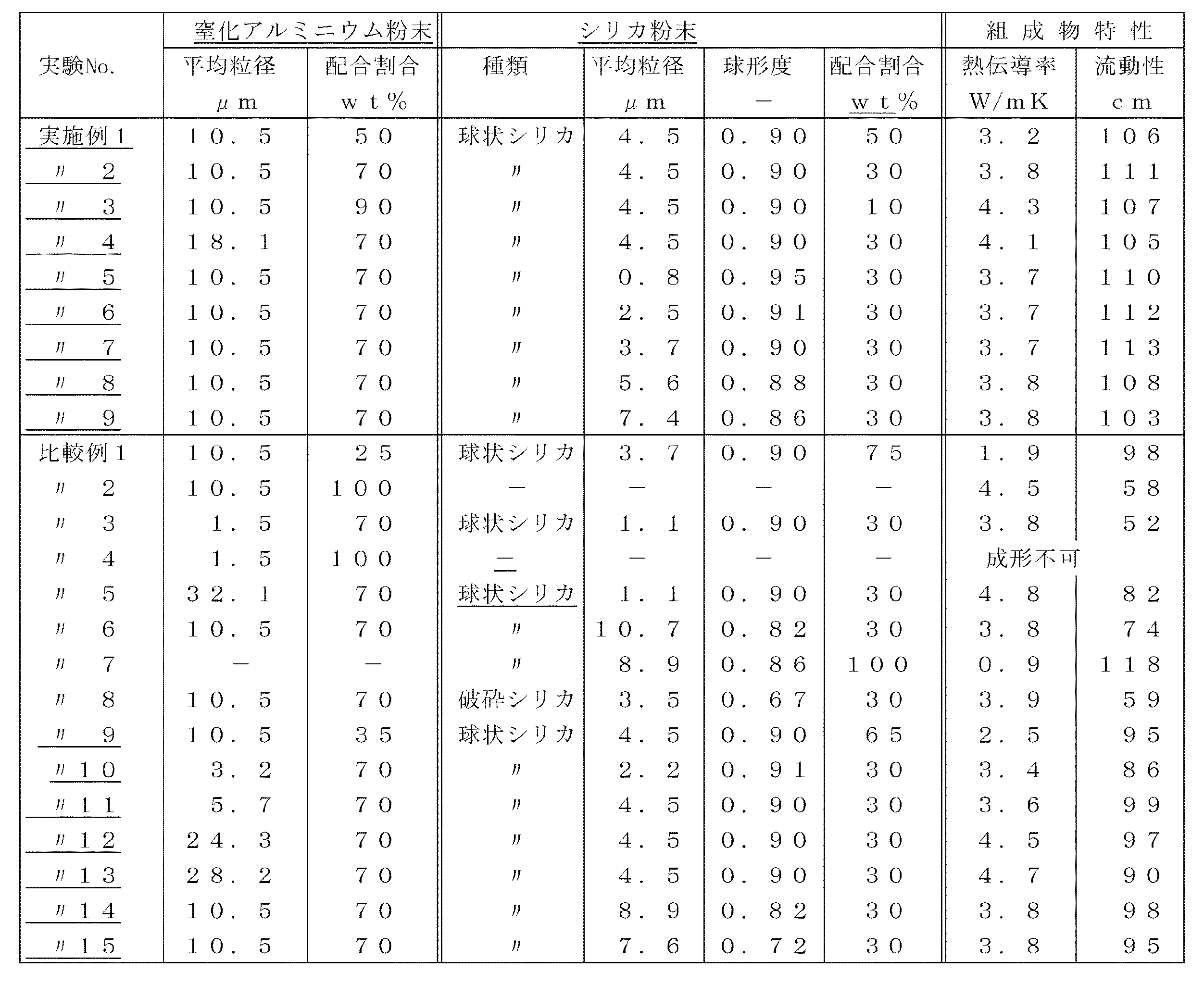
【発明の効果】
実施例から、本発明の充填材を用いた樹脂組成物は、流動性に富み、しかも得られる硬化体の熱伝導率も高いという、優れた効果を有していることが明かである。即ち、本発明によれば、成形時の流動性が阻害されることなく、充填材が高度に充填された樹脂組成物が容易に得ることができ、しかも充填材が高充填されているので硬化体の熱伝導率が高い樹脂組成物を容易に提供でき、例えば半導体封止用に用いて好適である。更に、充填材の微粉に粒子が球状のシリカ粉末を用いているので、得られた樹脂硬化体の耐湿性、耐水性に優れるという効果をも有している。[0001]
[Industrial application fields]
The present invention relates to a filler that exhibits excellent fluidity and high thermal conductivity when filled in a resin, and a semiconductor sealing resin composition using the same.
[0002]
[Prior art]
For semiconductor sealing, a resin composition obtained by mixing and kneading a filler made of an oxide-based inorganic powder such as quartz glass or alumina into an epoxy resin containing a curing agent or the like is cured by an operation such as heating. Has been done. The encapsulant, which is a cured product of the resin composition, satisfies various characteristics such as low thermal expansion, high thermal conductivity, heat resistance, water resistance, and low radiation in a balanced manner in order to make use of the function of the semiconductor element. is required. And when filling the resin composition on the element and sealing it, a highly fluid resin composition is required and developed so that the signal transmitting wire is not broken or the wires do not contact each other. I came.
[0003]
As an example of improving the characteristics of the filler used in the resin composition, for example, in JP-A-60-51613, a silane coupling material is attached to the surface of a spherical silica powder having a size of 1 to 100 μm. A method for improving dispersibility is disclosed. Japanese Patent Application Laid-Open No. 62-241541 discloses that a quartz glass powder is melted in a flame to obtain a spherical powder, thereby achieving high filling and high fluidity. Furthermore, in Japanese Patent Application Laid-Open No. 63-282146, high filling property is achieved by optimizing the particle size constitution of the filler. By combining these techniques, the conventional filler filling ratio of the inorganic resin to 75 to 80% by weight has recently reached nearly 90% by weight.
[0004]
On the other hand, in order to efficiently release the heat generated in the semiconductor element, high thermal conductivity has been further required for the sealing material. As a countermeasure, quartz glass has been improved in characteristics by increasing the filling amount as described above. However, the thermal conductivity of quartz glass is as low as 1 to 5 W / m · K, and there is a limit to the improvement in the thermal conductivity of the resin composition obtained using this. In order to improve the thermal conductivity, JP-A-1-115940 discloses a method using sialon and silicon oxynitride, and JP-A-6-24715 discloses a method using aluminum nitride powder as a filler. Proposed.
[0005]
[Problems to be solved by the invention]
However, these high thermal conductivity insulating inorganic materials are not only expensive, but also have low filling properties, resulting in a problem that the resulting resin composition does not have the high thermal conductivity as expected. When a large amount of product is used, there is a problem with the water resistance of the resin composition.
[0006]
That is, when the nitride inorganic powder is used alone as a filler, the problems inherent to each material cannot be solved due to filling properties, thermal conductivity, water resistance, and the like. The present invention has been made in view of the above circumstances, and an object of the present invention is to obtain a highly fluid resin composition even when highly filled, and has high thermal conductivity when the resin composition is cured. Thus, an object of the present invention is to provide a filler that can easily obtain a sealing material suitable for semiconductor sealing.
[0007]
[Means for Solving the Problems]
As a result of investigating the influence on the fluidity of the resulting resin composition and the thermal conductivity of the cured product when various inorganic powders are combined and filled in the resin, the present inventors have found that aluminum nitride having a specific particle size is obtained. powder, with particles spherical, only if a mixture of a silica powder having a specific particle diameter under a predetermined ratio, the mixed powder is highly filled in a resin, the cured product of the resulting resin composition is high thermal conductivity The present inventors have found that the present invention exhibits the properties and have arrived at the present invention .
[0008]
That is, the present invention, the average particle size of 50 to 90 wt% aluminum nitride powder of 10.5 ~18.1Myuemu, a spherical particles, average particle size 0.8 ~7.4Myuemu silica powder Is a filler comprising 10 to 50% by weight.
[0009]
Moreover, this invention is a resin composition for semiconductor sealing characterized by including the said filler.
[0010]
DETAILED DESCRIPTION OF THE INVENTION
Aluminum nitride powder used in the present invention is excellent in electrical insulation properties, yet as long as it has a high thermal conductivity, grain internal structure constituting the powder, i.e. crystallinity degree, or the crystal size, their It is not limited to the degree of aggregation. Further, the shape of the particles constituting the powder may be plate-like, polygonal column-like, flake-like or indeterminate, but it further improves the resin filling property and the fluidity of the resulting resin composition. A spherical shape is preferable because it is excellent, and more specifically, a sphericity of 0.7 or more is preferable.
[0011]
As a method for producing the aluminum nitride powder, a direct metal nitriding method, an oxide reduction method, a gas phase synthesis method, and the like are known. In the present invention, any method obtained by any method can be used. Moreover, you may grind | pulverize the molded object obtained by shape | molding the powder obtained by the said method, or also sintering. Further, due to the resistance aqueous improvement it may be obtained by coating the aluminum powder surface nitride oxide film or an organic film.
[0012]
The silica powder with spherical particles used in the present invention is suitable because it can be made vitreous having a very small coefficient of thermal expansion, and is inexpensive and available in large quantities.
[0013]
With respect to the method of making the particles spherical, a conventionally known method such as a flame melting method, a metal vapor oxidation method, or a sol-gel method may be used, and the production method is not limited. In the present invention, the term “spherical” does not mean only a true sphere, but means that the shape of the entire particle is rounded under SEM observation. More specifically, as described later in detail, the sphericity measured by the image analysis method is at least 0.80 or more, preferably 0.84 or more. When the sphericity is less than 0.80, the fluidity of the resin composition may deteriorate.
[0014]
In the present invention, the proportion of the aluminum nitride powder in the filler is 50 to 90% by weight. If it is less than 50% by weight, the thermal conductivity of the cured resin composition obtained is not sufficiently improved. When the ratio exceeds 90% by weight, the filling property into the resin is deteriorated and the fluidity of the resin composition is also deteriorated. Moreover, the ratio for which the particle | grains occupy to the filler of the spherical silica powder is 10 to 50% by weight, and if it is less than 10% by weight, the fluidity of the resin composition becomes insufficient.
[0015]
The filler of the present invention does not limit the addition of the third component other than the aluminum nitride powder and the silica powder having spherical particles . For example, carbon black and pigments may be added for the purpose of coloring, various stabilizers for the purpose of improving the durability of the resin, or inexpensive inorganic fillers for the purpose of reducing the cost, as appropriate as long as the physical properties are not impaired. Permissible. In order to achieve the object of the present invention, the total amount of aluminum nitride powder and silica powder with spherical particles is preferably contained in an amount of 70% by weight or more of the entire filler, and more preferably 80% by weight or more. .
[0016]
In order to further enhance the effect of the present invention, it is preferable to select an aluminum nitride powder having a particle size larger than that of a silica powder having a spherical particle and a high thermal conductivity. Thereby, when the filling rate of the filler in the resin composition is the same, the thermal conductivity of the cured resin composition can be further improved. In addition, aluminum nitride powder easily reacts with moisture (moisture) in the air on the surface, and when fine powder is used, the surface area increases and becomes more unstable. Increasing the particle size of the high thermal conductivity aluminum nitride powder for the purpose of increasing the thermal conductivity of the silica is to use silica powder with spherical particles on the fine powder side, and to improve the moisture resistance of the resulting cured resin composition It also has an effect.
[0017]
Regarding the particle size of the aluminum nitride powder , it is important that the maximum particle size is 100 μm or less and the average particle size is in the range of 10.5 to 18.1 μm. This is because the presence of particles of 100 μm or more increases the wear of the mold when the resulting resin composition is molded. When the average particle size is smaller than 2 μm, the powder surface area increases, so that the above-mentioned problems with moisture resistance and water resistance occur, and the viscosity of the resulting resin composition is remarkably increased, so that it cannot be uniformly dispersed in the resin. In addition, the filling tends to be difficult, and if the particle size is too small, the heat conduction of the resin composition does not improve even if the filling is high because the number of particle interfaces with poor heat transfer increases. There is. On the other hand, when the average particle diameter is larger than 30 μm, the fluidity of the resulting resin composition is deteriorated, resulting in a phenomenon that high filling cannot be performed.
[0018]
The silica powder with spherical particles has a maximum particle size of 100 μm or less and an average particle size of 0.8 to 7.4 μm. When flat Hitoshitsubu diameter is about 0.1 [mu] m, the handling, there is a fear that restrictions on the production occurs. When the particles are mixed with an aluminum nitride powder having an average particle size larger than the spherical silica powder , the fluidity of the resin composition becomes poor unless the average particle size is 10 μm or less, and as a result, high filling cannot be achieved. Sometimes.
[0019]
In the present invention, the particle size of the aluminum nitride powder, the silica powder having a spherical particle and the powder of the third component is obtained by dispersing 0.3 g of a sample in water, and using a laser diffraction particle size distribution measuring apparatus (Cirrus granulometer “ The value measured by the model 715 ").
[0020]
The thermal conductivity of the aluminum nitride powder and the silica powder having a spherical particle is dispersed in a silicon resin or epoxy resin whose thermal conductivity of the cured body is known in advance at 40 to 60% by volume, and a plate-like specimen is prepared. The thermal conductivity of the specimen can be measured and calculated from the value and the blending ratio .
[0021]
The sphericity of the particles constituting the aluminum nitride powder or the silica powder is measured using an SEM (scanning electron microscope) and an image analyzer. In the present invention, JSM-T200 type manufactured by JEOL Ltd. was used as the SEM and Nippon Avionics Co., Ltd. was used as the image analysis device, but similar values can be obtained using products of other companies. The sphericity is measured by first measuring the projected area (A) and the perimeter (PM) of the target particle from the SEM photograph of the powder. When the area of a perfect circle corresponding to the perimeter (PM) is (B), the sphericity (roundness) is expressed as A / B.
[0022]
Here, assuming a perfect circle having the same circumference as the circumference of the target particle (PM),
PM = 2πr (1)
B = πr 2 (2)
Because
From equation (1), r = PM / 2π (3)
Substituting equation (3) into equation (2),
B = π × (PM / 2π) 2 (4)
And
Sphericality = A / B = A × 4π / (PM) 2 (5)
It becomes. The sphericity of individual particles can be calculated by substituting the actual measurement values A and PM into the equation (5). In the present invention, particles are sampled so as to represent the particle size distribution of the entire powder, and the sphericity of each of about 100 particles is measured, and the average value is used as the sphericity of the powder.
[0023]
【Example】
Various silica glass powders (spherical silica powder) were prepared by flame-melting a granulated silica stone as a silica powder with spherical particles, vitrification and spheronization, and classification thereafter. Further, as a comparative example, a crushed silica powder having a poor particle sphericity obtained by pulverizing and classifying a quartz glass ingot was used.
[0024]
Aluminum nitride powder Ru der those obtained by ingot pulverization and classification by nitridation of aluminum metal powder. Sphere Katachido was 0.7 to 0.8.
[0025]
The above-mentioned powder was weighed at the blending ratio shown in Table 1, and then mixed with a V-type mixer to obtain various fillers. 320 parts by weight of the filler with respect to 80 parts by weight of a binder having the following formulation were weighed and further dry blended to obtain a blended product.
[0026]
<Binder composition>
4-4′-bis (2,3-epoxypropoxy 3,3 ′, 5,5-tetramethylbiphenyl 44 parts by weight phenol novolac resin (softening point 85 ° C.) 23 parts by weight triphenylphosphine (curing accelerator) 2 Part by weight Ester wax (release agent) 6 parts by weight Carbon black (colorant) 1 part by weight γ-glycidoxypropyltrimethoxysilane 4 parts by weight (silane coupling agent)
[0027]
The blended product was heated and kneaded for 5 minutes using a mixing roll having a roll surface temperature of 100 ° C., then cooled and pulverized to obtain various types of resin compositions. Next, spiral flow and thermal conductivity were measured using the resin composition. The spiral flow was measured in accordance with EMMI-66 (Epoxy Molding Material; Society of Plastic Industry) using a spiral flow mold. Molding was performed at a molding temperature of 175 ° C. and a molding pressure of 75 kg / cm 2 . In addition, the thermal conductivity of the cured resin composition is obtained by cutting a part of a bending specimen obtained by molding and curing under the same molding conditions as the spiral flow into a 10φ × 1t disk shape, and laser flash thermal conductivity. It measured at room temperature using the measuring apparatus. The results are shown in Table 1.
[0028]
[Table 1]
【The invention's effect】
From the examples, it is clear that the resin composition using the filler of the present invention has an excellent effect that it is rich in fluidity and also has a high thermal conductivity. That is, according to the present invention, a resin composition highly filled with a filler can be easily obtained without impeding the fluidity at the time of molding, and since the filler is highly filled, it is cured. A resin composition having a high thermal conductivity of the body can be easily provided, and is suitable for use, for example, for semiconductor encapsulation. Furthermore, since silica powder with spherical particles is used for the fine powder of the filler, the obtained cured resin has an effect of being excellent in moisture resistance and water resistance.
Claims (2)
Priority Applications (1)
| Application Number | Priority Date | Filing Date | Title |
|---|---|---|---|
| JP09375897A JP4040715B2 (en) | 1997-04-11 | 1997-04-11 | Filler and semiconductor sealing resin composition |
Applications Claiming Priority (1)
| Application Number | Priority Date | Filing Date | Title |
|---|---|---|---|
| JP09375897A JP4040715B2 (en) | 1997-04-11 | 1997-04-11 | Filler and semiconductor sealing resin composition |
Publications (2)
| Publication Number | Publication Date |
|---|---|
| JPH10287767A JPH10287767A (en) | 1998-10-27 |
| JP4040715B2 true JP4040715B2 (en) | 2008-01-30 |
Family
ID=14091342
Family Applications (1)
| Application Number | Title | Priority Date | Filing Date |
|---|---|---|---|
| JP09375897A Expired - Fee Related JP4040715B2 (en) | 1997-04-11 | 1997-04-11 | Filler and semiconductor sealing resin composition |
Country Status (1)
| Country | Link |
|---|---|
| JP (1) | JP4040715B2 (en) |
Families Citing this family (4)
| Publication number | Priority date | Publication date | Assignee | Title |
|---|---|---|---|---|
| JP2002338788A (en) * | 2001-05-16 | 2002-11-27 | Mitsui Chemicals Inc | Epoxy resin composition and semiconductor device containing hollow package using the same |
| JP2005320390A (en) * | 2004-05-07 | 2005-11-17 | Denki Kagaku Kogyo Kk | Curable composition, molded product and heat dissipation member |
| JP7852219B2 (en) * | 2021-10-05 | 2026-04-28 | Ube株式会社 | Silicon oxynitride-containing composition, heat-dissipating resin composition, and heat-dissipating resin composition film sheet using the same. |
| JP7889036B2 (en) * | 2022-04-15 | 2026-07-14 | Ube株式会社 | Heat-dissipating resin composition and heat-dissipating member |
-
1997
- 1997-04-11 JP JP09375897A patent/JP4040715B2/en not_active Expired - Fee Related
Also Published As
| Publication number | Publication date |
|---|---|
| JPH10287767A (en) | 1998-10-27 |
Similar Documents
| Publication | Publication Date | Title |
|---|---|---|
| KR101505237B1 (en) | Alumina powder, process for production of the same, and resin compositions containing the same | |
| JPH1060161A (en) | Improved boron nitride composition and polymer-based high thermal conductivity molding compound | |
| JPS6157347B2 (en) | ||
| JPH1067883A (en) | Inorganic filler, epoxy resin composition, and semiconductor device | |
| US20230159725A1 (en) | Alumina powder, filler composition, resin composition, encapsulant, and fingerprint authentication sensor | |
| CN114163673B (en) | Low-dielectric high-thermal-conductivity interface film and preparation method thereof | |
| JP3468996B2 (en) | Epoxy resin composition and resin-encapsulated semiconductor device | |
| JP3166324B2 (en) | Silica fine powder, method for producing the same, and resin composition containing the silica fine powder | |
| JP7587977B2 (en) | Thermally conductive filler and thermally conductive composition containing same | |
| JP3986154B2 (en) | Silicon nitride filler and semiconductor sealing resin composition | |
| JP5795168B2 (en) | Thermally conductive resin composition and semiconductor package | |
| JPH059270A (en) | Resin composition and its manufacture | |
| KR20190135486A (en) | Powder mixture | |
| JPH10287767A (en) | Filler and resin composition for semiconductor encapsulation | |
| JPS6296567A (en) | Semiconductor sealing resin composition | |
| JP3458196B2 (en) | High thermal conductive resin composition | |
| JPS6296568A (en) | Semiconductor sealing resin composition | |
| US5833746A (en) | Silica filler and method for its production | |
| JPH01266152A (en) | Silica used as filler in sealing resin | |
| JPH07103263B2 (en) | Silica for filling sealing resin | |
| JP2000128960A (en) | Epoxy resin composition for semiconductor encapsulation and semiconductor device using the same | |
| JPS6296569A (en) | Semiconductor sealing resin composition | |
| JP2764479B2 (en) | Filler material for semiconductor encapsulation resin | |
| JPH02247236A (en) | Fused fine spherical silica and sealing resin composition containing the same | |
| JPS63248712A (en) | Inorganic filler and production thereof |
Legal Events
| Date | Code | Title | Description |
|---|---|---|---|
| A977 | Report on retrieval |
Free format text: JAPANESE INTERMEDIATE CODE: A971007 Effective date: 20040611 |
|
| A131 | Notification of reasons for refusal |
Free format text: JAPANESE INTERMEDIATE CODE: A131 Effective date: 20040615 |
|
| A521 | Request for written amendment filed |
Free format text: JAPANESE INTERMEDIATE CODE: A523 Effective date: 20040722 |
|
| A02 | Decision of refusal |
Free format text: JAPANESE INTERMEDIATE CODE: A02 Effective date: 20040824 |
|
| A521 | Request for written amendment filed |
Free format text: JAPANESE INTERMEDIATE CODE: A523 Effective date: 20070115 |
|
| A521 | Request for written amendment filed |
Free format text: JAPANESE INTERMEDIATE CODE: A523 Effective date: 20070326 |
|
| A521 | Request for written amendment filed |
Free format text: JAPANESE INTERMEDIATE CODE: A523 Effective date: 20070821 |
|
| A61 | First payment of annual fees (during grant procedure) |
Free format text: JAPANESE INTERMEDIATE CODE: A61 Effective date: 20071108 |
|
| FPAY | Renewal fee payment (event date is renewal date of database) |
Free format text: PAYMENT UNTIL: 20101116 Year of fee payment: 3 |
|
| R150 | Certificate of patent or registration of utility model |
Free format text: JAPANESE INTERMEDIATE CODE: R150 |
|
| FPAY | Renewal fee payment (event date is renewal date of database) |
Free format text: PAYMENT UNTIL: 20101116 Year of fee payment: 3 |
|
| FPAY | Renewal fee payment (event date is renewal date of database) |
Free format text: PAYMENT UNTIL: 20111116 Year of fee payment: 4 |
|
| FPAY | Renewal fee payment (event date is renewal date of database) |
Free format text: PAYMENT UNTIL: 20111116 Year of fee payment: 4 |
|
| FPAY | Renewal fee payment (event date is renewal date of database) |
Free format text: PAYMENT UNTIL: 20121116 Year of fee payment: 5 |
|
| FPAY | Renewal fee payment (event date is renewal date of database) |
Free format text: PAYMENT UNTIL: 20131116 Year of fee payment: 6 |
|
| LAPS | Cancellation because of no payment of annual fees |