JP2009211971A - Secondary battery - Google Patents
Secondary battery Download PDFInfo
- Publication number
- JP2009211971A JP2009211971A JP2008054427A JP2008054427A JP2009211971A JP 2009211971 A JP2009211971 A JP 2009211971A JP 2008054427 A JP2008054427 A JP 2008054427A JP 2008054427 A JP2008054427 A JP 2008054427A JP 2009211971 A JP2009211971 A JP 2009211971A
- Authority
- JP
- Japan
- Prior art keywords
- lead terminal
- metal lead
- electrode plate
- negative electrode
- battery case
- Prior art date
- Legal status (The legal status is an assumption and is not a legal conclusion. Google has not performed a legal analysis and makes no representation as to the accuracy of the status listed.)
- Pending
Links
Images
Classifications
-
- Y—GENERAL TAGGING OF NEW TECHNOLOGICAL DEVELOPMENTS; GENERAL TAGGING OF CROSS-SECTIONAL TECHNOLOGIES SPANNING OVER SEVERAL SECTIONS OF THE IPC; TECHNICAL SUBJECTS COVERED BY FORMER USPC CROSS-REFERENCE ART COLLECTIONS [XRACs] AND DIGESTS
- Y02—TECHNOLOGIES OR APPLICATIONS FOR MITIGATION OR ADAPTATION AGAINST CLIMATE CHANGE
- Y02E—REDUCTION OF GREENHOUSE GAS [GHG] EMISSIONS, RELATED TO ENERGY GENERATION, TRANSMISSION OR DISTRIBUTION
- Y02E60/00—Enabling technologies; Technologies with a potential or indirect contribution to GHG emissions mitigation
- Y02E60/10—Energy storage using batteries
-
- Y—GENERAL TAGGING OF NEW TECHNOLOGICAL DEVELOPMENTS; GENERAL TAGGING OF CROSS-SECTIONAL TECHNOLOGIES SPANNING OVER SEVERAL SECTIONS OF THE IPC; TECHNICAL SUBJECTS COVERED BY FORMER USPC CROSS-REFERENCE ART COLLECTIONS [XRACs] AND DIGESTS
- Y02—TECHNOLOGIES OR APPLICATIONS FOR MITIGATION OR ADAPTATION AGAINST CLIMATE CHANGE
- Y02P—CLIMATE CHANGE MITIGATION TECHNOLOGIES IN THE PRODUCTION OR PROCESSING OF GOODS
- Y02P70/00—Climate change mitigation technologies in the production process for final industrial or consumer products
- Y02P70/50—Manufacturing or production processes characterised by the final manufactured product
Landscapes
- Connection Of Batteries Or Terminals (AREA)
- Secondary Cells (AREA)
Abstract
【課題】異常な使用や保護回路の誤作動等により過充電状態になった場合等においても安全保護素子が効率的に作動する安全性に優れた二次電池を提供する。
【解決手段】温度を感知して作動する安全保護素子を電気的に接続した二次電池であって、負極板6と電池ケース1とを電気的に接続する金属リード端子6aを、正極板5と封口体2とを電気的に接続する金属リード端子5aの電気伝導率よりも小さい部材とし、かつ、負極の金属リード端子6aを極板群14の最外周に配置し、この負極の金属リード端子6aと対向する電池ケース1側面の外側に安全保護素子を接触させる構成とした。
【選択図】図1Provided is a secondary battery excellent in safety in which a safety protection element operates efficiently even when the battery is overcharged due to abnormal use or malfunction of a protection circuit.
A rechargeable battery in which a safety protection element that operates by sensing temperature is electrically connected, and a metal lead terminal 6a that electrically connects a negative electrode plate 6 and a battery case 1 is connected to a positive electrode plate 5. The metal lead terminal 5a that electrically connects the sealing body 2 and the sealing body 2 is made a member having a smaller electrical conductivity, and the negative metal lead terminal 6a is disposed on the outermost periphery of the electrode plate group 14, and the negative metal lead The safety protection element is in contact with the outside of the side surface of the battery case 1 facing the terminal 6a.
[Selection] Figure 1
Description
本発明は二次電池に関し、特に安全保護素子が効果的に作動する安全性に優れた二次電池に関するものである。 The present invention relates to a secondary battery, and more particularly to a secondary battery excellent in safety in which a safety protection element operates effectively.
近年、携帯型情報機器の小型軽量化、高性能化の急速な進展により、その駆動電源として4V級の高い作動電圧を有し、高エネルギー密度化に適した非水電解液二次電池の開発・実用化が積極的に行われている。 In recent years, due to the rapid progress of miniaturization, weight reduction and high performance of portable information devices, the development of non-aqueous electrolyte secondary batteries that have a high operating voltage of 4V as the driving power source and are suitable for high energy density・ Practical application is being carried out.
非水電解液二次電池の正極活物質としては、層状岩塩構造を有するLiCoO2、LiNiO2、スピネル構造を有するLiMn2O4等のリチウム含有遷移金属化合物が用いられており、負極活物質には、天然黒鉛、球状・繊維状の人造黒鉛、難黒鉛化性炭素(ハードカーボン)、易黒鉛化性炭素(ソフトカーボン)等の炭素材料が採用されている。 As the positive electrode active material of the non-aqueous electrolyte secondary battery, lithium-containing transition metal compounds such as LiCoO 2 having a layered rock salt structure, LiNiO 2 , and LiMn 2 O 4 having a spinel structure are used. Employs carbon materials such as natural graphite, spherical / fibrous artificial graphite, non-graphitizable carbon (hard carbon), and graphitizable carbon (soft carbon).
そして、更なる高エネルギー密度化を実現するため、正極活物質の高密度充填化、正極活物質の受け入れ性に優れた負極活物質の採用、セパレータの薄膜化の他、機構部品の最適化による取り組み等がなされている。 In order to achieve higher energy density, the positive electrode active material is densely packed, the negative electrode active material with excellent acceptability of the positive electrode active material is adopted, the separator is made thinner, and the mechanical parts are optimized. Efforts are being made.
しかし、一方で昨今の更なる高エネルギー密度化は、異常な使用や保護回路の誤作動等により過充電状態等になった場合、その発熱量が大きく安全性の低下を招く場合があり、高エネルギー密度と優れた安全性の両立が難しくなっている。 However, on the other hand, the recent increase in energy density is that if the battery is overcharged due to abnormal use or malfunction of the protection circuit, etc. It is difficult to achieve both energy density and excellent safety.
このような課題を解決するため、非水電解液二次電池の極板群に高熱伝導率シートを捲装して極板群の放熱性を改善し、非水電解液二次電池の高効率放電時の温度上昇を抑制することで放電特性の向上を図る方法が開示されている(例えば、特許文献1参照)。
しかしながら、このような二次電池の極板群に高熱伝導率シートを捲装して極板群の放熱性を改善する方法では、昨今の更なる高エネルギー密度化を図った二次電池において、保護回路の誤作動等により過充電状態になった場合等、極板群の内部の急激な温度上昇に対して温度検出が遅れ、放熱が不十分となるおそれがあった。 However, in the method of improving the heat dissipation of the electrode plate group by installing a high thermal conductivity sheet on the electrode plate group of such a secondary battery, In the case of an overcharged state due to a malfunction of the protection circuit or the like, the temperature detection is delayed with respect to a rapid temperature rise inside the electrode plate group, and there is a possibility that heat dissipation becomes insufficient.
本発明は上記従来の問題点を解決するものであり、負極の金属リード端子を正極の金属リード端子の電気伝導率より小さい部材とすることにより、過充電状態になった場合等、二次電池内の電流による発熱を負極の金属リード端子に優先して集熱させている。さらに、この集熱した熱を効率的に安全保護素子に伝えるために、負極の金属リード端子を極板群の最外周に配置し、安全保護素子を負極の金属リード端子と対向する電池ケース側面の外側に接触させたものである。この構成により、安全保護素子が効率的に作動する安全性に優れた二次電池を提供する。 The present invention solves the above-mentioned conventional problems, and the secondary battery is used when the negative electrode metal lead terminal is a member smaller than the electric conductivity of the positive electrode metal lead terminal, resulting in an overcharged state. The heat generated by the internal current is collected with priority over the metal lead terminal of the negative electrode. Further, in order to efficiently transmit the collected heat to the safety protection element, the negative electrode metal lead terminal is arranged on the outermost periphery of the electrode plate group, and the safety protection element is opposed to the negative electrode metal lead terminal side surface. It is made to contact the outside of. With this configuration, a secondary battery excellent in safety in which the safety protection element operates efficiently is provided.
上記課題を解決するために本発明の二次電池は、活物質層と、その活物質層の少なくとも一部に設けた露出部に金属リード端子を溶接した帯状の金属箔からなる負極板と正極板とをセパレータを介して捲回してなる極板群と電解液を内部に収納した電池ケースと、この電池ケースの開口部を密閉する封口体を備え、温度を感知して作動する安全保護素子を
電気的に接続した二次電池であって、負極板と電池ケースとを電気的に接続する負極の金属リード端子を、正極板と封口体とを電気的に接続する正極の金属リード端子の電気伝導率よりも小さい部材とし、かつ、負極の金属リード端子を極板群の最外周に配置し、この負極の金属リード端子と対向する電池ケース側面の外側に安全保護素子を接触させたことを特徴とする。
In order to solve the above-described problems, the secondary battery of the present invention includes an active material layer, a negative electrode plate made of a strip-shaped metal foil with a metal lead terminal welded to an exposed portion provided in at least a part of the active material layer, and a positive electrode A safety protection element that has a battery case in which an electrode plate group formed by winding a plate through a separator and a battery case in which an electrolyte is stored, and a sealing body that seals the opening of the battery case, and operates by sensing temperature A negative electrode metal lead terminal for electrically connecting the negative electrode plate and the battery case, and a positive electrode metal lead terminal for electrically connecting the positive electrode plate and the sealing body. The member is smaller than the electrical conductivity, and the negative electrode metal lead terminal is arranged on the outermost periphery of the electrode plate group, and the safety protection element is in contact with the outside of the side surface of the battery case facing the negative electrode metal lead terminal. It is characterized by.
この構成により、二次電池内の電流による発熱を利用して集熱することができ、さらに、この集熱した熱を効率的に安全保護素子に伝えることができる。 With this configuration, heat can be collected using heat generated by the current in the secondary battery, and the collected heat can be efficiently transmitted to the safety protection element.
本発明によれば、昨今の更なる高エネルギー密度化を図った二次電池においても、保護回路の誤作動等により過充電状態になった場合等、二次電池内の電流による発熱を負極の金属リード端子に集熱することができ、さらに、この集熱した熱を効率的に安全保護素子に伝えることができる。その結果、極板群の内部の急激な温度上昇に対して温度検出が遅れ、放熱が不十分となるおそれがない、安全保護素子が効率的に作動する安全性に優れた二次電池を提供できる。 According to the present invention, even in the recent secondary batteries with further increased energy density, heat generated by the current in the secondary battery is reduced when the battery is overcharged due to malfunction of the protection circuit. Heat can be collected on the metal lead terminal, and the collected heat can be efficiently transmitted to the safety protection element. As a result, a secondary battery with excellent safety in which the safety protection element operates efficiently without the possibility of insufficient heat dissipation due to a delay in temperature detection due to a sudden rise in temperature inside the electrode plate group is provided. it can.
本発明においては、活物質層と、その活物質層の少なくとも一部に設けた露出部に金属リード端子を溶接した帯状の金属箔からなる負極板と正極板とをセパレータを介して捲回してなる極板群と電解液を内部に収納した電池ケースと、この電池ケースの開口部を密閉する封口体を備え、温度を感知して作動する安全保護素子を電気的に接続した二次電池であって、負極板と電池ケースとを電気的に接続する負極の金属リード端子を、正極板と封口体とを電気的に接続する正極の金属リード端子の電気伝導率よりも小さい部材とし、かつ、負極の金属リード端子を極板群の最外周に配置し、この負極の金属リード端子と対向する電池ケース側面の外側に安全保護素子を接触させた構成とするものである。 In the present invention, an active material layer, and a negative electrode plate and a positive electrode plate made of a strip-shaped metal foil in which a metal lead terminal is welded to an exposed portion provided in at least a part of the active material layer are wound through a separator. A secondary battery that has a battery case that contains an electrode plate group and an electrolyte solution inside, and a sealing body that seals the opening of the battery case, and is electrically connected with a safety protection element that operates by sensing temperature. A negative electrode metal lead terminal for electrically connecting the negative electrode plate and the battery case, and a member having a smaller electrical conductivity than the positive electrode metal lead terminal for electrically connecting the positive electrode plate and the sealing body, and The negative electrode metal lead terminal is disposed on the outermost periphery of the electrode plate group, and the safety protection element is in contact with the outside of the side surface of the battery case facing the negative electrode metal lead terminal.
この構成によれば、保護回路の誤作動等により過充電状態になった場合や二次電池が短絡した場合に、二次電池内の電流を利用して発熱を負極の金属リード端子に集熱することができ、さらに、この集熱した熱を効率的に安全保護素子に伝えることができる。 According to this configuration, when an overcharged state occurs due to a malfunction of the protection circuit or when the secondary battery is short-circuited, heat is collected to the negative metal lead terminal using the current in the secondary battery. In addition, the collected heat can be efficiently transmitted to the safety protection element.
また、負極の金属リード端子の電気伝導率を14.5μS/cm以下とし、正極の金属リード端子の電気伝導率を37.4μS/cm以上とすることが望ましい。 Further, it is desirable that the electrical conductivity of the metal lead terminal of the negative electrode is 14.5 μS / cm or less, and the electrical conductivity of the metal lead terminal of the positive electrode is 37.4 μS / cm or more.
このように、負極の金属リード端子と正極の金属リード端子の電気伝導率を規定すれば、負極の金属リード端子と正極の金属リード端子間の電気伝導率の差が顕著になり、二次電池内に大電流が瞬時に流れた場合に負極の金属リード端子が発熱し易くなる。例えば二次電池が内部短絡し、電池内に瞬時に大電流が流れた場合においても、負極の金属リード端子に集中して発熱させることができる。 In this way, if the electrical conductivity of the negative metal lead terminal and the positive metal lead terminal is defined, the difference in electrical conductivity between the negative metal lead terminal and the positive metal lead terminal becomes significant. When a large current flows instantaneously, the metal lead terminal of the negative electrode tends to generate heat. For example, even when a secondary battery is internally short-circuited and a large current flows instantaneously in the battery, heat can be concentrated on the negative metal lead terminal.
また、正極の金属リード端子にアルミニウム製のリード端子を用いれば、前述の電気伝導率を有する部材として好適に用いることができる。 Further, if an aluminum lead terminal is used as the positive metal lead terminal, it can be suitably used as a member having the above-described electrical conductivity.
また、負極の金属リード端子にニッケル製のリード端子を用いれば、前述の電気伝導率を有する部材として好適に用いることができる。 Further, if a nickel lead terminal is used for the metal lead terminal of the negative electrode, it can be suitably used as a member having the aforementioned electrical conductivity.
また、正極板の金属箔としてアルミニウム箔を用い、負極板の金属箔として銅箔を用いる構成が望ましい。 Moreover, the structure which uses aluminum foil as metal foil of a positive electrode plate, and uses copper foil as metal foil of a negative electrode plate is desirable.
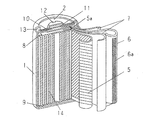
以下、本発明の電池について、図面を参照して説明する。図1は本発明の円筒型リチウ
ムイオン二次電池の構成例を示した一部切り欠き斜視図である。
Hereinafter, the battery of the present invention will be described with reference to the drawings. FIG. 1 is a partially cutaway perspective view showing a configuration example of a cylindrical lithium ion secondary battery of the present invention.
図1に示したように、円筒型リチウムイオン二次電池は、金属箔上に正極活物質層を設けた正極板5と、金属箔上に負極活物質層を設けた負極板6とをセパレータ7を介し捲回して極板群14を構成する。この正・負極活物質層の一部に露出部を設け、この露出部の金属箔に正極の金属リード端子5a・負極の金属リード端子6aを溶接する。
As shown in FIG. 1, the cylindrical lithium ion secondary battery includes a
金属箔と正極の金属リード端子5aの溶接形態は、帯状の金属箔の露出部に金属箔の長手方向とほぼ垂直に正極の金属リード端子5aを溶接する。負極の金属リード端子6aの溶接形態も同様である。
In the welding mode of the metal foil and the positive
次に、各金属リード端子5a,6aを備えた極板群14を下部絶縁板9とともに電池ケース1に収納し、正極の金属リード端子5aの上方に封口体2を溶接する。封口体2はPTC(Positive Temperature Coefficient)素子10、防爆弁11の安全機構と正極外部端子12を備えている。下部絶縁板9は極板群14の下面と下方へ突出した負極の金属リード端子6aに挟装し、この負極の金属リード端子6aは電池ケース1の内底面に溶接する。極板群14の上面には上部絶縁リング8を載置し、電池ケース1の上部側面に溝部を形成して極板群14を電池ケース1内に保持する。次に、所定量の非水電解液を電池ケース1内に注入し、正極の金属リード端子5aを折り曲げて前記の溝部上にガスケット13を介して封口体2を載置し、電池ケース1の上端の開口部を内方にかしめ封口して円筒型リチウムイオン二次電池を作製する。
Next, the
負極の金属リード端子6aの材質としては、電池内部で安定に存在する金属であれば良いが、電子伝導性や加工性、実用的強度などの観点からニッケルが好ましい。負極の金属リード端子6aの厚みは0.06〜0.18mmのものが加工性や実用的強度などの観点から好ましい。
The material of the
負極板6の金属箔としては、加工が容易であること、実用的強度があること、負極活物質層との密着性に優れることや電子伝導性などの観点から銅箔が好ましく、銅合金からなる金属箔を用いても良い。この銅や銅合金からなる金属箔は特に限定されるものではなく、例えば圧延箔、電解箔などが挙げられる。その形状は孔開き箔、エキスパンド材、ラス材等であっても構わない。
The metal foil of the
負極板6は、このような銅箔または銅合金からなる金属箔の片面または両面に負極活物質と結着剤、必要に応じて導電剤を溶剤に混練分散させたペーストを塗着、乾燥、圧延して作製する。圧延後の負極板6の厚みは110〜210μmの厚みで柔軟性があることが好ましい。
The
負極活物質としては、リチウムイオンを可逆的に吸蔵、脱離し得る黒鉛型結晶構造を有するグラファイトを含む材料、例えば天然黒鉛や球状・繊維状の人造黒鉛、難黒鉛化性炭素(ハードカーボン)、易黒鉛化性炭素(ソフトカーボン)等の炭素材料が好ましく、特に、格子面(002)の面間隔(d002)が0.3350〜0.3400nmである黒鉛型結晶構造を有する炭素材料を使用することがより好ましい。 As the negative electrode active material, a material containing graphite having a graphite-type crystal structure capable of reversibly occluding and desorbing lithium ions, such as natural graphite, spherical and fibrous artificial graphite, non-graphitizable carbon (hard carbon), Carbon materials such as graphitizable carbon (soft carbon) are preferred, and in particular, carbon materials having a graphite-type crystal structure in which the plane spacing (d 002 ) of the lattice plane ( 002 ) is 0.3350 to 0.3400 nm are used. More preferably.
結着剤としては、分散媒に混練分散できるものであれば特に限定されるものではないが、例えばフッ素系結着材やアクリルゴム、変性アクリルゴム、スチレンブタジエンゴム(SBR)、アクリル系重合体、ビニル系重合体等を単独、或いは二種類以上の混合物または共重合体として用いることができる。フッ素系結着剤としては、例えばポリフッ化ビニリデン、フッ化ビニリデンと六フッ化プロピレンの共重合体やポリテトラフルオロエチレン樹脂のディスパージョンが好ましい。 The binder is not particularly limited as long as it can be kneaded and dispersed in a dispersion medium. For example, a fluorine-based binder, acrylic rubber, modified acrylic rubber, styrene butadiene rubber (SBR), acrylic polymer Vinyl polymers can be used alone or as a mixture or copolymer of two or more. As the fluorine-based binder, for example, polyvinylidene fluoride, a copolymer of vinylidene fluoride and propylene hexafluoride, and a dispersion of polytetrafluoroethylene resin are preferable.
導電剤としてはアセチレンブラック、グラファイト、炭素繊維等を単独、或いは二種類以上の混合物が好ましく、また、必要に応じて増粘剤を加えても良い。増粘剤としてはエチレン−ビニルアルコール共重合体、カルボキシメチルセルロース、メチルセルロースなどが好ましい。 As the conductive agent, acetylene black, graphite, carbon fiber, or the like is preferably used alone or as a mixture of two or more kinds, and a thickener may be added as necessary. As the thickener, ethylene-vinyl alcohol copolymer, carboxymethyl cellulose, methyl cellulose and the like are preferable.
分散媒としては、結着剤が溶解可能な溶剤が適切で、有機系結着剤の場合は、N−メチル−2−ピロリドン、N,N−ジメチルホルムアミド、テトラヒドロフラン、ジメチルアセトアミド、ジメチルスルホキシド、ヘキサメチルスルホルアミド、テトラメチル尿素、アセトン、メチルエチルケトン等の有機溶剤を単独またはこれらを混合した混合溶剤が好ましく、水系結着剤の場合は水または温水が好ましい。 As the dispersion medium, a solvent in which the binder can be dissolved is suitable. In the case of an organic binder, N-methyl-2-pyrrolidone, N, N-dimethylformamide, tetrahydrofuran, dimethylacetamide, dimethyl sulfoxide, hexa An organic solvent such as methylsulfuramide, tetramethylurea, acetone or methyl ethyl ketone is preferably used alone or as a mixed solvent thereof. In the case of an aqueous binder, water or warm water is preferred.
また、上記ペーストの混練分散時に、各種分散剤、界面活性剤、安定剤等を必要に応じて添加することも可能である。 In addition, various dispersants, surfactants, stabilizers, and the like can be added as necessary when the paste is kneaded and dispersed.
正極の金属リード端子5aの材質としては、非水電解液を用いるリチウムイオン二次電池では非水電解液中での耐食性に優れるアルミニウムが好ましい。アルミニウムは電子伝導性や加工性にも優れる。正極の金属リード端子5aの厚みは0.08〜0.24mmのものが加工性や実用的強度などの観点から好ましい。
As a material of the
正極板5の金属箔としては、加工が容易であること、実用的強度があること、正極活物質層との密着性や電子伝導性に優れることに加え、薄くて耐食性に非常に優れるアルミニウム箔が好ましい。
The metal foil of the
正極板5は、アルミニウム箔の片面または両面に正極活物質と結着剤および導電剤を溶剤に混練・分散させたペーストを塗着、乾燥、圧延して作製する。圧延後の正極板5の厚みは100〜200μmの厚みで負極板6と同様に柔軟性に優れることが好ましい。
The
正極活物質としては、例えばリチウムイオンをゲストとして受け入れるリチウム含有遷移金属化合物が使用できる。例えばコバルト、マンガン、ニッケル、クロム、鉄およびバナジウムから選ばれる少なくとも一種類の金属とリチウムとの複合金属酸化物、LiCoO2、LiMnO2、LiNiO2、LiCoxNi(1-x)O2(0<x<1)、LiCrO2、αLiFeO2、LiVO2等が好ましい。 As the positive electrode active material, for example, a lithium-containing transition metal compound that accepts lithium ions as a guest can be used. For example, a composite metal oxide of at least one metal selected from cobalt, manganese, nickel, chromium, iron and vanadium and lithium, LiCoO 2 , LiMnO 2 , LiNiO 2 , LiCo x Ni (1-x) O 2 (0 <X <1), LiCrO 2 , αLiFeO 2 , LiVO 2 and the like are preferable.
結着剤、分散媒および必要に応じて加えることができる導電剤、増粘剤は負極板6と同様のものを使用することができる。
As the binder, the dispersion medium, and the conductive agent and thickener that can be added as necessary, the same materials as those of the
塗着・乾燥は、特に限定されるものではなく、上記のように混練分散させたスラリー状合剤を、例えばスリットダイコーター、リバースロールコーター、リップコーター、ブレードコーター、ナイフコーター、グラビアコーター、ディップコーター等を用いて容易に塗着することができ、自然乾燥に近い乾燥が好ましいが生産性を考慮すると70℃〜200℃の温度範囲で10分間〜5時間乾燥させることが好ましい。 Coating / drying is not particularly limited, and the slurry-like mixture kneaded and dispersed as described above, for example, slit die coater, reverse roll coater, lip coater, blade coater, knife coater, gravure coater, dip It can be easily applied using a coater or the like, and drying close to natural drying is preferable, but considering productivity, it is preferable to dry in a temperature range of 70 ° C. to 200 ° C. for 10 minutes to 5 hours.
圧延は、ロールプレス機によって所定の厚みになるまで、線圧1000〜2000kg/cmで数回の圧延を行うか、線圧を変えて圧延することが好ましい。 Rolling is preferably performed several times at a linear pressure of 1000 to 2000 kg / cm or by changing the linear pressure until a predetermined thickness is reached by a roll press.
セパレータ7としては、厚さ15〜30μmのポリエチレン樹脂、ポリプロピレン樹脂などの微多孔性ポリオレフィン系樹脂の単層やポリエチレン樹脂の両面にポリプロピレン樹脂を積層したものが好ましい。
The
電池ケース1としては、上端が開口している円筒型や角型ケースがあり、その材質は安価なニッケルメッキを施した鋼鈑が好ましい。 As the battery case 1, there are a cylindrical type and a rectangular type case with an open upper end, and the material is preferably an inexpensive nickel-plated steel plate.
このようにして作製した正極板5と負極板6とをセパレータ7を介して絶縁されている状態で捲回した極板群14を乾燥した後、電池ケース1に収納するか、極板群14を電池ケース1に収納した後、乾燥する。
The
この乾燥条件としては、低湿度、高温の雰囲気であることが好ましいが、温度が高すぎるとセパレータ7に熱収縮が生じたり、微多孔が潰れたりして電池特性に悪影響を及ぼすので、具体的には露点が−30〜−80℃であり、温度が80〜120℃であることが好ましい。
The drying condition is preferably an atmosphere of low humidity and high temperature. However, if the temperature is too high, the
非水電解液は、非水溶媒に電解質を溶解することにより調整する。前記非水溶媒としては、例えばエチレンカーボネート、プロピレンカーボネート、ブチレンカーボネート、ジメチルカーボネート、ジエチルカーボネート、γ−ブチロラクトン、1,2−ジメトキシエタン、1,2−ジクロロエタン、1,3−ジメトキシプロパン、4−メチル−2−ペンタノン、1,4−ジオキサン、アセトニトリル、プロピオニトリル、ブチロニトリル、バレロニトリル、ベンゾニトリル、スルホラン、3−メチル−スルホラン、テトラヒドロフラン、2−メチルテトラヒドロフラン、ジメチルホルムアミド、ジメチルスルホキシド、ジメチルホルムアミド、リン酸トリメチル、リン酸トリエチル等を用いることができ、これらの非水溶媒は、単独或いは二種類以上の混合溶媒として使用することができる。 The nonaqueous electrolytic solution is prepared by dissolving an electrolyte in a nonaqueous solvent. Examples of the non-aqueous solvent include ethylene carbonate, propylene carbonate, butylene carbonate, dimethyl carbonate, diethyl carbonate, γ-butyrolactone, 1,2-dimethoxyethane, 1,2-dichloroethane, 1,3-dimethoxypropane, and 4-methyl. -2-pentanone, 1,4-dioxane, acetonitrile, propionitrile, butyronitrile, valeronitrile, benzonitrile, sulfolane, 3-methyl-sulfolane, tetrahydrofuran, 2-methyltetrahydrofuran, dimethylformamide, dimethylsulfoxide, dimethylformamide, phosphorus Trimethyl acid, triethyl phosphate, and the like can be used, and these nonaqueous solvents can be used alone or as a mixed solvent of two or more kinds.
非水電解液に含まれる電解質としては、例えば電子吸引性の強いリチウム塩を使用し、例えばLiPF6、LiBF4、LiClO4、LiAsF6、LiCF3SO3、LiN(SO2CF3)2、LiN(SO2C2F5)2、LiC(SO2CF3)3等が挙げられる。これらの電解質は、一種類で使用しても良く、二種類以上組み合わせて使用しても良い。これらの電解質は、前記非水溶媒に対して0.5〜1.5Mの濃度で溶解させることが好ましい。 As the electrolyte contained in the nonaqueous electrolytic solution, for example, a lithium salt having a strong electron-withdrawing property is used. For example, LiPF 6 , LiBF 4 , LiClO 4 , LiAsF 6 , LiCF 3 SO 3 , LiN (SO 2 CF 3 ) 2 , Examples include LiN (SO 2 C 2 F 5 ) 2 and LiC (SO 2 CF 3 ) 3 . These electrolytes may be used alone or in combination of two or more. These electrolytes are preferably dissolved at a concentration of 0.5 to 1.5 M in the non-aqueous solvent.
必要に応じて電解液に加える添加剤としては、電池形状に係らずリチウムイオン二次電池が過充電状態になったときに作用するもので、例えばターフェニル、シクロヘキシルベンゼン、ジフェニルエーテル等が挙げられる。これらの添加剤は、一種類で使用しても良く、二種類以上組み合わせて使用しても良い。またこれらの添加剤は、前記非水電解液に対して0.05〜10重量%加えることが好ましい。 Additives added to the electrolyte solution as needed act when the lithium ion secondary battery is overcharged regardless of the battery shape, and examples include terphenyl, cyclohexylbenzene, diphenyl ether and the like. These additives may be used alone or in combination of two or more. Further, these additives are preferably added in an amount of 0.05 to 10% by weight with respect to the non-aqueous electrolyte.
非水電解液を注液した後、電池ケース1の開口部と封口体2をかしめ封口することによって円筒型リチウムイオン二次電池を作製する。
After injecting the nonaqueous electrolyte, the cylindrical lithium ion secondary battery is manufactured by caulking and sealing the opening of the battery case 1 and the sealing
以下、図面を参照して本発明の好ましい実施例について説明する。なお、ここで示す図面は本発明の一例であって、本発明の請求項に表す構成を有していれば同様の効果を得ることができる。 Hereinafter, preferred embodiments of the present invention will be described with reference to the drawings. The drawings shown here are examples of the present invention, and the same effects can be obtained as long as they have the structure described in the claims of the present invention.
正極板5は、正極活物質としてコバルト酸リチウムを100重量部、導電剤としてアセチレンブラックを2重量部、結着剤としてポリフッ化ビニリデン樹脂を固形分で3重量部を加え、N−メチル−2−ピロリドンを溶剤として混練分散させてペーストを作製した。このペーストを、厚さ15μmの帯状のアルミニウム箔に連続的に間欠塗着を行い乾燥し、線圧1000Kg/cmで3回圧延を行った。
The
次に、アルミニウム箔の露出部に、板厚0.15mm、幅寸法4.5mm、長さ寸法6
8mmのアルミニウム製の正極の金属リード端子5aを超音波溶接し、さらに正極の金属リード端子5aの切断バリなどによる微小な短絡を防止するため、正極の金属リード端子5aを覆うように短冊状のポリプロピレン樹脂製の絶縁テープ(図示せず)を貼り付けて、幅寸法57mm、長さ620mm、厚さ0.180mmの正極板5を作製した。
Next, on the exposed portion of the aluminum foil, a plate thickness of 0.15 mm, a width dimension of 4.5 mm, and a length dimension of 6
In order to ultrasonically weld the 8 mm aluminum positive
なお、アルミニウムの電気伝導率は20℃において、37.4μS/cmである。 The electrical conductivity of aluminum is 37.4 μS / cm at 20 ° C.
負極板6は、負極活物質としてリチウムを吸蔵、放出可能な鱗片状黒鉛を100重量部、結着剤としてスチレンブタジエンゴム(SBR)の水溶性ディスパージョンを固形分として1重量部、増粘剤としてカルボキシメチルセルロースを1重量部、溶剤として水を加え、混練分散させてペースト状合剤を作製した。このペーストを、厚さ10μmの帯状の銅箔に連続的に間欠塗着を行い、110℃で30分間乾燥し、線圧110Kg/cmで3回圧延を行った。
The
次に、銅箔の露出部に、板厚0.15mm、幅寸法4mm、長さ寸法65mmのニッケル製の負極の金属リード端子6aを抵抗溶接し、正極の金属リード端子5aと同様に微小な短絡を防止するため、負極の金属リード端子6aを覆うように短冊状のポリプロピレン樹脂製の絶縁テープ(図示せず)を貼り付けて、幅寸法59mm、長さ645mm、厚さ0.174mmの負極板6を作製した。
Next, a nickel negative electrode
なお、ニッケルの電気伝導率は20℃において、14.5μS/cmである。 The electrical conductivity of nickel is 14.5 μS / cm at 20 ° C.
このように作製した正極板5と負極板6とを厚さ20μmのポリエチレン樹脂製の微多孔性のセパレータ7を介して絶縁された状態で捲回して極板群14を得た。
The
このとき銅箔の露出部に抵抗溶接した負極の金属リード端子6aを極板群14の最外周に配置し、負極の金属リード端子6aが電池ケース1側面の内側に近接されるように構成した。
At this time, the negative electrode
この極板群14を、ニッケルメッキを施した肉厚0.20mmの鋼板で、直径17.8mm、総高64.8mmの形状にプレス成型により作製した有底の電池ケース1内に下部絶縁板9とともに収納した。下部絶縁板9は極板群14の下面と下方に突出した負極の金属リード端子6aに挟持されるように配し、負極の金属リード端子6aは電池ケース1の内底面と抵抗溶接した。極板群14の上面には上部絶縁リング8を載置し、電池ケース1の上部側面に溝部を形成して極板群14を電池ケース1内に保持した。極板群14の上方に突出した正極の金属リード端子5aに封口体2をレーザー溶接した後、エチレンカーボネート(EC)とエチルメチルカーボネート(EMC)を2:1で混合した混合溶媒にLiPF6を1.0Mの濃度で溶解させ、シクロヘキシルベンゼン0.5重量%添加した非水電解液を注液した。次に、正極の金属リード端子5aを屈曲させて前記の溝部上に封口体2を載置し、電池ケース1の上端の開口部を内方にかしめ封口して、直径18.1mm、高さ65.0mm、公称容量2600mAhの円筒型リチウムイオン二次電池を作製した。
The
この円筒型リチウムイオン二次電池に接続した安全保護素子として、幅2.7mm、厚さ0.64mmの薄型タイプの温度ヒューズを、極板群14の最外周に配置した負極の金属リード端子6aと対向する電池ケース1側面の外側に接触させて構成したものを実施例1の円筒型リチウムイオン二次電池とした。
As a safety protection element connected to the cylindrical lithium ion secondary battery, a thin-type thermal fuse having a width of 2.7 mm and a thickness of 0.64 mm is disposed on the outermost periphery of the
(比較例1)
温度ヒューズの配置を、実施例1の位置から、円筒型の電池ケース1の外周円に沿って
約90度ずらしたことの他は実施例1と同様に構成したものを比較例1の円筒型リチウムイオン二次電池とした。
(Comparative Example 1)
The cylindrical type of Comparative Example 1 is the same as that of Example 1 except that the arrangement of the thermal fuse is shifted from the position of Example 1 by about 90 degrees along the outer circumference of the cylindrical battery case 1. A lithium ion secondary battery was obtained.
以上の円筒型リチウムイオン二次電池について、過充電試験の比較を行った。 For the above cylindrical lithium ion secondary battery, an overcharge test was compared.
過充電試験は、25℃環境下で充電電圧12V、充電電流1000mAの連続充電を行い、温度ヒューズの作動温度と電池表面温度の最高到達温度を測定した。なお、電池表面温度は電池ケース底面の温度を熱電対を用いて測定した。その結果を(表1)に示す。 In the overcharge test, continuous charging was performed at a charging voltage of 12 V and a charging current of 1000 mA in an environment of 25 ° C., and the operating temperature of the thermal fuse and the maximum temperature reached by the battery surface temperature were measured. In addition, the battery surface temperature measured the temperature of the battery case bottom using a thermocouple. The results are shown in (Table 1).
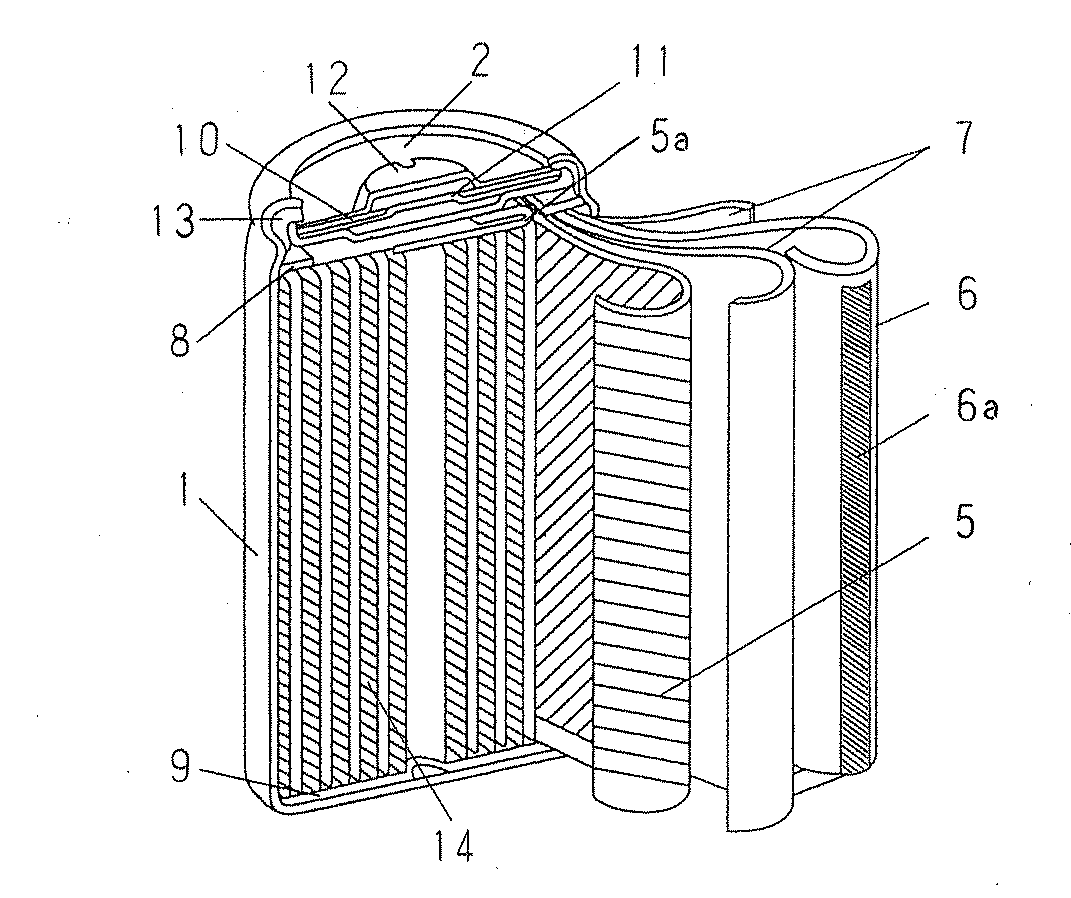
(表1)からわかるように、温度ヒューズを、極板群14の最外周に配置した負極の金属リード端子6aと対向する電池ケース1側面の外側に接触させて構成した実施例1の円筒型リチウムイオン二次電池は、温度ヒューズの作動温度が低く、電池表面温度の最高到達温度も低いことが確認できた。
As can be seen from (Table 1), the cylindrical type of Example 1 in which the thermal fuse is configured to be in contact with the outside of the side surface of the battery case 1 facing the negative electrode
これは、過充電試験時の電流により負極の金属リード端子6aを優先的に発熱させ、さらにこの負極の金属リード端子6aの発熱を、負極の金属リード端子6aと対向する電池ケース1側面の外側に接触させた温度ヒューズが感度良く感知したためと考えられる。
This preferentially causes the negative
一方、温度ヒューズの配置を、実施例1の位置から、円筒型の電池ケース1の外周円に沿って約90度ずらして構成した比較例1の円筒型リチウムイオン二次電池は、実施例1の円筒型リチウムイオン二次電池と比べて温度ヒューズの作動温度が高く、電池表面温度の最高到達温度も高くなった。 On the other hand, the cylindrical lithium ion secondary battery of Comparative Example 1 in which the arrangement of the thermal fuse is shifted from the position of Example 1 by about 90 degrees along the outer circumference of the cylindrical battery case 1 is the same as that of Example 1. Compared with the cylindrical lithium-ion secondary battery, the operating temperature of the thermal fuse was higher, and the maximum temperature of the battery surface temperature was also higher.
これは、比較例1の構成では負極の金属リード端子6aと温度ヒューズとが離れているためと考えられる。また、過充電試験時の電流により発熱した負極の金属リード端子6aの熱は、電池ケース側面を伝達して温度ヒューズに伝わるため、電池ケース1によって熱が放熱されたためと考えられる。
This is presumably because the negative electrode
以上より、負極の金属リード端子6aを正極の金属リード端子5aの電気伝導率よりも小さい部材とし、かつ、この負極の金属リード端子6aを極板群14の最外周に配置し、温度ヒューズなどの安全保護素子を負極の金属リード端子6aと対向する電池ケース1側面の外側に接触させることにより、安全保護素子を効率的に作動させることができることがわかった。
As described above, the negative
これは、これは二次電池内に電流が流れた際に、電気伝導率が小さい負極の金属リード端子6aを集中して発熱させるという作用効果により達成できるものである。この作用効果は、過充電時だけでなく、二次電池が内部短絡するようなことがあった場合においても、二次電池内に瞬時に流れる大電流を負極の金属リード端子6aの発熱により早いタイミングで感知できるため有用である。
This can be achieved by the effect of concentrating and generating heat at the negative
なお、実施例1は、負極の金属リード端子6aを覆うように短冊状のポリプロピレン樹脂製の絶縁テープを貼り付けたが、絶縁テープを貼り付けず、負極の金属リード端子6a
と電池ケース1側面の内側を直接接触させたほうがより効果があることを確認した。
In Example 1, a strip-shaped polypropylene resin insulating tape was attached so as to cover the negative
It was confirmed that it was more effective to directly contact the inside of the battery case 1 side.
また、実施例1は、極板群14の最外周にセパレータ7を捲回しなかったが、極板群14の最外周にセパレータ7を1〜2周捲回しても、実施例1と比べて温度ヒューズの作動温度は若干高くなるものの効果があることを確認した。
Further, in Example 1, the
本発明によれば、高エネルギー密度化を図った二次電池においても、安全保護素子が効率的に作動する安全性に優れた二次電池を提供することができるため、ポータブル用電子機器等の電源として有用である。 According to the present invention, even in a secondary battery with high energy density, it is possible to provide a secondary battery excellent in safety in which a safety protection element operates efficiently. Useful as a power source.
1 電池ケース
2 封口体
5 正極板
5a 正極の金属リード端子
6 負極板
6a 負極の金属リード端子
7 セパレータ
8 上部絶縁リング
9 下部絶縁板
10 PTC素子
11 防爆弁
12 正極外部端子
13 ガスケット
14 極板群
DESCRIPTION OF SYMBOLS 1
Claims (2)
前記負極板と電池ケースとを電気的に接続する負極の金属リード端子を、前記正極板と封口体とを電気的に接続する正極の金属リード端子の電気伝導率よりも小さい部材とし、かつ、負極の金属リード端子を極板群の最外周に配置し、この負極の金属リード端子と対向する電池ケース側面の外側に前記安全保護素子を接触させた二次電池。 An active material layer, and an electrode plate group formed by winding a negative electrode plate made of a strip-shaped metal foil with a metal lead terminal welded to an exposed portion provided in at least a part of the active material layer, and a positive electrode plate, with a separator interposed therebetween. A battery case containing an electrolyte solution therein and a sealing body that seals the opening of the battery case, electrically connected to a safety protection element that operates by sensing temperature,
A negative electrode metal lead terminal that electrically connects the negative electrode plate and the battery case, and a member that is smaller than the electrical conductivity of the positive electrode metal lead terminal that electrically connects the positive electrode plate and the sealing body; and A secondary battery in which a metal lead terminal of a negative electrode is disposed on the outermost periphery of a group of electrode plates, and the safety protection element is in contact with the outside of the side surface of the battery case facing the metal lead terminal of the negative electrode.
Priority Applications (1)
| Application Number | Priority Date | Filing Date | Title |
|---|---|---|---|
| JP2008054427A JP2009211971A (en) | 2008-03-05 | 2008-03-05 | Secondary battery |
Applications Claiming Priority (1)
| Application Number | Priority Date | Filing Date | Title |
|---|---|---|---|
| JP2008054427A JP2009211971A (en) | 2008-03-05 | 2008-03-05 | Secondary battery |
Publications (1)
| Publication Number | Publication Date |
|---|---|
| JP2009211971A true JP2009211971A (en) | 2009-09-17 |
Family
ID=41184919
Family Applications (1)
| Application Number | Title | Priority Date | Filing Date |
|---|---|---|---|
| JP2008054427A Pending JP2009211971A (en) | 2008-03-05 | 2008-03-05 | Secondary battery |
Country Status (1)
| Country | Link |
|---|---|
| JP (1) | JP2009211971A (en) |
Cited By (1)
| Publication number | Priority date | Publication date | Assignee | Title |
|---|---|---|---|---|
| CN114552046A (en) * | 2020-11-20 | 2022-05-27 | 北京小米移动软件有限公司 | A lithium-ion battery and electronic equipment |
-
2008
- 2008-03-05 JP JP2008054427A patent/JP2009211971A/en active Pending
Cited By (1)
| Publication number | Priority date | Publication date | Assignee | Title |
|---|---|---|---|---|
| CN114552046A (en) * | 2020-11-20 | 2022-05-27 | 北京小米移动软件有限公司 | A lithium-ion battery and electronic equipment |
Similar Documents
| Publication | Publication Date | Title |
|---|---|---|
| JP5420888B2 (en) | battery | |
| JP5264099B2 (en) | Nonaqueous electrolyte secondary battery | |
| EP2639876B1 (en) | Nonaqueous electrolyte secondary battery | |
| JP4236308B2 (en) | Lithium ion battery | |
| JP6439839B2 (en) | Nonaqueous electrolyte secondary battery | |
| WO2012042830A1 (en) | Nonaqueous electrolyte secondary battery | |
| JP6346178B2 (en) | Nonaqueous electrolyte secondary battery | |
| KR20170032456A (en) | Nonaqueous electrolyte battery and battery pack | |
| JP6064615B2 (en) | Non-aqueous electrolyte secondary battery and manufacturing method thereof | |
| JP2007103356A (en) | Non-aqueous secondary battery | |
| JP4304924B2 (en) | battery | |
| JP7209196B2 (en) | Cylindrical secondary battery | |
| JP2013201094A (en) | Nonaqueous electrolyte secondary battery | |
| JP5094084B2 (en) | Nonaqueous electrolyte secondary battery | |
| JP2009259749A (en) | Nonaqueous electrolyte secondary battery | |
| JP4867213B2 (en) | Method for producing non-aqueous electrolyte secondary battery | |
| WO2020137818A1 (en) | Non-aqueous electrolyte secondary battery and method for manufacturing same | |
| KR20130131983A (en) | Secondary battery comprising apparatus for preventing overcharge | |
| JP2008027831A (en) | battery | |
| JP5755870B2 (en) | Positive electrode for secondary battery, secondary battery, and method for producing positive electrode for secondary battery | |
| EP3905413B1 (en) | Non-aqueous electrolyte secondary battery | |
| JP3700683B2 (en) | Non-aqueous electrolyte secondary battery | |
| JP2008226828A (en) | Non-aqueous electrolyte secondary battery | |
| JP2009295554A (en) | Battery | |
| JP2006302509A (en) | battery |