JP2005290585A - Temperature-controlled textile product and manufacturing method thereof - Google Patents
Temperature-controlled textile product and manufacturing method thereof Download PDFInfo
- Publication number
- JP2005290585A JP2005290585A JP2004104331A JP2004104331A JP2005290585A JP 2005290585 A JP2005290585 A JP 2005290585A JP 2004104331 A JP2004104331 A JP 2004104331A JP 2004104331 A JP2004104331 A JP 2004104331A JP 2005290585 A JP2005290585 A JP 2005290585A
- Authority
- JP
- Japan
- Prior art keywords
- temperature
- thin film
- textile product
- conductive
- fiber
- Prior art date
- Legal status (The legal status is an assumption and is not a legal conclusion. Google has not performed a legal analysis and makes no representation as to the accuracy of the status listed.)
- Pending
Links
Images
Landscapes
- Knitting Of Fabric (AREA)
- Chemical Or Physical Treatment Of Fibers (AREA)
Abstract
Description
本発明は温度制御繊維製品及びその製造方法に関するものであり、特に均一的に発熱することができる上、繊維製品従来の特質を維持することができる温度制御繊維製品及びその製造方法に関するものである。 The present invention relates to a temperature-controlled fiber product and a method for manufacturing the same, and more particularly to a temperature-controlled fiber product that can generate heat uniformly and maintain the conventional characteristics of the fiber product and a method for manufacturing the same. .
繊維製品のハイテク化は紡績技術の主流になりつつある。20世紀80年代以降から、ハイテク繊維製品が繊維製品市場の全体に占める比率は成長しつつある。資料によると、最近5年間、技術先進国家におけるハイテク繊維製品の市場シェアは2倍強の増加を示した。ヨーロッパー繊維製品市場におけるハイテク繊維製品の市場シェアは40%を上回っている。現在、ハイテク繊維製品の主な製品は高性能化学繊維、高技術産業用の繊維製品、特殊医療と保健用の繊維製品などがある。これらのハイテク繊維製品の応用範囲は、国防、航空宇宙、水利、自動車製造、医療、農業などの分野を幅広く含む。このため、紡績技術に対する要求も高めた。 High-tech textile products are becoming mainstream in spinning technology. Since the 20th century, the proportion of high-tech textile products in the textile market has been growing. According to materials, over the last five years, the market share of high-tech textile products in technologically advanced countries has more than doubled. The market share of high-tech textile products in the European textile market is over 40%. Currently, the main products of high-tech fiber products include high-performance chemical fibers, textile products for high-tech industries, and textile products for special medical and health use. The range of application of these high-tech textile products includes a wide range of fields such as national defense, aerospace, water use, automobile manufacturing, medical care and agriculture. For this reason, the demand for spinning technology has increased.
これらのハイテク繊維製品の中で、より良い保温効果のある発熱繊維製品については、現在、様々な研究が行われている。その製品は防寒着、年配者や幼児の保健着、保温作業服またはダイビングスーツに応用できる。現在よく使われる技術には、下記の2つの技術がある。一つは導電金属線または加熱ユニットを繊維製品の内部に埋め込み、または充填する方法。もう一つは化学塗布プロセスを用いて繊維製品の表面に導熱物質を塗布する方法。 Among these high-tech fiber products, various researches are currently being conducted on heat-generating fiber products having a better heat retention effect. The product can be applied to winter clothes, elderly and infant health clothes, warm work clothes or diving suits. There are the following two technologies that are often used today. One is a method in which a conductive metal wire or a heating unit is embedded or filled in a textile product. The other is a method of applying a heat conductive material to the surface of a textile product using a chemical coating process.
繊維製品内部に導電金属線や加熱ユニットを埋め込み、または充填する技術で製造された製品は、電気毛布においてよく見られる。しかし、この技術はまだたくさんの問題が存在している。例として、使用する電気のパワー及び製品の電気抵抗は製品に充填された導電金属線の長さに比例して高くなる。そのため、この技術を応用した製品の発熱面積、発熱密度と発熱量は制限される。電気使用の安全性について、電気パワーや電気抵抗を引き上げて発熱量を高めようとする場合は、導電金属線の太さを倍増しなければならない。しかし、そうすると、着服の不快感を与えるため、この分野の応用が大幅に制限される。しかも、漏電などの安全問題も非常に大きい。製品の加工プロセスが煩雑のうえ、品質管理が極めて困難である。さらに、この技術で作られた繊維製品の加熱箇所は導電金属線や加熱ユニットに集中するため、温度分布を均一にすることには困難である。さらに、いったん紡績製品の導電金属線が断線すると、その繊維製品は発熱保温機能を失う。 Products manufactured with a technique of embedding or filling conductive metal wires or heating units inside textile products are often found in electric blankets. However, this technology still has many problems. As an example, the electric power used and the electrical resistance of the product increase in proportion to the length of the conductive metal wire filled in the product. Therefore, the heat generation area, heat generation density, and heat generation amount of products to which this technology is applied are limited. Regarding the safety of electricity use, when the electric power and electric resistance are raised to increase the heat generation amount, the thickness of the conductive metal wire must be doubled. However, doing so greatly limits the application in this area, as it causes discomfort in clothing. Moreover, safety problems such as electric leakage are very large. The product processing process is complicated and quality control is extremely difficult. Furthermore, since the heating part of the textile manufactured by this technique concentrates on a conductive metal wire or a heating unit, it is difficult to make the temperature distribution uniform. Furthermore, once the conductive metal wire of the spun product is broken, the fiber product loses its heat-generating and heat-retaining function.
一方、化学塗布プロセスを利用して繊維製品の表面に導熱物質を塗布する技術では、導電性のある粉末と樹脂を混練した後、溶剤または水を加えて溶液に溶かしてから、これを生地に塗布し導電導熱膜を形成させ、さらに、導電導熱膜の上に表面装飾品を覆って仕上げる。しかし、全製造過程に、大量の化学薬品を使用するため、環境汚染に繋がる。そのほか、導電性のある粉末と樹脂の混合溶液を均一的に生地に塗布することが困難な上、導電性のある粉末、樹脂、生地との間の付着状態も丈夫とは言えない。よって、均一に導熱するのが困難で、使用寿命も限られる。 On the other hand, in the technique of applying a heat conducting material to the surface of a textile product using a chemical coating process, after kneading conductive powder and resin, add solvent or water to dissolve in the solution, and then add this to the fabric. The conductive heat conductive film is formed by coating, and the surface decoration is covered on the conductive heat conductive film. However, a large amount of chemicals are used in the entire manufacturing process, which leads to environmental pollution. In addition, it is difficult to uniformly apply a mixed solution of conductive powder and resin to the cloth, and the state of adhesion between the conductive powder, resin, and cloth cannot be said to be strong. Therefore, it is difficult to conduct heat uniformly and the service life is limited.
本発明の目的は、繊維製品に均一な発熱効果を発揮できる上、繊維製品の有する特質を維持できる、温度制御繊維製品及びその製造方法を提供することにある。
また、本発明の他の目的は、膜層の発熱の利用が可能で、短絡の心配のない、温度制御繊維製品及びその製造方法を提供することにある。
さらに、本発明の他の目的は、製造過程が簡単で、環境汚染の問題がない、温度制御繊維製品及びその製造方法を提供することにある。
An object of the present invention is to provide a temperature-controlled fiber product and a method for producing the same that can exhibit a uniform heat generation effect on the fiber product and can maintain the characteristics of the fiber product.
Another object of the present invention is to provide a temperature-controlled fiber product and a method for manufacturing the same, which can use heat generated from the film layer and do not cause a short circuit.
Furthermore, another object of the present invention is to provide a temperature-controlled fiber product that is simple in the manufacturing process and free from environmental pollution problems, and a method for manufacturing the same.
本発明では、繊維製品の表面に物理真空蒸着法を利用し、繊維製品の表面に均一な導電発熱薄膜を形成させる。その材質としては、金属、金属合金、金属酸化物または/及び導電高分子などが使用される。さらに、導線エリアの上に、物理真空蒸着法を利用して低電気抵抗導電薄膜を形成する、その材質としては、銀または銅が使用される。次に、導電発熱薄膜と低電気抵抗導電薄膜の上に物理真空蒸着法を利用して絶縁保護膜を形成する、その材質としては酸化シリコンなどが使用される。 In the present invention, the physical vacuum vapor deposition method is used on the surface of the fiber product to form a uniform conductive heating thin film on the surface of the fiber product. As the material thereof, metal, metal alloy, metal oxide and / or conductive polymer are used. Furthermore, silver or copper is used as the material for forming a low electric resistance conductive thin film on the conductive wire area using physical vacuum deposition. Next, an insulating protective film is formed on the conductive heat generating thin film and the low electrical resistance conductive thin film using physical vacuum deposition, and silicon oxide or the like is used as the material thereof.
導電発熱薄膜、低電気抵抗導電薄膜と絶縁保護膜を形成する物理真空蒸着法を実行する前に、蒸着膜をよりよく形成するための繊維製品の表面を平坦させる表面処理を施す。表面処理の方法としては、繊維製品を表面処理剤を含んだ溶液中に浸す浸漬法などがある。表面処理剤として、フッ素撥水剤、フッ素撥水剤/架橋剤などが使用される。 Before the physical vacuum vapor deposition method for forming the conductive heat generating thin film, the low electrical resistance conductive thin film and the insulating protective film is performed, a surface treatment for flattening the surface of the textile product for better forming the vapor deposition film is performed. As a surface treatment method, there is an immersion method in which a textile product is immersed in a solution containing a surface treatment agent. As the surface treatment agent, a fluorine water repellent, a fluorine water repellent / crosslinking agent, or the like is used.
導電発熱薄膜と低電気抵抗導電薄膜を夫々別の繊維製品の表面に形成してから、ニット方式でもって両者を組み合わせることもできる。 The conductive heat generating thin film and the low electrical resistance conductive thin film can be formed on the surface of different textile products, and then both can be combined by the knit method.
複数層の導電発熱薄膜と低電気抵抗導電薄膜に覆われた繊維製品を重ねることによって、より良い発熱效果を発揮できる。 A better heat generation effect can be achieved by stacking a plurality of conductive heat generating thin films and a textile product covered with a low electrical resistance conductive thin film.
本発明によれば、繊維製品の表面に均一に導電発熱蒸着膜を製造することができ、その膜の厚みは0.1〜10マイクロメートルである。よって、一枚の繊維製品を均一に、かつ恒温的に発熱させることができ、局部が過熱するという問題が存在しない。そのほか、導線と絶縁保護層ともに物理真空蒸着法を利用して形成され、膜厚は10マイクロメートル以下であるため、繊維製品全体は本来の特質を維持できる。裁縫により、さまざまな衣類に加工することができる。製造された温度制御繊維製品は12ボルト以下またはそれに等しい低電圧のみを消費するため、携帯性が向上する。 According to the present invention, a conductive exothermic vapor deposition film can be produced uniformly on the surface of a textile product, and the thickness of the film is 0.1 to 10 micrometers. Therefore, a single fiber product can generate heat uniformly and at a constant temperature, and there is no problem of local overheating. In addition, since both the conductive wire and the insulating protective layer are formed using physical vacuum deposition and the film thickness is 10 micrometers or less, the entire textile product can maintain its original characteristics. It can be processed into various clothes by sewing. The manufactured temperature-controlled textile product consumes only a low voltage of 12 volts or less, which improves portability.
従って、本発明は、製造過程が簡単かつ環境汚染が発生しない、生産された繊維製品は膜層による発熱を利用するため、均一に発熱させる効果があり、短絡する恐れがない、さらに、繊維製品本来の特質を維持できる、温度制御繊維製品及びその製造方法を提供することになる。 Therefore, the present invention is simple in manufacturing process and does not cause environmental pollution. The produced fiber product uses the heat generated by the film layer, and therefore has an effect of uniformly generating heat, and there is no risk of short circuiting. A temperature-controlled fiber product that can maintain its original characteristics and a method for producing the same are provided.
本発明の効果として、下記のメリットが期待できる。
1.12ボルトより少ないまたはこれに等しい低電圧電源で、繊維製品全体を一定の恒温範囲に維持できるほか、局部を過熱することがない。
2.導電発熱材質は繊維製品の表面に均一に蒸着膜を形成するため、温度制御繊維製品はなお柔軟で体にフィットでき、裁縫により様々な衣類に仕上げることができる。
3.導電発熱材質と導線材質ともに繊維製品の表面の蒸着膜であるため、導電回路と導電接点の破損問題が起きなく、温度制御繊維製品の使用寿命が大幅に延長される。
4.導電発熱材質と導線材質ともに繊維製品の表面の蒸着膜であるため、それぞれの厚みが薄い。よって、温度制御繊維製品の重量と厚みを減少でき、使用するときの快適感が向上できる。
5.12〜14ボルトの低電圧の電源を使用するため、一般の乾電池が電源として使え、その携帯性が向上できる。
6.さらに、多層の導電発熱薄膜と低電気抵抗導電薄膜を蒸着した繊維織物を重ねて組み合わせることによって、より良い発熱效果を発揮できる。
As the effect of the present invention, the following merits can be expected.
A low voltage power supply of less than or equal to 1.12 volts can keep the entire textile in a constant temperature range and does not overheat the local area.
2. Since the conductive heat-generating material uniformly forms a vapor deposition film on the surface of the textile product, the temperature-controlled textile product is still flexible and fits the body, and can be finished into various clothes by sewing.
3. Since both the conductive heat generating material and the conductive wire material are vapor-deposited films on the surface of the fiber product, the problem of damage to the conductive circuit and the conductive contact does not occur, and the service life of the temperature control fiber product is greatly extended.
4). Since both the conductive heat generating material and the conductive wire material are vapor-deposited films on the surface of the textile product, the respective thicknesses are thin. Therefore, the weight and thickness of the temperature-controlled fiber product can be reduced, and the comfort when used can be improved.
5. Since a low voltage power source of 12 to 14 volts is used, a general dry battery can be used as a power source, and the portability can be improved.
6). In addition, a better heat generation effect can be exhibited by combining the fiber fabrics on which the multilayer conductive heat generating thin film and the low electrical resistance conductive thin film are deposited.
温度制御繊維製品及びその製造方法1
本発明の好ましい実施例によると、繊維製品を物理真空蒸着室に入れ、真空度10−7〜10−5トールで、0.1〜1.2キロワットのパワーを用いて、ここで金属、金属合金、金属酸化物などの導電発熱可能な材料のプラズマを発生させる。このときに、20〜35sccmのアルゴン(Ar)を注入し、物理真空蒸着室中の操作圧力を2×10⁻³〜4×10⁻³トール前後に維持する。そして、摂氏100〜150度の温度で、繊維製品の表面に均一様に膜厚0.1〜10マイクロメートルの導電発熱蒸着膜を蒸着する。導電発熱蒸着膜完成した後、温度制御繊維製品が得られる。さらに、繊維製品の表面に遮蔽シートで導電発熱エリアを覆い、導線エリアだけを露出させる。物理真空蒸着法を利用して、その表面に、低電気抵抗の金属を蒸着して、外部の電源及びコントローラーと接続するための導線として作り上げる。また、低電気抵抗の金属は他の繊維製品に蒸着してから、ニット法などを用いて2枚の繊維製品を接続する。そして、繊維製品の表面に物理真空蒸着法を利用して酸化ケイ素を蒸着して、絶縁保護層として作り上げる。
Temperature control fiber product and manufacturing method 1
According to a preferred embodiment of the present invention, the textile product is placed in a physical vacuum deposition chamber, with a vacuum of 10 −7 to 10 −5 torr and a power of 0.1 to 1.2 kilowatts, where metal, metal Plasma of materials capable of generating heat such as alloys and metal oxides is generated. At this time, 20 to 35 sccm of argon (Ar) is injected, and the operation pressure in the physical vacuum deposition chamber is maintained at around 2 × 10 −3 to 4 × 10 −3 Torr. Then, a conductive exothermic vapor deposition film having a film thickness of 0.1 to 10 micrometers is deposited uniformly on the surface of the fiber product at a temperature of 100 to 150 degrees Celsius. After completion of the conductive heat-deposited film, a temperature-controlled fiber product is obtained. Further, the conductive heat generation area is covered with a shielding sheet on the surface of the textile product, and only the conductive wire area is exposed. Using a physical vacuum vapor deposition method, a metal with low electrical resistance is vapor deposited on the surface to create a conductor for connection to an external power source and controller. Also, the metal with low electrical resistance is deposited on other textile products, and then the two textile products are connected using a knit method or the like. Then, silicon oxide is vapor-deposited on the surface of the fiber product using a physical vacuum vapor deposition method to form an insulating protective layer.
繊維製品として、糸、編み方により各種製品(織物や編み物など)または不織布などが使用される。また、その材質として、ポリエステル繊維、ポリプロピレン繊維、ナイロン繊維またはその他利用可能な人造繊維などが使用される。導電発熱蒸着膜の材質として、ニッケル、ニッケル・クロム合金、酸化ケイ素、インジウムスズの酸化物、酸化チタンなどが使用される。導線の材質として、銅または銀が使用される。 As the fiber product, various products (woven fabric, knitted fabric, etc.) or non-woven fabric are used depending on the yarn and knitting method. Further, as the material, polyester fiber, polypropylene fiber, nylon fiber, or other usable artificial fibers are used. Nickel, nickel-chromium alloy, silicon oxide, indium tin oxide, titanium oxide, or the like is used as a material for the conductive heat-deposited film. Copper or silver is used as the material of the conducting wire.
以下本発明の温度制御繊維製品及びその製造方法1について実施例を用いて詳しい説明するがこれらは本発明を何ら限定するものではない。 Hereinafter, although the temperature control textiles of the present invention and its manufacturing method 1 are explained in detail using an example, these do not limit the present invention at all.
蒸着対象物はポリエステル不織布とし、導電発熱物と導線の蒸着材料はそれぞれニッケル・クロム合金と銀を用いる。
蒸着対象物をポリプロピレン不織布とし、導電発熱物と導線の蒸着材料はそれぞれニッケル・クロム合金と銅を用いる。
蒸着対象物をポリエステル織物とし、導電発熱物の蒸着材料はそれぞれニッケル・クロム合金またはニッケルを使用し、導線の蒸着材料は銀または銅を用いる。
温度制御繊維製品及びその製造方法2
本発明の他の好ましい実施例によると、まずは繊維製品に表面処理を施して、製品の表面の繊維交叉する凹凸表面を平坦させる。これによって、その後物理真空蒸着法により、連続した平面導電体を形成して導電発熱をよりよくする。そして、繊維製品を物理真空蒸着室に入れて、真空度10−7〜10−5トールで、0.1〜1.2キロワットのパワーを用いて物理真空蒸着室の中で、金属、金属合金、金属酸化物などの導電発熱可能な材料のプラズマを発生させる。このときに、20〜35sccmのアルゴン(Ar)を注入し、物理真空蒸着室中の操作圧力を2×10⁻³〜4×10⁻³トール前後に維持する。そして、摂氏100〜150度の温度で、繊維製品の表面に均一的に膜厚0.1〜10マイクロメートルの導電発熱蒸着膜を蒸着する。導電発熱蒸着膜完成した後、温度制御繊維製品が得られる。さらに、繊維製品の表面に遮蔽シートで導電発熱エリアを覆い、導線エリアだけを露出させる。物理真空蒸着法を利用して、その表面に、低電気抵抗の金属を蒸着して、外部の電源及びコントローラと接続するための導線として作り上げる。また、低電気抵抗の金属は他の繊維製品に蒸着してから、ニット法などを用いて2枚の繊維製品を接続する。そして、繊維製品の表面に物理真空蒸着法を利用して酸化ケイ素を蒸着して、絶縁保護層として作り上げる。
Temperature control fiber product and manufacturing method 2
According to another preferred embodiment of the present invention, the fiber product is first subjected to a surface treatment to flatten the surface of the product where the fibers intersect. Thus, a continuous planar conductor is formed thereafter by physical vacuum vapor deposition to improve conduction heat generation. Then, the fiber product is put into a physical vacuum deposition chamber, and a metal, metal alloy is used in the physical vacuum deposition chamber at a vacuum degree of 10 −7 to 10 −5 Torr and a power of 0.1 to 1.2 kilowatts. A plasma of a material capable of generating heat such as a metal oxide is generated. At this time, 20 to 35 sccm of argon (Ar) is injected, and the operation pressure in the physical vacuum deposition chamber is maintained at around 2 × 10 −3 to 4 × 10 −3 Torr. Then, a conductive exothermic vapor deposition film having a thickness of 0.1 to 10 micrometers is uniformly deposited on the surface of the fiber product at a temperature of 100 to 150 degrees Celsius. After completion of the conductive heat-deposited film, a temperature-controlled fiber product is obtained. Further, the conductive heat generation area is covered with a shielding sheet on the surface of the textile product, and only the conductive wire area is exposed. Using a physical vacuum deposition method, a metal having a low electrical resistance is deposited on the surface of the metal to form a lead wire for connection to an external power source and controller. Also, the metal with low electrical resistance is deposited on other textile products, and then the two textile products are connected using a knit method or the like. Then, silicon oxide is vapor-deposited on the surface of the fiber product using a physical vacuum vapor deposition method to form an insulating protective layer.
繊維製品として、糸、編み方により各種製品(織物や編み物など)または不織布などが使用される。また、その材質として、ポリエステル繊維、ポリプロピレン繊維、ナイロン繊維またはその他利用可能な人造繊維などが使用される。導電発熱蒸着膜の材質として、ニッケル、ニッケル・クロム合金、酸化ケイ素、インジウムスズの酸化物、酸化チタンなどが使用される。導線の材質として、銅または銀が使用される。 As the fiber product, various products (woven fabric, knitted fabric, etc.) or non-woven fabric are used depending on the yarn and knitting method. Further, as the material, polyester fiber, polypropylene fiber, nylon fiber, or other usable artificial fibers are used. Nickel, nickel-chromium alloy, silicon oxide, indium tin oxide, titanium oxide, or the like is used as a material for the conductive heat-deposited film. Copper or silver is used as the material of the conducting wire.
表面処理の方法としては、繊維製品を表面処理剤を含んだ溶液中に浸す浸漬法などがある。表面処理剤として、フッ素撥水剤またはフッ素撥水剤と架橋剤両方などが使用される。表面処理剤溶液の表面張力は5〜70erg/cm2が好ましく、さらに好ましいのは10〜30erg/cm2である。前記架橋剤(ポリウレタンまたはエチルオキシドとエステル系活性剤より構成された防水乳剤など)は製品の経緯の隙間を接続して、製品の表面をより平坦にし、導電発熱蒸着膜材料がその上に「面状導体」をよりよく形成させる。 As a surface treatment method, there is an immersion method in which a textile product is immersed in a solution containing a surface treatment agent. As the surface treatment agent, a fluorine water repellent or both a fluorine water repellent and a crosslinking agent are used. The surface tension of the surface treating agent solution is preferably 5 to 70 erg / cm 2 , more preferably 10 to 30 erg / cm 2 . The cross-linking agent (such as a waterproof emulsion composed of polyurethane or ethyl oxide and an ester activator) connects the background of the product to make the surface of the product more flat, and the conductive heat-generating vapor deposition film material is `` Better formation of "planar conductor".
以下本発明の温度制御繊維製品及びその製造方法2について実施例を用いて詳しい説明するがこれらは本発明を何ら限定するものではない。 Hereinafter, although the temperature control textiles of the present invention and its manufacturing method 2 are explained in detail using an example, these do not limit the present invention at all.
蒸着対象物はポリエステル織物、表面処理剤は防水乳剤(エチルオキシド及びエステル系活性剤)、導電発熱物の蒸着材料はニッケル、そして導線の蒸着材料は銀または銅それぞれが使用される。
温度制御繊維製品システム
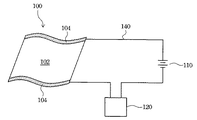
図1に示したものは、本発明の一実施例による温度制御繊維製品システムの略図である。図1に示したように、温度制御繊維製品100の表面に、蒸着材質によって二つのエリアに分られる。一つは導電発熱エリア102、もう一つは導線エリア104。その上に、導電発熱蒸着膜と導線がそれぞれ覆われる。温度制御繊維製品100表面の導線エリア104から電線140が引き出され、電源110とコントローラー120に接続させ、温度制御繊維製品システム全体を構成する。電源110は温度制御繊維製品100に必要な電気を供給する。本システムは12ボルト以下またはこれに等しい低電圧で、900cm2ぐらいの温度制御繊維製品100を摂氏10度に上昇することができる。制御システム120は、温度制御繊維製品100に供給する電流量を制御して、温度制御繊維製品100の発熱温度を制御することができる。温度制御繊維製品100の温度は最大摂氏40±5度前後に恒温維持することができる。温度制御精度約±0.5℃で、しかも温度制御繊維製品100の温度分布が均一で、局部過熱されることはない。
Temperature Controlled Textile System FIG. 1 is a schematic diagram of a temperature controlled textile product system according to one embodiment of the present invention. As shown in FIG. 1, the surface of the temperature-controlled
一つ好ましい実施例として、温度制御繊維製品100の導電発熱エリア102の面積900cm2、その表面に蒸着される導電発熱蒸着膜材質をニッケルとし、温度制御繊維製品100の導線エリア104に蒸着した導線材質を銀とし、電源110から供給される電力約12ボルトとする。定電圧12ボルトの温度上昇パターンにおける昇温結果は、下表を参照ください。
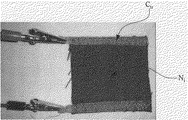
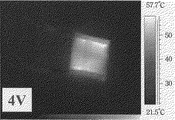
図2Aは、前記製造方法1により生産された温度制御繊維製品である。図1の導電発熱エリアに相当する場所に蒸着されたのはニッケルで、導線エリアに蒸着されたのは銅で、蒸着対象物の繊維製品の材質はポリエステル織物である。図2Bはこの温度制御繊維製品を4ボルトの電源につないで発熱させた後、赤外線カメラで写した映像である。図2Bに示したように、発熱面積の分布は均一的に摂氏49〜52度の前後である。 FIG. 2A is a temperature-controlled fiber product produced by the manufacturing method 1. Nickel was deposited in a location corresponding to the conductive heat generation area in FIG. 1, copper was deposited in the conductive wire area, and the material of the textile product to be deposited was polyester fabric. FIG. 2B is an image taken with an infrared camera after the temperature-controlled textile product is connected to a 4-volt power source to generate heat. As shown in FIG. 2B, the heat generation area distribution is uniformly around 49 to 52 degrees Celsius.
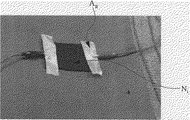
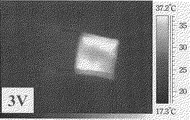
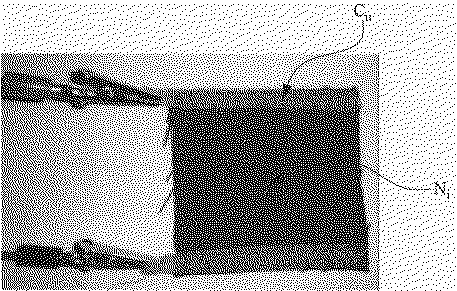
図3Aは製造方法2により生産された温度制御繊維製品である。図1の導電発熱エリアに相当する場所に蒸着されたのはニッケルで、導線エリアに蒸着されたのは銀で、蒸着対象物の繊維製品の材質はポリエステル織物である。図3Bはこの温度制御繊維製品を3ボルトの電源につないで発熱させた後、赤外線カメラで写した映像である。図3Bに示したように、発熱面積の分布は均一的に摂氏33〜37度の前後である。 FIG. 3A shows a temperature-controlled fiber product produced by the production method 2. The nickel deposited on the conductive heat generation area shown in FIG. 1 is silver, the silver deposited on the conductor area is silver, and the material of the textile product to be deposited is polyester fabric. FIG. 3B is an image taken with an infrared camera after the temperature-controlled textile product is connected to a 3-volt power source to generate heat. As shown in FIG. 3B, the heat generation area distribution is uniformly around 33 to 37 degrees Celsius.
本発明の技術思想範囲内で様々な応用実施が可能であり、このような応用実施も本発明の権利範囲に含まれるものと理解されるべきである。 Various application implementations are possible within the scope of the technical idea of the present invention, and it should be understood that such application implementations are also included in the scope of rights of the present invention.
100 温度制御繊維製品
102 導電発熱エリア
104 導線エリア
110 電源
120 コントローラー
140 電線
100 Temperature
Claims (35)
25. The temperature-controlled textile product according to claim 24, further comprising a laminate of a textile product covered with a plurality of layers of conductive heat generating thin film and a low electrical resistance conductive thin film.
Priority Applications (1)
| Application Number | Priority Date | Filing Date | Title |
|---|---|---|---|
| JP2004104331A JP2005290585A (en) | 2004-03-31 | 2004-03-31 | Temperature-controlled textile product and manufacturing method thereof |
Applications Claiming Priority (1)
| Application Number | Priority Date | Filing Date | Title |
|---|---|---|---|
| JP2004104331A JP2005290585A (en) | 2004-03-31 | 2004-03-31 | Temperature-controlled textile product and manufacturing method thereof |
Publications (1)
| Publication Number | Publication Date |
|---|---|
| JP2005290585A true JP2005290585A (en) | 2005-10-20 |
Family
ID=35323838
Family Applications (1)
| Application Number | Title | Priority Date | Filing Date |
|---|---|---|---|
| JP2004104331A Pending JP2005290585A (en) | 2004-03-31 | 2004-03-31 | Temperature-controlled textile product and manufacturing method thereof |
Country Status (1)
| Country | Link |
|---|---|
| JP (1) | JP2005290585A (en) |
Cited By (5)
| Publication number | Priority date | Publication date | Assignee | Title |
|---|---|---|---|---|
| WO2006081622A1 (en) * | 2005-02-03 | 2006-08-10 | Australian Wool Innovation Limited | Fibre coating composition |
| JP2010037681A (en) * | 2008-08-05 | 2010-02-18 | Toyobo Specialties Trading Co Ltd | Woven or knitted fabric for clothing |
| WO2013182568A2 (en) | 2012-06-06 | 2013-12-12 | Cht R. Beitlich Gmbh | Textile auxiliary agent and textile product finished therewith |
| CN109338576A (en) * | 2018-10-24 | 2019-02-15 | 迦南(福建)新材料科技有限公司 | A kind of honeycomb fabric and its manufacture craft |
| US11952657B2 (en) | 2019-05-23 | 2024-04-09 | Milliken & Company | Stain hiding fabric with metallic coating |
Citations (8)
| Publication number | Priority date | Publication date | Assignee | Title |
|---|---|---|---|---|
| JPS6076338A (en) * | 1983-10-04 | 1985-04-30 | カルソニックカンセイ株式会社 | Ornamental resin molding |
| JPS6235828U (en) * | 1985-08-19 | 1987-03-03 | ||
| JPS6330243A (en) * | 1986-07-25 | 1988-02-08 | 東レ株式会社 | Heat-insulating sheet |
| JPH01235181A (en) * | 1988-03-15 | 1989-09-20 | Matsushita Electric Works Ltd | Transparent plane-shaped heating element |
| JPH01285212A (en) * | 1988-05-13 | 1989-11-16 | Matsushita Electric Ind Co Ltd | Cloth made electric warmer |
| JPH02296186A (en) * | 1989-05-10 | 1990-12-06 | Kawaguchiko Seimitsu Kk | Dial plate for timepiece and manufacture thereof |
| JPH07173610A (en) * | 1993-08-02 | 1995-07-11 | Agency Of Ind Science & Technol | Transparent electric conductive ultrathin film and production thereof |
| JP2002264271A (en) * | 2001-03-08 | 2002-09-18 | Teijin Ltd | Polymer resin laminate |
-
2004
- 2004-03-31 JP JP2004104331A patent/JP2005290585A/en active Pending
Patent Citations (8)
| Publication number | Priority date | Publication date | Assignee | Title |
|---|---|---|---|---|
| JPS6076338A (en) * | 1983-10-04 | 1985-04-30 | カルソニックカンセイ株式会社 | Ornamental resin molding |
| JPS6235828U (en) * | 1985-08-19 | 1987-03-03 | ||
| JPS6330243A (en) * | 1986-07-25 | 1988-02-08 | 東レ株式会社 | Heat-insulating sheet |
| JPH01235181A (en) * | 1988-03-15 | 1989-09-20 | Matsushita Electric Works Ltd | Transparent plane-shaped heating element |
| JPH01285212A (en) * | 1988-05-13 | 1989-11-16 | Matsushita Electric Ind Co Ltd | Cloth made electric warmer |
| JPH02296186A (en) * | 1989-05-10 | 1990-12-06 | Kawaguchiko Seimitsu Kk | Dial plate for timepiece and manufacture thereof |
| JPH07173610A (en) * | 1993-08-02 | 1995-07-11 | Agency Of Ind Science & Technol | Transparent electric conductive ultrathin film and production thereof |
| JP2002264271A (en) * | 2001-03-08 | 2002-09-18 | Teijin Ltd | Polymer resin laminate |
Cited By (7)
| Publication number | Priority date | Publication date | Assignee | Title |
|---|---|---|---|---|
| WO2006081622A1 (en) * | 2005-02-03 | 2006-08-10 | Australian Wool Innovation Limited | Fibre coating composition |
| JP2010037681A (en) * | 2008-08-05 | 2010-02-18 | Toyobo Specialties Trading Co Ltd | Woven or knitted fabric for clothing |
| WO2013182568A2 (en) | 2012-06-06 | 2013-12-12 | Cht R. Beitlich Gmbh | Textile auxiliary agent and textile product finished therewith |
| DE102012209598A1 (en) | 2012-06-06 | 2013-12-12 | Cht R. Beitlich Gmbh | Textile auxiliaries and thus refined textile product |
| CN109338576A (en) * | 2018-10-24 | 2019-02-15 | 迦南(福建)新材料科技有限公司 | A kind of honeycomb fabric and its manufacture craft |
| US11952657B2 (en) | 2019-05-23 | 2024-04-09 | Milliken & Company | Stain hiding fabric with metallic coating |
| US12091747B2 (en) | 2019-05-23 | 2024-09-17 | Milliken & Company | Stain hiding fabric with metallic coating |
Similar Documents
| Publication | Publication Date | Title |
|---|---|---|
| Zhang et al. | Transforming commercial textiles and threads into sewable and weavable electric heaters | |
| US6720539B2 (en) | Woven thermal textile | |
| US20190230745A1 (en) | Electrically-heated fiber, fabric, or textile for heated apparel | |
| JP2019505699A (en) | Heatable garment, cloth for such garment, and method of making | |
| WO2007126743A1 (en) | Electrically conductive water repellant fabric composite | |
| KR102116546B1 (en) | Electrical Heating Gloves using Textile with Graphene/PVDF-HFP Composite by Various Circuit Patterning Conditions | |
| Pragya et al. | Designing and investigation of braided-cum-woven structure for wearable heating textile | |
| JP5842666B2 (en) | Cloth pressure sensor heater | |
| JP3820855B2 (en) | Planar heating element and vehicle seat heater using the same | |
| CN109661049A (en) | Active flexible heating body and preparation method and application thereof | |
| CN201967157U (en) | Flexible heating element | |
| CN118048709A (en) | A thermally conductive and electrically insulating fiber for wearable therapeutic equipment and a preparation process thereof | |
| CN209798101U (en) | Heatable thermal garment material | |
| TWI282387B (en) | Temperature-controlled textile and method producing the same | |
| CN209906872U (en) | A metal heating coating coating device on a soft material | |
| CN217693742U (en) | Flexible low-voltage electrothermal film | |
| TWI341880B (en) | Electrothermal textile | |
| CN208113000U (en) | A nanometer far-infrared carbon fiber heating sheet | |
| Pillai et al. | Joule heating fabrics | |
| TWM458829U (en) | Wearable dc warming apparatus | |
| KR100750874B1 (en) | Planar heating element manufacturing method | |
| CN101422075A (en) | Heatable textile fabric | |
| CN118727464A (en) | Heating fabric and method for preparing fabric products using the heating fabric | |
| CN111763921A (en) | A manufacturing method of a thermal clothing material and a thermal clothing material | |
| CN109162088B (en) | Graphene-modified conductive synthetic fiber and its preparation method and use |
Legal Events
| Date | Code | Title | Description |
|---|---|---|---|
| A977 | Report on retrieval |
Free format text: JAPANESE INTERMEDIATE CODE: A971007 Effective date: 20060315 |
|
| A131 | Notification of reasons for refusal |
Free format text: JAPANESE INTERMEDIATE CODE: A131 Effective date: 20060328 |
|
| A601 | Written request for extension of time |
Free format text: JAPANESE INTERMEDIATE CODE: A601 Effective date: 20060628 |
|
| A602 | Written permission of extension of time |
Free format text: JAPANESE INTERMEDIATE CODE: A602 Effective date: 20060703 |
|
| A521 | Written amendment |
Free format text: JAPANESE INTERMEDIATE CODE: A523 Effective date: 20060928 |
|
| RD02 | Notification of acceptance of power of attorney |
Free format text: JAPANESE INTERMEDIATE CODE: A7422 Effective date: 20060928 |
|
| A131 | Notification of reasons for refusal |
Free format text: JAPANESE INTERMEDIATE CODE: A131 Effective date: 20061017 |
|
| A02 | Decision of refusal |
Free format text: JAPANESE INTERMEDIATE CODE: A02 Effective date: 20070313 |